
History is rarely as tidy as the stories we tell about it. Places acquire names long before they acquire nations; peoples inherit memories they did not themselves create; languages, religions and identities change without ever quite erasing what came before. Palestine may be one of the world’s most conspicuous examples of this historical palimpsest, a place where ancient geography, successive civilisations and modern national identities have become so entangled that disentangling them can itself seem political.
That is partly why I have always valued William Dalrymple. He is a historian who understands that the past is inhabited by people, not merely populated by dates and events. His recent conversation about Palestine prompted me to revisit not only what he said, but what he left unsaid: the complicated process by which a population became a people, a geographical name acquired a modern national meaning, and history became memory – and memory, in turn, became identity.
It also led me back to a broader fascination of mine: the relationship between history, travel and place, and to writers who understand that landscapes are not backdrops to history but repositories of it.
Talking about Palestine and Palestinians
There are some historians whose books I buy almost automatically. British historian William Dalrymple is one of them. I have read many of his works over the years, from his debut, In Xanadu, through From the Holy Mountain, The Last Mughal, Return of a King and The Anarchy (see, in In That Howling Infinite, Bad company – how Britain conquered India, the story of the rise and fall of the notoriously rapacious British East India Company).
Dalrymple is well-educated, well-read, and well-travelled, having had his boots on the ground and its dust on those boots. He is what we call a “popular” historian and not an academic in the narrow sense, writing with enthusiasm, empathy, and the authority of someone who has visited the places he describes. And, to borrow from Bob Dylan, he knows his song well before he starts singing. His aim, refreshingly, is to educate, not to inculcate.
What has always appealed to me is not simply the depth of his scholarship but his refusal to become anyone’s court historian. His admirers come from different directions, and his critics do too. The old Empire loyalists dislike him because he writes unflinchingly about the violence and arrogance of imperialism. Progressives often embrace him for precisely that reason, yet they, too, sometimes seem disappointed when he refuses to enlist in their causes. Dalrymple has always struck me as someone who hoes his own row. He follows the evidence where it leads rather than where his audience might wish it to go.
That quality was on full display in his recent interview with Palestinian journalist and British resident Ahmed Alnaouq on the chat show Palestine Deep Dive, discussing his forthcoming, and as yet unfinished, book on the Palestinians. I encourage reader to take the time to watch the video below before reading the detailed appraisal that follows; but the time poor may nevertheless find it of interest.
To anyone familiar with the history of the region, little of the story itself is unfamiliar. Nor, contrary to some popular assumptions, has this history been ignored by Israeli historians. Ilan Pappé’s A History of Modern Palestine remains one of the best examples of a history that restores Palestinians to the centre of their own story, particularly those who rarely appear in conventional political histories: the villagers who cultivated the land, often on estates owned by absentee urban families or tribal elites who harvested much of the wealth.
That, perhaps, is the real significance of Dalrymple’s project. It belongs not simply to Middle Eastern history but to the much broader revolution that historians call social history. For centuries history was largely the story of rulers, wars, dynasties and diplomacy. Ordinary people appeared only fleetingly. Their lives belonged, if anywhere, to anthropology or sociology. Only relatively recently have historians begun asking what history looked like from the fields rather than the palaces.
Yet there is another trap which Dalrymple carefully avoids.
It has become fashionable to speak of the inhabitants of Palestine as though they constituted an unchanged people stretching seamlessly from biblical times until today. That is no more convincing than similar claims made by almost any nation.
Palestine has always been one of the great crossroads of civilisation. Long before the Philistines and the Hebrews there were other peoples. Afterwards came Assyrians, Babylonians, Persians, Greeks, Romans, Arabs, Crusaders, Mamluks, Ottomans and countless others, accompanied not merely by armies but by settlers, merchants, pilgrims, labourers and refugees. Even in the late Ottoman and British Mandate periods, economic opportunity attracted migrants from throughout the Levant. The Suez Canal, the expansion of Haifa, the Hauran railway, and later British infrastructure projects all drew workers from neighbouring lands. Family names such as al-Misri, al-Shami, Homsi and Halabi quietly preserve those journeys.
And yet Dalrymple is equally correct when he points to the growing body of genetic evidence demonstrating profound continuities across the centuries. Human populations do not simply replace one another like changing tenants. They absorb, intermingle and endure. DNA reveals not racial purity but remarkable persistence.
One aspect of the interview that particularly caught my attention was Dalrymple’s discussion of religion – not as an immutable badge of identity but as another thread in the long weaving of Palestinian society. Conversion, he observed, was rarely a single dramatic event. More often it was gradual, pragmatic and deeply human. Families embraced Christianity under Byzantine rule, Islam under the Caliphates and the Ottomans, sometimes from conviction, sometimes because new rulers brought new opportunities, and often because children simply inherited the world into which they were born. Nor was the movement one way. Jews became Christians; Christians became Muslims; communities adapted over centuries rather than changing overnight.
Language followed much the same path. Arabic became not merely the language of religion but of administration, commerce, literature and everyday life. It gradually supplanted earlier tongues without erasing the peoples who spoke them. Identity, like language itself, accumulated layer upon layer.
His brief reference to Yossef Rapoport’s Becoming Arab particularly caught my attention because I suspect it offers an important clue to the intellectual architecture of the book he is writing Rapoport’s central thesis is that peoples are not born fully formed; they become. It exercised a profound influence on my own essay One Land, Two Peoples: History, Memory, Continuity, and Inheritance. See also, Becoming Arab … the myth of fingerprints
There is a quiet subversiveness in Becoming Arab because it quietly removes the ladder that every competing nationalism insists upon climbing. By demonstrating that Arab identity in medieval Palestine emerged through a long process of linguistic, cultural and social transformation rather than existing unchanged since antiquity, Rapoport undermines the comforting assumption that any modern national identity is primordial and immutable. The implication extends well beyond Palestinians. Jews, too, have continually reinvented themselves through exile, diaspora, return and statehood. Israelis and Palestinians alike remain peoples in the making.
Belonging, then, rests less upon ancient blood than upon lived continuity, accumulated memory and attachment to place. Rapoport gently redirects us away from the sterile question, “Who was here first?”, towards the infinitely richer question, “How do people come to belong?” It is an insight I have found equally illuminating when thinking about the British, the Americans, and even the tangled histories of Russians and Ukrainians. It also underpins what I have elsewhere called the “myth of fingerprints”: the mistaken belief that nations possess fixed and immutable identities when, in truth, every people is a palimpsest, written and rewritten over centuries without ever completely erasing what came before.
Dalrymple also highlighted the remarkable role of churches and monasteries across successive eras – Byzantine, Arab, Ottoman and British. They were far more than places of worship. They were centres of learning, repositories of manuscripts, guardians of memory and, eventually, pioneers of modern education. During the Mandate years, Christian schools became among the first institutions to embrace European models of education. It is therefore hardly surprising that Christian Arabs were disproportionately represented among the intellectual architects of both Arab nationalism and the emerging Palestinian national movement. This, too, complicates the modern tendency to reduce the story to a simple contest between Jews and Muslims. The reality, as always, is richer and more textured.
Dalrymple’s passing reference to George Antonius was equally telling. Antonius remains one of the most poignant figures of the Mandate years. Urbane, multilingual and deeply cultivated, he believed there remained a path towards accommodation between Arab and Jewish aspirations. Alongside moderates such as Musa Alami, he searched for political middle ground as extremism steadily crowded out compromise. Increasingly isolated, distrusted by radicals on both sides and ultimately ignored by the great powers, he watched the possibility of reconciliation slip away. He died in Jerusalem in 1942, disappointed and politically alone. There is something profoundly melancholy about his story. Men such as Antonius devoted their lives to preventing the catastrophe that would later be remembered as the Nakba. History tends to remember the militants, the revolutionaries and the generals; it is far less generous to the moderates who failed. Yet, with the benefit of hindsight, it is often those failed moderates who seem to have understood the coming tragedy most clearly. [See The first Intifada … Palestine 1936]
There is, however, a significant historical link missing from Dalrymple’s account.
To speak of Palestinians as a people with a distinctive heritage, history and culture is entirely legitimate, but it also raises the prior question of when and how that collective identity emerged. The people we now call Palestinians did not arrive in Palestine as a discrete nation from elsewhere; they emerged over centuries from the settled populations of the region, predominantly Arabic-speaking Muslims and Christians alongside smaller Jewish and other communities, whose identities under Ottoman rule were more likely to be local, familial, religious, Ottoman or broadly Arab than specifically Palestinian. A modern Palestinian national consciousness crystallised only in the late nineteenth and, more decisively, the first half of the twentieth century, amid the decline of the Ottoman Empire, the rise of Arab nationalism, British rule, Zionist immigration and the intensifying struggle over the land.
Nor should “Palestine” itself be confused with a Palestinian nation: the name is far older, deriving ultimately from Greek and Roman Palaestina and subsequently used in various forms by Roman, Byzantine, Islamic and European writers; under the Ottomans, the territory was not a sovereign province or nation-state called Palestine but was divided among administrative districts. None of this makes Palestinian identity artificial. Like most modern national identities, it is both modern and genuine, rooted in an older population and a deeply layered attachment to place.
Perhaps Dalrymple simply takes this history as read. More likely, it is unmentioned because the interviewer did not ask about it. He does write about it in a piece published in The Guardian in August 2025 (republished below). But his readers and particularly an audience hearing a relatively compressed interview – may not. When the process by which a people acquired a modern national identity is left unstated, audiences tend to fill the gap with their own assumptions: some hearing an ancient, continuous Palestinian nation, others an identity recently invented from nothing. Both are historical distortions. The point is not to diminish Palestinian peoplehood but to locate it accurately: between the much older history of the land and the modern political history that transformed its inhabitants into distinct national communities.
As with Israeli identity, Palestinian identity belongs to the modern age while drawing upon memories, attachments, communities and histories that are considerably older. That distinction is essential if the Palestinian story is to be understood rather than simply enlisted in one of the competing narratives of the conflict.
It was telling that, despite repeated invitations from his interviewer, Dalrymple steadfastly refused to enter the contemporary ideological battlefield. He would not be drawn into pronouncements about settler colonialism, the legitimacy of Israel or competing national claims. He remained a historian.
Dalrymple displayed the same intellectual discipline when discussion turned towards the future. His interviewer clearly hoped he would venture predictions. He declined. Historians, he observed, can tell us what happened; they are far less qualified to say what will happen. The future delights in making fools of prophets.
Anthony Eden supposedly reduced politics to three words: “Events, dear boy, events.” Orwell supplied the darker warning through the Ministry of Truth: “Who controls the past controls the future. Who controls the present controls the past.” That remains one of the great cautions against allowing history to become merely another instrument of political mobilisation. Less bleakly, Robert Fisk – another writer I greatly admired – offered the wisest answer of all: “My crystal ball is broken.” Those who confidently predict the future almost invariably discover that history has other ideas. [See The Night of Power – Robert Fisk’s bitter epilogue ]
One curiosity remained with me after the interview. Dalrymple remarked upon young Israeli soldiers carrying rifles almost everywhere, yet the obvious question went unexplored: why? I have wondered about this myself ever since my first visit to Israel. I can still picture my late friend Avi’s rifle standing against the hallway wall in his parents’ home in Ramat Gan after he returned from reserve duty during the 1973 war. On my most recent visit I asked Israelis directly. Unless a weapon can be securely stored, soldiers are required to keep it with them. Our friend Shmuel’s son, serving as an army medic, once absent-mindedly left his rifle on a military bus after an exhausting exercise. His reward was several weeks in military prison. What appears to outsiders as a symbol of militarisation is, to many Israelis, simply one more expression of a society shaped by permanent insecurity.
Dalrymple also refers to the annual Jerusalem Day march, an event that commemorates the IDF’s capture of the Old City in June 1967 and the “unification” of the city. We happened to witness similar scenes ourselves near the Western Wall only days beforehand. They were ugly, confronting and impossible to dismiss as merely social media caricature.
I look forward to reading the finished book. Not because I expect it to settle the argument—history almost never does—but because the best historians enlarge rather than narrow our understanding. They remind us that identities are not fossils buried in the earth waiting to be excavated, but living things, fashioned over centuries by conquest and coexistence, faith and language, migration and memory. They leave us with fewer slogans and more questions; fewer certainties and greater humility. In an age increasingly addicted to binaries, that may be the most subversive act of all.
Travelers’ tales
There is a thread that runs through much of my writing, though I did not always recognise it at the time. It is a thread woven from history, travel, memory and place, and it connects figures as seemingly disparate as Jan Morris, Robert Fisk and William Dalrymple. They are very different writers, with different perspectives and different temperaments, but they share a quality that I have always valued: they do not simply describe places; they allow places to speak.
During my early encounters with the history and culture of the Middle East at London’s School of Oriental and African Studies – the “Madrasat al-Jawāsīs”, the “School of Spies”, as Arab friends would jokingly call it – I became fascinated by a trio of British writers whose books transported me into the worlds they described.described. Gertrude Bell, Freya Stark and Jan Morris each approached the region differently, yet all possessed that rare ability to convey not merely information but atmosphere: the smells of markets, the rhythms of streets, the weight of history embedded in landscapes.
Jan Morris was perhaps the greatest exponent of this art. Her genius was not merely as a chronicler of empire, nor simply as a travel writer, but as someone who understood that places possess personalities. She once wrote, “All my life I have felt in places, in landscapes as in cities, an allure that seems to me actually sexual, purer but no less exciting than the sexuality of the body.” It is a remarkable observation because it captures something that many travellers experience but few can articulate: that certain landscapes exert a pull beyond geography, that cities and countries can possess a kind of emotional and even sensual presence.
Bell, the archaeologist, traveller and administrator sometimes called the “Queen of the Desert”, was present at the creation of the modern Middle East after the First World War. Stark travelled through the region in the middle decades of the twentieth century, recording a world already beginning to disappear. James Morris, later Jan Morris, chronicled the rise and decline of British imperial confidence and the uncertain transition into a post-imperial age.
What makes Jan Morris such a fascinating figure is that her personal transformation occurred alongside the transformation of Britain itself. The end of Empire and the discovery of a new identity unfolded in parallel. The writer who chronicled the fading grandeur of British power was also undergoing a profound reimagining of self. Her Pax Britannica trilogy remains an extraordinary work, though it is also deeply complicated. Morris’s relationship with empire was neither a simple condemnation nor an uncomplicated celebration. She recognised its violence and arrogance, yet she was also fascinated by its energy, ambition and sense of adventure. Empire, in her telling, was a vast human drama: magnificent, destructive, creative and cruel.
The Suez Crisis of 1956 represented the moment when that imperial illusion finally collapsed. Morris described it as a kind of tombstone for British power and a crisis of British masculinity. The old confidence had disappeared. The imperial actor who had once imagined himself striding across the world stage was suddenly confronted with his own limitations. “Old forces were dying and new energies emerging,” she wrote. “Patterns that had seemed permanent were falling into chaos.” That insight resonates far beyond Britain. History repeatedly teaches us that identities and institutions which appear permanent are often temporary arrangements. Empires, nations and cultures are not fixed monuments but living things, constantly being reshaped by events.
This is why William Dalrymple’s work has always appealed to me. Like Morris, he understands that history is not simply about dates, battles and rulers. It is about people in places. His great strength is that he belongs to no faction. He follows the evidence, and he makes his own judgments. He resists the temptation to reduce history to contemporary political arguments. Instead, he explored the deeper processes by which societies and identities emerge.
As we have noted above, his observations intersect with Yossef Rapoport’s Becoming Arab, a work that has greatly influenced my own thinking. Rapoport challenges the assumption that national identities are ancient, fixed and immutable. Arab identity in Palestine, he argues, emerged through centuries of linguistic, cultural and social development. This does not diminish Palestinian identity; rather, it explains how all identities are formed.
The same applies elsewhere. Jewish identity has also evolved through exile, diaspora, return and statehood. British identity, American identity, Russian identity and Ukrainian identity are all products of history rather than timeless inheritances. Peoples are not fingerprints stamped permanently into existence. They are palimpsests, written and rewritten across generations, retaining traces of what came before while continually becoming something new.
This is also why Dalrymple’s observations about religion are significant. Faith, like language, is not simply inherited unchanged through the centuries. Communities converted, adapted and transformed. Jews became Christians, Christians became Muslims, and Arabic gradually became the dominant language of administration, commerce and culture. Churches and monasteries served not only as places of worship but as centres of learning and memory. During the British Mandate, as we have noted above, Christian schools were among the pioneers of modern education, and Christian Arabs played a disproportionately important role in the development of Arab nationalism and Palestinian political consciousness.
Again, the lesson is one of complexity. The history of Palestine cannot be reduced to simple categories. It is a story of migration and continuity, faith and adaptation, conflict and coexistence.
A personal coda
I make no comparison between my own experiences and those of writers such as Morris or Dalrymple, who devoted years of their lives to the places they studied. My own travels have been measured in days and weeks rather than prolonged residence, and I possess neither their linguistic gifts nor their local knowledge. Yet they have taught me some of the same lessons.
Over the years I have wandered through mosques and basilicas, monasteries and synagogues, castles and catacombs, museums and markets. I have traced the layers of history in weathered stones, walked streets that have changed little for centuries, and watched successive civilisations leave their marks upon the same landscape. Everywhere, the faces, languages and faiths have reminded me that history is one of mixture rather than purity, continuity rather than replacement. it is this extraordinary diversity that makes these lands so compelling.
Israel and Palestine affected me more deeply than almost anywhere else. I have read widely, but books can only take one so far. I have stood at checkpoints, seen the separation barrier close up and, witnessed the daily inconveniences, restrictions and humiliations that accompany life under occupation. Equally, I have spoken with Israelis and Palestinians whose lives have been shaped by generations of fear and insecurity, and come to understand, even if not always to agree with, the fears that underpin so many aspects of everyday life. By design, good fortune or simple caution, I have never witnessed the violence itself. But I have seen enough to understand that both peoples live with histories that cannot simply be dismissed.
Travel has not made me an idealist, nor has it turned me into a partisan. If anything, it has left me increasingly suspicious of certainties. The longer one spends amidst places where history is layered one civilisation upon another, the harder it becomes to accept simple stories about pure origins, immutable identities, uniquely righteous causes, and uncomplicated heroes and villains. Reality is almost always more complicated – and more human – than that.
Perhaps that is the enduring lesson of writers like Jan Morris, Robert Fisk and William Dalrymple. They remind us that landscapes have longer memories than nations, that stones often preserve truths that politics attempts to conceal, and that history is rarely a straight line. It is a conversation across centuries, written by countless hands.
In the forward to East – an Arab anthology, republished below, I wrote: “these are the lands of testament and prophecy, of sacrifice and sacrament, of seers and sages, of vision and vicissitude”. Their histories are “carved in stone, mysteries locked in stone”. And perhaps that is why they continue to draw us back: because beneath every empire, every ideology and every argument lie the enduring traces of ordinary human beings who lived, loved, fought, worshipped and dreamed in the same places we walk today.
Paul Hemphill and In That Howling Infinite, August 2026
Eastward, aye, he wandered
“I’d like to think that perhaps it is something intrinsically part of my software – an ability to adapt, accept, empathize, and, as far as it is indeed possible for a stranger, to become one with the scenery and slip into the machinery, and, to put it bluntly, take it all at face value. As a “stranger in a strange land”, I accepted what I saw, observed, heard and learned, moved on – to quote American beat poet Lawrence Ferlinghetti – like “a mirror walking down a strange street’. For this is how I traveled in those roving years, leaving very little by way of words and pictures of my travelling. All I saw, heard, observed, felt and learned was mostly stashed away on my own, internal hard-drive to be accessed in latter years – waiting, perhaps, for the advent of social media, blogs and highly portable electronic devices”.
For more about these journeys, see Song of the Road (2) – The Accidental Traveller
One of the oldest urban centres: Gaza’s rich history in ruins
In October 2025, William Dalrymple wrote this fine piece on the long, entangled history of Gaza in The Guardian, publicizing a forthcoming multi-episode series on his excellent Empire podcast. He wrote of how the territory’s ancient heritage has too often been ignored. As we mourn incalculable human losses, learning about its past can help us better understand the present
As a ceasefire brings a measure of peace to the Dresden-like hellscape that Gaza has become, it is time to take stock of all that has been lost. The human cost of what the UN commission of inquiry recognises as a genocide is of course incalculable, but fewer are aware of how much rich history and archaeology has also been destroyed in these horrific months. This is bolstered by the widespread assumption that Gaza was little more than a huge refugee camp built on a recently settled portion of desert. That is quite wrong. In reality Gaza it is one of the oldest urban centres on the planet.
Golda Meir famously declared that “there was no such thing as Palestinians”, but the reality is very different. Palestine is actually one of humanity’s oldest toponyms, and records of a people named after it are as old as literacy itself. Palestine was an established name for the coast between Egypt and Phoenicia since at least the second millennium BCE: the ancient Egyptian texts refer to “Peleset” from about 1450BCE, Assyrians inscriptions to the “Palashtu” c800BCE, and Herodotus c480BCE to “Παλαιστίνη” (Palaistinē). This was all brought home to me as I worked, with my co-presenter Anita Anand, on a 12-part series on Gaza’s history for the Empire podcast.
Gaza was first referenced as a strategic prize in an Egyptian inscription of Thutmose III in the 15th century BCE, where it is referred to as Ghazzati. It is also one of the most fought-over and contested spaces: for more than 4,000 years this area has been an ethnically mixed crossroads, linking Africa with Asia, and the desert with the Mediterranean. It has also been a crucial strategic and economic hub: an often incredibly rich and prosperous port from which the spices, incense, perfumes and wines of western Asia were exported to Greece and Rome, the end of the caravan route from Arabia via Petra. As well as a fortress guarding the strategically crucial route leading from the eastern Mediterranean coastline to Egypt.
Travellers who visited Gaza over the centuries have often remarked on the fecundity of its vegetation and the diversity of its agriculture, both of which are the products of its underground waters and the Mediterranean climate. It is this that enabled Gaza to grow the excellent grapes that for many centuries were made into a much celebrated sweet wine, the Château d’Yquem of the classical world. An exhibition of the salvaged antiquities of Gaza currently showing at the Institut du Monde Arabe in Paris opens with a fabulous display of the distinctive “torpedo jars” in which the Gazans exported their wine. As late as the sixth century AD, these amphorae were reaching both Merovingian France and Anglo-Saxon England.
Each successive power in the Middle East has always wanted to own Gaza, and to conquer it, and over the centuries we hear of a succession of empires – first the Egyptians, Assyrians, Babylonians, Persians, Greeks and Romans, and later the Umayyads, Mamluks, Turks and the British – coming through and fighting to seize it. More difficult to see in the chronicles of conquests and sieges are the locals who have always lived hereabouts, century after century, whose faith has slowly evolved from paganism to all three of the Abrahamic faiths, and whose dominant language has moved from Aramaic to Greek then from Greek to Arabic.
Archaeology shows that the DNA of the different peoples who lived here has remained fairly consistent throughout the centuries: the modern inhabitants of this land, both Jewish and Palestinian, share much the same mix of DNA groups as the peoples who lived here in the bronze age, and whose skeletons have been tested in contemporary labs. The small Samaritan and Palestinian Christian minorities, the latter descendants of the first Christians, exhibit genetic patterns that are especially close to those extracted from ancient skeletons.
Although the town remained a robust centre of paganism long after many other cities in the region, its beachfront was also the home to the earliest monasteries of Palestine, as followers of St Antony of Egypt migrated there bringing the monastic movement to the Levant; soon “the desert became a city” as monasteries sprang up across the region. In 406 the Empress Eudoxia provided the funds for a cathedral for Gaza, and by the end of the sixth century, the celebrated church of St Sergius was built.
The Arab conquest used to be considered a major turning point in the region’s history, but according to many historians and archaeologists who specialise in this period, the conquest is almost invisible archaeologically. Surviving documents from the period indicate that for many years after, Gaza continued as an administrative centre of the region, and Greek-speaking Christians continued to run the bureaucracy. The son and grandson of two of the early chancellors of the Ummayad Caliphs, St John of Damascus, ended his life in the monastery of Mar Saba not very far from Gaza in the Judean desert. In time, the inhabitants of Palestine accepted the language, government and religion of their new masters; but it was a gradual process of transition, over many centuries, not a sudden catastrophic end of civilisation. The Arab conquerors were a small military elite; the local people remained much the same.
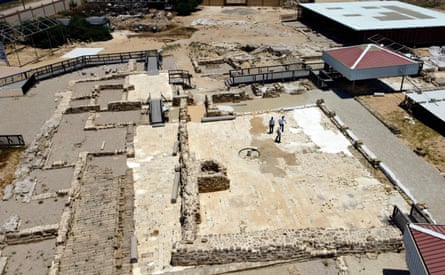
Gaza continued to flourish through the Crusader period, when it was given over to the Knights Templar to guard the frontier with Egypt; and even more so after the Mamluks expelled the Crusaders and filled Gaza with fine mosques and caravanserais. During the Ottoman period, Jaffa and Acre took over from Gaza as the most prosperous ports of the region, out of which Galilee cotton and Jaffa oranges were exported; but Gaza remained an important regional centre.
Though Gaza now dominates news bulletins for the worst reasons, it is a place about which we have traditionally learned remarkably little; we are not taught its story in movies or TV documentaries, let alone as part of formal education. Yet it is something we obviously badly need to know in order to grasp current events.
This month sees the publication of several new books addressing that absence. As well as the catalogue of the brilliant Paris exhibition, Trésors sauvés de Gaza: 5,000 ans d’histoire (Saved Treasures of Gaza: 5,000 Years of History) historian Anne Irfan has just produced an excellent primer, A Short History of the Gaza Strip, while Jean-Pierre Filiu has published a supplement to his wonderful Gaza: A History, called A Historian in Gaza. In it, he writes: “The Gaza I knew, and whose length and breadth I’ve travelled, has ceased to exist.” All three count as essential reading for those hungry to know more about this ancient territory so as to better understand the current, desperate chapter in its history.
A Short History of the Gaza Strip by Anne Irfan (Simon & Schuster, £18.99). To support the Guardian, order your copy at guardianbookshop.com. Delivery charges may apply.
A Historian in Gaza by Jean-Pierre Filiu (C Hurst & Co Publishers, £16.99). To support the Guardian, order your copy at guardianbookshop.com. Delivery charges may apply.


[…] A historian talks about Palestine’s deep history. An interview with British historian William Dalrymple […]