Echo of the Steppes … history’s long shadow

Fingerprints, ghosts and the long arm of History

In an illuminating essay in the e-zine Unherd, republished below, former war-correspondent Aris Roussinos’ begins an extensive and expansive review of  Australian archeologist Warwick Ball’s The Eurasian Steppe with three mute stone figures – Cuman balbals standing beside the road between Sloviansk and Bakhmut in Donetsk – watching the endless movement of armies a across what is now Ukraine’s disputed and devastated Donbas. They are ancient witnesses in a landscape where Russians and Ukrainians now fight over ground that, for most of human history, belonged to neither.

This is history as I like it: the historian as storyteller, where landscapes become characters and the past refuses to remain buried.

Long before Slavic speech reached these plains, the steppe was the domain of nomadic peoples: Scythians, Sarmatians, Alans, Huns, Turks, Mongols and many others whose empires rose and vanished like storms over the grasslands. They left few cities and fewer written records, but their fingerprints are everywhere: in languages, military traditions, political institutions, myths and identities. The grass remembers what libraries often forget.

Roussinos’ central argument is that we have misunderstood Europe by looking too exclusively westward, towards Rome. The steppe was never merely a barbarian wilderness beyond civilisation, waiting to burst through the gates. It was one of the great engines of European history. Europe was shaped not only by the legacy of Rome and Christianity but also by repeated encounters with the peoples of Inner Asia. The old frontier between “Europe” and “Asia” dissolves under closer inspection. What appears on a modern atlas as a dividing line was, for centuries, a vast zone of movement, exchange, conquest and adaptation.

The present war in Ukraine unfolds across precisely this ancient geography. The early Russian thrust towards Kyiv moved through forests and marshes that belonged historically to the old Slavic world. The grinding war of attrition in the east is being fought across the open “Wild Fields”, the immense Eurasian grasslands where mounted nomads once travelled with astonishing speed and where empires repeatedly collided. Roussinos draws parallels with the mechanised battles of the twentieth century – Kursk, Kharkiv, Stalingrad – where tanks replaced horses, but the strategic significance of the landscape remained unchanged. Geography, as Napoleon is said to have observed, is often the most enduring ally in war.

It is an enticing argument because it encourages us to look beneath the familiar surface of European history. Perhaps Europe itself carries far more of the steppe within it than we usually acknowledge. Hungary and Bulgaria were founded by peoples of the steppe. The Polish nobility cultivated a proud Sarmatian ancestry. The Magyars’ memory of their eastern origins helped shape nineteenth-century nationalism. Even the nation state, so often presented as an entirely European invention, may owe something to political traditions carried westward across the grasslands by mounted confederations whose influence extended far beyond the horizon they inhabited.

There are historical echoes scattered throughout this story. The Sarmatians and Alans revolutionised warfare with armoured cavalry, heavy lances and mounted tactics that would eventually blossom into the chivalric traditions of medieval Europe. Even the Arthurian legend may preserve a distant resonance of the steppe in the enduring image of the sword planted in the earth, waiting for the rightful king to draw it forth.

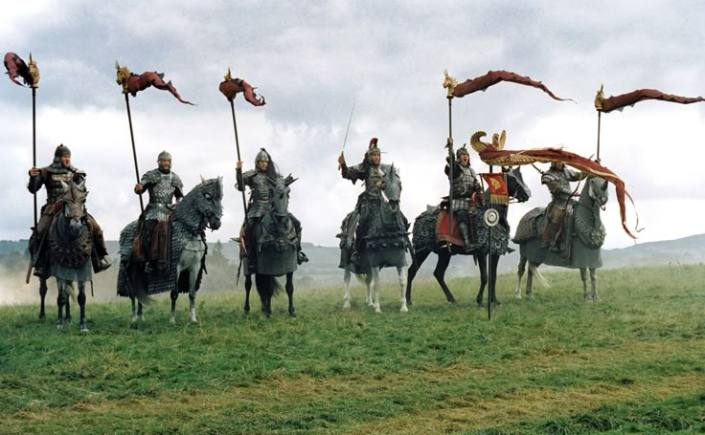
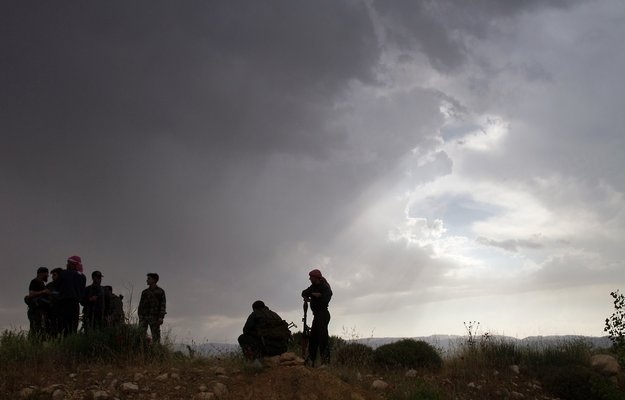
Filmmakers, naturally, could not resist. The 2004 film King Arthur, for example, stitched together Romans, Celts, Sarmatians, Picts and enough historical liberties to make any medievalist wince. Clive Owen wandered through a fictional Northumbria Britain as a brooding half-Roman, half-Sarmatian Arthur, while Keira Knightley appeared as an improbably glamorous and scantily clad Guinevere whose Pictish origins seemed less convincing than her plummy English accent. It was glorious nonsense, but enjoyable, nonetheless. The Irish landscapes were striking, the horses magnificent, the ‘Knights’ (the picture at the head of this essay) with their “Rus! Rus!” war cry (and they actually do sit at a round table) improbably photogenic. A battle fought across a frozen lake owed as much to Eisenstein’s Alexander Nevsky as it did to any surviving historical source. Ridley Scott later recycled much the same visual conceit in his disappointing Napoleon. History often survives in cinema not because the facts are accurate but because certain images possess extraordinary emotional truth.

The Cossacks offer a far more convincing example of the cultural blending that characterised the frontier. They emerged not from ethnic purity but from mixture. Runaway serfs, adventurers, escaped peasants and soldiers settled the borderlands, adopting the customs, military practices and vocabulary of the Turkic peoples who had occupied the steppe before them. Even the word “Cossack” derives from a Turkic root meaning “to roam”. The frontier was never a wall separating civilisations. It was a workshop in which entirely new identities were forged.

It is here that Roussinos, following Warwick Ball, arrives at his most provocative claim. Muscovite Russia, he argues, cannot be understood without recognising the formative influence of the Mongol world. Moscow’s rise was anything but inevitable. The Golden Horde required dependable tributaries capable of collecting taxes, maintaining order and supplying troops. The princes of Moscow proved remarkably efficient servants of the khans and, in doing so, transformed what had once been a relatively insignificant Rus’ principality into the nucleus of a future empire. The irony is delicious. Mongol domination helped create the very Russian state that would eventually conquer the steppe itself.

The fingerprints remain visible today. Administrative practices, institutions of government, systems of taxation and even elements of the Russian language bear traces of Mongol influence. Yet fingerprints are curious things. They tell us that contact occurred; they do not tell us everything that followed.

That question lies at the heart not only of Ball’s thesis but also of historian Orlando Figes’ The Story of Russia, which, by happenstance, I am reading at the moment. It is one of those literary coincidences in which two writers, approaching the same landscape from different directions, find themselves asking precisely the same question. What made Russia, Russia?

Figes is, in many respects, the perfect companion to Roussinos because he shifts our attention from inheritance to interpretation. He readily acknowledges that the Mongol conquest of the Rus’ principalities in the thirteenth century was one of the defining ruptures in Russian history. It destroyed Kyiv’s political centrality, subordinated the northern principalities to the Golden Horde and created the circumstances in which Moscow could eventually emerge as the dominant power. Like Roussinos, he recognises the profound irony that Mongol domination did not simply interrupt Russian state formation but helped shape its eventual character.

Yet Figes is ultimately less interested in what Russia inherited than in what Russia chose to become. The Mongols bequeathed methods of rule: taxation, military organisation, communications and a conception of authority that differed markedly from Western feudalism. Russia’s imagination, however, was nourished elsewhere. Orthodox Christianity, Byzantine political theology, the doctrine of Moscow as the “Third Rome” and the almost mystical conception of the Tsar as God’s anointed gave Russia a vocabulary through which it understood itself. Its civilisation emerged not from a single source but from the convergence of many.

This distinction is important because it rescues history from determinism. Fingerprints reveal contact; they do not reveal intention. They cannot tell us why someone picked up the knife, wrote the letter or opened the door. Likewise, cultural inheritance explains possibilities, not inevitabilities.

Figes presents Russia as a civilisation assembled from multiple traditions: Slavic, Byzantine, Mongol, European and imperial. The country’s enduring paradox is that it has persistently imagined itself as both European and somehow apart from Europe. Peter the Great attempted to drag Russia westward, shaving beards, importing European science, founding St Petersburg (a German name, which was changed to Petrograd during World War I for the same reasons the British royal house changed its German name to Windsor) embracing Enlightenment ideas. Yet beneath these reforms older structures of autocracy survived. Later generations reversed the argument entirely. Slavophiles celebrated Russia’s uniqueness while Westernisers lamented its failure to become sufficiently European. The debate has never really ended. It merely changes its vocabulary.

Maps have always encouraged these arguments. A glance at any atlas suggests that Russia occupies an almost impossible position: a European power that expanded across Asia until it became the largest contiguous empire on earth. The geography itself tempts us into historical mythology. Is Russia European? Asian? Eurasian? The answer has varied according to who was asking and what political purpose the answer was intended to serve. Geography creates opportunities, constraints and temptations. It does not dictate outcomes.

Figes’ also explores of recurring Russian archetypes: the Holy Tsar, the Holy Fool, the suffering nation, the belief that Russia possesses a unique historical destiny. These are not immutable characteristics embedded in some mystical national DNA. They are stories Russians have told about themselves across the centuries – including Vladimir Putin’s house ideologue, philosopher Aleksandr Dugin. Stories matter because people act upon them. Nations, no less than individuals, become attached to narratives that explain who they are and why they exist.

Juxtaposed against Ball, Roussinos and Figues is a comment on Roussinos’ essay by Alexander Morrison, a historian of Russian history at Oxford University. Every grand historical narrative requires its sceptic. Elegant theories are seductive precisely because they reduce complexity to a single organising principle. Morrison accepts much of Ball’s argument while quietly resisting its more deterministic conclusions. It is an exemplary piece of historical criticism because it neither dismisses nor genuflects. Instead, it refines.

He readily acknowledges that Muscovy inherited important administrative practices from the Mongol world and points out that Russia was far from unique. The Ottomans, Safavids, Mughals and Qing all incorporated Chinggisid or Timurid political traditions alongside older local institutions. Borrowing across Eurasia was commonplace. Civilisations have always learned from their neighbours, even while claiming absolute originality.

Where Morrison parts company with Ball is over the temptation to confuse influence with destiny. Muscovy borrowed bureaucratic structures connected with taxation, communications and administration. Indeed, the Russian language still preserves Mongol echoes in words such as kazna for treasury, den’gi for money and yam for the postal relay system. Yet the ideological foundations of the state remained overwhelmingly Byzantine and Orthodox. Ivan IV became Tsar by invoking the legacy of Caesar and the vision of Moscow as the Third Rome, not by presenting himself as the heir of Genghis Khan. Administrative inheritance did not erase cultural identity.

That distinction becomes even more important when considering the modern world. It is tempting to explain Putin’s Russia by reaching back to the Mongols, Ivan the Terrible or some timeless Russian soul. Such explanations possess an undeniable elegance because they transform political choices into historical inevitabilities. Morrison rejects this outright. Contemporary Russia, he argues, is shaped above all by decisions made by particular elites drawing upon nineteenth-century nationalism, memories of the Soviet collapse, selective readings of Russian history and modern political ideology. The past provides the vocabulary; it does not dictate the speech.

His discussion of Ukraine is equally persuasive. Southern and eastern Ukraine were settled comparatively recently by a remarkable mosaic of peoples: Ukrainians, Russians, Greeks, Jews, Armenians, Bulgarians and many others. The region’s history is therefore extraordinarily layered. Yet historical complexity does not undermine modern sovereignty. Ancient settlement patterns explain why memories remain contested, but they do not invalidate internationally recognised borders. History illuminates’ claims; it does not automatically legitimise them.

This strikes me as one of the most important lessons historians can offer our own age. We are living through a period in which politicians, nationalists and activists increasingly seek legitimacy by reaching deeper into the past. Ancient kingdoms, medieval battles, archaeological discoveries, linguistic survivals and genetic studies are all recruited into contemporary arguments about identity and territory. History becomes less an investigation than a courtroom brief.

Yet the past is a notoriously unreliable witness.

Landscapes accumulate memories without issuing verdicts. The Donbas bears the fingerprints of Scythians, Greeks, Sarmatians, Goths, Huns, Khazars, Mongols, Tatars, Cossacks, Russians, Ukrainians, Jews, Armenians and countless others. None of those fingerprints constitutes a title deed. They testify to presence, movement and encounter. They remind us that almost every place we imagine possessing an eternal identity has, in reality, been shaped by successive waves of migration, conquest, adaptation and coexistence.

Perhaps that is why I find Roussinos’ essay so compelling. Like the best historical writing, it restores movement to landscapes that modern maps often freeze into static national colours. It reminds us that frontiers have rarely been fixed and that civilisations have always been more entangled than their later myths would admit. Europe did not simply civilise the steppe. The steppe helped create Europe.

Equally, Morrison reminds us that historical explanation should never become historical imprisonment. Institutions endure, languages preserve old borrowings, myths outlive empires and landscapes retain astonishingly long memories. But people still make choices. Nations inherit the consequences of the past without becoming its captives.

The three weathered balbals still stand beside the road to Bakhmut. They have watched Scythians ride westward, Huns descend upon Europe, Mongol tumens disappear into the distance, Cossacks patrol the frontier, imperial armies march beneath Romanov eagles, Wehrmacht panzers advance across the wheatfields, Soviet tanks return in triumph and, today, drones circle silently above the same ground. Every generation has believed its struggle to be unique, its empire enduring, its victories permanent. The stones know otherwise.

History leaves fingerprints everywhere. It leaves them in words, in institutions, in ruined cities, in forgotten roads, in songs, in legends and in the memories of peoples who continue to argue about what happened centuries before they were born. Those fingerprints deserve to be studied because they tell us where we have come from and how our worlds were made. But fingerprints are not destiny. They record contact, not ownership; inheritance, not inevitability; memory, not command. The ghosts of the steppe still whisper across Eurasia, but they do not write the future. That task, as it always has been, belongs to the living.

Coda. The myth of fingerprints.

History leaves fingerprints.

That may seem an odd metaphor, but I have found myself returning to it again and again. Archaeologists brush them from shards of pottery, linguists discover them buried inside forgotten words, historians recognise them in institutions, laws, customs and myths. They are the traces left behind whenever peoples encounter one another, whenever empires rise and fall, whenever civilisations borrow, conquer, imitate or remember.

Fingerprints fascinate us because they appear to promise certainty. In a criminal investigation they identify who touched the weapon. Yet they tell us remarkably little about what actually happened. A fingerprint cannot reveal motive, explain intention or determine guilt. It records contact, not consequence.

History is much the same.

Every landscape is covered with fingerprints. They survive in place names and languages, in ruined cities and forgotten roads, in religions, legal systems, songs, frontiers and collective memory. The three ancient balbals still standing beside the road to Bakhmut are surrounded by them. For nearly a thousand years they have watched Scythians ride westward, Huns descend upon Europe, Mongol tumens disappear into the distance, Cossacks patrol the frontier, imperial armies march beneath Romanov eagles, Wehrmacht panzers cross the wheatfields, Soviet tanks return in triumph and, today, drones circle silently overhead. Every empire believed its moment would endure. Every generation imagined itself to be the culmination of history. The stones know otherwise.

And this is where I arrive at what I have come to think of as the Myth of Fingerprints.

The fingerprints themselves are not mythical. They are real. History leaves them everywhere. The myth begins when we misunderstand what they are telling us.

A fingerprint is evidence that someone was here. It cannot tell us why they came, whether they belonged, whether they acted justly or what rights their descendants may possess centuries later. In a court of law, a fingerprint may place someone at the scene; it cannot, by itself, decide the case. History works in much the same way. It explains how we arrived here, but it cannot by itself determine who ought to possess the future.

Too often we ask it to do precisely that.

Ancient maps become modern borders. Archaeological discoveries become political manifestos. Genetic inheritance becomes moral entitlement. Historical suffering becomes an enduring licence for vengeance. We confuse explanation with justification, inheritance with ownership, memory with legitimacy. That confusion – the transformation of historical evidence into historical entitlement—is what I mean by the Myth of Fingerprints.

It is a myth because it is one of the oldest stories nations tell themselves. Every people constructs narratives from the traces left by earlier generations. Sometimes those stories preserve genuine memory; sometimes they simplify; sometimes they become propaganda. But they all begin with the same temptation: to believe that because history explains the present, it therefore authorises it.

This question lies beneath far more than the current war in Ukraine. It echoes through the history of Palestine and Israel, through Australia’s History Wars, through debates over monuments, migration, frontiers and national identity. Again and again we encounter the same temptation: to search the past not for understanding, but for permission.

That is why Aris Roussinos’ essay on Warwick Ball’s The Eurasian Steppe struck me so forcefully. Ball demonstrates how profoundly the Eurasian steppe shaped Europe. Orlando Figes traces the inheritance of Byzantium, the Mongol world and the frontier in the making of Russia. Alexander Morrison reminds us that inheritances are never destinies. Together they illuminate a larger truth. Geography creates opportunities. Culture bequeaths inheritances. Myths provide meaning. Only human beings make choices.

The ghosts of the steppe still whisper across Eurasia, just as the ghosts of every civilisation whisper through the landscapes they once inhabited. Historians should listen carefully to those whispers, for they reveal how the world came to be. But they should resist the temptation to mistake echoes for commands. The past deserves understanding rather than obedience.

History leaves fingerprints everywhere. They are among our most valuable clues to the human story. They reveal connections, influences, migrations and memories that would otherwise be forgotten. Yet they are not title deeds, nor verdicts, nor chains binding the living to the ambitions of the dead. They explain inheritance without dictating destiny.

That is the real lesson of the Myth of Fingerprints.

Paul Hemphill and In That Howling Infinite, August 2026

This essay was written in conversation with books I’ve read, ideas formed and half-formed, and, more recently, in sustained dialogue with an AI language model, which contributed to drafting, phrasing, and conceptual articulation. What appears here is not unmediated thought, but considered thought: selected, tested, revised and revised again, and owned.

The concept of the Myth of Fingerprints originated in a long essay with regard to what is probably the most intractable conflict in modern times: One Land, Two Peoples: History, Memory, Continuity, and Inheritance. In That Howling Infinite has published many articles regarding the historical movement of peoples. For example: Modern history is built upon exodus and displacement. 

For more on Russia, Ukraine and the Soviet Union, see Russky Mir – Russian history’s long shadow. 

I highly recommend Ukrainian scholar Serhii Plokhy’s The Gates of Europe, a well told and fascinating story of the origins of Ukraine and Belarus, and how their histories were intertwined, and entwined with those of of Poland, Lithuania (which was a large and powerful state once) and Russia. Ukraine has historically been the border between the catholic west and the orthodox east, the division running virtually down the middle. The name Ukraine is Slav for border land. Its geopolitical location and natural resources have led to the land being inflicted by invaders, civil wars, man-made famine and repression. See, in In That Howling Infinite, Borderlands – Ukraine and the curse of mystical nationalism

Roussinos’ essay follows, and also, for readers with time on their hands, more on Figes’The Stiry of Russia and on Morrison’s critique.

The fate of Europe lies in the steppes Warwick Ball: ‘The Eurasian Steppe’

Aris Roussinos, Unherd 28 July 2022

The fate of Europe lies in the steppes

Genghis has won (Dean Conger/Corbis via Getty

On the road between the frontline cities of Sloviansk and Bakhmut, in Ukraine’s eastern Donbas region, three stone statues stand mutely by the side of the road, observing the coming and going of military traffic with impassive detachment. Known as balbals, they are funerary monuments erected by the Cuman Turks, known in Russian archaeology as the Polovtsians, who once ruled this vast sea of grass, long before Russian or Ukrainian speech was ever heard in this region.

For thousands of years, the empty, spreading steppe, stretching from Hungary to Mongolia, was the home of nomadic peoples, speakers of Iranic, Turkic and Mongolic languages, who drove their herds across the vast plains in search of fresh pastures. They founded great empires, which time and the steppe grasses would soon swallow up, leaving barely a trace. Their constant irruptions into Europe sounded the death knell in turn for other, settled civilisations, part of the endless cycle of growth, invasion and collapse that has shaped our continent’s history.

The war in Ukraine has taken place in two very different climatic and cultural zones: its initial phases saw Russian armour wend its way through the dark forests and marshes of northern Ukraine, the ancient homeland of the first Slavic peoples, to be destroyed in close fighting on the narrow wooded roads in a stunning and unexpected Ukrainian victory. Yet the gruelling war of attrition in the country’s east is taking part in a very different landscape, in the open steppe that was once the home of nomadic peoples.

The expansion of Slavic peoples, both Ukrainians and Russians, into the open steppe was a very recent historic event, broadly contemporaneous with the European settlement of the Americas, its fertile plains, now the breadbasket of the developing world, Europe’s equivalent of America’s Midwest. These open plains, the “Wild Fields” of local historiography have always been a contested space, where great empires wrestled for control: in the great Second World War battles of Kursk, Kharkiv and Stalingrad, Europe’s entire fate hinged on the battle between the two great tank armies wheeling and clashing like nomad hordes.

But then, as The Eurasian Steppe by the archaeologist Warwick Ball makes clear, rather than a semi-wild anteroom to the continent, “the history, languages, ideas, art forms, peoples, nations and identities of the steppe have shaped almost every aspect of the life of Europe”. Europeans from further west have for centuries been prone to viewing the steppe as the haunt of wild tribes, and the source of occasional, fearsome destruction.

But what if the Europe of today is in fact the product of steppe dynamics? As Ball argues, rather than being a product of 19th century nationalism, some historians trace the origin of Europe’s oldest nation states to the steppe, observing that “Peoples newly arriving from the east were also among the first to create nationally defined states, such as kingdoms of the Bulgars or Magyars”. “In some ways,” Ball argues, “the incipient idea of a nation state might have been stronger with the nomadic groups from the steppe, who were bound more closely by tribal loyalties” than among the polyglot peoples of the imperial Roman successor states they conquered.

Did the steppe peoples then create the fractious patchwork quilt of nationalities that we understand as Europe? Ball cites the archaeologist Hyun Jin Kim who claims that: “The political and cultural traditions of Inner Asia brought to Europe by Central Asian immigrants, the Huns and the Alans, were just as fundamental to the formation of western Europe as the rich legacy left behind by the Roman Empire. The political and cultural landscape of early medieval Europe was shaped by the fusion of Roman and Inner Asian influences.”

While Hungary and Bulgaria were directly founded by steppe nomads, the influence of steppe rulers also helped shape the political forms taken by Poland (whose szlachtanobles claimed Sarmatian descent well into the 19th century), Bohemia, Denmark and even, it is claimed, France. Even into the 19th century, as Ball notes, it was the Hungarian awareness of their steppe Magyar ancestry that helped bring about the rise of nationalism which shook apart the great Austro-Hungarian empire. “In the long evolution of the idea of the nation state,” then “from their beginnings in late-antique Europe to their emergence in the nineteenth century, we must look east as well as west”.

Viewed in this light, the war in Ukraine, a battle between a European nation-state and a vast Eurasian empire, is resonant with all manner of strange echoes of the steppe’s dimly-understood history. The colossal earthern ramparts of the “serpent walls” outside Kyiv, erected by early Slavic kingdoms to guard against invasion by steppe nomads from the Huns to the Mongols, fulfilled their ancient role admirably earlier this year when they prevented the movement of Russian armour towards the capital’s suburbs, corralling the latest wave of invaders into killing zones to be picked off at leisure by guided missiles.

The Cossack heritage both sides claim is the result of earlier Slavic peoples, runaway Ukrainian and Russian serfs, claiming the freedom of the open steppe and adopting the customs, lifestyle and much of the vocabulary of their nomadic Turkic predecessors. The very word Cossack, Ball notes, “derives from the Turk root qaz, ‘to roam’”, and is cognate with the ethnonym Kazakh further east, as the Cossacks “comprised mainly Russians — usually renegades, escaped serfs or criminals — but they also included Turks, Tatars and remnant Polovtsi.” Even now, Ukrainian is sprinkled with Turkic words, a legacy of the two cultures’ long history of interaction and competition. One Ukrainian commander I met went by the nom de guerre “Duman, or fog, deriving from the Turkic word for smoke or mist. Even now, Ukrainians refer to Russians with the dismissive Turkic epithet Katsab, or butcher.

On the Russian side, the war effort has been marked by the use of steppe peoples as infantry, with many of the heaviest casualties borne — and apparently some of the worst war crimes committed by — the Buryat Mongols of the Russian steppe, along with the Kalmyks of the lower Volga, Europe’s only Buddhist nation, who once watered their horses as far west as Paris following the defeat of Napoleon. Similarly, among the many subject peoples of the Russian empire deployed to Ukraine are Ossetians from the Caucasus, a tiny Iranic-speaking nation who are all that remain of the Alans, who once fought the Romans across Central Europe, settling as far west as France and Spain: some of their descendants, now Magyarised, still live in Hungary as the Jasz people. Their Iranic speech is now heard in Ukraine’s steppe for the first time in a thousand years, dragged along into a war of European conquest by another great Eurasian empire.

The very concept of chivalry which defined Europe’s medieval history was the product of Iranian-speaking steppe peoples like the Sarmatians and the Alans, whose innovations in the use of cavalry — stirrups, lances and long chainmail coats — changed the face of late Roman warfare and set the stage for the knights of the High Middle Ages. Even our own medieval romances may owe something to their distant steppe traditions, after the border forts of what is now northern England became the garrison home of Sarmatian levies in Roman service. As Ball notes: “Sarmatian warrior worship of a sword fixed in the ground has been suggested as furnishing the origin of the Excalibur legend. This appears to have been a long steppe warrior tradition: Ibn Rusta in the tenth century, for example, describes how the Viking Rus ruler — whom he calls by the steppe title of Khagan or khāqān — would plant a naked sword in the earth pointing towards his newborn son.” Perhaps it is not mere coincidence, then, that the Azov Regiment’s torchlit ceremonies in the southern steppe city of Mariupol took place beneath three giant swords embedded in the ground, a striking symbol that has now become the group’s emblem.

Again and again, these strange resonances between the steppe’s ancient nomad past and its bloody present swim to the surface like long-forgotten memories. The great statue to Mother Russia, sword in hand, that rises above Stalingrad’s Hill 102, where tens of thousands of Soviet and German soldiers were ground into the soil by artillery possesses the grim grandeur of some ancient steppe monument. And indeed, Hill 102, the crucial position of the battle that decided the war’s outcome, is perhaps better viewed by its alternate name as the Mamayev Kurgan, the burial tumulus of a long-forgotten Tatar khagan. From the ancient past to now, Russia’s history was written on the steppe, and without the steppe Russia’s imperial past and present is simply impossible to understand. Indeed, as Ball observes, without the historic domination of steppe nomads, there would be no Russia as we understand it.

As Ball observes: “The future of Russian greatness was both a response to and a legacy of the Mongols… Indeed, to a large extent Muscovite power was a creation of the Golden Horde: the khans required a stable central authority as a client state which could be relied upon to raise auxiliaries for the khan’s armies and to collect and deliver taxes and tribute. Moscow fitted the bill, so the Golden Horde deliberately strengthened it against the other Russian cities and appointed its prince as their chief tax collector.” Without the Mongol-enforced primacy of Muscovy, the land that is now Russia may well have remained a series of disunited kingdoms and city states, just like medieval Italy or Germany: “The Mongols, in other words, brought about the emergence of Russia.”

Even the great king Sviatoslav of Kyivan Rus, whose legacy is claimed by both Ukraine and Russia, extended his rule across the steppe by defeating the great Jewish Khazar kingdom and in doing so, “adopted the techniques and warfare of the steppe nomad: in other words, Kievan Rus was at first simply another steppe nomad state, albeit with a Scandinavian element. Sviatoslav never decisively defeated the Pechenegs and was killed by them in 963, and his skull was made into a cup in steppe tradition.” Medieval Russia was, then, as much a steppe polity as a European state, perhaps more so. After all, “up until 1480 Muscovite coins still carried inscriptions in Arabic. As late as 1531 Vasili III of Moscow was still paying tribute to the successors of the Golden Horde: Crimea, Kazan and Astrakhan”, and the eternal symbol of Russian power, Moscow’s St Basil’s Cathedral, was modelled on Kazan’s Great Mosque, in thanks for the conquest of the great Tatar capital.

Tracing Muscovy’s traditions of governance, and then those of imperial Russia, to the Mongol and Tatar customs of the inner steppe, Ball observes that “Even by the fourteenth century the civil and military institutions of Muscovy ‘were overwhelmingly Mongol in origin’… Ivan IV, the first Russian to proclaim himself Tsar (in Russian the title is actually Tsezar), added Ulugh Khan, ‘Great Khan’, to his titles.” Though he dismisses the “Mongol Yoke” hypothesis of Russian historiography, Ball nevertheless traces Russia’s unique and terrible form of autocratic rule to steppe customs, deep into the modern period: “Ivan also adopted the Mongol policy of ‘collective guilt’ where all male relatives and retainers of a guilty man would be executed, a policy even extended to entire communities. Stalin’s similar policy was a continuation of this.” The steppe’s long influence stretches deep into the cultural DNA of our modern world: even such a giant 20th century figure as Lenin, destroyer of one great Eurasian empire and founder of another, was of part-Kalmyk descent, after all.

Imperial Russia’s second largest minority after the Ukrainians, whose post-independence relationship with their giant neighbour is today a source of such bloodshed, was the Muslim Tatars, from whose Russified nomad aristocracy some of the greatest names in Russian culture — Rachmaninoff, Turgenev, Nureyev and Akhmatova — claimed descent. “The list [of Tatar surnames] covers all walks of Russian life: artistic, religious, scientific, literary, military, political and royal. The list is virtually endless,” Ball notes, and even today “the descendants of the Mongol ‘hordes’ — the Tatars — are the second-largest minority in Russia after the Russians themselves, and the Republic of Tatarstan is the second-largest republic in European Russia.”

Written for a general audience, Ball’s book nevertheless synthesises the latest archaeological research and historical debate on the steppe’s ancient and modern peoples, archaeological research on the steppe’s history, delving back into the deepest mists of time. The burgeoning community of esoteric archaeology and anthropology posters on Twitter will surely appreciate his summarising of the latest research on the origins of the Indo-Europeans, the fate of the Khazars and the birth and decline of the great Scythian kingdoms, who’s exquisite goldwork was the highlight of the British Museum’s recent blockbuster exhibition.

Noting that St Petersburg’s great Hermitage Museum was founded primarily as a place to store the newfound Scythian treasures unearthed by Russian colonists in Crimea, Mariupol and the rest what is now Ukraine’s contested southern steppe, and alert to the theft of Scythian treasures from Ukrainian museums by their new-old Russian conquerors, we realise that the relentless cycle of history has brought a new relevance to Ball’s book, even since its publication last winter. Just as in the Middle Ages and in the bloodiest battles of the Second World War, the fate of Europe is once again being written on the endless, grassy steppe.

Aris Roussinos is an UnHerd columnist and a former war reporter.

Orlando Figes’ The Story of Russia

That is a very happy coincidence, because Roussinos’ essay and Figes’ The Story of Russia are really circling the same enormous question from different directions: what made Russia Russia?

Figes is, in many ways, the antidote to the more sweeping “fingerprints of the steppe” argument. He certainly does not deny the Mongol inheritance  – quite the opposite. The Mongol conquest of the Rus principalities in the thirteenth century was one of the decisive ruptures in Russian history. It destroyed Kyiv’s old political centrality, subordinated the northern principalities to the Golden Horde, and created the conditions in which Moscow could eventually rise. The irony, as both Roussinos and Figes emphasise, is that the Mongols did not simply delay Russian state formation; they helped create the particular form of state that emerged.

But Figes is interested less in what Russia inherited than in what Russia made of those inheritances. The Mongols supplied mechanisms of rule – taxation, military organisation, hierarchy, a relationship between ruler and subject that was very different from Western feudalism. Yet Russia’s self-understanding was built around other ideas: Orthodox Christianity, Byzantium, the idea of Moscow as the “Third Rome”, and the notion that the Tsar was not merely a monarch but a sacred figure.

This is where it links beautifully with Morrison’s critique. The danger is that we see the Mongol “fingerprints” and assume they explain everything. But fingerprints do not tell you why the person picked up the knife, wrote the letter or opened the door. They tell you something about contact and inheritance; they do not reveal intention.

Figes’ Russia is a civilisation built from multiple inheritances: Byzantine, Slavic, steppe, European and imperial. The great Russian paradox is that it has often defined itself simultaneously as both European and apart from Europe. Peter the Great famously tried to drag Russia westward — shaving beards, building St Petersburg, importing European science and manners — yet the deeper structures of autocracy, hierarchy and imperial expansion remained. Later Slavophiles rejected the West and celebrated a distinct Russian path, while Westernisers argued that Russia’s tragedy was precisely its failure to become sufficiently European.

This also connects with our earlier discussion of maps and historical memory. Russia is, geographically, an extraordinary historical anomaly: a European state that expanded across Asia until it became a continental empire. The map itself creates the tension. Is Russia Europe? Asia? Eurasia? The answer has shifted depending on who was asking and what political argument they wanted to make.

One of the things I suspect you will appreciate in Figes is his attention to recurring Russian archetypes: the Holy Tsar, the Holy Fool, the tension between obedience and rebellion, the recurring belief that Russia has a unique destiny. These are not “genes” or immutable cultural DNA; they are traditions — stories Russians told about themselves. And stories matter enormously because people act upon them.

That brings us back to Roussinos’ evocative phrase, “the echo of the steppes”. Echoes are fascinating precisely because they are not the original sound. They are altered, refracted and carried forward. The Mongol conquest echoed through Muscovy; Byzantium echoed through the Tsars; Soviet power echoed through Putin’s Kremlin. But each generation chooses which echoes to amplify.

There is also a pleasing connection with your earlier fascination with maps and atlases. A physical map of Russia looks almost inevitable: the enormous landmass stretching from Europe to the Pacific. But Figes and Morrison both remind us that geography creates possibilities, not destinies. The Russian Empire was not simply “there” waiting to happen. It was built by choices — by princes, tsars, revolutionaries and commissars who made decisions within particular historical circumstances.

So perhaps the combined lesson of Figes, Roussinos and Morrison is this:

Russia is not merely a European country contaminated by Asia, nor an Asian empire wearing European clothes. It is a civilisation formed in the meeting place of worlds. The tragedy is not that it has a complicated past; all great civilisations do. The tragedy comes when a complicated past is reduced to a single myth of inevitable destiny.

Which, interestingly, brings us back to your recurring theme: the power  – and danger –  of maps. Every map is an argument about the past. Every empire is a story it tells about itself. And every story leaves fingerprints. The historian’s job is to work out which ones are real, which ones are imagined, and which ones have been deliberately placed there.

Alexander Morrison’s critique

Alexander Morrison, a historian of Russian history at Oxford University, specialising in the Russian conquest of Central Asia, commented on Roussinos’ essay in Unherd. Here it is in full.

Roussinos, seems to have made good use of Ball’s research. Some of these arguments are completely uncontroversial when applied to the Asian neighbours of the Eurasian steppe in the early modern period: the Ottomans, the Safavids of Iran and the Qing all made use of Chinggisid and TImurid political repertoires in building their states alongside other elements (Byzantine heritage for the Ottomans, the existing Chinese imperial tradition in the Qing case, Sufi religious charisma for the Safavids). The Mughals were of course actually of Timurid (and in the female line of Chinggisid) descent, and it was at the core of their dynastic ideology in India.

However the steppe political tradition seems to have produced ever larger polities in Asia, which makes it hard to explain why it would instead produce political fragmentation in western and Central Europe – I think that part of Ball’s argument is a bit overstretched.

The Muscovite example seems to fit the Asian pattern better, and Roussinos is spot on in saying that it was the willingness of the Princes of Moscow to act as particularly loyal and effective satraps and tax collectors for the Golden Horde that allowed what had previously been a minor Rus’ princedom to rise to pre-eminence.

However we need to be clear about what it was that Muscovy took from the Mongols: it was largely bureaucratic structures linked to taxation or communication. This why key Russian words such as kazna (treasury), den’gi (money) and yam (postal service) are of Mongol origin. On the cultural side the ruling ideologies of the state were all to do with Orthodox Christianity and the semi-mythical link to Byzantium (the ‘Third Rome’), which was what Ivan IV (the Terrible) was evoking when he took the title of Tsar (Caesar) – he may have added the title of khan for good measure but this was largely for the purposes of communication with steppe peoples.

Many Tatar nobles of Chinggisid descent did become incorporated into the Muscovite aristocracy after the fall of Kazan in 1552, but you need to be careful about 19th and 20th-century claims to this ancestry, which are often bogus (it was fashionable at the time). In the case of Akhmatova it was her nom de plume (she was born Anna Gorenko – in fact a Ukrainian name). In any case Chinggisid descent did not give you any kind of claim to the throne of Muscovy, which had its own dynastic legend in the Rurikids. A better guide to the relationship between Muscovy and the Mongols than Ball is Donald Ostrowski.

There is also a bit too much cultural determinism in all of this to my liking – it suggests that neither Russia nor Ukraine can ever shake off this bloody past etc. etc. Nowhere in the world is simply a prisoner of its past. What is happening now is a result of very specific political choices made by Vladimir Putin and Russia’s ruling elite. Their thinking is rooted partly in their reading of 19th-century Russian historians (who first came up with the idea that Russians and Ukrainians were the same people), vicious forms of anti-semitic Russian nationalism of the early 20th century and the emigration (the Black Hundreds, Ivan Il’in), a particular, tendentious interpretation of both Soviet history and their own memories of the Soviet collapse.

What is perhaps more relevant is that this steppe past means that most of southern and eastern Ukraine was only relatively recently settled – not just by Russians and Ukrainians, but by the whole range of peoples of the empire (Greeks, Jews, Bulgarians, Armenians…probably also some Ossetians). They are certainly not ‘ancient Russian lands’ as Putin has claimed, but they are part of Ukrainian territory under international law and the Budapest memorandum assuring the country’s territorial integrity which Russia signed.

A couple of other corrections – the Buryats are not a steppe people, they live East of Lake Baikal. I am a bit queasy about the implication that they and the Kalmyks are disproportionately represented in the ranks of the Russian army because of their ‘savage’ steppe nature – it is simply because these are some of the poorest parts of the Russian Federation, and because the Russian regime is very deliberately trying to avoid recruiting troops from metropolitan regions of European Russia whose families might cause political trouble or have ties to Ukraine.

The ethnic Russians who are fighting are also disproportionately from Siberia or the Altai. The regiment which committed the atrocities at Bucha was from Khabarovsk in the Russian Far East, and its commander appears to have been originally from Karakalpakstan. Most Ossetians speak Russian these days, and have long identified with Russian rule. A good piece though – not many outlets would allow as thorough and as thoughtful a review of a work on Eurasian History.

Morrison’s comment stands apart from most of the thread because it does what the best scholarly criticism should do: it accepts the broad thesis where the evidence supports it, corrects errors where necessary, and resists the temptation to replace one grand narrative with another.

The essence of Morrison’s critique is this:

He accepts the central proposition that Muscovy inherited important features from the Mongol world. Indeed, he strengthens it by pointing out that similar borrowing occurred across Eurasia. The Ottomans, Safavids, Mughals and Qing all incorporated Chinggisid or Timurid political traditions into their own states. Russia was therefore not unique in absorbing institutions from the steppe.

Where he parts company with Ball is over determinism. Ball appears to argue that steppe political culture explains not only Muscovy’s rise but much of Russia’s subsequent history and perhaps even Putin’s Russia today. Morrison thinks this stretches the evidence too far. Administrative institutions can endure for centuries; they do not imprison nations forever. Modern Russia, he argues, is the product of choices made by a particular elite, drawing on nineteenth-century nationalism, Soviet memories and contemporary ideology, rather than the inevitable flowering of Mongol political culture.

He also introduces some valuable nuance. Muscovy borrowed bureaucratic techniques—taxation, communications, administration – from the Golden Horde, but its ideological heart remained Orthodox and Byzantine. Ivan IV’s claim to be Tsar rested on the idea of Moscow as the “Third Rome”, not the successor of Genghis Khan. Even the Russian language preserves this administrative inheritance in words such as kazna (also in Arabic,treasury), den’gi (money) and yam (postal relay), all of Mongol origin, illustrating that institutional borrowing need not imply cultural subordination.

Morrison is equally careful about ethnicity. He rejects romanticised claims of Chinggisid ancestry, notes that many were fashionable nineteenth-century inventions, and cautions against portraying Buryats or Kalmyks as somehow naturally warlike. Their prominence in today’s Russian army is explained far more convincingly by economics and recruitment policy than by any inherited “steppe mentality”. That is a useful reminder that socio-economic factors often explain what cultural stereotypes merely decorate.

His discussion of Ukraine is similarly restrained. Southern and eastern Ukraine were indeed settled comparatively recently by a mosaic of peoples across the imperial period, making simplistic claims of ancient ethnic ownership difficult to sustain. Yet that historical complexity does not undermine Ukraine’s internationally recognised borders or Russia’s commitments under the Budapest Memorandum. History explains; it does not necessarily justify.

Finally, Morrison performs the historian’s essential task of distinguishing influence from destiny. States inherit institutions, myths and habits, but they are not condemned to repeat them. This is perhaps his strongest point. It is tempting to explain Putin’s Russia by reaching back to the Mongols, Ivan the Terrible or the “Russian soul”, just as earlier generations invoked “ancient Balkan hatreds” to explain Yugoslavia. Such narratives are elegant because they reduce contingency to inevitability. Historians, however, are generally suspicious of elegant explanations.

His recommendation of Donald Ostrowski is also telling. Ostrowski’s work has long argued that Muscovy’s relationship with the Mongol world was one of selective adaptation rather than wholesale inheritance. That is a subtler – and probably more persuasive – account than one that sees Russia as simply Europe’s most successful steppe empire.

In short, Morrison doesn’t demolish Ball’s thesis. He refines it. He accepts that the steppe mattered enormously, but insists that institutions are not destiny, that cultures borrow selectively, and that political choices remain more important than historical determinism. It is precisely the kind of intervention that lifts an online discussion from polemic into genuine historical

What  Unherd Readers had to say about Roussinos’ essay

The comments divide into several broad themes rather than converging on a single interpretation, and in many ways become a debate about contemporary Russia as much as about history.

Many readers found the article fascinating and praised it for opening an unfamiliar chapter of Eurasian history. Several immediately ordered Christopher Ball’s book, while others supplemented the discussion with examples ranging from the Kalmyks’ influence on Austrian costume to the chess capital of Elista, the legacy of the Mongols in Central Europe, and the wider political traditions of the Eurasian steppe. A number of contributors recommended additional works, notably Peter Frankopan’s The Silk Roads and Donald Ostrowski’s scholarship on Muscovy.

A second group challenged aspects of the historical argument. Critics argued that the article overstated the influence of steppe culture on later European political development, confused mythology with history in discussing Poland and Hungary, and oversimplified the origins of the Cossacks and the Azov Regiment’s symbolism. Others objected to what they saw as cultural determinism: the suggestion that Russia’s present behaviour is somehow an inevitable product of its Mongol inheritance. Several historians in the discussion -Morrison particularly, stressed that Muscovy certainly inherited administrative and fiscal practices from the Golden Horde, but that its religious ideology and dynastic legitimacy remained fundamentally Byzantine and Orthodox. They argued that modern Russian policy reflects political choices by Vladimir Putin and his circle, not an inescapable historical destiny.

As often happens, the historical discussion quickly became a proxy for arguments over the war in Ukraine. One camp maintained that Ukraine is an artificial state whose disputed regions deserve internationally supervised referendums, criticising NATO expansion and Western military support while advocating diplomacy. The opposing view rejected these claims as Russian propaganda, pointing to Ukraine’s overwhelming vote for independence in 1991, insisting that no genuine referendum is possible under military occupation, and arguing that Russian aggression – not Western policy – is the central issue. A more extreme minority advanced familiar pro-Kremlin narratives, portraying NATO as the true aggressor and Russia as a defensive victim, provoking vigorous rebuttals from other commenters.

There was also a meta-debate about free speech. An inflammatory remark describing Russians in derogatory terms prompted accusations of hate speech and counter-accusations of “crybullying”, illustrating how discussions of Russia often slide into arguments over acceptable language as readily as they do over history.

The most substantial contribution came from historian Alexander Morrison, whose lengthy critique was widely praised by other readers. Morrison broadly accepted the article’s central insight – that Muscovy’s rise owed much to its role within the Mongol imperial system – but argued that the thesis was pushed too far. He emphasised the distinction between administrative inheritance and cultural identity, corrected numerous historical inaccuracies, warned against deterministic readings of history, and reminded readers that modern events stem from contemporary political decisions rather than immutable civilisational characteristics. His intervention effectively became the intellectual centre of the comment thread, with several readers declaring that it improved upon the article itself.

Overall, the discussion reveals both the appeal and the risks of grand historical narratives. Most readers accepted that the Eurasian steppe profoundly shaped Russia’s development. Where they diverged was over the extent to which that past explains the present, and whether history should be read as a story of enduring civilisational patterns or of contingent political choices. The resulting debate ranges from thoughtful historiography to contemporary geopolitics, with occasional excursions into conspiracy theory and internet polemics.

Feints, refrains and unfinished business. 2025 in review

And we are here as on a darkling plain
Swept with confused alarms of struggle and flight,
Where ignorant armies clash by night.
Mathew Arnold, Dover Beach

We called 2024 a “year of everything, everywhere, all at once”, and it earned the name. Crises collided, news arrived faster than we could process it, and the world seemed to exist in a state of constant shock. 2025 did not bring relief. Instead, the chaos began to settle. Wars dragged on, political divides hardened, social tensions deepened, and technology reshaped how we saw and understood it all.

It was the year the world stopped exploding in real time and started being what it had already become: messy, uneven, morally complicated, and stubbornly persistent. A year, indeed, in a world of echoes, refrains and unfinished business. And we spent the year watching power bargain brazenly in plain sight, trying to describe what was happening while it unfolded around us.

From Gaza to Ukraine, Sudan to Syria, from America’s self-inflicted fracture to Australia’s sudden wake-up call on Bondi Bondi, 2025 forced a reckoning: the world did not pause, but it did sort itself – deciding what we would notice, what we would ignore, and what we would learn to live with. Alongside human crises came the continuing advance of AI and chatbots, and the dominion of the algorithms that now govern attention, proving that disruption can be structural as well as geopolitical.

Gaza: War, Then “Ceasefire”

The war in Gaza dominated the year internationally and here in Australia, even as attention ebbed and flowed. Military operations continued for months, followed eventually by a “ceasefire” – a word doing far more work than it should or even justified. Fighting paused, hostages living and dead were returned and prisoners released, but the devastation remained: tens of thousands dead, cities demolished, humanitarian catastrophe unresolved. And the causes of the consequences standing still amidst the ruins and the rubble.

Western governments continued to back Israel while expressing concern for civilians, a contradiction that grew harder to defend, while street protests and online anger seethed all across the world. At the same time, antisemitism surged globally, often hiding behind the language of anti-Zionism. Two realities existed together, and too many people insisted on choosing only one.

By the end of the year, the war had not been resolved – merely frozen. Trust in Western moral leadership had been badly damaged, and Israelis and Palestinians remain in bitter limbo.

See Gaza sunrise or false dawn? Spectacle or Strategy

Iran, Israel and America’s bunker busters

Long-simmering tensions between Israel and Iran spilled into open conflict. What had once been indirect – proxies, cyberattacks, covert strikes – became visible. A brief but destructive war of missile exchanges ended with the United States asserting ordinance, deterrence and control.

The episode was brief but telling. It showed that America still reaches for its guns quickly, even as it struggles to define long-term goals. Another line was crossed, then quickly absorbed into the background of “normal” geopolitics.

Russia, Ukraine and Trump’s “Peace”

Ukraine entered 2025 mired in stalemate. Front lines barely moved. Casualties continued to mount. Western support held, but with clear signs of fatigue. And Donald Trump’s re-emergence reshaped the conversation. His promise to deliver instant “peace” reframed the war not as a question of justice or sovereignty, but of exhaustion. Peace was no longer about what Ukraine deserved, but about what the world was tired of sustaining and what the “art of the deal” could deliver.

The war didn’t end. It simply became something many wanted to stop thinking about. Not Ukraine and Russia, but. The carnage continues.

Donald Trump’s one-way crush on Vladimir gave us the one of the+most cringeworthy moments in global politics – Trump greeting the Russian president in Alaska: As the US president rolled out the red carpet for the world’s most dangerous autocrat, Russia’s attack on Ukraine accelerated. Trump got precisely nothing out of the meeting, except for the chance to hang out with a gangster he so obviously admires and of whom he is embarrassingly in awe.

Syria: Free, but stranded at the crossroads

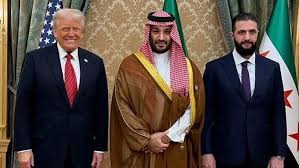
A year after Assad’s fall, Syria remained unstable and unresolved. The regime was gone, but the future was unclear. Old sectarian tensions resurfaced, often in bloodshed, new power struggles emerged, powerful neighbours staked claims and  justice for past crimes remained distant.

Syria in 2025 was neither a success story nor a collapse – but suspended between heaven and hell, a country trying to exist after catastrophe with the rest of the world largely moving on.

See Between heaven and hell … Syria at the Crossroads

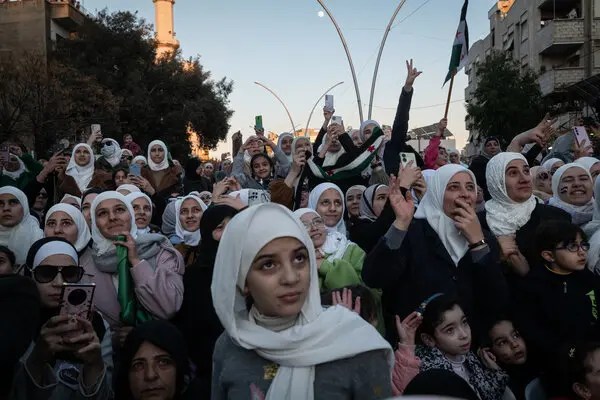
Women in Damascus celebrate the fall of the Assad regime

Sudan: what genocide actually looks like

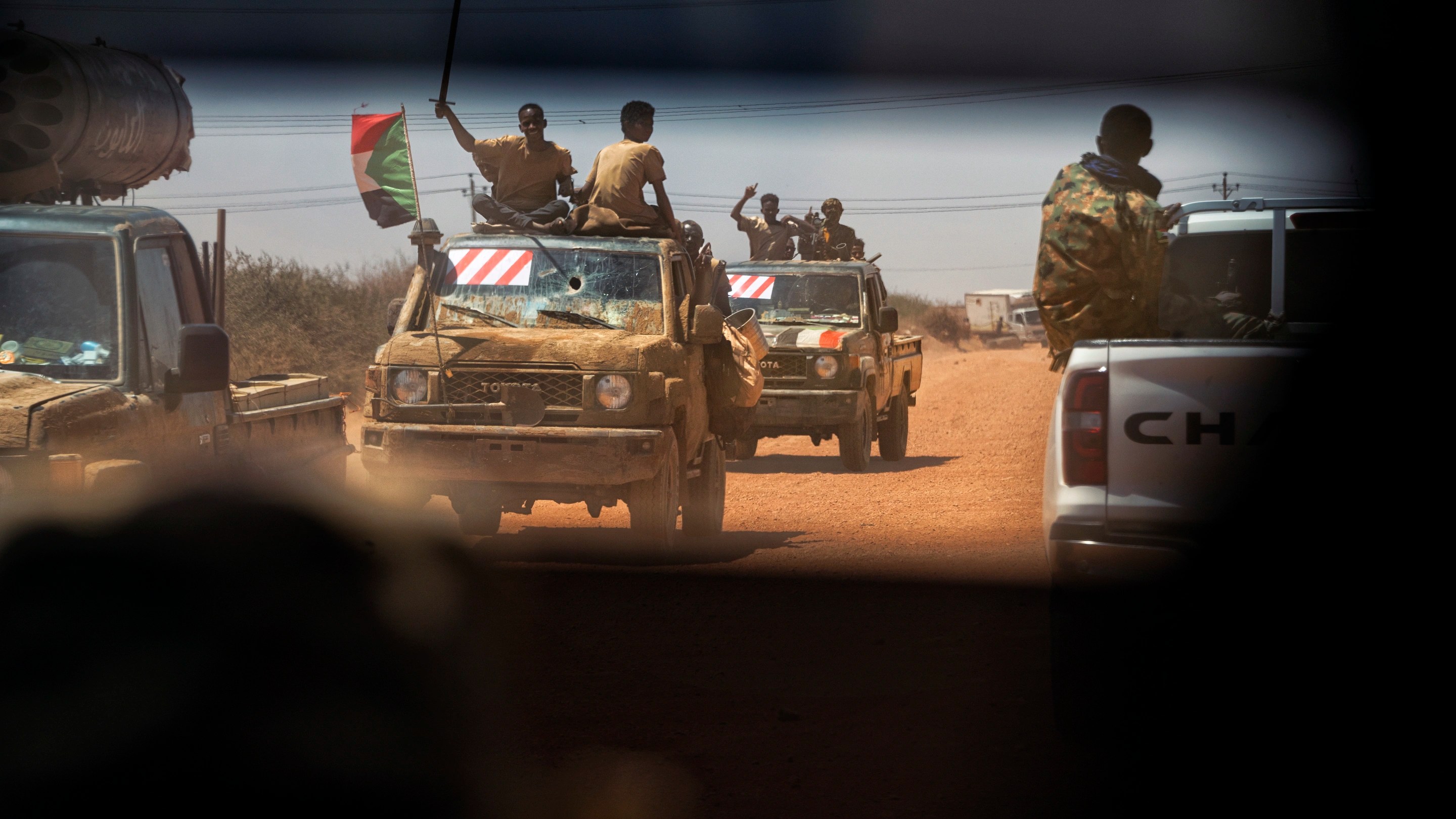
Sudan’s civil war continued with little international attention. Mass killing, ethnic cleansing, famine, and displacement unfolded slowly and relentlessly. This was genocide without spectacle. No clear narrative. No sustained outrage. It showed how mass atrocity can now occur not in secrecy, but in plain sight – and still be ignored.

see The most nihilistic war ever …Sudan’s waking nightmare

America: a country divided against itself

The United States spent 2025 deeply divided, with no sign of healing. Pew Research polling showed that seven out of ten republicans think that the opposite side is immoral while six of ten democrats thinks the same of their rivals.

Trump’s return to power sharpened those divisions. His administration governed aggressively: mass deportations, punitive tariffs, the dismantling of foreign aid, political retribution, and pressure on democratic institutions. The country looked inward and outward at the same time – less cooperative, more transactional, more openly nationalist. Democratic norms eroded not overnight, but through constant stress and disregard. With three years still to run and the tell-tale midterms approaching, allies and cronies are adjusting, bickering rivals are taking notes, and uncertainty has become the defining feature of American leadership. Meanwhile, #47 is slapping his name on everything he can christen, from bitcoins to battleships.

See, for light relief, Danger Angel … the ballad of Laura Loomer 

Monroe Redux: the return of “the Ugly American”

US foreign policy took on a blunt, old-fashioned tone. Pressure on Canada and Mexico increased. Talk of annexing Greenland resurfaced. Venezuela, caught in the maw of Yanqui bullying and bluster, waits nervously for Washington’s next move. The administration promised imminent land operations – and then bombed Nigeria! The revival of the old Monroe Doctrine felt, as baseball wizz Yogi Berra once remarked, like déjà vu all over again, not as strategy, but as instinct. Influence asserted, consultation discarded. The “ugly American” was back, and unapologetic.

See Tales of Yankee power … Why Venezuela, and why now?

Europe at a inflection point

Europe in 2025 didn’t collapse, as many pundits suggested it might, but it shifted. Far-right ideas gained ground even where far-right parties didn’t win and remained, for now, on the fringes albeit closer to electoral success. Borders tightened; policies hardened; street protests proliferated – against immigration and against Israel, Support for Ukraine continued, but cautiously. The continent stood at a crossroads: still committed to liberal values in theory, but increasingly selective in practice.

Uncle Sam’s  cold-shoulder

Rumbling away in the background throughout year was the quiet but  cumulative alienation of America’s allies. Not with a single rupture, but through a thousand small slights. transactional diplomacy dressed up as realism, alliances treated as invoices rather than covenants, multilateralism dismissed as weakness. Europe learned that security guarantees come with a mood swing; the Middle East heard policy announced via spectacle; Asia watched reassurance coexist uneasily with unpredictability.

The new dispensation was illustrated by the Trump National Security Strategy. It is at once candid and contradictory: it outlines a narrower, realist vision of American interests, emphasising sovereignty, burden-sharing, industrial renewal, and strategic clarity, yet it is riddled with silences, evasions, and tensions between rhetoric and likely action. Allies are scolded for weakness while the document avoids naming Russia’s aggression, underplays China, and projects American cultural anxieties onto Europe. These contradictions expose both strategic incoherence and the limits of paper doctrine against presidential temperament, leaving Europe facing an irreversible rupture in trust and revealing a strategy as much about America’s insecurities as its actual global posture.

The post-WW2 order has not so much been dismantled as shrugged at, and indeed, shrugged off. Trust eroded not because the United States has withdrawn from the world, but because it has remained present without being reliable, and presumed itself to be in charge. Power, exercised loudly but inconsistently, has discovered an old truth: allies can endure disagreement, but they struggle with contempt.

Australia in 2025 … high flight and crash landing

Though beset by a multitude of crises – the cost of living, housing, health and education services – the Albanese Labor government was returned comfortably in May, helped by a divided, incoherent, and seemingly out of touch opposition. For the rest the year, federal politics felt strangely frictionless with policy drift passing for stability. The Coalition remained locked in internal conflict, unable to present a credible alternative. The Greens, chastened by electoral defeat and in many formerly friendly quarters, ideological disillusionment, treaded water.

But beneath the surface, social cohesion frayed. Immigration debates sharpened. Antisemitism rose noticeably, no longer something Australians could pretend belonged elsewhere. Attacks on Jewish Australians forced a reckoning many had avoided and hoped would resolve once the tremors of the war in Gaza had ameliorated. Until 6.47pm on 7th December, a beautiful evening on Sydney’s iconic Bondi Beach. Sudden, brutal and in our summer playground, sectarian violence shattered the sense of distance Australians often feel from global disorder. At that moment, politics stopped feeling abstract. The world, with all its instability, barged in and brought the country down to earth.

See This Is What It Looks Like

Lifesavers on Bondi Beach, 20 December 2025. Edwina Pickles

Featured photograph and above:

A handful of bodies on Bondi Beach, and behind them, the howling infinite of expectation, obligation, and the careful rationing of human empathy. The smallness of the beach against the vastness of consequences. On December 20, 2025, Bondi’s iconic lifesavers formed a line stretching the entire length of the beach -silent, solemn, a nation visibly in mourning. Similar tributes unfolded from Perth to Byron Bay, gestures of unity in the face of a shock that touched the whole country.

The Year of the Chatbot: Promise, Power, and Risk

And now, a break from the doom and gloom …

2025 was the year when artificial intelligence became part of daily life. Chatbots ceased to be experimental and became integral, transforming from novelty to utility seemingly overnight. People used it to write, research, translate, plan, argue, comfort, and persuade; institutions and individuals adopted it instinctively. Setting tone as much as content, the ‘bots have lowered barriers to knowledge, sharpened thinking, and helped people articulate ideas they might otherwise struggle to express. Used well, they amplified curiosity rather than replace it.

The opportunities are obvious – but so are the risks. Systems that can clarify complexity can also flatten it. Chatbots sound confident even when wrong, smooth over disagreement, and made language cleaner, calmer, and more persuasive – but not necessarily truer. They reinforce confirmation bias, outrage, and tribal certainty, generating arguments instantly and flooding the zone with plausible-sounding text. As information has became faster, cheaper, and less reliable, Certainty has spread more easily than truth, so truth has to work much harder.

Dependence is subtler but real. Outsourcing thinking – summaries instead of reading, answers instead of wrestling – did not make humans stupid, but less patient. Nuance, doubt, and slow understanding became harder to justify in a world optimised for speed. Yet conversely, man people still seek context, history, and complexity. Used deliberately, AI could slow the pace, map contradictions, and hold multiple truths at once.

By the end of 2025, the question was no longer whether AI would shape public life – it already had. The real question is whether humans would use it as a shortcut, or as a discipline. The technology is neutral. The danger – and the promise – lies in how much thinking we are willing to give up, and how much responsibility we are prepared to keep.

See The promise and the peril of ChatGPT 

Algorithm and blues

Alongside the chatbot sat a quieter, more insidious force: the algorithm itself. By 2025 it no longer simply organised information – it governed attention. What people saw, felt, and argued about was shaped less by importance than by engagement. To borrow from 20th century philosopher and communication theorist and educator Marshall McLuhan, the meme had become the message. Complex realities were compressed into images, slogans, clips, and talking points designed not to inform but to travel. The algorithm rewarded speed over reflection, certainty over doubt, heat over light. Politics, war, and grief were all flattened into content, stripped of context, and ranked by performance. What mattered most was not what was true or necessary, but what disseminated.

Passion without Wisdom

I wrote during the year that we seemed “full of passionate intensity” – Yeats’ phrase still apt in the twenty first century- but increasingly short on wisdom and insight. 2025 confirmed it. Anger was everywhere, empathy highly selective, certainty worn like armour. People felt deeply but thought narrowly. Moral energy surged but rarely slowed into understanding. The problem was not indifference; it was excess – too much feeling, too little reflection. In that environment, nuance looked like weakness and patience like complicity. What was missing was not information, but judgement – the harder work of holding contradiction, of resisting instant conclusions, of allowing complexity to temper conviction. Passion was abundant. Insight, increasingly rare.

Looking Toward 2026

Looking back on 2025, it seems that there  were no endings, neither happy or sad. Just a promise, it seems, of more of the same. The year didn’t solve anything. It clarified things. And if it clarified anything, it was that the world has grown adept at managing, ignoring, or absorbing what it cannot fix. It revealed a world adjusting to permanent instability. In this year of echoes, refrains, and unfinished sentences.

Passion, intensity, and outrage were abundant, but patience, wisdom, and insight remained scarce. Democracies strained under internal and external pressures. Wars lingered unresolved. Technology reshaped thought and attention.

Some argue that hope springs eternal, that yet, even amid the drift and the fractures, glimpses of understanding and resistance persisted, that although the world has settled into its chaos, we can be riders on the storm. But, I fear, 2026 arrives not as break, a failsafe, a safety valve, but as continuation. It looms as a test of endurance rather than transformation.  In my somnolent frame of mind, I’ve reached again for my Yeats. “Things fall apart; the centre cannot hold; mere anarchy is loosed upon the world, the blood-dimmed tide is loosed …”

After the chaos of 2024 and the hardening of 2025, the question is no longer what might go wrong. It’s what we’re prepared to live with.

And so we come to what In That Howling Infinite wrote in 2025.

What we wrote in 2025

It was a year that refused neat endings.

It began in a wasteland – Gaza as moral ground zero – and moved, restlessly, through revolutions real and imagined: Trump as symptom and accelerant, Putin as a man racing his own shadow, Syria forever at the crossroads where history idles and then accelerates without warning. Gaza returned, again and again, sunrise and false dawn, as spectacle and strategy; Sudan burned in near silence; Venezuela re-entered the frame as empire’s backyard as the US disinterred its Monrovian legacy. In That Howling Infinite featured pieces on each of these – several in many cases , twenty in all, plus a few of relevance to them, including an overview of journalist Robert Fisk’s last book (The Night of Power – Robert Fisk’s bitter epilogue). A broadranging historical piece written in the previous year and deferred, Modern history is built upon exodus and displacement, provided a corrective of sorts to the distorted narratives that have emerged in recent years due to a dearth of historical knowledge and the partisan weaponisation of words. 

It was almost as light relief that we turned to other subjects. Of particular interest was AI. Approaching remorselessly yet almost unrecognised in recent years, it banged a loud gong and crept from curiosity to condition, from tool to weather system, quietly rewriting the newsroom, the internet, and the idea of authorship. ChatGPT and other chatbots appeared not as saviours but as promise and peril in equal measure. By year end, we were fretting about using ChatGPT too much and regarding it as something to moderate like alcohol or fatty foods. We published three pieces on the subject in what seemed like rapid succession, and then pestered out – sucked into the machinery, I fear.

What with so much else attracting our attention, we nevertheless managed to find time for some history – including a  particularly enthralling and indeed iconoclastic book on the fall of the Ottoman Empire; the story of an Anzac brigade lost in Greece in 1942; “the Lucky Country” revisited after half a century;  and a piece long in the pipeline on the iconic singer and activist Paul Robeson.

In August, as on a whim, for light relief, we summoned up a nostalgic old Seekers’ song from the mid-sixties, a time when the world was on fire with war and rage much as it is today, but for us young folk back in the day, a time of hope and hedonism. For us, the carnival, clearly, is not over. The machinery is still whirring, the music still loud, and the lights still on. History is insisting on one more turn of the wheel, and the dawn, so often promised, so frequently invoked, has not yet broken.

January
The Gaza War … there are no winners in a wasteland
The way we were … reevaluating the Lucky Country

February
Let’s turn Gaza into Mar e Largo
Trump’s Second Coming … the new American Revolution
Cold Wind in Damascus … Syria at the crossroads

March
Trumps Revolution… he can destroy but he cannot create
Where have all the big books gone?
Putin’s War … an ageing autocrat seeks his place in history

April
The Trump Revolution … I run the country and the world
The Fall of the Ottoman Empire and the birth of Türkiye
Let Stalk Strine .. a lexicon of Australian as it was spoken (maybe)

May
The phantom of liberty … the paradoxes of conservativism
Shadows in search of a name … requiem for a war
The continuing battle for Australia’s history

July
A mighty voice … the odyssey of Paul Robeson

August
109 years of Mein Kampf … the book that ravaged a continent
High above the dawn is breaking … the unlikely origin of a poo song

September
Gaza sunrise or false dawn? Trump’s peace plan
Gaza sunrise or false dawn? Spectacle or Strategy
Will there ever be a Palestinian state?
Why Osana bin lost the battle but won the war
The Night of Power … Robert Fisks bitter epilogue
The promise and peril of ChatGPT
Who wrote this? The newsroom’s AI dilemma

October
AI and the future of the internet
Danger Angel … the ballad of Laura Loomer

November
A forgotten Anzac story in Greece’s bloody history
The most nihilistic war ever … Sudan’s waking nightmare
Answering the call … National Service in Britain 1945-1963
Tales of Yankee Power … at play in Americas backyard

December
Delo Kirova – the Kirov Case … a Soviet murder mystery
Between heaven and hell … Syria at the crossroads
This Is What It Looks Like
Tales of Yankee power … Why Venezuela, and why now?
Marco Rubio’s Venezuelan bargain

Read out reviews of prior years:

That was the year that was – retrospectives

A song for 2026: Lost love at world’s end …

It is our custom to conclude our annual wrap with a particular song that caught our attention during the year. Last year, we chose Tears for Fears’ Mad World.  It would be quite appropriate for 2025. But no repeats! so here is something very different. An outwardly melancholy song that is, in the most ineffable way quite uplifting. that’s what we reckon, anyway …

The Ticket Taker is on the surface a love song for the apocalypse; and it’s it’s one of the prettiest, most lyrically interesting songs I’ve heard in a long while. I could almost hear late-period Leonard Cohen and his choir of angels.

The apocalypse is both backdrop and metaphor. We’re not sure which. Is it really about a world ending, or just about the private ruin of a man left behind by love and fortune. The lyrics are opaque enough to evade final meaning, but resonant enough to keep circling back, like the ferry itself, between hope and futility. A love song, yes, but also a confession of entrapment: the gambler’s hope, the ark one cannot board.

The “Ticket Taker” song was written by Ben Miller and Jeff Prystowsky and is featured on The Low Anthem’s album Oh My God, Charlie Darwin. It features on Robert Plant’s latest foray into roots music – this time with English band Saving Grace. This flawless duet with Suzi Dian is mesmerising and magical.

Jeff will tell you that the song is “pure fiction,” that Ben “just made it up one day” – but fiction, as we know, has a way of smuggling deeper truths than fact dares admit.

Tonight’s the night when the waters rise
You’re groping in the dark
The ticket takers count the men who can afford the ark
The ticket takers will not board, for the ticket takers are tied
For five and change an hour, they will count the passers-by

They say the sky’s the limit, but the sky’s about to fall
Down come all them record books, cradle and all
They say before he bit it that the boxer felt no pain
But somewhere there’s a gambling man with a ticket in the rain

Mary Anne, I know I’m a long shot
But Mary Anne, what else have you got?
I am a ticket taker, many tickets have I torn
And I will be your ark, we will float above the storm

Many years have passed in this river town, I’ve sailed through many traps
I keep a stock of weapons should society collapse
I keep a stock of ammo, one of oil, and one of gold
I keep a place for Mary Anne, soon she will come home

Mary Anne, I know I’m a long shot
But Mary Anne, what else have you got?
I am a ticket taker, many tickets have I torn
And I will be your ark, we will float above the storm

Mary Anne, I know I’m a long shot
But Mary Anne, what else have you got?
I am a ticket taker, many tickets have I torn
And I will be your ark

Between heaven and hell … Syria at the Crossroads

There are moments in the Middle East when history suddenly shift gears and takes us all by surprise. Lenin knew the cadence: there are decades, he wrote, where nothing happens; and then, weeks in which decades happen. A year ago, Syria – trapped in the vortex of its civil war for almost fourteen years  and virtually ignored by the rest of the world since October 7 2023 – suddenly leapt into one of those crazy weeks, leaving allies, enemies, and analysts alike blinking in the dust. Even now, a year after the astonishing fall of Damascus, the country sits like Kipling’s Tomlinson at the gates of judgement: not quite damned, not fully redeemed, suspended between heaven and hell.

Sleepers awake …

For years, as The Independent’s Bel Trew observed last December (see Syria. Illusion, delusion and the fall of tyrants) the world forgot about Syria – notwithstanding the courageous efforts of western and Syrian reporters and humanitarian workers who strove in perilous circumstances to bear witness. The civil war had become the background hum of the region, a grim drone many had learned to tune out as Ukraine and Gaza dominated the world stage. The regime of Hafez al Assad, brutal and immovable, bolstered by Russia, Iran and Hezbollah, looked set to endure indefinitely. The jihadi rebel enclave in Idlib, though supported by Türkiye, was dismissed as a besieged hold-out. Even those who professed expertise couldn’t reliably tell you whether the war was still ongoing, who was fighting whom, or what stage the conflict had reached. It was as if the wheels of war had stopped spinning.

Then, over the space of days – eleven, to be precise – the wheels spun again. Hay’at Tahrir al-Sham’s fighters burst from their confined redoubt with a momentum no one expected (including, it seems, themselves), sweeping through Aleppo and racing down the highway to the capital. Analysts reached instinctively for historical parallels: Havana 1959, Saigon 1975, Kabul 2021. Analyst David Kilcullen pointed instead to Timur Kuran’s theory of the “preference cascade”: the sudden collapse of a regime that had mistaken silence for loyalty and compliance for consent. Assad’s security apparatus – omnipresent, omniscient, yet somehow oblivious – realised too late that its soldiers had no stomach left for the fight. The all-powerful giant had feet of clay.

It didn’t help that Iran, Assad’s indispensable patron, had stumbled into the most grievous strategic miscalculation of its post-1979 history. Flush with revolutionary zeal, Tehran had kicked the hornet’s nest in Lebanon, prompting Israel to pivot from Gaza to Hezbollah with stunning force. Suddenly Iran’s expeditionary assets were exhausted, its proxies over-extended, and its clerical leadership exposed as both ageing and isolated. Even the Ayatollah’s conspiratorial refrain – that the fall of Damascus was all a plot by the Great Satan, the Little Satan, and the Sultan in Ankara – couldn’t mask the fact that this was less Zionist cunning than simple imperial overreach. When the rebels came, neither Iran nor Hezbollah, nor Russia, entangled in its Ukrainian quagmire, could ride to the rescue.

But the rebels, too, were surprised. Their mandate from Ankara was modest – expand the borders of their statelet a little, test the regime’s nerve. Instead, they found themselves virtually unopposed on the road to Damascus.  In an Informative article in E-zine Unherd republished below, British writer and investigative journalist Tam Hussein  writes how many of the fighters interpreted the victory as divine intervention – not jihadi zealotry, but a sincere theological attempt to explain the inexplicable. The suddenness of Damascus’s collapse felt, to them, like an echo of Muhammad’s bloodless conquest of Mecca. And in a land where the eschatological imagination has always saturated politics, it didn’t take long before social media brimmed with end-times speculation. Ahmed al Shara’a – formerly Abu Mohammad al-Jolani, with a $10 million American bounty on his head – was seen by some as “the one”, and the precursor of the Mahdi and the foretold end of days.

Yet as Hussein rightly notes, miracles make poor policy. The survival of the new Syrian administration will depend not on prophecy but on governance, and on whether Shara’a, interim president and ex-jihadi turned statesman, can transform a miraculous seizure into a sustainable state.

To his credit, he has avoided the catastrophic purges that helped destroy post-invasion Iraq. He has kept the civil service intact, flirted audaciously with Western diplomacy, and allowed at least the theatrical semblance of elections. He has restored the embassy in London, opened channels to Washington, even  visiting the White House  and played the charm-game with Gulf capitals that only recently readmitted Assad into their fold. As Hussein writes, he has shown political finesse: keeping the constitution, appointing seventy parliamentarians himself, and balancing piety with pragmatism.

But the tightrope is frayed. Sectarian wounds – Druze, Alawite, Sunni, Christian – remain raw and unstitched, with the Latakia massacres now entering their fraught judicial phase, and Israel stirring the Druze pot. Kurdish anxieties simmer: the old “Arab-first” chauvinism must be abandoned if Syria’s patchwork is ever to become a tapestry again. Foreign fighters, once lionised, now loiter between hero and hazard, implicated in sectarian atrocities. Kurds clash with Syrian forces; Turkish troops press deeper into Rojava; Israel remains the unpredictable neighbour bestride the Golan; and Iran, though weakened, is never entirely out of the game. It is not inconceivable that the forces that helped topple Assad could yet turn their sights toward Jerusalem in the belief that prophecy demands it.

And there are darker portents too – those flickering shadows that hint the wind of freedom may be blowing from the wrong quarter. The new government’s early gestures toward Islamisation – the hair-covering admonition, the curriculum purge, the dismissal of women from key posts, the torching of a Christmas tree in Hama – suggest that pro-Russia and anti-western platforms like RT and Mint may have a point when they warn that the leopard has not fully changed its theological spots. Shara’a’s declaration that elections may be four years away, the dissolution of the old constitution, and the folding of all rebel factions into state structures recall less a liberal transition than a consolidation of revolutionary power.

Meanwhile, the country remains a mosaic of mini-wars. In the north, Turkish proxies grind against Kurdish forces in Rojava. In the south, local militias continue to resist HTS’s claim to national authority. In the west, Alawite formations cling to their shrinking redoubts. To the east, Islamic State survivors eye the chaos, waiting for the prison gates to break. And overhead, as ever, the Americans and Israelis fly their competing deterrents, ensuring the war never quite ends.

So: Syria stands at the crossroads. Will Syria’s future be heaven, hell, or merely another circle of the inferno?

Optimism is possible – cautiously so. If the West can avoid its habitual fatalism, if, when sanctions are lifted, investment flows, if Turkey and Israel can be coaxed into tolerable coexistence, if Kurdish autonomy is honoured, if sectarian grievances are handled with equity and not vengeance — then Syria could, in time, become a conservatively stable hub. Shara’a’s Idlib experiment shows he can build an economy under duress.

But the inverse is equally imaginable: a Lebanon-style implosion, a Yugoslav-style partition, or a Gaza-style fortress of permanent mobilisation. As Isreali commentator and contributor to Haaretz Zvi Bar’el wrote a year ago, writes, the warm international “envelope” around Damascus is generous but tentative. Nobody quite knows where Shara’a is heading. They simply assume anyone is better than Assad – the same mistake Syrians once made about the old Ba’athi patriarch Hafez al-Assad himself.

Right now, the future’s not ours to see. Something’s happening, but we don’t know what it is, and anyone with a deep knowledge of the Middle East knows that one must expected the unexpected. The old regional wars – Gaza, Lebanon, the Red Sea, Iran’s Axis of Resistance – though seemingly on hold, have not paused to let Syria breathe. The war in Ukraine grinds into winter, the bizarre Gaza peace plan shuffles on, and there are constant political shifts in Washington. Each of these could rewrite the geopolitical chess board yet again.

Still, as Robert Fisk wrote in the final line of the final book he never lived to promote: all wars come to an end, and that’s where history restarts. Syria is restarting now – painfully, precariously, imprecisely –  but restarting nonetheless.

Whether Syria walks toward heaven or hell remains to be seen. The choice –  as ever in the Levant – will not be its alone.

Syria Today: Walking Through the Wreckage

A year after the Assads fell, Syria still moves through its own ruins – startled by its freedom, and half-afraid of it. The dynasty’s collapse ended the nightmare but did not usher in a dream; it simply exposed, in unforgiving daylight, the damage done over half a century of dictatorship and more than a decade of war. The smashed cities are visible to any passer-by; the deeper wreckage – the traumas, resentments, and debts of blood – is harder to map and harder still to mend.

Sednaya prison’s opened gates remain the sharpest indictment. The men who stumbled out were not just survivors but witnesses, their bodies forcing the nation to acknowledge what many had whispered and few had dared investigate. Yet even this reckoning has not united the country. Sectarian reprisals and atrocities on the coast, more atrocity and calls for Druze autonomy demands in Sweida, tribal restlessness in the south and northwest, Kurdish self-rule in the north, and Alawite fear of collective punishment keep the national psyche taut and divided. Bitterness circulates like a second economy.

The economy, meanwhile, balances on a fraying tightrope. Western aid and investment have brought cranes, reopened highways, and a flicker of commerce, but also inflation that is hollowing out households. Reconstruction glimmers like a desert mirage: real enough to chase, never close enough to touch. Corruption accompanying nepotism and patronage has survived the revolution, and many returnees discover that rebuilding a home now costs more than earning one.

Politically, the country sits in an improvised equilibrium. Al Shara’a rules as both liberator and question mark – trusted by some, tolerated by others, watched by all. His pivot toward Washington, his quiet coordination with US forces, and his break with former comrades offer a new direction, but also a gamble. Around him, sovereignty is nibbled at the edges: Israel digs deeper into Quneitra province; Türkiye tightens its grip in the Kurdish north. Liberation has shifted the map without fully restoring control over it.

So Syria stands on the threshold, like Tomlinson, neither damned nor redeemed, simply called to account. The war is over, but its aftershocks and tremors linger in regional loyalties, local vendettas and regional manoeuvres. The people are free, yet unsure of that freedom’s limits and what it asks of them. And the vast machinery of the state still creaks with old habits and temptation.

And yet – a small, highly qualified yet – Syrians are imagining a future again. Not the predetermined script of dictatorship, nor the fatalism of war, but something open, negotiable, theirs’. For a people long told that nothing changes, the mere possibility of change is its own quiet revolution. Hope is not guaranteed; neither is stability. But the impossible has already happened once, and that alone shifts the horizon.

Postscript: the strange, messianic weather of revolutions

Among the HTS fighters Tam Hussein describes, the astonishingly swift and almost bloodless collapse of Damascus could never be reduced to battlefield arithmetic. After over a decade of stalemate and slaughter, the conquest of Damascus and the fall of Assad felt too abrupt, too neat, too historically implausible to be merely human. And so they reached, perhaps instinctively, for the vocabulary of prophecy that has long circulated in the Levant: the old stories of tyrants toppled in the final days, of a just ruler rising at history’s eleventh hour, of a brief season of peace before a climactic confrontation with “the Romans,” a term that in popular imagination now stretches elastically to include Israel, America, or the West at large.

In this folk-level cosmology – not the carefully parsed doctrine of scholars, but the lived, emotional scripture of men who have lived too long fear, death and loss loss – the victory in Damascus reads like a prophetic epic ballad. When a fighter told Hussein that Syria would enjoy “ten years of peace before the war with Israel,” he was drawing from a hazy amalgam of hadith traditions and battlefield folklore to make sense if the improbable: the idea of a lull before the storm, a breathing space before the world tilts into its final reckoning. It is vernacular eschatology, shaped as much by trauma and longing as by text.

Within that register, the murmurs that Shara’a/Jolani might be “the one” carry an unmistakable Mahdist echo. No fatwas or proclamations like when Da’ish leader Abu Bakr  al-Baghdadi famously declared the caliphate from the minbar of Mosul’s al-Nuri Mosque in 2014; but the emotional charge behind the phrase is unmistakabl: an intuitive reach for a Mahdi-shaped idea of the righteous restorer, the unifier, the man who appears when everything has fallen apart. It’s not that anyone literally thinks Jolani is the Mahdi; it’s that the mood of the moment makes such thoughts feel briefly within arm’s length. A silhouette on the horizon, nothing more.

And here, Syria is not unique. Revolutionary periods everywhere – the Protestant Reformation, the French Revolution, the Russian Revolution and Civil War, the Arab Spring even, have their magical phase — those jittery days when people begin to speak as if the world has cracked open, meaning is pouring through the seams, and events blur into myth. When a regime that seemed immovable collapses in a fortnight, people fall back on stories larger than themselves. Sudden upheaval, long suffering, and the ascent of a charismatic figure combine to crack open the ordinary world. Prophecy offers a narrative frame when history seems to be behaving like fable.

So the eschatological edge in these fighters’ conversations tells us less about doctrine and more about psychology. It’s a very human response: a form of magical thinking that arises when reality becomes too strange to process, a way of giving shape to chaos, of telling themselves that their suffering fits into a larger story. A coping mechanism, if you like –  a mythic vocabulary for a moment when Damascus fell, and the ordinary rules stopped making sense and the earth seemed briefly to tilt on its axis.

See also in In That Howling Infinite, Syria. Illusion, delusion and the fall of tyrants and Cold wind in Damascus – Syria at the crossroads. And  on the subject of messianism in general, see A Messiah is needed – so that he will not come

Will civil war return to Syria?

Its future is in the balance

Tam Hussein, Unherd December 8, 2025

A few months ago in Damascus, I discovered a medieval hospital. The door had been left slightly ajar, and I wandered in with my companion Hassan Idlibi — a rebel fighter and old friend. He hadn’t been in the Old City since the fall of Syria’s capital, exactly a year ago today. “When Damascus fell,” he told me, “we were at our lowest ebb. Even the attack on Aleppo was our last gasp. We wanted to break the stalemate. And then we just pushed and pushed, and we ended up sleeping inside the Umayyad Mosque. It was a miracle.”Idlibi, like many Syrians, did not interpret the taking of Damascus through geopolitics — but as divine intervention. This wasn’t because he was a mindless zealot. Far from it. He is one of the most well-read men I know. But, to his mind, the fall of Damascus was so sudden, so unexpected, that only the miraculous could explain it. The victory, he noted, had been achieved by those who had been motivated by Islam. Help had come from foreign fighters, the mujahideen, who travelled from across the globe to aid their co-religionists. And the campaign had been led by a former jihadi, Ahmed al-Sharaa, now the interim president of Syria. At the time, the old al-Qaeda operative, then known by his nom de guerre, Abu Mohammad al-Jolani, had a $10 million American bounty on his head.

After more than a decade of slaughter, no one had expected the capital to collapse. Assad, then president, had seemed like a stubborn wart: unpleasant but immovable. Jolani’s rebel enclave in the northern city of Idlib looked too small, too besieged, to pose a serious threat — though in fact it was performing better economically than inflation-ravaged Damascus, helped along by a reliable flow of Turkish hard currency. I myself expected the rebels to negotiate. What leverage did they have? Yet this rebel government, roughly the size of Croydon, took over the instruments of state, and since then has avoided stumbling into a new civil war.

The unexpected and largely peaceful victory was attributed to piety, prophecy, steadfastness. Some have even compared the final conquest of Damascus to Muhammad’s bloodless conquest of Mecca in 630. The idea of a “miracle”, here, is not mere rhetoric — it shapes political expectations. Some Syrians, at least based on my social media, think all this makes Sharaa “the one”, with my Facebook messages and WhatsApp chats awash with prophetic readings of the present. One believed Syria would now enjoy 10 years of peace before the war with Israel begins. Perhaps, he suggested, this was the prelude to the end of times. After all, so-called “Greater Syria” — encompassing much of the Levant — plays an important role in the Syrian and indeed Muslim sacral imagination. It is where prophets walked and is the place where many of the end of times narratives will play themselves out.

Yet if the fall of Damascus seemed miraculous to many Syrians, the survival of the new administration will depend less on providence than on governance. Despite his past, Sharaa has so far demonstrated an unexpected level of political finesse. He has kept the constitution, held elections — albeit with 70 seats appointed by himself — and all the while has acted the statesman. He is savvy enough to not mind having President Trump spray his latest fragrance on him in the Oval Office, or Syrian Jewish rabbis blessing him.

Sharaa has made some promising early decisions. By keeping the civil service intact, he has avoided the catastrophic purge that helped destroy post-invasion Iraq. He should continue recruiting highly-educated young Syrians from the diaspora — people familiar with Western administrations and political norms. Even so, the administration still has a tendency to fear scrutiny and behaves as if under siege. It should welcome a regulated free press, which would expose blind spots, not undermine authority. The British press has reported that Jonathan Powell’s Inter Mediate is working with the new government. This should be welcomed rather than criticised — not only for reasons of conflict resolution and soft power, but for its value in statecraft and building institutional capacity.

Sharaa’s priorities for the coming year are clear. The country remains immensely fragile, caught in a regional tug-of-war between Israel and its neighbours, and divided along ethnic and sectarian lines. The situation could easily drift into a reprise of Lebanon’s civil war. Sharaa’s first task is therefore to mend Syria’s sectarian and ethnic fractures with a sense of equity. The trials that began this month over the coastal massacres in Latakia will be an important test of how the country intends to move forward. The Druze and Alawite communities — already bruised by conflict and mistrust — require justice delivered without the language of sectarianism.

Meanwhile, Kurdish anxieties must be addressed by ending the Arab-first ideology of the old regime. Syria has never been a purely Arab country: even its favourite son, Saladin, the builder of that hospital I visited and whose grave in Damascus still draws multitudes, was a Kurd. Last year’s tentative permission for Kurdish new year celebrations (Newroz) suggests that a more pluralist future is possible. Yet it remains unclear how far Kurdish cultural expression will be allowed to develop. Already this month, exchanges of fire between Syrian government forces and Syrian Democratic Forces (SDF) units under Kurdish command show how fragile the situation is.

Perhaps the most difficult balancing act involves the foreign fighters who fought on Sharaa’s side. They carry immense symbolic weight in Syrian society — and are the cause of immense fear in the West. Many are ready to resume normal life, but others still see themselves as Islam’s warriors. Recent clashes in the Idlib countryside involving French foreign fighters reflect anxieties that any rapprochement with the West might see them handed over to their home governments. The image of Sharaa standing beside Trump, receiving a symbolic “anointing” of his new fragrance, alarms them even if such engagement is politically necessary.

Granting these fighters legal status, regularising their papers, integrating some into the national army or demobilising them with stipends and educational opportunities — not unlike the GI Bill for US veterans — could go a long way toward neutralising one of Syria’s most volatile pressures.

Then there is the conundrum of Israel. On this, Sharaa has cultivated deliberate ambiguity. At the United Nations, Syria has repeatedly noted its restraint regarding Israel’s illegal strikes on Syrian territory, yet Sharaa has resisted pressure to join Trump’s flagship Abraham Accords. Signing them now would be political suicide. But ambiguity buys him room to manoeuvre — and time to consolidate the state. The question is how long this can last.

For its part, the West has worked to prevent Syria from sliding into another civil war — one that would inevitably spill over into Europe, potentially replaying the exodus of 2015. With regional partners like Saudi Arabia and Turkey, Western governments have effectively restrained Israeli escalation, aware that renewed instability would eventually reach Jerusalem’s door. It’s not impossible to imagine rebels, having overthrown a “pro-Western stooge” like Sharaa and aided by foreign fighters, actually marching toward Israel, convinced that “the infidels” will never allow them to determine their own future. As they did in Damascus, so too — in their imagination — must they do in Jerusalem.

Thus far Sharaa has governed with surprising openness. He has welcomed Britain’s foreign secretary David Lammy, met American diplomats and General David Petraeus, played basketball with US soldiers, and cooperated in counter-terrorism operations. He has also restored relations with London, with foreign minister Asaad al-Shaibani reopening the Syrian embassy.

If Western governments refuse to work with him because of his Islamist roots, they will share responsibility should Syria fracture again. Sharaa’s past is not erased; he may remain an uncomfortable partner. But what is the alternative? That he be excluded from political life and drift into a Castro- or Maduro-like role on the sidelines? If the Saudi Crown Prince can be brought in from the cold after the Khashoggi murder, then almost anything is possible.

Here I recall a meeting with former Saudi spy chief Turki al-Faisal in his South Kensington apartment after the release of his memoir. Faisal lamented how his advice went unheeded after the Afghan-Soviet war. He had urged the international community to launch something akin to a Marshall Plan — an investment programme to stabilise Afghanistan. Had that happened, the region might not have unravelled. Instead, the country collapsed into years of civil war.

Likewise, fully lifting sanctions on Syria and providing a major investment programme, coupled with training and cultural exchange, could restrain the country’s more radical elements. Reining in Israeli escalation, de-escalating the Druze conflict, and mediating between the SDF and Damascus would all help prevent new wars. On this, the West could also spare itself a future security headache by helping Damascus regularise or demobilise foreign fighters rather than leaving them to drift. This would all help to displace messianism.

What, then, would such investment bring the West, beyond avoiding another gaping wound on its eastern flank? For sure, it will not turn Damascus into another Beirut, a place for foreign journalists to party, nor into a Deano-friendly Dubai. Syria will likely remain socially conservative, more like Muscat in Oman. Given time, however, it could become a commercial hub with a distinct cultural life, just as it has been for much of its epic history. This isn’t mere optimism: Sharaa turned Idlib, once a distant town, into a magnet for Damascenes seeking commercial opportunity. Investment now would bring the West a friendly partner, business prospects and political influence. The choice is stark. With support, Syria could become a kind of West Germany: rebuilt, integrated, and stable. Without it, the country risks becoming a new Jerusalem — a battleground charged with fire and prophecy.

Tam Hussein is an award winning investigative journalist and writer. His work has been recognised by the Royal Television Society Awards.

The Night of Power – Robert Fisk’s bitter epilogue

“All wars come to an end and that’s where history restarts”

“History stretches out into the future as well as the past”

“All wars may end in negotiations, but not all negotiations end wars”

The indefatigable British journalist, author, and longtime Beirut resident Robert Fisk Robert Fisk died of a stroke in St Vincent’s Hospital, Dublin, on October 30, 2020. He was 75. Fearless and inquisitive, often iconoclastic and controversial, “Mister Robert,” as he was known from Algeria to Afghanistan, was one of the finest journalists of his generation—the greatest reporter on the modern Middle East. There is probably no better body of work for understanding the region. Respected and reviled in equal measure by left and right alike, Fisk spoke truth to power for more than half a century.

He was obsessive, he was angry, and – having read many of his books – I believe he suffered from undiagnosed PTSD throughout his career in the Middle East. His lifelong obsessions were the arrogance and misuse of power, the lies and impunity of the rulers: presidents and prime ministers, kings and emirs, dictators and theocrats, torturers and murderers. And always the countless innocents who endured and suffered, dying in their tens – and tens – of thousands on the altar of power and greed.

The Night of Power 

His last book, The Night of Power: The Betrayal of the Middle East, published posthumously in 2023, takes up where his monumental The Great War for Civilisation (2005) ended—with the contrived U.S.-British-Australian invasion of Iraq. The Great War for Civilisation was a tombstone of a book, literally and figuratively, as was its predecessor Pity the Nation (1990), his definitive history of the Lebanese civil war.

The Night of Power  is no less harrowing, covering the occupation of Iraq, the 2006 Israel–Lebanon war, the Arab Spring, the rise of Egypt’s new pharaoh Abdel Fattah al-Sisi, the lonely death of Mohammed Morsi, Israel’s occupation of the West Bank and seize of Gaza, and the Syrian civil war. It ranges widely – but its coherence lies in Fisk’s unrelenting theme: the cycle of war, the corruption of power, and the persistence of memory. To read it is to feel Fisk’s own cynicism, sadness and anger.

The title is deeply symbolic. In Islamic tradition, Laylat al-Qadr, the Night of Power, is the night the Qur’an was first revealed to the Prophet Muhammad: “The Night of Power is better than a thousand months … Peace it is, until the rising of the dawn” (Qur’an 97). It is a night of blessing beyond measure, greater than a lifetime of devotion. The title is bitterly ironic: the “night of power” he recounts is one of betrayal, cruelty, and endless war.

It is both a summation of his life’s work and a testament to his method. Over four decades, Fisk was a witness to almost every major conflict in the Middle East — Lebanon, Iran, Iraq, Palestine, Algeria, Afghanistan, Syria, Egypt — and the wars of the Yugoslav succession. His dispatches carried both forensic detail and moral outrage. This last work, published in the year of his death, is less a memoir than a vast chronicle of empire, war, betrayal, and resistance.

Fisk had long insisted that reporters must “be on the side of those who suffer.” He was no neutral stenographer of official sources. He distrusted governments – Western and Arab alike – and prized first hand testimony, walking the ruins, speaking to survivors, writing down the words of the powerless. The Night of Power continues in this vein, but with a sharpened sense of history. Fisk threads together centuries of conquest and resistance, showing how imperial arrogance, local despotism, and religious zealotry have conspired to devastate the region.

The last two paragraphs Robert Fisk wrote before his death, closing The Night of Power, cut like a blade through the pieties of Western journalism:

“Failure to distinguish between absolute evil, semi-evil, corruption, cynicism and hubris produced strange mirages. Regimes which we favoured always possessed ‘crack’ army divisions, ‘elite’ security units, and were sustained by fatherly and much revered ruling families. Regimes we wished to destroy were equipped with third-rate troops, mutineers, defectors, corrupt cops, and blinded by ruling families. Egypt with its political prisoners, its police torture and fake elections, was a tourist paradise. Syria with its political prisoners, police torture and fake elections, would like to be. Iran, with its political prisoners, police torture and fake elections was not — and did not wish to — be a tourist paradise.” (p. 533)

In the end, according to those closest to him, including his wife Nelofer Pazira-Fisk, an award-winning Afghan-Canadian author, journalist and filmmaker, who edited the book and wrote its final chapter, Fisk despaired. He feared that nothing he had written over four decades had made any difference – that things had, in fact, grown worse. As Kent says to the blinded King Lear, “All is cheerless, dark, and deadly”.

And yet the worst was arguably still to come: the chaotic retreat of America and its allies from Afghanistan and the Taliban’s reimposition of rule, including the literal silencing of women’s voices; Russia’s invasion of Ukraine and its murderous war of attrition that has now passed its thousandth day; Hamas’s atrocity of October 7, 2023, Israel’s biblical-scale revenge, and the utter destruction of Gaza; and the latest Israel–Lebanon war that saw the decapitation and emasculation of Hezbollah.

The Legacy of a Fearless Reporter

The Night of Power stands as a testament to Robert Fisk’s fearless journalism and his relentless moral compass. Across decades of war reporting, Fisk bore witness to suffering few dared to confront. He was unflinching in exposing the hypocrisies of Western powers, the brutality of dictators, and the costs of occupation, war, and empire. Yet he also captured the human dimension: the courage, endurance, and resilience of those who suffered, whether in Iraq, Gaza, Egypt, or Syria.

This final work synthesizes Fisk’s signature qualities: exhaustive research, direct engagement with the people whose lives were upended, and an ethical rigor that held both oppressors and complicit outsiders accountable. The Night of Power is not merely a chronicle of events; it is a meditation on power, betrayal, and history itself.

Fisk’s prose, vivid and often lyrical, reminds readers that journalism can be a form of witness — bearing truth against overwhelming odds. Even in despair, he recognized the persistence of human agency, the cycles of history, and the moral imperative to see, to name, and to remember. His death in 2020 marked the end of a career unparalleled in courage and conscience, but his work, particularly this last book, endures as both a warning and a guide for understanding the Middle East and the forces that shape our world.

In reading The Night of Power, one cannot avoid Fisk’s central lesson: history may restart at the end of every war, but the witness to injustice is what shapes the moral memory of humanity. The quotations at the head of this review, indeed, the final words of the book, weary yet resolute, are a fitting epitaph. Fisk saw the world as it was, not as we wished it to be: corrupt, cruel, but always turning, always restarting.

All wars come to an end and that’s where history restarts
Robert Fisk, The Night of Power

Postscript

The final chapter of The Night of Power was written by Fisk’s wife Nelofer Pazira-Fisk, She was based in Beirut for fifteen years working alongside her late husband and reported from Iraq, Afghanistan, Turkey, Egypt and Syria. The following podcast by American war correspondent Chris Hedges, with Fisk’s first wife Lara Marlowe is a worthy tribute .

See also, in In That Howling Infinite The calculus of carnage – the mathematics of Muslim on Muslim mortality 

The following briefly summarizes the main themes of The Night of Power drawing largely upon his own words

Robert Fisk’s Catalogue of Carnage

Hear the cry in the tropic night, should be the cry of love but it’s a cry of fright
Some people never see the light till it shines through bullet holes
Bruce Cockburn, Tropic Moon

Iraq: Catastrophe Foretold

Fisk argued that Iraq’s occupation was fraudulent from the start, brutal in execution, and ferocious in its response to insurgency. The Americans tolerated the inhuman behaviour of their own soldiers, relied on mercenaries and “greedy adventurers,” and mixed Christian religious extremism with an absurd political goal of “remaking the Middle East.” It was “tangled up in a web of political naivety and Christian muscularity”.It was bound, he wrote, to end in catastrophe.

“We were pulling at the threads of the society with no sense of responsibility as occupiers just as we had no serious plans for state reconstruction. Washington never wanted Iraq’s land. Of course the countries resources were a different matter, but its tactics did fit neatly into the prairies of the old West. The tribes could be divided and occupiers would pay less in blood. as long as they chose to stay. One set of tribes were bought off with guns and firewater the other with guns and dollar bills. Serious resistance, however, would invoke “the flaming imperial anger” of all occupation armies.

The rhetoric echoed the 19th century missionary zeal of empire. Western fascination with the Biblical lands was used to justify conquest: as Lieutenant General Stanley Maude told the people of Baghdad in 1917, the Allies wished them to “prosper even as in the past when your ancestors gave to the world Literature, Science, and Art, and when Baghdad city was one of the wonders of the world” (p. 92).

The modern occupation, Fisk observed, was nothing but “the rape of Iraq”. Oil wealth was divided up in a scandal of corruption involving US contractors and Iraqi officials. “The costs were inevitably as dishonest as the lies that created the war … I knew corruption was the cancer of the Arab world but I did not conceive of how occupying Power supposedly delivering Iraqi their long sort freedom could into a mafia and at such breathtaking speed”.

Security became a malignant industry; by 2006 mercenaries accounted for half of Western forces, sucking money out of the country. The food system, 10,000 years old, was destroyed by Paul Bremer’s infamous Order 81, which forbade farmers from saving their own seed. Iraq became a “giant live laboratory for GMO wheat,” its people “the human guinea pigs of the experiment”.

And through it all, a campaign of suicide bombings –  unprecedented in scale –  turned Iraq into the crucible of modern terror. Editors never tried to count them. The figures, Fisk noted, were historically unparalleled.

The trial of Saddam Hussein

The US ambassador to Iraq once claimed she had been “unable to convince Saddam that we would carry through what we warned we would.” Fisk dismissed this as absurd. Saddam, he argued, was well aware of Western threats, but the framing of his trial was designed to obscure deeper truths.

If Saddam had been charged with the chemical massacre at Halabja, defence lawyers could have pointed out that every US administration from 1980 to 1992 was complicit in his crimes. Instead, he was tried for the judicial murder of 148 men from Dujail — heinous, but “trifling in comparison” (p. 92). The great crimes of the Baathist regime — the 1980 invasion of Iran, the suppression of Shia and Kurdish revolts in 1991 — were deemed unworthy of the court’s attention.

Pakistan: Fragile State, Useful Pawn

Fisk’s lens widened to Pakistan, where he recorded with scorn the ISI’s admission that the reality of the state was defined not by American might but by “corrupt and low-grade governance”. A US intelligence officer boasted: “You’re so cheap … we can buy you with a visa, with a visit to the US, even with a dinner.”

This, Fisk suggested, was not just Pakistan but almost every Arab or Muslim state in thrall to Washington: Egypt, Jordan, Syria, the Gulf states under their dictators and kings, even Turkey. He wrote that Osama Bin Laden’s choice to hide in Pakistan embodied a weird symmetry: the man who dreamed of a frontierless caliphate sought refuge in the very sort of corrupt, Western-backed dictatorship he despised.

Rendition: Complicity in Torture

The “war on terror” extended beyond borders. CIA, MI5 and MI6 operatives were deeply involved in rendition. Prisoners were knowingly dispatched to states where torture was inevitable, even fatal. Fisk insisted on repeating this uncomfortable truth: Western democracies had integrated torture into their security architecture.

Israel and Palestine: The Last Colonial War

Fisk was unsparing in his treatment of Israel’s expansion. He rejected any obfuscation: Israel seized the opportunity to consolidate its control with a land grab for the most prominent hilltops and the most fertile property in the West Bank for settlements constructed on land legally owned for generations by Arabs, destroying any chance the Palestinian Arabs could have a viable state let alone a secure one.”). These settlements, he wrote, “would become the focus of the world’s last colonial war.”

He surmised: “Will the Jews of what was Palestine annex the West Bank and turn its inhabitants into voteless guest workers and all of mandate Palestine into an apartheid state? There was a mantra all repeat that only other way to resolve Israeli rule in the West Bank would be a transfer of the Palestinians across the Jordan into the Hashemite kingdom on the other side of the river. In other words, expulsion”

The Wall 

Fisk’s Fisk’s description of the Separation Wall is dramatic and unforgettable: an   “immense fortress wall” which snakes “firstly around Jerusalem but then north and south of the city as far as 12 miles deep into Palestine territory, cutting and escarping its way over the landscape to embrace most of the Jewish colonies … It did deter suicide bombers, but it was also gobbled up more Arab land. In places it is 26 feet or twice the height of the Berlin wall. Ditches, barbed wire, patrol roads and reinforced concrete watchtowers completed this grim travesty of peace. But as the wall grew to 440 miles in length, journalists clung to the language of ‘normalcy’ a ‘barrier’ after all surely is just a pole across the road, at most a police checkpoint, while a ‘fence’ something we might find between gardens or neighbouring fields. So why would we be surprised when Italian Prime Minister Silvio Berlisconi, traveling through the massive obstruction outside Bethlehem in February 2010 said that he did not notice it. But visitors to Jerusalem are struck by the wall’s surpassing gray ugliness. Its immensity dwarfed the landscape of low hills and Palestinian villages and crudely humiliated beauty of the original Ottoman walls Churches mosques and synagogues .. Ultimately the wall was found to have put nearly 15% of West Bank land on the Israeli side and disrupted the lives of a third of the Palestine population. It would, the UN discovered, entrap 274,000 Palestinians in enclaves and cut off another 400,000 from their fields, jobs, schools and hospitals. The UN concluded that many would “choose to move out.” Was that the true purpose?“.

Leftwing Israeli journalist Amira Haas, who lives in the West Bank, takes Fisk on a tour of the wall: “Towering 26 feet above us, stern, monstrous in its determination, coiling and snaking between the apartment blocks and skulking in wadis and turning back on itself until you have two walls, one after the other. You shake your head a moment – when suddenly through some miscalculation surely – there is no wall at all but a shopping street or a bare hillside of scrub and rock. And then the splash of red, sloping rooves and pools and trees of the colonies and yes, more walks and barbed wire fences and yet bigger walls. And then, once more the beast itself, guardian of Israel’s colonies: the Wall”.

See also, in In That Howling InfiniteBlood and Brick … a world of walls

Banksy on The Wall. Paul Hemphill, May 2016

Gaza: Junkyard of History

Although Oslo’s creators fantasied that it would become part of the Palestinian state, Gaza’s destiny was isolation. It has been a junkyard of history variously ruled by Christians and Muslims, ruined and rebuilt under the Ottomans, and fought for by the British and Turks in the First World War, and now reduced to a prison state.,

Egypt: A Revolution Betrayed

Mohammed Morsi embodied both hope and tragedy. “An intelligent, honourable, obtuse, arrogant and naïve man”. No visionary, he was “was shambolic, inspiring, occasionally brutal and very arrogant”.  He set off down the road to Egyptian democracy with no constitution no parliament and no right to command his own countries army …set off down the road to democracy “with no constitution, no parliament and no right to command his own country’s army”. And when the end came, as come it must, he could not smell trouble; he did not see what was coming.

In a coup that was not a coup, which former British prime minister Tony Blair called “an awesome manifestation of power”, “the democratically elected president was suspended, the constitution annulled, tekevion stations closed, the usual suspects arrested … Yet President Obama could not bring himself to admit this. He asked the Egyptian military “to return full authority back to a democratically elected civilian government… Through an inclusive and transparent process” without explaining which particular elected civil civilian government he had in mind”.

This was just the beginning. In the six years that followed, Egypt’s executioners and jailers were kept busy. “They hung 179 men, many of them tortured before confessing to murder, bomb attacks or other acts of terrorism”. It was claimed that Al Sisi had returned the country to a Mubarak style dictatorship in the seven years of his own war against the brotherhood between 1990 and 1997. Mubarak’s hangman had executed only 68 Islamists and locked up 15,000. By 2019  Al Sisi had 60,000 political prisoners

To Fisk, this was a sign of fear as much as it was evidence of determination to stamp out terror. Al Sisi had three separate conflict on his hands: his suppression of the brotherhood on the ground that they were themselves violent terrorists, the campaign by Islam extreme groups against Egypt’s minority Christian cops, and most frightening of all the very real al Qaeda and ISIS war against Al Sisi’s own regime. “The prisons of the Middle East, Fisk concluded, were “universities for future jihadi”.

See also, in In That Howling Infinite and Sawt al Hurriya – remembering the Arab Spring

Remember and witness

Silencing the women of the revolution 

The misogyny if the counterrevolution was stark. Fisk wrote: “… if the senior officers wished to prune the branches of the revolution the participation of women was something that could not be tolerated. Why did there suddenly occur without apparent reason a spate of sexual attacks by soldiers that were clearly intended to frighten young women off the street,  revealing a side to the Egyptian military that none of us had recognised. The misogynistic and shocking display of brutality towards women that could not have been the work of a few indisciplined units”. With sexual assaults on women protesters, virginity tests and public humiliation, “heroes of the 1973 war had become molesters”.

The lonesome death of Muhammad Morsi

Morsi would struggle on for years before a series of mass trials would entrap him and his brotherhood colleagues and quite literally exhaust him to death. Morsi’s slow death in solitary confinement was, Fisk insisted, “utterly predictable, truly outrageous and arguably a case of murder”. He was denied treatment, denied family visits, denied a funeral. “To die in a dictator’s prison, or at the hands of a dictator’s security services”, Fisk wrote, “is to be murdered.”

It did not matter, he continued “if it was the solitary confinement, the lack of medical treatment or the isolation, or if Morsi had been broken by the lack of human contact for those whom he loved. “The evidence suggested that Morsi’s death must’ve been much sought after by his jailers, his judges, and the one man in Egypt who could not be contradicted. You don’t have to be tortured with electricity to be murdered”.

Fisk’s description of Morsi’s death is a sad one. “Symbolism becomes all”, he wrote. “The first and last elected president of a country dies in front of his own judges and is denied even a public funeral. The 67-year-old diabetic was speaking to the judges, on trial this time for espionage, when he fainted to the floor. Imagine the response of the judges when he collapsed. To be prepared to sentence a man to the gallows and to witness him meeting his maker earlier than planned must’ve provoked a unique concentration of judicial minds. could they have been surprised groups had complained of Morsi’s treatment for the world media and the world had largely ignored the denunciations. What might have been surprising to his judges was that he managed to talk for five minutes before he departed the jurisdiction forever?”

See also, in In That Howling Infinite, Nowhere Man – the lonesome death of Mohamed Morsi 

Mohammed Morsi in the cage of justice

Russia in the Syrian Cockpit

Regarding Russia’s critical intervention in the Syrian civil war, Fisk wrote:

“We Westerners have a habit of always looking at the Middle East through our own pious cartography, but tip the map 90° and you appreciate how close Syria is to Russia and its Chechen Muslim irredentists. No wonder Moscow watched the rebellion in Syria with the gravest of concern. Quoting Napoleon, who said “if everyone wants to understand the behaviour of a country, one has to look at a map”, my Israeli friend (the late) Uri Avnery wrote that “geography is more important than ideology, however fanatical. Ideology changed with time”.

The Soviet Union, he continued was most ideological country in the 20th century. “It abhorred it predecessor, Tsarist Russia. It would have abhorred its successor, Putin‘s Russia. But Lo and behold – the Tsars, Stalin and Putin conduct more or less the same foreign policy. I wrote that Russia is back in the Middle East. Iran is securing its political semicircle of Tehran, Baghdad Damascus, and Beirut. And if the Arabs – or the Americans – want to involve themselves, they can chat to Putin”.

Yarmouk camp, Damascus. Once the thriving home of Syria’s Palestinian refugees, September 2025

Author’s note

Laylatu al Qadri

لَْيلَُةاْلَقْدِر َخْيٌر ِّمْنأَْل ِف َشْھٍر. َسَلاٌم ِھَي َحَّتى َمْطلَِعاْلَفْجِر
Laylatu alqadri khayrun min alfi shahriin.Salamun hiya hatta matla’i alfajrii
The night of power is better than one thousand months.
(That night is) Peace until the rising of the dawn.
Al Qur’an al Karīm, Surat Al Qadr 97

I first learned about the Quran and The Night of Power in Cairo when I was staying at the home of Haji Abd al Sami al Mahrous a devout Muslim doctor who had cared for me when I had fallen ill. There was a particular beauty and magic about the idea of a night that surpassed all other nights in sacredness. The fascination stayed with me, and when I returned to London and was learning Arabic and studying Middle East politic at SOAS, it inspired a song.

Shape without form, a voice without sound,
He moves in an unseen way;
A night of power, eternal hour,
Peace until the break of day;
The doubter’s dart, the traveller’s chart,
An arrow piercing even to the coldest heart,
A hand surpassing every earthly art,
And shows everyone his own way

Paul Hemphill, Embryo

When Freedom Comes, She Crawls on Broken Glass

In an earlier post in In That Howling Infinite, I wrote:

My song  When Freedom Comes is a tribute to Robert Fisk (1946-2020), indomitable, veteran British journalist and longtime resident of Beirut, who could say without exaggeration “I walk among the conquered, I walk among the dead” in “the battlegrounds and graveyards” of “long forgotten armies and long forgotten wars”. It’s all there, in his grim tombstone of a book, The Great War for Civilization (a book I would highly recommend to anyone wanting to know more about the history of the Middle East in the twentieth century – but it takes stamina – at near in 1,300 pages – and a strong stomach – its stories are harrowing).

The theme, alas, is timeless, and the lyrics, applicable to any of what Rudyard called the “savage wars of peace” being waged all across our planet, yesterday, today and tomorrow – and indeed any life-or-death battle in the name of the illusive phantom of liberty and against those intent on either denying it to us or depriving us of it. “When freedom runs through dogs and guns, and broken glass” could describe Paris and Chicago in 1968 or Kristallnacht in 1938. If it is about any struggle in particular, it is about the Palestinians and their endless, a fruitless yearning for their lost land. Ironically, should this ever be realized, freedom is probably the last thing they will enjoy. They like others before them will be helpless in the face of vested interest, corruption, and brute force, at the mercy of the ‘powers that be’ and the dead hand of history.

The mercenaries and the robber bands, the warlords and the big men, az zu’ama’, are the ones who successfully “storm the palace, seize the crown”. To the victors go the spoils – the people are but pawns in their game.

In 2005, on the occasion of the publication of his book, Fisk addressed a packed auditorium in Sydney’s Macquarie University. Answering a question from the audience regarding the prospects for democracy in the Middle East, he replied:

“Freedom must crawl over broken glass”

When Freedom Comes, She Crawls on Broken Glass 

There goes the freedom fighter,
There blows the dragon’s breath.
There stands the sole survivor;
The time-worn shibboleth.
The zealots’ creed, the bold shahid,
Give me my daily bread
I walk amongst the conquered
I walk amongst the dead

Paul Hemphill, When Freedom Comes

I reference this melancholy state of affairs in man of my songs:

High stand the stars and moon,
And meanwhile, down below,
Towers fall and tyrants fade
Like footprints in the snow.
The bane of bad geography,
The burden of topography.
The lines where they’re not meant to be
Are letters carved in stone.
They’re hollowed of all empathy,
And petrified through history,
A medieval atrophy
Defends a feeble throne.
So order goes, and chaos flows
Across the borderlines,
For nature hates a vacuum,
And in these shifting tides,
Bombs and babies, girls and guns,
Dollars, drugs, and more besides,
Wash like waves on strangers’ shores,
Damnation takes no sides.
Paul Hemphill, E Lucevan Le Stelle

When Freedom comes, she crawls on broken glass

Flashing for the warriors whose strength is not to fight
Flashing for the refugees on the unarmed road of flight
An’ for each an’ ev’ry underdog soldier in the night
An’ we gazed upon the chimes of freedom flashing
Bob Dylan, Chimes of Freedom

Hear the cry in the tropic night, should be the cry of love but it’s a cry of fright
Some people never see the light till it shines through bullet holes
Bruce Cockburn, Tropic Moon

When Freedom Comes is a tribute to Robert Fisk (1946-2020), indomitable, veteran British journalist and longtime resident of Beirut, who could say without exaggeration “I walk among the conquered, I walk among the dead” in “the battlegrounds and graveyards” of “long forgotten armies and long forgotten wars”. It’s all there, in his grim tombstone of a book, The Great War for Civilization (a book I would highly recommend to anyone wanting to know more about the history of the Middle East in the twentieth century – but it takes stamina – at near in 1,300 pages – and a strong stomach – its stories are harrowing).

The theme, alas, is timeless, and the lyrics, applicable to any of what Rudyard called the “savage wars of peace” being waged all across our planet, yesterday, today and tomorrow – and indeed any life-or-death battle in the name of the illusive phantom of liberty and against those intent on either denying it to us or depriving us of it. “When freedom runs through dogs and guns, and broken glass” could describe Paris and Chicago in 1968 or Kristallnacht in 1938. If it is about any struggle in particular, it is about the Palestinians and their endless, a fruitless yearning for their lost land. Ironically, should this ever be realized, freedom is probably the last thing they will enjoy. They like others before them will be helpless in the face of vested interest, corruption, and brute force, at the mercy of the ‘powers that be’ and the dead hand of history.

The mercenaries and the robber bands, the warlords and the big men, az zu’ama’, are the ones who successfully “storm the palace, seize the crown”. To the victors go the spoils – the people are but pawns in their game.

In 2005, on the occasion of the publication of his book, Fisk addressed a packed auditorium in Sydney’s Macquarie University. Answering a question from the audience regarding the prospects for democracy in the Middle East, he replied:

“Freedom must crawl over broken glass”

Freedom Comes 

… all wars come to an end. And that’s where history restarts.  Robert Fisk

There goes the freedom fighter,
There blows the dragon’s breath.
There stands the sole survivor;
The time-worn shibboleth.
The zealots’ creed, the bold shahid,
Give me my daily bread
I walk amongst the conquered
I walk amongst the dead

Here comes the rocket launcher,
There runs the bullets path,
The revolution’s father,
The hero psychopath.
The wanting seed, the aching need
Fulfill the devil’s pact,
The incremental balancing
Between the thought and act.

The long-forgotten army
In the long-forgotten war.
Marching to a homeland.
We’ve never seen before.
We feel the wind that blows so cold amidst
The leaves of grass.
When freedom comes to beating drums
She crawls on broken glass

There rides the mercenary,
Here roams the robber band.
In flies the emissary
With claims upon our land.
The lesser breed with savage speed
Is slaughtered where he stands.
His elemental fantasy
Felled by a foreign hand.

The long-forgotten army
In the long-forgotten war.
Marching to a homeland.
We’ve never seen before.
We feel the wind that blows so cold amidst
The leaves of grass.
When freedom comes to beating drums
She crawls on broken glass.

Thy kingdom come, thy will be done
On heaven and on earth,
And each shall make his sacrifice,
And each shall know his worth.
In stockade and on barricade
The song will now be heard
The incandescent energy
Gives substance to the word.

Missionaries, soldiers,
Ambassadors ride through
The battlegrounds and graveyards
And the fields our fathers knew.
Through testament and sacrament,
The prophecy shall pass.
When freedom runs through clubs and guns,
She crawls on broken glass.

The long-forgotten army
In the long-forgotten war.
Marching to a homeland.
We’ve never seen before.
We feel the wind that blows so cold amidst
The leaves of grass.
When freedom comes to beating drums
She crawls on broken glass
When freedom comes to beating drums
She crawls on broken glass

© Paul Hemphill 2012

From: In That Howling Infinite – Poems of Paul Hemphill Volume 5

See also in In That Howling Infinite, A Middle East Miscellany, See also: East – An Arab Anthology and   A Short History of the Rise and Fall of the West

Between the idea and the reality falls the shadow – coda in Kabul

I once wrote that the twenty year war in Afghanistan was like the Hotel California:  you can check out any time you like, but you can never leave. Recent events have shown otherwise – or have they, really? I am recalling those lines from David Byrne’s dystopian song, Once in a Lifetime: “same as it ever was, same as it ever was”. But perhaps Burning Down the House is more apt.

Desperate people scramble to escape, over the borders and over the airport walls. Afghans from all walks of life, including officials, soldiers, and policemen, former employees of the allies, women, and human rights advocates, fear the worst, as do ethnic and religious minorities who suffered horrific abuses at the hands of Taliban 1.0. Governments, NGOs and concerned folk all over the world wring their hands in vicarious anxiety, and for some, in shame. Europe. meanwhile, braces for another flood of refugees as displaced Afghans seek sanctuary

The US president declares that the America gave most of it’s all to save Afghanistan whilst the blame game as to “who lost Afghanistan?” commences, just as it did decades ago when the US ‘lost China” and then, Vietnam. The Chief Security Adviser says there’s no way of knowing how much American military hardware has been gifted to the Taliban, but it looks like a veritable bonanza.

America’s allies ponder the reliability of its erstwhile protector, fearing that the giant might have feet of clay – in choosing to give up on Afghanistan in order to confront China, Biden might actually have undercut America’s position everywhere. China and Russia, always happy to see America squirm, but always anxious about instability in neighbouring countries, eye up economic and strategic opportunities. And extremists all over the world, of all colours and creeds, are emboldened as yet another apparently rag tag militia humbles the world’s mightiest military power.

As Afghanistan slides into insolvency and famine, necessitating enormous amounts of aid, the question facing foreign governments is whether or not to recognize the new regime and to release the funds so urgently required. The appetite for isolating Afghanistan on human rights ground is diimishing. Pretty much all of Afghanistan’s neighbors are also guilty of the principal human rights violations that the Taliban are accused of. Minority rights have long been violated with impunity Pakistan and much of the Arab world, and most of Central Asia has been a showcase for ethnic nationalist authoritarianism for decades.

On the ground, and away from the besieged air[port, with the Taliban now well equipped and in control of the main towns and cities, many of the old politicians and warlords have chosen to work with them in the hopes of creating an inclusive transitional government. Former presidential aspirant and reconciliation council leader Abdullah Abdullah, disingenuous former president Hamid Karzai, and  that vicious and powerful old warlord, Gulbuddin Hekmatyar, have formed a council that seeks a political settlement with the Taliban, rather than join any nascent budding insurgency.

The old Afghanistan, divided along tribal, ethnic and religious lines, and governed by deals, compromises and the divvying up of the spoils may even reassert itself. All that is old might be new again!

Meanwhile our mainstream and non-mainstream media is awash with coverage and commentary , including contributions from a good number of Afghanistan/Iraq hawks – the ones who brought us those twin disasters in the first place _ who have been called on by major media organizations to offer their sage assessment of the current situation. Whether it’s retired generals who now earn money in the weapons industry, former officials from the Bush, Obama and Trump administrations who in many cases are directly responsible for the mistakes of the past two decades, or war enthusiast pundits with an unblemished record of wrongness, we’re now hearing from the same people who two decades ago told us how great these wars would be, then spent years telling us victory was right around the corner, and are now explaining how somebody else is to blame for Afghanistan.

As a counterbalance to all this, In that Howling Infinite republishes below  two excellent pieces by commentators of repute.

Sarah Cheyes, a journalist and political adviser with long experience in Afghanistan, identifies four elements contributing to the failure of America’s Afghan Project: corruption at the highest levels of government which the US chose to ignore – it also ignored the many billions of dollars ended up in the bank accounts of American arms manufacturers and contractors (a recent government report found that between 2011 and 2019, the US spent nearly $100 billion on private contractors); the role played by Pakistan’s intelligence organization, the ISI, in creating and nurturing the Taliban – and the allies refusal to call out Pakistan encouraged its impunity; the dubious maneuverings of former America’s onetime-favourite and former president Hamid Karzai, who appears to have a foot in both camps ; and America’s self-delusions about these and other matters.

Commentator and counterinsurgency expert   is always worth reading – and below is his latest piece  for The Australian. Whilst Cheyes looks back to determine how it all  came to this., Kilcullen ponders where it will it will go. But first, he denounces the blame-shifters and buck-passers: “Those pinning the entire blame for the collapse on the Afghan military should hang their heads in shame. The Afghans have been fighting desperately to survive, losing thousands killed every month, ever since President Joe Biden’s withdrawal announcement in April kicked off the final campaign. They have been carrying the main combat burden of the war since late 2014, losing close to 70,000 casualties in that time against a few dozen on the coalition’s part”.

None of the elements identified by Cheyes and Kilcullen is new news. Old Afghanistan’s hands like Robert Fisk and Patrick Cockburn, and many others have been saying this for decades. The big question, which I am sure will be answered soon is whether Taliban 2.0 will be an improvement on Taliban 1.0 vis a vis women, human rights and even modernity.

But Kilcullen does not see the war as a misbegotten  and forlorn hope. Far from it:

“Some will say the war was unwinnable, that it could never have succeeded. But deep down we all know that is not true. We were sustaining the effort with minimal expenditure and zero casualties, and could have continued it forever had we chosen to do so. We did not. The war was winnable, but we did not win it. Rather, we screwed it up and we have been defeated”.

That much is true.  And with an America smarting from humiliation and a China swaggering with hubris. What could possibly go wrong now?

Addendum

An old friend, Charles Tyler, wrote to me apropos this post:

“The last couple of weeks have certainly seen major shifts of power, but things are so very far from being settled, and probably never will be. Indeed. events as they unfold will defy all predictions, as they always do, and the commentary, informed and shallow, will continue as always. And all will need revision in the light of what actually transpires.

As several commentators have noted the US is now likely to become closer in military and strategic cooperation to India, while China and Russia will become closer to Pakistan and Afghanistan, with all the risks these shifts entail for every country involved.  But in this three-dimensional chess game the field of military and strategic action is just one layer. The layers of religion, tribalism, ethnicity, nationalism and plain human emotion – not to speak of even broader considerations like climate and demographic change and economic development – overlay and play into every other field, and can only be controlled or manipulated or predicted so far. So the consequences of moving any particular chess piece are unknowable”.

Well said, Charles!


For the history buffs, we also republish below an excellent history lesson from American academic and author Priya Satia; and  in In That Howling Infinite, read also: The Ghosts of Gandamak; The Devil Drives, and  One Two Three what are we fighting for?  

Taliban 2.0

Sarah Chayes, August 15, 2021

I’ve been silent for a while. I’ve been silent about Afghanistan for longer. But too many things are going unsaid.

I won’t try to evoke the emotions, somehow both swirling and yet leaden: the grief, the anger, the sense of futility. Instead, as so often before, I will use my mind to shield my heart. And in the process, perhaps help you make some sense of what has happened.

For those of you who don’t know me, here is my background — the perspective from which I write tonight.

I covered the fall of the Taliban for NPR, making my way into their former capital, Kandahar, in December 2001, a few days after the collapse of their regime. Descending the last great hill into the desert city, I saw a dusty ghost town. Pickup trucks with rocket-launchers strapped to the struts patrolled the streets. People pulled on my militia friends’ sleeves, telling them where to find a Taliban weapons cache, or a last hold-out. But most remained indoors.

It was Ramadan. A few days later, at the holiday ending the month-long fast, the pent-up joy erupted. Kites took to the air. Horsemen on gorgeous, caparisoned chargers tore across a dusty common in sprint after sprint, with a festive audience cheering them on. This was Kandahar, the Taliban heartland. There was no panicked rush for the airport.

I reported for a month or so, then passed off to Steve Inskeep, now Morning Edition host. Within another couple of months, I was back, not as a reporter this time, but to try actually to do something. I stayed for a decade. I ran two non-profits in Kandahar, living in an ordinary house and speaking Pashtu, and eventually went to work for two commanders of the international troops, and then the chairman of the Joint Chiefs of Staff. (You can read about that time, and its lessons, in my first two books, The Punishment of Virtue and Thieves of State.)

From that standpoint — speaking as an American, as an adoptive Kandahari, and as a former senior U.S. government official — here are the key factors I see in today’s climax of a two-decade long fiasco:

Afghan government corruption, and the U.S. role enabling and reinforcing it. The last speaker of the Afghan parliament, Rahman Rahmani, I recently learned, is a multimillionaire, thanks to monopoly contracts to provide fuel and security to U.S. forces at their main base, Bagram. Is this the type of government people are likely to risk their lives to defend?

Two decades ago, young people in Kandahar were telling me how the proxy militias American forces had armed and provided with U.S. fatigues were shaking them down at checkpoints. By 2007, delegations of elders would visit me — the only American whose door was open and who spoke Pashtu so there would be no intermediaries to distort or report their words. Over candied almonds and glasses of green tea, they would get to some version of this: “The Taliban hit us on this cheek, and the government hits us on that cheek.” The old man serving as the group’s spokesman would physically smack himself in the face.

I and too many other people to count spent years of our lives trying to convince U.S. decision-makers that Afghans could not be expected to take risks on behalf of a government that was as hostile to their interests as the Taliban were. Note: it took me a while, and plenty of my own mistakes, to come to that realization. But I did.

For two decades, American leadership on the ground and in Washington proved unable to take in this simple message. I finally stopped trying to get it across when, in 2011, an interagency process reached the decision that the U.S. would not address corruption in Afghanistan. It was now explicit policy to ignore one of the two factors that would determine the fate of all our efforts. That’s when I knew today was inevitable.

Americans like to think of ourselves as having valiantly tried to bring democracy to Afghanistan. Afghans, so the narrative goes, just weren’t ready for it, or didn’t care enough about democracy to bother defending it. Or we’ll repeat the cliche that Afghans have always rejected foreign intervention; we’re just the latest in a long line.

I was there. Afghans did not reject us. They looked to us as exemplars of democracy and the rule of law. They thought that’s what we stood for.

And what did we stand for? What flourished on our watch? Cronyism, rampant corruption, a Ponzi scheme disguised as a banking system, designed by U.S. finance specialists during the very years that other U.S. finance specialists were incubating the crash of 2008. A government system where billionaires get to write the rules.

Is that American democracy?

Well…?

Pakistan. The involvement of that country’s government — in particular its top military brass — in its neighbor’s affairs is the second factor that would determine the fate of the U.S. mission.

You may have heard that the Taliban first emerged in the early 1990s, in Kandahar. That is incorrect. I conducted dozens of conversations and interviews over the course of years, both with actors in the drama and ordinary people who watched events unfold in Kandahar and in Quetta, Pakistan. All of them said the Taliban first emerged in Pakistan.

The Taliban were a strategic project of the Pakistani military intelligence agency, the ISI. It even conducted market surveys in the villages around Kandahar, to test the label and the messaging. “Taliban” worked well. The image evoked was of the young students who apprenticed themselves to village religious leaders. They were known as sober, studious, and gentle. These Taliban, according to the ISI messaging, had no interest in government. They just wanted to get the militiamen who infested the city to stop extorting people at every turn in the road.

Both label and message were lies.

Within a few years, Usama bin Laden found his home with the Taliban, in their de facto capital, Kandahar, hardly an hour’s drive from Quetta. Then he organized the 9/11 attacks. Then he fled to Pakistan, where we finally found him, living in a safe house in Abbottabad, practically on the grounds of the Pakistani military academy. Even knowing what I knew, I was shocked. I never expected the ISI to be that brazen.

Meanwhile, ever since 2002, the ISI had been re-configuring the Taliban: helping it regroup, training and equipping units, developing military strategy, saving key operatives when U.S. personnel identified and targeted them. That’s why the Pakistani government got no advance warning of the Bin Laden raid. U.S. officials feared the ISI would warn him.

By 2011, my boss, the outgoing chairman of the Joint Chiefs of Staff, Adm. Mike Mullen, testified to the Senate Armed Services Committee that the Taliban were a “virtual arm of the ISI.”

And now this.

Do we really suppose the Taliban, a rag-tag, disjointed militia hiding out in the hills, as we’ve so long been told, was able to execute such a sophisticated campaign plan with no international backing? Where do we suppose that campaign plan came from? Who gave the orders? Where did all those men, all that materiel, the endless supply of money to buy off local Afghan army and police commanders, come from? How is it that new officials were appointed in Kandahar within a day of the city’s fall? The new governor, mayor, director of education, and chief of police all speak with a Kandahari accent. But no one I know has ever heard of them. I speak with a Kandahari accent, too. Quetta is full of Pashtuns — the main ethic group in Afghanistan — and people of Afghan descent and their children. Who are these new officials?

Over those same years, by the way, the Pakistani military also provided nuclear technology to Iran and North Korea. But for two decades, while all this was going on, the United States insisted on considering Pakistan an ally. We still do.

Hamid Karzai. During my conversations in the early 2000s about the Pakistani government’s role in the Taliban’s initial rise, I learned this breathtaking fact: Hamid Karzai, the U.S. choice to pilot Afghanistan after we ousted their regime, was in fact the go-between who negotiated those very Taliban’s initial entry into Afghanistan in 1994.

I spent months probing the stories. I spoke to servants in the Karzai household. I spoke to a former Mujahideen commander, Mullah Naqib, who admitted to being persuaded by the label and the message Karzai was peddling. The old commander also admitted he was at his wits’ end at the misbehavior of his own men. I spoke with his chief lieutenant, who disagreed with his tribal elder and commander, and took his own men off to neighboring Helmand Province to keep fighting. I heard that Karzai’s own father broke with him over his support for this ISI project. Members of Karzai’s household and Quetta neighbors told me about Karzai’s frequent meetings with armed Taliban at his house there, in the months leading up to their seizure of power.

And lo. Karzai abruptly emerges from this vortex, at the head of a “coordinating committee” that will negotiate the Taliban’s return to power? Again?

It was like a repeat of that morning of May, 2011, when I first glimpsed the pictures of the safe-house where Usama bin Laden had been sheltered. Once again — even knowing everything I knew — I was shocked. I was shocked for about four seconds. Then everything seemed clear.

It is my belief that Karzai may have been a key go-between negotiating this surrender, just as he did in 1994, this time enlisting other discredited figures from Afghanistan’s past, as they were useful to him. Former co-head of the Afghan government, Abdullah Abdullah, could speak to his old battle-buddies, the Mujahideen commanders of the north and west. You may have heard some of their names as they surrendered their cities in recent days: Ismail Khan, Dostum, Atta Muhammad Noor. The other person mentioned together with Karzai is Gulbuddin Hikmatyar — a bona fide Taliban commander, who could take the lead in some conversations with them and with the ISI.

As Americans have witnessed in our own context — the #MeToo movement, for example, the uprising after the murder of George Floyd, or the January 6 attack on the U.S. Capitol — surprisingly abrupt events are often months or years in the quiet making. The abrupt collapse of 20 years’ effort in Afghanistan is, in my view, one of those cases.

Thinking this hypothesis through, I find myself wondering: what role did U.S. Special Envoy Zalmay Khalilzad play? And old friend of Karzai’s, he was the one who ran the negotiations with the Taliban for the Trump Administration, in which the Afghan government was forced to make concession after concession. Could President Biden truly have found no one else for that job, to replace an Afghan-American with obvious conflicts of interest, who was close to former Vice President Dick Cheney and who lobbied in favor of an oil pipeline through Afghanistan when the Taliban were last in power?

Self-Delusion. How many times did you read stories about the Afghan security forces’ steady progress? How often, over the past two decades, did you hear some U.S. official proclaim that the Taliban’s eye-catching attacks in urban settings were signs of their “desperation” and their “inability to control territory?” How many heart-warming accounts did you hear about all the good we were doing, especially for women and girls?

Who were we deluding? Ourselves?

What else are we deluding ourselves about?

One final point. I hold U.S. civilian leadership, across four administrations, largely responsible for today’s outcome. Military commanders certainly participated in the self-delusion. I can and did find fault with generals I worked for or observed. But the U.S. military is subject to civilian control. And the two primary problems identified above — corruption and Pakistan — are civilian issues. They are not problems men and women in uniform can solve. But faced with calls to do so, no top civilian decision-maker was willing to take either of these problems on. The political risk, for them, was too high.

Today, as many of those officials enjoy their retirement, who is suffering the cost?

My warm thanks to all of you who have left comments, for taking the time to write, and for the vibrancy of your concern. A number of you have asked some excellent questions. Please have the kindness to stand by. I will try to provide what answers I can when I can.


Much as the Taliban may like to claim the war is over, it is far from finished. Afghanistan is collapsing in real time and a new bloodbath beginning. Now the world has a choice to make.

By Weekend Australian ,

Taliban fighters sit over a vehicle on a street in Laghman province on August 15. Picture: AFPTaliban fighters sit over a vehicle on a street in Laghman province on August 15. Picture. AFP

Afghanistan is collapsing in real time. Two decades of effort down the gurgler, trillions of dollars and many thousands of lives lost, and a new bloodbath beginning inside Afghanistan. US credibility – like that of every American ally, including Australia – is on the line.

Approaching the 20th anniversary of 9/11, we are back to square one. What happened? Describing the full debacle would take more space than I have, but let me try to answer some obvious questions: Why did we fail to foresee the fall of Kabul? What is happening on the ground and what does it mean? What will others do now, and what should we do next?

I promised a mea culpa, and here it is: I was dead wrong about the fall of Kabul. I am on record just weeks ago saying “it would be a stretch to imagine the Taliban capturing Kabul anytime soon”.

Of course virtually every other analyst got it wrong, too, but I can speak only to my own thought process. Thinking it over, examining my conscience, I realise my lack of imagination rested on a critical but flawed assumption.

I simply could not credit the possibility that the US government and the entire international community would just abandon Kabul overnight without a fight, leaving their own evacuation plan in disarray and surrendering both the Afghans and many thousands of their own citizens to the mercy of the Taliban. I took it as given that the US, UN and global institutions (all of which repeatedly promised ongoing support to Afghanistan) meant what they said. I mistakenly believed our major ally possessed a modicum of moral fibre and basic competence, and would muster the will to fight rather than see decades of effort down the drain.

I was wrong, and I apologise.

In the end Kabul fell as described in my last piece and the world’s response was to do – nothing. Not one airstrike; not a single attempt to blunt the Taliban offensive (even as guerrillas gathered in the open on Kabul’s approaches, presenting the juiciest target since 2001); not even a harsh tweet. Instead we saw excuse-making, blame-shifting and victim-shaming of the most nauseating kind from many (not all) American military and political leaders, and hand-wringing impotence from the UN.

A baby is handed over to the American army over the perimeter wall of the airport for it to be evacuated, in Kabul, Afghanistan, on August 19. Picture: OMAR HAIDARI/via REUTERS

A baby handed to the US  army on the perimeter wall of Kabul airport,  Aug 19. Omar Haiudari

Those pinning the entire blame for the collapse on the Afghan military should hang their heads in shame. The Afghans have been fighting desperately to survive, losing thousands killed every month, ever since President Joe Biden’s withdrawal announcement in April kicked off the final campaign. They have been carrying the main combat burden of the war since late 2014, losing close to 70,000 casualties in that time against a few dozen on the coalition’s part.

The Afghan forces – which the coalition built to our own specifications – were like a stack of Jenga blocks in which certain critical pieces, by design, could be provided only by the US. Principal among these were air support, intelligence, logistics and maintenance. Suddenly in early May, with no warning, we whipped away these pieces, having promised Afghans for a decade that this was exactly what we would never do.

Of course the Afghan army collapsed – it was designed by us to function only with the parts we provided. To quote British explorer and author Rory Stewart, blaming Afghans now is like removing the wheels from your car, then complaining that it can’t drive.

Once the air support, intelligence and logistics were gone, the Afghan forces rapidly began to lose ground in an accelerating collapse of control across the countryside. As each successive district garrison fell, the government grew weaker and more isolated while the Taliban gained weapons, vehicles, defectors and ammunition. More than 200 such garrisons were lost in May and June alone. The loss of assets was bad enough but the blow to morale was deadly – no more so than early last month when US forces bailed out of the vast Bagram air base without even bothering to tell their Afghan partners, who woke up to find the Americans gone.

By early this month, the first provincial capitals began to fall. Within a week multiple provinces were falling each day, and by last Friday Kabul was the only major city in government hands.

US Secretary of State Antony Blinken, meeting politicians in June, scoffed at the need to evacuate at-risk Afghans who had worked with the coalition, saying: “We are not withdrawing. We are staying. The embassy is staying … If there is a significant deterioration in security, I do not think it is going to be something that happens from a Friday to a Monday.”

He was right: it happened from Friday evening to early Sunday afternoon. That is cold comfort for the 86,000 at-risk Afghans now running a gauntlet of Taliban checkpoints to reach the sole remaining runway at Hamid Karzai airport (soon to be renamed, one would think) in downtown Kabul. That multi-runway air base at Bagram we abandoned last month would be nice to have right now.

Taliban enters the presidential palace in Kabul. Picture: AP

Taliban enters the presidential palace in Kabul. AP

Like many other veterans, I have received hundreds of mes­sages and dozens of frantic calls for help during the past few days from Afghan friends now stranded – some being hunted house-to-house by the Taliban. There will be time to be angry about this later. For now, it’s most important to share their perspective as objectively as possible. So, what is happening now across the country, and what does it mean?

In Kabul, a Taliban delegation in the presidential palace is negotiating with Hamid Karzai and other leaders, seeking to form a transitional government. On the streets, Taliban forces are securing government buildings and patrolling in green Afghan police trucks or captured armoured vehicles.

While Taliban leaders have announced that they seek no revenge, they have put the security of Kabul under the control of Anas Haqqani, known for his deadly 2018 attack on the Kabul Serena Hotel and other civilian targets.

Civilians are being disarmed, since according to the Taliban the war is over now so nobody needs a weapon. In fact, special Taliban units have been going house-to-house, “disappearing” former military, intelligence and government officials.

Some have been shot in the street, others tortured to death. Taliban checkpoints are stopping all Afghans, and witnesses say they have pulled special-visa holders from the airport queues and beaten them with chains. Remnants of the Afghan army and intelligence service are hiding from death squads or trying to make their way to the Panjshir Valley, 160km north of Kabul. Some stragglers, and a few formed units, are still fighting outside the city.

In the Panjshir, first vice-president Amrullah Saleh, citing the escape of former president Ashraf Ghani, has declared himself acting president and is rallying opponents of the Taliban to join a government in internal exile. (Ghani has appeared in the United Arab Emirates, living in an expensive hotel and claiming he was forced to flee to avoid lynching.) In the Panjshir a coalition of local militias and army remnants is forming to defend the valley. Their size and capability are still vague.

Afghan people line up outside the Iranian embassy to get a visa in Kabul on August 17. Picture: AFP

Afghan people line up outside the Iranian embassy to get a visa in Kabul, on Aug 17. AFP

Access to the valley is easy – for now. One Afghan officer, in plainclothes, made it from Kabul to the Panjshir on Monday carrying a message, then turned around and drove back to Kabul, unmolested by the Taliban. As any soldier knows, just because a district is Taliban-controlled does not mean there is a Talib on every square metre of it. In fact, Taliban forces have flooded into the cities, leaving parts of the countryside relatively open. Those cities will be a handful to control.

Already there have been deadly protests – met by brutal beatings and Taliban shooting of protesters – in several towns, and reports of 1000 trusted fighters from Helmand and Kandahar heading to Kabul to help secure it.

What this means is that, much as the Taliban may like to claim the war is over, it is far from finished. Afghanistan is still at war, and revolutionary regimes that are at war and facing potentially disloyal populations are legendarily lethal. It also means the international community has a choice to make.

This choice will strongly influence what others do now. Pakistan – despite a history of some elements in its intelligence service backing the Taliban – is looking warily at the potential for mass refugee flows or spillover of violence. Central Asian states such as Tajikistan and Uzbekistan are stepping up border security. Russia is working with these states, activating a military base in the region, but simultaneously attempting to shape Taliban behaviour by dangling the possibility of recognition, aid and trade if the regime shows moderation. China’s leverage is more economic, with discussions on trade and investment starting as early as Monday when the Taliban held a press conference calling for an international donors’ conference and foreign direct investment.

A Taliban fighter holds a rocket-propelled grenade (RPG) along the roadside in Herat, Afghanistan's third biggest city. Picture: AFP

Taliban fighters Herat, Afghanistan’s third biggest city. AFP

America’s European allies have been stunned and alienated by the speed of the collapse, and offended by Washington’s unilateral withdrawal, on which they were not consulted. French, German and British politicians have all criticised the US this week. The UN Security Council has strongly condemned the violence, calling for respect for women and human rights (presumably such harshly worded statements were what the UN meant when it promised “ongoing support”).

What, then, should we do next? Initially, the answer is crystal clear: save as many Afghans as can be saved. The evacuation is the critical activity of the moment and the only way to salvage some self-respect from this debacle. After a horrifically chaotic start, the airport is finally under control, though the Taliban maintains an outer cordon preventing civilians getting through. This is creating a massive logjam, with crowds surging around the airport perimeter and few getting through. Many evacuation aircraft have departed almost empty as a result.

More important, the crowds are a tempting target for terrorists such as Islamic State-Khorasan, the local ISIS group, which hates both the Taliban and Westerners, and deplores Afghans who have worked with foreigners. It is only a matter of time before a suicide bomber or a truck bomb gets in among the crowds and stops the evacuation in its tracks. Clearing the backlog is thus a humanitarian as well as a strategic necessity.

Inside a U.S. Air Force C-17 Globemaster III flown from Kabul to Qatar on August 15, evacuating some 640 Afghans from Kabul. Picture: AFP

Inside a U.S. Air Force C-17 Globemaster III  Aug 15, evacuating some 640 Afghans from Kabul. AFP

Allied commanders recognise this, but political constraints – the US government has promised the Taliban its troops will not leave the airport, according to sources in the State Department – have prevented them expanding the perimeter or pushing the Taliban back.

Creating landing sites away from the airport, from which evacuees could be flown by helicopter over the Taliban checkpoints, is another obvious military move that will likely be blocked on political grounds. Beyond the obvious humanitarian imperative, resettling refugees (many of whom initially are being flown to Qatar) will be a huge and protracted task, one for which many countries are stepping up to assist, though few seem prepared to take anywhere near the number of evacuees needed.

Bigger choices loom. Should the International Monetary Fund release Afghanistan’s funds to an interim government that will be dominated by the Taliban? Should the US support Saleh’s government-in-exile in the Panjshir and back his fighters, or accept defeat and deal with the Taliban? Should airstrikes (so conspicuously absent when they could have made a difference) now resume against terrorists and, if so, who on the ground is left to spot and designate targets? Should there be a post-mortem to analyse what went wrong and allocate (or evade) blame, or should we move on?

All this will become increasingly important in coming weeks, but for now the focus needs to be the humanitarian crisis – and potential bloodbath – unfolding on the ground.

Some will say the war was unwinnable, that it could never have succeeded. But deep down we all know that is not true. We were sustaining the effort with minimal expenditure and zero casualties, and could have continued it forever had we chosen to do so. We did not. The war was winnable, but we did not win it. Rather, we screwed it up and we have been defeated.

Last weekend, as the Taliban advanced across Afghanistan, Indian Prime Minister Narendra Modi declared Aug. 14, the eve of Indian independence from British rule in 1947, “Partition Horrors Remembrance Day”—a day to remember the violent Partition of British colonial India into the separate countries of India and Pakistan, which produced the largest migration in human history. Millions of people died or lost their homes, livelihoods, and ways of life and suffered rape and other atrocities in harrowing months of sudden displacement as Sir Cyril Radcliffe drew a largely arbitrary border dividing Punjab and Bengal. But Modi’s pronouncement, made with typical blindsiding precipitousness, was also deeply disingenuous.

It is lost on no one that Aug. 14—the day chosen for this gruesome remembrance—is the day Pakistan marks its independence. (Independence came to British India at midnight on Aug. 14, with India marking its independence on the 15th and Pakistan on the 14th.) Modi’s designation of Pakistan’s Independence Day as an anniversary for Indian mourning is calculated to deflect blame and serves to aggravate rather than heal old wounds. It elides the reality that the violence of 1947 was not the work of neighbors in villages and towns turning against one another but of well-armed paramilitary groups bearing the imprint of Western fascism—including the Rashtriya Swayamsevak Sangh, a group that Modi joined as a child and that remains a pillar of support for his Hindu-nationalist Bharatiya Janata Party government.

His call to remember Partition’s horrors appears decidedly cynical against this historical reality. But its coincidence with the Taliban takeover of Afghanistan created an unintended opportunity for more honest reckoning with one often forgotten aspect of this haunting past. 1947 marked not only the creation of a new border between Pakistan and India but also, equally disastrously, the border between Pakistan and Afghanistan. As Afghans flee across borders today, remembrance of the dotted line from that past to our present, of the continued reboot of colonial-era partition, is essential for South Asians and for meddlers in Afghanistan, past and present.

Before the Radcliffe Line, there was the Durand Line. The British, having seized territory from Afghanistan during the Second Anglo-Afghan War in 1878-80 and annexed it to British India, dispatched Mortimer Durand to formalize those gains with a treaty in 1893. Afghanistan was not fully sovereign: The British controlled its foreign affairs in a semicolonial arrangement common to British practice in many parts of the world. The treaty was thus coercive (and possibly duplicitous under the cover of faulty translation), as was often the case with colonial-era British treaties. Indeed, the Durand Line was drawn just shortly after European powers had, with similar arbitrariness, etched borders across the map of Africa.

The line divided a large region inhabited by Pashtuns, many of whom Afghanistan had permitted to remain self-governing, with a western half included in an Afghan sphere of influence and an eastern half in the British sphere. The British took direct, formal control of the most eastward districts and informally influenced those abutting the line, like Waziristan, by providing tribes there with subsidies and arms. Since the line was not a physical border but a demarcation of spheres of influence, considerable freedom of movement persisted. But it was disputed by those on whom it was foisted, prompting an uprising in 1897.

After putting down this rebellion (a young Winston Churchill took part), the British reasserted control over disputed parts of the demarcated area and worked to stop the flow of arms into the region. In 1901, they incorporated the directly controlled eastward districts into the North-West Frontier province of British India. That year, a new emir came to power in Afghanistan and again questioned the British partition of the region, prompting the British to attempt to renegotiate arrangements in 1905. Still the line remained disputed. That year, the British also partitioned Bengal on India’s eastern frontier along religious lines with a view to undermining intensifying anti-colonial sentiment there. (By 1911, anti-colonial pushback forced the undoing of that partition—though Radcliffe would partition the region again in 1947.)

During World War I, Indian and Afghan affairs remained entangled, with anti-colonial activists establishing an independent Provisional Government of India in Kabul, plotting with the Turkish and German empires to free not only India but all Islamic countries from British rule. Its members worked with Bolsheviks, Pan-Islamists, Pan-Asianists, and other anti-colonial activists as far away as California, embracing humanistic ethics of internationalism and love. They saw this joint struggle as an end in itself, regardless of its political results.

Having encouraged these anti-colonial forces, Afghanistan also asserted its own full autonomy after the war and attempted to retake the disputed areas abutting British India, including Mohmand and Waziristan. The resulting Third Anglo-Afghan War of 1919, however, again left the issue unresolved. Anticipating the U.S. drone strategy of today, the British resorted to the new technology of aerial policing in the region, which Chief of the Air Staff Hugh Trenchard deemed suited to “the psychology, social organization and mode of life of the tribesmen and the nature of the country they inhabit.”

Indian anti-colonial activists with wartime ties to Kabul remained influential in the massively popular postwar Indian anti-colonial struggle. But while they dreamt federal dreams, the British practice of drawing hard lines to divide peoples acquired new force and purpose. Partition was asserted as a “solution” to political conflict between different groups across the empire—the division of Ireland in 1921 as the price of independence (Northern Ireland remaining within the United Kingdom) became a template for recommending a similar “solution” for Palestine in the 1930s. By the 1940s, partition was a standard part of Britain’s decolonization toolkit. And the British justification for colonialism in South Asia—that its Hindus and Muslims constituted distinct nations requiring a mediating presence—had been built into the society’s political fabric in the form of separate, religiously based electorates that encouraged separate political movements as Indians incrementally wrested greater autonomy from the British. A push to partition British India into Muslim and Hindu states emerged, predictably, but struggled for support among many Muslims. These included the Pashtun Khudai Khidmatgar movement in the North-West Frontier, a nonviolent anti-colonial organization closely allied with the Gandhian Congress movement and staunchly opposed to partition.

When the plan for partition was announced in June 1947, the Khidmatgars—a word that means servant—feared that geography would automatically dictate their membership in Pakistan, whose creation they had vehemently opposed on principle. They pushed instead for an independent Pashtunistan, as did the Afghan government. After August 1947, as Punjabis and Bengalis fled for their lives across the new Radcliffe Line, the Pakistani government defended the ever contentious Durand Line, too, as Pashtuns and the Afghan government denied its legitimacy and rebuffed Pakistan’s claim to the Pashtun areas abutting it. Despite Pakistan’s strenuous efforts to crush the Pashtunistan movement, it survived, finding loyal support from Afghan President Daoud Khan in the 1970s.

Pakistan’s U.S.-backed support of mujahideen against the Soviet presence in Afghanistan was aimed, in part, at solidifying the border at the Durand Line. (The communist governments during the Soviet occupation refused to recognize the Durand Line as the border.) But even the agents Pakistan cultivated to intervene in Afghanistan refused to serve that end. The border was more or less moot during the conflict itself, but the mujahideen, recruited primarily among Pashtuns, maintained loyalty to the Pashtun position against the Durand Line. So it went with the Taliban: Pakistani backing didn’t trump the Taliban’s Pashtun loyalty to historic opposition to the Durand Line.

Pashtuns on both sides of the border deny the validity of the Durand Line, but the Pakistani government, in the hands of a Punjabi elite perhaps hardened by the violent partitioning of their own community in 1947, has relentlessly repressed the Pashtun desire for unity and autonomy. It has clung with increasing desperation to the principle of territorial integrity, especially after losing the Bengali half of the country, now Bangladesh, in 1971. The colonial U.S. presence in Afghanistan has abetted this effort. Of late, Pakistan is disrupting cross-border life by building up the frontier in a manner that is likely to rival the India-Pakistan border to the east—a border so fortified that it is one of the few man-made structures visible from space. In holding on to Pashtun land claimed by Afghanistan, the Pakistani government, with U.S. support, has extended the outlook of the past British colonial government toward the land and its people, twisting a knife in the wounds of 1893 and 1947. Meanwhile, the Modi government, in stoking the notion of the Muslim “other”—both inside and outside India—also twists a knife in the wounds of 1947.

In a region characterized by syncretic cultures that are the product of long intermingling, both colonial and postcolonial governments have engaged in endlessly destructive efforts to partition people into boxes defined by language, religion, and ethnicity, rather than afford them the freedom of coexistence fostered by the looser, federal structures that many anti-colonialists proposed. But the intermixing persists. Afghan refugees reside in Pakistan by the millions, and the specter of an undetectable Pakistani and Bangladeshi presence fuels the Modi government’s bigoted policies for proving citizenship. Who is Indian and who Bangladeshi? Who is Pakistani and who Afghan? The difficulty of answering such questions stems from the artificiality and violence of the hard lines that have been drawn between people entangled in what the Congress leader Maulana Azad called a “composite culture,” in which nonviolent anti-colonial struggle easily encompassed both Muslim Pashtuns and Gujarati Hindus.

India’s Punjabi farmers have been challenging the Modi government’s assertion of the central government’s authority for a year now in what has been one of the biggest protests in history. All around South Asia’s borderlands—from Kashmir to Kerala, from Bengal to Pashtunistan—we see resistance to the centralizing power that is a legacy of colonial rule and struggles for greater local governance, federalism, and layered forms of sovereignty promoting coexistence with the other, as envisioned by the anti-colonial thinkers and activists of the Provisional Government of India in Kabul, the Khidmatgars, and Mahatma Gandhi.

While the Cold War helped spur the federal unification of a Europe reeling from the horrors of nationalist violence, the neocolonialism it unleashed simultaneously abetted South Asia’s fragmentation into fortresslike nation-states sustained by the continual demonization of enemies within and without. Still, as the masses of farmers encamped at Delhi show us, alternative futures are never foreclosed. South Asians can still dream beyond those fortresses and promote enduringly composite cultures focused on the shared protection of water and land that is critical to survival in our time. As memory of the horrors of colonial partition fuel fascist Hindu nationalism in India and the Taliban’s expansion in Afghanistan, it has never been more important to remember and amplify the khidmatgars of anti-colonial coexistence.

Priya Satia is the Raymond A. Spruance professor of international history at Stanford University and the award-winning author of Spies in Arabia: The Great War and the Cultural Foundations of Britain’s Covert Empire in the Middle East and Empire of Guns: The Violent Making of the Industrial Revolution. Her most recent book is Time’s Monster: How History Makes History.

Lebanon’s WhatApp intifada

We know more or less what constitutes Lebanon, but we don’t know how it works. If we had to send into space a country capable of containing the world, Lebanon would fit the bill. If we had to send one that did not contain what is needed to make a real country, Lebanon would also be the answer.   Lebanese author Dominique Eddé

The sparks which that lit the fire of the current protests in Lebanon were an increase in the price of using the WhatApp messaging, which many Lebanese preferred to the high rates charged by private telcos, and destructive wildfires on the iconic Chouf mountains which could not be tamed because the authorities had grounded the firefighting helicopters for want of routine maintenance. But the root of Lebanon’s autumn of discontent go much deeper.

Almost thirty years of stagnation characterized by high unemployment, particularly among the youth, increasing inequality, limited opportunities, rampant corruption, meagre infrastructural reform, and decaying administrative, social, and educational institutions, are bringing young and old from across Lebanon’s many confessional fault lines and clan and party loyalties (often the same thing) onto the streets of major major towns all over this tiny but divided country. They accuse the government being preoccupied with enriching its members and their supporters and neglecting the needs of ordinary Lebanese. See longtime Beirut resident Robert Fisk’s article in The Independent: I don’t blame the Lebanese rioters setting Beirut alight – they are hungry, poor and furious; and Beiruti journalist Samah Hadid’s piece: The protests in Lebanon have bridged social divides – now everyone is fighting against the corrupt elite.

There are many left-wing social media tropes that are blinkered by an obsession with theories of US, Saudi and Israeli conspiracy, accusing them of manipulating the Lebanese street to bring down the Hariri government. They are letting Lebanon’s corrupt and dysfunctional sectarian political establishment off the hook.

Other media are talking excitedly about this being Lebanon’s version of the 2011 Arab Spring – as illustrated by our featured image and the lass sporting the word thawra or ’revolution’’ on her tee shirt – a sure way of drawing the invidious “evil eye’ to the the Lebanese’ peaceful (so far) and convivial (again, so far) intifada, for we all know how the Arab Spring ended. And none have yet allocated this putative revolution a colour like those that popped up from Kiev to Kazakhstan in the early years of this century (the ‘Cedar Revolution’, anyone?). Which is probably wise, because we all should have learned by now to avoid the trap of false analogies.

The party atmosphere and the images of unity among Lebanese of all classes, clans and confessions can be deceptive. Three decades since the end of a brutal civil war, which left over 120,000 propel dead, and tens of thousands “disappeared”, and almost eighty years since the National Pact of 1943 laid the foundations for Lebanon’s shaky and perennially challenged multi-faith political dispensation, divisions run deep. Not only traditional clan and sectarian lines, and the inequitable distribution of power and wealth, but also, the deliberately indeterminate status of upwards of 170,000 Palestinians (the refugees of the 1948 war and their descendants), and upwards of 1.5 million increasingly unwelcome Syrian refugees.

There are many amongst the party faithful and their never quite disarmed militias who at a signal from above, could let lose the dogs of violence with infiltrated provocateurs or strategically placed snipers – we’ve seen this before, in Sarajevo and Kyiv, in Tahrir Square, and in Syria in 2011 when demonstrations had yet to morph into violence and civil war. This it is already happening in Iraq, where security forces and lone wolves affiliated with Iranian interests are alleged to have fired on protesters.

The Lebanese National Army and police force have been ordered to disperse the protesters, but as yet, are merely holding the line. Many on the streets are no doubt anxious about the role the powerful Shia Hezbollah will chose to play in the coming days. Its reclusive but undisputed leader Hasan Nasrallah has declared that the status quo should stand, that the government should hold firm because it would taken too long to form a new one, thus delaying the reforms that the demonstrators are demanding. Hezbollah, with thirteen seats in the parliament and three cabinet posts, is the most powerful political and military and an army stronger than the national army, and whilst bankrolled by Iran, is itself part of the establishment that the protesters and one of the parties that many protesters are demonstrating against – as part of the problem and not of the solution.

Calling for a non-confessional government of technocrats appointed on the basis of experience and not patronage and clan connections, the protesters paint Hezbollah with the same brush as the the Christian Phalange, the Shia Amal, and other self serving confessional parties – quite apart from its constant provocation of what many see as needless confrontation with Israel (and its western backers), and its deep involvement in the Syrian civil war.  Whilst there is no doubt a traditional prejudice towards the country’s Shia minority, many Lebanese resent Hezbollah for exposing their country to potential destruction at the hands of Israel, and for dragging it into the conflict in Syria, a country and a regime for which for which they retain bad memories and harbour little affection.

Meanwhile, there have been indications that Hezbollah’s hitherto uncritical mass following in the south is fraying somewhat as economic hardship bites, tarnishing even Hezbollah’s credentials as a provider of social and educational services. But there are now reports from Beirut of Hezbollah supporters attacking protesters. Dressed in black and wielding batons, they are chanting that their boss is not like the others, whilst he has declared that the protests are being fomented by his enemies (it’s all about him!) and that it could reignite the fifteen year long civil war that ended in 1990. There is also talk of supporters of Hsiang part Amal and of Hezbollah coming to break up the demonstrations. Ominously, they are being called ‘shabiya’, Arabic for ‘ghosts’, and also the name of the murderous Alawi militias unleashed by the regime in Syria. 

There is also talk of supporters of Hsiang part Amal and of Hezbollah coming to break up the demonstrations. Ominously, they are being called ‘shabiya’, Arabic for ‘ghosts’, and also the name of the murderous Alawi militias unleashed by the regime in Syria. 

As I watch from afar, I am reminded of the words of celebrated Lebanon’s national poet Khalil Gibran: “Pity the nation that raises not its voice save when it walks in a funeral, boasts not except among its ruins, and will rebel not save when its neck is laid between the sword and the block”.

 © Paul Hemphill 2019.  All rights reserved


For more on the Lebanese civil war, and the full text of Gibran’s poem, see In That Howling Infinites Pity the Nation

For other posts about the Middle East, see: A Middle East Miscellany

Afterword:  Lebanon’s  huge smallness

In a fascinating article in the New York Review of Books, The Compatibility of Opposites, Lebanese author and novelist Dominique Eddé  writes one of the most profound and insightful descriptions of her homeland, that you could ever read  – a portrait of what I would describe as Lebanon’s  huge smallness (after Walt Whitman’s  “I am small, I contain multitudes”):

“Every Lebanese invents a personal Lebanon for a country that does not exist”.
A Lebanese author writes … Lebanon is both the center of the world and a dead end. The broken little village of a planet that is sick. Chaotic, polluted, and corrupt beyond belief, this is a country where beauty and human warmth constantly find ways to break through” …All extremes and all clumped together. It is like a magician’s trick handkerchief: you simply unfold one end and it will stretch ad infinitum. Individual memories are rich and compelling while the collective memory is nowhere to be found, impossible to recount”.

She continues: “It would hardly be an exaggeration to say that in Lebanon, everything can be explained and nothing can be understood. All the decisions made for this country are made behind its back, and all that happens here epitomizes the rest of the world: the mix of populations, the vulnerability of borders, political lying at its worst, building the present by destroying the past, an utter lack of perspective … “With a total population of 4 to 5 million, Lebanon is home to 1.5 million refugees. Between a quarter and a third of the population is foreign: Palestinians displaced by the wars of 1948 and 1967, Syrians and Palestinians fleeing repression and the war in Syria that began in 2011, Iraqis displaced by the two Gulf wars. Lebanon’s degree of absorption and hospitality is almost proportional to its degree of intolerance. Ambivalence is everywhere, in everything”.

Postscript – the autumn of our discontent 

Last Sunday, a million people marched in London, demanding a second people’s vote on Brexit. In Britain and in Australia environmental protesters are disrupting city centres and enraging commuters. The “law and order brigade” in parliaments, press and social media have called down fire and brimstone upon climate activists’ heads, one television host going so far as suggesting that they should be used as speed bumps.

But in far-away places around the globe, popular protests are far from peaceful.

In Lebanon, Iraq, Ecuador and Chile, people of all ages, genders and political affiliations are on the streets. There are many common themes, including demands for education and employment, and an end to the incompetence, self-interest and corruption of ruling elites. Bolivians are on th streets protesting the ruction of its president. In Spain, Catalans protest jail sentences handed down to their separatist parliamentary leaders. And in Hong Kong, there is no let up to months of demonstrations against China’s relentless chipping away at the city’s tenuous autonomy. Young Indonesians have been on the streets of Jakarta protesting new laws that undermine civil rights and endemic corruption amongst elites, and in Indonesian-occupied Papua, calls for independence have been met with predictable brutality.
In most of these each these outbreaks of popular outrage and protest, the authorities are responding with heavy handed police tactics, tear gas, rubber bullets, water cannon, and mass arrests, and in some instances, deadly live fire.
See The Washington Post’s  The Common Factor Uniting Protesters … ; an Patrick Cockburn’s insightful analysis of the changing nature of the Middle East’s many ethnic and sectarian conflicts: Mass protests against corruption and deprivation are replacing an era of sectarian civil wars. 

The Deal of the Century is designed to fail

“Trump’s peace plan has ­morphed from being a plan to promote peace between Israel and the Palestinians to a plan to help get Netanyahu re-elected in return for Netanyahu helping to get Trump re-elected,”  Martin Indyk

With the second Israeli election this year taking place this week, the Kushner Peace Plan, the US’ long awaited solution to the seventy year old – no, century old – conflict between Israelis and Palestinians, and put together by President Trump’s ingenue and arguably disingenuous businessman son-in-law Jared and his highly partisan, blinkered and thus discredited amigos. is about to finally be plonked down on the rickety and sloping negotiating table.One of them, Donald’s “special representative to the peace process’  Jason Greenblat has just this week left the room, which says heaps about his confidence in the project.

The “speculative” details are now well known, and it would appear that the “deal of the Century” will be DOA. The plan has been described as a a rewriting of the old story of the king’s new clothes. It will likely be rejected by both Israeli right-wing hardliners and a majority of Palestinians, but Israel’s leadership is likely to accept the plan only because they know that the Palestinians will reject it, allowing them to blame the failure of the Trump administration-brokered “peace process” on the Palestinians. It seems like the Us is going to an awful lot of trouble to get to exactly where things are now : stalemate and the potential for annexation.

There has been much excellent reporting on the so-called ‘deal of the century” (as in “mo one does deals like Donald’. ‘I’m finding Bel Trew’s reports from the Middle East very worthwhile and insightful, alongside her colleagues Robert Fisk and Patrick Cockburn.

The indefatigable Fisk takes the prize, but.

‘How many times can you fit a South Sea Bubble into a Bermuda Triangle?’

Whatever you might think of Robert Fisk or whatever side you take on the Israel-Palestine conundrum, he certainly pinpoints the strangeness of Jared Kushner’s “March of folly”. He was in fine form and in full flight whilst reporting on the recent Bahraini bash that launched the plan’s economic vision, he  was in fine form:

“Trump’s fey and vain son-in-law, a supporter of Israel’s colonial expansion on Arab land, set off with” Jason Greenblatt (who says “West Bank settlements are not an obstacle to peace”) to work out the economic underpinning of Trump’s “deal of the century” … Kushner recently went to visit some Muslim killer-states, some of them with very nasty and tyrannical leaders – Saudi Arabia and Turkey among them – to chat about the “economic dimension” of this mythical deal. Middle East leaders may be murderers with lots of torturers to help them stay in power, but they are not entirely stupid. It’s clear that Kushner and Greenblatt need lots and lots of cash to prop up their plans for the final destruction of Palestinian statehood – we are talking in billions – and the Arab leaders they met did not hear anything about the political “dimension” of Trump’s “deal”. Because presumably there isn’t one …”

Fisk continues: “This very vagueness is amazing, because the Kushner-Greenblatt fandango was in fact a very historic event. It was unprecedented as well as bizarre, unequalled in recent Arab history for its temerity as well as its outrageous assumption … this was the first time in modern Arab history – indeed modern Muslim history – that America has constructed and prepared a bribe BEFORE the acquiescence of those who are supposed to take the money; before actually telling the Palestinians and other Arabs what they are supposed to do in order to get their hands on the loot”.

On the eve of the the peace plan’s great unveiling, we republish from behind News Limited’s paywall, the following a worthwhile interview with veteran US diplomat Martin Indyk.

Related: Throwing Abbas under the bus; and on a lighter note, Bob Dylan’s 116th Dream – a Jerusalem Reverie.

Also, in In That Howling Infinite, see A Middle East Miscellany

Trump’s deal of the century engineered for failure: Indyk

Cameron Stewart, The Weekend Australian, 14th September 2019

People walk past an Israeli election billboard for the Likud party showing Donald Trump shaking hands with Benjamin Netanyahu with a caption in Hebrew reading ‘Netanyahu, in another league’. Picture: AFP

Bibi and his bestie. Israeli election billboard captioned ‘Netanyahu, in another league’

Martin Indyk’s phone won’t stop ringing in his office at the Council on Foreign Relations in New York. US President Donald Trump has just sacked his third national security adviser, John Bolton, while in Israel a few hours earlier Prime Minister Benjamin Netanyahu has vowed to annex a large chunk of the West Bank if he wins next week’s general election.

These events mean that Indyk, the Australian-educated two-time US ambassador to Israel and former National Security Council member in Bill Clinton’s White House, is in high demand for comment from the US media.

“The departure of Bolton suggests that President Trump is going to be his own foreign policy adviser,” he tells The New York Times in a quote that will appear on the front page the next day.

Right now Indyk is watching a confluence of events that will help determine the future of US policy in the Middle East with ramifications for allies such as Australia. On Tuesday Israel goes to the polls in an election that could end the era of Netanyahu, its longest serving prime minister, or extend his reign and reshape Israel’s footprint in the occupied territories. Soon after that election, perhaps even within days, Trump says he will release his long-awaited Middle East peace plan, which he has dubbed “the deal of the century”.

At the same time, the Trump White House is struggling to deal with a more assertive and aggressive Iran as it stares down the US in protest against crippling sanctions imposed on it by Washington.

Trump’s decision to sack Bolton reflected growing differences on a range of issues including Iran, where Bolton unsuccessfully tried to push Trump to launch a military strike over its recent downing of a US drone. Indyk says Bolton’s overly hawkish views on Iran have helped lead Trump down the wrong road on dealing with Tehran. More broadly, he says Trump’s overall policy approach to the Middle East has been poorly advised and badly executed.

“When it comes to the Middle East, Trump is effectively subcontracting to Israel and Saudi Arabia, and that can’t work, it isn’t working,” he tells Inquirer. “It doesn’t work for the peace process, as we can see, and it hasn’t worked for Arab-Israeli relations. These things, I think, are a real setback for American interests.”

Indyk, who was the US special envoy for Israeli-Palestinian negotiations from 2013 to 2014, says there is “zero chance” the Trump White House will produce a plan that will revive the stalled peace process.

“One leading indicator of the expectations for this plan is that Jason Greenblatt, who is Trump’s envoy for the negotiations, has resigned before the plan has come out,” he says. “If he expected that this plan would lead to negotiations he would not be resigning.”

Indyk expects the administration’s plan, which is said to be 60 pages long, will take the form of a vague “vision” for the region rather than a document that can work towards solutions.

“In terms of process, I don’t see how a 60-page document can be the basis for negotiation,” he says.

“A two-page document which laid out the basis for the negotiations could, but not 60 pages. In terms of acceptance there is zero chance that the Palestinians will accept it because it will not see their minimum requirements of a Palestinian state with east Jerusalem as its capital.”

Indyk says Trump’s peace plan was effectively dead from the moment the administration moved the US embassy from Tel Aviv to the disputed city of Jerusalem.

“The peace process had a design fault from that time on,” says Indyk. “It was engineered for failure because there was no way they were going to get the Palestinians to engage.”

Trump’s strong support for Netanyahu is largely driven by the belief of both leaders that they can help each other to get re-elected, Indyk says. Trump has been a far more pro-Israel president than his predecessor, Barack Obama. He has moved the US embassy to Jerusalem, recognised Israeli sovereignty in the Golan Heights, sup­ported Netanyahu’s expansionist policies in the occupied territories and adopted a far tougher stance against Iran, including withdrawing from the nuclear deal. Indyk says Netanyahu’s statement this week that he would seize on the historic opportunity given to him by a sympathetic White House to annex nearly a third of the occupied West Bank if he were re-elected would be a generational blow to peace.

“There is no way that Israel can go ahead and annex the Jordan Valley and expect to have peace with the Palestinians. That is critical territory for the Palestinian state, which is the minimum the Palestinians would require to make peace with Israel,” he says. If the Trump administration backs such a move, as Netanyahu claims, it will be “a recipe for continued conflict”.

“If Trump has in mind green-lighting a (partial) annexation of the Jordan Valley then that’s not a peace plan; that’s a plan for peace between the US and Israel, it’s a plan for the right-wing annexationists and it’s a plan for a one-state solution, which is not a solution at all.”

Indyk says Trump’s support for Netanyahu, which has proved divisive with American Jews, is driven more by domestic US politics than by geo-strategic calculations.

“Trump’s peace plan has ­morphed from being a plan to promote peace between Israel and the Palestinians to a plan to help get Netanyahu re-elected in return for Netanyahu helping to get Trump re-elected,” he says. “The key here for Trump is the (vote of the) US evangelicals. It’s not the American Jews because the vast majority of American Jews vote Democrat. But the evangelicals care deeply about Israel and appreciate what Trump has done for Israel and appreciate it when Netanyahu says he is the best president Israel has ever had, so that’s a critical part of Trump’s base.”

The Democrats gave Trump “a gift” with controversial anti-Israeli comments made by Democratic congresswomen Ilhan Omar and Rashida Tlaib, members of the so-called Squad, Indyk adds.

“That gave Trump the ability to try to paint the Democratic Party as anti-Semitic, and I don’t think anyone really takes it seriously, but he is trying to drive a wedge between the Democratic Party and American Jews. I don’t believe he will succeed but that is his purpose. The way he did it most recently by questioning the loyalty of American Jews … saying they should be loyal to Israel is something that is very dangerous and yet Netanyahu did not say a word. So I think it is an informal pact they have reached that he will do what he can do to get Bibi elected and in exchange Bibi will help him.”

Indyk says if the results of the Israel election reflect current polling then Netanyahu’s prospects of forming a working coalition of 61 seats in the 120-seat Knesset are unlikely. He says in some ways the election will be a referendum on Netanyahu, who faces indictment on corruption charges and has had a larger-than-life presence in Israeli politics for a generation.

“He has dominated the Israeli political scene for more than a decade and he has made this election very much about himself,” he says. “The fact that he is likely to be indicted within a month of the elections also ensures that it’s going to be focused on him.”

On Iran, Indyk says the US has lost the advantage it had in negotiations with Tehran because the White House has overplayed its hand and provoked Iran to step up its aggression. He says the US decision last year to leave the Iran nuclear deal and impose tough economic sanctions on Tehran initially led to a relatively muted response from Iran. “The Iranians were kind of hunkering down in the face of this intense economic pressure from the sanctions hoping to wait Trump out while staying within the nuclear deal hoping to split the Europeans off from Trump,” he says. “So in a sense Trump was winning the game.”

But he says when Trump went a step further by designating Iran’s Islamic Revolutionary Guard Corps as terrorists and further increasing economic pressure, sending Iran’s economy deep into negative territory, he provoked Tehran to become more assertive.

“They decided to show Trump that they could hurt him in every area that mattered to him,” he says. This included attacks on tankers in the Strait of Hormuz, attacking Saudi oil infrastructure, threatening US troops in Iraq and a step-by-step flouting of the terms of the nuclear deal.

“It put Trump in a tighter and tighter corner. He had to decide whether he was going to respond by confronting them.”

But Indyk says Trump then made the mistake of blinking in June when he initially ordered a military strike against Iran for the shooting down of a US drone, only to reverse the order several hours later. As a result, Indyk says, Iran is much more confident that Trump will not pursue armed conflict.

“Trump’s advisers, Bolton and (Secretary of State Mike) Pompeo, should never have put him up to it, one drone being shot down is not a basis for a strike on Iran,” he says. “Trump doesn’t want a war and they don’t want a war, but they have won this round.”

Australia is correct to stand alongside the US in helping enforce safe passage of oil supplies through the Strait of Hormuz against Iranian attacks, Indyk says. “Australia has always been there in every circumstance when the United States has needed military assistance and I think that one would have to say, looking back over the years, with the exception of Vietnam, I think paying that premium has been basically a worthwhile policy from a strategic point of view.

“And given that Australia, like all America’s allies, are now dealing with a mercurial and unreliable President who has a kneejerk disdain for allies who aren’t pulling their weight in his terms, I think it is probably a prudent thing for Australia to do.”

Indyk, who was born in London to Jewish immigrants from Poland, was reared in Sydney, attending the University of Sydney and then the Australian National University. His brother and their family still live in Australia and he visits them each year. He moved to the US in 1992 and became a US citizen the following year. “But you can’t take the Australian out of the American,” he says. “Australia is still very much in my heart.”

In a glittering CV, Indyk says the best job he has had were his two terms as US ambassador from 1995 to 1997 and again from 2000 to 2001, during a turbulent era in Israel. “It was really difficult and in the end disastrous with (prime minister) Yitzhak Rabin’s assassination, the Intifada, but there were also some very high points like the peace treaty between Israel and Jordan, the Oslo Accords; we did some great things,” he says.

“Being an ambassador on the front lines of American diplomacy at a time when the US was heavily involved in trying to make peace was just an amazing experience and a real privilege.”

Cameron Stewart is an Associate Editor of The Australian and its Washington correspondent.

Martin Indyk

Nowhere Man – the lonesome death of Mohamed Morsi

The caged bird sings with a fearful trill
of things unknown but longed for still
and his tune is heard on the distant hill
for the caged bird sings of freedom.
Maya Angelou

Death in slow-mo

Mohamed Morsi, Egypt’s only elected president died last week after collapsing in a courtroom, the place where his face has been seen most often, behind metal bars, since he was removed from power in 2013. 

The old tyrant Hosni Mubarak whom Morsi had replaced in 2011 in the wake of the Tahrir Square protests, died in pampered confinement. Not so his successor, held in solitary confinement for six years – thanks to the hard hearted Pharaoh who followed him.

Morsi’s fall led to a military regime more brutal and corrupt than any that preceded it, and with full support from the US and it’s European allies, and of the Egyptian elites, has consolidated the rise and rise of Egypt’s new rais and of the Arab autocrats who have transformed an already volatile Middle East into a powder keg. 

Veteran journalists Robert Fisk and David Hearst are among the few to have called out the deafening silence of the world when Morsi died in the dock (see their tributes below). It’s was like as if a tree falls in the forest – does anybody hear? Certainly not the pusillanimous, obsequious rulers of the so-called “free world”. “How useful it is”, Hearst wrote, “for Western leaders to shrug their shoulders and say, in true Orientalist fashion, that a regime such as Sisi’s is business as usual in a “rough neighbourhood”.” 

It was if he had never lived. And death in the dock was perhaps the only way he could escape – he had in a fashion been rescued and gone home to his family and to those who had supported him through his long travail. 

Sixty seven year old Morsi was imprisoned in 2013 after being toppled in a military coup by Egypt’s current President Abdel Fattah el-Sisi. He was back in court facing a retrial on charges including espionage – part of a swag of cases that had initially seen him sentenced to death. 

Egypt had only known a handful of military rulers until Mubarak was ousted in February 2011, following weeks of protests centred around Cairo’s Tahrir Square. These were the heady days of the brief “Arab Spring” and the fall of longtime dictators Zine el Abidine Ben Ali of Tunisia and Mubarak. It was precipitated by the yearning of their oppressed and impoverished people, and particularly the young, for freedom, justice, dignity and employment, and an end to endemic corruption, nepotism and brutality.

When elections were held a year later, Morsi, standing for the Muslim Brotherhood’s Freedom and Justice Party, emerged as president. After decades of repression of the Muslim Brotherhood under Egypt’s military rulers, Morsi promised a moderate agenda that would deliver an “Egyptian renaissance with an Islamic foundation”.

A year later, he was gone, replaced by And al Fatah al Sisi, his own defense minister, who threw him in jail and cracked down on the Muslim Brotherhood, putting hundreds of its members in front of courts that sentenced them to death in mass trials. 

His year in office was turbulent, however, as Egypt’s competing forces struggled over the direction the country should go in. Opponents had accused him of trying to impose an Islamist agenda on the country and mass protests began on the anniversary of his election. After more than a week of spreading protests and violence and talks with Sisi in which Morsi reportedly was prepared to make concessions to the opposition, the army announced it had removed Morsi and taken control on 3rd July 2013.

Morsi’s supporters had gathered in Cairo’s Rabaa Square before he was toppled, and there they remained, demanding he be reinstated. On 13th August, the army moved in, clearing the square by force. More than a thousand people are believed to have been killed in the worst massacre of peaceful demonstrators since China’s Tienanmen Square in 1999.

Morsi faced a number of trials, including on charges of spying for Qatar and of participating in prison breaks and violence against policemen during the 2011 uprising against Mubarak and was sentenced to death and multiple decades-long prison sentences. However, the death sentence and others were overturned by Egypt’s appeals court in 2015, prompting the retrial proceedings.

The conditions in which Morsi and tens of thousands of jailed dissidents were being held, as well as concerns raised by his family and supporters about his state of health, had long attracted the attention of activists and international human rights organisations. British MPs warned in March 2018 that Morsi was facing an “early death” because of the conditions he was being held in, which included 23 hours a day of solitary confinement, sleeping on a cement floor and being fed only canned food. He was reportedly suffering from diabetic comas and was losing his eyesight. 

Morsi collapsed on Monday inside the infamous cages in which defendants are held in Egypt’s courts, and was pronounced dead soon after. Egypt’s public prosecutor declared that a medical report showed no signs of recent injury.

In the courtroom of honor, the judge pounded his gavel
To show that all’s equal and that the courts are on the level
And that the strings in the books ain’t pulled and persuaded
And that even the nobles get properly handled
Once that the cops have chased after and caught ’em
And that the ladder of law has no top and no bottom
Bob Dylan, The Lonesome Death of Hattie Carroll

Morsi’s mixed legacy

Safeguard the revolution. Safeguard the revolution, which we have acquired with our sweat and with the blood of our martyrs, as well as with our two and a half year march. You should all safeguard it, whether you are supporters or opponents. Beware, lest the revolution is stolen from you.  Mohamed Morsi’s last speech as president

David Hearst writes that for all his faults, Morsi was an honest man and a true democrat, but (that) for much of the year he was in power, he was not in control, caught up in a maelstrom that became too big for him.

Fisk adds: “ … it’s true that Morsi was a second-choice president – the man the Brotherhood originally chose was barred from standing on a technicality – and it’s correct to say that Morsi’s near-year in power was also second-rate, uninspiring, disappointing, occasionally violent and tinged by a little dictatorial ambition of his own … Trotting out of cabinet meetings to phone his chums in the Brotherhood for advice was not exactly running a government through primus inter pares. But he was not a bad man. He was not a terrorist and he did not lock up 60,000 political prisoners like his successor – who is, of course, regarded as “a great guy” by the other great guy in the White House”. 

The world today appears to be the play-pen of the ‘big man’, and of it’s Arab equivalent,  az-zaim, the boss: the autocrat with the big mouth and the large persona, with the power of patronage and the heft of the security services behind him – Tony Soprano bereft of all his redeeming features.

Morsi’s demise demonstrates to every ‘big man’ in the Middle East and beyond that their misdeeds will go unpunished and unthought of, that justice will remain unredeemed and history books unread. On the bleeding edges of the Middle East, the bin Salmans and Assads, the emirs of the Gulf, and the militias of Libya, Lebanon, Syria and Iraq, Sudan and Congo, will not be losing sleep. Nor, of course, will Abd al Fattah al Sisi. 

Hearst writes: “The Egyptian president stands above the law – beyond elections and parliament, out of any legal reach, or indeed that of the constitution. All of these are his playthings; soft wax in his hands. He will rule for as long as he lives, as absolutely as anyone in Egypt or the Middle East. Asked if he backed the efforts to allow Sisi to stay in power for another 15 years, Trump said: “I think he’s doing a great job. I don’t know about the effort, I can just tell you he is doing a great job … great president.”

But whilst the caged Morsi died alone and unsung, he will be remembered.

He is mourned by many millions of Muslim Arabs the world over, a martyr for the faith and a symbol of what might have been. The grief is more a remembrance of what he stood for more and the brief flickering of happiness and hope that accompanied his ascension than for what he accomplished during his tenure. His presidency was brief and bewildered, caught between many rocks and hard places in th turbulent tides of the short-lived Aran Spring, between the seemingly irreconcilable demands of democracy and the deity, between what the Egyptian people wanted and needed, and between what his Ikhwan believed they needed, even if their conception of what was good for themselves and Allah was not what the youths of Tahrir Square, men and woman both, had fought and bled for.

Critics have argued that Morsi opened the door to the Islamists of the Muslim Brotherhood – and indeed, he appeared to dance to their tune – but it is his successor and el Sisi’s allies, financiers and armourers, west and east, who by their actions and indeed, inaction, who are stoking the fires of radical fundamentalism.

To borrow from Bruce Cockburn, keep millions of  people down down takes more than a strong arm up your sleeve.

There will be a reckoning.

There will be  hell to pay. 

But they’ve summoned, they’ve summoned up
A thundercloud
And they’re going to hear from me
                                                                                      Leonard Cohen
See also in In That Howling Infinite, A Middle East Miscellany

The KIng of the Hill

The West is silent over the death of a man it once called the great hope of Arab democracy

Robert Fisk, The Independent, 21st June 2019

The lack of comment from our heads of state is positive encouragement to every Middle Eastern leader who now knows their own misdeeds will go unpunished

Ye Gods, how brave was our response to the outrageous death-in-a-cage of Mohamed Morsi. It is perhaps a little tiresome to repeat all the words of regret and mourning, of revulsion and horror, of eardrum-busting condemnation pouring forth about the death of Egypt’s only elected president in his Cairo courtroom this week. From Downing Street and from the White House, from the German Chancellery to the Elysee – and let us not forget the Berlaymont – our statesmen and women did us proud. Wearying it would be indeed to dwell upon their remorse and protests at Morsi’s death.

For it was absolutely non-existent: zilch; silence; not a mutter; not a bird’s twitter – or a mad president’s Twitter, for that matter – or even the most casual, offhand word of regret. Those who claim to represent us were mute, speechless, as sound-proofed as Morsi was in his courtroom cage and as silent as he is now in his Cairo grave.

It was as if Morsi never lived, as if his few months in power never existed – which is pretty much what Abdul Fattah al-Sisi, his nemesis and ex-gaoler, wants the history books to say.

So three cheers again for our parliamentary democracies, which always speak with one voice about tyranny. Save for the old UN donkey and a few well-known bastions of freedom – Turkey, Malaysia, Qatar, Hamas, the Muslim Brotherhood-in-exile and all the usual suspects – Morsi’s memory and his final moments were as if they had never been. Crispin Blunt alone has tried to keep Britain’s conscience alive. So has brave little Tunisia. Much good will it do.

Yes, it’s true that Morsi was a second-choice president – the man the Brotherhood originally chose was barred from standing on a technicality – and it’s correct to say that Morsi’s near-year in power was also second-rate, uninspiring, disappointing, occasionally violent and tinged by a little dictatorial ambition of his own. Trotting out of cabinet meetings to phone his chums in the Brotherhood for advice was not exactly running a government through primus inter pares.

But he was not a bad man. He was not a terrorist and he did not lock up 60,000 political prisoners like his successor – who is, of course, regarded as “a great guy” by the other great guy in the White House.

It’s instructive to note how differently Morsi was treated after the coup d’etat that destroyed him. Banged up in solitary, unable to talk to his own family, deprived of medical help; just compare that to the comfort in which his predecessor Hosni Mubarak lived after his own dethronement – the constant hospital treatment, family visits, public expressions of sympathy and even a press interview. Morsi’s last words, defending his status as the still existing president of Egypt, were mechanically muffled by the sound-proof cage.

Our pusillanimous, disgraceful silence is not just proof of the pathetic nature of our public servants in the west. It is positive encouragement to every leader in the Middle East that their misdeeds will go unpunished, unthought of, that justice will remain unredeemed and history books unread. Our silence – let us be frank about it – is not going to have the Bin Salmans or Assads or the princes of the Gulf or the militias of Libya, Lebanon, Syria and Iraq shaking in their boots. Nor, of course, Sisi.

But yes, for many millions of Arab Muslims, Morsi was a martyr – if you imagine that martyrs have a cause. The trials and executions and mass imprisonments of the Brotherhood, “a terrorist organisation” in the eyes of Sisi (and almost in David Cameron’s until his security flunkeys told him it was a non-starter) will not destroy it. But are there any other Morsis around, willing to risk death in a prison cell as a price of their overthrow? Morsi himself told one of his senior advisers, Egyptian-Canadian physician and academic Wael Haddara, that if he could navigate Egypt towards democracy, he expected to be assassinated. Which, I suppose – given his ill treatment, isolation and unfair trials – was his ultimate fate.

The only western newspaper to give a friend of Morsi a chance to speak about him appears to be the Washington Post – all praise to it – which allowed Haddara the room to demand that Egypt must answer for the ex-president’s death. At a last meeting before he became president in June of 2012, Haddara asked Morsi to autograph an Egyptian flag.

And this is what Morsi wrote: “The Egypt that lives in my imagination: an Egypt of values and civilisation; an Egypt of growth and stability and love. And its flag, ever soaring above us.”

Would that a crackpot president or our own ignorant Tory masters were capable of such eloquence – or such honour.

People hold pictures of former Egyptian President Mohamed Morsi during a symbolic funeral ceremony on 18 June in Istanbul (AFP)

Egypt’s first democratically elected president met an end as dramatic as his one and only year in power. The man feted on social media as Egypt’s ‘martyr president’ will enjoy a status in death that he never achieved in life. The date alone on which it happened is significant. Mohamed Morsi died on 17 June, seven years to the day from the second round of his presidential election.

For all of his time in prison, Morsi was held in solitary confinement. He was allowed only three visits from his family in nearly six years. The state had ample opportunity to kill off a diabetic who suffered from high blood pressure in private, but if they wanted to convince the Egyptian people that their former president was dead, the job would have to be done in public, which is what Monday’s events were all about.

The cruellest pharaoh

We will never know the truth. Morsi’s nemesis, the man he handpicked to lead the army and who went on to depose him, Abdel Fattah al-Sisi, will never allow for an international investigation. Egypt is ruled by a pharaoh as absolute and cruel as any in its long history.

But even if Morsi died of natural causes, who are the people responsible before the court of history?

How easy and convenient it would be to place all the blame for Morsi’s death on Sisi himself. How useful it is for Western leaders to shrug their shoulders and say, in true Orientalist fashion, that a regime such as Sisi’s is business as usual in a “rough neighbourhood”.

Another variation on the same theme was former US President Barack Obama’s private reaction to the massacre at Rabaa Square in the weeks following the military coup. He reportedly told aides that the US could not help Egypt if Egyptians kill each other. That comment alone explains why the West is in decay: Obama’s reaction to the worst massacre since Tienanmen Square was to go back to his game of golf.

Morsi was held in solitary confinement for nearly six years. How many times in that period did Western leaders put pressure on Sisi to get access to him? None.

When State Department aides attempted to convince the former secretary of state, John Kerry, of the need to pressure Sisi to allow the Red Cross access to detainees in prison, Kerry rounded on him: “Give me a policy the Egyptians will not scream at me for,” a source with knowledge of the incident later told me.

Above the law

How many high-profile visits was Sisi allowed to make during the period of Morsi’s detention? He was feted on the international stage all over the world. France flogged him Mistral class warships. Germany flogged him submarines.

In Sharm el-Sheikh this year, Sisi was allowed to play host to world leaders from the EU and Arab League, purporting to uphold the world order. Far from taking lectures on human rights at the summit, Sisi gave them. Talking of the spike this year in executions, he told European leaders that executing detainees was part of “our humanity”, which is different from “your [European] humanity”.

“The global rules-based order is clearly under threat,” opined European Council President Donald Tusk. “We have agreed here in Sharm el-Sheikh that both sides will work together to defend it. Multilateral solutions remain the best way to address threats to international peace and security.”

What, Mr Tusk, has Sisi to do with the “rules-based” order? Who are you kidding?

The Egyptian president stands above the law – beyond elections and parliament, out of any legal reach, or indeed that of the constitution. All of these are his playthings; soft wax in his hands. He will rule for as long as he lives, as absolutely as anyone in Egypt or the Middle East.

Morsi rotted in jail, forgotten by all but a handful of human rights advocates, who found themselves screaming into an empty room. The world moved on and forgot all about the man to whom they had briefly flocked.

With the arrival of US President Donald Trump, Sisi’s suppression of his political opponents was not simply sidelined; it was lauded. Asked if he backed the efforts to allow Sisi to stay in power for another 15 years, Trump said: “I think he’s doing a great job. I don’t know about the effort, I can just tell you he is doing a great job … great president.”

So who is responsible for Morsi’s death? Look around you. They call themselves the leaders of the free world.

Morsi’s legacy

Morsi did not die in vain, although it may seem like that today. I and my fellow journalist Patrick Kingsley were the last journalists to interview him, just a week before his ouster. Morsi struck me as a good man in the middle of events that were rapidly sliding out of his control. Even the palace in which we filmed him was not his main seat of power, from which he and his staff had been moved earlier. Power was slipping from his grasp, even as he proclaimed to me that he had absolute faith in the army.

He was better one-on-one than in public. He could communicate privately far better than he did publicly.

Morsi addresses Egyptians in Tahrir Square after his 2012 election (AFP)
                       Morsi addresses Egyptians in Tahrir Square after his 2012 election (AFP)

His speeches often failed to be understood, but he made two important ones during his time as president. The first was the day he was sworn in as president. Morsi wanted to be sworn in, in Tahrir Square, in front of the revolution that had brought him to power. He was told that it had to be in front of the Constitutional Court, packed full of the deep state, with members who vowed by hook or by crook to oppose him.

In the end, in true Morsi fashion, he was sworn in twice – once before the court and the deep state, the other before the Egyptian people in Tahrir Square.

What he said in Tahrir Square is worth repeating. “People of Egypt, you are the source of the authority. You give it to whoever you want and deny it from whoever you want,” Morsi said.

And he meant it. This is closely based on a verse in the Quran, which says that God gives glory to whomever he wants, and he takes it away from whomever he wants. But here was an Islamist telling the people that they were sovereign.

‘Safeguard the revolution’

His last speech as president bore an equally resonant democratic message.  He addressed future generations.

“I want to safeguard the girls. They will be future mothers who will teach their children that their fathers and forefathers were truly men who do not succumb to injustice and who never go along with the opinions of the corrupt and who would never give up on their homeland or their legitimacy.

“Safeguard the revolution. Safeguard the revolution, which we have acquired with our sweat and with the blood of our martyrs, as well as with our 2.5-year march. You should all safeguard it, whether you are supporters or opponents. Beware, lest the revolution is stolen from you.”

Which is exactly what happened. The revolution was stolen by more than just the army, which was never going to allow a Muslim Brotherhood president to continue. It was stolen by Cairo’s elite class of liberals, who decried Morsi as an Islamist dictator. It was stolen by the politicians who lied that Morsi had seized all power for himself and was incapable of sharing it.

As we know now, both journalist Hamdeen Sabahi and politician Ayman Nour were offered high posts by Morsi. Nour was told to form his cabinet as he wanted. It’s ironic that Morsi told Nour he had to include one post – that of Sisi as minister of defense. They did not say it then. They admit it now.

We also know now, from the participants themselves, that Tamarod, the grassroots movement founded to register opposition to Morsi, was a creation of military intelligence.

This is not to absolve the Brotherhood of responsibility for what happened. A Muslim Brotherhood president was in all probability doomed from the start. There were many points in which the Brotherhood abandoned Tahrir Square for the warm, treacherous embrace of the army. They made huge misjudgments, but those misjudgments were not, in and of themselves, the cause of what was to follow.

A democratic hero

Morsi himself was an honest man and a true democrat. For much of the year he was in power, he was not in control, caught up in a maelstrom that became too big for him.

Mohamed Morsi, confined to a courtroom cage

Who is responsible for Morsi’s death? We all are. There will only be two forces that profit from his death: Sisi and the military regime around him, and the Islamic State (IS) group, which “wished him hell and the worst of states”.

Morsi devoted his life to a people who abandoned him. If Sayyid Qutb before him became a hero for Islamists, both the Brotherhood and al-Qaeda, Morsi’s legacy will be a democratic one.

Morsi quoted a poem  before his collapse :

“My country will still be dear to me no matter how much oppressed I’ve been treated, and my people will still be honourable in my eyes no matter how mean to me they have been.”

The man now feted on social media as the “martyr president” will enjoy a status in death that he never achieved in life. He vowed to his end never to recognise the military coup that overthrew him, and he stayed true to his word. That is Morsi’s legacy, and it is an important one.

The views expressed in this article belong to the author and do not necessarily reflect the editorial policy of Middle East Eye.

David Hearst is the editor in chief of Middle East Eye. He left The Guardian as its chief foreign leader writer. In a career spanning 29 years, he covered the Brighton bomb, the miner’s strike, the loyalist backlash in the wake of the Anglo-Irish Agreement in Northern Ireland, the first conflicts in the breakup of the former Yugoslavia in Slovenia and Croatia, the end of the Soviet Union, Chechnya, and the bushfire wars that accompanied it. He charted Boris Yeltsin’s moral and physical decline and the conditions which created the rise of Putin. After Ireland, he was appointed Europe correspondent for Guardian Europe, then joined the Moscow bureau in 1992, before becoming bureau chief in 1994. He left Russia in 1997 to join the foreign desk, became European editor and then associate foreign editor. He joined The Guardian from The Scotsman, where he worked as education correspondent.

Bob Dylan’s 116th Dream – a Jerusalem reverie

The Kushner Peace Plan, the long awaited solution to the seventy year old – no, century old – conflict between Israelis and Palestinians is, so we are informed via leaks and leading articles (see those at the end of this post), is about to finally be plonked down on the rickety and sloping negotiating table.

What President Trump has dubbed “the deal of the century” – presumably the now twenty years gone by 21st Century – has been developed, with varying degrees of involvement and disdain from both Israel and the the Palestinians, and from several significant others, including the US’ exclusively autocratic and repressive Arab allies. But the primary architects have been presidential adviser Jared Kushner, special envoy Jason Greenblatt, and US ambassador to Israel David Friedman.

Whether this bird can fly is a subject for much current discussion and conjecture in mainstream and left of mainstream media; and we really can’t predict what will happen at this point in time.

But, if indeed we did need a person with Jewish genes to nudge the Israelis and the Arabs to realize peace in the Holy Land, then maybe Trump should have dispatched the Bobster to the Middle East instead of his ingenue and arguably disingenuous businessman son-in-law Jared Kushner and JK’s highly partisan, blinkered and thus discredited amigos.

You gotta serve somebody

Bob Dylan once sang “… there’s no success like failure, and failure is no success at all”. He also crooned: “it ain’t dark yet, but it’s getting there”. And to complete a trifecta of wisdom: “you don’t need a weatherman to know which way the wind blows”.

He has even worked out the Palestinians cannot be pushed to the negotiating table by the US and it’s corrupt, brutal Arab allies: “So many roads, so much at stake. So many dead ends, I’m at the edge of the lake. Sometimes I wonder what it’s gonna take to find dignity”.

And few could match Bob’s credentials for the gig. How’s this for resumé:

“I’ve stumbled on the side of twelve misty mountains. I’ve walked and I’ve crawled on six crooked highways. I’ve stepped in the middle of seven sad forests. I’ve been out in front of a dozen dead oceans. I’ve been ten thousand miles in the mouth of a graveyard”.

And what will you do now, Mr Dylan?

“I’ll walk to the depths of the deepest black forest where the people are many and their hands are all empty, where the pellets of poison are flooding their waters, where the home in the valley meets the damp dirty prison, where the executioner’s face is always well-hidden, where hunger is ugly, where souls are forgotten, where black is the color, where none is the number”.

And then?

“… I’ll tell it and think it and speak it and breathe it, and reflect it from the mountain so all souls can see it. And I’ll stand on on the water until I start sinkin’, but I’ll know my song well before I start singin’”.

And so, there’s Bob “flashing for the warriors whose strength is not to fight, flashing for the refugees on the unarmed road of flight, an’ for each an’ ev’ry underdog soldier in the night”.

He’s “tolling for the rebel, tolling for the rake, tolling for the luckless, the abandoned an’ forsaked, tolling for the outcast, burnin’ constantly at stake … tolling for the searching ones, on their speechless, seeking trail, for the lonesome-hearted lovers with too personal a tale, an’ for each unharmful, gentle soul misplaced inside a jail”.

And yes, “he’s tolling for the aching whose wounds cannot be nursed, for the countless confused, accused, misused, strung-out ones an’ worse, an’ for every hung-up person in the whole wide universe” …

But the question remains, will Palestinian youth, wild at heart and wired to the world, be “wishin’ and hopin’, and thinkin’ and prayin’”, to quote another zeitgeist philosopher, that one day they’ll be able to “gaze upon the chimes of freedom flashing”.

And will Israelis, with their weapons, walls and wire, their soldier boys and girls, and two millenia of yearning for for a place of greater safety, no longer be “condemned to drift or else be kept from drifting”.

The answer, my friend, is blowin’ in the wind ….

See also, in In That Howling Infinite, A Middle East Miscellany  

Some FaceBook background

I’m finding The Independent’s Middle East correspondent Bel Trew’s reportst very worthwhile and insightful, alongside those of her colleagues Robert Fisk and Patrick Cockburn. Here is Bel’s take on the long awaited Kushner “Plan”, so succinctly encapsulated by Fisk himself:

‘How many times can you fit a South Sea Bubble into a Bermuda Triangle?’

He continued, in fine form:

“Trump’s fey and vain son-in-law, a supporter of Israel’s colonial expansion on Arab land, set off with Trump’s “special representative to the peace process” Jason Greenblatt (who says “West Bank settlements are not an obstacle to peace”) to work out the economic underpinning of Trump’s “deal of the century” …

… Kushner recently went to visit some Muslim killer-states, some of them with very nasty and tyrannical leaders – Saudi Arabia and Turkey among them – to chat about the “economic dimension” of this mythical deal. Middle East leaders may be murderers with lots of torturers to help them stay in power, but they are not entirely stupid. It’s clear that Kushner and Greenblatt need lots and lots of cash to prop up their plans for the final destruction of Palestinian statehood – we are talking in billions – and the Arab leaders they met did not hear anything about the political “dimension” of Trump’s “deal”. Because presumably there isn’t one …

… This very vagueness is amazing, because the Kushner-Greenblatt fandango was in fact a very historic event. It was unprecedented as well as bizarre, unequalled in recent Arab history for its temerity as well as its outrageous assumption … this was the first time in modern Arab history – indeed modern Muslim history – that America has constructed and prepared a bribe BEFORE the acquiescence of those who are supposed to take the money; before actually telling the Palestinians and other Arabs what they are supposed to do in order to get their hands on the loot”.

Read Bel Trew’s article here; and Robert Fisk’s, here.