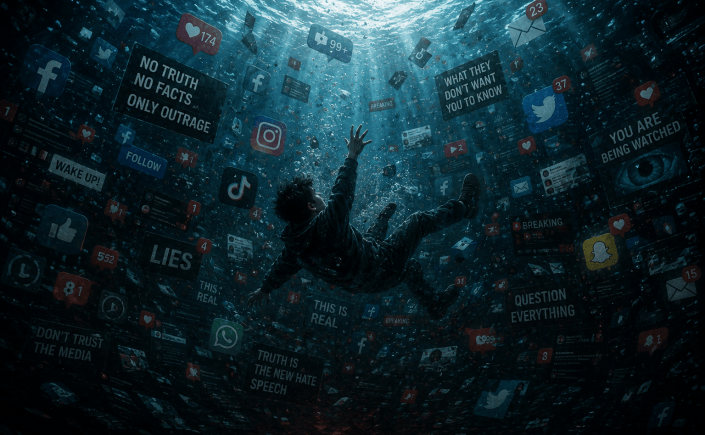
I am friend to the undertow
I take you in, I don’t let go.
Suzanne Vega, 1985
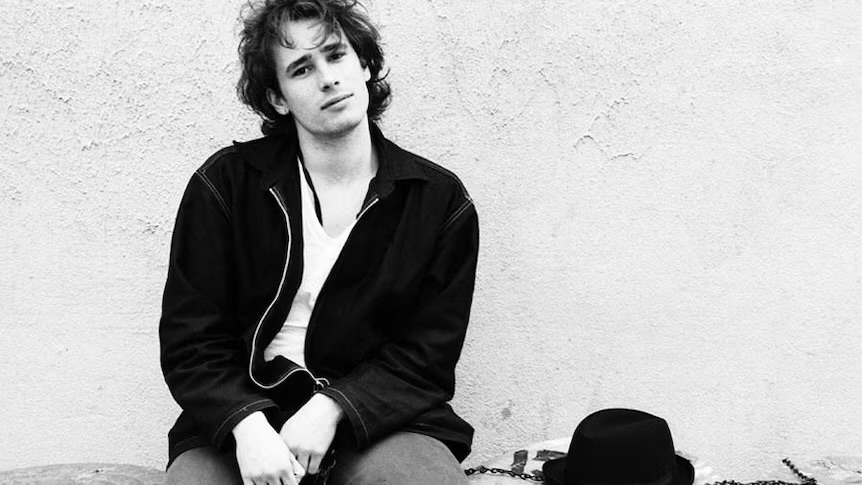
American singer, songwriter and guitarist Jeff Buckley was best known for his extraordinary, almost otherworldly voice and his acclaimed album Grace (1994). The son of the folk singer Tim Buckley, he developed a distinctive style blending rock, folk, soul and blues with an intensity that had made him into a cult figure among his aficionados.
He visited Australia twice – in 1995 and 1996. His reputation had preceded him and he had become a “must see” performer for both musicians and admirers of Grace. I had the great fortune to see him in concert at Newtown’s acclaimed if then ramshackle Enmore Theatre in February. Tickets were like hens’ teeth, and my wife and I and friends scored the last few – three in the gallery and one in centre of the very front row. We pulled straws for that front row prize – and I won. Oh, what a night it was. A night of music like no other – and never to come again.
In May 1997, while on tour in Tennessee, he entered the Wolf River in Memphis, singing, it is said, Led Zeppelin’s Whole Lot of Love – and was swept beneath the surface by the wake of a passing boat, disappearing into the current before his body was recovered several days later. His death has since acquired an almost mythic quality, particularly because of the unfinished music and career he had barely began.
Buckley’s death at the age of thirty was not a slow surrender to some imperceptible current; it was sudden, physical and irreversible. But the image remains: the surface looks deceptively benign, the swimmer believes himself to be in control, and then a force beneath or beyond his immediate perception alters everything.
There are some metaphors that become more powerful the longer you live with them. An undertow is one. You do not necessarily see it. There is no great wave announcing its arrival, no dramatic moment at which you can point to the sea and say, there, that is what is carrying me away. You are standing in the water, apparently where you intended to be, while beneath the surface a current is carrying you steadily away from the shore. You may not notice until you look back and discover that the beach has become strangely distant.
The digital undertow is obviously nothing so dramatic, but its power lies precisely in its lack of drama. It does not drag us suddenly beneath the surface. It carries us, almost imperceptibly, away from where we thought we were.
Forward
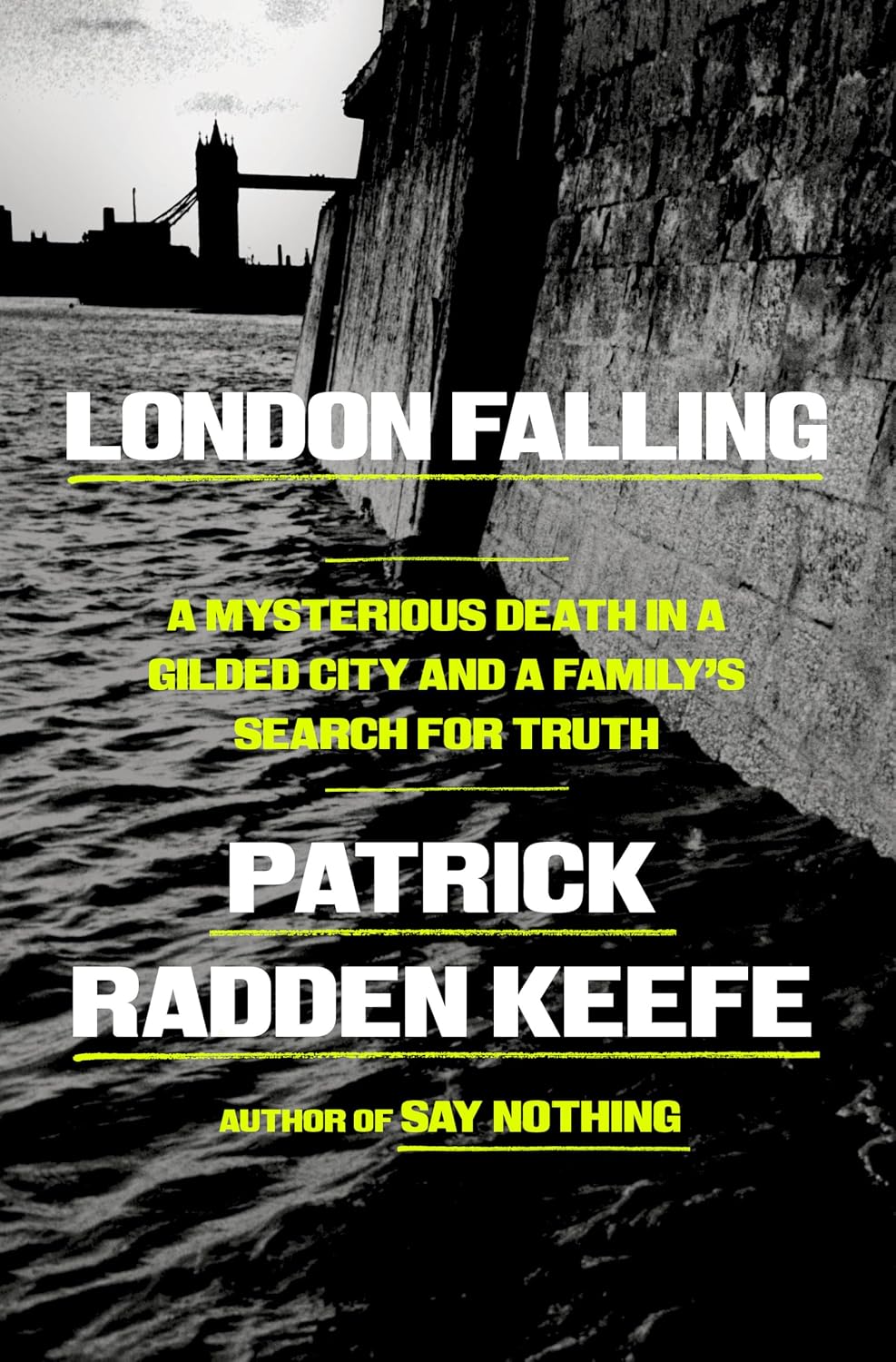
I began writing about American investigative journalist Patrick Radden Keefe’s London Falling, a book ostensibly concerned with the mysterious death of a young man in London, and with the city’s subterranean worlds of money, influence, crime and respectability. But somewhere along the way, Keefe’s phrase “digital undertow” caught me. It seemed to describe something much larger: the almost imperceptible current by which smartphones, social media and algorithms carry us away from sustained attention, a shared public world and, perhaps, from one another.
From there the essay wandered into a lengthy (be warned) contemplation of algorithms, attention, polarisation, personalised realities, the loss of a common informational environment and the curious way in which our own preferences can become the walls of an algorithmic box canyon. And eventually it arrived somewhere rather more immediate: the current debate over Australia’s proposed Digital Duty of Care, the distinction between censorship and algorithmic amplification, and the question of who should decide what reaches us through our screens.
The central thought is a simple one: the feed is not the world. It is a selection from the world – a mirror that has learned how to talk back.
We have more information than any generation before us, but perhaps less certainty that we are inhabiting the same informational world. The challenge is not to abandon technology, nor to imagine that the old media world was some lost republic of reason. It is to recover the habits that the algorithmic environment makes increasingly difficult: curiosity, context, sustained attention, intellectual humility and the willingness to encounter something we did not choose to see.
The undertow is not necessarily dragging us anywhere we consciously decided to go. That is rather the point.
Look up occasionally. Look around. Ask what you have not been shown. And, when the feed is moving too quickly, put the phone down and look towards the shore. Because the shore has not moved. We have.
Adrift in a digital world
Down, down, deep down we dove
In a tangle of rigging and rage –
Down to the deep where the dead sailors sleep
In the darkness of Lucifer’s cage.
Paul Hemphill, Chapter Forty One – In That Howling Infinite
American investigative journalist and author Patrick Radden Keefe coined the phrase ‘digital undertow’ in his recently published book London Falling: A Mysterious Death in a Gilded City and a Family’s Search for Truth. It describes the subtle but relentless way the internet, smartphones, social media and the constant flow of notifications pull us away from sustained attention, deep reading, conversation and the physical world around us. It is tempting to understand this merely as another complaint about modern distraction: the death of concentration, the inability to read a book without checking the phone, the colonisation of every spare moment by the little glowing rectangle in our hands. But Keefe’s idea is more disturbing than that. The digital undertow does not merely distract us. It carries us somewhere.
London Falling offers an unusually apt place to begin thinking about this. The book is ostensibly an investigation into the mysterious death of nineteen-year-old Zac Brettler, who in 2019 fell from a high balcony of the Riverwalk apartment tower into the Thames, close to the headquarters of MI6. Brettler had been living a secret double life, at one point presenting himself as the son of a Russian oligarch, and had become entangled with a slippery London businessman and a gangster known as “Indian Dave”. When his parents began investigating his death, unwilling to accept the explanation of suicide, they found themselves drawn into a London of money, criminality, influence and compromised institutions, where the boundary between the respectable and the crooked was often surprisingly porous.
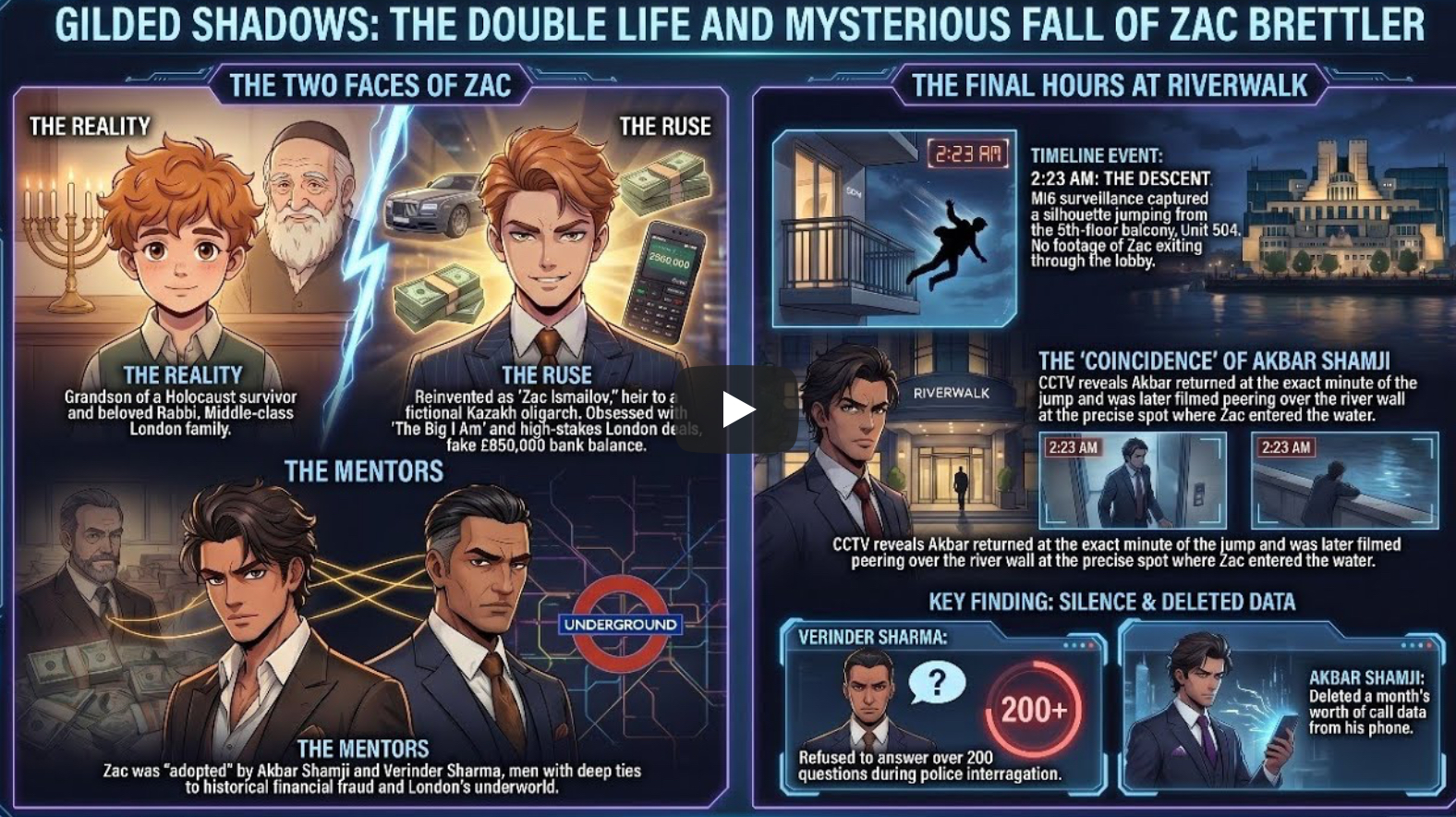
But as with his previous books, Say Nothing and Empire of Pain, Keefe’s real subject is larger than the mystery with which he begins. A single death becomes a way into a whole subterranean world. The particular opens onto the systemic. Zac’s story draws us beneath the polished surface of a city and into the networks of money and ambition that sustain it.
London is such a beautiful place that, as Keefe observes, it can be easy while strolling through the city to forget that much of it was built on imperial plunder. It is a capital of pristine façades, often painted in wedding-cake shades of cream and ivory, its dominant aesthetic amounting to a kind of literal whitewash. To acquire something, whether cash or reputation, is to mingle the dirty with the clean. London became, in Keefe’s memorable phrase, a twenty-four-hour laundromat for dirty money, and one consequence of that transformation was a city full of crooks with pretensions to legitimacy and businessmen who seemed a little crooked. When Russia’s oligarchs first arrived in the English capital at the turn of the millennium, they required lawyers and bankers, tax advisers and security consultants, real-estate agents and spin doctors. A generation of smart, eager and morally elastic young British professionals enthusiastically signed on as fixers of every stripe.
There is something almost perfectly Keefe-like about the way the book takes us from a young man’s death into the hidden structures of a city. And then, somewhere along the way, the metaphor turns inward. The undertow is no longer simply beneath London. It is beneath us. That distinction is crucial.
For a writer like Keefe, whose books require years of painstaking research and sustained attention, the digital environment represents more than a personal inconvenience. Investigative journalism depends upon patience, memory, ambiguity and the willingness to follow a thread that may take hundreds of pages before revealing where it leads. It requires the capacity to remain with something.
Yet the digital world is designed around the opposite impulse: immediacy, interruption, novelty and the next thing. It is not simply that we have become less disciplined. We are living inside systems deliberately engineered to capture and monetise attention.
And this is where Keefe’s observation about Zac becomes so revealing. Zac was interested in supercars, rich people and luxury real estate. Social media did not create those interests. It compounded them. The algorithm took existing fascinations and amplified them, reflecting his aspirations and anxieties back at him through his smartphone and magnifying them. Zac might not have been delusional in any clinical sense, Keefe suggests, but he inhabited a world in which social media was beginning to blur the boundary between reality and fantasy.
Increasingly, Keefe writes, any sense of a ‘shared conscious existence’ was giving way to an “individualized, algorithmically bespoke form of virtual reality”, in which our most personal and idiosyncratic anxieties and aspirations are reflected back at us and magnified by our smartphones.
That phrase, ‘shared conscious existence’ is the key to the larger argument.
We have always disagreed about reality. Human beings have never inhabited a world of universal agreement. We have different religions, ideologies, political loyalties, classes, cultures and prejudices, and we have always interpreted the same events differently. But for most of human history, and particularly throughout the era of mass communication, we nevertheless inhabited a broadly shared field of reference. Families, schools, workplaces, churches, newspapers, books, radio and television exposed us to things we had not necessarily chosen to see. We might argue bitterly about what an event meant, but we had at least seen the same event. We might read the same newspaper and despise its editorial line, but we had read the same newspaper.
Your own private Idaho
You’re livin’ in your own Private Idaho
You’re outta control, the rivers that roll
You fell into the water and down to Idaho
Get outta the state
Get outta the state you’re in
You better beware
The B-52s, from Wild Planet (1980)
The algorithmic world introduces something different: the possibility of individually curated realities. The technology does not merely give us information. It increasingly gives each of us a different selection of reality.
Two people can sit beside one another while their phones present them with entirely different worlds. One is immersed in stories of social collapse; another in stories of social progress. One is fed a succession of examples demonstrating the corruption of elites; another receives an endless catalogue of evidence that ordinary people are the real source of political danger. One is shown a world in which immigration is an existential threat; another a world in which opposition to immigration is itself the central threat. One becomes convinced that the media is hopelessly captured; another that anyone who questions the media is a conspiracist. Each is given enough material to make the world presented to them appear self-evident.
And this is where the undertow begins to have consequences beyond attention.
The algorithm does not necessarily persuade us. It surrounds us. And that is a more subtle form of influence. Propaganda tells you what to believe. The algorithm can determine what you repeatedly encounter, what appears salient, what becomes familiar and what disappears from view. It learns from every pause, every click, every momentary curiosity and every emotional reaction. It then gives us more of what it has learned will keep us looking.
Keefe illustrates the mechanism beautifully with his own Instagram experience. While researching London Falling, he began encountering accounts devoted to London real estate, attractive brokers giving tours of penthouses and sumptuous estates. He did not follow these accounts. But he paused over them, and Instagram inferred that he was interested. So it supplied more.
Then, at some point, he must have paused a little too long over a video of somebody falling.
And suddenly the London of penthouses was replaced by a London – or rather a digital world – of cliffs, rooftops and voids. There were people high-diving from cliffs, BASE-jumping from skyscrapers, leaping into quarries, parkour daredevils vaulting across rooftops, bungee jumpers vanishing into gorges and skydivers stepping out of aircraft. Before long, Keefe could scarcely open Instagram without encountering somebody plummeting towards the earth.
Nothing conscious had changed. He had not decided that he was fascinated by people falling. He had simply lingered for a moment, and the machine noticed.
That is the undertow.
It is also why the metaphor is better than the language of addiction. Addiction locates the problem largely inside the individual. The undertow locates it in the environment. The technology is continuously testing us, learning us and adjusting the current. Every moment of attention becomes feedback. Every curiosity can become a pathway.
And the more the system learns what catches us, the more efficiently it can construct a world around us.
Box canyon
Down in that old box canyon
Where only misfits can go
He rides with no companion
Neil Young, The Misfits (1985)
This is where the algorithmic box canyon becomes such a useful image. We enter because something interests us. The walls rise almost imperceptibly. Each turn is determined by the previous one. Because the next piece of content resembles the last, the environment begins to feel coherent, even natural. Eventually the canyon becomes so narrow that alternative directions are difficult to perceive. Nothing has explicitly forbidden us from looking elsewhere. We simply stop being shown elsewhere.
The extraordinary thing is that the walls are built from our own preferences.
It is why the digital world can be so persuasive without being obviously coercive. It feels personal because it is personal. It feels relevant because it has learned what we find relevant. It feels like reality because most of what it shows us is real. The distortion lies not necessarily in the individual item but in the selection, repetition, emphasis and omission.
And here the absence of nuance becomes particularly important.
Algorithms reward engagement, and engagement is disproportionately generated by emotion. Anger is engaging. Fear is engaging. Humiliation is engaging. Envy is engaging. Outrage is exceptionally engaging. Complexity, qualification and uncertainty are not. “On the one hand, on the other hand” is rarely the stuff of viral content. Neither is “it depends”, “the historical context is complicated” or “both sides have a point, but in different respects”.
The algorithm therefore has a structural preference for the binary.
Good and evil. Victim and oppressor. Hero and villain. Elites and ordinary people. Left and right. Establishment and outsider. With us or against us. The categories vary according to the political tribe, but the structure remains remarkably consistent. The world is divided into two camps, and everything that happens is interpreted as evidence for the virtue of one and the depravity of the other.
The problem is not that these categories are always meaningless. There are genuine moral distinctions in the world. There are perpetrators and victims. There are acts that are plainly wrong. There are moments when moral clarity is necessary. But human affairs rarely remain inside two boxes for very long. History is full of mixed motives, unintended consequences, competing truths, compromises, hypocrisies and people who are simultaneously right about one thing and wrong about another.
The digital environment is not particularly interested in any of that.
Nuance slows the rhythm. Context gets in the way. Qualification weakens the punchline. A complicated truth is a poor competitor against a simple outrage.
And so we increasingly encounter a peculiar form of moral simplification in which disagreement itself becomes evidence of wickedness. If somebody does not accept your premise, they must belong to the opposing camp; if they belong to the opposing camp, their motives can be presumed; and once their motives have been presumed, there is little reason to listen to what they actually say. The argument becomes secondary to the classification of the person making it.
This is how a political disagreement becomes a tribal identity. It is also how the algorithmic box canyon becomes a moral one.
Once inside, the inhabitants of the other canyon are not merely people who have taken a different route through the landscape. They become inhabitants of another moral universe. We stop asking why they think what they think and start asking what sort of person could possibly think it. The result is a feedback loop in which contempt becomes evidence, evidence becomes ammunition and ammunition becomes identity.
This is one of the things that has increasingly struck me in thinking about what I call “Algorithm and Blues”. It is, first of all, a deliberate pun on rhythm and blues. It is the rhythm that matters: the beat of the feed, the pulse of notification and response, the repetitive sequence of scroll, stimulus, reaction and reward. But the phrase also carries, inevitably, something of the melancholy of living inside that rhythm. We have created a machine capable of connecting almost everyone with almost everything, and one of its consequences may be that we are progressively losing the experience of a world held in common.
The algorithm does not need to make us believe the same thing. It can make us believe increasingly different things with increasing intensity.
That is the paradox.
We have never had access to more information, yet we may be losing the capacity to inhabit a common conversation about what matters. We have never been more connected, yet we can increasingly choose not to encounter anything that seriously challenges the world we have constructed for ourselves. We have never possessed so much information, yet we increasingly struggle to distinguish information from significance.
And perhaps this is why the old idea of a shared public sphere now feels so fragile. It was never as harmonious or rational as nostalgia sometimes suggests. Newspapers had their prejudices and gatekeepers; television had its biases; governments manipulated information; communities could be intolerant and suffocating. But there was at least a commonness to the experience. We could disagree about the same newspaper because we had read the same newspaper. We could argue about the news because we had broadly encountered the same news.
The personalised feed changes the arrangement. It allows each of us to assemble a private front page, updated continuously and calibrated to our own psychological appetites.
The consequence is not necessarily ignorance. It is asymmetry.
You know things I do not know, and I know things you do not know, not merely because we have different interests but because the systems through which we encounter information are actively differentiating our experience. And because each of us is receiving material that appears to confirm the reality we already inhabit, disagreement can become almost impossible to resolve.
We can each possess an apparently inexhaustible archive proving that our reality is the real reality.
This is the more dangerous form of polarisation. It is not simply that people have strong opinions. It is that the opposing position increasingly becomes unintelligible. The other side is not merely mistaken; it is corrupt, stupid, evil or deranged. Once that happens, compromise looks like betrayal and qualification looks like weakness. There is no longer much incentive to understand the other argument because the algorithm has already taught us what sort of person makes it.
The old public sphere imposed a certain accidental discipline upon us. We could not entirely choose what entered our field of vision. A newspaper contained stories we did not care about. The evening news showed events we would not have selected. A conversation with a neighbour might wander into territory we had not anticipated. A book might challenge us simply because we had happened to buy it. Boredom itself had a function. It left room for the unexpected.
The personalised feed removes much of that friction. It is exquisitely attentive to what we already like. And what we already like is not necessarily what we need to know.
This is perhaps why Keefe’s phrase “shared conscious existence” is so evocative. The threat is not simply to reading, concentration or productivity. It is to the possibility of a society in which people can disagree while remaining conscious of inhabiting the same world.
Democracy does not require agreement. It requires a common enough reality within which disagreement can occur.
We can argue about what an event means because we have seen the event. We can argue about history because, however differently we interpret it, we recognise the same historical episodes. We can argue about politics because we have some common sense of what our fellow citizens are talking about.
The algorithmic world makes that increasingly uncertain.
And perhaps this explains the peculiar feverishness of contemporary public life. We are not simply arguing more. We are encountering one another through increasingly incompatible informational realities. Each side arrives armed with an apparently endless supply of evidence, much of it genuine, much of it misleading, some of it fabricated, and almost all of it selected by systems optimised for emotional engagement. The result is not merely polarisation but a kind of epistemic isolation.
We are becoming strangers to one another’s worlds. That is more dangerous than being strangers to one another’s opinions.
There is an additional irony in Keefe’s anecdote. He is a professional investigator, someone whose entire craft depends upon resisting premature conclusions. He follows evidence. He accumulates detail. He tolerates uncertainty. He knows that the first explanation is not necessarily the correct one. Yet even he finds himself being nudged from luxury real estate into an endless stream of falling bodies because he paused briefly over a video.
The point is not that Keefe is gullible. The point is that the system operates beneath the level of conscious intention. It does not have to persuade us. It only has to learn what holds us. Which is why the digital undertow is less like traditional propaganda than like climate. We breathe it without noticing.
Falling
And then there is the peculiar coincidence at the heart of London Falling: Keefe is writing about a young man who falls while discovering that his own digital world is being shaped by an algorithm, and his research leads him into an apparently endless stream of images of people falling.
The title becomes almost brutally literal. In Keefe’s world, gravity is not merely a metaphor for decline or loss of control; it becomes an actual agent in human stories. People fall from windows, balconies, platforms and bridges. They are pulled beneath trains. The city itself becomes a landscape of edges, places where the boundary between safety and catastrophe is frighteningly thin.
The physical metaphor and the digital one begin to converge.
London is a vertical city. Its towers, balconies, bridges and skyscrapers are expressions of ambition. We build upwards because height represents achievement, wealth and power. The penthouse is the ultimate image of having risen above the ordinary street. Yet every elevation creates the possibility of a fall. The very structures that proclaim human mastery also provide new ways of being undone.
Perhaps that is why human beings have always been fascinated by falling. Icarus falls. Lucifer falls. Humpty Dumpty falls. The person who steps over the edge discovers gravity. We can temporarily defy it through architecture, technology and ambition, but ultimately we remain creatures of gravity.
Old age brings the most literal and perhaps most frightening version of the metaphor. The fear of falling is not merely the fear of injury; it is the fear that one’s relationship with the world has changed. A fall can become a hinge point, the moment when independence begins to slip away, when a person who has spent a lifetime standing upright must confront fragility. Gravity, which has always been there, suddenly becomes an adversary.
There is an interesting connection here with Keefe’s digital undertow. The physical fall and the digital fall are opposites in one sense: one is sudden, the other gradual. The elderly person knows when they have fallen; the social media user may not. Yet both involve losing balance, losing orientation, being carried somewhere one did not intend to go.
Perhaps that is why the metaphor has such enduring power. To be human is to live between ascent and descent. We climb hills, towers, ambitions, dreams and heavens; we also fall from grace, fall in love, fall into despair, fall through the cracks, and eventually fall silent. Gravity is not just a physical law; it is a reminder of our limits.
The undertow is gravity’s aquatic cousin.
Avalanche
There is something almost eerily appropriate, then, in Leonard Cohen’s line: ‘I stepped into an avalanche, it covered up my soul’. The avalanche is another image of accumulation, of countless small particles becoming a force that overwhelms the individual. One snowflake is insignificant; enough of them become catastrophe. One notification is nothing. One video is nothing. One momentary curiosity is nothing. One little piece of outrage is nothing. But accumulate them over hours, days, years and billions of human interactions, and they become an environment.
The algorithmic avalanche is not necessarily composed of falsehoods. That is what makes it so difficult to resist. Most of the individual things we encounter may be perfectly real. The problem is what happens when reality is selectively assembled around our existing interests and anxieties. The feed can make one part of the world appear to be the whole world.
The algorithm does not necessarily have to lie. It only has to select.
A person who spends enough time looking at political corruption will be shown more political corruption. Someone fascinated by immigration will encounter an endless supply of immigration stories. Someone consumed by crime will discover that the world appears to be full of crime. Someone obsessed with political extremism will be presented with an apparently endless supply of evidence that extremists are everywhere. None of this requires fabrication. It requires only selection, repetition and reinforcement.
The world outside the feed becomes increasingly difficult to imagine.
This is why the problem of algorithmic polarisation is not solved simply by telling people to check their facts. Facts matter enormously, but the deeper issue is the architecture of attention. Two people can have access to the same facts and yet inhabit radically different informational landscapes because the facts they encounter, the order in which they encounter them and the emotional context in which they encounter them are different.
The algorithmic world is therefore not simply a marketplace of ideas. It is a system for manufacturing salience. What becomes salient begins to feel important; what feels important demands attention; what receives attention generates more data; and the cycle continues, each turn carrying us a little farther from the shore. And then, we are the swimmer who has finally looked back towards the beach.
Because there is something genuinely sad about what may be disappearing. Not some mythical golden age in which people all agreed with one another, because such an age never existed, but the possibility of a broadly shared public world. The old world was noisy, partisan, prejudiced and often deeply unfair. Its newspapers had biases and its institutions had gatekeepers. But it gave us common objects of argument. We could disagree about the same things. Now we increasingly disagree about which things exist.
And perhaps that is why the story of Zac Brettler provides such an effective frame for Keefe’s argument. His tragedy cannot be explained by social media alone. Human beings are not algorithms, and lives are not reducible to feeds. Zac had his own vulnerabilities, ambitions, fantasies, relationships and choices. There were people around him who exploited those vulnerabilities, and there were institutions that may have failed to understand what was happening. The mystery of his death remains a human mystery.
But surrounding all of this was a new environment, one capable of taking pre-existing desires and amplifying them until the distinction between aspiration and reality began to blur.
The algorithm did not invent Zac’s world. It helped make the walls around it higher.
And perhaps this is the broader lesson of London Falling. The city Keefe describes is itself an elaborate exercise in the manufacture of appearances. London takes dirty money and gives it clean façades. It takes questionable fortunes and surrounds them with lawyers, bankers, property and prestige. It turns the crooked into something that can look respectable from the street.
The digital world does something strangely analogous. It takes fragments of our interests, anxieties and prejudices and surrounds them with an endless supply of confirming material. It gives our private obsessions the appearance of public reality.
In both cases, the surface can be beautiful. In both cases, the machinery is largely hidden. And in both cases, what lies beneath can be very different from what appears above.
That is the undertow. Not he sudden moment when we lose control. But the gradual movement before that moment, the accumulation of tiny choices and tiny nudges that eventually leaves us somewhere we did not consciously decide to go.
The danger is not that we will all become mad, or addicted, or incapable of thinking. It is that perfectly rational people can become increasingly enclosed within different versions of reality, each one internally coherent because it has been continuously reinforced.
The antidote is therefore not to abandon technology. Nor is it to pretend that the old media world was some lost republic of reason. It is to recover, consciously, the habits that the algorithmic environment makes increasingly difficult: sustained attention, curiosity about things we did not choose, tolerance of ambiguity, willingness to encounter inconvenient evidence, historical context, intellectual humility and, above all, the ability to distinguish certainty from truth.
We need to remember that the feed is not the world. It is a selection from the world, a mirror that has learned how to talk back.
And because it learns from us, it can become a very flattering mirror. It shows us what interests us, confirms what concerns us and reinforces what we suspect. It gives us the intoxicating sensation that reality has finally caught up with what we already knew.
But reality is rarely so obliging.
The world is messy. People are contradictory. History is full of unintended consequences. Political movements contain both nobility and folly. Victims can become perpetrators; perpetrators can possess motives that do not excuse their actions; institutions can be both necessary and flawed; a person can be right about one thing and disastrously wrong about another. Two things can be true at the same time.
That is the sort of sentence the algorithm has little use for. But it may be precisely the sort of sentence civilisation needs. Because nuance is not indecision. Complexity is not moral relativism. Context is not excuse. To resist the binary is not to refuse judgement. It is to insist that judgement should follow understanding rather than replace it.
The digital undertow pulls in the opposite direction. It favours immediacy over patience, reaction over reflection, certainty over curiosity and identity over inquiry. It is very good at what it does because it has been designed to be very good at what it does.
Which is why the first act of resistance may be surprisingly modest: look up occasionally, look around, notice where you are and ask what you have not been shown. Read something that does not agree with you. Stay with an argument after the moment when you first want to dismiss it. Remember that the person whose reality seems incomprehensible may simply have been swimming in a different current.
And occasionally, when the feed is moving too quickly, put the bloody phone down and look towards the shore. Because the shore has not moved. We have.
And perhaps that is the real warning contained in Keefe’s “digital undertow”. It is not that technology will suddenly seize control of us. It is that it can carry us away so gradually, so comfortably and so intimately that we continue to believe we are choosing the direction, until one day we look back and discover how far we have drifted.
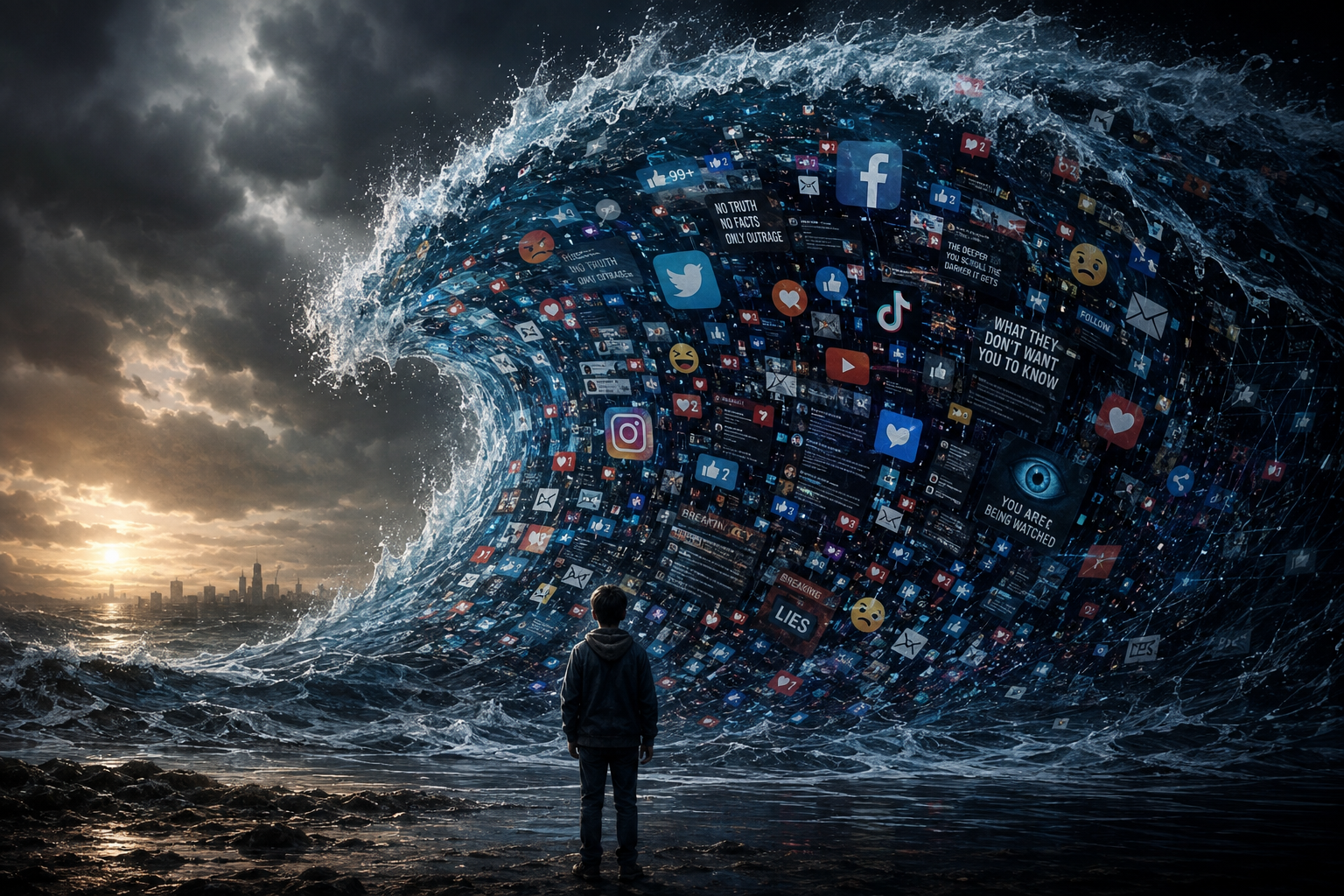
Friends to the undertow : the megaphone and the market
Returning to American folksinger Suzanne Bega’s song at the head of this essay, who are they, these friends to the undertow?
A study published in scientific journal Nature found that social media platform X’s algorithm “promotes conservative content and demotes posts by traditional media”. It would appear that here in Australia – and elsewhere – the algorithm is particularly generous to the conservative and populist tight who trade in disappointment and discontent and actively encourage outrage.
The language surrounding our Labor government’s proposed Digital Duty of Care laws so revealing. When the first draft was released on 8 September, prime minister Anthony Albanese was at pains to insist that the proposal was not about censorship but about control: adult users would be able to choose between an algorithm-driven feed and a feed showing only the accounts they had actually chosen to follow. “Let’s be very clear about what this is about,” he said. “It’s not about censorship. It’s about giving people control themselves over what they see.” The distinction is important. Censorship prevents a person from speaking. This proposal, at least as presently conceived, does not prevent anyone from publishing anything. It asks a rather different question: who should decide what arrives in front of us?
The distinction becomes clearer when the political objections are examined. Conservatives have understandably pointed to research published in Nature finding that X’s algorithm promoted conservative content while demoting posts from traditional media. If the proposed changes mean that such algorithmic amplification is reduced, then conservative politicians may indeed receive less attention and engagement than they presently do. But there is a curious sleight of hand in describing this as censorship. Their accounts would still exist. Their followers could still read them. Their opinions could still be published, shared and argued over. What would potentially disappear is not their voice but the megaphone.
“Don’t take away my megaphone!” is therefore a more honest description of the complaint. And perhaps that is precisely what needs to be disentangled from the increasingly elastic invocation of censorship. Freedom of speech is a right to speak; it is not a right to have a private corporation’s recommendation engine deliver one’s speech, unsolicited and repeatedly, to millions of people. Nobody has an inherent democratic entitlement to algorithmic amplification.
This is especially important because the algorithmic feed is not a neutral window onto public discourse. There is no pristine, natural stream of information waiting to be displayed to us. The platform selects, ranks, repeats and amplifies. It learns what holds our attention and feeds us more of it. The resulting stream is therefore not merely a reflection of our preferences. It can progressively manufacture them. The algorithm is, in effect, an invisible editor—one whose principal criterion is not truth, balance or civic value but engagement.
The irony is that those objecting to government interference in this process are often defending an existing system that already interferes with the flow of information on a vast scale. If an algorithm systematically favoured progressive material, conservatives would rightly complain. If it systematically favoured conservative material, progressives would rightly complain. The answer, however, cannot sensibly be to construct an algorithm that favours our own side. It is to give the individual greater control over whether the machine curates his or her informational environment at all.
That is where the issue intersects with the deeper argument of the Digital Undertow. We have become accustomed to thinking of social media as a vast public square, but it is not really a square. It is a system of currents. We enter believing that we are browsing the world; in reality, the world we encounter has been filtered, ranked and accelerated by an unseen mechanism designed to keep us in the water. We mistake the current for reality.
And the consequences extend beyond the individual. Millions of people are now inhabiting personalised versions of the same public world, each receiving a different selection of events, arguments, grievances and enemies. We share a society but increasingly do not share an informational environment. The resulting fragmentation is more profound than ordinary political disagreement. Each tribe comes to believe not simply that the other side is wrong, but that it inhabits a different reality altogether. This is the strange paradox of what might be called a shared consciousness without a shared world: we are connected to one another more intimately than ever, yet the machinery of connection continually separates us into mutually reinforcing informational enclaves.
There is an older metaphor for this process which has acquired a new and rather sinister meaning. the phrase ‘driving the pigs to market’ once belonged to the world of marketing and advertising: consumers were the pigs, and the industry devised increasingly sophisticated ways of directing them toward the marketplace. The digital transformation has taken the metaphor somewhere else. We are no longer merely being persuaded to buy things. We are being herded towards whatever keeps us looking. Outrage, fear, grievance, tribal affirmation, scandal, novelty and indignation are all particularly effective fodder because they generate the one commodity upon which the platforms depend: attention.
The extraordinary thing is that we now participate in our own herding. We click, react, share, condemn and rage, supplying the behavioural information that allows the machinery to become better at predicting what will keep us engaged. The undertow strengthens with every movement we make against it.
This is why the argument should not be reduced to left versus right, or censorship versus free speech. A conservative algorithm is not preferable to a progressive algorithm; nor is a progressive algorithm preferable to a conservative one. The more fundamental question is whether we should be content to have an opaque commercial system deciding, minute by minute, which fragments of reality deserve our attention.
There is a legitimate danger here, of course. A government that moves beyond giving citizens control over their feeds and begins determining which algorithms are permissible, which political views should be amplified, or what constitutes unacceptable opinion would cross a very different line. The protection of individual autonomy must not become a pretext for state control of information. The principle ought to be simple enough: don’t tell me what I can say; don’t tell me what I must see; and don’t secretly decide what I should see. Give me the ability to decide for myself.
That is not censorship. It is, arguably, the restoration of a small measure of agency in an environment designed to erode it.
The battle over social media is therefore becoming something subtly different from the old battle over freedom of speech. The question is moving from freedom to speak to freedom from algorithmic manipulation. And that may prove to be one of the defining freedoms of the digital age.
For the real democratic question is no longer simply, who gets to speak? It is increasingly: Who gets to decide who hears whom?
Paul Hemphill and In That Howling Infinite September 2026
This essay was written over several months from scattered notes and random thoughts formed and half-formed, all of which seemed to crystallise and take form when reading Keefe’s book, and assembled in a sustained dialogue with an AI language model that contributed to final drafting – and also, obviously, the graphics.
On the subject of social media and algorithms, and their influence on the shaping of opinions and emotions, see also in In That Howling Infinite: Moral capture, conditional empathy and the failure of shock,and Meet the Crybully, a hybrid of victim and victor . On AI and the individual, see The promise and the peril of ChatGPT, Diligent chatbot unearths fool’s gold, and

