As a long time student of русские вещи (russkiye veshchi – things Russian), I have written long and often about Russia in In That Howling Infinite – enough to warrant a place in its menu.
I owe this abiding interest in русский мир – Russky Mir or the Russian World – to my old tutor, the émigré Hungarian scholar Tibor Szamuely – he taught me Russian and Soviet history and politics at Reading University in the late sixties. Back then, I was a political ingenue and a naive communist sympathiser and fellow-traveler, still flirting with Marxist romanticism – although my evolving perspectives were transforming and expanding. He advised me to study with an open mind and to put off juvenile thinking.
He hadn’t been well when I knew him and he died a year after I graduated. Under his tuition, I’d resolved to specialize in Soviet Studies – but events intervened and I ended up in the Middle East (and that is another story. see: Tanks for the memory – how Brezhnev changed my life
Tibor Szamuely had lived history in ways my generation – and those that followed – could scarcely imagine. Born in Moscow to Hungarian communist exiles, the son of a father later executed in Stalin’s purges, imprisoned himself in Soviet labour camps before eventually defecting to the West, he understood both the seductions and brutalities of ideological myth making.
Szamuely believed that Russia punished simplification. Its history moved in circles rather than straight lines. Revolutions proclaimed liberation only to rediscover autocracy in new forms. The Romanovs fell; the Bolsheviks inherited the imperial reflexes. The Soviet Union collapsed; empire returned draped in Orthodoxy, nationalism, and Eurasian destiny. Beneath the surface turbulence remained the historical and political continuity of what he called The Russian Tradition, the title of his one and only book, published shortly before his death, and now, regrettably, out of print: centralised power, messianic consciousness, siege mentality, and the recurring sanctification of suffering.
Szamuely believed that the bloodstained drama of the revolutions of 1917 – there were two, the social democratic one in the February, the Bolshevik one in November – and the years that followed, including civil war, the establishment of the USSR and Stalinism largely obscured the underlying consistency of Russian history. He did not live to see the decline and fall of the Soviet Union, and the advent of Putin and Russia Redux, and the ongoing war in Ukraine, but the basic pattern persists, circular and repetitive. The frequent turmoils that have overtaken this vast continent have in their various ways made changes that were essentially superficial, leading in the end to the intensification, under new forms, of the old authoritarian structure.
From medieval times, autocracy has coexisted with a revolutionary traditionalism – a contradiction in terms as only Russia could sustain, a unique Russian capacity to seek revolution and discover regression, to invoke liberty merely to reinforce repression. if he were with us today, Szamuely would explain that the Soviet Union under Lenin and his successors and the Russia of Vladimir Putin bears so disconcertingly close a resemblance to Russia under the most savage of its tsars. His people, it turned out, had wanted freedom but wanted to retain the idea of their old Russian empire more. They ended up with the would-be czar, Vladimir Putin. And so the world turns.
Szamuely’s warning remains indispensable because Russia punishes certainty. Every neat thesis collapses eventually into contradiction. The same culture that produced Andrei Rublev produced the Okhrana and the Gulag. The same Orthodox mysticism that nurtured transcendent art could sanctify autocracy and suffering. The same literary tradition that dissected power with unparalleled moral intelligence could also slide into messianic nationalism.
There is a famous aphorism of Winston Churchill that is often quoted but rarely completed. Russia, he said, was “a riddle wrapped in a mystery inside an enigma,” but then he added: “perhaps there is a key. That key is Russian national interest.”
But that turns out to be just one of many Russian “matryoshka” dolls that conceal layers of identity,. Open “Russian national interest” and inside you find geography. Open geography and inside you find history. Open history and inside you find Orthodoxy, empire, memory, invasion, insecurity, and myth. Open those and out tumble Kyiv, Novgorod, the Mongols, Peter the Great, Napoleon, Stalin, and Putin. Then somewhere among the nested dolls sits a Ukrainian bandurist, a Hungarian émigré professor at Reading University, and an anarchist cavalry commander from Huliaipole.
Perhaps that is why my recollections of Szamuely stay with me. His great lesson was methodological as much as historical: proceed with caution – and with an open mind. His advice was not merely about Russia. It was about intellectual inquiry itself: proceed with caution—and an open mind. The most interesting destinations are often reached by accident, after setting out for somewhere else entirely.
Or, to borrow from the image of the matryoshka, every answer contains another question concealed within it. The trick is having the curiosity to keep opening the dolls.
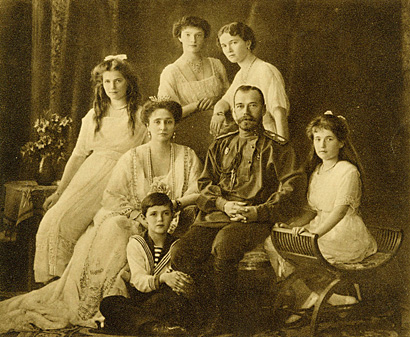
The featured image: is of the last of the Romanovs – Tsar Nicholas and his family, murdered in Ekaterinburg by the Bolsheviks in July 1918. Although the three hundred years old Romanov Dynasty was brutal, corrupt, and at its end, irredeemable and doomed, to me, this image of Tsar Nicholas II , Tsarita Alexandria, and their children is perhaps one of the most poignant images of a gone world.
- The Russian Tradition – Russia, Ukraine and Tibor Szamuely
- Rasputin and the downfall of the Romanovs
- Ghosts of the Gulag
- The Death of Stalin is no laughing matter
- Stalin’s Great Terror
- What did Lenin do for us? The welfare state, that’s what,
- Borderlands – Ukraine and the curse of mystical nationalism
- Red and white terror – the Russian revolution and civil war
- The Roots and Fruits of Putin’s Irridentism
- Putin’s war … an ageing autocrat seeks his place in history
- 17th September 199 – the rape of Poland (2)
- Tanks for the memory – how Brezhnev changed my life
- “High above the dawn is waiting” … the unlikely Russian origin of an English pop song
- Alexander Dugin versus Sydney Sweeney
- Echo of the Steppes … history’s long shadow

Lenin’s funeral, as painted by Isaac Brodsky, 1925

