The mass and majesty of this world, all
That carries weight and always weighs the same
Lay in the hands of others; they were small
And could not hope for help and no help came:
What their foes liked to do was done, their shame
Was all the worst could wish; they lost their pride
And died as men before their bodies died.
WH Auden, The Shield of Achilles
Among the many phrases that echo through modern Iranian history, few are as chilling – or as elastic – as the charge of “corruption on Earth” (mofsed-e-filarz). Rooted in Islamic jurisprudence but broadened by revolutionary courts into a political instrument, it has served as one of the Islamic Republic’s most powerful and feared accusations.
It was among the charges levelled against the eleven Kurdish prisoners executed at Sanandaj Airport in August 1979, their deaths immortalised in Jahangir Razmi’s Pulitzer Prize-winning photograph. In the years that followed, the same accusation would be invoked against Kurdish activists, political dissidents, monarchists, communists, members of the Mujahedin-e Khalq, protesters, and others deemed enemies of the revolutionary state. The charge’s very vagueness became its strength. To be declared “corrupt on Earth” was not merely to have broken a law; it was to be cast as a threat to the moral and political order itself.
Nearly half a century later, the phrase remains woven into the fabric of Iranian political life. It resurfaced during the prosecutions that followed the Woman, Life, Freedom protests of 2022–23, and again in the trials and executions that have followed subsequent unrest and acts of political violence, and particularly, in the wake of the demonstrations and subsequent massacres of January 2026 and the US-Israeli aerial assault the began a month later. Governments change their rhetoric, revolutions age, and generations pass, yet certain words endure. In Iran, “corruption on Earth” has become more than a legal charge. It is a window into how revolutionary states define legitimacy, identify enemies, and justify the use of ultimate power.
The story that follows is, in part, the story of that phrase – and of the people whose lives have been shaped, and often ended, by its invocation.
Iranian photographer Jahangir Razmi’s famous image, later known as “Firing Squad in Iran,” won the 1980 Pulitzer Prize for Spot News Photography. It remains the only Pulitzer awarded to an anonymous photographer. Razmi’s identity remained concealed for twenty-seven years before being publicly revealed in 2006 with his consent. The photograph endures as one of the defining visual records of the violence that accompanied the consolidation of the Islamic Republic.
The Revolution Devours Its Own
The Red–Green Alliance, Iranian Edition
In early June 1983, the Kurdish city of Mahabad awoke to grim news. Fifty-nine Kurdish prisoners had been executed by the Islamic Republic of Iran. Many were young. Some, according to Kurdish human-rights sources, were still school students. Their crime was not murder, terrorism or armed insurrection in any conventional sense. Their offence was opposition to the revolutionary order that had emerged from the upheavals of 1979.
Amnesty International later documented the executions as part of a wider campaign of repression that was sweeping across Iran. By then, the Islamic Republic had moved beyond the revolutionary euphoria of its founding years and into a phase familiar to students of revolutions throughout history: the consolidation of power. The idealism, pluralism and competing visions that had animated the overthrow of the Shah were being replaced by something far narrower and far less forgiving.
The executions in Mahabad were not an aberration. They were part of a pattern.
History offers many examples of revolutions that begin as broad coalitions and end as monopolies of power. The French Revolution consumed Girondins, Hébertists and Dantonists before eventually turning upon Robespierre himself. On the scaffold, Manon Roland is said to have exclaimed “O Liberté! O Liberté! que de crimes on commet en ton nom”. The Bolsheviks devoured Mensheviks, Socialist Revolutionaries and later their own Old Guard (see in In That Howling Infinite, Stalin’s Great Terror). Revolutions often unite disparate forces against a common enemy; once victory is achieved, the question becomes who will rule. At that point, yesterday’s allies can quickly become today’s enemies.
Iran followed a similar trajectory.
The revolution that overthrew Mohammad Reza Shah Pahlavi in 1979 brought together an unlikely alliance. Liberals sought constitutional government. Nationalists hoped for greater independence from foreign influence. Marxists and socialists imagined a future shaped by class struggle and social justice. Religious activists envisioned an Islamic state guided by clerical authority. What united these groups was opposition to the Shah, whose increasingly authoritarian rule, close alignment with the United States and powerful security apparatus had generated widespread resentment.
Yet while many revolutionary factions viewed the alliance as temporary, Ayatollah Ruhollah Khomeini and his followers possessed something their rivals lacked: a coherent vision of power and an organisational structure capable of seizing it. The mosques provided a nationwide network. The clergy enjoyed enormous social legitimacy. Religious symbolism offered a language that resonated far beyond university campuses and political cells.
Many on the secular left underestimated this advantage.
For some Marxists, political Islam appeared less as an ideological rival than as a useful partner in the struggle against imperialism and capitalism. The Shah was seen as a pillar of Western influence in the Middle East; therefore, any force capable of helping to overthrow him could be accommodated. The expectation, explicit or implicit, was that once the revolution succeeded, history would proceed along more familiar revolutionary lines. The clerics would either moderate, share power or eventually be superseded.
Events unfolded differently.
By 1980, universities were being purged and “Islamised” during what became known as the Cultural Revolution. Liberal and nationalist opponents were marginalised. Independent centres of authority were systematically dismantled. The Tudeh Party, Iran’s principal communist organisation and one that had initially supported the new regime, was outlawed. Its leaders were arrested, imprisoned and in some cases executed. Former revolutionary allies appeared on television delivering forced confessions. Political prisons filled. Revolutionary courts handed down death sentences with alarming speed.
The process was not unique to the Iranian left. Kurdish movements that had sought autonomy found themselves facing military campaigns. Women’s organisations that had supported the revolution discovered that many of their aspirations were incompatible with the state’s vision of Islamic governance. Student activists, secular intellectuals and minority groups encountered similar realities. The coalition that had overthrown the Shah steadily narrowed until meaningful opposition became impossible.
The Kurdish experience was particularly harsh. In regions such as Mahabad, Sanandaj and other Kurdish centres, resistance to central authority was met with military force and mass arrests. The executions of June 1983 were one episode in a larger struggle between the Islamic Republic and Kurdish political movements. For the families involved, ideological debates about revolution and anti-imperialism mattered little. The reality was imprisonment, exile and death.
The broader lesson is not confined to Iran, nor is it simply a story about the mistakes of the political left. Rather, it is a warning about the dangers of defining political movements primarily by what they oppose rather than by what they seek to build.
Opposition to a monarchy did not tell Iranians what kind of state would emerge after the Shah. Opposition to Western influence did not answer questions about civil liberties, minority rights, women’s equality or democratic institutions. Those questions remained unresolved until power was won—and by then it was largely too late.
This is one reason why the history of the Iranian Revolution continues to resonate.
Across the political spectrum there remains a temptation to view movements through the lens of a single conflict. If a regime opposes one’s enemies, its internal character can seem less important. If it stands against a disliked power, its treatment of dissidents, minorities or political opponents may receive less scrutiny than it deserves. Such thinking is hardly confined to any one ideology. Throughout modern history, people of varying political persuasions have excused authoritarianism when it appeared to serve a larger strategic or ideological purpose.
Iran offers a cautionary example of where that logic can lead.
Many who helped create the revolution imagined themselves as partners in a broad project of national liberation. Some believed they could influence its direction. Others assumed that shared opposition to the Shah guaranteed a shared future. Instead, they discovered that revolutionary coalitions are often marriages of convenience rather than communities of principle.
The tragedy of Mahabad, and of countless similar episodes in revolutionary history, is that those who helped bring down one form of authoritarianism often found themselves confronting another.
The revolution had succeeded. Then it began to consume its own.
Every picture tells a story
The story of Jahangir Razmi’s photograph is worth including because it captures, in a single frame, the moment when revolutionary justice gave way to revolutionary terror.
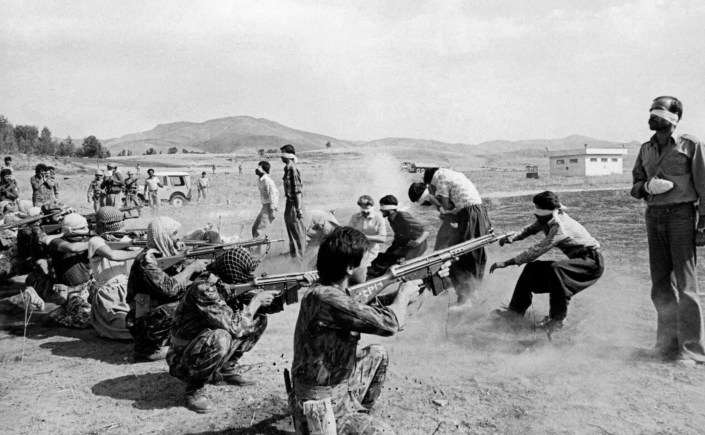
On 27 August 1979, at Sanandaj Airport in Iranian Kurdistan, eleven prisoners—most of them Kurdish militants or activists—were brought before a revolutionary tribunal. The proceedings reportedly lasted little more than half an hour. The charges ranged from weapons trafficking and murder to inciting unrest against the new Islamic Republic. There was no meaningful due process, no opportunity for appeal and no delay between verdict and sentence. Convicted by the revolutionary court, the prisoners were taken directly to a dusty section of the airfield, blindfolded and lined up before a firing squad.
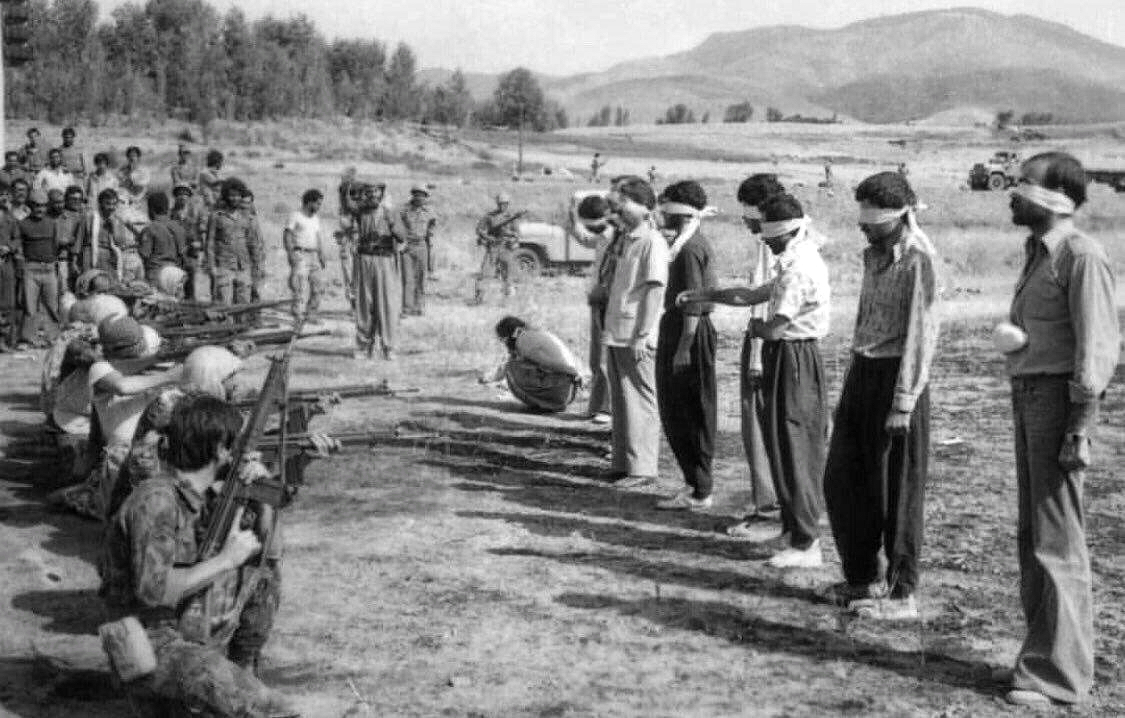
Jahangir Razmi, a young photographer working for the Iranian newspaper Ettela’at, was present. Managing to position himself slightly behind and to one side of the execution squad, he captured the exact instant the rifles fired. The resulting image is extraordinary and horrifying in equal measure. Some of the condemned are already collapsing; others remain momentarily upright, suspended between life and death. The executioners stand almost casually, performing what the revolution had already normalised as an administrative task. There is no drama in the cinematic sense. That is precisely what makes the photograph so unsettling. It records death not as a battlefield tragedy but as bureaucratic routine.
The image appeared in Ettela’at the following day without a photographer’s credit. The omission was deliberate. In the volatile atmosphere of post-revolutionary Iran, public association with such a photograph could have endangered Razmi’s life. The picture was subsequently distributed internationally through United Press International and quickly became one of the defining images of the revolution’s aftermath. In 1980 it was awarded the Pulitzer Prize for Spot News Photography—the only Pulitzer ever granted to an anonymous photographer.
For more than a quarter of a century, the identity of the man behind the lens remained a secret known only to a handful of people. It was not until 2006 that Wall Street Journal reporter Joshua Prager traced the photograph’s origins and revealed, with Razmi’s consent, the identity of the photographer who had captured one of the twentieth century’s most haunting images.
Placed alongside the executions in Mahabad four years later, the photograph acquires an even deeper significance. It was taken not at the end of the Islamic Republic’s consolidation of power but near its beginning. The victims at Sanandaj were among the first casualties of a revolutionary process that would soon expand far beyond Kurdish militants to encompass liberals, communists, students, women’s activists, ethnic minorities and former revolutionary allies. In retrospect, the image serves as an early warning. The firing squad at Sanandaj was not an isolated excess. It was one of the first visible signs that the revolution had begun to devour its own.
As photographs go, it possesses the rare quality of becoming more disturbing the longer one studies it. It is not merely a record of eleven deaths on a Kurdish airfield. It is a glimpse into a larger historical pattern: the moment when a revolution, having seized power, turns from overthrowing its enemies to eliminating its competitors. The rifles are aimed at eleven men, but the photograph foreshadows the fate of thousands who would follow. In that sense, Razmi captured not just an execution but a prophecy.
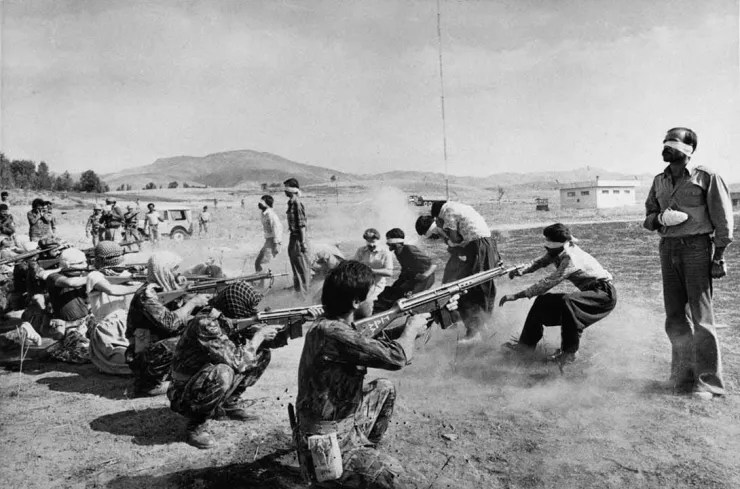
Firing Squad in Iran. Jahangir Ramzi’s Pulitzer winning photo, 1980.
Death in the camera’s eye
The photo reminds me of Robert Capa’s The Falling Soldier (1936), the death of a republican soldier taken during the Spanish Civil War, and Eddie Adams’s photograph of a South Vietnamese general executing a Viet Cong prisoner on a during the1968; Offensive. [These pictures are not shown here so as not to detract from the immediacy and tragedy of Razmi’s photograph.
The comparison is a fascinating one because all three photographs have become shorthand for entire conflicts, yet each captures a very different relationship between photography, truth and death.
Robert Capa’s iconic photograph taken during the Spanish Civil War, purportedly shows the exact moment a Republican militiaman is struck by a bullet and collapses backwards. It became one of the most famous war photographs ever taken, embodying the courage and vulnerability of those fighting fascism. Yet for decades historians have debated whether the image was genuine, staged, or a reconstruction. The controversy has never been fully resolved. Ironically, the photograph’s power derives not only from what it may show, but from the uncertainty surrounding it. It sits on the uneasy border between journalism, art and myth.
Eddie Adams’s photograph of South Vietnamese General Nguyễn Ngọc Loan executing a Viet Cong prisoner on a Saigon street during the Tet Offensive in 1968 occupies the opposite end of the spectrum. There is no ambiguity about what happened. Adams captured the precise instant the bullet entered the prisoner’s head. The image is shocking because it is so immediate and undeniable. For millions of viewers, it crystallised the brutality of the Vietnam War. Yet Adams himself later lamented that the photograph reduced a complicated human story to a single frozen moment. The prisoner had allegedly participated in killings during the offensive; the general spent the rest of his life defined by one fraction of a second. “The general killed the Viet Cong,” Adams later wrote, “I killed the general with my camera.”
Jahangir Razmi’s photograph from Sanandaj belongs in the same company. Like Adams’s image, it records an actual execution rather than a symbolic representation of one. Like Capa’s photograph, it came to symbolise an entire conflict and a wider historical struggle. Yet there is something uniquely unsettling about Razmi’s image. Adams shows a single victim and a single executioner. Razmi shows eleven condemned men and a firing squad acting in concert. The killing is not spontaneous or personal. It is institutional. The state itself is pulling the trigger.
Viewed together, the three photographs almost form a visual history of modern political violence. Capa’s image represents the romantic age of ideological struggle, when young men went off to fight for causes larger than themselves. Adams’s photograph captures the moral chaos of Cold War counterinsurgency, where certainty dissolves into horror. Razmi’s image depicts something colder still: the machinery of revolutionary justice transforming human beings into categories—“counter-revolutionary,” “enemy of God,” “corrupt on Earth”—before extinguishing them.
All three photographs freeze the instant between life and death. But they also remind us of something else. Photographs rarely explain. They reveal, they shock, they haunt—but they do not provide context. Capa’s militiaman may or may not have been dying. Adams’s prisoner and general carried histories invisible to the camera lens. Razmi’s eleven Kurds had been reduced by the revolutionary court to a handful of accusations and a death sentence. The photograph records their end, but not the complexity of their lives.
And perhaps that is why such images endure. They force us to confront history in its most compressed form: a single irreversible moment, laden with all the arguments, ideologies, hopes and hatreds that brought it into being. The photograph captures the second. Understanding the story behind it can take a lifetime.
In That Howling Infinite, June 2026
Other articles about the Islamic Republic in In That Howling Infinite: Messing with the Mullahs – America’s phoney war?, The quality of mercy … looking beyond Iran’s ghost republic, “Because of …” Iran’s voice of freedom, and The end of the line … an epitaph for a tyrant
A Chilling Photograph’s Hidden History
Twenty-six years ago, a picture of an execution in Iran won the Pulitzer Prize. But the man who took it remained anonymous. Until now.
December 6, 2006, The Wall Street Journal
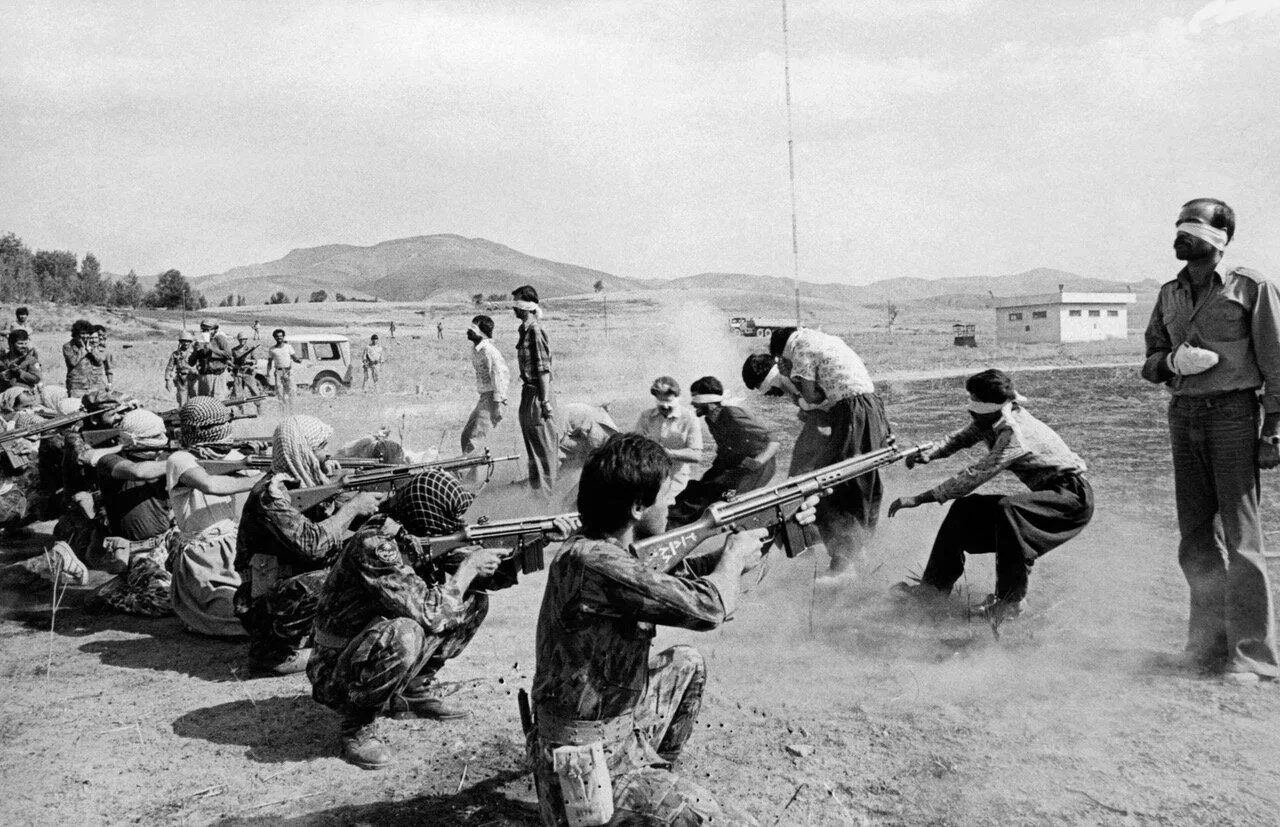
TEHRAN — On Aug. 27, 1979, two parallel lines of 11 men formed on a field of dry dirt in Sanandaj, Iran. One group wore blindfolds. The other held rifles. The command came in Farsi to fire: “Atesh!” Behind the soldier farthest to the right, a 12th man also shot, his Nikon camera and Kodak film preserving in black and white a mass execution.
Within hours, the photo ran across six columns in Ettela’at, the oldest newspaper in Iran. Within days, it appeared on front pages around the world. Within weeks, the new Iranian government annexed the offending paper. Within months, the photo won the Pulitzer Prize.
Taken seven months after Islamic radicals overthrew the U.S.-backed Shah, the photo remains one of the most famous images of Iran. It is an icon of government terror, invoked in critiques of the regime from the 1979 poem “Screaming,” to the 1986 music video “Speak To Me From My Land, Iran” to the 1997 book “Kurdistan.” Davood and Davar Ghassemlouie, brothers who operate a photo shop in Los Angeles, say they have made tens of thousands of reprints for demonstrators, including 200 in late September when Iranian President Mahmoud Ahmadinejad visited the U.S.
Says Shahrokh Hatami, a pioneer of Iranian photojournalism: “It is the most revealing photograph of the beginning of the Iranian revolution.”
Ettela’at, however, didn’t print the photographer’s name, fearing his safety. The Pulitzer was officially awarded to “an unnamed photographer of United Press International,” the news service that distributed the photo in the U.S. It remains the only time the award has ever been given to an anonymous recipient.
In the years since, several people have falsely claimed to be “Anonymous.” When Iran’s most famous photographer died in 2003, his obituaries were filled with mentions of a Pulitzer some say he had insinuated winning. Last September, another prominent Iranian photographer living in France was quoted in Paris Match magazine claiming credit for the work.
In fact, nearly three decades after the epochal photograph first appeared, almost no one knows who took it.
Jahangir Razmi grew up in the industrial city of Arak, in central Iran, the first child of a housewife and military clerk. Governed by the Shah, the nation was at peace. The boy was shy and happiest in a local photo shop helping a cousin develop film and shoot portraits of brides and soldiers. In 1960, at the age of 12, he bought a Russian Lubitel-2 camera.
He quickly put it to use. When one day a boy shot a girl dead outside his studio, a reporter urged Jahangir to photograph the scene. He did, the skirt and shirt of a bloodied school uniform preserved in the newsprint of Ettela’at.
When his father died, Mr. Razmi says he found work in a Tehran photo shop. When he served in the army, he found reprieve from military drills in a darkroom on base. When he photographed a 20th birthday party, he found a wife. And when Ettela’at — Farsi for “Information” — hired him in 1973 to shoot breaking news, he found a career.
“Although we were colleagues and there was a competition, his pictures were better,” says Jafar Danyeli, then one of seven staff photographers. Razmi, as everyone called him, paid attention to composition and chiaroscuro, the interplay of light and shadow. He sat at the desk closest to the stairwell. “I was always the volunteer to go,” says Mr. Razmi, then 25. “I was quick. I was young. I was braver than anyone else.”
On Jan. 16, 1979, the Shah fled Iran following mass demonstrations protesting his rule. Sixteen days later, Ayatollah Khomeini, a radical Islamic cleric, returned from France and seized control. Mr. Razmi photographed Mr. Khomeini in his Qom headquarters so regularly that he came to greet the imam with a handshake. Using his favorite Nikon lens, a 28mm wide-angle lens with automatic exposure, Mr. Razmi chronicled the conversion of Iran to theocracy from autocracy.
By August, about 500 alleged counter-revolutionaries and officials of the former regime had been executed. The judiciary decreed it illegal to criticize Islam and Iran’s spiritual leaders. A holding company formed by the regime appropriated Kayhan, the only newspaper in Iran larger than Ettela’at. Journalists who pushed back at censorship under the Shah were petrified.
“Under Khomeini they would kill you,” says Amir Taheri, then editor of Kayhan and now a political analyst living in England. “It was a different ballgame.”
On Aug. 16, Mr. Khomeini called on Iranian troops to suppress restive Kurds hoping for autonomy. Thousands of soldiers headed 300 miles northwest to the Iranian province of Kurdistan. Mr. Razmi and Khalil Bahrami, an Ettela’at reporter, followed.
Ten days later, Mr. Bahrami received a tip that a judge he had befriended was set to try Kurds in an antechamber of the municipal airport at Sanandaj, the capital of Kurdistan. The reporter, then 37, had worked at Ettela’at for 22 years and was thankful he was paired with the young Mr. Razmi, whose father had lived in Sanandaj and had raised his son to admire the Kurds and their traditions. “He knew his responsibility,” says Mr. Bahrami, who lives in Iran and is retired. “And he was quicker than the others.”
At the airport, Mr. Razmi stood ready outside the makeshift courtroom as 10 handcuffed men filled a wooden bench before the judge, a black-bearded Shiite cleric named Sadegh Khalkhali. An injured 11th prisoner lay on a stretcher beside the door.
The judge removed his turban, Mr. Bahrami recalls. He removed his shoes. He put his feet on a chair. Scanning the prisoners through thick eyeglasses, he asked their names. Officers of the court told of the defendants’ alleged crimes — of trafficking arms, inciting riots and murder. The prisoners, some with leftward or nationalist leanings, denied the accusations.
No evidence was presented, Mr. Bahrami says. “It was pure speculation.” After roughly 30 minutes, Mr. Khalkhali declared the 11 men “corrupt on earth” — mofsedin fel arz — the Koranic phrase he cited before issuing a sentence of death. A few of the men cried.
Mr. Bahrami summoned his colleague Mr. Razmi. “It was Razmi’s luck that day that he was with me,” the reporter says.
Mr. Razmi withdrew from his green canvas shoulder bag a 35-80mm lens and attached the zoom to his Nikon FE. The handcuffed men were blindfolded. Each put his hand on the shoulder of the man before him and together they walked single-file through the airport’s concrete lobby, through a metal doorframe and toward an open airfield. Mr. Razmi darted ahead and shot, untroubled by security forces: “I was totally free,” he says. Unbeknownst to Mr. Razmi, a soldier present also was taking pictures, which were never published.
The caravan passed roughly 30 airport workers, both men say. Up front walked Mr. Razmi. In the rear, both men say, was Ali Karimi, one of the judge’s bodyguards, wearing white shoes, white pants, white shirt, sunglasses and twin hip holsters. After about 100 yards, an officer halted the condemned on a plain of dry dirt. All but one of the executioners tied about their own heads Iranian shawls called chafiyehs. Both the faces of the Shiites and the eyes of the Kurds were now concealed.
Mr. Karimi asked the prisoners if they had last words, the two journalists recall. The men didn’t, all silent save a man Mr. Bahrami later reported to be Essa Pirvali, who wept aloud. A sandwich maker, he belonged to no political party but possessed a handgun and had been accused of murder. “He was scared,” Mr. Razmi says. “He wouldn’t stand.” The soldiers instructed a fellow prisoner to hold him.
An afternoon sun shone behind the prisoners and Mr. Razmi reached for his 28mm lens. He sidled in behind members of the firing squad, who stood in brown leather boots laced to the calf. He thought, he says, only about “speed and angle.” The prisoners stood in plainclothes. The firing squad crouched in camouflage.
“Afrad mosallah!,” yelled the commanding officer, calling his troops to attention. His charges aimed their G3 rifles at the midsections of the men standing little more than a body’s length away.
Standing farthest to the right, Naser Salimi, an employee of the Sanandaj health department, raised his right hand to his chest. It was bandaged, injured in a street fight that had led to his sentencing, according to contemporary newspaper reports. Opposite him, the only soldier who wore no chafiyeh raised his rifle.
Mr. Razmi stood a few feet behind this unmasked gunman. He raised his camera. At 4:30 p.m., the command came to fire: “Atesh!” Eleven guns discharged. Eleven bodies dropped. “When they fell, it was dusty,” Mr. Razmi says. The photographer lowered his camera.
The soldiers eyed Mr. Karimi, the judge’s bodyguard, lifting a pistol off his right hip. Not all of the men were dead, the photographer recalls. The bodyguard leaned over Ahsan Nahid, the injured prisoner on the stretcher, and fired one bullet into his head. Mr. Razmi snapped his Nikon. Mr. Karimi stepped to the next man and shot him, too. He proceeded along — one bullet per body, both journalists say. (Recent efforts to locate Mr. Karimi were unsuccessful.)
WITHIN MINUTES, ambulances ferried away the 11 bodies, airport workers returned to work, the huddle of soldiers thinned and Mr. Razmi stowed his two rolls of Kodak 400 film in a pocket of his canvas bag. After a helicopter flight landed the pair too late to cover a second execution, Mr. Razmi left his colleague, flagged a passing minibus and returned to the airport in Sanandaj, where at 8 a.m. the only daily flight to Tehran departed.
The photographer fell asleep. He was awakened at a checkpoint by shouts from airport officers, the same men who had shared their lunch with him the previous afternoon as they awaited the Kurdish prisoners. “It’s me!” yelled Mr. Razmi. “Jahangir!” The men held their fire. Mr. Razmi told them he had film and an article that had to get back to Tehran. “I put it in an envelope and gave it to the flight attendant,” he says, needing to continue his work in the region.
Mr. Razmi called Ettela’at, which dispatched a courier to the airport. The man picked up the white envelope from Tehran airport and delivered it to the newspaper. Ali Akbar Moradi, head of the paper’s darkroom, says he knew the 70 exposures were taken by Mr. Razmi and that he turned them into two contact sheets with the help of a technician. An office runner gave them to the photo editor, the late Fereydoun Ebrahimzadeh, who marked the frames he wished turned into prints and delivered them to Mohammed Heydari, the chief Ettela’at editor, Mr. Heydari says.
Mr. Heydari was examining the layout of that day’s front page and flipped through the stills. At about noon, he says, he stopped, overwhelmed by a single image of the moment when some of the squadron had fired and some hadn’t. Bodies fell. Dust rose.
Mr. Heydari, then 35, had little time to think — the afternoon paper was about to go to print. He says he told himself that the country was conflicted over the killing of the Kurds and angry over censorship. He decided to publish the photograph, although not in the edition distributed in the Kurdistan province, where it would be tantamount to a call to arms. “Considering the political climate, I knew I could get away with it,” Mr. Heydari says.
The Ettela’at editor made another snap decision. The photograph would run with no credit. “I was aware that if I published his name, he would be in danger,” Mr. Heydari says. “I wanted to protect Razmi.”
By 2 p.m., newsstands across Tehran trumpeted word of the Kurdish executions. The banner headline read: “Forty People Executed in Sanandaj, Marivan and Saqqez.” The accompanying photograph was a sensation, the seven months of Iranian firing squads distilled to one image.
Copies of Ettela’at sold out and representatives of international news agencies hustled to Khayam Street to buy prints. The photo editor, Mr. Ebrahimzadeh, “sold it to everyone like he was selling French fries,” says Alfred Yaghobzadeh, 47, then a photographer for the Associated Press, now a photojournalist based in France.
The first to arrive at Ettela’at was Sajid Rizvi of United Press International. Mr. Rizvi, then 30, had seen the newspaper at his home, ordered a copy by phone and sped off in the company’s pistachio-colored sedan. He picked up the photo roughly 15 minutes later inside the Ettela’at newsroom.
“It was almost wet when I took it,” says Mr. Rizvi, now editor of an arts publishing house in London. “I don’t think I have ever seen a picture as moving as that,” he says. “It is a picture between life and death.”
Mr. Rizvi asked who had snapped it. “They said, ‘better not to give out the name of the photographer.’ ” Once home, he walked into the bathroom he had converted into a darkroom, dried the photo with a hairdryer, composed a caption on his yellow Olympus typewriter, phoned the UPI desk in Brussels and transmitted the print.
Genghis Seren, a photo editor in Brussels, sat transfixed beside the company UniFax. “The drama of that machine was that the picture took 15 minutes to complete,” recalls Mr. Seren, then 25 years old and in his first year at UPI. “It came a 10th of an inch after a 10th of an inch…. It was something!” Mr. Seren forwarded the photo to UPI bureaus in Africa, Europe and the Middle East, and to company headquarters in Manhattan.
“It was transmitted to us with no name,” says Larry DeSantis, the UPI managing editor who received the photo 11 stories above 42nd Street. “Not knowing who made it interested me.”
At about 3 p.m., several armed agents from the Islamic Revolutionary Council arrived at Ettela’at, ascended four flights and entered the office of the editor, Mr. Heydari. They asked for the negative of the photo and asked to speak with the photo editor, Mr. Heydari recalls.
Mr. Heydari refused. “I said, ‘No. I am the editor. I take full responsibility.’ ” Mr. Heydari says he told the men: “If I am arrested, the negative consequences will outweigh the effect of this photo.”
The chief agent backed off. Both men telephoned government and religious officials, and the judge who ordered the executions radioed the agent seated beside Mr. Heydari, the editor says.
Mr. Khalkhali, the judge, declared the photo a fabrication and told the agent to arrest the editor, Mr. Heydari says. He says he responded by offering to show the negatives to the agent “as long as you agree not to use force to confiscate them.”
The agent agreed and viewed the negatives with two fellow officials. “They were astonished,” recalls Mr. Heydari. The agent made another call and told Iran’s attorney general that “the newspaper has been considerate to only publish this one,” Mr. Heydari remembers. The agents left with one proviso: Upon their return from Kurdistan, Messrs. Bahrami and Razmi should come in for questioning.
THAT SAME DAY, Mr. DeSantis, the UPI editor, had prints of the photo distributed by motorcycle to the New York papers and by telephoto machine to thousands of papers across the country. On Aug. 29, the New York Times, Washington Post, Der Tagesspiegel in Berlin and the Daily Telegraph in London were among the many newspapers to run it. Nearly all credited UPI.
“Our play was fabulous,” exults Mr. DeSantis, now retired. “It was a once in a lifetime…. Like it was a movie set. One guy kneeling, aiming. One guy falling. A mass execution.”
Mr. Razmi remained in Kurdistan, where at a Sanandaj newsstand he came across a copy of Ettela’at featuring one of his other photos showing the blindfolded men standing in wait. He understood why his more incendiary photographs were unprinted but nonetheless was disappointed. “I expected my name to be published,” he says.
Two days later, reporter and photographer returned to the Ettela’at office in Sanandaj. The office manager lifted from his desk the Tehran edition of the paper that had reported the execution, they recall. He said copies brought to Kurdistan were selling for more than double the cover price. The manager was a Kurd and Mr. Razmi recalls him saying: ” ‘We have to build a statue of gold of you.’ And because of what he told me, I understood that this photo was dangerous.”
Close readers of Ettela’at could have surmised Mr. Razmi was the photographer. On Aug. 26, the day before the execution, the newspaper named him as one of three employees it had sent “to the Western portion of the country.” An Aug. 29, the day after the photo ran, the paper reported on its front page that he and Mr. Bahrami had been “sent to Kurdistan.”
Home in Tehran, after a long shower, Mr. Razmi spoke about the execution to his wife and again the next morning to curious colleagues in the newsroom. He says he asked Mr. Heydari why his photo had carried no credit and didn’t object when the editor explained his worry. “I told him jokingly that you would have also been executed in Kurdistan on the spot,” Mr. Heydari says.
Mr. Razmi walked to the newspaper darkroom and saw for the first time what had been the 18th exposure of his first roll of film. “There I realized what I had taken,” he says. Turning on the red safelights in the studio, the photographer made prints of eight stills and preserved on a contact sheet 27 of his 70 photographs.
Mr. Razmi asked the darkroom supervisor for his negatives and locked them in the middle of his three metal drawers together with his other prints. A few days later, he slipped the contact sheet and stills into the fold of a newspaper and hid them in his home, “somewhere no one would have noticed,” he says. The next morning, he returned to Kurdistan.
On Sept. 9, the Islamic Revolutionary Council published a notice in the Islamic Revolution newspaper: “we hereby draw your attention to the picture which was published on the front page of [Ettela’at] on 6/6/1358 and was objected to harshly by the public.” It continued: “If this occurs again, serious decisions will be made.”
A serious decision already had been made. The day before, the Foundation for the Disinherited — the holding company that in August had swallowed Kayhan, Iran’s largest paper — also seized Ettela’at. Overnight, the paper, privately held since 1920, became state-owned.
The image continued to spread. Reza Deghati, then 27, a free-lance Iranian photographer, had seen the photo. It is “the most stirring execution picture in the history of photojournalism, of the human being,” he says. Mr. Deghati says he procured five additional photos of the execution from an Ettela’at employee and mailed them to SIPA, the Paris agency that had been publishing his own photos since the revolution.
Goksin Sipahioglu says he received the prints from Mr. Deghati at his agency on Paris’s Rue Roquepine. Even though UPI had already published one, Michele Sola, photo editor of Paris Match magazine, paid 14,000 French francs (about $10,000 today) for the additional prints. Mr. Sipahioglu forwarded half that sum to Mr. Deghati in Tehran.
The magazine went on sale in Paris days before its Sept. 21, 1979, cover date. About 2,600 miles east, readers in Iran turned to page 66. Titled “Les Kurdes, sous les balles d’Allah” (“The Kurds, under Allah’s bullets”), the photos spread rapidly. People paid 20 times the cover price for the magazine, and dozens of Iranians tacked the photos about town.
No one, however, neither Mr. Razmi nor the Iranian brain trust, seemed to notice the magazine’s erroneous credit — “Reza (Sipa)” — printed in the lower left corner of the index page. “When someone sends a picture to us,” explains Mr. Sipahioglu, “we always credit him.”
Mr. Deghati says he sent SIPA a letter saying he didn’t take the photos and that SIPA sent out a news release via the AP retracting his name. Representatives at SIPA, Paris Match and the AP don’t recall Mr. Deghati clarifying the matter and didn’t find such a release in their archives.
Mr. Razmi returned from Kurdistan in late September and Mr. Ebrahimzadeh approached him at his desk. The photo editor asked for the negatives of the 70 photos and extended his hand. “I couldn’t protest,” Mr. Razmi says. “It belonged to him.” He unlocked his metal drawer. Mr. Ebrahimzadeh told the photographer the police wished to speak to him in Tehran’s Evin prison, Mr. Razmi recalls.
Mr. Razmi says he arrived at the prison with Mr. Bahrami and two Ettela’at editors, and quickly found himself alone with the late Asadollah Lajevardi, a future warden of the prison already notorious for torturing inmates. As part of his newspaper duties, Mr. Razmi had often photographed men housed in Evin whom the state would soon execute. “I had a right to be nervous,” he says.
Mr. Lajevardi asked him who had photographed the Sanandaj execution, Mr. Razmi says. When Mr. Razmi said he had, the guard asked why he had hidden his negatives in the drawer. “So that no one would take them,” Mr. Razmi recalls answering.
He told Mr. Lajevardi that he had permission from the judge to shoot the scene and that he hadn’t sent the pictures overseas. The interrogation was soft, and it became apparent to Mr. Razmi that he wouldn’t be harmed. Mr. Razmi returned to the paper, and a few weeks later was consumed with work when, on Nov. 4, Iranian students took hostages inside the U.S. Embassy.
The next month, UPI managing editor Mr. DeSantis sat down to submit his newswire’s best work of the year for awards. At the top of his list was the execution photo. “I was a very good picture editor,” Mr. DeSantis says, “but on this one you could be a dumb dog and pick this out.”
That neither he nor anyone at UPI knew who took the photo was of little concern. The agency had been the first to provide it to the press and presented it as the work of an unnamed UPI photographer, which, says Mr. DeSantis, he assumed it was. “It came on the UPI wire,” he explains.
“Because of the present unrest in Iran,” wrote the editor to the Pulitzer committee, “the name of the photographer cannot be revealed at this time.”
Mr. Razmi didn’t know his photograph had been nominated for the Pulitzer. He didn’t know the jury nominating finalists for Spot News Photography was overwhelmed by the entry UPI titled, “Firing Squad in Iran.” Robert Duffy, then an editor at the St. Louis Post-Dispatch and chairman of the jury, says he informally lobbied a member of the Pulitzer Board that spring to pick the photo. “We were hell-bent on giving the prize to ‘Anonymous,’ ” he says.
On April 14, 1980, seven days after the U.S. severed diplomatic relations with Iran, ‘Anonymous’ won the Pulitzer Prize. Mr. Heydari told Mr. Razmi the news. But the same people who, in effect, had ordered the execution now owned his employer. Mr. Heydari says he was fired two months later. Representatives of the paper cancelled an August 2005 appointment at their Tehran head office and declined to be interviewed for this article.
Ettela’at didn’t report news of its prize-winning employee. Mr. Razmi says he “didn’t have the guts to celebrate.”
UPI did. The newswire flew its Tehran bureau chief Mr. Rizvi to the U.S. and had him speak to subscribers. “They were trying to show me off,” he says. Asked about the anonymous photographer, Mr. Rizvi recalls answering: “Eventually it will be revealed.”
IN THE SPRING, Ettela’at promoted Mr. Razmi, then 32, to photo editor. Iraq attacked Iran in September and Mr. Razmi covered the war. A mortar deafened his right ear in 1987. When months later Ettela’at asked him to work in Iraq, he decided he was tired of war. He quit his employer of 15 years, sold the home he had built by himself in a leafy neighborhood of northern Tehran, bought an apartment and opened a photography studio.
Forty years old, the photographer had come full circle, developing film and shooting portraits as he had as a boy. Says Mr. Razmi: “I was looking for a peaceful life.”
Mr. Razmi called the studio “Abgineh,” the Farsi word for glassware, which he says connoted for him the clarity of water. He didn’t advertise the studio. Still, six days a week, brides in gowns flocked to the shop, looked at Mr. Razmi and smiled.
Mr. Razmi thought often of Sanandaj. In his shop, he hung a large portrait of a boy wearing a Kurdish shawl and sash. Every summer, during the month of Shahrivar, he locked himself in his bedroom and looked at the execution photographs he had hidden.
On Aug. 3, 1997, three weeks before Shahrivar, Mohammad Khatami took office as president of Iran and hired Hashem Taleb to head his public relations. Mr. Razmi had met Mr. Taleb years before and saw a business opportunity. He drove to the office of the president, pronounced the headshots of Iranian officials unbefitting their rank and “suggested I take photographs of the president and the cabinet,” he recalls. Mr. Taleb hired him.
Days later, Mr. Razmi, the first “Official Photographer of the President and his Cabinet,” set up his flash umbrellas inside the Iranian presidential residence at the intersection of Palestine and Pasteur streets. He shot pictures of the new government. He developed the color portraits. Before mailing the prints to the president’s office, he stamped his name on the back of each.
The name Jahangir Razmi, however, remained unconnected to his most famous photograph. Monir Nahid, mother of two of the executed men, who has since settled in Los Angeles, says over time, “10, 20 people came to me and said, ‘I took the picture.’ ”
Among them, say Mrs. Nahid and her daughter, was Mr. Deghati, the stringer who in 1979 sent the photo to Paris Match. Mr. Deghati, who left Iran in 1981 and today lives in France working for Webistan Photo Agency, says he has never met the Nahids. Last September, Paris Match magazine quoted him saying he took the photo, adding in French that Mr. Khomeini “was furious.” Mr. Deghati says he knows Mr. Razmi took the photo, and that the magazine misquoted him.
Mr. Razmi says he first learned about a decade ago that others were claiming his work. Kaveh Golestan, Iran’s best-known photographer, reported to him that Mr. Deghati had said as much at a European photo exhibit. Mr. Razmi didn’t know that Mr. Golestan also had taken credit for the photo in classes he taught, according to several of his photojournalism students at Tehran University.
When Mr. Golestan died in 2003, after stepping on a landmine in Iraq, newspapers around the world reported that he had won a Pulitzer Prize. His widow, Hengameh Golestan, says her late husband never took credit for the photo and that the obituaries were mistaken. Mrs. Golestan says she knows Mr. Razmi took the photo.
On the fourth floor of a cement apartment building in northern Tehran, Mr. Razmi sat on a dimpled leather couch. His living room walls were barren of his work. Beside him on his couch, his son Ali sat rapt, tamping down a pinch of Cavendish tobacco in his father’s pipe. Mr. Razmi struck a match and puffed.
“My sons have told me a lot of times that I should go and prove that I am the photographer,” Mr. Razmi said, his voice soft and his eyes cast down. “I said, ‘No. Better not.’ ”
It is understandable why he feared claiming credit for such a public indictment of the Islamic Revolution. The hardline Mr. Ahmadinejad, elected in June 2005, shuttered Shargh, the country’s last large reformist newspaper, three months ago. Mr. Razmi also was still the official government photographer and returned the next morning to the presidential residence to shoot Mr. Ahmadinejad’s cabinet, including the defense minister who in 1979 helped quell the Kurds.
But Mr. Razmi, who is now 58, said part of him always wanted to step forward. He was disappointed when he first saw that his photo didn’t carry his name. He was irked when others took credit, people who “never feel the danger,” he said. And all the time, he was weighted by his secret, that of an ordinary man witness to extraordinary events. “Without this picture,” he said, “I wouldn’t be anything.”
Emboldened by time and dismayed by the opportunism of his fellow photographers, Mr. Razmi decided the moment was right to tell his tale after this newspaper approached him. “My name should be there,” he said.
Minced lamb and baghali polo — a dish of green rice and beans — awaited Mr. Razmi at home, and he sat down to eat with his wife and sons, his sister, two nephews and his father-in-law. They talked about Mr. Razmi identifying himself, for the first time, as the anonymous photographer.
Mr. Razmi had done nothing wrong, they reasoned. He photographed the execution with the permission of the judge. He turned over his negatives to the photo editor. He described his work to the prison guard. He wasn’t the one who sent the six images abroad. He didn’t earn a single rial or credit from his photo, the rights to which had passed from UPI to the Bettmann Archive to Corbis Corp.
The family approved of his decision to come forward. Voicing hope that it wouldn’t harm Mr. Razmi, eight people around the table spoke as one: “Inshallah,” if Allah wills it.
Past midnight, Mr. Razmi retreated to a bedroom closet and lifted his canvas camera bag by the faded strap that had hung over his shoulder during the 1979 revolution. Here in pale black ink on the inside flap of a pocket was written in Farsi, “Jahangir Razmi, Ettela’at, 328 331” — the newsroom number to phone in the event of his death.
Mr. Razmi returned to his living room. He had unearthed his contact sheet and stills for his annual look back at the execution. “I have pictures that have never been published,” he said.
The photographer held in his right hand a sheaf of black-and-white photographs, 27 images that were 26 years, five days old. He withdrew from a plastic sleeve a furling photo of the sandwich maker who cried as he waited to be shot.
Mr. Razmi thrust it forward. “Who has this picture?” he asked, his voice rising. “Nobody.” He thrust forward a photo of the dust that rose over 11 fallen men. “Who has this picture?” he asked. “Nobody.” He thrust forward a photo of the bodyguard surveying the men he had shot. “Who has this picture?” he asked. “Nobody.”
Mr. Razmi returned the photos to the sleeve that had held them since 1979. And for the first time since he had secreted them home in a folded newspaper, he put them in a Samsonite briefcase he had long used to store chosen photos from his career.
Says Mr. Razmi: “There’s no more reason to hide.”
Copyright © 2006 The Wall Street Journal. All Rights Reserved
 In That Howling Infinite