Adrift In the digital undertow

I am friend to the undertow
I take you in, I don’t let go.
Suzanne Vega, 1985

American singer, songwriter Jeff Buckley was best known for his extraordinary, almost otherworldly voice and his acclaimed album Grace (1994). The son of the folk singer Tim Buckley, he developed a distinctive style blending rock, folk, soul and blues with an intensity that had made him into a cult figure among his aficionados.

He  visited Australia twice – in 1995 and 1996. His reputation had preceded him and he had become a “must see” performer for both musicians and admirers of Grace. I had the great fortune to see him in concert at Newtown’s acclaimed if then ramshackle Enmore Theatre in February. Tickets were like hens’ teeth, and my wife and I and friends scored the last few – three in the gallery and one in centre of the very front row. We pulled straws for that front row prize – and I won. Oh, what a night it was. A night of music like no other – and never to come again.

In May 1997, while on tour in Tennessee, he entered the Wolf River in Memphis, singing, it is said, Led Zeppelin’s Whole Lot of Love – and was swept beneath the surface by the wake of a passing boat, disappearing into the current before his body was recovered several days later. His death has since acquired an almost mythic quality, particularly because of the unfinished music and career he had barely began.

Buckley’s death at the age of thirty  was not a slow surrender to some imperceptible current; it was sudden, physical and irreversible. But the image remains: the surface looks deceptively benign, the swimmer believes himself to be in control, and then a force beneath or beyond his immediate perception alters everything.

There are some metaphors that become more powerful the longer you live with them. An undertow is one. You do not necessarily see it. There is no great wave announcing its arrival, no dramatic moment at which you can point to the sea and say, there, that is what is carrying me away. You are standing in the water, apparently where you intended to be, while beneath the surface a current is carrying you steadily away from the shore. You may not notice until you look back and discover that the beach has become strangely distant.

The digital undertow is obviously nothing so dramatic, but its power lies precisely in its lack of drama. It does not drag us suddenly beneath the surface. It carries us, almost imperceptibly, away from where we thought we were.

Forward

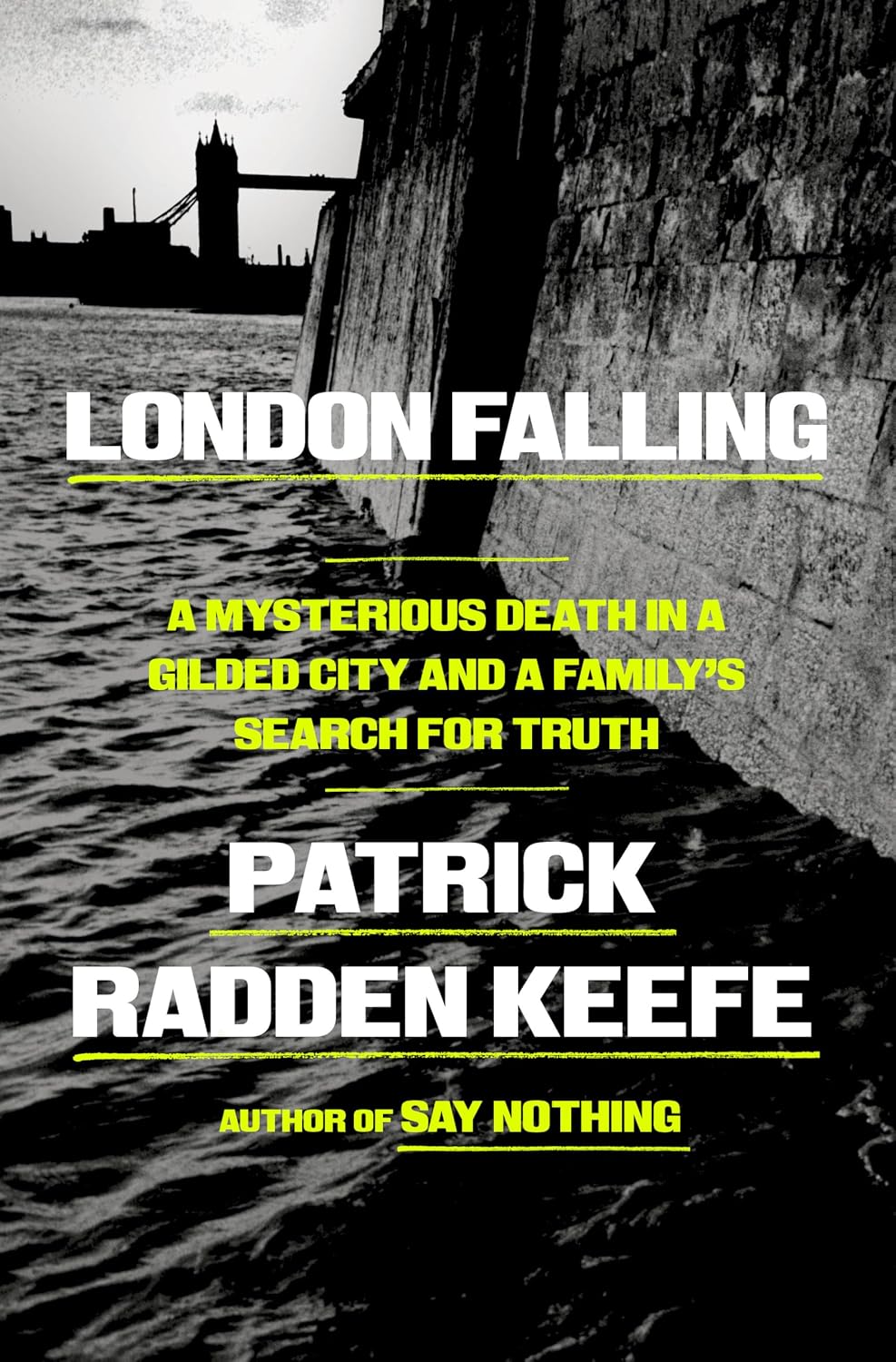
I began writing about American investigative journalist Patrick Radden Keefe’s London Falling, a book ostensibly concerned with the mysterious death of a young man in London, and with the city’s subterranean worlds of money, influence, crime and respectability. But somewhere along the way, Keefe’s phrase “digital undertow” caught me. It seemed to describe something much larger: the almost imperceptible current by which smartphones, social media and algorithms carry us away from sustained attention, a shared public world and, perhaps, from one another.

From there the essay wandered into a lengthy (be warned) contemplation of algorithms, attention, polarisation, personalised realities, the loss of a common informational environment and the curious way in which our own preferences can become the walls of an algorithmic box canyon. And eventually it arrived somewhere rather more immediate: the current debate over Australia’s proposed Digital Duty of Care, the distinction between censorship and algorithmic amplification, and the question of who should decide what reaches us through our screens.

The central thought is a simple one: the feed is not the world. It is a selection from the world – a mirror that has learned how to talk back.

We have more information than any generation before us, but perhaps less certainty that we are inhabiting the same informational world. The challenge is not to abandon technology, nor to imagine that the old media world was some lost republic of reason. It is to recover the habits that the algorithmic environment makes increasingly difficult: curiosity, context, sustained attention, intellectual humility and the willingness to encounter something we did not choose to see.

The undertow is not necessarily dragging us anywhere we consciously decided to go. That is rather the point.

Look up occasionally. Look around. Ask what you have not been shown. And, when the feed is moving too quickly, put the phone down and look towards the shore. Because the shore has not moved. We have.

Adrift in a digital world

Down, down, deep down we dove
In a tangle of rigging and rage –
Down to the deep where the dead sailors sleep
In the darkness of Lucifer’s cage.
Paul Hemphill,  Chapter Forty One – In That Howling Infinite 

American investigative journalist and author Patrick Radden Keefe coined the phrase ‘digital undertow’ in his recently published book London Falling: A Mysterious Death in a Gilded City and a Family’s Search for Truth. It describes the subtle but relentless way the internet, smartphones, social media and the constant flow of notifications pull us away from sustained attention, deep reading, conversation and the physical world around us. It is tempting to understand this merely as another complaint about modern distraction: the death of concentration, the inability to read a book without checking the phone, the colonisation of every spare moment by the little glowing rectangle in our hands. But Keefe’s idea is more disturbing than that. The digital undertow does not merely distract us. It carries us somewhere.

London Falling offers an unusually apt place to begin thinking about this. The book is ostensibly an investigation into the mysterious death of nineteen-year-old Zac Brettler, who in 2019 fell from a high balcony of the Riverwalk apartment tower into the Thames, close to the headquarters of MI6. Brettler had been living a secret double life, at one point presenting himself as the son of a Russian oligarch, and had become entangled with a slippery London businessman and a gangster known as “Indian Dave”. When his parents began investigating his death, unwilling to accept the explanation of suicide, they found themselves drawn into a London of money, criminality, influence and compromised institutions, where the boundary between the respectable and the crooked was often surprisingly porous.

But as with his previous books, Say Nothing and Empire of Pain, Keefe’s real subject is larger than the mystery with which he begins. A single death becomes a way into a whole subterranean world. The particular opens onto the systemic. Zac’s story draws us beneath the polished surface of a city and into the networks of money and ambition that sustain it.

London is such a beautiful place that, as Keefe observes, it can be easy while strolling through the city to forget that much of it was built on imperial plunder. It is a capital of pristine façades, often painted in wedding-cake shades of cream and ivory, its dominant aesthetic amounting to a kind of literal whitewash. To acquire something, whether cash or reputation, is to mingle the dirty with the clean. London became, in Keefe’s memorable phrase, a twenty-four-hour laundromat for dirty money, and one consequence of that transformation was a city full of crooks with pretensions to legitimacy and businessmen who seemed a little crooked. When Russia’s oligarchs first arrived in the English capital at the turn of the millennium, they required lawyers and bankers, tax advisers and security consultants, real-estate agents and spin doctors. A generation of smart, eager and morally elastic young British professionals enthusiastically signed on as fixers of every stripe.

There is something almost perfectly Keefe-like about the way the book takes us from a young man’s death into the hidden structures of a city. And then, somewhere along the way, the metaphor turns inward. The undertow is no longer simply beneath London. It is beneath us. That distinction is crucial.

For a writer like Keefe, whose books require years of painstaking research and sustained attention, the digital environment represents more than a personal inconvenience. Investigative journalism depends upon patience, memory, ambiguity and the willingness to follow a thread that may take hundreds of pages before revealing where it leads. It requires the capacity to remain with something.

Yet the digital world is designed around the opposite impulse: immediacy, interruption, novelty and the next thing. It is not simply that we have become less disciplined. We are living inside systems deliberately engineered to capture and monetise attention.

And this is where Keefe’s observation about Zac becomes so revealing. Zac was interested in supercars, rich people and luxury real estate. Social media did not create those interests. It compounded them. The algorithm took existing fascinations and amplified them, reflecting his aspirations and anxieties back at him through his smartphone and magnifying them. Zac might not have been delusional in any clinical sense, Keefe suggests, but he inhabited a world in which social media was beginning to blur the boundary between reality and fantasy.

Increasingly, Keefe writes, any sense of a ‘shared conscious existence’ was giving way to an “individualized, algorithmically bespoke form of virtual reality”, in which our most personal and idiosyncratic anxieties and aspirations are reflected back at us and magnified by our smartphones.

That phrase, ‘shared conscious existence’ is the key to the larger argument.

We have always disagreed about reality. Human beings have never inhabited a world of universal agreement. We have different religions, ideologies, political loyalties, classes, cultures and prejudices, and we have always interpreted the same events differently. But for most of human history, and particularly throughout the era of mass communication, we nevertheless inhabited a broadly shared field of reference. Families, schools, workplaces, churches, newspapers, books, radio and television exposed us to things we had not necessarily chosen to see. We might argue bitterly about what an event meant, but we had at least seen the same event. We might read the same newspaper and despise its editorial line, but we had read the same newspaper.
Your own private Idaho

You’re livin’ in your own Private Idaho
You’re outta control, the rivers that roll
You fell into the water and down to Idaho
Get outta the state
Get outta the state you’re in
You better beware
The B-52s, from Wild Planet (1980)

The algorithmic world introduces something different: the possibility of individually curated realities. The technology does not merely give us information. It increasingly gives each of us a different selection of reality.

Two people can sit beside one another while their phones present them with entirely different worlds. One is immersed in stories of social collapse; another in stories of social progress. One is fed a succession of examples demonstrating the corruption of elites; another receives an endless catalogue of evidence that ordinary people are the real source of political danger. One is shown a world in which immigration is an existential threat; another a world in which opposition to immigration is itself the central threat. One becomes convinced that the media is hopelessly captured; another that anyone who questions the media is a conspiracist. Each is given enough material to make the world presented to them appear self-evident.

And this is where the undertow begins to have consequences beyond attention.

The algorithm does not necessarily persuade us. It surrounds us. And that is a more subtle form of influence. Propaganda tells you what to believe. The algorithm can determine what you repeatedly encounter, what appears salient, what becomes familiar and what disappears from view. It learns from every pause, every click, every momentary curiosity and every emotional reaction. It then gives us more of what it has learned will keep us looking.

Keefe illustrates the mechanism beautifully with his own Instagram experience. While researching London Falling, he began encountering accounts devoted to London real estate, attractive brokers giving tours of penthouses and sumptuous estates. He did not follow these accounts. But he paused over them, and Instagram inferred that he was interested. So it supplied more.

Then, at some point, he must have paused a little too long over a video of somebody falling.

And suddenly the London of penthouses was replaced by a London –  or rather a digital world – of cliffs, rooftops and voids. There were people high-diving from cliffs, BASE-jumping from skyscrapers, leaping into quarries, parkour daredevils vaulting across rooftops, bungee jumpers vanishing into gorges and skydivers stepping out of aircraft. Before long, Keefe could scarcely open Instagram without encountering somebody plummeting towards the earth.

Nothing conscious had changed. He had not decided that he was fascinated by people falling. He had simply lingered for a moment, and the machine noticed.

That is the undertow.

It is also why the metaphor is better than the language of addiction. Addiction locates the problem largely inside the individual. The undertow locates it in the environment. The technology is continuously testing us, learning us and adjusting the current. Every moment of attention becomes feedback. Every curiosity can become a pathway.

And the more the system learns what catches us, the more efficiently it can construct a world around us.

Box canyon

Down in that old box canyon
Where only misfits can go
He rides with no companion
Neil Young, The Misfits (1985)

This is where the algorithmic box canyon becomes such a useful image. We enter because something interests us. The walls rise almost imperceptibly. Each turn is determined by the previous one. Because the next piece of content resembles the last, the environment begins to feel coherent, even natural. Eventually the canyon becomes so narrow that alternative directions are difficult to perceive. Nothing has explicitly forbidden us from looking elsewhere. We simply stop being shown elsewhere.

The extraordinary thing is that the walls are built from our own preferences.

It is why the digital world can be so persuasive without being obviously coercive. It feels personal because it is personal. It feels relevant because it has learned what we find relevant. It feels like reality because most of what it shows us is real. The distortion lies not necessarily in the individual item but in the selection, repetition, emphasis and omission.

And here the absence of nuance becomes particularly important.

Algorithms reward engagement, and engagement is disproportionately generated by emotion. Anger is engaging. Fear is engaging. Humiliation is engaging. Envy is engaging. Outrage is exceptionally engaging. Complexity, qualification and uncertainty are not. “On the one hand, on the other hand” is rarely the stuff of viral content. Neither is “it depends”, “the historical context is complicated” or “both sides have a point, but in different respects”.

The algorithm therefore has a structural preference for the binary.

Good and evil. Victim and oppressor. Hero and villain. Elites and ordinary people. Left and right. Establishment and outsider. With us or against us. The categories vary according to the political tribe, but the structure remains remarkably consistent. The world is divided into two camps, and everything that happens is interpreted as evidence for the virtue of one and the depravity of the other.

The problem is not that these categories are always meaningless. There are genuine moral distinctions in the world. There are perpetrators and victims. There are acts that are plainly wrong. There are moments when moral clarity is necessary. But human affairs rarely remain inside two boxes for very long. History is full of mixed motives, unintended consequences, competing truths, compromises, hypocrisies and people who are simultaneously right about one thing and wrong about another.

The digital environment is not particularly interested in any of that.

Nuance slows the rhythm. Context gets in the way. Qualification weakens the punchline. A complicated truth is a poor competitor against a simple outrage.

And so we increasingly encounter a peculiar form of moral simplification in which disagreement itself becomes evidence of wickedness. If somebody does not accept your premise, they must belong to the opposing camp; if they belong to the opposing camp, their motives can be presumed; and once their motives have been presumed, there is little reason to listen to what they actually say. The argument becomes secondary to the classification of the person making it.

This is how a political disagreement becomes a tribal identity. It is also how the algorithmic box canyon becomes a moral one.

Once inside, the inhabitants of the other canyon are not merely people who have taken a different route through the landscape. They become inhabitants of another moral universe. We stop asking why they think what they think and start asking what sort of person could possibly think it. The result is a feedback loop in which contempt becomes evidence, evidence becomes ammunition and ammunition becomes identity.

This is one of the things that has increasingly struck me in thinking about what I call “Algorithm and Blues”. It is, first of all, a deliberate pun on rhythm and blues. It is the rhythm that matters: the beat of the feed, the pulse of notification and response, the repetitive sequence of scroll, stimulus, reaction and reward. But the phrase also carries, inevitably, something of the melancholy of living inside that rhythm. We have created a machine capable of connecting almost everyone with almost everything, and one of its consequences may be that we are progressively losing the experience of a world held in common.

The algorithm does not need to make us believe the same thing. It can make us believe increasingly different things with increasing intensity.

That is the paradox.

We have never had access to more information, yet we may be losing the capacity to inhabit a common conversation about what matters. We have never been more connected, yet we can increasingly choose not to encounter anything that seriously challenges the world we have constructed for ourselves. We have never possessed so much information, yet we increasingly struggle to distinguish information from significance.

And perhaps this is why the old idea of a shared public sphere now feels so fragile. It was never as harmonious or rational as nostalgia sometimes suggests. Newspapers had their prejudices and gatekeepers; television had its biases; governments manipulated information; communities could be intolerant and suffocating. But there was at least a commonness to the experience. We could disagree about the same newspaper because we had read the same newspaper. We could argue about the news because we had broadly encountered the same news.

The personalised feed changes the arrangement. It allows each of us to assemble a private front page, updated continuously and calibrated to our own psychological appetites.

The consequence is not necessarily ignorance. It is asymmetry.

You know things I do not know, and I know things you do not know, not merely because we have different interests but because the systems through which we encounter information are actively differentiating our experience. And because each of us is receiving material that appears to confirm the reality we already inhabit, disagreement can become almost impossible to resolve.

We can each possess an apparently inexhaustible archive proving that our reality is the real reality.

This is the more dangerous form of polarisation. It is not simply that people have strong opinions. It is that the opposing position increasingly becomes unintelligible. The other side is not merely mistaken; it is corrupt, stupid, evil or deranged. Once that happens, compromise looks like betrayal and qualification looks like weakness. There is no longer much incentive to understand the other argument because the algorithm has already taught us what sort of person makes it.

The old public sphere imposed a certain accidental discipline upon us. We could not entirely choose what entered our field of vision. A newspaper contained stories we did not care about. The evening news showed events we would not have selected. A conversation with a neighbour might wander into territory we had not anticipated. A book might challenge us simply because we had happened to buy it. Boredom itself had a function. It left room for the unexpected.

The personalised feed removes much of that friction. It is exquisitely attentive to what we already like. And what we already like is not necessarily what we need to know.

This is perhaps why Keefe’s phrase “shared conscious existence” is so evocative. The threat is not simply to reading, concentration or productivity. It is to the possibility of a society in which people can disagree while remaining conscious of inhabiting the same world.

Democracy does not require agreement. It requires a common enough reality within which disagreement can occur.

We can argue about what an event means because we have seen the event. We can argue about history because, however differently we interpret it, we recognise the same historical episodes. We can argue about politics because we have some common sense of what our fellow citizens are talking about.

The algorithmic world makes that increasingly uncertain.

And perhaps this explains the peculiar feverishness of contemporary public life. We are not simply arguing more. We are encountering one another through increasingly incompatible informational realities. Each side arrives armed with an apparently endless supply of evidence, much of it genuine, much of it misleading, some of it fabricated, and almost all of it selected by systems optimised for emotional engagement. The result is not merely polarisation but a kind of epistemic isolation.

We are becoming strangers to one another’s worlds. That is more dangerous than being strangers to one another’s opinions.

There is an additional irony in Keefe’s anecdote. He is a professional investigator, someone whose entire craft depends upon resisting premature conclusions. He follows evidence. He accumulates detail. He tolerates uncertainty. He knows that the first explanation is not necessarily the correct one. Yet even he finds himself being nudged from luxury real estate into an endless stream of falling bodies because he paused briefly over a video.

The point is not that Keefe is gullible. The point is that the system operates beneath the level of conscious intention. It does not have to persuade us. It only has to learn what holds us. Which is why the digital undertow is less like traditional propaganda than like climate. We breathe it without noticing.

Falling

And then there is the peculiar coincidence at the heart of London Falling: Keefe is writing about a young man who falls while discovering that his own digital world is being shaped by an algorithm, and his research leads him into an apparently endless stream of images of people falling.

The title becomes almost brutally literal. In Keefe’s world, gravity is not merely a metaphor for decline or loss of control; it becomes an actual agent in human stories. People fall from windows, balconies, platforms and bridges. They are pulled beneath trains. The city itself becomes a landscape of edges, places where the boundary between safety and catastrophe is frighteningly thin.

The physical metaphor and the digital one begin to converge.

London is a vertical city. Its towers, balconies, bridges and skyscrapers are expressions of ambition. We build upwards because height represents achievement, wealth and power. The penthouse is the ultimate image of having risen above the ordinary street. Yet every elevation creates the possibility of a fall. The very structures that proclaim human mastery also provide new ways of being undone.

Perhaps that is why human beings have always been fascinated by falling. Icarus falls. Lucifer falls. Humpty Dumpty falls. The person who steps over the edge discovers gravity. We can temporarily defy it through architecture, technology and ambition, but ultimately we remain creatures of gravity.

Old age brings the most literal and perhaps most frightening version of the metaphor. The fear of falling is not merely the fear of injury; it is the fear that one’s relationship with the world has changed. A fall can become a hinge point, the moment when independence begins to slip away, when a person who has spent a lifetime standing upright must confront fragility. Gravity, which has always been there, suddenly becomes an adversary.

There is an interesting connection here with Keefe’s digital undertow. The physical fall and the digital fall are opposites in one sense: one is sudden, the other gradual. The elderly person knows when they have fallen; the social media user may not. Yet both involve losing balance, losing orientation, being carried somewhere one did not intend to go.

Perhaps that is why the metaphor has such enduring power. To be human is to live between ascent and descent. We climb hills, towers, ambitions, dreams and heavens; we also fall from grace, fall in love, fall into despair, fall through the cracks, and eventually fall silent. Gravity is not just a physical law; it is a reminder of our limits.

The undertow is gravity’s aquatic cousin.

Avalanche

There is something almost eerily appropriate, then, in Leonard Cohen’s line: ‘I stepped into an avalanche, it covered up my soul’. The avalanche is another image of accumulation, of countless small particles becoming a force that overwhelms the individual. One snowflake is insignificant; enough of them become catastrophe. One notification is nothing. One video is nothing. One momentary curiosity is nothing. One little piece of outrage is nothing. But accumulate them over hours, days, years and billions of human interactions, and they become an environment.

The algorithmic avalanche is not necessarily composed of falsehoods. That is what makes it so difficult to resist. Most of the individual things we encounter may be perfectly real. The problem is what happens when reality is selectively assembled around our existing interests and anxieties. The feed can make one part of the world appear to be the whole world.

The algorithm does not necessarily have to lie. It only has to select.

A person who spends enough time looking at political corruption will be shown more political corruption. Someone fascinated by immigration will encounter an endless supply of immigration stories. Someone consumed by crime will discover that the world appears to be full of crime. Someone obsessed with political extremism will be presented with an apparently endless supply of evidence that extremists are everywhere. None of this requires fabrication. It requires only selection, repetition and reinforcement.

The world outside the feed becomes increasingly difficult to imagine.

This is why the problem of algorithmic polarisation is not solved simply by telling people to check their facts. Facts matter enormously, but the deeper issue is the architecture of attention. Two people can have access to the same facts and yet inhabit radically different informational landscapes because the facts they encounter, the order in which they encounter them and the emotional context in which they encounter them are different.

The algorithmic world is therefore not simply a marketplace of ideas. It is a system for manufacturing salience. What becomes salient begins to feel important; what feels important demands attention; what receives attention generates more data; and the cycle continues, each turn carrying us a little farther from the shore. And then, we are the swimmer who has finally looked back towards the beach.

Because there is something genuinely sad about what may be disappearing. Not some mythical golden age in which people all agreed with one another, because such an age never existed, but the possibility of a broadly shared public world. The old world was noisy, partisan, prejudiced and often deeply unfair. Its newspapers had biases and its institutions had gatekeepers. But it gave us common objects of argument. We could disagree about the same things. Now we increasingly disagree about which things exist.

And perhaps that is why the story of Zac Brettler provides such an effective frame for Keefe’s argument. His tragedy cannot be explained by social media alone. Human beings are not algorithms, and lives are not reducible to feeds. Zac had his own vulnerabilities, ambitions, fantasies, relationships and choices. There were people around him who exploited those vulnerabilities, and there were institutions that may have failed to understand what was happening. The mystery of his death remains a human mystery.

But surrounding all of this was a new environment, one capable of taking pre-existing desires and amplifying them until the distinction between aspiration and reality began to blur.

The algorithm did not invent Zac’s world. It helped make the walls around it higher.

And perhaps this is the broader lesson of London Falling. The city Keefe describes is itself an elaborate exercise in the manufacture of appearances. London takes dirty money and gives it clean façades. It takes questionable fortunes and surrounds them with lawyers, bankers, property and prestige. It turns the crooked into something that can look respectable from the street.

The digital world does something strangely analogous. It takes fragments of our interests, anxieties and prejudices and surrounds them with an endless supply of confirming material. It gives our private obsessions the appearance of public reality.

In both cases, the surface can be beautiful. In both cases, the machinery is largely hidden. And in both cases, what lies beneath can be very different from what appears above.

That is the undertow. Not he sudden moment when we lose control. But the gradual movement before that moment, the accumulation of tiny choices and tiny nudges that eventually leaves us somewhere we did not consciously decide to go.

The danger is not that we will all become mad, or addicted, or incapable of thinking. It is that perfectly rational people can become increasingly enclosed within different versions of reality, each one internally coherent because it has been continuously reinforced.

The antidote is therefore not to abandon technology. Nor is it to pretend that the old media world was some lost republic of reason. It is to recover, consciously, the habits that the algorithmic environment makes increasingly difficult: sustained attention, curiosity about things we did not choose, tolerance of ambiguity, willingness to encounter inconvenient evidence, historical context, intellectual humility and, above all, the ability to distinguish certainty from truth.

We need to remember that the feed is not the world. It is a selection from the world, a mirror that has learned how to talk back.

And because it learns from us, it can become a very flattering mirror. It shows us what interests us, confirms what concerns us and reinforces what we suspect. It gives us the intoxicating sensation that reality has finally caught up with what we already knew.

But reality is rarely so obliging.

The world is messy. People are contradictory. History is full of unintended consequences. Political movements contain both nobility and folly. Victims can become perpetrators; perpetrators can possess motives that do not excuse their actions; institutions can be both necessary and flawed; a person can be right about one thing and disastrously wrong about another. Two things can be true at the same time.

That is the sort of sentence the algorithm has little use for. But it may be precisely the sort of sentence civilisation needs. Because nuance is not indecision. Complexity is not moral relativism. Context is not excuse. To resist the binary is not to refuse judgement. It is to insist that judgement should follow understanding rather than replace it.

The digital undertow pulls in the opposite direction. It favours immediacy over patience, reaction over reflection, certainty over curiosity and identity over inquiry. It is very good at what it does because it has been designed to be very good at what it does.

Which is why the first act of resistance may be surprisingly modest: look up occasionally, look around, notice where you are and ask what you have not been shown. Read something that does not agree with you. Stay with an argument after the moment when you first want to dismiss it. Remember that the person whose reality seems incomprehensible may simply have been swimming in a different current.

And occasionally, when the feed is moving too quickly, put the bloody phone down and look towards the shore. Because the shore has not moved. We have.

And perhaps that is the real warning contained in Keefe’s “digital undertow”. It is not that technology will suddenly seize control of us. It is that it can carry us away so gradually, so comfortably and so intimately that we continue to believe we are choosing the direction, until one day we look back and discover how far we have drifted.

Friends to the undertow : the megaphone and the market

Returning to American folksinger Suzanne Bega’s song at the head of this essay, who  are they, these friends to the undertow?

A study published in scientific journal Nature found that social media platform X’s algorithm “promotes conservative content and demotes posts by traditional media”. It would appear that here  in Australia – and elsewhere – the algorithm is particularly generous to the conservative and populist tight who trade in disappointment and discontent and actively encourage outrage.

The language surrounding our Labor government’s proposed Digital Duty of Care laws so revealing. When the first draft was released on 8 September, prime minister Anthony Albanese was at pains to insist that the proposal was not about censorship but about control: adult users would be able to choose between an algorithm-driven feed and a feed showing only the accounts they had actually chosen to follow. “Let’s be very clear about what this is about,” he said. “It’s not about censorship. It’s about giving people control themselves over what they see.” The distinction is important. Censorship prevents a person from speaking. This proposal, at least as presently conceived, does not prevent anyone from publishing anything. It asks a rather different question: who should decide what arrives in front of us?

The distinction becomes clearer when the political objections are examined. Conservatives have understandably pointed to research published in Nature finding that X’s algorithm promoted conservative content while demoting posts from traditional media. If the proposed changes mean that such algorithmic amplification is reduced, then conservative politicians may indeed receive less attention and engagement than they presently do. But there is a curious sleight of hand in describing this as censorship. Their accounts would still exist. Their followers could still read them. Their opinions could still be published, shared and argued over. What would potentially disappear is not their voice but the megaphone.

“Don’t take away my megaphone!” is therefore a more honest description of the complaint. And perhaps that is precisely what needs to be disentangled from the increasingly elastic invocation of censorship. Freedom of speech is a right to speak; it is not a right to have a private corporation’s recommendation engine deliver one’s speech, unsolicited and repeatedly, to millions of people. Nobody has an inherent democratic entitlement to algorithmic amplification.

This is especially important because the algorithmic feed is not a neutral window onto public discourse. There is no pristine, natural stream of information waiting to be displayed to us. The platform selects, ranks, repeats and amplifies. It learns what holds our attention and feeds us more of it. The resulting stream is therefore not merely a reflection of our preferences. It can progressively manufacture them. The algorithm is, in effect, an invisible editor—one whose principal criterion is not truth, balance or civic value but engagement.

The irony is that those objecting to government interference in this process are often defending an existing system that already interferes with the flow of information on a vast scale. If an algorithm systematically favoured progressive material, conservatives would rightly complain. If it systematically favoured conservative material, progressives would rightly complain. The answer, however, cannot sensibly be to construct an algorithm that favours our own side. It is to give the individual greater control over whether the machine curates his or her informational environment at all.

That is where the issue intersects with the deeper argument of the Digital Undertow. We have become accustomed to thinking of social media as a vast public square, but it is not really a square. It is a system of currents. We enter believing that we are browsing the world; in reality, the world we encounter has been filtered, ranked and accelerated by an unseen mechanism designed to keep us in the water. We mistake the current for reality.

And the consequences extend beyond the individual. Millions of people are now inhabiting personalised versions of the same public world, each receiving a different selection of events, arguments, grievances and enemies. We share a society but increasingly do not share an informational environment. The resulting fragmentation is more profound than ordinary political disagreement. Each tribe comes to believe not simply that the other side is wrong, but that it inhabits a different reality altogether. This is the strange paradox of what might be called a shared consciousness without a shared world: we are connected to one another more intimately than ever, yet the machinery of connection continually separates us into mutually reinforcing informational enclaves.

There is an older metaphor for this process which has acquired a new and rather sinister meaning. the phrase ‘driving the pigs to market’ once belonged to the world of marketing and advertising: consumers were the pigs, and the industry devised increasingly sophisticated ways of directing them toward the marketplace. The digital transformation has taken the metaphor somewhere else. We are no longer merely being persuaded to buy things. We are being herded towards whatever keeps us looking. Outrage, fear, grievance, tribal affirmation, scandal, novelty and indignation are all particularly effective fodder because they generate the one commodity upon which the platforms depend: attention.

The extraordinary thing is that we now participate in our own herding. We click, react, share, condemn and rage, supplying the behavioural information that allows the machinery to become better at predicting what will keep us engaged. The undertow strengthens with every movement we make against it.

This is why the argument should not be reduced to left versus right, or censorship versus free speech. A conservative algorithm is not preferable to a progressive algorithm; nor is a progressive algorithm preferable to a conservative one. The more fundamental question is whether we should be content to have an opaque commercial system deciding, minute by minute, which fragments of reality deserve our attention.

There is a legitimate danger here, of course. A government that moves beyond giving citizens control over their feeds and begins determining which algorithms are permissible, which political views should be amplified, or what constitutes unacceptable opinion would cross a very different line. The protection of individual autonomy must not become a pretext for state control of information. The principle ought to be simple enough: don’t tell me what I can say; don’t tell me what I must see; and don’t secretly decide what I should see. Give me the ability to decide for myself.

That is not censorship. It is, arguably, the restoration of a small measure of agency in an environment designed to erode it.

The battle over social media is therefore becoming something subtly different from the old battle over freedom of speech. The question is moving from freedom to speak to freedom from algorithmic manipulation. And that may prove to be one of the defining freedoms of the digital age.

For the real democratic question is no longer simply, who gets to speak? It is increasingly: Who gets to decide who hears whom?

Paul Hemphill and In That Howling Infinite September 2026

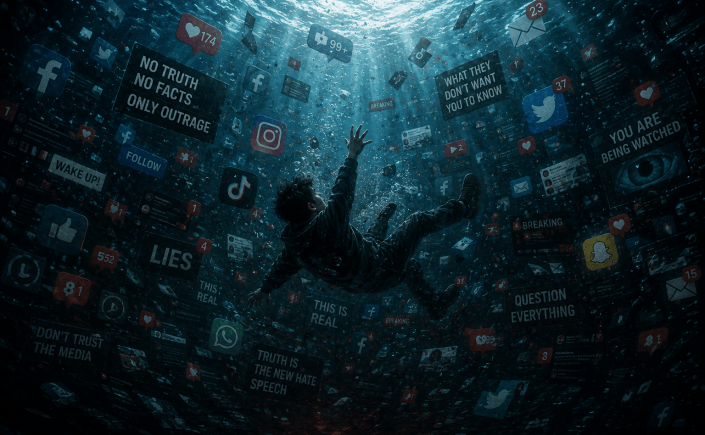
This essay was written over several months from scattered notes and random thoughts formed and half-formed, all of which seemed to crystallise and take form when reading Keefe’s book, and assembled in a sustained dialogue with an AI language model that contributed to final drafting – and also, obviously, the graphics. 

On the subject of social media and algorithms, and their influence on the shaping of opinions and emotions, see also in In That Howling Infinite: Moral capture, conditional empathy and the failure of shock,and  Meet the Crybully, a hybrid of victim and victor . On AI and the individual, see The promise and the peril of ChatGPT, Diligent chatbot unearths fool’s gold, and 
It’s 3am and an hour of existential angst

The night is dark and full of terrors.
Melisandre, the Red Witch. Game of Thrones

… and the darkest hour is just before dawn.
The Mommas and the Papas

American author F. Scott Fitzgerald wrote in The Crack-Up: “In a real dark night of the soul it is always 3 o’clock in the morning, day after day”.

And who hasn’t awoken at 3am and stayed awake into the early hours overthinking everything when random thoughts scatter and shatter, when matters large and small pitter-patter across the mind like mice scurrying across the room. With the late Warren Zevon, “we contemplate eternity beneath the vast indifference of heaven”, inevitably pondering, as we try time on the descending escalator, the ever-approaching End. And the next second, it’s tomorrow’s “to do” list, the credit card bills, or doctors’ appointments, or “did I turn off the hose in the veggie garden?” The mind runs through a myriad of things that are inconsequential during the daylight hours but are now morphed into potential catastrophes that may or may not come to pass.

So, nothing good comes from 3am; only memories, words unsaid, things unfinished, heartbreak, even and loss. Sleep eludes you and when you do fall into a fitful sleep, it’s a tormented one that leaves you quite enervated, exhausted even, in the morning. And usually, everything always looks much better in the morning. Though, in an entertaining piece in the Sydney Morning Herald, columnist and writer Monica Dux offers that “maybe our daylight optimism is the delusion, and those dark 3am moments are actually glimpses of a fundamental truth, as the distractions of the day are stripped away, and it’s just you and your mortality staring each other down”.

Science, of course, has an explanation or two for this pre-dawn desolation. We all wake up many times through the night and usually slide straight back to sleep. Unless the bladder has sounded a renal reveille, as is common with folk of a certain age. But around about 3am our core body temperature starts to rise, sleep hormones have peaked, and the stress hormone cortisol kicks in, preparing you for the coming day. So, if you wake fully, there’s a good chance you’ll stay that way. And your brain, deprived of other stimulation, will start playing tricks on you, distorting your sense of proportion and reality.

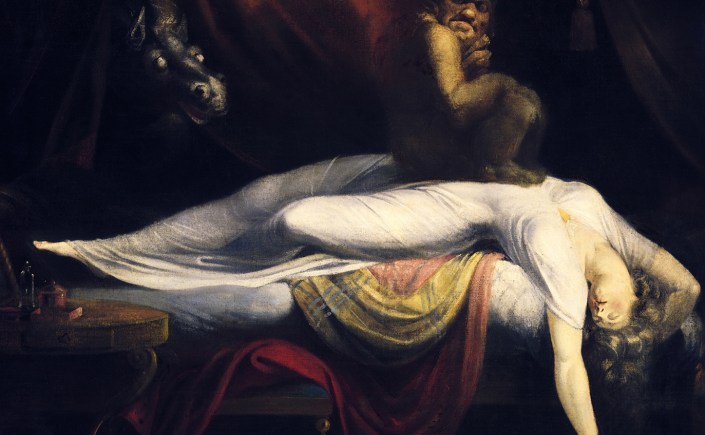
An alternate and seemingly contrary theory is that the hour may be when we emerge from our sleep cycle and circadian rhythm. The body goes through REM sleep at that time; the heart rate is slower, body temperature reduced, breathing pattern and blood pressure irregular. Sudden awakening from REM sleep could cause agitation, fear and disorientation in an individual. Also, during REM sleep, unpleasant and frightful sleep disturbances such as parasomnias can be experienced, including, maybe, nightmares, rapid eye movement sleep behavior disorder, night terrors, sleepwalking, and sleep paralysis.

But why let scientists have all the fun. Don’t we all know already that if you’re going to slip off this mortal coil, odds are it will be between. 3 and 4 am because this is an ambiguous hour of no rules. Before 3am it is still night; after 4 it is morning; and in between lies, we’ll, purgatory. It’s a time when the veil between the worlds is at its thinnest – betwixt the spiritual world and our own, between the living and the dead.

And it’s a well-known fact that 3pm was the time when Our Lord Jesus Christ expired on Golgotha. The opposite, 3am, belongs to Old Nick. It’s The Devil’s Hour, the evil hour, and supposedly, a time of power for satanic skullduggery and supernatural phenomena. It’s not called “the witching hour “for nothing. Some say that it is at precisely 3.33 – half the ‘mark of the Beast’ maybe? Though how Christians worked all this out beats me. In the sixteenth century, the catholic church endeavoured to forbid nocturnal activities between 3 and 4 due to burgeoning fears about witchcraft in Europe, and the fact that this was the hour witches, demons and ghosts were out about and reckoned be at their most powerful.

A forlorn hope, perhaps. Back in those days, it was customary for folk to break their slumber between what we now know are customary sleep cycles with a first and second sleep – one shortly after sundown, followed by a period of nocturnal activity, until one was sleepy again. That in-between waking-time was known to be especially propitious for making magic. Interpret that as you will.

Over to Mister Pickett:

I’m gonna wait ’til the midnight hour
That’s when my love come tumbling down
I’m gonna wait ’til the midnight hour
When there’s no one else around

The Sleep of Reason Produces Monsters Francisco Goya.

The Shepherd’s Dream, John Henry Fuseli

Postscript – beating the 3 o’clock blues

The afore-going contemplation was written four years ago, but due to a WordPress editing glitch, it was erased, recovered and reposted. The following was created recently. 

There is something rather convincing about the idea that 3am is The Devil’s Hour, even if Old Nick himself is innocent of the charge. It is less the hour on the clock than the peculiar psychological territory into which we enter at that hour: the world is asleep, ordinary distractions have fallen away, the body is inconveniently awake, and the mind, deprived of daylight and company, becomes an unusually unreliable narrator.

The moment you awake in the night and look at the clock, your experience changes. You no longer merely have a vague nocturnal awakening; you have been given a fact, and the brain immediately turns it into a story. Why am I awake? Why is it always around three? How much sleep have I had? How little have I got left? And from there it is remarkably easy for the mind to start rummaging through the psychological filing cabinet: mortality, mistakes, unfinished business, money, family, politics, the state of the world, things one said forty years ago that nobody else remembers, and things one might reasonably have forgotten but somehow hasn’t.

At three in the afternoon these thoughts would be problems. At three in the morning they acquire metaphysical significance.

There is a physiological reason for some of this. Sleep is not a uniform eight-hour descent into unconsciousness but a succession of cycles, and the latter part of the night contains proportionally more REM sleep. REM is associated with vivid dreaming, emotional processing and greater brain activity, while the body’s circadian system is still close to its daily low point. Cortisol, body temperature and other systems are beginning their gradual transition towards morning, but psychologically we are still in the middle of the night. If we wake during or immediately after REM, the residue of the dream can cling to consciousness, sometimes producing that peculiar sensation that something is terribly wrong without quite knowing what the something is.

And then there is the darkness itself. Human beings are remarkably good at imposing meaning on incomplete information. At night there is less sensory information to correct the imagination. A creak becomes a possibility; a bodily sensation becomes a symptom; a thought becomes an insight. The rational daylight self has gone off duty, leaving the night shift in the hands of an unpaid committee of catastrophists.

That may explain the old cultural association of the small hours with evil. The Christian tradition did not invent nocturnal fear, of course, but it gave it a particularly durable vocabulary. The folklore is much less historically tidy than the modern internet version suggests. But the symbolism is quite irresistible.

There is also an older and more general human intuition here. The Midnight Hour is dramatic, as Mister Pickett understood; but three in the morning is a lonely time. At midnight one can still imagine that the day has merely paused. At three, the night seems endless. Morning exists somewhere in the future but is not yet visible. It is the temporal equivalent of being stranded in a tunnel: you know there is an exit, but you cannot see it.

Perhaps the best way out is not to enter that tunnel in the first place. Maybe those folk in olden days who broke their sleep and found something to do were on to something.

If the clock is the culprit, when you awake to nature’s call in the wee (no pun intended) small hours, don’t look at it! That clock is not merely measuring the experience; it can help manufacture it. If you wake naturally, punish the porcelain and return to your bed. You don’t know what time it is, and you don’t want to know – removing one of the principal cues that turns an ordinary awakening into an event. You haven’t solved the problem of waking; you’ve deprived the awakened mind of a narrative hook.

There is something almost Zen about it, but let’s not make too much of that. Nature calls. Answer nature. Return to bed. No inquiry into the time of day, no audit of the night’s remaining sleep, no referendum on the meaning of existence. The less information supplied to the nocturnal brain, the fewer opportunities it has to construct a crisis.

Giving booze the boot has probably helped in a more substantial physiological way. Alcohol is a deceptive friend to sleep. It can make falling asleep easier because of its sedative effects, but it tends to fragment sleep later in the night, suppressing REM initially and then producing REM rebound as the alcohol is metabolised. It can also increase awakenings, worsen snoring and sleep-disordered breathing, increase urination and generally make the second half of the night less peaceful than the first. So the classic experience of falling asleep rather splendidly after a few drinks and then finding oneself wide awake and contemplating the decline of Western civilisation at 3:17 is not entirely imaginary.

Removing alcohol removes several of those disturbances at once. It does not mean that you will never wake at three again – human beings remain inconveniently human – but the awakening may be less sticky. You wake, attend to whatever woke you, and go back to sleep rather than allowing the awakening to become an extended philosophical symposium.

There is perhaps a larger lesson in all this. We tend to think of anxiety as something produced by thoughts, but sometimes the conditions under which thoughts occur determine their apparent truth. A proposition that seems profound at 3 am can look rather less compelling at 10 am the morning cuppa  and sunlight. The nocturnal mind is not necessarily telling lies; it is simply conducting its inquiry under peculiarly adverse lighting conditions.

So perhaps our own,  revised theory of the Devil’s Hour is this: the Devil’s real trick is not waking us at three in the morning. It is persuading us to look at the clock when we do. Once we know the hour, we begin to attach significance to it; once we attach significance, we start listening to the thoughts that arrive with it; and once those thoughts acquire the authority of the small hours, perfectly manageable concerns can become existential verdicts.

There is a nice irony in having escaped the 3 a.m. demon not through theology, meditation or some elaborate sleep protocol, but through two very prosaic measures: stop drinking and stop checking the  time. The first changes the sleep. The second changes the story.

And perhaps that is why the latter half of the night seems less haunted now. The Devil, deprived of his clock, has rather lost track of his appointment.

For other indulgent contemplations in In That Howling Infinite, see The quiet tea time of the soul, The first 100 Days on the wagon, The Country Life, and Blue remembered hills – a land of lost contentment 


What’s new in In That Howling Infinite?

The past beats inside me like a second heart
John Banville, The Sea

Why is this blog called In That Howling Infinite?  It refers to Herman Melville’s Moby-Dick, a magnificent study in mania and obsession:

“But as in landlessness alone resides highest truth, shoreless, indefinite as God – so better is it to perish in that howling infinite, than be ingloriously dashed upon the lee, even if that were safety!”  Moby–Dick, Chapter 23

In a figurative sense, it speaks of the themes and schemes that are addressed in the thoughts, ideas, songs, poems and stories that feature in this blog. We are, as Bob Dylan sang, “condemned to drift or else be kept from drifting”. And we like to hope that, as the ancient Greek lyric poet Sappho said, “someone will remember us, I say, even in another time”

Here are the most recent articles in In That Howling Infinite.

A historian talks about Palestine’s deep history. An interview with British historian William Dalrymple

Becoming Arab … the myth of fingerprints. A discussion regard Yossef Rapoport’s illuminating Becoming Arab: The Formation of Arab Identity in the Medieval Middle East

Lucifer ascending … the Dark Lord and the evil within. A free-flowing contemplation on the archetypical “big bad” of story and scripture. The sequel to Lucifer Descending … encounters with the morning star 

The Geography of Faith: America and the Gospel of Power. What happens when a nation with immense material power begins to clothe that power in sacred language?

Smyrna 1922 and the Ottoman endgame. The expulsion of the millennia long Greek presence in Anatolia was one of the last chapters in the extraordinarily violent disintegration of the Ottoman Empire.

Beside Strange Waters. The dark side of former Pink Floyd front man and currently, controversial political activist

Maps, memory, and the myth of fingerprints. Old maps are not title deeds and cannot be manifestos – the limits of cartography.

Alexander Dugin versus Sydney Sweeney. When a Russian philosopher and ideologue called “Putin’s brain” takes on a pulchritudinous film star.

Echo of the Steppes … history’s long shadow. History as we like it: the historian as storyteller, where landscapes become characters and the past refuses to remain buried.

Rasputin and the downfall of the Romanovs. To admirers he was a man of God; to his enemies, a charlatan, sexual predator, political manipulator and symbol of everything rotten within Russia’s last royal dynasty.

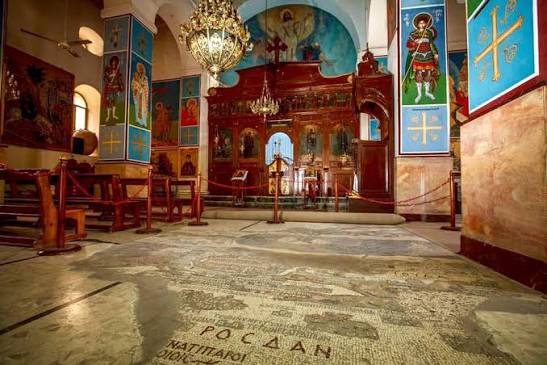
The featured picture at the head of this page is the interior of St George’s Greek Orthodox Church in Madaba, Jordan, home of the sixth century Madaba map, discussed in Maps, memory, and the myth of fingerprints 

Sydney Sweeney has good jeans

Ten  favourites:

A Short History of the Rise and Fall of the West. In one of the first essays published in In That Howling Infinite, we walked down what Welsh poet RS Thomas called ‘the long road of history”, beginning with the usual suspects: power and pride, greed, and aggrandisement, and as accessories after the fact, dolour, devastation, and death.

Blood and Brick … a world of walls. Hadrian’s Wall, the Theodosian Wall, the Berlin Wall, Northerm Ireland’s Peace Wall, Israel’s Separation Wall, George RR Martin’s Ice Wall, the wall you can see from space, and walls that most people have never heard of. If walls could talk, what take they woukd tell. While walls are destined to fall one day, people like them. They project a language of security – but they stem from a sense of insecurity, a fear of losing what you have.

One Land, Two Peoples: History, Memory, Continuity, and Inheritance. The history of Israel and Palestine does not yield to forensic neatness. This land holds layered attachment; Jewish longing and Palestinian dispossession; British imperial design and Arab nationalist pride; secular aspiration and religious revival; survival strategy and ideological fervour. None alone explains the whole. Together they form the sediment of a century.

The Twilight of the Equine Gods. An illuminating canter through the story of the “Centaurian Pact” between humans and horses. it is at once a ride and revelation. The horse, as German academic and cultural scientist Ulrich Raulff’s tells us, “has been man’s most important companion – forget cats and dogs – and the most durable of historical alliances – against which every other covenant into which we have entered has been fragile and ephemeral – not even our relationship with our gods has shown a comparable degree of stability”.

The Sport of Kings. CE Morgan’s “great American novel” is not a history book – nor is it an historical novel. But it is most certainly about history. And about identity. As Morgan puts it: “You would never escape the category of your birth”. It is also about memory and myth: “Repeated long enough, stories become memory and memory becomes fact”.

Blue remembered hills – a land of lost contentment. “Nostalgia”, literally the pain associated with the thought of home, or homesickness, is derived from the Greek “nostos” – a theme used in Ancient Greek literature most notably in the recently reimagined Odyssey, involving an epic hero returning home after a long time away. Nostalgia reveals the deep longing for a home that our younger selves took for granted, and bittersweet return to people and places that have changed forever. But it isn’t all it’s cracked out to be, and, indeed, can bring out the worst in us, becoming a millstone of bitterness and regret strung about the necks of discontented souls who drift off into a maze of memories, meanings and emotions.

A cowboy key – how the west was sung. My riding days are over, but I have been into westerns all my life, and the songs inspired by them – in films, musicals and popular song, from ghostly herds to outlaw chic, Frankie Laing to Leonard Cohen and Taylor Swift. And, as a onetime musician myself, I have, back in days gone by, penned songs in a cowboy key.

McGoohan’s Blues – sunbathing in the rain. How an eighteen minute digression from the concept if not the plot of an iconic if indecipherable ‘sixties’ television series made an indelible impression on an impressionable twenty year old who remains mightily impressed with this song by Britain’s high priest of angst.

The Boys of Wexford – memory and memoir. “Fast forwaranother century, and I was “on the Holy Ground once more” attending the wedding of an old pal held in an old pub in the heart of Ireland. Getting there, we’d done a whistle-stop tour of the south, including Inis Córthaid (my mother’s hometown), Wexford and Ross, the heartland of the ‘98 rebellion … I was best man at that wedding, and in a speech largely devoted to the groom and our mutual, lifelong appreciation of Bob Dylan, I was able to relate to guests young and old tales of my Irish childhood, taking us all “down the foggy ruins of time”, and sang extracts from songs I actually did learn at my mothers knee, the song-lines of my Celtic twilight.

About the creator of this blog

Paul Hemphill is a British-born Australian songwriter, poet, and blogger.

Once upon a time, he was an accountant by profession, a manager, mentor and mediator. A long-time resident of Sydney, he is now living in the middle of the forest on the mid north coast of New South Wales, Australia, where he spends much of his time in the great outdoors.

His interests include music, poetry, politics and history. He has had a lifelong passion for the history, politics and people of the Middle East. Over the years, through study and travel, he has acquired a working knowledge of standard and colloquial Arabic.

Listen to some of Paul’s songs on SoundCloud and YouTube. Search under Paul Hemphill or HuldreFolk (but ignore the Flemish death metal band of the same name). He has assembled seven volumes of poetry and verse, and these can be read on this blog.

Check out In That Howling Infinite on FaceBook.

Asemitism … when Jews disappear from the argument

Yesterday, upon the stair,
I met a man who wasn’t there
He wasn’t there again today
I wish, I wish he’d go away
William Hughes Mearns, Antigonish (1899)

When bestselling Australian author Richard Flanagan recently delivered a provocative address at the Festival of Dangerous Ideas, he struck a nerve. Conservative commentators were quick to condemn what they saw as a dangerous minimisation of antisemitism, particularly in the wake of the Bondi attack.

His argument was not that antisemitism did not exist, but that much of the contemporary Australian discussion of it had been misdirected. He argued that the “Israel lobby” – a term he used broadly for those campaigning on behalf of Israel and against what they regarded as antisemitism – had helped create a climate in which criticism of Israel was too readily conflated with hatred of Jews. More controversially, he questioned the way the Bondi murders of 14 December last year had been understood, arguing that the killings should not simply be explained as the product of antisemitism, and suggested that provocative actions and rhetoric surrounding Israel and Gaza had contributed to the circumstances in which they occurred.

Three responses, from academic Greg Craven, historian Nick Dyrenfurth, and economist Henry Ergas, each republished below., were particularly interesting, if hardly surprising given their respective positions on the subject.

For Craven, this amounted to a profound inversion of cause and effect: antisemitism was being treated not as something that produced violence, but as something produced by the political conduct of its victims or their alleged representatives. Dyrenfurth similarly saw in Flanagan’s argument a refusal to confront the deeper sources of contemporary Jew-hatred.

Ergas argues that contemporary antisemitism need not take the familiar form of overt hostility towards Jews. Instead, Jews can disappear as people while Jewishness remains present as a political abstraction: “the Lobby”, hidden influence, divided loyalty, or an alleged mechanism of control. Accusations of antisemitism can themselves be dismissed as instruments of Jewish or pro-Israel manipulation.

Yet what particularly caught my attention was something almost incidental in Craven’s response. He suggested that there is a phenomenon distinct from antisemitism, which he called “asemitism”: not hatred of Jews, but a curious inability to see Jews at all – to acknowledge their presence as Jews, or their particular vulnerability, within an argument ostensibly about something else.

The Jew becomes almost invisible as an individual human being, yet somehow omnipresent as an explanation. It is, in effect, absence becoming presence – the  Jew disappearing from view while the imagined Jew remains everywhere.

This struck a chord because it was something I had observed before, although from a rather different perspective, without giving it a name. I have written about the tendency, in arguments over Israel and Palestine, to turn actual people into political abstractions: Israelis into Zionists, Jews into Israel, Palestinians into Hamas, and individuals into representatives of causes they may or may not support.

Craven’s word therefore got me thinking. What happens when Jews disappear from the argument, when they disappear from the moral field as people and reappear only as a political abstraction?

The invisible man

There is a curious form of antisemitism that does not necessarily hate Jews. It simply cannot see them.

The former Australian Catholic University vice-chancellor Greg Craven has given this phenomenon a useful name: asemitism. His immediate target was the novelist Richard Flanagan, whose argument about antisemitism in Australia, as Craven describes it, attributes much of the present hostility to Jews to the activities of an amorphous “Israel lobby”. But the larger idea is more interesting than the particular quarrel. Asemitism describes the tendency to make Jews disappear from a discussion precisely when Jews are among the people most directly affected by it.

The distinction matters. Antisemitism is relatively easy to recognise when it takes the familiar form of hatred, conspiracy theory, racial slurs, intimidation or violence. Asemitism is subtler. It says, in effect: this isn’t about Jews. It is about Israel, Zionism, colonialism, Gaza, the occupation, the lobby, American foreign policy, or something else entirely. Jews therefore need not enter the moral equation.

The problem is that they do.

A Jewish school requiring armed security is not merely a footnote to a debate about Israel. A Jewish child being abused in the street is not simply collateral damage from a geopolitical argument. A Jewish Australian being told that he or she is responsible for the actions of a government on the other side of the world is not participating in a debate about foreign policy. These are things happening to actual people.

Asemitism works by substituting an abstraction for those people. “The Jews” become “the Israel lobby”; Jewish identity becomes Zionism; Zionism becomes Israel; Israel becomes the actions of its current government; and suddenly the ordinary Jew has vanished from view. Once that substitution has been made, almost anything can be explained without reference to the people experiencing it. Antisemitism becomes an invention of the lobby. Jewish anxiety becomes political manipulation. Jewish objections become attempts to silence criticism of Israel. A threat to Jews becomes merely an unpleasant but understandable by-product of protest.

None of this means that criticism of Israel is antisemitic. It plainly is not. Nor is criticism of Zionism, the Israeli government, the occupation or the conduct of the Gaza war automatically antisemitic. Democratic societies depend upon the freedom to make precisely such arguments. Nor should accusations of antisemitism be used as a shield against uncomfortable political criticism.

The test is rather different: can Jews remain visible as Jews and as individuals while the argument is being made?

That question has particular force in Australia because the history of Australian Jewry does not fit neatly into the popular image of multiculturalism as a succession of migrant communities arriving from elsewhere. Jews were here with the First Fleet. They have been part of the Australian story for more than two centuries. They have served in the armed forces, entered Parliament, populated universities and the professions, built businesses, contributed to philanthropy and the arts, and occupied distinguished positions in public life.

In other words, most Australian Jews are not visibly “foreign”. They are Australians.

That makes the contemporary phenomenon of asemitism especially revealing. Australian Jews are often indistinguishable, culturally and physically, from their fellow Australians. Their Jewishness may be expressed through religion, family, memory, community or simply ancestry; it may be barely visible at all. Yet in moments of political crisis they can suddenly be transformed from ordinary Australians into representatives of an imagined foreign entity.

It is a strange reversal. A community that has spent generations becoming unexceptional in the best sense of the word – part of the ordinary fabric of Australian life – is suddenly rendered foreign by the political imagination of others.

There is an analogy here with the long history of Irish Catholics in Australia. They were once regarded by sections of the Anglo-Protestant establishment as a suspect, disloyal or insufficiently Australian minority. Over generations, that distinction largely dissolved. The descendants of Irish immigrants became simply Australians. Their Irishness did not disappear; it ceased to (determine their status as citizens.

Something similar happened with Australian Jews. They did not cease to be Jewish. They became Australian Jews.

Asemitism threatens to reverse that achievement. It does so not necessarily by expelling Jews from the national community but by reassigning them to another political category. You are Jewish; therefore you are assumed to have a position on Israel. You are a Zionist; therefore you are assumed to support everything Israel does. You support Israel’s existence; therefore you are treated as an agent of the Israeli state. You object to antisemitic rhetoric, therefore you are assumed to be defending the Israeli government. The individual disappears beneath the label.

There is an even older pattern here. One of the most persistent features of antisemitism has been the refusal to allow Jews to be merely what everyone else is allowed to be: individuals with differing opinions, loyalties, interests and political beliefs. Jews have historically been imagined as a collective possessing a hidden solidarity and a common agenda. The modern version need not invoke the old language of Jewish conspiracy. It can speak instead of “the lobby”, “Zionists”, “Jewish influence” or “Israel supporters”. The vocabulary changes; the underlying collectivisation can remain.

That is why asemitism is an interesting concept. It identifies the point at which apparently sophisticated political discourse can reproduce an ancient habit without necessarily resembling traditional antisemitic rhetoric.

And it cuts both ways. If every criticism of Israel is declared antisemitic, Jews themselves are reduced to a political instrument: their identity is invoked to protect a government or ideology with which individual Jews may agree, disagree or have no connection. That too makes Jews disappear as individuals. The cure for asemitism cannot therefore be to place Israel beyond criticism. It must be to insist upon the opposite: Jews are entitled to the same diversity of political opinion as everybody else.

Asemitism is, at bottom, a failure of recognition. It is the inability to see the Jewish person standing behind the political abstraction.

That is why the concept is potentially more important than the particular controversy in which Craven introduced it. It allows us to distinguish between hatred and blindness. The antisemite sees the Jew and hates him. The asemite may insist that the Jew isn’t there at all.

But if Jews are absent from the argument, while Jewish schools require guards, Jewish children are intimidated, Jewish institutions are threatened and Jewish Australians are held responsible for events overseas, then something has gone badly wrong with the argument.

The first obligation is simply to see the person.

Before Jew, before Zionist, before Israeli, before Palestinian, before supporter or opponent of any government or cause, there is an Australian citizen standing in front of us. And that, perhaps, is precisely what asemitism makes hardest to see.

In That Howling Infinite, September 2026

Coda: Mearn’s paradox

William Hughes Mearns, the American educator and poet, best known for Antigonish (“The Little Man Who Wasn’t There”). That makes the opening much more directly relevant. His short poem, Antagonish, inspired by a Nova Scotia ghost story, gives us the paradox of something simultaneously absent and impossible to ignore: a phantom whose very invisibility makes him present. It is an apt metaphor for asemitism – not necessarily hatred of Jews, but the tendency to make Jews disappear from the frame while they remain implicated in what is being discussed. The Jewish Australian is “not there” when the subject is Israel, Zionism, Gaza or the lobby, yet somehow reappears in the consequences. In other words, Jews can be rendered invisible as people while becoming conspicuously visible as symbols: the ordinary Australian suddenly recast as “Zionist”, “Israel”, or part of some amorphous “lobby”

That is a neat metaphor for what you are exploring. Asemitism is not necessarily the hatred of Jews; it is the curious phenomenon in which Jews disappear from the frame while remaining the unacknowledged subject of what is happening. The Jewish Australian is “not there”—the discussion is about Israel, Zionism, Gaza, colonialism, lobbying or foreign policy—but somehow the Jew keeps turning up in the consequences.

Indeed, the Mearns poem gives you an even sharper formulation. The man “wasn’t there”, yet the speaker met him. His absence has become an encounter.

That is precisely the paradox you can pursue: Jews can be rendered invisible as people while becoming highly visible as symbols. The Australian Jew may be simply another Australian—neighbour, colleague, soldier, academic, businessperson, friend—until a distant conflict causes him or her to be recast as “Zionist”, “Israel”, “the lobby”, or some other political abstraction.

And this makes your later reference to H. G. Wells’s The Invisible Man rather nice. Mearns gives you the whimsical, unsettling version: the man who wasn’t there. Wells gives you the literalised version: a man who is physically present but cannot be seen. Your essay explores a third version: the person who is visible but whom a political culture has learned not to see.

That could become a particularly elegant opening motif for the essay: Mearns’ little poem begins as a ghost story but turns out to be a story about perception. Your argument then asks what happens when an entire category of people becomes similarly imperceptible—not because they have disappeared, but because we have learned to look past them.

The curious asymmetry

There is a paradox here, one that takes us beyond asemitism itself. Many of those caught up in what has become an algorithmic tangle had never previously shown much interest in the Middle East. They had not followed its history, its competing national narratives or its wars, and had never displayed anything like the same intensity about conflicts and atrocities elsewhere in the world. Yet Israel and Gaza have somehow acquired the extraordinary capacity to inflame them—to turn a distant and complicated conflict into an intensely personal moral cause.

There are, of course, perfectly legitimate reasons why Israel–Palestine attracts unusual attention. The conflict has a long and tragic history; it touches three major religions; it has involved the great powers; Australia has its own connections to the region; and the images emerging from Gaza are genuinely horrific. Israel is also a Western-aligned democracy, and it is entirely reasonable to argue that democratic states should be held to demanding standards.

But none of this quite explains the asymmetry.

We do not ordinarily hold Russian Australians responsible for Putin’s invasion of Ukraine, or Chinese Australians for the policies of Beijing, or Serbian Australians for the crimes of Belgrade. Indonesians in Australia were not generally treated as proxies for the Indonesian government when East Timor was invaded. There have certainly been outbreaks of hostility towards people associated with countries whose governments have behaved appallingly; nothing about antisemitism is unique in that respect. What is unusual is the persistent tendency to collapse the distinction between a Jewish person and a foreign state.

A Jewish Australian may be expected to explain or condemn the actions of the Israeli government simply because he is Jewish. His views about Netanyahu, Gaza or the occupation may be unknown and entirely irrelevant. His Jewishness itself can become politically diagnostic. The individual disappears and the symbol takes his place.

This is where the algorithmic age adds another layer to the problem. Social media does not require historical knowledge before it delivers moral certainty. A sequence of images of dead children, demolished buildings, grieving parents, angry slogans and simplified historical explanations can turn a previously remote conflict into an emotional universe. The more intensely one reacts, the more of the same material the algorithm supplies. Complexity becomes noise; qualification becomes equivocation; competing narratives become evidence of bad faith. Eventually the viewer may know remarkably little about the history of the conflict while possessing absolute certainty about who is guilty.

The result is not necessarily antisemitism. Many people genuinely care about Palestinian suffering and are motivated by a perfectly legitimate moral impulse. But something else can happen along the way. Israel ceases to be a country whose government is being criticised and becomes a moral abstraction: colonialism, racism, Western imperialism, apartheid, or some other embodiment of political evil. And because Israel is so closely identified with Jews in the popular imagination, Jews can become implicated in that abstraction whether they want to be or not.

This is the point at which the idea of asemitism becomes useful. The Jewish Australian is simultaneously invisible and hyper-visible. Invisible as an individual, because nobody asks who he or she actually is or what they actually believe; hyper-visible as a symbol, because Jewishness is treated as evidence of a presumed relationship to Israel.

The irony is considerable. Australian Jews have been here since the First Fleet. They are not, for the most part, visibly distinguishable from their fellow citizens. They have served in our armed forces, entered Parliament, taught in our universities, built businesses, practised the professions and contributed to public and cultural life. Like the descendants of Irish Catholics who were once regarded as an alien and suspect minority, generations of Australian Jews have simply become Australians.

Yet a conflict thousands of kilometres away can suddenly make them foreign again.

That is the question I find difficult to get past. Not why people criticise Israel—they should be free to do so, vigorously. Not even why this particular conflict attracts more attention than others. But why the asymmetry becomes so pronounced when Jews are involved. Why can an ordinary Australian citizen be transformed, by nothing more than his or her Jewish identity, into a representative of a foreign state? Why is the distinction between a government and the people associated with it so readily maintained in almost every other case, yet so often abandoned here?

There may be many answers: the extraordinary history of antisemitism; the symbolic and religious importance of the land; the polarising power of the Israeli–Palestinian conflict; the politics of the diaspora; the peculiarities of the Western left and right; the influence of social media; or simply the human tendency to reduce complicated conflicts to stories of innocent victims and malevolent perpetrators.

Perhaps it is some combination of all of them.

But the question remains. Why this conflict? Why this country? And why, when Israel becomes the object of moral outrage, do Jews so often become entangled in a conflict that is not theirs simply by virtue of being Jewish?

That is where the phantom in Mearns’s poem returns. The Jew who supposedly “isn’t there” turns out to have been there all along.

Pavlov’s progressives

There seems to be a Pavlovian reflex abroad among progressives – whenever there are government moves to combat the upsurge of antisemitism in Australia, and when resources are allocated towards combatting it, and particularly when Jewish organisations are the perceived or actual recipients, people of ostensible goodwill post comments and share memes asserting: that there is no upsurge in antisemitism; that other minorities are the most vulnerable targets of harassment and discrimination, particularly Muslims ; that Jews receive special treatment, and benefits disproportionate to their meagre numbers population-wise; that special treatment runs contrary to our government’s duty to promote equality for all. These arguments were also raised – ironically on the right – during the Voice to Parliament referendum campaign.

Why is this is so?

Part of it is simple moral competition in an age of scarcity – not scarcity of money necessarily, but scarcity of attention, legitimacy, symbolic recognition, and institutional empathy. Modern politics increasingly operates through what sociologists sometimes call a “hierarchy of suffering,” in which recognition of one group’s vulnerability is often interpreted, wrongly but emotionally powerfully, as diminishing another’s.

So when governments announce funding, inquiries, security measures, educational programs, or public condemnations relating to antisemitism, some progressives instinctively translate this not as “the state is addressing one real problem,” but as “the state is privileging this minority over others.”

The response becomes comparative rather than diagnostic: what about Islamophobia? what about Indigenous Australians? what about refugees? In principle, comparative concern can be healthy. In practice, it often slides into resentment politics.

There is also a specifically post-October 7 dynamic at work. For many people on the progressive side, support for Palestinians has become morally central to their political identity. Because Israel is widely perceived within those circles as aligned with Western power, military dominance, and colonial structures, Jews in diaspora communities are sometimes – unfairly and dangerously – perceived as adjacent to that power. The distinction between “Jews,” “Zionists,” “supporters of Israel,” “the Israeli government,” and “organised Jewish institutions” becomes blurred in public discourse. Once that blur occurs, anti-antisemitism initiatives are no longer viewed neutrally as anti-racism measures; they are interpreted as political instruments protecting power.

That helps explain the peculiar reflex whereby even acknowledging antisemitism can be treated with suspicion. If Jewish vulnerability is admitted, then Jews cease to fit neatly into the binary moral framework of “powerful oppressor” versus “marginalised oppressed.” Contemporary activist culture often struggles with complexity of that sort. Jews occupy an awkward sociological position: a tiny minority with visible success in some sectors, but also with a long history of persecution and recurring vulnerability. Minority status and perceived privilege coexist. Many ideological frameworks are uncomfortable holding both ideas simultaneously.

The irony is that similar arguments emerged from parts of the conservative side during the Indigenous Voice to Parliament debate – which led to the failure of the referendum: why should one group receive special recognition? why should resources or institutional mechanisms exist for one minority and not others?

The rhetoric changes, but the underlying egalitarian objection is structurally similar. Liberal democracies constantly wrestle with the tension between universal equality and targeted protections. We accept specialised programs for veterans, Indigenous communities, domestic violence victims, rural Australians, disabled people, and multicultural groups because formal equality alone does not always address particular vulnerabilities. Yet when Jews are involved, some people suddenly become hyper-universalist.

Another factor is the persistence of older tropes about Jewish influence and access. These rarely appear today in openly conspiratorial language among educated progressives. Instead they emerge in coded institutional form: “disproportionate influence,” “special access,” “lobby power,” “politicians are afraid,” “media protection,” “exceptional treatment.” Sometimes there are legitimate discussions to be had about lobbying or political advocacy – every organised community advocates. But Jews occupy a unique symbolic place in Western political imagination, shaped by centuries of antisemitic narratives portraying them as secretly powerful, unusually connected, or able to manipulate institutions for communal gain. Modern educated discourse often reproduces these themes unconsciously while believing itself entirely anti-racist.

Social media worsens all this.

Algorithms reward outrage, simplification, and tribal reinforcement. It is emotionally satisfying within online communities to puncture perceived hypocrisy: “Look, the government cares more about Jews than Muslims.” The claim signals moral sophistication and resistance to establishment narratives. But the medium discourages nuance – for example, the possibility that both antisemitism and Islamophobia have risen; that both Jews and Muslims can feel vulnerable simultaneously; that governments can address multiple forms of racism at once; or that Jewish institutions receiving security funding after synagogue attacks is not evidence of sinister favouritism but a response to assessed threat levels.

There is also an older progressive discomfort with Jews that long predates Israel. Jews historically complicated left-wing narratives because they did not fit neatly into class categories either: often urban, diasporic, literate, commercially successful in in some fields, yet periodically scapegoated, excluded, expelled, and massacred. In some strands of radical thought, success itself becomes suspicious. A minority perceived as “doing well” can lose moral legitimacy in the eyes of movements that increasingly interpret justice through visible disadvantage.

And finally, there is the psychological appeal of inversion. Many educated people like to imagine themselves as resisting dominant power. Since antisemitism is associated in public memory with fascism and the far right, acknowledging antisemitism within progressive spaces threatens self-identity. It is easier to redefine the problem away – to insist concerns are exaggerated, instrumentalised, or distractions from Gaza – than to confront the uncomfortable possibility that movements devoted to justice can also incubate prejudice.

None of this means criticism of Israeli policy is antisemitic, nor that concerns about unequal treatment of minorities are inherently illegitimate. Democracies should debate allocation of resources and consistency of anti-racism policy. But when every discussion of antisemitism immediately triggers denial, deflection, comparative minimisation, or insinuations about Jewish power, something deeper than ordinary policy disagreement is usually operating beneath the surface.

In That Howling Infinite, September 2026

This essay was written in conversation with an AI language model, which contributed to drafting, phrasing, and structure.

Postscript:  We’ve been here before.

This opinion piece is one of several which discus the attitudes of progressives towards the Israel, Palestine and the Gaza war, and also, consider the subjects of invisibility and asymmetry.

The first is Moral capture, conditional empathy and the failure of shock, a discussion on why erstwhile liberal, humanistic, progressive people from all walks of life have been caught up in what can be without subtly described as that anti-Israel machinery Shaping facts to feelings – debating intellectual dishonesty– regarding the Gaza war, intellectual dishonesty is everywhere, on both sides of the divide, magnified by mainstream and social media’s hunger for moral simplicity and viral outrage. Standing on the high moral ground is hard work! discusses the issues of free speech and “cancellation”, and boycotts with regard to the recent self-implosion of the Adelaide Writers’ Festival, one of the country’s oldest and most revered. Meet the Crybully, a hybrid of victim and victor, the symbolic citizen of a culture that increasingly confuses feeling wounded with being right, visibility with virtue, and accusation with truth. See also, Regarding Australia’s Royal Commission into Antisemitism, see also in In That Howling Infinite: An Australian Jew’s submission to the Royal Commission

In most of these essays, we concluded with the following segment. It touches on many of the issues and arguments of this article on Asemitism. It is followed by a supplemental section written by ChatGPT on the question of the so-called “Jewish Lobby” that underlies many contemporary narratives on the extreme left and right and what we see as the myth of Jewish influence over Australian politics.

Looking for the “good Jews”

In This Is What It Looks Like, we wrote: “… antisemitism does not arrive announcing itself. It seeps. It jokes. It chants. It flatters those who believe they are on the right side of history, until history arrives and asks what they tolerated in its name”.

One of those jokes landed, flatly, on January 7 when the otherwise circumspect Age and Sydney Morning Herald published a caricature drawn by the award-winning cartoonist Cathy Wilcox. It presented those calling for a forthcoming royal commission into antisemitism as naïve participants in a hierarchy of manipulation. At the surface were the petitioners themselves; beneath them senior Coalition figures – Sussan Ley, Jacinta Nampijinpa Price, John Howard, David Littleproud – alongside Rupert Murdoch and Jillian Siegel, lawyer, businesswoman and Australia’s Special Envoy to Combat Antisemitism; and behind them all, setting the rhythm, Israel’s prime minister, Benjamin Netanyahu. Each layer marched to a beat not its own.

Cathy Wilcox cartoon, SMH 7 January 2026

Critics argued that the image revived a familiar and corrosive trope: the suggestion of hidden Jewish influence directing political life from the shadows. The cartoon, titled Grass roots, depicts a cluster of foolish-looking figures demanding a royal commission. They are presumably meant to represent the families of the dead, as well as lawyers, judges, business leaders and sporting figures who had urged government action long before the Prime Minister concluded that continued indifference might stain his legacy. When he finally announced a royal commission—expanded, without explanation, to include the elastic phrase “social cohesion” – no journalist paused to ask what that addition was meant to clarify.

In the drawing, a dog stands among these Australians, holding a placard and thinking, “Don’t mention the war.” The grass beneath their feet is supported by a menacing cast: and stock villains of the anti-Zionist imagination. The implication is unmistakable: that the pleas of grieving families and prominent citizens are neither organic nor sincere, but choreographed – another performance conducted from afar.

That implication did not arise in isolation. Across social and mainstream media, many progressives called for Jillian Segal to be removed and her report rejected out of hand. Others elevated Jewish critics of the war, of Zionism, or of Netanyahu as moral exemplars – “good Jews,” “some Jews tell the truth” – as if Jewish legitimacy were contingent on ideological alignment.  Some wrote openly that Jews, “for their numbers,” exercised excessive influence. One circulating meme complained, “We didn’t vote for a Zionist voice”, whilst other posts informed their echo chamber that Chabad Bondi, a branch of the global Jewish outreach organisation, which had organised the Hanukkah gathering on the fateful Sunday evening and also the local commemorations for the victims (and later, the tribute at the Sydney Opera House) was but another tentacle of the sinister and  uber-influential Jewish Lobby. Some of the most incongruous postings have been of ultra Orthodox Jews – Haredim – with signs condemning the Gaza war and Zionism, as if to say these are the authentic, “good” Jews. Some footage actually shows Haredim protesting against the Israeli government’s efforts to conscript exempt yeshiva students into the IDF – but, as they say, every picture tells a story.

Running beneath this was a persistent misconception. Judaism was treated as a religion, detachable and voluntary, rather than as an ethnoreligious identity shaped by lineage, memory and shared fate. Jews were asked not simply to oppose Israeli policy but to renounce their “homeland,” their inheritance, their sense of collective belonging. Census figures were deployed to minimise Jewish presence, overlooking the fact that many Jews, with Germany in the 1930s still in mind, remain reluctant to advertise religious affiliation. Genealogical platforms tell a different story: the number of people who discover Jewish ancestry far exceeds those who publicly profess the faith.

Another factor further clouds understanding. Jews are rarely dogmatically regarded as part of what Australians loosely call our “multicultural” society – a variegated demographic more often reserved for the post–White Australia waves of migration – communities that are visibly non-European or culturally distinct. Jews slipped beneath that radar. Many arrived well before the Second World War, and those who came before and after tended to integrate, to go mainstream, to succeed, and therefore not to stand out.

As a result, Jews were quietly folded into an older Judeo-Christian demographic, grouped alongside Protestants and Catholics as part of the cultural furniture rather than recognised as a minority with a distinct history and vulnerability. In most urban, and even regional settings, many Australians would be unaware that Jewish families live among them at all. At the same time, a surprising number of people carry Jewish ancestry several generations back, or are connected through marriage or descent, without regarding this as identity in any conscious way.

This invisibility cuts both ways. It has allowed Jews to belong without friction, but it has also made Jewishness strangely abstract – easy to misclassify as belief rather than continuity, easy to overlook as lived experience, and easy, when political passions rise, to treat as conditional.

Here the paradox sharpens, particularly among progressives. There is genuine respect for Indigenous Australians’ reverence for history, genealogy and Country: an understanding that identity is inherited as much as chosen, that land carries memory and obligation across generations. Yet the Jewish connection to Zion is denied that same conceptual dignity. What is recognised as ancestral continuity in one case is dismissed in the other as theology, nationalism or ideology.

The inconsistency is telling. Jewish attachment to place is stripped of its historical depth and cultural persistence, judged by standards not applied elsewhere. In that light, the cartoon does more than offend. It gives visual form to a deeper habit of thought: one that sorts Jews into acceptable and unacceptable categories, organic grief and foreign orchestration, legitimate belonging and suspect attachment- depending on who is being asked to explain themselves, and to whom.

All of this helps to explain the dangerous and disturbing upsurge in antisemitism over the past two years and earlier.

The Bondi massacre did not invent anti-Semitism in Australia; it exposed a system already bent, quietly, against seeing it. Two recent articles in The Australian show in complementary ways two faces of the same failure: one structural, one intimate. On the one hand, Professor Timothy Lynch diagnoses the intellectual and institutional blindness that allows hatred to incubate unchecked; on the other, author Lee Kofman shows the personal toll when grief itself is made conditional on passing someone else’s moral purity test. Together, they reveal a society in which moral frameworks have become cages rather than guides.

For decades, Australian multiculturalism has performed a delicate contortion: apologising for its own history while demanding loyalty from newcomers. Original British settlement is framed as a sin; multiethnic immigration is a progressive corrective. The paradox, Lynch notes, is that the very order migrants join is simultaneously denigrated by the leaders they are expected to trust. Within this structure, Jews occupy an uncomfortable space: electorally negligible, culturally visible, historically persecuted, yet paradoxically recoded as white and colonial. Zionism – a project of survival and refug e- is reframed as a form of imperial wrongdoing, while other nationalisms pass without scrutiny. Anti-Semitism, filtered through progressive identity politics, becomes an exception to the very rules designed to prevent harm.

Bondi rendered these abstract asymmetries concrete. The massacre forced recognition that anti-Semitism, once dismissed as campus rhetoric or aestheticised resistance, could and would become lethal. Lynch observes that progressive moral frameworks – micro-aggressions monitored, systemic racism theorised -stop precisely at the Jew. A royal commission, he argues, would not be vindictive; it would be a sober exercise in moral clarity, tracing the cultural and ideological currents that incubated violence. Yet the same cultural institutions that produced those currents remain invested in their own innocence, framing ideas as harmless discourse even as they provide tacit validation for hatred.

The myth of Jewish influence 

The starting question – whether there is “solid, concrete evidence” of Zionist or Jewish influence over Australian government and society – has, since October 7, acquired a sharper edge and a louder echo. In the wake of the attacks, the war in Gaza, and the subsequent rise in domestic tension, social media in particular has filled with claims—often from the progressive side, and not infrequently from otherwise careful and intelligent commentators – about the malign and disproportionate influence of a “Zionist” or “Jewish lobby.” This rhetoric has been further amplified in Australia by the appointment of Jillian Segal as the Special Envoy to Combat Antisemitism, and by the establishment of a parliamentary inquiry (often loosely described as a “royal commission”) into antisemitism on Australian university campuses and in public life. Together, these developments have been read by some as evidence not of a policy response to rising antisemitism, but of the very influence they allege.

That interpretation, however, only makes sense if one begins from the assumption that such influence exists in a covert, coordinated, and disproportionate form. The more useful approach is to step back and examine how influence actually operates across the Australian system as a whole.

Australian public life is shaped most heavily by large, well-resourced peak bodies, particularly in business and industry. Organisations such as the Business Council of Australia, the Minerals Council, the Property Council, and the Australian Energy Producers (formerly APPEA) are permanent fixtures in policy formation. They produce economic modelling, maintain direct access to ministers and departments, and help define what governments regard as economically viable. Their influence is not hidden; it is structural, continuous, and grounded in resources, expertise, and institutional proximity to decision-making.

Alongside them sit the trade union movement, coordinated by the ACTU and expressed through powerful sectoral unions like the CFMEU, ANMF, and TWU. Their influence operates through membership, industrial leverage, and formal ties to the Labor Party. They shape debates on wages, workplace law, and social policy, sometimes from within government, sometimes through public campaigns. Like business groups, their role is embedded and enduring.

A third layer consists of issue-based advocacy organisations, particularly in the environmental sector. Groups such as the Australian Conservation Foundation, Greenpeace, WWF, and the Climate Council have been central to elevating climate and environmental concerns within national politics. Their influence tends to operate through public persuasion, media engagement, and strategic litigation rather than direct economic leverage. They rarely determine policy outcomes alone, but they have significantly shifted the parameters of debate over time.

The social welfare sector – including ACOSS, Anglicare, Mission Australia, and the St Vincent de Paul Society – contributes a different kind of influence. These organisations draw on service delivery and lived experience to inform policy on poverty, housing, and inequality. They are less dominant in fiscal decision-making but play an important role in shaping the ethical and empirical context in which those decisions are made.

In health and medicine, bodies such as the AMA, RACGP, and Cancer Council exercise influence grounded in professional authority and public trust. Their input is often decisive in technical areas of policy and becomes especially prominent during national crises, though it remains part of a broader advisory ecosystem.

Legal and civil liberties organisations – the Law Council, Human Rights Law Centre, and others – operate at the level of principle, scrutinising legislation and advocating for rights-based constraints on government action. Their influence is typically indirect but can be significant in shaping legal frameworks and public debate.

Within this wider system sit community and diaspora advocacy groups, including Jewish organisations (such as the Executive Council of Australian Jewry and the Australia/Israel & Jewish Affairs Council), Muslim organisations (AFIC, ANIC), and others (such as FECCA and Armenian advocacy bodies). These groups engage in standard democratic practices: making submissions, meeting with policymakers, contributing to public debate, and, at times, facilitating international engagement. Their influence is real in the sense that they are part of the policy conversation, particularly on foreign affairs and multicultural issues. However, in comparative terms, they are generally modest in financial resources, institutional reach, and structural power relative to major business or union actors.

Finally, think tanks such as the Australian Strategic Policy Institute, the Lowy Institute, and the United States Studies Centre play a distinct role. They do not represent mass constituencies, but they shape the analytical frameworks within which policy is discussed, particularly in foreign policy and national security. Their influence lies in framing, expertise, and elite networks rather than direct political mobilisation.

Against this broader landscape, the claim that “Jewish or Zionist interests control or infiltrate many of these groups” does not withstand scrutiny. To sustain such a claim would require evidence of coordinated, cross-sector control—shared command structures, dominant funding pipelines, or consistent policy alignment traceable to a central directive. No such evidence exists.

What does exist is something far more prosaic: Australians of Jewish background, like Australians of every background, participate across public life. Some hold senior roles in business, academia, media, and government. Their views are not uniform. Some are strongly supportive of Israel; others are critical; many occupy positions in between. That diversity alone makes the idea of a single, coherent “Zionist interest” directing multiple sectors implausible.

Moreover, the organisations themselves behave exactly as their mandates would predict. Industry groups advocate for industry; unions for workers; environmental organisations for climate action; welfare bodies for social support. Their positions frequently conflict – not only with each other, but also with the policies of Israel, the United States, and indeed with the views of different Jewish organisations. If there were hidden coordination, one would expect consistency. What we observe instead is disagreement, fragmentation, and issue-specific alignment.

It is also important to recognise a recurring pattern in such claims. Assertions of diffuse, concealed Jewish influence have historically relied on association, inference, and aggregation—not on demonstrable mechanisms of control. By the normal standards of evidence applied to any other claim of political power, they fall short.

This returns us to the initial concern. There is clear, concrete evidence that Jewish and pro-Israel organisations—like many other advocacy groups – engage in lobbying, public debate, and policy advocacy in Australia. There is also clear evidence that they do so openly, within democratic norms, and on a scale generally smaller than that of major economic or industrial actors. What is not supported by credible evidence is the claim that they exercise covert, disproportionate, or controlling influence over Australian government or society.

The more accurate picture is not one of hidden command, but of a system in which many organised interests compete to persuade, and where outcomes reflect the shifting balance between them.

Richard Flanagan’s dangerous idea is just a chilling form of denial

Greg Craven, The Australian, September

At the Festival of Dangerous Ideas, Richard Flanagan asked where the antisemitism was in the Bondi massacre and answered: “Nowhere. Nowhere. Nowhere”. Pictures: News Corp/Supplied

At the Festival of Dangerous Ideas, Richard Flanagan asked where the antisemitism was in the Bondi massacre and answered: “Nowhere. Nowhere. Nowhere”. Pictures: News Corp/Supplied

It’s always a good opening to a column to write that the only thing needed for evil to triumph over good is that good men stay silent. But this nostrum is not entirely true. The added element is that supposedly good people cannot recognise evil when they see it – or misattribute it to the wrong source or spend so much time denying it they end up with an apologia.

The longwinded speech by novelist Richard Flanagan at the Festival of Dangerous Ideas last month, flicking aside the reality of antisemitism, falls into all these categories. When it comes to identifying evil, here is a bloke who could not pick Satan out of a line-up of nuns.

Flanagan’s position seems to be that antisemitism in Australia is all the fault of “the Israel lobby”, a loathsome gang he never satisfactorily defines but you have a horrible feeling includes every Australian Jew – and probably non-Jew – who dares disagree with Flanagan on the October 7 attack, the Bondi Beach massacre and the war in Gaza.

His elaborated thesis is that the Bondi murders were not fundamentally antisemitic but were incited by provocative acts and misrepresentations by – you guessed it – the “Israel lobby”. What’s more, if things get any worse it will be all its fault as well.

A menorah is lit as people participate in a candlelight vigil at Bondi Pavilion. Picture: Getty Images

A menorah is lit as people participate in a candlelight vigil at Bondi Pavilion. Picture: Getty Images

Two general things stand out about Flanagan’s rant. First, it illustrates there is no correlation between creative talent, whether writing, acting or tap dancing, and intelligence. Flanagan is a passable author, but as a cultural analyst he ranks well below most rugby league commentators. Second, as an exercise in bad schoolboy debating, Flanagan has the lot. In his speech he packs in denial, deflection, blame-shifting, abuse, threats, distraction, conspiracy and obfuscation. Where was he when I needed him in grade 4?

This is not his first foray into mangled prose. His famously garbled Gould’s Book of Fish was reviewed by my brother Peter as comprising “multiple verbal collisions” and “massive lapses of narrative judgment”. I’m with you, brother.

Flanagan’s central and most bizarre claim is there actually was no antisemitism present at Bondi, other than the two shooters themselves. He seems incapable of comprehending that those monsters fired their guns from within a wider capsule of social antisemitism that walked alongside them. The shooters did not produce antisemitism. It produced them.

But let us indulge the Fish Man just for a moment. His analysis is the best let out for any war criminal so far detected. So as long as you were not the man pouring the Zyklon B into the gas chamber, you’re off scot-free. The person who hands you the canister, the man who orders it, the man who makes it and the man who thought up the idea in the first place are neither antisemitic nor murderers. They are just bystanders to the guilty physical act of another.

In the same way, vicious antisemites abusing Jews in the streets, chanting infamy and intimidation, and forcing Jewish schools to be secured by armed guards are not an actively authorising environment but merely a realistic human context.

If you tried to apply this analysis to the persecution of any other minority group in Australia, whether Indigenous people or indeed our Muslim brothers and sisters, you rightly would be run out of town on a very sharp rail.

Special Envoy to Combat Antisemitism Jillian Segal appears at Parliament House in Canberra. Picture: Martin Ollman

Special Envoy to Combat Antisemitism Jillian Segal appears at Parliament House in Canberra. Picture: Martin Ollman

The constant references to the “Israel lobby” are less illogical than chilling. One of the oldest stereotypes of Jewish history, the existence of some shadowy, all-powerful Jewish conspiracy, is wheeled out one more time.

Of course, Flanagan does accept that these insidious Jewish types are supported by an array of malicious non-Jewish Australians. It is unclear why they have joined the plot. Money, probably.

This is where it all gets rather more sinister. Flanagan makes repeated references not only to antisemitism being the result of the insidious actions of the “Israel lobby” itself but hints pretty broadly that future horrors also will be self-inflicted.

He seems to have a particular terror of special envoy to combat antisemitism Jillian Segal. Apparently she plans a McCarthyistic takeover of the Australian nation-state. Good luck to her.

In fairness to Flanagan’s positions, they may not be positively antisemitic. Instead, they may represent a different form of Jewish dismissal. This is asemitism.

Asemitism does not involve hating Jews, it just involves never being able to see them in any debate or controversy. So, there’s no antisemitism here because it’s not about the Jews. I’m not antisemitic, I just hate all Zionists and the state of Israel. These protests aren’t threatening anyone, they’re just healthy instances of freedom of assembly.

As Basil Fawlty might have put it: “Don’t mention the Jews.”

Greg Craven is former vice-chancellor of the Australian Catholic University.

Source: The Australian. Full Article at theaustralian.com.au.

Why Richard Flanagan is in denial on the true sources of Jew hate

Nick Dyrenfurth, The Australian, 31 August 2026


Author Richard Flanagan speaks at No Stadium Rally in Hobart. Picture: Nikki Davis-Jones

Author Richard Flanagan at No Stadium Rally in Hobart. Picture: Nikki Davis-Jones

I am a writer. Public writing is an inherently narcissistic business. You presume your thoughts deserve other people’s attention. Writers overreach. I have done it myself and no doubt will again. But there is overreach, and then there is Richard Flanagan.

Not long ago I stood in synagogue saying Kaddish for my late grandmother. Kaddish is called the Jewish prayer for the dead, though it says almost nothing about death. It is about life, God and continuity. Like so much of Judaism, it is an act of memory. Zachor – remember.

The command runs through Jewish civilisation. We remember slavery in Egypt, Jerusalem, persecution, liberation, catastrophe and survival. Jewish tradition is scaffolded by memory.

That is why much of the Australian left does not understand what happened to Jewish Australians since October 7, 2023. They imagine war ends, the marches will shrink, social media will move on, old alliances will re-form and everyone will forget what was said and done. Left-wing Jews like me will not.

The Royal Commission on Antisemitism and Social Cohesion has finished its public hearings. But where was the accountability for those who celebrated October 7, romanticised slaughter as “resistance”, doxxed Jews, reduced Jewish grief to propaganda or revived ancient ideas about Jewish money and conspiratorial power with “Zionist” substituted for “Jew”?

Criticism of Israel is not antisemitism. Zionism itself has been an argument among Jews since its birth. But something remarkable has happened to the word. In sections of the left, Zionist has mutated into a receptacle for old fantasies about Jews: greedy Zionists, bloodthirsty Zionists, media-controlling Zionists. Change the noun and the grammar is ancient.

The Soviets did not invent Zionism or Zionist but after 1967 Soviet propaganda helped perfect their use as a proxy for Jew. Secret power, divided loyalty, financial influence and conspiracy were repackaged. The Jew became the Zionist; the conspiracy remained.

Special Envoy to Combat Antisemitism Jillian Segal, Prime Minister Anthony Albanese and Special Envoy to Combat Islamophobia Aftab Malik. Artwork: Frank Ling

Special Envoy to Combat Antisemitism Jillian Segal, Prime Minister Anthony Albanese and Special Envoy to Combat Islamophobia Aftab Malik. Artwork: Frank Ling

At the Festival of Dangerous Ideas, Flanagan asked where the antisemitism was in the Bondi massacre and answered: “Nowhere. Nowhere. Nowhere.” He argued instead that an “Israel lobby” politicised the massacre and asked whether that lobby might be fuelling antisemitism.

Think about that. Jews are massacred at a Jewish festival and an acclaimed Australian writer peers into the wreckage, concludes antisemitism is absent, then turns his suspicion back on organised Jewish Australians. Flanagan distinguishes the “Israel lobby” from Jews, then attributes to it extraordinary power over government, universities, broadcasters, schools and public debate.

Antisemitism survives because it adapts to the moral vocabulary of each age.

The same alarm sounds in a recent piece published by The Shot. Dave Milner describes an “Epstein class” comprising “vampiric corporations, techno-fascists, militarists, Zionists” and American imperial power. Elsewhere he writes of Labor being “beholden to the Zionist lobby”, called for “Zionist plants” to be expelled from trade unions and described government as acting for a “cadre of genocidal pedophiles”.

Epstein. Zionists. Pedophiles. Secret influence. A corrupt ruling class controlling governments and institutions. At what point does a supposedly progressive publication hear the historical alarm screaming? Jeffrey Epstein was a real criminal. Turning “Epstein” into a metaphysical category of global power and placing “Zionists” inside it is something else.

You do not need the Protocols open on your desk for the architecture of an ancient conspiracy theory to become recognisable. For Jews of the left, Jews like me, the betrayal is profound.

We were not tourists in left politics asking for indulgence. Jews helped build trade unions, labour parties, civil rights campaigns and anti-racist movements.

Many of us spent our lives insisting minorities should be listened to when they describe hatred directed at them.

Jews as politically diverse as Mark Leibler and Henry Pinskier backed the voice to the hilt precisely because they believed Indigenous Australians should be heard when describing their own experience of dispossession and prejudice. That instinct was treated as a basic principle of anti-racism. Yet when Australian Jews asked for the same courtesy, parts of the left decided lived experience required ideological clearance.

A menorah is lit as people participate in a candlelight vigil at Bondi Pavilion at Bondi Beach. Picture: Audrey Richardson / Getty Images

A menorah is lit as people participate in a candlelight vigil at Bondi Pavilion at Bondi Beach. Picture: Audrey Richardson / Getty Images

Jewish fear was “weaponised”. Jewish grief was “politicised”. Jewish institutions became suspect. Jews were expected to denounce Israel before their experience of antisemitism could be admitted into evidence.

Solidarity that operates only for minorities whose politics you approve of is not solidarity. The answer is not censorship. It is argument, daylight and accountability. Ask people what they meant. Make movements defend their rhetoric. Stop allowing Palestine to function as an intellectual indemnity against ordinary standards of decency.

The left once knew hatred matters before it becomes violence, language prepared the ground for dehumanisation and minorities do not have to earn the right to be afraid. Jews know something else: hatred mutates, and memory helps us recognise the mutation.

Recently I was at a public Jewish festival with my seven-year-old daughter. She noticed the security men at the festival’s entrance, then their guns. “Why do they have guns?”

There are questions you expect from a seven-year-old at a festival. Can I have something to eat? Can we go on that ride? Not that. I gave her the answer a seven-year-old could understand. One day she will be old enough for the longer answer.

And when that day comes, I will remember standing in synagogue saying Kaddish for my grandmother. I will remember these years. I will remember who stood beside us, who remained silent, who explained it away – and who, even after Jews were murdered on an Australian beach, somehow managed to make the Jews answer for antisemitism.

Nick Dyrenfurth is executive director of the John Curtin Research

Source: The Australian. Full Article at theaustralian.com.au. For corporate sharing, find licensing options at the end of the article.


Richard Flanagan’s dangerous ideas were intellectually lazy

Henry Ergas, The Australian, 11 September 2026
At the Festival of Dangerous Ideas, Richard Flanagan asked where the antisemitism was in the Bondi massacre and answered:

At the Festival of Dangerous Ideas, Flanagan asked where the antisemitism was in the Bondi massacre. He answered: “Nowhere. Nowhere. Nowhere.”: News Corp / Supplied

Richard Flanagan’s speech at the Festival of Dangerous Ideas has one merit and one merit only: it crystallises the falsehoods, delusions and hypocrisy at the heart of the wave of hatred that has swept Australia since October 7, 2023.

Listening to the litany of factual errors, it is hard to know whether Flanagan is stupid, ignorant or both. He claims, for example, that Einstein was ardently opposed to Zionism. Yet Einstein famously called Israel “our state” – “unser staat”, a possessive stronger in German than any English can convey – bequeathed his papers to the Hebrew University and was working, when he died, on an address celebrating Israel’s seventh Independence Day.

Flanagan equally presents the Bund – a Jewish socialist movement – as implacably hostile to the state of Israel, conveniently ignoring that in 1955, as the reality of the Holocaust and of Stalinist antisemitism sank it, the Bund’s Third World Conference clamorously reversed its position.

But the factual errors are not mere intellectual sloppiness: they contribute to demonising Israel and the Australian Jews who support its right to exist, in some cases by ignoring reality in others by not providing crucial context.

To take just one instance, Flanagan recycles the Committee to Protect Journalists’ contention that “more journalists have been killed in Gaza by the IDF than in the entirety of World War Two”. What he omits is that the comparison applies a far looser definition of “journalist” to Gaza than to World War Two.

Worse, as the scholarly source underlying the wartime tally acknowledges, it excludes journalists killed on the Soviet and Chinese fronts, where 80 per cent of combat fatalities occurred, as well as journalists reporting from the Axis forces. Making those adjustments shows the claim to be utterly baseless – a fact Flanagan either knew or should have known.

All that, however, merely prepares the ground for “exposing” a conspiracy of monstrous scope and ambition. There is, in Flanagan’s telling, an ominously amorphous “Israel lobby”, operating both directly and through the Special Envoy for Antisemitism, Jillian Segal. Aided by “sustained” yet “mysterious” pressure from the Trump administration, its aim is to control “every significant arena of Australian public life”.

The “lobby’s” not-so-secret weapon is the International Holocaust Remembrance Alliance’s definition of antisemitism, which it wants enforced by “oversight committees” designed to “cower civil society and curb free speech”, leaving “Australians silenced, fearful and divided”. The restrictions those committees impose are “certain to be (on) terms that please Israel, a foreign nation”, so that this country would be controlled not by “the Australian state, but essentially the Israeli state”. Australians would become vassals of a foreign power, denied even the freedom to criticise their overlords.

Faced with those claims, one is irresistibly reminded of Richard Hofstadter’s classic 1964 essay on the paranoid style in American politics. Unlike clinical paranoids, the conspiracists Hofstadter focused on did not see themselves as singled out by a hostile world. Rather, they perceived, lurking behind every event, the sinister hand of a demonic force directed “against a nation, a culture, a way of life”.

Hofstadter called this style paranoid, he explained, “because no other word adequately evokes its qualities of heated exaggeration, suspiciousness, and conspiratorial fantasy”. And its archetypal expression is the malevolent fiction of a Jewish cabal plotting to bring the world to heel.

Little wonder then that direct references to “the Lobby’s” machinations account for almost a third of the words Flanagan utters. Yet what is most telling is not what Flanagan says but what he leaves unsaid. In a speech devoted to Gaza, Israel is mentioned 60 times; Hamas once. Jews are mentioned 43 times; Islam and Muslims, never.

The distortions that bias creates are glaring. Demonstrating that abject ignorance cannot dent his outrage, Flanagan foolishly claims that Zionism, whose intellectual origins owe incomparably more to Mazzini’s liberal nationalism and Moses Hess’s romantic socialism than to Fichte’s chauvinistic illiberalism, “arose out of the same fetid, ethno-nationalist ferment” that “gave the world Nazism, fascism, extreme nationalism and authoritarianism”. What he does not say is that this ferment, which left no discernible imprint on Zionism, shaped post-war Arab nationalism and modern Islamism, reinforced by fascism and Nazi ideology’s vitriolic antisemitism.

Equally, he endlessly excoriates the “Israel lobby”. Yet he never mentions the lavishly taxpayer-funded Muslim lobby, with its own special envoy, which has coalesced a wide range of Islamic and pro-Palestinian organisations in submissions to public inquiries, including the royal commission, urging, among other things, for the terrorism legislation to be weakened.

And while denouncing the International Holocaust Remembrance Alliance definition in vitriolic terms, Flanagan passes over the far more sweeping restrictions on what they call Islamophobia proposed by those organisations and by the Islamophobia Special Envoy: restrictions advanced without even the sketchiest definition of the “Islamophobia” they seek to repress.

The double standard then reaches its nadir in his suggestion that the representative bodies of Australian Jewry benefit from inciting hatred against the very people they represent – a charge he would never level at their Muslim counterparts.

To describe those assertions as outrageous would be an understatement; and Flanagan is plainly aware of their enormity. He therefore moves to pre-empt criticism by adopting the manoeuvre notoriously associated with former London mayor Ken Livingstone, who dismissed every charge of antisemitism as an attempt to silence legitimate criticism of Israel.

The goal is simple: to avoid addressing the substance of the charge by impugning the accuser’s supposed motives. Critics are presumed to be acting in bad faith, fabricating persecution to advance their political ends. Hatred is thus rebaptised as legitimate criticism, while those who object become accomplices in a secret campaign to stifle debate.

With every attempt to expose antisemitism is therefore just further proof of Jewish deceit, allowing the Jews to be accused of inventing the antisemitism that now mars our national life.

But Flanagan’s evasive tactics do not end there. Aping the techniques that saturate social media, he repeatedly poses as merely asking questions. The rhetorical approach is puerile: “A question needs to be asked,” Flanagan declares, casting himself as prepared to ask what others dare not. Then the inflammatory allegations are smuggled in: “To what extent has the Israel lobby itself contributed to antisemitism in Australia”, because it would, “perhaps perversely”, “accord with their existential message that only in Israel are Jews safe”? The insinuation is left hanging, as though the answer were self-evident, allowing Flanagan to don the mantle of truth-telling without ever shouldering the burden of proof it entails.

Every one of those claims and tactics could and should have been ruthlessly demolished on the day. Yet the so-called Festival of Dangerous Ideas evidently considered that prospect too dangerous to countenance. Its lineup featured Israel haters, but it included absolutely no one who would take them on.

The imbalance is, unfortunately, completely unremarkable: it is now a deeply ingrained feature of this country’s increasingly mediocre cultural life. But that only makes it even more important that those who purport to care about the truth should restore the balance that has been destroyed.

It is therefore much worse than scandalous that the festival was sponsored by the Ethics Centre and the NSW state government. It is an unforgivable disgrace.

A historian talks about Palestine’s deep history

History is rarely as tidy as the stories we tell about it. Places acquire names long before they acquire nations; peoples inherit memories they did not themselves create; languages, religions and identities change without ever quite erasing what came before. Palestine may be one of the world’s most conspicuous examples of this historical palimpsest, a place where ancient geography, successive civilisations and modern national identities have become so entangled that disentangling them can itself seem political.

That is partly why I have always valued William Dalrymple. He is a historian who understands that the past is inhabited by people, not merely populated by dates and events. His recent conversation about Palestine prompted me to revisit not only what he said, but what he left unsaid: the complicated process by which a population became a people, a geographical name acquired a modern national meaning, and history became memory – and memory, in turn, became identity.

It also led me back to a broader fascination of mine: the relationship between history, travel and place, and to writers who understand that landscapes are not backdrops to history but repositories of it.

The featured image at the head of this post? When last In Ramallah, de facto administrative “capital” of that part of the West Bank governed  by the  Palestinian Authority – Area A of the Oslo dispensation – we visited the cultural centre of Dar Zahran, a beautifully restored Ottoman house just south of the city. By fortunate serendipity, Dar Zahran was hosting a small exhibition of paintings by the late Palestinian artist Ismail Shammout. This large painting pictures the skyline of Jerusalem – Al Quds with its mosques and churches and the infinite variety of the Palestinian people, was front and centre. [In In That Howling Infinite, see Visualizing the Palestinian Return – the art of Ismail Shammout]

Talking about Palestine and Palestinians

There are some historians whose books I buy almost automatically. British historian William Dalrymple is one of them. I have read many of his works over the years, from his debut, In Xanadu, through From the Holy Mountain, The Last Mughal, Return of a King and The Anarchy (see, in In That Howling Infinite, Bad company – how Britain conquered India, the story of the rise and fall of the notoriously rapacious British East India Company).

Dalrymple is well-educated, well-read, and well-travelled, having had his boots on the ground and its dust on those boots. He is what we call a “popular” historian and not an academic in the narrow sense, writing with enthusiasm, empathy, and the authority of someone who has visited the places he describes. And, to borrow from Bob Dylan, he knows his song well before he starts singing. His aim, refreshingly, is to educate, not to inculcate.

What has always appealed to me is not simply the depth of his scholarship but his refusal to become anyone’s court historian. His admirers come from different directions, and his critics do too. The old Empire loyalists dislike him because he writes unflinchingly about the violence and arrogance of imperialism. Progressives often embrace him for precisely that reason, yet they, too, sometimes seem disappointed when he refuses to enlist in their causes. Dalrymple has always struck me as someone who hoes his own row. He follows the evidence where it leads rather than where his audience might wish it to go.

That quality was on full display in his recent interview with Palestinian journalist and British resident Ahmed Alnaouq on the chat show Palestine Deep Dive, discussing his forthcoming, and as yet unfinished, book on the Palestinians. I encourage reader to take the time to watch the video below before reading the detailed appraisal that follows; but the time poor may nevertheless find it of interest.

To anyone familiar with the history of the region, little of the story itself is unfamiliar. Nor, contrary to some popular assumptions, has this history been ignored by Israeli historians. Ilan Pappé’s A History of Modern Palestine remains one of the best examples of a history that restores Palestinians to the centre of their own story, particularly those who rarely appear in conventional political histories: the villagers who cultivated the land, often on estates owned by absentee urban families or tribal elites who harvested much of the wealth.

That, perhaps, is the real significance of Dalrymple’s project. It belongs not simply to Middle Eastern history but to the much broader revolution that historians call social history. For centuries history was largely the story of rulers, wars, dynasties and diplomacy. Ordinary people appeared only fleetingly. Their lives belonged, if anywhere, to anthropology or sociology. Only relatively recently have historians begun asking what history looked like from the fields rather than the palaces.

Yet there is another trap which Dalrymple carefully avoids.

It has become fashionable to speak of the inhabitants of Palestine as though they constituted an unchanged people stretching seamlessly from biblical times until today. That is no more convincing than similar claims made by almost any nation.

Palestine has always been one of the great crossroads of civilisation. Long before the Philistines and the Hebrews there were other peoples. Afterwards came Assyrians, Babylonians, Persians, Greeks, Romans, Arabs, Crusaders, Mamluks, Ottomans and countless others, accompanied not merely by armies but by settlers, merchants, pilgrims, labourers and refugees. Even in the late Ottoman and British Mandate periods, economic opportunity attracted migrants from throughout the Levant. The Suez Canal, the expansion of Haifa, the Hauran railway, and later British infrastructure projects all drew workers from neighbouring lands. Family names such as al-Misri, al-Shami, Homsi and Halabi quietly preserve those journeys.

And yet Dalrymple is equally correct when he points to the growing body of genetic evidence demonstrating profound continuities across the centuries. Human populations do not simply replace one another like changing tenants. They absorb, intermingle and endure. DNA reveals not racial purity but remarkable persistence.

One aspect of the interview that particularly caught my attention was Dalrymple’s discussion of religion – not as an immutable badge of identity but as another thread in the long weaving of Palestinian society. Conversion, he observed, was rarely a single dramatic event. More often it was gradual, pragmatic and deeply human. Families embraced Christianity under Byzantine rule, Islam under the Caliphates and the Ottomans, sometimes from conviction, sometimes because new rulers brought new opportunities, and often because children simply inherited the world into which they were born. Nor was the movement one way. Jews became Christians; Christians became Muslims; communities adapted over centuries rather than changing overnight.

Language followed much the same path. Arabic became not merely the language of religion but of administration, commerce, literature and everyday life. It gradually supplanted earlier tongues without erasing the peoples who spoke them. Identity, like language itself, accumulated layer upon layer.

His brief reference to Yossef Rapoport’s Becoming Arab particularly caught my attention because I suspect it offers an important clue to the intellectual architecture of the book he is writing Rapoport’s central thesis is that peoples are not born fully formed; they become. It exercised a profound influence on my own essay One Land, Two Peoples: History, Memory, Continuity, and Inheritance. See also, Becoming Arab … the myth of fingerprints

There is a quiet subversiveness in Becoming Arab because it quietly removes the ladder that every competing nationalism insists upon climbing. By demonstrating that Arab identity in medieval Palestine emerged through a long process of linguistic, cultural and social transformation rather than existing unchanged since antiquity, Rapoport undermines the comforting assumption that any modern national identity is primordial and immutable. The implication extends well beyond Palestinians. Jews, too, have continually reinvented themselves through exile, diaspora, return and statehood. Israelis and Palestinians alike remain peoples in the making.

Belonging, then, rests less upon ancient blood than upon lived continuity, accumulated memory and attachment to place. Rapoport gently redirects us away from the sterile question, “Who was here first?”, towards the infinitely richer question, “How do people come to belong?” It is an insight I have found equally illuminating when thinking about the British, the Americans, and even the tangled histories of Russians and Ukrainians. It also underpins what I have elsewhere called the “myth of fingerprints”: the mistaken belief that nations possess fixed and immutable identities when, in truth, every people is a palimpsest, written and rewritten over centuries without ever completely erasing what came before.

Dalrymple also highlighted the remarkable role of churches and monasteries across successive eras – Byzantine, Arab, Ottoman and British. They were far more than places of worship. They were centres of learning, repositories of manuscripts, guardians of memory and, eventually, pioneers of modern education. During the Mandate years, Christian schools became among the first institutions to embrace European models of education. It is therefore hardly surprising that Christian Arabs were disproportionately represented among the intellectual architects of both Arab nationalism and the emerging Palestinian national movement. This, too, complicates the modern tendency to reduce the story to a simple contest between Jews and Muslims. The reality, as always, is richer and more textured.

Dalrymple’s passing reference to George Antonius was equally telling. Antonius remains one of the most poignant figures of the Mandate years. Urbane, multilingual and deeply cultivated, he believed there remained a path towards accommodation between Arab and Jewish aspirations. Alongside moderates such as Musa Alami, he searched for political middle ground as extremism steadily crowded out compromise. Increasingly isolated, distrusted by radicals on both sides and ultimately ignored by the great powers, he watched the possibility of reconciliation slip away. He died in Jerusalem in 1942, disappointed and politically alone. There is something profoundly melancholy about his story. Men such as Antonius devoted their lives to preventing the catastrophe that would later be remembered as the Nakba. History tends to remember the militants, the revolutionaries and the generals; it is far less generous to the moderates who failed. Yet, with the benefit of hindsight, it is often those failed moderates who seem to have understood the coming tragedy most clearly. [See The first Intifada … Palestine 1936]

There is, however, a significant historical link missing from Dalrymple’s account.

To speak of Palestinians as a people with a distinctive heritage, history and culture is entirely legitimate, but it also raises the prior question of when and how that collective identity emerged. The people we now call Palestinians did not arrive in Palestine as a discrete nation from elsewhere; they emerged over centuries from the settled populations of the region, predominantly Arabic-speaking Muslims and Christians alongside smaller Jewish and other communities, whose identities under Ottoman rule were more likely to be local, familial, religious, Ottoman or broadly Arab than specifically Palestinian. A modern Palestinian national consciousness crystallised only in the late nineteenth and, more decisively, the first half of the twentieth century, amid the decline of the Ottoman Empire, the rise of Arab nationalism, British rule, Zionist immigration and the intensifying struggle over the land.

Nor should “Palestine” itself be confused with a Palestinian nation: the name is far older, deriving ultimately from Greek and Roman Palaestina and subsequently used in various forms by Roman, Byzantine, Islamic and European writers; under the Ottomans, the territory was not a sovereign province or nation-state called Palestine but was divided among administrative districts. None of this makes Palestinian identity artificial. Like most modern national identities, it is both modern and genuine, rooted in an older population and a deeply layered attachment to place.

Perhaps Dalrymple simply takes this history as read. More likely, it is unmentioned because the interviewer did not ask about it. He does write about it in a piece published in The Guardian in August 2025 (republished below). But his readers and particularly an audience hearing a relatively compressed interview – may not. When the process by which a people acquired a modern national identity is left unstated, audiences tend to fill the gap with their own assumptions: some hearing an ancient, continuous Palestinian nation, others an identity recently invented from nothing. Both are historical distortions. The point is not to diminish Palestinian peoplehood but to locate it accurately: between the much older history of the land and the modern political history that transformed its inhabitants into distinct national communities.

As with Israeli identity, Palestinian identity belongs to the modern age while drawing upon memories, attachments, communities and histories that are considerably older. That distinction is essential if the Palestinian story is to be understood rather than simply enlisted in one of the competing narratives of the conflict.

It was telling that, despite repeated invitations from his interviewer, Dalrymple steadfastly refused to enter the contemporary ideological battlefield. He would not be drawn into pronouncements about settler colonialism, the legitimacy of Israel or competing national claims. He remained a historian.

Dalrymple displayed the same intellectual discipline when discussion turned towards the future. His interviewer clearly hoped he would venture predictions. He declined. Historians, he observed, can tell us what happened; they are far less qualified to say what will happen. The future delights in making fools of prophets.

Anthony Eden supposedly reduced politics to three words: “Events, dear boy, events.” Orwell supplied the darker warning through the Ministry of Truth: “Who controls the past controls the future. Who controls the present controls the past.” That remains one of the great cautions against allowing history to become merely another instrument of political mobilisation. Less bleakly, Robert Fisk – another writer I greatly admired – offered the wisest answer of all: “My crystal ball is broken.” Those who confidently predict the future almost invariably discover that history has other ideas. [See The Night of Power – Robert Fisk’s bitter epilogue ]

One curiosity remained with me after the interview. Dalrymple remarked upon young Israeli soldiers carrying rifles almost everywhere, yet the obvious question went unexplored: why? I have wondered about this myself ever since my first visit to Israel. I can still picture my late friend Avi’s rifle standing against the hallway wall in his parents’ home in Ramat Gan after he returned from reserve duty during the 1973 war. On my most recent visit I asked Israelis directly. Unless a weapon can be securely stored, soldiers are required to keep it with them. Our friend Shmuel’s son, serving as an army medic, once absent-mindedly left his rifle on a military bus after an exhausting exercise. His reward was several weeks in military prison. What appears to outsiders as a symbol of militarisation is, to many Israelis, simply one more expression of a society shaped by permanent insecurity.

Dalrymple also refers to the annual Jerusalem Day march, an event that commemorates the IDF’s capture of the Old City in June 1967 and the “unification” of the city. We happened to witness similar scenes ourselves near the Western Wall only days beforehand. They were ugly, confronting and impossible to dismiss as merely social media caricature.

I look forward to reading the finished book. Not because I expect it to settle the argument—history almost never does—but because the best historians enlarge rather than narrow our understanding. They remind us that identities are not fossils buried in the earth waiting to be excavated, but living things, fashioned over centuries by conquest and coexistence, faith and language, migration and memory. They leave us with fewer slogans and more questions; fewer certainties and greater humility. In an age increasingly addicted to binaries, that may be the most subversive act of all.

Travelers’  tales

There is a thread that runs through much of my writing, though I did not always recognise it at the time. It is a thread woven from history, travel, memory and place, and it connects figures as seemingly disparate as Jan Morris, Robert Fisk and William Dalrymple. They are very different writers, with different perspectives and different temperaments, but they share a quality that I have always valued: they do not simply describe places; they allow places to speak.

During my early encounters with the history and culture of the Middle East at London’s School of Oriental and African Studies – the “Madrasat al-Jawāsīs”, the “School of Spies”, as Arab friends would jokingly call it – I became fascinated by a trio of British writers whose books transported me into the worlds they described.described. Gertrude Bell, Freya Stark and Jan Morris each approached the region differently, yet all possessed that rare ability to convey not merely information but atmosphere: the smells of markets, the rhythms of streets, the weight of history embedded in landscapes.

Jan Morris was perhaps the greatest exponent of this art. Her genius was not merely as a chronicler of empire, nor simply as a travel writer, but as someone who understood that places possess personalities. She once wrote, “All my life I have felt in places, in landscapes as in cities, an allure that seems to me actually sexual, purer but no less exciting than the sexuality of the body.” It is a remarkable observation because it captures something that many travellers experience but few can articulate: that certain landscapes exert a pull beyond geography, that cities and countries can possess a kind of emotional and even sensual presence.

Bell, the archaeologist, traveller and administrator sometimes called the “Queen of the Desert”, was present at the creation of the modern Middle East after the First World War. Stark travelled through the region in the middle decades of the twentieth century, recording a world already beginning to disappear. James Morris, later Jan Morris, chronicled the rise and decline of British imperial confidence and the uncertain transition into a post-imperial age.

What makes Jan Morris such a fascinating figure is that her personal transformation occurred alongside the transformation of Britain itself. The end of Empire and the discovery of a new identity unfolded in parallel. The writer who chronicled the fading grandeur of British power was also undergoing a profound reimagining of self. Her Pax Britannica trilogy remains an extraordinary work, though it is also deeply complicated. Morris’s relationship with empire was neither a simple condemnation nor an uncomplicated celebration. She recognised its violence and arrogance, yet she was also fascinated by its energy, ambition and sense of adventure. Empire, in her telling, was a vast human drama: magnificent, destructive, creative and cruel.

The Suez Crisis of 1956 represented the moment when that imperial illusion finally collapsed. Morris described it as a kind of tombstone for British power and a crisis of British masculinity. The old confidence had disappeared. The imperial actor who had once imagined himself striding across the world stage was suddenly confronted with his own limitations. “Old forces were dying and new energies emerging,” she wrote. “Patterns that had seemed permanent were falling into chaos.” That insight resonates far beyond Britain. History repeatedly teaches us that identities and institutions which appear permanent are often temporary arrangements. Empires, nations and cultures are not fixed monuments but living things, constantly being reshaped by events.

This is why William Dalrymple’s work has always appealed to me. Like Morris, he understands that history is not simply about dates, battles and rulers. It is about people in places. His great strength is that he belongs to no faction. He follows the evidence, and he makes his own judgments. He resists the temptation to reduce history to contemporary political arguments. Instead, he explored the deeper processes by which societies and identities emerge.

As we have noted above, his observations intersect with Yossef Rapoport’s Becoming Arab, a work that has greatly influenced my own thinking. Rapoport challenges the assumption that national identities are ancient, fixed and immutable. Arab identity in Palestine, he argues, emerged through centuries of linguistic, cultural and social development. This does not diminish Palestinian identity; rather, it explains how all identities are formed.

The same applies elsewhere. Jewish identity has also evolved through exile, diaspora, return and statehood. British identity, American identity, Russian identity and Ukrainian identity are all products of history rather than timeless inheritances. Peoples are not fingerprints stamped permanently into existence. They are palimpsests, written and rewritten across generations, retaining traces of what came before while continually becoming something new.

This is also why Dalrymple’s observations about religion are significant. Faith, like language, is not simply inherited unchanged through the centuries. Communities converted, adapted and transformed. Jews became Christians, Christians became Muslims, and Arabic gradually became the dominant language of administration, commerce and culture. Churches and monasteries served not only as places of worship but as centres of learning and memory. During the British Mandate, as we have noted above, Christian schools were among the pioneers of modern education, and Christian Arabs played a disproportionately important role in the development of Arab nationalism and Palestinian political consciousness.

Again, the lesson is one of complexity. The history of Palestine cannot be reduced to simple categories. It is a story of migration and continuity, faith and adaptation, conflict and coexistence.

A personal coda

I make no comparison between my own experiences and those of writers such as Morris or Dalrymple, who devoted years of their lives to the places they studied. My own travels have been measured in days and weeks rather than prolonged residence, and I possess neither their linguistic gifts nor their local knowledge. Yet they have taught me some of the same lessons.

Over the years I have wandered through mosques and basilicas, monasteries and synagogues, castles and catacombs, museums and markets. I have traced the layers of history in weathered stones, walked streets that have changed little for centuries, and watched successive civilisations leave their marks upon the same landscape. Everywhere, the faces, languages and faiths have reminded me that history is one of mixture rather than purity, continuity rather than replacement. it is this extraordinary diversity that makes these lands so compelling.

Israel and Palestine affected me more deeply than almost anywhere else. I have read widely, but books can only take one so far. I have stood at checkpoints, seen the separation barrier close up and, witnessed the daily inconveniences, restrictions and humiliations that accompany life under occupation. Equally, I have spoken with Israelis and Palestinians whose lives have been shaped by generations of fear and insecurity, and come to understand, even if not always to agree with, the fears that underpin so many aspects of everyday life. By design, good fortune or simple caution, I have never witnessed the violence itself. But I have seen enough to understand that both peoples live with histories that cannot simply be dismissed.

Travel has not made me an idealist, nor has it turned me into a partisan. If anything, it has left me increasingly suspicious of certainties. The longer one spends amidst places where history is layered one civilisation upon another, the harder it becomes to accept simple stories about pure origins, immutable identities, uniquely righteous causes, and uncomplicated heroes and villains. Reality is almost always more complicated – and more human – than that.

Perhaps that is the enduring lesson of writers like Jan Morris, Robert Fisk and William Dalrymple. They remind us that landscapes have longer memories than nations, that stones often preserve truths that politics attempts to conceal, and that history is rarely a straight line. It is a conversation across centuries, written by countless hands.

In the forward to East – an Arab anthology, republished below, I wrote: “these are the lands of testament and prophecy, of sacrifice and sacrament, of seers and sages, of vision and vicissitude”. Their histories are “carved in stone, mysteries locked in stone”. And perhaps that is why they continue to draw us back: because beneath every empire, every ideology and every argument lie the enduring traces of ordinary human beings who lived, loved, fought, worshipped and dreamed in the same places we walk today.

Paul Hemphill and In That Howling Infinite, August 2026

For more on the Middle East in In That Howling Infinite see: A Middle East Miscellany and East – an Arab anthology; and, most recently: Maps, memory, and the myth of fingerprints.

Eastward, aye, he wandered

Forward to East – an Arab anthology  of poems by Paul Hemphill
In these troubled times, I look back on a part of the world that has captivated much of my intellectual life. I was drawn to the Middle East in another age, when it was the land of myth and magic, of dreamers and adventurers, of quixotic tilters at windmills, of pioneers who would make the deserts bloom, of dissemblers and deceivers bearing false promises. The ancient lands of the Bible, the fabled realm of A Thousand and One Nights, the restless quests of Richard Burton, Charles Doughty, and TE Lawrence; the pulp-fiction fantasies of Frank Herbert, James Michener, and Leon Uris; the celluloid myths of Peter O’Toole, Omar Sharif, and Paul Newman.
These are the lands of testament and prophecy, of sacrifice and sacrament, of seers and sages, of vision and vicissitude, of warriors and holy men. The spiritual and the temporal have melded here since time immemorial. We still see the remnants of ancient empires and the echoes of their faiths. We can chart their decline and fall in monuments and mausoleums, in the “tumbled towers and fallen stones, broken statues, empty tombs,” where “ghosts of commoners and kings walk the walls and catacombs of the castles and the shrines.” Histories carved in stone, mysteries locked in stone, as “canyons and castles pass ageless and ageing and captive in time.”
I first travelled through these lands when the gaze of our Western world was directed elsewhere. The big stories then were the Vietnam quagmire and the Cold War, words made flesh when Brezhnev’s Red Army euthanised the Prague Spring – much as Nikita Kruschev crushed Hungary’s short lived revolution a decade earlier. Then plucky little Israel – that’s how the world viewed the Jewish state back in the day – made its pre-emptive blitzkrieg against the braggadocio of Egypt, and the dubious martial prowess of Syria, Jordan, and Iraq, and put the Middle East back in the news again.
And there it has stayed, with hijackings, hostages, terrorism, the Oil Crisis and OPEC, civil war and invasion in Lebanon, Gulf Wars One, Two, and Three, the Twin Towers, the Wars of American Vengeance. And so to the present day, the brief Arab Spring giving way to a long and bloody Arab Winter, and the demolition of the Sykes-Picot dispensation with Daish’s redrawing of the map of the Middle East, the Abraham Accords with their promise of Arab-Israeli “normalisation” – an opaque and controversial word in this box canyon of false hopes – the fall of the Assad regime and the prospect of a revived Syria, and, in the endgame of many Israeli incursions into Hamas’ Gaza autocracy, the pogrom of October 7 and Israel’s biblical vengeance.
There is a place for dissertations on the state of the world and the tectonic movements that continue to reverberate and ricochet through these most antique of lands. And this is not one. But they have been the inspiration for much of my writing, and this volume is an anthology of those pieces. And unavoidably, they reflect and comment upon ideas and incidents, actions and accidents, memories and monuments.
I wear the weave of history like a second skin, as though each stone, each ruin, each sun-baked wadi, each vibrant soul has pressed itself into my being. As the Irish novelist John Banville wrote, “the past beats inside me like a second heart,” and in these lands, it beats with a particular resonance – ancient and immediate, mythic and human. The Middle East is not merely a subject of study or a theatre for politics; it is a history and geography I have walked through, a landscape I have viewed, a culture I have carried with me in the dust of its deserts, in the sounds and scents of its streets, in the quiet of its mosques, churches and synagogues, and its ruins.
My poems and songs have mirrored what I have carried in memory, and carry still. The cadence of markets and mosques, the call to prayer, the silence of the canyons. the desert wind, remind me that these lands live not only in history books but in lived, sung, remembered experience of all who have passed through They recall centuries of triumph and loss. The past is not distant; it rises in waves, song lines across stone and sand, linking the footsteps of pilgrims, soldiers, merchants, and wanderers with my own.
I know the Old Cities of Jerusalem and Damascus like my own neighbourhood. I’ve promenaded down the Street Called Straight and the Suq Al Hammadiyeh many times; shopped in the ancient Aleppo Souk – before it was destroyed; walked though the deserted Dead Cities of the North – which became later refuge for the homeless; climbed the Masada massif twice, once in the full heat of high summer, and again one time in predawn darkness to watch the sunrise over the Dead Sea and Moab; traveled overland through the Judean Desert to the old monastery of Mar Saba Stood; stood atop the battlements of Krak de Chevaliers; slept a ledge overlooking Petra, the Rose City and walked the Siq both ways three times; rode in a jeep through the canyons of Wadi Rum; traveled on the famous Nairn Express from Damascus to Baghdad, and an old bus through the Khyber Pass; stood by the Euphrates at Babylon, the Nile at Karnak, and the Ganges at burning ghat of Varenesi; visited Palmyra and watched the sunset atop Qala’at Fakhe al Din al Ma’ani.
All of these, now memories, carry the stories of centuries: the echo of prophets, conquerors, poets, and common folk whose lives have risen and fallen in patterns invisible yet inscribed in every wall, every minaret, every crumbling mosaic. The present weighs upon them as heavily as the past: geopolitics, ideology, oil, invasion, and resistance all leave their marks, mingling with the dust of empires long gone. Yet amid it all, the pulse of life persists—bright, stubborn, and singin – reminding me that beauty and despair coexist in ways the mind alone can scarcely contain.
These lands, as I first knew them, were the lands of story, legend, and lore; of pilgrims and explorers; of warriors and sages. And now, reading, writing and singing their echoes through books, prose and verse, I understand that memory, imagination, and presence are inseparable. One cannot approach the Middle East without the awareness that history is embodied, tactile, insistent: in the sun upon skin, the dust on boots, the voices of markets, mosques, and alleys, and in the pull of ruins that hold the ghosts of kings and commoners alike.
Writing about the Middle East, I am reminded that story, song, and memory intertwine. The poems and songs I carry are part of this landscape, as much as the stones and winds themselves, shaping how I see, feel, and reflect. Their cadence is my compass, their imagery my guide, the echoes, the pulse of lands that refuse abstraction. Here, history and the present are inseparable; the past is alive in the dust, the stone, the sun, and the song.
I wear its dust, I carry its past, I feel its presence. In prose and in song, in memory and in presence, I am tethered to these lands. And in this tethering, I find the resonance that drives the writing in this anthology: an awareness of the Middle East not as a distant object but as a living, breathing interlocutor, shaping thought, reflection, and imagination with the weight, warmth, and insistence of centuries.
Decades later, I wrote about my early travels in Tanks for the memory – how Brezhnev changed my life.It encapsulates very much how I travelled in those gone days:

“I’d like to think that perhaps it is something intrinsically part of my software – an ability to adapt, accept, empathize, and, as far as it is indeed possible for a stranger, to become one with the scenery and slip into the machinery, and, to put it bluntly, take it all at face value. As a “stranger in a strange land”, I accepted what I saw, observed, heard and learned, moved on – to quote American beat poet Lawrence Ferlinghetti – like “a mirror walking down a strange street’. For this is how I traveled in those roving years, leaving very little by way of words and pictures of my travelling. All I saw, heard, observed, felt and learned was mostly stashed away on my own, internal hard-drive to be accessed in latter years – waiting, perhaps, for the advent of social media, blogs and highly portable electronic devices”.

For more about these journeys, see Song of the Road (2) – The Accidental Traveller

One of the oldest urban centres: Gaza’s rich history in ruins

The Guardian,17 Oct 2025

In October 2025, William Dalrymple wrote this  fine piece on the long, entangled history of Gaza in The Guardian, publicizing a forthcoming multi-episode series on his excellent Empire podcast. He wrote of how the territory’s ancient heritage has too often been ignored. As we mourn incalculable human losses, learning about its past can help us better understand the present

As a ceasefire brings a measure of peace to the Dresden-like hellscape that Gaza has become, it is time to take stock of all that has been lost. The human cost of what the UN commission of inquiry recognises as a genocide is of course incalculable, but fewer are aware of how much rich history and archaeology has also been destroyed in these horrific months. This is bolstered by the widespread assumption that Gaza was little more than a huge refugee camp built on a recently settled portion of desert. That is quite wrong. In reality Gaza it is one of the oldest urban centres on the planet.

Golda Meir famously declared that “there was no such thing as Palestinians”, but the reality is very different. Palestine is actually one of humanity’s oldest toponyms, and records of a people named after it are as old as literacy itself. Palestine was an established name for the coast between Egypt and Phoenicia since at least the second millennium BCE: the ancient Egyptian texts refer to “Peleset” from about 1450BCE, Assyrians inscriptions to the “Palashtu” c800BCE, and Herodotus c480BCE to “Παλαιστίνη” (Palaistinē). This was all brought home to me as I worked, with my co-presenter Anita Anand, on a 12-part series on Gaza’s history for the Empire podcast.

Gaza was first referenced as a strategic prize in an Egyptian inscription of Thutmose III in the 15th century BCE, where it is referred to as Ghazzati. It is also one of the most fought-over and contested spaces: for more than 4,000 years this area has been an ethnically mixed crossroads, linking Africa with Asia, and the desert with the Mediterranean. It has also been a crucial strategic and economic hub: an often incredibly rich and prosperous port from which the spices, incense, perfumes and wines of western Asia were exported to Greece and Rome, the end of the caravan route from Arabia via Petra. As well as a fortress guarding the strategically crucial route leading from the eastern Mediterranean coastline to Egypt.

Travellers who visited Gaza over the centuries have often remarked on the fecundity of its vegetation and the diversity of its agriculture, both of which are the products of its underground waters and the Mediterranean climate. It is this that enabled Gaza to grow the excellent grapes that for many centuries were made into a much celebrated sweet wine, the Château d’Yquem of the classical world. An exhibition of the salvaged antiquities of Gaza currently showing at the Institut du Monde Arabe in Paris opens with a fabulous display of the distinctive “torpedo jars” in which the Gazans exported their wine. As late as the sixth century AD, these amphorae were reaching both Merovingian France and Anglo-Saxon England.

Each successive power in the Middle East has always wanted to own Gaza, and to conquer it, and over the centuries we hear of a succession of empires – first the Egyptians, Assyrians, Babylonians, Persians, Greeks and Romans, and later the Umayyads, Mamluks, Turks and the British – coming through and fighting to seize it. More difficult to see in the chronicles of conquests and sieges are the locals who have always lived hereabouts, century after century, whose faith has slowly evolved from paganism to all three of the Abrahamic faiths, and whose dominant language has moved from Aramaic to Greek then from Greek to Arabic.

Archaeology shows that the DNA of the different peoples who lived here has remained fairly consistent throughout the centuries: the modern inhabitants of this land, both Jewish and Palestinian, share much the same mix of DNA groups as the peoples who lived here in the bronze age, and whose skeletons have been tested in contemporary labs. The small Samaritan and Palestinian Christian minorities, the latter descendants of the first Christians, exhibit genetic patterns that are especially close to those extracted from ancient skeletons.

Although the town remained a robust centre of paganism long after many other cities in the region, its beachfront was also the home to the earliest monasteries of Palestine, as followers of St Antony of Egypt migrated there bringing the monastic movement to the Levant; soon “the desert became a city” as monasteries sprang up across the region. In 406 the Empress Eudoxia provided the funds for a cathedral for Gaza, and by the end of the sixth century, the celebrated church of St Sergius was built.

The Arab conquest used to be considered a major turning point in the region’s history, but according to many historians and archaeologists who specialise in this period, the conquest is almost invisible archaeologically. Surviving documents from the period indicate that for many years after, Gaza continued as an administrative centre of the region, and Greek-speaking Christians continued to run the bureaucracy. The son and grandson of two of the early chancellors of the Ummayad Caliphs, St John of Damascus, ended his life in the monastery of Mar Saba not very far from Gaza in the Judean desert. In time, the inhabitants of Palestine accepted the language, government and religion of their new masters; but it was a gradual process of transition, over many centuries, not a sudden catastrophic end of civilisation. The Arab conquerors were a small military elite; the local people remained much the same.

The site of Saint Hilarion monastery, Deir al-Balah, June 8, 2022. Mahmud Hams/AFP/Getty 

Gaza continued to flourish through the Crusader period, when it was given over to the Knights Templar to guard the frontier with Egypt; and even more so after the Mamluks expelled the Crusaders and filled Gaza with fine mosques and caravanserais. During the Ottoman period, Jaffa and Acre took over from Gaza as the most prosperous ports of the region, out of which Galilee cotton and Jaffa oranges were exported; but Gaza remained an important regional centre.

Though Gaza now dominates news bulletins for the worst reasons, it is a place about which we have traditionally learned remarkably little; we are not taught its story in movies or TV documentaries, let alone as part of formal education. Yet it is something we obviously badly need to know in order to grasp current events.

This month sees the publication of several new books addressing that absence. As well as the catalogue of the brilliant Paris exhibition, Trésors sauvés de Gaza: 5,000 ans d’histoire (Saved Treasures of Gaza: 5,000 Years of History) historian Anne Irfan has just produced an excellent primer, A Short History of the Gaza Strip, while Jean-Pierre Filiu has published a supplement to his wonderful Gaza: A History, called A Historian in Gaza. In it, he writes: “The Gaza I knew, and whose length and breadth I’ve travelled, has ceased to exist.” All three count as essential reading for those hungry to know more about this ancient territory so as to better understand the current, desperate chapter in its history.

A Short History of the Gaza Strip by Anne Irfan (Simon & Schuster, £18.99). To support the Guardian, order your copy at guardianbookshop.com. Delivery charges may apply.

A Historian in Gaza by Jean-Pierre Filiu (C Hurst & Co Publishers, £16.99). To support the Guardian, order your copy at guardianbookshop.com. Delivery charges may apply.