Time is an ocean but it ends at the shore.
You may not see me tomorrow.
Bob Dylan, Oh Sister
Last month saw the passing of a friend whom I first met fifty-eight years ago, in September 1968, when we arrived as young postgraduate students at the University of Reading, a red-brick university in the provincial Berkshire town best known, perhaps, for its biscuits and beer. We were a disparate collection of young people from different parts of the country, thrown together by the peculiar circumstances of university life, away from home, finding our feet and making friendships whose longevity none of us could possibly have anticipated.
Bob Dylan’s words have a particular resonance when looking back across the years at those who have travelled alongside us, sometimes for a lifetime, sometimes briefly, and sometimes in and out of our lives in ways we could never have foreseen. Time seems boundless when we are young, an ocean without a visible horizon, but eventually we find ourselves standing at the shore, looking back at the distance travelled and remembering those with whom we shared the journey.
Jean and I also shared a longstanding affection for Dylan, whose songs provided something of the soundtrack to our generation. She had seen him perform at the Royal Albert Hall during his electric period, not long after the celebrated Manchester concert of May 1966, immortalised by the cry of “Judas!” from the audience and Dylan’s furious response: “I don’t believe you. You’re a liar!” I was always a little envious.
In the spring of 1969, she lent me a copy of Nashville Skyline, Dylan’s country-inflected departure from the sound that had made him the voice of a restless generation. I wore out the vinyl and had to buy her a replacement. I didn’t acquire my own copy until the CD appeared in the eighties. A small incident, perhaps, but one of those inconsequential details that somehow survive when so much else disappears.
Our first meeting was beside the red Royal Mail pillar box at the entrance to Childs Hall, one of the gateways to the university campus at Whiteknights Park. I was loitering there with a friend, Guy Weller, a Cornish lad who bore, as I recall, a striking resemblance to Keith Relf of the Yardbirds, when Jean and her roommate Sue Percy passed on their way to the students’ union. I have absolutely no recollection of what we said, although I suspect my contribution was a somewhat clumsy attempt at chatting up a girl. Whatever it was, it worked well enough: Jean and I agreed to go to the cinema.
The film was David Lean’s adaptation of Boris Pasternak’s Doctor Zhivago, an appropriately grand romantic epic for someone then going through what I would describe as my Russian phase. Whatever romantic expectations I might have entertained have long since vanished into the mists of time. What endured was friendship.
By the spring and summer of 1969, we had become part of a close-knit circle of undergraduates friends. Those were formative, carefree months, with examinations behind us and the agreeable prospect of a relatively relaxed final semester. There were books and ambitions, but also adventures, some more memorable than others.
One such was after Easter, 1969. I’d hitchhiked to Yorkshire where I took mescaline for the first time with an old school friend. Returning south through Oxfordshire, in a mellow mood, I remember the weather suddenly clearing and the spring sunshine revealing an English countryside washed clean by rain. Back in Reading, I discovered that our friends had gone to Devon for the weekend to stay with the farming family of a fellow student. Jean and I were invited to join them, so I had barely unpacked before we were back on the road, heading west. I even remember buying a copy of The Beano in Bristol along the way, although much of the weekend itself has become blurred. We stayed in rural village of Cullompton, visited the seaside, drank a generous quantity of local cider and eventually hitched our way back to Reading, via Basingstoke, I recall – youthful adventures do not always leave behind the most distinguished geographical itineraries.

Cullompton 1969. Jean and I are on the right
The following years took us in different directions. I became increasingly absorbed in a relationship that took me to London almost every weekend, while my academic ambitions consumed much of my time. After graduation, Jean and many of our Reading friends gravitated towards London, while I headed east and eventually embarked on the Hippie Trail. We lost some of the easy intimacy of those university days, but Jean and I remained in touch.
When I married my first wife, Jean was at our wedding in Maida Vale. She subsequently moved into the top-floor flat in our block in Castelaine Road. Our lives continued to evolve, with their various complications and changes of direction, but we met from time to time and maintained the thread of our friendship.
Libby and I moved to Australia in 1978. Jean and I continued to keep in touch, although geography and changing circumstances made it increasingly difficult. After my first marriage ended, Jean found herself DownUnder and we managed to meet again. I recall driving around Sydney’s North Shore with her, down towards Kirribilli, catching up with two of our old friends from Reading. She had her own difficulties, including overstaying her Australian visa, and eventually left the country voluntarily with government assistance. When I returned to England, we met again several times , but somewhere along the way we lost track of one another. There was no falling-out, simply the familiar business of lives moving in different directions.
Then, around 2008, Jean reappeared in Australia, this time with her partner, David. In September that year, we celebrated forty years of friendship at Adele and my favourite restaurant in Newtown. Four decades had passed since that red post box, yet the old connection was still there.
Jean and David came to visit us at our property near Bellingen, in the beautiful hinterland of northern New South Wales. Lost on the winding forest road from Bowraville, they had the somewhat unnerving experience of watching a wedge-tailed eagle land directly in front of their vehicle. The following day, I took them up Waterfall Way to Dorrigo National Park, through the ancient Gondwana rainforest, with its cathedral-like canopy, luxuriant vegetation and waterfalls. It was a pleasure to share this very different corner of the world with them, so far removed from the English countryside where our friendship had begun.
That evening, we sat together beside our bonfire. There was no particular ceremony to it. We were simply old friends, reunited in a place none of us could have imagined inhabiting when we first met. The decades had brought their share of disappointments and unexpected turns, but here we were, still able to share a meal, a conversation and the simple pleasure of one another’s company.
The following morning, Jean and David moved on, heading towards Sydney and then, I think, Spain or the Emirates. My recollection is uncertain. What I do know is that we never saw one another again.
Looking back, I have come to think that friendship is not necessarily measured by the frequency of contact, or even by the number of years spent in one another’s company. Some friendships demand constant attention; others survive long absences, sustained by a shared history that does not need to be rehearsed whenever the participants meet again. There is a particular comfort in discovering that someone who knew you when you were young can still recognise the person you have become, even if neither of you is quite the person you remember.
Jean was one of those friends. We went our separate ways, pursued our own ambitions and occasionally lost sight of one another altogether. Yet the connection endured, and when our paths crossed again, we could pick up the thread without too much ceremony.
From that September afternoon in Reading to our evening beside the bonfire at Bellingen, forty years of friendship had passed. Life does not really come full circle, of course. It carries us onwards, through places and relationships we could never have anticipated, leaving us with memories that become more precious as the years accumulate.
Sometimes all that is needed to begin such a journey is a red post box, a slightly awkward conversation and a film about love and revolution.
The rest, as they say, is our history.
One of those days in England
that you just could not forget,
From the mists of secret morning
to the golden red sunset …
So let’s now both be gone, ’tis far to Avalon
And though we go our different ways,
I’ll see you there anon
Roy Harper
Below a photograph of Jean, Sue and me from those carefree Reading days. I remember well that long evening in early summer ‘69 at “the Grotto”, as we called it. The picture at the head of this eulogy is an idealised version in a fantasy ‘sixties setting. It brings back memories of that first summer, and, whimsically, the closing lines of A. A. Milne’s The House at Pooh Corner: “wherever they go, and whatever happens to them on the way, in that enchanted place on the top of the Forest”, my old friends, forever young, will always be playing. Perhaps that is one of the consolations of memory: the people we knew remain, somewhere in that enchanted place, much as they were when we first met them.
Paul Hemphill, Jerusalem, October 2026
In That Howling Infinite published memories of those long gone hitchhiking days in Song of the Road (1) – my hitchhiking days and McGoohan’s Blues – sunbathing in the rain
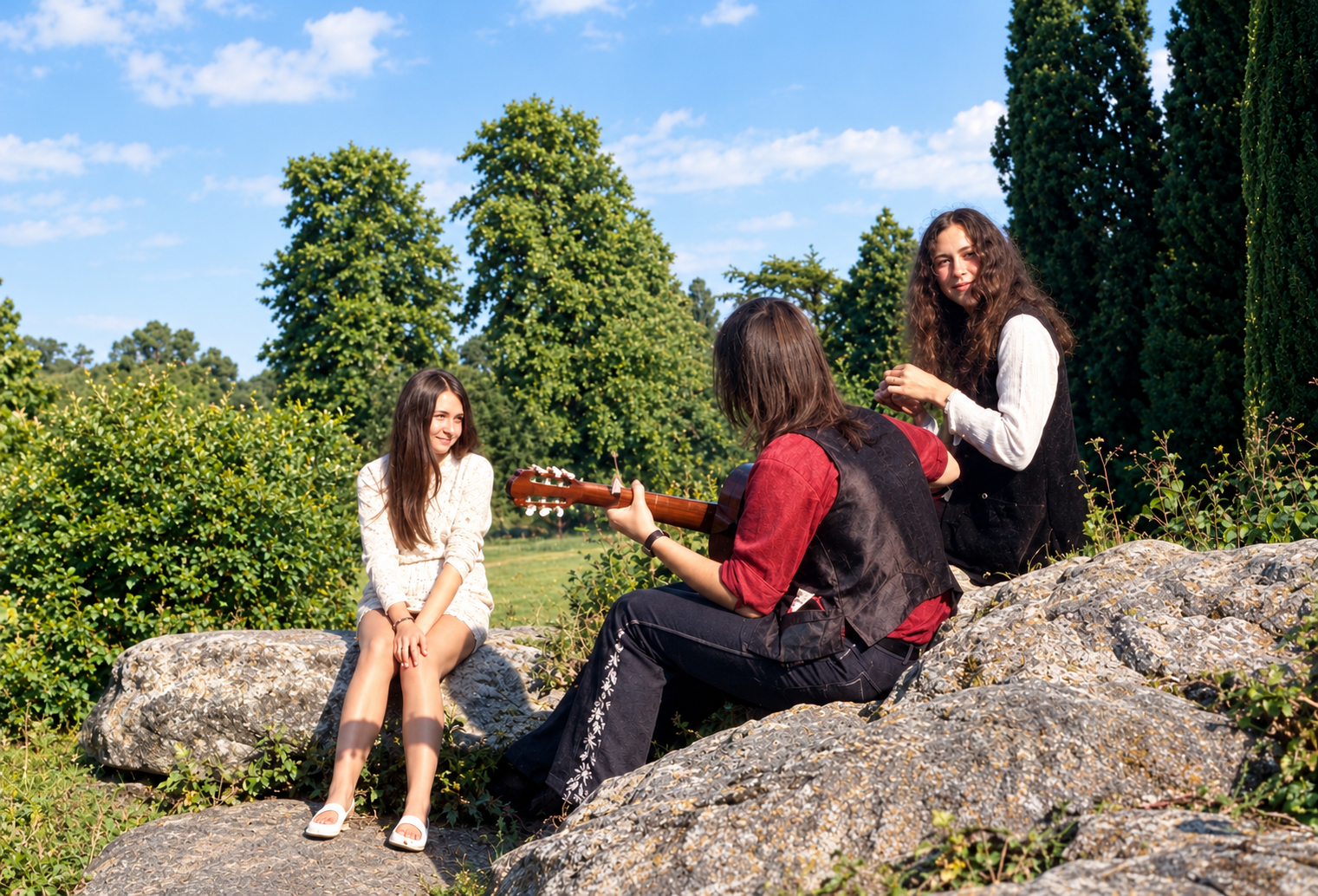
In the summer of ‘69
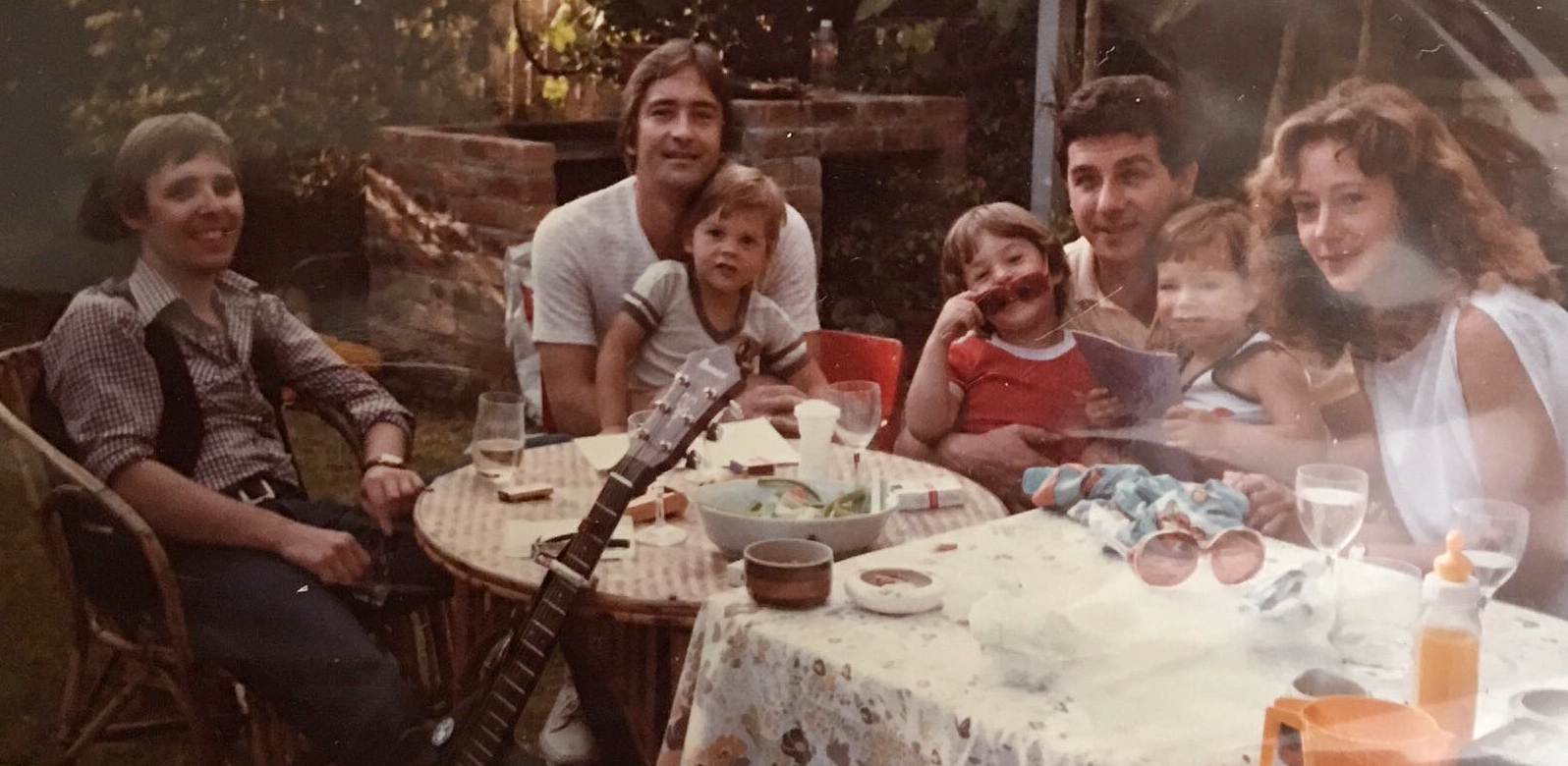
Sydney 1984 with Reading pals Christian and John