The night is dark and full of terrors.
Melisandre, the Red Witch. Game of Thrones
… and the darkest hour is just before dawn.
The Mommas and the Papas
American author F. Scott Fitzgerald wrote in The Crack-Up: “In a real dark night of the soul it is always 3 o’clock in the morning, day after day”.
And who hasn’t awoken at 3am and stayed awake into the early hours overthinking everything when random thoughts scatter and shatter, when matters large and small pitter-patter across the mind like mice scurrying across the room. With the late Warren Zevon, “we contemplate eternity beneath the vast indifference of heaven”, inevitably pondering, as we try time on the descending escalator, the ever-approaching End. And the next second, it’s tomorrow’s “to do” list, the credit card bills, or doctors’ appointments, or “did I turn off the hose in the veggie garden?” The mind runs through a myriad of things that are inconsequential during the daylight hours but are now morphed into potential catastrophes that may or may not come to pass.
So, nothing good comes from 3am; only memories, words unsaid, things unfinished, heartbreak, even and loss. Sleep eludes you and when you do fall into a fitful sleep, it’s a tormented one that leaves you quite enervated, exhausted even, in the morning. And usually, everything always looks much better in the morning. Though, in an entertaining piece in the Sydney Morning Herald, columnist and writer Monica Dux offers that “maybe our daylight optimism is the delusion, and those dark 3am moments are actually glimpses of a fundamental truth, as the distractions of the day are stripped away, and it’s just you and your mortality staring each other down”.
Science, of course, has an explanation or two for this pre-dawn desolation. We all wake up many times through the night and usually slide straight back to sleep. Unless the bladder has sounded a renal reveille, as is common with folk of a certain age. But around about 3am our core body temperature starts to rise, sleep hormones have peaked, and the stress hormone cortisol kicks in, preparing you for the coming day. So, if you wake fully, there’s a good chance you’ll stay that way. And your brain, deprived of other stimulation, will start playing tricks on you, distorting your sense of proportion and reality.
An alternate and seemingly contrary theory is that the hour may be when we emerge from our sleep cycle and circadian rhythm. The body goes through REM sleep at that time; the heart rate is slower, body temperature reduced, breathing pattern and blood pressure irregular. Sudden awakening from REM sleep could cause agitation, fear and disorientation in an individual. Also, during REM sleep, unpleasant and frightful sleep disturbances such as parasomnias can be experienced, including, maybe, nightmares, rapid eye movement sleep behavior disorder, night terrors, sleepwalking, and sleep paralysis.
But why let scientists have all the fun. Don’t we all know already that if you’re going to slip off this mortal coil, odds are it will be between. 3 and 4 am because this is an ambiguous hour of no rules. Before 3am it is still night; after 4 it is morning; and in between lies, we’ll, purgatory. It’s a time when the veil between the worlds is at its thinnest – betwixt the spiritual world and our own, between the living and the dead.
And it’s a well-known fact that 3pm was the time when Our Lord Jesus Christ expired on Golgotha. The opposite, 3am, belongs to Old Nick. It’s The Devil’s Hour, the evil hour, and supposedly, a time of power for satanic skullduggery and supernatural phenomena. It’s not called “the witching hour “for nothing. Some say that it is at precisely 3.33 – half the ‘mark of the Beast’ maybe? Though how Christians worked all this out beats me. In the sixteenth century, the catholic church endeavoured to forbid nocturnal activities between 3 and 4 due to burgeoning fears about witchcraft in Europe, and the fact that this was the hour witches, demons and ghosts were out about and reckoned be at their most powerful.
A forlorn hope, perhaps. Back in those days, it was customary for folk to break their slumber between what we now know are customary sleep cycles with a first and second sleep – one shortly after sundown, followed by a period of nocturnal activity, until one was sleepy again. That in-between waking-time was known to be especially propitious for making magic. Interpret that as you will.
Over to Mister Pickett:
I’m gonna wait ’til the midnight hour
That’s when my love come tumbling down
I’m gonna wait ’til the midnight hour
When there’s no one else around

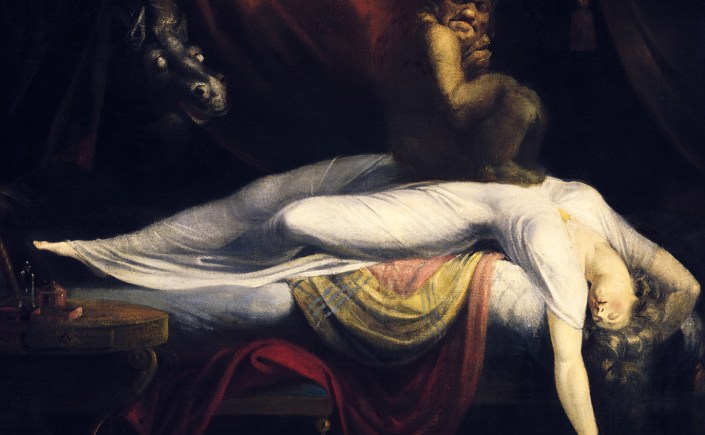
The Sleep of Reason Produces Monsters Francisco Goya.

The Shepherd’s Dream, John Henry Fuseli
Postscript – beating the 3 o’clock blues
There is something rather convincing about the idea that 3am is the Devil’s Hour, even if the Devil himself is innocent of the charge. It is less the hour on the clock than the peculiar psychological territory into which we enter at that hour: the world is asleep, ordinary distractions have fallen away, the body is inconveniently awake, and the mind, deprived of daylight and company, becomes an unusually unreliable narrator.
The moment you awake in the night and look at the clock, your experience changes. You no longer merely have a vague nocturnal awakening; you have been given a fact, and the brain immediately turns it into a story. Why am I awake? Why is it always around three? How much sleep have I had? How little have I got left? And from there it is remarkably easy for the mind to start rummaging through the psychological filing cabinet: mortality, mistakes, unfinished business, money, family, politics, the state of the world, things one said forty years ago that nobody else remembers, and things one might reasonably have forgotten but somehow hasn’t.
At three in the afternoon these thoughts would be problems. At three in the morning they acquire metaphysical significance.
There is a physiological reason for some of this. Sleep is not a uniform eight-hour descent into unconsciousness but a succession of cycles, and the latter part of the night contains proportionally more REM sleep. REM is associated with vivid dreaming, emotional processing and greater brain activity, while the body’s circadian system is still close to its daily low point. Cortisol, body temperature and other systems are beginning their gradual transition towards morning, but psychologically we are still in the middle of the night. If we wake during or immediately after REM, the residue of the dream can cling to consciousness, sometimes producing that peculiar sensation that something is terribly wrong without quite knowing what the something is.
And then there is the darkness itself. Human beings are remarkably good at imposing meaning on incomplete information. At night there is less sensory information to correct the imagination. A creak becomes a possibility; a bodily sensation becomes a symptom; a thought becomes an insight. The rational daylight self has gone off duty, leaving the night shift in the hands of an unpaid committee of catastrophists.
That may explain the old cultural association of the small hours with evil. The Christian tradition did not invent nocturnal fear, of course, but it gave it a particularly durable vocabulary. The folklore is much less historically tidy than the modern internet version suggests. But the symbolism is quite irresistible.
There is also an older and more general human intuition here. The Midnight Hour is dramatic, as Mister Pickett understood; but three in the morning is a lonely time. At midnight one can still imagine that the day has merely paused. At three, the night seems endless. Morning exists somewhere in the future but is not yet visible. It is the temporal equivalent of being stranded in a tunnel: you know there is an exit, but you cannot see it.
Perhaps the best way out is not to enter that tunnel in the first place. Maybe those folk in olden days who broke their sleep were on to something.
My own solution is now to avoid checking the clock when I awake to nature’s call in the wee (no pun intended) small hours. The clock is not merely measuring the experience; it can help manufacture it. If you wake naturally, relieve yourself, return to bed and think, and don’t know what time it is, you have removed one of the principal cues that turns an ordinary awakening into an event. You haven’t solved the problem of waking; you’ve deprived the awakened mind of a narrative hook.
There is something almost Zen about it, but let’s not make too much of that. Nature calls. Answer nature. Return to bed. No inquiry into the time of day, no audit of the night’s remaining sleep, no referendum on the meaning of existence. The less information supplied to the nocturnal brain, the fewer opportunities it has to construct a crisis.
Giving booze the boot has probably helped in a more substantial physiological way. Alcohol is a deceptive friend to sleep. It can make falling asleep easier because of its sedative effects, but it tends to fragment sleep later in the night, suppressing REM initially and then producing REM rebound as the alcohol is metabolised. It can also increase awakenings, worsen snoring and sleep-disordered breathing, increase urination and generally make the second half of the night less peaceful than the first. So the classic experience of falling asleep rather splendidly after a few drinks and then finding oneself wide awake and contemplating the decline of Western civilisation at 3:17 is not entirely imaginary.
Removing alcohol removes several of those disturbances at once. It does not mean that you will never wake at three again – human beings remain inconveniently human – but the awakening may be less sticky. You wake, attend to whatever woke you, and go back to sleep rather than allowing the awakening to become an extended philosophical symposium.
There is perhaps a larger lesson in all this. We tend to think of anxiety as something produced by thoughts, but sometimes the conditions under which thoughts occur determine their apparent truth. A proposition that seems profound at 3 am can look rather less compelling at 10 am the morning cuppa and sunlight. The nocturnal mind is not necessarily telling lies; it is simply conducting its inquiry under peculiarly adverse lighting conditions.
So perhaps our own, revised theory of the Devil’s Hour is this: the Devil’s real trick is not waking us at three in the morning. It is persuading us to look at the clock when we do. Once we know the hour, we begin to attach significance to it; once we attach significance, we start listening to the thoughts that arrive with it; and once those thoughts acquire the authority of the small hours, perfectly manageable concerns can become existential verdicts.
There is a nice irony in having escaped the 3 a.m. demon not through theology, meditation or some elaborate sleep protocol, but through two very prosaic measures: stop drinking and stop checking the time. The first changes the sleep. The second changes the story.
And perhaps that is why the latter half of the night seems less haunted now. The Devil, deprived of his clock, has rather lost track of his appointment.
For other indulgent contemplations in In That Howling Infinite, see The quiet tea time of the soul, The first 100 Days on the wagon, The Country Life, and Blue remembered hills – a land of lost contentment

