America is a country where you can drive from Damascus to Jerusalem via Jericho and Bethlehem without leaving the United States. Its map is littered with biblical names – geography of faith transplanted onto a new continent.
That was no accident. From the Puritans’ “city upon a hill” to Manifest Destiny and today’s Christian nationalism, Americans have repeatedly imagined their country as something more than a nation: a providential project, a New Jerusalem, a civilisation with a sacred inheritance.
But there is another America – the constitutional America, deliberately wary of the fusion of church and state; the pluralist America in which Christianity is one inheritance among many; and the America whose power is increasingly viewed abroad with scepticism.
This essay explores the curious convergence of a renewed intellectual interest in Christianity and Western civilisation, the muscular Christianity of the contemporary American Right, the crusader imagery of its warriors, the spectacle of the television evangelist, and the extraordinary political theology surrounding the Trump era.
At the heart of it is a simple question: what happens when a nation with immense material power begins to clothe that power in sacred language?
New Jerusalem
Look at a map of the United States and you can almost read the Bible in the place names. Bethlehem appears here, Jerusalem there; Jericho, Damascus, Nazareth, Salem, Shiloh, Zion, Hebron, Canaan, Goshen, Galilee, Gilead and Lebanon are scattered across the American landscape. Some are little more than dots on a map; others grew into substantial towns and cities. Together they form something more than a collection of quaint biblical echoes. They constitute a kind of geography of faith: a continent renamed, in part, through the vocabulary of Scripture.
America did not merely settle a new continent. It imagined itself within an ancient story.
The idea goes back to the earliest European settlers, particularly the Puritans, whose understanding of the New World was saturated with the language of Exodus, covenant, wilderness and the Promised Land. The voyage across the Atlantic could be imagined as an escape from bondage. The wilderness became a place of testing. The new settlement could become a covenanted community. America was not simply somewhere to live; it might become somewhere to begin again.
John Winthrop’s famous 1630 sermon, A Model of Christian Charity, gave the idea one of its enduring metaphors: the new community would be “as a city upon a hill”, watched by the world. The original meaning was less a declaration of American superiority than a warning about American responsibility. A people claiming a covenant with God would be judged by how it behaved.
Over time, however, the warning became a boast. The city upon the hill became the shining city upon the hill; the beacon became a claim to exceptionalism; and the American experiment acquired an increasingly providential character. The United States came to imagine itself not merely as a nation among nations but as a nation with a special mission.
This is one reason the idea of a New Jerusalem has such a deep resonance in the American imagination. The Book of Revelation promises a new heaven and a new earth, with the New Jerusalem descending from heaven. The old order passes away; the world is renewed; God dwells among humanity. It is the ultimate story of restoration.
America was, in a secular and political sense, another version of the same story: the old world left behind, a new world discovered, history apparently offering a second chance.
Europe had its cathedrals, dynasties, wars and accumulated centuries. America had the wilderness and the future.
And the wilderness was not empty.
That is where the mythology becomes more complicated. The promised land was already inhabited. The New Jerusalem was built through the displacement and dispossession of Native peoples. The language of Providence accompanied conquest. Manifest Destiny transformed territorial expansion into something that could be understood not simply as geopolitical ambition but as providential destiny.
The American frontier was therefore conquered with the Bible as much as the gun. The gun supplied the means; the Bible supplied, for many, the story.
This should not be reduced to cynical propaganda. Many of the people who settled the frontier genuinely believed that Providence was guiding them. They read their lives through Scripture. They named their settlements after biblical places. They understood victory and defeat, drought and harvest, migration and death within a scriptural framework. The preacher and the gunfighter could inhabit the same cultural universe.
The extraordinary thing is how durable that religious imagination has proved. The United States has repeatedly retold its national story in the language of fall, decline, threat, renewal and redemption. The names and metaphors change, but the narrative structure persists.
America sins; America suffers; America forgets itself; America is threatened; America awakens; America is restored.
It is almost a biblical narrative translated into political mythology.
From the city on the hill to muscular Christianity
This is the historical backdrop against which the contemporary revival of Christian language in American conservatism needs to be understood. It did not begin with Donald Trump, nor is it reducible to the phenomenon now labelled “Christian nationalism”. There has always been an American civil religion in which God, nation, freedom, sacrifice and destiny overlap.
What is new is the intensity with which some contemporary conservatives are seeking to recover Christianity not simply as private belief but as an explicit source of civilisational identity.
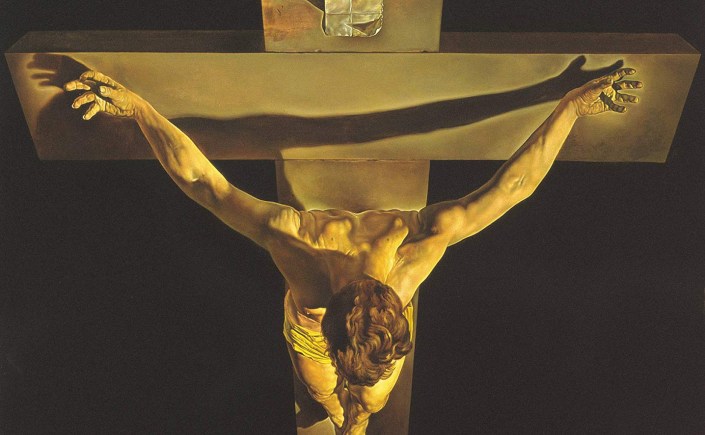
There has been, in parallel, an intellectual rediscovery of the Christian inheritance among thinkers who are not conventionally understood as theologians. British historian and co-host of the popular podcast The Rest is History, Tom Holland’s Dominion is perhaps the best-known example. His argument is essentially historical: many of the moral assumptions that modern secular Westerners regard as self-evidently universal – the dignity of the individual, the moral significance of the weak, equality before God, concern for the marginalised and suspicion of arbitrary power – were profoundly shaped by Christianity. See in In That Howling Infinite, Getting back to the garden – Tom Holland’s Dominion. The illustration at the head of this essay is taken from the cover of this thought-provoking book.
Historian Niall Ferguson and others have approached the question from somewhat different directions, examining the decline of Western confidence, the institutions and habits that made the West successful, and the possibility that societies can lose the cultural foundations that sustain them.
There is much to respect in this argument. Christianity did profoundly shape the moral and intellectual architecture of Western civilisation. To deny that is to indulge in a curious form of historical amnesia. But there is a distinction worth preserving between Christianity as an inheritance and Christianity as a political identity.
The West is Christian in its historical formation, but it is not only Christian. It is also Greek and Roman, Jewish and Islamic in important respects, Renaissance and Reformation, Enlightenment and scientific, liberal and socialist. Its civilisation emerged through argument as much as inheritance. Indeed, one of the defining characteristics of the West may be its capacity to argue with itself.
The danger begins when recognition of the Christian inheritance becomes a claim to Christian superiority, and when civilisational confidence becomes civilisational self-certainty.
For there is an awkward historical fact that every honest account of Western civilisation has to accommodate: the civilisation that produced the Sermon on the Mount also produced religious persecution, slavery, colonialism, racial theories, imperial conquest and industrialised warfare. It proclaimed universal human dignity while repeatedly deciding that some humans were more equal than others.
The West has produced some extraordinary moral ideals. It has also repeatedly failed to live up to them. That is not an argument against the ideals. Quite the reverse. It is an argument for taking them seriously.
JD Vance, Marco Rubio and the recovery of a sacred inheritance
The contemporary American conservative project – propagated by the current Us administration- therefore has an interesting intellectual spectrum.
At one end is the civilisational argument: the West has forgotten its inheritance and must recover confidence in the ideas and institutions that made it what it is. Christianity is not necessarily proposed as a state religion but as the moral and cultural foundation of Western civilisation.
The Catholic dimension is particularly interesting. The conversion of vice-president JD Vance, for example, has given his political thought an intellectual vocabulary that differs from the older Reaganite fusion of individual liberty, free markets and traditional morality. Catholic social thought permits a critique of atomised individualism and places greater emphasis upon family, community, solidarity, responsibility and the common good.
Secretary of State Marco Rubio’s formulation is similarly civilisational. His argument for Western renewal encompasses reindustrialisation, secure borders, a more restrained conception of the international order and, most importantly, recognition of what he describes as the Christian “sacred inheritance”.
This is not necessarily the same thing as theocracy. It is an argument that a civilisation requires more than institutions and material prosperity. It needs a moral vocabulary, a sense of purpose and some conception of the good.
That proposition is not absurd. Indeed, the secular West has been wrestling with precisely this problem for decades: What happens when a society loses the stories that once gave meaning to sacrifice, obligation, family, citizenship and responsibility?
But then comes the other end of the spectrum: muscular Christianity.
Come the Crusader
Here the intellectual argument becomes physical.
The language is martial. The imagery is martial. The body itself becomes part of the message: warrior tattoos, biblical inscriptions, fighter jets, missiles, military ceremony, prayer and the rhetoric of providence.
The Defence Secretary Pete Hegseth’s invocation of the Psalm, “Blessed be the Lord, my rock, who trains my hands for war and my fingers for battle”, is emblematic. Christianity is no longer merely being invoked as the moral inheritance of a civilisation. It is being placed beside the instruments of American military power.
There is a long tradition of Christian soldiers, Christian chaplains and religiously motivated warriors. Christianity has never been pacifist in any simple historical sense. The just-war tradition emerged precisely because Christians had to confront the moral problem of political violence.
But just-war thinking is an attempt to restrain power. It is not a licence to sanctify it. The distinction is crucial.
A soldier may quite properly pray before battle. A soldier may believe that God gives him courage. But when the institutions of the state begin to present military action in explicitly sacred terms, a different question arises: is God being invoked as a source of personal conscience, or as a source of political legitimacy?
The difference between “I believe this war is just” and “God has sanctioned this war” is enormous. The first is political conviction. The second approaches theological authority.
And once the military becomes wrapped in sacred language, the danger is that the moral uncertainty inherent in war disappears. The enemy is no longer merely an adversary whose motives and humanity must be understood. He becomes an obstacle in a providential drama.
That is where the crusader metaphor becomes more than colourful rhetoric. The crusader did not merely fight. He fought under a sacred sign.
Television evangelists and the politics of spectacle
There is another strand of American religious culture that belongs in this story: the television evangelist.
The old televangelists perfected a distinctive synthesis of faith and spectacle. Religion became mass entertainment, personal testimony became political mobilisation, the preacher became a celebrity and the audience became a constituency. The language was often intensely personal: belief, victory, persecution, redemption, prosperity, enemies and deliverance.
It is difficult not to see an echo of that culture in contemporary American politics.
President Donald Trump is not, in any conventional sense, an ideological theologian. He is transactional, improvisational and instinctively theatrical – and narcissistic, vindictive and profane to boot. His politics are based less upon a coherent doctrine than upon loyalty, grievance, performance, personal authority and the promise of restoration.
Yet he has proved extraordinarily compatible with the religious imagination of parts of the American Right. The convergence is almost anthropological. The televangelist says: You have been betrayed. The world is against you. I understand your grievance. Follow me and we can restore what has been lost. The populist politician says much the same thing, replacing salvation with national restoration.
There is consequently an uneasy resemblance between the culture of the television evangelist and the politics of Trumpism: personality, spectacle, grievance, loyalty, money, performance and the promise of redemption.
The difference, of course, is that the televangelist claims to speak for God while the politician claims to speak for the people. When those two claims begin to reinforce one another, however, politics acquires some of the characteristics of religion. It acquires saints and sinners, martyrs and enemies, rituals and sacred gatherings, heretics and converts, betrayal and redemption.
That phenomenon was visible in the extraordinary response to the murder and memorialisation of the charismatic, popular and divisive conservative activist Charlie Kirk. The point is not whether the grief manifested across the rightwing media-verse was sincere – it plainly was – nor whether the religious language was genuine. It was both. The more interesting observation is that the death of a political activist can be absorbed into a larger narrative of sacrifice, persecution, martyrdom and national renewal.
This is where political movements can begin to acquire a religious emotional architecture.
And it is worth being careful here. Political martyrdom is not uniquely Christian. Communists, fascists, nationalists, revolutionaries and liberation movements have all created martyrs. But Christianity supplies an especially powerful vocabulary of sacrifice, blood, witness, redemption and resurrection. The political temptation is obvious.
The American paradox
And yet all of this muscular Christianity, civilisational renewal and providential rhetoric is unfolding against a remarkable backdrop: America itself is deeply divided about what America is.
It is one of the most diverse societies on earth. It contains multiple religious traditions and enormous numbers of people who are secular or non-religious. Its politics have become intensely polarised. Its cultural conflicts are increasingly existential in tone.
Christian nationalism therefore confronts a paradox of its own making. It seeks to define a pluralistic country through one of its historical traditions. It can say, with considerable historical justification, that Christianity helped shape America. But it cannot simply turn that historical fact into a constitutional proposition that America belongs to Christians.
The American founding contains a deliberate tension here. Religion was important to the cultural environment in which the Republic developed, but the Constitution did not establish a Christian state. The genius – and perhaps the fragility – of the American experiment was that a profoundly religious society attempted to construct a political order in which different religions, and ultimately non-belief, could coexist.
The city upon the hill was never a single-denomination clubhouse.
That makes the contemporary rhetoric of Christian nationalism both understandable and problematic. It is partly a response to a genuine sense of cultural dislocation: secularisation, demographic change, immigration, declining institutional trust, economic insecurity, the collapse of older forms of community and the sense among many people that the country they knew has disappeared.
Grievances require ideology before they become political mobilisation. Christian nationalism can provide that ideology. It offers an explanation of what has gone wrong and a story about how it might be repaired. But the story can become dangerous when “America” and “Christianity” are treated as interchangeable terms. For then criticism of America can begin to sound like criticism of Christianity, and criticism of Christianity can be interpreted as hostility to America.
That is not a recipe for pluralism.
The constitutional counterweight
There is an important American corrective to all this biblical geography and civilisational rhetoric: the Constitution. America may have imagined itself as a chosen people building a city upon a hill, but the republic’s founders did not establish a Christian state. The First Amendment famously prohibited Congress from establishing a religion while protecting the free exercise of religion. That distinction was fundamental. Religion was not to be banished from public life; neither was the state to acquire a church.
This is one of the great American paradoxes. The country was profoundly shaped by Christianity, yet its constitutional architecture deliberately separated religious authority from governmental authority. The separation of church and state was not an act of hostility towards religion. It was, among other things, a recognition that a society of competing faiths could not remain free if the state became the arbiter of religious truth.
The distinction matters today because it separates two propositions that are increasingly liable to be conflated. The first is historical: Christianity profoundly influenced the formation of American institutions, habits and moral assumptions. The second is political: therefore, the American state should embody Christianity. The first is plainly defensible; the second is precisely the proposition against which the constitutional settlement was designed to provide some protection.
There is an irony here that reaches beyond America. The Christian tradition itself contains a long and complicated argument about the proper relationship between spiritual and temporal power. “Render unto Caesar” is not a complete constitutional theory, but it establishes a distinction that has proved remarkably fertile. Christianity may speak to the conscience of the citizen without becoming the official ideology of the state.
And perhaps this is where the larger philosophical movement: the extraordinary evolution of Western thought from an admiration for the mighty to an ethic increasingly concerned with the meek. The ancient world admired strength, glory, conquest and heroic virtue. Achilles is the archetype, particularly for the likes of Hegseth (absent, of course, the arguably homoerotic Patroclus undertone): muscled and magnificent, wrathful, proud and formidable. Christianity did something extraordinarily disruptive to that moral hierarchy. The mighty are sidelined, placing the weak, the poor, the humble and the suffering much closer to the centre of moral concern.
The Sermon on the Mount turned the conventional hierarchy upside down. Blessed are not necessarily the conquerors, the powerful and the triumphant, but the meek, the merciful and the peacemakers. Over centuries that moral inversion seeped, unevenly and imperfectly, into Western law, politics and social thought. It eventually became possible to imagine that the legitimacy of power should be measured not simply by what the powerful can accomplish, but by how they treat those without power.
That is a remarkable development in the history of political civilisation. And it provides an interesting test for contemporary muscular Christianity. The question is not whether Christianity can coexist with strength. Of course it can; Christianity has done so for two millennia. The more searching question is whether the Christian inheritance is being invoked to restrain power or to sanctify it.
That distinction brings us back to the Constitution. The American founders did not solve the problem of religion and power, but they constructed a political system in which neither church nor state was supposed to possess the whole truth. The republic was to remain secular in its institutions precisely so that its citizens could remain religious — or not religious — in their consciences.
The city upon the hill, in other words, was never meant to be a theocracy. It was an experiment in self-government.
And perhaps that is one of the more enduring contributions of the American experiment to the Western story: not the claim that America had discovered the New Jerusalem, but the much more modest proposition that people of different faiths could attempt to build a political community without first agreeing upon God.
What the rest of the world sees
There is also an international dimension that American civilisational rhetoric can easily overlook.
The United States remains the world’s pre-eminent military power, one of its largest economies and the centre of an extraordinary network of alliances and institutions. Its technology, universities, culture, financial system and military reach remain formidable.
But power and credibility are not the same thing. A hegemon can compel without inspiring.
And American power depends upon something more intangible than aircraft carriers and dollars: other countries must believe that American commitments mean something, that alliances are durable, that Washington understands the difference between interest and principle, and that its rhetoric about democracy, freedom and the rules-based order has some relationship to its conduct. That is where the present moment becomes particularly awkward.
When the world’s most powerful democracy speaks in the language of Christian civilisation while its president behaves, to a sceptical foreign observer, like a transactional television personality – opportunistic, self-promoting, bullying and apparently indifferent to ideological consistency – the result can be a peculiar dissonance.
The United States says values. The world watches behaviour. America says leadership. Others see transaction. America invokes faith. Others wonder whether they should still have faith in America.
That word “faith” is not accidental. International relations has its own definition. Alliances depend upon confidence. Treaties depend upon credibility. Soft power depends upon the willingness of others to believe that the power being exercised is legitimate, or at least predictable. But once confidence begins to disappear, it is remarkably difficult to restore.
And this is where the Christian rhetoric can become counterproductive. If America presents itself not simply as a powerful state but as the guardian of Western civilisation and Christian values, it raises the moral expectations by which its conduct will be judged. If it invokes God, the world can ask whether its conduct reflects the qualities attributed to God. If it invokes civilisation, the world can ask whether its conduct is civilised. If it invokes the rules-based order, the world can ask whether the rules apply to Washington as well as to everybody else.
The higher the rhetoric, the greater the distance when behaviour falls short.
An American pontiff in Washington’s shadow
The election of an American pope adds an extraordinary complication.
Pope Leo XIV is, by definition, an American product of the culture, but he does not belong to America in the political sense. The Catholic Church is universal, and the papacy represents an authority that transcends national interest.
His evident reservations about aspects of the Trump administration, particularly its treatment of migrants and its harder-edged nationalism, are therefore significant. The Pope cannot simply be absorbed into the American civilisational project because Catholicism itself contains a competing conception of universality.
That is perhaps one reason the current “Catholic moment” is so interesting. American Catholicism is simultaneously being courted by the nationalist Right and reminded by its own universal tradition that Christianity is larger than the nation. The Pope’s position effectively asks a question that Christian nationalism finds difficult to answer: where does Christian allegiance end and national allegiance begin?
The answer cannot simply be “wherever America says it does” because the Christian faith, at least in its Catholic conception, does not stop at the border. Nor does the stranger cease to be a human being when he crosses it.
The return to faith – and a Mahatma moment
In the intellectual world, therefore, something genuinely important is happening beneath the politics.
A number of intellectually serious people are rediscovering Christianity because they have come to understand that the supposedly secular values of the modern West are not as self-explanatory as they once assumed. They are asking where ideas of human dignity, equality, compassion, sacrifice and moral obligation came from, and whether a civilisation can sustain them once it forgets their genealogy. This is a worthwhile conversation, but there is a danger in turning it into a story of Western vindication.
The West has an extraordinary inheritance. It also has an extraordinary record of failing to live up to it.
This is where an apocryphal quip by Mahatma Gandhi becomes unexpectedly useful. Asked what he thought of Western civilisation, Gandhi is supposed to have replied: “I think it would be a good idea.” He almost certainly did not say it. But the joke survives because it captures something profound.
The West has produced ideals of extraordinary moral power. It has also spent much of its history demonstrating how difficult those ideals are to practise. The point is not to discard the inheritance. Quite the opposite. It is to take it seriously enough to judge ourselves by it.
Perhaps the proper response to the rediscovery of Western civilisation is therefore neither triumphalism nor self-loathing, but gratitude without complacency – acknowledging the Christian foundations of much Western moral thought without pretending that Christianity has a monopoly on virtue. We can recognise the achievements of the West without denying the violence that accompanied them. We can defend liberal democracy without pretending that every Western action has been liberal or democratic.
And perhaps the deepest lesson of the Christian inheritance is that being “chosen” is not a certificate of moral superiority. The biblical prophets spent an extraordinary amount of time telling their own people that God’s favour did not exempt them from judgement.
Indeed, the Bible that gave America its language of Exodus, Promised Land and Manifest Destiny also gave it the prophets. And the prophets were not particularly polite to powerful people who believed themselves righteous. They asked who was being excluded, who was being oppressed, how the stranger was being treated, what happened to the poor, the widow and the orphan, and what became of justice when power convinced itself that it was acting in the name of God.
That is why the phrase “What would Jesus do?” has more bite than its sometimes saccharine popular usage suggests. It is not merely a question about personal kindness. Applied seriously to statecraft, war and national power, it becomes an interrogation of the entire project.
What would Jesus make of the stranger at the border? What would he make of the poor? What would he make of vengeance? What would he make of the worship of strength? What would he make of the powerful congratulating themselves on their righteousness? What would he make of the Sermon on the Mount?
And, most awkwardly for the muscular Christian, what would he make of: “Blessed are the peacemakers”?
The great American story may therefore not be that America is the New Jerusalem. It is that America has repeatedly imagined itself becoming one. The city upon the hill was an aspiration before it became a boast. The New Jerusalem is an eschatological promise, not a national certificate. Civilisation is something to be practised, not possessed.
Which brings us back to that wonderfully mischievous Gandhi line. “Western civilisation?” “It would be a good idea.”
Perhaps that is the most useful way of understanding the contemporary return to faith. Christianity may indeed be one of the great sources of the moral vocabulary by which the West understands itself. But the test of a civilisation is not the grandeur of its inheritance. It is what it does with it.
The Bible gave America a map, a mythology and a moral vocabulary. The gun helped conquer the continent. The Constitution tried to establish the rules by which its people might live together. The pulpit supplied the language of providence. The television evangelist transformed faith into spectacle. The politician discovered the mobilising power of grievance, identity and redemption. The soldier discovered that Scripture could be placed beside the missile.
And now the most powerful country on earth is once again asking the world to believe in its exceptional mission. The world, understandably, is watching what it does.
Perhaps that is the ultimate irony of the city upon the hill. The higher the hill, the more visible the conduct of those who live upon it. And if America wants to invoke the Bible as its civilisational inheritance, it inherits not only the stories of Exodus and conquest, but the uncomfortable questions of the prophets.
Or, to put it in the irreverent vernacular of an old, sceptical observer:
What would Jesus do?
Paul Hemphill and In That Howling Infinite, August 2026
This essay was written in conversation with books I’ve read, ideas formed and half-formed, and, more recently, in sustained dialogue with an AI language model, which contributed to drafting, phrasing, and conceptual articulation. What appears here is not unmediated thought, but considered thought: selected, tested, revised and revised again, and owned.
See also in In That Howling Infinite, A Political World – Thoughts and Themes, The Wrath to Come. Gone With the Wind and America’s Big Lie and My country, ‘tis of Thee – on matters American

