Jerusalem is all about faith and passion, and there is no city on Earth that people get more passionate about. The light is luminous. In high summer it almost shimmers. The very air is full of prayer and politics, passion and pain, and the rocks and stones virtually sing a hallelujah chorus of history. I am not a religious person, but I cannot help getting excited by the place – although I do not transcend to the transports of delight and delirium that enrapture many or make their way here from all over the world.
We have been to Jerusalem many times, and hope to return. During our recent stay, we had the pleasure of meeting journalist, storyteller and author Sarah Tuttle-Singer several times – twice in the Old City, an appropriate place to meet someone whose relationship with the city is so deeply woven into her writing. We know the Old City well and love it. Having spent time with Sarah walking its streets and alleys, we know it better and love it more.
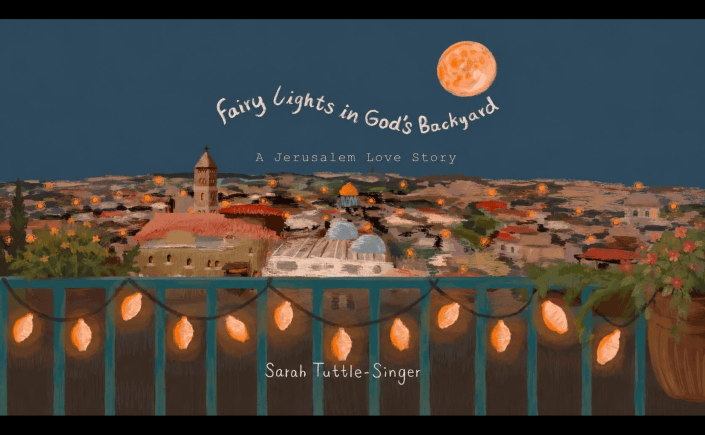
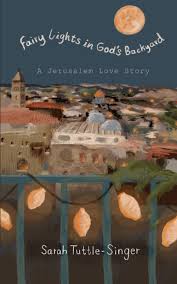
Her new book, Fairy Lights in God’s Backyard: A Jerusalem Love Story, is an affectionate, sometimes heartbreaking, often funny and very personal account of a city that has a habit of getting under one’s skin.
History, memory and humanity in a city that refuses to be possessed
Fairy Lights in God’s Backyard is not a conventional history of Jerusalem, nor an excitable gallop like Simon Sebag-Montefiore’s Jerusalem – the Biography. Nor is it an analysis of the Israeli-Palestinian conflict. It is something rather more intimate: a memoir of life in a city where the extraordinary and the mundane, the sacred and the profane, the ancient and the contemporary are continually bumping into one another. But Sarah’s observations about Jerusalem have a particular resonance for anyone interested in the accumulated history of this remarkable place, and I found myself returning repeatedly to one central idea: Jerusalem as a palimpsest, a city in which the past is not simply remembered but physically inhabited.
“History in Jerusalem is so thick it sometimes feels like another person in the room,” Sarah writes. It is a wonderful description of something that is difficult to explain to anyone who has not spent time wandering its streets. Jerusalem is not simply a city with a long history. Its history is part of the everyday landscape, embedded in the stones, walls, foundations, courtyards and alleyways, sometimes exposed, sometimes concealed, but rarely absent. One does not have to go looking for the past; one merely has to walk through the present.
As Sarah observes, Jerusalem “does not behave politely nor geographically. It stacks centuries on top of each other and calls it a street.” Elsewhere, cities may have an old town and a new; a museum where the past has been safely preserved; or an archaeological precinct separated from the business of contemporary life. Jerusalem is less accommodating. Here, people build apartments on Crusader arches and conduct their daily business above the foundations of earlier civilisations. The stones of one age become the building materials of another; temples become churches, churches become mosques, synagogues rise beside ruins, and buildings acquire successive identities as political and religious authority changes hands. As Sarah puts it, “One family’s foundation becomes another family’s archaeology.”
There is something almost geological about this accumulation. The city has been built, destroyed, rebuilt, appropriated, excavated and reconstructed so many times that its physical fabric resembles a series of overlapping historical deposits. A wall may contain stones quarried by Romans, incorporated into a later Byzantine structure, adapted by Crusaders and subsequently absorbed into an Ottoman building. A street may follow a route established centuries before the people now walking along it were born. The archaeological record is not simply beneath the city; it is part of the city, often inconveniently interrupting the present.
Sarah captures this when she writes that Jerusalem “has always been built twice: once by those who first laid the stones and again by the people who lovingly uncover them, preserve them and refuse to let them disappear.” The past is continually being rediscovered, although in Jerusalem rediscovery is rarely an entirely neutral exercise. Archaeology can establish what was there, but the interpretation of what has been found, and what it means for the people living above it, can become another dimension of the city’s continuing contest over history, identity and belonging.
For thousands of years, empires have marched through Jerusalem convinced that they would be the ones to tame her. “None of them did. Jerusalem outlived them all”. Sarah lists the Romans, Umayyads, Crusaders, Mamluks, Ottomans and British, among others, each leaving behind something of their presence and each, at some point, believing that its particular political arrangement might endure. The wider landscape has also been shaped by Egyptians, Syrians, Babylonians, Persians, Greeks, Byzantines, Jordanians and Israelis. Their histories overlap, sometimes complementing one another, sometimes contradicting one another, but never quite disappearing.
There is a certain literary licence in personifying the city in this way, but the historical point is a sound one. Political power is transient, even when it appears otherwise to those exercising it. Kingdoms rise and fall, occupations begin and end, flags change, borders move and the names on maps are erased and written again. The city remains, carrying the physical traces of those who came before.
Sarah makes the observation: “Once you could travel all the way from Beirut to Cairo through Jerusalem.” This simple sentence opens up a much larger historical perspective. The political geography of the contemporary Middle East, with its apparently fixed national boundaries, is a relatively recent construction when set against the longer history of the region. A century sounds like a long time until one realises that it is barely longer than a human lifetime. Empires and political systems that once seemed immovable have disappeared within the span of a few generations. “Every generation”, she writes, “somehow imagines that its version of the map is the final one. History suggests otherwise.”
This speaks to a recurring interest of mine: the relationship between maps, political authority and historical memory [See Maps, memory, and the myth of fingerprints]. We draw lines on maps and then behave as though those lines were somehow inherent in the landscape, rather than the products of particular historical circumstances, political decisions and exercises of power. The map is always a snapshot of a moment, not a guarantee of permanence. As Sarah observes, “The sands shift. The maps shift with them.”
She takes that thought further, and perhaps provides the most compelling historical perspective in the book: “The sun rises. The moon waxes and wanes. Generations come believing they have an inherited permanence only to discover they are merely another layer of sediment in a place measured not in decades but in millennia.”
There is a humility in that image. Jerusalem has seen too many generations arrive convinced of their permanence, only to become another archaeological layer themselves. It is not that history necessarily repeats itself, or that the present can be predicted from the past, but that a little historical perspective might make us less confident about our own claims to finality. Jerusalem has a way of reminding us that no generation owns the last word.
Yet she is careful not to reduce the city to a succession of empires, archaeological discoveries and competing national narratives. That would be to miss the point of her book. Its real subject is what happens when a place becomes part of one’s identity, when streets cease to be merely history or scenery and become the setting for the most intimate experiences of ordinary life.
The quotation at the beginning of this essay observed that Jerusalem was “a city of the mind as much as of this earth, it haunts the prayers and dreams of three faiths, and to this this day, it is coveted and contested”. As Sarah puts it, “It was somewhere both distant and deeply intimate. We carried it with us long before we ever lived there.” Because Jerusalem exists in the imagination of millions of people who may never have visited it.
It is a city of inherited stories, religious traditions, childhood memories, family histories and expectations, a place that can be emotionally familiar long before it becomes physically known. For Jews, Christians and Muslims, it carries meanings that extend far beyond its geographical boundaries. Pilgrims and tourists arrive looking for miracles in ancient stones, while residents are trying to negotiate the rather more immediate business of getting children to school, buying groceries, finding somewhere to park or persuading a shopkeeper to open his door.
But, says Sarah, of the visitors who travel thousands of miles to see Jerusalem’s famous sites: “They come searching for miracles in ancient stones. I think they’re looking in the wrong place.” The miracle, perhaps, is not in the stones themselves but in the people who continue to live among them, with all the complications that entails.
Spirit of place
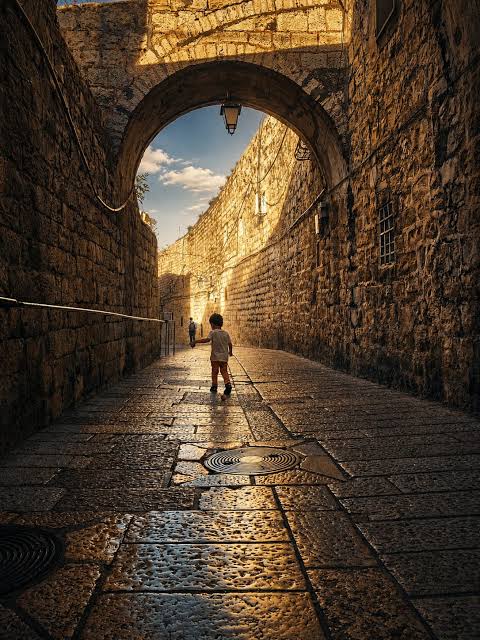
It is here that the book becomes particularly personal. Sarah’s own relationship with Jerusalem has been shaped by motherhood, friendship, faith, separation, loss and the daily challenges of raising three children, including her youngest son, who has special needs. She writes about the beauty, exhaustion, absurdity and occasional loneliness of motherhood, and about the way her son experiences the city through its sounds, textures, rhythms and familiar routines. A street corner, a favourite gate, a repeated phrase or a little hand reaching for hers can become part of what she calls a “sacred geography”.
It is an important shift in perspective. The great historical sites of Jerusalem may attract the attention of the world, but the geography of belonging is often much smaller and more personal. It is made up of places that acquire meaning through repetition, affection and shared experience. The city becomes familiar not because one has mastered its history, but because one has accumulated a thousand small memories within it.
The circumstances that prompted Sarah to write this book give that personal dimension an added poignancy. In June 2026, a gas explosion destroyed her home in the Old City and killed a neighbour. The experience left her confronting the loss of her home, the trauma of the event and the disorienting experience of being displaced from a place with which she had become so intimately connected. Rabbi Menachem Creditor suggested that writing might help her process what had happened. The result became something much larger than an account of personal trauma: a love letter to Jerusalem, to its inhabitants and to the fragile business of being alive.
“I wanted to write about the darkness without allowing it to swallow the light,” she explains. And that is the key to the book’s title. For Sarah, Jerusalem is “God’s backyard”, not because its inhabitants necessarily agree about God – quite the contrary – but because the divine and the ridiculous, the sacred and the profane, the ancient and the ordinary are constantly colliding. The fairy lights are the small moments of beauty and human connection that illuminate the darkness: conversations, friendships, acts of kindness, unexpected generosity and flashes of joy that remind us why life remains worth living, even when the circumstances are difficult.
This a lovely way of viewing Jerusalem, partly because it resists the temptation to turn the city into an abstraction. We tend to encounter Jerusalem through its competing claims, religious significance, political controversies and recurring violence. All of those things matter, of course, and none can simply be wished away. But they are not the whole story. Beneath the headlines there are people getting on with their lives, forming friendships across boundaries, raising families, arguing, laughing, mourning and occasionally discovering that the person they had been taught to regard as an adversary is rather more complicated, generous or human than they had imagined.
Sarah says she is interested in “the ways people connect across differences, and in the moments when someone surprises us by being more complicated, more generous, or more human than we expected.” She adds that Jerusalem has taught her that “multiple truths can exist at once, and listening to someone else doesn’t require surrendering your own.”
That is an important distinction, particularly in a city where almost every historical or political observation can be interpreted as an endorsement of one narrative at the expense of another. Recognising another person’s history does not invalidate your own; acknowledging another community’s attachment to the city does not require you to abandon your own. Jerusalem’s difficulty, and perhaps its enduring fascination, lies partly in the fact that it has held more than one story at once for a very long time. Its inhabitants do not necessarily share the same memories, loyalties, religious convictions or aspirations, but they occupy an extraordinarily intimate and contested physical space.
That does not mean that all claims are equally justified, that competing narratives are immune from historical scrutiny, or that the inequalities and injustices of the present can be dissolved in a warm sentiment about shared humanity. Nor does it mean that the city’s conflicts are simply misunderstandings waiting to be resolved over coffee. Sarah is not offering a political prescription, and readers ought not won’t impose one upon her book. What she offers instead is something perhaps more modest but no less valuable: a reminder that people are more complicated than the categories into which history, politics and sometimes our own prejudices place them.
It is also a reminder that Jerusalem is not exclusively the possession of those who visit its holy places, excavate its ruins, draw its maps or argue over its future. It belongs, in the everyday sense of belonging, to the people who live there, who know its rhythms and eccentricities, who recognise one another in the street and who carry its memories with them when they leave.
I have found myself thinking about all this during our own stay in the Old City. We have wandered its lanes, passed through its gates, crossed between its quarters and watched the ordinary business of life unfold against a backdrop that elsewhere would be regarded as an extraordinary historical and religious landscape. Having spent time with Sarah during our time here, those encounters have added a personal dimension to reading her account. There is something rather appropriate about meeting someone whose writing is so much about the human texture of Jerusalem in the very streets that have shaped it.
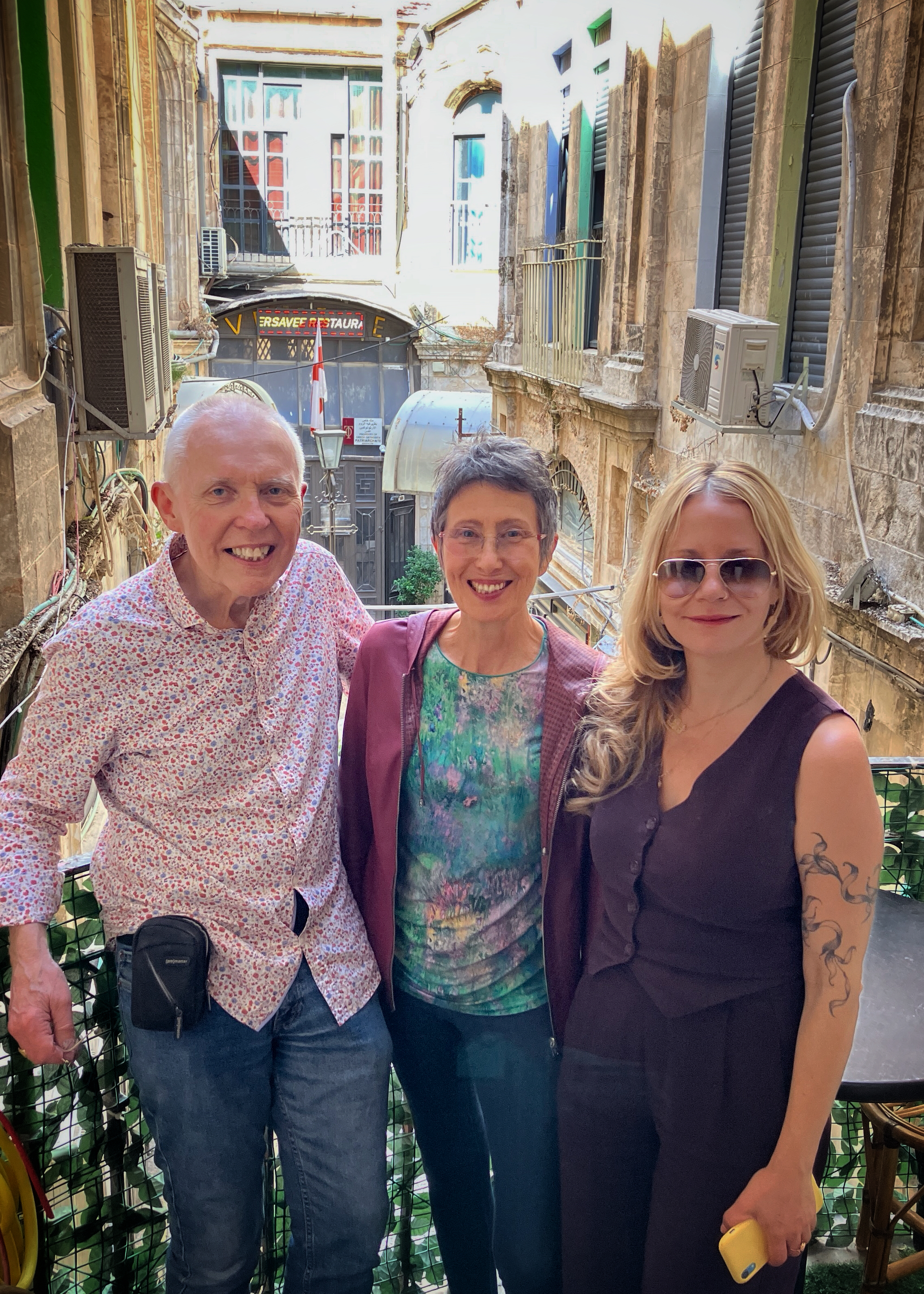
One morning, Sarah took us on something of a magical mystery tour of places that most visitors would probably never find for themselves. It was less a conventional guided walk than an excursion through the city’s hidden histories, eccentricities and unexpected connections.
Our itinerary was wonderfully eclectic. We visited what is reputed to be the oldest tattoo parlour in the Middle East; discovered the best place in Jerusalem to buy – and, importantly, sample – Islay malt whiskies; and called in at a shop run by the son of one of Jerusalem’s most celebrated photographers. We visited a church that Vladimir Putin apparently has ambitions to incorporate into the expanding cultural and political universe of Russki Mir, the Russian World. We explored a remarkable sixteenth-century palace built by a high-born woman of Central Asian origin and subsequently inherited by Suleiman the Magnificent’s blonde Ukrainian consort. Along the way, Sarah explained the curious story behind Jerusalem’s cats, before we came upon a weathered red Royal Mail postbox, complete with its royal crown and the initials GR – a small but wonderfully tangible relic of the days this land was part of the British Empire.
It was Jerusalem in miniature: stories tucked away in the labyrinth of streets and courtyards that make up the Old City. Every doorway seems to conceal another story, every alleyway another historical surprise. And that, is perhaps what Sarah means when she writes that Jerusalem does not behave politely or geographically, but stacks centuries on top of each other and calls it a street.
What made the morning particularly enjoyable was the way Sarah moves between these worlds. She knows the people, the places and the stories, but she also understands that the city is not simply a collection of monuments waiting to be explained to visitors. It is a living neighbourhood, full of personalities, family histories, unexpected friendships and the sort of everyday eccentricities that rarely make it into guidebooks.
And it revealed the spirit of Fairy Lights in God’s Backyard. The magic is not necessarily to be found in the places marked on the tourist map, but in the people and stories encountered along the way. Sometimes all it takes is someone who knows where to look, and is generous enough to show you.
The Old City can be bewildering, sometimes exasperating, occasionally overwhelming, but it is difficult to remain indifferent to it. One moment you are standing beside a wall that has witnessed the passage of empires; the next you are negotiating a narrow alley crowded with residents, merchants, pilgrims and tourists, The sacred and the ridiculous are never very far apart. Sarah understands that, and she writes about it with affection rather than reverence, which is probably the more honest response.
“The city breaks your heart, hands it back to you and somehow convinces you to keep loving it anyway.” I suspect that anyone who has spent much time in Jerusalem will recognise something of themselves in that sentiment. It is a city that can be infuriating, contradictory and emotionally demanding, but which also possesses an extraordinary capacity to surprise and enchant. It does not make loving it particularly easy, and perhaps that is part of the attraction.
Ultimately, Fairy Lights in God’s Backyard is not a book about who owns Jerusalem, who conquered it, whose history takes precedence or which political map will eventually prevail. Those questions are unavoidable, and Sarah’s historical observations remind us that none should be approached without a sense of perspective. But her deeper subject is the experience of belonging to a place that has become inseparable from one’s identity, and of finding reasons to love it even when it has taken something precious away.
Jerusalem has always been built twice, Sarah reminds us, by those who laid its stones and by those who subsequently uncovered and preserved them. I would add that it is also continually being rebuilt in the memories and affections of the people who inhabit it. Every generation leaves something behind: a building, a street name, a religious tradition, a family story, a friendship, a kindness, a grievance or a memory that refuses to disappear. The city absorbs them all, not necessarily reconciling them, but carrying them forward.
Perhaps that is the ultimate lesson of its accumulated history. Empires come and go, political certainties turn into archaeological curiosities, and the maps that once seemed immutable become historical documents themselves. The stones endure, but so do the stories, including those of people whose names will never appear in a history book.
“The sun rises. The moon waxes and wanes”, Sarah writes; and in the Old City, life goes on: a child walking home, a shopkeeper opening his shutters, a neighbour offering a cup of coffee, and people discovering that they have rather more in common than they expected.
The fairy lights are still there, if we remember to look for them.
And perhaps that is why Jerusalem continues to draw us back. It is a city that refuses to be reduced to a single history, a single faith, a single political claim or even a single meaning. It is ancient and contemporary, intimate and unknowable, sacred and profane, beloved and exasperating. It carries the footprints and the fingerprints of generations long vanished while making room, sometimes reluctantly, for those who come next.
History in Jerusalem is thick enough to feel like another person in the room. Perhaps it is the oldest inhabitant of them all. Sarah said that …
Paul Hemphill, Jerusalem, October 2026
Our walkabout with Sarah has inspired Un That Howling Infinite to publish several “small stories”. Here is one of them: Some dope, a small church and a big headache … A Jerusalem story.
For own snapshot of the Old City, see Amazing Grace – there’s magic in the air
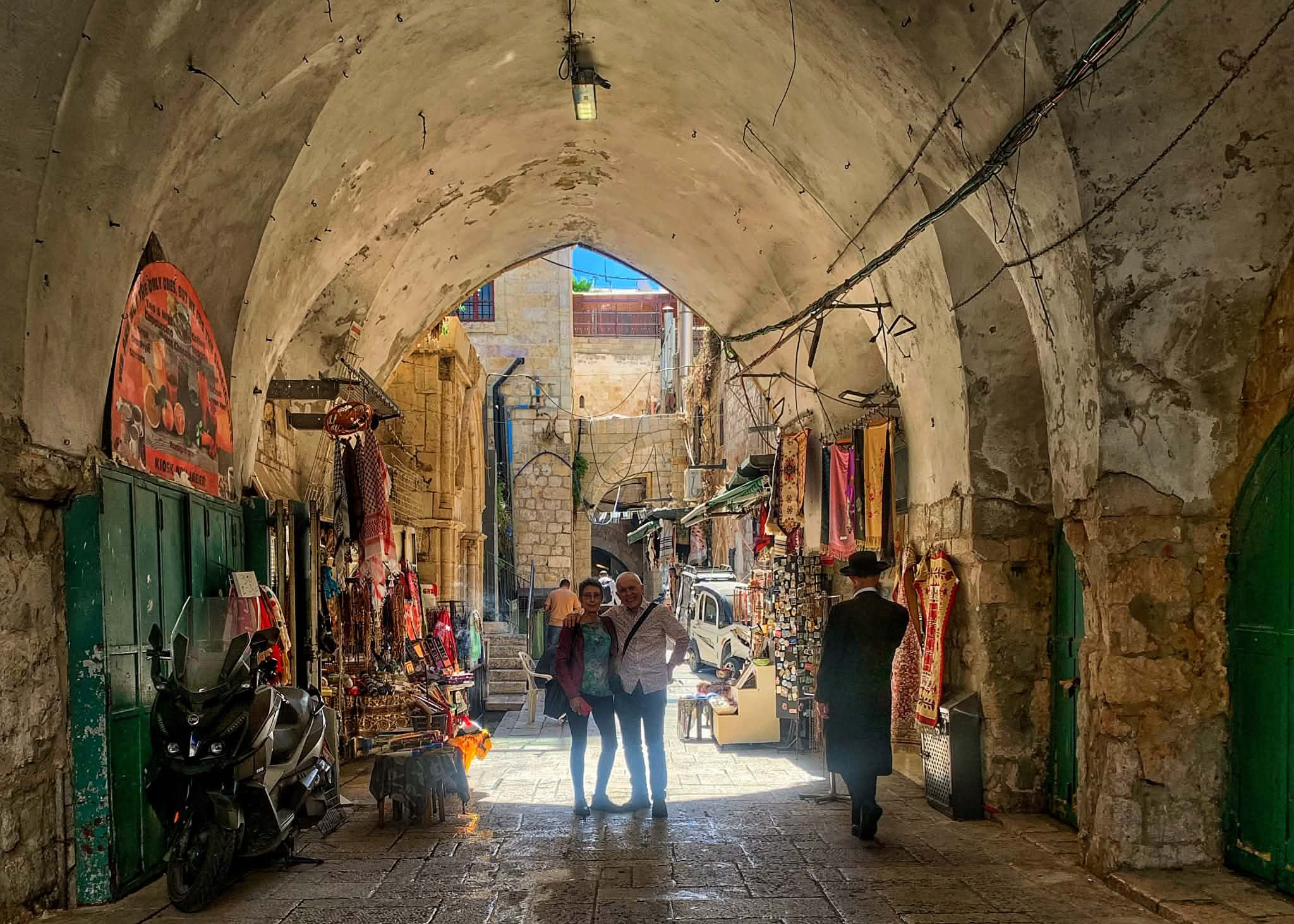
Walkabout with Sarah: Al Wad Street
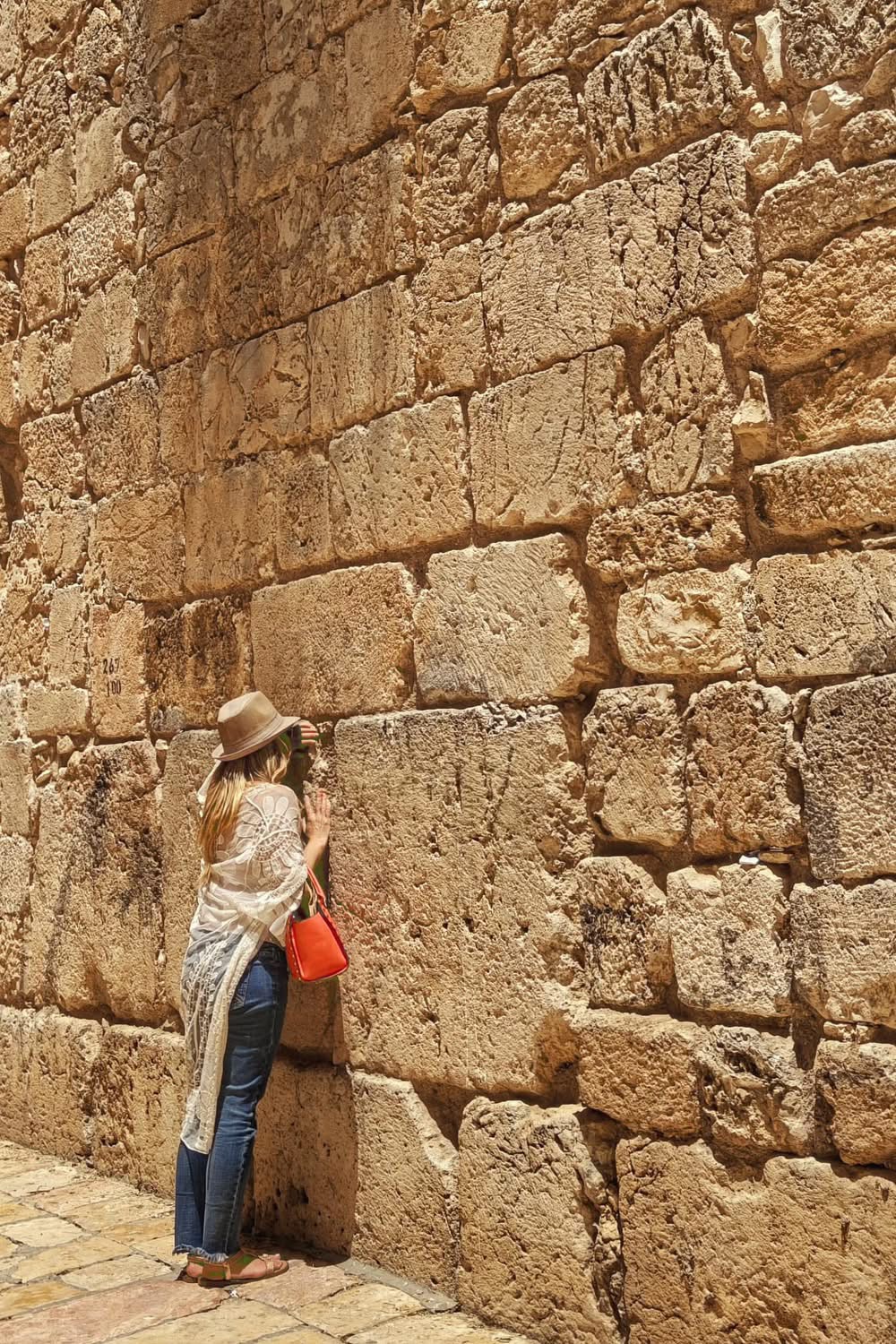
Sarah at the Little Wailing Wall, The Muslim Quarter

