“When we remember Zion” … what’s in a word?

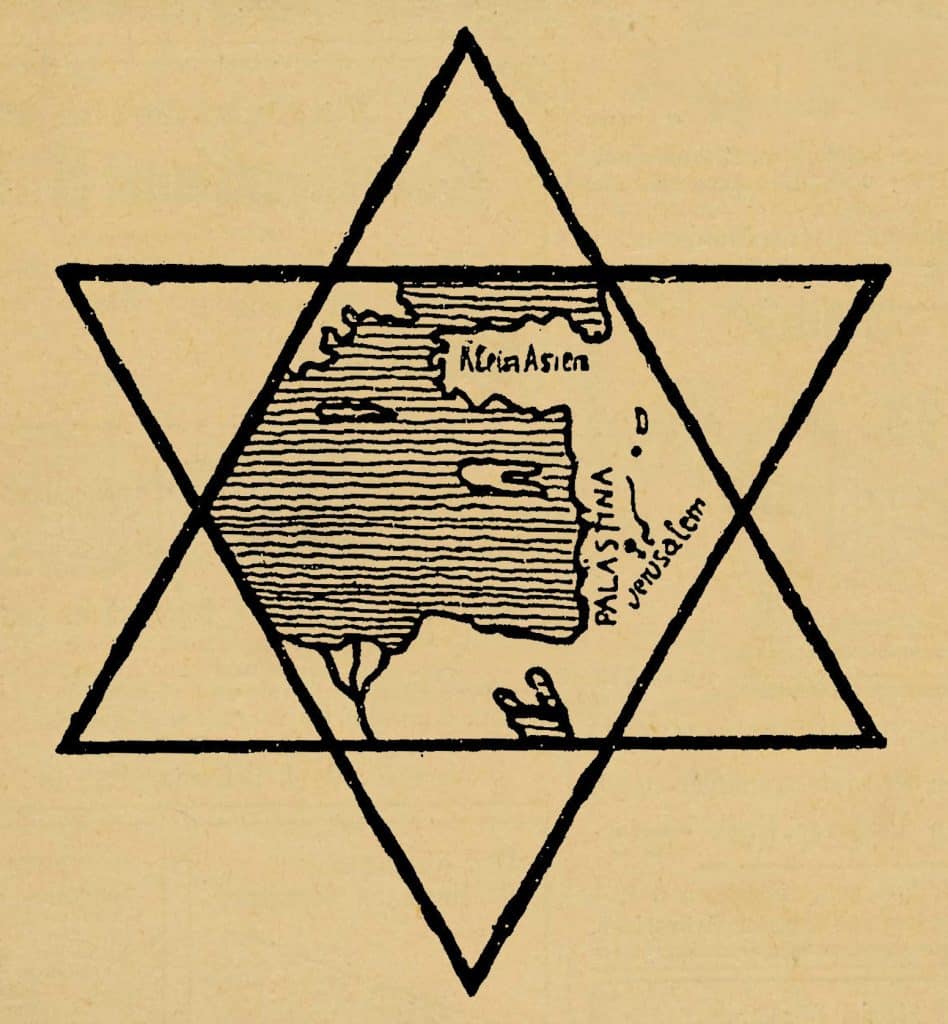
Zionism derives from the Hebrew Tsiyon – Mount Zion in Jerusalem  – and symbolizes the city and the Land of Israel. The term Zionismus was coined in 1890 by Austrian Jewish writer Nathan Birnbaum, replacing “Hovevei Zion” (“Lovers of Zion”). While the Jewish attachment to Zion is ancient, dating at least to the Babylonian Exile, modern Zionism emerged in late-19th-century Europe in response to anti-Semitism and rising nationalism, formalising the aspiration for Jewish return to their ancestral homeland.

We’ve been here before – not in the streets of Melbourne and Sydney with placards and police lines, nor in the corridors of Canberra where commissions are announced – but in language. Always in language.

For months now, perhaps years, In That Howling Infinite has been circling the same contested terrain: Is Israel a settler state or a returning people? Is Palestinian nationalism resistance or rejection? Is apartheid an analytic category or an accusation? Is “from the river to the sea” a geography or a prophecy? We have spent months disentangling words precisely because they matter: settler colonialism, indigeneity, apartheid, return, self-determination. Each carries law, history, trauma, aspiration. Each can illuminate. Each can distort. [See One Land, Two Peoples: History, Memory, Continuity, and Inheritance] and Same old stone, different rock. What’s in a word?]

Now another word –  or rather, an old word under new atmospheric pressure – demands the same care: “Zionist.”

Once a self-description, a term of late-Ottoman and Mandate-era political theory, shorthand for Jewish national revival; now increasingly an epithet, flung with the casual certainty of moral indictment.

Before we continue, let us make clear that the following essay is not an attempt to rehearse the full intellectual or political history of Zionism – its nineteenth-century European origins, its varieties (labor, revisionist, religious), its entanglement with empire and nationalism, its debates over diaspora and return. Those accounts are readily available elsewhere, in libraries,  lecture halls, and  the howling internet. Nor is it an exercise in catechism, for Zionism has never commanded universal assent among Jews; from Bundists to ultra-Orthodox anti-Zionists, from liberal diasporists to post-Zionist critics within Israel itself, and among Israelis and Jews today (whom many critics of Israel and its government push to the forefront of their cause as if to demonstrate its righteousness). Jewish history and contemporary politics contains vigorous dissent from the Zionist project. Rather, what concerns us here is a narrower and more combustible phenomenon: the contemporary habit of framing Zionism not simply as mistaken or unjust, but as morally equivalent to Nazism – and the accompanying charge that Jews, through the state that claims to represent their national aspirations, are now committing genocide. It is this rhetorical escalation, and the moral confusion it both expresses and produces, that demands examination.

The escalation and confusion was evident well before October 7 2023. On streets and social media, in university classrooms and in day-to-day conversations, on placards, in memes, sprayed in graffiti, the connection between Israel and the Third Reich was being turbocharged. Zionism was no longer merely criticised; it was Nazified. Israeli policy was not compared to other nationalisms; it was collapsed into World War II. The swastika, once the emblem of genocidal antisemitism, reappeared as rhetorical prop, pasted onto flags and caricatures, deployed for shock and applause.

This escalation did not need Al Aqsa Flood and the war it precipitated to ignite it;  merely intensified what had already been normalised. The analogy, once fringe, had drifted toward the mainstream of protest culture. And it matters –  not only as prejudice, though that is present, but as a symptom of rage, symbolic power, and the moral weight the Holocaust carries in public imagination. Nazism has become shorthand for illegitimacy; to affix it to Israel is an attempt to delegitimise the state’s moral right to exist.

In an article published in the Sydney Morning Herald on 14 February, appropriately, on Saint Valentine’s Day, Jewish campaigner Danny Berkovic argues that the word has become a socially acceptable proxy for “Jew.” He begins with protests during President Isaac Herzog’s visit to Australia, where “Zionists” were denounced as malign actors and Zionism was equated with Nazism. In private, he recounts being asked whether he was paid by Israel – the old dual-loyalty trope reissued with updated stationery. When he pressed his interlocutor – should Israel exist? should it exist as a Jewish state with equal rights? – the answer was yes to both. By his definition, that made the accuser a Zionist.

Yet the word was being used as moral condemnation. The definitional battle begins there.

Berkovic offers a deliberately minimalist account. Zionism, he says, is the belief that the Jewish people have the right to self-determination in their ancestral homeland; that Israel should exist as a Jewish state; that such existence is compatible with equal citizenship for Jews, Christians, Muslims and others. It does not prescribe borders. It does not require annexation. It does not mandate support for any government. It does not preclude criticism. It is a national movement – broad, internally diverse.

On that definition, most Jews worldwide qualify. The overwhelming majority identify in some fashion with Israel’s continued existence. And so when “Zionist” is spat as a term of inherent evil – supremacist, genocidal, morally bankrupt — it does not land as abstract critique. It lands collectively. The elasticity of the word allows hostility to be expressed while retaining plausible deniability. One need not say “Jew.” One says “Zionist.”

There is truth here.  Victor Klemperer, diarist of the Third Reich, writing in the shadow of a regime that turned vocabulary into vapour and vapour into poison, warned that words can act like arsenic. Not dramatic at first. Not even noticeable. They accumulate. They settle into the bloodstream of public life. They alter what can be said – and what can be thought. Respectable language can metabolise contempt.

Nowadays, while openly targeting Jews is socially taboo; “Zionist” can provide semantic cover. Equating Zionism with Nazism is not policy analysis; it is moral theatre. Suggesting hidden financial allegiance is not debate; it is inheritance from darker grammars.

But the story does not end with etymology.

Because when critics use the term pejoratively, they are often responding not to 19th century ideologue Theodore Herzl’s pamphlet but to rightwing Israeli politician Bezalel Smotrich’s expansionist programme. The definitional struggle is not purely semantic; it is a contest over which Zionism is politically operative – and therefore morally accountable.

Zionism has never been monolithic. Herzl’s liberal nationalism, seeking refuge and recognition among nations, is not Mandate-era Revisionist Ze’ev Jabotinsky’s iron wall. Cultural Zionism is not religious messianism. Labour Zionism, draining swamps and building institutions, is not identical to today’s annexationist maximalism. Religious Zionism grafted messianic longing onto modern sovereignty. These strands coexisted uneasily, sometimes violently.

Today, some of the most visible exponents of Zionism in power advocate annexation of the West Bank, legal differentiation between populations, and a theology-inflected claim to the whole land. They call themselves Zionists. Their critics do not invent the association; they encounter it on ministerial letterhead.

So when a protester condemns “Zionists,” the referent in their mind may not be Jewish self-determination in principle, but settlement expansion, permanent occupation, the rhetoric of “from the river to the sea” in reverse –  the Greater Israel mirror-image of Palestinian maximalism. To pretend these associations are conjured ex nihilo is disingenuous.

Yet to collapse all Zionism into that current is equally disingenuous.

Here the symmetry becomes uncomfortable. Just as “Zionist” can be weaponised to mean “Jew,” “anti-Zionist” can be weaponised to mean “antisemite,” foreclosing argument before it begins. Language slides in both directions. Each side accuses the other of bad faith; sometimes each is correct.

There are further complications. 1948 is not a footnote. For Jews, it is independence wrested from catastrophe that was the Shoah; for Palestinians, it is al Nakba, literally “catastrophe”, defeat and dispossession. Zionism is not only an abstract right but a historical event –  with winners, losers, and descendants who inherit both triumph and grievance. To define it purely as self-determination is to abstract it from its consequences. To define it purely as dispossession is to erase the catastrophe from which it arose.

The phrase “Jewish state” itself contains layers. A demographic majority? A Law of Return privileging Jewish immigration? National symbols and calendar? A civic democracy with Jewish cultural character but equal citizenship? Zionists disagree among themselves. So do critics. These are arguments about the nature of nation-states in a post-imperial world – arguments not confined to Israel. They are not, in themselves, antisemitic. But good faith requires precision.

If one believes Jewish collective self-determination is uniquely illegitimate – that Israel should not exist in any form as a Jewish polity – one must reckon with how that position will be heard by Jews shaped by statelessness and genocide. If one believes Israel should exist but its current government is reckless or unjust, then “Zionist” is an inadequate synonym for critique. If one believes Zionism’s realisation has entrenched unjust domination, that critique must be articulated without collapsing into collective vilification. And if one believes Jews as a group are morally bankrupt, no semantic pirouette will disguise the prejudice.

We have often warned of mirrored absolutes – annexationist dreams on one side, eradicationist chants on the other. “From the river to the sea” answered by “Judea and Samaria forever”, which envisages an Israel from that sane river to the sea. Each imagines exclusivity; each erases the other. The danger is not solidarity per se; it is the surrender of moral complexity.

In the wake of October 7 2023 and its aftermath, a hardening has taken hold across parts of the West: a rediscovery –  sometimes embarrassed, sometimes defiant – of solidarity with Israel. The term “Zio,” once flung as an epithet in online polemic, has been reclaimed half-seriously, half-sardonically. If the mere assertion of Israel’s right to exist now qualifies one as a zealot, then so be it. But if Zionism becomes a reactive identity badge – tribal solidarity in the face of hostility – it grows thinner than its history.

Historically, it was a spectrum: cultural revival, agricultural collectivism, diplomatic manoeuvre, spiritual longing, armed struggle, parliamentary debate. Palestinian nationalism, too, emerged from late-Ottoman modernity into Mandate uncertainty and war –  not reducible to Hamas, but spanning civic pluralism and Islamist absolutism alike. Both peoples carry aspiration and fear; both narratives are real; neither is complete alone.

Words change their weather. “Zionist” now carries heat – from hatred, from anger at power, from grief, from defiance, from genuine moral outrage at war and occupation. It can be weapon. It can be shield. It can be identity. It can be accusation.

The task is not to pretend the word is pristine, nor to concede it entirely to abuse, but to insist on distinctions.

Zionism is both refuge and sovereignty. It is both survival and statecraft. It contains Tel Aviv’s liberal dissent and Hebron’s fervour; Herzl’s diplomacy and the settler’s certainty. It is Aliyah and, in tragic counterpoint, Al-A’uda –  two grammars of return spoken over the same soil. It is refuge after Auschwitz and control over al Aqsa. It is a flag raised over independence, a checkpoint on a road, and a wall bisecting the land. Sovereignty is never morally weightless.

To deny Zionism’s pluralism is to falsify it; to deny its entanglement with power is to romanticise it.

History suggests that when words are repurposed to disguise prejudice, the damage rarely stops with words. History also suggests that when words are simplified to shield power from scrutiny, resentment ferments. If “Zionist” becomes a safe word for hate, something corrosive takes root. If it becomes a talisman against scrutiny, something else corrodes.

Between those distortions lies a narrower path –  unsatisfying to partisans, necessary for anyone who believes complexity is not weakness – where language is neither weapon nor alibi, but instrument.

The land remains small. The history immense. The language – elusive, illusive – continues to do its quiet work.

Perhaps our work is to be able to speak about Jewish and Palestinian self-determination without collapsing one into caricature and the other into sanctimony. Whether we can hold two national stories – each ancient, each wounded – without converting either into absolution.

The struggle, in the end, is not over a word alone. It is over whether we are willing to let it mean more than our anger requires.

Afterword

There is a moment when any extended discussion of Israel or Zionism tips into the gravitational pull that American attorney Mike Godwin formulated in 1990 as “Godwin’s Law”: that as an online discussion lengthens, there is a high probability of a comparison to Nazis or Hitler. Conceived, in part, to curb the trivialisation of the Holocaust in the unruly early days of internet debate, the maxim has since migrated into broader political discourse, where the invocation of Hitler often signals not illumination but exhaustion – the moment when analogy replaces analysis and moral thunder substitutes for evidence. It is frequently deployed to suggest that the person reaching for the Nazi comparison has, rhetorically at least, “lost” the argument. Yet Godwin himself cautioned that the law is descriptive, not absolute. It does not predict that every exchange will end in such hyperbole, only that, as tempers fray, the temptation becomes statistically likely. Nor did he deny that some comparisons to fascism may be warranted when describing genuinely fascistic behaviour. In a debate as charged as that surrounding Zionism – where accusations of apartheid, colonialism, ethnic cleansing, and even Nazism circulate with reckless ease – Godwin’s insight serves less as a gag rule than as a warning: once the Holocaust is instrumentalised as metaphor, the space for proportion, history, and moral seriousness contracts accordingly.

This essay was written in conversation with an AI language model, which contributed to drafting, and phrasing.

See also in In That Howling Infinite, A Political World – Thoughts and Themes, and A Middle East Miscellany. and also: This Is What It Looks Like“You want it darker?” … Gaza and the devil that never went away …How the jihadi tail wags the leftist dog, The Shoah and America’s Shame – Ken Burns’ sorrowful masterpiece, and Little Sir Hugh – Old England’s Jewish Question

Read on for Berkovic’s article, and an explainer” in bullet points of the many meanings and interpretations of Zionism.

Zionism – definitions, claims, and contested meanings

In Berkovic’s minimalist framing, Zionism is:

• The belief that the Jewish people constitute a nation entitled to self-determination.
• Rooted in Jewish historical, cultural, and ancestral connection to the land of Israel.
• The view that Israel should exist as a Jewish state.
• Compatible, in principle, with equal civil and political rights for non-Jewish citizens.
• Not inherently tied to:
• Specific borders.
• Settlement expansion.
• Annexation of the West Bank.
• Opposition to a two-state solution.
• Support for any particular Israeli government.
• Compatible with criticism of Israeli policy comparable to criticism directed at other states.

In historical reality, however, Zionism has also been:

• A late-19th and early-20th century nationalist movement emerging from European antisemitism, Ottoman decline, and modern political thought.
• A spectrum of ideological strands, including:
• Liberal political Zionism (Herzl).
• Cultural Zionism (Ahad Ha’am).
• Labour/socialist Zionism (Ben-Gurion, kibbutz movement).
• Revisionist Zionism (Jabotinsky’s “iron wall”).
• Religious Zionism (messianic and covenantal interpretations of sovereignty).
• A movement inseparable in practice from land acquisition, demographic change, and eventually state formation.
• Experienced by Jews primarily as refuge, survival, and national restoration.
• Experienced by Palestinians primarily as dispossession (Nakba) and the beginning of an enduring conflict over sovereignty and land⸻

In contemporary politics, “Zionism” can function as:

• A baseline affirmation of Israel’s legitimacy as a Jewish state.
• A broad umbrella identity encompassing Israelis and diaspora Jews across the political spectrum — including fierce critics of Israeli governments.
• A label claimed by religious-nationalist and annexationist actors advocating permanent control over the West Bank.
• A reactive identity marker in the wake of October 7 — reclaimed by some who feel that even acknowledging Israel’s right to exist now invites condemnation

In contemporary polemic, “Zionist” is sometimes used as:

• A synonym for “Jew,” allowing hostility toward Jews to be expressed with plausible deniability.
• A catch-all villain category, attributing collective moral corruption rather than critiquing specific policies.
• A shorthand not for Herzl’s theory of Jewish self-determination, but for the policies of the current Israeli government or the most hard-line currents within it.

Key tensions in the definitional struggle:

• The battle is not merely semantic but political: which Zionism is operative — Herzl’s refuge, Labour’s state-building, or Smotrich’s annexationism?
• Anti-Zionism can range from policy critique to categorical rejection of Jewish self-determination; its moral meaning depends on which of these is intended.
• Equating all Zionism with supremacism erases its plural history.
• Equating all anti-Zionism with antisemitism forecloses legitimate debate about power, occupation, and equality.
• The phrase “Jewish state” itself is contested: demographic majority, civic nation with Jewish character, ethnonational preference, or religious polity?

The core unresolved duality:

• Zionism is both refuge and sovereignty.
• It is both survival after statelessness and the exercise of state power.
• It is experienced as national liberation by one people and as national catastrophe by another.

Any serious discussion must hold those tensions without collapsing them into slogan or slur.

How ‘Zionist’ became a safe word for hate

Sydney Morning Herald, February 14, 2026

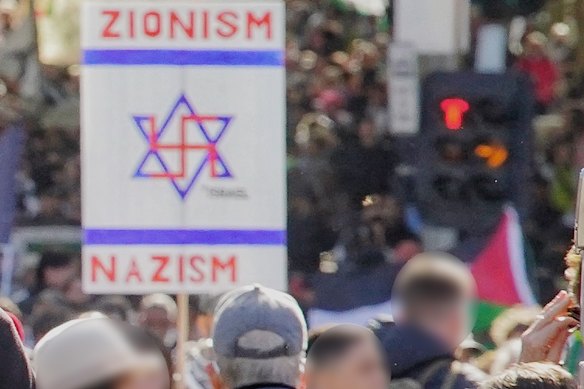
At protests against Israeli President Isaac Herzog’s visit to Australia, some demonstrators directed their anger not only at Israel’s policies but at “Zionists” themselves – accusing them of malign influence in the media and government. At other recent rallies, Zionism has been equated to Nazism and terrorism.

A sign juxtaposing Zionism and Nazism is displayed at a pro-Palestinian rally last May in Melbourne.
A sign juxtaposing Zionism and Nazism is displayed at a pro-Palestinian rally last May in Melbourne. LUIS ENRIQUE ASCUI

Victor Klemperer, a Jewish academic who survived Nazi Germany, warned that words can act like tiny doses of arsenic – swallowed unnoticed, accumulating slowly, until their poison takes hold. His insight was not about shouted slogans, but about respectable language that can normalise contempt. “Zionist” has entered this territory over the past two years.

In the wake of the Bondi attack, I was involved in a public campaign for a federal royal commission into antisemitism. My role prompted a message from someone I have known for more than 20 years. Had I been paid by Israel for my advocacy, he asked. It was an offensive question. The answer was no.

What followed was more revealing. “Zionists have always been morally bankrupt with a superiority complex,” he told me.

I asked him two simple questions. Did he believe the state of Israel should continue to exist? Yes. Did he believe it should exist as a Jewish state, provided Jews, Christians, Muslims and others were given equal rights? Yes.

By the standard definition, he qualified as a Zionist. He either did not understand the term – or he was deliberately repurposing it.

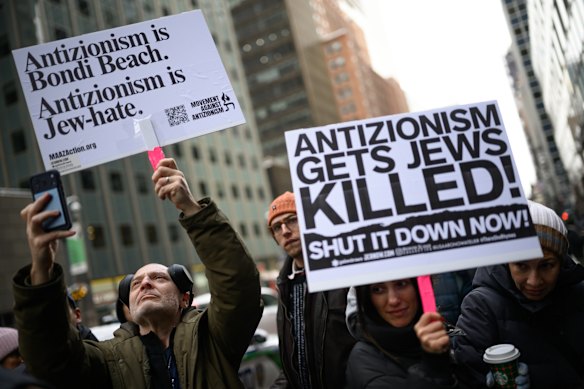
People hold signs at a vigil outside the Australian consulate in New York City after the Bondi massacre.
People hold signs at a vigil outside the Australian consulate in New York City after the Bondi massacre.GETTY IMAGES

That exchange mattered not because it was especially aggressive, but because it was ordinary. It was delivered calmly, with moral certainty, and without any sense of contradiction. It revealed something that has become increasingly common: the use of the word “Zionist” not to describe a belief, but to impugn a target.

Zionism, properly understood, is not complicated. It is the belief that the Jewish people have the right to self-determination in their ancestral homeland. In practical terms, it is the idea that Israel should exist as a Jewish state. In Australia, Zionism has long been openly supported by mainstream leaders from across the political spectrum as a legitimate expression of Jewish self-determination.


Zionism does not dictate borders. It does not prescribe military policy. It does not require allegiance to any government, leader or political party. It does not exclude any race or religion from Israeli citizenship. It does not preclude criticism of Israel and nor does it demand support for all actions taken by the Israeli state. Expansionism is not intrinsic to it, and nor does it require opposition to a two-state solution. To be clear, criticism of Israel that is similar to that levelled against any other country cannot be regarded as antisemitic.

Like any national movement, Zionism contains a wide spectrum of political views. Many Zionists oppose Israel’s current government. Many Israelis have protested against it for years. Some of the fiercest critics of Israeli policy are Israeli citizens, who nonetheless consider themselves proudly Zionist.

This clarity matters because once a word’s meaning is hijacked, it becomes available for misuse – or abuse.

In recent years, “Zionist” has increasingly been deployed as an insult. The term Zionist is no longer used to identify an idea, but it is spat to assign blame. “Zionists” are held responsible for a wide range of evils, often without definition or limitation. In many instances, “Zionist” is used synonymously with “Jew”, while maintaining just enough ambiguity to deny that Jews are being targeted at all. So why does this substitution occur?

Because openly targeting Jews is no longer socially acceptable. “Zionist” becomes the workaround – broad enough to encompass most Jews, yet elastic enough to provide moral cover. It allows hostility to be expressed while preserving plausible deniability.

We are repeatedly told that hostility toward “Zionists” is merely political critique. But if that were true, the criticism would be of policy. Instead, “Zionists” are accused of supremacy, immorality, or inherent evil. That is not political criticism. It is collective character assassination.

This matters because Zionism is not an abstract ideology for most Jews. It is bound up with history, vulnerability and survival. For many Jews – including those deeply critical of Israel – Zionism represents the belief that Jews should not again be stateless, dependent on the goodwill of others for protection. To insist that “anti-Zionism has nothing to do with Jews” while knowing that the overwhelming majority of Jews identify in some way with Zionism is disingenuous.

At best, it ignores how the word is actually used. At worst, the ambiguity is used intentionally as cover. This is why the definitional battle matters. Hijacking the meaning of Zionism allows hatred to masquerade as politics. The federal royal commission into antisemitism must grapple with these subtleties if it is to understand Jew hatred in Australia.

Existing legal frameworks are poorly equipped to deal with language that is technically deniable yet socially corrosive. They miss the cumulative effect of rhetoric that repeatedly singles out a group under a different name.

If the commission is to be meaningful, it must confront this linguistic sleight of hand directly. It must be willing to ask whether “Zionist” has become a socially acceptable stand-in for “Jew” – a way to legitimise hostility while denying responsibility for its impact. Because when words are repurposed to disguise prejudice, history suggests the damage rarely stops with words.

Danny Berkovic is a Sydney businessman and an organiser of the bondiresponse.com petition, which pushed the Albanese government to announce a royal commission into antisemitism.


One Land, Two Peoples: History, Memory, Continuity, and Inheritance

It’s the Land, it is our wisdom
It’s the Land, it shines us through
It’s the Land, it feeds our children
It’s the Land, you cannot own the Land
The Land owns you
Dougie McLean, Solid Ground

This is a story about the land – and the people who have reside thereupon.

Scottish folksinger Dougie McLean’s verse captures exactly its ethos: of the land as relational, ancestral, and moral; of belonging as stewardship rather than conquest; of identity entwined with place rather than imposed upon it. “You cannot own the Land – the Land owns you” resonates with what we are about to write about overlapping inheritances, continuity, and indigeneity. The verse gives us a lyrical bearing: it allows us to frame Jewish and Palestinian attachment to the land not as a contest of exclusive ownership, but as overlapping, reciprocal, and living relationships. It legitimises the presence of both without forcing a zero-sum moral calculus.

Forward: the Myth of Fingerprints

Watching the coverage of the Gaza war –  in mainstream commentary, on social media, in slogans chanted half a world away –  In That Howling Infinite was struck less by passion than by historical amnesia. Dates collapsed into each other. 1948 was invoked without 1917. 1967 without 1948. 2023 without Ottoman decline, Mandate ambiguity, imperial cartography, demographic upheaval. Archaeology was dismissed as propaganda; genealogy as myth; continuity as invention. A century was compressed into a headline; millennia into a meme.

We prefer our tragedies forensic.

Modern political culture trains us to search for a single print on the glass –  the moment, the document, the leader, the decision that explains everything. We want the smudge that proves who began it, who bears the primal guilt, who stands at the origin of the wound. A history with fingerprints is reassuring. It suggests that if only one actor had behaved differently – one declaration withheld, one militia restrained, one settlement not built, one massacre not committed – the catastrophe might have been avoided.

But the history of Israel and Palestine does not yield to forensic neatness.

There is no solitary fingerprint pressed into this soil. Not Balfour’s, nor Lloyd George’s. Not Haj Amin al-Husseini’s, nor Ben-Gurion’s. Not Nasser’s, not Arafat’s, not Sharon’s, not Netanyahu’s, not Hamas’s. No single impression explains the pattern. The land bears instead a dense overlay of smudged prints: empire and partition, fear and ambition, miscalculation and opportunism, exile and return, massacre and reprisal, daring and folly. Each generation has added its own layer. Each act has generated reaction; each reaction has hardened into structure; each structure has constrained the next set of choices.

The myth of fingerprints flatters our appetite for moral certainty. It allows us to say: there — that was the sin; there –  that is the villain. It relieves us of complexity. It permits outrage without introspection. It offers altitude without clarity.

Yet this conflict is cumulative. The Nakba did not occur in a vacuum. Nor did the wars that followed. Nor did the Occupation arise ex nihilo. Nor did Palestinian rejectionism or Israeli settlement expansion spring from pure malice detached from context. Nor did October 7 erupt without genealogy –  however indefensible its brutality, however catastrophic its consequences. Each event is entangled with what preceded it and what followed after. Violence here is not a fingerprint; it is a palimpsest.

To say this is not to dissolve accountability. It is to resist reductionism. It is to refuse the consolations of moral monoculture – the narrowing of empathy into a single authorised grief, the shaping of facts to fit feelings, the retreat into what I have elsewhere called the box canyon of certainty. Intellectual honesty demands a more difficult posture: to hold multiple truths in tension without collapsing them into equivalence.

This land — like any homeland, like any “country” in the deeper sense First Nations Australians use the word –  holds layered attachment. It holds Jewish longing and Palestinian dispossession; British imperial design and Arab nationalist pride; secular aspiration and religious revival; survival strategy and ideological fervour. None alone explains the whole. Together they form the sediment of a century.

If this essay resists simple answers, it is because the land itself resists them. What follows is not an argument for neutrality, nor a plea for bloodless detachment. It is an attempt to describe historical continuity in a place where memory is weaponised and identity compressed into accusation. It is written in the hope – perhaps naïve, perhaps stubborn –  that understanding genealogy, archaeology, chronology, and context might slow the reflex to eliminate rather than to comprehend.

There are no clean fingerprints here. Only accumulated traces.

And the work begins by learning to see them all.
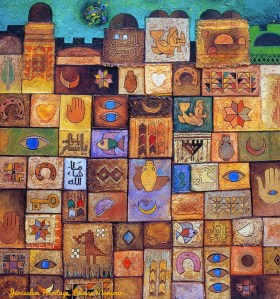
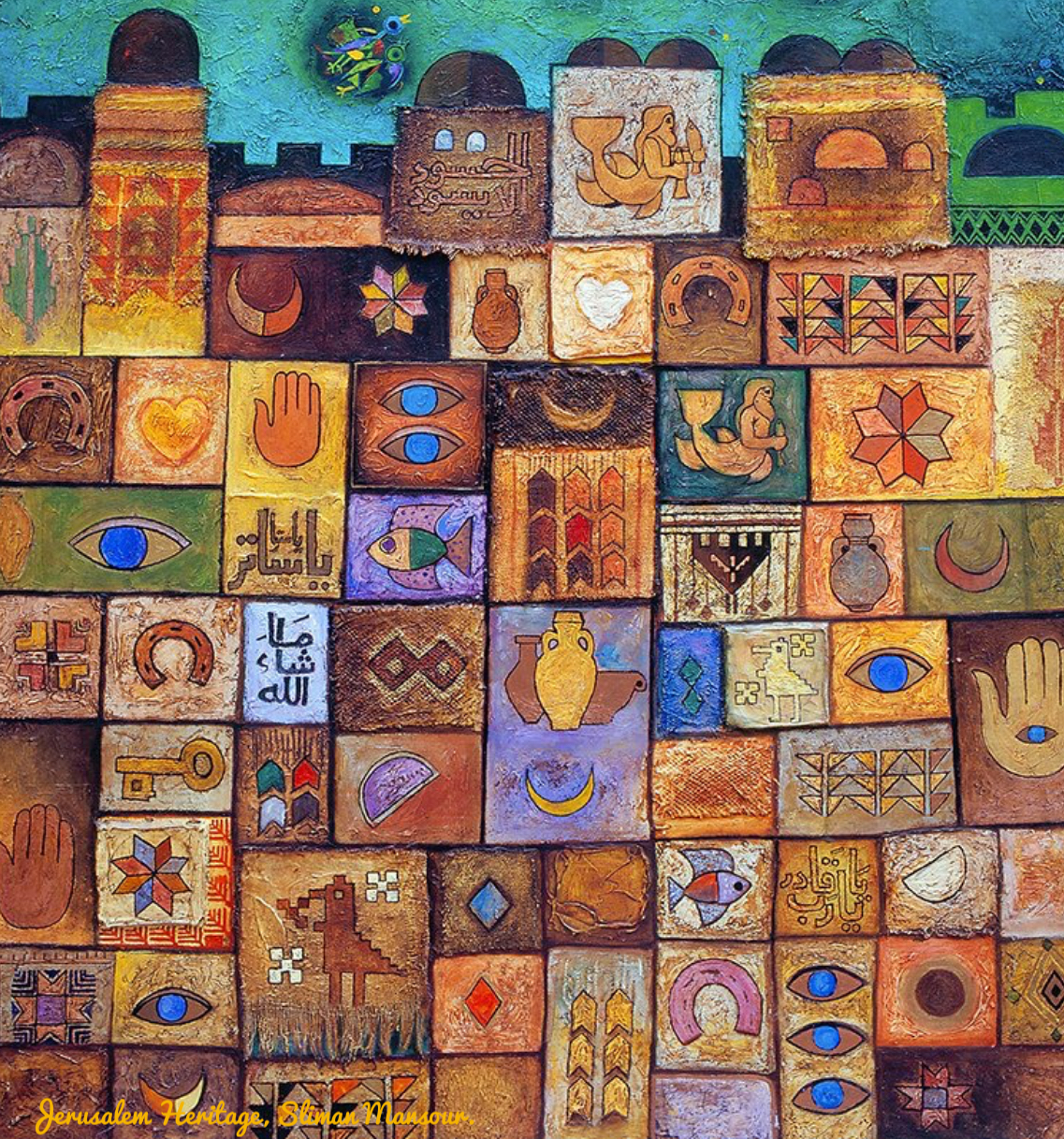
Embrace the Middle East, Sliman Mansour

Before you begin …

There is a temptation, with this land, to search for fingerprints. To press the soil for a single impression and declare: “Here  –  here is where it began. Here is the trespass. Here is the theft. Here is the wound from which every other wound must have  flowed”. But the ground does not yield so easily. It holds not one print, but many, layered and half-erased – footsteps crossing footsteps, prayers rising from ruins, stones reused and renamed. It is less a crime scene than a palimpsest: written, scraped back, written again though the old script never fully disappears.

This essay begins there. It moves slowly, because the history moves slowly. Jewish civilisation is not incidental to this terrain; it was formed there, fractured there, remembered there in exile for two millennia through liturgy and law and longing. Nor are Palestinians latecomers to their own homes; their belonging is carried in olive groves and family deeds, in village names, in the memory of 1948 spoken not as theory but as rupture.

Two continuities. Uneven in power, different in structure, but real.

Modern nationalism – that restless 19th- and 20th-century force – took older forms of attachment and hardened them into programs. Zionism emerged from European peril and Jewish memory; Palestinian nationalism emerged from Ottoman dissolution and local rootedness. Empire intervened. War intervened. Fear intervened. What might once have overlapped became mutually exclusive.

The language we now reach for –  settler colonialism, indigeneity, apartheid – illuminates some contours and obscures others. These frameworks explain structures of domination, especially in the territories occupied since 1967. Yet they often falter before the stubborn fact of Jewish historical continuity. When analysis becomes catechism, history flattens; complexity is treated as betrayal.

At the centre of the essay stand two words that mirror each other across the decades: Aliyah and al-‘Awda. Return and return. Ascent and homecoming. One largely realised in the sovereignty of a state; the other deferred, carried as al Muftah, the key, and inheritance. These are not merely political claims. They are existential longings. Each fears that recognising the other threatens its own legitimacy. Each is haunted by absence.

And then there is the present –  October 7 2023, and the devastating war that it precipitated, and the shattering of whatever fragile equilibrium once existed. Trauma does not cancel trauma; it compounds it. Israeli politics hardens toward security and annexationist imagination. Palestinian politics fragments, with religion filling the vacuum left by exhausted secular promises. The two-state solution lingers like a map no longer consulted but not yet discarded.

This is not a plea for neutrality. Nor is it a ritual balancing of grief. Power asymmetries are real. Civilian suffering is real. So too is the danger of moral monoculture –  the insistence that only one story counts, only one inheritance is authentic, only one people may speak in the language of belonging.

The land between the river and the sea has never held a single narrative. It carries more than one continuity, more than one exile, more than one claim to home. Any future worth imagining must begin by resisting erasure — of Jews, of Palestinians, of history itself.

If the essay asks anything of the reader, it is patience. A willingness to sit with more than one truth at once. A willingness to see that complexity is not evasion but reality.

The soil remembers more than we do. Are we prepared to remember with it?

Why we have written this story

This long essay was born less out of certainty than unease.

In the months following October 7 2023 and the Gaza war that followed, lasting two years and yet unresolved, we found ourselves increasingly disheartened – not only by the violence itself, but by the impoverished historical literacy that now dominates much of the public conversation. In mainstream commentary and across social media, Israel–Palestine is routinely reduced to slogans, memes, and moral shortcuts: 1948 as original sin, or 1967 as sole reference point, or 2023 as rupture unmoored from everything that came before. The deeper history – the Ottoman centuries, the layered genealogies, the archaeology underfoot, the long coexistence and long frictions of peoples and faiths – is treated as dispensable, even suspect. Ignorance is worn as conviction.

This narrowing of historical vision has consequences. It breeds existentialist and eliminationist rhetoric on all sides: claims that one people is fabricated, the other uniquely criminal; that history itself can be annulled by denunciation. It flattens complex inheritances into moral caricature, and in doing so accelerates a global coarsening of discourse – one that has travelled far beyond the region, seeding division, hatred, and a hardening of hearts across societies that once imagined themselves distant observers.

Our purpose here is modest but insistent. We want to describe, as clearly and simply as possible, the historical continuity of both Israel and Palestine: how peoples persist, inherit, adapt, and remain attached to land across conquest, conversion, exile, and return. I want to show that the land has never been empty, never singular, never owned by one story alone. And I want to counter the moral monoculture that insists this conflict can be understood, let alone solved through absolutes.

This essay does not argue for innocence. It argues against erasure. It is not an argument against passion, nor a plea for bloodless neutrality. It is written in resistance to the idea that complexity is a form of evasion, or that empathy is betrayal. If it insists on anything, it is that history matters – and that without it, moral seriousness quickly curdles into moral certainty, and certainty into something far more dangerous. A lot of  intellectual labour is required to stand on what we like to call the high ground without mistaking altitude for clarity.

As for the position of In That Howling Infinite on Israel, Palestine, and the Gaza war, it is neither declarative nor devotional; it is diagnostic. Inclined – by background, training, temperament, and long engagement with the region – to hold multiple truths in tension, it seeks to see, as the song has it, the whole of the moon. It is less interested in purity than in resisting moral monoculture and the consolations of unanimity. That stance does not claim wisdom. It claims only a refusal to outsource judgment, and a suspicion of movements that confuse volume with truth.

On Zionism, this essay treats it not as a slogan but as a historical fact with moral weight: the assertion – hard-won, contingent, flawed – that Jews are entitled to collective political existence on the same terms as other peoples. In this limited but essential sense, this blog is Zionist. It does not sanctify Israeli policy, excuse occupation, or romanticise state power. But it rejects the sleight of hand by which Israel’s existence is transformed from a political reality into a metaphysical crime – an expectation uniquely imposed upon Jews, and demanded of no other nation: justification for being.

On anti-Zionism, it is unsparing. Not because criticism of Israel is illegitimate – on the contrary, it is necessary – but because anti-Zionism increasingly operates as a categorical refusal to accept Jewish collective self-determination at all. What troubles us most is not its anger, but its certainty: its indifference to history, its appetite for erasure, its readiness to recycle older antisemitic patterns – collective guilt, inversion of victimhood, the portrayal of Jews as uniquely malignant actors – while insisting, with studied innocence, that Jews are not the subject. If not always antisemitism outright, the line separating the two is wafer-thin, and too often crossed.

At the same time, this essay is deeply critical of Israeli power: of occupation, settlement, annexationist fantasy, and the moral corrosion of permanent domination. It takes seriously the Palestinian experience of dispossession, fragmentation, humiliation, and despair – and the ways in which those conditions have fostered not only resistance, but radicalisation, sacralisation, and a narrowing of political imagination.

October 7 stands as a grim hinge. It has not only set back any prospect of reconciliation between Israelis and Palestinians for a generation; it has unleashed a wider contagion – one that has coarsened global discourse, legitimised eliminationist language, and normalised the idea that complexity itself is suspect. As Warren Zevon warned, “the hurt gets worse, and the heart gets harder”.

This essay is written against that hardening. It asks whether it is still possible to think historically, ethically, and imaginatively about a land claimed by more than one people – and whether refusing moral certainty might yet be an act not of evasion, but of responsibility.

The sections that follow are designed to stand alone and to accumulate. Each may be read independently; together they form a single, unfolding argument. If certain themes recur, that is intentional. The history under discussion does not advance in straight lines but circles back, reappears, and insists upon reconsideration. The structure mirrors the subject. Repetition here is not redundancy, but return.

It is a long read, because there is much that must be said. For readers who are time-poor, what follows is a brief précis – enough, I hope, to give you the outline, and perhaps to tempt you further.

Beginnings … Naming and Continuity

If there is a place to begin, it is not with a verdict but with a name.

Names are where history first hardens into meaning. They signal continuity or rupture, belonging or exclusion, memory or erasure. In this land especially, names do not merely describe; they contend. They carry sedimented layers of empire, scripture, conquest, pilgrimage, and return. To name is already to argue – but to refuse names altogether is also to argue, and more crudely.

One of the great distortions in contemporary debate is the insistence that political legitimacy must rest on administrative tidiness: that because the Ottomans did not govern a province called “Palestine,” Palestine did not exist; or conversely, that because modern Zionism emerged in Europe, Jewish attachment to the land is a late invention rather than an ancient continuity. Both claims mistake bureaucracy for belonging, paperwork for peoplehood. Both treat history as a courtroom exhibit rather than a lived inheritance.

What endures instead – often inconveniently – is continuity without sovereignty: peoples who remain present without power, attached without permission, named and renamed by others but never entirely erased. Jews prayed toward this land long before they could govern it. Palestinians inhabited it long before they could claim it politically. Neither experience cancels the other. Both are real. Both are incomplete on their own.

To understand how these parallel attachments hardened into mutually exclusive claims requires moving slowly, historically, and without the false comfort of absolutes. It requires tracing how a land administered by empires became a land imagined by nations; how religious memory became political project; how return – Aliyah for Jews, al-‘Awda for Palestinians – came to function not merely as aspiration but as moral horizon. It also requires acknowledging how each side’s story, when pressed by trauma and fear, learned to deny the depth of the other’s.

What follows, then, is not a search for origins that absolve, but for continuities that explain. Not a competition of suffering, but an examination of how attachment becomes destiny – and how destiny, when absolutised, forecloses imagination.

The story begins, as so many arguments do, with the claim that there was “no Palestine.” And with the equal and opposite insistence that there was no Jewish return – only intrusion. Both are wrong. Both are revealing. And both point us, inevitably, to the longer history that neither slogan can contain.

The claim that “Palestinians were here before Jews” is historically imprecise – but so is the claim that Jewish antiquity erases Palestinian presence. Both are simplifications, moral absolutes that flatten centuries of layered reality into slogans. The land between the Jordan River and the Mediterranean has been inhabited continuously for millennia, by overlapping peoples, faiths, and cultures.

Jewish civilisation has deep roots here, attested by archaeology, scripture, ritual, and memory. Cities such as Jerusalem, Hebron, Shechem, Jericho, Gaza, and Jaffa are not abstractions – they are places woven into law, worship, settlement, and daily life across time, repeatedly reoccupied, referenced, and remembered. Yet these same cities have been continuously inhabited by non-Jewish populations, who over centuries became Christian, Muslim, Arabic-speaking, and eventually Palestinian in identity. The Arabic place-names that survive – Nablus, Al-Khalil, Silwan, Yafa – often preserve Hebrew, Aramaic, Greek, or Latin forms, just as London preserves its Roman past or Paris its Gaulish echoes. Continuity in place is not ownership; inheritance is layered, overlapping, and sometimes contested.

The Roman renaming of Judea as Syria Palaestina was a gesture of imperial punishment, yet even this act of erasure could not erase lived reality. Centuries later, European travelers, missionaries, cartographers, and strategists reanimated the name “Palestine,” overlaying the land with biblical imagination, imperial calculation, and the romance of Orientalism. European frameworks – strategic, moral, and aesthetic – shaped modern political consciousness long before modern political actors arrived. The Europeanisation of the Holy Land created a template into which both Jewish and Arab claims would later be poured, each seeking legitimacy and recognition.

This essay traces these interwoven threads. It begins with the names themselves – the enduring markers of settlement, memory, and linguistic survival. From there, it examines continuity and archaeological evidence, showing how material culture and living communities intersect in ways that defy simple claims of precedence. It then moves to the language of settler colonialism and the frameworks imported from European empire, exposing how interpretive categories can be mobilised to delegitimise or moralise historical presence. Finally, it engages with indigeneity – not as a racial or ethnic label, but as a language of connection, survival, and attachment to place – demonstrating how both Jewish and Palestinian identities are inseparable from the soil, the history, and the lived landscape of the land.

History here does not grant exclusive ownership. It grants memory, attachment, and responsibility. The tragedy – and the challenge – is that two peoples trace their histories into the same soil, each with legitimate claims, each bearing inherited trauma, and each constrained by a political struggle that too often demands a single story. This essay does not promise resolution. It seeks reflection: to trace the layers, to illuminate the overlaps, and to hold complexity without collapsing it into certainty.

The return of “Palestine”: naming, memory, and the politics of inheritance

One of the more persistent confusions in contemporary debate is the claim – often made with an air of finality – that “Palestine” is either an ancient, uninterrupted political reality or a wholly modern invention, conjured out of thin air in the twentieth century. Both positions flatten history into a moral ordering exercise: one name authentic, the other fraudulent; one memory legitimate, the other contrived. This is precisely how historical argument slips into a box canyon, where complexity is mistaken for weakness and certainty for truth.

The Ottoman Empire, which ruled the region from the early sixteenth century until the First World War, did not govern a province called Palestine. Its administrative logic was practical rather than symbolic. The land between the Mediterranean and the Jordan was divided among the Eyalet (later Vilayet) of Damascus, the Vilayet of Beirut, and, from 1872, the Mutasarrifate of Jerusalem, which reported directly to Istanbul. Taxes, conscription, roads, and security mattered; biblical resonance did not. In that narrow bureaucratic sense, “Palestine” did not exist.

But absence from an imperium is not the same thing as absence from historical memory. The name Palestine never vanished. It persisted in European cartography, in Christian pilgrimage literature, in Islamic geographical writing as part of Bilad al-Sham, and in the loose regional vocabulary used by locals themselves, locals who belonged to a variety of ethnicities and faiths. It survived as a cultural and geographic term rather than a sovereign one. This distinction – between administrative reality and historical imagination – is often ignored, and much mischief flows from that omission.

The decisive shift came not from Istanbul, but from Europe. From the late eighteenth century onward, the eastern Mediterranean became an object of renewed European attention. The Ottoman Empire was weakening; Britain, France, Russia, and later Germany were probing for influence. Strategic considerations – sea routes, land bridges, ports, and imperial rivalry – pulled the region into a new geopolitical frame. “Palestine” proved a convenient and evocative name for this space: recognisable, resonant, and already embedded in European mental maps.

Religion deepened this re-engagement. For European Christians, especially Protestants, Palestine was not merely a territory but the word made flesh – the physical stage of the Bible. Missionaries, biblical scholars, archaeologists, and pilgrims flooded the region in the nineteenth century. Guidebooks, maps, and sermons revived biblical place-names and overlaid them onto a living landscape. The land was read as Scripture, and Scripture was projected back onto the land. Ottoman administrative divisions were quietly bypassed in favour of a vocabulary saturated with sacred history.

This religious lens blended seamlessly with the romance of Orientalism. Painters, travel writers, and antiquarians portrayed Palestine as timeless, unchanging, and curiously suspended outside modern history. Its inhabitants appeared as figures in a tableau – colourful, ancient, but politically inert. Europe “rediscovered” Palestine by freezing it in a biblical past, a move that simultaneously elevated the land’s symbolic value and erased the modern lives unfolding upon it. Historical memory was curated selectively, with some layers illuminated and others dimmed. [In In That Howling Infinite, see Alf Layla wa Laylah – the Orient and Orientalism]

Commerce and infrastructure reinforced this process. Steamships, railways, ports, and telegraph lines tied the region more tightly to Europe. Consuls, traders, and investors spoke of Palestine as a commercial and logistical unit. The term functioned as a brand – useful, intelligible, and already freighted with meaning. Still, this was not sovereignty. It was recognition through repetition.

The First World War transformed repetition into authority. British leaders did not speak of conquering Ottoman districts; they spoke of liberating Palestine. This choice of language was not accidental. British Prime Minister David Lloyd George, a son of the Welsh chapel and steeped in biblical culture, understood the land through Scripture as much as strategy. Jerusalem mattered to him symbolically, almost providentially. The term “Palestine” resonated with the British public, aligned with long-standing European usage, and wrapped military objectives in moral narrative. In naming, power announced itself. [Regarding the Balfour Declaration, which we will come to later, see In That Howling Infinite‘s The hand that signed the paper]

The British Mandate formalised what European imagination had long rehearsed. “Palestine” became a legal entity under international law. The name appeared on stamps, coins, and passports, rendered in Arabic (Filastin) and Hebrew (Eretz-Yisrael (Palestina)). Zionist institutions were legally Palestinian; Arab inhabitants were administratively Palestinian. Only later, as national conflict sharpened, did the term become a site of rejection and contestation. What began as an externally imposed administrative label was gradually inhabited as an identity by those who lived within its bounds. [In In That Howling Infinite, see The first Intifada … Palestine 1936]

None of this means that Palestinian identity was invented wholesale by Europeans, nor that Jewish historical connection to the land is diminished or negotiable. It means something more uncomfortable and more human: that modern political identities often crystallise under pressure, shaped by imperial power, local experience, and inherited memory alike. To declare one authentic and the other fraudulent is to impose a moral hierarchy onto history itself, a hierarchy confounds understanding.

Here, the danger is not ignorance but moral certainty. Historical memory becomes a sorting mechanism: ancient equals legitimate, modern equals suspect; one story accumulates moral credit, the other moral debt. This is how history is quietly recruited into a hierarchy of hostility – not through overt hatred, but through the denial of standing. Once a people’s name is dismissed as an invention, their claims can be treated as optional.

The harder truth is that Palestine returned to political life not because the Ottomans named it, nor because Europeans fabricated it ex nihilo, but because European power needed a name that carried biblical gravity, strategic clarity, and cultural familiarity. That name was then lived into – contested, resisted, embraced, and redefined – by the people on the ground. Modernity did the rest.

History here does not issue verdicts. It records inheritances – some ancient, some imposed, some painfully recent. When we try to force it into a moral ordering system, we lose precisely what makes it useful: its capacity to show how overlapping memories can coexist long before they are weaponised against one another.

Continuity, inheritance, and the limits of proof

Few arguments in this conflict are deployed with more confidence – and less care – than the appeal to ancient place names. Lists are recited, verses quoted, etymologies traced with forensic zeal, and the conclusion announced as if self-evident: the names are Hebrew, therefore the land is Jewish; the Arabic forms are later, therefore derivative. Continuity is treated as ownership, and inheritance as exclusivity. History is reduced to a ledger.

The facts themselves are rarely in dispute. Many of the region’s towns and cities bear names that can be traced deep into antiquity, and many of those names appear in the Hebrew Bible. Shechem becomes Neapolis under Rome and Nablus in Arabic. Hebron becomes al-Khalil, preserving Abraham’s epithet, “the Friend.” Shiloah echoes in Silwan; Jaffa in Yafa; Gaza in Ghazza; Jericho in Ariha. Even where the phonetics shift, the bones of the name remain. Language remembers.

What this demonstrates – powerfully and legitimately – is continuity of place. These are not invented towns dropped onto an empty map. They are inhabited sites with long, layered histories, revisited, renamed, translated, and repurposed by successive cultures. The land has not been erased and rebooted; it has been overwritten, like a palimpsest, with earlier texts still faintly visible beneath the newer script.

But continuity of place is not the same thing as continuity of people, and neither is the same as political entitlement. Names travel across languages precisely because populations change while places endure. Arabic, like English, routinely absorbs older toponyms rather than replacing them wholesale. London keeps its Roman core; Paris its Gallic one; Istanbul carries Byzantium in its shadow. No one imagines that linguistic survival alone settles questions of sovereignty.

The Hebrew Bible is an indispensable historical source, but it is also a theological text. When biblical names are cited as proof, the argument quietly shifts registers – from history to sacred memory. That shift is not illegitimate, but it must be acknowledged. For Jews, these names encode ancestral attachment, ritual meaning, and historical consciousness. They are part of a civilisational inheritance. To deny that is dishonest.

Yet it is equally dishonest to pretend that the later Arabic names represent rupture rather than translation. Al-Khalil does not erase Hebron; it reframes it through another religious lens that also venerates Abraham. Yafa does not cancel Jaffa; it carries it forward in a new linguistic register. In many cases, Arabic usage preserved ancient names when European empires and modern nationalisms might have flattened them. [See In That Howling Infinite, Children of Abraham, a story of Hebron]

This is where the argument often slips into a moral ordering exercise. Ancient becomes authentic; later becomes suspect. One inheritance is elevated as original, the other demoted as parasitic. But history is not a queue where the first arrival gets eternal priority. It is an accumulation of lives lived in the same places under changing conditions, languages, and powers.

Archaeology reinforces this layered reality rather than resolving it. Jewish ritual baths, Hebrew inscriptions, coins, winepresses and mikvas – these are real and abundant. So too are churches, mosques, monasteries, Islamic endowments, and centuries of continuous habitation by Arabic-speaking communities. The soil, the rocks, the bricks do not adjudicate; they record.

The mistake is not in pointing out Hebrew origins. The mistake is in imagining that etymology can do moral work it was never designed to perform. Place names testify to historical depth, not to exclusive possession. They tell us that people came, stayed, left, returned, converted, translated, adapted – and named what they loved in the language they spoke.

Inheritance, in this sense, is not a single line of descent but a woven one. Jews inherit these names as memory and longing; Palestinians inherit them as lived geography and daily speech. Both inherit them honestly. Conflict arises when inheritance is mistaken for cancellation – when one story is told in order to invalidate the other.

Used carefully, place names can rescue us from the fantasy of emptiness and the lie of discontinuity. Used carelessly, they become weapons of erasure, enlisted in a hierarchy of legitimacy that history itself does not recognise. That is the box canyon: mistaking linguistic survival for moral verdict.

Names endure because people endure. The tragedy is not that the land has too many names, but that its names have been asked to carry a burden they were never meant to bear.

Settler Colonialism and the European frame: a theory migrates

The Europeanisation of the Holy Land in the nineteenth century created a template into which both Jewish and Arab claims would later be poured, each seeking recognition, legitimacy, and moral validation. Modern debates over “settler colonialism” reflect this European lens.

The contemporary description of Israel as a “settler-colonial” project did not arise organically from the Ottoman or even early Mandate experience of the land. It is a later interpretive overlay, shaped by intellectual currents that themselves emerged from Europe’s reckoning with empire. Like the modern political revival of the name “Palestine,” the settler-colonial frame is best understood not as an invention ex nihilo, but as a concept imported, adapted, and weaponised under particular historical pressures.

Settler colonialism, as a theory, was developed to explain societies such as Australia, the United States, Canada, and New Zealand – places where European settlers crossed oceans, displaced Indigenous populations, and sought not merely to rule but to replace. Its defining features are familiar: elimination rather than exploitation, permanence rather than extraction, the transformation of land into property, and the erasure – physical or cultural – of prior inhabitants. It is a powerful lens, forged in the moral aftermath of European expansion and decolonisation.

When this framework is applied to Israel, it draws much of its force from the earlier Europeanisation of Palestine itself. Once the land was reconceived through European strategic, biblical, and Orientalist eyes – as a space legible primarily to Western moral categories – it became available for reclassification within Europe’s own moral inventory. Palestine, first imagined as a biblical landscape awaiting modern administration, later became recast as a colonial theatre awaiting decolonial judgement.

The argument runs roughly as follows: Zionism was a European movement; European Jews migrated to Palestine; the project relied on imperial sponsorship; therefore Israel is a settler-colonial state. The clarity of this syllogism is precisely what makes it attractive – and what makes it misleading. It collapses different historical phenomena into a single moral category, flattening motives, origins, and outcomes into a single narrative of invasion and replacement.

What this framing often overlooks is that Zionism did not emerge from imperial confidence but from European catastrophe. Jews were not agents of a confident metropole exporting surplus population; they were refugees, outcasts, and survivors of a continent that had repeatedly expelled or exterminated them. The first Jewish arrivals were fleeing from pogroms in Poland and Ukraine. Their relationship to Europe was not one of imperial extension but of repudiation. To describe this as simply another European colonial venture is to read Jewish history backwards through a framework designed for very different cases.

At the same time, the settler-colonial critique persists because it names something real: the experience of dispossession endured by Arab Palestinians. Land was acquired, institutions were built, borders were enforced, and a new sovereign order emerged that many inhabitants experienced as imposed rather than negotiated. For Palestinians, the language of settler colonialism offers a way to translate loss into a globally recognisable moral grammar – one that resonates with other Indigenous and postcolonial struggles. In this sense, it functions less as a precise historical diagnosis than as a political vernacular of grievance.

Right-wing Israeli nationalists deploy antiquity and indigeneity to delegitimise Palestinian claims, presenting Arab presence as late, derivative, or contingent. The settler-colonial argument, in turn, delegitimises Jewish political presence by recoding it as foreign, European, and imposed. Each side selects a different temporal starting point and treats it as dispositive. Each claims history as an audit rather than an inheritance.

The danger lies in how quickly these frameworks harden into moral absolutes. Once Israel is defined as a settler-colonial state, its existence becomes a standing injustice rather than a contested reality. Decolonisation, in this register, cannot mean reform, compromise, or coexistence; it implies undoing. Conversely, once Palestinian identity is dismissed as a colonial by-product or an invention of the Mandate, Palestinian claims become negotiable at best, disposable at worst.

It is no accident that the settler-colonial frame gains traction in Western academic and activist spaces. It speaks in a language those spaces already know – one shaped by Europe’s own reckoning with empire, race, and guilt. Israel, long cast as a European outpost in the Middle East, fits neatly into this moral template. The irony is sharp: a people once excluded from Europe are now condemned as its agents.

None of this requires denying the realities of occupation, inequality, or Palestinian suffering. But it does require recognising that “settler colonialism” is not a neutral descriptor. It is a polemical category, one that orders history toward a conclusion. It answers the question before it is fully asked.

The tragedy of this debate is not that the concept is used, but that it is used as a final word rather than a starting point. When theory becomes destiny, politics becomes theology. The conflict is no longer about borders, rights, or security, but about moral existence itself.

In that sense, the settler-colonial argument is less an explanation of Israel–Palestine than a continuation of the same European framing that once reimagined the land as “Palestine” in the first place: a tendency to see the region primarily through Western categories, whether biblical or decolonial, and to sort its inhabitants accordingly.

History here resists clean typologies. It offers no immaculate victims and no unblemished founders. What it offers instead is a warning: when legitimacy is treated as a finite resource, history becomes a courtroom and memory a weapon. That is how arguments meant to liberate end up reproducing the very logic they oppose.

Indigeneity and the struggle for moral standing

In contemporary debates over Israel and Palestine, few terms carry as much moral voltage – and as much conceptual confusion – as indigeneity. Borrowed from global struggles against colonial domination, the term now circulates as a claim to moral priority: to be indigenous is to possess an ethical standing that precedes politics, a legitimacy that demands recognition rather than negotiation. But like “Palestine” and “settler colonialism,” indigeneity is not a timeless category. It is a modern political language, forged in response to empire, and its application to the Levant reveals as much about contemporary moral frameworks as it does about ancient history.

At its core, indigeneity refers not simply to being “there first,” nor to race or bloodline, but to historical continuity with pre-colonial societies, to distinct cultural and linguistic traditions, and to a sustained relationship – often spiritual as much as economic – with a particular land. It is a global identity, articulated most forcefully by peoples confronting or surviving colonial domination, and it centres resistance to dispossession rather than mere antiquity.

This definition already exposes the difficulty. The land between the Jordan and the Mediterranean is not a blank slate upon which a single indigenous identity can be inscribed. It is one of the most continuously inhabited regions on earth, layered with successive empires, religions, and populations. Pre-colonial, in this context, depends entirely on where one chooses to begin the clock.

Jewish claims to indigeneity rest on several pillars: ancient presence, religious centrality, continuous textual and ritual attachment, and demonstrable archaeological record. Judaism is not merely a faith but a civilisation rooted in a specific land, with laws, festivals, and narratives oriented toward it. Even after exile, Jewish life remained geographically tethered to the land, to Zion, through prayer, pilgrimage, and memory. Return was not a metaphor but a liturgical expectation. In this sense, Jewish indigeneity is civilisational rather than demographic – maintained across time even when population density fluctuated.

Arab Palestinian claims, by contrast, emphasise continuous physical presence and lived inheritance. Generations cultivated the land, built villages, spoke local dialects, and developed social and religious institutions in situ. Their indigeneity is experiential rather than textual, grounded in daily life rather than eschatological hope. For Palestinians, the land was not a promise deferred but a home inhabited. Dispossession, when it came, was not a theological wound but a practical and immediate one.

Both claims fit parts of the global indigeneity definition – and neither fits it perfectly. Jews are indigenous in origin but diasporic in history; Palestinians are indigenous in continuity but historically shaped by Arabisation and Islamisation, processes that themselves followed earlier imperial expansions. To insist that one of these realities cancels the other is to misunderstand what indigeneity was meant to do.

Here is where the concept begins to deform under polemical pressure. External supporters – particularly in Western activist and academic spaces – often import indigeneity frameworks developed in the Americas or Australasia and apply them mechanically to the Levant. In those contexts, the moral geometry is clearer: a distant metropole, a settler population, an indigenous society pushed to the margins. Israel–Palestine does not conform to that template, yet the language is seductive because it promises moral clarity.

Thus Jews are cast as non-indigenous Europeans, despite the Middle Eastern origins of Jewish civilisation and the presence of large Mizrahi or Eastern Jewish populations whose histories cannot be reduced to Europe. Palestinians are cast as indigenous in a singular, exclusive sense, despite the region’s long history of migration, conversion, and cultural fusion. Each simplification flatters one side while erasing inconvenient facts on the other.

What emerges is a competition for moral standing rather than a serious engagement with history. Indigeneity becomes a zero-sum status: to recognise one claim is assumed to invalidate the other. This is the same logic we have seen with place names and settler colonialism – a moral ordering of history that ranks suffering and legitimacy rather than seeking coexistence.

The irony is that indigeneity, as a global concept, was meant to protect vulnerable peoples from erasure, not to authorise it. Its ethical force lies in resisting domination and dispossession, not in adjudicating which people has the superior claim to a land saturated with overlapping inheritances.

In the Levant, indigeneity is best understood not as a verdict but as a condition: multiple communities, each with deep roots, each shaped by conquest and survival, each bearing legitimate attachments that cannot be reduced to slogans. Jews did not arrive as strangers to a foreign land; Palestinians did not materialise as historical afterthoughts. Both are native to the story of the place, even if they entered different chapters at different times.

When indigeneity is pressed into service as a weapon, it joins the hierarchy of malice and hostility – not through open hatred, but through the quiet withdrawal of legitimacy. One people’s history is declared foundational; the other’s is recoded as contingent. Once that move is made, compromise begins to look like betrayal, and coexistence like moral failure.

The harder, and more honest, conclusion is also the less satisfying one: indigeneity here does not resolve the conflict. It explains why it is so difficult to resolve. The land is not contested because one people lacks roots, but because too many roots run too deep, too close together, and too painfully intertwined.

That recognition does not end the argument. But it does prevent it from becoming a theology  – where history is scripture, identity is fate, and politics is reduced to exegesis.

Beyond religion and race: peoples, continuity, and a multiplicity of origins

A persistent misconception in discussions of the Levant is the urge to reduce its peoples to singular categories: Judaism treated as merely a religion; Palestinians treated as a race. Both simplifications obscure far more than they explain. Jewish and Palestinian identities are not fixed or monolithic; they are composite formations – layers of ancestry, culture, language, belief, and historical experience accumulated over millennia.

Judaism undeniably carries a religious dimension, but it has never been only a matter of faith. It is also an ethnic and civilisational identity, sustained across time through shared law, memory, ritual, and a sense of common origin. Even in dispersion, Jewish communities retained continuity – cultural, linguistic, and symbolic – with the Levant. Genetic studies reinforce this historical record: many Jewish populations share markers linking them to the broader Levantine gene pool, interwoven, inevitably, with the DNA of the regions where they lived for centuries. Jewish identity, then, is simultaneously ancestral and diasporic, religious and biological, local in origin and global in experience.

Palestinian identity is no less complex. Palestinians are not a singular race, but the inheritors of continuous habitation shaped by centuries of settlement, cultivation, migration, and cultural change. Their modern Arabic language and predominantly Muslim faith are historically significant layers, not immutable markers of origin. Beneath them lie older strata: Canaanites, Philistines, Hebrews, Greeks, Romans, Arabs, Crusaders, Ottomans – peoples who arrived, mixed, converted, intermarried, and remained. Palestinian identity is grounded not in racial purity but in historical presence, social continuity, and sustained attachment to land.

The broader reality is that the peoples of the Levant are interconnected rather than discrete. Ancient Levantine ancestry flows through both modern Jewish and Palestinian populations. The region has always been a mosaic, shaped by movement rather than isolation, by overlap rather than exclusion. Attempts to categorically separate Jews and Palestinians – biologically, historically, or morally – are less grounded in evidence than in polemic. They simplify a shared past in service of present-day argument.

Understanding identity in this layered way clarifies a crucial point: claims of “first,” “pure,” or exclusive belonging are historically misleading. Both Jews and Palestinians are inheritors of the land in overlapping and entangled ways. If indigeneity is understood as sustained attachment to place, culture, and memory, then it applies to both. Each carries the land in story and ritual, in family memory and embodied history. Neither people’s connection is negated by the presence of the other.

The Levant has never been static. Jewish communities absorbed influences from Egypt, Babylon, Rome, and Europe while maintaining continuity with their Levantine origins. Palestinian communities likewise carry the genetic and cultural imprints of successive civilisations layered onto a continuous local presence. Both are products of continuity through multiplicity. Both are indigenous not because they are unchanged, but because they have endured.

Recognising this multiplicity undermines the temptation to treat indigeneity as an exclusive claim. Jewish historical connection does not erase Palestinian continuity; Palestinian rootedness does not negate Jewish ancestral ties. Their histories are not competing ledgers of legitimacy. They are overlapping inheritances inscribed into the same hills, valleys, and cities. History here does not operate as a zero-sum game.

The error arises when indigeneity is weaponised – when one people’s connection is elevated only by recasting the other as foreign, derivative, or invented. This logic echoes through debates over naming, settler-colonial framing, and historical legitimacy, where memory becomes proof, ancestry becomes argument, and recognition is treated as a finite resource. Yet the historical, archaeological, cultural, and genetic record consistently resists such neat separation.

Acknowledging multiplicity shifts the conversation away from moral absolutism toward historical understanding. Multiplicity clarifies the Levant’s moral geography. To be indigenous in the Levant is to belong to a palimpsest – to carry the land in memory, culture, and body while sharing it with others who do the same. Both Jews and Palestinians meet these criteria. Both are rooted. Both are inheritors. Both bear trauma and attachment, memory and aspiration.

Both possess a need to belong, to anchor identity in soil, to maintain continuity across generations. Both are entangled with history, trauma, and memory. Both assert presence and attachment without cancelling the other. And yet politics has rendered these dreams asymmetrical: one realised in statehood, the other deferred in exile. The Levant’s moral geography demands recognition of both impulses, even where political realities frustrate fulfilment.

The broader lesson is straightforward but demanding: indigeneity does not grant exclusivity; continuity does not require erasure; ancestry does not mandate conquest. In a land shaped by layered histories, any serious moral or political imagination must reckon with overlap, entanglement, and coexistence -not pretend that one lineage can cancel another. Recognising shared yet distinct claims is not a compromise of truth. It is, rather, fidelity to historical reality itself.

Aliyah and al-‘Awda: the twin mirrors of return

The parallel dreams of Aliyah and Al-‘Awda. illustrate this entanglement. These two words embrace two histories and two dreams, and also, haunting symmetry. Each carries the weight of exile and the promise of homecoming. Both animate national imagination. Both are rooted in soil, memory, and moral inheritance. And both illustrate how deeply intertwined Jewish and Palestinian connections to the land truly are.

They are mirror dreams, shaped by different histories but animated by the same human impulse: the need to belong, to root identity in soil, and to carry continuity across generations fractured by exile and loss. Each word gathers within it a history of displacement and a promise of return; each turns geography into memory, and memory into moral claim. Together they reveal not a clash of myths, but an entanglement of inheritances embedded in the same hills, valleys, and stones.

Aliyah – literally “ascent” – is the Jewish return to Ha Aretz, the Land, at once physical and spiritual. It is pilgrimage and homecoming, covenant and geography braided together. For centuries of diaspora, Jews prayed toward Jerusalem, invoked the landscapes of scripture, and rehearsed return through ritual, law, and liturgy. Even when absence was enforced, presence was maintained in memory. Aliyah is therefore not merely migration but fulfilment: the realisation of a promise sustained across time, carried forward through text, prayer, and collective imagination.

Al-‘Awda – the Palestinian “return” – is equally profound, though shaped by a different rupture. It arises not from distant exile alone but from lived displacement: from villages depopulated in 1948, from homes lost or made unreachable under occupation, from continuity violently interrupted rather than slowly deferred. It is at once literal and symbolic, a longing for restoration and a refusal of erasure. Mahmoud Darwish, recognised as Palestine’s national poet, gave this longing its most enduring language, transforming Palestine into a moral landscape of memory and loss, where homeland becomes metaphor without ceasing to be real. In his poetry, return is not nostalgia but ethical insistence: the land remembers those who remember it.

The symbols of al-‘Awda – most famously al-muftah, the key – encode this insistence. The key appears in art, in refugee camps, in protest iconography not as a fantasy of reversal but as a declaration of continuity: doors once opened, homes once lived in, identities anchored in place even when bodies are barred from return. Like Aliyah, al-‘Awda is transmitted intergenerationally, carried in stories, photographs, olive groves, and family names that refuse to dissolve into abstraction.

Seen together, these two traditions expose a shared pattern. The land is never merely territory. It is memory made material, identity rendered geographical. Aliyah seeks reconnection with an ancestral homeland from which Jews were historically exiled; Al-‘Awda seeks restoration within a land Palestinians never wholly left. One is framed as fulfilment, the other as reclamation – but both arise from the same grammar of belonging, continuity under duress, and moral inheritance. The symmetry is haunting, even when the outcomes are radically unequal.

Politics, however, has rendered these dreams asymmetrical. Aliyah culminated in statehood; al-‘Awda remains deferred, constrained by demography, sovereignty, and an international system that has institutionalized exile without resolving it. This disparity has encouraged a zero-sum reading in which one return is treated as legitimate history and the other as an insoluble problem. Yet such framing obscures the deeper truth: attachment to land is not exclusive. Memory does not cancel memory. Longing does not negate longing.

Understanding Aliyah and al-‘Awda side by side clarifies why claims of precedence -“first,” “original,” “native” – fail to capture the moral complexity of the Levant. Indigeneity here is not a single thread but a braid: sustained attachment expressed through ritual and law on one hand, through lived presence and inherited community on the other. Jewish and Palestinian connections to the land are not mutually annihilating; they are layered, overlapping, and historically entangled.

The Levant is not a ledger in which legitimacy must be won and lost. It is a palimpsest, bearing multiple inscriptions of memory, loss, and return. Aliyah and Al-‘Awda are not opposites but reflections—each giving form to the same human need to belong, to return, to anchor the self in soil and story. The tragedy lies not in the coexistence of these dreams, but in the political imagination that insists only one may be honoured.

To recognise both is not to resolve the conflict, nor to sentimentalise it. It is simply to acknowledge the moral geography of the place itself: a land that carries more than one inheritance, more than one claim, more than one dream—and demands a capacity to hold multiplicity, even where fulfilment remains contested.

Seen this way, Aliyah and al-‘Awda are not merely parallel dreams of return, but incompatible political grammars shaped by trauma, timing, and power. Each encodes a moral claim that feels existential to those who carry it, yet threatening to those on the other side. Jewish return, forged in diaspora and catastrophe, demanded permanence and sovereignty; Palestinian return, forged in dispossession and exile, demanded reversal and restoration. Both are rooted in continuity and memory, yet when translated into politics rather than poetry, each risks negating the other. The tragedy is not that these aspirations exist, but that history arranged them to collide – each seeking justice through a vision that leaves little room for the other’s survival.

[In In That Howling Infinite, see Visualizing the Palestinian Return – the art of Ismail Shammout]
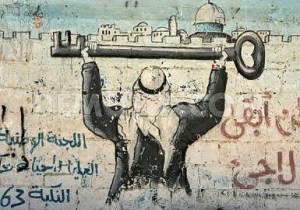
Al Mufta مفتاح

Return, continuity, and multiplicity

The mirrored impulses of Aliyah and al-‘Awda reveal a deeper pattern in the Levant: land as inheritance, memory, and moral geography, not merely as territory. Jewish Aliyah—the ascent to Ha Aretz—is rooted in centuries of diaspora experience, ritual, and ancestral memory. Palestinian al-‘Awda—the dream of return—is grounded in lived experience, collective memory, and the trauma of displacement. Both articulate belonging, both assert continuity, and both affirm a claim to presence, yet neither is reducible to exclusive ownership.

Understanding these aspirations through the lens of indigeneity clarifies the Levant’s complexity. Indigenous identity is not defined solely by ancestry or race, but by sustained attachment to place, unique culture, language, and historical continuity. Jewish communities, even after centuries in diaspora, maintained a living connection to the land through prayer, law, and cultural memory; Palestinians, continuously inhabiting villages, towns, and cities, preserve attachment through lived experience, story, and inherited community. Both meet the criteria of indigenous presence, both are rooted in the same soil, and both inherit overlapping geographies.

Multiplicity is the key. Neither Aliyah nor al-‘Awda exists in isolation; both emerge from entangled histories, migrations, and interwoven ancestries. The Levant is not a canvas for singular claims, nor a ledger for moral points. It is a palimpsest, where dreams, memory, and continuity coexist—even when politics imposes a zero-sum frame. Recognising this multiplicity transforms how we see legitimacy: it is not a finite resource to be won or lost, but a shared inheritance to be acknowledged.

In this light, the “return” is as much about imagination and moral continuity as it is about geography. The Jewish ascent, the Palestinian return, the dreams held in exile or diaspora, all testify to the same human impulse: to belong, to anchor identity in soil, and to see history not merely as a past but as an inheritance shaping the present. Both peoples carry the land in body, memory, and story; both dreams illuminate the impossibility—and the necessity—of coexistence.

Ultimately, Aliyah and al-‘Awda demonstrate that historical continuity, cultural memory, and ancestral attachment are not zero-sum. The land can carry more than one claim, more than one people, more than one dream. What is required is a moral and political imagination capable of holding multiplicity, of recognising overlapping rights, and of acknowledging that inheritance is shared, entangled, and enduring.

Why sharing the land has proved so difficult

If there is a single, stubborn question running beneath all of this, it is not who belongs, but why coexistence has proved so elusive. Two peoples, both rooted, both carrying memory, both claiming continuity – yet locked into a conflict that seems to resist every appeal to shared humanity.

One part of the answer lies not in antiquity, but in modernity – in the habits of mind carried from Europe to the eastern Mediterranean. Ilan Pappé argues, persuasively, that early Jewish settlers in Palestine, particularly in the late Ottoman and Mandate periods, largely did not see the local Arab population as a political subject. They were not the object of hatred, exactly; they were something more corrosive – irrelevant. The project was inward-facing: to build, to revive, to normalise Jewish life after centuries of vulnerability and persecution. The locals did not so much obstruct the vision as fail to register within it.

This indifference was not uniquely Jewish. It was recognisably European. The mindset closely resembled that of settlers who arrived, with their own fears and hopes, on the shores of North America, Australia, or the Cape. They came not primarily to dominate, but to begin again – to escape religious persecution, economic stagnation, or political precarity. The land appeared underused, underdeveloped, waiting. The people already there were often perceived less as political actors than as features of the landscape – present, but not decisive.

One does not need much imagination to see how this felt from the other side. To be continuous, rooted, embedded in place—and yet rendered invisible by a project unfolding around you. To watch newcomers build institutions, towns, and legal frameworks that did not include you, did not consult you, and did not imagine you as co-heirs. Even absent overt malice, this was experienced as dispossession in slow motion.

What makes the Jewish–Palestinian case especially tragic is that the settlers themselves were not an imperial metropole exporting surplus population, but a people long excluded, often brutalised, and desperate for normality. Zionism was not merely a political ideology; it was a survival strategy. Yet survival pursued without recognition of those already present reproduces—unintentionally – the very hierarchies it seeks to escape. Moral urgency crowds out moral vision. One people’s existential fear eclipses another’s lived reality.

This is where the conflict begins to harden. Palestinians experienced Zionist settlement not as return, but as arrival; not as redemption, but as replacement. Jews experienced Palestinian resistance not as indigenous defence, but as rejection of their most basic claim to safety and self-determination. Each side misread the other through the lens of its own trauma. Each interpreted the other’s actions as negation.

Once this dynamic sets in, sharing the land becomes psychologically – and then politically – extraordinarily difficult. Fear replaces curiosity. Memory becomes weaponised. Every concession feels like erasure. What began as indifference curdles into mistrust, and mistrust into moral absolutism. The box canyon narrows: only one narrative can survive; only one future can be imagined.

And yet history rarely leaves asymmetry unreciprocated.

If early Zionist indifference helped harden Palestinian resistance, Palestinian political culture also evolved in ways that increasingly mirrored the exclusivist logic it opposed. Faced with dispossession, fragmentation, and repeated defeat, Palestinian identity cohered around loss—around al Nakba as organising principle, and al-‘Awda as moral horizon. Over time, this produced not only solidarity and resilience, but also a narrowing of political imagination. Jewish presence came to be read not as layered or historical, but as entirely alien; Jewish continuity was reframed as fabrication, invention, or fraud.

This was understandable as a defensive reflex – but it came at a cost. By denying Jewish indigeneity altogether, Palestinian leadership and its external advocates adopted the same zero-sum logic they rightly condemned. Recognition became conditional, legitimacy indivisible. What began as a struggle against erasure risked becoming a project of counter-erasure. The hierarchy of malice inverted itself but did not disappear.

At the same time, the familiar settler-colonial frame begins to strain under the weight of historical complication. The early Jewish settlers were indeed overwhelmingly European in origin, language, and political culture, arriving with mental furniture shaped by Europe: nationalism, socialism, agrarian revival, and the settler imagination. In that sense, they do fit the classic profile of settler colonists, and this provides much of the grist for contemporary anti-Zionist critique. But the Yishuv did not imagine—could not have imagined—the demographic rupture that followed 1948: the arrival of nearly a million Jews expelled or forced to flee from Arab countries and Iran.

These Mizrahi Jews were not European interlopers parachuted into the Middle East. They were, to all practical purposes, Arab Jews Arabic-speaking, culturally embedded in the region, shaped by its music, food, social codes, and outlook. Their displacement from Baghdad, Cairo, Damascus, Sana’a, Fez, and Tehran was not incidental to Israel’s formation; it became constitutive of it. The state that emerged was not simply a transplanted Europe, but an improvised, often uneasy fusion of diasporas – Ashkenazi, Sephardi, Mizrahi – many of them poor, marginalised, and themselves refugees. [In In That Howling Infinite, see The Mizrahi Factor

This complicates the moral geometry. Israel becomes not a single settler project with a clear metropole and periphery, but a crowded refuge absorbing multiple expulsions at once. After more than seventy years, this reality is immediately visible to anyone who lands at Ben Gurion: Israel is not, and has not been for a long time, a “white” country, whatever the slogans suggest. That this fact is so rarely acknowledged let alone integrated into popular discourse—reveals how rigid and inattentive many contemporary moral frameworks have become.

Thus, both peoples arrived – by different routes – at a similar impasse. Each came to see itself as the true refugee of history. Each feared that recognising the other’s depth of attachment would annul its own. Each retreated into a moral box canyon of absolute narratives.

What was lost, on both sides, was the possibility of shared inheritance – of seeing the land not as a prize to be awarded, but as a burden to be carried together. The tragedy is not that two peoples loved the same land. It is that they entered modern politics with incompatible expectations shaped by Europe’s long shadow, and neither fully saw the other in time. Once mutual visibility is lost at the beginning, history has a way of compounding the error.

Understanding this does not assign guilt in tidy proportions. It asks something more demanding: to recognise how good faith, deep attachment, and legitimate claims can still produce a conflict that feels unsolvable –

not because one side is uniquely wicked, but because both became trapped in stories that left no room for the other to remain.

Only by loosening those stories—by allowing attachment to coexist without cancellation—does the land begin to re-emerge not as a zero-sum possession, but as something closer to what all indigenous traditions, in different tongues, have always known it to be: not owned, but endured; not conquered, but shared.

Why the Two-State horizon has receded – perhaps for a generation

If the two-state solution once functioned as a shared horizon -distant, hazy, but orienting -it now lies behind a wall of wreckage. Not abandoned in theory, perhaps, but rendered inert by history’s latest accelerant. October 7 2023 and the Gaza war that followed did not create the impasse; they detonated it.

The occupation, long described as “temporary,” has hardened into a permanent condition—administrative, psychological, and moral. It is no longer experienced by most Israelis as an emergency requiring resolution, but as an ambient fact of life, managed like traffic or crime. For Palestinians, it is no longer experienced as a condition awaiting negotiation, but as an enclosure tightening year by year: land eaten away by settlements, movement throttled by permits and checkpoints, political agency hollowed out by collaborators, donors, and armed factions alike. This normalisation corrodes both sides simultaneously. The occupation deforms Israel’s moral language while dissolving Palestinian political coherence. Each adapts in ways that make disentanglement harder.

In the West Bank, the ongoing “range war” in the hills and fields – the quiet violence of settler depredations, land seizures, olive groves torched, mosques and churches vandalised – has become the grinding background noise of daily life. It is rarely decisive enough to provoke international rupture, but cumulative enough to destroy trust entirely. The IDF’s role as occupying power, security guarantor, and—too often—arbiter of civilian life entrenches a system in which force substitutes for politics. The more soldiers are deployed to police civilians, the more civilian resistance becomes criminalised, and the more violence is routinised on both sides.

Yet this is only half the picture, and you are careful not to avert your gaze from the other half.

Despite the Separation Wall, despite the intelligence dragnet, despite the overwhelming asymmetry of power, there are still thousands of attacks on Israeli civilians each year—stabbings, shootings, car rammings, rockets, lone-wolf assaults. They do not threaten Israel’s existence, but they do something more corrosive: they reaffirm, daily, the belief that withdrawal invites annihilation. For Israelis shaped by the Second Intifada—and now by October 7—the line between occupation and survival has collapsed. Every concession is read as exposure. Every Palestinian death is tragic; every Israeli death is existential.

As Warren Zevon sang,”the hurt gets worse and the heart gets harder”. That lyric captures something neither UN resolutions nor peace plans ever quite grasp: trauma compounds. It does not cancel out.

October 7 shattered whatever residual belief remained among Israelis that separation could be achieved without mortal risk. Gaza – already sealed off, already written off by many Israelis as a lost cause – became proof, in their minds, that withdrawal does not end conflict, it relocates it closer to home. The war that followed, with its vast civilian toll, obliterated any remaining Palestinian faith that Israel distinguishes meaningfully between combatant and captive population. Each side now possesses fresh, blood-warm evidence for its bleakest assumptions about the other.

In this climate, the two-state solution survives mostly as rhetoric – recited by diplomats, invoked by editorial boards, but no longer animated by constituencies willing to pay its price. The Israeli electorate has moved decisively toward management over resolution: control without citizenship, security without reconciliation. The Palestinians, fragmented between a corrupt, hollowed-out Authority in the West Bank and a nihilistic, theocratic militia in Gaza, lack both legitimacy and leverage. There is no credible partner on either side capable of delivering compromise without being destroyed by their own people.

And beneath all this lies the deeper fracture you keep returning to: mutual invisibility.

Most Israelis no longer encounter Palestinians as neighbours, co-workers, or fellow citizens-in-waiting. They encounter them as threats, filtered through screens or uniforms. Most Palestinians encounter Israelis almost exclusively as soldiers, settlers, or jailers. Each people experiences the other not in ordinary human contexts, but at the sharp edge of power. This is not a soil from which compromise grows.

The two-state solution depended, at minimum, on three conditions: a belief in eventual separation, a willingness to recognise the other’s legitimacy, and a shared sense that time was running out. All three have inverted. Separation now feels dangerous. Recognition feels like surrender. And time feels abundant—because the status quo, however ugly, appears survivable.

That is why the two-state outcome is not merely stalled but suspended by psychology as much as by geography. It may yet return -but not soon, and not until a generation shaped by checkpoints, rockets, funerals, and revenge has loosened its grip on the wheel.

Until then, Israel and Palestine remain, as Avi Shalit put it, locked in a grotesque embrace: one squeezing for control, the other for breath. Trapped by each other, and by histories that have taught them, again and again, that to relent is to perish.

The tragedy is not that solutions are unknown. It is that, for now, neither side can imagine surviving the journey to them.

That, more than borders or maps, is why the two-state horizon has receded—and why, in the wreckage of October 7 and Gaza, it may take a generation before it comes back into view.

The transformation of Palestinian nationalism from secular to Islamist

Palestinian nationalism, like much Arab nationalism, was not always framed in the language of religion. In the early twentieth century, movements across the Levant—anti-colonial, anti-Zionist, and Arabist—were largely secular, rooted in a combination of local civic identity, anti-imperial sentiment, and the vision of a shared Arab polity. Leaders envisioned the liberation of Palestine and the establishment of self-governing institutions through political mobilization, diplomacy, and, at times, armed struggle, rather than religious imperatives.

Over the decades, however, the ideological contours of Palestinian nationalism shifted markedly. The repeated failures of secular parties, the political fragmentation of the Palestinian leadership, the enduring dislocations of the diaspora, and the harsh realities of occupation contributed to a turn toward religion as both a mobilizing force and a framework for justice. By the late twentieth century, Islamist movements like Hamas and Islamic Jihad had emerged not simply as religious actors, but as ideologically coherent alternatives to secular nationalism. These groups foreground jihad, martyrdom, and the religious sanctity of the land in their rhetoric, framing the struggle for Palestine as a cosmic as well as temporal obligation.

The transformation is reinforced and symbolically anchored in sites of singular significance. The Haram al-Sharif—or Al Aqsa compound—has become more than a physical locus; it is an icon, a rallying point, and a metonym for the broader struggle. Events such as the naming of military campaigns “Al Aqsa Flood,” and the explicit articulation of eschatological promises, like the “Hamas Promise of the Hereafter,” signal the intertwining of politics and theology in contemporary mobilization. For many young Palestinians, religiosity is inseparable from identity and resistance, shaping curricula, media consumption, and communal norms, and providing moral justification and existential purpose to a struggle defined by occupation, dispossession, and chronic vulnerability.

This turn toward Islamist framing cannot be understood in isolation from the broader regional context. Iran’s “Axis of Resistance”—its network of ideological, financial, and military support extending to Hezbollah, Palestinian Islamic factions, and other actors—has reinforced the sectarian and geopolitical overlay on what was once largely a nationalist struggle. Palestinian nationalism, once secular and civic, is now entangled with a wider regional contest over ideology, faith, and influence.

The result is a politics that is profoundly resistant to compromise. Where once the possibility of pragmatic negotiation might have existed under secular leadership, religious imperatives, narratives of martyrdom, and the sanctity of sacred space have complicated the landscape. The intersection of youth religiosity, ideological indoctrination, regional sponsorship, and symbolic geography means that even limited concessions are difficult to imagine without appearing sacrilegious, existentially threatening, or politically fatal.

In sum, the ideological evolution of Palestinian nationalism—from secular, civic, and political mobilization toward religiously framed struggle—illuminates why contemporary conflict cannot be understood solely through the lens of territory or governance. It is simultaneously geopolitical, generational, and spiritual, embedded in the sacred geography of the land and in the cosmology of a people who have endured loss, occupation, and existential threat. Understanding this transformation is essential to comprehending why peace is so elusive, why the Two-State Solution is increasingly improbable, and why the wounds of October 7 and the Gaza War are likely to reverberate across generations. [In In That Howling Infinite see Lebensraum Redux – Hamas’ promise of the hereafter and Al Aqsa Flood and the Hamas holy war.

Israeli religiosity, nationalism, and the hardening of intransigence

Just as Palestinian nationalism has shifted from secular civic aspiration to an Islamist, jihad-inflected orientation, Israeli politics and identity have undergone a parallel, if distinct, transformation. The early Zionist project—rooted in secular socialism, pragmatic state-building, and European Jewish cultural memory—emphasized settlement, cultivation, and defense of a Jewish homeland, but largely avoided overt messianism or religious justification for territorial claims. For decades, labor Zionism and pragmatic governance dominated the state, seeking coexistence when possible and security when necessary.

Over time, however, particularly following the 1967 war and Israel’s acquisition of the West Bank, Gaza, and East Jerusalem, a potent strain of religious-nationalist ideology gained influence. Settler movements, many infused with messianic belief, framed the West Bank and other “biblical heartlands” not as disputed territory to be negotiated but as divinely mandated inheritance. Military victory became moral vindication; the conquest of hills, valleys, and historic cities was interpreted as the fulfilment of prophecy. For many young Israelis—particularly those raised in settler communities or religious schools—attachment to the land is inseparable from divine obligation, identity, and collective destiny.

The fusion of religiosity with nationalism has been reinforced by political consolidation. Governments led by right-wing parties, often aligned with settler constituencies and religious Zionist ideologues, have enacted policies that expand settlements, prioritize security over compromise, and embed ideological imperatives into law and practice. The “Greater Israel” project is not merely strategic; it is sacred, moral, and historical. Even military service, once largely secular, now socializes many Israelis—soldiers, conscripts, and officers alike—into a worldview in which defense, occupation, and settlement are intertwined with divine sanction.

This hardening of ideology has been mirrored culturally. Public rituals, school curricula, media, and religious observance reinforce narratives of historical continuity, existential threat, and moral righteousness. Palestinian identity is often perceived through a lens of threat, suspicion, or delegitimization—echoing the zero-sum dynamics that have hardened Palestinian views in response. Generationally, the result is a cohort of Israelis for whom compromise is morally fraught, politically risky, and psychologically difficult. [In In That Howling Infinite, see A Messiah is needed – so that he will not come]

The convergence is stark. On one side, Palestinian youth are inculcated with religiosity, martyrdom, and symbolic attachment to sacred sites; on the other, Israeli youth are shaped by historical consciousness, messianic settlement ideology, and the ethos of defense and divine inheritance. Both trajectories interact with persistent violence, security operations, and cycles of attack and reprisal to produce symmetrical intransigence: each side perceives the other not merely as a political opponent, but as a moral and existential threat.

The consequence is a landscape in which “living together” is extraordinarily difficult. Generations of separation, trauma, and ideological reinforcement—accelerated and amplified by events such as the October 7 attacks and the ensuing Gaza War—have left both peoples locked in narratives of absolute moral and historical entitlement. The Two-State Solution, always tenuous, is now likely off the table for a generation, as each side’s ideological and spiritual imperatives make compromise psychologically, socially, and politically fraught. What remains is a contest over narratives, memory, sacred geography, and identity as much as over territory—a reality that ensures the conflict’s endurance, and the persistence of hurt and hardened hearts, long into the future.

A shared turn towards the sacred – and the absolute

Taken together, these parallel transformations reveal something deeply unsettling: the conflict is no longer driven primarily by negotiable political claims, but by sacred narratives that resist compromise by design. What began, on both sides, as largely secular national movements—Palestinian nationalism rooted in anti-colonial liberation, Zionism grounded in pragmatic state-building—has evolved into something more brittle and more dangerous. Land has been transfigured into destiny; territory into covenant; grievance into metaphysics. Each side now increasingly understands itself not merely as a people with rights, but as a people with a mandate. And mandates do not share easily. In this mirror-play of sacralised nationalism, each claims moral altitude, each sees concession as betrayal, and each reads the other not as a neighbour with history, but as an obstacle to redemption. This is not symmetry of guilt, but symmetry of entrapment—a narrowing corridor in which politics gives way to prophecy, and coexistence becomes heresy.

Last words. One land, two peoples, many inheritances

Early Zionist leaders invoked the phrase “a land without a people for a people without a land,” a formulation that sounds tidy on paper but collapses under the weight of soil, memory, and ordinary life. Lloyd George did not invent the phrase, but he embraced its logic -animated by imperial strategy, evangelical imagination, and a genuine sense of moral obligation. Jews, he believed, were a “remarkable race,” entitled to rebuild their ancient home. Yet that home already lived and breathed through generations of Arabs who tilled its soil, named its springs, and prayed in its cities. The Balfour Declaration, for all its lofty phrasing, attempted to reconcile history and aspiration, European strategy and ancestral longing—but it did so without fully pausing to accommodate the people already present. That omission was not incidental; it was foundational. [Regarding the Balfour Declaration, see In That Howling Infinite‘s The hand that signed the paper]

That unresolved tension – between return and continuity, between memory and presence, between claim and lived reality – became the defining heartbeat of the land. Names echo across centuries: Hebron and al-Khalil, Shechem and Nablus, Jaffa and Yafa. Each syllable carries strata of meaning -Hebrew, Aramaic, Greek, Latin, Arabic, conquest and conversion, exile and resettlement, survival and reinvention. Archaeology records footprints but cannot arbitrate possession. History testifies, but it does not decree. Both Jews and Palestinians inhabit these layers. Both are rooted in ways that are real, profound, and entangled,and both carry histories that cannot be wished away without violence -moral, cultural, or physical..

Modern frameworks – settler colonialism, indigeneity, even race and ethnicity—promise clarity, but clarity here often disguises moral adjudication. Jews are rendered outsiders when diaspora experience is foregrounded; Palestinians are rendered singularly indigenous when centuries of migration, conversion, and intermingling are flattened. The Levant resists such neat categories. Its peoples are mosaics: ancestry interwoven, culture layered, memory overlapping. To treat legitimacy as a zero-sum game is to misunderstand the soil itself.

What has changed – what darkens the horizon – is that this already tragic entanglement is now being refracted through absolutist religious and ideological lenses on both sides. Palestinian nationalism, once largely secular, has increasingly fused with Islamist cosmology, jihadist rhetoric, and sacralised grievance. Israeli politics, once dominated by pragmatic secular Zionism, has in turn absorbed messianic nationalism, settler theology, and the sanctification of territory. The land is no longer merely inherited; it is promised. No longer contested; it is ordained.

October 7 did not create this transformation, but it detonated it. The massacre, and the catastrophic war that followed, have not only extinguished what little remained of trust or political imagination between Israelis and Palestinians; they have radiated outward, poisoning discourse far beyond the region. They have hardened identities, licensed eliminationist rhetoric, and accelerated the global spread of moral monoculture – where outrage substitutes for understanding, and certainty for thought. For a generation at least, the two-state solution now sits not just beyond reach, but beyond belief – undermined by geography, demographics, trauma, and the collapse of faith in compromise itself.

And yet, the hardest truth remains unchanged. This conflict is not a clash of right and wrong, but of right and right – of two peoples carrying deep, legitimate attachments to the same land, each convinced that recognition of the other threatens their own survival. The tragedy is not that the land cannot sustain more than one people; it is that politics, ideology, and now theology have conspired to make that multiplicity feel impossible.

This is the context in which the two-state solution falters. Not merely because of settlements, borders, or security dilemmas – real and devastating as those are – but because the political imagination required to sustain partition has been eroded. Two states presume mutual recognition of legitimacy, not just pragmatic separation. They require each side to accept that the other’s story is not provisional, not fraudulent, not temporary. That moral groundwork has thinned, even as the physical geography has grown more entangled.

Yet the alternative – one state without mutual recognition – offers no clearer horizon. Power without legitimacy curdles into domination: legitimacy without power dissolves into grievance. Neither yields coexistence. The land does not reward absolutism. It absorbs it, layers it, and hands it back as tragedy.

The challenge of one land, two peoples is therefore not to determine who arrived first, nor to tally historical grievances like entries in a ledger. It is to imagine a politics capable of holding multiplicity without erasure, continuity without dispossession, and memory without weaponization. The land—and the histories it holds -can sustain more than one life, more than one inheritance, more than one truth.

Ownership is not the measure of legitimacy. Continuity, memory, and attachment are. Both Jewish and Palestinian peoples carry the land in body, story, ritual, and longing. Both are indigenous. Both are real. And both reveal the Levant’s most stubborn lesson: history is not a verdict, memory is not a weapon, and legitimacy is not diminished by being shared.

The challenge, then, is not to resolve history like a court case, nor to assign moral scores, nor to demand purification through denunciation. It is to recover a politics capable of holding multiplicity without erasure, continuity without dispossession, and memory without weaponisation. That task feels impossibly distant. But abandoning it altogether guarantees only one outcome: an endless tightening of the moral box canyon, where fear replaces curiosity, and every future is imagined only as the negation of another.

As Dougie MacLean sings of land and belonging, in words that echo far beyond Scotland—or Australia, or the Levant: you cannot own the land; the land owns you. The soil of Israel–Palestine has carried many peoples, many faiths, many dreams. It will outlast them all. The question is not who deserves it most, but whether those who inherit it can learn – before more generations are lost – to live upon it without turning memory into a weapon and faith into a sentence of perpetual war.

As Dougie MacLean writes of another contested homeland: “You cannot own the land. The land owns you.” The Levant, like Australia, like all homelands marked by layered inheritance, demands the same humility – to inhabit without erasure, to remember without domination, to recognise that the soil has always carried more than one people, more than one dream, more than one future.

Coda: the Myth of Fingerprints

We began with the myth of fingerprints – the comforting fiction that history can be reduced to a single originating smudge, a primal sin from which all subsequent calamity flows.

But what this tale of two peoples and two nationalisms in one land reveals is something more complex and more unsettling.

Neither national movement was born fully formed. Both evolved under empire, war, demographic upheaval, exile, and memory. Both shifted ideologically over time –  from reformism to revolt, from socialism to religiosity, from civic aspiration to sacralised entitlement. Each radicalisation found justification in the other’s excess. Each hardened position generated its mirror. The sediment thickened.

October 7 did not appear ex nihilo, nor did the devastation that followed. They sit atop decades of unresolved grievance, failed diplomacy, ideological drift, and mutual distrust. Yet to explain is not to excuse. Genealogy clarifies causation; it does not dissolve responsibility.

The temptation remains to isolate one fingerprint – one declaration, one occupation, one uprising, one massacre – and declare it definitive. But the land bears too many impressions. Empire pressed its thumb there. National revival did too. Exile. Settlement. Insurgency. Security doctrine. Sacred text. Demography. Memory. And now algorithms and the howling internet. In our time, moral capture accelerates what history once sedimented slowly. Certainty travels faster than context. Outrage outruns chronology. Box canyons of conviction form instantly online, their walls built from curated evidence and reciprocal fear. Within them, one hears only affirmation. Height masquerades as clarity. difficult. [In In That Howling Infinite, see Moral capture and conditional empathy]

The refusal of this essay has been simple, if unfashionable: to resist singular blame, to resist moral monoculture, to resist the shaping of facts to fit feelings. Not to equalise suffering, nor to flatten power asymmetries, but to insist that intellectual honesty requires proportion, chronology, and reciprocity of scrutiny.

Two peoples with aspirations for collective self-determination. Each convinced of depth. Each carrying trauma. Each tempted, under pressure, toward absolutism.

There are no clean fingerprints here.

Only layered traces – and the continuing choice, on all sides, whether to add another.

Paul Hemphill, February 2026

This essay was written in conversation with books I’ve read, places I’ve visited, conversation, ideas formed and half-formed, and, more recently, in sustained dialogue with an AI language model, which contributed to drafting, phrasing, and conceptual articulation. What appears here is not unmediated thought, but considered thought: selected, tested, revised and revised again, and owned.

For more on the Middle East in in That Howling Infinite, see A Middle East Miscellany.
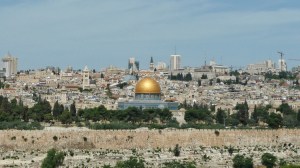
Bibliography

Sources drawn on for this essay.

Books and Memoirs

Lyons, John. Balcony in Jerusalem: Memoir of Six Years as Middle East Correspondent. Sydney: HarperCollins Australia, 2017.

Pappé, Ilan. A History of Modern Palestine: One Land, Two Peoples. Cambridge: Cambridge University Press, 2004.

Pappé, Ilan. The Ethnic Cleansing of Palestine. One World Publications, 2006.

Oren Kessler, Palestine 1936: The Great Revolt and the Roots of the Middle East Conflict (Rowman & Littlefield, 2023)

Shalit, Avi. My Promised Land: The Triumph and Tragedy of Israel. New York: Schocken Books, 2014.

Shulman, David. Kingdom of Olives and Ash: Writers Confront the Occupation. New York: New York Review Books, 2017.

Journal Articles and Essays

Darwish, Mahmoud. “The Key and the Return – Palestine as a Metaphor.” In Palestine as Metaphor. Berkeley: University of California Press, 2002.

Khalil-Habib, Nejmeh. “The Concept of Return (Al-‘Awda) in Contemporary Arabic Literature.” Nebula 5, no. 2 (2008): 41–58.

Natour, Raja. “Mahmoud Darwish and the Palestinian Narrative.” Haaretz, June 28, 2020.

Sulaimi, Samah. “Reclaiming the Homeland in Palestinian Memory and Art.” Haaretz, July 8, 2020.

Primary Historical Documents

Balfour Declaration, November 2, 1917.

Correspondence and speeches of David Lloyd George relating to Zionism, 1917–1922.

If you must say it, don’t say it in Jerusalem!

It was entitled: “Keeping Wolves from the Flock: The Case for Good Religion to Fight Anti-Semitism”. It was delivered on International Holocaust Remembrance Day on 27 January 2026 at the Binyaney Ha’uma Conference Center, Jerusalem, Israel. The presenter was former Australian prime Minister Scott Morrison. It was well received by audience, and praised by Israeli prime minister Binyamin Netanyahu. And it quickly reverberated back home.

The venue, the timing, and the company mattered. Israel, in the midst of an ongoing war and under the leadership of a government increasingly isolated internationally, was hardly a neutral stage. The event itself was framed as a moral gathering – a stand against antisemitism at a moment when Jewish communities worldwide feel newly exposed and embattled. Into this charged atmosphere stepped a deposed and disgraced Australian leader, now embarked on an international, largely ecclesiastical speaking circuit, offering prescriptions not for Israel, but for Islam in Australia.

The reaction in Australia followed well-worn grooves. Conservative outlets and commentators – most loudly those aligned with Murdoch media – cast Morrison as a truth-teller, bravely naming uncomfortable realities about radical Islam and standing up for Jewish security against a censorious, “woke” establishment that had been slow to deal with the acknowledged threat of radical Islamism. Progressive commentators, by contrast, focused on the dangers of securitising religion, the selective targeting of Muslims, exacerbating existing Islamophobia, and the symbolic violence of lecturing Australian minorities from abroad. The argument was instantly polarised, less a conversation than a mirror held up to our own media ecosystems and their predictable reflexes.

What was largely missing, however, was sustained attention to the deeper questions the speech inadvertently raised – questions that recur across debates about diversity, cohesion, and authority in plural societies. Who gets to speak about whom, and from where? How does a liberal democracy balance legitimate security concerns with religious freedom and civic trust? When does critique shade into control, and when does concern curdle into performance? And what happens when discussions about coexistence are conducted not face to face, but at altitude, before distant audiences primed for applause?

It is to those questions – rather than to the outrage or applause – that the brief following essay turns.

The politics of posturing 

There is a particular genre of speech that is recognisable before one even reaches the second paragraph. It is delivered abroad, framed as courageous, freighted with moral urgency, and aimed not so much at those ostensibly being addressed as at a wider, watching audience. Scott Morrison’s address in Israel belongs squarely in this genre. It is less a contribution to Australian social cohesion than a performance within a global culture war, delivered from a stage carefully chosen for its symbolism rather than its suitability.

Morrison, now out of office and out in the world, occupies a familiar post-political niche as he treads an international speaking circuit, heavily ecclesiastical in tone and audience, where moral clarity is prized over policy detail and applause over accountability. This matters, because the speech was not made in the Australian Parliament, not to Australian Muslims, not even in Australia. It was made in Israel – at a moment when Benjamin Netanyahu, politically cornered and morally embattled, will accept reassurance and affirmation from almost any quarter. In that sense, the speech served two purposes: it burnished Morrison’s credentials with a transnational conservative audience, and it offered Netanyahu symbolic solidarity. Australia, and Australian Muslims, were almost incidental.

The content of Morrison’s address has been widely rehearsed: calls for nationally consistent standards for Islamic institutions; accreditation and registration of imams; translation of sermons; expanded scrutiny of foreign funding; praise for Middle Eastern states that have “reasserted authority” over religious teaching. None of these ideas, taken in isolation, are wholly unthinkable. Liberal democracies already regulate religion in numerous ways – through education standards, charity law, financial transparency, and criminal statutes relating to incitement and abuse. No faith operates in a vacuum, and Islam is not exempt from the tensions between patriarchal authority and moral absolutism, and the egalitarian instincts of a secular, humanist society like Australia’s.

Nor is it controversial to observe that Islam, like Christianity before it, is engaged in a long, unfinished argument with modernity. Questions of gender, authority, pluralism, sexuality, and the limits of clerical power are not impositions from outside but live debates within Muslim communities themselves (see, in In That Howling Infinite, Islam’s house of many mansions and Educate a girl and you educate a community – exclude her and you impoverish it ). Australian Islam, however, is overwhelmingly benign, pragmatic, and law-abiding – a quiet negotiation between inherited tradition and lived reality, not a breeding ground of medieval zealotry. The men and women who left Australia to fight for ISIS were not summoned by local mosques but seduced by freelancing radicals in unregulated prayer halls algorithmic feeds, online grievance, and a search for meaning in a fractured digital world in which they find no place..

This is where Morrison’s argument begins to fray. Security agencies themselves – including ASIO director Mike Burgess – have been clear: you cannot arrest your way to social cohesion, nor spy your way to less youth radicalisation. The most rapidly evolving threats now emerge from the post-Covid morass of conspiracy theorists, anti-government paranoiacs, white nationalists, and apocalyptic survivalists – movements that often cloak themselves in Christian symbolism without any expectation that Christianity as a whole should be placed under special surveillance. To single out Islam, therefore, is not just analytically weak but politically loaded.

That loading is amplified by Morrison’s own biography. He is not a neutral secularist but an openly proselytising evangelical Christian, steeped in a tradition that would respond angrily to equivalent proposals applied to its own institutions. His political career was marked by secrecy, performative culture-war gestures, and a tendency to govern by symbolic posture rather than deliberative engagement – a style that ultimately saw him removed from office. These things do not invalidate his right to speak, but they do shape how his speech is received in his home country.

Then there is the matter of exemplars. Morrison’s citing of Saudi Arabia, the UAE, Egypt, and Jordan as models of religious regulation is not merely unfortunate; it is disqualifying. These are regimes that suppress women, persecute Christians and heterodox Muslims, criminalise dissent, and weaponise religion as an instrument of authoritarian control. They have form for dealing with Islamists like the Muslim Brotherhood with what the Americans euphemistically call “extreme prejudice”.

To invoke them while speaking the language of freedom of worship is to betray a deep confusion about the difference between liberal regulation and illiberal domination. If the aim is integration, these are strange teachers to cite.

Yet even all this misses the most important point, which is not what Morrison said but how and where he said it.

It is presumptuous to lecture Australians from abroad. It is disrespectful to address Australian Muslims without engaging them directly. And it is incendiary to do so from Israel – a place that is anything but neutral in Muslim political consciousness, and where questions of religion, power, land, and legitimacy are already saturated with pain and contestation. To speak from there is to speak over, not to; to align oneself symbolically before dialogue has even begun. No amount of policy caveating can undo that gesture.

This is where the charge of Islamophobia becomes both understandable and, paradoxically, incomplete. Morrison did not denounce Muslims as such, nor did he advocate exclusion or expulsion. But by singling out Islam, invoking authoritarian models, and delivering his critique from a stage freighted with geopolitical meaning, he helped reinforce the sense that Muslims are a problem to be managed rather than citizens to be engaged. That perception matters, because alienation is not a side effect of radicalisation; it is one of its preconditions.

The reactions to the speech followed predictable lines. British commentator Brendan O’Neill, for example, writing in The Australian, cast Morrison as a brave blasphemer, persecuted by a censorious “Islamophobia industry” – a piece of rhetorical theatre entirely consistent with Spiked’s long-standing contrarian brand and its comfortable alignment with Murdoch culture-war politics. Jacqueline Maley, writing in the Sydney Morning Herald, and the progressive wing of liberal commentary, focused on the dangers of securitisation, surveillance, and selective moral panic. Neither is wrong, exactly, but neither escapes their own political ecosystem.

What is striking is how little the speech had to do with Australia at all. It was not an attempt to build consensus, to consult, or to wrestle with the messy realities of pluralism. It was an attention-seeking intervention by a man no longer accountable to the electorate and yet nostalgic for its attention, speaking to an international audience that rewards moral certainty and civilisational framing. In that sense, the speech says less about Islam than it does about the temptations of post-power relevance.

If there is a lesson here, it is an old one. Social cohesion is not forged by speaking about communities from afar, nor by borrowing the language of security to police belief. It is built, slowly and imperfectly, through proximity, dialogue, and the unglamorous work of trust. Morrison chose distance instead. And in doing so, he turned a necessary conversation into a symbolic skirmish – one that generated headlines, applause, and division, but very little understanding. One that we hope, unrealistically alas, in today’s febrile political climate, will be forgotten sooner rather than later.

Call it concern if you like; politics has another word for speeches that travel so far to say so little at home: posturing.

For more on the Middle East in in That Howling Infinite, see A Middle East Miscellany.

Recent posts on the current state of Australian politics include Same old stone, different rock. What’s in a word?’ Shaping facts to feelings – debating intellectual dishonesty, Moral capture and conditional empathy, and Standing on the high moral ground is hard work!

Feints, refrains and unfinished business. 2025 in review

And we are here as on a darkling plain
Swept with confused alarms of struggle and flight,
Where ignorant armies clash by night.
Mathew Arnold, Dover Beach

We called 2024 a “year of everything, everywhere, all at once”, and it earned the name. Crises collided, news arrived faster than we could process it, and the world seemed to exist in a state of constant shock. 2025 did not bring relief. Instead, the chaos began to settle. Wars dragged on, political divides hardened, social tensions deepened, and technology reshaped how we saw and understood it all.

It was the year the world stopped exploding in real time and started being what it had already become: messy, uneven, morally complicated, and stubbornly persistent. A year, indeed, in a world of echoes, refrains and unfinished business. And we spent the year watching power bargain brazenly in plain sight, trying to describe what was happening while it unfolded around us.

From Gaza to Ukraine, Sudan to Syria, from America’s self-inflicted fracture to Australia’s sudden wake-up call on Bondi Bondi, 2025 forced a reckoning: the world did not pause, but it did sort itself – deciding what we would notice, what we would ignore, and what we would learn to live with. Alongside human crises came the continuing advance of AI and chatbots, and the dominion of the algorithms that now govern attention, proving that disruption can be structural as well as geopolitical.

Gaza: War, Then “Ceasefire”

The war in Gaza dominated the year internationally and here in Australia, even as attention ebbed and flowed. Military operations continued for months, followed eventually by a “ceasefire” – a word doing far more work than it should or even justified. Fighting paused, hostages living and dead were returned and prisoners released, but the devastation remained: tens of thousands dead, cities demolished, humanitarian catastrophe unresolved. And the causes of the consequences standing still amidst the ruins and the rubble.

Western governments continued to back Israel while expressing concern for civilians, a contradiction that grew harder to defend, while street protests and online anger seethed all across the world. At the same time, antisemitism surged globally, often hiding behind the language of anti-Zionism. Two realities existed together, and too many people insisted on choosing only one.

By the end of the year, the war had not been resolved – merely frozen. Trust in Western moral leadership had been badly damaged, and Israelis and Palestinians remain in bitter limbo.

See Gaza sunrise or false dawn? Spectacle or Strategy

Iran, Israel and America’s bunker busters

Long-simmering tensions between Israel and Iran spilled into open conflict. What had once been indirect – proxies, cyberattacks, covert strikes – became visible. A brief but destructive war of missile exchanges ended with the United States asserting ordinance, deterrence and control.

The episode was brief but telling. It showed that America still reaches for its guns quickly, even as it struggles to define long-term goals. Another line was crossed, then quickly absorbed into the background of “normal” geopolitics.

Russia, Ukraine and Trump’s “Peace”

Ukraine entered 2025 mired in stalemate. Front lines barely moved. Casualties continued to mount. Western support held, but with clear signs of fatigue. And Donald Trump’s re-emergence reshaped the conversation. His promise to deliver instant “peace” reframed the war not as a question of justice or sovereignty, but of exhaustion. Peace was no longer about what Ukraine deserved, but about what the world was tired of sustaining and what the “art of the deal” could deliver.

The war didn’t end. It simply became something many wanted to stop thinking about. Not Ukraine and Russia, but. The carnage continues.

Donald Trump’s one-way crush on Vladimir gave us the one of the+most cringeworthy moments in global politics – Trump greeting the Russian president in Alaska: As the US president rolled out the red carpet for the world’s most dangerous autocrat, Russia’s attack on Ukraine accelerated. Trump got precisely nothing out of the meeting, except for the chance to hang out with a gangster he so obviously admires and of whom he is embarrassingly in awe.

Syria: Free, but stranded at the crossroads

A year after Assad’s fall, Syria remained unstable and unresolved. The regime was gone, but the future was unclear. Old sectarian tensions resurfaced, often in bloodshed, new power struggles emerged, powerful neighbours staked claims and  justice for past crimes remained distant.

Syria in 2025 was neither a success story nor a collapse – but suspended between heaven and hell, a country trying to exist after catastrophe with the rest of the world largely moving on.

See Between heaven and hell … Syria at the Crossroads

Women in Damascus celebrate the fall of the Assad regime

Sudan: what genocide actually looks like

Sudan’s civil war continued with little international attention. Mass killing, ethnic cleansing, famine, and displacement unfolded slowly and relentlessly. This was genocide without spectacle. No clear narrative. No sustained outrage. It showed how mass atrocity can now occur not in secrecy, but in plain sight – and still be ignored.

see The most nihilistic war ever …Sudan’s waking nightmare

America: a country divided against itself

The United States spent 2025 deeply divided, with no sign of healing. Pew Research polling showed that seven out of ten republicans think that the opposite side is immoral while six of ten democrats thinks the same of their rivals.

Trump’s return to power sharpened those divisions. His administration governed aggressively: mass deportations, punitive tariffs, the dismantling of foreign aid, political retribution, and pressure on democratic institutions. The country looked inward and outward at the same time – less cooperative, more transactional, more openly nationalist. Democratic norms eroded not overnight, but through constant stress and disregard. With three years still to run and the tell-tale midterms approaching, allies and cronies are adjusting, bickering rivals are taking notes, and uncertainty has become the defining feature of American leadership. Meanwhile, #47 is slapping his name on everything he can christen, from bitcoins to battleships.

See, for light relief, Danger Angel … the ballad of Laura Loomer 

Monroe Redux: the return of “the Ugly American”

US foreign policy took on a blunt, old-fashioned tone. Pressure on Canada and Mexico increased. Talk of annexing Greenland resurfaced. Venezuela, caught in the maw of Yanqui bullying and bluster, waits nervously for Washington’s next move. The administration promised imminent land operations – and then bombed Nigeria! The revival of the old Monroe Doctrine felt, as baseball wizz Yogi Berra once remarked, like déjà vu all over again, not as strategy, but as instinct. Influence asserted, consultation discarded. The “ugly American” was back, and unapologetic.

See Tales of Yankee power … Why Venezuela, and why now?

Europe at a inflection point

Europe in 2025 didn’t collapse, as many pundits suggested it might, but it shifted. Far-right ideas gained ground even where far-right parties didn’t win and remained, for now, on the fringes albeit closer to electoral success. Borders tightened; policies hardened; street protests proliferated – against immigration and against Israel, Support for Ukraine continued, but cautiously. The continent stood at a crossroads: still committed to liberal values in theory, but increasingly selective in practice.

Uncle Sam’s  cold-shoulder

Rumbling away in the background throughout year was the quiet but  cumulative alienation of America’s allies. Not with a single rupture, but through a thousand small slights. transactional diplomacy dressed up as realism, alliances treated as invoices rather than covenants, multilateralism dismissed as weakness. Europe learned that security guarantees come with a mood swing; the Middle East heard policy announced via spectacle; Asia watched reassurance coexist uneasily with unpredictability.

The new dispensation was illustrated by the Trump National Security Strategy. It is at once candid and contradictory: it outlines a narrower, realist vision of American interests, emphasising sovereignty, burden-sharing, industrial renewal, and strategic clarity, yet it is riddled with silences, evasions, and tensions between rhetoric and likely action. Allies are scolded for weakness while the document avoids naming Russia’s aggression, underplays China, and projects American cultural anxieties onto Europe. These contradictions expose both strategic incoherence and the limits of paper doctrine against presidential temperament, leaving Europe facing an irreversible rupture in trust and revealing a strategy as much about America’s insecurities as its actual global posture.

The post-WW2 order has not so much been dismantled as shrugged at, and indeed, shrugged off. Trust eroded not because the United States has withdrawn from the world, but because it has remained present without being reliable, and presumed itself to be in charge. Power, exercised loudly but inconsistently, has discovered an old truth: allies can endure disagreement, but they struggle with contempt.

Australia in 2025 … high flight and crash landing

Though beset by a multitude of crises – the cost of living, housing, health and education services – the Albanese Labor government was returned comfortably in May, helped by a divided, incoherent, and seemingly out of touch opposition. For the rest the year, federal politics felt strangely frictionless with policy drift passing for stability. The Coalition remained locked in internal conflict, unable to present a credible alternative. The Greens, chastened by electoral defeat and in many formerly friendly quarters, ideological disillusionment, treaded water.

But beneath the surface, social cohesion frayed. Immigration debates sharpened. Antisemitism rose noticeably, no longer something Australians could pretend belonged elsewhere. Attacks on Jewish Australians forced a reckoning many had avoided and hoped would resolve once the tremors of the war in Gaza had ameliorated. Until 6.47pm on 7th December, a beautiful evening on Sydney’s iconic Bondi Beach. Sudden, brutal and in our summer playground, sectarian violence shattered the sense of distance Australians often feel from global disorder. At that moment, politics stopped feeling abstract. The world, with all its instability, barged in and brought the country down to earth.

See This Is What It Looks Like

Lifesavers on Bondi Beach, 20 December 2025. Edwina Pickles

Featured photograph and above:

A handful of bodies on Bondi Beach, and behind them, the howling infinite of expectation, obligation, and the careful rationing of human empathy. The smallness of the beach against the vastness of consequences. On December 20, 2025, Bondi’s iconic lifesavers formed a line stretching the entire length of the beach -silent, solemn, a nation visibly in mourning. Similar tributes unfolded from Perth to Byron Bay, gestures of unity in the face of a shock that touched the whole country.

The Year of the Chatbot: Promise, Power, and Risk

And now, a break from the doom and gloom …

2025 was the year when artificial intelligence became part of daily life. Chatbots ceased to be experimental and became integral, transforming from novelty to utility seemingly overnight. People used it to write, research, translate, plan, argue, comfort, and persuade; institutions and individuals adopted it instinctively. Setting tone as much as content, the ‘bots have lowered barriers to knowledge, sharpened thinking, and helped people articulate ideas they might otherwise struggle to express. Used well, they amplified curiosity rather than replace it.

The opportunities are obvious – but so are the risks. Systems that can clarify complexity can also flatten it. Chatbots sound confident even when wrong, smooth over disagreement, and made language cleaner, calmer, and more persuasive – but not necessarily truer. They reinforce confirmation bias, outrage, and tribal certainty, generating arguments instantly and flooding the zone with plausible-sounding text. As information has became faster, cheaper, and less reliable, Certainty has spread more easily than truth, so truth has to work much harder.

Dependence is subtler but real. Outsourcing thinking – summaries instead of reading, answers instead of wrestling – did not make humans stupid, but less patient. Nuance, doubt, and slow understanding became harder to justify in a world optimised for speed. Yet conversely, man people still seek context, history, and complexity. Used deliberately, AI could slow the pace, map contradictions, and hold multiple truths at once.

By the end of 2025, the question was no longer whether AI would shape public life – it already had. The real question is whether humans would use it as a shortcut, or as a discipline. The technology is neutral. The danger – and the promise – lies in how much thinking we are willing to give up, and how much responsibility we are prepared to keep.

See The promise and the peril of ChatGPT 

Algorithm and blues

Alongside the chatbot sat a quieter, more insidious force: the algorithm itself. By 2025 it no longer simply organised information – it governed attention. What people saw, felt, and argued about was shaped less by importance than by engagement. To borrow from 20th century philosopher and communication theorist and educator Marshall McLuhan, the meme had become the message. Complex realities were compressed into images, slogans, clips, and talking points designed not to inform but to travel. The algorithm rewarded speed over reflection, certainty over doubt, heat over light. Politics, war, and grief were all flattened into content, stripped of context, and ranked by performance. What mattered most was not what was true or necessary, but what disseminated.

Passion without Wisdom

I wrote during the year that we seemed “full of passionate intensity” – Yeats’ phrase still apt in the twenty first century- but increasingly short on wisdom and insight. 2025 confirmed it. Anger was everywhere, empathy highly selective, certainty worn like armour. People felt deeply but thought narrowly. Moral energy surged but rarely slowed into understanding. The problem was not indifference; it was excess – too much feeling, too little reflection. In that environment, nuance looked like weakness and patience like complicity. What was missing was not information, but judgement – the harder work of holding contradiction, of resisting instant conclusions, of allowing complexity to temper conviction. Passion was abundant. Insight, increasingly rare.

Looking Toward 2026

Looking back on 2025, it seems that there  were no endings, neither happy or sad. Just a promise, it seems, of more of the same. The year didn’t solve anything. It clarified things. And if it clarified anything, it was that the world has grown adept at managing, ignoring, or absorbing what it cannot fix. It revealed a world adjusting to permanent instability. In this year of echoes, refrains, and unfinished sentences.

Passion, intensity, and outrage were abundant, but patience, wisdom, and insight remained scarce. Democracies strained under internal and external pressures. Wars lingered unresolved. Technology reshaped thought and attention.

Some argue that hope springs eternal, that yet, even amid the drift and the fractures, glimpses of understanding and resistance persisted, that although the world has settled into its chaos, we can be riders on the storm. But, I fear, 2026 arrives not as break, a failsafe, a safety valve, but as continuation. It looms as a test of endurance rather than transformation.  In my somnolent frame of mind, I’ve reached again for my Yeats. “Things fall apart; the centre cannot hold; mere anarchy is loosed upon the world, the blood-dimmed tide is loosed …”

After the chaos of 2024 and the hardening of 2025, the question is no longer what might go wrong. It’s what we’re prepared to live with.

And so we come to what In That Howling Infinite wrote in 2025.

What we wrote in 2025

It was a year that refused neat endings.

It began in a wasteland – Gaza as moral ground zero – and moved, restlessly, through revolutions real and imagined: Trump as symptom and accelerant, Putin as a man racing his own shadow, Syria forever at the crossroads where history idles and then accelerates without warning. Gaza returned, again and again, sunrise and false dawn, as spectacle and strategy; Sudan burned in near silence; Venezuela re-entered the frame as empire’s backyard as the US disinterred its Monrovian legacy. In That Howling Infinite featured pieces on each of these – several in many cases , twenty in all, plus a few of relevance to them, including an overview of journalist Robert Fisk’s last book (The Night of Power – Robert Fisk’s bitter epilogue). A broadranging historical piece written in the previous year and deferred, Modern history is built upon exodus and displacement, provided a corrective of sorts to the distorted narratives that have emerged in recent years due to a dearth of historical knowledge and the partisan weaponisation of words. 

It was almost as light relief that we turned to other subjects. Of particular interest was AI. Approaching remorselessly yet almost unrecognised in recent years, it banged a loud gong and crept from curiosity to condition, from tool to weather system, quietly rewriting the newsroom, the internet, and the idea of authorship. ChatGPT and other chatbots appeared not as saviours but as promise and peril in equal measure. By year end, we were fretting about using ChatGPT too much and regarding it as something to moderate like alcohol or fatty foods. We published three pieces on the subject in what seemed like rapid succession, and then pestered out – sucked into the machinery, I fear.

What with so much else attracting our attention, we nevertheless managed to find time for some history – including a  particularly enthralling and indeed iconoclastic book on the fall of the Ottoman Empire; the story of an Anzac brigade lost in Greece in 1942; “the Lucky Country” revisited after half a century;  and a piece long in the pipeline on the iconic singer and activist Paul Robeson.

In August, as on a whim, for light relief, we summoned up a nostalgic old Seekers’ song from the mid-sixties, a time when the world was on fire with war and rage much as it is today, but for us young folk back in the day, a time of hope and hedonism. For us, the carnival, clearly, is not over. The machinery is still whirring, the music still loud, and the lights still on. History is insisting on one more turn of the wheel, and the dawn, so often promised, so frequently invoked, has not yet broken.

January
The Gaza War … there are no winners in a wasteland
The way we were … reevaluating the Lucky Country

February
Let’s turn Gaza into Mar e Largo
Trump’s Second Coming … the new American Revolution
Cold Wind in Damascus … Syria at the crossroads

March
Trumps Revolution… he can destroy but he cannot create
Where have all the big books gone?
Putin’s War … an ageing autocrat seeks his place in history

April
The Trump Revolution … I run the country and the world
The Fall of the Ottoman Empire and the birth of Türkiye
Let Stalk Strine .. a lexicon of Australian as it was spoken (maybe)

May
The phantom of liberty … the paradoxes of conservativism
Shadows in search of a name … requiem for a war
The continuing battle for Australia’s history

July
A mighty voice … the odyssey of Paul Robeson

August
109 years of Mein Kampf … the book that ravaged a continent
High above the dawn is breaking … the unlikely origin of a poo song

September
Gaza sunrise or false dawn? Trump’s peace plan
Gaza sunrise or false dawn? Spectacle or Strategy
Will there ever be a Palestinian state?
Why Osana bin lost the battle but won the war
The Night of Power … Robert Fisks bitter epilogue
The promise and peril of ChatGPT
Who wrote this? The newsroom’s AI dilemma

October
AI and the future of the internet
Danger Angel … the ballad of Laura Loomer

November
A forgotten Anzac story in Greece’s bloody history
The most nihilistic war ever … Sudan’s waking nightmare
Answering the call … National Service in Britain 1945-1963
Tales of Yankee Power … at play in Americas backyard

December
Delo Kirova – the Kirov Case … a Soviet murder mystery
Between heaven and hell … Syria at the crossroads
This Is What It Looks Like
Tales of Yankee power … Why Venezuela, and why now?
Marco Rubio’s Venezuelan bargain

Read out reviews of prior years:

That was the year that was – retrospectives

A song for 2026: Lost love at world’s end …

It is our custom to conclude our annual wrap with a particular song that caught our attention during the year. Last year, we chose Tears for Fears’ Mad World.  It would be quite appropriate for 2025. But no repeats! so here is something very different. An outwardly melancholy song that is, in the most ineffable way quite uplifting. that’s what we reckon, anyway …

The Ticket Taker is on the surface a love song for the apocalypse; and it’s it’s one of the prettiest, most lyrically interesting songs I’ve heard in a long while. I could almost hear late-period Leonard Cohen and his choir of angels.

The apocalypse is both backdrop and metaphor. We’re not sure which. Is it really about a world ending, or just about the private ruin of a man left behind by love and fortune. The lyrics are opaque enough to evade final meaning, but resonant enough to keep circling back, like the ferry itself, between hope and futility. A love song, yes, but also a confession of entrapment: the gambler’s hope, the ark one cannot board.

The “Ticket Taker” song was written by Ben Miller and Jeff Prystowsky and is featured on The Low Anthem’s album Oh My God, Charlie Darwin. It features on Robert Plant’s latest foray into roots music – this time with English band Saving Grace. This flawless duet with Suzi Dian is mesmerising and magical.

Jeff will tell you that the song is “pure fiction,” that Ben “just made it up one day” – but fiction, as we know, has a way of smuggling deeper truths than fact dares admit.

Tonight’s the night when the waters rise
You’re groping in the dark
The ticket takers count the men who can afford the ark
The ticket takers will not board, for the ticket takers are tied
For five and change an hour, they will count the passers-by

They say the sky’s the limit, but the sky’s about to fall
Down come all them record books, cradle and all
They say before he bit it that the boxer felt no pain
But somewhere there’s a gambling man with a ticket in the rain

Mary Anne, I know I’m a long shot
But Mary Anne, what else have you got?
I am a ticket taker, many tickets have I torn
And I will be your ark, we will float above the storm

Many years have passed in this river town, I’ve sailed through many traps
I keep a stock of weapons should society collapse
I keep a stock of ammo, one of oil, and one of gold
I keep a place for Mary Anne, soon she will come home

Mary Anne, I know I’m a long shot
But Mary Anne, what else have you got?
I am a ticket taker, many tickets have I torn
And I will be your ark, we will float above the storm

Mary Anne, I know I’m a long shot
But Mary Anne, what else have you got?
I am a ticket taker, many tickets have I torn
And I will be your ark

Between heaven and hell … Syria at the Crossroads

There are moments in the Middle East when history suddenly shift gears and takes us all by surprise. Lenin knew the cadence: there are decades, he wrote, where nothing happens; and then, weeks in which decades happen. A year ago, Syria – trapped in the vortex of its civil war for almost fourteen years  and virtually ignored by the rest of the world since October 7 2023 – suddenly leapt into one of those crazy weeks, leaving allies, enemies, and analysts alike blinking in the dust. Even now, a year after the astonishing fall of Damascus, the country sits like Kipling’s Tomlinson at the gates of judgement: not quite damned, not fully redeemed, suspended between heaven and hell.

Sleepers awake …

For years, as The Independent’s Bel Trew observed last December (see Syria. Illusion, delusion and the fall of tyrants) the world forgot about Syria – notwithstanding the courageous efforts of western and Syrian reporters and humanitarian workers who strove in perilous circumstances to bear witness. The civil war had become the background hum of the region, a grim drone many had learned to tune out as Ukraine and Gaza dominated the world stage. The regime of Hafez al Assad, brutal and immovable, bolstered by Russia, Iran and Hezbollah, looked set to endure indefinitely. The jihadi rebel enclave in Idlib, though supported by Türkiye, was dismissed as a besieged hold-out. Even those who professed expertise couldn’t reliably tell you whether the war was still ongoing, who was fighting whom, or what stage the conflict had reached. It was as if the wheels of war had stopped spinning.

Then, over the space of days – eleven, to be precise – the wheels spun again. Hay’at Tahrir al-Sham’s fighters burst from their confined redoubt with a momentum no one expected (including, it seems, themselves), sweeping through Aleppo and racing down the highway to the capital. Analysts reached instinctively for historical parallels: Havana 1959, Saigon 1975, Kabul 2021. Analyst David Kilcullen pointed instead to Timur Kuran’s theory of the “preference cascade”: the sudden collapse of a regime that had mistaken silence for loyalty and compliance for consent. Assad’s security apparatus – omnipresent, omniscient, yet somehow oblivious – realised too late that its soldiers had no stomach left for the fight. The all-powerful giant had feet of clay.

It didn’t help that Iran, Assad’s indispensable patron, had stumbled into the most grievous strategic miscalculation of its post-1979 history. Flush with revolutionary zeal, Tehran had kicked the hornet’s nest in Lebanon, prompting Israel to pivot from Gaza to Hezbollah with stunning force. Suddenly Iran’s expeditionary assets were exhausted, its proxies over-extended, and its clerical leadership exposed as both ageing and isolated. Even the Ayatollah’s conspiratorial refrain – that the fall of Damascus was all a plot by the Great Satan, the Little Satan, and the Sultan in Ankara – couldn’t mask the fact that this was less Zionist cunning than simple imperial overreach. When the rebels came, neither Iran nor Hezbollah, nor Russia, entangled in its Ukrainian quagmire, could ride to the rescue.

But the rebels, too, were surprised. Their mandate from Ankara was modest – expand the borders of their statelet a little, test the regime’s nerve. Instead, they found themselves virtually unopposed on the road to Damascus.  In an Informative article in E-zine Unherd republished below, British writer and investigative journalist Tam Hussein  writes how many of the fighters interpreted the victory as divine intervention – not jihadi zealotry, but a sincere theological attempt to explain the inexplicable. The suddenness of Damascus’s collapse felt, to them, like an echo of Muhammad’s bloodless conquest of Mecca. And in a land where the eschatological imagination has always saturated politics, it didn’t take long before social media brimmed with end-times speculation. Ahmed al Shara’a – formerly Abu Mohammad al-Jolani, with a $10 million American bounty on his head – was seen by some as “the one”, and the precursor of the Mahdi and the foretold end of days.

Yet as Hussein rightly notes, miracles make poor policy. The survival of the new Syrian administration will depend not on prophecy but on governance, and on whether Shara’a, interim president and ex-jihadi turned statesman, can transform a miraculous seizure into a sustainable state.

To his credit, he has avoided the catastrophic purges that helped destroy post-invasion Iraq. He has kept the civil service intact, flirted audaciously with Western diplomacy, and allowed at least the theatrical semblance of elections. He has restored the embassy in London, opened channels to Washington, even  visiting the White House  and played the charm-game with Gulf capitals that only recently readmitted Assad into their fold. As Hussein writes, he has shown political finesse: keeping the constitution, appointing seventy parliamentarians himself, and balancing piety with pragmatism.

But the tightrope is frayed. Sectarian wounds – Druze, Alawite, Sunni, Christian – remain raw and unstitched, with the Latakia massacres now entering their fraught judicial phase, and Israel stirring the Druze pot. Kurdish anxieties simmer: the old “Arab-first” chauvinism must be abandoned if Syria’s patchwork is ever to become a tapestry again. Foreign fighters, once lionised, now loiter between hero and hazard, implicated in sectarian atrocities. Kurds clash with Syrian forces; Turkish troops press deeper into Rojava; Israel remains the unpredictable neighbour bestride the Golan; and Iran, though weakened, is never entirely out of the game. It is not inconceivable that the forces that helped topple Assad could yet turn their sights toward Jerusalem in the belief that prophecy demands it.

And there are darker portents too – those flickering shadows that hint the wind of freedom may be blowing from the wrong quarter. The new government’s early gestures toward Islamisation – the hair-covering admonition, the curriculum purge, the dismissal of women from key posts, the torching of a Christmas tree in Hama – suggest that pro-Russia and anti-western platforms like RT and Mint may have a point when they warn that the leopard has not fully changed its theological spots. Shara’a’s declaration that elections may be four years away, the dissolution of the old constitution, and the folding of all rebel factions into state structures recall less a liberal transition than a consolidation of revolutionary power.

Meanwhile, the country remains a mosaic of mini-wars. In the north, Turkish proxies grind against Kurdish forces in Rojava. In the south, local militias continue to resist HTS’s claim to national authority. In the west, Alawite formations cling to their shrinking redoubts. To the east, Islamic State survivors eye the chaos, waiting for the prison gates to break. And overhead, as ever, the Americans and Israelis fly their competing deterrents, ensuring the war never quite ends.

So: Syria stands at the crossroads. Will Syria’s future be heaven, hell, or merely another circle of the inferno?

Optimism is possible – cautiously so. If the West can avoid its habitual fatalism, if, when sanctions are lifted, investment flows, if Turkey and Israel can be coaxed into tolerable coexistence, if Kurdish autonomy is honoured, if sectarian grievances are handled with equity and not vengeance — then Syria could, in time, become a conservatively stable hub. Shara’a’s Idlib experiment shows he can build an economy under duress.

But the inverse is equally imaginable: a Lebanon-style implosion, a Yugoslav-style partition, or a Gaza-style fortress of permanent mobilisation. As Isreali commentator and contributor to Haaretz Zvi Bar’el wrote a year ago, writes, the warm international “envelope” around Damascus is generous but tentative. Nobody quite knows where Shara’a is heading. They simply assume anyone is better than Assad – the same mistake Syrians once made about the old Ba’athi patriarch Hafez al-Assad himself.

Right now, the future’s not ours to see. Something’s happening, but we don’t know what it is, and anyone with a deep knowledge of the Middle East knows that one must expected the unexpected. The old regional wars – Gaza, Lebanon, the Red Sea, Iran’s Axis of Resistance – though seemingly on hold, have not paused to let Syria breathe. The war in Ukraine grinds into winter, the bizarre Gaza peace plan shuffles on, and there are constant political shifts in Washington. Each of these could rewrite the geopolitical chess board yet again.

Still, as Robert Fisk wrote in the final line of the final book he never lived to promote: all wars come to an end, and that’s where history restarts. Syria is restarting now – painfully, precariously, imprecisely –  but restarting nonetheless.

Whether Syria walks toward heaven or hell remains to be seen. The choice –  as ever in the Levant – will not be its alone.

Syria Today: Walking Through the Wreckage

A year after the Assads fell, Syria still moves through its own ruins – startled by its freedom, and half-afraid of it. The dynasty’s collapse ended the nightmare but did not usher in a dream; it simply exposed, in unforgiving daylight, the damage done over half a century of dictatorship and more than a decade of war. The smashed cities are visible to any passer-by; the deeper wreckage – the traumas, resentments, and debts of blood – is harder to map and harder still to mend.

Sednaya prison’s opened gates remain the sharpest indictment. The men who stumbled out were not just survivors but witnesses, their bodies forcing the nation to acknowledge what many had whispered and few had dared investigate. Yet even this reckoning has not united the country. Sectarian reprisals and atrocities on the coast, more atrocity and calls for Druze autonomy demands in Sweida, tribal restlessness in the south and northwest, Kurdish self-rule in the north, and Alawite fear of collective punishment keep the national psyche taut and divided. Bitterness circulates like a second economy.

The economy, meanwhile, balances on a fraying tightrope. Western aid and investment have brought cranes, reopened highways, and a flicker of commerce, but also inflation that is hollowing out households. Reconstruction glimmers like a desert mirage: real enough to chase, never close enough to touch. Corruption accompanying nepotism and patronage has survived the revolution, and many returnees discover that rebuilding a home now costs more than earning one.

Politically, the country sits in an improvised equilibrium. Al Shara’a rules as both liberator and question mark – trusted by some, tolerated by others, watched by all. His pivot toward Washington, his quiet coordination with US forces, and his break with former comrades offer a new direction, but also a gamble. Around him, sovereignty is nibbled at the edges: Israel digs deeper into Quneitra province; Türkiye tightens its grip in the Kurdish north. Liberation has shifted the map without fully restoring control over it.

So Syria stands on the threshold, like Tomlinson, neither damned nor redeemed, simply called to account. The war is over, but its aftershocks and tremors linger in regional loyalties, local vendettas and regional manoeuvres. The people are free, yet unsure of that freedom’s limits and what it asks of them. And the vast machinery of the state still creaks with old habits and temptation.

And yet – a small, highly qualified yet – Syrians are imagining a future again. Not the predetermined script of dictatorship, nor the fatalism of war, but something open, negotiable, theirs’. For a people long told that nothing changes, the mere possibility of change is its own quiet revolution. Hope is not guaranteed; neither is stability. But the impossible has already happened once, and that alone shifts the horizon.

Postscript: the strange, messianic weather of revolutions

Among the HTS fighters Tam Hussein describes, the astonishingly swift and almost bloodless collapse of Damascus could never be reduced to battlefield arithmetic. After over a decade of stalemate and slaughter, the conquest of Damascus and the fall of Assad felt too abrupt, too neat, too historically implausible to be merely human. And so they reached, perhaps instinctively, for the vocabulary of prophecy that has long circulated in the Levant: the old stories of tyrants toppled in the final days, of a just ruler rising at history’s eleventh hour, of a brief season of peace before a climactic confrontation with “the Romans,” a term that in popular imagination now stretches elastically to include Israel, America, or the West at large.

In this folk-level cosmology – not the carefully parsed doctrine of scholars, but the lived, emotional scripture of men who have lived too long fear, death and loss loss – the victory in Damascus reads like a prophetic epic ballad. When a fighter told Hussein that Syria would enjoy “ten years of peace before the war with Israel,” he was drawing from a hazy amalgam of hadith traditions and battlefield folklore to make sense if the improbable: the idea of a lull before the storm, a breathing space before the world tilts into its final reckoning. It is vernacular eschatology, shaped as much by trauma and longing as by text.

Within that register, the murmurs that Shara’a/Jolani might be “the one” carry an unmistakable Mahdist echo. No fatwas or proclamations like when Da’ish leader Abu Bakr  al-Baghdadi famously declared the caliphate from the minbar of Mosul’s al-Nuri Mosque in 2014; but the emotional charge behind the phrase is unmistakabl: an intuitive reach for a Mahdi-shaped idea of the righteous restorer, the unifier, the man who appears when everything has fallen apart. It’s not that anyone literally thinks Jolani is the Mahdi; it’s that the mood of the moment makes such thoughts feel briefly within arm’s length. A silhouette on the horizon, nothing more.

And here, Syria is not unique. Revolutionary periods everywhere – the Protestant Reformation, the French Revolution, the Russian Revolution and Civil War, the Arab Spring even, have their magical phase — those jittery days when people begin to speak as if the world has cracked open, meaning is pouring through the seams, and events blur into myth. When a regime that seemed immovable collapses in a fortnight, people fall back on stories larger than themselves. Sudden upheaval, long suffering, and the ascent of a charismatic figure combine to crack open the ordinary world. Prophecy offers a narrative frame when history seems to be behaving like fable.

So the eschatological edge in these fighters’ conversations tells us less about doctrine and more about psychology. It’s a very human response: a form of magical thinking that arises when reality becomes too strange to process, a way of giving shape to chaos, of telling themselves that their suffering fits into a larger story. A coping mechanism, if you like –  a mythic vocabulary for a moment when Damascus fell, and the ordinary rules stopped making sense and the earth seemed briefly to tilt on its axis.

See also in In That Howling Infinite, Syria. Illusion, delusion and the fall of tyrants and Cold wind in Damascus – Syria at the crossroads. And  on the subject of messianism in general, see A Messiah is needed – so that he will not come

Will civil war return to Syria?

Its future is in the balance

Tam Hussein, Unherd December 8, 2025

A few months ago in Damascus, I discovered a medieval hospital. The door had been left slightly ajar, and I wandered in with my companion Hassan Idlibi — a rebel fighter and old friend. He hadn’t been in the Old City since the fall of Syria’s capital, exactly a year ago today. “When Damascus fell,” he told me, “we were at our lowest ebb. Even the attack on Aleppo was our last gasp. We wanted to break the stalemate. And then we just pushed and pushed, and we ended up sleeping inside the Umayyad Mosque. It was a miracle.”Idlibi, like many Syrians, did not interpret the taking of Damascus through geopolitics — but as divine intervention. This wasn’t because he was a mindless zealot. Far from it. He is one of the most well-read men I know. But, to his mind, the fall of Damascus was so sudden, so unexpected, that only the miraculous could explain it. The victory, he noted, had been achieved by those who had been motivated by Islam. Help had come from foreign fighters, the mujahideen, who travelled from across the globe to aid their co-religionists. And the campaign had been led by a former jihadi, Ahmed al-Sharaa, now the interim president of Syria. At the time, the old al-Qaeda operative, then known by his nom de guerre, Abu Mohammad al-Jolani, had a $10 million American bounty on his head.

After more than a decade of slaughter, no one had expected the capital to collapse. Assad, then president, had seemed like a stubborn wart: unpleasant but immovable. Jolani’s rebel enclave in the northern city of Idlib looked too small, too besieged, to pose a serious threat — though in fact it was performing better economically than inflation-ravaged Damascus, helped along by a reliable flow of Turkish hard currency. I myself expected the rebels to negotiate. What leverage did they have? Yet this rebel government, roughly the size of Croydon, took over the instruments of state, and since then has avoided stumbling into a new civil war.

The unexpected and largely peaceful victory was attributed to piety, prophecy, steadfastness. Some have even compared the final conquest of Damascus to Muhammad’s bloodless conquest of Mecca in 630. The idea of a “miracle”, here, is not mere rhetoric — it shapes political expectations. Some Syrians, at least based on my social media, think all this makes Sharaa “the one”, with my Facebook messages and WhatsApp chats awash with prophetic readings of the present. One believed Syria would now enjoy 10 years of peace before the war with Israel begins. Perhaps, he suggested, this was the prelude to the end of times. After all, so-called “Greater Syria” — encompassing much of the Levant — plays an important role in the Syrian and indeed Muslim sacral imagination. It is where prophets walked and is the place where many of the end of times narratives will play themselves out.

Yet if the fall of Damascus seemed miraculous to many Syrians, the survival of the new administration will depend less on providence than on governance. Despite his past, Sharaa has so far demonstrated an unexpected level of political finesse. He has kept the constitution, held elections — albeit with 70 seats appointed by himself — and all the while has acted the statesman. He is savvy enough to not mind having President Trump spray his latest fragrance on him in the Oval Office, or Syrian Jewish rabbis blessing him.

Sharaa has made some promising early decisions. By keeping the civil service intact, he has avoided the catastrophic purge that helped destroy post-invasion Iraq. He should continue recruiting highly-educated young Syrians from the diaspora — people familiar with Western administrations and political norms. Even so, the administration still has a tendency to fear scrutiny and behaves as if under siege. It should welcome a regulated free press, which would expose blind spots, not undermine authority. The British press has reported that Jonathan Powell’s Inter Mediate is working with the new government. This should be welcomed rather than criticised — not only for reasons of conflict resolution and soft power, but for its value in statecraft and building institutional capacity.

Sharaa’s priorities for the coming year are clear. The country remains immensely fragile, caught in a regional tug-of-war between Israel and its neighbours, and divided along ethnic and sectarian lines. The situation could easily drift into a reprise of Lebanon’s civil war. Sharaa’s first task is therefore to mend Syria’s sectarian and ethnic fractures with a sense of equity. The trials that began this month over the coastal massacres in Latakia will be an important test of how the country intends to move forward. The Druze and Alawite communities — already bruised by conflict and mistrust — require justice delivered without the language of sectarianism.

Meanwhile, Kurdish anxieties must be addressed by ending the Arab-first ideology of the old regime. Syria has never been a purely Arab country: even its favourite son, Saladin, the builder of that hospital I visited and whose grave in Damascus still draws multitudes, was a Kurd. Last year’s tentative permission for Kurdish new year celebrations (Newroz) suggests that a more pluralist future is possible. Yet it remains unclear how far Kurdish cultural expression will be allowed to develop. Already this month, exchanges of fire between Syrian government forces and Syrian Democratic Forces (SDF) units under Kurdish command show how fragile the situation is.

Perhaps the most difficult balancing act involves the foreign fighters who fought on Sharaa’s side. They carry immense symbolic weight in Syrian society — and are the cause of immense fear in the West. Many are ready to resume normal life, but others still see themselves as Islam’s warriors. Recent clashes in the Idlib countryside involving French foreign fighters reflect anxieties that any rapprochement with the West might see them handed over to their home governments. The image of Sharaa standing beside Trump, receiving a symbolic “anointing” of his new fragrance, alarms them even if such engagement is politically necessary.

Granting these fighters legal status, regularising their papers, integrating some into the national army or demobilising them with stipends and educational opportunities — not unlike the GI Bill for US veterans — could go a long way toward neutralising one of Syria’s most volatile pressures.

Then there is the conundrum of Israel. On this, Sharaa has cultivated deliberate ambiguity. At the United Nations, Syria has repeatedly noted its restraint regarding Israel’s illegal strikes on Syrian territory, yet Sharaa has resisted pressure to join Trump’s flagship Abraham Accords. Signing them now would be political suicide. But ambiguity buys him room to manoeuvre — and time to consolidate the state. The question is how long this can last.

For its part, the West has worked to prevent Syria from sliding into another civil war — one that would inevitably spill over into Europe, potentially replaying the exodus of 2015. With regional partners like Saudi Arabia and Turkey, Western governments have effectively restrained Israeli escalation, aware that renewed instability would eventually reach Jerusalem’s door. It’s not impossible to imagine rebels, having overthrown a “pro-Western stooge” like Sharaa and aided by foreign fighters, actually marching toward Israel, convinced that “the infidels” will never allow them to determine their own future. As they did in Damascus, so too — in their imagination — must they do in Jerusalem.

Thus far Sharaa has governed with surprising openness. He has welcomed Britain’s foreign secretary David Lammy, met American diplomats and General David Petraeus, played basketball with US soldiers, and cooperated in counter-terrorism operations. He has also restored relations with London, with foreign minister Asaad al-Shaibani reopening the Syrian embassy.

If Western governments refuse to work with him because of his Islamist roots, they will share responsibility should Syria fracture again. Sharaa’s past is not erased; he may remain an uncomfortable partner. But what is the alternative? That he be excluded from political life and drift into a Castro- or Maduro-like role on the sidelines? If the Saudi Crown Prince can be brought in from the cold after the Khashoggi murder, then almost anything is possible.

Here I recall a meeting with former Saudi spy chief Turki al-Faisal in his South Kensington apartment after the release of his memoir. Faisal lamented how his advice went unheeded after the Afghan-Soviet war. He had urged the international community to launch something akin to a Marshall Plan — an investment programme to stabilise Afghanistan. Had that happened, the region might not have unravelled. Instead, the country collapsed into years of civil war.

Likewise, fully lifting sanctions on Syria and providing a major investment programme, coupled with training and cultural exchange, could restrain the country’s more radical elements. Reining in Israeli escalation, de-escalating the Druze conflict, and mediating between the SDF and Damascus would all help prevent new wars. On this, the West could also spare itself a future security headache by helping Damascus regularise or demobilise foreign fighters rather than leaving them to drift. This would all help to displace messianism.

What, then, would such investment bring the West, beyond avoiding another gaping wound on its eastern flank? For sure, it will not turn Damascus into another Beirut, a place for foreign journalists to party, nor into a Deano-friendly Dubai. Syria will likely remain socially conservative, more like Muscat in Oman. Given time, however, it could become a commercial hub with a distinct cultural life, just as it has been for much of its epic history. This isn’t mere optimism: Sharaa turned Idlib, once a distant town, into a magnet for Damascenes seeking commercial opportunity. Investment now would bring the West a friendly partner, business prospects and political influence. The choice is stark. With support, Syria could become a kind of West Germany: rebuilt, integrated, and stable. Without it, the country risks becoming a new Jerusalem — a battleground charged with fire and prophecy.

Tam Hussein is an award winning investigative journalist and writer. His work has been recognised by the Royal Television Society Awards.

Gaza sunrise or false dawn? Trump’s peace plan

US President Donald Trump’s twenty-point comprehensive peace plan for Gaza, published in full below, is a fascinating document – part fever dream of a “deal of the century,” part boardroom restructuring plan, part realpolitik ceasefire blueprint. And for Trump, yes – the dangling Nobel, the glittering carrot at the end of the labyrinth.

On paper it sounds almost seductively tidy: IDF withdrawal, Hamas stand-down,  aid flowing, hostages returned in return for prisoners released, multinational security force, guns decommissioned, technocrats taking over, reformed PA, while a “Board of Peace” chaired by Trump (and perhaps Tony Blair in a cameo) ushers in a gleaming new Gaza.

In That Howling Infinite reserves its opinion in these early days. It’s the only show in town right now and it is generating interest and potential commitment by all those parties who would have to make it happen. There’ll be dissenting voices on all sides, but at the end of the day, they have little to offer except more war and vitriol. You don’t use gasoline to put out a fire. To borrow from J Lennon, all we are saying is give peace a chance”.

But, nevertheless, the gap between the paper and the ground is immense.

Here are some early observations:

  • Ambition vs. feasibility. The plan imagines simultaneous hostage exchanges, mass prisoner releases, Hamas disarmament, and international deployment – all within days or weeks. Each step is individually fraught; stacked together, the sequencing is almost fantastical.
  • Actors and trust. It assumes that Hamas will voluntarily surrender weapons and that Israel will trust an international stabilization force enough to withdraw, all while regional guarantors enforce compliance. None of these actors currently exhibit the trust or cohesion needed.
  • Power dynamics. The “Board of Peace” with Trump as chair feels less like neutral governance and more like a branding exercise. Palestinians, already wary of external control, would likely see it as another foreign trusteeship.
  • Statehood dangling. The plan holds out a “credible pathway” to Palestinian self-determination but keeps it conditional on reforms and compliance – carrot and stick politics that might prolong, rather than resolve, the status question.
  • Optics of ownership. The redevelopment language (special economic zones, “miracle cities”) reads like a Gulf mega-project transplanted onto a traumatised strip of land, risking the perception of Gaza as a real-estate venture rather than a society with its own political agency.

So, on paper, it is clever and comprehensive, giving something to everybody, and promising an imminent end to the destruction and carnage of the past two years. But in reality, it is almost impossible to realise without a fundamental shift in regional politics and in the balance of trust. It reads less as a near-term peace plan than as a campaign manifesto – designed to signal vision and dominance, to offer every constituency a glimmer of what they want, and to position Trump as indispensable even if none of it materialises.

Read part 2 here: Gaza Sunrise or False Dawn (2) Spectacle or strategy?

Also, in In That Howling Infinite, see A Short History of the Rise and Fall of the West and A Middle East Miscellany

What will the warring parties and outsiders take the plan?

This will depend less on the fine print than on who authored it, and on the political imaginaries each camp carries into the debate. A few likely responses:

1. Israel & Netanyahu

  • Netanyahu, ever the tactician, would welcome the optics: Trump is both his old ally and a political shield. “Deradicalised Gaza,” hostages back, no forced concessions on West Bank settlements—what’s not to like?
  • The Israeli right could live with it, because it leaves the question of Palestinian statehood indefinitely conditional.
  • Centrists and security hawks might applaud the ISF mechanism and U.S. guarantees, though the idea of foreign troops patrolling Gaza would make many nervous.

2. Palestinians in Gaza and the West Bank

Gaza:

  • Immediate Relief vs. Distrust. Ordinary Gazans, exhausted by war and blockade, might welcome the promise of aid, reconstruction, and an end to bombardment. Rubble removed, water flowing, bakeries open—that is tangible.
  • But many will see it as conditional relief: they must surrender political agency, accept foreign trusteeship (“Trump’s Board of Peace”), and live under an imposed technocracy. To them, this may feel like a wardship, not a liberation.
  • Trauma & Pragmatism. After such devastation, some Gazans might pragmatically say, “we’ll take the deal, anything is better than this,” but the resentment toward outside control will simmer.

West Bank:

  • Deep Cynicism. Palestinians in the West Bank already regard the PA as corrupt and ineffectual, and many see U.S.-brokered plans as cover for Israeli expansion. The plan doesn’t address settlements, land seizures, checkpoints, or settler violence—all daily realities.
  • Result: West Bank Palestinians are likely to dismiss it as another charade – aid and optics in Gaza while the core occupation issue festers on their side of the Green Line.

3. Hamas and Its Supporters/Enablers

Hamas in Gaza:

  • Existential Threat. The plan effectively demands Hamas disarm, disband, or exile itself. For Hamas leadership, this is unconditional defeat in all but name.
  • Pragmatists vs. Hardliners. Some Hamas figures might toy with amnesty or safe passage, but for the movement’s core (military wing, ideological diehards), surrendering weapons = suicide.

Hamas Supporters in the West Bank:

  • They will frame the plan as capitulation and collaboration with occupiers. It hands Hamas a propaganda card: “see, the Americans and Israelis want to erase us.”
  • This could deepen West Bank radicalisation and further delegitimize the PA if it tries to administer such a deal.

Regional Supporters (Hezbollah, Iran, Qatar, Turkey):

  • Iran & Hezbollah: Will reject outright – it neuters their “Axis of Resistance”. They will continue funding and arming whatever underground or splinter groups emerge.
  • Qatar & Turkey: May hedge. They might support parts of the plan if it relieves humanitarian disaster, but not if it sidelines Hamas entirely.

Diaspora Palestinians & Pro-Hamas Sympathisers:

  • Many in exile view Hamas (however critically) as a symbol of armed resistance. For them, a Trump-blessed disarmament deal is betrayal dressed as peace.
  • Expect mass rejection from diaspora activists, especially in Europe and the Americas, where “Free Palestine” remains the rallying cry.

Net Effect

  • For Gazans: temporary relief but long-term discontent.
  • For West Bank Palestinians: scorn and dismissal.
  • For Hamas: existential rejection.
  • For Hamas’s backers: rejection, with potential escalation elsewhere (Lebanon, Syria, Red Sea) to keep the “resistance flame” alive.

In short, the plan may stop the bombs, but it does not resolve the politics. Gazans might sigh with relief; West Bankers will sneer; Hamas will fight on; its allies will sabotage; and the diaspora will rage.

3. Arab League & Regional States

Publicly, Arab governments (Egypt, Jordan, Saudi Arabia, UAE) would almost certainly bless the plan, because it ends the bloodletting, brings in money, and doesn’t force them to grapple with Hamas. Privately, they’d be wary: nobody relishes underwriting Gaza’s reconstruction while taking the blame for failed implementation. But in a rules-based, donor-heavy framework, they could sell it as Arab pragmatism.

4. Western Powers

Washington under Trump (and perhaps a Republican-leaning Congress) would present this as a masterstroke—“the deal no one else could deliver.” Europe would likely sigh in relief: anything that halts the war is better than nothing, and the technocratic language about governance and reform plays to EU ears. But the suspicion will linger: is this peace-building, or is it Trump building another gilded tower on scorched earth?

5. UN & International Institutions

UN agencies would leap at guaranteed humanitarian access, even under Trump’s “Board of Peace.” The problem: the UN is accustomed to being scapegoated, and here it would once again be implementing someone else’s design, while absorbing the failures if and when they come.

6. Progressives & Global Pro-Palestinian Activists

For many, this is a non-starter. It doesn’t dismantle the occupation, doesn’t guarantee sovereignty, doesn’t address the Nakba legacy – it freezes the conflict in a Trump-branded frame. They will dismiss it as paternalism dressed as pragmatism: Gazans are told to behave, hand over weapons, accept foreign trusteeship, and maybe, one day, statehood might be considered. For many progressives, and their Arab collaborators, the plan will probably not be enough. Though they’ve clamoured all along for a ceasefire, it’s not the one they wanted – a Free Palestine, and for some a Juden Frei Palestine “from the river to the sea”. Add the Trump factor: for progressives, he is the antithesis of credibility, and they abhor all he stands for. Even if the plan included a sovereign Palestinian state tomorrow, they’d likely distrust it as a Trojan horse.

7. The Subtext

The stark divide is this:

For state actors (Israel, Arab governments, Western powers), this looks like a workable ceasefire mechanism dressed up as reconstruction.

For non-state voices (Palestinian street, global solidarity movements), it looks like an elaborate cage, perhaps cleaner and better lit, but still a cage.

Netanyahu and the Arab League could sell it; the UN and EU could implement it; the U.S. could campaign on it; but progressives and much of Palestinian civil society will continue to shout: it’s not liberation, it’s management. And “management,” in the political imagination of the dispossessed, is simply another word for betrayal.

How will Donald Trump “sell” his “deal of the century “?

Trump’s political “genius” (and danger) is that he doesn’t need buy-in from the ground; he needs headlines at home and optics abroad. Here’s how the calculus lines up:

1. In the U.S. Domestic Arena

“The Deal Nobody Else Could Do.” Trump frames himself as the only leader who could stop the war, get hostages released, and bring aid trucks rolling in. The fact that Gazans or the diaspora are furious is immaterial – he’s selling to voters in Michigan, not in Khan Younis.

Optics of Strength. He casts the plan as disciplining Hamas (“they lay down arms or leave”) while also delivering humanitarian relief. That duality – tough but generous – is powerful on the campaign trail.

Nobel Peace Prize Theater. He doesn’t need to win it; he just needs to say he deserves it. The claim itself becomes part of his narrative of grievance and triumph.

2. Internationally

Israel: Netanyahu nods, Israeli centrists sigh in relief – Trump can present himself as Israel’s indispensable friend who also delivers quiet.

Arab League: Even tepid Arab League approval lets Trump boast: “I got the Arabs and Israelis on the same page.” That plays huge in diplomatic theater.

Europe: Brussels won’t love him, but the EU will be glad the bombs stopped. That’s enough for Trump to say, “they all lined up behind me.”

3. Against His Rivals

Against Biden/Democrats: He can taunt: “Biden let it burn, I brought peace.” Never mind the plan’s contradictions; soundbites are what matter.

Against Progressives: Their rejection of his plan – because it’s not liberation, because it has his name on it – becomes his foil. He’ll say: “They wanted chaos, I delivered peace, and they’re still angry.” That reframes them as radical spoilers.

4. The Spin Strategy

Even if Gazans accept aid but curse Trump, West Bank Palestinians reject it outright, Hamas refuses and Iran sneers, Trump still wins in the court of perception. He’ll point to convoys of aid, hostages walking free, and international press conferences flanked by Arab and Israeli leaders

For Trump, that’s success: not solving the conflict, but owning the narrative. He thrives on appearances of deal-making mastery, regardless of whether the underlying conflict is frozen, festering, or flaring again.

In other words: he doesn’t need the plan to work on the ground; he needs it to look like it worked just long enough. If later it unravels—well, that just proves others failed to sustain his deal.

A New Gaza governed by a New Palestinian Authority?

Trump’s plan waves vaguely toward a “reformed” Palestinian Authority (PA) as the eventual sovereign custodian of Gaza, but the devil lives in the details. The PA’s own house is famously messy.

Mahmoud Abbas and the Palestinian Authority (PA) are deeply unpopular among Palestinians because they are seen as stale, corrupt, and complicit. Abbas has overstayed his democratic mandate – his presidential term expired in 2009, yet he still rules by decree. Elections have been repeatedly postponed, hollowing out legitimacy. The PA is plagued by corruption, nepotism, and inefficiency, with patronage networks benefiting a small elite while everyday life in the West Bank deteriorates under occupation.

Worse, many Palestinians view the PA’s security coordination with Israel as collaboration – protecting Israel from attacks but delivering little political gain in return. Add to that the lack of progress toward statehood, the failure to heal the Fatah–Hamas split, and an aging leadership out of touch with a restless younger generation. The result: a widespread sense that the PA is more interested in preserving its own survival than advancing Palestinian freedom.

So what are the prospects for cleaning out these Augean Stables?

Every credible roadmap to Palestinian self-rule (whether in US “peace plans”, Arab League proposals, or European policy papers) circles back to roughly the same cluster of reforms:

Governance & Legitimacy

  • Elections: The PA has not held national elections since 2006. Regular, transparent presidential and legislative elections – monitored by international observers – are the baseline for legitimacy.
  • Leadership Renewal: President Mahmoud Abbas is in his late eighties and is highly unpopular. A clear succession process and generational turnover are essential to avoid a post-Abbas vacuum.
  • Rule of Law: Independent judiciary, due process in security courts, and an end to arbitrary detentions.

Security Sector Reform

  • Professionalisation of Forces: Unifying and depoliticising security services, with recruitment based on merit rather than factional loyalty.
  • Accountability Mechanisms: Civilian oversight, parliamentary scrutiny, and credible disciplinary systems to curb corruption and abuses.
  • Monopoly of Force: Ending the proliferation of armed factions and militias under semi-official umbrellas.

Anti-Corruption & Financial Transparency

  • Audit & Oversight: Strengthening the Palestinian Anti-Corruption Commission and ensuring regular public audits of ministries and security budgets.
  • Revenue Management: Transparent tax collection and spending, including reforms to the “clearance revenue” system Israel currently controls.
  • Private-Sector Safeguards: Modern procurement laws and independent regulators to reduce crony capitalism.

Institutional Consolidation

  • West Bank–Gaza Integration: Building unified administrative structures so that a future Gaza administration is not a parallel mini-state.
  • Service Delivery: Reliable health, education, and municipal services that reduce dependence on patronage networks.
  • Civil Society Engagement: Empowering NGOs and trade unions to act as watchdogs.

How Could This Be Realised?

External Leverage

  • Conditional Aid: The EU, U.S., and Gulf donors can tie financial support to measurable governance benchmarks (audits, election timelines, security milestones).
  • Arab Sponsorship: Egypt, Jordan, Saudi Arabia, and the UAE can provide both funding and political cover, helping broker intra-Palestinian reconciliation and mediating with Israel.

Internal Dynamics

  • Generational Change: A younger cohort of Fatah leaders and technocrats—already impatient with the old guard—must be empowered through credible elections.
  • Reconciliation with Hamas: Without some power-sharing or security arrangement, reform in the West Bank alone will not translate into legitimate rule in Gaza.

Israeli Role

  • Movement & Access: Reforms are impossible if Israel continues to restrict travel, tax revenue, and trade. Donors will demand at least tacit Israeli cooperation.
  • Security Coordination: A reformed PA security force must convince Israel that it can prevent attacks without being perceived domestically as a subcontractor for occupation.

Sustainability

  • Economic Viability: Reforms will collapse without a functioning economy—investment, trade corridors, and reliable tax revenue are oxygen.
  • Public Buy-In: Palestinians must see tangible improvements (jobs, mobility, basic freedoms) or reforms will be dismissed as foreign diktats.
  • Political Horizon: Even the best technocracy cannot survive perpetual occupation. A credible path to sovereignty—however distant—must accompany reforms to give them meaning.

In short, the PA must become a transparent, accountable proto-state while operating under occupation and facing a rival government in Gaza. It is a Sisyphean task, but not impossible if external actors (Israel included) provide real incentives, if donors enforce conditionality with patience, and if a younger Palestinian leadership can seize the moment. Without those three legs – international pressure, internal renewal, and a political horizon – the reform talk remains another Nobel-baiting paragraph in a White House press release.

[The above commentary and hypothetical is a the outcome of a conversation and collaboration between In That Howling Infinite and ChatGPT. The following list is the real deal]

Screenshot

Trump’s 20-point plan to end the war in Gaza:

  1. Deradicalisation & Security – Gaza will be a deradicalised, terror-free zone that does not pose a threat to its neighbours.
  2. Redevelopment for Gazans – Gaza will be redeveloped for the benefit of the people of Gaza, who have suffered more than enough.
  3. Immediate Ceasefire & Withdrawal – If both sides agree to this proposal, the war will immediately end. Israeli forces will withdraw to the agreed-upon line to prepare for a hostage release. During this time, all military operations, including aerial and artillery bombardment, will be suspended, and battle lines will remain frozen until conditions are met for the complete staged withdrawal.
  4. Hostage Return – Within 72 hours of Israel publicly accepting this agreement, all hostages, alive and deceased, will be returned.
  5. Prisoner Exchange – Once all hostages are released, Israel will release 250 life-sentence prisoners plus 1,700 Gazans detained after October 7th, 2023 (including all women and children detained in that context). For every Israeli hostage whose remains are released, Israel will release the remains of 15 deceased Gazans.
  6. Hamas Amnesty & Exit – Once all hostages are returned, Hamas members who commit to peaceful co-existence and to decommissioning their weapons will be given amnesty. Members of Hamas who wish to leave Gaza will be provided safe passage to receiving countries.
  7. Immediate Humanitarian Aid – Upon acceptance of this agreement, full aid will be immediately sent into the Gaza Strip, at minimum matching the quantities specified in the January 19, 2025 agreement, including infrastructure rehabilitation (water, electricity, sewage), hospital and bakery repairs, and equipment to remove rubble and open roads.
  8. Uninterrupted Aid Channels – Entry and distribution of aid in Gaza will proceed without interference from either party through the United Nations, the Red Crescent, and other neutral international institutions. Opening the Rafah crossing in both directions will follow the same mechanism as in the January 19, 2025 agreement.
  9. Transitional Governance – Gaza will be governed by a temporary technocratic, apolitical Palestinian committee responsible for daily public services, supervised by a new international transitional body, the Board of Peace, chaired by President Donald J. Trump with other members and heads of state (including former UK Prime Minister Tony Blair) to be announced. This body will manage funding and redevelopment until the Palestinian Authority completes its reform program and can securely take control.
  10. Trump Economic Development Plan – A Trump-led economic development plan will convene experts who have helped build thriving Middle Eastern cities, synthesizing security and governance frameworks to attract investment and create jobs, opportunity, and hope in Gaza.
  11. Special Economic Zone – A special economic zone will be established with preferred tariff and access rates to be negotiated with participating countries.
  12. Freedom of Movement – No one will be forced to leave Gaza. Those who wish to leave will be free to do so and free to return. People will be encouraged to stay and build a better Gaza.
  13. Demilitarization & Monitoring – Hamas and other factions will have no role in Gaza’s governance. All military, terror, and offensive infrastructure—including tunnels and weapons production—will be destroyed and not rebuilt. An independent, internationally funded buy-back and reintegration program will oversee the permanent decommissioning of weapons, verified by independent monitors.
  14. Regional Security Guarantee – Regional partners will provide guarantees to ensure that Hamas and other factions comply with their obligations and that “New Gaza” poses no threat to its neighbors or its own people.
  15. International Stabilization Force (ISF) – The United States will work with Arab and international partners to develop a temporary ISF to immediately deploy in Gaza. The ISF will train and support vetted Palestinian police, consult with Jordan and Egypt, help secure border areas, prevent munitions smuggling, and facilitate the rapid and secure flow of goods to rebuild Gaza. A deconfliction mechanism will be agreed upon.
  16. Israeli Withdrawal – Israel will not occupy or annex Gaza. As the ISF establishes control and stability, the Israeli military will withdraw based on standards, milestones, and timeframes linked to demilitarization, progressively handing over Gaza to the ISF and transitional authority until complete withdrawal (except for a temporary security perimeter).
  17. Partial Implementation if Hamas Refuses – If Hamas delays or rejects the proposal, the plan—including scaled-up aid—will proceed in the terror-free areas handed over from the Israeli military to the ISF.
  18. Interfaith Dialogue – An interfaith dialogue process will be established to promote tolerance and peaceful coexistence, aiming to change mindsets and narratives among Palestinians and Israelis by highlighting the benefits of peace.
  19. Path to Palestinian Statehood – While Gaza’s redevelopment advances and Palestinian Authority reforms are implemented, conditions may emerge for a credible pathway to Palestinian self-determination and statehood, recognized as the aspiration of the Palestinian people.
  20. U.S.-Brokered Political Horizon – The United States will establish a dialogue between Israel and the Palestinians to agree on a political horizon for peaceful and prosperous coexistence.

The Gaza war – there are no winners in a wasteland

The Gaza quagmire is a forever war without winners but with the ceasefire yet to go into effect, if indeed it actually happens, Hamas and its supporters are already declaring victory. As the ceasefire was announced, senior Hamas leader Khalil al-Hayya responded by praising the October 7 massacre as a major achievement that would be taught with pride to future generations of Palestinians. He went on to say that the next step is to rid Jerusalem of all Jews. In Gaza, fighters are openly displaying weapons and firing off “Happy shots” into the air accompanied by the takbirs of cheering onlookers. There are celebrations in the West Bank and in Teheran and Kabul whilst social media resounds with triumphalism by Muslims and western progressives alike. Critics argue that as the deal doesn’t require Hamas to be dismantled. this “victory” sets Gaza and Hamas up for the next war.

Commentator Armin Rosen wrote in Unherd on 18 January:

“Hamas’s reaction to the ceasefire agreement, with its leaders celebrating amid devastation, raises fundamental questions about the meaning of victory. Are wars still won by the usual measures of blood and territory, or is victory now more notional and slippery, a condition existing in the mind above all? Given the sheer scale of destruction over the past year, it seems crass for either side to claim victory. And as one Israeli official told me in early 2024: “You have won when no one has to ask whether you have won or not.”

An end to the war is a long way off and a long-term peace agreement of any kind between Israel and the Palestinians remains a hope and a dream, and in this long and bitter conflict hopes and dreams have so often ended in nightmares. The prospective ceasefire will bring relief and also, grief, to both Israelis and Palestinians, but a large majority of each, in their post-October 7 world, see the conflict as a zero-sum game with no end to it except victory for their side.

If this is a victory, we’d hate to see what defeat looked like.

We republish below an appraisal of the circumstances that have produced the prospective ceasefire at this particular stage in the present conflict and including the realities of multiple battlefields and the wider regional and global events that have compelled it.

© Paul Hemphill 2025. All rights reserved

For more on the Middle East in in That Howling Infinite, see A Middle East Miscellany:  


The battlefield reality behind the Gaza ceasefire

For its part, Israel is victorious on the battlefield – and recognition of that probably accounts for the willingness on both sides to negotiate a ceasefire.

For its part, Israel is victorious on the battlefield – and recognition of that probably accounts for the willingness on both sides to negotiate a ceasefire.

Politicians in Washington are indulging in a certain amount of unseemly grandstanding about who deserves credit for the Gaza ceasefire, provisionally agreed in Qatar this week and announced on Thursday. Outgoing US President Joe Biden boasts of his patient diplomacy through 15 months of war. President-elect Donald Trump touts his threat of “all hell to pay” if Hamas does not free its hostages before his inauguration on Monday (Tuesday AEDT), and the role his newly appointed envoy, Steve Witkoff, played in clinching the agreement.

Israel Prime Minister Benjamin Netanyahu meets US President-elect Donald Trump's Mideast envoy Steve Witkoff at his office in Jerusalem.

Netanyahu meets US President-elect Donald Trump’s Mideast envoy Steve Witkof

These claims are, of course, exaggerated and wildly premature. This is a complex three-stage ceasefire agreement, only the first stage of which has been approved, and whose implementation will be extraordinarily contentious and difficult. The political pointscoring also obscures the military facts on the ground that drove the deal, which resulted less from deft diplomacy than from brutal battlefield reality.

That reality is obvious if we consider that only two of the principals who were in office when the war began will be alive still and in power when any ceasefire takes effect: Israel’s Prime Minister Benjamin Netanyahu and Yemen’s Ansarallah (Houthi) leader Abdul-Malik al-Houthi.

Hamas military commander Yayha Sinwar has been killed, wounded by an airstrike then finished off, live on social media, by an Israeli first-person-view drone in October. His counterpart, Hamas political chief Ismail Haniyeh, also is dead, assassinated by Israel in Tehran in July.

Slain Hamas military commander Yayha Sinwar. Picture: AFP

Slain Hamas military commander Yayha Sinwar. AFP

Many other senior Hamas commanders are dead, as is Hassan Nasrallah, head of Hezbollah, killed in an airstrike that collapsed his headquarters last September.

Nasrallah’s successor, Hashem Safieddine, died days later in another Israeli strike, along with Hezbollah’s intelligence chief, Hussein Hazimah. Dozens of other Hezbollah leaders were killed, thousands wounded and Iran’s ambassador to Lebanon, Mojtaba Amini, blinded in an earlier Israeli covert operation that concealed explosives in pagers and radio transceivers.

Syrian President Bashar al-Assad, a Hezbollah partner and Iranian ally, was overthrown last month and is exiled in Moscow. Iranian president Ebrahim Raisi, a crucial Hamas and Hezbollah sponsor and Assad’s principal backer, died in a helicopter crash last May. Several Iranian Islamic Revolutionary Guards Corps generals – advisers to Hamas, Hezbollah, the Houthis and the Syrian regime – also have been killed. These include the IRGC’s commander in Syria, Razi Mousavi, killed in an airstrike in Damascus shortly after the war began. Iran’s senior adviser to Hezbollah, Abbas Nilforoushan, died in the same strike that killed Nasrallah.

This decapitation of Iranian, Syrian, Hezbollah and Hamas leadership reflects the broader beating that Israel – with extensive non-combat assistance from the US – has dealt its regional adversaries.

Syria’s army evaporated when Assad fled; its navy was sunk at its moorings by Israeli jets and its air force destroyed on its runways in the days after the regime fell. Hezbollah lost thousands, killed and wounded in its two-month war with Israel in 2024, while expending a significant portion of its missile arsenal, to lesser effect than many analysts (including me) expected before the war.

Hamas started the war with its own extensive rocket arsenal and perhaps 40,000 fighters at its disposal between its own military wing, the al-Qassam Brigades, and allies such as Palestinian Islamic Jihad. At least half these fighters have been killed and others scattered or forced underground.

The Gaza Strip is de-urbanised, depopulated and extensively damaged, whole settlements bombed and bulldozed, and millions of civilians displaced to makeshift camps in horrific conditions. It is claimed up to 50,000 Gazans have been killed in the conflict and many times more wounded.

Large areas of Lebanon – especially in the southern region, in Beirut and in Hezbollah strongholds of the Bekaa Valley – have been extensively damaged in Israeli airstrikes. Syria’s cities were battered by more than a decade of war but the final campaign inflicted even further damage.

The exception to this picture is Yemen’s Houthi movement. The Houthis entered the war in late 2023 with a campaign against commercial shipping in the Bab el-Mandab Strait, a chokepoint that carried, before the conflict, 13 per cent of total ship traffic. Their stated intent was to pressure Israel and Israel-friendly nations by holding ships and trade routes at risk until a ceasefire was agreed and Israeli troops withdrew from Gaza. Using aerial drones, missiles, uncrewed surface vessels, armed speedboats and helicopters, the Houthis succeeded in reducing shipping through the strait, costing billions of dollars, disrupting supply chains and damaging more than 87 ships while sinking two and capturing one.

Houthi supporters raise their machine guns during an anti-US and Israel rally in Sanaa, Yemen, in November. Picture: AP

Houthi supporters rally in Sanaa, Yemen, in November. AP

Despite two naval taskforces – one US-led and one assembled by the EU – deploying to protect commercial shipping in the strait, along with extensive airstrikes and a blockade against Yemen’s port of Hudaydah, the Houthis continue their campaign. Their reaction to the news of this week’s tentative ceasefire, so far, has been to threaten that they will resume their efforts if the deal collapses while in fact persisting in their attacks. Iran’s proxies in Yemen remain defiant even as Iran and the others in its self-styled Axis of Resistance are on the back foot.

For its part, Israel is victorious on the battlefield – and recognition of that, rather than fancy footwork by Western diplomats, probably accounts for the willingness on both sides to negotiate a ceasefire. Indeed, it’s possible Israel’s main motivation for a ceasefire arose from the combination of clear battlefield victory close to home along with equally clear inability to suppress the Houthis, who continue launching long-range missiles against Tel Aviv. Benjamin Netanyahu is personally triumphant, albeit facing political and legal challenges.

None of this assuages the pain of Israeli families whose loved ones were massacred in the initial attacks or have been held by Hamas since October 2023. As few as 20 of the roughly 250 hostages taken at the outset of the war may remain alive, though it is almost impossible to say. In Israel, about 980 civilians and an equal number of military personnel have been killed, more than 13,000 wounded and up to a 500,000 displaced from their homes because of ground attacks at the start of the conflict and rocket and missile attacks since then.

Israel also faces difficult decisions, even if the ceasefire is confirmed and broadly holds. Hamas can survive with largely uncontested control over Gazans; there were no significant incidents of anti-Hamas unrest in Gaza at any time during the war. In the displaced persons camps and ruined cities of the Gaza Strip, Hamas maintains political authority. It also has sufficient military potential – at least 10,000 fighters still at large – to maintain the fight in the form of a guerrilla campaign or terrorist activity. Permanent Israeli occupation of Gaza would face an insurgency, while full Israeli withdrawal risks resurgence of conventional capability on the part of Hamas. And Israeli forces are still heavily committed in Lebanon, the Golan and the West Bank, with no immediate end to these deployments in sight.

All of which is to say that, even if this week’s ceasefire does indeed stick, what comes next will be the hardest thing. We can only hope the region’s innocent civilian populations – in Israeli, Palestinian, Lebanese, Syrian and Yemeni territory – receive some measure of relief, however temporary. Who, if anyone, gets the credit for a ceasefire matters far less than the possibility that one may finally be at hand.

David Kilcullen served in the Australian Army from 1985 to 2007. He was a senior counter-insurgency adviser to General David Petraeus in Iraq in 2007-08, followed by special adviser for counter-insurgency to secretary of state Condoleezza Rice. He is the author of six books including most recently The Dragons and the Snakes: How the Rest Learned to Fight the West and The Ledger: Accounting for Failure in Afghanistan.

Modern history is built upon exodus and displacement

“We are cursed to live in a time of great historical significance: when future historians look back at 2023, the distinguishing feature of this year will likely be the recurrence of ethnic cleansing on a vast scale”.

Thus wrote Unherd columnist and former war correspondent Aris Roussinos in December. 2023, but he would draw the same conclusion in 2024 and in 2025. He notes that ethnic cleansing is taking place on a vast scale in many parts of the world. Yet, apart from the current outrage at Israel’s war on Hamas in Gaza, turbocharged as it is by unprecedented and arguably one-sided mainstream and social media coverage, international reaction has been muted to the point of indifference. Roussinos’ article is republished below, and the following overview is inspired by and draws on his observations.

The term ethnic cleansing is elusive and politically charged. In an age of endemic conflict, identity politics and competing narratives, it has become a contested and often diluted concept invoked with increasing frequency. Yet, it remains undefined in law. Unlike genocide or war crimes, it has never been codified as a distinct offence under international law, and so its use is contested.

A United Nations Commission of Experts investigating violations during the wars in the former Yugoslavia offered the most widely cited descriptions. In its interim report it defined ethnic cleansing as “rendering an area ethnically homogeneous by using force or intimidation to remove persons of given groups from the area.” In its final report the following year, the Commission elaborated: it is “a purposeful policy designed by one ethnic or religious group to remove by violent and terror-inspiring means the civilian population of another ethnic or religious group from certain geographic areas.” What is clear in these descriptions is that ethnic cleansing is deliberate, systematic, and political in nature.

The Commission also catalogued the methods through which such policies are carried out. They include murder, torture, arbitrary arrest and detention, extrajudicial executions, rape and sexual violence, severe injury to civilians, confinement of populations in ghettos, forcible deportation and displacement, deliberate military attacks or threats of attacks on civilian areas, the use of human shields, the destruction and looting of property, and assaults on hospitals, medical staff and humanitarian organisations such as the Red Cross and Red Crescent. The Commission concluded that these acts could amount to crimes against humanity, war crimes, and in some instances, fall within the meaning of the Genocide Convention.

Many people today use the term ethnic cleansing interchangeably with genocide, since both involve the violent removal and destruction of communities and often lead to similar outcomes of death, displacement, and cultural erasure. Ethnic cleansing, which refers to the forced expulsion of a group from a territory through intimidation, violence, or coercion, frequently overlaps with acts that fall under the 1948 UN Genocide Convention, such as mass killings and the destruction of cultural or religious life. This blurring of concepts reflects not only the moral outrage provoked by such crimes but also frustration at the narrowness of legal categories, which can leave survivors feeling their suffering has been minimized by technical distinctions. Historical cases illustrate how the line between the two has often been perilously thin: the mass deportations and killings of Armenians in 1915, which many scholars and states regard as genocide and even describe as a holocaust – though Türkiye denies it and Israel avoids official recognition for fear of diluting the unique status of the Shoah – the expulsions and massacres of Bosnian Muslims in the 1990s, and the flight of the Rohingya from Myanmar all show how ethnic cleansing has so often carried genocidal dimensions – as is particularly the case today with the war in Gaza which has polarized and politicized ordinary people and activists alike worldwide who have through lack of knowledge or opportunism conflated the two.

Yet it is important to recognize that genocide and ethnic cleansing are not strictly interchangeable. Genocide requires proof of an intent to destroy, in whole or in part, a national, ethnic, racial, or religious group, whereas ethnic cleansing focuses primarily on expulsion, which may or may not involve that deeper intent to annihilate. Ethnic cleansing can amount to genocide when the purpose is to eradicate a group, but not all instances meet this threshold. In public discourse, however, people motivated more by empathy and emotion than by detailed knowledge of history or law are often inclined to conflate the two, since the lived experience of the victims—violence, displacement, and cultural obliteration – appears indistinguishable from destruction itself. More informed observers, by contrast, emphasize legal precision and historical context, recognizing that while the outcomes often overlap, preserving the distinction remains vital for accurate analysis and accountability.

The moral revulsion ethnic cleansing excites is the natural and humane reaction, but historically and also presently, it is not an uncommon phenomenon. For the American sociologist and academic Michael Mann, ethnic cleansing is the natural consequence of modernity, “the dark side of democracy”: a recurring temptation of the modern nation-state. The following sections provided examples from the last thirty years, followed by a survey of instances of ethnic cleansing during the early to mid Twentieth Century. They describe how ethnic cleansing is not only a crime of forced removal and murder but also an assault on identity, memory, and the very visibility of a people.

[The featured picture at the head of this blog post is one of Palestinian artist Ismail Shammout’s striking illustrations of Al Nakba, the dispossession of tens of thousands of Palestinian Arabs during Israel’s war of independence, from In That Howling Infinite’s Visualizing the Palestinian Return – the art of Ismail Shammout]. More of his art is included below]

Expulsion, eradication and exile

The Wars of the Yugoslav Succession in the 1990s – encompassing Croatia, Bosnia, and Kosovo – offer a clear illustration of ethnic cleansing in a modern European context. As Yugoslavia disintegrated, political and military leaders pursued campaigns aimed at creating ethnically homogeneous territories, often through the systematic targeting of civilians. In Bosnia, Serb forces carried out mass killings, forced deportations, rape, and the deliberate destruction of homes, schools, and cultural heritage sites, culminating in the Srebrenica massacre of 1995, in which more than 8,000 Muslim men and boys were killed. In Croatia and Kosovo, similar tactics were deployed: ethnic minorities were expelled, villages razed, and communities terrorised into flight. The International Criminal Tribunal for the former Yugoslavia (ICTY) documented and prosecuted these actions as crimes against humanity and war crimes, establishing that the campaigns were not chaotic consequences of war, but deliberate, coordinated policies of ethnic removal. The tribunal’s rulings provide a legal benchmark for understanding ethnic cleansing as the purposeful removal of populations through violence, intimidation, and coercion, a pattern that recurs across history and geography—from the forced expulsions of Armenians in 1915, to the population exchanges of Greece and Turkey in 1923, to the contemporary displacement of Rohingya, Palestinians, Ukrainians, and Afghans. These cases demonstrate that ethnic cleansing combines physical violence, forced migration, and cultural erasure, often leaving long-term social, political, and demographic scars that endure generations after the immediate conflict.

Sudan has witnessed repeated waves of ethnic cleansing over recent decades, most infamously in Darfur in the early 2000s, when government-backed Arab Janjaweed militias targeted non-Arab communities with systematic violence. Villages were burned, civilians massacred, women subjected to mass rape, and more than 2.5 million people displaced, in what the International Criminal Court later described as crimes against humanity, war crimes, and genocide. The displacement and destruction in Darfur followed earlier campaigns of forced removal during Sudan’s long north–south civil war, where entire communities in the south and Nuba Mountains were uprooted by aerial bombardment, scorched earth tactics, and starvation sieges. Today, ethnic cleansing has returned with devastating intensity: since April 2023, renewed fighting between the Sudanese Armed Forces and the Rapid Support Forces (successors to the Janjaweed) has triggered mass atrocities, including the killing of thousands and the flight of more than 7 million civilians, many across borders into Chad, South Sudan, and Egypt. Reports of targeted massacres against non-Arab groups in West Darfur suggest continuity with earlier campaigns, underscoring how ethnic cleansing in Sudan is not an isolated event but a recurring feature of its violent political landscape.

The Rohingya expulsions in Myanmar provide a stark contemporary example of ethnic cleansing. Since 2017, Myanmar’s military has carried out systematic campaigns of violence, including mass killings, sexual violence, arson, and the destruction of villages, aimed at driving the Rohingya Muslim population from Rakhine State. More than 700,000 Rohingya have fled to neighbouring Bangladesh, creating one of the world’s largest refugee crises. The violence has been accompanied by measures of cultural and social exclusion: denial of citizenship, restrictions on movement, and the erasure of Rohingya identity from official records. The United Nations and international observers have described these actions as ethnic cleansing, noting the deliberate intent to remove an entire ethnic group from a geographic area, while some investigators have determined that elements of the campaign meet the criteria for genocide.

Armenia and its surrounding regions have been scarred by cycles of ethnic cleansing for more than a century. The Armenian genocide of 1915–1916, carried out by the Ottoman Empire, combined forced deportations, massacres, and cultural destruction with the intent of removing Armenians from their ancestral lands in Anatolia. More than a million were killed or died on death marches, and countless others were scattered into diaspora communities across the Middle East, Europe, and the Americas. Later, in the Soviet period, Armenians and Azerbaijanis experienced repeated forced movements, with pogroms and expulsions erupting during times of political instability. Most recently, the 2023 offensive by Azerbaijan in Nagorno-Karabakh resulted in the flight of almost the entire Armenian population of the enclave—around 120,000 people—into Armenia proper, effectively erasing a centuries-old community. These waves of displacement illustrate how ethnic cleansing in Armenia is not confined to the past but has recurred across generations, leaving lasting demographic, cultural, and political consequences for the region.

During the past two years, mass expulsions from neighbouring countries returned large numbers of Afghans to Taliban-run Afghanistan. Pakistan has deported nearly half a million Afghans; Iran has driven out hundreds of thousands more. What is packaged as “repatriation” is, in many cases, forced displacement: exiles who had tenuous livelihoods, access to education, or limited civil freedoms in exile are now returned to a polity where the rights — especially the rights of women and girls — are ruthlessly curtailed. The Taliban’s record on gender is well known: it controls a society where women are barred from education and work, forced into early marriages, and denied even minimal public freedoms. Public-life prohibitions and systematic punishments disproportionately harm women and girls. Returning families are therefore being pushed into what many observers describe as among the worst possible places in the world for women — a profoundly gendered and life-threatening form of displacement.

The erasure of culture and historical memory

Like genocide, ethnic cleansing may not be limited the physical expulsion or eradication of people. It can be political, cultural and geographical, and often works through more insidious forms of erasure.

China’s policies in Xinjiang are an example. It has renamed at least 630 villages in Xinjiang, erasing references to Uyghur culture in what human rights advocates say is a systematic propaganda rebrand designed to stamp out the Muslim minority group’s identity. Human Rights Watch has documented a campaign of renaming thousands of villages across the region, stripping out references to Uyghur religion, history and culture. At least 3,600 names have been altered since 2009, replaced by bland slogans such as “Happiness,” “Unity” and “Harmony.” Such bureaucratic changes appear mundane, but they are part of a systematic project to erase Uyghur identity from the landscape itself.

Ukraine illustrates another, more violent dimension of contemporary ethnic cleansing. Russia is coercively integrating five annexed Ukrainian regions — an area the size of South Korea — into its state and culture. Ukrainian identity is being wiped out through the imposition of Russian schooling and media, while more than a million Russian citizens have been settled illegally into the occupied zones. At the same time, some three million Ukrainians have fled or been forced out. Torture centres have been established, with one UN expert describing their use as “state war policy.” Russian forces have employed sexual violence, disappearances and arbitrary detentions, and carried out massacres. Civilian deaths officially stand at around 10,000, but independent estimates suggest a figure closer to 100,000. Homes and businesses have been seized and redistributed to the cronies of Russian officials and officers. On top of these abuses, thousands of Ukrainian children have been taken from their families and deported into Russia for adoption and assimilation, with the threat that when they reach 18 they will be conscripted into the Russian military. This programme of child transfers has been declared a war crime by international courts, and represents perhaps the most chilling element of the campaign to erase Ukrainian identity across generations. Russian propagandists, including ideologues such as Alexander Dugin, routinely describe Ukrainians as “vermin” to be eliminated — language that many experts say is consistent with genocidal intent.

The long arm of history

Historical precedent is sobering, underscoring how entrenched practices definable as ethnic cleansing are. Some examples follow.

The Armenian genocide of 1915–1916 is a historical example where the term “ethnic cleansing” can be applied alongside, though not identical to, the legal concept of genocide. Ottoman authorities systematically deported, massacred, and starved Armenians from their ancestral homelands in Anatolia, often under the guise of military necessity. Entire villages were emptied, survivors forced on death marches into the Syrian desert, and cultural and religious heritage deliberately destroyed. These actions aimed to remove the Armenian population from the territory of the Ottoman Empire, making the region ethnically and religiously homogeneous, which aligns closely with contemporary definitions of ethnic cleansing. The genocide combined mass killing with forced displacement and cultural erasure, illustrating how ethnic cleansing and genocide can overlap in both intent and method. (See The Fall of the Ottoman Empire and the birth of Türkiye)

The Armenian case also illustrates how recognition of genocide is often bound up not only with history but with contemporary politics. Türkiye continues to deny that the mass deportations and killings of Armenians in 1915 amounted to genocide, framing them instead as wartime relocations within the collapsing Ottoman Empire. Israel, despite wide acknowledgment among its own scholars of the genocidal character of the events, has avoided official recognition, partly out of diplomatic considerations toward Türkiye, once a key regional ally, but also out of concern that equating the Armenian tragedy with the Shoah might dilute the unique historical and moral status attached to the Holocaust in Jewish memory and international discourse. This reluctance is not unique to Israel: several states have long hesitated to employ the term “genocide” for fear of straining relations with Ankara or complicating their own foreign policy priorities. Such debates demonstrate how the line between ethnic cleansing and genocide is not only a matter of legal precision but also of political narrative, with governments and institutions sometimes reluctant to apply the most condemnatory labels even where evidence overwhelmingly supports them.

As the Northern Irish writer Bruce Clark observed in his excellent book Twice A Stranger on the euphemistically termed “population exchanges” between Greece and Turkey exactly a century ago, “Whether we like it or not, those of us who live in Europe or in places influenced by European ideas remain the children of Lausanne,” the 1923 peace treaty, finalizing the dismemberment of the Ottoman Empire after the First World War, which decreed a massive, forced population movement between Turkey and Greece”, and in effect, One and a quarter million Greek Orthodox Christians were removed from Anatolia, the heartland of the new republic of Türkiye, and nearly 400,000 Muslims from Greece, in a process overseen by the Norwegian diplomat Fridtjof Nansen leading a branch of the League of the Nations which would later – perhaps ironically – evolve into today’s UNHCR.

During the Second World War, Soviet Union alone deported half a million Crimean Tatars and tens of thousands of Volga Germans to Siberia. In 1945, the victorious Allied powers oversaw the removal of some 30 million people across Central and Eastern Europe to create ethnically homogeneous states. At Yalta and Potsdam, Britain, the US, and the Soviet Union endorsed the expulsion of 12 million Germans, over 2 million Poles, and hundreds of thousands of Ukrainians, Hungarians, and Finns.

The partition of British India in 1947 produced one of the largest and bloodiest forced migrations in modern history. As the new states of India and Pakistan were created, an estimated 12 to 15 million people crossed borders in both directions – Muslims moving into Pakistan, Hindus and Sikhs into India – in a desperate effort to reach what they hoped would be safer ground. The upheaval was marked by extreme communal violence, massacres, abductions, and sexual assaults. Between 500,000 and 1 million people are thought to have been killed, and millions more were uprooted from ancestral homes they would never see again. The trauma of Partition continues to shape Indian and Pakistani national identities, as well as the politics of South Asia to this day. (See Freedom at Midnight (2): the legacy of partition) and Freedom at Midnight (1): the birth of India and Pakistan

The dismemberment of Mandate Palestine by the new state of Israel, Jordan and Egypt in 1948 brought two simultaneous mass displacements that remain unresolved. During the first Arab–Israeli war more than 700,000 Palestinians fled or were expelled from their homes in what became Israel. Known as the Nakba or “catastrophe,” this created a vast refugee population now numbering in the millions, many still stateless. Jews living in what is now the Old City and East Jerusalem, and the West Bank seized by Jordan were expelled. Jews living across the Arab world in Iraq, Yemen, Egypt, Libya, Syria and elsewhere – faced growing hostility, persecution, and expulsion. Between 1948 and the 1970s, an estimated 800,000 to 1,000,000 Jews left or were forced out, many stripped of property and citizenship. Most resettled in Israel, where their presence profoundly altered the country’s politics and culture. Palestinians and Jews alike endured dispossession, trauma and exile, and both experiences fuel competing narratives of grievance that continue to define the conflict.

Israelis are themselves, for the most part, the product of 20th-century ethnic cleansings, in the Middle East as well as Europe: indeed the descendants of Middle Eastern Jews, like the Security Minister Itamar Ben-Gvir, are the country’s most radical voices on the Palestinian Question. But unlike the Mizrahim,  and displaced of Eastern and south-eastern Europe, the Palestinians have no Israel to go to. There is no Palestinian state waiting to absorb them. Indeed, for Gaza’s population, the vast majority of whom descend from refugees from what is today Israel, Gaza was their place of refuge, and the 1948 Nakba the foundational event in their sense of Palestinian nationhood. For all that ethnic cleansing punctuates modern history, there is no precedent for such a process of double displacement, and the political consequences cannot at this stage be determined. We may assume they will not be good, and an analogue to Europe’s post-war neighbourly relations will not be found.

Conclusion: The Age of Dispossession 

In many historical cases, expulsions, however brutal, were stabilized by the existence of ethnic homelands ready to absorb the displaced. Refugees were incorporated into nationalist projects in Greece and Türkiye, or into newly homogenized states such as Poland and Ukraine, where they became central to the shaping of modern politics. The Karabakh Armenians driven into Armenia may follow this precedent, potentially reshaping the political order of a small and embattled state.

Ethnic cleansing in the twenty-first century, however, combines these older methods with new techniques. Violence, rape, deportation, and massacre continue, but are now accompanied by cultural erasure, bureaucratic renaming, engineered resettlement, propaganda, and the deliberate targeting of children for assimilation. Unlike many twentieth-century precedents, today’s displaced populations often have nowhere safe to go, forced into territories with no protective homeland or into environments of repression, creating open-ended cycles of dispossession. The erasure of identities in Xinjiang, the coercive integration of Ukrainian territories, the expulsion of Rohingyas and Afghans, the depopulation of Karabakh, and the looming threat of Gaza – where Palestinians face the looming threat of another mass displacement, echoing the 1948 Nakba – collectively demonstrate that ethnic cleansing is not a relic of the past.

It remains a recurring feature of our age – modern history is indeed built upon exodus and displacement – and its human cost is profound and incalculable.

© Paul Hemphill 2024,2025. All rights reserved

Nagoorno Karabakh

Postscript … Al Nakba, a case study in dispossesion

In the late nineteenth and early twentieth centuries, European Jews came to a land that was already inhabited by another, different people. Over two decades, they forced the guarantor power out by terrorism and took the land by conquest, expelling most of  its original inhabitants by force. They have sowed their share of wind, too. Both sides want all the land for themselves.

Al Nakba, is the Arabic name for the “catastrophe” that befell the Arab inhabitants of Mandate Palestine during the war that was fought between Arabs and Jews in 1947-1948, resulting in the expulsion of upwards of 700,000 Arab Palestinians. That it happened is incontrovertible. But the facts, even those that are attested to by all reputable politicians and academic authorities, including Israelis, have long been subject to doubt and distortion by all sides of what has since been called “The Middle East Conflict” – notwithstanding that there have been conflicts in the Middle East more devastating and bloodier in terms of destruction and mortality including in Lebanon, Iraq, Syria, Algeria, Libya, and Sudan.

I do not to intend here to retell the history of Al Nakba. There many accounts available in print including those by Arab and Israeli authors, and in film, particularly an excellent documentary broadcast by Al Jazeera in May 2013 and repeated often?

June 17th, 2018, I wrote about it in a Facebook post:

Al Nakba did not begin in 1948. Its origins lie over two centuries ago….


So begins this award-winning series from Al Jazeera, a detailed and comprehensive account of al Nakba, the establishment of the State of Israel in 1948 and the dispossession and expulsion of the Palestinians who lived within its borders.

It is a well-balanced narrative, with remarkable footage, that will not please the ardent partisans of both sides who prefer their story of 1948 to be black and white.

Revisionist Israeli historians Ilan Pappe, Avi Shlaim, and Teddy Katz describe the ruthless and relentless military operations to clear and cleanse “Ha’aretz”, the land, of its Arab inhabitants and their history, whilst Palestinian historians tell the story from the Palestinian perspective, describing the critical failings of Palestinian’s political leaders and neighbouring Arab governments. Elderly Palestinians who were forced into exile and to camps in Jordan and Lebanon tell their sad stories of starvation and poverty, violence and death, and of terrible sadness, homesickness and longing that the passing years and old age have never diminished.

“When I left my homeland, I was a child. Now, I’m an old man. So are my children. But did we move forward? Where is our patriotism? Patriotism is about the pockets of our current leaders. They build high buildings and go to fancy banquets. They pay thousands for their children’s weddings”. Refugee Hosni Samadaa.

“We’re repeating the same mistakes. Before 1948 the Palestinian National Movement was split on the basis of rival families. Today, it is split into different parties over ideology, jurisdiction and self-interests. We didn’t learn our lesson. We were led by large, feudal landowners. Today, we are led by the bourgeoisie. Before 1948, we were incapable of facing reality. Today, we are just as inept. Before 1948, people chose the wrong leadership. And today, we are following the wrong leaders”. Researcher Yusuf Hijazi.

https://www.aljazeera.com/program/featured-documentaries/2013/5/29/al-nakba

I republish below Roussinos’ article in full, also a brief but comprehensive account about Al Nakba by economist and commentator Henry Ergas.

al Nakba, Ismail Shammout

al Nakba, Ismail Shammout

The truth about the ethnic cleansing in Gaza – modern Europe was built on exodus and displacement

Aris Roussinos, Unherd, December 18 2023

We are cursed to live in a time of great historical significance: when future historians look back at 2023, the distinguishing feature of this year will likely be the recurrence of ethnic cleansing on a vast scale. In just the past few months, Pakistan has deported nearly half a million Afghan migrants, while Azerbaijan has forced 120,000 Armenians — the statelet’s entire population — from newly-conquered Karabakh, both to broad international indifference. As the UNHCR has warned, the forced expulsion — that is, the ethnic cleansing — of Gaza’s Palestinian population is now the most likely outcome of the current war.

With no prospect of Palestinians and Israelis living together peaceably, anything short of absolute military victory unacceptable to both the Israeli government and its voters, but no meaningful plan for who will rule the uninhabitable ruins of post-war Gaza, the only realistic solution to the Palestinian problem, for Israel, is the total removal of the Palestinians. As Israel’s former Interior Minister has declared: “We need to take advantage of the destruction to tell the countries that each of them should take a quota, it can be 20,000 or 50,000. We need all two million to leave. That’s the solution for Gaza.”

Israeli officials have not been shy in promoting this outcome to a war, according to the President Isaac Herzog, for which “an entire nation… is responsible”. Israel’s agriculture minister Avi Dichter has asserted that “We are now rolling out the Gaza Nakba,” adding for emphasis that the result of the war will be “Gaza Nakba 2023. That’s how it’ll end.”Israel’s Intelligence Ministry has published a “concept paper” proposing the expulsion of Gaza’s entire population to the Sinai desert, and Israeli diplomats have been trying to win international support for this idea. According to the Israeli press, Israeli officials have sought American backing for a different plan to distribute Gaza’s population between Egypt, Turkey, Iraq and Yemen, tying American aid to these countries’ willingness to accept the refugees. In a Wall Street Journal opinion piece, two Israeli lawmakers have instead urged Western countries — particularly Europe — to host Gaza’s population, asserting that: “The international community has a moral imperative—and an opportunity—to demonstrate compassion [and] help the people of Gaza move toward a more prosperous future.” The outcome for Gaza’s Palestinians does not appear to be in doubt: what remains to be haggled over is their final location.

The only actor that can prevent the ethnic cleansing of Gaza is the United States, and for domestic political reasons it is disinclined to do so. While the Biden administration declaresit does not support “any forced relocation of Palestinians outside of the Gaza Strip”, it is not taking any action to prevent it. If the expulsion of Gaza’s 2.3 million population comes to pass, the result will be the most significant instance of ethnic cleansing in a generation, which will define Biden’s presidency for future historians. Yet outrage over such events is selective. It is not entirely true, as some Middle Eastern commentators claim, that Western complicity in the looming ethnic cleansing of Gaza highlights a lesser interest in Arab or Muslim lives: the Armenian case highlights that eastern Christians also barely flicker on the world’s moral radar.

This week’s awarding of the right to host next year’s COP29 climate conference to Azerbaijan, just a few months after its ethnic cleansing of Karabakh, reminds us that the supposed international taboo on the practice does not, in reality, exist. When ethnic cleansing is permissible, and when it is a war crime, depends, it seems, on who is doing it, and to whom. Azerbaijan is oil-rich, useful to Europe, and able to buy favourable Western coverage; Armenia is poor, weak and friendless in the world. Similarly, the extinction of much of the Christian population of the Middle East as a result of the chaos following the Iraq War won very little international attention or sympathy: communities which survived in their ancient homelands from Late Antiquity, riding out the passage of Arab, Mamluk, Ottoman and European imperial rule, did not survive the American empire.

Yet while the moral revulsion such events excite is the natural and humane reaction, ethnic cleansing is less rare an event than the crusading military response to its Nineties occurrence in the Balkans may make us think. For the sociologist Michael Mann, ethnic cleansing is the natural consequence of modernity, “the dark side of democracy”. As the Northern Irish writer Bruce Clark observed in his excellent book Twice A Stranger on the euphemistically termed “population exchanges” between Greece and Turkey exactly a century ago, “Whether we like it or not, those of us who live in Europe or in places influenced by European ideas remain the children of Lausanne,” the 1923 peace treaty “which decreed a massive, forced population movement between Turkey and Greece”. One and a quarter million Greek Orthodox Christians were removed from Anatolia, and nearly 400,000 Muslims from Greece, in a process overseen by the Norwegian diplomat Fridtjof Nansen leading a branch of the League of the Nations which would later — perhaps ironically — evolve into today’s UNHCR.

It was a cruel process, wrenching peoples from ancestral homelands in which they had lived for centuries, even millennia— and by the end of it half a million people were unaccounted for, presumably dead. Yet it was viewed as a great diplomatic triumph of the age, perhaps with good reason: without meaningful minorities on each side of each others’ borders to stoke tensions, Greece and Turkey have not fought a war in a century. Indeed, as late as 1993, the Realist IR scholar John Mearsheimer could propose a “Balkan Population Exchange commission” for the former Yugoslavia explicitly modelled on the 1923 precedent, asserting that “populations would have to be moved in order to create homogeneous states” and “the international community should oversee and subsidize this population exchange”. For the younger Mearsheimer, ethnic cleansing was the only viable solution to Yugoslavia’s bloody and overlapping ethnic map: “Transfer is a fact. The only question is whether it will be organized, as envisioned by partition, or left to the murderous methods of the ethnic cleansers.” Thirty years later, however, Mearsheimercondemns Israel’s planned expulsions from Gaza outright.

There is a dark irony here: the forced expulsion of peoples is an affront to liberal European values, yet it is rarely acknowledged that our modern, hitherto peaceful and prosperous Europe is built on the foundation of ethnic cleansing. Perhaps the ramifications of such a truth are too stark to bear, yet it is nevertheless the case that the peaceable post-1945 order depended on mass expulsions for its stability. Using the 1923 exchange as their explicit model, the victorious allies oversaw the forced removal of 30 million people from their homes in Central and Eastern Europe towards newly homogeneous ethnic homelands they had never seen. At the Yalta and Potsdam conferences, Britain, the United States and the Soviet Union settled upon the expulsion of 12 million Germans, more than 2 million Poles and hundreds of thousands of Ukrainians, Hungarians and Finns from their ancestral homes.

As Churchill declared in Parliament in 1944, “expulsion is the method that, so far as we have been able to see, will be the most satisfactory and lasting. There will be no mixture of populations to cause endless trouble, as has been in the case of Alsace-Lorraine. A clean sweep will be made.” Only two years later, once the Cold War had begun and the Soviet Union and its vassal Poland become a rival, did Churchill fulminate against the “enormous and wrongful inroads upon Germany, and mass expulsions of millions of Germans on a scale grievous and undreamed of” by “the Russian-dominated Polish Government”. In ethnic cleansing, as in so many other things, political context is the final arbiter of morality.

But as a result, Germany has never since unsettled Europe with revanchist dreams; both Poland and Western Ukraine became, for the first time in their histories, ethnically homogenous entities. As the Ukrainian-Canadian historian Orest Subtelny has observed, the forced separation of Poles and Ukrainians, once locked in bitter ethnic conflict against each other, has led to today’s amicable relationship: “It seems that the segregation of the two peoples was a necessary precondition for the development of a mutually beneficial relationship between them. Apparently the old adage that ‘good fences make for good neighbors’ has been proven true once more.” That we have forgotten the vast scale of the forced expulsions which established Europe’s peaceful post-war order is, in a strange way, a testament to their success.

Yet what made the mass expulsions following the First and Second World Wars broadly successful was that those expelled at least had ethnic homelands to receive them. In Greece and Turkey, the refugees fully adopted the ethnic nationalism of their new countries, in Greece providing the bedrock of later republican sympathies, and in Turkey the core support for both secular Kemalist nationalism and occasional bouts of military rule. In the newly-homogenous Poland and Ukraine, refugees shorn of their previous local roots and at times ambiguous ethnic identities fully adopted in recompense a self-identification with their new nation-states which has helped define these countries’ modern politics. The 120,000 Karabakh refugees will likely become a political bloc in tiny Armenia, affecting the country’s future political order in ways yet hard to discern.

Israelis are themselves, for the most part, the product of 20th-century ethnic cleansings, in the Middle East as well as Europe: indeed the descendants of Middle Eastern Jews, like the Security Minister Itamar Ben-Gvir, are the country’s most radical voices on the Palestinian Question. But the Palestinians, like the ethnic French narrator of Houellebecq’s Submission, have no Israel to go to. Unlike the 20th century displaced of Eastern and south-eastern Europe, there is no Palestinian state waiting to absorb them. Indeed, for Gaza’s population, the vast majority of whom descend from refugees from what is today Israel, Gaza was their place of refuge, and the 1948 Nakba the foundational event in their sense of Palestinian nationhood. For all that ethnic cleansing punctuates modern history, there is no precedent for such a process of double displacement, and the political consequences can not at this stage be determined. We may assume they will not be good, and an analogue to Europe’s post-war neighbourly relations will not be found.

Egypt’s disinclination to host two million Gazan refugees is not merely a matter of solidarity, but also self-preservation: flows of embittered Palestinian refugees helped destabilise both Lebanon, where their presence set off the country’s bloody ethnic civil war, and Jordan, where they make up the demographic majority. It is doubtful too, given the recent tenor of its politics, that Europe will be eager to receive them, no matter how humanitarian the language with which Israeli officials couch their planned expulsion. Rendered stateless, driven from their homes and brutalised by war, Gaza’s refugees remain unwanted by the world, perhaps destined to become, as the Jews once were, a diaspora people forever at the mercy of suspicious hosts.

A terrible injustice for the Palestinians, their ethnic cleansing may yet provide Israel with a measure of security, even as it erodes the American sympathy on which the country’s existence depends. The broader question, perhaps, is whether or not the looming extinction of Palestinian life in Gaza, like the expulsion of Karabakh’s Armenians, heralds the beginning of a new era of ethnic cleansing, or merely the settling of the West’s unfinished accounts. Like the movements which bloodily reshaped Central Europe, Israel’s very existence is after all a product of the same nationalist intellectual ferment of fin-de-siècle Vienna. In 1923, while acknowledging its necessity, the British Foreign Secretary Lord Curzon called the Greco-Turkish population exchange “a thoroughly bad and vicious [idea] for which the world would pay a heavy penalty for a hundred years to come”. Exactly a century later, Gaza’s Palestinians look destined to become the final victims of Europe’s long and painful 20th century

Nakba, where Palestinian victim mythology began

‘Nakba Day’ was commemorated this week with even more vehemence than usual. The greatest tragedy is that the Palestinian people who fled remain frozen in time.

The Australian, 18th May 2024

Pro-Palestinian protesters hold banners and flags as they listen to speakers at a rally held to mark the anniversary of the ‘Nakba’ or ‘catastrophe’ of 1948, in Sydney on Wednesday. Picture: David Gray/AFP

Protestors at a Sydney rally to mark the anniversary of the ‘Nakba’. David Gray/AFP

On Wednesday, “Nakba Day” was commemorated around the world with even more vehemence than usual as outpourings of hatred against Israel, sprinkled with ample doses of anti-Semitism, issued from screaming crowds.

What was entirely missing was any historical perspective on the Nakba – that is, the displacement, mainly through voluntary flight, of Palestinians from mandatory Palestine. Stripped out of its broader context, the event was invested with a uniqueness that distorts the processes that caused it and its contemporary significance.

It is, to begin with, important to understand that the displacement of Palestinians was only one facet of the sweeping population movements caused by the collapse of the great European land empires. At the heart of that process was the unravelling of the Ottoman Empire, which started with the Greek war of independence in 1821 and accelerated during subsequent decades.

As the empire teetered, religious conflicts exploded, forcing entire communities to leave. Following the Crimean War of 1854-56, earlier flows of Muslims out of Russia and its border territories became a flood, with as many as 900,000 people fleeing the Caucasus and Crimea regions for Ottoman territory. The successive Balkan wars and then World War I gave that flood torrential force as more than two million people left or were expelled from their ancestral homes and sought refuge among their co-religionists.

The transfers reshaped the population geography of the entire Middle East, with domino effects that affected virtually every one of the region’s ethnic and religious groups.

The formation of new nation-states out of what had been the Ottoman Empire then led to further rearrangements, with many of those states passing highly restrictive nationality laws in an attempt to secure ethnic and religious homogeneity.

Nothing more starkly symbolised that quest for homogeneity than the Convention Concerning the Exchange of Greek and Turkish Populations signed on January 30, 1923. This was the first agreement that made movement mandatory: with only a few exceptions, all the Christians living in the newly established Turkish state were to be deported to Greece, while all of Greece’s Muslims were to be deported to Turkey. The agreement, reached under the auspices of the League of Nations, also specified that the populations being transferred would lose their original nationality along with any right to return, instead being resettled in the new homeland.

Underlying the transfer was the conviction, articulated by French prime minister (and foreign minister) Raymond Poincare, that “the mixture of populations of different races and religions has been the main cause of troubles and of war”, and that the “unmixing of peoples” would “remove one of the greatest menaces to peace”.

That the forced population transfers, which affected about 1.5 million people, imposed enormous suffering is beyond doubt. But they were generally viewed as a success. Despite considerable difficulties, the transferred populations became integrated into the fabric of the recipient communities – at least partly because they had no other option. At the same time, relations between Turkey and Greece improved immensely, with the Ankara Agreements of 1930 inaugurating a long period of relative stability.

The result was to give large-scale, permanent population movements, planned or unplanned, a marked degree of legitimacy.

Thus, the formation of what became the Irish Republic was accompanied by the flight of Protestants to England and Northern Ireland, eventually more than halving, into an insignificant minority, the Protestant share of the Irish state’s population; that was viewed as easing the tensions that had so embittered the Irish civil war.

It is therefore unsurprising that further “unmixing” was seen by the allies in World War II as vital to ensuring peace in the post-war world. In a statement later echoed by Franklin Roosevelt, Winston Churchill made this explicit in 1944, telling the House of Commons he was “not alarmed by the prospect of the disentanglement of populations, nor even by these large transferences, which are more possible in modern conditions than they ever were before”.

The immediate effect, endorsed as part of the Potsdam Agreements and implemented as soon as the war ended, was the brutal expulsion from central and eastern Europe of 12 million ethnic Germans whose families had lived in those regions for centuries. Stripped of their nationality and possessions, then forcibly deported to a war-devastated Germany, the refugees – who received very little by way of assistance – gradually merged into German society, though the scars took decades to heal.

Even more traumatic was the movement in 1947 of 18 million people between India and the newly formed state of Pakistan.

As Indian novelist Alok Bhalla put it, India’s declaration of independence triggered the subcontinent’s sudden descent into “a bestial world of hatred, rage, self-interest and frenzy”, with Lord Ismay, who witnessed the process, later writing that “the frontier between India and Pakistan was to see more tragedy than any frontier conceived before or since”. Yet in the subcontinent too, and especially in India, the integration of refugees proceeded to the point where little now separates their descendants from those of the native born.

All that formed the context in which the planned partition of Palestine was to occur. The 1937 Peel Commission, which initially proposed partition, had recommended a mandatory population exchange but the entire issue was ignored in UN Resolution 181 that was supposed to govern the creation of the two new states.

When a majority of the UN General Assembly endorsed that resolution on November 29, 1947, the major Zionist forces reluctantly accepted the proposed partition, despite it being vastly unfavourable to them. But the Arab states not only rejected the plan, they launched what the Arab League described as “a war of extermination” whose aim was to “erase (Palestine’s Jewish population) from the face of the earth”. Nor did the fighting give any reason to doubt that was the Arabs’ goal.

At least until late May 1948, Jewish prisoners were invariably slaughtered. In one instance, 77 Jewish civilians were burned alive after a medical convey was captured; in another, soldiers who had surrendered were castrated before being shot; in yet another, death came by public decapitation. And even after the Arab armies declared they would abide by the Geneva Convention, Jewish prisoners were regularly murdered on the spot.

While those atrocities continued a longstanding pattern of barbarism, they also reflected the conviction that unrestrained terror would “push the Jews into the sea”, as Izzedin Shawa, who represented the Arab High Committee, put it.

Arabs flee in 1948 ahead of the ‘war of extermination’ against Israel. Picture: History/Universal Images Group via Getty Images
Arabs flee in 1948 ahead of the ‘war of extermination’ against Israel.
History/Universal Images Group via Getty Images

A crucial element of that strategy was to use civilian militias in the territory’s 450 Arab villages to ambush, encircle and destroy Jewish forces, as they did in the conflict’s first three months.

It was to reduce that risk that the Haganah – the predecessor of the Israel Defence Force – adopted the Dalet plan in March 1948 that ordered the evacuation of those “hostile” Arab villages, notably in the surrounds of Jerusalem, that posed a direct threat of encirclement. The implementation of its criteria for clearing villages was inevitably imperfect, but the Dalet plan neither sought nor was the primary cause of the massive outflow of Arab refugees that was well under way before it came into effect.

Nor was the scale of the outflow much influenced by the massacres committed by Irgun and Lehi – small Jewish militias that had broken away from the Haganah – which did not loom large in a prolonged, extremely violent, conflict that also displaced a very high proportion of the Jewish population.

Rather, three factors were mainly involved. First, the Muslim authorities, led by the rector of Cairo’s Al Azhar Mosque, instructed the faithful to “temporarily leave the territory, so that our warriors can freely undertake their task of extermination”.

Second, believing that the war would be short-lived and that they could soon return without having to incur its risks, the Arab elites fled immediately, leaving the Arab population leaderless, disoriented and demoralised, especially once the Jewish forces gained the upper hand.

Third and last, as Benny Morris, a harsh critic of Israel, stresses in his widely cited study of the Palestinian exodus, “knowing what the Arabs had done to the Jews, the Arabs were terrified the Jews would, once they could, do it to them”.

Seen in that perspective, the exodus was little different from the fear-ridden flights of civilians discussed above. There was, however, one immensely significant difference: having precipitated the creation of a pool of 700,000 Palestinian refugees, the Arab states refused to absorb them.

Rather, they used their clout in the UN to establish the UN Relief and Works Agency for Palestine Refugees, which became a bloated, grant-funded bureaucracy whose survival depended on endlessly perpetuating the Palestinians’ refugee status.

In entrenching the problem, the UN was merely doing the bidding of the Arab states, which increasingly relied on the issue of Palestine to convert popular anger at their abject failures into rage against Israel and the West. Terminally corrupt, manifestly incapable of economic and social development, the Arab kleptocracies elevated Jew-hatred into the opium of the people – and empowered the Islamist fanaticism that has wreaked so much harm worldwide.

Nor did it end there. Fanning the flames of anti-Semitism, the Arab states proceeded to expel, or force the departure of, 800,000 Jews who had lived in the Arab lands for millennia, taking away their nationality, expropriating their assets and forbidding them from ever returning to the place of their birth. Those Jews were, however painfully, integrated into Israel; the Palestinian refugees, in contrast, remained isolated, subsisting mainly on welfare, rejected by countries that claimed to be their greatest friends. Thus was born the myth of the Nakba.

That vast population movements have inflicted enormous costs on those who have been ousted from their homes is undeniable. Nor have the tragedies ended: without a murmur from the Arab states, 400,000 Palestinians were expelled from Kuwait after the first Gulf War, in retaliation for the Palestine Liberation Organisation’s support of Saddam Hussein. More recently, Myanmar has expelled 1.2 million Rohingya.

But the greatest tragedy associated with the plight of the Palestinians is not the loss of a homeland; over the past century, that has been the fate of tens of millions. Rather, it is the refusal to look forward rather than always looking back, an attitude encapsulated in the slogan “from the river to the sea”.

That has suited the Arab leaders, but it has condemned ordinary Palestinians to endless misery and perpetual war. Until that changes, the future will be a constant repetition of a blood-soaked past

The first Intifada … Palestine 1936

In 1929, there is violence at the Western Wall in Jerusalem – then a narrow alley named for Buraq, the steed with a human face that bore the Prophet Mohammed on his midnight journey to Jerusalem, and not the Kotel Plaza of today. The event, which was actually called the Buraq rising was incited by rumours that Jews planned to overrun the Haram al Sharif, the third holiest site in Islam. A massacre of Jews in Hebron in the south followed. These were a bleak precursor of the wars to come.

Fast forward to mid-April 1936. Following two incidents of killing carried out in by both Arabs and Jews, an Arab National Committee declared a strike in the city of Jaffa. National Committees were formed in other Palestinian cities and representatives of Arab parties formed the “Arab Higher Committee” led by Haj Amin al-Husseini. A general strike spread throughout Palestine, accompanied by the formation of Palestinian armed groups that started attacking British forces and Jewish settlements. Thus began the “Great Palestinian Revolt. It lasted for three years.

British troops run through Jerusalem’s’ Old City during the Great Revolt

Roots and fruits 

The ongoing struggle with regard to the existence Israel and Palestine is justifiably regarded the most intractable conflict of modern times. Whilst most agree that its origins lie in the political and historical claims of two people, the Jewish Israelis and the predominantly Muslim Palestinians for control over a tiny wedge of one-time Ottoman territory between Lebanon and Syria in the north, Jordan in the east, and Egypt to the south, hemmed in by the Mediterranean Sea. There is less consensus as to when the Middle East Conflict as it has become known because of its longevity and its impact on its neighbours and the world in general, actually began.

Was it the infamous Balfour Declaration of 1917 promising a national home for Jews in an Ottoman governate already populated by Arabs, or the secretive Sykes Picot Agreement that preceded it in 1916, staking imperial Britain’ and France’s claim to political and economic influence (and oil pipelines) in the Levant? Was it the establishment of the British Mandate of Palestine after the Treaty of Sèvres of 1922 which determined the dissolution of the defeated Ottoman Empire. Or was it the end of that British mandate and the unilateral declaration of Israeli independence in 1948 and the war that immediately followed?

In his book Palestine 1936: The Great Revolt and the Roots of the Middle East Conflict (Rowman & Littlefield, 2023) Israeli journalist and author Oren Kessler argues powerfully that the events in Mandatory Palestine between 1936 and 1939 shaped the subsequent history of the conflict for Israelis and Palestinians. The book identifies what was known at the time as The Great Revolt  as the first Intifada, a popular uprising which actually sowed the seeds of the Arab military defeat of 1947-48 and the dispossession and displacement of over seven hundred thousand Palestinian Arabs, which has set the tone of the conflict for almost a century.

It is a tragic history shared with knowledge in hindsight of the decades of violence and bloodshed in the region that followed. It begins in the time before Palestine became political entity, when mainly Eastern European Jews began settling in progressively larger numbers to the consternation of the Arab populace.

The 1936 conflict stemmed from questions of how to divide the land and how to deal with the influx of Jewish people – questions that remain relevant today. In an extensive interview coinciding with the book’s publication (republished below) Kessler notes that, for the Arab residents, the problem was one of immigration and economics; for the Zionists, it was about finding a home. These two positions soon became irreconcilable issues, leading to sporadic violence and then to continual confrontation.

He believes that the Revolt is the point when both sides really came to see the conflict as zero sum. insofar that whichever community had the demographic majority in Palestine would be the one that would determine its fate. However, in the 1920s, the Jews were so far from that majority that both sides were able to postpone the final reckoning. In the 1930s, the Jews threatened to become a majority, and this was the immediate precursor to the rising. There was no way that the objective of bringing as many Jews to the land as possible could be achieved without bringing about some serious Arab pushback.

It is Kessler’s view that it was during revolt that a strong sense of Arab nationalism in Palestine extended beyond the urban elites to all corners of the country. All segments of Arab society – urban and rural, rich and poor, rival families, and even to a large extent Muslim and Christian – united in the same cause against Zionism and against its perceived enabler, the British Empire. The Arab public in Palestine was becoming increasingly politically aware and consciously perceiving itself as a distinct entity – distinct from its brethren in Syria, in large part because it has a different foe: not simply European imperialism but this very specific threat presented by Zionism.

The British government made early efforts at keeping the peace, but these proved fruitless. And when the revolt erupted in 1936, it sent a royal commission to Palestine, known to history as the Peel Commission, to examine the causes of the revolt. It proposed in effect the first ‘two state solution.’ The Emir Abdullah of Transjordan publicly accepted this plan. The main rival clan to the Husseinis, the Nashashibis, privately signaled that they were amenable – not thrilled, but amenable. And their allies held the mayorships of many important cities – Jaffa, Haifa, and even Nablus, Jenin and Tulkarem, which today are centres of militancy. And yet the Mufti makes very clear that he regards this plan as a degradation and a humiliation, and all of these erstwhile supporters of partition suddenly realise that they are against partition.

Kessler believes that this is the point at which a certain uncompromising line became the default position amongst the Arab leadership of Palestine, with dire consequences for the Palestinians themselves, and when Yishuv leader David Ben Gurion saw an opportunity to achieve his long-standing objective of creating a self-sufficient Jewish polity, one that could feed itself, house itself, defend itself, employ itself, without any help from anyone – neither British or Arabs. When the Arabs called a general strike and boycott, cut all contacts with the Jewish and British economies and closed the port of Jaffa in Spring 1936, he lobbied successfully with the British to allow the Jews to open their own port in Tel Aviv, ultimately causing a lot of economic pain to the Arabs and helping the Jews in their state-building enterprise.

This is a mosaic history, capturing the chaotic events on the ground through snippets of action. And also, the people involved. 

There are heroes and villains aplenty in this relatively untold story. The urbane and erudite nationalists Muhammed Amal and George Antonius who strive for middle ground against increasingly insurmountable odds, and who died alone and exiled having failed to head off the final showdown that is today known as Al Nakba. The farseeing, resolute, and humourless Ben Gurion and the affable, optimistic Chaim Weizmann, who became Israel’s first prime minister and president respectively. The New York born Golda Meyerson, more of a realist than either leader, who would also one day become prime minister. The irascible revisionist Vladimir Ze’ev Jabotinski, the forebear of today’s virulent rightwing nationalists

The hardliner Mufti Haj Amin al Husseini, whose uncompromising stance, malign political influence, and conspiratorial association with the Nazis set the stage for a long general strike, the Great Revolt, and ultimately, the débâcle of 1948. The flamboyant rebel leaders, Syrian Izz al Din al Qassam, who is memorialized in the name of the Hamas military wing and a Gaza-made rocket, and Fawzi al Qawuqji. Qassam was gunned down by British soldiers during the revolt whilst Qawuqji lived on to become one of the most effective militia leaders in the war of 1948, and to perish therein. Both are remembered today as Palestinian martyrs whilst the Mufti is an arguably embarrassing footnote of history. There’s an article about his relatively unremarked death at the end of this post. 

Amin al-Husseini in 1929

And in the British corner, the well-intentioned high commissioners who vainly endeavoured to reconcile the claims of two aspirant nations in one tiny land, and quixotic figures like the unorthodox soldier Ord Wingate who believed he was fulfilling prophecy by establishing the nucleus of what would become the IDF (like many charismatic British military heroes, and particularly General Gordon and Baden-Powell, both admirers and detractors regarded him a potential nut-case); and the Australian-born ex-soldier Lelland Andrews, assistant district commissioner for Galilee, who also conceived of his mission as divinely ordained. Lewis was murdered by Arab gunmen and Wingate went down in an aeroplane over Burma during WW2.

There are appearances from among many others, Lloyd George, Winton Churchill and Neville Chamberlain, Adolph Hitler and Benito Mussolini, Franklin D Eisenhower and Joseph Kennedy.

The book highlights the work of powerful British functionaries in handling early confrontations: they are memorialized for starting commissions to study the matter and to generate ideas, though many of their ideas weren’t followed or were followed to ill effect. None solved the problem, making this account of the earliest days of the conflict all the more heartbreaking.

All under the shadow of the impending Shoah, and the inevitable showdown that would culminate in al Nakba.

The road to Al Nakba

Kessler argues that the Arab social fabric and economy are completely torn and shattered by the end of this revolt that in many ways the final reckoning for Palestine between Jews and Arabs – the civil war that erupts in 1947 – is actually won by one side and lost by the other nearly a decade earlier.

The final paragraphs of Kessler’s enthralling book are worth quoting because they draw a clear line between the events of the Great Revolt and the catastrophe, al Nakba, of 1948:

“For the Jews, perhaps the greatest shift was psychological. they had withstood of powerful sustained assault and lived to tell about it. One book on Zionist leaders” thinking in this era is titled Abandonment of Illusions. The belief of material gains would bring Arab consent now naïve and, worse, dangerous. Instead, by the end of the revolt and the start of the world war, much of Palestine’s Jewish mainstream had accepted the fact that the country’s fate would ultimately be determined and maintained by force.
 
“By 1939, the Yishuv had achieved the demographic weight, control of strategic areas of land, and much of the weaponry and military organization that would be needed as a springboard for taking over the country within less than a decade”, writes the Palestinian American historian Rasheed Khalidi.
 
Khalid argues that the Palestinian catastrophe of 1947 -1949 was predicated on a series of previous failures: “a deeply divided leadership, exceedingly limited finances, no centrally organized military forces or centralized administrative organs, and no reliable allies. They faced a Jewish society in Palestine which although small relative to theirs, was political unified, had centralized para-state institutions, and was increasingly well-led and extremely highly motivated”.
 
For Palestinians, he maintains, the Nakba – the catastrophe of their military drubbing, dispossession and dispersal – was but a forgone conclusion. For them, the terrible events that bookended the year 1948 “were no more than a postlude, a tragic epilogue to the shattering defeat of 1936- 39”.
 
The Great Revolt, Kessler says, has cast its shadow over the Israeli-Palestinian conflict ever since – for the Arabs, for the Jews, and for attempts to resolve the conflict. It is still remembered by Palestinians and Israelis alike. Palestinian folk songs still celebrate the revolt, and in my he regards the. BDS movement as direct descendant of the general strike that preceded the revolt. The two-state solution that is still the international community’s favoured solution to the conflict is but a variation of that original partition plan of 1937.

In so many ways, for both Israelis and Palestinians, this revolt rages on.

© Paul Hemphill 2024.  

Kessler’s interview in Fathom e-zine follows, together with serval informative articles on the Great Revolt and its aftermath

For more on Israel and Palestine in In That Howling Infinite, see: A Middle East Miscellany

The picture at the head of this post shows British troops marching through Ibn Khatib Square in 1936 past King David’s Citadel and towards the Jaffa Gate

British policemen disperse an Arab mob during the Jaffa riots in April 1936 (The Illustrated London News)


Jews evacuate the Old City of Jerusalem after Arab riots in 1936.

An interview with Oren Kessler

by Oren Kessler
 
 
3365748242
Great Arab Revolt, 1936-1939
A Popular Uprising Facing a Ruthless Repression
 
In 1936, widespread Palestinian dissatisfaction with Britain’s governance erupted into open rebellion. Several key dynamics and events can be seen as setting the stage for this uprising. In Palestine, as elsewhere, the 1930s had been a time of intense economic disruption. Rural Palestinians were hit hard by debt and dispossession, and such pressures were only exacerbated by British policies and Zionist imperatives of land purchases and “Hebrew labor.” Rural to urban migration swelled Haifa and Jaffa with poor Palestinians in search of work, and new attendant forms of political organizing emerged that emphasized youth, religion, class, and ideology over older elite-based structures. Meanwhile, rising anti-Semitism—especially its state-supported variant—in Europe led to an increase of Jewish immigration, legal and illegal, in Palestine.

Unsurprisingly, the combination of these various trends produced periodic upheavals, from the 1929 al-Buraq Uprising to multicity demonstrations in 1933 against the British Mandate. In October 1935, the discovery of a shipment of arms in the Jaffa port destined for the Haganah fueled Palestinian concerns that the Zionist movement was introducing the human and military resources necessary for its state-building project under the nose of the British. Meanwhile, the popular and populist Syrian Shaykh Izzeddin al-Qassam , who preached to the slum-dwelling rural transplants near Haifa’s rail yards and who had spent the early 1930s building a cell-based paramilitary network, was killed in a firefight with British forces in November 1935. Qassam’s funeral in Haifa elicited a mass outpouring of public outrage. These events are often seen as direct predecessors of the mass Palestinian uprising that took place in 1936.

The Great Palestinian Rebellion , or the Great Arab Revolt, as this uprising came to be known, lasted for three years and can be generally divided into three phases. The first phase lasted from the spring of 1936 to July 1937. With tensions throughout Palestine running high since the fall of 1935, the revolt was ignited in mid-April 1936 when followers of Qassam attacked a convoy of trucks between Nablus and Tulkarm , killing two Jewish drivers. The next day, the  Irgun killed two Palestinian workers near Petah Tikva , and in the following days, deadly disturbances ensued in Tel Aviv and Jaffa. In Nablus, an Arab National Committee was formed and a strike was called on 19 April. National Committees in other cities echoed the call to strike, and on 25 April the Arab Higher Committee (Lajna) (AHC) was formed, chaired by Haj Amin al-Husseini , to coordinate and support a nationwide general strike, which was launched on 8 May.

The strike was widely observed and brought commercial and economic activity in the Palestinian sector to a standstill. Meanwhile, Palestinians throughout the countryside came together in armed groups to attack—at first sporadically, but with increasing organization— British and Zionist targets. Some Arab volunteers joined the rebels from outside Palestine, though their numbers remained small in this period. The British employed various tactics in an attempt to break the strike and to quell the rural insurrection. The ranks of British and Jewish policemen swelled and Palestinians were subjected to house searches, night raids, beatings, imprisonment, torture, and deportation. Large areas of Jaffa’s Old City were demolished, and the British called in military reinforcements.

Concurrent with military operations and repressive measures, the British government dispatched a commission of inquiry headed by Lord Peel to investigate the root causes of the revolt. In October 1936, under the combined pressure of British policies, other Arab heads of state, and the effects of a six-month general strike on the Palestinian population, the AHC called off the strike and agreed to appear before the Peel Commission . A period of lower intensity conflict prevailed as the Peel Commission toured the country, but tensions continued to build in anticipation of the commission’s report. In July 1937, the Peel Commission published its report, recommending Palestine’s partition into Jewish and Arab states. Dismayed by this negation of their desires and demands, the Palestinian population relaunched their armed insurgency with renewed intensity, initiating the second phase of the revolt.

This second phase, lasting from July 1937 until the fall of 1938, witnessed significant gains by the Palestinian rebels. Large swaths of the hilly Palestinian interior, including for a time the Old City of Jerusalem , fell fully under rebel control. Rebels established institutions, most significantly courts and a postal service, to replace the British Mandate structures they sought to dismantle. The British, meanwhile, imposed even harsher measures to try to quash the revolt. The AHC and all Palestinian political parties were outlawed, political and community leaders were arrested, and a number of high-profile public figures exiled. The military aspects of counterinsurgency intensified, and British tanks, airplanes, and heavy artillery were deployed throughout Palestine. The British also meted out collective punishment: thousands of Palestinians were relegated to “detention camps”; residential quarters were destroyed; schools were closed; villages were collectively fined and forced to billet British troops and police. Zionist military institutions took advantage of the situation to build up their capacities with British support. By early 1939, members of the Jewish Settlement Police (about 14,000) were subsidized, uniformed, and armed by the British government as a thinly veiled front for the Haganah, and so-called Special Night Squads  comprising Jewish and British members launched “special operations” against Palestinian villages.

The third phase of the rebellion lasted roughly from the fall of 1938 to the summer of 1939. The British dispatched another commission of inquiry, this one headed by Sir John Woodhead , to examine the technical aspects of implementing partition. In November 1938, the Woodhead Commission report concluded that partition was not practicable, marking a certain British retreat from the Peel recommendation. At the same time, however, the British launched an all-out offensive: in 1939 more Palestinians were killed, more were executed (by hanging), and nearly twice as many were detained than in 1938. Such brutality placed immense pressure on the rebels, exacerbating rifts between the political leadership of the AHC exiled in Damascus and local leadership on the ground, between rebel bands and village populations that were expected to support and supply them, and ultimately between Palestinians who remained committed to the revolt and those willing to reach a compromise with the British. British-supported Palestinian “Peace Bands” were dispatched to battle their compatriots.

In May 1939, the British government published a new White Paperthat proposed the following: Britain’s obligations to the Jewish national home had been substantially fulfilled; indefinite mass Jewish immigration to and land acquisition in Palestine would contradict Britain’s obligations to the Palestinians; within the next five years, no more than 75,000 Jews would be allowed into the country, after which Jewish immigration would be subject to “Arab acquiescence”; land transfers would be permitted in certain areas, but restricted and prohibited in others, to protect Palestinians from landlessness; and an independent unitary state would be established after ten years, conditional on favorable Palestinian-Jewish relations.

The combined impact of Britain’s military and diplomatic efforts brought the rebellion to an end in the late summer of 1939. Over the revolt’s three years, some 5,000 Palestinians had been killed and nearly 15,000 wounded. The Palestinian leadership had been exiled, assassinated, imprisoned, and made to turn against one another. At the same time, the White Paper—despite its limitations—offered certain concessions to the rebels’ demands. Whatever gains Palestinians might have made through the revolt, however, were quickly overtaken by the larger geopolitical processes of World War II , and the combined British-Zionist assault on Palestinian political and social life during the revolt had a long-lasting impact.

 
Selected Bibliography:

Anderson, Charles W. “State of Formation from Below and the Great Revolt in Palestine.” Journal of Palestine Studies 47, no. 1 (Autumn 2017): 39-55.

Hughes, Matthew. “From Law and Order to Pacification: Britain’s Suppression of the 1936–1939 Arab Revolt in Palestine.” Journal of Palestine Studies 39, no.2 (Winter 2010): 6–22.

Kanafani, Ghassan. The 1936–39 Revolt in Palestine.

Shbeib, Samih. “Poetry of Rebellion: The Life, Verse and Death of Nuh Ibrahim during the 1936–39 Revolt.” Jerusalem Quarterly 25 (Winter 2006): 65–78.

Sufian, Sandy. “Anatomy of the 1936-39 Revolt: Images of the Body in Political Cartoons of Mandatory Palestine.” Journal of Palestine Studies 37, no.2 (Winter 2008):  23–42.

Swedenburg, Ted. Memories of Revolt: The 1936–1939 Rebellion and the Palestinian National Past. Fayetteville: University of Arkansas Press, 2003.

Britain says releasing a 1941 document about Palestine might ‘undermine security’

A two-part archive, labeled “Activities of the Grand Mufti of Jerusalem” and dated 1940-1941, sits in Britain’s National Archives in Kew. This writer successfully had the first part declassified in 2014. The second part remains sealed. My 2018 attempt to have these ten pages declassified was refused on the grounds that the archive might “undermine the security of the country [Britain] and its citizens.”[1] None of its secrets are to be available until January, 2042; and if the paired file is any precedent, even in 2042 it will be released only in redacted form.

The ‘Grand Mufti’ in the archive’s heading is Haj Amin al-Husseini, the Palestinian leader whom posterity best remembers for his alignment with the Italian and German fascists; and the years 1940-1941 place him not in Palestine, but in Iraq — and if the second archive extends to late 1941, in Europe. What could possibly be hidden in a World War II document about a long-dead Nazi sympathizer that would present such a risk to British national security eight decades later, that none of it can be revealed? At present, only the UK government censors know; but the answer may have less to do with the fascists and al-Husseini than with British misdeeds in Iraq, and less to do with Britain’s national security than with its historical embarrassment.

When in 1921 votes were cast for the new Mufti of Jerusalem, Amin al-Husseini came in last among the four candidates. But votes in Palestine mattered as little then as they do now, and the British, Palestine’s novice replacement occupiers for the Ottomans, handed the post to al-Husseini. At first, he proved to be an asset to the British. But as the years passed, his opposition to Zionism, support for Palestinian nationalism, and ultimately his involvement in the 1936 Palestinian uprising, led to calls for his arrest.

Photograph labelled 'Arab demonstrations on Oct. 13 and 27, 1933. In Jerusalem and Jaffa. Return of Grand Mufti from India. Met by hundreds of cars at Gethsemane, Nov. 17, 1933.'

“ARAB DEMONSTRATIONS ON OCT. 13 AND 27, 1933. IN JERUSALEM AND JAFFA. RETURN OF GRAND MUFTI FROM INDIA. MET BY HUNDREDS OF CARS AT GETHSEMANE, NOV. 17, 1933.” LIBRARY OF CONGRESS, LC-M33- 4218.

In mid-October of 1937, he fled from hiding in Palestine to Beirut. Two years later and six weeks after the outbreak of World War II, in mid-October of 1939, he slipped to Baghdad, where his sympathies for the Italian fascists further alarmed the British. Fast-forward another two years to late 1941, and al-Husseini is in Europe, meeting with Benito Mussolini on the 27th of October, and on the 28th of November meeting with the Führer himself at the Reich Chancellery in Berlin.

Al-Husseini’s motivation for embracing the Axis was likely a combination of selfish political opportunism and the belief that the alignment would help safeguard against the takeover of Palestine by the Zionists. The reasoning, however grotesque, was the same used by Lehi (the ‘Stern Gang’) in its own attempted collaboration with the fascists: Britain was the obstacle both to Palestinian liberation, and to unbridled Zionism, and for both the Mufti and Lehi, defeating that obstacle meant embracing its enemies. Even the ‘mainstream’ David Ben-Gurion had no moral qualms about taking advantage of Britain’s struggle against the Nazis — a struggle for which his Jewish Agency was already conspicuously unhelpful — by exploiting Britain’s post-war vulnerabilities.[2]

Posterity has treated Lehi’s and the Mufti’s flirtations with the fascists quite differently. Lehi, the most fanatical of the major Zionist terror organizations, was transformed into freedom fighters, and ex-Lehi leader Yitzhak Shamir was twice elected as Israeli Prime Minister. In contrast, Zionist leaders quickly seized on al-Husseini’s past to smear not just him, but the Palestinians as a people, as Nazis.

The use of al-Husseini’s unsavory history to ‘justify’ anti-Palestinian racism continues to the present day. Most bizarrely, in 2015 Israeli Prime Minister Benjamin Netanyahu claimed that Hitler had not intended to exterminate the Jews — that is, not until al-Husseini planted the words in his ear — which translates as “got the idea from the Palestinians”. A private citizen would likely have been arrested under German law for this attempt to rewrite the Holocaust.

The mufti of Jerusalem, Sayid Amin al Husseini, meets with Hitler, November 1941.

THE MUFTI OF JERUSALEM, SAYID AMIN AL HUSSEINI, MEETS WITH HITLER, NOVEMBER 1941.

Iraq won limited independence in 1932, just before the Nazis came to power. When the Mufti ensconced himself in Iraq seven years later, the country was under nominally ‘pro-British’ Prime Ministers, and Regent ‘Abd al-Ilah for the four-year-old king, Faisal II. This uneasy British-Iraqi equilibrium ended on first day of April 1941, when four Iraqi officers known as the Golden Square, wanting full independence (and similarly aligning themselves with the fascists in the foolish belief that doing so would help them get it), staged a coup d’état. It lasted two months. British troops ousted the coup on the first day of June — and as they did, anti-Jewish riots rocked Baghdad. An estimated 180 Jewish Iraqis were killed and 240 wounded in this pogrom known as the Farhud.

Why would the momentary power vacuum of the British takeover lead to anti-Jewish terror? While doing research for my 2016 book, State of Terror, I was intrigued by the claim of one Iraqi Jewish witness, Naeim Giladi, that these ‘Arab’ riots were orchestrated by the British to justify their return to power.[3] Indeed, the riots seemed unnatural in a society where Jews had lived for two and a half millennia, and the “pro-Axis” Golden Square takeover two months earlier had not precipitated any such pogrom. Yet it was also true that Zionism had created ethnic resentment, and Giladi did not question that junior officers of the Iraqi army were involved in the violence. The evidence provided by Giladi was compelling enough to seek out clues among British source documents that were not available to him.

And that, along with the hope of shedding new light on the Mufti’s pro-fascist activities, brought me to the archive at issue and my qualified (redacted) success in getting the first part declassified– officially titled, CO 733/420/19. Not surprisingly, much of the file focused on legitimate worry over the Mufti’s dealings with the Italian fascists. Some of the British voices recorded considered him to be a serious threat to the war effort, and a report entitled “Inside Information” spoke of the Mufti’s place in an alleged “German shadow government in Arabia”. Others dismissed this as “typical of the sort of stuff which literary refugees put into their memoirs in order to make them dramatic” and suggested that the Mufti’s influence was overstated.

Whatever the case, by October 1940, the Foreign Office was considering various methods for “putting an end to the Mufti’s intrigues with the Italians”, and by mid-November,

it was decided that the only really effective means of securing a control over him [the Mufti] would be a military occupation of Iraq.

British plans of a coup were no longer mere discussion, but a plan already in progress:

We may be able to clip the Mufti’s wings when we can get a new Government in Iraq. F.O. [Foreign Office] are working on this”.

So, the British were already working on re-occupying Iraq five months before the April 1941 ‘Golden Square’ coup.

A prominent thread of the archive was: How to effect a British coup without further alienating ‘the Arab world’ in the midst of the war, beyond what the empowering of Zionism had already done? Harold MacMichael, High Commissioner for Palestine, suggested the idea “that documents incriminating the Mufti have been found in Libya” that can be used to embarrass him among his followers; but others “felt some hesitation … knowing, as we should, there was no truth in the statement.”

But frustratingly, the trail stops in late 1940; to know anything conclusive we need the second part’s forbidden ten pages: CO 733/420/19/1.

The redacted first part partially supports, or at least does not challenge, Giladi’s claim. It proves that Britain was planning regime change and sought a pretext, but gives no hint as to whether ethnic violence was to be that pretext. Interestingly, Lehi had at the time reached the same conclusion as Giladi: its Communique claimed that “Churchill’s Government is responsible for the pogrom in Baghdad”.[4]

Does the public have the right to see still-secret archives such as CO 733/420/19/1? In this case, the gatekeepers claimed to be protecting us from the Forbidden Fruit of “curiosity”: They claimed to be distinguishing between “information that would benefit the public good”, and “information that would meet public curiosity”, and decided on our behalf that this archive fit the latter.[1] We are to believe that an eight-decade-old archive on an important issue remains sealed because it would merely satisfy our lust for salacious gossip.

Perhaps no assessment of past British manipulation in Iraq would have given pause to the Blair government before signing on to the US’s vastly more catastrophic Iraqi ‘regime change’ of 2003, promoted with none of 1940’s hesitation about using forged ‘African’ documents — this time around Niger, instead of Libya. But history has not even a chance of teaching us, if its lessons are kept hidden from the people themselves.

Note: According to Giladi, the riots of 1941 “gave the Zionists in Palestine a pretext to set up a Zionist underground in Iraq” that would culminate with the (proven) Israeli false-flag ‘terrorism’ that emptied most of Iraq’s Jewish population a decade later. Documents in Kew seen by the author support this. But to be sure, the Zionists were not connected with the alleged British maneuvers of 1941.

1. Correspondence from the UK government, explaining its refusal to allow me access to CO 733/420/19/1:

Section 23(1) (security bodies and security matters): We have considered whether the balance of the public interest favours releasing or withholding this information. After careful consideration, we have determined that the public interest in releasing the information you have requested is outweighed by the public interest in maintaining the exemption. It is in the public interest that our security agencies can operate effectively in the interests of the United Kingdom, without disclosing information that would assist those determined to undermine the security of the country and its citizens.

The judiciary differentiates between information that would benefit the public good and information that would meet public curiosity. It does not consider the latter to be a ‘public interest’ in favour of disclosure. In this case, disclosure would neither meaningfully improve transparency nor assist public debate, and disclosure would not therefore benefit the public good.

2. Ben-Gurion looked ahead to when the end of the war would leave Britain militarily weakened and geographically dispersed, and economically ruined. He cited the occupation of Vilna by the Poles after World War I as a precedent for the tactic. For him, the end of WWII only presented an opportunity for the takeover of Palestine with less physical resistance; it also left Britain at the mercy of the United States for economic relief, which the Jewish Agency exploited by pressuring US politicians to make that assistance contingent on supporting Zionist claims to Palestine. At a mid-December 1945 secret meeting of the Jewish Agency Executive, Ben-Gurion stressed that “our activities should be directed from Washington and not from London”, noting that “Jewish influence in America is powerful and able to cause damage to the interests of Great Britain”, as it “depends to a great extent on America economically” and would “not be able to ignore American pressure if we succeed in bringing this pressure to bear”. He lauded Rabbi Abba Silver in the US for his aggressiveness on the issue, while noting that he was nonetheless “a little fanatical and may go too far”. (TNA, FO 1093/508). The Irgun was more direct in 1946, stating that Britain’s commuting of two terrorists’ death sentences and other accommodations to the Zionists “has been done with the sole purpose to calm American opposition against the American loan to Britain”. (TNA, KV 5-36). Meanwhile, in the US that year Rabbi Silver’s bluntness on the tactic worried Moshe Shertok (a future prime minister). Although like Ben-Gurion, Shertok said that “we shall exploit to the maximum the American pressure on the British Government”, in particular the pre-election period (and in particular New York), but urged “care and wisdom in this” so as not to give ammunition to “anti-Zionists and the anti-semites in general”. Shertok criticized Silver for saying publicly that “he and his supporters opposed the loan to be granted to the British Government”. (TNA, CO 537/1715)

3. Suárez, Thomas, State of Terror: How Terrorism Created Modern Israel[Skyscraper, 2016, and Interlink, 2017]; In Arabic, هكذا أقيمت المستعمرة [Kuwait, 2018]; in French, Comment le terrorisme a créé Israël[Investig’Action, 2019]
Giladi, Naeim, Ben-Gurion’s Scandals: How the Haganah and the Mossad Eliminated Jews [Dandelion, 2006]

4. Lehi, Communique, No. 21/41, dated 1st of August 1941

Update: This post originally referred to the “four-year-old Prime Minister, ‘Abd al-Ilah,” not the four-year-old King Faisal under Regent ‘Abd al-Ilah. Commenter Jon S. corrected us, and the post has been changed.

The day the Mufti died 

Yes, Hajj Amin al-Husayni collaborated with the Nazis, but that’s not why he was dropped from the Palestinian narrative 

Martin Kramer, Times of Israel Blogs, July 5, 202

Please note that the posts on The Blogs are contributed by third parties. The opinions, facts and any media content in them are presented solely by the authors, and neither The Times of Israel nor its partners assume any responsibility for them. Please contact us in case of abuse. In case of abuse,

“To His Eminence the Grand Mufti as a memento. H. Himmler. July 4, 1943.” Israel State Archives.

Fifty years ago, on July 4, 1974, Hajj Amin al-Husayni, the “Grand Mufti” of Jerusalem, passed away in Beirut, Lebanon, at the American University Hospital. At age 79, he died of natural causes. The Mufti had faded from the headlines a decade earlier. In 1961, his name had resurfaced numerous times during the Jerusalem trial of Adolf Eichmann. But a couple of years later, the Palestinian cause gained a new face in Yasser Arafat. With that, the Mufti entered his final eclipse.

When he died, the Supreme Muslim Council in Jerusalem asked the Israeli authorities for permission to bury him in the city. Israel refused the request. Any Palestinian who wanted to attend the funeral in Lebanon would be allowed to do so, but the Mufti of Jerusalem would not be buried in Jerusalem. Instead, the Mufti was laid to rest in the Palestinian “Martyrs’ Cemetery” in Beirut.

The Mufti was appointed to his position by the British in 1921. Within the British Empire, authorities preferred to work through “native” institutions, even if they had to create them on the fly. So they established a supreme council for Palestine’s Muslims and placed the Mufti at its helm. Although he lacked religious qualifications, he came from a leading family and appeared capable of striking deals.

In fact, he used his position to oppose the Jewish “National Home” policy of the Mandate. The “Arab Revolt” of 1936 finally convinced the British that he had to go, and in 1937 he fled the country.

After a period in Lebanon, he ended up in Iraq, where he helped foment a coup against the pro-British regime. When British forces suppressed the coup, he fled again, making his way through Tehran and Rome to Berlin. There, the Nazi regime used him to stir up Arabs and Muslims against the Allies. He was photographed with Hitler and Himmler, recruited Muslims to fight for the Axis, and attempted to secure promises of independence for colonized Arabs and Muslims. None of his efforts met with much success. His role, if any, in the Holocaust is a contested matter. Hitler and his henchmen hardly needed any prompting to execute their genocidal plans. Clearly, though, the Mufti rooted for Jewish destruction from the fifty-yard line.

After the Nazi collapse, he fell into French hands and spent a year in comfortable house detention near Paris. Later, he fled to Egypt and subsequently moved in and out of Syria and Lebanon. Following the Arab debacle of 1948, Egypt established an “All Palestine Government” in the refugee-choked Gaza Strip, leaving the presidency open for the Mufti. It didn’t last long. He continued to maneuver through Arab politics, but he was yesterday’s man to a new generation of Palestinians born in exile. During the Eichmann trial, the prosecution sought to implicate the Mufti as an accomplice. Yet the Mossad never came after him, and he didn’t die a martyr’s death.

Man without a country

The Mufti was a formidable politician. In 1951, a State Department-CIA profile of him opened with this evocative enumeration of his many talents, which is worth quoting at length:

King of no country, having no army, exiled, forever poised for flight from one country to another in disguise, he has survived because of his remarkable ability to play the British against the French, the French against the British, and the Americans against both; and also because he has become a symbol among the Arabs for defending them against the Zionists. His suave penchant for intrigue, his delicate manipulation of one Arab faction against another, combined with the popularity of his slogan of a united Muslim world, has made him a symbol and a force in the Middle East that is difficult to cope with and well nigh impossible to destroy. The names of Machiavelli, Richelieu, and Metternich come to mind to describe him, yet none of these apply. Alone, without a state, he plays an international game on behalf of his fellow Muslims. That they are ungrateful, unprepared, and divided by complex and innumerable schisms, does not deter him from his dream. 

Profilers would later write similar things about Arafat, but the Mufti had none of Arafat’s cultivated dishevelment. He was manicured, even chic:

The Mufti is a man of striking appearance. Vigorous, erect, and proud, like a number of Palestinian Arabs he has pink-white skin and blue eyes. His hair and beard, formerly a foxy red, is now grey. He always wears an ankle length black robe and a tarbush wound with a spotless turban. Part of his charm lies in his deep Oriental courtesy; he sees a visitor not only to the door, but to the gate as well, and speeds him on his way with blessings. Another of his assets is his well-modulated voice and his cultured Arabic vocabulary. He can both preach and argue effectively, and is well versed in all the problems of Islam and Arab nationalism. His mystical devotion to his cause, which is indivisibly bound up with his personal and family aggrandizement, has been unflagging, and he has never deviated from his theme. For his numerous illiterate followers, such political consistency and simplicity has its advantages. The Mufti has always known well how to exploit Muslim hatred of ‘infidel’ rule. 

So why did the Mufti fade into obscurity? (By 1951, he was on his way out.) Many mistakenly believe his collaboration with Hitler and the Nazis discredited him. It didn’t. Not only did the Arabs not care, but Western governments eyed the Mufti with self-interest. The general view in foreign ministries held that he had picked the wrong side in the war, but not more than that.

The above-quoted American report expressed this view perfectly: “While the Zionists consider him slightly worse than Mephistopheles and have used him as a symbol of Nazism, this is false. He cared nothing about Nazism and did not work well with Germans. He regarded them merely as instruments to be used for his own aims.” If so, why not open a discreet line to him and let him roam the world unimpeded?

Nakba stigma

What finally discredited the Mufti in Arab opinion, where it mattered most, was his role in the 1948 war. It was a war he wanted and believed his side would win. In late 1947, the British sent someone to see if there might be some behind-the-scenes flexibility in his stance on partition, which he had completely rejected. There wasn’t. He explained:

As regards the withdrawal of British troops from Palestine, we would not mind. We do not fear the Jews, their Stern, Irgun, Haganah. We might lose at first. We would have many losses, but in the end we must win. Remember Mussolini, who talked of 8,000,000 bayonets, who bluffed the world that he had turned the macaronis back into Romans. For 21 years he made this bluff, and what happened when his Romans were put to the test? They crumbled into nothing. So with the Zionists. They will eventually crumble into nothing, and we do not fear the result, unless of course Britain or America or some other Great Power intervenes. Even then we shall fight and the Arab world will be perpetually hostile. Nor do we want you to substitute American or United Nations troops for the British. That would be even worse. We want no foreign troops. Leave us to fight it out ourselves. 

This underestimation of the Zionists proved disastrous, even more so than his overestimation of the Axis. He later wrote his memoirs, blaming “imperialist” intervention, Arab internal divisions, and world Zionist mind-control for the 1948 defeat. To no avail: his name became inseparable from the Nakba, the loss of Arab Palestine to the Jews. His reputation hit rock bottom, along with that of the other failed Arab rulers of 1948.

Upon his death in 1974, he received a grand sendoff in Beirut from the PLO. In 1970, Arafat had transferred the PLO headquarters from Jordan to Lebanon, and the funeral finalized his status as the sole leader of the Palestinian people. Four months later, Arafat addressed the world from the podium of the UN General Assembly, achieving an international legitimacy that the Mufti could never have imagined.

The PLO then dropped the Mufti from the Palestinian narrative; nothing bears his name. Even Hamas, which inherited his uncompromising rigidity and Jew-hatred, doesn’t include him in their pantheon. (Their man is Izz al-Din al-Qassam, a firebrand “martyr” killed by the British in 1935.)

If anyone still dwells on the Mufti, it’s the Israelis, including their current prime minister, who find him useful as a supposed link between the Palestinian cause and Nazism. One can understand Palestinians who push back on this; the Mufti was no Eichmann. But that doesn’t excuse Palestinian reluctance to wrestle candidly with the Mufti’s legacy. He personified the refusal to see Israel as it is and an unwillingness to imagine a compromise. Until Palestinians exorcise his ghost, it will continue to haunt them.


Al Aqsa Flood and the Hamas holy war

It has been said before and often, that Qatari owned Al Jazeera presents the non-Arabic speaking world with a markedly different narrative of the Gaza war to what it relays to its Arabic readers – it is the most popular news source in the Arab world, particularly among Palestinians.

Viewing or reading Al Jazeera English, you would think that Israel’s onslaught is directed entirely against the defenceless and helpless civilians of the unfortunate enclave. There are very rarely images of the militants who are engaged on a daily basis in fierce battles and deadly firefights with the IDF. Al Jazeera Arabic on the other hand, posts pictures and videos of the fighters, illustrating their courage, their resilience in the face of overwhelming odds, and their successes in the face of overwhelming military odds. 

On 13 August 2024, Al Jazeera Arabic published a series of seven articles under a forward titled The Al-Aqsa Flood and Religiosity… A New Islamic Awakening

The title refers to the pogrom of October 7 in which Islamic militants slaughtered some 1,200 Israeli men, woman and children and kidnapped over 200. It was given the name  Amaliyyat Tufān al Aqsa – Al Aqsa Flood, insofar as its purpose was to  preempt a Jewish takeover of Al Aqsa Mosque in Jerusalem, the third holiest Islamic shrine – notwithstanding the fact that nothing of the kind was happening. Israel’s angry response has been biblical in its brutality, with nine months of air and ground assault that has devastated the enclave of Gaza and, according to health officials killed more than 40,000 people (uncorroborated figures provided by the Hamas-run health authorities that include thousands of militants killed in the fighting, and persons who would have died under normal circumstances had war not broken out).

An earlier piece in In That Howling Infinite, Lebensraum Redux – Hamas’ promise of the hereafter revealed the Hamas master plan for the destruction of the state of Israel and the dispersion and disposal of its Jewish inhabitants. Statements like this and the longstanding foundational Hamas Covenant, which also calls for the eradication of Israel do not generally attract mainstream and social media interest, even after October 7.

Few have actually read the 1988 Hamas Covenant or the revised charter that was issued in 2017. The neglect is nonetheless surprising considering the clear exposition of the Islamist, genocidal intent of the Hamas and Islamic Jihad. This accords with a view held by many knowledgeable and well-informed observers and commentators that the original intent of Operation Al Aqsa Flood was to race en-masse across the Negev to the Occupied Territories and spark a general Palestinian rising which would precipitate an invasion of Israel by its Arab neighbours – a repeat of the war of 1948 without its outcome, but rather, al Nakba in reverse.  

We’ll probably never really know why this scenario was not followed through, and what may have been the outcome. Some may argue a 100km sprint across the open desert to the nearest Palestinian city, Hebron, was an impossible task. Others might surmise that the militants who descended on the borderland kibbutzim and the Nova Trance Festival to molest, maim and murder were distracted by the easy prey and the release of pent-up rage and brutal vengeance.

Al Aqsa Flood  may have failed, with only the Black Shabbat and the destruction of Gaza to show for it, but without doubt, it ignited a wildfire that has reinvigorated the Palestinian cause in the eyes of the world and severely damaged Israel’s standing on the world stage. The Hamas maintains that the ongoing carnage is justified, with many senior officials, declare in the safety of their sanctuaries in Qatar and Beirut that they’d do it all over again … and again.

The Al Jazeera series is enlightening in several respects, particularly insofar as it does not recognise the events of October 7 for what they were; and whilst acknowledging that there is a battle raging in the enclave but eschewing any reference to the carnage it is causing among the Gazan population, it presents the moral and humanitarian disaster of the Gaza war as the beginning of an Islamic enlightenment:

“Outside the military battlefield, there was another battle raging alongside the flood, which is the battle of conflicting identities that the world witnessed with the flood, and the accompanying signs of a noticeable religious awakening among young people around the world, and the restoration of the centrality of the role of religion in Arab public affairs”.

By happenstance, I read this series not long after In That Howling Infinite published A Messiah is needed – so that he will not come, which discussed the phenomenon of messianism with particular reference to the connections between the conflict and catastrophe of the Gaza war on the one hand and an emerging messianism on the other among both religious and non-religious Jew. It noted:

In the eyes of Israel’s principal foes, the so-called “Axis of Resistance”, Iran and its Islamist proxies in Palestine, Lebanon, Syria, Iraq and Yemen, the current Arab Israeli conflict is in reality a holy war with inseparable and uncompromising religious, political and military dimensions that take on a messianic character.

The irony is that increasingly in the Jewish state, the existential crisis emanating from the catastrophe of October 7 and the encirclement of the tiny country by enemies determined to wipe it off the map, has arguably fostered a messianic fervour in Israel too.

We republish the foreword to the Al Jazeera series below in both English and Arabic.

See also in In That Howling Infinite, A Middle East Miscellany:  

Al-Aqsa Flood and Religiosity …  A New Islamic Awakening?

“Outside the military battlefield, there was another battle raging alongside the flood, which is the battle of conflicting identities that the world witnessed with the flood, and the accompanying signs of a noticeable religious awakening among young people around the world, and the restoration of the centrality of the role of religion in Arab public affairs”.

What is the religious symbolism of the red cows that the Zionist settlers brought before the flood? Why did the spokesman for the Qassam Brigades denounce them in a speech? And what is the meaning of the concept of the nation in the speeches of the resistance leaders? Why did the Zionist Prime Minister invoke the story of the “Amalekites” from the Old Testament to justify the Israeli brutality in the Gaza Strip? And why do we only receive clips of resistance fighters accompanied by glorification and praise and mention of the virtue of martyrdom?

Many questions about religion and religiosity and their relationship to the flood have imposed themselves since the outbreak of the flood on October 7, 2023. From the first moments of the flood, and with the resistance members crossing the security fence of the Gaza Strip, the sounds of glorification and praise of the resistance fighters preceded the sounds of the Kalashnikovs. During the battle, the leaders of each team did not limit themselves to the military and strategic mention of the battle, but they loaded the battle itself with many religious symbols, which are no less present and important than the importance of the security, intelligence and military machine. Outside the military battlefield, there was another battle raging alongside the flood, which is the battle of conflicting identities that the world witnessed with the flood, and the accompanying signs of a noticeable religious awakening among young people around the world, and the restoration of the centrality of the role of religion in Arab public affairs.

All of this prompted us to ask the question: What is the position of religion and religiosity in the battle of the flood? This was the file titled “The Flood of Al-Aqsa and Religiosity… A New Islamic Awakening?!” which consisted of 7 articles.

The first article was an extensive article titled “From the Tortured of the Earth to the Beloved of God… How did Arab Youth Return to the Questions of Faith and Religiosity after the Events of October 7?” The work on the article took 8 months, during which we met with dozens of young people around the world between the ages of 20 and 40 to monitor the transformations of Arab youth after the flood, and the transformation of many of them from “indifference” to a state of sweeping religiosity, and sometimes even readiness to engage in the broad Islamic state, and support the Islamic resistance. All of this was monitored by the article, and their testimonies recorded the impact of the flood on them and its effect on the transformations they went through.

As for the second article, it was a conceptual article entitled “Cultural Wars and the War on Gaza… How did October 7 formulate the concept of the nation?” The article followed the conflict of identities that accompanied the flood, and how the speeches of the resistance spokesman restored the concept of “nation” and made it the heart of the battle of the flood, and how the Zionists and their allies tried to redraw the concept of the term “nation” in the past decades!

Then we delved into the third article into a forward-looking article entitled “The Flood, Prophecy, and the Hour… Welcome to the Exceptional Times!” to tell us how prophecy can have its effect on military reality? And how faith becomes a refuge for salvation for the resistance fighters when all roads are narrow, moments of foresight are absent, and work becomes based on the sites of destiny.

As for the fourth article, it was about the presence of the Zionist religious narrative on social media platforms, especially TikTok. The article “Religious Zionism on TikTok… This is how genocide was legitimized in Gaza” attempted to monitor the religious presence of Zionist figures and those influenced by them on TikTok, and how this presence helped justify the genocide with a clear conscience! The article placed this Zionist religious narrative in a comparative case with the role of Arab influencers and the religious narrative they carried during the war.

From TikTok to psychology, in the fifth article we went to reconsider Western psychology and the problem of Western standards on religion and religiosity in the article “What is faith? About Gaza and the Istisqa prayer in the summer”, which monitored the academic deficiency in Western standards of religiosity when trying to apply them to Muslim peoples. The article revealed that the case of “Gaza” remains a unique case that is difficult to frame within the material framework of the psychology of religiosity in its Western perspective.

Then we reinforced it with the sixth article, in which we returned to the impact of religion on the battlefield, which is the article “Psychology of Religiosity… The Infrastructure of Resistance in Gaza”, which attempted to draw the line between religious motivation and mental health in crises, and monitored the religious beliefs of the people of Gaza that created meaning from the womb of suffering, and concluded the article by talking about the uniqueness of Islam in drawing the path of salvation for its followers in the two cases of life or martyrdom.

Finally, we concluded with the seventh article, which tells the expansion of the circle of influence to the ends of the world by reviewing the story of an evangelical Christian Islam, and how the Gazan model of religiosity was transformed into a beacon of global guidance.

طوفان الأقصى والتدين … يقظة إسلامية جديدة؟!

مقدمة الملف ما الرمزية الدينية للبقرات الحُمر التي استجلبها المستوطنون الصهاينة قبيل الطوفان؟ ولمَ ندد بها المتحدث باسم كتائب القسام في خطاب له؟ وبأي مدلولٍ حضر مفهوم الأمة في خطابات قادة المقاومة؟ ولماذا استدعى رئيس الوزراء الصهيوني قصة “العماليق” من العهد القديم تبريرًا للوحشية الإسرائيلية على قطاع غزة؟ ولماذا لا تصلنا مقاطع مقاتلي المقاومة إلا مصحوبة بالتكبير والتهليل وذكر فضل الشهادة؟

أسئلة كثيرة حول الدين والتدين وعلاقتهما بالطوفان فرضت نفسها منذ اندلاع الطوفان في السابع من أكتوبر ٢٠٢٣. فمنذ اللحظات الأولى للطوفان، ومع عبور أفراد المقاومة السياج الأمني لغُلاف غزة كان أصوات التكبير والتهليل للمقاومين تسبق أصوات الكلاشنكوف. وفي أثناء المعركة لم يكتف قادة كل فريق بالذكر العسكري والإستراتيجي للمعركة، وإنما شحنوا المعركة ذاتها بكثير من الرمزيات الدينية، التي لا تقل في حضورها وأهميتها عن أهمية الآلة الأمنية والإستخباراتية والعسكرية. أما خارج ميدان المعركة العسكري، فكان ثمة معركة أخرى تدور رحاها إلى جوار الطوفان، وهي معركة الهويات المتصارعة التي شهدها العالم مع الطوفان، وما صاحب ذلك من بوادر استفاقة دينية ملحوظة في أوساط الشباب حول العالم، واستعادة محورية دور الدين في الشأن العام العربي.

كل ذلك دفعنا إلى طرح سؤال: ما هو موقع الدين والتدين في معركة الطوفان؟ فكان هذا الملف الذي حمل عنوان “طوفان الأقصى والتدين … يقظة إسلامية جديدة؟!” والذي تكون من 7 مواد.

كانت المادة الأولى مادة مستفيضة بعنوان “من معذبي الأرض إلى أحباب الله … كيف عاد الشباب العربي إلى سؤالي الإيمان والتديّن بعد أحداث السابع من أكتوبر” وقد استغرق العمل على المادة 8 أشهر، التقينا فيها بعشرات الشباب حول العالم من الفئة العمرية ما بين 20 إلى 40 لرصد تحولات الشباب العربي بعد الطوفان، وتحول كثير منهم من “اللامبالاة” إلى حالة التدين الجارف، بل وأحيانا التأهب للانخراط في الحالة الإسلامية الواسعة، ومناصرة المقاومة الإسلامية. كل ذلك رصدته المادة، وسجلت بشهاداتهم وقع الطوفان عليهم وأثره في التحولات التي خاضوها.

أما المادة الثانية كانت مادة مفاهيمية بعنوان “الحروب الثقافية والحرب على غزة.. كيف صاغ 7 أكتوبر مفهوم الأمة؟” تتبعت المادة صراع الهويات التي صاحب الطوفان، وكيف استعادات خطابات المتحدث باسم المقاومة مفهوم “الأمة” وجعلته في القلب من معركة الطوفان، وكيف حاول الصهاينة وحلفائهم إعادة رسم مفهوم مفردة “الأمة” في العقود الماضية!

ثم دلفنا في المادة الثالثة إلى مادة استشرافية بعنوان “الطوفان والنبوءة والساعة … مرحبًا بك في الأزمنة الاستثنائية!” لتخبرنا كيف يمكن للنبوءة أن يكون لها أثرها في الواقع العسكري؟ وكيف يصبح الإيمان ملاذ الخلاص للمقاومين عندما تضيق جميع الطرق، وتنعدم لحظات الاستشراف، ويصبح العمل على مواقع القدر.

أما المادة الرابعة فكانت عن حضور السردية الدينية الصهيونية على منصات التواصل الاجتماعي، وخاصة التيك توك. فكانت مادة “الصهيونية الدينية على “تيك توك”.. هكذا شُرّعت الإبادة في غزّة” حاولت هذه المادة رصد الحضور الديني للخامات الصهاينة والمتأثريين بهم على التيك توك، وكيف ساعد هذا الحضور على تبرير الإبادة بضمير مرتاح! ووضعت المادة هذه السردية الدينية الصهيونية ضمن حالة مقارنة مع دور المؤثريين العرب والسردية الدينية التي حملوها أثناء الحرب.

ومن التيك توك إلى علم النفس، فقد ذهبنا في المادة الخامسة إلى إعادة النظر في علم النفس الغربي وإشكالية المقايس الغربية حول الدين والتدين في مادة “ما الإيمان؟ عن غزة وصلاة الاستسقاء في الصيف” والتي رصدت النقص الأكاديمي في مقاييس التدين الغربية عند محاولة تطبيقها على الشعوب المسلمة. وكشفت المادة أن حالة “غزة” تظل حالة فريدة ومستعصية على التأطير ضمن الإطار المادي لعلم نفس التدين في منظوره الغربي.

وثم عززنا بالمادة السادسة التي عُدنا فيها إلى أثر الدين في أرض المعركة، وهي مادة “سيكولوجية التديّن.. البنية التحتيّة للمقاومة في غزة” والتي حاولت رسم الخط بين الدافع الديني والصحة النفسية في الأزمات، ورصدت المسلمات الدينية لأهل غزة والتي خَلّقَت المعنى من رحم المعاناة، وختمت المادة بالحديث عن فرادة الإسلام في رسم مسار الخلاص لأتباعه في حالتي الحياة أو الشهادة.

وأخيرًا ختمنا بالمادة السابعة، التي تحكي اتساع دائرة التأثير إلى أطراف المعمورة باستعراضنا لقصة إسلام مسيحيّ إنجيليّ، وكيف تحول نموذج التديّن الغزيّ إلى منار هداية عالميّة.

من معذبي الأرض – 1

الحروب الثقافية والحرب – 2

الطوفان والنبوءة والساعة

الصهيونية الدينية على تيك توك – 4

ما الإيمان؟ عن غزة – 5

سيكولوجية التديّن -6

قصة إسلام إنجيلي أميركي