Out of the depths have I cried unto thee, O Lord. Psalm 130
I have been intending to write about Apeirogon, the remarkable novel by Irish author Colum McCann, and 2020 Booker Prize nomination, for six years. I have referred to it several times in other writings, including Blood and Brick … a world of walls and, more recently, Wasatia … building bridges, not walls. which discuss the possibilities of reconciliation between Israelis and Palestinians. The connections are not accidental. In many respects, this book has been quietly informing my thinking about both.
It is a novel quite unlike any other, and one I recommend without reservation to anyone seeking a more layered understanding of the Israeli-Palestinian conflict. The title refers to a geometrical shape with an infinite number of sides, an apt metaphor for a conflict that resists simple explanations, competing narratives and the comforting certainties of those who would reduce it to a contest between good and evil.
McCann’s narrative moves in a manner that is almost stream of consciousness, one subject segueing into another, apparently unrelated but ultimately connected. As he writes:
“There is a still point where the present, the now, winds around itself, and nothing is tangled. The river is not where it begins or ends, but right in the middle point, anchored by what has happened and what is to arrive.”
A shape of infinite sides
In geometry, an apeirogon (from Ancient Greek ἄπειροv apeiron ‘infinite, boundless’ and γωνία gonia ‘angle’) or infinite polygon is a polygon with an infinite number of sides. The Israeli Palestinian conflict, like the apeirogon, has infinitely many sides. every perspective reveal’s another angle, another history, another experience, or, all too often, grievance. No single narrative can encompass the whole. And perhaps, there is an additional implication: to understand the shape, we must be prepared to look beyond the side on which we happen to be standing.
Apeirogon the novel comprises 1,001 chapters, numbered 1–500, followed by 500–1, with a brief final chapter, 1001. The structural allusion to Alf Layla wa Laylah or One Thousand and One Nights is both apt and disorientating. Memories, historical episodes, stories, observations about mathematics and science, and accounts of birds and their behaviour are woven into the narrative. Their apparently disparate nature is deceptive. Together they form a richly textured picture of life in Israel and Palestine, particularly in the occupied West Bank.
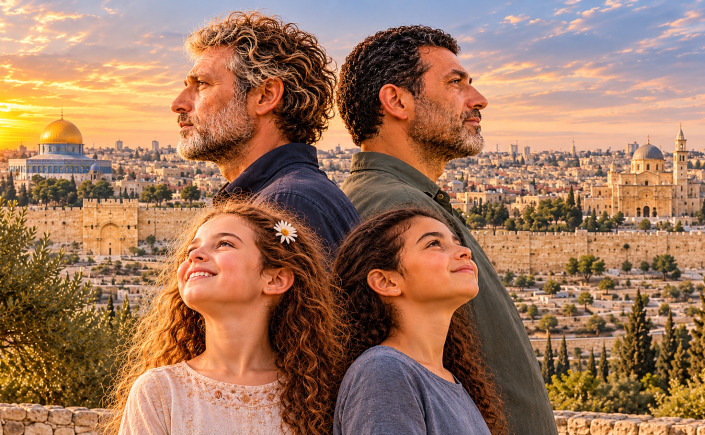
At the heart of the novel are two fathers, two young girls and two deaths, separated by ten years but connected by a terrible synchronicity.
Abir Aramin, a Palestinian child, was born on the day that Israeli teenager Smadar Elhanan was killed by a Palestinian suicide bomber on Jerusalem’s Ben Yehuda Street. Ten years later, almost to the day, Abir herself was killed, struck in the head by a rubber-coated bullet fired by an Israeli border policeman.
Smadar’s father, Rami Elhanan, is an Israeli graphic artist and veteran of three wars. Abir’s father, Bassam Aramin, is a Palestinian, an avid birdwatcher and a veteran of Israel’s prison system. Their daughters’ deaths might reasonably have been expected to consign both men to the familiar and seemingly inexhaustible cycle of grief, anger and mutual recrimination. Instead, they meet through a peace organisation established by parents who have lost children in the conflict. They become friends and, eventually, fellow advocates for reconciliation.
There is something profoundly unsettling about the coincidence of the girls’ lives and deaths. One was born on the day the other was murdered; a decade later, the second was killed. It is almost too neat a symmetry for fiction, except that it happened. Yet McCann is not suggesting that the two deaths are politically or circumstantially equivalent. Their circumstances were very different, as were the histories and power relations surrounding them. Rather, he asks us to consider what happens when two families, each with an entirely legitimate claim to grief, refuse to make that grief an obstacle to recognising the humanity of the other.
I am familiar with much of the history, politics, geography and terrain in which the story unfolds. McCann’s descriptions of the red-roofed settlement, the Separation Wall, Bedouin encampments, checkpoints, separate roads, onerous permit systems and the daily humiliations of occupation are recognisable. Travelling through the West Bank I have actually witnessed them. Familiar also, from much eyewitness reportage, are the demolition of Palestinians’ homes and the destruction of olive trees. McCann takes us, among other places, to Banksy’s Walled Off Hotel, just outside Bethlehem, in the permanent shadow of the Separation Wall and a highlight of “Occupation tourism”. In 2016, the hotel opened, we visited the Banksey Shop. Visitors were invited to add their own graffiti to the wall which rose immediately across the road. While the wall itself is an extended canvass of permanent and powerful political tableaux, this particular section is regularly painted over to accommodate fresh slogans.
But the novel is not simply an indictment of occupation, nor is it an exercise in balancing competing grievances. Its ambition is more interesting and considerably more demanding. It seeks to make room for multiple narratives without insisting that they cancel one another out. It acknowledges the particularity of individual suffering while refusing to allow that suffering to become the exclusive property of one people.
One passage has stayed with me, and it is the reason my earlier essay Walls and my more recent writing on Wasatia are so closely connected to this book.
Speaking of his daughter’s death, Bassam says: “All walls are destined to fall, no matter what.”
Rami, whose own daughter was murdered in a suicide bombing, is not quite so optimistic. He knows that even if one wall falls, others will be built. It is a world of walls. Nevertheless, he considers it his responsibility to insert a crack in the one most visible to him.
There is a distinction here worth dwelling on. The recognition that walls are destined to fall is not necessarily a prediction that they will disappear in some inevitable triumph of human enlightenment. Nor does it deny the fears, historical experiences and security concerns that lead people to build them in the first place. Rami’s response is more modest, and perhaps more realistic. He does not pretend to possess the means to dismantle the entire architecture of separation. He simply accepts responsibility for making a breach in it.
And this brings me to Wasatia, the Arabic concept of the middle way, moderation and balance, which has become an increasingly important reference point in my own thinking. The middle way is not fence-sitting, nor an attempt to manufacture an artificial equivalence between unequal circumstances. It does not require abandoning one’s convictions, forgetting history or surrendering legitimate claims. It requires something more difficult: the willingness to recognise the humanity, history and legitimate aspirations of people whose experiences and political narratives may be profoundly different from our own.
McCann’s two fathers embody that possibility. Neither forgets his daughter, neither abandons his history, and neither pretends that the circumstances of their respective losses are interchangeable. Yet they find a way to stand together without requiring the other to relinquish his grief.
Perhaps that is the most important lesson of Apeirogon. Reconciliation does not begin when everyone agrees about the past, or even when they agree about the present. It begins when people become sufficiently willing to contemplate a future that does not depend upon the defeat, humiliation or disappearance of the other.
There are, as the title suggests, infinitely many sides to this story. We cannot see them all, and should be wary of anyone who claims to have found the only one that matters. But we can, at the very least, resist the temptation to look away from the sides that complicate our own.
Six years after reading it, I find that Apeirogon remains an unusually powerful reminder that the first crack in a wall may not be made of concrete or steel. It may begin with two fathers, two dead daughters and the extraordinary decision not to let grief have the last word.
Coda: The circle remains unbroken
It’s take six years to finally complete this story. Perhaps, as Paul McCartney once suggested, it was simply waiting for its moment to arrive. The connections between Apeirogon, and my own writing have been there all along. Perhaps I needed the intervening years, and the experiences and conversations that came with them, to recognise quite how closely they belonged together.
The circle, it seems, is now complete. Which brings to mind that old American gospel and folk spiritual, Will the Circle Be Unbroken?, also known as Can the Circle Be Unbroken (By and By), famously recorded by the Carter Family in 1935. The original hymn speaks of death, separation and the hope of reunion with loved ones in a better home beyond this world.
There is something rather poignant about that sentiment in the context of McCann’s two fathers and their lost daughters. But I find myself drawn to a slightly different interpretation. We cannot simply wait for that better home that awaits us in the sky. There are walls to crack, bridges to build and histories to reconcile down here, among the living. The circle we need to keep unbroken is not just the one that promises reunion in the next world, but the one that connects us to one another in this one.
And perhaps that is where the story of Bassam and Rami leaves us: not with the promise of a happy ending, but with the possibility that grief need not have the last word.
By and by, perhaps. But preferably sooner.
Paul Hemphill, Bellingen, November2020 and 2026
In That Howling Infinite has published many essays on the subject of peace and reconciliation between Israel and Palestinians, including One Land, Two Peoples: History, Memory, Continuity, and Inheritance and Wasatia … building bridges, not walls. This essay could ostensibly be viewed as its sequel. For more on the Middle East in In That Howling Infinite, see A Middle East Miscellany.

