And there’ll be no barricades then, there’ll be no wire walls
And we can wash all this blood from our hands and all this hatred from our souls
And I believe that on that day, all the children of Abraham
Will lay down their swords forever in Jerusalem
Steve Earl, Jerusalem
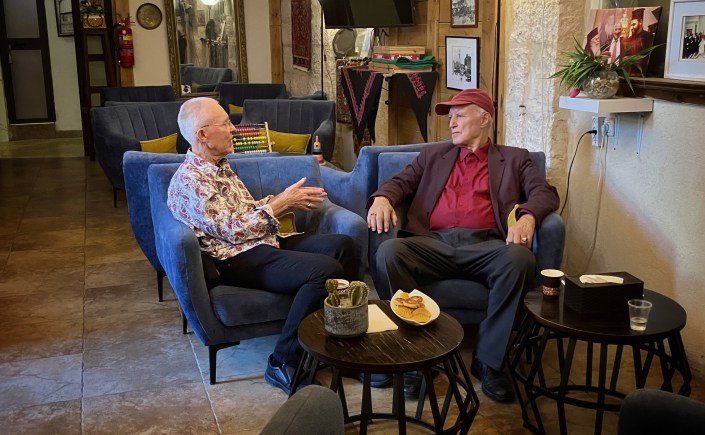
While in Jerusalem in October, I spent a couple of hours talking with Palestinian academic Professor Muhammad Dajani Daoudi, in the lounge of the grand old New Imperial Hotel, just inside Jaffa Gate. I had wanted to meet him for some time, having followed his work with Wasatia, the movement he founded to promote moderation, dialogue and reconciliation between Israelis and Palestinians, and a different way of thinking about the Israeli-Palestinian conflict. His public work has included the Wasatia Graduate Institute, dialogue and reconciliation work, and teaching about the Holocaust and Jewish history. His 2014 Auschwitz visit with Palestinian students remains the defining episode in his public career.
I was also interested in his family history, which is intimately connected with the history of the Old City. The Dajanis (al-Dajani) are one of Jerusalem’s old Muslim “notable” families – a’yan or effendiya – with a long association with the city’s religious, civic and commercial life. Its history is woven into the fabric of the city. The New Imperial Hotel, beside the Jaffa Gate is also deeply embedded in that older Jerusalem world, and the family’s association with the hotel is part of its history. Dajani has related how his grandfather saw the “Grand Hotel”, built in 1884 and in ruins after 1948. He leased it from the Greek Orthodox Patriarchate, renovated it, and established the Imperial Hotel. The hotel became a prominent institution in the Old City. The family has leased and managed it since – and indeed, Dajani few up there We have stayed three times at the hotel, a magnificent mix of trash and treasure overlooking al Khatib Square and the King David Citadel.
The family was historically associated with the custodianship of King David’s Tomb in Mount Zion – hence, the suffix in The professor’s name, Al Daoudi, named after Nabi Daoud or the Prophet David. Granted by Ottoman Sultan Suleiman the Magnificent in 1525 during the Ottoman period, this responsibility was taken away by the new state of Israel in 1948. While walking by King David’s tomb later in our visit, we chanced upon the cemetery. It was neglected and overgrown, and looking through the small iron grill in the locked gate, we spied a couple of worn headstones just visible through the grass. The sight was a small but rather eloquent illustration of the way in which the political history of Jerusalem has been written into its physical landscape. The city has a habit of making the past rather difficult to leave behind.
Al Dajani’s combination of Palestinian Muslim identity, Jerusalemite family history, Islamic scholarship and the Wasatia project intersects closely with questions I’ve been working through, particularly whether Palestinians and Israelis can acknowledge each other’s historical narratives without treating recognition of one as betrayal of the other.
Having been to Jerusalem repeatedly, I am as much interested in how competing historical memories become mutually exclusive political identities, as I am in the convoluted and complex quest for peace. This is very close to the intellectual territory Dajani occupies. I see myself as a historian (albeit an amateur one) rather than a political partisan, the Wasatia movement is one of the more interesting – and politically difficult – attempts to articulate a specifically Palestinian Muslim case for moderation, coexistence and non-violence from within an Islamic framework. It is particularly relevant to the questions discussed often in In That Howling Infinite .
A conversation in Jerusalem
Our conversation ranged across the familiar and seemingly intractable questions of history, national identity, competing narratives and the possibilities, however remote they might appear, of reconciliation – and the extraordinary difficulty of finding a political settlement that allows two peoples to live securely and with dignity in the same small piece of land.
We found considerable common ground in the proposition that competing narratives cannot simply be dismissed or wished away. They have to be acknowledged, understood and, where possible, accommodated. That does not mean accepting every historical claim or treating every action as morally equivalent. It means recognising that a durable settlement cannot be built upon the denial of another people’s history, identity or legitimate aspirations.
Our conversation about Wasatia widened into a discussion of conflict resolution more generally, drawing in part on my own background in dispute resolution and mediation. We touched on the Harvard Negotiation Project with and its promotion of principled negotiation, the distinction between positions and underlying interests, and the possibility of finding common ground without requiring either party to abandon its identity or surrender its essential interests.
From there we found ourselves discussing other conflicts that, at various points in their histories, appeared almost intractable — Northern Ireland, the former Yugoslavia — and whether there were lessons, parallels or insights worth carrying across to the Israeli–Palestinian predicament. But historical comparisons are treacherous territory. They can illuminate, certainly, but they can also encourage false equivalences or misleading conclusions when the particular histories, grievances and circumstances of one conflict are made to fit too neatly into another. My caution was less about rejecting comparisons than about knowing their limits: what might be transferable, what is particular to each conflict, and the danger of mistaking analogy for prescription.
Since returning to Australia, I have been reading Dajani’s pamphlet, Wasatia: The Straight Path from Denormalisation to Reconciliation. In effect, it is the manifesto of his movement, and a challenging document, particularly in its examination of assumptions that have become deeply entrenched in Palestinian political discourse. Its central proposition is deceptively straightforward: if Israelis and Palestinians are ever to move beyond the conflict, they must abandon the assumption that their relationship is necessarily one of permanent opposition. They must find a way to recognise the legitimacy of the other, engage with one another and accept that compromise need not mean capitulation.
As I understand it, Wasatia is neither an exercise in political fence-sitting nor an appeal to forget history. Rather, it seeks to change the terms on which Israelis and Palestinians understand one another and contemplate a shared future. Its argument is that progress cannot come from the continued reinforcement of competing national narratives, still less from the pursuit of total victory by either side, but from a willingness to acknowledge the humanity, rights and legitimate aspirations of the other.
It is an important and challenging proposition, particularly when the political and social climate on both sides appears to be moving in precisely the opposite direction. Those who advocate such an approach are often dismissed within their own communities as naïve, disloyal or insufficiently committed to the cause. Perhaps that is precisely why the argument deserves a hearing.
The following is a long essay on the origins and ideas of Wasatia, and also, a critique of its objectives with particular reference to political developments since Tufan al Aqsa on October 7, 2023, the Gaza war and the present conflict between the United Sates and Israel and Iran.
What is Wasatia?
There is a still point where the present, the now, winds around itself, and nothing is tangled. The river is not where it begins or ends, but right in the middle point, anchored by what has happened and what is to arrive
Colum McCann, Apeirogon (2020)
Wasatia (الوسطية usually translated as moderation, balance or the middle way) is an Arabic term whose religious resonance comes from the Qur’anic idea of an ummatan wasatan, a balanced or middle community. But the ethical principles it expresses are not confined to Islam. Justice, moderation, restraint, balance and a sense of proportion are also found in Jewish and Christian traditions, as well as in the work of political philosophers from very different intellectual traditions.
It is important to understand that Wasatia is not simply an appeal to political centrism, still less an invitation to split the difference between two opposing positions regardless of their merits. Nor does it mean avoiding difficult questions or pretending that the parties to a conflict possess equal power, responsibility or capacity to act. It is an ethical and political disposition: the willingness to resist extremism, recognise the rights and interests of others, and seek solutions that do not depend upon the humiliation or exclusion of one side.
In the context of Israel and Palestine, that is a substantial undertaking. Both national movements have histories of dispossession, insecurity and frustrated aspirations. Both have developed narratives in which their own suffering and claims occupy the centre of the story, while the experience of the other is frequently treated as incidental, exaggerated or illegitimate. Such narratives are understandable as expressions of collective memory, but they become dangerous when they are turned into exclusive accounts of historical truth and political entitlement.
Dajani’s argument is that the conflict should not be understood simply as Israelis against Palestinians, or Jews against Arabs, but also as a struggle within both societies between those committed to maximalist national ambitions and those prepared to work towards coexistence, reconciliation and some form of shared future. It is an attempt to change the terms of the argument, and to identify common ground among people who may otherwise be separated by national, religious and political loyalties.
This is not an argument that the two sides are equally responsible for the conflict, or that their circumstances are interchangeable. It is an argument that neither people can achieve a secure and sustainable future by denying the legitimate national aspirations of the other.
The big dream and the small hope
One of the most appealing aspects of Dajani’s thinking is his reference in the pamphlet to the celebrated Palestinian poet Mahmoud Darwish. Dajani invokes a question attributed to Darwish: “What is more important, a big dream or a small hope?” This inspired what has become known as the Big Dream, Small Hope model of conflict resolution.
The poet’s relevance extends well beyond the particular question Dajani borrows from him. He was perhaps the most influential poetic voice of Palestinian dispossession, exile and national identity, but his work was never simply a literature of grievance or political declaration. It also explored the tensions between belonging and exile, memory and loss, the longing for a homeland and the human cost of being consumed by that longing.
I have read much of Darwish’s work and am familiar with his biography, including his relationship with Rita, the Israeli Jewish woman who became one of the most enduring and poignant presences in his poetry. Their relationship, and the separation imposed upon it by the political circumstances in which they lived, became an intensely personal expression of the larger tragedy of the conflict. In poems such as Rita and the Rifle, the personal and political are inseparable. Love exists, but it exists in the shadow of national antagonism, history and the machinery of conflict.
There is something particularly affecting about this relationship. The human connections that might transcend national divisions can become casualties of the very identities people are expected to defend. A private relationship becomes entangled in a political conflict over which the individuals involved have little control. It is a reminder that the consequences of nationalism are not confined to borders, governments and military operations; they reach into the most intimate aspects of human life. The relationship is not a solution to the conflict, of course, but it illustrates what is lost when political identity becomes an impermeable boundary between human beings.
Darwish’s “big dream” is the grand national aspiration, the historic claim, the vision of a complete and final victory. It is the dream that has inspired generations, but which can also become an obstacle when its fulfilment is made a precondition for any accommodation with reality. The small hope is something more modest, but perhaps more attainable: the possibility of living together, recognising the humanity of the other, securing the everyday conditions of freedom, dignity and safety, without requiring either people to abandon its identity or historical claims, and building a future in which neither people has to disappear for the other to flourish.
The poet understood the power of the national dream, but also its capacity to become an abstraction in whose name ordinary lives are sacrificed.
The distinction between the big dream and the small hope is therefore not a choice between abandoning national aspirations and accepting the status quo. It is an invitation to recognise the limits of what can be achieved through force, political rejection or the pursuit of ultimate historical vindication, without surrendering the legitimate aspirations of either people. For Palestinians, the small hope cannot mean accepting permanent occupation, denying their right to self-determination or settling for a subordinate existence. For Israelis, it cannot mean abandoning the need for security or accepting that Jewish national self-determination is inherently illegitimate. The question is whether both peoples can pursue their legitimate aspirations without making the fulfilment of one dependent upon the denial of the other. Darwish’s insight, as Dajani employs it, is that the immediate possibilities of freedom, dignity, coexistence and a life worth living need not displace the larger dream; they may be the only practical way of keeping it alive.
There is something here that resonates with my own experience of mediation. In an intractable dispute, the parties often begin with positions that appear irreconcilable. They have invested so much in their respective narratives, and so much political and emotional capital in defending them, that retreat can be represented as betrayal. The task is not necessarily to persuade either party to abandon its aspirations, but to identify what can be achieved without requiring the other to surrender its identity or dignity.
The small hope is not a grand historical reconciliation, and certainly not an easy one. It is the willingness to preserve the possibility of a different future, even when the larger political circumstances seem determined to extinguish it. There is something deeply practical in this apparently modest ambition. The big dream may inspire, but it can also become a justification for postponing every attainable improvement until the perfect settlement arrives. The small hope asks what can be done now, without pretending that the larger questions have disappeared. A small hope is not necessarily a small achievement. Sometimes it is the beginning of something that previously seemed impossible. To quote acclaimed Australian songwriter Paul Kelly, “from small things, big things grow”.
From opposing camps to competing visions
Dajani describes a change in the way the conflict has been understood over time. Before the Oslo process, he argues, the division was commonly framed as one between Jews and Israelis on one side and Arabs and Palestinians on the other, together with their respective supporters. After Oslo, another division began to emerge: between Israelis and Palestinians who were prepared to pursue peace, reconciliation and some form of shared future, and those who rejected such a possibility.
This is a useful way of looking at the conflict, although it should not obscure the very real differences in power, circumstances and political responsibility between the parties. Nor does it mean that those who favour dialogue necessarily agree about the eventual shape of a settlement. Israelis and Palestinians who support coexistence may disagree profoundly about borders, Jerusalem, refugees, settlements, security and the precise meaning of self-determination. But they share an understanding that the continued pursuit of total victory is unlikely to produce a sustainable future.
The challenge, as Dajani sees it, is to bring these constituencies together, across national and religious boundaries, and to give them sufficient political and social weight to counter the forces of hatred and rejection. That is easier said than done. Moderates are often divided, poorly organised and politically vulnerable, while extremists have the advantage of certainty, simple explanations and an ability to mobilise grievance. To mangle two idioms, , when the going gets rough, the meek do not inherit the kingdom. The language of compromise can sound like weakness when people are frightened, angry or grieving. It is much easier to promise victory than to explain what a workable peace might actually require.
There is also a danger in describing the conflict as though it were merely a contest between reasonable people and unreasonable ones. Political grievances are not invented simply because they are expressed by people who reject a proposed compromise. The occupation, settlement expansion, Palestinian dispossession, Israeli security concerns and the history of attacks on civilians are not abstractions to be dissolved by better communication. They are the substance of the conflict. The task is to address them without allowing them to become an endless licence for collective hostility.
Indeed, the events of October 2023 have made Dajani’s distinction between competing visions more difficult to sustain. The massacre and hostage-taking of 7 October, followed by the devastation of Gaza and the widening regional conflict, have strengthened the political constituencies least receptive to compromise. Those who argue that the other side understands only force have found considerable evidence, or at least confirmation of their existing beliefs, in the actions of their opponents. The challenge for those advocating coexistence is therefore not simply to promote a different political programme. It is to resist a climate in which the very idea of engagement has come to be regarded by many as either dangerous or morally unacceptable.
Normalisation, denormalisation and the loss of contact
Viewed from this perspective, the most challenging part of Dajani’s argument concerns normalisation and the campaign for denormalisation. It is also where his thinking becomes particularly relevant to the practical experience of conflict resolution. The events of 7 October 2023, and the war that followed, have made this debate considerably more difficult, but arguably more important. For it is no longer simply a question of whether Israelis and Palestinians should talk to one another while the occupation continues. It is about what happens when two societies, already deeply divided by history, politics and geography, progressively lose the experience of ordinary human contact.
To understand Dajani’s concern, it is worth looking back to the period following the Oslo agreements in the 1990s. There was considerable investment in people-to-people initiatives designed to create contact between Israelis and Palestinians. Joint sporting activities, children’s programmes, educational exchanges, mediation workshops and other forms of cooperation sought to establish relationships beyond the formal political process. Organisations such as Yalla Young Leaders, Seeds of Peace, and also, Wasatia itself, prominent grassroots peace-building and dialogue initiatives operating in the Middle East, particularly focusing on Israeli-Palestinian reconciliation and regional youth leadership, have been involved in different aspects of this work. The underlying premise was that political agreements alone would not create peace unless they were accompanied by some degree of mutual understanding and public acceptance.
These initiatives were never a substitute for political negotiations, and their achievements should not be exaggerated. Bringing Israeli and Palestinian children together for a sporting activity does not resolve the question of sovereignty, any more than a joint workshop removes the realities of occupation or insecurity. Nor does the language of friendship necessarily overcome the profound inequalities between the participants. But such encounters can challenge assumptions, humanise people who have been encountered principally through political rhetoric, and establish relationships that might otherwise never have existed. They can also provide a small but important counterweight to the narratives through which each society learns to regard the other.
According to Dajani, the Second Intifada, from 2000 to 2004, brought a substantial decline in these activities. Violence intensified, trust collapsed and international funding and attention shifted increasingly towards security and crisis management. The resources available for people-to-people initiatives diminished, while civil society organisations, often dependent upon external funding, struggled to sustain programmes requiring continuity and long-term commitment. Dajani is particularly critical of the failure of Israeli and Palestinian political leadership to invest adequately in peacebuilding. The political environment deteriorated, walls were constructed, literally and figuratively, and priority was given to physical separation over the more difficult work of building political and social trust.
The construction of Israel’s Separation Wall, beginning in 2002, was a particularly consequential development. Its immediate rationale was security, following a period of devastating suicide bombings and other attacks against Israeli civilians. That context should not be ignored. But the Wall, much of which runs through occupied Palestinian territory rather than along the Green Line, did more than create a physical barrier between populations. Together with checkpoints, permits and restrictions on movement, it progressively dismantled many of the everyday relationships that had previously connected Israelis and Palestinians.
Before this separation, Palestinian workers travelled into Israel, traders and customers crossed between communities, and there was a degree of ordinary commercial and social interaction. These relationships existed within a profoundly unequal political framework, and should not be romanticised. Nevertheless, they provided opportunities for people to encounter one another outside the immediate context of conflict. The Wall and the wider system of restrictions progressively removed many of those opportunities.
The social consequences have been considerable. Israelis increasingly have little direct contact with Palestinians from the West Bank, while the Israelis encountered by Palestinians are more likely to be soldiers, border guards and, increasingly, settlers from settlements widely regarded as illegal under international law, some of whom engage in intimidation and violence. For older generations, memories of a more connected relationship remain. They may remember Palestinian colleagues, Israeli employers, customers, neighbours and acquaintances, however complicated the circumstances in which those relationships developed. For younger Israelis and Palestinians, who constitute the majority of their respective populations, that experience is increasingly unfamiliar. They have grown up with separation as the norm, and with the other society encountered principally through the institutions and representatives of conflict.
This is an important distinction. Physical separation does not simply restrict movement; over time it changes how people imagine one another. When ordinary encounters disappear, the space is occupied by inherited narratives, political rhetoric, television and social media. The other becomes an abstraction, increasingly defined by the actions of governments, armies, armed groups and political movements rather than by personal experience. It becomes easier to attribute collective characteristics and intentions to an entire population when there are fewer opportunities to discover otherwise.
October 7 and the war that followed have accelerated this process, while introducing an additional and particularly destructive dimension. Hamas’s attack, the murder of approximately 1,200 people and the abduction of 251 hostages inflicted profound trauma upon Israeli society. They reinforced the conviction among many Israelis that Palestinian hostility represents an existential threat and that security must precede any meaningful political accommodation. For Palestinians, the subsequent destruction of Gaza, the extraordinary civilian death toll, mass displacement and the continuing consequences of occupation have reinforced the conviction that normalisation cannot be separated from the questions of justice, equality and political freedom.
These experiences are not equivalent, nor should they be treated as interchangeable. The asymmetry of power and the respective responsibilities of the parties remain important. But both societies have experienced profound trauma, and the political consequences have been mutually reinforcing. Israeli and Palestinian public attitudes have hardened, trust has deteriorated further, and the constituencies willing to contemplate engagement have become increasingly marginalised. The space for people-to-people initiatives has narrowed just when the need for them has arguably become greater.
There has also been a substantial material cost, particularly for the Palestinian economy. Before October 2023, tens of thousands of Palestinians from the West Bank held permits to work in Israel, with their earnings supporting families and contributing significantly to the wider Palestinian economy. Following the Hamas attack, Israel largely suspended those work permits, abruptly depriving many thousands of Palestinians of their livelihoods. The consequences have been severe, particularly for households already struggling with unemployment and economic insecurity. Meanwhile, Israel has increasingly sought to replace Palestinian labour with workers recruited from South and Southeast Asia, effectively creating a new guest-worker system. Whether this arrangement becomes a permanent feature of the Israeli labour market remains to be seen, but there is little reason to assume that the previous scale of Palestinian employment in Israel will simply be restored when the war ends. A longstanding economic relationship may have been broken, with consequences not only for Palestinian livelihoods but also for the possibility of rebuilding some degree of practical interdependence between the two societies.
Neither Israel and Palestine have escaped the economic consequences. Their economies had barely recovered from the COVID lockdowns when Hamas struck, followed by the prolonged war, regional instability and, subsequently, Iranian missile attacks. Tourism and pilgrimage, both important sources of employment and income, have been particularly badly affected. The consequences extend well beyond hotels and airlines to guides, restaurants, transport operators, shopkeepers and the many small businesses whose livelihoods depend upon the movement of visitors. For Jerusalem and Bethlehem in particular, the disappearance of pilgrims and tourists has been devastating. These are not peripheral industries. They sustain a substantial network of employment and commercial activity, much of it shared across communities. The conflict has therefore further weakened the practical relationships and common economic interests that might otherwise provide some foundation for future cooperation.
There continued to be some practical cooperation, including security coordination between Israel and the Palestinian Authority, and arrangements concerning water and other shared interests. But cooperation in limited practical matters is not the same as a sustained political commitment to reconciliation. Nor should economic interdependence be confused with equality, particularly where one party exercises considerable control over the circumstances in which the other lives and works. What is striking, however, is how much of the previous economic relationship has now been disrupted. The separation that began as a security and territorial measure has acquired an increasingly permanent social and economic character.
It is against this background that we need to consider the counter-movement: denormalisation. The 2005 call for Boycott, Divestment and Sanctions demanded an end to forms of cooperation with Israeli institutions and individuals unless they were explicitly directed towards exposing or resisting occupation, discrimination and oppression. The rationale is understandable. Joint projects can be used to present an appearance of normal relations while the underlying conditions remain unchanged. Dialogue can become a public-relations exercise, and cooperation can be invoked to suggest that an intolerable status quo is somehow acceptable. For Palestinians living under occupation, the demand that they engage in apparently equal partnerships with Israelis while experiencing profound inequality can itself seem offensive.
Since October 2023, this argument has acquired renewed force. For many Palestinians and their supporters, the scale of the destruction in Gaza has made the language of normalisation seem not merely premature but morally objectionable. How, they ask, can one pursue ordinary relations while the occupation continues, settlements expand, Palestinian communities are displaced and an entire population experiences the consequences of a devastating war? For some, refusing contact has become an expression of political solidarity; for others, it is a means of denying Israeli institutions and individuals the appearance of international legitimacy. Among Israelis, meanwhile, the same period has produced heightened sensitivity to boycotts and exclusion, particularly where these are perceived as denying the legitimacy of Israel itself or holding ordinary Israelis collectively responsible for the actions of their government.
And yet, there is a further complication here, one that tends to get lost in the moral shorthand of the BDS debate: the economic interdependence between Palestinians and Israel is not simply a by-product of occupation; for many Palestinian families it is also a means of survival. Before October 7, tens of thousands of Palestinians from the West Bank earned their living in Israel and in the settlements, often at wages substantially higher than those available in the Palestinian economy. The larger, established settlements, including Ma’ale Adumim and the Etzion Bloc, have developed commercial, industrial and service economies that provide employment for Palestinians, while smaller settlements have also employed Palestinian construction workers and tradespeople. None of this makes the settlements legitimate, resolves the inequalities under which Palestinians work, or diminishes the wider costs of occupation. But it does raise an awkward question for those who advocate boycotts as an expression of solidarity: what happens to the workers when the factories, businesses and building sites close, or relocate inside Israel, and what replaces the income on which their families depend?
Bassem Eid, the Palestinian human rights activist, makes this argument forcefully in his recent account of the proposed British boycott of settlement goods, citing the loss of Palestinian jobs when SodaStream moved its plant out of the West Bank. His argument should not be treated as the last word on BDS, nor does the economic case for employment amount to an endorsement of settlement policy. But it exposes a genuine dilemma. A boycott may impose a symbolic or commercial cost on a settlement enterprise while imposing a much more immediate and personal cost on the Palestinian worker. If the object is to improve Palestinian lives, rather than simply to register opposition to Israel, that consequence deserves serious consideration. Economic dependence is itself a feature of the unequal relationship, but dismantling the limited opportunities it provides without creating viable alternatives risks making Palestinians poorer and more dependent, not freer [On a personal note: we met Bassem in Jerusalem in May 2016 We had hoped to catch up with him on this visit, but he was overseas at the time]
That argument should not be dismissed. There is a legitimate concern that normalisation can be used to whitewash the occupation or confer legitimacy upon policies that should be challenged. Dialogue that ignores the unequal circumstances in which it takes place can become an exercise in moral evasion. But Dajani raises a question that is equally difficult to avoid: if all meaningful contact with ordinary Israelis is rejected, how is mutual understanding to develop, and how are the misconceptions and prejudices that sustain hostility to be challenged? And if engagement is postponed until every political grievance has been resolved, what mechanism remains for building the relationships that might help make such a resolution possible?
His argument is that the Palestinian cause must also be won inside Israel. That requires Israelis to encounter Palestinians as people with legitimate national aspirations, rather than solely through the categories of security, terrorism and political threat. Equally, Palestinians need opportunities to encounter Israelis as individuals rather than as an undifferentiated representation of the state, the army or the settler movement. October 7 makes the first of these tasks particularly difficult, just as the devastation of Gaza and the continuing occupation make the second increasingly difficult. Neither encounter requires the abandonment of political convictions. Indeed, it may be precisely because people retain their convictions that honest dialogue becomes worthwhile.
There is an important qualification here. Normalisation is not acquiescence, and engagement is not endorsement. It is possible to oppose the occupation, condemn settlement expansion and support Palestinian self-determination while believing that isolating ordinary Israelis is counterproductive. It is equally possible to condemn Hamas’s atrocities, recognise the profound trauma experienced by Israeli society and support Israel’s right to security without accepting the policies of its present government or the conduct of the war in Gaza. It is also possible to engage with Israeli individuals and institutions without pretending that the relationship takes place between parties with equal power or responsibility. Dialogue should not be a device for avoiding political questions, any more than denormalisation should become a reason for refusing to encounter the people with whom a future settlement will have to be made.
But there remains a distinction between recognising another person’s humanity and accepting their government’s policies. It is a distinction that seems increasingly difficult to maintain in public debate, particularly when collective grief, anger and fear are so readily translated into collective judgement. The refusal to speak to someone because of their nationality, religion or presumed political position may feel like an act of solidarity, but it can also reinforce the very divisions that make reconciliation more difficult. Conversely, dialogue that asks the less powerful party to set aside its grievances in order to make the more powerful party comfortable is not reconciliation. It is a performance of civility that leaves the underlying problem untouched.
The failures of political leadership
Dajani’s criticism is directed not only at the rhetoric of extremism but also at the failure of political leadership to create the conditions in which moderation might become politically viable. The Oslo process raised expectations that a negotiated settlement was possible, but those expectations were not translated into a durable political framework. The Palestinian Authority became increasingly discredited, the division between Fatah and Hamas deepened, and Israeli politics moved steadily towards a more assertive nationalism, with the growing influence of religious nationalist and annexationist currents.
There were failures on both sides, although not necessarily of the same kind or scale. Palestinian leadership has repeatedly been compromised by factionalism, authoritarianism, corruption and strategic misjudgement. The history of Palestinian political movements also includes episodes in which attempts to establish a state within a state, or to pursue armed struggle without regard to the consequences for host societies, have contributed to repression and civil conflict. The consequences were particularly severe in Jordan and Lebanon, and later in Syria. These histories are not an argument against Palestinian national aspirations; they are part of the difficult record that any serious account of Palestinian political leadership needs to confront.
Israeli leadership, meanwhile, has increasingly failed to offer a credible political horizon for Palestinian self-determination. Settlement expansion, occupation and the influence of parties committed to annexation have progressively weakened the prospects of a negotiated two-state settlement. The continued absence of a viable political process has encouraged the belief, among many Israelis, that there is no Palestinian partner for peace, while the realities of occupation have encouraged the belief among many Palestinians that negotiations offer little prospect of meaningful change.
The events of October 7 have reinforced this political impasse. Hamas’s attack has strengthened those in Israel who argue that territorial concessions and Palestinian statehood would expose the country to unacceptable security risks. Conversely, the conduct and consequences of the war in Gaza have strengthened those among Palestinians who regard the peace process as exhausted and political negotiation as incapable of delivering their national aspirations. Neither conclusion offers a route forward. The actions of Hamas cannot invalidate the Palestinian right to self-determination, any more than the failures of Israeli governments can invalidate the Jewish right to national self-determination and security.
Each side’s rejectionists have found reinforcement in the actions of the other. The more powerful the extremists become, the more they are able to present themselves as vindicated by the existence of their opponents. This is a particularly destructive political dynamic because it makes moderation appear not merely ineffective but dangerous. The person who proposes compromise is accused of betraying the dead, abandoning the national cause or failing to understand the threat. In such circumstances, the politics of the possible becomes difficult to sustain.
Yet political leadership is not simply a matter of responding to public opinion. It also involves shaping it, sometimes against immediate popular sentiment. Leaders who merely reflect the anger and fear of their constituencies may be successful politicians, but they are unlikely to be successful peacemakers. Reconciliation requires people prepared to explain why the pursuit of a sustainable future may demand compromises that are painful, imperfect and unpopular.
At this present moment, Israeli politics is in flux, and far from settled. The prospect of a change of government, while by no means guaranteed, is increasingly part of the political conversation. An change in leadership might create an opportunity for a different direction, particularly if a new government were prepared to confront the settlement expansion, the growing influence of religious-nationalist extremism and the absence of any credible political horizon for Palestinians. Elections alone, of course, will not resolve the conflict, nor should we assume that a change of government automatically translates into a change of policy. But political circumstances are not immutable, and the possibility that Israel might eventually move away from its present trajectory is one of the few grounds for cautious hope that the political landscape need not remain frozen in its current configuration.
The Holocaust, the Nakba and the histories that are left out
Dajani recounts how Palestinian students have sometimes questioned why they should learn about the Holocaust when Israeli schools do not adequately teach the Nakba. It is a revealing question, not least because it exposes the way historical memory can become a test of national loyalty. The Holocaust has often been marginalised in Palestinian educational narratives, while the Nakba – the mass displacement and dispossession of Palestinians during the 1947–49 war, involving expulsions, flight, the destruction of communities and the denial of return — has long been marginalised or contested in Israeli public discourse. Each national narrative has its omissions, and each has political and psychological reasons for resisting the other’s account.
There is, however, another substantial part of this history that is too often left out by commentators on both sides of the divide: the displacement and exodus of Jews from the Arab world, North Africa and Iran in the decades following the establishment of Israel. Between the late 1940s and the 1970s, close to a million Jews left, or were driven from, countries in which their communities had often existed for centuries. Their circumstances varied considerably from one country to another. Some faced expulsion, confiscation of property, persecution and violence; others left amid mounting insecurity, discrimination, political upheaval and the consequences of the Arab-Israeli conflict. It would be misleading to suggest that every departure followed the same pattern, or that all were formally expelled. But the scale of the exodus, and the loss of homes, property, communities and cultural inheritance that accompanied it, are beyond serious dispute.
These Jews are often described collectively as Mizrahim, although the term encompasses a diverse range of communities and histories, including Jews from Iraq, Yemen, Syria, Egypt, Morocco, Tunisia, Libya and Iran. Many were Arabic-speaking; some had lived in the region for generations, long before the emergence of modern Arab nationalism or Zionism. Their descendants now constitute a substantial part of Israel’s Jewish population and have acquired considerable demographic, cultural and political influence. They are not simply an historical footnote to the European story of Jewish persecution, nor can they be comfortably fitted into a narrative in which Israel is understood only as a European colonial project. Their experiences complicate that account, just as the Nakba complicates an exclusively celebratory account of Israel’s foundation.
While the Holocaust, is central to modern Jewish identity and Israeli consciousness, it does not resonate uniformly across Jewish society. For many European Ashkenazi Jews, the Shoah is an inherited family and cultural memory, often only a generation or two removed, and it profoundly shapes their understanding of vulnerability, security and the necessity of a Jewish homeland. For many Mizrahim, the formative historical experience was different: centuries of life in Arab and Muslim societies, followed in many cases by discrimination, persecution, dispossession and departure after 1948. The Holocaust is not necessarily absent from their consciousness, but it does not occupy quite the same place in their historical memory or political sensibility. Israeli society is therefore not a single community responding to history in the same way; its collective memory is layered, sometimes overlapping, sometimes quite different, and that diversity matters when we try to understand the politics and psychology of Israel today.
It is striking, then, how little attention this history receives in much of the public discussion, including in accounts that otherwise seek to accommodate competing narratives. Dajani’s emphasis is understandably on the Palestinian experience and on the need for Israelis to recognise the Nakba. But a fuller account of the region’s history would also acknowledge the displacement of Jewish communities from Arab and Muslim-majority countries, and the way that experience has shaped the outlook of a substantial part of Israeli society. Recognition need not be a competition in which one people’s dispossession is invoked to diminish another’s. Nor should the history of Jewish refugees be used to deny Palestinian claims, excuse the circumstances of their displacement, or suggest that one experience somehow compensates for the other.
The events described above had different causes, took different forms and should be understood on their own terms. But they belong within the same broader historical landscape of displacement, competing national projects, persecution and the making of modern states. And acknowledging one history does not require suppressing another. Palestinians should not have to diminish the Holocaust or the suffering of Jewish refugees to make the Nakba visible; Israelis should not have to deny Palestinian dispossession to acknowledge the persecution and displacement of Jews from Arab countries. And neither community is well served by a selective history that recognises only the suffering that reinforces its own political narrative. History is not a zero-sum ledger. If reconciliation is to mean anything, it must begin with the willingness to look at the whole of the record, including those parts that are inconvenient to the stories we have learned to tell ourselves.
Reconciliation is not forgetting
This brings us to the central difficulty of reconciliation. It is sometimes presented as though it were a matter of putting the past behind us, forgiving and moving on. That is a comforting idea, but it is not a particularly realistic one, especially where the past is not simply past but continues to shape the present through occupation, displacement, insecurity, bereavement and inherited memory.
Reconciliation cannot mean that Palestinians are expected to forget the Nakba, accept the permanence of occupation or abandon their claims to freedom and self-determination. Nor can it mean that Israelis are expected to forget Jewish persecution, the Holocaust, the experience of expulsion from Arab countries, the wars and attacks that have shaped their sense of vulnerability, or the continuing reality of antisemitism. It cannot require either people to accept the other’s historical narrative in its entirety, still less to surrender their own.
What it does require is a willingness to recognise that the other has a history, that this history has produced genuine fears and grievances, and that those experiences cannot simply be dismissed because they complicate one’s own account. Recognition is not endorsement. Understanding is not agreement. Acknowledging the Nakba does not require an Israeli to abandon the significance of Jewish national self-determination; acknowledging Jewish persecution and displacement does not require a Palestinian to abandon the right to national freedom.
My own experience in conflict resolution and mediation has taught me that the positions people take are not always the same as the interests and fears that lie beneath them. It is often possible to find some common ground once those underlying concerns are understood. But this requires patience, a willingness to listen and, above all, the ability to distinguish between understanding a position and accepting it. Mediation does not work by pretending that differences do not exist. It works by identifying which differences are negotiable, which are not, and where a practical accommodation might be possible without requiring either party to abandon its fundamental interests.
Compromise is often represented as a form of betrayal, particularly in conflicts where national identity and historical suffering have become inseparable. But refusing all compromise is not necessarily an expression of moral strength. It can be a way of avoiding the responsibility of deciding what might actually improve the lives of those who have to live with the consequences. Reconciliation does not demand moral equivalence, nor does it require a false symmetry between an occupying power and an occupied population. It does require an honest assessment of power, responsibility and the obligations that follow from them.
There is a difference between moral clarity and moral certainty. The former allows us to identify injustice and condemn it while remaining open to evidence, complexity and the humanity of others. The latter tends to turn political judgement into a closed system in which every fact is interpreted as confirmation of what we already believe. Once that happens, the other side’s suffering becomes an inconvenience, its fears a deception, and any attempt at understanding a form of disloyalty.
The politics of the possible
What, then, might Wasatia offer? It is not a blueprint for a final settlement, and it would be unreasonable to expect it to resolve questions that have defeated generations of diplomats and political leaders. It is better understood as an ethical framework for the work that must precede, accompany and sustain any political agreement.
That work has several dimensions. There must be a credible political horizon for Palestinian self-determination and Israeli security. The occupation and settlement enterprise cannot simply be left in place while people are encouraged to develop better interpersonal relationships. The questions of borders, Jerusalem, refugees, sovereignty, security and mutual recognition require political answers. Civil society initiatives cannot substitute for those answers, but they can help create the social conditions in which they might become possible and, eventually, acceptable.
There is also an educational task. Children need to learn more than the national story that confirms their inherited identity. That does not mean imposing a single, supposedly neutral narrative, or pretending that historical disputes can all be resolved in a classroom. It means teaching the evidence, acknowledging contested interpretations and making room for the experiences of others. A Palestinian student should be able to learn about the Holocaust without feeling that doing so diminishes the Nakba; an Israeli student should be able to learn about the Nakba without being asked to deny the historical reasons for Jewish national self-determination. Neither should be required to accept a political conclusion as the price of historical understanding.
And there is the work of contact: the unglamorous, often frustrating business of bringing people together, building relationships and sustaining dialogue when the political climate makes it unpopular. Such initiatives will not produce an immediate breakthrough. They may not even prevent the next crisis. But they preserve something that is otherwise easily lost: the recognition that the people on the other side are not abstractions, and that any future settlement will have to be made with them, not simply imposed upon them.
This is where Dajani’s argument is most compelling, although it is important to distinguish engagement from political acquiescence. There can be no meaningful reconciliation without confronting the structures and policies that perpetuate injustice. But neither is there much prospect of a durable settlement if the populations concerned are encouraged to regard one another as permanently beyond the reach of dialogue. Walls may provide separation; they cannot create reconciliation. And even where physical separation is necessary for security, it cannot be the organising principle of a lasting political relationship.
Indeed, the challenge is now greater than simply restoring the programmes and exchanges that existed in the 1990s. The social and economic connections that once made contact possible have themselves been eroded. A generation has grown up with little experience of the other society, and the events of October 7 and the war have deepened that estrangement. Rebuilding relationships will require more than reopening a few channels of communication. It will require sustained political commitment, the removal of practical barriers to contact, economic opportunities that do not depend upon one population’s vulnerability to the other, and educational programmes that challenge inherited hostility.
Wasatia, therefore, is not an appeal to sit on the fence. It is an insistence that there is a difference between refusing to take sides in the face of injustice and refusing to allow one’s political sympathies to determine what one is prepared to see. It is possible to support Palestinian rights and security for Israelis, to oppose occupation and reject Hamas, to acknowledge Jewish historical connection to the land and Palestinian dispossession, without treating these positions as mutually exclusive. That may be an uncomfortable position for those who prefer the reassurance of political binaries, but the conflict itself is not made simpler by simplifying our understanding of it.
Coda: Where do we go from here, Wasatia?
Since 7 October 2023, the political and social environment in which Wasatia operates has become immeasurably more difficult. The Hamas-led attacks on southern Israel, the deliberate murder of civilians, the taking of hostages and the profound shock to Israeli society have reinforced an already powerful sense that Israel faces an existential threat and that there can be no reliable Palestinian partner. The subsequent war in Gaza has brought catastrophic loss of life, mass displacement and destruction on a vast scale, while the continuing pressures of occupation, settlement expansion and violence in the West Bank have further undermined Palestinian confidence in any prospect of a just political future.
These events should not be collapsed into a single moral or historical category. The attacks of 7 October and the war that followed have different circumstances, histories and responsibilities. But neither can be understood in isolation from the longer conflict, and neither people’s suffering should be used to cancel out the other’s. The trauma of Israeli civilians does not justify the collective punishment of Palestinians; the devastation of Gaza does not justify the murder or abduction of Israeli civilians. To state these things should not be controversial, although the present political climate sometimes makes even the most elementary distinctions seem like acts of provocation.
The consequences extend well beyond the immediate conflict. In Israel, the attacks and the ensuing war have strengthened those who argue that there is no Palestinian partner with whom peace can be made. Among Palestinians, the devastation of Gaza, the continuing occupation and the absence of a credible political horizon have deepened distrust of Israel and the international community. Hamas and the Israeli far right have, in different ways, reinforced the political narratives of one another. The Palestinian Authority remains deeply discredited, the division between Fatah and Hamas persists, and there is no broadly accepted Palestinian leadership capable of articulating a credible national strategy. Meanwhile, Israeli politics has become increasingly influenced by religious-nationalist and annexationist currents that offer little prospect of a negotiated settlement.
But the consequences are not confined to political leadership or public opinion. The severing of Palestinian employment in Israel, the growing reliance on imported labour, the damage to tourism and pilgrimage, and the wider economic disruption have further weakened the practical connections between the two societies. What was once a significant, if unequal, relationship of economic interdependence may prove difficult to reconstruct. The Wall and the restrictions that accompanied it had already diminished ordinary contact; the events of October 7 and the war have made the separation more profound. The danger is that this becomes not simply a temporary consequence of conflict but a new social and economic reality, in which each population increasingly conducts its daily life without encountering the other except through the institutions of security and confrontation.
The polarisation has also found its way into Western societies, including Australia, where the conflict has contributed to a disturbing increase in antisemitism and anti-Muslim hostility. Criticism of the Israeli government and its military conduct is not, in itself, antisemitism; criticism of Hamas or Palestinian political leadership is not hostility towards Palestinians. Yet those distinctions are increasingly blurred, sometimes deliberately. Jews are held responsible for the actions of the Israeli government, just as Palestinians and Muslims are too readily associated with the actions of Hamas. The result is that communities far removed from the conflict become drawn into its antagonisms, while the space for considered discussion becomes narrower.
Social media makes matters worse. Algorithms reward outrage, certainty and the repeated confirmation of existing beliefs. They are not particularly interested in historical context, competing evidence or the uncomfortable business of holding two thoughts in one’s head at the same time. The result is a moral monoculture in which acknowledgement of the other side’s suffering can be interpreted as betrayal, and a willingness to consider another narrative as evidence of insufficient commitment to one’s own. The more the argument becomes a test of moral allegiance, the less room remains for the kind of dialogue Dajani is advocating.
It would be tempting to conclude that Wasatia has become irrelevant, a relic of a more hopeful period before the latest catastrophe. I would argue almost the opposite. Its prospects may be poorer, its advocates more isolated and its task considerably harder, but the need for a middle way has not diminished. It has become more urgent, precisely because the political incentives now favour those who insist that there is no alternative to permanent hostility.
That does not mean simply returning to the people-to-people programmes of the 1990s, as though the intervening decades had not happened. Nor does it mean asking those who have suffered to put their grievances aside in the interests of an abstract reconciliation. The starting point must be an honest recognition of what has happened, accountability for wrongdoing, an end to policies that perpetuate dispossession and insecurity, and a credible political process that offers both peoples a future. Dialogue must be protected, not used as a substitute for political change. Those prepared to argue for coexistence need more than expressions of sympathy: they need political leadership, institutional support and the practical means to sustain their work.
Our conversation in Jerusalem had ranged well beyond Wasatia itself, touching on the principles of negotiation and mediation, and on other conflicts that once appeared equally resistant to resolution. We discussed the Harvard Negotiation Project and principled negotiation, with its emphasis on distinguishing underlying interests from stated positions, and finding ways to accommodate competing needs without requiring either party to abandon its essential claims. Northern Ireland and the former Yugoslavia also entered the discussion, as examples of conflicts shaped by history, identity, competing national narratives and accumulated grievance. There are lessons to be drawn, but also cautions. None provides a ready-made prescription for the Middle East. Historical analogies can illuminate, but they can also mislead when superficial similarities obscure the particular circumstances of each conflict. My own caution was against mistaking comparison for explanation, or an apparently successful precedent for a transferable solution. History does, however, remind us that political circumstances can change, that positions once regarded as immovable can shift, and that conflicts once thought intractable need not remain so indefinitely. Whether that can happen here, and what might bring it about, remains an open question.
I am reminded, too, of Mahmoud Darwish whose writing offers an interesting companion to Dajani’s Big Dream, Small Hope model. Darwish never abandoned the grand dream of freedom, homeland and dignity, but understood that it was small hope that sustained people when the larger dream seemed impossibly distant. In A State of Siege, hope becomes almost a daily discipline, nurtured in the ordinary things of life when circumstances offer little reason for optimism. In Mural, the capacity to imagine another future becomes an act of defiance in itself. The two are inseparable: the grand dream gives small hope its direction, while small hope keeps the grand dream alive. Perhaps this is also the quiet strength of Dajani’s proposition. Reconciliation may be a grand ambition, but it cannot be sustained by ambition alone. It needs the small, stubborn acts of human connection, generosity, conversation and recognition that keep open the possibility of something better.
American songwriter Warren Zevon sang that “the hurt gets worse and the heart gets harder”. There is a danger that this is precisely what is happening: that accumulated grief and fear are hardening into political identities from which retreat becomes almost impossible. The challenge for Wasatia, and for anyone who believes that a different future remains possible, is to resist that hardening without pretending that the hurt can simply be wished away.
I suspect Dajani is an optimist, perhaps more so than present circumstances warrant. His vision may seem quixotic, a voice crying in the wilderness at a time when the political currents on both sides are running so strongly in the opposite direction. But I find myself agreeing with him about the direction in which we must ultimately travel, even if the road is considerably longer and more difficult than his original pamphlet might have anticipated. That is not to underestimate the obstacles, or to pretend that dialogue alone can overcome occupation, insecurity, dispossession or competing national claims. Reconciliation requires political change, accountability, leadership and a willingness to recognise the legitimate aspirations of both peoples. It cannot be wished into existence.
So where do we go from here, Wasatia? I don’t pretend to know. But the alternative — the permanent triumph of the big dream over the small hope, and the acceptance of hostility as the natural condition of two peoples sharing the same land — is not much of an answer. Moderation is not the absence of conviction, nor is reconciliation an evasion of justice. It is the willingness to subject our convictions to the demands of history and the humanity of others. That, to me, is the straight path Dajani is asking us to consider. It offers no guarantee of arrival, and perhaps not even the prospect of getting there in our lifetime. But it is a path worth keeping open.
Paul Hemphill, Jerusalem and Bellingen, November 2026
In That Howling Infinite has published many essays on the subject of peace and reconciliation between Israel and Palestinians, including One Land, Two Peoples: History, Memory, Continuity, and Inheritance . This essay could ostensibly be viewed as its sequel. For more on the Middle East in in That Howling Infinite, see A Middle East Miscellany.
The Palestinian Professor Who Still Believes in Peace
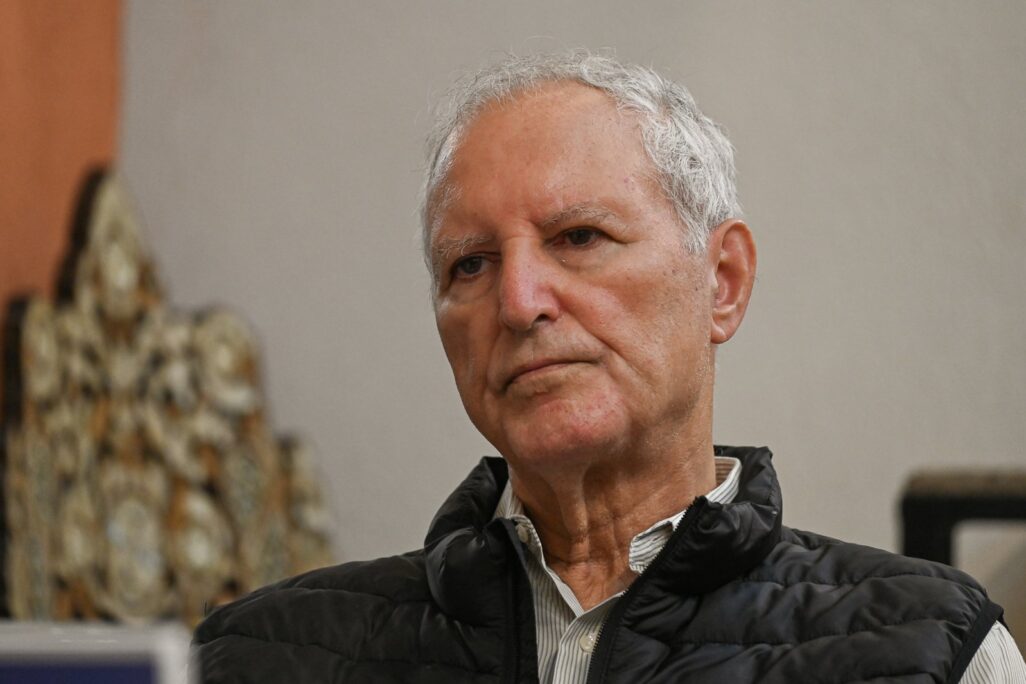
Professor Mohammed Dajani Daoudi sits at the Imperial Hotel, near Jaffa Gate in Jerusalem’s Old City. Though he has reached the age of 80, he remembers his childhood within the hotel’s walls—the starting point of physical and intellectual wanderings that eventually brought him back home. For decades he has worked to promote reconciliation between Israelis and Palestinians—”moderation within the conflict,” as he puts it. Even at 80, and despite the current security and political situation, he says, “I believe in hope. My hope is that one day our children will be able to play together.”
Daoudi, founder of the Palestinian movement for moderate Islam, Wasatia, belongs to a prominent lineage in Palestinian society. “The name Daoudi comes from the name given to the Dajani family because they were the custodians of King David’s Tomb,” he explains with pride. “They were appointed by Sultan Suleiman the Magnificent in 1525. And from then until 1948, we were the guardians of King David’s Tomb.”
When the fighting subsided, the family returned to Jerusalem. “We could not return to our home in Baka, so we came to the Old City and lived in the place that is today the ‘Swedish Hostel.’ My grandfather did not let any obstacle or loss crush him or turn him into a refugee. On the advice of her neighbors, his wife went to the UNRWA office and registered her family as refugees. When my grandfather returned from work and saw what she had done, he took the registration papers and said, ‘I am not a refugee.’ That was the lesson he taught us. Being a refugee is a state of mind. If you want to be a refugee, you want to be dependent on others; if you do not want to be a refugee, you rely on yourself and must build yourself up.”
Daoudi relates that his grandfather saw the “Grand Hotel”, built in 1884, in ruins and inhabited by refugees. He leased it from the Greek Orthodox Patriarchate, renovated it, and established the Imperial Hotel. The hotel became a prominent institution in the Old City: “People who wanted to hold festivals and weddings would come here; it was the only venue that did that in the 1950s. My grandfather persuaded the municipality to ask King Hussein for funding for a road connecting the Dung Gate with Jaffa Gate.” The grandfather’s businesses flourished, and he represented various European companies.
Today, Daoudi is locked in a legal battle over his right to reside in the hotel, which was purchased through a shell company in 2005 by the Ateret Cohanim organization. Following a years of litigation aimed at annulling the sale, the court gave its final approval in 2022, and the Jewish organization, which acquires properties in East Jerusalem, took possession of part of the building.
“I grew up in this hotel. I attended the Friends School in Ramallah, which was a Quaker school. I learned there to think in terms of compromise. They taught us empathy and cooperation. The headmaster, Farid Tabari, who was Christian, used to read in the assembly hall one day from the New Testament, one day from the Hebrew Bible, and one day from the Quran. And so we grew up steeped in interfaith values.”
His political involvement began during his studies at the American University of Beirut. “Beirut marked the beginning of my year of radicalization. There were very active political parties there. Everyone was anti-Israel, calling for the destruction of Israel and the liberation of Palestine.
After the 1967 defeat, which was not just a military defeat, but also a psychological and social defeat, defeating Israel became tied to people’s honor. They lost their pride in the 1967 defeat. As a result, Palestinians shifted from supporting Arab armies to attack Israel or liberate Palestine, to supporting Palestinian liberation movements that would liberate Palestine themselves.”
Daoudi joined Fatah in 1967. “I was an idealist, and the liberation of Palestine was the ultimate goal.” He relates that after a while, people began joining Fatah for money, status, and prestige. “During that period, I started seeing a lot of corruption. I used to raise money for Fatah by selling tickets door-to-door for five Lebanese pounds. I saw people taking 5,000 pounds just to throw a wedding. I said to myself, ‘Wait a second, this is money that took me two months to collect, and they’re throwing a wedding with it?’ That affected me deeply.”
")
At the end of his studies he received permission to return to Jordan, at the request of his family from King Hussein. In Jordan he founded the Department of Political Science and Diplomacy at the University of Applied Sciences. In 1993 he received residency and returned to Jerusalem.
He served as a consultant for the United Nations Development Programme (UNDP) and later for the Palestinian Authority. “Over two years, I succeeded in helping establish the Palestinian Authority’s ministries. I established two institutions for public administration, one in Ramallah and one in Gaza. We trained more than 30,000 Palestinians to become civil servants in the Palestinian Authority.”
Daoudi pushes back against the sweeping accusations leveled against the Palestinian civil service. “The corruption is at the top; it is not deeply ingrained. The civil servants want to do their job. Some are good, some are not. There is indeed a lot of nepotism and a lot of tribalism, and the problem is that the corrupt give everyone a bad name.” He explains that in 1996, the Palestinian public voted for Fatah, but “Arafat encouraged corruption, and things did not go well.”
“Hamas Divides Us, Wasatia Unites Us”
Daoudi accuses Hamas of distorting verses from the Quran. “Many verses in the Quran are being changed. In Wasatia, we teach that everyone is entitled to their own faith. We teach tolerance, interfaith dialogue, and empathy for the other. There are values we share, and things on which we disagree; the Quran tells us that God will ultimately judge between us. He is a forgiving God, and He will forgive those who were misled.”
He quotes a phrase considered the encapsulation of Wasatia’s core principles: “Wars divide us, peace unites us,” and connects it to present-day reality: “Hamas divides us, Wasatia unites us.”
“The Middle Way”
“I went to Ein Kerem Hospital with my father so he could undergo chemotherapy. I saw Jewish doctors helping to heal Palestinians and Arabs, Muslims and Christians. I started to see the human side of the Other. Instead of ‘us or them,’ my vision became ‘us and them.'”
He recalls one of the events that led him to establish the Wasatia movement. “It was in 2007, and I was secular then; I had no connection to religion,” he remembers. “One Friday morning, I was watching an Israeli checkpoint from my home balcony. There were hundreds of Palestinians surging toward the checkpoint to get to Jerusalem for prayers. The soldiers were pushing them back because they didn’t have permits. The soldiers fired tear gas at them, and I thought that eventually they would shoot them. The people were determined. Despite the tear gas, they didn’t give up.
“In the end, the soldiers at the checkpoint brought buses, allowed the people to cross the checkpoint, searched them, took their ID cards, and then the buses took them to Jerusalem to pray. The buses brought them back to the checkpoint after prayers. The people got their ID cards back and went home.”
“For me, it was a win-win situation. The Palestinians wanted to go pray so as not to miss the Friday prayers during Ramadan, and the Israelis were worried about these people coming in, entering Israel, and making bombs. The people prayed and there were no bombs or violence. I wanted to establish a party or movement that would create win-win situations, and that is how I started Wasatia.”
The word Wasatia means “center” or “the middle way.” “In the second chapter of the Quran, Surah Al-Baqarah, there are 286 verses. The middle verse says, ‘Thus We have made you a middle nation.’ This means there is a middle path in Islam. So we adopted that concept from there and started our movement. Initially, we focused on Islam because it is the language of the Palestinian religious community, and later, in order to appeal to secular audiences, we also spoke about moderation in various religions and among different philosophers.”
“Education for Reconciliation and Empathy”
“We used to hold a conference every year where about 200 imams and sheikhs would come to learn about Wasatia. We worked on changing the Palestinian curriculum, but the problem is that even if you change it, if you don’t change the mindset of the teachers, nothing can be taught. A teacher can walk into a classroom and teach hatred instead of peace.
“That is why in 2020 we established the European Wasatia Graduate School for Peace and Conflict Resolution at the European University Flensburg in Germany. About 25 students study there, including Israelis, rabbis, Palestinians, and one student from Gaza.” He tried to set up a similar institution with joint programs at Tel Aviv University and Al-Istiqlal University in Jericho, but “PA President Abbas and the president of the Jericho university rejected it.”
Daoudi places his trust in education and draws inspiration from Plato. “When he was disappointed by Athenian democracy, which condemned his teacher Socrates to drink poison, he looked beyond the Athenian community and beyond democracy. He was not against democracy, but he pondered what was wrong with it, and concluded that when people lack education, democracy devolves into demagoguery. He launched his academic journey to enrich the community through education. I want to enrich the Palestinian and Israeli communities through education for reconciliation and empathy. My dream is to see a graduate school in the spirit of Wasatia in Israel and Palestine.”
The Need for Moderation
“Hamas’s radical Islamic ideology can only be countered by a moderate Islamic ideology. You can defeat Hamas militarily, but if you don’t defeat it ideologically, you lose. Hamas members want an Islamic state from the river to the sea, and Zionist extremists want a Jewish state from the river to the sea—I believe neither will happen; it is a fantasy on both sides. There are seven or eight million Israelis on one side, Jews, and seven or eight million Christians and Muslims on the other. What do you plan to do with them?
“The language of force used by the current Israeli government, designed to rally Israeli voters, empowers the radicals on the other side. They feed off each other. Moderation, on the other hand, paves the way for good-faith negotiations, which will open the path to peace.”
His Office Was Ransacked, His Colleagues Stayed Silent
To educate for empathy, Daoudi, as a university professor, initiated a trip for Palestinian students to Auschwitz. “The reason I took my students to Auschwitz was to practice empathy—so they could go and see the suffering of the Other. We also took Israeli students to the Dheisheh refugee camp to hear the Nakba stories of the 1948 refugees, so that they, too, could feel empathy in their hearts. We want to turn hearts of stone into hearts of flesh.”
Twenty-seven students joined the trip to Auschwitz in 2014. “These people came from such negative backgrounds. Before we started, I told them to leave the baggage of the past behind and come with an open mind. On our last day there, the newspaper Haaretz published an article about the trip. I had asked them to publish it only after we returned, but they published it while we were still there. The Palestinian newspaper Al-Quds translated the article into Arabic. There were several flaws in the translation. For example, it stated that Tel Aviv University funded the trip instead of Friedrich Schiller University in Germany, which actually funded it.
“People started telling the students, ‘This is normalization, and normalization is betrayal.’ I argue that normalization intended to reinforce the occupation is betrayal, but normalization intended to end the occupation and build bridges of peace with the peace camp on the other side is not betrayal.”
Daoudi believes the error in translation was not made in good faith. The controversy spread beyond Jerusalem and the Palestinian Authority, reverberating throughout the Arab world. Daoudi came under attack in the media, and unidentified individuals ransacked his university office. Facing overwhelming pressure, he resigned from his post at the university.
“I met with the university president and submitted my resignation. He asked me why, and I replied: ‘You have protests outside. My office was destroyed. People are threatening me.’ I showed him threat letters, which he took and refused to return. I asked him to issue an updated statement on behalf of the university clarifying that what I did fell within the scope of academic freedom. He said, ‘I can’t do that.’ There was heavy external pressure—for instance, Ahmed Qurei (one of the architects of the Oslo Accords), who served as chairman of the board of trustees, called him and demanded my dismissal.”
“What affected me most negatively was the silence of my colleagues. Some of them even began attacking me to appease the university, claiming that the students who participated were forced to go. That was untrue, as 70 people had applied and we selected 30 of them.”
The Big Dream and the Small Hope
Daoudi invokes the concept of “the big dream and the small hope,” taken from a 1996 New Yorker interview with Mahmoud Darwish, the Palestinian national poet, following the signing of the Oslo Accords. Darwish said at the time that Arafat chose a small hope over a big dream. Daoudi recalls introducing this concept in 1997, at a gathering of Jewish and Palestinian religious leaders in Antalya, Turkey.
“The meeting played out as a series of monologues: people talked at each other, but didn’t listen to each other. I recalled Darwish’s words and asked, ‘What is more important: a big dream or a small hope?’ The big dream is to wake up one morning and find that the Other is no longer around. But when you wake up, there are eight million of the Other. What do you want to do with them? Do you want to throw them into the sea? They answered, ‘No.’ So we moved on to the small hope: to wake up one morning and discover that we are living together as neighbors—helping each other, teaching each other, learning from each other. That is how we can lead our children to peace.”
The starting point, according to Daoudi, is mutual recognition between the State of Israel and the State of Palestine. “What needs to happen is for both states to recognize each other as states and as UN member nations. This will grant legitimacy to the State of Israel from the Palestinians, and to the Palestinians from the Israelis. In doing so, we can move forward—living in the future rather than in the past.”
Regarding Arab citizens of Israel, he says that “they should not view Islam as a barrier separating them from the Jewish community. They should use Christianity and Islam to serve as bridges between the two communities. And I believe they can adopt the concept of Wasatia within this group, emphasizing the vision of both communities living in peace and harmony.”
“Elections Under Occupation Will Lead to Votes for Radicals”
Although he has criticisms of him, Daoudi believes that Palestinian Authority President Mahmoud Abbas can still sign a historic peace agreement between the two peoples. “Palestinians don’t believe there is an Israeli partner for peace, and Israelis don’t believe there is a Palestinian partner for peace. They don’t hear each other. Israelis need to make peace with Abbas; signing a peace agreement will give him legitimacy.”
According to him, “Ultimately, recognition of a Palestinian state will happen, and even though I don’t support Abu Mazen [Mahmoud Abbas] and his entourage, if he gets the credit for it, people won’t care about the corruption. Corruption exists in democratic countries as well. If people feel he delivered on what he promised—recognition of a Palestinian state—his path will be seen as the right one.”
He recognizes the limitations of Abu Mazen’s leadership, but sees no better alternative on the horizon. “Abbas is certainly not particularly open to the two-state solution, or even to Holocaust education. But if he is given the authority before his death to recognize the State of Israel and to become the President of the State of Palestine, he will lead the way for others to follow. Israelis want a courageous leader like Nelson Mandela, but someone like [Marwan] Barghouti, for instance, is no Nelson Mandela—none of the other leaders possess the courage to lead.”
The Planned Palestinian Authority Elections
“I believe Abbas is using [the elections] as morphine for the people, because the situation is very grim—especially with the Israeli incursions into the West Bank, the siege imposed by Israel, the poverty, and the lack of salaries. I also believe these elections will not take place. In the past, elections were canceled because Israel did not permit them in East Jerusalem. Now, we don’t just have the Jerusalem issue; we have the Gaza issue.”
According to him, “I do not believe elections are a good thing under occupation. It isn’t democratic. People under pressure and occupation will not vote like free people; they will vote for the radicals. Hamas will take over, and the Israelis encourage this so they have a pretext to annex the West Bank. Elections held under a sovereign Palestinian state would bring entirely different people into power—people who believe in democracy, negotiation, and diplomacy.”
Is there a solution to the situation in Gaza?
“Israel needs to empower Gaza residents who oppose extremism—the moderates. Israel needs to bolster education and the Wasatia curriculum. In the next elections, Israelis need to decide what they want: the future or the past. If they want the future, that means peace. And if they want the past, that means war.”
Dajani addresses Israelis directly: “You built a great country; do not destroy it. Do not make people hate it and place it under siege. Citizens of Israel today are better off than citizens in Britain. Instead of wasting money on wars and conflict, build bridges with people.”
Davar (Hebrew: דָּבָר, lit. Word, Speech, Thing) was a Hebrew-language daily newspaper published in the British Mandate of Palestine and Israel between 1925 and May 1996.[1] A similarly named website was launched in 2016, under the name Davar Rishon as an online outlet by the Israeli union Histadrut.

