He says, “There’s no doubt about it
It was the myth of fingerprints
I’ve seen them all and, man,
They’re all the same.
Paul Simon, All Around The World
Remembering, Belonging, and Historical Truth
For a while now in a cerebral studio half-library, half-workshop, I have been circling the same issue from different angles: how nations remember themselves, how identities cohere, how nations tell stories about their origins and how these stories harden into truth or disappear. Each conversation, each foray into history or into the quarrelsome present, returns us to the same quiet, unanswerable question: what, exactly, are we remembering when we claim to remember a nation? And who, precisely, is this “we” that history keeps ventriloquising?
Somewhere along the way, perhaps when we were contemplating narratives of migrations, invasions and conquests, tracing the afterimages of settler myths, or weighing the moral freight of modern nationalisms – a metaphor emerged: the “myth of fingerprints.” It was a lyric of Paul Simon’s which I had remembered out of context and frighted it with a meaning of my own making – a way of naming the uncanny persistence of identity stories, their air of timeless permanence, their promise of uniqueness – and the near certainty that these promises are, if not lies, then comforting half-truths. I found myself returning to it, polishing it, setting it against new historical examples and examining the fit.
And so this essay begins where that collaboration has led us: with the myth itself. Not as an accusation, nor as an elegy, but as a kind of unmasking – an invitation to look at the prints on the glass more carefully, and to consider how many hands have actually touched it.
What follows, then, is a foundation stone: a meditation on fingerprints, on the stories nations tell, and on the fragile, smudged, necessary business of belonging.
Every nation tells itself a story. It can’t help it. The story is seldom true in any strict archival sense, nor is it even necessarily consistent, but it performs the vital work of giving shape to the past and coherence to the present. It tells us who “we” are – a small, fiercely defended word – and what we owe to the ghosts who came before. History, in this sense, is never simply what happened; it is what we believe happened, what we need to believe in order to go on belonging.
That need gives rise to what we might call “the myth of fingerprints”: the comforting notion that identity, whether personal or national, is like the whorls on a fingertip – unique, immutable, traceable. That it leaves a clean mark on history, a signature that can be read back to its source. But this, too, is myth. No one’s fingerprints are purely their own. They are pressed and smudged by time, by touch, by other hands, other claims, other losses. The lines blur. History – national, personal, or collective – becomes a palimpsest of contact.
Every nation insists that it has its own distinct “fingerprint,” its unique identity pressed into the soft wax of the past. But what we actually see are overlapping impressions: the marks of conquerors and the conquered, settlers and displaced, victims and victors, the living and the dead. The illusion is that the print belongs to one hand alone; the reality is that we have all touched the same page.
This creates the deeper tension at the heart of remembering and belonging: the yearning for a clear print, an unbroken line from past to present, versus the recognition that history’s surfaces are crowded, overlaid, unstable. We imagine the fingerprint as fixed and legible – proof of continuity, of moral coherence. But in truth the record is partial, blurred, and endlessly rewritten. What we read as “identity” is often nothing more than the pattern that flatters our sense of self.
Different societies play out this tension in their own ways. Australia oscillates between a black armband and a white blindfold; Britain juggles its composite realms and questions its unitary future. America quarrels across its duelling creation myths – 1619 versus 1776; Russia and China legislate memory outright, outlawing doubt in the name of unity. Each of these contests betrays the same unease: that truth, once it steps out from behind the slogans, may not flatter us. So we curate, commemorate, rewrite; we re-edit the film reel to make our ancestors saints or victims, depending on the mood of the age. The past becomes a stage on which we perform our present anxieties.
Every competing narrative, every national myth, is ultimately another bid for belonging — an attempt to reconcile dueling vantage points and to anchor identity in some stable moral ground from which to look back. But there is no such ground. History is a moving landscape, its contours shifting with each generation’s eyes. We inherit our vantage points – from family, school, class, faith, geography – and we mistake the view for the terrain itself. What feels like historical truth to one may feel like erasure to another; what registers as guilt to some appears as justice to others. The archive does not change, but our eyes do.
To remember, then, is not merely to know, but to choose. And belonging – that subtle alloy of pride and shame – depends on which memories we choose to preserve and which we quietly let fade. Perhaps the most honest nations are those that admit the instability; that accept history as dialogue rather than verdict. For in the end, the past does not belong to the victors or the vanquished alone, but to all who continue to argue about it. The argument is the belonging.
Yet this argument, too, is fraught. In many countries, remembering and belonging collide with the desire for closure – the urge to stop interrogating the past lest the whorls dissolve altogether. Some insist that too much remembering threatens the story that binds us. But the danger of closure is amnesia: the quiet substitution of myth for memory. Once we start believing the fingerprint is perfect, we stop noticing whose fingers were cut off to make it so.
The myth of fingerprints therefore becomes the myth of pure belonging – the fiction that we can find, in the ridges of history, something distinctly and innocently our own. The truth is messier, more communal, more compromised. The mark we leave is never solely ours. It records how we have all handled the past – sometimes tenderly, sometimes violently – and how, in turn, the past has left its print on us.
In the end, those who tell the national story are bound by a common impulse: to tidy up the smudge and claim the mark as theirs alone. But history, like a fingerprint taken in haste, resists neatness. The harder you press, the more it blurs.
And so the historian’s task — and the citizen’s — is not to polish the print until it gleams, but to study the smudge: to see, in the blurred lines, the complicated truth of who we really are, and who we have been to one another.
I will return to those nations name checked above; but first, let us look at a region that is particularly in the spot light at this time, the genealogy and history of its peoples the focus of much discussion, conjecture, and indeed, misinformation.
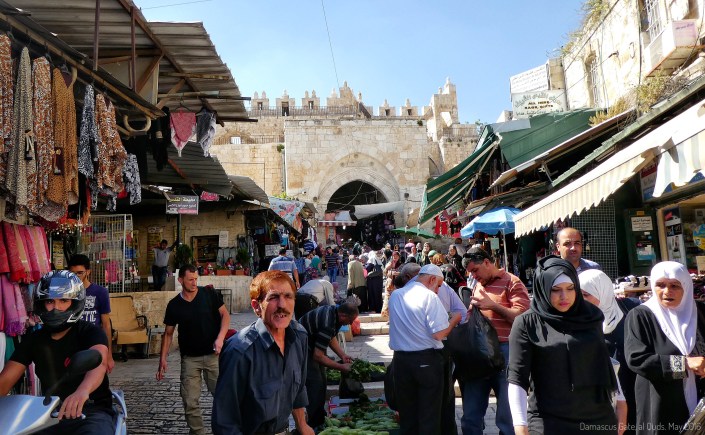
The picture at the head of this essay is our own 2016 photograph of the streetscape behind the Damascus Gate in Jerusalem’s Old City, a vibrant spot where, literally and figuratively, all nations meet.
The Peasants’ Revolt … the shaking of ancestral certainties
We had been circling the question of identity, particularly in these troubled times with regard to the perennial chimera of Middle Eastern history, when Becoming Arab: The Formation 8of Arab Identity in the Medieval Middle East (Princeton, 2025) came to our attention. Its author is Yossef Rapoport, a historian of the social, cultural and legal aspects of life in the Islamic, Arabic-speaking Middle East in its Middle Ages.
At first glance, Rapoport’s book is about Egypt and Greater Syria between the eleventh and fifteenth but can also be viewed as an act of quiet historiographical subversion. It takes one of the most enduring assumptions in Middle Eastern history, that Arab identity is essentially primordial, tribal, genealogically anchored in the Arabian Peninsula, and consistently distinct from the sedentary peasantry, and reverts it. The Arabs, he argues, did not arrive in Egypt and Greater Syria in the later Middle Ages. They were, instead, made there. The peasants, he says, were Arabising themselves while no one was looking.
The Arabs of late-medieval Egypt and Syria did not descend like a migrating river from the Hejaz. They germinated from the soil itself. Villagers – Christian and Muslim, tenant and smallholder – constructed new Arab identities from the pressures of Islamisation, taxation, tenancy, and the need for protection against the Mamluk military apparatus. Arabness, in his telling, was not the survival of some desert aristocracy; it was the invention of the villages.
Identity, in Rapoport’s world, is not an inheritance. It is a project.
Becoming Arab, Becoming Someone: the unsettling art of Identity
Identity, as Rapoport’s medieval peasants quietly demonstrate, is less a patrimony than a practice – something fashioned, revised, and sometimes improvised like a timber roof over shifting sands. If modern nationalisms insist on bloodlines, purity, and ancient descent, Rapoport ushers us into a world where belonging is bricolage, and where the most enduring identities are precisely those that were assembled in moments of uncertainty.
His canvas, at least at first, seems modest: Egypt and Greater Syria in the late-medieval centuries. The Nile Delta, the villages of the Beqaa, the stepped hills of Jabal Nablus, the rural orchards around Damascus — these were not theatres of grand empire but landscapes of chronic insecurity, where land changed hands faster than memory, and where peasants, famously immobile, found themselves navigating new forms of power. Rapoport catches them in one such moment: the collapse of customary landholding under the Ayyubids and Mamluks, the spread of Islam into villages once half-Christian or syncretic, the arrival of new administrative categories that sorted human beings into clans, tribes, and lineages.
Most historians had assumed that Arab identity belonged to Bedouin tribes and their descendants — that the peasants of Egypt and Syria were simply absorbed or dominated by nomads. Rapoport tilts the frame. The villages, he shows, Arabised themselves from within. As military iqṭāʿ holders confiscated land, villagers reorganised along new kinship lines, often inventing lineages to protect themselves. Arabness, in this context, was not a biological category but a political technology. It gave rural people a language for solidarity, a framework for adjudicating disputes, a veneer of dignity in a world where formal autonomy had evaporated.
Genealogy – the great fetish of Middle Eastern historiography – emerges here as a craft, not a truth. Villagers pieced together Arabian forefathers from epics, sermons, Qur’anic imagery, and the demands of survival. The Sīrat Banī Hilāl and Sīrat Baybars were not mere stories; they were genealogical libraries. To insert oneself into these epics was not to lie but to belong. Much as Scottish clans in the 18th and 19th centuries adopted tartans older than their supposed lineage, or Balkan villages discovered Homeric ancestry with suspicious precision during the nationalist age, Egyptian and Syrian villagers found the Arabia they needed.
Rapoport’s materials are prosaic – tax registers, turbans, legal deeds – yet their implications are seismic. When villagers appear in administrative registers as members of “tribes” spanning multiple villages, one sees identity crystallizing in real time. When turbans worn by urban Arabs suddenly appear on rural heads, one sees identity becoming visible before it becomes genealogical. When waqf deeds record peasants reorganising into named clans, one sees the invention of ancestry under pressure.
The old binary collapses: desert Arabs vs. sedentary peasants, mobile tribes vs. rooted farmers. Instead we encounter a world where tribes can grow in river valleys, and peasant families can adopt Arabian mythologies without becoming biological Arabs. Identity, in this telling, is not inherited but cultivated, a crop grown as much from stories as from soil.
The Expanding Wave: from Egypt and Syria to the Arab world
Once one accepts this rural, adaptive model of Arab identity, the rest of the region begins to shimmer differently. The Levant, always a crossroads, always porous, becomes a showcase of integrative identity formation. The Arabic spoken in Beirut, Jerusalem, Aleppo, and the hill villages of Palestine was not poured from a single Arabian vessel; it seeped into daily life through commerce, religion, poetry, and the slow gravitational pull of Islam. Levantine Christians Arabised linguistically while retaining liturgical identities older than Islam itself. The Maronites of Mount Lebanon absorbed Arabic hagiography into their repertoire; Greek Orthodox congregations in Palestine prayed in Greek while writing love poetry in Arabic.
Arabness here was not a takeover but a sedimentation: a layering of linguistic, cultural, and symbolic materials onto older regional identities. The people did not change; the idioms through which they spoke themselves did.
This pattern repeats with variation across the Maghreb. The legendary migrations of the Banū Hilāl, often treated as historical fact, now appear as cultural movements more potent than any actual demographic influx. North African communities adopted Hilālī origin stories not because Arabian blood flowed in their veins, but because the epics provided a heroism that resonated with rural life, feuding lineages, and pastoral memory. It was a genealogy of usefulness, not ancestry — a medieval branding exercise that worked spectacularly.
If Rapoport’s Egyptian villagers began to speak Arabia to make sense of their world, Maghrebi communities did the same across a different frontier: the long negotiation between Arab, Berber, and Islamic spheres. Meanwhile, Yemenis continued to retrofit their lineages backward into the time of Sabaeans and Himyarites, producing genealogies as ornate as carved doors in Sanaʿa.
Across this wide geography, identity behaves in the same patterned way: responsive, adaptive, porous. Not primordial, but persistent.
When Arabic became a village, a region, a world
And somewhere in the midst of Rapoport’s quietly radical countryside – that Middle East of peasants who Arabised themselves while no one was looking – you must pause, tilt your head, and listen. Because language is doing something extraordinary here, something rarely acknowledged in the grand narratives of empire and creed. It is splitting and flowering, shedding its classical plumage, burrowing into the furrows of village life, and re-emerging as something both recognisably Arabic and unmistakably local. Arabisation was not only a migration of people or ideas; it was a migration of sounds.
At one end of the spectrum sits al fuṣḥā, the eloquent one – the Qur’anic register, the chancery script, the high prose that lived above the dust of daily life, as if suspended from the celestial spheres by unbreakable grammatical threads. It was the language of revelation, law, commentaries, the language you were meant to speak, or at least revere. It shimmered across the medieval landscape like a liturgical north star, perfectly declined, eternally unchanging.
But beneath it – within earshot, and yet worlds away – alʿāmmiyya, the vernaculars that grew like hardy, opinionated shrubs in every valley and market square. This was Arabic as lived: the idiom of millers, muleteers, and women gossiping at the well; the flexible, musical tongue of shepherds’ calls, lovers’ quarrels, curses hurled at tax collectors, and ballads sung under cheap lamps at dusk. If fuṣḥā belonged to eternity, ʿamiyya belonged to the moment. And it was ʿāmmiyya – not the polished classical al fuṣḥā’ ideal – that carried the weight of becoming Arab.
Rapoport’s villagers were not mastering an Arabic language classics; they were sanding down al fuṣḥā’s angles, letting vowels and prefixes fall like loose grain from a sieve. They folded older substrates – Coptic in the Delta, Aramaic in the Hawrān, Syriac in Mesopotamia, Amazigh across the Maghreb – into their new vernaculars, creating dialects that were less “corruptions” and more linguistic terroirs, tasting unmistakably of the soil from which they sprang. A peasant reciting Sīrat Banī Hilāl beside a canal was not merely echoing Arabian heroes; he was remaking the language so it sounded like home.
Egyptian Arabic took on its warm cadences and soft g’s; Levantine Arabic acquired its clipped urban briskness and rural singsong; Iraqi Arabic clung to archaisms jettisoned elsewhere; Maghrebi Arabic became its famously rapid, consonantal storm – so dense that an Egyptian might catch only fragments of a Moroccan taxi driver’s lament. Each dialect became a fossil record, a stratigraphy of migrations and memories.
And between these poles – the classical ideal above and the lived vernaculars below – there slowly formed a third layer: not yet fully born in Rapoport’s medieval world, but gestating in chancelleries and courtly workshops. What we now call Modern Standard Arabic – the language of officialdom, of newspapers, of TV anchors with immaculate hair. Not quite fuṣḥā, not quite ʿamiyya, but a negotiated truce between them: the language of governments, of textbooks, of polite argumentation, stripped of archaism yet still tethered to scriptural authority. It is nearer to the classical than the colloquial, yet modern enough to speak of jet engines and election irregularities without sounding like a medieval astrologer.
The tripartite ecology – fuṣḥā the ideal, Standard the negotiated, andʿāmmiyya the lived – became one of the great engines of regional difference. For Arab identity, so often imagined as primordial and uniform, turns out to be something much more interesting: a multilingual negotiation. A people becomes Arab in three voices at once – the language of God, the language of the state, and the language of the grandmother – and the distance between them is where history happens.
Arabisation, then, was not a single river flowing outward from Arabia but a delta, branching, silted, alive with local colour. Fuṣḥā offered a canopy of meaning; Standard Arabic provided the bureaucratic trellis; butʿāmmiyya rooted people to place, giving each community its accent, its humour, its way of making the world intelligible. Rapoport’s villagers did not simply become Arabs. They became Arabs in their own accents.
A civilisation, after all, is rarely forged by the language its scholars write. More often, it is shaped by the language its people speak when no one important is listening.
Palestine: Continuity Without Primordialism
The Palestinian case sits at the junction of these wider patterns but carries its own texture. Unlike Egypt’s delta or North Africa’s steppe, the population of Palestine shows remarkable continuity in settlement from antiquity through the Islamic period. Archaeology, Ottoman tax registers, and settlement studies all point to a population deeply rooted in place. Arabisation here was overwhelmingly linguistic and cultural – a shift of idiom rather than a replacement of peoples. The fallahin who tended the terraced hills of the Galilee, the citrus orchards of Jaffa, and the olive groves of Bethlehem inherited practices, place-names, and family continuities stretching back centuries.
Their “Arabness” emerged gradually as the Levant’s cultural horizon shifted; their “Palestinianness” crystallised much later, in the 19th and early 20th centuries, in dialogue with Ottoman reforms, missionary schools, European cartographies, rising local literatures, and eventually Zionist settlement. But none of this makes them latecomers. It places them squarely within the universal pattern Rapoport uncovers: a people whose identity evolved under pressure, opportunity, and imagination.
Turning the mirror: Jewish identity under the same light
But here is the irony – the elegant and unsettling symmetry: the very method that destabilises genealogical Arabness also destabilises genealogical Jewishness. For if Arabness in Egypt and Syria was assembled, if Maghrebi lineages were performed, if Palestinian Arab identity evolved through cultural sedimentation rather than bloodline replacement, then Jewish identity – ancient, diasporic, and widely varied – equally bears the marks of construction.
This does not undermine Jewish indigeneity. It simply places it in its proper human context: a story of endurance and reinvention, not unbroken biological lineage.
Rabbinic Judaism, the bedrock of post-Temple Jewish identity, is itself a grand reconstruction – a theological architecture erected after the catastrophe of 70 CE. Sephardi Jews absorbed Andalusian philosophy; Mizrahim internalised the rhythms of Iraq, Yemen, Morocco; Ashkenazim carried and transformed the cultural DNA of Rhineland, Slavic, and Central European worlds. Even the Hebrew language died and was resurrected – arguably the most successful identity reinvention of the modern age.
Zionism, far from claiming purity, openly embraced transformation. It imagined the “New Jew” – muscular, agricultural, rooted – explicitly in defiance of the diaspora Jew caricatured as bookish, urban, passive. Modern Israeli identity remains an astonishingly dynamic negotiation between these multiple inheritances, plus the lived realities of immigration, conflict, citizenship, diaspora return, and technological modernity.
Thus Rapoport’s thesis does not privilege Jewish claims; it relativises them. It reminds us that Jews too “became” at multiple historical junctures — through adaptation, narrative, and necessity.
The second coming of Hebrew
If Arabic became a village tongue by flowering into its dialects, Hebrew performed a stranger, almost miraculous manoeuvre: it returned from the bookshelf to the street. For two millennia it lived largely in the high attic of Jewish life – the language of prayer, of legal argumentation, of letters that crossed continents in search of kin; a liturgical and literary macrofuṣḥā, if you will, spoken mainly to God or to posterity. Everyday speech was ceded to Aramaic, to Judeo-Arabic, to Ladino, to Yiddish – the rich polyglot detritus of exile.
And then, in the late nineteenth and early twentieth centuries, Hebrew did what few languages have ever done: it was revived not as a museum piece but as a mother tongue. The result, Modern Hebrew, is neither a corruption nor a restoration but a negotiated hybrid – biblical syntax warmed by Yiddish rhythms, revived roots grafted onto European semantic habits, ancient structures bent to modern bureaucracies and café humour. Like the Arabic dialects, it bears the fingerprints of its makers: immigrants from Minsk and Marrakesh, Odessa and Sana’a, each inflecting the resurrected tongue with their own vowels, anxieties, and homeland ghosts. If Rapoport’s peasants Arabised themselves while no one was looking, the early Zionist settlers Hebraised themselves with an almost performative intensity – yet in both cases, the language that emerged is best understood not as purity regained but as identity spoken into being.
Mirrors and maps – symbols speak Belonging
If identity is a story, then symbols are its shorthand, its portable memory, its way of saying we were here, we endure, we belong. Modern Palestinian nationalism can be read in three of its most persistent emblems: the keffiyeh, the olive tree, and the watermelon. None is ancient in its nationalist meaning, yet each has become a portable archive of belonging.
The keffiyeh – once a functional headcloth of fellahin and Bedouin alike – rose to symbolic prominence in the twentieth century, especially through the black-and-white pattern popularised by the Palestinian revolt of the 1930s and later by Arafat. What had been rural workwear became a visual shorthand for endurance, resistance, and the dignity of the countryside, a textile memory of a peasant world under pressure.
The olive tree, by contrast, is not an invention but a continuity – a living witness that predates the identities laid upon it. Its adoption as a national emblem draws upon its stubborn longevity: roots that hold fast, fruit that ripens slowly, groves that survive empires. As settlement patterns shifted and land was expropriated, the olive tree became a symbol of steadfastness (sumud), a natural register of presence, cultivation, and loss. And then there is the watermelon – the most modern, and perhaps the most telling, of the three. When authorities banned the display of the Palestinian flag in the late twentieth century, artists and protesters responded with slices of watermelon whose four colours – red, green, black, and white – reproduced the outlawed emblem in edible form. What began as visual subterfuge evolved into a symbol of creative defiance, a reminder that identity can slip through prohibitions and reappear in unexpected places as a people under constraint finds new semiotics, new signs, new ways of saying: we are here, and we endure – sedimented time, a material mnemonic of everyday life, a witness to displacement and resilience, and a way of folding centuries into a single gesture.
Across the same contested landscapes, Israeli identity tells a parallel story. The Magen David, Star of David, once a diaspora emblem, repurposed as a unifying national icon; the menorah, the seven-branched candelabrum from the Temple of Jerusalem, ancient and sacred, bridging memory and modernity, once-ritual reframed as civic heritage; the sabra pear cactus, adopted as a metaphor for the “New Jew” – resilient, thorny on the outside, sweet within – a botanical and cultural invention, celebrating the settler’s rootedness in the land, the imagined continuity with indigenous soil, and the transformation of diaspora into native presence.
These symbols, like their Palestinian counterparts, are inventions as much as continuities, drawn from ritual, memory, myth, and habit, polished in the crucible of public display and repeated performance. They are not merely markers of belonging, but performances of it – a gesture, a pose, a way of telling the world and oneself, this is who we are, this is where we stand. Each set of symbols narratied its people’s story, equally real in effect, equally constructed in origin
And yet, juxtaposed, these two sets of emblems, competing and complementary, reveal a striking symmetry emerging from lived practice, not abstract decree; each local and portable, bodily and visual; each negotiating the space between memory and invention, continuity and adaptation. Diasporas, exiles, settlers, and villagers all participate in the same act of making the ephemeral tangible: identity rendered in cloth, in bark, in fruit, in geometric design. What is striking is that, in both cases, history is never merely received. It is performed, repeated, negotiated, and argued over, asserting: we are here, we have been here, we will be here again.
In this sense, symbols are both mirrors and maps. They trace the contours of human endurance while projecting aspirations into the future. They mark presence in a land where stories are borders and borders are wounds. And in the Levant, perhaps more than anywhere else, they remind us that identity is never inherited in pure form; it is always spoken, stitched, grafted, and tasted into being, layer upon layer, season upon season, gesture upon gesture – until it settles, tentatively, like sediment, into collective memory.
From Words to Symbols: The material and performative logic of Identity
What Rapoport shows us in the medieval villages of Egypt and Greater Syria – that Arabness was not inherited but spoken, performed, and negotiated – echoes forward into the modern Levant in ways both subtle and vivid. If peasants remade themselves through dialect, through adoption of heroic genealogies, through turbans and clan names, then later generations remade themselves through cloth, fruit, and emblem. The keffiyeh, the olive, the watermelon, the Star of David, the menorah, the sabra: these are all languages of presence, extending the principle of bricolage beyond speech into the realm of material culture, visual rhetoric, and ritual practice.
In both the medieval and the modern, identity is bricolage: it is assembled from what is at hand, folded into local rhythms, adjusted to political pressure, shaped by practical necessity. Just as villagers Arabicised themselves in ways that suited their fields, their canals, their epics, so too did Palestinians and Israelis use symbols to assert belonging, continuity, and dignity. Language carried the first traces of adaptation; symbols, textiles, trees, fruit, and architecture carried the next. Both operate as sedimented narratives, recording what communities value, fear, and hope for — and both reveal that claims of antiquity, of “primordial belonging,” are far less simple than nationalist imaginations often suggest.
In this sense, Rapoport’s argument is not merely a historical footnote; it is a lens for reading the entire human enterprise of identity. Arabisation, Hebraisation, nationalist symbolism — all are variations on the same theme: identity is not a given, it is made. It is performed in dialect, enacted in ritual, embodied in trees, stitched into cloth, carved in stone. The past is invoked, rearranged, and made present; continuity is imagined even as invention is relentless. And the irony — or perhaps the quiet wisdom — is that this process is universal. One people’s invented continuity mirrors another’s; one community’s performance echoes another’s; all are engaged in the same human project: the persistent, adaptive, and sometimes improvisational work of becoming who they are.
The Great Levantine Lesson
The deeper one follows Rapoport’s trail, the clearer the common denominator becomes: all identities in the region – Arab, Jewish, Berber, Coptic, Kurdish, Assyrian, Turkish — share the same grammar of survival. All have invented ancestors. All have reassembled themselves after rupture. All have absorbed strangers and myths. All have lost something, rebuilt something, reimagined something.
The Middle East, seen through this prism, becomes a vast workshop of identity-making. In this workshop: Egyptian peasants reinvent themselves as tribal Arabs; Levantine Christians become Arabic-speaking while guarding ancient liturgies; North African families claim Hilālī heroes they never met; Jewish exiles reinvent themselves as Hebrews on Mediterranean soil; Palestinians reassemble themselves as a nation under Ottoman collapse and colonial intrusion; Israelis today negotiate the uneasy coexistence of diaspora memory with national modernity.
None of these processes diminishes legitimacy. On the contrary: they reveal what legitimacy actually rests upon – persistence, memory, and lived connection, not biological myth.
The End of Primordial Claims
Rapoport’s thesis subverts romanticised, essentialist, genealogical identity claims. In showing how identity formation is a universal human process, his real target, methodologically, is primordialism – not Arab identity specifically, nor Jewish, but any identity rooted in “ancient bloodlines”. His real subversion, then, is not aimed at Arabs or Jews, Palestinians or Israelis, but at the very idea that peoples possess an unbroken biological thread stretching into antiquity. His medieval villagers show, with disarming clarity, that identity is always a story – a story shaped by circumstance and repeated until it becomes the air a people breathe.
This does not erase indigeneity; it clarifies it. Palestinian indigeneity is not a matter of being “ancient Arabs,” but of continuous habitation, cultural adaptation, and memory in place. Jewish indigeneity is not a matter of pure descent, but of enduring religious, cultural, and historical ties to the land. Arabness in the Levant rests not on genealogy, but on centuries of embedding and evolving within the region. Rapoport gives us a Levant without primordial peoples — only persistent ones.
And in a region where identity narratives harden into territorial claims and territorial claims harden into conflict, this is both a historiographical gift and a political provocation. It suggests that legitimacy need not depend on purity. That ancientness is less important than continuity. That belonging is built, not inherited. And that peoples become themselves through the long, complex choreography of memory, story, and need.
In the end, Rapoport does not pick a side. He pulls away the floorboards on which all sides stand. He reminds us that identity – Arab, Jewish, Palestinian, Israeli — is always being written, rewritten, and lived into existence.
And perhaps, in a land where stories are borders and borders are wounds, the recognition that everyone is still becoming may be the beginning of something truer than any myth of fingertips.
The following is full, detailed review and analysis of Yossef Rapoport’s Becoming Arab: The Formation of Arab Identity in the Medieval Middle East, assembled by ChatGPT with particular attention to its core thesis, evidence, historiographical interventions, and implications.
In that Howling Infinite, August 2026
See also, Maps, memory, and the myth of fingerprints and One Land, Two Peoples: History, Memory, Continuity, and Inheritance
Yossef Rapoport, Becoming Arab: The Formation of Arab Identity in the Medieval Middle East (Princeton, 2025)
I. What the book is really about
Rapoport’s book is an act of quiet historiographical subversion. It takes one of the most enduring assumptions in Middle Eastern history—that Arab identity is essentially primordial, tribal, genealogically anchored in the Arabian Peninsula, and consistently distinct from the sedentary peasantry—and flips it like a late-Mamluk pancake. The Arabs, he argues, did not arrive in Egypt and Greater Syria in the later Middle Ages. They were, instead, made there. More precisely: they were made from within the peasantry.
Peasants, by the 11th to 15th centuries, were not merely copying the desert elites; they were fashioning new, hybrid, locally meaningful Arab identities that had little to do with actual descent and everything to do with the rural experience of Islamisation, tenancy, taxation, and survival.
It’s a thesis that feels startlingly modern: ethnicity as a choice, genealogy as a strategy, identity as a form of political choreography.
II. The Core Thesis
Rapoport’s central claim can be stated like this:
Late-medieval village society in Egypt and Greater Syria did not merely absorb Arab migrants; instead, it internally generated new Arab identities as a response to Islamisation, shifting landholding patterns, and the social pressures imposed by Turkish-dominated military elites.
Arabness, in this landscape, becomes not a bloodline but a language of belonging—a kind of medieval “myth of fingertips”: the place where people insisted lineage reached right into the past, even if it was assembled from the materials of the present.
Where earlier historians saw Bedouin versus peasant, tribe versus fellah, Rapoport sees a continuum, a porous membrane, even a feedback loop. The “Arab tribes” of the Nile Delta, the Syrian steppe, and the mountain valleys of Lebanon were not simply semi-nomadic imports from the Hejaz; they were rural communities re-imagining themselves as clans, lineages, and descendants of Arabian forebears.
Identity, in his telling, is not an inheritance. It is a project.
III. Evidence: the brick-and-mortar of the argument
Rapoport draws on several bodies of evidence, each used to dismantle a different pillar of the old narrative.
1. Documentary evidence (tax registers, legal texts, waqf deeds)
These show a marked shift after the 11th century: landholding collapses at the village level; peasants shift from proprietors to tenants; Mamluk and Ayyubid authorities restructure the rural economy around military iqta‘ grants. As villagers lose legal autonomy, they reorganise social life around lineages—many newly minted—which provide a protective umbrella and a sense of inherited legitimacy.
2. Literary and epic traditions
Here is where it gets unexpectedly colourful.
Rapoport shows that popular epics—Sīrat Banī Hilāl, Sīrat al-Ẓāhir Baybars, and the rest of the “heroic Arabia” cycle—spread widely in the very period villagers were reinventing themselves. These were not simply entertainments; they were genealogical libraries, moral charters, and recruiting posters for a new Arab identity. The villagers, hearing the wind in these tales, began to see themselves as the descendants of heroic Arabian clans—much as early modern Scots reinvented themselves with tartans and clans, or Balkan villages acquired “ancient” heroic eponyms.
3. Material culture (dress, headgear, tools, settlement patterns)
Peasant adoption of recognisably “Arab” headgear is telling. Village men begin wearing turbans and headdresses associated with Arabian tribes, not because some Bedouin fashion influencer rode into town, but because this was how one signaled participation in the new, Islamised rural order.
Identity became visible before it became fully genealogical.
4. Administrative practice
Crucially, the state did not impose “Arab clans” from above. Villagers themselves appear in registers as members of named clans—often clustering multiple villages into single lineages for reasons practical (protection, arbitration) and political (collective bargaining with the authorities).
The state reacted to Arabisation; it did not engineer it.
IV. Why this matters: the historiography he is challenging
Rapoport is pushing against a century of scholarship that imagines the rural Middle East as divided into two stable populations:
- the “Arabs”—pastoral nomads who moved in waves out of Arabia;
- the “peasants”—sedentary, agricultural, stable, pre-Islamic in ancestry.
This model, inherited from colonial anthropology and sharpened by nationalist historiography, treats tribal identity as primordial and peasant identity as static.
Rapoport argues instead that:
- tribes could be village-based, not pastoral;
- genealogy could be invented, repurposed, or retrofitted;
- Islamisation—especially at the rural level—drove cultural Arabisation;
- identity formation was dynamic, negotiated, and profoundly local.
This is a direct challenge to the assumption that Arab identity is exclusively blood-and-descent. It is also a quiet rebuttal to nationalist claims of unbroken tribal antiquity. Arabness, he shows, was not only imported but cultivated.
V. The larger argument: Islamisation + tenancy = Arabisation
One of Rapoport’s boldest contributions is linking two processes not commonly tied together:
1. Rural Islamisation
By the twelfth century, Islam is no longer the religion of cities, elites, and military slaves. It is the faith of the countryside. Conversion changes the symbolic world of peasants: new rituals, new saints, new calendars, new tales. The Qur’an’s tribal imaginary—its genealogies, its Arabian landscapes—becomes part of the villagers’ imaginative toolkit.
2. New landholding regime (loss of peasant ownership)
As villagers become tenants under Mamluk iqta‘ holders, they need new social glue. Clans, lineages, and “Arab” ancestry become a kind of rural insurance system: your clan pledges to support you, represent you, and avenge you.
Arab identity becomes:
- a protection network,
- a political instrument,
- a prestige marker against Turkish elites,
- a vocabulary for resistance (rural uprisings against sultans are framed as “Arab” revolts),
- a source of internal arbitration.
Thus: peasants did not Arabise because they were Bedouin.
They Arabised because it worked.
VI. Implications
Rapoport’s thesis brings the medieval Middle East uncannily close to modern sociological understandings of ethnicity—fluid, instrumental, symbolic, often retroactively rationalised. It also nudges us toward a more complex genealogy of “Arabness” itself: a palimpsest, not a pedigree; a village archive, not a tribal fossil.
For identity, he suggests, is rarely about where the bones lie. It is about where the stories point.
And suddenly the medieval Middle East begins to look like a place we recognise: villages reinventing their past to survive the present; peasants turning themselves into nobles; lineages rising from the soil like wheat after rain.
Even the parallels multiply. Egyptian Copts who Arabised linguistically without adopting tribal genealogies; Maghrebis who Arabised through Hilālī myth rather than Hilālī migration; Yemenis who constructed lineages retroactively; Levantine Christians who Arabised culturally while maintaining confessional particularity.
You can feel the modern world echoing through it. Identity as adaptation; belonging as bricolage.
VII. Final Assessment
Becoming Arab is an important book—not because it demolishes an old narrative (though it does), but because it humanises one of the most over-mythologised transformations in world history. The peasants were not passive recipients of migrations or administrative fiat. They were, to borrow your favourite phrase, “authors of their own ancestry”—creative, pragmatic, occasionally rebellious, and deeply invested in the stories they told about themselves.
Rapoport gives us a Middle East where Arabness is not the monopoly of conquerors but a living, rural, evolving identity—stitched together from costume, story, religion, and resistance.
A world where villagers “became Arab” because it made sense, because it offered dignity, because it offered protection, and—most surprisingly—because it offered hope.
It is, in its way, a very modern book about a very medieval problem.


[…] His brief reference to Yossef Rapoport’s Becoming Arab particularly caught my attention because I suspect it offers an important clue to the intellectual architecture of the book he is writing Rapoport’s central thesis is that peoples are not born fully formed; they become. It exercised a profound influence on my own essay One Land, Two Peoples: History, Memory, Continuity, and Inheritance. See also, Becoming Arab … the myth of fingerprints […]
[…] Becoming Arab … the myth of fingerprints. A discussion regard Yossef Rapoport’s illuminating Becoming Arab: The Formation of Arab Identity in the Medieval Middle East […]