A historian talks about Palestine’s deep history

History is rarely as tidy as the stories we tell about it. Places acquire names long before they acquire nations; peoples inherit memories they did not themselves create; languages, religions and identities change without ever quite erasing what came before. Palestine may be one of the world’s most conspicuous examples of this historical palimpsest, a place where ancient geography, successive civilisations and modern national identities have become so entangled that disentangling them can itself seem political.

That is partly why I have always valued William Dalrymple. He is a historian who understands that the past is inhabited by people, not merely populated by dates and events. His recent conversation about Palestine prompted me to revisit not only what he said, but what he left unsaid: the complicated process by which a population became a people, a geographical name acquired a modern national meaning, and history became memory – and memory, in turn, became identity.

It also led me back to a broader fascination of mine: the relationship between history, travel and place, and to writers who understand that landscapes are not backdrops to history but repositories of it.

The featured image at the head of this post? When last In Ramallah, de facto administrative “capital” of that part of the West Bank governed  by the  Palestinian Authority – Area A of the Oslo dispensation – we visited the cultural centre of Dar Zahran, a beautifully restored Ottoman house just south of the city. By fortunate serendipity, Dar Zahran was hosting a small exhibition of paintings by the late Palestinian artist Ismail Shammout. This large painting pictures the skyline of Jerusalem – Al Quds with its mosques and churches and the infinite variety of the Palestinian people, was front and centre. [In In That Howling Infinite, see Visualizing the Palestinian Return – the art of Ismail Shammout]

Talking about Palestine and Palestinians

There are some historians whose books I buy almost automatically. British historian William Dalrymple is one of them. I have read many of his works over the years, from his debut, In Xanadu, through From the Holy Mountain, The Last Mughal, Return of a King and The Anarchy (see, in In That Howling Infinite, Bad company – how Britain conquered India, the story of the rise and fall of the notoriously rapacious British East India Company).

Dalrymple is well-educated, well-read, and well-travelled, having had his boots on the ground and its dust on those boots. He is what we call a “popular” historian and not an academic in the narrow sense, writing with enthusiasm, empathy, and the authority of someone who has visited the places he describes. And, to borrow from Bob Dylan, he knows his song well before he starts singing. His aim, refreshingly, is to educate, not to inculcate.

What has always appealed to me is not simply the depth of his scholarship but his refusal to become anyone’s court historian. His admirers come from different directions, and his critics do too. The old Empire loyalists dislike him because he writes unflinchingly about the violence and arrogance of imperialism. Progressives often embrace him for precisely that reason, yet they, too, sometimes seem disappointed when he refuses to enlist in their causes. Dalrymple has always struck me as someone who hoes his own row. He follows the evidence where it leads rather than where his audience might wish it to go.

That quality was on full display in his recent interview with Palestinian journalist and British resident Ahmed Alnaouq on the chat show Palestine Deep Dive, discussing his forthcoming, and as yet unfinished, book on the Palestinians. I encourage reader to take the time to watch the video below before reading the detailed appraisal that follows; but the time poor may nevertheless find it of interest.

To anyone familiar with the history of the region, little of the story itself is unfamiliar. Nor, contrary to some popular assumptions, has this history been ignored by Israeli historians. Ilan Pappé’s A History of Modern Palestine remains one of the best examples of a history that restores Palestinians to the centre of their own story, particularly those who rarely appear in conventional political histories: the villagers who cultivated the land, often on estates owned by absentee urban families or tribal elites who harvested much of the wealth.

That, perhaps, is the real significance of Dalrymple’s project. It belongs not simply to Middle Eastern history but to the much broader revolution that historians call social history. For centuries history was largely the story of rulers, wars, dynasties and diplomacy. Ordinary people appeared only fleetingly. Their lives belonged, if anywhere, to anthropology or sociology. Only relatively recently have historians begun asking what history looked like from the fields rather than the palaces.

Yet there is another trap which Dalrymple carefully avoids.

It has become fashionable to speak of the inhabitants of Palestine as though they constituted an unchanged people stretching seamlessly from biblical times until today. That is no more convincing than similar claims made by almost any nation.

Palestine has always been one of the great crossroads of civilisation. Long before the Philistines and the Hebrews there were other peoples. Afterwards came Assyrians, Babylonians, Persians, Greeks, Romans, Arabs, Crusaders, Mamluks, Ottomans and countless others, accompanied not merely by armies but by settlers, merchants, pilgrims, labourers and refugees. Even in the late Ottoman and British Mandate periods, economic opportunity attracted migrants from throughout the Levant. The Suez Canal, the expansion of Haifa, the Hauran railway, and later British infrastructure projects all drew workers from neighbouring lands. Family names such as al-Misri, al-Shami, Homsi and Halabi quietly preserve those journeys.

And yet Dalrymple is equally correct when he points to the growing body of genetic evidence demonstrating profound continuities across the centuries. Human populations do not simply replace one another like changing tenants. They absorb, intermingle and endure. DNA reveals not racial purity but remarkable persistence.

One aspect of the interview that particularly caught my attention was Dalrymple’s discussion of religion – not as an immutable badge of identity but as another thread in the long weaving of Palestinian society. Conversion, he observed, was rarely a single dramatic event. More often it was gradual, pragmatic and deeply human. Families embraced Christianity under Byzantine rule, Islam under the Caliphates and the Ottomans, sometimes from conviction, sometimes because new rulers brought new opportunities, and often because children simply inherited the world into which they were born. Nor was the movement one way. Jews became Christians; Christians became Muslims; communities adapted over centuries rather than changing overnight.

Language followed much the same path. Arabic became not merely the language of religion but of administration, commerce, literature and everyday life. It gradually supplanted earlier tongues without erasing the peoples who spoke them. Identity, like language itself, accumulated layer upon layer.

His brief reference to Yossef Rapoport’s Becoming Arab particularly caught my attention because I suspect it offers an important clue to the intellectual architecture of the book he is writing Rapoport’s central thesis is that peoples are not born fully formed; they become. It exercised a profound influence on my own essay One Land, Two Peoples: History, Memory, Continuity, and Inheritance. See also, Becoming Arab … the myth of fingerprints

There is a quiet subversiveness in Becoming Arab because it quietly removes the ladder that every competing nationalism insists upon climbing. By demonstrating that Arab identity in medieval Palestine emerged through a long process of linguistic, cultural and social transformation rather than existing unchanged since antiquity, Rapoport undermines the comforting assumption that any modern national identity is primordial and immutable. The implication extends well beyond Palestinians. Jews, too, have continually reinvented themselves through exile, diaspora, return and statehood. Israelis and Palestinians alike remain peoples in the making.

Belonging, then, rests less upon ancient blood than upon lived continuity, accumulated memory and attachment to place. Rapoport gently redirects us away from the sterile question, “Who was here first?”, towards the infinitely richer question, “How do people come to belong?” It is an insight I have found equally illuminating when thinking about the British, the Americans, and even the tangled histories of Russians and Ukrainians. It also underpins what I have elsewhere called the “myth of fingerprints”: the mistaken belief that nations possess fixed and immutable identities when, in truth, every people is a palimpsest, written and rewritten over centuries without ever completely erasing what came before.

Dalrymple also highlighted the remarkable role of churches and monasteries across successive eras – Byzantine, Arab, Ottoman and British. They were far more than places of worship. They were centres of learning, repositories of manuscripts, guardians of memory and, eventually, pioneers of modern education. During the Mandate years, Christian schools became among the first institutions to embrace European models of education. It is therefore hardly surprising that Christian Arabs were disproportionately represented among the intellectual architects of both Arab nationalism and the emerging Palestinian national movement. This, too, complicates the modern tendency to reduce the story to a simple contest between Jews and Muslims. The reality, as always, is richer and more textured.

Dalrymple’s passing reference to George Antonius was equally telling. Antonius remains one of the most poignant figures of the Mandate years. Urbane, multilingual and deeply cultivated, he believed there remained a path towards accommodation between Arab and Jewish aspirations. Alongside moderates such as Musa Alami, he searched for political middle ground as extremism steadily crowded out compromise. Increasingly isolated, distrusted by radicals on both sides and ultimately ignored by the great powers, he watched the possibility of reconciliation slip away. He died in Jerusalem in 1942, disappointed and politically alone. There is something profoundly melancholy about his story. Men such as Antonius devoted their lives to preventing the catastrophe that would later be remembered as the Nakba. History tends to remember the militants, the revolutionaries and the generals; it is far less generous to the moderates who failed. Yet, with the benefit of hindsight, it is often those failed moderates who seem to have understood the coming tragedy most clearly. [See The first Intifada … Palestine 1936]

There is, however, a significant historical link missing from Dalrymple’s account.

To speak of Palestinians as a people with a distinctive heritage, history and culture is entirely legitimate, but it also raises the prior question of when and how that collective identity emerged. The people we now call Palestinians did not arrive in Palestine as a discrete nation from elsewhere; they emerged over centuries from the settled populations of the region, predominantly Arabic-speaking Muslims and Christians alongside smaller Jewish and other communities, whose identities under Ottoman rule were more likely to be local, familial, religious, Ottoman or broadly Arab than specifically Palestinian. A modern Palestinian national consciousness crystallised only in the late nineteenth and, more decisively, the first half of the twentieth century, amid the decline of the Ottoman Empire, the rise of Arab nationalism, British rule, Zionist immigration and the intensifying struggle over the land.

Nor should “Palestine” itself be confused with a Palestinian nation: the name is far older, deriving ultimately from Greek and Roman Palaestina and subsequently used in various forms by Roman, Byzantine, Islamic and European writers; under the Ottomans, the territory was not a sovereign province or nation-state called Palestine but was divided among administrative districts. None of this makes Palestinian identity artificial. Like most modern national identities, it is both modern and genuine, rooted in an older population and a deeply layered attachment to place.

Perhaps Dalrymple simply takes this history as read. More likely, it is unmentioned because the interviewer did not ask about it. He does write about it in a piece published in The Guardian in August 2025 (republished below). But his readers and particularly an audience hearing a relatively compressed interview – may not. When the process by which a people acquired a modern national identity is left unstated, audiences tend to fill the gap with their own assumptions: some hearing an ancient, continuous Palestinian nation, others an identity recently invented from nothing. Both are historical distortions. The point is not to diminish Palestinian peoplehood but to locate it accurately: between the much older history of the land and the modern political history that transformed its inhabitants into distinct national communities.

As with Israeli identity, Palestinian identity belongs to the modern age while drawing upon memories, attachments, communities and histories that are considerably older. That distinction is essential if the Palestinian story is to be understood rather than simply enlisted in one of the competing narratives of the conflict.

It was telling that, despite repeated invitations from his interviewer, Dalrymple steadfastly refused to enter the contemporary ideological battlefield. He would not be drawn into pronouncements about settler colonialism, the legitimacy of Israel or competing national claims. He remained a historian.

Dalrymple displayed the same intellectual discipline when discussion turned towards the future. His interviewer clearly hoped he would venture predictions. He declined. Historians, he observed, can tell us what happened; they are far less qualified to say what will happen. The future delights in making fools of prophets.

Anthony Eden supposedly reduced politics to three words: “Events, dear boy, events.” Orwell supplied the darker warning through the Ministry of Truth: “Who controls the past controls the future. Who controls the present controls the past.” That remains one of the great cautions against allowing history to become merely another instrument of political mobilisation. Less bleakly, Robert Fisk – another writer I greatly admired – offered the wisest answer of all: “My crystal ball is broken.” Those who confidently predict the future almost invariably discover that history has other ideas. [See The Night of Power – Robert Fisk’s bitter epilogue ]

One curiosity remained with me after the interview. Dalrymple remarked upon young Israeli soldiers carrying rifles almost everywhere, yet the obvious question went unexplored: why? I have wondered about this myself ever since my first visit to Israel. I can still picture my late friend Avi’s rifle standing against the hallway wall in his parents’ home in Ramat Gan after he returned from reserve duty during the 1973 war. On my most recent visit I asked Israelis directly. Unless a weapon can be securely stored, soldiers are required to keep it with them. Our friend Shmuel’s son, serving as an army medic, once absent-mindedly left his rifle on a military bus after an exhausting exercise. His reward was several weeks in military prison. What appears to outsiders as a symbol of militarisation is, to many Israelis, simply one more expression of a society shaped by permanent insecurity.

Dalrymple also refers to the annual Jerusalem Day march, an event that commemorates the IDF’s capture of the Old City in June 1967 and the “unification” of the city. We happened to witness similar scenes ourselves near the Western Wall only days beforehand. They were ugly, confronting and impossible to dismiss as merely social media caricature.

I look forward to reading the finished book. Not because I expect it to settle the argument—history almost never does—but because the best historians enlarge rather than narrow our understanding. They remind us that identities are not fossils buried in the earth waiting to be excavated, but living things, fashioned over centuries by conquest and coexistence, faith and language, migration and memory. They leave us with fewer slogans and more questions; fewer certainties and greater humility. In an age increasingly addicted to binaries, that may be the most subversive act of all.

Travelers’  tales

There is a thread that runs through much of my writing, though I did not always recognise it at the time. It is a thread woven from history, travel, memory and place, and it connects figures as seemingly disparate as Jan Morris, Robert Fisk and William Dalrymple. They are very different writers, with different perspectives and different temperaments, but they share a quality that I have always valued: they do not simply describe places; they allow places to speak.

During my early encounters with the history and culture of the Middle East at London’s School of Oriental and African Studies – the “Madrasat al-Jawāsīs”, the “School of Spies”, as Arab friends would jokingly call it – I became fascinated by a trio of British writers whose books transported me into the worlds they described.described. Gertrude Bell, Freya Stark and Jan Morris each approached the region differently, yet all possessed that rare ability to convey not merely information but atmosphere: the smells of markets, the rhythms of streets, the weight of history embedded in landscapes.

Jan Morris was perhaps the greatest exponent of this art. Her genius was not merely as a chronicler of empire, nor simply as a travel writer, but as someone who understood that places possess personalities. She once wrote, “All my life I have felt in places, in landscapes as in cities, an allure that seems to me actually sexual, purer but no less exciting than the sexuality of the body.” It is a remarkable observation because it captures something that many travellers experience but few can articulate: that certain landscapes exert a pull beyond geography, that cities and countries can possess a kind of emotional and even sensual presence.

Bell, the archaeologist, traveller and administrator sometimes called the “Queen of the Desert”, was present at the creation of the modern Middle East after the First World War. Stark travelled through the region in the middle decades of the twentieth century, recording a world already beginning to disappear. James Morris, later Jan Morris, chronicled the rise and decline of British imperial confidence and the uncertain transition into a post-imperial age.

What makes Jan Morris such a fascinating figure is that her personal transformation occurred alongside the transformation of Britain itself. The end of Empire and the discovery of a new identity unfolded in parallel. The writer who chronicled the fading grandeur of British power was also undergoing a profound reimagining of self. Her Pax Britannica trilogy remains an extraordinary work, though it is also deeply complicated. Morris’s relationship with empire was neither a simple condemnation nor an uncomplicated celebration. She recognised its violence and arrogance, yet she was also fascinated by its energy, ambition and sense of adventure. Empire, in her telling, was a vast human drama: magnificent, destructive, creative and cruel.

The Suez Crisis of 1956 represented the moment when that imperial illusion finally collapsed. Morris described it as a kind of tombstone for British power and a crisis of British masculinity. The old confidence had disappeared. The imperial actor who had once imagined himself striding across the world stage was suddenly confronted with his own limitations. “Old forces were dying and new energies emerging,” she wrote. “Patterns that had seemed permanent were falling into chaos.” That insight resonates far beyond Britain. History repeatedly teaches us that identities and institutions which appear permanent are often temporary arrangements. Empires, nations and cultures are not fixed monuments but living things, constantly being reshaped by events.

This is why William Dalrymple’s work has always appealed to me. Like Morris, he understands that history is not simply about dates, battles and rulers. It is about people in places. His great strength is that he belongs to no faction. He follows the evidence, and he makes his own judgments. He resists the temptation to reduce history to contemporary political arguments. Instead, he explored the deeper processes by which societies and identities emerge.

As we have noted above, his observations intersect with Yossef Rapoport’s Becoming Arab, a work that has greatly influenced my own thinking. Rapoport challenges the assumption that national identities are ancient, fixed and immutable. Arab identity in Palestine, he argues, emerged through centuries of linguistic, cultural and social development. This does not diminish Palestinian identity; rather, it explains how all identities are formed.

The same applies elsewhere. Jewish identity has also evolved through exile, diaspora, return and statehood. British identity, American identity, Russian identity and Ukrainian identity are all products of history rather than timeless inheritances. Peoples are not fingerprints stamped permanently into existence. They are palimpsests, written and rewritten across generations, retaining traces of what came before while continually becoming something new.

This is also why Dalrymple’s observations about religion are significant. Faith, like language, is not simply inherited unchanged through the centuries. Communities converted, adapted and transformed. Jews became Christians, Christians became Muslims, and Arabic gradually became the dominant language of administration, commerce and culture. Churches and monasteries served not only as places of worship but as centres of learning and memory. During the British Mandate, as we have noted above, Christian schools were among the pioneers of modern education, and Christian Arabs played a disproportionately important role in the development of Arab nationalism and Palestinian political consciousness.

Again, the lesson is one of complexity. The history of Palestine cannot be reduced to simple categories. It is a story of migration and continuity, faith and adaptation, conflict and coexistence.

A personal coda

I make no comparison between my own experiences and those of writers such as Morris or Dalrymple, who devoted years of their lives to the places they studied. My own travels have been measured in days and weeks rather than prolonged residence, and I possess neither their linguistic gifts nor their local knowledge. Yet they have taught me some of the same lessons.

Over the years I have wandered through mosques and basilicas, monasteries and synagogues, castles and catacombs, museums and markets. I have traced the layers of history in weathered stones, walked streets that have changed little for centuries, and watched successive civilisations leave their marks upon the same landscape. Everywhere, the faces, languages and faiths have reminded me that history is one of mixture rather than purity, continuity rather than replacement. it is this extraordinary diversity that makes these lands so compelling.

Israel and Palestine affected me more deeply than almost anywhere else. I have read widely, but books can only take one so far. I have stood at checkpoints, seen the separation barrier close up and, witnessed the daily inconveniences, restrictions and humiliations that accompany life under occupation. Equally, I have spoken with Israelis and Palestinians whose lives have been shaped by generations of fear and insecurity, and come to understand, even if not always to agree with, the fears that underpin so many aspects of everyday life. By design, good fortune or simple caution, I have never witnessed the violence itself. But I have seen enough to understand that both peoples live with histories that cannot simply be dismissed.

Travel has not made me an idealist, nor has it turned me into a partisan. If anything, it has left me increasingly suspicious of certainties. The longer one spends amidst places where history is layered one civilisation upon another, the harder it becomes to accept simple stories about pure origins, immutable identities, uniquely righteous causes, and uncomplicated heroes and villains. Reality is almost always more complicated – and more human – than that.

Perhaps that is the enduring lesson of writers like Jan Morris, Robert Fisk and William Dalrymple. They remind us that landscapes have longer memories than nations, that stones often preserve truths that politics attempts to conceal, and that history is rarely a straight line. It is a conversation across centuries, written by countless hands.

In the forward to East – an Arab anthology, republished below, I wrote: “these are the lands of testament and prophecy, of sacrifice and sacrament, of seers and sages, of vision and vicissitude”. Their histories are “carved in stone, mysteries locked in stone”. And perhaps that is why they continue to draw us back: because beneath every empire, every ideology and every argument lie the enduring traces of ordinary human beings who lived, loved, fought, worshipped and dreamed in the same places we walk today.

Paul Hemphill and In That Howling Infinite, August 2026

For more on the Middle East in In That Howling Infinite see: A Middle East Miscellany and East – an Arab anthology; and, most recently: Maps, memory, and the myth of fingerprints.

Eastward, aye, he wandered

Forward to East – an Arab anthology  of poems by Paul Hemphill
In these troubled times, I look back on a part of the world that has captivated much of my intellectual life. I was drawn to the Middle East in another age, when it was the land of myth and magic, of dreamers and adventurers, of quixotic tilters at windmills, of pioneers who would make the deserts bloom, of dissemblers and deceivers bearing false promises. The ancient lands of the Bible, the fabled realm of A Thousand and One Nights, the restless quests of Richard Burton, Charles Doughty, and TE Lawrence; the pulp-fiction fantasies of Frank Herbert, James Michener, and Leon Uris; the celluloid myths of Peter O’Toole, Omar Sharif, and Paul Newman.
These are the lands of testament and prophecy, of sacrifice and sacrament, of seers and sages, of vision and vicissitude, of warriors and holy men. The spiritual and the temporal have melded here since time immemorial. We still see the remnants of ancient empires and the echoes of their faiths. We can chart their decline and fall in monuments and mausoleums, in the “tumbled towers and fallen stones, broken statues, empty tombs,” where “ghosts of commoners and kings walk the walls and catacombs of the castles and the shrines.” Histories carved in stone, mysteries locked in stone, as “canyons and castles pass ageless and ageing and captive in time.”
I first travelled through these lands when the gaze of our Western world was directed elsewhere. The big stories then were the Vietnam quagmire and the Cold War, words made flesh when Brezhnev’s Red Army euthanised the Prague Spring – much as Nikita Kruschev crushed Hungary’s short lived revolution a decade earlier. Then plucky little Israel – that’s how the world viewed the Jewish state back in the day – made its pre-emptive blitzkrieg against the braggadocio of Egypt, and the dubious martial prowess of Syria, Jordan, and Iraq, and put the Middle East back in the news again.
And there it has stayed, with hijackings, hostages, terrorism, the Oil Crisis and OPEC, civil war and invasion in Lebanon, Gulf Wars One, Two, and Three, the Twin Towers, the Wars of American Vengeance. And so to the present day, the brief Arab Spring giving way to a long and bloody Arab Winter, and the demolition of the Sykes-Picot dispensation with Daish’s redrawing of the map of the Middle East, the Abraham Accords with their promise of Arab-Israeli “normalisation” – an opaque and controversial word in this box canyon of false hopes – the fall of the Assad regime and the prospect of a revived Syria, and, in the endgame of many Israeli incursions into Hamas’ Gaza autocracy, the pogrom of October 7 and Israel’s biblical vengeance.
There is a place for dissertations on the state of the world and the tectonic movements that continue to reverberate and ricochet through these most antique of lands. And this is not one. But they have been the inspiration for much of my writing, and this volume is an anthology of those pieces. And unavoidably, they reflect and comment upon ideas and incidents, actions and accidents, memories and monuments.
I wear the weave of history like a second skin, as though each stone, each ruin, each sun-baked wadi, each vibrant soul has pressed itself into my being. As the Irish novelist John Banville wrote, “the past beats inside me like a second heart,” and in these lands, it beats with a particular resonance – ancient and immediate, mythic and human. The Middle East is not merely a subject of study or a theatre for politics; it is a history and geography I have walked through, a landscape I have viewed, a culture I have carried with me in the dust of its deserts, in the sounds and scents of its streets, in the quiet of its mosques, churches and synagogues, and its ruins.
My poems and songs have mirrored what I have carried in memory, and carry still. The cadence of markets and mosques, the call to prayer, the silence of the canyons. the desert wind, remind me that these lands live not only in history books but in lived, sung, remembered experience of all who have passed through They recall centuries of triumph and loss. The past is not distant; it rises in waves, song lines across stone and sand, linking the footsteps of pilgrims, soldiers, merchants, and wanderers with my own.
I know the Old Cities of Jerusalem and Damascus like my own neighbourhood. I’ve promenaded down the Street Called Straight and the Suq Al Hammadiyeh many times; shopped in the ancient Aleppo Souk – before it was destroyed; walked though the deserted Dead Cities of the North – which became later refuge for the homeless; climbed the Masada massif twice, once in the full heat of high summer, and again one time in predawn darkness to watch the sunrise over the Dead Sea and Moab; traveled overland through the Judean Desert to the old monastery of Mar Saba Stood; stood atop the battlements of Krak de Chevaliers; slept a ledge overlooking Petra, the Rose City and walked the Siq both ways three times; rode in a jeep through the canyons of Wadi Rum; traveled on the famous Nairn Express from Damascus to Baghdad, and an old bus through the Khyber Pass; stood by the Euphrates at Babylon, the Nile at Karnak, and the Ganges at burning ghat of Varenesi; visited Palmyra and watched the sunset atop Qala’at Fakhe al Din al Ma’ani.
All of these, now memories, carry the stories of centuries: the echo of prophets, conquerors, poets, and common folk whose lives have risen and fallen in patterns invisible yet inscribed in every wall, every minaret, every crumbling mosaic. The present weighs upon them as heavily as the past: geopolitics, ideology, oil, invasion, and resistance all leave their marks, mingling with the dust of empires long gone. Yet amid it all, the pulse of life persists—bright, stubborn, and singin – reminding me that beauty and despair coexist in ways the mind alone can scarcely contain.
These lands, as I first knew them, were the lands of story, legend, and lore; of pilgrims and explorers; of warriors and sages. And now, reading, writing and singing their echoes through books, prose and verse, I understand that memory, imagination, and presence are inseparable. One cannot approach the Middle East without the awareness that history is embodied, tactile, insistent: in the sun upon skin, the dust on boots, the voices of markets, mosques, and alleys, and in the pull of ruins that hold the ghosts of kings and commoners alike.
Writing about the Middle East, I am reminded that story, song, and memory intertwine. The poems and songs I carry are part of this landscape, as much as the stones and winds themselves, shaping how I see, feel, and reflect. Their cadence is my compass, their imagery my guide, the echoes, the pulse of lands that refuse abstraction. Here, history and the present are inseparable; the past is alive in the dust, the stone, the sun, and the song.
I wear its dust, I carry its past, I feel its presence. In prose and in song, in memory and in presence, I am tethered to these lands. And in this tethering, I find the resonance that drives the writing in this anthology: an awareness of the Middle East not as a distant object but as a living, breathing interlocutor, shaping thought, reflection, and imagination with the weight, warmth, and insistence of centuries.
Decades later, I wrote about my early travels in Tanks for the memory – how Brezhnev changed my life.It encapsulates very much how I travelled in those gone days:

“I’d like to think that perhaps it is something intrinsically part of my software – an ability to adapt, accept, empathize, and, as far as it is indeed possible for a stranger, to become one with the scenery and slip into the machinery, and, to put it bluntly, take it all at face value. As a “stranger in a strange land”, I accepted what I saw, observed, heard and learned, moved on – to quote American beat poet Lawrence Ferlinghetti – like “a mirror walking down a strange street’. For this is how I traveled in those roving years, leaving very little by way of words and pictures of my travelling. All I saw, heard, observed, felt and learned was mostly stashed away on my own, internal hard-drive to be accessed in latter years – waiting, perhaps, for the advent of social media, blogs and highly portable electronic devices”.

For more about these journeys, see Song of the Road (2) – The Accidental Traveller

One of the oldest urban centres: Gaza’s rich history in ruins

The Guardian,17 Oct 2025

In October 2025, William Dalrymple wrote this  fine piece on the long, entangled history of Gaza in The Guardian, publicizing a forthcoming multi-episode series on his excellent Empire podcast. He wrote of how the territory’s ancient heritage has too often been ignored. As we mourn incalculable human losses, learning about its past can help us better understand the present

As a ceasefire brings a measure of peace to the Dresden-like hellscape that Gaza has become, it is time to take stock of all that has been lost. The human cost of what the UN commission of inquiry recognises as a genocide is of course incalculable, but fewer are aware of how much rich history and archaeology has also been destroyed in these horrific months. This is bolstered by the widespread assumption that Gaza was little more than a huge refugee camp built on a recently settled portion of desert. That is quite wrong. In reality Gaza it is one of the oldest urban centres on the planet.

Golda Meir famously declared that “there was no such thing as Palestinians”, but the reality is very different. Palestine is actually one of humanity’s oldest toponyms, and records of a people named after it are as old as literacy itself. Palestine was an established name for the coast between Egypt and Phoenicia since at least the second millennium BCE: the ancient Egyptian texts refer to “Peleset” from about 1450BCE, Assyrians inscriptions to the “Palashtu” c800BCE, and Herodotus c480BCE to “Παλαιστίνη” (Palaistinē). This was all brought home to me as I worked, with my co-presenter Anita Anand, on a 12-part series on Gaza’s history for the Empire podcast.

Gaza was first referenced as a strategic prize in an Egyptian inscription of Thutmose III in the 15th century BCE, where it is referred to as Ghazzati. It is also one of the most fought-over and contested spaces: for more than 4,000 years this area has been an ethnically mixed crossroads, linking Africa with Asia, and the desert with the Mediterranean. It has also been a crucial strategic and economic hub: an often incredibly rich and prosperous port from which the spices, incense, perfumes and wines of western Asia were exported to Greece and Rome, the end of the caravan route from Arabia via Petra. As well as a fortress guarding the strategically crucial route leading from the eastern Mediterranean coastline to Egypt.

Travellers who visited Gaza over the centuries have often remarked on the fecundity of its vegetation and the diversity of its agriculture, both of which are the products of its underground waters and the Mediterranean climate. It is this that enabled Gaza to grow the excellent grapes that for many centuries were made into a much celebrated sweet wine, the Château d’Yquem of the classical world. An exhibition of the salvaged antiquities of Gaza currently showing at the Institut du Monde Arabe in Paris opens with a fabulous display of the distinctive “torpedo jars” in which the Gazans exported their wine. As late as the sixth century AD, these amphorae were reaching both Merovingian France and Anglo-Saxon England.

Each successive power in the Middle East has always wanted to own Gaza, and to conquer it, and over the centuries we hear of a succession of empires – first the Egyptians, Assyrians, Babylonians, Persians, Greeks and Romans, and later the Umayyads, Mamluks, Turks and the British – coming through and fighting to seize it. More difficult to see in the chronicles of conquests and sieges are the locals who have always lived hereabouts, century after century, whose faith has slowly evolved from paganism to all three of the Abrahamic faiths, and whose dominant language has moved from Aramaic to Greek then from Greek to Arabic.

Archaeology shows that the DNA of the different peoples who lived here has remained fairly consistent throughout the centuries: the modern inhabitants of this land, both Jewish and Palestinian, share much the same mix of DNA groups as the peoples who lived here in the bronze age, and whose skeletons have been tested in contemporary labs. The small Samaritan and Palestinian Christian minorities, the latter descendants of the first Christians, exhibit genetic patterns that are especially close to those extracted from ancient skeletons.

Although the town remained a robust centre of paganism long after many other cities in the region, its beachfront was also the home to the earliest monasteries of Palestine, as followers of St Antony of Egypt migrated there bringing the monastic movement to the Levant; soon “the desert became a city” as monasteries sprang up across the region. In 406 the Empress Eudoxia provided the funds for a cathedral for Gaza, and by the end of the sixth century, the celebrated church of St Sergius was built.

The Arab conquest used to be considered a major turning point in the region’s history, but according to many historians and archaeologists who specialise in this period, the conquest is almost invisible archaeologically. Surviving documents from the period indicate that for many years after, Gaza continued as an administrative centre of the region, and Greek-speaking Christians continued to run the bureaucracy. The son and grandson of two of the early chancellors of the Ummayad Caliphs, St John of Damascus, ended his life in the monastery of Mar Saba not very far from Gaza in the Judean desert. In time, the inhabitants of Palestine accepted the language, government and religion of their new masters; but it was a gradual process of transition, over many centuries, not a sudden catastrophic end of civilisation. The Arab conquerors were a small military elite; the local people remained much the same.
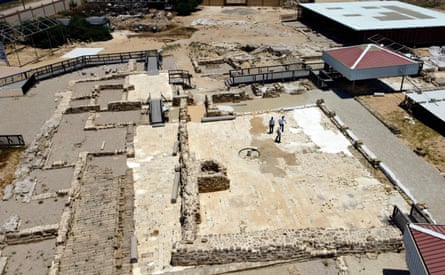
The site of Saint Hilarion monastery, Deir al-Balah, June 8, 2022. Mahmud Hams/AFP/Getty 

Gaza continued to flourish through the Crusader period, when it was given over to the Knights Templar to guard the frontier with Egypt; and even more so after the Mamluks expelled the Crusaders and filled Gaza with fine mosques and caravanserais. During the Ottoman period, Jaffa and Acre took over from Gaza as the most prosperous ports of the region, out of which Galilee cotton and Jaffa oranges were exported; but Gaza remained an important regional centre.

Though Gaza now dominates news bulletins for the worst reasons, it is a place about which we have traditionally learned remarkably little; we are not taught its story in movies or TV documentaries, let alone as part of formal education. Yet it is something we obviously badly need to know in order to grasp current events.

This month sees the publication of several new books addressing that absence. As well as the catalogue of the brilliant Paris exhibition, Trésors sauvés de Gaza: 5,000 ans d’histoire (Saved Treasures of Gaza: 5,000 Years of History) historian Anne Irfan has just produced an excellent primer, A Short History of the Gaza Strip, while Jean-Pierre Filiu has published a supplement to his wonderful Gaza: A Historycalled A Historian in Gaza. In it, he writes: “The Gaza I knew, and whose length and breadth I’ve travelled, has ceased to exist.” All three count as essential reading for those hungry to know more about this ancient territory so as to better understand the current, desperate chapter in its history.

A Short History of the Gaza Strip by Anne Irfan (Simon & Schuster, £18.99). To support the Guardian, order your copy at guardianbookshop.com. Delivery charges may apply.
A Historian in Gaza by Jean-Pierre Filiu (C Hurst & Co Publishers, £16.99). To support the Guardian, order your copy at guardianbookshop.com. Delivery charges may apply.


Beside Strange Waters

I have admired Pink Floyd since the sixties. I still thrill to the memory of sitting in the darkness on Parliament Hill in the fall of 1968 as the  lights of the city sparkled below us and as jet planes roared overhead on their descent to Heathrow airport to the accompaniment of Interstellar Overdrive and Careful With That Axe, Eugene. The Dark Side of the Moon remains, in my view, one of the greatest albums ever recorded: musically adventurous, philosophically rich, endlessly rewarding. Like much of Floyd’s best work, it explores madness, alienation, mortality and power with extraordinary subtlety.

That subtlety is precisely what seems missing from co-founder Roger Waters’ contemporary activism. Flying inflatable pigs adorned with Stars of David or swastika imagery; describing Israel as uniquely evil; dismissing inconvenient evidence about the atrocities of October 7, 2026; and denouncing former colleagues as idiots. All this may generate headlines, but they lack the complexity of the art that made him and Pink Floyd famous.

Perhaps that is the enduring irony. David Gilmour rarely pretended to be a political philosopher. Waters plainly believes he is one. Yet the songs they created together endure precisely because they resisted simplistic moral binaries. The Dark Side of the Moon recognises that human beings are contradictory creatures, capable of love and cruelty, sanity and madness, empathy and tribalism. Waters’ current politics increasingly divide humanity into those who possess truth and those who have been brainwashed.

The Haaretz article republished below unintentionally illustrates another uncomfortable truth. In 2006 Waters was still embraced by most Israelis despite his criticisms. Today he is regarded by many not merely as a critic of Israel but as someone who has crossed into demonisation. Whether one agrees with that judgement or not, the shift is real. His critics see not an artist speaking truth to power but a man whose empathy has become radically selective.

The music, however, remains untouched. It is still magnificent. One can treasure the album while concluding that its principal lyricist has become, to borrow one of his own titles, rather more comfortably certain than comfortably numb. The  younger Roger Waters asked us to question authority. The contemporary Roger Waters often seems to demand that we accept his own. That is a curious destination for one of rock’s greatest sceptics.

The dark side of Roger Waters

This is a fascinating article, not because it settles anything – it manifestly does not – but because it captures Roger Waters almost in the raw.  Israeli music journalist Ben Shalev deserves credit for largely getting out of the way and letting his subject speak. The result is both revealing and, at times, deeply unsettling.

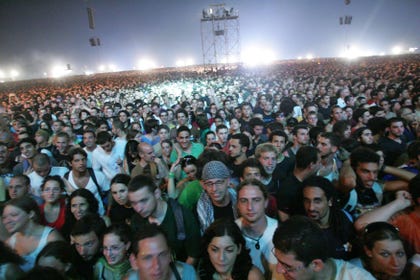
The article begins as a piece of rock-and-roll history. In 2006, Waters agreed to perform in Israel but, under pressure from the fledgling Boycott, Divestment and Sanctions (BDS) movement, cancelled the planned Tel Aviv concert and instead performed in Neve Shalom (Wahat al-Salam), the Jewish-Arab “Oasis of Peace” village near Latrun. The move required an extraordinary logistical effort: a chickpea field became a wheat field, then an amphitheatre for some 60,000 people. Traffic collapsed, helicopters ferried the wealthy, and the concert itself – a performance of The Dark Side of the Moon – became one of the largest and most memorable rock events Israel has ever hosted.

Around this entertaining backstage story swirl competing memories. Did Waters himself suggest Neve Shalom? Was it promoter Shuki Weiss? Did Waters witness armed Israeli soldiers at the separation barrier or not? Did security concerns prevent him attending a peace gathering, or did he simply go shopping? Almost every anecdote has two or three incompatible versions. Shalev wisely resists deciding who is right. Memory, ideology and self-mythologising have become inseparable.

The more interesting story is Waters’ own political evolution. He describes 2006 as the beginning of his radicalisation, crediting Qatari-Palestinian activist Omar Barghouti and the nascent BDS movement with opening his eyes to what he now regards as Zionism’s original sin. He claims his deceased father’s letters from British Mandatory Palestine anticipated these concerns decades earlier. Since then, he says, he has concluded not merely that Israeli governments have committed grave wrongs, but that Israel itself – and Zionism as such – is “a failed experiment.”

At that point the interview changes register entirely. It ceases to be about a concert and becomes a prolonged political jeremiad. Waters insists Israelis have been comprehensively brainwashed, dismisses Israeli society as morally corrupted, embraces armed struggle as historically necessary, rejects Nick Cave’s argument for cultural engagement, and repeats claims about October 7 that have been extensively challenged by independent investigations. His denial that Hamas committed rapes, despite substantial evidence collected by UN investigators, journalists and Israeli forensic teams, inevitably overwhelms everything else he says. Whether one is sympathetic to Palestinian suffering or highly critical of Israeli policy, this is where many readers simply stop listening.

That is perhaps the tragedy of Roger Waters. He undoubtedly possesses genuine moral passion. The anti-authoritarian themes running through Animals, The Wall and Dark Side of the Moon were always political, even when listeners preferred to hear only the music. But somewhere along the way, righteous anger seems to have hardened into absolute certainty. There is almost no room left for ambiguity, self-doubt or tragedy. Israelis become collectively brainwashed; Palestinians collectively embody resistance; every contradictory fact is assimilated into a single explanatory framework.

It is an oddly totalising worldview from a man who once warned us against “thought control.”

Postscript

On 4th September 2026, The Times of Israel Israel reported that Roger Waters, “a far-left conspiracist who has long been accused of antisemitism”, was scheduled to headline a New York City conference run by a group that raises conspiracies about the September 11, 2001 terror attack. “Waters and the group organizing the conference, the International Center for 9/11 Justice, have raised false allegations that Israel was involved in the al-Qaeda terror attacks”.

According to The Times, “The group identifies with the “truth movement” that raises alternative explanations for the attacks and calls the attacks an “inside job” orchestrated by the US government with assistance from Israel and other countries”. “9/11 was the first step in the plan for US-Israel hegemony in the Middle East,” the group said earlier this year.

The Times notes that Waters has endorsed conspiracy theories about the September 11, 2001, attacks, telling Tucker Carlson in July that the towers fell due to “controlled demolitions. “It fell down because it was demolished, and the question is, ‘Who placed the explosives in it? Who pressed the button?’” he said. He alleged Israelis had foreknowledge of the attacks, saying, “They were dancing around, sort of congratulating themselves”. He has also raised conspiracies or denied atrocities related to Hamas’s October 2023 invasion of Israel and has a history of anti-Jewish rhetoric.

Paul Hemphill, August 2026

For more on the Middle East in in That Howling Infinite, see A Middle East Miscellany.

Roger Waters: ‘My Songs That Israelis Love Are About Truth and Love. Israel Is the Complete Opposite’

Twenty years after his performance in the Jewish-Arab village of Neve Shalom, Roger Waters recounts his version of what really happened there – and what has changed for him since. ‘They went from, ‘Waaaah! Roger, Pink Floyd, we love you’ – to ‘What the fuck is he talking about?”

June 18, 2026

Roger Waters: "Israel is a failed experiment."
Shortly after 10 P.M. on June 22, 2006, as Roger Waters’ concert in the Jewish-Arab Israeli village of Neve Shalom was in full swing, a member of the production team mistakenly believed that police were preparing to arrest the Pink Floyd legend.

The employee, a member of Israeli producer Shuki Weiss’ team, thought he had heard over the radio that Waters would be arrested on suspicion of damaging IDF property the moment he stepped offstage. He alerted Amir Feingold, who was in charge of security for the production.

Already under immense pressure as the concert drew to a close and 60,000 attendees prepared to leave, Feingold took the report seriously. “We called the Jerusalem District commander, who was at the site, and asked him to look into it,” he recalls.

“Listen, we know how easily the police arrest people. Look at what’s happening today with protest activists.”

That was in 2006. The minister responsible for the police was not Ben-Gvir.

“If there was the slightest chance something would go wrong, we wanted to make sure it didn’t happen. The district commander reassured us. He said, ‘I’m with you.’ At the same time, Shuki and I went to Waters’ manager and told him, ‘Listen, here’s the situation. There could be problems.’ As soon as Waters got off stage, we put him in a car, even before giving the order to turn on the lights in the facility. Shuki said a few words to the audience while the man was already on his way to Ben-Gurion International Airport, escorted by special police patrol unit vans.”

רוג'ר ווטרס גרפיטי
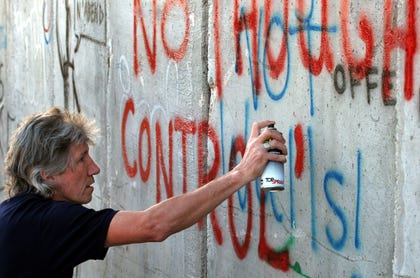
Rogers Waters spraying graffiti on the separation wall, 2006.  Credit: AP

The story about the complaint against Waters is an insignificant anecdote, but it illustrates how much Israeli reality has changed in the 20 years since that performance.

In 2006, Ben-Gvir was a serial offender who belonged to the lunatic, ostracized fringes of the far-right, far outside the bounds of public legitimacy. Today, he is the national security minister. Waters is the one who has moved far beyond the bounds of Israeli legitimacy in the past two decades. In 2006, he was still a huge cultural hero, unconditionally loved and admired. His arrival in the country was seen as a historic event.

Israelis’ attitude toward Waters has, as is well known, totally changed since then. First, he has been a vocal and tireless advocate for the cultural boycott against Israel, as part of the boycott, divestment and sanctions movement. Then, he denied the scale of the Hamas massacre on October 7.

Pink Floyd’s music is still very much loved in the country, but Waters himself is probably among the most hated people in Israel. The possibility of him setting foot in the country today is beyond imagination. This makes the memories of his performance here, exactly 20 years ago, particularly charged and interesting.

What does Waters himself remember from that visit to Israel and the performance in Neve Shalom? What is the most significant thing that stuck with him?

“Very, very comfortable, shabby chic white sofas arranged backstage. Not the most meaningful memory, but you said, how do you remember it? But the main memory, obviously, is the memory of when I made the little speech at the end where I said, you are the generation of young Israelis who must make peace with your neighbors and blah blah blah,” Waters says in a Zoom interview from his New York home.

He then mimics a screaming, fawning audience: “They went from, ‘Waaaah! Roger, Pink Floyd, we love you’ – to ‘What the fuck is he talking about?’ Wow. It was something of a surprise. I went back the next year and I learned a lot more about Israeli psychology. But that first year, it was still a bit of a surprise.”

Waters is not precise with the timing: He returned three years later, in 2009.

Was the change in audience reaction really that extreme?

“It went from ecstasy to silent horror in a split second. And I thought, whoa, that was by far the most important bit. The rest was just a gig, with an adoring audience.”

Israel is waiting for Roger

One need not accept Waters’ recollection. I asked several people who were there how they remembered that moment. Some didn’t recall Waters’ statement at all. Others said the audience reacted supportively. No one remembered a reserved response, certainly not “silent horror.”

A significant discrepancy between different accounts of the same events characterizes the entire story of Waters’ performance and his 2006 visit to Israel. Whose idea was it to move the concert from its original venue in Yarkon Park to Neve Shalom’s chickpea field? What did Waters see during his visit to the separation barrier? Why didn’t he attend the meeting organized for him with intellectuals and peace activists?

The answer to all these questions is: It depends on whom you ask. So we asked. To mark 20 years since the most complex and charged performance in the history of international rock concerts in Israel, we will try to tell its story in the most reliable and interesting way.

This story has two protagonists: Waters and producer Shuki Weiss. In the 1970s, before Weiss became one of the country’s biggest concert producers, he managed record stores in Tel Aviv and was one of those responsible for introducing Pink Floyd’s music to Israelis. Later, when he owned the Dan Cinema Club in Tel Aviv, he used to hold record listening evenings there. One time he played “The Wall.”

“People would come to listen,” he recalls. “Many people.”

In the early 1980s, Weiss and Miron Rechtman, the owner of the Betty Bam event equipment company, bought the sound system that Pink Floyd used on its “The Wall” tour. In the mid-1980s, Weiss tried in vain to bring David Gilmour, Pink Floyd’s guitarist, to Israel as a solo artist. Toward the end of the 1980s, after Waters had left the band, he negotiated to bring Pink Floyd to perform in the country in its trio lineup (Gilmour, keyboardist Rick Wright and drummer Nick Mason. But that attempt also failed.

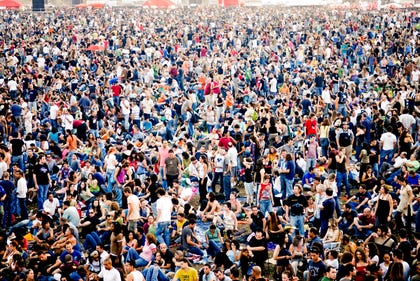
The crowd waiting for Waters to perform. The concert caused a traffic nightmare.

The crowd waiting for Waters to perform. Credit: Oren Levin

“I stalked them, so to speak,” he says.

In early 2006, Weiss learned that Waters was planning a world tour based on the album “The Dark Side of the Moon.”

“I went to London, met his agent, and offered a huge sum, much more than he received anywhere else,” Weiss recalls. After the contract was signed and the planned performance in Yarkon Park was announced, he traveled to Paris for a brief meeting with Waters. “I told him that Israel was excited for him,” he says. “He was perfectly fine.” Weiss says ticket sales were excellent, with 35,000 sold three months before the show.

A couple of weeks later, Weiss was vacationing with his family in the Netherlands, when Waters’ manager, Mark Fenwick, called him. He told Weiss that pro-Palestinian activists were exerting heavy pressure on Waters. A few hours later, Fenwick called again to say that Waters had decided to cancel the performance.

“I got lots of emails from my brothers and sisters after the announcement of Hayarkon Park. But the important one was from Omar Barghouti,” Waters recalls about changing his mind, referring to one of the founders of the BDS movement. “We had a conversation, and then I eventually cancelled Hayarkon Park. Organizing this concert instead was a compromise with Omar and with the rest of the people who had just started the BDS movement, because obviously even doing Neve Shalom broke the boundaries of the cultural boycott.”

Waters describes that exchange as “a huge moment” in his political thinking.

“You know, in this song that Mona Miari and I have just released, a re-imagination of my song ‘Comfortably Numb,’ I sing, ‘We never knew about the Nakba. I was only 5 years old in ’48.’ And we didn’t,” he says. “And the lie that is Zionism had been spread all over the world since the Second World War. So I wasn’t alone. Very, very few people quite got it.”

Waters says that one of the few people who “got it” before the war was his father.

Shuki Weiss giving an interview ahead of the Rogers Water concert in 2006.
Shuki Weiss giving an interview ahead of the concert. Credit: Oren Levin

“My father taught at St. George’s School in Jerusalem from 1934 to 1936,” he says. “And he wrote letters home to my grandmother, which I have, saying how worried he was about the influx of American money, mainly, to buy up land, and about the establishment of the settlements that he saw going on, and how desperately worried and concerned he was,” he recounts, referring to the pre-state Jewish communities. “Of course, he was killed in the war, so I never got to talk to him about these things. but it’s a fascinating fact.”

Following the deepening of his awareness of the Israeli-Palestinian conflict due to the appeal of the BDS movement, Waters made his second visit in 2009. “My travels around the occupied territories … were deeply, deeply moving and very informative,” he says. “I’ve tried never to shut my mouth from that moment. And things have only got worse, obviously, except that it’s becoming clearer and clearer to the vast majority of people all over the world now that this is a failed experiment, and it should be stopped.”

What is the failed experiment?

“Israel is the failed experiment. Zionism is the failed experiment. and this is becoming increasingly a position taken up by a huge majority of human beings all over the world, because we witness and are appalled by the horrific policies of the state of Israel in its massacre of the indigenous people whose land it stole in order to create itself. And so it’s a terrible, terrible, terrible tragedy, and it remains to be seen: Will I see the end of the story in my lifetime? Probably not. I’m 82 years old.”

פותחת
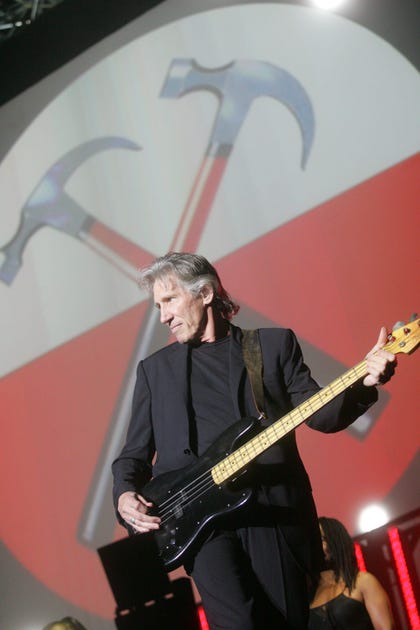
Waters performing in Neve Shalom in 2006.  Credit: Assaf Evron

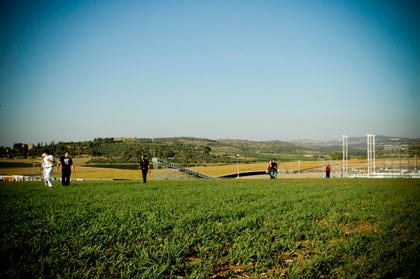
Field of wheat

In response to Waters’ decision to cancel the Yarkon Park concert, the most monumental improvisation in the history of performances in Israel occurred. Thanks to the move to Neve Shalom, Weiss says he was called “The King of the Chickpea Field” for years by people in the global music industry.

“When Waters’ manager informed me of the cancellation, I told him: ‘What if I move the show to a place for Jews and Arabs?’ I don’t know where that came from,” Weiss says. ‘I knew Neve Shalom. David Broza’s grandfather was one of the first residents there. I had done performances there many years before this show, events for peace. But nothing of this magnitude. Performances for a few thousand people. I had no idea if a huge concert could be held there. I left my family in the Netherlands and returned to Israel. That night, Waters’ manager called me back and said: ‘We checked what Neve Shalom is. If you can do it there, and if you invite Arabs to the show and arrange meetings with peace activists, we’re in.’ I told him: ‘Yes, yes, yes.”

Rayek Rizek, a Neve Shalom resident, offers a different version of the events that led to the Neve Shalom performance. “Sometime in late March 2006, I heard two employees in the community’s secretariat talking about Roger Waters,” recalls Rizek who was the community’s secretary general in 2006. “I’ve loved Pink Floyd since high school. I still listen to them today. When I was studying at university in the United States, around when “Animals” (the band’s 1977 album) came out, I missed a performance of theirs in Houston. By the time I managed to look for a ticket, everything was sold out. I was very sorry,” Rizek says as an aside.

“So when I heard the employees in the office talking about Waters, I asked what was going on. They said his manager had sent us an email. Waters was interested in Neve Shalom and was asking for information about the village,” he says. “As soon as I saw I had a direct connection with the manager, I sat down and wrote him a long email telling him about Neve Shalom and inviting him to hold the concert with us. I didn’t know about the pressure being exerted on him. Two days later, Shuki Weiss came to the village and told me, ‘This morning, Waters’ manager called me and asked about the possibility of moving the concert to Neve Shalom.’ I imagine the manager received my letter and understood that such a possibility existed.”

Rizek’s version doesn’t necessarily contradict Weiss’s entirely. Perhaps Weiss suggested the idea to Waters’ manager, and then the manager sent an email to Neve Shalom. But it’s also possible that the initial email to Neve Shalom was sent to explore the option of holding some separate activity in the community. In this scenario, when the Yarkon gig was canceled amid Rizek’s offer to hold a concert in Neve Shalom, Waters and his manager adopted the proposal. Rizek recounts that during one of the preliminary meetings with police officers at the event site, one of the commanders got annoyed over some details and asked, “‘Why are we even holding the concert here? Why didn’t it stay in Tel Aviv?'”

Rizek recalls: “Shuki looked at me and told the commander: ‘Blame him.’ As for me, all I did was send a letter.”

Waters himself doesn’t remember the history of the concert’s move to Neve Shalom. “Shuki Weiss, bless him, he’s just another promoter,” he says with a smile. “I don’t know him at all. I wouldn’t trust him as far as I can spit.”

On the other hand, he stresses, “I loved the idea of Neve Shalom, of this agricultural community.” He says fondly: “It’s like this is the dream that we have of how Palestine could go, could go back to being, where everybody lives together, and there’s no supremacists, there’s no racism. Whatever it may be that has caused this great catastrophe, there was none of that in Neve Shalom. I hope it’s still doing well.”

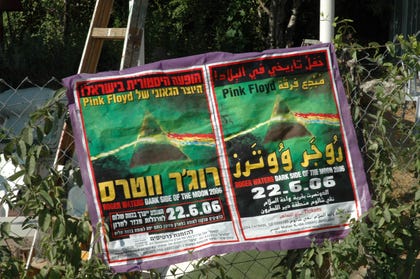
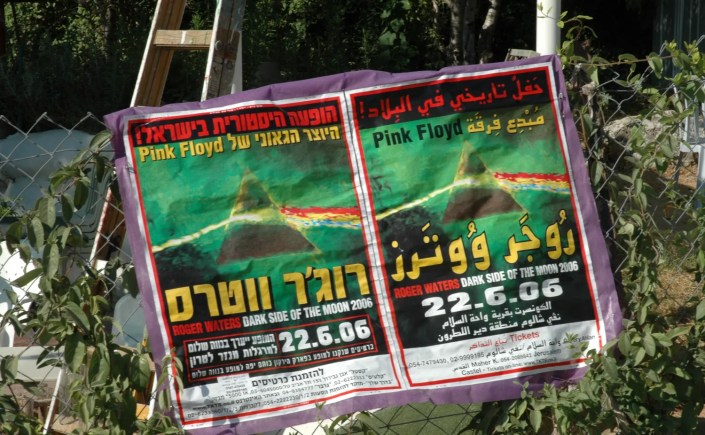
Flyers for the Roger Waters concert in Israel

Flyers for the Roger Waters concert in Israel Credit: Oren Levin

Weiss picked the new concert site’s location with Giora Porter, who designed the producer’s concert venues for many years. “There was only one area that came into consideration, with a certain slope, a kind of natural amphitheater,” Porter recalls. “It was a chickpea field owned by two brothers from one of the local moshavim. I located the field owners and said: ‘I want to buy your chickpeas.’ They said: ‘Okay, we’ll harvest in May.’ I said: ‘No, now.’ They understood they could make a killing off me. I bought the chickpea field, the crop they wouldn’t harvest, for $100,000. They were nice guys, but they knew how to bargain.”

“But there was a problem with the crappy soil in the Latrun area,” Porter says. “Exposed soil in June is all dust. It’s terrible. I suggested sowing grass, but the moshav resident said: ‘No, that will ruin my land.’ I said: ‘I can’t do a show on dirt.’ I think he was the one who suggested sowing wheat. He said: ‘It’ll sprout and be green like grass.’ So we went to see wheat sprouting elsewhere. I told him: ‘It’s terribly sparse.’ He said: ‘We’ll double sow it, increase the density.’ And that’s what he did. Shuki paid for it. And that entire huge area turned green within days. It was a miracle.”

Weiss and Porter recount that various state authorities created numerous difficulties for the show. The Israel Antiquities Authority remembered that salvage excavations needed to be carried out on the site and delayed the work. The Israel Land Authority charged several hundred thousand shekels to rezone the land for commercial use, even if only for one night. Meanwhile, the Health Ministry prohibited watering the compound with reclaimed water and forced Weiss to bring tankers. “It didn’t matter that we used reclaimed water at night, but I showed them we had tankers,” Weiss says.

“Quite cunning bodies,” Porter says of the authorities that created difficulties and collected payments. Weiss adds, laughing: “They know their job. That’s governance!”

Weiss and Amir Feingold, who was his security officer, have mostly praise for the police’s conduct. Some officers, Weiss says, were Pink Floyd fans. The event morphed into a kind of national project that the police wished to see succeed. There was, however, a dispute over the number of paid police officers the production was required to fund. The Jerusalem District commander demanded 1,000, including several dozen detectives to hunt for pot smokers among the crowd.

“We argued with them about it,” Feingold recalls. “I told the district commander: ‘In the end, it’s rock and roll. Are you bringing 80 detectives to arrest the pot smokers? Let them enjoy themselves.” The police, he says, complied and eased the demands.

Waters landed in Israel two days before the concert. The morning after his arrival, he visited the separation barrier near Bethlehem, where he protested against its construction with spray paint and words. Weiss says Waters gave interviews after his visit in which he said he was shocked to see “soldiers with drawn weapons” near the wall.

“A lie. There wasn’t a single soldier there, certainly not with drawn weapons,” Weiss says. Feingold, who accompanied Waters’ entourage on the trip to the wall, confirms no soldiers were present.

קהל אנשים צופים רוג'ר ווטרז ווטרס

Fans at the concert in 2006. Most did not arrive by helicopter: Assaf Evron

No-show in Neve Shalom

Waters laughs when he hears this claim. “So which story rings truer, Shuki Weiss’ story, no weapons, no soldiers, just a nice wall, or my story? I’ll tell you which one is true: my story,” he insists. “Shuki Weiss is a lying schmuck, obviously. I’m sure he’s very smiley, and he likes to make a lot of money. Good luck to him, but he’s just making stuff up.”

Another claim by Weiss concerns Waters’ non-attendance at an event organized in his honor in Neve Shalom. It was to be a meeting with intellectuals, peace activists, and village residents. Singer David Broza “helped me bring artists, writers, very serious people,” Weiss recalls. “They brought an olive tree for him to plant. There was a children’s orchestra. Tons of excitement. Everyone was already there, but he wasn’t. No Roger. They called him. He didn’t answer. His manager didn’t know where he was. In the end, David planted the tree in his place. Later it turned out he went to Kikar Hamedina to buy jewelry for his partner.”

Not only an olive tree was prepared for Waters, but also a sculpture of the famous prism from the cover of “The Dark Side of the Moon,” Rayek Rizek recounts. “I went to an artist in the Rehovot area, he told me 20,000 shekels ($4,500 in 2006). In the end, we made it from marble-coated concrete. It cost 4,000 shekels. Shuki paid,” Rizek says. “We waited and waited. In the end, someone on Waters’ behalf came and said he couldn’t come. There were too many people.”

Weiss says Waters was a no-show in Neve Shalom the day before the concert, but the event took place the afternoon of the show. “He was supposed to go to the community from the backstage area,” Feingold says. “His security guard came and looked around. I told him: ‘Tell me what you need. We’ll sort it out.’ He didn’t say a word and left. Later, he announced, ‘We’re not coming.’ I don’t know if he or Waters decided. He just said, ‘Security problems.’ What security problems? First-graders and 30 other people from the left. Where was the threat?”

Rogers says “of course” he didn’t come. “You don’t do anything on a gig day, except the gig,” he says. “I’m glad I’ve had this career and that I’ve been able to do multiple shows all over the world to fabulous audiences, but it’s very rare to do other things on show days.”

“And I’m absolutely, totally against the Nick Cave school of thought that, oh, we should all go and talk to people in meetings and that’ll do it,” he stresses, parodying hippie naivete. “No, it fucking won’t, you prick. No people has ever freed themselves without armed struggle, ever. It just doesn’t happen. It reminds me of the best interview that any of us have ever seen. (Palestinian writer) Ghassan Kanafani gave that fabulous interview where he talks about the conversation between the hatchet and the neck. What a wonderful writer.” He adds, referring to one of Kanafani’s books, “I can still remember almost every word in ‘Returning to Haifa.'”

A few weeks after the Neve Shalom concert, Waters wrote Rizek. “Dear Rayek, I’m deeply saddened that I was unable to plant the olive tree, but our efforts to reach the site were thwarted by the sheer numbers of people surrounding the vehicle in which I was travelling,” he wrote. “I know how upset you are that this did not take place and I hope that will not blight the memory of our visit to your land.” It sounds like something Waters would write, not his agent or manager.

“You see, Ben? I’m not just evil,” Waters comments.

The wheat field that replaced the chickpea field near Neve Shalom, 2006.
The wheat field that replaced the chickpea field near Neve Shalom, Oren Levin

When I sent him an email a few weeks ago asking if he would agree to be interviewed for this article, I didn’t expect a positive answer. But it was positive and even cordial. When I told him during the Zoom call that I was pleasantly surprised, and that the conventional wisdom here is that he has no desire for dialogue with Israelis, certainly not after October 7, he responded: “Yes, I am. I’m just having one with you now.”

However, some things he said were difficult to hear and didn’t seem very open-minded.

“You, as a country, Israeli people have been brainwashed, and consequently you are now subjects, nationals of the most evil thing that has happened in the world since the Nazis and the Second World War. And you can’t seem to grasp it, and that is so sad,” he said.

“You used the two magic words: Gideon and Levy,” he continued, referring to my email mentioning Gideon Levy as my Haaretz colleague. “It’s only these words that got you the ability to get to me, and even Gideon got the whole October 7th thing wrong. We almost fell out over it, because he was so brainwashed. He believed all that crap about burning babies and raping women and stuff, and it’s all complete nonsense, and everybody knows it’s complete and utter nonsense. There was no rape by Hamas on October the 7th. However, there have been documented multiple rapes by the IDF, of men and women and children.”

After pushing back that I did believe these things happened, I asked Waters to change the subject. It was unbearable to hear him say these things. I knew that any attempt to continue responding to him would blow up the interview. But he continued.

“Your position is indefensible, and no amount of talking intelligently to any of you is going to change any of this. You’ve been Ben-Gvir’d until you can’t accept any reason,” he retorted. “Your state, Israel, is psychotic, psychopathic, criminally insane, and the only way out of it is for you to re-establish connection with the rest of the human race. Stop thinking that you are superior in some way and should rule the world, and join in with the community of the part of the world you’re living in. Until you do that, you are doomed, but you may well drag the rest of the world down with you. You know, it wouldn’t surprise me at all if suddenly some lunatic was to drop a nuclear bomb on Iran or something, and that’s the end of the world. You, Israel, and the United States, the U.K., France and Germany, and all the people in that cabal are dragging the whole globe towards its extinction, extinction of all life on the planet. And that’s what I complain about. It’s not weird to complain about that.”

Aviv Geffen arrives by chopper

Back to the concert, enormous traffic jams formed on the way to Neve Shalom in the afternoon and evening, and on the way from it that night. “The biggest traffic jam of 2006, perhaps of the entire decade,” Feingold asserts.

“A massive transportation failure. To this day, people are still stuck there trying to get out,” Porter laughs. Still, he acknowledges the huge traffic jams were unavoidable. “That’s the geography. We invested a lot in finding access roads, dirt roads,” he says. “We rented entire fields from nearby kibbutzim and leveled them for parking. And still, in the end, everything converged on one turn off the main road. Like everyone coming to Tel Aviv in the morning. It’s an unmanageable rush hour.”

דיויד גילמור

David Gilmour. “He’s dumb as shit.” Credit: Gregorio Borgia/AP

So, did you bear responsibility for the failure, or did you say “it couldn’t be prevented”?

“Both,” Porter says.

Those who didn’t suffer from the traffic jams were the affluent who could afford 3,000 shekels for helicopter transport to the concert venue. A special helicopter line operated from Sde Dov airport in Tel Aviv. “Rani Rahav rented two helicopters for himself and the group that came with him,” Weiss says, referring to the PR consultant. “Aviv Geffen also arrived by helicopter. They told me afterward: ‘You don’t understand what a sight unfolded before us from above. It was worth every shekel.”

As for the concert, the quadraphonic sound was excellent. The superb backing band, which included acclaimed guitarists Snowy White and Dave Kilminster, was flawless. Waters occasionally used playback or excellent backing vocalists. It wasn’t a spontaneous or surprising performance, but it was clearly going to be that way. For the fortunate few who had the luck to see Pink Floyd perform, it was necessarily a diluted version. (Weiss is one of them, saying, “It was a poor man’s Pink Floyd. It wasn’t the real thing.”). But a straw poll I took last week among people who were there suggests that the enjoyment was complete, overwhelming and enthusiastic.

Musician Oded Tamsoot came to the concert from Ma’ale Gamla in the Golan Heights. “The entire event, the performance itself, was an amazing experience, beyond imagination,” he says. A year later, he formed the Pink Floyd tribute band Ummagumma.

Yael Ori, a former teacher and kindergarten teacher from Jerusalem, says Pink Floyd’s messages, which deeply influenced her as a teenager, inspired her to choose the teaching profession. “My high school was a nightmare,” she says. “I decided I wanted to be a teacher so my children wouldn’t suffer what I suffered.” Singing “We don’t need no education” with Waters and the masses was a wonderful experience, she says.

Dvir Zhorno from Jerusalem was 16. “The concert’s timing was perfect for me. It was shortly after I discovered Pink Floyd and started delving into their music,” says Zhorno, now a finance professional. “After the show, I heard critiques that he performed the songs exactly as they were on the albums, but that style suited me. That’s what I wanted to hear. ‘The Great Gig in the Sky’ live, exactly like on the album – it was awesome.”

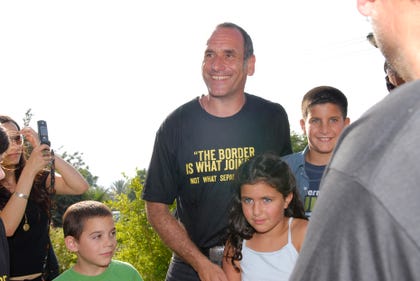
David Broza at the tree planting ceremony at Neve Shalom. He was the default replacement for Waters.
David Broza at the tree planting ceremony at Neve Shalom. Credit: Oren Levin

Truth and love, lies and hate

Toward the end of the interview, I asked Waters what he thought about the enormous, unbridgeable gap between the deep love hundreds of thousands of Israelis feel for Pink Floyd’s music and the extreme hatred most Israelis feel toward him, his views and his statements.

“This is their problem,” he sighs. “All my work, all that work that they love, all those songs I wrote for Pink Floyd – “Shine On You Crazy Diamond,” “Comfortably Numb,” “Wish You Were Here,” – are all about truth and love. And all of my work that I do now is about truth and love. The State of Israel and what the children of Israel are taught to believe from the minute they’re grown up is the exact opposite. You’ve been brought up to believe the lies about October 7th. That’s not true. That’s just pure evil lies. And you’ve been taught to hate Arabs and Palestinians. That’s the opposite of love. So you live in a world that’s built on lies and hatred. … My music is built on love and truth, and that’s why there’s a dichotomy – oh, we love his music, but we hate him.

“I’m so sorry that even talking to you, I can see that you have been brainwashed, my brother Ben, completely. And I know you’re laughing at me now, but it’s really not funny. It’s sad. Israel is the saddest thing on earth, with the possible exception of the Trump White House. It’s sad because human beings are better than this. There is a capacity within every human soul for an attachment to love and truth. So for us to be persuaded that lies and hatred are a better alternative is why I go on working and expressing myself in my great songs.

“You think that ‘Dark Side of the Moon’ and ‘The Wall’ and ‘Animals’ weren’t political? Are you fucking stupid? Yes, they are stupid. If they don’t get that, they’re very, very stupid. You can’t really blame them. There were people in the band who don’t get it. David Gilmour doesn’t get it. He’s dumb as shit. He never understood a single bit of any of it. … That’s why he was miserable. And he was miserable with the band, because he never understood what I was doing.”

Waters started to say another sentence but then stopped and said: “Well, no, I’m not gonna [there]. Good luck with getting them to print any of this.”

Thank you very much.

“You’re welcome. Thank you for still having a smile on your face at the end of this conversation.”

Gaza Sunrise or False Dawn?(2) … spectacle or strategy?

Trump’s Gaza Peace Plan: Spectacle, Strategy, and the Limits of Diplomacy

In late September 2025, US President Donald Trump unveiled a sweeping 20‑point peace plan for Gaza, accompanied by the familiar trappings of performance: the East Room of the White House, cameras flashing, a florid declaration of “eternal peace in the Middle East,” and a newly anointed “Board of Peace” with Trump as chair and Tony Blair as his deputy. On paper, the plan promises ceasefire, reconstruction, hostage releases, demilitarization, a staged Israeli withdrawal, and a technocratic administration in Gaza overseen by an international board. In practice, it reads as equal parts showmanship, improvisation, and coercive diplomacy, an audacious gambit with enormous potential benefits and equally enormous pitfalls.

For the Trump administration, the plan is a chance to rewrite the narrative: to isolate Hamas, reassert US influence in the Gulf, forestall further annexation of the West Bank, and offer Netanyahu a politically palatable off‑ramp from the brutal two‑year campaign in Gaza. For the international community — including the Arab Gulf states, Qatar, Jordan, Turkey, and Indonesia — it presents an opportunity to participate in a stabilizing initiative and to demonstrate relevance after years of watching humanitarian crises unfold from the sidelines. Yet beneath the pageantry lie structural asymmetries, enormous trust deficits, and profound omissions, particularly the conspicuous absence of the Palestinians themselves from meaningful negotiation.

In That Howling Infinite reserves its opinion in these early days. It’s the only show in town right now and it is generating interest and potential commitment by all those parties who would have to make it happen. There are already dissenting voices on all sides – the pro-Palestinian “progressive” left have been predictably dismissive  of what is indeed an imposed solution to an intractable problem – although it would appear that there are many cooks in the kitchen other than Donald Trump and Binyamin Netanyahu. Some have even condemned it for its demand that Hamas, the instigator of the war, to surrender unconditionally. But at the end of the day, they have little to offer except more war and vitriol. You don’t use gasoline to put out a fire. The reality is that the parties that can make this happen, including providing the proposed security forces and the resources to rebuild the devastated enclave and rehouse and rehabilitate its homeless and harrowed people, appear at this stage to have signed on. Early days, but, to  borrow from J Lennon, “all we are saying is give peace a chance”.

Read part 1 here: Gaza sunrise or false dawn? Trump’s 20 point peace plan

Also, in In That Howling Infinite, see A Short History of the Rise and Fall of the West and A Middle East Miscellany

[The following analysis is the outcome of a conversation and collaboration between In That Howling Infinite and ChatGPT.

Screenshot

Mechanics of the Plan

The plan’s framework is deceptively simple:

  1. Immediate Ceasefire and Hostage Exchange: Hamas must release all remaining Israeli hostages, alive or dead, within 72 hours. In return, Israel promises a staged withdrawal to a security perimeter.
  2. Prisoner Release and Amnesty: Israel would release approximately 2,000 Palestinian prisoners, including those detained after the October 2023 attacks. Hamas fighters willing to renounce violence could gain amnesty; those choosing exile would receive safe passage.
  3. Board of Peace and Reconstruction: A transitional authority, the so-called Board of Peace, would oversee governance and reconstruction, with Trump as chair and Blair as deputy. Aid delivery, infrastructure rebuilding, and the restoration of hospitals, water, electricity, and sewage would be managed under this international technocratic oversight.
  4. International Stabilization Force (ISF): Western and Arab troops would replace Israeli forces in Gaza, ensuring security during reconstruction and the reestablishment of governance. The exact composition and mandate remain undefined, a critical gap given the operational risks.
  5. Pathway to Palestinian Statehood: A vague promise of “conditions for self-determination” exists, contingent on PA reform, reconciliation between Gaza and the West Bank, and adherence to technocratic administration under international oversight.

On paper, it is a plan that offers incentives to every major party: Hamas faces conditional amnesty; Israel gains hostages, de-escalation, and security assurances; the Gulf states gain influence; and the PA is positioned to regain a governance role in Gaza. It is, in principle, a diplomatic masterstroke — if it can be implemented.

Gaps, Omissions, and Absurdities

Yet the devil — and much of the comedy — lies in the details not addressed:

Hamas Exclusion: The central conflict party, Hamas, was neither consulted nor invited. Trump openly admitted, “I have not dealt with them,” and proposed outsourcing the group’s compliance to Arab and Muslim mediators. The result is a coercive ultimatum dressed as a peace initiative: accept the terms or face complete annihilation with US backing.

Palestinian Agency Ignored: The two million Gazans whose lives are at stake had no seat at the table. Aid, reconstruction, and governance are treated as top-down deliverables, with no credible mechanism for local input. Gaza becomes a theatre set, not a living society.

Unclear Implementation: The ISF, Board of Peace, and PA reform mechanisms are vaguely defined. Who will command the stabilization troops? How will the PA be reformed to earn legitimacy in Gaza? What safeguards prevent reconstruction materials from being diverted to military purposes? These questions are unanswered, leaving enormous operational and political gaps.

West Bank Neglected: Despite daily settler-Palestinian clashes, the plan offers almost no operational framework for the West Bank. New settlements, such as the E1 project, threaten to fracture any contiguous Palestinian state. The plan’s silence on this is a glaring omission.

Asymmetry and Risk: The plan favors Israel far more than Hamas. The militant group is asked to surrender hostages and arms simultaneously, a leap of faith in a context of zero trust. The amnesty offer is conditional and uncertain; refusal triggers an existential threat. Israel, by contrast, faces comparatively modest obligations, particularly given the indefinite “security perimeter” it maintains.

Domestic Israeli Politics: Netanyahu’s right-wing cabinet, notably Bezalel Smotrich and Itamar Ben-Gvir, remain uncompromisingly hawkish. Trump’s backing gives Netanyahu room to sell the plan domestically, but hardliners could sabotage implementation, and prior experience demonstrates Netanyahu’s readiness to resume military operations when politically expedient.

Performance Over Policy: The East Room spectacle was classic Trump: a reality-TV cadence applied to diplomacy. Grandiose claims of “eternal peace,” self-anointment, photo ops with global leaders, and theatrical references to “the ocean” Israel ceded in 2005 illustrate a plan heavy on optics and light on enforceable substance.

International Reception

The plan has drawn broad, if cautious, support:

  • Arab and Muslim States: Qatar, Jordan, UAE, Saudi Arabia, Indonesia, and Turkey issued a joint endorsement emphasizing aid delivery, hostages, non-displacement, and the integration of Gaza with the West Bank under a Palestinian state framework.
  • Europe: Macron and Starmer endorsed the effort to secure hostages and reduce conflict.
  • Australia: Prime Minister Anthony Albanese welcomed the initiative as a constructive step, while opposition figures criticized Canberra’s earlier symbolic recognition of Palestinian statehood as performative and irrelevant.

Yet these endorsements are conditional and aspirational, recognizing the plan’s promise without committing to enforcement.

Perspectives of Israelis, Palestinians, and Activists

Israeli Public: Polls indicate two-thirds of Israelis want the war to end. The hostage release and cessation of bombardment offer tangible relief. Hardline right-wing factions, however, may resist compromises that limit continued Israeli military prerogatives. Indeed, the far-right, whose ethnic cleansing designs are explicit and who have driven so much of Netanyahu’s prosecution of this war appear to hate Trump’s plan: “a tragedy of leadership” and “an act of wilful blindness” in the phrase of Finance Minister Bezalel Smotrich.

Palestinians: Exhausted by years of blockade and bombardment, Gazans desire immediate relief. But the lack of agency and the conditional, externally imposed nature of governance and reconstruction make the plan potentially resented as foreign administration rather than liberation.

Progressives and Activists: Pro-Palestinian advocates will likely view the plan skeptically. While it promises aid and reconstruction, it circumvents local agency, substitutes technocratic administration for democratic governance, and leaves Palestinian sovereignty largely aspirational. International human rights groups will monitor for coercion, displacement, and military overreach.

Political Theatre

The plan is an exercise in spectacle: Trump as self-styled savior, Netanyahu as pliant yet menacing partner, Palestinians and Hamas as props off-stage. The terminology — “Board of Peace,” “International Stabilisation Force,” “demilitarization” — evokes bureaucracy rather than genuine power-sharing. It is as much a political theatre as a policy framework, designed to satisfy domestic and international optics. In that sense, it is both brilliant and cynical: brilliant in its choreography of alliances and threats; cynical in its disregard for the lived realities of Gaza’s population.

Promise and Peril

Trump’s plan is audacious. It isolates Hamas, engages Gulf wealth, nudges Netanyahu toward tactical concessions, and offers a narrow window for reconstruction and peace. Yet structural asymmetries, zero trust, vague operational mechanisms, potential sabotage from hardliners, and the absence of Palestinian agency render it precarious.

If Hamas accepts, the plan could relieve immediate humanitarian crises, return hostages, and establish a technocratic administration capable of rebuilding Gaza — a diplomatic triumph in a region long starved of them. If it fails, it will cement perceptions of American theatre in place of effective policy, leaving Gaza’s suffering unresolved and occupation repackaged as transition.

And if Hamas actually accepts, and the plan moves ahead, what would happen if, having received the hostages, Israel simply decided to remain in Gaza, or refused to return Palestinian prisoners. Given how Netanyahu’s political survival depends on his far-right coalition partners, and given how clearly those partners want the war to continue and Israel to remain in Gaza, this is not remotely a fanciful scenario. And if it transpired, who aside from Trump could do anything about it? Netanyahu highlighted this feature of the plan for a reason: almost certainly as a signal to those far-right allies that they needn’t fear.

The plan is shot through with such difficulties. Netanyahu notes that Israel’s withdrawal from Gaza will be gradual and “linked to the extent of disarmament and demilitarisation” of Hamas. What happens if Israel decides progress on this is too slow and resumes bombing?

The deal envisages a technocratic Palestinian committee to provide day-to-day services, until the Palestinian Authority is adequately reformed. Who would be the arbiter of whether this has been satisfied? And more specifically, what would happen if Israel simply declared it hasn’t? Given this is the precursor to the possibility of the Palestinian state Netanyahu has always opposed, it’s again a perfectly likely scenario. Will some independent body resolve this?

All of this is a reflection of the fact that this is not a deal in any sense. No Arab nation was present at that press conference. The plan was developed with no discernible Palestinian involvement at all. Trump has declared there’s “not much” room for Hamas to negotiate terms, and that it had days to accept or “pay in hell”.
The Arab and Muslim nations that welcomed this, and whose involvement will be crucial in it working, have set out conditions Netanyahu explicitly rejects and which the Trump plan doesn’t allow for, including that Israel withdraw fully from Gaza and commit to a pathway for a Palestinian state. Moreover, they want the Palestinian Authority to invite them to provide troops to stabilise Gaza so they aren’t seen as yet another occupying force. Trump’s plan provides for none of that.

The lesson is stark: diplomacy without inclusion, even when performed at the highest theatrical scale, is fragile. For now, the Board of Peace is more a symbol of hope than a guarantor of change — a test of whether spectacle can ever substitute for governance, and whether exhausted populations, international actors, and political opportunists will allow vision to overcome reality.

It is all down to will. The will of Hamas to accept its dismantling, when this has always been non-negotiable for it. The will of Netanyahu to end a war he has shown every interest in prolonging. The will of Trump to force Israel to abide faithfully by the plan, even where it’s politically inconvenient. The worry isn’t just that this seems unlikely on all fronts. That’s inevitable in such an intractable tragedy. 

In short, the plan may well work; or it may simply provide another act in a two-decade-long tragedy, with Trump and Netanyahu as performers and Gaza as the stage.

The Mizrahi Factor

Strangers in a strange land

When I first visited Israel in the early ‘seventies, it seemed to me a white man’s land with the look and feel of a European colony transplanted in Levantine soil. But first impressions were deceptive. Subsequent visits made it very clear to me that State of Israel is anything but monochrome, but rather, a technicolor cultural melting pot.

Back then, European Ashkenazim (literally, “German” Jews), the returnees of the diaspora, were in the majority. They had dominated politics and culture from the days of the first Zionist immigration, and through the mandate years of the Yishuv when Eastern Europeans predominated in the movement and in the fledgling military. The republic that the Ashkenazim prepared for during the Mandate and then built after 1948 was, in intent and in actuality, a white, secular, socialist outpost of Central and Eastern Europe. But then things changed  utterly.

The Sephardim, Jews who had lived in Palestine for centuries, and up to a million Jews expelled from Arab countries after 1948, were, for some forty years of Israel’s existence, a disadvantaged minority. The name itself was misleading. ‘Sephardi’ originally described Jews who had been expelled from Spain in the late fifteenth century. But it came to be applied to anyone who was not Ashkenazi. These Jews of Middle Eastern origin are now generally referred to as Mizrahim – “eastern” or “oriental” Jews. They were discriminated against in many spheres of Israeli life, regarded as primitive, backward, ill-educated, and poor – and more like Arabs than Jews.

And this was indeed the case in many respects. Jewish communities had been an integral part of Arab society for centuries. From Morocco to Iran, they had lived, thrived, and prospered among the their Muslim neigbours. The Jewish communities in Morocco, Algeria, Tunisia, Egypt, Iraq, Lebanon, Syria, Yemen and Iran were old and populous, and indeed often predated Christianity. From high to low, they were entwined in their local politics and economics.The lower classes were as poor and as downtrodden as their Arab neighbours. The professional and mercantile middle class lived very comfortable lives, and under late Ottoman rule, and British and French suzerainty, enjoyed a cosmopolitan lifestyle.

Embedded in the heart and soul of their Arab homelands, they shared the same history, suffered the same depredations, wore the same clothes, ate the same food, made and listened to the same music. Many of their values and cultural norms had more in common with the east than the west.

Oriental Jewish culture was based on three pillars: the community, the synagogue and the father. Faith was the cornerstone and family paramount, and with these, the authority of the rabbi and the head of the household. Piety was respected, chastity honoured, modesty and decorum observed, and marriages arranged. Religion, tradition and patriarchy preserved the community for a millennium. It did not experience European-style secularization, western enlightenment, or a revolt against religion. Even when modernization came, the father and the rabbi remained dominant.

There was harmony between Arab and Jew. Life had order, meaning, and a timeless rhythm. No one imagined that one day, they would have to abandon their lives, their homes and possessions and the graves of their ancestors. Never did they contemplate having to flee, in fear of their lives from the people among whom they had lived for generations, and seek refuge in a fledgling European, secular, modern state on the edge of the Mediterranean.

After 1948, the relatively charmed existence of oriental Jews in North Africa, the Levant, and Mesopotamia ended, and thousand year old communities disintegrated. A million Jewish Arabs were uprooted, their world destroyed, their culture ruined, their homes lost.

In an ironic twist, their Aliyah (literally “ascent” to Eretz Israel) confounded the Zionist model. Israel was created to be the home of European Jewry – until the Shoah brought those Jews to the brink of extinction. Young Israel had to populate or perish, and whilst designed for a European population and culture, it had no choice but to accommodate an oriental one. .

In yet another ironic twist, the creation of the State of Israel doomed the Jews of the Middle East by making mortal enemies of its Arab neighbours. But by giving these exiles refuge, Israel saved them from a life of repression, misery and backwardness in an unstable and violent Middle East. And yet, even as their numbers rose from under ten percent of the population to over fifty today, they were looked down upon, humiliated, discriminated against, neglected, and indeed, ignored by the secular Ashkenazi establishment. They were the Israeli “other”.

Destitute and grieving for their lost world and their old identities, and for the manner in which their longtime Arab compatriots turned on them, they were like flotsam on the shore of a new land. But it was an unfamiliar world, a world made for and ruled by European Zionists with an ethos alien to their own. This was a pioneer society, spartan yet permissive, that valued the individual and his or her contribution to the new state’s collective enterprises above the ties of family, custom and congregation. And for sound if not satisfactory reasons: the ties that bound European Jews to their centuries-old communities had been severed in the killing fields of Mitteleuropa – so many had few or no surviving relatives and friends from the prewar days – and new loyalties forged in the displaced persons camps of Europe, the mass Aliyah into disputed Palestine, and the cauldron on the Independence War.

The immigrant nation of Israel was conceived as a melting pot. The goal of the education system, the exclusive use of a reinvented and modernized Hebrew, and mandatory national service in the IDF, was to assimilate all who made Aliyah as Israelis. To make them Ashkenazis, in fact. The Ashkenazi social engineers encouraged European Jews to get over the Diaspora and the Shoah, and the struggle for independence and national survival, and to get on with the challenges of nation building. These orphans of Europe neither appreciated nor accommodated the eastern Jews’ attachment to their Arab identity, tradition, and culture. And indeed, may have resented, both consciously and subliminally, the fact that these Arab Jews had not come through the Holocaust or fought in the War of Independence

In the national project, the easterners were banished to existential shadow lands. Isolated, marginalized, dispersed, and cut off from their roots and heritage, their rabbis and synagogues, they were consigned to arid development towns in the Negev, to remote villages, and to the impoverished suburbs of the major cities. The state provided refuge, housing, schooling, and jobs. But it took away community, honour and tradition, the social and normative structures that kept Jews together in the eastern diaspora. They were given few tools to deal with the new world of physical and economic hardship, no authority, no bearings, no compass, no meaning. They took low paid, menial jobs, and a lost generation of youngsters drifted into crime and gang culture, drugs and prostitution.

Decades later, these “forgotten people” rose up against the (self)chosen race in a political and cultural revolution that saw “downstairs” gate crash the “upstairs” party. In the political turmoil that followed the Yom Kippur war, they found a political voice and demanded a seat at the top table. They backed Likud against “born to rule”, secular, Ashkenazi Labour, and precipitated a new political dispensation based on faith and values-based political parties and shifting and opportunistic coalitions. They were the working class, the factory hands, the tradies, and the small business owners. They were the parvenus, the usurpers, the nouveau riche, rising about their station, and as such, were scorned and maligned by many Ashkenazim. But they were now the majority. Through immigration and natural increase, their numbers grew, and with it, their political clout. One no longer heard the term ‘Sephardi’ – but rather, ‘Mizrahim’, literally ‘easterners’ – the descendants of Jews from Middle Eastern countries. Their values, interests and expectations were different to those held by the secular, liberal-minded Ashkenazim.

The Garibaldi of this Mizrahim Risorgimento was the charismatic Moroccan Jew Ariyeh Deri who formed the ultra-Orthodox Shas party – Shomrei Sfarad, literally, “(Religious) Guardians of the Sephardim”. Through the late nineties and into the twenty first century, Shas has become a pivotal political player. In the hurly-burly of Israeli coalition politics, its Mizrahi constituency has delivered parliamentary numbers that can make or break governments, and through the torturous wheeling and dealing, it influences policies as diverse and as critical as education and defense.

One of Binyamin Netanyahu’s key people in the current right-wing government is his Minister of Culture Miri Regev, whose family came from Morocco, a former brigadier general in the IDF, where she served as chief spokesperson during the Gaza pullout. She is a member of Likud, not Shas, and Netanyahu needs her backing in order to maintain his support among the Mizrahim. Regev likes to rail against what she calls “the haughty left-wing Ashkenazi elite” and once proudly told an interviewer that she’d never read Chekhov and didn’t like classical music. She has sought to give greater prominence to Mizrahi culture and to deprive “less than patriotic” artists of government subsidies. Many of the government’s recent actions appear designed to address the traditional disenfranchisement of the Mizrahim and of citizens living in the country’s “periphery” (that is, far from the central Tel Aviv–Jerusalem corridor), whilst other measures are aimed at promoting social mobility amongst these “outsiders”.

A changing world

Which brings me back the present and to my return to Israel after an absence of thirty years.

The dazzling sunlight reflected off the limestone brickage was the same. The history literally oozing from the stones was still exhilarating and addictive. The dry heat of summer in Jerusalem was as ever cleansing and enervating. The sociability, conviviality, argumentativeness, and at times obstreperousness of Israelis was the same. But Israel, as a society, had changed – and not just the cosmopolitan cafe and restaurant strips, the vibrant arts scene, the high-tech, wired-to-the-world communication systems, and the ever-present security presence.

Israel’s complexion has changed. Over half of the Israeli population are now Mizrahim (and some twenty percent are Arabs), and Russians and Ethiopians have come in by tens of thousands. There is intermarriage between Jews of all colours and cultures, and the place has taken on a coffee-coloured hue. Israel became the multicultural country it is now.

And it is changing still. As more and more foreign workers come in to work here – one of the consequences of the lock-down and separation that followed the 2002 Intifada, as Chinese and Southeast Asians replaced Palestinian Arabs in many sectors of the booming economy, there will be an increasing number of Israelis taking Filipina, Thai and Indonesian brides..

On our recent visits, we noted the high proportion of Mizrahim, and also, to a lesser degree, Ethiopians – most particularly, among young people. In the street, in the cafes, on the light rail, and especially with respect to the conscript army in which all young Israelis, boys and girls, must serve when they turn eighteen (with the exception of the ultra-orthodox Haredim and Israeli Arabs).

We had been contemplating why in recent years, and particularly, during the last Israeli election, right wing politicians were able to capitalize on an anti-Arab sentiment so incongruent (to liberal-minded outsiders, at any rate) among a people that proclaims itself to be conscious of its history of victimization and oppression. Why Israeli street protests and social media feature virulent tirades and slogans against the country’s Arab citizens and Palestinian neigbours (such inflammatory sentiment is returned with equal if not more vigour on the Arab street, on tabloid television, and from the mana-bir of mosques during Friday sermons). And why, therefore, Bibi Netanyahu’s election dog-whistle was so effective, resulting in a coalition government that is probably the most nationalistic, anti-Arab and anti-Palestinian in memory.

Commentators have suggested that the political shift to the right and to an increasingly authoritarian character has been due in part to the influx during the nineties of tens of thousands of Russian Jews who have no experience, appreciation and empathy for the occidental democratic model established by Israel’s founding fathers. It has also been said that the shift has been propelled by the exigencies of the security state that has perpetuated a pattern of fear and retaliation with respect to internal and external threats, be these Palestinian resistance to the occupation, as in the violent street protests and and bombings the first and second intifadas, and the lone-wolf vehicle attacks and stabbings of recent times, the ongoing rocket attacks and tunnel construction of Gaza, or the calls for the destruction of the Zionist entity by the Iran and its Hizbollah proxy, and by the televangelists and shock-jocks of the Muslim media.

It may well be “all of the above”, but there is also possibly the Mizrahi factor.

Now the majority of voters – this is where I am going out on a polemical limb with an argument that runs counter to what I have written above about the Mizrahim and their oriental legacy – Mizrahim don’t want Arabs – as friends, as neighbours, as fellow-citizens. Although Arabs and eastern Jews are literally ‘brothers under the skin’, although they shared the same lands, cultures and lifestyles for centuries, have they grown so far apart that the chasm has bred contempt?

They have grown up with the stories of their parents’ and grandparents’ own Nakba, the Arabic word for “the Catastrophe” of the 1948 war, when their families were cast out of their oriental Eden, expelled from Arab countries amidst threats and pogroms, murder and plunder. They spend their military service as conscripts and as reservists either serving in the occupied territories, or subject to deployment there or in Gaza when tensions flare, as they do frequently. They are aware of Arab mainstream and social media denigrating Jews and Israelis and calling for the destruction of their country. They know that any time, they and their loved ones, including particularly their soldier children, could be attacked by car, knife or bomb, or worse still, killed or kidnapped. Young – and not so young – Mizrahim have been hearing all their lives from their families and from the Arabs themselves that “they want to kill us”.

Nowadays, in many quarters, the Arab pogroms of the twenties and thirties appear to feature more prominently in Israel’s creation story than they did in earlier decades, providing an historical leitmotif to contemporary acts of violence. Times past, it was always the about the Zionist pioneers and, inevitably and unavoidably, the Shoah (and left-wing, peacenik Jews are predominately Ashkenazi of pioneer or Shoah heritage). Back then, there was also the image of triumphant David fending off five Arab armies and killing and expelling Arab Palestinians to create a contiguous national territory. Over half of Israel’s Jewish population has no connection to the Shoah, and to the secular and socialist Zionist ethos and once-powerful foundation institutions like the Kibbutz and Histradrut. The Israel of today, and the average Israeli, indeed, are very different to those of forty, fifty, sixty years ago, as are their perceptions and prejudices.

Perhaps the “victim” narrative appeals to and exploits atavistic fears of Arab hordes threatening to push the Jews into the sea. Maybe, too, it is a function of Israel’s dysfunctional place in the turbulent and bloody Arab world: a garrison state of citizen soldiers on a permanent,  war-footing, the only democratic nation in these parts that nevertheless, paradoxically and immorally, maintains a military occupation of a conquered people, and sustains politically, financially, and among many Israelis, ideologically and spiritually, a neocolonial settler society. But in a sinister twist of fate, it is a narrative that would have been music to the ears of those long-gone Revisionist Zionists who harkened to the call of Zeev Jabotinsky and his Eastern European Ashkenazi crew who had resolved during the Mandate years that there could only be one people in Ha’Aretz, and that The Land would range from the Mediterranean to the Jordan River. Zeev’s vision inspired the vicious Irgun and Stern Gang, and these morphed in time into Likud, which is now effectively the ‘party of government, and the driver of all things intransigent.

One thing’s for sure: the Mizrahi factor adds to the many complications that hinder a just and permanent solution to the intractable conflict between Israelis and Palestinians.

__________________________________________________________________________________________________________

In writing this piece, I am indebted to Israeli journalist and author Avi Shavit and his controversial and enlightening “My Promised Land – The Triumph and Tragedy of Israel” (Scribe 2014). Shavit wrote a brief, sad sequel in March 2015:

http://www.politico.com/magazine/story/2015/03/israeli-elections-israel-future-116266

Veteran Zionist, humanist, journalist, and fighter for justice Uri Avnery wrote the following in February 2017: “When and how the Ashkenazi and Mizrahi Rift was born”. It is well worth reading:

http://zope.gush-shalom.org/home/en/channels/avnery/1487945729

See also:

http://www.haaretz.com/life/1.795156
hthttp://www.haaretz.com/life/1.795156tps://en.m.wikipedia.org/wiki/Mizrahi_Jews
https://en.m.wikipedia.org/wiki/Demographics_of_Israel
In the statistics cited herein, there was no distinction made between Sephardim and Mizrachim. (If the Sephardim, Mountain Jews and other non-European groups are included in the Middle East and Asian group, then Middle Eastern and Asian Jews outnumber European and American Jews by a margin of 52 to 48

On a musical note:
From way back, I was particularly familiar with world-famous Israeli singers of eastern origin – Esther Ofarim, of dubious ‘Cinderella Rockefeller’ fame, (with her then-husband Abi, who was, incidentally, of Russian heritage), the late, sublime Ofra Haza, Noa, and latterly, Ladino diva Yasmin Levy].