I have admired Pink Floyd since the sixties. I still thrill to the memory of sitting in the darkness on Parliament Hill in the fall of 1968 as the lights of the city sparkled below us and as jet planes roared overhead on their descent to Heathrow airport to the accompaniment of Interstellar Overdrive and Careful With That Axe, Eugene. The Dark Side of the Moon remains, in my view, one of the greatest albums ever recorded: musically adventurous, philosophically rich, endlessly rewarding. Like much of Floyd’s best work, it explores madness, alienation, mortality and power with extraordinary subtlety.
That subtlety is precisely what seems missing from co-founder and principal songwriter Roger Waters’ contemporary activism. Flying Pink Floyd’s iconic inflatable pigs – now adorned with the Hagan David or swastika imagery; describing Israel as uniquely evil; dismissing inconvenient evidence about the atrocities of October 7, 2026; and denouncing former colleagues as idiots. All this may generate headlines, but they lack the complexity of the art that made him and Pink Floyd famous.
Perhaps that is the enduring irony. Guitarist David Gilmour rarely pretended to be a political philosopher. Waters plainly believes he is one. Yet the songs they created together endure precisely because they resisted simplistic moral binaries. The Dark Side of the Moon recognises that human beings are contradictory creatures, capable of love and cruelty, sanity and madness, empathy and tribalism. Waters’ current politics increasingly divide humanity into those who possess truth and those who have been brainwashed.
The Haaretz article republished below unintentionally illustrates another uncomfortable truth. In 2006 Waters was still embraced by most Israelis despite his criticisms. Today he is regarded by many not merely as a critic of Israel but as someone who has crossed into demonisation. Whether one agrees with that judgement or not, the shift is real. His critics see not an artist speaking truth to power but a man whose empathy has become radically selective.
The music, however, remains untouched. It is still magnificent. One can treasure the album while concluding that its principal lyricist has become, to borrow one of his own titles, rather more comfortably certain than comfortably numb. The younger Roger Waters asked us to question authority. The contemporary Roger Waters often seems to demand that we accept his own. That is a curious destination for one of rock’s greatest sceptics.
One might attribute all this, in Waters’s case, to a Momentary Lapse of Reason – the title of Pink Floyd’s 1987 album. There is a double irony here: a song thereon, On The Turning Away, is a longtime favourite of mine. What is there to object to in the lyrics of what is a powerful, melodic and anthemic song – and one that was not written by Waters, who left the band in 1985 due to personal, musical and political differences, but by cofounder David Gilmour and Floyd collaborator Anthony Moore.
No more turning away
From the weak and the weary
No more turning away
From the coldness inside
Just a world that we all must share
It’s not enough just to stand and stare
Is it only a dream that there’ll be
No more turning away?
The dark side of Roger Waters
This is a fascinating article, not because it settles anything – it manifestly does not – but because it captures Roger Waters almost in the raw. Israeli music journalist Ben Shalev deserves credit for largely getting out of the way and letting his subject speak. The result is both revealing and, at times, deeply unsettling.
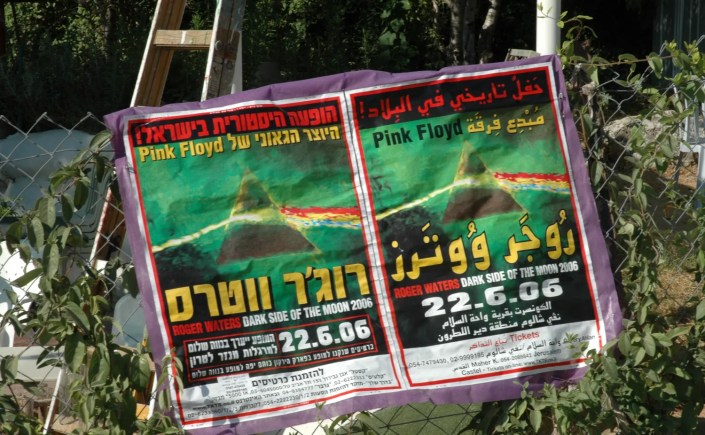
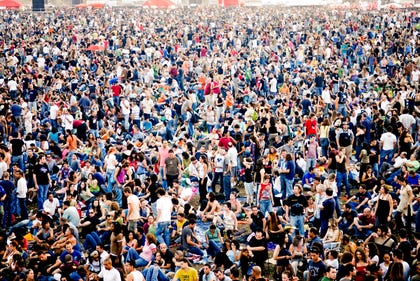
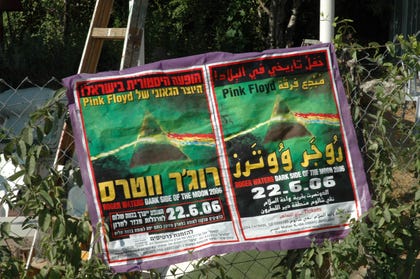
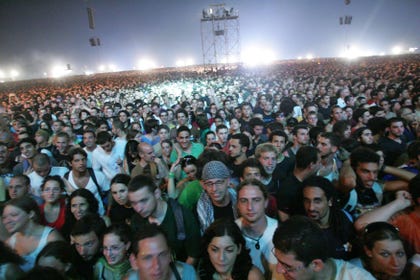
The article begins as a piece of rock-and-roll history. In 2006, Waters agreed to perform in Israel but, under pressure from the fledgling Boycott, Divestment and Sanctions (BDS) movement, cancelled the planned Tel Aviv concert and instead performed in Neve Shalom (Wahat al-Salam), the Jewish-Arab “Oasis of Peace” village near Latrun. The move required an extraordinary logistical effort: a chickpea field became a wheat field, then an amphitheatre for some 60,000 people. Traffic collapsed, helicopters ferried the wealthy, and the concert itself – a performance of The Dark Side of the Moon – became one of the largest and most memorable rock events Israel has ever hosted.
Around this entertaining backstage story swirl competing memories. Did Waters himself suggest Neve Shalom? Was it promoter Shuki Weiss? Did Waters witness armed Israeli soldiers at the separation barrier or not? Did security concerns prevent him attending a peace gathering, or did he simply go shopping? Almost every anecdote has two or three incompatible versions. Shalev wisely resists deciding who is right. Memory, ideology and self-mythologising have become inseparable.
The more interesting story is Waters’ own political evolution. He describes 2006 as the beginning of his radicalisation, crediting Qatari-Palestinian activist Omar Barghouti and the nascent BDS movement with opening his eyes to what he now regards as Zionism’s original sin. He claims his deceased father’s letters from British Mandatory Palestine anticipated these concerns decades earlier. Since then, he says, he has concluded not merely that Israeli governments have committed grave wrongs, but that Israel itself – and Zionism as such – is “a failed experiment.”
At that point the interview changes register entirely. It ceases to be about a concert and becomes a prolonged political jeremiad. Waters insists Israelis have been comprehensively brainwashed, dismisses Israeli society as morally corrupted, embraces armed struggle as historically necessary, rejects Nick Cave’s argument for cultural engagement, and repeats claims about October 7 that have been extensively challenged by independent investigations. His denial that Hamas committed rapes, despite substantial evidence collected by UN investigators, journalists and Israeli forensic teams, inevitably overwhelms everything else he says. Whether one is sympathetic to Palestinian suffering or highly critical of Israeli policy, this is where many readers simply stop listening.
That is perhaps the tragedy of Roger Waters. He undoubtedly possesses genuine moral passion. The anti-authoritarian themes running through Animals, The Wall and Dark Side of the Moon were always political, even when listeners preferred to hear only the music. But somewhere along the way, righteous anger seems to have hardened into absolute certainty. There is almost no room left for ambiguity, self-doubt or tragedy. Israelis become collectively brainwashed; Palestinians collectively embody resistance; every contradictory fact is assimilated into a single explanatory framework.
It is an oddly totalising worldview from a man who once warned us against “thought control.”
Postscript
On 4th September 2026, The Times of Israel Israel reported that Roger Waters, “a far-left conspiracist who has long been accused of antisemitism”, was scheduled to headline a New York City conference run by a group that raises conspiracies about the September 11, 2001 terror attack. “Waters and the group organizing the conference, the International Center for 9/11 Justice, have raised false allegations that Israel was involved in the al-Qaeda terror attacks”.
According to The Times, “The group identifies with the “truth movement” that raises alternative explanations for the attacks and calls the attacks an “inside job” orchestrated by the US government with assistance from Israel and other countries”. “9/11 was the first step in the plan for US-Israel hegemony in the Middle East,” the group said earlier this year.
The Times notes that Waters has endorsed conspiracy theories about the September 11, 2001, attacks, telling Tucker Carlson in July that the towers fell due to “controlled demolitions. “It fell down because it was demolished, and the question is, ‘Who placed the explosives in it? Who pressed the button?’” he said. He alleged Israelis had foreknowledge of the attacks, saying, “They were dancing around, sort of congratulating themselves”. He has also raised conspiracies or denied atrocities related to Hamas’s October 2023 invasion of Israel and has a history of anti-Jewish rhetoric.
Paul Hemphill, August 2026
For more on the Middle East in in That Howling Infinite, see A Middle East Miscellany.
Roger Waters: ‘My Songs That Israelis Love Are About Truth and Love. Israel Is the Complete Opposite’
Twenty years after his performance in the Jewish-Arab village of Neve Shalom, Roger Waters recounts his version of what really happened there – and what has changed for him since. ‘They went from, ‘Waaaah! Roger, Pink Floyd, we love you’ – to ‘What the fuck is he talking about?”
Ben Shalev, Haaretz , June 18, 2026

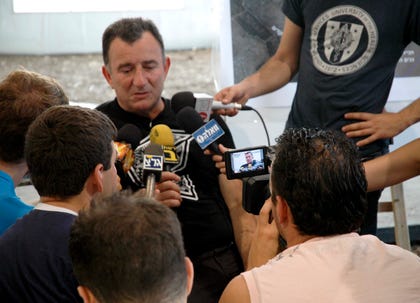
The employee, a member of Israeli producer Shuki Weiss’ team, thought he had heard over the radio that Waters would be arrested on suspicion of damaging IDF property the moment he stepped offstage. He alerted Amir Feingold, who was in charge of security for the production.
Already under immense pressure as the concert drew to a close and 60,000 attendees prepared to leave, Feingold took the report seriously. “We called the Jerusalem District commander, who was at the site, and asked him to look into it,” he recalls.
“Listen, we know how easily the police arrest people. Look at what’s happening today with protest activists.”
That was in 2006. The minister responsible for the police was not Ben-Gvir.
“If there was the slightest chance something would go wrong, we wanted to make sure it didn’t happen. The district commander reassured us. He said, ‘I’m with you.’ At the same time, Shuki and I went to Waters’ manager and told him, ‘Listen, here’s the situation. There could be problems.’ As soon as Waters got off stage, we put him in a car, even before giving the order to turn on the lights in the facility. Shuki said a few words to the audience while the man was already on his way to Ben-Gurion International Airport, escorted by special police patrol unit vans.”
The story about the complaint against Waters is an insignificant anecdote, but it illustrates how much Israeli reality has changed in the 20 years since that performance.
In 2006, Ben-Gvir was a serial offender who belonged to the lunatic, ostracized fringes of the far-right, far outside the bounds of public legitimacy. Today, he is the national security minister. Waters is the one who has moved far beyond the bounds of Israeli legitimacy in the past two decades. In 2006, he was still a huge cultural hero, unconditionally loved and admired. His arrival in the country was seen as a historic event.
Israelis’ attitude toward Waters has, as is well known, totally changed since then. First, he has been a vocal and tireless advocate for the cultural boycott against Israel, as part of the boycott, divestment and sanctions movement. Then, he denied the scale of the Hamas massacre on October 7.
Pink Floyd’s music is still very much loved in the country, but Waters himself is probably among the most hated people in Israel. The possibility of him setting foot in the country today is beyond imagination. This makes the memories of his performance here, exactly 20 years ago, particularly charged and interesting.
What does Waters himself remember from that visit to Israel and the performance in Neve Shalom? What is the most significant thing that stuck with him?
“Very, very comfortable, shabby chic white sofas arranged backstage. Not the most meaningful memory, but you said, how do you remember it? But the main memory, obviously, is the memory of when I made the little speech at the end where I said, you are the generation of young Israelis who must make peace with your neighbors and blah blah blah,” Waters says in a Zoom interview from his New York home.
He then mimics a screaming, fawning audience: “They went from, ‘Waaaah! Roger, Pink Floyd, we love you’ – to ‘What the fuck is he talking about?’ Wow. It was something of a surprise. I went back the next year and I learned a lot more about Israeli psychology. But that first year, it was still a bit of a surprise.”
Waters is not precise with the timing: He returned three years later, in 2009.
Was the change in audience reaction really that extreme?
“It went from ecstasy to silent horror in a split second. And I thought, whoa, that was by far the most important bit. The rest was just a gig, with an adoring audience.”
Israel is waiting for Roger
One need not accept Waters’ recollection. I asked several people who were there how they remembered that moment. Some didn’t recall Waters’ statement at all. Others said the audience reacted supportively. No one remembered a reserved response, certainly not “silent horror.”
A significant discrepancy between different accounts of the same events characterizes the entire story of Waters’ performance and his 2006 visit to Israel. Whose idea was it to move the concert from its original venue in Yarkon Park to Neve Shalom’s chickpea field? What did Waters see during his visit to the separation barrier? Why didn’t he attend the meeting organized for him with intellectuals and peace activists?
The answer to all these questions is: It depends on whom you ask. So we asked. To mark 20 years since the most complex and charged performance in the history of international rock concerts in Israel, we will try to tell its story in the most reliable and interesting way.
This story has two protagonists: Waters and producer Shuki Weiss. In the 1970s, before Weiss became one of the country’s biggest concert producers, he managed record stores in Tel Aviv and was one of those responsible for introducing Pink Floyd’s music to Israelis. Later, when he owned the Dan Cinema Club in Tel Aviv, he used to hold record listening evenings there. One time he played “The Wall.”
“People would come to listen,” he recalls. “Many people.”
In the early 1980s, Weiss and Miron Rechtman, the owner of the Betty Bam event equipment company, bought the sound system that Pink Floyd used on its “The Wall” tour. In the mid-1980s, Weiss tried in vain to bring David Gilmour, Pink Floyd’s guitarist, to Israel as a solo artist. Toward the end of the 1980s, after Waters had left the band, he negotiated to bring Pink Floyd to perform in the country in its trio lineup (Gilmour, keyboardist Rick Wright and drummer Nick Mason. But that attempt also failed.
“I stalked them, so to speak,” he says.
In early 2006, Weiss learned that Waters was planning a world tour based on the album “The Dark Side of the Moon.”
“I went to London, met his agent, and offered a huge sum, much more than he received anywhere else,” Weiss recalls. After the contract was signed and the planned performance in Yarkon Park was announced, he traveled to Paris for a brief meeting with Waters. “I told him that Israel was excited for him,” he says. “He was perfectly fine.” Weiss says ticket sales were excellent, with 35,000 sold three months before the show.
A couple of weeks later, Weiss was vacationing with his family in the Netherlands, when Waters’ manager, Mark Fenwick, called him. He told Weiss that pro-Palestinian activists were exerting heavy pressure on Waters. A few hours later, Fenwick called again to say that Waters had decided to cancel the performance.
“I got lots of emails from my brothers and sisters after the announcement of Hayarkon Park. But the important one was from Omar Barghouti,” Waters recalls about changing his mind, referring to one of the founders of the BDS movement. “We had a conversation, and then I eventually cancelled Hayarkon Park. Organizing this concert instead was a compromise with Omar and with the rest of the people who had just started the BDS movement, because obviously even doing Neve Shalom broke the boundaries of the cultural boycott.”
Waters describes that exchange as “a huge moment” in his political thinking.
“You know, in this song that Mona Miari and I have just released, a re-imagination of my song ‘Comfortably Numb,’ I sing, ‘We never knew about the Nakba. I was only 5 years old in ’48.’ And we didn’t,” he says. “And the lie that is Zionism had been spread all over the world since the Second World War. So I wasn’t alone. Very, very few people quite got it.”
Waters says that one of the few people who “got it” before the war was his father.
“My father taught at St. George’s School in Jerusalem from 1934 to 1936,” he says. “And he wrote letters home to my grandmother, which I have, saying how worried he was about the influx of American money, mainly, to buy up land, and about the establishment of the settlements that he saw going on, and how desperately worried and concerned he was,” he recounts, referring to the pre-state Jewish communities. “Of course, he was killed in the war, so I never got to talk to him about these things. but it’s a fascinating fact.”
Following the deepening of his awareness of the Israeli-Palestinian conflict due to the appeal of the BDS movement, Waters made his second visit in 2009. “My travels around the occupied territories … were deeply, deeply moving and very informative,” he says. “I’ve tried never to shut my mouth from that moment. And things have only got worse, obviously, except that it’s becoming clearer and clearer to the vast majority of people all over the world now that this is a failed experiment, and it should be stopped.”
What is the failed experiment?
“Israel is the failed experiment. Zionism is the failed experiment. and this is becoming increasingly a position taken up by a huge majority of human beings all over the world, because we witness and are appalled by the horrific policies of the state of Israel in its massacre of the indigenous people whose land it stole in order to create itself. And so it’s a terrible, terrible, terrible tragedy, and it remains to be seen: Will I see the end of the story in my lifetime? Probably not. I’m 82 years old.”
Field of wheat
In response to Waters’ decision to cancel the Yarkon Park concert, the most monumental improvisation in the history of performances in Israel occurred. Thanks to the move to Neve Shalom, Weiss says he was called “The King of the Chickpea Field” for years by people in the global music industry.
“When Waters’ manager informed me of the cancellation, I told him: ‘What if I move the show to a place for Jews and Arabs?’ I don’t know where that came from,” Weiss says. ‘I knew Neve Shalom. David Broza’s grandfather was one of the first residents there. I had done performances there many years before this show, events for peace. But nothing of this magnitude. Performances for a few thousand people. I had no idea if a huge concert could be held there. I left my family in the Netherlands and returned to Israel. That night, Waters’ manager called me back and said: ‘We checked what Neve Shalom is. If you can do it there, and if you invite Arabs to the show and arrange meetings with peace activists, we’re in.’ I told him: ‘Yes, yes, yes.”
Rayek Rizek, a Neve Shalom resident, offers a different version of the events that led to the Neve Shalom performance. “Sometime in late March 2006, I heard two employees in the community’s secretariat talking about Roger Waters,” recalls Rizek who was the community’s secretary general in 2006. “I’ve loved Pink Floyd since high school. I still listen to them today. When I was studying at university in the United States, around when “Animals” (the band’s 1977 album) came out, I missed a performance of theirs in Houston. By the time I managed to look for a ticket, everything was sold out. I was very sorry,” Rizek says as an aside.
“So when I heard the employees in the office talking about Waters, I asked what was going on. They said his manager had sent us an email. Waters was interested in Neve Shalom and was asking for information about the village,” he says. “As soon as I saw I had a direct connection with the manager, I sat down and wrote him a long email telling him about Neve Shalom and inviting him to hold the concert with us. I didn’t know about the pressure being exerted on him. Two days later, Shuki Weiss came to the village and told me, ‘This morning, Waters’ manager called me and asked about the possibility of moving the concert to Neve Shalom.’ I imagine the manager received my letter and understood that such a possibility existed.”
Rizek’s version doesn’t necessarily contradict Weiss’s entirely. Perhaps Weiss suggested the idea to Waters’ manager, and then the manager sent an email to Neve Shalom. But it’s also possible that the initial email to Neve Shalom was sent to explore the option of holding some separate activity in the community. In this scenario, when the Yarkon gig was canceled amid Rizek’s offer to hold a concert in Neve Shalom, Waters and his manager adopted the proposal. Rizek recounts that during one of the preliminary meetings with police officers at the event site, one of the commanders got annoyed over some details and asked, “‘Why are we even holding the concert here? Why didn’t it stay in Tel Aviv?'”
Rizek recalls: “Shuki looked at me and told the commander: ‘Blame him.’ As for me, all I did was send a letter.”
Waters himself doesn’t remember the history of the concert’s move to Neve Shalom. “Shuki Weiss, bless him, he’s just another promoter,” he says with a smile. “I don’t know him at all. I wouldn’t trust him as far as I can spit.”
On the other hand, he stresses, “I loved the idea of Neve Shalom, of this agricultural community.” He says fondly: “It’s like this is the dream that we have of how Palestine could go, could go back to being, where everybody lives together, and there’s no supremacists, there’s no racism. Whatever it may be that has caused this great catastrophe, there was none of that in Neve Shalom. I hope it’s still doing well.”
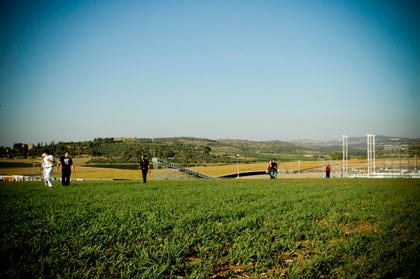
Weiss picked the new concert site’s location with Giora Porter, who designed the producer’s concert venues for many years. “There was only one area that came into consideration, with a certain slope, a kind of natural amphitheater,” Porter recalls. “It was a chickpea field owned by two brothers from one of the local moshavim. I located the field owners and said: ‘I want to buy your chickpeas.’ They said: ‘Okay, we’ll harvest in May.’ I said: ‘No, now.’ They understood they could make a killing off me. I bought the chickpea field, the crop they wouldn’t harvest, for $100,000. They were nice guys, but they knew how to bargain.”
“But there was a problem with the crappy soil in the Latrun area,” Porter says. “Exposed soil in June is all dust. It’s terrible. I suggested sowing grass, but the moshav resident said: ‘No, that will ruin my land.’ I said: ‘I can’t do a show on dirt.’ I think he was the one who suggested sowing wheat. He said: ‘It’ll sprout and be green like grass.’ So we went to see wheat sprouting elsewhere. I told him: ‘It’s terribly sparse.’ He said: ‘We’ll double sow it, increase the density.’ And that’s what he did. Shuki paid for it. And that entire huge area turned green within days. It was a miracle.”
Weiss and Porter recount that various state authorities created numerous difficulties for the show. The Israel Antiquities Authority remembered that salvage excavations needed to be carried out on the site and delayed the work. The Israel Land Authority charged several hundred thousand shekels to rezone the land for commercial use, even if only for one night. Meanwhile, the Health Ministry prohibited watering the compound with reclaimed water and forced Weiss to bring tankers. “It didn’t matter that we used reclaimed water at night, but I showed them we had tankers,” Weiss says.
“Quite cunning bodies,” Porter says of the authorities that created difficulties and collected payments. Weiss adds, laughing: “They know their job. That’s governance!”
Weiss and Amir Feingold, who was his security officer, have mostly praise for the police’s conduct. Some officers, Weiss says, were Pink Floyd fans. The event morphed into a kind of national project that the police wished to see succeed. There was, however, a dispute over the number of paid police officers the production was required to fund. The Jerusalem District commander demanded 1,000, including several dozen detectives to hunt for pot smokers among the crowd.
“We argued with them about it,” Feingold recalls. “I told the district commander: ‘In the end, it’s rock and roll. Are you bringing 80 detectives to arrest the pot smokers? Let them enjoy themselves.” The police, he says, complied and eased the demands.
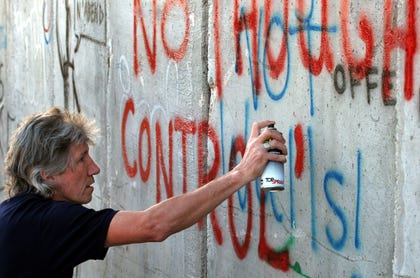
Waters landed in Israel two days before the concert. The morning after his arrival, he visited the separation barrier near Bethlehem, where he protested against its construction with spray paint and words. Weiss says Waters gave interviews after his visit in which he said he was shocked to see “soldiers with drawn weapons” near the wall.
“A lie. There wasn’t a single soldier there, certainly not with drawn weapons,” Weiss says. Feingold, who accompanied Waters’ entourage on the trip to the wall, confirms no soldiers were present.
No-show in Neve Shalom
Waters laughs when he hears this claim. “So which story rings truer, Shuki Weiss’ story, no weapons, no soldiers, just a nice wall, or my story? I’ll tell you which one is true: my story,” he insists. “Shuki Weiss is a lying schmuck, obviously. I’m sure he’s very smiley, and he likes to make a lot of money. Good luck to him, but he’s just making stuff up.”
Another claim by Weiss concerns Waters’ non-attendance at an event organized in his honor in Neve Shalom. It was to be a meeting with intellectuals, peace activists, and village residents. Singer David Broza “helped me bring artists, writers, very serious people,” Weiss recalls. “They brought an olive tree for him to plant. There was a children’s orchestra. Tons of excitement. Everyone was already there, but he wasn’t. No Roger. They called him. He didn’t answer. His manager didn’t know where he was. In the end, David planted the tree in his place. Later it turned out he went to Kikar Hamedina to buy jewelry for his partner.”
Not only an olive tree was prepared for Waters, but also a sculpture of the famous prism from the cover of “The Dark Side of the Moon,” Rayek Rizek recounts. “I went to an artist in the Rehovot area, he told me 20,000 shekels ($4,500 in 2006). In the end, we made it from marble-coated concrete. It cost 4,000 shekels. Shuki paid,” Rizek says. “We waited and waited. In the end, someone on Waters’ behalf came and said he couldn’t come. There were too many people.”
Weiss says Waters was a no-show in Neve Shalom the day before the concert, but the event took place the afternoon of the show. “He was supposed to go to the community from the backstage area,” Feingold says. “His security guard came and looked around. I told him: ‘Tell me what you need. We’ll sort it out.’ He didn’t say a word and left. Later, he announced, ‘We’re not coming.’ I don’t know if he or Waters decided. He just said, ‘Security problems.’ What security problems? First-graders and 30 other people from the left. Where was the threat?”
Rogers says “of course” he didn’t come. “You don’t do anything on a gig day, except the gig,” he says. “I’m glad I’ve had this career and that I’ve been able to do multiple shows all over the world to fabulous audiences, but it’s very rare to do other things on show days.”
“And I’m absolutely, totally against the Nick Cave school of thought that, oh, we should all go and talk to people in meetings and that’ll do it,” he stresses, parodying hippie naivete. “No, it fucking won’t, you prick. No people has ever freed themselves without armed struggle, ever. It just doesn’t happen. It reminds me of the best interview that any of us have ever seen. (Palestinian writer) Ghassan Kanafani gave that fabulous interview where he talks about the conversation between the hatchet and the neck. What a wonderful writer.” He adds, referring to one of Kanafani’s books, “I can still remember almost every word in ‘Returning to Haifa.'”
A few weeks after the Neve Shalom concert, Waters wrote Rizek. “Dear Rayek, I’m deeply saddened that I was unable to plant the olive tree, but our efforts to reach the site were thwarted by the sheer numbers of people surrounding the vehicle in which I was travelling,” he wrote. “I know how upset you are that this did not take place and I hope that will not blight the memory of our visit to your land.” It sounds like something Waters would write, not his agent or manager.
“You see, Ben? I’m not just evil,” Waters comments.
When I sent him an email a few weeks ago asking if he would agree to be interviewed for this article, I didn’t expect a positive answer. But it was positive and even cordial. When I told him during the Zoom call that I was pleasantly surprised, and that the conventional wisdom here is that he has no desire for dialogue with Israelis, certainly not after October 7, he responded: “Yes, I am. I’m just having one with you now.”
However, some things he said were difficult to hear and didn’t seem very open-minded.
“You, as a country, Israeli people have been brainwashed, and consequently you are now subjects, nationals of the most evil thing that has happened in the world since the Nazis and the Second World War. And you can’t seem to grasp it, and that is so sad,” he said.
“You used the two magic words: Gideon and Levy,” he continued, referring to my email mentioning Gideon Levy as my Haaretz colleague. “It’s only these words that got you the ability to get to me, and even Gideon got the whole October 7th thing wrong. We almost fell out over it, because he was so brainwashed. He believed all that crap about burning babies and raping women and stuff, and it’s all complete nonsense, and everybody knows it’s complete and utter nonsense. There was no rape by Hamas on October the 7th. However, there have been documented multiple rapes by the IDF, of men and women and children.”
After pushing back that I did believe these things happened, I asked Waters to change the subject. It was unbearable to hear him say these things. I knew that any attempt to continue responding to him would blow up the interview. But he continued.
“Your position is indefensible, and no amount of talking intelligently to any of you is going to change any of this. You’ve been Ben-Gvir’d until you can’t accept any reason,” he retorted. “Your state, Israel, is psychotic, psychopathic, criminally insane, and the only way out of it is for you to re-establish connection with the rest of the human race. Stop thinking that you are superior in some way and should rule the world, and join in with the community of the part of the world you’re living in. Until you do that, you are doomed, but you may well drag the rest of the world down with you. You know, it wouldn’t surprise me at all if suddenly some lunatic was to drop a nuclear bomb on Iran or something, and that’s the end of the world. You, Israel, and the United States, the U.K., France and Germany, and all the people in that cabal are dragging the whole globe towards its extinction, extinction of all life on the planet. And that’s what I complain about. It’s not weird to complain about that.”
Aviv Geffen arrives by chopper
Back to the concert, enormous traffic jams formed on the way to Neve Shalom in the afternoon and evening, and on the way from it that night. “The biggest traffic jam of 2006, perhaps of the entire decade,” Feingold asserts.
“A massive transportation failure. To this day, people are still stuck there trying to get out,” Porter laughs. Still, he acknowledges the huge traffic jams were unavoidable. “That’s the geography. We invested a lot in finding access roads, dirt roads,” he says. “We rented entire fields from nearby kibbutzim and leveled them for parking. And still, in the end, everything converged on one turn off the main road. Like everyone coming to Tel Aviv in the morning. It’s an unmanageable rush hour.”
So, did you bear responsibility for the failure, or did you say “it couldn’t be prevented”?
“Both,” Porter says.
Those who didn’t suffer from the traffic jams were the affluent who could afford 3,000 shekels for helicopter transport to the concert venue. A special helicopter line operated from Sde Dov airport in Tel Aviv. “Rani Rahav rented two helicopters for himself and the group that came with him,” Weiss says, referring to the PR consultant. “Aviv Geffen also arrived by helicopter. They told me afterward: ‘You don’t understand what a sight unfolded before us from above. It was worth every shekel.”
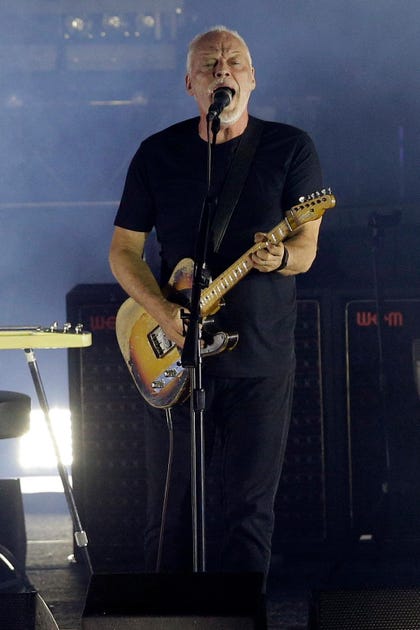
As for the concert, the quadraphonic sound was excellent. The superb backing band, which included acclaimed guitarists Snowy White and Dave Kilminster, was flawless. Waters occasionally used playback or excellent backing vocalists. It wasn’t a spontaneous or surprising performance, but it was clearly going to be that way. For the fortunate few who had the luck to see Pink Floyd perform, it was necessarily a diluted version. (Weiss is one of them, saying, “It was a poor man’s Pink Floyd. It wasn’t the real thing.”). But a straw poll I took last week among people who were there suggests that the enjoyment was complete, overwhelming and enthusiastic.
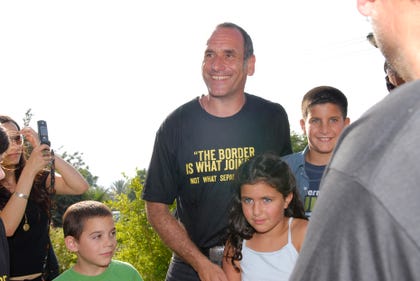
Musician Oded Tamsoot came to the concert from Ma’ale Gamla in the Golan Heights. “The entire event, the performance itself, was an amazing experience, beyond imagination,” he says. A year later, he formed the Pink Floyd tribute band Ummagumma.
Yael Ori, a former teacher and kindergarten teacher from Jerusalem, says Pink Floyd’s messages, which deeply influenced her as a teenager, inspired her to choose the teaching profession. “My high school was a nightmare,” she says. “I decided I wanted to be a teacher so my children wouldn’t suffer what I suffered.” Singing “We don’t need no education” with Waters and the masses was a wonderful experience, she says.
Dvir Zhorno from Jerusalem was 16. “The concert’s timing was perfect for me. It was shortly after I discovered Pink Floyd and started delving into their music,” says Zhorno, now a finance professional. “After the show, I heard critiques that he performed the songs exactly as they were on the albums, but that style suited me. That’s what I wanted to hear. ‘The Great Gig in the Sky’ live, exactly like on the album – it was awesome.”
Truth and love, lies and hate
Toward the end of the interview, I asked Waters what he thought about the enormous, unbridgeable gap between the deep love hundreds of thousands of Israelis feel for Pink Floyd’s music and the extreme hatred most Israelis feel toward him, his views and his statements.
“This is their problem,” he sighs. “All my work, all that work that they love, all those songs I wrote for Pink Floyd – “Shine On You Crazy Diamond,” “Comfortably Numb,” “Wish You Were Here,” – are all about truth and love. And all of my work that I do now is about truth and love. The State of Israel and what the children of Israel are taught to believe from the minute they’re grown up is the exact opposite. You’ve been brought up to believe the lies about October 7th. That’s not true. That’s just pure evil lies. And you’ve been taught to hate Arabs and Palestinians. That’s the opposite of love. So you live in a world that’s built on lies and hatred. … My music is built on love and truth, and that’s why there’s a dichotomy – oh, we love his music, but we hate him.
“I’m so sorry that even talking to you, I can see that you have been brainwashed, my brother Ben, completely. And I know you’re laughing at me now, but it’s really not funny. It’s sad. Israel is the saddest thing on earth, with the possible exception of the Trump White House. It’s sad because human beings are better than this. There is a capacity within every human soul for an attachment to love and truth. So for us to be persuaded that lies and hatred are a better alternative is why I go on working and expressing myself in my great songs.
“You think that ‘Dark Side of the Moon’ and ‘The Wall’ and ‘Animals’ weren’t political? Are you fucking stupid? Yes, they are stupid. If they don’t get that, they’re very, very stupid. You can’t really blame them. There were people in the band who don’t get it. David Gilmour doesn’t get it. He’s dumb as shit. He never understood a single bit of any of it. … That’s why he was miserable. And he was miserable with the band, because he never understood what I was doing.”
Waters started to say another sentence but then stopped and said: “Well, no, I’m not gonna [there]. Good luck with getting them to print any of this.”
Thank you very much.
“You’re welcome. Thank you for still having a smile on your face at the end of this conversation.”

