Mo Ghile Mear – Irish myth and melody

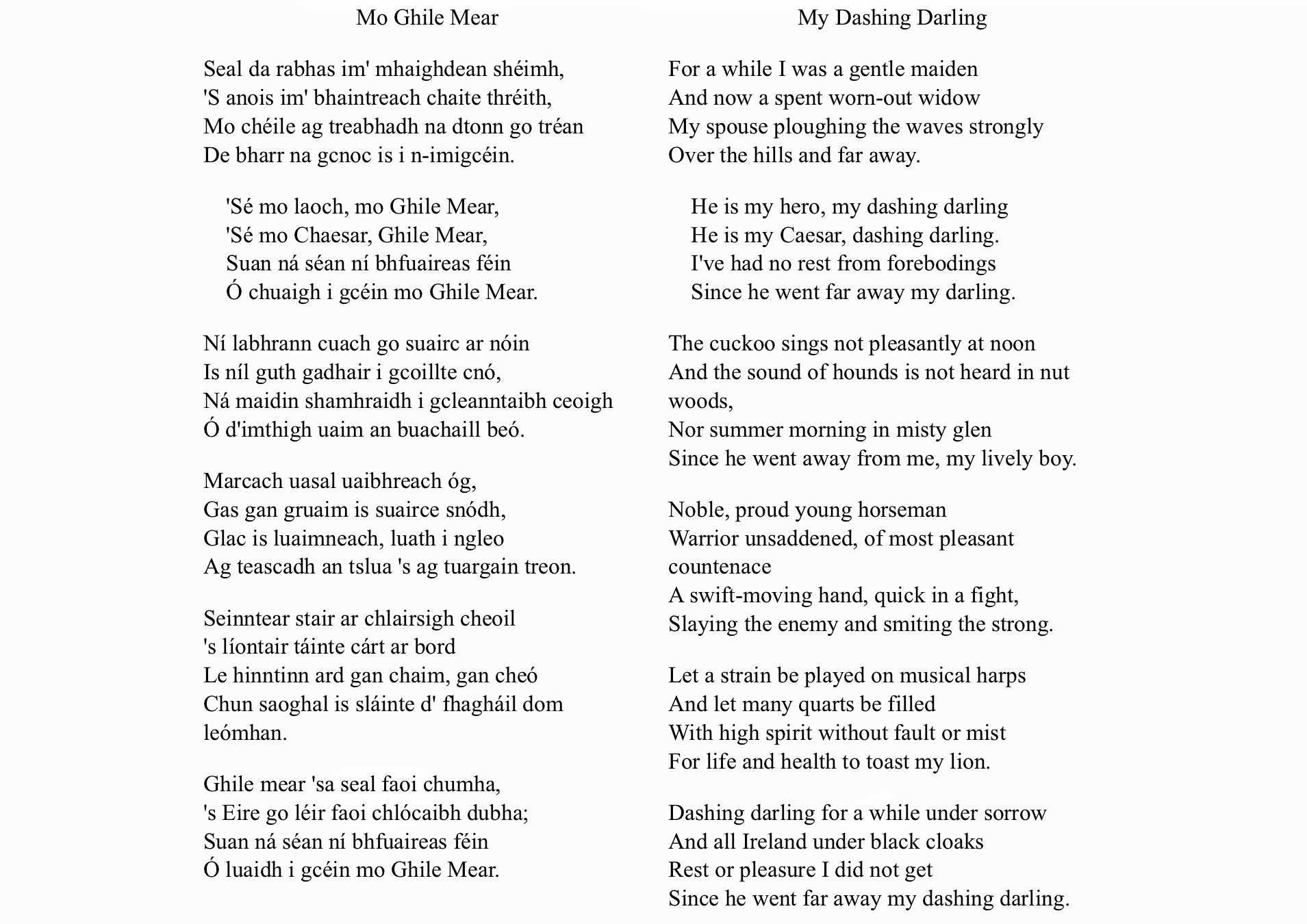
     Sé mo laoch, mo Ghile Mear,
    ‘Sé mo Chaesar, Ghile Mear,
    Suan ná séan ní bhfuaireas féin
    Ó chuaigh i gcéin mo Ghile Mear

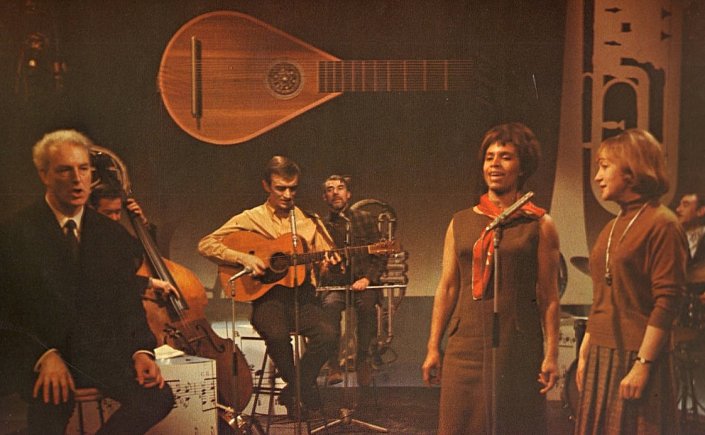
The song begins as the camera focuses on the face of the singer. A soft and confident tenor, he gently leans into a long-gone poet’s Gaelic verse. The camera pulls back to reveal a phalanx of young people behind him. They are dressed plainly. The lads in dark suits and open-neck, white shirts, and most sport five o’clock shadows. The lassies in dark dresses, blouses and pants. They join the soloist, quietly at first, but rising soon in unison. A bodhran kicks in, sharp and deliberate. The young folk stand still, yet their heads nod almost imperceptibly to the bodhran’s driving beat, and the song lifts off and soars. The camera pans across the choir, focusing on their faces, and particularly, their eyes – almost all of them clear and blue. The joy in the eyes, their smiles, and their voices is there for all to see and hear. Their voices rise, and then gradually fall, as if to glide to a gentle landing. The choir hums softly as the singer gently repeats the last line. Ó chuaigh i gcéin mo Ghile Mear – “since my darling went away”,  And it is done.

Mo Ghile Mear is a paradoxical, quixotic song that is at once romantic and political. If you have but a drop of Celtic blood in your veins or a rebel heart in your breast, you will fall under its spell.

Variously translated as “my gallant hero”, “my gallant star”, and “my dashing darling”, Mo Ghile Mear is a Jacobite love song that is as much about politics as about romance. Inspired as it was was by the Jacobite Rising against Protestant England’s rule in 1745, romance and politics do indeed unite in heroic, insurrectionary failure.

it was written in Gaelic by poet Seán Clárach Mac Domhnaill after the battle of Culloden which dashed for two and a half centuries the Scots’ dreams of independence. Composed in the convention of Aisling (Gaelic for “dream” or “vision”) poetry, it is a lament by the Gaelic goddess Éire for Bonnie Prince Charlie, Charles Stuart, the “Young Pretender” to the Protestant Hanoverian English throne that once belonged to the Roman Catholic Stuart clan, and who after the bloody failure of the ’45, fled into exile in France. And that’s where he remained, although his last resting place is in the crypt of Saint Peter’s Basilica in Rome – an ironic ending for this could’ve been champion of Catholic hopes.

Bonny Prince Charlie had many romantic and rousing songs written about him. But in reality he wasn’t the dashing, gallant leader that the songs portrayed and that the Scots and their Celtic Irish allies yearned for – most certainly not the Caesar of this song. He was an indecisive and vacillating leader, who thought himself much cleverer and popular than he actually was, and when the going got rough, he got going – and left the the Scots and Irish who supported him with blood and treasure to the tender mercies of the Sassenach foe.

And yet, the songs live on to this day, most notably in The Skye Boat Song, Will Ye No Come Back Again. The old and well-recorded favourite Óró sé do bheatha ‘bhaile has also been associated with the Jacobite cause as Séarlas Óg (“Young Charles” in Gaelic). The poet Padraig Pearse, leader of the doomed intifada we know as the Easter Rising of 1916, added new verses, and so the song entered the rebel canon.

Mo Ghile Mear differs from more conventional Aisling poems in which the poet is asleep or otherwise minding his own business when he experiences a dream or vision of a fair maid. In this cerebral wet dream, the poet personifies Éire – Ireland, the country itself – as a woman who once was a fair maiden but is now a widow. Her husband, the “Gallant” whatever is not dead but, but he is far away. As a consequence the land is failing and nature itself is in decline.
Popular since the 18th century, song has come to international attention in our own drear times – largely due to a host of recordings, and accompanying You Tube interest.

Iconic chanteuse Mary Black presents the song as a gentle, sad air. Sting famously recorded it with the renowned Celtic ensemble The Chieftains, and they give an understated and fair account of themselves, although the reinvented English lyrics turn “Our Hero” into a dashing cavalier”, swords and harps and all, far removed from original dream song. It is an easy song to overcook,  but Sting managed to resist the temptation. Not so that be-kilted posse Celtic Thunder who ramp up the Celtic bombast, reinventing the English lyrics as a curiously anachronistic, latter-day “rebel song” – “Hail the Hero”, the Battle Hymn of the Irish Republic, with a massive Irish flag waving o’er them all. What would The Minstrel Boy have thought about this?

Then there is the overreach of the much-loved and very popular, kitsch-laden, outings of Celtic Woman, invariably staged to maximum visual effect and capacity audiences at fantastically photogenic Irish castles. These handsome, well-dressed colleens do not crimp on the gowns, choirs, drums and bagpipes. Their Gaelic rewrite, transforms our “dashing darling” into a lovelorn mariner, replete with waves and tides, sails and sunsets. The ladies’ latest outing, with a relatively new lineup, sustains the razzmatazz with the eponymous “gallant star” resurrected as a martial beacon for “freedom’s sons”. It would seem that maritime motif of the girls’ original rendering was superfluous on an album that included My Heart Will Go On, from that damp, tear-jerking,   blockbuster, “Titanic”. Oh, Danny Boy, the pipes the pipes are calling!

That such liberties are taken with the lyrics is no big thing, however. Old Seán Clárach would probably agree that his original Aisling poem would be a wee bit archaic in this day and age, and that the undefeated despair, hope and longing of Éire’s dream were no longer relevant in a free, democratic and relatively prosperous (that is, post GFC) Ireland. He would no doubt have updated his verse, just as Padraig Pearse did with his song in 1916, substituting a 16th Century Irish pirate, the “great sea warrior” Gráinne Mhaol for the foreign born Charlie (so the ladies of Celtic Woman were not that far off-track with their nautical rewrite after all). But this mythologizing of Ireland’s heroes too often comes across as self-reverentially corny.

Cynics might blame the atmospheric, anthemic stadium rock of Bono and U2 for this commercialization of Irish music. Others blame Enya’s symphonic, new age outings once she put  behind her the Celtic mist and moodiness of her Clannad siblings. But I reckon that hitherto timeless, soulful and folksy Irish music has been like this since the Riverdance crew first stamped their collective hard shoes during the intermission of the Eurovision Song Contest and stole the show. But most Irish folk blame Michael Flatley, as the authoritative Waterford Whisperer made clear.

Meanwhile, in my opinion, the most sensitive, beautiful and indeed, rousing rendition of Mo Ghile Mear is the one described at the head of this post. No naff English lyrics are required. The original words of the Gaelic poem resonate powerfully through the hall.

It is sung by the Choral Scholars of University College, Dublin, an amateur, mostly acapella bunch of Irish students. These young folk formally audition for a scholarship with the ensemble. There is little glamour or artifice, no fireworks or vocal gymnastics. Plainly dressed, they look like folk you would pass on the streets of Dublin or Galway. Mark Waters, the portly lead singer would never get a gig in an Irish boy band, but wouldn’t look out of place in a church choir. The drama is achieved by inflection, modulation and tone, the lighting and way the choir is physically arranged in an eerily martial wedge, their only movement being that almost imperceptible nod of their heads in time with the lone bodran’s beat as the song builds momentum.

Listen, and listen again. It is a gem.

© Paul Hemphill 2017  All rights reserved

For more on Irish history and Irish songs of rebellion, see The Boys of Wexford – memory and memoir, Irish Rebel Music, and A Selection of songs of ’98.

Also, in In That Howling Infinite, O’Donnel Abú – the Red Earl no history in a song, and .Over the Sea to Skye.

And here are the Choral Students again:

TheChoral Scholars of University College, Dublin

Here is  Brendan Graham’s achingly beautiful song Orphan Girl with the  Choral Scholars featuring  Abby Molloy. Sung from the perspective of one of Ireland’s famine orphans, on the eve of her inspection, which would decide whether she could travel to Australia, to escape the workhouse which had become her life.

And here are the recordings I referred to above. Enjoy.:
The Shock of the Old – the Glory Days of Prog Rock

I remember well the early days of prog rock, in the late sixties. It was pompous, it was pretentious, it was self conscious and self reverential. Big-screen, technicolor, and unashamedly over the top. And so much fun.

I’d drifted into other musical pastures in the seventies, and missed out on what this very entertaining article in The New Yorker, The Persistence of Prog Rock,views as prog’s finest moments, including those Gentle Giants “songs that seemed to occupy some phantom limb of music’s evolutionary tree”.

““I suppose that your local newspaper might call it ‘jazz-influenced classical-rock”, a reviewer wrote. In fact, a term was being adopted for this hybrid of highbrow and lowbrow. People called it progressive rock, or prog rock: a genre intent on proving that rock and roll didn’t have to be simple and silly—it could be complicated and silly instead”. Ouch!

Back in the day, I saw King Crimson in first bloom and full flight. Lay back on Parliament Hill as Pink Floyd played “Interstellar Overdrive” as jets flew overhead enroute to Heathrow. I  watched the Who performing “Tommy” in its entirety in a cramped, humid Birmingham club calld Mothers (of Invention, surely?) with Roger Daltrey swinging his mic just above our heads. And the Nice, in the same venue, Keith Emerson climbed on top of his Hammond organ, sticking knives between the keys, and splitting his tight pants in the process. As Wordsworth might have said, “Bliss it was in that dawn to be alive. But to be young was very heaven.” I guess you had to have been there.

As the article relates, prog rock just grew bigger, braver, and  bolder, with ELP, Genesis, Uriah Heap, and Yes leading the charge – and there was even a Euro-prog, with Vangelis’ Aphrodite’s Child, with Demi’s Roussos as vocalist.

Both Keith Emerson and Greg Lake of ELP joined the great gig in the sky last year, joining that long line of famous folk who were knock, knock, knocking on heaven’s door. But their music, and that of their peers, lives on. “Progressive rock, broadly defined, can never disappear, because there will always be musicians who want to experiment with long songs, big concepts, complex structures, and fantastical lyrics”. Indeed.

“There is something inspiring about the indigestibility of prog, which still hasn’t quite been absorbed into the canon of critically beloved rock and roll, and which therefore retains some of its outsider appeal. Often, we celebrate bygone bands for being influential, hearing in them the seeds of the new; the best prog provides, instead, the shock of the old”.

Soul food – music and musicians


Oh, Jerusalem – a song

“Bear me up on angels’ wings, and other transcendental things. Where the golden walls still glow, let my people go to Jerusalem”. 

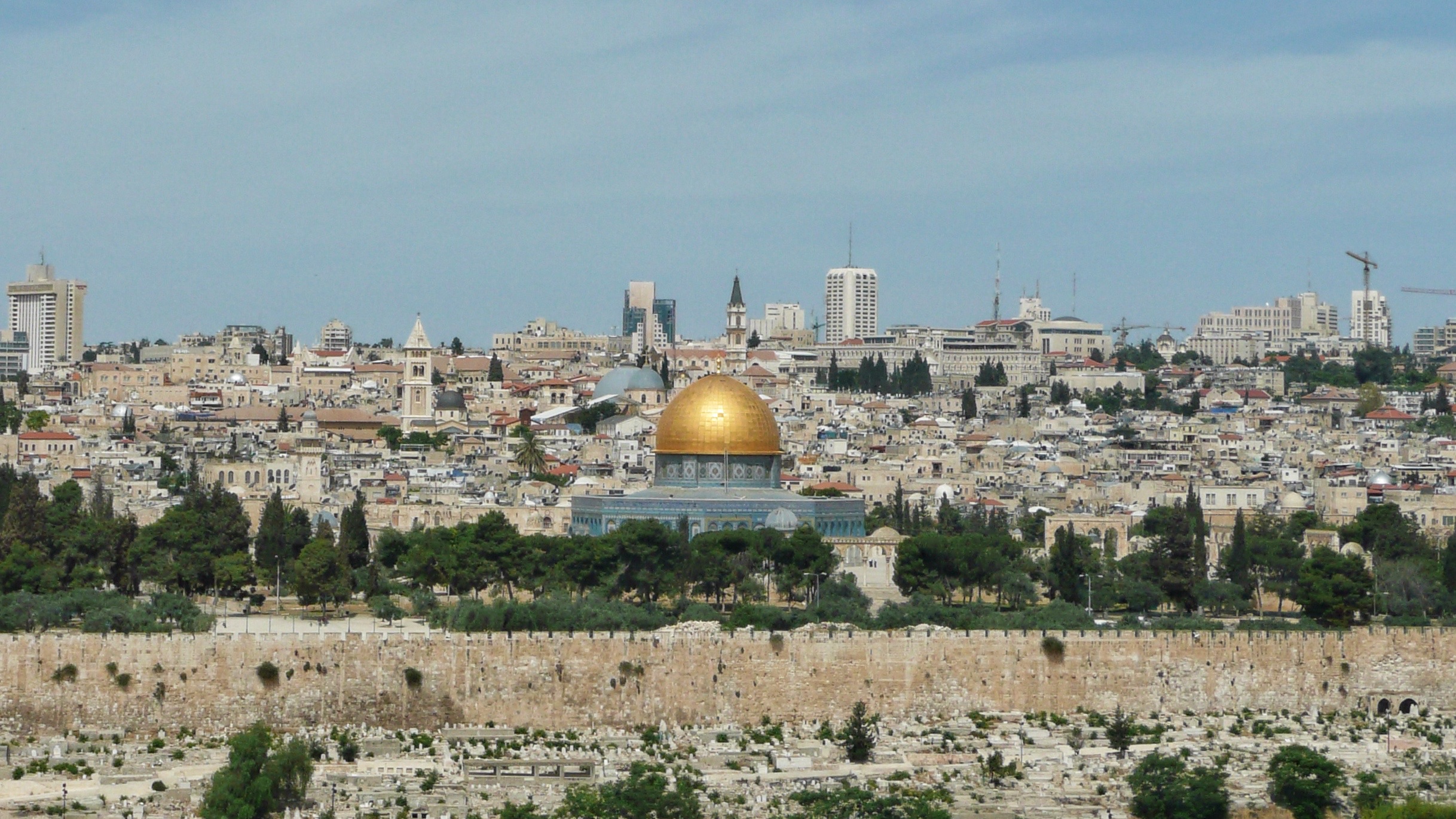
Jerusalem is all about faith and passion, and there is no city on Earth that people get more passionate about. The light is luminous. In high summer it almost shimmers. The very air is full of prayer and politics, passion and pain, and the rocks and stones virtually sing a hallelujah chorus of history. I am not a religious person, but I cannot help getting excited by the place – although I do not transcend to transports of delight and delirium. Some folk love Jerusalem so much, they go mad.

Recorded by Charles Tyler at Susan Street, Annandale, 14th May 2017. © Paul Hemphill 2014 All rights reserved

Messianic Carpet Rides

Amazing Grace : There’s Magic In The Air

The death of the singer will not kill the song

It is not Leonard Cohen about whom I write.

The passing of a beloved singer or poet is a sad affair, the initial shock on hearing the news segueing into bitter-sweet memories of songs and poems and how they provided a soundtrack or bookmark to significant events in our lives. We’ve had opportunities aplenty this year with so many of our icons knocking on heaven’s door.

But the murder of singers and poets on account of their words and their voices is sadder still. It diminishes our lives and indeed, it diminishes the world in which we live, and in its hatred and nihilism, strikes at the heart of the values we hold most dear.

So it was with Spanish poet Garcia Lorca, murdered in 1936 by Generalissimo Franco’s Nationalist soldiery at the beginning of the savage Spanish Civil War. So it was with Chilean folk singer and songwriter Victor Lara, slain in a soccer stadium in September 1973 by Augusto Pinochet’s thugs.

Rest In Peace, Amjad Fareed Sabri, acclaimed Pakistani maestro of Qawwali Sufi devotional music who was murdered in Karachi in June this year by Taliban militants.

Ajmat and his brother Maqbool were the acclaimed Sabri Brothers, two the most renowned qawwals – up there with Nusrat Fateh Ali Khan, muse and mentor of Jeff Buckley.

The Sabri Brothers

The Sabri Brothers

The songs Ahmad Sabri and his father performed are part of a Sufi tradition dating back to the 13th century. Known as Qawwalis, steeped in mysticism and sometimes based on mystic poetry, they are a key part of the spiritual life of millions of Muslims across south Asia and enjoyed by wider audiences of many faiths.

But both the music, and the shrines at which it is often performed, have long been a target for religious conservatives who shun all forms of music and consider the shrines unorthodox. Dozens of sites have been targeted in attacks, including a 2010 suicide bombing at one of Pakistan’s most popular shrines. Qawwalis have long been criticized by the Taliban and other hard-line groups that reject all music as un-Islamic, and particularly object to those songs which focus on the life of the prophet Muhammad.

The murder of a popular singer from a famous and well-loved musical dynasty was a clear warning to others trying to celebrate and preserve Pakistan’s indigenous traditions, and the  pluralism and diversity of religious practice and cultural expression in this tortured part of the world.

I recall seeing the Sabri Brothers perform in London in 1977, led in those days by Ajmad’s father Ghukam Farid, just before I departed for Oz. I still treasure – and play – these glorious songs of praise. their driving rhythms, exotic melodies, and spirited call and response, and enthralling and hypnotic,  Here are two of my long-time favourites, sung by Sabri Senior. Listen for yourself.

‘Bhar do Jholi’ is a praise song for the Prophet and for his companion Bilal and his grandson Hussein, (who with his father Ali are the founding martyrs of Shia Islam).  Read the translated lyrics here.

‘Balaghal bi Kamalihi’ tells the story of Muhammad’s night journey to Jerusalem on the horse Buraq.  Read the translated lyrics here.

For more on the Sabri Brothers and Qawwali, see:

https://en.m.wikipedia.org/wiki/Qawwali

https://en.m.wikipedia.org/wiki/Amjad_Sabri

https://en.m.wikipedia.org/wiki/Sabri_Brothers

https://en.m.wikipedia.org/wiki/Nusrat_Fateh_Ali_Khan

Read about Victor Jara and Garcia Lorca here:

https://www.theguardian.com/music/2013/sep/18/victor-jara-pinochet-chile-rocks-backpages

https://en.m.wikipedia.org/wiki/Federico_Garc%C3%ADa_Lorca

Read also, David Kilcullen’s cogent piece on ISIS AND al Qaeda:

One, Two, Three, What are we fighting for?


That was the year that was – from New Orleans to Jerusalem.

Its been a diverse year In That Howling Infinite. We have traveled, to quote Bob Dylan, “all the way from New Orleans to Jerusalem” – and to many other places in between. Vikings and Roman legionaries; Bob Dylan, Jackson Browne and Bruce Cockburn; Britain in the ‘forties and Paris in the ‘fifties; America, the Levant, and even Wonderland. By Year’s end a million souls will have journeyed to Europe from the war-ravaged lands of the Middle East, and my final posts for the year contemplate what it might mean for refugees who find to safe haven in Australia.

Here is a retrospective.

The year began with a short piece on recent archeological discoveries in Jerusalem that strongly suggested that the Via Dolorosa that Jesus trode on his final journey to Golgotha was the wrong route, and that instead, it began just inside of the Jaffa Gate. I took a light-hearted look at the Jerusalem Syndrome, a mental condition involving the presence of religiously-themed obsessive ideas, delusions and other psychoses triggered by a visit to The Holy City.

image

I read but one piece of fiction this year – a sad admission from a lifelong bibliophile – but this one book was probably one of the best I have read: The Incorrigible Optimists Club , winner of the prestigious Prix de Goncourt, by Jean Michel Guenassia. It is set in Paris’ Rive Gauche, as the ‘fifties gives way to the ‘sixties; as the crooners makes way for rock n’roll; as the Cold War divides a continent, sending dissidents and refugees fleeing to a safe haven in Paris; as the Algerian war divides and destroys families: and as the seeds of ‘les evenments de Mai 1968’ are sown in the hearts and souls of France’s young people. It is a coming of age book, of young hopes and fears, love and loss, a book about writers and reading, and the magic and power of the written word in prose and poetry.

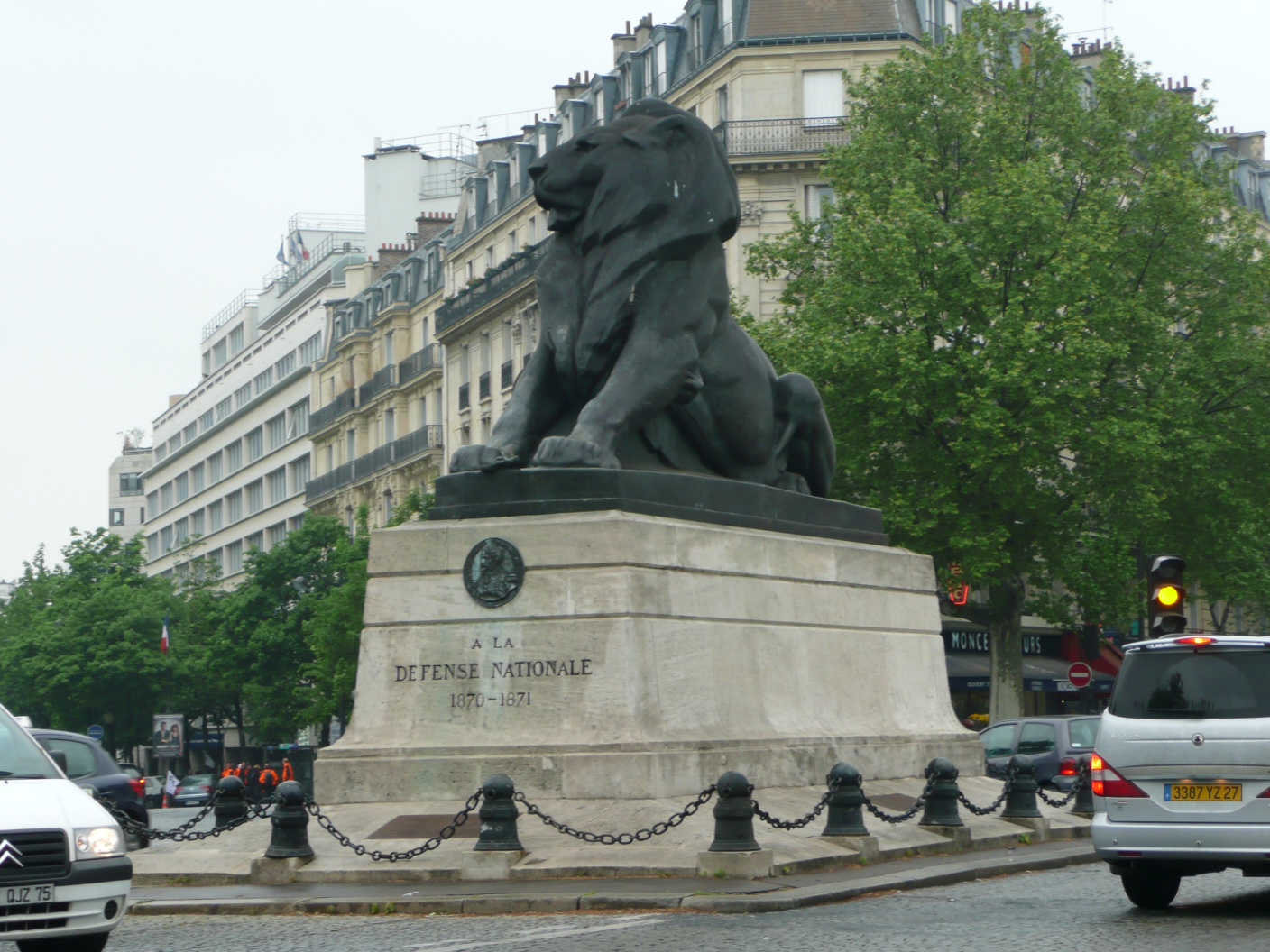
Le Lion de Belfort

March saw the passing of my old friend Dermott Ryder, chronicler and luminary of the Folk Music revival in Sydney in the early ‘seventies. Dermott’s Last Ride is my tribute to him. And April was a month of anniversaries and remembrance. Forty years since the outbreak of the Lebanese Civil War, and the centenary of the landings of the ANZACs at Gallipoli. Pity the Nation takes its title from Robert Fisk’s tombstone of a book on the long war; and he had taken it from a poem written in 1934 by Khalil Gibran, Lebanon’s most celebrated poet, a poem that was both a prophetic testament and a testimony of times to come: “Pity the nation divided into fragments, each fragment deeming itself a nation”. The Watchers of the Water is a song about Gallipoli sing by a Turkish solder.

May saw two diverse pieces of social history. The Spirit of 45  takes personal perspective of British filmmaker Ken Loach’s documentary of the excitement and optimism that followed the Labour Party’s election victory at the end of World War II. This laid the foundation stone for the British welfare state. Bob Dylan’s Americana discusses the meaning and significance of the lyrics and the imagery of Dylan’s early ‘eighties masterpiece Blind Willie McTell, a harrowing journey through America’s dark heart.

In June, we visited Yorkshire and in London, conjuring up memories and historical connections. Harald Went A Viking is a saga about the first of two kings to die on English soil in the late summer of 1066, and the adventures that took him from Norway to Constantinople and Jerusalem and finally, to Yorkshire. Roman Wall Blues takes its title from WH Auden’s poem about a homesick and grumpy legionnaire on Hadrian’s Wall, and contemplates the lives of the ethnically polyglot soldiery who defended the Empire’s borders. And June saw another famous anniversary, the Bicentennial of the momentous and bloody Battle of Waterloo. The Long Road to Waterloo prefaces a song for the men who, after twenty six long years of war, never came home.

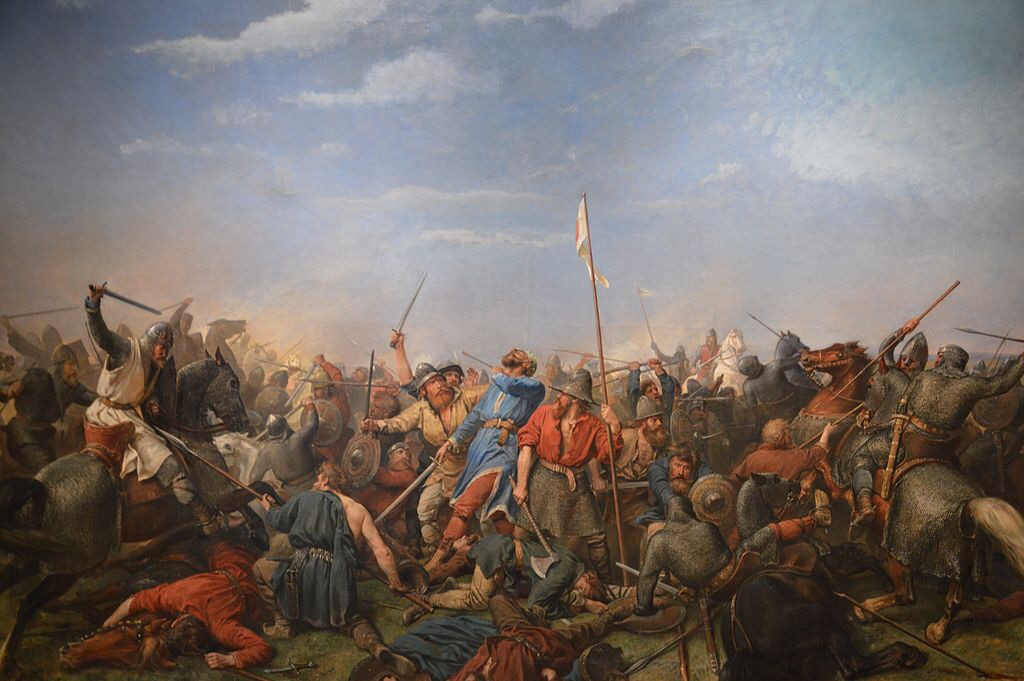
Painting of the Battle of Stamford Bridge by Peter Nicolai Arbo, depicting King Harald Hardrada hit in the neck by an arrow

Battle of Stamford Bridge, depicting King Harald Hardrada hit in the neck by an arrow

In July, controversy erupted in the Land of the Free over the flying of the Confederate Flag in states that were once part of Old Dixie. The dead hand of the Civil War reached out and touched the hearts of Americans and their friends throughout the world in the wake of yet another mass shooting. This time, a young man gunned down worshippers at prayer. That the victims were folk of colour, and the shooter, a young white extremist, reopened wounds that have never really healed. Rebel Yell surmises that The South will always be with us, in our thoughts, in our historical memory, in our art and literature, our books and films, and our favourite music.

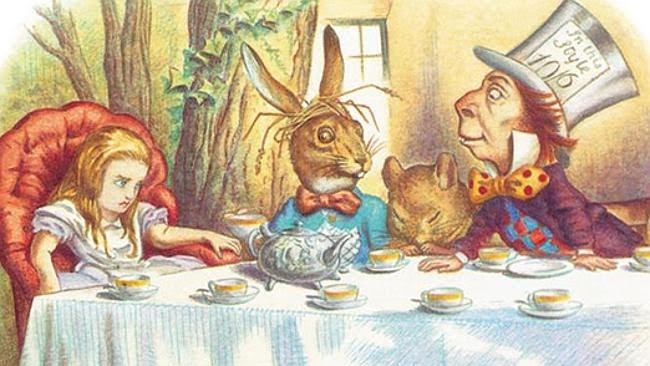
September marked the one hundred and fiftieth anniversary of the publication of Lewis Carroll’s timeless, fabulist masterpiece Alice In Wonderland. Go Ask Alice, I Think She’ll Know reproduces Australian  critic Peter Craven’s masterful celebration of Alice 150. The title belongs to the mesmerizing Grace Slick of Jefferson Airplane who cut through to the rabbit chase channeling the long-gone Lewis in a psychedelic musical masterpiece.

Alice

On an infinitely sadder note, Ruins and Bones is a tribute to the memory of Syrian archeologist Khaled Muhammed al Asaad, murdered by ISIS in August 2015, and of Palmyra, the ‘Pearl of the Desert’.

Allende’s Desk and Osama’s Pyjamas is a brief commentary on the extension  of American military power and the pathology of demons and demonization. Tales of Yankee Power looks at American foreign policy during the 1980s from the perspective of the songs of Jackson Browne and Bruce Cockburn.

November’s Children of the Revolution looks at the events that led up to the beginning of the Syrian Civil War, and the early days before it became too dangerous to gather on the streets, when men, women and children would parade in public places, waving the flag of the old Syria, the one that flew before the Assad clan seized power in 1966. Canny camera men could take media-friendly shots of photogenic little girls in face makeup looking sad, vulnerable and defiant. Those days of hope are long gone.

A highlight of this past year has been my work as a volunteer with the Humanitarian Settlement Services programme. The HSS’ mission is to assist newly arrived refugees to settle in Australia. In No Going Home,  I endeavour to imagine the refugee journey. Hejira is a sequel of sorts and, indeed, a happy ending.

Happy New Year to these prospective New Australians, and to all my readers. May 2016 be fortunate and fulfilling.

Palmyra, viewed from Tadmor

Palmyra, viewed from Tadmor

Back In The Day

I was in love with Dusty Springfield. In the drear tea-time of my adolescent soul, I worshiped her truly, madly, deeply. Tiny girl, big hair, panda eyes, hands moving like a beckoning siren. I just had to hear “da da da da da da” and then “I don’t know what it is that makes me love you so…” and I was hers for the next two and a half minutes. Until…

It was one of those beautiful late-spring evenings that you would get in the England of memory. The evening sun poured through the gothic stained glass windows of the school library – it was one of those schools. A group of lower sixth lads, budding intellectuals all, as lower sixth tended to be, gathered for a ‘desert island disks” show-and tell of their favourite records. Mine was ‘Wishin’ and Hopin‘ by you know who. Then it was on to the next. Clunk, hiss,  guitar intro, and: “My love she speaks like silence, without ideas or violence, she doesn’t have to say she’s faithful, but she’s true like ice, like fire…” Bob had arrived, and I was gone, far gone. So was Dusty.

dusty

I bought a guitar. A clunky, eastern European thing. I tried ‘Blowin’ in the Wind’, but what came out was unrecognisable. My dad said he’d break it over my head. One day, that tipping point was reached. It sounded indeed like ‘Blowin’ in the Wind’, or something similar. I was away, and the rest, as they say, was hearsay.

Young Bob

On a  high of hope and hype, so it all began. With a heritage of Irish rebel songs and folksongs, and the ‘sixties folkie canon (but never, ever ‘Streets of London’). Sea shanties, a capella Watersons, Sydney Carter’s faith-anchored chants, ‘The Lord of the Dance’ being the most beloved (a song now and forever burdened with the curse of Michael Flatley). Across the pond, young Bob Dylan, Joan Baez, and Peter, Paul & Mary decanted fine old wine into new bottles, and during the Easter CND march in London in 1966, billeted in an old cinema in Southall, a first public ‘performance’ with Ewan MacColl’s “Freeborn Man of the Traveling People”. The journey had begun, and, as the father of America poetry had crooned, “Afoot and light-hearted, I take to the open road, healthy, free, the world before me, the long brown path before me, leading wherever I choose”.

And it led beside strange waters. “Marc Bolan warbled “My people were fair, and had sky in their hair, but now they’re content to wear crowns stars on their brows“. But didn’t they all in the days when Tolkien was king, and elves and ents walked amongst us. We thoroughly understood and empathized. And we marveled at the Scottish bard who could pen ‘The Minotaur’s Song‘ and ‘Job’s Tears‘, and then run off with Old Father Hubbard. Then Roy Harper, the high priest of Anglo angst, sang ‘McGoohan’s Blues’, a twenty minute digression from the concept if not the plot of an iconic if indecipherable television series. “The Prisoner is taking his shoes off to walk in the rain”.

Unicorn(Album)

‘The Songs of Leonard Cohen’ played in every wannabe poet’s bedsit. “Come over to the window, my little darlin’. I’d like to try and read your palm“. What a pick-up line, so fitting for the generous times that were the ‘sixties. Others might sigh over the agonies of ‘The Stranger Song’, and ‘The Stories of the Street’. But I preferred the drollery of “Sometimes I see her undressing for me; she’s the sweet, fragrant lady love meant her to be“. And the wondrous punch-line of ‘Chelsea Hotel #2‘, that gorgeous tribute to the peerless Janis: not what happened on the unmade bed, but “we are ugly, but we have the music”. Bob segued from folk to rock, carrying with him many if not all of acolytes on the joker man’s journey from “Oxford Town” to “Desolation Row”. To this day, people ponder the meaning of “Jewels and binoculars hang from the head of the mule”‘ and marvel at “The ghosts of electricity howl in the bones of her face“.

HangmansBeautifulDaughter

Read on in the full Introduction to In That Howling Infinite – Poems of Paul Hemphill, Volume Five

© Paul Hemphill 2013.  All rights reserved.

Ruins and Bones

In memory of Khaled Muhammed al Asaad, murdered by ISIS in August 2015, and of Palmyra, the ‘Pearl of the Desert’.

The past is manifest in stone, in Ruins and Bones  © Paul Hemphill 2014.

These are lands of testament and prophecy, of sacrifice and sacrament, of seers and sages, of vision and vicissitude, of warriors and holy men. The spiritual and the temporal have melded here for millennia. We see still the remnants of ancient empires and the echoes of their faiths. We chart their decline and fall in the fortunes of their monuments and their mausoleums, in the “tumbled towers and fallen stones, broken statues, empty tombs” where “ghosts of commoners and kings walk the walls and catacombs of the castles and the shrines”.

The cloud-capp’d tow’rs, the gorgeous palaces,
The solemn temples, the great globe itself,
Yea, all which it inherit, shall dissolve.
         Shakespeare, The Tempest, Act 4 Scene 1

Nothing beside remains. Round the decay
Of that colossal wreck, boundless and bare,
The lone and level sands stretch far away.
              Percy Bysshe Shelley, Ozymandias

Read also, The Rubble Of Palmyra by Leon Wieseltier, published in The Atlantic, 5th September, 2014

Palmyra (3)

Palmyra (6)

Malika Zenobia


Rebel Yell

I didn’t surrender, but they took my horse and made him surrender. They have him pulling a wagon up in Kansas I bet.
Chief Dan George, as Lone Watie in The Outlaw Josie Wales

In the winter of ’65
We were hungry, just barely alive
By May the 10th, Richmond had fell
It’s a time I remember, oh so well,
The night they drove old Dixie down.
Robbie Robertson and The Band

The Band, from The Last Waltz

I do not profess to be an expert on the subject, and being an outsider, I do not presume to preach. Nor am I a civil war tragic like some of our politicians here in Australia – they can tell you precisely who said what at what o’clock on such and such a location on this battlefield or that.

Mind you, a civil war that claimed more than seven hundred thousand American lives, tore a young nation apart, and the echoes of which reverberate still one hundred and fifty years later, is bound to exert a degree of fascination on an inquiring mind.

Recently, the dead hand of the American Civil War reached out and touched the hearts of Americans and their friends throughout the world in the wake of yet another mass shooting. This time, a young man gunned down worshippers at prayer. That the victims were folk of colour, and the shooter, a young white extremist, reopened wounds that have never really healed.

What made this massacre different from all the other massacres was the prominence of the Confederate flag in the iconography of the fresh-faced killer. The battle flag of Dixie has never gone away. It flies inThe Dukes of Hazzard, True Blood, and even The Walking Dead, and is a favoured accessory above government buildings and at right wing rallies in The South, those former secessionists states that lay south of the Mason-Dixon line

But what also makes this slaughter different from all those other slaughters is that something is actually being done about it.

Not, however a tightening of gun laws. The Second Amendment is safe and still well kept. The President mourns with the grieving relatives and congregation and breaks into song. POTUS’ rendering of Amazing Grace goes viral on You Tube. But as ever, nothing can be done. No God or mortal can stymy the U.S’ long-time love affair with the gun, nor challenge the NRA choke-hold on the American polity – particularly with the next presidential race in the starting blocks.

No, not the right to bear arms. But the rather, the right to flaunt the Stars and Bars, an enduring symbol of the lost Confederate cause, and a rallying point for those who still believe the rebel cause to be just, those who take solace from an heroic defeat, and those who believed that “the South will rise again”, and indeed those who KNOW that the South has indeed risen again. For have not the white, right wing, God fearing, Clinton-baiting, and Obama-hating ‘Red’ states of the South conquered and colonized the American political system?

Flags can unite nations. And also divide them. And none more so, it seems, than this one.  Professor Colin Tatz once said People will forget what you said. People will forget what you did. But people will never forget how you made them feel. This flag is potent symbol that spans both sides of the great divide. It is seen by many a a symbol of racism, and in the wake of the killings, there has been a loud call to remove it from public places and events. Others see it as part of their identity, of who they and their families are. They refuse to surrender it and to trade it in for Old Glory. The call has been met with with, well, dare I say it, defiance and rebellion. If you’ve got one, flaunt it – on houses, on cars, on roadsides, on Facebook posts, blogs and websites. Here are few of th m, all worth reading to place the battle flag in its social and political context:

http://www.thedailybeast.com/articles/2016/09/21/for-the-virginia-flaggers-it-s-hate-not-heritage.html

http://www.vox.com/first-person/2016/9/30/13090100/confederacy-myths-lost-cause

http://www.historynet.com/embattled-banner-the-convoluted-history-of-the-confederate-flag.htm

I do not want to editorialize here. Rather, I would like to share the following piece in the Washington Post. It is symptomatic of the intellectual and cultural reaction to tragic events. If your cannot do something positive and practical about a problem. Advocate something symbolic, politically correct, a placebo even. Like banning the film Gone with the Wind.

http://www.washingtonpost.com/news/act-four/wp/2015/07/01/why-we-should-keep-reading-gone-with-the-wind/

The past is another country. They thought things differently there: The iconic film opened with “There was a land of Cavaliers and Cotton Fields called the Old South. Here in this pretty world, Gallantry took its last bow. Here was the last ever to be seen of Knights and their Ladies Fair, of Master and of Slave. Look for it only in books, for it is no more than a dream remembered, a Civilization gone with the wind…”

So, as students of history, do we call for the suppression of an artistic rendering of the past because we feel uncomfortable with the ideas, opinions and sentiments expressed therein? If this sprawling Southern soap opera, this pseudo Shakespearean tale of love lost and found and lost again, against a backdrop of great events, is to be consigned to the oublier of history, why cease there? Why not Lawrence of Arabia? The Outlaw Josie Wales? The Searchers? Showboat?

Let’s not go there. The South will always be with us, in our thoughts, in our historical memory, in our art and literature, our books and films. It is forever on the border of our consciousness. Even when listening to our favourite music.

Take the Flag, but leave the songs alone.

Here is what the Rebel Yell sounded like:

Alison Krauss and Union Station

Paul Robeson, from Show Boat

Chet Atkins

http://www.deathandtaxesmag.com/254760/hero-rushes-through-traffic-to-rip-confederate-flag-off-truck/

.

The Long Road To Waterloo

The rebel yell that resounded in Paris in the summer of 1789 reverberated around Europe for 26 years until it sounded for the last time on the fields of Waterloo. On an overcast summer’s morning on Sunday 18th June, two hundred years ago, over one hundred thousand soldiers prepared to face each other in damp Belgian farmland. More gathered during that “longest day”. When darkness fell, up to fifty thousand of them lay dead or seriously wounded. A British rifleman would later recall: “I had never yet heard of a battle in which everybody was killed, but this seemed likely to be an exception, as all were going by turns.”

To historians, Waterloo is one of the great battles of history, a turning point, the beginning of the modern era. It ended the wars that had convulsed Europe – and since the French Revolution,  the First French Empire and the career of Napoleon Bonaparte, one of the greatest commanders and statesmen in history. And it ushered in almost half a century of international peace in Europe; no further major conflict occurred until the Crimean War.

This song is for all those men who, after these long years of war, never came home.

https://soundcloud.com/user6120518-1/the-song-of-the-soldier-1815.

The Song Of The Soldier

Chaos is majestic in its way. I contemplate this vista of destruction and death with pain and helplessness in my soul.  
Red Army Captain Pavel Kovalenko, in All Hell Let Loose, Max Hastings, 2011

Before him, he carries noise, and behind him, he leaves tears; death, that dark spirit,
in’s nervy arm doth lie; which, being advanc’d, declines, and then men die.
Volumnia, in Shakespeare’s Corialanus, Act 2, Scene 1.

A new age dawned when the Bastille fell
Twenty six long years ago.
We marched the road of Europe
In the revolution’s glow.
In the floodtide of that revolution,
We bartered our young lives away.
And shoulder to shoulder we stood to arms
And held our foes at bay.

Against the might of empires,
Beyond our wildest dreams,
We fought the professional armies
Of Europe’s old regimes.
And hungry, tired and poorly armed,
We ragged volunteers
Pushed them back in disarray
Far from our own frontiers.

And we talked that time of setting stars
And the twilight of great powers.
And we never once thought that the sun would set
On an empire such as ours’.
But the siren song of liberty
Has lost its golden thrill.
The new age is now stained with blood
And we are marching still.

There came a great adventurer
For whom France was much too small.
As if we’d had not enough of war,
We answered to his call.
He was like a father unto us.
He served his children’s need.
A substitute for politics, for intellect and greed.

But he overreached in pomp and pride
To serve his vanity.
And we, the soldiers of the line,
Paid with our blood his fee.
‘til the whole world turned against us.
It neither forgot nor forgave
We who came to liberate
But stayed on to enslave

And we talked that time of setting stars
And the twilight of great powers.
And we never once thought that the sun would set
On an empire such as ours’.
But the siren song of liberty
Has lost its golden thrill.
The new age is now stained with blood
And we are marching still.

From the dust of Torres Vedras
To the bloodstained Russian snow.
We followed the Eagles loyally.
Never questioned why we go.
‘til the tide of conquest turned abut,
And showed us how it feels
To retrace weary footsteps
With the wolves hard at our heels.

And now we march our final march
On Belgium’s fertile soil.
We see an end to all or pain
And an end to mortal toil.
And the dream which fired us through the years
Has nothing left to yield
But peace that comes from a nameless death
On a confused battlefield.

And we talked that time of setting stars
And the twilight of great powers.
And we never once thought that the sun would set
On an empire such as ours.
But the tyrant song of liberty
Has lost its golden thrill.
The new age is now stained with blood
And we are marching still.

© Paul Hemphill 1984

A Short History Of The Rise And Fall Of The West

See also:

https://howlinginfinite.com/2016/04/08/thermidorian-thinking/

 http://www.economist.com/news/books-and-arts/21651775-appallingly-bloody-yet-decisive-battle-waterloo-june-1815-deserve

http://www.telegraph.co.uk/culture/books/bookreviews/11075393/Waterloo-by-Tim-Clayton-and-Waterloo-the-Aftermath-by-Paul-OKeeffe-review-compelling.html