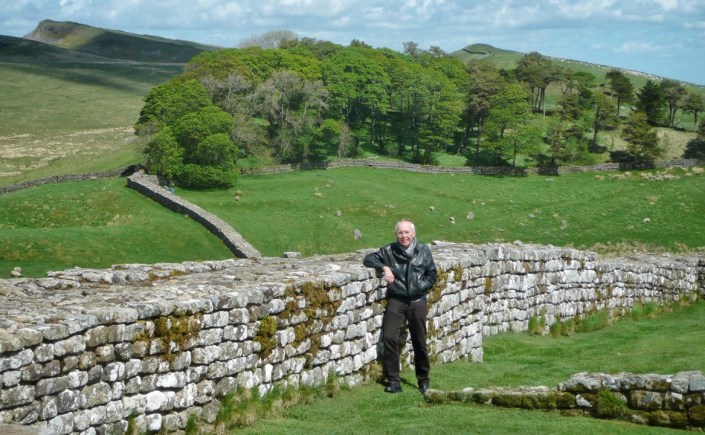
One of the highlights of last years’ travel in northern England was our visit to Hadrian’s Wall. In Roman Wall Blues, I wrote of the magical museum at Vindolanda, the Roman town just south of the wall, and contemplated the lives of those memorialized within. Earlier that day, we had walked through Chesters Fort, where the wall crosses the Tyne, the best preserved Roman cavalry fort in Britain.
Adjacent to the fort is a small but significant museum. It was here that we learned that what we are able to walk through and and wonder at today, we owe to the dedication, foresight, and finance of one man: John Clayton, one of the great unsung saviours of Britain’s historical heritage. His monument is the Chesters Roman Fort Museum which houses the Clayton Collection of 5,500 catalogued items from many sites on the central section of the wall.
A classically educated Victorian gentleman who combined demanding roles running the family law firm and acting as town clerk for the city of Newcastle-upon-Tyne, Clayton had a passion for archaeology and the Roman military legacy in his beloved Northumberland.
Were it not for Clayton, large parts of Hadrian’s Wall would have disappeared as the industrial revolution fuelled the demand for stone to build factories, mines and mills. His role in the preservation and survival of Chesters Roman Fort is undisputed.
During the early 19th century, Clayton lived at Chesters House in the parkland surrounding the Roman fort, and from an early age he was fascinated by the Roman relics surrounding him. By the 1830s, he began buying land to preserve the Wall. This was at a time when what is now a World Heritage Site was little understood, and indeed, was being unthinkingly destroyed through the quarrying and removal of its stones for reuse in industrial and urban development.
Clayton’s enthusiasm helped preserve the central stretch of Hadrian’s Wall that includes Chesters (Cilurnum), Housesteads and Vindolanda. He carried out some of the first archaeological excavations on the Wall, carried out restoration work, and brought early tourism to the area by displaying some of the finds at Chesters. Clayton managed the estate and its farms for sixty years, generating the funds to finance to fund further preservation and restoration work on the Wall. He never married, and died in 1890.
The museum housing the Clayton Collection was opened adjacent to the fort site in 1903, 13 years after his death. Today, it is privately owned, but is curated by English Heritage on behalf of the Trustees of the Clayton Collection, and it has been refurbished to brin to contemprary standards of conservation, display, and interpretation. And yet, great care has been taken to respect its period character, and to retain the feel of a 19th century gentleman antiquarian’s collection, with many of the labels and original cases having been retained.
Click his name to read more about John Clayton and his museum.
Its been a diverse year In That Howling Infinite. We have traveled, to quote Bob Dylan, “all the way from New Orleans to Jerusalem” – and to many other places in between. Vikings and Roman legionaries; Bob Dylan, Jackson Browne and Bruce Cockburn; Britain in the ‘forties and Paris in the ‘fifties; America, the Levant, and even Wonderland. By Year’s end a million souls will have journeyed to Europe from the war-ravaged lands of the Middle East, and my final posts for the year contemplate what it might mean for refugees who find to safe haven in Australia.
Here is a retrospective.
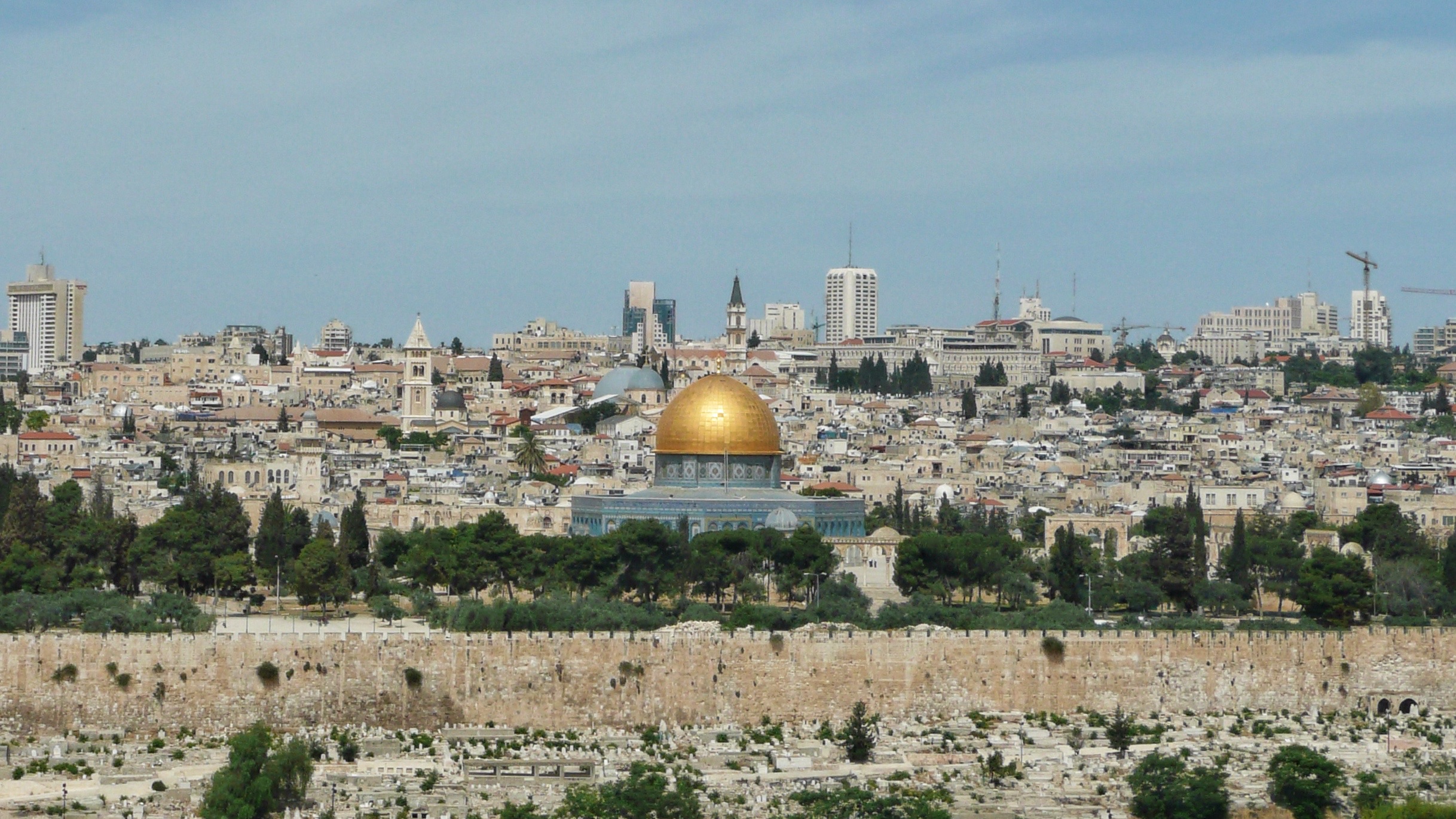
The year began with a short piece on recent archeological discoveries in Jerusalem that strongly suggested that the Via Dolorosathat Jesus trode on his final journey to Golgotha was the wrong route, and that instead, it began just inside of the Jaffa Gate. I took a light-hearted look at the Jerusalem Syndrome, a mental condition involving the presence of religiously-themed obsessive ideas, delusions and other psychoses triggered by a visit to The Holy City.
I read but one piece of fiction this year – a sad admission from a lifelong bibliophile – but this one book was probably one of the best I have read: The Incorrigible Optimists Club, winner of the prestigious Prix de Goncourt, by Jean Michel Guenassia. It is set in Paris’ Rive Gauche, as the ‘fifties gives way to the ‘sixties; as the crooners makes way for rock n’roll; as the Cold War divides a continent, sending dissidents and refugees fleeing to a safe haven in Paris; as the Algerian war divides and destroys families: and as the seeds of ‘les evenments de Mai 1968’ are sown in the hearts and souls of France’s young people. It is a coming of age book, of young hopes and fears, love and loss, a book about writers and reading, and the magic and power of the written word in prose and poetry.
March saw the passing of my old friend Dermott Ryder, chronicler and luminary of the Folk Music revival in Sydney in the early ‘seventies. Dermott’s Last Rideis my tribute to him. And April was a month of anniversaries and remembrance. Forty years since the outbreak of the Lebanese Civil War, and the centenary of the landings of the ANZACs at Gallipoli. Pity the Nation takes its title from Robert Fisk’s tombstone of a book on the long war; and he had taken it from a poem written in 1934 by Khalil Gibran, Lebanon’s most celebrated poet, a poem that was both a prophetic testament and a testimony of times to come: “Pity the nation divided into fragments, each fragment deeming itself a nation”. The Watchers of the Water is a song about Gallipoli sing by a Turkish solder.
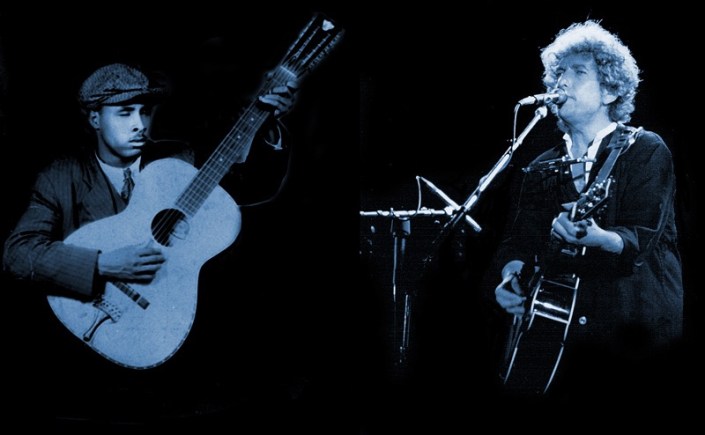
May saw two diverse pieces of social history. The Spirit of 45 takes personal perspective of British filmmaker Ken Loach’s documentary of the excitement and optimism that followed the Labour Party’s election victory at the end of World War II. This laid the foundation stone for the British welfare state. Bob Dylan’s Americana discusses the meaning and significance of the lyrics and the imagery of Dylan’s early ‘eighties masterpiece Blind Willie McTell, a harrowing journey through America’s dark heart.
In June, we visited Yorkshire and in London, conjuring up memories and historical connections. Harald Went A Vikingis a saga about the first of two kings to die on English soil in the late summer of 1066, and the adventures that took him from Norway to Constantinople and Jerusalem and finally, to Yorkshire. Roman Wall Bluestakes its title from WH Auden’s poem about a homesick and grumpy legionnaire on Hadrian’s Wall, and contemplates the lives of the ethnically polyglot soldiery who defended the Empire’s borders. And June saw another famous anniversary, the Bicentennial of the momentous and bloody Battle of Waterloo. The Long Road to Waterloo prefaces a song for the men who, after twenty six long years of war, never came home.
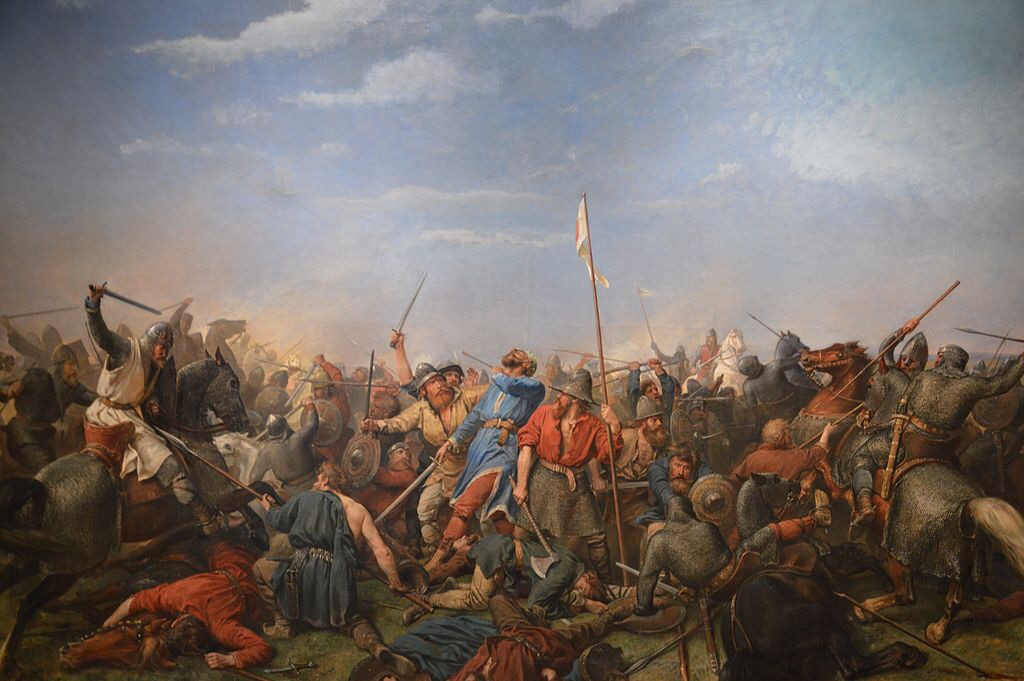
Battle of Stamford Bridge, depicting King Harald Hardrada hit in the neck by an arrow
In July, controversy erupted in the Land of the Free over the flying of the Confederate Flag in states that were once part of Old Dixie. The dead hand of the Civil War reached out and touched the hearts of Americans and their friends throughout the world in the wake of yet another mass shooting. This time, a young man gunned down worshippers at prayer. That the victims were folk of colour, and the shooter, a young white extremist, reopened wounds that have never really healed. Rebel Yellsurmises that The South will always be with us, in our thoughts, in our historical memory, in our art and literature, our books and films, and our favourite music.
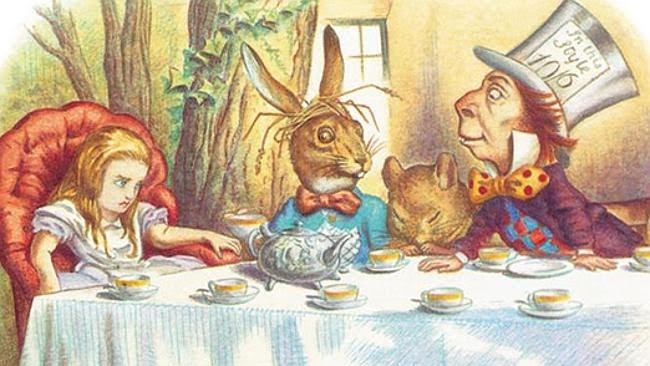
September marked the one hundred and fiftieth anniversary of the publication of Lewis Carroll’s timeless, fabulist masterpiece Alice In Wonderland. Go Ask Alice, I Think She’ll Know reproduces Australian critic Peter Craven’s masterful celebration of Alice 150. The title belongs to the mesmerizing Grace Slick of Jefferson Airplane who cut through to the rabbit chase channeling the long-gone Lewis in a psychedelic musical masterpiece.
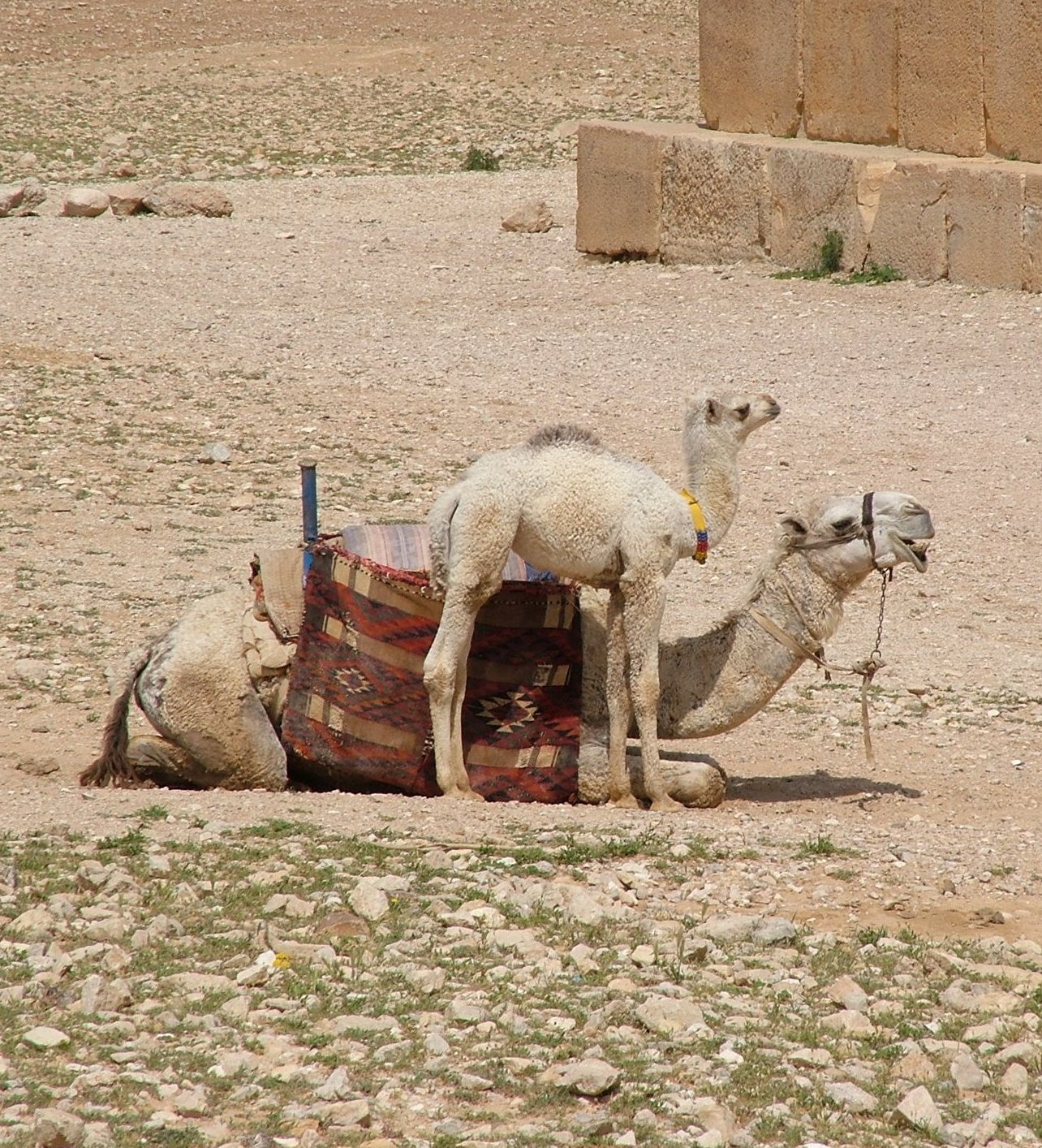
On an infinitely sadder note, Ruins and Bones is a tribute to the memory of Syrian archeologist Khaled Muhammed al Asaad, murdered by ISIS in August 2015, and of Palmyra, the ‘Pearl of the Desert’.
Allende’s Desk and Osama’s Pyjamas is a brief commentary on the extension of American military power and the pathology of demons and demonization. Tales of Yankee Powerlooks at American foreign policy during the 1980s from the perspective of the songs of Jackson Browne and Bruce Cockburn.
November’s Children of the Revolution looks at the events that led up to the beginning of the Syrian Civil War, and the early days before it became too dangerous to gather on the streets, when men, women and children would parade in public places, waving the flag of the old Syria, the one that flew before the Assad clan seized power in 1966. Canny camera men could take media-friendly shots of photogenic little girls in face makeup looking sad, vulnerable and defiant. Those days of hope are long gone.
A highlight of this past year has been my work as a volunteer with the Humanitarian Settlement Services programme. The HSS’ mission is to assist newly arrived refugees to settle in Australia. In No Going Home, I endeavour to imagine the refugee journey. Hejirais a sequel of sorts and, indeed, a happy ending.
Happy New Year to these prospective New Australians, and to all my readers. May 2016 be fortunate and fulfilling.
Never in modern times – since the Second World War – have there been so many refugees. There are over sixty nine million people around the world on the move today – people who have been forcibly displaced from their homes and are fleeing from persecution or conflict. Forty million people have been internally displaced within their own countries – including six million Syrians. Over 25 million are refugees in neighbouring countries and further afield -. 25% of them are in Turkey, Lebanon, Iran, Pakistan, and Uganda. five million are Syrians. These figures are of those registered by the UNHCR. The real numbers are much higher. [See below, The World Refugee Crisis in Brief, and The Refugee’s Journey]
Just imagine …
Millions are on the move – , and you are one of them.
Lebanese American BBC Journalist Kim Ghattas says well:
I often get asked why my family never left – or more pointedly, why my parents kept us there, dodging sniper fire on the way to school and back. The answer is this: We stayed because leaving is hard. Becoming refugees meant leaving our lives, our identity, and our dignity behind…No one’s first instinct is to leave. Their first choice is usually to hold on to the comforting familiarity of home; when that becomes impossible, you leave for another safer area within the country. Then you leave for a neighboring country, so you can return as soon as possible or even keep an eye on your property while you’re away. Only when the walls are closing in and the horizon is total darkness do you give up and leave everything you have ever known behind, lock the door to your home, and walk away.
no one leaves home until home is a sweaty voice in your ear saying- leave, run away from me now i don’t know what i’ve become but i know that anywhere is safer than here
Somali poet Warsan Shire, Home
A million spaces in the earth to fill, here’s a generation waiting still – we’ve got year after year to kill, but there’s no going home. Steve Knightley, Exile
Oh, the wind, the wind is blowing, through the graves the wind is blowing, freedom soon will come; then we’ll come from the shadows. Leonard Cohen, The Partisan
I pity the poor immigrant whose strength is spent in vain, whose heaven is like ironsides, whose tears are like rain. Bob Dylan, I Pity the Poor Immigrant
Just imagine …
What if you had to leave behind everything that you hold dear. Your identity, culture, language, faith. You job, your school. Your loved ones, your friends, and your play-mates.
What if you have to sleep with your shoes on so you are ready to run if your enemies are approaching your village? And then you have to flee your home and climb the mountain to escape, helping your youngsters and old folk up the rocky slopes in the summer heat, and there is nothing to eat or drink, and nothing you can do except wait for capture or rescue.
What would YOU do if you had but a short while to gather a few things together and run, leaving your whole life behind? What would you try and take with you?
Then you wash up, literally and figuratively, on foreign shores – in border refugee camps, dusty border towns or urban slums. And there you stay, with other tens, hundreds, thousands, maybe hundreds of thousands in like dire straits.
Until one day, you are selected for humanitarian settlement in a strange land at the other end of the earth.
That day may never come; so, impatient, frustrated, desperate, you use your family’s savings to pay smugglers and traffickers who prowl the desert and jungle camps like predators and the port cities of Turkey, Libya and South East Asia.
So you take to the seas in frail boats and brave the the deep and dangerous waters of the Mediterranean, the Adriatic and the Indian Ocean.
You might only have enough money for one passage, so you go on ahead and hope to send for your kin once you have reached safe haven.
You may be one of fortunate ones who make it – not one of those cast ashore, lifeless flotsam and jetsam like baby Aylan on his golden beach.
You are now one of tens of thousands in a river of desperate endeavour.
You walk the long miles of the unwelcoming highways of Eastern Europe to a German or Swedish sanctuary. You might end up in a detention camp in Italy or Spain, stranded in the Calais Jungle, or the harbours of Java and Sumatra.
Or else, you are parked in a hot and hostile makeshift camp somewhere near the Tropic of Capricorn.
Just imagine …
You have fled the terror of the warlords and the militias, the holy warriors and the ethnic cleansers.
You discover that the border camps of Jordan and Lebanon, Turkey and Afghanistan, Thailand and Malaysia, Kenya and Namibia have their own ecology of hardship and handouts, rape and robbery, beatings and bribes, illness and neglect, cursory and desultory treatment by overworked and under-resourced aid workers, and shake-downs by the criminals who thrive in these places and the cops who take a cut and turn a blind eye or else enforce punitive directives from politicians, parliaments and bureaucrats.
There, you and yours’ attempt to rebuild a semblance of a life-before amidst the tents and the shanties, the dust and the sewage, the summer’s heat and the winter’s cold. A mosque to pray in, a school for the children, games of football or backgammon for idle youth and menfolk.
You try to keep the children warm and fed and free of mortal illness; you try to keep the spirit alive in a time of anxiety, fear, threat, loss, and confusion, a time of hopeful emptiness and of empty hopelessness.
Zaatari refugee camp, Jordan July 2013
Just imagine …
You are one of the lucky few selected for settlement in the fabled, unknown ‘west’.
New lands, under foreign skies, different constellations, so far away it might as well be the moon.
You now dwell among strangers. You neither speak their language nor comprehend their ways or their foreign gods.
You have no friends or family to call on in time of need.
You must rebuild the basic buildings blocks of a normal life – where even the idea of a normal life has now changed utterly.
The houses, the streets, the shops, the money even – are all new.
The things you took for granted are no longer there, and in their place are new ways and means.
New systems and processes – social, welfare, health, education – with new rules and ways of getting things done. Going to the doctor, to the bank, to government offices.
Understanding that policemen and soldiers are not people you have to pay off or flee from.
Learning English.
Finding a home.
Getting the kids into a school.
Finding a job when your qualifications are not recognized, and work-ways are different to what you know.
The laws are new, the language is new, the way people dress and behave, talk, walk and eat is new.
Many new things are fascinating, tempting.
Others, confronting and insulting to your morality and values.
Some are alien, even, beyond your comprehension.
Codes of behaviour, dress, decorum, politeness, are new. Less formality, respect and deference; open displays of sexuality, affection, and rudeness that would not have been tolerated, permitted even, at home.
You don’t understand what makes the locals tick – their mannerisms, their speech, their body language, their concept of time and space, even.
And you are shocked and frightened by their hostility. Not all – just a noisy and troublesome few who talk quietly amongst themselves, or hurl abuse, or march through city streets with signs that scream, “go back to where you came from!”, “go home!”
Home?
There is no home.
Home is far, far away.
So far away, it might as well be on the moon.
Just imagine…
This is the new. And you still bear the cross of the old. The world you left behind is still with you.
You miss your family, your friends, and the comfort and support you all gave each other.
You miss your old life. The streets, the sounds, the smells. The weather and seasons. Your job, your status, your school, your neighbourhood.
You yearn for street and shop signs you could read, voices you understood on the radio and television, on the street, and on the buses.
You hate having to try and make yourself understood to officials and doctors, desk clerks and shop assistants, and even the supportive and ever helpful case workers whose mission is to help you get through all this.
You are homesick, and lonesome; you feel isolated, helpless, dependent.
There is a terrible ache in your heart and a rift in your soul.
And then there are the scars that won’t and perhaps can never heal. The psychological and physical effects of the events and experiences that forced you to flee your homeland.
Conflict and violence, intimidation and discrimination, torture and brutality, even. You have flashbacks, bad dreams, anxiety attacks, and actual physical and mental pain and anguish.
They say that PTSD is endless. There is no cure …
Just imagine…
You are a stranger in a strange land, and there’s no going home …
They that go down to the sea in ships, that do business in great waters; these see the works of the LORD, and his wonders in the deep. For he commandeth, and raiseth the stormy wind, which lifteth up the waves thereof. Psalm 107
Home
Warsan Shire
no one leaves home unless
home is the mouth of a shark.
you only run for the border
when you see the whole city
running as well.
your neighbours running faster
than you, the boy you went to school with
who kissed you dizzy behind
the old tin factory is
holding a gun bigger than his body,
you only leave home
when home won’t let you stay.
no one would leave home unless home
chased you, fire under feet,
hot blood in your belly.
it’s not something you ever thought about
doing, and so when you did –
you carried the anthem under your breath,
waiting until the airport toilet
to tear up the passport and swallow,
each mouthful of paper making it clear that
you would not be going back.
you have to understand,
no one puts their children in a boat
unless the water is safer than the land.
who would choose to spend days
and nights in the stomach of a truck
unless the miles travelled
meant something more than journey.
no one would choose to crawl under fences,
be beaten until your shadow leaves you,
raped, then drowned, forced to the bottom of
the boat because you are darker, be sold,
starved, shot at the border like a sick animal,
be pitied, lose your name, lose your family,
make a refugee camp a home for a year or two or ten,
stripped and searched, find prison everywhere
and if you survive
and you are greeted on the other side
with
go home blacks, refugees
dirty immigrants, asylum seekers
sucking our country dry of milk,
dark, with their hands out
smell strange, savage –
look what they’ve done to their own countries,
what will they do to ours?
the dirty looks in the street
softer than a limb torn off,
the indignity of everyday life
more tender than fourteen men who
look like your father, between
your legs, insults easier to swallow
than rubble, than your child’s body
in pieces – for now, forget about pride
your survival is more important.
i want to go home,
but home is the mouth of a shark
home is the barrel of the gun
and no one would leave home
unless home chased you to the shore
unless home tells you to
leave what you could not behind,
even if it was human.
no one leaves home until home
is a damp voice in your ear saying
leave, run now, i don’t know what
i’ve become.
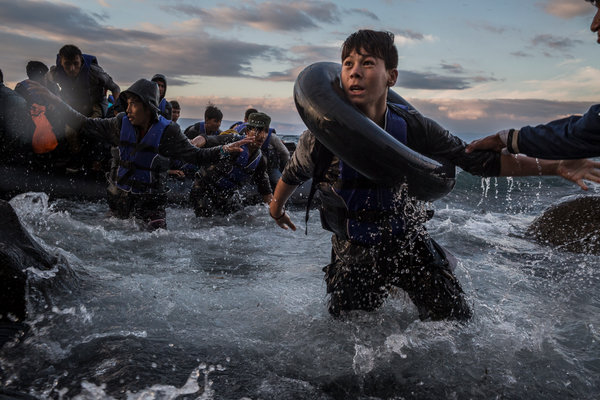
This Syrian mother and her child were rescued by the Greek Coast Guard.
The World Refugee Crisis in Brief
The Melancholy Mathematics
Like death and taxes, the poor and racism, refugees have always been with us. But never in modern times – since the Second World War – have they been so many!
There are over sixty nine million people around the world on the move today – that have been forcibly displaced from their homes – fleeing from persecution or conflict.
This doesn’t count economic migrants who have hit the roads of sub Saharan Africa and Central America fleeing drought and crop failure, economic recession and unemployment, poverty, gangs and cartels, seeking a better life for themselves and the families in Europe or the USA.
Three quarters of a million ‘economic migrants’ are on the move in Central America, whilst the UN estimates that at least four million people have left Venezuela because of its political and economic crisis in what has been described as the biggest refuge crisis ever seen in the Americas. There are refugee camps on the Colombian border. Most are in Columbia but others have entered Brazil and Peru. But these are not by legal definition refugees – see below, The Refugees’ Journey .
Of those sixty nine million people over 11 million or 16% are Syrians. The numbers keep growing Thirty one people at being displaced every minute of the day. In 2018 alone, 16.2 million people were newly displaced.
Forty million people have been internally displaced within their own countries – this includes six million Syrians and off our radars, some two million souls who once lived in the contested regions of eastern Ukraine.
Over 25 million are refugees in neighbouring countries and further afield. 25% of them are in Turkey, Lebanon, Iran, Pakistan, and Uganda. Some 57% of them come from three countries: Syria, 6.3 million, Afghanistan 2.6 million and South Sudan 2.4 million. The top hosting counties are Turkey 3.5 million, Lebanon, 1 million, Pakistan 1.4 million, Uganda 1.4 million and Iran 1 million.
Jordan shelters over three quarters of a million Syrians; during the Iraq wars, this relatively poor country sheltered a similar number of Iraqis, and still hosts tens of thousands of Iraqi Christians who’ve fled persecution at home.
These figures are of those registered by the UNHCR. The real numbers are much higher. The Lebanese government estimates that there are more than 1.5 million Syrian refugees in the country.
Much of the focus these days is on the Middle East – Syria and its neighbours, on Libya and the frail boats crossing the Mediterranean, on the war in Yemen which has killed over thirteen thousand and displaced over two million.
But situation in Africa is as dire.
More than 2 million Somalis are currently displaced by a conflict that has lasted over two decades. An estimated 1.5 million people are internally displaced in Somalia and nearly 900,000 are refugees in the near region, including some 308,700 in Kenya, 255,600 in Yemen and 246,700 in Ethiopia.
By August 2018, the Democratic Republic of the Congo hosted more than 536,000 refugees from Burundi, the Central African Republic and South Sudan. And yet, there are over 4.5 million Congolese people displaced inside their own country and over 826,000 in neighbouring countries, including Namibia, Angola and Kenya.
Should the present situation in Sudan deteriorate into civil war, another tide of humanity will hit the road.
And closer to home, there are millions of refugees in Asia.
As of March 2019, there are over 100, 000 refugees in 9 refugee camps in Thailand (as of March 2019), mainly ethnic Karen and Shan. Refugees in Thailand have been fleeing ethnic conflict and crossing Myanmar’s eastern border jungles for the safety of Thailand for nearly 30 years.
There were an estimated 1 million Rohingya living in Myanmar before the 2016–17 crisis, and since August 2017, an estimated 625,000 refugees from Rakhine, had crossed the border into Bangladesh.
The top-level numbers are stupendous. The detail is scary.
Some 52% of the world’s refugees and displaced are children. And many are unaccompanied. Every hour, around 20 children run for their lives without their parents to protect them.
Children are the most vulnerable to disease and malnutrition and also to exploitation and lose years of schooling. Millions are elderly and are also face health problems.
And the problems facing young people and adults are all enormous. International aid is limited and host countries often unsympathetic. Work opportunities are few, some countries even forbidding refugees to take work, whilst unscrupulous employers exploit the desperate. Migrants are often encouraged, sometimes forcibly, to return to their countries of origin regardless of whether or not it is safe for them to return. There are reports that many have returned to Syria into the unwelcoming hands of the security services.
Refugees have lived in camps and towns in Pakistan and Thailand, Namibia and Kenyan for decades. Most refugee children were not born in their parents’ homelands.
And the camps are by no means safe havens. There may be no shelter or only basic shelter in tents; no privacy; a lack of clean water; meagre food; limited medical care; and the threat of injury, disease and epidemics. They may be poor physical security and armed attacks, and abuse by the authorities and officials. There may be organized crime, shakedowns and extortion, corruption and bribery.
Families may have become separated, exposing women and children without the protection of male family members to more fear and violence. Women are subsequently vulnerable to harsh conditions, including potential sexual and physical and abuse, poor healthcare, and unequal access to food and water. They may be coping with the loss of the head of the family and with the changing roles and responsibilities that come from being the sole parent. They may not know if their male family members will return to them safely and they must deal with the stress and anxiety, the grief and loss arising from their recent experiences. They might be fearful of the future, which in a camp is unknown and unpredictable
Australia and Refugees
Of all displaced peoples, 17% of them are being hosted in Europe. According to recent data published by the UNHCR, Germany is home to the most refugees by far in Europe – 1.4 million in total. By comparison, France and Sweden have 402,000 and 328,000 respectively, and the UK, 122,000.
Australia’s contribution to the world’s refugee problem is but a drop in the ocean. But we have a long established humanitarian refugee settlement programme for people officially recognized as refugees by the UNHCR and selected for third-country settlement in Australia.
Our humanitarian migration intake for 2016 -17 was the highest year on record. The intake of 24,162 was some 10% of our broader migration program which saw 225,941 permanent additions to the Australian population, and included the special intake of Syrian and Iraqi refugees (an estimate 12,000 places over several years).
The figures are 17,500 in 2017-18 and similar in 2018-19, whilst Scott Morrison has pledged to freeze the number of humanitarian arrivals for the next term. Under the policy there will be an overall target of 60 per cent of the offshore component for women, up from 50.8 per cent in 2017-18. The Government will also push to increase the number of refugees and humanitarian entrants being settled in regional Australia from a target of 30 per cent to 40 per cent in 2019-20, whilst insisting that new arrivals will only go to areas where there is strong community support.
Coffs Harbour
Coffs Harbour is one of several refugee intake towns in NSW, along with Armidale, Newcastle, Wollongong and Wagga Wagga. It’s medical and educational facilities have….
Coffs Harbour hosts several organizations dedicated to helping former refugees settle in Australia. They arrive in Australia on specific humanitarian visas and become permanent residents the moment they are admitted into the country. – and hence cease to be refugees.
SSI looks after them when they first arrive in Coffs Harbour. North Coast Settlement Services, a division of Saint Vincent de Paul Society, takes over once SSI’s work is done – after between six and eighteen months depending on a family’s needs, whilst the privately run Sanctuary organization assists settled migrants with such matters as family reunion and employment. An ancillary NSW government agency, the NSW Service for the Treatment and Rehabilitation of Torture and Trauma Survivors (STARTTS), assists new arrivals with psychological support, and particularly, the effects of PTSD. STARTTS services include counseling, group therapy, group activities and outings, camps for children and young people, English classes and physiotherapy
I spend two days a week as a volunteer with Settlement Services International, a Sydney-based community organisation that administers the Humanitarian Settlement Program (HSP) which supports refugees from the moment they arrive at the airport, provides essential support and information to assist refugees settle in Australia and empower them to gain independence and build strong connections in their new communities. SSI helps with the needs of new arrivals and the challenges of settling in a new country. Its aim is to enhance self-reliance with a focus on English language skills, education and job readiness.
SSI administers the Humanitarian Settlement Programme in several centres in regional NSW, including Coffs Harbour, Newcastle and Armidale. In all three areas, SSI has teams of staff on the ground who work with refugees, humanitarian entrants and their local communities to help new arrivals to through their initial settlement. The SSI team includes case managers and volunteers from the local community and from the refuge community itself
SSI’s work includes meeting and greeting, arranging temporary accommodation on arrival; orientation, including familiarization with Australian ways, our services and institutions, and getting around Coffs Harbour; basic official matters like Centrelink, banking, and health services; English classes at TAFE and enrolling children at schools; dealing with real estate agents, rental leases and looking after their rental properties.
Where do our clients come from?
When first volunteering, I worked for Anglicare. New arrivals were largely from Myanmar and Congo – mostly Christians – and from Afghanistan. Many of the latter came to Australia under the “woman at risk” programme – mothers and children with no father. Whilst all are Muslim, many were Shia Hazaras, a Turkic people persecuted by the Sunni Taliban. Since SSI took over from Anglicare in September 2017, whilst Burmese and African families continue to arrive, the emphasis has been on Yazidis from Iraq and Syria, and particularly from the Yazidi heartland of Sinjar in northern Iraq, where they endured enormous suffering and hardship at the hands of the Islamic State. Considered infidels by Da’ish, they were targets of a campaign of genocide from 2014. More than five thousand were killed, and some five to seven thousand were abducted and enslaved – mainly women and children. Such was the danger that the UNHCR and the Australian and other governments took whole families straight out of the war zone rather than from camps outside Iraq.
Yazidis are ethnically Kurdish, and their language, Kurmanji, is Kurdish. Their society is hierarchical and endogamous. Their religion, Yazidsm, is a monotheistic religion and has elements of ancient Mesopotamian faiths, including ancient Persian Mithraism, and some similarities to the Abrahamic religions, Judaism, Christianity and Islam. Because Yazidis believe in reincarnation and turn to the direction of the sun when praying, it has been thought – erroneously, that the religion has its origins in ancient Persian Zoroastrianism and Hinduism. They believe in the one god, the creator of all things, who delegated the ongoing management to a heptad of seven holy beings or angels, the chief of whom is Malek Taus – the Peacock Angel.
Malek Taus has in the past been associated, by Muslims and Christians, with Iblis, Satan, and the fall of proud Lucifer. This misinterpretation has led, historically, to Yazidis being perceived as devil worshipers, and thus being subject to persecution and pogrom. The atrocities of Da’ish were only different from past assaults and massacres in their scale and longevity.
Volunteering
Whilst case managers specifically look after the new arrivals, they depend upon a team of volunteers to assist them in a wide variety of tasks that we locals take for granted. for example: taking new arrivals them to medical or bank appointments, showing them how to use the bus network, setting up accommodation prior to arrival, minding children whilst parents attend appointments, and even helping folk to purchase use lawn mowers – there are few lawns in Iraq and Afghanistan.
As a volunteer, past and present tasks have included walkabouts to familiarize new arrivals with Coffs Harbour, accompanying clients to house inspections when seeking new rental accommodation, and assisting with rental application forms; sending important documents like birth, marriage and education certificates to Social Services’ translation service for official translations; helping clients to apply for bus concession cards, school bus cards, and children’s sport vouchers; and assisting with NBN plans and connections. I have fixed broken cupboards, replaced light bulbs, checked out washing machines and kitchen stoves. and taking families to school interviews.
As I can get by with spoken Arabic and can read and write the language, and as i am reasonably proficient with computers, I have helped with online applications and prepared resumes. I have shown clients how to budget their money, and have run a class on how to set up and use smart phone calendars to help them make and keep appointments. On occasions, I am asked to just drop in on clients to see how they are getting on, and sort any basic house problems.
My most rewarding experiences have been: assisting case managers at the airport when the clients first arrive. It’s a very emotional moment for all involved; Taking families who have never seen the sea before to the seaside; helping a clients get a job; and helping STARTTS run a youth group for children and young people by registering the young attendees
How I got into this
Since my twenties, I’ve had an interest and, indeed, a passion for the Middle East, its history and politics, its people and culture, its languages and religions. I’ve travelled often to the region, and have studied it formally and as a hobby. I learned standard Arabic in the seventies and worked in academic and government research. Though I took a very different road for two decades, I returned to Syria in the noughties and got back into Arabic both standard and colloquial (two relatively distinct languages).
On retirement, I wanted to do volunteer work, and by happenstance, Coffs Harbour was a refugees intake town with several organizations dedicated to assisting new arrivals. At first, I used my knowledge of Arabic script to assist Farsi-speaking Afghans, and then the Iraqi and Syrian Yazidis arrived. Though their native tongue is Kurdish Kurmanji, and few could speak English, many spoke Arabic. SSI had several Arabic speaking support-workers, and some new arrivals had good English and now work as Arabic and Kurmanji speaking support staff, I am able to step in when they are already booked. Who’d ever have thought I’d be able to use and grow my Arabic in Coffs Harbour.
The Refugees’ Journey
Who is a migrant? Who is a refugee? Who is an asylum seeker?
Migrants
A migrant is a person who makes a conscious choice to leave their country to seek a better life elsewhere. Before they decide to leave their country, migrants can seek information about their new home, study the language and explore employment opportunities. They can plan their travel, take their belongings with them, and say goodbye to the important people in their lives. They can continue to phone friends and family, or write, email or Skype them without fear of adverse consequences. They are free to return home at any time if things don’t work out as they had hoped, if they get homesick or if they wish to visit family members and friends left behind.
People who choose to migrate for economic reasons are sometimes called “economic refugees”, especially if they are trying to escape from poverty. But they are not recognized as refugees under international law. The correct term for people who leave their country or place of residence because they want to seek a better life is “economic migrant”.
However, the displacement of people caused by such economic circumstances, or by natural disasters like flood, drought or extreme weather, can contribute towards political, social and ethnic tensions that can precipitate refugee crises. Effective and timely external assistance from neighbours and donor nations will often help to avert this. Aid is therefore provided in an effort to keep people in their homes or in their home countries.
Refugees
The 1951 United Nations Convention relating to the Status of Refugees states:
“Any person who owing to a well founded fear of being persecuted for reasons of race, religion, nationality, membership of a particular social group or political opinion, is outside the country of his/her nationality and is unable, or owing to such fear, is unwilling to avail himself/herself of the protection of that country.”
Refugees are forced to leave their country because they are at risk of, or have experienced persecution. Their concerns are human rights and safety, and not economic advantage. They leave behind their homes, most or all of their belongings, family members and friends. Some are forced to flee with no warning, and may not be able to say goodbye to friends and family, and may never be able to contact or see them again.
Many refugees have experienced significant trauma or been tortured or otherwise ill-treated. Their journey to safety is fraught with hazards, many risking their lives in search of protection. They cannot return home unless the situation that forced them to leave improves.
Location is all important. During civil unrest and conflict, people may be forced to leave their homes, but do not leave their country. These internally displaced persons (IDPs) are often referred to as refugees. But, whilst refugees and IDPs may flee for similar reasons, their legal status is very different. Whilst remaining within the borders of their home countries, IDPs are legally under the protection of their own government, even in cases where the government’s actions are the cause of their flight. A person cannot be recognized as a refugee unless they are outside their home country.
Asylum Seekers
These seek protection as refugees, but their claim for refugee status has not yet been assessed. Many refugees have at some point been asylum seekers, that is, they have lodged an individual claim for protection and have had that claim assessed by a government or UNHCR.
Some refugees, however, do not formally seek protection as asylum seekers. During mass influx situations, people may be declared “prima facie” refugees without having undergone an individual assessment of their claims, as conducting individual interviews in these circumstances is generally impracticable (due the large numbers involved) and unnecessary (as the reasons for flight are usually self-evident). In other cases, refugees may be unable to access formal status determination processes or they may simply be unaware that they are entitled to claim protection as a refugee.
It is important to note that refugee status exists regardless of whether it has been formally recognized. People do not “become” refugees at the point when their claims for protection are upheld – they were already refugees, and the assessment process has simply recognized their pre-existing status. People become refugees (and are entitled to international protection and assistance) from the moment they flee their country due to a well-founded fear of persecution, as stipulated in the Refugee Convention.
What causes a person or a people to flee their home country?
The most common causes are war and civil unrest, persecution for political or religious beliefs, or ethnic and racial identity, and human rights violations by government authorities or rogue militias. There could be extreme political instability and fighting; assassinations of people associated with certain political or social groups; arbitrary arrest and torture, mutilation and degradation that can happen without warning; routine sexual violence towards women and girls; forced conscription of child soldiers, forcing families to flee to protect their children; and conscription for slave labour. Governments are unable to protect their citizens, and may actively participate in violations, leaving people with no place or person to turn to for protection.
Often people will hang on, hoping things will improve. Flight is the last option because it means leaving everything behind – home, possessions, jobs, education, family and friends, language, culture and identity. People are often forced to flee with very little warning, no time to collect identity documents or precious things, or say farewell to family, friends and neighbours. They may have to travel long distances, often on foot or in small boats, and through dangerous territory or waters. They may go for long periods without food and water. They may become in danger of being intercepted, robbed or recruited, raped or killed, imprisoned or repatriated.
Life in the Refugee Camps
The fortunate might reach a camp or other place of relative safety. In the camp there may be no shelter or only basic shelter in tents; no privacy; a lack of clean water; meagre food; limited medical care; and the threat of injury, disease and epidemics. They may be poor physical security and armed attacks, and abuse by the authorities and officials. There may be organized crime, shakedowns and extortion, corruption and bribery.
Families may have become separated, exposing women and children without the protection of male family members to more fear and violence. Women are subsequently vulnerable to harsh conditions, including potential sexual and physical and abuse, poor healthcare, and unequal access to food and water. They may be coping with the loss of the head of the family and with the changing roles and responsibilities that come from being the sole parent. They may not know if their male family members will return to them safely and they must deal with the stress and anxiety, the grief and loss arising from their recent experiences. They might be fearful of the future, which in a camp is unknown and unpredictable
The Role of the UNHCR
The office of the United Nations High Commissioner for Refugees (UNHCR) is mandated by the United Nations to protect refugees and help them find solutions to their plight. It has over 4,000 staff in 120 countries and an annual budget of about US$1 billion. In addition to legal protection, UNHCR now also provides material relief in major emergencies either directly or in partnership with other agencies.
Refugee protection is covered by International Human Rights Law, and this sits within a broader framework of international law. The agency responsible for the oversight of international human rights law is the Office of the United Nations High Commissioner for Human Rights (UNHCHR).
Refugees are accorded certain rights under international law, including
The right not to be sent back to a country where their life or freedom would be in danger
The right to receive public relief and welfare support at the same level as nationals
The right to access education and health care
The right to work
Entitlement to be issued with identity papers and travel documents
The role of the UNHCR is to
Safeguard the rights and wellbeing of refugees
Ensure that every person can exercise the right to seek asylum and find safe refuge in another country
Promote long-term solutions to the refugees’’ plight utilizing the options of voluntary return, local integration in the country of first asylum, or resettlement in a third country
Ensure that refugees are treated appropriately by countries that have signed the UN Convention
Ensure that refuges are given the same rights as nationals of the countries they are accepted into
Protect refuges from being forced to return to their home countries if it is likely they will be persecuted
Promote the reunification of families
Take into account the special needs of particular refuges classes, e.g. women and children
UNHCR’s “durable solutions” for refugees:
Voluntary repatriation, the preferred long-term solution – going back to the country of origin when it is safe for them to return country. Voluntary repatriation is encouraged if it is safe and reintegration is viable. Indeed, most refuges prefer to go home as soon as circumstances permit and a degree of stability has been restored.
Local settlement and integration is the next preferred option – making a home in the country to which they first fled. Such local settlement may e spontaneous with new-comers establishing a new community. Integration is facilitated there are common ethnic groups or co-religionists. However, there may be a political affiliation between the government of their homeland and the country of first asylum which may lead to continued harassment and persecution.
Resettlement in a third country – often as a last resort, when refugees can neither return home nor remain in the country of first asylum, and are then selected by the UNHCR and sent to a third country to start a new life. Some eleven countries offer resettlement on a regular basis: Australia, Canada, Denmark, Finland, Ireland, Netherlands, New Zealand, Norway, Sweden, the UK, and the USA.
Whilst the UNHCR strives for “durable solutions”, the reality of the global refugee problem is that many countries hosting refugees embrace “non-durable” solutions such as:
“Warehousing” – refugees remain indefinitely in a camp where freedom of movement is restricted, basic supplies are scarce and there are few opportunities for any meaningful activity
Involuntary Repatriation – refugees are sent back to their country or origin while it is still unsafe. Sometimes refugees are forced back; sometimes they return because this is the “least bad option”
Secondary Movement – refugees themselves attempt to get to a western country in which they can lodge a claim for refugee status. This often involves clandestine travel using people smugglers and it can be very dangerous.
Settlement and Arrival
Refugees are selected for settlement in Australia by the Department Immigration and Border Protection, in conjunction with the UNHCR. Before arriving in Australia, humanitarian entrants are required to go through security and health checks.
The Australian Cultural Orientation program (AUSCO) is provided to humanitarian visa holders who are preparing to settle in Australia. The program provides practical advice and the opportunity to ask questions about travel to and life in Australia. It is delivered overseas, before they begin their journey. The International Organization for Migration (IOM) is currently contracted to deliver AUSCO on behalf of the DIBP.
The average length of time spent in a camp or in a place of first refuge is 17 years, and migrants may have little experience beyond this. Children may not even have known their home country. Many will have experiences extreme instability and uncertainty. Being selected for resettlement can be an overwhelming experience, and can include feelings of intense elation on one hand and fear and anxiety on the other.
Under such circumstances, a person may not always be aware of the potential difficulties of resettlement. On arrival, feelings can quickly move from elation and joy to culture shock, resentment, dislocation and confusion. It can take months, years even, for new arrivals to understand aspects of their new country and adapt to it.
To rephrase Euripides, those whom the state wishes to destroy, it first demonizes.
When the president of Chile was killed in the military coup d’état that brought Augusto Pinochet to power on 9th September 1973 (yes, that first, forgotten 9/11), ex post facto justification for the bloody coup and its equally bloody aftermath was provided by the content of the drawers in the dead presidents desk. Though never corroborated, there were alleged to contain proof of an imminent communist takeover, and evidence of drug taking and black magic.
Cut to Panama in December 1989, and the US invasion of Panama, ostensibly to take out strongman and erstwhile ally Emmanuel Noriega. There, in the ruins of the city, was Allende’s desk. The same communist literature, the drugs, the voodoo.
Cut to Mogadishu, Somalia, December 1992. US marines led a doomed UN intervention to take out the warlord. Mohamed Farah Aideed. Enjoy the folly in widescreen in Ridley Scott’s masterful Black Hawk Down. And although the villain decamped unscathed, guess what he left behind? Yes, Allende’s desk, contents intact. Actually, the desk had transformed into a bedside table, but the contents now included, shock horror, red silk pyjamas!
Communism. Drug taking. Black magic. And the sheer, un-American decadence of red silk pyjamas. The State Department pressed the hot buttons of white, Christian US morality to garner domestic support for its military adventures. The desk never came to light after the fall of Slobodan Milosevic in 2000. No doubt the Serbian authorities kept is existence hidden.
And it was never found at Waco because it was no doubt destroyed in the fire of state retribution. But David Koresh, self-proclaimed millenarian prophet, with his apparently indoctrinated and deluded followers, his harem, and his guns, was singled out for treatment very different to that meted out to scores of likeminded and heavily armed fringe dwellers scattered across the USA. To paraphrase Colin Powell, they were demonized, they were isolated, and they were destroyed. And on prime time television too. In that land of paradoxes, few eyebrows were raised when gun-toting members of the KKK offered to assist the DFDA and FBI in their assault on the besieged compound.
When Navy SEALS swooped on Abbottabad in Pakistan to take out long-sought-after Big Bad Osama bin Laden, they took careful notes of the contents of his bookshelves. An eclectic collection of reading matter – and pornography. No kindles, no iPads, so no eBooks or ePorn, which just went to show what a tired, old, out-of-date codger he was at the end of his days. The Pentagon has yet to reveal what they found on Osama’s bedside table. Maybe that voodoo and witchcraft stuff? And Osama’s pyjamas?
Though they both bequeathed sumptuous palaces to their conquerors, Saddam Hussein and Muammar Gaddafi were both spared the indignity of their cupboards being laid bare. But they were both caught hiding in drainpipes, which may show that the restless ghost of Allende’s Desk may have be laid at last.
Rumours of the inevitable demise of current bogeymen Bashar al Assad, Vlad Putin and Abu Bakr al Baghdadi are exaggerated. And the Fat Controller of Korea is still entertaining the world with his eccentricities and imaginative executions. So what will it be? Desks or drainage. And the long arm of the law has yet to reach inside another famous public enemy’s Knightsbridge hideaway. Yet, being the on-line, wired chap that Julian is, we may be disappointed.
And so it goes, as Vonnegut’s Kilgore Trout often declaimed when mad things happened. The American way of preparing the nation and its friends for a military adventure. First select your enemy. Give him horns and a tail. The latter day manifestation of the Judeo-Christian personification of the evil Other, the Dark Side of us all, and the public swallows and follows…Because it supports their own value system, their own perception of self, their own identity, and thereby, they’re own interpretation of what is and what is not appropriate behaviour. Then, hang on for a bumpy ride!
These are lands of testament and prophecy, of sacrifice and sacrament, of seers and sages, of vision and vicissitude, of warriors and holy men. The spiritual and the temporal have melded here for millennia. We see still the remnants of ancient empires and the echoes of their faiths. We chart their decline and fall in the fortunes of their monuments and their mausoleums, in the “tumbled towers and fallen stones, broken statues, empty tombs” where “ghosts of commoners and kings walk the walls and catacombs of the castles and the shrines”.
The cloud-capp’d tow’rs, the gorgeous palaces, The solemn temples, the great globe itself, Yea, all which it inherit, shall dissolve. Shakespeare, The Tempest, Act 4 Scene 1
Nothing beside remains. Round the decay Of that colossal wreck, boundless and bare, The lone and level sands stretch far away. Percy Bysshe Shelley, Ozymandias
Read also,The Rubble Of Palmyraby Leon Wieseltier, published in The Atlantic, 5th September, 2014
I didn’t surrender, but they took my horse and made him surrender. They have him pulling a wagon up in Kansas I bet.
Chief Dan George, as Lone Watie in The Outlaw Josie Wales
In the winter of ’65 We were hungry, just barely alive By May the 10th, Richmond had fell It’s a time I remember, oh so well, The night they drove old Dixie down.
Robbie Robertson and The Band
The Band, from The Last Waltz
I do not profess to be an expert on the subject, and being an outsider, I do not presume to preach. Nor am I a civil war tragic like some of our politicians here in Australia – they can tell you precisely who said what at what o’clock on such and such a location on this battlefield or that.
Mind you, a civil war that claimed more than seven hundred thousand American lives, tore a young nation apart, and the echoes of which reverberate still one hundred and fifty years later, is bound to exert a degree of fascination on an inquiring mind.
Recently, the dead hand of the American Civil War reached out and touched the hearts of Americans and their friends throughout the world in the wake of yet another mass shooting. This time, a young man gunned down worshippers at prayer. That the victims were folk of colour, and the shooter, a young white extremist, reopened wounds that have never really healed.
What made this massacre different from all the other massacres was the prominence of the Confederate flag in the iconography of the fresh-faced killer. The battle flag of Dixie has never gone away. It flies inThe Dukes of Hazzard, True Blood, and even The Walking Dead, and is a favoured accessory above government buildings and at right wing rallies in The South, those former secessionists states that lay south of the Mason-Dixon line
But what also makes this slaughter different from all those other slaughters is that something is actually being done about it.
Not, however a tightening of gun laws. The Second Amendment is safe and still well kept. The President mourns with the grieving relatives and congregation and breaks into song. POTUS’ rendering of Amazing Grace goes viral on You Tube. But as ever, nothing can be done. No God or mortal can stymy the U.S’ long-time love affair with the gun, nor challenge the NRA choke-hold on the American polity – particularly with the next presidential race in the starting blocks.
No, not the right to bear arms. But the rather, the right to flaunt the Stars and Bars, an enduring symbol of the lost Confederate cause, and a rallying point for those who still believe the rebel cause to be just, those who take solace from an heroic defeat, and those who believed that “the South will rise again”, and indeed those who KNOW that the South has indeed risen again. For have not the white, right wing, God fearing, Clinton-baiting, and Obama-hating ‘Red’ states of the South conquered and colonized the American political system?
Flags can unite nations. And also divide them. And none more so, it seems, than this one. Professor Colin Tatz once said People will forget what you said. People will forget what you did. But people will never forget how you made them feel. This flag is potent symbol that spans both sides of the great divide. It is seen by many a a symbol of racism, and in the wake of the killings, there has been a loud call to remove it from public places and events. Others see it as part of their identity, of who they and their families are. They refuse to surrender it and to trade it in for Old Glory. The call has been met with with, well, dare I say it, defiance and rebellion. If you’ve got one, flaunt it – on houses, on cars, on roadsides, on Facebook posts, blogs and websites. Here are few of th m, all worth reading to place the battle flag in its social and political context:
I do not want to editorialize here. Rather, I would like to share the following piece in the Washington Post. It is symptomatic of the intellectual and cultural reaction to tragic events. If your cannot do something positive and practical about a problem. Advocate something symbolic, politically correct, a placebo even. Like banning the film Gone with the Wind.
The past is another country. They thought things differently there: The iconic film opened with “There was a land of Cavaliers and Cotton Fields called the Old South. Here in this pretty world, Gallantry took its last bow. Here was the last ever to be seen of Knights and their Ladies Fair, of Master and of Slave. Look for it only in books, for it is no more than a dream remembered, a Civilization gone with the wind…”
So, as students of history, do we call for the suppression of an artistic rendering of the past because we feel uncomfortable with the ideas, opinions and sentiments expressed therein? If this sprawling Southern soap opera, this pseudo Shakespearean tale of love lost and found and lost again, against a backdrop of great events, is to be consigned to the oublier of history, why cease there? Why not Lawrence of Arabia? The Outlaw Josie Wales? The Searchers? Showboat?
Let’s not go there. The South will always be with us, in our thoughts, in our historical memory, in our art and literature, our books and films. It is forever on the border of our consciousness. Even when listening to our favourite music.
Over the heather the wet wind blows, I’ve lice in my tunic and a cold in my nose. The rain comes pattering out of the sky, I’m a Wall soldier, I don’t know why. The mist creeps over the hard grey stone, My girl’s in Tungria; I sleep alone. Aulus goes hanging around her place, I don’t like his manners, I don’t like his face. Piso’s a Christian, he worships a fish; There’d be no kissing if he had his wish. She gave me a ring but I diced it away; I want my girl and I want my pay. When I’m a veteran with only one eye I shall do nothing but look at the sky
We’ve marvelled at Roman brickage from Syria to Cirencester, from Bath to Baalbek, but had never ventured to Hadrian’s Wall in Northumbria. WH Auden’s whimsical song, Roman Wall Blues, came to mind as we stood atop the windswept knoll that is Housesteads Roman Fort on a freezing May morning.
In the preface to Pax, the latest volume of his magisterial history of the Roman Empire, English historian Tom Holland notes that the northern bank of the river Tyne was the furthest north that a Roman Emperor ever visited. What was so important about Hadrian’s visit to Tyneside in 122AD was his decision there to mark in stone, for the first time, the official limits of his Empire. North of this great wall, there was paucity and unspeakable barbarism, scarcely worth bothering about; below the wall was civility and abundance and the blessings of Romanitas. To this day, those 73 miles of the Vallum Hadriani across the jugular of Britain still shape the common conception of where England and Scotland begin and end, even though the wall has never delineated the Anglo-Scottish border. For this colossal structure left enduring psychological as well as physical remains. To the Saxons, it was “the work of giants” and was often thought of as a metaphysical frontier with the land of the dead.
George RR Martin, author of The Game of Thrones, the artistic juggernaut, has said that his Ice Wall separating the northern wintry waste with its nomads and its demons from the settled and temperate Seven Kingdoms of Westeros with it castles and cities, it’s palaces and slums, it’s despots, destitute and the depraved, was inspired by a visit to Hadrian’s Wall – only he built it much longer and much, much higher.
“We walked along the top of the wall just as the sun was going down. It was the fall. I stood there and looked out over the hills of Scotland and wondered what it would be like to be a Roman centurion … covered in furs and not knowing what would be coming out of the north at you. George RR Martin has said that his Ice Wall separating the northern wintry waste with its nomads abd its demons from the settled and temperate Westeros with it castles and cities, it’s palaces and slums, and destitute and the depraved, was inspired by a visit to Hadrian’s Wall – only he built it much longer and much, much higher. “We walked along the top of the wall just as the sun was going down. It was the fall. I stood there and looked out over the hills of Scotland and wondered what it would be like to be a Roman centurion … covered in furs and not knowing what would be coming out of the north at you”.
There we were, then, on the edge of empire. The Roman Empire, that is. Among outposts and outcasts. Up on the hills in the nithering wind and the cold rain, the snow and the sleet, and in the valley below with the baths and the brothels. This is where worlds collided. Between the Roman cives and their satraps, and the barbarians of the northlands. Between Britannia and Caledonia. Where solders from Rome and the Italy-yet-to-be that surrounded it, from Gaul, Batavia, Asturias and Tungria, now France, Spain and the Low Countries, from Germania and Sarmatia in Central and Eastern Europe, marched and marauded, drank and dined, foraged and fucked, lived and died.
At the height of Empire, some seven hundred soldiers manned the fort we now call Housesteads, up high on the moors, a windswept outcrop with a vista of 360 degrees and a temperature near zero. Many more legionaries garrisoned the more sheltered Chesters Fort in the nearby-by valley below where the wall crosses the Tyne. These included cavalry, drafted from Sarmatia, in present day Hungary. This was the fanciful premise of King Arthur (2004) starring Clive Owen as a handsome, tortured soul wandering through a flawed film and Keira Knightly as a scantily clad, elfin warrior Guinevere, backed up by a gallant band of photogenic heroes who hailed from the eastern steppes.
When the Romans departed Britain, Hadrian’s Wall fell into disrepair – it was always permeable, and in time, had served its purpose – which was perhaps as much about public relations as protection. Archeologist Terri Madenholme wrote in Haaretz: “Despite itself having a culture of violence, Rome aimed to project an image of a nation of the civilized, and what better way than having it monumentalized in stone? When Hadrian set to build the 73-miles-long wall drawing the border between Roman Britannia and the unconquered Caledonia, the message became even more clear: this is us, and that’s them. Hadrian’s Wall was much more than just a border control, keeping the Scots in check: it was a monument to Roman supremacy, an attempt to separate the civilized world from the savages”.
“He set out for Britain”, Hadrian’s historian tells us, “and there he put right many abuses and was the first to build a wall 80 miles long [Roman miles] to separate the barbarians and the Romans.”
Housesteads Fort
At Vindolanda, to the south, a small town grew up around a large military camp. First of wood and then of stone, constructed by the legionnaires themselves, who included in their number skilled masons and carpenters. Their settlements endure to engage our imaginations today. In times of turmoil, these soldiers fought and fell. In quieter times, they relaxed and recuperated. And the locals gathered about them, built houses and gardens, opened shops and pubs and those aforementioned brothels. And life went on like it does in our time.
During conflict, the Roman auxiliaries guarded the borderlands, deterring the Picts, a dark-skinned painted people who raided from the northern badlands. When peace prevailed, the locals visited, traded, and settled in the viccii or villages that grew organically to the south of the forts that were constructed at intervals along the empire’s perimeter wall. There, they traded, and provided goods, services and entertainment for themselves and for the martial strangers that had come among them from faraway places they’d never heard of.
In the early days, the auxiliaries were not permitted to bring wives and children to the frontier. But folks being folk, they very soon established friendly relations with their neighbours, and legionaries would keep informal wives and families in the vicus. Soviet writer and war-correspondent Vasily Grossman encapsulated all this poignantly and succinctly in An Armenian Sketchbook: “The longer a nation’s history, the more wars, invasions, wanderings, and periods of captivity it has seen – the greater the diversity of its faces .Throughout the centuries and millennia, victors have spent the night in the homes of those whom they have defeated. This diversity is the story of the crazed hearts of women who passed away long ago, of the wild passion of soldiers intoxicated by victory, of the miraculous tenderness of some foreign Romeo towards some Armenian Juliet”.
Officers were allowed to bring their wives and children to their postings, and these endured their provincial, primitive exile by importing the necessities of a comfortable Roman life, including the celebrated Roman plumbing and central heating. Chesters boasts the best preserved military bathhouse in Britain. And so, the accessories of civic consumerism reached the frontier. Food and wine from the warm South were transported to the cold north-lands. Fashions in clothes and jewelry, day-to-day articles and artifacts, from glass and pewter dinnerware to cutlery, tools and sundry hardware. Recently, it has been revealed that these domestic items included what is believed to be the only known Roman dildo. Remnants and reports gathered in the Vindolanda museum open a window into a gone world.
Housesteads Fort
The wonderful Vindolanda tablets have preserved a picture of the oh-so-normal lives of these transplanted souls so far away from home. Amidst accounts and inventories, orders and troop dispositions, a quartermaster reports that supplies of beer are running low. An officer writes to another in a neighboring fort inquiring about the availability of accommodation for visitors and the quality thereof. One tablet reveals that Roman soldiers wore underpants, which, in view of the locale and climate thereabouts, is comforting to know. And another recounts workplace harassment and bullying that would today invoke grievance procedures. The wife of an officer invites another to a birthday party at her house in Vindolanda. There is an undercurrent of “Please come, I am bored shitless”, though a polite Roman matron would not commit such sentiments to a wooden tablet (nor reveal to her friend the existence of that aforementioned sexual comforter). It is probably the oldest surviving document in Latin written by a woman.
So who were these folk so near to us in their needs and desires, their hopes, fears and expectations, and so far from us in time, space and purpose? What did they think and feel? It is a question oft asked by empathetic history tragics. The thinking of another time can be hard to understand. Ideas and ideologies once compelling may become unfathomable. And the tone and sensibility that made those ideas possible is even more mysterious. We read, we ponder, and we endeavour to empathize, to superimpose the template of our value system, our socialization, our sensibilities upon the long-dead. And thence, we try to intuit, read between the lines, draw out understanding from poems, plays, novels, memoirs, pictures, photographs, and films of the past.
We feel we are experiencing another facet of the potential range of human experience. But in reality, we are but skimming the surface, drawing aside a heavy curtain for a momentary glimpse through an opaque window into the past. Yet, we persist nevertheless, because that is what humans do. Over two and a half thousand years ago, the controversial Greek poetess Sappho wrote ”I tell you, someone will remember us; even in another time”.
And in Vindolanda, up there on the wall, on the weather-beaten rim of the long-gone empire, we do …
One of the great unsung saviours of the UK’s heritage is remembered in the museum housing his remarkable collection at Chesters Roman Fort Museum which houses the Clayton Collection of and 5,500 catalogued items from a variety of sites along the central section of the wall.
Few people today have heard of John Clayton, yet he is one of the single most important individuals in the history of Hadrian’s Wall.
A classically educated Victorian gentleman who combined demanding roles running the family law firm and acting as town clerk for the city of Newcastle-upon-Tyne, Clayton had a passion for archaeology and the Roman military legacy in his beloved Northumberland.
Were it not for Clayton, large parts of Hadrian’s Wall would have disappeared as the industrial revolution fuelled the demand for stone to build factories, mines and mills. His role in the preservation and survival of Chesters Roman Fort – the best-preserved Roman cavalry fort in Britain, is now undisputed.
In the early 19th century Clayton lived at Chesters House in the parkland surrounding the Roman fort and from an early age became fascinated by the Roman relics that surrounded him.
By the 1830s he began buying land to preserve the Wall, at a time when what is now a World Heritage Site was little understood, and was being unthinkingly vandalised by quarrying and removal of stones for reuse. Clayton’s enthusiasm helped preserve the central stretch of Hadrian’s Wall that includes Chesters (Cilurnum), Housesteads and Vindolanda. He carried out some of the first archaeological excavations on the Wall and even brought early tourism to the area by displaying some of the finds at Chesters. Clayton managed the estate and its farms successfully, generating cash to fund further preservation and restoration work on the Wall. He never married, and died in 1890
The museum housing the Clayton Collection was opened next to the fort site in 1903, 13 years after his death. It is privately owned but curated by English Heritage on behalf of the Trustees of the Clayton Collection, and has been refurbished to bring it up to 21st century standards of conservation, display and interpretation. Yet, great care has been taken to respect its character and to retain the feel of a 19th century gentleman antiquarian’s collection, and many of the labels and original cases have been retained..
The rebel yell that resounded in Paris in the summer of 1789 reverberated around Europe for 26 years until it sounded for the last time on the fields of Waterloo. On an overcast summer’s morning on Sunday 18th June, two hundred years ago, over one hundred thousand soldiers prepared to face each other in damp Belgian farmland. More gathered during that “longest day”. When darkness fell, up to fifty thousand of them lay dead or seriously wounded. A British rifleman would later recall: “I had never yet heard of a battle in which everybody was killed, but this seemed likely to be an exception, as all were going by turns.”
To historians, Waterloo is one of the great battles of history, a turning point, the beginning of the modern era. It ended the wars that had convulsed Europe – and since the French Revolution, theFirst FrenchEmpire and the career of Napoleon Bonaparte, one of the greatest commanders and statesmen in history. And it ushered in almost half a century of international peace in Europe; no further major conflict occurred until the Crimean War.
This song is for all those men who, after these long years of war, never came home.
Chaos is majestic in its way. I contemplate this vista of destruction and death with pain and helplessness in my soul. Red Army Captain Pavel Kovalenko, in All Hell Let Loose, Max Hastings, 2011
Before him, he carries noise, and behind him, he leaves tears; death, that dark spirit, in’s nervy arm doth lie; which, being advanc’d, declines, and then men die. Volumnia, in Shakespeare’s Corialanus, Act 2, Scene 1.
A new age dawned when the Bastille fell
Twenty six long years ago.
We marched the road of Europe
In the revolution’s glow.
In the floodtide of that revolution,
We bartered our young lives away.
And shoulder to shoulder we stood to arms
And held our foes at bay.
Against the might of empires,
Beyond our wildest dreams,
We fought the professional armies
Of Europe’s old regimes.
And hungry, tired and poorly armed,
We ragged volunteers
Pushed them back in disarray
Far from our own frontiers.
And we talked that time of setting stars
And the twilight of great powers.
And we never once thought that the sun would set
On an empire such as ours’.
But the siren song of liberty
Has lost its golden thrill.
The new age is now stained with blood
And we are marching still.
There came a great adventurer
For whom France was much too small.
As if we’d had not enough of war,
We answered to his call.
He was like a father unto us.
He served his children’s need.
A substitute for politics, for intellect and greed.
But he overreached in pomp and pride
To serve his vanity.
And we, the soldiers of the line,
Paid with our blood his fee.
‘til the whole world turned against us.
It neither forgot nor forgave
We who came to liberate
But stayed on to enslave
And we talked that time of setting stars
And the twilight of great powers.
And we never once thought that the sun would set
On an empire such as ours’.
But the siren song of liberty
Has lost its golden thrill.
The new age is now stained with blood
And we are marching still.
From the dust of Torres Vedras
To the bloodstained Russian snow.
We followed the Eagles loyally.
Never questioned why we go.
‘til the tide of conquest turned abut,
And showed us how it feels
To retrace weary footsteps
With the wolves hard at our heels.
And now we march our final march
On Belgium’s fertile soil.
We see an end to all or pain
And an end to mortal toil.
And the dream which fired us through the years
Has nothing left to yield
But peace that comes from a nameless death
On a confused battlefield.
And we talked that time of setting stars
And the twilight of great powers.
And we never once thought that the sun would set
On an empire such as ours.
But the tyrant song of liberty
Has lost its golden thrill.
The new age is now stained with blood
And we are marching still.
Born in the early years after the end of World War II, I was aware that the dominant mood was relief that it was over, sadness at those lost and most importantly a forward looking attitude to improve things and not simply to get back to what life had been like before. The traces of the conflict were all around me in once blitzed Birmingham – in the barren, levelled ‘wastelands’ where streets had once stood, in the austerity, and the monotonous and monochrome drabness of couture and cuisine. To my boyish mind, “the war” was a shared community experience, a shadow which few, I now recall, talked about; but also, the stuff of puerile fantasies fostered by comic books, Airfix models, and patriotic movies that were literally and figuratively black and white.
Life was not all roses in those immediate post-war years, but better by far than what went before. Rationing was still in place when I was born in Birmingham in 1949, not ending until 1954. Young men still had to do their national service (the last call up was in 1960, the year I started Secondary school). We lived with our aunt in a cold-water, back-alley walk-up on the border of Balsall Heath (just inside Moseley, a ‘better’ suburb). Aunty Mary was my mother’s mother’s sister. When her sister died and daddy Paddy ran off with another women, Mary brought the six children over to Birmingham from Enniscorthy, County Wexford one by one. She had come to Birmingham from Ireland before the war, after her husband had run off (these things happened in Catholic Ireland). And she lived in that same old house right through the Blitz when German bombers regularly targeted The Second City’s engineering, motor and arms factories, and not a few public buildings including the Piccadilly and Waldorf cinemas on nearby Stratford Road.
I was born in her house. She had a friend who had once given birth, so that friend was the midwife. My brothers followed over the next two years. By then, National Health Service had kicked in, so they were born in hospital. Childbirth, forever dangerous, was now rendered less life threatening. There we all lived, three kids, our folks, three uncles, two aunts, a dog and a cat. Three bedrooms, girls in one, boys in another, and our family in the third. Outside loo and coal shed, no bathroom or hot water (we kids bathed in the kitchen sink and grown- ups went down to The Baths), Cold and damp, and close to the shops. And there we lived until, in 1956 when a council house in Yardley Wood became our first family home. Cold and colder running water that froze in winter, but it was at least inside the house; bathroom with hot water boiled in a big gas boiler; and an outside flush lavatory that was nevertheless immediately adjacent to the backdoor and not down the garden. A big garden too, for winter and spring vegetables, and summer camp-outs.
There we grew, with free medical treatment for all our ailments, and free optical and dental care. I still have crooked teeth – no fancy orthodontics on the NHS – but I have all my teeth still. And my eyesight. We were educated, for free. This came in during the war with the Butler Act. So, thanks to the Welfare State, we were housed and healthy enough to get to primary school and beyond. Once there, we had free books, free pens and paper, and compulsory sport, and doctors and nurses would turn up on a regular basis to check our vitals. And thus, we were able to reach the glorious ‘sixties ready to rock ‘n roll.
Which brings me by a circuitous route to British director Ken Loach’s 2013 documentary, The Spirit of ’45, a celebration of the radical changes that took place under the Labour government of Clement Attlee which came to power in 1945.
What a year that was! No sooner had the war ended, than the British electorate voted out its esteemed and beloved war leader, Winston Churchill, and bought Labour’s promise of a democratic socialism. Drawing on archive footage, and presented in black and white with contemporary interviews with dockers and miners, doctors and nurses, politicians and economists, Loach describes the nationalisation of the public services, and their subsequent privatisation three decades later. His interviewees provide poignant anecdotes about the poverty of the 1930s, dangerous and exploitative working conditions, poor housing, and abysmal health care, and the renewed sense of purpose and optimism after the end of the war and Labour’s landslide victory. He recounts the subsequent expansion of the welfare state, with its free to all medical service, and the nationalization of significant parts of the British economy, most notably, electricity, the railways, and the mines.
The Attlee government was elected due to a general belief that nothing would or could be as it had been before. Britain had pulled together to win the war; now, it would transform the peace. This was The ‘Spirit’ of ’45.
But whilst ‘spirit’ can imply ‘esprit’ and elation, it can also mean ‘ghost’ insofar as Loach rages against the death of all that hope, optimism, and vision in the decades that followed.. It is a call to arms for a return to the public unity of those heady post-war years and against the policies of subsequent governments, and most particularly those of Margaret Thatcher, that have progressively demolished the Britain that Clement Attlee and Aneurin Bevan strove to build. And it is a reminder that the NHS is worth fighting for at a time when it is being progressively dismantled. With stills of modern soup kitchens and the Occupy movement camped outside St Paul’s, Loach clearly believes that Occupy inherits that spirit of ’45.
Viewing The Spirit of ’45 was exhilarating. It was full of Wow! moments. The footage of the poverty of the depression years, the slum dwellings, urchin children playing on the streets or on the slag heaps, the unemployment queues, the scavenging for coal, the Jarrow March. Diseases now preventable or eradicated, then mortal. Five in a bed, and two of them dead. Malnutrition and rickets. Bread and dripping sandwiches? You needed beef for dripping. Fat chance. It was bread and jam, thank you (and grateful for it, one was tempted to respond – there were indeed some Monty Python moments there, particularly the one-down-manship sketch “when I was a lad, we were so poor…”
Relying so heavily on memories and reminiscences, the film is nostalgic, sentimental, and simplistic even, with little in-depth analysis. A tick-a-box of the many innovations that greeted the arrival of the baby boomers. Presented in such a clear and uncluttered fashion, it was quite stirring. That is Ken Loach for you. What you see is what you get: a one-sided history lesson.
The film leaps from the Attlee government straight into the darkest days of the Thatcher government, with no discussion of the political, economic and social changes and challenges in between. The road from Clement to Maggie was an eventful and for many, a traumatic one. The Counter Revolution took decades to establish itself. The great experiment of 1945 contained the seeds of its own destruction.
Loach’s focus on the years of nationalization and privatization makes narrative and dramatic sense.
But the years in between were dramatic also. Read Dominic Sandbrook’s great quartet. The titles say it all: Never Had It So Good: A History of Britain from Suez to the Beatles; White Heat: A History of Britain in the Swinging Sixties; State of Emergency; The Way We Were: Britain 1970–1974; and Seasons in the Sun: The Battle for Britain, 1974-1979. These were best of times, these were the worst of times, as the Great Man might have said. And the worst was to come, when Britain apparently went down the gurgler, and Thatcher had to break it to fix it. And like Dr Frank’s monster, it did not quite come back together right.
The Spirit of ’45 received favourable reviews (one follows), most writers qualifying their praise with Loach’s unapologetic partisanship – he is Ken Loach, after all, and you either dig him or you don’t. My favourite film is his 1995 Spanish Civil War drama,Land and Freedom. And you most certainly don’t get a balanced view of that conflict from this. As with The Spirit of ’45, you just sit back and go for a revolutionary ride.
See also othet memories in In That Howling Infinite:
Ken Loach rarely makes documentaries, and when he does, they’re usually about an urgent topical issue, such as the 1980s miners’ strike (‘Which Side Are You On?’) or the 1990s Liverpool Dockers’ strike (‘The Flickering Flame’). On the surface, ‘The Spirit of ’45’ takes a longer view than those films. This rousing and saddening film reminds us of the air of progress and reconstruction that took hold in British politics immediately after World War II. It takes us right back to the founding of the welfare state and, with it, the nationalization of the health service, transport, energy, housing and other areas of public life, as initiated by Clement Attlee’s 1945-1951 Labour government. The faces we see at the beginning of the film of young Britons celebrating in the fountains at Trafalgar Square in May 1945 symbolize the hope of a nation: that things can only get better after six years of war.
But Loach, the director of ‘Kes’ and ‘Looking for Eric’, is equally concerned with the spirit of modern Britain. For him, the socialism of our past – of Attlee and his comrades Nye Bevan, Herbert Morrison and others – could teach the present a thing or two. And so the second part of ‘The Spirit of ’45’ ponders an altogether different mood than that in the 1940s: Thatcherism and the more recent failure of organised labour to live up to its founding principles. If ‘The Spirit of ’45’ might provoke David Cameron to raise his eyes skywards, it might also have Ed Miliband cowering behind an unwritten manifesto. Loach’s quiet, unforced position is that the left is equally guilty of abandoning the promise and passion of the post-war years.
Yet, as political essays go, this is a tender, soft and humane film. It’s a compelling mix of interviews, old and new, with archive footage, much of it from old newsreels and public information films. There’s no voice-over, just faces and voices – the voices of ageing nurses, doctors, miners, union officials and others, alongside a handful of economists and historians. Some of Loach’s arresting interviewees, like Sam Watts from Liverpool and the former Welsh miner Ray Davies, recall what poverty looked like in the 1930s, reminding us why the welfare state was necessary in the first place. Others, like a trio of nurses from Manchester and the Welsh GP Dr Julian Tudor Hart, remember the excitement and the work of the early NHS. In fact, the NHS emerges as one of the film’s chief concerns: it’s both the great survivor of the welfare state and the institution of that age currently facing the biggest threat from political decisions.
Ninety-odd minutes is not enough for this subject. There are inevitable omissions (no education, for example), and Loach makes a slightly jarring leap from a chronology of nationalization that speeds through the 1950s and ’60s to the 1979 election of Thatcher. But always apparent is his clear thesis and the infectious commitment and fervour of his interviewees. The film works all at once as a lament, a celebration and a wake-up call to modern politicians and voters.
Bob Dylan’s song, named for blues singer Blind Willie McTell, was recorded in May 1983 for the Infidels album but was not released until 1991’s The Bootleg Series Volumes 1–3. The melody is loosely based on St. James Infirmary Blues. Bob plays piano and Dire Straits’ front man and songwriter Mark Knopfler, twelve-string guitar. Although inexplicably excluded from Infidels, the song is now recognized as one of Dylan’s best.
He said of his song: “I started playing it live because I heard the Band doing it. Most likely it was a demo, probably showing the musicians how it should go. It was never developed fully, I never got around to completing it. There wouldn’t have been any other reason for leaving it off the record. It’s like taking a painting by Monet or Picasso – goin’ to his house and lookin’ at a half-finished painting and grabbing it and selling it to people who are ‘Picasso fans”.
Howe continues: “McTell himself had been recorded by musicologist John Lomax who, apart from teaching himself ancient Greek and Latin, realised before anyone else the invaluable contribution to American music that had been made by black American cowboys. He and his sons John Jnr and Alan spent their lives recording the music that was already fading from American life and whose practitioners were dead, in jail or otherwise silenced. McTell’s thin volume of music – he died in 1959 – is a jaunty mix of blues and country and perhaps with hints of Scott Joplin. One of his songs to survive – with that distinctive clear, penetrating vocal – is Statesboro Blues which has been recorded by Taj Mahal, David Bromberg and was famously part of most Allman Brothers’ sets. English folkie Ralph May recorded it before changing his surname to McTell”.
Dylan’s song traces lines in American history from slavery, chain gangs, hostile Confederate “rebel yells” to the Civil War and the burning of rundown plantations after it when the cheap labour that sustained them dried up.
For Dylan, “God is in His heaven” but man proved himself untrustworthy in the Garden of Eden through “power and greed and corruptible seed”. Knopfler too was struck by this composition’s undecorated beauty. “I love that song,” he said. Indeed, they had been discussing influences with Dylan “who was big into Robert Johnson, and I said ‘do you listen to Blind Willie McTell?’. It could be that I put Blind Willie McTell into Bob’s head”.
Indeed it could. It’s not a song about McTell (pictured left), it is just a device to link the verses together, and unlike Johnson, McTell rhymes with lots of words. Dylan clearly thought he had never nailed the song he heard in his head. There are three versions of it about, the one with Knopfler that came out on the Official Bootleg Series, another with the Rolling Stones’ Mick Taylor on slide, and a third yet-to-surface version, of which Knopfler said: “I did (it) with electric guitar and piano. I don’t know what happened to that, which was really spaced out.”
On May 5, 1983, Dylan and Knopfler recorded it a final time, a hauntingly spare rendition. Still Dylan was unhappy. He never returned to that song. It sounds like another manufactured myth of Dylanology to point out that it would have been Blind Willie’s 80th birthday.
Whatever the untold story, Bob Dylan captures its essence in the following quote from Greil Marcus’ masterful telling of the story behind Dylan’s memorable collaboration with The Band in the sessions that became The Basement Tapes, The Invisible Republic: “I have to think of all this as traditional music. Traditional music is based on hexagrams. It comes about from legends, Bibles, plagues, and it revolves around vegetables and death”
Blind Willie McTell is Dylan’s historical equivalent of his A Hard Rains Gonna Fall, a graphic compendium of images, not of an impending apocalypse this time, but of scenes from America’s harrowing history. More specifically, it is history of The South, a South that you don’t see in Gone With The Wind.
In 1936, Margaret Mitchell wrote: “There was a land of Cavaliers and Cotton Fields called the Old South. Here in this pretty world, Gallantry took its last bow. Here was the last ever to be seen of Knights and their Ladies Fair, of Master and of Slave. Look for it only in books, for it is no more than a dream remembered, a Civilization gone with the wind”.
There is no such romantic reverie in Dylan’s song. It is a journey to through America’s heart of darkness. As Leonard Cohen wrote in Democracy, America is “the cradle of the best and the worst”. And Dylan dwells on the latter.
As with all Dylan songs, commentators and aficionados have pondered the breadth and the depth of the lyrics. I reprint some of their thoughts below, if you have the time and the curiosity. But first, here the lyrics, followed by some of my own thoughts.
Seen the arrow on the doorpost
Saying, “This land is condemned
All the way from New Orleans
To Jerusalem”
I traveled through East Texas
Where many martyrs fell
And I know no one can sing the blues
Like Blind Willie McTell
Well, I heard that hoot owl singing
As they were taking down the tents
The stars above the barren trees
Were his only audience
Them charcoal gypsy maidens
Can strut their feathers well
But nobody can sing the blues
Like Blind Willie McTell
See them big plantations burning
Hear the cracking of the whips
Smell that sweet magnolia blooming
See the ghosts of slavery ships
I can hear them tribes a-moaning
Hear that undertaker’s bell
Nobody can sing the blues
Like Blind Willie McTell
There’s a woman by the river
With some fine young handsome man
He’s dressed up like a squire
Bootlegged whiskey in his hand
There’s a chain gang on the highway
I can hear them rebels yell
And I know no one can sing the blues
Like Blind Willie McTell
Well, God is in His heaven
And we all want what’s His
But power and greed and corruptible seed
Seem to be all that there is
I’m gazing out the window
Of the St. James Hotel
And I know no one can sing the blues
Like Blind Willie McTell
When I first listened to the song, I misheard the very first words. It was my fancy that the song opened with an arrow thumping into a door post – an archetypical image from many Westerns, movies that Dylan has often referenced – a signal that bad things are about to happen. I imagined a message attached to the arrow, another movie trope, a message of prophetic warning. Mankind has been weighed and found wanting. My good friend Malcolm Harrison corrected my initial perception. The arrow is ON the doorway, not IN it, he said, pointing eastwards. More likely, the arrow echoes the blood of lambs daubed on the Israelites’ doors protecting them as the Angel of Death passed over, forcing Pharoah to let the enslaved Chosen People go. As was Egypt condemned, so is America. The whole world, even, from New Orleans, music Mecca at the end of the Mississippi, the River of Song flowing through the heartland of The Blues from Nashville and Memphis in Tennessee, to the Gulf of Mexico. To fabled Jerusalem, a city of the mind and heart as much as of this earth.
The narrator travels through East Texas, literally the borderland where the South ends and the West begins. It was also The Frontier, where the West was won. The fallen martyrs could be any the souls who perished here. Soldiers and settlers, Indians and slaves, the nameless dead of the wars with Mexico, the American Civil War, and the Indian Wars, the dead of the expansion westward and of the indigenous resistance to it, or casualties of Reconstruction, the Ku Klux Klan, the Dust Bowl, and the Great Depression.
He then takes us out beyond City Limits to the to the realm of Midnight Ramblers and Hoochy Coochie Men, fast guns and fast women, traveling circuses and honky-tonks, itinerant preachers and gospel tents. This was another ‘frontier’, a no-man’s-land where the laws of man and morality did not run.
And then, to the dark side of Dixie. Slavery was America’s Original Sin, a stain running through its technicolor grain. Carried to captivity from Africa; taken aboard ship to the New World, and placed in bondage. Four hundred years of slavery end ending in civil war and a wasteland. And yet there was still another hundred years of toiling towards true freedom. As Martin Luther King said, “Lord, we ain’t what we want to be; we ain’t what we ought to be; we ain’t what were gonna be, but thank God, we ain’t where we was”.
The Civil War and its aftermath. Crime and punishment. Sin and corruption. Trial and retribution. There are the winners with their fine clothes and bad habits, and the losers who end up working on the chain gang, another archetypical American image. And finally, that rebel yell echoing down the years. It used to be said that the South would rise again. It did, and indeed, some reckon, the South finally won the war.
The song ends where is started with the accusing prophecy. The road to heaven’s gate is a rocky one indeed. The back story is the decline and fall of civilizations, viewed through the fall of Man and the expulsion from The Garden. Race and slavery, sin and corruption, crime and punishment, trial and retribution, and the condemnation of all. Does the narrator sit in the famous hotel, watching the world pass by, or has he been imagining the passing parade he has described in the song? Is he a mere observer or is he a seer?
The Band did a great cover of Blind Willie McTell on their 1993 Jericho album.
The Darker Meanings In A Bob Dylan Masterpiece
Sean Wilentz, The Beast, 09.05.2010
The Power Station studio is hushed; there is a barely audible footfall, then Dylan strikes a single piano key. It is a quiet but stark call to musical order. Mark Knopfler softly, exquisitely picks an acoustic guitar in the background, then joins in; Bob Dylan hits a quick pair of somber E- flat minor chords, sketches two measures of melody, and begins to sing, wearily: “Seen the arrow on the door po-ost, sayin’ this land is condemned.” Twenty years after A Hard Rain’s A-Gonna Fall, he has written another of his many songs that traverse appalling sights and sounds. Almost right away, it is obvious that the melody of Blind Willie McTell comes from St. James Infirmary– the same melody that dominates Blind Willie McTell’s own The Dyin’Crapshooter’s Blues—with possibly just a touch of Frédéric Chopin’s Marche Funèbre.
Recording the song has been giving Dylan difficulty. Three complete takes from the first day of work on the album, with his entire ensemble, don’t work, and neither do two complete takes from the seventh Infidels session. Now, after a grueling three weeks of recording sessions, working six days a week, Dylan returns to Blind Willie McTell and attempts to rediscover it at the piano, much as he attempted in 1966 after he lost “She’s Your Lover Now.” With Knopfler playing beside him, his foot quietly tapping out the time, Dylan runs through the entire song, slowly, but fails to reconnect: whatever he had once heard in his head is gone. Infidels would appear later in the year without Blind Willie McTell and the recording of Dylan and Knopfler’s studio run-through would circulate as a demo tape for possible use by other performers, until it finally appeared in 1991 on an official three-CD retrospective of rare Dylan performances and outtakes. Only then did listeners learn that Dylan had recorded a masterpiece.
Dylan’s revision of the second line describes a yearning for life everlasting—but also humankind’s blasphemous disregard for the separation of heaven and earth.
The arrow on the doorpost that the singer sees when the song begins is a sign. It might protect the home inside, much as doorway signs of lamb’s blood protected the enslaved Israelites in the Passover story. It might mark the household as righteous and observant, like the Jewish mezuzah, affixed to the doorposts of the pious in accord with the holy injunctions in Deuteronomy. But it certainly signifies that the land as a whole is condemned. Which land? “All the way from New Or- leeans to Je- ru- sa- lem,” Dylan sings. The land where blacks were enslaved; the land where the Israelites ruled only to be cast out and oppressed, and where Herod, in trying to kill the Christ child, massacred the innocents: these lands and all the lands between them, the whole world over, are damned.
The singer suddenly tells of traveling through East Texas, home to Blind Lemon Jefferson, though not to McTel, “where many martyrs fell.” The martyrs could be, as the word normally connotes, holy victims, or they could be broken slaves and lynched freedmen, or even Confederate and Union soldiers, or soldiers from the war against Mexico, or the fallen fighters at the Alamo. Or they might include John F. Kennedy. Or they could be all of these. And what does the singer know from these sights and travels? That “no one can sing the blues like Blind Willie McTell.”
The next verse thrusts us into Willie McTell’s world. The singer recalls hearing a hoot owl singing late at night, after some sort of show had ended and the tents were being struck and folded. (They could be revival show tents or medicine show circus tents; McTell had connections to both.) Yet even though the singer heard the owl, a symbol of wisdom and victory in ancient Greece, although in other cultures a symbol of bad luck and evil – nobody else did; the owl’s only audience was the stars above the barren trees. By contrast, one can only imagine that an enthusiastic crowd cheered the charcoal gypsy maidens, strutting their feathers, whom the singer recalls next. It seems that the tent show was a lusty one, with swaggering black chorus girls who might have stepped out of “The Dyin’ Crapshooter’s Blues”—although Dylan himself had performed with his own soulful black maidens, who were also, at various times, his lovers. In the American South, the lines between one kind of show and the other – Holy Rollers and hoochie-coochie- had always been blurry; indeed, one sometimes followed the other on the same night. But no matter because, finally, Dylan sings, “ No-bu-dee can sing the blues like Blind Willie McTell.”
Now sunk in deepest Dixie, the song moves backward in time, not forward through space, and the singer doesn’t just relate what he finds, but calmly bids us to look for ourselves: See them big plantations burnin’, Hear the cracking of the whips,Smell that sweet magnolia bloomin’, See the ghosts- uuuuuuuuuvv slavery ships.
From the Civil War and slavery’s Armageddon back to slavery times, cruelty cracked while lush beauty bloomed, and in back of it all stood the shades of the deathly Middle Passage. Suddenly, though, time has slipped again: these are ghosts, not the ships or slaves themselves, and the singer tells of how he can still “hear them tribes a- moanin’” and hear the undertaker’s bell ringing. The moaning tribes are the tribes of Africans being sold into slavery, but they could also be the moaning Africans of today, or the ancient enslaved tribes of Israel, or any suffering tribe you choose, at any time you choose. And though the undertaker’s bell tolled all over the slave South, that bell has tolled forever, and it tolls for everyone. And still – still – the singer repeats, “Nobody can sing the blues like Blind Willie McTell.”
Now the song flashes on other southern scenes, and Dylan’s voice rises in revulsion. A woman, who seems to know exactly what’s up, is down by the riverside with a fine young man, dressed to the nines, who is carrying a bottle of bootleg whiskey (the song does not say whether they are black or white, because they could be either). Up on the highway, a convict chain-gang toils and sweats. The singer can hear rebel yells. And now he knows no one can sing the blues like Blind Willie McTell. An instrumental break sets off the singer’s tale of his journey from his final reflections. Atop Knopfler’s strums and liquid licks, Dylan plays a jumpy piano, banging out the chorus with doubled-up, backbeat chords.
Then he sings: “Well, God is in His heaven, And we all want what’s His.” As performed on the session tape, the lines echo the famous conclusion of the poet Robert Browning’s Pippa’s Song – “God’s in His heaven – All’s right with the world!”, by which Browning really meant that despite all of the evil and vicious injustice in the world, it is still possible to have faith in God. But as rendered in Dylan’s official book of lyrics, Well God is in heaven”. The lines echo the Bible and convey a darker message. “God is in heaven, and thou upon earth,” reads Ecclesiastes 5:2. Dylan’s revision of the second line describes a yearning for life everlasting- but also humankind’s blasphemous disregard for the separation of heaven and earth. Continuing in a biblical vein, the song explains that in this world, all is vanity, and “power and greed and corruptible seed seem to be all that there is.” And there is still another possibility, just as close to Dylan’s preoccupations and the historical themes of “Blind Willie McTell”: “But God is in Heaven, and Grant in the Town, And Right through might is Law, God’s way adore,” Herman Melville wrote in one of his poems in Battle Pieces, describing the fall of Richmond, the Confederate capital, and the conclusion of the Civil War. The singer has seen, heard, and smelled unspeakable things, in the past and in the present. He reports no redress and no redemption, even in Jesus Christ; the only sign he sees of the Lord’s true and righteous judgment is an arrow marking condemnation of a heedless world riddled with greed, corruption, and the lust for power. And with that the singer concludes, gazing out a hotel window, his voice rising again, as if to give himself and his listeners something to hold on to, proclaiming one last time the one thing that he really knows, that “ no one can sing the blu- oo-ues like Blind Will-ah-ee McTe-uhl.” All he has left is the song and its singer.
Dylan and Knopfler play two more verses of instrumental, slowing and swelling at the end, and the performance concludes with a softly ringing harmonic and quick single note from Knopfler’s guitar. There the studio life of “Blind Willie McTell” ended for Dylan. It was May 5, 1983—which, as best anyone can tell, but unknown to everyone at the Power Station, would have been Blind Willie McTell’s 80th birthday.
(Sean Wilentz is a history professor at Princeton University whose books include The Rise of American Democracy: Jefferson to Lincoln and The Age of Reagan: A History, 1974-2008 and Bob Dylan in America, Doubleday 2010)
Others have a different view. Tony Attwood wrote on November 12, 2008 on bob-Dylan.org.uk
I suspect that for most of us, Blind Willie McTell was the name of a blues singer whose music we had never heard of. I suspect also that for most of us it is unimaginable that such a wonderful piece of music should not appear on a mainstream album from Bob Dylan.
There have been other instances of such oddness on Dylan’s part – the delay in releasing Mississippi, for example, and the issues surrounding Dignity. In the case of the former, the original version was a love song that Dylan didn’t want to reveal – and he had to wait until he had re-written it as a political commentary. In the latter case, the piece is flawed. It is a masterpiece, but it isn’t right (as the multiple attempts to play it in different ways show. In effect it is hard to find the right way to cope with the piece – but more on that when I move on to that song)
But Blind Willie McTell falls into neither category. It is not only a perfect song, with not a word out of place, the classic recording that we have is itself wonderful. The slightly out of time piano works. The guitars work. Why not release it?
The first insight I can offer is that the song has nothing to do with the music of Blind Willie McTell. My source, Atlanta Strut, is a fine collection, and I am told it is representative of Willie McTell’s work. But it raises the question – what is the connection between the songs of McTell’s and Dylan’s song. In fact, on the surface there isn’t a connection. He’s not singing at all about McTell – it is just a throw away line in the song, that no one can sing the blues like Blind Willie McTell. Where is the connection between the famous line about “power and greed and corruptible seed” and a song like “I got religion and I’m so glad”.
Musically, Dylan’s song is a true masterpiece – although in effect a borrowed masterpiece. Back to strophic form, as it has to be for a song about the blues, it never tires through verse after verse, because of the unusual chord structure.
So we are edged towards the references to Willie McTell being a reference to the whole issue of slavery, and the music of the slaves and their descendants. “There’s a chain gang on the highway”… the humiliation of the people continues generation to generation. But even here it doesn’t quite work – because if humiliation is the theme, then Blind Willie McTell isn’t the man to cite.
In the end, we get a clue as to where we are going, appropriately, at the end…
And that is the clue. St James Hotel was nothing to do with Willie McTell – except McTell did record the song St James Infirmary Blues (on which Dylan’s tune is based) under the title Dying Crapshooter’s Blues. The melody is a derivative, and I suspect Dylan wasn’t too happy with that fact, which probably explains why he didn’t put it on an album.
Whatever the costume Dylan wishes to don – folk troubadour, confessional songwriter, country crooner, tough bluesman, Beatnik rock and roller – his music always carries with it a vital understanding of roots music. The best folk songs sound modern but they also sound like they could’ve been written a hundred years ago. And that is the crux of Dylan’s music; that essence which places it not in a time period or genre but into the larger continuum of the American music tradition.
If any song by Bob Dylan fully exemplifies the above, it’s Blind Willie McTell. It was recorded for but curiously left off of 1983’s Infidels, an album warmly received for its return to secular themes after Dylan’s much-reviled gospel period. Religious overtones still find their way into the subject matter however. The version I’ll be discussing in this article is actually a demo; a take that Dylan recorded with a full band has yet to be officially released. Since I don’t own a would-be illegal copy of it, the full-band version will remain untouched in this article. Dylan aficionados being the notorious bootleggers that they are, (I’m not kidding; they were actually the first fan base to circulate bootlegs on a widespread level starting in the 60’s) the song found its way onto unofficial tapes and quickly became of Dylan’s most popular compositions among his fans and colleagues. The man himself never performed it live until he heard a cover by the Band, but since then it has become a concert staple for the “Never Ending Tour.”
So what makes Blind Willie McTell such a powerful song that deserves to be heard outside the circle of Dylanologists arguing over who exactly is “Einstein disguised as Robin Hood?” It’s the very subject matter of the song itself; a damning of America’s troubled past and the redeeming music that emerges from those who have suffered the most. Dylan imbues the song with a sense of timelessness in two important ways. First, he adopts the melody from “St. James Infirmary Blues,” an American folk song about a man who finds his lover lying dead in a hospital as a result of their morally questionable actions. This already connects the song to the rest of Americana by doing what people have been doing for hundreds of years; taking old songs and changing them. (St. James Infirmary Blues is itself adapted from an an English folk song known as The Unfortunate Rake). As I’ll discuss later, it also ties into the larger theme of the song itself. The second thing Dylan does to make the song mythic in scope is weaving the narrator’s perspective in and out of different periods of American history. This conveys to the listener that the cycle of pain and seeking relief from that pain through music is not unique to any time; it is something universal to the American experience.
Although not an outright gospel tune, religious imagery plays a key part in the lyrics. It becomes a framing device that Dylan uses to chastise America’s various ills in a manner similar to the way the narrator of “St. James” laments the sins that’ve brought their lover to death.
The last couplet ends each and every verse, tying together scenes of Civil War (There’s a chain gang on the highway, I can hear them rebels yell), debauchery (There’s a woman by the river With some fine young handsome man/. He’s dressed up like a squire, Bootlegged whiskey in his hand”), slavery (See them big plantations burning, Hear the cracking of the whips) and death (Hear the undertaker’s bell). Dylan’s vocals grow louder and louder by the end of each refrain. At the collapse of the last verse he’s practically howling the words, giving one of his best vocal performances. It is here where the song gets its name, but why is Blind Willie McTell mentioned at all? Again, Dylan is tying the song and the subject matter to Americana at large. The blues was developed in the Mississippi Delta, an expression of pain molded by the experiences of living in Jim Crow America. Blind Willie McTell is revered as one of the best of the original Delta blues singers (Dylan obviously thinks so) and thus the metaphor now becomes clear. Amidst the evils of America, it is in the music created by those affected that Dylan finds redemption. Even though he is blind, Willie McTell expresses the pain of living in America in a more beautiful and better way than most of those with sight. Another telling aspect are the last days of the blues singer’s life; after becoming a preacher, he never sang the blues again. But America is not yet at peace.
Religion enters the lyrics again during the last verse, and it is here that we find another link to St.James Infirmary Blues. St.James was a real place that opened as a hotel in New Orleans in 1859 and was later converted into a military hospital by Union troops during the Civil War. The lyric serves not only as a nod to “St. James” but also as a tie-in to the Civil War and the larger themes of death and the decay of America. Dylan’s last rendition of the refrain ends on a hopeful note, despite the apocalyptic overtones of the rest of the song. Even as the narrator is in bed dying at the St. James Hotel, he still manages to find meaning in Blind Willie McTell’s music. Whether the rest of us can find similar redemption in anything is the real question the song poses. It’s one that people have asked themselves throughout our nation’s history and is a vital part of what makes the song so haunting. Astounding for a piece of music that might’ve been thrown away forever, Blind Willie McTell is surely deserving of the accolades usually reserved for Bob Dylan’s more popular tunes.
You can find Blind Willie McTell on the Bootleg Series Volume 1–3 (Rare and Unreleased) 1961-1991, an officially released compilation of various Dylan bootlegs collected over the years. St. James Infirmary Blues has been covered by countless artists over the years, but the version that made the song famous was Louis Armstrong’s 1928 recording. The White Stripes (also big fans of Blind Willie McTell, to which their first record is dedicated) have also released their own take on this classic folk song. Blind Willie McTell himself recorded around 70 songs over his lifetime and they are all available on various compilations. If you want to to dive right into the deep end, you get all three volumes of his Complete Recorded Works from Document Records.
First of all, what’s the arrow on the doorpost? I seem to remember hearing somewhere that stations on the Underground Railroad would paint arrows on their doorposts as secret identification to runaway slaves, but I’ve tried to confirm this in the local library with no success, so I could be completely imagining it. It would fit in real nice with slavery references later. Putting signs on doorposts obviously ties in with the blood of lambs on the Israelites’ doors (they were slaves, too) in Egypt, a land that, like the slaveholding South, was condemned.
Also, what’s significant about East Texas? I think he’s comparing the South to the Holy Land, dead slaves being equated to religious martyrs, all of which leads to Blind Willie McTell–in the song he’s not only a blues singer par excellance, but maybe something of a prophet as well. Blues singer as prophet – the only one able to fully express the horror and despair of what man is doing to man. But why East Texas in particular? McTell was from Atlanta, wasn’t he, so it’s not a reference to his stomping grounds.
Tents. Circus? Maybe a revival meeting, maybe a minstrel show? Maybe both (didn’t one usually follow the other, after the kids went to bed?). But in either case the owl is the one who really has something to say, and nobody’s listening–even the trees, his audience, are barren and desolate. Parallel between the owl and a prophet no one listens to, and with McTell. The choice of McTell is significant here, I think, in part because he’s not one of the most famous of bluesmen. I mean, he’s well-known in blues circles, and now among Dylan fans, but your average American, who may have heard of John Lee Hooker, Robert Johnson, Muddy Waters, etc., chances are doesn’t know McTell. I think Bob’s suggesting that not only is the bluesman a prophet, but he’s an unheeded one, like the owl.
The gypsy maidens. If the tents are from a minstrel show/juke joint type of scene, then these would be the dancers. “Strut their feathers well” is a wonderfully evocative image of sassy, erotic dancing, I take it, and maybe he also means that they were using feather boas like you see in old movies. And their dancing, too, in this context, is likely meant to express a certain desperation, a certain longing (lust being a hallowed component of even the most philosophical of blues), but even so, McTell expresses it better.
(The next verse) seems to kaleidoscope the whole history of American slavery into one series of vivid images. The plantations burning is the apocalyptic end of the institution of slavery in the Civil War. The cracking of the whips, though, contrasted to the sweet magnolia blooming, is the long period when slavery was practiced, to support the genteel society of the South. The slavery ships need no explanation, but the fact that they’re ghosts is significant: not only does this underscore the deadly nature of the ships, but it brings the listener back to the present, when those ships are long gone, but their effects still remain on American society. Tribes moaning takes us back to the very beginnings of slavery on the continent, when slavers broke up tribes and families, exploiting tribal enmities and loyalties. The undertaker’s bell casts a note of deathly finality over the whole verse’s reflections on slavery, and he concludes by once again insisting that the only one with power to fully deliver the burden of what has gone on (burden in the Old Testament sense of a message of prophecy) is Blind Willie McTell.
(Then)”There’s a woman by the river…” I think this woman and this man are what Bob elaborated on in Man in the Long Black Coat. The woman is by the river – a multifaceted image, as others have pointed out, in this case, I suspect it means mobility and escape. Could have just as easily been a road. The fine young handsome man is the Man in the Long Black Coat – alluring, groomed and handsome, but somehow sinister – the bootleg whiskey. What’s she doing with him? He’s alluring and sinister, ’nuff said. While they’re trying to escape the desperation of their lives, the world is still going to hell around them – the chain gang (slaves? prisoners? some kind of image of bondage) is at work on the highway, and the rebels (asserting their freedom, in direct contrast to the chain gang) are trying to split up the country. The rebel yell, too, is an echo of the blues song – a direct vocal expression of desperation, defiance, strong emotion. Inspiring, but scary if you’re a slave, in chains – where in the distance are the rebels, are they coming this way, and what have they got on their minds?
“Well God is in His heaven”…The conclusion of the whole matter, like it says in Ecclesiastes. We all want Heaven – but all we can seem to find is power, greed, and a wicked mankind. These relate to God – God has power, although it’s not the same as man’s political power to exploit; God has riches, although they’re spiritual and not the material ones that inspire greed; and God created man, that seed which, we find, is all too corruptible. ie. everybody talks about God, but their actions are just a parody of His nature. Case in point being all those ministers in the South who for hundreds of years maintained that God and the Bible justified the slave economy.
The St..James hotel? I’m sure the reference is also to James in the New Testament, but I confess I don’t get exactly what he means. This image brings us neatly back to the present, though, where the singer is contemplating all this evil and desperation, and realizes with a surety that no one at all can do it justice except Blind Willie McTell, prophet and bluesman. Oracles in Greece were supposed to be blind, weren’t they?
The intricate layers of irony in this song have been pointed out elsewhere, but it doesn’t hurt to repeat them in this context. Throughout, the singer is protesting that only McTell can really sing the blues. But the singer is singing. Dylan is singing. In one of his best songs ever he’s protesting his inability to get it right (and then very coyly not releasing the song, protesting he never got it quite right). And even in the lyrics, he strictly confines himself to description, instead of the kind of open statements the blues excel in, as if to say, I can tell you what I see, but I can’t interpret it completely for you. Of course, telling us exactly is poetically the greater accomplishment, because it enables us to make the judgement.