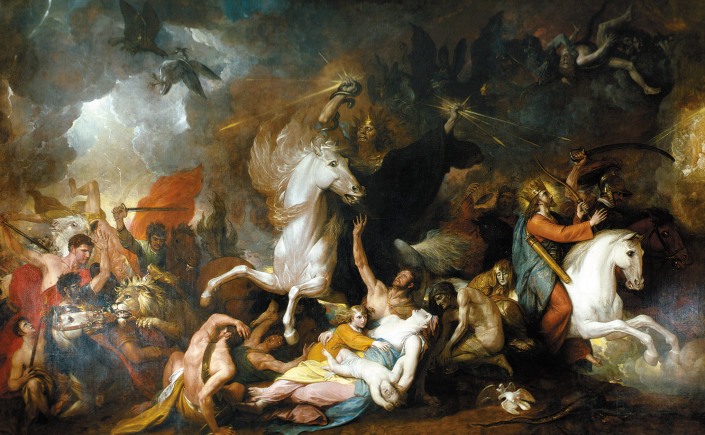
The best thing one can say about 2021 is that it is not 2020. i guess we’ll all be glad when twenty one is done.
There were no bushfires to entertain us like last year, but the pandemic hung like a dark cloud over our everyday lives. In this, the second year of the pandemic, economies continue to struggle, livelihoods continue threatened or destroyed, many borders remain closed, and cities, towns and homes continue to be locked-down and isolated, and restrictions and precautions are ever-present.
There’s a sense that time has stood still, as if nothing much has really happened since the pandemic struck and that we’ve been treading water, awaiting wake if not rescue, them at least, release.
Things have changed, of course. The affairs of gods and men carry on above it all. But in our personal lives, there have been changes too – our behaviour and the nature of our interactions with others and the outside world, have indeed changed utterly. And our outlook on life, the universe and everything has changed too.
Most of all, we’re all feeling tired. Burnt out. Disengaged. Cynical.
I noticed it during the recent local government election when otherwise astute and active folk could not summon up the energy and interest to involve themselves with the issues at stake. The elections had been cancelled twice due to COVID19, and many had just lost interest. “When is the election again?” they’d ask apathetically.
A year ago almost to the day, we wrote in our our review of 2020, A year of living dangerously: “Time during 2020 has been elastic and confused. On 21st December, The Guardian asked readers to sum up how they felt about 2020 in one word – and likewise their feelings for 2021. As of Xmas Eve, the standout words were respectively (a) shit, fucked and challenging and (b) hopeful and better. My poll responses were “fascinating” and “unpredictable”.
And a year hence, I would give much the same response. Compared to other folk here in Australia and overseas, we’ve had a “good” Covid – if that indeed is the most appropriate descriptor. We don’t have to earn a living and we live on a beautiful rural acreage that is totally stand-alone and off-grid – there couldn’t be a more congenial spot to self-isolate. But we’d love to be able to escape the padded cell – to exit the Australian bubble for a while, to visit friends and relatives in England and to reconnect with the history and geography that we love in the world outside. Perhaps in 2022, we’ll have that opportunity.
The title of this review is borrowed from the famous American baseball coach Yogi Berra. As we leave 2021, here’s another:
“Predictions are always very hard, especially when they’re about the future”
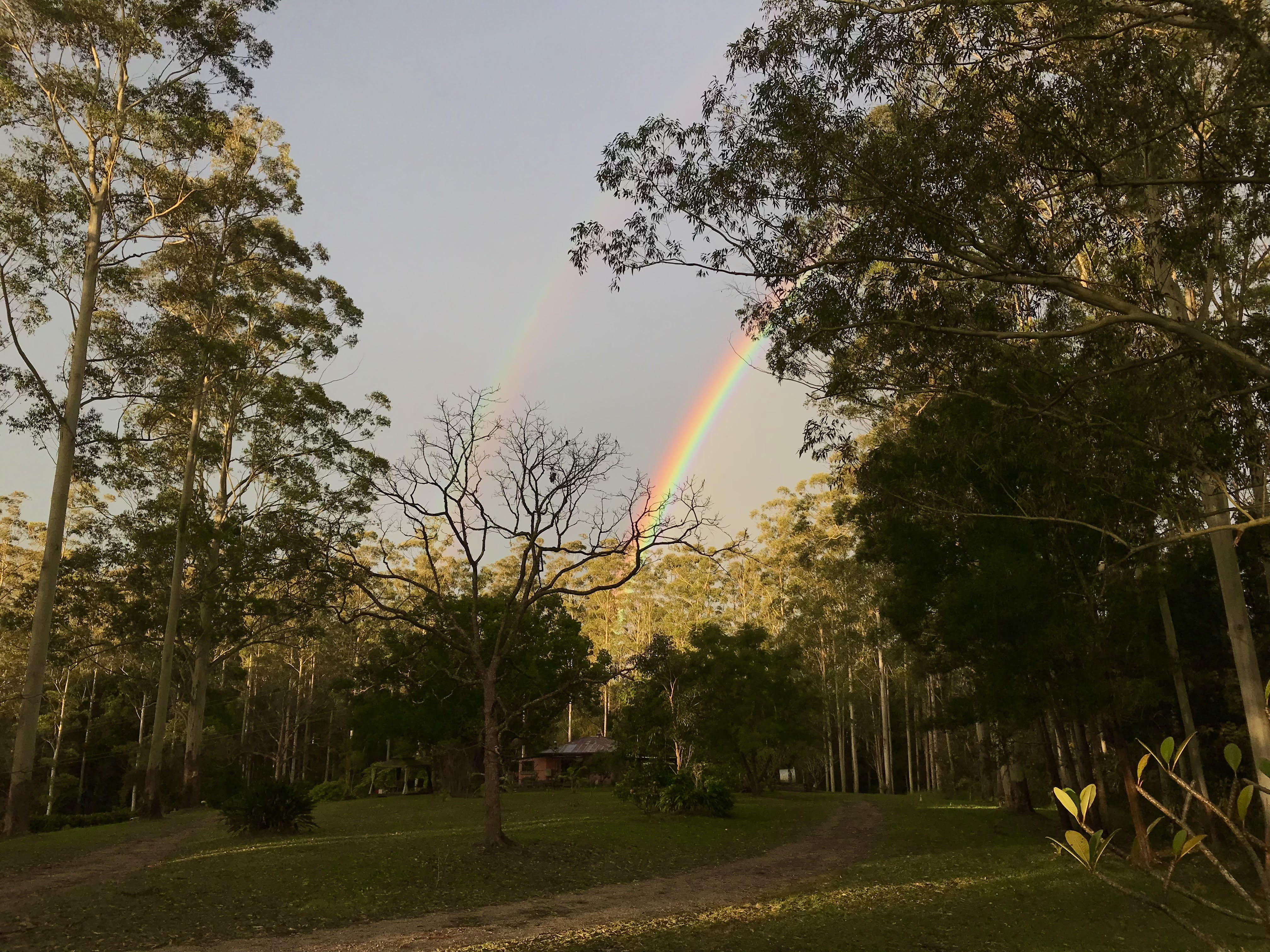
She’s a Rainbow
Paradise Park Fernmount
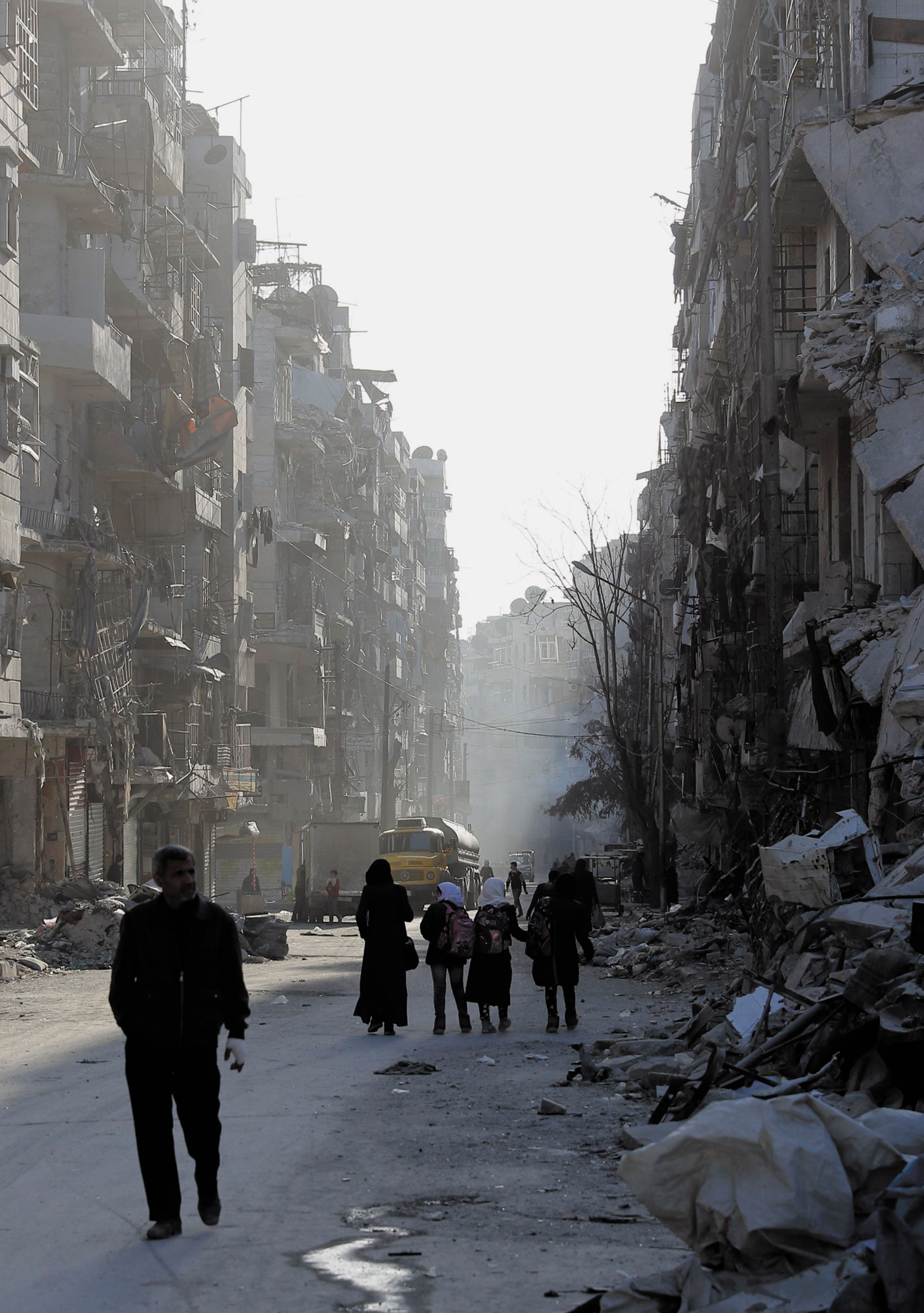
The World in review
It was for us personally the saddest of years. Our close friend, neighbour and forest warrior, Annette, departed our planet mid-year after what seemed like short, aggressive illness – although in retrospect, we know that it was a slow train coming for a long while. I wrote Farewell to a Tarkeeth Tigerin tribute to her. And in September, our beautiful, talented, wise friend and soul sister Krishna Sundari.
As for the world at large, COVID19 continues to dominate the news, with more contagious variants popping up all over the place lake a game of “whack a mole”. As does the ongoing struggle to reach global consensus on the need to confront climate change. Tackling both looks a little like the story of Sisyphus, the Greek King of old who was condemned by Zeus to spend eternity rolling a huge boulder to the top of a hill only to have it roll back down as soon as he reached the top.
The year kicked off to a fine start with the January 6th Insurrection in Washington DC as Donald Trump endeavoured to cling on to office by inciting his supporters and sundry militias to storm the Capitol to stop the count of electoral votes that would cede the presidency to Joe Biden. Though he failed, and was impeached
for a second time, and the Biden administration sought to calm America’s troubled waters, the Orange One haunts The US’ fractious and paralyzed politics and the prospect of a second Trump term is not beyond imagination.
Trump’s bestie, Benjamin Netanyahu, Israel’s longest serving Prime’s minister, also got the push in the wake of the third election in just over a year. The unique coalition that emerged from torturous negotiations spanned the political, social and religious spectrum – left and right, secular and orthodox, Arab and Jew, and promised little more than maintaining the unsatisfactory status quo, that pertaining to the occupation and the settlements, illegal migrants, and the disproportionate influence the Haredim, none of which are morally, politically, socially or economically sustainable.
China under would-be emperor Xi Jinping continues to aggressively build its military and economic power, determined to take its rightful and long overdue place at the top of the geopolitical ladder, causing consternation among its neighbours and also other powers and fears of war in our time. With Xinjiang’s Uighurs and Hong Kong firmly under its autocratic boot, it continues to expand its nautical footprint in the South China Sea and signals loudly that Taiwan’s days as a liberal democracy are numbered. Its belligerency is increasingly meeting blow-back as other nations react in various ways to what they perceive as clear and present danger. What happens next is anybody’s guess.
Russia under would-be czar Vladimir Putin continues to aggressively rebuild its military power and influence, determined to revive the glory days of the defunct Soviet Union, whist channeling memories of its former imperial glory. Whilst in no way as powerful as China, it is taking advantage of the the world’s preoccupation with the ascendancy of the Celestial Kingdom Redux to reassert its influence in its own backyard – including the veiled threat to reconquer Ukraine – and also in the world, particularly in Syria and through the use of shadowy proxies and mercenaries, in Africa. What happens next is anybody’s guess.
Turkey under would-be Sultan Recep Tayyip Erdogan continues to aggressively pull its self away from the west and towards some concept of a leadership role in the Muslim world.Its economy, meanwhile, is in free-fall, with unemployment and food prices rising and the lira tanking. At the heart of the problem is Erdogan’s attempt to take a sophisticated globalized economy and run it as an emirate does, replacing state institutions with personalized rule.You cannot run a sophisticated, modern economy on conspiracy theories and doctrines from the 7th century.But President Erdogan, having rigged the electoral system and cornered the religious and nationalist vote, and with no rivals in sight, isn’t gong anywhere soon.
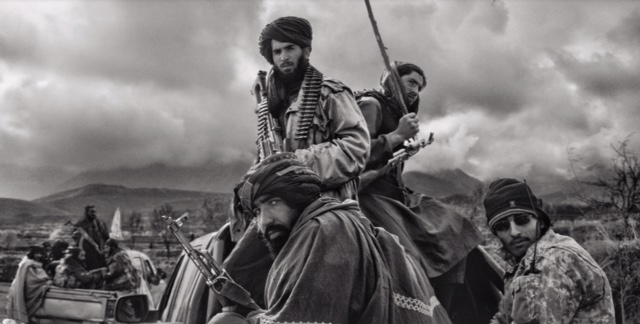
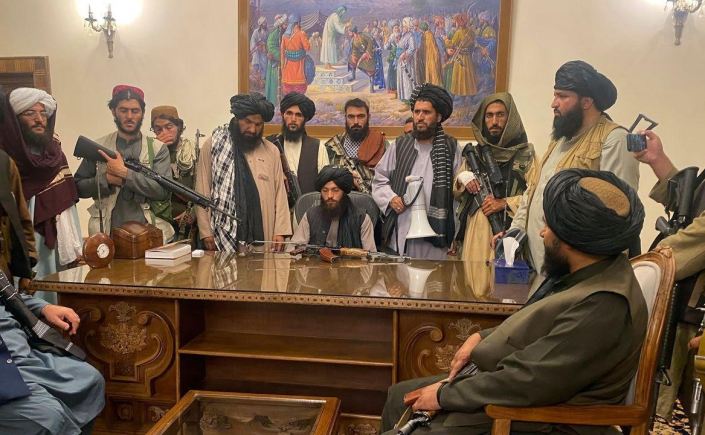
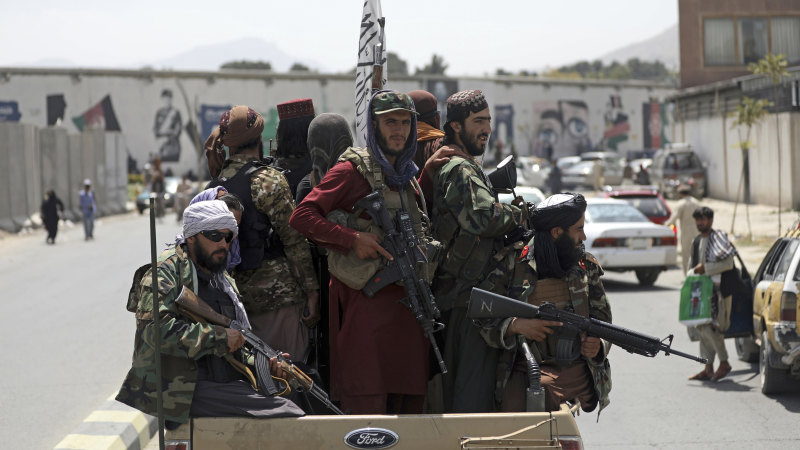
America finally ended its “endless war” in Afghanistan, in a chaotic, deadly scramble that left that country’s forever unfortunate people in the hands of a resurgent and apparently unreformed and unrepentant Taliban. It’s over a 100 days since the last evacuation plane took off in scenes of chaos and misery, leaving behind thousands of employees and others at risk of retribution, and the new regime has yet to establish a working government. Meanwhile professionals, human rights workers, officials of the former regime, members if the old government’s security forces, and especially women and girls wait, many in hiding, for the worst. Meanwhile, winter is coming and the country is broke and on the brink of of starvation. A major humanitarian crisis is imminent. What happens next, everybody does indeed know. As St. Leonard said, “We have seen the future and it’s murder!”
Whilst the war in Afghanistan ended, there are still plenty to go around for the weapons manufacturers and arms dealers, the mercenaries and the proxies. The year began well for Azerbaijan when it emerged victorious from a vicious 44 day drone and missile war against Armenia for control of the Nagorno-Karabakh enclave that saw Turkish and Syrian proxies engaged each side of the conflict. An old War was rekindled in Ethiopia as a Nobel Peace Prize winner sent his troops to rake pillage and conquer a fractious province which turned the tables and is now poses to seize his capital. Hubris extremis? Meanwhile, war went on in the usual places – Syria, Libya, Yemen, Mali, the Central African Republic, and places too obscure to mention.
Meanwhile, back home DownUnder, the story that dominated political news – apart from COVID19 and the shmozzle of the vaccine roll-out, was the delinquent behaviour of politicians and their staffers in Parliament House – commentators have likened the goings-on in there to a school yard or frat house, and more bluntly, to a Roman orgy, with tales of bullying and sexual harassment, drunken parties, mutual masturbation sessions, and even rape. The prime minister huffed and puffed and asked his wife how he should deal with the situation; commissions of inquiries were set up; and reports handed down. The motto is “we must do better – and we shall!” But as with most things these days, nobody believes what politicians say anymore.
And not just here in Australia, but all over the world. Trust is in short supply, and indeed, people’s faith in democratic traditions and processes is shaking as populism and a taste for autocracy spreads like … well, a coronavirus. The US was recently named a “backsliding democracy” by a Swedish based think-tank, an assessment based on the attempted Capitol coup and restrictions on voting rights in Red states. In the bizarro conspiracy universe, American right-wing commentators and rabble-rousers are urging their freedom-loving myrmidons to rescue Australia from totalitarianism. Apparently we have established covid concentration camps and are forcible vaccinating indigenous people.
In early December, US President Joe Biden held a summit for democracy, and yet his administration are still determined to bring Julian Assange to trial, a case that, if it succeeds, will limit freedom of speech. The conduct of the trial also poses a threat to the US’s reputation because it could refocus attention on the ugly incidents during the US wars in Iraq and Afghanistan that were exposed by WikiLeaks. There is a strong humanitarian and pragmatic case to look for a way out of Assange’s Kafkaesque nightmare, but the bastions of freedom, America, Britain and Australia show no interest in doing so notwithstanding the harm it does to their democratic credentials.
I chose these invigorating times to stand as a Labor candidate for Bellingen Shire Council in those elections I referred to at the beginning of this review. What we thought would be a short, sharp two month campaign extended to an exhausting five month slog as the Delta variant necessitated delaying the elections for a second time.
Few in the Shire can remember the last time Labor candidate stood for council, so we began with a very low public recognition, but we ran a good, honest campaign and raised our profile.
But alas, we were outgunned, outspent and outnumbered by the well-funded, professionally organised chamber of commerce independents coordinated, advised and directed by the National Party, who played to a disengaged and cynical electorate by gas-lighting us with the claim that we were “infiltrators” from mainstream political parties, bankrolled by big party money, and dictated to by Macquarie Street (the NSW Parliament), and thence, with no entitlement to represent the Shire – even though we were long-standing residents well-known in the community. Progressives on council are now but two against five, and the Nationals have reclaimed the Shire for business, development and traditional values. Back to the future. There will be buyer’s remorse for many ho voted for them without checking their credentials. And meanwhile, I’m quite happy not to have to sit in the council chamber with a bunch of neo-Thatcherites.
And finally, on a bright note, in the arts world, there was Taylor Swift. Fresh from her Grammy award for the sublime Folklore, she released her re-recorded version of her copyright-purloined album Red. How can anyone improve on the fabulous original? Swift does! It’s brighter, shinier, sharper, bigger, beatier and bouncier (I stole the last alliterations from the Who album of yonks ago), and her mature voice is a pleasure. Released just over nine years ago, when she was 22, it feels as fresh today, and for all the gossip and innuendo that surrounded its conception and reception and endure to this day, even in the hallowed habitats of the New York Times, the Washington Post and Rolling Stone (the Economist hasn’t weighed in yet), I find it refreshing and encouraging to listen to an artist so articulate and audacious, precocious and prodigious for one so young. Tay Tay also delivered one of the pop culture moments of the year, beguiling us all with the adventures of her old scarf. It out that not only did actor Jake Gyllenhall take her innocence, but he nicked her scarf too, and for one weekend in November all the internet cared about was its whereabouts. Safe to say it was a bad 48 hours to be Gyllenhaal.
Our year in review …
True to its mission statement, In That Howling Infinite reflected the events of the year with an eclectic collection. But, curiously, deliberately or by mere circumstance, we published nothing about the plague that had dominated our lives.
In a year when the treatment of women dominated the Australian news, and Grace Tame and Brittany Hughes became household names, we look at the status of women and girls in less fortunate parts of the world. Facing the Music – no dance parties in Palestine tells the story of a young Palestinian DJ and her confrontation with social conservatism and religious orthodoxy. In Educate a girl and you educate a community – exclude her and you impoverish it, we discus how countries who exclude women from political, social and economic life are the worse for it.
As always, this blog has a strong history focus. I spent a lot of time conversing with our friend and forest neighbours, acclaimed photographer Tim Page about his adventures in Indochina during the Vietnam War. I’d edited his unpublished autobiography, and written a forward to open it. It ended up in Tim Page’s War – a photographer’s Vietnam journey. This was accompanied by a story told by Ken Burns in his excellent documentary The Vietnam War about a young man who went to war and did not return: The Ballad of Denton Crocker – a Vietnam elegy. Part memoir, part memory lane, i recall the story of my own youthful travels in Song of the Road – my hitchhiking days
A Celtic heartbeat inspired Over the Sea to Skye, the story of the famous folk song and of Bonnie Prince Charlie and Flora MacDonald, whilst a continuing interest in The Middle East saw the completion of a log-standing piece, a contemplation on the Crusade: Al Tarikh al Salabin – the Crusader’s Trail. Our Israeli friend and guide Shmuel Browns explored the Anzac Trail in the Negev Desert and discovered a forgotten battle that had a direct connection to our own neighbourhood and the ever-evolving story of Chris Fell of Twin Pines: Tel al Sabi’ – Tarkeeth’s Anzac Story.
The Crusades
Our own Kalang River was the subject of the latest in the Small Stories series, Crossing the South Arm– how that wide river was first spanned back in the day. On Christmas Eve last year, a koala took up residence on our property and stayed for several weeks – the only koala we have actually seen in forty years (we do hear them often). This led to a historical and contemporary commentary on the parlous predicament of our much-loved marsupial: The Agony and Extinction of Blinky Bill. Last year, we exposed the alarming reality that Tarkeeth Forest wood was being chipped and used to generate electricity. Our earlier The Bonfire of the Insanities- the Biomass Greenwash was followed by The Bonfire of the Insanities 2 – the EU’s Biomass Dilemma.
And finally to poetry and song. In Dark Deeds in a Sunny Land – a poet’s memorial to a forgotten crime, we looked at “the great Australian silence – what historian Henry Reynolds called “this whispering in the bottom of our hearts” in the context of a famous poem by Judith Wright and the almost forgotten secrets of our own hinterland here on the “holiday coast”. On a brighter note, we revisit the history and legacy of Banjo Paterson’s iconic poem Waltzing Matilda with Banjo’s not to jolly swagman – Australia’s could’ve been anthem.
Commentator and counterinsurgency expert David Kilcullenis always worth reading – and below is his latest piece for The Australian.
As the time of the year would have it, I read his review of 2021 as I was completing my own for publication in the That Was The Year That Was series. Here is mine. Kilcullen’s follows.
As for the world at large, COVID19 continues to dominate the news, with more contagious variants popping up all over the place lake a game of “whack a mole”. As does the ongoing struggle to reach global consensus on the need to confront climate change. Tackling both looks a little like the story of Sisyphus, the Greek King of old who was condemned by Zeus to spend eternity rolling a huge boulder to the top of a hill only to have it roll back down as soon as he reached the top.
The year kicked off to a fine start with the January 6th Insurrection in Washington DC as Donald Trump endeavoured to cling on to office by inciting his supporters and sundry militias to storm the Capitol to stop the count of electoral votes that would cede the presidency to Joe Biden. Though he failed, and was impeached for a second time, and the Biden administration sought to calm America’s troubled waters, the Orange One haunts The US’ fractious and paralyzed politics and the prospect of a second Trump term is not beyond imagination.
Trump’s bestie, Benjamin Netanyahu, Israel’s longest serving Prime’s minister, also got the push in the wake of the third election in just over a year. The unique coalition that emerged from torturous negotiations spanned the political, social and religious spectrum – left and right, secular and orthodox, Arab and Jew, and promised little more than maintaining the unsatisfactory status quo, that pertaining to the occupation and the settlements, illegal migrants, and the disproportionate influence the Haredim, none of which are morally, politically, socially or economically sustainable.
China under would-be emperor Xi Jinping continues to aggressively build its military and economic power, determined to take its rightful and long overdue place at the top of the geopolitical ladder, causing consternation among its neighbours and also other powers and fears of war in our time. With Xinxiang’s Uighurs and Hong Kong firmly under its autocratic boot, it continues to expand its nautical footprint in the South China Sea and signals loudly that Taiwan’s days as a liberal democracy are numbered. It’s belligerency is increasingly meeting blow-back as other nations react in various ways to what they perceive as clear and present danger. What happens next is anybody’s guess.
Russia under would-be czar Vladimir Putin continues to aggressively rebuild its military power and influence, determined to revive the glory days of the defunct Soviet Union, whist channeling memories of its former imperial glory. Whilst in no way as powerful as China, it is taking advantage of the the world’s preoccupation with the ascendancy of the Celestial Kingdom Redux to reassert its influence in its own backyard – including the veiled threat to reconquer Ukraine – and also in the world, particularly in Syria and also, through the use of shadowy proxies and mercenaries, in Africa. What happens next is anybody’s guess.
America finally ended its “endless war” in Afghanistan, in a chaotic, deadly scramble that left that country’s forever unfortunate people in the hands of a resurgent and apparently unreformed and unrepentant Taliban. It’s over a 100 days since the last evacuation plane took off in scenes of chaos and misery, leaving behind thousands of employees and others at risk of retribution, and the new regime has yet to establish a working government. Meanwhile professionals, human rights workers, officials of the former regime, members if the old government’s security forces, and especially women and girls wait, many in hiding, for the worst. Meanwhile, winter is coming and th country is broke and on the brink of of starvation. A major humanitarian crisis is imminent. What happens next, everybody does indeed know. As St. Leonard said, “We have seen the future and it’s murder!”
Whilst the war in Afghanistan ended, there are still plenty to go around for the weapons manufacturers and arms dealers, the mercenaries and the proxies. The year began well for Azerbaijan when it emerged victorious from a vicious 44 day drone and missile war against Armenia for control of the Nagorno-Karabakh enclave that saw Turkish and Syrian proxies engaged each side of the conflict. An old War was rekindled in Ethiopia as a Nobel Peace Prize winner sent his troops to rake pillage and conquer a fractious province which turned the tables and is now poses to seize his capital. Hubris extremis? Meanwhile, war went on in the usual places – Syria, Libya, Mali, the Central African Republic, and places too obscure to mention.
Meanwhile, back home DownUnder, the story that dominated political news – apart from COVID19 and the total fuck-up of the vaccine roll-out, was the delinquent behaviour of politicians and their staffers in Parliament House – commentators have likened the goings-on in there to a school yard or frat house, and more bluntly, to a Roman orgy, with tales of bullying and sexual harassment, drunken parties, mutual masturbation sessions, and even rape. The prime minister huffed and puffed and asked his wife how he should deal with the situation; commissions of inquiries were set up; and reports handed down. The motto is “we must do better – and we shall!” But as with most things these days, nobody believes what politicians say anymore.
And not just here in Australia, but all over the world. Trust is in short supply, and indeed, people’s faith in democratic traditions and processes is shaking as populism and a taste for autocracy spreads like … well, a coronavirus. The US was recently named a “backsliding democracy” by a Swedish based think-tank, an assessment based on the attempted Capitol coup and restrictions on voting rights in Red states. In the bizarro conspiracy universe, American right wing commentators and rabble-rousers are urging their freedom-loving myrmidons to rescue Australia from totalitarianism. Apparently we have established Covid concentration camps and are forcible vaccinating indigenous people.
In early December, US President Joe Biden held a summit for democracy, and yet his administration are still determined to bring Julian Assange to trial, a case that, if it succeeds, will limit freedom of speech. The conduct of the trial also poses a threat to the US’s reputation because it could refocus attention on the ugly incidents during the US wars in Iraq and Afghanistan that were exposed by WikiLeaks. There is a strong humanitarian and pragmatic case to look for a way out of Assange’s Kafkaesque nightmare, but the bastions of freedom, America, Britain and Australia show no interest in doing so notwithstanding the harm it does to their democratic credentials.
Uncustomary for him – it must be the season of goodwill – Kilcullen ends his review on a note of cautious optimism:
“Given the events of 2021, all this suggests that in 2022, despite the darkening international threat picture, a more independent, self-reliant, resilient and capable Australia, stepping up to confront the challenges of great-power competition – amid a rising threat from China, declining US influence and an increasingly complex and dangerous security environment – will be necessary and achievable. We should all hope for a sense of urgency and commitment in the face of the new environment’.
I am more sanguine. To quote the famous American coach Yogi Berra. As we leave 2021:
“Predictions are always very hard, especially when they’re about the future”
The security picture for Australia has never been darker or more complex. But several key events this year offer clues into the challenges we’ll be facing in the year ahead.
David KilCullen, Weekend Australian 18th December 2021
Afghans struggle to reach the foreign forces Hamid Karzai International Airport,Kabul.
As we look forward into next year, the geostrategic and security picture for Australia has never been more complex and rarely more challenging. In security terms, this year was one of American weakness, Afghan betrayal, rising Russia-NATO tension and the emergence of space warfare and advanced technologies as domains in a new Sino-American Cold War.
But it was also the year of AUKUS and the year Australia found its feet despite increasingly belligerent bullying from Beijing. Several key events shaped 2021, and these in turn give us a clue as to how things might develop next year.
US weakness
The year began in chaos as Donald Trump’s supporters stormed the US Capitol, seeking to stop what they saw as a stolen election. Belief that an election has been stolen is one of the most well-documented triggers for revolutionary unrest.
Many Republicans, independents and even some Democrats still see the election as rigged – and, by extension, the Biden administration as illegitimate – boding ill for US stability into next year. The unrest that peaked during deadly riots in 200 US cities and all 50 states through the summer of 2020 seems to have subsided. But this is an illusion, since last year’s tension was stoked by the media and anti-Trump politicians.
Now back in charge, establishment institutions have an interest in damping dissent and, as a result, media amplification of unrest has been more subdued this year. But the underlying issues remain: riots continue in places such as Portland and Seattle, racially charged trials have triggered deadly protests, extremists are active on left and right, and murder rates are at levels not seen for 30 years. All of this is likely to come to a head next year around the US midterm elections. The worst inflation in four decades, supply-chain disruptions, labour disputes, retail shortages, soaring fuel prices, persistent Covid-19 restrictions (800,000 Americans have now died during the pandemic) and the most illegal border crossings since records began in 1960 complete the picture of a superpower in decline whose domestic weakness encourages its international adversaries.
Afghanistan: a triple betrayal
US feebleness was evident in August when, without bothering to consult his allies, President Joe Biden insisted on the rampantly incompetent withdrawal from Afghanistan that prompted apocalyptic scenes at Kabul airport. The botched evacuation was not only a betrayal of our Afghan partners – in whom the international community, at Washington’s urging, had invested unprecedented effort since 2001 – but also a betrayal by Biden of NATO and non-NATO allies, including Australia.
Afghans climb atop a plane at the Kabul airport in Kabul,lAugust 16, 2021,
It was a defeat on the scale of Saigon in 1975, though the comparison is unfair to that withdrawal, which was more professional and less self-inflicted than this one. The resulting contempt in coalition capitals (and military headquarters) has been quietly intense, even as Americans’ trust in the armed forces plummeted to its lowest level this century, reflecting the military’s recent inability to win wars and its failure to hold anyone accountable when it loses.
It was a triple betrayal: Afghan leaders from president Ashraf Ghani down abandoned their people in the moment of truth, fleeing to safety while leaving them to the Taliban and the prospect of famine. The UN estimates that more than 20 million Afghans are at risk of starvation this winter, meaning 2022 may well turn out to be an even worse year for Afghans than 2021. Even while many of us continue working frantically to help evacuate his people, Ghani is calmly writing a book in Abu Dhabi – perhaps a sequel to his well-received Fixing Failed States – while his henchmen live large on money squirrelled away in advance of the collapse or carried with them as they fled. Some, such as the leaders of the National Resistance Front, Amrullah Saleh and Ahmad Massoud, fight on, while others (including former president Hamid Karzai) proved courageous in the crisis. But with these few exceptions, never was a people so ill-served by their own leaders or so badly left in the lurch by their self-styled friends.
Russia: playing a poor hand well
America’s enemies, and not only the terrorists emboldened by the Taliban victory, have noticed its weakness. Vladimir Putin moved quickly to fill the vacuum in Afghanistan’s Central Asian borderland, partnering with China on several military and economic initiatives, deploying troops to the Afghan-Tajik border and signing a weapons deal with India, a move that parallels his efforts to win Turkish support through arms sales. In the Pacific, Indian, Atlantic and Arctic oceans Russian ships, submarines and aircraft are more active than at any time since the fall of the Soviet Union 30 years ago next week.
Putin always has been brilliant at playing a weak hand well, and this year has been no exception. In the early months of 2021, with Biden distracted after the Capitol riot, and congress impeaching Trump for the second time, Russian forces pressured Ukraine with a troop build-up and threatening deployments on its border. The result was a conciliatory summit meeting between Putin and Biden in June, seen in Europe as mostly benefiting the Russan side.
Vladimir Putin and Xi Jinping toast with vodka during a signing ceremony in Shanghai
After the Afghan fiasco, Russian activity in the Baltic States and Ukraine ramped up, and Russia’s ally Belarus tested the frontier defences of Poland and Lithuania with a manipulated flood of refugees, copying a Russian technique pioneered in Norway in 2015 and repeated several times since. Now Russian forces, including missile, tank and artillery units – perhaps 175,000 troops in all – are again massing within striking distance of the Ukrainian border, prompting urgent concern in Kiev.
Again, the US response reeked of appeasement, with Biden allegedly urging Ukrainian President Volodymyr Zelensky to offer formal autonomy to the eastern region of his country that has been under de facto Russian occupation since 2014, while assuring Russia and NATO that the US has no plans to fight for Ukraine’s freedom. These assurances were given the same week Biden hosted the Summit for Democracy, posing as leader of the free world. Neither Ukraine’s elected leaders nor Afghan parliamentarians – now on the run for their lives – commented, though Russia and China issued stinging critiques.
With winter approaching, Russian energy exports remain essential for Europe, while Russia – as a side effect of US policies targeting domestic energy production in pursuit of the Green New Deal – is the second largest source of US petroleum imports, giving Putin yet another card to play. The northern hemisphere winter of 2021-22 is thus likely to see Russia making use of its “energy weapon” within a broader suite of coercive tools.
China’s uneasy rise
If Russia played a weak hand well this year, China continued strengthening its hand. Beijing’s navy is growing at an astonishingly rapid pace while the modernisation and professionalisation of its land, air, cyber and rocket forces continue. The regime’s nuclear arsenal is undergoing substantial expansion, with hundreds of new missile silos discovered in remote desert areas. Cyber attacks, economic coercion and diplomatic bullying remain core elements of the Chinese repertoire, even as Western business leaders and sports stars (again with honourable exceptions) turn a blind eye to its crackdown in Hong Kong, bullying of Taiwan and oppression of the Uighurs.
China’s completion last year of its BeiDou satellite constellation, equivalent to the US Global Positioning System, threatened the dominance of GPS for the first time since 1993, with implications for every aspect of Western society, from EFTPOS transactions to infrastructure and transportation. Then in mid-October China tested a fractional orbital bombardment system, a shuttle-like spacecraft moving at hypersonic speed, able to evade missile defences and deliver a nuclear warhead anywhere in the world with limited chance of interception.
The Chinese test demonstrated how far US technology is lagging in this area, while marking the emergence of space warfare as a domain of conflict. Russia’s demonstration of a counter-space capability, destroying one of its own satellites in orbit (and creating a debris cloud that threatened the International Space Station) showed China is not the only adversary in space. Moscow and Beijing have announced joint plans for a permanent moon base, while China’s space station appears to include military modules.
More broadly, hypersonic technology – missiles moving at more than five times the speed of sound that can manoeuvre to avoid defences – are proliferating.
The so-called tech war among the superpowers includes these technologies alongside directed-energy weapons, robotics, nanotechnologies, bioweapons, quantum computing and human performance enhancements. These are among the most important areas of competition in the new cold war, along with the contest to control commodities (rare earth metals, copper, cobalt, lithium and uranium) and assets such as silicon and gallium nitride semiconductors that sustain them.
The first big event for China next year will be the Winter Olympics in February. Australia has joined a US-led diplomatic boycott of the Games, with Britain, Canada, Japan, New Zealand and Lithuania. Others may follow, but a diplomatic boycott – where athletes still participate – will have limited impact.
The Olympics are important for another reason: Admiral John Aquilino, newly appointed chief of US Indo-Pacific Command, has argued that Beijing is holding back on any move against Taiwan until the Games are over, meaning that from next March the risk of war in the Taiwan Strait may rise significantly.
Reservists of the Ukrainian Territorial Defence Forces Kharkiv, Ukraine, December 11, 2021.
Beijing may be emboldened towards any future conflict by US failure in Afghanistan, of which China is the biggest beneficiary. China’s control of mineral resources in the country (and its de facto recognition of the Taliban) gives it leverage, while Beijing’s alliance with Islamabad allows the currently dominant Taliban faction in Kabul, which is heavily influenced by Pakistan’s intelligence service, to draw on Chinese support to consolidate control.
Indirectly, the failure of two decades of intervention in Afghanistan is seen as discrediting Western attempts to meddle in the internal affairs of other countries, vindicating China’s transactional approach.
Beijing’s 25-year strategic co-operation agreement with Tehran, signed in March, lets China import oil directly from Iran, helping to draw Afghanistan into a Chinese-dominated regional economic and security order.
It also reduces China’s reliance on seaborne petroleum imports through the Malacca Strait and South China Sea, making it less vulnerable to US action in the Pacific.
Iran: further than ever from a nuclear deal
For its part, Tehran has made great strides in developing its nuclear capability since 2018, when Trump suspended US participation in the multilateral deal signed by Barack Obama in 2015. This prompted severe concern about Iranian nuclear weapons in Israel and in the Sunni Arab states of the Middle East, while European diplomats warn the 2015 deal will soon be beyond saving. Iran suspended its involvement in talks to rescue the deal, conducting an internal review after its presidential election in June. Though talks have resumed, and Tehran seems willing to co-operate with UN monitoring, a return to the previous deal appears further away than ever. The fact Iran is revising its stance largely because of pressure from Russia and China, rather than in response to US sanctions, underlines American impotence and Sino-Russian influence, even as the two US rivals meet this week to discuss joint responses to what they describe as increasingly aggressive US rhetoric and sanctions threats.
Iran’s dominance in Iraq, Syria and Lebanon (and Lebanon’s ongoing humanitarian and security crisis) has helped cement Tehran’s influence across the Middle East and Levant while reinforcing the regional role of Iran’s proxy, Hezbollah, and the Russia-Iran and China-Iran partnerships that made that position possible. This will persist next year. After the Afghan withdrawal it is hard for Washington to justify its troop presence in Iraq (where the anti-ISIS combat mission has officially ended) or eastern Syria, where US forces are deployed without approval from congress or any clear mission or end state. Something to watch in the coming year will be whether progress towards any resumption of the nuclear agreement coincides with further US withdrawals across the region.
AUKUS: doubling down on a weak partner?
As this overview shows, Australia’s environment this year has been more threatening and less predictable than at any time since the 1930s, as recognised in last year’s strategic update and cyber-security strategy, and underlined by the AUKUS agreement in September. Much has been made of the nuclear-powered submarines to be acquired under the agreement, a truly transformational move for Australian naval capability, though one that will take a long time to implement. Much sooner, indeed starting next year, long-range strike capabilities including Tomahawk and JASSM-ER missiles for the navy and air force, Apache attack helicopters for the army, and self-propelled artillery (under a separate deal with South Korea) will represent an immediate step up in Australia’s military posture. A new national critical technologies strategy, part of the broader technological component of AUKUS, is another important element of the new, more assertive stance.
As 2022 unfolds, AUKUS will represent an important indicator of the way ahead. If the agreement becomes a broadbased framework on which to build expanded co-operation with like-minded players – particularly Britain, which is rediscovering a role East of Suez and partnering with Australia on more issues than ever – then it will strengthen our leverage in the face of this new era of conflict.
If, on the other hand, AUKUS becomes another way to double down on the US relationship, increasing our reliance on a declining partner, the agreement could quickly become a net negative.
Scott Morrison announces the AUKUS pact oe Biden and Boris Johnson
The alienation of France (given that the French have more citizens and more capable military forces than any other European power in the Pacific) carries significant risks, as the South Pacific increasingly looks like a new theatre of conflict with China. Likewise, as India’s recent weapons deal with Russia illustrates, AUKUS can neither replace the Quadrilateral Security Dialogue – the informal partnership between the US, Japan, India and Australia – nor should it.
Encouragingly, 2021 seems to have been the year Australia found its feet despite bullying by Beijing since Canberra’s call for accountability on Covid-19 last year. China’s diplomatic high-handedness, shrill anti-Australian propaganda, economic coercion, cyber attacks, political interference and aggressive deployment of intelligence assets near our coastline were designed to teach us a lesson and show every Western-allied power what happens to those who step out of line. This backfired badly, pushing Australia into closer relations with allies, helping Australia’s economy diversify away from a damaging dependence on China, and prompting a sharp decline in Australians’ perceptions of China.
As a global energy shortage began to bite in late 2021, and China’s growth slowed, Chinese dependence on Australian iron and coal revealed itself as a key aspect of economic leverage – naturally prompting Beijing to threaten Australia over it.
Given the events of 2021, all this suggests that in 2022, despite the darkening international threat picture, a more independent, self-reliant, resilient and capable Australia, stepping up to confront the challenges of great-power competition – amid a rising threat from China, declining US influence and an increasingly complex and dangerous security environment – will be necessary and achievable. We should all hope for a sense of urgency and commitment in the face of the new environment.
Photographs of guns and flame Scarlet skull and distant game Bayonet and jungle grin Nightmares dreamed by bleeding men Lookouts tremble on the shore But no man can find the war Tim Buckley 1976
Tim Page had already been two years “in country” when as an undergraduate I’d participated in the violent melees in front of the US embassy in London’s Grosvenor Square protesting what Kenny Rodgers would call “that crazy Asian war”. Our undergraduate passions were inflamed by the fear that our government would answer US President Lyndon B Johnson’s call to join him and his forces in Vietnam – our Antipodean kin in Australia and New Zealand has already committed troops, and Johnson was applying the economic screws. But Labour Prime Minister Harold Wilson held firm and Britain avoided the débacle that has haunted the US for half a century.
This is the story of a war, and a young man who wandered into that war.
A ship is waiting for us at the dock America has trouble to be stopped We must stop Communism in that land Or freedom will start slipping through our hands. I hope and pray someday the world will learn That fires we don’t put out, will bigger burn We must save freedom now, at any cost Or someday, our own freedom will be lost. Johnny Wright, Hello Vietnam
The Twentieth Century’s “Thirty Years War” was waged in South East Asia initially by the colonialist France, and then by neo-imperialist America. France’s war ended in defeat and ignominy for French arms and prestige, and a partition that was but a prelude to America’s Vietnam quagmire.
America’s War has since been defined as chaos without compass. It was inevitable that acclaimed historian Barbara Tuchman would chose it as one of her vignettes in The March of Folly, her celebrated study of débacles through the ages characterised by what would appear to be a single-minded determination amounting to tunnel vision that is akin to stupidity.
As Tuchman saw it, exceptionalism and manifest destiny are historically proven folly. Self-belief in American power and righteousness has historically created delusions of grandeur, obstinate attachment to unserviceable goals, stubbornness, and an inability to learn from past mistakes or even admitting error – a wooden-headedness that often sees the US persisting on erroneous paths that lead to loss of blood, treasure, reputation and moral standing.
Why did the US’ experience of backing the wrong horse in China in the forties not provide an analogy and warning in Vietnam in the fifties? Why did the experience in Vietnam not inform the it with respect to Iran right up to the fall of the Shah in 1978? And why hadn’t it learned anything when it stumbled into Salvador in the eighties? And then, of course, we arrive in the 21st century with no-exit, never-ending wars in Afghanistan and Middle East that end in retreat and betrayal with the ‘freedom-loving’ USA still backing the wrong horses by supporting autocrats and tyrants against their own people.
But, back to Vietnam …
As historian Per Yule noted in The Long Shadow: Australia’s Vietnam Veterans Since The War, the Vietnam War was based on an assortment of unproven assumptions and half truths. It wrongly identified a dictatorship as a democracy a civil war as an international conflict. Our armed forces were sent to fight in support of a corrupt military regime which received solid support only from the catholic minority and the small landowning class. Few willingly fought for the regime.
Many in the US military reckoned that if given a free hand by the administration of President Johnson, they could have prevailed against North Vietnam – by destroying it utterly with overwhelming firepower. But the US had backed the wrong side and no amount of support could make the South Vietnamese fight and die hard enough for their corrupt, incompetent, puppet government. We hear a similar rationale with regard to the the Afghan army’s rapid collapse and the US’ shambolic withdrawal from Afghanistan
The US wanted to convince the North Vietnamese that they couldn’t win on the battlefield. The North Vietnamese wanted to convince the American people that the cost in blood and treasure was too high. Both sides continued to believe that they could improve their positions through escalation and both continued to focus on military rather than political means to end the conflict. And so we were left with an almost certainly unwinnable strategy of bombing the enemy to the negotiating table when that enemy shows no willingness to negotiate under duress. The bombing campaign, code name Rolling Thunder, was described by a commentator in Ken Burns’ documentary The Vietnam War as “the dumbest campaign ever designed by a human being”.
All we need is a little determination; Men, follow me, I’ll lead on. We’re waist deep in the big muddy And the big fool says to push on. Pete Seeger, Waist Deep in the Big Muddy
Vietnam has been called the pointless war and the needless war. Vietnam has been called the pointless war and the needless war. In a scene in Apocalypse Now Redux, Francis Ford Coppola’s recut of his seventies epic, Having denounced his country’s folly in being surrounded and defeated in the battle of Dien Bien Phu in 1954, which precipitated the end of French colonial rule and the beginning of US involvement in Indochina, expatriate patriarch Hubert de Marais declares to his American guests: “You are fighting for the biggest nothing in history”.
It was certainly a costly war. The butchers bill was horrendous. No one really knows how many people perished. Civilian deaths range from 1.3 to 4.5 million.of which over 80% were Vietnamese and 7% Cambodian. American soldiers dead numbered 58,220 and wounded,153,303. The number of Vietnamese and Cambodian wounded is inestimable.
As for the American forces, it most certainly “the poor man’s war” – most who were perished or were maimed were not rich folks, and a disproportionate number were black. Amd the more who died, the more were sent to replace them. And like here in Australia, thecdraft caught mainly the poor and unconnected. Even as soldiers started going home, actual or attempted murder by enlisted men of their superiors increased alarmingly.
As to the monetary cost: an estimated $1 trillion in today’s dollars. But that is doubtlessly an understatement – what about the rebuilding, the rehabilitation, the recompense? Vietnam was the most heavily bombed country in history. More than 6.1 million tons of bombs were dropped, compared to 2.1 million tons in WW2. U.S. planes dumped 20 million gallons of herbicides to defoliate VietCong hiding places. It decimated 5 million acres of frostbite and 500,000 acres of farmland.
It has been called “the helicopter war” because choppers were the primary mode of ground combat and transport, and also “the television war – it’s triumphs (few) and tragedies (many) were beamed Into American homes nightly, fuelling the public’s confusion and unease about this Asian war, and eventually, the anger that forced the US government to eventually withdraw over half a million soldiers, marines, airmen and sailors and abandoning South Vietnam’s puppet government, its demoralised and abandoned army, and its unfortunate, battered and bloodied people to the tender mercies of the hardline and heartless ideologues in Hanoi.
Vietnam was also, notoriously, a pharmaceutical war. In its final year’s, as raw and reluctant draftees made up an increasing proportion of the US forces, indiscipline and substance abuse transformed, in the words of one professional soldier, an officer, a fine army into a rotten one. Alcohol, marijuana, acid, coke, heroin, and a cornucopia of pills were freely available on base, on leave in Saigon, and often, in the field, and many soldiers actually made it a business. The press too were sucked into the machinery.
And, it was a promiscuous war. So far away from home and loved ones, like warriors in all wars since time immoral, US solders took comfort and solace where they could find it. Historians, memoirists, veterans of both the French and American wars in Indochina write and talk of the beauty of the Vietnamese women. Economic deprivation and social dislocation create a flesh market supplying lonely, frightened strangers in a strange land.
It was chemical warfare – not the mustard gas of older wars, and the Zyklon B of the Nazi death camps, nor the recent wars in the Middle East, in the first Gulf War, between Iraq and Iran, and in Syria – but the broad-acre use of chemical defoliants designed to deny the enemy of jungle and forest concealment that left behind a bitter harvest, a legacy of disease, deformity and death that ricochets to this day.
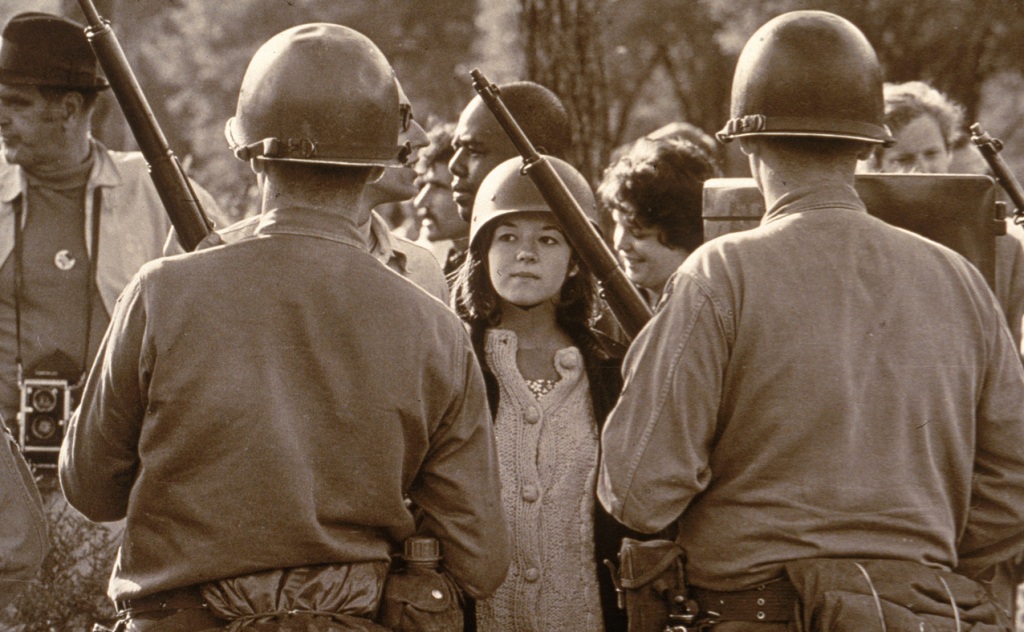
And, in the United States, it was a war that divided a nation. The protest movement emerged during 1965. It grew and grew, and by the Moratorium of October 1969, it became the largest outpouring of public dissent in American history. The moratorium movement was massive and unprecedented – and peaceful. Nationwide, hundreds and hundreds of thousands of people across the US were marching. The children of politicians and officials and soldiers were also marching. They were marching not about winning or losing the war but demanding an end to the war.
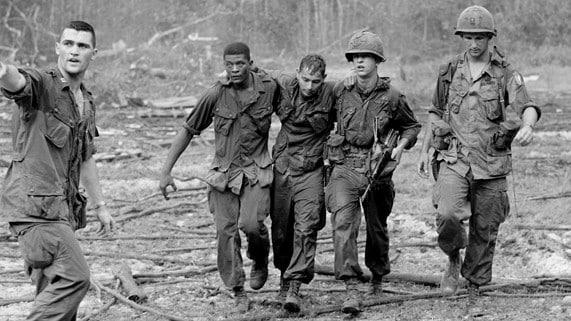
It was a journalists war too, and the photographers’ War. The military had a relaxed and tolerant attitude towards the press that would seem profligate and foolhardy in today’s tightly managed and manipulated combat media. Journalists and photographers would be permitted and indeed invited along on patrols and sweeps, carrier landings, on helicopter “dust offs” (a euphemism for evacuating the wounded and the dead), and the controversial “search and destroy” operations that destroyed so many fields, villages and lives. Needless to say, the coopted fourth estate were often in harm’s way. They were taught how to use weapons and often actually did use them in self defence and, sometimes in anger. And like the officers and men with whom they worked, many were wounded and slain. More than two hundred would die covering the fighting in South East Asia.
And English photojournalist Tim Page, who ran away from boring ‘sixties Britain to the exotic East at the age of seventeen, taking the ‘overland’ route that decades later would be called ‘the Hippie Trail’, washed up in the war of our generation, and left it critically injured and indeed clinically dead in a medivac chopper.
There is no decent place to stand in a massacre But if some women takes you’re hand You go and stand with her. I left a wife in Tennessee and a baby in Saigon I risked my life but not to hear A country-western song Leonard Cohen, The Captain
Tim Pageliterally and figuratively ambled into the last of the “great” wars of the Twentieth Century; and reading Tim’s autobiography, you wonder whether this peregrinating, ever-restless bloke had more lives than a cat!
Page ran off to join the circus. Leaving England in 1962, it was to be twenty years until he saw his folks again. A restless soul, he split for Europe with his girl friend, and when she baled, headed ever-eastwards, an early pioneer of that famed trail in a succession of secondhand vehicles and a caravan of colourful comrades. The further east he wandered, the more drugs he savoured, sampling the local toke through Afghanistan, Pakistan, India, Nepal and Burma. Many a time, he was flat broke and broken down, and laid low with a variety of exotic, intimate and excruciating ailments. But we needn’t go there.
Though photography was a teenage hobby, he drifted into the profession almost by accident, and virtually ambled into the Vietnam War, the Great War of our generation – a road -trip to Vientiane, the sleepy capital of the Kingdom of Laos to renew his expired Thai visa saw him hanging out there just as the the US’ fateful foray into Indochina was escalating into the quagmire that it was to become.
The lure of sex, drugs, and excitement – and paid work for a major news agency saw him wash up in Saigon and the celebrated, inebriated Frankie’s House, a kind of home-away-from home and party house for transiting bao chi – ‘round-eye’ newsmen – a decadent, dissolute, de facto foreign correspondents club. From here, they would fan out though war-wracked South Vietnam under the often dodgy and dangerous protection of Uncle Sam. In the 1992 series of Frankie’s House, based on Tim’s Vietnam days, he was portrayed by the Scottish actor Iain Glen, famous nowadays for his role as Ser Jorah Mormont in Game of Thrones.
Like the soldiers they accompanied, many came back in body bags or on stretchers. Many just disappeared @and it has been Tim’s mission in life to trace these lost souls. They include his best buddy Sean Flynn, the son of famous actor and pants man Errol Flynn.
Tim’s number almost came up in a blood-soaked friendly fire debacle on a navy river boat. Patched up and R&R in the US, he photographed the burgeoning antiwar demonstrations wracking the nation and ‘fesses up in his chronicle that he didn’t quite get the rage of the protesters – to Tim and his Saigon peers, the war might’ve been hell, but it was also a helluva buzz, and he was itching to return to the maelstrom.
But his intoxicating and intoxicated Nam days came to an explosive end in a dry paddy field when he and his helicopter crew landed to help an injured GI and walked into a minefield. Dead on arrival and resuscitated three times, he was medivacced stateside minus part of his skull and with injuries that hamper him still half a century later. Photographs of that almost fatal encounter turned up out of the blue just a few years ago.
Post-op and recuperating in the US, Tim took himself off to Woodstock, New York State. where it was being said that there was going be a cool scene – which indeed there was, as we all remember: the famous music festival held over three days in August 1969 on Max Yasgur’s dairy farm in Bethel, New York (65 km) southwest of the town of Woodstock. But Tim never got to hear any of the great music – complications from his injuries meant that he had to be medivacced out of Woodstock, probably on the same chopper that had just brought in the legendary Crosby, Stills and Nash.
Of our elaborate plans, the end Of everything that stands, the end No safety or surprise, the end Jim Morrison 1967
Internationally acclaimed photographer Tim Pagehas been the subject of many documentaries, two films and the author of ten books, including his latest opus Nam Contact. He has been recognized as one of the ‘100 Most Influential Photographers of All Time’ and is the recipient of many awards. After a career spanning sixty years, world renowned photographer Tim Page has settled quietly into the Bellingen Shire, where he and his wife Marianne live what Tim describes as “a peaceful life. The choice of the word Peaceful’ is pertinent considering that his photographic assignments during the of the Laos Civil War, the Vietnam War and the Six Day War in the Middle East in 1967 brought him directly into the firing line. He still carries the injuries to prove it.
I once wrote that the twenty year war in Afghanistan was like the Hotel California: you can check out any time you like, but you can never leave. Recent events have shown otherwise – or have they, really? I am recalling those lines from David Byrne’s dystopian song, Once in a Lifetime: “same as it ever was, same as it ever was”. But perhaps Burning Down the House is more apt.
Desperate people scramble to escape, over the borders and over the airport walls. Afghans from all walks of life, including officials, soldiers, and policemen, former employees of the allies, women, and human rights advocates, fear the worst, as do ethnic and religious minorities who suffered horrific abuses at the hands of Taliban 1.0. Governments, NGOs and concerned folk all over the world wring their hands in vicarious anxiety, and for some, in shame. Europe. meanwhile, braces for another flood of refugees as displaced Afghans seek sanctuary
The US president declares that the America gave most of it’s all to save Afghanistan whilst the blame game as to “who lost Afghanistan?” commences, just as it did decades ago when the US ‘lost China” and then, Vietnam. The Chief Security Adviser says there’s no way of knowing how much American military hardware has been gifted to the Taliban, but it looks like a veritable bonanza.
America’s allies ponder the reliability of its erstwhile protector, fearing that the giant might have feet of clay – in choosing to give up on Afghanistan in order to confront China, Biden might actually have undercut America’s position everywhere. China and Russia, always happy to see America squirm, but always anxious about instability in neighbouring countries, eye up economic and strategic opportunities. And extremists all over the world, of all colours and creeds, are emboldened as yet another apparently rag tag militia humbles the world’s mightiest military power.
As Afghanistan slides into insolvency and famine, necessitating enormous amounts of aid, the question facing foreign governments is whether or not to recognize the new regime and to release the funds so urgently required. The appetite for isolating Afghanistan on human rights ground is diimishing. Pretty much all of Afghanistan’s neighbors are also guilty of the principal human rights violations that the Taliban are accused of. Minority rights have long been violated with impunity Pakistan and much of the Arab world, and most of Central Asia has been a showcase for ethnic nationalist authoritarianism for decades.
On the ground, and away from the besieged air[port, with the Taliban now well equipped and in control of the main towns and cities, many of the old politicians and warlords have chosen to work with them in the hopes of creating an inclusive transitional government. Former presidential aspirant and reconciliation council leader Abdullah Abdullah, disingenuous former president Hamid Karzai, and that vicious and powerful old warlord, Gulbuddin Hekmatyar, have formed a council that seeks a political settlement with the Taliban, rather than join any nascent budding insurgency.
The old Afghanistan, divided along tribal, ethnic and religious lines, and governed by deals, compromises and the divvying up of the spoils may even reassert itself. All that is old might be new again!
Meanwhile our mainstream and non-mainstream media is awash with coverage and commentary , including contributions from a good number of Afghanistan/Iraq hawks – the ones who brought us those twin disasters in the first place _ who have been called on by major media organizations to offer their sage assessment of the current situation. Whether it’s retired generals who now earn money in the weapons industry, former officials from the Bush, Obama and Trump administrations who in many cases are directly responsible for the mistakes of the past two decades, or war enthusiast pundits with an unblemished record of wrongness, we’re now hearing from the same people who two decades ago told us how great these wars would be, then spent years telling us victory was right around the corner, and are now explaining how somebody else is to blame for Afghanistan.
As a counterbalance to all this, In that Howling Infinite republishes below two excellent pieces by commentators of repute.
Sarah Cheyes, a journalist and political adviser with long experience in Afghanistan, identifies four elements contributing to the failure of America’s Afghan Project: corruption at the highest levels of government which the US chose to ignore – it also ignored the many billions of dollars ended up in the bank accounts of American arms manufacturers and contractors (a recent government report found that between 2011 and 2019, the US spent nearly $100 billion on private contractors); the role played by Pakistan’s intelligence organization, the ISI, in creating and nurturing the Taliban – and the allies refusal to call out Pakistan encouraged its impunity; the dubious maneuverings of former America’s onetime-favourite and former president Hamid Karzai, who appears to have a foot in both camps ; and America’s self-delusions about these and other matters.
Commentator and counterinsurgency expert David Kilcullen is always worth reading – and below is his latest piece for The Australian. Whilst Cheyes looks back to determine how it all came to this., Kilcullen ponders where it will it will go. But first, he denounces the blame-shifters and buck-passers: “Those pinning the entire blame for the collapse on the Afghan military should hang their heads in shame. The Afghans have been fighting desperately to survive, losing thousands killed every month, ever since President Joe Biden’s withdrawal announcement in April kicked off the final campaign. They have been carrying the main combat burden of the war since late 2014, losing close to 70,000 casualties in that time against a few dozen on the coalition’s part”.
None of the elements identified by Cheyes and Kilcullen is new news. Old Afghanistan’s hands like Robert Fisk and Patrick Cockburn, and many others have been saying this for decades. The big question, which I am sure will be answered soon is whether Taliban 2.0 will be an improvement on Taliban 1.0 vis a vis women, human rights and even modernity.
But Kilcullen does not see the war as a misbegotten and forlorn hope. Far from it:
“Some will say the war was unwinnable, that it could never have succeeded. But deep down we all know that is not true. We were sustaining the effort with minimal expenditure and zero casualties, and could have continued it forever had we chosen to do so. We did not. The war was winnable, but we did not win it. Rather, we screwed it up and we have been defeated”.
That much is true. And with an America smarting from humiliation and a China swaggering with hubris. What could possibly go wrong now?
Addendum
An old friend, Charles Tyler, wrote to me apropos this post:
“The last couple of weeks have certainly seen major shifts of power, but things are so very far from being settled, and probably never will be. Indeed. events as they unfold will defy all predictions, as they always do, and the commentary, informed and shallow, will continue as always. And all will need revision in the light of what actually transpires.
As several commentators have noted the US is now likely to become closer in military and strategic cooperation to India, while China and Russia will become closer to Pakistan and Afghanistan, with all the risks these shifts entail for every country involved. But in this three-dimensional chess game the field of military and strategic action is just one layer. The layers of religion, tribalism, ethnicity, nationalism and plain human emotion – not to speak of even broader considerations like climate and demographic change and economic development – overlay and play into every other field, and can only be controlled or manipulated or predicted so far. So the consequences of moving any particular chess piece are unknowable”.
I’ve been silent for a while. I’ve been silent about Afghanistan for longer. But too many things are going unsaid.
I won’t try to evoke the emotions, somehow both swirling and yet leaden: the grief, the anger, the sense of futility. Instead, as so often before, I will use my mind to shield my heart. And in the process, perhaps help you make some sense of what has happened.
For those of you who don’t know me, here is my background — the perspective from which I write tonight.
I covered the fall of the Taliban for NPR, making my way into their former capital, Kandahar, in December 2001, a few days after the collapse of their regime. Descending the last great hill into the desert city, I saw a dusty ghost town. Pickup trucks with rocket-launchers strapped to the struts patrolled the streets. People pulled on my militia friends’ sleeves, telling them where to find a Taliban weapons cache, or a last hold-out. But most remained indoors.
It was Ramadan. A few days later, at the holiday ending the month-long fast, the pent-up joy erupted. Kites took to the air. Horsemen on gorgeous, caparisoned chargers tore across a dusty common in sprint after sprint, with a festive audience cheering them on. This was Kandahar, the Taliban heartland. There was no panicked rush for the airport.
I reported for a month or so, then passed off to Steve Inskeep, now Morning Edition host. Within another couple of months, I was back, not as a reporter this time, but to try actually to do something. I stayed for a decade. I ran two non-profits in Kandahar, living in an ordinary house and speaking Pashtu, and eventually went to work for two commanders of the international troops, and then the chairman of the Joint Chiefs of Staff. (You can read about that time, and its lessons, in my first two books, The Punishment of Virtue and Thieves of State.)
From that standpoint — speaking as an American, as an adoptive Kandahari, and as a former senior U.S. government official — here are the key factors I see in today’s climax of a two-decade long fiasco:
Afghan government corruption, and the U.S. role enabling and reinforcing it. The last speaker of the Afghan parliament, Rahman Rahmani, I recently learned, is a multimillionaire, thanks to monopoly contracts to provide fuel and security to U.S. forces at their main base, Bagram. Is this the type of government people are likely to risk their lives to defend?
Two decades ago, young people in Kandahar were telling me how the proxy militias American forces had armed and provided with U.S. fatigues were shaking them down at checkpoints. By 2007, delegations of elders would visit me — the only American whose door was open and who spoke Pashtu so there would be no intermediaries to distort or report their words. Over candied almonds and glasses of green tea, they would get to some version of this: “The Taliban hit us on this cheek, and the government hits us on that cheek.” The old man serving as the group’s spokesman would physically smack himself in the face.
I and too many other people to count spent years of our lives trying to convince U.S. decision-makers that Afghans could not be expected to take risks on behalf of a government that was as hostile to their interests as the Taliban were. Note: it took me a while, and plenty of my own mistakes, to come to that realization. But I did.
For two decades, American leadership on the ground and in Washington proved unable to take in this simple message. I finally stopped trying to get it across when, in 2011, an interagency process reached the decision that the U.S. would not address corruption in Afghanistan. It was now explicit policy to ignore one of the two factors that would determine the fate of all our efforts. That’s when I knew today was inevitable.
Americans like to think of ourselves as having valiantly tried to bring democracy to Afghanistan. Afghans, so the narrative goes, just weren’t ready for it, or didn’t care enough about democracy to bother defending it. Or we’ll repeat the cliche that Afghans have always rejected foreign intervention; we’re just the latest in a long line.
I was there. Afghans did not reject us. They looked to us as exemplars of democracy and the rule of law. They thought that’s what we stood for.
And what did we stand for? What flourished on our watch? Cronyism, rampant corruption, a Ponzi scheme disguised as a banking system, designed by U.S. finance specialists during the very years that other U.S. finance specialists were incubating the crash of 2008. A government system where billionaires get to write the rules.
Is that American democracy?
Well…?
Pakistan. The involvement of that country’s government — in particular its top military brass — in its neighbor’s affairs is the second factor that would determine the fate of the U.S. mission.
You may have heard that the Taliban first emerged in the early 1990s, in Kandahar. That is incorrect. I conducted dozens of conversations and interviews over the course of years, both with actors in the drama and ordinary people who watched events unfold in Kandahar and in Quetta, Pakistan. All of them said the Taliban first emerged in Pakistan.
The Taliban were a strategic project of the Pakistani military intelligence agency, the ISI. It even conducted market surveys in the villages around Kandahar, to test the label and the messaging. “Taliban” worked well. The image evoked was of the young students who apprenticed themselves to village religious leaders. They were known as sober, studious, and gentle. These Taliban, according to the ISI messaging, had no interest in government. They just wanted to get the militiamen who infested the city to stop extorting people at every turn in the road.
Both label and message were lies.
Within a few years, Usama bin Laden found his home with the Taliban, in their de facto capital, Kandahar, hardly an hour’s drive from Quetta. Then he organized the 9/11 attacks. Then he fled to Pakistan, where we finally found him, living in a safe house in Abbottabad, practically on the grounds of the Pakistani military academy. Even knowing what I knew, I was shocked. I never expected the ISI to be that brazen.
Meanwhile, ever since 2002, the ISI had been re-configuring the Taliban: helping it regroup, training and equipping units, developing military strategy, saving key operatives when U.S. personnel identified and targeted them. That’s why the Pakistani government got no advance warning of the Bin Laden raid. U.S. officials feared the ISI would warn him.
By 2011, my boss, the outgoing chairman of the Joint Chiefs of Staff, Adm. Mike Mullen, testified to the Senate Armed Services Committee that the Taliban were a “virtual arm of the ISI.”
And now this.
Do we really suppose the Taliban, a rag-tag, disjointed militia hiding out in the hills, as we’ve so long been told, was able to execute such a sophisticated campaign plan with no international backing? Where do we suppose that campaign plan came from? Who gave the orders? Where did all those men, all that materiel, the endless supply of money to buy off local Afghan army and police commanders, come from? How is it that new officials were appointed in Kandahar within a day of the city’s fall? The new governor, mayor, director of education, and chief of police all speak with a Kandahari accent. But no one I know has ever heard of them. I speak with a Kandahari accent, too. Quetta is full of Pashtuns — the main ethic group in Afghanistan — and people of Afghan descent and their children. Who are these new officials?
Over those same years, by the way, the Pakistani military also provided nuclear technology to Iran and North Korea. But for two decades, while all this was going on, the United States insisted on considering Pakistan an ally. We still do.
Hamid Karzai. During my conversations in the early 2000s about the Pakistani government’s role in the Taliban’s initial rise, I learned this breathtaking fact: Hamid Karzai, the U.S. choice to pilot Afghanistan after we ousted their regime, was in fact the go-between who negotiated those very Taliban’s initial entry into Afghanistan in 1994.
I spent months probing the stories. I spoke to servants in the Karzai household. I spoke to a former Mujahideen commander, Mullah Naqib, who admitted to being persuaded by the label and the message Karzai was peddling. The old commander also admitted he was at his wits’ end at the misbehavior of his own men. I spoke with his chief lieutenant, who disagreed with his tribal elder and commander, and took his own men off to neighboring Helmand Province to keep fighting. I heard that Karzai’s own father broke with him over his support for this ISI project. Members of Karzai’s household and Quetta neighbors told me about Karzai’s frequent meetings with armed Taliban at his house there, in the months leading up to their seizure of power.
And lo. Karzai abruptly emerges from this vortex, at the head of a “coordinating committee” that will negotiate the Taliban’s return to power? Again?
It was like a repeat of that morning of May, 2011, when I first glimpsed the pictures of the safe-house where Usama bin Laden had been sheltered. Once again — even knowing everything I knew — I was shocked. I was shocked for about four seconds. Then everything seemed clear.
It is my belief that Karzai may have been a key go-between negotiating this surrender, just as he did in 1994, this time enlisting other discredited figures from Afghanistan’s past, as they were useful to him. Former co-head of the Afghan government, Abdullah Abdullah, could speak to his old battle-buddies, the Mujahideen commanders of the north and west. You may have heard some of their names as they surrendered their cities in recent days: Ismail Khan, Dostum, Atta Muhammad Noor. The other person mentioned together with Karzai is Gulbuddin Hikmatyar — a bona fide Taliban commander, who could take the lead in some conversations with them and with the ISI.
As Americans have witnessed in our own context — the #MeToo movement, for example, the uprising after the murder of George Floyd, or the January 6 attack on the U.S. Capitol — surprisingly abrupt events are often months or years in the quiet making. The abrupt collapse of 20 years’ effort in Afghanistan is, in my view, one of those cases.
Thinking this hypothesis through, I find myself wondering: what role did U.S. Special Envoy Zalmay Khalilzad play? And old friend of Karzai’s, he was the one who ran the negotiations with the Taliban for the Trump Administration, in which the Afghan government was forced to make concession after concession. Could President Biden truly have found no one else for that job, to replace an Afghan-American with obvious conflicts of interest, who was close to former Vice President Dick Cheney and who lobbied in favor of an oil pipeline through Afghanistan when the Taliban were last in power?
Self-Delusion. How many times did you read stories about the Afghan security forces’ steady progress? How often, over the past two decades, did you hear some U.S. official proclaim that the Taliban’s eye-catching attacks in urban settings were signs of their “desperation” and their “inability to control territory?” How many heart-warming accounts did you hear about all the good we were doing, especially for women and girls?
Who were we deluding? Ourselves?
What else are we deluding ourselves about?
One final point. I hold U.S. civilian leadership, across four administrations, largely responsible for today’s outcome. Military commanders certainly participated in the self-delusion. I can and did find fault with generals I worked for or observed. But the U.S. military is subject to civilian control. And the two primary problems identified above — corruption and Pakistan — are civilian issues. They are not problems men and women in uniform can solve. But faced with calls to do so, no top civilian decision-maker was willing to take either of these problems on. The political risk, for them, was too high.
Today, as many of those officials enjoy their retirement, who is suffering the cost?
My warm thanks to all of you who have left comments, for taking the time to write, and for the vibrancy of your concern.A number of you have asked some excellent questions. Please have the kindness to stand by. I will try to provide what answers I can when I can.
Much as the Taliban may like to claim the war is over, it is far from finished. Afghanistan is collapsing in real time and a new bloodbath beginning. Now the world has a choice to make.
Taliban fighters sit over a vehicle on a street in Laghman province on August 15. Picture. AFP
Afghanistan is collapsing in real time. Two decades of effort down the gurgler, trillions of dollars and many thousands of lives lost, and a new bloodbath beginning inside Afghanistan. US credibility – like that of every American ally, including Australia – is on the line.
Approaching the 20th anniversary of 9/11, we are back to square one. What happened? Describing the full debacle would take more space than I have, but let me try to answer some obvious questions: Why did we fail to foresee the fall of Kabul? What is happening on the ground and what does it mean? What will others do now, and what should we do next?
I promised a mea culpa, and here it is: I was dead wrong about the fall of Kabul. I am on record just weeks ago saying “it would be a stretch to imagine the Taliban capturing Kabul anytime soon”.
Of course virtually every other analyst got it wrong, too, but I can speak only to my own thought process. Thinking it over, examining my conscience, I realise my lack of imagination rested on a critical but flawed assumption.
I simply could not credit the possibility that the US government and the entire international community would just abandon Kabul overnight without a fight, leaving their own evacuation plan in disarray and surrendering both the Afghans and many thousands of their own citizens to the mercy of the Taliban. I took it as given that the US, UN and global institutions (all of which repeatedly promised ongoing support to Afghanistan) meant what they said. I mistakenly believed our major ally possessed a modicum of moral fibre and basic competence, and would muster the will to fight rather than see decades of effort down the drain.
I was wrong, and I apologise.
In the end Kabul fell as described in my last piece and the world’s response was to do – nothing. Not one airstrike; not a single attempt to blunt the Taliban offensive (even as guerrillas gathered in the open on Kabul’s approaches, presenting the juiciest target since 2001); not even a harsh tweet. Instead we saw excuse-making, blame-shifting and victim-shaming of the most nauseating kind from many (not all) American military and political leaders, and hand-wringing impotence from the UN.
A baby handed to the US army on the perimeter wall of Kabul airport, Aug 19. Omar Haiudari
Those pinning the entire blame for the collapse on the Afghan military should hang their heads in shame. The Afghans have been fighting desperately to survive, losing thousands killed every month, ever since President Joe Biden’s withdrawal announcement in April kicked off the final campaign. They have been carrying the main combat burden of the war since late 2014, losing close to 70,000 casualties in that time against a few dozen on the coalition’s part.
The Afghan forces – which the coalition built to our own specifications – were like a stack of Jenga blocks in which certain critical pieces, by design, could be provided only by the US. Principal among these were air support, intelligence, logistics and maintenance. Suddenly in early May, with no warning, we whipped away these pieces, having promised Afghans for a decade that this was exactly what we would never do.
Of course the Afghan army collapsed – it was designed by us to function only with the parts we provided. To quote British explorer and author Rory Stewart, blaming Afghans now is like removing the wheels from your car, then complaining that it can’t drive.
Once the air support, intelligence and logistics were gone, the Afghan forces rapidly began to lose ground in an accelerating collapse of control across the countryside. As each successive district garrison fell, the government grew weaker and more isolated while the Taliban gained weapons, vehicles, defectors and ammunition. More than 200 such garrisons were lost in May and June alone. The loss of assets was bad enough but the blow to morale was deadly – no more so than early last month when US forces bailed out of the vast Bagram air base without even bothering to tell their Afghan partners, who woke up to find the Americans gone.
By early this month, the first provincial capitals began to fall. Within a week multiple provinces were falling each day, and by last Friday Kabul was the only major city in government hands.
US Secretary of State Antony Blinken, meeting politicians in June, scoffed at the need to evacuate at-risk Afghans who had worked with the coalition, saying: “We are not withdrawing. We are staying. The embassy is staying … If there is a significant deterioration in security, I do not think it is going to be something that happens from a Friday to a Monday.”
He was right: it happened from Friday evening to early Sunday afternoon. That is cold comfort for the 86,000 at-risk Afghans now running a gauntlet of Taliban checkpoints to reach the sole remaining runway at Hamid Karzai airport (soon to be renamed, one would think) in downtown Kabul. That multi-runway air base at Bagram we abandoned last month would be nice to have right now.
Taliban enters the presidential palace in Kabul. AP
Like many other veterans, I have received hundreds of messages and dozens of frantic calls for help during the past few days from Afghan friends now stranded – some being hunted house-to-house by the Taliban. There will be time to be angry about this later. For now, it’s most important to share their perspective as objectively as possible. So, what is happening now across the country, and what does it mean?
In Kabul, a Taliban delegation in the presidential palace is negotiating with Hamid Karzai and other leaders, seeking to form a transitional government. On the streets, Taliban forces are securing government buildings and patrolling in green Afghan police trucks or captured armoured vehicles.
While Taliban leaders have announced that they seek no revenge, they have put the security of Kabul under the control of Anas Haqqani, known for his deadly 2018 attack on the Kabul Serena Hotel and other civilian targets.
Civilians are being disarmed, since according to the Taliban the war is over now so nobody needs a weapon. In fact, special Taliban units have been going house-to-house, “disappearing” former military, intelligence and government officials.
Some have been shot in the street, others tortured to death. Taliban checkpoints are stopping all Afghans, and witnesses say they have pulled special-visa holders from the airport queues and beaten them with chains. Remnants of the Afghan army and intelligence service are hiding from death squads or trying to make their way to the Panjshir Valley, 160km north of Kabul. Some stragglers, and a few formed units, are still fighting outside the city.
In the Panjshir, first vice-president Amrullah Saleh, citing the escape of former president Ashraf Ghani, has declared himself acting president and is rallying opponents of the Taliban to join a government in internal exile. (Ghani has appeared in the United Arab Emirates, living in an expensive hotel and claiming he was forced to flee to avoid lynching.) In the Panjshir a coalition of local militias and army remnants is forming to defend the valley. Their size and capability are still vague.
Afghan people line up outside the Iranian embassy to get a visa in Kabul, on Aug 17. AFP
Access to the valley is easy – for now. One Afghan officer, in plainclothes, made it from Kabul to the Panjshir on Monday carrying a message, then turned around and drove back to Kabul, unmolested by the Taliban. As any soldier knows, just because a district is Taliban-controlled does not mean there is a Talib on every square metre of it. In fact, Taliban forces have flooded into the cities, leaving parts of the countryside relatively open. Those cities will be a handful to control.
Already there have been deadly protests – met by brutal beatings and Taliban shooting of protesters – in several towns, and reports of 1000 trusted fighters from Helmand and Kandahar heading to Kabul to help secure it.
What this means is that, much as the Taliban may like to claim the war is over, it is far from finished. Afghanistan is still at war, and revolutionary regimes that are at war and facing potentially disloyal populations are legendarily lethal. It also means the international community has a choice to make.
This choice will strongly influence what others do now. Pakistan – despite a history of some elements in its intelligence service backing the Taliban – is looking warily at the potential for mass refugee flows or spillover of violence. Central Asian states such as Tajikistan and Uzbekistan are stepping up border security. Russia is working with these states, activating a military base in the region, but simultaneously attempting to shape Taliban behaviour by dangling the possibility of recognition, aid and trade if the regime shows moderation. China’s leverage is more economic, with discussions on trade and investment starting as early as Monday when the Taliban held a press conference calling for an international donors’ conference and foreign direct investment.
Taliban fighters Herat, Afghanistan’s third biggest city. AFP
America’s European allies have been stunned and alienated by the speed of the collapse, and offended by Washington’s unilateral withdrawal, on which they were not consulted. French, German and British politicians have all criticised the US this week. The UN Security Council has strongly condemned the violence, calling for respect for women and human rights (presumably such harshly worded statements were what the UN meant when it promised “ongoing support”).
What, then, should we do next? Initially, the answer is crystal clear: save as many Afghans as can be saved. The evacuation is the critical activity of the moment and the only way to salvage some self-respect from this debacle. After a horrifically chaotic start, the airport is finally under control, though the Taliban maintains an outer cordon preventing civilians getting through. This is creating a massive logjam, with crowds surging around the airport perimeter and few getting through. Many evacuation aircraft have departed almost empty as a result.
More important, the crowds are a tempting target for terrorists such as Islamic State-Khorasan, the local ISIS group, which hates both the Taliban and Westerners, and deplores Afghans who have worked with foreigners. It is only a matter of time before a suicide bomber or a truck bomb gets in among the crowds and stops the evacuation in its tracks. Clearing the backlog is thus a humanitarian as well as a strategic necessity.
Inside a U.S. Air Force C-17 Globemaster III Aug 15, evacuating some 640 Afghans from Kabul. AFP
Allied commanders recognise this, but political constraints – the US government has promised the Taliban its troops will not leave the airport, according to sources in the State Department – have prevented them expanding the perimeter or pushing the Taliban back.
Creating landing sites away from the airport, from which evacuees could be flown by helicopter over the Taliban checkpoints, is another obvious military move that will likely be blocked on political grounds. Beyond the obvious humanitarian imperative, resettling refugees (many of whom initially are being flown to Qatar) will be a huge and protracted task, one for which many countries are stepping up to assist, though few seem prepared to take anywhere near the number of evacuees needed.
Bigger choices loom. Should the International Monetary Fund release Afghanistan’s funds to an interim government that will be dominated by the Taliban? Should the US support Saleh’s government-in-exile in the Panjshir and back his fighters, or accept defeat and deal with the Taliban? Should airstrikes (so conspicuously absent when they could have made a difference) now resume against terrorists and, if so, who on the ground is left to spot and designate targets? Should there be a post-mortem to analyse what went wrong and allocate (or evade) blame, or should we move on?
All this will become increasingly important in coming weeks, but for now the focus needs to be the humanitarian crisis – and potential bloodbath – unfolding on the ground.
Some will say the war was unwinnable, that it could never have succeeded. But deep down we all know that is not true. We were sustaining the effort with minimal expenditure and zero casualties, and could have continued it forever had we chosen to do so. We did not. The war was winnable, but we did not win it. Rather, we screwed it up and we have been defeated.
Last weekend, as the Taliban advanced across Afghanistan, Indian Prime Minister Narendra Modi declared Aug. 14, the eve of Indian independence from British rule in 1947, “Partition Horrors Remembrance Day”—a day to remember the violent Partition of British colonial India into the separate countries of India and Pakistan, which produced the largest migration in human history. Millions of people died or lost their homes, livelihoods, and ways of life and suffered rape and other atrocities in harrowing months of sudden displacement as Sir Cyril Radcliffe drew a largely arbitrary border dividing Punjab and Bengal. But Modi’s pronouncement, made with typical blindsiding precipitousness, was also deeply disingenuous.
It is lost on no one that Aug. 14—the day chosen for this gruesome remembrance—is the day Pakistan marks its independence. (Independence came to British India at midnight on Aug. 14, with India marking its independence on the 15th and Pakistan on the 14th.) Modi’s designation of Pakistan’s Independence Day as an anniversary for Indian mourning is calculated to deflect blame and serves to aggravate rather than heal old wounds. It elides the reality that the violence of 1947 was not the work of neighbors in villages and towns turning against one another but of well-armed paramilitary groups bearing the imprint of Western fascism—including the Rashtriya Swayamsevak Sangh, a group that Modi joined as a child and that remains a pillar of support for his Hindu-nationalist Bharatiya Janata Party government.
His call to remember Partition’s horrors appears decidedly cynical against this historical reality. But its coincidence with the Taliban takeover of Afghanistan created an unintended opportunity for more honest reckoning with one often forgotten aspect of this haunting past. 1947 marked not only the creation of a new border between Pakistan and India but also, equally disastrously, the border between Pakistan and Afghanistan. As Afghans flee across borders today, remembrance of the dotted line from that past to our present, of the continued reboot of colonial-era partition, is essential for South Asians and for meddlers in Afghanistan, past and present.
Before the Radcliffe Line, there was the Durand Line. The British, having seized territory from Afghanistan during the Second Anglo-Afghan War in 1878-80 and annexed it to British India, dispatched Mortimer Durand to formalize those gains with a treaty in 1893. Afghanistan was not fully sovereign: The British controlled its foreign affairs in a semicolonial arrangement common to British practice in many parts of the world. The treaty was thus coercive (and possibly duplicitous under the cover of faulty translation), as was often the case with colonial-era British treaties. Indeed, the Durand Line was drawn just shortly after European powers had, with similar arbitrariness, etched borders across the map of Africa.
The line divided a large region inhabited by Pashtuns, many of whom Afghanistan had permitted to remain self-governing, with a western half included in an Afghan sphere of influence and an eastern half in the British sphere. The British took direct, formal control of the most eastward districts and informally influenced those abutting the line, like Waziristan, by providing tribes there with subsidies and arms. Since the line was not a physical border but a demarcation of spheres of influence, considerable freedom of movement persisted. But it was disputed by those on whom it was foisted, prompting an uprising in 1897.
After putting down this rebellion (a young Winston Churchill took part), the British reasserted control over disputed parts of the demarcated area and worked to stop the flow of arms into the region. In 1901, they incorporated the directly controlled eastward districts into the North-West Frontier province of British India. That year, a new emir came to power in Afghanistan and again questioned the British partition of the region, prompting the British to attempt to renegotiate arrangements in 1905. Still the line remained disputed. That year, the British also partitioned Bengal on India’s eastern frontier along religious lines with a view to undermining intensifying anti-colonial sentiment there. (By 1911, anti-colonial pushback forced the undoing of that partition—though Radcliffe would partition the region again in 1947.)
During World War I, Indian and Afghan affairs remained entangled, with anti-colonial activists establishing an independent Provisional Government of India in Kabul, plotting with the Turkish and German empires to free not only India but all Islamic countries from British rule. Its members worked with Bolsheviks, Pan-Islamists, Pan-Asianists, and other anti-colonial activists as far away as California, embracing humanistic ethics of internationalism and love. They saw this joint struggle as an end in itself, regardless of its political results.
Having encouraged these anti-colonial forces, Afghanistan also asserted its own full autonomy after the war and attempted to retake the disputed areas abutting British India, including Mohmand and Waziristan. The resulting Third Anglo-Afghan War of 1919, however, again left the issue unresolved. Anticipating the U.S. drone strategy of today, the British resorted to the new technology of aerial policing in the region, which Chief of the Air Staff Hugh Trenchard deemed suited to “the psychology, social organization and mode of life of the tribesmen and the nature of the country they inhabit.”
Indian anti-colonial activists with wartime ties to Kabul remained influential in the massively popular postwar Indian anti-colonial struggle. But while they dreamt federal dreams, the British practice of drawing hard lines to divide peoples acquired new force and purpose. Partition was asserted as a “solution” to political conflict between different groups across the empire—the division of Ireland in 1921 as the price of independence (Northern Ireland remaining within the United Kingdom) became a template for recommending a similar “solution” for Palestine in the 1930s. By the 1940s, partition was a standard part of Britain’s decolonization toolkit. And the British justification for colonialism in South Asia—that its Hindus and Muslims constituted distinct nations requiring a mediating presence—had been built into the society’s political fabric in the form of separate, religiously based electorates that encouraged separate political movements as Indians incrementally wrested greater autonomy from the British. A push to partition British India into Muslim and Hindu states emerged, predictably, but struggled for support among many Muslims. These included the Pashtun Khudai Khidmatgar movement in the North-West Frontier, a nonviolent anti-colonial organization closely allied with the Gandhian Congress movement and staunchly opposed to partition.
When the plan for partition was announced in June 1947, the Khidmatgars—a word that means servant—feared that geography would automatically dictate their membership in Pakistan, whose creation they had vehemently opposed on principle. They pushed instead for an independent Pashtunistan, as did the Afghan government. After August 1947, as Punjabis and Bengalis fled for their lives across the new Radcliffe Line, the Pakistani government defended the ever contentious Durand Line, too, as Pashtuns and the Afghan government denied its legitimacy and rebuffed Pakistan’s claim to the Pashtun areas abutting it. Despite Pakistan’s strenuous efforts to crush the Pashtunistan movement, it survived, finding loyal support from Afghan President Daoud Khan in the 1970s.
Pakistan’s U.S.-backed support of mujahideen against the Soviet presence in Afghanistan was aimed, in part, at solidifying the border at the Durand Line. (The communist governments during the Soviet occupation refused to recognize the Durand Line as the border.) But even the agents Pakistan cultivated to intervene in Afghanistan refused to serve that end. The border was more or less moot during the conflict itself, but the mujahideen, recruited primarily among Pashtuns, maintained loyalty to the Pashtun position against the Durand Line. So it went with the Taliban: Pakistani backing didn’t trump the Taliban’s Pashtun loyalty to historic opposition to the Durand Line.
Pashtuns on both sides of the border deny the validity of the Durand Line, but the Pakistani government, in the hands of a Punjabi elite perhaps hardened by the violent partitioning of their own community in 1947, has relentlessly repressed the Pashtun desire for unity and autonomy. It has clung with increasing desperation to the principle of territorial integrity, especially after losing the Bengali half of the country, now Bangladesh, in 1971. The colonial U.S. presence in Afghanistan has abetted this effort. Of late, Pakistan is disrupting cross-border life by building up the frontier in a manner that is likely to rival the India-Pakistan border to the east—a border so fortified that it is one of the few man-made structures visible from space. In holding on to Pashtun land claimed by Afghanistan, the Pakistani government, with U.S. support, has extended the outlook of the past British colonial government toward the land and its people, twisting a knife in the wounds of 1893 and 1947. Meanwhile, the Modi government, in stoking the notion of the Muslim “other”—both inside and outside India—also twists a knife in the wounds of 1947.
In a region characterized by syncretic cultures that are the product of long intermingling, both colonial and postcolonial governments have engaged in endlessly destructive efforts to partition people into boxes defined by language, religion, and ethnicity, rather than afford them the freedom of coexistence fostered by the looser, federal structures that many anti-colonialists proposed. But the intermixing persists. Afghan refugees reside in Pakistan by the millions, and the specter of an undetectable Pakistani and Bangladeshi presence fuels the Modi government’s bigoted policies for proving citizenship. Who is Indian and who Bangladeshi? Who is Pakistani and who Afghan? The difficulty of answering such questions stems from the artificiality and violence of the hard lines that have been drawn between people entangled in what the Congress leader Maulana Azad called a “composite culture,” in which nonviolent anti-colonial struggle easily encompassed both Muslim Pashtuns and Gujarati Hindus.
India’s Punjabi farmers have been challenging the Modi government’s assertion of the central government’s authority for a year now in what has been one of the biggest protests in history. All around South Asia’s borderlands—from Kashmir to Kerala, from Bengal to Pashtunistan—we see resistance to the centralizing power that is a legacy of colonial rule and struggles for greater local governance, federalism, and layered forms of sovereignty promoting coexistence with the other, as envisioned by the anti-colonial thinkers and activists of the Provisional Government of India in Kabul, the Khidmatgars, and Mahatma Gandhi.
While the Cold War helped spur the federal unification of a Europe reeling from the horrors of nationalist violence, the neocolonialism it unleashed simultaneously abetted South Asia’s fragmentation into fortresslike nation-states sustained by the continual demonization of enemies within and without. Still, as the masses of farmers encamped at Delhi show us, alternative futures are never foreclosed. South Asians can still dream beyond those fortresses and promote enduringly composite cultures focused on the shared protection of water and land that is critical to survival in our time. As memory of the horrors of colonial partition fuel fascist Hindu nationalism in India and the Taliban’s expansion in Afghanistan, it has never been more important to remember and amplify the khidmatgars of anti-colonial coexistence.
Priya Satia is the Raymond A. Spruance professor of international history at Stanford University and the award-winning author of Spies in Arabia: The Great War and the Cultural Foundations of Britain’s Covert Empire in the Middle East and Empire of Guns: The Violent Making of the Industrial Revolution. Her most recent book is Time’s Monster: How History Makes History.
The story opens with Bob Dylan singing With God on Our Side…”Oh my name it ain’t nothin’, my age it means less; country I come from is called the Midwest”.
Denton’s family nickname is “Mogie”. “He’s a right little mogul, the way he rules our lives”, says dad of his infant son. Young Denton loves history, is proud of America and its heroes, and hates “Reds”.
It is 1964 and Mogie is restless. He wants to do his bit. So he runs away from home for four months returning only when until his folks consent to him joining up before he turned 18.
He enlists in March 1965.
Eager for combat, he wants to be a paratrooper and is delighted when he is able to join the celebrated 101 Airborne, the famous “screaming eagles” who had led the way on D Day back in another war.
Posted to a support unit, he is disappointed, writing home that he “felt no sense of accomplishment whilst one’s friends are facing all the dangers”.
He finally gets reassigned to a combat unit at Qan Duc on the Cambodian border.
Denton’s buddy is mortally wounded beside him. He carries his dying friend from the battlefield, earning an Army Commendation Medal.
He’s in the field and at the sharp end, hoping he’ll be taken off the line. He writes home: “I was religious for a while, sending out various and sundry prayers mainly concerned with staying alive. But I am once again an atheist – until the shooting starts”.
Hopes of withdrawal are an idle dream.
It is his 19th birthday, June 3rd 1966, nighttime, “in country”, on the Cambodian border, and yet another operation.
His unit is ordered to climb to the crest of a hill overlooking a besieged ARVN (South Vietnam Army) outpost to organise artillery support for the morning’s offensive.
Mogie is the point man. Out of the darkness, a Vietcong machine gun opens up.
Denton Crocker Junior never made it to the top the hill.
Back home, officers come to the door. His mother recalls: “it was just lovely day to be out in our garden”, in Saratoga Springs, New Jersey.
“Our children are really only on loan to us”, says his mother, who by the end of 1965 was already having doubts about what America was doing in Vietnam – she was well aware of the politics and the protests in South Vietnam and in the US.
But she never let on, least of all to Mogie.
At the going down of the sun, and in the morning. we will remember them.
Authors Note:
This piece was collated from Ken Burn’s chronological account of the Vietnam War and retold as one narrative.
The photograph heading this post is by internationally acclaimed photographer Tim Page who spent three years “in country” in Vietnam from 1965. But his intoxicating and intoxicated Nam days came to an explosive end in a dry paddy field when he and his helo crew landed to help an injured GI and walked into a minefield. Dead on arrival and resuscitated three times, he was medivacced stateside minus part of his skull and with injuries that hamper him still half a century later. Photographs of that almost fatal encounter turned up out of the blue just a few years ago. Hes come through, despite multiple surgeries, PTSD, and suicidal impulses, and is still shooting pictures , revisiting Laos, Cambodia and Vietnam, and hanging with those of his ‘bia chi’ who have also survived the journey. He’s now a neighbour of ours, over the hill, across the Torest, four thousand miles and a lifetime away from his Asian war.
For more in In That Howling Infinite with regard to the ‘sixties:
Things fall apart. The centre cannot hold.
WB Yeats, The Second Coming
Recently, I’ve been enjoying very much the Definitely Dylanpodcasts produced and narrated by broadcaster Laura Tenschert, a board member at the Institute of Bob Dylan Studies at the University of Tulsa, Oklahoma (and yes, you’ve read it right – the Bobster is now a legitimate focus for the academy). With an enchanting Celtic lilt, she brings a fresh, and indeed very original perspective in her exploration of Dylan’s work. Listen, do!
This week, the New York Review of Books published an essay by one of Laura’s Institute colleagues, addressing Bob Dylan’s lyrical narratives of American history. Across the six decades of his career, Bob Dylan has mined America’s past for images, characters, and events that speak to the nation’s turbulent present. And Sean Wilenz discusses in some detail the chronological development of Dylan’s historical songs from With God on Our Side, to Bob Dylan’s 115th Dream, to Blind Willie McTell, to Tempest, and the to the history overload of his latest album of original songs Rough and Rowdy Ways, and most specifically in Murder Most Foul. But what caught my attention, was Cross the Green Mountain.
Now, I’ve been tangled up in Bob Dylan for near on sixty years. Neither a fanatic nor a completist, I bob (yes, I know – bad pun!) out and back in. And sometimes I miss stuff. I missed Blind Willie McTelI, and it is now one of my Dylan favourites. I missed Love and Theft, but caught up with great pleasure – Mississippi is a gem! And I deliberately ignored his take on The Great American Songbook. Diana Krall does it better and she’s also a hot pianist and gorgeous.
And I missed Cross the Green Mountain, which he wrote for the soundtrack of Ted Turner’s American Civil War film Gods and Generals. Though based on a successful book, the film sank without trace. Ted was a Civil War aficionado – he joined the serried ranks of Civil War recreationalists in the epic, hours-long Gettysburg – in the forlorn hope that was Pickett’s Charge, the denouement of that harrowing two day battle. Bob’s song ended up in one of his many Bootleg releases. Here is a truncated version featuring footage from Turner’s film. You can listen to the the complete song together wit Sean’s essay, below.
It is a remarkable song, drawing on a multitude of theological, literary, and historical sources. Sonic ally, it seems to me to reflect the mood and ambiance of the 1997 album Time Out Of Mind, and specifically It’s Not Dark Yet, and also, 2001’s Love and Theft. A blog called Waxing Lyrical describes it thus.
“Cross the Green Mountain is truly one of Dylan’s finest creations. It is astonishing and maddening that such a towering achievement was initially hidden away on a soundtrack, and even despite it’s release on “Tell Tale Signs: The Bootleg Series Volume Eight” is yet to receive anywhere near the attention a lyric of this calibre deserves. In twelve remarkable verses, Dylan essays a civil war history, a visionary history of humanity and a grimly insightful summation of the likely path ahead for us all. It’s a strange, sad species that would choose maintaining a grip on destructive reality, but it is our world; and in Dylan’s hands it is brought into stark focus, and seems all the more revealing of our true nature because of it, as in charting our dreams, our strife and our struggles, he shows that the best and worst of who we are, who we were and who we can be are all strands of a single thread. An elegy, a tribute and a lament, this song is beautifully hewn tale of tragedy that reaches far beyond its overt themes and into the hearts and minds of all who seek to walk a clearer path in a confusing world.
“Not a shot gets fired; no bugles blare; you can’t tell one army from the other. The song dwells upon soldiers in a ravaged land just before the fog of war descends or just after it’s started to lift. Walt Whitman, who spent three years in Washington hospitals tending to mutilated, sick, and dying troops, wrote in his notebook, shortly after Robert E. Lee’s surrender at Appomattox, that “the real war will never get into books.” Dylan tries to get some of that real war into his song”.
And he concludes his review of Bob Dylan as a historian thus:
“It’s hard not to tremble in these dystopic days in American history—days when everywhere you look, the center seems undone—peering out from East Thirty-Eighth Street and Chicago Ave in Minneapolis, or from wherever you happen to have spent the plague year, all the way to the US Capitol, desecrated and bloody. These are days of schism, of evil for evil, when it’s unclear whether we’ll ever reverse the long decay diagnosed in “Murder Most Foul,” or whether, as may be the fate of life on Earth itself, it’s just too late: desire and destiny have already been dismembered, and it feels as though America is back on the cross, with only the slimmest chance that wisdom or redemption will follow. As much as to the past, Bob Dylan’s historical vision speaks to this, our moment.”
Don’t even hear the murmur of a prayer It’s not dark yet but it’s gettin’ there
It’s a gloomy conclusion. For many, however, the glass is half full rather than half empty. As Paul Simon sang In American Tune, “we come in the age’s most uncertain hour and sing an American tune”. But he also added: “you can’t be forever blessed”.
The United States of America is more than North and South, Red and Blue. There are probably more than two Americas: North, South, Black, White, East and West Coast, and the Mid West; the heirs of the Mid 19th Century Know Nothings, nativists and immigrants, and indigenous, and more. It is the country of Trump and his carpetbaggers and of the tele-evangelists, the bitter and twisted, revanchist and retro America, the dangerously blinkered and overconfident America driven by its creation myths of manifest destiny and American exceptionalism. But it is also, the America of Martin Luther King, the Freedom Riders, Barack Obama and Alexandria Ocasio-Cortez and her Quad compadres. It is Walt Whitman’s America and the America of Herman Melville and John Steinbeck. It is the America of Clint Eastwood, Martin Scorsese and Woody Allen. It is Leonard Bernstein’s America, Paul Simon’s America, Woody Guthrie and Bob Dylan’s America.
As Leonard Cohen said, America is “the cradle of the best and the worst”.
But outsiders do indeed look at America today and shake their heads in wonder.
I have prayed for America I was made for America It’s in my blood and in my bones By the dawn’s early light By all I know is right We’re going to reap what we have sown
Jackson Brown, from Lives in The Balance
Both the NYRB and Waxing Lyrical articles are republished in fill below.
This essay is adapted from a keynote lecture delivered at a conference to honor Bob Dylan’s eightieth birthday, “Dylan @ 80,” convened by the Bob Dylan Institute at the University of Tulsa, Oklahoma, May 24, 2021.
Bob Dylan performing at a SNCC voter registration drive, Mississippi, 1963
Two American presidents, William McKinley and John F. Kennedy, bite the dust on Rough and Rowdy Ways, Bob Dylan’s latest record (his thirty-ninth studio album, released last year), and a third, Harry S. Truman, pops up on the next-to-last track, on Mystery Street off Mallory Square in Key West, where Truman had his winter White House. Elsewhere on the album, we cross the Rubicon with Julius Caesar; and on the beautiful song “Mother of Muses,” three Union senior officers from the Civil War as well as two great commanders from World War II (one American, one Soviet), clear the way for Elvis Presley and Martin Luther King Jr. This is not the same phenomenon as the appearance of Ma Rainey and Beethoven, emblems as much as people, in “Tombstone Blues” on his 1965 album Highway 61 Revisited: Bob Dylan brings a different kind of history to bear on this album, though hardly for the first time in his writing. Mystery Street doesn’t actually exist—it’s the one spot in the Key West song that’s imagined—but it is at the center of everything in that liminal paradise, just on Dylan’s horizon line. Once you get to the Mystery, it seems, you’ll find History dwelling there.
This in itself is highly unusual, as few songwriters if any have exhibited Dylan’s historical knowledge, let alone his historical consciousness. In Dylan’s case, though, history is only one branch of knowledge and creativity that absorbs him: whether it’s a Juvenal satire or a picture at an exhibition or a recording of Robert Johnson, Dylan responds by breaking things down, trying to understand how they work and what makes them different from everything else. As the critic Greil Marcus recently noted, it’s helpful to think of Dylan as a scholar, as well as craftsman. Do so and we might better understand how his art works.
But what difference does history—and more specifically, American history—make to Dylan’s work? Dylan has long populated his songs with historical characters, as well as characters from the territory where history shades into legend, and his work is never too far from the larger American mythos emanating from its rough and rowdy past, with its gamblers, prophets, false prophets, and outlaws, from Billy the Kid to Lenny Bruce. In his 2004 memoir Chronicles, Dylan writes, convincingly, of reading deeply in history books once he’d reached Greenwich Village, and of how figures such as the antislavery and civil rights congressman Thaddeus Stevens, who had “a clubfoot like Byron,” made a deep and lasting impression on him.
Dylan has also often seemed to depart from the mental clatter of the present, by living according to a time-warped calendar, in which the Galveston flood or the great Mississippi flood or the sinking of the Titanic have only just happened. Long ago, he has said, he discovered in folk songs a parallel universe of old-fashioned virtues and actions; and in time, that universe became real, so that if someone asked what was happening, the answer was (to take another assassination) that President Garfield had been shot down and there was nothing anybody could do, just as Bascom Lamar Lunsford sang it. “All of this was current, played out and in the open,” Dylan writes, of his Village days. “This was the news that I considered, followed and kept tabs on.” It’s hard to listen to the last two decades of Dylan’s compositions especially and not hear him living in some version of that time warp and pulling his listeners into it, too.
How does he go about it? Well, for one thing, he studies. For a historian, it was fascinating, even thrilling to read, in Dylan’s memoir, of the young rising artist’s visiting the New York Public Library and researching in American newspapers from the Civil War era on microfilm to help calm his mind. Of course, it may never have happened: although I can attest to the book’s spiritual accuracy about the Village in the early Sixties, the author of Chronicles also fabricates, which tells you something about Dylan and his relationship with history. (Indeed, I’m not entirely certain whether he really first encountered Thaddeus Stevens in the early Sixties, when most historians portrayed Stevens as a deformed, vindictive radical, or if he only discovered him later.)
Still, Dylan builds his fantasies from facts, and it was exciting to read of his carefully studying primary historical sources, as assuredly he does. Such was the routine until the Internet made microfilm largely obsolete—and the thought of an ambitious Bob Dylan’s seeking inspiration by threading one of those strips of film into one of those plastic or metal reels on one of those archaic machines, then turning a knob or pressing a lever, trying to keep everything in focus, just as we once did, felt like a kind of validation of his work and, I suppose, of mine. That Dylan remains fascinated with documents from the nineteenth century was affirmed recently by the historian Douglas Brinkley, reporting on Dylan’s research into the details of the gruesome Sand Creek Massacre of Cheyenne and Arapaho in 1864.
What Dylan takes from the past obviously isn’t the same as what the average historian does; the differences and the similarities are equally important. Dylan is no stickler for the kind of factual accuracy that the historian’s craft demands but that the songwriter’s safely ignores. When someone asked E. L. Doctorow if Emma Goldman and Evelyn Nesbit ever met, as they do in his novel Ragtime, Doctorow replied, “They have now.” That’s the spirit Dylan works into his songs.
“A songwriter doesn’t care about what’s truthful,” he told an interviewer in 2012. “What he cares about is what should’ve happened, what could’ve happened. That’s its own kind of truth.” Yet to discover and express that kind of truth requires knowing as much as you can about what actually happened, as much as any historian might hope to. This is surely the reason, I imagine, why Dylan pressed Brinkley for all that he knows about what happened at Sand Creek (which turns out to have been be much less than Dylan had already learned from his studies.).
A trained historian commonly dives into sources with a particular topic or line of narrative in mind and can block out the rest. Dylan, though, can get disoriented and nearly overwhelmed by the unexpected. “The issue of slavery wasn’t the only concern,” he writes in Chronicles of the 1850s. “There were news items about reform movements, antigambling leagues, rising crime, child labor, temperance, slave-wage factories, loyalty oaths and religious revivals. You get the feeling the newspapers themselves could explode and lightning will burn and everyone will perish.”
Once over his bewilderment, though, Dylan soon surpasses most historians in quickly building a syncretic sense of the whole. For example, Civil War–era America, as he says he discovered it a century later, was an unrealistic, grandiose, immensely suffering land, riven by clashing comprehensions of time itself. Enlightenment ideas of liberty and equality, the Declaration of Independence, checks and balances, everything Americans supposedly prided themselves on—indeed, reason itself—could carry you only so far. “After a while,” he continues, “you become aware of nothing but a culture of feeling, of black days, of schism, evil for evil, the common destiny of the human being getting thrown off course.” Shine a light on that America, he writes, and “you could see the full complexity of human nature,” in a place that did not at all resemble the America of the Sixties, “but yet it did in some mysterious and traditional way. Not just a little bit, but a lot.” A reasonable man tracking unreason, Dylan offers a summary metaphor, more pithy and powerful than any historian would ordinarily use: “Back there, America was put on the cross, died and was resurrected.” As important is where Dylan later claimed that perception took him: “The godawful truth of that would be the all-encompassing template behind everything I would write.”
That shows how seriously Dylan takes history. And looking back at some of his major efforts at historical perception, from his early songwriting through Rough and Rowdy Ways, it’s plain that his use of history has matured and become more sophisticated and nuanced over the decades.
A mural by Brazilian muralist Eduardo Kobra in downtown Minneapolis, Minnesota, 2020 Brian Peterson/Star Tribune via Getty Images
Dylan debuted his first obviously historical song, “With God on Our Side,” written when he was twenty-one years old, at Town Hall in April 1963. Although it became something of a favorite over the next couple of years, most famously as performed with Joan Baez, it fell out of his repertoire in 1965, and has remained largely untouched ever since. A sanctimonious lecture about American sanctimony—a counternarrative to what he portrays as the false one the history books tell us—the song is in keeping with an easy iconoclasm, asserting that the American history you’ve been fed is a pack of lies designed to glorify war and conquest. That easy iconoclasm is very much with us amid today’s social and political turmoil, but many of the feelings, as well as observations, inside that song are long out-of-date, stuck inside the high cold war, ban-the-bomb period of American antiwar protest, when every day felt as if human existence was on the brink of superpower thermonuclear annihilation. (In 1989, just as the Berlin Wall was falling, the Neville Brothers recorded an updated version of the song that substituted a new verse about Vietnam for the original one about World War II and the Holocaust. It didn’t catch on.)
As a songwriter’s history lesson, “With God on Our Side” is barely coherent. It has a point to make about the US military’s slaughter of the Indians, and maybe another about the futility of World War I. About the Spanish–American War, though, all it can is say is that the war had its day, whatever that means. It doesn’t know what to make of the Civil War, by which, a historian might point out, the US Army and Navy, with upward of 200,000 Black recruits, nearly half of them formerly enslaved, killing and dying to the strains of “Glory, Glory, Hallelujah,” effectively brought about slavery’s abolition—something the emancipated reasonably regarded as a godly outcome. The song’s most graphic, unsettling line concerns not American war crimes but Nazi Germany’s eradication of the Jews. The song’s final betrayal, of Jesus by Judas Iscariot, though assuredly timeless, invokes absolute evil in ways that reduce American history into foreshortened fable.
What can be said on behalf of the song is that it expresses an outrage, utterly innocent of tragedy, which encapsulates the first two critical lessons anyone needs to learn about American history alongside its achievements and promise: first, that the deadly gap between reality and the nation’s proud, sometimes messianic professions has, at its worst, been real and too often wide; and second, that America the beautiful also has some twisted roots planted in dark and bloody ground. “With God on Our Side” is a preachy song that Dylan had to outgrow, but without its historical foundation, there would have been much less for him to grow on.
“Bob Dylan’s 115th Dream,” written less than two years later and released on his fifth album, Bringing It All Back Home, is no less a protest song than “With God on Our Side,” but the similarities end there. One of the first efforts in Dylan’s shift from folk to rock, it is seemingly a song about what used to be called the discovery of America, and it is as rollickingly uplifting and zany as its predecessor was sententious and leaden. The recorded version opens with a carefully edited false start, but the musicians regroup for a six-and-a-half-minute roller-coaster ride, more joyful than scary, a display of clackety exuberance that brushes the guardrails yet stays on course. Dylan has written of how much, in his early New York years, he came to admire the frenzied comic work of the downtown artist Red Grooms, and “Bob Dylan’s 115th Dream” sounds like a Red Grooms composition put to music. That Dylan has thought to perform it publicly only six more times since that recording session fifty-odd years ago might signal that, unusually for him, he’s decided he likes the recorded version well enough that there’s little to be gained from revisiting it.
Unlike “With God on Our Side,” “Bob Dylan’s 115th Dream” puts us in a real, if also fantasized, historical place—“I think I’ll call it America,” Captain Ahab/A-rab announces early on from his ship as the place comes into view. The song gives us a couple of actual historical names and events—but, as in a dream, the names slip: A-rab’s ship starts out as the Mayflower then morphs into the Pequod; and at the end, when A-rab and the crew prepare to shove off back to sea, they spot the Niña, the Pinta, and the Santa Maria sailing their way, to discover an America that’s already been discovered. And so, as the names slip, time does, too.
The song’s protagonist, one of A-rab’s men, was already familiar to Dylan listeners from an earlier song, the Chaplinesque figure, assumed to be a traveling salesman, forever getting in and out of jams in “Motorpsycho Nitemare” (of which “Bob Dylan’s 115th Dream” is a rewrite, with the identical melody). But this time, the maybe salesman is a hipster sailor traveling across a historical landscape where it’s sometimes 1620, sometimes 1851, sometimes 1492, but always 1965 as well—and could just as easily be America today, which is really the point. From the start, when A-rab, momentarily transformed into Peter Minuit on Manhattan, sets about writing deeds, building a fort, and buying the place with wampum, America’s history collapses into stories of sharp dealers and confidence men, with a handsome ambiguous male waitress dressed in a powder-blue cape, and an undertaker who’s only interested if you’re dead, and people demanding not “Ban the Bomb” but “Ban the Bums” along what Peter Stuyvesant knew as the Bouwerie—an America that always has been and always will be: a newfound land that is frantic, exasperating, jumbled, and irrational beyond the point of absurdity.
Eighteen years later, in 1983, Dylan wrote what some have considered a historical masterpiece.“Blind Willie McTell” is as allusive as “With God on Our Side” is didactic, and as spare and exact as “115th Dream” is rambunctiously ramshackle. It’s another traveling song, but this time, the road is time, starting in a condemned Southland soaked with martyrs’ blood, moving back to the closing-down of a nighttime country tent show, then further back to slavery days and the Civil War, then up to the present via a chain gang and rebel yells, ending with the traveler on the road, his mind on the recurring, punctuating presence of Blind Willie McTell, the Georgia songwriter and bluesman who made his name recording in the 1920s and 1930s. The song offers a lesson about human greed and corruption, envisaged inside Southern history, born of slavery’s whips, the Middle Passage, and Sherman’s March to the Sea, yet with a trace of redemption, or, at any rate, of enduring beauty, and heard as sung and played in a blind black man’s blues.
I’ve sometimes seen “Blind Willie McTell” described as an updated protest song, intended to chart the continuing tragedy and suffering of Blacks in the American new world, and that’s there to be heard in the version recorded nearly forty years ago. But Dylan famously had doubts about the song in 1983 because he didn’t think it was finished, which is why it didn’t appear on Infidels, and, although it’s now esteemed, even beloved among Dylan’s songs, he’s struggling with it still. In contrast to “With God on Our Side” and “115th Dream,” he’s performed it frequently in concert (more than two hundred times since 1997), but over the years, the song has changed and continues to. None of Dylan’s work is fixed, but some songs are less fixed than others, and “Blind Willie McTell” is one of those—though even so, as with every song he alters, the original version never disappears. It is a matter of multiplication, not substitution.
Dylan’s current version of “Blind Willie McTell” eliminates the verse about burning plantations and slavery’s ships; and the chain gang and the rebel yells are gone, too. The song now confines itself historically more or less to McTell’s own time, or maybe as far back as the 1880s; and the verse that is now one of the two remaining historical verses, involving a woman and a fine young handsome man, notes that “Some of them died in the battle/Some of them survived as well,” leaving both “them” and the battle they fought to the listener’s imagination.
I can’t say why Bob Dylan has struggled with the song or why the struggle has led him here, but just as history seriously rendered has ironies and ambiguities as well as certainties, so a master of ambiguity has made this historical song more ambiguous, the suffering less specific, less singular, and less explicit, yet leaving nothing easy about it; while the “power and greed and corruptible seed” that the singer sees everywhere taint us all.
Ironies, more than ambiguities, mark what was, until recently, Dylan’s most ambitious and dedicated work of history: “’Cross the Green Mountain,” written nearly twenty years after “Blind Willie McTell” as part of a film soundtrack, one bright spot in an otherwise abysmal Ted Turner movie about the Civil War. In a mournful arrangement notable for Larry Campbell’s keening fiddle, and written in the style Dylan showcased two years earlier on Love and Theft (released, as luck had it, on September 11, 2001), it is a song of war that the precocious author of “With God on Our Side” could scarcely have imagined writing, yet with a curious possible connection to that older song.
Not a shot gets fired; no bugles blare; you can’t tell one army from the other. The song dwells upon soldiers in a ravaged land just before the fog of war descends or just after it’s started to lift. Walt Whitman, who spent three years in Washington hospitals tending to mutilated, sick, and dying troops, wrote in his notebook, shortly after Robert E. Lee’s surrender at Appomattox, that “the real war will never get into books.” Dylan tries to get some of that real war into his song.
Two striking verses, both reworkings of relatively obscure Civil War poems, spring cruel ironic traps, with a touch of Ambrose Bierce’s spirit, as well as Whitman’s. The first, containing a line lifted from an Ohio-born Confederate poet, relates the moment of the death of “our Captain,” “killed outright he was by his own men.” The second, a condensed rewrite of one of Whitman’s lesser-known poems, relates a mother’s initial shock at receiving a letter that her son has been severely wounded, shock relieved by the letter’s assurance that he has survived and is recovering in a hospital bed—“but,” the narrator encroaches, “he’ll never be better, he’s already dead.”
The living God’s presence pervades “’Cross the Green Mountain,” as something real and not an instrument for warmongering propaganda. But as the song’s cruel ironies dramatize, God’s ways are as inscrutable as His purposes. In that inscrutability, there is an important restatement of “With God on Our Side,” with a twist and a much deeper resonance. There is no godly side in “’Cross the Green Mountain”—Dylan certainly chooses no sides, either in the poetry borrowed or the stories related. And while we know that both Northerners and Southerners prayed to the same God and proclaimed He was on their side, in the song, at least, the Almighty picks neither.
Instead, Dylan writes of “an avenging God,” to whom all must yield—but whom or what, exactly, is God avenging? Abraham Lincoln, in his second inaugural address, began at one point to indict blasphemous Southern justifications of slavery—slavery, which he called the fundamental cause of the war—but he stopped short, lest he turn pharisaical, remarking, “Let us judge not that we be not judged.” Lincoln ventured, rather, that God had inflicted terrible carnage on both the North and the South, as both sides had shared in “the wealth piled by the bond-man’s two hundred and fifty years of unrequited toil.” Dylan, who has certainly read Lincoln’s address, is chiefly interested in other aspects of the war, but his invocation of God the Avenger, smiting “the land of the rich and the free,” squares with Lincoln’s.
Just past sixty years old when he recorded “’Cross the Green Mountain,” Dylan has, over the two decades since, seen the world in which he started out crumble to dust, and watched fiercely urgent events he wrote about in traditional forms pass into history. He was drawn, early on, to the ballad form, not simply as the source of mythic archetypes like John Henry and Stagolee but also as a means of rendering deadly incidents of injustice that touched him. He has lived long enough now for his once-current ballads to become as ancient-seeming as the original ones that inspired him. Give or take a few years, today we stand as distant in time from the killings of Emmett Till, Medgar Evers, and Hattie Carroll as Dylan stood, in 1963, from the killings of William “Billy” Lyons in “Stagolee,” Albert Britt in “Frankie and Albert,” and Delia Green in “Delia.” Longevity has similarly shaped Dylan’s most recent approaches to history, as he has inhabited old ballads about monumental catastrophes from well before his time and invented new ones about catastrophes he remembers well.
Other songwriters’ ballads about the sinking of the Titanic, in 1912, form a subgenre all their own, with a dozen or more different compositions, of which Lead Belly’s “The Titanic” and the campfire favorite “It Was Sad When That Great Ship Went Down” are among the best known. Of all these, Dylan’s “Tempest” (from the album of the same name, released in 2012) is by far the longest, its melody and some of the lyrics lifted from the Carter Family’s “The Titanic,” recorded in 1956. Dylan must have thought the Carters’ version unfinished, and he supplied the missing material, including a couple of time-warp cameos by Leonardo DiCaprio, borrowed, in turn, from James Cameron’s overblown movie. There is a recurring tragic note of a sleeping watchman, but otherwise, the song is a plain yet progressively riveting account that turns to horror: a chaos of floating dead bodies, flooded cabins, and exploding engine rooms, at times resembling a Civil War battle in which, as Dylan sings of the sinking ship, “Brother rose up against brother/In every circumstance/They fought and slaughtered each other/In a deadly dance.” The song offers vignettes of unreflective heroism alongside vignettes of betrayal, human nature in all its complexity amid the disaster.
And so, finally, eight years after that song—that is, in the plague year of 2020—Dylan’s historical quest brought him to the venerable presidential assassination genre with the song “Murder Most Foul” on Rough and Rowdy Ways. He would have known the traditional songs “Charles Guiteau” (about James Garfield’s assassin) and “White House Blues” (about William McKinley’s death) no later than when he first listened to Harry Smith’s Anthology of American Folk Music, released in 1952, in which both appear. Around the same time, he would also have heard Bascom Lamar Lunsford performing “Mr. Garfield” on Lunsford’s Smoky Mountain Ballads album, which had been released by Folkways in 1953.
Long-mislaid manuscripts from late 1963, rediscovered and later obtained by Graham Nash of Crosby, Stills, and Nash in 1989, show that Dylan was deeply affected by John F. Kennedy’s assassination, scribbling lines that included what would become the central image in “Chimes of Freedom.” His only public reaction at the time of that event consisted of his notorious, bungled, confrontational remarks three weeks later, upon receiving a civil liberties award, about seeing something of Lee Harvey Oswald in his own alienated self. He later denied that Kennedy’s killing had stunned him: If it had so affected him, he asked, why hadn’t he written a song about it? Today, just at the point when his songs from 1963 are passing from memory into history, he has written “Murder Most Foul” as a kind of incantatory ballad.
Kennedy’s murder inspired an important song in 1966, perhaps Phil Ochs’s finest, “Crucifixion,” even if its starry imagery, recalling Whitman’s elegy to President Lincoln, at times whirls a little grandly. (Ochs suggested his song was not only about JFK but about Dylan himself, also.) Like Ochs, Dylan presents Kennedy as a lamb led to ritual slaughter. Dylan, however, wishes for little imagery: although the song warps time and constructs its own truth, “Murder Most Foul” is as literal as can be, as literal as the Zapruder film (the footage that is described by the song’s narrator as ugly, vile, and deceitful, but which he has watched thirty-three times or more, trying and failing to make sense of what happened). Unlike the older assassination songs, which focus on the assassin or the deed’s aftermath, “Murder Most Foul” dwells on the actual killing, one cold fact after another feeding the tale, to the point at which Kennedy himself—though, in reality, his head would have just been shattered by the assassin’s bullet—describes falling into his wife’s lap, realizing in a flash he’s been caught in a trap.
The song begins by describing the assassination as a coolly calculated conspiracy, with Kennedy, like Julius Caesar, murdered shamelessly, mockingly, in the broad light of day. The singer then calls upon a mysterious wolfman to howl about the evil deed, when suddenly the song jumps from 1963 to 1964 and the Beatles’ arrival in the US, and then moves ahead in time to the rise and fall of the hippies’ Aquarian Age. Yet the irrepressible evil deed just as suddenly intrudes, uncontained; time slips, bits and pieces from the assassination story swirling around and piling up and blotting out the rest.
The Who’s Acid Queen flashes but swiftly disappears into the song’s most horrible couplets, placing us inside the presidential Lincoln at the fatal instant. We then encounter what seems like an odd reference to Patsy Cline, which in turn refers to Lee Harvey Oswald as a “patsy,” no longer a fellow alienated young man as Dylan had pegged him in 1963 but a fall guy.
Then, out of nowhere, the mysterious wolfman reappears, and he’s none other than the famous rock-and-roll disc jockey Wolfman Jack, crazed, shouting, speaking in tongues, just maybe a prophet, and it’s radio request time, and thence begins the better part of the entire second half of Dylan’s longest song ever, a six-hundred-word cascade of callouts, from Nat King Cole to On the Waterfront’s Terry Malloy to Etta James to Charlie Parker, some of the best of what America has had to offer the world (plus Beethoven’s Moonlight Sonata), tilting to the years since World War II. As in “Blind Willie McTell,” redemption or at least beauty glimmers out of a monstrousness that one of the song’s characters suggests has marked the arrival of the Antichrist. Yet nothing seems to work, and as the requests rampage, the fatal day returns to the song like a revenant, one more time. The perfectly timed bullet left the nation forever changed, forever conflicted, forever haunted: “Play ‘Love Me or Leave Me’ by the great Bud Powell,” the song concludes, Dylan’s voice combining elements of fear, resignation, and menace, “Play ‘The Blood-Stained Banner’—play ‘Murder Most Foul.’” The song becomes a part of the mercurial history it has just related, a history from which there seems to be no escape.
Dylan has studied the events closely, right down to the minute when Lyndon B. Johnson got sworn in. He connects Dealey Plaza with different layers of American culture, from the horror franchise Nightmare on Elm Street to the legendary Dallas barrelhouse and red-light district from which the traditional song “Deep Ellum Blues” takes its name, two miles from the old Texas School Book Depository sitting at 411 Elm Street. He sees the assassination as a ripping point, not a tipping point, when the three Graces died and when the nation, its soul torn away, began “to go into a slow decay.” With the full story unknowable, never to come out—“What is the truth, where did it go/Ask Oswald and Ruby—they oughta know”—“Murder Most Foul” is in part about the nation’s calamitous failure to come to terms with what happened. You don’t need to buy into the song’s conspiratorial set-up, reminiscent of Oliver Stone’s paranoid fantasy film JFK—which might even appear to be a symptom of the cynical nihilism that the assassination unleashed and that has poisoned the nation—in order to find its larger point deeply moving, the point about reckoning and failing to reckon with the dreadful moment in November 1963, when the fall of America began.
More history appears in the songs that precede “Murder Most Foul” on Rough and Rowdy Ways. In “Mother of Muses,” which sounds inspired by something he’d seen in the Nobel Prize medal that he finally picked up in 2017, Dylan looks back in honor to the military he’d denigrated in his 1963 song, when he sang about “the names of the heroes/l’s made to memorize/With guns in their hands/And God on their side.” “Goodbye Jimmy Reed” weaves subtle references to the dead bluesman into a juxtaposition of holiness and sex that is at least as old as the tent show in “Blind Willie McTell.” The awful killing of President McKinley as rendered by Charlie Poole’s slightly macabre 1926 recording of “White House Blues”—not the shooting itself, which the song barely mentions, but McKinley’s unexpected death from gangrene eight days later—is the entryway to Dylan’s “Key West (Philosopher Pirate),” a dreamlike song about a divine paradise, way down at the end of the line.
Bob Dylan performing in Hyde Park, London, England, July 12, 2019 Dave J Hogan/Getty Images for ABA
Thus, then nearing eighty, Dylan concluded his latest meditations, with American history all over the place. It turns out that Dylan was being straight in Chronicles, if not necessarily about every detail of what happened in 1961, then about a deeper truth in all that followed: if the songs have been, as he has said, his lexicon and prayer book, the American past has come to serve as his template for viewing, in a multitude of ways, an explosive culture of feeling, a place where human nature is visible in its full complexity. In his historical view, this is an America utterly different from our own and yet, in some mysterious and traditional way, not so different at all.
Along with the raging mayhem of history, there has been, also, a powerful elegiac quality to Dylan’s recent songwriting in this vein: a backward glance over traveled roads that appears elsewhere in his recent output, especially in the paintings of American cityscapes and byways in his “The Beaten Path Series,” first exhibited in 2016. That quality, which pervades Rough and Rowdy Ways, actually dates back many years, before Chronicles, and is tied to a feeling that a time is soon coming, if not already here, when truth will be erased and, with it, traditional songs and even history itself. Then, he intimates, anything that came before the here-and-now will be time out of mind. “Look out! there wont be songs like this anymore, factually there arent any now,” he wrote in his liner notes to World Gone Wrong, back in 1993. It’s become a late autumnal feeling in his work—call it November-ish, while recalling that November 22, 1963, was a hot, sunny day in Dallas—a feeling that speaks to a wider condition that has built to this very moment.
It’s hard not to tremble in these dystopic days in American history—days when everywhere you look, the center seems undone—peering out from East Thirty-Eighth Street and Chicago Ave in Minneapolis, or from wherever you happen to have spent the plague year, all the way to the US Capitol, desecrated and bloody. These are days of schism, of evil for evil, when it’s unclear whether we’ll ever reverse the long decay diagnosed in “Murder Most Foul,” or whether, as may be the fate of life on Earth itself, it’s just too late: desire and destiny have already been dismembered, and it feels as though America is back on the cross, with only the slimmest chance that wisdom or redemption will follow. As much as to the past, Bob Dylan’s historical vision speaks to this, our moment.
Sean Wilentz is the George Henry Davis 1886 Professor of American History at Princeton. His most recent book is Richard Hofstadter: Anti-Intellectualism in American Life, The Paranoid Style in American Politics, Uncollected Essays, 1956–1965, the first in a multivolume edition of Hofstadter’s work that he is editing for the Library of America. (July 2021)
In a lifetime of writing and performing music, Bob Dylan has constructed a considerable body of work comprised of innumerable songs that speak to individual listeners in distinct yet profound ways. It is my belief that Dylan’s song writing abilities have only increased with the passing years, and that the some of the songs he has composed since his creative “rebirth” in the late 1980’s are equal – if not superior – to anything he wrote in the halcyon days of his youth. I think that whilst his earlier lyrics captured the desired spirit of a generation – which ultimately catapulted Dylan to the forefront of public consciousness – in a more powerful and immediately persuasive manner, I think that in reaching maturity, Dylan has even more to say; and his breadth of understanding of history, contemporary society and his craft has allows him to articulate lyrics that are considerably more controlled than the lyrics of youth, but that don’t compromise the extent to which evocative imagery and alluring ambiguity operate as key components of his style.
Songs such as “Dignity”, “Series of Dreams”, “Ain’t Talkin” and “Not Dark Yet” are magnificent songs that contain lyrics of the highest calibre. It is the depth and complexity of ideas and feeling that render them works of such stark beauty. They also typify Dylan’s current style of ambiguous and resonant simplicity, as opposed to the unrestrained, passionate imagery of earlier times. Each of these songs deserves fulsome analysis, if only to ensure time is actually given over to enjoying them. But it is “’Cross the Green Mountain – Dylan’s contribution to the largely unwatched civil war film, “Gods and Generals” – that in my opinion sits on par with his finest ever lyrics. It is a bold, rich, evocative and ultimately redemptive exploration of conflict on earth. It may take the American Civil War as an inspiration, but the implications of the themes it contains transcend historical connections. It certainly seems to have been designed to encourage listeners to forge meaningful connections between events, peoples and concepts; the very kinds of connections that I would argue that Dylan views as necessary to avoid the kind of bloodshed that he evokes so poignantly.
The song opens with a multilayered invitation to an experience grounded in reality and reflection, via the allusion to dreams and flood. The framing of the ensuing narrative with the context of “monstrous” dream lends the entire lyric a reflective and meditative air. The image of something rising out of the sea seems an image readily associated with the Boxing Day Tsunami of 2005; an event contemporaneous with the song’s origins.
The final lines of the opening stanza attain a level of authoritative ambiguity that Dylan sustains throughout the lyric; the ominous notion of something rising Leviathan-like out of the sea – a kind of vengeful force. But what is interesting is why a vengeful force would strike a land rich and free; intriguingly, the “otherness” of ‘something’ obscures motive, and Dylan’s selection of “rich” as opposed to brave suggests some uncomfortable possibilities.
The image of a “merciful friend” in the song’s second verse conjures an image of death as saviour or one capable of offering release from struggle or strife; but Dylan blurs this redemptive distinction through the placing the image within a question, and then transfers the narrative from the present to the future tense in a manner that accentuates doubt and emotive resonance, rather an any kind of reassuring certainty.
The concluding lines of the second verse are amongst Dylan’s very best. He twists the Shakespearean sentiment of parting as sweet sorrow into a subversive rejoinder, where in death, the departed meet. In the context of a lyric penned as an accompaniment to a civil war dramatisation, one wonders of whom Dylan is thinking when he “thinks of the souls in heaven who will meet”, as the notion of those on opposing sides meeting and accepting each other in death is a tragic counterpoint from which to consider lives lived and lost in brutal conflict.
The apocalyptic imagery of burning altars in the first couplet of the song’s third verse acts an horrific counterpoint to the battleground imagery of advancing troops in its second. Significantly, Dylan moves fluidly, if mysteriously, from either side of the rather abstract conflict that he recounts, so that listeners cannot easily align themselves to the conflict’s heroes. His shifting, elegiac and compassionate narrative dissolves the hero-villain dichotomy into something far more human, and more tragic.
The notion of a foe having crossed over from the other side is mordant and obtuse, an image that, in the context of far-reaching flames most strongly evokes the notion of the devil walking amongst man. It’s a disconcerting image, as is the notion of those soldiers with “more brave blood to spill”, whose sacrifice is simultaneously poignant and pointless, driven both by honour, desperation, and bloodlust. No wonder the flames fall wide, and that the foe has crossed over; it is as though the actions of man have enlarged hell itself.
The shift from foe to God in the fifth verse is startling; suggesting perhaps that an “avenging God” and the foe could be one and the same. The wide streets and dim lines seem oddly redolent of the chartered world of Blake’s “London”; a comparably savage mediation on troubled times. It segues poignantly into one of those eminently quotable Dylan lines sagely reminding us that “lessons of life can’t be learned in a day”. In this context, the grey world seems a neglected pot of wisdom, unwisely discarded.
It’s here that again the boundaries between historical account and contemporary reflection blur darkly. And the fact that our narrator listens while he “stands” is a fascinating detail. Within lies the possibly that this is an act of remembrance, and that the music from a far better land is that of the past, or of Heaven. It’s curious that the natural tendency is to extrapolate forward or backwards in order to locate the better land, even though it may be a lateral leap that is required. Perhaps inevitably, Dylan has drawn upon the innate ethnocentrism inherent in all cultural examinations. The important question that remains all but unanswered is the source of the superiority of the better land; but the return to conflict and loss in the following verse gives a world-weary clue.
The death of the Captain seems drawn with the broad brush-strokes of an oil painting; the lament for what horridly would be termed today a “friendly fire” death seems a poetic tragedy, reclaimed in this context from the self-serving euphemism of the ‘friendly fire’ cliché. There is also, buried within these lines subtle allusion to rebellion and to mutiny; and the “great” is as much an affectation as it is affection. Again, Dylan has selected imagery that is readily interpretable, but with multiple, frequently contradictory possibilities.
In the following stanza, where a seeming time of judgement draws inexorably closer, the “unknown world’s” nature can be simultaneously seen from opposing sides: one on hand it is the hellish uncertainty subsequent to an annihilated world, but on another, it is the world beyond the vicious vices of mankind, where even virtue – perhaps no longer needed in Dylan’s utopia – exists only as memory. The “happy year” images makes the former more plausible than the latter, but both readings exist on an implicit level, and it is the latter interpretation’s presence that shades the deathly imagery of the lyric with such profound melancholy.
The assertive declarative tone of the lyric’s eighth verse is fascinating yet elusively troubling. The notions of blasphemy are disturbing, as is the persona’s exhortation of loyalty to truth and right, in spite of blasphemy being on “every tongue”, which logically must include its own. The irony is resolved only through an embracing of the kind of pluralism that accusations of blasphemy logically preclude through their very existence.
The hectoring self-righteousness of the persona at this point seems satirically designed to induce a knowing inscrutability, one that ultimately coheres with the lyric’s weary blend of compassion and indifference to those involved in the central conflict, albeit in a rather opaque manner. The stated fealty to “truth and to right” seems to be advocating a kind of declarative autonomy fused with an ambiguous incarnation of faith or
fidelity, whereby the writer has simply conveyed things as they are, which serves, bewilderingly, to obfuscate the meaning and message of the lyric still further, behind yet another layer of possible interpretations.
The next verse is one of Dylan’s finest ever creations. It delves further into an exploration of the relationship between purpose, perspective and meaning, with the command to “serve God and be cheerful” seeming both logical and ludicrous in equal measure, in that it may be the only sane choice, in spite of an insane context of war. The choice to link the instruction to serve with being cheerful is fascinating, in that being cheerful can be read as either the end product of serving God, or a second (necessary or tautological) instruction. Depending on how this enigmatic half-line is read, it is either comforting, cynical or something else again. And yet, the concluding, tense-defying “look upward beyond” with its otherworldly overtones seems to yolk together an existence both earthly and spiritual into a single decree, startling in its fusion of futility and its lack of stated alternatives.
These words connect with the following line via one of Dylan’s better employments of the technique of enjambment, as two distinct meanings emerge from within lines that are distinctly (and rhythmically) complete. The notion of looking upward “beyond/the darkness that masks the surprises of dawn” is a surreal subversion of night and day imagery, as the song (and particularly the music)’s somnambulant creep staggers through a world of dark, disturbing visions; and, rather than emerge into a clear, comforting world, it is the night that becomes the place of certainty – underscoring its allure – thereby reinforcing the notion that our day’s actions are little more than an illusory defence against the true darkness and the empty anxieties of each new day.
In this context, the men’s position within the “green grasses of the bloodstained world” seems strangely logical; as though our day’s delusion will inevitably hold sway over other possibilities. At a stroke, Dylan gently, implicitly endorses the notion that reality is little more than smoke and mirrors, but to set it aside is akin to abandoning consciousness, which is as unfathomable in war time as it is in peace time.
The tenth verse is almost unbearably poignant, with its evocation of a world where ghosts permeate every pore of existence. With a deft shift in emphasis, Dylan’s directs the reader/listener’s gaze from the stars above – and their heavenly associations – to a world where the living are “walking in dreams, whoever you are”. Walking in the dreams of the living, including one’s own. And even more powerfully, walking in the dreams of the dead. It’s a startling image of the spirit world; one that simultaneously decries the futility of war, whilst painting the entirety of existence as a sacred place. The final couplet is tightly focused, suffused with sense of stifled grief that comes in acknowledgement of all that must needs be unspoken in times of tragedy and loss, both in terms of the loss of human lives in conflict and in the loss of human possibility that inevitably comes from clinging to the coldly familiar and shunning the bright unknown.
The lyric’s penultimate verse is its most personal, with the tantalising personal touch of a wounded soldier and his mother, where the solider lives on – if only for a fleeting, tragic moment – in the illusion of a letter that lists him as wounded, rather than deceased. It’s a deftly cutting dramatic touch, positioning the reader/listener to feel – apart from sympathy for the mother and her son – that the real tragedy is the delusion.
It’s at this point that the narrator detaches from his worldly reportage, signified initially by notions of being “lifted away”, but ultimately realised in its shift to a collective first-person point of view. Here, Dylan pulls off the astonishing narrative trick of rendering the present and future into the past tense, and acts as the conscience and consciousness of the entirety of humanity. In it, two key understandings are offered: that the fate of humanity rests of the surrendering of fear – or perhaps the fear of fear – and the embracing of the uncertainty and weakness inherent in change and growth; and secondly, that the past, present and future are tangible, malleable and extant, and that the world we inhabit is a stranger, darker, more beautiful and more tragic reality than our limited perspectives allow us to see.
“’Cross the Green Mountain” is truly one of Dylan’s finest creations. It is astonishing and maddening that such a towering achievement was initially hidden away on a soundtrack, and even despite it’s release on “Tell Tale Signs: The Bootleg Series Volume Eight” is yet to receive anywhere near the attention a lyric of this calibre deserves. In twelve remarkable verses, Dylan essays a civil war history, a visionary history of humanity and a grimly insightful summation of the likely path ahead for us all. It’s a strange, sad species that would choose maintaining a grip on destructive reality, but it is our world; and in Dylan’s hands it is brought into stark focus, and seems all the more revealing of our true nature because of it, as in charting our dreams, our strife and our struggles, he shows that the best and worst of who we are, who we were and who we can be are all strands of a single thread. An elegy, a tribute and a lament, this song is beautifully hewn tale of tragedy that reaches far beyond its overt themes and into the hearts and minds of all who seek to walk a clearer path in a confusing world.
They say artists hold a candle to the world so we all can see it a little more clearly. On this occasion Dylan’s light is searing, and we can see just how rocky are our surroundings, and just our precarious our footing. But certainty – however daunting – must eventually hold sway over delusion. It’s just that reality might be a little more complex – and considerably less tangible – than we would like it to be.
Bob Dylan – ‘Cross the Green Mountain
I crossed the green mountain, I slept by the stream
Heaven blazing in my head, I dreamt a monstrous dream
Something came up out of the sea
Swept through the land of the rich and the free.
I look into the eyes of my merciful friend
And then I ask myself, is this the end?
Memories linger sad yet sweet
And I think of the souls in heaven who will meet.
Altars are burning with flames falling wide
The foe has crossed over from the other side
They tip their caps from the top of the hill
You can feel them come; more brave blood to spill.
Along the dim Atlantic line
The ravaged land lies for miles behind
The light’s coming forward and the streets are broad
All must yield to the avenging God…
The world is older, the world is grey;
Lessons of life can’t be learned in a day.
I watch and I wait and I listen while I stand
To the music that comes from a far better land.
Close the eyes of our Captain; peace may he know.
His long night is done; the great leader is laid low.
He was ready to fall; he was quick to defend;
Killed outright he was, by his own men.
It’s the last day’s last hour, of the last happy year
I feel that the unknown world is so near
Pride will vanish and glory will rot,
But virtue lives and cannot be forgot.
The bells of evening have rung
There’s blasphemy on every tongue;
Let them say that I walked in fair nature’s light,
And that I was loyal to truth and to right.
Serve god and be cheerful, look upward beyond
Beyond the darkness that masks the surprises of dawn
In the deep green grasses of the bloodstained world
They never dreamed of surrendering; they fell where they stood.
Stars fell over Alabama, I saw each star;
You’re walking in dreams, whoever you are.
Chilled are the skies, keen in the frost
The grounds froze hard, and the morning is lost.
A letter to Mother came today;
Gunshot wound to the breast is what it did say.
But he’ll be better soon; he’s in a hospital bed.
But he’ll never be better. He’s already dead.
I’m ten miles outside the city and I’m lifted away
In an ancient light at the start of day
They were calm, they were blunt we know them all too well,
We loved each other more than we ever dared to tell.
In the dark times will there also be singing? Yes, there will also be singing. About the dark times. Bertolt Brecht, motto to Svendborg Poems, 1939
Brown girl in the ring, raise your voice and sing
Rhiannon Giddens, a multifaceted singer, musician, folklorist and storyteller brings American history alive in her her drive to unearth the stories of forgotten people so that her audiences and listeners may remember them.
On Moon Meets The Sun, a defiantly joyous song, Giddens and her comrades of Our Native Daughterssing in the round over a polyrhythmic lacework of banjo and guitar, vowing not to let radical suffering diminish humanity. “You put the shackles on our feet, but we’re dancing”, she sings, “You steal our very tongue, but we’re dancing” “Ah, you sell our work for your profit, but we’re dancing,” she scoffs. “Ah, you think our home we have forgotten, but we’re dancing.” Then she recedes into the jubilant tangle of voices: “You can’t stop us now (We’ll be dancing). You can’t keep us down (We’ll be dancing)”.
Songs of Our Native Daughters is at once a harrowing ride through early America’s darkness and also, a celebration of resilience and resistance. As Rhiannon Giddens describes it:
“There is surely racism in this country — it’s baked into our oldest institutions – just as there is sexism, millennia old. At the intersection of the two stands the African American woman. Used, abused, ignored and scorned, she has in the face of these things been unbelievably brave, groundbreaking and insistent. Black women have historically had the most to lose, and have therefore been the fiercest fighters for justice — in large, public ways that are only beginning to be highlighted, and in countless domestic ways that will most likely never be acknowledged.” (NPR – First Listen to Our Native Daughters)
‘… slavery is not a historical event but rather an intrinsic, dominating, and ultimately destructive part of everyone’s day-to-day reality’ (CE Morgan’s “great American novel”)
When the day is done The moon meets the sun We’ll be dancing When the day is done The moon meets the sun We’ll be dancing
You put the shackles on our feet But we’re dancing You steal our very tongue But we’re dancing
Brown girl in the ring Raise your voice and sing Sing us solace Sing us freedom Hold us steady Keep us breathing We’ll endure this You can’t stop us And we’re dancing
You steal our children But we’re dancing You make us hate our very skin But we’re dancing
We’re your sons We’re your daughters But you sell us Down the river May the God That you gave us Forgive you Your trespasses We’re survivors You can’t stop us And we’re dancing
When the day is done The moon meets the sun We’ll be dancing When the day is done The moon meets the sun We’ll be dancing
Like the rabbit We won’t bend to your will Like the spider The smallest will still prevail The stories of our elders We find comfort in these We smile to the sky We move to stay alive And we’re dancing
You steal our work for your profit But we’re dancing You think our home we have forgotten But we’re dancing
Step into the circle Step into the ring Raise your voice and sing Sing freedom Sing freedom You can’t stop us now You can’t keep us down We’ll be dancing
When the day is done The moon meets the sun We’ll be dancing When the day is done The moon meets the sun We’ll be dancing
You can’t stop us now (We’ll be dancing) You can’t keep us down (We’ll be dancing) You can’t stop us now (We’ll be dancing) You can’t keep us down (We’ll be dancing) You can’t stop us now (We’ll be dancing) You can’t keep us down (We’ll be dancing) You can’t stop us now You can’t keep us down You can’t stop us now (We’ll be dancing) You can’t keep us down (We’ll be dancing) You can’t stop us now (We’ll be dancing) You can’t keep us down (We’ll be dancing) You can’t keep us down (We’ll be dancing) You can’t keep us down (We’ll be dancing) You can’t keep us down (We’ll be dancing)
Quasheba, Quasheba You’re free now, you’re free now How does your spirit fly? Blood of your blood Bone of your bone By the grace of your strength we have life
From the Golden Coast of Ghana To the bondage of Grenada You kept the dream of hope alive They burned your body They cursed your blackness But they could not take your lights
Raped and beaten, your babies taken Starved and sold and sold again Ain’t you a woman, of love deserving Ain’t it somethin’ you survived?
Quasheba, Quasheba You’re free now, you’re free now How does your spirit fly? Blood of your blood Bone of your bone By the grace of your strength we have life
You dreamt of home, you dreamt of freedom You died a slave, you died alone You came from warriors who once built empires Ashanti’s kingdom carries on
You were forgotten, almost forsaken Your children founded generations Your strength sustained them They won their freedom Traced their roots to find you [waiting?]
Quasheba, Quasheba You’re free now, you’re free now How far your spirit’s flown Blood of your blood Bone of your bone By the grace of your strength we are home
Blood of your blood Bone of your bone By the grace of your strength we are home By the grace of your strength we are home We are home We are home We are home
I am reminded of Pete Seeger’s adaptation of the old Baptist hymn:
My life flows on in endless song Above earth’s lamentation. I hear the real, thought far off hymn That hails the new creation Above the tumult and the strife, I hear the music ringing; It sounds an echo in my soul How can I keep from singing?
I can’t run no more With that lawless crowd While the killers in high places Say their prayers out loud But they’ve summoned, they’ve summoned up A thundercloud They’re going to hear from me
Here is the wondrous Éabha McMahon of Celtic Woman:
Last December, when we wrote our review of the year that was ending, fires were ravaging Eastern Australia, and civil unrest had broken out across the world, from Hong to Chile, Beirut to Bolivia. Calling it The End of the Beginning, we wrote:
“We enter a new decade with an American election that will focus our attention; Britain’s long farewell to Europe; an end, maybe, to Syria’s agony (accompanied by renewed repression and victor’s revenge); the rise and rise of China and the geopolitical challenge it presents to the senescent “Old World”. And that is just a few things we have to look forward to”.
As they say, “be careful what you wish for”, or more prosaically, when men make plans, god laughs.
This was a year unlike any other in my, dare I say it and invite the evil eye, long lifetime. It started so well with the abatement of our smoky, fiery Black Summer, and then the rains came. This was the year optimists hoped would be one of 20/20 vision: progress on tackling climate change, perhaps, and end to the entertaining but scary presidency of Donald Trump, a cure for … well everything.
But it was to be the year of the virus. By year’s end nearly eight million people will have been infected and almost two million will have perished, with the US recording more than any other country – by New Years Day, its death-toll will very likely exceed its dead in World War II. Economies have been shattered, livelihoods threatened or destroyed, borders closed, cities, towns and homes closed, locked-down and isolated.
In its turbulent and divisive election year, the death of George Floyd at the hands of – or more specifically under the knee of a policeman, painted a brutal portrait of the implacable indifference to black life that defines American policing. It reopened America’s long-festering wounds of racial and social injustice, white racism and vigilante violence. Rather than douse the flames with water and retardant, The White House reached for a can of petrol. The Black Lives Matter Movement, like #MeToo in recent years, an incendiary spark ignited protests around the world, showing that police violence, injustice and inequality do not belong to the USA alone.
Armed protesters on the steps of the Michigan State Capitol in Lansing, demanding the reopening of businesses
Whilst most of the world had entered into a kind of limbo, awaiting the vaccine that will end our travails and reopen our countries and indeed, the wide world, others dropped down the rabbit hole of conspiracy theories that alternatively deny that the pandemic exists or that it had been deliberately created and spread by mysterious and malevolent cabal that seeks total control, like some villain from an old James Bond film or an Avengers movie. Social media has enabled a veritable eBay of ideas and explanations where the isolated and excluded who do their own research and follow the breadcrumbs into the Matrix can buy one and get four free.
On a saner but nonetheless destabilizing level, denizens of the so-called “cancel culture” had a field day exercising its democratic right to be easily offended by demanding the deplatforming, defenestration and demolition of persons, ideas, careers, and monuments. Long-dead slavers, imperialists and generals bit the dust; JK Rowling and Nick Cave got a serve, the latter for devaluing that “cancel culture’s refusal to engage with uncomfortable ideas has an asphyxiating effect on the creative soul of a society”; and an episode of Fawlty Towers was temporarily committed to the naughty corner.
In the cold-blooded, brutal real world, there was no abatement in the wars and insurgencies that have been grinding on years now in Africa and the Middle East, whilst an old conflict over blood and soil broke out anew between Armenians and Azerbaijanis. Donald Trump’s much touted “deal of the century” that would reconcile Israelis and Palestinians was revealed to be no more than a shifty and shitty bribe, whilst US-brokered “peace” deals with a bunch of autocracies who had never gone to war against Israel are but smoke and mirrors that like Kushner’s Peace to Prosperity plan throw the unfortunate Palestinians under the bus. It is as if there is, beyond the planets COVID, Conspiracy and Cancel, a parallel universe of misery and carnage, power games and proxy wars.
Meanwhile, China, or more precisely, the Chinese Communist Party, having let loose the virus, has taken advantage of the world’s distraction and confusion by pressing forward in its quest its political, military and economic predominance. Uighurs, Mongolians and Tibetans face cultural extinction whilst in Hong Kong, the flame of freedom flickered and went out. Sooner or later, something is going to give – what some pundits perceive as President Xi’s impatient recklessness will be followed by a reckoning.
Time during 2020 has been elastic and confused. On 21st December, The Guardian asked readers to sum up how they felt about 2020 in one word – and likewise their feelings for 2021. As of Xmas Eve, the standout words were respectively (a) shit, fucked and challenging and (b) hopeful and better. My poll responses were “fascinating” and “unpredictable”.
The year ahead?
Our year in review
And so to our review of what In That Howling Infinite published during the plague year. Curiously, deliberately or by mere circumstances, nothing about the plague.
The year began with the fires and smoke abating here on our Mid North Coast, though raging still in southern New South Wales and eastern Victoria. Inspired by an early Cat Stevens song, we opened with a light, nostalgic history of the firstthe schools of the Tarkeeth, where we live.
Before we knew it, Australian Day was upon us. Normally, the weeks preceding our national day see social and mainstream media, posturing politicians and personalities and cultural warriors of all our tribes caught up in argument and invective about its meaning and significance. This year, however, things are unseasonably quiet. As a nation and a community, we were perhaps too preoccupied with Australia’s unprecedented bush-fire crisis to wage our customary wars of words. Elizabeth Farrelly asked what it means to be Australian: “As the fires rage on, bringing little but anti-green and pro-coal propaganda from our governments, we have a choice. We can go on pretending that exploitation is a sustainable way of life. We can pursue this culture of denial, where truths about nature, climate, women and Indigenous peoples are held in contempt. Or we can smarten up” … It was Australia’s choice – survive by respect or die by stupid.
February saw the first of several cynical and futile attempts by the international community to resolve the morass of the Libyan civil war. In Tangled – a cynic’s guide to alliances in the Middle East, we pointed out that Libya was not the only quagmire of outside powers and their local proxies. Then there the Trump administration’s “deal of the century”. Intended to end half a century of conflict between Israel and Palestine, it was the beginning, dead in the water: Clouded Vision – no peace, no plan, no Palestine, no point.
The ominous drumbeats of the novel coronavirus we now know as COVID19 drew close and closer during January and February, and by mid March, it was all on for young and old. A tiny but loud minority protested that all a cod. It was to misapply Bob Dylan, “just a dream, babe, a vacuum, a scheme babe that sucks you into feeling like this”. With enough being written about the pandemic on mainstream and social media, we took the pasty now very well traveled with The view from the grassy knoll – the resilience of conspiracy theories.
The onward March of the “Conspiratualists” merged by midyear with anti-lockdown protests in otherwise rational western democracies, the violence on America’s streets following the death of George Floyd, and the anticipation of open war between rival militia in the Land of the fearful – home of the heavily armed. As the US descended into a social and political division as contagious as the coronavirus, the calls to right historical wrongs led to the demands that statues of morally dubious long-dead white be torn down led to Arguments of a Monumental Proportions.
In Bad Company – how Britain conquered India, we reviewed The Anarchy, the latest in a long list of excellent histories of the sub-continent by Scottish scholar and longtime resident of India, William Dalrymple – the daunting and depressing story of the rise and fall of the British East India Company, a quasi-military industrial complex that earned the misleading sobriquet The Honourable Company.
Flashman in the Great Game
Just in time for the lock-down, Hilary Mantel gave us the finale of her magisterial and magnificent Wolf Hall trilogy – The Light and the Mirror. In That Howling Infinite took up two themes that threaded through all three books. We know how the story ends, but are fascinated with how Mantel takes us there. Taking as it theme the golden bird-boy flying too close to the sun,Beyond Wolf Hall (2) – Icarus ascending asks the question “could Thomas Cromwell have avoided his doom?” Beyond Wolf Hall (1) – Revolution Road reviews Cromwell’s legacy, the Protestant Reformation that changed the course of English (and British) history.
Mark Rylance and Damian Lewis as Tom and Hal
Fast forward from the life and dangerous times of Henry VIII to the present, and Netflix’ release in November of the third season of The Crown, a sumptuous soap that beguiles even ardent republicans. The latest serve, highlighting the rise and fall of Margaret Thatcher and the salacious pas de trois of Charles, Diana and Camilla, is deliciously seditious. And there was an entertaining Australian interlude, as described in The Crown – the view from Down Under – even if it was actually filmed in Spain.
In August 2020, the largest man-made explosion since Hiroshima and Nagasaki rippled the heart out of Lebanon’s capital. Over two thousand tons of illegal, combustible, unstable, and almost forgotten ammonium nitrate went up in a fireball that resembled an atomic blast. Social media shared memes and messages, hearts and flags, and “we are all Lebanese” profiles. Expatriates and others wrote and spoke about the country’s present turmoil and fears of a return to the bad old days. Many shared videos of songs by Lebanon’s national cultural icon, Fairuz – most particularly, her poignant Li Beirut, which she wrote during the civil war as a tribute to the city’s timeless beauty and the suffering of its people people. O Beirut – songs for a wounded city presents Fairuz’ songs, and also Syrian poet Nizar Qabbani’s famous O Beirut, Mistress of the World, and Khalil Gibran’s iconic Pity the Nation.
And finally, as this strangest of years was ending, we published a frolic that has been several years a’making. A cowboy key – how the west was sung takes us on a leisurely jaunt through some of those grand old songs, films and musicals that have shaped our more pleasant perceptions of America.
Oh, give me land, lots of land under starry skies above, Don’t fence me in. Let me ride through the wide open country that I love, Don’t fence me in. Let me be by myself in the evenin’ breeze, And listen to the murmur of the cottonwood trees, Send me off forever but I ask you please, Don’t fence me in.
Cole Porter and lyrics by Robert Fletcher and Cole Porter.
Outlaw songs and cowboy gothic
“An old cowpoke went riding by one dark and windy day …”
In his informative and entertaining Way Out West series, in The Immortal Jukebox, British blogger and music chronicler Thom Hickey reminds us that the Western Writers of America declared Ghost Riders In The Sky the greatest of all Western songs. I’m totally with Thom here. Written and recorded in 1948 by Sons of The Pioneers alumni Stan Jones, it is probably the best of a glorious herd. The lyrics echo the Seer of Patmos’ four horsemen of the apocalypse …
Their brands were still on fire and their hooves were made of steel Their horns were black and shiny and their hot breath he could feel A bolt of fear went through him as they thundered through the sky For he saw the riders coming hard and he heard their mournful cry
It’s as far way from “Whoopee ti yi yo, get along little dogies” as Kansas is from Oz.
What makes a man to wander? What makes a man to roam? What makes a man leave bed and board And turn his back on home? Ride away, ride away, ride away
The Searchers is regarded by many to be the best western ever, and many modern filmmakers pay visual homage to it – recall Kill Bill and Westworld. I would argue that it is the second best, after Clint Eastwood’s redemptive avenger saga The Outlaw Josie Wales – which also had a memorable song, the corny Rose of Alabama, which would not be in Thom’s or anyone’s else’s cowboy song pantheon.
The Searchers and Kill Bill
And there’s Marty Robbins’ fatal fight for the affections of flirtatious Feleena at Rosa’s cantina in the West Texas town of El Paso. Yes, El Paso of 1959 is up there near the summit. It’s a crowded peak, with these songs tussling for space alongside a swag of worthy contenders.
Western movies provided irresistible opportunities for city songwriters to try their hands at moralistic cowboy carols. These included the Tin Pan Alley ring-in written by Burt Bacharach and Hal David and sung so well by Gene Pitney: The Man Who Shot Liberty Valance (1962). Those who tamed the wild west had cleaved to an ambivalent moral code …
But the point of a gun Was the only law that Liberty understood When the final showdown came at last A law book was no good
From the moment a girl gets to be full grown The very first thing she learns When two men go out to face each other Only one returns
The cowboy hero faced many challenges in his lonesome quest – none more so than Marshall Will Kane in Stanley Kramer’s showdown classic High Noon(1952) with its iconic theme song written by Ukrainian-born Dimitri Tiomkin and sung by the Chicago son of Sicilian immigrants Francesco Paolo LoVecchio – known to us as crooner Frankie Laine.
Oh, to be torn ‘tweenst love and duty Supposin’ I lose my fair-haired beauty Look at that big hand move along Nearin’ high noon
The song is iconic. But rather than play it here, here is something completely different – the Ukrainian version performed by a shadowy, iconoclastic Australian combo:
Frankie Laine became a master of the genre with a swag of hits, including Gunfight at the OK Corral, Mule Train, The Hanging Tree, Cool Water, and Rawhide.
On the subject of films, let’s never forget the luminous, numinous, pulchritudinous Jane Fonda as Cat Balou on that “hangin’ day in Wolf City, Wyoming”, serenaded outside her death cell by Nat King Cole and Stubby Kayes as celluloid Earl Flatt and Lester Scruggs.
Pancho was a bandit, boys – outlaw chic
There is a multitude of latter day tributes to the genre.
Many have tried their hand, and many have given us songs that endure. One is most certainly the mysteriously poignant, mariachi fever-dream Pancho and Leftyby the doomed Texan troubadour Townes Van Zandt, a song that has been covered by Emmylou Harris, Willie Nelson, and Bob Dylan. Townes later said that when writing the song, he had in mind President Nixon – figure that one out (as Neil Young did when he declaimed in The Old Campaigner that “even Richard Nixon has got soul …”).
Pancho was a bandit, boys His horse was fast as polished steel, Wore his gun outside his pants For all the honest world to feel
“Dying outlaw’ ballads are a breed of their own, ranging from the maudlin and admonitory “take a warning from me” Streets of Laredo, to the syrupy Seven Spanish Angels sung so beautifully by Ray Charles and Willie Nelson:
There were seven Spanish angels at the altar of the sun They were praying for the lovers in the valley of the gun When the battle stopped and the smoke cleared There was thunder from the throne And seven Spanish angels took another angel home.
Troy Seals and Eddie Setser
Bob Dylan gave us a doom-laden outlaw Romeo and Juliet with Romance in Durango, not one of Desire’s outstanding tracks, but what a grand chorus:
No llores, mi querida, Dios nos vigila Soon the horse will take us to Durango Agarrame, mi vida, Soon the desert will be gone Soon you will be dancing the fandango
El Paso, Pancho, Durango, those attendant Spanish angels – it is passing paradox that notwithstanding America’s ambivalent relationship with its Latino demographic, a Hispanic mystique permeates so many gorgeous songs!
Cocaine Canyon bad-boy Warren Zevon, never lost for a cowboy and rebel riff in his outstanding gothic oeuvre – his ingenue Frank and Jessie James, his tale of how two-timing Jeannie needed “a shooter, a shooter on her side”. and the nihilistic Play it all night long: “Sweet home Alabama, play that dead band’s song!”.
Most bandit songs’ protagonists come out alive. But not all our trigger-happy troubadours end up with a bullet or a noose. The Everly Brothers sent a Message to Maryfrom a cold cell where the failed stage-coach robber was doing a long stretch, advising Mary that she ought to court a better beau; and Marty Robbins and Frankie Laine were both lucky enough to be spared The Hanging Tree.
Bob Dylan’s wonderful Blood on the Tracks included the cowboy-noir ballad Rosemary, Lily and the Jack of Hearts, a characters-driven saloon story of payback and pay-dirt which would not be out of place in decadent Deadwood and wired Westworld.
And, of course, there are the songs dedicated to the one they loved, the cowboy’s best pal, his Four Legged Friend. Roy Rogers blazed this equine trail, with that very song about his photogenic palomino Trigger. St. Leonard of Montreal, who had aspirations once upon a time to join a cowboy band, has given us his lyrically gorgeous paean to the pony and its desolate rider with the Ballad of the Absent Mare:
Say a prayer for the cowboy His mare’s run away And he’ll walk til he finds her His darling, his stray
And from the sublime to the ridiculous, there’s Lyle Lovett calling up both Roy and Trigger and singing of how “… we could all together go out on the ocean, me upon my pony on my boat”.
Then there’s Lee Hazelwood, “the wayward guru of cowboy psychedelia” and onetime mentor of Nancy Sinatra (yes, he wrote These Boots Were Made For Walking – all over you). With his Great Plains drawl and his hankering for the outlaw Bad Girl who’d “took my silver spurs, a dollar and a dime, and left me cravin’ for more Summer Wine” with its “strawberries, cherries and an angel’s kiss in spring”,he was the inspiration for a kind of cowboy gothic that saw urban roustabout cos-play with Wild West dress-ups and bad-boy cowboy noir that found its apotheosis in the cover of the Eagles’s Desperado.
Emmylou Harris’ beau, Carolina coast-born Gram Parsons, who brought the Byrds eight miles down to the Sweetheart of the Rodeo, pioneered “country rock”, went on to muster Keith Richards into the rockabilly ambiance of the Rolling Stones’s Devils Banquet, and on the brink of stardom, he exited on an overdose at the Jericho Tree Motel, close to the primeval vegetation that provided the title for Irish band U2’s excellent album – but that is not part of this story.
As big as all outdoors
Lost my heart in the Black Hills The Black Hills of Dakota Where the pines are so high That they kiss the sky above
Sammy Fain, and Paul Francis Webster
There’s a bright golden haze on the meadow, There’s a bright golden haze on the meadow, The corn is as high as an elephant’s eye, An’ it looks like its climbin’ clear up to the sky.
Oh what a beautiful morning, Richard Rodgers and Oscar Hammerstein II
It was inevitable that cowboys should infiltrate that most American of theatrical excess, the musical. The contributions of the great musical songwriters – many of them urban Jewish immigrants from Eastern Europe – have endured with countless outings on screen and stage. Oklahoma gave us songs “as big as all outdoors” with the title song, its standout ballad Oh What a Beautiful Mornin’, and the hand-clappin’, foot-stompin’ The Farmer and the Cow Man (“Territory Folks should stick together”). Seven Brides For Seven Brothers brought the backwoods to the city with its retelling of the old tale of “the sobbin’ women who lived in the Roman days” (“… least that’s what Plutarch said!”) and songs like Wonderful, Wonderful Day, Bless Your Beautiful Hide, and Goin’ Courtin’. The rags to rodeo soapie Annie Get Your Gun gave us Doin’ What Comes Naturally and Anything You can Do. As they say, “there’s no business like show business”, and any excuse for a barn dance, shindig, hoedown or hootenanny.
My personal favourite is Calamity Jane. Doris Day could not be further from Robin Weigert’s foul-mouthed, drunk of Deadwood, but boy, could this girl “whip crack away” as she drove the Deadwood Stage into town. And didn’t we all yearn for “the Black Hills and the beautiful Indian country that I love” – notwithstanding the brutal irony that the seizure of that Indian country was the prelude to the annihilation of the Plains Indians.
Musical movies give film stars with terrible voices a chance to let it all hang out. Paint Your Wagon, was brought painfully and rib-ticklingly to life on the big screen by Clint Eastwood and Lee Marvin, who were not, to borrow Leonard Cohen’s word, “born with the gift of the golden voice”. Gruff Rod Steiger’s darkish Poor Judd is Daid in Oklahoma gave Peter O’Toole and Richard Harris license to break out in dubious song in Man of La Mancha and Camelot. There is something evocative and timeless about Lee’s croaky I Was Born Under a Wondering Star: “… wheels were mean for rollin’, mules were mad to pack; I never saw a sight that don’t look better lookin’ back”. One can’t help but like it.
And whilst we’re breaking out the corn that sometimes is “as high as an elephant’s eye”, I have to admit that I have also always had an inexplicable affection for Tony Orlando’s melodramatic, latter-day revenger tragedy and El Paso clone I Did What I Did For Maria, and the overblown, whip-crackin’ Legend of Xanadu by that peculiar British band Dave Dee, Dozy, Beaky, Mick and Titch (the video is below – very cowboy cosplay and “all a bit Zorro”). Which brings us ineluctably – to the irreverently awful, bowdlerized Rawhide by the strange Scottish The Chaps (as in blokes or cowboy leg coverings?) and Sting’s eminently forgettable Cowboy Song. Here’s Tony grooving it with the dolly-birds during the decade that fashion forgot. And we never did find out what was done to Maria.
My cowboy days
How many Aussies of a certain age did not thrill at the Banjo’s ballad of the bushman that is almost our national poem:
He hails from Snowy River, up by Kosciusko’s side, Where the hills are twice as steep and twice as rough, Where a horse’s hoofs strike firelight from the flint stones every stride, The man that holds his own is good enough.
Though I was immigrant and a townie, I had my ‘cowboy’ days. I was not a good rider, but I loved the craic. Not a natural like my future wife. When we first met, she kept four horses and looked after a whole riding school of them, bringing them in bareback riding, stock-whip cracking, a proper jillaroo. ‘Western pleasure’, it was called. No jackets and jodhpurs – it was cowboy hats, boots and blue jeans – before helmets and Occupational Health and Safety. I rode her gorgeous chestnut quarter horse called Twopence, and she, a handsome palomino named Trigger (of course). A riding accident put me in hospital – and I never rode a horse again. See In That Howling Infinite‘s The Twilight of the Equine Gods.
My riding days are over, but as this post will aver, I am still into westerns, and as a onetime musician myself, I have, in days gone by, penned songs in a cowboy key.
The Ballad of The Drover’s Dog is twin to iconic Australian poet Henry Lawson’s Harry Dale The Drover, that wistful if overwrought tragedy of the homeward bound stock-man who, along with his faithful hound, comes to grief in the flooded creek. Playing at a pub in Pontadawe, in South Wales, we sang the story of Bluey, a brave blue cattle dog. As ever, the audience took the song seriously albeit sardonically. But this time it was different – knowing smiles flickered across many faces. Afterwards, folk came up to us and asked if we heard of Swansea Jack, a local hero of yore who’d rescued sundry dogs and humans from the wild Bristol Channel until meeting dying a sailor’s death. Read the notes that accompany the song. Greater love hath no dog. Inspired by Henry, this story references council by-laws governing Sydney’s famous Bondi Beach.
From The Ballad of The Drovers Dog, it is only a hop, step, and a boot scoot to that song that dares not mention its name, a rollicking cross between The Man From Snowy River and Seven Brides For Seven Brothers. It is loosely based on a true story – it was actually banned on our local radio station. As is Capricorn Cowboy: we were doing a gig in Cairns, in the tropical far north of Australia, against a backdrop of frogs and cicadas, street noise and broken and breaking glasses. One of the floor singers was Henry, a wannabe country & western singer. And country music of the cowboy variety is a thread that runs through most of these songs and stories. Three quarter time, regardless of the subject matter. I Still Call Mongolia Home, notwithstanding its title and subject matter, is a cowboy song through and through, dedicated as it is to The Duke himself. And Summer Is The Time, a Viking saga that meanders all over the map , resolves into a finale that would not be out of place in Oklahoma! Well, sort of. Listen to it and also the story of Henry below.
My Cowboy Days with Twopence & Trigger
Postscript – a cowboy like me
Americans love their outlaws and really love them running wild, and if that means going out in a blaze of glory, so much the better. We recall the closing camera pan of Bonny and Clyde, and the fade to sepia freeze-frame ending of Butch Cassidy and the Sundance Kid. In part, this is because the world’s most powerful country, and indeed, as recent history has shown, most libertarian, cleaves to its foundational “don’t tread on me” and “us against them” identities. In the American noir series Justified, an inept backwoods criminal declaims “he who is not with us – is not with us!”
But it is not only in the Land of the Free. England has its perennial and ageless Robin Hood – “age cannot wither nor custom stale” his infinite screen resurrections (there’s another on the way in 2021). And aren’t we still fascinated by those East End bully boys, the Kray Twins, DownUnder, the ghost of Ned Kelly haunts our ethos still, alongside those our famed and favoured bushrangers Captain Lightfoot and Ben Hall.
But the fascination with the cowboy is much more than outlaw chic. It is a deep and colourful repository of folk memories and foundation myths where fact and fiction coexist. During the closing scenes of The Man Who Shot Liberty Valance, the journalist says: “This is the West, sir. When the legend becomes fact, print the legend”. And it was always thus. As German cultural scientist Ulrich Raulff noted in his captivating Farewell to the Horse: “Like love and the stock exchange, our historical memory is a motherland of wishful thinking, sacrificed to our faith and blind to known fact s…This is why historical myths are so tenacious. It’s as though the truth even when it’s there for everyone to see, is powerless – it can’t lay a finger on the all powerful myth”. [See: The Twilight of the Equine Gods]
The sad irony is that even as these songs, films and musicals were being created, the world of the cowboy was fast disappearing. Films such as The Wild Bunch and Butch Cassidy and The Sundance Kid saw its protagonists exit in a blaze of bloody glory. But the reality was more poignant: a slo-mo and allegorical lone rider heading into the sunset for one last time, an American archetype that is lost forever, as country singer Ed Bruce tells us in The Last Cowboy Song, the end of a hundred year waltz”, the video illustrated with a fine gallery of old photographs that recall Frederic Remington’s iconic paintings.
An Oklahoman friend reminded me of the famous Chisholm Trail, the rout for arduous cattle drives that traversed her state from Texas to Kansas. And there it is in Ed Bruce’s song too, together with references to Lewis & Clark, The Alamo, Custer’s Last Stand and other American epics. I had visions of visions of Rawhide and a young Clint Eastwood, but I also recalled our own Long Paddock, the “travelling stock routes” where stockmen would walk their cattle to market over hundreds of miles exist today largely as tourist drives. Like the cowboy, our “drover” is a precious but passing of artefact of historical iconography.
We all get that cowboy vibe, the idea of a life lived on the edge. Though long “civilized” and sedentary, we harbour atavistic folk memories of running wild and free – from the law, from the tax man, from ‘civilization and its discontents‘. Even Taylor Swift has got the drift – albeit as image rather than actual in her song about a pair of hustlers: .
You’re a cowboy like me Perched in the dark Telling all the rich folks anything they wanna hear … You’re a bandit like me Eyes full of stars Hustling for the good life Never thought I’d meet you here … I’ve had some tricks up my sleeve Takes one to know one You’re a cowboy like me
Our historical memory is a motherland of wishful thinking. Ulrich Raulph
There was a land of Cavaliers and Cotton Fields called the Old South. Here in this pretty world, Gallantry took its last bow. Here was the last ever to be seen of Knights and their Ladies Fair, of Master and of Slave. Look for it only in books, for it is no more than a dream remembered, a Civilization gone with the wind…The opening of the film Gone with the Wind
The past is another country – they thought things differently there; and if the past shapes the present, the present also shapes the past.
With the spread of Black Lives Matter protests around the world, in response to the murder of George Floyd by a Minneapolis police officer, the defacing and destruction of monuments to dead and dubious white men is back in vogue – not that the practice has ever actually gone out of style.
As The Australian’s Art columnist Christopher Allen has written, statues have been set up as monuments to great and not so great men and removed by their enemies for a very long time. Even without considering the many precedents in antiquity, countless statues were destroyed during the French Revolution, others during the mob violence of the short-lived “Commune” government in Paris in early 1871 – including the figure of Napoleon on the Colonne Vendôme – and many more under the Nazi occupation of Paris.
Then there is the tearing down the statues of tyrants in the fall of dictatorships, from the former Soviet empire to Iraq. In those instances, the state or a despot had set up multiple effigies all over the country as symbols of power and instruments of oppression, and they were overthrown in the collective movement of popular revolution.
To paraphrase Allen once more, portrait monuments proliferated in more recent times, particularly in the 19th century, as a consequence of increasing prosperity, patriotism or nationalism and local municipal pride. Monarchs, politicians, leaders of national unification or liberation movements, explorers and founders of new colonies, notable scientists and writers, philanthropists and other prominent citizens were commemorated in public statuary. Arguably, too many were raised; sometimes their subjects have lost the prominence they once had; or some of their deeds may now be today be considered reprehensible. An argument could be made to relocate a statue to a museum instead, but such decisions ought not be taken lightly, especially if the justification for removal and relocation are ideological, or made in response to online protests and vandalism.
Fallen Idols
There is a certain historical irony that the statue of a 17th century slave trader (and on account of his wealth, philanthropist) Edward Colston has been consigned to the watery depths of Bristol Harbour from whence his ships sailed. He’d built his fortune as an influential member of the Royal African Company, a private company which branded its initials on the chests of some 100,000 men, women and children before shipping them to the Americas and the Caribbean. Thousandsnever made it, tossed into the ocean after drawing their last breath in the filth below decks. Ted and his fellow slavers have a case to answer. In the hundred years after 1680, some two million slaves were forcible removed from their homes in West Africa to the work camps of the West Indies. By 1750, the numbers of slaves had reached over 270,000 per decade, and by 1793, Liverpool handled three fifths of the slave trade of all Europe.Historian Peter Ackroyd wrote in his History of England: “No more than half of the transported slaves reached their destination; some plunged into the sea and were said to hike up their arms in joy from the brief sensation of liberty before they sank beneath the waves”.
Bristol owed its past prosperity to the slave trade – as did Liverpool. The statue had stood in the city centre for 125 years with a plaque that read: ‘Erected by citizens of Bristol as a memorial of one of the most virtuous and wise sons of their city’. Streets and buildings were also named after Colton though most townsfolk have probably never have heard of him.
Activists have drawn up a hit list of 60 monuments in the United Kingdom that “celebrate slavery and racism”. London mayor Sadiq Khan paves the way for the legal removal of many of historic statues in the British capital and the changing of street names. Slave owner and West India Docks founder Robert Milligan has already been taken down. On the same day, Belgium’s bloody King Leopold, whose rule of the Congo – it was his private property – became a byword in colonial barbarity, was removed from his plinth in Brussels
As an Aussie and a Brit of Irish parents, and as a history tragic, I find the long runningmonuments furore engrossing. Statues of famous and infamous generals, politicians and paragons of this and that grace plazas, esplanades and boulevards the world over, and their names are often given to such thoroughfares. They represent in visual and tangible form the historical memory of a nation, and as such, can generate mixed emotions reflecting the potentially conflicted legacies and loyalties of the citizenry.
It is about the control of history – and who controls it. We all use history, incorporating perceptions of our national story into lessons that guide or confirm our present actions and outlooks. Our history is written not only in scholarly narratives, but also, in commemorations, in statues, flags and symbols, in the stories that children are taught about their country and their community from their earliest school years, and in the historical figure skatingthey are taught to remember and honour. History, it is said, is written mostly by the victors– but not always. So the inevitable tensions between different versions of the past fosters tension and conflict, and grievance and offense in the present. Particularly in onetime colonialist and settler countries, and the lands these once ruled and exploited.
Juxtaposing controversial British statuary, and those of American Civil War generals, against the empty plinths of the former People’s Republics of Eastern Europe, and the images of the toppling of the statue of Saddam Hussein, I have always contemplated our own monuments to reputed bad boys past.
There are statues of Lord Protector Oliver Cromwellall over the place in England where his legacy is still debated. He stands authoritatively outside the Houses of Parliament and is remembered as one of the godfathers of that institution. And yet, when he died, and the monarchy he deposed restored, his body was disinterred and hanged. In Ireland, for so long “John Bull’s other island”, however, he is reviled. He did, after all, march through the land with “fire and fury”, to borrow Donald Trump’s hyperbole, and killed quite a number of Irish folk. In my southern Irish mother’s day, people would put his picture upside down, facing the wall. This may be apocryphal, but whatever.
Oliver Cromwell, Parliament Square
A statue of Lord Nelson stood in O’Connell Street, Dublin until March 1966 when the IRA blew him up, celebrated by the Clancies in the song below. The IRA also blew up that other famous English mariner, Lord Louis Mountbatten, inveterate pants-man, victor of the Burma campaign and facilitator of Indian Independence). It wasn’t that Horatio had inflicted anything unpleasant upon the Irish, but rather his renowned Englishness that earned him the TNT. And yet, in the wake of intermittent US monuments barnies, beady British eyes were always focusing on the admirable admiral and his ostensible racism (not a word in use at the turn of the eighteenth century) and support for the slave trade. After Colston’s dip in Bristol harbour, it won’t be long before Horatio is harangued – not that anyone actually believes that Nelsons Column should be evicted from iconic Trafalgar Square, and it would be damn difficult to paint-bomb his myopic visage. The British attachment to Lord Nelson is long and strong. In Birmingham, my hometown, the city centre around the Bullring has been refurbished, redesigned and reconstructed numerous times during my lifetime, but the immortal mariner and his battleship stand still on their plinth of honour – as in the featured picture.
The ongoing controversy in England over statues of Cecil Rhodes, colonialist and capitalist, and ostensibly an early architect of apartheid, still rages with respect to his African legacy, with many demanding that he be demolished. his statue in Cape Town, South Africa, was removed after extensive protestsin 2015. as As I write, Cecil may not survive the week. There is a statue in Parliament Square, close to Cromwell and Winston Churchill (who some also abhor), of South African soldier and statesman Jan Smuts. His Boer War (on the enemy’s side) and segregationist sympathies were outweighed by his military and diplomatic record in service of the British Empire, and to date, none has called for his eviction. Perhaps he will be spared as he did not have a pariah state named for him, as it was with Cecil. Nor was he associated with the apartheid regime as it was decades before his time – although this wouldn’t satisfy some iconoclasts. But most likely, he is safe because most folk have never heard of him.
Cecil Rhodes, Oxford University
Winston Churchill gets a paint-job
I have heard mumblings, however, of doing for General Smuts, and also for his Parliament Square neighbour Sir Winston Churchill, who has now been graffitied. Now, he might have saved Britain from Hitler’s hoards, but he did not like the Irish, nor Indians (and Pakistanis for that matter), and said some gross things about Arabs and Jews. And we Aussies, and Kiwis too, still blame him for the disastrous Dardanelles campaign – although he did give us our indefatigable and untouchable ANZAC legend and a long weekend. And whilst on the subject of the Middle East, an equestrian Richard the Lionheart stands close by. He did dastardly things to tens of thousandsof locals – Muslim, Christian and Jew –during the Third Crusade, almost a millennium ago. Watch out, Dick and Dobbin!
Richard the Lionhearted
Lord Baden-Powell, the founder of the world scout movement, of which I was a relaxed and comfortable member for half of the sixties, sits on the seafront in Poole, Dorset, under twenty four hour CCTV protection. In a 2007 poll, he was voted the 13th most influential person in the UK in the 20th century. But critics say that he held racist views, and in 2010 declassified MI5 files revealed he was invited to meet Adolf Hitler after holding friendly talks about forming closer ties with the Hitler Youth. If old “bathing towel” as he was once affectionately called by us Boy Scouts, becomes persona non grata, what will become of Baden Powell Park in Coffs Harbour, our regional centre? It sits behind the Dan Murphy’s liquor mart, one of the town’s most popular retail outlets, and provides an opportunity for our discussion to segue DownUnder.
Dark deeds in a sunny land
In this strange, copycat world we live in, politicians and activists call for the removal of statues of our Australian founding fathers for the parts they played in the creation of our nation. In his challenging revisionist history of Australia, Taming of the Great South Land’,William Lines tells us that if we look up the names of the worthies who’ve had statues, squares, streets and highways, building and bridges, parks and promontories, rivers and even mountains named after them, we will uncover a dark history of which few are aware. Try it sometime; you’ll be surprised.
There has inevitably been much fuss about Captain James Cook, the renowned and courageous navigator who “discovered” the place two hundred and fifty years ago (notwithstanding that the Aborigines, Javanese, Dutch, Portuguese, and French had been here first). His “discovery”, many argue, led to genocide and the dispossession of our First Peoples (Columbus no doubt also gets more than pigeons shitting on him!). And also, there’s Lachlan Macquarie, fifth and last of the autocratic governors of New South Wales, who laid the economic and social foundations of the new colony. He is in the cross-hairs as responsible for initiating the ‘frontier wars‘ and for ordering the massacre of Aborigines.
The captain, his chopsticks and his lunch. James Cook, Whitby, Yorks
Lachlan Macquarie, Hyde Park,Sydney
Inevitably, right-wing politicians, shock-jocks andcommentators, came out swinging, venting against political correctness and identity politics, defending what they see as an assault on our “Australian values”. When Macquarie got a paint job three years back, for a moment it seemed that our intractable history wars” were on again – the “whitewash” brigade versus the “black arm-band” mob. Statues were vandalized, voices raised and steam emitted as opposing sides took to their hyperbolic barricades. But once the graffiti had been removed from the statues of Cook and Macquarie in Sydney, and The Australian got it off its chest with a week of broadsheet history and a swag of indignant opinion pieces by the usual suspects, things appeared to have calmed down.
But not for long, perhaps.
All sorts of emotions, hopes and fears lie behind our various creation myths. No matter the source of our different “dream-times” we are all correct in one way or another. People wheel out the wise old “blind men and the elephant” story to illustrate how blinkered we are; but in reality, if those blind men were given more time, they would have expanded their explorations and discovered a bigger picture.
A statue of Cecil John Rhodes on the slopes of Devil’s Peak, Cape Town, South Africa.
For as long as there have been statues, says Alex von Tunzelmann in this new book, they have been subject to attack. The Egyptian pharaohs regularly disfigured or smashed images of their predecessors. And so, what we have witnessed over the past few years, for all its urgency, in one sense has been a recurrence.
Von Tunzelmann demonstrates this very well by the way she has shaped her new book, Fallen Idols: it may end with the statue of George Washington being pulled down in Portland, Oregon, but its first focus is the statue of George III pulled down by New Yorkers. This occurred immediately after a public reading of the Declaration of Independence.
Attacking statues is as old as the United States itself.
Von Tunzelmann has been fascinated by statues for years. She challenges the notion that statue attacks are aimed at “erasing our past in its entirety” and she is sceptical that a man of his time (for they are nearly always men) can hold, say, racist assumptions, and yet be justified by good works. She says orderly removals are all very well, but the process is protracted and cumbersome: street action is sometimes necessary.
“Statues do not have rights,” she says. “They stand at the pleasure of those who live alongside them.”
The book examines 12 case studies. Each culminates in attack or removal, when statues had functioned as instruments of dominance. The massive Stalin statue that loomed over Budapest – 25 metres high – was partly constructed from melted-down Hungarian ones, and people were enjoined by the Communist Party to go and respectfully converse with it. Friendly little Stalin – and yes, he was in fact quite short, and sensitive about it.
Worse (in some respects) was Rafael Trujillo, who graduated from outright criminality to becoming police chief, supervising an election so that he came to power and stayed there. He employed state terror to rule the Dominican Republic for 31 years, peppering the place with statues and public busts – nearly 2000 of them. Almost certainly a serial rapist, he gloried in what he saw as his virility: a couple of his column-centred monuments were in-your-face phallic. In case people didn’t get the point, at one unveiling his vice-president spoke of Trujillo’s “superior natural gifts”. All these statues came down, with others like them. In India as in Eastern Europe they have been put in special statue parks, where they stand largely neglected. A relatively benign relegation, sometimes leaving behind blank spaces. In one way, the recent attacks are a reversal of the statue-building mania across the Westernised world that accelerated through the 19th century. In 1844, London had 22 statues; by 1910, there were 10 times as many. The attacks are perhaps best seen as part of the reset following through the implications of the collapse of the European colonial empires. Hence the speed with which the Black Lives Matter movement spread: 13 days after George Floyd’s murder in Minnesota, a crowd in Bristol, England pulled down the statue of slave trader Edward Colston and threw it in the harbour.
The book also gives a highly contextualised account of the “Rhodes must Fall” movement. It is shown how deeply – indeed brutally – racist Cecil Rhodes was; how his belief in the superiority of the British race led him to conclude that it had a right to occupy those lands “at present inhabited by the most despicable specimens of human beings”.
So the first statue to go, after it had been smeared in excrement, was that at the University of Cape Town. Oxford, where he gazes down at the High Street from the facade of Oriel College, has proved a tougher nut to crack. The college has prevaricated – people threatened to withdraw bequests if it moved to take Rhodes down – so he is still there. But the agitation has led to some improvement in Oxford practice, including the appointment of the first black head of a college.
Toward the end, Von Tunzelmann retreats a little from a generally abolitionist stance when it comes to statues, admitting that she is quite fond of a few. As are the British public, polls show. Certainly, some statues should be statements of what the people who live around them admire, but some are needed to remind us of who we, as people, were, when they went up. There should always be room for that: in the recent frenzy in America, a statue celebrating an antislavery abolitionist was toppled, as was another celebrating women’s rights. For there is a broader problem: the technological imperative has brought with it a flattened sense of the past.
Jim Davidson’s book, Emperors in Lilliput: Clem Christesen of Meanjin and Stephen Murray-Smith of Overland, is to be published by Melbourne University Press next year.
Fallen Idols: Twelve Statues That Made History, Alex von Tunzelmann (Headline 2021)