“You want it darker?” … Gaza and the devil that never went away …

They’re lining up the prisoners
And the guards are taking aim
I struggle with some demons
They were middle-class and tame
I didn’t know I had permission
To murder and to maim
Leonard Cohen, You want it darker?

There is no decent place to stand in a massacre”.
Leonard Cohen, The Captain

The events of the past four weeks in Israel should make us all question our previous assessments and assumptions. One assumption is that antisemitism is no longer a major threat to Diaspora Jews, and that much of the talk about it was an obsession and distraction from much weightier issues that Jews should be focusing on.

The Hamas’ assault was almost perfect act of Taqiyyah, deception and dissimulation in an ostensibly Islamic cause. The term تقیة taqiyyah is derived from the trilateral root wāw-qāf-yā, literally denoting caution, fear, prudence, guarding against a danger), carefulness and wariness. It used unprecedented intelligence tactics to mislead Israel over past last months, by giving a public impression that it was not willing to go into a fight or confrontation with Israel while preparing for this massive operation. As part of its subterfuge over the past two years, Hamas refrained from military operations against Israel even as another Gaza-based armed group known as Islamic Jihad launched a series of its own assaults or rocket attacks.

One of the reasons Israel was caught unaware was because its security apparatus believed Hamas had changed its ways. Contrary to all the evidence afforded by a long history and a painful present, a belief emerged that its leaders are at least somewhat “like us” – they want the same things, they act the same way. Israel watched Hamas train for October 7 believing that the training for the real thing was itself the deception. All of the country’s formidable military technology meant nothing for the simple reason that — despite decades filled with thousands upon thousands of Hamas-directed attacks and kidnappings — they believed there was nothing on the other side of that fence to be overly alert to.

The audacity and brutality of the attack were as astonishing as its secrecy. The images of fear and bloodletting, of ecstatic attack and capture, guarantee that October 7, 2023, will become an indelible tragedy in Jewish history. Hamas probably succeeded beyond their expectation. Now they are having to deal with an Israel determined to decimate them

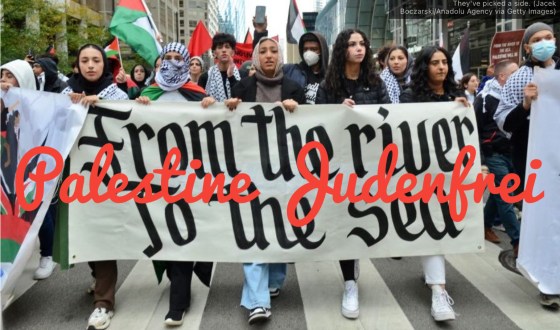
Since the Simhat Torah massacre, which mirrored in so many ways the pogroms inflicted upon Jewish communities in Eastern Europe in the late nineteenth and early twentieth centuries, what we’ve been seeing in cities around the world is that antisemitism is the devil that never goes away. One could also ask whether anti-Zionism is but an old hatred clad in new clothes. One phenomenon of anti-Semitism is its ­ability to mutate over history: from religious hatred to ethnic hatred to hatred of Israel in any form. If the marchers want a two-state ­solution, a pathway to peace, they do not say so. They chant “From the river to the sea”, which is a call for ethnic cleansing at best, and genocide at worst, though many do not know the name of the river, or the name of the sea.

Hamas recorded and broadcast the images of its atrocities on October 7 to make sure Israel and the world knew exactly what it had done. Israel has struck back hard on Gaza, killing many civilians in the densely populated region to reach Hamas targets. The Palestinian authorities say over 10,000 civilians have been killed, over a third of them children, and about two-thirds of Gaza’s 2.3 million people have been made homeless, unable to escape the territory. As tens of thousands flee and the bodies pile up, the brief moment of sympathy for Israel has receded and a tide of anti-Jewish sentiment is rising around the world.

International political theorist Arta Moeini wrote in Unherd on 4th November: “The moment Hamas carried out its heinous terror attacks against Israel, the war in Gaza was instantly globalised, reverberating in the hearts and minds of people oceans away who were neither Israeli nor Gazan. Millions on social media picked a side, proudly displaying their solidarity flags and condemning their opponents as either evil terrorists or genocidal oppressors. Both foreign states and populations assumed reflexive positions, railing against antisemitism or settler-colonialism and identifying with the “victims” in a Manichaean struggle that cares little for historical context, nuance or open debate. They became virtual participants in the conflict, as if their own lives and futures depended on it, cancelling and dehumanizing their opposition other just as the most extreme Hamasi Islamist or Israeli Zionist would do”.

In western, Liberal-democratic countries with some of the largest Jewish communities there are mass marches with open calls to kill Jews; there is the defacement and removal of posters of hostages being held in Gaza; and Israel is being held responsible by mainstream politicians and media figures for war crimes committed by Hamas; and there’s a flood of antisemitic poison on social media. It appears to have given permission for progressive activists to clothe antisemitism as anti-colonialism, and indeed, an alibi to say the most racist of things, and yet to retain all innocence in their own minds. And the more morally certain people are that they are right, the easier it is for them to miss their own complicity.

Rare is the criticism of the less savoury aspects of Muslim religion and society, like its patriarchal authoritarianism, its latent misogyny, and its antisemitism and homophobia. The intersectional narrative inhaled by activists, giving comfort to the “oppressed” legitimizes unspeakable cruelty against the “oppressor”. Hence, we have the sublimation of antisemitism into support and justification for the atrocities of the Hamas. [Pogrom, by the way, is a Russian-Yiddish word derived from “to destroy by violence]

Many people, particularly on the left, have forgotten or just ignore what triggered the latest bloody episode in the long running bloody saga. If you deliberately target civilians, regardless of your ideology, religion or ethnicity, you have lost all moral authority whatsoever. There are no excuses, no mitigations and no explanations. You have become the very thing you purport to hate.

For sure, an almost sixty year long occupation of the West Bank and the ongoing blockade of Gaza are criminal, and Israel’s behaviour thereby, is inexcusable. We can argue forever whether it is justifiable or necessary. But remember that in Gaza, the Hamas is a quasi-government, and a reactionary, exclusivist outfit with a “post-Israel” vision that will produce an ethnically cleansed theocratic dictatorship. And when it launched its troops on the kibbutzs of the Negev twith orders to behave like Da’ish, murdering kids at a music festival killing, raping, mutilating, and abducting unarmed men, women, children and babies, the opprobrium inevitably and unfortunately attaches to all Palestinians.

It is not helped when in the West Bank and elsewhere, such “bravery” is celebrated with sweets, ululation and “happy shots”, when people in a crowd in the forecourt of the iconic Sydney Opera House chant from the river to the sea” and “gas the Jews”, and social media is awash with memes that display but limited knowledge of the history and politics of the Middle East.

The Hamas now holds some 250 Israeli men, women and children captive in Gaza, adding to over two million Palestinians that are serving as human shields against what it knew would be inevitable Israeli vengeance. It has reportedly three months of supplies in its tunnels whilst above them, the Gazans run out of gas, food and water and medical facilities are brought to a standstill. Hundreds of thousands of civilians are now caught in a crossfire of Hamas’ making. There are reports that the Hamas is preventing Gazans from leaving, determined to use them as human shields, and has actually fired on fleeing convoys. They need to be protected, but how? We need to seek justice for Palestinians without glorifying unspeakable violence.

Luxury beliefs and historical illiteracy 

The term “luxury beliefs” was coined to describe how privileged progressives like to traffic in a kind of unhinged extremist rhetoric. Partly, it’s a byproduct of their insulation from ever having to experience the practical impact of what they advocate. When people in Australia chant “from the river to the sea”, and “gas the Jews”, relatively few are saying this because they have a material interest in obliterating the real Israel and rendering the land “Judenfrei” (remember that word!) More have no particular animus toward Jewish people – they just don’t care about them. But most are moved by a desire to weaken what Israel symbolizes: the US.

Many left-wing impressions are coloured by a an antipathy for the policies of the United States, an antipathy that for many was born of the Vietnam War and was perpetuated by America’s interference in the affairs of nations large and small since then – and of course, America’s strong ideological and military support for Israel. Uncle Sam certainly does have a case to answer. There’s no denying the hundreds of thousands, millions maybe, of bodies of men, women and children that could be laid at the foot of Abe Lincoln’s huge statue in Washington DC. But giving aid and comfort to a regime that is antithetical to your beliefs and also your lifestyle does not compute. It is an ideological stance uninformed by knowledge and awareness of the nature of the Israeli and Palestinian entities, their peoples, and their cultures in the 21st Century. None of these are what they were in the nineteen seventies and eighties.

Writing in The Australian on 29th October, commentator Gemma Tognini wrote: “As I watched mainly white, middle-class privileged (in the truest sense of that word, not the co-opted, cheapened version) people parade themselves around as soft apologists for a declared terror organization, I felt despair. How? How did we get here? … What’s been on display on university campuses since October 7 has been terrifying in its historical illiteracy, lack of humanity and ideological zealotry”.

It’s worthwhile quoting what else she had to say about such “luxury beliefs”:

“… This is the soft generation. Their grandparents fought type 2 diabetes, not Nazism. It was reported that (perhaps unsurprisingly) the University of Sydney Student Representative Council urged students to “stand against oppression … until Palestine is free”. Let me tell you one thing I’m willing to bet on. Not one of them would volunteer to go help the cause. Not one of them would give up their Uber eats, days at the pub and total freedom to go live in a place where being gay is an offence punishable by death, fewer than 20 per cent of women are allowed to work and more than 20 per cent of women are married under the age of 17. Good luck wearing a bikini or your active wear in downtown Gaza.

And then, there’s a punchline: “… this conflict in the Middle East, this visceral, existential attack on Israel, and on Jewish people the world over, seems to have ripped something open to reveal an ideological hatred that I don’t understand. It’s a good impetus to raise the voting age, to be honest. If your response to the fact that the Arab states are refusing to take refugees, that Egypt won’t open its northern border for the same reason, is “Israel’s committing genocide”, then sorry, you’re not intellectually agile enough to be in the conversation … If it were 1400 young people barbarically slaughtered anywhere else in the world, if it were any other ethnic cohort, these same junior cowards, and the universities they attend, would be condemning the act and the actors”

I couldn’t say it better, particularly her allusion to “historical illiteracy, lack of humanity and ideological zealotry”. Many people out there in the world of university politics, social media, and reflex virtue signalling, have, for a variety of reasons a limited, even cursory knowledge of the roots and fruits of intractable conflicts that originated decades, centuries, millennia ago. As the late Israeli Amos Oz explained in his excellent book, How to Cure a Fanatic, Arabs and Jews typically understand each other far better than westerners understand either of them. Cost-free wisdom from western liberals is so often pathetically ill-informed and bathing in self-righteousness.

Russia’s invasion of Ukraine did not originate in 2022 or 2014 or even 1991 when Ukraine departed the defunct Soviet Union. The wars of the Yugoslav secession did not begin when Serbia attacked the newly independent states of Slovenia, Croatia, Bosnia and Kosovo from 1991. The seeds of the Syrian civil war were sown well before 2011. So too with the story of Israel and Palestine, one of the world’s most intractable conflicts, did not begin on October 7th.

A war of words 

Understanding is not enhanced when a conflict morphs into a battle of words as well as weapons, the words invariably loaded with emotional and ideological weight. Enter the old adage “one person’s terrorist in another’s freedom fighter. The Hamas calls itself al muqawamah, resistance – it’s the “m” in its acronymic name – see below) as also does Hezbollah, which means literally Party of God (though the deity him/herself has no say in the matter). Türkiye’s opportunistic president calls Hamas fighters mujahidin, holy warriors, a name that recalls Afghanistan resistance to Russia’s invasion in the eighties. Whilst some refer to a terrorist attack, many pro-Palestinian groups have called it an intifada, as have memes and posters put up by “progressives” recalling the two earlier risings against the occupation, implying that it was the work of freedom fighters resisting colonialism. Some have even called for a “global intifada”, though against what and whom is unclear.

Then there’s the sad semantics around other descriptors, each loaded with partisanship and emotion. Self-defense. Proportionate or disproportionate response. Collective punishment. Moral equivalence. Human shields. Hostages. Refugees. Collateral damage. Just war. War crimes. Genocide. Justice, Revenge. Warriors. Executioners. Shahidiin (or martyrs). Thugs. Pick a side, pick your vocabulary to suit. It makes you wish for the now depleted ammo of syntax like “shock and awe” and “war on terror” – though we’re getting plenty of both right now as “we sit back and watch while the death count gets higher”.

Only two things are certain: antisemitism is the devil that has never gone away, and everything is broken.

As Leonard Cohen sang, “There is no decent place to stand in a massacre”.

Meanwhile, in the corridors of power

On 24th October, Antonio Gutierrez, the perennially exasperated and disappointed secretary general of the United Nations, told the Security Council that “it is important to also recognize the attacks by Hamas did not happen in a vacuum. The Palestinian people have been subjected to 56 years of suffocating occupation. They have seen their land steadily devoured by settlements and plagued by violence; their economy stifled; their people displaced, and their homes demolished.

Truth be told, it has indeed been the past that has brought us to this. Lost in the miasma of violence is the fact that Israel has occupied the West Bank for 56 years and, along with Egypt, maintained  a cordon sanitaire around the Gaza Strip. Prominent features of life for Palestinians in these areas are violence, dispossession, and dehumanization. Under these circumstances, there are few Palestinians who regard resistance as illegitimate. The ‘Hamas attack was a reaction to many things, including settler attacks on and evictions of Palestinians in the West Bank; attacks on Muslim and Christian holy sites by Israeli extremists; and Israel’s normalization with Arab countries, that is seen as an attempt by Israeli Prime Minister Benjamin Netanyahu to “liquidate” Palestinian rights and the Palestinian cause.

“But” as Guterres then stressed, “the grievances of the Palestinian people cannot justify the appalling attacks by Hamas.  And those appalling attacks cannot justify the collective punishment of the Palestinian people”. Their hopes for a political solution to their plight have been vanishing”.

Israel’s delegate was predictably enraged. But Guterres’ statement at least condemned the Hamas – unlike a UN General Assembly resolution a few days later which condemned Israel for its collective punishment of defenseless Gazans whilst completely ignoring the direct causus bellum. Making no reference to the barbarous attack by the Hamas was an absurdist denial of reality, as if Israel had decided to bomb Gaza on a whim, unprovoked.

Like Guterres, politicians across the western world endeavour to straddle the barbed wire fence, calling almost out of habit for the elusive “two state solution” as a panacea for the Palestinians’ plight. But in reality, there can be no two-state solution when an immovable and irredentist Hamas remains as a powerful if beleaguered “third state”. As Australian prime minister Anthony Albanese stated, “we have picked a side against Hamas. And we did that very clearly and unequivocally because the actions of Hamas are against the interests of both the Israeli population, clearly, but also against the interests of Palestinians”.

Calls for a ceasefire by world leaders and humanitarian organization’s go unheeded in the stark reality that a ceasefire would effectively give the Hamas the justification to declare victory whist permitting the mortal threat it poses to Israel to continue. Israel knows that if its response to the terrorists is unconvincing, the attacks on it on all sides will redouble. The sharp rise in global antisemitism reminds Jewish people that they may never be truly safe anywhere., and this intensifies, rather than weakens, the desire for a defendable homeland.

The Hamas and together with the ineffectual, corrupt and discredited Palestinian Authority which ostensibly governs the West Bank, and Hezbollah, the Lebanese paramilitary force on Israel’s northern border, most Arab states, Iran, and their western and southern sympathizers blame the situation on the historical behaviour and present policies of Israel and the US, implying that really, Israel had it coming.

There is much discussion in the mainstream media about what comes next if the Hamas is destroyed or effectively neutered and Gaza is “liberated” from its thrall. Should the IDF reinstate the occupation it ended two decades ago? Should Israel hand the enclave over to the Palestinian Authority, to use a decidedly un-Muslim analogy, organize a piss up in a brewery? Or should the UN, or at a stretch, the Arab League, a club of autocrats and tyrants, assume military and political administration until it can be reincorporated into a reformed and workable Palestine?

And even then, should any of these scenarios work out, would Israel be in the mood to make nice? The Hamas pogrom has not helped Palestinians in besieged Gaza, nor will it help those in the occupied West Bank who have been subjected to IDF incursions and vigilante violence by angry settlers. Nor will it encourage Israel to moderate its draconian policies and end the occupation.

Little mention has been made, both before and after outbreak of war of what may have been going on in the PA’s domain. The old, ineffectual and rejected Mahmoud Abbas, “emir” of Palestine, in the eighteenth year of his four-year term, is ill and probably dying, so there is a power struggle already underway in what are in fact three Palestines, Gaza, the West Bank, and the Diaspora (principally Syria, Lebanon and Jordan) over the succession. Meanwhile, Iran and its proxy, Hezbollah are stirring the pot, whilst even the Yemeni Houthis, who you’d think were busy with their own nasty civil war, the third strand, with Hezbollah and the Hamas of Iran’s “Axis of Resistance”, are lobbying missiles Israel’s way up the Red Sea.

The whole thing is a bloody mess (literally and figuratively) and the implications for Israel, Palestine and others unpredictable. The violence reminded me of the Lebanese civil war, and particularly, of Maronite Christian militia’s massacre of Palestinians in Sabra and Chatila (ironically, with Israeli connivance) in 1982. I am reminded also of Chaim Nachman Bialik’s poem, Al haShehita (On the Slaughter), about the Kishinev Pogrom in present day Moldova in the spring of 1903:

And cursèd be he that saith: avenge this! Such vengeance for blood of babe and maiden Hath yet to be wrought by Satan.

Whosoever sows the wind reaps the whirlwind.

Rafah, Gaza

From the river to the sea, Palestine will be free 

It is much more than a snappy chant. The Hamas’ stated goal is the “liberation” of what is presently Israel and the expulsion annihilation of its people, and it pays little heed for the suffering of the people of Gaza – Hamas leader Moussa Abu Marzouk, for example, in a recent interview on Russia Today’s Arabic channel, told an interviewer that his movement had not built bomb shelters in Gaza for its population because it was the job of the UN and the “occupation” – that is, Israel – to look after the civilians of the Strip.

In an interview on October 24, 2 on Lebanon’s LBC TV. Ghazi Hamad of the Hamas political bureau declared that the Hamas, was prepared to repeat the October 7 “Al-Aqsa Flood” Operation time and again until Israel is annihilated. He added that Palestinians are willing to pay the price and that they are “proud to sacrifice martyrs.” He said that Palestinians are the victims of the occupation, therefore no one should blame them for the events of October 7 or anything else, adding: “Everything we do is justified.”

Some extracts:

“We must teach Israel a lesson, and we will do this again and again. The Al-Aqsa Flood is just the first time, and there will be a second, a third, a fourth, because we have the determination, the resolve, and the capabilities to fight. Will we have to pay a price? Yes, and we are ready to pay it. We are called a nation of martyrs, and we are proud to sacrifice martyrs”.

“We did not want to harm civilians, but there were complications on the ground, and there was a party in the area, with [civilian] population … It was a large area, across 40 kilometres”.

“The existence of Israel is illogical. The existence of Israel is what causes all that pain, blood, and tears. It is Israel, not us. We are the victims of the occupation. Period. Therefore, nobody should blame us for the things we do. On October 7, October 10, October the millionth – everything we do is justified”.

Hamad: “The occupation must come to an end … I am talking about all the Palestinian lands”
News anchor: “Does that mean the annihilation of Israel?”
Hamad: “Yes, of course”.

If the Arabs put down their weapons today, there would be no more violence. If the Jews put down their weapons today, there would be no more Israel.
Golda Meir, Israeli prime minister, 1973

© Paul Hemphill 2023 All rights reserved

Note: al Hamas is the Arabic word for ‘zeal’ and also, an acronym for Ḥarakah al-Muqāwamah al-ʾIslāmiyyah, the “Islamic Resistance Movement”; Hezbollah means ‘Party of God’.

For more on antisemitism in In That Howling Infinite, see: Little Sir Hugh – Old England’s Jewish Question; and The Shoah and America’s Shame – Ken Burns’ sorrowful masterpiece 

For more on Palestine and Israel in In That Howling Infinite, see: A Middle East Miscellany
Addendum – poster wars

Why are Americans tearing down posters of children held hostage by Hamas?

Linda Dayan wrote in Haaretz on 26th October:

Those removing flyers may not be ready to look into the eyes of ‘the other side’ and acknowledge that they are people. But the consequences of this lack of introspection go far beyond posters

If you’re a Jew on Instagram, you’ve probably seen a particular genre of video going around: a shaky phone camera follows a person, either in a big city or on a college campus, as they tear down posters bearing the names and faces of Israeli civilians kidnapped by Hamas.

Sometimes they’re smiling, sometimes they’re defiant, sometimes they hide their faces from the person filming them. In one, the person says “kalba” (the Arabic word for bitch) while tearing down a flyer. In another, a man holding a wad of posters says he is doing so because “Jews in Israel – I mean, the Israeli government – are bombing Gaza.” When the cameraman asks, in a thick Israeli accent, why Hamas killed babies and even pets, he responds: “I can’t explain what people filled with rage do.”

Channel 12’s Yuna Leibzon tweeted photos from New York of posters that had been defaced – instead of “kidnapped,” they now read “occupier.” (If the person who did this is not Algonquian, I have unfortunate news for them about their own status.)

It is clear that the posters rouse discomfort in these people, and not in the “this could have been me” way that many Jews view them. Some, like the aforementioned man, look into the faces of abducted children and see the airstrikes that followed. Others have mentally transformed them into human embodiments of the occupation. A few accounts state that the people tearing down the posters do not believe that Hamas took hostages at all.

The people kidnapped by Hamas, much like the October 7 atrocities, represent a kink in a very clear narrative thread. The people holding tight to this thread might not be ready to face the realization that not all acts are justified so long as they bear the banner of “resistance.” They might not be ready to hold the idea that it’s okay to say out loud that the occupation is wrong, but so is holding an infant hostage. They might not be ready to look into the eyes of “the other side,” and acknowledge that they are people.

But the consequences of this lack of introspection go far beyond posters and posing. After a silent vigil in which they held photos of the kidnapping victims, Jewish students at the Cooper Union had to barricade themselves into the library as anti-Israel protesters stormed the building. The Anti-Defamation League reported 193 antisemitic incidents since October 7 – a 21 percent spike in the United States. A University of California, Davis, professor posted online against “all these Zionist journalists who spread propaganda and misinformation,” and noted that their children are vulnerable.

It is good, correct and just to stand up for Palestinians, to make the plight of Gazan civilians known, to mourn for the innocent lives lost. None of that demands erasing the reality of Hamas’ campaign of kidnapping and murder. And none of that demands harassing, threatening and attacking Jewish institutions and individuals, wherever they may be.

Of course, this may not be about Palestinians at all: Alawi and Shi’ite students in America did not have to barricade themselves in after Bashar Assad’s airstrikes on the Yarmouk Palestinian refugee camp. And in that case, perhaps these people can leave the Palestinians out of such campaigns, and be open about the narratives and ideologies that drive them to erase the faces of our children.

A defaced poster depicting a woman held captive by Hamas is seen as people attend a pro-Palestinian rally as part of a walkout by New York University students

Authors Note

Whenever In That Howling Infinite posts commentaries such as this, people ask why I rarely forward my own opinion on the issues I am presenting or discussing. On the contrary, I would argue that my views are fairly transparent in in the subjects I chose to engage with, the words I use, and the vein in which I use them. 

The following is an updated version of a postscript I wrote six years ago after I’d last visited Israel. It does not mention in detail the events since then, including the Israel’s rapprochement with its autocratic neighbours, the political paralysis that has afflicted Israeli politics for several years, and the war now being wages in the besieged enclave of Gaza. The rest still holds true.

With respect to my numerous posts about Israel and Palestine, and the Middle East in general, I  come to my conclusions from a political science and sociology perspective – that’s where my academic experience came from – and a background in conflict resolution, supported by study and travel. If I do on occasions display any particular bias, it originates in my longtime interest, understanding and affection for the history, politics, and culture of the region, of its geography and archeology, and of its people of all faiths and nationalities.

I believe that the systematic dispossession of almost a million Palestinians and the destruction of half of their towns and villages in 1948 is Israel’s original sin. It is the primal stain that colours and corrupts all that followed. And yet, if not for the actions, often daring, often brave, often questionable, and often deplorable, of the politicians and soldiers of 1948 – and of the generations that followed –  Israel would not exist today. This paradox is addressed sympathetically by Avi Shalit In My Promised Land, referred to above, and scathingly by ‘new history’ scholar Ilan Pappe in The Ethnic Cleansing of Palestine.   

The Occupation, fifty-six years old this year, which grew out of the unexpectedly total victory of June 1967, has taken on strategic, ideological and indeed messianic dimensions by many in the  Israeli government and political elite. It compounded the original sin, deepened the primal stain, released the demons of messianic fervour, and wounded Israel’s soul. The settlements locked the nation into the colonialist project. With the close call of the Yom Kippur War, the violence and murder of the first and second Intifadat, and present Palestinian jacquerie, Israel’s heart has not just hardened, it has become sclerotic.

I admit that I have always been sympathetic towards Israel – from my first visit in 1972. I’ve travelled its length and breadth and also visited the major Palestinian cities of the West Bank. But mine is not a blinkered viewpoint. I am deeply critical of Israeli politics and policies and have no respect for many of its leaders. Yet there are hundreds of thousands of Israelis who oppose the present government and long for justice and peace. And if – a very big “if” – Arab Israelis and the Israeli left could work together, they could obtain a majority in the Knesset and change Israel’s politics.

Meanwhile, Binyamin Netanyahu and his nationalist coalition allies call all the shots, the Israelis continue to control and exploit the land, its people, and its resources, whilst varying degrees of annexation are on the cards. The settlements are an abomination, as are the policies and practices of the state and its occupying army. There’s no escaping these facts.

But I am likewise critical of Palestinian governance, politics and politicians. The Hamas and the PA are on the nose in their respective fiefdoms, and if a moderate “third force” were to arise – and survive, because sure as hell, they would risk being murdered – Palestinians who just want a quiet, normal life, adequate services, and opportunities for their children, and Israelis who want likewise, might – just might – reject their extremist, dogmatic, entrenched leaders and reach some form of modus vivendi.

Palestinians themselves have to take control of their own lives, kick out their corrupt leaders, cease inculcating their children with hatred and jihadism, and use all that international good will and dollars to build a viable economy that can provide jobs, opportunities, and security, economic and physical to the people. Only this way will they be inoculated against cronyism, corruption and extremism. And yet, the dead hand of a moribund, patriarchal, conservative and ethnocentric culture holds them back – but that is the subject of another, future discussion for In That Howling Infinite.

Today, the ‘powers that be’, defenders and beneficiaries of a status quo that looks more like a cul de sac, predominate over a dispiriting array of competing, clamouring factions, left, right, nationalist, secular, tribal, Haredi, and Islamist alike. New, young, brace, local voices in both Israel and Palestine, are not heard.

So what happens next?

I get that question too. And I am perennially reluctant to venture an answer beyond one that runs like “on the one hand…but then on the other”.  I inevitably fall back on Robert Fisk’s response to the same question with regard to the calamitous freezing over of the Arab Spring and the fall and rise again of the same old autocrats and tyrants: “my crystal ball is broken”. It’s a cop out, really, but just as cogent as that famous line in that UK spy drama Spooks: “What’s going to happen to me?” “Bad things!”

One thing is for sure: as songwriter Warren Zevon sang, “the hurt gets worse, and the heart get harder”.

October 8th, 2017, and 6th November 2023

The new anti-Semitism looks a lot like the old hatred

The current wave of anti-Jewish hostility did not originate with the Gaza war, and its horrors. It has been building for decades.

Anti-Israel signs are held at a Palestine rally in Melbourne’s CBD. Picture: NCA NewsWire / David Crosling

Anti-Israel signs are held at a Palestine rally in Melbourne’s CBD. Picture: NCA NewsWire / David Crosling

Since the Hamas mass terrorist attack on October 7 and Israel’s military response, we have witnessed an explosion of anti-Jewish hatred. It is frequently mixed in with legitimate expressions of support for Palestinian civilians suffering the terrible violence of a protracted conflict. The Netanyahu government’s conduct of the war is certainly a reasonable target for trenchant criticism, including by Israel’s own citizens.

The combination of these themes makes the public response to the Gaza war complex and difficult to process. For most Jews it is nothing short of a continuing nightmare.

Deep anti-Semitism has been on vivid display in certain parts of the movement leading the anti-Israel protests. This has been explicit in celebrations of Hamas and its terrorist massacre of Israeli civilians as a heroic act of resistance, together with calls for such attacks to be repeated. This has been paired with simultaneous insistence, in some quarters, that no atrocities were committed. The dual response is reminiscent of a certain type of Holocaust denial. On one hand the mass violence that the Nazis committed against European Jewry is justified as a response to the odious behaviour of the Jews, and the threat that they posed to their host societies. On the other the historical reality of the Nazi genocide is questioned, or it is denied entirely.

Shalom Lappin.

Shalom Lappin.

The New Antisemitism by Shalom Lappin

The New Antisemitism by Shalom Lappin

Some anti-Israel demonstrations have skidded into violent assaults on local Jewish communities, and harassment of Jewish students on campuses around the world. Boycotts, exclusions, and “political” acceptability tests in the academic, publishing and entertainment worlds are now common phenomena. They recall darker periods of Jewish history. No other diaspora ethnic group associated with a country run by a widely censured regime is subject to this sort of marginalisation.

When racists target Muslims, or other immigrant groups after terrorist attacks, or the misdeeds of a foreign government, broad segments of public opinion, particularly on the liberal left, defend the victims of prejudice, precisely as they should. By contrast, attacks on Jews are explained away as possibly misguided expressions of fully comprehensible outrage at Israel’s egregious behaviour.

The current wave of anti-Jewish hostility did not originate with the Gaza war, and its horrors. It has been building for decades, as indicated by the steady annual increase in anti-Semitic incidents across the globe, at least since 2000. This has now become a flood. It is the result of deeper economic and political forces that have undermined the social contract that once defined the post-war era. A sharp rise in economic inequality within countries across the world is a major factor driving the unravelling of the post-war era. The unconstrained globalisation of financial markets and trade has been largely responsible for the skewed within-country (as opposed to between-country) distribution of wealth. It is creating a cleavage of populations into a comparatively small group of wealthy beneficiaries of economic growth, and increasingly large groups of people who endure a declining standard of living and jarring social dislocation. This disaffection has provided the basis for a variety of extremist anti-globalisation movements that exploit identity politics as the focus of their reaction to the chaos and instability that is attending the collapse of the post-war order.

A pro-Palestine activist in New York. Picture: AFP

A pro-Palestine activist in New York. Picture: AFP

These movements thrive on the sense of powerlessness among electorates. This is feeding a breakdown of mainstream political institutions, which are increasingly perceived as unable to respond effectively to the pressing problems that people are contending with in their daily lives. Polarisation between far-right and far-left anti-globalisation movements has now become a defining feature in the political life of many countries, with traditional centrist parties fading into irrelevance in a variety of places. The alliance of much of the far left with radical Islamist movements (also a form of anti-globalist, identity-focused reaction) has accentuated this clash. The nature of the alliance has come sharply into view in the course of the ongoing anti-Israel protests over the past 10 months.

The far-right threat has emerged in recent European elections, in Trump’s current presidential campaign, and in the current riots sweeping the UK. It is also apparent in the authoritarian regimes that control Russia, Hungary and Turkey, as well as in Modi’s Hindu nationalist government.

Anti-Semitism is a central feature of the anti-globalisation movements of the far right, the far left and radical Islamism. This is due to the fact that it is deeply entrenched within both Western and Middle Eastern cultures. It encodes myths of power and conspiracy that provide simple, satisfying answers to complex problems in times of severe crisis. It turns on the notion that the Jews are an illicit collectivity whose continued existence as a group obstructs the realisation of the respective (and mutually incompatible) utopian programs to which each of these movements is dedicated.

Anti-Semitism was marginalised in the West during the post-war period. It has now flooded back into mainstream discourse as a potent factor in mobilising support for totalising ideologies across the political spectrum. In its capacity to cross political boundaries from right to left, anti-Semitism is a unique form of racism. To identify it properly, it is necessary to understand its history throughout the millennia that it has plagued the societies where it has taken root. It is essential to recognise its very specific expression as a reaction to the current political and social crisis. It is also important to combat it in its current manifestation, rather than through the backward-looking ideologies of the past.

For the most part the gate keepers of liberal opinion and the custodians of public discourse have simply stepped aside while anti-Jewish campaigns, often packaged as “anti-Zionism”, have been raging in their institutions. They issue pious incantations of their commitment to banishing racism, gender discrimination, anti-Semitism and Islamophobia, while doing nothing to implement this commitment in the current crisis. They take strong action against assaults on other embattled ethnic minorities and gender groups, as ought to be the case. They assume the role of neutral moderators when such attacks are launched against Jews. They frequently sanitise these attacks as an exercise of the right to free speech, even when this speech crosses into active incitement to hatred and violence.

The current wave of anti-Jewish racism is not only a threat to Jews. It is a challenge to the survival of democracy and the viability of liberal values. Political leaders are singularly failing to address this threat, and the forces that have produced it. They are largely content to step back and allow the manifestations of anti-Semitism to multiply, as long as the appearance of public peace is maintained. In fact, this peace is increasingly frayed. The extremist movements that converge on the Jews as the source of their problems have much larger agendas. They seek to transform the social order in their own image, overturning the foundations of liberal democracy.

In treating anti-Semitism as a parochial development, threatening only Jews, current political and cultural leaders are allowing large swathes of public life to be taken over by movements that are determined to overturn democracy. Recent history is littered with precedents that warn of the dangers involved in ignoring the larger threat that anti-Semitism presages. By failing to address these movements, and the deeper causes of the crisis that generated them, political and cultural leaders in the West risk repeating past historical errors that have led to disastrous consequences. It is long past time to address this issue honestly and effectively. To start to do so requires that we acknowledge the extent of the problem, and that we describe it accurately. Most people who shape mainstream opinion in the West have yet to take this initial step.

Shalom Lappin’s The New Antisemitism (Polity Books, 1 September) investigates the upsurge of anti-Jewish racism now manifest across the world

.

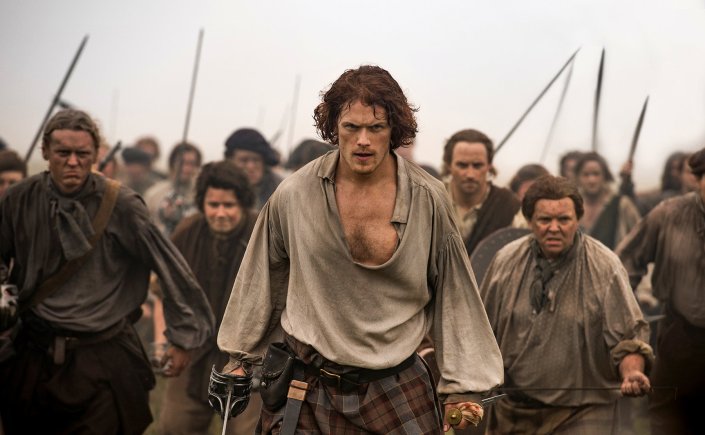
Outlander – if I didna hae bad luck, I’d hae no luck at all …

History can’t be trusted
Brianna Randall

It’s good I’m Scottish. I’m Scottish. I am Scottish.
I can complain about things, I can really complain about things.

Peter Capaldi, the Twelfth Doctor, discovers he has a Scottish accent

The pipes, the pipes are calling …

Well, after nearly a decade, we heard them at last and surrendered to Outlander  

The promise of exotic Celtic locations, steamy sex scenes, and graphic violence was too irresistible – all this and the fact that we’d run out of tempting things to watch on Foxtel, SBS and Netflix … And so we settled down to what would be eight  seasons of the celebrated time-shifting highland fling (before bingeing on Game of Thrones for the umpteenth time. By happenstance, the final episodes dropped on Netflix on the same day as GoT’s imaginative prequel The House of the Dragons – a fine time for fantasy fans. 

If you’re into stories with eye-candy, period costume, great music, loads of gratuitous violence and soft porn garnished with some history, this one’s for you. It’s a bit like reading Playboy for the stories.

And, of course, there’s time-travel, a perennial fantasy and science fiction trope. Nor is time travel involving Scotland original. The many incarnations of Doctor Who have made many visits to Scotland during their adventures. Way back in 1966 The Highlanders saw Patrick Troughton’s Second Doctor arrive in the Scottish Highlands in 1746 just after the Battle of Culloden. It was here that The Doctor met Jamie McCrimmon (actually, Yorkshire actor, Frazer Hines), a piper of the Clan MacLeod who would go on to be a regular and popular companion to the Doctor. Since then, there have been four Scottish Doctors and many Scottish lead characters. American author Diana Gabaldon says she created the Outlander stories (on which the series is based – there are nine of them) after watching Hines in Doctor Who and based her leading man on him. Hines actually has a role in the 21st century Doctor,  Season 1, episode 11.

Fraser Hines as Jamie, 1966

The Whovian Paradox

So, here we were, time-hopping back and forth between 1745 and 1945, the ‘45 Scottish Highland rising and the end of WWII, and then, the American colonies before and during the American War of Independence, the late nineteen sixties and early eighties. The traffic at the magical stone rings of Craigh na Dun, somewhere near Inverness (they’re actually on Lewis in the Outer Hebrides) and North Carolina (apparently, they’re styrofoam) reaches rush hour proportions as one, two, one again, three and four, family members and other sundry “travelers” pass to and fro’.

The title of this piece, as everybody ought to know, is borrowed from the old blues song Born Under A  Bad Sign, immortalised, of course by the best rock trio ever, Cream. It describes a narrative arc which follows a “Groundhog Day” formula. The heroine Clare Fraser late of 1945, a former WWII battlefield nurse, after landing in the Scottish Highlands in 1744, is over ensuing years captured by British Army Redcoats, press-ganged by the Royal Navy, arrested by colonial vigilantes, almost burnt for a witch by superstitious puritans, has sex with Bonnie Prince Charlie, and is serially rescued in the nick of time by her husband, rebellious and handsome highlander Jamie Fraser. Jamie is captured, arrested, flogged, enslaved, kidnapped and worse, and is rescued, in the nick of time by his resilient spouse. This happens numerous times, with sundry villains outwitted, overcome and served their just desserts – with plenty of time to spare for many interminable sex-scenes (why take five minutes of screen time when you’ve seven seasons to fill), and one excruciatingly graphic and gratuitous episode of sexual violence which, counting flashbacks, must’ve taken up to a hour or more of screen time. It must have caused consumer conniptions because by series seven, the show runners had seriously toned down the adult content.

Their ill-starred son in law Roger Mackenzie endures a similar helter-skelter ride as he embarks on a literal “hero’s journey” from academic and folksinger to preacher to late twentieth century “househusband” – his adventures including being press-ganged by pirates, “sold” to native Americans, and fighting successively for the British army and the insurgent Continental Army. 

For all the back and forth, the melodramatic fol-de-rol, the surfeit of rumpy-pumpy and violence, and the gorgeous highland and American scenery, as a historical and well-costumed drama, it presents a well-researched and historically accurate – if simplified – portrayal of society and politics leading up to the Jacobite Rebellion of 1745-46, including a brutal reenactment of the Battle of Culloden, the last battle fought on British soil, and the American Revolutionary War, of the French court at Versailles, of medical techniques in the 18th Century (Clare is an experienced battlefield nurse and qualified twentieth century doctor), and of the original sins that still haunt the United States today: the institution of slavery and the fate of the indigenous Americans. There are many historical characters including an unflattering portrayal of Bonnie Prince Charlie, the leader of the Jacobite forces, and a more sympathetic George Washington (but not his alleged wooden teeth). There is also a brief cameo for the not yet treasonous Benedict Arnold. 

There was an original and to my mind amusing walk-on role which may have gone over the heads of most viewers, particularly as no reference is made to her back story. When Charles Stewart was on the run after Culloden, he was aided in his flight by minor aristocrat Flora MacDonald who was subsequently arrested for her role and consigned to the Tower of London, but later amnestied. She married an army captain also named McDonald, and they emigrated to the American colonies, where she is fleetingly introduced to our Jamie at a society soirée. Her captain actually served with the British forces during the American War of Independence, and as a result, their property was confiscated. They relocated to Canada and soon, after, returned to Scotland. 

One early criticism I had of Outlander was that the highlanders all spoke Scottish Gaelic. Not that I’ve a problem with the tongue because it’s a beautiful language and I wish I could’ve learned Gaelic in the past – it was my Irish mother’s native tongue, though she lost it after years of living in England. But because there were no subtitles. I realized very soon that this was intentional as it emphasised just how alien the whole scene must’ve been to English Claire, now dependent upon Jamie, who, like Mel Gibson’s William Wallace, was multilingual, and a handful of bilingual clansmen to understand what was being said around and about her. Jamie’s pet name for her is Sassenach, meaning foreigner or, indeed, Outlander, derived from the English saxonīs or saxons, and used by Catholic highlanders for protestants of the Anglican persuasion. By the second season, to borrow from Jamie, I “dinnae fash”.

Many books and films of the fantasy genre have endeavoured to resolve what one could call the Whovian Paradox – the desire to go back and change history for the better. But, as the ever-regenerating Doctor himself always cautioned his constantly changing and ever-enthusiastic companions, you can’t just go back and alter history.  We’ve seen it often in films like Terminator, 12 Monkeys and Looper.  For all its melodrama and conjecture, Outlander manages to weave, at times clumsily, through the conundrums and contradictions. But no spoilers here … 

Songs of Rebellion 

Now, let’s talk about the music. The Outlander books by Diana Gabaldon make constant references to songs and music from the periods in which the stories are set, be these eighteenth century Scotland and America or the twentieth century. The series’ soundtrack created by American composer and musician Bear McCreary works well in providing a sense of place and time. As an old folkie of Celtic blood, I enjoyed hearing snippets of songs and tunes that I’ve known since childhood, including Marie’s Wedding and Johnny Cope.

The main theme, in the opening TikTok’s, and as a leitmotif throughout story  is the ersatz Jacobite song Over The Sea to Skye. It’s a grand old song, and I’ve written about it before:

There are many folk songs that we are convinced are authentically “traditional”, composed in the days gone by an unknown hand and passed down to us by word of mouth and then, perhaps, by broadsheets and handbills, rustic kitchens and Victorian parlours, until finally pressed into vinyl during the mid-twentieth century folk revival. And yet many such songs were indeed written by poets and songwriters of variable fame. One such is The Skye Boat Song. 

This famous song is one of many inspired by the Scottish Jacobite Rising against Protestant England’s rule in 1745. It recalls the journey of Prince Charles Edward Stuart, “Bonny Prince Charlie”, from Benbecula to the Isle of Skye as he evaded capture by government troops after his defeat at the Battle of Culloden in 1746. The Jacobite Rebellion was sparked by many political, cultural and economic factors. but essentially, it was a dynastic civil war. 

Songwriter and philanthropist Sir Harold Boulton, 2nd Baronet composed the lyrics to an air collected by Anne Campbelle MacLeod in the 1870s. According to Andrew Kuntz, a collector of folk music lore, MacLeod was on a trip to the isle of Skye and was being rowed over Loch Coruisk (Coire Uisg, the “Cauldron of Waters”) when the rowers broke into a Gaelic rowing song “Cuachag nan Craobh” (“The Cuckoo in the Grove”). MacLeod set down what she remembered of the air, with the intention of using it later in a book she was to co-author with Boulton.

It was first published in 1884 Around 1885 the famed author Robert Louis Stevenson, considering Boulton’s lyrics words “ unworthy”, composed verses “more in harmony with the plaintive tune”. Purged of Jacobite content, these mentioned neither Charlie nor Culloden.

Boulton’s is the one that endured, along with the sentimental perspective Bonny Prince Charlie

But historical fact has never dimmed the popularity of the song. It is often played as a slow lullaby or waltz in many and varied contexts including soundtracks, including Outlander (adapting the text of the text Robert Lewis Stevenson’s poem “Sing Me a Song of a Lad That Is Gone” (1892).

Billow and breeze, islands and seas,
Mountains of rain and sun,
All that was good, all that was fair,
All that was me is gone.

The rendering of the song changes through the seasons, with female and male solos, a capella and choral. The most poignant is that of season 7, featuring as it does Irish singer Sinéad O’Connor, who passed away this July , not long after the season aired fir the first time. Listen to it below. 

There was another piece that was used to excellent and atmospheric effect in the lead up to the Battle of Culloden. Bear McCreary has written: “To properly underscore these episodes, I needed a song that was written during the Jacobite uprising as opposed to after it, a song that makes no comment about loss, only promises of victory.
 I turned to famed Scottish composer and music historian John Purser, who was gracious with his time and assembled a collection a historically-accurate songs for me. I was immediately drawn to the soaring melody in Moch Sa Mhadainn, song composed by Scottish Gaelic poet Alasdair mac Mghaighstir Alasdair (known in English as Alexander MacDonald), a member of Clan MacDonald of Clanranald). A celebrated poet of the Jacobite era, Alasdair composed this song upon hearing the news that Prince Charles Edward Stuart had landed at Glenfinnan. That was perfect!  When Jamie opens the letter in “The Fox’s Lair” and learns he has been roped into the revolution, this song was actually being composed somewhere in Scotland at that very moment.“ Moch sa Mhadainn ‘s Mi a’ Dùsgadh (Early As I Awaken), also known as Oran Eile Don Phrionnsa (Song to the Prince) or Clan Ranald’s Welcome. I have published it at the end of this post.

A Scottish footnote

The two Scottish rebellions of the 18th century were as much civil wars as insurrections against the English Crown. Lowland Scots of the south were against the highlanders of the north. Catholics fought Presbyterians – but many Protestants fought the Crown, a legacy perhaps of the English Civil War, Cromwell’s Commonwealth, the Restoration in the previous century. Clan chiefs allied themselves to the Crown or to the Jacobite cause based upon family ties and self interest. The Crown’s forces at Culloden contained many Scottish soldiers, including senior commanders. Irish Catholic forces who had no love for protestant England fought on the side of the Jacobites. The forces who tracked down the rebels after the battle were often Scots, as were the soldiers and officers carrying out the reprisals and infamous Highland Clearances that followed – the latter being dictated by economics as much as politics, often in the interests of Glasgow and Edinburgh landowners who wanted the land cleared of residents so they could run lucrative sheep farms. A larger than life character like the celebrated Rob Roy MacGregor was very much a charming scoundrel who always had some sort of scheme going, and like most clan leaders, he had contacts in the highest places, including the palace.

I recently rewatched a televisual recreation of the battle of Culloden that I’d first seen in 1964 by British film maker Peter Watkins. For its time, it was a well-balanced account, featuring “interviews” with the principal protagonists on both sides, an engrossing narrative, and some pretty harrowing scenes of the carnage inflicted on the Highland forces by the well-armed and well-trained Redcoats. There is a link to the full film below. 

The Jacobite Rebellion itself was sparked by many political, cultural and economic factors. but essentially, it was a dynastic civil war. The battle on Culloden Moor dashed for two and a half centuries the Scots’ dreams of independence. Charles Edward Stuart, the “Young Pretender” to the Protestant Hanoverian English throne that once belonged to the Roman Catholic Stuart clan, fled into exile in France. And that’s where he remained, although his last resting place is in the crypt of Saint Peter’s Basilica in Rome – an ironic ending for this could’ve been champion of Catholic hopes. Bonny Prince Charlie had many romantic and rousing songs written about him. But in reality he wasn’t the dashing, gallant leader that the songs portrayed and that the Scots and their Celtic Irish allies yearned for. He was an indecisive and vacillating leader who thought himself much cleverer and popular than he actually was. portrayal in Outlander is most unflattering. When the going got rough, he got going – and left the the Scots and Irish who supported him with blood and treasure to the tender mercies of the Sassenach foe”.

And yet, the songs live on to this day, most notably in The Skye Boat Song, Mo Gile Mear, Will Ye No Come Back Again. The old and well-recorded favourite Óró sé do bheatha ‘bhaile has also been associated with the Jacobite cause as Séarlas Óg (“Young Charles” in Gaelic). The poet Padraig Pearse, leader of the doomed intifada we know as the Easter Rising of 1916, added new verses, and so the song entered the rebel canon.

Thou art the choicest of all rulers
Here’s a health to thy returning,
Charlie His the royal blood unmingled
Great the modesty in his visage
Moch Sa Mhadainn (Song to the Prince)

The Jacobites: ‘Don’t let romanticism obscure the threat they posed

Alison Campsie, 19th Nov 2020

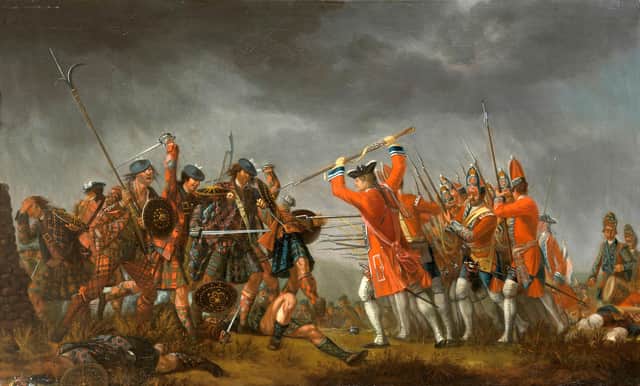
The Battle of Culloden as depicted by Swiss painter David Morier, who was paid a pension by the Duke of Cumberland, the commander of the British Army at the battle. PIC: Creative Commons.
The Battle of Culloden, David Morier, who was paid a pension by the Duke of Cumberland, the commander of the British Army at the battle. PIC: Creative Commons.

The romanticism of Jacobites should not obscure the threat they posed to the British Army in the years following the Battle of Culloden, a leading historian has said.

They soldiers were stationed in 400 cantonment camps – from forts to staging posts – from Lerwick to the Western Isles and from Aberdeen to Gretna, with 60 patrols remaining in Scotland a decade after the battle.

 
Professor Pittock, in an online lecture hosted by History Scotland magazine, said: “Although Jacobitism became romanticized, that romanticism should not be obscured by its reality.
 
“Its reality was that it had to be contained so extensively in such a prolonged way and so completely.”
 
He added: “Although the Jacobites became romanticised the romanticisation was itself a reaction to the seriousness of the threat it was seen as posing at the time.

“Romanticism kept the Jacobites alive but it also kept it at a safe distance.”

Prof Pittock noted that around 1,000 Jacobites died at Culloden with another 2,000 killed in the days that followed given the army’s ‘licence to kill’ supporters of the cause.

Soldiers were paid 16 guineas for the capture of Jacobite colours and 2s and 6d for every Jacobite musket or broadsword seized, Prof Pittock said.

He added that Cumberland and his commanders rotated their soldiers every three months in order to prevent connections being forged with local people.


Their longer term role was to police ‘Highland dress’, protect the collection of taxes and “overawe the local population”.

But residents chose not to help the soldiers in some cases with a report from Glen Dessary noting that ‘the people are unwilling to part with any provisions’ for the forces.

Desertions were not uncommon, with two deserters from Pulteney’s Regiment sentenced to death. However, it was decided that one should be spared, with a roll of a dice determining who should live, research by Prof Pittock found.

He pointed to the building of Fort George at Arderseir, which served as a British Army garrison from 1757, which cost around £2m to build at a time when Britain was heading into the Seven Years War while servicing a massive national debt.

“What that should tell us that whatever people might think about the Jacobite cause being romanticised, or it being wrong, it was not what their enemies thought at the time,” Prof Pittock added.

“That is extremely important. You cannot understand Jacobitism by looking down the wrong end of a telescope,” he said.

Details of the British Army occupation of Scotland following Culloden have also been brought to light by the Stennis Historical Society, which has researched and digitised hundreds of records of cantonment camps set up across the country post-Culloden.

The Jacobites who fought on after Culloden

The Scotsman, 16th Apr 2019

The battle was lost, the rising was over, and the rebels were told by their leader to go home. But for hundreds of Jacobites, the fight was still on, despite their defeat at the Battle of Culloden, with many remaining armed and engaged long after Bonnie Prince Charlie went on the run on April 16, 1746.

Around 1000 Jacobites ­gathered the following day at Ruthven ­Barracks, where a written order from Prince Charles Edward Stuart told them to “seek their own safety” and disband,

But, for many, surrendering was too dangerous an option, according to Professor Murray ­Pittock, ­historian and pro-vice principal of Glasgow University.

As time went on, the risks of Jacobites handing themselves in became clear.

Prof Pittock said: “The mood of the Ruthven meetings was downcast. Many fought on to avoid capture or because the risk of surrendering was high.

“To see how the British Army is dealing with people, there is not really a lot of incentive to go home. They think they will be at more risk.

“In June, a number of Jacobites went into Fort William after the British government ­promised six weeks’ immunity. Captain Scott drowned them in a salmon net.”

Jacobites engaged in low-level disruption, raiding and ­protection of vulnerable tenantry as well as recruitment to the Irish Brigade and probably Scottish regiments in French service, including Ecossais Royales.

Assassinations of unpopular ­government officers or sympathizers were also recorded. The British government still considered the Jacobite threat to be “major” at this time with around 12,000 to 13,000 soldiers deployed across the entire country – from Berwick and Stranraer to Elgin, Forres, Stonehaven, Inverbervie and Montrose – by the end of August 1746.

As government forces mobilized, significant units of armed Jacobites continued to appear in the field, said Prof Pittock, who is due to publish a book on the British Army between 1746 and 1760.

At the end of April, 120 armed MacGregor men were recorded in Balqhuidder after marching home ‘colours flying and pipes playing’ with the Army unwilling to tackle or pursue Jacobite units that maintained discipline, Prof Pittock said.

One battalion of Lochiel’s ­regiment was still operational in May – as were 500 men under ­Clanranald. Orkney remained under Jacobite control until late that month and, despite British attacks, four local Jacobite lairds remained successfully hidden.

Clans made concerted attempts to resist Cumberland and his men with around a dozen chiefs meeting at Mortlaig in early May.

“At the meeting… they entered into a bond for their mutual defence and agreed never to lay down their arms, or make a general peace without the consent of the whole,” according to an 1832 account by James Browne.

“By the bond of association, the chiefs agreed…to raise on behalf of the prince and in defense of their country, as many able-bodied armed men as they could on their respective properties.”

Around 600 men gathered later that month across the north and west but the clans “ultimately did not have the time or morale to raise or retain enough men in the field,” Prof Pittock said.

Although a unified response failed to materialize, Jacobites remained active across Scotland. Jacobite expresses – the non-stop delivery of letters by horse – continued until August. A British regiment was deployed across Banffshire in the summer of 1746 with insurgents reported in Argyll that September.

Arms were surrendered in the Mearns right into the summer of 1748.

“British atrocities may have been carried out against innocent ­victims, but there were plenty of continuing Jacobite threats,” Prof Pittock said.

© Paul Hemphill 2023 All rights reserved

Over the sea to Skye

Mo Ghile Mear – Irish myth and melody

The Shoah and America’s Shame – Ken Burns’ sorrowful masterpiece

And high up above my eyes could clearly see
The Statue of Liberty
Sailing away to sea
And I dreamed I was flying
Paul Simon, American Tune

Ken Burns is a documentary maker and storyteller without equal. All his films are masterpieces of American history. I’ve watched much if not most of his work. They are among the most unforgettable histories I’ve ever viewed, high up in what I’d consider the pantheon of the genre, alongside The Sorrow and the Pity, The Battle of Algiers, Salvador and Waco – Terms of EngagementThe Civil War raised the bar so high that very few documentary filmmakers have reached it, with its mix of surviving photographic images (in an style that Apple now promotes as its “Ken Burns Effect”) and the mesmerizing recitation of diaries, letters home, and official communications. The West confronted his country’s enduring creation myth with an honesty balanced by empathy. The Dustbowl was breathtaking in its images, its narrative and the spoken testimonies it presented. The Vietnam War was a relentless, harrowing story told in pictures and the witness of the people ground zero of a a conflict that has been called “chaos without a compass”.

The US and the Holocaust is Burns’ latest film. It does not make for easy viewing being a searing indictment of America’s response to the catastrophe that was approaching for European Jewry. It’s a significant exposition centred on just how much evidence was accessible to Americans during that appalling time, and asks just why rescuing Jews was no priority, except for those few individuals who actually took risks to help. As Burns observed: “There is an American reckoning with this, and it had to be told. If we are an exceptional country, we have to be tough on ourselves and hold ourselves to the highest standard. We cannot encrust our story with barnacles or sanitise our history into a feel-good story”. As historian Rebecca Erbelding suggests, “There is no real perception in the 1930s that America is a force for good in the world or that we should be involved in the world at all. There is no sense among the American people, among the international community, that it is anyone else’s business what is happening in your own country”. There is indeed a disconnect between America’s self regard as the land of the free and the “light on the hill”, and the cold reality – and realpolitik – of its actual record at home and abroad. There is a none too subtle irony in the titles Burns has chosen for each two hour episode, drawn from extracts from the poem by Emily Lazarus that adorns the base of The Statue of Liberty (see below).

Burns work reminds us that historical memory in America, Europe, and indeed Australia is often like a sieve. Give it a good shake and only the big chunks are left. The story of the US’ public opinion and government policy regarding the worsening plight of European Jewry during the nineteen thirties and the a second World War is not one of those. When I posted an article about the film on Facebook, many Americans commented that they were unaware of their country’s disregard and outright obstruction. Burns has opened a crack that has let the light in.  

The quotations cited above are from a review published recently in the Weekend Australian which I have republished below – it is an excellent and quite detailed account of the issues and the incidents featured in this sorry tale, and I cannot better it. But I will note one distinctive feature of Ken Burns’ documentaries – his skill at recounting unfolding stories which he interweaves through the ongoing narrative, drawing viewers inexorably in and acquainting them with the characters, their hopes and their fears, and ultimately, their fates be these tragic – alas. in the most part – or fortunate.

In The Vietnam War, I followed the journey of an eager and patriotic young soldier, Denton “Mogie” Crocker, as he roved out from mall town USA to the battlefields of Indochina. I recount it. in The Ballad of Denton Crocker – a Vietnam elegy. In America and the Holocaust, there is the story of Anne Frank’s family as they sought asylum in the USA from the moment the the Nazi regime started to come down hard on Germany’s Jewish community. We all know how that ended for Anne and her sister. There is also the saga of what Hollywood called “the voyage of the damned”, the subject of an overwrought and overacted feature film, which nevertheless was based upon the actual voyage of the SS St.Louis which departed Hamburg with nearly a thousand desperate but hopeful travellers, but was refused entry into American and Canadian ports, and returned eventfully to Rotterdam where Britain, Belgium, France and the Netherlands gave them shelter. The latter three were conquered by the Wehrmacht in 1940, with harrowing consequences for those passengers who settled there, but a half of the St. Louis’ human cargo survived the war, predominantly those who were permitted to settle in Britain. 

On a personal note, whilst I am myself of Irish descent, Catholic and Protestant in equal measure on each side, my wife’s father’s family were Jews from eastern Germany and Czechoslovakia and experienced the same travails as those described in Burns’ film. Many, including her father’s elderly parents, perished in the death camps, and are memorialised the Yad Vashem shrine of remembrance in Jerusalem – which I have visited many times. Others managed to leave Germany, including her father, who settled in London, where she was born, and her uncle who a  lawyer who left Germany in 1933 after the promulgation of the infamous Nuremberg Laws, who settled in England and  and then made Aliyah to Palestine, ending his days in Haifa, in an independent Israel. Others headed westwards to Latin America in the hope of securing entry to the US from there.

Epilogue. Antisemitism, the devil that never dies

It has been said, with reason, that antisemitism is the devil that never dies. And yet, is antisemitism a unique and distinct form of racism, or a subset of a wider fear and loathing insofar as people who dislike Jews rarely dislike only Jews?

Fear of “the other” is a default position of our species wherein preconceptions, prejudice and politics intertwine – often side by side with ignorance and opportunism. it is no coincidence that what is regarded as a dangerous rise in antisemitism in Europe, among the extreme left as much as the extreme right, is being accompanied by an increase in Islamophobia, in racism against Roma people, and indeed, in prejudice in general, with an increase in hate-speech and incitement in the media and online, and hate-crimes.

We are seeing once again the rise of nationalism and populism, of isolationism and protectionism, of atavistic nativism and tribalism, of demagogic leaders, and of political movements wherein supporting your own kind supplants notions of equality and tolerance, and the acceptance of difference – the keystones of multicultural societies. It is as if people atomized, marginalized and disenfranchised by globalization, left behind by technological, social and cultural change, and marginalized by widening economic inequality, are, paradoxically, empowered, energized, and mobilized by social media echo-chambers, opportunistic politicians, and charismatic charlatans who assure them that payback time is at hand. These days, people want to build walls instead of bridges to hold back the perceived barbarians at the gates.

© Paul Hemphill 2023 All rights reserved

From Little Sir Hugh – Old England’s Jewish Question

Also, on American history and politics, My country, ’tis of thee- on matters American

The New Colossus

     Emily Lazarus

Not like the brazen giant of Greek fame,
With conquering limbs astride from land to land;
Here at our sea-washed, sunset gates shall stand
A mighty woman with a torch, whose flame
Is the imprisoned lightning, and her name
Mother of Exiles. From her beacon-hand
Glows world-wide welcome; her mild eyes command
The air-bridged harbor that twin cities frame.
“Keep, ancient lands, your storied pomp!” cries she
With silent lips. “Give me your tired, your poor,
Your huddled masses yearning to breathe free,
The wretched refuse of your teeming shore.
Send these, the homeless, tempest-tost to me,
I lift my lamp beside the golden door!”

Ken Burns’ “The US and the Holocaust” tells of a shameful past

Graeme Blundell, The Weekend Australian, 11th March 2023

A scene from The US and the Holocaust
The latest documentary series from Ken Burns’s Florentine Films, The US and the Holocaust, is inspired in part by the US Memorial Museum’s “America and the Holocaust” exhibition. The series was developed with the assistance of the museum’s historians (many of whom appear in it) and its extensive archives.

It’s a significant exposition centred on just how much evidence was accessible to Americans during that appalling time, and asks just why rescuing Jews was no priority, except for those few individuals who took the risk to help.

For Burns, the series is the most important work of his professional career.

“There is an American reckoning with this, and it had to be told,” he says. “If we are an exceptional country, we have to be tough on ourselves and hold ourselves to the highest standard. We cannot encrust our story with barnacles or sanitise our history into a feel-good story.”

The US and the Holocaust was originally supposed to be released in 2023 but Burns accelerated production by several months, “much to the consternation of my colleagues, just because I felt the urgency that we needed to be part of a conversation”. That conversation for Burns and his colleagues is about “the fragility of democracies” and demonstrating how, “we’re obligated then to not close our eyes and pretend this is some comfortable thing in the past that doesn’t rhyme with the present”.

The filmmaker is fond of quoting Mark Twain’s, “History doesn’t repeat itself but it often rhymes,” and like all his films he wants this one to rhyme with the present.

“We remind people that it’s important that these impulses are not relegated to a past historical event,” Burns says. “It’s important to understand the fragility of our institutions and the fragility of our civilised impulses.”

As Holocaust historian Deborah Lipstadt, a significant voice in Burns’s documentary, says with some alarm in the series, “The time to stop a genocide is before it starts”.

And Peter Hayes, also a revered historian, says, underling the subtext of the documentary, “exclusion of people, and shutting them out, has been as American as apple pie”.

The three-part, six-hour series is directed and produced by Burns, Lynn Novick and Sarah Botstein, two of his long-term collaborators, and beautifully written by another Burns regular, Geoffrey Ward. As always Burns manages to find major actors to play the parts of his central characters in voice over, including Liam Neeson, Matthew Rhys, Paul Giamatti, Meryl Streep, Werner Herzog, Elliott Gould, Joe Morton and Hope Davis.

And like so many of Burns’s films it’s narrated in that mesmerising way by Peter Coyote, who Burns calls “God’s stenographer”. Coyote is able to voice such complex ideas with authority and empathy, often with a kind of beguiling liturgical intonation.

Stylistically recognisable and cinematically audacious, Burns’s memorable documentaries (many of which he has co-produced with Lynn Novick) include The Civil War, Baseball, Jazz, The War, The National Parks, The Dust Bowl, Prohibition, Country Music and more recently Hemingway. He constructs a compelling narrative by using almost novelistic techniques, imaginatively selecting archival material, photographed in his now famous way, immersing us in photographs, developing characters and arranging details around their stories.

The filmmakers present their story in this new series across three overflowing episodes in six challenging, engrossing hours: the first The Golden Door (Beginnings-1938); the second Yearning to Breathe Free (1938-1942); and the final The Homeless, Tempest-Tossed (1941-).

There are two parallel storylines that continuously reverberate off each other – the American side details the history of American anti-Semitism, the notion of “race betterment” and the evolving immigration policy; the German narrative arc deals with the way hatred of the Jews sprouted over time, how the Nazis pursued the end of Jewish intellectualism, and of course the process of their extermination.

The first episode covers the period from roughly the end of the 19th century to the late 1930s, a historical background that delivers context and perspective for the complex narrative that follows.

A scene from The US and the Holocaust

It’s broken by a short pre-titles sequence that involves new archival material from the centre of Frankfurt in 1933 of Otto Frank, father of Anne, Hitler having been in power for some months. Otto is desperate to get his family to America, but in the absence of an asylum policy, Jews seeking to escape Nazi persecution in Europe had to go through a protracted emigration procedure. It’s an unanticipated and surprising piece of the Franks’s story highlighting an American connection to the Holocaust.

(It’s a lovely, if distressing, example of the way Burns likes compelling personal narrative to wrap his ideas around, finding “characters” who become involved as events dictate.)

There was limited willingness to accept Jewish refugees. America did not want them, as Coyote says. Frank would continue to apply when they moved to Amsterdam but his immigration visa application to the American consulate in Rotterdam was never processed.

As the filmmakers later show so tragically, existence for European Jews became a deadly, exhausting pursuit of passports, identification cards, transit visas, and affidavits. As the journalist Dorothy Thompson, who features in the series, said, “For thousands and thousands of people a piece of paper with a stamp on it is the difference between life and death.”

We then cut to a beautiful period film sequence of the Statue of Liberty, Mother of Exiles, surrounded by slowly floating clouds, and a beautiful reading of the famous poem by 19th-century poet Emma Lazarus printed on a bronze plaque mounted inside the lower level of the pedestal:

Give me your tired, your poor,

Your huddled masses yearning to breathe free …,

I lift my lamp beside the golden door!

But the Golden Door, which gives the title for the first episode, had begun to close. The filmmakers take us back through history at quotas and the favouring of northerners over immigrants from southern or eastern Europe. Asians were largely locked out by the time of the Chinese Exclusion Act of 1882.

A so-called “racial abyss” was feared by Americans as the new century began; white people feared they would be outbred by the newcomers and their offspring. The white Protestant majority at the end of 19th century was certain that unless things changed they were about to be replaced.

A part meeting with a sign reading "Kauft nicht bei Juden"- Don't buy from Jews.
A US Nazi Party meeting with a sign reading “Kauft nicht bei Juden”- Don’t buy from Jews.

A “mordant sentimentalism” was blamed by some for the US becoming “a sanctuary for the oppressed”, and “suicidal ethics” were leading to the extermination of the white people.

Helen Keller called it “cowardly sentimentalism” and Henry Ford, the series reveals, blamed Jews “for everything from Lincoln’s assassination to the change he thought he detected in his favourite candy bar”. He even published a hugely successful newspaper to triumphantly publish anti-Semitic harangues.

Jews were dismissed as “uncouth Asiatics” and the hogwash “science” of eugenics, the theory that humans can be improved through selective breeding of populations, was promulgated by conservationist Madison Grant’s The Passing of the Great Race. The filmmakers show how it evolved and thrived in response to America’s changing demographics.

It was a concept taken up by Hitler who also admired America’s expansion across the continent from east to west, brushing aside those who were already there. This was manifest destiny. “The immense inner strength of the US came from the ruthless but necessary act of murdering native people and herding the rest into cages,” he wrote. His dream was of territorial expansion and Germany would in time conquer the wild east of Europe he believed. “Our Mississippi,” he said, “must be the Volga”.

Jews, scapegoats for centuries, watched as anti-Semitism was normalised in the US, in and out of Washington. Burns and his colleagues closely follow the complex manoeuvrings of President Roosevelt as he coped with the anti-immigrant xenophobiaas well as a wilful, and for many, all-consuming obsession with white supremacy.

As historian Rebecca Erbelding suggests, “There is no real perception in the 1930s that America is a force for good in the world or that we should be involved in the world at all. There is no sense among the American people, among the international community, that it is anyone else’s business what is happening in your own country”.

The series unfolds with Burns’s typical elegance: the stylised organisation of personal anecdote, Coyote’s sonorous narration, erudite, subdued commentary from historians and some ageing witnesses to atrocities, an elegiac soundtrack from Johnny Gandelsman, and gracefully realised visual documentation.

Much of the German archival footage is not unfamiliar but some new sequences horrify and disturb deeply. SS soldiers parade in the streets, chanting “When Jewish blood spurts off a knife, everything will be all right”. And the midnight book burnings on May 10, 1933, are a frenzied, phantasmagoria of volumes hurled into bonfires, including the works of Jewish authors like Albert Einstein and Sigmund Freud as well as blacklisted American authors such as Ernest Hemingway and Helen Keller.

The series is an extraordinary piece of work, resonant and at times frightening. As historian Nell Irvin Painter says, “Part of this nation’s mythology is that we’re good people. We are a democracy, and in our better moments we are very good people. But that’s not all there is to the story”.

The US and the Holocaust is streaming on SBS On Demand.

Actor, director, producer and writer, Graeme Blundell has been associated with many pivotal moments in Australian theatre, film and television. He has directed over 100 plays, acted in about the same number, appeared in more than 40 films and hundreds of hours of television. He is also a prolific reporter, and is the national television critic for The Australian.

The great outdoors – camping days

And the bush hath friends to meet him, and their kindly voices greet him
In the murmur of the breezes and the river on its bars,
And he sees the vision splendid of the sunlit plains extended,
And at night the wond’rous glory of the everlasting stars.
Clancy of the Overflow, AB (Banjo) Paterson

Sleeping under the stars, close to nature and exposed to the elements has a timeless allure, whether under canvas or on a bedroll or in a swag. It’s almost atavistic – a harking back to simpler and indeed, primeval days, a retreat albeit temporary from the workaday world and the ties that bind us to it, and a genuine pleasure of the open road.

For those with a drop of vagabond blood in their veins, and the echoes of a gypsy soul, it’s a sure cure for those “summertime blues”!

The Travelling People

Countries where the nomadic life has long been consigned to history and where the sedentary lifestyle is regarded as the civilised norm, individuals and authorities have long struggled to decide what camping is, and who is allowed to do it. Over the decades, the act of sleeping outside has served wildly varying ends: as a return to agrarian ideals, a rite of passage, a route to self-improvement. But whilst some camp for leisure and pleasure, for many, it is a economic and social necessity that has often been condemned as uncivilised, unsanitary, indigent, and even criminal – and it has also served as a proxy for disputes about race, class, discrimination and rootlessness.

For centuries, sleeping outside has been embraced or condemned, depending on who’s doing it. A recent book on the history of camping in the US explores what, exactly, camping is, and how the pursuit intersects with protest culture, homelessness, and identity. A excellent review in The New Yorker is republished below.

In some countries that are seeking to modernise rapidly, heavy-handed authorities have endeavoured to curtail the wandering life by regulation and resettlement, at times, by brute force. Recall the sad conclusion to James A Michener’s novel Caravans, set in Afghanistanand the its movie adaptation, and also British historian Vincent Cronin’s The Last Migration (1957), a  account of the Pahlavi shah’s regime’s repression of the Falqani nomads in the name of “progress”. I can’t recommend it enough. It is tragic and beautiful, and authentic in every finely drawn detail, like a Persian miniature on ivory. Closer to our western consciousness and consciences, is the savage repression and dispossession of the Native American and Australian First Nations. It is historically and culturally ironic that a loop-hole in Australian law decreed that camping was permitted on the lawns of Old Parliament House in Canberra, the Australian capital provided no more than twenty tents were erected. So it was that on Australia Day, 26th January 1972, indigenous activists established an Aboriginal Tent Embassy to protest against the the Australian government’s refusal to recognize indigenous land rights. It is there to this day, drawing national attention to unresolved indigenous issues. Read about the Aboriginal Tent Embassy HERE 

The early light is breaking
The morning sun is waiting in the sky
And I think I’m gonna break away
And follow where the birds of freedom fly

Caravans, Mike Batt

Aboriginal Tent Embassy 26th January 1972

The big backyard

As a nipper in Birmingham back in the late fifties, we had a very large backyard, with a lawn, apple and pear trees and a huge veggie garden. And one of our pleasures during the few warm months of school summer holidays was to erect a tent on that lawn. My brothers and I would spend our days outdoors, with a picnic and an old wind-up phonogram record player, until ordered in at sundown. We’d always wanted to spend the night there but our folks wouldn’t let us. We never understand why – we were perfectly safe in our own garden, and in our suburban backyard, there were none of the wild things we encounter in the wild. Looking back, I surmised that it had a lot to do with social norms. The folks grew up in rural Ireland, and probably associated camping out with the peregrinating ‘travellers’ who were regarded very much as unsightly and shady – a prejudice that persevered into their new lives in Birmingham. Back then, we had other names for them, for which I’ve been called to order on many a Facebook post.

In those days, “the travellers” would camp with their caravans and lorries on the “waste land” (yes, that what we called it, for reasons that were never explained – there was a lot that was not explained back the but was just taken for granted) that used to be homes and factories before the Luftwaffe destroyed them over ten years before. They had Irish accents, and this created an affinity with these itinerant folk as our parents and relatives were Irish immigrants, and we lived in an Irish world of Irish history, politics and music – as a young teen, I loved Ewan MacColl’s beautiful song Freeborn Man of the Travelling People, and it was the very first folk song I ever sang in public – in a billet in Southall during an Easter CND march.

As teens, we joined the Boy Scouts – where camping was deemed not only acceptable when under the auspices of the institution, but also, character building, and a means to learning resilience, self-reliance, and of acquiring valuable Baden-Powell bushcraft skills. To my folks, this gave camping the tick of respectability.

I must’ve been eleven or twelve when I first went off to camp, the whole troop   on the back of an open lorry with all our gear and supplies. That was was my first night away from home, in the middle of nowhere, and it was, well, unsettling. Two blankets pinned together, rucksack for a pillow, rubber groundsheet on the cold hard ground. Washing in the freezing country river. Drop latrines that we had first to dig . Tea “brewed” in a huge dixie, fry-ups in a big frying pan, and “spud bashing”. “Bush” walks and “survival” tips, and the famous “wide game”. Cocoa around a roaring camp of a summer evening fire at night singing jolly scouting songs.

The annual summer camp became a permanent fixture of my early adolescence, and off I went every year until I left senior scouts and grew out of “god, queen and country”. But it was an important and enjoyable experience. I still remember those songs, and snatches often pop into my memory unannounced.

We’d see parts of our land that few of us had the means to travel to, and experience a rural England that city folk had long lost touch with. On overnight hikes we’d tote our backpacks along country lanes and byways, compass and ordinance survey map in hand, and set up a flimsy tent in an open field when the sun went down. The following hazy pictures were taken at a combined South Birmingham troop scout camp in Echternach, Luxembourg, on the German border. We were an eclectic crew – it even included a trio of Sea Scouts (incongruous as Birmingham was a long way from the sea). Of its time – nowadays, such a group shot would be so much more cosmopolitan. That’s me, arms folded.

Echternach Scout Camp, August 1963

Echternach Scout Camp, August 1963

As I grew to manhood – and outgrew scouting, I remained accustomed to sleeping out. At music festivals in rural England in the late sixties, it was a given that we would bed down on site come all weather – as the lovely pictures of the retro-medieval fayres provided by my good friend Charles Tyler show (Charles in the lad with the guitar in the featured photograph). I would often sleep on the side of the road when hitchhiking throughout the land. I’ve slept under the stars in England and Scotland, in Greece and Yugoslavia, Syria and Jordan, Iran and Afghanistan, Pakistan and India.

I’ve awoken covered in snow near the Culloden battlefield outside Inverness; been moved on by Yugoslav police when I’d mistakenly turned in for the night next to a military base outside Niš; settled down in a shabby park by the Sea of Galilee, wary of scorpions; slept on a precarious ledge high above the rose city of Petra in Jordan; bedded down in the desert on the border between Iran and Afghanistan; and battled mosquitoes on the banks of the Hawkesbury River. In latter years, on safari in Tanzania, we awoke in the night in our tent by the Rufiji river to see a big eye staring at us through the flimsy window as an old tusker proceeded to do his business right beside our tent; and sat around a fire of acacia sticks in a makeshift bush camp on the Serengeti savanna.

Just the other day, I was browsing through my travel diary for 26th August 1971 and came upon the description of my nighttime arrival in the outskirts of Amman, Jordan, on my way to Petra and Aqaba – a night I had long forgotten: “In my lostness, I came upon a policeman. And soon, three traffic cops were crashing the ash and buying me tea and bread. At last, they took me to a park, where King Hussein had a palace,  and bade me sleep – under their protection. Come morning, I was gently awoken by the coppers who bought me breakfast and commandeered a taxi to take me into the town centre (where) again, police assisted me by asking a taxi driver to take me to the Aqaba road”. We took risks, we travellers of “the Overland” back in the day, and many times we were blessed with the charity and caring of our fellow humans.

My hitching days are now long gone, and so is the urge to set up camp in the great outdoors – apart from that African journey, when there was little alternative. And yet, I still love the great outdoors and being close to nature. Living off-grid on a rural property far from the madding crowd and surrounded by forest, with birdsong by day and frog song by night, I reckon I have have the best of both worlds.

© Paul Hemphill 2023 All rights reserved

Read also in In That Howling Infinite, Song of the Road (1) – my hitchhiking days, and Song of the Road (2) – The Accidental Traveller

Barsham Faire 1973

Meagan Fair, Pembrokeshire, 1975

The Confounding Politics of Camping in America

For centuries, sleeping outside has been embraced or condemned, depending on who’s doing it. A recent book by the historian Phoebe S. K. Young explores what, exactly, camping is, and how the pursuit intersects with protest culture, homelessness, and identity.
Illustration by Sally Deng 

Just a drop would do, though. Early campers didn’t wish to be mistaken for actual vagabonds, and the line between the two was easily smudged. In 1884, Samuel June Barrows, an outdoors enthusiast and, later, a one-term congressman, warned that a traveller carrying a “motley array of bedding, boxes, bags, and bundles” might arouse “suspicions of vagrancy”; to distinguish oneself from the riffraff, it was best to pack a “de luxe” tent and fashionable attire. Barrows’s anxiety underscored the contradictions of recreational camping, which he described as “a luxurious state of privation.” One of its luxuries was that it was temporary. In the name of leisure, well-heeled campers sought out the same conditions that, in other contexts, they condemned as uncivilized, unsanitary, or criminal.

In “Camping Grounds: Public Nature in American Life from the Civil War to the Occupy Movement” (Oxford University Press), the historian Phoebe S. K. Young finds that Americans have long struggled to decide what camping is, and who is allowed to do it. Over the decades, the act of sleeping outside has served wildly varying ends: as a return to agrarian ideals, a means of survival, a rite of passage for the nuclear family, a route to self-improvement, and a form of First Amendment expression. In Young’s account, it becomes a proxy for disputes about race, class, and rootlessness—all the schisms in the American experiment.

As Barrows slept beneath the stars, countless workers were forced to do the same. In the eighteen-seventies, a boom-and-bust economy and a burgeoning network of railroads compelled laborers to crisscross the nation, following the cycles of the market. The “tramp problem” vexed those of means. Allan Pinkerton, the founder of the ruthless, union-busting Pinkerton National Detective Agency, blamed the Civil War for giving men a taste of “the lazy habits of camp-life.” In 1878’s “Strikers, Communists, Tramps and Detectives,” Pinkerton detailed the “grotesque company” tramps kept by moonlight, writing that debauchees would doze “in a stupid sodden way that told of brutish instincts and experiences.” Scarier than the encampments was the fear that some Americans might find them appealing, retreating from society to enjoy “the genuine pleasure of the road.”

The travel industry soon recognized those pleasures by making tramping an aesthetic, something that campers could slip into and shuck off as they pleased. A writer for Outing, a magazine aimed at moneyed outdoorsmen, preferred to “rough it in the most approved ‘tramp’ style—to abjure boiled shirts and feather beds and dainty food, and even good grammar.” As Young points out, the quotation marks around “tramp” raised a barricade between the imitation and the original. Real tramps led a precarious existence, subject to arrest, surveillance, poverty, and ostracism. When élite campers wore their costume, they shrugged at a world in which, as Pinkerton wrote, “a man may be eminent to-day and tomorrow a tramp.”

The double standard was especially glaring in Native communities. White Americans, including Barrows, saw tribal settlements as the epitome of savagery. The U.S. Office of Indian Affairs hoped that Native populations would disavow their “barbarous life” and take up “a distaste for the camp-fire.” Such goals were presented as matters of public health, but the message diverged sharply depending on the audience. Although Native groups “learned that the only way to prevent consumption was to give up camp life,” Young writes, “recreational campers read that exposure to fresh air and sunlight” could cure the illness. The government forced Native children to attend boarding school and subjected adults to dehumanizing reëducation projects. Meanwhile, Outing, as it had with tramps, presented Indianness as an identity to be adopted and discarded on a camper’s whim. One contributor confessed that summer gave him “an irresistible desire” to “live the life of a savage in all of its most primitive simplicity.”

In the early twentieth century, the automobile allowed legions of new drivers to flock to the countryside. Camping shed some of its élitist pretensions, but its popularity exposed new rifts. Eager for traffic, many towns constructed no-frills auto camps at their outskirts, where entry was often free, at least until the camps attracted hordes of families and their Model Ts. These “tin-can” tourists, as Sunset magazine called them, ate canned food heated on the engine—or, more boldly, by a camp stove connected to the exhaust pipe. Camps couldn’t keep such people away; now that the backcountry, or even the frontcountry, was within reach, Americans intended to pitch their tents wherever they could. From 1910 to 1920, national parks and monuments saw a fivefold increase in visitors, reaching a million a year; by 1930, that figure had jumped to more than three million. The deluge was unmanageable. In addition to arresting vistas and pristine forests, campers expected generous amenities—firewood, electric lights, running water, garbage collection—and they were not in the habit of leaving nature as they found it. California’s redwoods, in particular, were so frequently, heedlessly beheld that their roots began to choke underfoot.

To save the trees, Emilio Meinecke, a plant pathologist for the U.S. Forest Service, conceived a template still in use today: a one-way loop road with short “garage-spurs,” each of which functioned as parking for a designated campsite. By presenting campers with private, manicured spaces, Meinecke hoped to spare the surrounding plant life, reminding visitors that they were “guests of the nation.” Intentionally or not, his campsites had the flavor of the suburbs—the land, once for farming, was now to be savored as a consumer, and every family had its plot. The New Deal funded the “Meineckizing” of almost ninety thousand acres of federal campgrounds, about half of which were new, signalling the rise of what Young calls “the campers’ republic.” “Mixing leisure with nature,” she writes, “became a potent way for citizens to demonstrate national belonging.”

But all was not well in the republic. The Great Depression had pushed record numbers of Americans into homelessness: by one estimate, during one day in the spring of 1933, a million and a half people were sleeping outside or in public shelters, and the actual number was likely higher. Because camping was so popular, budget-minded vacationers were sometimes cheek by jowl with the down-and-out. Who could say which was which? Manufacturers of camping trailers went out of their way to disclaim the use of their products as “a permanent address.” Others argued that campgrounds were too affordable or unsupervised. In 1940, J. Edgar Hoover, never one for understatement, alleged that roadside tourist camps had become “dens of vice and corruption” for “gangs of desperados.” Even Meinecke, for all his talk of hospitality, did not look kindly on extended stays at national parks. In an internal report, he complained that some visitors, “evidently camped for a long time,” had given one of his campsites a “ ‘used,’ second-hand look,” spoiling it for “decent people who are not slum-minded.”

If the U.S. has dithered about the basics of camping—who can do it, where, and for how long—it’s been outright bewildered by camping as political speech. Could anyone have a message so urgent that it can be delivered only by sleeping outdoors? The answer is yes, as thousands of protesters have made clear, but the government has seldom taken them at their word, instead casting them as devious freeloaders or closet indigents. Occupy Wall Street, which famously enjoined its participants to bring tents, honed an approach popularized after the Civil War, when the Grand Army of the Republic, a Union veterans’ group, camped near the Washington Monument to raise awareness of their sacrifices. In 1932, the Bonus Army—thousands of out-of-work veterans seeking their service bonuses—followed suit, encamping in plain view of the Capitol. For weeks, the public debated whether the soldiers were heroes or hobos. President Herbert Hoover, deciding on the latter, ordered the clearing of the camps, resulting in a fiery conflict that claimed at least one life.

But a tent makes a forceful statement: someone is here, and that someone intends to stay. When Martin Luther King, Jr., and the Southern Christian Leadership Conference wanted to show Washington the true toll of poverty, they decided that camping was the only suitable action. The Poor People’s Campaign brought more than two thousand people to the Lincoln Memorial Reflecting Pool in May, 1968, a month after King’s assassination. Known as Resurrection City, the encampment lasted for six weeks, drawing support and ire. A concerned citizen wrote to President Lyndon B. Johnson that “a hoard [sic] of locusts” was abusing “hallowed ground.” Calvin Trillin, writing for this magazine, noted the irony: the poor had intended to show America that they were “sick, dirty, disorganized, and powerless—and they are criticized daily for being sick, dirty, disorganized, and powerless.” By June 24th, the camp had dwindled to five hundred, and police fired tear gas to expel those remaining. A demonstration about homelessness, it seemed, was no different than homelessness itself.

Just three years later, Vietnam Veterans Against the War began planning to camp near the Capitol, and the Nixon Administration, fearing a repeat of Resurrection City, refused to give them a permit. The V.V.A.W. requested a stay on the ban, and the case went to court. Determining the legality of protest encampments, Young writes, “required finding an elusive balance between Constitutional freedoms and public safety.” The N.P.S. would allow only a “simulated” camp on federal grounds: no fires, no tents. John Kerry, who argued for the V.V.A.W., maintained that a real campsite was the only way to “tell our story to the people of this country.” The judge hearing the case, meanwhile, felt that to camp was essentially to sleep and was an act that couldn’t “express a single idea”—and that couldn’t claim First Amendment protection. He upheld the camping ban; the Court of Appeals reversed it; the Supreme Court reinstated it. The V.V.A.W. decided to camp anyway, and, not wanting a public-relations disaster, Nixon let them be. The Washington Post quoted a Park Police officer who, looking over a National Mall clotted with sleeping bags, waxed philosophical: “What’s the definition of camping? You tell me. I don’t know.”

The ensuing decades did little to answer that question. By 2012, Congress was holding hearings on the subject, in which Trey Gowdy, a House member from South Carolina, grilled Jonathan Jarvis, the director of the N.P.S at the time. “What is the definition of camping?” Gowdy demanded. Occupy D.C. had been staying in McPherson Square, in downtown Washington, for months, and Jarvis had been reluctant to say that the protesters were camping—their actions were a means to an end, not the end itself, which was reason enough to avoid enforcing the N.P.S. ban. Gowdy seemed to understand the Occupiers as recreational campers in disguise; their politics were a cover story for a good time, and taxpayers were footing the bill. But the Occupiers emphasized that they weren’t camping at all. (“WE ARE NOT CAMPING,” signs on their tents read.) Campers slept outside for the joy of it; Occupiers wanted “a redress of grievances.” Gowdy couldn’t compute how people camping “for fun” were permitted only in certain areas, while those “pitching a camp in protest of fun” were welcomed by the National Park Service. Without a clear distinction between camping and not-camping—the distinction that generations of Americans had tried and failed to make—he felt that “the fabric of this republic” was “going to unravel.”

The ride of the psychotic Valkyries – Apocalypse Now Redux

Photographs of guns and flame
Scarlet skull and distant game
Bayonet and jungle grin
Nightmares dreamed by bleeding men
Lookouts tremble on the shore
But no man can find the war
Tim Buckley 1976

Our recently departed friend Tim Page was the central character in the 1992 ABC miniseries Frankie’s House, the story of the celebrated, inebriated Vietnamese home-away-from home and party house in Saigon for transiting newsmen – a decadent, dissolute, de facto foreign correspondents club. Tim was portrayed by Scottish actor Iain Glen, famous nowadays for his role as Ser Jorah Mormont in Game of Thrones. This was not Tim’s first first portrayal in film. Denis Hopper’s strung-out photojournalist in the 1979 film Apocalypse Now was said to have been inspired by Tim’s Vietnam adventures. This was referred to many times in the many media tributes that followed his passing and at his farewell in August last year.

Rewatching the film recently, for the first time in decades, I thought Hopper’s over the top, incongruous and unexplained character bears little resemblance to the Tim Page we knew. And yet, as Tim and his partner Mau were later to point out to me, Hopper’s cracked and crazed camera cowboy illustrated exactly what the soldiers at ground zero experienced in America’s war, a war that has since been defined as chaos without compass.

The film is loosely based on Joseph Conrad’s novel Heart of Darkness, set in a dark and deadly Belgium-ravaged Congo. A special forces officer is sent on a mission to assassinate a rogue officer who has established a quasi-kingdom in the heart of the Jungle. With poetic and creative license Francis Ford Coppola created a psychedelic fever dream somewhere up the crazy river on a journey through a war that had already been lost while the powers that be had concealed the fact to the American public and to the world at large.

The Vietnam War’s echoes reverberate to this day. In the United States, it has taken more than 50 years for such a traumatic defeat to fade. The deepest scars, inevitably, belong to those who suffered most. Author and Vietnam veteran Philip Caputo in the preface to his memoir A Rumor of War  wrote:

“I came home from the war with the curious feeling that I had grown older than my father, who was then 51,” writes. “A man saw the heights and depths of human behaviour in Vietnam, all manner of violence and horrors so grotesque that they evoked more fascination than disgust. Once I had seen pigs eating napalm-charred corpses – a memorable sight, pigs eating roast people.”

The scars on Vietnam itself were much much deeper and long lasting – on its politics, still a authoritarian communist regime; its people – millions died, were wounded or suffered long term psychological and genetic damage; and its environment – the effects of broad-acre defoliants and the damage and debris of war.

Two seminal scenes in the film encapsulate the carnage wrought in a country the US government wanted to “bomb back into the stone-age”.

Ou first introduction is where “little spots on the horizon, into gunships grow”, to borrow from Canadian songwriter Bruce Cockburn, as a squadron of US helicopters approach a tropical shore and attack a Vietcong camp in an idyllic seaside village to the exhilarating accompaniment of Richard Wagner’s rollicking The Ride of the Valkyries. Amidst the rattle of machine guns, the explosions and the flames, the American crews are portrayed as gung-ho and dispassionate participants in a real-time video game. The Vietnamese men, women and children are tiny black-garbed figures running around in panic like a disturbed ant’s nest, falling, flailing and flying through the air. Yet you know that this is no computer game. These helpless and doomed people are merely targets with nowhere to run to.

The second scene is set towards the end of the film, up that crazy river. The assassin, Willard, is about to slay his target, Colonel Kurtz – but not before Kurtz, filmed in a flame-lit semi-darkness, declares that he wants to die as a soldier and “not like some poor, crazed rag-assed renegade”. He then delivers his final testament on a war that has been all for nothing, and on why it has been lost:

“I’ve seen horrors … horrors that you’ve seen. But you have no right to call me a murderer. You have a right to kill me. You have a right to do that … but you have no right to judge me. It’s impossible for words to describe what is necessary to those who do not know what horror means. Horror. Horror has a face … and you must make a friend of horror. Horror and moral terror are your friends. If they are not, then they are enemies to be feared. They are truly enemies. I remember when I was with Special Forces. Seems a thousand centuries ago. We went into a camp to inoculate the children. We left the camp after we had inoculated the children for Polio, and this old man came running after us, and he was crying. He couldn’t see. We went back there, and they had come and hacked off every inoculated arm. There they were in a pile. A pile of little arms. And I remember … I … I … I cried. I wept like some grandmother. I wanted to tear my teeth out. I didn’t know what I wanted to do. And I want to remember it. I never want to forget it. I never want to forget. And then I realized … like I was shot … like I was shot with a diamond … a diamond bullet right through my forehead. And I thought: My God … the genius of that. The genius. The will to do that. Perfect, genuine, complete, crystalline, pure. And then I realized they were stronger than we. Because they could stand that these were not monsters. These were men … trained cadres. These men who fought with their hearts, who had families, who had children, who were filled with love … but they had the strength … the strength … to do that. If I had ten divisions of those men, then our troubles here would be over very quickly. You have to have men who are moral … and at the same time who are able to utilize their primordial instincts to kill without feeling … without passion … without judgment … without judgment. Because it’s judgment that defeats us”.

The film itself is much better than I recall it first time around. Perhaps it is because I now know substantially more about the Vietnam War than I did then. But also, because the 2001 directors cut, Apocalypse Now Redux has nearly an hour of footage that never reached the original cinema release, much of it quite crucial to an understanding of how pointless and crazy the war became.

The film contains several changes, mostly subtle, and two entirely new scenes, both of which enhance and serve to illustrate just how inchoate and crazy the war had become by the end of the sixties. By the time Richard Nixon was elected president in November 1968 with a promise to end the war and “bring the boys home”, it had almost seven years still to run.

One of the new scenes is set on the tiny US Navy river boat taking Willard up-country, Earlier in the story, the famous Penthouse Playmates arrive at a rear-base to entertain the troops. We now meet  them again at a neglected and run-down forward fire base further up the river. It is a bizarre scene with an equally bizarre script in which two stranded and befuddled beauties struggle with the surreal setting and its drug and combat addled garrison. The other has Captain Willard and the team encounter a family of well-armed holdout French colonists on their remote rubber plantation. Here we have the film’s the only solid explication of the origins and inevitable outcome of the Indochina conflict. Having denounced his country’s folly in being surrounded and defeated in the battle of Dien Bien Phu in 1954, which precipitated the end of French colonial rule and the beginning of US involvement in Indochina, patriarch Hubert de Marais declares: “You are fighting for the biggest nothing in history”.

© Paul Hemphill 2023 All rights reserved

Read more about the Vietnam War in In That Howling Infinite: The Ballad of Denton Crocker – a Vietnam elegy; Tim Page’s War – a photographer’s Vietnam journey; Journey’s end – photographer Tim Page’s wild ride; Things fall apart, the centre cannot hold – 1968 revisited 

Colonel Kurtz’s “Horror” monologue from Apocalypse Now,  performed by Marlon Brando

Lost in the rain with no direction home – Dylan’s poem for Woody

Stop this day and night with me and you shall possess the origin of all poems.
Walt Whitman, Song of Myself.

The words of America’s national bard came to me as I read for the first time this very morning Last Thoughts on Woody Guthrie, written by Bob Dylan in honour of his idol Woody Guthrie, who at the time was dying from Huntington’s disease.

I hear America singing, the varied carols I hear, wrote Walt Whitman, setting song lines for a young nation, and what was seen at the time as its promise and its bold, independent identity. He reflected his country’s growing up and coming of age to his own personal awakening and awareness, in his seeing and being enlightened. Dylan was to become the young voice of an older but not wiser nation that seemed very much like it was not busy being born, but, rather, under the weight of its myriad contradictions – of the old and the new, the youth and their elders, of war and peace,  black and white. Dylan heard the his country’s song in the turbulent, transformed and transforming sixties declaiming that he’d know my song well before I start singing.

In 1855, when Whitman published his first incarnation of Leaves of Grass, no one had yet heard anything like the raw, declamatory, and jubilant voice of this self- proclaimed “American”.  And the same could be said of the young Bob Dylan when he broke out from the pack that had gathered in the folk cafés and clubs of New York City in the early years of the nineteen sixties, an enigmatic poetic figure whose songs spotlighted the chaos and division that have long defined what it meant to be an American. It is no wonder that in later years,  Dylan would acknowledge his debt to Whitman in I Contain Multitudes – unoriginal and some would argue, pretentious, but then Bob has always borrowed, be it from the Anthology of American Folk Music, the British folk tradition, the avant guard poets of Europe, and the great books of the western literary canon.

Dylan read his poem for Woody aloud once only, reciting it at New York City’s Town Hall on April 12th 1963.

Introducing the poem, he told the audience he’d been asked to “write something about Woody … what does Woody Guthrie mean to you in twenty-five words,” for an upcoming book on the icon left wing singer-songwriter. He explained that he “couldn’t do it – I wrote out five pages, and, I have it here, have it here by accident, actually.” What followed was not a simple eulogy, but a lengthy, 1705 word stream of consciousness treatise on the importance of hope.

Dylan sets the scene by describing the stresses and strains of everyday life and challenging choices we have to make as we navigate it. He describes how these can cause us to feel alone, lost, and without direction. He then explains the need for hope and how we need something to give our lives meaning. He concludes by suggesting that, for him, Woody Guthrie is as much a source of hope and beauty in the world as God or religion.

Reading it for the first time ever this morning, I could hear words, lines and themes from songs that were yet to be written, songs that have followed me down these past sixty years, from those early albums of anger and introspection, protest and perception, through to My Rough And Rowdy Ways.

The recitation was recorded, but was not officially released until 1991, on The Bootleg Series Volumes 1-3 (Rare & Unreleased) 1961-1991, after circulating on bootleg releases for years. The poem is published in full below. The images in the video that follows it are clichéd and distracting; just shut your eyes and listen to the words. I prefer just reading and recalling all those uncounted ballads, songs and snatches and the improbable ‘echoes’ of things to come. I have added a gallery of favourite pictures of the man himself. Enjoy.

More on Bob Dylan in In That Howling InfiniteWhat’s Bob got to do with it?; Legends, bibles, plagues – Bob Dylan’s Nobel Lecture; Blind Willie McTell – Bob Dylan’s Americana; Cross the Green Mountain – Bob Dylan’s Americana; Still tangled up in Bob

In That Howling Infinite, read also, I hear America singing – happy birthday, Walt Whitman; The last rains came gently – Steinbeck’s dustbowl ballad, and The Sport of Kings – CE Morgan’s “great American novel”

Bob and Woody

Last Thoughts On Woody Guthrie

When yer head gets twisted and yer mind grows numb
When you think you’re too old, too young, too smart or too dumb
When yer laggin’ behind an’ losin’ yer pace
In a slow-motion crawl of life’s busy race
No matter what yer doing if you start givin’ up
If the wine don’t come to the top of yer cup
If the wind’s got you sideways with with one hand holdin’ on
And the other starts slipping and the feeling is gone
And yer train engine fire needs a new spark to catch it
And the wood’s easy findin’ but yer lazy to fetch it
And yer sidewalk starts curlin’ and the street gets too long
And you start walkin’ backwards though you know its wrong
And lonesome comes up as down goes the day
And tomorrow’s mornin’ seems so far away
And you feel the reins from yer pony are slippin’
And yer rope is a-slidin’ ’cause yer hands are a-drippin’
And yer sun-decked desert and evergreen valleys
Turn to broken down slums and trash-can alleys
And yer sky cries water and yer drain pipe’s a-pourin’
And the lightnin’s a-flashing and the thunder’s a-crashin’
And the windows are rattlin’ and breakin’ and the roof tops a-shakin’
And yer whole world’s a-slammin’ and bangin’
And yer minutes of sun turn to hours of storm
And to yourself you sometimes say
“I never knew it was gonna be this way
Why didn’t they tell me the day I was born”
And you start gettin’ chills and yer jumping from sweat
And you’re lookin’ for somethin’ you ain’t quite found yet
And yer knee-deep in the dark water with yer hands in the air
And the whole world’s a-watchin’ with a window peek stare
And yer good gal leaves and she’s long gone a-flying
And yer heart feels sick like fish when they’re fryin’
And yer jackhammer falls from yer hand to yer feet
And you need it badly but it lays on the street
And yer bell’s bangin’ loudly but you can’t hear its beat
And you think yer ears might a been hurt
Or yer eyes’ve turned filthy from the sight-blindin’ dirt
And you figured you failed in yesterdays rush
When you were faked out an’ fooled while facing a four flush
And all the time you were holdin’ three queens
And it’s makin you mad, it’s makin’ you mean
Like in the middle of Life magazine
Bouncin’ around a pinball machine
And there’s something on yer mind you wanna be saying
That somebody someplace oughta be hearin’
But it’s trapped on yer tongue and sealed in yer head
And it bothers you badly when your layin’ in bed
And no matter how you try you just can’t say it
And yer scared to yer soul you just might forget it
And yer eyes get swimmy from the tears in yer head
And yer pillows of feathers turn to blankets of lead
And the lion’s mouth opens and yer staring at his teeth
And his jaws start closin with you underneath
And yer flat on your belly with yer hands tied behind
And you wish you’d never taken that last detour sign
And you say to yourself just what am I doin’
On this road I’m walkin’, on this trail I’m turnin’
On this curve I’m hanging
On this pathway I’m strolling, in the space I’m taking
In this air I’m inhaling
Am I mixed up too much, am I mixed up too hard
Why am I walking, where am I running
What am I saying, what am I knowing
On this guitar I’m playing, on this banjo I’m frailin’
On this mandolin I’m strummin’, in the song I’m singin’
In the tune I’m hummin’, in the words I’m writin’
In the words that I’m thinkin’
In this ocean of hours I’m all the time drinkin’
Who am I helping, what am I breaking
What am I giving, what am I taking
But you try with your whole soul best
Never to think these thoughts and never to let
Them kind of thoughts gain ground
Or make yer heart pound
But then again you know why they’re around
Just waiting for a chance to slip and drop down
“Cause sometimes you hear’em when the night times comes creeping
And you fear that they might catch you a-sleeping
And you jump from yer bed, from yer last chapter of dreamin’
And you can’t remember for the best of yer thinking
If that was you in the dream that was screaming
And you know that it’s something special you’re needin’
And you know that there’s no drug that’ll do for the healin’
And no liquor in the land to stop yer brain from bleeding
And you need something special
Yeah, you need something special all right
You need a fast flyin’ train on a tornado track
To shoot you someplace and shoot you back
You need a cyclone wind on a stream engine howler
That’s been banging and booming and blowing forever
That knows yer troubles a hundred times over
You need a Greyhound bus that don’t bar no race
That won’t laugh at yer looks
Your voice or your face
And by any number of bets in the book
Will be rollin’ long after the bubblegum craze
You need something to open up a new door
To show you something you seen before
But overlooked a hundred times or more
You need something to open your eyes
You need something to make it known
That it’s you and no one else that owns
That spot that yer standing, that space that you’re sitting
That the world ain’t got you beat
That it ain’t got you licked
It can’t get you crazy no matter how many
Times you might get kicked
You need something special all right
You need something special to give you hope
But hope’s just a word
That maybe you said or maybe you heard
On some windy corner ’round a wide-angled curve
But that’s what you need man, and you need it bad
And yer trouble is you know it too good
“Cause you look an’ you start getting the chills
“Cause you can’t find it on a dollar bill
And it ain’t on Macy’s window sill
And it ain’t on no rich kid’s road map
And it ain’t in no fat kid’s fraternity house
And it ain’t made in no Hollywood wheat germ
And it ain’t on that dimlit stage
With that half-wit comedian on it
Ranting and raving and taking yer money
And you thinks it’s funny
No you can’t find it in no night club or no yacht club
And it ain’t in the seats of a supper club
And sure as hell you’re bound to tell
That no matter how hard you rub
You just ain’t a-gonna find it on yer ticket stub
No, and it ain’t in the rumors people’re tellin’ you
And it ain’t in the pimple-lotion people are sellin’ you
And it ain’t in no cardboard-box house
Or down any movie star’s blouse
And you can’t find it on the golf course
And Uncle Remus can’t tell you and neither can Santa Claus
And it ain’t in the cream puff hair-do or cotton candy clothes
And it ain’t in the dime store dummies or bubblegum goons
And it ain’t in the marshmallow noises of the chocolate cake voices
That come knockin’ and tappin’ in Christmas wrappin’
Sayin’ ain’t I pretty and ain’t I cute and look at my skin
Look at my skin shine, look at my skin glow
Look at my skin laugh, look at my skin cry
When you can’t even sense if they got any insides
These people so pretty in their ribbons and bows
No you’ll not now or no other day
Find it on the doorsteps made out-a paper mache¥
And inside it the people made of molasses
That every other day buy a new pair of sunglasses
And it ain’t in the fifty-star generals and flipped-out phonies
Who’d turn yuh in for a tenth of a penny
Who breathe and burp and bend and crack
And before you can count from one to ten
Do it all over again but this time behind yer back
My friend
The ones that wheel and deal and whirl and twirl
And play games with each other in their sand-box world
And you can’t find it either in the no-talent fools
That run around gallant
And make all rules for the ones that got talent
And it ain’t in the ones that ain’t got any talent but think they do
And think they’re foolin’ you
The ones who jump on the wagon
Just for a while ’cause they know it’s in style
To get their kicks, get out of it quick
And make all kinds of money and chicks
And you yell to yourself and you throw down yer hat
Sayin’, “Christ do I gotta be like that
Ain’t there no one here that knows where I’m at
Ain’t there no one here that knows how I feel
Good God Almighty
THAT STUFF AIN’T REAL”
No but that ain’t yer game, it ain’t even yer race
You can’t hear yer name, you can’t see yer face
You gotta look some other place
And where do you look for this hope that yer seekin’
Where do you look for this lamp that’s a-burnin’
Where do you look for this oil well gushin’
Where do you look for this candle that’s glowin’
Where do you look for this hope that you know is there
And out there somewhere
And your feet can only walk down two kinds of roads
Your eyes can only look through two kinds of windows
Your nose can only smell two kinds of hallways
You can touch and twist
And turn two kinds of doorknobs
You can either go to the church of your choice
Or you can go to Brooklyn State Hospital
You’ll find God in the church of your choice
You’ll find Woody Guthrie in Brooklyn State Hospital
And though it’s only my opinion
I may be right or wrong
You’ll find them both
In the Grand Canyon
At sundown

Bringin’ it all back home …

Bob and Sara

Bob and Joan

Bob and Alan Ginsberg at the grave of Jack Kerouac

21st Century Bob – the Never Ending Tour

From the foggy ruins of time – our favourite history stories

I wear the weave of history like a second skin,
I wake with runes of mystery of how we all begin,
I walk the paths of pioneers who watched the circus start,
The past now beats within me like a second heart.
Paul Hemphill. E Lucivan Le Stelle

Whilst its scope is eclectic and wide ranging in content In That Howling Infinite is especially a history blog. It’s subject matter is diverse. Politics, literature, music, and memoir are featured –  but it is at its most original and informative, a miscellany of matters historical, gathered in Foggy Ruins of Time – from history’s back pages – yes, an appropriation of lyrics from two Bob Dylan Songs.

In compiling the annual retrospective for 2022, I decided I would put together a list of my favourite posts in each of the categories described above, beginning with the history ones. My primary criteria were not so much the subject matter, which is diverse, as can be seen from the ten choices (shown here in alphabetical order) but firstly, what I most enjoyed writing and secondly, those I considered the most original insofar as I referenced and republished few other voices, other than direct quotations from the sources I was consulting and books I was reviewing.

A cowboy key – how the west was sung

Outlaw songs and outlaw gothic are as much apart if the mythic Wild West as cowboys and gunslingers. A nostalgic canter through some of my personal favourites on records and in movies.

Androids Dolores and Teddy enjoy the Westworld view

Al Tariq al Salabiyin – the Crusaders’ Trail 

Western folk, long on romanticism and short on historical knowledge, associate crusades and crusaders with medieval knights, red crosses emblazoned on white surcoats and shields and wielding broadswords battling it out with swarthy scimitar-swinging, be-turbaned Saracens. Here, we widen that orientalist perspective.

The Crusades

A Short History of the Rise and Fall of the West

“… one thing is for certain: we all love a good story. As they say, in Arabic, as indeed in all tongues, times and places, “ka-n ya ma ka-n bil ‘adim izzama-n wa sa-lifi al aSri  wa la-wa-n”‘ or, “once upon an time”. An original,  idiosyncratic and not strictly accurate journey through those foggy ruins of time.

Somewhere in Syria

Beyond Wolf Hall – Icarus ascending 

We know how the story of Thomas Cromwell ends. It’s how Booker prize winner Hilary Mantel gets us there that matters. Our questions here are whether Thomas could sense where it was all headed, and whether he could have quit while he was ahead.

Beyond Wolf Hall – Revolution Road

“A wide-ranging rural road trip through England’s green and pleasant land takes the traveller by antique and desolated abbeys and monasteries, their ageing walls crumbling and lichen covered, their vaulted pediments open to the English elements. The celebrated poets of the romantic era immortalized these relics in poetry, and even today, when one stands in grassy naves, gazing skywards through skeletal pillars, one can almost feel an ode coming on”. A brief dissertation on Thomas Cromwell’s English revolution.

Mark Rylance and Damian Lewis as Tom and Hal

Martin Sparrow’s Blues

It is late summer in 1806, in the colony of New South Wales. After he loses everything he owns in a disastrous flood, former convict, failed farmer, and all-round no-hoper and ne’er-do-well Martin Sparrow heads into the wilderness that is now the Wollemi National Park in the unlikely company of an outlaw gypsy girl and a young wolfhound. Historian Peter Cochrane’s tale of adventure and more often than not, misadventure, set on the middle reaches of the Hawkesbury River at time when two culturally and spiritually disparate peoples collided.

Roman Holiday – the perils of a poet in Nero’s Rome

In the First century, the Roman Empire was a far-ranging and cosmopolitan polity extending from the shores of the Atlantic to the borders of Persia. As far as we can ascertain from the historical record, Meniscus Diabetes was born in Rome in 25 CE. His father was a Greek slave in the Imperial Household of Tiberius Caesar, Emperor of Rome. These were turbulent times for Rome and Romans, but our hero managed to navigate through them.

The Sport of Kings – CE Morgan’s “Great American Novel 

The Sport of Kings’ is not a history book – nor is it an historical novel. But it is most certainly about history. And about identity. As Morgan puts it: “You would never escape the category of your birth”. It is also about memory and myth: “Repeated long enough, stories become memory and memory becomes fact”. It is both a meditation on race, on slavery – America’s “original sin” – and a bitter inversion of the American dream.

The Twilight of the Equine Gods 

An illuminating canter through the story of the “Centaurian Pact” between humans and horses. it is at once a ride andrevelation, and a reminiscence of my short-lived ‘cowboy’ days. The horse” has been man’s most important companion – forget cats and dogs – and the most durable of historical alliances, and yet, over the span of a few decades, a relationship that endured for six millennia went “to the dogs” – excuse my awful pet-food pun. And it happened almost unremarked, unnoticed, and unsung.

Tim Page’s War – a photographer’s Vietnam journey 

Our forest neighbour, recently deceased and internationally acclaimed English photojournalist Tim Page ran away from boring ‘sixties Britain to the exotic East at the age of seventeen, taking the ‘overland’ route that decades later would be called ‘the Hippie Trail’. He washed up in the great war of our generation, and left it critically injured and indeed clinically dead in a medivac chopper. This is the story of a war, and a young man who wandered into that war.

The quiet tea time of the soul

Some folks put much reliance
On politics and science
There’s only one hero for me
His praise we should be roaring
The man who thought of pouring
The first boiling water onto tea

Once in a while, I go on a ramble, a stream of consciousness jaunt. The following was inspired by one of my very best Facebook friends, a resident of Oklahoma, who posted a picture of a mug of Twinings Irish Breakfast Tea, and the comments I made regarding that post.

In my opinion, I wrote, the best tea is Irish – and the best Irish tea for me is Barry’s, although Bewley’s is also excellent. Taylor’s Yorkshire Tea, from Harrogate in, yes, Yorkshire, is also very delicious. I don’t like my tea too strong or “stewed”. At home, we drink Barry’s Gold which we buy it in our local supermarket – we used to be able to buy Bewley’s, but that was before the British Shop in the Sydney CBD closed down over a decade ago. With such a large Anglo-Celtic population here, there’s a strong nostalgia market for British food products DownUnder, whether it’s for tea, McVitie’s Digestive Biscuits, Marmite or Bassett’s Licorice Allsorts.

Eteaquette

Tea is served traditionally in a tea pot (and you must heat the pot first), and drank languidly, leisurely, and ideally with the morning newspaper – online these days- and with a plain biscuit which you might like to dunk in it. Milk rather than cream is how Poms and Paddies like it. Some prefer it without – “black tea”. With or without sugar. I like it not too milky , and never with cream – cream is for coffee, though personally, I don’t like that either. And never over-brew it! The Brits call that “the barely bloody drinkable”, “barely bloody…” for short. I’ve learned that trades people generally like it strong with one lump of sugar. And on the matter of the Irish, a wee drop of whisky in the tea is nice. We used to be given it when visiting our Irish relatives.

Tea without milk is called black tea. Some take a slice of lemon in it, which some purists call poncified, and others like sugar or honey. My wife prefers her morning tea black, in a Doctor Who telephone box tea pot,  and prefers Earl Grey and Russian Caravan. But I’m not into “fancy” teas like these – and the Chinese Lapsang Souchong smells and tastes like old shoes – it has actually been banned in Europe because lapsang is potentially carcinogenic if smoked for too long (I mean smoked over a pinewood fire and not rolled like a joint). But I do drink camomile tea when under the weather or need to cut down on caffeine, and mint tea on occasion, for the same reason. But these are never my first tea choice.

I prefer hot tea to water or coke after a hard slog on the property as it is very refreshing when the weather is hot. Don’t ask me how that works. But it is very popular in high summer in the Middle East. Hot tea is also comforting when it’s very cold. In fact, any time is right for a cup of tea. With that biscuit, preferably.

Russians like it black and well-brewed. It’s an old tradition (samovars and all that). Arabs like their tea black with sugar. Indians boil theirs’ with milk and sugar. They call it shai, which is not the chai that hippies and present day wellness advocates go for – and which I do not like at all. The Chinese have their own type of tea, weak, light and fragrant, as do the Japanese – who have developed elaborate ceremonies for serving it, and indeed people have committed ritual suicide when they have stuffed it up.

George Harrison and Pattie Boyd

Eteamology

We are all floating somewhere on a full tide of tea.
JB Priestley, English Journey, 1933.

Back in the day, when I was a lad, there was whole etymology around tea, There was the English tradition of High Tea, a posh afternoon “tea” (as in “teatime”) with pots of tea and little pastries and quarter-cut salad sandwiches on white bread. One would “take tea” at places like Harrods and Fortnum and Masons – many “posh” hotels here in Australia persist with the pretentious practice. Variations on the theme are “cream teas” with scones, strawberry jam and cream (on the scones, not in the tea!) and a more downmarket High Tea of bacon and egg, baked beans and chips (that’s potato“fries” to you), described on café menus as a “mixed grill” that I used to love on Boy Scout camping excursions and on Wednesday and Saturday evenings in university halls of residence.

When I was growing up, our evening meal was called “tea time” (“dinner” was called lunch). Hence the kiddies’ refrain “what’s for tea! Mom?”. “Heinz baked beans” was the refrain in The Who’s Sell Out album, and they featured on the cover. Decades, later, I love Heinz baked beans on toast, and I still call our evening meal “tea” which irritates my wife no end because she was bring up proper!

Roger Daltrey bathes in beans

By the way, tea should not be confused with a golf tee and draftsman’s T square, or with the phrase “teed off” as in “I’m getting quite annoyed with you!” – which is a polite way of saying “you’re beginning to get on my t##s”.

Teastory

Tea is regarded as a particularly English thing. In his celebrated wartime essay on Englishness, The Lion and the Unicorn, famed, left-wing author George Orwell placed the beverage near the top of those favourite things that Brits cleave to “when the dog bites, when the bee stings” and when Mister Hitler’s bombs and rockets rained down on British towns and cities – and you can read his instructions on how to best brew it below. During the Cold War, sixties, English folk revival luminary Leon Rosselson prophesied that when the Big One dropped, we’d “stand firm” and “duck down in our hidey holes and drink cups and cups of tea”. And when Britain was locked down for months and months during the worst days of Covid-19, and tens of thousands of people perished, folk recalled that old “Blitz spirit” and I wager sales and consumption of tea went through the roof. Orwell observed that it was a palliative pleasure shared by all social and economic classes, a national characteristic on a par with the “stiff upper lip”, “shoulders to the wheel” and “seeing it through”.

It’s not just an English thing. Irish folk regard a hot cup of tae as an important social custom, indeed, arguably as as important if not more so than the bottle, and is enjoyed at all hours amongst family and friends in greater volumes  than alcohol. It has traditionally been  a symbol of hospitality, camaraderie, and friendship, and not only is it a great way to cheer up and keep warm on a bleak and rainy day, but it brings people together too. This said, the worst cup of tea I have ever tasted – and I’ve been around the figurative tea bush many times – was actually in Ireland. In New Ross, County Wexford, actually, en route from my ancestral home of Enniscorthy to Waterford and the west coast. I reckon someone must have just squezz out a dishcloth into a cup and added milk.

Predictably, the British and Irish took their tea all over the world. Here in Australia, it has long been the most popular beverage. It was a tea manufacturer who came up with the first line of our most well-known song. In the early 20th century, a copy of the song was included in packets of the popular Billy Tea, as a promotional stunt. The tea manufacturers were concerned that the song ended on a pretty grim note, so the word “jolly” was added to the opening line. To liven things up a bit. Shocking, isn’t it? That one word changes the whole feel of the thing, elevating the swag man from an impoverished, homeless man, hounded to death by police, to a happy-go-lucky bush scamp. Yet the only reason the word is there is so the song would work better as an ad.


Songs have been written in praise of tea, most particularly the English song A Nice Cup of Tea, wrttien by a member of parliament and first performed in 1937 but made famous by Gracie Fields, England’s wartime ‘sweetheart”. A “nice cup of tea”, as we’ve noted, is a traditional panacea for stressful situations – it got Brits through two world wars, and will probably do the same in the next one.

Foreigners often make fun of the English for their fondness for a “cuppa”. The French cartoon strip Asterix, set in Roman Gaul, portrays the Britons as drinking cups of hot water with milk – because tea hadn’t been invented in Roman days.

But the Poms didn’t invent it – I believe that was the Chinese who worked.out that leaves can be not just tasty but also therapeutic – but the Brits’ fondness for that nice cup of tea was one of the reasons they decided to conquer India, and they managed to rule the place for over four hundred years by drinking gallons of it – but they nevertheless they still died of malaria, dysentery, alcoholism and mutiny by the score.

Tea helped Britannia rule the waves and most of the world, but Britain lost America on account of it. Americans reckon that is why they prefer coffee, but the famous Boston Tea Party was a bit more complicated than colonists dressed in red indian garb dumping crates of the stuff overboard.and it has nothing whatsoever to do with the contemporary American “Tea Party” Republicans and their MAGA heirs. But, the first tea bag was invented – by an American, a century or so ago, and this is now the most convenient and hence most popular way to “take tea” (a peculiarly English way to describe having a cuppa). Indeed, whenever we go on holiday, we take with us a swag of tea bags “just in case ..”

© Paul Hemphill 2022.  All rights reserved

For more yarns in In That Howling Infinite, see: Tall Tales, small stories, eulogies and epiphanies

Tea sellers, Ramallah, Palestine, in traditional Ottoman garb

George’s Nice Cup of Tea

Published on the 12th of January, 1946 by the Evening Standard. George Orwell lets us all know how to enjoy hot flavored water best.

If you look up ‘tea’ in the first cookery book that comes to hand you will probably find that it is unmentioned; or at most you will find a few lines of sketchy instructions which give no ruling on several of the most important points.

This is curious, not only because tea is one of the main stays of civilization in this country, as well as in Eire, Australia and New Zealand, but because the best manner of making it is the subject of violent disputes.

When I look through my own recipe for the perfect cup of tea, I find no fewer than eleven outstanding points. On perhaps two of them there would be pretty general agreement, but at least four others are acutely controversial. Here are my own eleven rules, every one of which I regard as golden:

  • First of all, one should use Indian or Ceylonese tea. China tea has virtues which are not to be despised nowadays — it is economical, and one can drink it without milk — but there is not much stimulation in it. One does not feel wiser, braver or more optimistic after drinking it. Anyone who has used that comforting phrase ‘a nice cup of tea’ invariably means Indian tea.
  • Secondly, tea should be made in small quantities — that is, in a teapot. Tea out of an urn is always tasteless, while army tea, made in a cauldron, tastes of grease and whitewash. The teapot should be made of china or earthenware. Silver or Britanniaware teapots produce inferior tea and enamel pots are worse; though curiously enough a pewter teapot (a rarity nowadays) is not so bad.
  • Thirdly, the pot should be warmed beforehand. This is better done by placing it on the hob than by the usual method of swilling it out with hot water.
  • Fourthly, the tea should be strong. For a pot holding a quart, if you are going to fill it nearly to the brim, six heaped teaspoons would be about right. In a time of rationing, this is not an idea that can be realized on every day of the week, but I maintain that one strong cup of tea is better than twenty weak ones. All true tea lovers not only like their tea strong, but like it a little stronger with each year that passes — a fact which is recognized in the extra ration issued to old-age pensioners.
  • Fifthly, the tea should be put straight into the pot. No strainers, muslin bags or other devices to imprison the tea. In some countries teapots are fitted with little dangling baskets under the spout to catch the stray leaves, which are supposed to be harmful. Actually one can swallow tea-leaves in considerable quantities without ill effect, and if the tea is not loose in the pot it never infuses properly.
  • Sixthly, one should take the teapot to the kettle and not the other way about. The water should be actually boiling at the moment of impact, which means that one should keep it on the flame while one pours. Some people add that one should only use water that has been freshly brought to the boil, but I have never noticed that it makes any difference.
  • Seventhly, after making the tea, one should stir it, or better, give the pot a good shake, afterwards allowing the leaves to settle.
  • Eighthly, one should drink out of a good breakfast cup — that is, the cylindrical type of cup, not the flat, shallow type. The breakfast cup holds more, and with the other kind one’s tea is always half cold before one has well started on it.
  • Ninthly, one should pour the cream off the milk before using it for tea. Milk that is too creamy always gives tea a sickly taste.
  • Tenthly, one should pour tea into the cup first. This is one of the most controversial points of all; indeed in every family in Britain there are probably two schools of thought on the subject. The milk-first school can bring forward some fairly strong arguments, but I maintain that my own argument is unanswerable. This is that, by putting the tea in first and stirring as one pours, one can exactly regulate the amount of milk whereas one is liable to put in too much milk if one does it the other way round.
  • Lastly, tea — unless one is drinking it in the Russian style — should be drunk without sugar. I know very well that I am in a minority here. But still, how can you call yourself a true tealover if you destroy the flavour of your tea by putting sugar in it? It would be equally reasonable to put in pepper or salt. Tea is meant to be bitter, just as beer is meant to be bitter. If you sweeten it, you are no longer tasting the tea, you are merely tasting the sugar; you could make a very similar drink by dissolving sugar in plain hot water.Some people would answer that they don’t like tea in itself, that they only drink it in order to be warmed and stimulated, and they need sugar to take the taste away. To those misguided people I would say: Try drinking tea without sugar for, say, a fortnight and it is very unlikely that you will ever want to ruin your tea by sweetening it again.

These are not the only controversial points to arise in connexion with tea drinking, but they are sufficient to show how subtilized the whole business has become. There is also the mysterious social etiquette surrounding the teapot (why is it considered vulgar to drink out of your saucer, for instance?) and much might be written about the subsidiary uses of tealeaves, such as telling fortunes, predicting the arrival of visitors, feeding rabbits, healing burns and sweeping the carpet. It is worth paying attention to such details as warming the pot and using water that is really boiling, so as to make quite sure of wringing out of one’s ration the twenty good, strong cups of that two ounces, properly handled, ought to represent.

George’s nice cup of tea

And in conclusion, here is that song in full:

And that song … 

Some folks put much reliance
On politics and science
There’s only one hero for me
His praise we should be roaring
The man who thought of pouring
The first boiling water onto tea
I like a nice cup of tea in the morning
For to start the day you see
And at half past eleven
Well my idea of heaven
Is a nice cup of tea
I like a nice cup of tea with me dinner
And a nice cup of tea with me tea
And when it’s time for bed
There’s a lot to be said
For a nice cup of tea

You can talk about your science
And your airships in the sky
I can do without the wireless
And you’ll never see me fly
The public benefactor of the universe for me
Is the genius that thought of pouring water onto tea

I like a nice cup of tea in the morning
For to start the day you see
And when I get the breakfast in
Well my idea of sin
Is a fourth, or a fifth, cup of tea
I like a nice cup of tea with me dinner
And a nice cup of tea with me tea
And when it’s time for bed
There’s a lot to be said
For a nice cup of tea

They say it’s not nutritious
But still it is delicious
And that’s all that matters to me
It turns your meat to leather
But let’s all die together
The one drink in paradise is tea

I like a nice cup of tea
In the morning
For to start the day you see
And at half past eleven
Well my idea of heaven
Is a nice cup of tea
I like a nice cup of tea with me dinner
And a nice cup of tea with me tea
And when it’s time for bed
As I think I may have said
I’d like a nice cup of tea
You can talk about your liberties
They talk of women’s rights
I don’t want to make no speeches
Because the one that does is trite
And anyone can have my vote and chuck it in the sea
But golly there’ll be trouble if they try to touch me tea

I like a nice cup of tea with me dinner
And a nice cup of tea with me tea
And when it’s getting late
Almost anything can wait
For a nice cup of tea

© Paul Hemphill 2022 All rights reserved

Journey’s end – photographer Tim Page’s wild ride

Time is an ocean but it ends at the shore
You may not see me tomorrow

Bob Dylan

Friends of acclaimed Anglo-Australian photographer, writer and humanist Tim Page, gathered from all across the shire, from the mountains to the sea, and from around Australia on Saturday 10th September to bid him farewell at his bush home in Fernmount next to Tarkeeth Forest to bid him farewell. Bellingen’s resident square-tailed kite did a fly past as if to salute him, and as we sat around the campfire under a full moon, a bevy of fireflies emerged from the forest like faeries coming for to carry him home.

Tim had departed this mortal realm at 4.15pm on Wednesday 24th August 2022, after a relatively short illness. He been sleeping most of the time during those last few days when we dropped by on our way over the hill. We knew it was very close as we’d visited several times, and almost at the exact time of his passing, we’re were actually driving by but decided not to disturb him.

The international and social media response to Tim’s death was astounding and almost instantaneous. Within hours, tributes had been published and posted all over the world. The New York Times published an excellent eulogy, as did the Sydney Morning Herald. The Guardian presented an excellent gallery of his work. An interview by the ABC with Ben Bohane, photojournalist and author and longtime friend and mentee, is both poignant and precise. We had the pleasure of meeting Ben when he visited Bellingen and spent several days with Tim immediately before his death.

He was given a fine send-off. As one mourner noted in a Facebook tribute, “It was a long, melancholic, yet kind of wonderful weekend … the kind of gathering he’d have loved, crammed with people he cared about, the Stones and Dylan rolling out over the Birds of Paradise grove in the gully, a grassy aroma in the air, and tales of his misdemeanours, wisdom and humanity prompting chuckles and affirmations as a light breeze loosened leaves and sent them down in lazy spirals onto his wicker casket …”

Fine eulogies were delivered by Tim’s “brothers” in photo-journalism who’d worked with him over all over the world and down the years. There were tales of battlefields and bar-rooms, of recovery and resilience, of road trips and revelries, of incidents and accidents.

Tim Page 1944-2022

Tim Page 1944-2022

I spoke too, as a friend and a forest neighbour, and also, as a resident of Bellingen Shire. We’d had the privilege and pleasure of sitting with Tim for many an hour during the three months of his decline. We talked of was and when, of our childhoods in Nineteen Fifties England, of life in our valley, of history and politics and of his long and colourful career – and we were able to say goodbye to him in person four days before the end.

This is what I said …

Journey’s End

Living just over the hill, and forever dropping in here at paradise park, Adèle and I spent many an hours sharing stories and gossip with Tim and his partner Marianne and her sister Annette, who we farewelled right here just over a year ago. We all shared a common English heritage, having all grown up in postwar Britain with its rationing, blandness and monochrome conformity – in the midst of the Cold War and under the shadow of the mushroom cloud.

During the three months of his decline, Tim and I would reminisce about our common boyhoods in nineteen fifties England before we both split for foreign parts. 

We were into bicycles with drop handlebars and comics like The Beano and illustrated stories about “the war” – which was still a lived experience for the adults around us whilst the sons and brothers of our friends and acquaintances were called up for national service. We’d built the same Airfix aeroplane kits and hung our trophies from our bedroom ceilings – Tim’s are now hanging in his archive bunker over yonder. I believe he still has his Hornby train set and, no doubt, his Meccano – folks here of a certain vintage will know what I mean. He was and remained a great collector of stuff. He even picked up a UN Toyota “technical” utility truck in Bosnia and brought it back here. [Author’s note: he eventually gave the truck to a friend up the valley and it saw service as a water carrier during the devastating wildfires of our 2019-20 Black Summer]

In the sixties, we’d listened to the same music, and used some of the same drugs – me, much less than he. We both took to the Hippie Trail from Europe to Asia taking the ‘overland’ road that decades later would be called ‘the Hippie Trail’.

But Tim had already been two years “in country” when I was demonstrating in front of the US embassy in London’s Grosvenor Square against what Kenny Rodgers would call “that crazy Asian war”. 

Tim virtually ambled into the Vietnam War, the last of the “great” wars of the Twentieth Century, and though photography was a teenage hobby, in Vietnam, he drifted into the profession almost by accident. The war was a conflict with many names, but the best is probably one from Ken Burns great documentary: “chaos without a compass”. Tim navigated it cannily if carelessly for several but left ‘Nam a few years later critically injured in a minefield and indeed clinically dead in a medivac chopper. Post-op and recuperating in the US, Tim took himself off to Woodstock, New York State. where it was being said that there was going be a cool scene – which indeed there was, as we all remember:  the famous music festival held over three days in August 1969 on Max Yasgur’s dairy farm in Bethel, New York (65 km) southwest of the town of Woodstock. But Tim never got to hear any of the great music – complications from his injuries meant that he had to be medivacced out of Woodstock, probably on the same chopper that had just brought in the legendary Crosby, Stills and Nash.

Tim told us the clear-felled Tarkeeth Forest to our immediate south, just beyond those trees, reminded him of those Vietnam battlegrounds – indeed, the use of fires and herbicides in Forestry Corporation’s “forest re-establishment” reminded him of the devastation wrought by the defoliant Agent Orange in that unfortunate country. Ironically, Agent Orange may have contributed to his illness. He was unable to have MRI scans because of the shrapnel fragments in his liver from one of his many close encounters with the Grim Reaper. 

Listening to Tim’s stories, you wonder whether this peregrinating, ever-restless bloke had more lives than a cat! When he was first diagnosed in early May, as Adèle and sat on his hospital bed, I remarked that he’d already used up his nine lives. He replied: “No matter how many times you’ve faced the prospect of death, you’re never prepared for it”.

But, when the end came, he faced it with stoicism and courage. I hope that when we get there, we’ll all be as brave. 

Farewell wild rover.

Your’s was a life well lived, and to borrow from Rudyard Kipling, filling the unforgiving minute of the unrelenting day with sixty seconds worth of distance run.

As Bob Dylan sang, “Time is an ocean but it ends at the shore – you may not see me tomorrow”.

Of our elaborate plans, the end
Of everything that stands, the end
No safety or surprise, the end
Jim Morrison 1967

This painting by his friend Joanne Brooker portrays his long and colourful career.

Tim Page by Joanne Brooker

In Country

Tim Page’s War

Any good war picture is an anti-war picture. Tim Page

Almost exactly a year ago, In That Howling Infinite published a piece on Tim’s journey to a war. I had been editing one of his several autobiographical accounts of his adventures and reading Max Hastings’ tombstone of a book, Vietnam – an Epic Tragedy, and spent hours talking to Tim about his life and viewing his splendid if often harrowing pictures. In Tim’s words, written on his archive “bunker”, a converted shipping container that became his last great project (buoyed up on steroids, he’d risen from his bed finished unpacking his collection on the Saturday before he died), “Any good war picture is an anti-war picture”.

In Tim Page’s War – a photographer’s Vietnam Journey, I wrote:

For Tim, it was the worst of times, it was the best of times. “Hot and cold running …” he says, using the vernacular of those days … booze, drugs, girls, he meant – battle injuries and diseases – and action, lots of it, in the air in helicopters and on occasion, fighter bombers, on the land in jeeps, armoured vehicles, and motor bikes, on the rivers in patrol boats, and on foot. The lure of sex, drugs, and excitement – and paid work for a major news agency saw him wash up in Saigon and the celebrated, inebriated Frankie’s House, a kind of home-away-from home and party house for transiting bao chi – ‘round-eye’ newsmen – a decadent, dissolute, de facto foreign correspondents club. From here, they would fan out though war-wracked South Vietnam under the often dodgy and dangerous protection of Uncle Sam. Like the soldiers they accompanied, many came back in body bags or on stretchers. Many just disappeared, and it has been Tim’s mission in life to trace these lost souls. They include his best buddy Sean Flynn, the son of famous actor and pants man Errol Flynn”.

In the 1992 series of Frankie’s House, based on Tim’s Vietnam days, he was portrayed by the Scottish actor Iain Glen, famous nowadays for his role as Ser Jorah Mormont in Game of Thrones.

Iain Glen on the left as Tim Page in Frankie’s House

“Any good war picture is an anti-war picture”.

For what is it to die but to stand naked in the wind and to melt into the sun?
And what is it to cease breathing, but to free the breath from its restless tides, that it may rise and expand and seek God unencumbered?
Only when you drink from the river of silence shall you indeed sing.
And when you have reached the mountain top, then you shall begin to climb.
And when the earth shall claim your limbs, then shall you truly dance.
Khalil Gibran

We die with the dying:
See, they depart, and we go with them.
We are born with the dead:
See, they return, and bring us with them.
The moment of the rose and the moment of the yew-tree
Are of equal duration…

TS Elliot, Little Giddng

© Paul Hemphill 2022. All rights reserved

In In That Howling Infinite, see also, Tall tales, small stories, obituaries and epiphanies

Also in In That Howling InfiniteThe Ballad of Denton Crocker – a Vietnam elegy ; anThings fall apart, the centre cannot hold – 1968 revisited

A House Divided – the nature of civil war

A house divided against itself cannot stand. Abraham Lincoln

The North would not let us govern ourselves, so the war came. Jefferson Davis

Perhaps is the personal dimension that makes civil wars so attractive to re-enactors in the U.K the US – the gloomy and yet paradoxically romantic concept of “a family divided” and “brother against brother”. When hundreds of ordinary folk meticulously don period garb and take up replica weaponry to replay Gettysberg and Shiloh, Worcester and Naseby, Towton and Bosworth Field, it is much, much more than a fun day out in the countryside. It might be good-natured play-acting, or participating in “living history”, but might it not also speak to some inner-need to connect with long-dead forbears who endured “the longest day” on those very fields in mortal combat with their own kith and kin.

This is just one of the many thoughts that entered my head on reading an article in the New York Review of Books in 2017 reviewing Civil Wars: A History in Ideas byDavid Armitage, and another in the Times in January 2022 reviewing a new book by american political scientist Barbara F Walter called How Civil Wars Start – And How To Stop Them. The review are reprinted in full below, but first, some of  of my own observations.

Notwithstanding the fact that civil wars are so devastating in terms of lives lost, the destruction wrought on the urban and rural environment, and the shattering of social and political institutions, fear of civil war and its consequences apparently does not deter belligerent parties from marching down that road. Often, one or another actually forces the issue, aware of the potentially disastrous consequences, but rationalizing it along the lines of national, ideological or sectional interest, and indeed, some concept of community, social, religious or ethnic survival, a perception defined nowadays as an existential threat, as happened historically, one could argue, in England, in the US, Russia, Spain, and Bosnia. Sometimes, it is an accumulation of seemingly minor events, perceived slights, discrimination, actual atrocities, miscalculations, or overreactions that ignite pyres that have been building for ages – generations even. I think of Lebanon here, and Syria.

So often, casus belli that are in hindsight viewed by historians as pivotal, are not seen as critical to the participants, and indeed, many would protest that they had “no idea that things would come to this”, and that even then, there may have been a sense that wiser heads would prevail, that it would blow over or that it would be all over soon. The idea of what people are fighting about often looks different from the perspective of those actually engaged in it to his outside observers, both contemporarily and retrospectively. Indeed, sometimes, reasons are tacked on afterwards, and indeed, actually mutate progressively as matters escalate.

Lebanon and Syria, again, and perhaps even the southern slave states that sought to secede from the Union in 1861, and the English parliamentarians who challenged the royal prerogative. But one can be damn sure Generalissimo Franco knew what he was doing when he flew the Spanish Foreign Legion with its Moorish mercenaries to the mainland in 1936, as did Leon Trotsky when he unleashed the Red Army against the Whites in the wake of the Russian Revolution.

A civil war can spawn from a wider, ongoing conflagration when factions or parties dispute the nature and terms of the post-bellum status quo and fracture along political and ideological lines. Many civil wars have arisen from the ashes of a prior war, when there are what are perceived as existential issues unresolved and the availability of weapons and materiel and experienced and discontented men to use them. The Russian Civil War which followed on from The First World War and the Chinese and Vietnamese civil wars which followed the second spring to mind, and historically, the Paris Commune which raised its red banner after the Franco-Prussian War whilst the victorious Prussian Army was still camped outside the city. Ireland’s civil war bled out of its independence struggle against British rule after  the Anglo-Irish Treaty left Ireland divided and dependent with the six Ulster counties excised as Northern Ireland.

The experience, cost, and legacy of civil war is often a powerful political and social disincentive to venture there again. It is this fear that probably prevents Lebanon from falling back into the abyss notwithstanding the many centrifugal forces at play in this perennially divided country. It most probably had a powerful influence on the political development of post-bellum England in the mid seventeenth century. The next and ultimate showdown between crown and parliament, and indeed “regime change” as we now call it, was a relatively peaceful one, and indeed, was thus named the “Glorious Revolution”. And yet, the deposition of James III and the ascension of Queen Mary and her husband,the Dutch Prince William of Orange, was preceded by what can be described as the last invasion of England by a foreign force. The spectre of the Commune haunts still the French soul. The beautiful church of Sacre Coeur was built as a penance for and as a solemn reminder of the bloodletting In the streets of Paris in much the same way as Byzantine emperor Justinian raised the glorious Hagia Sophia in Constantinople as a form of contrition after his soldiers had slaughtered tens of thousands of his rebellious citizens and buried their bodies under the Hippodrome.

There is a view that civil war can be retrospectively be seen as a crucible of nation, a fiery furnace through which the righteous must walk – an ex post facto rationalization  of the Nietzschean paradox of “that which does not kill us makes us strong”. Abraham Lincoln verbalized this in his Gettysberg Address in 1863 on a battlefield where the fallen had been only recently interred. Franco made a similar play as he laid claim to the wreckage that was Spain in the wake of three years of carnage, but then petrified his riven, country in autocratic stone until his death many decades later. The Russian Civil War was not accorded such a nation-building ethos as it was viewed by the Bolshevik victors as the crushing of a counter-revolution against a new world already being born.

 And finally, to conclude this conversation, let us briefly contemplate the article’s discussion of how and when protagonists actually define their internecine conflict as civil war. The American Civil War is a case in point, referred to at times as “The Rebellion” and “The War Between the States”. The American War of Independence, also know as The American Revolution was indeed a civil war as defined by the author, fought along political lines by people who had race, faith, culture and identity in common. The English Wars of the Roses, which staggered on for thirty years in in the  fifteenth century is largely viewed as a dynastic struggle between noble houses rather than civil wars per se. And yet, nearly thirty thousand Englishmen died on the snow-swept fields of Towton, near York, the largest loss of English lives on a single day (a third more than perished on the first day of the Somme in June 1916).

 The Syrian tragedy, as the author notes, is regarded by the concerned, and hypocritically entangled outside world, a civil war by any definition. But it is at present a harrowing work in progress, viewed by the Assad regime and its supporters as a rebellion and as an assault by extremist outsiders, and by the rebel forces, as a revolution, albeit a comprised and even hijacked one. Jihadis for their many sins, see it as a messianic prelude to Armageddon.

Once thing for sure, civil war, the Hobbesian “war if all against all” (Hobbes was thinking England’s) is undoubtably the saddest, bloodiest and most visceral of all conflicts. I leave the last words to WB Yeats:

    Things fall apart; the centre cannot hold;
   Mere anarchy is loosed upon the world,
   The blood-dimmed tide is loosed, and everywhere
   The ceremony of innocence is drowned;
   The best lack all conviction, while the worst
   Are full of passionate intensity.

© Paul Hemphill 2017, 2022.  All rights reserved


This is a revised version of the original post of June 1st 2017

See also: Rebel Yell. Pity the Nation, Sic Semper Tyrannis, and A Brief History of the Rise and Fall of the West

Now, read on…


What Gets Called ‘Civil War’?

Linda Colley, New York Review of Books, June 8, 2017
Civil Wars: A History in Ideas,  by David Armitage (Knopf) 

The end of the world is on view at Philadelphia. Hurtling across a twenty-five-foot-wide canvas in the Pennsylvania Academy of the Fine Arts are the Four Horsemen of the Apocalypse. Together, Death, Pestilence, Famine, and War ravage the earth amid blood-red banners and what looks like cannon smoke. Warriors fall before their swords and spears, and women, children, and babies are slaughtered.

Benjamin West completed this version of Death on the Pale Horse in 1817, two years after the Battle of Waterloo. It is tempting therefore to see in the painting not only the influence of the book of Revelation, and perhaps the elderly West’s intimations of his own imminent mortality, but also a retrospective verdict on the terrible catalogue of death and destruction that had been the Napoleonic Wars. Yet West’s original inspiration seems to have been another conflict. He first sketched out his ideas for Death on the Pale Horse in 1783, the concluding year of the American War of Independence. Bitterly divisive on both sides of the Atlantic, the war imposed strains on West himself. Pennsylvanian born and bred, he was a supporter of American resistance.

But in 1763 he migrated to Britain, and he spent the war working as a historical painter at the court of George III. So every day he served the monarch against whom some of his countrymen were fighting, knowing all the while that this same king was launching his own legions against Americans who had once been accounted British subjects. It was this tension that helped to inform West’s apocalyptic vision. More viscerally than most, he understood that the American Revolution was also in multiple respects civil warfare.

Tracing some of the histories of the idea of civil war, and showing how definitions and understandings of this mode of conflict have always been volatile and contested, is the purpose of this latest book by David Armitage. Like all his work, Civil Wars: A History in Ideas is concise, wonderfully lucid, highly intelligent, and based on a confident command of a wide range of printed sources. It is also ambitious, and divided into three parts in the manner of Julius Caesar’s Gaul. This seems appropriate since Armitage roots his account in ancient Rome. It was here, he claims, between the first century BCE and the fifth century CE, that lethal conflicts within a recognized society, a common enough experience in earlier eras and in other regions, began to be viewed and categorized as a distinctive form of war: bellum civile.

How this came to pass is the subject of Part One of the book. In Part Two, Armitage switches to the early modern era, which is here defined mainly as the seventeenth and eighteenth centuries, and shows how elite male familiarity with classical texts encouraged Europeans and some of their overseas colonizers to interpret the civil commotions of their own times very much in Roman terms. Part Three takes the story from the nineteenth century to the dangerous and precarious present. Whereas the incidence of overt conflicts between major states has receded during the post-1945 “long peace,” civil wars have proliferated, especially in parts of Eastern Europe, Asia, the Middle East, and Africa. The “shadow of civil war,” Armitage contends, has now become “the most widespread, the most destructive, and the most characteristic form of organized human violence.”

But why ancient Rome to begin with? Armitage attributes its centrality to evolving Western conceptions of civil warfare partly to this culture’s marked success in establishing and stabilizing the idea of a distinct citizenry and political community. “Civil War could, by definition, exist only after a commonwealth (civitas) had been created.” More significant, as far as perceptions in later centuries were concerned, were the writings and careers of two brilliant Romans, each of whom in different ways was caught up in the rivalry between Julius Caesar and Pompey and destroyed by the violence of their warring successors.

Cicero, an opponent of Caesar, is the earliest-known writer to have used the term “civil war.” He also employed it in a speech that he delivered at the Forum in 66 BCE, close to the spot where his severed head and hands would be put on display twenty-three years later, as punishment for his activism and his words. In the following century, the youthful poet Lucan completed a ten-book masterwork, De Bello Civile, on how, under Caesar, “Rome’s high race plunged in her [own] vitals her victorious sword.” Lucan dedicated his saga to Nero, the emperor who later forced him to commit suicide.

Their writings and the gory fate of these men helped to foster and perpetuate the idea that civil warfare was a particularly nasty variant of organized human violence. It is in part this reputation, Armitage contends, that has made the subject of civil war a more impoverished field of inquiry than inter-state conflict. Given that the English, American, and Spanish civil wars have all long been historiographical cottage industries, I am not sure this is wholly correct. But it is the case, and he documents this powerfully throughout, that the ideas and negative language that have accumulated around the notion of “civil war” have resulted in the term’s use often being politically driven in some way. As with treason, what gets called civil war, and becomes remembered as such, frequently depends on which side eventually prospers.

 At times, the term has been deliberately withheld for fear of seeming to concede to a set of antagonists even a glimmer of a claim to sovereignty in a disputed political space. Thus the royalist Earl of Clarendon chose in his history to describe the English Parliament’s campaigns against Charles I after 1642 not as a civil war, but as a rebellion. In much the same way, an early US official history of the Union and Confederate navies described their encounters between 1861 and 1865 as a “War of the Rebellion,” thereby representing the actions of the Southern states as a mere uprising against an indisputably legitimate government.

For Abraham Lincoln at Gettysburg in 1863, by contrast, it was essential to insist that America was undergoing a civil war. He wanted to trumpet in public more than simply the rightness of a particular governing regime. Since its survival was still in doubt, he needed as well to rally support for the Union itself, that “new nation, conceived in liberty” as he styled it: “Now we are engaged in a great civil war, testing whether that nation, or any nation so conceived, and so dedicated, can long endure.”

Of course, had the American Civil War ended differently, it might well not have been called a civil war at all. Later generations might have remembered it as a “War of Southern Independence,” or even as a “Southern Revolution.” As Armitage points out, when major insurrections break out within a polity, they almost invariably start out as civil wars in the sense that the local population is initially divided in its loyalties and responses. But if the insurrectionists eventually triumph, then—as in Russia after 1917, or China after 1949—it has increasingly been the case that the struggle is redescribed by the victors as a revolution. Partly because of the continuing influence of the ancient Roman cultural inheritance, “revolution” possesses far more positive connotations than the more grubby and ambivalent “civil war.”

Joseph Eid/AFP/Getty Images

Rebel–held al-Shaar neighborhood of Aleppo,  recaptured by government forces, March 2017

As a searching, nuanced, and succinct analysis of these recurring ideas, linguistic fluctuations, and shifting responses over a dramatic span of time, and across national and continental boundaries, Armitage’s account is a valuable and suggestive one. But as he admits, it is hardly comprehensive. This is not simply because of the scale of his subject matter, but also because of his chosen methodologies.

In dealing with civil wars he practices what, in an earlier work, he styled “serial contextualism.” This means that he offers detailed snapshots of a succession of discrete moments and of particular intellectual, political, and legal figures spread out over a very long stretch of time. The strategy is sometimes illuminating, but one has to mind the gaps. Most obviously, there are difficulties involved in leaping, as he does, almost immediately from ancient Rome to the seventeenth century. By the latter period, for instance, England’s “Wars of the Roses” were sometimes viewed and described in retrospect as civil wars. But at the time, in the 1400s, commentators do not seem to have resorted to medieval Latin phrases such as bella civilia or guerre civiles to describe these particular domestic and dynastic conflicts. Although classical texts such as Lucan’s De Bello Civile were known to medieval scholars, the impress of this ancient Roman inheritance on contemporary interpretations of fifteenth-century England’s internal wars does not appear to have been a vital one.

Why might this have been? The question could be rephrased. Why should it be imagined that language and concepts drawn from the ancient Roman past supplied the only or even the dominant ideas and methods for subsequent Westerners wanting to make sense of the experience of large-scale civil contention and slaughter? After all, in the medieval era and long after, most men and even more women possessed no direct knowledge of the Roman classics. Multitudes in Europe and everywhere else could not even read, never mind afford books. Yet in the past as now, it was precisely these sorts of “ordinary” people who were often the most vulnerable to the chaos and bloodshed of civil warfare, and so had little choice but to work out some ideas about it. What were these ideas?

A practitioner of intellectual history from the so-called Cambridge School of that discipline, Armitage barely touches on such questions. More international in range than many of his fellow scholars, he shares some of this school’s leading characteristics: its fascination with the long-term impact of Aristotelian and Roman republicanism, its overwhelming focus on language and on erudite elite males, and its comparative neglect of religious texts. It is partly this deliberately selective approach to the past and its sources that allows Armitage to venture on such an enormous topic over such a longue durée. But again, there is a mismatch between this methodology and the full extent and vital diversity of his subject.

To be sure, many of the impressive individuals who feature in his book were much more than desk-bound intellectuals or sheltered and austere political players. One of the most striking segments in Civil Wars is Armitage’s treatment of the multiple roles of the Prussian-born American lawyer Francis Lieber, who provided Lincoln with a legal code for the conduct of the Civil War. Lieber had fought at Waterloo and was left for dead on the battlefield. During the 1860s, he also had to bear the death of one of his sons who fought for the South, even as two others were fighting for the North. As he remarked: “Civil War has thus knocked loudly at our own door.” The fact remains, however, that most men caught up in civil wars throughout history have not been educated, prosperous, and high-achieving souls of this sort. Moreover—and this has a wide significance—civil wars have often been viewed as having a particular impact on women.

In harsh reality, even conventional warfare has usually damaged non-combatants, women, children, the elderly, and the infirm. Nonetheless, the idea long persisted that war was quintessentially a separate, masculine province. But civil wars were seen as taking place within, and cutting across, discrete societies. Consequently, by their very nature, they seemed likely to violate this separation of spheres, with women along with children and the old and frail all patently involved. This was a prime reason why civil warfare was so often characterized in different cultures not just as evil and catastrophic, but as unnatural. In turn, this helps to explain why people experiencing such conflicts have often resorted, far more avidly than to any other source of ideas, to religious language and texts for explanations as well as comfort.

The major holy books all contain allusions to civil warfare and/or lines that can be read as addressing its horrors. “I will set the Egyptians against the Egyptians,” declares the King James version of the book of Isaiah: “and they shall fight every one against his brother, and every one against his neighbour.” It was often the Apocalypse, though, as demonstrated by Benjamin West’s great canvas, that Christians mined for terrifying and allusive imagery. Such biblical borrowings sometimes crowded out references to the Roman classics as a means of evoking and explaining civil war altogether, as seems often to have happened in medieval England.

At other times, religious and classical imagery and arguments were combined. Thus, as Armitage describes, the English poet Samuel Daniel drew on Lucan’s verses on the Roman civil war when composing his own First Fowre Bookes of the Civile Wars between the Two Houses of Lancaster and Yorke in 1595, a work plundered for its plots and characters by William Shakespeare. But it is also easy to see in portions of Daniel’s text the influence of the Apocalypse:

Red fiery dragons in the aire doe flie,

And burning Meteors, poynted-streaming lights,

Bright starres in midst of day appeare in skie,

Prodigious monsters, gastly fearefull sights:

Straunge Ghosts, and apparitions terrifie,

…Nature all out of course to checke our course,

Neglects her worke to worke in us remorse.

It was never just Christians who turned to holy books and religious pieties so as to cast some light on the darkness of civil war. Unlike allusions to the Roman past, such responses seem to have been universal. Indeed, I suspect that the only way that a genuinely trans-continental and socially deep history of civil warfare could conceivably be written would be through an examination of how civil wars have been treated by the world’s various religions, and how such texts and interpretations have been used and understood over time. In particular, the idea that Samuel Daniel hints at in the passage quoted above—that civil war was a punishment for a people’s more than usually egregious sins—has proved strikingly ecumenical as well as persistent.

Thus for Sunni Muslims, the idea of civil war as fitna has been central to understandings of the past. But fitna in this theology connotes more than civil warfare. The term can evoke sexual temptation, moral depravity—once again, sin. The First Fitna, for instance, the war of succession between 656 and 661, is traditionally viewed by Sunnis as marking the end of the Rightly Guided Caliphs, the true followers of Muhammad.

As Tobie Meyer-Fong has shown, the civil wars that killed over twenty million Chinese in the 1850s and 1860s, the so-called Taiping Rebellion, were also often interpreted as divine retribution for immoral, decadent, or irreligious behavior.* Confucian, Daoist, and Buddhist commentators on all sides rationalized the carnage and disorder in these terms. Poor, illiterate Chinese caught up in this crisis seem also to have regularly turned to religion to make sense of it, and not simply out of faith, or as a means to explain apparently arbitrary horrors. By viewing civil war as punishment for Chinese society’s sins in general, they could also secure for themselves a strategy and a possible way out, even if only in spiritual terms. They could make extra and conscious efforts to follow a moral pathway, and hope thereby to evade heaven’s condemnation.

Analogous responses and patterns of belief continue today, and understandably so. As the ongoing civil warfare in Syria illustrates all too terribly, vulnerable people caught up in such ordeals can easily be left feeling that no other aid is available to them except a deity, and that the only alternative is despair. David Armitage concludes his book with a discussion of how the “long-term decline of wars between states” (a decline that should not be relied on) has been “accompanied by the rise of wars within them.” As in his previous book, The History Manifesto (2014), co-written with Jo Guldi, he also insists that historians have a duty—and a particular capacity—to address such large and recurrent features of human experience:

Where a philosopher, a lawyer, or even a political scientist might find only confusion in disputes over the term “civil war,” the historian scents opportunity. All definitions of civil war are necessarily contextual and conflictual. The historian’s task is not to come up with a better one, on which all sides could agree, but to ask where such competing conceptions came from, what they have meant, and how they arose from the experience of those who lived through what was called by that name or who have attempted to understand it in the past.

Certainly, a close reading of Civil Wars provides a deeper understanding of some of the semantic strategies that are still being deployed in regard to this mode of warfare. Thus President Bashar al-Assad and his supporters frequently represent Syria’s current troubles as the result of rebellion, revolt, or treason; while for some of his Russian allies, resistance in that country is to be categorized as terrorism.

But historians can illumine the rash of civil warfare that has characterized recent decades more deeply than this. Whereas Armitage focuses here on the making and unmaking of states, it is the rise and fall of empires that have often been the fundamental precipitants of twentieth- and early-twenty-first-century civil wars. At one level, the decline and demise of some old, mainly land-based empires—Austrian, Ottoman, and Soviet—have contributed to a succession of troubles in Eastern Europe. At another, the old maritime empires that invaded so much of Asia, Africa, and the Middle East frequently imposed new boundaries and yoked together different peoples in those regions in ways that were never likely to endure, and stoked up troubles for the future. In these and other respects, Armitage is right to insist that history can equip men and women with a better understanding of the past and of the troubled present. It always has done this. But only when its practitioners have been willing to adopt broad and diverse and not just long perspectives.

Linda Colley is Shelby M.C. Davis 1958 Professor of History at Princeton. Her latest book is Acts of Union and Disunion: What Has Held the UK Together—and What Is Dividing It? 
. (June 2017)

Is America’s second civil war brewing? All the signs are all there

The Balkans conflict gives an ominous glimpse of potential future strife in the US. A democracy founded more than two centuries ago, has entered very dangerous territory

David Aaaronovitch, The Times,  January 21, 2022

It turns out that there is a discipline that you might call “civilwarology” – the study of the factors that lead to civil war. It exists in think tanks and universities, and its experts are consulted by state agencies anxious to better understand the world in which they operate.

Barbara F. Walter became a civilwarologist nearly a quarter of a century ago and her entry is evidently well thumbed in the Rolodexes of the CIA and the US State Department.

In other words, she knows what she’s talking about – which makes this book rather scary.

The discipline is based on observation and measurement over time. Out of these have emerged a series of data sets and analytical tools relating to the progression towards or away from the conditions likely to lead to civil war. And it adds a word to the list of possible-ocracies.

Anocracy, disappointingly, is not government by assholes, but a troubling middle point between democracy and autocracy. An anocracy may exist during the transition from authoritarianism to full democracy, or the other way round, but it is less stable than either. Right now some states that lay claim to being democracies are in fact anocracies.

If anocracy is a key precondition for the outbreak of a civil war, “factionalisation”, Walter says, is another. Not to be confused with polarisation, this is “when citizens form groups based on ethnic, religious or geographic distinctions – and a country’s political parties become predatory, cutting out rivals and enacting policies that primarily benefit them and their constituents”. Winner takes all. Or loser loses all.

The postwar conflict that features most prominently in this book happened in the territories that had once been Yugoslavia. For 35 years the communist autocrat Marshal Tito had suppressed any latent ethnic rivalry between a series of closely related peoples. When he died in 1980 this settlement died with him.

As the component republics of the old state began to agitate for more autonomy, one group – the Serbs – saw themselves as losing out. This sense of loss on the part of a large group, Walter says, is a significant element in creating the conditions for war.

She reminds us that the election of Abraham Lincoln as US president in 1860 meant slaveholding Southern states no longer exercised a veto on federal policy; the other states could outvote them.

In Yugoslavia the new anocracy opened the way for what experts call “ethnic entrepreneurs” – a breed of politician that mobilises around ethnic grievances or anxieties. These included most notably Slobodan Milosevic in Serbia, Franjo Tudjman in Croatia and Radovan Karadzic for the Bosnian Serbs.

At a more local level ethnic politics became exploited by “violence entrepreneurs” – the men who formed and armed militias to take control and to kill their enemies. These militias do not need to be large. In the town of Visegrad one man with 15 gang and family members carried out a local genocide of Bosnian Muslims.

Rescue workers remove the body of victim following mortar attack on Sarajevo market in 1994.

A common dimension in civil war development, Walter tells us, is a rural/urban divide, in which resentful “sons of the soil”, organising away from the supervision of the authorities, see themselves at cultural war with the more cosmopolitan town-dwellers. In Bosnia this was embodied in the bloody four-year siege of Sarajevo, with the Serb hicks from the hills mortaring and sniping the occupants of the city.

One of Walter’s reasons for reminding us of the horrors of the former Yugoslavia is to point out that to the population of these lands, civil war had never seemed likely until it happened and suddenly, one day, their good neighbours turned into their executioners.

And here we come to the nub of it. The title of the book is misleading. It isn’t really about civil wars generically, but about one conceivable conflict in particular: the Second American Civil War. Roughly at the halfway point, having established how fratricidal conflict occurs, Walter turns her attention fully to her own country. Naturally, she knows how absurd such a possibility will seem to many readers as they take the subway to their downtown offices or listen to the audiobook as they drive the children to school.

“No one wants to believe,” she writes, “that their beloved democracy is in decline, or headed toward war; the decay is often so incremental that people often fail to notice it or understand it, even as they’re experiencing it.”

Yet objectively the danger signs are there. So that “if you were an analyst in a foreign country looking at events in America – the same way you’d look at events in Ukraine or the Ivory Coast or Venezuela – you would go down a checklist, assessing each of the conditions that make civil war likely. And what you would find is that the United States, a democracy founded more than two centuries ago, has entered very dangerous territory.”

My psychological disposition inclines me against claims such as these. In the Great Journalistic Division between the hysterics and the phlegmatists, I tend to side with the latter. But happenings in the US since 2016 – and especially the events of the past two years – have shaken my complacency.

There has been the loss of conventional politics from much of the national discourse, so that sharp political difference no longer concerns taxes or the environment, but (for one side at least) is almost entirely about ethnicity, identity, culture and loss. The Kyle Rittenhouse court case arose from armed men stalking the ungoverned streets shooting at each other in pursuit of political, not criminal objectives. Militias line statehouse steps openly carrying weapons of civil war lethality.

Erick and Jade Jordan guard the perimeter of Civic Center Park while activists protest the verdict in the Kyle Rittenhouse trial on November 21, 2021 in Kenosha, Wisconsin. Picture: AFP

Then there was January 6, 2021, and the storming of the Capitol, in which political thugs sought to prevent the accession of a democratically elected president. Even more alarming than the mere fact of this act of what the CIA classified as “open insurgency” has been the way the Republican Party and its supporters have minimised this attempt at insurrection.

Walter shows how developments in the US match the conditions for other civil wars.

The sense of loss among many white-identifying voters (the US as a whole will follow where California and Texas have led by becoming minority white by 2045), the rural-urban divide, a failure of trust in politicians and other citizens, the factionalisation of politics, the rise of grievance-exploiting “ethnic entrepreneurs” (in this case most obviously Donald Trump), and all of this hugely exacerbated by the catalyst of that great creator of anxiety, social media.

Portland police officers chase demonstrators after a riot was declared during a protest against the killing of Daunte Wright on April 12, 2021 in Portland, Oregon. Picture: AFP

The psychological fuel for civil war, Walter reminds us, is not hate, but fear. Between January and October 2020 a record 17 million firearms were sold in the US. In December 2020 one poll showed that 17 per cent of respondents agreed with the statement: “A group of Satan-worshipping elites who run a child sex ring are trying to control our politics.”

Walter admits that in light of all this she and her husband, children of European migrants to the US, considered leaving the US last year. A useful rule of thumb could be that when your experts on civil strife start moving abroad you may be in trouble.

Yet for all that, Walter is not fatalistic. If the forces of division have a playbook, then, she writes, “we have a playbook too”. She advocates better civics lessons in schools, prosecuting armed militias as terrorists, reform of what is a terribly inefficient and patchwork voting system, tech regulation and much greater attention to developing policies that benefit the majority of citizens. The threat can be averted. To which the watching Brit, otherwise powerless, can only whisper a heartfelt: “Amen.”

How Civil Wars Start – And How to Stop Them, by Barbara F. Walter (Viking)