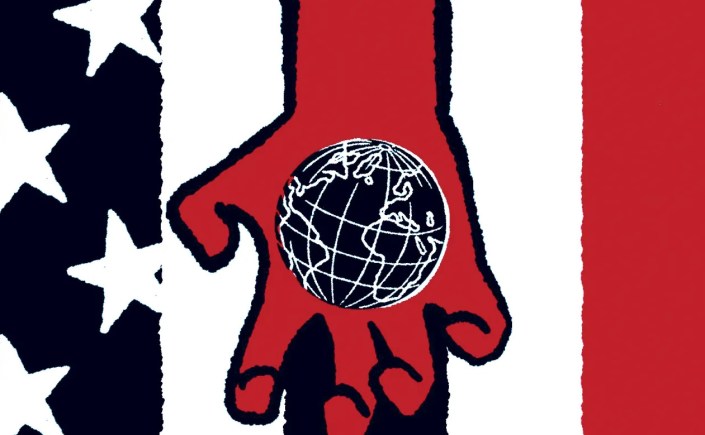
In his Global Public Square “take” on CNN last weekend, American commentator Fareed Zakaria discussed political scientist Stephen M. Walt’s recent article in Foreign Affairs: The Predatory Hegemon – how Trump wields American Power. He distilled Walt’s thesis into a phrase at once elegant and accusatory: the United States, he suggested, has drifted from an “enlightened hegemony” – a system in which power was exercised with an eye to legitimacy, stability, and long-term advantage – toward something more immediate, more transactional, and ultimately more predatory.
Walt’s essay gives that intuition a harder edge. He is not merely describing a tonal shift in American foreign policy, but a reorientation of its strategic logic – a change in how power understands itself, justifies itself, and, crucially, sustains itself.
The older model, Zakaria’s enlightened hegemon, was always something of a paradox, a balancing act performed with varying degrees of grace. The United States built a global order that advantaged itself, certainly, but did so by embedding its dominance in institutions, alliances, and norms that others found tolerable, even beneficial. It is tempting to see this as benevolence; it is more accurate to see it as enlightened self-interest, a recognition that power travels further when it is partially disguised as cooperation.
Consider the architecture: NATO as both shield and tether; the Bretton Woods institutions as both stabilisers and amplifiers of American economic influence; open markets that allowed others to prosper while quietly anchoring them within a U.S.-centred system. Even American restraint – selective, inconsistent, sometimes hypocritical – played a role. By not always extracting the maximum possible gain, Washington lowered the incentives for resistance. It made its leadership feel less like domination and more like gravity: inescapable, but not actively oppressive.
Zakaria’s emphasis falls on this temporal discipline. The United States, at its postwar best, accepted short-term costs – trade imbalances, alliance burdens, the irritations of multilateral compromise – in exchange for long-term influence. It invested in a system that would, over time, repay those investments many times over. The wager worked, not perfectly, but well enough: allies aligned, rivals were constrained, and the American-led order acquired a kind of grudging legitimacy.
Walt does not romanticise this past. He is too much the realist for that. He knows the system was riddled with contradictions: interventions justified in the name of norms that were selectively applied, economic openness that coexisted with strategic coercion, ideals that bent under pressure. But – and this is the hinge of his argument – the system’s imperfections did not negate its utility. On the contrary, they were often part of its flexibility. What mattered was that the United States appeared to play by rules it had helped create, and that appearance mattered enormously.
Against this backdrop, Trump’s approach, across both terms, but especially in its more fully articulated second incarnation, appears not as a mere policy adjustment but as a philosophical break. Walt’s term, “predatory hegemony,” is deliberately provocative, but also precise. The United States remains the central power in the system; what changes is how it treats the system itself.
Alliances, in this telling, are no longer strategic communities but balance sheets. NATO becomes a venue for cost-sharing disputes; Asian alliances are framed in terms of payments and protection fees. The language of shared purpose gives way to the language of reciprocity stripped to its transactional core: what are you paying, and what are we getting? There is a certain brutal clarity in this – no more pretence, no more sentimental talk of values – but it comes at a cost. Alliances that once rested on a mixture of interest and trust begin to tilt toward interest alone, and interest, as history reminds us, is a notoriously fickle glue.
In the economic realm, the shift is equally stark. Trade and finance become explicit instruments of leverage, deployed not only against adversaries but against partners. Tariffs are imposed with a freedom that disregards institutional constraints; sanctions proliferate; export controls tighten. Interdependence – once celebrated as a stabilising force – is recast as a field of vulnerabilities to be exploited. The system, in effect, is turned inside out: what was designed to bind becomes a means to coerce.
Zakaria’s gloss on this is telling. He notes that the United States has always used economic power strategically, but that it once did so within a framework that preserved the overall attractiveness of the system. Under a predatory model, that framework erodes. The message sent to the world is no longer “join us and prosper,” but “join us, and be prepared to be squeezed.” The rational response, for others, is not enthusiastic participation but cautious diversification.
Walt’s third line of argument concerns norms and institutions, the often invisible scaffolding of the international order. Here, too, the change is less about abandonment than about downgrading. Agreements become optional, commitments provisional, rules contingent on immediate advantage. The United States does not necessarily withdraw from every institution, but it treats them as tools rather than constraints, to be used when convenient and ignored when not.
Again, Zakaria’s lament is that something subtle but vital is lost in this process: legitimacy as a force multiplier. The old order worked, in part, because others believed – however imperfectly – that it was more than a façade for American power. Strip away that belief, and cooperation becomes thinner, more conditional, more brittle.
All of which leads to Walt’s central concern: that predatory hegemony, for all its apparent toughness, is strategically myopic. It operates on a shortened time horizon, prioritising immediate, tangible gains over diffuse, long-term benefits. In economic terms, it applies a high discount rate to the future. Why tolerate an imbalance today for a payoff tomorrow when you can extract a concession now?
The answer, in the older model, was that the future payoff was larger and more durable. By maintaining a system that others trusted and depended on, the United States ensured a steady stream of influence, cooperation, and alignment. By contrast, predation yields diminishing returns. Allies coerced too often begin to hedge. Partners subjected to pressure seek alternatives. Rivals exploit the cracks.
One might say – stretching the metaphor, but not too far – that enlightened hegemony was a form of cultivation, while predatory hegemony is a form of harvesting. The former assumes renewal; the latter risks depletion.
Walt is particularly attuned to the feedback effects of this shift. By treating allies as clients, the United States encourages them to behave like clients – transactional, calculating, ready to shop around. By weaponising interdependence, it incentivises others to de-risk and decouple, thereby reducing the very leverage Washington seeks to wield. By disregarding norms, it lowers the costs for others to do the same. The hegemon, in short, models the behaviour it will later lament.
Zakaria, for his part, situates this within a broader narrative of American political change. The appetite for the burdens of leadership has waned; the patience required for long-term strategy has thinned; the domestic rewards accrue to visible wins rather than invisible stability. Enlightened hegemony, in this reading, was not just a foreign policy doctrine but a political achievement, sustained by a consensus that no longer holds.
And here the essay acquires a slightly elegiac tone. For what is being described is not merely a shift in tactics but the possible unravelling of a particular idea of order—one in which power and restraint were, if not reconciled, then at least held in productive tension. Walt’s realism strips away nostalgia, but it does not eliminate the sense that something functionally valuable is being lost.
The unresolved question – hovering over both Walt’s analysis and Zakaria’s commentary – is whether this transformation is contingent or structural. Is predatory hegemony a phase, a deviation that can be corrected by a future administration rediscovering the uses of restraint? Or does it reflect deeper currents in American society and politics, suggesting a more permanent recalibration?
If the former, the system may yet be repaired, though not without scars. Trust, once eroded, is slow to rebuild; institutions, once weakened, do not spring back fully formed. If the latter, then the post-1945 order begins to look less like a stable architecture and more like a historical anomaly – a period in which an unusually powerful state chose, for its own reasons, to exercise power with a degree of restraint that history rarely sustains.
The irony. – one that both Walt and Zakaria, in their different registers, seem to appreciate – is that the older model of enlightened hegemony was not naïve but deeply pragmatic. It recognised that in a complex, interdependent world, the most effective way to maintain dominance was often to make that dominance acceptable. Predatory hegemony, by contrast, risks proving that the most direct expression of power is not always the most effective.
And so we return, as these arguments often do, to a question of time. Not simply what the United States can extract today, but what kind of world it is shaping for tomorrow – and whether that world will still, in any meaningful sense, run through Washington.
For now, the shift is unmistakable. The language has changed; the assumptions have shifted; the system is being tested from within. The hegemon remains, formidable as ever. But it no longer quite plays the same game. And the other players, watching closely, are already beginning to adjust their moves – quietly, pragmatically, and with an eye, as ever, to the long term.
Peace brokers
The following picture, featuring as it does the key players in Trump’s transactional diplomacy is an apt illustration of Walt’s thesis.
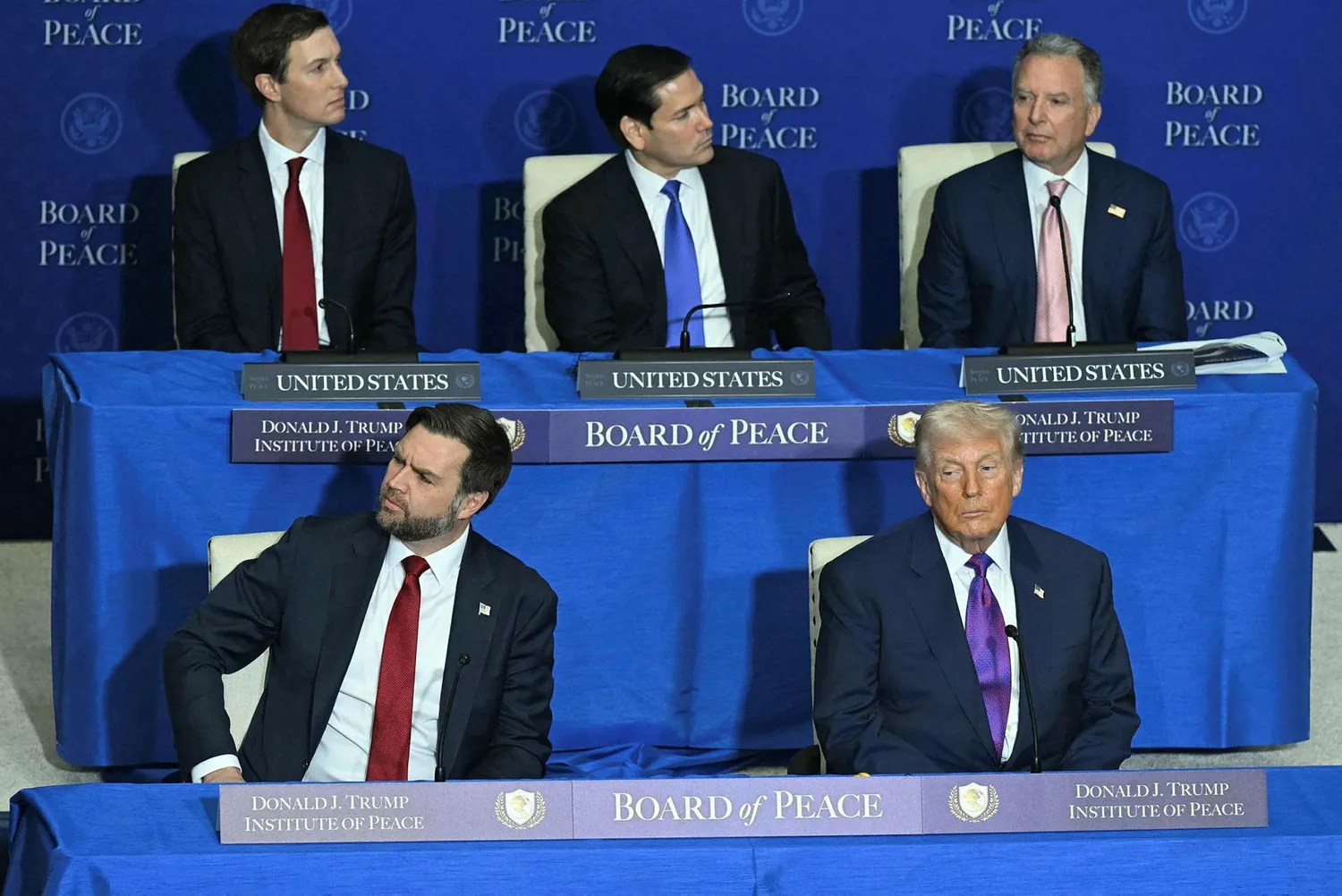
The “Board of Peace” is in essence a Trumpian confection of narcissism and megalomania, wrapped around what began, one must concede, as a not wholly foolish premise. Announced at Davos between lectures on Europe’s decline and intimidating talk of Greenland’s future, it was offered as a world-historical corrective – a leaner, sharper alternative to the United Nations, capable of doing, as Trump put it, “pretty much whatever we want to do,” albeit now “in conjunction” with the very institution it implicitly rebukes.
That hedge – in conjunction with the UN – betrays both ambition and unease. For all its frustrations, the UN remains the only broadly legitimate architecture for peace-making, its dysfunction less a design flaw than a record of unresolved rivalries. Trump’s instinct is to bypass such encumbrances: to replace the labyrinth with a boardroom, procedure with deal-making, paralysis with will. If peace were merely a coordination problem, this might even work. But peace is never merely procedural.
And the Board of Peace, for all its architectural neatness, rests on far shakier ground – a stage set awaiting actors who may never agree to the script, and a script that assumes conflicts can be edited rather than endured.
A body intended to gather the decisive actors of the age has assembled, thus far, a scattering of small and middle powers, most of them keen to curry Trump”# favour, whilst the big players keep tore distance. The Europeans hover at the edges; China sees no advantage in diluting its influence under a Trump-chaired forum; Russia, a principal source of present disorder, remains undecided about joining the mechanism meant to restrain it. A peace table without the principal enablers and disruptors is not an innovation so much as a rehearsal.
And what of the Board’s raison d’etre? Gaza and the implementation of Trump’s ambitious and arguably impossible “Twenty Point Plan”. It is there, loitering offstage, the ghost at the feast – unmistakably present in its absence, and as ever, intractable, morally fraught and resistant to shortcuts. Under an “enlightened hegemonic” model, it would demand sustained, often frustrating engagement – a willingness to absorb political cost in pursuit of incremental progress. Under a more predatory or transactional model, it becomes something else: a crisis to be managed, a variable in a broader strategic equation, or, at times, a problem to be worked around rather than through. See In That Howlong Infinite’s Gaza Sunrise or False Dawn (2) Spectacle or strategy?
What about the venue, the United States Institute of Peace? This was created in the late Cold War, not as an instrument of policy execution but as a buffer against its excesses: a congressionally funded, ostensibly bipartisan body designed to study conflict, train mediators, convene adversaries, and inject into Washington’s bloodstream a measure of patience. Its board was meant to reflect that mission – drawn from across government, the military, academia, and civil society, combining practitioners with thinkers, hawks with doves, all under the assumption that peace required pluralism, process, and time.
It was, in short, an institutional expression of what Zakaria later calls enlightened hegemony: the idea that American power could be made more durable – more effective, even – by embedding it in norms, procedures, and habits of restraint. It was never glamorous. Its successes were rarely visible. But it represented a wager that the slow, untelevised work of conflict resolution was not ancillary to power, but constitutive of it.
Now place that inheritance alongside the renaming.
To recast the United States Institute of Peace as the Donald J. Trump Institute of Peace is not merely to change a sign; it is to alter the centre of gravity. The original name gestures outward- to a national project, even a universal aspiration. The new name turns inward, attaching the idea of peace to a single, highly particular figure. Given Trump’s public persona – combative, transactional, attuned to victory and recognition – the effect is jarring. There is an unmistakable note of narcissistic inscription here, as though peace were not a condition to be cultivated but a brand to be owned.
Layer onto that his long-standing preoccupation with the Nobel Peace Prize- the sense, often voiced, that it is an accolade he ought to have received – and the renaming begins to look like a kind of symbolic compensation. If peace cannot be awarded, it can be appropriated; if it cannot be conferred, it can be named. The irony is not subtle: an institution built to depersonalise the pursuit of peace now bears the name of a man whose approach to conflict has been anything but disinterested.
Into this reframed space step the individuals in the photograph.
At the centre sits Donald Trump, President, whose foreign policy instincts – whatever label one prefers – tilt toward the immediate and the demonstrable. Alliances are assessed in terms of cost and return; diplomacy is valued for the deals it produces; outcomes are to be visible, claimable, ownable. Gaza, in this schema, is less a process to be patiently engaged than a problem that stubbornly resists the kind of resolution that can be announced from a lectern. It is, therefore, both central and strangely unsuited to his method.
To one side, J.D. Vance, Vice President, leans away – his posture almost a visual footnote to his politics. Vance represents a current of scepticism about the entire postwar architecture: alliances as burdens, interventions as misadventures, institutions like the USIP as relics of an overextended America. His interest is not in refining the Board’s work but in questioning its premise of necessity.
Behind them, Marco Rubio, Secretary of State, carries the formal responsibility for American diplomacy. His role, traditionally, would align closely with the Board’s ethos: sustaining alliances, managing crises, preserving channels. Yet here he appears slightly off-axis, as though translating between two languages—one institutional, one transactional. Gaza, for him, is not optional; it demands engagement. But the tools available are shaped by a broader shift away from the very processes the Board was designed to support.
Next, Jared Kushner, whose entrée into diplomacy came not through the usual apprenticeships but through proximity and trust. His approach – most visible in the Abraham Accords – privileged state-to-state normalisation and deal-making, often sidestepping the Palestinian question rather than confronting it. Gaza, in that sense, was not resolved but deferred, treated as a complication that could be managed while other, more tractable agreements were pursued.
Beside him, Steve Witkoff, another figure from the world of real estate and finance, reinforces the sense that diplomacy here is being conducted by negotiators rather than stewards. His expertise lies in closing deals, aligning incentives, reading counterparts – skills not irrelevant to diplomacy, but distinct from the slow cultivation of legitimacy and trust that institutions like the USIP were built to foster.
This is, then, a kind of board of directors of the Board of Peace, in composition if not in spirit: a gathering of individuals whose orientations toward conflict and resolution are divergent, even dissonant. Their gazes in the photograph – scattered, non-convergent – capture that lack of shared focus. They are in the same room, under the same banner, but not quite engaged in the same enterprise.
Which brings us back to Walt and Zakaria.
Zakaria’s “enlightened hegemony” lives in the architecture of the institution—in the idea that power can be extended by embedding it in processes others trust. Walt’s “predatory hegemony” is visible in the orientation of the actors – in the preference for leverage over legitimacy, transaction over system, immediacy over patience.
The photograph, in this sense, is not merely illustrative; it is diagnostic.
- The Board of Peace: conceived as a guardian of process, pluralism, and long-term thinking.
- The renaming: a shift from institutional ethos to personal branding, from shared endeavour to individual inscription.
- The individuals: a mix of diplomats, sceptics, and dealmakers, each carrying a different theory of what peace is and how it is achieved.
- The context of Gaza: a test case that exposes the limits of transactional approaches and the absence – or attenuation – of sustained mediation.
And threaded through it all, the larger question both Walt and Zakaria pose from different angles: whether the United States still believes that its power is best exercised by building systems others will inhabit, or whether it has turned, more decisively, toward extracting advantage within systems it no longer feels bound to sustain.
The Board still sits. The name still proclaims peace – twice over, now, with the addition of a personal signature. But the scene suggests something unsettled: an institution designed for one kind of hegemony now operating within another.
And the eye, moving across the image, cannot quite find a single point of convergence—only a series of individuals, each holding a piece of the argument, while the larger coherence—the thing the Board was meant to supply – remains, like Gaza itself, unfinished, unresolved, and just out of frame.
In That Howling Infinite, April 2026
This essay was written in conversation with an AI language model, which contributed to drafting, phrasing, and conceptual articulation. What appears here is not unmediated thought, but considered thought: selected, tested, revised and revised again, and owned.
See also in In That Howling Infinite, A Political World – Thoughts and Themes, and A Middle East Miscellany
 In That Howling Infinite