President Donald Trump has described the US bombing campaign against Iran as “a little excursion,” then a “skirmish,” then a “mini-war” – ostensible breaches of a subsequent ceasefire are called “trifles”. He was doing something powerful men have always done: reach for a word small enough to sit comfortably in a sentence while the fires it describes are still burning, without actually committing to the potential political consequences calling the conflict a war. The gesture is familiar. Vladimir Putin called his invasion of Ukraine a “special military operation.” History, in the end, has usually insisted on its own vocabulary. What begins as euphemism tends to end as a chapter heading.
The US-Iran conflict – a sustained bombing campaign, a naval blockade constricting a fifth of the world’s oil supply, and an increasingly fragile ceasefire – is, by any honest accounting, a war. That we have not yet fully agreed to call it one is itself revealing. Language shapes the choices we are willing to contemplate; the choices we refuse to contemplate have a habit of being made for us, usually at greater cost and on someone else’s timetable.
But naming the war is only the first act of reckoning. The second – and more treacherous – is understanding it. And here, almost instinctively, we reach backwards. Before the first campaign has properly unfolded, the analogies arrive.
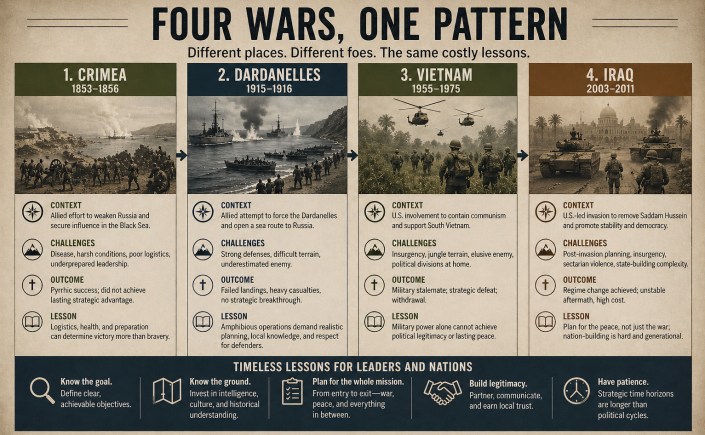
For this is what nations do when confronted with uncertainty: they search the past for usable maps. Yet wars are not equations, and analogies illuminate only by partial light. Gallipoli warns of overconfidence and the fantasy of the decisive stroke. Crimea evokes mismanagement and systemic incoherence. Vietnam and Iraq conjure the slow dread of entanglement – wars that move, expensively and violently, without ever quite arriving at conclusion.
We rarely encounter a new war on its own terms. Before the first campaign has properly unfolded, it is already being narrated through the past – the Gallipoli, Crimea, Vietnam, Iraq – names invoked less as history than as instruments of comprehension. This reflex is not mere intellectual laziness. War, in its immediacy, is too vast, too contradictory, to grasp without scaffolding; analogy supplies the frame. It tells us where to look for overconfidence, where to suspect mismanagement, where to anticipate drift. Yet it also does something subtler, and more dangerous: it invites us to believe that the present can be read off the past, that by matching patterns we might master outcomes.
The essay that follows proceeds from that tension. It does not treat these conflicts as competing verdicts on America’s confrontation with Iran, but as different lenses trained on different moments of a war’s life: conception, execution, and duration. Each captures a recognisable failure mode – the decisive stroke that overreaches, the system that cannot align means to ends, the conflict that persists beyond its rationale. To “refight” these wars in argument is not simply to indulge historical memory; it is to reveal how deeply our strategic thinking remains shaped by unresolved experiences. The past, in this sense, is not behind us. It is the grammar in which we continue to write the present.
Seeking storylines to explain the present
The quest begins, as these often do, reaching backwards in search of a usable past, a storyline that suits the present and what is now unfolding between America and Iran.
No war arrives naked; it comes draped in analogy. War is too large, too chaotic, to apprehend all at once; analogy shrinks it to something graspable. Analogies, like maps, tell you where to look, but also, just as often, where not to. Gallipoli (1915–16) is summoned, and Crimea (1853–56), and then, inevitably, Vietnam (1955-75, the war of my generation, though one that we British chose not to join) and Iraq (2003-11), those twin lodestars of modern American unease. Each is offered up as a key. Each, in its way, fits a lock. None, taken alone, opens the door.
Start with the British campaign during WWI to seize the strategic Dardanelles straits with the aim of threatening Istanbul and taking the Ottoman Empire out of the war. That analogy tends to be invoked by those who see overconfidence at the top: a belief that a bold stroke – decapitation strikes, limited escalation, a sharp application of force – can produce a decisive political outcome in a complex theatre. Gallipoli was conceived as a shortcut around stalemate; it became a lesson in underestimating geography, logistics, and the enemy’s will. If the critique is that Washington imagined a controlled, almost surgical confrontation with Iran that would bend reality to its design, then Gallipoli fits – particularly in its early optimism curdling into stubborn, costly entanglement.
There is something almost aesthetic about the Gallipoli temptation. It promises clarity. A narrow strait, a defined objective, a hinge upon which the whole great mechanism might turn. Strategy reduced to geometry. Yet wars have a way of refusing such elegance. The Turkish defence stiffened; the terrain asserted itself; the timetable dissolved into dust and flies and blood. The decisive stroke became an extended ordeal. And here the analogy deepens: not merely in the initial miscalculation, but in the dawning realisation that what was meant to be quick has become something else entirely – sticky, resistant, unyielding.
The Crimean War comparison is subtler, and in some ways more damning. Ostensibly a campaign by Britain and France (ironically, the architects of the Dardanelles venture) to challenge Czarist Russia’s design on the ailing Ottoman Empire – the so-called Eastern Question. Crimea was not just a military muddle; it was a war of misaligned systems: unclear objectives, poor coordination, inflated rhetoric masking administrative incompetence, and a media environment that amplified both heroism and absurdity (the Charge of the Light Brigade as both myth and indictment). If the Iran conflict appears strategically incoherent – multiple actors, shifting goals, allies pulling in different directions, public narratives outpacing operational reality – then Crimea begins to look uncomfortably familiar. It’s less about one disastrous decision and more about a system that cannot quite align means with ends.
Here the failure is quieter, but more pervasive. Not the single grand error, but the accumulation of smaller ones: supply chains that falter, commands that overlap, allies who agree in principle but diverge in practice. Crimea is what happens when the machinery of war – bureaucratic, logistical, political – fails to mesh. The guns fire, the troops advance, the dispatches glow with rhetoric, but somewhere beneath it all the connection between effort and outcome frays. One might say, borrowing that withering line in the 1960 Encyclopedia Britannica, that it becomes “perhaps the most ill-managed campaign in English history” – and the sting lies precisely in that word managed. Not conceived, not fought, but managed: as though war were an administrative exercise that has slipped its clerical bounds.
And then, inevitably, we arrive at America’s misbegotten wars in Indochina and Iraq. When people reach for these, they are usually pointing to something deeper: not the opening moves, but the trajectory. Vietnam is the archetype of gradual escalation into a conflict that cannot be cleanly won because its political premises are flawed. Iraq (particularly post-2003) adds another layer: the illusion of quick victory followed by insurgency, fragmentation, and the long tail of unintended consequences. If Iran becomes a drawn-out contest of proxies, asymmetric retaliation, and domestic fatigue – where tactical successes accumulate but strategic clarity recedes – then Vietnam/Iraq is the more predictive analogy.
Vietnam was once called “chaos without a compass,” and the phrase endures because it captures the feeling of the war more than its formal doctrine. There was, in fact, a compass – containment, credibility, dominoes – but it spun uncertainly, pointing in several directions at once. Washington oscillated between coercion and restraint, escalation and negotiation, measuring progress in tonnage dropped and bodies counted, even as the political centre of gravity drifted further out of reach. The war moved, violently and expensively, but it did not arrive. It accumulated.
Iraq echoes that pattern but begins differently – with a burst of clarity that dissolves into ambiguity. The regime falls; the statue topples; the map is redrawn in a matter of weeks; victory is declared. And then the afterlife begins. Insurgency, sectarian fracture, proxy entanglement- the slow discovery that winning the war is not the same as securing the peace. Iraq is what happens when the end state is assumed rather than constructed. It is, in that sense, less a campaign than a condition.
Set beside these, the earlier analogies sharpen. Gallipoli was not “chaos without a compass” at the outset; it had a very clear aim. Nor was it quite Crimea’s administrative farce, though elements of mismanagement crept in as the campaign stalled. Its distinctive flaw was the belief that a bold, limited stroke could shortcut the hard arithmetic of war – geography, supply, enemy adaptation. When that belief failed, the campaign slid, almost reluctantly, toward something more protracted, more wearing, with flashes of Crimean dysfunction flickering at the edges.
And this is the point at which the analogies begin to overlap, to blur into one another. The opening may be Gallipoli: confident, compressed, persuasive in its apparent simplicity. The conduct may drift toward Crimea: systems straining, coordination fraying, rhetoric outrunning reality. The trajectory may lengthen into Vietnam or Iraq: time stretching, purpose thinning, the war becoming less an event than an environment.
So which is most apt? If you’re judging initial strategic conception: then it is Gallipoli. If you’re judging systemic dysfunction and coalition incoherence: it’s Crimea. If you’re judging likely long-term dynamics and risk of quagmire: look to Vietnam and Iraq.
Forced to choose one, the most useful analogy is probably Iraq (with a Vietnam shadow). It captures both the confidence of the opening act and the chronic instability that can follow when political end states are ill-defined. Gallipoli was a failed gamble; Iraq became a condition. And it is the risk of becoming a condition – open-ended, absorbing, resistant to tidy resolution – that should trouble policymakers more than the memory of any single historical blunder.
For there is something peculiarly modern in that transformation. Nineteenth-century wars could be mismanaged; early twentieth-century campaigns could be disastrously conceived; but late twentieth- and early twenty-first-century conflicts have a habit of enduring. They slip their temporal bounds. They resist conclusion. They persist in the form of insurgencies, proxy struggles, regional destabilisations, so-called “forever wars” – echoes rather than endings.
History, in this sense, does not repeat so much as it offers a set of recurring traps, each labelled in a different hand. The names change – Lone Pine and The Nek, Balaclava, Khe Sanh, Fallujah – but the pattern is recognisable: ambition outruns understanding; institutions struggle to keep pace with intention; time erodes clarity; and strategy discovers, too late, that the map was never the territory.
The past, obligingly, provides the metaphors. The present decides which of them it is willing to become.
Forever wars and the persistent Eastern Question
Ironically, the repercussions and ricochets of the Crimea and Gallipoli linger still in the “forever wars” of the Ottoman Succession that continue to be fought in the Levant. Though the “sick man of Europe” has long gone, so-called “Eastern Question” that he precipitated is with us still. And the irony is not merely poetic, it is structural.
The Crimean War and Gallipoli were not just episodes in the long decline of the Ottoman Empire; they were moments in which the European powers tried, and failed, to manage that decline without resolving it. The Eastern Question – what to do with a weakening empire whose territories sat athwart trade routes, faiths, and ambitions – was never answered. It was deferred, patched, internationalised, moralised, and, when necessary, fought over. But never settled.
Crimea was, in essence, a war about containment without clarity. Britain and France fought not to destroy the Ottoman Empire, nor to reform it decisively, but to prevent Russia from exploiting its weakness. The result was a kind of geopolitical holding operation – costly, confused, and inconclusive. The patient survived, but the illness deepened. The war did not solve the Eastern Question; it ensured that it would return, more complicated than before.
Gallipoli, sixty years later, was almost the inverse: an attempt at decisive intervention that miscarried. Where Crimea sought to stabilise the system, Gallipoli tried to break it open – knock the Ottomans out of what became known as The Great War, reorder the strategic map, and force a resolution. It failed, and in failing, prolonged the life of the very problem it aimed to solve. When the Ottoman Empire did finally collapse in 1918, it did so not through elegant strategy but through cumulative exhaustion – and the settlement that followed (the infamous Sykes–Picot agreement, the Treaty of Lausanne that ended the Great War and shaped the modern Middle East, the mandates, improvised borders, and the legacies inherited by Israel and Palestine, by Syria and Lebanon, and by Iraq carried within it the seeds of future instability.
And here is the connective tissue to the present: the “forever wars” of the Levant are, in a very real sense, the afterlife of those unresolved choices.
The Ottoman system, for all its inequities, provided a kind of imperial coherence – a loose, often improvised order that managed diversity through hierarchy rather than uniformity. Its removal created a vacuum that external powers attempted to fill with lines on maps and imported state structures, often indifferent to local realities, including religious and ethnic divisions. The mandates were not solutions; they were transitional fictions that hardened into permanence. The Eastern Question did not end; it metastasised.
Thus the region becomes a palimpsest of earlier interventions:
- The Crimean instinct persists in modern coalition warfare – external powers seeking to contain instability without fully committing to its resolution, managing symptoms rather than causes.
- The Gallipoli impulse reappears in periodic attempts at decisive intervention – strikes, invasions, regime-change strategies – each promising to reset the board, each discovering the board is more complicated than imagined.
- And over all this hangs the long shadow of Vietnam and Iraq: the recognition that once engaged, these conflicts do not conclude cleanly, but evolve into layered, persistent struggles involving states, militias, proxies, and narratives.
What we call “forever wars” are, in this sense, not aberrations but continuations – the modern form of an old, unanswered question. The Ottoman Empire is gone, but the strategic problem it embodied remains: a region where internal fractures intersect with external interests, where no single power can impose order, and where every intervention alters the conditions for the next.
There is a quiet, almost melancholic symmetry in this. Nineteenth-century statesmen spoke of the “Sick Man of Europe” as though the problem were a patient to be diagnosed and treated. But the illness was never confined to the patient; it was embedded in the system around him. Remove the patient, and the condition does not disappear – it redistributes itself.
So when modern observers reach for Gallipoli, or Crimea, or Vietnam, or Iraq, they are not merely searching for analogies of method. They are circling, perhaps without quite naming it, the persistence of a problem without closure.
The Eastern Question was never answered. It simply changed its language.
Challenging the analogies
You can’t really make sense of the analogies – Gallipoli, Crimea, Vietnam, Iraq – without restoring Iran itself to the centre of the frame. Otherwise the country becomes a backdrop, a stage upon which other powers replay their historical anxieties. But Iran is not the Ottoman Empire in decline, nor Iraq in 2003, nor Vietnam in 1965. It is an old state with a long memory of being acted upon – and that memory shapes how it acts now.
What changes, once you bring Iran back in, is the direction of the analogy. The earlier comparisons mostly describe how outside powers misjudge wars. Iran’s history reminds you how those same powers are often experienced from the inside – as intrusion, manipulation, or existential threat.
Iran enters the story not as an abstraction – “the enemy,” “the regime,” “the theatre” – but as a historical actor formed in the crucible of the very system the earlier analogies describe.
In the nineteenth and early twentieth centuries, Persia was itself entangled in a version of the Eastern Question, pressured by Russian and British imperial competition, its sovereignty compromised, its politics penetrated. The First World War and its aftermath did not dismantle Iran as they did the Ottoman Empire, but they confirmed its vulnerability to external design. The Second World War made that vulnerability explicit: Anglo-Soviet occupation in 1941, the removal of Reza Shah, and the installation of his son – an early demonstration that great powers could, when required, rearrange Iran’s internal order.
From there, the pattern sharpens. The 1953 coup against the democratically elected prime minister Mohammed Mossadegh – engineered by Britain and the United States – lodges itself in Iranian political consciousness as a defining moment: not simply a change of government, but a lesson about the limits of independence in a world of larger powers. The Shah’s subsequent rule, modernising yet authoritarian, Western-aligned yet domestically brittle, becomes the next act in this long drama of externally entangled sovereignty.
The Islamic Revolution of 1979 then reads, in part, as a rupture with that pattern- a violent reassertion of autonomy, clothed in religious language but grounded in political memory. “Neither East nor West” was not just a slogan; it was a rejection of the very dynamics that had shaped Iran’s modern history. Yet revolutions do not escape geography. The new regime inherits the same strategic environment, the same pressures, the same suspicions.
The Iran–Iraq War (1980–88) is crucial here. For eight years, Iran fights a brutal, attritional conflict against Saddam Hussein – largely isolated, facing external support flowing to its adversary. This is Iran’s Vietnam, one might say, but with a different lesson drawn: not the futility of war, but the necessity of endurance. The war entrenches a doctrine of asymmetry, resilience, and proxy capability – precisely the features that later confound American strategy in the region.
From that point on, the Islamic Republic is not simply surviving; it is adapting. It builds networks – Hezbollah, militias, regional alliances – not as ideological ornaments but as strategic depth. It becomes, in effect, a state that has internalised the lessons of the very wars others use as analogies. Where outside observers see Vietnam or Iraq looming, Iranian planners see something else: a long game in which time, patience, and indirection offset conventional inferiority.
To reinsert Iran into the narrative is to complicate every analogy. Gallipoli assumes an opponent who will react predictably to a decisive blow; Iran’s history suggests otherwise. Crimea assumes mismanagement on one side; Iran’s experience reminds us that what appears as dysfunction externally may be met by coherence internally. Vietnam and Iraq warn of quagmires; Iran has, in many respects, built its strategy around drawing others into them.
In that sense, the question is not only which past war America risks refighting, but which past experiences Iran believes it is reliving – or avenging. The 1953 coup, the isolation of the 1980s, the long memory of foreign interference: these are not background details, but active ingredients in the present.
And so our frame subtly shifts. It is no longer simply about the hazards of analogy, or the repetition of strategic error, but about the collision of historical memories. One side reaches for Gallipoli, Crimea, Vietnam, Iraq- warnings drawn from its own past misjudgments. The other carries a different archive: intervention, resistance, survival.
Between those two archives lies the present conflict – less a replay of any single war than a convergence of many, each side reading from a different script, each convinced, in its own way, that history has already shown it how this story goes.
Conclusion
To refight old wars in the mind is, at one level, an act of prudence. It reminds us that others have stood at similar thresholds, armed with confidence, intelligence, and good intentions – and have nonetheless misjudged the terrain, the enemy, or themselves. But there is a fine line between learning from history and being governed by it. Analogy can clarify; it can also constrain. It can sharpen perception, or it can trap us in inherited scripts, seeing Gallipoli where the problem is administrative, or diagnosing Vietnam when the flaw lies in the opening wager.
The deeper unease running through these comparisons is not simply that wars go wrong, but that they linger – that they slip their boundaries and become conditions rather than episodes. From the mismanaged campaigns of Crimea to the failed gambles of Gallipoli, from the disorientation of Vietnam to the long aftermath of Iraq, one sees not repetition but recurrence: ambition outrunning understanding, institutions straining to keep pace, time eroding clarity. And beneath it all, especially in the Levant, the longer echo of an older, unanswered question – how to order a region where external power and internal fracture are perpetually entangled.
History does not offer a single, authoritative mirror. It offers a cabinet of them, each slightly warped, each catching a different angle of the present. The task is not to choose one reflection and mistake it for reality, but to recognise the distortions for what they are – and to ask, with some humility, whether we are illuminating the path ahead or merely retracing, with greater eloquence, the steps that led others into the same uncertain ground.
The Western cabinet of mirrors – Gallipoli, Crimea, Vietnam, Iraq – captures recurring pathologies: the overconfident opening stroke, the misaligned machinery, the war that lingers beyond its logic. Yet these are, inescapably, insider narratives. They describe how campaigns look from the bridge, the штаб, the situation room. They are diagnoses of our own errors.
What the Iranian story, set against the longer afterlife of the Eastern Question, forces back into view is the perspective from the other shore. The Young Turks, confronting encroachment and dismemberment, did not experience Gallipoli as a misjudged Allied gamble; they experienced it as a defence of survival. Ho Chi Minh and the North Vietnamese did not inhabit “chaos without a compass”; they pursued a coherent, if costly, struggle against a foreign presence. Iraqi insurgents, and later ISIS in its own brutal and aberrant way, did not parse the war as a case study in post-conflict planning; they resisted, adapted, endured, and exploited.
They did not conduct war games about us. They fought.
Iran belongs in that lineage – not as an analogue, but as an heir to a particular historical consciousness: one shaped by intervention, by imposed settlements, by long wars of attrition, and by the conviction that time can be turned into a weapon. From that vantage, what appears to Western observers as drift or dysfunction may look like opportunity; what is feared as quagmire may be cultivated as strategy.
And so the question shifts. It is no longer simply which past war America risks refighting, but whether the very act of choosing among Gallipoli, Crimea, Vietnam, and Iraq obscures the more important reality: that the other side is not reading from the same book – or as many commentators are reminding us today, “the enemy has a vote”. One side searches its history for warnings about overreach; the other draws from its own past a repertoire of resistance.
History, then, does not just offer competing analogies. It offers competing memories. And where those memories diverge – where one side analyses and the other endures – there lies the most persistent danger: not that we will repeat the past, but that we will misunderstand the present, even as we describe it with perfect historical fluency.
In That Howling Infinite, May 2026
Read more about history in In That Howling Infinite in Foggy Ruins of Time.
On World War I, see Ottoman Redux – an alternative, The fall of the Ottoman Empire and the birth of Türkiye and November 1918 – the counterfeit peace. On the Balfour Declaration and its repercussions, see The hand that signed the paper. On Vietnam, see The Ballad of Denton Crocker – a Vietnam elegy, Tim Page’s War – a photographer’s Vietnam journey, and Shadows in search of a name … requiem for a war. On the US-Iran war, see Chaos in without a compass … Donald Trump’s Persian “excursion”

