The US-Iran war … beware of false analogies

President Donald Trump has described the US bombing campaign against Iran as “a little excursion,” then a “skirmish,” then a “mini-war” – ostensible breaches of a subsequent ceasefire are called “trifles”. He was doing something powerful men have always done: reach for a word small enough to sit comfortably in a sentence while the fires it describes are still burning, without actually committing to the potential political consequences calling the conflict a war. The gesture is familiar. Vladimir Putin called his invasion of Ukraine a “special military operation.” History, in the end, has usually insisted on its own vocabulary. What begins as euphemism tends to end as a chapter heading.

The US-Iran conflict – a sustained bombing campaign, a naval blockade constricting a fifth of the world’s oil supply, and an increasingly fragile ceasefire – is, by any honest accounting, a war. That we have not yet fully agreed to call it one is itself revealing. Language shapes the choices we are willing to contemplate; the choices we refuse to contemplate have a habit of being made for us, usually at greater cost and on someone else’s timetable.

But naming the war is only the first act of reckoning. The second – and more treacherous – is understanding it. And here, almost instinctively, we reach backwards. Before the first campaign has properly unfolded, the analogies arrive.

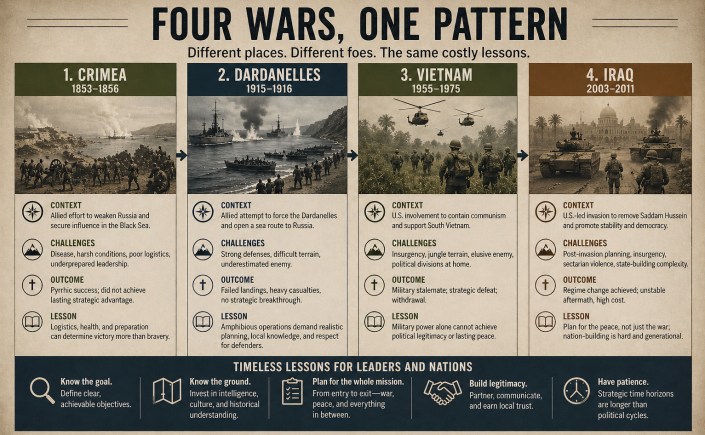
For this is what nations do when confronted with uncertainty: they search the past for usable maps. Yet wars are not equations, and analogies illuminate only by partial light. Gallipoli warns of overconfidence and the fantasy of the decisive stroke. Crimea evokes mismanagement and systemic incoherence. Vietnam and Iraq conjure the slow dread of entanglement – wars that move, expensively and violently, without ever quite arriving at conclusion.

We rarely encounter a new war on its own terms. Before the first campaign has properly unfolded, it is already being narrated through the past – the Gallipoli, Crimea, Vietnam, Iraq – names invoked less as history than as instruments of comprehension. This reflex is not mere intellectual laziness. War, in its immediacy, is too vast, too contradictory, to grasp without scaffolding; analogy supplies the frame. It tells us where to look for overconfidence, where to suspect mismanagement, where to anticipate drift. Yet it also does something subtler, and more dangerous: it invites us to believe that the present can be read off the past, that by matching patterns we might master outcomes.

The essay that follows proceeds from that tension. It does not treat these conflicts as competing verdicts on America’s confrontation with Iran, but as different lenses trained on different moments of a war’s life: conception, execution, and duration. Each captures a recognisable failure mode – the decisive stroke that overreaches, the system that cannot align means to ends, the conflict that persists beyond its rationale. To “refight” these wars in argument is not simply to indulge historical memory; it is to reveal how deeply our strategic thinking remains shaped by unresolved experiences. The past, in this sense, is not behind us. It is the grammar in which we continue to write the present.

Seeking storylines to explain the present

The quest begins, as these often do, reaching backwards in search of a usable past, a storyline that suits the present and what is now unfolding between America and Iran.

No war arrives naked; it comes draped in analogy. War is too large, too chaotic, to apprehend all at once; analogy shrinks it to something graspable. Analogies, like maps, tell you where to look, but also, just as often, where not to. Gallipoli (1915–16) is summoned, and Crimea (1853–56), and then, inevitably, Vietnam (1955-75, the war of my generation, though one that we British chose not to join) and Iraq (2003-11), those twin lodestars of modern American unease. Each is offered up as a key. Each, in its way, fits a lock. None, taken alone, opens the door.

Start with the British campaign during WWI to seize the strategic Dardanelles straits with the aim of threatening Istanbul and taking the Ottoman Empire out of the war. That analogy tends to be invoked by those who see overconfidence at the top: a belief that a bold stroke – decapitation strikes, limited escalation, a sharp application of force – can produce a decisive political outcome in a complex theatre. Gallipoli was conceived as a shortcut around stalemate; it became a lesson in underestimating geography, logistics, and the enemy’s will. If the critique is that Washington imagined a controlled, almost surgical confrontation with Iran that would bend reality to its design, then Gallipoli fits – particularly in its early optimism curdling into stubborn, costly entanglement.

There is something almost aesthetic about the Gallipoli temptation. It promises clarity. A narrow strait, a defined objective, a hinge upon which the whole great mechanism might turn. Strategy reduced to geometry. Yet wars have a way of refusing such elegance. The Turkish defence stiffened; the terrain asserted itself; the timetable dissolved into dust and flies and blood. The decisive stroke became an extended ordeal. And here the analogy deepens: not merely in the initial miscalculation, but in the dawning realisation that what was meant to be quick has become something else entirely – sticky, resistant, unyielding.

The Crimean War comparison is subtler, and in some ways more damning. Ostensibly a campaign by Britain and France (ironically, the architects of the Dardanelles venture) to challenge Czarist Russia’s design on the ailing Ottoman Empire – the so-called Eastern Question. Crimea was not just a military muddle; it was a war of misaligned systems: unclear objectives, poor coordination, inflated rhetoric masking administrative incompetence, and a media environment that amplified both heroism and absurdity (the Charge of the Light Brigade as both myth and indictment). If the Iran conflict appears strategically incoherent – multiple actors, shifting goals, allies pulling in different directions, public narratives outpacing operational reality – then Crimea begins to look uncomfortably familiar. It’s less about one disastrous decision and more about a system that cannot quite align means with ends.

Here the failure is quieter, but more pervasive. Not the single grand error, but the accumulation of smaller ones: supply chains that falter, commands that overlap, allies who agree in principle but diverge in practice. Crimea is what happens when the machinery of war – bureaucratic, logistical, political – fails to mesh. The guns fire, the troops advance, the dispatches glow with rhetoric, but somewhere beneath it all the connection between effort and outcome frays. One might say, borrowing that withering line in the 1960 Encyclopedia Britannica, that it becomes “perhaps the most ill-managed campaign in English history” – and the sting lies precisely in that word managed. Not conceived, not fought, but managed: as though war were an administrative exercise that has slipped its clerical bounds.

And then, inevitably, we arrive at America’s misbegotten wars in Indochina and Iraq. When people reach for these, they are usually pointing to something deeper: not the opening moves, but the trajectory. Vietnam is the archetype of gradual escalation into a conflict that cannot be cleanly won because its political premises are flawed. Iraq (particularly post-2003) adds another layer: the illusion of quick victory followed by insurgency, fragmentation, and the long tail of unintended consequences. If Iran becomes a drawn-out contest of proxies, asymmetric retaliation, and domestic fatigue – where tactical successes accumulate but strategic clarity recedes – then Vietnam/Iraq is the more predictive analogy.

Vietnam was once called “chaos without a compass,” and the phrase endures because it captures the feeling of the war more than its formal doctrine. There was, in fact, a compass – containment, credibility, dominoes – but it spun uncertainly, pointing in several directions at once. Washington oscillated between coercion and restraint, escalation and negotiation, measuring progress in tonnage dropped and bodies counted, even as the political centre of gravity drifted further out of reach. The war moved, violently and expensively, but it did not arrive. It accumulated.

Iraq echoes that pattern but begins differently – with a burst of clarity that dissolves into ambiguity. The regime falls; the statue topples; the map is redrawn in a matter of weeks; victory is declared. And then the afterlife begins. Insurgency, sectarian fracture, proxy entanglement- the slow discovery that winning the war is not the same as securing the peace. Iraq is what happens when the end state is assumed rather than constructed. It is, in that sense, less a campaign than a condition.

Set beside these, the earlier analogies sharpen. Gallipoli was not “chaos without a compass” at the outset; it had a very clear aim. Nor was it quite Crimea’s administrative farce, though elements of mismanagement crept in as the campaign stalled. Its distinctive flaw was the belief that a bold, limited stroke could shortcut the hard arithmetic of war – geography, supply, enemy adaptation. When that belief failed, the campaign slid, almost reluctantly, toward something more protracted, more wearing, with flashes of Crimean dysfunction flickering at the edges.

And this is the point at which the analogies begin to overlap, to blur into one another. The opening may be Gallipoli: confident, compressed, persuasive in its apparent simplicity. The conduct may drift toward Crimea: systems straining, coordination fraying, rhetoric outrunning reality. The trajectory may lengthen into Vietnam or Iraq: time stretching, purpose thinning, the war becoming less an event than an environment.

So which is most apt? If you’re judging initial strategic conception: then it is Gallipoli. If you’re judging systemic dysfunction and coalition incoherence: it’s Crimea. If you’re judging likely long-term dynamics and risk of quagmire: look to Vietnam and Iraq.

Forced to choose one, the most useful analogy is probably Iraq (with a Vietnam shadow). It captures both the confidence of the opening act and the chronic instability that can follow when political end states are ill-defined. Gallipoli was a failed gamble; Iraq became a condition. And it is the risk of becoming a condition – open-ended, absorbing, resistant to tidy resolution – that should trouble policymakers more than the memory of any single historical blunder.

For there is something peculiarly modern in that transformation. Nineteenth-century wars could be mismanaged; early twentieth-century campaigns could be disastrously conceived; but late twentieth- and early twenty-first-century conflicts have a habit of enduring. They slip their temporal bounds. They resist conclusion. They persist in the form of insurgencies, proxy struggles, regional destabilisations, so-called “forever wars” – echoes rather than endings.

History, in this sense, does not repeat so much as it offers a set of recurring traps, each labelled in a different hand. The names change – Lone Pine and The Nek, Balaclava, Khe Sanh, Fallujah – but the pattern is recognisable: ambition outruns understanding; institutions struggle to keep pace with intention; time erodes clarity; and strategy discovers, too late, that the map was never the territory.

The past, obligingly, provides the metaphors. The present decides which of them it is willing to become.

Forever wars and the persistent Eastern Question

Ironically, the repercussions and ricochets of the Crimea and Gallipoli linger still in the “forever wars” of the Ottoman Succession that continue to be fought in the Levant. Though the “sick man of Europe” has long gone, so-called “Eastern Question” that he precipitated is with us still.  And the irony is not merely poetic, it is structural.

The Crimean War and Gallipoli were not just episodes in the long decline of the Ottoman Empire; they were moments in which the European powers tried, and failed, to manage that decline without resolving it. The Eastern Question – what to do with a weakening empire whose territories sat athwart trade routes, faiths, and ambitions – was never answered. It was deferred, patched, internationalised, moralised, and, when necessary, fought over. But never settled.

Crimea was, in essence, a war about containment without clarity. Britain and France fought not to destroy the Ottoman Empire, nor to reform it decisively, but to prevent Russia from exploiting its weakness. The result was a kind of geopolitical holding operation – costly, confused, and inconclusive. The patient survived, but the illness deepened. The war did not solve the Eastern Question; it ensured that it would return, more complicated than before.

Gallipoli, sixty years later, was almost the inverse: an attempt at decisive intervention that miscarried. Where Crimea sought to stabilise the system, Gallipoli tried to break it open – knock the Ottomans out of what became known as The Great War, reorder the strategic map, and force a resolution. It failed, and in failing, prolonged the life of the very problem it aimed to solve. When the Ottoman Empire did finally collapse in 1918, it did so not through elegant strategy but through cumulative exhaustion – and the settlement that followed (the infamous Sykes–Picot agreement, the Treaty of Lausanne that ended the Great War and shaped the modern Middle East, the mandates, improvised borders, and the legacies inherited by Israel and Palestine, by Syria and Lebanon, and by Iraq carried within it the seeds of future instability.

And here is the connective tissue to the present: the “forever wars” of the Levant are, in a very real sense, the afterlife of those unresolved choices.

The Ottoman system, for all its inequities, provided a kind of imperial coherence – a loose, often improvised order that managed diversity through hierarchy rather than uniformity. Its removal created a vacuum that external powers attempted to fill with lines on maps and imported state structures, often indifferent to local realities, including religious and ethnic divisions. The mandates were not solutions; they were transitional fictions that hardened into permanence. The Eastern Question did not end; it metastasised.

Thus the region becomes a palimpsest of earlier interventions:

  • The Crimean instinct persists in modern coalition warfare – external powers seeking to contain instability without fully committing to its resolution, managing symptoms rather than causes.
  • The Gallipoli impulse reappears in periodic attempts at decisive intervention – strikes, invasions, regime-change strategies – each promising to reset the board, each discovering the board is more complicated than imagined.
  • And over all this hangs the long shadow of Vietnam and Iraq: the recognition that once engaged, these conflicts do not conclude cleanly, but evolve into layered, persistent struggles involving states, militias, proxies, and narratives.

What we call “forever wars” are, in this sense, not aberrations but continuations – the modern form of an old, unanswered question. The Ottoman Empire is gone, but the strategic problem it embodied remains: a region where internal fractures intersect with external interests, where no single power can impose order, and where every intervention alters the conditions for the next.

There is a quiet, almost melancholic symmetry in this. Nineteenth-century statesmen spoke of the “Sick Man of Europe” as though the problem were a patient to be diagnosed and treated. But the illness was never confined to the patient; it was embedded in the system around him. Remove the patient, and the condition does not disappear – it redistributes itself.

So when modern observers reach for Gallipoli, or Crimea, or Vietnam, or Iraq, they are not merely searching for analogies of method. They are circling, perhaps without quite naming it, the persistence of a problem without closure.

The Eastern Question was never answered. It simply changed its language.

Challenging the analogies

You can’t really make sense of the analogies – Gallipoli, Crimea, Vietnam, Iraq – without restoring Iran itself to the centre of the frame. Otherwise the country becomes a backdrop, a stage upon which other powers replay their historical anxieties. But Iran is not the Ottoman Empire in decline, nor Iraq in 2003, nor Vietnam in 1965. It is an old state with a long memory of being acted upon – and that memory shapes how it acts now.

What changes, once you bring Iran back in, is the direction of the analogy. The earlier comparisons mostly describe how outside powers misjudge wars. Iran’s history reminds you how those same powers are often experienced from the inside – as intrusion, manipulation, or existential threat.

Iran enters the story not as an abstraction – “the enemy,” “the regime,” “the theatre” – but as a historical actor formed in the crucible of the very system the earlier analogies describe.

In the nineteenth and early twentieth centuries, Persia was itself entangled in a version of the Eastern Question, pressured by Russian and British imperial competition, its sovereignty compromised, its politics penetrated. The First World War and its aftermath did not dismantle Iran as they did the Ottoman Empire, but they confirmed its vulnerability to external design. The Second World War made that vulnerability explicit: Anglo-Soviet occupation in 1941, the removal of Reza Shah, and the installation of his son – an early demonstration that great powers could, when required, rearrange Iran’s internal order.

From there, the pattern sharpens. The 1953 coup against the democratically elected prime minister Mohammed Mossadegh – engineered by Britain and the United States – lodges itself in Iranian political consciousness as a defining moment: not simply a change of government, but a lesson about the limits of independence in a world of larger powers. The Shah’s subsequent rule, modernising yet authoritarian, Western-aligned yet domestically brittle, becomes the next act in this long drama of externally entangled sovereignty.

The Islamic Revolution of 1979 then reads, in part, as a rupture with that pattern- a violent reassertion of autonomy, clothed in religious language but grounded in political memory. “Neither East nor West” was not just a slogan; it was a rejection of the very dynamics that had shaped Iran’s modern history. Yet revolutions do not escape geography. The new regime inherits the same strategic environment, the same pressures, the same suspicions.

The Iran–Iraq War (1980–88) is crucial here. For eight years, Iran fights a brutal, attritional conflict against Saddam Hussein – largely isolated, facing external support flowing to its adversary. This is Iran’s Vietnam, one might say, but with a different lesson drawn: not the futility of war, but the necessity of endurance. The war entrenches a doctrine of asymmetry, resilience, and proxy capability – precisely the features that later confound American strategy in the region.

From that point on, the Islamic Republic is not simply surviving; it is adapting. It builds networks – Hezbollah, militias, regional alliances – not as ideological ornaments but as strategic depth. It becomes, in effect, a state that has internalised the lessons of the very wars others use as analogies. Where outside observers see Vietnam or Iraq looming, Iranian planners see something else: a long game in which time, patience, and indirection offset conventional inferiority.

To reinsert Iran into the narrative is to complicate every analogy. Gallipoli assumes an opponent who will react predictably to a decisive blow; Iran’s history suggests otherwise. Crimea assumes mismanagement on one side; Iran’s experience reminds us that what appears as dysfunction externally may be met by coherence internally. Vietnam and Iraq warn of quagmires; Iran has, in many respects, built its strategy around drawing others into them.

In that sense, the question is not only which past war America risks refighting, but which past experiences Iran believes it is reliving – or avenging. The 1953 coup, the isolation of the 1980s, the long memory of foreign interference: these are not background details, but active ingredients in the present.

And so our frame subtly shifts. It is no longer simply about the hazards of analogy, or the repetition of strategic error, but about the collision of historical memories. One side reaches for Gallipoli, Crimea, Vietnam, Iraq- warnings drawn from its own past misjudgments. The other carries a different archive: intervention, resistance, survival.

Between those two archives lies the present conflict – less a replay of any single war than a convergence of many, each side reading from a different script, each convinced, in its own way, that history has already shown it how this story goes.

Conclusion

To refight old wars in the mind is, at one level, an act of prudence. It reminds us that others have stood at similar thresholds, armed with confidence, intelligence, and good intentions – and have nonetheless misjudged the terrain, the enemy, or themselves. But there is a fine line between learning from history and being governed by it. Analogy can clarify; it can also constrain. It can sharpen perception, or it can trap us in inherited scripts, seeing Gallipoli where the problem is administrative, or diagnosing Vietnam when the flaw lies in the opening wager.

The deeper unease running through these comparisons is not simply that wars go wrong, but that they linger – that they slip their boundaries and become conditions rather than episodes. From the mismanaged campaigns of Crimea to the failed gambles of Gallipoli, from the disorientation of Vietnam to the long aftermath of Iraq, one sees not repetition but recurrence: ambition outrunning understanding, institutions straining to keep pace, time eroding clarity. And beneath it all, especially in the Levant, the longer echo of an older, unanswered question – how to order a region where external power and internal fracture are perpetually entangled.

History does not offer a single, authoritative mirror. It offers a cabinet of them, each slightly warped, each catching a different angle of the present. The task is not to choose one reflection and mistake it for reality, but to recognise the distortions for what they are – and to ask, with some humility, whether we are illuminating the path ahead or merely retracing, with greater eloquence, the steps that led others into the same uncertain ground.

The Western cabinet of mirrors – Gallipoli, Crimea, Vietnam, Iraq – captures recurring pathologies: the overconfident opening stroke, the misaligned machinery, the war that lingers beyond its logic. Yet these are, inescapably, insider narratives. They describe how campaigns look from the bridge, the штаб, the situation room. They are diagnoses of our own errors.

What the Iranian story, set against the longer afterlife of the Eastern Question, forces back into view is the perspective from the other shore. The Young Turks, confronting encroachment and dismemberment, did not experience Gallipoli as a misjudged Allied gamble; they experienced it as a defence of survival. Ho Chi Minh and the North Vietnamese did not inhabit “chaos without a compass”; they pursued a coherent, if costly, struggle against a foreign presence. Iraqi insurgents, and later ISIS in its own brutal and aberrant way, did not parse the war as a case study in post-conflict planning; they resisted, adapted, endured, and exploited.

They did not conduct war games about us. They fought.

Iran belongs in that lineage – not as an analogue, but as an heir to a particular historical consciousness: one shaped by intervention, by imposed settlements, by long wars of attrition, and by the conviction that time can be turned into a weapon. From that vantage, what appears to Western observers as drift or dysfunction may look like opportunity; what is feared as quagmire may be cultivated as strategy.

And so the question shifts. It is no longer simply which past war America risks refighting, but whether the very act of choosing among Gallipoli, Crimea, Vietnam, and Iraq obscures the more important reality: that the other side is not reading from the same book – or as many commentators are reminding us today, “the enemy has a vote”. One side searches its history for warnings about overreach; the other draws from its own past a repertoire of resistance.

History, then, does not just offer competing analogies. It offers competing memories. And where those memories diverge – where one side analyses and the other endures – there lies the most persistent danger: not that we will repeat the past, but that we will misunderstand the present, even as we describe it with perfect historical fluency.

In That Howling Infinite, May 2026

Read more about history  in In That Howling Infinite in Foggy Ruins of Time.

On World War I, see Ottoman Redux – an alternative, The fall of the Ottoman Empire and the birth of Türkiye and November 1918 – the counterfeit peace. On the Balfour Declaration and its repercussions, see The hand that signed the paper. On Vietnam, see The Ballad of Denton Crocker – a Vietnam elegy, Tim Page’s War – a photographer’s Vietnam journey, and Shadows in search of a name … requiem for a war. On the US-Iran war, see Chaos in without a compass … Donald Trump’s Persian “excursion”

The fall of the Ottoman Empire and the birth of Türkiye

Preface

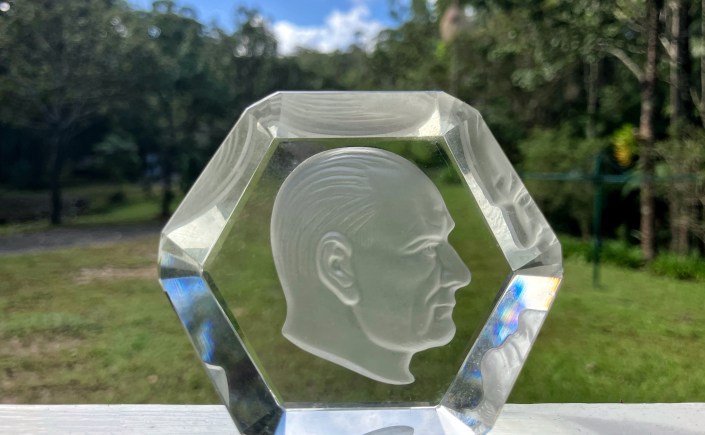
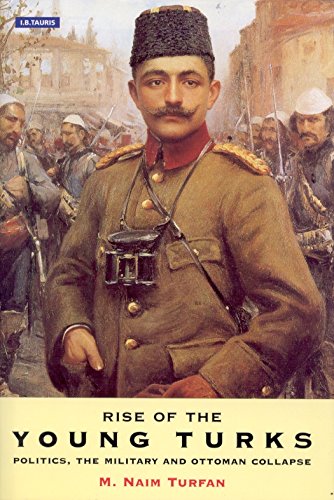
The featured image of this post is a profile in crystal of Kemal Atatürk that sits on my bookshelf as a reminder of my late friend and academic colleague Mehmet Naim Turfan. Naim, like millions of his compatriots, harboured a deep affection and respect for the legacy of Atatürk, the founder of modern Türkiye and its first president. It was gifted to me by His wife soon after his passing by his wife Barbara. His doctoral thesis was published posthumously in 2000 as Rise of the Young Turks: Politics, the Miliary and Ottoman Collapse. He is cited several times in the book that is the subject of this article. I thought of Naim often while reading the book and writing what follows.

Enver Pasha, soldier, politician and member of the troika that ruled the Ottoman Empire before and during WW1

Ottoman Endgame

Many believe that prior to the outbreak of World War 1 in August 1914, Europe had been at peace. In matter of fact, brutal and bloody little wars had raged in Eastern Europe three years prior, whilst Italy fought the Ottoman Empire for Tripoli and Cyrenaica, both now modern Libya and yet also presently two warring parts of a fractured whole and now being triggered by the aftermath of equally nasty little wars in the same lands in the last quarter of the Nineteenth Century. The Ottoman Empire’s entry into alliance with the Central Powers in 1915 against the Entente of Britain, France and Russia was the direct outcome of what we know refer to generically as The Balkan Wars – which aided and abetted by Russia, saw the emergence of Serbia, Romania and Bulgaria. In retrospect, with the benefit of hindsight, they were the beginning of what we might now refer to as The Wars of the Ottoman Succession. They are not over.

The empire’s entry into the war on the side of the Central Powers against the Entente of Britain France and Russia was a devious, drawn-out business as it sought to take advantage of its potential allies in recovering why it lost in the preceding Balkan Wars that had deprived it of its European provinces,

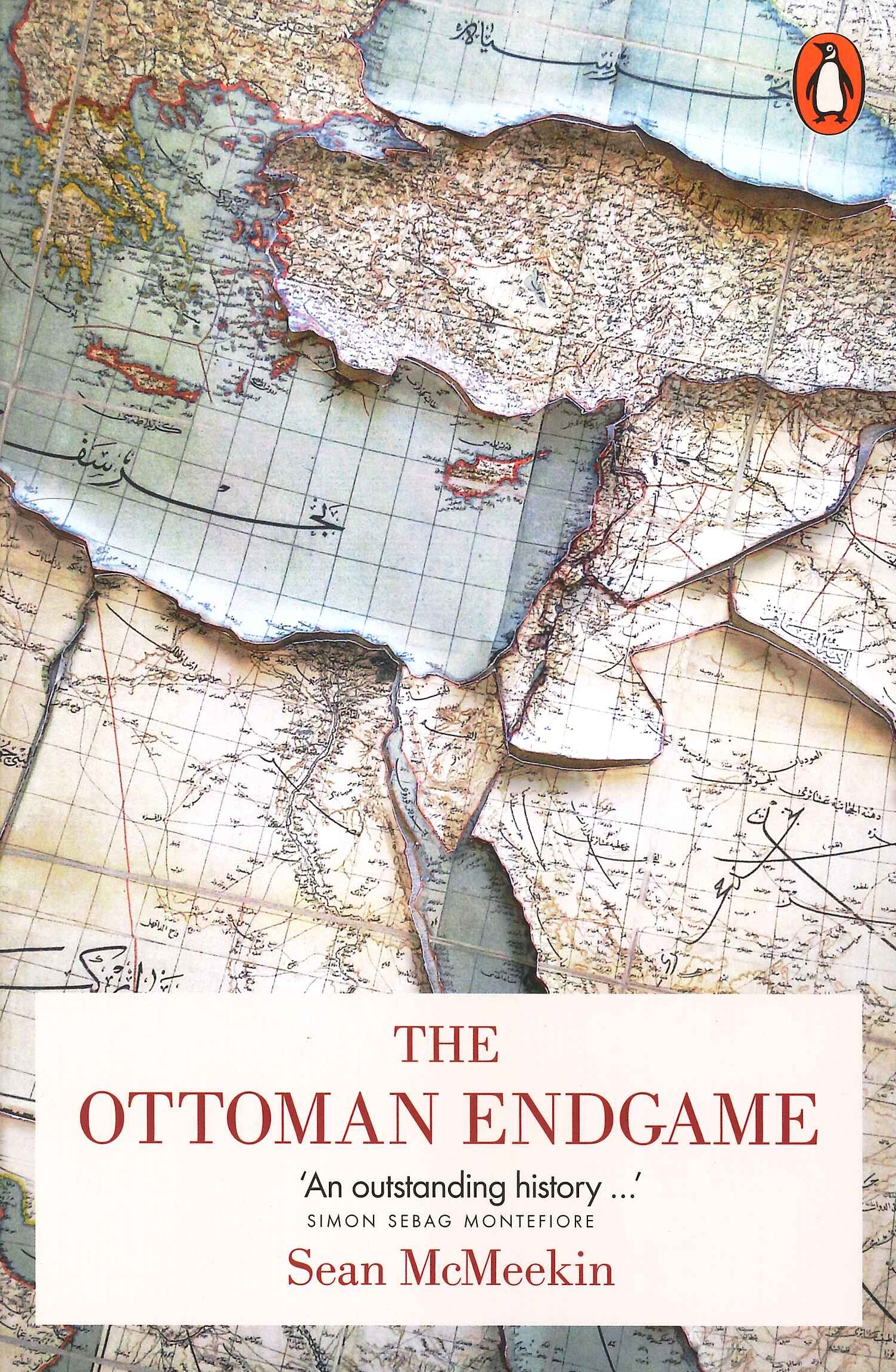
Few have told the story of the fall of the Ottoman Empire and the birth of modern Türkiye as well as English historian Sean McMeekin in his geographically sprawling and historically enthralling book The Ottoman Endgame. He juxtaposes military operations in the empire with those on Europe’s eastern and western fronts, demonstrating how, in the shifting fortunes of war in Europe, each impacted the other from the first offensives in France and on the eastern front to the Russian Revolutions of 1917.

Author and journalist Christopher de Bellaigue sets the scene well in a brief but compelling review (published in full below with some excellent pictures, along with a article by the author himself):

”For the historian of the first world war, the Ottoman theatre is a blur of movement compared to the attrition of the western front. Its leading commanders might race off to contest Baku and entirely miss the significance of events in the Balkans, while the diffuse nature of operations tended to encourage initiative, not groupthink. The war of the Ottoman succession, as Sean McMeekin calls it, was furthermore of real consequence, breaking up an empire that had stifled community hatreds, and whose absence the millions who have fled sectarian conflict in our age may rue …

For the Ottomans, the “great war” of western historiography was part of a much longer period of conflict and revolution, and arguably not even its climax. The process started with the collapse of the Ottomans’ Balkan empire – encouraged by Russia, moderated by Britain – and it brought to power the militaristic regime of the Committee of Union and Progress, or CUP. When Turkey entered the European war on 10 November 1914, Ottoman innocence was long gone, the army fully mobilised, the people benumbed by loss and refugees and the empire hanging in the balance. And yet, for the CUP and its triumvirate of leading pashas, the Young Turk troika of Enver, Talat and Djemal, the moment was as fraught with opportunity as it was with danger. On the opportunity side of the ledger was the prospect of riding Germany’s coat tails to victory, overturning the Balkan reverses and winning back provinces in the east from the old enemy, Russia. Enver, the CUP’s diminutive generalissimo, even spoke of appealing to Muslim sentiment and marching all the way to India.

For the Russians, the game was about winning Constantinople (or Tsargrad, as they presumptuously called it) and with it unimpeded access to the Mediterranean through the Bosphorus; it was with “complete serenity”, Tsar Nicholas II informed his subjects, that Russia took on “this ancient oppressor of the Christian faith and of all Slavic nations”

The European war on the eastern and western fronts was characterized by attrition and stalemate, but that waged by the Ottomans and the Russians, and soon, the British and French, was in contrast, highly mobile and constantly shifting, with the exception perhaps of the allied assault on the Gallipoli Peninsula which very soon resembled the trench warfare and brutal but futile offensives that characterized the Western Front. It is difficult to comprehend to scale of the war fought in the Middle East in terms of its territorial extent. From Baghdad to Baku, Gallipoli to Gaza, the Black Sea to the Gulf of Aqaba and the Caspian Sea. It was waged across European and Asian Ottoman lands including present day Greece, Bulgaria and Romania in the west, in the Caucasus in the east, in present day Armenia, Georgia and Azerbaijan and Iran, and in the south in present day Syria, Iraq, Jordan, Israel and Palestine.

Though the Sultan departed, and with him, the Islamic Caliphate, and most of the empire’s non-Turkish lands – were lost, under the leadership of former Ottoman commander and war hero Mustafa Kemal Pasha, the Anatolian heartland resisted and ultimately repelled invading foreign armies, and the Turkish state he created endures today as an influential participant in world affairs.

Casting new light on old narratives

McMeekin, writes de Bellaigue, is an old-fashioned researcher who draws his conclusions on the basis of the documentary record. In the case of a conflict between Ottoman Turkey and Germany on one side, and Russia, Britain and France on the other, and involving Arabs, Armenians and Greeks, this necessitates linguistic talent and historical nous of a high order. McMeekin is at home in the archives of all major parties to the conflict and his accounts of some of the more contested episodes carry a ring of finality. Access to previously closed Russian and Turkish archives has provided new and potentially controversial insights into accepted narratives regarding the last years of the Ottoman Empire. Challenging long accepted narratives, he addresses three of the most enduring shibboleths of the First World War.

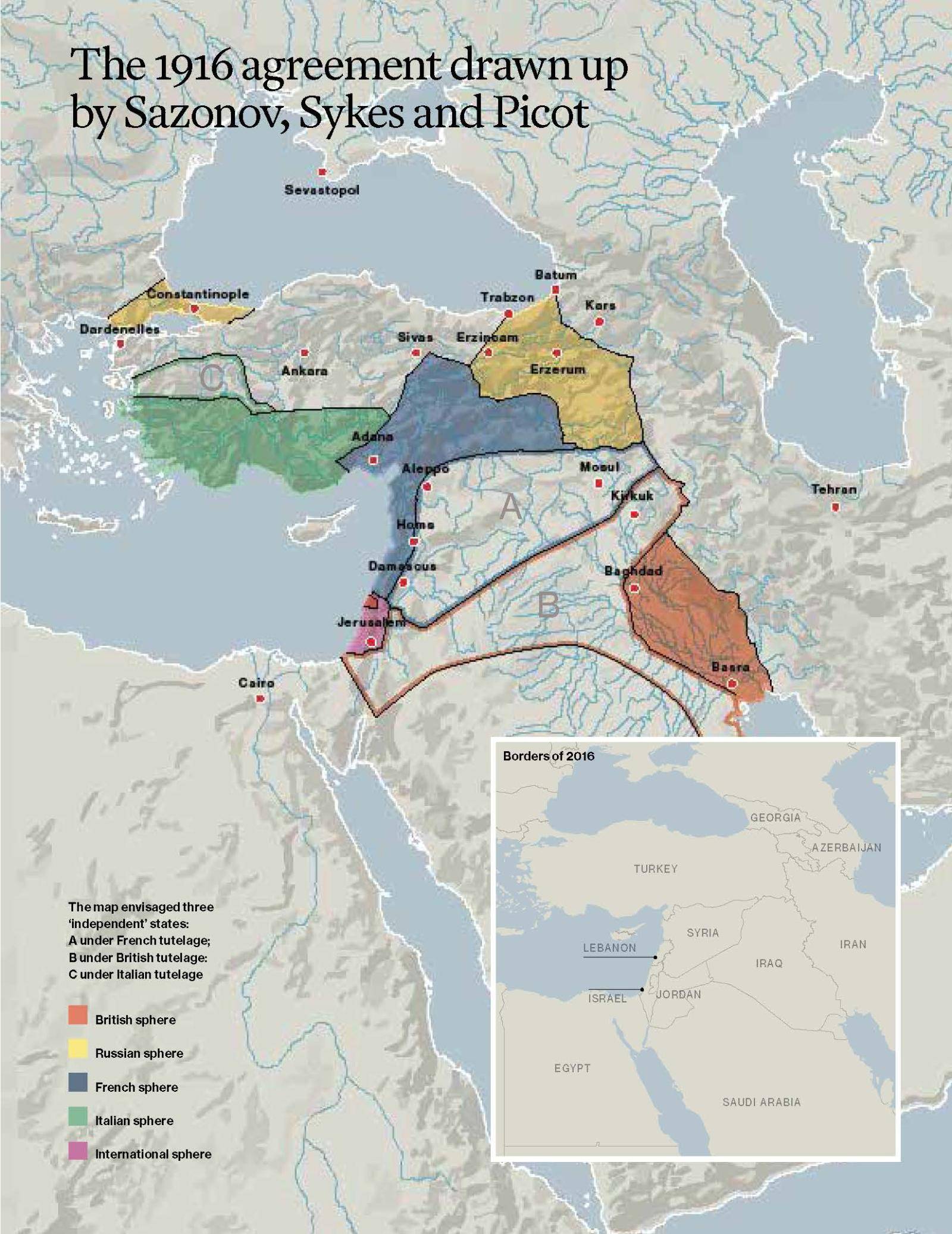
He jumps right in even before he begins his wide-ranging story, leaves hanging in the air like a predator drone until he returns to it in chronologically due course. The Sykes Picot Agreement of 1916 – the bête noir of most progressive narratives of the modern Middle East, and to many ill-informed partisans, the causus bello of the intractable Arab Israeli conflict – was not the brainchild of perfidious Albion and duplicitous France, but rather a plan for the dismemberment of the Ottoman Empire concocted by the foreign minister of Imperial Russia. France’s Monsieur François-George Picot and Britain’s Sir Mark Sykes played second and third violin to the “third man” Sergei Sazonov. Both Russia and France had for decades sought to establish their political, strategic and economic interests at the expense of the so-called “sick man of Europe”, an ostensibly terminal invalid who throughout the nineteenth century, had experienced many deathbed recoveries. Czar Nicholas II, in common with his Russian Orthodox predecessors, dreamt of bringing Istanbul, formerly Constantinople, the heart of the orthodox patriarchate, or Tsargrad into the empire. It was no coincidence that the infamous Sykes Picot pact was outed by Russia’s Bolshevik regime after the collapse of the Czarist regime to discombobulate the revolution’s foremost European enemies. 

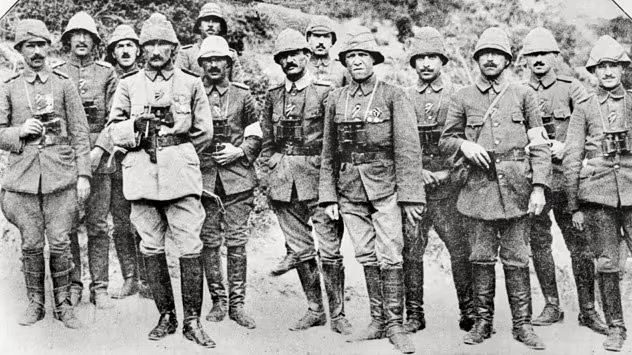
The second icon of “received history” in McMeekin’s sights, is one Australia’s foundation stories – the ill-starred Dardanelles Campaign of 1915 and particularly, the the ANZAC’s Gallipoli legend. It was, from McMeekin’s perspective, a misconceived, poorly planned endeavour to capture the Ottoman capital, to relieve pressure on Russian forces engaged in bitter fighting in Eastern Anatolia, and potentially, to knock the Ottomans out of the war. Contrary to popular conceptions, the British were not exactly enthused by the idea. First Lord of the Admiralty Winston Churchill’s preference was for an assault on the “soft underbelly” of the empire – the port of Alexandretta in Ottoman Syria (now Turkish Antakya), with its strategic and logistic proximity to the Hijaz railway and the hinterland of the Levant. One indisputable fact about Gallipoli is that it assured the ascent Mustafa Kemal, a key commander who had already distinguished himself in the Balkan Wars, who would go on to conduct a fighting retreat of Ottoman Armies through what is now present-day Palestine and Syria, lead Turkish forces to victory in the war of liberation that followed, and, as Kemal Atatürk, would become the founder of modern Türkiye.

The third widely held narrative concerns the Armenian Genocide. Unlike the rulers of modern Türkiye, McMeekin does not deny its occurrence. Nor does he downplay or even ignore it, as does Israel for the idiosyncratic reason that it potentially minimises the horrors of the Shoah. Rather, he places it in the context of events in the empire’s Anatolian heartland. Two predominantly Armenian provinces in Eastern Anatolia were home to active nationalist independence movements, and these gave tacit and actual support to the Russian forces encroaching on the empire from the Caucasus and the Caspian Sea (in present day Azerbaijan and Georgia). Armenian militias fought alongside Russian forces on the Caucasian front whilst partisans operated behind ottoman lines, and cities, town and villages were actually “liberated”, fostering fears in the Istanbul government of an treasonous” fifth column”. McMeekin acknowledges the death toll of what we now recognise the systematic destruction of the Armenian people and identity which was spearheaded by the ruling Committee of Union and Progress (CUP) and implemented primarily through the mass deportation and murder of around one million Armenians during death marches to the Syrian Desert and the forced Islamization of others, primarily women and children. Whilst most probably died of inhumane treatment, exposure, privation and starvation, unknown numbers were murdered.

Kemal Pasha and Ottoman offices at Gallipoli

Parallels

Reading The Ottoman Endgame, I was reminded often of his compatriot Anthony Beevor’s harrowing tale of the Russian Revolution (reviewed in In That Howling Infinite’s Red and white terror – the Russian revolution and civil war. That Revolution and the end of the Ottoman Empire converged. McMeekin notes that with regard to the war in Anatolia and the Caucasus, the treaty of Brest-Litovsk, which ended the war between Czarist Russia and the Central Powers, was poisoned chalice for both Russia and Turkey and as significant as any of the treaties that followed the end of the war.

I found it fascinating that many individuals who were to play a significant part in the Russian Civil war also feature in Ottoman Endgame. Admiral Alexander Kolchak, commander of the imperial Black Sea fleet and General Anton Deniken, commander of Russian forces on the Caucasian front, became leaders of the Tsarist cause and were to command the counter-revolutionary White forces against the Red Army with the Siberian People’s Army and the Volunteer Army in Ukraine.

None were more prominent or as controversial in western narratives, however, as Winston Churchill. As noted above, McMeekin lays to rest the notion that the Dardanelles campaign and Gallipoli were Churchill’s sole doing and his folly – though he did blame himself later on and has been pilloried for it ever since. Ironically, once disgraced, and having volunteered to serve on the Western Front, at the end of the war, he was brought back into Lloyd George’s cabinet as Secretary of State for War. There, he advised against military intervention against Kemal’s nationalist forces and indeed mused about the option of dumping the Sazonov-Sykes-Picot dispensation imposed on the moribund empire’s Arab provinces after the armistice and of restoring the prewar territorial status quo, a kind of circumscribed Ottoman Redux. And yet, as civil war broke out and spread in the nascent Soviet Union, he was alone of his cabinet colleagues in advocating for a full-on allied intervention. Critics claimed that he dreamt, – though some believed that he fantasized – about of creating an effective White army and a borderlands alliance to defeat the Bolsheviks. But his aspirations were foiled by the imperialism of the White leadership and of White officers, and the various national movements’ fear that that if the Whites prevailed, they would restore Russian rule. Britain’s rulers were reticent about shoring up and providing financial, material support and also, soldiers sailors and airmen to brutal to demonstrably homicidal Cossack brigades and revanchist and reactionary royalist autocrats. It is not without reason that admirers and critics alike would agree that Winston had more positions than the Karma Sutra.

The Russian Revolutions – there were two, in February and October 1917 – and the Civil War that followed it, the disintegration of the Ottoman Empire followed by foreign intervention, the war of liberation, and the creation and endurance of Türkiye can be said to have defined the contours of modern Middle Eastern geopolitics, setting the stage for many if not most of the conflicts that have inflicted the region since, including three Gulf wars, the rise and fall of the Islamic State, the Lebanese, Iraqi and Syrian civil wars, and the Arab-Israel conflict, arguably the most intractable conflict of modern times. Cold War and also, the current Ukraine war.

In the wake of the fall of the Russian Empire, the Twentieth Century was not kind to the countries of Central and Eastern Europe. Historian Timothy Snyder called them “the blood lands”. Nor was it kind to the heirs and successors of the Ottoman Empire. Though the tyranny and oppression and the death and destruction wrought by rulers and outsiders upon the lands and peoples of the Middle East has been significantly less than that endured by the people of Eastern Europe and Russia, the region would fit Snyder’s sombre soubriquet.

© Paul Hemphill 2025. All rights reserved

Also in In That Howling Infinite, see Ottoman Redux – an alternative history and Red and white terror – the Russian revolution and civil war

For more on the Middle East, see A Middle East Miscellany

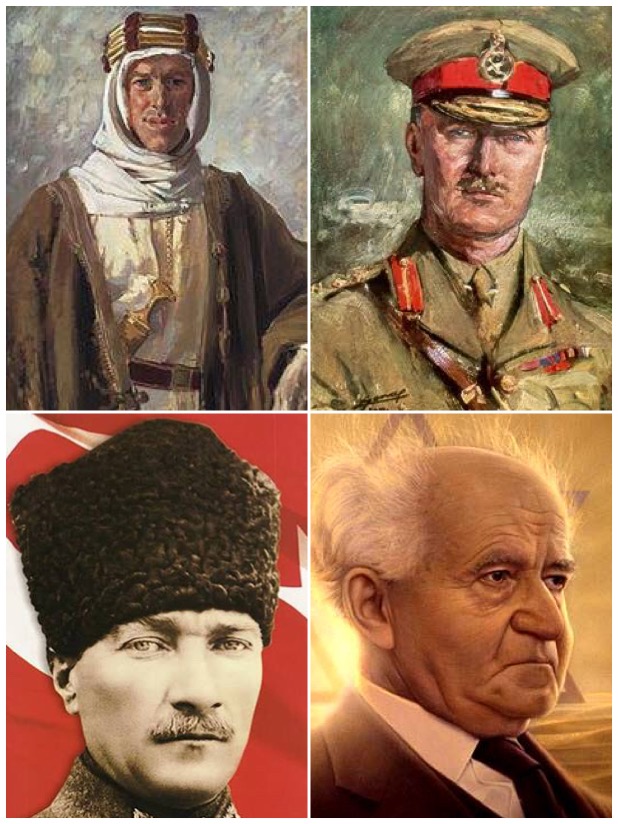
TE Lawrence, General Allenby, Kemal Ataturk, and Ben Gurion

Clone of Russia returns to a Middle East it never really left

Sykes and Picot have taken the blame but actually it was a Russian who drew the map of the Middle East, writes Sean McMeekin

The World Today, 7 December 2018

To judge from press coverage, the emergence of Islamic State has brought about a cartographic revolution in the Middle East. With the borders of Syria and Iraq in flux, journalists have resurrected the legend of Sykes-Picot, wherein Britain and France are said to have divided up the Ottoman empire between them in an agreement signed 100 years ago, in May 1916. Russia’s intervention in Syria, by upstaging the United States and her allies, seems in this view to be completing the rout of western influence in the Middle East, putting the final nail in the coffin of ‘Sykes-Picot’.

Rarely has history been more thoroughly abused. In reality, none of the contentious post-Ottoman borders of the Middle East was settled by Sykes and Picot in 1916: not the Iraq-Kuwait frontier notoriously crossed by Saddam’s armies in 1990, not those separating the Palestinian mandate from (Trans) Jordan and Syria, not the highly contested and still-in-flux Israeli/Palestinian partition of 1948, nor, in the most relevant example from today, those separating Syria from Iraq.

To take an obvious example from recent headlines, Mosul, the Iraqi city whose capture in June 2014 led Abu Bakr al-Baghdadi of Islamic State to proclaim himself Caliph Ibrahim, was actually assigned to French Syria in the 1916 agreement.

Journalists are even more spectacularly wrong in describing the Ottoman partition agreement as exclusively (or even primarily) a British-French affair, omitting the driving role played by Tsarist Russia and her Foreign Minister, Sergei Sazonov.

The final terms of what should more accurately be called the Sazonov-Sykes-Picot agreement were actually hashed out in the Russian capital of Petrograd in the spring of 1916, against the backdrop of crushing Russian victories over the Turks at Erzurum, Erzincan, Batum, and Trabzon (the British were reeling, having been humiliated at Gallipoli and in Iraq, where an expeditionary force would shortly surrender).

The conquest of northeastern Turkey in 1916 left Russia, unlike her grasping allies, in possession of most of the Ottoman territory she was claiming – barring only Constantinople (called ‘Tsargrad’ by the Russians), which still needed to be taken.

At the dawn of 1917, Tsarist Russia was poised to inherit the crown jewels of the Ottoman empire, including Constantinople, the Straits, Armenia, and Kurdistan, all promised to her in the Sazonov-Sykes-Picot Agreement. Along the Black Sea coast, Russian engineers were building a rail line from Batum to Trabzon, with the latter city a supply base for the Caucasian Army, poised for a spring assault on Sivas and Ankara. With Russia enjoying virtually uncontested naval control of the Black Sea, preparations were underway for an amphibious strike at the Bosphorus, spearheaded by a specially created ‘Tsargradskii Regiment’.

After watching her allies try, and fail, to seize the Ottoman capital during the Dardanelles/Gallipoli campaign of 1915 (when Sazonov had first put forward Russia’s sovereign claim on Constantinople and the Straits), Russia was now poised to seize the prize for herself – weather permitting, in June or July 1917.

Of course, it did not turn out that way. After the February Revolution of 1917, mutinies spread through the Russian army and navy, including the Black Sea fleet, just as it was poised to strike.

In a remarkable and little-known coincidence, on the very day the Foreign Minister of the Provisional Government, Pavel Milyukov, first aroused the anger of the Petrograd Soviet and the Bolsheviks by refusing to renounce Russia’s territorial claims on the Ottoman empire – April 4, 1917 – a Russian naval squadron approached the Bosphorus in ‘grand style’, including destroyers, battle cruisers, and three converted ocean liner-carriers which launched seaplanes to inspect Constantinople’s defences from the air. The amphibious plans were not abandoned until fleet commander Admiral AV Kolchak threw his sword overboard on June 21 during a mutiny. Even after ‘revolutionary sailors’ had taken control of the Black Sea fleet, a Russian amphibious strike force landed on the Turkish coastline as late as August 23, 1917, in one last sting by the old Tsargrad beast.

After the Bolsheviks took power, Russia collapsed into civil war, which left her prostrate, at Germany’s mercy. By signing a ‘separate peace’ with the Central Powers at Brest-Litovsk in March 1918, Russia forfeited her treaty claims to Armenia, Kurdistan, Constantinople, and the Straits, throwing the Sazonov-Sykes-Picot agreement of 1916 into chaos, even as new claimants were appearing on the scene, such as Italy and Greece – not to mention local actors: Jewish, Arab, and Armenian troops were attached as national ‘Legions’ to General Allenby’s mostly British army as it rolled up Palestine and Syria. These forces, along with French, Italian, and Greek expeditionary forces sent after the war, and the Turkish nationalists who regrouped under Mustafa Kemal in Ankara to oppose them, would determine the final post-Ottoman borders in a series of small wars between 1918 and 1922, with scarcely a nod to the Sazonov-Sykes-Picot Agreement.

While Russia’s forfeiture of her claims in 1918 was welcome, in a selfish sense, to the other players vying for Ottoman territory, it was not necessarily a positive one for the region. In the absence of Russian occupying troops to police the settlement, the

Allies, in 1919, offered Russia’s territorial share, now defined (in deference to Woodrow Wilson) as mandates, to the United States – only for the Senate to vote down the Versailles Treaty, rendering the arrangement moot. Lacking Russian or American troops as ‘muscle’, the Allies leaned on weaker proxies such as the Italians and, more explosively, local Greeks and Armenians, which aroused the anger of the Muslim masses and spurred the Turkish resistance led by Kemal (the future Atatürk). Armenians, Greeks and Kurds, too, could only lament the vacuum left behind by the departing Russians, which left them to face Turkish wrath alone.

Soviet Russia re-emerged as a player in the Middle East fairly quickly, not least as Mustafa Kemal’s key diplomatic partner during his wars against the West and its proxies from 1920-22. In a reminder of the enduring prerogatives of Russian foreign policy, the Cold War kicked into high gear when Stalin made a play for Kars, Ardahan, and the Ottoman Straits in 1946: these moves, along with the British withdrawal from Greece, Turkey, and Palestine, inspired the Truman doctrine.

In an eerily similar replay of the history of 1917-18, the collapse of Soviet power in 1991 led Moscow to turn inward, withdrawing from the Middle East and inaugurating a period of US and western hegemony in the region, which turned out no less well than the Middle Eastern free-for-all of 1918-22. A prostrate and impoverished Russia put up no objection during the First Gulf War of 1991, and did little more than sputter during the Iraq War of 2003. Russia’s recovery of strength and morale in the Putin years led, almost inevitably, to her return in force to the Middle East – from which, in reality, she never truly left.

The Russian return to the region, along with Turkey’s increasingly overt hostility over her Syrian intervention, resurrects historical patterns far, far older than Sykes-Picot. For centuries, the Ottoman empire was the primary arena of imperial ambition for the Tsars, even as Russians were the most feared enemies of the Turks. In many ways, the Crimean War of 1853-56, which saw western powers (Britain, France, and an opportunistic Piedmont-Sardinia) unleash an Ottoman holy war against the Tsar to frustrate Russian ambitions in the Middle East, is a far more relevant analogy to the present crisis in Syria than the pseudo-historical myths of 1916. It is time we put the Sykes-Picot legend in the dustbin where it belongs.

Diplomatic carve-up: the third man

In David Lean’s 1962 film, ‘Lawrence of Arabia’, a cynical British official explains how the carcass of the Ottoman Empire was to be divided at the end of the First World War under the Sykes-Picot Agreement.

‘Mr Sykes is an English civil servant. Monsieur Picot is a French civil servant. Mr Sykes and Monsieur Picot met and they agreed that after the war, France and England would share the Turkish Empire, including Arabia. They signed an agreement, not a treaty, sir. An agreement to that effect.’

This summary of wartime diplomacy has proved long-lived. It encapsulates the less than honest dealings of the British government with the Arabs – who wanted independence after being liberated from Turkish domination, rather than rule by the European colonial powers – but it leaves out the key figure in the deliberations, Sergei Sazonov, Russian foreign minister, 1910-1916.

Sazonov was one of the most significant diplomats both before and during the Great War. It was thanks to his adroit manipulation that Britain and its allies came to accept that Russia would gain the Ottoman capital Constantinople, in the event of an Allied victory, an outcome that Britain had tried for decades to prevent.

At the talks in the Russian capital Petrograd in 1916, the British and French emissaries were far lesser agents of empire than their host.

Sir Mark Sykes was a gifted linguist, travel writer and Conservative politician, but no top-flight diplomat. As for François Georges-Picot, he was an experienced diplomat and lawyer and noted advocate for a greater Syria under French rule.

But with France having no troops in the eastern theatre of war, he had to accept Russia’s demand to swallow up large parts of what is now eastern Turkey, but which Paris had set out to claim.

Sykes died of influenza in 1919 at the Paris Peace Conference, where Sazanov represented the White Russians. He died in Nice in 1927

The Ottoman Endgame: War, Revolution, and the Making of the Modern Middle East, 1908-1923” by Sean McMeekin

Czar Nicolas I of Russia is sometimes credited with coining the phrase “Sick Man of Europe” to describe the decrepit Ottoman Empire of the mid-nineteenth century. By the early 20th century, there could be little doubt that the disparaging sobriquet applied in spades. The Ottoman Empire was soundly defeated in two Balkan wars in 1912 and 1913 by the comparatively pipsqueak countries of Bulgaria, Greece, Montenegro and Serbia. One result of the wars was that the Empire lost all of its European territories to the west of the River Maritsa, which now forms the western boundary of modern Turkey. Then, when World War I broke out, the Ottomans made the disastrous decision to side with the Central Powers against the Triple Entente, ending up on the losing side of that cataclysm.

882094291

A popular theory is that the carving up of the Ottoman lands after the war, pursuant to the Sykes-Picot Agreement between France and Britain, is the source of many of the problems of the current Middle East. In The Ottoman Endgame, Sean McMeekin concedes that it is not wrong to look to the aftermath of the war for the roots of many of today’s Middle Eastern problems, but the “real historical record is richer and far more dramatic than the myth.” For example, the notorious Sykes-Picot Agreement was sponsored primarily by Russia, whose foreign secretary, Alexander Samsonov, was the principal architect of the agreement. McMeekin’s retelling of the demise of the Ottoman Empire and its recrudescence as modern Turkey is a fascinating and complicated narrative.

Among the interesting facts McMeekin points out is that according to an 1893 census only 72% of the Ottoman citizens were Muslim, and that in the middle of the 19th century the majority of the population of Constantinople may have been Christian. The Balkan Wars started a trend, exacerbated by World War I, toward ethnic cleansing, with hundreds of thousands of Christians leaving the Empire and similar numbers of Muslims moving from territory lost by the Empire to areas it still controlled.

We in the West tend to think of World War I as a static slugfest conducted in the trenches of northern France. But the war in the East, particularly as it applied to the Ottoman Empire, was a much more mobile affair. In fact, the Ottomans ended up fighting the war on six different fronts, as the Entente Powers invaded them from many different angles.

Winston Churchill in 1914

Winston Churchill in 1914

At the outbreak of WWI, the Ottomans allied themselves with Germany out of fear of Russia, which had coveted control over the straits connecting the Black and Mediterranean seas for centuries. In 1914 the Russians invaded Eastern Anatolia and met with initial success. However, Russia feared its early success was quite precarious, and so it inveigled its ally, Britain, to launch a diversionary assault on the Gallipoli peninsula. The “diversion” became one of the most deadly killing grounds of the war, as the British poured hundreds of thousands of men into the battle in hopes of breaking the stalemate on the Western Front. The author credits Russian prodding more than Winston Churchill’s stubbornness for the extent of the British commitment. The Ottomans, led by Mustapha Kemal (later to be known as Ataturk, the “father of modern Turkey”), prevailed in this hecatomb, showing that there was still plenty of fight left in the “Sick Man.”

Turkish General Mustafa Kemal, center, at Gallipoli, 1915

Turkish General Mustafa Kemal, Gallipoli, 1915

The Ottomans also soundly defeated the British in Mesopotamia (modern Iraq) in late 1915, but they were less successful against the Russians, who invaded across the Caucasus and held much of eastern Anatolia until the Bolshevik revolution in 1917 caused them to withdraw voluntarily. The British ultimately prevailed against the Ottomans in 1918 by invading from Egypt through Palestine, with a little help from the Arabs of Arabia.

The Treaty of Versailles, which ended the war in Europe in 1919, did not end the war for the Ottomans. The victorious Allies were ready to carve up much of the Empire for themselves. The Ottoman armies were to disband; England was to keep Egypt and to get Palestine and Mesopotamia; France was to get Syria, Lebanon, and parts of modern Turkey; and Greece was to get a large swath of western Turkey. All might have gone according to that plan, but Mustapha Kemal (Attaturk) was still in charge of a small but effective fighting force in central Anatolia. Attaturk husbanded his forces and fought only when he had an advantage. In a war that lasted until 1923, he was able to expel the Greeks from Anatolia and to establish the boundaries of modern Turkey.

large

McMeekin deftly handles this complexity with a lucid pen. His descriptions of the various military campaigns are riveting. This is not to say that he shortchanges the political machinations taking place. He gives more than adequate coverage to the “Young Turks,” a triumvirate that ruled the Empire from 1909 until they eventually brought it to its ruin in 1919. He also covers the Armenian massacres as objectively as possible, given the enormity of the events described.

Evaluation: This is a very satisfying book and an excellent addition to the enormous corpus of World War I literature. The book includes good maps and photos.

Published by Penguin Press, an imprint of Penguin Random House, 2015

Cha … Cha … Changes

There would be later times (1965, 67, 69…) but I remember the first time. 1962. Having hitched through Europe and arriving in Istanbul. That special feeling. From Sultan Ahmed looking across the Bosporus towards the East, unknown roads and places and in the far distance a very vague idea of India…. Istanbul as a gateway to other worlds and new adventures….I was a young man drifting and dreaming, there were no guidebooks and I had not met anybody who had done the journey or heard stories from the road ahead….. The world was open, and I was ready….
Torben Huss, photographer

Haydarpasha Gan, late November 1972.

The last station on the line, and the end of Asia, after a twenty four hour train journey across Anatolia, from Teheran, including a wintry ferry ride across Lake Van, in the East, in the company of an idiosyncratic and proselytizing German pastor and a Pakistani student. The student and I quickly converted to Lutheranism just to shut him up.

There were no bridges across the Bosphorus in those days. Just the ferry that met the train to take us across to the Golden Horn to Eminou. And thence, a walk up to Sultanahmet, with the address of a doss house given to me by someone I’d met in Meshad near the Persian-Afghani border. A space on a floor for a few lira a night.

And then several weeks in Istanbul on two dollars a day, sleeping on the floor at what today would be called a backpacker’s hostel, broke and waiting for money to be sent from England. Weeks spent wandering the streets, wondering at the mosques and markets, getting stoned (dangerously in those days – remember ‘Midnight Express’?) in the Hippodrome, and dining cheaply morning, noon and night at the Pudding Shop.

Forty years on, and naturally, things have changed in many ways. Haydarpasha is closed for renovations and a rail link crosses the Bosphorus by undersea tunnel. There are now are two impressive suspension bridges.

Asian Istanbul, more of a sleepy suburb then, with some fine buildings scattered along the shore, is now a metropolis in its own right. And Istanbul is a city of thirteen million people.

The Pudding Shop is now world-famous on account of its hippie credentials and sells all kinds of good Turkish tucker, but a shadow of its former simplicity. Where once there thronged ragged and rangey adventurers on their journey east or west, tourists of all nations gather en masse.

The Pudding Shop 1969

Turkey in general, and Istanbul in particular, is now the place to be and the town to see – in these troubles times, it is a safe ‘Middle Eastern’ holiday destination, and a big cross on the cruise map. Almost every day, a fleet of giant liners ties up on the Yesilkoy quay. And their cargo soon materializes in Sultanahmet to view the BIg Four: the Blue Mosque, Aya Sofya, Topkapi Seray, and the Grand Bazaar. No time for the simple grandeur of the Sulaymaniyah Mosque, the other-worldliness of Byzantine Emperor Justinian’s vast underground cistern, or the aromatic gorgeousness of the Spice Bazaar down by the quays of Eminou.

Though no longer the exotic, half-east-half-west departure lounge for the old hippie trail, Istanbul is still a contradiction of past and present, trash and treasure, modernity and medaevilism. The dialectic is still evident, and maybe more so, between the ever changing now and the ever-present then, in the forever magical monuments and mosques, in the contrast between the modern young Turks in their western gaberdine and the many muhajibiin and well-covered conservatives.

Scratch Istanbul’s surface, and you will find a tangle of medieval streets and 21st Century traffic jams, bad drivers, and worse pavements. Walkers watch out!

And there is a poorer, working class, and even rural Istanbul. Suburbs just off the tourist map, where old men gather outside chai shops smoking, chatting and playing cards, and where women are rarely seen – when they do, most are covered.

Many Turks have come in from rural areas, and are still clad in traditional garb. There are now hundreds, maybe thousands of Syrian refugees in Istanbul now, seeking shelter from the storm in their sad and devastated homeland, and other Arabs fleeing the bitter winter that has followed the Arab Spring. Some rent apartments for their families, others beg in the streets.

As we walked along the highway that boarders the ancient walls and the Bosphorus, a speeding car hit an elderly Syria as he was crossing the dangerous road. We and his distraught family rushed to his aid, and mercifully he was unharmed but in shock, and did not want an ambulance. We placed him in a the comfortable position and I advised the young men with him in Arabic to keep a watch over him and to watch his eyes.

In contrast to these wandering souls, well-heeled Gulf Arabs arrive with too much money and too little taste. Istanbul is viewed as more stable, cosmopolitan, and naughty than tense and tenuous Beirut, and these wealthy visitors often seek to buy property here.

All the contrasts and contradictions are presently being played out in the politics and economics of this modern Turkey, and in the street protests, tear gas, and riot gear across the Golden Horn, up the hill around Taksim and Gezi Park, and across the suspension bridge. Partisans of Prime Minister (now presiden) Erdogan bump up against the Gulenists, followers of an exiled but influential dissident, and against the ever-ardent bearers of Kemal Ataturk’s torch. Folks still revere him as the Father of The Turks, but times change, some say, and so then must Ataturk, although the old man must spin some in his revered grave.

People say that Turkey is a divided nation right now. And this is manifested in accusations of creeping Islamization, counter-accusations of occidental decadence and depravity, allegations of corruption and cronyism, and street violence and police brutality. Back into November 1972, Military Rule was the norm, and dissent was silenced. Turkey was Asian, and Middle Eastern. Now the country still straddles east and west, coughing the European Union with much leas enthusiasms than hitherto or and presenting as the go-between ‘twixt The West and and Iran, and with the volatile lands to the south.

For better or ill, how things have changed.

© Paul Hemphill 2014.  All rights reserved

Torben Huss, Eminonu 1965

For other posts about Turkey in In That Howling Infinite, see: People watching in Sultanahmet, Sailing to Byzantium, Ottoman Redux – an alternative history and The Watchers of the Water