For our old friend and co-founder of HuldreFolk, the acclaimed bandurist Victor Mishalow, Ukrainian composer Hryhory Kytasty’s Echo of the Steppes (Гомін Степів) was much, much more than a piece of music; it was an evocation of a lost homeland.
It was Victor’s signature piece, and when introducing it in our concerts – an eclectic combination of stories, songs and music – he would describe the boundless Ukrainian steppe: waves of tall grass bending beneath an endless wind, and beneath it all the legendary black chernozem, among the richest soil on earth, so deep it seemed almost without end. In his telling, the bandura was “the soul of Ukraine”, its shimmering strings giving voice to the wind, the grasses, the little creatures that dwelt within them, and the immenseness of the plains.
The music also carried folk memory: of open frontiers where the Kozaks once found refuge from oppression, where freedom could still be breathed beneath an enormous sky, and where the landscape itself became part of the nation’s identity. Listening to Victor play, one did not simply hear an instrument; one heard the echo of the steppes – a vast, living landscape in which earth, wind, history and people were bound together in a single, resonant voice.
Fingerprints, ghosts and the long arm of History
In an illuminating essay in the e-zine Unherd, republished below, former war-correspondent Aris Roussinos begins an extensive and expansive review of Australian archeologist Warwick Ball’s The Eurasian Steppe with three mute stone figures – Cuman balbals – standing beside the road between Sloviansk and Bakhmut in Donetsk, watching the endless movement of armies across what is now Ukraine’s disputed and devastated Donbas. They are ancient witnesses in a landscape where Russians and Ukrainians now fight over ground that, for most of human history, belonged to neither, and yet, for countless people over millennia, became pasturelands and polities, battlefields and burial grounds.
This is history as I like it: the historian as storyteller, where landscapes become characters and the past refuses to remain buried.
Long before Slavic speech reached these plains, the steppe was the domain of nomadic peoples: Scythians, Sarmatians, Alans, Huns, Turks, Mongols and many others whose empires rose and vanished like storms over the grasslands. They left few cities and fewer written records, but their fingerprints are everywhere: in languages, military traditions, political institutions, myths and identities. The grass remembers what libraries often forget.
Roussinos’ central argument is that we have misunderstood Europe by looking too exclusively westward, towards Rome. The steppe was never merely a barbarian wilderness beyond civilisation, waiting to burst through the gates. It was one of the great engines of European history. Europe was shaped not only by the legacy of Rome and Christianity but also by repeated encounters with the peoples of Inner Asia. The old frontier between “Europe” and “Asia” dissolves under closer inspection. What appears on a modern atlas as a dividing line was, for centuries, a vast zone of movement, exchange, conquest and adaptation.
The present war in Ukraine unfolds across precisely this ancient geography. The early Russian thrust towards Kyiv moved through forests and marshes that belonged historically to the old Slavic world. The grinding war of attrition in the east is being fought across the open “Wild Fields”, the immense Eurasian grasslands where mounted nomads once travelled with astonishing speed and where empires repeatedly collided. Roussinos draws parallels with the mechanised battles of the twentieth century – Kursk, Kharkiv, Stalingrad – where tanks replaced horses, but the strategic significance of the landscape remained unchanged. Geography, as Napoleon is said to have observed, is often the most enduring ally in war.
It is an enticing argument because it encourages us to look beneath the familiar surface of European history. Perhaps Europe itself carries far more of the steppe within it than we usually acknowledge. Hungary and Bulgaria were founded by peoples of the steppe. The Polish nobility cultivated a proud Sarmatian ancestry. The Magyars’ memory of their eastern origins helped shape nineteenth-century nationalism. Even the nation state, so often presented as an entirely European invention, may owe something to political traditions carried westward across the grasslands by mounted confederations whose influence extended far beyond the horizon they inhabited.
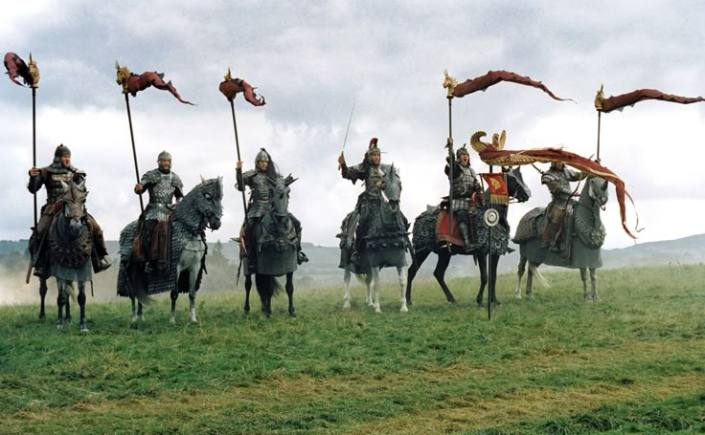
There are historical echoes scattered throughout this story. The Sarmatians and Alans revolutionised warfare with armoured cavalry, heavy lances and mounted tactics that would eventually blossom into the chivalric traditions of medieval Europe. Even the Arthurian legend may preserve a distant resonance of the steppe in the enduring image of the sword planted in the earth, waiting for the rightful king to draw it forth.
Filmmakers, naturally, could not resist. The 2004 film King Arthur, for example, stitched together Romans, Celts, Sarmatians, Picts and enough historical liberties to make any medievalist wince. Clive Owen wandered through a fictional Northumbria Britain as a brooding half-Roman, half-Sarmatian Arthur, while Keira Knightley appeared as an improbably glamorous and scantily clad Guinevere whose Pictish origins seemed less convincing than her plummy English accent. It was glorious nonsense, but enjoyable, nonetheless. The Irish landscapes were striking, the horses magnificent, the ‘Knights’ (the picture at the head of this essay) with their “Rus! Rus!” war cry (and they actually do sit at a round table) improbably photogenic. A battle fought across a frozen lake owed as much to Eisenstein’s Alexander Nevsky as it did to any surviving historical source. Ridley Scott later recycled much the same visual conceit in his disappointing Napoleon. History often survives in cinema not because the facts are accurate but because certain images possess extraordinary emotional truth.
The Cossacks offer a far more convincing example of the cultural blending that characterised the frontier. They emerged not from ethnic purity but from mixture. Runaway serfs, adventurers, escaped peasants and soldiers settled the borderlands, adopting the customs, military practices and vocabulary of the Turkic peoples who had occupied the steppe before them. Even the word “Cossack” derives from a Turkic root meaning “to roam”. The frontier was never a wall separating civilisations. It was a workshop in which entirely new identities were forged.
It is here that Roussinos, following Warwick Ball, arrives at his most provocative claim. Muscovite Russia, he argues, cannot be understood without recognising the formative influence of the Mongol world. Moscow’s rise was anything but inevitable. The Golden Horde required dependable tributaries capable of collecting taxes, maintaining order and supplying troops. The princes of Moscow proved remarkably efficient servants of the khans and, in doing so, transformed what had once been a relatively insignificant Rus’ principality into the nucleus of a future empire. The irony is delicious. Mongol domination helped create the very Russian state that would eventually conquer the steppe itself.
The fingerprints remain visible today. Administrative practices, institutions of government, systems of taxation and even elements of the Russian language bear traces of Mongol influence. Yet fingerprints are curious things. They tell us that contact occurred; they do not tell us everything that followed.
That question lies at the heart not only of Ball’s thesis but also of historian Orlando Figes’ The Story of Russia, which, by happenstance, I am reading at the moment. It is one of those literary coincidences in which two writers, approaching the same landscape from different directions, find themselves asking precisely the same question. What made Russia, Russia?
Figes is, in many respects, the perfect companion to Roussinos because he shifts our attention from inheritance to interpretation. He readily acknowledges that the Mongol conquest of the Rus’ principalities in the thirteenth century was one of the defining ruptures in Russian history. It destroyed Kyiv’s political centrality, subordinated the northern principalities to the Golden Horde and created the circumstances in which Moscow could eventually emerge as the dominant power. Like Roussinos, he recognises the profound irony that Mongol domination did not simply interrupt Russian state formation but helped shape its eventual character.
Yet Figes is ultimately less interested in what Russia inherited than in what Russia chose to become. The Mongols bequeathed methods of rule: taxation, military organisation, communications and a conception of authority that differed markedly from Western feudalism. Russia’s imagination, however, was nourished elsewhere. Orthodox Christianity, Byzantine political theology, the doctrine of Moscow as the “Third Rome” and the almost mystical conception of the Tsar as God’s anointed gave Russia a vocabulary through which it understood itself. Its civilisation emerged not from a single source but from the convergence of many.
This distinction is important because it rescues history from determinism. Fingerprints reveal contact; they do not reveal intention. They cannot tell us why someone picked up the knife, wrote the letter or opened the door. Likewise, cultural inheritance explains possibilities, not inevitabilities.
Figes presents Russia as a civilisation assembled from multiple traditions: Slavic, Byzantine, Mongol, European and imperial. The country’s enduring paradox is that it has persistently imagined itself as both European and somehow apart from Europe. Peter the Great attempted to drag Russia westward, shaving beards, importing European science, founding St Petersburg (a German name, which was changed to Petrograd during World War I for the same reasons the British royal house changed its German name to Windsor) embracing Enlightenment ideas. Yet beneath these reforms older structures of autocracy survived. Later generations reversed the argument entirely. Slavophiles celebrated Russia’s uniqueness while Westernisers lamented its failure to become sufficiently European. The debate has never really ended. It merely changes its vocabulary.
Maps have always encouraged these arguments. A glance at any atlas suggests that Russia occupies an almost impossible position: a European power that expanded across Asia until it became the largest contiguous empire on earth. The geography itself tempts us into historical mythology. Is Russia European? Asian? Eurasian? The answer has varied according to who was asking and what political purpose the answer was intended to serve. Geography creates opportunities, constraints and temptations. It does not dictate outcomes.
Figes’ also explores of recurring Russian archetypes: the Holy Tsar, the Holy Fool, the suffering nation, the belief that Russia possesses a unique historical destiny. These are not immutable characteristics embedded in some mystical national DNA. They are stories Russians have told about themselves across the centuries – including Vladimir Putin’s house ideologue, philosopher Aleksandr Dugin. Stories matter because people act upon them. Nations, no less than individuals, become attached to narratives that explain who they are and why they exist.
Juxtaposed against Ball, Roussinos and Figues is a comment on Roussinos’ essay by Alexander Morrison, a historian of Russian history at Oxford University. Every grand historical narrative requires its sceptic. Elegant theories are seductive precisely because they reduce complexity to a single organising principle. Morrison accepts much of Ball’s argument while quietly resisting its more deterministic conclusions. It is an exemplary piece of historical criticism because it neither dismisses nor genuflects. Instead, it refines.
He readily acknowledges that Muscovy inherited important administrative practices from the Mongol world and points out that Russia was far from unique. The Ottomans, Safavids, Mughals and Qing all incorporated Chinggisid or Timurid political traditions alongside older local institutions. Borrowing across Eurasia was commonplace. Civilisations have always learned from their neighbours, even while claiming absolute originality.
Where Morrison parts company with Ball is over the temptation to confuse influence with destiny. Muscovy borrowed bureaucratic structures connected with taxation, communications and administration. Indeed, the Russian language still preserves Mongol echoes in words such as kazna for treasury, den’gi for money and yam for the postal relay system. Yet the ideological foundations of the state remained overwhelmingly Byzantine and Orthodox. Ivan IV became Tsar by invoking the legacy of Caesar and the vision of Moscow as the Third Rome, not by presenting himself as the heir of Genghis Khan. Administrative inheritance did not erase cultural identity.
That distinction becomes even more important when considering the modern world. It is tempting to explain Putin’s Russia by reaching back to the Mongols, Ivan the Terrible or some timeless Russian soul. Such explanations possess an undeniable elegance because they transform political choices into historical inevitabilities. Morrison rejects this outright. Contemporary Russia, he argues, is shaped above all by decisions made by particular elites drawing upon nineteenth-century nationalism, memories of the Soviet collapse, selective readings of Russian history and modern political ideology. The past provides the vocabulary; it does not dictate the speech.
His discussion of Ukraine is equally persuasive. Southern and eastern Ukraine were settled comparatively recently by a remarkable mosaic of peoples: Ukrainians, Russians, Greeks, Jews, Armenians, Bulgarians and many others. The region’s history is therefore extraordinarily layered. Yet historical complexity does not undermine modern sovereignty. Ancient settlement patterns explain why memories remain contested, but they do not invalidate internationally recognised borders. History illuminates’ claims; it does not automatically legitimise them.
This strikes me as one of the most important lessons historians can offer our own age. We are living through a period in which politicians, nationalists and activists increasingly seek legitimacy by reaching deeper into the past. Ancient kingdoms, medieval battles, archaeological discoveries, linguistic survivals and genetic studies are all recruited into contemporary arguments about identity and territory. History becomes less an investigation than a courtroom brief.
Yet the past is a notoriously unreliable witness.
Landscapes accumulate memories without issuing verdicts. The Donbas bears the fingerprints of Scythians, Greeks, Sarmatians, Goths, Huns, Khazars, Mongols, Tatars, Cossacks, Russians, Ukrainians, Jews, Armenians and countless others. None of those fingerprints constitutes a title deed. They testify to presence, movement and encounter. They remind us that almost every place we imagine possessing an eternal identity has, in reality, been shaped by successive waves of migration, conquest, adaptation and coexistence.
Perhaps that is why I find Roussinos’ essay so compelling. Like the best historical writing, it restores movement to landscapes that modern maps often freeze into static national colours. It reminds us that frontiers have rarely been fixed and that civilisations have always been more entangled than their later myths would admit. Europe did not simply civilise the steppe. The steppe helped create Europe.
Equally, Morrison reminds us that historical explanation should never become historical imprisonment. Institutions endure, languages preserve old borrowings, myths outlive empires and landscapes retain astonishingly long memories. But people still make choices. Nations inherit the consequences of the past without becoming its captives.
The three weathered balbals still stand beside the road to Bakhmut. They have watched Scythians ride westward, Huns descend upon Europe, Mongol tumens disappear into the distance, Cossacks patrol the frontier, imperial armies march beneath Romanov eagles, Wehrmacht panzers advance across the wheatfields, Soviet tanks return in triumph and, today, drones circle silently above the same ground. Every generation has believed its struggle to be unique, its empire enduring, its victories permanent. The stones know otherwise.
History leaves fingerprints everywhere. It leaves them in words, in institutions, in ruined cities, in forgotten roads, in songs, in legends and in the memories of peoples who continue to argue about what happened centuries before they were born. Those fingerprints deserve to be studied because they tell us where we have come from and how our worlds were made. But fingerprints are not destiny. They record contact, not ownership; inheritance, not inevitability; memory, not command. The ghosts of the steppe still whisper across Eurasia, but they do not write the future. That task, as it always has been, belongs to the living.
Coda. The myth of fingerprints.
History leaves fingerprints.
That may seem an odd metaphor, but I have found myself returning to it again and again. Archaeologists brush them from shards of pottery, linguists discover them buried inside forgotten words, historians recognise them in institutions, laws, customs and myths. They are the traces left behind whenever peoples encounter one another, whenever empires rise and fall, whenever civilisations borrow, conquer, imitate or remember.
Fingerprints fascinate us because they appear to promise certainty. In a criminal investigation they identify who touched the weapon. Yet they tell us remarkably little about what actually happened. A fingerprint cannot reveal motive, explain intention or determine guilt. It records contact, not consequence.
History is much the same.
Every landscape is covered with fingerprints. They survive in place names and languages, in ruined cities and forgotten roads, in religions, legal systems, songs, frontiers and collective memory. The three ancient balbals still standing beside the road to Bakhmut are surrounded by them. For nearly a thousand years they have watched Scythians ride westward, Huns descend upon Europe, Mongol tumens disappear into the distance, Cossacks patrol the frontier, imperial armies march beneath Romanov eagles, Wehrmacht panzers cross the wheatfields, Soviet tanks return in triumph and, today, drones circle silently overhead. Every empire believed its moment would endure. Every generation imagined itself to be the culmination of history. The stones know otherwise.
And this is where I arrive at what I have come to think of as the Myth of Fingerprints.
The fingerprints themselves are not mythical. They are real. History leaves them everywhere. The myth begins when we misunderstand what they are telling us.
A fingerprint is evidence that someone was here. It cannot tell us why they came, whether they belonged, whether they acted justly or what rights their descendants may possess centuries later. In a court of law, a fingerprint may place someone at the scene; it cannot, by itself, decide the case. History works in much the same way. It explains how we arrived here, but it cannot by itself determine who ought to possess the future.
Too often we ask it to do precisely that.
Ancient maps become modern borders. Archaeological discoveries become political manifestos. Genetic inheritance becomes moral entitlement. Historical suffering becomes an enduring licence for vengeance. We confuse explanation with justification, inheritance with ownership, memory with legitimacy. That confusion – the transformation of historical evidence into historical entitlement—is what I mean by the Myth of Fingerprints.
It is a myth because it is one of the oldest stories nations tell themselves. Every people constructs narratives from the traces left by earlier generations. Sometimes those stories preserve genuine memory; sometimes they simplify; sometimes they become propaganda. But they all begin with the same temptation: to believe that because history explains the present, it therefore authorises it.
This question lies beneath far more than the current war in Ukraine. It echoes through the history of Palestine and Israel, through Australia’s History Wars, through debates over monuments, migration, frontiers and national identity. Again and again we encounter the same temptation: to search the past not for understanding, but for permission.
That is why Aris Roussinos’ essay on Warwick Ball’s The Eurasian Steppe struck me so forcefully. Ball demonstrates how profoundly the Eurasian steppe shaped Europe. Orlando Figes traces the inheritance of Byzantium, the Mongol world and the frontier in the making of Russia. Alexander Morrison reminds us that inheritances are never destinies. Together they illuminate a larger truth. Geography creates opportunities. Culture bequeaths inheritances. Myths provide meaning. Only human beings make choices.
The ghosts of the steppe still whisper across Eurasia, just as the ghosts of every civilisation whisper through the landscapes they once inhabited. Historians should listen carefully to those whispers, for they reveal how the world came to be. But they should resist the temptation to mistake echoes for commands. The past deserves understanding rather than obedience.
History leaves fingerprints everywhere. They are among our most valuable clues to the human story. They reveal connections, influences, migrations and memories that would otherwise be forgotten. Yet they are not title deeds, nor verdicts, nor chains binding the living to the ambitions of the dead. They explain inheritance without dictating destiny.
That is the real lesson of the Myth of Fingerprints.
Paul Hemphill and In That Howling Infinite, August 2026
This essay was written in conversation with books I’ve read, ideas formed and half-formed, and, more recently, in sustained dialogue with an AI language model, which contributed to drafting, phrasing, and conceptual articulation. What appears here is not unmediated thought, but considered thought: selected, tested, revised and revised again, and owned.
The concept of the Myth of Fingerprints originated in a long essay with regard to what is probably the most intractable conflict in modern times: One Land, Two Peoples: History, Memory, Continuity, and Inheritance. In That Howling Infinite has published many articles regarding the historical movement of peoples. For example: Modern history is built upon exodus and displacement.
For more on Russia, Ukraine and the Soviet Union, see Russky Mir – Russian history’s long shadow.
I highly recommend Ukrainian scholar Serhii Plokhy’s The Gates of Europe, a well told and fascinating story of the origins of Ukraine and Belarus, and how their histories were intertwined, and entwined with those of of Poland, Lithuania (which was a large and powerful state once) and Russia. Ukraine has historically been the border between the catholic west and the orthodox east, the division running virtually down the middle. The name Ukraine is Slav for border land. Its geopolitical location and natural resources have led to the land being inflicted by invaders, civil wars, man-made famine and repression. See, in In That Howling Infinite, Borderlands – Ukraine and the curse of mystical nationalism
And, finally, who or what were HuldreFolk? Named for the mythical and mystical ‘hidden people’ of Icelandic legend, for two years in the early nineteen eighties, they played throughout Australia. Their fame was short-lived; after two years they pursued their own paths and projects. But during the following decades, they would pop up in unexpected places, like their namesakes, in ones, twos, threes, and on occasions with guest HuldreFolkies. Their last outing as a trio was in October 2007 at the North By Northwest Poetry And Folk Club. Google the videos on YouTube. See also, Yuri The Storyteller … We’ll sure miss the old bastard!
Roussinos’ essay follows, and also, for readers with time on their hands, more on Figes’The Stiry of Russia and on Morrison’s critique.
The fate of Europe lies in the steppes Warwick Ball: ‘The Eurasian Steppe’
Aris Roussinos, Unherd 28 July 2022
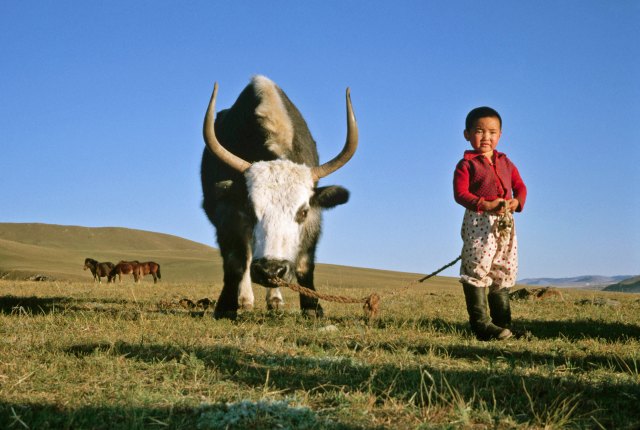
Genghis has won (Dean Conger/Corbis via Getty
On the road between the frontline cities of Sloviansk and Bakhmut, in Ukraine’s eastern Donbas region, three stone statues stand mutely by the side of the road, observing the coming and going of military traffic with impassive detachment. Known as balbals, they are funerary monuments erected by the Cuman Turks, known in Russian archaeology as the Polovtsians, who once ruled this vast sea of grass, long before Russian or Ukrainian speech was ever heard in this region.
For thousands of years, the empty, spreading steppe, stretching from Hungary to Mongolia, was the home of nomadic peoples, speakers of Iranic, Turkic and Mongolic languages, who drove their herds across the vast plains in search of fresh pastures. They founded great empires, which time and the steppe grasses would soon swallow up, leaving barely a trace. Their constant irruptions into Europe sounded the death knell in turn for other, settled civilisations, part of the endless cycle of growth, invasion and collapse that has shaped our continent’s history.
The war in Ukraine has taken place in two very different climatic and cultural zones: its initial phases saw Russian armour wend its way through the dark forests and marshes of northern Ukraine, the ancient homeland of the first Slavic peoples, to be destroyed in close fighting on the narrow wooded roads in a stunning and unexpected Ukrainian victory. Yet the gruelling war of attrition in the country’s east is taking part in a very different landscape, in the open steppe that was once the home of nomadic peoples.
The expansion of Slavic peoples, both Ukrainians and Russians, into the open steppe was a very recent historic event, broadly contemporaneous with the European settlement of the Americas, its fertile plains, now the breadbasket of the developing world, Europe’s equivalent of America’s Midwest. These open plains, the “Wild Fields” of local historiography have always been a contested space, where great empires wrestled for control: in the great Second World War battles of Kursk, Kharkiv and Stalingrad, Europe’s entire fate hinged on the battle between the two great tank armies wheeling and clashing like nomad hordes.
But then, as The Eurasian Steppe by the archaeologist Warwick Ball makes clear, rather than a semi-wild anteroom to the continent, “the history, languages, ideas, art forms, peoples, nations and identities of the steppe have shaped almost every aspect of the life of Europe”. Europeans from further west have for centuries been prone to viewing the steppe as the haunt of wild tribes, and the source of occasional, fearsome destruction.
But what if the Europe of today is in fact the product of steppe dynamics? As Ball argues, rather than being a product of 19th century nationalism, some historians trace the origin of Europe’s oldest nation states to the steppe, observing that “Peoples newly arriving from the east were also among the first to create nationally defined states, such as kingdoms of the Bulgars or Magyars”. “In some ways,” Ball argues, “the incipient idea of a nation state might have been stronger with the nomadic groups from the steppe, who were bound more closely by tribal loyalties” than among the polyglot peoples of the imperial Roman successor states they conquered.
Did the steppe peoples then create the fractious patchwork quilt of nationalities that we understand as Europe? Ball cites the archaeologist Hyun Jin Kim who claims that: “The political and cultural traditions of Inner Asia brought to Europe by Central Asian immigrants, the Huns and the Alans, were just as fundamental to the formation of western Europe as the rich legacy left behind by the Roman Empire. The political and cultural landscape of early medieval Europe was shaped by the fusion of Roman and Inner Asian influences.”
While Hungary and Bulgaria were directly founded by steppe nomads, the influence of steppe rulers also helped shape the political forms taken by Poland (whose szlachtanobles claimed Sarmatian descent well into the 19th century), Bohemia, Denmark and even, it is claimed, France. Even into the 19th century, as Ball notes, it was the Hungarian awareness of their steppe Magyar ancestry that helped bring about the rise of nationalism which shook apart the great Austro-Hungarian empire. “In the long evolution of the idea of the nation state,” then “from their beginnings in late-antique Europe to their emergence in the nineteenth century, we must look east as well as west”.
Viewed in this light, the war in Ukraine, a battle between a European nation-state and a vast Eurasian empire, is resonant with all manner of strange echoes of the steppe’s dimly-understood history. The colossal earthern ramparts of the “serpent walls” outside Kyiv, erected by early Slavic kingdoms to guard against invasion by steppe nomads from the Huns to the Mongols, fulfilled their ancient role admirably earlier this year when they prevented the movement of Russian armour towards the capital’s suburbs, corralling the latest wave of invaders into killing zones to be picked off at leisure by guided missiles.
The Cossack heritage both sides claim is the result of earlier Slavic peoples, runaway Ukrainian and Russian serfs, claiming the freedom of the open steppe and adopting the customs, lifestyle and much of the vocabulary of their nomadic Turkic predecessors. The very word Cossack, Ball notes, “derives from the Turk root qaz, ‘to roam’”, and is cognate with the ethnonym Kazakh further east, as the Cossacks “comprised mainly Russians — usually renegades, escaped serfs or criminals — but they also included Turks, Tatars and remnant Polovtsi.” Even now, Ukrainian is sprinkled with Turkic words, a legacy of the two cultures’ long history of interaction and competition. One Ukrainian commander I met went by the nom de guerre “Duman”, or fog, deriving from the Turkic word for smoke or mist. Even now, Ukrainians refer to Russians with the dismissive Turkic epithet Katsab, or butcher.
The very concept of chivalry which defined Europe’s medieval history was the product of Iranian-speaking steppe peoples like the Sarmatians and the Alans, whose innovations in the use of cavalry — stirrups, lances and long chainmail coats — changed the face of late Roman warfare and set the stage for the knights of the High Middle Ages. Even our own medieval romances may owe something to their distant steppe traditions, after the border forts of what is now northern England became the garrison home of Sarmatian levies in Roman service. As Ball notes: “Sarmatian warrior worship of a sword fixed in the ground has been suggested as furnishing the origin of the Excalibur legend. This appears to have been a long steppe warrior tradition: Ibn Rusta in the tenth century, for example, describes how the Viking Rus ruler — whom he calls by the steppe title of Khagan or khāqān — would plant a naked sword in the earth pointing towards his newborn son.” Perhaps it is not mere coincidence, then, that the Azov Regiment’s torchlit ceremonies in the southern steppe city of Mariupol took place beneath three giant swords embedded in the ground, a striking symbol that has now become the group’s emblem.
As Ball observes: “The future of Russian greatness was both a response to and a legacy of the Mongols… Indeed, to a large extent Muscovite power was a creation of the Golden Horde: the khans required a stable central authority as a client state which could be relied upon to raise auxiliaries for the khan’s armies and to collect and deliver taxes and tribute. Moscow fitted the bill, so the Golden Horde deliberately strengthened it against the other Russian cities and appointed its prince as their chief tax collector.” Without the Mongol-enforced primacy of Muscovy, the land that is now Russia may well have remained a series of disunited kingdoms and city states, just like medieval Italy or Germany: “The Mongols, in other words, brought about the emergence of Russia.”
Tracing Muscovy’s traditions of governance, and then those of imperial Russia, to the Mongol and Tatar customs of the inner steppe, Ball observes that “Even by the fourteenth century the civil and military institutions of Muscovy ‘were overwhelmingly Mongol in origin’… Ivan IV, the first Russian to proclaim himself Tsar (in Russian the title is actually Tsezar), added Ulugh Khan, ‘Great Khan’, to his titles.” Though he dismisses the “Mongol Yoke” hypothesis of Russian historiography, Ball nevertheless traces Russia’s unique and terrible form of autocratic rule to steppe customs, deep into the modern period: “Ivan also adopted the Mongol policy of ‘collective guilt’ where all male relatives and retainers of a guilty man would be executed, a policy even extended to entire communities. Stalin’s similar policy was a continuation of this.” The steppe’s long influence stretches deep into the cultural DNA of our modern world: even such a giant 20th century figure as Lenin, destroyer of one great Eurasian empire and founder of another, was of part-Kalmyk descent, after all.
Written for a general audience, Ball’s book nevertheless synthesises the latest archaeological research and historical debate on the steppe’s ancient and modern peoples, archaeological research on the steppe’s history, delving back into the deepest mists of time. The burgeoning community of esoteric archaeology and anthropology posters on Twitter will surely appreciate his summarising of the latest research on the origins of the Indo-Europeans, the fate of the Khazars and the birth and decline of the great Scythian kingdoms, who’s exquisite goldwork was the highlight of the British Museum’s recent blockbuster exhibition.
Noting that St Petersburg’s great Hermitage Museum was founded primarily as a place to store the newfound Scythian treasures unearthed by Russian colonists in Crimea, Mariupol and the rest what is now Ukraine’s contested southern steppe, and alert to the theft of Scythian treasures from Ukrainian museums by their new-old Russian conquerors, we realise that the relentless cycle of history has brought a new relevance to Ball’s book, even since its publication last winter. Just as in the Middle Ages and in the bloodiest battles of the Second World War, the fate of Europe is once again being written on the endless, grassy steppe.
Orlando Figes’ The Story of Russia
That is a very happy coincidence, because Roussinos’ essay and Figes’ The Story of Russia are really circling the same enormous question from different directions: what made Russia Russia?
Figes is, in many ways, the antidote to the more sweeping “fingerprints of the steppe” argument. He certainly does not deny the Mongol inheritance – quite the opposite. The Mongol conquest of the Rus principalities in the thirteenth century was one of the decisive ruptures in Russian history. It destroyed Kyiv’s old political centrality, subordinated the northern principalities to the Golden Horde, and created the conditions in which Moscow could eventually rise. The irony, as both Roussinos and Figes emphasise, is that the Mongols did not simply delay Russian state formation; they helped create the particular form of state that emerged.
But Figes is interested less in what Russia inherited than in what Russia made of those inheritances. The Mongols supplied mechanisms of rule – taxation, military organisation, hierarchy, a relationship between ruler and subject that was very different from Western feudalism. Yet Russia’s self-understanding was built around other ideas: Orthodox Christianity, Byzantium, the idea of Moscow as the “Third Rome”, and the notion that the Tsar was not merely a monarch but a sacred figure.
This is where it links beautifully with Morrison’s critique. The danger is that we see the Mongol “fingerprints” and assume they explain everything. But fingerprints do not tell you why the person picked up the knife, wrote the letter or opened the door. They tell you something about contact and inheritance; they do not reveal intention.
Figes’ Russia is a civilisation built from multiple inheritances: Byzantine, Slavic, steppe, European and imperial. The great Russian paradox is that it has often defined itself simultaneously as both European and apart from Europe. Peter the Great famously tried to drag Russia westward — shaving beards, building St Petersburg, importing European science and manners — yet the deeper structures of autocracy, hierarchy and imperial expansion remained. Later Slavophiles rejected the West and celebrated a distinct Russian path, while Westernisers argued that Russia’s tragedy was precisely its failure to become sufficiently European.
This also connects with our earlier discussion of maps and historical memory. Russia is, geographically, an extraordinary historical anomaly: a European state that expanded across Asia until it became a continental empire. The map itself creates the tension. Is Russia Europe? Asia? Eurasia? The answer has shifted depending on who was asking and what political argument they wanted to make.
One of the things I suspect you will appreciate in Figes is his attention to recurring Russian archetypes: the Holy Tsar, the Holy Fool, the tension between obedience and rebellion, the recurring belief that Russia has a unique destiny. These are not “genes” or immutable cultural DNA; they are traditions — stories Russians told about themselves. And stories matter enormously because people act upon them.
That brings us back to Roussinos’ evocative phrase, “the echo of the steppes”. Echoes are fascinating precisely because they are not the original sound. They are altered, refracted and carried forward. The Mongol conquest echoed through Muscovy; Byzantium echoed through the Tsars; Soviet power echoed through Putin’s Kremlin. But each generation chooses which echoes to amplify.
There is also a pleasing connection with your earlier fascination with maps and atlases. A physical map of Russia looks almost inevitable: the enormous landmass stretching from Europe to the Pacific. But Figes and Morrison both remind us that geography creates possibilities, not destinies. The Russian Empire was not simply “there” waiting to happen. It was built by choices — by princes, tsars, revolutionaries and commissars who made decisions within particular historical circumstances.
So perhaps the combined lesson of Figes, Roussinos and Morrison is this:
Russia is not merely a European country contaminated by Asia, nor an Asian empire wearing European clothes. It is a civilisation formed in the meeting place of worlds. The tragedy is not that it has a complicated past; all great civilisations do. The tragedy comes when a complicated past is reduced to a single myth of inevitable destiny.
Which, interestingly, brings us back to your recurring theme: the power – and danger – of maps. Every map is an argument about the past. Every empire is a story it tells about itself. And every story leaves fingerprints. The historian’s job is to work out which ones are real, which ones are imagined, and which ones have been deliberately placed there.
Alexander Morrison’s critique
Alexander Morrison, a historian of Russian history at Oxford University, specialising in the Russian conquest of Central Asia, commented on Roussinos’ essay in Unherd. Here it is in full.
Roussinos, seems to have made good use of Ball’s research. Some of these arguments are completely uncontroversial when applied to the Asian neighbours of the Eurasian steppe in the early modern period: the Ottomans, the Safavids of Iran and the Qing all made use of Chinggisid and TImurid political repertoires in building their states alongside other elements (Byzantine heritage for the Ottomans, the existing Chinese imperial tradition in the Qing case, Sufi religious charisma for the Safavids). The Mughals were of course actually of Timurid (and in the female line of Chinggisid) descent, and it was at the core of their dynastic ideology in India.
However the steppe political tradition seems to have produced ever larger polities in Asia, which makes it hard to explain why it would instead produce political fragmentation in western and Central Europe – I think that part of Ball’s argument is a bit overstretched.
The Muscovite example seems to fit the Asian pattern better, and Roussinos is spot on in saying that it was the willingness of the Princes of Moscow to act as particularly loyal and effective satraps and tax collectors for the Golden Horde that allowed what had previously been a minor Rus’ princedom to rise to pre-eminence.
However we need to be clear about what it was that Muscovy took from the Mongols: it was largely bureaucratic structures linked to taxation or communication. This why key Russian words such as kazna (treasury), den’gi (money) and yam (postal service) are of Mongol origin. On the cultural side the ruling ideologies of the state were all to do with Orthodox Christianity and the semi-mythical link to Byzantium (the ‘Third Rome’), which was what Ivan IV (the Terrible) was evoking when he took the title of Tsar (Caesar) – he may have added the title of khan for good measure but this was largely for the purposes of communication with steppe peoples.
Many Tatar nobles of Chinggisid descent did become incorporated into the Muscovite aristocracy after the fall of Kazan in 1552, but you need to be careful about 19th and 20th-century claims to this ancestry, which are often bogus (it was fashionable at the time). In the case of Akhmatova it was her nom de plume (she was born Anna Gorenko – in fact a Ukrainian name). In any case Chinggisid descent did not give you any kind of claim to the throne of Muscovy, which had its own dynastic legend in the Rurikids. A better guide to the relationship between Muscovy and the Mongols than Ball is Donald Ostrowski.
There is also a bit too much cultural determinism in all of this to my liking – it suggests that neither Russia nor Ukraine can ever shake off this bloody past etc. etc. Nowhere in the world is simply a prisoner of its past. What is happening now is a result of very specific political choices made by Vladimir Putin and Russia’s ruling elite. Their thinking is rooted partly in their reading of 19th-century Russian historians (who first came up with the idea that Russians and Ukrainians were the same people), vicious forms of anti-semitic Russian nationalism of the early 20th century and the emigration (the Black Hundreds, Ivan Il’in), a particular, tendentious interpretation of both Soviet history and their own memories of the Soviet collapse.
What is perhaps more relevant is that this steppe past means that most of southern and eastern Ukraine was only relatively recently settled – not just by Russians and Ukrainians, but by the whole range of peoples of the empire (Greeks, Jews, Bulgarians, Armenians…probably also some Ossetians). They are certainly not ‘ancient Russian lands’ as Putin has claimed, but they are part of Ukrainian territory under international law and the Budapest memorandum assuring the country’s territorial integrity which Russia signed.
A couple of other corrections – the Buryats are not a steppe people, they live East of Lake Baikal. I am a bit queasy about the implication that they and the Kalmyks are disproportionately represented in the ranks of the Russian army because of their ‘savage’ steppe nature – it is simply because these are some of the poorest parts of the Russian Federation, and because the Russian regime is very deliberately trying to avoid recruiting troops from metropolitan regions of European Russia whose families might cause political trouble or have ties to Ukraine.
The ethnic Russians who are fighting are also disproportionately from Siberia or the Altai. The regiment which committed the atrocities at Bucha was from Khabarovsk in the Russian Far East, and its commander appears to have been originally from Karakalpakstan. Most Ossetians speak Russian these days, and have long identified with Russian rule. A good piece though – not many outlets would allow as thorough and as thoughtful a review of a work on Eurasian History.
Morrison’s comment stands apart from most of the thread because it does what the best scholarly criticism should do: it accepts the broad thesis where the evidence supports it, corrects errors where necessary, and resists the temptation to replace one grand narrative with another.
The essence of Morrison’s critique is this:
He accepts the central proposition that Muscovy inherited important features from the Mongol world. Indeed, he strengthens it by pointing out that similar borrowing occurred across Eurasia. The Ottomans, Safavids, Mughals and Qing all incorporated Chinggisid or Timurid political traditions into their own states. Russia was therefore not unique in absorbing institutions from the steppe.
Where he parts company with Ball is over determinism. Ball appears to argue that steppe political culture explains not only Muscovy’s rise but much of Russia’s subsequent history and perhaps even Putin’s Russia today. Morrison thinks this stretches the evidence too far. Administrative institutions can endure for centuries; they do not imprison nations forever. Modern Russia, he argues, is the product of choices made by a particular elite, drawing on nineteenth-century nationalism, Soviet memories and contemporary ideology, rather than the inevitable flowering of Mongol political culture.
He also introduces some valuable nuance. Muscovy borrowed bureaucratic techniques—taxation, communications, administration – from the Golden Horde, but its ideological heart remained Orthodox and Byzantine. Ivan IV’s claim to be Tsar rested on the idea of Moscow as the “Third Rome”, not the successor of Genghis Khan. Even the Russian language preserves this administrative inheritance in words such as kazna (also in Arabic,treasury), den’gi (money) and yam (postal relay), all of Mongol origin, illustrating that institutional borrowing need not imply cultural subordination.
Morrison is equally careful about ethnicity. He rejects romanticised claims of Chinggisid ancestry, notes that many were fashionable nineteenth-century inventions, and cautions against portraying Buryats or Kalmyks as somehow naturally warlike. Their prominence in today’s Russian army is explained far more convincingly by economics and recruitment policy than by any inherited “steppe mentality”. That is a useful reminder that socio-economic factors often explain what cultural stereotypes merely decorate.
His discussion of Ukraine is similarly restrained. Southern and eastern Ukraine were indeed settled comparatively recently by a mosaic of peoples across the imperial period, making simplistic claims of ancient ethnic ownership difficult to sustain. Yet that historical complexity does not undermine Ukraine’s internationally recognised borders or Russia’s commitments under the Budapest Memorandum. History explains; it does not necessarily justify.
Finally, Morrison performs the historian’s essential task of distinguishing influence from destiny. States inherit institutions, myths and habits, but they are not condemned to repeat them. This is perhaps his strongest point. It is tempting to explain Putin’s Russia by reaching back to the Mongols, Ivan the Terrible or the “Russian soul”, just as earlier generations invoked “ancient Balkan hatreds” to explain Yugoslavia. Such narratives are elegant because they reduce contingency to inevitability. Historians, however, are generally suspicious of elegant explanations.
His recommendation of Donald Ostrowski is also telling. Ostrowski’s work has long argued that Muscovy’s relationship with the Mongol world was one of selective adaptation rather than wholesale inheritance. That is a subtler – and probably more persuasive – account than one that sees Russia as simply Europe’s most successful steppe empire.
In short, Morrison doesn’t demolish Ball’s thesis. He refines it. He accepts that the steppe mattered enormously, but insists that institutions are not destiny, that cultures borrow selectively, and that political choices remain more important than historical determinism. It is precisely the kind of intervention that lifts an online discussion from polemic into genuine historical
What Unherd Readers had to say about Roussinos’ essay
The comments divide into several broad themes rather than converging on a single interpretation, and in many ways become a debate about contemporary Russia as much as about history.
Many readers found the article fascinating and praised it for opening an unfamiliar chapter of Eurasian history. Several immediately ordered Christopher Ball’s book, while others supplemented the discussion with examples ranging from the Kalmyks’ influence on Austrian costume to the chess capital of Elista, the legacy of the Mongols in Central Europe, and the wider political traditions of the Eurasian steppe. A number of contributors recommended additional works, notably Peter Frankopan’s The Silk Roads and Donald Ostrowski’s scholarship on Muscovy.
A second group challenged aspects of the historical argument. Critics argued that the article overstated the influence of steppe culture on later European political development, confused mythology with history in discussing Poland and Hungary, and oversimplified the origins of the Cossacks and the Azov Regiment’s symbolism. Others objected to what they saw as cultural determinism: the suggestion that Russia’s present behaviour is somehow an inevitable product of its Mongol inheritance. Several historians in the discussion -Morrison particularly, stressed that Muscovy certainly inherited administrative and fiscal practices from the Golden Horde, but that its religious ideology and dynastic legitimacy remained fundamentally Byzantine and Orthodox. They argued that modern Russian policy reflects political choices by Vladimir Putin and his circle, not an inescapable historical destiny.
As often happens, the historical discussion quickly became a proxy for arguments over the war in Ukraine. One camp maintained that Ukraine is an artificial state whose disputed regions deserve internationally supervised referendums, criticising NATO expansion and Western military support while advocating diplomacy. The opposing view rejected these claims as Russian propaganda, pointing to Ukraine’s overwhelming vote for independence in 1991, insisting that no genuine referendum is possible under military occupation, and arguing that Russian aggression – not Western policy – is the central issue. A more extreme minority advanced familiar pro-Kremlin narratives, portraying NATO as the true aggressor and Russia as a defensive victim, provoking vigorous rebuttals from other commenters.
There was also a meta-debate about free speech. An inflammatory remark describing Russians in derogatory terms prompted accusations of hate speech and counter-accusations of “crybullying”, illustrating how discussions of Russia often slide into arguments over acceptable language as readily as they do over history.
The most substantial contribution came from historian Alexander Morrison, whose lengthy critique was widely praised by other readers. Morrison broadly accepted the article’s central insight – that Muscovy’s rise owed much to its role within the Mongol imperial system – but argued that the thesis was pushed too far. He emphasised the distinction between administrative inheritance and cultural identity, corrected numerous historical inaccuracies, warned against deterministic readings of history, and reminded readers that modern events stem from contemporary political decisions rather than immutable civilisational characteristics. His intervention effectively became the intellectual centre of the comment thread, with several readers declaring that it improved upon the article itself.
Overall, the discussion reveals both the appeal and the risks of grand historical narratives. Most readers accepted that the Eurasian steppe profoundly shaped Russia’s development. Where they diverged was over the extent to which that past explains the present, and whether history should be read as a story of enduring civilisational patterns or of contingent political choices. The resulting debate ranges from thoughtful historiography to contemporary geopolitics, with occasional excursions into conspiracy theory and internet polemics.


 In That Howling Infinite