The death of the singer will not kill the song

It is not Leonard Cohen about whom I write.

The passing of a beloved singer or poet is a sad affair, the initial shock on hearing the news segueing into bitter-sweet memories of songs and poems and how they provided a soundtrack or bookmark to significant events in our lives. We’ve had opportunities aplenty this year with so many of our icons knocking on heaven’s door.

But the murder of singers and poets on account of their words and their voices is sadder still. It diminishes our lives and indeed, it diminishes the world in which we live, and in its hatred and nihilism, strikes at the heart of the values we hold most dear.

So it was with Spanish poet Garcia Lorca, murdered in 1936 by Generalissimo Franco’s Nationalist soldiery at the beginning of the savage Spanish Civil War. So it was with Chilean folk singer and songwriter Victor Lara, slain in a soccer stadium in September 1973 by Augusto Pinochet’s thugs.

Rest In Peace, Amjad Fareed Sabri, acclaimed Pakistani maestro of Qawwali Sufi devotional music who was murdered in Karachi in June this year by Taliban militants.

Ajmat and his brother Maqbool were the acclaimed Sabri Brothers, two the most renowned qawwals – up there with Nusrat Fateh Ali Khan, muse and mentor of Jeff Buckley.

The Sabri Brothers

The Sabri Brothers

The songs Ahmad Sabri and his father performed are part of a Sufi tradition dating back to the 13th century. Known as Qawwalis, steeped in mysticism and sometimes based on mystic poetry, they are a key part of the spiritual life of millions of Muslims across south Asia and enjoyed by wider audiences of many faiths.

But both the music, and the shrines at which it is often performed, have long been a target for religious conservatives who shun all forms of music and consider the shrines unorthodox. Dozens of sites have been targeted in attacks, including a 2010 suicide bombing at one of Pakistan’s most popular shrines. Qawwalis have long been criticized by the Taliban and other hard-line groups that reject all music as un-Islamic, and particularly object to those songs which focus on the life of the prophet Muhammad.

The murder of a popular singer from a famous and well-loved musical dynasty was a clear warning to others trying to celebrate and preserve Pakistan’s indigenous traditions, and the  pluralism and diversity of religious practice and cultural expression in this tortured part of the world.

I recall seeing the Sabri Brothers perform in London in 1977, led in those days by Ajmad’s father Ghukam Farid, just before I departed for Oz. I still treasure – and play – these glorious songs of praise. their driving rhythms, exotic melodies, and spirited call and response, and enthralling and hypnotic,  Here are two of my long-time favourites, sung by Sabri Senior. Listen for yourself.

‘Bhar do Jholi’ is a praise song for the Prophet and for his companion Bilal and his grandson Hussein, (who with his father Ali are the founding martyrs of Shia Islam).  Read the translated lyrics here.

‘Balaghal bi Kamalihi’ tells the story of Muhammad’s night journey to Jerusalem on the horse Buraq.  Read the translated lyrics here.

For more on the Sabri Brothers and Qawwali, see:

https://en.m.wikipedia.org/wiki/Qawwali

https://en.m.wikipedia.org/wiki/Amjad_Sabri

https://en.m.wikipedia.org/wiki/Sabri_Brothers

https://en.m.wikipedia.org/wiki/Nusrat_Fateh_Ali_Khan

Read about Victor Jara and Garcia Lorca here:

https://www.theguardian.com/music/2013/sep/18/victor-jara-pinochet-chile-rocks-backpages

https://en.m.wikipedia.org/wiki/Federico_Garc%C3%ADa_Lorca

Read also, David Kilcullen’s cogent piece on ISIS AND al Qaeda:
One, Two, Three, What are we fighting for?


Back In The Day

I was in love with Dusty Springfield. In the drear tea-time of my adolescent soul, I worshiped her truly, madly, deeply. Tiny girl, big hair, panda eyes, hands moving like a beckoning siren. I just had to hear “da da da da da da” and then “I don’t know what it is that makes me love you so…” and I was hers for the next two and a half minutes. Until…

It was one of those beautiful late-spring evenings that you would get in the England of memory. The evening sun poured through the gothic stained glass windows of the school library – it was one of those schools. A group of lower sixth lads, budding intellectuals all, as lower sixth tended to be, gathered for a ‘desert island disks” show-and tell of their favourite records. Mine was ‘Wishin’ and Hopinby you know who. Then it was on to the next. Clunk, hiss,  guitar intro, and: “My love she speaks like silence, without ideas or violence, she doesn’t have to say she’s faithful, but she’s true like ice, like fire…” Bob had arrived, and I was gone, far gone. So was Dusty.

dusty

I bought a guitar. A clunky, eastern European thing. I tried ‘Blowin’ in the Wind’, but what came out was unrecognisable. My dad said he’d break it over my head. One day, that tipping point was reached. It sounded indeed like ‘Blowin’ in the Wind’, or something similar. I was away, and the rest, as they say, was hearsay.

Young Bob

On a  high of hope and hype, so it all began. With a heritage of Irish rebel songs and folksongs, and the ‘sixties folkie canon (but never, ever ‘Streets of London’). Sea shanties, a capella Watersons, Sydney Carter’s faith-anchored chants, ‘The Lord of the Dance’ being the most beloved (a song now and forever burdened with the curse of Michael Flatley). Across the pond, young Bob Dylan, Joan Baez, and Peter, Paul & Mary decanted fine old wine into new bottles, and during the Easter CND march in London in 1966, billeted in an old cinema in Southall, a first public ‘performance’ with Ewan MacColl’s “Freeborn Man of the Traveling People”. The journey had begun, and, as the father of America poetry had crooned, “Afoot and light-hearted, I take to the open road, healthy, free, the world before me, the long brown path before me, leading wherever I choose”.

And it led beside strange waters. “Marc Bolan warbled “My people were fair, and had sky in their hair, but now they’re content to wear crowns stars on their brows“. But didn’t they all in the days when Tolkien was king, and elves and ents walked amongst us. We thoroughly understood and empathized. And we marveled at the Scottish bard who could pen ‘The Minotaur’s Song and ‘Job’s Tears‘, and then run off with Old Father Hubbard. Then Roy Harper, the high priest of Anglo angst, sang ‘McGoohan’s Blues’, a twenty minute digression from the concept if not the plot of an iconic if indecipherable television series. “The Prisoner is taking his shoes off to walk in the rain”.

Unicorn(Album)

‘The Songs of Leonard Cohen’ played in every wannabe poet’s bedsit. “Come over to the window, my little darlin’. I’d like to try and read your palm“. What a pick-up line, so fitting for the generous times that were the ‘sixties. Others might sigh over the agonies of ‘The Stranger Song’, and ‘The Stories of the Street’. But I preferred the drollery of “Sometimes I see her undressing for me; she’s the sweet, fragrant lady love meant her to be“. And the wondrous punch-line of ‘Chelsea Hotel #2‘, that gorgeous tribute to the peerless Janis: not what happened on the unmade bed, but “we are ugly, but we have the music”. Bob segued from folk to rock, carrying with him many if not all of acolytes on the joker man’s journey from “Oxford Town” to “Desolation Row”. To this day, people ponder the meaning of Jewels and binoculars hang from the head of the mule”‘ and marvel at “The ghosts of electricity howl in the bones of her face“.

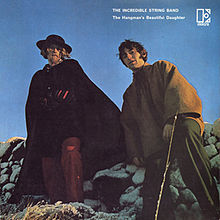
HangmansBeautifulDaughter

Read on in the full Introduction to In That Howling Infinite – Poems of Paul Hemphill, Volume Five

© Paul Hemphill 2013.  All rights reserved.

Rebel Yell

I didn’t surrender, but they took my horse and made him surrender. They have him pulling a wagon up in Kansas I bet.
Chief Dan George, as Lone Watie in The Outlaw Josie Wales

In the winter of ’65
We were hungry, just barely alive
By May the 10th, Richmond had fell
It’s a time I remember, oh so well,
The night they drove old Dixie down.
Robbie Robertson and The Band

The Band, from The Last Waltz

I do not profess to be an expert on the subject, and being an outsider, I do not presume to preach. Nor am I a civil war tragic like some of our politicians here in Australia – they can tell you precisely who said what at what o’clock on such and such a location on this battlefield or that.

Mind you, a civil war that claimed more than seven hundred thousand American lives, tore a young nation apart, and the echoes of which reverberate still one hundred and fifty years later, is bound to exert a degree of fascination on an inquiring mind.

Recently, the dead hand of the American Civil War reached out and touched the hearts of Americans and their friends throughout the world in the wake of yet another mass shooting. This time, a young man gunned down worshippers at prayer. That the victims were folk of colour, and the shooter, a young white extremist, reopened wounds that have never really healed.

What made this massacre different from all the other massacres was the prominence of the Confederate flag in the iconography of the fresh-faced killer. The battle flag of Dixie has never gone away. It flies inThe Dukes of Hazzard, True Blood, and even The Walking Dead, and is a favoured accessory above government buildings and at right wing rallies in The South, those former secessionists states that lay south of the Mason-Dixon line

But what also makes this slaughter different from all those other slaughters is that something is actually being done about it.

Not, however a tightening of gun laws. The Second Amendment is safe and still well kept. The President mourns with the grieving relatives and congregation and breaks into song. POTUS’ rendering of Amazing Grace goes viral on You Tube. But as ever, nothing can be done. No God or mortal can stymy the U.S’ long-time love affair with the gun, nor challenge the NRA choke-hold on the American polity – particularly with the next presidential race in the starting blocks.

No, not the right to bear arms. But the rather, the right to flaunt the Stars and Bars, an enduring symbol of the lost Confederate cause, and a rallying point for those who still believe the rebel cause to be just, those who take solace from an heroic defeat, and those who believed that “the South will rise again”, and indeed those who KNOW that the South has indeed risen again. For have not the white, right wing, God fearing, Clinton-baiting, and Obama-hating ‘Red’ states of the South conquered and colonized the American political system?

Flags can unite nations. And also divide them. And none more so, it seems, than this one.  Professor Colin Tatz once said People will forget what you said. People will forget what you did. But people will never forget how you made them feel. This flag is potent symbol that spans both sides of the great divide. It is seen by many a a symbol of racism, and in the wake of the killings, there has been a loud call to remove it from public places and events. Others see it as part of their identity, of who they and their families are. They refuse to surrender it and to trade it in for Old Glory. The call has been met with with, well, dare I say it, defiance and rebellion. If you’ve got one, flaunt it – on houses, on cars, on roadsides, on Facebook posts, blogs and websites. Here are few of th m, all worth reading to place the battle flag in its social and political context:

http://www.thedailybeast.com/articles/2016/09/21/for-the-virginia-flaggers-it-s-hate-not-heritage.html

http://www.vox.com/first-person/2016/9/30/13090100/confederacy-myths-lost-cause

http://www.historynet.com/embattled-banner-the-convoluted-history-of-the-confederate-flag.htm

I do not want to editorialize here. Rather, I would like to share the following piece in the Washington Post. It is symptomatic of the intellectual and cultural reaction to tragic events. If your cannot do something positive and practical about a problem. Advocate something symbolic, politically correct, a placebo even. Like banning the film Gone with the Wind.

http://www.washingtonpost.com/news/act-four/wp/2015/07/01/why-we-should-keep-reading-gone-with-the-wind/

The past is another country. They thought things differently there: The iconic film opened with “There was a land of Cavaliers and Cotton Fields called the Old South. Here in this pretty world, Gallantry took its last bow. Here was the last ever to be seen of Knights and their Ladies Fair, of Master and of Slave. Look for it only in books, for it is no more than a dream remembered, a Civilization gone with the wind…”

So, as students of history, do we call for the suppression of an artistic rendering of the past because we feel uncomfortable with the ideas, opinions and sentiments expressed therein? If this sprawling Southern soap opera, this pseudo Shakespearean tale of love lost and found and lost again, against a backdrop of great events, is to be consigned to the oublier of history, why cease there? Why not Lawrence of Arabia? The Outlaw Josie Wales? The Searchers? Showboat?

Let’s not go there. The South will always be with us, in our thoughts, in our historical memory, in our art and literature, our books and films. It is forever on the border of our consciousness. Even when listening to our favourite music.

Take the Flag, but leave the songs alone.

Here is what the Rebel Yell sounded like:

Alison Krauss and Union Station

Paul Robeson, from Show Boat

Chet Atkins

http://www.deathandtaxesmag.com/254760/hero-rushes-through-traffic-to-rip-confederate-flag-off-truck/

.

The Watchers Of The Water

A song about Gallipoli, sung by a Turkish soldier

Once upon a war…

Monday 25th April is Australia and New Zealand’s national day of remembrance for all Anzac solders killed and wounded in their nation’s wars, and to honour servicemen and women past and present. At first, the Anzacs fought in the British Empire’s Wars, beginning with the Boer War, and then through two World Wars. From the mid -twentieth century, they have fought and died in what could ostensibly be called America’s wars even though these were waged under UN, EU or western alliance auspices: Korea, Gulf Wars II and III, Afghanistan, and the current interventions in Syria and Iraq. Incidentally, Australian veterans commanded mercenary forces hired by Saudi Arabia and the United Arab Emirates that laid waste to towns and villages in Yemen during its recent civil way – with the help of American and British weaponry.

At the heart of the Anzac Day remembrance is the Australian and New Zealand Army Corps’ role the Dardanelles campaign of 1915-16, Winston Churchill’s grandiose and ill-conceived plan to take the Ottoman Empire out of the war by seizing the strategic strait between the Black Sea and the Mediterranean, thereby threatening Istanbul, the Ottoman capital. It was a military failure. From the initial seaborne assault to the evacuation, it lasted eight months and cost 114,000 lives with 230,000 wounded.

In 1915, Australians greeted the landings at Gallipoli with unbridled enthusiasm as a nation-making event. But it wasn’t long before they were counting the dreadful cost. More than 8000 Australians died during the Gallipoli campaign. As a loyal member of the British Empire, Australia eventually sent 330,000 men overseas to fight for the King. Volunteers all, not all of them white men – despite the authorities policy of recruiting only Australians of Anglo-Celtic stock, their ranks included many indigenous, Chinese and others. By the time the war ended in 1918, 60,000 of them were dead. As the late historian Ken Inglis once pointed out: “If we count as family a person’s parents, children, siblings, aunts and uncles and cousins, then every second Australian family was bereaved by the war.

[As for the Anzac Day march], I’d say only returned people could march. And then the day would come, I’d hope, when there’d be the last person marching, the last survivor as it were. And I’d think what a great day that would be … because it would mean we’d been at peace for a long time. And that’s what those men in the First World War were fighting for.”
Bill Gammage, historian and author of The Broken Years.

Gallipoli is cited as the crucible of Australian nationhood, but the Anzacs’ part in the doomed campaign was but a sideshow of the wider campaign. Although it is celebrated in Australian song and story, it was the Ottomans’ most significant victory in the war that was to destroy the seven hundred year old Ottoman Empire secure the reputation of its most successful general Mustafa Kemal, who as Ataturk, became the founder of modern Turkey.

Some thirty four thousand British soldiers died on the peninsula, including 3,400 Irishmen, and ten thousand Frenchmen – many of these latter being “colonial” troops from West and North Africa. Australia lost near on ten thousand and NZ three. Some 1,400 Indian soldiers perished for the King Emperor. Fifty seven thousand allied soldiers died, and seventy five thousand were wounded. The Ottoman army lost fifty seven thousand men, and one hundred and seven thousand were wounded (although these figures are probably much higher). An overlooked fact is that some two thirds of the “Turkish” solders in Kemal’s division were actually Arabs from present day Syria, Israel and Palestine – and  a small number of European Jews who had settled there and who as Ottoman citizens were subject to conscription.

Gallipoli was indeed a multicultural microcosm of a world at war.

Whilst the flower of antipodean youth is said to have perished on Gallipoli’s fatal shore, this was just the overture. Anzac troops were despatched to the Western Front, and between 1919 and 1918, 45,000 Aussies died there and 124,000 were wounded.

Once upon a war, the Dardanelles Campaign of 1915-16 was a sideshow to the bigger theatres of the Eastern and Western Fronts. To some, it was a reminder that they could not stomach Winston Churchill for this was said to be his greatest stuff up in a career replete with such (although they would admit that he more than exonerated himself his and Britain’s Finest Hour). For many Australians and New Zealanders, it was a national baptism of fire, of youthful sacrifice on the altar of Empire. And notwithstanding the  military defeat and retreat, the folly and foolhardiness, in the harrowing adversity and heroism, lay the bones of a young country’s enduring creation myth.
Former soldier James Brown, Anzac’s  Long Shadow

There are abundant primary and secondary sources relating to the Dardanelles campaign and the Anzacs, but here is a wiki primer: Gallipoli Campaign

The genesis of a song …

Back in the last century, before ANZAC Day became the secular Christmas that it has become, before marketing people and populist politicians saw its commercial and political potential, before the fatal shore became a crowded place of annual pilgrimage, my Turkish friend, the late Naim Mehmet Turfan, gave me a grainy picture of a Turkish soldier at Gelibolu carrying a large howitzer shell on his back. Then there was this great film by Australian director Peter Weir, starring young Mel Gibson and Mark Lee. There were these images of small boats approaching a dark and alien shore, of Lighthorsemen sadly farewelling their Walers as they embarked as infantry, and of the doomed Colonel Barton humming along to a gramophone recording of Bizet’s beautiful duet from The Pearl Fishers, ‘Au fond du temple saint’ before joining his men in the forlorn hope of The Nek.

There were other melodies I could never quite get out of my head. One I first heard in a musical in Beirut before that magical city entered its Dark Ages  –  Al Mahatta, written by the famous Rabbani Brothers and starring the Lebanese diva Fayrouz. And The Foggy Dew, one of the most lyrical and poignant of the Irish rebel songs:

Right proudly high over Dublin town, they hung out the flag of war. ‘Twas better to die ‘neath that Irish sky than at Suvla or at Sud el Bar…Twas England bade our Wild Geese go that small nations might be free,  But their lonely graves are by Suvla’s waves or the fringe of the grey North Sea.

Over three thousand Irishmen died at Gallipoli.

The song grew out of these many inspirations.

It was first performed in public by HuldreFolk in the closing concert of Coffs Harbour Folk Festival at the RSL on Australia Day 1984. When we had finished, there was absolutely silence in the hall. Then a voice cried out “the sky didn’t fall down!”, and the hall erupted with applause.

And here is HukdreFolk’s rendering of Russian poet Yevtushenko’s account of the parade of German prisoners of war through the streets of Moscow in 1941, juxtaposed with The Watchers of the Water.

Anthem for Doomed Youth
Wilfred Owen

What passing-bells for these who die as cattle?
Only the monstrous anger of the guns.
Only the stuttering rifles’ rapid rattle
Can patter out their hasty orisons.
No mockeries now for them; no prayers nor bells;
Nor any voice of mourning save the choirs,—
The shrill, demented choirs of wailing shells;
And bugles calling for them from sad shires.

What candles may be held to speed them all?
Not in the hands of boys, but in their eyes
Shall shine the holy glimmers of goodbyes.
The pallor of girls’ brows shall be their pall;
Their flowers the tenderness of patient minds,
And each slow dusk a drawing-down of blinds.


Dermott’s Last Ride

So, when my time it comes  and at last I leave this place, I’ll walk out past the charge hand’s gate and never turn my face. Up to the gates and into the sun, and I’ll leave it all behind, with one regret for the lads I’ve left to carry on their grind.    Factory Lad, Colin Dryden

Dermott Ryder, poet, writer, collector and chronicler of songs and stories, singer and songwriter, stalwart of the seventies and eighties Sydney folk scene, one-time manager of the legendary ‘‘Liz” Folk Club, and creator and longtime presenter of the iconic weekly folk radio programme Ryder ‘Round Folk, headed off to his big gig at the great folk club in the sky on the night of Tuesday 3rd March.

A retrospective follows, but first, enjoy two minutes of delight with the theme to Ryder Round Folk: a merrie morris, a hornpipe, and a hoot!

Dermott and I go back a long way, though not as long as most.

He arrived in Oz in 1968 as a Ten Pound Pom. Before that, he’d spent five years in the Royal Artillery on a short term commission, seeing service in Germany and in Malaya,  avoiding the nasty places that proliferated during the declining decades of the moribund British Empire. Trained in management, accounting and IT, he worked in Papua New Guinea before settling down in Sydney where he became a pillar of the folk music scene. Since his retirement, he has devoted his energies to his music and writing.

Dermott In Bougainville

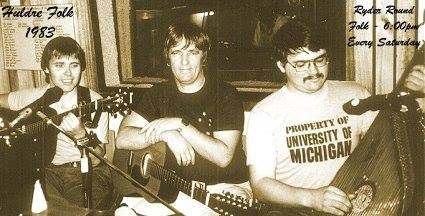
It was Victor Mishalow who first introduced me to Dermott in 1983. He was dropping into 2MBS for an interview on Ryder Round Folk, and he brought me and Yuri the Russian Storyteller along too. We had just launched our short and almost illustrious career as HuldreFolk. Dermott, as guru, mentor, and propagandist for the Sydney folk scene, gave us our first radio appearance. There is a famous photograph to commemorate it (Dermott’s archive of folkdoms’ seventies and eighties should be a national treasure. All the wannabes and could’ve beens, the famous and almost famous are celebrated therein).

HuldreFolk - Early Days. Ryder Round Folk 1983

The live concerts at 2MBS’s Chandos Street studios were a must-listen on the monthly calendar, with the good and the great of Sydney’s folksingers and musicians doing their thing. Guests included Victor, Yuri, Jim Taylor, Robin Connaughton, Penny Davies, Roger Illot, John Broomhall, Gordon McIntyre and Kate Delaney, Phil Lobl, Mary Jane Field, and the Fagans.

This was when Adele and I got to know Dermott and Margaret Ryder for the first time. We then learnt of his history: his part in the famous folk revival of the late sixties and early seventies, the first Port Jackson Folk Festival, the foundation if the NSW Folk Federation, and the famous Liz Folk Club in the Sydney CBD. He was among that first golden generation of folkies, including Colin Dryden, Gary Shearston, Declan Affley, Warren Fahey, John Dengate, Danny Spooner, Mike McClellan, Bernard Bolan, and Judy Small. Many other performers moved in Dermott’s musical orbit, including Andy George, Rhonda Mawer and the Shackistas of Narrabeen, Jim Jarvis, Al Ward, John Summers, and many, many more.

Dermott and I bonded further with our shared origins in the old country. He of Lancashire Irish heritage (Widnes, actually), and me, an Irish Brummie. We had a shared love of traditional Irish and English folk music. We probably even crossed bars in one of the many English folk clubs, in the ‘sixties. Most notably, the celebrated Jug O’Punch in the Birmingham suburb of Digbeth, run by the famous Ian Campbell Folk Group.*

        The Parting Glass

        Trad. as sung by Liam Clancy and Tommy Makem

Oh all the money that e’er I had
I spent it in good company
And all the harm that e’er I’ve done
alas, it was to none but me
For all I’ve done for want of wit
to memory now I can’t recall
So fill to me the parting glass
good night and joy be with you all

Oh all the comrades that e’er I’ve had
they are sorry for my going away
And all the sweethearts that e’er I’ve had
they would wish me one more day to stay
But since it falls unto my lot that
that I should rise and you should not
I’ll gently rise and I’ll softly call
good night and joy be with you all

Farewell, old friend.

Dermott and Margaret Ryder

  Leaving Can Be Easy

  By Dermott Ryder

  Leaving can be easy, when the right time comes.                                                                               Many will have gone before, in a long, long line.                                                                                 When it’s your turn, you look back, and smile,                                                                                     then look forward to your own new, far horizon.

 There are people to tell, and books to return,                                                                                 Broken bridges to mend now, better this way,                                                                                   leave no hurt feelings behind at the end of the day.                                                                           We are all travellers, and we will meet again.

 Don’t think of sleep. Keep that for much later.                                                                                    Give and take addresses and phone numbers.                                                                                  Make promises you probably won’t remember.                                                                                 Be pleasantly surprised and strangely grateful.

Welcome the crowd come to see you on your way,                                                                             and to share this rite of passage, to keep the faith                                                                             in this next step in the long tradition of the traveller.                                                                         Shake hands, and know that you cannot return.

* What a club that was. Back in the day, it hosted the cream of British folk music, including the Dubliners, the Furey Brothers, Martin Carthy, Peter Bellamy, and a very young and acoustic Al Stewart. Overseas guests included Tom Rush, an unknown Paul Simon, a young goddess called Joni Mitchell, and on an antipodean note, Trevor Lucas, who went to marry Fairport’s fair maid, Sandy Denny, and later, become a founding member of The Bushwhackers before his untimely demise in 1989.

Chanson – living next to Jim

P1050095

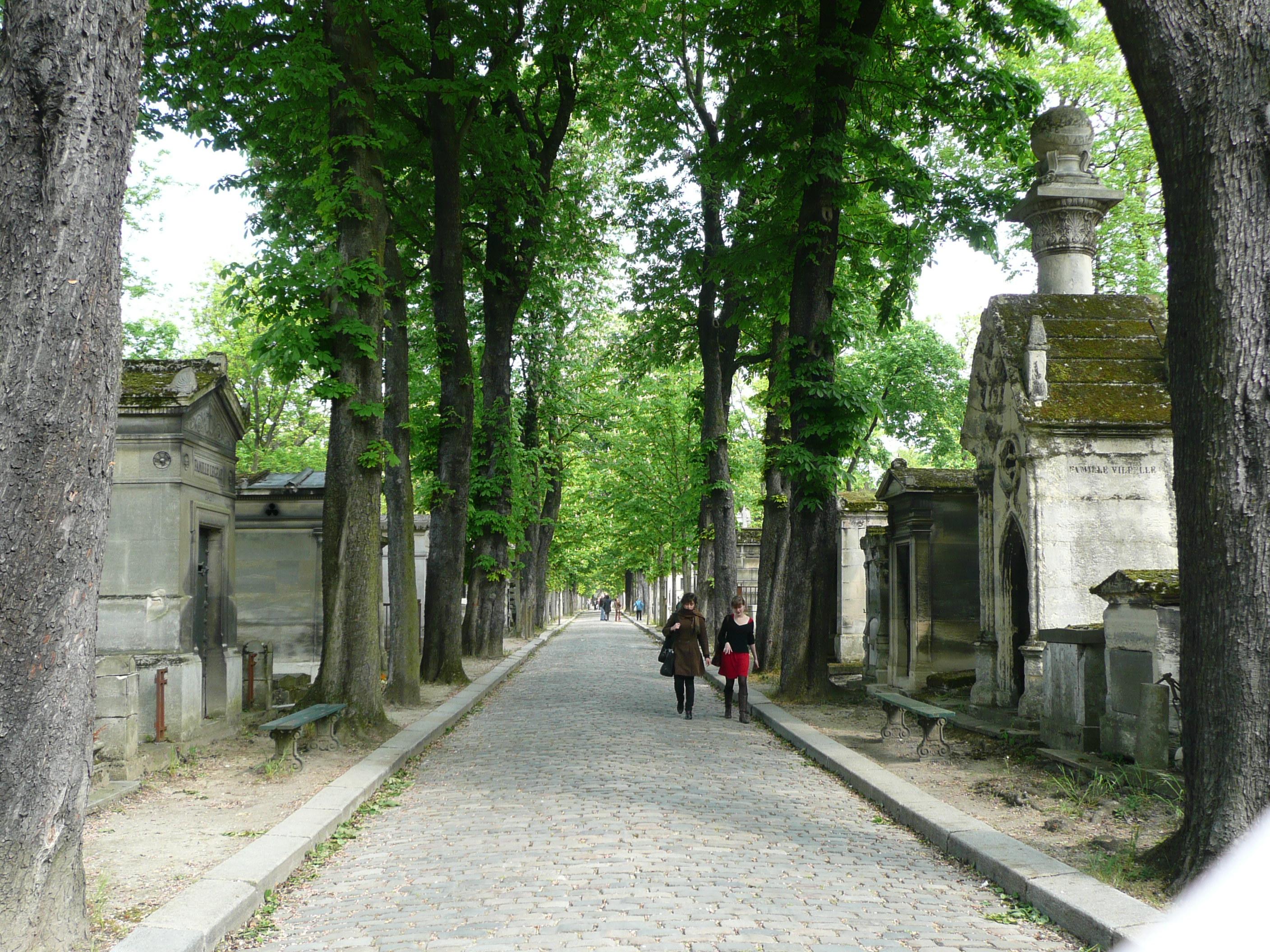
Paris has a myriad of attractions for history tragics. For me, there are three ‘must sees’ that are at the top of the ‘out there’ list. Les Catacombes de Pariss are one. The folk cabaret Au Lapin Agile is another. and the third is La Cimetière du Père-Lachaise, the most famous cemetery in the world.

For the dear departed, Père Lachaise is the best address in Paris. Some 300,000 people reste ici. A cavalcade of French cultural and political history, with a few foreign entombments, including the playwright Oscar Wild and Doors front-man and zeitgeist icon Jim Morrison.

CHANSON

I

Summer is the worst time – there never is a good time.
They come from all across the world just to visit him.
A lot has come and gone since nineteen seventy one,
But I’ve never ever gotten used to living next to Jim.

Why do they come and queue for a man they never knew
Who had gone to meet his maker before most of them were born?
I guess that it’s the fame, or the magic of a name,
Or a spirit never tamed, that brings them here to mourn.

The Poles will throw a party for their Chopin, and the arty
Bring flowers, poems and candles, and others’ wine and bread,
Why do young folk come to rave ‘round an ancient rocker’s grave?
Don’t they know how to behave in the presence of the dead?

It’s the best address in town, but I think I’d rather be
With Karl and all the comrades up in Highgate Cemetery.
Though there’s nothing to compare with this famous cemetaire,
There’s not much love to spare between the Lizard King et moi.

Pourquoi? Dites moi! Je vous dis que…

Living near the great is highly over-rated.
They stand upon my headstone just to get a better view.
If I was recreated, I’d sooner be cremated
And scattered on the river or some quiet avenue.

II

Yes, Père Lachaise is the most famous cemetery in the whole wide world. Therein recline some of the most famous names in French history and culture. And imports like Oscar Wilde and Jim Morrison. Edith Piaf, Marcel Marceau, Delacroix and Gericault, The man who built the Suez Canal, and Antoine Parmentier who popularised the heath benefits of the humble potato. Maria Callas’ ashes were there until some Greek stole her urn and scattered her on the Aegean Sea.

C’est vrai! C’est l’esprit de mort! Et maintenant, l’encore:

III

The singers, and the dancers, and the actors, and the chancers,
The rebels and the statesmen, and the fallen communards,
Napoleonic Generals and politicians’ wives.
The poets and the dreamers, all those other famous lives.

The writers, and the waiters, and those great large format painters,
Deportee commemorations, Oscar’s winged androgenoid,
The names no one remembers, and the ones no one forgets,
But Jim’s here with empty coke cans and the smell of cigarettes.

And, summer is the worst time – there never is a good time.
They come from all across the world just be with him.
A lot has come and gone since nineteen seventy one,
But I’ve never ever gotten used to living next to Jim.

From:  In That Howling Infinite – Poems of Paul Hemphill, Volume Five

© Paul Hemphill 2013. All rights reserved

  P1050093

P1050086

P1050079

P1050078

P1050076

P1050073

P1050092

Yuri The Storyteller … we’ll sure miss the old bastard!

No man could kill him – but his heart did. Anon

My old friend and Huldrefolk founder member, George Hofsteters, Yuri The Storyteller, passed away peacefully in his sleep yesterday morning, 9th July 2014.

Passing strangest is Yuri’s passing. He had such a life force. He was a force of nature, even, the kind of person you’d think would outlive us all. And it was ironic that he who raged so long against the establishment should go so quietly into the night. I would have expected a contrarian like Yuri to have been lynched by a mob of irate god-botherers.

Yuri’s departure brought me back to the dying decades of the last century, when the shadowy and iconoclastic HuldreFolk appeared out of nowhere with their unique combination of stories and songs, and then almost as suddenly, disappeared into the mists of memory.

I was playing at the celebrated Three Weeds Folk Club in Rozelle in the spring of 1983, performing a cover of Roman poet Meniscus Diabetes‘ popular song Roman Holiday.  I was distracted by a cackling in the front row; and there was Yuri, laughing his head off. After my set, we got together and swapped notes on life, the universe and everything. Fate would have it that celebrated bandurist Victor Mishalow was also on the bill that night. And Yuri and I were enthralled by the magic of the Carlingford Cossack’s grand instrument.

Yuri told us he was a Russian Storyteller, and that he was performing at the Humanist Society the following Tuesday. “Come along and play some songs and tunes”, he said. And so we did. Yuri enthralled us with his spirited rendering of Alfred Noyes’ The Highwayman.  And it was there, in Shepherd Street, Surrey Hills, that HuldreFolk was born. Over the next two years, HuldreFolk, named for the mythical and mystical ‘hidden people’ of Icelandic legend, played throughout Australia.

One such occasion was the very first time I visited Coffs Harbour, a seaside graveyard with lights on the mid north holiday coast of New South Wales, sometimes known as the Costa Geriatrica (as fate would have it, we now live in the forest some forty clicks away from there). Looking for a parking space outside the venue, Yuri cut into a space ahead of a car that had already bagged that spot. A few minutes later, the occupants of the car approached us, looking mean and moody. Tall, broad and hairy, they looked like bad news. Yuri was unperturbed. “My mate Paul is a black belt in karate”, he chirped …

On a return visit to Coffs Harbour, he and Victor Mishalow got a gig performing on the back of a flatbed truck in the mall for a smattering of disinterested passers-by. When they’d finished, the organiser asked Yuri how much they wanted, “Two hundred dollars”, Yuri said. Before the paymaster could reply, Yuri added: “Each!” And they got it.

Yuri could be a proper bastard sometimes.

Although HuldreFolk pursued their own paths and projects, during the following decades, they would pop up in unexpected places, like their namesakes, in ones, twos, threes, and on occasions with guest HuldreFolkies. Their last outing as a trio was in October 2007 at the North By Northwest Poetry And Folk Club. Google the videos on YouTube.

Such was his energy, after a series of concerts, I’d need several months away from him to recover. Whenever we had to do a road trip, Yuri would tell jokes non-stop – it was as if they were on a loop. Once he’d finished his repertoire, he’d automatically start again.

Whenever HuldreFolk worked together, their collaborations were creative and at times, crazy.

Listen to Victor’s haunting bandura arrangements behind many of Yuri’s stories, the bravado of ‘The Ballad of Boreslav’ and the wackiness of ‘The Song Of The Volga Shearers’. Back in the day when I was performing ‘I Still Call Mongolia Home’, ‘Brave Goliath’, and ‘Roman Holiday’, Yuri would say: “There has never been as song about the Spanish Inquisition. Why don’t you write one”. Or, “How about a song about the Vikings?” The rest, of course, is hysterical.

We would always introduce George as “The One And Only Yuri The Storyteller”. Watch him on You Tube reciting the epical ‘McArthur’s Fart’ or the poignant ‘Claudy’, and telling the magical story of ‘The Algonquin Cinderella’ or the faerie ‘Green Lady’, and you will see that he really was.

Goodbye old friend.

Blast from the past

On 28th October 2013, Yuri posted on the HuldreFolk Facebook page:

Hi, Amigo!

You’ve done a great job on the Huldrefolk page, I’m with you 100% and will support at every opportunity. Could not be on your side more if I was Eddie Obeid. Now here comes the ‘but’. It’s only a tiny elephant in a big room.

It’s been quite a while since we’ve trod the boards together. Obviously neither of us will get the applause or the audiences we once had and sensibly, we should be content to let someone else drive the celebrity bus. We once had the opportunity to be bigger than the Kingston Trio and Tiny Tim together, but the choices that were made ensured we would never be plagued by the paparazzi. Yet I do believe we have influenced others with the idea we once spearheaded. Story, song, music are being metamorphosed in countless variations. I’m glad we had something to do with that.

Today, however, I’m puzzled at why one would go to the trouble of going to the ‘Pet Cemetary’ of entertainment to resurrect on social media a tired old dinosaur that is hardly remembered, let alone noticed by all but a small coterie of moth eaten folkies whose perception of “Macarthur’ is deemed akin to ‘high culture’. Traditional folktales, I’m afraid, will always belong in the musty archives and forgotten bookshops. They are a relic. Fossils belong in museums. But then, being the sentimental bastard that my nature dictates me to be, I hope you get something nice and rewarding for your efforts. If it’s sentiment before oblivion, light the fuse. Cheers!

Yuri’s race had less than a year to run when he penned this piece.

In many ways, he was right – a cruel man but fair, as they say.

But what times we had!