Rasputin and the downfall of the Romanovs

the protagonists of 1914 were sleepwalkers, watchful but unseeing, haunted by dreams, yet blind to the reality of the horror they were about to bring into the world
Christopher Clark, The Sleepwalkers: How Europe Went to War in 1914

The mystique of the mesmerising muzhik

For readers unfamiliar with him, Grigori Rasputin was a Siberian peasant, self-styled holy man and wandering mystic who somehow found his way into the innermost circle of the last Russian imperial family. Born in 1869 in the remote village of Pokrovskoye, he possessed no formal religious training yet acquired a reputation as a healer and spiritual adviser. His influence grew largely because Tsarita Alexandra became convinced that he could alleviate the suffering of her hemophiliac son, Tsarevich Alexei, whose illness threatened both the family and the succession itself. From that point onward, Rasputin became a lightning rod for public anger, rumour and scandal. To his admirers he was a man of God; to his enemies a charlatan, sexual predator, political manipulator and symbol of everything rotten within the late Romanov regime.

History has rarely been kind to him. The very name “Rasputin” conjures images of dark-eyed depravity, hypnotic influence and imperial decadence, making him one of those figures who seem destined to play the villain in the historical imagination.

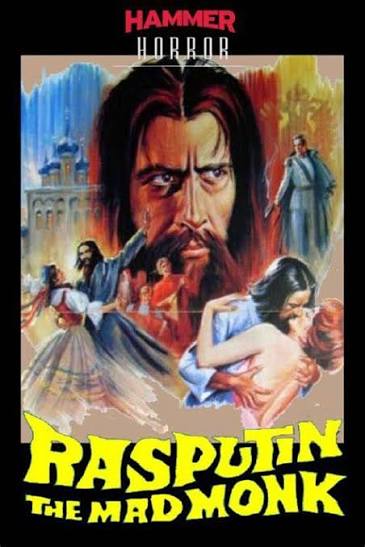
My own first encounter with him came not through history but through Hammer Horror’s gloriously lurid Rasputin: The Mad Monk (1966), in which Christopher Lee – already such a vampire icon that he’d earned the epithet “Draculee”. He played Rasputin with such operatic menace that it was not difficult to assume he must have personally engineered the fall of the Romanov dynasty between bouts of hypnotism, partying and priapic indulgence. The reality, as is so often the case, was both less theatrical and considerably more complicated. Like Boney M’s disco hit  a decade later (more on that at the end if this essay), it was great entertainment, if not necessarily great history. [In later life, Christopher Lee played a suitably malevolent Saruman in Peter Jackson’s The Lord of the Rings, resembling very much what Rasputin might have looked like had he reached old age. Lee really wanted to play Gandalf, but he was doomed to be typecast]
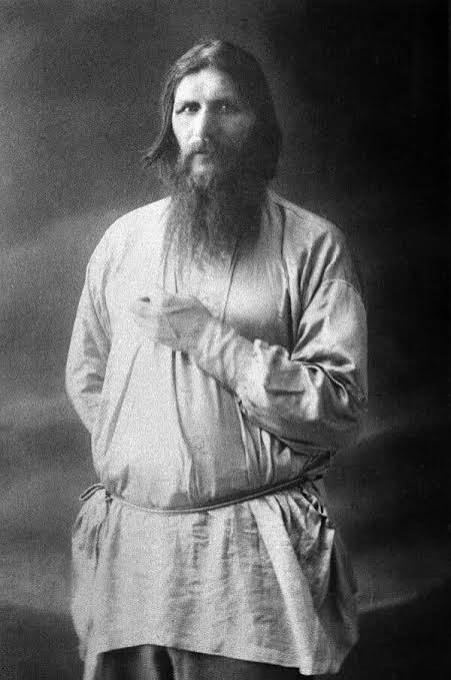
The mystical muzhik

Which brings us to acclaimed British historian Anthony Beevor’s latest book Rasputin and the Downfall of the Romanovs.

As happens often In That Howling Infinite, what begins as a review  ultimately becomes something larger than that. The book is the point of departure, but the essay then widens into a meditation on Russia itself and on historical continuity; and in this case, on the recurring problem of elites mistaking symptoms for causes, and on the peculiar human inability to recognise catastrophe even when its scent is already in the air.

I have read most of Anthony Beevor’s books and, on the whole, found them riveting, informative and refreshingly free of sensationalism. Stalingrad, Berlin, The Ardennes, Arnhem, Russia: Revolution and Civil War. Beevor is one of those rare historians who combines scholarship with narrative flair, making vast and complicated events accessible without sacrificing seriousness. Which is why I came to Rasputin with high expectations, and why I finished it feeling vaguely disappointed.

Not because it is a bad book. It is not. It is readable, entertaining, meticulously researched and full of fascinating material. But compared with Beevor’s finest work, it feels curiously slight: overextended and underdeveloped at the same time. There is enough material here for a long magazine essay, a television documentary; but not quite enough analytical depth to sustain a truly great work of history.
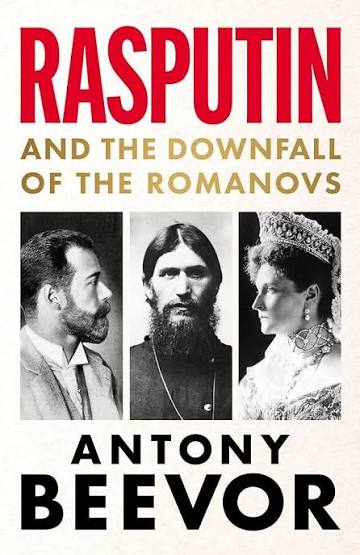
The title itself is slightly misleading. This is not really a biography of Rasputin. The so-called Mad Monk looms over the narrative like a spectral presence, but remains oddly elusive. Readers expecting a deep exploration of his Siberian origins, religious beliefs, charisma, psychology, sexuality, or the mythology that has accumulated around him often come away unsatisfied. Rasputin functions less as a subject than as a lens through which Beevor examines the final years of the Romanov court. What the book actually delivers is the story of imperial collapse between 1914 and 1917.

And what a royal court it was. Beevor presents a world populated by sycophants, grifters, mystics, opportunists, flatterers, courtiers and assorted aristocratic parasites orbiting an increasingly dysfunctional monarchy. Ministers come and go with bewildering speed. Rumours swirl through Petrograd salons. Schemes flourish and collapse. Rasputin dispenses advice, Tsarita Alexandra dispenses influence, Tsar Nicholas retreats ever further into passivity, and meanwhile the empire bleeds. All of this makes for compelling reading. Yet one gradually begins to suspect that the court is being asked to carry more explanatory weight than it can reasonably bear.

Certainly Nicholas II was an inadequate ruler and often dominated by his spouse. Certainly Alexandra was politically naïve – though that didn’t deter her from meddling: “Lovey”, she wrote to him in August 1915 while he away with his army, “I am your wall in the rear. I am here, don’t laugh at old wifey, but she has ‘trousers’ on unseen.” And both were catastrophically dependent upon Rasputin.

Certainly, the dynasty had become detached from the realities of modern Russia. But the Russian Revolution was not simply the consequence of a dysfunctional royal family making poor decisions in a palace. Russia’s problems ran far deeper than the imperial nursery. By 1917 the empire faced enormous peasant land hunger, rapid but uneven industrialisation, militant labour unrest, revolutionary traditions stretching back decades, ethnic tensions across a vast multi-national state, a fragile constitutional settlement after the failed revolution of 1905, catastrophic military losses on what we call the Eastern Front to distinguish it from the brutal stalemate on the Western one, economic breakdown, logistical paralysis and food shortages. Above all, it faced the immense pressures of total war. Even a far more capable monarch would have struggled. The Romanovs were undoubtedly part of the problem. They were not the whole problem.

Indeed, one of the ironies of Beevor’s narrative is that the closer he gets to Nicholas and Alexandra, the less convincing they become as the sole explanation for the catastrophe unfolding around them. The real story increasingly lies beyond the palace walls.

And then there is the nursery talk. The surviving correspondence between Nicholas and Alexandra is authentic, and Beevor quotes it extensively – perhaps too much. Endless references to “Sunny,” “Hubby,” “Wifey,” “baby” (the sickly heir apparent), pet names, sentimental endearments and emotional dependency reveal a couple inhabiting a private emotional universe increasingly disconnected from the realities of the empire they ruled. The first few examples are illuminating. The next fifty plus merely reinforce the point. One understands quickly enough what Beevor wishes to demonstrate: that the Tsar and Tsarina had retreated into a cocoon of domestic intimacy and religious certainty while the state around them was disintegrating. Yet repetition eventually diminishes rather than strengthens the effect.

I found myself feeling less contempt than pity, particularly for Alexandra. Beevor’s portrait is harsh, and not without justification. She was deeply unpopular even before the arrival of Rasputin. Her German origins became politically disastrous during wartime. Her interventions in ministerial appointments were often disastrous. Her faith in Rasputin was politically suicidal. Yet behind the political incompetence stood a tragic figure: a woman consumed by anxiety over a hemophiliac son whose death seemed perpetually imminent, a husband she believed had been divinely appointed, and a political system she scarcely understood. Her mistakes were enormous. Her burdens were equally profound.

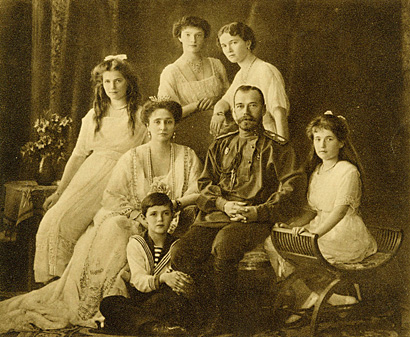
The children, meanwhile, are perhaps the saddest figures in the entire story. OTMA, the Grand Duchesses Olga, Tatiana, Maria and Anastasia. The family acronym itself has become strangely poignant, a small domestic joke preserved in history. Throughout the narrative I wondered how much they understood. Did they recognise that the dynasty was already doomed? Did they understand that the empire around them was beginning to crack apart? Olga especially emerges as a fascinating figure. Many contemporaries remarked upon her intelligence and seriousness. She often appears more politically aware than either parent. Had Russia permitted female succession, might she have made a better sovereign than Nicholas? It is impossible to know, but it is difficult to avoid the conclusion that several members of the younger generation among a myriad of dukes and duchesses possessed more common sense than the adults steering the ship of state.

As for Alexei, history has wrapped him in the melancholy glow reserved for doomed children. Understandably so. Yet had he survived to inherit the throne, one suspects he would have faced the same impossible contradictions that destroyed his father: autocracy confronting modernity, privilege confronting reform, dynasty confronting history itself.

The last of the Romanovs – Tsar Nicholas and his family, murdered by the Bolsheviks in July 1918

The road to Ekaterinburg

Let papa (Nicholas II) not plan war. It will be the end of Russia and
all of us. We shall be destroyed to the last man

Grigori Rasputin July 30, 1914

But if there is a deeper weakness in Beevor’s account, it lies not with the Romanovs, but with what overshadows them. The giant elephant in the room is the First World War. Without the war, Rasputin remains an eccentric holy man from Siberia. Alexandra remains unpopular. Nicholas remains mediocre. The Romanov dynasty perhaps limps on for another decade or two. With the war, every weakness becomes fatal.

Russia entered the conflict militarily, economically, politically and socially ill-equipped for the demands of modern industrial warfare. It possessed manpower but lacked organisation. It could mobilise millions of peasants but struggled to arm, supply and transport them. Railways buckled. Food shortages worsened. Casualties mounted on a staggering scale. Most importantly, the largely peasant army itself became fertile ground for revolution. The officer corps remained socially distant from the rank-and-file. Military disasters shattered confidence. Discipline deteriorated. Radical ideas spread. By 1917 the army was not merely losing battles. It was losing faith in the system it served. When revolution finally arrived that February, not with a bang but a slow-mo disintegration, it was little wonder that, encouraged by agitators in its ranks, the Russian Army did what we like to imagine most soldiers would like to do: lay down their arms and head for home – often first shooting their officers.

This, surely, was the real story. The gossip in Petrograd salons and restaurants drawing mattered. But millions of armed peasants questioning the legitimacy of the state mattered rather more. One occasionally wishes Beevor had spent less time recounting the latest court scandal and more time examining the immense structural forces pulling the empire apart.

Because by 1916 some observers could already smell danger. The writer Mikhail Lemke, serving at Stavka, the army headquarters, captured the mood perfectly: “Oh, the holy stupidity of the Romanovs. We are moving at full speed towards some terrible abyss, a dreadful end that is not clear to anyone but is inevitable… It is clear that the finale is going to be terrifying and in its haphazard nature.” It is a remarkable observation insofar as it captures something larger than the Romanovs themselves.

History is full of such moments. Barbara Tuchman encountered them repeatedly. Christopher Clark found them among the sleepwalkers of 1914. One finds them before the collapse of Austria-Hungary, before the fall of the Ottoman Empire, before Yugoslavia’s descent into war. People sense that disaster is approaching. The clouds gather, the pressure changes, the atmosphere becomes electric, even if the precise lightning strike remains unseen.

Beevor quotes Russian poet Alexander Blok expressing something similar when he wrote of the “peculiar merry horror that sits in the Russian soul.” It is one of those observations that sounds simultaneously profound, unfair, insightful and impossible to verify. Yet it evokes a Russia that appears repeatedly in its literature and history: exuberant and despairing, mystical and brutal, comic and tragic, capable of extraordinary creativity and extraordinary destruction, often simultaneously.

Reading these passages, I found myself thinking not only of Beevor but of my university tutor Tibor Szamuely who has featured often in In That Howling Infinite. Szamuely believed that Russia punished simplification. Its history moved in circles rather than straight lines. Revolutions proclaimed liberation only to rediscover autocracy in new forms. The Romanovs fell; the Bolsheviks inherited the imperial reflexes. The Soviet Union collapsed; empire returned draped in Orthodoxy, nationalism and Eurasian destiny. Beneath the turbulence remained what he called The Russian Tradition – the title of his one and only book, now out of print: centralised power, messianic consciousness, siege mentality and the recurring sanctification of suffering.

Szamuely believed that the bloodstained drama of 1917  and beyond – the February Revolution, the Bolshevik seizure of power in November, the Civil War, the creation of the USSR and Stalinism – often obscured the deeper continuities of Russian history. He did not live to see the collapse of the Soviet Union, the rise of Vladimir Putin or the war in Ukraine, but his argument remains strikingly relevant. The frequent upheavals that have overtaken this vast continent have often produced changes that were, at bottom, superficial, leading ultimately to the intensification of old authoritarian structures under new names.

One of the more revealing moments in Beevor’s narrative comes when Alexandra writes to Nicholas on December 14, 1916: “Be firm. Russia loves to feel the whip – it’s their nature – tender love and then the iron hand to punish and guide”. The observation is deeply revealing. It suggests a view of governance fundamentally at odds with constitutional politics. Whether one accepts Szamuely’s thesis or not, one cannot help noticing the irony. The Romanovs fell. Liberal democracy survived only briefly. The whip did not disappear. It merely changed hands. Lenin’s whip proved heavier. Stalin’s heavier still. Perhaps Alexandra was disastrously wrong about her own era and yet, in some darker sense, glimpsed something enduring about Russia’s future.

And that reminded me, oddly enough, of Deadwood. One of the reasons David Milch’s masterpiece remains such extraordinary television is that it understands something many historians understand and many politicians do not: catastrophe is usually visible before it arrives. Not in its precise form, certainly. Nobody sees the exact bullet, the exact revolution, the exact market crash. But the atmosphere changes. The clouds gather. The animals become restless. And somebody, somewhere, notices. Viewers who are paying attention notice too because the background music becomes jangly and minor key.

In the episode ominously titled Suffer the Little Children, world-weary Madame Joanie Stubbs asks  the young opportunist Flora a simple question: “Can you smell danger?” Joanie, from experience, can. The fey and feckless Flora cannot. She sees only opportunity and the immediate game she is playing and fails to recognise the larger forces closing around her. The result is one of the most violent conclusions in a series notorious for its displays of wanton brutality.

The same pattern appears repeatedly in history. People like Lemke could smell danger. Alexander Blok could smell danger. Many officers, politicians, intellectuals and ordinary Russians could smell danger. But did Nicholas and Alexandra? The evidence suggests not. Or perhaps they did but convinced themselves otherwise. In that sense they resemble the tragic Flora. Not wicked. Not entirely foolish. Simply trapped within assumptions that prevented them from recognising reality. Every warning became another irritation. Every crisis was temporary. Every setback could somehow be managed through faith, loyalty and persistence. Meanwhile the empire was bleeding to death.

The Romanovs spent years mistaking symptoms for causes. Rasputin was a symptom. Ministerial instability was a symptom. Court gossip and innuendo was a symptom. The disease lay much deeper: a political system incapable of reforming itself, a society under immense strain, and a war exposing every weakness simultaneously. By 1916 the smell of danger was everywhere. The tragedy is that those best placed to act either could not smell it or convinced themselves that the storm would somehow pass.

Tsar Nicholas in captivity

Which brings us to where Beevor’s book ends. Rasputin is assassinated by nobles determined to save the dynasty itself – treating a  symptom, not the disease (see below); the Tsar abdicates in March 1917; and the last of the Romanovs and his family disappear down the melancholy railway line to Ekaterinburg and death. The curtain falls. The reader must supply the rest. And the rest matters enormously. For all their failings, Nicholas and Alexandra were not succeeded by enlightened constitutional reformers. They were succeeded by the Bolsheviks. The road that began with Rasputin’s influence at court led through revolution, civil war, famine, terror, collectivisation, purges and the Gulag.

One leaves the book with an uncomfortable thought. The Romanovs were unquestionably part of the problem. But history’s eventual solution proved vastly more destructive.

Perhaps that is the most haunting aspect of the entire story. The downfall of the Romanovs solved one set of problems and unleashed others on an unimaginable scale. The train that Lemke saw hurtling toward the abyss did indeed reach its destination. But beyond the bend in the track lay not merely revolution, but decades of violence, repression and suffering.

In the end, Rasputin and the Downfall of the Romanovs is worth reading. The story itself remains compelling. Yet it is a lesser Beevor work: repetitive where his best books are incisive, narrowly focused where his best books are panoramic, occasionally so absorbed by court intrigue that it loses sight of the immense forces gathering beyond the palace gates. Like the dynasty it describes, it becomes most interesting when viewed as part of a larger story.

And perhaps that is the final irony. Rasputin, Nicholas, Alexandra, the four princesses, poor Alexei, the plotting dukes, ambitious ministers and aristocratic parasites all occupy centre stage for a time. Yet beyond them looms the true protagonist of the drama: Russia itself – vast, restless, wounded, contradictory, moving, as it has so often moved, between reform and reaction, idealism and coercion, hope and catastrophe.

The revolution was coming regardless. The tragedy of the Romanovs was not merely that they failed to stop it. It was that, like Flora ignoring Joanie Stubbs’ warning, they scarcely seemed to understand it was happening at all. The smell of danger was everywhere. The locomotive was already gathering speed. And somewhere ahead, beyond the next bend in the track, lay Ekaterinburg, the Civil War, Stalin, the Gulag, the Soviet century and perhaps even the long shadows that still stretch across Russia today.

The passengers continued gossiping, plotting, arguing and reassuring one another. A few looked nervously out the windows. A few could smell the storm. But by then it was already too late.

Bolshevik recruiting poster 1917

Explaining Rasputin’s power – Russia’s peasant complex

Rasputin arrived in St Petersburg trailing not merely Siberian mud on his boots but centuries of Russian argument about the peasantry.

For much of the nineteenth century, Russia’s educated classes had romanticised “the people” from a respectful distance. The peasant was imagined as the keeper of Holy Russia’s soul: patient, devout, long-suffering, close to the land and somehow morally superior to the fashionable, French-speaking aristocracy that governed him. Tolstoy found wisdom amongst peasants. Dostoevsky found redemption there. Intellectuals went “to the people” in search of authenticity, only to discover that actual peasants could be suspicious, conservative, superstitious and decidedly unimpressed by visiting idealists from St Petersburg.

Out of this tension emerged the Narodniks, the great “to the people” movement of the later nineteenth century. Young idealists abandoned universities and cities and went into the countryside to live amongst the peasants, educate them, organise them and, in some cases, save them. The peasants frequently responded by assuming they were spies and reporting them to the police.

Russia has always possessed an unusual talent for disappointing its romantics

Rasputin landed squarely in this contradiction. To admirers, he was the authentic Russia that the salons had spent generations searching for: a wandering pilgrim, a holy fool, a man of the soil with the smell of birch forests and woodsmoke still clinging to him. To his enemies, he represented everything that modern Russia was supposed to leave behind: ignorance, mysticism, obscurantism and the triumph of superstition over reason.

The aristocracy had always liked peasants rather in the way that modern urbanites like farmers’ markets — as long as the mud remained somebody else’s problem. Then one of them walked into the Winter Palace and sat down with the Tsarita.

Even popular culture recognised the type. At one point, Christopher Lee’s wonderfully excessive and inebriated Rasputin, breaks into an exuberant Russian dance to Stenka Razin, the great folk lament about the rebel Cossack who throws his Persian princess into the Volga to prove his loyalty to his comrades. Watching it as a teenager, I remember thinking not of Cossacks and river pirates but: “Hang on! That’s The Carnival Is Over.”

Tom Springfield had indeed borrowed one of Russia’s most famous melodies and transformed it into a global hit for The Seekers. Russia has always had a habit of turning up unexpectedly in other people’s stories. [See, in In That Howling Infinite,“High above the dawn is waiting” … the unlikely Russian origin of an English pop song]

Rather like Rasputin himself.

The resurrection of the Romanovs

One of the enduring ironies of Russian history – and indeed of history generally- is how often “all that is old is new again.” Revolutions announce themselves as clean breaks with the past, yet the past has a habit of returning through side doors and forgotten corridors. The symbols change, the slogans change, the uniforms change, but old habits, assumptions and institutions frequently re-emerge in unexpected forms.

Russia provides perhaps the most spectacular examples.

Much attention is paid to the persistence of the autocratic state: the succession from Tsarist secret police to Cheka, NKVD, KGB and FSB; the recurring preference for centralised authority over pluralism; the enduring suspicion of foreign influence; the tendency to frame political life as an existential struggle between order and chaos. These continuities are real enough.

Yet the return of older Russia extends well beyond the machinery of coercion. One of the most remarkable developments of the post-Soviet era has been the resurrection of the Russian Orthodox Church. The institution that survived persecution, marginalisation and attempted eradication under Soviet rule has re-emerged as one of the central pillars of contemporary Russian identity. Cathedrals demolished by the Bolsheviks have been rebuilt. Religious symbolism once dismissed as superstition now appears alongside state ceremonies and military rituals. Patriarchs once monitored by the Party have become influential public figures. Patriarch Kyril , the current head of the Russian Orthodox Church is a close political and ideological ally of Putin. Orthodoxy, once pushed to the margins, has returned to the centre of Russian public life.

And with Orthodoxy has come a reconsideration of the Romanovs, murdered along with their servants (and pet dogs) by bullet and bayonet by local Bolsheviks, on Lenin’s orders it is claimed, on the night of 16th and 17th July 1918 – ostensibly to prevent their rescue by Kolchak’s White forces who were closing in on Ekaterinburg. Many of their family and friends were executed in the days and months afterwards.

For much of the Soviet period, Nicholas II occupied a relatively simple role in the official story: a weak ruler whose incompetence justified the Revolution that swept him away. Post-Soviet Russia complicated that narrative. The Romanovs gradually ceased to be merely the defeated rulers of a vanished age and became, for many Russians, symbols of national martyrdom. Nicholas and Alexandra, together with their children, were canonised as Passion Bearers. Pilgrimages developed around sites associated with their imprisonment and murder. Their deaths came to be viewed not simply as a political execution but as a spiritual tragedy and a national wound.

The process was aided by the gradual revelation of what actually happened in the cellar of the Ipatiev House in Ekaterinburg. Soviet accounts had long been evasive. The fuller story proved profoundly unsettling. The murder of Nicholas and Alexandra is one thing. The murder of Olga, Tatiana, Maria, Anastasia and the sickly Alexei is quite another. Whatever one’s judgement of the Romanov regime, if the witness statements gathered after the slaughter are reliable, it is difficult not to recoil from the sheer brutality of what occurred that night. The image of frightened young women surviving the first fusillade because jewels sewn into their clothing deflected bullets, only to be finished off with bayonets and revolvers in a chaotic mess of panic and gun-smoke possesses a dreadful power.

That sympathy has done much to reshape public memory. The Romanovs who emerge in popular imagination are often not the rulers of a vast empire but a doomed family. The focus shifts from Nicholas the inadequate monarch to Nicholas the husband and father; from Alexandra the politically disastrous empress to Alexandra the anxious mother. Martyrdom eclipses governance.

There was to be, however, no martyr’s crown for Grigori Rasputin, whom we had lost sight of when we widened the scope of our review of Beevor’s historical pot-boiler.

The death of Rasputin

To borrow from the Bard of Avon (Macbeth, that is), “nothing in his life became him like the leaving it”. Rasputin’s demise has passed into legend largely because it seems to belong less to history than to black comedy.

In December 1916 a group of aristocratic conspirators, led by Prince Felix Yusupov and Grand Duke Dmitri Pavlovich, decided that the self-styled holy man had become a mortal threat to the monarchy and must be removed. What followed has often been retold as a Gothic horror story in which Rasputin was poisoned, shot, beaten, drowned and somehow kept coming back for more.

Beevor, however, strips away much of the mythology and reveals something closer to a tragic farce. The conspirators were astonishingly amateurish, repeatedly losing control of events, contradicting one another, panicking and improvising as their carefully laid plan unravelled. Reading Beevor’s account, one is reminded less of a sinister political assassination than of a darkly comic Ealing caper performed by nervous aristocrats hopelessly out of their depth. Yet the absurdity only heightens the symbolism. Here was the Russian elite, convinced it was saving the Empire, bungling even a murder. Rasputin’s chaotic end became a grotesque metaphor for the regime itself: confused, incompetent, riddled with fantasy, and staggering towards disaster while imagining it was still in control.

No wonder it provided such irresistible material for a shonky Hammer Horror melodrama. Rasputin’s life already contained all the necessary ingredients: a mysterious peasant mystic, aristocratic decadence, rumours of hypnotic powers, political intrigue, sexual scandal and a violent death wrapped in myth and exaggeration. His assassination only added to the legend. Poison that apparently failed to work, bullets that seemed unable to stop him, panicked noblemen stumbling through a murder plot and a corpse eventually dumped into the icy Neva – it all reads less like sober history than a fever dream concocted by a screenwriter after too many vodkas.

Hammer simply leaned into the absurdity. With Christopher Lee glowering, glaring and generally chewing the scenery as only Christopher Lee could, Rasputin became less a historical figure than a gothic supervillain, somewhere between Dracula and a mad prophet. The remarkable thing is that the real story, stripped of its embellishments, remains almost as bizarre as the cinematic version. Indeed, one suspects that if a screenwriter had invented the entire affair from scratch, critics would have dismissed it as implausibly over-the-top.

History, as usual, had other ideas. And therein lies the enduring fascination of Rasputin: not merely the man himself, but the way his life and death seem perpetually suspended between fact and folklore, political history and popular mythology.

The book of the film?

Whilst reading Beevor’s account, I wondered if he had recently watched the 1971 British film Nicholas and Alexandra. It is an appealing fancy, and not an entirely implausible one.

Anthony Beevor is a serious historian, of course, and his account of the Romanovs, Rasputin, and the revolutionary years rests on decades of scholarship rather than any cinematic influence. Yet historians are also human beings, and good historians often have a keen sense of narrative, character, and scene. Reading some passages in Russia: Revolution and Civil War, one occasionally gets the feeling that Beevor can see the events unfolding before him in almost cinematic fashion.

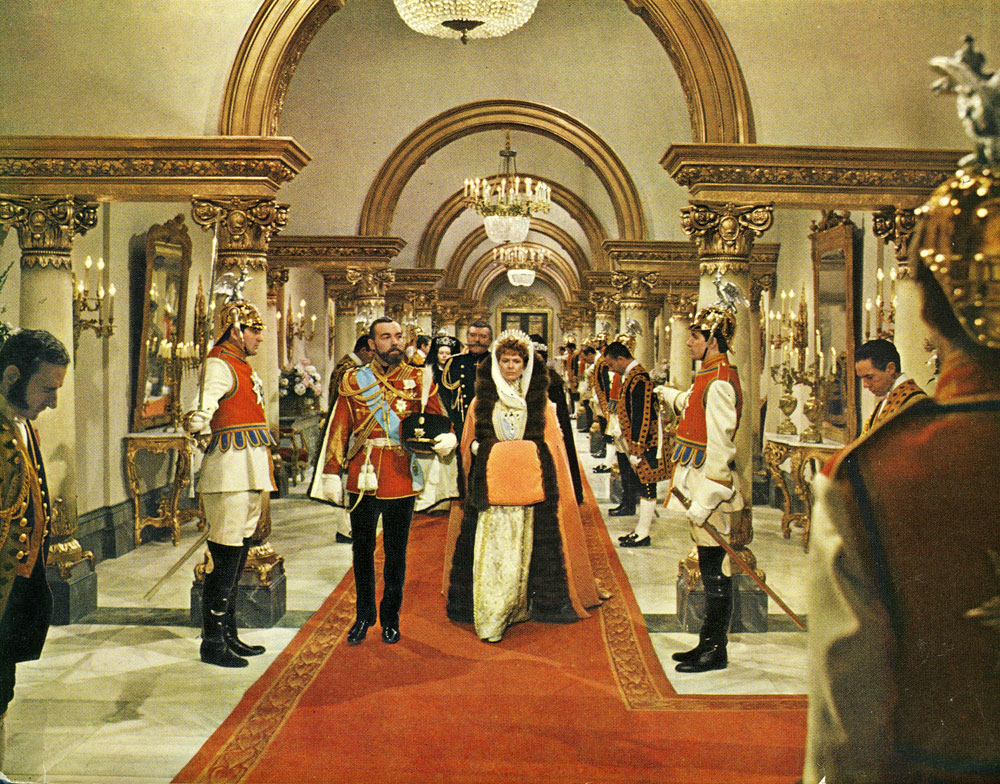
The 1971 film Nicholas and Alexandra remains one of the most ambitious attempts ever made to dramatise the collapse of Imperial Russia. Although it was something of a commercial disappointment, it assembled a remarkable cast of British acting royalty. Michael Jayston’s Nicholas II and Janet Suzman’s Alexandra are perhaps best remembered, but the supporting cast reads like a roll-call of twentieth-century British theatre and film: Laurence Olivier as Count Witte, Michael Redgrave as Sazonov, Jack Hawkins, Harry Andrews, Timothy West, Ian Holm, and a young Brian Cox in one of his earliest screen appearances as Leon Trotsky.

Then there is Tom Baker as Rasputin: wild-eyed, bearded, charismatic, unsettling, simultaneously ridiculous and strangely compelling. It remains one of the screen’s most memorable Rasputins, capturing something of the paradox that has fascinated generations- the peasant mystic who became confidant to an empress, faith healer, political liability, and eventually a figure of near-mythic notoriety. [Tom Baker reincarnated in 1974 as the Fourth Doctor, to become the longest serving time lord in that venerable television series, and, to hark back to our opening paragraphs, like Christopher Lee, he also pitched unsuccessfully to play Gandalf in The Lord of The Rings]

As for Ian Holm, His role is actually an interesting footnote. In Nicholas and Alexandra, he played Vasily Yakovlev, the Bolshevik commander who supervised the execution of the imperial family in Ekaterinburg in July 1918. Yakovlev survived the civil war and perished during Stalin’s Great Terror in 1938 while Holm morphed into the devious cyborg Ash in Ridley Scott’s Alien (1979).

Whether Beevor recently watched the film is impossible to know. But if one were writing about the twilight of the Romanovs, it would be hard not to have the film somewhere in the back of one’s mind. For all its historical simplifications, it remains one of those grand old epics that lodged themselves in the cultural imagination.

And perhaps that is one reason the movie endures despite its reputation as a flop. It was not merely recounting history. It was staging the last act of an entire civilisation – the chandeliers still glittering, the uniforms still immaculate, the orchestra still playing, even as the floorboards beneath the Russian Empire were already beginning to crack.
When Josef met Vladimir

There is a scene in Nicholas and Alexandra that takes us down one of history’s intriguing rabbit holes where fact, folklore and political mythology sit together at the same table – perhaps even, over a pint.

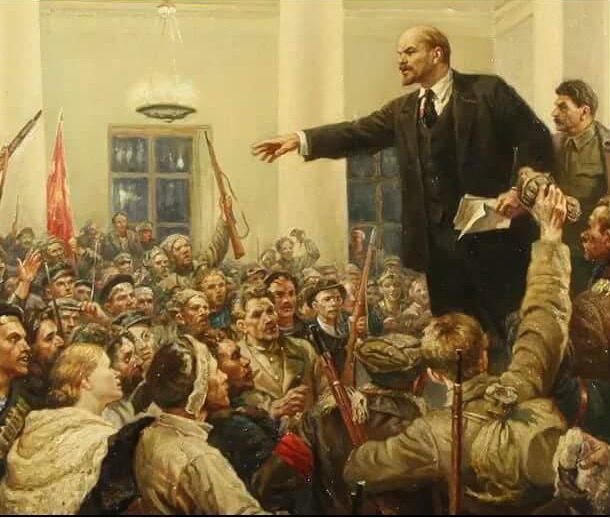
It depicts the First Conference of the Russian Social Democratic Labour Party in Tampere (then part of the Grand Duchy of Finland) in December 1905. That conference is generally accepted by historians as the first documented meeting between Lenin and Stalin. Stalin himself later recalled it as their first encounter, describing how the younger Georgian revolutionary was somewhat disappointed to discover that the legendary Lenin was not the towering, commanding figure he had imagined, but rather a relatively ordinary-looking man who blended easily into the crowd.

And yet, according to a London tradition, the two had met earlier at the Crown Tavern on Clerkenwell Green, a pub situated opposite what became the headquarters of the Twentieth Century Press, where Lenin worked while editing Iskra during his London exile. The tale has enormous appeal. One can easily picture the scene: two future dictators of the twentieth century sharing a beer in a smoky London pub while discussing the fate of the Russian Empire, utterly unknown to the drinkers around them.

The problem, though, is evidence. Lenin certainly spent considerable time in Clerkenwell. Stalin certainly visited London in 1907 for the Fifth Congress of the RSDLP. Both men undoubtedly walked the same streets. The Crown Tavern proudly embraces the connection. Yet hard documentary proof that they actually sat down together there before the 1905 Finnish conference is elusive. Soviet historians, who were often eager to document Lenin’s revolutionary activities in minute detail, generally treated the Tampere meeting as the first confirmed encounter. Modern historians tend to do the same.

That does not necessarily make the pub story false. Revolutionary underground movements were not renowned for maintaining meticulous attendance records. Absence of evidence is not evidence of absence. But it does leave the tale in that charming grey zone occupied by so much historical folklore.

There is also a delicious irony in the setting. Clerkenwell Green was one of the great centres of radical politics in Victorian and Edwardian London – a place where exiles, anarchists, socialists, trade unionists and political dreamers gathered. The British Empire, then at the height of its power, provided refuge to revolutionaries who were plotting the overthrow of other empires. London was simultaneously the capital of global capitalism and a sanctuary for those dedicated to its destruction.

If Lenin and Stalin really did share a pint at the Crown Tavern, neither man could have known that within two decades one would have created the Soviet state and the other would inherit it. Nor could the Londoners around them have guessed that two obscure Russian exiles would become among the most consequential figures of the twentieth century.

That, perhaps, is why the story survives. Whether true or not, it captures the peculiar magic of history: the possibility that world-changing events sometimes begin not in palaces, parliaments or battlefields, but in an ordinary corner pub on an ordinary London afternoon.

And, finally, from the surreal to the ridiculous …When it comes to exuberant absurdity, one cannot match that of German reggae, funk and disco group Boney M.

Ra- ra-ra Rasputin

For an entire generation, Boney M’s 1978 disco hit Rasputin probably did more to shape popular perceptions of the man than any serious work of history.

It is, of course, ridiculously inaccurate. Rasputin was not literally the “lover of the Russian Queen”; there is no credible evidence that he and Alexandra were lovers, despite endless rumours at the time. Nor did he “rule the Russian land and never mind the Tsar.” Even at the height of his influence he remained more symbolic than omnipotent, a trusted adviser whose access to the imperial family far exceeded his actual political competence.

Yet the song captures something important about how Rasputin entered popular mythology. He became less a historical figure than a larger-than-life archetype: part holy man, part conman, part libertine, part political puppet-master, wrapped in an aura of sex, mystery and impending catastrophe.

It compresses a complicated story into a memorable caricature. The real Rasputin was almost certainly less powerful, less sinister and less glamorous than legend suggests. But legends endure because they tell us something about the fears and fantasies of their age. To Russians watching their empire stagger towards collapse, Rasputin became a convenient embodiment of everything that seemed wrong with the Romanov regime. To the wider world, he became the bearded mystic with hypnotic eyes, impossible appetites and nine lives.

Boney M simply took that mythology, added a disco beat with a Russian flavour, Euro-pop chorus and a dash of Cold War exoticism, and produced one of the strangest historical stories ever to hit the dance floor.

Indeed, there is a curious progression in the way many of us first encountered Rasputin. First came Christopher Lee’s wild-eyed Hammer Horror incarnation in the 1960s; then Boney M’s improbable disco supervillain in 1978; and only much later the actual historical figure lurking behind both performances. By that stage, poor old Grigori scarcely stood a chance. History had already handed him over to popular culture, where villains, mystics and monsters invariably enjoy a much longer shelf life than ordinary men.

Paul Hemphill, June 2025

For more on Russia, Ukraine and the Soviet Union in In That Howling Infinite, see Russky Mir – Russian history’s long shadow

Rasputin, Bony M (1978)

There lived a certain man in Russia long ago
He was big and strong, in his eyes a flaming glow
Most people look at him with terror and with fear
But to Moscow chicks, he was such a lovely dear
He could preach the Bible like a preacher
Full of ecstasy and fire
But he also was the kind of teacher
Women would desire

Ra-Ra-Rasputin, lover of the Russian Queen
There was a cat that really was gone
Ra-Ra-Rasputin, Russia′s greatest love machine
It was a shame how he carried on

He ruled the Russian land and never mind the Tsar
But the kazachok, he danced really wunderbar
In all affairs of state, he was the man to please
But he was real great when he had a girl to squeeze
For the Queen, he was no wheeler-dealer
Though she’d heard the things he′d done
She believed he was a holy healer
Who would heal her son

Ra-Ra-Rasputin, lover of the Russian Queen
There was a cat that really was gone
Ra-Ra-Rasputin, Russia’s greatest love machine
It was a shame how he carried on

But when his drinking, and lusting and his hunger for power
Became known to more and more people
The demands to do something about this outrageous man became louder and louder

“This man’s just gotta go,” declared his enemies
But the ladies begged, “Don′t you try to do it, please”
No doubt this Rasputin had lots of hidden charms
Though he was a brute, they just fell into his arms
Then one night some men of higher standing
Set a trap, they′re not to blame
“Come to visit us,” they kept demanding
And he really came

Ra-Ra-Rasputin, lover of the Russian Queen
They put some poison into his wine
Ra-Ra-Rasputin, Russia’s greatest love machine
He drank it all, and he said, “I feel fine”
Ra-Ra-Rasputin, lover of the Russian Queen
They didn′t quit, they wanted his head
Ra-Ra-Rasputin, Russia’s greatest love machine
And so they shot him ′til he was dead

Oh, those Russians

Writer(s): Frank Farian, Fred Jay, George Reyam

Afterword

Being a longtime student of the Middle East, and having visited Jerusalem many times, whilst assembling this essay, I was surprised to discover a direct connection between the murdered Romanovs and the Holy City. Tsarita Alexandra’s sister, the Grand Duchess Elisabeth, who was executed along with other nobility on the sane night as The Tsar and his family, and later, interred in the incongruous and ostentatiously Muscovite Church of Saint Mary Magdalene in the Garden of Gethsemane on Mount Olive – which she and her husband had helped build – and in 1982, canonised as “new martyr” of the Russian Orthodox Church Outside Russia.
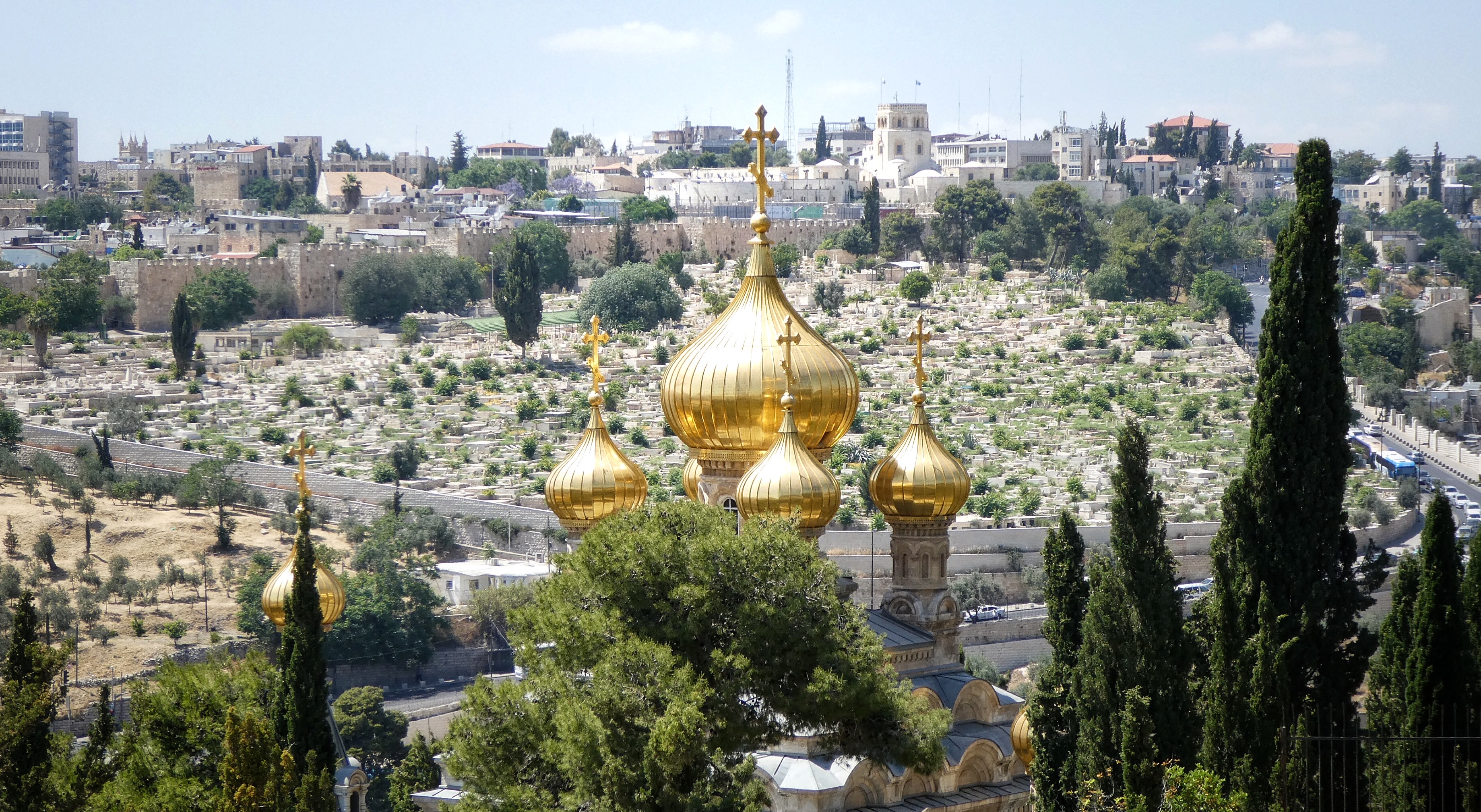
The Church of St. Mary Magdalene, viewed from the walls of Jerusalem. P.Hemphill, May 2014
The fall of the Ottoman Empire and the birth of Türkiye

Preface

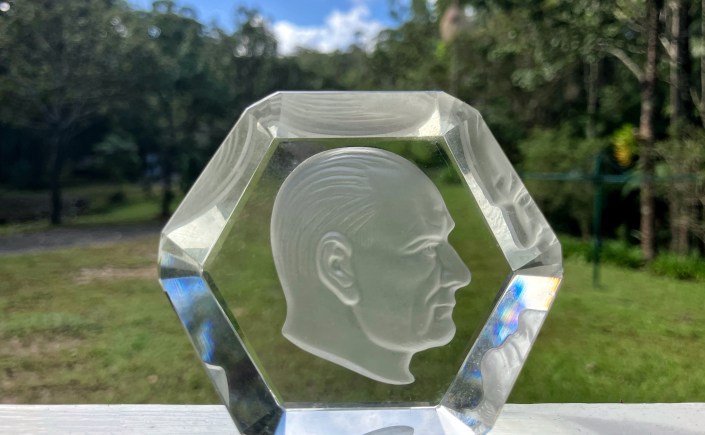
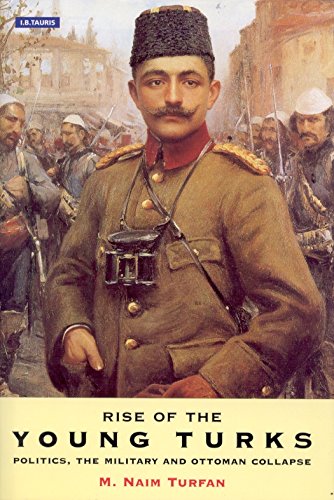
The featured image of this post is a profile in crystal of Kemal Atatürk that sits on my bookshelf as a reminder of my late friend and academic colleague Mehmet Naim Turfan. Naim, like millions of his compatriots, harboured a deep affection and respect for the legacy of Atatürk, the founder of modern Türkiye and its first president. It was gifted to me by His wife soon after his passing by his wife Barbara. His doctoral thesis was published posthumously in 2000 as Rise of the Young Turks: Politics, the Miliary and Ottoman Collapse. He is cited several times in the book that is the subject of this article. I thought of Naim often while reading the book and writing what follows.

Enver Pasha, soldier, politician and member of the troika that ruled the Ottoman Empire before and during WW1

Ottoman Endgame

Many believe that prior to the outbreak of World War 1 in August 1914, Europe had been at peace. In matter of fact, brutal and bloody little wars had raged in Eastern Europe three years prior, whilst Italy fought the Ottoman Empire for Tripoli and Cyrenaica, both now modern Libya and yet also presently two warring parts of a fractured whole and now being triggered by the aftermath of equally nasty little wars in the same lands in the last quarter of the Nineteenth Century. The Ottoman Empire’s entry into alliance with the Central Powers in 1915 against the Entente of Britain, France and Russia was the direct outcome of what we know refer to generically as The Balkan Wars – which aided and abetted by Russia, saw the emergence of Serbia, Romania and Bulgaria. In retrospect, with the benefit of hindsight, they were the beginning of what we might now refer to as The Wars of the Ottoman Succession. They are not over.

The empire’s entry into the war on the side of the Central Powers against the Entente of Britain France and Russia was a devious, drawn-out business as it sought to take advantage of its potential allies in recovering why it lost in the preceding Balkan Wars that had deprived it of its European provinces,

Few have told the story of the fall of the Ottoman Empire and the birth of modern Türkiye as well as English historian Sean McMeekin in his geographically sprawling and historically enthralling book The Ottoman Endgame. He juxtaposes military operations in the empire with those on Europe’s eastern and western fronts, demonstrating how, in the shifting fortunes of war in Europe, each impacted the other from the first offensives in France and on the eastern front to the Russian Revolutions of 1917.

Author and journalist Christopher de Bellaigue sets the scene well in a brief but compelling review (published in full below with some excellent pictures, along with a article by the author himself):

”For the historian of the first world war, the Ottoman theatre is a blur of movement compared to the attrition of the western front. Its leading commanders might race off to contest Baku and entirely miss the significance of events in the Balkans, while the diffuse nature of operations tended to encourage initiative, not groupthink. The war of the Ottoman succession, as Sean McMeekin calls it, was furthermore of real consequence, breaking up an empire that had stifled community hatreds, and whose absence the millions who have fled sectarian conflict in our age may rue …

For the Ottomans, the “great war” of western historiography was part of a much longer period of conflict and revolution, and arguably not even its climax. The process started with the collapse of the Ottomans’ Balkan empire – encouraged by Russia, moderated by Britain – and it brought to power the militaristic regime of the Committee of Union and Progress, or CUP. When Turkey entered the European war on 10 November 1914, Ottoman innocence was long gone, the army fully mobilised, the people benumbed by loss and refugees and the empire hanging in the balance. And yet, for the CUP and its triumvirate of leading pashas, the Young Turk troika of Enver, Talat and Djemal, the moment was as fraught with opportunity as it was with danger. On the opportunity side of the ledger was the prospect of riding Germany’s coat tails to victory, overturning the Balkan reverses and winning back provinces in the east from the old enemy, Russia. Enver, the CUP’s diminutive generalissimo, even spoke of appealing to Muslim sentiment and marching all the way to India.

For the Russians, the game was about winning Constantinople (or Tsargrad, as they presumptuously called it) and with it unimpeded access to the Mediterranean through the Bosphorus; it was with “complete serenity”, Tsar Nicholas II informed his subjects, that Russia took on “this ancient oppressor of the Christian faith and of all Slavic nations”

The European war on the eastern and western fronts was characterized by attrition and stalemate, but that waged by the Ottomans and the Russians, and soon, the British and French, was in contrast, highly mobile and constantly shifting, with the exception perhaps of the allied assault on the Gallipoli Peninsula which very soon resembled the trench warfare and brutal but futile offensives that characterized the Western Front. It is difficult to comprehend to scale of the war fought in the Middle East in terms of its territorial extent. From Baghdad to Baku, Gallipoli to Gaza, the Black Sea to the Gulf of Aqaba and the Caspian Sea. It was waged across European and Asian Ottoman lands including present day Greece, Bulgaria and Romania in the west, in the Caucasus in the east, in present day Armenia, Georgia and Azerbaijan and Iran, and in the south in present day Syria, Iraq, Jordan, Israel and Palestine.

Though the Sultan departed, and with him, the Islamic Caliphate, and most of the empire’s non-Turkish lands – were lost, under the leadership of former Ottoman commander and war hero Mustafa Kemal Pasha, the Anatolian heartland resisted and ultimately repelled invading foreign armies, and the Turkish state he created endures today as an influential participant in world affairs.

Casting new light on old narratives

McMeekin, writes de Bellaigue, is an old-fashioned researcher who draws his conclusions on the basis of the documentary record. In the case of a conflict between Ottoman Turkey and Germany on one side, and Russia, Britain and France on the other, and involving Arabs, Armenians and Greeks, this necessitates linguistic talent and historical nous of a high order. McMeekin is at home in the archives of all major parties to the conflict and his accounts of some of the more contested episodes carry a ring of finality. Access to previously closed Russian and Turkish archives has provided new and potentially controversial insights into accepted narratives regarding the last years of the Ottoman Empire. Challenging long accepted narratives, he addresses three of the most enduring shibboleths of the First World War.

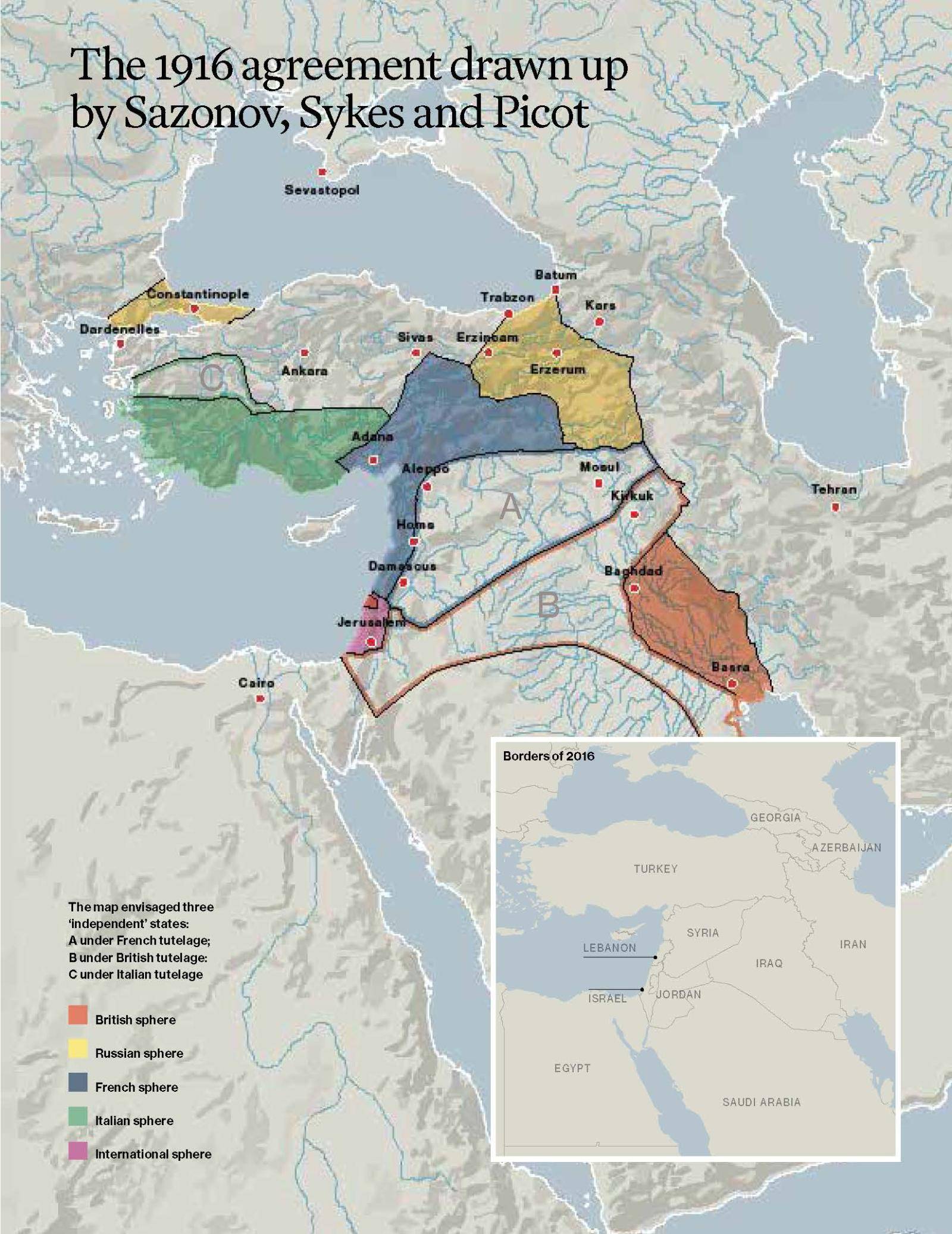
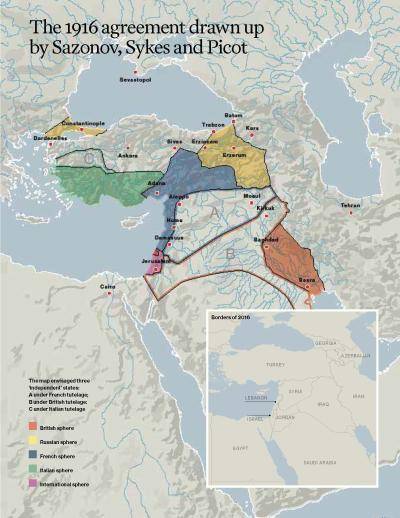
He jumps right in even before he begins his wide-ranging story, leaves hanging in the air like a predator drone until he returns to it in chronologically due course. The Sykes Picot Agreement of 1916 – the bête noir of most progressive narratives of the modern Middle East, and to many ill-informed partisans, the causus bello of the intractable Arab Israeli conflict – was not the brainchild of perfidious Albion and duplicitous France, but rather a plan for the dismemberment of the Ottoman Empire concocted by the foreign minister of Imperial Russia. France’s Monsieur François-George Picot and Britain’s Sir Mark Sykes played second and third violin to the “third man” Sergei Sazonov. Both Russia and France had for decades sought to establish their political, strategic and economic interests at the expense of the so-called “sick man of Europe”, an ostensibly terminal invalid who throughout the nineteenth century, had experienced many deathbed recoveries. Czar Nicholas II, in common with his Russian Orthodox predecessors, dreamt of bringing Istanbul, formerly Constantinople, the heart of the orthodox patriarchate, or Tsargrad into the empire. It was no coincidence that the infamous Sykes Picot pact was outed by Russia’s Bolshevik regime after the collapse of the Czarist regime to discombobulate the revolution’s foremost European enemies. 

The second icon of “received history” in McMeekin’s sights, is one Australia’s foundation stories – the ill-starred Dardanelles Campaign of 1915 and particularly, the the ANZAC’s Gallipoli legend. It was, from McMeekin’s perspective, a misconceived, poorly planned endeavour to capture the Ottoman capital, to relieve pressure on Russian forces engaged in bitter fighting in Eastern Anatolia, and potentially, to knock the Ottomans out of the war. Contrary to popular conceptions, the British were not exactly enthused by the idea. First Lord of the Admiralty Winston Churchill’s preference was for an assault on the “soft underbelly” of the empire – the port of Alexandretta in Ottoman Syria (now Turkish Antakya), with its strategic and logistic proximity to the Hijaz railway and the hinterland of the Levant. One indisputable fact about Gallipoli is that it assured the ascent Mustafa Kemal, a key commander who had already distinguished himself in the Balkan Wars, who would go on to conduct a fighting retreat of Ottoman Armies through what is now present-day Palestine and Syria, lead Turkish forces to victory in the war of liberation that followed, and, as Kemal Atatürk, would become the founder of modern Türkiye.

The third widely held narrative concerns the Armenian Genocide. Unlike the rulers of modern Türkiye, McMeekin does not deny its occurrence. Nor does he downplay or even ignore it, as does Israel for the idiosyncratic reason that it potentially minimises the horrors of the Shoah. Rather, he places it in the context of events in the empire’s Anatolian heartland. Two predominantly Armenian provinces in Eastern Anatolia were home to active nationalist independence movements, and these gave tacit and actual support to the Russian forces encroaching on the empire from the Caucasus and the Caspian Sea (in present day Azerbaijan and Georgia). Armenian militias fought alongside Russian forces on the Caucasian front whilst partisans operated behind ottoman lines, and cities, town and villages were actually “liberated”, fostering fears in the Istanbul government of an treasonous” fifth column”. McMeekin acknowledges the death toll of what we now recognise the systematic destruction of the Armenian people and identity which was spearheaded by the ruling Committee of Union and Progress (CUP) and implemented primarily through the mass deportation and murder of around one million Armenians during death marches to the Syrian Desert and the forced Islamization of others, primarily women and children. Whilst most probably died of inhumane treatment, exposure, privation and starvation, unknown numbers were murdered.

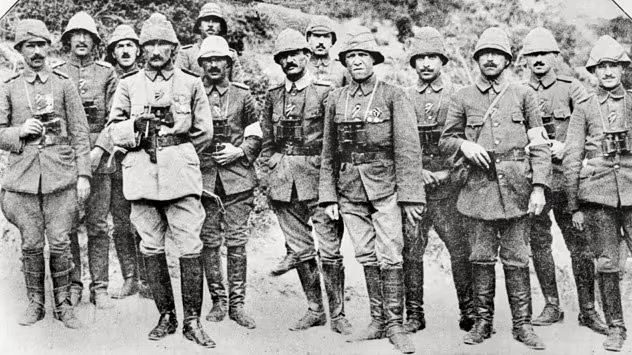
Kemal Pasha and Ottoman offices at Gallipoli

Parallels

Reading The Ottoman Endgame, I was reminded often of his compatriot Anthony Beevor’s harrowing tale of the Russian Revolution (reviewed in In That Howling Infinite’s Red and white terror – the Russian revolution and civil war. That Revolution and the end of the Ottoman Empire converged. McMeekin notes that with regard to the war in Anatolia and the Caucasus, the treaty of Brest-Litovsk, which ended the war between Czarist Russia and the Central Powers, was poisoned chalice for both Russia and Turkey and as significant as any of the treaties that followed the end of the war.

I found it fascinating that many individuals who were to play a significant part in the Russian Civil war also feature in Ottoman Endgame. Admiral Alexander Kolchak, commander of the imperial Black Sea fleet and General Anton Deniken, commander of Russian forces on the Caucasian front, became leaders of the Tsarist cause and were to command the counter-revolutionary White forces against the Red Army with the Siberian People’s Army and the Volunteer Army in Ukraine.

None were more prominent or as controversial in western narratives, however, as Winston Churchill. As noted above, McMeekin lays to rest the notion that the Dardanelles campaign and Gallipoli were Churchill’s sole doing and his folly – though he did blame himself later on and has been pilloried for it ever since. Ironically, once disgraced, and having volunteered to serve on the Western Front, at the end of the war, he was brought back into Lloyd George’s cabinet as Secretary of State for War. There, he advised against military intervention against Kemal’s nationalist forces and indeed mused about the option of dumping the Sazonov-Sykes-Picot dispensation imposed on the moribund empire’s Arab provinces after the armistice and of restoring the prewar territorial status quo, a kind of circumscribed Ottoman Redux. And yet, as civil war broke out and spread in the nascent Soviet Union, he was alone of his cabinet colleagues in advocating for a full-on allied intervention. Critics claimed that he dreamt, – though some believed that he fantasized – about of creating an effective White army and a borderlands alliance to defeat the Bolsheviks. But his aspirations were foiled by the imperialism of the White leadership and of White officers, and the various national movements’ fear that that if the Whites prevailed, they would restore Russian rule. Britain’s rulers were reticent about shoring up and providing financial, material support and also, soldiers sailors and airmen to brutal to demonstrably homicidal Cossack brigades and revanchist and reactionary royalist autocrats. It is not without reason that admirers and critics alike would agree that Winston had more positions than the Karma Sutra.

The Russian Revolutions – there were two, in February and October 1917 – and the Civil War that followed it, the disintegration of the Ottoman Empire followed by foreign intervention, the war of liberation, and the creation and endurance of Türkiye can be said to have defined the contours of modern Middle Eastern geopolitics, setting the stage for many if not most of the conflicts that have inflicted the region since, including three Gulf wars, the rise and fall of the Islamic State, the Lebanese, Iraqi and Syrian civil wars, and the Arab-Israel conflict, arguably the most intractable conflict of modern times. Cold War and also, the current Ukraine war.

In the wake of the fall of the Russian Empire, the Twentieth Century was not kind to the countries of Central and Eastern Europe. Historian Timothy Snyder called them “the blood lands”. Nor was it kind to the heirs and successors of the Ottoman Empire. Though the tyranny and oppression and the death and destruction wrought by rulers and outsiders upon the lands and peoples of the Middle East has been significantly less than that endured by the people of Eastern Europe and Russia, the region would fit Snyder’s sombre soubriquet.

© Paul Hemphill 2025. All rights reserved

Also in In That Howling Infinite, see Ottoman Redux – an alternative history and Red and white terror – the Russian revolution and civil war

For more on the Middle East, see A Middle East Miscellany

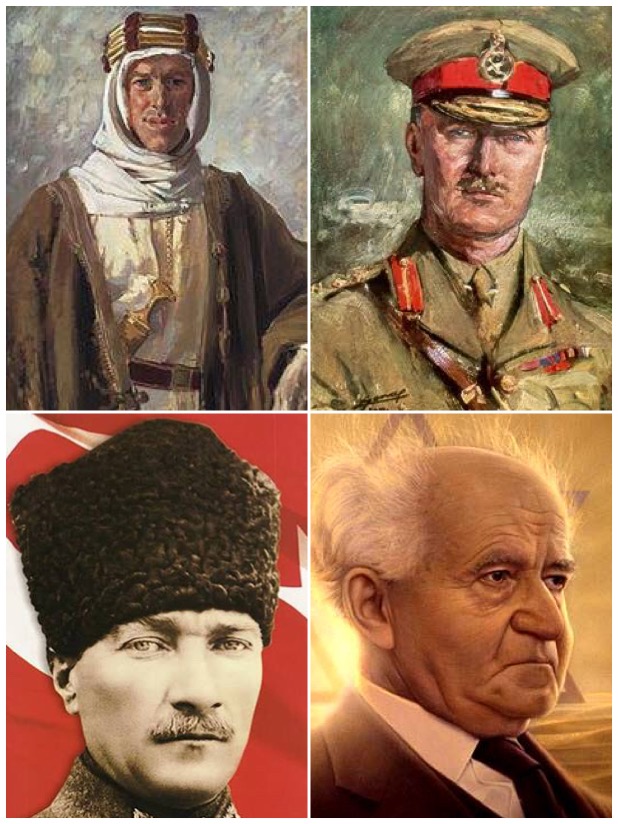
TE Lawrence, General Allenby, Kemal Ataturk, and Ben Gurion

Clone of Russia returns to a Middle East it never really left

Sykes and Picot have taken the blame but actually it was a Russian who drew the map of the Middle East, writes Sean McMeekin

The World Today, 7 December 2018

To judge from press coverage, the emergence of Islamic State has brought about a cartographic revolution in the Middle East. With the borders of Syria and Iraq in flux, journalists have resurrected the legend of Sykes-Picot, wherein Britain and France are said to have divided up the Ottoman empire between them in an agreement signed 100 years ago, in May 1916. Russia’s intervention in Syria, by upstaging the United States and her allies, seems in this view to be completing the rout of western influence in the Middle East, putting the final nail in the coffin of ‘Sykes-Picot’.

Rarely has history been more thoroughly abused. In reality, none of the contentious post-Ottoman borders of the Middle East was settled by Sykes and Picot in 1916: not the Iraq-Kuwait frontier notoriously crossed by Saddam’s armies in 1990, not those separating the Palestinian mandate from (Trans) Jordan and Syria, not the highly contested and still-in-flux Israeli/Palestinian partition of 1948, nor, in the most relevant example from today, those separating Syria from Iraq.

To take an obvious example from recent headlines, Mosul, the Iraqi city whose capture in June 2014 led Abu Bakr al-Baghdadi of Islamic State to proclaim himself Caliph Ibrahim, was actually assigned to French Syria in the 1916 agreement.

Journalists are even more spectacularly wrong in describing the Ottoman partition agreement as exclusively (or even primarily) a British-French affair, omitting the driving role played by Tsarist Russia and her Foreign Minister, Sergei Sazonov.

The final terms of what should more accurately be called the Sazonov-Sykes-Picot agreement were actually hashed out in the Russian capital of Petrograd in the spring of 1916, against the backdrop of crushing Russian victories over the Turks at Erzurum, Erzincan, Batum, and Trabzon (the British were reeling, having been humiliated at Gallipoli and in Iraq, where an expeditionary force would shortly surrender).

The conquest of northeastern Turkey in 1916 left Russia, unlike her grasping allies, in possession of most of the Ottoman territory she was claiming – barring only Constantinople (called ‘Tsargrad’ by the Russians), which still needed to be taken.

At the dawn of 1917, Tsarist Russia was poised to inherit the crown jewels of the Ottoman empire, including Constantinople, the Straits, Armenia, and Kurdistan, all promised to her in the Sazonov-Sykes-Picot Agreement. Along the Black Sea coast, Russian engineers were building a rail line from Batum to Trabzon, with the latter city a supply base for the Caucasian Army, poised for a spring assault on Sivas and Ankara. With Russia enjoying virtually uncontested naval control of the Black Sea, preparations were underway for an amphibious strike at the Bosphorus, spearheaded by a specially created ‘Tsargradskii Regiment’.

After watching her allies try, and fail, to seize the Ottoman capital during the Dardanelles/Gallipoli campaign of 1915 (when Sazonov had first put forward Russia’s sovereign claim on Constantinople and the Straits), Russia was now poised to seize the prize for herself – weather permitting, in June or July 1917.

Of course, it did not turn out that way. After the February Revolution of 1917, mutinies spread through the Russian army and navy, including the Black Sea fleet, just as it was poised to strike.

In a remarkable and little-known coincidence, on the very day the Foreign Minister of the Provisional Government, Pavel Milyukov, first aroused the anger of the Petrograd Soviet and the Bolsheviks by refusing to renounce Russia’s territorial claims on the Ottoman empire – April 4, 1917 – a Russian naval squadron approached the Bosphorus in ‘grand style’, including destroyers, battle cruisers, and three converted ocean liner-carriers which launched seaplanes to inspect Constantinople’s defences from the air. The amphibious plans were not abandoned until fleet commander Admiral AV Kolchak threw his sword overboard on June 21 during a mutiny. Even after ‘revolutionary sailors’ had taken control of the Black Sea fleet, a Russian amphibious strike force landed on the Turkish coastline as late as August 23, 1917, in one last sting by the old Tsargrad beast.

After the Bolsheviks took power, Russia collapsed into civil war, which left her prostrate, at Germany’s mercy. By signing a ‘separate peace’ with the Central Powers at Brest-Litovsk in March 1918, Russia forfeited her treaty claims to Armenia, Kurdistan, Constantinople, and the Straits, throwing the Sazonov-Sykes-Picot agreement of 1916 into chaos, even as new claimants were appearing on the scene, such as Italy and Greece – not to mention local actors: Jewish, Arab, and Armenian troops were attached as national ‘Legions’ to General Allenby’s mostly British army as it rolled up Palestine and Syria. These forces, along with French, Italian, and Greek expeditionary forces sent after the war, and the Turkish nationalists who regrouped under Mustafa Kemal in Ankara to oppose them, would determine the final post-Ottoman borders in a series of small wars between 1918 and 1922, with scarcely a nod to the Sazonov-Sykes-Picot Agreement.

While Russia’s forfeiture of her claims in 1918 was welcome, in a selfish sense, to the other players vying for Ottoman territory, it was not necessarily a positive one for the region. In the absence of Russian occupying troops to police the settlement, the

Allies, in 1919, offered Russia’s territorial share, now defined (in deference to Woodrow Wilson) as mandates, to the United States – only for the Senate to vote down the Versailles Treaty, rendering the arrangement moot. Lacking Russian or American troops as ‘muscle’, the Allies leaned on weaker proxies such as the Italians and, more explosively, local Greeks and Armenians, which aroused the anger of the Muslim masses and spurred the Turkish resistance led by Kemal (the future Atatürk). Armenians, Greeks and Kurds, too, could only lament the vacuum left behind by the departing Russians, which left them to face Turkish wrath alone.

Soviet Russia re-emerged as a player in the Middle East fairly quickly, not least as Mustafa Kemal’s key diplomatic partner during his wars against the West and its proxies from 1920-22. In a reminder of the enduring prerogatives of Russian foreign policy, the Cold War kicked into high gear when Stalin made a play for Kars, Ardahan, and the Ottoman Straits in 1946: these moves, along with the British withdrawal from Greece, Turkey, and Palestine, inspired the Truman doctrine.

In an eerily similar replay of the history of 1917-18, the collapse of Soviet power in 1991 led Moscow to turn inward, withdrawing from the Middle East and inaugurating a period of US and western hegemony in the region, which turned out no less well than the Middle Eastern free-for-all of 1918-22. A prostrate and impoverished Russia put up no objection during the First Gulf War of 1991, and did little more than sputter during the Iraq War of 2003. Russia’s recovery of strength and morale in the Putin years led, almost inevitably, to her return in force to the Middle East – from which, in reality, she never truly left.

The Russian return to the region, along with Turkey’s increasingly overt hostility over her Syrian intervention, resurrects historical patterns far, far older than Sykes-Picot. For centuries, the Ottoman empire was the primary arena of imperial ambition for the Tsars, even as Russians were the most feared enemies of the Turks. In many ways, the Crimean War of 1853-56, which saw western powers (Britain, France, and an opportunistic Piedmont-Sardinia) unleash an Ottoman holy war against the Tsar to frustrate Russian ambitions in the Middle East, is a far more relevant analogy to the present crisis in Syria than the pseudo-historical myths of 1916. It is time we put the Sykes-Picot legend in the dustbin where it belongs.

Diplomatic carve-up: the third man

In David Lean’s 1962 film, ‘Lawrence of Arabia’, a cynical British official explains how the carcass of the Ottoman Empire was to be divided at the end of the First World War under the Sykes-Picot Agreement.

‘Mr Sykes is an English civil servant. Monsieur Picot is a French civil servant. Mr Sykes and Monsieur Picot met and they agreed that after the war, France and England would share the Turkish Empire, including Arabia. They signed an agreement, not a treaty, sir. An agreement to that effect.’

This summary of wartime diplomacy has proved long-lived. It encapsulates the less than honest dealings of the British government with the Arabs – who wanted independence after being liberated from Turkish domination, rather than rule by the European colonial powers – but it leaves out the key figure in the deliberations, Sergei Sazonov, Russian foreign minister, 1910-1916.

Sazonov was one of the most significant diplomats both before and during the Great War. It was thanks to his adroit manipulation that Britain and its allies came to accept that Russia would gain the Ottoman capital Constantinople, in the event of an Allied victory, an outcome that Britain had tried for decades to prevent.

At the talks in the Russian capital Petrograd in 1916, the British and French emissaries were far lesser agents of empire than their host.

Sir Mark Sykes was a gifted linguist, travel writer and Conservative politician, but no top-flight diplomat. As for François Georges-Picot, he was an experienced diplomat and lawyer and noted advocate for a greater Syria under French rule.

But with France having no troops in the eastern theatre of war, he had to accept Russia’s demand to swallow up large parts of what is now eastern Turkey, but which Paris had set out to claim.

Sykes died of influenza in 1919 at the Paris Peace Conference, where Sazanov represented the White Russians. He died in Nice in 1927

The Ottoman Endgame: War, Revolution, and the Making of the Modern Middle East, 1908-1923” by Sean McMeekin

Czar Nicolas I of Russia is sometimes credited with coining the phrase “Sick Man of Europe” to describe the decrepit Ottoman Empire of the mid-nineteenth century. By the early 20th century, there could be little doubt that the disparaging sobriquet applied in spades. The Ottoman Empire was soundly defeated in two Balkan wars in 1912 and 1913 by the comparatively pipsqueak countries of Bulgaria, Greece, Montenegro and Serbia. One result of the wars was that the Empire lost all of its European territories to the west of the River Maritsa, which now forms the western boundary of modern Turkey. Then, when World War I broke out, the Ottomans made the disastrous decision to side with the Central Powers against the Triple Entente, ending up on the losing side of that cataclysm.

882094291

A popular theory is that the carving up of the Ottoman lands after the war, pursuant to the Sykes-Picot Agreement between France and Britain, is the source of many of the problems of the current Middle East. In The Ottoman Endgame, Sean McMeekin concedes that it is not wrong to look to the aftermath of the war for the roots of many of today’s Middle Eastern problems, but the “real historical record is richer and far more dramatic than the myth.” For example, the notorious Sykes-Picot Agreement was sponsored primarily by Russia, whose foreign secretary, Alexander Samsonov, was the principal architect of the agreement. McMeekin’s retelling of the demise of the Ottoman Empire and its recrudescence as modern Turkey is a fascinating and complicated narrative.

Among the interesting facts McMeekin points out is that according to an 1893 census only 72% of the Ottoman citizens were Muslim, and that in the middle of the 19th century the majority of the population of Constantinople may have been Christian. The Balkan Wars started a trend, exacerbated by World War I, toward ethnic cleansing, with hundreds of thousands of Christians leaving the Empire and similar numbers of Muslims moving from territory lost by the Empire to areas it still controlled.

We in the West tend to think of World War I as a static slugfest conducted in the trenches of northern France. But the war in the East, particularly as it applied to the Ottoman Empire, was a much more mobile affair. In fact, the Ottomans ended up fighting the war on six different fronts, as the Entente Powers invaded them from many different angles.

Winston Churchill in 1914

Winston Churchill in 1914

At the outbreak of WWI, the Ottomans allied themselves with Germany out of fear of Russia, which had coveted control over the straits connecting the Black and Mediterranean seas for centuries. In 1914 the Russians invaded Eastern Anatolia and met with initial success. However, Russia feared its early success was quite precarious, and so it inveigled its ally, Britain, to launch a diversionary assault on the Gallipoli peninsula. The “diversion” became one of the most deadly killing grounds of the war, as the British poured hundreds of thousands of men into the battle in hopes of breaking the stalemate on the Western Front. The author credits Russian prodding more than Winston Churchill’s stubbornness for the extent of the British commitment. The Ottomans, led by Mustapha Kemal (later to be known as Ataturk, the “father of modern Turkey”), prevailed in this hecatomb, showing that there was still plenty of fight left in the “Sick Man.”

Turkish General Mustafa Kemal, center, at Gallipoli, 1915

Turkish General Mustafa Kemal, Gallipoli, 1915

The Ottomans also soundly defeated the British in Mesopotamia (modern Iraq) in late 1915, but they were less successful against the Russians, who invaded across the Caucasus and held much of eastern Anatolia until the Bolshevik revolution in 1917 caused them to withdraw voluntarily. The British ultimately prevailed against the Ottomans in 1918 by invading from Egypt through Palestine, with a little help from the Arabs of Arabia.

The Treaty of Versailles, which ended the war in Europe in 1919, did not end the war for the Ottomans. The victorious Allies were ready to carve up much of the Empire for themselves. The Ottoman armies were to disband; England was to keep Egypt and to get Palestine and Mesopotamia; France was to get Syria, Lebanon, and parts of modern Turkey; and Greece was to get a large swath of western Turkey. All might have gone according to that plan, but Mustapha Kemal (Attaturk) was still in charge of a small but effective fighting force in central Anatolia. Attaturk husbanded his forces and fought only when he had an advantage. In a war that lasted until 1923, he was able to expel the Greeks from Anatolia and to establish the boundaries of modern Turkey.

large

McMeekin deftly handles this complexity with a lucid pen. His descriptions of the various military campaigns are riveting. This is not to say that he shortchanges the political machinations taking place. He gives more than adequate coverage to the “Young Turks,” a triumvirate that ruled the Empire from 1909 until they eventually brought it to its ruin in 1919. He also covers the Armenian massacres as objectively as possible, given the enormity of the events described.

Evaluation: This is a very satisfying book and an excellent addition to the enormous corpus of World War I literature. The book includes good maps and photos.

Published by Penguin Press, an imprint of Penguin Random House, 2015

Red and white terror – the Russian revolution and civil war

… as a policeman, I would say, get hold of a man’s brother and you’re halfway home. Nor was it admiration for a better man than me. I did admire him, but I didn’t think he was a better man. Besides, I’ve executed better men than me with a small pistol. 

She’d come to Moscow to look for her child. I helped her as best I could, but I knew it was hopeless. I think I was a little in love with her. One day she went away and didn’t come back. She died or vanished somewhere, in one of the labor camps. A nameless number on a list that was afterwards mislaid. That was quite common in those days.

Yevgraf Zhivargo, in David Lean’s Doctor Zhivago (1965)

“The terror,” declared British Historian Simon Schama in his iconic Citizens: A Chronicle of the French Revolution “was merely 1789 with a higher body count; violence … was not just an unfortunate side effect … it was the Revolution’s source of collective energy. It was what made the Revolution revolutionary’. In short, “From the very beginning […] violence was the motor revolution”.

At the end of the chapter on the coming of thw Revolutionary Wars, he writes: ‘ … poets of romantic weather forecasting like William Wordsworth continued to describe the revolution is a cyclonic disturbance, but increasingly it was no longer the storm that invigorates in cleanses rather a dark and potent elemental rage moving forward in indiscriminate destruction its breath was no longer sweet but foul. It was the wind of war and if the wind of war comes, can the storm clouds of war be far behind’.

I thought a lot about the events of the French Revolution and the Napoleonic wars which followed it as I read English author and historian Anthony Beevor’s latest foray into Russian and Soviet history, Russia – Revolution and Civil War 1917-1921

Some books can be unrelentingly bleak and brutal, so grim and graphic in fact that you have to push yourself to finish them. Cormac McCarthy’s odyssey tale The Road is one such. But one doesn’t often say that about history books. Usually it is time, ennui or both that cry “enough, already!” You set it aside, promising to return to your bookmark – but you never do. I persevered with a veritable catalogue of the horrors that men can inflict upon their fellow humans (and yes, the perpetrators are apparently exclusively male, and the victims are males and females of many ethnicities). Beevor’s previous, highly acclaimed books Stalingrad and Berlin 1945 are chilling, but his latest takes top prize. And finish it I did …

The following is not a review of Beavor’s grim opus as such, but rather a thematic compendium of thoughts and observations derived from or inspired by the book.

Most academic accounts and university courses focus on the ideological and geopolitical dimensions of the origins, rise and consolidation of the Soviet Union, and its ultimate disintegration seventy years later. General public knowledge of the Russian Revolution and the civil war which followed it is relatively limited and cursory, often derived and books like Mikail Sholokhov’s saga of the Don Cossacks, Quiet Flows the Don and The Don Flows Home To The Sea, and Boris Pasternak’s Doctor Zhivago. Indeed, it was these novels and David Lean’s powerful adaptation of Doctor Zhivago that first attracted my interest in Russia as a school student in Birmingham. I majored in Politics at the University of Reading in the United Kingdom, and Soviet history and politics were an important part of my studies. Between those days and today, I’ve read widely about Russia’s history, past and present, and I am familiar with the events, ideas and personalities, their role in the broader and longer tableau of history, and the reverberations that are still felt today.

I have written often in In That Howling Infinite on Russian and Ukrainian history. Although I am no expert, and profess an amateur interest only, I do possess a short and humble pedigree. My tutor in Soviet Studies at Reading was exiled Hungarian academic and historian Tibor SzamuelyLike many refugees from Communism, he was descended from both perpetrators and victims. An uncle of the same name served in the Hungarian Soviet Republic that took power for six months under Béla Kun in 1919 and died violently that year when the revolution failed. He was among that government’s most bloodthirsty ministers and was called “Butcher Szamuely”.

Szamuely’s family wound up in Moscow, where Tibor was born, and where his father was executed in Stalin’s purges. Young Tibor served in the Red Army, and he too was arrested and sent to a labour camp. Rehabilitated, he served as Chancellor of Budapest University. In 1964, then nearing 40, he was teaching in the “ideological institute” of Ghana’s Marxist president Kwame Nkrumah when he defected to England.

Back then, I was a political ingenue and a naïve communist sympathizer and fellow traveler, although my evolving perspectives were transforming and expanding. As my tutor, he advised me to study with an open mind and to put off juvenile thinking. He hadn’t been well when I knew him, and he died a year after I graduated. Under his tuition, I’d resolved to specialize in Soviet Studies – but events intervened, and I ended up in the Middle East (and that is another story. see: Tanks for the Memory – how Brezhnev changed my life). I nevertheless retained an active interest in the history and politics of Eastern Europe.

He would always impress upon me the historical and political continuity of what he called The Russian Tradition – the title of his one and only book, The Russian Tradition, published shortly before his death, and now, regrettably, out of print. I purchased a first edition when it was published and it is on my bookshelf still.

Szamuely believed that the bloodstained drama of the revolutions of 1917 – there were two, the social democratic one in the February, the Bolshevik one in November – and the years that followed, including civil war, the establishment of the USSR and Stalinism largely obscured the underlying consistency of Russian history. He did not live to see the decline and fall of the Soviet Union, and the advent of Putin and Russia Redux, but the basic pattern persists, circular and repetitive. The frequent turmoils that have overtaken this vast continent have in their various ways made changes that were essentially superficial, leading in the end to the intensification, under new forms, of the old authoritarian structure.

You – Bolshevik recruiting poster 1918


Contemplating civil wars

A civil war can emerge from the ashes of a wider, ongoing conflagration when factions or parties dispute the nature and terms of the post-bellum status quo and fracture along political and ideological lines. Many civil wars have arisen from the ashes of a prior war when there are what are perceived as existential issues unresolved and the availability of weapons and materièl and experienced and discontented men to use them.

There is a view that civil war can retrospectively be seen as a crucible of nation, a fiery furnace through which the righteous must walk – an ex post facto rationalization of the Nietzschean paradox of “that which does not kill us makes us strong”. Abraham Lincoln verbalized this in his Gettysburg Address in 1863 on a battlefield where the fallen had been only recently interred. Franco made a similar play as he laid claim to the wreckage that was Spain in the wake of three years of carnage, but then petrified his riven, country in autocratic stone until his death many decades later. The Russian Civil War was not accorded such a nation-building ethos as it was viewed by the Bolshevik victors as the crushing of a counter-revolution against a new world already being born.

Given Russia’s vast expanse, long history of restive regions, and large non-Russian ethnicities – all a result of centuries of imperial conquests – there is always the potential for the disintegration of centralized control and fragmentation. There is a rich history of state collapse following wars, revolutions, system breakdowns, economic crises, and other epochal events. Napoleon’s empire collapsed after his disastrous march on Moscow and subsequent defeat at the Battle of Leipzig. In 1918, the Ottoman, Austro-Hungarian, German, and Russian empires all collapsed in military defeat. Of course, people, decisions, and policies played a role, but ultimately it was war and the attendant economic and social crises that pushed these states over the edge into political chaos and often violence.

Once thing for sure, civil war, the Hobbesian “war if all against all” (Hobbes was thinking England’s) is undoubtedly the saddest, bloodiest and most visceral of all conflicts. I leave the last words to WB Yeats:

Things fall apart; the centre cannot hold;
Mere anarchy is loosed upon the world,
The blood-dimmed tide is loosed, and everywhere
The ceremony of innocence is drowned;
The best lack all conviction, while the worst
Are full of passionate intensity.

See: In that Howling Infinite, A House Divided – the Nature of Civil War

All fall down 

Revolutions are unpredictable. They never run in straight lines. They reverberate, the shockwaves expanding and impacting on their vicinity, and way beyond. The shots ricochet, like drive-by shootings and crossfires, and you never know who will be hit, where the bullets will come to rest, and who will be damaged or destroyed. Many people will be liberated, and many enslaved. Many peoples will prosper, and many, many will perish. As TS Elliot wrote, “between the idea and the reality falls the shadow”.”

When the Tsarist Russian empire collapsed halfway through the First World War, it was the first of four great empires to disintegrate. By war’s end, the conflict had destroyed the German, Hapsburg and Ottoman empires. But unlike these three, though the imperial house perished, the empire it ruled did not disintegrate. A handful of national movements, Finnish, Polish, Estonian, Latvian, and Lithuanian succeeded in breaking free, but most of murdered Tsar’s realm emerged from the convulsions of world war, revolution and civil war within a new Soviet empire, one that still ruled millions of square miles and a multitude of peoples.

The Russian Revolutions – the two in 1917, and a failed rising in 1905 in the wake of the disastrous (for Russia) of Russo-Japanese War – and the civil war that followed can be said to have defined the contours of modern European geopolitics, setting the stage for the Cold War and also, the current Ukraine war. The 20th Century was not kind to the countries of Central and Eastern Europe. Historian Timothy Snyder called them “the blood lands”.

The USSR was officially declared in the Bolshoi Theatre on 30th December 1922. Most people find this slightly surprising, because we assume that the Soviet Union must have been proclaimed immediately after The Bolshevik Revolution in November 1917. In fact, it only came into existence after a horrendous civil war that killed an estimated 10 million people, in which the deep national and ethnic tensions inside the old Russian Empire had been laid bare for all to see.

Historian Orlando Figes says in his seminal book about the Bolshevik revolution, A People’s Tragedy, that the failure of democracy in 1917 was deeply rooted in Russian culture and social history and what had started as a people’s revolution contained the seeds of its degeneration into violence and dictatorship.

In Russia, the revolution of February 1917 did not provoke a counterrevolution. The initial absence of any attempt to fight back was illustrative not so much apathy, as a feeling that there was very little of the ancien regime left that was worth defending. The overthrow of the czarist regime prompted a variety of reactions amongst the former ruling class: a resignation to events, bitterness at the incompetence and obstinacy of the Imperial Court, yet also an initial optimism among its more liberal and idealistic members. Most of the nobility and bourgeoisie supported the Provisional Government in the hope that it would at least restrain the worst excesses and keep the country together.

Soon after the November 1917 revolution, Lenin made it clear to the Bolsheviks that civil war was necessary to cleanse Russia of reactionary forces and old ways and to rebuild as a communist state and society. Moreover, he was confident that the Bolsheviks’ example would ignite revolution in the countries of Western Europe. German and Hungarian communists obliged, establishing people’s republics, which in turn invited counter revolution, the ousting of the revolutionaries, and reactionary military and police exacting bloody revenge on any leftists that could find.

The determination to resist only crystallized when the Bolshevik programme in the wake of the Bolshevik Revolution of October 1917 polarized opinion. The question is important when it comes to the origins of the Civil War itself, which led to the deaths of up to 12,000,000 people, the impoverishment of the whole country, and suffering on an unimaginable scale.

In June 1918 the Bolshevik regime was enjoying a brief respite from the rigors of revolution and civil war. Although surrounded on all sides by hostile forces, the Bolsheviks were in no immediate military danger. This welcome hiatus, lasting from the Treaty of Brest-Litovsk (March 1918) to the collapse of the Central Powers at the end of the year, allowed the Bolsheviks to consolidate their political and military strength.

In an uneasy alliance with the Bolsheviks were leftwing Socialist Revolutionaries who still dreamed of a constituent assembly and the anarchists who regarded Brest-Litovsk represented the watershed of the Revolution. In coming to terms with the Central Powers, the Bolsheviks had paid a staggering price in territory and resources. But, more importantly, they had preferred to make a pact with the imperialists rather than attempt to propagate the Revolution through popular initiatives, in particular, by partisan warfare.

Shortly after Brest-Litovsk the Bolsheviks turned against their erstwhile allies. The Cheka (the successor to the Czar’s Okrana secret police and the precursor to the NKVD, the KGB and the FSB) ostensibly created to suppress counterrevolutionaries, was unleashed on the Bolsheviks’ critics on the left. There were fierce battles between Chekists and anarchists in Petrograd and many other Russian cities.

It was game on.

It is difficult to comprehend to scale of the civil war that broke out in Russia in terms of its territorial extent, the numbers of nations and would-be states engaged in the conflict, and the destruction and carnage it wrought to soldier and civilian alike. Nor the ongoing relentlessness. Western European invaders had been defeated in the past (and indeed, the future) by what Mikhail Kutuzov, the Russian general who defeated Napoleon, called General Winter, but within the empire and its Soviet successor, weather did not stop play. Certainly, it complicated military operations, played havoc with logistics and supply-chains, and inflicted indescribable suffering upon soldiers and civilians. And the war went on …


The last of the Romanovs – Tsar Nicholas and his family, murdered by the Bolsheviks in July 1918

Revolution and reaction

If Lenin was politically flexible with foreign powers, he was ruthless with his own people, including rival parties on the left. He grabbed power when the hapless provisional government lost its way in setting up a constituent assembly that was intended to be a democratic representation of all Russians. Lenin initially paid lip service to the assembly, while calling for power to go the “soviets” – people’s councils. In reality he had no intention of allowing any diminishment or oversight of his control of the Bolshevik party and, through its Council of People’s Commissars, the battered Russian state.

But no sooner had the Bolsheviks cemented their rule than they were fighting a civil war on multiple fronts against a mind-boggling array of enemies, from revolutionary socialists  and anarchists to unreconstructed “White Russian” tsarists, nostalgic for a corrupt and flagrantly unjust regime and in between the Reds and Whites were the Greens or Partisans, mainly deserters from all sides who hated both Reds and Whites and attacked both, increasingly so as the war continued. And a range of foreign powers dealt themselves into the game to further their own strategic and ideological interests. [the featured picture of this piece is an idealized manga depiction of charismatic Ukrainian anarchist and Green Nestor Makhno, a larger-than-life figure who miraculous survived the civil way and died in his bed in exile]

Reds and Whites

The terms White and Red did not arise by chance, but drew upon older political symbolism deeply rooted in European history. White had long been associated with monarchy and legitimate authority, most famously as the colour of the House of Bourbon and the royalist forces who opposed the French Revolution – who wore white cockades in their hats. During that upheaval, those who rallied beneath the white banner represented counter-revolution, continuity and the defence of the old order. More than a century later, Russia’s anti-Bolshevik forces inherited this symbolism, becoming known collectively as the Whites.

Their opponents consciously embraced the opposite colour. Red, already synonymous with revolutionary upheaval since 1789, had become the emblem of international socialism, the blood shed by the working class, and the promise of a new social order. Thus, in the Russian Civil War, the conflict between the White Armies and the Red Army was not merely a military contest but a symbolic struggle between competing visions of political legitimacy, tradition and revolution, expressed in colours whose meanings had been forged long before the first shots were fired.

The Whites were a confused, fractured and often dysfunctional coalition with rapid changes of command occasioned by personal ambitions and fluctuating military fortunes. White generals were committed to restoring the integrity of the Russian Empire, a self-defeating handicap that alienated potential allies on the fringes, like Finland, the Baltic states and Poland. Churchill underestimated this imperial obsession which prevented the alliances he wanted to defeat the Bolsheviks. The Greater Russia obsession also hampered efforts in the Caucasus where Georgians stirred regions like Ingushetia, Chechnya and Dagestan, giving Britain nightmares of Bolshevism spreading through Central Asia towards India, an obsession that continued through the twenties as described in Peter Hopkirk’s Setting the East Ablaze – Lenin’s Dream of an Empire in Asia.

Out on the edge of the old empire, White warlords endeavoured to carve out kingdoms for themselves. Many commanders spent more time terrorizing locals than fighting the Red partisans who were operating behind enemy lines across the war zone, creating a legacy and tradition the persist to this day.

The diffusion of opponents played into the Bolsheviks’ hands, as their differences were so extreme that a unified opposition fighting force was never a viable option. But if the battle lines were often blurred, the hatred felt by the combatants for each other was nightmarishly vivid.

The White’s defeat in the civil war wasn’t for lack of outside moral and materiel support. It was due largely to their inflexibility, including their refusal to contemplate land reform until it was far too late, and their refusal to grant any autonomy to nationalities of the Czarist Empire. Their administration was so useless that it’s barely existed. Paradoxically, they lost for reasons very similar to the way the Republicans lost the Spanish Civil War two decades later. In Spain, the antifascist alliance of the Republic could not prevail against Generalissimo Franciso Franco‘s disciplined and militarized regime. In Russia, the utterly incompatible alliance of socialist revolutionaries and reactionary monarchists didn’t stand a chance against the single-minded Communist dictatorship.

A leftist libertarian with St. George’s Cross, and a Sister of Mercy nurse, 1916.

World War 1.2

It in many ways it became World War 1.2. The idea of a purely Russian Civil War is misleading simplification, prompting one historian recently to describe it instead as ‘a world war condensed’.

It was waged across European and Asian Russia, including present day Belarus and Ukraine and the successor states of the Soviet Union in the Baltic, the Caucasus, and Central Asia – from Warsaw and Eastern Europe to the Urals and eastwards through the vastness of Siberia’s forests, deserts and tundra to Vladivostok in the Far East, from the arctic north to Crimea and the Black Sea, the Caspian Sea and the borders of what in 1918 ceased to be the Ottoman Empire. Fronts stretched for thousands of miles and advances and retreats likewise. The Trans-Siberian Railway, stretching the length of the former empire from Moscow to Vladivostok, was almost six thousand miles long, and it’s tributary lines served as strategic and logistical thoroughfares for all protagonists who weren’t mounted like the innumerable Cossacks tribes and the nascent Red Cavalry, bringing to prominence the armoured trains that became a symbol of the revolution.

It drew in most of Russia’s contemporary neighbours and more far-flung nations, including The USA, Britain, France, Germany Italy and Japan – the latter providing the largest contingent, estimated by British Intelligence as some 85,000 soldiers, more than many of the various White armies. Combatants included soldiers from these countries, the British dominions of Canada, Australia, South Africa, and India, and Chinese and Mongolian troops. And a multitude of ethnicities fought for their own warlords, their national place in the sun or else their very survival. Caught up in the transcontinental maelstrom were Slavs, Cossacks, Tartars, Turkmen, Arabs, Azeris, Persians, Turks, Armenians, Chechens, Kazakhs, Buryat Mongols, Kalmyks (Europe’s only Buddhist nation) and Jews. White divisions were augmented in Siberia by Mongolian, Chinese, Uighur and Kirghiz mercenaries.

Various nationalist movements arose, successfully and unsuccessfully in all parts of the former Russian Empire. The aftermath of the First World War and the collapse of the Russian Empire saw Polish, German, Italian, Hungarian, Romanian, Czech, and myriad other nationalities fighting for disparate sides, and Beevor skillfully frames the bizarre impact of this on the ethnic nationalist dimensions of the conflict.

The scale of military manoeuvres was unprecedented, as were the physical and supply difficulties over vast distances, and the extremities in climate, particularly the bitter Russian winter. The conflict became very much a cavalry war and indeed, a “railway war” notable for its armoured trains and the logistical lifeline of the Trans-Siberian Railway, protected for much if the conflict by the Czechoslovak Legion, a force of Czech and Slovak nationalists who having fought in the Czarist army, joined the Whites who controlled many towns in Siberia.

In addition to the Czechs, there was also a Polish Legion operating in the Far East. The commanders of both forces became increasingly disenchanted with the White officers who refused to countenance the independence of the border states and who shocked many with their brutality towards prisoners and civilians, and though thousands of miles from Europe, demanded repatriation – ostensibly by sea from Vladivostok.

Western Allies’ ideological perspective of the civil war was ambivalent. Though many, politicians and military alike, were viscerally opposed to Bolshevism and what it stood for, and feared a Red contagion infecting their own countries, a fear that was not unfounded. In the wake of the Revolution, a concatenation of revolts detonated across the globe. Bolshevism spread westwards, from Vienna through Budapest and Sofia to Kiel. The Bavarian Soviet Republic was briefly established in April 1919, before the far-Right Freikorps did it in. Britain wasn’t immune to the ferment. Between the February and October Revolutions, the Leeds Soviet did indeed appear to be the beginning of something, whilst strikes and demonstrations proliferated to be violently put down by the police and army. Winston Churchill alone of his cabinet colleagues wanted a full-on allied intervention and dreamed – some believed he was indeed dreaming but others claimed that he fantasized – of creating an effective White army and a borderlands alliance to defeat the Bolsheviks. But his aspirations were foiled by the imperialism of the White leadership and of White officers and the various national movements’ fear that that if the Whites prevailed, they would restore Russian rule. Britain’s rulers were reticent about shoring up and providing financial, material support and also, soldiers sailors and airmen to brutal to demonstrably homicidal Cossack brigades and revanchist and reactionary royalist autocrats.

British regiments were nevertheless deployed in Siberia and in the Far East as well as the Arctic and Caspian Sea. Royal Navy flotillas blockaded Petrograd in the Baltic, floated up the Volga in the south and down the Dvina in the arctic north, and controlled the Caspian Sea and the waters around the Crimean Peninsula. The Royal Air Force deployed Sopwith Camels and sea planes in surveillance and surveillance missions against the Red forces, who British officers called the “Bolos”. And artillery units and armoured car squadrons were attached to the various White armies.

Wider imperial concerns were in play too. Churchill rang alarm bells as the Reds pushed the Whites back in Siberia and Central Asia, alarming even his reticent cabinet colleagues with prospect of Reds on the borders of the Raj. The Great Game still had over a quarter of century to run before the final whistle blew. In the Far East, Britain and the US, and Reds and Whites alike, were nervous about the designs imperial Japanese was revealing with regard to the resources and the empty lands of eastern Siberia, the island of Sakhalin, the pacific littoral and Manchuria. Intelligence reports revealed that Japanese forces in the region exceeded all others involved, including the warring Russians.

Pogrom

Fratricidal wars are bound to be cruel because of the lack of definable front lines, because of their instant extension into civilian life, and because of the terrible hatreds and suspicions which they engender. The fighting ranged right across the Eurasian landmass was violent beyond belief, especially the unspeakable cruelty of the Cossack atamans in Siberia. Even that archconservative politician VV Shukgin believed that one of the major reasons for the failure of the whites what is a “moral collapse” – that they behaved as badly as their enemy.

There was nevertheless one subtle yet important difference. All too often, whites represented the worst examples of inhumanity, yet on that score, the Bolsheviks were unbeatable. It has been said that their ruthlessness has few parallels in recorded European history up until that time – believing that history was on their side, and that a new world was being created. The almost religious zeal with which they brutalized and killed combatants and innocents alike could be likened to the Albigensian Crusade in the early thirteenth century. [The Crusaders were accompanied by an official representative of the Pope, a French Cistercian monk named Arnaud Amalric. According to accounts written decades later, as the attack began, a soldier asked Amalric how they would be able to tell which Beziers townspeople were Catholics and which were Cathars. Some sources give the alleged quote as “Kill them all, for the Lord knows his own” or as “Kill them all. The Lord knows his own.”]

The focus on ordinary people also means their suffering is brought to the fore. And Beevor is unsparing in showing the chaotic violence of the conflict, and unrelenting in showing the sheer violence of both sides. Reds and Whites are both revealed as more than comfortable burning villages, shooting traitors, suspected or real, and torturing and massacring prisoners, and men women and children caught in the crossfire.

There were many instances of racist violence mainly on the White side – particularly towards Jews. The Whites’ antipathy towards Jews was to some degree due to their perception that most senior Bolshevik were Jewish, but mostly it was that old devil that never went away, antisemitism. The fall of the Romanovs and the ancien regime and the anti-Semitic pogroms they perpetuated continued. Retreat from the major cities brought out the worse in the Whites, with terrible massacres of Jews – although they were not the only perpetrators. Playwright And author Isaac Babel, attached as a correspondent and propagandist to the Red Cavalry on the Polish Soviet front in late 2020 posed the question: “what sort of person is our (Red) Cossack? Many layered: looting, reckless daring, professionalism, revolutionary spirit, bestial cruelty. The population await their saviors. The Jews look for liberation – and in ride the Kuban Cossacks”.

It is estimated that there were some 1300 anti-Semitic pogroms in the Ukraine during the civil war, with some 50000 to 60000 killed by both sides. There were pogroms in Belarus also, but these were not nearly as murderous as in Ukraine. A Soviet report of 1920 mentions 150,000 dead and as many again badly injured.

Churchill was well aware of the effect of the pogroms on public opinion in the West and sought in vain to exert pressure on white leaders to restrain their forces.,

Terror begat terror, leading to greater acts of conspicuous cruelty. After a particularly hard-fought battle in early 1919, a young White horse artillery officer recalled “for the first time since the start of the civil war, prisoners were not shot. There were too many of them”. This did not happen often – and such was the brutality meted out to captives on both sides, shooting was actually a blessing. An Odesa women witness after the fall of the city to the Whites, “Urrrraaa! Four and a half months under these five-pointed star oppressors”. Two days later, Beevor notes, she noted that all the Jews were in hiding. When a city held by the Reds fell to the Cossacks, a a female surgeon observed that fearing a program, two Jewish doctors in her hospital wisely ran to hide in the attic.

Bolshevik leaders and commanders on the field eventually realized that brutality did not endear their cause to the general populace and moderated their behaviour. Some Whites too came to that conclusion, and sought to prevent it at least limit atrocities, but reactionary officers and uncontrollable Cossacks persisted in burning, looting, torturing and murdering, inflicting irreparable damage to the anti-Bolshevik cause. Beevor reports instances when allied forces actually fired on Cossack perpetrators.

The End

As the whites retreated, support for the red army amongst the populace grew, as did its numbers as deserters returned to its ranks encouraged by the announcement of an amnesty and as defections from the White forces grew. Peasants grew less reluctant to serve in the Red Army Fear that with white advances and victory, old landlords would reclaim their land. Success bred success. The Whites’ ranks thinned with desertions defections and the need to transfer troops to defend its rear from attacks by partisans and freelance militias units. The Cossacks, disappointed and tired of war, turned about and headed home to their stanitsas laden with loot. The size of the frontline Red Army was eventually twice that of the Whites, as it eliminated the White armies in the north and east and closed in on the last remaining area under White control, Crimea, where rearguards held out long enough to ensure the evacuation of 150,000 soldiers and civilians by sea protected by the British and French navies.

In the aftermath of total Soviet victory, starvation struck the towns and cities across the land. Food requisitioning detachments scoured the countryside for supplies, their rapaciousness and brutality igniting peasant rebellions from Belarus to Siberia; tens of thousands of peasants rose in revolt, dealing brutally with any Bolshevik that came into their hands. The Red Army and Cheka reciprocated in spades with burning and looting, rape and torture, execution and exile to the emergent Gulag. Workers went on strike in the starving cities, and with the Whites vanquished and the civil war won, the call for democratization of Soviet rule grew louder.

And then, the sailors of the Baltic Fleet at the Kronstadt naval base, who’s guns had heralded the fall of the Romanovs, and whom Trotsky had called “the pride and glory of the Russian Revolution”, rebelled. The regime responded with lies – that the sailors had been suborned and were now Whites – and that White forces in Finland would be crossing the ice to help them. When this didn’t work, I resolved to crush them without mercy, dispatching trustworthy forces against them.

At the end, of 16000 sailors and their families, most were able to cross that ice to final and. But some 3000 fought a last stand and died by assault or firing squad. One of the last cries of protest by the Kronstadt sailors was “All of Soviet Russia has been turned into a Russian penal colony”.

Thus ended the Russian Civil War in November 1920.

… all wars come to an end. And that’s where history restarts.
British war and foreign correspondent Robert Fisk

Evacuees board ship in a Crimean portEpilogue

Epilogue … history repeats

Whilst there were many active fronts during the civil war, often simultaneously, extending for thousands of kilometers, around Archangelsk and Murmansk in the arctic, along the great rivers the Volga, the Don and the Dniester in the south, in the Baltic provinces, and in Belarus, and along the length of the Trans-Siberian Railway. And as during WW2 and the present-day Ukraine war, opposing armies advanced and retreated across Ukraine. Kiev was occupied, often several occasions, by Reds, Whites and Greens, and finally, the Polish Army which invaded Russia and Ukraine in 1920 to reclaim and defend the independence of the onetime Polish state, long divided between the now destroyed Russian, German and Austro-Hungarian empires. The names of the war-torn cities are today tragically familiar. Mariupol and Melitopol, Karchiv and Kherson. Kiev, Odessa and Lvov are now Kyiv, Odesa and Lviv.

© Paul Hemphill 2023 All rights reserved

Posts in In That Howling Infinite, about Eastern Europe: