Ghayath al Madhoun – the agony of an exiled poet

Never in modern times – since the Second World War – have there been so many refugees. There are over sixty nine million people around the world on the move today – people who have been forcibly displaced from their homes and are fleeing from persecution or conflict. Forty million people have been internally displaced within their own countries – including six million Syrians. Over 25 million are refugees in neighbouring countries and further afield -. 25% of them are in Turkey, Lebanon, Iran, Pakistan, and Uganda. five million are Syrians. These figures are of those registered by the UNHCR. The real numbers are much higher. [See below, The World Refugee Crisis in Brief]

no one leaves home until home is a sweaty voice in your ear
saying-
leave,
run away from me now
i don’t know what i’ve become
but i know that anywhere
is safer than here
Somali poet Warsan Shire, Home

A million spaces in the earth to fill, here’s a generation waiting still – we’ve got year after year to kill, but there’s no going home. Steve Knightley, Exile

Historical and social memory, and indeed, remembrance and commemoration, and their opposites, forgetfulness and letting go, are intrinsic to our human story. Often our interpretation of history, and our historical narrative, is a version of what we want rather than what actually existed. And hence, the enduring, enthralling, captivating, and almost existential power of invention, if not quite myth, in the telling of our national stories. It is of particular potency amongst people who have for one reason or another left their native land and reside in another.

It is to varying degrees applicable to all migrants – myself included as a migrant to Australia in the Seventies, and my parents, as working class Irish immigrants to England in the late Nineteen Forties – but it is most poignant and melancholy with respect to exiles and refugees.

“We cannot imagine, us in our safe, comfortable, connected anglophone worlds the pain of exile. We cannot begin to imagine. No amount of empathy and Saint Paul’s exhortation to walk a mile on the shoes of The Other. For thousands, tens of thousands, hundred of thousands, millions even, there is no going home. For there is no home.  “Crying for home”, as Van Morrison so lyrically sung it, the idea of homecoming is a chimera, a forlorn hope. Van the Man could, can, and will forever be able to go home, just as I, an immigrant and the son of immigrants can go home. I can return to my father’s town, my mother’s town, my home town, and London Town”.  From In That Howling Infinite‘s No Going Home

I live in a our country town in northern New South Wales, and work as a community volunteer with Yazidis – mostly Iraqi Kurds but also Syrian. These were the ethnic and religious minority that suffered egregiously at the hands of Islamic State ( and indeed have suffered throughout history at the hands of Muslims who regarded their ancient religion and its rever bee for the mystical Melek Taus, The Peacock Angel, as akin to devil-worship. It is salutary to listen to their stories and to understand how they cleave to their history, faith and culture, and also, hold onto their pain as they adapt to living in Australia. I am conscious of their terrible homesickness, and the pain that they feel because for them, there is no going home – home for many of them no longer exists. I have Bosnian friends from once cosmopolitan Sarajevo who endured the Serbian siege and still have family in Sarajevo and Belgrade. They visit their relatives often but their Bosnia, their Sarajevo, their childhood and youth, indeed, are gone forever.

For the exile, the refugee, the involuntary migrant, their’s is a yearning, a longing, an absence of belonging – an existential homelessness and rootlessness, that is almost like a phantom limb. It is a bereavement, a loss, a spiritual and cultural death that could qualifies for descriptors drawn from Elisabeth Kübler-Ross’ Five Stages of Grief: (Shock and disbelief), denial, anger, bargaining, depression, (testing) and acceptance.

One way the refugee can assuage his or her anguish is through writing. Chicago librarian and writer Leslie Williams notes: “The literature of exile encompasses bitter, impassioned indictments of unjust, inhumane regimes, but also includes wrenching melancholy for lost homes, lost families, and a lost sense of belonging. The pervasive feeling of rootlessness, of never being quite at home echoes across centuries of exile writing” (read here her The Literature of Exile).

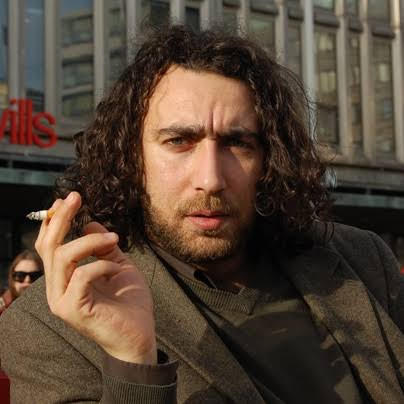
It is from this perspective that we look at the poetry of Syrian Palestinian poet Ghayath al Madhoun. His work is the fruit of two exiles. His father fled Palestine for Syria  in 1967 after the Six Day War, known to Palestinians as al Naksa, ‘the setback’. and the occupation of the West Bank, and marrying a Syrian from Dara’a in southern Syria. He settled in the Yarmouk refugee camp in southern Damascus. Occupied by rebel militias and ultimately Syrian and Russian forces during Syria’s civil war, Yarmouk was devastated and Madhoun fled to Europe, washing up in Stockholm, Sweden, where he now lives and writes.
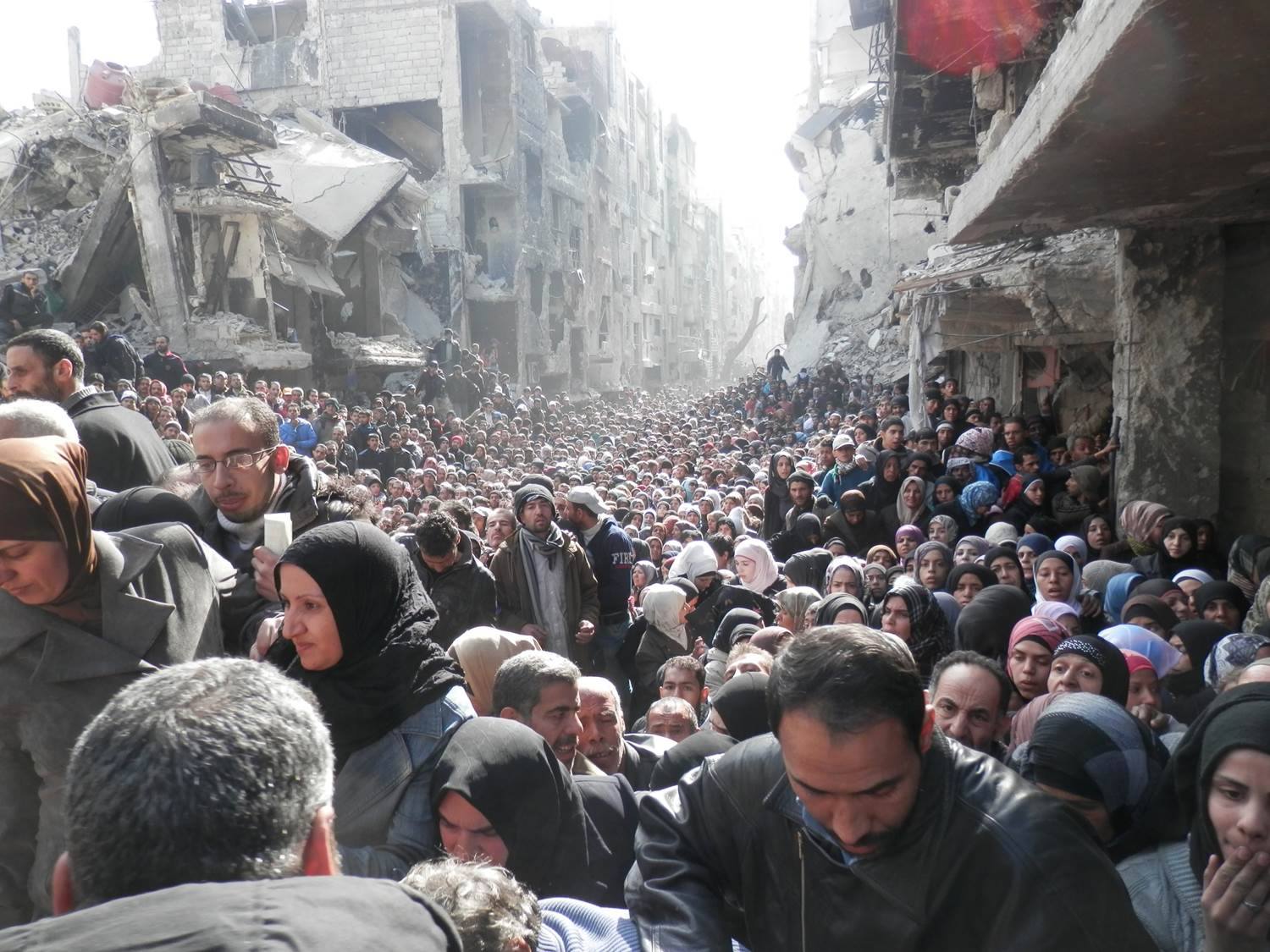
Yarmouk camp,.Refugees wait for UNRWA food-deliveries February 2014

Of his life as a Palestinian in Syria, he wrote:

How beautiful life would’ve been
if I had an ID card in my pocket.
I’d travel with it to my mother in Daraa
without explaining to the policeman from Idlib
the difference between the Palestinians of 48 and the Palestinians of 67 —
or I’d just lose it as my friends do.

In Sweden, he was a stranger in a strange land – “like an olive tree at the north pole,” he once said. However, the irony is that while he was struggling alone with the northern ice, he became, after the Syrian exodus, a host in the house of exile. In I Can’t Attend, he writes:

In the North, close to God’s boundary wall, enjoying a developed culture, the magic of technology, the latest achievements of human civilization, and under the influence of the drug that grants safety, health insurance, social security and freedom of expression, I lie in the summer sun as if I am a white man and think of the South, contriving excuses to justify my absence.

In an excellent overview of modern Syrian poets, Waeed Wahesh writes that for Madhoun, exile Is a personal war;

“Ghayath al Madhoun’s poetry is full of paradoxes, news, and scientific and historical information. It’s crowded with names. It’s a poetry with appetite for saying. It wants to argue, but it doesn’t want to do that immediately. It conjures more the tools of modern art, especially installation art. A poetic narration comes out of a cluster of vocabulary and miscellaneous meanings. This narration combines magic and real, eastern and western, question and answer.

al Mahjar – or émigré – poets carried on their shoulders a renaissance burden, and their poetry was characterized by nostalgia, but they didn’t present examples of the environments and the struggles they went through at these exiles. This is what we find in the writings of the author of “Each Time the City Expanded, my Room Became Narrower.” His poetry faces, especially in his two latest books, questions entangled with the idea of European centralism. We who followed him to the north can see the reality of this struggle. The stereotypes faced on this journey can be summarized as follows: Islamophobia; anti-Arabism; hostility toward Palestinians by Israel’s supporters; the hostility of citizens – who may not have animosity toward Islam or Arabs – toward immigrants; and the resentment of previous generations of immigrants regarding the new ones, based on fear of losing their privileges. Furthermore, if a person survived all of this, then there is the impassable bump: the hatred toward the eastern men. Being an eastern man in the west means you despise women and seek to assemble wives like slaves.

On the edge of these sharp blades, the poet stands in confrontation, and converts this conflict into poet material, inquiring about the Palestinian’s rights and condemning the Mediterranean Sea, which has turned into a “predatory animal.”

Despite all the political background, al Madhoun doesn’t write political poetry. He writes about a life he knows. It’s true that its trait is violence, terrorism, oppression and asylum, but it’s true also that he searches for a horizon of possible life”.

Madhoun’s entry in Wikipedia is unusually lyrical”:

“The central themes in al Madhoun’s poetry, which has been translated into numerous languages, are war and destruction, death and fight, exile and homesickness. The speaker is a witness to violence and demise and, as the only survivor, lends his voice to the dead … The protagonists of the poems are the victims of the Syrian civil war, the injured, people fleeing and seeking asylum, and those who remain in the war zone. The complex, prosaic poems are nourished by the rich imagery of Arabic poetry as well as the traditions of European poetry. “Cruelty, brutalization, and love are just as universal in al Madhoun’s texts as the language of poetry. They impressively demonstrate that the Palestinian refugee from Syria is much closer to us than many would like to believe” (Deutschlandfunk). »His poems are carried by graphic vividness, absurdity, and great stylistic sensitivity”.The FAZ wrote: “He is the great poet of a great catastrophe”.

We present I Can’t Attend in full below, in English and also in the original Arabic. We also republish two other poems by this excellent poet.

In the poem, we meet the exiled poet as a stranger in a strange land, enjoying all the benefits of an advanced, heterogeneous Scandinavian country but constantly thinking of his homeland and endeavouring to justify to himself why he cannot return. The exile can never shake off a pervasive feeling of rootlessness, of never being quite at home.

The obvious reason for his exile is the Syrian civil war, now in its tenth year, which has shattered his country and scattered its people across the globe – and which has killed many of his friends. He now has a a northern girlfriend who he suggests has caused him to forget, though but for a while, for the memory of his life in Damascus and his family there.. He gives us a pathetic excuse – who will feed his fish when he is away.

He is terribly homesick and suffers from grief and depression, and also, survivor’s guilt. He has this deep longing, a wrenching melancholy for his lost home, his distant family, his sense of identity and belonging. He feels guilty about his exile,  It is as if the line between what was, what is and what shall be is blurred, as if he has become a non-person, a living ghost indeed. He fears that he will lose his connection with home, that he will loosen and loose the threads that bind him to his home – his memories.

But the war is forever in his thoughts, Its imagery shapes his prose poem, and he feels the immense loneliness, dislocation and uncertainty that is part of being a stranger, a dark-skinned Arab stranger at that, in a Nordic Land. There is, after all no place like home, and but home is far, far away. He juxtaposes the two societies:“Slow rhythms, slow grief, slow death”. There is a paradox at the heart of a western society, a society that protects you from being killed by others but is unable to protect you from yourself.

The poem concludes with a litany of excuses as to why he is in Sweden and not in Damascus. These become more and more fanciful, more and more mystical, magical realism indeed. He no longer speaks his own language. His old self is disappeared. It is as if he has died inside.

See also in In That Howling Infinite on the theme of exile and loss: Songs for a wounded city – Beirut, Fairuz and Nizar Qabbani, Visualizing the Palestinian Return – the art of Ismail Shammout, and, in Arabic, تصور عودة الفلسطينيين – فن إسماعيل شموط
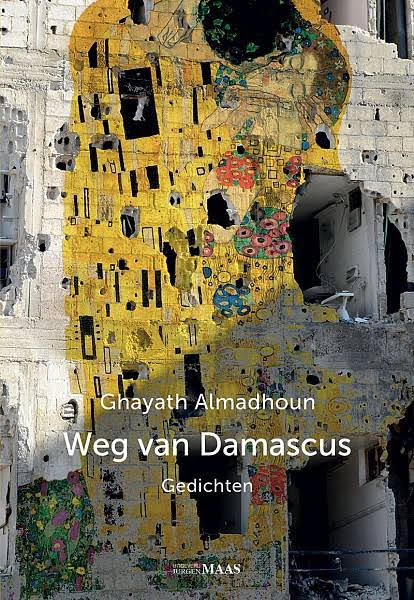
For Damascus

I Can’t Attend

In the North, close to God’s boundary wall, enjoying a developed culture, the magic of technology, the latest achievements of human civilization, and under the influence of the drug that grants safety, health insurance, social security and freedom of expression, I lie in the summer sun as if I am a white man and think of the South, contriving excuses to justify my absence. Emigrants, travellers, refugees go by me, genuine inhabitants, bogus inhabitants, tax-dodgers, alcoholics, the newly rich and racists, all of them crossing in front of me as I sit in the North thinking of the South, composing spurious stories in order to cover up my absence and explain how I can’t attend.

Yes, I can’t attend, for the road between my poem and Damascus is cut off for postmodern reasons: these include the fact that my friends are ascending to God at a rapidly increasing rate, faster than my computer processor, while other reasons relate to a woman I met in the North who made me forget the taste of my mother’s milk, and some are connected to the fishes in the fish tank, who won’t find anyone to feed them in my absence.

I can’t attend, for the distance between my reality and my memory confirms that Einstein was right and the energy produced by my longing equals mass multiplied by the speed of light squared.

I can’t attend but I can be absent, yes, I can be absent with great skill. I’ve become an expert in recent times and I’ve acquired a diary where I make a note of the times I have to be absent and I have memories that haven’t happened yet.

I can be absent as if I have never existed, as if I am nothing, as if air has never entered my lungs, as if I’ve never had enemies before, as if I’m concentrated memory loss, a coma transmitted like a contagious disease.

I can’t attend as I’m currently busy with the cold war I fight daily with isolation, with indiscriminate shelling by darkness, with systematic depression, with the attacks of loneliness that target the kitchen, the checkpoints that stand between me and summer, the bureaucracy caused by the separation of the legislative and executive powers, the routine procedures of the tax department. You’ve talked to me at length about the war, now let me tell you a little about the peace that I enjoy here in the North. Let me tell you about gradations of skin colour, what it means when people don’t know how to pronounce your name, about black hair, about the democracy that always favours the rich, the health insurance that doesn’t cover your teeth because they aren’t part of the body. Let me talk to you about the tasteless vegetables, the flowers with no smell, the racism masked by a smile. Let me tell you about the fast food, fast trains, fast relationships, slow rhythms, slow grief, slow death.

Will you believe me if I say to you that my shoes are tired, that inside me is a wolf I can’t restrain once he’s smelt blood? Will you believe me if you see on my body the marks of the bullets that have hit my friends there, while I’m sitting here in front of a computer screen? Do you believe in coincidence? My absence is a coincidence planned with extreme care, a well-considered random act. I’ve discovered by coincidence that it’s no coincidence that coincidences happen, and in fact the coincidence is when they don’t happen. The point is, will you believe me if I swear to you by music? I swear by music that a European residence permit prevents us from being shot but makes it more likely that we’ll kill ourselves.

Fine, I’ll tell you the truth. I’ll tell you why I can’t attend. It happened on a summer’s evening when I met a sad woman on my way home. In her hand she carried a forest and in her bag a bottle of wine. I kissed her and she became eleven months pregnant…

That’s not what’s stopping me attending. I’ll tell you the truth. Damascus caught me in bed with another woman. I tried to put things right, to say what happened was a spur of the moment thing, nothing more, and it wouldn’t happen again. I swore by everything, by the moon, fireworks, women’s fingers, but it was all over, so I fled to the North.

That’s not what’s stopping me attending. I’ll tell you the truth. When I was a child I didn’t know anything about the market economy. Now, after I’ve become a citizen of a first world country, I don’t know anything about the market economy.

This isn’t what’s stopping me attending. I’ll tell you the truth. When I was intending to come, my suitcase collided with an item of breaking news and my language was smashed to bits, the passersby grabbed hold of the pieces and I no longer had a language…

That isn’t what is stopping me attending. I’ll tell you the truth, I’m dead, yes, I died several years ago.

That isn’t what’s stopping me attending. I’ll tell you the truth…

Translation: Catherine Cobham
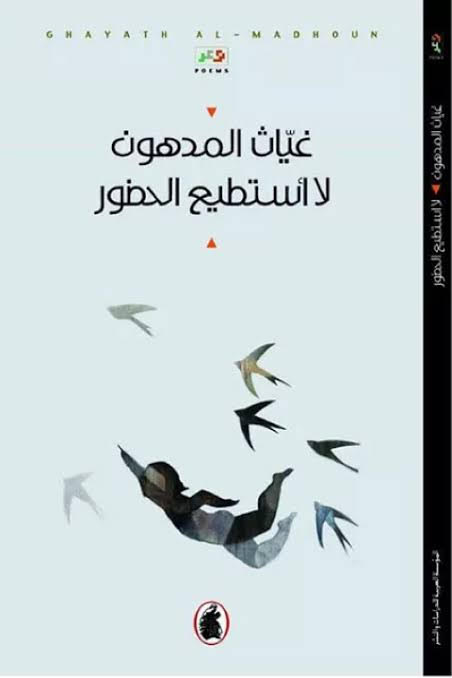
I Can’t Attend

لا أستطيعُ الحضور.

غياث المدهون

في الشمالِ، بالقربِ من سياجِ الله، مستمتعاً بالتطورِ الحضاري وسحرِ التكنولوجيا، وبآخرِ ما توصلتْ إليهِ البشريةُ من أساليبِ التمدن، وتحتَ التأثيرِ المخدرِ الذي يمنحهُ الأمانُ والتأمينُ الصحيُّ والضمانُ الاجتماعي وحريةُ التعبير، أتمدَّدُ تحتَ شمس الصيفِ كأنَّني رجلٌ أبيض، وأفكرُ بالجنوب، مختلقاً أعذاراً تبررُ غيابي، يمرُّ بجانبي مهاجرونَ ورحالةٌ ولاجؤون، يمرُّ سكانٌ أصليونَ ومزيفونَ ومتهربونَ من الضرائب، كحوليونَ وأغنياءُ جددٍ وعنصريون، كلُّهم يعبرون أمامي وأنا جالسٌ في الشمالِ أفكرُ بالجنوب، وأؤلفُ قصصاً مزيفةً كي أُغطي على غيابي، وكيفَ أنَّني لا أستطيعُ الحضور.

نعم، لا أستطيعُ الحضور، فالطريقُ بين قصيدتي ودمشق مقطوعةٌ لأسباب ما بعد حداثية، منها أنَّ أصدقائي يصعدون إلى الله بتسارعٍ مُضطردٍ أعلى من سرعةِ مُعالجِ كمبيوتري، وبعضُها يخصُّ امرأةً قابلتها في الشمالِ فأنستني حليبَ أمي، وبعضها متعلقٌ بحوضِ السمكِ الذي لنْ يجدَ منْ يطعِمَهُ في غيابي.

 لا أستطيعُ الحضور، فالمسافةُ بين واقعي وذاكرتي تؤكِّدُ أنَّ أينشتاين على حقّ، وأنَّ الطاقةَ المنبثقةَ من اشتياقي تساوي حاصلَ ضربِ الكتلةِ في مربَّعِ سرعةِ الضوء.

 لا أستطيعُ الحضور، لكنَّني قادرٌ على الغياب، نعم، أستطيعُ الغيابَ بمهارةٍ عالية، وقد أصبحتُ محترفاً في الآونة الأخيرة، وصارَ لي أجندةٌ أرتِّبُ فيها مواعيدَ غيابي، وصارَ لي ذكرياتٌ لم تقعْ بعد.

أستطيعُ الغياب، كما لو أنَّني لم أكنْ، كما لو أنَّني عَدَم، كما لو أنَّ الهواءَ لم يدخلْ رئتي من قبل ولم يكُ لي أعداء، كما لو أنَّني فقدانُ ذاكرةٍ مُرَكَّز، كما لو أنَّني غيبوبةٌ تنتقلُ بالعدوى.

لا أستطيعُ الحضور، فأنا الآنَ مشغولٌ بالحربِ الباردة التي أخوضها يومياً مع العزلة، بالقصفِ العشوائيِّ للعتْم، بالاكتئابِ الممنهجِ وغاراتِ الوحدةِ التي تستهدفُ المطبخ، بحواجزِ التفتيشِ التي تقفُ بيني وبين الصيف، بالبيروقراطية بسببِ فَصْلِ السلطاتِ التشريعيةِ والتنفيذية، بالروتينِ في دائرةِ الضريبة، لقد حدَّثْتَنِي طويلاً عن الحرب، دعني أحدِّثك قليلاً عن السلامِ الذي أنعمُ به هنا في الشمال، دعني أحدِّثك عن تدرجاتِ لونِ البشرة، عن معنى ألَّا يعرفَ الناسُ أنْ يلفظوا اسمك، عن الشَّعر الأسود، عن الديمقراطيةِ التي تقفُ دائماً في صالحِ الأغنياء، عن التأمين الصحِّي الذي لا يشمل الأسنان لأنَّها ليست جزءاً من الجسد، دعني أحدِّثكَ عن الخضار التي لا طعمَ لها، عن الورودِ التي لا رائحةَ لها، عن العنصريةِ المغلفةِ بابتسامة، دعني أخبركَ عن الوجباتِ السريعةِ والقطاراتِ السريعةِ والعلاقاتِ السريعة، عن الإيقاعِ البطيءِ والحزنِ البطيءِ والموتِ البطيء.

هل ستُصدقني إنْ قُلتُ لكَ إنَّ حذائي متعبٌ، وإنَّ في داخلي ذئباً لا أستطيعُ كبحَهُ بعد أن اشتمَّ رائحة الدم، هل تصدقني إنْ رأيتَ على جسدي آثارَ الرصاصاتِ التي أصابتْ أصدقائي هناكَ بينما أنا جالسٌ هنا خلفَ شاشةِ الكمبيوتر، أتؤمنُ بالمصادفة، إنَّ غيابي مصادفةٌ مخططٌ لها بعنايةٍ بالغة، خبط عشواء مدروسة، ولقد اكتشفتُ مصادفةً أنْ ليس مصادفةً أنْ تحدثَ المصادفة، إنما المصادفةُ ألَّا تحدث. المهم، هل ستصدقني إنْ حلفتُ لكَ بالموسيقى، أقسمُ بالموسيقى أنَّ تصريحَ الإقامةِ في أوروبا قد يباعد ما بيننا وبين الموتِ بالرصاص، لكنَّه يقاربُ ما بيننا وبين الانتحار.

حسناً، سأخبركَ الحقيقة، سأخبركَ لمَ لا أستطيعُ الحضور، حدثَ ذلك في إحدى أمسياتِ الصيف، حين صادفتُ في الطريق إلى البيت امرأةً حزينة، كانتْ تحملُ في يدها غابة، وفي حقيبتها زجاجةَ نبيذ، قبَّلتُها فأصبحتْ حاملاً في الشهر الحادي عشر…

ليس هذا ما يمنعني من الحضور، سأخبركَ الحقيقة، لقد أمسكتني دمشقُ مع امرأةٍ أُخرى في الفراش، حاولتُ أنْ أُصلحَ الموقف، وأنَّ ما جرى نزوةَ ليس إلا، وأنَّها لن تتكرر، أقسمتُ بكلِّ شيء، بالقمر، بالألعابِ النارية، بأصابعِ النساء، لكنَّ كلَّ شيءٍ كانَ قد انتهى، فهربتُ إلى الشمال…

ليس هذا ما يمنعني من الحضور، سأخبركَ الحقيقة، حين كنتُ طفلاً، لم أكنْ أعرفُ أي شيءٍ عن اقتصاد السوق، الآن وبعدَ أنْ أصبحتُ مواطناً في إحدى دول العالمِ الأول فإنَّني لا أعرفُ أي شيءٍ عن اقتصادِ السوق…

ليس هذا ما يمنعني من الحضور، سأخبركَ الحقيقة، حينَ كنتُ أهمُّ بالمجيء، اصطدمتْ حقيبتي بخبرٍ عاجلٍ فانكسرتْ لغتي إلى قطعٍ وتناهبها المارة، ولم يعدْ لديَّ لغة…

ليس هذا ما يمنعني من الحضور، سأخبركَ الحقيقة، أنا ميِّت، نعم، لقد توفيتُ منذ عدةِ سنوات…

How I became…

Her grief fell from the balcony and broke into pieces, so she needed a new grief. When I went with her to the market the prices were unreal, so I advised her to buy a used grief. We found one in excellent condition although it was a bit big. As the vendor told us, it belonged to a young poet who had killed himself the previous summer. She liked this grief so we decided to take it. We argued with the vendor over the price and he said he’d give us an angst dating from the sixties as a free gift if we bought the grief. We agreed, and I was happy with this unexpected angst. She sensed this and said ‘It’s yours’. I took it and put it in my bag and we went off. In the evening I remembered it and took it out of the bag and examined it closely. It was high quality and in excellent condition despite half a century of use. The vendor must have been unaware of its value otherwise he wouldn’t have given it to us in exchange for buying a young poet’s low quality grief. The thing that pleased me most about it was that it was existentialist angst, meticulously crafted and containing details of extraordinary subtlety and beauty. It must have belonged to an intellectual with encyclopedic knowledge or a former prisoner. I began to use it and insomnia became my constant companion. I became an enthusiastic supporter of peace negotiations and stopped visiting relatives. There were increasing numbers of memoirs in my bookshelves and I no longer voiced my opinion, except on rare occasions. Human beings became more precious to me than nations and I began to feel a general ennui, but what I noticed most was that I had become a poet.   

… كيف أصب.حتُ

سقطَ حُزنُها من الشرفةِ وانكسر، أصبحتْ تحتاجُ إلى حزنٍ جديد، حين رافقتُها إلى السوق، كانتْ أسعارُ الأحزان خياليةً فنصحتُهَا أنْ تشتريَ حُزناً مستعملاً، وجدنا حزناً في حالةٍ جيدة، غيرَ أنَّهُ واسعٌ قليلاً، كانَ كما أخبرَنَا البائعُ لشاعرٍ شابٍ انتحرَ في الصيفِ الماضي، أعجبَها الحزنُ وقرَّرنا أخذه، اختلفنا مع البائعِ على السعرِ، فقال إنَّه سيعطينا قلقاً يعودُ إلى الستينياتِ كهديةٍ مجانيةٍ إن اشترينا الحزن، وافقنا وكنتُ فرحاً بهذا القلقِ الذي لم يكنْ في الحسبان، أحسَّتْ بفرحتي فقالت هو لك، أخذتُ القلقَ في حقيبتي ومضينا، مساءً تذكرتُ القلق، أخرجتُهُ من الحقيبةِ وقلَّبتُهُ، لقد كانَ بجودةٍ عاليةٍ وبحالةٍ جيدةٍ رغم نصفِ قرنٍ من الاستعمال، لا بدَّ أنَّ البائعَ يجهلُ قيمتَهُ وإلَّا ما كان ليعطينَاهُ مقابلَ شراء حزنٍ رديءٍ لشاعرٍ شاب، أكثرُ ما أفرحني به هو أنَّهُ قلقٌ وجودي، مشغولٌ بحرفيةٍ عاليةٍ وفيه تفاصيلُ غايةٌ في الدقةِ والجمال، لا بدَّ أنَّهُ يعودُ لمثقفٍ موسوعيٍ أو سجينٍ سابق، بدأتُ باستعمالهِ فأصبحَ الأرقُ رفيقَ أيَّامي، وصِرتُ من مؤيدي مباحثاتِ السلام، توقفتُ عن زيارةِ الأقاربِ وازدادتْ كتبُ المذكراتِ في مكتبتي ولم أعدْ أُبدي رأياً إلا ما ندر، صارَ الإنسانُ عندي أغلى من الوطنِ وبدأتُ أشعرُ بمللٍ عام، أمَّا أكثر ما لفتَ انتباهي هو أنني أصبحتُ شاعراً.

Massacre

Massacre is a dead metaphor that is eating my friends, eating them without salt. They were poets and have become Reporters With Borders; they were already tired and now they’re even more tired. ‘They cross the bridge at daybreak fleet of foot’ and die with no phone coverage. I see them through night vision goggles and follow the heat of their bodies in the darkness; there they are, fleeing from it even as they run towards it, surrendering to this huge massage. Massacre is their true mother, while genocide is no more than a classical poem written by intellectual pensioned-off generals. Genocide isn’t appropriate for my friends, as it’s an organised collective action and organised collective actions remind them of the Left that let them down.

Massacre wakes up early, bathes my friends in cold water and blood, washes their underclothes and makes them bread and tea, then teaches them a little about the hunt. Massacre is more compassionate to my friends than the Universal Declaration of Human Rights. Massacre opened the door to them when other doors were closed, and called them by their names when news reports were looking for numbers. Massacre is the only one to grant them asylum regardless of their backgrounds; their economic circumstances don’t bother Massacre, nor does Massacre care whether they are intellectuals or poets, Massacre looks at things from a neutral angle; Massacre has the same dead features as them, the same names as their widowed wives, passes like them through the countryside and the suburbs and appears suddenly like them in breaking news. Massacre resembles my friends, but always arrives before them in faraway villages and children’s schools.

Massacre is a dead metaphor that comes out of the television and eats my friends without a single pinch of salt.

Translated from the Arabic by Catherine Cobham

المجزرة

المجزرة مجازٌ ميتٌ يأكل أصدقائي، يأكلهم بلا ملحٍ، كانوا شعراءَ، وأصبحوا مراسلين مع حدود، كانوا متعبين وأصبحوا متعبين جداً، “يعبرون الجسر في الصبح خفافاً “، ويموتون خارج التغطية، إنني أراهم بالمناظير الليلية، وأتتبعُ حرارة أجسادهم في الظلام، ها هم يهربون منها إليها، مستسلمين لهذا المساج الهائل، المجزرة أمهم الحقيقية، أما الإبادة الجماعية فهي مجردُ قصيدةٍ كلاسيكيةٍ يكتبها جنرالاتٌ مثقفون أحيلوا إلى التقاعد، الإبادة الجماعية لا تليق بأصدقائي، فهي عملٌ جماعي منظم، والأعمال الجماعية المنظمة تذكرهم باليسار الذي خذلهم.

المجزرةُ تصحو باكراً، تحمّمُ أصدقائي بالماء البارد والدم، تغسلُ ملابسهم الداخلية وتعدُ لهم الخبز والشاي، ثم تعلمهم قليلاً من الصيد، المجزرة أحنُّ على أصدقائي من الإعلان العالمي لحقوق الانسان، فتحتْ لهم الباب حين غُلِّقتْ الأبواب، ونادتهم بأسمائهم حين كانت نشراتُ الأخبار تبحث عن عدد الضحايا، المجزرة هي الوحيدةُ التي منحتهم اللجوء بغض النظر عن خلفياتهم، لم يهمها وضعهم الاقتصادي، لم يهمها إنْ كانوا مثقفين أو شعراء، إنها تنظر إلى الأشياء من زاوية محايدة، لها نفس ملامحهم الميتة، وأسماءُ زوجاتهم الأرامل، تمرُّ مثلهم على الأرياف والضواحي، وتظهرُ فجأة مثلهم في الأخبار العاجلة، المجزرة تشبه أصدقائي، لكنها دائماً تسبقهم إلى القرى النائية ومدارس الأطفال.

المجزرة مجازٌ ميتٌ يخرجُ من التلفزيون، ويأكل أصدقائي دون رشة ملح واحدة.


The World Refugee Crisis in Brief

The Melancholy Mathematics

Like death and taxes, the poor and racism, refugees have always been with us.  But never in modern times – since the Second World War – have they been so many!

There are over sixty nine million people around the world on the move today – that have been forcibly displaced from their homes – fleeing from persecution or conflict.

This doesn’t count economic migrants who have hit the roads of sub Saharan Africa and Central America fleeing drought and crop failure, economic recession and unemployment, poverty, gangs and cartels, seeking a better life for themselves and the families in Europe or the USA.

Three quarters of a million ‘economic migrants’ are on the move in Central America, whilst the UN estimates that at least four million people have left Venezuela because of its political and economic crisis in what has been described as the biggest refuge crisis ever seen in the Americas. There are refugee camps on the Colombian border. Most are in Columbia but others have entered Brazil and Peru.  But these are not by legal definition refugees – see below, The Refugees’ Journey .

Of those sixty nine million people over 11 million or 16% are Syrians. The numbers keep growing Thirty one people at being displaced every minute of the day. In 2018 alone, 16.2 million people were newly displaced.

Forty million people have been internally displaced within their own countries – this includes six million Syrians and off our radars, some two million souls who once lived in the contested regions of eastern Ukraine.

Over 25 million are refugees in neighbouring countries and further afield. 25% of them are in Turkey, Lebanon, Iran, Pakistan, and Uganda. Some 57% of them come from three countries: Syria, 6.3 million, Afghanistan 2.6 million and South Sudan 2.4 million. The top hosting counties are Turkey 3.5 million, Lebanon, 1 million, Pakistan 1.4 million, Uganda 1.4 million and Iran 1 million.

Jordan shelters over three quarters of a million Syrians; during the Iraq wars, this relatively poor country sheltered a similar number of Iraqis, and still hosts tens of thousands of Iraqi Christians who’ve fled persecution at home.

These figures are of those registered by the UNHCR. The real numbers are much higher. The Lebanese government estimates that there are more than 1.5 million Syrian refugees in the country.

Much of the focus these days is on the Middle East – Syria and its neighbours, on Libya and the frail boats crossing the Mediterranean, on the war in Yemen which has killed over thirteen thousand and displaced over two million.

But situation in Africa is as dire.

More than 2 million Somalis are currently displaced by a conflict that has lasted over two decades. An estimated 1.5 million people are internally displaced in Somalia and nearly 900,000 are refugees in the near region, including some 308,700 in Kenya, 255,600 in Yemen and 246,700 in Ethiopia.

By August 2018, the Democratic Republic of the Congo hosted more than 536,000 refugees from Burundi, the Central African Republic and South Sudan. And yet, there are over 4.5 million Congolese people displaced inside their own country and over 826,000 in neighbouring countries, including Namibia, Angola and Kenya.

Should the present situation in Sudan deteriorate into civil war, another tide of humanity will hit the road.

And closer to home, there are millions of refugees in Asia.

As of March 2019, there are over 100, 000 refugees in 9 refugee camps in Thailand (as of March 2019), mainly ethnic Karen and Shan. Refugees in Thailand have been fleeing ethnic conflict and crossing Myanmar’s eastern border jungles for the safety of Thailand for nearly 30 years.

There were an estimated 1 million Rohingya living in Myanmar before the 2016–17 crisis, and since August 2017, an estimated 625,000 refugees from Rakhine, had crossed the border into Bangladesh.

The top-level numbers are stupendous. The detail is scary.

Some 52% of the world’s refugees and displaced are children. And many are unaccompanied. Every hour, around 20 children run for their lives without their parents to protect them.

Children are the most vulnerable to disease and malnutrition and also to exploitation and lose years of schooling. Millions are elderly and are also face health problems.

And the problems facing young people and adults are all enormous. International aid is limited and host countries often unsympathetic. Work opportunities are few, some countries even forbidding refugees to take work, whilst unscrupulous employers exploit the desperate. Migrants are often encouraged, sometimes forcibly, to return to their countries of origin regardless of whether or not it is safe for them to return. There are reports that many have returned to Syria into the unwelcoming hands of the security services.

Refugees have lived in camps and towns in Pakistan and Thailand, Namibia and Kenyan for decades. Most refugee children were not born in their parents’ homelands.

And the camps are by no means safe havens. There may be no shelter or only basic shelter in tents; no privacy; a lack of clean water; meagre food; limited medical care; and the threat of injury, disease and epidemics. They may be poor physical security and armed attacks, and abuse by the authorities and officials. There may be organized crime, shakedowns and extortion, corruption and bribery.

Families may have become separated, exposing women and children without the protection of male family members to more fear and violence. Women are subsequently vulnerable to harsh conditions, including potential sexual and physical and abuse, poor healthcare, and unequal access to food and water. They may be coping with the loss of the head of the family and with the changing roles and responsibilities that come from being the sole parent. They may not know if their male family members will return to them safely and they must deal with the stress and anxiety, the grief and loss arising from their recent experiences. They might be fearful of the future, which in a camp is unknown and unpredictable.

From In That Howling Infinite’s  No Going Home

Rhiannon the Revelator – In the dark times will there also be singing?

In the dark times will there also be singing?
Yes, there will also be singing. About the dark times.
Bertolt Brecht, motto to Svendborg Poems, 1939

Brown girl in the ring, raise your voice and sing

Rhiannon Giddens, a multifaceted singer, musician, folklorist and storyteller brings American history alive in her her drive to unearth the stories of forgotten people so that her audiences and listeners may remember them.

On Moon Meets The Sun, a defiantly joyous song, Giddens and her comrades of Our Native Daughters sing in the round over a polyrhythmic lacework of banjo and guitar, vowing not to let radical suffering diminish humanity. “You put the shackles on our feet, but we’re dancing”, she sings, “You steal our very tongue, but we’re dancing” “Ah, you sell our work for your profit, but we’re dancing,” she scoffs. “Ah, you think our home we have forgotten, but we’re dancing.” Then she recedes into the jubilant tangle of voices: “You can’t stop us now (We’ll be dancing). You can’t keep us down (We’ll be dancing)”. 
As Leonard Cohen sang, “that’s how the light gets in”. 

Songs of Our Native Daughters is at once a harrowing ride through early America’s darkness and also, a celebration of resilience and resistance. As  Rhiannon Giddens describes it:

“There is surely racism in this country — it’s baked into our oldest institutions – just as there is sexism, millennia old. At the intersection of the two stands the African American woman. Used, abused, ignored and scorned, she has in the face of these things been unbelievably brave, groundbreaking and insistent. Black women have historically had the most to lose, and have therefore been the fiercest fighters for justice — in large, public ways that are only beginning to be highlighted, and in countless domestic ways that will most likely never be acknowledged.” (NPR – First Listen to Our Native Daughters)

‘… slavery is not a historical event but rather an intrinsic, dominating, and ultimately destructive part of everyone’s day-to-day reality’ (CE Morgan’s “great American novel”)

When the day is done
The moon meets the sun
We’ll be dancing
When the day is done
The moon meets the sun
We’ll be dancing

You put the shackles on our feet
But we’re dancing
You steal our very tongue
But we’re dancing

Brown girl in the ring
Raise your voice and sing
Sing us solace
Sing us freedom
Hold us steady
Keep us breathing
We’ll endure this
You can’t stop us
And we’re dancing

You steal our children
But we’re dancing
You make us hate our very skin
But we’re dancing 

We’re your sons
We’re your daughters
But you sell us
Down the river
May the God
That you gave us
Forgive you
Your trespasses
We’re survivors
You can’t stop us
And we’re dancing

When the day is done
The moon meets the sun
We’ll be dancing
When the day is done
The moon meets the sun
We’ll be dancing

Like the rabbit
We won’t bend to your will
Like the spider
The smallest will still prevail
The stories of our elders
We find comfort in these
We smile to the sky
We move to stay alive
And we’re dancing

You steal our work for your profit
But we’re dancing
You think our home we have forgotten
But we’re dancing

Step into the circle
Step into the ring
Raise your voice and sing
Sing freedom
Sing freedom
You can’t stop us now
You can’t keep us down
We’ll be dancing

When the day is done
The moon meets the sun
We’ll be dancing
When the day is done
The moon meets the sun
We’ll be dancing

You can’t stop us now (We’ll be dancing)
You can’t keep us down (We’ll be dancing)
You can’t stop us now (We’ll be dancing)
You can’t keep us down (We’ll be dancing)
You can’t stop us now (We’ll be dancing)
You can’t keep us down (We’ll be dancing)
You can’t stop us now
You can’t keep us down
You can’t stop us now (We’ll be dancing)
You can’t keep us down (We’ll be dancing)
You can’t stop us now (We’ll be dancing)
You can’t keep us down (We’ll be dancing)

Quasheba, Quasheba
You’re free now, you’re free now
How does your spirit fly?
Blood of your blood
Bone of your bone
By the grace of your strength we have life

From the Golden Coast of Ghana
To the bondage of Grenada
You kept the dream of hope alive
They burned your body
They cursed your blackness
But they could not take your lights

Raped and beaten, your babies taken
Starved and sold and sold again
Ain’t you a woman, of love deserving
Ain’t it somethin’ you survived?

Quasheba, Quasheba
You’re free now, you’re free now
How does your spirit fly?
Blood of your blood
Bone of your bone
By the grace of your strength we have life

You dreamt of home, you dreamt of freedom
You died a slave, you died alone
You came from warriors who once built empires
Ashanti’s kingdom carries on

You were forgotten, almost forsaken
Your children founded generations
Your strength sustained them
They won their freedom
Traced their roots to find you [waiting?]

Quasheba, Quasheba
You’re free now, you’re free now
How far your spirit’s flown
Blood of your blood
Bone of your bone
By the grace of your strength we are home

Blood of your blood
Bone of your bone
By the grace of your strength we are home
We are home
We are home
We are home

Also in In That Howling Infinite,  Soul Food – music and musicians, a collection of posts on matters musical, My Country ’tis of thee, a collection of posts on american history, politics and music, Blind Willie McTell – Bob Dylan’s Americana, and The Sport of Kings – CE Morgan’s “great American novel”

Postscript

I am reminded of  Pete Seeger’s adaptation of the old Baptist hymn:

 My life flows on in endless song
Above earth’s lamentation.
I hear the real, thought far off hymn
That hails the new creation
Above the tumult and the strife,
I hear the music ringing;
It sounds an echo in my soul
How can I keep from singing?

and of Leonard Cohen’s Anthem

I can’t run no more
With that lawless crowd
While the killers in high places
Say their prayers out loud
But they’ve summoned, they’ve summoned up
A thundercloud
They’re going to hear from me

Here is the wondrous Éabha McMahon of Celtic Woman:


Tel as Sabi’ – Tarkeeth’s Anzac Story

The 25th April is Anzac Day, Australia’s national day of remembrance, honouring Aussies and Kiwis who perished in foreign wars from South Africa to Afghanistan. It takes its name from the ill-fated Gallipoli campaign – on this day in the spring time of 1915, Australian and New Zealand soldiers landed under heavy fire from Ottoman forces entrenched in the heights above what was later to be called Anzac Cove on Turkey’s Gallipoli peninsula. 

The Anzacs were just part of a wider campaign devised by British Secretary of the Navy Winston Churchill to knock The Ottoman Empire out of the war with one decisive blow by seizing the strategic Dardanelles Strait and occupying Istanbul, the capital. It do not go well. The Ottoman soldiers commanded by Mustafa Kamal Pasha, the future founder of modern Turkey, Kamal Atatürk, held the high ground and fought stubbornly and bravely, and ultimately, victoriously. 

The bloodshed ended in stalemate. The Allies withdrew eight months later leaving behind over eight thousand dead Australians and nearly three thousand New Zealanders (along with over thirty thousand English, Irish, and Frenchmen, Indians and North Africans, and close on ninety thousand Ottoman soldiers, Turks and Arabs, Muslims and Christians), without, historians say, having had any decisive influence on the course of the First World War. 

The rest, as we say, is our history. 

The Anzac Trail

Whenever we visit Israel, our friend and guide Shmuel of Israel Tours drives us all over tiny beautiful and vibrant country (travelling through the West Bank, we use Palestinian guides). During the pandemic year, most Israelis had been locked down three times and like in many countries, the all-important tourist trade barely has registered a pulse. When permitted to travel beyond his home in Jerusalem, Shmuel has spent the year exploring and learning, visiting places he has never guided to before. He believes that he has exited the plague year a better guide, and we are already making plans for our next Israel adventure, including recently excavated Herodian palaces and further travel in the Negev Desert. 

Shmuel recently told me that he had visited Tel Sheva, Tel as Sabi’ in Arabic, in the Negev, five kilometres east of the city of Beer Sheva, a site inhabited since the fourth   millennium BC. The ancient fortified town dates from the early Israelite period, around the tenth century BC. The walls, homes, storage warehouses and water reservoir system have been excavated and opened to the public. Today, Tel as Sabi’ s also known as the first of seven Bedouin townships established in the Negev as part of the Israeli government’s policy to plant the once-nomadic Bedouin permanent settlements. 

It was from the foot of this stark desert hill that the Light Horse Brigade launched its famous charge towards the Ottoman lines at the strategic rail-head and wells of Beersheva on October 31st 2017. 

Today, it is the ninth (not seventh) stop on The Anzac Trail which traces the route of the Light Horse Brigade from Gaza on the Mediterranean coast to Beer Sheva. For obvious reasons, it begins beyond Gaza’s wire and concrete encirclement and trail culminates at the Anzac Memorial Centre In Beer Sheva, inaugurated on the 100th anniversary of the battle. 

The Charge at Beersheba” by Sir Ivor Hele 1973

Tel as Sabi’ to Tarkeeth 

As we commemorate Anzac Day this Sunday, few folk in Bellingen Shire would know that there is a link between that hill in the heart of the Negev and Tarkeeth on the north bank of the Kalang River just six kilometres west of Urunga as the crow flies.  

In A Tale of Twin Pines, the first of our Small Stories, I wrote of how researching the history of the Urunga area where we live, I came across Lloyd Fell’s story of the Fell Family Farm. This was located close to the present Twin Pines Trail, just east of Fells Road on South Arm Road, and west of the Uncle Tom Kelly motorway bridge over the Kalang River. Click here to access TwinPinesStory.pdf

Lloyd tells the story of how in 1926, New Zealand farmer, solo-yachtsman, and returned ANZAC Chris Fell first saw the land that became the family farm, purchasing it from a deceased estate for a thousand pounds. Chris was impressed by the two mature hoop pines that stood on either side of the track leading to a rough timber house that already stood there – and these gave the farm its name. He cleared the bush, felling and hauling timber until he had sufficient land and capital to run cattle. In time, he built up a prosperous dairy business and cattle stud where he and his wife Laura, a Sydneysider from a well-to-do Vaucluse family, raised their three children. The house has long gone, but the two magnificent pines are still there. 

On October 31st 1917, Chris Fell and his comrades in the New Zealand Mounted Infantry fought on Tel as Sabi’. 

Tel as Sabi 1917, showing Ottoman trenches (AWM)

Chris Fell and the battle of Beer Sheva

As told in Short Stories – a tale of Twin Pines:

in his ebook The Twin Pines Story, Lloyd Fell tells how his father served as a mounted machine gunner with the New Zealand forces in the Gaza campaign of late 1917. His war record reports that he was one of the machine gunners who fought through the day before the famous charge to knock out the Turkish machine guns on the strategic Tel al Saba, east of the strategic desert town Beersheba.

The strong position the Ottomans had established on the hill was a key obstacle to the conquest of the town and the ANZACs had to seize it before storming Beersheva itself. The Ottoman soldiers fought valiantly, and it was only at around 3 p.m. that the fighters of the New Zealand Brigade, primarily the Auckland regiment, succeeded in capturing the hill in a face-to-face battle. Had these fortifications not been overrun, the Light Horse would have been prevented from advancing on the wells. Afterwards, the machine gunners and their Kiwi mates took part in a bayonet charge against the enemy.

As Jean Bou wrote in The Weekend Australian:

“The New Zealand brigade was sent against Tel el Saba’, but this steep-sided hill with terraced entrenchments was formidable. The dismounted horsemen, with the limited fire support of their machine-gunners and the attached horse artillery batteries, had to slowly suppress the enemy defences and edge their way forward. Chauvel sent light horse to assist, but as the afternoon crawled on, success remained elusive. Eventually the weight of fire kept the defenders’ heads down enough that the New Zealanders were able to make a final assault. The hill was taken and the eastern approach to Beersheba opened, but nightfall was approaching”

Major-General Harry Chauvel, the ANZAC commander faced a dilemma. The light was fading and there wasn’t enough time to properly regroup to assault the town. An unsuccessful attack would mean withdrawing far to the south, whilst delaying ng the attack until morning would deny him the element of surprise and and also give the Turks time to destroy the town’s vital wells. He decided to attack, and assigning the  the mission to the Australian 4th Light Horse Brigade. 

Epilogue

The 31 light horsemen who fell are buried in the Beersheba War Cemetery along with 116 British and New Zealand soldiers who perished in the Beersheba battle. There are 1,241 graves in the military cemetery, soldiers being brought in from other Great War Middle East battlefields. We visited it in May 2016.  It is a tranquil, poignant, and beautiful place in the Negev Desert, where the bodies of young men from Australia and New Zealand and from the shires of England, Ireland, Scotland and Wales were laid to rest. “Lest we forget”

See also, : The Taking of Tel el Saba

In In that Howling Infinite, see also, Tall Tales, Small Stories, Obituaries and Epiphanies,  The Watchers of the Water, and Loosing Earth – Tarkeeth and other matters environmental

Read in In That Howling Infinite more stories about Israel, Palestine and the Middle East: A Middle East Miscellany


Song of the Road (1) – my hitchhiking days

May the road rise up to meet you.
May the wind be always at your back.
May the sun shine warm upon your face,
The rains fall soft upon your fields
And until we meet again,
May God hold you in the palm of His hand.
An old  Irish blessing

You just picked up a hitcher
A prisoner of the white lines on the freeway
Joni Mitchell, Coyote

On the road

A recent story in Haaretz brought back memories of my hitchhiking days.

Whilst hitching has lost much of its allure in the west, it remains very popular in Israel. From my very first visit, There are always young people waiting by the roadside – it has always been so for young conscripts travelling home on leave, and motorists have traditionally been comfortable with picking up soldiers waiting with their rifles and kit bags (all non-Haredi or ultra orthodox Israelis must complete national service when they reach 18, and are required to carry their weapons with them at all times if these can’t be securely stored). It is also a popular mode of travel in the occupied West Bank where settlers regard hitching a ride as a political statement of sovereignty and freedom to travel through all of HaAretz, “the land”, and as an economical means of reaching scattered and often isolated (not to mention illegal under international law) settlements. Many drivers regard picking up fellow-settlers as a political and religious duty.


Hitching in the West Bank

This attachment to hitchhiking harbours a strong sense of community, but also, a delusion of safety –  it can and does have deadly consequences. For example, in June 2014, three Israeli teenagers were kidnapped by Hamas operatives at the bus/hitching stop at the Alon Shvut settlements in Gush Etzion and subsequently murdered. The atrocity precipitated Operation Protective Edge, an Israeli bombardment of Gaza which resulted in thousands of civilian deaths, and the kidnap and murder of a Palestinian boy by Jewish extremists. But that is not what this story is about …

In the second decade of the 21st century, hitchhiking is widely viewed as an edgy, even dangerous, activity to be avoided by both a potential hitcher and a prospective motorist contemplating whether to pull over or to drive on. For some, it also carries undertones of bludging and of indigence, although in rural areas like where I live, during these straightened times with high youth unemployment and poor public transport, many young people hitch out of necessity.

But the practice flourished for several decades, particularly during the fifties and sixties when few people owned vehicles and catching a ride with a friendly stranger was means of adventure as well as a mode of travel. Hitchhikers did so for a variety of reasons – a combination of thrift, expedience, and necessity, but also, a sense of romantic adventure – buoyed by what seems in retrospect, a naive sense of invulnerability.

More than just a means of transportation, it was also about social interaction and the opportunity for conversations with strangers. Jack Kerouac, American beat poet and secular patron saint of hitchers. begged to differ. In his seminal On the Road, a book revered more than read, he whinged: “One of the biggest troubles hitchhiking is having to talk to innumerable people, make them feel that they didn’t make a mistake picking you up, even entertain them almost, all of which is a great strain when you are going all the way and don’t plan to stay in hotels”.

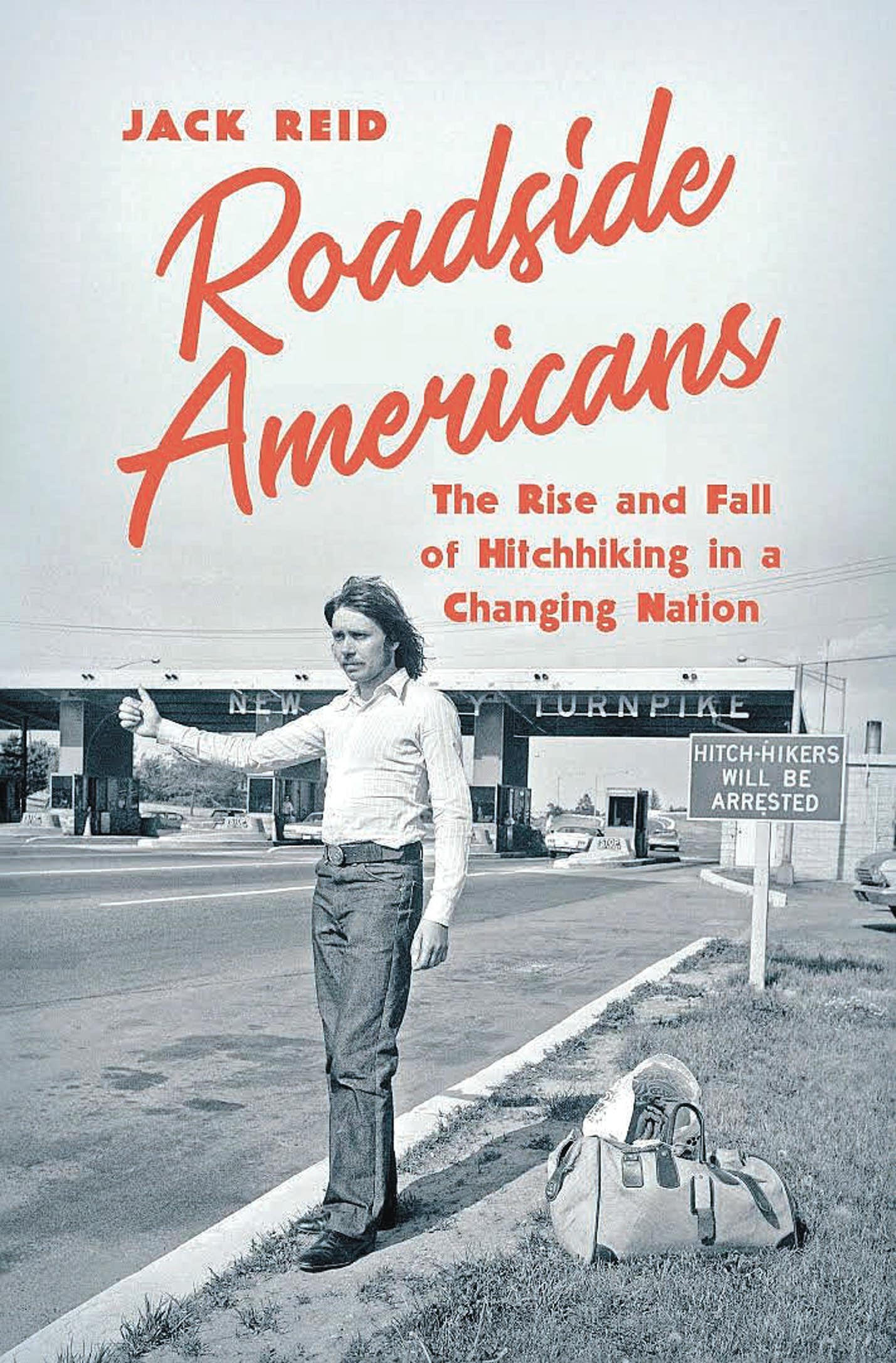
In his recent Roadside Americans – the rise and fall of hitchhiking in a changing nation, North Carolina historian Jack Reid writes: “The waning of hitchhiking in the 1980s was a result of social change, but the main reason was related to the economy and to engineering. The highways changed. At the exits from cities, there are now huge interchanges rather than simple junctions, where it was easy to stop a car. Added to that was a sense of alienation, a growing fear of strangers and a loss of intimacy. Another reason was that years of economic prosperity and a significant reduction in car prices enabled many young people to buy their own cars”.

Allons! the road is before us! 

Afoot and light-hearted I take to the open road,
Healthy, free, the world before me,
The long brown path before me leading wherever I choose.
Strong and content I travel the open road.
Walt Whitman, Song of the Open Road

I was thumbing lifts before I’d even heard of Jack Kerouac,  It seemed like the easiest and cheapest thing to do when cash was scarce  and modes of carriage were few, and the open road and the horizon beckoned.

.In the days gone by, when money was tight and adventure beckoned, I hitched all-over England – visiting friends in far-flung towns and villages, attending music festivals and anti-war and anti-nuclear demonstrations, and often, simply for the joy of travelling and exploration.

Looking back, my hitching was destination focused,  getting to where I wanted to go and the route that would take me there rather than exploring the highways and byways, the towns and village in between and the folk therein – although I would take in appreciatively the landscapes and cityscapes I would pass through. The roadside and the adjoining nature strip, were, on the other hand, a world of their own. Between rides, standing at a place I’d never been and to which I would not return, I’d note the micro-milieu – the grass and the wildflowers, the flotsam and jetsam, the discarded bottles and butt ends, the empty cigarette packets and the candy bar wrappers. Vehicles  whizzed by and I’d observe their type and frequency to calculate when I’d likely be picked up. And then, destination in mind’s eye, like stepping into a cold pool,or breaking into a run, I’d extend my arm and raise a thumb, gingerly at first and then with bravado.

Living on the northeastern edge of Birmingham,  close to the motorways heading north and south, I’d simply pack a bag, walk to the nearby roundabout, and put out my thumb. It was, after it own fashion, a kind of commuting between hometown domesticity and the great beyond.

When first I roved out, the M1 started on the outskirts of London at Watford, and ended between Coventry and Rugby. The first section of the M1 Motorway between Watford and Crick, Rugby opened in 1959. Watford Gap Services, known then as The Blue Boar Services, opened on the same day. It was long hailed as the unofficial boundary between the North and South parts of the Britain.

The Coventry Road in south west Birmingham was my launching pad. Watford Gap services was like a transit lounge, as was Newport Pagnell. The large road sign Hatfield and the North was a landmark on the road to home. Daytime, nighttime, the wee small hours, in spring and summer sunshine or winter rain, it didn’t really matter – the M1 never slept.

In time, the road system extended and the M1-M6 link lay just a hundred metres in front my family home. One summer, I worked on that section of the motorway as an “on the lump”  casual navvy. No workers comp,or occupational health and safety in those days. Helmets and gloves were optional. My blood, and that of many others, including some who clocked one fine summer morning and never clocked off, is in that  concrete.

As a sixth former, I’d often hitch to “swinging” London for the weekend, to explore the capital and visit folk and jazz clubs, kipping in shop door-ways and underground car parks under cardboard and napping wrapped in newspapers, and eating at Wimpy bars and Lyons teas houses.

A few years later, whilst at Reading University,  the M4 began near Maidenhead and finished at Chiswick, and every few weekends, I’d stand opposite the cemetery in eastern Reading and hitch a ride to London and back – for sit-ins, marches, happenings at The Roundhouse, free open-air concerts (including the famous Rolling Stones concert in Hyde Park), and to hang with my London girlfriend.

                                                              The Roundhouse, Chalk Farm

When first I roved abroad, I thumbed my way from Budapest to Athens via Yugoslavia and thence back to Blighty, and the following year, on a side-step from the famous hippie trail, from Beirut to Aqaba and back via Petra and Wadi Rum. I slept a night in Petra itself – in those days, a deserted and un-restored hideaway for fugitive Palestinian  fedayeen after the Black September intifada. For reasons that I can not fully explain, I took my future first wife down the same road two years later, including sleeping out among Petra’s Nabatean tombs. And this was to be the end of my gypsy ways and hitching days. They lasted eight years. Thereafter, the famous “open road” was replaced by planes and trains, buses and cars – and one agonizingly crippled Ford transit van (to … an old saying, when life gives you a lemon, you’d wish you’d’ve been willing to spend more on a reliable motor).

If you’ve taken all you need from this post already, off you go … What follows now are an assortment of self-indulgent reminiscences of my hitchhiking days.

From this hour I ordain myself loos’d of limits and imaginary lines,
Going where I list, my own master total and absolute,
Listening to others, considering well what they say,
Pausing, searching, receiving, contemplating,
Gently,but with undeniable will, divesting myself of the holds that would hold me.
I inhale great draughts of space,
The east and the west are mine, and the north and the south are mine.
Walt Whitman, Song of the Open Road

Travellers’ Tales

Well I left my happy home
To see what I could find out
I left my folk and friends
With the aim to clear my mind out
Well I hit the rowdy road
And many kinds I met there
And many stories told me on the way to get there
So on and on I go, the seconds tick the time out
So much left to know, and I’m on the road to find out
Cat Stevens, Tea for the Tillerman

The toad road licked my wheels like a sabre. Marc Bolan

And what should they know of England …

There’s always a first time. We’d all like to daydream that we’d be picked up by Joni Mitchell, like she picked up that scallywag Coyote on her sublime Hejira album. Mine, alas, was as as stocky sixth former with long hair (long for those days) and horn-rims, heading down to London to meet meet up with school chums for the CND Easter March (that was a first too). Standing at the roundabout where the M1 and the world began, having already thumbed from the Coventry Road roundabout opposite the old Swan public house at Yardley, It wasn’t long before a Rolls Royce pulled up. “WTFl!” is what I’d say today A handsome bloke with shades and sideburns who looked like Englebert Humperdinck asked me where I was heading. “London”, I replied. “Of course – where else? Get in”, he said. It was all the way to Marble Arch with pop star Don Fardon – whom I’d never heard of at the time – he later entered the hit parade with a cover of John Loudermilk’s song Indian Reservation. Not a good song, I would say – with many similarly empathetic ballads, it is long on heartstring-pulling  and fucked on imagery and lyrics. If you want to listen to a good song, check out Bruce Cockburn’s evocative Indian Wars and the Australian Goanna Band’s anthemic Solid Rock.

Henceforward, that motorway from Brum to London was a road well-traveled. In my final year at Moseley Grammar, I’d often hitch down to London for a weekend with pals who’d gone there before. We’d hang out at cheap and cheerful Pollo’s Italian restaurant in Old Compton Street in Soho and the Coach and Horses right across the road, and go to Cousins folk and blues joint in a cellar in nearby Greek Street and the 101 Jazz Club off Oxford Street. Bunjies folk club and Ronnie Scott’s jazz Club were just around the corner. After a meal or a pint, I’d often catch the last tube to the end of the line closest to the M1. I can’t recall how many times I headed off into the night; and and there were always drivers on the road at the witching hour. I guess many folks “get the urge for going”, as Joni sang back then, “and they had to go …” And in those generous times, folks were willing to offer a lift to a wayfaring stranger – gentle souls who would not leave strays stranded by the dark wayside; lonesome folks seeking company and conversation in the dark night of the soul; curios people wondering why a young  man would hitch the highways in the middle of the night.

It is now early spring of 1968. I’d repeated my last year at Grammar School, and with assignments completed, an amenable headmaster let me take a week off to travel. This time, I headed northwest across Brum to Darkaston, near Walsall, and what was then the beginning of the M6 – it ended at Lancaster. Travelling through Lancashire, Cumbria and the Lowlands, I reached the outskirts of Glasgow by nighttime. Hitching across the city, I was picked up by a young couple who insisted that I spend the night at their place – they reckoned the green scarf I’d worn around my hat was a risky proposition in that part of sectarianist Glasgow. I loved that old brown fedora; it traveled with me all over England, to Greece and Yugoslavia, and the Middle East until it was stolen along with my harmonica at Wadi Musa, near Petra. Next morning, I was on the road to Edinburgh, crossed the silvery Tay of bad poet William McGonagall fame, transited the granite city of Aberdeen, and by nightfall, I was on the road into Inverness, where I slept by the roadside and woke up covered in snow. Next morning, I was on Culloden field, and thence, continued on my journey. It took me through the Great Glen where I’d caught a local bus that delivered the mail to isolated homesteads, a journey so slow that I was hallucinating mountains and braes for days, and thence to to Loch Lomond and beyond, southering homewards.


The brown fedora, Giza 1971

During my first year at the University of Reading, I kept on hitching – many more journeys to London and back and day trips to nearby Oxford and Windsor. In a cold and rainy April, with first year exams done, I headed east to London and north to the Humber and the port of Hull, to drop on a good friend who had dropped out of uni and to visit an former school chum. In a student share-house near the university, I took my first mescaline trip to the soundtrack of Roy Harper’s sang McGoohan’s Blues’, a twenty minute digression from the concept if not the plot of an iconic if indecipherable television series. “The Prisoner is taking his shoes off to walk in the rain”.  For 1,200 blissful seconds of cosmic consciousness, I found the meaning of life down that wonderful rabbit hole – and had forgotten what I’d found when I’d resurfaced the next morning. Peyote is a very colourful hallucinogenic. I still recall the Fantasia images that passed before my eyes as Roy sang:

Daffodil April petal hiding the game
Forests of restless chessmen life is the same
Tides in the sand sun lover watching us dream
Covered in stars and clover rainbows downstream …
Under the toadstool lover down by the dream
Everything flowing over rainbows downstream
Silver the turning water flying away
I’ll come to see you sooner I’m on my way

As I headed back down south, the wet and windy old weather changed and as I rode through rural Oxfordshire, all a sudden, the sun came out for behind dull English clouds and and Springtime came in verdant glory – as doomed young Robert Browning once declaimed

Oh to be in England now that April ’s there
And whoever wakes in England sees, some morning, unaware,
That the lowest boughs and the brushwood sheaf
Round the elm-tree bole are in tiny leaf,
While the chaffinch sings on the orchard bough
In England—now!

On arrival at my digs in Reading, there was a note from friends telling me that they’d headed off to Devon to spend a weekend with a fellow student’s farming family, and that me and my friend Jean should join them. So within minutes of arriving home, we were off into the west. Navigating Bristol where, I recall for no apparent reason, that on impulse. I’d bought a copy of The Beano comic) and Somerset. Late that night, we arrived in the tiny town Cullompton in the heart of rustic Devon. After some now forgotten but fun times, including a trip to the seaside and getting blotto on local cider, we hitched home. I don’t recall too much of the journey except that it took us through Basingstoke.

                                                                       Cullompton 1969

One glorious English summer I arranged to meet up with my late pal Dave Shaw in Cambridge, where he was attending a summer school at the University, and go to the celebrated Cambridge Folk Festival. I clocked off from my work on the motorway, got home, just ten minutes away – I said we were close! – showered and packed, and headed to the Clock Garage roundabout and put out my thumb. I took the M1 to London’s North Circular, and cut across to the A10 (there was no M11 in those days) and, And, my stars were alignment on this night ride, arrived at Dave’s digs in time for breakfast.I don’t remember much of the festival bill, but American folk diva Odetta was singing, and also, our idol, Roy Harper, England’s high priest of angst.

I had to leave Cambridge around Sunday lunchtime, after Roy’s last set, to return to Brum for work on Monday. Rather than head back down to London, to save time – a quixotic idea when you are hitching – I decided to cut cross-country to connect with the M1 at Newport Pagnell – in those days before GPS and route planners, a cheap, creased road map from WH Smith was the best we had, plus a good sense of direction, fair weather and loads of luck. And such are the movements of the cosmos, that my one and only only ride took me to, yes, what was then the bucolic village of Newport Pagnell. It was one of those summer evenings in England, when the days are long, the air warm and languorous, and the light, luminous. Birds were singing and church bells were ringing for evensong, and in my mind’s ear, I’d like to imagine that cows were lowing and sheep were bleating. One could almost feel an ode coming on. So there I was, once more, at the services on-ramp, hitching a ride to Birmingham , and hopping aboard an old Land Rover for what was the slowest and noisiest ride ever – which took me almost to my door.

… who only England know

The above header is the second half of Rudyard Kipling’s well known if oft misunderstood poem The English Flag, in which the old Imperialist exhorts his insular countrymen to go forth and conquer … In later and less jingoism times, it has been given a more benign slant, along the lines of the adages like “travel broadens the mind” to which I readily subscribe, or as Cat Stevens was to sing at the time “the road to find out”.

And so it was during the holidays before my final year at Grammar School that I tried my thumb on the Continent. With another school pal, I hopped across La Manche to Belgium with the idea of hitching to Amsterdam. Why we chose Belgium, I can’t recall, but my brother had been there shortly before and he reckoned it was a great place for art and architecture (that was his thing – he scored a rare First in architecture at Uni and went to become the chief architect for Nottingham City Council, designing the international ice rink in partnership with Jane Torvill of of skating icons Torvill and Dean fame). We did a lot of beer and chips and saw a lot of great art and architecture in Bruges, Ghent and Brussels – and we visited the Waterloo battlefield, as one would. As for the Netherlands, we got as far as Antwerp but gave up on Amsterdam after a long day of futile thumbing. We were, however, adopted by a young Belgian lass who took us home to meet her ma and pa. We enjoyed a  bucolic Sunday picnic on the banks of a tributary of the Scheldt before heading back to Oostende and England. In retrospect, I regretted that hadn’t turned south south and set a course for Paris, a  pleasure which would have to wait several more years.

My next “big hitch” was by happenstance in Eastern Europe. I’ve written of this before in In That Howling Infinite in Tanks for the Memory – how Brezhnev changed my life. Therein, I recalled how I’d flown to Prague on the first anniversary of the Soviet Invasion for Czechoslovakia, only to have the flight diverted to Budapest in Hungary.

“Given the circumstances of our arrival, and the atmosphere prevailing in the Bloc on the anniversary of Prague invasion, the authorities had given me a visa for four days only. I had therefore to depart the country quick-smart. I had effectively two choices of non-Soviet countries –  westwards to Austria, or south to what was then Yugoslavia. In a split second decision, I took the road less traveled – south to Szeged and the Serbian border. Wondering through the rural outskirts of Novi Sad, I was taken home by a pair of Serbian boys. I spent my first evening with their most hospitable family and slept that night on a bed of furs. “Novi Sad, Beograd” the lads had chanted, and so, instead of setting my direction home, I hitch-hiked south to the ancient Danube city of Belgrade. In the Yugoslav capital, I resolved to keep going southwards. Over the next two weeks, I transited Yugoslavia to Thessaloniki, where decided to continue with my southern odyssey – to Athens and the Greek Islands. At journeys end, I hitchhiked back the way I’d come, only this time, reaching Austria via the Croatian capital of Zagreb”.

My Balkan and Aegean adventures included that aforesaid sleepover in Novi Sad; sleeping by the highway south of Niš where I was awoken in the middle of the night by military police who reckoned I was a security risk; being propositioned – solicited more like – by a gypsy girl whose favours I forsook as she mustn’t have showered for a week; picked up by a Greek lorry-driver near the famous pass of Thermopylae who insisted we skinny-dip in the aquamarine Adriatic; and heading out of Thessaloniki on the road to Macedonia (the Slav one), I was picked by a bus load of frisky young Greek conscripts – I jumped out quicksmart into the night.

By the time I reached Zagreb, I’d had enough of the road and took the train to Vienna and thence to Calais and Albion. But, as I wrote in Tanks for the Memory, my southwards diversion to the Mediterranean fixed my gaze on other pastures and inspired  a lifetime interest in the Middle East. For that is where I roved next: “… the clear Hellenic sky and the cobalt blue of the Mediterranean, the parched hills and pine woods of the Peloponnese, the dazzling light and the warm sun on my body, and the ruins and bones of antiquity sang a siren’s song. As Jack Bruce warbled: You thought the leaden winter would bring you down forever, but you rode upon a steamer to the violence of the sun. And the colours of the sea bind your eyes with trembling mermaids, and you touch the distant beaches with tales of brave Ulysses. My thoughts and dreams no longer ranged eastwards. My next journey took me back to the Mediterranean, and thence, following in the footsteps of Alexander the Great – the golden hero of legend, not the “mad, bad and dangerous to know” destroyer – through the Middle East and on to the famous well-trodden Hippie Trail to India”.

I’d never intended to hit the Hippie Trail back then, in the northern summer of 1971. In fact, I didn’t even know it existed.

I’d just finished my final exams and graduated with a good degree, and after three exciting and formative years, it was as if everything had suddenly ground to a halt. Uni was over; a romantic relationship was on the rocks; I was footloose and free, floating and feeling the urge to escape elsewhere, somewhere, anywhere. I’d no idea at all what I would do next, other than an inchoate plan to undertake post-graduate study – guided by my tutor and mentor exiled Hungarian academic Tibor Szamuely, my academic interest was Eastern Europe and the Soviet Union, but that was to be down the track.

When the finals results came out, I spent the evening at the student union with friends, unwinding and getting pissed; and the very next day, I walked into the Student Travel office and booked a one-way air ticket to Athens, passage by steamer from Piraeus to Alexandria via Limassol, Cyprus, and from Egypt to Piraeus and thence to Tel Aviv, Israel, with no bookings for onward travel.

Seized by the idea of visiting the two principal antagonists of the almost recent Six Day War, I’d a naive and uninformed notion to view both sides of the Arab-Israeli puzzle. Within a few weeks, I’d bought a second-hand rucksack and sleeping bag, converted my savings to traveller’s cheques – there were still currency restrictions in the UK on how much cash you could take out of the country – packed a few things, and in the words of Cat Stevens, I was “on the road to find out”. That road took me through the Middle East, and on and on, until I reached Kolkata in Bengal. What was planned as but a two month holiday to “clear my mind out”, to quote Cat again, extended to over six months as the appetite grew with the eating.

And so I travelled through lands of which I knew little, picking up fragments of history and heritage, parables and politics as onwards I roamed

My final hitching hejiras were played out in the Levant – an Indian traveller I’d met in a Cairo youth hostel had told me that if I thought the slums of Cairo were bad – and to a naive Brummie, they were – I should see those in Kolkata. So that is what I resolved to do. Leaving Egypt, I found my way to Damascus by way of Beirut, with a side-trip to Israel via Cyprus, and on a quixotic notion, I resolved to visit Aqaba, and also Petra, the ancient “rose” city. Back then, I knew next to nothing about the Middle East. I’d recalled Aqaba from the film Lawrence of Arabia; and I’d been told that Petra was a “must see” by a fellow traveller in my Damascus hostel. So, I set off south, to Dara’a, a border town where Lawrence was allegedly captured and buggered by the Turks, and which was, in recent times, the spark that ignited the Syrian civil war.

The Jordanian border lay just beyond Dera’a, but all traffic thereto was forbidden – the Syrian and Jordanian army had just fought a desultory tank battle in one of the many ricochets of the latter’s suppression of the Palestinian Liberation Organisation after the failed Black September intifada the year before. The border checkpoints were still open, however, to traffic from Jordan only. So I walked across a kind of no man’s land, past tank tracks and the occasional military wreck. There was a large concrete marker at the actual borderline, with “welcome to jordan” on one side and “welcome to Syria” on the other. It was a surreal space. It’s was twilight and high summer. The air was hot and still and there was almost total silence. No birdsong, an imperceptible warm wind. And of a sudden, there was a buzzing of flies which which swarmed all about me and the marker. I walked on and before too long, passed through passport control with a tourist visa, and thumbed a ride to Amman, the capital.

I slept that night on the outskirts of Amman and continued on to Ma’an, the jump-off point for the village of Wadi Musa and Petra. Onwards then to Aqaba where, having paddled in the sea and walked about the town, I headed back straightaway the way I’d come, to Ma’an, Amman, Dera’a and Damascus – from whence I took the fabled Nairn Bus across the desert to Baghdad. From there, I traveled by bus through Iran, Afghanistan, and Pakistan, and finally, by train, to Delhi and journey’s end, Kolkata, in the midst of a cholera epidemic and a refugee crisis that was a prelude to the Indo-Pakistan war that led to the birth of Bangladesh.

                                                      By the rivers of Babylon, August 1971
                                                              Agra September 1971
                                                                 Srinegar, October 1971
                                                                           Petra 1973

If you never go, you’ll never grow 

With that, I’ll conclude these travellers’ tales, observing in the present how in all my journeying, I never came to harm, whether by accident, misadventure or malignancy.

As noted in opening paragraphs, there was the “combination of thrift, expedience, and necessity, but also, a sense of romantic adventure – buoyed by what seems in retrospect, a naive sense of invulnerability” .

Back in the day, hitchhiking in Britain and on the continent was taken for granted and hitchers were commonplace, even if the practice was frowned upon by the straighteners and the fearful. In the Levant, it was a rare thing. Passers-by would often ask what I was doing, and why I traveled thus. Saving money, I’d reply, I was on a budget and had a long way to go – which was indeed the case in the days when credit cards had yet to be invented and the cash and travellers’ cheques in your body belt were all you had to get your thousands of miles. But you come from a rich country, they’d say, adding that there were cheap service-taxis and buses, and that it was dangerous and there were men out there who would rob you or do you harm. Yes, but I have a long way to go. A policeman in Jerash in northern Jordan served me Arab tea and cakes and sat me down on a bench outside the police station whilst he flagged down a driver he considered to be a decent man.

Like those Israelis hitching between towns and villages in Israel and between settlements in the Occupied Territories, we who traveled the world before jumbo jets and cruise ships understood that bad things could happen and that they sometimes did whether you journeyed by thumb, van, bus or train. In hotels and hostels from Beirut to Baghdad, Kabul to Kolkata, you’d pick up word-of-mouth “travel advisories”, warnings and “war stories”. In India, I’d been told of a chap who’d been robbed and stranded in Afghanistan, and I actually met him when I bunked down in Sultanahmet, Istanbul, on my way back to Britain.

So yes, there always was a risk; but if you think too much about it, you’d never go, and if you never go, you’ll never grow.

© Paul Hemphill 2021. All rights reserved.

Also in In That Howling Infinite, read: Tanks for the memory – how Brezhnev changed my life; Back in the Day ; and A Window on a Gone World


Hitching in the West Bank

Continue reading →

Small Stories – Crossing the South Arm

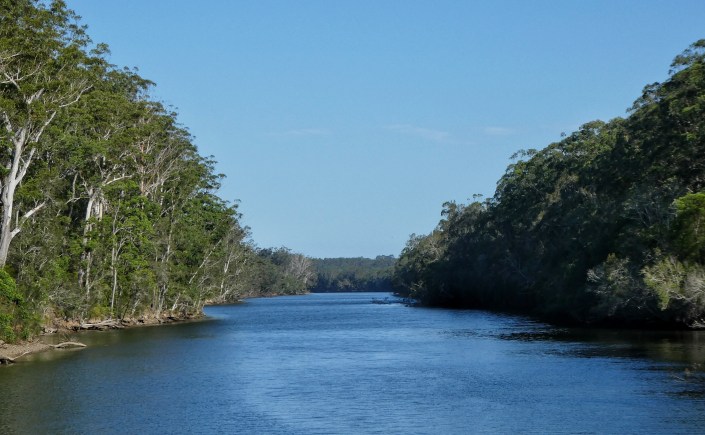
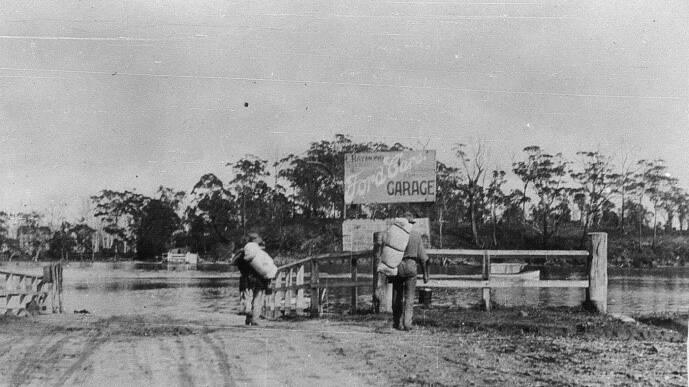
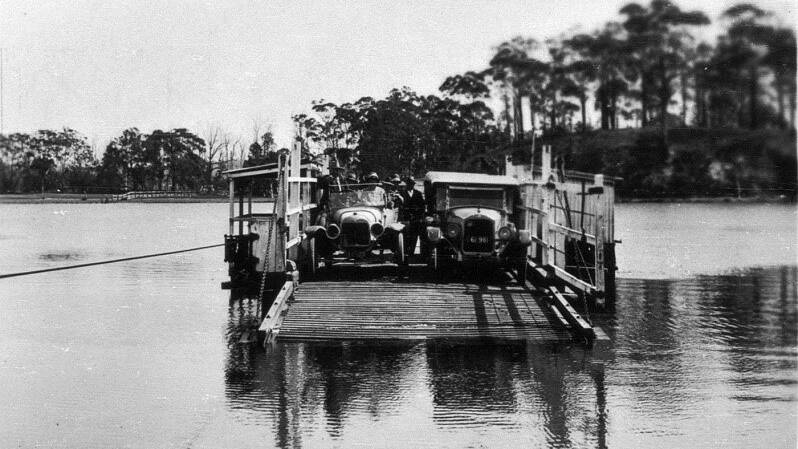
In days gone by, the journey from Bellingen and Coffs Harbour to the south side of Kalang River, and thence to Kempsey, Taree and Sydney, was a torturous one. The crossing had to be made by a slow and ponderous  ferry. It is remembered today by the existence of Old Punt Road, on the right hand side of Giinagay Way in the seaside town of Urunga on the Mid North Coast of New South Wales – if you are heading south from Coffs Harbour, it is on the right hand side just before the present day Kalang Bridge.

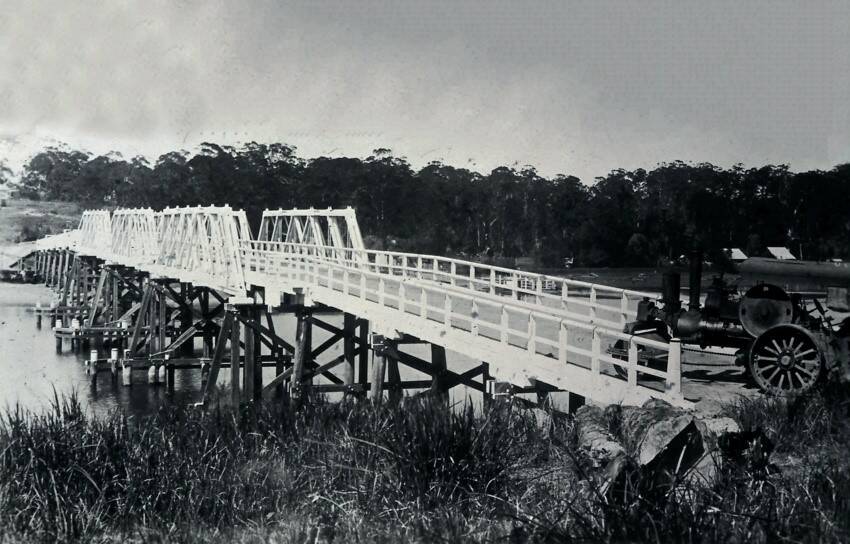
We republish here the story of the old punt and the construction of the first bridge over the Kalang (since replaced by the steel meccano bridge we see today) as retold in the now dearly departed Bellingen Courier Sun.

But first, a tale of the South Arm in the days of the Shire’s early settlement:

Europeans entered what was to become Bellingen Shire in 1840 when stock-man William Miles led a party into the Bellinger Valley to ascertain the abundance of much prized, avidly sought (and rapidly depleted) Red Cedar in the area. They came on foot, all the way from Kempsey – a trek of some one hundred kilometres through virgin bush. Such was abundance of the “red gold” that Macleay Valley government surveyor Clement Hodgkinson financed and supplied Miles to take him there the following year to see for himself. Arriving at the estuary of a large river, they headed west along that very ridge walked by the Gumbaynggirr for untold centuries.  Following a stream that descended southwards from the ridge, they encountered another large river that the Gumbaynggirr called the Odalberrie …

… Further exploration revealed that the Odalberrie was the southern arm of this larger river, named the Bellinger – derived from the Gumbaynggirr name for the spotted quoll, a totemic and now endangered marsupial. It’s southern sister was unimaginatively christened The South Arm

Back in the day, there was no road along the northern bank of The South Arm. Access to the farms that were established along the river was by small jetties. Farmers and their families would travel by boat to visit the estuarine port of Urunga and to visit each other. In the late 19th century, Moses Lacey, the first selector, ran a store on the rive bank …

Whilst the river became the Kalang, after the Gumbaynggirri “galanga” – the native tree known as white beech, now uncommon although we have reintroduced scores of them on our property – the road kept its name.

From Small Stories – the Schools of the Tarkeeth

For other tales of Bellingen Shire in In That Howling Infinite, see: Small Stories – A Tale of Twin Pines and Dark Deeds in a Sunny Land – a poet’s memorial to a forgotten crime  

Crossing the South Arm of the Bellinger

Travelling by foot.

 Travelling by foot in Olden Days.

As you travel at 110kms along the new Urunga bypass, spare a thought for the travellers of bygone years, because in 1888 it was a much slower journey.

At this time there were only three ferries available for crossing the Bellinger River’s North and South arm (now called the Kalang River). One was at Fernmount, one at Raleigh and one at Urunga (the South Arm), the latter being on the mail route to the Macleay and had the greatest amount of traffic

Bridge blocked by steamroller until the Official Opening Party arrive.

The new bridge blocked by asteamroller until the Official Opening Party arrive.

The Minister was presented with a signed petition asking the Minister for an oil launch to be put on the ferries at South Arm and Raleigh.  Mr Arnold, a spokesman for the community, pointed out that “great inconvenience and delay were caused through the slowness of the ferries”[i]

By 1925 the members of the Bellingen Chamber of Commerce are wholeheartedly behind the Urunga Progress Association in the endeavour to secure a bridge over the South Arm. Mr W J Hammond (President of the Bellingen Chamber of Commerce) said that for 30 years, to his knowledge, the agitation had been going on.  He said “the present punt service was a disgrace, it was antediluvian and shocking inconvenience was occasioned to persons who were obliged to use the road”[ii] He instanced one delay recently when a doctor, hurrying to an urgent call from the other side of the river, was held up from 5am till 1pm through a breakdown of the punt.

Travelling by car.

 Travelling by car in days gone by.

By 1928 the battle was won and the Urunga Ferry contract for working of the punt expired on the 30 June 1928.  On September 29 1928 the punt was replaced by a timber bridge built by the Department of Main Road at a cost of $19,000.

The Engineer (Mr Baird) broke the ribbon at the entrance and drove his car over the bridge.  He had with him Mrs Gale (wife of the Bellingen Shire President) and Mesdames Atherton and Bushell, two of the oldest residents of the Bellinger.  It was noted that the ceremonies were not elaborate, as the Shire Clerk, Mr Witt put it “it was a case of no champagne by request as the Council is rather hard up at present”.

The Raleigh Sun reported on the 2 October 1928 that the opening was an important Milestone in the progress of the district. Mr Gale (the Shire President), in a fine speech, expressed the wish that it would not be long before another bridge at Raleigh would be on its way and that, with the bridges to be built over the Nambucca at Macksville and over the Clarence at Grafton, there would be no more punts to cross for hundreds of miles along the main North Coast road.[iii]

The bridge transformed the trip in 1928 but was eventually replaced by a new bridge in March 1972 at a cost $1.13 million.

The Minister of highways, the Hon P Morton, in his opening address, said that the new bridge was an example of the recent trend to avoid visual pollution. He added that this was as it should be in conformity with the beautiful district and a shire which was full of contrasts of scenery, which made it a delightful mecca for the tourist.

There are many more stories about the history of the Bellinger Valley available at the Bellingen and Urunga Museums. If you would like to become involved in the Bellinger Valley Historical Society as a volunteer or a Friend of the Museum please call Susan 0418 415 032 or drop in to either of our Museums.  Also visitors to the Bellingen Museum can view the collection of the Museum for a gold coin donation during the upgrading of the Museum.

.

  • [i] Raleigh Sun Mar 31 1911
  • [ii] Raleigh Sun Aug 7 1925
  • [iii] Raleigh Sun Oct 2 1928

Sawt al Hurriya – remembering the Arab Spring

Ten years ago, people across the Middle East and North Africa rose up in protest against their corrupt, autocratic and repressive rulers, demanding freedom and democracy. Tyrants were toppled or feared that power was being torn from their grasp as millions of demonstrators surged through the streets, chanting that “the people demand the fall of the regime”.  

Myth and memory often embellish the stories and the glories of oppressed people rising up against the power, but when we recall these oft-times forlorn hopes, from Spartacus to the Arab Spring, it is difficult to imagine ourselves, in our relatively comfortable, free and democratic countries, in the position of people desperate and passionate enough to risk life and limb and to face the terrible consequences of heroic failure.  We can but sense, vicariously, the ache and the urge behind Lord Byron’s passionate couplet:

Yet, Freedom! thy banner, torn, but flying,
Streams like the thunder-storm against the wind.

As Patrick Cockburn writes in a gloomy opinion piece in The Independent,

“There was nothing phoney about this mass yearning for liberty and social justice. Vast numbers of disenfranchised people briefly believed that they could overthrow dictatorships, both republican and monarchical. But …the dream of a better tomorrow expressed by herself and millions during the Arab Spring in 2011 was to be brutally dispelled as the old regimes counter-attacked. Crueler and more repressive than ever, they reasserted themselves, or where they had fallen, they were replaced by chaotic violence and foreign military intervention.

… none of the kleptocratic powers-that-be intended to give up without a fight. They soon recovered their nerve and struck back with unrestrained violence. … across the Middle East and North Africa, rulers used mass imprisonment, routine torture and summary executions to crush dissent. Repression not only affected places where the Arab Spring had been at its peak, but spread throughout the region, which is home to 600 million people, as frightened rulers sought to stamp out the slightest hint of dissent in case it could become a threat to their regimes …

… Could could the Arab Spring have ever succeeded against such odds? The question is highly relevant today because oppression by regimes, aptly described as “looting machines” on behalf of a tiny elite, is no less than it was in 2011. Even more people now live crammed into houses with raw sewage running down the middle of the street outside while their rulers loll on yachts anchored offshore.”

We published the following piece just over a year ago. Little has changed since them – if anything, with the world distracted by the pandemic and the US and its allies – and also  adversaries, indifferent if not complicit, the situation has gotten much worse. 

In Egypt, the grip of Egyptian strongman Abd al Fattah al Sisi has tightened. Civil wars rage still in Yemen and Libya exacerbated by outside interference (see Tangled – a cynic’s guide to alliances in the Middle East). Syria’s misery continues with the regime almost but not quite on the verge of victory, and the Kurds betrayed by the Trump administration and defeated by Turkish forces and their Syrian mercenaries. Lebanon, which avoided the fate of other Arab countries a decade ago, although enduring the influx of millions of Syrian refugees, in the wake of a winter of protests, economic meltdown and political paralysis, and the explosive destruction of Beirut’s port and environs, is on the edge of an abyss (see our Lebanon’s WhatsApp Intifada).

All is, as Kent lamented in King Lear, “cheerless, dark and deadly”.

Sawt al Hurriya – Egypt’s slow-burning fuse

In That Howling Infinite, 9th October 2019

Déjà vu

Last month saw the death in exile of former Tunisian strongman, dictator and kleptocrat Zine el Abidine Ben Ali, and the resurgence on 20th September of Friday street protests in Cairo and smaller Egyptian towns – and around the world – against the corruption and oppression of Egyptian strongman Abd al Fattah al Sisi and his military cronies. Predictably, some three thousand people have been arrested – protesters, prominent activists, journalists, lawyers and politicians, including Islamist and leftists alike and dissenters in general. These have now been added to the tens of thousands that have already been incarcerated on conspiracy and terrorism charges, largely without trial.

it appears to be an indiscriminate backlash, The Independent’s Bel True writes: “… according to rights groups and people I’ve interviewed, among those haphazardly rounded up are children who were out buying school uniform, tourists holidaying in Cairo, human rights lawyers going to court to represent clients, confused bystanders, young men popping out for evening strolls, visiting foreign students and street vendors. All are now swallowed up in Egypt’s notoriously opaque justice system”.

The protests have for the moment been contained, but with a third of Egypt’s population below the poverty line (and that’s a government figure – it’s very likely much higher), about one-third of the total under age 14 and sixty percent under 30, one can’t help feeling a hint of déjà vu. It is hard to keep one hundred million people down with just a strong arm up your sleeve.

Meeting with al Sisi in New York, US President Donald Trump praised him for restoring order to Egypt. At this year’s G7 summit in Biarritz, Trump had referred to the Egyptian president  as his “favourite dictator”, a comment that was met with stunned silence from American and Egyptian officials. Boris Johnson has likewise found a friend in Al Sisi. Tru quotes a British-Egyptian filmmaker: “There is a misconception that Sisi is a partner in stability which allows governments, particularly in Europe, to turn a blind eye to his behaviour: as long he keeps buying weapons and submarines and power stations”.

The Voice of Freedom

In our relatively comfortable, free and democratic countries, it is difficult to put ourselves in the position of people desperate and passionate enough to risk life and limb and to face the terrible consequences of potentially heroic failure. We can but sense, vicariously, the ache and the urge behind Lord Byron’s passionate couplet:

Yet, Freedom! thy banner, torn, but flying,
Streams like the thunder-storm against the wind.

The courage of the of the Egyptian protesters – for brave they are indeed For having experienced six years of brutal and vengeful military regime, they are fully aware of the consequences of their actions – reminded me of an exhilarating song and video created by a young Egyptian and his friends, celebrating the demonstrations in Cairo’s Tahrir Square that precipitated the fall of practically president-for-life Hosni Mubarak eight years ago last February. Sawt Al Huriya (The Voice of Freedom)), went viral on YouTube after its release on 11 February 2011, the day before Mubarak’s departure.

Bur first, let us revisit those heady days and the doleful years that followed.

Remembering Tahrir Square

The self-immolation in December 20111 of young Tunisian Muhammed Bouazizi was the catalyst for the pent-up popular outrage that led to the heady days of January and February 2011, with the green of the Arab Spring fresh sprung from the soil of the economic and political bankruptcy of the Arab Middle East.

The fall of longtime dictators Zine el Abidine Ben Ali of Tunisia and Hosni Mubarak of Egypt, was precipitated by the yearning of their oppressed and impoverished people, and particularly the young, for freedom, justice, dignity and employment, and an end to endemic corruption, nepotism and brutality; for a society in which there were jobs and a decent living, where you could save up enough money to get married, where you didn’t have to bribe corrupt officials for everything from traffic fines to court decisions to business permits to jobs, where you could be arbitrarily arrested and/or beaten up or worse for speaking out against the government, the system, or just…speaking out.

Egypt had only known a handful of military rulers until Mubarak was ousted in February 2011, following weeks of protests centred around Cairo’s Tahrir Square.

When elections were held a year later, Mohammed Morsi, standing for the Muslim Brotherhood’s Freedom and Justice Party, emerged as president. After decades of repression of the Muslim Brotherhood under Egypt’s military rulers, Morsi promised a moderate agenda that would deliver an “Egyptian renaissance with an Islamic foundation”.

A year later, he was gone, replaced by Abd al Fatah al Sisi, his own defense minister, who threw him in jail and cracked down on the Muslim Brotherhood, putting hundreds of its members in front of courts that sentenced them to death in mass trials. 

His year in office was turbulent, however, as Egypt’s competing forces struggled over the direction the country should go in. Opponents had accused him of trying to impose an Islamist agenda on the country and mass protests began on the anniversary of his election. After more than a week of spreading protests and violence and talks with Sisi in which Morsi reportedly was prepared to make concessions to the opposition, the army announced it had removed Morsi and taken control on 3rd July 2013.

Morsi’s supporters had gathered in Cairo’s Rabaa Square before he was toppled, and there they remained, demanding he be reinstated. On 13th August, the army moved in, clearing the square by force. More than a thousand people are believed to have been killed in the worst massacre of peaceful demonstrators since China’s Tienanmen Square in 1999.

Whereas Hosni Mubarak died in pampered confinement, Mohamed Morsi, Egypt’s only elected president, was held in solitary confinement for six years, and died in June 2019 after collapsing in a courtroom, the place where his face has been seen most often, behind metal bars, since he was removed from power. See: Nowhere Man – the lonesome death of Mohamed Morsi 

Morsi’s fall led to a military regime more brutal and corrupt than any that preceded it, and with full support from the US and it’s European allies, and of the Egyptian elites, has consolidated the rise and rise of the new pharoah. Al Sisi and other US supporterd and armed Arab autocrats have transformed an already volatile Middle East into a powder keg. 

Mohamed Morsi, Egypt’s only elected president died  in June 2019 after collapsing in a courtroom, the place where his face has been seen most often, behind metal bars, since he was removed from power in 2013

The Arab Spring failed because its youthful vanguard were not prepared for the next stage. In reality, it only occurred in Tunisia and in Egypt. Like the Occupy movement in the west, it lacked coherent leadership and purpose, and in the end, unity against the forces of the establishment that were mobilized against them. But the young, inexperienced idealists were no match for the experienced activists of the Muslim brotherhood, the apparatchiks of the established political parties, and the cadres of the mukhabarat, the military, and the “deep state” that were able to hijack and subvert the revolution.

The Arab Spring was effectively over once the Tunisian and Egyptian dictators had departed and the counterrevolution had already begun – in Egypt particularly with the electoral success and later putsch of the Ikhwan, and finally the “tamarrud” or “rising” of the fearful and conservative middle classes that ushered in military rule.

 The great unravelling

The Tunisian and Egyptian risings were followed rapidly by the outbreak of insurrections in Bahrain, Syria, Libya, and Yemen. These were more sectarian and tribal based, with less reliance on social media, and while media chose to consider them as part of the Arab Spring, in reality, they were not.

This was transformed into a long, hard and bloody winter., and eight years on, the wars of the Arab Dissolution have dragged the world into its vortex. Great Power politics and proxy wars are taxing intellectual and actual imaginations.

And they led to the virtual destruction and disintegration of these countries, the ongoing dismantling of Iraq, and an expanding arc of violence, bloodshed and repression from Morocco to Pakistan, extending southwards across Africa into Mali, Nigeria, Somalia and the Sudans, and their unfortunate neighbours.

Tunisia alone has held on to some of the gains of its “Spring”, but there it is often a case of two steps forward one step back. Nevertheless, the country is holding ostensibly free and fair elections as I write. Elsewhere, the misnamed Arab Spring entered into a cycle of protest and repression little different from earlier unrest, and also, as in the past, foreign intervention. And the story has still a long way to run…

Civil war and economic desperation propelled millions of refugees across the Mediterranean and the Aegean into Europe, threatening the unity and stability of the European Union. Islamic fundamentalism filled the vacuum created by crumbling dictatorships and vanishing borders, unleashing atavistic, uncompromising and vicious Jihadis against their own people and coreligionists, and onto the streets of cities as far apart as Paris, Istanbul, Beirut, Djakarta, and Mogadishu. In Syria particularly, but also in Iraq, Libya and Yemen, outsiders intervened to further complicate the chaos, rendering an early end to these wars a forlorn hope.

All is, as Kent lamented in King Lear, “cheerless, dark and deadly”.

See also in In That Howling Infinite, A Middle East Miscellany

 The voice of freedom

Against this a back-drop of the revolution despoiled, hijacked, and betrayed, I share the song created by Seed Mostafa Fahmy and his friends and the video they shot in Tahrir Square during the demonstrations. “In every street in my country, the voice of Freedom is calling!”

Sawt al Hurriya

I  went (to go protest), vowing not to turn back.
I wrote, in my blood, on every street.
We raised our voices, until those who had not heard us could.
We broke down all barriers.

Our weapon was our dreams.
And we could see tomorrow clearly.
We have been waiting for so long.
Searching, and never finding our place.

In every street in my country,
The voice of freedom is calling.

We raised our heads high into the sky.
And hunger no longer mattered to us.
Most important are our rights,
And that with our blood we write our history.

If you are one of us,
Stop your chattering,
Stop telling us to leave and abandon our dream.
Stop saying the word, “I”.

In every street in my country,
The voice of freedom is calling.

Brown Egyptian hands
Are outstretched amidst the roars (of the crowd)
Breaking barriers.

Our innovative youth
Have turned autumn into spring.

They have achieved the miraculous.
They have resurrected the dead,
Saying: “Kill me,
But my death will not resurrect YOUR country.
I am writing, with my blood,
A new life for my nation.
Is this my blood, or is it spring?
In color, they are both green.”

I do not know whether I smile from happiness,
Or from my sadnesses.
In every street in my country,

The voice of freedom is calling.

(Translated by Egyptian Seed Mariam Bazeed.)

Sout al-Hurriya
صوت الحرية

Nezelt We qolt ana mesh rage3
نزلت وقلت انا مش راجع
I went out and said I would not return

we katabt bedamy fe kol share3
وكتبت بدمي في كل شارع
And I wrote on each street with my blood

Sama3na elli makansh same3
سمعنا اللي ما كمش سامع
We heard what was not heard

we etkasaret kol el mawane3
واتكسرت كل الموانع
And all the barriers were broken

sela7na kan a7lamna
سلحنا كان احلامنا
Our weapon was our dreams

we bokra wade7 odamna
وبكره واضح قدمنا
And tomorrow was clear ahead of us

men zaman benestana
من زمان بنستني
We’ve been waiting a long time

bendawar mesh la2een makkanna
بندور مش لاقيين مكانا
Seeking but not finding our place

fe kol share3 fe beladi
في كل شارع في بلادي
In every street of my country

sout el houriya beynadi
صوت الحريه بينادي
the voice of freedom is calling
……………….
rafa3na rasna fe elsama
رفعنا رسنا في السما
We lifted our heads high (in the sky)

we elgo3 maba2ash beyhemna
والجوع مبقاش بيهمنا
And hunger no longer bothered us

aham 7aga 7a2ena
اهم حاجه حقنا
What’s most important are our rights

wenekteb tarekhna be damena
ونكتب تاريخنا بدمنا
And to write our history with our blood

law kont wa7ed mnena
لو كنت واحد مننا
If you were really one of us

balash terghi we t2ol lena
بلاش ترغي وتقولنا
don’t blather and telling us

nemshy we neseeb &elmna
نمشي ونسيب حلمنا
To leave and abandon our dream

we batal te2ol kelmt ana
وبطل تقول كلمه انا
And stop saying the word “I”

fe kol share3 fe beladi
في كل شارع في بلادي
In every street of my country

Sout El-7ouria beynadi
صوت الحريه بينادي
the sound of freedom is calling
……………..
spoken poetry at 2:14:
ايادي مصريه سمره
Dark Egyptian arms
ليها في التمييز
knows how to characterize (against discrimination)
ممدوده وسط الذئير
reached out through the roar
بتكسر البراويز
breaking the frams
طلع الشباب البديع
the creative youth came out
قلبوا خريفها ربيع
turned it’s fall into spring
وحققوا المعجزه
and achieved the miracle
صحوا القتيل من القتل
awakinging the murdered from death
اقتلني , اقتلني
kill me , kill me
قتلي ما هايقيم دولتك تاني
killing me is not going to build up you regime again
بكتب بدمي حياه تانيه لوطاني
I am writing with my blood another life for my country
دمي ده ولا الربيع
is this my blood or the spring
اللي اتنين بلون اخضر
both seem green
وببتسم من سعادتي ولا أحزاني
am i smiling from my happiness or my sadness
في كل شارع في بلادي
In every street of my country
صوت الحريه بينادي
the sound of freedom is calling
في كل شارع في بلادي
In every street of my country
صوت الحريه بينادي
the sound of freedom is calling

Over the sea to Skye

Many’s the lad, fought in that day
Well the claymore did wield;
When the night came, silently lay
Dead on Culloden’s field.

There are many folk songs that we are convinced are authentically “traditional”, composed in the days gone by an unknown hand and passed down to us by word of mouth and then, perhaps, by broadsheets and handbills, rustic kitchens and Victorian parlours, until finally pressed into vinyl during the mid-twentieth century folk revival. And yet many such songs were indeed written by poets and songwriters of variable fame. One such is The Skye Boat Song. 

This famous song is one of many inspired by the Scottish Jacobite Rising against Protestant England’s rule in 1745. It recalls the journey of Prince Charles Edward Stuart, “Bonny Prince Charlie”, from Benbecula to the Isle of Skye as he evaded capture by government troops after his defeat at the Battle of Culloden in 1746. The Jacobite Rebellion was sparked by many political, cultural and economic factors. but essentially, it was a dynastic civil war. 

He was aided in his flight by minor aristocrat Flora MacDonald who was subsequently arrested for her role and consigned to the Tower of London, but later amnestied. She married an army captain also named McDonald, and they later emigrated to the American colonies. Her captain served with the British forces during the American War of Independence, and as a result, their property was confiscated. They relocated to Canada and soon, after, returned to Scotland.

Flora and Charlie

Songwriter and philanthropist Sir Harold Boulton, 2nd Baronet composed the lyrics to an air collected by Anne Campbelle MacLeod in the 1870s. According to Andrew Kuntz, a collector of folk music lore, MacLeod was on a trip to the isle of Skye and was being rowed over Loch Coruisk (Coire Uisg, the “Cauldron of Waters”) when the rowers broke into a Gaelic rowing song “Cuachag nan Craobh” (“The Cuckoo in the Grove”). MacLeod set down what she remembered of the air, with the intention of using it later in a book she was to co-author with Boulton.

It was first published in 1884 Around 1885 the famed author Robert Louis Stevenson, considering Boulton’s lyrics words “ unworthy”, composed verses “more in harmony with the plaintive tune”. Purged of Jacobite content, these mentioned neither Charlie nor Culloden.

Boulton’s is the one that endured, along with the sentimental perspective Bonny Prince Charlie

Charles Stuart was the “Young Pretender” to the Protestant Hanoverian English throne that once belonged to the Roman Catholic Stuart clan, who after the bloody failure of the ’45 rebellion, fled into exile in France. And that’s where he remained, although his last resting place is in the crypt of Saint Peter’s Basilica in Rome – an ironic ending for this could’ve been champion of Catholic hopes.

He had many romantic and rousing songs written about him. But in reality he wasn’t the dashing, gallant leader that the songs portrayed and that the Scots and their Celtic Irish allies yearned for. He was an indecisive and vacillating leader, who thought himself much cleverer and popular than he actually was, and when the going got rough, he got going – and left the the Scots and Irish who supported him with blood and treasure to the tender mercies of the Sassenach foe.

But historical fact has never dimmed the popularity of the song. It is often played as a slow lullaby or waltz in many and varied contexts including soundtracks, including Outlander (adapting the text of the text Robert Lewis Stevenson’s poem “Sing Me a Song of a Lad That Is Gone” (1892), pipe bands and weddings. It entered into the modern folk canon in the twentieth century with renderings by singers as diverse and indeed betimes idiosyncratic as Paul Robeson, Tom Jones, Rod Stewart,  Esther & Abi Ofarim, The Corries and Tori Amos. James Galway and The Chieftains recorded an instrumental version, as did The Shadows, whilst Roger Whittaker whistled it as comedic crooner Des O’Connor sang.

The song was played by pipers as the coffin of Her Late Majesty Queen Elizabeth II travelled up the Long Walk to Windsor Castle on 19 September 2022. Media comment included speculation that this was to ‘put to rest’ the conflict between the old Jacobite and Hanoverian royal houses. Maybe so, but it probably will not dampen the enthusiasm of many Scots for independence from the United Kingdom.

We much prefer the version presented below sung by the Choral Scholars of University College, Dublin, an amateur, mostly acapella bunch of Irish students. These young folk formally audition for a scholarship with the ensemble. There is little glamour or artifice, no fireworks or vocal gymnastics. Plainly dressed, they look like folk you would pass on the streets of Dublin or Galway.

Below that is a link to British film-maker Peter Watkins’ acclaimed film  Culloden (1964).

See also in In That Howling Infinite, a discussion about another famous Jacobite song:  Mo Ghile Mear – Irish myth and melody. This song is presented below.

Speed, bonnie boat, like a bird on the wing,
Onward! the sailors cry;
Carry the lad that’s born to be king
Over the sea to Skye

Loud the winds howl, loud the waves roar,
Thunderclaps rend the air;
Baffled, our foes stand by the shore,
Follow they will not dare.

Many’s the lad, fought in that day
Well the claymore did wield;
When the night came, silently lay
Dead on Culloden’s field.

Though the waves leap, soft shall ye sleep,
Ocean’s a royal bed.
Rocked in the deep, Flora will keep
Watch by your weary head.

Burned are their homes, exile and death
Scatter the loyal men;
Yet ere the sword cool in the sheath
Charlie will come again.


The agony and extinction of Blinky Bill

In 1991, Australian publishers Allen & Unwin, the Aussie buyout of the antipodean subsidiary of the venerable British publisher that gave us JRR Tolkien, published an original political and environmental history of Australia: William J Lines’ Taming The Great South Land – a history of the conquest of nature in Australia.

It was, and remains, an eye-opener and a page-turner. All our past, present and future environmental hotspots are covered. Squatters and selectors,  rabbits and real estate, hydro and homosexuals, uranium and aluminium, environmental degradation and deforestation, and the trials of our indigenous fellow-citizens who up until a referendum in 1967 were excluded from the census – and therefore not counted [The referendum of October 14th 2023, rejecting the Indigenous Voice to Parliament and the inclusion of our First Nations in the Australian constitution, demonstrates that we have yet to come to terms with our past. See Silencing The Voice – the Anatomy of a No voter]

Behind many of the names that are attached to our suburbs, our highways, our rivers and our mountains are the names of dead white men who were aware of, even witnessed, and were often complicit in “dark deeds in a sunny land”. Perhaps I shall write more on this at a later date, but meanwhile, the following is what Lines has to say about our iconic wildlife, and particularly, our endangered koalas.

At the beginning of white settlement, it is believed that there were millions of koalas across Australia. But their’ perennial paradox and their doom has been that they and humans covet the same habitats – good land and good soil. We have always sought to acquire, clear and develop the land they like for timber, for farmland and for development. Research by the World Wildlife Fund has shown that eastern Australia is one of eleven deforestation hotspots in the world, the only OECD country on the list.

Lines writes that at the turn of the twentieth century, state governments were less concerned with planting trees than with “how to kill a forest quickly”. “Elsewhere in Australia, “settlers regarded native animals an obstacle to development, the equal of native trees. The morality of development sanctioned virtually unlimited increases in the quantity of humans and tolerated virtually any decrease in the populations of other life forms – except animals directly useful to humans, such as sheep and cattle”. 

Settlers and professional hunters therefore shot anything that moved in the bush. Around the turn of the century, encouraged by an international demand for fur – primarily for the fashionably consciousness in Britain and the US – hunters began killing large numbers of koalas. In 1908, 58,000 koalas passed through the Sydney markets. In1924 over two million were exported from the eastern states. By the late twenties, the total total nationwide is reckoned to have been about eight million. 

By the end of the Great War the koala was extinct in South Australia. Other native animals survived, however, so in 1920, SA removed the brush-tailed possum from the protected list. Within four months, hunters trapped more than 100 000. As a consequence of hunting and habitat destruction, over 70 percent of native land mammals in South Australia are now extinct, extremely rare or uncommon and endangered.

In 1927 the Queensland government declared open season on possums and koalas. The eradication of wild animals, the government believed, promoted closer settlement. Despite widespread protest the government persisted the slaughter, and within months 10 000 trappers disposed of over one million possums and 600 000 koalas – more than the total number of koalas which remain alive in the whole of Australia today. The carnage caused the virtual elimination of koalas from Queensland. 

Four years later New South Wales declared open season on possums and during June and July 1931, hunters and trappers brought over 800 000 possum skins to market. To avoid offending the sensibilities of city nature lovers, merchants marketed possum as chinchilla and koala skins as wombat. 

Efforts to protect the koala have and remain a matter of “one step forwards, two steps back”. To burnish their dubious environmental credentials, governments broadcast their good intentions, announce inquiries and censuses, and then withdraw discretely in the face of all-too-friendly fire from political and industrial interest groups and their lobbyists. A WWF scientist has remarked that ”drop bears have more teeth than of the (National Koala Conservation and Management) Strategy”. It was not just on the Big Rock Candy Mountain that the cops had wooden legs and the bulldogs, rubber teeth.

In her masterful and lyrically beautiful “Fathoms – the the world in the whale” (Scribe 2020), – the Sydney Morning Herald called it a “a marvelous work of haunted wonder” – Australian author Rebecca Griggs notes how we earthlings anthropomorphized the leviathan of the deep as the symbol and indeed monument to our fall from environmental grace and our quixotic hopes for a return to Eden. Writer and author Stephanie Wood attaches a similar symbolism to Australia’s iconic marsupial in a well-written feature on our koalas’ dire straits. We reproduce this in full below. 

“Whenever people are upset about protecting animals, it is usually because they’ve got a financial stake in not doing so”, she writes. Echoing Griggs, she asks: “if we can’t save koalas, it’s unlikely we’ll be able to save ourselves”.

See also In That Howling Infinite: Losing Earth – Tarkeeth and other matters environmental

Featured photograph: In the thirty years we have owned our property in Tarkeeth Forest, much of which has been designated primary koala habitat, we have heard koalas in the surrounding forest, but , we have never seen one – until the day after Christmas last year. Meet Chrissy Dunggir (that’s Gumbaynggirr for koala).

How good were koalas?’: A national treasure in peril

Dwindling habitat. Climate change. Mega-bushfires. Koalas face dire threats, yet politicians continue to obfuscate.

Stephanie Wood, Sydney Morning Herald 6th February 2021

A koala in a tree on Kangaroo Island, South Australia: “They were lying defeated on the ground, desperate for water. Usually they’d be doing all they could to get away from us.”

Kangaroo Island, South Australia: “They were lying defeated on the ground, desperate for water. Usually they’d be doing all they could to get away from us.” Ricky Carioti, Washington Post/Getty
Every summer for a decade now, the curious photos have surfaced: a koala gulping water from a firefighter’s bottle, a koala drinking from a watering can, another on its belly trying to slurp from a swimming pool. By late 2019, images were popping up daily: a koala clinging to a bike as a cyclist tipped water into its mouth, another drinking from a pot of water while a dog stood nearby. In northern NSW near Moree, one was photographed in the middle of a road after rain, its curling pink tongue licking a puddle.

The comments came from around the world: “OMG, so cute” and “How adorable!”

But there was something unsettling about the images; koalas don’t drink water, they get the moisture they need from gum leaves. Don’t they? Even scientists and koala experts who knew the species was in peril were unlikely to have realised just how portentous the images were.

In spring 2019, the fires started.

There was nothing cute about the new images, which came in a flood. Koalas with bandaged paws and scorched ears nestling in laundry baskets in a wildlife volunteer’s lounge room. A huddled koala trying to drink from a Kangaroo Island dam, the charred carcass of another nearby. A woman stripped down to her bra running out of a blaze near Port Macquarie holding a koala in her shirt; if you watched the video, you heard the koala mewling in pain as the woman doused it in water.

As the imagery spread and the world’s attention focused on this devastating escalation of the koala crisis, the animal became a global symbol of environmental grief and fear. Prayers and messages of love rained down. So did money. Port Macquarie’s Koala Hospital created a GoFundMe account with a $25,000 goal and got nearly $8 million. From Kazakhstan to Kentucky, people sewed mittens for burnt paws. A cosmetics firm made eucalyptus-scented, koala-shaped soap to raise funds. A little boy in Massachusetts moulded the marsupials in clay and his parents gave one to every person who donated more than $50 to the cause. A friend in London couldn’t stop crying. “You’re not looking at koala pics again, are you, Mum?” her daughter asked.

At the time of white settlement, it is believed there were millions of koalas across our continent. Two centuries later, before the 2019-20 fires, the most authoritative study available estimated 331,000 koalas remained in the wild nationally, 79,000 of which were in Queensland and 36,000 in NSW. But koala counting is a notoriously difficult exercise and the 2012 study, led by University of Queensland conservation biologist Dr Christine Adams-Hosking and drawing on the research of a number of koala experts, noted that in Queensland, population estimates ranged from 33,000 to 153,000, and in NSW from 14,000 to 73,000.

But if the numbers aren’t firm, one thing is: even before the fires, koala populations had been declining precipitously. Studies carried out in 2020 by Dr Steve Phillips, principal research scientist at environmental consultancy Biolink, found that in the past two decades, Queensland had lost half its koalas, and NSW a third. Experts are still trying to tally the full extent of Black Summer’s carnage but University of Sydney research found 61,000 koalas nationally and 8000 in NSW were injured, displaced or died during the fires.

We did this. Since settlement, our needs have always trumped those of koalas. We needed the land their trees were on. Sometimes we shot them to eat. In an article in The Sydney Morning Herald in June 1851, the author noted that Aboriginal people called the creature a “kola” and settlers described it as “the native bear or monkey”. It was an animal with a “singular aspect”, he wrote, “its appearance is a sort of caricature upon gentlemen of the legal profession with their wigs on. It is said to be good eating, but is not frequently met with …”

“The response to the majority of recommendations were ‘Support in principle’ or ‘Noted’, which to me is saying, ‘We’re doing nothing’.”

We wanted their furs. From the late 19th century to the end of the 1920s, hunters slaughtered up to eight million koalas nationally to supply a voracious international fur market. Most went to England and the US, where they were described as “wombat fur” and often became part of that Jazz Age wardrobe essential, the fur collar wrap coat. By the late 1930s, the animal was considered extinct in South Australia and critically depleted elsewhere.

Still we wanted more: more land for farms and tree plantations and highways and developments of massive houses with manicured gardens. Developers saw dollar signs, their bulldozers kept moving. With all that came fast cars, feral animals, family pets and disease. A submission from a koala activist in northern NSW’s Ballina to the NSW parliamentary inquiry listed in wretched detail the fate of some local creatures: “Healthy breeding female, hit by car”; “Female, dog attack, dead”; “Male, retrovirus, ulcers in mouth and throat, hadn’t eaten for probably [two] weeks, maggots down throat while still alive, found sitting on a road after a storm”.

Above all else, our insatiable needs have led to the greatest threats koalas face: climate change and its handmaidens, more extreme droughts and bushfires. But despite the international spotlight the 2019-20 fires threw on the urgency of the species’ plight, one year on, governments have taken little meaningful action to protect the marsupial and its habitat.

The NSW Environment Minister, Matt Kean, says he wants to double koala numbers in the state by 2050 but in January his government announced it would fully commit to only 11 of the upper house inquiry’s 42 recommendations designed to protect koalas. Conservationists and koala scientists were horrified. “It’s really disheartening that the response to the vast majority of recommendations were ‘Support in principle’ or ‘Noted’, which to me is saying, ‘We’re doing nothing’,” Port Macquarie Koala Hospital clinical director Cheyne Flanagan says. “In koala circles, everyone’s disgusted.”

Meanwhile, for months through 2020 the koala became a political football after the Deputy Premier and National Party Leader, John Barilaro, staged a failed rebellion against his own government over koala policy. The result of the subsequent political wrangling was that, by the end of the year, policy to protect the species was weaker than it had been at the start.

Experts also point to the federal government’s shilly-shallying. Key national measures to protect the koala are either out of date or yet to be completed. “The koala was listed as a vulnerable species by the federal government in 2012; seven years later, we’re still waiting for a national koala recovery plan,” says Biolink’s Steve Phillips.

And what of the three billion other animals killed or displaced by last summer’s fires? One million lumbering wombats. More than 100,000 echidnas. Millions of kangaroos and wallabies; bandicoots, quokkas and potoroos. A terrible number of birds, lizards and frogs. The uncounted pretty beetles, butterflies and bugs. Well, it’s hard to spare too much emotional energy for a frill-neck lizard. But a koala … we can mourn a koala.

Scientists who study other species despair at the attention the koala gets. But a koala is emblematic; we feel in our bones that it says something important about us as Australians. “Koalas are woven into the narrative of Australia,” says Danielle Celermajer, professor of sociology and social policy at the University of Sydney and the author of the recently released book Summertime: Reflections on a Vanishing Future. Dr Kellie Leigh, a koala scientist in the Blue Mountains west of Sydney, offers an anthropomorphic explanation for why they have such a profound place in our psyche. “The whole thing about koalas is the head shape, with the forward-facing eyes and the big round head that instinctively reminds people of a human baby,” she says, adding that mobilising resources for koalas is not a single-species approach.

“They get people engaged in conservation who otherwise wouldn’t be.” The koala is also an “umbrella species”, depending on a broad range of habitats which are home to many other species. Put measures in place to protect koalas in the wild and other creatures will also be saved.

Given that fact, perhaps we should ask an inverse question: if we can’t save koalas, what can we save? And if we can’t save koalas, can we save ourselves?

A rolled-up towel serves as a tree-trunk substitute for this sedated koala during ANU research into the impact of bushfires.
A rolled-up towel serves as a tree-trunk substitute for this sedated koala during ANU research into the impact of bushfires. Micheal Weinhardt

Kellie Leigh names many of the Blue Mountains koalas she studies after gods “because we’re on the Mount Olympus for koalas … we’ve had Medusa, Mars, Athena”. The Greek mountain is the home of the gods and famously biodiverse. The Blue Mountains is – was – home to a surprising and remarkable population of koalas.

The mountains were long thought not to be propitious koala habitat, although records show there were at least some in residence. In a letter to the Sydney weekly The Catholic Press in 1921, a reader described a “shooting expedition” to Hazelbrook, during which her uncle shot a koala. She added that at one time, her family had kept at their Paddington home in Sydney four “tame native bears”, which had been captured in the mountains. After a month, one by one, they died. The last survivor sat in a backyard peach tree crying all night until the family decided to liberate it and “one evening at dusk we took it to Bellevue Hill”. The fur trade was believed to have knocked out any remaining in the mountains.

In 2013, during the devastating Blue Mountains bushfires, three koalas were seen emerging to seek water around the town of Winmalee. Another climbed a pole in a backyard near Mountain Lagoon. “It was like, ‘Hey, there are koalas … they haven’t been on record for a long time, what’s going on?’ ”, says Leigh, executive director of the not-for-profit Science for Wildlife, which in 2014 started to survey koalas at five sites in the mountains.

This koala, named Medusa, is being monitored by Science for Wildlife in Kanangra-Boyd National Park in the Blue Mountains in NSW.
This koala,Medusa, is being monitored by Science for Wildlife in Kanangra-Boyd NP, the
Blue Mountains, NSW. Dominic Lorrimer

Their significance could not be understated: they were largely within national park boundaries so developers could not get near them, they seemed to be breeding like rabbits and, most importantly, a study with which Leigh was involved found they had the highest genetic diversity within a koala population of any in Australia. Darwin 101: genetic variation individuals in a species allows for its adaptation to changing environmental circumstances and so ensures the survival of the species. Leigh dared to hope that the Blue Mountains koalas might one day help recolonise the broader World Heritage area.

Photo: Eddie Jim.

But genetic variation is of no assistance to a koala in the event of a mega-fire. In late October 2019, Leigh’s teams were surveying sites in Kanangra-Boyd National Park and in the Megalong Valley when lightning ignited a blaze 100 kilometres or so to the north. That fire, dubbed the Gospers Mountain fire, or “the monster”, would become Australia’s largest ever. In the days that followed, it raced in from the north, licking up Leigh’s survey sites in the south-east Wollemi National Park and on Newnes Plateau. Leigh pulled her teams out of the bush.

She floated an idea with the NSW National Parks and Wildlife Service: could she attempt to rescue some of the koalas at the Kanangra-Boyd site? “At the 12th hour we got a ‘yes’. ” Within two days, a Victorian climbing team had flown in and volunteers had started to track the radio signals coming from the koalas’ collars and scour canopies for creatures without collars. Two days after that, 12 koalas had been temporarily moved to Taronga Zoo.

It was a small triumph in a great tragedy. Only one of Leigh’s study sites – in the Lower Blue Mountains, near where residential areas were protected by firefighting efforts – was unaffected by the fires. She estimates that 80 per cent of the mountains’ koala habitat was burnt and perhaps 1000 animals died, and is now madly working to assess what koalas remain and what potential there is for them to recolonise. “It totally changed this little picture of hope we had,” says Leigh. “It was like, ‘Okay, it’s not a source population any more.’”

Koalas rescued from bushfires returned to their native habitat

Pockets of optimism remain. In November, I followed Leigh and a VHF signal along a ridge line within the Kanangra-Boyd site looking for Kali, one of the 12 koalas which had a Taronga Zoo holiday. The lovely hum of the bush in late spring: rising warmth, birdsong, a darting dragonfly. Only months ago, soon after the 12 were rescued, fire raced through here; the trees are blackened still and there is a subliminal scent of something burnt. But the young epicormic shoots are lush and our feet crunch over new bracken fern and lomandra grass. And there, high in a narrow-leaved peppermint gum (Eucalyptus radiata), is Kali.

“Kali” is the Hindu goddess of death and destruction but is also associated with motherhood and rebirth. There could not be a more appropriate name for this creature half-concealed behind branches above us. Leigh “pouch-checked” Kali for a joey when she was rescued and was surprised not to find one. “I was like, ‘That’s unusual, she’s having a year off breeding.’ ” When Kali was returned to the wild in late March, a joey was in her pouch, that bonus baby peeking out now from her position snuggled on her mother’s back.

Leigh has tracked Kali for nearly four years. “If she was a person, she’d be sitting there with a crocheted rug and a cup of Earl Grey tea watching over the kids,” says Leigh. “She’s a homebody; she breeds every year, has a joey every year and doesn’t go far; she has one of the smaller home ranges of those we have tracked.” But for a homebody, Kali is a rule-breaker, as are the other koalas on the mountains.

Koalas are generally known to like trees on richer soils, but the mountains are sandstone country. Generally, the rule is that they live below 800 metres in altitude, but two of Leigh’s sites, including Kanangra-Boyd, are above 1000 metres and often white in winter. It was not thought that the silvertop ash (Eucalyptus sieberi) was a food source but here, they eat it delightedly. Additionally, the Kanangra-Boyd population is one of only two NSW koala populations to be chlamydia-free. “So it seems to be, or was, a thriving, growing population in an area that’s above the climate envelope for koalas, using tree species they shouldn’t,” says Leigh. “Yeah, they’re just a bunch of rule-breakers.”

The story of Kali and her compatriots is just one of dozens of koala stories to have emerged from the fire grounds. Taken together, they shed some light on the challenges of saving the species: there are hundreds of stakeholders working in the field, from wildlife rescuers to scientists and multiple points of disagreement; the science is dense but there are still big gaps in knowledge about the creature; and, depending on where they live, koalas have varying behaviours and face different threats.

Some of the most gut-wrenching images came out of Kangaroo Island, where tens of thousands of koalas are believed to have died from a pre-fire population of about 50,000. Evan Quartermain, head of programs for the Humane Society International Australia (HSI), travelled to the island to help with rescue attempts. “They were lying defeated on the ground, desperate for water. Usually they’d be doing all they could to get away from us.”

But it was a tragedy of animal welfare rather than species decline. In the late 19th century, three koalas were put on French Island in Victoria’s Western Port in an attempt to rescue the species from the fur trade’s devastation. Descendants of those koalas were later used to repopulate areas in Victoria and South Australia, including Kangaroo Island. But despite a widespread misconception that the island’s koalas can be used to replenish depleted mainland populations, they have issues resulting from inbreeding. “Their genetic diversity is very low,” says Sydney University associate professor and ecologist Mathew Crowther. “They’re a very bad source population.”

Additionally, before the fires, koala numbers on the island had ballooned to the point that they were putting unsustainable pressure on the environment. Some proposed culling. Likewise, in parts of South Australia and Victoria, introduced koala populations breed so prolifically that they put untenable pressure on native vegetation. In 2015, The Age revealed that wildlife officials secretly culled 600 koalas in Victoria’s Cape Otway area. The animals were starving as a result of over-population.

The complexity of the subject matter is matched only by the confounding nature of koala politics and bureaucracy across federal, state and local levels. Federally, there’s a National Koala Conservation and Management Strategy but it’s out of date: it was developed before the east coast koala population was listed as vulnerable in 2012 and does not take into account updated predictions about climate change. “Drop bears have more teeth than the strategy,” conservation scientist Dr Stuart Blanch from WWF-Australia says.

Similarly, a recovery plan to bring koala populations back to health, a legislative requirement that followed the koala’s 2012 vulnerable listing, was to be finalised two years ago but remains undone. In June last year, federal Environment Minister Sussan Ley told The Sydney Morning Herald and The Age that the government had been waiting on the states’ draft plans. In November, Ley announced an $18 million koala package, which will include a national audit of populations, health research and habitat restoration. But within days, 23 conservation groups had signed an open letter slamming the audit as a diversionary tactic and a waste of money. Research scientist Steve Phillips agrees. “It’s garbage … The numbers don’t matter, it’s about the rate of change that’s occurred. We already know what that rate of change is and the science is very strong that the animal is very clearly on a trajectory towards extinction.”

Meanwhile, the skirmishes that occupied the NSW government through 2020 showed the complexity of legislation governing environmental planning policy over koala habitats at a state level and the extent to which conservative ideology plays a role in the debate about saving the creature.

In September 2020, NSW Deputy Premier John Barilaro threatened to move his MPs to the crossbench over the State Environmental Planning Policy (SEPP) that, among other things, increased the number of tree species identified as koala feed and habitat trees from 10 to 123. Many described his move as a “dummy spit” but, seen in context, it was more understandable: since 2016 the Shooters, Fishers and Farmers Party has grabbed the heartland state electorates of Orange, Barwon and Murray and the Nationals are struggling to remain relevant. In claiming the policy was an assault on landholders’ property rights, Barilaro was appealing to his base (two-thirds of NSW’s koalas are on private land). He backed away from his threat but the political wounds were deep: a week or so later, the Nationals MP for Port Macquarie, Leslie Williams, defected to the Liberal Party. In a statement, Williams said her community rightly expected that policy should overshadow politics.

Related Article: Bushfires  Storms, tornadoes and explosions: Bushfires are getting stranger. How?

Dashcam Captures Speed Of Bushfire.

The machinations continued through spring as a bill amending the Local Land Services act (LLS), which regulates native vegetation management on private land, was passed by the lower house of Parliament but blocked in the upper house when Liberal MP Catherine Cusack crossed the floor to vote with Labor, the Greens and other crossbenchers. She told the chamber that she had never seen “such poor integrity of processes” which had “zero to do with protecting koalas”. She said: “It is to try to patch up a political disagreement … Far too many mistakes have been made already, many buried in regulatory complexity. But the trends, the science and the outcomes are very clear. We are failing, and this bill cannot possibly assist.”

During the state’s hottest November on record, the Premier, Gladys Berejiklian, sacked Cusack as parliamentary secretary for voting against the government and announced she would scrap the SEPP and revert to its predecessor – a weaker, 25-year-old koala habitat policy – until a new one was developed.

Kellie Leigh, at right, surveys the koala population in Kanangra-Boyd National Park, NSW.
Kellie Leigh, at right, surveys the koala population in Kanangra-Boyd NP, NSW. Dominic Lorrimer

Kellie Leigh’s koalas might be rule-breakers but, mostly, koalas and people like the same habitats: good land, good soil types. “We always want to develop the land koalas like, that’s where we can grow our vegies and crops,” Leigh says. According to WWF international research, eastern Australia is one of 11 deforestation hotspots in the world, the only OECD country on the list.

Multiple koala experts I spoke to for this story noted that despite layers of bureaucracy and multiple koala plans and strategies, the hard decisions needed about the most important measure to save koalas aside from reversing climate change – habitat protection – are still not being taken. Port Macquarie Koala Hospital’s Cheyne Flanagan notes that the NSW government is taking some positive steps, including the development of a new koala strategy due to be released this year. But she says legislation to protect koala habitats is not tight enough.

“It’s still rape and pillage and open slather with regards to removal of habitat,” she says. NSW Greens MP Cate Faehrmann, who chaired the upper house inquiry into koalas, says that successive governments have made koala protection policies “complex and overlapping, but ultimately there’s hardly any of it that actually stops koala habitat being cleared”.

Meanwhile, Evan Quartermain from the Humane Society International Australia believes there is an untold element to the habitat loss story: “It’s the cumulative effect of smaller developments … death by a thousand cuts.” They don’t get much attention but they’re happening everywhere, all the time. Often, what is lost is the critical “corridors” koalas need to travel across the land.

But the overarching threat to koalas is climate change. Ahead of a firefront that ravaged the NSW Southern Tablelands in January 2020, more than 40 koalas were rescued and taken to the Australian National University for sanctuary. Scientists were appalled to discover that most were starving to death. “They were in that condition because of the extreme heat and the drought that set up those conditions for the fire to happen. The climate was killing them before the fires even got there,” says Dr Kara Youngentob, an ANU ecologist. Youngentob says she has now seen eucalypts, trees adapted to one of the driest climates in the world, dying from moisture stress. “Before this past summer happened, I had a hard time believing that eucalypts could get that desiccated … [they] can’t handle the type of climate they’re now experiencing.”

Conventional wisdom has long been that koalas don’t need to drink water because gum leaves provide all the moisture they need. But a new study led by Dr Valentina Mella, a research associate from the University of Sydney, captured koala drinking behaviour in the wild for the first time: researchers observed koalas licking water running down smooth tree trunks during rain.

Usually, koalas get enough hydration from gum leaves. A scene like this in Gunnedah, NSW “really tells you there’s something wrong”, says a researcher.
Usually, koalas get enough hydration from gum leaves. A scene like this in Gunnedah, NSW “really tells you there’s something wrong”.Kate Wilson

So what should we make of all the photographs of koalas drinking from humans’ water bottles and bird baths and pools? “That is very incredible behaviour; that really tells you there’s something wrong,” says Mella, who has preliminary data showing the moisture content of eucalyptus leaves is declining. “No wild animal would approach a human unless there was something to get from it … these animals can’t find water anywhere else.” (Experts caution against giving koalas water from a bottle because when they tip their head back to drink, water can get into their lungs, potentially causing aspiration pneumonia.) Youngentob says when koalas in the care of ANU during the fires drank a lot of water, it was an indication they’d sustained physiological stress. “Drinking is kind of their swansong,” she says. “When you see a koala drink a lot, it’s on its way out.”

“It’s about climate change … these extreme temperature differentials that are just beyond the koala’s ability to adapt to.”

Sometimes people try to tell Biolink’s Steve Phillips that the decline in koala numbers is primarily due to disease. “Oh, bullshit!” he replies. “Every time I see somebody try to hijack the koala conservation argument and mention disease as one of the driving factors, I go, ‘No, no, no.’ It’s about climate change, and the drying out of the landscape and these extreme temperature differentials that are just beyond the koala’s ability to adapt to.” Phillips has seen the climate envelope for where koalas can survive shrink dramatically. During surveys in the mid-1990s, he found thousands of koalas in the Pilliga forests of north-central NSW. He returned in 2019 and surveyed 108 sites. “We did not find one single bit of evidence of koalas being alive.” East of the Pilliga, the “koala capital” of Gunnedah had a koala population of nearly 13,000 in 2012. Phillips says that, by 2019, estimates were that about 90 per cent had gone. “This wave of extinction moving through from the west has taken out the Pilliga animals and now looks like it’s going to take out the Gunnedah population.”

What he says next makes me shiver. “I could go out into the Pilliga at night 15 years ago and drive along the road with a spotlight and see four koalas and three brushtail possums and a couple of ringtails and possibly a carpet snake and various other things. Now I can do that and I see nothing.” A night in the Australian bush, and there is no life.

Kellie Leigh releases Lakshmi and her joey, Ra, in Kanangra-Boyd National Park in NSW in March last year. The koalas had been evacuated to Taronga Zoo to escape the Gospers Mountain fire.
Kellie Leigh releases Lakshmi and her joey, Ra, in Kanangra-Boyd NP in NSW March2020. The koalas had been evacuated to Taronga Zoo to escape the Gospers Mountain fire.Ian Brown

Why do we place so little value on the glorious, pulsing, sweet-smelling beauty of our landscapes and the creatures rustling within them? Why do we argue with what scientists tell us, scientists whose research is not published until it has undergone rigorous, peer-reviewed assessment? Why do we imagine things will go on as they always have?

Is it about greed and self-interest? HSI’s Evan Quartermain observes: “Whenever people are upset about protecting animals, it’s usually because they’ve got a financial stake in not doing so.”

Is it about priorities? Kellie Leigh’s mad scramble to save some of the Blue Mountains’ koalas was done without assistance from authorities. “All the firefighters were out protecting people and property,” she says. “There were no resources for wildlife.” Firefighters call it “asset protection” – protecting people and property.

“Whenever people are upset about protecting animals, it’s usually because they’ve got a financial stake in not doing so.”

But we diminish ourselves and imperil our own future when we take such a narrow, short-sighted view of assets and self-interest. Professor Danielle Celermajer wants people to recognise “we’re all earth beings … We are woven in relationships with other earth beings: animals, rivers, forests, rainforests, gum trees.” She rejects the idea that humans are in a different realm. “It’s a very pernicious fantasy we continue to indulge that everything else can go but we’ll be okay.”

On November 30, The Guardian published a story noting that international lawyers were developing plans for a crime of ecocide: criminalising destruction of the world’s ecosystems. On Twitter, Matt Haig, the acclaimed English author of the 2016 book Reasons to Stay Alive, posted a link to the story with the comment: “Ecological destruction is ultimately self-harm.”

The day before The Guardian story was published, a video of a koala under a lawn sprinkler in Bowenville, near Dalby in south-east Queensland, travelled around the world. “Even the koala bears are coming up with ways to stay cool there,” a perky TV presenter in Oklahoma City said. “That’s pretty cute.”

Dalby’s average maximum November temperature is 30.6°C. In November 2020, the maximum average temperature was 33.9°C. On November 29, the day the video of the koala under a sprinkler was shot, the thermometer hit 38.5°C. Watch the video. The koala is guzzling from the sprinkler head.

In December 2019, as an apocalyptic haze of smoke blanketed Sydney, thousands of people marched through the city demanding action on climate change. An image of one person’s placard pinged around social media: “How great were koalas?”

Tangled 2 – Libya’s bloody circus rolls on

UN-sponsored talks have produced a new interim government for Libya aimed at resolving a decade of chaos, division and violence by holding national elections later this year. But with myriad factions loathe to surrender influence they already hold, and with foreign powers invested in local allies, the new government may rapidly come under pressure. The appointment of a new government may also do little to change the balance of military power on the ground, where armed groups rule the streets and factions remain split between east and west along a fortified front-line.  

Some Libyans have been critical of a process which they view as being managed from abroad and which they fear will allow existing power-brokers to cling to their influence. “It’s just a painkiller to portray Libya as stable for a while. But war and tension will certainly come back sooner or later so long as militias have power,” said Abdulatif al-Zorgani, a 45-year-old state employee in Tripoli.

“Déjà vu all over again”

A year ago, In That Howling Infinite published Tangled – a cynic’s guide to alliances in the Middle East Back then, Libya held poll position for its multitude of active players and, to use that Shakespearean script note, “voices off”. A year on, borrowing again from the Bard, there are continuing “alarums and excursions”. 

Libya has long been a jigsaw puzzle of competing interests –  tribal versus urban, Islamist versus secularist, revolutionary versus old-regime, localist and regional players, Middle Eastern and European – all prepared to tear the country apart for in pursuit of their own political and economic interests – which include, as is often the case, oil and gas. Their contortions get more and more torturous. 

It was reported year last year that that more than 1400 Russian mercenaries had been were deployed in 2019 by the Wagner company, a Russian military outfit headed by a confidant of Russian President Vladimir Putin, had deployed in Libya to assist warlord Khalifa Haftar’s self-styled Libyan National Army in its push against Libya ostensibly internationally recognized government. It was joining troops hired by Haftar’s backers, Egypt and the United Arab Emirates, and included mercenaries from Sudan’s brutal Jamjaweed militia – aided and abetted by several EU members and French, Italian and sundry other arms suppliers. 

Wagner’s sell-swords included a good number of Syrians – sundry rebels and jihadis left high, dry and unemployed by the Syrian regime’s ongoing ‘reconquista’ – which is, as we know, bolstered by the Russian military – including Wagner’s fighting men, who include in their number many Muslim Chechens from Russia’s subservient neighbour. 

When Haftar’s offensive stalled outside Tripoli, Libya’s capitol, last June, it was reported that more than a thousand of the Russian and Syrian mercenaries had been  pulled back from the front lines and taken planes to who knows where. This “retreat” was precipitated by a Turkish military intervention that has helped block an assault on the capital. 

The Turkish contingent is comprised of numerous specialists and advisers, artillery and aircraft, and a contingent of, surprise surprise, hirelings drawn from the same battered battlefields of northern Syria. Those same jihadis and rebels in Wagner’s pay. 

Many Syrians sell their services because it is the only way they can feed their families in the war-battered economy of the regime’s Syria, and the besieged enclaves of the disparate rebel forces. It reported that these mercenaries, zealous and reluctant alike, have also been deployed in the disputed enclave of Nagorno-Karabakh during the recent brief but bloody war between Russian-backed Armenia and Turkish-supported Azerbaijan. Recruits on both sides in both conflicts are reportedly complaining that they are not being paid what they were promised nor on time. 

Haftar spend time late last year in Egypt conferring with his patron and mentor, Egyptian president Abdel Fattah el-Sisi, over possible next moves. There is speculation now that whilst Haftar’s backers are becoming increasingly disillusioned with his martial abilities, they are reluctant to relinquish their influence in this politically and economically strategically area leaving the field to an ambitious Erdogan. They may, indeed, be surreptitiously looking around for a new dance-partner. 

As COVID-19 infections continued to rise, and as Turkey and Russia vied for influence in this strategically important corner of the Mediterranean, there were incoherent mumblings that the that the USA might be about to throw its MAGA cap into the crowded ring, This did not however eventuate, and there are indications that the new administration may be reluctant to involve itself in torturous proxy wars involving disreputable Arab and other despots. 

Nevertheless, Libya’s nightmare continues. As American baseball wizz Yogi Berra once said, “It feels like déjà vu all over again”.

In That Howling Infinite, see also; Tangled – a cynic’s guide to alliances in the Middle East and A Middle East Miscellany

Here is a good  analysis of this unwinnable civil war:  The citizens of Libya are suffering – All sides have to take the blame for this bloody stalemate

© Paul Hemphill 2021.  All rights reserved

That was the year that was – a year of living dangerously

Last December, when we wrote our review of the year that was ending, fires were ravaging Eastern Australia, and civil unrest had broken out across the world, from Hong to Chile, Beirut to Bolivia. Calling it The End of the Beginning, we wrote:

“We enter a new decade with an American election that will focus our attention; Britain’s long farewell to Europe; an end, maybe, to Syria’s agony (accompanied by renewed repression and victor’s revenge); the rise and rise of China and the geopolitical challenge it presents to the senescent “Old World”. And that is just a few things we have to look forward to”.

As they say, “be careful what you wish for”, or more prosaically, when men make plans, god laughs.

This was a year unlike any other in my, dare I say it and invite the evil eye, long lifetime. It started so well with the abatement of our smoky, fiery Black Summer, and then the rains came. This was the year optimists hoped would be one of 20/20 vision: progress on tackling climate change, perhaps, and end to the entertaining but scary presidency of Donald Trump, a cure for … well everything.

But it was to be the year of the virus. By year’s end nearly eight million people will have been infected and almost two million will have perished, with the US recording more than any other country – by New Years Day, its death-toll will very likely exceed its dead in World War II. Economies have been shattered, livelihoods threatened or destroyed, borders closed, cities, towns and homes closed, locked-down and isolated.

In its turbulent and divisive election year, the death of George Floyd at the hands of – or more specifically under the knee of a policeman, painted a brutal portrait of the implacable indifference to black life that defines American policing. It reopened America’s long-festering wounds of racial and social injustice, white racism and vigilante violence. Rather than douse the flames with water and retardant, The White House reached for a can of petrol. The Black Lives Matter Movement, like #MeToo in recent years, an incendiary spark ignited protests around the world, showing that police violence, injustice and inequality do not belong to the USA alone.

Armed protesters on the steps of the Michigan State Capitol in Lansing, demanding the reopening of businesses

Whilst most of the world had entered into a kind of limbo, awaiting the vaccine that will end our travails and reopen our countries and indeed, the wide world, others dropped down the rabbit hole of conspiracy theories that alternatively deny that the pandemic exists or that it had been deliberately created and spread by mysterious and malevolent cabal that seeks total control, like some villain from an old James Bond film or an Avengers movie. Social media has enabled a veritable eBay of ideas and explanations where the isolated and excluded who do their own research and follow the breadcrumbs into the Matrix can buy one and get four free.

On a saner but nonetheless destabilizing level, denizens of the so-called “cancel culture” had a field day exercising its democratic right to be easily offended by demanding the deplatforming, defenestration and demolition of persons, ideas, careers, and monuments. Long-dead slavers, imperialists and generals bit the dust; JK Rowling and Nick Cave got a serve, the latter for devaluing that “cancel culture’s refusal to engage with uncomfortable ideas has an asphyxiating effect on the creative soul of a society”; and an episode of Fawlty Towers was temporarily committed to the naughty corner. 

In the cold-blooded, brutal real world, there was no abatement in the wars and insurgencies that have been grinding on years now in Africa and the Middle East, whilst an old conflict over blood and soil broke out anew between Armenians and Azerbaijanis. Donald Trump’s much touted “deal of the century” that would reconcile Israelis and Palestinians was revealed to be no more than a shifty and shitty bribe, whilst US-brokered “peace” deals with a bunch of autocracies who had never gone to war against Israel are but smoke and mirrors that like Kushner’s Peace to Prosperity plan throw the unfortunate Palestinians under the bus. It is as if there is, beyond the planets COVID, Conspiracy and Cancel, a parallel universe of misery and carnage, power games and proxy wars.

Meanwhile, China, or more precisely, the Chinese Communist Party, having let loose the virus, has taken advantage of the world’s distraction and confusion by pressing forward in its quest its political, military and economic predominance. Uighurs, Mongolians and Tibetans face cultural extinction whilst in Hong Kong, the flame of freedom flickered and went out. Sooner or later, something is going to give – what some pundits perceive as President Xi’s impatient recklessness will be followed by a reckoning.

Michelle Griffin, World Editor with the Sydney Morning Herald provides a brief but excellent run down of 2020: The 2020 Pandemic – our year of living dangerously. And on 2020 as the year of “cancel culture”, the reflex response of the easily offended, here is 2020, the year we finally broke our culture. Both are well worth a read.

Time during 2020 has been elastic and confused. On 21st December, The Guardian asked readers to sum up how they felt about 2020 in one word – and likewise their feelings for 2021. As of Xmas Eve, the standout words were respectively (a) shit, fucked and challenging and (b) hopeful and better. My poll responses were “fascinating” and “unpredictable”.

The year ahead?

Our year in review

And so to our review of what In That Howling Infinite published during the plague year. Curiously, deliberately or by mere circumstances, nothing about the plague.

The year began with the fires and smoke abating here on our Mid North Coast, though raging still in southern New South Wales and eastern Victoria. Inspired by an early Cat Stevens song, we opened with a light, nostalgic history of the first the schools of the Tarkeeth, where we live.

Before we knew it, Australian Day was upon us. Normally, the weeks preceding our national day see social and mainstream media, posturing politicians and personalities and cultural warriors of all our tribes caught up in argument and invective about its meaning and significance. This year, however, things are unseasonably quiet. As a nation and a community, we were perhaps too preoccupied with Australia’s unprecedented bush-fire crisis to wage our customary wars of words. Elizabeth Farrelly asked what it means to be Australian: “As the fires rage on, bringing little but anti-green and pro-coal propaganda from our governments, we have a choice. We can go on pretending that exploitation is a sustainable way of life. We can pursue this culture of denial, where truths about nature, climate, women and Indigenous peoples are held in contempt. Or we can smarten up” … It was Australia’s choice – survive by respect or die by stupid.

February saw the first of several cynical and futile attempts by the international community to resolve the morass of the Libyan civil war. In Tangled – a cynic’s guide to alliances in the Middle East, we pointed out that Libya was not the only quagmire of outside powers and their local proxies. Then there the Trump administration’s “deal of the century”. Intended to end half a century of conflict between Israel and Palestine, it was the beginning, dead in the water: Clouded Vision – no peace, no plan, no Palestine, no point.

The unfortunate Palestinians were viewed more sympathetically in a retrospective of the life and work of one of Palestine’s most celebrated artists: Visualizing the Palestinian Return – The art of Ismail Shammout.

The ominous drumbeats of the novel coronavirus we now know as COVID19 drew close and closer during January and February, and by mid March, it was all on for young and old. A tiny but loud minority protested that all a cod. It was to misapply Bob Dylan, “just a dream, babe, a vacuum, a scheme babe that sucks you into feeling like this”.  With enough being written about the pandemic on mainstream and social media, we took the pasty now very well traveled with The view from the grassy knoll – the resilience of conspiracy theories.

The onward March of the “Conspiratualists” merged by midyear with anti-lockdown protests in otherwise rational western democracies, the violence on America’s streets following the death of George Floyd, and the anticipation of open war between rival militia in the Land of the fearful – home of the heavily armed. As the US descended into a social and political division as contagious as the coronavirus, the calls to right historical wrongs led to the demands that statues of morally dubious long-dead white be torn down led to Arguments of a Monumental Proportions.

It was time for In That Howling Infinite to retreat into history, with The Bard in the Badlands 2 – America’s Shakespearean dreaming, a sequel to an earlier piece on America’s historical fascination with William Shakespeare. The lockdowns and self-isolation of the pandemic’s first wave saw people going out less, homeschooling, drinking more (and sadly, in many instances, beating each other up more. But many of us were also avidly FaceBooking, Tweeting and Zooming; and also binge-watching Netflix and Scandi-noir and reading large books.

In Bad Company – how Britain conquered India, we reviewed The Anarchy, the latest in a long list of excellent histories of the sub-continent by Scottish scholar and longtime resident of India, William Dalrymple – the daunting and depressing story of the rise and fall of the British East India Company, a quasi-military industrial complex that earned the misleading sobriquet The Honourable Company.

Flashman in the Great Game

Just in time for the lock-down, Hilary Mantel gave us the finale of her magisterial and magnificent Wolf Hall trilogy – The Light and the Mirror. In That Howling Infinite took up two themes that threaded through all three books. We know how the story ends, but are fascinated with how Mantel takes us there. Taking as it theme the golden bird-boy flying too close to the sun, Beyond Wolf Hall (2) – Icarus ascending asks the question “could Thomas Cromwell have avoided his doom?” Beyond Wolf Hall (1) – Revolution Road reviews Cromwell’s legacy, the Protestant Reformation that changed the course of English (and British) history.

Mark Rylance and Damian Lewis as Tom and Hal

Fast forward from the life and dangerous times of Henry VIII to the present, and Netflix’ release in November of the third season of The Crown, a sumptuous soap that beguiles even ardent republicans. The latest serve, highlighting the rise and fall of Margaret Thatcher and the salacious pas de trois of Charles, Diana and Camilla, is deliciously seditious. And there was an entertaining Australian interlude, as described in The Crown – the view from Down Under – even if it was actually filmed in Spain.

In August 2020, the largest man-made explosion since Hiroshima and Nagasaki rippled the heart out of Lebanon’s capital. Over two thousand tons of illegal, combustible, unstable, and almost forgotten ammonium nitrate went up in a fireball that resembled an atomic blast. Social media shared memes and messages, hearts and flags, and “we are all Lebanese” profiles. Expatriates and others wrote and spoke about the country’s present turmoil and fears of a return to the bad old days. Many shared  videos of songs by Lebanon’s national cultural icon, Fairuz – most particularly, her poignant Li Beirut, which she wrote during the civil war as a tribute to the city’s timeless beauty and the suffering of its people people. O Beirut – songs for a wounded city presents Fairuz’ songs, and also Syrian poet Nizar Qabbani’s famous O Beirut, Mistress of the World, and Khalil Gibran’s iconic Pity the Nation.

And finally, as this strangest of years was ending, we published a frolic that has been several years a’making. A cowboy key – how the west was sung takes us on a leisurely jaunt through some of those grand old songs, films and musicals that have shaped our more pleasant perceptions of America.

Happy New Year.

Our reviews of previous years: 2019, 2018; 2017; 2016; 2015

Androids Dolores and Teddy enjoy the Westworld view