Enoch knocking on England’s door

As I look ahead, I am filled with foreboding; like the Roman,
I seem to see the River Tiber foaming with much blood

Fifty years ago, conservative British MP Enoch Powell got himself sacked as a shadow minister after he controversially warned that Britain would face “rivers of blood” if it did not reduce immigration. The BBC has now kicked off a shit-storm by announcing that Scottish actor and erstwhile Stars Wars emperor Ian McDiarmid will recite Enoch’s incendiary speech in full for the very first time.

What Powell said back then, at closed gathering of Conservative Party faithful in Birmingham on 20th April 1968, was regarded as unacceptably over the top, rhetorical hyperbole. But we get stuff like this all the time these days. Every Tom, Dick and Himmler on the right of politics from Brixton to Brisbane, from Galveston to Gdańsk, from Hopkins to Hanson, come up with this and worse every day – to the delight of dog-whistling shock-jocks, populist politicians, and angry white men and women who hanker after the “good old days’ and want somebody or other to go back to where they’re came from – which quite often happens to be just around the corner: comedian Lenny Henry, raised in the Midlands’ Black Country (just west of Birmingham) which many wanted to make white, would satirize such white delusions: In a gig at West Bromwich , he said the National Front wanted to give black people £1,000 to go home. Fine, Henry said: after all, that would more than cover his bus fare back to Dudley.

After what was regarded at the time as Britain’s most racist election in 1964, Liverpudlian bard Brian Patten penned the wistful, unseasonable I’m Dreaming of a White Smethwick (just down the road from Brum and Dudley) in response to the the mood of certain sections in the population about immigration, a mood which entered the national dialogue in odorous array once Enoch let slip the hounds of woe, and which, as the Brexit referendum and its fallout continue to demonstrate, has never dissipated.

Immigration debates are running hot in western democracies, including down here in Australia, and on the neo-authoritarian eastern edges of the European Union, as fringe and mainstream parties defend and propound their invariably conflicting and flawed understanding of western civilization against disparate and often doomsday scenarios of mass migration, islamification, and ‘white replacement”.

This is not, however, the time or place to engage with these issues.  The fiftieth anniversary of Enoch’s seminal “Rivers of Blood” speech has been greeted with many articles and reminiscences. This one in the New York Review of Books, Enoch, Bageye and Me, I found particularly informative and also entertaining. A piece in the Guardian on that infamous Smethwick by-election is also worth reading. I reproduce Brian Patten’s poem below.

But right now, I want to leave the commemoration and commentary to the pundits and recall my own encounters with the phenomenon of Enoch Powell. I never actually met the man – the nearest I ever got to him was about twenty metres – let’s just say  that on several occasions, our paths intersected

Vox Pop!

Back in the day, the words that Enoch had made flesh were not to be said in polite company. And yet, they could not be unsaid, and in pubs, parlours and playgrounds across Britain, he strummed a power chord long before these were invented.

In the summer of 1968, I had completed my final school year in, yes, Birmingham, of all places, at what was then emphatically white-bread, boys-only Moseley Grammar School.

Those hypothetical rivers of blood had a particular resonance in the industrial West Midlands with its motor industries and variegated populace a long-time home of immigrants and their descendants from all quarters of the coloured commonwealth. As I have written earlier, the bleak and bland streets and suburbs of our English and Irish Birmingham were already rocking with new sounds and flavours, from the ska and reggae beats of Sparkhill to the spicy aromas of Balsall Heath and Alum Rock. There was prejudice, there was discrimination, there was at times violence, but as Britain emerged from the austerity of the war years, as the bombed cities were rebuilt, and a resuscitated economy created a consumer society, labour shortages persuaded politicians to facilitate mass immigration from the empire – and particularly, from the West Indies and the Indian subcontinent (See: Weighing the White Man’s Burden)

And Birmingham, the Motown of the north, was at the heart of the calabash. But scratch its skin, and you find … Ron Simcox.

I spent the summer of ‘68 working as a labourer on a building site in Chelmsely Wood on the outskirts of Brum. Back then, my back was strong, my eye was keen, and my ears were sharp – and my memory for conversations, well, it must’ve been good, because a few years later, I was able to recall almost verbatim the world according to Simcox, a dark angel washed in White Tide.  Warning! Bad language follows.

Ganger-man, foreman, industrial spy, jack of all trades, agent provocateur, martinet, scourge of the to bureaucrats, friend of the workers, champion of the oppressed, bless his soul and damn his eyes in the same breath. The man’s an institution – like prostitution. Big mouth, big belly, very big. Look, look at my tan, my body beautiful, “all muscle 18 stone and still as fit as a 18 year old!”

“Go to the other shop – not to the black man’s. You don’t know what filth he has in that place. Mind you, his bird could do with a good seeing to …”

“Bleedin’ wogs – we never should’ve let ‘em in now. Old Enoch Powell’s dead bloody right, int’e. We should kick ‘em all back to fucking India. If I had my way, I’d shoot the bleeding lot of them filthy cunts, coming over here and spreading their diseases, an’ fillin’ up all our hospitals, and taking the money and sending it all back home, and getting the fuck out of here when they get it …”

“We should offer to pay to pay ‘em a thousand quid each to go home, then put them in a boat and send them all to Jamaica or wherever the black monkeys come from. And when they’re in the middle of the ocean, torpedo the lot of them buggers. Anybody who gets to Jamaica after that would deserve the thousand bloody quid, I tell you!”

Ron couldn’t brook the shirkers, could Ron. But that was easy as he was always heard before he was seen even, and even if you had pleasure of gazing upon this Adam, he would rarely see you as he was for ever distracted by the body he was always admiring in car windows or or by the local talent of the estate across the way.

“How would you like those thighs around you, eh? Corr! I could take that one from behind!”

Ah, Ron, a way with words. “What are you doin’ Enoch? Come ‘ere bollock-chops. Fucking stoodents – good for nothing bastards. If I had my way, y’know what I’d do to these stoodents if they caused trouble? You know what I’d do. I’d turn the fuckin’ sewer hoses on ‘em, I would, cover ‘em in shit. Then they’d have to wash to get rid of the smell. Turn the hoses on ‘em. Cover ‘em in all the shit and rubbish, and all the jonnies and the jammies and the slime. That’d really shake ‘em up and give ‘em some sense it would!”

Always a one for words was Ron. All this and the big blue tractor too. Nine hours a day, six days a week and thirty quid at the end of it …

From Tabula Rase – Early Years: Poems of Paul Hemphill Volume One

Street Fighting Man

Among the Left, of course, Enoch was the fifth horseman of the black apocalypse. Even his name, with its Old Testament pedigree, was vicariously baleful. I recall his patrician mug on the cover of many a Private Eye, and artist Gerald Scarfe’s visceral caricature of the metaphorical hornèd one recoiling from a jar of Robertson’s Marmalade (golliwog and all – and, did you know that you can still buy golliwogs in Australia?)

Soon after Enoch’s incendiary oratory, prime and minister Harold Wilson chose a wet and windy Sunday afternoon in Spring to attend a Labour party function at Birmingham’s Victorian town hall. It was just over a month since the memorable mêlée in front of the American embassy in Grosvenor Square, and many of us, students, unionists, anarchists, and a raj taj and bobtail of South Asian organisations, anticipated a confrontation with Birmingham’s finest. We were, predictably, outmaneuvered and outnumbered, and in an early incarnation of what  today we call “kettling”, the “wabble of woudy webels” were hemmed in, facing uphill on Bennett’s Hill, a wind-swept side street of Birmingham’s finance district. We learnt there, as we did during those Vietnam demonstrations in Grosvenor Square, that there’s no greater killer of revolutionary passion than the sight of a wall of fat horse’s arses backing towards you with those nervous hooves a’twitching (see: The Twilight of the Equine Gods).

Children of the Revolution

But I digress. Enoch! He was like catnip to the young and not so young of what was then the idealistic, radical, and what with Vietnam and Paris providing the fuel, fired-up left. What was it Old William Wordsworth said? “Bliss it was in that dawn to be alive. But to be young was very heaven”. As Marc would later warble, “you can’t stop the children of the revolution, oh, no…”

Later that year, I had gone up to Reading University, and as one would in those dynamic days – though not so many working class lads like myself – and, as a political ingenue, I was  soon involved in sundry sit-ins and soviets. It was what young students did. Enoch Powell, exiled to the  back bench, was at lose end. He had yet to be born-again as an Ulster Unionist MP, this most Churchillian – in a turncoat sense – of politicians. And like many career-truncated pollies nowadays, he had embarked on what was then a not so lucrative speakers circuit – and he was addressing the Conservative Club on the subject of … economics!

Naturally, we arrived well in advance, revved up and ready for revolution, and totally packed the lecture hall. The Young Tories were left out in the cold in their tweeds and twinsets (really, that’s what straight folk wore in those days, particularly Reading University which boasted a reputable college of agriculture that attracted the sons and a few daughters of the rural shires). When Enoch entered, there was sheer pandemonium. Cat-calls, wolf-whistles, swearwords, and those corny couplets that folk chant at marches (“Yes, we are  all individuals!”). You couldn’t hear a bomb drop. The Antichrist just stood there at the lectern, cool, calm and collected as the vitriol poured over and around him. In retrospect, knowing as I do now that he’d “had a good war” as a decorated, veteran combat officer in World War 2, he was ice-cool under fire. Stock-still, silent, that famous, disdainful mug of his calm and expressionless. As the hubbub subsided, people got bored, tired, and impatient, muttered and mumbled, and shut up. And he gave his prepared speech. On economics. No old Roman aphorisms. No allusions or innuendo. Plain and simple, dry, economics. And gave it well. Cogent, it was, the odd joke, even, and informative. He had our interest, had our attention, and we listened. And when he’d finished, he was given a standing ovation. In recognition of his courage, I would like to think. Like Daniel in the lion’s den and  the three amigos in the fiery furnace cool as a cucumber.

I’m Dreaming of a White Smethwick
(An old, never-to-be-forgotten song by Brian Patten)

I’m Dreaming of a White Smethwick,
One I didn’t want to know,
Where they’ll have allwhite, allright children
And the White and White Minstrel Show.
I’m Dreaming of a White Smethwick
Where they’ll have a brandnew dance;
Teach their kids to close their eyes
And forget that once
Strange men came to Smethwick
With slogans whitewashed on their minds,
They campaigned about a while
And left their shit behind.
I saw black father christmasses
Burning in the snow,
Protesting to the Opposition
About what happened a while ago.
The last blackbird’s been shot in Smethwick
And the council’s doing allright,
The M.P.’s in the Commons
Making sure his words are white.
Chorus: May all your days be merry and bright
And may all your citizens be white.

Poet’s Note: As in numerous folk songs, the words may be improvised on to suit the present.

And here are other posts in In That Howling Infinite with regard to the ‘sixties: Springtime in Paris – remembering May 1968; Recalling the Mersey Poets; The Strange Death of Sam Cooke; Looking for LehrerShock of the Old – the glory days of prog rock; Window on a Gone World; Back in the day; The Incorrigible Optimists Club.

The Monarch of the Sea

I am the monarch of the sea,
The ruler of the Queen’s Navee,
Whose praise Great Britain loudly chants.
And we are his sisters, and his cousins, and his aunts!
When at anchor here I ride,
My bosom swells with pride,
And I snap my fingers at a foeman’s taunts;
And so do his sisters, and his cousins, and his aunts!
Sir Joseph Porter, HMS Pinafore, Gilbert & Sullivan

Once upon a time, in a land not so far away, there dwelt a prince and his beautiful princess…

It may be hard for post-baby boomer generations with their iPods and iPads, smartphones, Spotify and You Tube to imagine the halcyon days of pop-music when radio, vinyl, and badly mic’ed, ramshackle live performances were the only pop music media available to the fans, when the venerably ‘square’ BBC ruled the airwaves, when teenagers broke the musical shackles of the predictable and unthreatening ‘forties and fifties with its big bands, comic songs and crooners by tuning-in, often under their bed-covers,  to the new ‘sounds’ broadcast by Radio Luxembourg, and when enterprising and adventurous rebels endeavoured to throw off the cultural chains of the monochrome ‘Aunty’ by setting up shop for themselves.

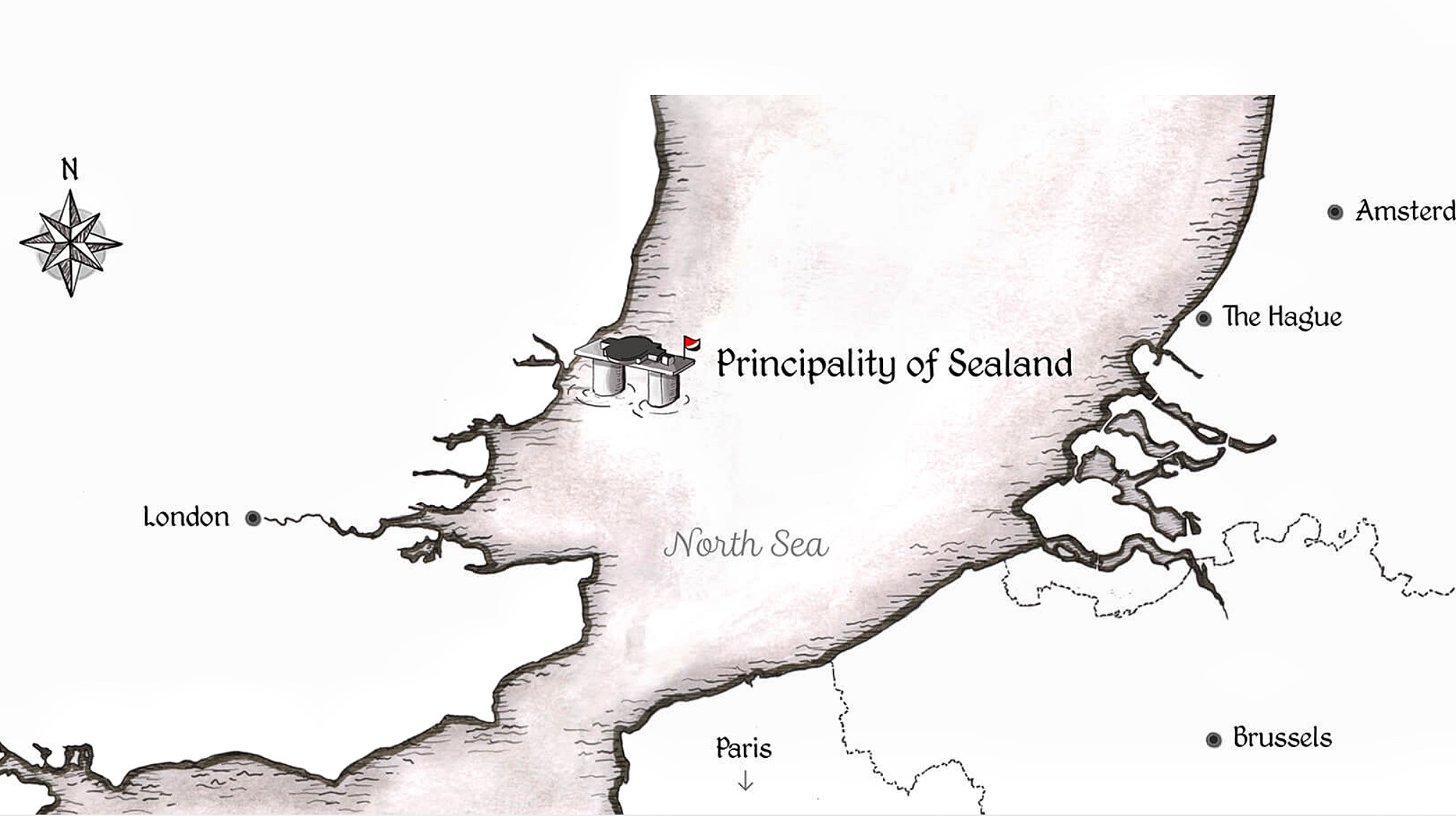
Fifty years ago last September, a new state was born in the North Sea just off the English coast. Its genesis lay in the herculean struggle of the English pirate radio stations to establish free and independent airwaves – events so memorably portrayed in the rock ‘n rolling, all singing and toking The Boat that Rocked.  Check the soundtrack – it’s fab!

Five years ago, newspapers around the world published the obituary of one of the world’s longest reigning but least known monarchs.  This is his story.

Welcome to Sealand

“Sealand is the smallest country in the world. The country‘s national motto is E Mare, Libertas (From the Sea, Freedom), reflecting its enduring struggle for liberty through the years. Sealand has been an independent sovereign State since 1967. Upon the declaration of independence, the founding Bates family raised the Sealand flag, pledging freedom and justice to all that lived under it”.

So goes the Sealand homepage.  That’s the vision. The reality is a little less exalted. But the Principality of Sealand does exist. Its a real-life, royal family, passport-issuing, micro-nation that has been around since 1967, and it is arguably the most credible place like it in the world,, as a browse through the Wikipedia lists of micronations will show.

Roy Paddy Bates was a bit of a buccaneer. A war veteran who had risen to the rank of major in the British army, he’d fought in North Africa, Sicily, and Italy, and had been  wounded in action several times. After the war, he started various enterprises, including an import-export business, a wholesale meat business, and a thirty boat fishing fleet. Nowadays, we’d call him an entrepreneur and throw buckets of public money at him.

In 1965, the the Major Bates family embarked on a project that his wife Joan cheerfully described as “pioneering commercial radio.” Others called it ‘pirate radio’ because at that time the BBC was the only licensed broadcaster in England, Inspired in part by the success of the outlaw Radio Caroline, Roy established a his own pirate radio station on Fort Knock John, one of many abandoned WWII sea forts, a complex of no-frills anti-aircraft forts that were used for shooting down German planes on bombing runs to London, and broadcast pop music and paid advertisements. Radio Essex broadcast to a quarter of England, until HMG summonsed Roy in September 1966 for operating a transmitter without a license – he’d picked a tower just inside England’s three mile territorial limit. He was fined one hundred quid and shut down.

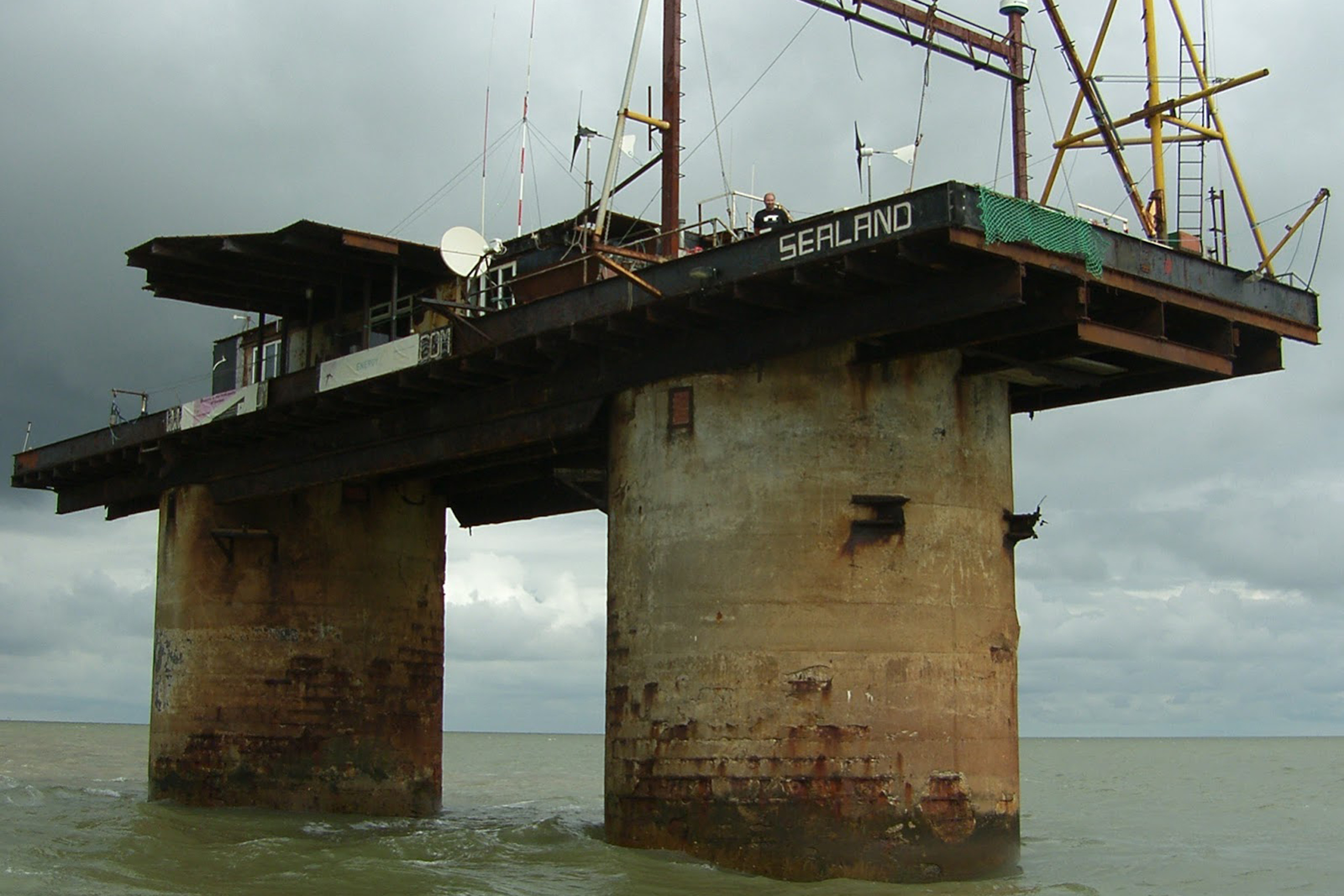
But Roughs Tower, another of the forlorn forts, lay just beyond the pale – six miles out and beyond the limit. This old battle station stands still,  in twenty four feet of chilly North Sea brine, six miles east of Felixstowe, an industrial port on the southeast coast of England. Abandoned like its siblings after the war, it was occupied in 1965 by Jack Moore and his daughter Jane in the name of Wonderful Radio London.

But, in September 1967, the Moores were evicted by Major Roy who wanted to use it to for his own station. On Christmas Eve that year, Roy and his son Michael, then aged fifteen and home from boarding school, dismantled Radio Essex and hauled it to Roughs Tower. The government was snookered – but the Royal Navy blew up another old fort that stood beyond the three mile limit to prevent another hijack, pour décourager les autres.

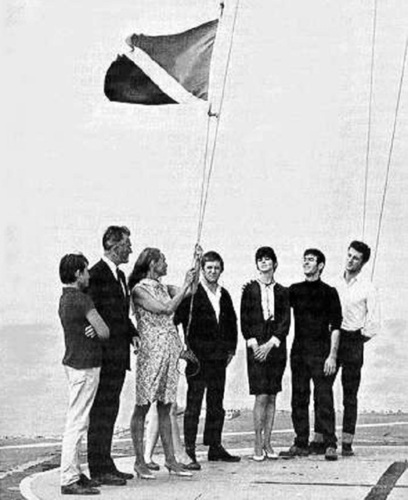
Shortly afterwards, Roy and Joan were out with friends in a local pub when Joan said that she’d like to have “a flag and some palm trees” to go with the “island” her husband had won for her. The company canvassed the things Roy and Joan could do with a sovereign property, so Roy hired a lawyer to check it out. And yes, there was loophole in international law whereby the Bates family could claim Roughs Tower as its own: “dereliction of sovereignty” – in effect, if you don’t use it, you lose it.

On September 2, 1967, Major Roy renamed the tower Sealand and declared its independence from Great Britain with himself himself as its ‘prince’ and Joan, his princess. In 1975, His Highness introduced Sealand’s constitution, followed soon afterwards by a national flag, a national anthem, currency (pegged to the US $)  and passports,  and printed a series of postage stamps honouring great explorers like Christopher Columbus and Sir Walter Raleigh (both of whom, ironically spent their last days in jail, and Sir Walter ending his lfe on the executioners block).

Officially, the UK doesn’t recognize Sealand, and except for “diplomatic” incidents every now and then, HMG  left this strange little fief alone. Until 1968, that is, when, in a move that helped force the sovereignty issue, Michael fired warning shots at workmen who were servicing a navigational buoy near the platform. When Michael and Roy next set foot on British soil, they were promptly arrested for weapons violations, only to be acquitted in October of that year since as Sealand was “about three miles outside territorial waters,” the Crown’s firearms laws didn’t apply there. The authorities, perhaps sensing an embarrassing precedent, chose not to appeal.

The British government extended its territorial limit to twelve miles in 1987, but Sealand has been allowed to plod on. Over time, other legal cases have appear to have have bolstered the Bates’ sovereignty claim, and the government’s stance remains one of hands-off. In 1984, the Department of Health and Social Security issued a written ruling that Michael Bates did not have to pay his national health insurance for the periods he resided on Sealand. In 1990, Sealand once again fired shots at a boat that came too close, and although local authorities investigated, the matter was quickly dropped.

Sealand was never used for pirate broadcasting. Changes in English law and the broadcasting environment saw Prince Roy lose interest in the pirate radio scene by the late ’60s. He explored other investment opportunities in the ’70s and ’80s, but little came of them except misadventure. Prince Michael has said that that a number of “undesirables” had contacted the family over the years hoping to use the place for various schemes – from setting up some sort of “pleasure island” to smuggling, and Roy has claimed that he was approached during the Falklands War by a group of Argentinians who wanted to buy Sealand and set up camp “on Britain’s doorstep.” “Of course I sent them away,” he told The Independent in 1990. “I’d never do anything that would pose a threat to the UK”. And indeed, he has said that in if Britain has another hour of need, he would rally to the call. Old soldiers never die…

“Cry havoc and let slip the dogs of  war!”

The most momentous moment in Sealand’s history occurred in 1977. when the royal family were approached by a German and Dutch consortium of shady lawyers and diamond merchants who had plans to build a luxury casino on the platform. “They wanted to be part of what we were doing, and they wanted to develop it as well,” Princess Joan recalls. “Then they asked us to go to Austria” for a meeting. Roy was wary, but Joan persuaded him, saying, “What have we got to lose?”

A lot, it would seem.  When they landed in Austria, five men met them and arranged to meet later. They never showed, and the suspicious, highnesses endeavoured to contact the mother ship. “In those days it was very difficult,” said Princess Joan. “We had no radio communication and no telephone communication. We phoned different people who worked in the area – fishermen and the Coast Guard. One of them said, ‘I saw a big helicopter hovering over Sealand.’ It didn’t feel right.”

And it wasn’t. Crown Prince Michael was at Sealand when the helicopter showed up. As he remembers it, the mystery party lowered down a man who claimed to have a telex (remember those?) from Prince Roy confirming that a deal had been done. Prince Mikel didn’t buy that. Then the helicopter lowered a man who whinged that “he was sick and needed a glass of whiskey.” The Prince let the chopper land, but it was ruse : a bunch of Dutch and German mercenaries led by one Alexander Achenbach, a German lawyer who held a Sealand passport, disembarked. Once on the deck, they locked the prince up without food or water for three days. He recounts that his assailants finally put him on a Dutch fishing boat that they “controlled,” took him to Holland, and left him there without passport and money.

He made his way back to Southend, where he met up with his folks. They hired a helicopter and a dashing pilot who’d worked on a few James Bond movies, gathered a posse and set forth to reclaim the fiefdom. When they arrived, Michael, shotgun in hand, slid down a rope and fired a shot – apparently by accident – and the mercenaries surrendered.

Achenbach was taken captive. The governments of Germany, the Netherlanda and Austria petitioned the British Governmet for his release, but HMG declined to intervene, citing its 1968 ruling. Germany sent a diplomat to Sealand to negotiate Achenbach’s release, and the ‘prisoner’ was eventually freed, with Roy asserting thereby that Germany had effectively recognized Sealand as a sovereign nation. Achenbach returned to Germany whereupon he established a government in exile, the Sealand Rebel Government. His successor, Johannes Seiger, continues to claim that he is the one true prince. The SRG too is one of those quixotic micronations. In 2009, another German, calling himself King Marduk I, after the old Babylonian deity, declared that he had claimed Sealand for his own nation, The Kingdom of Marduk! The days of Europe’s dynastic  squabbles are apparently not over. But, honestly, you couldn’t make this stuff up!

“Keep on rockin’ in the free world”

Nowadays, when Sealand blips on the geopolitical radar, it has more often than not been a kind of low comedy that makes it a tabloid favourite. In 1997, for example, when the killer of celebrity Gianni Versace’s assassin committed suicide on a Miami houseboat, police discovered that the man who owned the boat was in possession of a Sealand passport. Nothing eventuated, but as it turned out, it would appear that lots of people have Sealand passports who shouldn’t – these apparently self-replicate without the Bateses’ knowledge. There were an estimated 150,000 in curculatiuon, and in 1997, their majesties revoked all of them. 2000, Sealand made the news again when law enforcement officials in Spain busted a Madrid-based gang allegedly tied to international drug trafficking and money laundering. It appeared to be using a fake Sealand website and thousands of phony Sealand passports as part of its criminal activity. In

Questioned by Interpol, Prince Roy bewailed the injustice of anyone using the Sealand name for black deeds. “[Sealand] has all been a game, an adventure, and it is very unfortunate to see it take this turn,” he told one reporter. “Nobody is more honest than my husband,” Joan said at the time. “He’s so honest he creaks.”

But as the Bates admit, life on Sealand hasn’t always been a thrill, and in recent years the tiny country has been sliding into obscurity. The biggest challenge for Roy was always that of figuring out what to do with their patrimony.  Over the years, Prince Roy, Princess Joan and Michael, the dauphin, earned their keep with humdrum pursuits – like commercial fishing and fish processing – while shuttling back and forth between their royal seat and the mainland as dual citizens of Sealand and the UK. They’d ponder all sorts of moneymaking dreams and schemes like pirate radio outposts, tax havens, pleasure dens, casinos, and internet havens. In January 2007, The Pirate Bay attempted to purchase Sealand after harsher copyright laws in Sweden forced it to look for a base of operations offshore. WikiLeaks is said to have considered moving its servers there – a plan that came to nought when Julian Assange became enmeshed in his Swedish quagmire and his diplomatic quarantine as Ecuadorian Embassy house-guest.

An article in Wired in 2000 entitled Welcome to Sealand – Now Bugger Off! describes a project to set up Sealand as the world’s first truly offshore, almost-anything-goes electronic data haven – a place that occupies a tantalizing gray zone between what’s legal and what’s possible – outside the jurisdiction of the world’s nation-states. Simply put: Sealand won’t just be offshore. It will be off-government. The HavenCo initiative came, saw and collapsed by 2007, but the Wired story is a fascinating insight into the world of geeks and gigabytes.

But in reality, Sealand has been a quixotic financial sink-hole. Whilst none of the Bateses live on Sealand, they did visit and provide upkeep, and say they’ve spent huge amounts on supplies, legal fees, and improvements A caretaker usually occupies the place, which includes modest living quarters, a kitchen, a chapel and an exercise area. Sealand was abandoned briefly after a fire in 2006 but later repaired. Prince Michael has said in recent years that the family would consider selling the place — or, given the complications of selling a supposedly sovereign nation, leasing it –  from 2017 to 2010, a Spanish real estate company offered Sealand for sale for €750,000.

Michael lives in Southend, where he runs his own business. Roy spent most of the ’90s living on Sealand by himself, ready to defend its sovereignty with rifle and shotgun until his was physcially unable to keep his lonely watch. Joan, afflicted with arthritis, retired to Southend, keeping in touch with Roy by cell phone. Roy Bates died on 9th October 2012 after suffering from Alzheimers disease for several years. He was succeeded by his son Michael. On 15th March 2016, it was announced that Princess Joan had passed on, at the age of 86, in an nursing home in Essex.

These events have made Sealand more than a little depressing: a geriatric experiment in nation-building, doomed to die a slow death, beaten into the sea by wind and waves. But Prince Michael, now the Prince of Sealand, said on the patriarch’s passing that their descendants would preside over Sealand for many generations to come.  “The family,” he said, “plans to continue the legacy.”

So we beat on, boats against the current, borne back ceaselessly into the past.

The Great Gatsby,  F Scott Fitzgerald

Prince Roy holding the fort

Roy Bates, Bigger-Than-Life Founder of a Micronation, Dies at 91

William Yardley, The New York Times

Roy Bates, who commandeered a former British military outpost in the North Sea nearly 50 years ago and declared it a sovereign nation, died on Tuesday in Essex, England. He was 91. He had had Alzheimer’s disease for several years, his son Michael said in announcing the death. Make that Prince Michael.

Members of the Bates family still claim dynastic dominion over what they call the Principality of Sealand, a rudimentary platform of concrete and steel rising out of the water seven miles southeast of the main British island. And they are looking to expand the royal family.

Even if you never get the chance to visit — the trip requires a helicopter ride or a willingness to be hoisted by crane from a boat — you, too, can join the royal court of one of the world’s most enduring and entrepreneurial micronations. The official Sealand Web site sells titles (the “Count/Countess Title Pack”: about $320), identity cards, stamps, wristbands and e-mail addresses (just under $10 for six months). “It it helps pay for the whole Sealand thing,” Michael Bates said.

A country does need an economy, and the effort to sustain Sealand with Internet commerce is at least somewhat consistent with why Roy Bates arrived there in the first place.

In the 1960s, Mr. Bates, a former major in the British Army, was among a group of disc jockeys who tried to avoid England’s restrictive broadcasting regulations by setting up pirate radio stations on some of the country’s abandoned offshore outposts, which had been used to fire ground artillery at German aircraft during World War 2. Mr. Bates began broadcasting from one outpost within the three-mile limit of England’s territorial waters, and when he was driven from there in 1966 he planned to start a station at Her Majesty’s Fort Roughs, which was in international waters. Instead, he founded Sealand.

On Sept. 2, 1967, Mr. Bates declared it an independent nation, himself its royal overseer and his wife, Joan, its princess. It was her birthday. “They had a huge love affair,” Michael Bates said. “He really worshiped her.”

Mr. Bates was emboldened the next year when, after he faced weapons charges for firing warning shots at an approaching British vessel, a British court ruled that it had no jurisdiction over the case because the exchange had occurred in international waters.

                Prince Roy Bates and Princess  Joan. Standard/Hulton Archive, via Getty Images

A decade later, a greater drama ensued when a group of Germans with plans to build a luxury casino on the platform tried to take control of Sealand while Mr. Bates and his wife were away. They held Michael Bates hostage for several days before Roy Bates stormed Sealand and retook it in a dramatic helicopter raid. He imprisoned one of the men there. When the German government sought Britain’s help in freeing him, Britain declined to intervene, citing the 1968 ruling.

Germany sent a diplomat, the man was eventually freed, and Mr. Bates asserted that Germany had effectively recognized Sealand as a sovereign nation.

Even after Britain expanded its territorial waters to 12 miles from shore, it mostly left Sealand and the Bateses alone. The family has explored various means of economic development, including housing an Internet company that wanted to create a financial haven without government oversight. It is still considering playing host to an online casino. WikiLeaks is said to have considered moving its servers there. [This plan came to nought when Julian Assange became enmeshed in his Swedish quagmire and an Ecuadorian house-guest]

For now, most of Sealand’s trade is driven by Roy Bates’s grandson James — Prince Royal James — who oversees the Sealand Web site.

“The history of Sealand is a story of a struggle for liberty,” the Web site says. “Sealand was founded on the principle that any group of people dissatisfied with the oppressive laws and restrictions of existing nation-states may declare independence in any place not claimed to be under the jurisdiction of another sovereign entity.”

Paddy Roy Bates was born on Aug. 29, 1921, in London. His father served in the Royal Artillery in World War I and suffered lung damage from being gassed. The family moved to Essex with the goal of improving his health. According to an account on the Sealand Web site, Roy Bates was the only one of five siblings who survived childhood, and he barely survived his 20s, suffering several war wounds as a British soldier.

“He once said that despite the paradox of him breaking away from the U.K. with Sealand, he would do it all again if his mother country needed him,” the account said.

Besides his son, his wife and his grandson, Mr. Bates’s survivors include a daughter, Penelope Hawker, who has not been especially involved with Sealand, and a granddaughter.

Roy Bates was not just a self-made prince, he was a self-made man. After the war, he imported beef and ran butcher shops. He built fishing boats in Essex, and some family members still fish commercially for cockles, mussels, oysters and other seafood. None of the Bateses live on Sealand, though they do visit and provide upkeep. A caretaker usually occupies the place, which includes modest living quarters, a kitchen, a chapel and an exercise area. Sealand was abandoned briefly after a fire in 2006 but later repaired.

Prince Michael and Family

Michael Bates has said in recent years that the family would consider selling the place — or, given the complications of selling a supposedly sovereign nation, leasing it — but he said on Thursday that no sale was planned. He expects his descendants to preside over Sealand for many generations to come.

“The family,” he said, “plans to continue the legacy.”

Further Reading

There’s no better place to start than Sealand’s own home page.

The Wikipedia entry for Sealand is a treasure trove of references about Sealand and also the political and legal aspects of micro-nations. Wikipedia is also a good place to start one ishes to inquire firther on the infinite variety of micronations scattered across the globe.

An article in Wired in 2000 entitled Welcome to Sealand – Now Bugger Off! describes a project to set up Sealand as the world’s first truly offshore, almost-anything-goes electronic data haven – a place that occupies a tantalizing gray zone between what’s legal and what’s possible – outside the jurisdiction of the world’s nation-states. Simply put: Sealand won’t just be offshore. It will be off-government. The HavenCo initiative came, saw and collapsed by 2007, but the Wired story is a fascinating insight into the world of geeks and gigabytes.

For other posts in our Small Stories series of ordinary folk doing extraordinary things, see:  A Tale of Twin Pines  , the story of a Lebanese migrant to New Zealand, The Odyssey of Assid Corban.


Recalling The Mersey Poets


for we had love and each other and the moon for company
when I spent summer with Monica and Monica spent summer with me

June this year saw the fiftieth anniversary the publication of Roger McGough’s wistful verse-memoir “Summer With Monika”, and in October, we celebrate the publication in 1967 of that great anthology The Mersey Sound which showcased the poetry of Liverpudlians McGough, Brian Patten and Adrian Henry.

Named for the musical revolution that originated in the northern English port city of Liverpool, it became one of the best-selling poetry anthologies of all time, exerting an influence on British poetry well beyond the decade. I bought the slim volume as soon as it came out, and back in the day, guitar in hand, I would set many of its poems to music as it nurtured my nascent song-writing and poetry skills. I recall now Patten’s “Somewhere Between Heaven and Woolworths’, and “Delicate John’ and the tunes I set to them. I still sing McGough’s Great War country-and-western-noir ‘Square Dance’: “Swing your partners dos-y-doed, all around the shells explode”

The poems had an immediacy, a relevance to those breakout times when a young man’s hopes and fears seemed to centre of the availability or otherwise (mostly not) of casual sex with gorgeous dolly birds, the American quagmire in Vietnam, and the imminent threat of a nuclear Armageddon. They spoke in a familiar vernacular, everyday English that we understood and related to about ordinary events and workaday artifacts that acquired a totemic significance upon the printed page. Toasters, teapots and fish ‘n chips. Kardomah cafes and Star of India restaurants. Bus-conductors, postmen, and milk bottles on the doorstep. Schoolyards and superheroes. Miniskirts and monarchy. The northern English weather.

And all this against the soundtrack of some of the greatest popular music that ever was spilling out of radios and record players in the suburban bedrooms and inner city bedsits of teenagers across the land. There wasn’t a great lyrical leap from the songs of the Beatles with their particular Liverpudlian spirit of place to the words, worries and wonderings of our very own British ‘Beat Poets’.

I have visited those days often in these pages. In A Window on a Gone World I wrote:

“This was indeed a decade of change and ferment. Values changed, morals changed, habits changed, clothes changed, music changed (the best music ever). The way people looked at the world and thought about it. We often look back and remark that a supernova of creativity burst over the western world during those years, the likes of which was not seen before and has never been seen again. And nowhere more so than in decadent, decaying, depressing, old England, trapped in tradition, class, and prejudice”.

I browsed through the whole book the other day, and in a way, it was like a reunion party, a meeting and greeting of old friends, a pleasant, nostalgic journey to a gone time. As that well-worn saying goes, the past is indeed another country – we certainly did things different then. The places and the people, the perceptions and perspectives, the preoccupations and the passions. As I read, I’d recognize words, phrases, images, ideas that osmosised into my own verse, particularly poetry I penned in the late sixties and early seventies, and which are gathered up in my Tabula Rasa collection.

It was my habit in those days to scribble little notes in the margins. And there they were now, for me to ponder fifty years on, and to wonder how the world looked when I wore a young man’s skin, and thought with the mind of a raw, inquiring, idealistic youth who had yet to break loose of the ties that bound, of family, school, and town. But the adventure had obviously begun – if only in the imagination, as I read and rehearsed, pondered and prepared for the great escape. An upper sixth, adolescent eclecticism well-illustrated by the picture below of my additions to Adrian Henri’s stream of consciousness nomenklatura:

Like Adrian Henri’s name-dropping, my neatly-written notes list a host of folk living and dead, mostly white and mostly male. Actors, authors and autocrats. Poets, painters, and philosophers. Popstars, policians and television personalities. Most are, even today, remembered and commemorated. Some are long forgotten. There are few on my list that I failed to recognize after  all these years. But praise be to Google! I soon rediscovered that Sean Lemass was Taoiseach of Ireland in 1967; that Frank Mitchell was a notorious ax-murderer killed that year on the orders of the infamous Kray twins; that Manny Shinwell was an MP and trade unionist, and Jack Dash, a communist trade union leader. Bartle Frere was governor of Cape Colony at the time of the Zulu wars, and Dudley Stamp, a celebrated geographer of the British landscape, both included, I believe, because I was doing A Levels in History and Geography at the time, and their names struck a chord of sorts. In the light of my later life DownUnder, one name was particularly prescient: Harold Holt’s short tenure as prime minister of Australia ended in 1967 with a ill-fated swim off the coast of Melbourne. There are now Harold Holt swimming clubs and annual swimathons all over the country.

I will conclude this personal retrospective with a some quotations, poems and recordings:

Brian Patten:

She walks across the room and opens the skylight
thinking, perhaps a bird will drop in
for and teach her to sing

The children who grow old
to who squabble and grow thin
who lick their lips at disaster .
and quietly whisper of sin

Adrian Henri:

I remember
walking in empty squares in winter rain
kissing in darkened hallways
walking in empty suburban streets
saying goodnight in deserted alleyways
in the midnight hour

The Independent recently published an affectionate tribute to Roger McGough on the occasion of this fiftieth anniversary. It includes Roger’s revisiting of one of his iconic poems:

Not for me a youngman’s death
Not a car crash, whiplash
One more for the road, kind of death.
Not a gun in hand, in a far off land
IED hidden in the sand death

Not a slow-fade, razor blade
bloodbath in the bath, death.
Jump under a train, Kurt Cobain
bullet in the brain, death

Not a horse-riding, paragliding
mountain climbing fall, death.
Motorcycle into an old stone wall
you know the kind of death, death

My nights are rarely unruly.
My days of all-night parties
are over, well and truly.
No mistresses no red sports cars
no shady deals no gangland bars
no drugs no fags no rock ‘n roll
Time alone has taken its toll

Let me die an old man’s death
Not a domestic brawl, blood in the hall
knife in the chest, death.
Not a drunken binge, dirty syringe
‘What a waste of a life’ death.

And here is one of my favourites from the Summer of Love:

Summer With Monika

They say the sun shone now and again
but it was generally cloudy
with far too much rain

they say babies were born
married couples made love,
often with each other
and people died
sometimes violently.

they say it was an average ordinary moderate
run-of-the-mill common or garden summer
but it wasn’t

for I locked a yellow door
and I threw away the key.
and I spent summer with Monica
and she spent summer with me

unlike everybody else we made friends with the weather
most days the sun called and sprawled all over the place
or the wind blew in as breezily as ever
and ran his fingers through our hair
but usually it was the moon that kept us company

some days we thought about the seaside
and built sand castles on the blankets
and paddled in the pillows
or swam in the sink and played with shoals of dishes

other days we went for long walks around the table
and picnicked on the banks of the settee
or just sunbathed lazily in front of the fire
until the shilling set on the horizon.

we danced a lot that summer
bossanovaed by the bookcase
or maddisoned instead,
hulligullied by the oven
or twisted round the bed

at first we kept birds in a transistor box
to sing for us but sadly they died
we being to embrace in each other to feed them.
but it didn’t really matter because
we made love songs with our bodies
I became the words
and she put me to music

they say it was just like any other summer
but it wasn’t
for we had love and each other
and the moon for company
when I spent summer with Monica
and Monica spent summer with me.

Sic semper tyrannis

You come at the king, you best not miss.
Omar Little, The Wire (after RW Emerson)

The phrase “one man’s freedom fighter is another man’s terrorist” is at once apt, correct, and yet often oversimplified to the point of disingenuousness. The word “terrorist” itself describes its goal. To instill fear in the heart of the enemy. In the past, the target would have been the king, the dictator, the ruling class, and those who served them and upheld their rule. Politicians, officials, solders and policemen. Today, terrorists indiscriminately target whole societies. Irish bombers blasted communities of the rival faith, murdered shoppers, office workers, and pub patrons, as well as soldiers and policemen. Palestinian suicide bombers hit malls and pizza bars in city centres. ISIS, al Qa’ida and the Taliban detonate cars in busy city streets and publicly execute prisoners in callous and calculating “lectures in flesh” (the phrase is civil rights lawyer Geoffrey Robertson’s, from his chilling account of the trials and execution of King Charles I of England and those who sentenced him, The Tyrannicide Brief.).

But targeted and random terrorism has a long historical pedigree. For centuries, it has been the desperate and nihilistic weapon of last resort of resistance and rebellion against perceived oppression and injustice, and against invaders and occupiers.

In the second century BCE Palestine, the Maccabees used assassination in their resistance to the Seleucid Greeks, and a century later, the Jewish zealots, the Sicarii, named for the easily concealed small daggers, paid the Romans in like coin, and ultimately in an insurrection that culminated in the destruction of Jerusalem in 70CE and the scattering of the Jewish race (giving history the emotive and symbolic last exit that was Masada). In an etymological irony that Mark Twain would have been proud of, the present unrest in Jerusalem, a large number of young Palestinians have perished in attempting to stab jewish soldiers and civilians. Their jaquerie is called the “Intifada Sakni-in”, the ‘Knife Uprising – an echo of those long-dead Sicarii “dagger men”.

Nowadays, one would be excused for thinking that “terrorism” and “terrorist” are synonymous with Arabs and Muslims. And a historical precedent reinforces this erroneous assumption. The Hashishan or “Assassins” of Middle East fame (yes, that is where that noxious noun originated) were Muslim men and boys mesmerized and mentored by Rashid ad Din as Sina-n, the “Old Man of the Mountain” (and all this, before Osama in the caves of Tora Bora), and were Twelfth Century  hit-men contracted out to rival Muslim princes in the internecine conflicts that plagued the Levant in the wake of the Crusades and the demise of the great Arab Caliphates.

But the assassin’s knife (and in modern times, the gun and bomb, and latterly cars and trucks) predates these medieval hoods and links the Hebrew rebels of old to the Irgun and Stern Gang who encouraged Britain and the UN to abandon Palestine in 1948, bequeathing most of it to the new state of Israel, and triggering the Palestinian diaspora. European anarchists and Irish rebels and loyalists were adept at shootings and ambushes. In Algeria, during the ‘fifties, the nationalist FLN and the “colon” OAS shot and bombed each other and those unfortunates caught in the crossfire. The IRA perfected the improvised explosive device that today has crippled thousands of American, Canadian, and Australian soldiers in Iraq abd in Afghanistan. Hindu Tamil separatists of Sri Lanka introduced the suicide bomber, an economical and efficient weapon against soft (civilian, that is) targets, deployed today by Islamist killers in the streets of London and Lahore, Damascus and Dar es Salaam, Jerusalem and Jakarta. Whilst Arabs – and particularly Palestinians may have given the world the hijacking of aircraft – a tactic that fell into disuse due to diminishing political returns and rapid response forces – other Arabs showed us how to fly them into public buildings as the whole world watched in horror and disbelief. The shockwaves of this one are still reverberating through the deserts of the east and the capitals of the western world.

In going up up against their occupiers, the Palestinians have an old heritage. In my old country, Boudicca and Caractacus fought a losing battle against the Romans in Britain during the First CE. The Roman historian Tacitus ascribed to a vanquished chieftain the memorable words  “solitudinem faciunt, pacem appellant” – they make a desert and they call it peace. After the battle of Hastings in 1066, the defeated Saxons pushed back against the Normans and brought the genocidal wrath of William the Conqueror down on their heads with the devastating “Harrying of the North”. The Green Man and Robin Hood legends are said to be a retrospective and romanticised remembering of the Saxon resistance. Warrior fugitives from that failed guerilla war fled as far as Constantinple, where many joined the Emperor’s acclaimed Varangarian Guard, (see When Harald Went A Viking) 

In the streets and the countryside of Ireland, my parents’ birthplace, the United Irishmen, Fenians, Free Staters, IRA and Unionists fought against the redcoats, tommies, and black and tans of the British Army. Fought amongst themselves, fought against each other, and killed and were killed in their centuries long war of liberation. And in my adopted country, indigenous Australians fought a futile frontier war against settlers and soldiers just as native Americans did, albeit on a much smaller scale, and paid the price in hangings, massacres, poisoned wells, dispossession, marginalization, and “stolen children”. The legacy of those times lingers still – see The Frontier Wars – Australia’s heart of darkness.

In Central America, Juarez led the Mexicans against the French, and Sandino, Nicaraguans against US marines. Spaniards rose up against Napoleon’s forces, giving the world the word “guerilla”, or “little war”. Russian partisans ambushed the Grande Armé and the Wehrmacht. Throughout occupied Europe, the very term “resistance” became synonymous with the heroic unequal struggle against tyranny. In another of history’s ironies, muqa-wamat, Arabic word for resistance, unites sectarian rivals Hamas and Hizbollah against Israel.

And not just resistance to invasion and occupation, but also against oppression by one’s own rulers. Religious tracts tie themselves in knots reconciling the obligation to obey our rulers with the right to resist and overthrow those that rule badly. The unequal struggle against tyranny – or what is perceived by the perpetrators as tyranny – is the cause that inspires men and women to desperate acts.

The most celebrated in fact, film and fiction is the death of Julius Caesar at the hands of peers who feared that he intended to usurp the ostensibly democratic Republic (ostensible because democratic it was not) and institute one-man rule. That ended badly for the conspirators, and for Rome, as it precipitated years of civil war and ultimately, half a century of empire).

In 1880 the reforming Czar Alexander II of Russia, discovered the hard way that liberating the serfs did not inoculate himself against the bomb that took his legs and his life. His fearful and unimaginative successors hardened their hearts and closed their minds against further reform. setting in train the crackdown on dissent and democratic expression that led eventually to the storming of the Winter Palace on Petrograd in 1917. Narodnaya Volya, the killers called themselves – the People’s Will. And that is what terrorists do. They appeal and owe fealty to a higher court, a greater good, a savage God.

So it was when student and Serbian nationalist Gavril Princip assassinated Archduke Ferdinand of Austria-Hungary in June 1914 and ignited the spark that lit the conflagration of World War 1 which precipitated the demise of the old European empires.

So too when John Brown and his sons brought their broadswords to bear on slavers and their sympathizers and made a date with destiny at Harpers Ferry. Their famous raid may or may not have accelerated the downward slide to the secession and civil war that erupted the following year, but it provided a moral and symbolic prelude and also, the resonating battle hymn of the republic. John Wilkes Booth bookended this bloody era with his histrionic and public murder of Abraham Lincoln, shouting “sic semper tyrannis”, “thus always to tyrants,” attributed to Brutus at Caesar’s assassination – today, it’s the Virginia state motto. Brown and Booth were quite clear in their motives. As was were the segregationalist shooters who did for African Americans Medgar Evers and Martin Luther King. Less so were the killers of the Kennedy brothers in the sixties.

To conclude, sometimes that savage, rebel God is one of faith, sometimes, of blood and soil. In some instances, it is revenge for wrongs real and imagined – the reasons at times lost or forgotten through the passage of time and fading memories. And often, “the cause” is corrupted by the immoral economics of illicit commerce, including contraband, kidnapping, blackmail and extortion. Sometimes all merge in an incongruous hybrid of religious passion, ethic identity, libertarian or anarchistic fervour, and protection racket. As was the case in Northern Ireland, in Lebanon, in sub-Saharan Africa, and currently so in Syria and Iraq.

But most times, terror and turmoil is simply a political weapon planned, targeted and executed as a mechanism of regime change. Rebellion, revolt and revolution. Resisting, opposing, challenging, confronting and defeating the central authority. The seizing, holding, consolidation and keeping of political power.

And one thing is for sure. The outcome is unpredictable. History does not move in straight lines, but often follows a bitter and twisted path. Cliched as it is, the phrase “be careful what you wish for” is an apt one. And when, as Bob Dylan sang, “the line it is drawn, the curse it is cast”, there is no going back. To quote WB Yeats’ famous lines, “all is changed, changed utterly”.

Terrorism, then, can shift the course of history. If we were to stumble into the swamp of alternative histories, imagine what might of happened

If Caesar had walked home from the senate on the Ides of March
If Lincoln had been able to guide the Reconstruction
If the reforming Czar had introduced democratic government to Russia
If Gavril Princip’s shot had missed the archduke
If Kennedy had returned from Dallas
If John Lennon outlived George Harrison
If Yitzak Rabin had left the peace concert in Tel Aviv
If the Twin Towers stood still

To quote “Stairway to Heaven”, a curiously apposite title given the millenarian mindset of many terrorists, “Oh, it makes you wonder!”