Echo of the Steppes … history’s long shadow

For our old friend and co-founder of HuldreFolk, the acclaimed bandurist Victor Mishalow, Ukrainian composer Hryhory Kytasty’s Echo of the Steppes (Гомін Степів) was much, much more than a piece of music; it was an evocation of a lost homeland.

It was Victor’s signature piece, and when introducing it in our concerts – an eclectic combination of stories, songs and music – he would describe the boundless Ukrainian steppe: waves of tall grass bending beneath an endless wind, and beneath it all the legendary black chernozem, among the richest soil on earth, so deep it seemed almost without end. In his telling, the bandura was “the soul of Ukraine”, its shimmering strings giving voice to the wind, the grasses, the little creatures that dwelt within them, and the immenseness of the plains.

The music also carried folk memory: of open frontiers where the Kozaks once found refuge from oppression, where freedom could still be breathed beneath an enormous sky, and where the landscape itself became part of the nation’s identity. Listening to Victor play, one did not simply hear an instrument; one heard the echo of the steppes – a vast, living landscape in which earth, wind, history and people were bound together in a single, resonant voice.

Fingerprints, ghosts and the long arm of History

In an illuminating essay in the e-zine Unherd, republished below, former war-correspondent Aris Roussinos begins an extensive and expansive review of  Australian archeologist Warwick Ball’s The Eurasian Steppe with three mute stone figures – Cuman balbals – standing beside the road between Sloviansk and Bakhmut in Donetsk, watching the endless movement of armies across what is now Ukraine’s disputed and devastated Donbas. They are ancient witnesses in a landscape where Russians and Ukrainians now fight over ground that, for most of human history, belonged to neither, and yet, for countless people over millennia, became pasturelands and polities, battlefields and burial grounds.

This is history as I like it: the historian as storyteller, where landscapes become characters and the past refuses to remain buried.

Long before Slavic speech reached these plains, the steppe was the domain of nomadic peoples: Scythians, Sarmatians, Alans, Huns, Turks, Mongols and many others whose empires rose and vanished like storms over the grasslands. They left few cities and fewer written records, but their fingerprints are everywhere: in languages, military traditions, political institutions, myths and identities. The grass remembers what libraries often forget.

Roussinos’ central argument is that we have misunderstood Europe by looking too exclusively westward, towards Rome. The steppe was never merely a barbarian wilderness beyond civilisation, waiting to burst through the gates. It was one of the great engines of European history. Europe was shaped not only by the legacy of Rome and Christianity but also by repeated encounters with the peoples of Inner Asia. The old frontier between “Europe” and “Asia” dissolves under closer inspection. What appears on a modern atlas as a dividing line was, for centuries, a vast zone of movement, exchange, conquest and adaptation.

The present war in Ukraine unfolds across precisely this ancient geography. The early Russian thrust towards Kyiv moved through forests and marshes that belonged historically to the old Slavic world. The grinding war of attrition in the east is being fought across the open “Wild Fields”, the immense Eurasian grasslands where mounted nomads once travelled with astonishing speed and where empires repeatedly collided. Roussinos draws parallels with the mechanised battles of the twentieth century – Kursk, Kharkiv, Stalingrad – where tanks replaced horses, but the strategic significance of the landscape remained unchanged. Geography, as Napoleon is said to have observed, is often the most enduring ally in war.

It is an enticing argument because it encourages us to look beneath the familiar surface of European history. Perhaps Europe itself carries far more of the steppe within it than we usually acknowledge. Hungary and Bulgaria were founded by peoples of the steppe. The Polish nobility cultivated a proud Sarmatian ancestry. The Magyars’ memory of their eastern origins helped shape nineteenth-century nationalism. Even the nation state, so often presented as an entirely European invention, may owe something to political traditions carried westward across the grasslands by mounted confederations whose influence extended far beyond the horizon they inhabited.

There are historical echoes scattered throughout this story. The Sarmatians and Alans revolutionised warfare with armoured cavalry, heavy lances and mounted tactics that would eventually blossom into the chivalric traditions of medieval Europe. Even the Arthurian legend may preserve a distant resonance of the steppe in the enduring image of the sword planted in the earth, waiting for the rightful king to draw it forth.

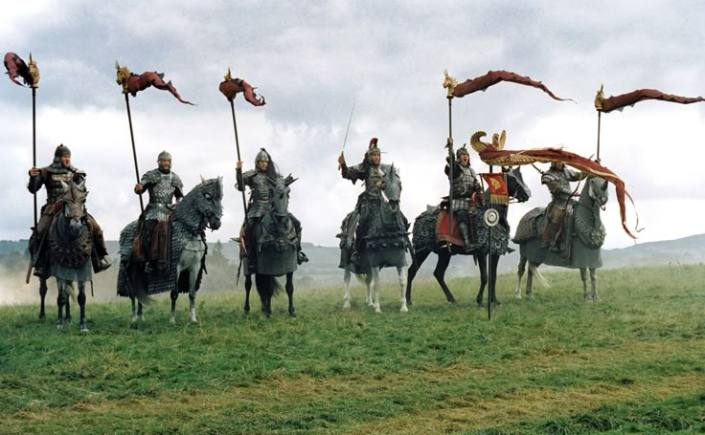
Filmmakers, naturally, could not resist. The 2004 film King Arthur, for example, stitched together Romans, Celts, Sarmatians, Picts and enough historical liberties to make any medievalist wince. Clive Owen wandered through a fictional Northumbria Britain as a brooding half-Roman, half-Sarmatian Arthur, while Keira Knightley appeared as an improbably glamorous and scantily clad Guinevere whose Pictish origins seemed less convincing than her plummy English accent. It was glorious nonsense, but enjoyable, nonetheless. The Irish landscapes were striking, the horses magnificent, the ‘Knights’ (the picture at the head of this essay) with their “Rus! Rus!” war cry (and they actually do sit at a round table) improbably photogenic. A battle fought across a frozen lake owed as much to Eisenstein’s Alexander Nevsky as it did to any surviving historical source. Ridley Scott later recycled much the same visual conceit in his disappointing Napoleon. History often survives in cinema not because the facts are accurate but because certain images possess extraordinary emotional truth.

The Cossacks offer a far more convincing example of the cultural blending that characterised the frontier. They emerged not from ethnic purity but from mixture. Runaway serfs, adventurers, escaped peasants and soldiers settled the borderlands, adopting the customs, military practices and vocabulary of the Turkic peoples who had occupied the steppe before them. Even the word “Cossack” derives from a Turkic root meaning “to roam”. The frontier was never a wall separating civilisations. It was a workshop in which entirely new identities were forged.

It is here that Roussinos, following Warwick Ball, arrives at his most provocative claim. Muscovite Russia, he argues, cannot be understood without recognising the formative influence of the Mongol world. Moscow’s rise was anything but inevitable. The Golden Horde required dependable tributaries capable of collecting taxes, maintaining order and supplying troops. The princes of Moscow proved remarkably efficient servants of the khans and, in doing so, transformed what had once been a relatively insignificant Rus’ principality into the nucleus of a future empire. The irony is delicious. Mongol domination helped create the very Russian state that would eventually conquer the steppe itself.

The fingerprints remain visible today. Administrative practices, institutions of government, systems of taxation and even elements of the Russian language bear traces of Mongol influence. Yet fingerprints are curious things. They tell us that contact occurred; they do not tell us everything that followed.

That question lies at the heart not only of Ball’s thesis but also of historian Orlando Figes’ The Story of Russia, which, by happenstance, I am reading at the moment. It is one of those literary coincidences in which two writers, approaching the same landscape from different directions, find themselves asking precisely the same question. What made Russia, Russia?

Figes is, in many respects, the perfect companion to Roussinos because he shifts our attention from inheritance to interpretation. He readily acknowledges that the Mongol conquest of the Rus’ principalities in the thirteenth century was one of the defining ruptures in Russian history. It destroyed Kyiv’s political centrality, subordinated the northern principalities to the Golden Horde and created the circumstances in which Moscow could eventually emerge as the dominant power. Like Roussinos, he recognises the profound irony that Mongol domination did not simply interrupt Russian state formation but helped shape its eventual character.

Yet Figes is ultimately less interested in what Russia inherited than in what Russia chose to become. The Mongols bequeathed methods of rule: taxation, military organisation, communications and a conception of authority that differed markedly from Western feudalism. Russia’s imagination, however, was nourished elsewhere. Orthodox Christianity, Byzantine political theology, the doctrine of Moscow as the “Third Rome” and the almost mystical conception of the Tsar as God’s anointed gave Russia a vocabulary through which it understood itself. Its civilisation emerged not from a single source but from the convergence of many.

This distinction is important because it rescues history from determinism. Fingerprints reveal contact; they do not reveal intention. They cannot tell us why someone picked up the knife, wrote the letter or opened the door. Likewise, cultural inheritance explains possibilities, not inevitabilities.

Figes presents Russia as a civilisation assembled from multiple traditions: Slavic, Byzantine, Mongol, European and imperial. The country’s enduring paradox is that it has persistently imagined itself as both European and somehow apart from Europe. Peter the Great attempted to drag Russia westward, shaving beards, importing European science, founding St Petersburg (a German name, which was changed to Petrograd during World War I for the same reasons the British royal house changed its German name to Windsor) embracing Enlightenment ideas. Yet beneath these reforms older structures of autocracy survived. Later generations reversed the argument entirely. Slavophiles celebrated Russia’s uniqueness while Westernisers lamented its failure to become sufficiently European. The debate has never really ended. It merely changes its vocabulary.

Maps have always encouraged these arguments. A glance at any atlas suggests that Russia occupies an almost impossible position: a European power that expanded across Asia until it became the largest contiguous empire on earth. The geography itself tempts us into historical mythology. Is Russia European? Asian? Eurasian? The answer has varied according to who was asking and what political purpose the answer was intended to serve. Geography creates opportunities, constraints and temptations. It does not dictate outcomes.

Figes’ also explores of recurring Russian archetypes: the Holy Tsar, the Holy Fool, the suffering nation, the belief that Russia possesses a unique historical destiny. These are not immutable characteristics embedded in some mystical national DNA. They are stories Russians have told about themselves across the centuries – including Vladimir Putin’s house ideologue, philosopher Aleksandr Dugin. Stories matter because people act upon them. Nations, no less than individuals, become attached to narratives that explain who they are and why they exist.

Juxtaposed against Ball, Roussinos and Figues is a comment on Roussinos’ essay by Alexander Morrison, a historian of Russian history at Oxford University. Every grand historical narrative requires its sceptic. Elegant theories are seductive precisely because they reduce complexity to a single organising principle. Morrison accepts much of Ball’s argument while quietly resisting its more deterministic conclusions. It is an exemplary piece of historical criticism because it neither dismisses nor genuflects. Instead, it refines.

He readily acknowledges that Muscovy inherited important administrative practices from the Mongol world and points out that Russia was far from unique. The Ottomans, Safavids, Mughals and Qing all incorporated Chinggisid or Timurid political traditions alongside older local institutions. Borrowing across Eurasia was commonplace. Civilisations have always learned from their neighbours, even while claiming absolute originality.

Where Morrison parts company with Ball is over the temptation to confuse influence with destiny. Muscovy borrowed bureaucratic structures connected with taxation, communications and administration. Indeed, the Russian language still preserves Mongol echoes in words such as kazna for treasury, den’gi for money and yam for the postal relay system. Yet the ideological foundations of the state remained overwhelmingly Byzantine and Orthodox. Ivan IV became Tsar by invoking the legacy of Caesar and the vision of Moscow as the Third Rome, not by presenting himself as the heir of Genghis Khan. Administrative inheritance did not erase cultural identity.

That distinction becomes even more important when considering the modern world. It is tempting to explain Putin’s Russia by reaching back to the Mongols, Ivan the Terrible or some timeless Russian soul. Such explanations possess an undeniable elegance because they transform political choices into historical inevitabilities. Morrison rejects this outright. Contemporary Russia, he argues, is shaped above all by decisions made by particular elites drawing upon nineteenth-century nationalism, memories of the Soviet collapse, selective readings of Russian history and modern political ideology. The past provides the vocabulary; it does not dictate the speech.

His discussion of Ukraine is equally persuasive. Southern and eastern Ukraine were settled comparatively recently by a remarkable mosaic of peoples: Ukrainians, Russians, Greeks, Jews, Armenians, Bulgarians and many others. The region’s history is therefore extraordinarily layered. Yet historical complexity does not undermine modern sovereignty. Ancient settlement patterns explain why memories remain contested, but they do not invalidate internationally recognised borders. History illuminates’ claims; it does not automatically legitimise them.

This strikes me as one of the most important lessons historians can offer our own age. We are living through a period in which politicians, nationalists and activists increasingly seek legitimacy by reaching deeper into the past. Ancient kingdoms, medieval battles, archaeological discoveries, linguistic survivals and genetic studies are all recruited into contemporary arguments about identity and territory. History becomes less an investigation than a courtroom brief.

Yet the past is a notoriously unreliable witness.

Landscapes accumulate memories without issuing verdicts. The Donbas bears the fingerprints of Scythians, Greeks, Sarmatians, Goths, Huns, Khazars, Mongols, Tatars, Cossacks, Russians, Ukrainians, Jews, Armenians and countless others. None of those fingerprints constitutes a title deed. They testify to presence, movement and encounter. They remind us that almost every place we imagine possessing an eternal identity has, in reality, been shaped by successive waves of migration, conquest, adaptation and coexistence.

Perhaps that is why I find Roussinos’ essay so compelling. Like the best historical writing, it restores movement to landscapes that modern maps often freeze into static national colours. It reminds us that frontiers have rarely been fixed and that civilisations have always been more entangled than their later myths would admit. Europe did not simply civilise the steppe. The steppe helped create Europe.

Equally, Morrison reminds us that historical explanation should never become historical imprisonment. Institutions endure, languages preserve old borrowings, myths outlive empires and landscapes retain astonishingly long memories. But people still make choices. Nations inherit the consequences of the past without becoming its captives.

The three weathered balbals still stand beside the road to Bakhmut. They have watched Scythians ride westward, Huns descend upon Europe, Mongol tumens disappear into the distance, Cossacks patrol the frontier, imperial armies march beneath Romanov eagles, Wehrmacht panzers advance across the wheatfields, Soviet tanks return in triumph and, today, drones circle silently above the same ground. Every generation has believed its struggle to be unique, its empire enduring, its victories permanent. The stones know otherwise.

History leaves fingerprints everywhere. It leaves them in words, in institutions, in ruined cities, in forgotten roads, in songs, in legends and in the memories of peoples who continue to argue about what happened centuries before they were born. Those fingerprints deserve to be studied because they tell us where we have come from and how our worlds were made. But fingerprints are not destiny. They record contact, not ownership; inheritance, not inevitability; memory, not command. The ghosts of the steppe still whisper across Eurasia, but they do not write the future. That task, as it always has been, belongs to the living.

Coda. The myth of fingerprints.

History leaves fingerprints.

That may seem an odd metaphor, but I have found myself returning to it again and again. Archaeologists brush them from shards of pottery, linguists discover them buried inside forgotten words, historians recognise them in institutions, laws, customs and myths. They are the traces left behind whenever peoples encounter one another, whenever empires rise and fall, whenever civilisations borrow, conquer, imitate or remember.

Fingerprints fascinate us because they appear to promise certainty. In a criminal investigation they identify who touched the weapon. Yet they tell us remarkably little about what actually happened. A fingerprint cannot reveal motive, explain intention or determine guilt. It records contact, not consequence.

History is much the same.

Every landscape is covered with fingerprints. They survive in place names and languages, in ruined cities and forgotten roads, in religions, legal systems, songs, frontiers and collective memory. The three ancient balbals still standing beside the road to Bakhmut are surrounded by them. For nearly a thousand years they have watched Scythians ride westward, Huns descend upon Europe, Mongol tumens disappear into the distance, Cossacks patrol the frontier, imperial armies march beneath Romanov eagles, Wehrmacht panzers cross the wheatfields, Soviet tanks return in triumph and, today, drones circle silently overhead. Every empire believed its moment would endure. Every generation imagined itself to be the culmination of history. The stones know otherwise.

And this is where I arrive at what I have come to think of as the Myth of Fingerprints.

The fingerprints themselves are not mythical. They are real. History leaves them everywhere. The myth begins when we misunderstand what they are telling us.

A fingerprint is evidence that someone was here. It cannot tell us why they came, whether they belonged, whether they acted justly or what rights their descendants may possess centuries later. In a court of law, a fingerprint may place someone at the scene; it cannot, by itself, decide the case. History works in much the same way. It explains how we arrived here, but it cannot by itself determine who ought to possess the future.

Too often we ask it to do precisely that.

Ancient maps become modern borders. Archaeological discoveries become political manifestos. Genetic inheritance becomes moral entitlement. Historical suffering becomes an enduring licence for vengeance. We confuse explanation with justification, inheritance with ownership, memory with legitimacy. That confusion – the transformation of historical evidence into historical entitlement—is what I mean by the Myth of Fingerprints.

It is a myth because it is one of the oldest stories nations tell themselves. Every people constructs narratives from the traces left by earlier generations. Sometimes those stories preserve genuine memory; sometimes they simplify; sometimes they become propaganda. But they all begin with the same temptation: to believe that because history explains the present, it therefore authorises it.

This question lies beneath far more than the current war in Ukraine. It echoes through the history of Palestine and Israel, through Australia’s History Wars, through debates over monuments, migration, frontiers and national identity. Again and again we encounter the same temptation: to search the past not for understanding, but for permission.

That is why Aris Roussinos’ essay on Warwick Ball’s The Eurasian Steppe struck me so forcefully. Ball demonstrates how profoundly the Eurasian steppe shaped Europe. Orlando Figes traces the inheritance of Byzantium, the Mongol world and the frontier in the making of Russia. Alexander Morrison reminds us that inheritances are never destinies. Together they illuminate a larger truth. Geography creates opportunities. Culture bequeaths inheritances. Myths provide meaning. Only human beings make choices.

The ghosts of the steppe still whisper across Eurasia, just as the ghosts of every civilisation whisper through the landscapes they once inhabited. Historians should listen carefully to those whispers, for they reveal how the world came to be. But they should resist the temptation to mistake echoes for commands. The past deserves understanding rather than obedience.

History leaves fingerprints everywhere. They are among our most valuable clues to the human story. They reveal connections, influences, migrations and memories that would otherwise be forgotten. Yet they are not title deeds, nor verdicts, nor chains binding the living to the ambitions of the dead. They explain inheritance without dictating destiny.

That is the real lesson of the Myth of Fingerprints.

Paul Hemphill and In That Howling Infinite, August 2026

This essay was written in conversation with books I’ve read, ideas formed and half-formed, and, more recently, in sustained dialogue with an AI language model, which contributed to drafting, phrasing, and conceptual articulation. What appears here is not unmediated thought, but considered thought: selected, tested, revised and revised again, and owned.

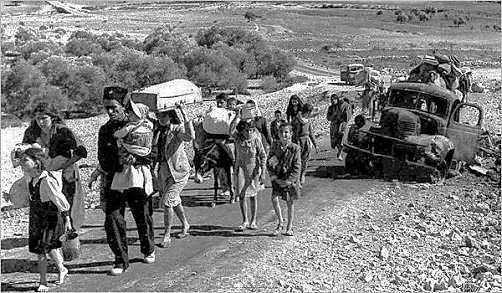
The concept of the Myth of Fingerprints originated in a long essay with regard to what is probably the most intractable conflict in modern times: One Land, Two Peoples: History, Memory, Continuity, and Inheritance. In That Howling Infinite has published many articles regarding the historical movement of peoples. For example: Modern history is built upon exodus and displacement. 

For more on Russia, Ukraine and the Soviet Union, see Russky Mir – Russian history’s long shadow. 

I highly recommend Ukrainian scholar Serhii Plokhy’s The Gates of Europe, a well told and fascinating story of the origins of Ukraine and Belarus, and how their histories were intertwined, and entwined with those of of Poland, Lithuania (which was a large and powerful state once) and Russia. Ukraine has historically been the border between the catholic west and the orthodox east, the division running virtually down the middle. The name Ukraine is Slav for border land. Its geopolitical location and natural resources have led to the land being inflicted by invaders, civil wars, man-made famine and repression. See, in In That Howling Infinite, Borderlands – Ukraine and the curse of mystical nationalism

And, finally, who or what were HuldreFolk? Named for the mythical and mystical ‘hidden people’ of Icelandic legend, for two years in the early nineteen eighties, they played throughout Australia. Their fame was short-lived; after two years they pursued their own paths and projects. But during the following decades, they would pop up in unexpected places, like their namesakes, in ones, twos, threes, and on occasions with guest HuldreFolkies. Their last outing as a trio was in October 2007 at the North By Northwest Poetry And Folk Club. Google the videos on YouTube. See also, Yuri The Storyteller … We’ll sure miss the old bastard! 

Roussinos’ essay follows, and also, for readers with time on their hands, more on Figes’The Stiry of Russia and on Morrison’s critique.

The fate of Europe lies in the steppes Warwick Ball: ‘The Eurasian Steppe’

Aris Roussinos, Unherd 28 July 2022
The fate of Europe lies in the steppes

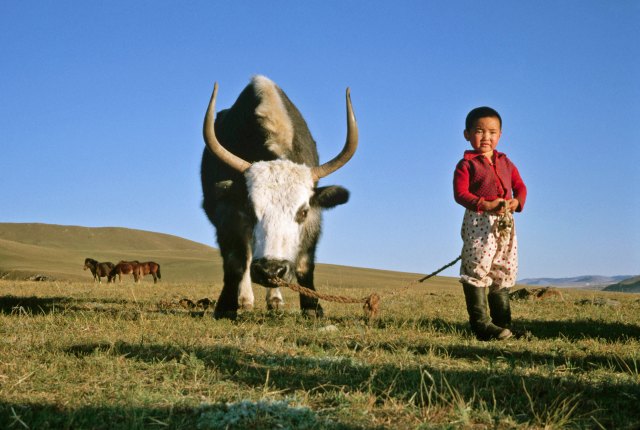
Genghis has won (Dean Conger/Corbis via Getty

On the road between the frontline cities of Sloviansk and Bakhmut, in Ukraine’s eastern Donbas region, three stone statues stand mutely by the side of the road, observing the coming and going of military traffic with impassive detachment. Known as balbals, they are funerary monuments erected by the Cuman Turks, known in Russian archaeology as the Polovtsians, who once ruled this vast sea of grass, long before Russian or Ukrainian speech was ever heard in this region.

For thousands of years, the empty, spreading steppe, stretching from Hungary to Mongolia, was the home of nomadic peoples, speakers of Iranic, Turkic and Mongolic languages, who drove their herds across the vast plains in search of fresh pastures. They founded great empires, which time and the steppe grasses would soon swallow up, leaving barely a trace. Their constant irruptions into Europe sounded the death knell in turn for other, settled civilisations, part of the endless cycle of growth, invasion and collapse that has shaped our continent’s history.

The war in Ukraine has taken place in two very different climatic and cultural zones: its initial phases saw Russian armour wend its way through the dark forests and marshes of northern Ukraine, the ancient homeland of the first Slavic peoples, to be destroyed in close fighting on the narrow wooded roads in a stunning and unexpected Ukrainian victory. Yet the gruelling war of attrition in the country’s east is taking part in a very different landscape, in the open steppe that was once the home of nomadic peoples.

The expansion of Slavic peoples, both Ukrainians and Russians, into the open steppe was a very recent historic event, broadly contemporaneous with the European settlement of the Americas, its fertile plains, now the breadbasket of the developing world, Europe’s equivalent of America’s Midwest. These open plains, the “Wild Fields” of local historiography have always been a contested space, where great empires wrestled for control: in the great Second World War battles of Kursk, Kharkiv and Stalingrad, Europe’s entire fate hinged on the battle between the two great tank armies wheeling and clashing like nomad hordes.

But then, as The Eurasian Steppe by the archaeologist Warwick Ball makes clear, rather than a semi-wild anteroom to the continent, “the history, languages, ideas, art forms, peoples, nations and identities of the steppe have shaped almost every aspect of the life of Europe”. Europeans from further west have for centuries been prone to viewing the steppe as the haunt of wild tribes, and the source of occasional, fearsome destruction.

But what if the Europe of today is in fact the product of steppe dynamics? As Ball argues, rather than being a product of 19th century nationalism, some historians trace the origin of Europe’s oldest nation states to the steppe, observing that “Peoples newly arriving from the east were also among the first to create nationally defined states, such as kingdoms of the Bulgars or Magyars”. “In some ways,” Ball argues, “the incipient idea of a nation state might have been stronger with the nomadic groups from the steppe, who were bound more closely by tribal loyalties” than among the polyglot peoples of the imperial Roman successor states they conquered.

Did the steppe peoples then create the fractious patchwork quilt of nationalities that we understand as Europe? Ball cites the archaeologist Hyun Jin Kim who claims that: “The political and cultural traditions of Inner Asia brought to Europe by Central Asian immigrants, the Huns and the Alans, were just as fundamental to the formation of western Europe as the rich legacy left behind by the Roman Empire. The political and cultural landscape of early medieval Europe was shaped by the fusion of Roman and Inner Asian influences.”

While Hungary and Bulgaria were directly founded by steppe nomads, the influence of steppe rulers also helped shape the political forms taken by Poland (whose szlachtanobles claimed Sarmatian descent well into the 19th century), Bohemia, Denmark and even, it is claimed, France. Even into the 19th century, as Ball notes, it was the Hungarian awareness of their steppe Magyar ancestry that helped bring about the rise of nationalism which shook apart the great Austro-Hungarian empire. “In the long evolution of the idea of the nation state,” then “from their beginnings in late-antique Europe to their emergence in the nineteenth century, we must look east as well as west”.

Viewed in this light, the war in Ukraine, a battle between a European nation-state and a vast Eurasian empire, is resonant with all manner of strange echoes of the steppe’s dimly-understood history. The colossal earthern ramparts of the “serpent walls” outside Kyiv, erected by early Slavic kingdoms to guard against invasion by steppe nomads from the Huns to the Mongols, fulfilled their ancient role admirably earlier this year when they prevented the movement of Russian armour towards the capital’s suburbs, corralling the latest wave of invaders into killing zones to be picked off at leisure by guided missiles.

The Cossack heritage both sides claim is the result of earlier Slavic peoples, runaway Ukrainian and Russian serfs, claiming the freedom of the open steppe and adopting the customs, lifestyle and much of the vocabulary of their nomadic Turkic predecessors. The very word Cossack, Ball notes, “derives from the Turk root qaz, ‘to roam’”, and is cognate with the ethnonym Kazakh further east, as the Cossacks “comprised mainly Russians — usually renegades, escaped serfs or criminals — but they also included Turks, Tatars and remnant Polovtsi.” Even now, Ukrainian is sprinkled with Turkic words, a legacy of the two cultures’ long history of interaction and competition. One Ukrainian commander I met went by the nom de guerre “Duman, or fog, deriving from the Turkic word for smoke or mist. Even now, Ukrainians refer to Russians with the dismissive Turkic epithet Katsab, or butcher.

On the Russian side, the war effort has been marked by the use of steppe peoples as infantry, with many of the heaviest casualties borne — and apparently some of the worst war crimes committed by — the Buryat Mongols of the Russian steppe, along with the Kalmyks of the lower Volga, Europe’s only Buddhist nation, who once watered their horses as far west as Paris following the defeat of Napoleon. Similarly, among the many subject peoples of the Russian empire deployed to Ukraine are Ossetians from the Caucasus, a tiny Iranic-speaking nation who are all that remain of the Alans, who once fought the Romans across Central Europe, settling as far west as France and Spain: some of their descendants, now Magyarised, still live in Hungary as the Jasz people. Their Iranic speech is now heard in Ukraine’s steppe for the first time in a thousand years, dragged along into a war of European conquest by another great Eurasian empire.

The very concept of chivalry which defined Europe’s medieval history was the product of Iranian-speaking steppe peoples like the Sarmatians and the Alans, whose innovations in the use of cavalry — stirrups, lances and long chainmail coats — changed the face of late Roman warfare and set the stage for the knights of the High Middle Ages. Even our own medieval romances may owe something to their distant steppe traditions, after the border forts of what is now northern England became the garrison home of Sarmatian levies in Roman service. As Ball notes: “Sarmatian warrior worship of a sword fixed in the ground has been suggested as furnishing the origin of the Excalibur legend. This appears to have been a long steppe warrior tradition: Ibn Rusta in the tenth century, for example, describes how the Viking Rus ruler — whom he calls by the steppe title of Khagan or khāqān — would plant a naked sword in the earth pointing towards his newborn son.” Perhaps it is not mere coincidence, then, that the Azov Regiment’s torchlit ceremonies in the southern steppe city of Mariupol took place beneath three giant swords embedded in the ground, a striking symbol that has now become the group’s emblem.

Again and again, these strange resonances between the steppe’s ancient nomad past and its bloody present swim to the surface like long-forgotten memories. The great statue to Mother Russia, sword in hand, that rises above Stalingrad’s Hill 102, where tens of thousands of Soviet and German soldiers were ground into the soil by artillery possesses the grim grandeur of some ancient steppe monument. And indeed, Hill 102, the crucial position of the battle that decided the war’s outcome, is perhaps better viewed by its alternate name as the Mamayev Kurgan, the burial tumulus of a long-forgotten Tatar khagan. From the ancient past to now, Russia’s history was written on the steppe, and without the steppe Russia’s imperial past and present is simply impossible to understand. Indeed, as Ball observes, without the historic domination of steppe nomads, there would be no Russia as we understand it.

As Ball observes: “The future of Russian greatness was both a response to and a legacy of the Mongols… Indeed, to a large extent Muscovite power was a creation of the Golden Horde: the khans required a stable central authority as a client state which could be relied upon to raise auxiliaries for the khan’s armies and to collect and deliver taxes and tribute. Moscow fitted the bill, so the Golden Horde deliberately strengthened it against the other Russian cities and appointed its prince as their chief tax collector.” Without the Mongol-enforced primacy of Muscovy, the land that is now Russia may well have remained a series of disunited kingdoms and city states, just like medieval Italy or Germany: “The Mongols, in other words, brought about the emergence of Russia.”

Even the great king Sviatoslav of Kyivan Rus, whose legacy is claimed by both Ukraine and Russia, extended his rule across the steppe by defeating the great Jewish Khazar kingdom and in doing so, “adopted the techniques and warfare of the steppe nomad: in other words, Kievan Rus was at first simply another steppe nomad state, albeit with a Scandinavian element. Sviatoslav never decisively defeated the Pechenegs and was killed by them in 963, and his skull was made into a cup in steppe tradition.” Medieval Russia was, then, as much a steppe polity as a European state, perhaps more so. After all, “up until 1480 Muscovite coins still carried inscriptions in Arabic. As late as 1531 Vasili III of Moscow was still paying tribute to the successors of the Golden Horde: Crimea, Kazan and Astrakhan”, and the eternal symbol of Russian power, Moscow’s St Basil’s Cathedral, was modelled on Kazan’s Great Mosque, in thanks for the conquest of the great Tatar capital.

Tracing Muscovy’s traditions of governance, and then those of imperial Russia, to the Mongol and Tatar customs of the inner steppe, Ball observes that “Even by the fourteenth century the civil and military institutions of Muscovy ‘were overwhelmingly Mongol in origin’… Ivan IV, the first Russian to proclaim himself Tsar (in Russian the title is actually Tsezar), added Ulugh Khan, ‘Great Khan’, to his titles.” Though he dismisses the “Mongol Yoke” hypothesis of Russian historiography, Ball nevertheless traces Russia’s unique and terrible form of autocratic rule to steppe customs, deep into the modern period: “Ivan also adopted the Mongol policy of ‘collective guilt’ where all male relatives and retainers of a guilty man would be executed, a policy even extended to entire communities. Stalin’s similar policy was a continuation of this.” The steppe’s long influence stretches deep into the cultural DNA of our modern world: even such a giant 20th century figure as Lenin, destroyer of one great Eurasian empire and founder of another, was of part-Kalmyk descent, after all.

Imperial Russia’s second largest minority after the Ukrainians, whose post-independence relationship with their giant neighbour is today a source of such bloodshed, was the Muslim Tatars, from whose Russified nomad aristocracy some of the greatest names in Russian culture — Rachmaninoff, Turgenev, Nureyev and Akhmatova — claimed descent. “The list [of Tatar surnames] covers all walks of Russian life: artistic, religious, scientific, literary, military, political and royal. The list is virtually endless,” Ball notes, and even today “the descendants of the Mongol ‘hordes’ — the Tatars — are the second-largest minority in Russia after the Russians themselves, and the Republic of Tatarstan is the second-largest republic in European Russia.”

Written for a general audience, Ball’s book nevertheless synthesises the latest archaeological research and historical debate on the steppe’s ancient and modern peoples, archaeological research on the steppe’s history, delving back into the deepest mists of time. The burgeoning community of esoteric archaeology and anthropology posters on Twitter will surely appreciate his summarising of the latest research on the origins of the Indo-Europeans, the fate of the Khazars and the birth and decline of the great Scythian kingdoms, who’s exquisite goldwork was the highlight of the British Museum’s recent blockbuster exhibition.

Noting that St Petersburg’s great Hermitage Museum was founded primarily as a place to store the newfound Scythian treasures unearthed by Russian colonists in Crimea, Mariupol and the rest what is now Ukraine’s contested southern steppe, and alert to the theft of Scythian treasures from Ukrainian museums by their new-old Russian conquerors, we realise that the relentless cycle of history has brought a new relevance to Ball’s book, even since its publication last winter. Just as in the Middle Ages and in the bloodiest battles of the Second World War, the fate of Europe is once again being written on the endless, grassy steppe.

Aris Roussinos is an UnHerd columnist and a former war reporter.

Orlando Figes’ The Story of Russia

That is a very happy coincidence, because Roussinos’ essay and Figes’ The Story of Russia are really circling the same enormous question from different directions: what made Russia Russia?

Figes is, in many ways, the antidote to the more sweeping “fingerprints of the steppe” argument. He certainly does not deny the Mongol inheritance  – quite the opposite. The Mongol conquest of the Rus principalities in the thirteenth century was one of the decisive ruptures in Russian history. It destroyed Kyiv’s old political centrality, subordinated the northern principalities to the Golden Horde, and created the conditions in which Moscow could eventually rise. The irony, as both Roussinos and Figes emphasise, is that the Mongols did not simply delay Russian state formation; they helped create the particular form of state that emerged.

But Figes is interested less in what Russia inherited than in what Russia made of those inheritances. The Mongols supplied mechanisms of rule – taxation, military organisation, hierarchy, a relationship between ruler and subject that was very different from Western feudalism. Yet Russia’s self-understanding was built around other ideas: Orthodox Christianity, Byzantium, the idea of Moscow as the “Third Rome”, and the notion that the Tsar was not merely a monarch but a sacred figure.

This is where it links beautifully with Morrison’s critique. The danger is that we see the Mongol “fingerprints” and assume they explain everything. But fingerprints do not tell you why the person picked up the knife, wrote the letter or opened the door. They tell you something about contact and inheritance; they do not reveal intention.

Figes’ Russia is a civilisation built from multiple inheritances: Byzantine, Slavic, steppe, European and imperial. The great Russian paradox is that it has often defined itself simultaneously as both European and apart from Europe. Peter the Great famously tried to drag Russia westward — shaving beards, building St Petersburg, importing European science and manners — yet the deeper structures of autocracy, hierarchy and imperial expansion remained. Later Slavophiles rejected the West and celebrated a distinct Russian path, while Westernisers argued that Russia’s tragedy was precisely its failure to become sufficiently European.

This also connects with our earlier discussion of maps and historical memory. Russia is, geographically, an extraordinary historical anomaly: a European state that expanded across Asia until it became a continental empire. The map itself creates the tension. Is Russia Europe? Asia? Eurasia? The answer has shifted depending on who was asking and what political argument they wanted to make.

One of the things I suspect you will appreciate in Figes is his attention to recurring Russian archetypes: the Holy Tsar, the Holy Fool, the tension between obedience and rebellion, the recurring belief that Russia has a unique destiny. These are not “genes” or immutable cultural DNA; they are traditions — stories Russians told about themselves. And stories matter enormously because people act upon them.

That brings us back to Roussinos’ evocative phrase, “the echo of the steppes”. Echoes are fascinating precisely because they are not the original sound. They are altered, refracted and carried forward. The Mongol conquest echoed through Muscovy; Byzantium echoed through the Tsars; Soviet power echoed through Putin’s Kremlin. But each generation chooses which echoes to amplify.

There is also a pleasing connection with your earlier fascination with maps and atlases. A physical map of Russia looks almost inevitable: the enormous landmass stretching from Europe to the Pacific. But Figes and Morrison both remind us that geography creates possibilities, not destinies. The Russian Empire was not simply “there” waiting to happen. It was built by choices — by princes, tsars, revolutionaries and commissars who made decisions within particular historical circumstances.

So perhaps the combined lesson of Figes, Roussinos and Morrison is this:

Russia is not merely a European country contaminated by Asia, nor an Asian empire wearing European clothes. It is a civilisation formed in the meeting place of worlds. The tragedy is not that it has a complicated past; all great civilisations do. The tragedy comes when a complicated past is reduced to a single myth of inevitable destiny.

Which, interestingly, brings us back to your recurring theme: the power  – and danger –  of maps. Every map is an argument about the past. Every empire is a story it tells about itself. And every story leaves fingerprints. The historian’s job is to work out which ones are real, which ones are imagined, and which ones have been deliberately placed there.

Alexander Morrison’s critique

Alexander Morrison, a historian of Russian history at Oxford University, specialising in the Russian conquest of Central Asia, commented on Roussinos’ essay in Unherd. Here it is in full.

Roussinos, seems to have made good use of Ball’s research. Some of these arguments are completely uncontroversial when applied to the Asian neighbours of the Eurasian steppe in the early modern period: the Ottomans, the Safavids of Iran and the Qing all made use of Chinggisid and TImurid political repertoires in building their states alongside other elements (Byzantine heritage for the Ottomans, the existing Chinese imperial tradition in the Qing case, Sufi religious charisma for the Safavids). The Mughals were of course actually of Timurid (and in the female line of Chinggisid) descent, and it was at the core of their dynastic ideology in India.

However the steppe political tradition seems to have produced ever larger polities in Asia, which makes it hard to explain why it would instead produce political fragmentation in western and Central Europe – I think that part of Ball’s argument is a bit overstretched.

The Muscovite example seems to fit the Asian pattern better, and Roussinos is spot on in saying that it was the willingness of the Princes of Moscow to act as particularly loyal and effective satraps and tax collectors for the Golden Horde that allowed what had previously been a minor Rus’ princedom to rise to pre-eminence.

However we need to be clear about what it was that Muscovy took from the Mongols: it was largely bureaucratic structures linked to taxation or communication. This why key Russian words such as kazna (treasury), den’gi (money) and yam (postal service) are of Mongol origin. On the cultural side the ruling ideologies of the state were all to do with Orthodox Christianity and the semi-mythical link to Byzantium (the ‘Third Rome’), which was what Ivan IV (the Terrible) was evoking when he took the title of Tsar (Caesar) – he may have added the title of khan for good measure but this was largely for the purposes of communication with steppe peoples.

Many Tatar nobles of Chinggisid descent did become incorporated into the Muscovite aristocracy after the fall of Kazan in 1552, but you need to be careful about 19th and 20th-century claims to this ancestry, which are often bogus (it was fashionable at the time). In the case of Akhmatova it was her nom de plume (she was born Anna Gorenko – in fact a Ukrainian name). In any case Chinggisid descent did not give you any kind of claim to the throne of Muscovy, which had its own dynastic legend in the Rurikids. A better guide to the relationship between Muscovy and the Mongols than Ball is Donald Ostrowski.

There is also a bit too much cultural determinism in all of this to my liking – it suggests that neither Russia nor Ukraine can ever shake off this bloody past etc. etc. Nowhere in the world is simply a prisoner of its past. What is happening now is a result of very specific political choices made by Vladimir Putin and Russia’s ruling elite. Their thinking is rooted partly in their reading of 19th-century Russian historians (who first came up with the idea that Russians and Ukrainians were the same people), vicious forms of anti-semitic Russian nationalism of the early 20th century and the emigration (the Black Hundreds, Ivan Il’in), a particular, tendentious interpretation of both Soviet history and their own memories of the Soviet collapse.

What is perhaps more relevant is that this steppe past means that most of southern and eastern Ukraine was only relatively recently settled – not just by Russians and Ukrainians, but by the whole range of peoples of the empire (Greeks, Jews, Bulgarians, Armenians…probably also some Ossetians). They are certainly not ‘ancient Russian lands’ as Putin has claimed, but they are part of Ukrainian territory under international law and the Budapest memorandum assuring the country’s territorial integrity which Russia signed.

A couple of other corrections – the Buryats are not a steppe people, they live East of Lake Baikal. I am a bit queasy about the implication that they and the Kalmyks are disproportionately represented in the ranks of the Russian army because of their ‘savage’ steppe nature – it is simply because these are some of the poorest parts of the Russian Federation, and because the Russian regime is very deliberately trying to avoid recruiting troops from metropolitan regions of European Russia whose families might cause political trouble or have ties to Ukraine.

The ethnic Russians who are fighting are also disproportionately from Siberia or the Altai. The regiment which committed the atrocities at Bucha was from Khabarovsk in the Russian Far East, and its commander appears to have been originally from Karakalpakstan. Most Ossetians speak Russian these days, and have long identified with Russian rule. A good piece though – not many outlets would allow as thorough and as thoughtful a review of a work on Eurasian History.

Morrison’s comment stands apart from most of the thread because it does what the best scholarly criticism should do: it accepts the broad thesis where the evidence supports it, corrects errors where necessary, and resists the temptation to replace one grand narrative with another.

The essence of Morrison’s critique is this:

He accepts the central proposition that Muscovy inherited important features from the Mongol world. Indeed, he strengthens it by pointing out that similar borrowing occurred across Eurasia. The Ottomans, Safavids, Mughals and Qing all incorporated Chinggisid or Timurid political traditions into their own states. Russia was therefore not unique in absorbing institutions from the steppe.

Where he parts company with Ball is over determinism. Ball appears to argue that steppe political culture explains not only Muscovy’s rise but much of Russia’s subsequent history and perhaps even Putin’s Russia today. Morrison thinks this stretches the evidence too far. Administrative institutions can endure for centuries; they do not imprison nations forever. Modern Russia, he argues, is the product of choices made by a particular elite, drawing on nineteenth-century nationalism, Soviet memories and contemporary ideology, rather than the inevitable flowering of Mongol political culture.

He also introduces some valuable nuance. Muscovy borrowed bureaucratic techniques—taxation, communications, administration – from the Golden Horde, but its ideological heart remained Orthodox and Byzantine. Ivan IV’s claim to be Tsar rested on the idea of Moscow as the “Third Rome”, not the successor of Genghis Khan. Even the Russian language preserves this administrative inheritance in words such as kazna (also in Arabic,treasury), den’gi (money) and yam (postal relay), all of Mongol origin, illustrating that institutional borrowing need not imply cultural subordination.

Morrison is equally careful about ethnicity. He rejects romanticised claims of Chinggisid ancestry, notes that many were fashionable nineteenth-century inventions, and cautions against portraying Buryats or Kalmyks as somehow naturally warlike. Their prominence in today’s Russian army is explained far more convincingly by economics and recruitment policy than by any inherited “steppe mentality”. That is a useful reminder that socio-economic factors often explain what cultural stereotypes merely decorate.

His discussion of Ukraine is similarly restrained. Southern and eastern Ukraine were indeed settled comparatively recently by a mosaic of peoples across the imperial period, making simplistic claims of ancient ethnic ownership difficult to sustain. Yet that historical complexity does not undermine Ukraine’s internationally recognised borders or Russia’s commitments under the Budapest Memorandum. History explains; it does not necessarily justify.

Finally, Morrison performs the historian’s essential task of distinguishing influence from destiny. States inherit institutions, myths and habits, but they are not condemned to repeat them. This is perhaps his strongest point. It is tempting to explain Putin’s Russia by reaching back to the Mongols, Ivan the Terrible or the “Russian soul”, just as earlier generations invoked “ancient Balkan hatreds” to explain Yugoslavia. Such narratives are elegant because they reduce contingency to inevitability. Historians, however, are generally suspicious of elegant explanations.

His recommendation of Donald Ostrowski is also telling. Ostrowski’s work has long argued that Muscovy’s relationship with the Mongol world was one of selective adaptation rather than wholesale inheritance. That is a subtler – and probably more persuasive – account than one that sees Russia as simply Europe’s most successful steppe empire.

In short, Morrison doesn’t demolish Ball’s thesis. He refines it. He accepts that the steppe mattered enormously, but insists that institutions are not destiny, that cultures borrow selectively, and that political choices remain more important than historical determinism. It is precisely the kind of intervention that lifts an online discussion from polemic into genuine historical

What  Unherd Readers had to say about Roussinos’ essay

The comments divide into several broad themes rather than converging on a single interpretation, and in many ways become a debate about contemporary Russia as much as about history.

Many readers found the article fascinating and praised it for opening an unfamiliar chapter of Eurasian history. Several immediately ordered Christopher Ball’s book, while others supplemented the discussion with examples ranging from the Kalmyks’ influence on Austrian costume to the chess capital of Elista, the legacy of the Mongols in Central Europe, and the wider political traditions of the Eurasian steppe. A number of contributors recommended additional works, notably Peter Frankopan’s The Silk Roads and Donald Ostrowski’s scholarship on Muscovy.

A second group challenged aspects of the historical argument. Critics argued that the article overstated the influence of steppe culture on later European political development, confused mythology with history in discussing Poland and Hungary, and oversimplified the origins of the Cossacks and the Azov Regiment’s symbolism. Others objected to what they saw as cultural determinism: the suggestion that Russia’s present behaviour is somehow an inevitable product of its Mongol inheritance. Several historians in the discussion -Morrison particularly, stressed that Muscovy certainly inherited administrative and fiscal practices from the Golden Horde, but that its religious ideology and dynastic legitimacy remained fundamentally Byzantine and Orthodox. They argued that modern Russian policy reflects political choices by Vladimir Putin and his circle, not an inescapable historical destiny.

As often happens, the historical discussion quickly became a proxy for arguments over the war in Ukraine. One camp maintained that Ukraine is an artificial state whose disputed regions deserve internationally supervised referendums, criticising NATO expansion and Western military support while advocating diplomacy. The opposing view rejected these claims as Russian propaganda, pointing to Ukraine’s overwhelming vote for independence in 1991, insisting that no genuine referendum is possible under military occupation, and arguing that Russian aggression – not Western policy – is the central issue. A more extreme minority advanced familiar pro-Kremlin narratives, portraying NATO as the true aggressor and Russia as a defensive victim, provoking vigorous rebuttals from other commenters.

There was also a meta-debate about free speech. An inflammatory remark describing Russians in derogatory terms prompted accusations of hate speech and counter-accusations of “crybullying”, illustrating how discussions of Russia often slide into arguments over acceptable language as readily as they do over history.

The most substantial contribution came from historian Alexander Morrison, whose lengthy critique was widely praised by other readers. Morrison broadly accepted the article’s central insight – that Muscovy’s rise owed much to its role within the Mongol imperial system – but argued that the thesis was pushed too far. He emphasised the distinction between administrative inheritance and cultural identity, corrected numerous historical inaccuracies, warned against deterministic readings of history, and reminded readers that modern events stem from contemporary political decisions rather than immutable civilisational characteristics. His intervention effectively became the intellectual centre of the comment thread, with several readers declaring that it improved upon the article itself.

Overall, the discussion reveals both the appeal and the risks of grand historical narratives. Most readers accepted that the Eurasian steppe profoundly shaped Russia’s development. Where they diverged was over the extent to which that past explains the present, and whether history should be read as a story of enduring civilisational patterns or of contingent political choices. The resulting debate ranges from thoughtful historiography to contemporary geopolitics, with occasional excursions into conspiracy theory and internet polemics.
Chaos without a compass … Donald Trump’s Persian “excursion”

Without seeming to realise what he has done, Trump has exposed the raw fact that the US is no longer a full-spectrum military hegemon able to project power simultaneously in multiple theatres across the planet. It has superb armed forces and technology – but that is not the same thing.                                Ambrose Evans-Pritchard, The Telegraph, 11 March 2026

The Twentieth Century’s “Thirty Years War”, the war of my generation, was waged in South East Asia initially by the colonialist France, and then by neo-imperialist America. France’s war ended in defeat and ignominy for French arms and prestige, and a partition that was but a prelude to America’s Vietnam quagmire. [In In That Howling Infinite, see Tim Page’s War – a photographer’s Vietnam journey]

America’s War has since been defined as chaos without compass. It was inevitable that acclaimed historian Barbara Tuchman would chose it as one of her vignettes in The March of Folly, her celebrated study of débacles through the ages characterised by what would appear to be a single-minded determination amounting to tunnel vision that is akin to stupidity.

As Tuchman saw it, exceptionalism and manifest destiny are historically proven folly. Self-belief in American power and righteousness has historically created delusions of grandeur, obstinate attachment to unserviceable goals, stubbornness, and an inability to learn from past mistakes or even admitting error – a wooden-headedness that often sees the US persisting on erroneous paths that lead to loss of blood, treasure, reputation and moral standing.

Why did the US’ experience of backing the wrong horse in China in the forties not provide an analogy and warning in Vietnam in the fifties? Why did the experience in Vietnam not inform it with respect to Iran right up to the fall of the Shah in 1978? And why hadn’t it learned anything when it stumbled into Salvador in the eighties? And then, of course, we arrive in the 21st century with no-exit, never-ending wars in Afghanistan and Middle East that end in retreat and betrayal with the ‘freedom-loving’ USA still backing the wrong horses by supporting autocrats and tyrants against their own people.

Tuchman was describing a particular pathology of statecraft-  the spectacle of governments pursuing policies visibly contrary to their own interests while possessing the intelligence, experience and evidence to know better. Power, in such circumstances, is not lacking. Direction is.

In the American case, she saw something close to a recurring pattern. Self-belief in American power and virtue could generate a peculiar strategic blindness – delusions of grandeur, obstinate attachment to unserviceable goals, and a refusal to learn from past mistakes or even admit error. The result was a form of national tunnel vision: the conviction that sufficient determination and force must eventually bend reality to American purposes. Too often the outcome was the opposite — the expenditure of blood, treasure, prestige and moral authority in pursuit of objectives that proved unattainable.

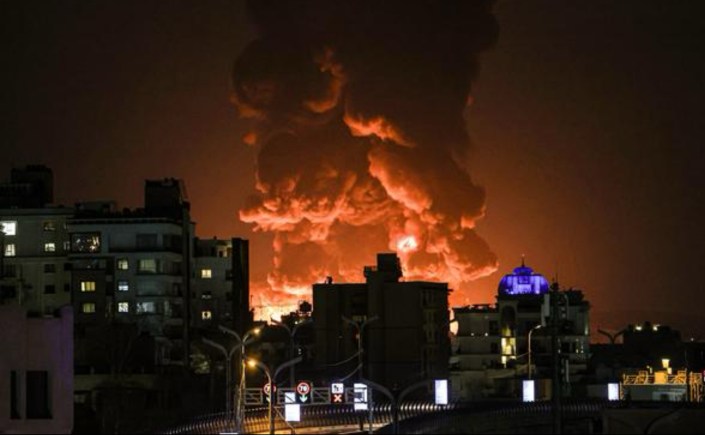
It is difficult not to hear the echo of Tuchman’s diagnosis when considering the widening conflict now unfolding between Israel, the United States and Iran. The scale of the military campaign alone is remarkable. Australian commentator and security expert David David Kilcullen’s description in an article in The Australian, republished below, reads almost like a catalogue of twenty-first-century warfare: thousands of sorties in the first hundred hours, stealth fighters dismantling air defences, B-2 bombers opening corridors through Iranian airspace, naval engagements stretching from the Persian Gulf toward the Indian Ocean, tankers burning in the Strait of Hormuz while drones and missiles ripple across the wider region. Cyberattacks strike data centres, satellite navigation systems are jammed, and the conflict unfolds simultaneously across air, sea, cyberspace and orbit.

In strictly operational terms the campaign appears formidable. Iranian air defences have been degraded, missile launchers and command networks methodically targeted, naval assets hunted down. Western air power increasingly operates across Iranian skies with relative freedom. In the narrow military sense, success seems plausible.

Yet wars are not judged by tactical success but by political outcome. And here the picture grows strangely indistinct.

The most striking criticism of the conflict — articulated most clearly by Aris Roussinos in an article in Unherd republished below –  is that no one appears able to define what victory would mean. Possible objectives multiply: regime change in Tehran; destruction of Iran’s nuclear programme; the degradation of Iranian military capabilities; or a wider strategic aim of constraining Chinese influence across Eurasia. Each implies a different war. Regime change requires internal collapse or occupation. Nuclear disarmament ultimately requires diplomacy and verification. Strategic competition with China belongs largely to another theatre altogether.

The result is a peculiar strategic ambiguity: immense military force applied in pursuit of ends that remain fluid, sometimes contradictory, occasionally improvised after the fact.

Roussinos therefore invokes an earlier historical analogy: the Suez crisis of 1956 – as have other commentators. That operation was militarily successful yet politically disastrous. British and French forces seized the canal zone quickly and efficiently, only to discover that the political objective — preserving imperial influence — collapsed under international pressure. Today’s conflict, he suggests, may represent a kind of reverse Suez: a large military campaign unfolding before the political objective has even been clearly articulated.

Hovering behind this debate is another and more recent ghost: Iraq. Kilcullen’s experience in Iraq and Afghanistan informs his caution. Removing regimes, he notes in an article in The Australian, is often easier than replacing them. The Taliban returned after twenty years of war. Iraq descended into sectarian violence after Saddam’s fall. Libya’s regime collapsed quickly but left behind a fractured state.

Iran, however, is not Libya. It is a nation of ninety million people with a deep historical identity and a political culture shaped by both imperial memory and the Shiite narratives of martyrdom that animate the Islamic Republic. Foreign attack may weaken the regime — but it may also strengthen the nationalist solidarity on which that regime depends.

Here the shadow of Iraq becomes unavoidable. The question that haunted that war returns once more: what happens the day after victory?

Supporters of the campaign insist that what appears chaotic may in fact be the culmination of long-term strategy. Israeli intelligence has spent years penetrating Iranian networks, sabotaging nuclear infrastructure and eliminating key figures. Others place the conflict within the larger geopolitical contest with China, arguing that weakening Iran constrains Beijing’s long-term influence across Eurasia.

Yet even these arguments leave uncertainty intact. If the central contest lies with China, the Middle East becomes a dangerous diversion. If nuclear disarmament is the aim, diplomacy will eventually be unavoidable. If regime collapse is the goal, history suggests that air power alone rarely produces it.

Meanwhile the war itself expands. Hezbollah strikes from Lebanon. Houthi forces threaten shipping in the Red Sea. Missiles fall across Gulf states. Cyberattacks ripple outward through global infrastructure. Modern conflicts rarely remain geographically contained; the networks of trade, alliances and proxy forces ensure that violence spreads outward in widening circles.

Kilcullen’s observation, delivered with the weary clarity of experience, captures the problem succinctly: war is inherently complex and non-linear, unleashing forces that no strategist can fully predict or control.

Old phrases return easily in such circumstances. One of them comes from Cicero: Inter arma silent leges — among arms the laws fall silent. Yet when law falls silent, prudence often follows. The machinery of war — alliances, domestic politics, military planning — acquires its own momentum. Decisions initially framed as temporary expedients become permanent commitments. Vietnam began with advisers; Afghanistan with a punitive expedition; Iraq with inspections and resolutions. History rarely begins with the word “quagmire.”

What is most striking in the debate surrounding the present war is not the intensity of disagreement but the depth of uncertainty. Some believe the Iranian regime is brittle and nearing collapse; others believe foreign attack will strengthen it. Both views rely on historical analogy; neither fits perfectly.

Which brings us back, inevitably, to Tuchman. Her great theme was not that governments make mistakes — that is the normal condition of politics — but that they sometimes continue down dangerous paths even after the warning signs become visible.

Whether the present conflict will prove another example of such folly remains to be seen. It may yet reveal a coherent strategy whose logic becomes clear only with time. Or it may confirm once again Tuchman’s darker insight about the persistence of wooden-headedness in the councils of power.

For the moment the war continues: vast in scale, impressive in its technology, uncertain in its purpose. And somewhere in the background, like an echo from another era, the old phrase lingers once again – chaos without a compass.

And then, of course, there’s Trump. To return to Ambrose-Pritchard, who opened this essay: “So which will prevail in the tug of war within Trump’s personality: his fear of losing the US midterm election? Or his injured vanity and his psychological need to command “escalation dominance”, always and everywhere?

For other articles on Iran in In That Howling Infinite, see: Messing with the Mullahs – America’s phoney war? The quality of mercy … looking beyond Iran’s ghost republic and “Because of …” Iran’s voice of freedom, and The end of the line … an epitaph for a tyrant

Trump’s reverse Suez

Starmer should beware another quagmire

Aris Roussinos, Unherd,  March 7 2026 

As we approach the 70th anniversary of the Suez Crisis, from which France’s political class learned to never again let their country’s security become subject to America’s veto, and Britain’s to never again distinguish between its own national interests and Washington’s whims, it is worth remembering that — judged purely as a military operation — the seizure of the Canal Zone was highly successful. The Canal itself, and a buffer zone around it, were captured within days, with limited casualties; the operation’s technical proficiency was praised by the First Sea Lord, Lord Mountbatten, even as he twice attempted to resign in protest at the political folly of it all.

Yet success or failure will be a harder judgment to make for historians of Trump’s own latest Middle East adventure, which is already starting to look like a reverse Suez: its exposure of the limitations of pure military power; the domestic and international hostility; the fragility of alliance systems lazily assumed to be solid; and the wider overtones of an empire wildly overreaching in an attempt to stave off terminal decline. The difficulty in ascertaining, when this ends, whether or not Trump has achieved his war aims rests simply in the fact that the aims so far put forward have differed wildly, and are often mutually contradictory. The Suez Operation possessed a clearly defined military goal which succeeded, and a wider political one, which failed. As it stands, the Trump administration appears in possession of neither.

The broader arguments against the current conflict were most memorably made by Trump himself, campaigning as an anti-war candidate who would keep the United States out of costly and unmanageable Middle Eastern entanglements. His Vice-President, JD Vance, once articulately made the case against this very war. Having successfully demolished his own policy platform, it is difficult to determine what would now count as victory for Trump. The desired outcomes given, at the time of writing, have ranged from the maximalist deliverance of “freedom” to the Iranian people through full regime change in Tehran, through to inspiring an ideal “Venezuela solution” in which more amenable military figures launch an internal coup, then perhaps installing a Shah, ruling Iran remotely from the more stable comfort of Maryland. Or else simply destroying Iran’s nuclear enrichment capacity (which Trump claimed to have “obliterated” in June last year). This scrambling for post facto rationales appears to derive from the fact that Iran did not immediately fold, as Trump apparently assumed it would, with the assassination of its leadership: unlike today’s America, it is not a personalist regime.

Yet if America’s war aims are nebulous from a lack of preparation, Israel’s appear haphazard by design. Summing up Netanyahu’s goals, the Israeli strategic analyst Danny Citrinowicz observes that “If we can have a coup, great. If we can have people on the streets, great. If we can have a civil war, great. Israel couldn’t care less about the future [or] the stability of Iran.” Whatever Netanyahu’s aspirations, a heavily armed but leaderless Iran, engulfed in chaos, represents a strategic threat rather than a victory for the wider West. In this, it appears that America has launched a war alongside, and at the behest of, a notionally junior partner with wildly divergent goals, and which Washington has already admitted it is unable to rein in. For British politicians, all the warning lights should now be blinking red: even the Iraq War, a historic disaster, was vastly better conceived, planned and resourced than this.

“Even the Iraq War, a historic disaster, was vastly better conceived, planned and resourced than this.”

And if America’s war aims are vague and contradictory, their proposed means of achieving these desired outcomes are too — including Iranian submission through aerial bombing alone — a result which has never yet been obtained in the century-long history of air power — through launching a peripheral revolt in which Kurdish and perhaps Baluchi separatists act as America and Israel’s boots on the ground. The best that can currently be said for Trump’s gamble is that the desired end-state is so nebulous in its imagining, and the approach so scattergun, that almost any off-ramp can be spun as a victory by his imperial court and its attendant sycophants. With no single, coherent outcome proposed, Trump can claim, as he already has, that the war has already succeeded beyond the wildest dreams of planners. This is even as he is warning his base that victory may yet take some weeks, and cautioning Congress that “it is not possible at this time to know the full scope and duration of military operations that may be necessary”.

The war was, it seems, resourced for a few days of intensive bombing, with little anticipation of Iran striking back against Gulf states, and American early-warning facilities, with its arsenal of low-cost drones. Policy is now being made on the hoof, with senior administration officials “at each other’s throats” on the need for ground troops. CENTCOM, overseeing the war, has requested an increase in military intelligence analysts “to support operations against Iran for at least 100 days but likely through September”. The spectacle of a days-long special military operation, entered into with an over-confident faith in hard power achieving a swift political solution, then dragging on interminably, is all too familiar. For Vladimir Putin, certainly, America’s unforced error of embroiling itself in a quagmire US presidents have spent a half-century studiously avoiding is a godsend, depleting Western munitions stocks, replenishing the Kremlin’s coffers through rising oil and gas prices, and weakening Europe’s negotiating power.

Judged on strict military terms, though, the operation has chalked up notable successes. Iranian ballistic missile launches have slowed, and no doubt the aerial onslaught is depleting Iran’s arsenal of both munitions and launchers. The looming switch from stand-off munitions to less sophisticated bombs implies that air superiority has already been achieved, as Israel declared last weekend, or will soon be achieved, as the White House more cautiously claims. Whether or not Israel, the US and the Gulf states will run out of interceptor munitions before Iran runs out of missiles is a matter of speculation for even the best-informed analysts. Even as Pentagon sources brief concern over their dwindling arsenal, the Trump administration, for what it is worth, claims that it possesses “unlimited” stocks of munitions for a war that could last “forever” — while simultaneously blaming Ukraine for running down its weapons stockpile.

The most recent American attempt to exert its will in the region through air power alone, against Yemen’s Houthis, who are vastly weaker than Iran, entirely failed. The Houthis have not yet joined the war, as Hezbollah now has in response to Israel’s invasion of southern Lebanon: the prospects for escalation grow wider by the day. As for boots on the ground, the much-briefed claims that Iran’s Kurds are willing to join in the war against Tehran remains debatable. The Kurdish Regional Government of Northern Iraq, which hosts exiled Iranian Kurdish militias, has been warned by Iran that their entry into the war will invite an Iranian response, and has stressed its neutrality as a result. It has not even been a month since Washington abandoned its last Kurdish partners: they must now judge whether this time round America will prove a more dependable ally.

For all the military risks involved, it is very possible, though far from certain, that US and Israeli bombing can bring about the collapse of the Iranian state, though what happens next is anyone’s guess. The US Chairman of the Joint Chiefs, General Dan Caine, reportedly cautioned before the strikes began “about the potential downsides of launching a major military operation targeting Iran”, citing “the scale, complexity and potential for US casualties of such a mission”, and asserting he was “​​unable to predict what the result of a regime change operation would be”. Both the Iranians and the Americans have already claimed to have received, and rejected, the other’s request for a ceasefire, with Israel reportedly seeking assurances Washington is not already seeking private talks. In any case, the Iranians have good cause to be wary of negotiating with Trump, given that their previous rounds of negotiations ended in American and Israeli bombing. Indeed, the current war began with Israel’s aerial assassination of the country’s political leadership in the middle of negotiations which, the Trump administration later boasted, were merely a ruse. Some of America’s intended new rulers of Iran, Trump has claimed, have already been killed by Israel. Having launched a war of choice, at a time convenient to him, Trump may now find ending it a far less simple affair.

As it stands, it is in Iran’s interest to drag out the war for as long as possible, expanding it across the wider region, increasing the economic disruption to American allies, and capitalising on the widespread hostility to the war. As both Trump’s anti-interventionist base and the Democrat opposition rightly proclaim, this war has been entered into without any coherent plan, seemingly through Israel’s chain-ganging of the United States into military action it would not otherwise have chosen, an observation claimed as antisemitic by Israel’s advocates in the United States yet which has nevertheless also — bafflingly — been offered as proof of the war’s necessity by America’s Secretary of State Marco Rubio, the House Speaker Mike Johnson, Senate Intelligence Committee chair Tom Cotton, and most recently by Trump himself.

As for Netanyahu, he exultantly claims that bringing America into the war is something he has “yearned to do for 40 years”. The Democrats, repeatedly briefingthe attack line that Trump was “the first president stupid enough” to be cajoled by Netanyahu into war with Iran, have now been gifted a path to success in midterm elections which may yet overlap with the conflict itself. When as cynical a politician as Gavin Newsom feels safe questioning future military support to the “apartheid state” Israel, demanding from the podium “Why did we help Israel kill little girls?”, we see the cracks in America’s only true special relationship widening into a gulf. This war was, most probably, Netanyahu’s last chance to enlist the fading superpower against his decades-long foe. Whether it improves Israel’s long-term strategic position is doubtful in the extreme  — but none of this is Britain’s problem.

It goes against instinct to praise the Prime Minister for his lawyerly prevarication. Yet given all the risks and uncertainties inherent to this war the arguments against joining America and Israel’s wild gamble are as strong as can be imagined. Just weeks ago, the same Trump administration which now chides us for our caution was threatening to annex European territory, and mocking our participation in its previous disastrous wars. Even if we exclude, as the Prime Minister does not, the moral factors, Starmer is entirely correct to say that this is a war with “no viable plan”. It appears that the Prime Minister, through his twin flaws of excessive deference to both European opinion and international law, may yet be dragged, unwillingly, towards the national interest. We already have our own war to worry about, in which the desire or ability of the United States to negotiate a satisfactory conclusion looks as doubtful from London as Washington’s reliability as a negotiating partner must look from Moscow. American realists may be correct in stating that the Ukraine war, in which Britain is already dangerously over-exposed, is not a core Washington interest — but neither is Netanyahu’s latest war of choice a British or European interest. Simply put, there is no advantage for Britain in joining this distant conflict, and the national interest, as in the Gaza War of which this is a vast escalation, remains in staying out of the affair as far as possible.

It is absurd, then, to watch Reform politicians, so recently bemoaning Britain’s political enmeshment with distant Middle Eastern conflicts and diaspora grievances, caper onstage with Israeli and Iranian monarchist flags, demanding our involvement in this mess. Farage’s hiring as foreign policy adviser of the neoconservative lobbyist Alan Mendoza, who has never yet seen a disastrous war he did not wish to join, was a rare deviation from his sharp political instincts, and a warning of the major strategic risks inherent in a Reform government, however much their domestic agenda may appeal. The Greens will rightly benefit from this misstep, as will, on Reform’s Right, Restore, edging towards a Powellite indifference to distant wars. If he holds his course, so will Starmer too.

The dilemma now for the Prime Minister is whether or not to join the emergent European policy of defensive neutrality, protecting national and continental interests while refusing involvement in the wider campaign. Yet the almost wholesale capture of the British security establishment by an Atlanticist ethos indistinguishable from vassalage, along with the looming American usage of British bases for offensive purposes, will complicate this. Starmer initially refused to permit offensive raids to launch from British territory, a policy which, in Spain’s case, has seen Trump threaten to use its bases anyway. Such threats would appear less stark, no doubt, if Britain had not already placed the sovereignty of Diego Garcia under question, but we cannot all boast the strategic wisdom of David Lammy’s formerbrain. If allowing British bases to be used cannot be prevented, Starmer can either explain why, or — politically more likely — spin a plausible rationale for active involvement, attempting to make a virtue out of compulsion.

Yet there is another path, the one shown by Emmanuel Macron, now expanding across the continent the French-led defence axis initially trialled with Greece. At the same time, Macron is drawing a sharp dividing line between the interests of Europe and her many nation states, and of the erratic empire which alternately threatens and cajoles us. Seventy years ago, a misadventure in the Middle East saw Britain and France adopt opposing positions on American domination, which led us to this impasse. Through an accident of British politics, it falls to as unlikely a figure as Starmer to make just such another historic choice

Israel’s first air-to-air combat kill signals what it has planned.

Israel’s first air-to-air combat kill signals what it has planned.

On the first night of US-Israeli strikes against Iran last weekend, a friend and former colleague in Dubai sent me a video from his rooftop. Emirati air defences had just intercepted an Iranian drone across the street, metres from his house.

A loud explosion rattled his windows. I could hear car alarms in the background and his wife and young children expressing concern as he calmly escorted them down from the roof. I asked if I could do anything to help, and he came back with one word: “Exfil?”

“Exfiltration” – evacuation from the most heavily targeted areas – is a priority for some locals, most expats and many governments including Australia, which this week mounted one of the largest consular operations in our history.

Leaving not an option

For Iranian civilians facing intensive air and missile strikes after weeks of regime crackdowns that have already killed thousands, leaving is not an option.

Friends elsewhere in the region have decided to stay put, concluding their best bet is to shelter in place. In any case, with US and Israeli aircraft bombing all over Iran, and Iranian rockets striking targets across the Middle East, most have nowhere to go.

Evacuation flights have been made more difficult by sudden airspace closures given lack of warning for the attack, which began with Israeli air strikes while Iran and the US were still in negotiations, right after Omani mediators had announced a possible breakthrough.

Apart from its suddenness – despite a massive US military build-up across the past month, Israel struck without warning – the main feature of the conflict so far is its scope, scale and intensity.

This is by far the largest air campaign mounted by Israel and one of the largest conducted by the US, on a par with the bombing of Yugoslavia in 1999 or the initial air campaigns in Afghanistan and Iraq.

A group of men inspects the ruins of a police station in Tehran struck amid the US-Israel barrage on Iran. Picture: AP

A group of men inspects the ruins of a police station in Tehran struck amid the US-Israel barrage on Iran. Picture: AP

Already, within the first 100 hours, US aircraft had launched thousands of sorties, destroying hundreds of missile sites, command posts and air defences across Iran. Whatever its political framing, in practical terms this is a full-scale war.

The initial main effort was to establish air superiority, with F-35, F-22 and F-15E aircraft destroying Iranian warplanes and air base infrastructure. On the fourth day of the war, an Israeli F-35 shot down an Iranian fighter jet over northern Tehran, the first air-to-air combat kill by an F-35, and Israel’s first such aerial victory in 40 years.

The take-down of Iran’s air force was followed by the destruction of its air defences by US B-2 bombers using stand-off missiles, opening the skies for follow-on attacks by B-1 and B-52 bombers. These non-stealthy aircraft carry a massive bomb load. B-52s have been involved in the campaign already, releasing air-launched missiles up to 370km from their targets. Once Iran’s surface-to-air missiles are suppressed, however, the bombers can operate directly overhead, hugely increasing the weight of bombs dropped.

Expect more

We can expect US and Israeli aircraft, once they can operate with impunity, to further ramp up strikes, roaming the skies over Iran and hitting any identified threat. In effect, they will be working their way down the priority list as successive categories of higher-value targets are destroyed, a process that may take weeks.

A second task – destruction of Iran’s offensive missile launchers, command-and-control systems and storage and production facilities – is now the focus. Israeli and US forces are working in tandem, with Israel focusing on northern and western Iran, and US aircraft striking sites in the country’s central and southern regions.

A satellite image shows damage at Garmdarah missile base in northern Iran on March 4 following precision strikes. Picture: AFP/Satellite Image (c) 2026 Vantor

A satellite image shows damage at Garmdarah missile base in northern Iran on March 4 following precision strikes. Picture: AFP/Satellite Image (c) 2026 Vantor

This aspect of the campaign has been less successful so far. Iran is still launching large numbers of missiles against Haifa, Tel Aviv and other Israeli cities, and many are successfully evading Israeli interceptors. Other missiles have been destroyed over urban centres, with falling debris causing casualties on the ground. In strictly military terms, the campaign is going well for Israel and the US. But other aspects of the war have been more problematic.

The killing of supreme leader Ali Khamenei and other senior leaders in the first strike may have been intended to decapitate Iran’s regime and dislocate its response. But key leaders such as foreign minister Abbas Araghchi and Ali Larijani – former speaker of parliament, leader of the deadly anti-democracy crackdown in January and head of Iran’s national security council – are alive and in place.

Khamenei appears to have delegated launch authority to lower-level commanders in the Islamic Revolutionary Guard Corps, whose aerospace forces control parts of Iran’s missile arsenal, and the Artesh, Iran’s regular military which controls air defence. Junior commanders, cut off from Tehran in the first hours of the war, are making their own target selections, launching missiles and drones as far afield as Jordan, Turkey, Saudi Arabia and Azerbaijan. Closer in, Persian Gulf states such as Kuwait, Qatar, Bahrain, Oman and the United Arab Emirates have been particularly hard hit.

Hiogjh-ranking members of the Iranian Revolutionary Guards Corps (IRGC) attend an unveiling ceremony of an IRGC underground facility that houses hundreds of domestically built precision-strike missiles. Picture: IMAGO / ZUMA

Hiogjh-ranking members of the Iranian Revolutionary Guards Corps (IRGC) attend an unveiling ceremony of an IRGC underground facility that houses hundreds of domestically built precision-strike missiles. Picture: IMAGO / ZUMA

Iranian missiles are targeting civilian infrastructure, diplomatic posts, military bases, oil refineries, gas terminals, hotels, houses and shopping centres. Desalination plants – critical in a water-poor region – also have been targeted. Iran’s Lebanese ally, Hezbollah, seems to have launched the drone that hit Britain’s Akrotiri Air Base in Cyprus; in response, Israel is bombing Beirut, and Israeli troops and tanks have pushed farther into Lebanon, widening the war and inflicting several hundred casualties.

War on water

The war at sea has expanded even further. US and Israeli strikes destroyed the Iranian navy’s command post at Bandar Abbas this week and damaged at least nine warships including Iran’s sole drone carrier, the IRIS Shahid Bagheri, along with several Soleimani-class corvettes, smaller warships capable of operating independently or supporting fast attack craft in the Persian Gulf.

In a major escalation, the larger Moudge-class frigate IRIS Dena was sunk off Sri Lanka by a torpedo from a US submarine, as it made its way back to Iran after joint naval exercises with India, with the loss of up to 150 lives. In another grim milestone, this was the first time since 1945 that a US submarine has sunk an enemy warship by torpedo.

At least 10 oil tankers are now ablaze or sunk in the Strait of Hormuz, a critical chokepoint that accounts for more than 20 per cent of global oil flow. Commercial shipping has fallen to almost nothing.

On Thursday, Iran allowed a Chinese-flagged tanker through the strait, and the US has offered insur­ance and naval escort for other vessels in the area, but shipping companies and captains are understandably reluctant to run the risk, triggering a 90 per cent drop in traffic.

Further west, Iran’s Houthi allies in Yemen are restarting their efforts – suspended after last year’s Gaza ceasefire – to interdict shipping through the Bab el-Mandeb, the chokepoint at the southern end of the Red Sea. The Houthis also appear to have launched missiles into Saudi Arabia, which also has been hit by rockets from Iran itself.

Also this week, a Russian-flagged oil tanker was attacked in the western Mediterranean by a Ukrainian sea drone. Ukrainian attacks continue against Russian ships in the Black Sea, underscoring the connection between conflict in Europe and the newly opened front in the Middle East.

On the ground

On land, there is no sign yet of US or Israeli ground troops entering the war, though Israeli aircraft have begun targeting Iranian internal security forces such as the IRGC and its paramilitary arm, the Basij, which might be used to suppress an uprising. US media outlets are reporting CIA plans to arm and support Kurdish separatists against the regime. Kurdish leaders have denied this, even as Kurdish troops in Iraq are massingon the Iranian border, and there are unconfirmed reports of conflict inside northwestern Iran.

Other dissident groups – the anti-regime democracy movement and ethnic separatist Arab, Azeri and Baloch – suffered severely in January’s regime crackdown but may move against the government if the conflict continues. Such efforts almost certainly will fail unless these groups receive arms and support from external players.

Pakistan, which shares a border with Iran and is allied with Tehran’s regional rival Saudi Arabia, is committed to a war against its own former proxy, the Afghan Taliban, but could join in if the war escalates further.

Israeli police and emergency teams respond at the scene after a missile strike hit buildings in Tel Aviv’s Gush Dan area, in Israel, as Iran's missile attacks in retaliation for US-Israeli strikes continue. Picture: Getty Images

Israeli police and emergency teams respond at the scene after a missile strike hit buildings in Tel Aviv’s Gush Dan area, in Israel, as Iran’s missile attacks in retaliation for US-Israeli strikes continue. Picture: Getty Images

If a ground war does develop, it may look something like the invasion of Afghanistan in 2001, when intelligence and special warfare teams worked with Afghan allies on the ground, combining with US air power to overthrow the Taliban in less than seven weeks.

Conventional US ground forces are politically problematic for President Donald Trump, given deep scepticism among his MAGA base about foreign wars, American casualties and Israeli intentions.

On the other hand, CIA or special operations teams – given their small numbers and low profile – are seen as less risky, easier to justify, and thus the preferred option.

As in Afghanistan, the question for any ground campaign is what comes next. The potential for full-scale civil war inside Iran, accompanied by state fragmentation and a region-wide flood of refugees, was on the minds of diplomats and intelligence officers with whom I spoke this week, even as the conflict’s future remains unclear.

Taking down the regime is one thing; standing up a stable successor is entirely another, as any Iraq or Afghanistan veteran knows. Many leaders are clearly concerned about this.

All of this makes the current conflict more than just a third Gulf war. Countries that escaped previous conflicts are now suffering direct attacks, up-ending regional relationships as governments scramble to protect their populations. Closure of the Strait of Hormuz involves superpower interests and the global economy much more than previous rounds of conflict. The longer the war lasts, the greater the risk that it escalates even further, pulling more countries in.

International response

Broader responses have been mixed. European countries – following inter-allied controversy earlier this year over US threats to seize Denmark’s autonomous territory in Greenland – have expressed reservations, as has the EU.

An intercepted projectile falls into the sea near Dubai's Palm Jumeirah archipelago on March 1, 2026. Picture: AFP

An intercepted projectile falls into the sea near Dubai’s Palm Jumeirah archipelago on March 1, 2026. Picture: AFP

Britain offered defensive support only, prompting Trump to criticise Prime Minister Keir Starmer as “no Churchill” and complain that the special relationship is not what it once was.

Trump also announced “total suspension” of trade with Spain after Madrid blocked US aircraft from using Spanish bases for the attack. French President Emmanuel Macron declared the US-Israeli attack in violation of international law and called for a return to negotiations, while the UN said it had seen no evidence of ongoing Iranian nuclear weapons programs.

On the other hand, NATO secretary-general Mark Rutte expressed support for the operation.

US adversaries Russia and North Korea – both of which have close relationships with Iran – strongly condemned the attack. China did so too, but so far has offered only rhetorical support. This is somewhat surprising since China is a major weapon supplier to the regime in Tehran and announced, days before the US attack, that it was sending offensive and defensive weapons to Iran.

Under a 25-year agreement signed in 2021, China also accounts for 80 per cent of Iran’s oil exports and depends heavily on traffic through the Strait of Hormuz and the Red Sea. China has been stockpiling oil for several years, so Chinese leaders may calculate they can afford to wait, letting US stockpiles of bombs and missiles be depleted as the war goes on.

Alternatively, they may be scrambling to catch up with a rapidly evolving situation. Neither Moscow nor Beijing has yet moved to mediate or resolve the war.

Against this background, military lessons are already emerging. Artificial intelligence has dramatically accelerated the targeting process, with the campaign running on a continuously updated dynamic engagement matrix rather than a traditional daily task order. Satellite communications are ubiquitous, with small Starlink antennas seen mounted on American Low-Cost Unmanned Combat Attack System drones, themselves an improved copy of Iran’s Shahed-136 drone, the export version of which played a prominent part in Russia’s arsenal in Ukraine.

Beyond showing how adversaries copy each other’s battlefield technologies, the LUCAS drones illustrate how important space systems such as Starlink now are. Space has emerged as what the military calls a “warfighting domain” alongside air, space, sea and cyberspace. GPS spoofing and jamming, as all sides interfere with each other’s navigation satellites, has been particularly noticeable here as in Ukraine, with knock-on effects for civilian ships, aircraft and infrastructure.

Attacks on data centres, including three Amazon Web Services data centres hit by Iranian drones in the Emirates, underline the vulnerability of AI and cyber systems to physical attack.

An ambulance is parked near a sweeping blaze following Israeli bombardment on a solar farm and electricity generation facility in Lebanon's southern coastal city of Tyre on March 4, 2026. Israeli forces on March 4 advanced into a number of towns and villages in south Lebanon, a source from the UN peacekeeping force in the country, UNIFIL, told AFP. Picture: AFP

An ambulance is parked near a sweeping blaze following Israeli bombardment on a solar farm and electricity generation facility in Lebanon’s southern coastal city of Tyre on March 4, 2026. Israeli forces on March 4 advanced into a number of towns and villages in south Lebanon, a source from the UN peacekeeping force in the country, UNIFIL, told AFP. Picture: AFP

The war’s rapid spread outside Iran’s vicinity emphasises how modern conflicts, irrespective of causes, rarely remain geographically contained. Regional proxies – Hezbollah and the Houthis but also pro-Iranian militias in Iraq, Iranian-sponsored sleeper cells in Western countries, and the possibility that resistance groups may play the leading role in any ground campaign – emphasise how even the most conventional conflicts involve irregular warfare, with non-state armed groups operating on their own or advised by specialist operators.

At the strategic level, one lesson is that, irrespective of Trump’s need for a quick resolution to the conflict, lest it undermine his support ahead of critical midterm elections in November, war is inherently complex and non-linear, unleashing forces that cannot be predicted or controlled. Even now, the campaign is illustrating the impossibility of doing regime change from the air, to say nothing of whether regime change is even a viable goal: 20 years of the war on terror would suggest not.

One thing I heard whispered in Washington this week was that – between Venezuela, Greenland and now Iran – others may be concluding they cannot trust American negotiators. The terms of any deal seem increasingly contingent on political whim in the White House, rather than consistent policy, and attacking a counterparts mid-negotiation makes it less likely that adversaries will themselves negotiate in good faith.

This US navy handout photo released by US Central Command public affairs shows US sailors preparing to stage ordnance on the flight deck of Nimitz-class aircraft carrier USS Abraham Lincoln (CVN 72) in support of Operation Epic Fury. Picture: US navy/US Central Command/AFP

This US navy handout photo released by US Central Command public affairs shows US sailors preparing to stage ordnance on the flight deck of Nimitz-class aircraft carrier USS Abraham Lincoln (CVN 72) in support of Operation Epic Fury. Picture: US navy/US Central Command/AFP

One congressional staffer gloomily told me this week that, under this administration’s force-based approach to international relations, diplomatic consistency carried less weight, but that wouldn’t always be the case. Russia and China were watching this conflict closely, she noted, and if they saw an opportunity to move against Western interests while the US was tied down in Iran, credibility with allies would matter again, fast. The broader potential for escalation – for Gulf War III to become World War III – is not in the forefront of anyone’s mind at present but the risk is real.

Impact at home

For Australia, the implications of the current conflict are stark enough. As a globally connected trading nation, with millions of Australians overseas and massive exposure to the global system, Australians’ safety and our nation’s prosperity can easily be disrupted by events thousands of kilometres away. Just one illustration of this is petroleum imports, which despite rapid growth in renewables still drive almost every aspect of our economy.

The latest Australian petroleum statistics, from December 2025, showed Australia with 50 days net import coverage, 25 days of diesel consumption, enough jet fuel for 20 days and enough automotive petrol for 26 days. In other words, if global oil supplies are interrupted for more than three to four weeks, Australia’s transportation and production systems start grinding to a halt. The government has rightly advised against panic hoarding, but fuel resilience will become a real issue as the conflict drags on.

There is also the possibility that an expanded conflict may lead to a spike in terrorism risk. Iranian-sponsored terror cells aside, unrest among or against Iranian, Jewish, Kurdish, Arab and other communities is a real issue, one that many Western governments are watching, Australia almost certainly included.

A final possibility is that, if the war drags on or escalates, Australia and other allies may receive a US request for support. Intelligence, surveillance and reconnaissance – including joint facilities in Australia – are almost certainly already involved. No request for warships, aircraft or ground troops has been publicly discussed but planners would be wise to be thinking ahead.

In the meantime, and much more importantly, families such as my friend’s – across Iran, Israel, the Gulf states and elsewhere – are sheltering in basements, comforting their kids, hoping they have enough food, water, cash and medical supplies, and worrying what the future holds. Tens of thousands of Australians and other expats are stranded as they seek to leave the region, and millions more locals have no exit in sight. This war is unlikely to end soon, but it has already changed the game


Modern history is built upon exodus and displacement

“We are cursed to live in a time of great historical significance: when future historians look back at 2023, the distinguishing feature of this year will likely be the recurrence of ethnic cleansing on a vast scale”.

Thus wrote Unherd columnist and former war correspondent Aris Roussinos in December. 2023, but he would draw the same conclusion in 2024 and in 2025. He notes that ethnic cleansing is taking place on a vast scale in many parts of the world. Yet, apart from the current outrage at Israel’s war on Hamas in Gaza, turbocharged as it is by unprecedented and arguably one-sided mainstream and social media coverage, international reaction has been muted to the point of indifference. Roussinos’ article is republished below, and the following overview is inspired by and draws on his observations.

The term ethnic cleansing is elusive and politically charged. In an age of endemic conflict, identity politics and competing narratives, it has become a contested and often diluted concept invoked with increasing frequency. Yet, it remains undefined in law. Unlike genocide or war crimes, it has never been codified as a distinct offence under international law, and so its use is contested.

A United Nations Commission of Experts investigating violations during the wars in the former Yugoslavia offered the most widely cited descriptions. In its interim report it defined ethnic cleansing as “rendering an area ethnically homogeneous by using force or intimidation to remove persons of given groups from the area.” In its final report the following year, the Commission elaborated: it is “a purposeful policy designed by one ethnic or religious group to remove by violent and terror-inspiring means the civilian population of another ethnic or religious group from certain geographic areas.” What is clear in these descriptions is that ethnic cleansing is deliberate, systematic, and political in nature.

The Commission also catalogued the methods through which such policies are carried out. They include murder, torture, arbitrary arrest and detention, extrajudicial executions, rape and sexual violence, severe injury to civilians, confinement of populations in ghettos, forcible deportation and displacement, deliberate military attacks or threats of attacks on civilian areas, the use of human shields, the destruction and looting of property, and assaults on hospitals, medical staff and humanitarian organisations such as the Red Cross and Red Crescent. The Commission concluded that these acts could amount to crimes against humanity, war crimes, and in some instances, fall within the meaning of the Genocide Convention.

Many people today use the term ethnic cleansing interchangeably with genocide, since both involve the violent removal and destruction of communities and often lead to similar outcomes of death, displacement, and cultural erasure. Ethnic cleansing, which refers to the forced expulsion of a group from a territory through intimidation, violence, or coercion, frequently overlaps with acts that fall under the 1948 UN Genocide Convention, such as mass killings and the destruction of cultural or religious life. This blurring of concepts reflects not only the moral outrage provoked by such crimes but also frustration at the narrowness of legal categories, which can leave survivors feeling their suffering has been minimized by technical distinctions. Historical cases illustrate how the line between the two has often been perilously thin: the mass deportations and killings of Armenians in 1915, which many scholars and states regard as genocide and even describe as a holocaust – though Türkiye denies it and Israel avoids official recognition for fear of diluting the unique status of the Shoah – the expulsions and massacres of Bosnian Muslims in the 1990s, and the flight of the Rohingya from Myanmar all show how ethnic cleansing has so often carried genocidal dimensions – as is particularly the case today with the war in Gaza which has polarized and politicized ordinary people and activists alike worldwide who have through lack of knowledge or opportunism conflated the two.

Yet it is important to recognize that genocide and ethnic cleansing are not strictly interchangeable. Genocide requires proof of an intent to destroy, in whole or in part, a national, ethnic, racial, or religious group, whereas ethnic cleansing focuses primarily on expulsion, which may or may not involve that deeper intent to annihilate. Ethnic cleansing can amount to genocide when the purpose is to eradicate a group, but not all instances meet this threshold. In public discourse, however, people motivated more by empathy and emotion than by detailed knowledge of history or law are often inclined to conflate the two, since the lived experience of the victims—violence, displacement, and cultural obliteration – appears indistinguishable from destruction itself. More informed observers, by contrast, emphasize legal precision and historical context, recognizing that while the outcomes often overlap, preserving the distinction remains vital for accurate analysis and accountability.

The moral revulsion ethnic cleansing excites is the natural and humane reaction, but historically and also presently, it is not an uncommon phenomenon. For the American sociologist and academic Michael Mann, ethnic cleansing is the natural consequence of modernity, “the dark side of democracy”: a recurring temptation of the modern nation-state. The following sections provided examples from the last thirty years, followed by a survey of instances of ethnic cleansing during the early to mid Twentieth Century. They describe how ethnic cleansing is not only a crime of forced removal and murder but also an assault on identity, memory, and the very visibility of a people.

[The featured picture at the head of this blog post is one of Palestinian artist Ismail Shammout’s striking illustrations of Al Nakba, the dispossession of tens of thousands of Palestinian Arabs during Israel’s war of independence, from In That Howling Infinite’s Visualizing the Palestinian Return – the art of Ismail Shammout]. More of his art is included below]

Expulsion, eradication and exile

The Wars of the Yugoslav Succession in the 1990s – encompassing Croatia, Bosnia, and Kosovo – offer a clear illustration of ethnic cleansing in a modern European context. As Yugoslavia disintegrated, political and military leaders pursued campaigns aimed at creating ethnically homogeneous territories, often through the systematic targeting of civilians. In Bosnia, Serb forces carried out mass killings, forced deportations, rape, and the deliberate destruction of homes, schools, and cultural heritage sites, culminating in the Srebrenica massacre of 1995, in which more than 8,000 Muslim men and boys were killed. In Croatia and Kosovo, similar tactics were deployed: ethnic minorities were expelled, villages razed, and communities terrorised into flight. The International Criminal Tribunal for the former Yugoslavia (ICTY) documented and prosecuted these actions as crimes against humanity and war crimes, establishing that the campaigns were not chaotic consequences of war, but deliberate, coordinated policies of ethnic removal. The tribunal’s rulings provide a legal benchmark for understanding ethnic cleansing as the purposeful removal of populations through violence, intimidation, and coercion, a pattern that recurs across history and geography—from the forced expulsions of Armenians in 1915, to the population exchanges of Greece and Turkey in 1923, to the contemporary displacement of Rohingya, Palestinians, Ukrainians, and Afghans. These cases demonstrate that ethnic cleansing combines physical violence, forced migration, and cultural erasure, often leaving long-term social, political, and demographic scars that endure generations after the immediate conflict.

Sudan has witnessed repeated waves of ethnic cleansing over recent decades, most infamously in Darfur in the early 2000s, when government-backed Arab Janjaweed militias targeted non-Arab communities with systematic violence. Villages were burned, civilians massacred, women subjected to mass rape, and more than 2.5 million people displaced, in what the International Criminal Court later described as crimes against humanity, war crimes, and genocide. The displacement and destruction in Darfur followed earlier campaigns of forced removal during Sudan’s long north–south civil war, where entire communities in the south and Nuba Mountains were uprooted by aerial bombardment, scorched earth tactics, and starvation sieges. Today, ethnic cleansing has returned with devastating intensity: since April 2023, renewed fighting between the Sudanese Armed Forces and the Rapid Support Forces (successors to the Janjaweed) has triggered mass atrocities, including the killing of thousands and the flight of more than 7 million civilians, many across borders into Chad, South Sudan, and Egypt. Reports of targeted massacres against non-Arab groups in West Darfur suggest continuity with earlier campaigns, underscoring how ethnic cleansing in Sudan is not an isolated event but a recurring feature of its violent political landscape.

The Rohingya expulsions in Myanmar provide a stark contemporary example of ethnic cleansing. Since 2017, Myanmar’s military has carried out systematic campaigns of violence, including mass killings, sexual violence, arson, and the destruction of villages, aimed at driving the Rohingya Muslim population from Rakhine State. More than 700,000 Rohingya have fled to neighbouring Bangladesh, creating one of the world’s largest refugee crises. The violence has been accompanied by measures of cultural and social exclusion: denial of citizenship, restrictions on movement, and the erasure of Rohingya identity from official records. The United Nations and international observers have described these actions as ethnic cleansing, noting the deliberate intent to remove an entire ethnic group from a geographic area, while some investigators have determined that elements of the campaign meet the criteria for genocide.

Armenia and its surrounding regions have been scarred by cycles of ethnic cleansing for more than a century. The Armenian genocide of 1915–1916, carried out by the Ottoman Empire, combined forced deportations, massacres, and cultural destruction with the intent of removing Armenians from their ancestral lands in Anatolia. More than a million were killed or died on death marches, and countless others were scattered into diaspora communities across the Middle East, Europe, and the Americas. Later, in the Soviet period, Armenians and Azerbaijanis experienced repeated forced movements, with pogroms and expulsions erupting during times of political instability. Most recently, the 2023 offensive by Azerbaijan in Nagorno-Karabakh resulted in the flight of almost the entire Armenian population of the enclave—around 120,000 people—into Armenia proper, effectively erasing a centuries-old community. These waves of displacement illustrate how ethnic cleansing in Armenia is not confined to the past but has recurred across generations, leaving lasting demographic, cultural, and political consequences for the region.

During the past two years, mass expulsions from neighbouring countries returned large numbers of Afghans to Taliban-run Afghanistan. Pakistan has deported nearly half a million Afghans; Iran has driven out hundreds of thousands more. What is packaged as “repatriation” is, in many cases, forced displacement: exiles who had tenuous livelihoods, access to education, or limited civil freedoms in exile are now returned to a polity where the rights — especially the rights of women and girls — are ruthlessly curtailed. The Taliban’s record on gender is well known: it controls a society where women are barred from education and work, forced into early marriages, and denied even minimal public freedoms. Public-life prohibitions and systematic punishments disproportionately harm women and girls. Returning families are therefore being pushed into what many observers describe as among the worst possible places in the world for women — a profoundly gendered and life-threatening form of displacement.

The erasure of culture and historical memory

Like genocide, ethnic cleansing may not be limited the physical expulsion or eradication of people. It can be political, cultural and geographical, and often works through more insidious forms of erasure.

China’s policies in Xinjiang are an example. It has renamed at least 630 villages in Xinjiang, erasing references to Uyghur culture in what human rights advocates say is a systematic propaganda rebrand designed to stamp out the Muslim minority group’s identity. Human Rights Watch has documented a campaign of renaming thousands of villages across the region, stripping out references to Uyghur religion, history and culture. At least 3,600 names have been altered since 2009, replaced by bland slogans such as “Happiness,” “Unity” and “Harmony.” Such bureaucratic changes appear mundane, but they are part of a systematic project to erase Uyghur identity from the landscape itself.

Ukraine illustrates another, more violent dimension of contemporary ethnic cleansing. Russia is coercively integrating five annexed Ukrainian regions — an area the size of South Korea — into its state and culture. Ukrainian identity is being wiped out through the imposition of Russian schooling and media, while more than a million Russian citizens have been settled illegally into the occupied zones. At the same time, some three million Ukrainians have fled or been forced out. Torture centres have been established, with one UN expert describing their use as “state war policy.” Russian forces have employed sexual violence, disappearances and arbitrary detentions, and carried out massacres. Civilian deaths officially stand at around 10,000, but independent estimates suggest a figure closer to 100,000. Homes and businesses have been seized and redistributed to the cronies of Russian officials and officers. On top of these abuses, thousands of Ukrainian children have been taken from their families and deported into Russia for adoption and assimilation, with the threat that when they reach 18 they will be conscripted into the Russian military. This programme of child transfers has been declared a war crime by international courts, and represents perhaps the most chilling element of the campaign to erase Ukrainian identity across generations. Russian propagandists, including ideologues such as Alexander Dugin, routinely describe Ukrainians as “vermin” to be eliminated — language that many experts say is consistent with genocidal intent.

The long arm of history

Historical precedent is sobering, underscoring how entrenched practices definable as ethnic cleansing are. Some examples follow.

The Armenian genocide of 1915–1916 is a historical example where the term “ethnic cleansing” can be applied alongside, though not identical to, the legal concept of genocide. Ottoman authorities systematically deported, massacred, and starved Armenians from their ancestral homelands in Anatolia, often under the guise of military necessity. Entire villages were emptied, survivors forced on death marches into the Syrian desert, and cultural and religious heritage deliberately destroyed. These actions aimed to remove the Armenian population from the territory of the Ottoman Empire, making the region ethnically and religiously homogeneous, which aligns closely with contemporary definitions of ethnic cleansing. The genocide combined mass killing with forced displacement and cultural erasure, illustrating how ethnic cleansing and genocide can overlap in both intent and method. (See The Fall of the Ottoman Empire and the birth of Türkiye)

The Armenian case also illustrates how recognition of genocide is often bound up not only with history but with contemporary politics. Türkiye continues to deny that the mass deportations and killings of Armenians in 1915 amounted to genocide, framing them instead as wartime relocations within the collapsing Ottoman Empire. Israel, despite wide acknowledgment among its own scholars of the genocidal character of the events, has avoided official recognition, partly out of diplomatic considerations toward Türkiye, once a key regional ally, but also out of concern that equating the Armenian tragedy with the Shoah might dilute the unique historical and moral status attached to the Holocaust in Jewish memory and international discourse. This reluctance is not unique to Israel: several states have long hesitated to employ the term “genocide” for fear of straining relations with Ankara or complicating their own foreign policy priorities. Such debates demonstrate how the line between ethnic cleansing and genocide is not only a matter of legal precision but also of political narrative, with governments and institutions sometimes reluctant to apply the most condemnatory labels even where evidence overwhelmingly supports them.

As the Northern Irish writer Bruce Clark observed in his excellent book Twice A Stranger on the euphemistically termed “population exchanges” between Greece and Turkey exactly a century ago, “Whether we like it or not, those of us who live in Europe or in places influenced by European ideas remain the children of Lausanne,” the 1923 peace treaty, finalizing the dismemberment of the Ottoman Empire after the First World War, which decreed a massive, forced population movement between Turkey and Greece”, and in effect, One and a quarter million Greek Orthodox Christians were removed from Anatolia, the heartland of the new republic of Türkiye, and nearly 400,000 Muslims from Greece, in a process overseen by the Norwegian diplomat Fridtjof Nansen leading a branch of the League of the Nations which would later – perhaps ironically – evolve into today’s UNHCR.

During the Second World War, Soviet Union alone deported half a million Crimean Tatars and tens of thousands of Volga Germans to Siberia. In 1945, the victorious Allied powers oversaw the removal of some 30 million people across Central and Eastern Europe to create ethnically homogeneous states. At Yalta and Potsdam, Britain, the US, and the Soviet Union endorsed the expulsion of 12 million Germans, over 2 million Poles, and hundreds of thousands of Ukrainians, Hungarians, and Finns.

The partition of British India in 1947 produced one of the largest and bloodiest forced migrations in modern history. As the new states of India and Pakistan were created, an estimated 12 to 15 million people crossed borders in both directions – Muslims moving into Pakistan, Hindus and Sikhs into India – in a desperate effort to reach what they hoped would be safer ground. The upheaval was marked by extreme communal violence, massacres, abductions, and sexual assaults. Between 500,000 and 1 million people are thought to have been killed, and millions more were uprooted from ancestral homes they would never see again. The trauma of Partition continues to shape Indian and Pakistani national identities, as well as the politics of South Asia to this day. (See Freedom at Midnight (2): the legacy of partition) and Freedom at Midnight (1): the birth of India and Pakistan

The dismemberment of Mandate Palestine by the new state of Israel, Jordan and Egypt in 1948 brought two simultaneous mass displacements that remain unresolved. During the first Arab–Israeli war more than 700,000 Palestinians fled or were expelled from their homes in what became Israel. Known as the Nakba or “catastrophe,” this created a vast refugee population now numbering in the millions, many still stateless. Jews living in what is now the Old City and East Jerusalem, and the West Bank seized by Jordan were expelled. Jews living across the Arab world in Iraq, Yemen, Egypt, Libya, Syria and elsewhere – faced growing hostility, persecution, and expulsion. Between 1948 and the 1970s, an estimated 800,000 to 1,000,000 Jews left or were forced out, many stripped of property and citizenship. Most resettled in Israel, where their presence profoundly altered the country’s politics and culture. Palestinians and Jews alike endured dispossession, trauma and exile, and both experiences fuel competing narratives of grievance that continue to define the conflict.

Israelis are themselves, for the most part, the product of 20th-century ethnic cleansings, in the Middle East as well as Europe: indeed the descendants of Middle Eastern Jews, like the Security Minister Itamar Ben-Gvir, are the country’s most radical voices on the Palestinian Question. But unlike the Mizrahim,  and displaced of Eastern and south-eastern Europe, the Palestinians have no Israel to go to. There is no Palestinian state waiting to absorb them. Indeed, for Gaza’s population, the vast majority of whom descend from refugees from what is today Israel, Gaza was their place of refuge, and the 1948 Nakba the foundational event in their sense of Palestinian nationhood. For all that ethnic cleansing punctuates modern history, there is no precedent for such a process of double displacement, and the political consequences cannot at this stage be determined. We may assume they will not be good, and an analogue to Europe’s post-war neighbourly relations will not be found.

Conclusion: The Age of Dispossession 

In many historical cases, expulsions, however brutal, were stabilized by the existence of ethnic homelands ready to absorb the displaced. Refugees were incorporated into nationalist projects in Greece and Türkiye, or into newly homogenized states such as Poland and Ukraine, where they became central to the shaping of modern politics. The Karabakh Armenians driven into Armenia may follow this precedent, potentially reshaping the political order of a small and embattled state.

Ethnic cleansing in the twenty-first century, however, combines these older methods with new techniques. Violence, rape, deportation, and massacre continue, but are now accompanied by cultural erasure, bureaucratic renaming, engineered resettlement, propaganda, and the deliberate targeting of children for assimilation. Unlike many twentieth-century precedents, today’s displaced populations often have nowhere safe to go, forced into territories with no protective homeland or into environments of repression, creating open-ended cycles of dispossession. The erasure of identities in Xinjiang, the coercive integration of Ukrainian territories, the expulsion of Rohingyas and Afghans, the depopulation of Karabakh, and the looming threat of Gaza – where Palestinians face the looming threat of another mass displacement, echoing the 1948 Nakba – collectively demonstrate that ethnic cleansing is not a relic of the past.

It remains a recurring feature of our age – modern history is indeed built upon exodus and displacement – and its human cost is profound and incalculable.

© Paul Hemphill 2024,2025. All rights reserved

Nagoorno Karabakh

Postscript … Al Nakba, a case study in dispossesion

In the late nineteenth and early twentieth centuries, European Jews came to a land that was already inhabited by another, different people. Over two decades, they forced the guarantor power out by terrorism and took the land by conquest, expelling most of  its original inhabitants by force. They have sowed their share of wind, too. Both sides want all the land for themselves.

Al Nakba, is the Arabic name for the “catastrophe” that befell the Arab inhabitants of Mandate Palestine during the war that was fought between Arabs and Jews in 1947-1948, resulting in the expulsion of upwards of 700,000 Arab Palestinians. That it happened is incontrovertible. But the facts, even those that are attested to by all reputable politicians and academic authorities, including Israelis, have long been subject to doubt and distortion by all sides of what has since been called “The Middle East Conflict” – notwithstanding that there have been conflicts in the Middle East more devastating and bloodier in terms of destruction and mortality including in Lebanon, Iraq, Syria, Algeria, Libya, and Sudan.

I do not to intend here to retell the history of Al Nakba. There many accounts available in print including those by Arab and Israeli authors, and in film, particularly an excellent documentary broadcast by Al Jazeera in May 2013 and repeated often?

June 17th, 2018, I wrote about it in a Facebook post:

Al Nakba did not begin in 1948. Its origins lie over two centuries ago….


So begins this award-winning series from Al Jazeera, a detailed and comprehensive account of al Nakba, the establishment of the State of Israel in 1948 and the dispossession and expulsion of the Palestinians who lived within its borders.

It is a well-balanced narrative, with remarkable footage, that will not please the ardent partisans of both sides who prefer their story of 1948 to be black and white.

Revisionist Israeli historians Ilan Pappe, Avi Shlaim, and Teddy Katz describe the ruthless and relentless military operations to clear and cleanse “Ha’aretz”, the land, of its Arab inhabitants and their history, whilst Palestinian historians tell the story from the Palestinian perspective, describing the critical failings of Palestinian’s political leaders and neighbouring Arab governments. Elderly Palestinians who were forced into exile and to camps in Jordan and Lebanon tell their sad stories of starvation and poverty, violence and death, and of terrible sadness, homesickness and longing that the passing years and old age have never diminished.

“When I left my homeland, I was a child. Now, I’m an old man. So are my children. But did we move forward? Where is our patriotism? Patriotism is about the pockets of our current leaders. They build high buildings and go to fancy banquets. They pay thousands for their children’s weddings”. Refugee Hosni Samadaa.

“We’re repeating the same mistakes. Before 1948 the Palestinian National Movement was split on the basis of rival families. Today, it is split into different parties over ideology, jurisdiction and self-interests. We didn’t learn our lesson. We were led by large, feudal landowners. Today, we are led by the bourgeoisie. Before 1948, we were incapable of facing reality. Today, we are just as inept. Before 1948, people chose the wrong leadership. And today, we are following the wrong leaders”. Researcher Yusuf Hijazi.

https://www.aljazeera.com/program/featured-documentaries/2013/5/29/al-nakba

I republish below Roussinos’ article in full, also a brief but comprehensive account about Al Nakba by economist and commentator Henry Ergas.

al Nakba, Ismail Shammout

al Nakba, Ismail Shammout

The truth about the ethnic cleansing in Gaza – modern Europe was built on exodus and displacement

Aris Roussinos, Unherd, December 18 2023

We are cursed to live in a time of great historical significance: when future historians look back at 2023, the distinguishing feature of this year will likely be the recurrence of ethnic cleansing on a vast scale. In just the past few months, Pakistan has deported nearly half a million Afghan migrants, while Azerbaijan has forced 120,000 Armenians — the statelet’s entire population — from newly-conquered Karabakh, both to broad international indifference. As the UNHCR has warned, the forced expulsion — that is, the ethnic cleansing — of Gaza’s Palestinian population is now the most likely outcome of the current war.

With no prospect of Palestinians and Israelis living together peaceably, anything short of absolute military victory unacceptable to both the Israeli government and its voters, but no meaningful plan for who will rule the uninhabitable ruins of post-war Gaza, the only realistic solution to the Palestinian problem, for Israel, is the total removal of the Palestinians. As Israel’s former Interior Minister has declared: “We need to take advantage of the destruction to tell the countries that each of them should take a quota, it can be 20,000 or 50,000. We need all two million to leave. That’s the solution for Gaza.”

Israeli officials have not been shy in promoting this outcome to a war, according to the President Isaac Herzog, for which “an entire nation… is responsible”. Israel’s agriculture minister Avi Dichter has asserted that “We are now rolling out the Gaza Nakba,” adding for emphasis that the result of the war will be “Gaza Nakba 2023. That’s how it’ll end.”Israel’s Intelligence Ministry has published a “concept paper” proposing the expulsion of Gaza’s entire population to the Sinai desert, and Israeli diplomats have been trying to win international support for this idea. According to the Israeli press, Israeli officials have sought American backing for a different plan to distribute Gaza’s population between Egypt, Turkey, Iraq and Yemen, tying American aid to these countries’ willingness to accept the refugees. In a Wall Street Journal opinion piece, two Israeli lawmakers have instead urged Western countries — particularly Europe — to host Gaza’s population, asserting that: “The international community has a moral imperative—and an opportunity—to demonstrate compassion [and] help the people of Gaza move toward a more prosperous future.” The outcome for Gaza’s Palestinians does not appear to be in doubt: what remains to be haggled over is their final location.

The only actor that can prevent the ethnic cleansing of Gaza is the United States, and for domestic political reasons it is disinclined to do so. While the Biden administration declaresit does not support “any forced relocation of Palestinians outside of the Gaza Strip”, it is not taking any action to prevent it. If the expulsion of Gaza’s 2.3 million population comes to pass, the result will be the most significant instance of ethnic cleansing in a generation, which will define Biden’s presidency for future historians. Yet outrage over such events is selective. It is not entirely true, as some Middle Eastern commentators claim, that Western complicity in the looming ethnic cleansing of Gaza highlights a lesser interest in Arab or Muslim lives: the Armenian case highlights that eastern Christians also barely flicker on the world’s moral radar.

This week’s awarding of the right to host next year’s COP29 climate conference to Azerbaijan, just a few months after its ethnic cleansing of Karabakh, reminds us that the supposed international taboo on the practice does not, in reality, exist. When ethnic cleansing is permissible, and when it is a war crime, depends, it seems, on who is doing it, and to whom. Azerbaijan is oil-rich, useful to Europe, and able to buy favourable Western coverage; Armenia is poor, weak and friendless in the world. Similarly, the extinction of much of the Christian population of the Middle East as a result of the chaos following the Iraq War won very little international attention or sympathy: communities which survived in their ancient homelands from Late Antiquity, riding out the passage of Arab, Mamluk, Ottoman and European imperial rule, did not survive the American empire.

Yet while the moral revulsion such events excite is the natural and humane reaction, ethnic cleansing is less rare an event than the crusading military response to its Nineties occurrence in the Balkans may make us think. For the sociologist Michael Mann, ethnic cleansing is the natural consequence of modernity, “the dark side of democracy”. As the Northern Irish writer Bruce Clark observed in his excellent book Twice A Stranger on the euphemistically termed “population exchanges” between Greece and Turkey exactly a century ago, “Whether we like it or not, those of us who live in Europe or in places influenced by European ideas remain the children of Lausanne,” the 1923 peace treaty “which decreed a massive, forced population movement between Turkey and Greece”. One and a quarter million Greek Orthodox Christians were removed from Anatolia, and nearly 400,000 Muslims from Greece, in a process overseen by the Norwegian diplomat Fridtjof Nansen leading a branch of the League of the Nations which would later — perhaps ironically — evolve into today’s UNHCR.

It was a cruel process, wrenching peoples from ancestral homelands in which they had lived for centuries, even millennia— and by the end of it half a million people were unaccounted for, presumably dead. Yet it was viewed as a great diplomatic triumph of the age, perhaps with good reason: without meaningful minorities on each side of each others’ borders to stoke tensions, Greece and Turkey have not fought a war in a century. Indeed, as late as 1993, the Realist IR scholar John Mearsheimer could propose a “Balkan Population Exchange commission” for the former Yugoslavia explicitly modelled on the 1923 precedent, asserting that “populations would have to be moved in order to create homogeneous states” and “the international community should oversee and subsidize this population exchange”. For the younger Mearsheimer, ethnic cleansing was the only viable solution to Yugoslavia’s bloody and overlapping ethnic map: “Transfer is a fact. The only question is whether it will be organized, as envisioned by partition, or left to the murderous methods of the ethnic cleansers.” Thirty years later, however, Mearsheimercondemns Israel’s planned expulsions from Gaza outright.

There is a dark irony here: the forced expulsion of peoples is an affront to liberal European values, yet it is rarely acknowledged that our modern, hitherto peaceful and prosperous Europe is built on the foundation of ethnic cleansing. Perhaps the ramifications of such a truth are too stark to bear, yet it is nevertheless the case that the peaceable post-1945 order depended on mass expulsions for its stability. Using the 1923 exchange as their explicit model, the victorious allies oversaw the forced removal of 30 million people from their homes in Central and Eastern Europe towards newly homogeneous ethnic homelands they had never seen. At the Yalta and Potsdam conferences, Britain, the United States and the Soviet Union settled upon the expulsion of 12 million Germans, more than 2 million Poles and hundreds of thousands of Ukrainians, Hungarians and Finns from their ancestral homes.

As Churchill declared in Parliament in 1944, “expulsion is the method that, so far as we have been able to see, will be the most satisfactory and lasting. There will be no mixture of populations to cause endless trouble, as has been in the case of Alsace-Lorraine. A clean sweep will be made.” Only two years later, once the Cold War had begun and the Soviet Union and its vassal Poland become a rival, did Churchill fulminate against the “enormous and wrongful inroads upon Germany, and mass expulsions of millions of Germans on a scale grievous and undreamed of” by “the Russian-dominated Polish Government”. In ethnic cleansing, as in so many other things, political context is the final arbiter of morality.

But as a result, Germany has never since unsettled Europe with revanchist dreams; both Poland and Western Ukraine became, for the first time in their histories, ethnically homogenous entities. As the Ukrainian-Canadian historian Orest Subtelny has observed, the forced separation of Poles and Ukrainians, once locked in bitter ethnic conflict against each other, has led to today’s amicable relationship: “It seems that the segregation of the two peoples was a necessary precondition for the development of a mutually beneficial relationship between them. Apparently the old adage that ‘good fences make for good neighbors’ has been proven true once more.” That we have forgotten the vast scale of the forced expulsions which established Europe’s peaceful post-war order is, in a strange way, a testament to their success.

Yet what made the mass expulsions following the First and Second World Wars broadly successful was that those expelled at least had ethnic homelands to receive them. In Greece and Turkey, the refugees fully adopted the ethnic nationalism of their new countries, in Greece providing the bedrock of later republican sympathies, and in Turkey the core support for both secular Kemalist nationalism and occasional bouts of military rule. In the newly-homogenous Poland and Ukraine, refugees shorn of their previous local roots and at times ambiguous ethnic identities fully adopted in recompense a self-identification with their new nation-states which has helped define these countries’ modern politics. The 120,000 Karabakh refugees will likely become a political bloc in tiny Armenia, affecting the country’s future political order in ways yet hard to discern.

Israelis are themselves, for the most part, the product of 20th-century ethnic cleansings, in the Middle East as well as Europe: indeed the descendants of Middle Eastern Jews, like the Security Minister Itamar Ben-Gvir, are the country’s most radical voices on the Palestinian Question. But the Palestinians, like the ethnic French narrator of Houellebecq’s Submission, have no Israel to go to. Unlike the 20th century displaced of Eastern and south-eastern Europe, there is no Palestinian state waiting to absorb them. Indeed, for Gaza’s population, the vast majority of whom descend from refugees from what is today Israel, Gaza was their place of refuge, and the 1948 Nakba the foundational event in their sense of Palestinian nationhood. For all that ethnic cleansing punctuates modern history, there is no precedent for such a process of double displacement, and the political consequences can not at this stage be determined. We may assume they will not be good, and an analogue to Europe’s post-war neighbourly relations will not be found.

Egypt’s disinclination to host two million Gazan refugees is not merely a matter of solidarity, but also self-preservation: flows of embittered Palestinian refugees helped destabilise both Lebanon, where their presence set off the country’s bloody ethnic civil war, and Jordan, where they make up the demographic majority. It is doubtful too, given the recent tenor of its politics, that Europe will be eager to receive them, no matter how humanitarian the language with which Israeli officials couch their planned expulsion. Rendered stateless, driven from their homes and brutalised by war, Gaza’s refugees remain unwanted by the world, perhaps destined to become, as the Jews once were, a diaspora people forever at the mercy of suspicious hosts.

A terrible injustice for the Palestinians, their ethnic cleansing may yet provide Israel with a measure of security, even as it erodes the American sympathy on which the country’s existence depends. The broader question, perhaps, is whether or not the looming extinction of Palestinian life in Gaza, like the expulsion of Karabakh’s Armenians, heralds the beginning of a new era of ethnic cleansing, or merely the settling of the West’s unfinished accounts. Like the movements which bloodily reshaped Central Europe, Israel’s very existence is after all a product of the same nationalist intellectual ferment of fin-de-siècle Vienna. In 1923, while acknowledging its necessity, the British Foreign Secretary Lord Curzon called the Greco-Turkish population exchange “a thoroughly bad and vicious [idea] for which the world would pay a heavy penalty for a hundred years to come”. Exactly a century later, Gaza’s Palestinians look destined to become the final victims of Europe’s long and painful 20th century

Nakba, where Palestinian victim mythology began

‘Nakba Day’ was commemorated this week with even more vehemence than usual. The greatest tragedy is that the Palestinian people who fled remain frozen in time.

The Australian, 18th May 2024

Pro-Palestinian protesters hold banners and flags as they listen to speakers at a rally held to mark the anniversary of the ‘Nakba’ or ‘catastrophe’ of 1948, in Sydney on Wednesday. Picture: David Gray/AFP

Protestors at a Sydney rally to mark the anniversary of the ‘Nakba’. David Gray/AFP

On Wednesday, “Nakba Day” was commemorated around the world with even more vehemence than usual as outpourings of hatred against Israel, sprinkled with ample doses of anti-Semitism, issued from screaming crowds.

What was entirely missing was any historical perspective on the Nakba – that is, the displacement, mainly through voluntary flight, of Palestinians from mandatory Palestine. Stripped out of its broader context, the event was invested with a uniqueness that distorts the processes that caused it and its contemporary significance.

It is, to begin with, important to understand that the displacement of Palestinians was only one facet of the sweeping population movements caused by the collapse of the great European land empires. At the heart of that process was the unravelling of the Ottoman Empire, which started with the Greek war of independence in 1821 and accelerated during subsequent decades.

As the empire teetered, religious conflicts exploded, forcing entire communities to leave. Following the Crimean War of 1854-56, earlier flows of Muslims out of Russia and its border territories became a flood, with as many as 900,000 people fleeing the Caucasus and Crimea regions for Ottoman territory. The successive Balkan wars and then World War I gave that flood torrential force as more than two million people left or were expelled from their ancestral homes and sought refuge among their co-religionists.

The transfers reshaped the population geography of the entire Middle East, with domino effects that affected virtually every one of the region’s ethnic and religious groups.

The formation of new nation-states out of what had been the Ottoman Empire then led to further rearrangements, with many of those states passing highly restrictive nationality laws in an attempt to secure ethnic and religious homogeneity.

Nothing more starkly symbolised that quest for homogeneity than the Convention Concerning the Exchange of Greek and Turkish Populations signed on January 30, 1923. This was the first agreement that made movement mandatory: with only a few exceptions, all the Christians living in the newly established Turkish state were to be deported to Greece, while all of Greece’s Muslims were to be deported to Turkey. The agreement, reached under the auspices of the League of Nations, also specified that the populations being transferred would lose their original nationality along with any right to return, instead being resettled in the new homeland.

Underlying the transfer was the conviction, articulated by French prime minister (and foreign minister) Raymond Poincare, that “the mixture of populations of different races and religions has been the main cause of troubles and of war”, and that the “unmixing of peoples” would “remove one of the greatest menaces to peace”.

That the forced population transfers, which affected about 1.5 million people, imposed enormous suffering is beyond doubt. But they were generally viewed as a success. Despite considerable difficulties, the transferred populations became integrated into the fabric of the recipient communities – at least partly because they had no other option. At the same time, relations between Turkey and Greece improved immensely, with the Ankara Agreements of 1930 inaugurating a long period of relative stability.

The result was to give large-scale, permanent population movements, planned or unplanned, a marked degree of legitimacy.

Thus, the formation of what became the Irish Republic was accompanied by the flight of Protestants to England and Northern Ireland, eventually more than halving, into an insignificant minority, the Protestant share of the Irish state’s population; that was viewed as easing the tensions that had so embittered the Irish civil war.

It is therefore unsurprising that further “unmixing” was seen by the allies in World War II as vital to ensuring peace in the post-war world. In a statement later echoed by Franklin Roosevelt, Winston Churchill made this explicit in 1944, telling the House of Commons he was “not alarmed by the prospect of the disentanglement of populations, nor even by these large transferences, which are more possible in modern conditions than they ever were before”.

The immediate effect, endorsed as part of the Potsdam Agreements and implemented as soon as the war ended, was the brutal expulsion from central and eastern Europe of 12 million ethnic Germans whose families had lived in those regions for centuries. Stripped of their nationality and possessions, then forcibly deported to a war-devastated Germany, the refugees – who received very little by way of assistance – gradually merged into German society, though the scars took decades to heal.

Even more traumatic was the movement in 1947 of 18 million people between India and the newly formed state of Pakistan.

As Indian novelist Alok Bhalla put it, India’s declaration of independence triggered the subcontinent’s sudden descent into “a bestial world of hatred, rage, self-interest and frenzy”, with Lord Ismay, who witnessed the process, later writing that “the frontier between India and Pakistan was to see more tragedy than any frontier conceived before or since”. Yet in the subcontinent too, and especially in India, the integration of refugees proceeded to the point where little now separates their descendants from those of the native born.

All that formed the context in which the planned partition of Palestine was to occur. The 1937 Peel Commission, which initially proposed partition, had recommended a mandatory population exchange but the entire issue was ignored in UN Resolution 181 that was supposed to govern the creation of the two new states.

When a majority of the UN General Assembly endorsed that resolution on November 29, 1947, the major Zionist forces reluctantly accepted the proposed partition, despite it being vastly unfavourable to them. But the Arab states not only rejected the plan, they launched what the Arab League described as “a war of extermination” whose aim was to “erase (Palestine’s Jewish population) from the face of the earth”. Nor did the fighting give any reason to doubt that was the Arabs’ goal.

At least until late May 1948, Jewish prisoners were invariably slaughtered. In one instance, 77 Jewish civilians were burned alive after a medical convey was captured; in another, soldiers who had surrendered were castrated before being shot; in yet another, death came by public decapitation. And even after the Arab armies declared they would abide by the Geneva Convention, Jewish prisoners were regularly murdered on the spot.

While those atrocities continued a longstanding pattern of barbarism, they also reflected the conviction that unrestrained terror would “push the Jews into the sea”, as Izzedin Shawa, who represented the Arab High Committee, put it.

Arabs flee in 1948 ahead of the ‘war of extermination’ against Israel. Picture: History/Universal Images Group via Getty Images
Arabs flee in 1948 ahead of the ‘war of extermination’ against Israel.
History/Universal Images Group via Getty Images

A crucial element of that strategy was to use civilian militias in the territory’s 450 Arab villages to ambush, encircle and destroy Jewish forces, as they did in the conflict’s first three months.

It was to reduce that risk that the Haganah – the predecessor of the Israel Defence Force – adopted the Dalet plan in March 1948 that ordered the evacuation of those “hostile” Arab villages, notably in the surrounds of Jerusalem, that posed a direct threat of encirclement. The implementation of its criteria for clearing villages was inevitably imperfect, but the Dalet plan neither sought nor was the primary cause of the massive outflow of Arab refugees that was well under way before it came into effect.

Nor was the scale of the outflow much influenced by the massacres committed by Irgun and Lehi – small Jewish militias that had broken away from the Haganah – which did not loom large in a prolonged, extremely violent, conflict that also displaced a very high proportion of the Jewish population.

Rather, three factors were mainly involved. First, the Muslim authorities, led by the rector of Cairo’s Al Azhar Mosque, instructed the faithful to “temporarily leave the territory, so that our warriors can freely undertake their task of extermination”.

Second, believing that the war would be short-lived and that they could soon return without having to incur its risks, the Arab elites fled immediately, leaving the Arab population leaderless, disoriented and demoralised, especially once the Jewish forces gained the upper hand.

Third and last, as Benny Morris, a harsh critic of Israel, stresses in his widely cited study of the Palestinian exodus, “knowing what the Arabs had done to the Jews, the Arabs were terrified the Jews would, once they could, do it to them”.

Seen in that perspective, the exodus was little different from the fear-ridden flights of civilians discussed above. There was, however, one immensely significant difference: having precipitated the creation of a pool of 700,000 Palestinian refugees, the Arab states refused to absorb them.

Rather, they used their clout in the UN to establish the UN Relief and Works Agency for Palestine Refugees, which became a bloated, grant-funded bureaucracy whose survival depended on endlessly perpetuating the Palestinians’ refugee status.

In entrenching the problem, the UN was merely doing the bidding of the Arab states, which increasingly relied on the issue of Palestine to convert popular anger at their abject failures into rage against Israel and the West. Terminally corrupt, manifestly incapable of economic and social development, the Arab kleptocracies elevated Jew-hatred into the opium of the people – and empowered the Islamist fanaticism that has wreaked so much harm worldwide.

Nor did it end there. Fanning the flames of anti-Semitism, the Arab states proceeded to expel, or force the departure of, 800,000 Jews who had lived in the Arab lands for millennia, taking away their nationality, expropriating their assets and forbidding them from ever returning to the place of their birth. Those Jews were, however painfully, integrated into Israel; the Palestinian refugees, in contrast, remained isolated, subsisting mainly on welfare, rejected by countries that claimed to be their greatest friends. Thus was born the myth of the Nakba.

That vast population movements have inflicted enormous costs on those who have been ousted from their homes is undeniable. Nor have the tragedies ended: without a murmur from the Arab states, 400,000 Palestinians were expelled from Kuwait after the first Gulf War, in retaliation for the Palestine Liberation Organisation’s support of Saddam Hussein. More recently, Myanmar has expelled 1.2 million Rohingya.

But the greatest tragedy associated with the plight of the Palestinians is not the loss of a homeland; over the past century, that has been the fate of tens of millions. Rather, it is the refusal to look forward rather than always looking back, an attitude encapsulated in the slogan “from the river to the sea”.

That has suited the Arab leaders, but it has condemned ordinary Palestinians to endless misery and perpetual war. Until that changes, the future will be a constant repetition of a blood-soaked past