Alexander Dugin versus Sydney Sweeney

As a longtime student of русские вещи (russkiye veshchi or things Russian) – I have written about Russia long and often in In that Howling Infinite. And I have only seen Sydney Sweeney in her controversial jeans ad and in the new series Americana (she’s gorgeous). But I found this article by English journalist Richard Godwin in the British e-zine Unherd, republished below, an absolute hoot.

This witty article about a Russian philosopher raging over a pulchritudinous American actress becomes an exploration of the deeper currents shaping Putin’s Russia. Beneath the absurdity lies an old and dangerous idea: that Russia is not simply a nation, but a sacred civilisation with a providential mission, locked in a metaphysical struggle against a decadent West.

The result is a reflection on mystical nationalism, the enduring patterns of Russian history, and why understanding Putin requires more than headlines about geopolitics. As Dostoevsky recognised, the West’s excesses are real enough – but Russia’s historical answers have too often been empire, repression and violence.

Sometimes a pair of blue jeans can reveal more about competing visions of civilisation than a thousand diplomatic communiqués.

Godwin’s piece is, in one sense, a very English performance: clever, arch, amused by its own wit, delighted that Alexander Dugin – apostle of Eurasian apocalypse, prophet of the “Third Rome”, self-styled metaphysician of Russian destiny, often referred to as Russian president Vladimir Putin’s philosophy – can be reduced to a furious old man rage-posting about a pneumatic American in denim.

The article toggles between HBO, geopolitics, and philosophical anthropology. The juxtaposition itself is the joke. Dugin, who dreams of civilisations finds himself triggered by Euphoria, a very popular television series – which I have not watched.

And yet, Godwin actually stumbles onto something real, something many Western commentators still fail to grasp about Russia, and especially about the ideological ecosystem around Putin. Namely: that this is not merely nationalism in the ordinary sense. It is eschatological nationalism. Mystical nationalism. A civilisation-sized grievance narrative infused with theology, imperial memory, humiliation, and metaphysical longing.

Godwin traces the intellectual genealogy well. Dugin is presented not simply as “Putin’s brain” (a lazy cliché Western journalism loves) but as a mutant synthesis of older Russian currents: Slavophilism, Eurasianism, Orthodoxy, anti-liberalism, anti-modernism, and what my old tutor Tibor Szamuely long ago identified as the Russian tendency to transmute suffering into destiny. Russia, in this worldview, is never merely a country. It is always a mission. A vessel. A redemptive civilisation standing athwart decadence and chaos.

Which brings us to Sydney.

Sydney Sweeney has good jeans

But first, that advertisement.

The image captures why even before Dugin weighed in has become such a cultural Rorschach test. A fashion advertisement featuring a conventionally attractive blonde woman wearing denim. The campaign’s wordplay – great jeans”- was intended as a marketing pun. But for critics, the combination of the pun with a blonde, blue-eyed model evoked older ideas about beauty, heredity, and genetic desirability. Some argued that, whether intentionally or not, it echoed themes historically associated with eugenics and racial hierarchy.

Supporters of the campaign saw the backlash as wildly overblown –  an ordinary denim ad, using a common advertising trope (attractive people selling clothes), while critics read ideological meaning into something fundamentally mundane. The controversy therefore became less about the advertisement itself than about competing assumptions. One side asked, “How could a ‘great genes’ slogan attached to this image not carry historical baggage?” The other asked, “How could anyone look at a jeans ad and immediately see eugenics?”

In that sense, the image is indeed the controversy in a nutshell: a glamorous denim advertisement that some people see as completely ordinary and others see as freighted with cultural and historical symbolism. The argument is not really about the jeans. It is about what people bring with them when they look at the picture.

Back to Dugin and Euphoria.

As Godwin puts it (I cannot comment) it is not just television. It is civilisational evidence. The series –  with its atomised sexuality, fluid identities, drug culture, commodified intimacy, and aestheticised despair – appears to him not as critique but confession: the West displaying its own spiritual decomposition in public. Hence his fury. Hence the almost medieval language of pollution, nihilism, perversion, and annihilation.

What Godwin understands is that Dugin’s horror is not primarily racial, though race lurks around the edges of his rhetoric, nor merely political. It is metaphysical. Liberal modernity itself is the enemy. The autonomous individual severed from church, nation, family, hierarchy, and historical continuity is the enemy. The “postmodern West” becomes, in Dugin’s imagination, a civilisation of non-being.

In That Howling Infinite been circling precisely this terrain for years: the strange fusion of Russian spiritual grandeur and Russian historical trauma. The sense that Russia oscillates eternally between monastery and prison camp, icon and tank, Dostoevskian compassion and Ivan-the-Terrible brutality.

Godwin captures fragments of this, but we approach it from a deeper historical melancholy rather than fashionable bemusement. Putin’s worldview is not Soviet nostalgia in the simplistic Western sense. He is not trying to resurrect Marxism-Leninism. If anything, he sees the Soviet Union as one historical vessel of Russian power among many –  Tsarist, Soviet, Orthodox-imperial, Eurasian. The constant is not communism but empire, sacred geography, and strategic depth.

Hence Kyiv.

Kievan Rus is not merely history to Russian nationalists; it is sacred ancestry. The baptism of Vladimir in 988 functions almost like a Russian civilisational nativity story. Which is why Ukraine’s independent identity is experienced by men like Putin not merely as geopolitics but as metaphysical amputation. If Kyiv is “the mother of Russian cities”, then Ukrainian sovereignty becomes, in this fevered imagination, an ontological rebellion against history itself.

This is where Dugin becomes useful to Putin – not because Putin is his puppet (that has always been overstated), but because Dugin articulates, in exaggerated mythic form, impulses already embedded deep within Russian political culture: the siege mentality, the cult of suffering, the suspicion of liberalism, the idea of Russia as spiritually unique and perpetually humiliated by the West.

To Godwin, the irony is that Dugin himself is a creature of the very decadent global culture he condemns. He doom-scrolls X. He watches HBO. He rants about Marvel films. Like many reactionaries, he is parasitic upon the civilisation he despises. He requires Western decadence as both enemy and spectacle. One suspects, Godwin infers, that he consumes Euphoria with the same horrified fascination medieval monks reserved for demons in illuminated manuscripts.

And here the article becomes unexpectedly revealing about the West too.

Because Godwin is right that Americans, especially, often underestimate the degree to which Russia possesses its own universalist narrative. Americans assume universalism belongs to liberal democracy. But Russia has long imagined itself as universal in a completely different register: not the end of history, but the resistance to history’s dissolution. Not liberal pluralism, but sacred continuity. Not the autonomous self, but sobornost –  the mystical organic unity of the people.

That tradition runs from the Slavophiles through Dostoevsky to Solzhenitsyn and into Putinism, albeit increasingly vulgarised.

But there is another irony here – one Dostoevsky himself understood better than Dugin. The Russian critique of Western atomisation is not entirely wrong.

Walk through parts of Los Angeles, London, or indeed Sydney – the loneliness, the commodification, the performative identities, the endless monetisation of the self – and one can understand why Russian conservatives see pathology. The Crystal Palace frightened Dostoevsky for a reason. He sensed modernity’s capacity to flatten the soul into consumer mechanism long before algorithms and influencer culture existed.

The problem is that Russia’s answer to this crisis has historically involved autocracy, censorship, mystical nationalism, and redemptive violence. The village commune too easily becomes the mass grave. The sacred empire becomes the Donbas. The organic unity becomes enforced conformity.

As Tibor Szamuely emphasised and elaborated in his posthumous opus The Russian Tradition, in Russia there was indeed nothing new under the sun. The forms change – Tsars, commissars, oligarchs, Eurasianists – but the pattern recurs: humiliation transmuted into destiny; suffering elevated into proof of moral superiority; expansion justified as spiritual necessity.

Which brings us back, absurdly enough, to Sydney Sweeney in jeans: the philosopher of a nuclear-armed civilisation denouncing HBO actresses as emblems of the Antichrist while simultaneously inhabiting the digital architecture of the global capitalism he claims to despise. One can imagine those iconic Russian  authors smiling grimly somewhere in the background.

Yet beneath the farce lies something dangerous and deeply old: the conviction that liberal civilisation is spiritually illegitimate and therefore expendable. That history itself is a holy war between “being” and “non-being”. Once politics becomes metaphysics, compromise becomes heresy.

And that, other essays in In That Howling Infinite repeatedly suggest, is where mystical nationalism ceases to be merely eccentric – and becomes lethal.

Paul Hemphill, In That Howling Infinite, and an AI language model, May 2026

For more on Russia, Ukraine and the Soviet Union in In That Howling Infinite, see Russky Mir – Russian history’s long shadow

Alexander Dugin versus Sydney Sweeney

Putin’s philosopher despises Western decadence

Richard Godwin, Unherd, 27 May 2026

Sydney Sweeney has upset a lot of people in her short career. Since rising to fame playing “crazy Cassie” in the edgy Gen Z drama, Euphoria, the 28-year-old American actor has been variously accused of degrading the morals of a generation (passim), spreading Nazi propaganda (she appeared in a jeans commercial), supporting genocide (she wore a dress by an Israeli designer) and worst of all, disrespecting Taylor Swift (she was briefly involved with pop uber-villain, Scooter Braun). 


Now, should the worst come to pass – should Western civilisation be erased from the face of the earth – then those of us who make it to the fallout shelter will be able to add another crime to the list. Annihilation will also be Sydney Sweeney’s fault. A culture that can produce a scene like the one in Euphoria season three — in which Sweeney’s character performs sex-cam work while dressed as a baby — apparently deserves all the hydrogen bombs coming to it.
The HBO drama appears to have been the final straw for the influential ultra-nationalist Russian “philosopher” Alexander Dugin, who earlier this month launched into an extraordinary rant on X, apparently inspired by his late-night TV viewing. “Look: is there at least one argument why the US shouldn’t be erased from the face of the earth?” he asked. To those who might respond: “Sydney Sweeney in American Eagle jeans”, Dugin offered short shrift. Sweeney may be a MAGA darling — she is, after all, blonde haired and blue-eyed and comes from a Republican-coded family — but to a committed Russian nationalist, this is irrelevant. “You are not the people,” he wrote. “You are stupid slaves on the Epstein’s menu of cruel cannibal elites. You are eaten, your brains are. It is why you watch Euphoria. Because all of you are perverts. Disgusting civilization. No reason to exist. Please, die.”
Thanks – we’ll take that on board. 

It’s not too hard to see why Euphoria — with its interracial, intersex, into-absolutely-anything cast — would be a particular trigger for the Kremlin’s on-off court philosopher. Born in the Khrushchev era, Dugin spent his youth vaguely agitating against communism before the break-up of the Soviet Union deeply wounded his national pride. Like every fascist before and since, he became obsessed with the idea of humiliation. He co-founded the National Bolshevik Party — the “Natbols” — with Eduard Limonov in the Nineties. The party’s flag was a Nazi-style white circle on a red background — only instead of a swastika, it had a black hammer and sickle. Russians aren’t generally fans of the Nazis; Dugin admired both the Nazis and the Bolsheviks for their Nietzschean will to power. It was the liberal West, with its dangerous ideas like human rights and free speech, that he regarded as the true evil. A hairy ogre of a man, Dugin conveyed his ideas with charisma and force. He was a hard drinker and a rich storyteller with a deep resonant voice in which he delivered mesmerising monologues about the destiny of Russia to the eager young jackbooted Natbols. 

“It’s not too hard to see why Euphoria – with its interracial, intersex, into-absolutely-anything cast — would be a particular trigger for the Kremlin’s on-off court philosopher.”

For all his mad array of influences – Hitler, Stalin, Guy Debord, Terminator, Lao Tzu, Mishima, Rosa Luxemburg, René Guénon — and his fondness for terms like “rhizomatic” and “hermeneutic circle”, Dugin’s philosophy is actually pretty simple. In Foundations of Geopolitics (1997), he argues that Russia must reverse the humiliation of the Soviet collapse by rebuilding itself as the core of a new Eurasian empire that is destined to challenge and ultimately dismantle Western (i.e. American) hegemony. America and the EU in this vision are not merely political rivals like China, India or Iran, say — but decadent forces, intent on dissolving Russia’s identity and historical purpose. Beneath the book’s strategic language lies a messianic strain: a wounded civilisation is redeemed through expansion, action, spiritual renewal and permanent struggle. Only Russia, with its spiritual depth, its powers of endurance, its capacity for hard action, is capable of saving the world from the liberal antichrist. The book has become a set text for Russian military leaders and seems to have guided Vladimir Putin’s strategy in Ukraine. Asked what policy Russia should take towards its Western neighbour as early as 2014, Dugin’s response was: “Kill! Kill! Kill! There can be no other discussion.” 

Dugin’s pronouncements became more deranged following the assassination of his daughter Darya in a car bomb in 2022, and his targets have become a little more scattergun. He has a particular hatred of the popular Russian cartoon character, Cheburashka, for example — “the concentrated expression of that very feeblemindedness against which I have battled my whole life” — and frequently rails against Marvel movies, McDonalds, and various other symbols of American cultural power.

But Euphoria — in which literally every character is performing sex work to support their crystal meth addiction and/or gender reassignment surgery — would strike Dugin as a representation of everything evil and degrading in Western culture. And the fact that America permits this depiction of itself — indeed, that Euphoria has launched the careers of some of its most lauded stars, including Sweeney, Jacob Elordi and Zendaya — is further evidence of the moral degeneracy of a culture. In his fawning interview with that useful American idiot, Tucker Carlson, Dugin declared that the dystopian futures depicted in Hollywood movies like The Matrix and Terminator were not warnings, but actual visions of where the West was heading. Why do American filmmakers never depict happy families or thriving communities in their future visions, he asked. It’s because Americans are willing on this apocalypse. Thus Euphoria’s self-loathing, atomised, narcotic, nihilistic, multi-racial hell is basically a warning — this is what America would impose on the rest of the world, a staging post on the way to Skynet. 

What’s interesting about all this — and what Russocurious American conservatives like Carlson often seem to miss — is the strain of messianism in Russian thought. Americans are so accustomed to thinking of their culture as the envy of the world and their eccentric conception of “freedom” as the universal absolute that the idea Russia might have its own global vision seems not to have occurred to them. They are more comfortable patronising Russia as a backward, violent, pitiful place — much of which goes back to those images of Russians in the Eighties queuing for Big Macs in Red Square and going crazy for Levis (which clearly made Dugin furious). Thus Carlson could tour a Moscow supermarket in 2024, simply amazed that they have affordable groceries. But this cultural complacency frequently leads non-Russians to miss Russian critiques of the West (say, of American racism) and to underestimate the very real strain of messianism in Russian thought — that is, Russia’s own mission to save the world.

So as ludicrous as Dugin often appears, there is a coherent set of ideas behind his philosophy — and in any case, recent history tells us that it is the ludicrous people we need to take most seriously. To understand where Dugin is coming from you need to understand the Eurasianist tradition of which he is a mutant 21st-century outgrowth, as well as Russia’s dual conception as both an Asiatic and Christian civilisation. There are many ways this dichotomy manifests. You can see it in the rivalry between the two capitals: St Petersburg, constructed by Peter the Great as a “window onto Europe”, and Moscow, the older Slavic centre of Orthodoxy and imperial memory. But there are two key moments in Russian history that the Eurasianists have drawn upon to lend grandeur to their vision.

The first is the Battle of Kulikovo in 1380, when the forces of the Russian principalities defeated the Tatar army of the Golden Horde and began to free their lands from their Mongol oppressors. In the Russian cultural memory, this event has mythic significance: the point at which Russia begins to define itself through resistance to, and absorption of, the steppe world. “Our path runs through the steppe – and boundless anguish / Your anguish, O Russia!” wrote the symbolist poet Aleksandr Blok in his cycle On the Field of Kulikovo (1908), which conjures a “holy banner” and the “Khan’s sabre” rising against a blood-red horizon. The idea this animates is Russia as a land formed of Mongol violence and Christian redemption — with a destiny of, hurrah, “boundless anguish”. 

The influential Central Asian scholar (and virulent antisemite) Lev Gumilev — son of the appallingly persecuted poets Anna Akhmatova and Nikolai Gumilev, both acquaintances of Blok — built an entire civilisational theory from this image. He argued that the Mongol period had not merely been an occupation but a formative synthesis. Rather than seeing Tatar horseman rampaging through Russian villages, raping Russian women, burning Russian crops as a catastrophe, he reframed it as a creative ethnogenesis. The Russian “ethnos”, in Gumilev’s formulation, emerges from a fusion of Slavic and Turkic elements, formed through long cycles of what he calls “passionarity” — a kind of heroic fusing of land, soul and idea. Gumilev developed an entire theory around this “ethnos”, arguing that this was no mere abstract theory but a “biophysical reality”. 

From here comes the notion that it is actually the liberalising, secularising, Enlightenment Europeans who are actually the dangerous ones — since they want to flatten out all ethnoi into one rainbow coalition of consumerism. Or as Dugin had it in his rant on X: “Whites? They are destroyed the world and themselves. To be white means to be nihilist. It is self hatred race. It caused so meany troubles to others and to itself. It lost the right to be something. No arguments to support their existence.” (He is said to speak 15 languages, and you have to wonder if his grammar is as bad in the others.)

The second foundational moment was the fall of Byzantium in 1453, when Constantinople was conquered by the Ottoman Turks. From this rupture emerges one of the most consequential ideas in Russian political theology — of Moscow as the “Third Rome”. As Philotheus of Pskov argued in the 16th century: “Two Romes have fallen, but the third stands, and there will be no fourth.” Rome itself had fallen into heresy (i.e. Catholicism), Constantinople to conquest, which meant that Moscow remained as the final guardian of true Orthodoxy. This notion would guide Russia’s self-conception not only as a state, but as a providential civilisation — the nation destined to preserve and ultimately redeem Christendom itself and, certainly, its near neighbours like Ukraine and Georgia. So, Russia is no mere country but a vessel of sacred history, a restraining force against chaos — a katechon holding back dissolution; the dissolution of Sydney Sweeney, Zendaya, Jacob Elordi and friends. 

This is the deeper ideological field upon which later debates about Russia’s destiny take place. Whenever “Westernisers” have argued that Russia should reform itself along liberal, democratic, secular lines (Dugin would say “white” lines), there are always “Slavophiles” to argue that this is not the Russian way. In the 19th century, Slavophile philosophers like Aleksey Khomyakov and Ivan Kireevsky argued passionately against European modernity, insisting instead that Russia’s strength lay precisely in what Europe had lost: Orthodoxy, communal life, and a form of spiritual wholeness they called sobornost — a notion of organic unity in which truth emerges not from isolated individuals but from a living moral community.

There are traces of this in many of the great 19th-century Russian novels. Fyodor Dostoevsky, indeed, had his own Euphoria moment when he visited London in 1862 and was appalled by what he saw. “Everyone is drunk, but drunk joylessly,” he wrote. “Everyone is in a hurry to drink himself into insensibility…” But what unsettled him most was not vice but order — or rather, the promise of a new kind of world order. He was one of millions of international visitors to the Great Exhibition in Hyde Park, which featured 28,000 exhibitors from dozens of nations showcasing steam engines, telegraphs, leech barometers, machine tools, Japanese prints, American cocktails — the whole world assembled in one glass pyramid. Forever after, the “Crystal Palace” recurred in Dostoevsky’s work as a horrifying hallucination of mankind forced into rational order through science, commerce and industrial progress. Where Western visitors might have seen a vision of global harmony, Dostoevsky saw spiritual erasure: atomisation, loneliness, the reduction of human beings to interchangeable units in a vast rational machine. If you have ever toured the shopping malls of Los Angeles or Dubai, you may have experienced a similar shudder. 

“All Europeans try to attain one and the same goal,” Dostoevsky later wrote — that is, “the universally human ideal”. But in striving toward this abstraction they dissolve the very cultures that give human life meaning. Only Russia, he concluded, had the spiritual vigour to withstand such a fate. Russia possessed “a distinct peculiarity of its own” — a “talent for universal reconciliation, universal humanity”. This is the essence of sobornost: a paradoxical unity that preserves difference within a shared spiritual whole. This idea is the great theme of Dostoevsky’s Pushkin speech of 1880, where he presents the Russian national character as uniquely capable of absorbing and reconciling all cultures while remaining spiritually intact. It is also a theme Dugin resumes in his X commentary: “To be on the side of Russia, of Iran, of China, of multipolarity is to be on the side of the being against the non-being. The (post)modern West is the citadel of the non-being, of nihilism.” Liberalism, in his reading, is a project to liberate the individual from any form of collective identity — be it Church, family, nation, empire, even gender (trans-related scare stories are a particular source of horror).

So Russia’s mission is to save the world from all this — and especially its near neighbours in the so-called Russkiy Mir, a telling phrase. Mir in Russian means “world” and also “peace” — but it also has a connotation of a peasant village community (as opposed to svet, which means “light” but also high society). So when Putin appeals to the Russkiy Mir he is not merely referring to the Russian-adjacent peoples of Belarus, Georgia, Kazakhstan, etc — but harking to an idea of organic peasant communal life. Come back to the village-empire! (Mir is, of course, also what Russians call the International Space Station. The progenitors of the Soviet space program often referred to the idea that the USSR, owing to its enormous spiritual depth, was the most suitable nation to represent Earth in the cosmos.)

All of this would be wonderful if Russian peasant life were not famously brutish, miserable and subject to ultraviolence from on high. In Dostoevsky’s The Brothers Karamazov, Alyosha recounts the story of an eight-year-old peasant boy who accidentally injures his master’s favourite hunting dog while throwing stones. The landowner orders the child to be stripped naked and spend the night in a miserable hovel. In the morning, he is torn apart by hunting dogs in front of his mother and the whole village. For Alyosha the story represents the failure of any kind of system — Christian, political, philosophical — to account for human suffering: “If the sufferings of children go to swell the sum of sufferings which was necessary to pay for truth, then I protest that the truth is not worth such a price. I don’t want the mother to embrace the oppressor who threw her son to the dogs! She dare not forgive him!” In other words, any system or theory that tries to justify or excuse the suffering of the innocent is obscene. The realism of Dostoevsky’s depiction of this horrific event — and the social hierarchy that permits it — serves as a convincing repudiation of any argument that could be used to justify it. 

Indeed, it is never entirely clear what the Russian Utopia actually looks like — beyond “eternal anguish”, that is. Nor have I ever seen any of these thinkers truly spell out what those in the Russkiy Mir are supposed to get from their spiritual communion; the millions of Kazakhs who starved during collectivisation, for example, or the Siberian tribes slaughtered as the Russian Empire marched eastward; or for that matter the more than 350,000 young men (predominantly from the Muslim-dominated monotowns of the South) who have died fighting to impose brotherhood on the disobedient Ukrainians. A vision of nationhood that promises redemption through suffering is quite useful when you want to explain away millions of dead. The hardest pill to swallow for many following the Soviet collapse was the idea that all of that suffering meant nothing — hence the ever-escalating need to put all the famines, all the wars, all the purges and sieges and atrocities into the service of some higher ideal.

Still, rather like the oligarchs of America who romanticise honest blue-collar work but have no idea what it actually consists of, the great romantics of ordinary Russian life tended to be from the svet as opposed to the mir. Most of the Slavophiles were serf-owning aristocrats. Putin’s legitimacy, such as it is, is largely predicated on his ability to provide shopping malls and farmers’ markets for a Moscow elite who are quite happy to shuttle back and forth to their villas in Dubai, Zurich, London, Nice and Cyprus when it suits them. Dugin himself seems to spend an awful lot of his time watching HBO and scanning social media — and, I would suggest, not enough time reading Dostoevsky. 

It seems outside of Dugin’s philosophy that Euphoria might itself be a critique of precisely the kind of societal atomisation that capitalism produces — and that this capacity of Western democracies to critique themselves might indeed be a source of strength. Putin has been careful to provide modern capitalist comforts to Russian elites, but he has meanwhile cranked up the state censorship machinery to pre-Glasnost levels, so any Russian who attempts anything like an honest depiction of Russian life will soon be censored, banned, banished, imprisoned, or voluntarily exiled, like the recent Cannes Grand Prix winner, Andrei Zvyagintsev. It’s not as if Russian youths are all happily singing patriotic songs as they march towards the drones of the Donbas. 

Meanwhile, the third season of Euphoria does gesture towards redemption. After she winds up in the home of a family of Texan true believers, the character of Rue (played by Zendaya) experiences a growing religious obsession — culminating in an epiphanic vision of God and a hint that there is, in fact, a higher meaning, beyond lonely pleasure-seeking. As Dostoevsky wrote: “Love is such a priceless treasure that you can redeem the whole world by it, and expiate not only your own sins but the sins of others.”

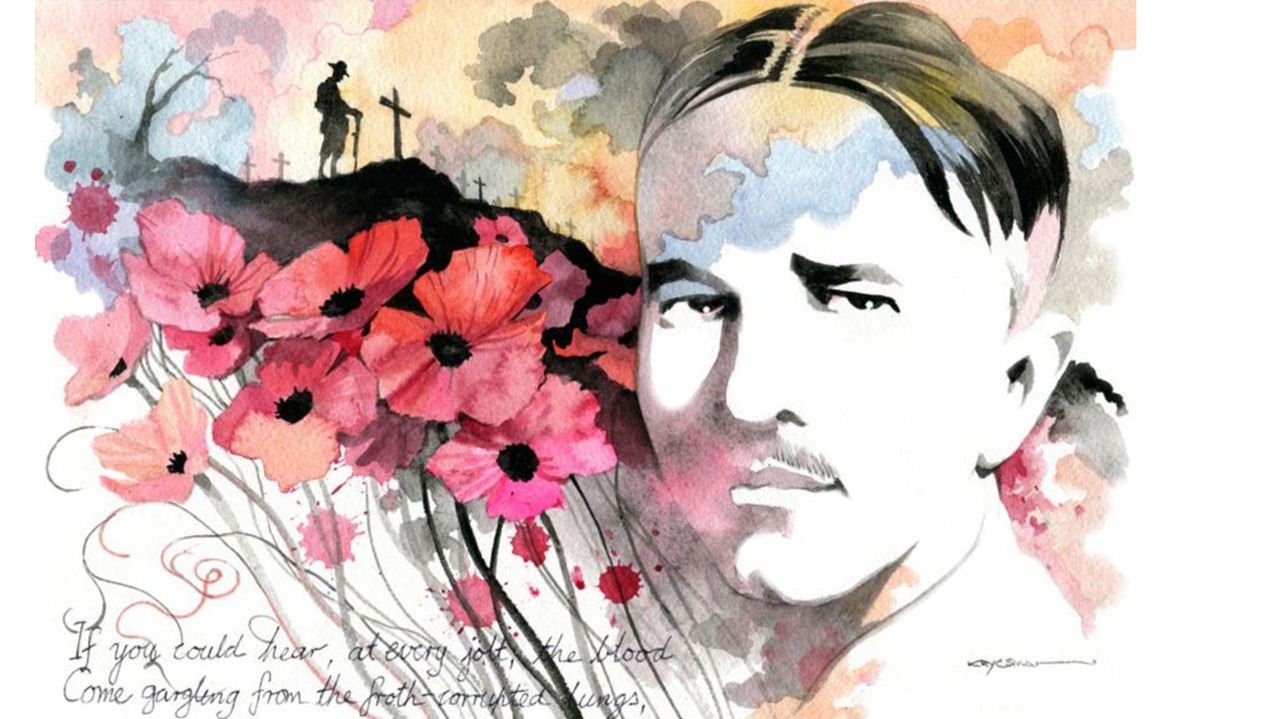
I am the enemy you killed – Wilfred Owen’s solemn testament

If you could hear, at every jolt, the blood
Come gargling from the froth-corrupted lungs,
Obscene as cancer, bitter as the cud
Of vile, incurable sores on innocent tongues,
My friend, you would not tell with such high zest
To children ardent for some desperate glory,
The old Lie: Dulce et decorum est
Pro patria mori.

Poet Wilfred Owen died on 4 November 1918 – seven days before the guns fell silent in the war that people though would end all wars – as it turned out, the Treaty of Versailles became the peace that ended all peace.

That “old Lie,” from which his most famous poem Dulce et Decorum Est takes its title, comes from the Roman poet Horace. No bitter irony was intended, though, as Horace beseeched Romans to embrace the cleansing fire of a noble death.

In a brief article in the e-zine Quillette, titled The End of War Poetry, Simon British stand-up comic, satirist, writer, and broadcaster Simon Evans wrote:  “Privately, I still find the idea of young men gladly ploughing themselves back into the earth of their homeland unbearably moving. But after Owen, recreating such an ecstatic embrace of death in the service of a greater cause became as impossible as nailing Christ back onto the cross, or rather, nailing that cross back onto the wall”.

As Evans observes, the First World War at least gave us some of the most cherished and painfully beautiful verse in our history. “Poetry bubbled from the trenches in France as abundantly as methane, oaths, and blisters … [and] central to earlier war poetry was the tension between the terror, devastation, and death on one hand, and the opportunity for virtues like loyalty and honour on the other”.

Contemplating explanations, he writes that a junior officer’s prospects of survival were considerably worse than those of his men. According to one account, as little as six weeks. That might explain the poetry. Such a violently diminished life expectancy must have focused the mind wonderfully. World War Two was—on that score at least—considerably more democratic and egalitarian … By 1939, the culture had shifted for officers and men alike. The practice of soldiers carrying a slim volume of Browning or Keats, and of aspiring to emulate whoever was in their pockets, had passed. In 1914, the available persona of the poet was still vital—or seems so now, in sepia vignette. He was the sensitive man quietly scratching a wet match against sandpaper and putting it to a candle, careful not to wake the slumbering cattle. Ignoring the grotesque shadows that leapt in the dug-out, he would unfold his notebook, its neat ruled lines like trenches in which the words would hunker, later pressed against his breast as a Talisman once returned to his pocket. Working slowly through his exhaustion and his tobacco ration, setting down his impressions in bottled ink, striving with purpose to resolve the lunacy and the oceans of spilt blood just a few dark yards away”.

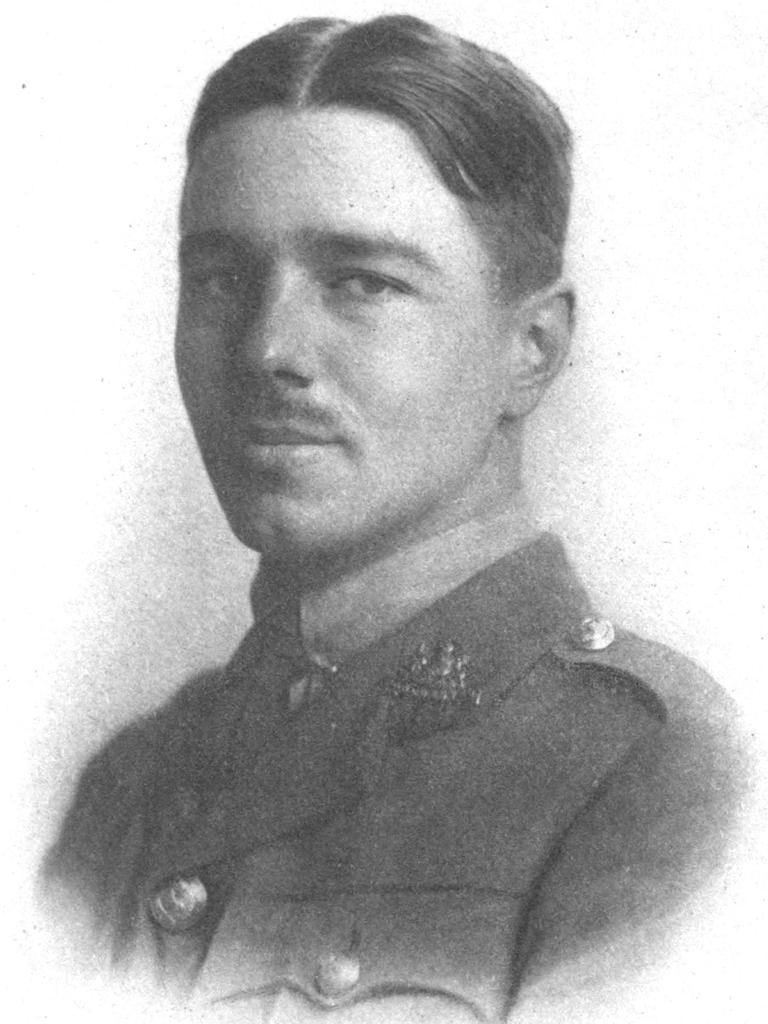
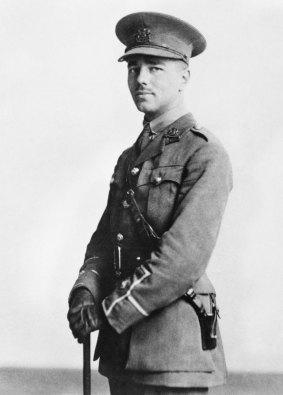
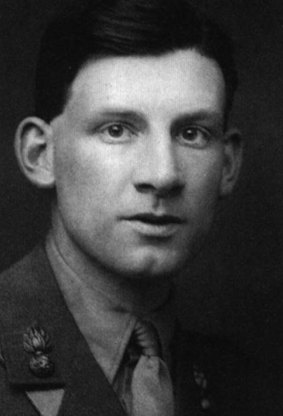
Second lieutenant Wilfred Owen, 25 years of age, was one of the last to die in a war that claimed 20 million dead and 20 million injured.  At least for the past half-centur­y, his poems have served as a prism through which the so-called Great War is viewed. But, despite being anthologised by his friend Siegfried Sassoon in 1920 and Edmund Blunden a decade later, they did not enter popular parlance until pacifist composer Benjamin Britten incorporated some of Owen’s most pot­ent verses in his War Requiem, written for the 1962 inauguration of the restored Coventry Cathedral

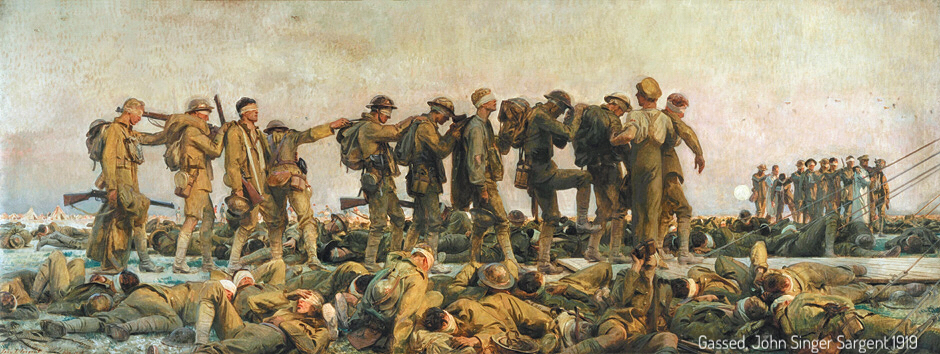
Gassed, John Singer Sargent 1919

Owen entered Britain’s national curriculum during the 1960s, and eventually the high school curricula of Commonwealth nations, which is where I first encountered him – and I was shocked by his viscer­al descriptions and implicit denunciations of war. He did not dwell on the causes but seemed to suggest that the sheer awfulness of military conflict between nations had stripped away all justifications.

“There had been many wars before, of course, but none where the poet was the soldier and, therefore, the intimate witness. This war was the rendering of wounds, both flesh and spiritual, by words”.

We republish below two excellent articles on Wilfred Owen and the poets of the First World War.

Othe posts in In That Howling Infinite: Dulce et Decorum est – the death of Wilfred Owen. A Son Goes To War – the grief of Rudyard Kipling and November 1918 – the counterfeit peace

Bent double, like old beggars under sacks,
Knock-kneed, coughing like hags, we cursed through sludge,
Till on the haunting flares we turned our backs,
And towards our distant rest began to trudge.
Men marched asleep. Many had lost their boots,
But limped on, blood-shod. All went lame; all blind;
Drunk with fatigue; deaf even to the hoots
Of gas-shells dropping softly behind.

Gas! GAS! Quick, boys!—An ecstasy of fumbling
Fitting the clumsy helmets just in time,
But someone still was yelling out and stumbling
And flound’ring like a man in fire or lime.—
Dim through the misty panes and thick green light,
As under a green sea, I saw him drowning.

In all my dreams before my helpless sight,
He plunges at me, guttering, choking, drowning.

If in some smothering dreams, you too could pace
Behind the wagon that we flung him in,
And watch the white eyes writhing in his face,
His hanging face, like a devil’s sick of sin;
If you could hear, at every jolt, the blood
Come gargling from the froth-corrupted lungs,
Obscene as cancer, bitter as the cud
Of vile, incurable sores on innocent tongues,—
My friend, you would not tell with such high zest
To children ardent for some desperate glory,
The old Lie: Dulce et decorum est
Pro patria mori.

Qurba-n قُرْبان

Sacrifice -Rayner Hoff, Anzac Memorial, Hyde Park, Sydney

War poet Wilfred Owen: sweet and honourable lie 

Artwork: Sturt Krygsman.

Artwork: Sturt Krygsman.

Mahir Ali, Weekend Australian, 10th November 2018

During a visit to London in 1920, Bengali poet, philosopher and polem­icist Rabindranath Tagore receive­d an unexpected letter from a Mrs Susan Owen. She wished to share some information about her favourite son.

“It is nearly two years ago, that my dear eldest son went out to the War for the last time,” she wrote, “and the day he said Goodbye to me … my poet son said these wonderful words of yours … ‘when I leave, let these be my parting words: what my eyes have seen, what my life received, are unsurpassable’. And when his pocket book came back to me — I found these words written in his dear writing — with your name beneath.”

Tagore was something of a celebrity in Britain at the time, a white-bearded Indian sage who bore a resemblance to the then recently ­deceased Leo Tolstoy. He had won the Nobel Prize in Literature in 1913 on the strength, essentially, of Gitanjali, a collection of poetry he had translated from the original Bengali with the assistance of William Butler Yeats, which is the source for the aphorism that appealed to Owen’s son. That son, Wilfred, is likely to have perceived rather differently from Tagore the context of what each of them considered “unsurpassable”.

It is equally likely that the young Englishman was unfamiliar with Tagore’s thought-provoking critique of nationalism as well as the poem, compos­ed on the last day of the 19th century, that demonstrates a remarkable prescience about the maelstrom that sneaked up on Europe shortly afterwards:

The last sun of the century sets amidst the blood red clouds of the West and the whirlwind of hatred The naked passion of self-love of Nations, in its drunken delirium of greed, is dancing to the clash of steel and the howling verses of vengeance The hungry self of Nation shall burst in a violence of fury from its own shameless feeding For it has made the world its food …

A plate from <i>Poems by Wilfred Owen </i>(1920).

               A plate from Poems by Wilfred Owen (1920)

Wilfred Owen’s final foray into that maelstrom came in August 1918. He won a Military Cross shortly afterwards. But while the Armistice Day bells pealed on November 11, his family received a telegram informing them that Wilfred had been killed a week earlier — 100 years ago last Sunday — while leading the men under his command across the Sambre-Oise canal at Ors.

The second lieutenant was 25, his longevity abbreviated by a year even in comparison with the life span of his favourite predecessor poet, John Keats.

Unlike all too many of his contemporaries, though, Owen did not exactl­y die in vain. At least for the past half-centur­y, his poems have served as a prism through which the so-called Great War is viewed. But, despite being anthologised by his friend Siegfried Sassoon in 1920 and Edmund Blunden a decade later, they did not enter popular parlance until pacifist composer Benjamin Britten incorporated some of Owen’s most pot­ent verses in his War Requiem, written for the 1962 inauguration of the restored Coventry Cathedral.

Coincidentally, about the same time, a fellow composer appropriated a contemporary young poet’s verses as the centrepiece of his 13th symphony: Dmitri Shostakovich immortalised Yevgen­y Yevtushenko’s poem Babi Yar, which catapults from a reflection on an egregiously atrocious component of the Judeocide that accompa­nied World War II into a searing condem­nation of anti-Semitism. It also serves as a reminder that the “war to end all wars” not only did nothing of the kind but in fact sowed the seeds for an even more outrageous bloodbath.

Owen entered Britain’s national curriculum during the 1960s, and eventually the curricula of Commonwealth nations, which is where I first encountered him and was blown away by his viscer­al descriptions and implicit denunciations of war. He did not dwell on the causes but seemed to suggest that the sheer awfulness of military conflict between nations stripped away all justifications.

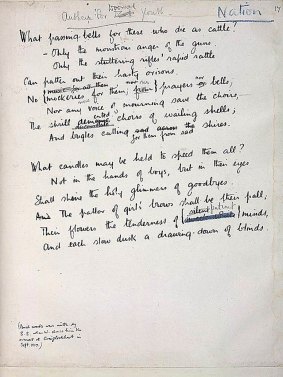
The alliteration and onomatopoeia of the sonnet Anthem for Doomed Youth made a powerful impression, but so did the realisat­ion that “those who die as cattle” were by no means restricted to Gallipoli or the Somme, and that “the stuttering rifles’ rapid rattle” continued to “patter out” all too many “hasty orisons”.

Dulce et Decorum Est stands out not only for nailing Horace’s destructive untruth about the value of patriotic sacrifice but also because gas attac­ks against unsuspecting victims remain par for the course on Middle Eastern battlefields — notably in Syria, where chlorine, used to such devastating effect in World War I, continues to serve as a favourite weapon for the Assad regim­e and some of its opponents.

Owen pictured a gas attack on a retreating column of comrades in which just one fails to fit “the clumsy (helmet) just in time”. “In all my dreams, before my helpless sight, / He plunges at me, guttering, choking, drowning,” he declares, comparing the soldier’s “hanging face” to “the devil’s sick of sin”, before going in for the kill, so to speak:

If you could hear, at every jolt, the blood
Come gargling from the froth-corrupted lungs,
Obscene as cancer, bitter as the cud
Of vile, incurable sores on innocent tongues,
My friend, you would not tell with such high zest
To children ardent for some desperate glory,
The old Lie: Dulce et decorum est
Pro patria mori.

The Latin translates as “it is sweet and honoura­ble to die for one’s country”, and Owen’s oeuvre offers incontrovertible evidence to the contrary.

He goes much further in Futility, whose title has been cited by scholars as a key to framing contemporary conceptions of the conflict. Yet in this poem Owen is questioning not just the war but the very point of life on earth. Again, it’s based on a single casualty, a human being the sun can no longer manage to revive after having roused it for so many years. “Was it for this the clay grew tall?” the poet asks: “O what made fatuous sunbeams toil / To break earth’s sleep at all?”

Then there’s Strange Meeting, a reinforcement of the trope whereby warriors in the battlefield come up against a foe who is a doppel­ganger, as in Bob Dylan’s relatively obscu­re early song John Brown, where the narrat­or informs his mother: “But the thing that scared me most was when my enemy came close / And I saw that his face looked just like mine.” In Owen’s case, the resemblance is not physical but spiritual, in a poem replete with the half-rhymes that distinguished his style; groined/groaned, moan/mourn, spoiled/spilled, mystery/mastery and so on.

He escapes “down some profound dull ­tunnel” to a “sullen hall”, and by the “dead smile” of an inmate who greets him “with piteou­s recognition in fixed eyes” knows that “we stood in Hell”. Back in the day, those socia­l democrats (synonymous at the time with socialists and communists) who had not fallen into the patriotic trap tended to describe a bayonet as “a weapon with a worker at both ends”. Owen sees a blade with a poet at both ends: “Whatever hope is yours, / Was my life also,” his new acquaintance tells him. “I went hunting wild / After the wildest beauty in the world … For by my glee might many men have laughed, / And of my weeping something had been left, / Which must die now. I mean the truth untold, / The pity of war, the pity war distilled­.” The poem concludes thus:

I am the enemy you killed, my friend.
I knew you in this dark: for so you frowned
Yesterday through me as you jabbed and killed.
I parried; but my hands were loath and cold.
Let us sleep now …

In The Parable of the Old Man and the Young, meanwhile, Owen subverts a key narrat­ive from the Old Testament to formul­ate his angst. An angel intervenes as Abraham prepares to murder his firstborn, Isaac, and offer­s a ram instead. “But the old man would not so, but slew his son / And half the seed of Europe one by one.” It’s unlikely he would have quarrelled with American “singer-journalist” Phil Ochs’s declaration almost a half-century later: “It’s always the old to lead us to the war / It’s always the young to fall / Now look at all we’ve won with the sabre and the gun / Tell me is it worth it all …”

It wasn’t, of course, just the seed of Europe that perished in the early 20th-century carnag­e. We never cease to be reminded how Australia answered the call — and paid proportionat­ely a higher price than any other country in what purportedly served as a nation­-building cull. Its effort was voluntary, a precursor to almost every Western-waged war through the 20th century and beyond — from Korea to Vietnam, Afghanistan and Iraq — to which our nation has contributed its young blood, chiefly as a means of ingratiating itself with its imperial “protectors”, and partly by regurgi­tating “the old Lie”.

But plenty of countries that were still colonie­s in 1914 also contributed their spawn — a million men in India’s case, as reflected in Trench Brothers, a play premiered in Brighton a couple of weeks ago. Besides, the Ottoman Empire was a participant, on Germany’s side, in the Great War, so substantial parts of the Middle East were not immune to the conflict. And the war’s last shots were fired in southern Africa, where the imperial urge had drawn several European nations, including Britain and Germany.

Owen wasn’t a conscientious objector by nature. As a Shropshire lad he was deeply religio­us, to the extent that initially the liturgy trumped his second love, poetry, and for a time he was expected to join the clergy. But better sense prevailed, and he was teaching in France when the war broke out. He returned home, joined up and underwent training, but wasn’t cast into the cauldron until January 1917. He was back home by midsummer, after having been blown out of a trench into a well. He recuperated at Craiglockhart Hospital near Edinburgh, a facility for the shell-­shocked, or those with what today would be designated as post-traumatic stress disorder.

It was there that he encountered Sassoon, an army captain who had been dispatched partly as means of silencing his increasingly trenchant anti-war propaganda.

Owen was familiar with the poetry of Sassoon, who was six years older, and tentatively approached him for an autograph before sharing his own efforts at wartime verse. In response, Sassoon combined constructive criticism with a great deal of encouragement, and soon enough the pent-up poems began pouring out of Owen.

Almost all of his best-known poems surface­d during the year or so between then and his demise, most of them emotions re­collected during the relative tranquillity of sojourn­s in his homeland. Among the first was The Send-Off, in which he compares soldiers on an outward bound train, their “faces grimly gay”, with “wrongs hushed-up”. He goes on to ask: “Shall they return to beating of great bells / In wild train-loads? / A few, a few, to few for drums and yells, // May creep back, silent, to villag­e wells, / Up half-known roads.”

In Exposure, we encounter frozen corpses as: “The burying-party, picks and shovels in ­shaking grasp, / Pause over half-known faces. All their eyes are ice, / But nothing happens.” In Mental Cases, there is the devastating verse: “Surely we have perished/ Sleeping, and walk hell; but who these hellish?”

In a draft preface to a planned 1919 collection of his verse, Owen wrote: “Above all, this book is not concerned with Poetry. The subject of it is War, and the pity of War. The Poetry is in the pity. Yet these elegies are to this generation in no sense consolatory. They may be to the next. All the poet can do to-day is to warn.’’

Less than 30 years later, Wilfred Burchett, the Australian who became the first Western journalist to witness the devastation of Hirosh­ima, prefaced his accoun­t with the words: “I write this as a warning to the world.”

Unheeded warnings remain one of the drivin­g forces of history’s chariot wheels, clogged as they are with much blood, but who can sensibly argue that they ought not to have been articulated? Who can say when we will ever learn, but it’s unlikely Owen would have disputed his contemporary Robert Graves’s reflectio­n on November 11, 1918:

When the days of rejoicing are over,
When the flags are stowed safely away,
They will dream of another ‘War to end Wars’
And another wild Armistice Day

Poets in action: How writers captured the horrors of the Great War

Warwick McFadyen, Sydney Morning Herald 2nd 

One hundred years ago today, Wilfred Owen, poet and soldier, had 24 hours to live. On November 4, 1918, Owen and his men were trying to cross a canal near Ors in France. As Owen was walking among his men, offering encouragement, German machine guns burst into action. Owen fell. He was one of the last to die in a war that claimed 20 million dead and 20 million injured. He was promoted to lieutenant the next day.

In the cruellest twist, Owen’s mother in Shrewsbury received the telegram of his death on November 11, Armistice Day, as the bells were ringing for peace.

A generation of young men marched to the front in World War I, often singing and with cheerful abandon, at least in the beginning, to be slaughtered.

Poetry would mourn the loss of a singular talent, whose star was just beginning to light the sky. Owen had seen but a handful of his poems in print before his death, aged 25. He had written all we have, in little more than 12 months, from August 1917.

The first collection, edited by Siegfried Sassoon, was published in 1920, and then in 1931 appeared an expanded collection. In the latter edition, editor Edmund Blunden wrote that Owen “was a poet without classifications of war and peace. Had he lived, his humanity would have continued to encounter great and moving themes, the painful sometimes, sometimes the beautiful, and his art would have matched his vision.”

Wilfred Owen had seen but a handful of his poems in print before his death, aged 25.

Apart from what are regarded as classics such as Anthem for Doomed Youth and Dulce Et Decorum Est, it is Owen’s preface to the collection that is as famous as the poems: “Above all I am not concerned with Poetry/ My subject is War, and the pity of War/ The Poetry is in the pity/ Yet these elegies are to this generation in no sense consolatory/ They may be to the next/ All a poet can do today is warn/ That is why the true Poets must be truthful.”

The First World War was a charnel house. A generation of young men marched to the front, often singing and with cheerful abandon, at least in the beginning, to be slaughtered. Poetry, unlike any time before or since, was the vehicle for their voices and those of bystanders. At first, it was celebratory, but as the days of carnage rolled on and on, truth came to be heard.

There had been many wars before, of course, but none where the poet was the soldier and, therefore, the intimate witness. This war was the rendering of wounds, both flesh and spiritual, by words.

Robert Giddings, in The War Poets, writes that “before 1914, when poets dealt with war it was to render it exotically or historically removed from immediate experience. War, in the hands of Macaulay, Tennyson, Arnold, Newboult and Aytoun, had all the conviction of modern television costume drama. There were two outstanding exceptions – Rudyard Kipling and Thomas Hardy.”

<i>Anthem for Doomed Youth</I> by Wilfred Owen is regarded as a classic.
    Anthem for Doomed Youth, World Archive 

The primacy of the poet in people’s lives a century ago can be seen in the immediate bringing into action of writers to support war aims. On September 2, 1914, only five weeks after war was declared, The Times, published a letter from the Poet Laureate, Robert Bridges, in which he likened the good soldiers of empire fighting the Devil. The image of the soldier as Christ was popular in these early stages, as was the theory that war was a necessary purification of nations. The government’s Propaganda Bureau enlisted writers such as Arthur Conan Doyle and G.K. Chesterton to promote Britain’s war aims. It took the pre-eminent war poet Sassoon to use the figure of Christ in a heightened awareness of spirit, flesh and suffering that had nothing to do with patriotism.

Professor Tim Kendall, in Poetry of the First World War, writes that during the war “poetry became established as the barometer for the nation’s values: the greater the civilisation, the greater its poetic heritage”. He believes that the “close identification of war poetry with a British national character persists to the present day”.

Siegfried Sassoon was among the poets who showed that there was art in death and suffering.
Siegfried Sassoon 

As to Australia’s war effort in poetry, despite more than 415,000 men enlisting (from a population of fewer than 5 million) with 60,000 killed and more than 150,000 injured or taken prisoner, the results hardly trouble the margins of anthologies.

As Geoff Page noted in Shadows from Fire: Poems and Photographs of Australians in the Great War, the literary efforts of those Australians with direct experience in the war were less than memorable. His intention with the book was to juxtapose recent poems “with Australians poems actually written during the conflict”.

“On closer examination, however, I found the quality of these latter poems to be depressingly low – especially when contrasted with those of the English war poets: Owen, Sassoon and Rosenberg . . . It rapidly became apparent that a much more appropriate and powerful record of the conflict could be found among the contemporary photographs held by the Australian War Memorial. These speak with a directness and truth seldom attempted, at that time, by our poets.”

By the end of 1914, two anthologies of wartime verse had been published. Many poets in the early years were no more than writers of patriotic doggerel. The Georgian movement, of pastoral whimsy, and gentle beauty, had found a cause in which to celebrate England. The modernism that had slowly been growing in Europe had not permeated English literary minds, but in the aftermath of the war it blossomed, seen no more so than in T.S. Eliot’s The Waste Land, published in 1922.

Dominic Hibberd and John Onions, in their book The Winter of the World, cite the work of historian Catherine Reilly in which she records 2225 British writers who experienced the war, and published poems of their experience. A quarter of the writers were women. By contrast Westminster Abbey honours 16 poets of WWI, all men: Richard Aldington, Laurence Binyon, Edmund Blunden, Rupert Brooke (“If I should die, think only this of me: That there’s some corner of a foreign field that is for ever England”), Wilfred Gibson, Robert Graves, Julian Grenfell, Ivor Gurney, David Jones, Robert Nichols, Owen, Sir Herbert Read, Isaac Rosenberg, Sassoon, Charles Sorley and Edward Thomas.

Since suffering and death were universal there were no frontiers in the writing of it, geographically, with Austrian Georg Trakl, German Alfred Lichtenstein, Italian Giuseppe Ungaretti, Canadian John McCrae and Frenchmen Guillaume Apollinaire and Henri Barbusse, or in gender, Edith Sitwell, Margaret Sackville, Alice Meynell and Vera Brittain, whose Testament of Youth is regarded as a masterpiece of the period.

This was the flowering that has not been captured again. The poets of the Second World War do not go much beyond Keith Douglas and Paul Celan.

It seems curious and strange now, but the biggest barricade to the acceptance of the war poets in the immediate years after came from the towering figure of Nobel Laureate W.B. Yeats.

The Oxford Book of Modern Verse 1892-1935, published in 1936, was edited by Yeats. It contained nothing from the war. Yeats defended his decision thus: “In poems that had for a time considerable fame, written in the first person, they made suffering their own. I have rejected these poems . . . passive suffering is not a theme for poetry. In all the great tragedies, tragedy is a joy to the man who dies, in Greece the tragic chorus danced. If war is necessary, or necessary in our time and place, it is best to forget its suffering, as we do the discomforts of fever, remembering our comfort at midnight when our temperature fell.”

Yeats was wrong, comprehensively so. But the glory was that Owen, Sassoon, Thomas, Rosenberg et al showed that there was art in death and suffering. The war poets found in the desolation of France and in the ruined bodies and spirits in hospital wards, a voice transcendent. Theirs was the fundamental expression of what it meant – still means – to be human. And there was a warning, but as history turned, no one was listening.

“Out there, we’ve walked quite friendly up to death;/ Sat down and eaten with him, cool and bland,/ Pardoned his spilling mess tins in our hand./ We’ve sniffed the green thick odour of his breath,/ Our eyes wept, but our courage didn’t writhe./ He’s spat at us with bullets and he’s coughed/ Shrapnel. We chorused when he sang aloft;/ We whistled while he shaved us with his scythe.” (The Next War, Wilfred Owen)

Siegfried Sassoon wrote in his diary of November 11: “The war is ended. It is impossible to realise. I got to London about 6.30 and found masses of people in streets and congested Tubes, all waving flags and making fools of themselves – an outburst of mob patriotism. It was a wretched wet night, and very mild. It is a loathsome ending to the loathsome tragedy of the last four years.”