An Australian Jew’s submission to the Royal Commission

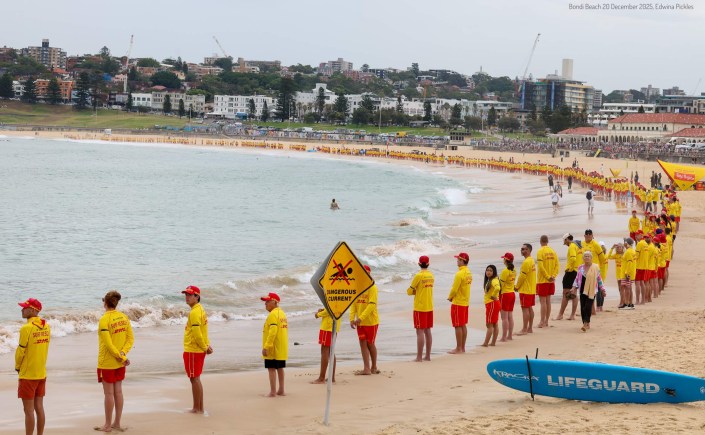
The Royal Commission into Antisemitism was convened in the shadow of the Bondi Beach massacre of December 2025, when fifteen people were murdered at a Hanukkah gathering in what has been described as the deadliest antisemitic attack in Australian history. It was, on any reading, a rupture –  not only because of its scale, but because it forced into the open a question that had been building, uneasily, for more than two years: how a country that prides itself on pluralism and civic ease had arrived at a moment where Jews could be targeted so explicitly, and so lethally, in public space.

That question does not begin at Bondi. Since the Hamas attacks of October 7, 2023, and the subsequent war in Gaza, Australia has seen a sustained wave of anti-Israel and anti-Zionist protest – much of it framed in the language of human rights, some of it more strident, even incendiary. Alongside this mobilisation has come a marked rise in antisemitic incidents: abusive chants at early demonstrations, harassment of visibly Jewish individuals, vandalism of synagogues and community institutions, graffiti, threats, social and professional exclusion, and a steady current of online vilification. Some of these episodes have been highly visible; many more have been ambient, cumulative, and privately absorbed. For the Jewish community, the sense has not been of isolated but of a gathering atmosphere – a shift in what can be said, and done, about Jews in public without consequence.

It is into this unsettled landscape that the Commission steps. Its task is not only to examine the failures that allowed Bondi to occur, but to consider whether that attack can be understood in isolation at all – or whether it belongs to a broader pattern of escalating hostility, contested language, and fraying social norms. In that sense, it is as much an inquiry into civic culture as it is into security.

Andrew Wirth’s submission is written with precisely that broader frame in mind. He contributes not as a representative of any organisation, but as a Jewish Australian – the child of Holocaust survivors, a member of a contemporary community that now finds itself, again, thinking seriously about questions of safety and belonging. His purpose is not to collapse legitimate criticism of Israel into antisemitism, nor to deny the moral force of Palestinian advocacy. Rather, it is to interrogate the relationship between the forms that advocacy has taken in Australia since October 2023 and the lived experience of many Jews during that same period.

He is, in effect, asking the Commission to look not only at events but at environment. To consider whether the prevailing ways of understanding harm – episodic, attributable, legally discrete — are adequate to a phenomenon that may instead be cumulative, ambiguous, and socially mediated. And to ask, quietly but insistently, whether Bondi was an isolated act of hatred, or the most violent expression of a climate that had already, for some time, been forming in plain sight.

The complete submission is republished in full below. As it is very lengthy, In That Howling Infinite has used AI to provide a comprehensive summary.

Much of the testimony before the Royal Commission on Anti-Semitism and Social Cohesion dealt not with abstract politics, but with the way the Israel-Palestine conflict has spilled into everyday Australian life: schools, workplaces, music venues, synagogues and online spaces. Among the most striking evidence was that of singer and author Deborah Conway, who described cancelled performances, organised protest campaigns, doxing, online abuse and threats directed at her for publicly identifying as both Jewish and Zionist. Whatever one’s views on Israel or Gaza, her testimony underscored the increasingly blurred line between political activism, social intimidation and hostility directed at Jews as Jews – a tension that sat at the heart of the inquiry’s hearings. Conroy’ testimony and that of others is also republished below.

In That Howling Infinite, April 2026

Long story short …

Wirth’s submission is, at heart, an attempt to change the lens through which the Commission looks – away from the forensic habit of isolating moments (a chant, a placard, a lone actor, a single atrocity) and toward something more diffuse and disquieting: the social atmosphere in which those moments become possible. He writes as a Jewish Australian, and as the son of survivors, but resists the pull of memoir. The authority he claims is not moral witness so much as analytic patience – an effort to describe how a climate forms, thickens, and, eventually, breaks.

His central contention is that the harms experienced by Jewish Australians since October 2023 are systemic and cumulative. Bondi – horrific, unprecedented – is not treated as an aberration but as a point of condensation, where a long-gathering set of pressures became visible in a single, devastating act. To understand that act, he argues, one must look not for a clean causal chain (this slogan → this shooter → this event), but for patterns of probability: the way repeated exposure to certain forms of rhetoric, symbolism, and social signalling can lower inhibitions, sharpen antagonisms, and render violence imaginable to those already inclined toward it. The analogy he reaches for is telling: not criminal law, but climate science. You cannot attribute a single storm to climate change with precision; you can, however, describe the conditions that make storms more frequent, more intense, more likely.

From this premise, the essay unfolds in widening circles.

He first dismantles the idea of a singular “pro-Palestinian movement.” What exists instead, he suggests, is an ecosystem: formal advocacy bodies fluent in the language of human rights; looser activist formations oriented toward protest and disruption; and a penumbra of fellow travellers – ideological extremists, vandals, conspiracists — who share space, slogans, and emotional energy if not formal affiliation. These elements are not centrally controlled, nor are they uniformly motivated. That, in a sense, is the point. The diversity allows for elasticity: respectable actors can maintain a principled public face while disclaiming the excesses of the wider milieu (“a few bad actors,” “not representative”), even as those excesses contribute to the overall tone and impact of the movement. Plausible deniability is not a bug but a feature.

Language is the next terrain. Wirth is careful not to claim that particular phrases are intrinsically violent in a narrow, lexical sense. Instead, he insists that meaning is contextual, historical, and relational. Words arrive carrying baggage. “Intifada,” whatever its literal translation, is heard by many Jews through the memory of suicide bombings and mass-casualty attacks; “from the river to the sea,” however it is intended, resonates with anxieties about elimination; “Zionists are…” constructions collapse a vast and internally diverse population into a single moral category, often freighted with the most toxic imagery available. The key point is not that every speaker intends harm, but that in a crowded, emotionally charged public sphere, ambiguity is not neutral. It creates room for multiple readings, including the most hostile ones, and allows those who wish to intimidate to do so under cover of contestability. The same words can be defended as benign and experienced as threatening – and both facts can be true at once.

Central to this slippage is the term “Zionist.” In activist discourse it operates as a floating signifier: sometimes a political descriptor, sometimes a moral indictment, sometimes a proxy for a people. Wirth’s claim – backed by survey data — is that the overwhelming majority of Australian Jews feel some connection to Israel and many are comfortable with the label “Zionist” in a broad, cultural or existential sense. To target “Zionists,” then, is in practice to target Jews as they understand themselves, even if the formal claim is otherwise. The distinction between Jew and Zionist, while logically defensible, does little work sociologically. Indeed, he suggests, the insistence on that distinction can become a way of telling Jews what they are allowed to be – a curious inversion in a discourse otherwise attentive to self-identification.

The essay then turns to causation – or rather, to the limits of conventional thinking about it. The familiar retort to concerns about protest rhetoric is that no direct link can be proven between speech and a specific act of violence. Wirth concedes the point and then sidesteps it. In complex systems, he argues, causation is rarely linear or attributable. The relevant question is not “did this slogan cause this attack?” but “does a given communicative environment increase or decrease the likelihood of such attacks occurring?” Here he draws on the literature around “stochastic violence”: the idea that repeated, dehumanising or inflammatory messaging can, over time, prime a small subset of individuals to act, even in the absence of explicit incitement. Responsibility is diffuse; effects are real. It is an uncomfortable model for legal systems built on individual intent, but a familiar one in other domains of risk.

If this is the mechanism, the effects are not confined to headline events. A large portion of the submission is devoted to what might be called the low-grade, high-frequency harms: insults, exclusion, intimidation, the steady drip of being cast as suspect or illegitimate. Synagogues require guards; schools adjust routines; people speak more cautiously, or not at all. There is a contraction of presence — a subtle withdrawal from the public square. Wirth is at pains to stress that for every reported incident there are many more that never reach formal channels but accumulate in private memory, at dinner tables, in the small recalibrations of daily life. This is where his argument edges closest to the experiential without relinquishing its analytic frame: harm as something lived continuously rather than episodically.

Against this backdrop, he is sharply critical of two patterns in the public response. The first is the tendency, among some pro-Palestinian advocates, to dismiss Jewish concerns as bad faith – “weaponisation,” an attempt to silence criticism of Israel, a manoeuvre in a political contest. This, he suggests, substitutes motive-hunting for engagement with the substance of the claims. The second is the reliance on generalised anti-racism frameworks as a sufficient policy response. Such frameworks, he argues, are necessary but not sufficient, because antisemitism does not map neatly onto the paradigms those frameworks were designed to address. Jews are often perceived simultaneously as powerful and vulnerable, insiders and outsiders – a dual coding that allows hostility to evade categories built primarily around visible disadvantage. Subsumed into the general, antisemitism risks disappearing.

He extends this scepticism to legal doctrine. Courts, tasked with balancing free expression against harm, tend to look for discrete, demonstrable injuries traceable to particular acts. But if the harm is cumulative, ambient, and probabilistic, that evidentiary demand becomes almost impossible to meet. The result is a persistent gap between lived experience and legal recognition – a sense, on the part of those affected, that the system cannot quite “see” what is happening. This is not, in his telling, an argument against free speech so much as a claim that the existing conceptual toolkit is ill-suited to a new class of problem.

The question of representation threads through the latter part of the submission. Wirth does not contest the right of anti-Zionist Jewish groups to participate in the debate, but he cautions against treating them as broadly representative. Their prominence, he suggests, owes less to their numbers than to their utility: they provide a form of internal validation for those who wish to deny any connection between anti-Zionist activism and antisemitic harm. The risk, for the Commission, is that such voices — legitimate but minority – might be weighted in a way that obscures the concerns of the larger community.

All of this leads to a set of recommendations that are, in tone, more calibrative than punitive. He does not call for the suppression of protest or the prohibition of criticism of Israel. Instead, he argues for clearer moral boundaries around language and conduct; for accountability within advocacy movements for what they tolerate as well as what they endorse; for policy approaches that acknowledge systemic harm; and, crucially, for investment in education – a rebuilding of the shared understandings that make any legal framework meaningful. Law, in his formulation, can draw lines; it cannot, by itself, restore the sensibility that gives those lines legitimacy.

Running beneath the analysis is a quieter, more disquieting claim: that the deepest failure of the past two years has been one of recognition. Not simply a failure to prevent specific acts, but a failure of institutions — governmental, cultural, civic – to articulate, early and clearly, that Jews are a vulnerable minority entitled to the same reflex of solidarity extended to others. Silence, in this reading, is not neutral. It is read, by all parties, as permission.

The essay closes, as it began, with Bondi –  not as origin but as revelation. A society that prides itself on its egalitarian reflexes is asked to consider whether, in this instance, those reflexes faltered; whether a movement framed in the language of rights allowed, in some of its forms, the targeting of a minority at home; and whether the balance between free expression and communal belonging has been misjudged. The question Wirth leaves hanging is not whether protest should be free – it must be – but whether it can remain so without eroding the conditions that make a plural civic life possible.

Author’s Note…

This opinion piece is one of several on the attitudes of progressives towards the Israel, Palestine and the Gaza war.

The first is Moral capture, conditional empathy and the failure of shock, a discussion on why erstwhile liberal, humanistic, progressive people from all walks of life have been caught up in what can be without subtly described as that anti-Israel machinery. Shaping facts to feelings – debating intellectual dishonesty– regarding the Gaza war, intellectual dishonesty is everywhere, on both sides of the divide, magnified by mainstream and social media’s hunger for moral simplicity and viral outrage. Standing on the high moral ground is hard work! discusses the issues of free speech and “cancellation”, and boycotts with regard to the recent self-implosion of the Adelaide Writers’ Festival, one of the country’s oldest and most revered.

As governments federal and state weigh the prohibition of potentially inflammatory phrases, we also consider syntax and semantics. Lawyers parse syllables and activists insist that what is heard is not what is meant, and what is meant is not what is said. The words hover, untethered from consequence, yet curiously heavy with it. If words can be made infinitely flexible, then meaning itself becomes negotiable; and if meaning is negotiable, then so too are responsibility and harm. See: Same old stone, different rock. What’s in a word? and What’s in a word? A world of meaning and of pain 

There are moments when public argument stops being a search for truth and becomes a test of belonging. Facts are no longer weighed so much as auditioned; empathy is rationed; moral language hardens into a badge system, issued and revoked according to rules everyone seems to know but few are willing to articulate. One learns quickly where the trip-wires are, which sympathies are permitted, which questions are suspect, and how easily tone can outweigh substance.

What interests me here is not the quarrel itself – names, borders, histories—but the habits of mind it exposes. The ease with which conviction can slide into choreography. The way intellectual honesty is praised in the abstract and punished in practice. The curious transformation of empathy from a human reflex into a conditional licence, granted only after the correct declarations have been made.

Across these pieces I circle the same uneasy terrain: the shaping of facts to fit feelings; the capture of moral language by ideological gravity; the performance of righteousness as both shield and weapon. Cultural spaces that once prided themselves on curiosity begin to resemble courts, where innocence and guilt are presumed in advance and the labour lies not in thinking, but in signalling.

This is not an argument against passion, nor a plea for bloodless neutrality. It is, rather, a meditation on how quickly moral seriousness curdles into moral certainty – and how much intellectual work is required to stand on what we like to call the high ground without mistaking altitude for clarity.

The position of In That Howling Infinite with regard to Palestine, Israel and the Gaza war is neither declarative nor devotional; it is diagnostic. Inclined – by background, sensibility, and experience – to hold multiple truths in tension, to see, as the song has it, the whole of the moon. It is less interested in arriving at purity than in resisting moral monoculture and the consolations of certainty. That disposition does not claim wisdom; it claims only a refusal to outsource judgment or to accept unanimity as a proxy for truth.

On Zionism, it treats it not as a slogan but as a historical fact with moral weight: the assertion – hard-won, contingent, imperfect – that Jews are entitled to collective political existence on the same terms as other peoples. According to this definition, this blog is Zionist. It is not interested in laundering Israeli policy, still less in romanticising state power, but rejects the sleight of hand by which Israel’s existence is transformed from a political reality into a metaphysical crime. Zionism is not sacred, but its delegitimisation is revealing – because it demands from Jews what is demanded of no other nation: justification for being.

On anti-Zionism, it has been unsparing. It sees it not as “criticism of Israel” (which you regard as both legitimate and necessary) but as a categorical refusal to accept Jewish collective self-determination. What troubles it most is not its anger but its certainty: its moral absolutism, its indifference to history, its willingness to borrow the language of justice to license erasure. It is attentive to how anti-Zionism recycles older antisemitic patterns – collectivisation of guilt, inversion of victimhood, and the portrayal of Jews as uniquely malignant actors – while insisting, with studied innocence, that none of this concerns Jews at all. If not outright antisemitism, the line separating it from anti-Zionism is wafer—thin, and too often crosses over.

Running through all of this is a consistent stance: a resistance to moral theatre, an impatience with historical amnesia, and a belief that intellectual honesty requires limits – on language, on fantasy, and on the indulgent belief that one’s own righteousness exempts one from consequence. And a lifelong hatred of antisemitism. The new antisemitism looks a lot like the old hatred!

We are not asking culture to choose sides; we are asking it to recover judgment

See in In That Howling Infinite, A Political World – Thoughts and Themes, and A Middle East Miscellany. and also: This Is What It Looks Like“You want it darker?” … Gaza and the devil that never went away … , How the jihadi tail wags the leftist dog, The Shoah and America’s Shame – Ken Burns’ sorrowful masterpiece, and Little Sir Hugh – Old England’s Jewish Question

A Royal Commission into Antisemitism: One Australian’s Submission
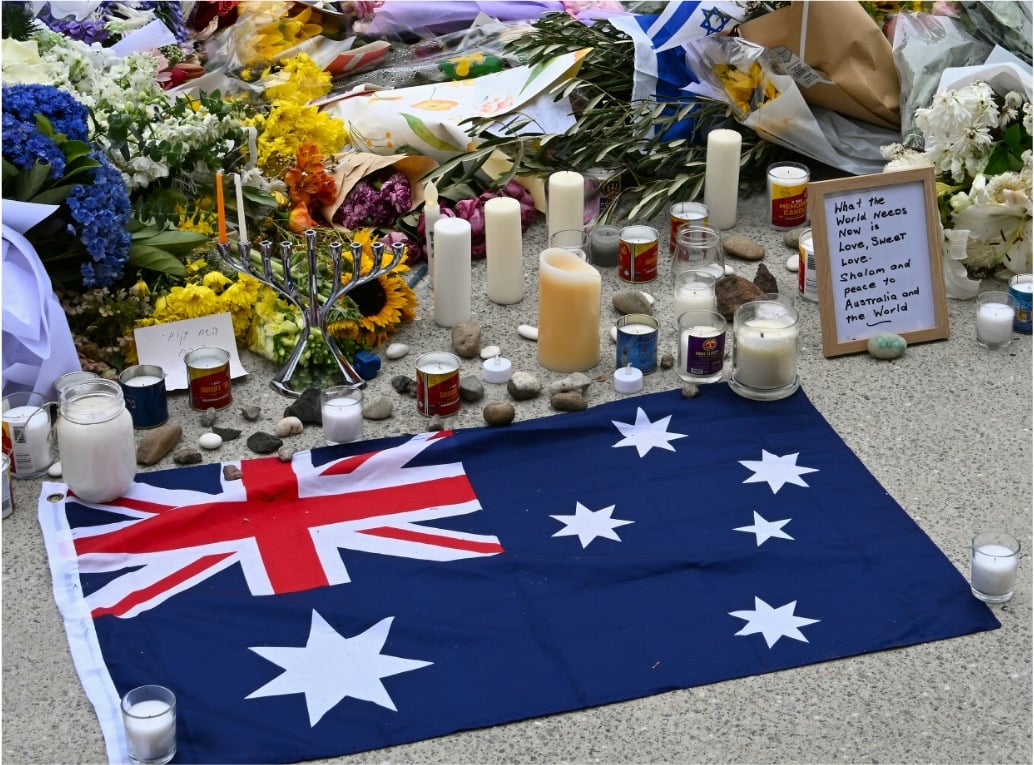
Aftermath of Bondi Beach massacre, Sydney 2025 (Image available under the Creative Commons)

Australia is in the midst of a major enquiry into antisemitism- a Royal Commission- following the terrorist attack at Bondi Beach. The community has been invited to make submissions. Below, I share mine. It is analytical rather than personal and represents my attempt to understand the links between anti-Zionist protest and harms to the Jewish community.

Who I am

I write as an Australian Jew.

I am writing entirely in my personal capacity and do not represent any Jewish communal, political or Zionist organisation. I am an engaged member of the Jewish community and regularly attend a local “egalitarian orthodox” synagogue.

I am a child of holocaust survivors. My father survived Auschwitz and Bergen-Belsen concentration camps and death marches; my mother was hidden in a convent for the latter part of the second World War. All four of my grandparents were murdered in Auschwitz.

I strongly support the right of Australians to advocate for the welfare, human rights and self-determination of both Jewish and Palestinian communities. I have been involved in inter-communal dialogue both in Melbourne and in Israel-Palestine and am commited to a just outcome in Israel and Palestine.

I am a medical specialist in the public hospital system and an associate professor at at Melbourne University.

Aims of this submission

I am writing primarily to reflect on, and critically evaluate, common claims made in reference to the relationship between pro-Palestinian advocacy and harms affecting the Australian Jewish community.

My primary contentions are that:

  1. The adverse impacts of the protest movement need to be understood as a systemic and cumulative phenomenon- this includes chronic low level psychological harm, social exclusion and the generation of an atmosphere associated with a heightened risk of sporadic violence
  2. The heterogeneity of participants and their motivations, the ill-defined targets (Israel, Zionists or Jews), and the ambiguity of protest language and symbols, together make attribution of harm and intent difficult. This ambiguity and heterogeneity allow a protest environment that tacitly fosters exclusionary, vilifying and even violent behaviour while allowing protest spokespeople plausible deniability.
  3. Consequently, the courts and relevant legislation, which assess the protest movement on a “slogan by slogan” or “event by event” basis -that is, through the lens of individual cases – cannot adequately “see” the broad environment as experienced by the Jewish community. It is a case of forest and trees.

Background

The attack on December 14, 2025, was the worst act of antisemitic violence ever committed on Australian soil. Fifteen people were murdered at a Hanukkah celebration at Bondi Beach.

Some have drawn a straight line between the Bondi massacre and anti-Zionist incitement, particularly focusing on the slogan “Globalise the Intifada”. Anti-Zionist advocates, in contrast, attribute blame to the shooters’ ISIS connection and the influence of radical Sydney clerics, insisting that the Bondi shootings have nothing to do with peaceful anti-Zionist activism.

Yet this murder was, in the perpetrators own words, intended to condemn “the acts of ‘Zionists”. It seems implausible that this targeting of Zionists was entirely unrelated to two years of inflammatory anti-Zionist rhetoric or that hate speech played no role in pushing perpetrators, primed by fundamentalist influencers, to cross some threshold to action.

Most Jewish Australians view Bondi against a backdrop of over two years of escalating incitement and a hardening anti-Jewish atmosphere. The Opera House protest in October 2023 marked a turning point. Reported chants, including “Where are the Jews?” and “F*** the Jews”, suggested a real shift in what could be said about Jews in public, seemingly without consequence.

Since then, high-profile incidents, such as arson attacks on synagogues, have attracted significant media attention.  Less visible are cumulative, psychologically harmful effects of effects of chronic “low level” stigmatisation.

Many find it hard to avoid the conclusion that this environment may have lowered the threshold for violence. A long-standing vulnerability has been brought into sharper focus, prompting calls for a precautionary response, including greater restraint in protest language.

The Bondi tragedy has produced grief, fear and anger within the Jewish community, alongside shock and sympathy across the wider Australian society. The subsequent critical national conversation has led to the present Royal Commission. Could we, as a nation, have done more to counter antisemitism and ensure Jewish safety? Why did our security services fail?  Was anti-Zionist activism a contributing factor for Bondi?

If so, do we need constraints on forms of protest? Should constraints be established through legislation or, at a deeper level, through education and cultural change?

Debate over public discourse and anti-Jewish incidents

Palestinian advocacy organisations have condemned the violence at Bondi and expressed sympathy for the victims. However, Jewish expressions of fear or calls for reassurance and safety have typically been dismissed as “weaponising antisemitism”, silencing debate or even “defending genocide”.

Anti-Israel groups like US Jewish Voice for Peace and the Australian Palestine Advocacy Network insist their activism is guided by justice and human rights and rejects racism or violence. Those claims are in their mission statements. Jewish anti-Zionist commentators and groups have denied any possible relationship between the language of protest and the attack.  “Zero evidence”, according to one commentator.

Consequently, they have criticised Jewish calls for safety and protections, and government proposals to restrict aspects of protest, as overreach or an attack on free speech rather than an attempt to provide community safety.

This insistence that no restrictions be placed on the language and forms of protests is accompanied by several claims that warrant critical evaluation:

  1. That the pro-Palestinian movement is peaceful and simply protesting injustice (including alleged genocide)
  2. That the language of protest, including terms such as “Globalise the intifada” is inherently non-violent;
  3. That public protest is directed against Israel and Zionists and not against Jews;
  4. That consequently activist speech cannot be linked with violence, or harms more broadly, affecting Jews
  5. That the imputation of violent connotations is simply an attempt to stifle free speech.

How might we reconcile this Jewish experience of harm with claims by Palestinian advocacy groups that the movement is non-violent and explicitly rejects antisemitism?

Below, I address a number of key questions and issues in turn.

1.The pro-Palestinian movement is a complex ecosystem and not accurately characterised as entirely peaceful

Palestinian advocacy groups stress that their activism is grounded in human rights. They claim that violence against Jews cannot be attributed to a movement that explicitly rejects antisemitism or the use of violence. This is a superficially reassuring but incomplete framing. It fails to acknowledge the range of actors (and agendas) within the pro-Palestinian advocacy community and beyond it, not all of whom necessarily share these peaceful ideals.

This heterogeneity is even reflected in the several labels used to describe the movement: pro-Palestinian, anti-Israel and anti-Zionist. While they may be used interchangeably, they represent very different agendas and targets: supporting the rights of a people, opposing the policies of a state and opposing, and often vilifying, those who can be linked with that state- that is, Jews.

A 2014 study of over 20 Palestinian civil society groups by the General Delegation Of Palestine in Australia captures the heterogeneity of the groups – likely a fraction of the number of groups active in 2026.

The study notes that Palestinian organizations “often have multiple desired outcomes and target audiences and undertake different kinds of activities.” The study explicitly distinguishes “advocacy groups” and “activist groups”. The former are the public facing, suit and tie wearing (my words) groups, that speak the language of human rights and engage in, to quote the study, “persuasion, lobbying and negotiation”.

“Activist groups”, in contrast, are described as “denunciative” engaging in “protest, street demonstrations, strike actions, public meetings” and whose desired outcomes are “diffuse and not necessarily … within defined policy and political parameters”. They “articulate messages in different forums, to different audiences” with different “tone, tenor, and language of the message”… “in language that resonates with their niche constituencies.” Of course we are now also increasingly aware of Islamist (and) influences in Australia which we now know to have been connected to the Bondi massacre.

Beyond explicitly Palestinian groups lies a wider ecosystem. It includes direct-action networks, unaffiliated vandals, right-wing extremists, Islamic fundamentalist groups and “old school antisemites”. They often mobilise around the same events, language and grievances or share physical and online spaces with non-violent advocacy groups. Their presence may shape how protests are experienced by those on the receiving end.

Speaking at the Lowy Institute lecture ASIO Director-General Mike Burgess observed that activist groups are often not “centrally controlled” or “uniformly motivated,” and may include “individuals who are increasingly willing to embrace or threaten violence to achieve their goals.”

This heterogeneity within the activist community allows for plausible deniability when violent or threatening behaviour is observed For example, after chants of “F-ck the Jews” and “where’s the jews” were reported at the Opera house protest, Fahad Ali of the Palestinian Action Groups dismissed this as reflecting a “small group of troublemakers” The same disavowal was made regarding a pro-Palestinian bikie group. This allows spokespeople to claim entirely benign aims while wider affiliates of movement take a more aggressive approach to members of the Jewish community.

To put it simply: claims that the Palestinian advocacy community is entirely peaceful is a very incomplete description of reality.

2.The language and forms of protest are not unambiguously peaceful, but rather contain phrases and symbols with the potential to be interpreted as violent by elements in the protest movement and broader society

The language and symbolism of protest span a wide range. Some slogans are political and entirely unobjectionable: “Stop the war,” “Free Palestine”.

Then there are the explicitly or implicitly violent slogans and symbols that often accompany protest. They include phrases such as “where’s the Jews”, “f*** the jews” “death to IDF” and  “by any means necessary” as well as symbols (terrorist flags, pictures of the Ayatollah, the Jewish Star of David in rubbish bins)  Symbols of Hamas, Hezbollah and Iran can be understood as implying support for their violent and eliminationist goals (described here, here, here, here, here). This celebration of violence was evident immediately after the Hamas massacre at the Opera House protest and the Lakemba celebration (and indeed there was further language of celebration and an anniversary event at Lakemba a year later.)

Slogans such as “Zionists are baby killers” and “all Zionists are terrorists” are clearly intended to, or can reasonably be expected to, incite hatred towards those who support Israel’s existence or are affiliated with Israel, regardless of their views on the conduct of the war.

In between are phrases whose meaning is contested, such as “from the river to the sea” and “globalise the intifada.” Many have expressed concern that such phrases are coded calls for violence or for the elimination of the Jewish state. Palestinian advocates have emphasised the innocent meaning of “river to the sea” and “Intifada” (here, here, here) and some go so far as to argue that attributing violent intent to such slogans is Islamophobic.

It is frequently explained, for example, that “intifada” simply means “shaking off” political oppression and is not inherently violent. But language does not operate through dictionary definitions alone. For many Jews, the word “intifada” evokes, and is inseparable from the Second Intifada — a sustained campaign of terrorism that killed more than 1,000 Israelis. That history inevitably shapes how the term is heard. As Susan Benesch of the Dangerous Speech Project explains, the experience of speech as “inflammatory” depends on the speaker, the audience, the medium and the context.

“Globalise the intifada” may carry one meaning in an academic lecture and quite another in a mass street march. Its impact can shift with the size, tone and location of a protest; with accompanying slogans (“death to the IDF,” “by any means necessary”); and with symbols associated with Hamas or Hezbollah. Such language may land very differently in demonstrations held immediately after the Hamas attacks of 2023 or in the wake of the Bondi terror attack. It will be experienced differently in the public square and outside a synagogue.

The activist community is not an army of philologists. Whatever the linguistic origins of “intifada”, its meaning is contested and may be interpreted differently by different groups. As the Palestinian led report mentioned above states, in some circumstances “…human rights and international law arguments can lose their meaning in inflammatory and, at times, ideological criticisms.”

It is that very ambiguity that allows those who do seek to intimidate (or even provoke violence) to use it with plausible deniability. As Susan Benesch states “One cannot make a list of words that are dangerous, since the way in which any message will be understood – like its effect on an audience – depends not only on its content but on how it is communicated…. The very same words can be highly inflammatory, or benign.”

3.The use of the term Zionist as the target of protest implicates most Jews despite claims by protesters that they are not antisemitic and do not target Jews

Activists claim to target Zionists and not Jews.

The problem is that the vast majority of Australian Jews are Zionists- if you target Zionists you are generally targeting Jews.

A 2023 Australian survey reported 80-90% of respondents indicated personal connectedness with and concern for Israel and 77% identified as Zionist. Most Australian Jews have cultural, religious or historical connections to Israel and support for the security and safety of its citizens, including for many Jews, close family. Some use the label Zionist to describe this connection. It is often an element of cultural identity and for Australia’s substantial post-Holocaust community, it carries connotations of “refuge”. For many Jews, this sense of connection does not imply endorsement of specific Israeli policies or leadership.

Anti-Zionists are well aware of this deep connection between Jews, Israel and Zionism, yet work hard to maintain the fiction that their activism does not target Jews.

They do it by presuming to tell Jews about their identity. (Something that would be considered offensive if directed at other groups. Jews are told that they are a disembodied “faith group” with no sense of peoplehood or organic connection to Israel. Palestinian advocates showcase the tiny minority of antizionist Jews who agree with them. Anti-Zionists insist that Zionism and Judaism are distinct noting that  “Not all Jews are Zionist” or “being Jewish is not identical to being Zionist”. This distinction is technically correct but doesn’t negate the connection of the vast majority of Jews with Israel.

Indeed, the identification of Zionists and Jews in the mental landscape of some activists is evoked by the use of classic antisemitic tropes in antizionist discourse. They speak of  “…the Jewish Lobby and the Zionist Lobby infiltrating” with their “Tentacles”, of powerful elites(including Jewish Law firms) and conspiracist notions  “We already know that Zionists are parasitic upon progressive spaces. It is under the guise of progressivism that Zionists launder their genocidal colonialism, while weaponising their influence to amplify occupation propaganda and steer cultural narratives away from Palestinian liberation.”

Thus, though the protest movement insists its focus is Israel and its policies, the use of the term Zionist does much unrecognised work in redirecting hostility from Israel to Jews. This reflects the multiple and conflicting resonances of the term Zionist in protest culture. In protest messaging, the term “Zionist” is a placeholder for a catalogue of evils: colonialism, racism, apartheid and genocide. It can be loaded with the most inflammatory rhetoric: Zionists as “child killers,” “Nazis” or “genociders.” It functions loosely as a political descriptor, a moral accusation and a marker of identity.

These dual resonances – Zionist as object of hate and Zionist as Jew – ripple through disparate communities, tacitly “criminalising” even the most benign connection with Israel and indirectly reinforcing antipathy towards Jews, without ever explicitly naming them. When “Zionist” functions simultaneously as a term of vilification and as a label many Jews apply to themselves, political critique almost inevitably slides into group-based hostility. The effect is to generate antipathy toward Jews without ever explicitly naming them.

It is not surprising that in some community sectors, a simple public expression of concern for the safety of Jews in Israel may be enough to evoke all the hostility now reflexly associated with the term Zionist. This leaves many Jews uncertain how to speak publicly at all.

Many Australians who support Palestinian rights in good faith may not recognise how protest language may facilitate this “slippage” of anger from Israel to Zionists, to Jews.  This slippage blurs the boundary between political critique and hostility toward the Jewish community.

A distressing incident in 2025 illustrates how boundaries between antisemitism and the language of anti-Zionist protest can blur. Year-5 Jewish students on an excursion were reportedly subjected to a barrage of insults from older students from another school including: “dirty Jews”, “baby killers”, and “Free Hezbollah”.

It is tragic that the Bondi attackers, allegedly motivated by opposition to “Zionists”, murdered Jews.

4.The reflex denial of any possible links between protest and violence is based on simplistic and outmoded understandings of causality in complex social systems

In response to Jewish community concerns about protest language and community safety, it is common to hear the reply that the relationship between speech and a specific terrorist act cannot be “proven”. This is technically true, but misleading. In complex systems, causation is a statistical concept.

It is widely accepted in the broader community that certain harms operate probabilistically: for example the relationship between climate change and extreme weather events is well recognised even though one cannot prove causation for an individual bush-fire or storm event. The same applies to the relationship between smoking and individual cases of lung cancer.

Similarly, there is a substantial literature supporting the view that the risk of harm from hate-speech is also probabilistic and operates at a population level.  This is true, even though we cannot attribute a given event (such as Bondi) to a specific persons, actions, slogan or protest event.

This phenomenon has been described as “stochastic terrorism” or “stochastic violence”. This has been defined as “…the use of mass communications to stir up … lone wolves to carry out violent or terrorist acts that are … individually unpredictable”. This literature recognises that violent acts are likely related to the emotional and cognitive effects of activism in the media and on the street. Psychological and linguistic studies and a recent major metanalysis of 55 studies on the impact of media messaging all describe similar mechanisms. This literature describes how rhetoric circulates within communities and can lower the threshold for violence in primed individuals. In these systems no one need explicitly call for violence, and no one is individually responsible. Risk arises through cumulative effects rather than direct incitement.

Susan Benesch of the Dangerous Speech Project describes dangerous speech as “Any form of expression (e.g. speech, text, or images) that can increase the risk that its audience will condone or commit violence against members of another group.” She further notes that “Hate speech … uses derogatory group slurs, metaphoric language, exaggeration, images, and symbols. … Its public expression ….allows like-minded individuals to find an echo chamber for their shared beliefs. And it has real and painful consequences for victims.”

Mike Burgess, speaking a month prior to the Bondi massacre, said that “Since October 2023, we’ve seen more provocative protests and a notable uptick in intentionally disruptive and damaging tactics by anti-Israel activists, including multiple acts of arson, vandalism and violent protest…” and “The conflict in the Middle East …. prompted protest, exacerbated tension, undermined social cohesion and elevated intolerance (making)  acts of politically motivated violence more likely. …. Inflammatory rhetoric and provocative, disruptive actions had been normalised, and the normalisation of violence and hatred against one community had created a permissive environment for similar behaviours in other communities.”

This is not an argument about direct causation or “collective blame”, but the debate over language and anti-Jewish violence requires the recognition of this well described sociological phenomenon and  constructive engage with its policy implications.

The inadequacy of frameworks premised on direct causation is not merely  theoretical but regularly surfaces in permissive court findings regarding the right to protest near synagogues, or to display language vilifying “Zionists”.

5.The harms to the Jewish community are not limited to dramatic violent acts but include chronic psychological and social harm

Bondi was a tragic event that finally shocked our community into recognising and responding to a problem that had been evident to most of the Jewish community for two years.

Pro-Palestinian/ anti-Zionist activism had invaded “intimate” Jewish spaces, with mobs outside synagogues or at recreational spaces in Jewish neighbourhoods. There has been vandalism of Jewish homes, schools, synagogues, community centres and of the offices of a university academic. Jews in the arts and other sectors of our community have been marginalised and doxxed and private businesses intimidated and shut down. There have been death threats to Jews and Jewish organisations.

A steady drum beat of vilification: “baby killers”, “genocidaires” and “Nazis” has created a charged and heated atmosphere in which many Jews have come to feel unwelcome or unsafe. For every act that hits the media there are countless stories, often related over the Sabbath dinner table, of personal slights, off-hand comments and slurs. There has been endless on-line hate. This incitement has been marked by episodes of violence, acts of arson and now murder.

The dramatic rise in incidents negatively impacting Australian Jews since October 2023 has been well documented in Executive Council of Australian Jewry (ECAJ) incident reports, as have Jewish experiences of antisemitism (2024 survey ) and antisemitic attitudes held by non-Jewish Australians (2021, 2025, ASECA survey).

Hate speech itself can be profoundly harmful psychologically. This is true for Jews in Australia (and)  the US Jewish community just as it was for the indigenous community during the voice debate. For some antizionists, the intimidation and marginalisation of Jews is not a by-product of activism but rather a specific goal. ASIO Director-General Mike Burgess, commenting on anti-Israel activists observed: “Directly or indirectly, their actions can marginalise, stigmatise and frighten sections of the community.”

A 2024 survey conducted in the weeks after the start of the Gaza war (including approximately 8% of the adult Jewish population) reported that 64% felt that antisemitism was a big problem, far higher than in a 2017 survey. One in five had personally experienced an insult or harassment because they are Jewish and a similar number was less open in showing their identity in public. Similar findings have been reported in the UK, Europe and the US.

This is particularly sensitive in Australia’s post Holocaust community. As Jeremy Waldronwrote of hate speech: “It does this not only by intimating discrimination and violence, but by reawakening living nightmares of what this society was like—or what other societies have been like—in the past. In doing so, it creates something like …a sort of slow-acting poison, accumulating here and there, word by word…”

6.Jewish community calls for support and safety reflect genuine grass roots concerns and are not simply political attempts to stifle legitimate debate as often claimed by anti-Zionist groups

Against the overwhelming evidence of adverse Jewish experiences, non-Jewish and Jewish pro-Palestinian and anti-Zionist groups regularly attempt to downplay the issue by:

  • disputing definitions of antisemitism, survey methodology and measurement.
  • dismissing communal concerns as “weaponising” antisemitism
  • claiming Jews are simply conflating antisemitism with criticism of Israel.
  • claiming that antizionist slogans and activism have nothing to do with Jews because “not all Jews are Zionists” or “Zionism and Jewishness are not identical”. Such claims, while true, are facile and in no way negate the experiences and views of the vast majority of the Jewish community who have strong connections with and concerns for Israel and are targets for antizionist activism
  • focusing on antisemitism from the political right, distracting from the complex and cumulative effects of anti-Zionist speech and activism from the progressive left, religious fundamentalist and anti-Israel groups.

The pattern is one of disputing and distracting rather than engaging with patterns of fear, withdrawal and marginalisation.

This approach stands in opposition to recommendations in the AHRC Framework which stresses that the  approach to racism should be “community-centric” and recognise that racism as a “complex and shifting phenomenon”.

7.Claims that antisemitism can adequately be addressed through existing “universal” mechanisms are not supported by evidence

Anti-Zionists resist specific policies to respond to antisemitism, casting their lot with generalised anti-racism frameworks. They reject the Special Envoy’s report on antisemitism, in part for reasons of free speech. The claim that the AHRC Framework is sufficient as the primary mechanism to deal with antisemitism is flawed.

While society-wide approaches to racism are essential, Indigenous Australians, migrants, women, LGBTQ+ communities, Muslims and Jews all have different histories of oppression and face different challenges.

The need for targeted measures for antisemitism is not about moral priority but relates to its specific dynamic. Jews are often not recognised as a minority let alone a vulnerable one, because they are coded “white” and linked with power, money, conspiracy and influence. There is growing ignorance of antisemitism’s history, its genocidal expression within living memory. A UN report highlighting the lack of awareness of antisemitism’s modern manifestations.

It must also be noted that the AHRC document was framed and developed primarily to deal with indigenous disadvantage. Its preamble it states that: “racism operates by racialising various groups of people negatively to maintain the dominance of groups racialised as white….”. This strong conceptual frame around issues of colour raises questions about its suitability as the sole vehicle for addressing antisemitism.

The assertion made by Jewish anti-Zionists, that “general anti-racism” measures, including the AHRC Framework, will be effective for antisemitism does not reflect what is known about antisemitism nor about the AHRC Framework.

As human rights law academic Kenneth Marcus has observed, when  antisemitism is subsumed under generalised frameworks of disadvantage, it often disappears from view.

The Special Envoy’s plan, while open to criticism, is consonant with Global Guidelineswhich have been endorsed by over 40 states and regional groups, and consistent with UN recommendations that addressing antisemitism requires specific strategies in addition to general anti-racism measures.

In public statements the JCA has argued that calls to curb the most hostile forms of anti-Zionist speech risk making Jews less safe, by exposing them to blame for increased state repression. It is worth asking whether reframing such calls as political manoeuvres rather than expressions of communal fear does not itself heighten that risk — by casting concern for safety as bad faith.

8.Minority Jewish voices substantially misrepresent the concerns of the wider Australian Jewish community

The Jewish Council of Australia (JCA) has expressed the intention to engage with the Commission, as is their right. However, public positions taken so far by the JCA and other anti-Zionist Jewish groups raise concerns about the nature and impact of their likely submissions.

The JCA presents itself as an expert voice that provides a counterbalance to allegedly unrepresentative communal leadership bodies such as the ECAJ.

While Jewish peak bodies are not directly elected by the whole of community (what community peak bodies are?), they include a wide range of community organisations across the country and are closely aligned the community’s concerns regarding safety and connection with Israel. Concerns regarding community safety are widespread and a deep connection to Israel and concern for Israel’s welfare are shared by around 90% of Australian Jews. Around three quarters self-identify as Zionist.(2017, 2023 and 2024).

The JCA and other anti-Zionist groups have a small number of high-profile spokespeople, however their views are unlikely to reflect more than a small minority of a Jewish community of over 110,000. The JCA claims over 1,300 supporters. However, many claimed supporters are anonymous and signing on to their website entails endorsing values such as human rights, freedom and equality. not necessarily the anti-Zionist nature of the group. It is far from clear that their those who have signed endorse the JCA’s view that antisemitism is unrelated to progressive and antizionist activism.

This doesn’t delegitimise their participation or views but should have bearing on the weight given these views at the Royal Commission.

Anti-Zionist Jewish positions are often cited by the broader anti-Zionist advocacy community and by segments of the media and civil society. This is not because the JCA is representative of the community, but rather because their views suit the agenda of those who seek to vilify the Jewish community without restriction.

This “spoiler effect” is not without precedent.

The recent referendum on an Indigenous Voice to Parliament, though set in a different political context, is illustrative. Tanya Muscat and Katharina Wolf from Curtin University described how “No” proponents “… were selectively framed by media to present a picture of broad Indigenous opposition, thereby neutralising support for the Yes campaign…(this)  illustrates the need for communication strategies that are not only inclusive, but genuinely representative and responsive to the diversity within Indigenous communities.”

The Commission should be alert to the risk that anti-Zionist Jewish voices, amplified beyond their representative weight, may obscure the genuine concerns and aspirations of the wider Jewish community.

9.Jewish vulnerability is not adequately recognised in legal and progressive cultural frameworks

Over the last two years or more, hostile speech targeting Jews has circulated, escalated and become normalised in a manner that seems unimaginable were this another minority.

Cautious responses across government, media, legal and other civic institutions have contributed to a permissive environment in which hostile language and behaviour have gone unchallenged.

In part this has happened because concerns expressed by Jews regarding antisemitism are often understood primarily through the lens of the Israel–Palestine conflict, where they are interpreted as attempts to “silence protest”. They are also contested through disputes over definition or methodology.

At a deeper level, Jews are not widely recognised as a vulnerable minority, despite being one of Australia’s smallest communities and carrying profound collective trauma within living memory. Jews are targeted by “the right” as “non-white” and conspiratorial (with replacement theories proliferating, particularly in the US) as well as by progressives who characterise them as white, European, powerful and conspiratorial. This antipathy from both sides of the political spectrum is not experienced by other minorities, and other vulnerable groups typically do not offer solidarity to the Jewish community.

Existing legal and anti-discrimination mechanisms are designed to deal with harms attributable to individual people and events. As discussed above, much of the harm associated with the protest movement can be understood as cumulative in nature, with risks being statistical. This framing is more akin to climate change than to individual criminal behaviour and so grappling with the cumulative effects and diffuse responsibility of mass movements needs alternative conceptual approaches and  mechanisms of mitigation and redress.

The NSW Court of Appeal’s April 2026 decision striking down the Public Assembly Restriction Declaration scheme found that it imposed an impermissible burden on the implied constitutional freedom of political communication. The courts framework assumes that harms from political expression are discrete and traceable, and that a more precisely targeted instrument is always available and always superior.

The stochastic violence framework challenges both assumptions. Where harm operates through cumulative population-level exposure and threshold effects, demanding tight causal specificity as a condition of constitutional validity is demanding something the nature of the harm structurally cannot provide. Where the relevant risk is ambient and systemic rather than incident-specific, a broader precautionary mechanism may be more — not less — consistent with the underlying harm theory than a narrowly targeted one would be.

Legal mechanisms designed to adjudicate individual acts, individual intent and individual causation are poorly suited to harms that are diffuse, cumulative and probabilistically distributed across a population.

The Commission should draw two conclusions from this. First, that the safety concerns motivating the legislation were genuine and documented. Second, that the gap between what existing legal frameworks can address and what the harm actually requires cannot be closed by litigation. It requires policy development grounded in the empirical literature on dangerous speech and probabilistic violence — to develop regulatory responses that are both constitutionally defensible and adequate to the harm being addressed. That is precisely the kind of deeper recommendation this Commission is positioned to make.

10. This is not just another free speech/protest issue- the current protests are the first large-scale human rights protest movement in Australia that explicitly or implicitly targets an Australian minority community

The claim that anti-Zionist protest stands in the tradition of great Australian civic activism deserves scrutiny. Australia has a proud history of protest in the cause of human rights.

Opposition to the Vietnam War targeted government military policy. The anti-apartheid movement targeted a foreign regime. Activism for LGBTQ+ and Indigenous rights targeted discriminatory laws and the Australian state. In each case the object of protest was governmental policy or the policies of a foreign state.

No Australian minority community was targeted, vilified or made to feel unsafe in its own country as a direct consequence of the protest itself.

The anti-Zionist protest movement is different.  Its stated target is the Israeli government but, as argued above, the language and conduct of significant elements of the movement extend — through slippage and cumulative normalisation — from Israel, to Zionists, to Jews. The people bearing the cost are not governments or institutions. They are Jewish schoolchildren, Jewish academics, and Jewish families whose synagogues have been vandalised and whose neighbourhoods have been subject to intimidatory protest.

A human rights movement that targets a vulnerable minority undermines its own foundational premise. This not simply the case of speaking truth to power but rather a large movement directing its forces at a vulnerable minority.

Powerful and effective advocacy for Palestinian rights is entirely legitimate and possible without dehumanising language, without intimidation in Jewish communal spaces, and without slogans carrying violent resonances for a community that has known genocide within living memory.

Some notes from personal experience

My parents came to Australia to escape European antisemitism. It was largely a successful migration, and this country has been good to our family and to the Jewish community more broadly.

Antisemitism has nonetheless been a sporadic presence throughout my life. As a child I heard comments about Jews and money. Walking to synagogue in a kippah I have had “bloody Jews” shouted from passing car windows on several occasions. A close friend was beaten in a football ground car park while wearing a kippah . A few years ago a tradesman stormed out of my home after apparently noticing a Jewish artefact, shouting in the street as he left: “the Nazis should have finished you off.”

This was unpleasant but had never risen to the sense of a systematic anti-Jewish campaign.

Since October 2023 something has changed.

Partly it is what has been said and done — the graffiti, the vandalism of Jewish centres, the tearing down of hostage photographs from public walls. Partly it is what has not been said. I have watched colleagues receive institutional solidarity after attacks on their communities over time After October 7th 2023 I received communications from institutional leaders that mentioned Gaza, mentioned the conflict, but did not mention Jews, did not mention what had happened to Israeli civilians and did not acknowledge what the Australian Jewish community was living through. That silence communicated something profound.

I have watched security guards at synagogues and Jewish schools become so normalised that we have largely stopped remarking on it. Soon after October 7th 2023 a Jewish nursing home in Melbourne started to employ guards at the entrance. My uncle, a Holocaust survivor, needs guards to protect him from antisemitic attack in Melbourne in 2026.

The sense that there has been a tectonic shift in attitudes towards Jews is widely shared in my community, and it deserves to be taken seriously.

Conclusions and recommendations

The concerns currently being expressed by Australian Jews do not turn on Bondi.

Rather, Bondi has served to crystallise awareness of the sustained and normalised hostility toward a minority community. This has operated through language, symbolism, social pressure and physical intimidation in a civic environment that has consistently failed to recognise, constrain or respond to it with the seriousness applied to harms affecting other minorities.

There is a moral accounting that has not yet been done. For two years, government and civic institutions sent a series of signals — largely through acts of omission— that shaped the environment in which hostility toward Jews escalated and became normalised. Just two early examples were the silence after the Opera House protest in October ’23 and our Foreign Minister’s refusal to visit the Nova memorial while in Israel. The has been a continuing absence of clear public statements about what forms of protest and language are acceptable — not legally, but morally.

This continuing silence and apathy were read, by the Jewish community and by the protest movement, as tacit acceptance of unconstrained forms of protest. The failure of government to reinforce moral and civic norms has had consequences that no subsequent legislative response can fully undo.

A Royal Commission that focuses narrowly on security failures at Bondi, without grappling with this broader institutional failure of leadership, will fail.

The protest movement should address its own accountability. Palestinian advocacy organisations that present themselves as defenders of human rights carry a particular responsibility. Tolerating, excusing or deflecting attention from dehumanising language directed at Jews is a contradiction the Commission should name directly. “We reject antisemitism” in a mission statement is not accountability. Genuine commitment to human rights principles requires actively calling out vilifying language when it appears, refusing to share platforms with those who use it, and accepting that the credibility of a movement is shaped by what it tolerates as much as by what it explicitly endorses. The question the Commission should put to these organisations is not whether they intend harm, but rather whether they effectively provide cover for unacceptable conduct incompatible with the protection of human rights.

The Commission will hear from minority Jewish voices who are seeking to limit scrutiny of anti-Zionist activism and minimise the widely held concerns of the community they claim to represent. Anti-Zionist Jewish voices are amplified not because they reflect Australian Jewish experience but because they are useful to those who wish to deflect that scrutiny. It would be a serious failure if the genuine and widely held fears of over 100,000 Australian Jews were obscured by a small, unrepresentative minority whose positions are largely indistinguishable from those opposing any restraint on anti-Zionist activism.

The Commission should weigh the asymmetry of what is at stake. On one side of the balance sits some degree of restraint in the most inflammatory language and protest forms — forms that reasonable people can recognise as serving no legitimate advocacy purpose. On the other sits a community that has spent two years reporting fear, concealing identity in public, withdrawing from civic life, and watching its institutions firebombed while being told that its concerns are weaponisation, overreach, or simply the price of free speech. Freedom of speech is a central value. So is the right of a minority community to exist in civic space without being treated as a legitimate target. These are not equivalent considerations, and recommendations that treat them as symmetrical will not address the harm.

This is not a call for censorship, silencing debate or banning protest. It does not equate criticism of Israel with antisemitism. Nor is it a concern about mere Jewish discomfort relating to robust debate. The case for Palestinian rights is legitimate and can be made powerfully without language that dehumanises, without slogans that carry violent resonances, and without forms of protest that target Jewish communal spaces. The question is not whether advocacy is permissible. It is whether the most harmful modes of that advocacy are necessary to it.

What is at stake is not comfort but belonging: whether Australian civic spaces remain places where minorities can live, speak and participate without being treated as objects of collective hostility.

No regulatory or legislative response will be adequate without investment in the civic and educational foundations that make such responses meaningful. The past two years have exposed not only a failure of law and policy but a failure of shared understanding — across institutions, media and the general public — about what antisemitism is, how it operates.

Regulation addresses behaviour but education is needed to address the conditions that make certain behaviours seem acceptable. Any set of recommendations that omits this foundation is treating symptoms. The Commission should recommend that addressing antisemitism be incorporated into school curricula. The media and public institutions require structured guidance on recognising hate speech that operates through political framing.

The Commission is accordingly asked to consider the following recommendations:

  1. Recognise the systemic nature of the harm. The cumulative, probabilistic character of harm from hate speech and inflammatory protest language should be acknowledged explicitly. A framework built solely around adjudicating discrete incidents and provable individual causation will continue to fail the Jewish community as it has failed it for the past two years.
  2. Develop regulatory responses adequate to systemic harm. The NSW Court of Appeal’s invalidation of the post-Bondi protest restrictions indicates the limitations of current judicial processes to address the nature of harms experienced by the Jewish community. The Commission should recommend policy grounded in the empirical literature on speech and harm —that are both constitutionally defensible yet adequate to the nature of harms experienced by the Jewish community.
  3. Require accountability within the protest movement. Advocacy organisations that claim to reject antisemitism and violence bear a corresponding responsibility to actively call out vilifying language and intimidatory conduct within the broader protest ecosystem they share. Passive disavowal after the fact is not accountability. The Commission should consider whether organisations and individuals that claim human rights credentials while tolerating dehumanising language directed at Jews should continue to receive public legitimacy, funding or institutional support.
  4. Reject the adequacy of generalised anti-racism frameworks as the sole response.The AHRC Framework was developed primarily around racialised disadvantage and the experience of communities of colour. Antisemitism has a distinct dynamic — Jews are simultaneously coded as white and powerful by progressives, and as foreign and conspiratorial by the right — and is rendered invisible by generalised frameworks. Specific strategies, consistent with Global Guidelines endorsed by over 40 states and with UN recommendations, are warranted and should be implemented alongside, not instead of, broader anti-racism measures.
  5. Weigh community voices accurately. The Commission will hear from Jewish anti-Zionist groups whose positions diverge sharply from those of mainstream communal organisations and most community members. Their right to participate is not questioned. However the weight accorded their submissions should be proportionate to genuine representativeness, and the Commission should be alert to the amplification of minority Jewish voices to serve interests other than accurate representation of the Jewish community.
  6. Invest in education and civic foundations. The Commission should recommend that antisemitism — its history, its specific character and its modern manifestations — be reflected in institutional training.
  7. Demand moral leadership, not only legal mechanism. The most important failure of the past two years has not been legislative. It has been the failure of government, universities, media and civil society to say clearly and repeatedly that Jews are a vulnerable minority community entitled to the same recognition, solidarity and protection extended to other minorities; that their fears are legitimate; and that certain forms of language and protest are not made acceptable by being coded. No other minority is expected to bear resentments originating in distant conflict or in the acts of isolated individuals.

The “I’ll ride with you” movement, which supported Muslims who were feeling vulnerable to backlash following the  Lindt Café siege, exemplifies our community’s capacity to recognise and respond to minority vulnerability with solidarity. No equivalent solidarity was extended to the Jewish community in the wake of October 7th, or in the two years of escalating hostility that followed.

Randa Abdel-Fattah’s claim that “Zionists (i.e. most Jews) have no right to cultural safety” exemplifies the cloud that has hung unanswered over the Jewish community for far too long. This slogan, and the tragic downstream effects when such views become normalised (and even celebrated in some sectors), represent the deep challenge before the Royal Commission and the Australian community more broadly.

ABOUT THE AUTHOR
Andrew is a medical specialist working in Australia. He is a regular visitor to Israel and a member of an egalitarian shul in Melbourne. He is married and has three sons. He occasionally suffers from thought bubbles that transmogrify into written form.

Jewish singer Deborah Conway accuses Aussie actor of running anti-Semitic boycott campaign against her

Jewish singer Deborah Conway has accused an Australian actor of running an anti-Semitic boycott campaign against her that led to venues cancelling her shows.

Fifty-six witnesses were called in the Royal Commission on Anti-Semitism and Social Cohesion last week, sharing how “Nazi style slurs” are being hurled at children in schools that now look more like prisons due to increased security concerns in the wake of Hamas’ attack on Israel on October 7, 2023.

Conway, a Jewish Australian, told the commission several of her shows have been pulled over the last few years, claiming an Australian actor, who she did not name inside the hearing, had sent letters to venues stating “Deborah Conway is a self-confessed Zionist and a supporter of genocide”.

The letters also allegedly included words to the effect that if they were to platform her “you are complicit in genocide”.

“I think some of the venues found that incredibly disturbing and they pulled back,” Conway said.

Conway revealed the name of the actor she has accused of running the campaign while speaking outside the hearing, however NewsWire has chosen not to name the woman.

“She signed her name very boldly and openly and she was proud of the letter she had written,” Conway claimed outside the hearing on Monday.

Singer Deborah Conway has suffered a flurry of online abuse in the wake of October 7, 2023. Picture: NewsWire / Damian Shaw

Deborah Conway Picture: NewsWire / Damian Shaw

Conway also detailed how in another instance, 70 people wearing balaclavas rocked up to a venue hitting pots and pans together, and said if they went ahead with one of Conway’s shows “we will make sure that we turn up with 300 people, and we will make sure that business is very hard for you”.

“So they pulled it, which I don’t blame them — I would too,” Conway said.

The musician also copped a flurry of online abuse after she and a group of about 600 Jewish creatives were doxxed in February 2024.

“I hope your entire family dies in an air strike and you have limbs amputated without aesthetics — I assume he means anaesthetics,” Conway read to the commission on Monday.

“I hope that after this happens you have no access to clean bandages, antibiotics or food.”

Conway called anti-Zionism a ‘genocidal impulse’. Picture: NewsWire / Damian Shaw

Anti-Zionism a ‘genocidal impulse’

Conway described anti-Zionism as a “genocidal impulse”, telling the hearing that “when people chant from the river to the sea … that is a call to end the entity of Israel”.

“I want there to be peace, I want there to be a two-state solution, I want everyone to just relax. Let everyone eat their hummus and get on with it,” Conway said.

“But unfortunately … we’re not living in the land of unicorns and rainbows.”

She said she can’t bear the idea of young artists who are being targeted and vilified for believing Israel should be allowed to exist.

“That’s their crime, and that’s a crime that I think is completely beyond the pale,” she said.

“When they say Zionism equals Nazism … genocide … and then they end up with a sign that goes in the bin.

“They’re throwing us all in the bin. It’s not going to end well.”

Conway is an Australian singer and songwriter. Picture: NewsWire / Damian Shaw

Conway is an Australian singer and songwriter. Picture: NewsWire / Damian Shaw

‘Larger than life’: Tribute to slain Rabbi

The father of a 14-year-old who survived the Bondi attack with bullet wounds paid tribute to Rabbi Eli Schlanger who died in the Bondi attack on December 14 last year.

The speaker was present at the Chanukah by the Sea event where two gunmen allegedly opened fire, killing fifteen people.

“He was so happy, it was an amazing event ‘til the minute before,” the man said.

He described Mr Schlanger as “larger than life” and “an amazing human being” who was always ready to help.

His 14-year-old daughter was shot while shielding children during the attack, with the man saying his daughter had asked him afterwards “(Dad) why they hate us so much, why they want to kill us?”

The speaker also told the royal commission a Jewish community member brought their Mezuzah — a religious scroll placed at the door of Jewish Homes — to see if it was intact and correct.

Once he opened it he found a “Free Palestine” scroll in it instead of the religious verse.

‘No friends left’: Jewish 15yo targeted online

A 15-year-old Jewish boy, known only as ABB, detailed how he had been bullied since the end of 2024 and was targeted in a Minecraft chat group comprised of children from his school.

A Jewish teenager says he was targeted with anti-Semitic abuse while playing the popular online game Minecraft with kids from his school. Picture: Supplied by Telltale Games

A Jewish teenager says he was targeted with anti-Semitic abuse while playing the popular online game Minecraft with kids from his school. Picture: Supplied by Telltale Games

Someone had written “I hate the Jews” in the chat group at one stage, but his stomach turned “upside down” after someone commented “rabid filthy rotten gut-wrenching grotesque rabbi yamaka wearing bank owning iron doming Hashem following Jew” on another occasion.

“It made my stomach turn upside down, I really just had to step away from my computer for a little bit and then, when I came back, I think I just closed and logged off for the day,” the teen said.

The children continued with the abuse after the 15-year-old confronted them at school and “told them to stop because it was destroying my mental health”.

He didn’t tell his parents right away because he thought he could handle it, “but it just got out of hand”.

“I walked into their room and said I have no friends left,” the teen told the hearing.

His mother, ABD, said her son had “tears in his eyes” as he told them how his friends had locked him in a part of the game and left him alone to die.

“Appalled”, ABD said her stomach drops knowing how her son had “normalised” and had to “make his peace” with the ordeal.

“(He) accepted it as part of his school life,” she said.

His parents said the school handled the situation really well and held an investigation, with three of the children also apologising to ABB.

However if ABB is near the group too long at school they tell him to leave, the boy said.

“Every time I go up to them, because some of my other friends sit with them … if I stay there for a little too long, they’ll be like ‘get out of here’ or something like that,” ABB said.

ABB also told the hearing of how a group of Year 12s recently shouted something along the lines of “Hitler was right to kill them all”.

“I turned around expecting to see somebody staring at me or pointing at me but I found it was just a group of Year 12 boys who were just talking amongst themselves using it for general conversation,” he said.

The October 9, 2023 rally at the Opera House has been described as a critical turning point in the rise of Jewish hate during the inquiry. Picture: NewsWire / Jeremy Piper

The October 9, 2023 rally at the Opera House has been described as a critical turning point in the rise of Jewish hate during the inquiry. Picture: NewsWire / Jeremy Piper

The boy’s father, ABE, said he no longer recognises this country, telling the hearing people used to be “a lot more tolerant”.

“All of those Australian idioms that we have for people having a fair go, that seems to have been lost,” he said.

“I would like to see something come out of this commission where we can chart the course back towards that Australia, or that attitude that we had in Australia.”

Propaganda fuelling ‘disunity’ and ‘discord’

Rabbi Daniel Rabin, who is part of a synagogue in Caulfield in Melbourne, said “we wouldn’t be sitting here if this was just about criticism of Israel”, telling the hearing Australians are being fed propaganda which is fuelling the disunity the country is experiencing.

Mr Rabin acknowledged that criticism of Israel is OK, but “huge lies” are circulating, telling the commission the word “genocide” is being “thrown into everything”.

“It’s the seeping through of this propaganda that’s found it’s way everywhere,” he said.

Rabbi Daniel Rabin detailed a campaign of abusive calls his synagogue has received. Picture: NewsWire / Damian Shaw

Rabbi Daniel Rabin Picture: NewsWire / Damian Shaw

“I think there are those who naturally have this hateful mission, but I think it’s affecting many regular Australians who are being fed this narrative, which I think is causing so much of the disunity and this discord that we are finding ourselves in at the moment.”

He recounted a campaign of abusive calls his synagogue had received, with the phrase “baby killers” seeming to be the favourite.

“When you say somebody is a baby killer … I can’t think of anything more grotesque to say about a person,” he said.

“It’s actually mind boggling that people are accusing us of that and then calling our synagogues … it’s hurtful, it’s disgusting.”

Mr Rabin spoke of having eggs and anti-Semitic slurs thrown at him before October 7, 2023, but the abuse has increased in the wake of Hamas’ attack.

Just days after the attack a car passing by he and his 10-year-old son shouted out “horrific things” he didn’t feel comfortable repeating at the inquiry.

“Having my 10-year-old son with me, of course he looked at me and he said ‘Why do these people hate us?’” he said.

“And that was very confronting … very difficult to explain to him.”

Fifteen people were killed in the Bondi attack in December 2025. Picture: NewsWire / Flavio Brancaleone

Fifteen people were killed in the Bondi attack in December 2025. NewsWire / Flavio Brancaleone

Jewish musician’s career and business destroyed after doxxing

Jewish musician Joshua Moshe told the hearing how his life started to fall apart after he was doxxed, with he and his wife both receiving hate messages and threats.

The couple’s homeware shop in north Melbourne was vandalised with boycott stickers and graffiti in the wake of the doxxing, while photos of them both taken from their social media accounts and plastered with “Zionists” and “Boycotting”.

At one point he received a photo of his son along with a voicemail that said “You racist motherf***er better keep watching your motherf***ing back”.

The abuse forced the couple to close up their shop and move to a different spot in the city. “This was devastating to experience … ongoing torrent of messages.. I was feeling extremely anxious, devastated, feeling like my life was starting to unravel,” Mr Moshe said.

Musician Joshua Moshe told the hearing how his life started to fall apart after he was doxxed. Picture: NewsWire / Damian Shaw

Musician Joshua Moshe  Picture: NewsWire / Damian Shaw

Musician Joshua Moshe and his partner Maggie May Moshe spoke with the media outside the hearing on Monday. Picture: NewsWire / Damian Shaw

Musician Joshua Moshe and his partner Maggie May Moshe spoke with the media outside the hearing on Monday. Picture: NewsWire / Damian Shaw

A saxophonist and composer, Mr Moshe was part of an award-winning band for seven years up until the doxxing incident, when he found out via social media that he’d been kicked out of the band.

The band had posted an online post — which they recently issued an apology for — which said the group was “disgusted, deeply shocked and betrayed”, claiming Mr Moshe had made comments in a Zionist WhatsApp group.

“We explicitly condemn any form of Zionism, racism, bullying anti-Semitism and prejudice of any kind,” the post said.

Mr Moshe said the Zionism that he believed in was that Jewish people deserved a home in some part of their ancestral homeland.

ECAJ researcher targeted with ‘horrifying’ anti-Semitic caricature

Executive council of Australian Jewry (ECAJ) research director Julie Nathan described the “horrifying” moment a sexualised caricature of her was shared on the internet.

The caricature was accompanied with the words “Julie simply desires to be filled with Aryan seed”.

“It’s very much a sexualisation, so you have this Jewish caricature, this is the feminine version of it, with the long, curly hair, and the long fingernails … It was horrifying to see” Ms Nathan told the royal commission.

Executive Council of Australian Jewry research director Julie Nathan says trying to keep track of anti-Semitic incidents online is ‘like trying to count the stars’. Picture: NewsWire / Damian Shaw

Executive Council of Australian Jewry research director Julie Nathan says trying to keep track of anti-Semitic incidents online is ‘like trying to count the stars’. Picture: NewsWire / Damian Shaw

Ms Nathan, who authors the Jewish group’s annual report on anti-Semitism in Australia, said a new form of anti-Semitism has emerged since October 7, 2023 telling the hearing there was a 316 per cent rise in anti-Semitic incidents in Australia according to their 2024-2025 annual report.

“We’re getting much more brazen and much more confident coming out and not ashamed or worried about it being anti-Semitic and inciting violence against Jews,” she said.

Online posts or publications are not included in the report “because there are so many it’s uncountable”, Ms Nathan said.

“It’s like trying to count the stars,” she said.

Pro-Palestine material is also not counted as anti-Jewish, with Ms Nathan explaining a “free Palestine” sticker would only be considered anti-Semitic if it was stuck on a synagogue or a Jewish school, for instance.

“Israel is a state like any other state, and just as we in Australia are free to criticise our government, our country … we accept that, and even though people may lie about things or may use offensive language,” Ms Nathan said.

“We accept that as being, you know, political discourse or political language. It’s only when it crosses the line into anti-Semitism, that’s when we will count it as anti Semitic.”

The incidents, which are all personally reviewed by Ms Nathan, are recorded under six different categories including: physical assault, vandalism, verbal abuse, hate messages, graffiti and material such as banners and stickers.

She spoke of some people on social media screenshotting the annual report and making fun of it, saying: “We’re doing well boys, let’s keep the momentum going”.

Chief executive officer of The Dor Foundation Tahli Blicblau said scenes at a Western Sydney protest on October 8, 2023, ‘set the tone’ for the normalisation of Jewish hate. Picture: NewsWire / Damian Shaw

Chief executive officer of The Dor Foundation Tahli Blicblau sPicture: NewsWire / Damian Shaw

Ms Blicblau said online spaces have helped move anti-Semitism away from ‘shameful radical fringes’. Picture: NewsWire / Damian Shaw

Fireworks in the street is Israel was ‘counting its dead

Fireworks in the streets as Israel was “still counting its dead” in the wake of Hamas’ 2023 attack “set the tone” for the normalisation of Jewish hate in Australia, the leader of a Jewish organisation has told a hate inquiry.

Many pointed to the Sydney Opera House protest on October 9, 2023, as a critical turning point in the rise of Jewish hate; however, Dor Foundation Tahli Blicblau chief executive instead submitted that scenes at a Western Sydney protest the day prior were pivotal.

“The events of October 7 were described as a day of pride and courage,” Ms Blicblau told the royal commission on Monday.

“Cars were driving through Western Sydney setting off fireworks … that glorification of violence that night at a time when Israel was still counting its dead really set the tone for a permissive environment in which glorifying violence was accepted and permissible.”

Nine witnesses will give evidence on Monday. Picture: Gaye Gerard /NewsWire

 Picture: Gaye Gerard /NewsWire

Research from the Jewish body, which was established in 2024 to combat anti-Semitism, has revealed that most Australians can’t recognise anti-Semitic tropes.

Radical ideologies had converged in such a way that anti-Semitism was slipping into public discourse easier, Ms Blicblau said.

“They’re shrouded just enough in language, often of human rights, to be acceptable,” she said.

“Most Australians can’t recognise anti-Semitic tropes when they see them, so they’re presented with these hateful tropes and because they don’t recognise it as being anti-Semitic, it’s more likely to become normalised and accepted.”

Ms Blicblau also spoke to the role of online spaces in helping move anti-Semitism away from “shameful radical fringes”.

“The role of the internet and social media allows these hateful comments to reach millions of people within milliseconds, so in order to combat the new form (of anti-Semitism) … we need to operate there,” Ms Blicblau said.

The hearing continues

One Land, Two Peoples: History, Memory, Continuity, and Inheritance

It’s the Land, it is our wisdom
It’s the Land, it shines us through
It’s the Land, it feeds our children
It’s the Land, you cannot own the Land
The Land owns you
Dougie McLean, Solid Ground

This is a story about the land – and the people who have reside thereupon.

Scottish folksinger Dougie McLean’s verse captures exactly its ethos: of the land as relational, ancestral, and moral; of belonging as stewardship rather than conquest; of identity entwined with place rather than imposed upon it. “You cannot own the Land – the Land owns you” resonates with what we are about to write about overlapping inheritances, continuity, and indigeneity. The verse gives us a lyrical bearing: it allows us to frame Jewish and Palestinian attachment to the land not as a contest of exclusive ownership, but as overlapping, reciprocal, and living relationships. It legitimises the presence of both without forcing a zero-sum moral calculus.

The featured image at the head of this post? When last In Ramallah, de facto administrative “capital” of that part of the West Bank governed  by the  Palestinian Authority – Area A of the Oslo dispensation – we visited the cultural centre of Dar Zahran, a beautifully restored Ottoman house just south of the city. By fortunate serendipity, Dar Zahran was hosting a small exhibition of paintings by the late Palestinian artist Ismail Shammout. This large painting pictures the skyline of Jerusalem – Al Quds with its mosques and churches and the infinite variety of the Palestinian people, was front and centre. [In In That Howling Infinite, see Visualizing the Palestinian Return – the art of Ismail Shammout]

Forward: the Myth of Fingerprints

Watching the coverage of the Gaza war –  in mainstream commentary, on social media, in slogans chanted half a world away –  In That Howling Infinite was struck less by passion than by historical amnesia. Dates collapsed into each other. 1948 was invoked without 1917. 1967 without 1948. 2023 without Ottoman decline, Mandate ambiguity, imperial cartography, demographic upheaval. Archaeology was dismissed as propaganda; genealogy as myth; continuity as invention. A century was compressed into a headline; millennia into a meme.

We prefer our tragedies forensic.

Modern political culture trains us to search for a single print on the glass –  the moment, the document, the leader, the decision that explains everything. We want the smudge that proves who began it, who bears the primal guilt, who stands at the origin of the wound. A history with fingerprints is reassuring. It suggests that if only one actor had behaved differently – one declaration withheld, one militia restrained, one settlement not built, one massacre not committed – the catastrophe might have been avoided.

But the history of Israel and Palestine does not yield to forensic neatness.

There is no solitary fingerprint pressed into this soil. Not Balfour’s, nor Lloyd George’s. Not Haj Amin al-Husseini’s, nor Ben-Gurion’s. Not Nasser’s, not Arafat’s, not Sharon’s, not Netanyahu’s, not Hamas’s. No single impression explains the pattern. The land bears instead a dense overlay of smudged prints: empire and partition, fear and ambition, miscalculation and opportunism, exile and return, massacre and reprisal, daring and folly. Each generation has added its own layer. Each act has generated reaction; each reaction has hardened into structure; each structure has constrained the next set of choices.

The myth of fingerprints flatters our appetite for moral certainty. It allows us to say: there — that was the sin; there –  that is the villain. It relieves us of complexity. It permits outrage without introspection. It offers altitude without clarity.

Yet this conflict is cumulative. The Nakba did not occur in a vacuum. Nor did the wars that followed. Nor did the Occupation arise ex nihilo. Nor did Palestinian rejectionism or Israeli settlement expansion spring from pure malice detached from context. Nor did October 7 erupt without genealogy – however indefensible its brutality, however catastrophic its consequences. Each event is entangled with what preceded it and what followed after. Violence here is not a fingerprint; it is a palimpsest.

To say this is not to dissolve accountability. It is to resist reductionism. It is to refuse the consolations of moral monoculture – the narrowing of empathy into a single authorised grief, the shaping of facts to fit feelings, the retreat into what I have elsewhere called the box canyon of certainty. Intellectual honesty demands a more difficult posture: to hold multiple truths in tension without collapsing them into equivalence.

This land — like any homeland, like any “country” in the deeper sense First Nations Australians use the word –  holds layered attachment. It holds Jewish longing and Palestinian dispossession; British imperial design and Arab nationalist pride; secular aspiration and religious revival; survival strategy and ideological fervour. None alone explains the whole. Together they form the sediment of a century.

If this essay resists simple answers, it is because the land itself resists them. What follows is not an argument for neutrality, nor a plea for bloodless detachment. It is an attempt to describe historical continuity in a place where memory is weaponised and identity compressed into accusation. It is written in the hope – perhaps naïve, perhaps stubborn –  that understanding genealogy, archaeology, chronology, and context might slow the reflex to eliminate rather than to comprehend.

There are no clean fingerprints here. Only accumulated traces.

And the work begins by learning to see them all.

Embrace the Middle East, Sliman Mansour

Before you begin …

There is a temptation, with this land, to search for fingerprints. To press the soil for a single impression and declare: “Here  –  here is where it began. Here is the trespass. Here is the theft. Here is the wound from which every other wound must have  flowed”. But the ground does not yield so easily. It holds not one print, but many, layered and half-erased – footsteps crossing footsteps, prayers rising from ruins, stones reused and renamed. It is less a crime scene than a palimpsest: written, scraped back, written again though the old script never fully disappears.

This essay begins there. It moves slowly, because the history moves slowly. Jewish civilisation is not incidental to this terrain; it was formed there, fractured there, remembered there in exile for two millennia through liturgy and law and longing. Nor are Palestinians latecomers to their own homes; their belonging is carried in olive groves and family deeds, in village names, in the memory of 1948 spoken not as theory but as rupture.

Two continuities. Uneven in power, different in structure, but real.

Modern nationalism – that restless 19th- and 20th-century force – took older forms of attachment and hardened them into programs. Zionism emerged from European peril and Jewish memory; Palestinian nationalism emerged from Ottoman dissolution and local rootedness. Empire intervened. War intervened. Fear intervened. What might once have overlapped became mutually exclusive.

The language we now reach for –  settler colonialism, indigeneity, apartheid – illuminates some contours and obscures others. These frameworks explain structures of domination, especially in the territories occupied since 1967. Yet they often falter before the stubborn fact of Jewish historical continuity. When analysis becomes catechism, history flattens; complexity is treated as betrayal.

At the centre of the essay stand two words that mirror each other across the decades: Aliyah and al-‘Awda. Return and return. Ascent and homecoming. One largely realised in the sovereignty of a state; the other deferred, carried as al Muftah, the key, and inheritance. These are not merely political claims. They are existential longings. Each fears that recognising the other threatens its own legitimacy. Each is haunted by absence.

And then there is the present –  October 7 2023, and the devastating war that it precipitated, and the shattering of whatever fragile equilibrium once existed. Trauma does not cancel trauma; it compounds it. Israeli politics hardens toward security and annexationist imagination. Palestinian politics fragments, with religion filling the vacuum left by exhausted secular promises. The two-state solution lingers like a map no longer consulted but not yet discarded.

This is not a plea for neutrality. Nor is it a ritual balancing of grief. Power asymmetries are real. Civilian suffering is real. So too is the danger of moral monoculture –  the insistence that only one story counts, only one inheritance is authentic, only one people may speak in the language of belonging.

The land between the river and the sea has never held a single narrative. It carries more than one continuity, more than one exile, more than one claim to home. Any future worth imagining must begin by resisting erasure — of Jews, of Palestinians, of history itself.

If the essay asks anything of the reader, it is patience. A willingness to sit with more than one truth at once. A willingness to see that complexity is not evasion but reality.

The soil remembers more than we do. Are we prepared to remember with it?

Why we have written this story

This long essay was born less out of certainty than unease.

In the months following October 7 2023 and the Gaza war that followed, lasting two years and yet unresolved, we found ourselves increasingly disheartened – not only by the violence itself, but by the impoverished historical literacy that now dominates much of the public conversation. In mainstream commentary and across social media, Israel–Palestine is routinely reduced to slogans, memes, and moral shortcuts: 1948 as original sin, or 1967 as sole reference point, or 2023 as rupture unmoored from everything that came before. The deeper history – the Ottoman centuries, the layered genealogies, the archaeology underfoot, the long coexistence and long frictions of peoples and faiths – is treated as dispensable, even suspect. Ignorance is worn as conviction.

This narrowing of historical vision has consequences. It breeds existentialist and eliminationist rhetoric on all sides: claims that one people is fabricated, the other uniquely criminal; that history itself can be annulled by denunciation. It flattens complex inheritances into moral caricature, and in doing so accelerates a global coarsening of discourse – one that has travelled far beyond the region, seeding division, hatred, and a hardening of hearts across societies that once imagined themselves distant observers.

Our purpose here is modest but insistent. We want to describe, as clearly and simply as possible, the historical continuity of both Israel and Palestine: how peoples persist, inherit, adapt, and remain attached to land across conquest, conversion, exile, and return. We want to show that the land has never been empty, never singular, never owned by one story alone. And we want to counter the moral monoculture that insists this conflict can be understood, let alone solved through absolutes.

This essay does not argue for innocence. It argues against erasure. It is not an argument against passion, nor a plea for bloodless neutrality. It is written in resistance to the idea that complexity is a form of evasion, or that empathy is betrayal. If it insists on anything, it is that history matters – and that without it, moral seriousness quickly curdles into moral certainty, and certainty into something far more dangerous. A lot of  intellectual labour is required to stand on what we like to call the high ground without mistaking altitude for clarity.

As for the position of In That Howling Infinite on Israel, Palestine, and the Gaza war, it is neither declarative nor devotional; it is diagnostic. Inclined – by background, training, temperament, and long engagement with the region – to hold multiple truths in tension, it seeks to see, as the song has it, the whole of the moon. It is less interested in purity than in resisting moral monoculture and the consolations of unanimity. That stance does not claim wisdom. It claims only a refusal to outsource judgment, and a suspicion of movements that confuse volume with truth.

On Zionism, this essay treats it not as a slogan but as a historical fact with moral weight: the assertion – hard-won, contingent, flawed – that Jews are entitled to collective political existence on the same terms as other peoples. In this limited but essential sense, this blog is Zionist. It does not sanctify Israeli policy, excuse occupation, or romanticise state power. But it rejects the sleight of hand by which Israel’s existence is transformed from a political reality into a metaphysical crime – an expectation uniquely imposed upon Jews, and demanded of no other nation: justification for being.

On anti-Zionism, it is unsparing. Not because criticism of Israel is illegitimate – on the contrary, it is necessary – but because anti-Zionism increasingly operates as a categorical refusal to accept Jewish collective self-determination at all. What troubles us most is not its anger, but its certainty: its indifference to history, its appetite for erasure, its readiness to recycle older antisemitic patterns – collective guilt, inversion of victimhood, the portrayal of Jews as uniquely malignant actors – while insisting, with studied innocence, that Jews are not the subject. If not always antisemitism outright, the line separating the two is wafer-thin, and too often crossed.

At the same time, this essay is deeply critical of Israeli power: of occupation, settlement, annexationist fantasy, and the moral corrosion of permanent domination. It takes seriously the Palestinian experience of dispossession, fragmentation, humiliation, and despair – and the ways in which those conditions have fostered not only resistance, but radicalisation, sacralisation, and a narrowing of political imagination.

October 7 stands as a grim hinge. It has not only set back any prospect of reconciliation between Israelis and Palestinians for a generation; it has unleashed a wider contagion – one that has coarsened global discourse, legitimised eliminationist language, and normalised the idea that complexity itself is suspect. As Warren Zevon warned, “the hurt gets worse, and the heart gets harder”.

This essay is written against that hardening. It asks whether it is still possible to think historically, ethically, and imaginatively about a land claimed by more than one people – and whether refusing moral certainty might yet be an act not of evasion, but of responsibility.

The sections that follow are designed to stand alone and to accumulate. Each may be read independently; together they form a single, unfolding argument. Individually, they invite further inquiry. If certain themes recur – and with it, a degree of repetition – that is intentional. The history under discussion does not advance in straight lines but circles back, reappears, and insists upon review and reconsideration. The structure mirrors the subject, so repetition here is not redundancy, but return.

It is a long read, because there is much that must be said. For readers who are time-poor, what follows is a brief précis – enough, I hope, to give you the outline, and perhaps to tempt you further.

Beginnings … Naming and Continuity

If there is a place to begin, it is not with a verdict but with a name.

Names are where history first hardens into meaning. They signal continuity or rupture, belonging or exclusion, memory or erasure. In this land especially, names do not merely describe; they contend. They carry sedimented layers of empire, scripture, conquest, pilgrimage, and return. To name is already to argue – but to refuse names altogether is also to argue, and more crudely.

One of the great distortions in contemporary debate is the insistence that political legitimacy must rest on administrative tidiness: that because the Ottomans did not govern a province called “Palestine,” Palestine did not exist; or conversely, that because modern Zionism emerged in Europe, Jewish attachment to the land is a late invention rather than an ancient continuity. Both claims mistake bureaucracy for belonging, paperwork for peoplehood. Both treat history as a courtroom exhibit rather than a lived inheritance.

What endures instead – often inconveniently – is continuity without sovereignty: peoples who remain present without power, attached without permission, named and renamed by others but never entirely erased. Jews prayed toward this land long before they could govern it. Palestinians inhabited it long before they could claim it politically. Neither experience cancels the other. Both are real. Both are incomplete on their own.

To understand how these parallel attachments hardened into mutually exclusive claims requires moving slowly, historically, and without the false comfort of absolutes. It requires tracing how a land administered by empires became a land imagined by nations; how religious memory became political project; how return – Aliyah for Jews, al-‘Awda for Palestinians – came to function not merely as aspiration but as moral horizon. It also requires acknowledging how each side’s story, when pressed by trauma and fear, learned to deny the depth of the other’s.

What follows, then, is not a search for origins that absolve, but for continuities that explain. Not a competition of suffering, but an examination of how attachment becomes destiny – and how destiny, when absolutised, forecloses imagination.

The story begins, as so many arguments do, with the claim that there was “no Palestine.” And with the equal and opposite insistence that there was no Jewish return – only intrusion. Both are wrong. Both are revealing. And both point us, inevitably, to the longer history that neither slogan can contain.

The claim that “Palestinians were here before Jews” is historically imprecise – but so is the claim that Jewish antiquity erases Palestinian presence. Both are simplifications, moral absolutes that flatten centuries of layered reality into slogans. The land between the Jordan River and the Mediterranean has been inhabited continuously for millennia, by overlapping peoples, faiths, and cultures.

Jewish civilisation has deep roots here, attested by archaeology, scripture, ritual, and memory. Cities such as Jerusalem, Hebron, Shechem, Jericho, Gaza, and Jaffa are not abstractions – they are places woven into law, worship, settlement, and daily life across time, repeatedly reoccupied, referenced, and remembered. Yet these same cities have been continuously inhabited by non-Jewish populations, who over centuries became Christian, Muslim, Arabic-speaking, and eventually Palestinian in identity. The Arabic place-names that survive – Nablus, Al-Khalil, Silwan, Yafa – often preserve Hebrew, Aramaic, Greek, or Latin forms, just as London preserves its Roman past or Paris its Gaulish echoes. Continuity in place is not ownership; inheritance is layered, overlapping, and sometimes contested.

The Roman renaming of Judea as Syria Palaestina was a gesture of imperial punishment, yet even this act of erasure could not erase lived reality. Centuries later, European travelers, missionaries, cartographers, and strategists reanimated the name “Palestine,” overlaying the land with biblical imagination, imperial calculation, and the romance of Orientalism. European frameworks – strategic, moral, and aesthetic – shaped modern political consciousness long before modern political actors arrived. The Europeanisation of the Holy Land created a template into which both Jewish and Arab claims would later be poured, each seeking legitimacy and recognition.

This essay traces these interwoven threads. It begins with the names themselves – the enduring markers of settlement, memory, and linguistic survival. From there, it examines continuity and archaeological evidence, showing how material culture and living communities intersect in ways that defy simple claims of precedence. It then moves to the language of settler colonialism and the frameworks imported from European empire, exposing how interpretive categories can be mobilised to delegitimise or moralise historical presence. Finally, it engages with indigeneity – not as a racial or ethnic label, but as a language of connection, survival, and attachment to place – demonstrating how both Jewish and Palestinian identities are inseparable from the soil, the history, and the lived landscape of the land.

History here does not grant exclusive ownership. It grants memory, attachment, and responsibility. The tragedy – and the challenge – is that two peoples trace their histories into the same soil, each with legitimate claims, each bearing inherited trauma, and each constrained by a political struggle that too often demands a single story. This essay does not promise resolution. It seeks reflection: to trace the layers, to illuminate the overlaps, and to hold complexity without collapsing it into certainty.

The return of “Palestine”: naming, memory, and the politics of inheritance

One of the more persistent confusions in contemporary debate is the claim – often made with an air of finality – that “Palestine” is either an ancient, uninterrupted political reality or a wholly modern invention, conjured out of thin air in the twentieth century. Both positions flatten history into a moral ordering exercise: one name authentic, the other fraudulent; one memory legitimate, the other contrived. This is precisely how historical argument slips into a box canyon, where complexity is mistaken for weakness and certainty for truth.

The Ottoman Empire, which ruled the region from the early sixteenth century until the First World War, did not govern a province called Palestine. Its administrative logic was practical rather than symbolic. The land between the Mediterranean and the Jordan was divided among the Eyalet (later Vilayet) of Damascus, the Vilayet of Beirut, and, from 1872, the Mutasarrifate of Jerusalem, which reported directly to Istanbul. Taxes, conscription, roads, and security mattered; biblical resonance did not. In that narrow bureaucratic sense, “Palestine” did not exist.

But absence from an imperium is not the same thing as absence from historical memory. The name Palestine never vanished. It persisted in European cartography, in Christian pilgrimage literature, in Islamic geographical writing as part of Bilad al-Sham, and in the loose regional vocabulary used by locals themselves, locals who belonged to a variety of ethnicities and faiths. It survived as a cultural and geographic term rather than a sovereign one. This distinction – between administrative reality and historical imagination – is often ignored, and much mischief flows from that omission.

The decisive shift came not from Istanbul, but from Europe. From the late eighteenth century onward, the eastern Mediterranean became an object of renewed European attention. The Ottoman Empire was weakening; Britain, France, Russia, and later Germany were probing for influence. Strategic considerations – sea routes, land bridges, ports, and imperial rivalry – pulled the region into a new geopolitical frame. “Palestine” proved a convenient and evocative name for this space: recognisable, resonant, and already embedded in European mental maps.

Religion deepened this re-engagement. For European Christians, especially Protestants, Palestine was not merely a territory but the word made flesh – the physical stage of the Bible. Missionaries, biblical scholars, archaeologists, and pilgrims flooded the region in the nineteenth century. Guidebooks, maps, and sermons revived biblical place-names and overlaid them onto a living landscape. The land was read as Scripture, and Scripture was projected back onto the land. Ottoman administrative divisions were quietly bypassed in favour of a vocabulary saturated with sacred history.

This religious lens blended seamlessly with the romance of Orientalism. Painters, travel writers, and antiquarians portrayed Palestine as timeless, unchanging, and curiously suspended outside modern history. Its inhabitants appeared as figures in a tableau – colourful, ancient, but politically inert. Europe “rediscovered” Palestine by freezing it in a biblical past, a move that simultaneously elevated the land’s symbolic value and erased the modern lives unfolding upon it. Historical memory was curated selectively, with some layers illuminated and others dimmed. [In In That Howling Infinite, see Alf Layla wa Laylah – the Orient and Orientalism]

Commerce and infrastructure reinforced this process. Steamships, railways, ports, and telegraph lines tied the region more tightly to Europe. Consuls, traders, and investors spoke of Palestine as a commercial and logistical unit. The term functioned as a brand – useful, intelligible, and already freighted with meaning. Still, this was not sovereignty. It was recognition through repetition.

The First World War transformed repetition into authority. British leaders did not speak of conquering Ottoman districts; they spoke of liberating Palestine. This choice of language was not accidental. British Prime Minister David Lloyd George, a son of the Welsh chapel and steeped in biblical culture, understood the land through Scripture as much as strategy. Jerusalem mattered to him symbolically, almost providentially. The term “Palestine” resonated with the British public, aligned with long-standing European usage, and wrapped military objectives in moral narrative. In naming, power announced itself. [Regarding the Balfour Declaration, which we will come to later, see In That Howling Infinite‘s The hand that signed the paper]

The British Mandate formalised what European imagination had long rehearsed. “Palestine” became a legal entity under international law. The name appeared on stamps, coins, and passports, rendered in Arabic (Filastin) and Hebrew (Eretz-Yisrael (Palestina)). Zionist institutions were legally Palestinian; Arab inhabitants were administratively Palestinian. Only later, as national conflict sharpened, did the term become a site of rejection and contestation. What began as an externally imposed administrative label was gradually inhabited as an identity by those who lived within its bounds. [In In That Howling Infinite, see The first Intifada … Palestine 1936]

None of this means that Palestinian identity was invented wholesale by Europeans, nor that Jewish historical connection to the land is diminished or negotiable. It means something more uncomfortable and more human: that modern political identities often crystallise under pressure, shaped by imperial power, local experience, and inherited memory alike. To declare one authentic and the other fraudulent is to impose a moral hierarchy onto history itself, a hierarchy confounds understanding.

Here, the danger is not ignorance but moral certainty. Historical memory becomes a sorting mechanism: ancient equals legitimate, modern equals suspect; one story accumulates moral credit, the other moral debt. This is how history is quietly recruited into a hierarchy of hostility – not through overt hatred, but through the denial of standing. Once a people’s name is dismissed as an invention, their claims can be treated as optional.

The harder truth is that Palestine returned to political life not because the Ottomans named it, nor because Europeans fabricated it ex nihilo, but because European power needed a name that carried biblical gravity, strategic clarity, and cultural familiarity. That name was then lived into – contested, resisted, embraced, and redefined – by the people on the ground. Modernity did the rest.

History here does not issue verdicts. It records inheritances – some ancient, some imposed, some painfully recent. When we try to force it into a moral ordering system, we lose precisely what makes it useful: its capacity to show how overlapping memories can coexist long before they are weaponised against one another.

Continuity, inheritance, and the limits of proof

Few arguments in this conflict are deployed with more confidence – and less care – than the appeal to ancient place names. Lists are recited, verses quoted, etymologies traced with forensic zeal, and the conclusion announced as if self-evident: the names are Hebrew, therefore the land is Jewish; the Arabic forms are later, therefore derivative. Continuity is treated as ownership, and inheritance as exclusivity. History is reduced to a ledger.

The facts themselves are rarely in dispute. Many of the region’s towns and cities bear names that can be traced deep into antiquity, and many of those names appear in the Hebrew Bible. Shechem becomes Neapolis under Rome and Nablus in Arabic. Hebron becomes al-Khalil, preserving Abraham’s epithet, “the Friend.” Shiloah echoes in Silwan; Jaffa in Yafa; Gaza in Ghazza; Jericho in Ariha. Even where the phonetics shift, the bones of the name remain. Language remembers.

What this demonstrates – powerfully and legitimately – is continuity of place. These are not invented towns dropped onto an empty map. They are inhabited sites with long, layered histories, revisited, renamed, translated, and repurposed by successive cultures. The land has not been erased and rebooted; it has been overwritten, like a palimpsest, with earlier texts still faintly visible beneath the newer script.

But continuity of place is not the same thing as continuity of people, and neither is the same as political entitlement. Names travel across languages precisely because populations change while places endure. Arabic, like English, routinely absorbs older toponyms rather than replacing them wholesale. London keeps its Roman core; Paris its Gallic one; Istanbul carries Byzantium in its shadow. No one imagines that linguistic survival alone settles questions of sovereignty.

The Hebrew Bible is an indispensable historical source, but it is also a theological text. When biblical names are cited as proof, the argument quietly shifts registers – from history to sacred memory. That shift is not illegitimate, but it must be acknowledged. For Jews, these names encode ancestral attachment, ritual meaning, and historical consciousness. They are part of a civilisational inheritance. To deny that is dishonest.

Yet it is equally dishonest to pretend that the later Arabic names represent rupture rather than translation. Al-Khalil does not erase Hebron; it reframes it through another religious lens that also venerates Abraham. Yafa does not cancel Jaffa; it carries it forward in a new linguistic register. In many cases, Arabic usage preserved ancient names when European empires and modern nationalisms might have flattened them. [See In That Howling Infinite, Children of Abraham, a story of Hebron]

This is where the argument often slips into a moral ordering exercise. Ancient becomes authentic; later becomes suspect. One inheritance is elevated as original, the other demoted as parasitic. But history is not a queue where the first arrival gets eternal priority. It is an accumulation of lives lived in the same places under changing conditions, languages, and powers.

Archaeology reinforces this layered reality rather than resolving it. Jewish ritual baths, Hebrew inscriptions, coins, winepresses and mikvas – these are real and abundant. So too are churches, mosques, monasteries, Islamic endowments, and centuries of continuous habitation by Arabic-speaking communities. The soil, the rocks, the bricks do not adjudicate; they record.

The mistake is not in pointing out Hebrew origins. The mistake is in imagining that etymology can do moral work it was never designed to perform. Place names testify to historical depth, not to exclusive possession. They tell us that people came, stayed, left, returned, converted, translated, adapted – and named what they loved in the language they spoke.

Inheritance, in this sense, is not a single line of descent but a woven one. Jews inherit these names as memory and longing; Palestinians inherit them as lived geography and daily speech. Both inherit them honestly. Conflict arises when inheritance is mistaken for cancellation – when one story is told in order to invalidate the other.

Used carefully, place names can rescue us from the fantasy of emptiness and the lie of discontinuity. Used carelessly, they become weapons of erasure, enlisted in a hierarchy of legitimacy that history itself does not recognise. That is the box canyon: mistaking linguistic survival for moral verdict.

Names endure because people endure. The tragedy is not that the land has too many names, but that its names have been asked to carry a burden they were never meant to bear.

Settler Colonialism and the European frame: a theory migrates

The Europeanisation of the Holy Land in the nineteenth century created a template into which both Jewish and Arab claims would later be poured, each seeking recognition, legitimacy, and moral validation. Modern debates over “settler colonialism” reflect this European lens.

The contemporary description of Israel as a “settler-colonial” project did not arise organically from the Ottoman or even early Mandate experience of the land. It is a later interpretive overlay, shaped by intellectual currents that themselves emerged from Europe’s reckoning with empire. Like the modern political revival of the name “Palestine,” the settler-colonial frame is best understood not as an invention ex nihilo, but as a concept imported, adapted, and weaponised under particular historical pressures.

Settler colonialism, as a theory, was developed to explain societies such as Australia, the United States, Canada, and New Zealand – places where European settlers crossed oceans, displaced Indigenous populations, and sought not merely to rule but to replace. Its defining features are familiar: elimination rather than exploitation, permanence rather than extraction, the transformation of land into property, and the erasure – physical or cultural – of prior inhabitants. It is a powerful lens, forged in the moral aftermath of European expansion and decolonisation.

When this framework is applied to Israel, it draws much of its force from the earlier Europeanisation of Palestine itself. Once the land was reconceived through European strategic, biblical, and Orientalist eyes – as a space legible primarily to Western moral categories – it became available for reclassification within Europe’s own moral inventory. Palestine, first imagined as a biblical landscape awaiting modern administration, later became recast as a colonial theatre awaiting decolonial judgement.

The argument runs roughly as follows: Zionism was a European movement; European Jews migrated to Palestine; the project relied on imperial sponsorship; therefore Israel is a settler-colonial state. The clarity of this syllogism is precisely what makes it attractive – and what makes it misleading. It collapses different historical phenomena into a single moral category, flattening motives, origins, and outcomes into a single narrative of invasion and replacement.

What this framing often overlooks is that Zionism did not emerge from imperial confidence but from European catastrophe. Jews were not agents of a confident metropole exporting surplus population; they were refugees, outcasts, and survivors of a continent that had repeatedly expelled or exterminated them. The first Jewish arrivals were fleeing from pogroms in Poland and Ukraine. Their relationship to Europe was not one of imperial extension but of repudiation. To describe this as simply another European colonial venture is to read Jewish history backwards through a framework designed for very different cases.

At the same time, the settler-colonial critique persists because it names something real: the experience of dispossession endured by Arab Palestinians. Land was acquired, institutions were built, borders were enforced, and a new sovereign order emerged that many inhabitants experienced as imposed rather than negotiated. For Palestinians, the language of settler colonialism offers a way to translate loss into a globally recognisable moral grammar – one that resonates with other Indigenous and postcolonial struggles. In this sense, it functions less as a precise historical diagnosis than as a political vernacular of grievance.

Right-wing Israeli nationalists deploy antiquity and indigeneity to delegitimise Palestinian claims, presenting Arab presence as late, derivative, or contingent. The settler-colonial argument, in turn, delegitimises Jewish political presence by recoding it as foreign, European, and imposed. Each side selects a different temporal starting point and treats it as dispositive. Each claims history as an audit rather than an inheritance.

The danger lies in how quickly these frameworks harden into moral absolutes. Once Israel is defined as a settler-colonial state, its existence becomes a standing injustice rather than a contested reality. Decolonisation, in this register, cannot mean reform, compromise, or coexistence; it implies undoing. Conversely, once Palestinian identity is dismissed as a colonial by-product or an invention of the Mandate, Palestinian claims become negotiable at best, disposable at worst.

It is no accident that the settler-colonial frame gains traction in Western academic and activist spaces. It speaks in a language those spaces already know – one shaped by Europe’s own reckoning with empire, race, and guilt. Israel, long cast as a European outpost in the Middle East, fits neatly into this moral template. The irony is sharp: a people once excluded from Europe are now condemned as its agents.

None of this requires denying the realities of occupation, inequality, or Palestinian suffering. But it does require recognising that “settler colonialism” is not a neutral descriptor. It is a polemical category, one that orders history toward a conclusion. It answers the question before it is fully asked.

The tragedy of this debate is not that the concept is used, but that it is used as a final word rather than a starting point. When theory becomes destiny, politics becomes theology. The conflict is no longer about borders, rights, or security, but about moral existence itself.

In that sense, the settler-colonial argument is less an explanation of Israel–Palestine than a continuation of the same European framing that once reimagined the land as “Palestine” in the first place: a tendency to see the region primarily through Western categories, whether biblical or decolonial, and to sort its inhabitants accordingly.

History here resists clean typologies. It offers no immaculate victims and no unblemished founders. What it offers instead is a warning: when legitimacy is treated as a finite resource, history becomes a courtroom and memory a weapon. That is how arguments meant to liberate end up reproducing the very logic they oppose.

Indigeneity and the struggle for moral standing

In contemporary debates over Israel and Palestine, few terms carry as much moral voltage – and as much conceptual confusion – as indigeneity. Borrowed from global struggles against colonial domination, the term now circulates as a claim to moral priority: to be indigenous is to possess an ethical standing that precedes politics, a legitimacy that demands recognition rather than negotiation. But like “Palestine” and “settler colonialism,” indigeneity is not a timeless category. It is a modern political language, forged in response to empire, and its application to the Levant reveals as much about contemporary moral frameworks as it does about ancient history.

At its core, indigeneity refers not simply to being “there first,” nor to race or bloodline, but to historical continuity with pre-colonial societies, to distinct cultural and linguistic traditions, and to a sustained relationship – often spiritual as much as economic – with a particular land. It is a global identity, articulated most forcefully by peoples confronting or surviving colonial domination, and it centres resistance to dispossession rather than mere antiquity.

This definition already exposes the difficulty. The land between the Jordan and the Mediterranean is not a blank slate upon which a single indigenous identity can be inscribed. It is one of the most continuously inhabited regions on earth, layered with successive empires, religions, and populations. Pre-colonial, in this context, depends entirely on where one chooses to begin the clock.

Jewish claims to indigeneity rest on several pillars: ancient presence, religious centrality, continuous textual and ritual attachment, and demonstrable archaeological record. Judaism is not merely a faith but a civilisation rooted in a specific land, with laws, festivals, and narratives oriented toward it. Even after exile, Jewish life remained geographically tethered to the land, to Zion, through prayer, pilgrimage, and memory. Return was not a metaphor but a liturgical expectation. In this sense, Jewish indigeneity is civilisational rather than demographic – maintained across time even when population density fluctuated.

Arab Palestinian claims, by contrast, emphasise continuous physical presence and lived inheritance. Generations cultivated the land, built villages, spoke local dialects, and developed social and religious institutions in situ. Their indigeneity is experiential rather than textual, grounded in daily life rather than eschatological hope. For Palestinians, the land was not a promise deferred but a home inhabited. Dispossession, when it came, was not a theological wound but a practical and immediate one.

Both claims fit parts of the global indigeneity definition – and neither fits it perfectly. Jews are indigenous in origin but diasporic in history; Palestinians are indigenous in continuity but historically shaped by Arabisation and Islamisation, processes that themselves followed earlier imperial expansions. To insist that one of these realities cancels the other is to misunderstand what indigeneity was meant to do.

Here is where the concept begins to deform under polemical pressure. External supporters – particularly in Western activist and academic spaces – often import indigeneity frameworks developed in the Americas or Australasia and apply them mechanically to the Levant. In those contexts, the moral geometry is clearer: a distant metropole, a settler population, an indigenous society pushed to the margins. Israel–Palestine does not conform to that template, yet the language is seductive because it promises moral clarity.

Thus Jews are cast as non-indigenous Europeans, despite the Middle Eastern origins of Jewish civilisation and the presence of large Mizrahi or Eastern Jewish populations whose histories cannot be reduced to Europe. Palestinians are cast as indigenous in a singular, exclusive sense, despite the region’s long history of migration, conversion, and cultural fusion. Each simplification flatters one side while erasing inconvenient facts on the other.

What emerges is a competition for moral standing rather than a serious engagement with history. Indigeneity becomes a zero-sum status: to recognise one claim is assumed to invalidate the other. This is the same logic we have seen with place names and settler colonialism – a moral ordering of history that ranks suffering and legitimacy rather than seeking coexistence.

The irony is that indigeneity, as a global concept, was meant to protect vulnerable peoples from erasure, not to authorise it. Its ethical force lies in resisting domination and dispossession, not in adjudicating which people has the superior claim to a land saturated with overlapping inheritances.

In the Levant, indigeneity is best understood not as a verdict but as a condition: multiple communities, each with deep roots, each shaped by conquest and survival, each bearing legitimate attachments that cannot be reduced to slogans. Jews did not arrive as strangers to a foreign land; Palestinians did not materialise as historical afterthoughts. Both are native to the story of the place, even if they entered different chapters at different times.

When indigeneity is pressed into service as a weapon, it joins the hierarchy of malice and hostility – not through open hatred, but through the quiet withdrawal of legitimacy. One people’s history is declared foundational; the other’s is recoded as contingent. Once that move is made, compromise begins to look like betrayal, and coexistence like moral failure.

The harder, and more honest, conclusion is also the less satisfying one: indigeneity here does not resolve the conflict. It explains why it is so difficult to resolve. The land is not contested because one people lacks roots, but because too many roots run too deep, too close together, and too painfully intertwined.

That recognition does not end the argument. But it does prevent it from becoming a theology  – where history is scripture, identity is fate, and politics is reduced to exegesis.

Beyond religion and race: peoples, continuity, and a multiplicity of origins

A persistent misconception in discussions of the Levant is the urge to reduce its peoples to singular categories: Judaism treated as merely a religion; Palestinians treated as a race. Both simplifications obscure far more than they explain. Jewish and Palestinian identities are not fixed or monolithic; they are composite formations – layers of ancestry, culture, language, belief, and historical experience accumulated over millennia.

Judaism undeniably carries a religious dimension, but it has never been only a matter of faith. It is also an ethnic and civilisational identity, sustained across time through shared law, memory, ritual, and a sense of common origin. Even in dispersion, Jewish communities retained continuity – cultural, linguistic, and symbolic – with the Levant. Genetic studies reinforce this historical record: many Jewish populations share markers linking them to the broader Levantine gene pool, interwoven, inevitably, with the DNA of the regions where they lived for centuries. Jewish identity, then, is simultaneously ancestral and diasporic, religious and biological, local in origin and global in experience.

Palestinian identity is no less complex. Palestinians are not a singular race, but the inheritors of continuous habitation shaped by centuries of settlement, cultivation, migration, and cultural change. Their modern Arabic language and predominantly Muslim faith are historically significant layers, not immutable markers of origin. Beneath them lie older strata: Canaanites, Philistines, Hebrews, Greeks, Romans, Arabs, Crusaders, Ottomans – peoples who arrived, mixed, converted, intermarried, and remained. Palestinian identity is grounded not in racial purity but in historical presence, social continuity, and sustained attachment to land.

The broader reality is that the peoples of the Levant are interconnected rather than discrete. Ancient Levantine ancestry flows through both modern Jewish and Palestinian populations. The region has always been a mosaic, shaped by movement rather than isolation, by overlap rather than exclusion. Attempts to categorically separate Jews and Palestinians – biologically, historically, or morally – are less grounded in evidence than in polemic. They simplify a shared past in service of present-day argument.

Understanding identity in this layered way clarifies a crucial point: claims of “first,” “pure,” or exclusive belonging are historically misleading. Both Jews and Palestinians are inheritors of the land in overlapping and entangled ways. If indigeneity is understood as sustained attachment to place, culture, and memory, then it applies to both. Each carries the land in story and ritual, in family memory and embodied history. Neither people’s connection is negated by the presence of the other.

The Levant has never been static. Jewish communities absorbed influences from Egypt, Babylon, Rome, and Europe while maintaining continuity with their Levantine origins. Palestinian communities likewise carry the genetic and cultural imprints of successive civilisations layered onto a continuous local presence. Both are products of continuity through multiplicity. Both are indigenous not because they are unchanged, but because they have endured.

Recognising this multiplicity undermines the temptation to treat indigeneity as an exclusive claim. Jewish historical connection does not erase Palestinian continuity; Palestinian rootedness does not negate Jewish ancestral ties. Their histories are not competing ledgers of legitimacy. They are overlapping inheritances inscribed into the same hills, valleys, and cities. History here does not operate as a zero-sum game.

The error arises when indigeneity is weaponised – when one people’s connection is elevated only by recasting the other as foreign, derivative, or invented. This logic echoes through debates over naming, settler-colonial framing, and historical legitimacy, where memory becomes proof, ancestry becomes argument, and recognition is treated as a finite resource. Yet the historical, archaeological, cultural, and genetic record consistently resists such neat separation.

Acknowledging multiplicity shifts the conversation away from moral absolutism toward historical understanding. Multiplicity clarifies the Levant’s moral geography. To be indigenous in the Levant is to belong to a palimpsest – to carry the land in memory, culture, and body while sharing it with others who do the same. Both Jews and Palestinians meet these criteria. Both are rooted. Both are inheritors. Both bear trauma and attachment, memory and aspiration.

Both possess a need to belong, to anchor identity in soil, to maintain continuity across generations. Both are entangled with history, trauma, and memory. Both assert presence and attachment without cancelling the other. And yet politics has rendered these dreams asymmetrical: one realised in statehood, the other deferred in exile. The Levant’s moral geography demands recognition of both impulses, even where political realities frustrate fulfilment.

The broader lesson is straightforward but demanding: indigeneity does not grant exclusivity; continuity does not require erasure; ancestry does not mandate conquest. In a land shaped by layered histories, any serious moral or political imagination must reckon with overlap, entanglement, and coexistence -not pretend that one lineage can cancel another. Recognising shared yet distinct claims is not a compromise of truth. It is, rather, fidelity to historical reality itself.

Aliyah and al-‘Awda: the twin mirrors of return

The parallel dreams of Aliyah and Al-‘Awda. illustrate this entanglement. These two words embrace two histories and two dreams, and also, haunting symmetry. Each carries the weight of exile and the promise of homecoming. Both animate national imagination. Both are rooted in soil, memory, and moral inheritance. And both illustrate how deeply intertwined Jewish and Palestinian connections to the land truly are.

They are mirror dreams, shaped by different histories but animated by the same human impulse: the need to belong, to root identity in soil, and to carry continuity across generations fractured by exile and loss. Each word gathers within it a history of displacement and a promise of return; each turns geography into memory, and memory into moral claim. Together they reveal not a clash of myths, but an entanglement of inheritances embedded in the same hills, valleys, and stones.

Aliyah – literally “ascent” – is the Jewish return to Ha Aretz, the Land, at once physical and spiritual. It is pilgrimage and homecoming, covenant and geography braided together. For centuries of diaspora, Jews prayed toward Jerusalem, invoked the landscapes of scripture, and rehearsed return through ritual, law, and liturgy. Even when absence was enforced, presence was maintained in memory. Aliyah is therefore not merely migration but fulfilment: the realisation of a promise sustained across time, carried forward through text, prayer, and collective imagination.

Al-‘Awda – the Palestinian “return” – is equally profound, though shaped by a different rupture. It arises not from distant exile alone but from lived displacement: from villages depopulated in 1948, from homes lost or made unreachable under occupation, from continuity violently interrupted rather than slowly deferred. It is at once literal and symbolic, a longing for restoration and a refusal of erasure. Mahmoud Darwish, recognised as Palestine’s national poet, gave this longing its most enduring language, transforming Palestine into a moral landscape of memory and loss, where homeland becomes metaphor without ceasing to be real. In his poetry, return is not nostalgia but ethical insistence: the land remembers those who remember it.

The symbols of al-‘Awda – most famously al-muftah, the key – encode this insistence. The key appears in art, in refugee camps, in protest iconography not as a fantasy of reversal but as a declaration of continuity: doors once opened, homes once lived in, identities anchored in place even when bodies are barred from return. Like Aliyah, al-‘Awda is transmitted intergenerationally, carried in stories, photographs, olive groves, and family names that refuse to dissolve into abstraction.

Seen together, these two traditions expose a shared pattern. The land is never merely territory. It is memory made material, identity rendered geographical. Aliyah seeks reconnection with an ancestral homeland from which Jews were historically exiled; Al-‘Awda seeks restoration within a land Palestinians never wholly left. One is framed as fulfilment, the other as reclamation – but both arise from the same grammar of belonging, continuity under duress, and moral inheritance. The symmetry is haunting, even when the outcomes are radically unequal.

Politics, however, has rendered these dreams asymmetrical. Aliyah culminated in statehood; al-‘Awda remains deferred, constrained by demography, sovereignty, and an international system that has institutionalized exile without resolving it. This disparity has encouraged a zero-sum reading in which one return is treated as legitimate history and the other as an insoluble problem. Yet such framing obscures the deeper truth: attachment to land is not exclusive. Memory does not cancel memory. Longing does not negate longing.

Understanding Aliyah and al-‘Awda side by side clarifies why claims of precedence – “first,” “original,” “native” – fail to capture the moral complexity of the Levant. Indigeneity here is not a single thread but a braid: sustained attachment expressed through ritual and law on one hand, through lived presence and inherited community on the other. Jewish and Palestinian connections to the land are not mutually annihilating; they are layered, overlapping, and historically entangled.

The Levant is not a ledger in which legitimacy must be won and lost. It is a palimpsest, bearing multiple inscriptions of memory, loss, and return. Aliyah and Al-‘Awda are not opposites but reflections – each giving form to the same human need to belong, to return, to anchor the self in soil and story. The tragedy lies not in the coexistence of these dreams, but in the political imagination that insists only one may be honoured.

To recognise both is not to resolve the conflict, nor to sentimentalise it. It is simply to acknowledge the moral geography of the place itself: a land that carries more than one inheritance, more than one claim, more than one dream – and demands a capacity to hold multiplicity, even where fulfilment remains contested.

Seen this way, Aliyah and al-‘Awda are not merely parallel dreams of return, but incompatible political grammars shaped by trauma, timing, and power. Each encodes a moral claim that feels existential to those who carry it, yet threatening to those on the other side. Jewish return, forged in diaspora and catastrophe, demanded permanence and sovereignty; Palestinian return, forged in dispossession and exile, demanded reversal and restoration. Both are rooted in continuity and memory, yet when translated into politics rather than poetry, each risks negating the other. The tragedy is not that these aspirations exist, but that history arranged them to collide – each seeking justice through a vision that leaves little room for the other’s survival.

[In In That Howling Infinite, see Visualizing the Palestinian Return – the art of Ismail Shammout]

Al Mufta مفتاح

Return, continuity, and multiplicity

The mirrored impulses of Aliyah and al-‘Awda reveal a deeper pattern in the Levant: land as inheritance, memory, and moral geography, not merely as territory. Jewish Aliyah – the ascent to Ha Aretz – is rooted in centuries of diaspora experience, ritual, and ancestral memory. Palestinian al-‘Awda – the dream of return- is grounded in lived experience, collective memory, and the trauma of displacement. Both articulate belonging, both assert continuity, and both affirm a claim to presence, yet neither is reducible to exclusive ownership.

Understanding these aspirations through the lens of indigeneity clarifies the Levant’s complexity. Indigenous identity is not defined solely by ancestry or race, but by sustained attachment to place, unique culture, language, and historical continuity. Jewish communities, even after centuries in diaspora, maintained a living connection to the land through prayer, law, and cultural memory; Palestinians, continuously inhabiting villages, towns, and cities, preserve attachment through lived experience, story, and inherited community. Both meet the criteria of indigenous presence, both are rooted in the same soil, and both inherit overlapping geographies.

Multiplicity is the key. Neither Aliyah nor al-‘Awda exists in isolation; both emerge from entangled histories, migrations, and interwoven ancestries. The Levant is not a canvas for singular claims, nor a ledger for moral points. It is a palimpsest, where dreams, memory, and continuity coexist—even when politics imposes a zero-sum frame. Recognising this multiplicity transforms how we see legitimacy: it is not a finite resource to be won or lost, but a shared inheritance to be acknowledged.

In this light, the “return” is as much about imagination and moral continuity as it is about geography. The Jewish ascent, the Palestinian return, the dreams held in exile or diaspora, all testify to the same human impulse: to belong, to anchor identity in soil, and to see history not merely as a past but as an inheritance shaping the present. Both peoples carry the land in body, memory, and story; both dreams illuminate the impossibility – and the necessity – of coexistence.

Ultimately, Aliyah and al-‘Awda demonstrate that historical continuity, cultural memory, and ancestral attachment are not zero-sum. The land can carry more than one claim, more than one people, more than one dream. What is required is a moral and political imagination capable of holding multiplicity, of recognising overlapping rights, and of acknowledging that inheritance is shared, entangled, and enduring.

Why sharing the land has proved so difficult

If there is a single, stubborn question running beneath all of this, it is not who belongs, but why coexistence has proved so elusive. Two peoples, both rooted, both carrying memory, both claiming continuity – yet locked into a conflict that seems to resist every appeal to shared humanity.

One part of the answer lies not in antiquity, but in modernity – in the habits of mind carried from Europe to the eastern Mediterranean. Ilan Pappé argues, persuasively, that early Jewish settlers in Palestine, particularly in the late Ottoman and Mandate periods, largely did not see the local Arab population as a political subject. They were not the object of hatred, exactly; they were something more corrosive – irrelevant. The project was inward-facing: to build, to revive, to normalise Jewish life after centuries of vulnerability and persecution. The locals did not so much obstruct the vision as fail to register within it.

This indifference was not uniquely Jewish. It was recognisably European. The mindset closely resembled that of settlers who arrived, with their own fears and hopes, on the shores of North America, Australia, or the Cape. They came not primarily to dominate, but to begin again – to escape religious persecution, economic stagnation, or political precarity. The land appeared underused, underdeveloped, waiting. The people already there were often perceived less as political actors than as features of the landscape – present, but not decisive.

One does not need much imagination to see how this felt from the other side. To be continuous, rooted, embedded in place – and yet rendered invisible by a project unfolding around you. To watch newcomers build institutions, towns, and legal frameworks that did not include you, did not consult you, and did not imagine you as co-heirs. Even absent overt malice, this was experienced as dispossession in slow motion.

What makes the Jewish–Palestinian case especially tragic is that the settlers themselves were not an imperial metropole exporting surplus population, but a people long excluded, often brutalised, and desperate for normality. Zionism was not merely a political ideology; it was a survival strategy. Yet survival pursued without recognition of those already present reproduces—unintentionally – the very hierarchies it seeks to escape. Moral urgency crowds out moral vision. One people’s existential fear eclipses another’s lived reality.

This is where the conflict begins to harden. Palestinians experienced Zionist settlement not as return, but as arrival; not as redemption, but as replacement. Jews experienced Palestinian resistance not as indigenous defence, but as rejection of their most basic claim to safety and self-determination. Each side misread the other through the lens of its own trauma. Each interpreted the other’s actions as negation.

Once this dynamic sets in, sharing the land becomes psychologically – and then politically – extraordinarily difficult. Fear replaces curiosity. Memory becomes weaponised. Every concession feels like erasure. What began as indifference curdles into mistrust, and mistrust into moral absolutism. The box canyon narrows: only one narrative can survive; only one future can be imagined.

And yet history rarely leaves asymmetry unreciprocated.

If early Zionist indifference helped harden Palestinian resistance, Palestinian political culture also evolved in ways that increasingly mirrored the exclusivist logic it opposed. Faced with dispossession, fragmentation, and repeated defeat, Palestinian identity cohered around loss—around al Nakba as organising principle, and al-‘Awda as moral horizon. Over time, this produced not only solidarity and resilience, but also a narrowing of political imagination. Jewish presence came to be read not as layered or historical, but as entirely alien; Jewish continuity was reframed as fabrication, invention, or fraud.

This was understandable as a defensive reflex – but it came at a cost. By denying Jewish indigeneity altogether, Palestinian leadership and its external advocates adopted the same zero-sum logic they rightly condemned. Recognition became conditional, legitimacy indivisible. What began as a struggle against erasure risked becoming a project of counter-erasure. The hierarchy of malice inverted itself but did not disappear.

At the same time, the familiar settler-colonial frame begins to strain under the weight of historical complication. The early Jewish settlers were indeed overwhelmingly European in origin, language, and political culture, arriving with mental furniture shaped by Europe: nationalism, socialism, agrarian revival, and the settler imagination. In that sense, they do fit the classic profile of settler colonists, and this provides much of the grist for contemporary anti-Zionist critique. But the Yishuv did not imagine – could not have imagined—the demographic rupture that followed 1948: the arrival of nearly a million Jews expelled or forced to flee from Arab countries and Iran.

These Mizrahi Jews were not European interlopers parachuted into the Middle East. They were, to all practical purposes, Arab Jews Arabic-speaking, culturally embedded in the region, shaped by its music, food, social codes, and outlook. Their displacement from Baghdad, Cairo, Damascus, Sana’a, Fez, and Tehran was not incidental to Israel’s formation; it became constitutive of it. The state that emerged was not simply a transplanted Europe, but an improvised, often uneasy fusion of diasporas – Ashkenazi, Sephardi, Mizrahi – many of them poor, marginalised, and themselves refugees. [In In That Howling Infinite, see The Mizrahi Factor

This complicates the moral geometry. Israel becomes not a single settler project with a clear metropole and periphery, but a crowded refuge absorbing multiple expulsions at once. After more than seventy years, this reality is immediately visible to anyone who lands at Ben Gurion: Israel is not, and has not been for a long time, a “white” country, whatever the slogans suggest. That this fact is so rarely acknowledged let alone integrated into popular discourse—reveals how rigid and inattentive many contemporary moral frameworks have become.

Thus, both peoples arrived – by different routes – at a similar impasse. Each came to see itself as the true refugee of history. Each feared that recognising the other’s depth of attachment would annul its own. Each retreated into a moral box canyon of absolute narratives.

What was lost, on both sides, was the possibility of shared inheritance – of seeing the land not as a prize to be awarded, but as a burden to be carried together. The tragedy is not that two peoples loved the same land. It is that they entered modern politics with incompatible expectations shaped by Europe’s long shadow, and neither fully saw the other in time. Once mutual visibility is lost at the beginning, history has a way of compounding the error.

Understanding this does not assign guilt in tidy proportions. It asks something more demanding: to recognise how good faith, deep attachment, and legitimate claims can still produce a conflict that feels unsolvable –

not because one side is uniquely wicked, but because both became trapped in stories that left no room for the other to remain.

Only by loosening those stories – by allowing attachment to coexist without cancellation—does the land begin to re-emerge not as a zero-sum possession, but as something closer to what all indigenous traditions, in different tongues, have always known it to be: not owned, but endured; not conquered, but shared.

Why the Two-State horizon has receded – perhaps for a generation

If the two-state solution once functioned as a shared horizon – distant, hazy, but orienting -it now lies behind a wall of wreckage. Not abandoned in theory, perhaps, but rendered inert by history’s latest accelerant. October 7 2023 and the Gaza war that followed did not create the impasse; they detonated it.

The occupation, long described as “temporary,” has hardened into a permanent condition – administrative, psychological, and moral. It is no longer experienced by most Israelis as an emergency requiring resolution, but as an ambient fact of life, managed like traffic or crime. For Palestinians, it is no longer experienced as a condition awaiting negotiation, but as an enclosure tightening year by year: land eaten away by settlements, movement throttled by permits and checkpoints, political agency hollowed out by collaborators, donors, and armed factions alike. This normalisation corrodes both sides simultaneously. The occupation deforms Israel’s moral language while dissolving Palestinian political coherence. Each adapts in ways that make disentanglement harder.

In the West Bank, the ongoing “range war” in the hills and fields – the quiet violence of settler depredations, land seizures, olive groves torched, mosques and churches vandalised – has become the grinding background noise of daily life. It is rarely decisive enough to provoke international rupture, but cumulative enough to destroy trust entirely. The IDF’s role as occupying power, security guarantor, and, too often, arbiter of civilian life entrenches a system in which force substitutes for politics. The more soldiers are deployed to police civilians, the more civilian resistance becomes criminalised, and the more violence is routinised on both sides.

Yet this is only half the picture, and you are careful not to avert your gaze from the other half.

Despite the Separation Wall, despite the intelligence dragnet, despite the overwhelming asymmetry of power, there are still thousands of attacks on Israeli civilians each year—stabbings, shootings, car rammings, rockets, lone-wolf assaults. They do not threaten Israel’s existence, but they do something more corrosive: they reaffirm, daily, the belief that withdrawal invites annihilation. For Israelis shaped by the Second Intifada, and now by October 7, the line between occupation and survival has collapsed. Every concession is read as exposure. Every Palestinian death is tragic; every Israeli death is existential.

As Warren Zevon sang,”the hurt gets worse and the heart gets harder”, That lyric captures something neither UN resolutions nor peace plans ever quite grasp: trauma compounds. It does not cancel out.

October 7 shattered whatever residual belief remained among Israelis that separation could be achieved without mortal risk. Gaza – already sealed off, already written off by many Israelis as a lost cause – became proof, in their minds, that withdrawal does not end conflict, it relocates it closer to home. The war that followed, with its vast civilian toll, obliterated any remaining Palestinian faith that Israel distinguishes meaningfully between combatant and captive population. Each side now possesses fresh, blood-warm evidence for its bleakest assumptions about the other.

In this climate, the two-state solution survives mostly as rhetoric – recited by diplomats, invoked by editorial boards, but no longer animated by constituencies willing to pay its price. The Israeli electorate has moved decisively toward management over resolution: control without citizenship, security without reconciliation. The Palestinians, fragmented between a corrupt, hollowed-out Authority in the West Bank and a nihilistic, theocratic militia in Gaza, lack both legitimacy and leverage. There is no credible partner on either side capable of delivering compromise without being destroyed by their own people.

And beneath all this lies the deeper fracture you keep returning to: mutual invisibility.

Most Israelis no longer encounter Palestinians as neighbours, co-workers, or fellow citizens-in-waiting. They encounter them as threats, filtered through screens or uniforms. Most Palestinians encounter Israelis almost exclusively as soldiers, settlers, or jailers. Each people experiences the other not in ordinary human contexts, but at the sharp edge of power. This is not a soil from which compromise grows.

The two-state solution depended, at minimum, on three conditions: a belief in eventual separation, a willingness to recognise the other’s legitimacy, and a shared sense that time was running out. All three have inverted. Separation now feels dangerous. Recognition feels like surrender. And time feels abundant—because the status quo, however ugly, appears survivable.

That is why the two-state outcome is not merely stalled but suspended by psychology as much as by geography. It may yet return -but not soon, and not until a generation shaped by checkpoints, rockets, funerals, and revenge has loosened its grip on the wheel.

Until then, Israel and Palestine remain, as Avi Shalit put it, locked in a grotesque embrace: one squeezing for control, the other for breath. Trapped by each other, and by histories that have taught them, again and again, that to relent is to perish.

The tragedy is not that solutions are unknown. It is that, for now, neither side can imagine surviving the journey to them. That, more than borders or maps, is why the two-state horizon has receded – and why, in the wreckage of October 7 and Gaza, it may take a generation before it comes back into view.

The One-State Solution and the Limits of Lennonism

Among many progressives, particularly in the West, a one-state solution has acquired an almost utopian appeal. Faced with the apparent death of the two-state solution, they envisage a single democratic, secular, egalitarian state stretching from the Jordan River to the Mediterranean Sea, in which Jews and Palestinians live together as equal citizens under a common constitutional framework. It is an attractive vision. Indeed, its attraction lies precisely in its moral simplicity. If two peoples inhabit the same land, why should one enjoy rights, privileges, or national status denied to the other? Why not a state that belongs equally to all?

As a statement of principle, it is difficult to object to. As a practical political project, however, In That Howling Infinite remains deeply sceptical.

We sometimes think of the one-state solution as a form of what might be called John Lennonism. Like Lennon’s Imagine, it invites us to picture a world in which the barriers dividing human beings – nationality, religion, identity, inherited loyalties – simply fade away “… and the world will live as one”. It is, in political terms, a fantasy. Human beings have proven remarkably resistant to abandoning the identities by which they define themselves, particularly when those identities have been forged in trauma, conflict, and memory.

The obstacle is not merely political. If it were only a matter of drawing borders or writing constitutions, the conflict might have been resolved decades ago. The deeper problem is that Israeli Jews and Palestinian Arabs are not simply rival populations occupying the same territory. They are distinct national communities with different historical experiences, cultural assumptions, political traditions, and social norms.

Modern Israel, despite its many internal divisions, has evolved as a democratic state with a vigorous civil society, an independent judiciary, a highly visible secular culture, and social attitudes that often resemble those of the Mediterranean and Western worlds. Palestinian society is itself diverse and cannot be reduced to stereotypes, but it remains on average more religious, more socially conservative, and more communitarian in outlook. Questions of gender, sexuality, family structure, religion, and public morality are often approached very differently.

This is not a matter of superiority or inferiority. It is simply a recognition that cultures develop in different ways. A constitution can proclaim equality before the law; it cannot instantly reconcile competing visions of how society should be organised.

Nor is religion a secondary issue that can be neatly confined to the private sphere. The Holy Land is not merely a geographical expression. Jerusalem is sacred to Jews, Muslims, and Christians alike. The Temple Mount and Haram al-Sharif are not interchangeable pieces of real estate. Hebron is not simply another provincial town. The land itself is saturated with competing sacred histories and theological meaning. Secular liberals often underestimate the extent to which these beliefs continue to shape political reality.

Most importantly, there is the question of national identity. The majority of Israeli Jews do not regard Israel merely as the place where they happen to live. They see it as the national homeland of the Jewish people, hard won after centuries of persecution, expulsion, and ultimately the Holocaust. Most Palestinians, with equal sincerity, see themselves as a distinct people whose own homeland was fragmented, occupied, and partially lost. Neither national narrative is likely to disappear because intellectuals devise an elegant constitutional formula.

The one-state solution therefore requires something extraordinary. It asks two peoples who have spent more than a century developing separate national identities, fighting wars, enduring terrorism, experiencing occupation, displacement, and mutual fear, to place their trust in a common political project. It asks them not merely to share territory but to share sovereignty, institutions, symbols, and ultimately a vision of the future.

History offers few examples of such transformations succeeding quickly or peacefully. Lebanon, Bosnia, Cyprus, Iraq, and the former Yugoslavia serve as reminders that multinational states are often fragile even under far less traumatic circumstances. Northern Ireland, often cited as a success story, was not resolved by the disappearance of identity but by painstaking arrangements that acknowledged and accommodated competing identities rather than pretending they no longer mattered.

This is why it is understandable to remain sceptical of the one-state solution, despite understanding its moral appeal. The scepticism does not arise from hostility to coexistence, nor from a belief that Jews and Arabs are somehow incapable of living together. They have done so before, and they may yet do so again. Rather, it arises from a recognition that human beings are shaped by history, culture, religion, memory, and collective experience. These things are not easily discarded.

The tragedy of Israel and Palestine is that there are many compelling moral arguments and very few convincing practical solutions. The one-state solution may satisfy the imagination, much as Imagine satisfies the ear. But politics is not a song. States are built not from aspirations alone but from the consent, trust, and shared assumptions of the people who inhabit them. At present, those foundations appear conspicuously absent.

That may strike some as pessimistic. But it is more an attempt to see the conflict not as we wish it to be, but as it is: a struggle between two deeply rooted national communities, each carrying histories, loyalties, fears, and aspirations that cannot simply be wished away by even the noblest of ideals.

The transformation of Palestinian nationalism from secular to Islamist

Palestinian nationalism, like much Arab nationalism, was not always framed in the language of religion. In the early twentieth century, movements across the Levant. anti-colonial, anti-Zionist, and Arabist—were largely secular, rooted in a combination of local civic identity, anti-imperial sentiment, and the vision of a shared Arab polity. Leaders envisioned the liberation of Palestine and the establishment of self-governing institutions through political mobilization, diplomacy, and, at times, armed struggle, rather than religious imperatives.

Over the decades, however, the ideological contours of Palestinian nationalism shifted markedly. The repeated failures of secular parties, the political fragmentation of the Palestinian leadership, the enduring dislocations of the diaspora, and the harsh realities of occupation contributed to a turn toward religion as both a mobilizing force and a framework for justice. By the late twentieth century, Islamist movements like Hamas and Islamic Jihad had emerged not simply as religious actors, but as ideologically coherent alternatives to secular nationalism. These groups foreground jihad, martyrdom, and the religious sanctity of the land in their rhetoric, framing the struggle for Palestine as a cosmic as well as temporal obligation.

The transformation is reinforced and symbolically anchored in sites of singular significance. The Haram al-Sharif – or Al Aqsa compound – has become more than a physical locus; it is an icon, a rallying point, and a metonym for the broader struggle. Events such as the naming of military campaigns “Al Aqsa Flood,” and the explicit articulation of eschatological promises, like the “Hamas Promise of the Hereafter,” signal the intertwining of politics and theology in contemporary mobilization. For many young Palestinians, religiosity is inseparable from identity and resistance, shaping curricula, media consumption, and communal norms, and providing moral justification and existential purpose to a struggle defined by occupation, dispossession, and chronic vulnerability.

This turn toward Islamist framing cannot be understood in isolation from the broader regional context. Iran’s “Axis of Resistance” – its network of ideological, financial, and military support extending to Hezbollah, Palestinian Islamic factions, and other actors – has reinforced the sectarian and geopolitical overlay on what was once largely a nationalist struggle. Palestinian nationalism, once secular and civic, is now entangled with a wider regional contest over ideology, faith, and influence.

The result is a politics that is profoundly resistant to compromise. Where once the possibility of pragmatic negotiation might have existed under secular leadership, religious imperatives, narratives of martyrdom, and the sanctity of sacred space have complicated the landscape. The intersection of youth religiosity, ideological indoctrination, regional sponsorship, and symbolic geography means that even limited concessions are difficult to imagine without appearing sacrilegious, existentially threatening, or politically fatal.

In sum, the ideological evolution of Palestinian nationalism—from secular, civic, and political mobilization toward religiously framed struggle – illuminates why contemporary conflict cannot be understood solely through the lens of territory or governance. It is simultaneously geopolitical, generational, and spiritual, embedded in the sacred geography of the land and in the cosmology of a people who have endured loss, occupation, and existential threat. Understanding this transformation is essential to comprehending why peace is so elusive, why the Two-State Solution is increasingly improbable, and why the wounds of October 7 and the Gaza War are likely to reverberate across generations. [In In That Howling Infinite see Lebensraum Redux – Hamas’ promise of the hereafter and Al Aqsa Flood and the Hamas holy war.

Israeli religiosity, nationalism, and the hardening of intransigence

Just as Palestinian nationalism has shifted from secular civic aspiration to an Islamist, jihad-inflected orientation, Israeli politics and identity have undergone a parallel, if distinct, transformation. The early Zionist project – rooted in secular socialism, pragmatic state-building, and European Jewish cultural memory – emphasized settlement, cultivation, and defense of a Jewish homeland, but largely avoided overt messianism or religious justification for territorial claims. For decades, labor Zionism and pragmatic governance dominated the state, seeking coexistence when possible and security when necessary.

Over time, however, particularly following the 1967 war and Israel’s acquisition of the West Bank, Gaza, and East Jerusalem, a potent strain of religious-nationalist ideology gained influence. Settler movements, many infused with messianic belief, framed the West Bank and other “biblical heartlands” not as disputed territory to be negotiated but as divinely mandated inheritance. Military victory became moral vindication; the conquest of hills, valleys, and historic cities was interpreted as the fulfilment of prophecy. For many young Israelis. particularly those raised in settler communities or religious schools – attachment to the land is inseparable from divine obligation, identity, and collective destiny.

The fusion of religiosity with nationalism has been reinforced by political consolidation. Governments led by right-wing parties, often aligned with settler constituencies and religious Zionist ideologues, have enacted policies that expand settlements, prioritize security over compromise, and embed ideological imperatives into law and practice. The “Greater Israel” project is not merely strategic; it is sacred, moral, and historical. Even military service, once largely secular, now socializes many Israelis – soldiers, conscripts, and officers alike – into a worldview in which defense, occupation, and settlement are intertwined with divine sanction.

This hardening of ideology has been mirrored culturally. Public rituals, school curricula, media, and religious observance reinforce narratives of historical continuity, existential threat, and moral righteousness. Palestinian identity is often perceived through a lens of threat, suspicion, or delegitimization—echoing the zero-sum dynamics that have hardened Palestinian views in response. Generationally, the result is a cohort of Israelis for whom compromise is morally fraught, politically risky, and psychologically difficult. [In In That Howling Infinite, see A Messiah is needed – so that he will not come]

The convergence is stark. On one side, Palestinian youth are inculcated with religiosity, martyrdom, and symbolic attachment to sacred sites; on the other, Israeli youth are shaped by historical consciousness, messianic settlement ideology, and the ethos of defense and divine inheritance. Both trajectories interact with persistent violence, security operations, and cycles of attack and reprisal to produce symmetrical intransigence: each side perceives the other not merely as a political opponent, but as a moral and existential threat.

The consequence is a landscape in which “living together” is extraordinarily difficult. Generations of separation, trauma, and ideological reinforcement – accelerated and amplified by events such as the October 7 attacks and the ensuing Gaza War – have left both peoples locked in narratives of absolute moral and historical entitlement. The Two-State Solution, always tenuous, is now likely off the table for a generation, as each side’s ideological and spiritual imperatives make compromise psychologically, socially, and politically fraught. What remains is a contest over narratives, memory, sacred geography, and identity as much as over territory – a reality that ensures the conflict’s endurance, and the persistence of hurt and hardened hearts, long into the future.

A shared turn towards the sacred – and the absolute

Taken together, these parallel transformations reveal something deeply unsettling: the conflict is no longer driven primarily by negotiable political claims, but by sacred narratives that resist compromise by design. What began, on both sides, as largely secular national movements – Palestinian nationalism rooted in anti-colonial liberation, Zionism grounded in pragmatic state-building—has evolved into something more brittle and more dangerous. Land has been transfigured into destiny; territory into covenant; grievance into metaphysics. Each side now increasingly understands itself not merely as a people with rights, but as a people with a mandate. And mandates do not share easily. In this mirror-play of sacralised nationalism, each claims moral altitude, each sees concession as betrayal, and each reads the other not as a neighbour with history, but as an obstacle to redemption. This is not symmetry of guilt, but symmetry of entrapment – a narrowing corridor in which politics gives way to prophecy, and coexistence becomes heresy.

The weaponisation of Jerusalem

One of the recurring tragedies of the Israeli–Palestinian conflict has been the weaponisation of Jerusalem’s holy places. Few locations on earth carry such a concentration of religious, historical, and emotional significance. For Jews, Jerusalem is the city of King David, the site of the First and Second Temples, and the focus of centuries of prayer and longing. For Muslims, Jerusalem is al Quds, the Holy. Al-Aqsa Mosque and the Haram al-Sharif are bound to the Prophet Muhammad’s Night Journey and Ascension, making them the third holiest site in Islam. For both peoples, Jerusalem is not merely a city; it is a repository of memory, identity, and destiny.

The problem is not that these places are revered. Reverence is natural. The problem arises when sacred sites become political instruments, enlisted to mobilise populations, legitimise agendas, and elevate earthly disputes into cosmic struggles. Once that transformation occurs, compromise becomes extraordinarily difficult. Negotiations over borders, sovereignty, and security become entangled with questions of divine promise, historical grievance, and religious duty.

The modern conflict offers many examples. In Palestinian politics, Al-Aqsa has often functioned as both a religious symbol and a nationalist rallying cry. Yasser Arafat’s adoption of the term “Al-Aqsa Intifada” in 2000 helped frame a political uprising in the language of defending a sacred sanctuary. Two decades later, Hamas would take this a step further by naming the October 7 attacks Tufan al-Aqsa – the “Al-Aqsa Flood.” The implication was clear: the violence was not merely a military operation but part of a sacred struggle conducted in defence of Islam’s holy places. [See Al Aqsa Flood and the Hamas holy war]

This invocation of Al-Aqsa has proven extraordinarily powerful because Jerusalem occupies such a central place in the Palestinian imagination. Yet it has also carried a heavy cost. The language of holy war and sacred obligation can create expectations that no political settlement can satisfy. It encourages the belief that victory lies just beyond the next sacrifice, the next uprising, the next confrontation. In doing so, it can transform a complex national conflict into a perpetual religious crusade, with devastating consequences for ordinary Palestinians and Israelis alike.

A similar dynamic can be found, albeit in different forms, on the Israeli side. The City of David, located just south of the Old City walls, is not merely an archaeological site. For many Jews it represents the tangible connection between the modern Jewish state and the ancient Israelite kingdom. The Kotel – the Western Wall – serves as a living reminder of the destruction of the Second Temple and of two millennia of exile and longing. These are not abstract symbols but deeply emotional touchstones embedded in Jewish collective memory.

Most Jews experience these places primarily as sites of prayer, history, and cultural continuity. Yet for some religious-nationalists, they can also become symbols of exclusive claims and redemptive politics. Biblical history may be invoked not simply as a source of identity but as a mandate for contemporary sovereignty. Palestinians, in turn, often interpret such assertions as challenges to their own historical presence in Jerusalem and the surrounding land. Thus sacred history becomes intertwined with modern political conflict.

The result is that Jerusalem often functions as a mirror, reflecting the deepest hopes and fears of both peoples. Rumours regarding changes to the status quo at Al-Aqsa can trigger unrest across the region, and indeed, from Morocco to the Malacca Strait.  Proposals concerning Jewish prayer rights on the Temple Mount can provoke international crises. Archaeological excavations are scrutinised not merely as scientific endeavours but as political acts that have alost politicised UNESCO. Even language itself becomes contested, as competing names and narratives signal competing visions of legitimacy and belonging.

What makes the situation particularly combustible is that both peoples possess genuine historical connections to the city. Neither attachment is invented. Neither can simply be dismissed as propaganda. The challenge lies in recognising that the existence of one narrative does not invalidate the other. Yet political movements often find it easier to mobilise supporters through exclusivity than through complexity. Sacred sites become symbols not of shared history but of zero-sum ownership.

History offers many examples of holy places becoming vehicles for nationalism, irredentism, and ideological struggle. Jerusalem is perhaps the most potent example because so many sacred geographies overlap within such a small space. The danger arises when the defence of a shrine, a wall, or a mount becomes more important than the lives of the people who live around it. At that point, stone acquires greater value than flesh, and symbols begin to outweigh human beings.

The tragedy is that the religious traditions rooted in Jerusalem contain resources for a different conclusion. Jewish, Christian, and Islamic teachings all emphasise the sanctity of human life. Indeed, a well-known Islamic tradition holds that the life of a believer is more sacred in God’s sight than the Kaaba itself. Such teachings suggest that holy places should inspire humility rather than militancy, reverence rather than violence.

Yet throughout the conflict, Jerusalem’s sacred geography has too often been transformed into political ammunition. The challenge for any future peace will not be to diminish the importance of these places, but to prevent them from being used as weapons in a struggle that has already consumed far too many lives.

Last words. One land, two peoples, many inheritances

Early Zionist leaders invoked the phrase “a land without a people for a people without a land,” a formulation that sounds tidy on paper but collapses under the weight of soil, memory, and ordinary life. Lloyd George did not invent the phrase, but he embraced its logic – animated by imperial strategy, evangelical imagination, and a genuine sense of moral obligation. Jews, he believed, were a “remarkable race,” entitled to rebuild their ancient home. Yet that home already lived and breathed through generations of Arabs who tilled its soil, named its springs, and prayed in its cities. The Balfour Declaration, for all its lofty phrasing, attempted to reconcile history and aspiration, European strategy and ancestral longing – but it did so without fully pausing to accommodate the people already present. That omission was not incidental; it was foundational. [Regarding the Balfour Declaration, see In That Howling Infinite‘s The hand that signed the paper]

That unresolved tension – between return and continuity, between memory and presence, between claim and lived reality – became the defining heartbeat of the land. Names echo across centuries: Hebron and al-Khalil, Shechem and Nablus, Jaffa and Yafa. Each syllable carries strata of meaning -Hebrew, Aramaic, Greek, Latin, Arabic, conquest and conversion, exile and resettlement, survival and reinvention. Archaeology records footprints but cannot arbitrate possession. History testifies, but it does not decree. Both Jews and Palestinians inhabit these layers. Both are rooted in ways that are real, profound, and entangled,and both carry histories that cannot be wished away without violence -moral, cultural, or physical..

Modern frameworks – settler colonialism, indigeneity, even race and ethnicity – promise clarity, but clarity here often disguises moral adjudication. Jews are rendered outsiders when diaspora experience is foregrounded; Palestinians are rendered singularly indigenous when centuries of migration, conversion, and intermingling are flattened. The Levant resists such neat categories. Its peoples are mosaics: ancestry interwoven, culture layered, memory overlapping. To treat legitimacy as a zero-sum game is to misunderstand the soil itself.

What has changed – what darkens the horizon – is that this already tragic entanglement is now being refracted through absolutist religious and ideological lenses on both sides. Palestinian nationalism, once largely secular, has increasingly fused with Islamist cosmology, jihadist rhetoric, and sacralised grievance. Israeli politics, once dominated by pragmatic secular Zionism, has in turn absorbed messianic nationalism, settler theology, and the sanctification of territory. The land is no longer merely inherited; it is promised. No longer contested; it is ordained.

October 7 did not create this transformation, but it detonated it. The massacre, and the catastrophic war that followed, have not only extinguished what little remained of trust or political imagination between Israelis and Palestinians; they have radiated outward, poisoning discourse far beyond the region. They have hardened identities, licensed eliminationist rhetoric, and accelerated the global spread of moral monoculture – where outrage substitutes for understanding, and certainty for thought. For a generation at least, the two-state solution now sits not just beyond reach, but beyond belief – undermined by geography, demographics, trauma, and the collapse of faith in compromise itself.

And yet, the hardest truth remains unchanged. This conflict is not a clash of right and wrong, but of right and right – of two peoples carrying deep, legitimate attachments to the same land, each convinced that recognition of the other threatens their own survival. The tragedy is not that the land cannot sustain more than one people; it is that politics, ideology, and now theology have conspired to make that multiplicity feel impossible.

This is the context in which the two-state solution falters. Not merely because of settlements, borders, or security dilemmas – real and devastating as those are – but because the political imagination required to sustain partition has been eroded. Two states presume mutual recognition of legitimacy, not just pragmatic separation. They require each side to accept that the other’s story is not provisional, not fraudulent, not temporary. That moral groundwork has thinned, even as the physical geography has grown more entangled.

Yet the alternative – one state without mutual recognition – offers no clearer horizon. Power without legitimacy curdles into domination: legitimacy without power dissolves into grievance. Neither yields coexistence. The land does not reward absolutism. It absorbs it, layers it, and hands it back as tragedy.

The challenge of one land, two peoples is therefore not to determine who arrived first, nor to tally historical grievances like entries in a ledger. It is to imagine a politics capable of holding multiplicity without erasure, continuity without dispossession, and memory without weaponization. The land—and the histories it holds -can sustain more than one life, more than one inheritance, more than one truth.

Ownership is not the measure of legitimacy. Continuity, memory, and attachment are. Both Jewish and Palestinian peoples carry the land in body, story, ritual, and longing. Both are indigenous. Both are real. And both reveal the Levant’s most stubborn lesson: history is not a verdict, memory is not a weapon, and legitimacy is not diminished by being shared.

The challenge, then, is not to resolve history like a court case, nor to assign moral scores, nor to demand purification through denunciation. It is to recover a politics capable of holding multiplicity without erasure, continuity without dispossession, and memory without weaponisation. That task feels impossibly distant. But abandoning it altogether guarantees only one outcome: an endless tightening of the moral box canyon, where fear replaces curiosity, and every future is imagined only as the negation of another.

As Dougie MacLean sings of land and belonging, in words that echo far beyond Scotland – or Australia, or the Levant: you cannot own the land; the land owns you. The soil of Israel–Palestine has carried many peoples, many faiths, many dreams. It will outlast them all. The question is not who deserves it most, but whether those who inherit it can learn – before more generations are lost – to live upon it without turning memory into a weapon and faith into a sentence of perpetual war.

The Levant, like Australia, like all homelands marked by layered inheritance, demands the same humility – to inhabit without erasure, to remember without domination, to recognise that the soil has always carried more than one people, more than one dream, more than one future.

Coda: the Myth of Fingerprints

We began with the myth of fingerprints – the comforting fiction that history can be reduced to a single originating smudge, a primal sin from which all subsequent calamity flows.

But what this tale of two peoples and two nationalisms in one land reveals is something more complex and more unsettling.

Neither national movement was born fully formed. Both evolved under empire, war, demographic upheaval, exile, and memory. Both shifted ideologically over time –  from reformism to revolt, from socialism to religiosity, from civic aspiration to sacralised entitlement. Each radicalisation found justification in the other’s excess. Each hardened position generated its mirror. The sediment thickened.

October 7 did not appear ex nihilo, nor did the devastation that followed. They sit atop decades of unresolved grievance, failed diplomacy, ideological drift, and mutual distrust. Yet to explain is not to excuse. Genealogy clarifies causation; it does not dissolve responsibility.

The temptation remains to isolate one fingerprint – one declaration, one occupation, one uprising, one massacre – and declare it definitive. But the land bears too many impressions. Empire pressed its thumb there. National revival did too. Exile. Settlement. Insurgency. Security doctrine. Sacred text. Demography. Memory. And now algorithms and the howling internet. In our time, moral capture accelerates what history once sedimented slowly. Certainty travels faster than context. Outrage outruns chronology. Box canyons of conviction form instantly online, their walls built from curated evidence and reciprocal fear. Within them, one hears only affirmation. Height masquerades as clarity. difficult. [In In That Howling Infinite, see Moral capture and conditional empathy]

The refusal of this essay has been simple, if unfashionable: to resist singular blame, to resist moral monoculture, to resist the shaping of facts to fit feelings. Not to equalise suffering, nor to flatten power asymmetries, but to insist that intellectual honesty requires proportion, chronology, and reciprocity of scrutiny.

Two peoples with aspirations for collective self-determination. Each convinced of depth. Each carrying trauma. Each tempted, under pressure, toward absolutism.

There are no clean fingerprints here.

Only layered traces – and the continuing choice, on all sides, whether to add another.

Paul Hemphill, February 2026

This essay was written in conversation with books I’ve read, places I’ve visited, conversation, ideas formed and half-formed, and, more recently, in sustained dialogue with an AI language model, which contributed to drafting, phrasing, and conceptual articulation. What appears here is not unmediated thought, but considered thought: selected, tested, revised and revised again, and owned.

For more on the Middle East in in That Howling Infinite, see A Middle East Miscellany.

Bibliography

Sources drawn on for this essay.

Books and Memoirs

Lyons, John. Balcony in Jerusalem: Memoir of Six Years as Middle East Correspondent. Sydney: HarperCollins Australia, 2017.

Pappé, Ilan. A History of Modern Palestine: One Land, Two Peoples. Cambridge: Cambridge University Press, 2004.

Pappé, Ilan. The Ethnic Cleansing of Palestine. One World Publications, 2006.

Oren Kessler, Palestine 1936: The Great Revolt and the Roots of the Middle East Conflict (Rowman & Littlefield, 2023)

Shalit, Avi. My Promised Land: The Triumph and Tragedy of Israel. New York: Schocken Books, 2014.

Shulman, David. Kingdom of Olives and Ash: Writers Confront the Occupation. New York: New York Review Books, 2017.

Journal Articles and Essays

Darwish, Mahmoud. “The Key and the Return – Palestine as a Metaphor.” In Palestine as Metaphor. Berkeley: University of California Press, 2002.

Khalil-Habib, Nejmeh. “The Concept of Return (Al-‘Awda) in Contemporary Arabic Literature.” Nebula 5, no. 2 (2008): 41–58.

Natour, Raja. “Mahmoud Darwish and the Palestinian Narrative.” Haaretz, June 28, 2020.

Sulaimi, Samah. “Reclaiming the Homeland in Palestinian Memory and Art.” Haaretz, July 8, 2020.

Primary Historical Documents

Balfour Declaration, November 2, 1917.

Correspondence and speeches of David Lloyd George relating to Zionism, 1917–1922.

Gaza Sunrise or False Dawn?(2) … spectacle or strategy?

Trump’s Gaza Peace Plan: Spectacle, Strategy, and the Limits of Diplomacy

In late September 2025, US President Donald Trump unveiled a sweeping 20‑point peace plan for Gaza, accompanied by the familiar trappings of performance: the East Room of the White House, cameras flashing, a florid declaration of “eternal peace in the Middle East,” and a newly anointed “Board of Peace” with Trump as chair and Tony Blair as his deputy. On paper, the plan promises ceasefire, reconstruction, hostage releases, demilitarization, a staged Israeli withdrawal, and a technocratic administration in Gaza overseen by an international board. In practice, it reads as equal parts showmanship, improvisation, and coercive diplomacy, an audacious gambit with enormous potential benefits and equally enormous pitfalls.

For the Trump administration, the plan is a chance to rewrite the narrative: to isolate Hamas, reassert US influence in the Gulf, forestall further annexation of the West Bank, and offer Netanyahu a politically palatable off‑ramp from the brutal two‑year campaign in Gaza. For the international community — including the Arab Gulf states, Qatar, Jordan, Turkey, and Indonesia — it presents an opportunity to participate in a stabilizing initiative and to demonstrate relevance after years of watching humanitarian crises unfold from the sidelines. Yet beneath the pageantry lie structural asymmetries, enormous trust deficits, and profound omissions, particularly the conspicuous absence of the Palestinians themselves from meaningful negotiation.

In That Howling Infinite reserves its opinion in these early days. It’s the only show in town right now and it is generating interest and potential commitment by all those parties who would have to make it happen. There are already dissenting voices on all sides – the pro-Palestinian “progressive” left have been predictably dismissive  of what is indeed an imposed solution to an intractable problem – although it would appear that there are many cooks in the kitchen other than Donald Trump and Binyamin Netanyahu. Some have even condemned it for its demand that Hamas, the instigator of the war, to surrender unconditionally. But at the end of the day, they have little to offer except more war and vitriol. You don’t use gasoline to put out a fire. The reality is that the parties that can make this happen, including providing the proposed security forces and the resources to rebuild the devastated enclave and rehouse and rehabilitate its homeless and harrowed people, appear at this stage to have signed on. Early days, but, to  borrow from J Lennon, “all we are saying is give peace a chance”.

Read part 1 here: Gaza sunrise or false dawn? Trump’s 20 point peace plan

Also, in In That Howling Infinite, see A Short History of the Rise and Fall of the West and A Middle East Miscellany

[The following analysis is the outcome of a conversation and collaboration between In That Howling Infinite and ChatGPT.

Screenshot

Mechanics of the Plan

The plan’s framework is deceptively simple:

  1. Immediate Ceasefire and Hostage Exchange: Hamas must release all remaining Israeli hostages, alive or dead, within 72 hours. In return, Israel promises a staged withdrawal to a security perimeter.
  2. Prisoner Release and Amnesty: Israel would release approximately 2,000 Palestinian prisoners, including those detained after the October 2023 attacks. Hamas fighters willing to renounce violence could gain amnesty; those choosing exile would receive safe passage.
  3. Board of Peace and Reconstruction: A transitional authority, the so-called Board of Peace, would oversee governance and reconstruction, with Trump as chair and Blair as deputy. Aid delivery, infrastructure rebuilding, and the restoration of hospitals, water, electricity, and sewage would be managed under this international technocratic oversight.
  4. International Stabilization Force (ISF): Western and Arab troops would replace Israeli forces in Gaza, ensuring security during reconstruction and the reestablishment of governance. The exact composition and mandate remain undefined, a critical gap given the operational risks.
  5. Pathway to Palestinian Statehood: A vague promise of “conditions for self-determination” exists, contingent on PA reform, reconciliation between Gaza and the West Bank, and adherence to technocratic administration under international oversight.

On paper, it is a plan that offers incentives to every major party: Hamas faces conditional amnesty; Israel gains hostages, de-escalation, and security assurances; the Gulf states gain influence; and the PA is positioned to regain a governance role in Gaza. It is, in principle, a diplomatic masterstroke — if it can be implemented.

Gaps, Omissions, and Absurdities

Yet the devil — and much of the comedy — lies in the details not addressed:

Hamas Exclusion: The central conflict party, Hamas, was neither consulted nor invited. Trump openly admitted, “I have not dealt with them,” and proposed outsourcing the group’s compliance to Arab and Muslim mediators. The result is a coercive ultimatum dressed as a peace initiative: accept the terms or face complete annihilation with US backing.

Palestinian Agency Ignored: The two million Gazans whose lives are at stake had no seat at the table. Aid, reconstruction, and governance are treated as top-down deliverables, with no credible mechanism for local input. Gaza becomes a theatre set, not a living society.

Unclear Implementation: The ISF, Board of Peace, and PA reform mechanisms are vaguely defined. Who will command the stabilization troops? How will the PA be reformed to earn legitimacy in Gaza? What safeguards prevent reconstruction materials from being diverted to military purposes? These questions are unanswered, leaving enormous operational and political gaps.

West Bank Neglected: Despite daily settler-Palestinian clashes, the plan offers almost no operational framework for the West Bank. New settlements, such as the E1 project, threaten to fracture any contiguous Palestinian state. The plan’s silence on this is a glaring omission.

Asymmetry and Risk: The plan favors Israel far more than Hamas. The militant group is asked to surrender hostages and arms simultaneously, a leap of faith in a context of zero trust. The amnesty offer is conditional and uncertain; refusal triggers an existential threat. Israel, by contrast, faces comparatively modest obligations, particularly given the indefinite “security perimeter” it maintains.

Domestic Israeli Politics: Netanyahu’s right-wing cabinet, notably Bezalel Smotrich and Itamar Ben-Gvir, remain uncompromisingly hawkish. Trump’s backing gives Netanyahu room to sell the plan domestically, but hardliners could sabotage implementation, and prior experience demonstrates Netanyahu’s readiness to resume military operations when politically expedient.

Performance Over Policy: The East Room spectacle was classic Trump: a reality-TV cadence applied to diplomacy. Grandiose claims of “eternal peace,” self-anointment, photo ops with global leaders, and theatrical references to “the ocean” Israel ceded in 2005 illustrate a plan heavy on optics and light on enforceable substance.

International Reception

The plan has drawn broad, if cautious, support:

  • Arab and Muslim States: Qatar, Jordan, UAE, Saudi Arabia, Indonesia, and Turkey issued a joint endorsement emphasizing aid delivery, hostages, non-displacement, and the integration of Gaza with the West Bank under a Palestinian state framework.
  • Europe: Macron and Starmer endorsed the effort to secure hostages and reduce conflict.
  • Australia: Prime Minister Anthony Albanese welcomed the initiative as a constructive step, while opposition figures criticized Canberra’s earlier symbolic recognition of Palestinian statehood as performative and irrelevant.

Yet these endorsements are conditional and aspirational, recognizing the plan’s promise without committing to enforcement.

Perspectives of Israelis, Palestinians, and Activists

Israeli Public: Polls indicate two-thirds of Israelis want the war to end. The hostage release and cessation of bombardment offer tangible relief. Hardline right-wing factions, however, may resist compromises that limit continued Israeli military prerogatives. Indeed, the far-right, whose ethnic cleansing designs are explicit and who have driven so much of Netanyahu’s prosecution of this war appear to hate Trump’s plan: “a tragedy of leadership” and “an act of wilful blindness” in the phrase of Finance Minister Bezalel Smotrich.

Palestinians: Exhausted by years of blockade and bombardment, Gazans desire immediate relief. But the lack of agency and the conditional, externally imposed nature of governance and reconstruction make the plan potentially resented as foreign administration rather than liberation.

Progressives and Activists: Pro-Palestinian advocates will likely view the plan skeptically. While it promises aid and reconstruction, it circumvents local agency, substitutes technocratic administration for democratic governance, and leaves Palestinian sovereignty largely aspirational. International human rights groups will monitor for coercion, displacement, and military overreach.

Political Theatre

The plan is an exercise in spectacle: Trump as self-styled savior, Netanyahu as pliant yet menacing partner, Palestinians and Hamas as props off-stage. The terminology — “Board of Peace,” “International Stabilisation Force,” “demilitarization” — evokes bureaucracy rather than genuine power-sharing. It is as much a political theatre as a policy framework, designed to satisfy domestic and international optics. In that sense, it is both brilliant and cynical: brilliant in its choreography of alliances and threats; cynical in its disregard for the lived realities of Gaza’s population.

Promise and Peril

Trump’s plan is audacious. It isolates Hamas, engages Gulf wealth, nudges Netanyahu toward tactical concessions, and offers a narrow window for reconstruction and peace. Yet structural asymmetries, zero trust, vague operational mechanisms, potential sabotage from hardliners, and the absence of Palestinian agency render it precarious.

If Hamas accepts, the plan could relieve immediate humanitarian crises, return hostages, and establish a technocratic administration capable of rebuilding Gaza — a diplomatic triumph in a region long starved of them. If it fails, it will cement perceptions of American theatre in place of effective policy, leaving Gaza’s suffering unresolved and occupation repackaged as transition.

And if Hamas actually accepts, and the plan moves ahead, what would happen if, having received the hostages, Israel simply decided to remain in Gaza, or refused to return Palestinian prisoners. Given how Netanyahu’s political survival depends on his far-right coalition partners, and given how clearly those partners want the war to continue and Israel to remain in Gaza, this is not remotely a fanciful scenario. And if it transpired, who aside from Trump could do anything about it? Netanyahu highlighted this feature of the plan for a reason: almost certainly as a signal to those far-right allies that they needn’t fear.

The plan is shot through with such difficulties. Netanyahu notes that Israel’s withdrawal from Gaza will be gradual and “linked to the extent of disarmament and demilitarisation” of Hamas. What happens if Israel decides progress on this is too slow and resumes bombing?

The deal envisages a technocratic Palestinian committee to provide day-to-day services, until the Palestinian Authority is adequately reformed. Who would be the arbiter of whether this has been satisfied? And more specifically, what would happen if Israel simply declared it hasn’t? Given this is the precursor to the possibility of the Palestinian state Netanyahu has always opposed, it’s again a perfectly likely scenario. Will some independent body resolve this?

All of this is a reflection of the fact that this is not a deal in any sense. No Arab nation was present at that press conference. The plan was developed with no discernible Palestinian involvement at all. Trump has declared there’s “not much” room for Hamas to negotiate terms, and that it had days to accept or “pay in hell”.
The Arab and Muslim nations that welcomed this, and whose involvement will be crucial in it working, have set out conditions Netanyahu explicitly rejects and which the Trump plan doesn’t allow for, including that Israel withdraw fully from Gaza and commit to a pathway for a Palestinian state. Moreover, they want the Palestinian Authority to invite them to provide troops to stabilise Gaza so they aren’t seen as yet another occupying force. Trump’s plan provides for none of that.

The lesson is stark: diplomacy without inclusion, even when performed at the highest theatrical scale, is fragile. For now, the Board of Peace is more a symbol of hope than a guarantor of change — a test of whether spectacle can ever substitute for governance, and whether exhausted populations, international actors, and political opportunists will allow vision to overcome reality.

It is all down to will. The will of Hamas to accept its dismantling, when this has always been non-negotiable for it. The will of Netanyahu to end a war he has shown every interest in prolonging. The will of Trump to force Israel to abide faithfully by the plan, even where it’s politically inconvenient. The worry isn’t just that this seems unlikely on all fronts. That’s inevitable in such an intractable tragedy. 

In short, the plan may well work; or it may simply provide another act in a two-decade-long tragedy, with Trump and Netanyahu as performers and Gaza as the stage.

Gaza sunrise or false dawn? Trump’s peace plan

US President Donald Trump’s twenty-point comprehensive peace plan for Gaza, published in full below, is a fascinating document – part fever dream of a “deal of the century,” part boardroom restructuring plan, part realpolitik ceasefire blueprint. And for Trump, yes – the dangling Nobel, the glittering carrot at the end of the labyrinth.

On paper it sounds almost seductively tidy: IDF withdrawal, Hamas stand-down,  aid flowing, hostages returned in return for prisoners released, multinational security force, guns decommissioned, technocrats taking over, reformed PA, while a “Board of Peace” chaired by Trump (and perhaps Tony Blair in a cameo) ushers in a gleaming new Gaza.

In That Howling Infinite reserves its opinion in these early days. It’s the only show in town right now and it is generating interest and potential commitment by all those parties who would have to make it happen. There’ll be dissenting voices on all sides, but at the end of the day, they have little to offer except more war and vitriol. You don’t use gasoline to put out a fire. To borrow from J Lennon, all we are saying is give peace a chance”.

But, nevertheless, the gap between the paper and the ground is immense.

Here are some early observations:

  • Ambition vs. feasibility. The plan imagines simultaneous hostage exchanges, mass prisoner releases, Hamas disarmament, and international deployment – all within days or weeks. Each step is individually fraught; stacked together, the sequencing is almost fantastical.
  • Actors and trust. It assumes that Hamas will voluntarily surrender weapons and that Israel will trust an international stabilization force enough to withdraw, all while regional guarantors enforce compliance. None of these actors currently exhibit the trust or cohesion needed.
  • Power dynamics. The “Board of Peace” with Trump as chair feels less like neutral governance and more like a branding exercise. Palestinians, already wary of external control, would likely see it as another foreign trusteeship.
  • Statehood dangling. The plan holds out a “credible pathway” to Palestinian self-determination but keeps it conditional on reforms and compliance – carrot and stick politics that might prolong, rather than resolve, the status question.
  • Optics of ownership. The redevelopment language (special economic zones, “miracle cities”) reads like a Gulf mega-project transplanted onto a traumatised strip of land, risking the perception of Gaza as a real-estate venture rather than a society with its own political agency.

So, on paper, it is clever and comprehensive, giving something to everybody, and promising an imminent end to the destruction and carnage of the past two years. But in reality, it is almost impossible to realise without a fundamental shift in regional politics and in the balance of trust. It reads less as a near-term peace plan than as a campaign manifesto – designed to signal vision and dominance, to offer every constituency a glimmer of what they want, and to position Trump as indispensable even if none of it materialises.

Read part 2 here: Gaza Sunrise or False Dawn (2) Spectacle or strategy?

Also, in In That Howling Infinite, see A Short History of the Rise and Fall of the West and A Middle East Miscellany

What will the warring parties and outsiders take the plan?

This will depend less on the fine print than on who authored it, and on the political imaginaries each camp carries into the debate. A few likely responses:

1. Israel & Netanyahu

  • Netanyahu, ever the tactician, would welcome the optics: Trump is both his old ally and a political shield. “Deradicalised Gaza,” hostages back, no forced concessions on West Bank settlements—what’s not to like?
  • The Israeli right could live with it, because it leaves the question of Palestinian statehood indefinitely conditional.
  • Centrists and security hawks might applaud the ISF mechanism and U.S. guarantees, though the idea of foreign troops patrolling Gaza would make many nervous.

2. Palestinians in Gaza and the West Bank

Gaza:

  • Immediate Relief vs. Distrust. Ordinary Gazans, exhausted by war and blockade, might welcome the promise of aid, reconstruction, and an end to bombardment. Rubble removed, water flowing, bakeries open—that is tangible.
  • But many will see it as conditional relief: they must surrender political agency, accept foreign trusteeship (“Trump’s Board of Peace”), and live under an imposed technocracy. To them, this may feel like a wardship, not a liberation.
  • Trauma & Pragmatism. After such devastation, some Gazans might pragmatically say, “we’ll take the deal, anything is better than this,” but the resentment toward outside control will simmer.

West Bank:

  • Deep Cynicism. Palestinians in the West Bank already regard the PA as corrupt and ineffectual, and many see U.S.-brokered plans as cover for Israeli expansion. The plan doesn’t address settlements, land seizures, checkpoints, or settler violence—all daily realities.
  • Result: West Bank Palestinians are likely to dismiss it as another charade – aid and optics in Gaza while the core occupation issue festers on their side of the Green Line.

3. Hamas and Its Supporters/Enablers

Hamas in Gaza:

  • Existential Threat. The plan effectively demands Hamas disarm, disband, or exile itself. For Hamas leadership, this is unconditional defeat in all but name.
  • Pragmatists vs. Hardliners. Some Hamas figures might toy with amnesty or safe passage, but for the movement’s core (military wing, ideological diehards), surrendering weapons = suicide.

Hamas Supporters in the West Bank:

  • They will frame the plan as capitulation and collaboration with occupiers. It hands Hamas a propaganda card: “see, the Americans and Israelis want to erase us.”
  • This could deepen West Bank radicalisation and further delegitimize the PA if it tries to administer such a deal.

Regional Supporters (Hezbollah, Iran, Qatar, Turkey):

  • Iran & Hezbollah: Will reject outright – it neuters their “Axis of Resistance”. They will continue funding and arming whatever underground or splinter groups emerge.
  • Qatar & Turkey: May hedge. They might support parts of the plan if it relieves humanitarian disaster, but not if it sidelines Hamas entirely.

Diaspora Palestinians & Pro-Hamas Sympathisers:

  • Many in exile view Hamas (however critically) as a symbol of armed resistance. For them, a Trump-blessed disarmament deal is betrayal dressed as peace.
  • Expect mass rejection from diaspora activists, especially in Europe and the Americas, where “Free Palestine” remains the rallying cry.

Net Effect

  • For Gazans: temporary relief but long-term discontent.
  • For West Bank Palestinians: scorn and dismissal.
  • For Hamas: existential rejection.
  • For Hamas’s backers: rejection, with potential escalation elsewhere (Lebanon, Syria, Red Sea) to keep the “resistance flame” alive.

In short, the plan may stop the bombs, but it does not resolve the politics. Gazans might sigh with relief; West Bankers will sneer; Hamas will fight on; its allies will sabotage; and the diaspora will rage.

3. Arab League & Regional States

Publicly, Arab governments (Egypt, Jordan, Saudi Arabia, UAE) would almost certainly bless the plan, because it ends the bloodletting, brings in money, and doesn’t force them to grapple with Hamas. Privately, they’d be wary: nobody relishes underwriting Gaza’s reconstruction while taking the blame for failed implementation. But in a rules-based, donor-heavy framework, they could sell it as Arab pragmatism.

4. Western Powers

Washington under Trump (and perhaps a Republican-leaning Congress) would present this as a masterstroke—“the deal no one else could deliver.” Europe would likely sigh in relief: anything that halts the war is better than nothing, and the technocratic language about governance and reform plays to EU ears. But the suspicion will linger: is this peace-building, or is it Trump building another gilded tower on scorched earth?

5. UN & International Institutions

UN agencies would leap at guaranteed humanitarian access, even under Trump’s “Board of Peace.” The problem: the UN is accustomed to being scapegoated, and here it would once again be implementing someone else’s design, while absorbing the failures if and when they come.

6. Progressives & Global Pro-Palestinian Activists

For many, this is a non-starter. It doesn’t dismantle the occupation, doesn’t guarantee sovereignty, doesn’t address the Nakba legacy – it freezes the conflict in a Trump-branded frame. They will dismiss it as paternalism dressed as pragmatism: Gazans are told to behave, hand over weapons, accept foreign trusteeship, and maybe, one day, statehood might be considered. For many progressives, and their Arab collaborators, the plan will probably not be enough. Though they’ve clamoured all along for a ceasefire, it’s not the one they wanted – a Free Palestine, and for some a Juden Frei Palestine “from the river to the sea”. Add the Trump factor: for progressives, he is the antithesis of credibility, and they abhor all he stands for. Even if the plan included a sovereign Palestinian state tomorrow, they’d likely distrust it as a Trojan horse.

7. The Subtext

The stark divide is this:

For state actors (Israel, Arab governments, Western powers), this looks like a workable ceasefire mechanism dressed up as reconstruction.

For non-state voices (Palestinian street, global solidarity movements), it looks like an elaborate cage, perhaps cleaner and better lit, but still a cage.

Netanyahu and the Arab League could sell it; the UN and EU could implement it; the U.S. could campaign on it; but progressives and much of Palestinian civil society will continue to shout: it’s not liberation, it’s management. And “management,” in the political imagination of the dispossessed, is simply another word for betrayal.

How will Donald Trump “sell” his “deal of the century “?

Trump’s political “genius” (and danger) is that he doesn’t need buy-in from the ground; he needs headlines at home and optics abroad. Here’s how the calculus lines up:

1. In the U.S. Domestic Arena

“The Deal Nobody Else Could Do.” Trump frames himself as the only leader who could stop the war, get hostages released, and bring aid trucks rolling in. The fact that Gazans or the diaspora are furious is immaterial – he’s selling to voters in Michigan, not in Khan Younis.

Optics of Strength. He casts the plan as disciplining Hamas (“they lay down arms or leave”) while also delivering humanitarian relief. That duality – tough but generous – is powerful on the campaign trail.

Nobel Peace Prize Theater. He doesn’t need to win it; he just needs to say he deserves it. The claim itself becomes part of his narrative of grievance and triumph.

2. Internationally

Israel: Netanyahu nods, Israeli centrists sigh in relief – Trump can present himself as Israel’s indispensable friend who also delivers quiet.

Arab League: Even tepid Arab League approval lets Trump boast: “I got the Arabs and Israelis on the same page.” That plays huge in diplomatic theater.

Europe: Brussels won’t love him, but the EU will be glad the bombs stopped. That’s enough for Trump to say, “they all lined up behind me.”

3. Against His Rivals

Against Biden/Democrats: He can taunt: “Biden let it burn, I brought peace.” Never mind the plan’s contradictions; soundbites are what matter.

Against Progressives: Their rejection of his plan – because it’s not liberation, because it has his name on it – becomes his foil. He’ll say: “They wanted chaos, I delivered peace, and they’re still angry.” That reframes them as radical spoilers.

4. The Spin Strategy

Even if Gazans accept aid but curse Trump, West Bank Palestinians reject it outright, Hamas refuses and Iran sneers, Trump still wins in the court of perception. He’ll point to convoys of aid, hostages walking free, and international press conferences flanked by Arab and Israeli leaders

For Trump, that’s success: not solving the conflict, but owning the narrative. He thrives on appearances of deal-making mastery, regardless of whether the underlying conflict is frozen, festering, or flaring again.

In other words: he doesn’t need the plan to work on the ground; he needs it to look like it worked just long enough. If later it unravels—well, that just proves others failed to sustain his deal.

A New Gaza governed by a New Palestinian Authority?

Trump’s plan waves vaguely toward a “reformed” Palestinian Authority (PA) as the eventual sovereign custodian of Gaza, but the devil lives in the details. The PA’s own house is famously messy.

Mahmoud Abbas and the Palestinian Authority (PA) are deeply unpopular among Palestinians because they are seen as stale, corrupt, and complicit. Abbas has overstayed his democratic mandate – his presidential term expired in 2009, yet he still rules by decree. Elections have been repeatedly postponed, hollowing out legitimacy. The PA is plagued by corruption, nepotism, and inefficiency, with patronage networks benefiting a small elite while everyday life in the West Bank deteriorates under occupation.

Worse, many Palestinians view the PA’s security coordination with Israel as collaboration – protecting Israel from attacks but delivering little political gain in return. Add to that the lack of progress toward statehood, the failure to heal the Fatah–Hamas split, and an aging leadership out of touch with a restless younger generation. The result: a widespread sense that the PA is more interested in preserving its own survival than advancing Palestinian freedom.

So what are the prospects for cleaning out these Augean Stables?

Every credible roadmap to Palestinian self-rule (whether in US “peace plans”, Arab League proposals, or European policy papers) circles back to roughly the same cluster of reforms:

Governance & Legitimacy

  • Elections: The PA has not held national elections since 2006. Regular, transparent presidential and legislative elections – monitored by international observers – are the baseline for legitimacy.
  • Leadership Renewal: President Mahmoud Abbas is in his late eighties and is highly unpopular. A clear succession process and generational turnover are essential to avoid a post-Abbas vacuum.
  • Rule of Law: Independent judiciary, due process in security courts, and an end to arbitrary detentions.

Security Sector Reform

  • Professionalisation of Forces: Unifying and depoliticising security services, with recruitment based on merit rather than factional loyalty.
  • Accountability Mechanisms: Civilian oversight, parliamentary scrutiny, and credible disciplinary systems to curb corruption and abuses.
  • Monopoly of Force: Ending the proliferation of armed factions and militias under semi-official umbrellas.

Anti-Corruption & Financial Transparency

  • Audit & Oversight: Strengthening the Palestinian Anti-Corruption Commission and ensuring regular public audits of ministries and security budgets.
  • Revenue Management: Transparent tax collection and spending, including reforms to the “clearance revenue” system Israel currently controls.
  • Private-Sector Safeguards: Modern procurement laws and independent regulators to reduce crony capitalism.

Institutional Consolidation

  • West Bank–Gaza Integration: Building unified administrative structures so that a future Gaza administration is not a parallel mini-state.
  • Service Delivery: Reliable health, education, and municipal services that reduce dependence on patronage networks.
  • Civil Society Engagement: Empowering NGOs and trade unions to act as watchdogs.

How Could This Be Realised?

External Leverage

  • Conditional Aid: The EU, U.S., and Gulf donors can tie financial support to measurable governance benchmarks (audits, election timelines, security milestones).
  • Arab Sponsorship: Egypt, Jordan, Saudi Arabia, and the UAE can provide both funding and political cover, helping broker intra-Palestinian reconciliation and mediating with Israel.

Internal Dynamics

  • Generational Change: A younger cohort of Fatah leaders and technocrats—already impatient with the old guard—must be empowered through credible elections.
  • Reconciliation with Hamas: Without some power-sharing or security arrangement, reform in the West Bank alone will not translate into legitimate rule in Gaza.

Israeli Role

  • Movement & Access: Reforms are impossible if Israel continues to restrict travel, tax revenue, and trade. Donors will demand at least tacit Israeli cooperation.
  • Security Coordination: A reformed PA security force must convince Israel that it can prevent attacks without being perceived domestically as a subcontractor for occupation.

Sustainability

  • Economic Viability: Reforms will collapse without a functioning economy—investment, trade corridors, and reliable tax revenue are oxygen.
  • Public Buy-In: Palestinians must see tangible improvements (jobs, mobility, basic freedoms) or reforms will be dismissed as foreign diktats.
  • Political Horizon: Even the best technocracy cannot survive perpetual occupation. A credible path to sovereignty—however distant—must accompany reforms to give them meaning.

In short, the PA must become a transparent, accountable proto-state while operating under occupation and facing a rival government in Gaza. It is a Sisyphean task, but not impossible if external actors (Israel included) provide real incentives, if donors enforce conditionality with patience, and if a younger Palestinian leadership can seize the moment. Without those three legs – international pressure, internal renewal, and a political horizon – the reform talk remains another Nobel-baiting paragraph in a White House press release.

[The above commentary and hypothetical is a the outcome of a conversation and collaboration between In That Howling Infinite and ChatGPT. The following list is the real deal]

Screenshot

Trump’s 20-point plan to end the war in Gaza:

  1. Deradicalisation & Security – Gaza will be a deradicalised, terror-free zone that does not pose a threat to its neighbours.
  2. Redevelopment for Gazans – Gaza will be redeveloped for the benefit of the people of Gaza, who have suffered more than enough.
  3. Immediate Ceasefire & Withdrawal – If both sides agree to this proposal, the war will immediately end. Israeli forces will withdraw to the agreed-upon line to prepare for a hostage release. During this time, all military operations, including aerial and artillery bombardment, will be suspended, and battle lines will remain frozen until conditions are met for the complete staged withdrawal.
  4. Hostage Return – Within 72 hours of Israel publicly accepting this agreement, all hostages, alive and deceased, will be returned.
  5. Prisoner Exchange – Once all hostages are released, Israel will release 250 life-sentence prisoners plus 1,700 Gazans detained after October 7th, 2023 (including all women and children detained in that context). For every Israeli hostage whose remains are released, Israel will release the remains of 15 deceased Gazans.
  6. Hamas Amnesty & Exit – Once all hostages are returned, Hamas members who commit to peaceful co-existence and to decommissioning their weapons will be given amnesty. Members of Hamas who wish to leave Gaza will be provided safe passage to receiving countries.
  7. Immediate Humanitarian Aid – Upon acceptance of this agreement, full aid will be immediately sent into the Gaza Strip, at minimum matching the quantities specified in the January 19, 2025 agreement, including infrastructure rehabilitation (water, electricity, sewage), hospital and bakery repairs, and equipment to remove rubble and open roads.
  8. Uninterrupted Aid Channels – Entry and distribution of aid in Gaza will proceed without interference from either party through the United Nations, the Red Crescent, and other neutral international institutions. Opening the Rafah crossing in both directions will follow the same mechanism as in the January 19, 2025 agreement.
  9. Transitional Governance – Gaza will be governed by a temporary technocratic, apolitical Palestinian committee responsible for daily public services, supervised by a new international transitional body, the Board of Peace, chaired by President Donald J. Trump with other members and heads of state (including former UK Prime Minister Tony Blair) to be announced. This body will manage funding and redevelopment until the Palestinian Authority completes its reform program and can securely take control.
  10. Trump Economic Development Plan – A Trump-led economic development plan will convene experts who have helped build thriving Middle Eastern cities, synthesizing security and governance frameworks to attract investment and create jobs, opportunity, and hope in Gaza.
  11. Special Economic Zone – A special economic zone will be established with preferred tariff and access rates to be negotiated with participating countries.
  12. Freedom of Movement – No one will be forced to leave Gaza. Those who wish to leave will be free to do so and free to return. People will be encouraged to stay and build a better Gaza.
  13. Demilitarization & Monitoring – Hamas and other factions will have no role in Gaza’s governance. All military, terror, and offensive infrastructure—including tunnels and weapons production—will be destroyed and not rebuilt. An independent, internationally funded buy-back and reintegration program will oversee the permanent decommissioning of weapons, verified by independent monitors.
  14. Regional Security Guarantee – Regional partners will provide guarantees to ensure that Hamas and other factions comply with their obligations and that “New Gaza” poses no threat to its neighbors or its own people.
  15. International Stabilization Force (ISF) – The United States will work with Arab and international partners to develop a temporary ISF to immediately deploy in Gaza. The ISF will train and support vetted Palestinian police, consult with Jordan and Egypt, help secure border areas, prevent munitions smuggling, and facilitate the rapid and secure flow of goods to rebuild Gaza. A deconfliction mechanism will be agreed upon.
  16. Israeli Withdrawal – Israel will not occupy or annex Gaza. As the ISF establishes control and stability, the Israeli military will withdraw based on standards, milestones, and timeframes linked to demilitarization, progressively handing over Gaza to the ISF and transitional authority until complete withdrawal (except for a temporary security perimeter).
  17. Partial Implementation if Hamas Refuses – If Hamas delays or rejects the proposal, the plan—including scaled-up aid—will proceed in the terror-free areas handed over from the Israeli military to the ISF.
  18. Interfaith Dialogue – An interfaith dialogue process will be established to promote tolerance and peaceful coexistence, aiming to change mindsets and narratives among Palestinians and Israelis by highlighting the benefits of peace.
  19. Path to Palestinian Statehood – While Gaza’s redevelopment advances and Palestinian Authority reforms are implemented, conditions may emerge for a credible pathway to Palestinian self-determination and statehood, recognized as the aspiration of the Palestinian people.
  20. U.S.-Brokered Political Horizon – The United States will establish a dialogue between Israel and the Palestinians to agree on a political horizon for peaceful and prosperous coexistence.

The Gaza war – there are no winners in a wasteland

The Gaza quagmire is a forever war without winners but with the ceasefire yet to go into effect, if indeed it actually happens, Hamas and its supporters are already declaring victory. As the ceasefire was announced, senior Hamas leader Khalil al-Hayya responded by praising the October 7 massacre as a major achievement that would be taught with pride to future generations of Palestinians. He went on to say that the next step is to rid Jerusalem of all Jews. In Gaza, fighters are openly displaying weapons and firing off “Happy shots” into the air accompanied by the takbirs of cheering onlookers. There are celebrations in the West Bank and in Teheran and Kabul whilst social media resounds with triumphalism by Muslims and western progressives alike. Critics argue that as the deal doesn’t require Hamas to be dismantled. this “victory” sets Gaza and Hamas up for the next war.

Commentator Armin Rosen wrote in Unherd on 18 January:

“Hamas’s reaction to the ceasefire agreement, with its leaders celebrating amid devastation, raises fundamental questions about the meaning of victory. Are wars still won by the usual measures of blood and territory, or is victory now more notional and slippery, a condition existing in the mind above all? Given the sheer scale of destruction over the past year, it seems crass for either side to claim victory. And as one Israeli official told me in early 2024: “You have won when no one has to ask whether you have won or not.”

An end to the war is a long way off and a long-term peace agreement of any kind between Israel and the Palestinians remains a hope and a dream, and in this long and bitter conflict hopes and dreams have so often ended in nightmares. The prospective ceasefire will bring relief and also, grief, to both Israelis and Palestinians, but a large majority of each, in their post-October 7 world, see the conflict as a zero-sum game with no end to it except victory for their side.

If this is a victory, we’d hate to see what defeat looked like.

We republish below an appraisal of the circumstances that have produced the prospective ceasefire at this particular stage in the present conflict and including the realities of multiple battlefields and the wider regional and global events that have compelled it.

© Paul Hemphill 2025. All rights reserved

For more on the Middle East in in That Howling Infinite, see A Middle East Miscellany:  


The battlefield reality behind the Gaza ceasefire

For its part, Israel is victorious on the battlefield – and recognition of that probably accounts for the willingness on both sides to negotiate a ceasefire.

For its part, Israel is victorious on the battlefield – and recognition of that probably accounts for the willingness on both sides to negotiate a ceasefire.

Politicians in Washington are indulging in a certain amount of unseemly grandstanding about who deserves credit for the Gaza ceasefire, provisionally agreed in Qatar this week and announced on Thursday. Outgoing US President Joe Biden boasts of his patient diplomacy through 15 months of war. President-elect Donald Trump touts his threat of “all hell to pay” if Hamas does not free its hostages before his inauguration on Monday (Tuesday AEDT), and the role his newly appointed envoy, Steve Witkoff, played in clinching the agreement.

Israel Prime Minister Benjamin Netanyahu meets US President-elect Donald Trump's Mideast envoy Steve Witkoff at his office in Jerusalem.

Netanyahu meets US President-elect Donald Trump’s Mideast envoy Steve Witkof

These claims are, of course, exaggerated and wildly premature. This is a complex three-stage ceasefire agreement, only the first stage of which has been approved, and whose implementation will be extraordinarily contentious and difficult. The political pointscoring also obscures the military facts on the ground that drove the deal, which resulted less from deft diplomacy than from brutal battlefield reality.

That reality is obvious if we consider that only two of the principals who were in office when the war began will be alive still and in power when any ceasefire takes effect: Israel’s Prime Minister Benjamin Netanyahu and Yemen’s Ansarallah (Houthi) leader Abdul-Malik al-Houthi.

Hamas military commander Yayha Sinwar has been killed, wounded by an airstrike then finished off, live on social media, by an Israeli first-person-view drone in October. His counterpart, Hamas political chief Ismail Haniyeh, also is dead, assassinated by Israel in Tehran in July.

Slain Hamas military commander Yayha Sinwar. Picture: AFP

Slain Hamas military commander Yayha Sinwar. AFP

Many other senior Hamas commanders are dead, as is Hassan Nasrallah, head of Hezbollah, killed in an airstrike that collapsed his headquarters last September.

Nasrallah’s successor, Hashem Safieddine, died days later in another Israeli strike, along with Hezbollah’s intelligence chief, Hussein Hazimah. Dozens of other Hezbollah leaders were killed, thousands wounded and Iran’s ambassador to Lebanon, Mojtaba Amini, blinded in an earlier Israeli covert operation that concealed explosives in pagers and radio transceivers.

Syrian President Bashar al-Assad, a Hezbollah partner and Iranian ally, was overthrown last month and is exiled in Moscow. Iranian president Ebrahim Raisi, a crucial Hamas and Hezbollah sponsor and Assad’s principal backer, died in a helicopter crash last May. Several Iranian Islamic Revolutionary Guards Corps generals – advisers to Hamas, Hezbollah, the Houthis and the Syrian regime – also have been killed. These include the IRGC’s commander in Syria, Razi Mousavi, killed in an airstrike in Damascus shortly after the war began. Iran’s senior adviser to Hezbollah, Abbas Nilforoushan, died in the same strike that killed Nasrallah.

This decapitation of Iranian, Syrian, Hezbollah and Hamas leadership reflects the broader beating that Israel – with extensive non-combat assistance from the US – has dealt its regional adversaries.

Syria’s army evaporated when Assad fled; its navy was sunk at its moorings by Israeli jets and its air force destroyed on its runways in the days after the regime fell. Hezbollah lost thousands, killed and wounded in its two-month war with Israel in 2024, while expending a significant portion of its missile arsenal, to lesser effect than many analysts (including me) expected before the war.

Hamas started the war with its own extensive rocket arsenal and perhaps 40,000 fighters at its disposal between its own military wing, the al-Qassam Brigades, and allies such as Palestinian Islamic Jihad. At least half these fighters have been killed and others scattered or forced underground.

The Gaza Strip is de-urbanised, depopulated and extensively damaged, whole settlements bombed and bulldozed, and millions of civilians displaced to makeshift camps in horrific conditions. It is claimed up to 50,000 Gazans have been killed in the conflict and many times more wounded.

Large areas of Lebanon – especially in the southern region, in Beirut and in Hezbollah strongholds of the Bekaa Valley – have been extensively damaged in Israeli airstrikes. Syria’s cities were battered by more than a decade of war but the final campaign inflicted even further damage.

The exception to this picture is Yemen’s Houthi movement. The Houthis entered the war in late 2023 with a campaign against commercial shipping in the Bab el-Mandab Strait, a chokepoint that carried, before the conflict, 13 per cent of total ship traffic. Their stated intent was to pressure Israel and Israel-friendly nations by holding ships and trade routes at risk until a ceasefire was agreed and Israeli troops withdrew from Gaza. Using aerial drones, missiles, uncrewed surface vessels, armed speedboats and helicopters, the Houthis succeeded in reducing shipping through the strait, costing billions of dollars, disrupting supply chains and damaging more than 87 ships while sinking two and capturing one.

Houthi supporters raise their machine guns during an anti-US and Israel rally in Sanaa, Yemen, in November. Picture: AP

Houthi supporters rally in Sanaa, Yemen, in November. AP

Despite two naval taskforces – one US-led and one assembled by the EU – deploying to protect commercial shipping in the strait, along with extensive airstrikes and a blockade against Yemen’s port of Hudaydah, the Houthis continue their campaign. Their reaction to the news of this week’s tentative ceasefire, so far, has been to threaten that they will resume their efforts if the deal collapses while in fact persisting in their attacks. Iran’s proxies in Yemen remain defiant even as Iran and the others in its self-styled Axis of Resistance are on the back foot.

For its part, Israel is victorious on the battlefield – and recognition of that, rather than fancy footwork by Western diplomats, probably accounts for the willingness on both sides to negotiate a ceasefire. Indeed, it’s possible Israel’s main motivation for a ceasefire arose from the combination of clear battlefield victory close to home along with equally clear inability to suppress the Houthis, who continue launching long-range missiles against Tel Aviv. Benjamin Netanyahu is personally triumphant, albeit facing political and legal challenges.

None of this assuages the pain of Israeli families whose loved ones were massacred in the initial attacks or have been held by Hamas since October 2023. As few as 20 of the roughly 250 hostages taken at the outset of the war may remain alive, though it is almost impossible to say. In Israel, about 980 civilians and an equal number of military personnel have been killed, more than 13,000 wounded and up to a 500,000 displaced from their homes because of ground attacks at the start of the conflict and rocket and missile attacks since then.

Israel also faces difficult decisions, even if the ceasefire is confirmed and broadly holds. Hamas can survive with largely uncontested control over Gazans; there were no significant incidents of anti-Hamas unrest in Gaza at any time during the war. In the displaced persons camps and ruined cities of the Gaza Strip, Hamas maintains political authority. It also has sufficient military potential – at least 10,000 fighters still at large – to maintain the fight in the form of a guerrilla campaign or terrorist activity. Permanent Israeli occupation of Gaza would face an insurgency, while full Israeli withdrawal risks resurgence of conventional capability on the part of Hamas. And Israeli forces are still heavily committed in Lebanon, the Golan and the West Bank, with no immediate end to these deployments in sight.

All of which is to say that, even if this week’s ceasefire does indeed stick, what comes next will be the hardest thing. We can only hope the region’s innocent civilian populations – in Israeli, Palestinian, Lebanese, Syrian and Yemeni territory – receive some measure of relief, however temporary. Who, if anyone, gets the credit for a ceasefire matters far less than the possibility that one may finally be at hand.

David Kilcullen served in the Australian Army from 1985 to 2007. He was a senior counter-insurgency adviser to General David Petraeus in Iraq in 2007-08, followed by special adviser for counter-insurgency to secretary of state Condoleezza Rice. He is the author of six books including most recently The Dragons and the Snakes: How the Rest Learned to Fight the West and The Ledger: Accounting for Failure in Afghanistan.

Qatar’s caliphate – taqiyyah or hasbara?

Two Islamic terms and one Hebrew have been making the media rounds of late.

Taqiyyah is the employment of deception and dissimulation in an ostensibly Islamic cause. The term تقیة taqiyyah is derived from the trilateral root wāw-qāf-yā, literally denoting caution, fear, prudence, guarding against a danger), carefulness and wariness. It is related to kitmān (كتمان), the act of covering or dissimulation.  While the terms taqiyya and kitmān may be used synonymously, kitmān refers specifically to the concealment of one’s convictions by silence or omission. Kitmān derives from Arabic katama “to conceal, to hide”.

The Hebrew word ishasbara. It has no direct English translation, but roughly means “explaining”, a communicative strategy that seeks to explain actions, whether or not they are justified). It is often interpreted by critics of Israel as public relations or propaganda. It has even been described as the fool’s gold version of diplomacy.

The Hamas’ assault of October 7 2023 was an almost perfect act of Taqiyyah, It used unprecedented intelligence tactics to mislead Israel over months, by giving a public impression that it was not willing to go into a fight or confrontation with Israel while preparing for this massive operation. As part of its subterfuge over the past two years, Hamas refrained from military operations against Israel even as another Gaza-based armed group known as Islamic Jihad launched a series of its own assaults or rocket attacks.

It has been said before and often, that the Qatari-owned news platform Al Jazeera presents the non-Arabic speaking world with a markedly different narrative of to what it relays to its Arabic readers – it is the most popular news source in the Arab world, particularly among Palestinians. Viewing or reading Al Jazeera English, you would think that Israel’s ongoing onslaught in Gaza is directed entirely against the defenceless and helpless civilians of the unfortunate enclave. There are very rarely images of the militants who are engaged on a daily basis in fierce battles and deadly firefights with the IDF. Al Jazeera Arabic on the other hand, posts pictures and videos of the fighters, illustrating their courage, their resilience in the face of overwhelming odds, and their successes in the face of overwhelming military odds. In that Howling Infinite recently covered the issue of divergent narratives in Al Aqsa Flood and the Hamas holy war.

The following opinion piece published this week in Haaretz suggests that the gas-rich and influential emirate of Qatar, erstwhile mediator in many contemporary of conflicts has indeed need playing a much more subtle long game of taqiyyah and kitmān.

I leave it to the reader to determine whether there is some truth in the author’s case or whether this is part of some deceptive hasbara.It would indeed be in Israel’s interests to propagate a narrative that emphasises the existential threat posed by its Muslim neighbours.

Personally, I am inclined to take this opinion piece with a large pinch of salt. For a start, it is badly written and many of its historical references are inaccurate. And then there is the matter of ascribing caliphate ambitions to  the Gulf emirate of Qatar, a tiny autocracy, albeit one of the richest, and until recently at odds with its equally autocratic Gulf neighbours with regard to it’s having given support and succour to the Islamist Muslim Brotherhood – from which Hamas evolved in Palestine – which is similarly reviled and repressed by the rulers of Egypt, Syria and Jordan, who have dealt brutally with the organisation in the past. Other Sunni Muslim regimes were, moreover, unimpressed by Qatar’s cordial relationship, political and economic, with The Shia Islamic Republic of Iran – although the Gulf regimes have of late been increasingly conducive to improving their relationships with the hardline theocracy. Indeed, it was not so long ago that Qatar’s neighbours endeavoured to impose a blockade on the recalcitrant emirate. They would be hardly inclined to countenance Qatar as the leader of an Islamic Caliphate – even if the Muslim street in most Arab states were enthusiastic about the idea.

In a brief article in Haaretz the following week, also republished below, a former Israeli diplomat took issue with Ronit Marzan’s “one-dimensional approach” to Qatar: “…Israel’s tendency to divide the world into “good” and “bad” is not a good approach to intelligent foreign policy. Skillful diplomacy identifies common interests shared by diverse and often opposing players – partners in one area who are adversaries in another. That is precisely why the term “frenemies” exists. Qatar is a classic example”.

For more on Israel and Palestine in In That Howling Infinite, see: A Middle East Miscellany

Qatar Is Preparing a ‘Ring of Fire’ Around Israel to Supplant Iran’s

Ronit Marzan Haaretz, Oct 15, 2024

On October 7, 2023, the idee fixe that Hamas was deterred was shattered. But Israel is still mired in another idee fixe – that Qatar is a friendly country that helps resolve conflicts.

Israel is ignoring the hearts-and-minds campaign Qatar is waging against it and against the entire Western world by arguing that liberating all of Palestine will liberate the Middle East from colonialism, liberate the world from the unipolar order of American hegemony and liberate the human psyche from Western culture.

The hashtags “Spain,” “Andalusia,” “Palestine” and “history and culture,” which Qatar’s online influencers regularly use, are not understood by either Israel or Spain.These hashtags are part of a historical, cultural and psychological campaign that links two central narratives. It seeks to convince Muslims worldwide that the medieval Islamic empire in Andalusia fell as a result of jealousy and rivalry among Muslim kings. Additionally, historical Palestine isn’t being liberated because of the rivalry among Arab countries and their cooperation with the Israeli enemy against Palestinian resistance organizations.

Tweets posted online by Qatari influencers such as “Haifa is beautiful, but it will be more beautiful when it burns down,” “Don’t dream about a happy world as long as Israel exists” and “Liberating all of Palestine is possible, and it has begun” have also not been met with any effective response by Israel’s official public diplomacy network.

And Qatar’s threats that it is considering deporting Hamas leaders from the country should not be taken seriously so long as senior Hamas leader Khaled Meshal, who lives there, keeps telling Muslims around the world that the Al-Aqsa Mosque is “the explosive that sets off intifadas”; inciting residents of the West Bank and “the 1948 Arabs” (i.e. Israeli Arabs) to resume suicide bombings; urging the Arab nation to embark on both a jihad of the soul and an armed jihad against the Zionist enemy, which isn’t a natural part of the region; encouraging the Arab masses to take to the streets and pressure their leaders to sever ties with Israel; and urging student leaders worldwide to renew street protests to put an end to Zionist and American hegemony.

It’s not only Israel that has fallen asleep while on guard duty. European and American leaders also don’t understand that Qatar is working via its agents of change to bring about a clash between the global north and the global south by exploiting the distress of failed states and the woke movement in the West. They are failing to recognize that it is undermining the Western model of the modern nation-state whose borders were drawn in the past.

Its goal is to replace this Western model with that of a traditional Arab state, meaning one where the regime’s legitimacy would come from its willingness to put the interests of the Arab-Islamic nation above those of its own country, first and foremost in the battle against Israel.

Tawakkol Karman, an Islamic activist from Yemen, received aid from Qatar to promote a revolutionary discourse in her country during the Arab Spring and was awarded a Nobel Peace Prize for it.

Now, she is helping Qatar incite a revolt against Western governments among young people and indigenous peoples. At the One Young World Summit in Canada, she argued that democracy, human rights and the rule of law are in retreat in the United States, Canada, Britain and France and urged action against powerful companies and governments that had stolen the resources of indigenous peoples.

In an edited Al Jazeera video of a speech by UN Secretary-General Antonio Guterres at an Arab League summit, the following chyrons were prominently displayed: “Guterres urged the Arab states to unite and not let outside parties manipulate them,” “Guterres highlighted the golden age of Islamic culture and praised the Arab contribution over the course of hundreds of years, from the Andalusian renaissance in the Iberian peninsula to Baghdad, which was a global center of culture and civilization,” “The secretary-general blamed the Arab states’ backwardness on colonialism and the war of liberation that the Arab nation had to wage.”

All of the above show that Guterres, like many former UN employees who are today employed at Azmi Bishara’s research institute in Doha, don’t represent the values in whose name the United Nations was established. Instead, they have become Qatar’s water carriers.

Israel and the United States erred when they let Qatar send aid to the Gaza Strip.And they are erring now by allowing it to send aid to Lebanon. Now that Gaza has been devastated, and the chances of Hamas returning to power are low, Qatar is racing ahead towards Lebanon.

It is part of the five-member committee that was established to help resolve Lebanon’s political crisis, along with Egypt, Saudi Arabia, America and France.

Qatar is embracing veteran Druze politician Walid Jumblatt, the former head of Lebanon’s Progressive Socialist Party, in the hopes that the Druze community will provide help in the future to topple Bashar Assad’s regime in Syria.

It is giving millions of dollars to the Lebanese army to help pay soldiers’ salaries ($100 a month per soldier). And it is cooperating more closely with Lebanese government ministries – for instance, the internal security ministry, which is responsible for training police officers – while moving forward on agreements in the field of solar energy.
Israel’s ground operation in Lebanonis giving Qatar an opportunity to settle itself in the hearts of the Lebanese people. After Israel dismantles Shi’ite Hezbollah for it, along with the ring of fire Iran has for years nurtured in the region, Qatar will appear in the role of the “savior” and repeat what it did with Sunni Hamas in Gaza.
But this time, it will do so with the Sunni Muslim Brotherhood in Lebanon, Syria, Iraq and Jordan. And Iran’s Shi’ite ring of firewill be replaced with Qatar’s Sunni ring, which will be no less dangerous, and might well lead Israel to new versions of the October 7 attacks, just as Meshal has been promising.

Saladin liberated Palestine, Jerusalem and Al-Aqsa after securing geographic and demographic depth for himself in Turkey, Syria, Iraq, Egypt and Jordan. That’s what Meshal and Mohamed El-Shinqiti, a faculty member at Qatar University, have been saying, and presumably not by chance.

Lolwah Al-Khater, the country’s minister for international cooperation, landed in Beirut a few days ago with a generous supply of aid and promises of “plans for the medium and long term.” We should believe what she says, because Qatar is a long-distance runner, and patience is a key value in the Muslim Brotherhood’s ideology.

Ronit Marzan is a researcher of Palestinian society and politics at the Tamrur-Politography

Qatar Can Be Part of the Solution, and Not Just Part of the Problem

Nadav Tamir Haaretz, Oct 21, 2024

In her article “Qatar is preparing a ‘ring of fire’ around Israel to supplant Iran’s,” (Haaretz, October 15), Dr. Ronit Marzan takes a one-dimensional approach toward Qatar. However, Israel’s tendency to divide the world into “good” and “bad” is not a good approach to intelligent foreign policy. Skillful diplomacy identifies common interests shared by diverse and often opposing players – partners in one area who are adversaries in another. That is precisely why the term “frenemies” exists.

Qatar is a classic example. It does indeed support the Muslim Brotherhood, but the conclusion that it therefore supports terrorism is mistaken and misleading. The Muslim Brotherhood spans a wide spectrum. Anyone who understands the dramatic difference between MK Mansour Abbas and Hamas, or Raed Salah and the late Mohammed Morsi, the former Egyptian president who, during his presidency, upheld the peace agreement with Israel, realizes this. Unlike Iran, Qatar has never sought to promote terrorism, even though it has not avoided connections with those involved in it.

The transfer of Qatari aid to Hamas was carried out in response to an Israeli-American request to create Western leverage over Hamas and mechanisms for ending the fighting in Gaza. Hosting the political leadership of Hamas in Qatar was part of a broader approach, aimed at distancing the movement from Iran.

Qatar’s assistance is highly valued by Israeli and American negotiators in the efforts to release hostages held by Hamas and this is a good example of the importance of working with Qatar. But even after the war, we will still need the Qataris as mediators and stabilizers, because Hamas will not disappear from Gaza and other Palestinian territories.

Qatar hosts the largest U.S. airbase in the Middle East, Al-Udeid Air Base. It is also home to branches of some of the most important American universities. Qatar and Iran are partners in a large offshore gas field, which allows it to influence and moderate Iran. Being the richest country per capita in the world enables Qatar to invest significant resources in rebuilding countries like Syria and Lebanon, and in Gaza – a capability that may be critical to any political settlement following the war.

Qatar’s soft power diplomacy could serve as an alternative to the ongoing military conflicts, which is perhaps a strategy Israel should also consider adopting. We should also learn from the U.S., which utilizes Qatar for diplomatic moves with hostile countries and organizations. For example, Qatar helped release American citizens from Iranian prisons and facilitated the agreement that allowed U.S. forces to exit Afghanistan.

After the Oslo Accords, Israel opened an Israeli interest office in Doha, Qatar’s capital. From this and other actions, we learned that Qatar is interested in helping create processes that promote peace and stability in the region through soft power. While Prime Minister Benjamin Netanyahu used Qatar to fund Hamas with the declared goal of weakening the Palestinian Authority and the chances of a political settlement, I propose using Qatar to help advance a settlement with the Palestinians as part of a regional agreement. Similarly, it is important to leverage Qatar, one of the five key countries assisting governance in Lebanon, to help weaken Hezbollah domination in Lebanon.

A country does not choose its surroundings and Qatar is not a friendly state, but it is a state that can serve as a counterforce to Iran’s rise. Qatar is an actor with economic and political interests in both the Western and Arab-Muslim worlds. It should be approached with caution but utilized rather than kept away.

Therefore, instead of denigrating Qatar’s significant influence in the region, we should consider how to leverage its skills in navigating among different regional alliances, which give Qatar unique capabilities – not as a sole player or even central one but as a country with influence that even much larger nations, such as Egypt and Saudi Arabia, don’t posses

Al Aqsa Flood and the Hamas holy war

It has been said before and often, that Qatari owned Al Jazeera presents the non-Arabic speaking world with a markedly different narrative of the Gaza war to what it relays to its Arabic readers – it is the most popular news source in the Arab world, particularly among Palestinians.

Viewing or reading Al Jazeera English, you would think that Israel’s onslaught is directed entirely against the defenceless and helpless civilians of the unfortunate enclave. There are very rarely images of the militants who are engaged on a daily basis in fierce battles and deadly firefights with the IDF. Al Jazeera Arabic on the other hand, posts pictures and videos of the fighters, illustrating their courage, their resilience in the face of overwhelming odds, and their successes in the face of overwhelming military odds. 

On 13 August 2024, Al Jazeera Arabic published a series of seven articles under a forward titled The Al-Aqsa Flood and Religiosity… A New Islamic Awakening

The title refers to the pogrom of October 7 in which Islamic militants slaughtered some 1,200 Israeli men, woman and children and kidnapped over 200. It was given the name  Amaliyyat Tufān al Aqsa – Al Aqsa Flood, insofar as its purpose was to  preempt a Jewish takeover of Al Aqsa Mosque in Jerusalem, the third holiest Islamic shrine – notwithstanding the fact that nothing of the kind was happening. Israel’s angry response has been biblical in its brutality, with nine months of air and ground assault that has devastated the enclave of Gaza and, according to health officials killed more than 40,000 people (uncorroborated figures provided by the Hamas-run health authorities that include thousands of militants killed in the fighting, and persons who would have died under normal circumstances had war not broken out).

An earlier piece in In That Howling Infinite, Lebensraum Redux – Hamas’ promise of the hereafter revealed the Hamas master plan for the destruction of the state of Israel and the dispersion and disposal of its Jewish inhabitants. Statements like this and the longstanding foundational Hamas Covenant, which also calls for the eradication of Israel do not generally attract mainstream and social media interest, even after October 7.

Few have actually read the 1988 Hamas Covenant or the revised charter that was issued in 2017. The neglect is nonetheless surprising considering the clear exposition of the Islamist, genocidal intent of the Hamas and Islamic Jihad. This accords with a view held by many knowledgeable and well-informed observers and commentators that the original intent of Operation Al Aqsa Flood was to race en-masse across the Negev to the Occupied Territories and spark a general Palestinian rising which would precipitate an invasion of Israel by its Arab neighbours – a repeat of the war of 1948 without its outcome, but rather, al Nakba in reverse.  

We’ll probably never really know why this scenario was not followed through, and what may have been the outcome. Some may argue a 100km sprint across the open desert to the nearest Palestinian city, Hebron, was an impossible task. Others might surmise that the militants who descended on the borderland kibbutzim and the Nova Trance Festival to molest, maim and murder were distracted by the easy prey and the release of pent-up rage and brutal vengeance.

Al Aqsa Flood  may have failed, with only the Black Shabbat and the destruction of Gaza to show for it, but without doubt, it ignited a wildfire that has reinvigorated the Palestinian cause in the eyes of the world and severely damaged Israel’s standing on the world stage. The Hamas maintains that the ongoing carnage is justified, with many senior officials, declare in the safety of their sanctuaries in Qatar and Beirut that they’d do it all over again … and again.

The Al Jazeera series is enlightening in several respects, particularly insofar as it does not recognise the events of October 7 for what they were; and whilst acknowledging that there is a battle raging in the enclave but eschewing any reference to the carnage it is causing among the Gazan population, it presents the moral and humanitarian disaster of the Gaza war as the beginning of an Islamic enlightenment:

“Outside the military battlefield, there was another battle raging alongside the flood, which is the battle of conflicting identities that the world witnessed with the flood, and the accompanying signs of a noticeable religious awakening among young people around the world, and the restoration of the centrality of the role of religion in Arab public affairs”.

By happenstance, I read this series not long after In That Howling Infinite published A Messiah is needed – so that he will not come, which discussed the phenomenon of messianism with particular reference to the connections between the conflict and catastrophe of the Gaza war on the one hand and an emerging messianism on the other among both religious and non-religious Jew. It noted:

In the eyes of Israel’s principal foes, the so-called “Axis of Resistance”, Iran and its Islamist proxies in Palestine, Lebanon, Syria, Iraq and Yemen, the current Arab Israeli conflict is in reality a holy war with inseparable and uncompromising religious, political and military dimensions that take on a messianic character.

The irony is that increasingly in the Jewish state, the existential crisis emanating from the catastrophe of October 7 and the encirclement of the tiny country by enemies determined to wipe it off the map, has arguably fostered a messianic fervour in Israel too.

We republish the foreword to the Al Jazeera series below in both English and Arabic.

See also in In That Howling Infinite, A Middle East Miscellany:  

Al-Aqsa Flood and Religiosity …  A New Islamic Awakening?

“Outside the military battlefield, there was another battle raging alongside the flood, which is the battle of conflicting identities that the world witnessed with the flood, and the accompanying signs of a noticeable religious awakening among young people around the world, and the restoration of the centrality of the role of religion in Arab public affairs”.

What is the religious symbolism of the red cows that the Zionist settlers brought before the flood? Why did the spokesman for the Qassam Brigades denounce them in a speech? And what is the meaning of the concept of the nation in the speeches of the resistance leaders? Why did the Zionist Prime Minister invoke the story of the “Amalekites” from the Old Testament to justify the Israeli brutality in the Gaza Strip? And why do we only receive clips of resistance fighters accompanied by glorification and praise and mention of the virtue of martyrdom?

Many questions about religion and religiosity and their relationship to the flood have imposed themselves since the outbreak of the flood on October 7, 2023. From the first moments of the flood, and with the resistance members crossing the security fence of the Gaza Strip, the sounds of glorification and praise of the resistance fighters preceded the sounds of the Kalashnikovs. During the battle, the leaders of each team did not limit themselves to the military and strategic mention of the battle, but they loaded the battle itself with many religious symbols, which are no less present and important than the importance of the security, intelligence and military machine. Outside the military battlefield, there was another battle raging alongside the flood, which is the battle of conflicting identities that the world witnessed with the flood, and the accompanying signs of a noticeable religious awakening among young people around the world, and the restoration of the centrality of the role of religion in Arab public affairs.

All of this prompted us to ask the question: What is the position of religion and religiosity in the battle of the flood? This was the file titled “The Flood of Al-Aqsa and Religiosity… A New Islamic Awakening?!” which consisted of 7 articles.

The first article was an extensive article titled “From the Tortured of the Earth to the Beloved of God… How did Arab Youth Return to the Questions of Faith and Religiosity after the Events of October 7?” The work on the article took 8 months, during which we met with dozens of young people around the world between the ages of 20 and 40 to monitor the transformations of Arab youth after the flood, and the transformation of many of them from “indifference” to a state of sweeping religiosity, and sometimes even readiness to engage in the broad Islamic state, and support the Islamic resistance. All of this was monitored by the article, and their testimonies recorded the impact of the flood on them and its effect on the transformations they went through.

As for the second article, it was a conceptual article entitled “Cultural Wars and the War on Gaza… How did October 7 formulate the concept of the nation?” The article followed the conflict of identities that accompanied the flood, and how the speeches of the resistance spokesman restored the concept of “nation” and made it the heart of the battle of the flood, and how the Zionists and their allies tried to redraw the concept of the term “nation” in the past decades!

Then we delved into the third article into a forward-looking article entitled “The Flood, Prophecy, and the Hour… Welcome to the Exceptional Times!” to tell us how prophecy can have its effect on military reality? And how faith becomes a refuge for salvation for the resistance fighters when all roads are narrow, moments of foresight are absent, and work becomes based on the sites of destiny.

As for the fourth article, it was about the presence of the Zionist religious narrative on social media platforms, especially TikTok. The article “Religious Zionism on TikTok… This is how genocide was legitimized in Gaza” attempted to monitor the religious presence of Zionist figures and those influenced by them on TikTok, and how this presence helped justify the genocide with a clear conscience! The article placed this Zionist religious narrative in a comparative case with the role of Arab influencers and the religious narrative they carried during the war.

From TikTok to psychology, in the fifth article we went to reconsider Western psychology and the problem of Western standards on religion and religiosity in the article “What is faith? About Gaza and the Istisqa prayer in the summer”, which monitored the academic deficiency in Western standards of religiosity when trying to apply them to Muslim peoples. The article revealed that the case of “Gaza” remains a unique case that is difficult to frame within the material framework of the psychology of religiosity in its Western perspective.

Then we reinforced it with the sixth article, in which we returned to the impact of religion on the battlefield, which is the article “Psychology of Religiosity… The Infrastructure of Resistance in Gaza”, which attempted to draw the line between religious motivation and mental health in crises, and monitored the religious beliefs of the people of Gaza that created meaning from the womb of suffering, and concluded the article by talking about the uniqueness of Islam in drawing the path of salvation for its followers in the two cases of life or martyrdom.

Finally, we concluded with the seventh article, which tells the expansion of the circle of influence to the ends of the world by reviewing the story of an evangelical Christian Islam, and how the Gazan model of religiosity was transformed into a beacon of global guidance.

طوفان الأقصى والتدين … يقظة إسلامية جديدة؟!

مقدمة الملف ما الرمزية الدينية للبقرات الحُمر التي استجلبها المستوطنون الصهاينة قبيل الطوفان؟ ولمَ ندد بها المتحدث باسم كتائب القسام في خطاب له؟ وبأي مدلولٍ حضر مفهوم الأمة في خطابات قادة المقاومة؟ ولماذا استدعى رئيس الوزراء الصهيوني قصة “العماليق” من العهد القديم تبريرًا للوحشية الإسرائيلية على قطاع غزة؟ ولماذا لا تصلنا مقاطع مقاتلي المقاومة إلا مصحوبة بالتكبير والتهليل وذكر فضل الشهادة؟

أسئلة كثيرة حول الدين والتدين وعلاقتهما بالطوفان فرضت نفسها منذ اندلاع الطوفان في السابع من أكتوبر ٢٠٢٣. فمنذ اللحظات الأولى للطوفان، ومع عبور أفراد المقاومة السياج الأمني لغُلاف غزة كان أصوات التكبير والتهليل للمقاومين تسبق أصوات الكلاشنكوف. وفي أثناء المعركة لم يكتف قادة كل فريق بالذكر العسكري والإستراتيجي للمعركة، وإنما شحنوا المعركة ذاتها بكثير من الرمزيات الدينية، التي لا تقل في حضورها وأهميتها عن أهمية الآلة الأمنية والإستخباراتية والعسكرية. أما خارج ميدان المعركة العسكري، فكان ثمة معركة أخرى تدور رحاها إلى جوار الطوفان، وهي معركة الهويات المتصارعة التي شهدها العالم مع الطوفان، وما صاحب ذلك من بوادر استفاقة دينية ملحوظة في أوساط الشباب حول العالم، واستعادة محورية دور الدين في الشأن العام العربي.

كل ذلك دفعنا إلى طرح سؤال: ما هو موقع الدين والتدين في معركة الطوفان؟ فكان هذا الملف الذي حمل عنوان “طوفان الأقصى والتدين … يقظة إسلامية جديدة؟!” والذي تكون من 7 مواد.

كانت المادة الأولى مادة مستفيضة بعنوان “من معذبي الأرض إلى أحباب الله … كيف عاد الشباب العربي إلى سؤالي الإيمان والتديّن بعد أحداث السابع من أكتوبر” وقد استغرق العمل على المادة 8 أشهر، التقينا فيها بعشرات الشباب حول العالم من الفئة العمرية ما بين 20 إلى 40 لرصد تحولات الشباب العربي بعد الطوفان، وتحول كثير منهم من “اللامبالاة” إلى حالة التدين الجارف، بل وأحيانا التأهب للانخراط في الحالة الإسلامية الواسعة، ومناصرة المقاومة الإسلامية. كل ذلك رصدته المادة، وسجلت بشهاداتهم وقع الطوفان عليهم وأثره في التحولات التي خاضوها.

أما المادة الثانية كانت مادة مفاهيمية بعنوان “الحروب الثقافية والحرب على غزة.. كيف صاغ 7 أكتوبر مفهوم الأمة؟” تتبعت المادة صراع الهويات التي صاحب الطوفان، وكيف استعادات خطابات المتحدث باسم المقاومة مفهوم “الأمة” وجعلته في القلب من معركة الطوفان، وكيف حاول الصهاينة وحلفائهم إعادة رسم مفهوم مفردة “الأمة” في العقود الماضية!

ثم دلفنا في المادة الثالثة إلى مادة استشرافية بعنوان “الطوفان والنبوءة والساعة … مرحبًا بك في الأزمنة الاستثنائية!” لتخبرنا كيف يمكن للنبوءة أن يكون لها أثرها في الواقع العسكري؟ وكيف يصبح الإيمان ملاذ الخلاص للمقاومين عندما تضيق جميع الطرق، وتنعدم لحظات الاستشراف، ويصبح العمل على مواقع القدر.

أما المادة الرابعة فكانت عن حضور السردية الدينية الصهيونية على منصات التواصل الاجتماعي، وخاصة التيك توك. فكانت مادة “الصهيونية الدينية على “تيك توك”.. هكذا شُرّعت الإبادة في غزّة” حاولت هذه المادة رصد الحضور الديني للخامات الصهاينة والمتأثريين بهم على التيك توك، وكيف ساعد هذا الحضور على تبرير الإبادة بضمير مرتاح! ووضعت المادة هذه السردية الدينية الصهيونية ضمن حالة مقارنة مع دور المؤثريين العرب والسردية الدينية التي حملوها أثناء الحرب.

ومن التيك توك إلى علم النفس، فقد ذهبنا في المادة الخامسة إلى إعادة النظر في علم النفس الغربي وإشكالية المقايس الغربية حول الدين والتدين في مادة “ما الإيمان؟ عن غزة وصلاة الاستسقاء في الصيف” والتي رصدت النقص الأكاديمي في مقاييس التدين الغربية عند محاولة تطبيقها على الشعوب المسلمة. وكشفت المادة أن حالة “غزة” تظل حالة فريدة ومستعصية على التأطير ضمن الإطار المادي لعلم نفس التدين في منظوره الغربي.

وثم عززنا بالمادة السادسة التي عُدنا فيها إلى أثر الدين في أرض المعركة، وهي مادة “سيكولوجية التديّن.. البنية التحتيّة للمقاومة في غزة” والتي حاولت رسم الخط بين الدافع الديني والصحة النفسية في الأزمات، ورصدت المسلمات الدينية لأهل غزة والتي خَلّقَت المعنى من رحم المعاناة، وختمت المادة بالحديث عن فرادة الإسلام في رسم مسار الخلاص لأتباعه في حالتي الحياة أو الشهادة.

وأخيرًا ختمنا بالمادة السابعة، التي تحكي اتساع دائرة التأثير إلى أطراف المعمورة باستعراضنا لقصة إسلام مسيحيّ إنجيليّ، وكيف تحول نموذج التديّن الغزيّ إلى منار هداية عالميّة.

من معذبي الأرض – 1

الحروب الثقافية والحرب – 2

الطوفان والنبوءة والساعة

الصهيونية الدينية على تيك توك – 4

ما الإيمان؟ عن غزة – 5

سيكولوجية التديّن -6

قصة إسلام إنجيلي أميركي


The sickness at the heart of the international order

Last week, in sheeplike conformity with diplomatic niceties, Australia, together with the US, the EU and NATO offered condolences for Iran’s vicious hanging judge President Ebrahim Raisi.

A year ago, the International Criminal Court issued a warrant for the arrest of Russian President Vladimir Putin for crimes against humanity. It would deepen Russia’s international isolation, pundits pronounced. The announcement did not receive the breathless coverage of the recent news that the court was considering similar warrants with respect to Israeli and Hamas leaders with repeat to the atrocities of October 7th and the bloody war that has followed.

A year on, and Vlad’s star still shines as Russia makes gains on the Ukrainian battlefield.

But the ICC is only one part of the malaise that has contaminated international institutions.

I have long believed that the United Nations has long passed its usefulness – if it ever had any purpose at all having been strangled at birth by the veto wielded in the Security Council by the US and Russia.

It has indeed gotten worse. As Greg Sheridan wrote in The Australian on 25th May

“The ethos of institutional liberal internationalism, especially when associated with the UN, has become an inverted parody of what it was once meant to be. The UN culture is a result of a combination of activism from dictatorships, especially China and Russia; plus the in-built voting power of the Arab, North African and Muslim blocs, none of which is sympathetic to democracy, and the ideological leftism of the activist and NGO class in Western societies themselves. Thus.  the UN frequently produces abominations with a kind of PG Wodehouse comic quality – committees on women’s rights headed by Saudi Arabia, human rights bodies chaired by China, non-proliferation committees headed by Pakistan and the like”.

On Ebrahim Raisi in particular, Sheridan wrote:

“Before becoming president Raisi was most famous for his role on the Tehran Death Committee in 1988. Across the Islamic Republic of Iran at that time many thousands of political prisoners were tortured and killed. No jurist was a more enthusiastic deliverer of death than Raisi. Later, when president, he looked back on those days with fondness and claimed the executions as a particular achievement for Iran.

Raisi ran unsuccessfully for president a couple of times. He was neither popular nor in the first rank of Iranian leaders, or of Islamic theologians, though he gave himself the title of Ayatollah. In 2021 Iran’s Supreme Leader, Ayatollah Ali Khameini, decided, with the Islamic Revolutionary Guard Corps, they would make Raisi president. He was a reliable hardliner and someone the IRGC in particular thought they could control”.

For more on Israel and Palestine in In That Howling Infinite, see Middle East Miscellany. See also, Lebensraum Redux – Hamas’ promise of the hereafter, Total war in an urban landscape – Israel’s military quandary, Flight into Egypt, and the promise of the hereafter , and The Calculus of Carnage – the mathematics of Muslim on Muslim mortality

The ICC is a sign of a deep sickness

That UN agencies mourn the Butcher of Tehran as they seek to arrest democratic Israel’s leaders presents the morally inverted, politically corrupted nature of what passes for liberal internationalism today.

Greg Sheridan, The Weekend Australian, 26th May 2024

Left to right: ICC chief Karim Khan, Israel PM Benjamin Netanyahu, Iran President, Ebrahim Raisi.

The contrasting treatment, especially at the UN, of Israel’s Prime Minister, Benjamin Netanyahu, and Iran’s president, Ebrahim Raisi, who died in a helicopter crash on May 19, starkly presents the morally inverted, politically corrupted and more than half insane nature of what passes for liberal internationalism today.

The chief prosecutor at the International Criminal Court in The Hague has formally requested arrest warrants for Netanyahu and Israel’s Defence Minister, Yoav Gallant, accusing them of war crimes in Gaza.

Netanyahu is the duly elected Prime Minister of the Middle East’s only democracy. On October 7 his country was attacked, while a ceasefire was in place, by the terrorist group Hamas, which is sponsored by Iran. In the attack the most savage, sadistic and sexually depraved terror was unleashed as 1200 people were exuberantly tortured and butchered, and some 250 taken hostage. Hamas then retreated into its tunnels below the civilians of Gaza.

The ICC has formally requested arrest warrants for Israel’s PM, Benjamin Netanyahu, and Defence Minister, Yoav Gallant, accusing them of war crimes in Gaza.
The ICC has formally requested arrest warrants for Benjamin Netanyahu, and Yoav Gallant

Netanyahu’s government retaliated, with a few clear objectives – to end Hamas rule in Gaza, to destroy Hamas and to ensure October 7 wouldn’t happen again. Hamas vowed it would repeat October 7 over and over. Meanwhile it killed some of the hostages, tortured others, even small children (there’s video) and subjected women and girls to sexual assault, sexual terror.

Raisi, unlike Netanyahu, didn’t have a background in politics, certainly not democratic politics, more the legal system, specifically as a prosecutor. In a totalitarian theocracy such as Iran, prosecutors are always busy. Before becoming president Raisi was most famous for his role on the Tehran Death Committee in 1988. Across the Islamic Republic of Iran at that time many thousands of political prisoners were tortured and killed. No jurist was a more enthusiastic deliverer of death than Raisi. Later, when president, he looked back on those days with fondness and claimed the executions as a particular achievement for Iran.

Raisi ran unsuccessfully for president a couple of times. He was neither popular nor in the first rank of Iranian leaders, or of Islamic theologians, though he gave himself the title of Ayatollah. In 2021 Iran’s Supreme Leader, Ayatollah Ali Khameini, decided, with the Islamic Revolutionary Guard Corps, they would make Raisi president. He was a reliable hardliner and someone the IRGC in particular thought they could control.

Ayatollah Ali Khameini.

Iranian elections used to have some limited meaning. Elected officials never really had power and Iranian voters several times elected notionally moderate presidents to no avail. The real powers, the IRGC and the office of the Supreme Leader, decided who could run. But much more than

Iranian elections used to have some limited meaning. Elected officials never really had power and Iranian voters several times elected notionally moderate presidents to no avail. The real powers, the IRGC and the office of the Supreme Leader, decided who could run. But much more than the president, they wielded state power.

Consequently, Iranians stopped bothering to vote. When Raisi won, the turnout was claimed to be 49 per cent, though even this is regarded as an exaggeration.

Since Raisi became president in 2021, Iran has been energetic. It redoubled the vice police. Iranian women and girls are routinely arrested, sexually assaulted and beaten to death for offences such as not wearing their hijabs properly. One such case, of a young woman named Mahsa Amini, who died in 2022, set off a round of riots and protests that were savagely repressed, with hundreds dead and more than 20,000 imprisoned.

Internationally, Raisi’s government became famous for murdering Iranian dissidents in Europe and the US. Western governments regard Iran as the chief state sponsor of terrorism. Apart from Hamas, Iran has built Hezbollah, in southern Lebanon, into a powerful non-state military force, with perhaps 150,000 missiles and tens of thousands of soldiers.

Mourners hold posters of Iranian President Ebrahim Raisi during a funeral ceremony in Tehran, on May 22. Picture: AFP
Mourners hold posters of Ebrahim Raisi during a funeral ceremony in Tehran. AFP

Tehran funds and provides weapons to Shi’ite militias in Iraq and Syria. All these groups deal out death fairly indiscriminately to their opponents and internal critics. Iran also backs the Houthi rebels, whom Australia has just declared a terrorist organisation under our law. They fire missiles at Israel but the Houthis’ great significance has been to massively disrupt shipping in the Red Sea. They exempt Chinese and Russian shipping, which is as sure a sign of Iranian control of their activities.

Many of the deaths Iran caused under Raisi occurred on the soil of nations over which the International Criminal Court claims jurisdiction. Yet the ICC never produced a warrant for Raisi’s arrest. Indeed, the UN lowered its flag to half-mast to honour Raisi after his death. The EU, not quite as otiose as the UN but surely its first cousin in the fatuousness of much that it says and does, used its most senior officials to send heartfelt and sincere condolences over Raisi’s death.

A former immigration minister of Belgium, Theo Francken, chided the EU for praising a “butcher and a mass murderer”. A Swedish member of the European parliament, David Lega, asked the EU leaders: “Can you ever look the brave women and freedom fighters of Iran in the eye again?”

You’ve never heard of Franck­en or Lega and you never will. Voices like theirs are marginal now.

The ethos of institutional liberal internationalism, especially when associated with the UN, has become an inverted parody of what it was once meant to be. The UN culture is a result of a combination of activism from dictatorships, especially China and Russia; plus the in-built voting power of the Arab, North African and Muslim blocs, none of which is sympathetic to democracy, and the ideological leftism of the activist and NGO class in Western societies themselves.

Thus the UN frequently produces abominations with a kind of PG Wodehouse comic quality – committees on women’s rights headed by Saudi Arabia, human rights bodies chaired by China, non-proliferation committees headed by Pakistan and the like.

Feeding into that are two other dynamics. One is that most nations are concerned, understandably but dismally, only to avoid getting themselves criticized in any UN committee. So they go along to get along. And they like to get their little share of UN goodies. So they don’t object to some moral grotesquerie to secure the position of deputy rotating chairperson of the Pots and Pans Committee of the Under Secretary’s eminent Consultative Group.

Far more toxic is the sick obsession in this fetid culture with Israel and Jews. This is a kind of reverse intersectionality. Modern demented left-wing activism absurdly defines Israel as a colonist state. Demented right-wing activism draws on centuries of Western anti-Semitism. Most Arab nations, though many have recently made good accommodations with Israel, would nonetheless rather not have any non-Muslim state in the Middle East, while the tradition of Arab anti-Semitism roars. China, Russia and all their friends will routinely seek to hurt Israel in order to hurt America.

All of this comes together in a witch’s brew of anti-Semitism cloaked in the faux high-minded verbiage of liberal internationalism. Very frequently, specialist UN human rights bodies pass more resolutions criticising Israel than they do concerning the rest of the world combined. Don’t worry about Uighurs or Tibetans or Christians in China; never mind about labour camps in North Korea; leave the Arab world’s treatment of women or indeed of gays to one side – all the human rights evil in the world is insanely attributed to Israel.

By the way, the only nation in the Middle East that has big gay pride days is Israel. I’ve seen the gay pride days in Jerusalem and Tel Aviv. But somehow you never see a protest march with a sign: Queers for Israel.

That the UN and its institutions have become so morally corrupted is partly the fault of the West, as it has lost power, cohesion, self-confidence and the ability to believe in and argue for the values it once regarded as universal.

The UN has been a politically corrupt body for a long time. Our response was not always this feeble. In 1975, only 30 years after the Holocaust, the UN General Assembly passed a resolution equating Zionism with racism. At the time, under Gerald Ford’s presidency, the US seemed all astray, after Watergate and the failures in Vietnam. Its ambassador to the UN was the professorial, slightly dishevelled-looking Daniel Patrick Moynihan, a cloud of stray hairs and half-dropped papers but a whirlwind of moral force. He went on, this most untelegenic of figures, to be a long-term Democrat senator for New York.

He strode, this ungainly figure, to the lectern and thundered forth a modern Gettysburg Address, in its way the finest speech ever delivered at the UN. Moynihan began: “The United States rises to declare before the General Assembly of the United Nations and the world that it does not acknowledge, it will not abide by and it will never acquiesce in this infamous act.” This was not bluster. The US stirred itself to get what was in fact a racist motion reversed, and it succeeded.

Back then Australia voted with the US, unlike now. Joe Biden denounced the ICC action as an outrage. His Secretary of State, Antony Blinken, said he’d work with Republican senators, notably Lindsey Graham, to consider imposing US sanctions on officials of the ICC who enacted such infamy. Biden, in my view a generally weak president, on this has been strong. Perhaps the issue called to an earlier version of Biden, when America itself was stronger.

Of course, Netanyahu deserves great criticism. He has become an increasingly counter-productive Prime Minister for Israel. This is despite past mighty achievements – liberalising and growing the Israeli economy, pioneering new relationships in Asia, welcoming millions of immigrants into the country, creating a good life for Jewish and Arab Israelis alike, and then, during Donald Trump’s presidency, achieving the Abraham Accords in which Israel exchanged diplomatic recognition with the United Arab Emirates, Bahrain, Sudan and Morocco.

But he became too arrogant, too self-obsessed, too complacent. The October 7 attacks are wholly the moral responsibility of Hamas, but they also reflect a shocking intelligence failure, and simple preparedness failure, on Israel’s part. Similarly, Netanyahu has not been able, or perhaps not willing to try, in recent years to control the lawlessness of some of the Israelis who live in the West Bank.

Netanyahu must bear responsibility for these matters. Now, he faces intense criticism from his cabinet colleagues for refusing to address governance in the Gaza Strip once Israel is finished its military operation. None of this remotely makes Netanyahu a war criminal. Israel has not starved Gaza. Hamas itself has made it difficult to get aid convoys safely into Gaza. Egypt has shut its border with Gaza because it doesn’t like Israel controlling the other side. But this means no aid from that quarter. Hamas and its allies have attacked aid shipments coming through the pier the US built to provide a sea route for aid to Gaza.

Similarly, Hamas’s casualty figures are greatly exaggerated. There has been terrible death and destruction in Gaza and this is entirely Hamas’s responsibility. Even today, Hamas could end all the suffering by releasing some Israeli hostages and accepting the ceasefire Israel has been offering for months. Hamas attacked Israel in the most sickening manner possible, then hid among and underneath Palestinian civilians. The ICC seems to be of the view that this means Israel is forbidden from waging a military campaign against Hamas. The UN itself recently halved its estimate of the number of women and children killed in Gaza, which suggests Israel’s efforts to keep civilian casualties as low as it can have been meaningful.

The ICC has no jurisdiction as Palestine is not a state and Israel is not a signatory to the Rome Statute that established the ICC. And finally, the ICC is meant to act only where national governments can’t or won’t act. Israel has a strong judicial system and will certainly have a plenitude of inquiries once the military action in Gaza is complete. The odious ICC action therefore has to be seen as a political expression of the cultural collapse and degradation of the old liberal international ideals.

It’s up to the nations that believe in those ideals, most importantly the US but, you would expect, also its allies and like-minded nations, to vigorously reform or, if this is impossible, simply walk away from those institutions.

Instead, Ireland, Spain and Norway extended formal diplomatic recognition to the state of Palestine. This is a common but bizarre conceit of our day. There is no state of Palestine. Hopefully one day there will be, but this can come about, as the US argues, only through negotiation between Israel and Palestinian representatives.

But, as everyone knows, any Palestinian leader who makes any kind of peace with Israel will surely be assassinated by extremists in his own camp. Some Palestinian groups, such as Hamas, are utterly transparent in their anti-Semitism and vow never to recognise any Jewish state. Others theoretically recognise Israel’s right to exist but have erected a whole lot of preconditions and red lines they know Israel can never possibly meet. Therefore, they won’t ever have to face the hard compromises and choices a Palestinian state would necessitate.

Instead, all the Western gestures of solidarity with the Palestinians have amply and warmly justified Hamas’s terror. The Albanese government rewarded Hamas when it declared, through a very confused and poor speech by Wong, it would recognise Palestine before an agreement was reached with Israel.

Israeli legal scholar and commentator Eugene Kontorovich surely calls out a gruesome truth when he writes: “Hamas’ grisly terror raid on October 7 has proved to be the single most stunningly successful act in gaining support for the Palestinian cause … The bloodier the terror attacks, the more stark the eliminationist rhetoric, the more support for a Palestinian state.”

Kontorovich identifies a crippling syndrome. The more savage the terror, the more entranced Western elite opinion becomes. If Israel responds that same elite instantly reverts to the rhetoric and operating principle of de-escalation.

When Biden was backing Israel most strongly early in the campaign, Hamas released hostages and agreed to a ceasefire. Washington’s efforts more recently have caused Israel delay, and this delay itself prolonged Palestinian suffering and helped Hamas. As Hamas has seen Biden come under political pressure, and therefore put Israel under pressure, it has been effectively rewarded for its barbarism and encouraged to make no compromise.

The ICC is not a court but a sign of the deep sickness at the heart of the international system. Don’t think that sickness cannot kill us here in Australia in time.

Greg Sheridan is The Australian’s foreign editor.

Lebensraum Redux – Hamas’ promise of the hereafter

We must differentiate between Jews who should and should not be killed.
The Promise of the Hereafter Post-Liberation Palestine conference September 2021

Mainstream and social media are naturally focused on the plight of Palestinian civilians caught in the crossfire between the IDF and the Hamas terrorists embedded amongst and below them with total disregard for their safety and welfare. Negligible attention is paid to what is not in plain sight.

Hence the widespread denial among pro-Palestinian activists and academics of the atrocities committed by Islamist fighters on October 7th notwithstanding the (belated) corroboration by the United Nations and reputable media outlets. Hence also, reports of the flight to Egypt of tens of thousands on Gazans with the means to cough up the exorbitant fees demanded by Egyptian middlemen.

That such stories are largely disseminated by Israeli media may lead outside observers unsympathetic to Israel to dismiss them as hasbara, derived from the Hebrew for explaining, but interpreted by many, particularly the lazy and the partisan as public diplomacy propaganda, public relations or spin. But to people with a deeper knowledge of Israeli and Palestinian history, politics, and society, and of the Middle East generally, they are potentially quite credible.

The same is true of a conference held in Gaza in September 2021: the Promise of the Hereafter Post-Liberation Palestine conference, sponsored by the Hamas’ leader in Gaza Yahyah al Sinwar and attended by senior officials from Hamas and other Palestinian factions. Whereas much western media commentary discuss what will happen to Gaza and its unfortunate populace “the day after” the war, this gathering discussed preparations for the future administration of the state of Palestine following its “liberation” from Israel after the latter “disappears”.

It is, in essence, a blueprint for expulsion and mass murder, a kind of Lebensraum Redux.

Though reported in October 2021 by the Israel-aligned Middle East Media Research Institute (MEMRI), the conference did not attract mainstream and social media interest at the time. Even after October 7, it has received little coverage, with the exception of Israeli media including Haaretz and Times of Israel – presumably because it might have seemed to some as elaborate hasbara.

The neglect is nonetheless surprising considering its clear exposition of the Islamist, genocidal intent of the Hamas and Islamic Jihad,  and accords with a view held by many knowledgeable and well-informed observers and commentators that the original intent of Operation Al Aqsa Flood was to race en masse across the Negev to the Occupied Territories and spark a general Palestinian rising which would precipitate an invasion of Israel by its Arab neighbours – a repeat of the war of 1948 without its al Nakba outcome.

We’ll probably never really know why this scenario was not followed through, and what may have been the outcome. Some may argue a 100km sprint across the open desert to the nearest Palestinian city, Hebron, was an impossible task. Others might surmise that the militants who descended on the borderland kibbutzim and the Nova Trance Festival to molest, maim and murder were distracted by the easy prey and the release of pent-up rage and brutal vengeance after years of siege in Gaza.

The conference’s concluding statement made clear the Resistance’s understanding of “from the river to the sea” and also its Islamist mission. Its very name originates in Quran 17:104: “And We said thereafter unto the Children of Israel, ‘Dwell in the land. And when the promise of the Hereafter comes to pass, we shall bring you as a mixed assembly”.

It claimed as its historical pedigree Muslim victories in the past – over Christians, not Jews, mind – and proposes what appears to be a “back to the future” plan for “the day after“. The following extract is taken from MEMRI’s report on the event:

“Immediately after the liberation, the liberation forces will issue a Palestinian independence document setting out the Palestinian principles, highlighting the Palestinian national identity and its Arab, Islamic, regional and international depth. The formulation of this document will be overseen by a team of experts in the spheres of politics, law and media, for this will be a historic document on the legal and humanitarian levels, a direct continuation of the Pact of ‘Umar Bin Al-Khattab and of the announcement issued by Salah Al-Din upon his liberation of the Al-Aqsa Mosque [in 1187].”

The conference published a concluding statement listing “ideas and methods of operation [to be implemented] during the liberation of Palestine” after Israel ceases to exist. This list included, inter alia, a call for drafting a document of independence that will be “a direct continuation of the Pact of ‘Umar Bin Al-Khattab” concerning Byzantine Jerusalem’s surrender to the Muslim conquerors which took place apparently in 638; a definition of the leadership of the state until elections are held; recommendations for engagement with the international community and the neighbouring states; a call for preparing in advance appropriate legislation for the transition to the new regime; a call for establishing apparatuses to ensure the continuation of economic activity once the Israeli shekel is no longer in use and to preserve the resources that previously belonged to Israel; and a call for compiling a guide for resettling the Palestinian refugees who wish to return to Palestine.

The conference also recommended that rules be drawn up for dealing with “Jews” in the country, including defining which of them will be killed or subjected to legal prosecution and which will be allowed to leave or to remain and be integrated into the new state. It also called for preventing a brain drain of Jewish professionals, and for the retention of “educated Jews and experts in the areas of medicine, engineering, technology, and civilian and military industry… [who] should not be allowed to leave.” Additionally, it recommended obtaining lists of “the agents of the occupation in Palestine, in the region, and [throughout] the world, and… the names of the recruiters, Jewish and non-Jewish, in the country and abroad” in order to “purge Palestine and the Arab and Islamic homeland of the hypocrite scum”.

Read the complete MEMRI report HERE. It is republished below in full.

A former high-ranking Fatah member from Gaza who was well acquainted with the Hamas leadership recently spoke to Haaretz about another aspect of Hamas’s scheme for the “day after,” namely the administrative division of “liberated Palestine” into cantons. He said he was contacted by a well-known Hamas figure who informed him that Hamas was “preparing a full list of committee heads for the cantons that will be created in Palestine.” In 2021, he was reportedly offered the chairmanship of the “Zarnuqa” committee, named after the Arab village where his family lived before 1948, that was slated to cover the cities of Ramle and Rehovot.

The Fatah official reportedly reacted to the Hamas offer in disbelief: “You’re out of your minds.”

We will do this again and again

Al Aqsa Flood, or Amaliyyat Tufān al Aqsa may have failed, with only the Black Shabbat and the destruction of Gaza to show for it, but without doubt, it ignited a wildfire that has reinvigorated the Palestinian cause in the eyes of the world and severely damaged Israel’s standing on the world stage. The Hamas maintains that the ongoing carnage is justified, with many senior officials, declare in the safety of their sanctuaries in Qatar and Beirut that they’d do it all over again … and again.

One such spokesperson, Ghazi Hamad of the Hamas political bureau, said in an October 24 2023 programme on Lebanon’s LBC TV that the Hamas is prepared to repeat the October 7 “Al Aqsa Flood” Operation time and again until Israel is annihilated. He added that Palestinians are willing to pay the price and that they are “proud to sacrifice martyrs.” Hamad said that Palestinians are the victims of the occupation, therefore no one should blame them for the events of October 7 or anything else, adding: “Everything we do is justified.”

Some extracts:

“We must teach Israel a lesson, and we will do this again and again. The Al-Aqsa Flood is just the first time, and there will be a second, a third, a fourth, because we have the determination, the resolve, and the capabilities to fight. Will we have to pay a price? Yes, and we are ready to pay it. We are called a nation of martyrs, and we are proud to sacrifice martyrs”.

“We did not want to harm civilians, but there were complications on the ground, and there was a party in the area, with [civilian] population… It was a large area, across 40 kilometers”.

“We Are the victims of the Occupation. Therefore, nobody should blame us for the things we do … Everything we do is Justified”

Hamad: “The occupation must come to an end … I am talking about all the Palestinian lands.”

News anchor: “Does that mean the annihilation of Israel?”

Hamad: “Yes, of course”.

“The existence of Israel is illogical. The existence of Israel is what causes all that pain, blood, and tears. It is Israel, not us. We are the victims of the occupation. Period. Therefore, nobody should blame us for the things we do. On October 7, October 10, October 1,000,000 – everything we do is justified”.

Watch the interview HERE.

About MEMRI

The Middle East Media Research Institute is an American non-profit press monitoring and analysis organization that was co-founded by Israeli ex-intelligence officer Yigal Carmon and Israeli-American political scientist Meyrav Wurmser in 1997. It publishes and distributes free copies of media reports that have been translated into English—primarily from Arabic and Persian, but also from Urdu, Turkish, Pashto, and Russian.

Critics describe MEMRI as a strongly pro-Israel advocacy group that, in spite of describing itself as being “independent” and “non-partisan” in nature, aims to portray the Arab world and the Muslim world in a negative light by producing and disseminating incomplete or inaccurate translations of the original versions of the media reports that it re-publishes.[9][10] It has also been accused of selectively focusing on the views of Islamic extremists while de-emphasizing or ignoring mainstream opinions.

For more on Israel and Palestine in In That Howling Infinite, see Middle East Miscellany. See also, Total war in an urban landscape – Israel’s military quandary, Flight into Egypt, and the promise of the hereafter , and The Calculus of Carnage – the mathematics of Muslim on Muslim mortality

‘Promise of the Hereafter’ Conference for the phase following the liberation of Palestine and Israel’s ‘disappearance’: We must differentiate between Jews who should and should not be killed, and prevent a Jewish ‘brain drain’ from Palestine

MEMRI October 4th, 2024

The September 30, 2021 “Promise of the Hereafter[1] – Post-Liberation Palestine” conference, sponsored by Hamas leader in Gaza Yahyah Al-Sinwar and attended by senior officials from Hamas and other Palestinian factions, discussed preparations for the future administration of the state of Palestine following its “liberation” from Israel after the latter “disappears.”

The conference published a concluding statement listing “ideas and methods of operation [to be implemented] during the liberation of Palestine” after Israel ceases to exist. This list included, inter alia, a call for drafting a document of independence that will be “a direct continuation of the Pact of ‘Umar Bin Al-Khattab” concerning Byzantine Jerusalem’s surrender to the Muslim conquerors which took place apparently in 638; a definition of the leadership of the state until elections are held; recommendations for engagement with the international community and the neighboring states; a call for preparing in advance appropriate legislation for the transition to the new regime; a call for establishing apparatuses to ensure the continuation of economic activity once the Israeli shekel is no longer in use and to preserve the resources that previously belonged to Israel; and a call for compiling a guide for resettling the Palestinian refugees who wish to return to Palestine.

The conference also recommended that rules be drawn up for dealing with “Jews” in the country, including defining which of them will be killed or subjected to legal prosecution and which will be allowed to leave or to remain and be integrated into the new state. It also called for preventing a brain drain of Jewish professionals, and for the retention of “educated Jews and experts in the areas of medicine, engineering, technology, and civilian and military industry… [who] should not be allowed to leave.” Additionally, it recommended obtaining lists of “the agents of the occupation in Palestine, in the region, and [throughout] the world, and… the names of the recruiters, Jewish and non-Jewish, in the country and abroad” in order to “purge Palestine and the Arab and Islamic homeland of this hypocrite scum.”

The conference was organized by the Promise of the Hereafter Institute, which was established in 2014; the institute called it “a conference that looks to the future.” Dr. Issam Adwan, chairman of the conference’s preparatory committee and former head of Hamas’s department of refugee affairs, said that the conference’s recommendations would be presented to the Hamas leadership, which also funded the event.[2] The recommendations were also included in the strategies that the Promise of the Hereafter Institute had been drawing up since its establishment to address the phase following the liberation of Palestine.[3]

In his statements for the conference, which were delivered by Hamas political bureau member Kamal Abu Aoun, Hamas leader Al-Sinwar stressed that “we are sponsoring this conference because it is in line with our assessment that victory is nigh” and that “the full liberation of Palestine from the sea to the river” is “the heart of Hamas’s strategic vision.”

This report will review the concluding statement of the September 30, 2021 Promise of the Hereafter conference and statements by several participating officials.

The Concluding Statement Of The “Promise Of The Hereafter” Conference

“Today, on Safar 30, 1443 AH, September 30, 2021, under the generous sponsorship of the leader Yahya Al-Sinwar Abu Ibrahim, head of the Hamas movement in the Gaza Strip, the Promise of the Hereafter Institute held the first strategic vision conference of its kind: the Promise of the Hereafter Conference, which formulated ideas and methods of operation [to be implemented] during the liberation of Palestine in various areas that were discussed at the conference. This complements the strategies that have been formulated by the Promise of the Hereafter Institute since its establishment in 2014, with the aim of providing a clearer vision for those in charge of liberating Palestine. The following are some of the recommendations [formulated at] the conference:

“1. The sovereign body that is to lead the liberation is the Council for the Liberation of Palestine, which is to include all the Palestinian and Arab forces who endorse the idea of liberating Palestine, with the backing of friendly countries.

“2. The liberation of Palestine is the collective duty of the entire [Islamic] nation, first and foremost of the Palestinian people. Its is [therefore] crucial to formulate a plan for utilizing the nation’s resources and dividing the labor among its different components, each according to its abilities. That is the responsibility of the Council for the Liberation of Palestine.

“3. The Council for the Liberation of Palestine will be headed by a general secretariat, led by a steering council, which, upon the liberation of Palestine, will become an executive council headed by an interim presidential council until the holding of presidential and parliamentary elections and the formation of a new government.

“4. Immediately after the liberation, the liberation forces will issue a Palestinian independence document setting out the Palestinian principles, highlighting the Palestinian national identity and its Arab, Islamic, regional and international depth. The formulation of this document will be overseen by a team of experts in the spheres of politics, law and media, for this will be a historic document on the legal and humanitarian levels, a direct continuation of the Pact of ‘Umar Bin Al-Khattab[4] and of the announcement issued by Salah Al-Din upon his liberation of the Al-Aqsa Mosque [in 1187].[5]

“5. Following the liberation, the Palestinian judicial system will be directly regulated by an interim basic law that will allow implementing  the laws from before the establishment of the independent state, each in its area of application, as long as they do not contradict the content of the Palestinian Declaration of Independence or the laws that will be legislated and ratified by the judiciary authorities in Palestine during the interim period or after it, until the unification of the judiciary authorities in Palestine – because the disappearance of states [i.e. Israel] does not mean the disappearance of legal effects, for the law is not abolished but rather amended by another law.

“6. The liberation forces will declare a series of interim laws, to be formulated in advance, including a land and real estate law granting [these forces] control over all state lands and assets, as well as laws [regulating the activity of] the civil service, the interim government, the Palestinian army, the judiciary and security [apparatuses], the return [of the refugees], the [state] comptroller and the municipal authorities.

“7. A [document] will be prepared declaring the application of Palestinian sovereignty over the 1948 territories, setting out a position on various agreements and contracts.

“8. An announcement will be addressed to the UN declaring that the state of Palestine has succeeded the occupation state and will enjoy the rights of the occupation state, based on the articles of the 1978 Vienna Convention on Succession of States.[6]

“9. Upon the liberation, the fate of the national agreements signed by the occupation or the Palestinian Authority will be at the discretion of the Palestinian state, given that the circumstances that prevailed during the occupation of Palestine are not similar to the circumstances that will prevail later. Therefore, it will be possible to consider these agreements from a different perspective, should the [Palestinian] state be inclined to renounce these commitments, born of international agreements that are the basis for the changing circumstances addressed by the 1969 Vienna Convention on the Law of Treaties.[7]

“10. The state of Palestine is likely to inherit from the defunct state of ‘Israel’ the agreements delineating the borders with Egypt and Jordan, as well as the economic zone delimitation agreements with Greece in the eastern Mediterranean, the passage and shipping rights in the Gulf of Aqaba, etc. Wise diplomacy will surely find a way to ensure that no side’s interests in the international agreements will suffer, neither the [interests of] the succeeding state (Palestine) or of the other states.

“11. A committee of legal experts will be established today, to study all the agreements, contracts and organizations that the state of ‘Israel’ has joined, and submit recommendations regarding each of them, determining which agreements the state of Palestine [should] choose to inherit and which it [should] not.

“12. The international community and the peoples of the world will be addressed, in order to clarify Palestine’s foreign policy, based on cooperation and mutual respect; a first diplomatic meeting of the ambassadors and representatives of the [various] states will be held in Palestine, in Jerusalem, the city of peace and freedom, so as to underscore the adherence of the free state of Palestine to the international commitments that promote security, stability and development in the region and the world; letters will be sent to the UN, the ambassadors of the various states and the representatives of the various religions in Palestine.

“13. It is inconceivable that one should lose ownership over one’s land… Therefore, land must be restored to its owners as long as no strategically [important] buildings or facilities have been built on it, in which case the owners will receive fair compensation, in money or land.

“14. A basis for a financial administration must be established, which will be ready to start operating immediately, [even] during the liberation efforts… To this end, the new Palestinian junayh[8] should be circulated at the crucial juncture, in order to prevent a deterioration of the situation, and it should be introduced domestically even now, so that people will become accustomed to it. In addition, we may agree with one of the neighboring Arab countries on the use of its currency on a temporary basis during the interim period. In any case the conference advises the Palestinian people not to keep [Israeli] shekels but to change their savings into gold, dollars or dinars.

“15. In dealing with the Jewish settlers on Palestinian land, there must be a distinction in attitude towards [the following]: a fighter who must be killed; a [Jew] who is fleeing and can be left alone or be prosecuted for his crimes in the judicial arena; and a peaceful individual who gives himself up and can be [either] integrated or given time to leave. This is an issue that requires deep deliberation and a display of the humanism that has always characterized Islam.

“16. Educated Jews and experts in the areas of medicine, engineering, technology, and civilian and military industry should be retained [in Palestine] for some time and should not be allowed to leave and take with them the knowledge and experience that they acquired while living in our land and enjoying its bounty, while we paid the price for all this in humiliation, poverty, sickness, deprivation, killing and arrests.

“17. The return of the refugees must be prepared for gradually, by coordinating in advance with the host countries and establishing temporary absorption centers near the borders with these countries. In this interim period, [the refugees] will register with the census bureau and be issued identity cards, and the Law of Return will be applied to them.

“18. The minute ‘Israel’ collapses, the interim government’s security apparatuses must put their hands on the data regarding the agents of the occupation in Palestine, in the region and [throughout] the world, and [discover] the names of the recruiters, Jewish and non-Jewish, in the country and abroad. This is invaluable information that must not be lost, [for] using this information we can purge Palestine and the Arab and Islamic homeland of the hypocrite scum that spread corruption in the land. This important information will enable us to pursue the fleeing criminals who massacred our people.

“19. A guide book must be compiled explaining the mechanism for repatriating all the refugees who wish to return, and the international community must be charged to do its duty of helping in their repatriation and in realizing the plans for absorbing them in their cities. Wealthy Palestinians must be encouraged to contribute [to the repatriation project] through housing, employment, and investment activity.

“20. When the campaign for the liberation of Palestine begins, the Palestinian fighters will be too busy to secure Palestine’s resources. This means that there will be others not engaged in warfare but possessing physical and mental abilities and the required training who will be recruited to popular committees which can be called ‘guard teams.’ These will comprise men over 40 years of age, as well as women, Palestinians from inside and outside Palestine, whose main job will be to secure the resources of the land and monitor them. They will be trained and then assigned to [different] work teams. Each team will familiarize itself with the institutions and resources it must secure, and record their [status] in an application that will upload [the information] into a central database, part of an administrative system coordinated with the military commander. Preparations for this will begin right now, first of all in the Gaza Strip.

“In sum, the time has come to act. Preparations for the liberation of Palestine began with the spirit of liberation that emanated from this conference, and from the preparations of the fighters whose souls yearn to liberate the land of Palestine and its holy places. We are headed for the victory that Allah promised his servants: ‘O you who have believed, if you support Allah , He will support you and plant firmly your feet [Quran 47:7]’; “They will say, ‘When is that?’ Say, ‘Perhaps it will be soon.’ [Quran 17:51].”

The Promise of the Hereafter conference, sponsored by Al-Sinwar (Source: Palsawa.com, September 30, 2021)

Al-Sinwar’s Statements At The “Promise Of The Hereafter” Conference: Palestine’s Liberation From The Sea To The River Is The Heart Of Hamas’s Strategic Vision

Statements by Yahyah Al-Sinwar, delivered at the Promise of the Hereafter conference by Hamas political bureau member Kamal Abu Aoun, underlined that “the battle for the liberation and the return to Palestine has become closer now than ever before.” Al-Sinwar emphasized the importance of preparing for what was to come, giving as an example the Sword of Jerusalem battle – i.e. the May 2021 Hamas-Israel conflict – which, he said, “did not suddenly break out… rather, the resistance had prepared for it with years of planning, training, and military and intelligence development.” Noting that “the conflict can end only with the implementation of the promise of victory and control that Allah gave us – that our people will live with dignity in its independent state with Jerusalem as its capital. To this end, we are working hard and making many efforts on the ground and in its depths, in the heart of the sea, and in the heights of the heavens… We [can already] see with our eyes the [imminent] liberation and therefore we are preparing for what will come after it…”

He added: “Liberation is the heart of Hamas’s strategic vision, that speaks of the full liberation of Palestine from the sea to the river, the Palestinian refugees’ return to their homeland, and the establishment of a Palestinian state with full sovereignty over its lands, with Jerusalem as its capital… We are sponsoring this conference because it is in line with our assessment that victory is nigh.”[9]

Hamas political bureau member Mahmoud Al-Zahhar referred to the battle of the End of Days, saying in an interview with the Gaza Filastin daily that the Palestinian people and the entire Islamic nation stood at the beginning of a final battle in which Lebanon, Syria, and Jordan must participate. He added that “their participation will finish off the occupation entity in a single day.” The battle of the End of Days will, he said, be a bigger and more intense version of the May 2021 Sword of Jerusalem battle and that “Hamas’s dispute with the plan of [Palestinian Authority President] Mahmoud ‘Abbas and Fatah is that they are settling for the western side of Palestine being for the Jews and the eastern side for the Palestinians – what is known as the two-state solution… We must not relinquish a single inch of our land.”[10]

Palestinian Islamic Jihad Official At The “Promise Of The Hereafter” Conference: The Zionist Entity’s End Is Mentioned In The Quran

In statements on behalf of the National and Islamic Forces, Palestinian Islamic Jihad official Khader Habib said at the conference: “The resistance is engaged in an existential conflict with the Israeli occupation, and it will emerge victorious, as promised by Allah.” He added: “The only conflict which the Quran discusses in detail is the conflict between us and the Zionist enterprise, which is the pinnacle of evil on the global level.” Calling on the Palestinians to be prepared for the ramifications of the divine victory, he noted that the end of the Zionist entity is mentioned in the Quran, and is certain and credible.[11]

Conference Chairman: Israel’s Disappearance Will Be An Historic Event; We Have A Registry Of Israeli Apartments, Institutions, And Resources

Also at the conference, conference chairman Kanaan Obeid explained: “The aim of establishing ‘The Promise of the Hereafter’ institute in 2014 was to act to implement in every way the vision of the phase that will follow liberation – with regard to the economy, politics, security, and society.” Stating that “liberating the Gaza Strip from the occupation in 2005 was an experience of liberation, and we learned a lesson from it – particularly when the resources of the [abandoned Israeli] settlements [in Gaza] were lost,” he added that following this, “we said [to ourselves] that there is no escape from establishing an institution that will be in charge of preparations and of drawing up the plans for the post-liberation stage.”

He added: “We have a registry of the numbers of Israeli apartments and institutions, educational institutions and schools, gas stations, power stations, and sewage systems, and we have no choice but to get ready to manage them… We believe that the liberation [will come] within a few years, [and] that the disappearance of Israel will be an unprecedented historic event on the regional and global levels will have global ramifications.”[12] He also called on the Palestinians “get rid of with the [Israeli] shekel, because it will have zero value – just as the occupation will have zero value.”[13]

[1] The name apparently originates in Quran 17:104: “And We said thereafter unto the Children of Israel, ‘Dwell in the land. And when the promise of the Hereafter comes to pass, We shall bring you as a mixed assembly.'”

[2] Al-Ayyam (Palestinian Authority), September 6, 2021.

[3] Safa.ps, September 30, 2021.

[4] According to Islamic tradition, the Pact of ‘Umar was signed between the Second Caliph ‘Umar Bin Al-Khattab and Sophronius, the Christian patriarch of Jerusalem, upon the Islamic conquest of the city in 638.

[5] Apparently a reference to Salah Al-Din’s decision upon his conquest of Jerusalem to allow Christians and Jews to reside in the city under Islamic rule.

[6] Article 2b of this convention states that “‘succession of states’ means the replacement of one state by another in the responsibility for the international relations of territory.”

[7] Legal.un.org/ilc/texts/instruments/english/conventions/1_1_1969.pdf.

[8] The Palestinian Junayh (also called the Eretz-Israeli funt or lira) was the currency of Mandatory Palestine.

[9] Palinfo.com, Shehabnews.com, September 30, 2021.

[10] Filastin (Gaza), September 30, 2021.

[11] Shehabnews.com, September 30, 2021.

[12] Shehabnews.com, September 30, 2021.

[13] Filastin (Gaza), September 30, 2021.

How the jihadi tail wags the leftist dog

… as of October 2023, the Anglosphere’s far-Left has neatly pivoted from the infantilization of black people to the Palestinian cause with the coordinated grace of a synchronized swimmer … Thus, an organization established for the defense of free speech of every sort – including the overtly Zionist kind – is necessarily obliged to openly advocate for Hamas, a murderous, cheerfully anti-Semitic cult whose interest in free speech on its home turf would fit in a thimble … For these authors, defense of free speech, promotion of tolerance, and opposition to violent political oppression – the very purpose of PEN – counted for nothing when weighed against any injury to the delicate feelings of fundamentalist Muslims

…Much has been written about the unholy and in some ways hilarious alliance developing between the progressive Left and Islam (Lesbians for Palestine, etc.). But for Western writers to embrace a restrictive, prescriptive, and stifling culture isn’t merely ironic or comical; it’s self-defeating. One needn’t consult a professor of Middle Eastern Studies to conclude that these fair-weather friends in Gaza may welcome useful idiocy, but the permissive ethos of the Anglo-Left is diametrically at odds with despotic Islamic theology. Moreover, for American writers to express increasingly shrill and little-disguised hostility to Jews is to disavow a substantial chunk of the country’s distinguished literary canon: Philip Roth, Saul Bellow, Isaac Bashevis Singer, Bernard Malamud, and Elie Weisel just for starters.

American author Lionel Shriver, Unherd  30th April 2024

Luxury beliefs and historical illiteracy 

From “You want it darker?” … Gaza and the devil that never went away

The term “luxury beliefs” was coined to describe how privileged progressives like to traffic in a kind of unhinged extremist rhetoric. Partly, it’s a byproduct of their insulation from ever having to experience the practical impact of what they advocate. When people in Australia chant “from the river to the sea”, and “gas the Jews”, relatively few are saying this because they have a material interest in obliterating the real Israel and rendering the land “Judenfrei” (remember that word!) More have no particular animus toward Jewish people – they just don’t care about them. But most are moved by a desire to weaken what Israel symbolizes: the US.

Many left-wing impressions are coloured by a an antipathy for the policies of the United States, an antipathy that for many was born of the Vietnam War and was perpetuated by America’s interference in the affairs of nations large and small since then – and of course, America’s strong ideological and military support for Israel. Uncle Sam certainly does have a case to answer. There’s no denying the hundreds of thousands, millions maybe, of bodies of men, women and children that could be laid at the foot of Abe Lincoln’s huge statue in Washington DC. But giving aid and comfort to a regime that is antithetical to your beliefs and also your lifestyle does not compute. It is an ideological stance uninformed by knowledge and awareness of the nature of the Israeli and Palestinian entities, their peoples, and their cultures in the 21st Century. None of these are what they were in the nineteen seventies and eighties.

Writing in The Australian on 29th October, commentator Gemma Tognini wrote: “As I watched mainly white, middle-class privileged (in the truest sense of that word, not the co-opted, cheapened version) people parade themselves around as soft apologists for a declared terror organization, I felt despair. How? How did we get here? … What’s been on display on university campuses since October 7 has been terrifying in its historical illiteracy, lack of humanity and ideological zealotry”.

It’s worthwhile quoting what else she had to say about such “luxury beliefs”:

“… This is the soft generation. Their grandparents fought type 2 diabetes, not Nazism. It was reported that (perhaps unsurprisingly) the University of Sydney Student Representative Council urged students to “stand against oppression … until Palestine is free”. Let me tell you one thing I’m willing to bet on. Not one of them would volunteer to go help the cause. Not one of them would give up their Uber eats, days at the pub and total freedom to go live in a place where being gay is an offence punishable by death, fewer than 20 per cent of women are allowed to work and more than 20 per cent of women are married under the age of 17. Good luck wearing a bikini or your active wear in downtown Gaza.

And then, there’s a punchline: “… this conflict in the Middle East, this visceral, existential attack on Israel, and on Jewish people the world over, seems to have ripped something open to reveal an ideological hatred that I don’t understand. It’s a good impetus to raise the voting age, to be honest. If your response to the fact that the Arab states are refusing to take refugees, that Egypt won’t open its northern border for the same reason, is “Israel’s committing genocide”, then sorry, you’re not intellectually agile enough to be in the conversation … If it were 1400 young people barbarically slaughtered anywhere else in the world, if it were any other ethnic cohort, these same junior cowards, and the universities they attend, would be condemning the act and the actors”

I couldn’t say it better, particularly her allusion to “historical illiteracy, lack of humanity and ideological zealotry”. Many people out there in the world of university politics, social media, and reflex virtue signalling, have, for a variety of reasons a limited, even cursory knowledge of the roots and fruits of intractable conflicts that originated decades, centuries, millennia ago. As the late Israeli Amos Oz explained in his excellent book, How to Cure a Fanatic, Arabs and Jews typically understand each other far better than westerners understand either of them. Cost-free wisdom from western liberals is so often pathetically ill-informed and bathing in self-righteousness.

For more on Israel and Palestine in In That Howling Infinite, see Middle East Miscellany. See also, Total war in an urban landscape – Israel’s military quandary, and The Calculus of Carnage – the mathematics of Muslim on Muslim mortality

America’s Leftist Literati Fetishizes Hamas Brutality

When Western leftists celebrate an open defense of Hamas’ ‘exhilarating’ murder of civilians but censor texts that humanize Israelis or deplatform Jews, they’re not acting in solidarity with Palestinians. It’s an armchair glorification of faraway violence that could rightly be called colonial

Relatives of victims of October 7  at an installation bearing the photos of loved ones killed or kidnapped during the Nova festival. AFP
By now, it shouldn’t be surprising to anyone that there are those on the Western left who openly support the attacks of October 7 on Israeli civilians. The past six months have produced a long list of examples.
The latest came when Verso Books, easily the most renowned left-wing publishing house in the English-speaking world, released an article on its website by political theorist Jodi Dean.
Dean’s position was made clear from her opening sentence in which she announces the image of October 7 paragliders, those who would go on to help brutally murder more than 300 young participants in a trance music festival, were “exhilarating” for her. She goes on to criticize the Western left for not doing enough to support Hamas and making clear that “[by] defending Hamas, we take the side of the Palestinian resistance.”
She writes: “Which side are you on? Liberation or Zionism and imperialism? There are two sides and no alternative, no negotiation of the relation between oppressor and oppressed.”
Palestinians transport a captured Israeli civilian, Noa Argamani, on a motorcycle from southern Israel, in the Gaza Strip during the Hamas attack on October 7.
Palestinians transport Noa Argamani, southern Israel to the Gaza Strip on October 7. AP
The article made even more news after Dean’s employer, Hobart and William Smith Colleges, started an investigation into her based on the article and temporarily relieved her of classroom duties.
Dean called the move “McCarthyism” and she has since become a cause in herself, with many among many well-known academics declaring their “solidarity” with her.
As an historian of political ideas, the fact that some human beings gleefully support brutalization and murder of others is, alas, not surprising to me. After all, the worst human atrocities, from the Cambodian genocide to Syria’s Bashar Assad‘s killing of hundreds of thousands of his own people, have long had their enthusiastic supporters, not least those on Western campuses
Images of Hamas militants parading the body of Shani Louk, a 22-year-old Israeli woman, on the back of a pickup truck, her body clad only in her underwear, while people take turn in spitting on her, were awful to many of us who could imagine in her, a sister, a cousin, a friend. To others, they could have been, well, “exhilarating,” justifiable as part of a broader political campaign. In the same way, some have rationalized any number of brutalities enacted upon Palestinian civilians.
So I am not writing these lines to profess my shock and disgust at Dean’s writing, but rather to place it in a political context and to show what it tells us about the state of the acceptable discourse on the Western left.
Just a month ago, about a dozen editors resigned from their unpaid positions at Guernica, a respected left-leaning American online magazine, over an essay published by Joanna Chen, an Israeli writer and peace activist.
Joanna Chen
Joanna Chen

The essay, which was soon retracted by Guernica, was denounced by one resignee as “hand-wringing apologia for Zionism and the ongoing genocide in Palestine.” In fact, Chen is pacifist enough to have refused mandatory service in the Israel Defense Forces.

When not translating Arabic and Hebrew poetry, she was volunteering to drive Palestinian children from the West Bank to Israeli hospitals. Her beautiful essay doesn’t give an ounce of support to Israel’s assault on Gaza and is instead brimming with humanity, full of empathy for all the people between river and the sea. As Guernica’s editor-in-chief, Jina Moore, who has since resigned herself amid the debacle, later put it, it addresses “caregiving as a political act as aligned with a long tradition of feminist writing.”
What was the controversy about then?
Simply put, Chen’s “crime” was that she is an Israeli who painted a humanized image of Israelis as real people; not nameless, faceless ‘settlers’ who are dehumanized enough so that a massacre of 1,200 of them, the kidnapping of over 230 be so boastfully celebrated.
Friday, Guernica’s founder Michael Archer, said Chen’s essay should have never been published, writing, “Rather than mine the personal to expose the political, individual angst was elevated above the collective suffering laid bare in the extensive body of work Guernica has published from the region.”
We saw another version of such controversy much earlier just after the October 7 attacks, when Canadian leftist writer Naomi Klein dared to write a piece in which she complained about “some of our supposed comrades on the left [who] continue to minimize massacres of Israeli civilians, and some even seem to celebrate them, as if doing so proves their bad-ass anti-Zionism.”
Even though Klein supports the boycott, divestment and sanctions movement and had gone out of her way to denounce Zionism in the very same piece, she met with such avalanche of opposition that she edited her piece within hours.
The new corrected version affirmed in a note at the bottom that “celebrations of the deaths were rare,” which begged the question: Why had she written it in the first place? She had now taken out the part about “bad-ass anti-Zionism” and added an acknowledgement about the “desire to celebrate the powerful symbolism of Palestinians escaping the open air prison that is Gaza – which occupied people have every right to do.”
The paragraph at the top is as it originally appeared in an op-ed in The Guardian by writer Naomi Klein published October 11, and the one on the below is as it appeared after it was edited following pushback.
The paragraph at the top is as it originally appeared in The Guardian by Naomi Klein on October 11, and below it is as it appeared after editing following pushback.
A bigger controversy is currently riling the literary world. Numerous writers, including many well-known names, resigned en masse from events and awards associated with PEN America, an association of writers dedicated to free speech.
This furor began in February when PEN America hosted an author’s event in Los Angeles for stand-up comedian Moshe Kasher’s memoir. He was joined on stage by his close friend, “The Big Bang Theory” actress Mayim Bialik whose pro-Israel commentary on the war has riled some. The event had nothing to do with the Middle East. The two were there to talk about the latter’s memoir which accounts his growing up in a deaf and Jewish household, journey through Alcoholics Anonymous and eventual landing in the world of comedy.
But PEN was accused of “platforming” Bialik, the implication being that she shouldn’t be allowed a platform to talk about anything, even if unrelated to the Middle East, not even her friend’s memoir.
Put together, these events show the framework of accepted discourse on Israel-Palestine on large sections of the American left and literary world. Publishing open defense of murdering Israeli civilians is hardly controversial and can even gain you “solidarity.” But publishing an essay that humanizes them is beyond the pale. This one-sided censoriousness is mirrored on the other side of the divide by those that ban any support to the Palestinian cause or sometimes a mere mention of Palestine, with the most extreme case being seen in Germany.
Turning to Dean’s essay itself, we find clues as to why some celebrations of violence against civilians are so welcome among parts of the Western left.
Dean calls herself a communist but what “communist” measure can she take that influences politics in the United States in any meaningful way? She is a member of the Party for Socialism and Liberation (PSL) which has runs in US elections for years. Its most spectacular success came in 2021 when a candidate it supported for city council in a small college town in Illinois got 40 percent of the vote (he still lost.) What better way to compensate for political irrelevance than by defending the most extreme position in support of Hamas?
Unsurprisingly, staunchly anti-Western PSL also supports Russia’s annexation of Ukrainian territory, Assad’s regime in Syria and North Korea’s nuclear weapons program. This all sure sound more “exhilarating” than running and losing in a city council race in Illinois.
In defense of her position, Dean cites the Western left’s adulation of Palestinian militants in the heady days of 1960s and 70s, specifically the left-wing Popular Front for Liberation of Palestine (PFLP) and its fabled plane hijackings including those by its most famous member, Leila Khaled. This works particularly well for her argument since PFLP continues to exist and celebrated the October 7 attacks.
This historical placing is also telling. Indeed, if the Western left then gave support to politically insane acts like PLFP plane hijackings, it was also to compensate for its lack of political relevance back home. Dean cites Khaled’s memoirs where she defended hijackings as “[acting] heroically in a cowardly world” and claimed that “the more spectacular the action the better the morale of our people.” With historical hindsight, we know that the “spectacular” actions of the militants produced a lot of “exhilaration,” but no progressive political change for Palestinians or anyone else. They arguably set back the Palestinian cause by decades.
The only difference is that, back then, those leftists actually took part in similar violent actions in home and abroad, putting their bodies on the line for their short-sighted political adventures. Now, a blog post is most they muster.
This isn’t about supporting the people of the Middle East, of which I am one, but using us as objects of amusement.
If Dean wanted to show solidarity to the Palestinian left, she could have done so by supporting Marxists such as those in the People’s Party of Palestine or the Palestinian-led Communist Party of Israel, both of whom have been on the forefront of countering the occupation and apartheid policies while also opposing the killing of civilians, whether in Gaza or in the kibbutzim.
But, in 2024 just like in 1970s, that would hardly provide much “exhilaration.” Dean’s act is not one of solidarity, but fetishization of violence in lands faraway. One might even call it colonial.
Arash Azizi is an Iranian historian and writer of “Shadow Commander: Soleimani, the US, and Iran’s Global Ambitions” (2020) and “Iran’s New Revolution: Women, Life, Freedom” (2023). Twitter: @arash_tehran