History has a habit of turning up unexpectedly in everyday life.
Some fifteen years ago, a muso friend of ours told us about his family’s Greek origins in Ottoman Smyrna. We were in the Black Sheep wine bar in King Street, Newtown, sitting down with a Greek Australian who’d just finished a great set of blues and soul standards talking about events that occurred almost a century earlier. Nationality, language, religion and ancestry did not always fit the neat boxes into which the twentieth century subsequently tried to place them.
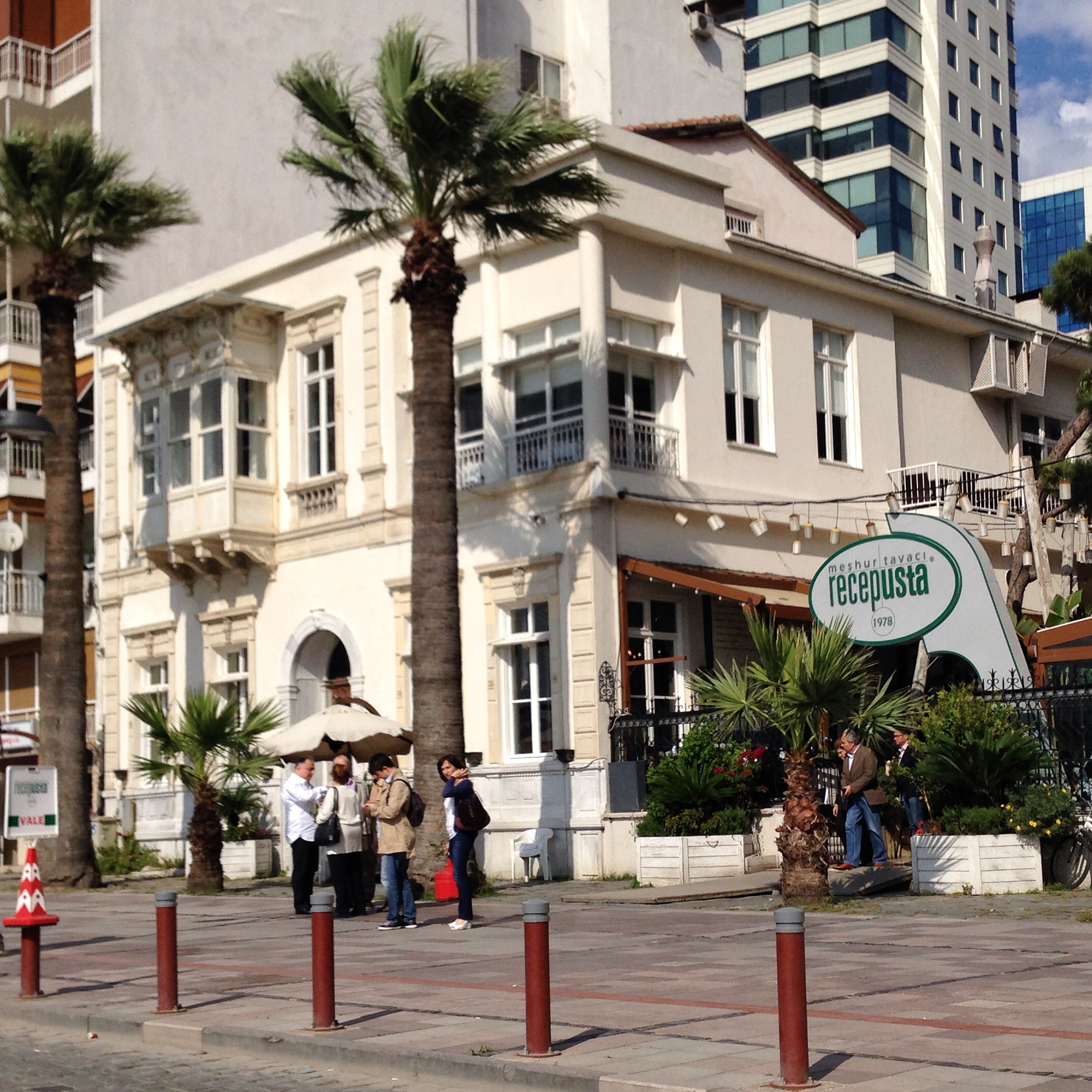
We visited Smyrna – now modern İzmir – in May 2014. We walked along the harbourside promenade, looked across the Aegean Sea, and took photographs that we sent them to our friend. They were ordinary holiday snaps, in one sense: the waterfront, the sea, the city behind us. But they carried something else with them. We were standing in a place from which his Greek forebears, had once looked towards the same water in circumstances unimaginably different from ours.
It is one of the peculiarities of history that the past can sometimes feel closer through a family anecdote or a photograph than through a library full of books. The old cliché about history leaving fingerprints is, perhaps, not entirely a cliché. Places retain traces of people who have gone, even when almost nothing visible remains of the communities that once inhabited them.
Smyrna is an especially powerful example.
It was once an Ancient Greek city located at a strategic point on the Aegean coast of Anatolia, and was actually two successive settlements: Old Smyrna, founded around the 11th century BC as an Aeolian settlement before being taken over and developed by the Ionians during the Archaic Period, and Smyrna proper, the new city founded from the 4th century BC onward, whose establishment is associated with Alexander the Great. Due to its advantageous port conditions, its ease of defence, and its good inland connections, Smyrna rose to prominence, reaching metropolitan proportions under the Roman Empire, with most of its surviving remains dating from that era, largely following reconstruction after a 2nd-century AD earthquake. Since 1930, the city’s official name has been İzmir.
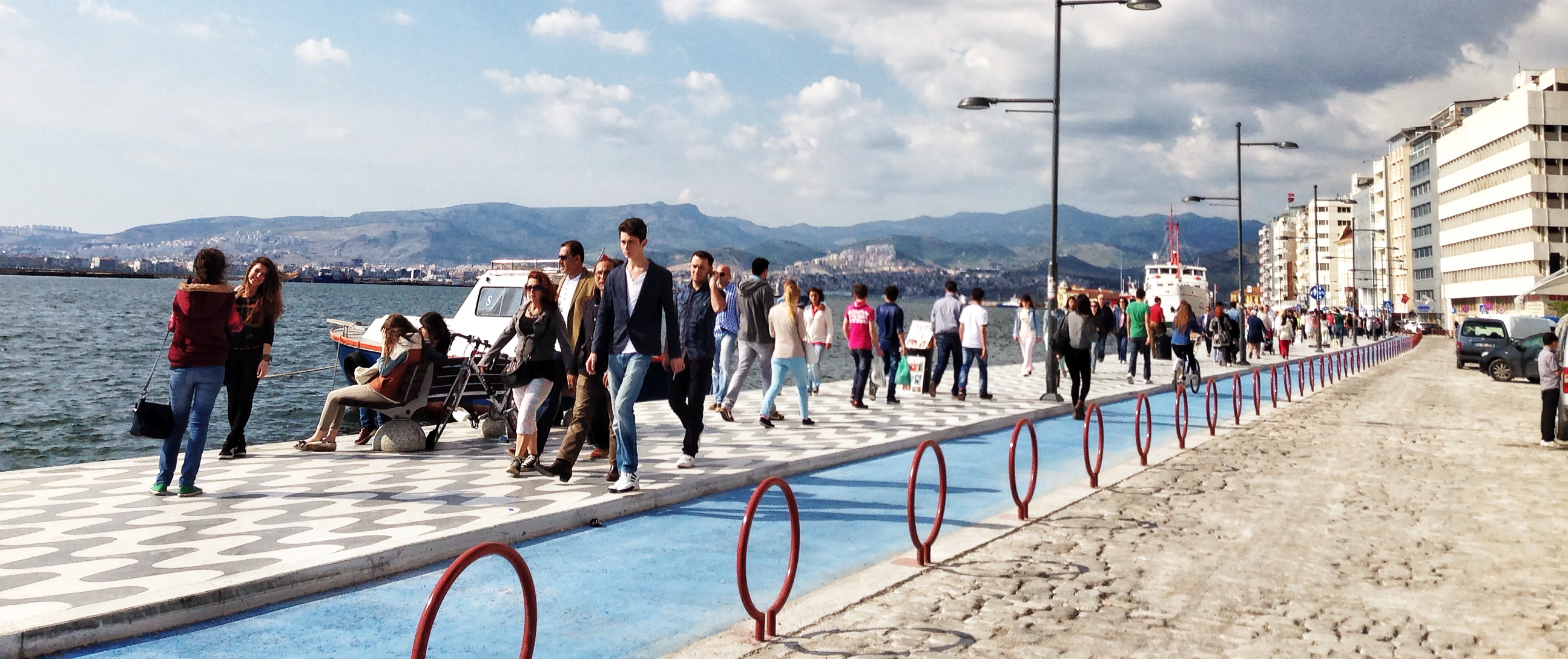
Modern Izmir, May 2014
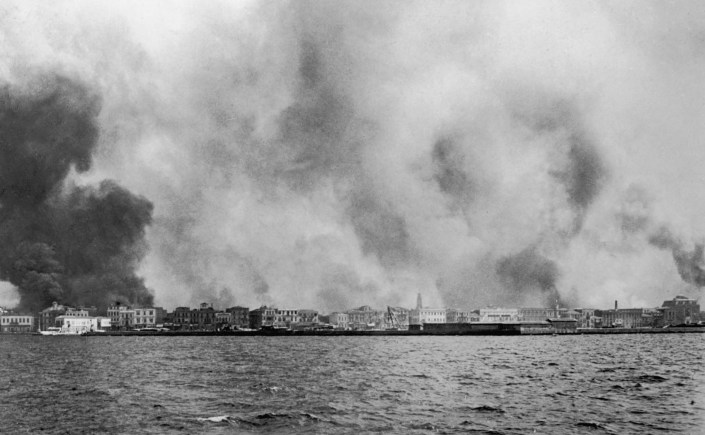
In September 1922, the city’s waterfront became the final refuge of tens of thousands of Greek and Armenian civilians as Turkish nationalist forces entered the city and violence and fire engulfed its Christian quarters. Within a few years, the overwhelmingly Greek character of one of the great cities of the eastern Mediterranean had largely disappeared. But Smyrna was not the beginning of this story. It was one of the last chapters in the extraordinarily violent disintegration of the Ottoman Empire.
The story reaches backwards through the Balkan Wars, the Ottoman-Russian conflicts, the massacres of Armenians in the 1890s, the First World War and the destruction of Armenian and Assyrian communities, and forwards through the Greek Turkish and War, the Treaty of Lausanne and the compulsory exchange of populations. It is a story of imperial collapse and national self-determination, but also of refugees, massacres, deportations, competing territorial claims and the brutal desire of emerging nation-states to make populations conform to political borders.
It is therefore tempting to reduce it to a morality tale. There is certainly no shortage of moral horror in the record. But moral judgement and historical explanation are not alternatives. The challenge is to understand how a multi-ethnic empire that had survived for centuries gave way, through war and revolution, to a collection of more nationally defined states — and why that transformation was accompanied by such extraordinary human suffering.
That is the longer story of Smyrna, and of the Ottoman endgame.

The leaving of Smyrna, September 2022
Smyrna and the Ottoman Endgame
In September 1922, the cosmopolitan city of Smyrna became the final, terrible act in a drama that had been unfolding for more than a decade. The city’s waterfront filled with Greek and Armenian refugees as Turkish nationalist forces entered the city and Christian neighbourhoods were engulfed by fire. Behind them lay the ruins of communities that had existed in Anatolia for centuries; ahead was the Aegean and, for many, an uncertain escape to Greece.
The familiar account of Smyrna begins here, with the fire, the refugees and the ships of the Allied powers lying offshore, apparently unable or unwilling to intervene in one of the final acts in a war that they had effectively lost. But history did not begin in Smyrna. Nor did the destruction of Anatolia’s Christian communities begin with Turkish commander Mustafa Kemal’s nationalist movement. To understand what happened in 1922, one has to go back through the Balkan Wars, the Ottoman defeat in the First World War and, before that, the increasingly violent crisis of the Ottoman state’s relations with its subject peoples.
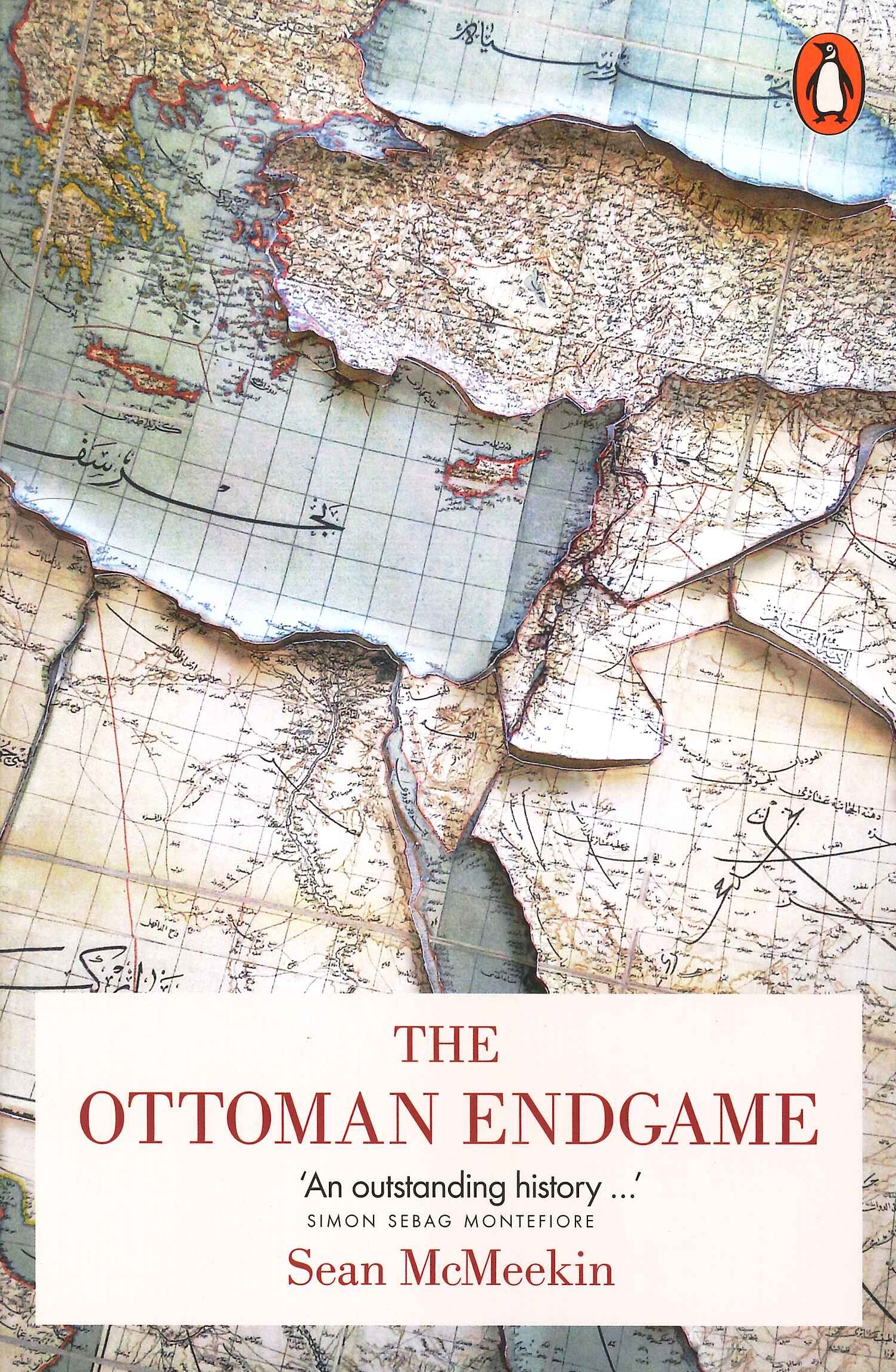
This is the broader story told, with considerable geographical and archival range, by Sean McMeekin in The Ottoman Endgame. It is also the story explored in In That Howling Infinite’s The fall of the Ottoman Empire and the birth of Türkiye : the dissolution of an empire was not a single event but a succession of wars, revolutions, occupations, expulsions and attempts at national reconstruction. The First World War was the central episode, but it was also part of a much longer Ottoman endgame.
The wars before the war
It is convenient to imagine Europe as peaceful until August 1914. It was not. The Ottoman Empire had already been fighting for its survival.
Italy went to war with the Ottomans in 1911, seizing Tripolitania and Cyrenaica, the territories that became Libya. Then came the Balkan Wars of 1912–13, in which the Ottoman Empire lost almost all its remaining European territories. Greece, Serbia, Bulgaria and Montenegro expanded at Ottoman expense, while Albania emerged as an independent state. Romania, often included rather casually in this account, was already an independent kingdom, although it acquired territory from Bulgaria after the Second Balkan War.
The Balkan Wars were particularly important because they demonstrated what the disintegration of a multinational empire could mean in an age of nationalism. Armies advanced, borders changed and populations moved. Christians were expelled from territories conquered by Muslim powers and Muslims were expelled from territories conquered by Christian states. Villages were destroyed, civilians massacred and refugees displaced on a large scale. The demographic transformation of the Balkans was already underway before the First World War began.
This matters because the later violence in Anatolia did not occur in a political vacuum. Ottoman Muslims, many of them themselves refugees from the Balkans and the Caucasus, had seen their homes and communities disappear. The Ottoman state increasingly came to regard the survival of its Muslim population as a matter of national security. At the same time, Christian minorities – particularly Armenians and Greeks – increasingly looked beyond the empire towards their own national movements and, in some cases, to foreign powers.
The result was a vicious feedback loop. Nationalism encouraged separatism; separatism encouraged repression; repression encouraged further separatism. War made the whole process considerably worse.
Armenians and the First World War
The Armenian catastrophe has to be treated separately from what happened to the Greeks and Assyrians, although there were connections between them.
The massacres of Armenians during the reign of Sultan Abdulhamid II in 1894–96 were already a warning of what could happen when imperial authority, Muslim majoritarian sentiment and fears of territorial disintegration collided. Hundreds of thousands of Armenians were killed in massacres and associated violence. The Young Turk revolution of 1908 initially raised hopes of a more constitutional and inclusive Ottoman order, but those hopes deteriorated rapidly as the empire suffered military defeat, territorial losses and political crisis.
When the Ottoman Empire entered the First World War in late 1914 on the side of Germany and the other Central Powers, the Armenian question acquired an altogether more dangerous dimension. Ottoman forces were fighting Russia in the Caucasus, and some Armenian organisations and volunteers did indeed cooperate with the Russians. Armenian soldiers fought in Russian formations, while armed Armenian groups operated behind Ottoman lines. Ottoman fears of an Armenian fifth column were therefore not entirely invented.
But this context does not explain what followed, still less justify it.
In 1915 the Committee of Union and Progress government – what we know as The Young Turks (now a common term to describe ambitious young upstarts) – began the systematic deportation of Ottoman Armenians. Armenian political and community leaders were arrested and killed. Men were separated from their families and frequently murdered. Women, children and the elderly were deported southwards, many towards the Syrian desert. Deportation became a mechanism of destruction.
The death toll remains debated in detail, as such figures inevitably are, but the broad historical conclusion is not seriously in doubt: hundreds of thousands, probably well over a million Armenians, died through massacre, deportation, starvation, disease, exposure and deliberate deprivation. Many women and children were forcibly converted or absorbed into Muslim households. Sexual assault was commonplace. Armenian property was confiscated. An ancient community was not merely displaced; its institutional, demographic and economic foundations were systematically dismantled.
The Ottoman government and its successors have contested the term genocide and have emphasised the extraordinary circumstances of wartime collapse, Armenian collaboration with Russia and the deaths of Muslim civilians. Those Muslim deaths were real and often horrific. But they do not negate the evidence for the organised deportation and destruction of the Armenians. Nor does acknowledging Armenian collaboration with Russia turn an entire ethnic population into a legitimate military target.
The same period brought massacres and deportations of Assyrian Christians in southeastern Anatolia and northern Mesopotamia. The historical record is less comprehensive than for the Armenians, but the destruction of Assyrian communities belongs to the same wider story of wartime demographic violence.
The Greek catastrophe was different – and connected
The fate of the Ottoman Greeks followed a somewhat different chronology.
Greeks had lived throughout the Ottoman domains for centuries. In Anatolia they were concentrated particularly along the Aegean and Black Sea “Pontic” coasts, but Greek communities were also found in the interior. They were not simply recent immigrants or colonial settlers. They were part of the social and economic fabric of the late Ottoman Empire.
During the First World War, some Greek communities were deported or otherwise subjected to coercion and violence. In the Pontic region of the Black Sea, Greek nationalists and armed groups also became involved in conflict with Ottoman authorities and later with Turkish nationalists. The question of Greek communities in Anatolia consequently became entangled with the wider struggle over what would replace the Ottoman Empire.
The decisive change came after the Ottoman defeat.
The Armistice of Mudros in October 1918 effectively ended Ottoman participation in the war. Allied forces occupied strategic parts of the empire, including Constantinople. The victorious powers then contemplated a drastic settlement of Ottoman territory. The Treaty of Sèvres in 1920 proposed a severely truncated Ottoman state and envisaged Greek control or influence over substantial parts of western Anatolia.
The Greek military landing at Smyrna in May 1919 was therefore not an isolated act of Greek aggression. It occurred within the post-war Allied occupation and with Allied approval. Greece, was encouraged by its wartime territorial ambitions and by the vision of the Megali (great) Idea, – a Greek nationalist and irredentist vision that emerged after Greek independence (1821–1829) that called for the revival of the Byzantine Empire by uniting all regions with significant Greek populations – including parts of the southern Balkans, Anatolia, and Cyprus – still under Ottoman rule into a single Greek state.
Greece believed that it had an opportunity to incorporate territories containing substantial Greek populations and places of enormous symbolic importance to Greek history. But the settlement soon collided with another nationalism: Mustafa Kemal and the Turkish counter-revolution
Mustafa Kemal Pasha, the Ottoman commander who had become famous at Gallipoli, emerged as the principal leader of the Turkish nationalist movement. The movement rejected the partition of Anatolia contemplated at Sèvres and sought to establish national sovereignty over the Turkish heartland.
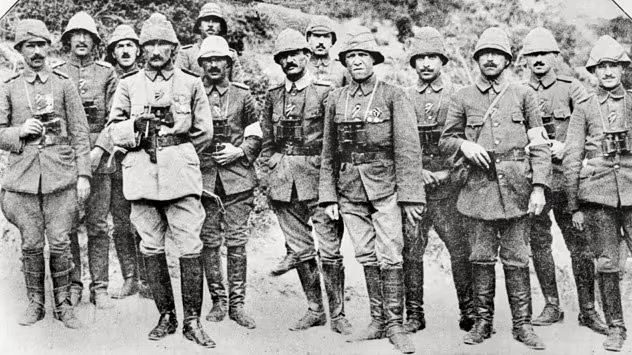
Mustafa Kemal and other Ottoman officers at Gallipoli
This was not simply an Ottoman army fighting a foreign invader. The Ottoman government in Constantinople accepted the Allied settlement; the nationalist movement centred in Anatolia rejected it. Turkey therefore experienced something approaching a war of national liberation combined with civil conflict.
The Greek army advanced deep into Anatolia. For a time, it appeared that Greece might achieve a substantial territorial settlement. But Turkish resistance stiffened. The nationalists defeated the Greek advance and, in August–September 1922, launched the offensive that drove the Greek army back towards the Aegean.
The Greek retreat was accompanied by atrocities and destruction on both sides. Turkish nationalist forces and irregulars committed massacres and expulsions against Christian civilians; Greek forces and retreating troops were themselves responsible for atrocities against Muslim civilians during their occupation and withdrawal. None of this is usefully understood through a simple morality tale in which one side was innocent and the other intrinsically barbarous.
There was, however, an important asymmetry in the final outcome: the Turkish nationalist victory made possible the consolidation of a Turkish nation-state in Anatolia, while the Greek population of much of the region was about to disappear.
Smyrna, September 1922
The events at Smyrna remain among the most contested episodes of the war, particularly regarding responsibility for the city’s fire and the precise number of people killed. The broad outlines are clearer.
Turkish nationalist forces entered Smyrna on 9 September 1922. The Greek Orthodox metropolitan, Chrysostomos, was murdered. There followed widespread looting, violence and attacks on the city’s Christian population. On 13 September a fire began in the Armenian quarter and subsequently consumed large parts of the Greek and Armenian districts.
The city contained a large Muslim population as well as substantial Greek and Armenian communities, and the precise course of the fire remains disputed. What is not disputed is the appalling predicament of the refugees trapped along the waterfront. Tens of thousands, probably far more, sought escape by sea. Allied warships were present. Their crews could see the fire. Their governments were reluctant to intervene militarily in what had become a Turkish nationalist victory and were constrained by the political circumstances of the time. Some Allied personnel and ships did rescue refugees; the larger failure was that the international presence did not prevent the catastrophe.
Smyrna was therefore both an atrocity and a symbol. It marked the end of a substantial Greek and Armenian presence in one of the great cities of the eastern Mediterranean.
But it was not, strictly speaking, the moment when that population vanished. Much of the Greek population had already fled or been displaced during the preceding years, and the final settlement was still to come.
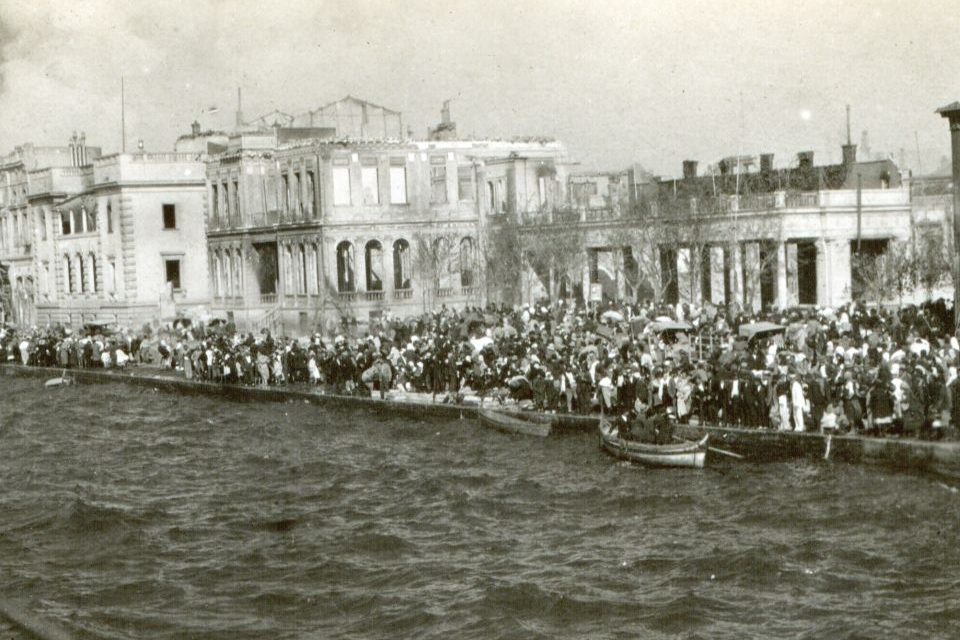
The leaving of Smyrna, September 2022
The population exchange
The Treaty of Lausanne in 1923 replaced Sèvres and internationally recognised the sovereignty of the new Turkish Republic over Anatolia and eastern Thrace. Mustafa Kemal, now Atatürk, had won the war.
Lausanne also gave international legitimacy to the compulsory exchange of populations between Greece and Turkey. Approximately 1.2 million Orthodox Christians were transferred from Turkey to Greece, while roughly 400,000 Muslims were transferred from Greece to Turkey, subject to various exemptions, including the Greek population of Constantinople and the Muslim population of western Thrace.
The exchange was presented as a solution to the problem of minorities. In reality, it was the formalisation of a demographic revolution already substantially achieved through war, massacre, deportation and flight.
It is important not to describe this simply as the expulsion of Christians from Anatolia. Muslims had also been expelled from territories lost by the Ottoman Empire during the Balkan Wars, and the compulsory exchange itself displaced Muslim as well as Christian populations. Nor was the exchange an exclusively Turkish initiative: Greece and Turkey agreed to it, and the victorious European powers incorporated it into the Lausanne settlement.
It was nevertheless an extraordinary admission of failure. The ideal of a multi-ethnic Ottoman political order had effectively given way to the principle that stability could be achieved by separating populations according to religion and, increasingly, nationality.
The irony was profound. The Ottoman Empire had survived for centuries precisely because it did not require everyone within its borders to be Turkish, Arab, Greek, Armenian, Serbian or Bulgarian. Its subjects belonged to overlapping religious, linguistic and local communities. The nineteenth and early twentieth centuries progressively replaced that imperial pluralism with nationalism. By the 1920s, population transfer had become one of the instruments by which the new states sought to make their populations conform to their national boundaries.
The longer Ottoman endgame
This is why I find McMeekin’s The Ottoman Endgame such a useful corrective to the conventional Western story of the First World War.
The war in the Ottoman world was not merely a sideshow to the trenches of France and Belgium. It stretched from Gallipoli to Gaza, Baghdad to Baku, the Caucasus to the Arabian Peninsula. Its consequences extended from the Balkans through Anatolia and the Levant to Mesopotamia. And it was intimately connected with the Russian war, the Russian revolutions and the subsequent Russian Civil War.
The Ottoman collapse also cannot be reduced to the familiar caricature of Britain and France simply carving up an otherwise coherent Middle East according to the lines of the Sykes–Picot Agreement. Sykes–Picot was real and consequential, but it was one of several competing wartime schemes for the disposition of Ottoman territory. Russia, too, had imperial ambitions. Constantinople had long been an object of Russian strategic and religious aspiration. France had its own ambitions in the Levant. Britain was concerned with India, Egypt, Mesopotamia, the Persian Gulf and the routes linking them.
And the Arabs, Armenians, Greeks, Kurds, Turks and other peoples of the empire were not merely passive pieces on a European chessboard. They had their own political ambitions, national movements and armed organisations.
The same complexity applies to Gallipoli. The campaign was certainly a military disaster, and Churchill was one of its principal advocates. But it was not simply Churchill’s personal folly, as the mythology subsequently suggested. It emerged from a much wider strategic debate about how best to defeat the Ottoman Empire and assist Russia. Its failure helped establish Mustafa Kemal as a military leader of consequence.
That matters because the man who became the founder of modern Türkiye was not an outsider who suddenly appeared after the Ottoman collapse. He was an Ottoman officer, a product of the imperial military system and a veteran of the Balkan Wars, Libya and Gallipoli. The Turkish Republic was born not from a clean break with the Ottoman past but from its ruins.
A demographic revolution
There is a tendency, particularly in polemical accounts of this period, to describe the destruction of Anatolia’s Christian communities as a single uninterrupted campaign stretching from the Hamidian massacres through the Armenian genocide to Smyrna. The chronology is more complicated than that.
There were massacres under Abdulhamid II. There were the catastrophic deportation and destruction of the Armenians under the wartime Committee of Union and Progress. There were attacks on Assyrian communities. There were violence and displacement affecting Ottoman Greeks during and after the First World War. There were massacres of Muslims during the Balkan Wars and the Greek occupation and retreat in Anatolia. There was the Turkish nationalist war against Greece. There was Smyrna. Finally, there was the compulsory population exchange.
These events were not identical. Their perpetrators, political circumstances and immediate objectives differed. Nor should the existence of Muslim suffering be invoked to dilute the particular historical responsibility for the Armenian genocide.
But they belong to the same larger transformation: the violent passage from empire to nation-state.
What disappeared was not literally a civilisation that had remained unchanged for two thousand years. Anatolian Christianity itself had changed enormously over those centuries. Byzantine Christianity, Armenian Christianity, Syriac Christianity and Greek Orthodoxy had their own histories and communities. Ottoman society was neither a paradise of tolerance nor a permanent state of persecution. It was a hierarchical imperial order in which religious communities possessed considerable autonomy while remaining unequal before the state.
What disappeared in the early twentieth century was that plural Ottoman world.
By the middle of the 1920s, the Armenian presence in Anatolia had been largely destroyed; the great majority of Anatolian Greeks had gone; Assyrian communities had been devastated and dispersed; and millions of Muslims displaced from the Balkans and Caucasus had been absorbed into the Turkish heartland. The new Republic of Türkiye inherited an Anatolia that was considerably more homogeneous than the Ottoman Empire had been.
The transformation was accompanied by enormous human suffering and the appropriation of property on a vast scale. It also produced the demographic foundations of the modern Turkish state.
The wars of Ottoman succession
Seen from this distance, the Balkan Wars, the First World War and the Turkish War of Independence can be understood as parts of a longer sequence: the wars of Ottoman succession.
The Ottoman Empire had once encompassed much of southeastern Europe, the Middle East and North Africa. Its disappearance created a succession problem of extraordinary dimensions. Who would inherit its territories? Russia, Britain, France, Greece, Italy and the emerging Arab states all had answers. So did the Turks. The Balkan peoples had already answered the question in their own way before 1914.
The wars did not end neatly in 1918. The Ottoman defeat was followed by the Greek-Turkish war; the Russian Revolution and Civil War transformed the Caucasus; Britain and France established mandates in former Arab Ottoman territories; the Turkish Republic emerged from the nationalist victory; population exchanges attempted to impose demographic order upon territories in which communities had been intermingled for centuries.
That is one reason the consequences remain visible today.
The modern Middle East was not simply invented at a European conference after the First World War. Nor was it simply the inevitable product of ancient ethnic and religious hatreds. It emerged from the interaction of imperial collapse, nationalism, local political movements, European intervention, Russian expansion, war, revolution and demographic engineering.
Smyrna was therefore not the beginning of the story, and neither was it quite the end. It was one of the last great convulsions of the Ottoman endgame.
The ships in the harbour in September 1922 were looking at more than a burning city. They were looking at the consequences of a political order that had been collapsing for generations. Behind the flames lay the Balkan Wars, the deportations of 1915, the battles between Greeks and Turks, the Russian-Ottoman struggle in the Caucasus, the Allied occupation, Sèvres and the nationalist revolt led by Mustafa Kemal. Ahead lay Lausanne, the population exchange and the Republic of Türkiye.
The Ottoman Empire had gone. The Greek presence in Anatolia had largely gone with it. So too had the Armenian communities that had survived there for centuries.
But the story was not one of an ancient world simply disappearing beneath the flames. It was the much messier story of modern nationalism being born from the wreckage of empire.
And that is perhaps the more uncomfortable historical lesson. Empires can suppress national conflict without resolving it. When they collapse, the suppressed conflicts do not necessarily disappear. They can return in a more radical form, as competing peoples attempt to turn mixed imperial territories into national homelands. Borders are drawn; populations move; minorities become suspect; refugees become instruments of politics; and, in the worst circumstances, demographic homogenisation becomes a military objective.
The Ottoman Empire was not the only empire to discover this. The Habsburg, Romanov and German empires would suffer their own violent disintegration. Timothy Snyder’s later description of the lands between Germany and Russia as the “Bloodlands” has a broader resonance here. The territories left behind by the collapse of Europe’s great empires became some of the most violent political spaces of the twentieth century.
The Ottoman endgame was one of them. And it is still playing its echoes.
Izmir, May 2014
When we stood on the Izmir waterfront in 2014, there was little to suggest what had happened there ninety-two years earlier. The promenade was busy; the Aegean glittered beyond the harbour and modern İzmir was very much a Turkish city looking confidently towards its future. There was no visible boundary between the city that had been and the city that is.
Yet somewhere in the photographs I sent to our friend back home in Australia was a connection between those two worlds. His family’s roots lay in a city whose Greek population had once been large enough to constitute one of its defining communities. The people themselves had gone, their neighbourhoods transformed, their institutions dispersed, their descendants scattered across Greece and the wider diaspora. But the sea remained.
That is the strange persistence of history. People disappear; places survive. Names change, buildings are demolished, languages fall silent and populations are exchanged. Yet descendants carry fragments of the vanished world with them. Sometimes it is a family story, sometimes a photograph, sometimes a surname whose meaning has travelled further than its bearers ever imagined.
A Greek family descended from Smyrna and living in Sydney is itself a reminder of the untidy human geography of the Ottoman world. It tells us something that maps coloured in the clean shades of modern nation-states cannot: people moved, intermarried, converted, fled, were expelled and reinvented themselves. Their identities were rarely as tidy as the borders that eventually enclosed them.
The history of Smyrna is therefore not simply the story of one massacre or one burning city, terrible though those events were. It belongs to the much larger history of the collapse of empires and the rise of nationalism. The Balkan Wars, the First World War, the Armenian genocide, the destruction and displacement of Assyrian and Greek communities, the Greek advance into Anatolia, the Turkish nationalist victory and the compulsory population exchange were different episodes, with different actors and circumstances. Together, however, they transformed the demographic and political landscape of the eastern Mediterranean.
The Ottoman Empire had not been a harmonious multicultural paradise, and its dissolution did not produce violence from nowhere. But its disappearance removed an imperial framework within which different communities had lived, however unequally, alongside one another. The national states that replaced it promised sovereignty and security. Too often they sought both by making their populations more homogeneous.
That is the uncomfortable lesson of the Ottoman endgame. The twentieth century did not simply replace old empires with neat national democracies. It also produced refugees, minorities without homelands, homelands without their former minorities, and borders drawn through landscapes inhabited for generations by people who had never imagined themselves foreigners.
And yet history is not entirely erased by political transformation.
The harbour is still there.
In 1922, people crowded along that waterfront desperate to escape across the same Aegean. In 2014, an Australian friend of Greek Smyrna ancestry received photographs of that same waterfront from another traveller, standing there in very different circumstances. Between those two moments lies a century of catastrophe, migration and memory.
Perhaps that is what the old phrase about history leaving fingerprints really means. The fingerprints are not always found in monuments or memorials. Sometimes they survive in a surname, a family story, a photograph sent from a distant city — or in the simple recognition that, although the people have gone, you are standing where they once stood.
Roots and fruits.
The empire is gone. The city has changed. The people have dispersed.
But the fingerprints remain.
© Paul Hemphill, August 2026.
The old and the new in modern Izmir, May 2014
Also, in In That Howling Infinite, The fall of the Ottoman Empire and the birth of Türkiye; Ottoman Redux – an alternative history; Sailing to Byzantium; The Watchers of the Water; Cha-cha-cha-changes; People watching in Sultanahmet; and on displacement, Modern history is built upon exodus and displacement
For more on the Middle East, see A Middle East Miscellany
The Great Unravelling – modern history is built on exodus and displacement


 In That Howling Infinite