In Lucifer Descending … encounters with the morning star, In That Howling Infinite followed Lucifer’s long journey from Scripture into theology: from the elusive serpent of Genesis to the rebellious archangel of Christian tradition; from the Book of Job to Isaiah, Ezekiel, the New Testament and, ultimately, to Milton’s magnificent Paradise Lost. It was the story of how a comparatively shadowy biblical adversary gradually became the Prince of Darkness who has haunted the Western imagination for almost two millennia.
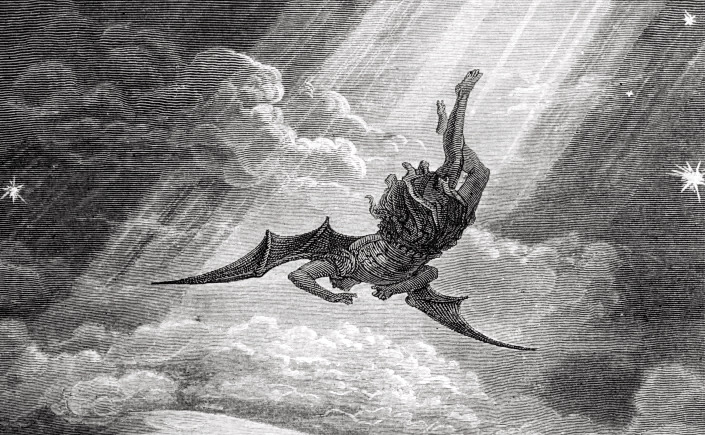
But stories, like their protagonists, seldom remain where we leave them. If Lucifer Descending explored how the Lucifer fell from Heaven, this essay asks what happened after he landed.
For Lucifer, it turns out, has enjoyed an extraordinarily successful afterlife. As religious belief has receded across much of the Western world, he has not disappeared. Rather, he has escaped the confines of theology and colonised almost every corner of our culture. He strides through literature, painting, opera, horror, fantasy, cinema, television, popular music and political rhetoric with undiminished confidence.
This is therefore not another essay about Satan as an object of faith. It is an exploration of Lucifer as one of Western civilisation’s most durable cultural archetypes. Why do we continue to invent Dark Lords long after many have ceased to believe in the Devil? Why do our stories seem unable to function without them? Why does the Wild Hunt still thunder across our imagination, why does Old Nick keep turning up in our songs, and why do successive generations remain fascinated by the glamour of the forbidden?
The answers reveal at least as much about ourselves as they do about the Devil.
For, as this essay gradually suggests, Lucifer’s greatest triumph may not have been persuading us that he exists. It may have been persuading us that evil always wears somebody else’s face.
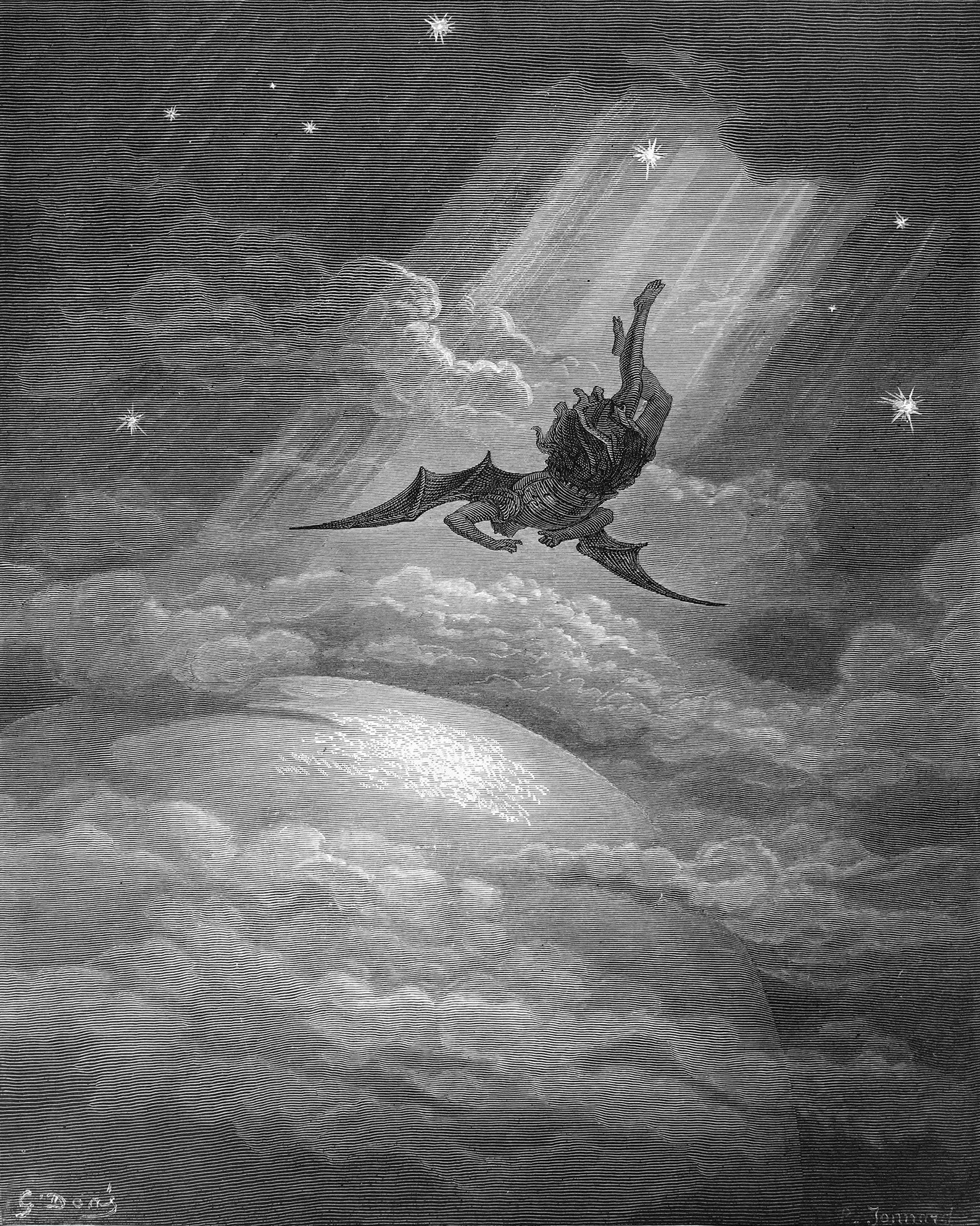
Lucifer descending, Gustave Dore
The Devil Rises
I heard the snake was baffled by his sin
He shed his scales to find the snake within
But born again is born without a skin
The poison enters into everything
Leonard Cohen, Treaty
There is a curious paradox at the heart of Western civilisation. For all the decline in church attendance, one suspects that Lucifer has never really been unemployed.
Heaven may have dismissed him long ago, but literature, painting, music, theatre and cinema hired him almost immediately. Theology gradually misplaced him; popular culture put him back on the payroll. Strip away the horns, the cloven hooves and the sulphurous odour, and he reappears century after century in fresh disguise: the Dark Lord, the Shadow, the Emperor, the Great Corrupter, the smiling tyrant, the master criminal, the “Big Bad”, the villain whose ambitions invariably exceed both his wisdom and his humanity.
In short, Lucifer never really went away. He simply changed costumes.
This is perhaps his greatest triumph. For while belief in a literal Devil has waned across much of the Western world, belief in evil personified has scarcely diminished at all. We remain incurable myth-makers. Every age invents a Prince of Darkness suited to its own anxieties. Medieval Europe imagined hornèd demons lurking in forests and crossroads. The nineteenth century preferred aristocratic vampires and criminal masterminds. The twentieth gave us dictators. The twenty-first has elevated cinematic super-villains into a kind of secular demonology. We may no longer fear Hell in quite the old-fashioned sense, but we still require someone – or something – to embody the darkness against which heroes define themselves.
It is hardly surprising. Stories require conflict. Heroes are admirable, but villains are memorable. The hero must remain consistently virtuous; the villain enjoys all the best speeches, the finest costumes and the greatest dramatic licence. Lucifer himself set the pattern. Even those who have never read Paradise Lost have absorbed Milton’s magnificent creation second-hand. William Blake famously quipped that the Puritan poet “was of the Devil’s party without knowing it,” and one understands precisely what he meant. God issues decrees. Satan delivers soliloquies and strikes power chords.
Milton’s Lucifer was not the grotesque beast of medieval mystery plays. He was intelligent, eloquent, magnificent even in defeat, ruined less by wickedness than by pride. “Better to reign in Hell than serve in Heaven” may be one of the most quoted lines in English literature precisely because it speaks to something recognisably human. Milton’s Devil is wrong, certainly, but never dull. Every great fictional Dark Lord since has borrowed something from him.
J.R.R. Tolkien would doubtless have resisted the comparison. As a devout Catholic he disliked allegory almost as much as C.S. Lewis embraced it. Yet Sauron stands unmistakably in the Miltonic tradition. He is no mere tyrant but a fallen power, less a personality than a malignant will bent entirely upon domination. Indeed, Sauron scarcely appears in The Lord of the Rings as a character at all. He is an absence, an all-seeing eye, a presence felt rather than seen. Evil has become abstract, bureaucratic almost, no longer dependent upon pitchforks and brimstone but upon surveillance, conquest and absolute control. Lucifer has evolved into totalitarianism.
Sauron’s lieutenant Saruman is perhaps closer to Milton’s original conception. Once wise, once good, corrupted not by appetite but by certainty. Like Lucifer himself, Saruman does not begin as evil. He begins by believing that the ends justify the means. Christopher Lee, who portrayed him so magnificently, understood these ambiguities better than most. There was something appropriate about the actor who had previously embodied Dracula and Rasputin eventually becoming Tolkien’s fallen wizard. Lee spent much of his career giving evil an aristocratic dignity that was infinitely more unsettling than any number of prosthetic horns.
George Lucas followed much the same path. Darth Vader may be the fallen angel, the once-noble knight seduced by power, but the true Lucifer of Star Wars is Emperor Palpatine. Smiling, patient, almost avuncular, he rarely forces anyone to do anything. Instead, he whispers. He flatters. He identifies weaknesses already present and quietly enlarges them. Like the serpent in Eden, he offers knowledge, certainty and power, while allowing his victims to imagine that every decision is entirely their own. Watching the prequel trilogy today, one is struck by how often democracy destroys itself voluntarily. Palpatine scarcely stages a coup. The Republic hands him the keys.
Marvel has travelled a similar road. Thanos does not regard himself as wicked. Quite the reverse. He considers himself the only rational adult in a sentimental universe. Half of all life must perish, he argues, so that the remainder may flourish. His is genocide expressed as arithmetic. That, perhaps, is modern evil in a nutshell. The old Devil tempted souls. Today’s Dark Lord arrives bearing graphs, statistics and PowerPoint slides.
Even Walt Disney understood that darkness is dramatically indispensable. Snow White has her Wicked Queen, Sleeping Beauty her horned Maleficent, and The Lion King its melancholy conspirator Scar, Shakespeare’s Richard III translated into feline form. Disney princes tend to blur into one another. Nobody forgets Cruella De Ville.
Nor is this confined to fairy tales.
Sherlock Holmes required Professor Moriarty, “the Napoleon of Crime”, a title that neatly transformed the “Corsican ogre” into a metaphor for criminal genius. Dracula became immortal not merely because he drank blood but because he represented temptation wrapped in elegance. Hannibal Lecter horrified audiences precisely because he was cultivated enough to discuss Bach and Bordeaux while contemplating cannibalism. Batman’s Joker delights in proving that civilisation itself is only a thin coat of paint over chaos. Voldemort, another heir to Sauron, seeks not merely power but immortality itself, the oldest Luciferian ambition of all.
James Bond, too, would have enjoyed a remarkably brief career had Ian Fleming contented himself with ordinary gangsters. Instead, he gave us Blofeld, Dr No, Goldfinger and a parade of megalomaniacs convinced that humanity’s principal problem was insufficient obedience. They possessed volcanic lairs, Persian cats, improbable weapons and ambitions bordering on the theological. Bond did not merely foil criminals; he repeatedly thwarted men aspiring to become secular gods.
One of the cleverest reinventions of the archetype came from the most unlikely quarter imaginable: a Californian-based television series ostensibly about teenage vampires.
Beneath the wisecracks and high-school melodrama, Buffy the Vampire Slayer was an entertainingly sophisticated theological exercise. Each season introduced a new “Big Bad”, the a term creator Joss Weedon coined for whatever apocalyptic menace Buffy happened to be facing. The expression was comic, yet psychologically astute. Stories seem to demand a supreme antagonist around whom lesser evils can organise themselves.
The setting was inspired. Sunnydale High School stood upon a Hellmouth, a literal gateway to infernal realms buried beneath the school library, and an eminently portable metaphor. Adolescence already feels like Hell; why not build the school directly over it? Evil, the series quietly suggested, is never somewhere else. It is not confined to Mordor or the underworld. It bubbles perpetually beneath ordinary life, beneath classrooms, shopping malls, suburban cul-de-sacs and parent-teacher evenings, requiring only the occasional crack in the pavement to emerge. “There’s this thing that happens here, over the hell mouth”, says Buffy, “where the way a thing feels – it kind of starts being that way for real. I’ve seen all these things before – just not all at once”.
Lucifer has hence become less a theological proposition than a dramatic necessity. Every mythology requires its dragon. Every dragon requires its Dark Lord. Every Dark Lord owes something to the Morning Star. And every hero requires a nemesis to defeat and destroy.
Nor do we confine these figures to fiction. Human beings have always displayed a remarkable talent for transforming history into morality plays. Every generation manufactures its own secular Satan. Adolf Hitler has become the universal benchmark against which evil itself is measured. His name no longer belongs solely to history but to mythology. Joseph Stalin joins him, pipe smoke curling above the Gulag like incense from some infernal liturgy. Mao Tse Tung presides over famines of almost biblical proportions. Pol Pot transformed Cambodia into a charnel house. Even the language betrays us. We do not merely describe such men as wicked. We speak of them as monsters, demons, incarnations of evil itself.
Earlier centuries found their Dark Lords elsewhere. Napoleon Bonaparte was the Corsican Ogre, riding across Europe like an Antichrist in cavalry boots. Medieval chroniclers regarded Genghis Khan as divine punishment erupting from the eastern steppe. Rome supplied a gallery of memorable villains – Nero, Caligula, Commodus and Elagabalus – whose reputations, embroidered though some undoubtedly are, have endured for two thousand years because every civilisation likes to imagine that somewhere in its past there strode an emperor who was not merely bad but diabolical.
Then there was Grigori Rasputin, whom we encountered in a recent essay. Mystic, mountebank, holy fool, healer, libertine, political manipulator and reluctant martyr, Rasputin somehow managed to become all things to all people. The beard, the hypnotic stare, the whispered scandals, the astonishing resilience in the face of poison, bullets and icy rivers – no wonder he stared in on of Hammer’s schlocky horror shows.
There is, however, a danger in all this. The more enthusiastically we invest evil in extraordinary individuals, the more confidently the rest of us absolve ourselves. If Hitler is Satan, then we need only reassure ourselves that we are not Hitler. If Sauron dwells in Mordor, then the Shire is safely innocent. It is an attractive proposition, comforting even, but one that both history and literature stubbornly refuse to endorse.
Milton knew better. So did Tolkien. So, in his own deceptively gentle way, did W.H. Auden, who, according to his biographer, Humphrey Carpenter, once startled a Sunday School class by asking, “Do you know what the Devil looks like? The Devil looks like me.”
That may be the most unsettling description of Lucifer ever written. For it suggests that the Dark Lord’s final disguise is not the hornèd demon, nor the tyrant, nor the vampire, nor the emperor. It is the ordinary human face reflected back at us from the mirror.
From there, as the old proverb reminds us, it is but a short ride before the Devil takes the reins.
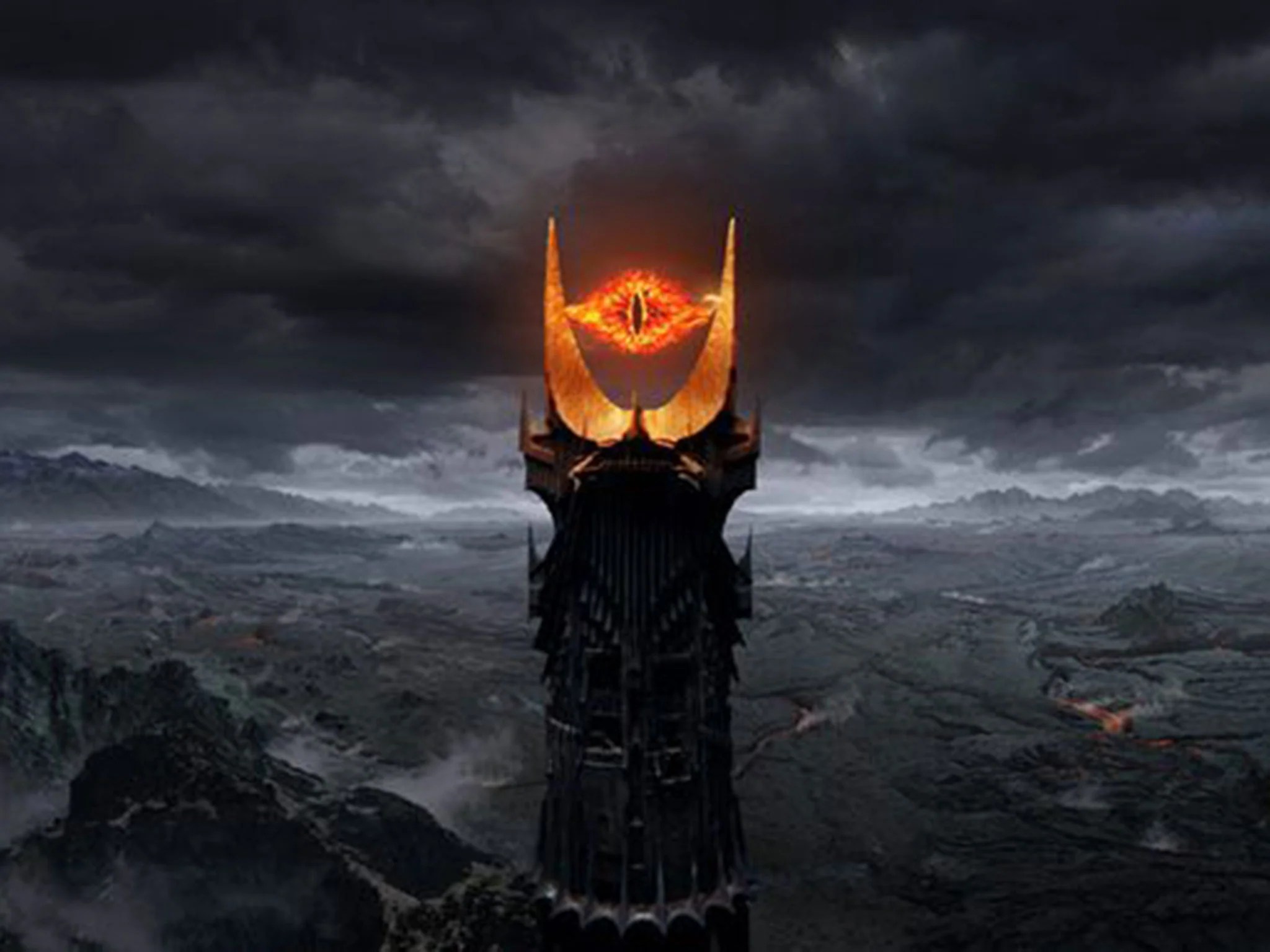
Sauron, the all-seeing eye
The Devil Drives
And now the wheels of heaven stop, you feel the devil’s riding crop.
Get ready for the future: it is murder.
Leonard Cohen, The Future
If the Dark Lord gives evil a face, the Devil gives it motion.
There is an old English proverb, first recorded by John Lydgate around 1420, that survives today in abbreviated form: Needs must when the Devil drives. We have largely forgotten the second half, retaining only the resigned “needs must”, yet the original is far richer. It conjures a vivid image of the unfortunate traveller compelled onward by an infernal coachman, driven not by choice but by necessity, passion, fear or circumstance. Shakespeare knew the saying well and put it into the mouth of Helena in All’s Well That Ends Well. Six centuries later it still captures something uncomfortable about the human condition. We like to think we are steering our own course. More often than not, someone – or something else – appears to have seized the reins. How often have we heard those righteous souls who have failed to resist carnal temptation plaintively cry “the devil made me do it!”
The Devil, in this tradition, is not so much a ruler as a driver.
American gospel music later turned the proverb into practical theology. “Don’t let the Devil ride,” warned one well-loved spiritual. The explanation followed immediately: “If you let him ride, he’ll want to drive.” It is a neat summary of temptation itself. Evil rarely demands complete surrender at the outset. It asks only for a lift, a compromise, a tiny concession, one small indulgence. Before long, you discover that you have been relegated to the passenger seat.
Author Dennis Wheatley understood the power of this ancient image when he published The Devil Rides Out in 1934. It remains one of the great classics of English supernatural fiction, written at a time when spiritualism, séances and occult societies flourished among polite society between the wars. Wheatley’s Satan is no medieval gargoyle lurking beneath cathedral gargoyles. He rides abroad, active in the world, recruiting disciples, pursuing souls and intruding into drawing rooms where cocktails are served with impeccable manners. Christopher Lee’s magnificent portrayal of the Duc de Richelieu in Hammer’s 1968 adaptation elevated what might otherwise have been Gothic melodrama into something almost Miltonic. Tall, patrician and entirely convincing, Lee battled infernal forces with learning, courage and Latin – unlike Buffy Somer’s high kicks and wisecracks. It may be the only horror film in which civilisation itself, embodied in good breeding and quiet erudition, proves the Devil’s most formidable opponent.
Yet Wheatley was drawing upon something immeasurably older than Christianity, for long before Lucifer acquired horns, antique Europe already knew that when the wind howled through winter forests and clouds raced across a full moon, riders were abroad on The Wild Hunt.
Every northern people seemed to possess its own version. In Scandinavia it thundered across the heavens under the command of Odin himself, one-eyed, cloaked and spear in hand, accompanied by ghostly warriors and spectral wolves. In England the leader became Herne the Hunter, antlers upon his brow, riding through Windsor Forest with baying hounds at his heels. Shakespeare gives him a memorable cameo in The Merry Wives of Windsor, where Falstaff disguises himself as the horned hunter beneath the great oak. Whether Herne was once a forgotten woodland god, an Anglo-Saxon spirit or merely local folklore hardly matters. By Elizabethan times everyone knew that one did not linger in the forest after dark when Herne was abroad.
Across the Severn in Wales the Hunt belonged to Gwyn ap Nudd, king of Annwn, the Otherworld, who rode with his fearsome Cŵn Annwn, the white hounds with crimson ears whose baying foretold death. In Brittany and northern France, it became the Mesnée d’Hellequin, the Host of Hellequin, whose mysterious leader eventually lent his name, by one of language’s curious transformations, to the comic Harlequin of the Italian stage. Germany knew the procession under other names; so too did the Low Countries.
The details varied. The essentials did not. A storm. A cavalcade. The dead riding with the living. And woe betide anyone who crossed their path. Sometimes those unfortunate enough to witness the Hunt were swept away forever. Sometimes they were compelled to join it. Sometimes they survived only to wake the following morning miles from home with no memory of the night’s journey. One can almost hear the old proverb whispering through these stories. Needs must when the Devil drives.
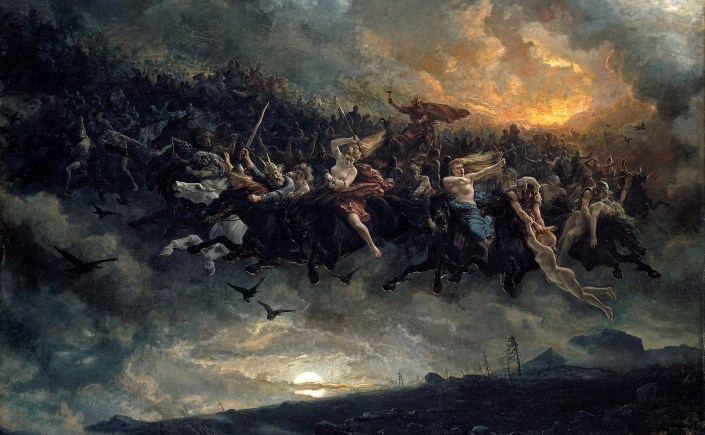
The great Norwegian painter Peter Nicolai Arbo captured the legend magnificently in his 1872 canvas Åsgårdsreien – usually rendered in English simply as The Wild Hunt of Odin. It is one of those paintings that appears almost to move before one’s eyes. Odin’s spectral company bursts from the darkness in an explosion of movement. Horses rear. Cloaks stream behind their riders. Women, warriors and phantom hounds tumble through the storm as though the sky itself has become a battlefield. Nothing in the picture is static. The Hunt is motion incarnate, a supernatural force impossible either to resist or escape. Looking upon it, one immediately understands why our ancestors barred their doors when winter winds began to howl.
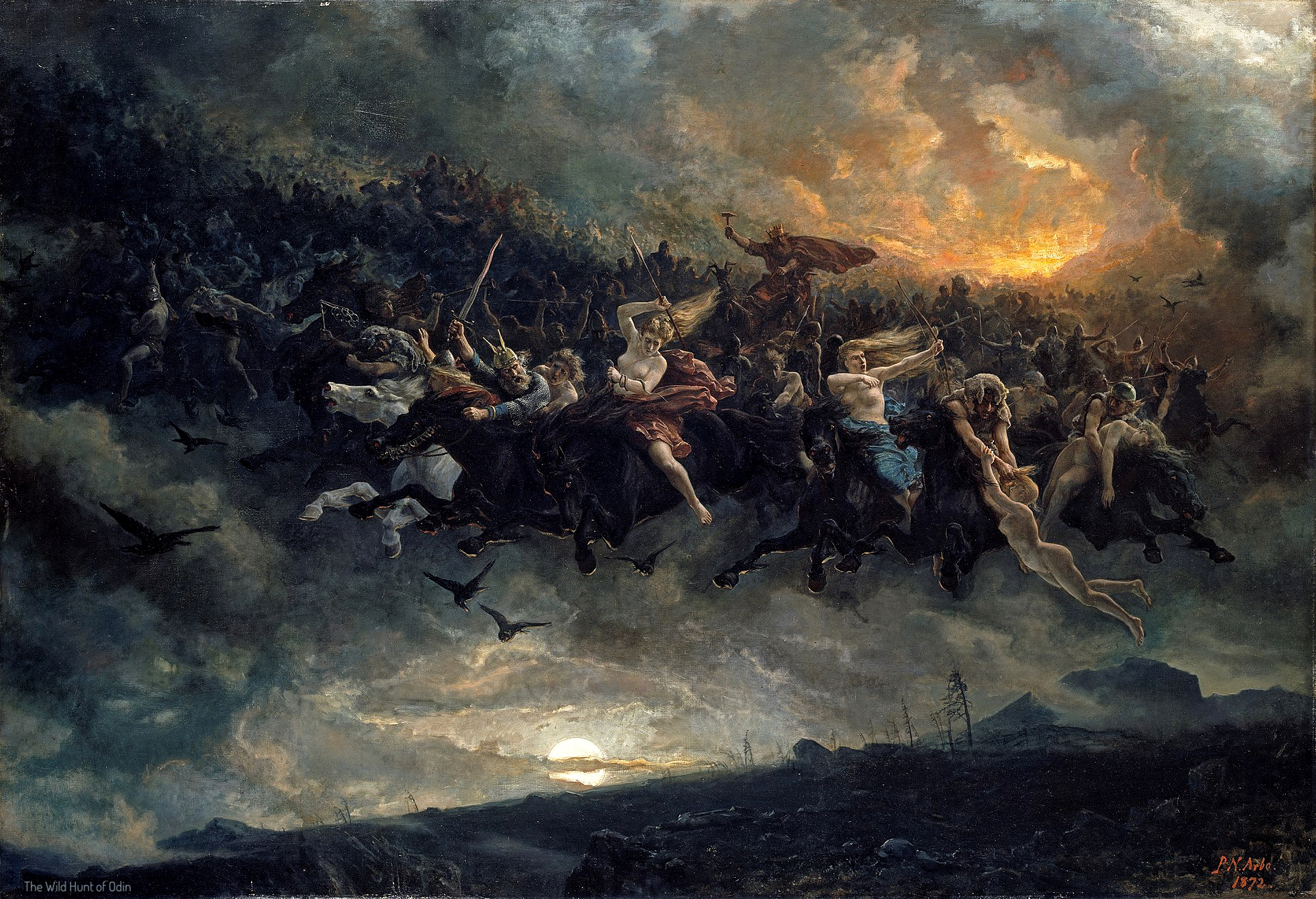
Åsgårdsreien – The Wild Hunt
The Church, unsurprisingly, appropriated the legend rather than abolishing it. Odin quietly surrendered his command to darker powers. The spectral riders became demons. The horned Herne acquired a suspicious resemblance to the Devil himself. Pagan myth merged seamlessly into Christian cosmology. The Hunt still rode; only its commander had changed.
Or perhaps not. For there is something profoundly Luciferian about the Wild Hunt irrespective of who happens to lead it. It is the embodiment of restless movement, insatiable desire and ceaseless pursuit. The riders never arrive because they are never seeking a destination. They exist only to chase – like temptation itself.
The extraordinary thing is that the Hunt did not perish with the old beliefs. It emigrated. Like so much European folklore, it crossed the Atlantic in the baggage of settlers, adapting itself to new landscapes and fresh imaginations. Somewhere between the Black Forest and the Black Hills, between Sherwood Forest and the Sierra Nevada, the ghostly riders exchanged mail armour for denim, spears for lassos and wolves for cattle.
The Wild Hunt became the Wild West.
No one realised this more completely than Stan Jones. When the Arizona park ranger wrote Ghost Riders in the Sky in 1948, he almost certainly knew he was drawing upon old frontier tales of phantom cattle drives. Whether he realised that those tales themselves descended from a mythology already a thousand years old is another matter. Yet the genealogy is unmistakable. Jones’s doomed cowboys pursuing a phantom herd across thunderclouds are Odin’s riders in Stetsons. Their burning cattle replace the wolves of the north. Their endless pursuit echoes precisely the fate awaiting those medieval hunters unfortunate enough to be swept into the spectral cavalcade.
In That Howling Infinite has paid tribute to this extraordinary song in A cowboy key – how the west was sung, describing it as perhaps the greatest of all cowboy ballads. It deserves the accolade. For all its American trappings, it reaches back through frontier folklore to the Book of Revelation and beyond that to the ancient forests of Europe. The Four Horsemen of the Apocalypse gallop somewhere in the background, but so too does Herne beneath Windsor’s oak, Gwyn ap Nudd crossing the Welsh hills and Odin hurtling through Scandinavian skies.
It is one of those rare songs in which myth survives almost intact, merely changing hats.
Somewhere between Valhalla and the Rio Grande, the Wild Hunt learned to yodel. And the Devil, one suspects, thoroughly approved.
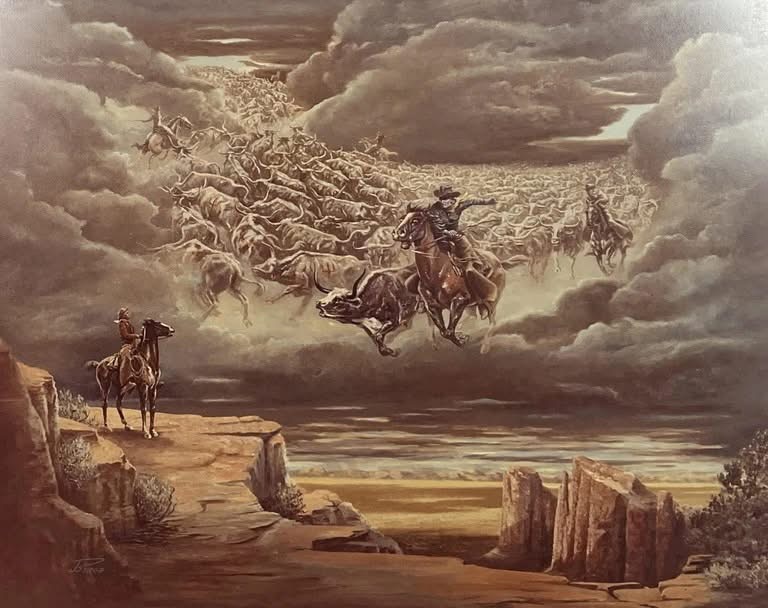
Ghost Riders in the Sky, Jenning Berge
The Devil Sings
Their brands were still on fire and their hooves were made of steel
Their horns were black and shiny and their hot breath he could feel
A bolt of fear went through him as they thundered through the sky
For he saw the riders coming hard and he heard their mournful cry
Stan Jones, Ghost Riders in the Sky
It has often been said, only half in jest, that the Devil gets all the best songs.
God, to be fair, has hardly been neglected. He has inspired Gregorian chant, Bach’s Passions, Handel’s Messiah, Haydn’s Creation, Verdi’s Requiem, the African-American spiritual, the Welsh hymn, the Gospel choir and enough Christmas carols to keep shopping centres in business from November onwards. Heaven has produced magnificent music.
But Hell swings.
There is something about Old Nick that seems to appeal irresistibly to musicians. He crops up in folk songs, murder ballads, spirituals, blues, country, jazz, rock and heavy metal with a persistence that borders upon the supernatural. One begins to suspect that if Lucifer really was once Heaven’s brightest angel, his expulsion may not have deprived him of music at all. It merely changed the repertoire.
it was not for nothing that Rock and roll was called “the devil’s music”. its driving rhythms, rebellious energy, and provocative dancing directly challenged conservative religious and social norms. Emerging from African American blues, the genre inherited a reputation for sinfulness due to its associations with marginalized spaces, nightlife, and earthy themes
Perhaps rebellion simply has a better rhythm.
The same bargain resurfaced centuries later at a lonely crossroads in Mississippi.
The oldest of these musical bargains belongs, naturally enough, to Doctor Faustus. Christopher Marlowe first dramatised the medieval legend of the ambitious scholar who traded his immortal soul for worldly knowledge and pleasure, Goethe transformed him into one of the great figures of European literature, and Charles Gounod clothed the story in glorious French Romantic opera. Yet in every version it is Mephistopheles who steals the show. Bass-baritones relish the role because villains invariably enjoy the better music. The Devil not only gets the best lines; he often gets the best arias as well.
Whether Robert Johnson actually met Satan one moonlit night sometime in the 1930s is almost entirely beside the point. Legends endure because they express truths that facts cannot. Johnson had been an unremarkable guitarist. He disappeared for a time and returned astonishingly accomplished. Rural gossip supplied the explanation. He had met the Devil at the crossroads and exchanged his soul for musical genius.
Thus, America reinvented Faust,
The crossroads itself is an ancient place of magic in European folklore, where roads – and destinies – the River of Song as the Mississippi has been called, where spirits linger and bargains are struck. The myth crossed the Atlantic with everything else, put on denim overalls, acquired a battered Gibson guitar and gave birth to the Delta Blues.
From there it was only a short journey to Georgia.
Charlie Daniels’ exuberant The Devil Went Down to Georgia is really another version of the old contest tales in which ordinary mortals outwit supernatural adversaries. The Devil, looking for “a soul to steal”, challenges a young fiddler to a musical duel and, for once, comes second. There is something wonderfully democratic about the story. Lucifer may be older than Creation itself, but he can still be shown up by a country boy with a fiddle and sufficient confidence in his own abilities.
English folk music had anticipated the idea centuries earlier in The False Knight Upon the Road. A mysterious stranger repeatedly attempts to intimidate a child with riddles and threats, only to be calmly answered at every turn until the False Knight – widely interpreted as the Devil himself – is finally driven away in defeat. The old stories were surprisingly optimistic. The Devil might be clever, but he was not unbeatable.
Nor, for that matter, was he always entirely sinister.
By the time we reach the twentieth century he has become positively urbane.
The Rolling Stones’ Sympathy for the Devil remains perhaps the most brilliant reinvention of Lucifer in popular music. Jagger’s narrator is no horned medieval monster but an impeccably dressed gentleman of “wealth and taste”, strolling through history with dry amusement as empires rise, revolutions unfold and humanity repeatedly demonstrates its extraordinary capacity for cruelty. The Devil scarcely claims responsibility for our crimes. He merely observes them with professional interest. It is a profoundly unsettling conceit because the song quietly suggests that mankind requires remarkably little assistance.
Gun’s hectic Race With the Devil, released in the same annus mirabilis of 1968, approaches the old fellow from a different angle altogether. Here the Devil is not the urbane observer but the relentless pursuer, forever hunting, forever closing the distance, echoing once again those ancient riders of the Wild Hunt thundering across medieval skies. The old folklore had merely acquired electric guitars.
Then there is Leonard Cohen.
No modern songwriter returned more often – or more thoughtfully % to biblical imagery. Yet Cohen’s Devil becomes progressively less external and more intimate. In Treaty, the serpent sheds his skin only to discover “the snake within”. Evil is no longer an adversary encountered in lonely wildernesses, but an inheritance carried beneath one’s own skin. In one of his final songs, with characteristic wit, Cohen quietly inverts centuries of iconography: now “the angel’s got a fiddle, the devil’s got a harp.” The celestial and infernal orchestras have exchanged instruments. Nothing, it seems, remains quite where tradition left it.
Freddie Mercury, never knowingly guilty of understatement, transformed Beelzebub into operatic theatre in Bohemian Rhapsody. The Devil appears only fleetingly amid Galileo, Scaramouche and heavenly choirs, yet somehow manages to dominate one of the most extraordinary six minutes in rock history. That, too, seems entirely appropriate. Old Nick has always had impeccable comic timing.
Tom Waits, all gravel and bourbon, frequently sounds as though he has spent an evening drinking with the Devil in some forgotten dockside bar. Nick Cave has made an entire career exploring the uneasy frontier where scripture, murder ballad and Southern Gothic overlap: “He’s a god, he’s a man, he’s a ghost, he’s a guru. They’re whispering his name through this disappearing land. But hidden in his coat is a red right hand”.
Even heavy metal, with its adolescent flirtations with pentagrams and infernal imagery, owes less to genuine Satanism than to the enduring theatrical appeal of Lucifer as the ultimate outsider. The Devil, one suspects, appreciates good publicity wherever he can find it.
Which brings us back to the Wild Hunt.
Stan Jones’s Ghost Riders in the Sky deserves to stand alongside these classics not because it mentions the Devil directly, and scarcely needs to, but because it preserves one of humanity’s oldest supernatural narratives in modern musical dress. Those spectral cowboys pursuing phantom cattle across storm clouds are descendants of Odin’s riders, Herne’s hunters and the Four Horsemen themselves. The song is medieval Europe galloping beneath the vast skies of Arizona. Like all the finest folk songs, it remembers far more than its author probably realised.
How the West Was Sung describes it as perhaps the finest of all cowboy ballads. It is as far removed from cheerful campfire songs of wandering dogies as Kansas is from the Land of Oz. Beneath its Western saddle leather beats the heart of an ancient myth.
And, if I may be forgiven a personal indulgence, somewhere among all these songs sits several of my own.
My first serious encounter with Lucifer in music came not through rock and roll but through Gordon Giltrap’s haunting instrumental Lucifer’s Cage. Introduced to me by an old friend in a London flat sometime in the early 1970s, its title lodged quietly in the imagination for years before eventually emerging, almost unbidden, in a song of my own song of that name. Dante contributed the pillar of ice. Marlowe lent his melancholy. Milton supplied the fallen archangel. The rest belonged to memory, dreams and the peculiar alchemy by which songs occasionally write themselves.
Lucifer appeared again years later in Devil’s Work, though by then he had become something rather different. Summoned before the bar of humanity to answer for every cruelty committed in his name, Satan calmly pleads not guilty. Men, he observes with devastating logic, have proved perfectly capable of atrocity without supernatural assistance. He does not deny admiring the results. He merely disputes authorship.
The old rogue may even have a case. Which perhaps explains why he continues to haunt our music.
Songs, after all, thrive on conflict. They delight in temptation, regret, betrayal, longing, rebellion and redemption – the very emotions that have always formed the Devil’s stock-in-trade. Heaven may provide perfection, but perfection is notoriously difficult to rhyme. Hell, by contrast, offers endless narrative possibilities.
Lucifer may have been expelled from the heavenly choir, but he appears to have landed squarely in the music business. And business, judging by the catalogue, has been remarkably good ever since.
The Devil’s trick
For his is the language of liars
And his is the honour of thieves
And he is the master of eloquence
As the last of the honest men leaves.
Paul Hemphill. Lucifer
The “pillar of ice”, by the wThe oldest image of evil is not always the monster at the gate or the tyrant upon the throne. More often, it is the quiet voice at the shoulder: the tempter, the whisperer, the insinuator who does not command but suggests; who does not force the hand but gently guides it. The devil’s greatest achievement is rarely the invention of falsehood. It is the art of making falsehood appear attractive, sophisticated, inevitable, even virtuous.
C.S. Lewis understood this ancient pattern with remarkable clarity. In The Screwtape Letters, the infernal bureaucracy does not operate through crude declarations of evil. The tempter’s craft is subtler. It lies in rearranging perceptions, encouraging vanity, disguising weakness as strength, and persuading people that they are acting from reason when they are often responding to pride, fashion, fear, or the desire to belong.
The danger, Lewis suggests, is not merely that people hold mistaken ideas. Human beings have always been capable of error. The deeper danger is when ideas become ornaments of identity rather than conclusions reached through reflection. A philosophy becomes attractive because it feels modern, daring, compassionate, rebellious, or intellectually fashionable. The question shifts from “Is this true?” to “What does believing this say about me?”
This is the realm of the whisperer. The whisperer does not need to overthrow reason; he merely needs to distract it. He surrounds the mind with fragments: a little fashionable theory here, a borrowed slogan there, a moral certainty imported from someone else. Contradictions can coexist comfortably because coherence is less important than belonging. The result is not always a carefully constructed worldview, but a collection of convictions assembled from the cultural atmosphere.
The genius of the tempter is that he rarely presents himself as the enemy. He arrives disguised as enlightenment, liberation, sophistication, or courage. He flatters rather than threatens. He tells people they are not merely correct, but among the few who truly understand. The oldest temptation is not simply to do wrong; it is to believe oneself too wise, too moral, or too enlightened to be mistaken.
This brings to mind another great literary figure of the whispering world: Lord Varys, the “Master of Whisperers” in Game of Thrones. Varys is not a demon, nor is he portrayed simply as a villain. His power lies in information, influence, and his ability to move unseen through the corridors of power. He understands that kingdoms are often shaped less by armies than by rumours, perceptions, and carefully planted ideas.. Varys understood the theatre of power; he understood that information itself was a weapon and that every ruler lives inside a carefully constructed reality. His web of informants becomes a metaphor for the invisible forces that govern human affairs
The “Master of Whisperers” is an old archetype. Behind the throne sits the counsellor, the adviser, the confidant who knows that shaping the mind of the ruler can be more powerful than commanding the ruler’s army. In that sense, Varys belongs to the same long tradition as the court intriguer, the Mephistophelean tempter, and the old folkloric figure who appears at the crossroads offering knowledge, power, or forbidden wisdom.
Perhaps that is why the archetype endures. From the serpent in Eden to Mephistopheles, from Shakespeare’s Iago to Varys, the whisperer represents a profound truth about human nature: we are not only creatures who seek truth; we are creatures who seek stories about ourselves. The most dangerous lies are often not those imposed upon us, but those we welcome because they confirm the person we wish to be.
The devil’s trick, then, is not simply deception. It is seduction. It is convincing us that the voice in the shadows is our own.
Satanic Majesties and the lure of the dark side …
Please allow me to introduce myself
I’m a man of wealth and taste
I’ve been around for a long, long year
Stole many a man’s soul and faith
The Rolling Stones, Sympathy for the Devil (1968)
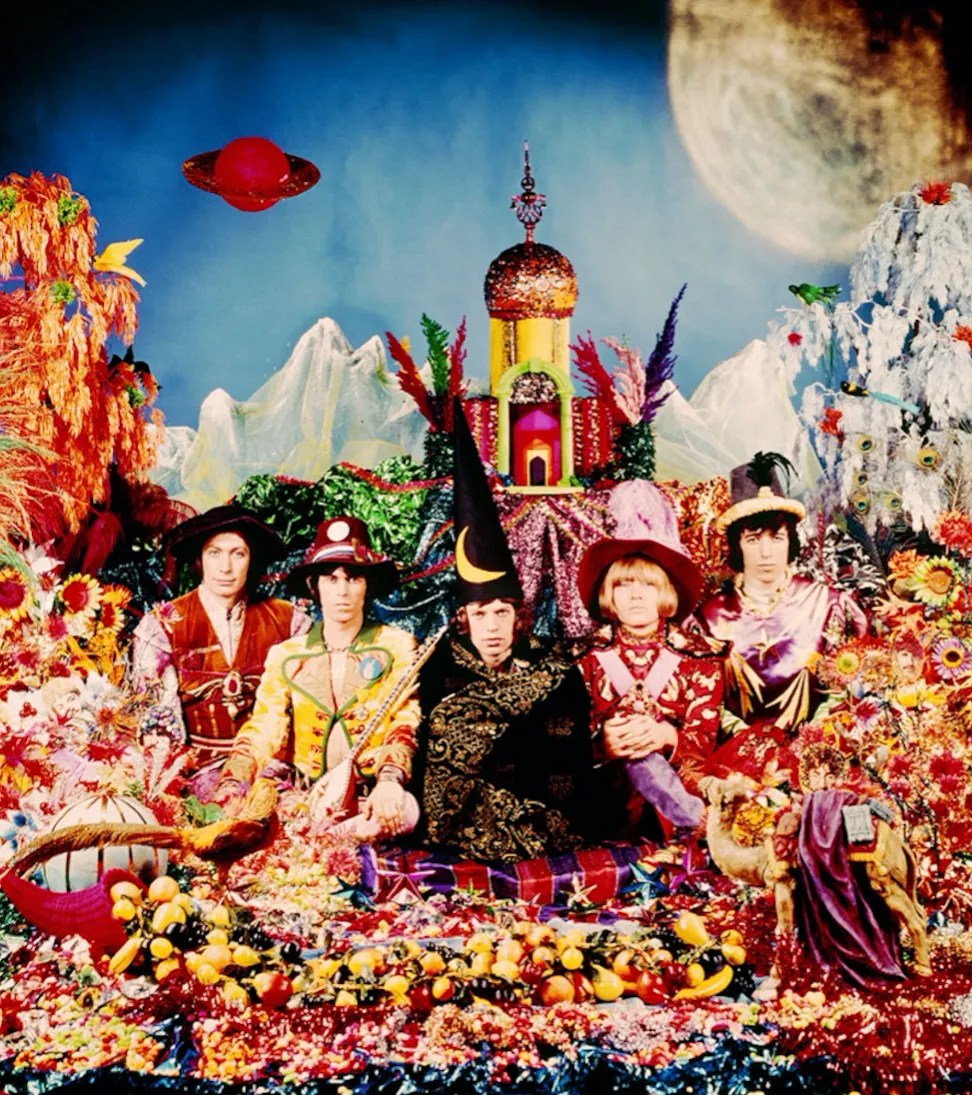
Which brings is tangentially to “devil worship”, whether in cosplay or for real, and why has had and continues to exert an attraction to folks of a certain “disposition”. Hence in pop culture, we have The Rolling Stones using the concept to distinguish themselves from the more saccharine (though brilliant) Sergeant Pepper, and the movies – particularly those dealing with the immanence of the Antichrist.
It is a fascinating tangent because “devil worship” has almost never been primarily about the Devil. More often, it is about rebellion, transgression, power, or the seduction of forbidden knowledge. Satan becomes a mirror in which each age sees the things it most fears—or secretly desires.
The attraction begins with the nature of Lucifer himself. Unlike the grotesque medieval devil of horns and pitchforks, Lucifer is the most compelling character in the Christian imagination after Christ. He is beautiful, intelligent, eloquent, proud, charismatic. 17th Century John Milton’s Paradise Lost transformed him into one of literature’s great antiheroes, whose defiant declaration, “Better to reign in Hell than serve in Heaven”, has echoed through centuries of political revolutionaries, Romantic poets, and rock musicians alike. William Blake famously remarked that Milton “was of the Devil’s party without knowing it.” Whether or not Blake was right, Milton unintentionally gave Satan much of the best dialogue.
That ambiguity proved irresistible to the Romantics. The poets Byron, Shelley, and later Baudelaire saw Lucifer not simply as the embodiment of evil but as the eternal rebel against authority. One need not approve of Satan to recognise the psychological appeal. Every adolescent has, at some point, imagined themselves misunderstood by a hypocritical world. Lucifer becomes the patron saint of alienation.
This is where “devil worship” divides into several distinct streams.
The first is largely theatrical. Heavy metal, gothic fashion, horror films, occult imagery, black clothing, inverted crosses, and pentagrams function less as professions of faith than as cultural shorthand for danger, independence, and shock. Alice Cooper, Black Sabbath, Iron Maiden, Ghost, and countless others have mined this aesthetic. Most participants have little interest in metaphysical evil; they are enjoying the iconography of rebellion.
The Rolling Stones understood this perfectly. In 1967, Their Satanic Majesties Request was less an endorsement of Satanism than a calculated provocation. It was impossible not to hear it as a response to the Beatles’ Sgt. Pepper’s Lonely Hearts Club Band. Where the Beatles embraced colourful optimism and psychedelic innocence, the Stones offered something darker, more decadent, more dangerous. Their image became one of sex, drugs, excess and moral ambiguity.
The following year they released Sympathy for the Devil, perhaps the greatest popular song ever written from Satan’s perspective. Yet the song is not a hymn to evil. Jagger’s Lucifer is an urbane observer of human history, politely introducing himself while recounting the crimes of mankind. The genius lies in the reversal. The Devil scarcely needs to tempt us; humanity supplies ample atrocities of its own. As the refrain insists, “after all, it was you and me.” The devil becomes less the author of evil than its ironic narrator.
Then there is genuine religious Satanism, which is rarer than popular imagination assumes.
Anton LaVey’s Church of Satan, founded in 1966, was largely atheistic. Satan was treated as a symbol of individualism, rational self-interest, scepticism toward religious authority, and personal freedom rather than as a literal supernatural being. In many ways it inverted Christian morality without necessarily believing in Christian cosmology.
Far more obscure are small groups that genuinely venerate Satan as a real spiritual being. They exist, but their numbers have always been tiny. The “Satanic Panic” of the 1980s vastly exaggerated their influence, fuelled by moral panic, unreliable testimony, and sensationalist media.
More enduring has been the cinematic Satan.
Modern horror discovered that the Devil works best not as a monster but as an absence – an invisible intelligence corrupting ordinary life. Rosemary’s Baby (1968) suggested evil could inhabit respectable Manhattan apartments. The Exorcist (1973) brought demonic possession into a suburban family, terrifying audiences because faith itself seemed uncertain. The Omen (1976) imagined the Antichrist not as a horned beast but as an innocent-looking child quietly ascending to political power. The horror lay precisely in the inversion: evil wearing the face of innocence.
It seemed appropriate that The Devil’s address was 1600 Pennsylvania Avenue. These films appeared during an era of collapsing confidence – in churches, governments, families, and institutions. Watergate, Vietnam, social upheaval, the sexual revolution: Western culture was asking whether the old moral certainties still held. The Antichrist became a metaphor for the fear that civilisation itself might contain the seeds of its own destruction.

The Omen (1976)
The fascination continues because Satan remains one of Western culture’s richest symbols. He can signify tyranny or liberation, temptation or freedom, narcissism or resistance, depending on the storyteller. Like Prometheus stealing fire from the gods, he embodies humanity’s perennial temptation to cross boundaries simply because they exist.
Psychology adds another layer. Carl Jung argued that every personality possesses a “shadow” – those impulses we deny or repress. Healthy people acknowledge their shadow rather than pretend it does not exist. Much popular engagement with Satanic imagery can be understood as an exploration of that shadow. Horror allows us to confront evil at a safe distance. Rock music permits us to flirt with darkness while remaining within the bounds of performance. It is ritualised transgression.
The danger, however, comes when performance ceases to be performance. Nietzsche warned that “he who fights with monsters should see to it that he himself does not become a monster.” Jung similarly cautioned that confronting the shadow is not the same as identifying with it. One may explore darkness without enthroning it.
Perhaps that is why the Devil remains culturally immortal. God asks for worship; Satan offers fascination. God commands obedience; Satan whispers autonomy. God speaks of redemption; Satan promises self-realisation without limits. Whether one believes in him literally or not, Lucifer continues to embody one of humanity’s oldest temptations: not simply to do evil, but to imagine ourselves beyond the distinction between good and evil.
There is an irony here that would not have been lost on the medieval theologians. Much of what passes for “Satanism” in modern culture is less a rejection of Christianity than a backhanded tribute to it. The Devil has meaning only in a civilisation shaped by the biblical story. As Christianity’s cultural influence has waned, Satan has often survived more successfully than the saints. He has become detached from theology and reborn as an endlessly adaptable icon—part Romantic rebel, part existential outsider, part Hollywood villain, part rock star.
For all the glamour, however, the traditional Christian understanding ends with an unexpectedly mundane observation. Satan’s greatest trick is not horns, black masses, or spectacular evil. It is persuading us that evil is glamorous, liberating, sophisticated, or somehow more interesting than goodness. The Devil, in this view, is the supreme salesman: he packages pride as freedom, selfishness as authenticity, and rebellion as wisdom. His marketing, one might say, has always been better than his product.
That may explain why, from Milton to Mick Jagger, from Rosemary’s Baby to The Omen, Lucifer continues to stride across our cultural stage. The costumes change with every generation, but the role remains the same: the eternal seducer, inviting us to peek over the edge – not always to push us off, but to persuade us that the view from the abyss is somehow more exciting than the long, ordinary climb toward the light.
Crossing the Threshold
It was in another lifetime, one of toil and blood
When blackness was a virtue the road was full of mud
I came in from the wilderness, a creature void of form
“Come in, ” she said “I’ll give you shelter from the storm”
Bob Dylan
There is an old rule that appears again and again in the folklore of Europe. A vampire, however ancient or powerful, cannot cross the threshold of a home unless invited. It is a curious limitation for a creature that can command wolves, transform into mist, mesmerise its victims and seemingly defy death itself. Yet before the simplest cottage door, all that supernatural power comes to nothing. It must wait. It must ask. Someone within must choose to open the door.
The convention has endured from the pages of Bram Stoker’s Dracula to the worlds of Stephen King, Anne Rice and Buffy the Vampire Slayer. We accept it almost without question because, beneath the gothic trappings, it expresses something profoundly human. The threshold is more than wood and stone. It is the boundary between safety and danger, innocence and experience, trust and betrayal. To cross it without permission would be mere violence. To be invited across is something altogether more unsettling.
The ancient motif has not disappeared from contemporary storytelling. John Ajvide Lindqvist’s novel Let the Right One In, and the haunting 2008 Swedish film that followed, take the old vampire prohibition and transform it into a moral question. The issue is no longer simply whether we invite someone across the threshold, but whether we possess the wisdom to know whom we are inviting. Every act of welcome carries the possibility of grace or ruin. The threshold remains sacred because, once crossed, neither host nor guest is quite the same again.
Perhaps this explains why the Devil, in so many traditions, is less a conqueror than a seducer. Lucifer does not usually arrive with an army at his back. He comes with a question, a promise, a whispered doubt. In Eden, he offers knowledge. In the wilderness, he offers power. In Goethe’s Faust, he offers fulfilment. The bargain changes with the age, but the method rarely does. The invitation is always voluntary. The victim believes the choice is entirely his own.
John Milton understood this better than most. In Paradise Lost, Satan’s greatest victory is not won on the battlefield but in the imagination. He persuades others that rebellion is freedom, that pride is dignity, that disobedience is enlightenment. His triumph lies not in overpowering his enemies but in teaching them to mistake temptation for liberation.
This is one of the oldest insights of the Judeo-Christian tradition. Evil rarely appears wearing its own face. It arrives clothed in reason, justice, beauty, necessity or compassion. It flatters before it threatens. It persuades before it commands. It waits patiently upon the threshold until someone inside unlatches the door.
That ancient intuition has never really left us. Even in a largely secular age, our stories continue to insist that darkness cannot simply seize us. Dracula must be welcomed. The Ring must be claimed. The White Witch tempts Edmund with enchanted sweetness. Darth Vader invites Luke to join him. Hannibal Lecter enters Clarice Starling’s mind long before he ever escapes his cell. The forms change, but the pattern remains remarkably constant. The greatest victories of darkness are achieved not by force but by consent.
Perhaps this is why these stories continue to resonate. They are not really about vampires or devils at all. They are about us. We like to imagine that evil comes from somewhere beyond the horizon, an alien force that erupts into ordinary lives. Folklore suggests otherwise. It waits politely outside, asking only to be admitted. More often than we care to acknowledge, we are the ones who turn the handle.
It is a disturbing thought, for it shifts the battleground. The struggle between good and evil is no longer fought in distant heavens between angels and demons. It takes place at the threshold of every human heart. The decisive moment is not when the Dark Lord appears, but when we recognise the quiet voice that says, Just this once. No one will know. You deserve this. Come with me.
And that raises an even more uncomfortable possibility. If the Devil depends upon our invitation, if the darkness enters because we allow it to enter, then perhaps the most frightening encounter is not with some horned apparition lurking beyond the doorway.
The dark magic of Fairy Tales
And what hills, what hills are those, my love
Those hills so dark and low?
Those are the hills of hell, my love
Where you and I must go
House Carpenter (The Daemon Lover), Laurence Price (1657)
Perhaps this is why fairy tales have proved so enduring. Not the diminutive winged fairies of modern fantasy, nor the escapist worlds of contemporary fiction, but the old literary tales of Perrault, the Brothers Grimm, Hans Christian Andersen and the countless anonymous storytellers whose voices echo through the centuries. These were never merely stories for children. They were repositories of collective memory, preserving in symbolic form those hard truths about human nature that every generation must rediscover for itself.
Their lessons are remarkably consistent. Do not wander carelessly from the path. Beware the stranger whose charm conceals darker intentions. Be wary of gifts that appear too generous, bargains that seem too easy, promises that flatter your deepest desires. Little Red Riding Hood trusts the Wolf. Hansel and Gretel are tempted by sweetness. Bluebeard forbids the one door that curiosity cannot resist. Snow White accepts the poisoned apple from a smiling hand. Again and again, the stories remind us that evil rarely presents itself as evil. It arrives disguised as opportunity, pleasure, beauty, knowledge or kindness.
Yet alongside these literary fairy tales runs an older and stranger tradition, carried not in children’s books but in the folk songs and ballads of the Celtic lands. Here the threshold leads not to vampires or devils but to Faërie, that mysterious realm which is neither wholly benevolent nor wholly malign, but profoundly Other.
This is not the miniature world of charming sprites and decorative enchantment that later ages would create, but the older Faerie of folklore: a place of wonder and peril, beauty and terror, where the boundaries between the human world and the unknown become uncertain. It is the realm Tolkien described in On Fairy-Stories not as an escape into childish fantasy, but as an encounter with a deeper reality at the edge of the human imagination.
The old ballads return to this theme with remarkable persistence. In Tam Lin, Janet ventures into the haunted wood of Carterhaugh and confronts the Fairy Queen herself to reclaim the man she loves [There’s a wonderful recounting of the story here in this entertaining blog post. In Thomas the Rhymer, the poet follows the Queen of Elfland beneath the Eildon Hills, exchanging the familiar world for one where time and truth obey altogether different laws. What is it about Fairy Queens. Something to do with Lilith, who we introduced in Lucifer Descending? And in the haunting ballad of The House Carpenter, often known as The Daemon Lover, a mysterious stranger returns from the past, offering riches, adventure and escape from an ordinary life. The woman accepts his invitation, only to discover too late that she has embarked upon a voyage from which there will be no safe return. There is a fine version of House Capenter by Tim and Molly Obrien at the end of this article,
Whether these enigmatic, supernatural figures are fairies, spirits or the Devil himself is almost beside the point. They belong to that older landscape of myth where temptation rarely appears in monstrous form. It comes instead as beauty, longing, nostalgia or desire – the whispered promise that happiness lies just beyond the next horizon. The threshold is crossed willingly, the protagonist stepping beyond the known world into a place where the he or she returns changed, if they return at all; and the cost is understood only when, as in House Carpenter, the familiar shore has disappeared from sight.
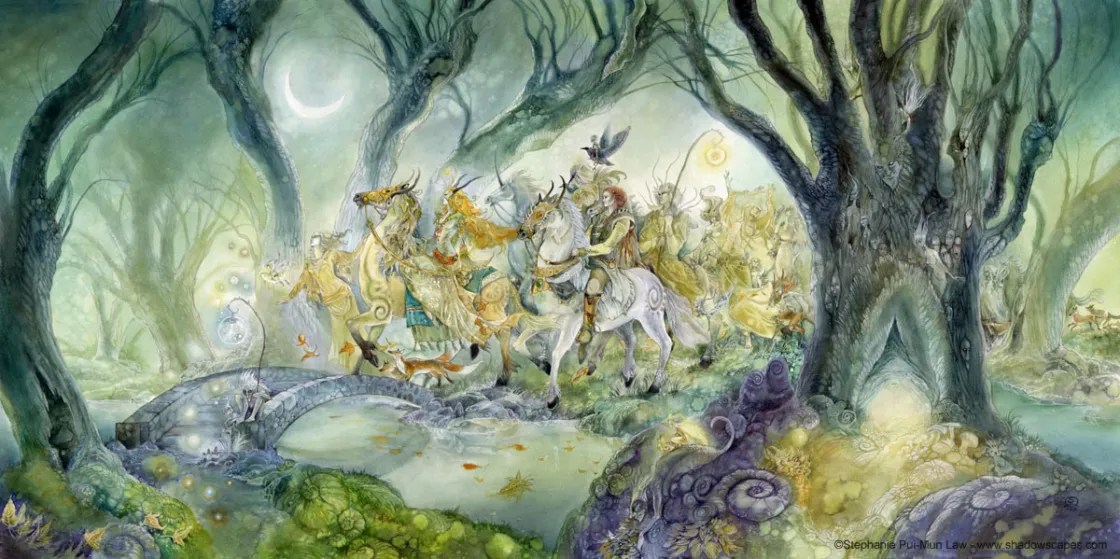
Tam Lin and the Faery Host.Stephanie Pui-Mun Law
The danger is not always wickedness, but enchantment itself: the loss of home, identity, memory and the comforting certainties of ordinary life. The Fair Folk do not necessarily seek to destroy mortals; their peril lies in their indifference to human limits and human time. They belong to an older order of existence, one that fascinates precisely because it cannot be reduced to our categories of good and evil.
Like Lucifer, the Folk of Faerie seldom arrive as monsters. They are beautiful, alluring and irresistible. They invite rather than compel. The traveller accepts shelter for a night, follows a haunting melody into the greenwood, or rides with a mysterious stranger beneath the moon, only to awaken in a world where familiar landmarks have vanished and time itself has become unmoored. The old ballads understood, as surely as the theologians, that the most perilous journeys begin not with violence but with invitation.
It is a vision that would have been familiar to Tolkien, to Yeats and to the anonymous singers who carried these stories through generations: Faërie is not a place of escape from reality, but a place where reality is seen more clearly. It reminds us that mystery still exists, that wonder can be dangerous, and that every threshold crossed carries the possibility of transformation.
That is why these tales continue to speak to us long after we have ceased believing in enchanted forests, wicked witches, talking beasts or the hidden kingdoms beneath the hills. Their monsters and enchantments are symbols, and symbols possess a curious longevity. The Wolf is not simply a wolf; he is deception. The Witch is not merely an old woman in the woods; she is temptation. The Dragon is not just a beast to be slain; it is fear itself. The Fair Folk are not simply supernatural beings; they embody the irresistible allure of the unknown, the longing to escape the ordinary, and the price that is so often paid for crossing forbidden thresholds. Like Lucifer himself, they endure because they give form to forces that are otherwise difficult to describe.
The genius of these stories lies in their refusal to preach. They do not offer philosophical arguments or theological treatises. Instead, they invite us to recognise ourselves. They speak in the language of metaphor, where wisdom lingers long after the details have faded from memory. We remember the path through the forest, the forbidden door, the poisoned fruit, the moonlit crossroads and the welcoming hearth because they are landmarks within the landscape of our own lives.
Perhaps that is why humanity has never abandoned these tales. We do not return to them because we believe that vampires cannot cross a threshold uninvited, that wolves converse with little girls, or that the Queen of Elfland still rides abroad on Halloween. We return because they express, with unsettling clarity, something we know instinctively but are reluctant to admit: the greatest dangers seldom arrive by force. More often, they are welcomed. The oldest monsters ask permission before they enter, and the hand that lifts the latch is usually our own.
If that is true, then the threshold is not merely the doorway of a cottage, a castle or a haunted house. It is the boundary of the self. The decisive struggle is not between angels and demons in some distant heaven, but within every human heart. The Dark Lord may wait outside, but someone must always open the door.
And when we ask who it was that welcomed him in, we find ourselves confronted by the most disquieting image of all: a face in the mirror.
The Face in the Mirror
So where, finally, does all this leave Lucifer?
After all the centuries, all the sermons and theological arguments, all the paintings, sculptures, poems, novels, films and songs, we are left with a rather unsettling possibility: perhaps the Devil’s greatest achievement was not persuading humanity that he existed, but persuading humanity that evil always belonged somewhere else.
The enduring appeal of Lucifer lies partly in his usefulness. He gives us somewhere to place the things we find hardest to explain about ourselves. When the world becomes cruel, when individuals commit acts of extraordinary brutality, when societies descend into hatred and violence, we instinctively look for a monster. We want a face, a name, a single embodiment of wickedness upon whom we can project all that we fear and despise. The serpent in Eden, the horned tempter at the crossroads, the Dark Lord in his fortress, the tyrant in his palace: these figures offer a reassuring simplicity. Defeat the villain, destroy the source of corruption, restore the natural order, and the world is made whole again.
History, however, has rarely been so obliging.
The twentieth century, the most technologically advanced age humanity had yet created, also produced some of the most terrible examples of human cruelty. It did not require supernatural intervention. It manufactured its own infernos through ideology, bureaucracy and obedience. The great crimes of the modern age were not committed by demons emerging from the shadows, but by human beings who believed themselves to be serving higher purposes. The machinery of death was designed not only by fanatics but by administrators; not only by monsters but by ordinary men who convinced themselves that their actions were necessary, inevitable or even virtuous.
This was the disturbing insight behind Hannah Arendt’s famous reflections on Adolf Eichmann and the “banality of evil”. Evil did not always announce itself with theatrical menace. It did not always arrive wearing horns and carrying a pitchfork. Sometimes it appeared in a grey suit, spoke in measured tones and filled out forms. Sometimes it hid behind procedure, ideology and obedience. The most frightening villains are not always those who know they are evil, but those who have persuaded themselves that they are doing good.
The Devil, one suspects, would have appreciated the irony.
For centuries humanity has blamed him for our darkest impulses, yet he might reasonably argue that he has often been given rather more credit than he deserves. He has been accused of starting wars, corrupting rulers, tempting sinners and poisoning societies, but mankind has demonstrated a remarkable capacity for invention when it comes to cruelty. Lucifer may have whispered in the ear, but humanity has frequently supplied the imagination, the ambition and the machinery.
This is the argument at the heart of my own earlier song Devil’s Work, where I imagined Lucifer brought before the tribunal of humanity to answer for all that had been done in his name. His defence was not that he was innocent in any moral sense, but that mankind had misunderstood his role. He was the convenient explanation, the eternal scapegoat, the mythical culprit upon whom humanity could place the burden of its own failings. The tyrants, the torturers and the conquerors had not required his instruction. They had acted according to their own desires, their own fears and their own visions of power.
Lucifer’s argument, uncomfortable as it may be, contains a warning. If we imagine evil solely as something external, we risk ignoring the darker possibilities within ourselves. We are comforted by the idea that the Devil is someone else: the enemy, the stranger, the fanatic on the other side of the border, the person whose beliefs we find abhorrent. Yet history repeatedly demonstrates that the line between righteousness and cruelty is not always as clearly marked as we would like to believe.
The old proverb warns us, “Don’t let the Devil ride, for if he rides long enough, he will want to drive.” But perhaps the deeper lesson is that the Devil does not always need to seize the reins. Sometimes we hand them over willingly, convinced that we are travelling towards some noble destination.
This is why Milton’s Lucifer remains such a powerful creation. The genius of Paradise Lost was not that it gave us a monster, but that it gave us a personality. Milton’s Satan is seductive because he possesses qualities we recognise: intelligence, ambition, courage, eloquence and a fierce sense of grievance. His tragedy is not that he lacks greatness, but that greatness becomes corrupted by pride. The brightest of angels falls because he cannot accept that he is not the centre of the universe.
And perhaps that is why Lucifer continues to fascinate us. He is not merely the personification of evil. He is the personification of self-deception. He represents the dangerous human capacity to transform ambition into destiny, resentment into righteousness and cruelty into necessity. He is the voice that assures every Dark Lord, from Sauron “in the land Mordor where the shadows lie”, to the tyrants of history, that he is not the villain of his own story.
W.H. Auden understood this with characteristic precision. The story is told that, after his return to the Anglican faith in which he had been raised, he once asked a Sunday school class if they knew what the Devil looked like. The expected answer was probably some variation of the traditional image: horns, tail, pitchfork and sulphurous breath. Instead, Auden replied: “The Devil looks like me.”
Whether the anecdote is exact or embellished, its truth is unmistakable. It captures something that theologians, poets and philosophers have wrestled with for centuries. The Devil is frightening not because he is alien, but because he is familiar. He does not merely lurk in some distant infernal kingdom. He exists in the ordinary human capacity for vanity, cruelty, resentment and self-justification.
Which brings us back to Mick Jagger’s immortal introduction: “Please allow me to introduce myself.” The Devil who appears in Sympathy for the Devil is not a medieval demon but a sophisticated observer of history, a gentleman who has watched empires rise and fall, revolutions become tyrannies and ideals become excuses for violence. His greatest trick is not that he causes humanity’s crimes, but that he knows humanity is perfectly capable of committing them without his assistance.
Perhaps that is why Lucifer refuses to disappear.
Religions may change. Churches may empty. Old cosmologies may fade. Yet the questions that created Lucifer remain stubbornly alive. Why do human beings seek power? Why do we justify cruelty? Why do we convince ourselves that our own darkness is righteous? Why do we so often recognise evil most clearly in others while overlooking it within ourselves?
These are not merely theological questions. They are human questions.
Lucifer survives because he is more than a devil. He is a metaphor for the eternal struggle between our aspirations and our appetites, between the angels we imagine ourselves to be and the creatures we sometimes become.
He falls from Heaven in the old stories. He rises again in every generation’s imagination. He changes his name, his appearance and his costume. He becomes Satan, Mephistopheles, Sauron, Vader, Palpatine, the Joker, the Big Bad, the outlaw, the rebel, the rock star and the shadow at the edge of the road.
But perhaps his most enduring incarnation is the simplest: He has the potential to be face in the mirror.
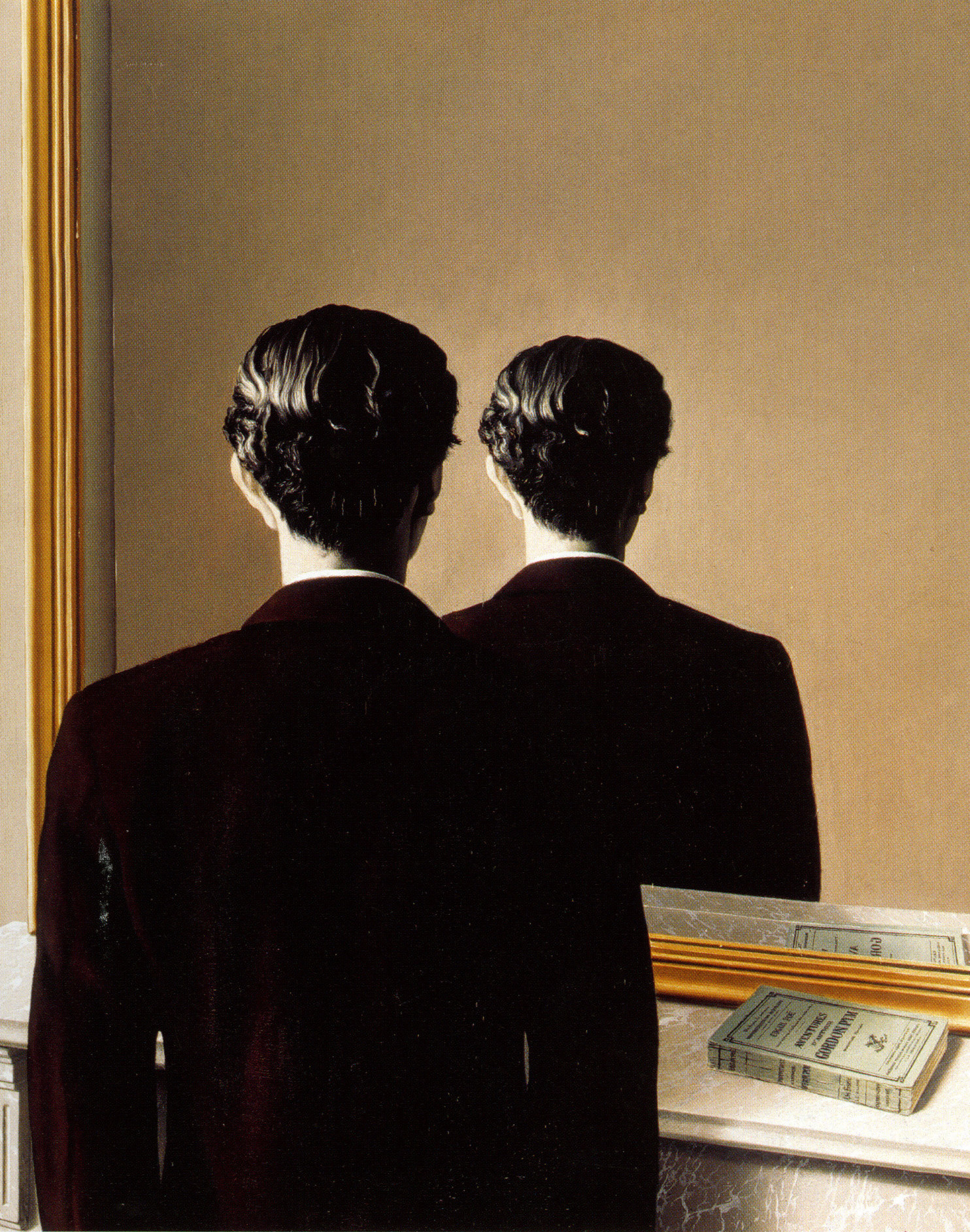
René Magritte, Not to be Reproduced (1937)
Coda: The Devil’s Human Victims
One final reflection. For all the glamour that Lucifer has acquired in literature, music and popular culture, there is another story—far less entertaining and infinitely more tragic—that shadows his long ascent through the Western imagination.
If the Devil has inspired some of our greatest poetry, our darkest cinema and our most provocative rock music, belief in his earthly agents has also left a trail of blood.
The medieval world certainly knew religious persecution, but it was during the supposedly enlightened ages of the Renaissance and the Reformation that Europe’s obsession with Satan reached its murderous zenith. Between the fifteenth and eighteenth centuries, tens of thousands of people—overwhelmingly women, though not exclusively—were executed as witches. Catholics and Protestants alike proved equally susceptible to the conviction that the Devil walked among them, recruiting servants through pacts, sabbaths and sorcery. Learned judges, theologians and magistrates, armed with books such as the infamous Malleus Maleficarum, lent intellectual respectability to fear, while torture transformed suspicion into confession. The Renaissance, which celebrated reason and rediscovered classical learning, was paradoxically also an age of extraordinary credulity.
Nor was Europe alone in projecting the image of the Devil onto those it neither understood nor trusted. Across the Middle East, minority faiths have long borne the burden of misunderstanding. The Yazidis, whose reverence for Melek Taus—the Peacock Angel—has repeatedly been misrepresented as “devil worship”, have endured centuries of persecution, culminating in the genocidal campaign waged by ISIS in 2014. The Druze, too, because of the esoteric nature of their beliefs, have often been regarded with suspicion and, at various times, suffered discrimination and violence at the hands of those who judged them through the lens of orthodoxy rather than understanding. Similar accusations have echoed through history against countless other minorities, where ignorance and fear have proved more potent than theology.
The pattern is painfully familiar. Societies under stress seek an enemy within. The Devil rarely appears in person; instead, he is said to wear the face of the outsider, the dissenter, the heretic, the foreigner, the eccentric woman living on the edge of the village, or the obscure community whose customs remain mysterious. To accuse another of serving Satan has often been less a statement of faith than a licence to persecute.
There is a profound irony here. In the biblical narrative, Satan is ha-satan—the Accuser. Yet throughout history it has been human beings who have most enthusiastically assumed that role. Convinced they were defending God against the Devil, they have inflicted upon one another torments that no demon could have devised more effectively.
Perhaps that is the final paradox of Lucifer Ascending. The Devil’s greatest triumph has never been to persuade people to worship him. Such cases have always been vanishingly rare. His more enduring legacy has been to persuade men and women that they alone possess absolute certainty about who serves the powers of darkness. Once that conviction takes hold, compassion yields to righteousness, neighbours become enemies, and persecution begins with the comforting belief that one is acting in the service of Good.
Milton gave Lucifer the finest speeches. The Romantics made him a hero. Hollywood turned him into an icon. Rock music made him fashionable. Yet history offers a quieter, sadder lesson. The true tragedy of the Devil is not found in black masses or satanic cults, but in the countless innocent lives destroyed by those who imagined they could see him reflected in the faces of others.
And so the story comes full circle. The mirror in which we thought we glimpsed the Prince of Darkness reveals, instead, ourselves, and what began, for me, as a literary diversion, a frolic through mythology, theology and popular culture, has ended somewhere altogether less comfortable.
I had imagined this essay as an exploration of one of Western civilisation’s most enduring characters: Lucifer as rebel, tempter, antihero and cultural icon; the Devil of Milton and Goethe, of Blake and Baudelaire, of The Rolling Stones, Hollywood and heavy metal. It was, at first, an exercise in intellectual curiosity – a walk through the darker galleries of our collective imagination. Yet, as so often happens, the journey led elsewhere.
For behind the poetry, the music and the mythology lay a far more sobering truth. The Devil’s greatest appearances have rarely been in cathedrals, black masses or horror films, but in history itself: in witch trials, inquisitions, pogroms, persecutions and genocides, wherever one group has become convinced that another is not merely mistaken, but evil incarnate.
The realisation is a melancholy one. Perhaps Lucifer’s most enduring triumph has never been to persuade humanity to believe in him, nor even to worship him, but to persuade us that we know precisely where evil resides – and that it is always somewhere else.
That is a comforting thought. It is also one of the most dangerous.
In the end, I have come to suspect that the enduring power of the Lucifer story lies not in what it tells us about the Devil, but in what it reveals about ourselves. Every generation recreates him in its own image. Every age discovers him in its chosen enemies. Every certainty carries within it the temptation to become accusation.
What began as a fancy has ended as a cautionary tale. And, perhaps, that was the story waiting to be told all along.
Paul Hemphill, July 2026
This essay was written over several months from scattered notes and random thoughts formed and half-formed, and, more recently, in sustained dialogue with an AI language model which contributed to final drafting, The main influence was, of course, Lucifer Descending … encounters with the morning star, For but it owes it style and spirit to other indulgences in In That Howling Infinite, like It’s 3am and an hour of existential angst, Blue remembered hills – a land of lost contentment and The quiet teatime of the soul
Lucifer, star of the morning
Lucifer, prince of the night
Lucifer falling through darkness
Lucifer cast from the light.
Lucifer sits in his wasteland
Trapped in the cage of his pride
The sirens of importunate circumstance
Reclining in ranks by his side
Plots he has made, so ingenuous.
Dangerous follies and schemes
For he has stage-managed quite strenuous
Drunken prophecies, libels and dreams.
Lucifer frets in the wasteland
Locked in a pillar of ice
We know of this only to well
We have visited him there once or twice
For his is the language of liars
And his is the honour of thieves
And he is the master of eloquence
As the last of the honest men leaves.
Lucifer crawls from the wasteland
No solace or peace or rest.
For he has corrupted the wisest
And he has co-opted the best.
And all that is good has since vanished
And with it, the fair and the true
And the silences hurting his demon heart
Are haunting, haunting you.
And the road that winds out of Meggido
Is the path that leads to the pit
For Lucifer prizes a web of disguises
He merely selects one to fit.
And the road that runs down to Jericho
Is the path that leads him to you
And the paradox searing his demon soul
Is hunting, hunting you.
So make you no truce with Lucifer
Lucifer of fiery breath
For Lucifer is treachery
And treachery is death.
Lucifer, star of the morning
Lucifer, prince of the night
Lucifer falling through darkness
Lucifer cast from the light.



 In That Howling Infinite