The Geography of Faith: America and the Gospel of Power

America is a country where you can drive from Damascus to Jerusalem via Jericho and Bethlehem without leaving the United States. Its map is littered with biblical names – geography of faith transplanted onto a new continent.

That was no accident. From the Puritans’ “city upon a hill” to Manifest Destiny and today’s Christian nationalism, Americans have repeatedly imagined their country as something more than a nation: a providential project, a New Jerusalem, a civilisation with a sacred inheritance.

But there is another America – the constitutional America, deliberately wary of the fusion of church and state; the pluralist America in which Christianity is one inheritance among many; and the America whose power is increasingly viewed abroad with scepticism.

This essay explores the curious convergence of a renewed intellectual interest in Christianity and Western civilisation, the muscular Christianity of the contemporary American Right, the crusader imagery of its warriors, the spectacle of the television evangelist, and the extraordinary political theology surrounding the Trump era.

At the heart of it is a simple question: what happens when a nation with immense material power begins to clothe that power in sacred language?

New Jerusalem

Look at a map of the United States and you can almost read the Bible in the place names. Bethlehem appears here, Jerusalem there; Jericho, Damascus, Nazareth, Salem, Shiloh, Zion, Hebron, Canaan, Goshen, Galilee, Gilead and Lebanon are scattered across the American landscape. Some are little more than dots on a map; others grew into substantial towns and cities. Together they form something more than a collection of quaint biblical echoes. They constitute a kind of geography of faith: a continent renamed, in part, through the vocabulary of Scripture.

America did not merely settle a new continent. It imagined itself within an ancient story.

The idea goes back to the earliest European settlers, particularly the Puritans, whose understanding of the New World was saturated with the language of Exodus, covenant, wilderness and the Promised Land. The voyage across the Atlantic could be imagined as an escape from bondage. The wilderness became a place of testing. The new settlement could become a covenanted community. America was not simply somewhere to live; it might become somewhere to begin again.

John Winthrop’s famous 1630 sermon, A Model of Christian Charity, gave the idea one of its enduring metaphors: the new community would be “as a city upon a hill”, watched by the world. The original meaning was less a declaration of American superiority than a warning about American responsibility. A people claiming a covenant with God would be judged by how it behaved.

Over time, however, the warning became a boast. The city upon the hill became the shining city upon the hill; the beacon became a claim to exceptionalism; and the American experiment acquired an increasingly providential character. The United States came to imagine itself not merely as a nation among nations but as a nation with a special mission.

This is one reason the idea of a New Jerusalem has such a deep resonance in the American imagination. The Book of Revelation promises a new heaven and a new earth, with the New Jerusalem descending from heaven. The old order passes away; the world is renewed; God dwells among humanity. It is the ultimate story of restoration.

America was, in a secular and political sense, another version of the same story: the old world left behind, a new world discovered, history apparently offering a second chance.

Europe had its cathedrals, dynasties, wars and accumulated centuries. America had the wilderness and the future.

And the wilderness was not empty.

That is where the mythology becomes more complicated. The promised land was already inhabited. The New Jerusalem was built through the displacement and dispossession of Native peoples. The language of Providence accompanied conquest. Manifest Destiny transformed territorial expansion into something that could be understood not simply as geopolitical ambition but as providential destiny.

The American frontier was therefore conquered with the Bible as much as the gun. The gun supplied the means; the Bible supplied, for many, the story.

This should not be reduced to cynical propaganda. Many of the people who settled the frontier genuinely believed that Providence was guiding them. They read their lives through Scripture. They named their settlements after biblical places. They understood victory and defeat, drought and harvest, migration and death within a scriptural framework. The preacher and the gunfighter could inhabit the same cultural universe.

The extraordinary thing is how durable that religious imagination has proved. The United States has repeatedly retold its national story in the language of fall, decline, threat, renewal and redemption. The names and metaphors change, but the narrative structure persists.

America sins; America suffers; America forgets itself; America is threatened; America awakens; America is restored.

It is almost a biblical narrative translated into political mythology.

From the city on the hill to muscular Christianity

This is the historical backdrop against which the contemporary revival of Christian language in American conservatism needs to be understood. It did not begin with Donald Trump, nor is it reducible to the phenomenon now labelled “Christian nationalism”. There has always been an American civil religion in which God, nation, freedom, sacrifice and destiny overlap.

What is new is the intensity with which some contemporary conservatives are seeking to recover Christianity not simply as private belief but as an explicit source of civilisational identity.

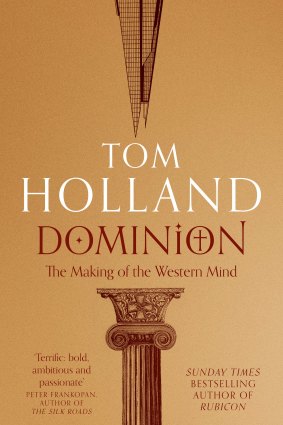
There has been, in parallel, an intellectual rediscovery of the Christian inheritance among thinkers who are not conventionally understood as theologians. British historian and co-host of the popular podcast The Rest is History, Tom Holland’s Dominion is perhaps the best-known example. His argument is essentially historical: many of the moral assumptions that modern secular Westerners regard as self-evidently universal – the dignity of the individual, the moral significance of the weak, equality before God, concern for the marginalised and suspicion of arbitrary power – were profoundly shaped by Christianity. See in In That Howling Infinite, Getting back to the garden – Tom Holland’s Dominion. The illustration at the head of this essay is taken from the cover of this thought-provoking book.

Historian Niall Ferguson and others have approached the question from somewhat different directions, examining the decline of Western confidence, the institutions and habits that made the West successful, and the possibility that societies can lose the cultural foundations that sustain them.

There is much to respect in this argument. Christianity did profoundly shape the moral and intellectual architecture of Western civilisation. To deny that is to indulge in a curious form of historical amnesia. But there is a distinction worth preserving between Christianity as an inheritance and Christianity as a political identity.

The West is Christian in its historical formation, but it is not only Christian. It is also Greek and Roman, Jewish and Islamic in important respects, Renaissance and Reformation, Enlightenment and scientific, liberal and socialist. Its civilisation emerged through argument as much as inheritance. Indeed, one of the defining characteristics of the West may be its capacity to argue with itself.

The danger begins when recognition of the Christian inheritance becomes a claim to Christian superiority, and when civilisational confidence becomes civilisational self-certainty.

For there is an awkward historical fact that every honest account of Western civilisation has to accommodate: the civilisation that produced the Sermon on the Mount also produced religious persecution, slavery, colonialism, racial theories, imperial conquest and industrialised warfare. It proclaimed universal human dignity while repeatedly deciding that some humans were more equal than others.

The West has produced some extraordinary moral ideals. It has also repeatedly failed to live up to them. That is not an argument against the ideals. Quite the reverse. It is an argument for taking them seriously.

JD Vance, Marco Rubio and the recovery of a sacred inheritance

The contemporary American conservative project – propagated by the current Us administration- therefore has an interesting intellectual spectrum.

At one end is the civilisational argument: the West has forgotten its inheritance and must recover confidence in the ideas and institutions that made it what it is. Christianity is not necessarily proposed as a state religion but as the moral and cultural foundation of Western civilisation.

The Catholic dimension is particularly interesting. The conversion of vice-president JD Vance, for example, has given his political thought an intellectual vocabulary that differs from the older Reaganite fusion of individual liberty, free markets and traditional morality. Catholic social thought permits a critique of atomised individualism and places greater emphasis upon family, community, solidarity, responsibility and the common good.

Secretary of State Marco Rubio’s formulation is similarly civilisational. His argument for Western renewal encompasses reindustrialisation, secure borders, a more restrained conception of the international order and, most importantly, recognition of what he describes as the Christian “sacred inheritance”.

This is not necessarily the same thing as theocracy. It is an argument that a civilisation requires more than institutions and material prosperity. It needs a moral vocabulary, a sense of purpose and some conception of the good.

That proposition is not absurd. Indeed, the secular West has been wrestling with precisely this problem for decades: What happens when a society loses the stories that once gave meaning to sacrifice, obligation, family, citizenship and responsibility?

But then comes the other end of the spectrum: muscular Christianity.

Come the Crusader

Here the intellectual argument becomes physical.

The language is martial. The imagery is martial. The body itself becomes part of the message: warrior tattoos, biblical inscriptions, fighter jets, missiles, military ceremony, prayer and the rhetoric of providence.

The Defence Secretary Pete Hegseth’s invocation of the Psalm, “Blessed be the Lord, my rock, who trains my hands for war and my fingers for battle”, is emblematic. Christianity is no longer merely being invoked as the moral inheritance of a civilisation. It is being placed beside the instruments of American military power.

There is a long tradition of Christian soldiers, Christian chaplains and religiously motivated warriors. Christianity has never been pacifist in any simple historical sense. The just-war tradition emerged precisely because Christians had to confront the moral problem of political violence.

But just-war thinking is an attempt to restrain power. It is not a licence to sanctify it. The distinction is crucial.

A soldier may quite properly pray before battle. A soldier may believe that God gives him courage. But when the institutions of the state begin to present military action in explicitly sacred terms, a different question arises: is God being invoked as a source of personal conscience, or as a source of political legitimacy?

The difference between “I believe this war is just” and “God has sanctioned this war” is enormous. The first is political conviction. The second approaches theological authority.

And once the military becomes wrapped in sacred language, the danger is that the moral uncertainty inherent in war disappears. The enemy is no longer merely an adversary whose motives and humanity must be understood. He becomes an obstacle in a providential drama.

That is where the crusader metaphor becomes more than colourful rhetoric. The crusader did not merely fight. He fought under a sacred sign.

Television evangelists and the politics of spectacle

There is another strand of American religious culture that belongs in this story: the television evangelist.

The old televangelists perfected a distinctive synthesis of faith and spectacle. Religion became mass entertainment, personal testimony became political mobilisation, the preacher became a celebrity and the audience became a constituency. The language was often intensely personal: belief, victory, persecution, redemption, prosperity, enemies and deliverance.

It is difficult not to see an echo of that culture in contemporary American politics.

President Donald Trump is not, in any conventional sense, an ideological theologian. He is transactional, improvisational and instinctively theatrical – and narcissistic, vindictive and profane to boot. His politics are based less upon a coherent doctrine than upon loyalty, grievance, performance, personal authority and the promise of restoration.

Yet he has proved extraordinarily compatible with the religious imagination of parts of the American Right. The convergence is almost anthropological. The televangelist says: You have been betrayed. The world is against you. I understand your grievance. Follow me and we can restore what has been lost. The populist politician says much the same thing, replacing salvation with national restoration.

There is consequently an uneasy resemblance between the culture of the television evangelist and the politics of Trumpism: personality, spectacle, grievance, loyalty, money, performance and the promise of redemption.

The difference, of course, is that the televangelist claims to speak for God while the politician claims to speak for the people. When those two claims begin to reinforce one another, however, politics acquires some of the characteristics of religion. It acquires saints and sinners, martyrs and enemies, rituals and sacred gatherings, heretics and converts, betrayal and redemption.

That phenomenon was visible in the extraordinary response to the murder and memorialisation of the charismatic, popular and divisive conservative activist Charlie Kirk. The point is not whether the grief manifested across the rightwing media-verse was sincere – it plainly was – nor whether the religious language was genuine. It was both. The more interesting observation is that the death of a political activist can be absorbed into a larger narrative of sacrifice, persecution, martyrdom and national renewal.

This is where political movements can begin to acquire a religious emotional architecture.

And it is worth being careful here. Political martyrdom is not uniquely Christian. Communists, fascists, nationalists, revolutionaries and liberation movements have all created martyrs. But Christianity supplies an especially powerful vocabulary of sacrifice, blood, witness, redemption and resurrection. The political temptation is obvious.

The American paradox

And yet all of this muscular Christianity, civilisational renewal and providential rhetoric is unfolding against a remarkable backdrop: America itself is deeply divided about what America is.

It is one of the most diverse societies on earth. It contains multiple religious traditions and enormous numbers of people who are secular or non-religious. Its politics have become intensely polarised. Its cultural conflicts are increasingly existential in tone.

Christian nationalism therefore confronts a paradox of its own making. It seeks to define a pluralistic country through one of its historical traditions. It can say, with considerable historical justification, that Christianity helped shape America. But it cannot simply turn that historical fact into a constitutional proposition that America belongs to Christians.

The American founding contains a deliberate tension here. Religion was important to the cultural environment in which the Republic developed, but the Constitution did not establish a Christian state. The genius – and perhaps the fragility – of the American experiment was that a profoundly religious society attempted to construct a political order in which different religions, and ultimately non-belief, could coexist.

The city upon the hill was never a single-denomination clubhouse.

That makes the contemporary rhetoric of Christian nationalism both understandable and problematic. It is partly a response to a genuine sense of cultural dislocation: secularisation, demographic change, immigration, declining institutional trust, economic insecurity, the collapse of older forms of community and the sense among many people that the country they knew has disappeared.

Grievances require ideology before they become political mobilisation. Christian nationalism can provide that ideology. It offers an explanation of what has gone wrong and a story about how it might be repaired. But the story can become dangerous when “America” and “Christianity” are treated as interchangeable terms. For then criticism of America can begin to sound like criticism of Christianity, and criticism of Christianity can be interpreted as hostility to America.

That is not a recipe for pluralism.

The constitutional counterweight

There is an important American corrective to all this biblical geography and civilisational rhetoric: the Constitution. America may have imagined itself as a chosen people building a city upon a hill, but the republic’s founders did not establish a Christian state. The First Amendment famously prohibited Congress from establishing a religion while protecting the free exercise of religion. That distinction was fundamental. Religion was not to be banished from public life; neither was the state to acquire a church.

This is one of the great American paradoxes. The country was profoundly shaped by Christianity, yet its constitutional architecture deliberately separated religious authority from governmental authority. The separation of church and state was not an act of hostility towards religion. It was, among other things, a recognition that a society of competing faiths could not remain free if the state became the arbiter of religious truth.

The distinction matters today because it separates two propositions that are increasingly liable to be conflated. The first is historical: Christianity profoundly influenced the formation of American institutions, habits and moral assumptions. The second is political: therefore, the American state should embody Christianity. The first is plainly defensible; the second is precisely the proposition against which the constitutional settlement was designed to provide some protection.

There is an irony here that reaches beyond America. The Christian tradition itself contains a long and complicated argument about the proper relationship between spiritual and temporal power. “Render unto Caesar” is not a complete constitutional theory, but it establishes a distinction that has proved remarkably fertile. Christianity may speak to the conscience of the citizen without becoming the official ideology of the state.

And perhaps this is where the larger philosophical movement: the extraordinary evolution of Western thought from an admiration for the mighty to an ethic increasingly concerned with the meek. The ancient world admired strength, glory, conquest and heroic virtue. Achilles is the archetype, particularly for the likes of Hegseth (absent, of course, the arguably homoerotic Patroclus undertone): muscled and magnificent, wrathful, proud and formidable. Christianity did something extraordinarily disruptive to that moral hierarchy. The mighty are sidelined,  placing the weak, the poor, the humble and the suffering much closer to the centre of moral concern.

The Sermon on the Mount turned the conventional hierarchy upside down. Blessed are not necessarily the conquerors, the powerful and the triumphant, but the meek, the merciful and the peacemakers. Over centuries that moral inversion seeped, unevenly and imperfectly, into Western law, politics and social thought. It eventually became possible to imagine that the legitimacy of power should be measured not simply by what the powerful can accomplish, but by how they treat those without power.

That is a remarkable development in the history of political civilisation. And it provides an interesting test for contemporary muscular Christianity. The question is not whether Christianity can coexist with strength. Of course it can; Christianity has done so for two millennia. The more searching question is whether the Christian inheritance is being invoked to restrain power or to sanctify it.

That distinction brings us back to the Constitution. The American founders did not solve the problem of religion and power, but they constructed a political system in which neither church nor state was supposed to possess the whole truth. The republic was to remain secular in its institutions precisely so that its citizens could remain religious — or not religious — in their consciences.

The city upon the hill, in other words, was never meant to be a theocracy. It was an experiment in self-government.

And perhaps that is one of the more enduring contributions of the American experiment to the Western story: not the claim that America had discovered the New Jerusalem, but the much more modest proposition that people of different faiths could attempt to build a political community without first agreeing upon God.

What the rest of the world sees

There is also an international dimension that American civilisational rhetoric can easily overlook.

The United States remains the world’s pre-eminent military power, one of its largest economies and the centre of an extraordinary network of alliances and institutions. Its technology, universities, culture, financial system and military reach remain formidable.

But power and credibility are not the same thing. A hegemon can compel without inspiring.

And American power depends upon something more intangible than aircraft carriers and dollars: other countries must believe that American commitments mean something, that alliances are durable, that Washington understands the difference between interest and principle, and that its rhetoric about democracy, freedom and the rules-based order has some relationship to its conduct. That is where the present moment becomes particularly awkward.

When the world’s most powerful democracy speaks in the language of Christian civilisation while its president behaves, to a sceptical foreign observer, like a transactional television personality – opportunistic, self-promoting, bullying and apparently indifferent to ideological consistency – the result can be a peculiar dissonance.

The United States says values. The world watches behaviour. America says leadership. Others see transaction. America invokes faith. Others wonder whether they should still have faith in America.

That word “faith” is not accidental. International relations has its own definition. Alliances depend upon confidence. Treaties depend upon credibility. Soft power depends upon the willingness of others to believe that the power being exercised is legitimate, or at least predictable. But once confidence begins to disappear, it is remarkably difficult to restore.

And this is where the Christian rhetoric can become counterproductive. If America presents itself not simply as a powerful state but as the guardian of Western civilisation and Christian values, it raises the moral expectations by which its conduct will be judged. If it invokes God, the world can ask whether its conduct reflects the qualities attributed to God. If it invokes civilisation, the world can ask whether its conduct is civilised. If it invokes the rules-based order, the world can ask whether the rules apply to Washington as well as to everybody else.

The higher the rhetoric, the greater the distance when behaviour falls short.

An American pontiff  in Washington’s shadow

The election of an American pope adds an extraordinary complication.

Pope Leo XIV is, by definition, an American product of the culture, but he does not belong to America in the political sense. The Catholic Church is universal, and the papacy represents an authority that transcends national interest.

His evident reservations about aspects of the Trump administration, particularly its treatment of migrants and its harder-edged nationalism, are therefore significant. The Pope cannot simply be absorbed into the American civilisational project because Catholicism itself contains a competing conception of universality.

That is perhaps one reason the current “Catholic moment” is so interesting. American Catholicism is simultaneously being courted by the nationalist Right and reminded by its own universal tradition that Christianity is larger than the nation. The Pope’s position effectively asks a question that Christian nationalism finds difficult to answer: where does Christian allegiance end and national allegiance begin?

The answer cannot simply be “wherever America says it does” because the Christian faith, at least in its Catholic conception, does not stop at the border. Nor does the stranger cease to be a human being when he crosses it.

The return to faith  – and a Mahatma moment

In the intellectual world, therefore, something genuinely important is happening beneath the politics.

A number of intellectually serious people are rediscovering Christianity because they have come to understand that the supposedly secular values of the modern West are not as self-explanatory as they once assumed. They are asking where ideas of human dignity, equality, compassion, sacrifice and moral obligation came from, and whether a civilisation can sustain them once it forgets their genealogy. This is a worthwhile conversation, but there is a danger in turning it into a story of Western vindication.

The West has an extraordinary inheritance. It also has an extraordinary record of failing to live up to it.

This is where an  apocryphal quip by Mahatma Gandhi becomes unexpectedly useful. Asked what he thought of Western civilisation, Gandhi is supposed to have replied: “I think it would be a good idea.” He almost certainly did not say it. But the joke survives because it captures something profound.

The West has produced ideals of extraordinary moral power. It has also spent much of its history demonstrating how difficult those ideals are to practise. The point is not to discard the inheritance. Quite the opposite. It is to take it seriously enough to judge ourselves by it.

Perhaps the proper response to the rediscovery of Western civilisation is therefore neither triumphalism nor self-loathing, but gratitude without complacency – acknowledging the Christian foundations of much Western moral thought without pretending that Christianity has a monopoly on virtue. We can recognise the achievements of the West without denying the violence that accompanied them. We can defend liberal democracy without pretending that every Western action has been liberal or democratic.

And perhaps the deepest lesson of the Christian inheritance is that being “chosen” is not a certificate of moral superiority. The biblical prophets spent an extraordinary amount of time telling their own people that God’s favour did not exempt them from judgement.

Indeed, the Bible that gave America its language of Exodus, Promised Land and Manifest Destiny also gave it the prophets. And the prophets were not particularly polite to powerful people who believed themselves righteous. They asked who was being excluded, who was being oppressed, how the stranger was being treated, what happened to the poor, the widow and the orphan, and what became of justice when power convinced itself that it was acting in the name of God.

That is why the phrase “What would Jesus do?” has more bite than its sometimes saccharine popular usage suggests. It is not merely a question about personal kindness. Applied seriously to statecraft, war and national power, it becomes an interrogation of the entire project.

What would Jesus make of the stranger at the border? What would he make of the poor? What would he make of vengeance? What would he make of the worship of strength? What would he make of the powerful congratulating themselves on their righteousness? What would he make of the Sermon on the Mount?

And, most awkwardly for the muscular Christian, what would he make of: “Blessed are the peacemakers”?

The great American story may therefore not be that America is the New Jerusalem. It is that America has repeatedly imagined itself becoming one. The city upon the hill was an aspiration before it became a boast. The New Jerusalem is an eschatological promise, not a national certificate. Civilisation is something to be practised, not possessed.

Which brings us back to that wonderfully mischievous Gandhi line. “Western civilisation?” “It would be a good idea.”

Perhaps that is the most useful way of understanding the contemporary return to faith. Christianity may indeed be one of the great sources of the moral vocabulary by which the West understands itself. But the test of a civilisation is not the grandeur of its inheritance. It is what it does with it.

The Bible gave America a map, a mythology and a moral vocabulary. The gun helped conquer the continent. The Constitution tried to establish the rules by which its people might live together. The pulpit supplied the language of providence. The television evangelist transformed faith into spectacle. The politician discovered the mobilising power of grievance, identity and redemption. The soldier discovered that Scripture could be placed beside the missile.

And now the most powerful country on earth is once again asking the world to believe in its exceptional mission. The world, understandably, is watching what it does.

Perhaps that is the ultimate irony of the city upon the hill. The higher the hill, the more visible the conduct of those who live upon it. And if America wants to invoke the Bible as its civilisational inheritance, it inherits not only the stories of Exodus and conquest, but the uncomfortable questions of the prophets.

Or, to put it in the irreverent vernacular of an old, sceptical observer:

What would Jesus do?

Paul Hemphill and In That Howling Infinite, August 2026

This essay was written in conversation with books I’ve read, ideas formed and half-formed, and, more recently, in sustained dialogue with an AI language model, which contributed to drafting, phrasing, and conceptual articulation. What appears here is not unmediated thought, but considered thought: selected, tested, revised and revised again, and owned.

See also in In That Howling Infinite, A Political World – Thoughts and Themes, The Wrath to Come. Gone With the Wind and America’s Big Lie and My country, ‘tis of Thee – on matters American

My country, ’tis of thee – on matters American


Getting back to the garden – Tom Holland’s Dominion

The Battle of Basildon 2011

There’s a whisper in our souls – the world has suffered long.
Beneath these skies have rolled two thousand years of wrong.
Bless This Day, Paul Hemphill
(after Edward Sears’ carol It Came Upon A Midnight Clear)

There’s a memorable scene towards the end of Martin Scorsese’s masterful adaptation of Nikos Kazantzakis’ historical novel The Last Temptation of Christ (he also wrote Zorba the Greek) in which the peregrinating proselytizer Saint Paul meets a raised and reluctant Jesus who has sought domestic anonymity in contented cohabitation with reformed hooker Mary Magdalene – or so we are led to believe, for there is more than meets the eye in this iconoclastic film (the soundtrack alone, Passion, by Peter Gabriel, is more than worth the price of admission). “I am so glad that I’ve met you”, says the pompously dismissive Paul, “and now, I can forget you”.

I thought of this scene often whilst reading British historian Tom Holland’s revelatory and wide-ranging Dominion (2019), recounting the origins and the transformative and disruptive influence of the world’s biggest faith. Saint Paul, a central character in the drama, has a lot to answer for – though the Persians, Greeks, Romans, Jews and Muslims are significant supporting actors.

Tom Holland is an erudite British historian, specializing in classical and early medieval history. I’ve read many of his books. His Roman trilogy, Rubicon, Dynasty and his recent Pax read like thrillers, as does In the Shadow of the Sword which chronicles the rise of Islam. He’s also written on Greek and Persian classical history. Together with fellow historian Dominic Sandbrook,, he writes and broadcasts The Rest is History, an excellent podcast [Sandbrook is an informative and entertaining authority on postwar British history and society, and his quad of books on the fifties to the early eighties are wide-ranging and highly entertaining and informative – particularly so as I actually grew from boy to man in these dynamic decades.

In an earlier book, Dynasty, the saga of the Augustan caesars, Holland wrote: “The age was a rotten one: diseased, debased and degraded”. But to us, two thousand years on, it seems like it was always thus. He doesn’t shy away from criticism. All over Europe and the New World, Holland writes, “in church after church, we encounter the same fascinating admixture of the salacious, the sexual, the sadistic, and the sacred”.

We of the western world are heirs to a civilization that has for two millennia endeavoured to get back to the garden – in a continual cycle of striving for perfection and falling into to evil ways. 

Holland argues that all “western” moral and social norms are the product of what he defines as the Christian revolution, a revolution that continues to shape the modern world. Even if churches across the West continue to empty, Christian values continue to define who we are and the battles we choose to fight. In a recent interview in The Australian occasioned by the imminent arrival DownUnder of The Rest is History podcast’s roadshow, Holland refers to instincts and muscle memories that derive from 2000 years of Christianity.

Though Christianity’s spiritual roots go deeper than year one of the Christian era, it had to actually begin as it did – with believers. As American author EC Morgan wrote in her magnificent Deep South epic The Sport of Kings, “Our stories about life and death are meaningless if they aren’t shared. Community is what religious faith is all about. Believers are persistent. They refuse to forget. Without believers, the sacrifice of Jesus Christ would have been forgotten, a lost relic of history, just the story of a wandering radical with a vision for a new kingdom. It was only the witness of a community through storytelling that transformed Jesus’ tragic death into God’s ultimate sacrifice. In their rebelling, he was no longer a political dissident put to death by the state, but a hero”.

Holland is not a nostalgic Christian who reads history. At the time of Dominion’s publication, he confessed to being an atheist. Like atheists, including myself, he sways to the rhythm of a spiritual drum. He is, rather, a historian observing the influence of Christianity without making moral judgments. He says large swathes of Western modernity are having arguments within a Christian framework, often without realising it.

Even those who reject religion – those who hold to atheism, humanism, scientism, secularism, egalitarianism, feminism, and many other ‘isms, find their beliefs ineradicably shaped by Christian preconceptions, prejudices, and, indeed, superstitions. Holland writes that Christianity continues to infuse people’s morals and presumptions “so utterly that many failed even to detect their presence. Like dust particles so fine as to be invisible to the naked eye, they were breathed in equally by everyone: believers, atheists and those who never paused so much as to think about religion … perhaps the most compelling point is the way Christianity defines even its opponents. Even as the woke generation condemns Christian history as oppressive, patriarchal, racist and all the other now-standard derelictions, the standards of justice and equality by which they judge these shortcomings remain ineradicably Christian. In that sense, Holland concludes, Christendom will remain with us a while yet”.

Our conservatism, our fear of change, our contempt for “the other”, our atavistic hopes and fears, our yearning for renewal and revolution, and in the contemporary argot, our political correctness and value signaling, even – our love for our neighbour and our intolerance of his and her resistance and reticence, doubt and difference, our hostility and our hubris, our ethnocentrism and our ecumenism, all spring from the same source: that lowly stable in a satellite suburb of Jerusalem, in the Roman colony of Judea two millennia ago. O Little Town of Bethlehem, how still we see thee lie…

In his interview with The Australian, Holland said that at the centre of social movements of the ’60s and onwards, from civil and gay rights to the more recent Black Lives Matters and #MeToo is “Christ’s great promise that the last should be first”.

“The 1960s will come to be seen as a decade as significant for Christendom as the 1520s. We are living through a process of moral and ethical and, indeed, theological change comparable to the Reformation in the 16th century. And the idea of reformation, the idea of casting off superstition, idols, opening yourself to the spirit. You get that in the 1520s, and you get that in the 1960s. The difference in the 1960s is that what is being cast off is essentially what you might call a conservative Christian understanding of how society should function, going to church, experiencing liturgies, Sunday schools, familiarity with the Bible.”

There is, he continues, “a kind of Christ-shaped hole in our public culture. And George Floyd kind of filled that gap for that summer of 2020 … Two thousand years of Christian sexual morality had resulted in men and women widely taking this for granted. Had it not, then #MeToo would have had no force”.

Again, Holland makes no judgment about this. He is simply observing that Christianity explains “woke­ism”, whatever that portmanteau word might mean to the mind of the beholder. Not to mention our polarized and argumentative modernity.

Whatever Holland’s own spiritual beliefs – in Dominion he is quite discreet – there is a curious dualism, disconnect even, in the manner in which Dominion has been presented to its prospective readership. On the one hand, it is offered as an essentially humanistic tract linking the rise and rise of Christianity with humankind’s eternal striving for perfection of a sort. When I bought the book, it this aspect that drew me to it after reading the reviews I republish below. And yet, as illustrated by its two distinctively different covers, it has also been deliberately targeting a Christian market. here they are, the opaquely secular and the transparently sacred.

But, back to Dominion.

The reviews below provide an excellent overview of the scale and achievement of Holland’s project. I see no reason to compete with them. but I must add that I was mightily impressed by the literal cast of thousands he assembled to tell his story. There are many surprising and entertaining but always pertinent segues, from Adam to Zarathustra (of Nietzsche fame), with cameo appearances from a long-dead famous white men, iconic persons of colour like Martin Luther King, Nelson Mandela and Desmond Tutu, some most impressive women, and contemporaries as diverse as Harvey Weinstein, Margaret Atwood and Angela Merkel. There is a cornucopia of texts from Job’s tears to John Lennon’s Imagine, a connecting of movements and zeitgeists from crusaders to slavery abolitionists to #MeToo, from the protestant reformation to revolutions political and social, and a globetrotting, time-shifting odyssey from Megiddo to Mordor, the Crucifixion to California Dreaming.

Surprisingly, the Bard of Avon doesn’t earn a guernsey. You won’t find him in the glossary. It was after all he who held up a mirror to our humanity, and who is in his turn held most highly in the canon of our Anglosphere. Is it because there was no room at the inn? Because that rundown inn in that little town of Bethlehem, is the alpha and omega, the hopes and fears all our years, and they abide with us still.

And by us, I also include myself. My father was an Orangeman from Ulster, and my mother, a Catholic from County Wexford. I was born in Birmingham, England, baptized as a Catholic, and raised as a Catholic. I was educated in the British cultural milieu, with Roman Catholic teaching and thinking, but received prodigious input from a British upbringing and an education in an English grammar school grounded in the Church of England and replete with the history of invasions, civil wars, reformation, revolution and empire.

 All these laid the bedrock of my spiritual and cultural identity. Much of this was inherited from “priest-ridden Ireland” and its centuries of resistance to the Sassenach (Saxon, that is) overlord, from whence I acquired most of my DNA and to which I ascribe to myself (a subjective thing and not for others to judge) a Celtic soul and a rebel heart.

“Once a Catholic, always a Catholic” they used to say to me when I’d declare that I’d given up practicing when I was good enough. That was not long after my confirmation by the Archbishop of Birmingham in St Chad’s Cathedral. There was no great epiphany. No revelation from the sea of unknowing. I remained in a Catholic scout troop and participated in church parades and attended mass of a Sunday to pleased my mother. I just kind of slip slided away, and then came the sixties with its Marx and music, and all the rest: the sights, sounds, sensibilities and substances of that generous decade …

But, as my songs and stories and politics attest, like Holland, I’ve not ventured all that far from the mother ship.

As a parting disclaimer, I am named not for Saint Paul but for the acclaimed American socialist and singer Paul Robeson.

Lord of the starfields
Ancient of Days
Universe Maker
Here’s a song in your praise
Bruce Cockburn

We are stardust
Billion year old carbon
We are golden
Caught in the devil’s bargain
And we’ve got to get ourselves
Back to the garden

Joni Mitchell, Woodstock

Featured picture: Dale Farm – The Battle of Basildon 2011

© Paul Hemphill 2023 All rights reserved

Postscript

By 2025, Tom Holland has openly returned to the Christian fold, as have many prominent intellectuals, including historian Niall Ferguson, or converted like and his wife, activist and author Ayaan Hirsi Ali who was formerly a Muslim. The reasons why such thinkers seek the transcendent in their later years is beyond the remit of this review, though Holland admits to having been wrong about Christianity, that his spiritual quest led him to Dominion. now come to see Christianity as the story of power willingly spent on behalf of the vulnerable; strength deployed to protect the weak, power that is used to take the vulnerable off of crosses, rather than put them there. https://theopolisinstitute.com/tom-holland-and-the-liberating-power-of-christianity/

As for myself, I still hear the thrum of that spiritual drum, but even though I head for that inevitable final exit and the “great unknown”, I do not hear the call of the numinous. I was unexpectedly presented with an opportunity to contemplate this recently when old friend of my own age shared with me the story of how he’d taken the hallucinatory drug mescaline for the first time in a bucolic Welsh setting in 1972:

“I had an experience of enlightenment, of self-discovery, that transformed my understanding of the world. I realised that all is one, and that this One is what ‘I’ am – an unborn, undying, eternal, formless Reality – that is all that exists and all that has ever existed – and that this world of form that we perceive is nothing other than this formless Reality. This experience led me down the path of spiritual search from that moment on. Scriptural writings like the Upanishads which had previously seemed obscure and impenetrable suddenly became dazzlingly clear to me as I realised that their writers were describing the experience I had just had myself. I found numerous teachers who were describing the same experience and showing a path to discover it. I felt a particular affinity for the teaching of the South Indian guru Ramana Maharshi, but also found my experience reflected in the teachings of the Sufis and the Zen masters”.

Though I too had taken mescaline and acid in the late sixties, I did not travel down such paths. “For whatever reasons”, I wrote him back, “nature, nurture or narcotics, I’ve never experienced anything like what you describe, nor, for good or ill, have I sought it. Transcendence is something I read about but have never encountered, although I might’ve got a hint of it momentarily in the Taj Mahal when I was high on speed (to keep me awake on overnight train Indian journeys). Maybe that might explain my perspective on history, politics, society and culture, and life, even. Matter of fact. Hard-boiled. Blunt. Brutal even. Quizzical, yes. Cynical, certainly. Your favourite song of the seventies is probably John Lennon’s Imagine. Mine is more like David Bowie’s Life on Mars”.

See also in In That Howling Infinite: The Rest is History – a gift that keeps on giving ; O Little Town of Bethlehem, how still we see thee lie…

Barney Zwartz, Sydney Morning Herald November 15, 2019
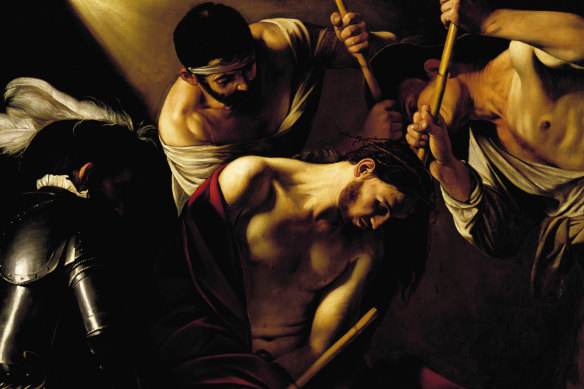
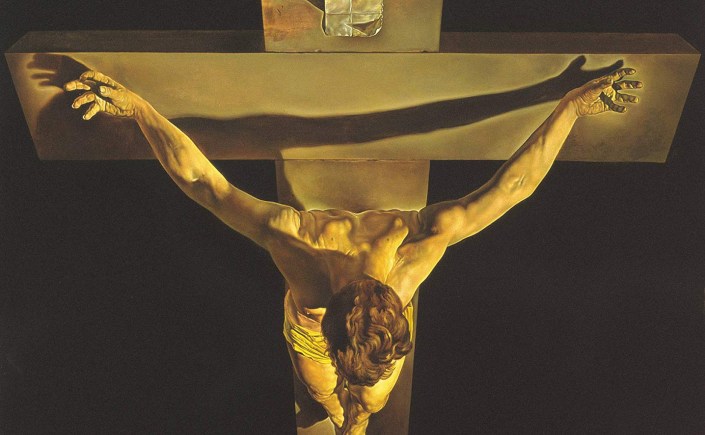
Caravaggio's The Crowning with Thorns.

Caravaggio’s The Crowning with Thorns.

This huge and sweeping account of the past 2500 years has a similarly large-scale ambition: “to explore how we in the West came to be what we are and to think the way that we do.” And his argument is compelling: even those who reject religion – those who hold to atheism, humanism, scientism, secularism – find their beliefs ineradicably shaped by Christian presuppositions.

Holland writes that Christianity continues to infuse people’s morals and presumptions “so utterly that many failed even to detect their presence. Like dust particles so fine as to be invisible to the naked eye, they were breathed in equally by everyone: believers, atheists and those who never paused so much as to think about religion.”

Holland explores the influence of the world’s biggest faith.
Holland manages to traverse Western history from the Persian invasion of Greece in 480BC to Donald Trump by the technique of taking some often-obscure figure or event and expanding from that to social transformation. So he leaps from the Apostle Paul, herald of a new beginning, to church fathers Irenaeus and the development of the canon, Origen and the invention of theology, the council of Nicaea, Martin of Tours and the exaltation of poverty, and Bede and a calendar based on the birth of Christ.

Perhaps Holland’s most important contribution is to lay waste the secularist founding myth that reason, empiricism, evidence, humanism and the like emerged in the Enlightenment fully formed like Botticelli’s The Birth of Venus, not only owing nothing to the preceding centuries but indeed in contrast to them.

Holland, an atheist, is no apologist for Christianity but is honest enough to acknowledge that his values and world view emerged from Christianity rather than pagan antiquity.

Take human rights, a key concept in modern law and ethics. Rights are by no means self-evident or inalienable, as the US Declaration of Independence states, and would have attracted contempt in pre-Christian societies such as ancient Rome or China.

Rights’ essential precondition is the Genesis teaching of humans made in God’s image, and therefore endowed with dignity and worth. It led Gregory of Nyssa in the fourth century to rail against slavery and abandoning unwanted infants on rubbish heaps and was made explicit by 11th-century canon lawyer Gratian, who pronounced that everyone was equal in the sight of God. Anything in the legal system obstructing this idea had to go.

“Much flowed from this formulation that earlier ages would have struggled to comprehend. Age-old presumptions were being decisively overturned: that custom was the ultimate authority; that the great were owed a different justice from the humble; that inequality was something natural, to be taken for granted,” Holland writes. In 1550 Bartolome de las Casas demanded justice for South American Indians, using the term “derechos humanos”, human rights. The genius of the authors of the US Constitution 200 years later was to garb in the robes of the Enlightenment the radical Protestantism that shaped the fledgling nation.

Darwin, in contrast, pointed out how unnatural such a concept is in the light of evolution, observing that “philanthropy and care for the poor must be highly injurious to the race of man”.

And today the insistence of the United Nations and others on the antiquity and broad acceptance of human rights is a fiction to allow it to be a global rather than merely a Western understanding. Secularism, in an identical manner, depended on the care with which it covered its tracks, Holland says.

The idea of the secular, contrasted with the religious, is an important theme of the great fourth-century theologian Augustine, in The City of God, and reaches fulfilment in the humiliation of Henry IV before Pope Gregory in 1076, which divided the religious and secular realms (giving the Church great power in both).

So embedded is it that nearly a millennium later German chancellor Angela Merkel appealed to it in 2014 to claim that Islam belongs as much as Christianity in modern Germany. So it may, but not because traditional Islam admits the idea of the secular, a notion born purely from Christian history. To Islam, it is an artificial divide. But, as Holland notes, the West has become skilled in repackaging Christian concepts for non-Christian audiences.

The idea that science needed to set itself free of dogma and superstition, possible only in the Enlightenment, is another fiction that can be believed only by those ignorant of history. Holland turns to Abelard – the ill-fated lover of Heloise – who devoted his post-castration life to promoting the idea that God’s order was rational and governed by rules that humans could seek to comprehend. His conviction that identifying the laws that governed nature would honour the God who made them led to the founding of universities in the 12th century.

Similarly, humanism has smuggled in Christian assumptions unacknowledged. Without the biblical story of creation in God’s image, the reverence of humanists for their own species “risks seeming mawkish and shallow”. Indeed, philosophers such as Peter Singer have attacked such notions as “speciesism”.

And the claim in the Humanist Manifesto that morals can be developed from science is another fantasy. “The primary dogma of humanism – that morality is an intrinsic part of human nature based on understanding and a concern for others – found no more corroboration in science than did the dogma of the Nazis that anyone not fit for life should be exterminated,” Holland writes. “The wellspring of humanist values lay not in reason, not in evidence-based thinking, but in history.”

An interesting thesis is that those who most truly understood Christianity’s radical role were those who most despised it, and here Holland cites Nietzsche, the Marquis de Sade, Thomas Huxley and Heinrich Himmler. Nietzsche thought Christianity a slave morality, a way for the weak to bind the strong, but also recognized its values could not survive without the God who sanctioned them. Himmler, who had a 50-year plan to eradicate Christianity, believed the strong had both a duty and obligation to eliminate the weak.

Holland acknowledges that the course of Christianity has been a mixed blessing. Christians have indeed been oppressors and exploiters, although the backlash against that has also been Christian. He details many embarrassing aspects, from crusades to corruption, and especially the totalitarian idea of truth that justifies persecuting those who differ. The heresy hunters of the inquisition survive today in the self-righteous “woke” fanatics, who no longer have the power to burn people at the stake but try to end careers, ruin reputations and close down discussions.

This is an astounding book, not only for its scope – cultural, political, social, intellectual, historical – and its originality, but for its masterly writing. Holland has a knack for the colourful twist. Writing of the summer of love, 1967, he notes: “Preachers, seen through the marijuana haze of a squat in San Francisco, had the look of bigots. Where was the love in short-haired men jabbing their fingers and going puce?”

He also has an eye for fascinating detail. For example, we owe capital letters and question marks to the abbot Alcuin of Tours, adviser to Charlemagne in the eighth century, who did a vast amount to popularize the Bible as a single source of revelation.

But sometimes Holland is a bit too graphic to be comfortable. His detailed discussion of death by crucifixion is stomach-churning; still more so the Persian punishment of the scaphe, in which the victim is trapped inside a log but for his extremities, covered in honey, and devoured over days by insects and maggots from within. Believe me, Holland’s account is horrifically more detailed.

In an enterprise as vast as Dominion, there are inevitably lacunae. Critics have observed that Holland underplays the role of Eastern Orthodox Christianity and the rise of trade, but the book is already nearly 600 pages. Another occasional weakness is that Holland’s narrative style means that he may pass over contested aspects of history to stick with his main line, though footnotes can redeem him.

For me, perhaps the most compelling point is the way Christianity defines even its opponents. Even as the woke generation condemns Christian history as oppressive, patriarchal, racist and all the other now-standard derelictions, the standards of justice and equality by which they judge these shortcomings remain ineradicably Christian. In that sense, Holland concludes, Christendom will remain with us a while yet.

Barney Zwartz is a Senior Fellow of the Centre for Public Christianity.

The legacy of Christianity

An absorbing survey of Christianity’s subversive origins and enduring influence is filled with vivid portraits, gruesome deaths and moral debates

Holland might also have pointed out that the ancient Romans reserved crucifixion mostly for political rebels. Jesus may not have been a Lenin, but it might have suited the Jewish leaders to persuade Pontius Pilate, the Roman governor, that he was. He would certainly have knocked around with Zealots, the anticolonial revolutionaries of the day. A few of his disciples were probably paid-up members of the group, as (probably) were the two so-called thieves between whom he hung on the cross. Pilate wouldn’t have needed much convincing to reach for the hammer and nails. Contrary to the gospels’ portrait of him as a kind of Guardian-reading liberal, reluctant to use his power and bemusedly in search of truth, the historical Pilate was a moral monster who would have crucified his own grandmother, and who was finally dismissed from the imperial service for corruption.

Despite these omissions, Dominion packs an astonishing amount of stuff into its 500 pages on Christianity’s enduring influence. Holland has all the talents of an accomplished novelist: a gift for narrative, a lively sense of drama and a fine ear for the rhythm of a sentence. He also has an intense, sometimes rather grisly feel for the physical: the book is resonant with the cracking of bones, flaying of flesh and shrieks of small children tossed into fires. Some of this was inflicted on Christians, and some of it inflicted by them.

Rather than unpack complex theological debates, the book gives us a series of vivid portraits of some key figures in Christian history: St Paul, St Augustine, Peter Abelard, Catherine of Siena, a former playboy known as Francis of Assisi and a host of more modern luminaries. Yet this is not just a galaxy of Christian superstars. They are all embedded in their historical contexts, as the book moves from Caesar Augustus to the #MeToo movement. There is even a medieval forerunner of feminism in the figure of the Milanese noblewoman Guglielma, who announced that she was the Holy Spirit made flesh for the redemption of women, and with engaging modesty baptised them in the name of the Father, the Son and herself.

Other intriguing details abound. When Notre Dame was being built in medieval Paris, a collective of prostitutes offered to pay for one of its windows and dedicate it to the Virgin Mary. Followers of Satan around the same time were obliged to suck on the tongue of a giant toad and lick the anus of a black cat. Galileo had a craving for celebrity and was an inveterate social climber. Yet, though the book is full of such titbits, there is a seriousness at its heart. Holland argues that all “western” moral and social norms are the product of the Christian revolution. He is haunted by St Paul’s claim that God chose the weak and foolish things of the world to shame the strong, and to drive the point home he might have looked at the beginning of Luke’s gospel. We encounter there an obscure young Jewish woman called Mary who is pregnant with Jesus, and Luke puts into her mouth a cry of praise that some scholars believe is a Zealot chant. It speaks of how you will know who God is when you see the poor coming to power and the rich sent empty away. It is this which must be weighed in the balance against the killing fields of Christendom.

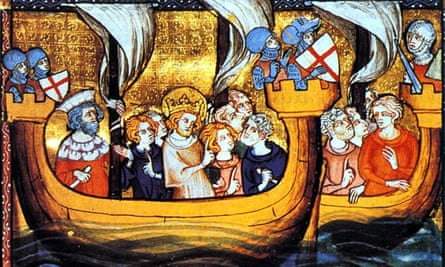
Louis IX en route to Egypt, leading the Seventh Crusade.
Louis IX en route to Egypt, leading the Seventh Crusade. Photograph: Alamy

So, too, must the notion of love. This book is full of saints and martyrs selflessly devoted to others. Yet what distinguishes the Judeo-Christian idea of love from the romantic, erotic, touchy-feely sense it has acquired in modern times is that it has nothing to do with feeling. Love for the New Testament is a social practice, not a sentiment. How you feel about the person whose place you take in the queue for the gas chambers is neither here nor there. You don’t even have to know him. Only a love of this ruthlessly impersonal kind, which couldn’t care less about the gender, rank, skin colour or personality of whoever needs your help, could prove equal to what St John darkly calls the powers of this world: Trump, Putin, Bolsonaro and their lackeys.

You can, however, make a fetish or idol out of anything, as Freud instructs us. Such false gods fill every chapter of this illuminating study. Yet Holland is surely right to argue that when we condemn the moral obscenities committed in the name of Christ, it is hard to do so without implicitly invoking his own teaching.

Terry Eagleton is a literary critic, writer and chair in English literature in Lancaster University’s department of English and creative writing. His latest book is The Event of Literature

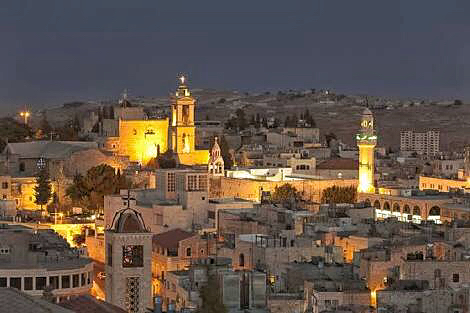
O little town of Bethlehem, how still we see thee lie…

Bethlehem has captured the imagination of the world for centuries – we are culturally and spiritually drawn to this famous Palestinian town, and specifically, to an event that may or may not have happened 2,020 years ago. Many express doubt but we nevertheless embrace the myth and the magic it inspires: the appearance of a “star of wonder, star of light, star of royal beauty bright”, harking back to prophecies of old; stories of wise men journeying on camels’ back from the exotic and mysterious east, choiring angels, simple shepherds watching their flocks, and homely livestock; and an auspicious birth in the outhouse of a village pub – all the well-loved dramatis personae of the classic manger scene.

These moments in time have long inspired painters and poets, and are recalled by carol singers from the field mice of The Wind in the Willows to the sentimentality of that famous book by the one they now hail as “the man who invented Christmas” to the songs that make shopping at this time of the year cruel and unusual punishment.

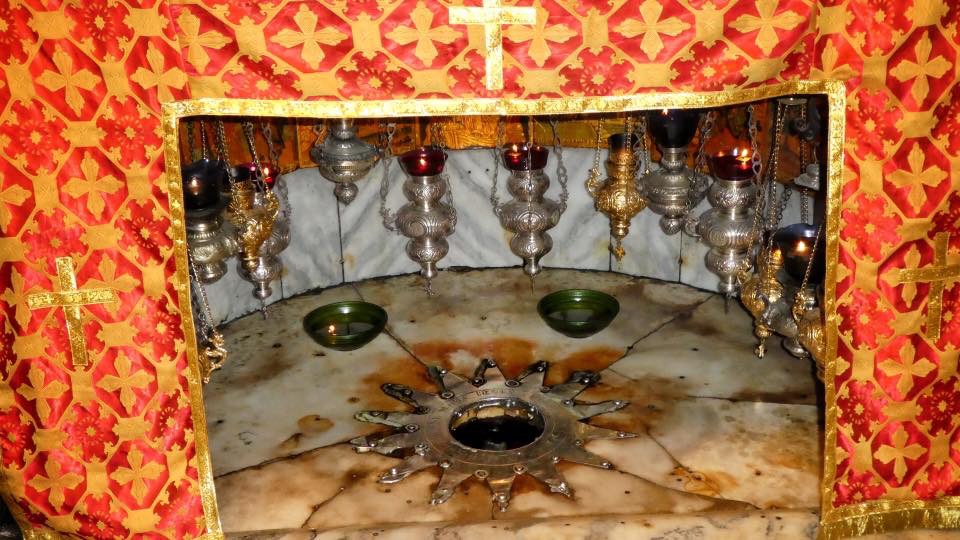
For over a century, Christian pilgrims have flocked to Bethlehem from all over the world – until COVID and the current conflict. It has long been the bedrock of the town’s economy. As a frequent visitor to Israel and Palestine, an amateur historian and a one-time catholic, I’ve visited the town and the Church of the Nativity many times over the years. Though I do not profess faith, I treasure Bethlehem for what it represents in Christianity’s story and also my own.

Poets have always been ambivalent about Bethlehem. It’s been invested with a symbolism quite detached from the geographic. TS Elliot’s magi we’re unsure what it all actually meant, whilst to WB Yeats, it might’ve been a place where bad things would happen. But then they hardly knew the place, and them and countless others, it is a place of myth and memory, most of it imagined.

And whilst “the hopes and fears of all our years” abide with this town of some 27,000 souls, it has a life of its own, a history, a society, an economy, and a political story that reaches back eleven thousand years.

Like Jerusalem, its sacred, senior sibling, just ten kilometres away as the crow flies (and much, much longer by road due to the impositions of the occupation), the “little town of Bethlehem”  is as much a city of the mind and heart as one of bricks and mortar and of ordinary people with myriad preoccupations and passions.

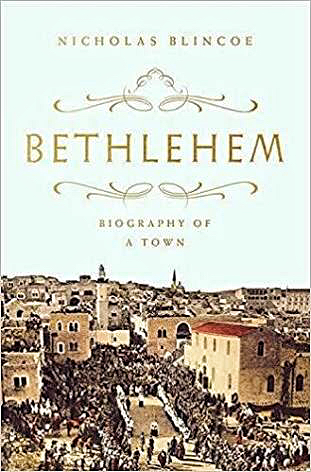
British author and screenwriter Nicholas Blincoe has now written an affectionate and informative biography of a town that is as close to the heart of our culture as any town ever was, and yet one that is almost unknown. Whilst “the hopes and fears of all our years” abide with this town of some 27,000 souls, it has a story of its own that reaches back eleven thousand years.

Ballad of a border town 

Blincoe’s story is part history, part travelogue and memoir, the past intermingling with the present in informative and ofttimes entertaining anecdotes and interviews, memories and personal experiences, as he takes us on a journey from the stone age to the stone wall – one that is in places eight metres in height.

Bethlehem has since the beginning of recorded history been a border-town on a physical and metaphysical borderland.

A borderland between “the desert and the sown”, the Judean Desert with it’s sheep-herding nomads and Bedouin bandits, and the orchards and vineyards in the fertile wadis that for centuries had supplied world-famous wine and olive oil.

A borderland also between the Christians who once constituted a majority, and who for generations have tended to the churches, shrines, and monasteries that were drawn to the holy ground around the Church of the Nativity, and the vast Muslim hinterland from whence over the centuries have come traders and invaders, missionaries and marauders, tourists and tanks. For two thousand years, Jerusalem and Bethlehem have been one of the world’s preeminent destinations for religious tourism, and over two million tourists and pilgrims visit the town each year.

Bethlehem’s location has given it a social, political, economic, and strategic significance disproportionate to its size. It grew the confluence of the springs and aqueducts that have supplied nearby Jerusalem for millennia. “All ittakes to conquer Jerusalem is to seize its water supply…This is what every future invader did.” It was close to the historic trade route between the Kings Road that linked the Hijaz to the Hauran, Damascus and the north, and the ancient Palestinian ports on the Mediterranean.

Its importance as a Christian island in a sea of Islam saw it serve as a refuge for the oppressed and dispossessed of Ottoman pogroms and genocides and also of the Nakba, it has earned a reputuaion as a haven for the more secular and radical elements of the Palestinian national movement their struggle with more religious and indeed fundamentalist adversaries.

But over the last half-Century, it is town that is increasingly cut off and isolated by the Separation Wall, encircled and encroached upon by the ever multiplying and expanding Israeli settlements (forty one at the last count with well over 100,000 inhabitants), hostile and acquisitive settlers, and the daily impositions and injustices of the military occupation with its restricted roads, armed soldiers and border police, checkpoints and the Kafkaesque permit system.

A cultural caravanserai

For most of his historical narrative, Blincoe maintains a degree of scholarly detachment with regard to the serpentine history and politics of the region, and  crafts a captivating tale of warlords and adventurers, of soldiers and saints,  as a parade of foreign armies pass through. Egyptians, Hittites, Persians, Greeks, and Romans, Arabs, Franks, and Mamluks, Turks, Brits, and finally, Israelis. There is a great picture of a group of Anzacs from the far side of the world in their winter coats emerging from the cave of the nativity in December 1917. Rulers and rebels have passed this way, and many, like mad, bad King Herod, Bar Kokba’s Jewish fighters, and the Shabab of the Palestinian Intifada-t have died nearby.

Given its religious significance, Bethlehem has forever been a focus and at times, a flash-point for events that have enmeshed the Holy Land and its Holy Places, from the fossicking of Emperor Constantine’ mother Helena and the self-imposed exile of estranged Empress Eudocia, through the Muslim conquest, the Crusades and Mongol raids to the Crimean War, the Palestine Campaign of WW1, and the Arab-Israel conflict. Bethlehem’s history has been one of civilization, colonization and conquest.

As a former scholar of philosophy, Blincoe seems particularly at home amidst the theological disputes of the early Christian, Byzantine period, and brings to life a host of passionate, idiosyncratic, adventurous, and infuriating men and women – the wandering saints and scholars, clerics and ascetics, wealthy widows and society matrons of the Middle Ages, and an unending caravan of pilgrims, tourists, evangelical adventurers and amateur archaeologists that have walked these hills and valleys for centuries. As with Jerusalem, seekers of the numinous could never get enough of the place.

He doesn’t shy away from the social, theological and political complexities of his chronicle, but his objectivity is severely tested in his final chapters when writing of Bethlehem and the occupation.

But then he does after all have a lot of skin in the game: he is married to Bethlehem filmmaker Leila Samsour, dividing his time between London and Bethlehem. He is quite embedded with Leila’s Christian Palestinian family, one with deep roots in the town’s history and politics, and has often been in the thick of the crises, protests, incursions and violent clashes that periodically embroil his adopted home.

He is not some desktop warrior, NGO apparatchik or “occupation tourist”. And whilst he deplores the actions of the settlers and the right wing politicians – Avigdor Leiberman and other nationalist MKs are virtual neighbours of his – and ascribes to revisionist Israeli historians like Ilan Pape and Benny Morris’ reading of the Nakba, he is not one of Israel‘s haters But he is disappointed, saddened, infuriated even by the Jewish state’s often cavalier and callous approach to its Palestinians who are its neighbours and also, its sullen, subject people.

Banksy’s Bethlehem Bouquet. Paul Hemphill

Breaking the wheel

Palestine, and with it,  Jerusalem and Bethlehem, have always been under strangers’ dominion. But in the past, the rulers largely left the locals to live their own lives and manage their own affairs in accordance with their own social, political, and religious ways, and in the fullness of time, they departed, ceding the land to the next despot. Until, that is, the Israelis. In the words of Daenerys Targaryen: “ We’re not going to stop the wheel. I’m going to break the wheel.”

Year by year, Bethlehem’s economy shrinks. Over two million tourists and pilgrims visit “Royal David’s City” annually, but its economically stressed, and it has the highest unemployment rate (nearly 30%) in the West Bank.

Year by year, Bethlehem’s Christian population diminishes as people head overseas in search of a better life – and particularly its young folk. In 1950, Bethlehem and the surrounding villages were 86% Christian, but by 2016, the Christian population was but 12%.

Year by year, the settlements grow, and settlers, encouraged by an extremist, nationalist government and a seemingly compliant IDF, become more emboldened in their expansion onto Palestinian land. Considered illegal under international law, Israel regards them as legitimate suburbs of Jerusalem- a territorial fait accompli that is tantamount to de facto annexation.

Year by year, Bethlehem becomes more and more cut off from the rest of the West Bank by walls, wire, and a web of “Israeli only” highways, and indeed from the world beyond the wall. Travel to Jerusalem and to the rest of the West Bank is severely restricted by roads, checkpoints and permits, whilst the interaction between Israelis and Palestinians that existed during the seventies and eighties, in workplaces, educational and health institutions, friendships and romances, ceased after the terrors of the second, bomb Intifada as israel and Israelis withdrew into their mental and physical fortress.

A generation of young people on either side of the old and ostensibly moribund Green Line have grown up with negligible contact with their peers on the “other side” – and this is most likely to be limited to military service in the Occupied Territories on the one hand, and confrontations with armed soldiers on the other.

Writing of the 1948 war, Blincoe notes: “From their future actions it became clear that both Jordan and Israel saw the term “Palestine” as an empty tag: it was the name of a piece of real estate rather than the home of people demanding self representation”, this is how he sees the future for Palestine and for Bethlehem, his adopted home. He argues that the settlement project is first and foremost about land and cheap housing for middle and lower class Israelis pressed by rising property values and a shortage of affordable housing to rent or buy in Israel proper. it is real estate developers, he argues, with friends in high places, who are calling the shots, rather than the more visible and vocal Zionist nationalists. As the Israeli historian and one–time deputy mayor of Jerusalem Meron Benvenisti puts it, the settlements are a “commercial real estate project that conscripts Zionist rhetoric for profit”. The story of Jesus and the money-changers somehow comes to mind.

It is an intriguing argument that invites further research. it also echoes what would appear to be a similar patter in those parts of the West Bank that are under the direct control and administration of the Palestinian Authority, as we have reported earlier in Castles Made of Sand, an account of the land rush that is taking place in Area A.

With this and all the other pressures in play, from Blincoe’s perspective, the future prospects of Palestine and the little town of Bethlehem not appear to be promising. Bethlehem – Biography of a Town does not have a happy ending.

Synchronicity – a footnote

A few days after this post was published, an article by Hillel Zand appeared in the Matzav Review addressing the settlements and the real estate argument:  “Israel’s right-wing has strengthened in recent years because it has promoted heavily financing the settlement project as a way to compensate for the not insignificant negative side-effects of neoliberal economic policy, especially rising housing prices and increasing inequality and poverty…In Israel, the “losers” are being compensated by the advocates of these policies with incentives, subsidies and entitlements that allow them to maintain, or even raise, their quality of life by living in West Bank settlements”.

The Israel-Jordan collaboration referred to by Blincoe also raised its controversial head recently when Justice Minister Ayalet Shaked and her boss Naftali Bennett hinted, favourably, at the prospects of US’ impending “peace deal” that includes the West Bank being ceded to Jordan and Gaza to Egypt. Murmurings from US allies Egypt and Saudi Arabia have also indicated support for such an idea.

Aida Refugee Camp, Bethlehem. Paul Hemphill

Walls and wire define the brotherhood of man.  Paul Hemphill

Some further reading about Bethlehem:

There are the PLO’s official facts and figures, and the National Catholic Reporter on the declining Christian population. And there is always Wikipedia. There are a series of posts in In That Howling Infinite about Jerusalem and Palestine in: O Jerusalem, and A Middle Eat Miscellany

Author’s Note: 

Whenever I pen commentaries such as this, people ask why I rarely forward my own opinion on the issues I am presenting or discussing. On the contrary, I would argue that my views are fairly transparent in the subjects I chose to engage with, the words I use, and the vein in which I use them.

With respect to my numerous posts about Israel and Palestine, and the Middle East in general, I  come to my conclusions from a political science and sociology perspective – that’s where my academic experience came from – and a background in conflict resolution, supported by study and travel. If I do on occasions display any particular bias, it originates in my longtime interest, understanding and affection for the history, politics culture and language of the region, of its geography and archaeology, and of its people of all faiths and nationalities that I make my observations.

I am presently working on a piece that encapsulates my thoughts on this complex and controversial subject. But meanwhile, here is a brief exposition.

I do believe that the systematic dispossession of almost a million Palestinians and the destruction of half of their towns and villages in 1948 is Israel’s original sin. It is the primal stain that colours and corrupts all that followed. And yet, if not for the actions, often daring, often brave, often questionable, and often deplorable, of the politicians and soldiers of 1948 – and of the generations that folllowed –  Israel would not exist today. This paradox is addressed sympathetically by Avi Shalit in My Promised Land, referred to above, and scathingly by ‘new history’ scholar Ilan Pappe in The Ethnic Cleansing of Palestine.   

The Occupation, fifty years old this year, which grew out of the unexpectedly total victory of June 1967, has taken on strategic, ideological and indeed messianic dimensions by many in the  Israeli government and political elite. It compounded the original sin, deepened the primal stain, released the demons of messianic fervour, and wounded Israel’s soul. The settlements locked the nation into the the colonialist project. With the close-call of the Yom Kippur War, the violence and murder of the first and second Intifadat, and present Palestinian jaquerie, Israel’s heart has not just hardened, it has become sclerotic.

I admit that I have always been sympathetic towards Israel – from my first visit in 1972. But it is not a blinkered viewpoint. I am deeply critical of Israeli politics and policies, and have no respect for many of its leaders.

Ayelet Shaked, the nationalist’s La Passionaria, and her boss Naftali Bennett do not not represent ALL Israelis! They hold extremist views just like we in UK, US, and Australia have parties and individuals with extremist views. But there are hundreds of thousands of Israelis who oppose the present government and long for justice and peace. And if – a very big “if” – Arab Israelis and the Israeli left could work together, they could obtain a majority in the Knesset and change Israel’s politics.

Yet meanwhile, Binyamin Netanyahu and his nationalist allies call all the shots, the Israelis continue to control and exploit the land, its people, and its resources, whilst varying degrees of annexation are on the cards. The settlements are an abomination, as are the policies and practices of the state and its occupying army, as described by Lyons and others. There’s no escaping these facts.

But I am likewise critical of Palestinian governance, politics and politicians. Hamas and the PA are on the nose in their respective fiefdoms, and if a moderate “third force” were to arise – and survive, because sure as hell, they would risk being murdered – Palestinians who just want a quiet, normal life, adequate services, and opportunities for their children, and Israelis who want likewise, might – just might – reject their extremist, dogmatic, entrenched leaders and reach some form of modus vivendi.

Palestinians themselves have to take control of their own lives, kick out their corrupt leaders, cease inculcating their children with hatred and jihadism, and use all that international good will and dollars to build a viable economy that can provide jobs, opportunities, and security, economic and physical to the people. Only this way will they be inoculated against cronyism, corruption and extremism. And yet, the dead hand of a moribund, patriarchal, conservative and ethnocentric culture holds them back –  but that is the subject of another, future discussion for In That Howling Infinite.

Today, the ‘powers that be’, defenders and beneficiaries of a status quo that looks more like a cul de sac, predominate over a dispiriting array of competing, clamouring factions, left, right, nationalist, secular, tribal, Haredi, and Islamist alike. New, young, brace, local voices in both Israel and Palestine, are not heard.

So what happens next?

I get that question too. And I am perennially reluctant to venture an answer beyond one that runs like “on the one hand…but then on the other”.  I inevitably fall back on Robert Fisk’s response to the same question with regard to the calamitous freezing over of the Arab Spring and the fall and rise again of the same old autocrats and tyrants: “my crystal ball is broken”. It’s a cop out, really, but just as cogent as that famous line in that UK spy drama Spooks: “What’s gong to happen to me?” “Bad things!”

One thing is for sure: as songwriter Warren Zevon sang, “the hurt gets worse, and the heart get harder”.

October 8th 2017

For more posts on Jerusalem, Israel and the Middle East, visit:
https://m.facebook.com/HowlingInfinite/
https://m.facebook.com/hf1983/

See also, my collection of posts about Jerusalem. 

The Church of the Nativity. Paul Hemphill

Where Christianity began. Paul Hemphill