One morning when we were last in Jerusalem, author and Jerusalem resident, Sarah Tuttle-Singer, author of the recently published and enthralling Fairy Lights in Godʻs Backyard: A Jerusalem Love Story , took us on something of a magical mystery tour of places that most visitors would probably never find for themselves. It was less a conventional guided walk than an excursion through the city’s hidden histories, eccentricities and unexpected connections.
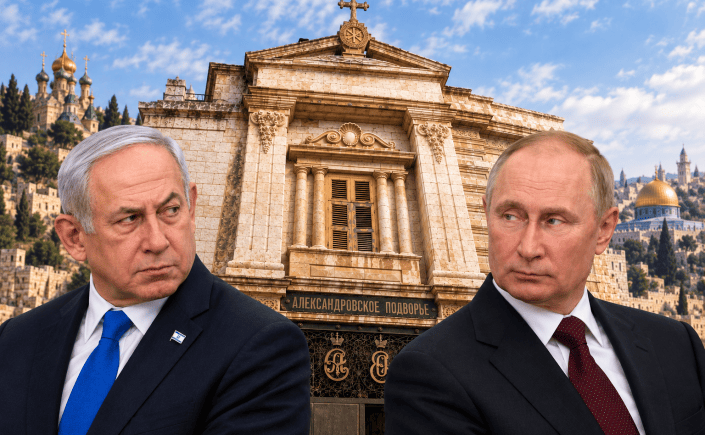
Our itinerary was wonderfully eclectic. We visited what is reputed to be the oldest tattoo parlour in the Middle East; discovered the best place in Jerusalem to buy – and, importantly, sample – Islay malt whiskies; and called in at a shop run by the son of one of Jerusalem’s most celebrated photographers. We explored a remarkable sixteenth-century palace built by a high-born woman of Central Asian origin and subsequently inherited by Suleiman the Magnificent’s blonde Ukrainian consort. Along the way, Sarah explained the curious story behind Jerusalem’s cats, before we came upon a weathered red Royal Mail postbox, complete with its royal crown and the initials GR – a small but wonderfully tangible relic of the days this land was part of the British Empire. Anshe d between the New Gate and the Church of the Holy Sepulcher, we stood outside the less well-know Orthodox Church of Alexander Nevsky. It was, she stated with a sly grin, a building that could potentially start World War III – a church that Vladimir Putin apparently has ambitions to incorporate into the expanding cultural and political universe of Russky Mir, the Russian World.
Sarah gave us the black and white short film version. here it is retold in Russian red, white and blue technicolor…
The Kremlin, Moscow, Christmas morning 7 January 2020
The telephone rings. President (for life) Vladimir Putin stares at it with the expression of a man who has just been informed that the West has invented another human right. He answers grumpily:
Vlad: Da?
Bibi: Hi, Vlad! It’s Bibi. You know, Prime Minister Benjamin Netanyahu, calling from Israel. How are you, my friend?
Vlad: Bibi! It is seven in the morning! It is Christmas! Russian Christmas. Even God is not taking calls today. Why are you?
Bibi: Vlad, Vlad, my friend, tovarishch, I wouldn’t disturb you unless it were important..
Vlad: (… a long, wintry pause) You said this last time. It was Trump. I am beginning to think you people have no respect for the holidays.
Bibi: Vlad, my friend, listen, I’m asking you for one small favour. One small favour! Naama Issachar. Remember her? Lovely girl. Israeli-American. Good family. A little cannabis in her luggage. Nine grams! I mean, what is that? A salad garnish? You’re giving her seven and a half years. For nine grams! What is this, a prison sentence or a lifetime supply?
Vlad: She broke Russian law.
Bibi: Yes, but Vlad, between friends, surely we can be flexible about the law. I mean, you have laws, I have laws, everybody has laws. If we enforced all of them, where would we be? I couldn’t run a government!
Vlad: Nyet!
Bibi: Nyet? Just like that? You don’t even want to hear what I have to say? I’ve come all this way. I’ve had meetings. I’ve had advisers. I’ve had advisers who advise other advisers. Do you know what that costs?
Vlad: Not my problem.
Bibi: No, of course not. Why should it be your problem? You have your own problems. Ukraine, sanctions, the economy. And now you have an opportunity to do something really positive. A gesture! A gesture of goodwill. Think of the public relations. Think of the Russian Jews in Israel. Important people, Vlad. Voters! You understand voters.
Vlad: I understand power.
Bibi: Yes, well, voters are a kind of power. A rather irritating kind, admittedly, but you have to have them.
Vlad: What do you offer?
Bibi: Ah! Now we’re talking. I knew there was a Russian in there somewhere.
Vlad: Do not waste my time, Bibi.
Bibi: The Alexander Courtyard. Here in Jerusalem. The Christian Quarter. A beautiful property. A church, the Alexabder Nevsky church. History, religion, Russian pilgrims. All those babushkas coming here with their headscarves and shopping bags, kissing icons and buying souvenirs. They’ll adore you! And Patriarch Kirill will be absolutely thrilled. You’ll be the man who restored Russia’s place in the Holy City.
Vlad: The property belongs to Russia.
Bibi: Well, it doesn’t exactly belong to Russia yet. That’s the beauty of the arrangement! You see, we have a little legal difficulty. Nothing serious. A technicality. The sort of thing that can be resolved over lunch, assuming nobody brings a lawyer.
Vlad: Alexander Nevsky? Mmm.
Bibi: Exactly! Alexander Nevsky. A great Russian warrior, a saint, a national hero. You like that sort of thing. Your friend Alexander Dugin likes that sort of thing. A little medieval glory, a little Orthodox mysticism, a little imperial nostalgia. You could hardly have designed it better yourself.
Vlad: I do not require your interpretation of Russian history.
Bibi: No, no, naturally. You have people for that. I’m merely offering the venue.
Vlad: And the church?
Bibi: The church, the courtyard, the whole historical package. Practically turnkey! Well, subject to a few administrative matters. And possibly the courts. But those things can be managed.
Vlad: You will transfer it.
Bibi: Vlad, I’m a politician. I never use the word transfer when I can use the phrase facilitate an administrative outcome.
Vlad: Bibi!
Bibi: Alright! Alright! You’ll get your church. Naama comes home, you get your Alexander Nevsky, the babushkas light their candles, Kirill says a prayer, and everybody goes home happy. It’s a win-win!
Vlad: There is no win-win. There is Russia, and there are those who understand Russia.
Bibi: Of course. Of course. I was speaking metaphorically.
Vlad: See that you keep your word. Russia remembers.
Bibi: Trust me, Vlad. Trust me. I’m a man of my word.
Vlad: That is what concerns me.
Bibi: You know, I really don’t appreciate that sort of remark. I come to you in friendship, I offer you a church, I ask you to release a young woman from prison, and you insult me! Honestly, next time I’ll send a lawyer.
Vlad: Please do. He can serve her sentence.
Bibi: (outraged) Vlad! I’m asking for a little human compassion!
Vlad: And I am offering you a little Russian justice. We are both disappointed.
Bibi: You know, you really should have been a comedian.
Vlad: I am president of Russia.
Bibi: Yes. Well. Nobody’s perfect.
Please note: This is an imagined conversation. But the bargain made is not entirely so.
A little dope, a small Russian church, and a big geopolitical headache
There are places in Jerusalem’s Old City where the stones have seen so much history that one might reasonably expect them to have acquired a certain immunity to political intrigue. The Alexander Courtyard, tucked away in the Christian Quarter, within a stone’s throw of the Church of the Holy Sepulcher, is not one of them. Here, amid the competing claims of emperors, patriarchs, governments and rival Christian traditions, a small piece of real estate has become entangled in a distinctly modern tale of diplomatic horse-trading, Russian nationalism and the fate of an Israeli woman arrested with a little cannabis.
It began in 2019, when Naama Issachar, an Israeli-American woman travelling from India to Israel via Moscow, was arrested at Sheremetyevo Airport. A small quantity of cannabis – about nine grams – was found in her luggage. Russia charged her with drug smuggling, and in October 2019 she was sentenced to seven and a half years in prison. The sentence struck many observers as wildly disproportionate, and suspicions quickly arose that the case had become a convenient instrument of Russian leverage.
Benjamin Netanyahu, then serving his previous term as Israeli prime minister, took a personal interest in securing her release. In January 2020, Russian president Vladimir Putin pardoned Issachar and she returned to Israel.
But diplomatic courtesies, as we know, are rarely entirely gratuitous. There was another matter on the table: the Alexander Courtyard, a historically and religiously sensitive compound in Jerusalem which Russia had long sought to have formally registered in its name.
That same month, Netanyahu signed an order designating the courtyard a holy place under legislation dating from the British Mandate. This opened the way for the land registry commissioner to register the property in the name of the Russian Federation. It was a substantial diplomatic gesture, although the legal machinery proved rather less obliging than the politicians might have hoped.
The courtyard’s history is complicated. The site is associated with the Imperial Orthodox Palestine Society, founded in the Russian Empire in the nineteenth century to promote Russian Orthodox pilgrimage and maintain a Russian presence in the Holy Land. The compound contains the Church of St Alexander Nevsky, built over archaeological remains traditionally associated with the vicinity of the ancient city and its gates. Its significance is religious, historical and political, with Russia’s imperial past and modern ambitions woven into the fabric of the place. We have added an addendum to this story below. It provides a brief explainer with respect to Russia’s historical interest in Jerusalem’s Holy Places.
Here, the story takes a distinctly awkward turn. The people actually maintaining the religious life of the site have included Ukrainian Orthodox nuns, associated with the historical Orthodox Palestine Society. The political contest is therefore not simply between Israel and Russia, or between competing Christian claims. It has acquired an added irony since Russia’s full-scale invasion of Ukraine in February 2022: a compound sought by Moscow is, on the ground, associated with Ukrainian religious custodians. The ecclesiastical and institutional arrangements are complicated, and should not be mistaken for a straightforward contest between two national churches, but the symbolism is hard to miss.
In March 2022, the Jerusalem District Court annulled the attempted registration of the property in Russia’s name. The court held, in essence, that the transfer of a designated holy site involved decisions beyond the authority of an administrative land registrar. Given the religious and geopolitical sensitivities, the matter required action at cabinet level. Putin was not amused. He subsequently wrote to Naftali Bennett, Netanyahu’s successor, pressing Israel to complete the transfer. Bennett established a process to examine the issue, but it stalled.
Netanyahu’s return to office brought the dispute back into active consideration. By 2024–26, the government was again examining the question, with Russia insisting that registration in its name ought to be nearing completion while Israeli authorities maintained that the matter remained under review. The precise legal status and timing of any final decision have continued to be contested.
Meanwhile, the courtyard remains where it has always been: in the Christian Quarter, beside some of the most sacred sites in Christendom, some seventy metres from Golgotha, caught between the claims of history, religion, property law and national power.
There is something almost irresistibly Jerusalemite about the whole affair. A few grams of cannabis become a diplomatic crisis; the release of a young woman becomes an opportunity for a property transaction; a medieval Russian saint becomes an instrument of contemporary statecraft; and Ukrainian nuns find themselves at the intersection of an argument involving Netanyahu, Putin, the Russian Orthodox world and the aftershocks of a European war.
Jerusalem has always been a city in which the sacred and the profane share the same narrow streets. Sometimes the distance between them is measured in centuries. Sometimes it is measured in nine grams of cannabis.
And sometimes, if you are Benjamin Netanyahu, it is measured in square metres of disputed real estate.
Historical note: The imagined dialogue is satire, not an actual transcript. The precise quid pro quo between Issachar’s release and the Alexander Courtyard’s transfer should not be presented as conclusively established. The chronology of the legal proceedings and the status of the property should also be checked against the latest Israeli court and government records..
Addendum: The Russians Are Coming (and have been for centuries)
Russia’s interest in Jerusalem is no passing fancy, nor is it simply a matter of Putin’s imperial nostalgia. It goes back centuries, gathering momentum in the nineteenth, when the Russian Empire increasingly presented itself as the protector of Orthodox Christians under Ottoman rule. The Crimean War (1853–56), fought partly over competing Russian and Western claims to protect Christian holy places, demonstrated just how combustible the mixture of religion, imperial ambition and control of the Holy Land could become. Jerusalem was never merely a destination for Russian pilgrims; it was also a stage on which great powers performed their rival claims to influence and prestige.
The Russian presence grew substantially in the nineteenth century, particularly after the establishment of the Imperial Orthodox Palestine Society in 1882, which organised pilgrimages, supported Orthodox communities and built accommodation and religious institutions for Russian visitors. The grand Russian Compound outside the Old City walls became a small Russian world in its own right, while churches, hospices and courtyards sprang up around the Holy City. The Bolshevik Revolution disrupted the old imperial arrangements, but it did not extinguish the Russian religious attachment to Jerusalem. Soviet atheism was eventually followed by a remarkable revival of Russian Orthodox pilgrimage after the collapse of the USSR.
The imperial legacy is still visible in some rather unexpected places. The Church of St Mary Magdalene in Gethsemane, with its distinctive golden onion domes, was built in the 1880s by Tsar Alexander III in memory of his mother, Empress Maria Alexandrovna. Among those buried there is Grand Duchess Elizabeth Feodorovna, the sister of the last Russian empress, Alexandra Feodorovna. Elizabeth became a nun after her husband, Grand Duke Sergei – a harsh governor of Moscow who expelled Jews from the city, was assassinated in 1905. The Grand Duchess was herself murdered by the Bolsheviks in 1918 along with many Russian nobles. Their execution is described in melancholy detail in British historian Anthony Beevor’s recent history of Rasputin and the end of the Romanovs (see Rasputin and the downfall of the Romanovs). Her remains were eventually brought to Jerusalem and laid to rest in the church. Alexandra herself, the last tsarina, lies with Nicholas II and their children in the Peter and Paul Cathedral in St Petersburg, not Jerusalem. The distinction matters, although it is easy to see how the stories become entangled amid the layered history of the Russian holy places.
And the pilgrims keep coming. During our visits to Jerusalem, we have often encountered Russian groups moving through the Old City, some reverent, some weary, all adding their voices to the extraordinary human murmur of the streets. Just last night, at Versavee restaurant beside our hotel, the New Imperial, the owner told us that only a few days earlier he had catered for six Russian nuns. One small anecdote, perhaps, but it brings the larger history down to street level: the old connections are not merely diplomatic abstractions or relics of tsarist ambition. They are people arriving, praying, eating, sleeping and finding their way through the same narrow lanes we walk.
Which brings us back to the Alexander Courtyard. For Putin, a Russian foothold beside the Church of the Holy Sepulcher carries the weight of history, Orthodox identity and the recovery of imperial prestige. For the Israeli government, it is a sensitive question of sovereignty, property law and international relations. And for the Ukrainian nuns associated with the site’s religious life, it is a place of worship caught in the crosscurrents of a much larger struggle.
Jerusalem has always attracted pilgrims who see heaven in its stones, and rulers who see power. The difficulty, as ever, is that they often want the same piece of ground [See Amazing Grace – there’s magic in the air]
Alexander Who?
There are, in fact, three Alexanders lurking behind his little Jerusalem real-estate drama, and it is worth distinguishing them before the history becomes even more complicated than the politics.
First, Alexander III, Tsar of Russia from 1881 to 1894, was a staunch autocrat and champion of Russian Orthodoxy and imperial power. His reign saw the expansion of Russia’s religious and cultural presence in the Holy Land, encouraged by the Imperial Orthodox Palestine Society, founded in 1882. It was in this imperial spirit that the Alexander Courtyard was constructed in 1896, two years after the tsar’s death, and named in his honour. There is an uncomfortable irony here: Alexander III’s Russia presided over the persecution of Jews and a wave of pogroms that drove many to seek refuge abroad, while the modern Israeli state is now considering whether to place this particular piece of Jerusalem under Russian ownership.
The second Alexander is Alexander Nevsky (c.1221–1263), the medieval Russian prince and military hero canonised by the Orthodox Church, whose name is borne by the church within the courtyard. Nevsky has acquired renewed significance under Vladimir Putin, for whom the prince embodies the marriage of Russian national identity, Orthodox Christianity and military power. Sergei Eisenstein’s celebrated 1938 film Alexander Nevsky, with its stirring score by Sergei Prokofiev, dramatised the prince’s victory over the Teutonic Knights as a defence of Russia against Western aggression. Made on the eve of war with Nazi Germany, it was a powerful exercise in patriotic propaganda, subsequently reclaimed as a symbol of Russian greatness and resistance to the West. The church in Jerusalem thus carries more than religious significance: it belongs to a tradition in which Russian Orthodoxy and national power have long reinforced one another.
And finally, there is Alexander Dugin, the contemporary Russian ultranationalist philosopher and advocate of a resurgent Russian empire, whose ideas about Russia’s distinctive civilisational destiny have often been associated with the ideological climate of Putin’s regime, although the precise extent of his influence on the president is disputed. He has, however, been described as “Putin’s Brain”. He features in several essays in In That Howling Infinite, the most recent being Alexander Dugin versus Sydney Sweeney. Dugin is not Nevsky reincarnated, nor is he the architect of every Kremlin ambition, but his vision of a Russia resisting Western liberalism and reclaiming its historic sphere of influence provides a useful contemporary echo of the older imperial and Orthodox traditions.
Three Alexanders, then: a tsar, a saintly warrior and a modern ideologue. Their lives span eight centuries, but their stories converge in a small compound barely seventy metres from Golgotha, where the Russian state seeks to secure a foothold in one of Christianity’s holiest places. For Putin, the courtyard is more than a property dispute; it offers a tangible connection to Russia’s imperial past, Orthodox identity and aspirations to renewed greatness. For Israel, it presents a delicate question of sovereignty, religious sensitivities and diplomatic leverage. And for the rest of us, watching this particular piece of Jerusalem real estate become entangled in the politics of Moscow, Kyiv and Jerusalem, it is a reminder that history rarely stays buried beneath the stones. Sometimes it comes back demanding the deeds.
For more on Russia, Ukraine and the Soviet Union in In That Howling Infinite, see Russky Mir – Russian history’s long shadow
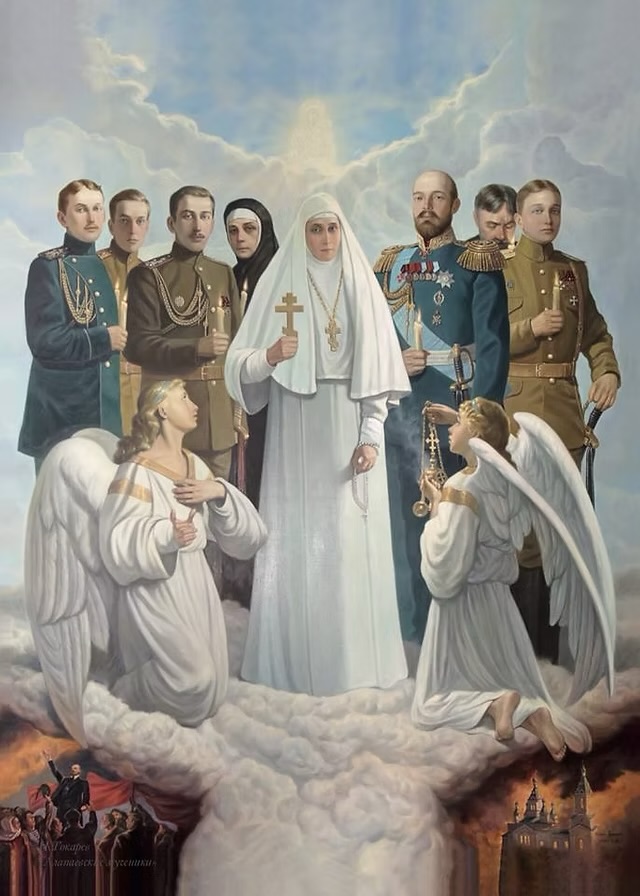
The Holy Martyr Elizaveta Feodorovna.

