The sickness at the heart of the international order

Last week, in sheeplike conformity with diplomatic niceties, Australia, together with the US, the EU and NATO offered condolences for Iran’s vicious hanging judge President Ebrahim Raisi.

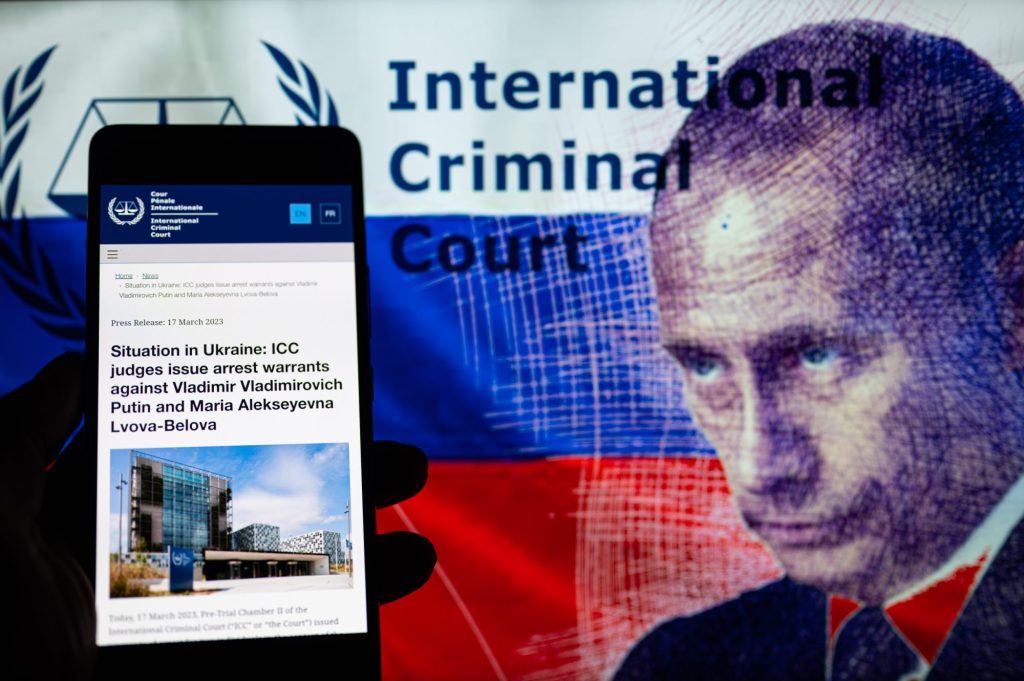
A year ago, the International Criminal Court issued a warrant for the arrest of Russian President Vladimir Putin for crimes against humanity. It would deepen Russia’s international isolation, pundits pronounced. The announcement did not receive the breathless coverage of the recent news that the court was considering similar warrants with respect to Israeli and Hamas leaders with repeat to the atrocities of October 7th and the bloody war that has followed.

A year on, and Vlad’s star still shines as Russia makes gains on the Ukrainian battlefield.

But the ICC is only one part of the malaise that has contaminated international institutions.

I have long believed that the United Nations has long passed its usefulness – if it ever had any purpose at all having been strangled at birth by the veto wielded in the Security Council by the US and Russia.

It has indeed gotten worse. As Greg Sheridan wrote in The Australian on 25th May

“The ethos of institutional liberal internationalism, especially when associated with the UN, has become an inverted parody of what it was once meant to be. The UN culture is a result of a combination of activism from dictatorships, especially China and Russia; plus the in-built voting power of the Arab, North African and Muslim blocs, none of which is sympathetic to democracy, and the ideological leftism of the activist and NGO class in Western societies themselves. Thus.  the UN frequently produces abominations with a kind of PG Wodehouse comic quality – committees on women’s rights headed by Saudi Arabia, human rights bodies chaired by China, non-proliferation committees headed by Pakistan and the like”.
On Ebrahim Raisi in particular, Sheridan wrote:

“Before becoming president Raisi was most famous for his role on the Tehran Death Committee in 1988. Across the Islamic Republic of Iran at that time many thousands of political prisoners were tortured and killed. No jurist was a more enthusiastic deliverer of death than Raisi. Later, when president, he looked back on those days with fondness and claimed the executions as a particular achievement for Iran.

Raisi ran unsuccessfully for president a couple of times. He was neither popular nor in the first rank of Iranian leaders, or of Islamic theologians, though he gave himself the title of Ayatollah. In 2021 Iran’s Supreme Leader, Ayatollah Ali Khameini, decided, with the Islamic Revolutionary Guard Corps, they would make Raisi president. He was a reliable hardliner and someone the IRGC in particular thought they could control”.

For more on Israel and Palestine in In That Howling Infinite, see Middle East Miscellany. See also, Lebensraum Redux – Hamas’ promise of the hereafter, Total war in an urban landscape – Israel’s military quandary, Flight into Egypt, and the promise of the hereafter , and The Calculus of Carnage – the mathematics of Muslim on Muslim mortality

“The ICC is a sign of a deep sickness

That UN agencies mourn the Butcher of Tehran as they seek to arrest democratic Israel’s leaders presents the morally inverted, politically corrupted nature of what passes for liberal internationalism today.
Greg Sheridan, The Weekend Australian, 26th May 2024

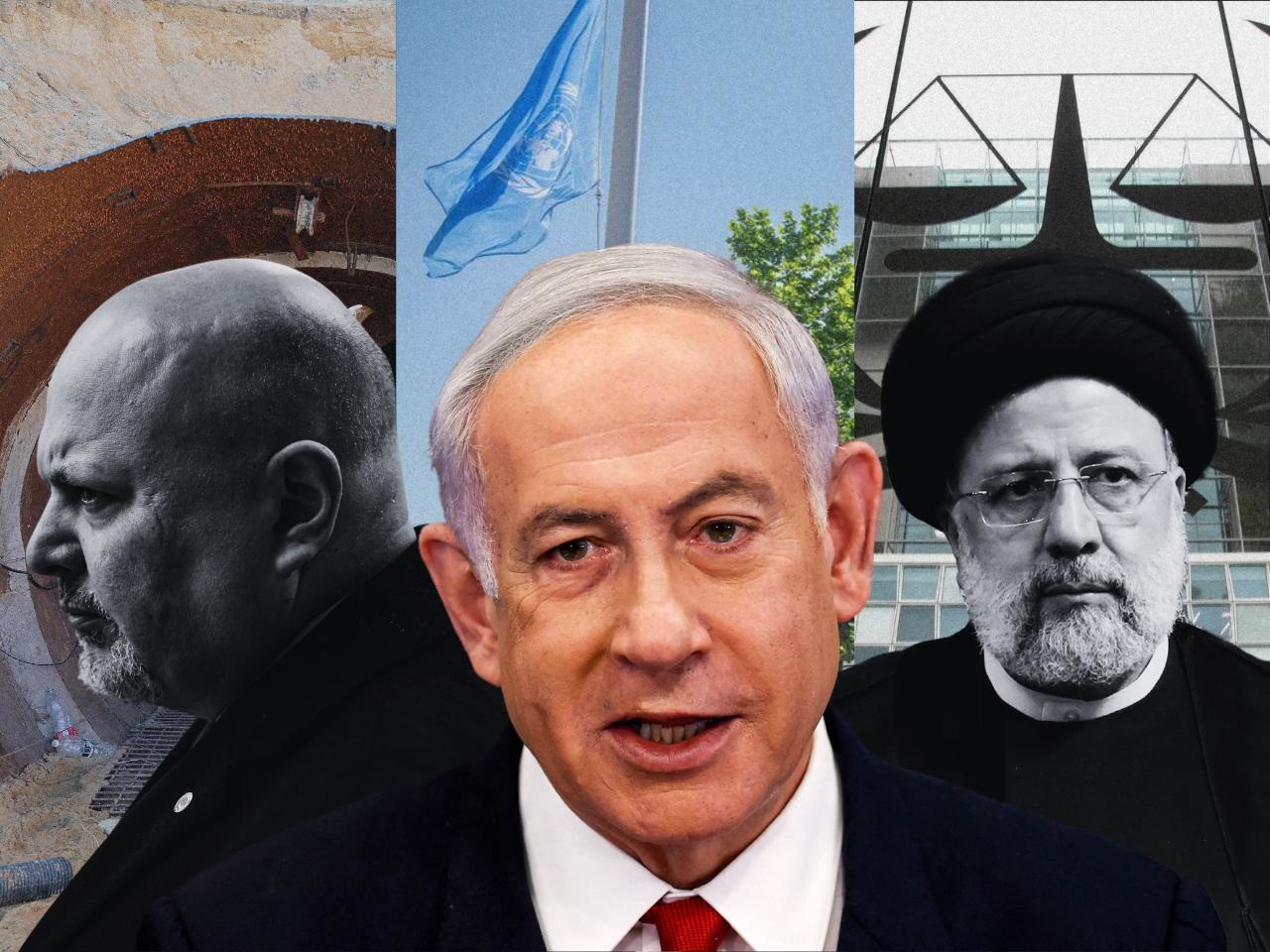
Left to right: ICC chief Karim Khan, Israel PM Benjamin Netanyahu, Iran President, Ebrahim Raisi.

The contrasting treatment, especially at the UN, of Israel’s Prime Minister, Benjamin Netanyahu, and Iran’s president, Ebrahim Raisi, who died in a helicopter crash on May 19, starkly presents the morally inverted, politically corrupted and more than half insane nature of what passes for liberal internationalism today.

The chief prosecutor at the International Criminal Court in The Hague has formally requested arrest warrants for Netanyahu and Israel’s Defence Minister, Yoav Gallant, accusing them of war crimes in Gaza.

Netanyahu is the duly elected Prime Minister of the Middle East’s only democracy. On October 7 his country was attacked, while a ceasefire was in place, by the terrorist group Hamas, which is sponsored by Iran. In the attack the most savage, sadistic and sexually depraved terror was unleashed as 1200 people were exuberantly tortured and butchered, and some 250 taken hostage. Hamas then retreated into its tunnels below the civilians of Gaza.
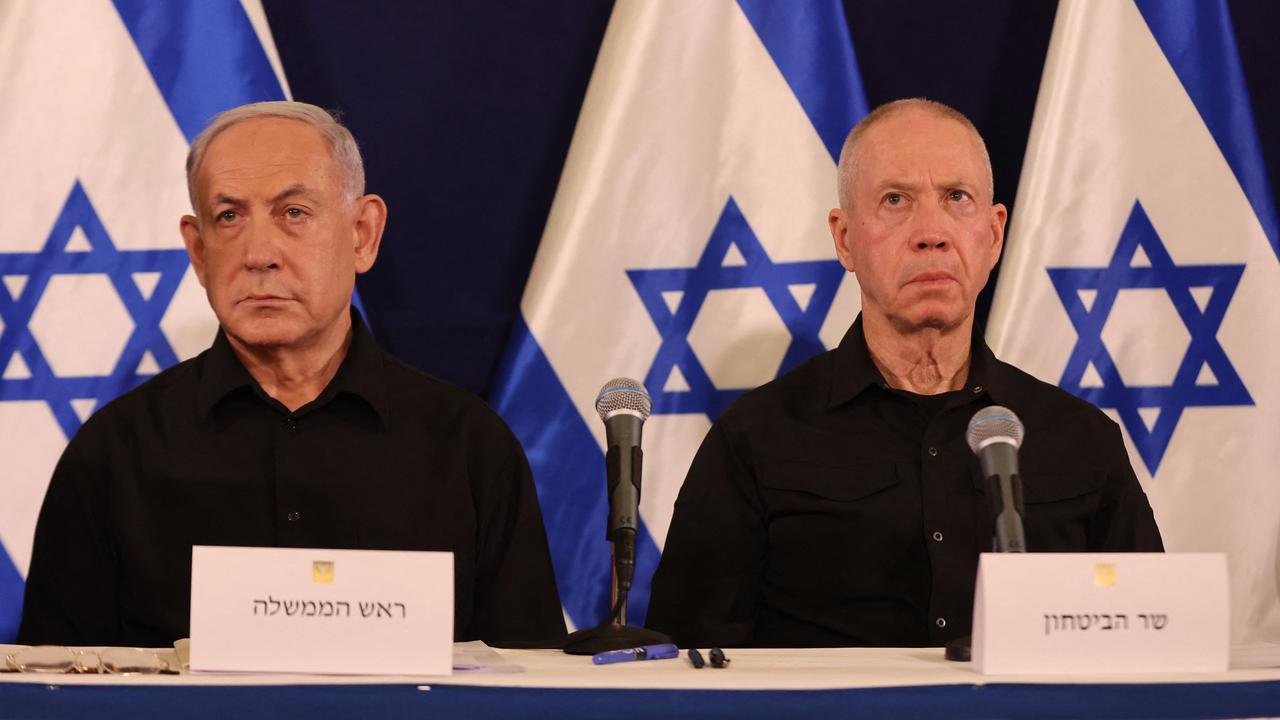
The ICC has formally requested arrest warrants for Israel’s PM, Benjamin Netanyahu, and Defence Minister, Yoav Gallant, accusing them of war crimes in Gaza.
The ICC has formally requested arrest warrants for Benjamin Netanyahu, and Yoav Gallant

Netanyahu’s government retaliated, with a few clear objectives – to end Hamas rule in Gaza, to destroy Hamas and to ensure October 7 wouldn’t happen again. Hamas vowed it would repeat October 7 over and over. Meanwhile it killed some of the hostages, tortured others, even small children (there’s video) and subjected women and girls to sexual assault, sexual terror.

Raisi, unlike Netanyahu, didn’t have a background in politics, certainly not democratic politics, more the legal system, specifically as a prosecutor. In a totalitarian theocracy such as Iran, prosecutors are always busy. Before becoming president Raisi was most famous for his role on the Tehran Death Committee in 1988. Across the Islamic Republic of Iran at that time many thousands of political prisoners were tortured and killed. No jurist was a more enthusiastic deliverer of death than Raisi. Later, when president, he looked back on those days with fondness and claimed the executions as a particular achievement for Iran.

Raisi ran unsuccessfully for president a couple of times. He was neither popular nor in the first rank of Iranian leaders, or of Islamic theologians, though he gave himself the title of Ayatollah. In 2021 Iran’s Supreme Leader, Ayatollah Ali Khameini, decided, with the Islamic Revolutionary Guard Corps, they would make Raisi president. He was a reliable hardliner and someone the IRGC in particular thought they could control.
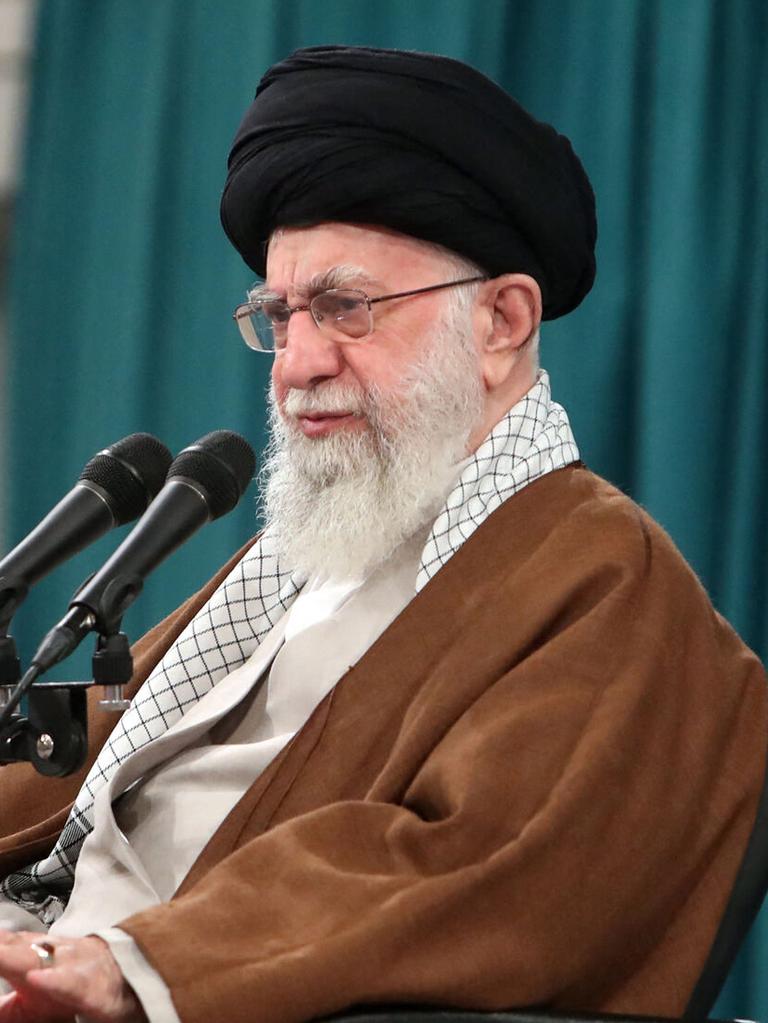
Ayatollah Ali Khameini.

Iranian elections used to have some limited meaning. Elected officials never really had power and Iranian voters several times elected notionally moderate presidents to no avail. The real powers, the IRGC and the office of the Supreme Leader, decided who could run. But much more than

Iranian elections used to have some limited meaning. Elected officials never really had power and Iranian voters several times elected notionally moderate presidents to no avail. The real powers, the IRGC and the office of the Supreme Leader, decided who could run. But much more than the president, they wielded state power.

Consequently, Iranians stopped bothering to vote. When Raisi won, the turnout was claimed to be 49 per cent, though even this is regarded as an exaggeration.

Since Raisi became president in 2021, Iran has been energetic. It redoubled the vice police. Iranian women and girls are routinely arrested, sexually assaulted and beaten to death for offences such as not wearing their hijabs properly. One such case, of a young woman named Mahsa Amini, who died in 2022, set off a round of riots and protests that were savagely repressed, with hundreds dead and more than 20,000 imprisoned.

Internationally, Raisi’s government became famous for murdering Iranian dissidents in Europe and the US. Western governments regard Iran as the chief state sponsor of terrorism. Apart from Hamas, Iran has built Hezbollah, in southern Lebanon, into a powerful non-state military force, with perhaps 150,000 missiles and tens of thousands of soldiers.
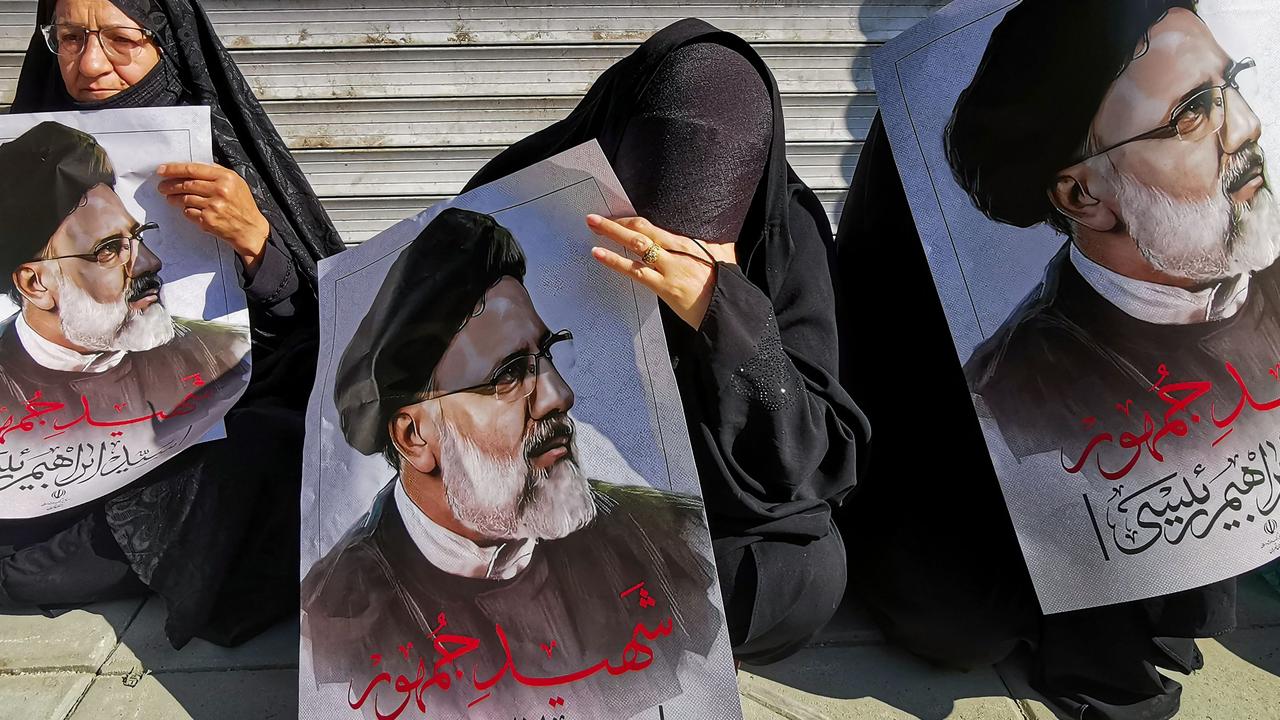
Mourners hold posters of Iranian President Ebrahim Raisi during a funeral ceremony in Tehran, on May 22. Picture: AFP
Mourners hold posters of Ebrahim Raisi during a funeral ceremony in Tehran. AFP

Tehran funds and provides weapons to Shi’ite militias in Iraq and Syria. All these groups deal out death fairly indiscriminately to their opponents and internal critics. Iran also backs the Houthi rebels, whom Australia has just declared a terrorist organisation under our law. They fire missiles at Israel but the Houthis’ great significance has been to massively disrupt shipping in the Red Sea. They exempt Chinese and Russian shipping, which is as sure a sign of Iranian control of their activities.

Many of the deaths Iran caused under Raisi occurred on the soil of nations over which the International Criminal Court claims jurisdiction. Yet the ICC never produced a warrant for Raisi’s arrest. Indeed, the UN lowered its flag to half-mast to honour Raisi after his death. The EU, not quite as otiose as the UN but surely its first cousin in the fatuousness of much that it says and does, used its most senior officials to send heartfelt and sincere condolences over Raisi’s death.

A former immigration minister of Belgium, Theo Francken, chided the EU for praising a “butcher and a mass murderer”. A Swedish member of the European parliament, David Lega, asked the EU leaders: “Can you ever look the brave women and freedom fighters of Iran in the eye again?”

You’ve never heard of Franck­en or Lega and you never will. Voices like theirs are marginal now.

The ethos of institutional liberal internationalism, especially when associated with the UN, has become an inverted parody of what it was once meant to be. The UN culture is a result of a combination of activism from dictatorships, especially China and Russia; plus the in-built voting power of the Arab, North African and Muslim blocs, none of which is sympathetic to democracy, and the ideological leftism of the activist and NGO class in Western societies themselves.

Thus the UN frequently produces abominations with a kind of PG Wodehouse comic quality – committees on women’s rights headed by Saudi Arabia, human rights bodies chaired by China, non-proliferation committees headed by Pakistan and the like.

Feeding into that are two other dynamics. One is that most nations are concerned, understandably but dismally, only to avoid getting themselves criticized in any UN committee. So they go along to get along. And they like to get their little share of UN goodies. So they don’t object to some moral grotesquerie to secure the position of deputy rotating chairperson of the Pots and Pans Committee of the Under Secretary’s eminent Consultative Group.

Far more toxic is the sick obsession in this fetid culture with Israel and Jews. This is a kind of reverse intersectionality. Modern demented left-wing activism absurdly defines Israel as a colonist state. Demented right-wing activism draws on centuries of Western anti-Semitism. Most Arab nations, though many have recently made good accommodations with Israel, would nonetheless rather not have any non-Muslim state in the Middle East, while the tradition of Arab anti-Semitism roars. China, Russia and all their friends will routinely seek to hurt Israel in order to hurt America.

All of this comes together in a witch’s brew of anti-Semitism cloaked in the faux high-minded verbiage of liberal internationalism. Very frequently, specialist UN human rights bodies pass more resolutions criticising Israel than they do concerning the rest of the world combined. Don’t worry about Uighurs or Tibetans or Christians in China; never mind about labour camps in North Korea; leave the Arab world’s treatment of women or indeed of gays to one side – all the human rights evil in the world is insanely attributed to Israel.

By the way, the only nation in the Middle East that has big gay pride days is Israel. I’ve seen the gay pride days in Jerusalem and Tel Aviv. But somehow you never see a protest march with a sign: Queers for Israel.

That the UN and its institutions have become so morally corrupted is partly the fault of the West, as it has lost power, cohesion, self-confidence and the ability to believe in and argue for the values it once regarded as universal.

The UN has been a politically corrupt body for a long time. Our response was not always this feeble. In 1975, only 30 years after the Holocaust, the UN General Assembly passed a resolution equating Zionism with racism. At the time, under Gerald Ford’s presidency, the US seemed all astray, after Watergate and the failures in Vietnam. Its ambassador to the UN was the professorial, slightly dishevelled-looking Daniel Patrick Moynihan, a cloud of stray hairs and half-dropped papers but a whirlwind of moral force. He went on, this most untelegenic of figures, to be a long-term Democrat senator for New York.

He strode, this ungainly figure, to the lectern and thundered forth a modern Gettysburg Address, in its way the finest speech ever delivered at the UN. Moynihan began: “The United States rises to declare before the General Assembly of the United Nations and the world that it does not acknowledge, it will not abide by and it will never acquiesce in this infamous act.” This was not bluster. The US stirred itself to get what was in fact a racist motion reversed, and it succeeded.

Back then Australia voted with the US, unlike now. Joe Biden denounced the ICC action as an outrage. His Secretary of State, Antony Blinken, said he’d work with Republican senators, notably Lindsey Graham, to consider imposing US sanctions on officials of the ICC who enacted such infamy. Biden, in my view a generally weak president, on this has been strong. Perhaps the issue called to an earlier version of Biden, when America itself was stronger.

Of course, Netanyahu deserves great criticism. He has become an increasingly counter-productive Prime Minister for Israel. This is despite past mighty achievements – liberalising and growing the Israeli economy, pioneering new relationships in Asia, welcoming millions of immigrants into the country, creating a good life for Jewish and Arab Israelis alike, and then, during Donald Trump’s presidency, achieving the Abraham Accords in which Israel exchanged diplomatic recognition with the United Arab Emirates, Bahrain, Sudan and Morocco.

But he became too arrogant, too self-obsessed, too complacent. The October 7 attacks are wholly the moral responsibility of Hamas, but they also reflect a shocking intelligence failure, and simple preparedness failure, on Israel’s part. Similarly, Netanyahu has not been able, or perhaps not willing to try, in recent years to control the lawlessness of some of the Israelis who live in the West Bank.

Netanyahu must bear responsibility for these matters. Now, he faces intense criticism from his cabinet colleagues for refusing to address governance in the Gaza Strip once Israel is finished its military operation. None of this remotely makes Netanyahu a war criminal. Israel has not starved Gaza. Hamas itself has made it difficult to get aid convoys safely into Gaza. Egypt has shut its border with Gaza because it doesn’t like Israel controlling the other side. But this means no aid from that quarter. Hamas and its allies have attacked aid shipments coming through the pier the US built to provide a sea route for aid to Gaza.

Similarly, Hamas’s casualty figures are greatly exaggerated. There has been terrible death and destruction in Gaza and this is entirely Hamas’s responsibility. Even today, Hamas could end all the suffering by releasing some Israeli hostages and accepting the ceasefire Israel has been offering for months. Hamas attacked Israel in the most sickening manner possible, then hid among and underneath Palestinian civilians. The ICC seems to be of the view that this means Israel is forbidden from waging a military campaign against Hamas. The UN itself recently halved its estimate of the number of women and children killed in Gaza, which suggests Israel’s efforts to keep civilian casualties as low as it can have been meaningful.

The ICC has no jurisdiction as Palestine is not a state and Israel is not a signatory to the Rome Statute that established the ICC. And finally, the ICC is meant to act only where national governments can’t or won’t act. Israel has a strong judicial system and will certainly have a plenitude of inquiries once the military action in Gaza is complete. The odious ICC action therefore has to be seen as a political expression of the cultural collapse and degradation of the old liberal international ideals.

It’s up to the nations that believe in those ideals, most importantly the US but, you would expect, also its allies and like-minded nations, to vigorously reform or, if this is impossible, simply walk away from those institutions.

Instead, Ireland, Spain and Norway extended formal diplomatic recognition to the state of Palestine. This is a common but bizarre conceit of our day. There is no state of Palestine. Hopefully one day there will be, but this can come about, as the US argues, only through negotiation between Israel and Palestinian representatives.

But, as everyone knows, any Palestinian leader who makes any kind of peace with Israel will surely be assassinated by extremists in his own camp. Some Palestinian groups, such as Hamas, are utterly transparent in their anti-Semitism and vow never to recognise any Jewish state. Others theoretically recognise Israel’s right to exist but have erected a whole lot of preconditions and red lines they know Israel can never possibly meet. Therefore, they won’t ever have to face the hard compromises and choices a Palestinian state would necessitate.

Instead, all the Western gestures of solidarity with the Palestinians have amply and warmly justified Hamas’s terror. The Albanese government rewarded Hamas when it declared, through a very confused and poor speech by Wong, it would recognise Palestine before an agreement was reached with Israel.

Israeli legal scholar and commentator Eugene Kontorovich surely calls out a gruesome truth when he writes: “Hamas’ grisly terror raid on October 7 has proved to be the single most stunningly successful act in gaining support for the Palestinian cause … The bloodier the terror attacks, the more stark the eliminationist rhetoric, the more support for a Palestinian state.”

Kontorovich identifies a crippling syndrome. The more savage the terror, the more entranced Western elite opinion becomes. If Israel responds that same elite instantly reverts to the rhetoric and operating principle of de-escalation.

When Biden was backing Israel most strongly early in the campaign, Hamas released hostages and agreed to a ceasefire. Washington’s efforts more recently have caused Israel delay, and this delay itself prolonged Palestinian suffering and helped Hamas. As Hamas has seen Biden come under political pressure, and therefore put Israel under pressure, it has been effectively rewarded for its barbarism and encouraged to make no compromise.

The ICC is not a court but a sign of the deep sickness at the heart of the international system. Don’t think that sickness cannot kill us here in Australia in time.

Greg Sheridan is The Australian’s foreign editor.

What did Lenin do for us? The welfare state, that’s what,

Vladimir Ilyich Ulyanov (22 April 1870 – 21 January 1924), better known as Vladimir Lenin, was a Russian revolutionary, politician, and political theorist. He is widely considered one of the most significant and influential figures of the 20th century. Yet whilst his embalmed body still lies in Red Square, the real Lenin has been buried by decades of dictatorship and Cold War, and a century of sanctification and vilification.

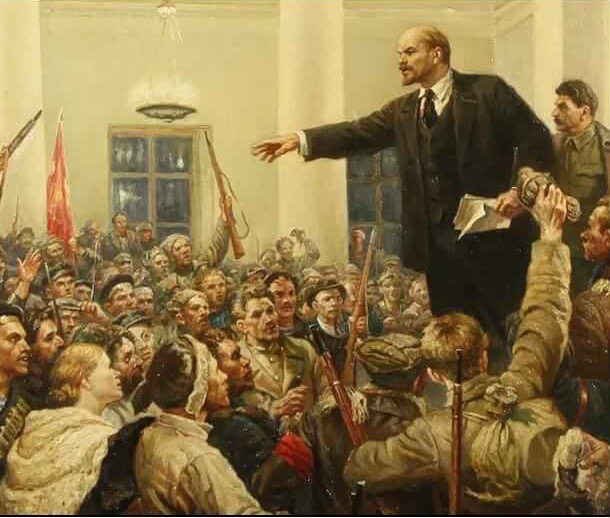
Lenin speaking to a crowd in Moscow’s Sverdlov Square with Leon Trotsky and Lev Kamenev beside him, May 1920

In That Howling Infinite has written often about Russian history. So, we couldn’t resist commemorating the centennial of Lenin’s death.

I first became acquainted with him in the fall of 1968 whilst reading politics at Reading University under the tutorship of émigré academic and historian of Russian and Soviet politics Tibor Szamuely. For a while,

Back then, I was a political ingenue and a naïve communist sympathizer and fellow traveler, although my evolving perspectives were transforming and expanding. As my tutor, he advised me to study with an open mind and to put off juvenile thinking. He hadn’t been well when I knew him, and he died a year after I graduated. Under his tuition, I’d resolved to specialize in Soviet Studies – but events intervened, and I ended up in the Middle East (and that is another story. see: Tanks for the Memory – how Brezhnev changed my life). I nevertheless retained an active interest in the history and politics of Eastern Europe.

Szamuely would always impress upon me the historical and political continuity of what he called The Russian Tradition – the title of his one and only book, The Russian Tradition, published shortly before his death, and now, regrettably, out of print. I purchased a first edition when it was published and it is on my bookshelf still.

He believed that the bloodstained drama of the revolutions of 1917 – there were two, the social democratic one in the February, the Bolshevik one in November – and the years that followed, including civil war, the establishment of the USSR and Stalinism largely obscured the underlying consistency of Russian history. He did not live to see the decline and fall of the Soviet Union, and the advent of Putin and Russia Redux, but the basic pattern persists, circular and repetitive. The frequent turmoils that have overtaken this vast continent have in their various ways made changes that were essentially superficial, leading in the end to the intensification, under new forms, of the old authoritarian structure. See The Russian Tradition – Russia, Ukraine and Tibor Szamuely. 

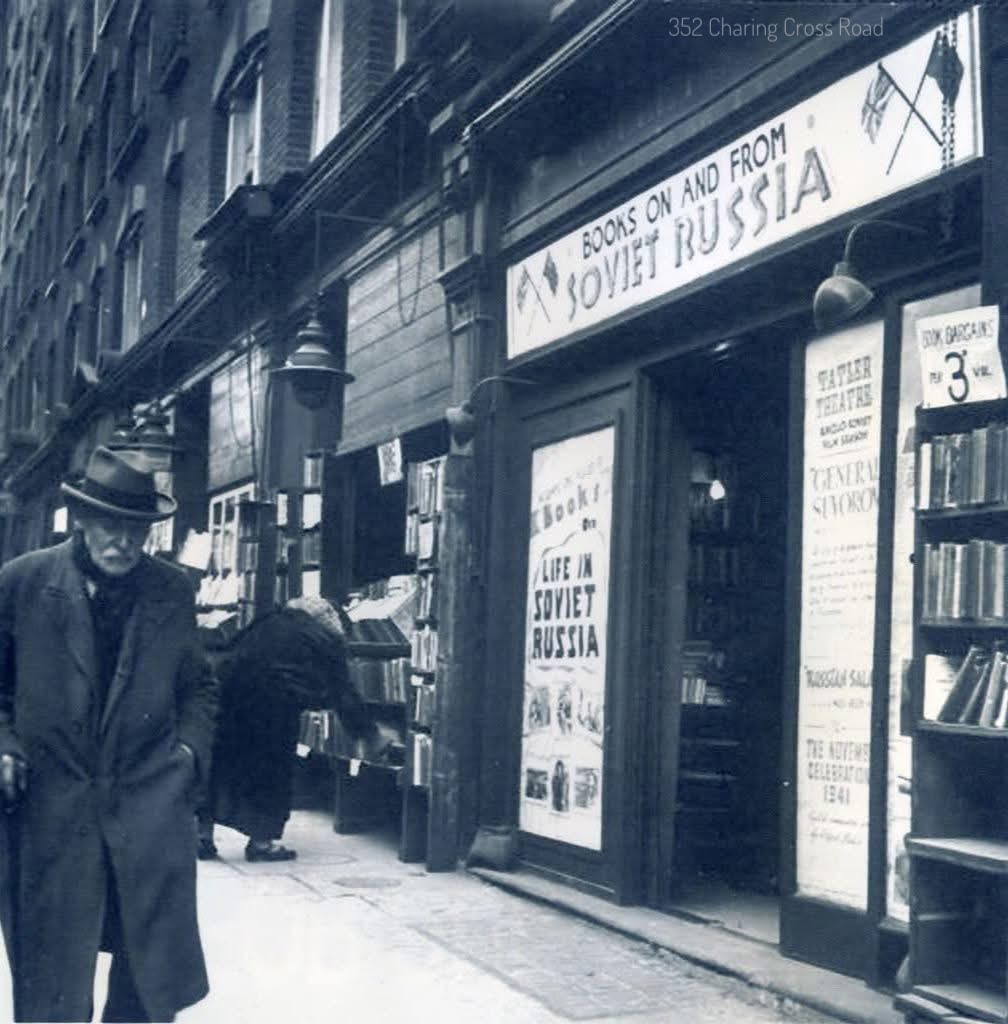
Studying Soviet politics, I read quite a few of Lenin’s writings – the mercifully short paperbacks like What Is To Be Done? Burning Questions of our Movement (1901), Imperialism, the highest state of Capitalism (1917), and The State and Revolution (1917), and Leftwing Communism, an Infantile Disorder (1920), the best title of them all. They cost very little at a Communist Bookshop, in Soho, I think – a source also, of posters from the Revolution and the Russian Civil War. In my Russian phase, I’d even bought a balalaika – though admittedly my purchase was inspired more by its use by Ian Anderson of Jethro Tull in a great concert in our hall of residence. I never did much with it and saw it last on the sideboard of my late mother’s house in Birmingham.

I still have those books, in addition to the panegyric 1942 edition of The Truth about Soviet Russia, by famous British socialists (and Stalinist apologists) Sydney and Beatrice Webb, which was everything but the truth, posing the rhetorical question “Is Soviet Communism a New Civilization based on the ethical principle of ‘From each man according to his faculty to each man according to his need’. 

Better Read than Dead

352 Charing Cross Road, London

Vladimir Lenin has a way of confounding Marxist and indeed other historians for he was that rare thing – an individual and singular instigator of historical change. A hundred years after his death, hagiographies and obloquies continue to pouring off printing presses as once did concrete to erect statues of Uncle Volodya. Even his most hostile critics would be churlish to dismiss his outsized role during the heady months leading to Red October.

The principal protagonist of the Bolshevik Revolution of November 1917 and the brutal and bloody civil war that followed, Lenin served as the first and founding head of government of Soviet Russia from 1917 to 1924 and of the Soviet Union from 1922 to 1924. Under his administration, Russia, and later the Soviet Union, became a one-party socialist state governed by the Communist Party. Ideologically a Marxist, his additions to the ideology earned their own title: Leninism.

There is near universal consensus that Lenin had no use for “liberalism” in any form, or democracy which he regarded as a bourgeois delusion. He closed down the elected Constituent Assembly, when elections to it rejected his party, at gunpoint. He then proceeded to ban all other parties. He instigated the Red Terror via setting up the Cheka, the prototype KGB and brought about the deaths of hundreds of thousands, establishing the apparatus and mechanisms of terror so definitively exploited by Stalin. His administration laid the framework for the system of government that ruled Russia and the USSR for seven decades and provided the model for later Communist-led states that came to cover a third of the inhabited world in the mid-20th century.

As a result, Lenin’s influence was global. A controversial figure, he remains both reviled and revered, a figure who has been both idolized and demonized. Even during his lifetime, Lenin “was loved and hated, admired and scorned” by the Russian people. This has extended into academic studies of Lenin and Leninism, which have often been polarized along political lines.

Back in the day, I admired him for the smooth operator that he was, though I was shocked by his cold-bloodedness. No matter what his sophisticated musings in exile or during 1917 told his readers, he conducted the civil way to à l’outrance. See: Red and white terror – the Russian revolution and civil war. Today, I come not to bury Vladimir nor to praise him – Wikipedia provides a good overview of his life and times, and his legacy. It’s a good source for further reading: HERE

Detail of Man, Controller of the Universe, a fresco by Diego Rivera in the Palacio de Bellas Artes in Mexico City

I republish below and interesting article from Unherd, my favourite e-zine, on the debatable influence of Lenin and the Bolshevik Revolution in British politics.

In the immediate wake of World War One, and the outbreak of civil war, Western Allies’ ideological perspective of the conflict was ambivalent. Many, politicians and military alike, were viscerally opposed to Bolshevism and what it stood for, and feared a Red contagion infecting their own countries, a fear that was not unfounded. After the Revolution, a concatenation of revolts detonated across the globe. Bolshevism spread westwards, from Vienna through Budapest and Sofia to Kiel. The Bavarian Soviet Republic was briefly established in April 1919, before the far-Right Freikorps did it in.

Britain wasn’t immune to the ferment. Between the February and October Revolutions, the Leeds Soviet did indeed appear to be the beginning of something, whilst strikes and demonstrations proliferated to be violently put down by the police and army. Winston Churchill alone of his cabinet colleagues wanted a full-on allied intervention and dreamed – some believed he was indeed dreaming but others claimed that he fantasized – of creating an effective White army and a borderlands alliance to defeat the Bolsheviks. But his aspirations were foiled by the imperialism of the White leadership and of White officers and the various national movements’ fear that that if the Whites prevailed, they would restore Russian rule. Britain’s rulers were reticent about shoring up and providing financial, material support and also, soldiers sailors and airmen to brutal to demonstrably homicidal Cossack brigades and revanchist and reactionary royalist autocrats.

The concern of His Majesty’s Government with the the Bolsheviks is the theme of series three of the superlative British crime saga Peaky Blinders. It is set in 1924, three years after the civil war, and not long after the fabricated Zionoviev Letter implicating the British communist party and by association, the Labour Party in a seditious plot, instigated a “Red Scare” that saw Britain’s first Labour Government defeated in a general election. Home Secretary Mr WS Churchill employs the services of Thomas Shelby and his Brummie brethren in a devious plot to fit-up and compromise the Soviet regime. The White Russian èmigrés, a cabal of revanchist aristocrats that Tommy has to do business with are an unsavory, unprincipled, bigoted and amoral crew.

The fear of this “Red contagion” after  Revolution, saw conservative British governments preempt insurrection by mollifying, co-opting even, and caring for the workers and the disadvantaged. The interwar years saw major strides in universal education, healthcare, and insurance Post-war, all that was left for Labour to do was to extend it to one and all. Already covering some 80% of the population, welfare was brought to the remaining one-fifth of Britain by Clement Attlee and William Beveridge.

I qualify this by noting that the article ignores the trends that emerged in the UK during the 19th century, such as the Poor Law Amendment Act, the Factory Acts and the 1870 Education Act which were built upon during the 20th century.

Historian Anil Pratinav’s writes how paradoxically, Soviet communism unwittingly fortified British capitalism. The unintended upshot of Anglo-Marxism was to make the Establishment more heedful of working-class interests. The same went for the welfare state. Peace was preserved between the classes. Redistribution took the edge off class conflict. What’s more, an educated and healthy workforce proved good for business. Moderately progressive taxation was a tiny insurance premium to keep the workers in working condition and the barbarians at bay.

Lenin might’ve said there are decades when nothing happens; and there are weeks when decades happens – but “these days, barring a few libertarian crackpots, Tory radicals, nostalgics, and campus Marxists, nearly everyone is united in confirming the wisdom of this arrangement. The simple fact is that most Brits like their politics dull.

© Paul Hemphill 2024.  All rights reserved.

Lenin’s funeral, as painted by Isaac Brodsky, 1925

Other articles on Russian and Soviet history is In That Howling Infinite has written often about Russian history: Ghosts of the Gulag; The Death of Stalin is no laughing matter; Stalin’s Great Terror; Borderlands – Ukraine and the curse of mystical nationalism:The Roots and Fruits of Putin’s Irridentism

How Bolshevism built modern Britain

Lenin still haunts our welfare state

Pratinav Anil Unherd, 15th January 2024

Yet there is another achievement that Lenin was inadvertently, indeed perversely, responsible for: the Western welfare state. That we rarely recognise this owes to a common misperception. Very many of us regrettably buy that Labour conceit, hawked by spin doctors and court historians, that celebrates Clement Attlee and William Beveridge as the co-fathers of our welfare jstate. But as the historian David Edgerton reminds us, it is in fact the Liberal-Tory coalition of David Lloyd George in the immediate aftermath of the First World War that we ought to be thanking. These were the years when the major strides in education, healthcare, and insurance were made. Post-war, all that was left for Labour to do was to extend it to one and all. Already covering some 80% of the population, welfare was brought to the remaining one-fifth of Britain by Beveridge.

More importantly, it was neither paternalism nor prodigality that prompted these early stirrings of dirigisme. Rather it was red contagion. In the wake of the Russian Revolution, a concatenation of revolts detonated across the globe. Bolshevism spread westwards, from Vienna through Budapest and Sofia to Kiel. The Bavarian Soviet Republic was briefly established in April 1919, before the far-Right Freikorps did it in. Britain wasn’t immune to the ferment. Between the February and October Revolutions, the Leeds Soviet did indeed appear to be the beginning of something. That nothing came of it was down to Lloyd George’s unsentimental pragmatism. Many of the workers’ demands were duly conceded, taking the sting out of union radicalism, even as many leaders were put behind bars.
Two years later, Lloyd George’s Bolshevik bugbear was to return with a vengeance, when shipbuilders stormed the Glasgow City Chambers. With hindsight, it is obvious that “Red Clydeside” was never, in any meaningful sense, a harbinger of “Red Britain”: the radicalism of Glaswegian trade unions on either side of the River Clyde was never going to spread to the rest of the country. Yet at the time, the red threat was all too real. “This country was nearer to Bolshevism that day than at any time since,” Lloyd George would later recall of the police and prison officers’ strike. London and Birmingham were spared, but Merseyside had rocked to the sound of rioting and looting. Violence was brought to a halt only when the army was brought in.
It is difficult for us to conceive what the “peace” after the armistice actually looked like. Yet Simon Webb’s 1919: Britain’s Year of Revolutions reconstructs a society teetering on the brink of collapse: soldiers roughing up workers; martial law in Luton; tanks cruising the streets of Liverpool. The Italians call the two years immediately following the war the biennio rosso, and it seems fair to speak of a red biennium in Britain as well. For one thing, it would be impossible to understand British domestic and foreign policy without reference to that singular neurosis of the interwar ruling class. While cavorting with the antisemitic Whites to crush the Reds in Russia, Westminster and Whitehall were at the same time crushing the unruly bolshies back at home. Churchill, then minister for war, put forward the government line with characteristic crassness: “kill the Bolshie, kiss the Hun.”

As it must in democracies, with the stick also came the carrot. Yes, the workers were brutally put down. But they hadn’t protested in vain. Gone were the Gladstonian days of cheese-paring Liberalism. Lloyd George’s Liberals were an altogether different beast: by turns technocratic, interventionist and ambitious. They were, no doubt, building on pre-war precedent, in particular the health and insurance schemes of 1911, and making good on wartime promises, but they were above all trying to make peace with the bad, mad and dangerous Brits on the streets.

To begin with, they gave a great many people a greater share in government, shepherding them from the barricades into polling stations. Universal male suffrage in 1918 enfranchised unpropertied men — that is, two in five men — as well as propertied women over 30. The same year, the Education Act, lobbied by Lancashire unionists, raised the school-leaving age from 12 to 14 to forestall cotton bosses from battening on benighted boys. And in 1919, the Housing and Town Planning Act put in motion the construction of what became that instantly recognisable feature of the British urban landscape: the council estate.

Bettered by Attlee and Harold Wilson, battered by Margaret Thatcher and David Cameron, the early interwar consensus around the welfare state survives to this day. Both under Labour and the Tories, truculent workers with ideas above their station have been shown their place: from Ramsay MacDonald’s disciplining of the “communistic” trade unions in 1924 through Thatcher’s thwarting of the miners in 1984 to Keir Starmer’s disavowal of organised labour in 2024. Likewise, since 1945, both parties have shown a general commitment to public spending around the 40% of GDP mark. Creaking, underfunded, “our NHS” continues nevertheless to be spoken of only in hallowed whispers.

Time and again, our rulers have let slip the real reason why welfare matters. Here’s Attlee in Margate in 1950: “our policy of democratic socialism is the only dynamic alternative to totalitarian communism.” Is it any surprise that two of the most robust welfare states across La Manche were created in societies that boasted a formidable communist presence? The Parti Communiste Français in 1946 counted some 800,000 members, and the Partito Comunista Italiano nearly two million. It is true that the Communist Party of Great Britain never had much to recommend it, but the strength of the post-war British Left — independent of Labour — is undeniable. It was the miners who brought down Edward Heath in 1974.

As with the British welfare state, so with British intellectual life. Our republic of letters would have been a dreary landscape of conformity were it not for the Russian Revolution, which fired three generations of Anglo-Marxists. The interwar years were a time when communists could rise to the very top of the cultural establishment. E.H. Carr, for example, became a leader writer and deputy editor of The Times, a perch from which he preached the gospel of collectivist planning and conciliation with Stalin. His monumental History of Soviet Russia — running to 7,000 pages and 14 volumes — remains the best account of the early years of the revolutionary regime.

Even such a sceptic of the state as George Bernard Shaw was swept away by Russomania. By 1931, with Britain reeling from the Depression, he was singing Stalin’s praises. Fabian gradualism, his old creed, wasn’t going to cut it in the 20th century. MacDonald’s Labour had evidently failed, he reflected in a new preface to Fabian Essays in Socialism. What was needed was “swift effectiveness” — Soviet-style. A trip to Moscow was written up in glowing terms in The Rationalisation of Russia.

In a manner of speaking, the remoter reaches of the ivory tower, too, succumbed to the Soviets. G.E.M. de Ste. Croix inaugurated what was by far the most arresting development in classical studies. A child of empire born in Macau, “Croicks” turned his back on his “thoroughly Right-wing upbringing” on the “lunatic fringe of Christianity” — as he later put it — in the Twenties. A romp across the Soviet Union in 1937 with Intourist, the Soviet travel agency, left him critical of Stalinism but committed to Marxism, on the strength of observing the peasants of the Caucasus. Thereafter, he became a “thoroughgoing Marxist”, tutoring a generation of students at New College, Oxford, who, in their own writings, were to remain alert to class in the classics. The Class Struggle in the Ancient Greek World appeared in 1981.

Such profiles can be indefinitely multiplied. Suffice it to say that most of the smartest minds of the interwar period were on the Left. This would soon change with the emigration of Eastern and Mitteleuropean conservatives to Britain — Friedrich Hayek, Karl Popper, Lewis Namier, Ernest Gellner — producing a more balanced intellectual division of labour. But before that, Left hegemony was unrivalled. John Strachey was undoubtedly among the most important political commentators of the Thirties. His father was the editor of The Spectator for nearly 40 years, and Strachey’s best man was Oswald Mosley, then still on the Left. When Mosley founded the British Union of Fascists, Strachey led some of the largest demonstrations against him.

As it was, the Marxist Strachey lost the battle of ideas to the Liberal John Maynard Keynes, who famously had no truck with communism: “How can I adopt a creed which, preferring the mud to the fish, exalts the boorish proletariat above the bourgeois and intelligentsia who, with all their faults, are the quality of life and surely carry the seeds of all human advancement?” Yet Keynes could do little to prevent one of his Cambridge protégés, Maurice Dobb, from taking up the cudgels for the boorish proletariat.

Communism gained a bridgehead in Cambridge thanks to Dobb, who edited The Plebs, a Marxist magazine, in the Twenties. He extolled Lenin as a “stern realist” blessed “with all the Jesuit’s sincerity and idealism”. By contrast, “non-Marxists” were “as silly as pre-Darwinian biologists”. He helped found the Communist Party Historians Group, and set up Kim Philby — of the Cambridge Five ring of spies — with the NKVD. Later students included Amartya Sen and Eric Hobsbawm, whose own Oxbridge appointments were blocked by Tory dons.

Paradoxically, then, Soviet communism unwittingly fortified British capitalism. The unintended upshot of Anglo-Marxism was to make the Establishment more heedful of working-class interests. The same went for the welfare state. Peace was preserved between the classes. Redistribution took the edge off class conflict. What’s more, an educated and healthy workforce proved good for business. Moderately progressive taxation was a tiny insurance premium to keep the workers in working condition and the barbarians at bay. These days, barring a few libertarian crackpots, Tory radicals, Bridesheady (Saltburny?) nostalgics, and campus Marxists, nearly everyone is united in confirming the wisdom of this arrangement. The simple fact is that most Brits like their politics dull.

Pratinav Anil is the author of two bleak assessments of 20th-century Indian history. He teaches at St Edmund Hall, Oxford.

Other articles by Anil: The Marxism of Horrible Histories, and Gandhi hasnt aged well. Both are good reads.

I wrote on Facebook regarding his article Horrible Histories, a Marxist plot?,:

“I am a lifelong history tragic and I’ve degrees in history and politics. Now I’ve heard about horrible histories, I’ll have to look further. All history is, in a manner of speaking, storytelling, its validity and verification changing with the perspectives, perspicacity and prejudices of the storyteller. And on a potentially controversial tangent, all history is political – exhibit one is the proliferation of the culture wars and their corollary, the history wars.

If HHs can bring young folk to history and encourage them to learn more, so much the better. From what I read here, the histories are a more detailed and graphic version of that old, corny chestnut 1066 And All That. Which I still dip into now and then, for its perspective on what we’re owecievd back in the day as “good kings” and “good things”. Bad kings were more often than not the stuff of Shakespeare, whilst there were remarkably few bad things. I share the view of one commentator – that Deary is probably no Marxist, but was taught by a history teacher with Marxist leanings. History can and should be fun as well as serious, and not just the bailiwick of crusty academics and history snobs and culture warriors.

There’s a Canadian writer who tells similar stories about world history called Sweary History or The Day Shit Went Down – I’m sure you get the drift. By the way, I highly recommend Dominic Sandbrook and Tom Holland’s excellent podcast  The Rest is History – a gift that keeps on giving. Solid and well researched stories from history’s back pages with bad impersonations , lots of friendly banter, and loads of humorous irreverence regarding assorted shibboleths and sacred cows”.

Sleeping still, in Red Square

Red and white terror – the Russian revolution and civil war

… as a policeman, I would say, get hold of a man’s brother and you’re halfway home. Nor was it admiration for a better man than me. I did admire him, but I didn’t think he was a better man. Besides, I’ve executed better men than me with a small pistol. 

She’d come to Moscow to look for her child. I helped her as best I could, but I knew it was hopeless. I think I was a little in love with her. One day she went away and didn’t come back. She died or vanished somewhere, in one of the labor camps. A nameless number on a list that was afterwards mislaid. That was quite common in those days.

Yevgraf Zhivargo, in David Lean’s Doctor Zhivago (1965)

“The terror,” declared British Historian Simon Schama in his iconic Citizens: A Chronicle of the French Revolution “was merely 1789 with a higher body count; violence … was not just an unfortunate side effect … it was the Revolution’s source of collective energy. It was what made the Revolution revolutionary’. In short, “From the very beginning […] violence was the motor revolution”.

At the end of the chapter on the coming of thw Revolutionary Wars, he writes: ‘ … poets of romantic weather forecasting like William Wordsworth continued to describe the revolution is a cyclonic disturbance, but increasingly it was no longer the storm that invigorates in cleanses rather a dark and potent elemental rage moving forward in indiscriminate destruction its breath was no longer sweet but foul. It was the wind of war and if the wind of war comes, can the storm clouds of war be far behind’.

I thought a lot about the events of the French Revolution and the Napoleonic wars which followed it as I read English author and historian Anthony Beevor’s latest foray into Russian and Soviet history, Russia – Revolution and Civil War 1917-1921. 

Some books can be unrelentingly bleak and brutal, so grim and graphic in fact that you have to push yourself to finish them. Cormac McCarthy’s odyssey tale The Road is one such. But one doesn’t often say that about history books. Usually it is time, ennui or both that cry “enough, already!” You set it aside, promising to return to your bookmark – but you never do. I persevered with a veritable catalogue of the horrors that men can inflict upon their fellow humans (and yes, the perpetrators are apparently exclusively male, and the victims are males and females of many ethnicities). Beevor’s previous, highly acclaimed books Stalingrad and Berlin 1945 are chilling, but his latest takes top prize. And finish it I did …

The following is not a review of Beavor’s grim opus as such, but rather a thematic compendium of thoughts and observations derived from or inspired by the book.

Most academic accounts and university courses focus on the ideological and geopolitical dimensions of the origins, rise and consolidation of the Soviet Union, and its ultimate disintegration seventy years later. General public knowledge of the Russian Revolution and the civil war which followed it is relatively limited and cursory, often derived and books like Mikail Sholokhov’s saga of the Don Cossacks, Quiet Flows the Don and The Don Flows Home To The Sea, and Boris Pasternak’s Doctor Zhivago. Indeed, it was these novels and David Lean’s powerful adaptation of Doctor Zhivago that first attracted my interest in Russia as a school student in Birmingham. I majored in Politics at the University of Reading in the United Kingdom, and Soviet history and politics were an important part of my studies. Between those days and today, I’ve read widely about Russia’s history, past and present, and I am familiar with the events, ideas and personalities, their role in the broader and longer tableau of history, and the reverberations that are still felt today.

I have written often in In That Howling Infinite on Russian and Ukrainian history. Although I am no expert, and profess an amateur interest only, I do possess a short and humble pedigree. My tutor in Soviet Studies at Reading was exiled Hungarian academic and historian Tibor Szamuely, Like many refugees from Communism, he was descended from both perpetrators and victims. An uncle of the same name served in the Hungarian Soviet Republic that took power for six months under Béla Kun in 1919 and died violently that year when the revolution failed. He was among that government’s most bloodthirsty ministers and was called “Butcher Szamuely”.

Szamuely’s family wound up in Moscow, where Tibor was born, and where his father was executed in Stalin’s purges. Young Tibor served in the Red Army, and he too was arrested and sent to a labour camp. Rehabilitated, he served as Chancellor of Budapest University. In 1964, then nearing 40, he was teaching in the “ideological institute” of Ghana’s Marxist president Kwame Nkrumah when he defected to England.

Back then, I was a political ingenue and a naïve communist sympathizer and fellow traveler, although my evolving perspectives were transforming and expanding. As my tutor, he advised me to study with an open mind and to put off juvenile thinking. He hadn’t been well when I knew him, and he died a year after I graduated. Under his tuition, I’d resolved to specialize in Soviet Studies – but events intervened, and I ended up in the Middle East (and that is another story. see: Tanks for the Memory – how Brezhnev changed my life). I nevertheless retained an active interest in the history and politics of Eastern Europe.

He would always impress upon me the historical and political continuity of what he called The Russian Tradition – the title of his one and only book, The Russian Tradition, published shortly before his death, and now, regrettably, out of print. I purchased a first edition when it was published and it is on my bookshelf still.

Szamuely believed that the bloodstained drama of the revolutions of 1917 – there were two, the social democratic one in the February, the Bolshevik one in November – and the years that followed, including civil war, the establishment of the USSR and Stalinism largely obscured the underlying consistency of Russian history. He did not live to see the decline and fall of the Soviet Union, and the advent of Putin and Russia Redux, but the basic pattern persists, circular and repetitive. The frequent turmoils that have overtaken this vast continent have in their various ways made changes that were essentially superficial, leading in the end to the intensification, under new forms, of the old authoritarian structure.

You – Bolshevik recruiting poster 1918


Contemplating civil wars

A civil war can emerge from the ashes of a wider, ongoing conflagration when factions or parties dispute the nature and terms of the post-bellum status quo and fracture along political and ideological lines. Many civil wars have arisen from the ashes of a prior war when there are what are perceived as existential issues unresolved and the availability of weapons and materièl and experienced and discontented men to use them.

There is a view that civil war can retrospectively be seen as a crucible of nation, a fiery furnace through which the righteous must walk – an ex post facto rationalization of the Nietzschean paradox of “that which does not kill us makes us strong”. Abraham Lincoln verbalized this in his Gettysburg Address in 1863 on a battlefield where the fallen had been only recently interred. Franco made a similar play as he laid claim to the wreckage that was Spain in the wake of three years of carnage, but then petrified his riven, country in autocratic stone until his death many decades later. The Russian Civil War was not accorded such a nation-building ethos as it was viewed by the Bolshevik victors as the crushing of a counter-revolution against a new world already being born.

Given Russia’s vast expanse, long history of restive regions, and large non-Russian ethnicities – all a result of centuries of imperial conquests – there is always the potential for the disintegration of centralized control and fragmentation. There is a rich history of state collapse following wars, revolutions, system breakdowns, economic crises, and other epochal events. Napoleon’s empire collapsed after his disastrous march on Moscow and subsequent defeat at the Battle of Leipzig. In 1918, the Ottoman, Austro-Hungarian, German, and Russian empires all collapsed in military defeat. Of course, people, decisions, and policies played a role, but ultimately it was war and the attendant economic and social crises that pushed these states over the edge into political chaos and often violence.

Once thing for sure, civil war, the Hobbesian “war if all against all” (Hobbes was thinking England’s) is undoubtedly the saddest, bloodiest and most visceral of all conflicts. I leave the last words to WB Yeats:

Things fall apart; the centre cannot hold;
Mere anarchy is loosed upon the world,
The blood-dimmed tide is loosed, and everywhere
The ceremony of innocence is drowned;
The best lack all conviction, while the worst
Are full of passionate intensity.

See: In that Howling Infinite, A House Divided – the Nature of Civil War

All fall down …

Revolutions are unpredictable. They never run in straight lines. They reverberate, the shockwaves expanding and impacting on their vicinity, and way beyond. The shots ricochet, like drive-by shootings and crossfires, and you never know who will be hit, where the bullets will come to rest, and who will be damaged or destroyed. Many people will be liberated, and many enslaved. Many peoples will prosper, and many, many will perish. As TS Elliot wrote, “between the idea and the reality falls the shadow”.”

When the Tsarist Russian empire collapsed halfway through the First World War, it was the first of four great empires to disintegrate. By war’s end, the conflict had destroyed the German, Hapsburg and Ottoman empires. But unlike these three, though the imperial house perished, the empire it ruled did not disintegrate. A handful of national movements, Finnish, Polish, Estonian, Latvian, and Lithuanian succeeded in breaking free, but most of murdered Tsar’s realm emerged from the convulsions of world war, revolution and civil war within a new Soviet empire, one that still ruled millions of square miles and a multitude of peoples.

The Russian Revolutions – the two in 1917, and a failed rising in 1905 in the wake of the disastrous (for Russia) of Russo-Japanese War – and the civil war that followed can be said to have defined the contours of modern European geopolitics, setting the stage for the Cold War and also, the current Ukraine war. The 20th Century was not kind to the countries of Central and Eastern Europe. Historian Timothy Snyder called them “the blood lands”.

The USSR was officially declared in the Bolshoi Theatre on 30th December 1922. Most people find this slightly surprising, because we assume that the Soviet Union must have been proclaimed immediately after The Bolshevik Revolution in November 1917. In fact, it only came into existence after a horrendous civil war that killed an estimated 10 million people, in which the deep national and ethnic tensions inside the old Russian Empire had been laid bare for all to see.

Historian Orlando Figes says in his seminal book about the Bolshevik revolution, A People’s Tragedy, that the failure of democracy in 1917 was deeply rooted in Russian culture and social history and what had started as a people’s revolution contained the seeds of its degeneration into violence and dictatorship.

In Russia, the revolution of February 1917 did not provoke a counterrevolution. The initial absence of any attempt to fight back was illustrative not so much apathy, as a feeling that there was very little of the ancien regime left that was worth defending. The overthrow of the czarist regime prompted a variety of reactions amongst the former ruling class: a resignation to events, bitterness at the incompetence and obstinacy of the Imperial Court, yet also an initial optimism among its more liberal and idealistic members. Most of the nobility and bourgeoisie supported the Provisional Government in the hope that it would at least restrain the worst excesses and keep the country together.

Soon after the November 1917 revolution, Lenin made it clear to the Bolsheviks that civil war was necessary to cleanse Russia of reactionary forces and old ways and to rebuild as a communist state and society. Moreover, he was confident that the Bolsheviks’ example would ignite revolution in the countries of Western Europe. German and Hungarian communists obliged, establishing people’s republics, which in turn invited counter revolution, the ousting of the revolutionaries, and reactionary military and police exacting bloody revenge on any leftists that could find.

The determination to resist only crystallized when the Bolshevik programme in the wake of the Bolshevik Revolution of October 1917 polarized opinion. The question is important when it comes to the origins of the Civil War itself, which led to the deaths of up to 12,000,000 people, the impoverishment of the whole country, and suffering on an unimaginable scale.

In June 1918 the Bolshevik regime was enjoying a brief respite from the rigors of revolution and civil war. Although surrounded on all sides by hostile forces, the Bolsheviks were in no immediate military danger. This welcome hiatus, lasting from the Treaty of Brest-Litovsk (March 1918) to the collapse of the Central Powers at the end of the year, allowed the Bolsheviks to consolidate their political and military strength.

In an uneasy alliance with the Bolsheviks were leftwing Socialist Revolutionaries who still dreamed of a constituent assembly and the anarchists who regarded Brest-Litovsk represented the watershed of the Revolution. In coming to terms with the Central Powers, the Bolsheviks had paid a staggering price in territory and resources. But, more importantly, they had preferred to make a pact with the imperialists rather than attempt to propagate the Revolution through popular initiatives, in particular, by partisan warfare.

Shortly after Brest-Litovsk the Bolsheviks turned against their erstwhile allies. The Cheka (the successor to the Czar’s Okrana secret police and the precursor to the NKVD, the KGB and the FSB) ostensibly created to suppress counterrevolutionaries, was unleashed on the Bolsheviks’ critics on the left. There were fierce battles between Chekists and anarchists in Petrograd and many other Russian cities.

It was game on.

It is difficult to comprehend to scale of the civil war that broke out in Russia in terms of its territorial extent, the numbers of nations and would-be states engaged in the conflict, and the destruction and carnage it wrought to soldier and civilian alike. Nor the ongoing relentlessness. Western European invaders had been defeated in the past (and indeed, the future) by what Mikhail Kutuzov, the Russian general who defeated Napoleon, called General Winter, but within the empire and its Soviet successor, weather did not stop play. Certainly, it complicated military operations, played havoc with logistics and supply-chains, and inflicted indescribable suffering upon soldiers and civilians. And the war went on …


The last of the Romanovs – Tsar Nicholas and his family, murdered by the Bolsheviks in July 1918

Revolution and reaction

If Lenin was politically flexible with foreign powers, he was ruthless with his own people, including rival parties on the left. He grabbed power when the hapless provisional government lost its way in setting up a constituent assembly that was intended to be a democratic representation of all Russians. Lenin initially paid lip service to the assembly, while calling for power to go the “soviets” – people’s councils. In reality he had no intention of allowing any diminishment or oversight of his control of the Bolshevik party and, through its Council of People’s Commissars, the battered Russian state.

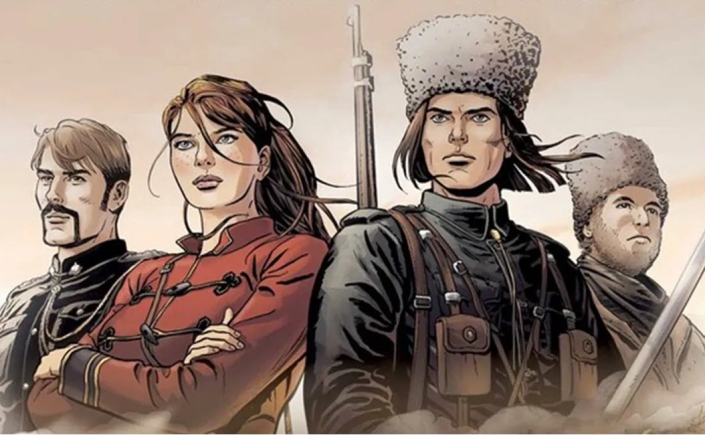
But no sooner had the Bolsheviks cemented their rule than they were fighting a civil war on multiple fronts against a mind-boggling array of enemies, from revolutionary socialists  and anarchists to unreconstructed “White Russian” tsarists, nostalgic for a corrupt and flagrantly unjust regime and in between the Reds and Whites were the Greens or Partisans, mainly deserters from all sides who hated both Reds and Whites and attacked both, increasingly so as the war continued. And a range of foreign powers dealt themselves into the game to further their own strategic and ideological interests. [the featured picture of this piece is an idealized manga depiction of charismatic Ukrainian anarchist and Green Nestor Makhno, a larger-than-life figure who miraculous survived the civil way and died in his bed in exile]

Reds and Whites

The terms White and Red did not arise by chance, but drew upon older political symbolism deeply rooted in European history. White had long been associated with monarchy and legitimate authority, most famously as the colour of the House of Bourbon and the royalist forces who opposed the French Revolution – who wore white cockades in their hats. During that upheaval, those who rallied beneath the white banner represented counter-revolution, continuity and the defence of the old order. More than a century later, Russia’s anti-Bolshevik forces inherited this symbolism, becoming known collectively as the Whites.

Their opponents consciously embraced the opposite colour. Red, already synonymous with revolutionary upheaval since 1789, had become the emblem of international socialism, the blood shed by the working class, and the promise of a new social order. Thus, in the Russian Civil War, the conflict between the White Armies and the Red Army was not merely a military contest but a symbolic struggle between competing visions of political legitimacy, tradition and revolution, expressed in colours whose meanings had been forged long before the first shots were fired.

The Whites were a confused, fractured and often dysfunctional coalition with rapid changes of command occasioned by personal ambitions and fluctuating military fortunes. White generals were committed to restoring the integrity of the Russian Empire, a self-defeating handicap that alienated potential allies on the fringes, like Finland, the Baltic states and Poland. Churchill underestimated this imperial obsession which prevented the alliances he wanted to defeat the Bolsheviks. The Greater Russia obsession also hampered efforts in the Caucasus where Georgians stirred regions like Ingushetia, Chechnya and Dagestan, giving Britain nightmares of Bolshevism spreading through Central Asia towards India, an obsession that continued through the twenties as described in Peter Hopkirk’s Setting the East Ablaze – Lenin’s Dream of an Empire in Asia.

Out on the edge of the old empire, White warlords endeavoured to carve out kingdoms for themselves. Many commanders spent more time terrorizing locals than fighting the Red partisans who were operating behind enemy lines across the war zone, creating a legacy and tradition the persist to this day.

The diffusion of opponents played into the Bolsheviks’ hands, as their differences were so extreme that a unified opposition fighting force was never a viable option. But if the battle lines were often blurred, the hatred felt by the combatants for each other was nightmarishly vivid.

The White’s defeat in the civil war wasn’t for lack of outside moral and materiel support. It was due largely to their inflexibility, including their refusal to contemplate land reform until it was far too late, and their refusal to grant any autonomy to nationalities of the Czarist Empire. Their administration was so useless that it’s barely existed. Paradoxically, they lost for reasons very similar to the way the Republicans lost the Spanish Civil War two decades later. In Spain, the antifascist alliance of the Republic could not prevail against Generalissimo Franciso Franco‘s disciplined and militarized regime. In Russia, the utterly incompatible alliance of socialist revolutionaries and reactionary monarchists didn’t stand a chance against the single-minded Communist dictatorship.

A leftist libertarian with St. George’s Cross, and a Sister of Mercy nurse, 1916.

World War 1.2

It in many ways it became World War 1.2. The idea of a purely Russian Civil War is misleading simplification, prompting one historian recently to describe it instead as ‘a world war condensed’.

It was waged across European and Asian Russia, including present day Belarus and Ukraine and the successor states of the Soviet Union in the Baltic, the Caucasus, and Central Asia – from Warsaw and Eastern Europe to the Urals and eastwards through the vastness of Siberia’s forests, deserts and tundra to Vladivostok in the Far East, from the arctic north to Crimea and the Black Sea, the Caspian Sea and the borders of what in 1918 ceased to be the Ottoman Empire. Fronts stretched for thousands of miles and advances and retreats likewise. The Trans-Siberian Railway, stretching the length of the former empire from Moscow to Vladivostok, was almost six thousand miles long, and it’s tributary lines served as strategic and logistical thoroughfares for all protagonists who weren’t mounted like the innumerable Cossacks tribes and the nascent Red Cavalry, bringing to prominence the armoured trains that became a symbol of the revolution.

It drew in most of Russia’s contemporary neighbours and more far-flung nations, including The USA, Britain, France, Germany Italy and Japan – the latter providing the largest contingent, estimated by British Intelligence as some 85,000 soldiers, more than many of the various White armies. Combatants included soldiers from these countries, the British dominions of Canada, Australia, South Africa, and India, and Chinese and Mongolian troops. And a multitude of ethnicities fought for their own warlords, their national place in the sun or else their very survival. Caught up in the transcontinental maelstrom were Slavs, Cossacks, Tartars, Turkmen, Arabs, Azeris, Persians, Turks, Armenians, Chechens, Kazakhs, Buryat Mongols, Kalmyks (Europe’s only Buddhist nation) and Jews. White divisions were augmented in Siberia by Mongolian, Chinese, Uighur and Kirghiz mercenaries.

Various nationalist movements arose, successfully and unsuccessfully in all parts of the former Russian Empire. The aftermath of the First World War and the collapse of the Russian Empire saw Polish, German, Italian, Hungarian, Romanian, Czech, and myriad other nationalities fighting for disparate sides, and Beevor skillfully frames the bizarre impact of this on the ethnic nationalist dimensions of the conflict.

The scale of military manoeuvres was unprecedented, as were the physical and supply difficulties over vast distances, and the extremities in climate, particularly the bitter Russian winter. The conflict became very much a cavalry war and indeed, a “railway war” notable for its armoured trains and the logistical lifeline of the Trans-Siberian Railway, protected for much if the conflict by the Czechoslovak Legion, a force of Czech and Slovak nationalists who having fought in the Czarist army, joined the Whites who controlled many towns in Siberia.

In addition to the Czechs, there was also a Polish Legion operating in the Far East. The commanders of both forces became increasingly disenchanted with the White officers who refused to countenance the independence of the border states and who shocked many with their brutality towards prisoners and civilians, and though thousands of miles from Europe, demanded repatriation – ostensibly by sea from Vladivostok.

Western Allies’ ideological perspective of the civil war was ambivalent. Though many, politicians and military alike, were viscerally opposed to Bolshevism and what it stood for, and feared a Red contagion infecting their own countries, a fear that was not unfounded. In the wake of the Revolution, a concatenation of revolts detonated across the globe. Bolshevism spread westwards, from Vienna through Budapest and Sofia to Kiel. The Bavarian Soviet Republic was briefly established in April 1919, before the far-Right Freikorps did it in. Britain wasn’t immune to the ferment. Between the February and October Revolutions, the Leeds Soviet did indeed appear to be the beginning of something, whilst strikes and demonstrations proliferated to be violently put down by the police and army. Winston Churchill alone of his cabinet colleagues wanted a full-on allied intervention and dreamed – some believed he was indeed dreaming but others claimed that he fantasized – of creating an effective White army and a borderlands alliance to defeat the Bolsheviks. But his aspirations were foiled by the imperialism of the White leadership and of White officers and the various national movements’ fear that that if the Whites prevailed, they would restore Russian rule. Britain’s rulers were reticent about shoring up and providing financial, material support and also, soldiers sailors and airmen to brutal to demonstrably homicidal Cossack brigades and revanchist and reactionary royalist autocrats.

British regiments were nevertheless deployed in Siberia and in the Far East as well as the Arctic and Caspian Sea. Royal Navy flotillas blockaded Petrograd in the Baltic, floated up the Volga in the south and down the Dvina in the arctic north, and controlled the Caspian Sea and the waters around the Crimean Peninsula. The Royal Air Force deployed Sopwith Camels and sea planes in surveillance and surveillance missions against the Red forces, who British officers called the “Bolos”. And artillery units and armoured car squadrons were attached to the various White armies.

Wider imperial concerns were in play too. Churchill rang alarm bells as the Reds pushed the Whites back in Siberia and Central Asia, alarming even his reticent cabinet colleagues with prospect of Reds on the borders of the Raj. The Great Game still had over a quarter of century to run before the final whistle blew. In the Far East, Britain and the US, and Reds and Whites alike, were nervous about the designs imperial Japanese was revealing with regard to the resources and the empty lands of eastern Siberia, the island of Sakhalin, the pacific littoral and Manchuria. Intelligence reports revealed that Japanese forces in the region exceeded all others involved, including the warring Russians.

Pogrom

Fratricidal wars are bound to be cruel because of the lack of definable front lines, because of their instant extension into civilian life, and because of the terrible hatreds and suspicions which they engender. The fighting ranged right across the Eurasian landmass was violent beyond belief, especially the unspeakable cruelty of the Cossack atamans in Siberia. Even that archconservative politician VV Shukgin believed that one of the major reasons for the failure of the whites what is a “moral collapse” – that they behaved as badly as their enemy.

There was nevertheless one subtle yet important difference. All too often, whites represented the worst examples of inhumanity, yet on that score, the Bolsheviks were unbeatable. It has been said that their ruthlessness has few parallels in recorded European history up until that time – believing that history was on their side, and that a new world was being created. The almost religious zeal with which they brutalized and killed combatants and innocents alike could be likened to the Albigensian Crusade in the early thirteenth century. [The Crusaders were accompanied by an official representative of the Pope, a French Cistercian monk named Arnaud Amalric. According to accounts written decades later, as the attack began, a soldier asked Amalric how they would be able to tell which Beziers townspeople were Catholics and which were Cathars. Some sources give the alleged quote as “Kill them all, for the Lord knows his own” or as “Kill them all. The Lord knows his own.”]

The focus on ordinary people also means their suffering is brought to the fore. And Beevor is unsparing in showing the chaotic violence of the conflict, and unrelenting in showing the sheer violence of both sides. Reds and Whites are both revealed as more than comfortable burning villages, shooting traitors, suspected or real, and torturing and massacring prisoners, and men women and children caught in the crossfire.

There were many instances of racist violence mainly on the White side – particularly towards Jews. The Whites’ antipathy towards Jews was to some degree due to their perception that most senior Bolshevik were Jewish, but mostly it was that old devil that never went away, antisemitism. The fall of the Romanovs and the ancien regime and the anti-Semitic pogroms they perpetuated continued. Retreat from the major cities brought out the worse in the Whites, with terrible massacres of Jews – although they were not the only perpetrators. Playwright And author Isaac Babel, attached as a correspondent and propagandist to the Red Cavalry on the Polish Soviet front in late 2020 posed the question: “what sort of person is our (Red) Cossack? Many layered: looting, reckless daring, professionalism, revolutionary spirit, bestial cruelty. The population await their saviors. The Jews look for liberation – and in ride the Kuban Cossacks”.

It is estimated that there were some 1300 anti-Semitic pogroms in the Ukraine during the civil war, with some 50000 to 60000 killed by both sides. There were pogroms in Belarus also, but these were not nearly as murderous as in Ukraine. A Soviet report of 1920 mentions 150,000 dead and as many again badly injured.

Churchill was well aware of the effect of the pogroms on public opinion in the West and sought in vain to exert pressure on white leaders to restrain their forces.,

Terror begat terror, leading to greater acts of conspicuous cruelty. After a particularly hard-fought battle in early 1919, a young White horse artillery officer recalled “for the first time since the start of the civil war, prisoners were not shot. There were too many of them”. This did not happen often – and such was the brutality meted out to captives on both sides, shooting was actually a blessing. An Odesa women witness after the fall of the city to the Whites, “Urrrraaa! Four and a half months under these five-pointed star oppressors”. Two days later, Beevor notes, she noted that all the Jews were in hiding. When a city held by the Reds fell to the Cossacks, a a female surgeon observed that fearing a program, two Jewish doctors in her hospital wisely ran to hide in the attic.

Bolshevik leaders and commanders on the field eventually realized that brutality did not endear their cause to the general populace and moderated their behaviour. Some Whites too came to that conclusion, and sought to prevent it at least limit atrocities, but reactionary officers and uncontrollable Cossacks persisted in burning, looting, torturing and murdering, inflicting irreparable damage to the anti-Bolshevik cause. Beevor reports instances when allied forces actually fired on Cossack perpetrators.

The End

As the whites retreated, support for the red army amongst the populace grew, as did its numbers as deserters returned to its ranks encouraged by the announcement of an amnesty and as defections from the White forces grew. Peasants grew less reluctant to serve in the Red Army Fear that with white advances and victory, old landlords would reclaim their land. Success bred success. The Whites’ ranks thinned with desertions defections and the need to transfer troops to defend its rear from attacks by partisans and freelance militias units. The Cossacks, disappointed and tired of war, turned about and headed home to their stanitsas laden with loot. The size of the frontline Red Army was eventually twice that of the Whites, as it eliminated the White armies in the north and east and closed in on the last remaining area under White control, Crimea, where rearguards held out long enough to ensure the evacuation of 150,000 soldiers and civilians by sea protected by the British and French navies.

In the aftermath of total Soviet victory, starvation struck the towns and cities across the land. Food requisitioning detachments scoured the countryside for supplies, their rapaciousness and brutality igniting peasant rebellions from Belarus to Siberia; tens of thousands of peasants rose in revolt, dealing brutally with any Bolshevik that came into their hands. The Red Army and Cheka reciprocated in spades with burning and looting, rape and torture, execution and exile to the emergent Gulag. Workers went on strike in the starving cities, and with the Whites vanquished and the civil war won, the call for democratization of Soviet rule grew louder.

And then, the sailors of the Baltic Fleet at the Kronstadt naval base, who’s guns had heralded the fall of the Romanovs, and whom Trotsky had called “the pride and glory of the Russian Revolution”, rebelled. The regime responded with lies – that the sailors had been suborned and were now Whites – and that White forces in Finland would be crossing the ice to help them. When this didn’t work, I resolved to crush them without mercy, dispatching trustworthy forces against them.

At the end, of 16000 sailors and their families, most were able to cross that ice to final and. But some 3000 fought a last stand and died by assault or firing squad. One of the last cries of protest by the Kronstadt sailors was “All of Soviet Russia has been turned into a Russian penal colony”.

Thus ended the Russian Civil War in November 1920.

… all wars come to an end. And that’s where history restarts.
British war and foreign correspondent Robert Fisk

Evacuees board ship in a Crimean portEpilogue

Epilogue … history repeats

Whilst there were many active fronts during the civil war, often simultaneously, extending for thousands of kilometers, around Archangelsk and Murmansk in the arctic, along the great rivers the Volga, the Don and the Dniester in the south, in the Baltic provinces, and in Belarus, and along the length of the Trans-Siberian Railway. And as during WW2 and the present-day Ukraine war, opposing armies advanced and retreated across Ukraine. Kiev was occupied, often several occasions, by Reds, Whites and Greens, and finally, the Polish Army which invaded Russia and Ukraine in 1920 to reclaim and defend the independence of the onetime Polish state, long divided between the now destroyed Russian, German and Austro-Hungarian empires. The names of the war-torn cities are today tragically familiar. Mariupol and Melitopol, Karchiv and Kherson. Kiev, Odessa and Lvov are now Kyiv, Odesa and Lviv.

© Paul Hemphill 2023 All rights reserved

Posts in In That Howling Infinite, about Eastern Europe:

Великий Ужас (Velikiy Uzhas) – Stalin’s Great Terror

You were taken away at dawn. I followed you
As one does when a corpse is being removed.
Children were crying in the darkened house.
A candle flared, illuminating the Mother of God…
The cold of an icon was on your lips
A death-cold sweat on your brow –
I will never forget this; I will gather
To wail with the wives of the murdered streltsy
Inconsolably, beneath the Kremlin towers.
Anna Akhmatova, Moscow 1935 Continue reading →

The Russian Tradition – Russia, Ukraine and Tibor Szamuely

In a televised address on September 30th last year, Vladimir Putin said: Russia is a great, 1000-year-old power, a whole civilisation, and it is not going to live by such makeshift, false rules … What, if not racism, is the West’s dogmatic conviction that its civilisation and neoliberal culture is an indisputable model for the entire world to follow?”

Now, one might not agree with Putin, and today, he is certainly persona non grata in Western forums, but one thing is for sure: Russian history mines its own unique seamWe republish below an article by American author, journalist and editor Christopher Caldwell. He advocates that we adopt a cautious and open minded perspective on historical memory, contemporary perceptions, lexicological differences, the dangers of making assumptions, and coming to conclusions and adopting opposing positions on the basis of incomplete and inadequate knowledge of other countries than our own with their distinct but not hermetically sealed histories and cultures.

Caldwell’s central focus is the colourful life and legacy of exiled Hungarian academic Tibor Szamuely.

Like many refugees from Communism, Szamuely was descended from both perpetrators and victims. An uncle of the same name served in the Hungarian Soviet Republic that took power for six months under Béla Kun in 1919, and died violently that year when the revolution failed. He was among that government’s most bloodthirsty ministers, and was called “Butcher Szamuely”. Szamuely’s family wound up in Moscow, where Tibor was born, and where his father was executed in Stalin’s purges. Young Tibor served in the Red Army, and he too was arrested and sent to a Labour camp. Rehabilitated, he served as Chancellor of Budapest University. In 1964, then nearing 40, he was teaching in the “ideological institute” of Ghana’s Marxist president Kwame Nkrumah when he defected to England.

He taught at the University of Reading in England and befriended Kingsley Amis, Robert Conquest, and Anthony Powell, among other literary anti-Communists. His book, unfinished when he died of cancer in 1972, was edited into its final form by Conquest and published two years later.

Szamuely taught me Russian and Soviet history and politics at Reading University. Back then, I was a political ingenue and a naive communist sympathizer and fellow-traveler, although my evolving perspectives were transforming and expanding. As my tutor, he advised me to study with an open mind and to put off juvenile thinking. He hadn’t been well when I knew him and he died a year after I graduated. Under his tuition, I’d resolved to specialize in Soviet Studies – but events intervened and I ended up in the Middle East (and that is another story. see: Tanks for the Memory – how Brezhnev changed my life).

He he would always impress upon me the historical and political continuity of what he called The Russian Tradition – the title of his one and only book, published shortly before his death, and now, regrettably, out of print. I purchased a first edition when it was published and it is on my bookshelf still.

Szamuely believed that the bloodstained drama of the revolutions of 1917 – there were two, the social democratic one in the February, the Bolshevik one in November – and the years that followed, including civil war, the establishment of the USSR and Stalinism largely obscured the underlying consistency of Russian history. He did not live to see the decline and fall of the Soviet Union, and the advent of Putin and Russia Redux, but the basic pattern persists, circular and repetitive. The frequent turmoils that have overtaken this vast continent have in their various ways made changes that were essentially superficial, leading in the end to the intensification, under new forms, of the old authoritarian structure.

From medieval times, autocracy has coexisted with a revolutionary traditionalism – a contradiction in terms as only Russia could sustain, a unique Russian capacity to seek revolution and discover regression, to invoke liberty merely to reinforce repression. if he were with us today, Szamuely would explain that the Soviet Union under Lenin and his successors and the Russia of Vladimir Putin bears so disconcertingly close a resemblance to Russia under the most savage of its tsars. His people, it turned out, had wanted freedom but wanted to retain the idea of their old Russian empire more. They ended up with the would-be czar, Vladimir Putin. And so the world turns.

© Paul Hemphill 2023 All rights reserved

Posts in In That Howling Infinite, about Eastern Europe: The Roots and fruits of Putin’s irridentism; Borderlands – Ukraine and the curse of mystical nationalism; Ghosts of the Gulag, The Death of Stalin is no laughing matter, Tanks for the memory – how Brezhnev changed my life, 2nd September 1939 – the rape of Poland (1), 17th September 1939 – the rape of Poland (2)  

You – Bolshevik recruiting poster 1918

You Are Needed In Kiev 2014

Churchill, Roosevelt and Stalin divide Europe at the Yalta Conference in Crimea, 1945

Why is Russia obsessed with slavery?

Tibor Szamuely: ‘The Russian Tradition’

Christopher Caldwell, UnHerd, 23rd august 2022

There’s nothing wrong with being cautious. Since 1709, when Peter the Great routed the troops of Swedish King Charles XII at Poltava, smack-dab in the middle of modern-day Ukraine, Europeans have understood Russia as a military threat. Never has this required us to close our minds to the glories of Russian culture or to forget that Russia’s strategic posture always has an explanation — and sometimes even a rationale.

But what was intellectually possible for Westerners in the winter of 1943, when Hitler’s troops and Stalin’s were killing each other by the millions on the Eastern front, is apparently beyond our powers today. In the wake of Russia’s February invasion of Ukraine, many Europeans will not be content with anything less than wiping Russia and its culture off the map. In April, novelist Oksana Zabuzhko, writing in the TLS  that it was the morality of Tolstoy and other Russian writers that “wove the camouflage net for Russia’s tanks”, urged us to “take a long, hard look at our bookshelves”. In early August, the Russian-language novelist Wolodymyr Rafejenko declared he now felt a “revulsion” when he conversed in Russian, and vowed never again to write in it.

These are Ukrainians — one can understand their anguish and rage. But Western Europeans, who are not even at war, have been even more zealous. A Milan university cancelled its Dostoevsky class last spring. The EU and UK have blacked out the Russian internet channel RT. Russians have been declared unwelcome at venues from Wimbledon to Estonia.

Back in the middle of the 20th century, when Russia was capable of far worse, the Russian-born historian Tibor Szamuely wrote an extraordinary book. The Russian Tradition explained how Russian political behaviour (about which Szamuely was wary to the point of hostility) arose from Russian history and culture (about which Szamuely was respectful to the point of reverence). This is the right balance. It has not been struck so well since. Too bad the book is out of print, because it is strangely relevant to a lot of this decade’s preoccupations: slavery, political correctness and Ukraine, for starters.

Like many refugees from Communism, Szamuely was descended from both perpetrators and victims. An uncle of the same name served in the Hungarian Soviet Republic that took power for six months under Béla Kun in 1919, and died violently that year when the revolution failed. He was among that government’s most bloodthirsty ministers, which is really saying something. Szamuely’s family wound up in Moscow, where his father was executed in Stalin’s purges. In 1964, Szamuely, then nearing 40, was teaching in the “ideological institute” of Ghana’s Marxist president Kwame Nkrumah when he defected to England. He taught at Reading and befriended Kingsley Amis, Robert Conquest, and Anthony Powell, among other literary anti-Communists. His book, unfinished when he died of cancer in 1972, was edited into its final form by Conquest and published two years later.

The simple question that animates it is how Russia came to be the centre of Marxist revolution and late 20th-century totalitarianism. Did aggressive Communism subvert blameless Russia? Or was aggressive Russia using blameless Communism as a pretext?

The beginnings of an answer lie in geography. Lacking frontiers, Szamuely writes, Russia has faced “a history of armed struggle against invaders that, for length, intensity and ferocity has no parallel in the annals of any other nation”. That is a large claim. Russia is always vulnerable someplace — at least for as long as it takes to gather and concentrate its killing power. And it is always fighting for its life, which tends — at least in domestic Russian debates — to empty of meaning our concepts of just and unjust war. “Despotic government,” Szamuely writes, “was the instrument she shaped to cope with the everlasting emergency.”

For Szamuely, the central problem in Russian history is slavery. Yes, slavery. Using the word “serf” to describe its put-upon agricultural workers leads us to think of the society as merely backward, quaint, feudal. But this is wrong. Russian slavery was a creation of modernity. Once-free agricultural labourers somehow got buried under debt about 500 years ago, and in the mid-16th century the government bound them to the land, the better to tax them. The owner of the serfs was the state, not the notables on whose land they toiled. There was an equality in this, for the notables were beholden to the state, too. The upper crust owed the tsar military service. Until recent centuries, Russia was one of the rare countries where nobles could be publicly flogged.

But this changed, as Peter the Great tried to modernise the system — Russia got rum, minuets, a navy and of course St. Petersburg. For aristocrats it meant Western connections and new opportunities, for serfs an overload of labour and hard discipline. That was an end to society’s old “mystic unity” and the mumbo-jumbo that had surrounded it. Serfs could now be sold or lost at cards. Russia now had not one people, Szamuely writes, but two: “the Westernised upper classes, and the masses, whose way of life became ever less distinguishable from that of the population of the great Asian empires.” As middle classes in America and France were forging republics, aristocrats were living a Golden Age under Catherine the Great (1762-95). “The most striking feature of 18th-century Russian social history,” Szamuely writes, “was the great expansion and intensification of peasant bondage at the precise moment when, with the emancipation of the nobility, it finally lost any vestige of moral, political or legal justification.”

Szamuely’s preoccupation with slavery anticipates a lot of the “woke” discussion of our own time. If slavery warped the development of the United States (which was one-eighth slave at the start of its civil war in 1861), Szamuely asks, then why has there been so much less soul searching about Russia (which was seven-eighths slave at the time of emancipation that same year)? He may misunderstand the parallel: The difference lies not in the size of the enslavement but in the identity of the rememberer. Progressive white America is wracked by guilt over what it did to “them”. Russia feels no such guilt because the misdeeds were done to “us”. The moral tenor of its soul-searching is more like that of Sicily, or Ireland, or black America.

But it is not as if Russia had no reckoning with serfdom. As access to higher education and newsprint spread, “gradually the idea began to sink in that every Russian of education and leisure was an accomplice in a crime unparalleled in its enormity”. This was the cause around which a revolutionary and often violent intelligentsia arose in the late 19th century, a class unique in Europe until the rise of political correctness. “The Russian intelligentsia was an instrument of destruction,” Szamuely writes. “Unlike the European bourgeoisie it had no constructive purposes, neither was it equipped to fulfil any such tasks.”

There was something Messianic in the intelligentsia’s role. Szamuely recognises that it used others’ suffering as a rationale for autocracy. But he never entertains the idea that the intelligentsia was an outright racket. He even praises the “intellectual honesty” of the critic Nikolay Chernyshevsky, who saw that equality would be won only at a very steep price in liberty: “What a contrast he provides to certain Western ‘progressive’ intellectuals, who worship at the altar of egalitarianism yet refuse to recognise that their dream… can only be realised by an arbitrary dictatorial government. Chernyshevsky and his followers, down to the present day, have never harboured any illusions about this.”

He is nonetheless struck that the great 19th-century Russian novelists (“men of sensibility, compassion and humanity”) were almost unanimously contemptuous of the intelligentsia (“with their joyless utilitarianism, their dogmatic intolerance, their fanatical devotion to a messianic vision”).

The modern enslavement of Russia’s peasantry was not, strictly speaking, a capitalist project. But it felt like one. More than the exploitation undergone in advanced industrial countries, it resonated with the exploitation Marx described. In the end, the Russian revolution was a matter of adjusting Marx’s teaching to powerful Russian folk-institutions, above all the autonomous peasant cooperative known as the obshchina. Marx himself wound up backing peasant “populists” against his own more orthodox followers. It actually turned out to be a piece of good fortune for the revolutionaries that the Marxist spark caught in what Szamuely considers the most conservative country on earth.

That is where Szamuely’s book ends. It is a shame he was never able to write at book-length about the 20th century, of which he was a passionate chronicler. He considered Lenin “the supreme political genius of the century”, and was impressed with the way he and his followers allied Russia’s interests abroad to Asian and African nationalism, not Communism. It was, in a way, the same judgment Marx had made in backing the populists.

Szamuely was fascinated with Ukraine. “Perhaps no other historical experience,” he writes in The Russian Tradition, “has left as lasting an impression on the folk-memory of the Russian people as the horrors of [the] interminable struggle against the slavers and killers of the south. For centuries the steppe remained a source of constant menace, a land of terror, death, destruction and degradation. It was called the Wild Plain, or, as we would say today, the Frontier; the greater part of this region is now called the Ukraine…”

He was highly sympathetic to Ukraine’s modern struggles. In 1968 he wrote a fascinating and well-informed account of the nationalist protests and ensuing prosecutions that had then been going on in Ukraine for much of the decade. While granting that the Ukrainians welcomed the Nazis as liberators in June 1941, he wasn’t surprised by this nationalist sentiment, given the decade of famine and purges they had endured. He noted, too, the “methodological dilution” of Ukraine’s ethnic composition by Russia, insisting that Russian dominance of the country’s high culture was a recent and unnatural phenomenon. Only 41% of books published in Ukraine were in Ukrainian, it is true, but in 1930, before Russification and famine, that figure had been 84%.

Szamuely never let justified fear of Russia drive out justified fascination. Vastly well read in the country’s history, he still found it ambiguous, describing the policies of Ivan the Terrible at one point as “a strange mixture of farsightedness and paranoia — a combination frequently reproduced by his successors through the centuries”. Few historians have been better equipped than Szamuely to understand the paradoxes of Russia, where the novelists are sublime and the politics are unendurable, and often for the same reasons.

Tsar Nicholas the Last

The last of the Romanovs – Tsar Nicholas and his family, murdered by the Bolsheviks in July 1918


That was the year that was – don’t stop (thinking about tomorrow)

The prophet’s lantern is out
And gone the boundary stone
Cold the heart and cold the stove
Ice condenses on the bone
Winter completes an age
WH Auden, For the Time Being – a Christmas Oratorio, 1941

I considered using a line from the above as the title of this retrospective of 2022.  It was written during 1941 and 1942, though published in 1947, when the poet was in self-exile in the United States and viewing the war in Europe from afar – although the long poem from which it has been extracted does not in itself reflect such pessimism. A more fitting title could be taken from another long poem that was published in another (very) long poem published in 1947 – Auden’s often overlooked masterpiece The Age of Anxiety, a meditation on a world between the wreckage of The Second World War and of foreboding for the impending armed peace that we now look back on as the Cold War, with its oft-repeated mantra: “many have perished, and more most surely will”.

The year just gone was indeed a gloomy one, meriting a dismal heading. There are few indications of where it might take us in ‘23 and beyond, and my crystal ball is broken. Pundits reached for convenient comparisons. Some propounded that it was like the 1930s all over again when Europe constantly teetered on the brink of war. Others recalled 1989 with the fall of the aneroid Wall and the collapse of the Soviet Union. But, beware of false analogies. In 2022, things were more confused. The tides of history have often resembled swirling cross-currents.

Things, of course, might have been worse. There are, as I’ve noted in successive posts on my own Facebook page, many qualified “reasons to be cheerful”. The  year could have ended with Ukraine under Russian control. An emboldened China might have been encouraged to launch an assault on Taiwan. A red wave in the midterms would have buoyed Trump. And here in Australia, Scott Morrison might have secured another “miracle” election victory. The West could have retreated on all fronts.

Instead, therefore, I have selected a title that hedges its bets, because, to paraphrase the old Chinese adage, and the title of an earlier retrospective, we certainly live in interesting times and in 2023, and a lot of energy will be spent endeavouring to make sense of them – or, to borrow from Bob:

Pointed threats, they bluff with scorn
Suicide remarks are torn
From the fool’s gold mouthpiece
The hollow horn plays wasted words
Proves to warn that he not busy being born
Is busy dying

B Dylan

The year in review 

Christine McVie, longtime and founder member of Fleetwood Mac departed the planet on 30th November this year. And contemplating this year’s posts in In That Howling Infinite, I could not help thinking about one her most famous songs. I recalled that it featured on newsreels of the revolution that ousted the Shah of Iran in 1979.

Why not think about times to come?
And not about the things that you’ve done
If your life was bad to you
Just think what tomorrow will do
Don’t stop thinking about tomorrow
Don’t stop, it’ll soon be here
It’ll be better than before
Yesterday’s gone, yesterday’s gone

The song seemed quite apposite as the soundtrack of a revolution that had overthrown one of America’s many friendly autocrats. At the time, no one could predict what would happen, but, as with the fall of the Berlin Wall in 1989, it was a time optimistic expectation. And yet its shock waves have reverberated and ricocheted in ways unimagined at the time.

As 2022 ends, with blood flowing on the streets of Iran and in the mullahs’s torture cells as young people rise up against a hypocritically brutal theocratic tyranny, we see again and again how that which goes around comes around.

Women, Freedom, Life

If the malign hand of history has literally reached out and gripped Iran’s young women and girls by their hair, it has also endeavoured to strangle the thousand year old Ukrainian nation in the name of an atavistic irredentism. Russian troops invaded the Ukraine on February 24, causing what has since become the largest conflict in Europe since World War II. Out if the spotlight of the world’s easily distracted attention. intractable conflicts lumbered mercilessly on – in Syria, Yemen, Ethiopia, the Congo and many other “far away  places with strange sounding names”.  

On the far side of the world, the USA continued to struggle with the reverberations of January 6th 2021. Donald Trump, like Dracula, has not gone away, and whilst his 2024 presidential run is looking increasingly shaky, he continues to poison the atmosphere like radioactive dust. The unfortunate folk of the United Kingdom endured three prime ministers during the year, including the shortest ever in the history of the office, and after two years of pandemic, are facing a bleak economic winter as well as a frigid actual one.

In Australia, it was the year of the teal – at least according to those who study the evolution of language, the year we lost a queen, our long-serving foreign head of state, and a king of spin, the down-fallen and disgraced Scott Morrison. And a sodden La Nina saw incessant rain drown large swathes of eastern Australia, visiting misery on thousands. COVID-19 mutated, the Omicron variant surging from beginning of the year, ensuring no end to the pandemic – today, it seems like everyone we know has had it, including ourselves (and we were soooo careful for a full two years!). As restrictions were cautiously lifted, we as a nation are learning to live with it. 

Politically, it’s been a grand year for the Australian Labor Party. With our stunning Federal election win in May and in Victoria in November, the Albanese government’s star is on the ascendant and it’s legislative record in six months has out run nine years of Tory stagnation on climate, integrity and equality – a neglect that saw the rise of a new political force in the shape of a proto-party, the aforementioned “teal”, named for the colour of the candidates’ tee shirts. The opposition has been reduced to a bickering and carping crew, and whilst Labor continues to ride high in the polls, the Coalition bounces along the bottom of the pond.

Lismore, northern NSW, March 2023

Flooded house aflame, Lismore March 2022

Christine McVie was just one of many music icons who checked out this past year. The coal miner’s daughter, Loretta Lynn, crooned her last, as did rock ‘n roll bad boy Jerry Lee Lewis and Ronnie “the Hawk” Hawkins, who gave the boys in The Band their big break. Rock heavyweight (literally) Meatloaf took off like his bat out of hell and keyboard evangelist Vangelis boarded his chariot of fire.

Acclaimed British author Hilary Mantel, whose Wolf Hall trilogy inspired back to back posts in In That Howling Infinite in 2020 found “a place of greater safety”, and French author Dominique Lapierre also joined the choir invisible. I had first learned about Israel’s war of independence and the Palestinians’ al Nakba in his O Jerusalem, and about the bloody tragedy that accompanied the birth of India and Pakistan, in Freedom at Midnight, both books featuring in past posts. 

Mark Rylance and Damian Lewis as Tom and Hal

One could argue that the most significant departure was that of Britain’s longest serving monarch. Queen Elizabeth II had been on the throne for almost all of my life, as has the now King Charles III who was born four months before me, and of whom, as a nipper, I was jealous. I recall how I watched the queen’s coronation on a tiny black and white television in the crowded and smokey parlour of the boarding house run by a friend of our family. By happenstance, Netflix served up two over the top regal sagas to binge on: the penultimate season of The Crown, which whilst entertaining, was a disappointment in comparison with earlier seasons, and Harry and Meghan which was whilst excruciatingly cringe-worthy, was nevertheless addictive viewing. The passing of Her Maj reminded me that in my lifetime, I have witnessed three monarchs and eighteen British prime ministers (and incidentally, eighteen Australian prime ministers).  The public outpouring of grief for the Queen’s ascent to the choir invisible was unprecedented – the picture below demonstrates what the Poms do best …

The Queue along the Thames to pay respect to Her Maj

There were farewells much closer to home. My mediation colleague, aspiring author and friend John Rosley, and Beau Tindall, the son of my oldest Bellingen friend Warren, took off on the same day in May. Peter Setterington, my oldest friend in England – we first met in 1972 – died suddenly in London in March, and our friend and forest neighbour, the world-famous war photographer Tim Page, in August, after a short but nasty illness. Pete is memorialized in When an Old Cricketer Leave His Crease whilst Journey’s end – Tim Page’s wild ride,is an adaptation of the eulogy I gave for Tim in September, one of many on that sunny afternoon day in Fernmount. It is a coda to Tim Page’s  War – a photographer’s  Vietnam journey, a story we published a year ago.

Tim Page by Joanne Booker

What we wrote in 2022

The ongoing Ukraine War has dominated our perception of 2022, from the morning (Australian time) we watched it begin on CNN as the first Russian missiles struck Kyiv, to the aerial assault on infrastructure that has left Ukrainians sheltering through a cold, dark winter. Two posts in In That Howling Infinite examined the historical origins of the conflict: Borderlands – Ukraine and the curse of mystical nationalism and The Roots and Fruits of Putin’s Irridentism. “Because of …” Iran’s voice of freedom looks at the song that has become the rising’s anthem. None can predict the outcome – whether it will be a doomed intifada, the Arabic word that literally means a shaking off – historically of oppression – and figuratively, a rising up, like that in Ireland in 1798 and 1916, Warsaw in 1943 and 1945, and Hungary in 1956, or an Inqilab, another Arabic word meaning literally change or transformation, overturning or revolution.

The run up to May’s Australian elections inspired Teal independents – false reality in a fog of moralism.; and Australia votes – the decline and fall of the flimflam man. 

More distant history featured in Menzie’s Excellent Suez Adventure, the story of the Suez crisis of 1956 that historians argue augured the end of the British imperium, and the role played therein by longtime Australian prime minister Sir Robert Menzies. Johnny Clegg and the Washing of the Spears is a tribute to the late South African singer, dancer and songwriter, and a brief history of the war that destroyed the great Zulu nation, setting the scene for the modern history of South Africa. And journeying further back in time to sixteenth century Ireland, there is O’Donnell Abú – the Red Earl and history in a song, a discussion of the origins of a famous and favorite rebel song.

Then there are the semi-biographical “micro-histories” in In That Howling Infinite’s Tall tales, small stories, obituaries and epiphanies. In 2023, these included: Folksong Au Lapin Agile, the evening we visited Montmarte’s famous folk cabaret; Ciao Pollo di Soho – the café at the end of the M1, the story of a café that played a minor part in my London days, as described in detail in an earlier travelogue, Song of the Road – my hitchhiking days; Better read than dead – the joy of public libraries; The quiet tea time of the soul, an ode in prose to a favourite beverage; and The work, the working, the working life recalling the many jobs I took on in the sixties to keep myself in music, books, travel and sundry vices. 

We cannot pass a year without something literary. We celebrated the centenary of three iconic literary classics in The year that changed literature, and with the release of The Rings of Power, the controversial prequel to The Lord of the Rings, we published a retrospective on the influence of JRR Tolkien. One ring to rule us all – does Tolkien matter? – a personal perspective with an opinion piece by English historian Dominic Sandbrook, an informative and entertaining chronicler of postwar British history and society which featured, in Unherd, an online e-zine that became a “must read” in 2022. A Son Goes To War – the grief of Rudyard Kipling recalls the death in battle on the Western Front in 1917 of the poet’s only son, it’s influence upon his subsequent work, whilst Muzaffar al Nawab, poet of revolutions and sorrow is an obituary for another poet, who seen a lifetime speaking truth to power.

And that was that for what was in so man ways a sad year. Meanwhile, In That Howling Infinite already has several works in progress, including a review of historian Anthony Beevor’s Russia – Revolution and Civil War, what King Herod really thought about the birth of baby Jesus, and the story of a famous and favourite British army marching song.

Best wishes for 2023 …

Death of a Son

That was the year that was – retrospectives

Life in Wartime – images of Ukraine

The Roots and Fruits of Putin’s Irridentism

Prologue

The Soviet invasion of Czechoslovakia in August 1968 was in many ways a seminal event in my own journeying. Until then, I was a political ingenue and a naive communist sympathizer and fellow-traveler, although my evolving perspectives were transforming and expanding as I studied the history and politics of Russia and the Soviet Union, under the tutelage of exiled Hungarian academic Tibor Szamuely. Born in Moscow to a prominent communist family, his father disappeared into the Gulag. Young Tibor served in the Red Army, and he too was arrested and sent to a Labour camp. Rehabilitated, he served as Chancellor of Budapest University encore finally settling in the UK he taught me Russian politics at Reading University. He advised my to study with an open mind and to put off juvenile thinking. He hadn’t been well when I knew him and he died in 1972, a year after I graduated. Under his tuition, I’d resolved to specialize in Soviet Studies – but events intervened and I ended up in the Middle East (see: Tanks for the Memory – how Brezhnev changed my life).

I am recalling Tibor Szamuely today because he would always impress upon me the historical and political continuity of what he called The Russian Tradition – the title of his one and only book, published shortly before his death. He believed that the bloodstained drama of 1917 and the years that followed largely obscured the underlying consistency of Russian history. It is this basic pattern, circular and repetitive, that has seen the frequent turmoils that have overtaken this vast continent have in their various ways made changes that were essentially superficial, leading in the end to the intensification, under new forms, of the old authoritarian structure. From medieval times, autocracy has coexisted with a revolutionary traditionalism – a contradiction in terms as only Russia could sustain, a unique Russian capacity to seek revolution and discover regression, to invoke liberty merely to reinforce repression. if he were with us today, Szamuely would explain that the Soviet Union under Lenin and his successors and the Russia of Vladimir Putin bears so disconcertingly close  a resemblance to Russia under the most savage of its tsars.

It is a theme echoed recently by Russian scholar and historian Simon Sebag Montefiore who wrote recently about how on 17th March, Putin appeared to threaten his people with a revival of Stalin’s Great Terror that began in 1937 and in which 1 million people were shot over two-and-a-half years:

“He’s dog-whistling 1937, so that’s pretty scary and the reason he’s doing it is because he realises there’s opposition in the elite and among the populace.He used all these keywords: ‘traitors,’ ‘enemy of the people,’ ‘scum,’ ‘bastards,’ all of which were from the thirties, which a Russian would know he’s threatening massive repression in Russia. He’s literally putting the fear, an ancestral, terrifying fear into these people. People who would have heard of these stories from their old parents, and grandparents and great-grandparents about the time when people didn’t sleep at night, they kept a bag packed in case they were deported. People were never seen again. It was a terrifying speech in only a way the Russians would know.”

One nation under an Orthodox god

In That Howling Infinite’s last post, Borderlands – Ukraine and the curse of mystical nationalism, we wrote:

‘Observing Putin’s mystical nationalism, his idea of Ukraine as part of Russia’s “spiritual space” … American historian Victoria Smolkin argues that his imagination of Ukraine is a fantasy of a fallen empire, a fever dream of imperial restoration. “Undoubtedly, many still harbour fantasies of such imperial restoration. But fantasy is not history, and it’s not politics. One can lament – as Putin does – that Soviet politics was not “cleansed” of the “odious” and “Utopian” fancies “inspired by the revolution,” which, in part, made possible the existence of contemporary Ukraine. But that is the burden of History –  it is full of laments”.’

By his own account, Putin sees himself not as the heir to the Soviets but as a champion of Russian civilization and Moscow’s Eurasian empire, whose roots extend back to a much earlier Vladimir—St. Vladimir, the Grand Prince of Kyiv from about 980 to 1015. St. Vladimir was ruler of what the Russians consider their first empire, the Slavic state known as Kievan Rus—based, of course, in Kyiv, the capital of what is now Ukraine. St. Vladimir’s conversion to Christianity in 988 later gave rise to the idea that Russia would be the “third Rome”—the heir to the fallen Roman and Byzantine Empires following the surrender of Constantinople to the Ottomans. It is why, like Putin, many Russians refer to Kievan Rus as “the cradle of Russian civilization” and Kyiv as “the mother of Russian cities.”

He didn’t realize that even most of the Russian-language speakers in eastern Ukraine see themselves now as Ukrainian—that over the past 30 years, the Ukrainians had formed their own country. He didn’t realize that their sense of identity had changed,”

Fortress Russia This attitude also has profound roots in Russian history, especially the Russian belief that Orthodox Christianity is superior to the West’s liberalized Christianity, which Putin and other conservative Russians view as corrupted by Enlightenment ideas. In the early 19th century, the Russian answer to the French Revolution’s Enlightenment creed, “Liberté, Égalité, Fraternité (Freedom, Equality, Fraternity), was “Orthodoxy, Autocracy, and Nationality”—which Sergey Uvarov, minister of public education to Tsar Nikolai I, formulated as the conceptual foundation of the Russian Empire. This tripartite credo isn’t mentioned in Putin’s speeches and writings—he still likes to pretend Russia is a democracy—but it has been invoked by the far-right thinkers said to influence Putin, including Aleksandr Dugin, Lev Gumilev, Ivan Ilyin, Konstantin Leontiev, Sergei Petrovich Trubetskoy, and others dating back 200 years.

It is a sense that goes back centuries: In order to survive, you need strategic depth, so you need to push borders out as far away from the heartland as possible—not so much physical as geopolitical barriers. You just push until you meet something that can resist you.”

It is little understood by many Westerners that Russian literary figures they revere, such as Leo Tolstoy, Fyodor Dostoevsky and Aleksandr Solzhenitsyn, were also devotees of this idea of a “greater Russia” under an absolute autocrat. Solzhenitsyn, the Nobel Prize-winning author best known for writings that exposed the horrors of the Soviet gulag, later became one of Putin’s favorite intellectuals. Before his 2008 death, Solzhenitsyn wrote in an essay: “All the talk of a separate Ukrainian people existing since something like the ninth century and possessing its own non-Russian language is recently invented falsehood.” Shortly before his death in 1881, Dostoevsky wrote: “To the people the Czar is the incarnation of themselves, their whole ideology, their hopes and beliefs.”

Many commentators on left and right are now pondering what they see as the inevitability of what is happening today in Ukraine, and several of them point to the malign influence of the man people are calling “Putin’s brain”, the nationalist ideologue Aleksandr Dugin -a latter day Rasputin, indeed, although  Vladimir Putin is not as naive and dependent as the doomed Tsar Nikolai II, he is seemingly appearing to be as isolated – he is nobody’s puppet. David von Drehle wrote recently in the Washington Post: “A product of late-period Soviet decline, Dugin belongs to the long, dismal line of political theorists who invent a strong and glorious past — infused with mysticism and obedient to authority — to explain a failed present. The future lies in reclaiming this past from the liberal, commercial, cosmopolitan present (often represented by the Jewish people). Such thinkers had a heyday a century ago, in the European wreckage of World War I: Julius Evola, the mad monk of Italian fascism; Charles Maurras, the reactionary French nationalist; Charles Coughlin, the American radio ranter; and even the author of a German book called “Mein Kampf.”

Greg Sheridan, Foreign Editor of The Australian and a committed Roman Catholic, wrote a very good piece not just discussing Dugin, but also, the long arm of Russian history and the depth of Russian culture, including not only those icons of the Russian literary cannon, but also, what he describes as the “self-obsessed and self-regarding Russian Orthodox Christianity”. It is, he says, “ a treasure of spiritual depth and theological insight. But it’s view if the rest if Christianity is tied up in its tangles relationship with Russian nationalism”. Russia, he writes, considers itself as the third Rome, the true heir and successor to Rome and Byzantium, and the chaplain to the tsars.

I republish Sheridan’s article below, along with a piece from the eZine Foreign Policy by Michael Hersh, Putins Thousand Year War, which follows a similar historical track although with more emphasis on its present day geopolitical implications.

Both lead us back to Tibor Szamuely’s perspective that in Russia, there is indeed nothing new under the sun.

© Paul Hemphill 2021. All rights reserved

Posts in In That Howling Infinite, about Eastern Europe: Borderlands – Ukraine and the curse of mystical nationalism; Ghosts of the Gulag, The Death of Stalin is no laughing matter, Tanks for the memory – how Brezhnev changed my life, 2nd September 1939 – the rape of Poland (1), 17th September 1939 – the rape of Poland (2)  

Inside the twisted mind of Vladimir Putin

Greg Sheridan, Foreign Editor, The Australian, 12th March 2022

Putin sees Ukraine and Belarus as the absolute minimum he must reclaim for Russia.

Ukraine and Belarus are the absolute minimum Putin must reclaim for Russia

Is Vladimir Putin out of his mind? As their savage invasion of Ukraine began a third week, Russian forces deliberately bombed a maternity and children’s hospital in the southern city of Mariupol. Last week, they attacked a nuclear power plant. The Ukrainian government accuses Moscow of using illegal thermobaric bombs, vacuum bombs, which suck the oxygen even out of people’s lungs.

Evacuation routes for civilians fleeing the heavy fighting in Mariupol have been repeatedly agreed, then shelled when terrified women and children try to escape.

International sanctions have crippled the Russian economy, crashed the rouble, caused a flight of capital. Russian oligarchs have lost tens of billions of dollars. Civilised nations won’t let Russian planes enter their air space. Moscow has created the biggest European refugee crisis since World War II. US intelligence thinks Putin might be about to use chemical weapons.

On the battlefield, Russia’s forces have been humiliated by a much smaller, less well-equipped Ukrainian military enjoying overwhelming civilian support.

But Putin cannot afford to lose. In Russian history, losing a war normally leads to government collapse and often the ruler’s assassination. The Russian govern­ment is now a one-man show. All power resides in Putin, the most comprehensive personal dictatorship since Josef Stalin. Only Xi ­Jinping of China wields a similar degree of absolute control in a big nation.

Putin has re-established not the Cold War, but the pre-Cold War norm that major powers invade other nations for conquest and territory, and population. Putin has even threatened the use of nuclear weapons.

US senator Marco Rubio thinks Putin is deranged. Former secretary of state Condoleezza Rice, who met him many times, thinks he has changed. Previously, Putin was cool and calculated; now he’s erratic and delusional.

The televised kabuki performance Putin had his national security council put on, in which they all advised him to be tougher, from across a vast room (like Xi and ­Donald Trump, Putin is a germaphobe), not only looked weird but seemed false and clumsy, unlike most of Putin’s theatricality.

But this analysis is surely overdone. Putin has miscalculated in Ukraine. He thought his military stronger, Ukraine weaker, and the West more divided. But these are mistakes leaders, especially dictators who seldom get disagreeable advice, sometimes make. There is no reason to think Putin mad, even unbalanced. He’s always been a gambler. The next few weeks could be terrible, as the main military tactic left is simply to bomb and shell Ukrainian cities, repeatedly if not relentlessly, to cut off food, water and power, and effectively starve and murder the population into submission.

While Putin cannot afford to lose, perhaps he can compromise, using that word loosely, to describe a situation where he keeps a chunk of Ukraine but stops fighting. Putin is intensely unpredictable but he is not irrational and the Ukraine campaign lies at the very heart of his long-held ideological world view. It was predictable, and he himself often predicted it.

That world view is very particular and sees Russia as the centre of a Eurasian empire. It relies on a theory called Traditionalism, which rejects modernism and every aspect of Western liberalism, especially the West itself. This ideology is most clearly expressed in the writings of Aleksandr Dugin, who has prospered as a public sage under Putin. Dugin’s exotic views have earned him the label of Putin’s Rasputin (a mad mystic whose influence on the family of the last tsar, Nicholas II, was wholly baleful).

More of Dugin below, but Putin of course is nobody’s puppet and embodies many distinctive influences. Putin, now 69, was born in St Petersburg, studied law and went into the KGB. He rose to lieutenant-colonel and served in East Germany.

After the collapse of the Soviet Union, Putin became active in St Petersburg politics. He has said the chief lesson he learnt there was that if there’s going to be a fight, make sure you hit first.

Russian ultra-nationalist philosopher Aleksandr Dugin.

Russian ultra-nationalist philosopher Aleksandr Dugin.

He was briefly in charge of intelligence services, then rose like a rocket to become prime minister, then president. He has been the boss of Russia for 20 years. That brings its own psychological baggage. Democratic leaders have told me they think people go a bit mad if they stay in the top job too long. That’s particularly so for dictators. As they grow older they seek a special place in history and become ever more paranoid. Numerous tsars were killed by ambitious rivals. Putin has no obvious succession plan. He has two daughters and may have a couple of sons, but none is involved in Russian politics or public life.

Putin is careful to look after his personal security detail. A number have become very wealthy. But the isolation, the gnawing paranoia, the eschatological date with history, these are the dark and lonely reaches of absolute power, which no human being is meant for.

Putin has said the collapse of the Soviet Union was the greatest tragedy of the 20th century. He was an orthodox communist, but this expresses nostalgia not for communism, which Putin routinely criticises or dismisses these days, but rather for the Russian empire embodied in the Soviet Union.

Dugin is an important expression of the dominant ideology of the Putin era, but Putin emerges out of a much broader tradition. That is the long history, the dark forest, of Russian nationalism and cultural hubris.

Russia is a paradox because it is indeed one of the greatest cultures. Fyodor Dostoevsky and Leo Tolstoy were perhaps the supreme novelists in any language. Life could not be complete without the melancholy sweetness of Tchaikovsky’s music. The Thief, a film made in Russia’s brief post-­communist freedom, surely rates among the finest of all films.

But this culture is also self-­obsessed and self-regarding. Russian Orthodox Christianity is a treasure of spiritual depth and theological insight. But its view of the rest of Christianity is tied up in its tangled relationship with Russian nationalism.

It considers itself the third Rome, and the true Rome. After the fall of Rome, in this view, Christianity was carried on in the Byzantine Empire. Constantinople (Istanbul) was the second Rome. Now Moscow is Byzantine’s rightful heir, the third Rome, the true Rome. Yet the Russian Orthodox Church has also always been the tsar’s chaplain.

Putin is much more a modern tsar than a modern communist like China’s Xi.

The tsars themselves, both the occasional liberal reformers and the aloof autocrats, resided at the heart of Russian cultural self-obsession and hostility to the West.

Dostoevsky was the supreme Christian novelist of the 19th century. His Christian vision was transcendent, at times sublime. The most Christ-like character in all Dostoevsky’s novels, Prince Myshkin, surely gives expression to Dostoevsky’s own views when he declares: “Our Christ must shine forth in opposition to the West … Catholicism is no more than an unchristian faith, it is not a faith but a continuation of the Holy Roman Empire.”

That last is an astonishing comment, given that the Holy Roman Empire hadn’t by then (1869) been powerful for hundreds of years. But that paranoid style, retaining grievance over hundreds of years, seeing enemies where none exist, that is characteristic of Russian culture both at the elite and the popular levels.

These qualities animate the mind of Vladimir Putin. He must have espoused atheism when a KGB colonel, but since ruling ­Russia he funds the Russian Orthodox Church and is happy to be filmed participating in its services on feast days.

Putin is said to own luxury yachts and enjoy living very well. But the Russian population never sees any debauchery from him. He is proud of his physical fitness and his private life is entirely private.

Putin may or may not hold any religious belief himself but he is in many ways a traditional tsarist leader. This tradition pays no lip service to Western liberalism.

I attended a lunch with Putin at the Sydney APEC summit in 2007. He told a long, and it must be said very funny, joke about what a fool Alexander Kerensky was. Kerensky was the social democrat leader the Russian communists deposed in 1917. Kerensky lived for a time in Brisbane in the 1940s. What Putin thought bizarre was that he formed a romantic liaison with a journalist. Putin thought this contemptible, grotesque, in any political leader. Putin went on and on about it. At the time it seemed funny enough, but odd. Looking back, I can’t imagine any other leader behaving that way.

Most dictators would ignore the press, democrats would celebrate it or josh it or whinge about it. Dictators pretending to be democrats would pretend to tolerate the media. Putin was none of those things. In expressing contempt for the press, in this case humorously, he was giving an early sign of the contempt in which he held all the norms of Western liberalism.

There is no better insight into the strategic mind of Putin than the book (which admittedly has a pretty wordy title): The American Empire Should be Destroyed – ­Aleksandr Dugin and the Perils of Immanentized Eschatology, by James Heiser, a Lutheran bishop in the US.

Dugin is a Russian political activist, university professor, prolific author and public commentator of great note. He has been a formal and informal adviser to several figures in the Russian leadership. Some of the things he says are truly bizarre and Putin doesn’t repeat those. But there is a deep continuity and overlap between Dugin’s writings and Putin’s recent long essay on why Russia and Ukraine are the one people, the one “spiritual space”.

There is no way Dugin could be as prominent as he is if Putin didn’t approve, and there is ample evidence that Putin, whom Dugin supports with wild enthusiasm, takes Dugin very seriously.

Dugin has written many books, but changed his fundamental views little over the years. A typical Dugin passage reads: “When there is only one power which decides who is right and who is wrong, and who should be punished and who not, we have a form of global dictatorship. This is not acceptable. Therefore, we should fight against it. If someone deprives us of our freedom, we have to react. And we will react. The American Empire should be destroyed. And at one point, it will be. Spiritually, globalisation is the creation of a grand parody, the kingdom of the Antichrist. And the United States is the centre of its expansion.”

For a time, Dugin was an anti-communist but he came to support the Soviet Union not long before it collapsed. He also sees good in Nazism, especially its paganism and its rejection of modernity, though of course he condemns its wildest excesses and certainly its war against Russia. Like many Nazis, he is obsessed with the occult.

People walk past a stencil painting depicting Ukraine's President Volodymyr Zelensky on a building in downtown Podgorica. Picture: AFP

People walk past a stencil painting of President Volodymyr Zelensky in Podgorica. AFP

He believes Russia is protected by a specific good angel, that every nation has its assigned angel. Russia’s angel is at war with the West’s angel.

Dugin is a member of the Russian Orthodox Church but has a very eccentric view of Christianity. He embraces Traditionalism, which he holds shows that traditional human life, which is decent and good, comes from primordial traditions which pre-date modernism, which is evil. He has a pretty arbitrary selection of some religions as OK – Russian Orthodox Christianity, Islam, Buddhism and a few others – and some as fraudulent and twisted, especially Catholicism and Protestantism.

He believes the good religions can all live side-by-side. More than that, he thinks all Russians are automatically Russian Orthodox. It doesn’t matter whether they go to church or not. The church is a kind of accompanying minor theme in the symphony of Russian nationalism. This ideology is immensely chauvinist, but not exactly racist. A nation is defined by cultural unity rather than race.

One of the things Dugin hates most about the West is its stress on individual rights. Peoples have rights, in Dugin’s view, but individual people do not. The society has rights; individuals do not have rights.

Dugin glorifies violence and the violent assertion of culture and national destiny.

Dugin also espouses the long-held Russian doctrine of Eurasianism. He sees the Eurasian culture as land-based, wholesome and good, and the Atlantic culture as sea-based, decadent and corrupt. He erects an enormous theological and philosophical sub-structure behind all this, but the bottom line is that Moscow should rule a Eurasian empire running from Western Europe all the way through central Asia and beyond.

The aftermath of Russian army bombardment on a children hospital in Mariupol, southeastern Ukraine.

The aftermath of Russian  bombardment on a children hospital in Mariupol

Putin, following Dugin but also of course interpreting him freely, sees Ukraine and Belarus as the absolute minimum he must reclaim for Russia. Their addition would make Russia a nation of 200 million, and an even more vast geographical behemoth. Putin sometimes calls his opponents Nazis, as he grotesquely labels the Jewish President of Ukraine, but Putin has himself become a hero for the far right in the West. The right is always inclined to fall for a strongman leader. Putin funds, and thereby compromises and corrupts, the Russian Orthodox Church. He despises Western liberalism, the failings of which also distress Western conservatives. Putin promotes traditional values, as Dugin also claims to do within his bizarre world view. So before invading Ukraine, Putin had a lot of fans on the far right.

Dugin’s writings are a rich and weird compendium of often frightening conspiracies and speculations and they certainly exist at the extremes of Russian nationalism. There are countless milder versions than Dugin.

But the final element of Dugin’s theories which ought to give concern is his conviction that these are the “end days” and that a mighty battle between Russian Eurasia and the vile West is at hand. Putin is much smarter and more practical than Dugin. But this ideological impulse – to hate the West, to see anti-Russian conspiracies everywhere, to reclaim territory for Russia and favour violence – are all evident in the mind and actions of the Russian leader.

As Dugin says, chaos can think.

Putin’s Thousand-Year War

Michael Hersh, Foreign Policy, March 12th 2022. 

Whether or not Vladimir Putin’s invasion of Ukraine ends any time soon, what is certain to continue is the Russian president’s abiding hatred and mistrust of the United States and other Western powers, which he believes left him no choice but to launch an unprovoked war.

It’s not just Putin. These views are shared by the many Russian elites who have supported him for two decades. They have also been a chief reason for Putin’s domestic popularity—at least until recently, when his invasion ran into fierce resistance—even as he has turned himself into a dictator and Russia into a nearly totalitarian state reminiscent of the Soviet Union at its worst. It is an enmity worth probing in depth, if only to understand why Washington and the West almost certainly face another “long twilight struggle” with Moscow—in former U.S. President John F. Kennedy’s words—rivaling the 45-year Cold War.

The Russian president’s enduring antagonism toward the West is a complex tale, one compounded of Putin’s 69-year-old personal history as a child of World War II and career Soviet spy as well as the tangled, thousand-year history of Russia itself—or at least Putin’s reading of it. At the bottom, Putin and the many right-leaning Russian officials, elites, and scholars who support him not only don’t want to be part of the West and its postwar liberal value system but believe their country’s destiny is to be a great-power bulwark against it.

Even if Putin is somehow ousted from power, the generals and security mandarins who surround him are just as vested in his aggression as he is. And already, Russia is almost as isolated economically as it was during the Soviet era.

Indeed, Putin may have been preparing for this moment longer than people realize: After the Russian leader annexed Crimea in 2014, the Kremlin’s longtime ideologist, Vladislav Surkov, wrote that it would mark “the end of Russia’s epic journey to the West, the cessation of repeated and fruitless attempts to become a part of Western civilization.” Surkov predicted that Russia would exist in geopolitical solitude for at least the next hundred years.

“Putin has no path back,” said Anna Ohanyan, a political scientist at Stonehill College and the author of several books on Russia. Like other Russia experts, Ohanyan believed at one point during Putin’s 20 years in power that he was seeking a way to wield Russian influence within the institutions of the international system while trying to build new, countervailing ones, such as the Shanghai Cooperation Organization. Now most of those initiatives have turned to ashes. “By challenging territorial norms, he’s throwing out the prospect of the path he’s been building,” she said.

Biden administration officials are still grappling with the implications of the new long-term struggle. To do so, they have already delayed publishing their new national security strategy slated for the spring. While the administration expects to maintain its Indo-Pacific focus, officials say Putin’s aggression is leading to much more intensive effort to pursue what was already one of U.S. President Joe Biden’s key goals: the revitalization of NATO and the Western alliance, especially the new militarization of major European Union nations such as Germany, which hitherto had been reluctant to play a leading defense role.

Ukraine became the touchstone of Putin’s anti-Western attitudes in large part because the Russian leader and his supporters saw their historical brother nation as the last red line in a long series of Western humiliations. Putin, in his speeches, has repeatedly called this the West’s “anti-Russia project.” These perceived humiliations go back a long, long way—not just in the 30 years since the Cold War ended, nor even in the 100 years since the Soviet Union was formed in 1922. They reach all the way back to the European Enlightenment of more than three centuries ago, which gave rise to liberty, democracy, and human rights. To Russian nationalists like Putin, these developments have gradually come to eclipse Russia’s distinct character as a civilization.

By his own account, Putin sees himself not as the heir to the Soviets but as a champion of Russian civilization and Moscow’s Eurasian empire, whose roots extend back to a much earlier Vladimir—St. Vladimir, the Grand Prince of Kyiv from about 980 to 1015. St. Vladimir was ruler of what the Russians consider their first empire, the Slavic state known as Kievan Rus—based, of course, in Kyiv, the capital of what is now Ukraine. St. Vladimir’s conversion to Christianity in 988 later gave rise to the idea that Russia would be the “third Rome”—the heir to the fallen Roman and Byzantine Empires following the surrender of Constantinople to the Ottomans. It is why, like Putin, many Russians refer to Kievan Rus as “the cradle of Russian civilization” and Kyiv as “the mother of Russian cities.”

Some scholars believe this obsession with long-ago history is why Putin, who during his two decades in power was often thought to be a wily and restrained tactician, made the biggest miscalculation of his career in invading Ukraine. In doing so, he united, in one reckless move, the Ukrainians and the Europeans as well as the rest of the world against him. “He didn’t realize that even most of the Russian-language speakers in eastern Ukraine see themselves now as Ukrainian—that over the past 30 years, the Ukrainians had formed their own country. He didn’t realize that their sense of identity had changed,” said Peter Eltsov, a professor at National Defense University and author of the new book The Long Telegram 2.0: A Neo-Kennanite Approach to Russia. “He also killed all the progress he was making in dividing Europe. Even Finland and Sweden, which had been neutral, are now talking about joining NATO. He achieved the 100 percent opposite result of what he wanted.”

Statue of Archangel Michael on the Lach Gates at Kyiv’s Independence Square

A House Divided – the nature of civil war

A house divided against itself cannot stand. Abraham Lincoln

The North would not let us govern ourselves, so the war came. Jefferson Davis

Perhaps is the personal dimension that makes civil wars so attractive to re-enactors in the U.K the US – the gloomy and yet paradoxically romantic concept of “a family divided” and “brother against brother”. When hundreds of ordinary folk meticulously don period garb and take up replica weaponry to replay Gettysberg and Shiloh, Worcester and Naseby, Towton and Bosworth Field, it is much, much more than a fun day out in the countryside. It might be good-natured play-acting, or participating in “living history”, but might it not also speak to some inner-need to connect with long-dead forbears who endured “the longest day” on those very fields in mortal combat with their own kith and kin.

This is just one of the many thoughts that entered my head on reading an article in the New York Review of Books in 2017 reviewing Civil Wars: A History in Ideas byDavid Armitage, and another in the Times in January 2022 reviewing a new book by american political scientist Barbara F Walter called How Civil Wars Start – And How To Stop Them. The review are reprinted in full below, but first, some of  of my own observations.

Notwithstanding the fact that civil wars are so devastating in terms of lives lost, the destruction wrought on the urban and rural environment, and the shattering of social and political institutions, fear of civil war and its consequences apparently does not deter belligerent parties from marching down that road. Often, one or another actually forces the issue, aware of the potentially disastrous consequences, but rationalizing it along the lines of national, ideological or sectional interest, and indeed, some concept of community, social, religious or ethnic survival, a perception defined nowadays as an existential threat, as happened historically, one could argue, in England, in the US, Russia, Spain, and Bosnia. Sometimes, it is an accumulation of seemingly minor events, perceived slights, discrimination, actual atrocities, miscalculations, or overreactions that ignite pyres that have been building for ages – generations even. I think of Lebanon here, and Syria.

So often, casus belli that are in hindsight viewed by historians as pivotal, are not seen as critical to the participants, and indeed, many would protest that they had “no idea that things would come to this”, and that even then, there may have been a sense that wiser heads would prevail, that it would blow over or that it would be all over soon. The idea of what people are fighting about often looks different from the perspective of those actually engaged in it to his outside observers, both contemporarily and retrospectively. Indeed, sometimes, reasons are tacked on afterwards, and indeed, actually mutate progressively as matters escalate.

Lebanon and Syria, again, and perhaps even the southern slave states that sought to secede from the Union in 1861, and the English parliamentarians who challenged the royal prerogative. But one can be damn sure Generalissimo Franco knew what he was doing when he flew the Spanish Foreign Legion with its Moorish mercenaries to the mainland in 1936, as did Leon Trotsky when he unleashed the Red Army against the Whites in the wake of the Russian Revolution.

A civil war can spawn from a wider, ongoing conflagration when factions or parties dispute the nature and terms of the post-bellum status quo and fracture along political and ideological lines. Many civil wars have arisen from the ashes of a prior war, when there are what are perceived as existential issues unresolved and the availability of weapons and materiel and experienced and discontented men to use them. The Russian Civil War which followed on from The First World War and the Chinese and Vietnamese civil wars which followed the second spring to mind, and historically, the Paris Commune which raised its red banner after the Franco-Prussian War whilst the victorious Prussian Army was still camped outside the city. Ireland’s civil war bled out of its independence struggle against British rule after  the Anglo-Irish Treaty left Ireland divided and dependent with the six Ulster counties excised as Northern Ireland.

The experience, cost, and legacy of civil war is often a powerful political and social disincentive to venture there again. It is this fear that probably prevents Lebanon from falling back into the abyss notwithstanding the many centrifugal forces at play in this perennially divided country. It most probably had a powerful influence on the political development of post-bellum England in the mid seventeenth century. The next and ultimate showdown between crown and parliament, and indeed “regime change” as we now call it, was a relatively peaceful one, and indeed, was thus named the “Glorious Revolution”. And yet, the deposition of James III and the ascension of Queen Mary and her husband,the Dutch Prince William of Orange, was preceded by what can be described as the last invasion of England by a foreign force. The spectre of the Commune haunts still the French soul. The beautiful church of Sacre Coeur was built as a penance for and as a solemn reminder of the bloodletting In the streets of Paris in much the same way as Byzantine emperor Justinian raised the glorious Hagia Sophia in Constantinople as a form of contrition after his soldiers had slaughtered tens of thousands of his rebellious citizens and buried their bodies under the Hippodrome.

There is a view that civil war can be retrospectively be seen as a crucible of nation, a fiery furnace through which the righteous must walk – an ex post facto rationalization  of the Nietzschean paradox of “that which does not kill us makes us strong”. Abraham Lincoln verbalized this in his Gettysberg Address in 1863 on a battlefield where the fallen had been only recently interred. Franco made a similar play as he laid claim to the wreckage that was Spain in the wake of three years of carnage, but then petrified his riven, country in autocratic stone until his death many decades later. The Russian Civil War was not accorded such a nation-building ethos as it was viewed by the Bolshevik victors as the crushing of a counter-revolution against a new world already being born.

 And finally, to conclude this conversation, let us briefly contemplate the article’s discussion of how and when protagonists actually define their internecine conflict as civil war. The American Civil War is a case in point, referred to at times as “The Rebellion” and “The War Between the States”. The American War of Independence, also know as The American Revolution was indeed a civil war as defined by the author, fought along political lines by people who had race, faith, culture and identity in common. The English Wars of the Roses, which staggered on for thirty years in in the  fifteenth century is largely viewed as a dynastic struggle between noble houses rather than civil wars per se. And yet, nearly thirty thousand Englishmen died on the snow-swept fields of Towton, near York, the largest loss of English lives on a single day (a third more than perished on the first day of the Somme in June 1916).

 The Syrian tragedy, as the author notes, is regarded by the concerned, and hypocritically entangled outside world, a civil war by any definition. But it is at present a harrowing work in progress, viewed by the Assad regime and its supporters as a rebellion and as an assault by extremist outsiders, and by the rebel forces, as a revolution, albeit a comprised and even hijacked one. Jihadis for their many sins, see it as a messianic prelude to Armageddon.

Once thing for sure, civil war, the Hobbesian “war if all against all” (Hobbes was thinking England’s) is undoubtably the saddest, bloodiest and most visceral of all conflicts. I leave the last words to WB Yeats:

    Things fall apart; the centre cannot hold;
   Mere anarchy is loosed upon the world,
   The blood-dimmed tide is loosed, and everywhere
   The ceremony of innocence is drowned;
   The best lack all conviction, while the worst
   Are full of passionate intensity.

© Paul Hemphill 2017, 2022.  All rights reserved


This is a revised version of the original post of June 1st 2017

See also: Rebel Yell. Pity the Nation, Sic Semper Tyrannis, and A Brief History of the Rise and Fall of the West

Now, read on…


What Gets Called ‘Civil War’?

Linda Colley, New York Review of Books, June 8, 2017
Civil Wars: A History in Ideas,  by David Armitage (Knopf) 

The end of the world is on view at Philadelphia. Hurtling across a twenty-five-foot-wide canvas in the Pennsylvania Academy of the Fine Arts are the Four Horsemen of the Apocalypse. Together, Death, Pestilence, Famine, and War ravage the earth amid blood-red banners and what looks like cannon smoke. Warriors fall before their swords and spears, and women, children, and babies are slaughtered.

Benjamin West completed this version of Death on the Pale Horse in 1817, two years after the Battle of Waterloo. It is tempting therefore to see in the painting not only the influence of the book of Revelation, and perhaps the elderly West’s intimations of his own imminent mortality, but also a retrospective verdict on the terrible catalogue of death and destruction that had been the Napoleonic Wars. Yet West’s original inspiration seems to have been another conflict. He first sketched out his ideas for Death on the Pale Horse in 1783, the concluding year of the American War of Independence. Bitterly divisive on both sides of the Atlantic, the war imposed strains on West himself. Pennsylvanian born and bred, he was a supporter of American resistance.

But in 1763 he migrated to Britain, and he spent the war working as a historical painter at the court of George III. So every day he served the monarch against whom some of his countrymen were fighting, knowing all the while that this same king was launching his own legions against Americans who had once been accounted British subjects. It was this tension that helped to inform West’s apocalyptic vision. More viscerally than most, he understood that the American Revolution was also in multiple respects civil warfare.

Tracing some of the histories of the idea of civil war, and showing how definitions and understandings of this mode of conflict have always been volatile and contested, is the purpose of this latest book by David Armitage. Like all his work, Civil Wars: A History in Ideas is concise, wonderfully lucid, highly intelligent, and based on a confident command of a wide range of printed sources. It is also ambitious, and divided into three parts in the manner of Julius Caesar’s Gaul. This seems appropriate since Armitage roots his account in ancient Rome. It was here, he claims, between the first century BCE and the fifth century CE, that lethal conflicts within a recognized society, a common enough experience in earlier eras and in other regions, began to be viewed and categorized as a distinctive form of war: bellum civile.

How this came to pass is the subject of Part One of the book. In Part Two, Armitage switches to the early modern era, which is here defined mainly as the seventeenth and eighteenth centuries, and shows how elite male familiarity with classical texts encouraged Europeans and some of their overseas colonizers to interpret the civil commotions of their own times very much in Roman terms. Part Three takes the story from the nineteenth century to the dangerous and precarious present. Whereas the incidence of overt conflicts between major states has receded during the post-1945 “long peace,” civil wars have proliferated, especially in parts of Eastern Europe, Asia, the Middle East, and Africa. The “shadow of civil war,” Armitage contends, has now become “the most widespread, the most destructive, and the most characteristic form of organized human violence.”

But why ancient Rome to begin with? Armitage attributes its centrality to evolving Western conceptions of civil warfare partly to this culture’s marked success in establishing and stabilizing the idea of a distinct citizenry and political community. “Civil War could, by definition, exist only after a commonwealth (civitas) had been created.” More significant, as far as perceptions in later centuries were concerned, were the writings and careers of two brilliant Romans, each of whom in different ways was caught up in the rivalry between Julius Caesar and Pompey and destroyed by the violence of their warring successors.

Cicero, an opponent of Caesar, is the earliest-known writer to have used the term “civil war.” He also employed it in a speech that he delivered at the Forum in 66 BCE, close to the spot where his severed head and hands would be put on display twenty-three years later, as punishment for his activism and his words. In the following century, the youthful poet Lucan completed a ten-book masterwork, De Bello Civile, on how, under Caesar, “Rome’s high race plunged in her [own] vitals her victorious sword.” Lucan dedicated his saga to Nero, the emperor who later forced him to commit suicide.

Their writings and the gory fate of these men helped to foster and perpetuate the idea that civil warfare was a particularly nasty variant of organized human violence. It is in part this reputation, Armitage contends, that has made the subject of civil war a more impoverished field of inquiry than inter-state conflict. Given that the English, American, and Spanish civil wars have all long been historiographical cottage industries, I am not sure this is wholly correct. But it is the case, and he documents this powerfully throughout, that the ideas and negative language that have accumulated around the notion of “civil war” have resulted in the term’s use often being politically driven in some way. As with treason, what gets called civil war, and becomes remembered as such, frequently depends on which side eventually prospers.

 At times, the term has been deliberately withheld for fear of seeming to concede to a set of antagonists even a glimmer of a claim to sovereignty in a disputed political space. Thus the royalist Earl of Clarendon chose in his history to describe the English Parliament’s campaigns against Charles I after 1642 not as a civil war, but as a rebellion. In much the same way, an early US official history of the Union and Confederate navies described their encounters between 1861 and 1865 as a “War of the Rebellion,” thereby representing the actions of the Southern states as a mere uprising against an indisputably legitimate government.

For Abraham Lincoln at Gettysburg in 1863, by contrast, it was essential to insist that America was undergoing a civil war. He wanted to trumpet in public more than simply the rightness of a particular governing regime. Since its survival was still in doubt, he needed as well to rally support for the Union itself, that “new nation, conceived in liberty” as he styled it: “Now we are engaged in a great civil war, testing whether that nation, or any nation so conceived, and so dedicated, can long endure.”

Of course, had the American Civil War ended differently, it might well not have been called a civil war at all. Later generations might have remembered it as a “War of Southern Independence,” or even as a “Southern Revolution.” As Armitage points out, when major insurrections break out within a polity, they almost invariably start out as civil wars in the sense that the local population is initially divided in its loyalties and responses. But if the insurrectionists eventually triumph, then—as in Russia after 1917, or China after 1949—it has increasingly been the case that the struggle is redescribed by the victors as a revolution. Partly because of the continuing influence of the ancient Roman cultural inheritance, “revolution” possesses far more positive connotations than the more grubby and ambivalent “civil war.”

Joseph Eid/AFP/Getty Images

Rebel–held al-Shaar neighborhood of Aleppo,  recaptured by government forces, March 2017

As a searching, nuanced, and succinct analysis of these recurring ideas, linguistic fluctuations, and shifting responses over a dramatic span of time, and across national and continental boundaries, Armitage’s account is a valuable and suggestive one. But as he admits, it is hardly comprehensive. This is not simply because of the scale of his subject matter, but also because of his chosen methodologies.

In dealing with civil wars he practices what, in an earlier work, he styled “serial contextualism.” This means that he offers detailed snapshots of a succession of discrete moments and of particular intellectual, political, and legal figures spread out over a very long stretch of time. The strategy is sometimes illuminating, but one has to mind the gaps. Most obviously, there are difficulties involved in leaping, as he does, almost immediately from ancient Rome to the seventeenth century. By the latter period, for instance, England’s “Wars of the Roses” were sometimes viewed and described in retrospect as civil wars. But at the time, in the 1400s, commentators do not seem to have resorted to medieval Latin phrases such as bella civilia or guerre civiles to describe these particular domestic and dynastic conflicts. Although classical texts such as Lucan’s De Bello Civile were known to medieval scholars, the impress of this ancient Roman inheritance on contemporary interpretations of fifteenth-century England’s internal wars does not appear to have been a vital one.

Why might this have been? The question could be rephrased. Why should it be imagined that language and concepts drawn from the ancient Roman past supplied the only or even the dominant ideas and methods for subsequent Westerners wanting to make sense of the experience of large-scale civil contention and slaughter? After all, in the medieval era and long after, most men and even more women possessed no direct knowledge of the Roman classics. Multitudes in Europe and everywhere else could not even read, never mind afford books. Yet in the past as now, it was precisely these sorts of “ordinary” people who were often the most vulnerable to the chaos and bloodshed of civil warfare, and so had little choice but to work out some ideas about it. What were these ideas?

A practitioner of intellectual history from the so-called Cambridge School of that discipline, Armitage barely touches on such questions. More international in range than many of his fellow scholars, he shares some of this school’s leading characteristics: its fascination with the long-term impact of Aristotelian and Roman republicanism, its overwhelming focus on language and on erudite elite males, and its comparative neglect of religious texts. It is partly this deliberately selective approach to the past and its sources that allows Armitage to venture on such an enormous topic over such a longue durée. But again, there is a mismatch between this methodology and the full extent and vital diversity of his subject.

To be sure, many of the impressive individuals who feature in his book were much more than desk-bound intellectuals or sheltered and austere political players. One of the most striking segments in Civil Wars is Armitage’s treatment of the multiple roles of the Prussian-born American lawyer Francis Lieber, who provided Lincoln with a legal code for the conduct of the Civil War. Lieber had fought at Waterloo and was left for dead on the battlefield. During the 1860s, he also had to bear the death of one of his sons who fought for the South, even as two others were fighting for the North. As he remarked: “Civil War has thus knocked loudly at our own door.” The fact remains, however, that most men caught up in civil wars throughout history have not been educated, prosperous, and high-achieving souls of this sort. Moreover—and this has a wide significance—civil wars have often been viewed as having a particular impact on women.

In harsh reality, even conventional warfare has usually damaged non-combatants, women, children, the elderly, and the infirm. Nonetheless, the idea long persisted that war was quintessentially a separate, masculine province. But civil wars were seen as taking place within, and cutting across, discrete societies. Consequently, by their very nature, they seemed likely to violate this separation of spheres, with women along with children and the old and frail all patently involved. This was a prime reason why civil warfare was so often characterized in different cultures not just as evil and catastrophic, but as unnatural. In turn, this helps to explain why people experiencing such conflicts have often resorted, far more avidly than to any other source of ideas, to religious language and texts for explanations as well as comfort.

The major holy books all contain allusions to civil warfare and/or lines that can be read as addressing its horrors. “I will set the Egyptians against the Egyptians,” declares the King James version of the book of Isaiah: “and they shall fight every one against his brother, and every one against his neighbour.” It was often the Apocalypse, though, as demonstrated by Benjamin West’s great canvas, that Christians mined for terrifying and allusive imagery. Such biblical borrowings sometimes crowded out references to the Roman classics as a means of evoking and explaining civil war altogether, as seems often to have happened in medieval England.

At other times, religious and classical imagery and arguments were combined. Thus, as Armitage describes, the English poet Samuel Daniel drew on Lucan’s verses on the Roman civil war when composing his own First Fowre Bookes of the Civile Wars between the Two Houses of Lancaster and Yorke in 1595, a work plundered for its plots and characters by William Shakespeare. But it is also easy to see in portions of Daniel’s text the influence of the Apocalypse:

Red fiery dragons in the aire doe flie,

And burning Meteors, poynted-streaming lights,

Bright starres in midst of day appeare in skie,

Prodigious monsters, gastly fearefull sights:

Straunge Ghosts, and apparitions terrifie,

…Nature all out of course to checke our course,

Neglects her worke to worke in us remorse.

It was never just Christians who turned to holy books and religious pieties so as to cast some light on the darkness of civil war. Unlike allusions to the Roman past, such responses seem to have been universal. Indeed, I suspect that the only way that a genuinely trans-continental and socially deep history of civil warfare could conceivably be written would be through an examination of how civil wars have been treated by the world’s various religions, and how such texts and interpretations have been used and understood over time. In particular, the idea that Samuel Daniel hints at in the passage quoted above—that civil war was a punishment for a people’s more than usually egregious sins—has proved strikingly ecumenical as well as persistent.

Thus for Sunni Muslims, the idea of civil war as fitna has been central to understandings of the past. But fitna in this theology connotes more than civil warfare. The term can evoke sexual temptation, moral depravity—once again, sin. The First Fitna, for instance, the war of succession between 656 and 661, is traditionally viewed by Sunnis as marking the end of the Rightly Guided Caliphs, the true followers of Muhammad.

As Tobie Meyer-Fong has shown, the civil wars that killed over twenty million Chinese in the 1850s and 1860s, the so-called Taiping Rebellion, were also often interpreted as divine retribution for immoral, decadent, or irreligious behavior.* Confucian, Daoist, and Buddhist commentators on all sides rationalized the carnage and disorder in these terms. Poor, illiterate Chinese caught up in this crisis seem also to have regularly turned to religion to make sense of it, and not simply out of faith, or as a means to explain apparently arbitrary horrors. By viewing civil war as punishment for Chinese society’s sins in general, they could also secure for themselves a strategy and a possible way out, even if only in spiritual terms. They could make extra and conscious efforts to follow a moral pathway, and hope thereby to evade heaven’s condemnation.

Analogous responses and patterns of belief continue today, and understandably so. As the ongoing civil warfare in Syria illustrates all too terribly, vulnerable people caught up in such ordeals can easily be left feeling that no other aid is available to them except a deity, and that the only alternative is despair. David Armitage concludes his book with a discussion of how the “long-term decline of wars between states” (a decline that should not be relied on) has been “accompanied by the rise of wars within them.” As in his previous book, The History Manifesto (2014), co-written with Jo Guldi, he also insists that historians have a duty—and a particular capacity—to address such large and recurrent features of human experience:

Where a philosopher, a lawyer, or even a political scientist might find only confusion in disputes over the term “civil war,” the historian scents opportunity. All definitions of civil war are necessarily contextual and conflictual. The historian’s task is not to come up with a better one, on which all sides could agree, but to ask where such competing conceptions came from, what they have meant, and how they arose from the experience of those who lived through what was called by that name or who have attempted to understand it in the past.

Certainly, a close reading of Civil Wars provides a deeper understanding of some of the semantic strategies that are still being deployed in regard to this mode of warfare. Thus President Bashar al-Assad and his supporters frequently represent Syria’s current troubles as the result of rebellion, revolt, or treason; while for some of his Russian allies, resistance in that country is to be categorized as terrorism.

But historians can illumine the rash of civil warfare that has characterized recent decades more deeply than this. Whereas Armitage focuses here on the making and unmaking of states, it is the rise and fall of empires that have often been the fundamental precipitants of twentieth- and early-twenty-first-century civil wars. At one level, the decline and demise of some old, mainly land-based empires—Austrian, Ottoman, and Soviet—have contributed to a succession of troubles in Eastern Europe. At another, the old maritime empires that invaded so much of Asia, Africa, and the Middle East frequently imposed new boundaries and yoked together different peoples in those regions in ways that were never likely to endure, and stoked up troubles for the future. In these and other respects, Armitage is right to insist that history can equip men and women with a better understanding of the past and of the troubled present. It always has done this. But only when its practitioners have been willing to adopt broad and diverse and not just long perspectives.

Linda Colley is Shelby M.C. Davis 1958 Professor of History at Princeton. Her latest book is Acts of Union and Disunion: What Has Held the UK Together—and What Is Dividing It? 
. (June 2017)

Is America’s second civil war brewing? All the signs are all there

The Balkans conflict gives an ominous glimpse of potential future strife in the US. A democracy founded more than two centuries ago, has entered very dangerous territory

David Aaaronovitch, The Times,  January 21, 2022

It turns out that there is a discipline that you might call “civilwarology” – the study of the factors that lead to civil war. It exists in think tanks and universities, and its experts are consulted by state agencies anxious to better understand the world in which they operate.

Barbara F. Walter became a civilwarologist nearly a quarter of a century ago and her entry is evidently well thumbed in the Rolodexes of the CIA and the US State Department.

In other words, she knows what she’s talking about – which makes this book rather scary.

The discipline is based on observation and measurement over time. Out of these have emerged a series of data sets and analytical tools relating to the progression towards or away from the conditions likely to lead to civil war. And it adds a word to the list of possible-ocracies.

Anocracy, disappointingly, is not government by assholes, but a troubling middle point between democracy and autocracy. An anocracy may exist during the transition from authoritarianism to full democracy, or the other way round, but it is less stable than either. Right now some states that lay claim to being democracies are in fact anocracies.

If anocracy is a key precondition for the outbreak of a civil war, “factionalisation”, Walter says, is another. Not to be confused with polarisation, this is “when citizens form groups based on ethnic, religious or geographic distinctions – and a country’s political parties become predatory, cutting out rivals and enacting policies that primarily benefit them and their constituents”. Winner takes all. Or loser loses all.

The postwar conflict that features most prominently in this book happened in the territories that had once been Yugoslavia. For 35 years the communist autocrat Marshal Tito had suppressed any latent ethnic rivalry between a series of closely related peoples. When he died in 1980 this settlement died with him.

As the component republics of the old state began to agitate for more autonomy, one group – the Serbs – saw themselves as losing out. This sense of loss on the part of a large group, Walter says, is a significant element in creating the conditions for war.

She reminds us that the election of Abraham Lincoln as US president in 1860 meant slaveholding Southern states no longer exercised a veto on federal policy; the other states could outvote them.

In Yugoslavia the new anocracy opened the way for what experts call “ethnic entrepreneurs” – a breed of politician that mobilises around ethnic grievances or anxieties. These included most notably Slobodan Milosevic in Serbia, Franjo Tudjman in Croatia and Radovan Karadzic for the Bosnian Serbs.

At a more local level ethnic politics became exploited by “violence entrepreneurs” – the men who formed and armed militias to take control and to kill their enemies. These militias do not need to be large. In the town of Visegrad one man with 15 gang and family members carried out a local genocide of Bosnian Muslims.
Rescue workers remove the body of victim following mortar attack on Sarajevo market in 1994.

A common dimension in civil war development, Walter tells us, is a rural/urban divide, in which resentful “sons of the soil”, organising away from the supervision of the authorities, see themselves at cultural war with the more cosmopolitan town-dwellers. In Bosnia this was embodied in the bloody four-year siege of Sarajevo, with the Serb hicks from the hills mortaring and sniping the occupants of the city.

One of Walter’s reasons for reminding us of the horrors of the former Yugoslavia is to point out that to the population of these lands, civil war had never seemed likely until it happened and suddenly, one day, their good neighbours turned into their executioners.

And here we come to the nub of it. The title of the book is misleading. It isn’t really about civil wars generically, but about one conceivable conflict in particular: the Second American Civil War. Roughly at the halfway point, having established how fratricidal conflict occurs, Walter turns her attention fully to her own country. Naturally, she knows how absurd such a possibility will seem to many readers as they take the subway to their downtown offices or listen to the audiobook as they drive the children to school.

“No one wants to believe,” she writes, “that their beloved democracy is in decline, or headed toward war; the decay is often so incremental that people often fail to notice it or understand it, even as they’re experiencing it.”

Yet objectively the danger signs are there. So that “if you were an analyst in a foreign country looking at events in America – the same way you’d look at events in Ukraine or the Ivory Coast or Venezuela – you would go down a checklist, assessing each of the conditions that make civil war likely. And what you would find is that the United States, a democracy founded more than two centuries ago, has entered very dangerous territory.”

My psychological disposition inclines me against claims such as these. In the Great Journalistic Division between the hysterics and the phlegmatists, I tend to side with the latter. But happenings in the US since 2016 – and especially the events of the past two years – have shaken my complacency.

There has been the loss of conventional politics from much of the national discourse, so that sharp political difference no longer concerns taxes or the environment, but (for one side at least) is almost entirely about ethnicity, identity, culture and loss. The Kyle Rittenhouse court case arose from armed men stalking the ungoverned streets shooting at each other in pursuit of political, not criminal objectives. Militias line statehouse steps openly carrying weapons of civil war lethality.

Erick and Jade Jordan guard the perimeter of Civic Center Park while activists protest the verdict in the Kyle Rittenhouse trial on November 21, 2021 in Kenosha, Wisconsin. Picture: AFP

Then there was January 6, 2021, and the storming of the Capitol, in which political thugs sought to prevent the accession of a democratically elected president. Even more alarming than the mere fact of this act of what the CIA classified as “open insurgency” has been the way the Republican Party and its supporters have minimised this attempt at insurrection.

Walter shows how developments in the US match the conditions for other civil wars.

The sense of loss among many white-identifying voters (the US as a whole will follow where California and Texas have led by becoming minority white by 2045), the rural-urban divide, a failure of trust in politicians and other citizens, the factionalisation of politics, the rise of grievance-exploiting “ethnic entrepreneurs” (in this case most obviously Donald Trump), and all of this hugely exacerbated by the catalyst of that great creator of anxiety, social media.

Portland police officers chase demonstrators after a riot was declared during a protest against the killing of Daunte Wright on April 12, 2021 in Portland, Oregon. Picture: AFP

The psychological fuel for civil war, Walter reminds us, is not hate, but fear. Between January and October 2020 a record 17 million firearms were sold in the US. In December 2020 one poll showed that 17 per cent of respondents agreed with the statement: “A group of Satan-worshipping elites who run a child sex ring are trying to control our politics.”

Walter admits that in light of all this she and her husband, children of European migrants to the US, considered leaving the US last year. A useful rule of thumb could be that when your experts on civil strife start moving abroad you may be in trouble.

Yet for all that, Walter is not fatalistic. If the forces of division have a playbook, then, she writes, “we have a playbook too”. She advocates better civics lessons in schools, prosecuting armed militias as terrorists, reform of what is a terribly inefficient and patchwork voting system, tech regulation and much greater attention to developing policies that benefit the majority of citizens. The threat can be averted. To which the watching Brit, otherwise powerless, can only whisper a heartfelt: “Amen.”

How Civil Wars Start – And How to Stop Them, by Barbara F. Walter (Viking)

David Kilcullen’s 2021 wrap up – a weak US emboldens its rivals

Commentator and counterinsurgency expert is always worth reading – and below is his latest piece  for The Australian.

As the time of the year would have it, I read his review of 2021 as I was completing my own for publication in the That Was The Year That Was series. Here is mine. Kilcullen’s follows.

As for the world at large, COVID19 continues to dominate the news, with more contagious variants popping up all over the place lake a game of “whack a mole”. As does the ongoing struggle to reach global consensus on the need to confront climate change. Tackling both looks a little like the story of Sisyphus, the Greek King of old who was condemned by Zeus to spend eternity rolling a huge boulder to the top of a hill only to have it roll back down as soon as he reached the top.

The year kicked off to a fine start with the January 6th Insurrection in Washington DC as Donald Trump endeavoured to cling on to office by inciting his supporters and sundry militias to storm the Capitol to stop the count of electoral votes that would cede the presidency to Joe Biden. Though he failed, and was impeached for a second time, and the Biden administration sought to calm America’s troubled waters, the Orange One haunts The US’ fractious and paralyzed politics and the prospect of a second Trump term is not beyond imagination.

Trump’s bestie, Benjamin Netanyahu, Israel’s longest serving Prime’s minister, also got the push in the wake of the third election in just over a year. The unique coalition that emerged from torturous negotiations spanned the political, social and religious spectrum – left and right, secular and orthodox, Arab and Jew, and promised little more than maintaining the unsatisfactory status quo, that pertaining to the occupation and the settlements, illegal migrants, and the disproportionate influence the Haredim, none of which are morally, politically, socially or economically sustainable.

China under would-be emperor Xi Jinping continues to aggressively build its military and economic power, determined to take its rightful and long overdue place at the top of the geopolitical ladder, causing consternation among its neighbours and also other powers and fears of war in our time. With Xinxiang’s Uighurs and Hong Kong firmly under its autocratic boot, it continues to expand its nautical footprint in the South China Sea and signals loudly that Taiwan’s days as a liberal democracy are numbered. It’s belligerency is increasingly meeting blow-back as other nations react in various ways to what they perceive as clear and present danger. What happens next is anybody’s guess.

Russia under would-be czar Vladimir Putin continues to aggressively rebuild its military power and influence, determined to revive the glory days of the defunct Soviet Union, whist channeling memories of its former imperial glory. Whilst in no way as powerful as China, it is taking advantage of the the world’s preoccupation with the ascendancy of the Celestial Kingdom Redux to reassert its influence in its own backyard – including the veiled threat to reconquer Ukraine – and also in the world, particularly in Syria and also, through the use of shadowy proxies and mercenaries, in Africa. What happens next is anybody’s guess.

America finally ended its “endless war” in Afghanistan, in a chaotic, deadly scramble that left that country’s forever unfortunate people in the hands of a resurgent and apparently unreformed and unrepentant Taliban. It’s over a 100 days since the last evacuation plane took off in scenes of chaos and misery, leaving behind thousands of employees and others at risk of retribution, and the new regime has yet to establish a working government. Meanwhile professionals, human rights workers, officials of the former regime, members if the old government’s security forces, and especially women and girls wait, many in hiding, for the worst. Meanwhile, winter is coming and th country is broke and on the brink of of starvation. A major humanitarian crisis is imminent. What happens next, everybody does indeed know. As St. Leonard said, “We have seen the future and it’s murder!”

Whilst the war in Afghanistan ended, there are still plenty to go around for the weapons manufacturers and arms dealers, the mercenaries and the proxies. The year began well for Azerbaijan when it emerged victorious from a vicious 44 day drone and missile war against Armenia for control of the Nagorno-Karabakh enclave that saw Turkish and Syrian proxies engaged each side of the conflict. An old War was rekindled in Ethiopia as a Nobel Peace Prize winner sent his troops to rake pillage and conquer a fractious province which turned the tables and is now poses to seize his capital. Hubris extremis?  Meanwhile, war went on in the usual places – Syria, Libya, Mali, the Central African Republic, and places too obscure to mention.

Meanwhile, back home DownUnder, the story that dominated political news – apart from COVID19 and the total fuck-up of the vaccine roll-out, was the delinquent behaviour of politicians and their staffers in Parliament House – commentators have likened the goings-on in there to a school yard or frat house, and more bluntly, to a Roman orgy, with tales of bullying and sexual harassment, drunken parties, mutual masturbation sessions, and even rape. The prime minister huffed and puffed and asked his wife how he should deal with the situation; commissions of inquiries were set up; and reports handed down. The motto is “we must do better – and we shall!” But as with most things these days, nobody believes what politicians say anymore.

And not just here in Australia, but all over the world. Trust is in short supply, and indeed, people’s faith in democratic traditions and processes is shaking as populism and a taste for autocracy spreads like … well, a coronavirus. The US was recently named a “backsliding democracy” by a Swedish based think-tank, an assessment based on the attempted Capitol coup and restrictions on voting rights in Red states. In the bizarro conspiracy universe, American right wing commentators and rabble-rousers are urging their freedom-loving myrmidons to rescue Australia from totalitarianism. Apparently we have established Covid concentration camps and are forcible vaccinating indigenous people.

In early December, US President Joe Biden held a summit for democracy, and yet his administration are still determined to bring Julian Assange to trial, a case that, if it succeeds, will limit freedom of speech. The conduct of the trial also poses a threat to the US’s reputation because it could refocus attention on the ugly incidents during the US wars in Iraq and Afghanistan that were exposed by WikiLeaks. There is a strong humanitarian and pragmatic case to look for a way out of Assange’s Kafkaesque nightmare, but the bastions of freedom, America, Britain and Australia show no interest in doing so notwithstanding the harm it does to their democratic credentials.

Uncustomary for him – it must be the season of goodwill – Kilcullen ends his review on a note of cautious optimism:

“Given the events of 2021, all this suggests that in 2022, despite the darkening international threat picture, a more independent, self-reliant, resilient and capable Australia, stepping up to confront the challenges of great-power competition – amid a rising threat from China, declining US influence and an increasingly complex and dangerous security environment – will be necessary and achievable. We should all hope for a sense of urgency and commitment in the face of the new environment’.

I am more sanguine. To quote  the famous American coach Yogi Berra. As we leave 2021:
“Predictions are always very hard, especially when they’re about the future”
Over to David Kilcullen …


.Weak US emboldens China, Russia and Iran  
The security picture for Australia has never been darker or more complex. But several key events this year offer clues into the challenges we’ll be facing in the year ahead.

David KilCullen, Weekend Australian 18th December 2021


Afghans struggle to reach the foreign forces to show their credentials to flee the country outside the Hamid Karzai International Airport, in Kabul.

Afghans struggle to reach the foreign forces Hamid Karzai International Airport,Kabul.

    As we look forward into next year, the geostrategic and security picture for Australia has never been more complex and rarely more challenging. In security terms, this year was one of American weakness, Afghan betrayal, rising Russia-NATO tension and the emergence of space warfare and advanced technologies as domains in a new Sino-American Cold War.

    But it was also the year of AUKUS and the year Australia found its feet despite increasingly belligerent bullying from Beijing. Several key events shaped 2021, and these in turn give us a clue as to how things might develop next year.

    US weakness  

    The year began in chaos as Donald Trump’s supporters stormed the US Capitol, seeking to stop what they saw as a stolen election. Belief that an election has been stolen is one of the most well-documented triggers for revolutionary unrest.

    Many Republicans, independents and even some Democrats still see the election as rigged – and, by extension, the Biden administration as illegitimate – boding ill for US stability into next year. The unrest that peaked during deadly riots in 200 US cities and all 50 states through the summer of 2020 seems to have subsided. But this is an illusion, since last year’s tension was stoked by the media and anti-Trump politicians.

    Now back in charge, establishment institutions have an interest in damping dissent and, as a result, media amplification of unrest has been more subdued this year. But the underlying issues remain: riots continue in places such as Portland and Seattle, racially charged trials have triggered deadly protests, extremists are active on left and right, and murder rates are at levels not seen for 30 years. All of this is likely to come to a head next year around the US midterm elections. The worst inflation in four decades, supply-chain disruptions, labour disputes, retail shortages, soaring fuel prices, persistent Covid-19 restrictions (800,000 Americans have now died during the pandemic) and the most illegal border crossings since records began in 1960 complete the picture of a superpower in decline whose domestic weakness encourages its international adversaries.

    Afghanistan: a triple betrayal

    US feebleness was evident in August when, without bothering to consult his allies, President Joe Biden insisted on the rampantly incompetent withdrawal from Afghanistan that prompted apocalyptic scenes at Kabul airport. The botched evacuation was not only a betrayal of our Afghan partners – in whom the international community, at Washington’s urging, had invested unprecedented effort since 2001 – but also a betrayal by Biden of NATO and non-NATO allies, including Australia.

    Afghan people climb atop a plane as they wait at the Kabul airport in Kabul on August 16, 2021, after a stunningly swift end to Afghanistan's 20-year war, as thousands of people mobbed the city's airport trying to flee the group's feared hardline brand of Islamist rule.

    Afghans climb atop a plane at the Kabul airport in Kabul,lAugust 16, 2021, 

    It was a defeat on the scale of Saigon in 1975, though the comparison is unfair to that withdrawal, which was more profes­sional and less self-inflicted than this one. The resulting contempt in coalition capitals (and military headquarters) has been quietly intense, even as Americans’ trust in the armed forces plummeted to its lowest level this century, reflecting the military’s recent inability to win wars and its failure to hold anyone accountable when it loses.

    It was a triple betrayal: Afghan leaders from president Ashraf Ghani down abandoned their people in the moment of truth, fleeing to safety while leaving them to the Taliban and the prospect of famine. The UN estimates that more than 20 million Afghans are at risk of starvation this winter, meaning 2022 may well turn out to be an even worse year for Afghans than 2021. Even while many of us continue working frantically to help evacuate his people, Ghani is calmly writing a book in Abu Dhabi – perhaps a sequel to his well-received Fixing Failed States – while his henchmen live large on money squirrelled away in advance of the collapse or carried with them as they fled. Some, such as the leaders of the National Resistance Front, Amrullah Saleh and Ahmad Massoud, fight on, while others (including former president Hamid Karzai) proved courageous in the crisis. But with these few exceptions, never was a people so ill-served by their own leaders or so badly left in the lurch by their self-styled friends.

    Russia: playing a poor hand well

    America’s enemies, and not only the terrorists emboldened by the Taliban victory, have noticed its weakness. Vladimir Putin moved quickly to fill the vacuum in Afghanistan’s Central Asian borderland, partnering with China on several military and economic initiatives, deploying troops to the Afghan-Tajik border and signing a weapons deal with India, a move that parallels his efforts to win Turkish support through arms sales. In the Pacific, Indian, Atlantic and Arctic oceans Russian ships, submarines and aircraft are more active than at any time since the fall of the Soviet Union 30 years ago next week.

    Putin always has been brilliant at playing a weak hand well, and this year has been no exception. In the early months of 2021, with Biden distracted after the Capitol riot, and congress impeaching Trump for the second time, Russian forces pressured Ukraine with a troop build-up and threatening deployments on its border. The result was a conciliatory summit meeting between Putin and Biden in June, seen in Europe as mostly benefiting the Russan side.

    President of Russia Vladimir Putin and Chinese President Xi Jinping toast with vodka during a signing ceremony in Shanghai, China.

    Vladimir Putin and  Xi Jinping toast with vodka during a signing ceremony in Shanghai

    After the Afghan fiasco, Russian activity in the Baltic States and Ukraine ramped up, and Russia’s ally Belarus tested the frontier defences of Poland and Lithuania with a manipulated flood of refugees, copying a Russian technique pioneered in Norway in 2015 and repeated several times since. Now Russian forces, including missile, tank and artillery units – perhaps 175,000 troops in all – are again massing within striking distance of the Ukrainian border, prompting urgent concern in Kiev.

    Again, the US response reeked of appeasement, with Biden allegedly urging Ukrainian President Volodymyr Zelensky to offer formal autonomy to the eastern region of his country that has been under de facto Russian occupation since 2014, while assuring Russia and NATO that the US has no plans to fight for Ukraine’s freedom. These assurances were given the same week Biden hosted the Summit for Democracy, posing as leader of the free world. Neither Ukraine’s elected leaders nor Afghan parliamentarians – now on the run for their lives – commented, though Russia and China issued stinging critiques.

    With winter approaching, Russian energy exports remain essential for Europe, while Russia – as a side effect of US policies targeting domestic energy production in pursuit of the Green New Deal – is the second largest source of US petroleum imports, giving Putin yet another card to play. The northern hemisphere winter of 2021-22 is thus likely to see Russia making use of its “energy weapon” within a broader suite of coercive tools.

    China’s uneasy rise

    If Russia played a weak hand well this year, China continued strengthening its hand. Beijing’s navy is growing at an astonishingly rapid pace while the modernisation and professionalisa­tion of its land, air, cyber and rocket forces continue. The regime’s nuclear arsenal is undergoing substantial expansion, with hundreds of new missile silos discovered in remote desert areas. Cyber attacks, economic coercion and diplomatic bullying remain core elements of the Chinese repertoire, even as Western business leaders and sports stars (again with honourable exceptions) turn a blind eye to its crackdown in Hong Kong, bullying of Taiwan and oppression of the Uighurs.

    China’s completion last year of its BeiDou satellite constellation, equivalent to the US Global Positioning System, threatened the dominance of GPS for the first time since 1993, with implications for every aspect of Western society, from EFTPOS transactions to infrastructure and transportation. Then in mid-October China tested a fractional orbital bombardment system, a shuttle-like spacecraft moving at hypersonic speed, able to evade missile def­ences and deliver a nuclear warhead anywhere in the world with limited chance of interception.

    The Chinese test demonstrated how far US technology is lagging in this area, while marking the emergence of space warfare as a domain of conflict. Russia’s demonstration of a counter-space capability, destroying one of its own satellites in orbit (and creating a debris cloud that threatened the International Space Station) showed China is not the only adversary in space. Moscow and Beijing have announced joint plans for a permanent moon base, while China’s space station appears to include military modules.

    More broadly, hypersonic technology – missiles moving at more than five times the speed of sound that can manoeuvre to avoid defences – are proliferating.

    The so-called tech war among the superpowers includes these technologies alongside directed-energy weapons, robotics, nanotechnologies, bioweapons, quantum computing and human performance enhancements. These are among the most important areas of competition in the new cold war, along with the contest to control commodities (rare earth metals, copper, cobalt, lithium and uranium) and assets such as silicon and gallium nitride semiconductors that sustain them.

    The first big event for China next year will be the Winter Olympics in February. Australia has joined a US-led diplomatic boycott of the Games, with Britain, Canada, Japan, New Zealand and Lithuania. Others may follow, but a diplomatic boycott – where athletes still participate – will have limited impact.

    The Olympics are important for another reason: Admiral John Aquilino, newly appointed chief of US Indo-Pacific Command, has argued that Beijing is holding back on any move against Taiwan until the Games are over, meaning that from next March the risk of war in the Taiwan Strait may rise significantly.

    Reservists of the Ukrainian Territorial Defence Forces line up during military exercises at a training ground outside Kharkiv, Ukraine December 11, 2021.

    Reservists of the Ukrainian Territorial Defence Forces Kharkiv, Ukraine, December 11, 2021.

    Beijing may be emboldened towards any future conflict by US failure in Afghanistan, of which China is the biggest beneficiary. China’s control of mineral res­ources in the country (and its de facto recognition of the Taliban) gives it leverage, while Beijing’s alliance with Islamabad allows the currently dominant Taliban faction in Kabul, which is heavily influenced by Pakistan’s intelligence service, to draw on Chinese support to consolidate control.

    Indirectly, the failure of two decades of intervention in Afghanistan is seen as discrediting Western attempts to meddle in the internal affairs of other countries, vindicating China’s transactional approach.

    Beijing’s 25-year strategic co-operation agreement with Tehran, signed in March, lets China import oil directly from Iran, helping to draw Afghanistan into a Chinese-dominated regional economic and security order.

    It also reduces China’s reliance on seaborne petroleum imports through the Malacca Strait and South China Sea, making it less vulnerable to US action in the Pacific.

    Iran: further than ever from a nuclear deal

    For its part, Tehran has made great strides in developing its nuclear capability since 2018, when Trump suspended US participation in the multilateral deal signed by Barack Obama in 2015. This prompted severe concern about Iranian nuclear weapons in Israel and in the Sunni Arab states of the Middle East, while European diplomats warn the 2015 deal will soon be beyond saving. Iran suspended its involvement in talks to rescue the deal, conducting an internal review after its presidential election in June. Though talks have resumed, and Tehran seems willing to co-operate with UN monitoring, a return to the previous deal appears further away than ever. The fact Iran is revising its stance largely because of pressure from Russia and China, rather than in response to US sanctions, underlines American impotence and Sino-Russian influence, even as the two US rivals meet this week to discuss joint responses to what they describe as increasingly aggressive US rhetoric and sanctions threats.

    Iran’s dominance in Iraq, Syria and Lebanon (and Lebanon’s ongoing humanitarian and security crisis) has helped cement Tehran’s influence across the Middle East and Levant while reinforcing the regional role of Iran’s proxy, Hezbollah, and the Russia-Iran and China-Iran partnerships that made that position possible. This will persist next year. After the Afghan withdrawal it is hard for Washington to justify its troop presence in Iraq (where the anti-ISIS combat mission has officially ended) or eastern Syria, where US forces are deployed without approval from congress or any clear mission or end state. Something to watch in the coming year will be whether progress towards any resumption of the nuclear agreement coincides with further US withdrawals across the region.

    AUKUS: doubling down on a weak partner?

    As this overview shows, Australia’s environment this year has been more threatening and less predictable than at any time since the 1930s, as recognised in last year’s strategic update and cyber-security strategy, and underlined by the AUKUS agreement in September. Much has been made of the nuclear-powered submarines to be acquired under the agreement, a truly transformational move for Australian naval capability, though one that will take a long time to implement. Much sooner, indeed starting next year, long-range strike capabilities including Tomahawk and JASSM-ER missiles for the navy and air force, Apache attack helicopters for the army, and self-propelled artillery (under a separate deal with South Korea) will represent an immediate step up in Australia’s military posture. A new national critical technologies strategy, part of the broader technological component of AUKUS, is another important element of the new, more assertive stance.

    As 2022 unfolds, AUKUS will represent an important indicator of the way ahead. If the agreement becomes a broadbased framework on which to build expanded co-operation with like-minded players – particularly Britain, which is rediscovering a role East of Suez and partnering with Australia on more issues than ever – then it will strengthen our leverage in the face of this new era of conflict.

    If, on the other hand, AUKUS becomes another way to double down on the US relationship, increasing our reliance on a declining partner, the agreement could quickly become a net negative.

    Prime Minister Scott Morrison announces the AUKUS pact with the President of the United States Joe Biden and the Prime Minister of the United Kingdom Boris Johnson in Canberra. Picture: Newswire/Gary Ramage

    Scott Morrison announces the AUKUS pact oe Biden and  Boris Johnson 

    The alienation of France (given that the French have more citizens and more capable military forces than any other European power in the Pacific) carries significant risks, as the South Pacific increasingly looks like a new theatre of conflict with China. Likewise, as India’s recent weapons deal with Russia illustrates, AUKUS can neither replace the Quadrilateral Security Dialogue – the informal partnership between the US, Japan, India and Australia – nor should it.

    Encouragingly, 2021 seems to have been the year Australia found its feet despite bullying by Beijing since Canberra’s call for accountability on Covid-19 last year. China’s diplomatic high-handedness, shrill anti-Australian propaganda, economic coercion, cyber attacks, political interference and aggressive deployment of intelligence assets near our coastline were designed to teach us a lesson and show every Western-allied power what happens to those who step out of line. This backfired badly, pushing Australia into closer relations with allies, helping Australia’s economy diversify away from a damaging dependence on China, and prompting a sharp decline in Australians’ perceptions of China.

    As a global energy shortage began to bite in late 2021, and China’s growth slowed, Chinese dependence on Australian iron and coal revealed itself as a key aspect of economic leverage – naturally prompting Beijing to threaten Australia over it.

    Given the events of 2021, all this suggests that in 2022, despite the darkening international threat picture, a more independent, self-reliant, resilient and capable Australia, stepping up to confront the challenges of great-power competition – amid a rising threat from China, declining US influence and an increasingly complex and dangerous security environment – will be necessary and achievable. We should all hope for a sense of urgency and commitment in the face of the new environment.

    Tangled 2 – Libya’s bloody circus rolls on

    UN-sponsored talks have produced a new interim government for Libya aimed at resolving a decade of chaos, division and violence by holding national elections later this year. But with myriad factions loathe to surrender influence they already hold, and with foreign powers invested in local allies, the new government may rapidly come under pressure. The appointment of a new government may also do little to change the balance of military power on the ground, where armed groups rule the streets and factions remain split between east and west along a fortified front-line.  

    Some Libyans have been critical of a process which they view as being managed from abroad and which they fear will allow existing power-brokers to cling to their influence. “It’s just a painkiller to portray Libya as stable for a while. But war and tension will certainly come back sooner or later so long as militias have power,” said Abdulatif al-Zorgani, a 45-year-old state employee in Tripoli.

    “Déjà vu all over again”

    A year ago, In That Howling Infinite published Tangled – a cynic’s guide to alliances in the Middle East Back then, Libya held poll position for its multitude of active players and, to use that Shakespearean script note, “voices off”. A year on, borrowing again from the Bard, there are continuing “alarums and excursions”. 

    Libya has long been a jigsaw puzzle of competing interests –  tribal versus urban, Islamist versus secularist, revolutionary versus old-regime, localist and regional players, Middle Eastern and European – all prepared to tear the country apart for in pursuit of their own political and economic interests – which include, as is often the case, oil and gas. Their contortions get more and more torturous. 

    It was reported year last year that that more than 1400 Russian mercenaries had been were deployed in 2019 by the Wagner company, a Russian military outfit headed by a confidant of Russian President Vladimir Putin, had deployed in Libya to assist warlord Khalifa Haftar’s self-styled Libyan National Army in its push against Libya ostensibly internationally recognized government. It was joining troops hired by Haftar’s backers, Egypt and the United Arab Emirates, and included mercenaries from Sudan’s brutal Jamjaweed militia – aided and abetted by several EU members and French, Italian and sundry other arms suppliers. 

    Wagner’s sell-swords included a good number of Syrians – sundry rebels and jihadis left high, dry and unemployed by the Syrian regime’s ongoing ‘reconquista’ – which is, as we know, bolstered by the Russian military – including Wagner’s fighting men, who include in their number many Muslim Chechens from Russia’s subservient neighbour. 

    When Haftar’s offensive stalled outside Tripoli, Libya’s capitol, last June, it was reported that more than a thousand of the Russian and Syrian mercenaries had been  pulled back from the front lines and taken planes to who knows where. This “retreat” was precipitated by a Turkish military intervention that has helped block an assault on the capital. 

    The Turkish contingent is comprised of numerous specialists and advisers, artillery and aircraft, and a contingent of, surprise surprise, hirelings drawn from the same battered battlefields of northern Syria. Those same jihadis and rebels in Wagner’s pay. 

    Many Syrians sell their services because it is the only way they can feed their families in the war-battered economy of the regime’s Syria, and the besieged enclaves of the disparate rebel forces. It reported that these mercenaries, zealous and reluctant alike, have also been deployed in the disputed enclave of Nagorno-Karabakh during the recent brief but bloody war between Russian-backed Armenia and Turkish-supported Azerbaijan. Recruits on both sides in both conflicts are reportedly complaining that they are not being paid what they were promised nor on time. 

    Haftar spend time late last year in Egypt conferring with his patron and mentor, Egyptian president Abdel Fattah el-Sisi, over possible next moves. There is speculation now that whilst Haftar’s backers are becoming increasingly disillusioned with his martial abilities, they are reluctant to relinquish their influence in this politically and economically strategically area leaving the field to an ambitious Erdogan. They may, indeed, be surreptitiously looking around for a new dance-partner. 

    As COVID-19 infections continued to rise, and as Turkey and Russia vied for influence in this strategically important corner of the Mediterranean, there were incoherent mumblings that the that the USA might be about to throw its MAGA cap into the crowded ring, This did not however eventuate, and there are indications that the new administration may be reluctant to involve itself in torturous proxy wars involving disreputable Arab and other despots. 

    Nevertheless, Libya’s nightmare continues. As American baseball wizz Yogi Berra once said, “It feels like déjà vu all over again”.

    In That Howling Infinite, see also; Tangled – a cynic’s guide to alliances in the Middle East and A Middle East Miscellany

    Here is a good  analysis of this unwinnable civil war:  The citizens of Libya are suffering – All sides have to take the blame for this bloody stalemate

    © Paul Hemphill 2021.  All rights reserved