Seeing through the eyes of ‘the other’

But who are the ones that we call our friends?
These governments killing their own?
Or the people who finally can’t take anymore
And they pick up a gun or a brick or a stone.
And there are lives in the balance;
There are people under fire;
There are children at the cannons;
And there is blood on the wire.
Jackson Browne, Lives in the Balance

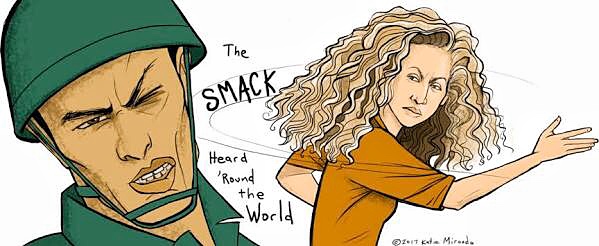
Indomitable ninety-four year old Uri Avnery is an Israeli writer, founder of the Gush Shalom peace movement, veteran of Israel’s Independence War, and former member of the Knesset. He has written a weekly column for Gush Shalom since 1993. I republish his latest in In That Howling Infinite as a reminder that the world looks different from the other side of the wire.

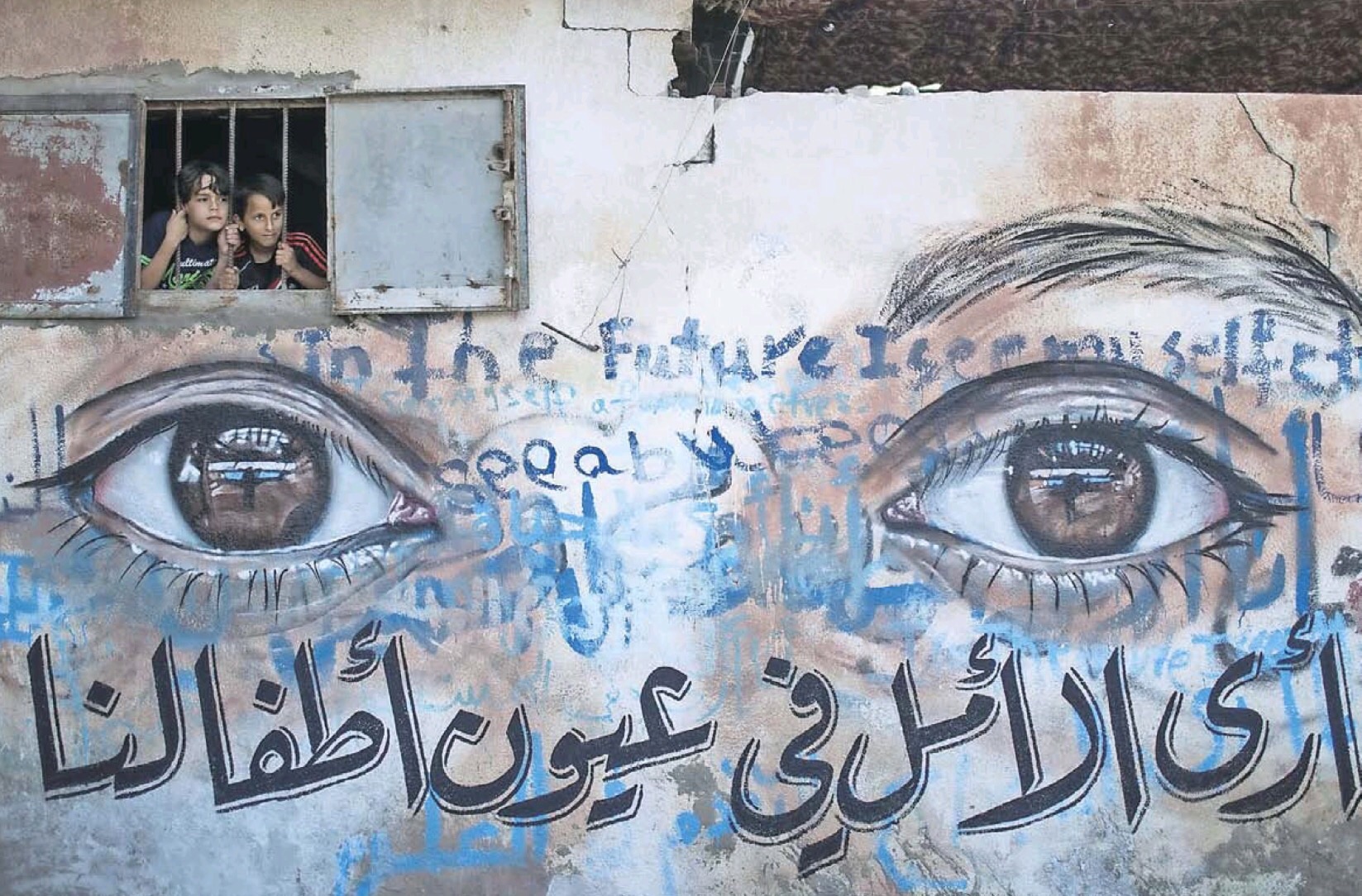
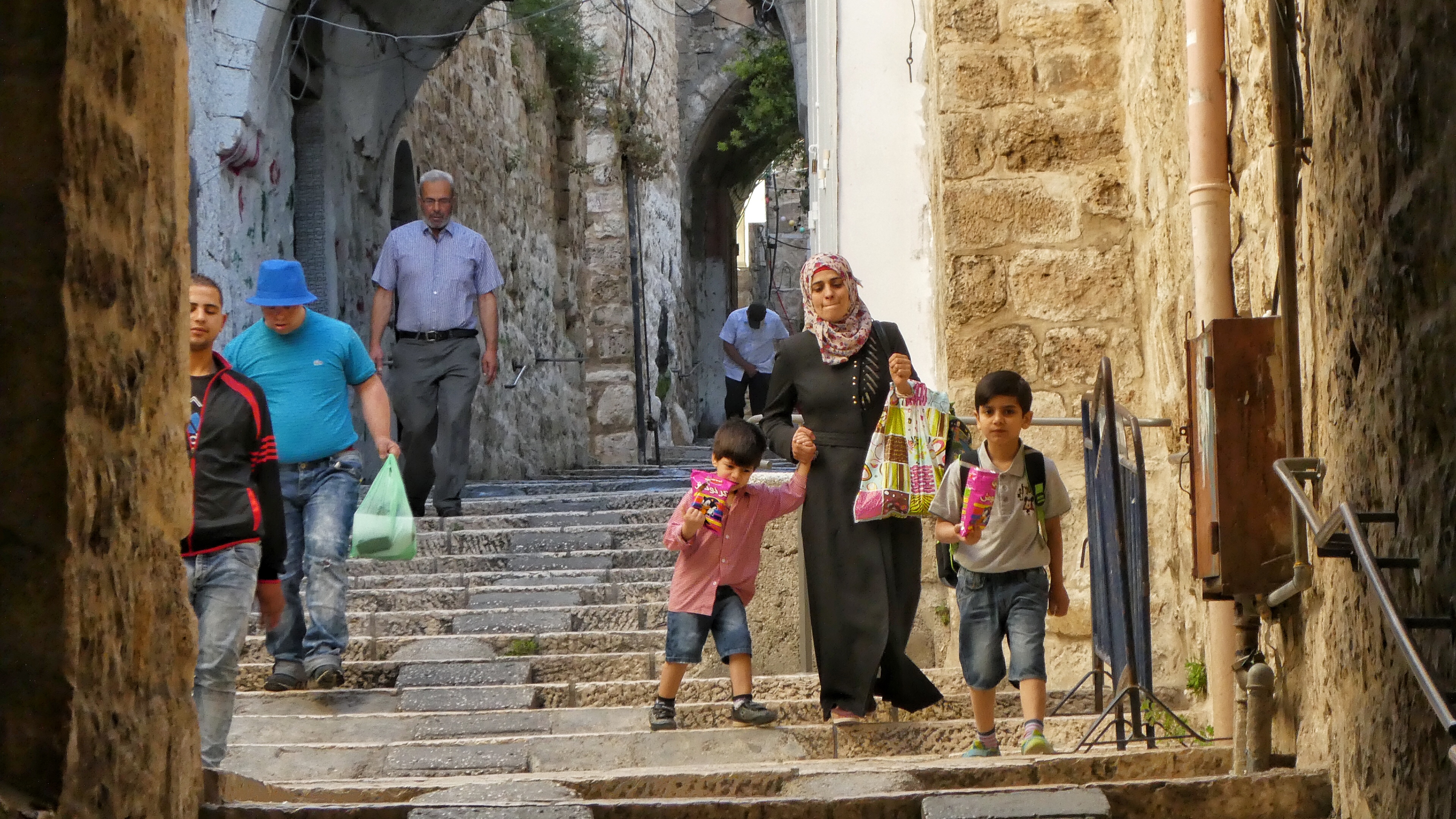
The Arabic in the featured picture says: “View Us Through the Eyes of Our Children”.

See also, my Facing the Fear of the Other, and Children of Abraham

For more posts on Jerusalem, Israel and the Middle East, visit:
https://m.facebook.com/HowlingInfinite/
https://m.facebook.com/hf1983/

A Tale of Two Stories

Uri Avnery, September 29, 2017

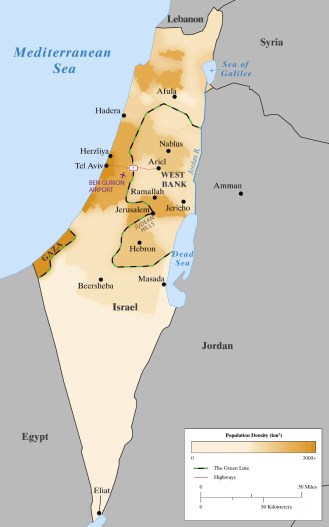
This is the story: at 7 o’clock in the morning, an Arab approaches the gate of Har Adar, a settlement close to the Green Line near the Israeli-Arab village of Abu Ghosh.

The man is a “good Arab”. A good Arab with a work permit in the settlement. He lives in the nearby West Bank Arab village of Beit Surik. He received a work permit there because he fits all the criteria – he is 37 years old, married and father of four children. The inhabitants of Har Adar know him well, because he has been cleaning their homes for years.

This Tuesday morning he arrived at the gate as usual. But something aroused suspicion among the guards.. He was wearing a jacket, though the weather was quite hot on this early autumn day. The guards asked him to remove his jacket.

Instead, the man took out a loaded pistol and shot three of the guards in the head at close range – two civilian guards and a member of the semi-military Border Guards. Two of the victims were Arabs (one of them a Druze) and one was a Jew. Another Jew, the local commander of the guards, was severely wounded. Since the assailant had never received military training, the precision of his shots was astounding. The pistol had been stolen 15 years ago.

All Israel was shocked. How could this happen? A good Arab like this? An Arab with permits? Why would he do such a thing in a place where he was well liked and well treated? Where he played with the children? And that after he was thoroughly vetted by the Security Service, which has innumerable Arab spies and is considered well-nigh infallible?

Something extraordinary must have happened. Someone must have incited him against the Jews and the nice people of Har Adar, who had treated him so well. Perhaps the UN speech by Mahmoud Abbas. Or perhaps some secret contacts with Hamas. “Incitement!” cried Binyamin Netanyahu.

But then another fact emerged, which explained everything. The man had quarreled with his wife. He had beaten her up, and she had escaped to her family in Jordan, leaving the four children behind.

So, obviously, he had become temporarily unhinged. In a state of mental derangement he had forgotten the kindness of the Har Adar people. Just a unique case, that need not trouble us further.

But it all shows that you can’t trust the Arabs. They are a bunch of murderers. You cannot make peace with them until they change completely. So we must keep the occupied territories.

THAT IS the story. But there is another story, too. The story as seen by the man himself.

From his home in neighboring Beit Surik, the man – whose name was, by the way, Nimr (“leopard”) Mahmoud Ahmed al-Jamal – could see Har Adar from his home every day when he woke up. For him, as for every Arab, it was a flourishing Jewish settlement, built on expropriated Arab land. Like his own village, it belonged to the Palestinian West Bank which is occupied territory.

He had to get up in the darkness of the night in order to get to Har Adar on time – 7.00 o’clock in the morning – and work hard until late in the night, arriving home at about 10 o’clock. This is the lot of tens of thousands of Arab laborers. They may look friendly, especially when their livelihood depends on it. They may even be really friendly to benevolent masters. But deep in their hearts they cannot forget for a moment that they are cleaning the toilets of the Jews who came to Arab Palestine and occupied their homeland.

Since most of the agricultural land of their villages has been expropriated for Jewish settlements, they have no choice but to work in these low-status jobs. There is no industry to speak of in the West Bank. Wages are minimal, often below the legal minimum wage in Israel proper (some 1500 dollars per month). Since they have no choice, they are not far from being slaves. Like the nice slaves in “Gone with the Wind”.

Such a man may be at peace with this reality, but if something bad happens, he may suddenly become upset with his status and decide to become a martyr. Nimr left behind a letter in which he defended his wife and absolved her from any responsibility for the deed he had planned for the next day.

So these are the two stories, which have very little in common.

The people of Har Adar are completely shocked. Since they live 20 minutes drive from Jerusalem, they do not consider themselves settlers at all, but Israelis like any other. They don’t really see the Arabs all around them as people like themselves, but as primitive natives.

The Har Adar people are not like the fanatical, religious and nearly fascist people in some settlements. Far from it. Har Adar people vote for all parties, including Meretz, the left-wing Zionist party which advocates the return of the occupied territories to the Palestinians. This is not seen as including Har Adar, of course, since there is a consensus among Zionists, right and left, that the settlements close to the Green Line should be annexed to Israel.

Har Adar people can rightly be proud of their achievements. From the air, the place looks very orderly. It has 3858 inhabitants. Their average income is about 5000 dollars a month, well over the national Israeli average (some 3000 dollars). Their local council is the third most efficient in the entire country.

Located in the mountainous area around Jerusalem, it has a beautiful landscape. It also has man-made amenities: a library, a youth club, a skate-park and an amphitheater that seats 720 people. Even for an average Israeli, this is paradise. For the Arabs around, who cannot enter without a special permit, it is a perpetual reminder of their national disaster.

Of course, like other settlements, Har Adar is not located on land that was empty. It occupies the location on which stood a village called Hirbat Nijam, a village which already stood there in Persian-Hellenistic times, some 2500 years ago. Like most Palestinian villages, they were Canaanite, then Judean, then Hellenist, then Byzantine, then Muslim, then crusader, then Mameluk, then Ottoman, then Palestinian – without the population ever changing. Until 1967.

WHEN NIMR was born, all this long history was long forgotten. What remained was the reality of the Israeli occupation.

This now looks like the normal state of things. The members of Har Adar are happy, feeling secure and well guarded by the efficient Security Service, the Border Guard and local mercenaries, mostly Arab citizens of Israel. Neighbors like Nimr seem content, and probably are, if they are lucky enough to have a job and a work permit, even with pitiful wages. The historical grudge lies deeply buried within their consciousness.

And then something happens, something that may be quite irrelevant – like the escape of his wife to Jordan – to bring it all up. Nimr the lowly laborer suddenly becomes Nimr the freedom-fighter, Nimr the martyr on his way to paradise. All his village respects his sacrifice and his family.

Israelis are furious that the families of “martyrs” are paid an allowance by the Palestinian Authority. Binyamin Netanyahu accuses Mahmoud Abbas (Abu Mazen) of incitement to murder with these payments. But it is quite impossible for Abbas to annul them – the outrage reaction of his people would be tremendous. Martyrs are holy, their families respected.

THE DAY after Nimr’s dastardly terrorist act and/or heroic martyrdom, a grandiose national ceremony took place in another settlement.

All the country’s major dignitaries, led by the President and the Prime Minister, assembled to commemorate the 50tth anniversary of “our return to our homeland, Judea and Samaria, the Jordan Valley and the Golan Heights”.

Missing in the list is the Gaza Strip, which Israel has evacuated, leaving behind a tight land and sea blockade aided by Egypt. In the Strip there are about two million Palestinians. Who the hell wants them?

All hell broke loose when the President of the Supreme Court, who was supposed to send a judge to represent the court at this ceremony, canceled his attendance because of the highly propagandist style of the event. She decided that this is party propaganda, in which her court would not take part.

Altogether not a day of quiet in this country, a state without borders and without a constitution, where every story has two totally different sides, where nice and quiet people suddenly become raging martyrs.

There will be no quiet until there is peace, with each of the two peoples living in their own state, a situation where real friendship has a chance of blooming.

Deconstructing Dunkirk

During the closing scenes of The Man Who Shot Liberty Valance, the journalist says: “This is the West, sir. When the legend becomes fact, print the legend”.

Acclaimed British historian Max Hastings examines the reality of the events behind Christopher Nolan’s blockbuster whilst pricking the illusions and delusions of the Brexit balloon. “The irony…is that Churchill himself never saw anything in the least glorious about standing alone”. “Wars” said Winston, “are not won by evacuations”.

“After Brexit takes place I fear that this time around we shall be unable to rely upon the Russians to stage a grand diversion in the East to spare us from the hideous economic, social, cultural, and political consequences of attempting to fight on alone, without the impeccable justification that Hitler has forced such a course upon us”.

Whilst these are Hasting’s principal themes, he also demolishes a couple of common misconceptions. Firstly, the Dunkirk “miracle”, impressive as it was, was not the only major evacuation that harrowing summer. A few weeks later, “some 144,000 British troops, together with 24,352 Poles and 42,000 other Allied soldiers, were brought to England. Only historians are much aware of this “second Dunkirk”. Secondly, soldiers on the beach and commentaries thereafter talk of how the “bloody RAF!” was nowhere to be seen in the skies above Dunkirk. Recent archival research how shown that the RAF was indeed active in the hinterland, suffering heavy losses as it fought to prevent reinforcements and materiel reaching the Wehrmacht and and as it attacked the Luftwaffe before it hit the beaches.

During early 2018, I posted the following on the In That Howling Infinite Facebook page in response to an article in The Independent:

Once more into the breach…on Belgian beaches and parliamentary benches

This article, like many of its recent ilk, is bound to a create a furore among the “make Britain great again” brigade (I loved the Katie Hopkins connection…)
I recently watched Dunkirk and Darkest Hour to back, and they made curiously compelling companions. The best thing about Darkest Hour was Gary Oldman’s  portrayal of Winston, and his delivery of the famous speeches (and I could happily watch loyal stenographer Lily James typing out menus all day long – she gave us a luminous Natasha in the Beeb’s recent and eminently bodacious War and Peace).
Dunkirk was harrowing for its portrayal of the chaos aboard the sinking hospital ship and the other doomed rescue ships, and for the chaos and confusion in the cockpits of the spitfires (is there anything Mad Max Tom Hardy isn’t in these days?)
But both films were quite corny and cartoonish in their representation of the “bulldog spirit” of the brave, plucky , and yes, white Englanders (Kenneth Branagh at his Shakespearean best, and Mark Rylance channeling Foyle’s War – there was, however, a token black chap with a small speaking role during Winston’s apocryphal trip on the London Underground – “Yes, Mister Churchill, we shall never surrender!”; and there was a single Frenchie on the beach, although he was nefariously disguised as a Brit and was outed immediately prior to his  demise – played by Aneurin Barnard, another refugee from War and Peace, but being shell-shocked,incognito, or both, didn’t say a word). And apart from the speeches in Darkest Hour, the script in both films was hamfistedly cliched and clunky, and not much different from a Monty Python movie – or those patriotic Ealing Studios English war films.
Which might, of course, have been the intention.These two films and other nostalgia fests like the Crown and Victoria and Albert are quite in keeping with those Ealing films of old with their high production values, great actors like John Mills and Alec Guinness, stirring music in the Vaughn Williams vein, and hammy but patriotic scripts that were in their day Great Britishly politically correct.

For more posts by In That Howling Infinite, visit:
https://m.facebook.com/HowlingInfinite/
https://m.facebook.com/hf1983/

Splendid Isolation
Max Hastings, New York Review of Books, October 12 2017

Christopher Nolan’s epic movie about the rescue of the British army from the beaches of northeastern France in May 1940 has become a worldwide box office success. This is splendid news for its makers, and can do no harm to American, Taiwanese, or for that matter Rajput audiences. In the eyes of some of us, however, its impact upon the British people is calamitous at this moment in our fortunes.

Dunkirk contains no foreigners except a few understandably grumpy French soldiers. It is a British tale that feeds the myth that has brought Churchill’s nation to the cliff edge of departure from the European Union: there is splendor in being alone. This was most vividly expressed at the time by King George VI, who wrote to his mother: “Personally I feel happier now that we have no allies to be polite to & pamper.” One of the British officers who escaped with his battalion via the beaches greeted news that the French had surrendered on June 17 by exulting mindlessly to his comrades in the mess: “Thank heavens they have, now at last we can get on with the war.”

Michael Korda, for decades a celebrated New York publisher, was born in Britain in 1933; his father was Vincent Korda, one of three Hungarian-born brothers who were cinema wizards of their day. Now he offers two books for the price of one, interweaving a historical narrative of the events of 1939–1940, climaxing with Dunkirk, and a succession of vivid fragments of autobiography. He describes the flow of Jewish refugees through the North London homes of his childhood: “They had the haunted look of people who have just witnessed a bad accident, people with aggressive charm and formal manners who had grown up with the Kordas in Túrkeve, or had been to university in Budapest with Alex, or loaned him money, or worked with my father on film sets in Vienna, Paris or Berlin.”

Vacationing in France in the summer of 1939, as the world tumbled toward catastrophe, he recalls his actress mother constantly reprising the comic hit song of the day “Tout va très bien, Madame La Marquise,” which tells of an aristocratic woman on holiday who calls home to check that all is well and hears from her servants of one catastrophe after another, each described as “a little incident, a nothing,” culminating in the suicide of her husband and the incineration of her château. Korda writes: “Even as a boy of six, I observed that everybody in France talked about la ligne Maginot reverentially as if it were a holy object.”

He is very funny about his family’s experiences embarking on the film That Hamilton Woman, which eventually became one of Churchill’s favorites: his father, as set designer, failed to grasp that this was a tale of Admiral Nelson. Supposing it to be about General Wellington, he began to create a backdrop for the Duchess of Richmond’s ball in Brussels before Waterloo.

Once the European struggle began in earnest with the launch of Hitler’s blitzkrieg, Korda writes, “my mother, when she thought about the war at all, had the cheerful conviction that everything would work out well in the end because it always had for Britain, except for the war against the American colonies, and that was too long ago to matter.” He discerns among Britain’s modern Brexiters the mood that he himself witnessed after Dunkirk.

This comparison seems valid. Boris Johnson, Liam Fox, Michael Gove, David Davis, Iain Duncan Smith, Jacob Rees-Mogg, and their misbegotten Tory kin daily assure the British people that once we have cast off the shackles that bind us to Europe, caravels laden with the spoils of free trade will bring gold, frankincense, and myrrh to our island; as an added bonus, the sun will shine every day. Watching Dunkirk, I half-expected Foreign Secretary Johnson to appear in lieu of Winston Churchill, promising to hurl back the Hunnish hordes led by Angela Merkel, and to show no mercy to such knock-kneed Pétainistes as France’s Emmanuel Macron.

The irony, of course, is that Churchill himself never saw anything in the least glorious about standing alone. In May and June 1940 he moved heaven and earth—even fantastically offering Paul Reynaud’s government political union with Britain—to persuade France to stay in the war rather than sign an armistice. When the Nazis invaded Russia in June 1941, Churchill embraced the tyranny of Stalin, morally hard to distinguish from that of Hitler, and greeted the Russians as comrades in arms. The foremost objective of his premiership was to woo the United States into belligerence.

No man understood better than Churchill that while Britain might somehow avert defeat, without fighting alongside friends it could not conceivably aspire to victory. Only necessity and a supremely courageous willingness to defy reason, which many British politicians and generals felt unable to share, caused him in June 1940 to proclaim his country’s determination to fight to the last.

Our most eminent living historian, Sir Michael Howard, who lived through that era relatively early in his ninety-four years, observed to me recently: “The great lesson of my lifetime is that all difficult problems and challenges are best addressed with partners and allies.” This is the wisdom that the modern Brexiters seek to trample. They find the “Dunkirk spirit” refreshingly bracing, which Churchill certainly did not. “I cannot say that I have enjoyed being Prime Minister v[er]y much so far,” he wrote wryly on June 4, 1940, to one of his predecessors, Stanley Baldwin.


And so to the Nolan film. It possesses many of the virtues and vices of Steven Spielberg’s epics, wrapped in a Union flag instead of the Stars and Stripes. It looks terrific, though it is noisier than any battle I have ever attended. It contains some adequate acting, reminiscent of the silent movie era, because the stars deliver few coherent lines, being merely required to look staunch, stressed, and indomitable at appropriate moments.

The film opens with unseen Germans firing on a group of British soldiers in the deserted streets of Dunkirk, killing all but one, Tommy (Fionn Whitehead), whose experiences during the ensuing week, on the beaches and offshore, form a principal theme of what follows. At intervals between being bombed and strafed by the Luftwaffe, Tommy and various companions board ships in hopes of escape, only to find each in turn stricken. Nolan offers some extraordinary sinking scenes: Tommy’s escapes make Leonardo DiCaprio’s misfortunes aboard the Titanic seem tame stuff.

Meanwhile the Royal Navy has commandeered a host of small boats from the harbors of the South Coast and dispatched them to aid the evacuation. One boat owner, named Dawson (Mark Rylance), sets forth with his teenage son, Peter (Tom Glynn-Carney), and a young helper named George (Barry Keoghan). Their first encounter with the war comes when they rescue a traumatized soldier (Cillian Murphy) from a floating hulk. He is so appalled on finding that they are heading for Dunkirk, from which he has just escaped, that he tries to seize control of the boat, hurling George onto a ladder below, which his head strikes with fatal effect—a mawkish moment.

Meanwhile in the air, there are spectacular scenes as three Spitfires duel with the Luftwaffe over the Channel. One RAF pilot (Jack Lowden) ditches in the sea, from which he is rescued by Dawson and his son. As they then approach the beaches amid a throng of such craft, a colonel on the Dunkirk mole (an old term for a pier or jetty) asks the Royal Navy’s Commander Bolton (Kenneth Branagh) what the boats mean. Branagh offers a performance as the elegant, unruffled naval officer that Noël Coward—who played Captain Kinross, based on Lord Mountbatten, in that notable wartime weepie In Which We Serve—might identify with. Bolton answers the colonel laconically: “Hope.” In the cinema where I saw the film, at that moment the audience burst into applause.

The small boats, including Dawson’s, load up with soldiers amid worsening perils—oil from a sunken minesweeper blazes on the water—before setting course for home and a heroes’ welcome. Commander Bolton gallantly lingers on the mole to ensure that some French soldiers can also get away. He remarks wryly that it has been not a bad fortnight’s work to rescue 338,000 British, French, and Belgian troops, when at the outset it was thought that no more than 30,000 could be taken off. Back home, the rescued Tommy reads in a newspaper Churchill’s heroic words to the nation, concluding with the vow that Britain will never surrender.

Most of us would agree that no work of art, whether novel, play, or film, has a responsibility to represent history accurately, any more than Shakespeare did, or David Lean’s Lawrence of Arabia. Spielberg’s Saving Private Ryan opens with a thirty-minute portrayal of the 1944 D-Day landings that is as vivid and realistic as anything we are ever likely to see on screen. Thereafter, however, that film deteriorates into routine Superman stuff that bears no relationship to anything that happened to US soldiers in Normandy. The mini-series Band of Brothers is a superb piece of filmmaking, probably the best ever made about Americans in World War II, but it is suffused with the romanticism that colors all of Spielberg’s work as well as much of that of Stephen Ambrose, who wrote the book from which it derives.

Nonetheless, for the record, we shall consider how far Nolan’s film tells the Dunkirk story like it was. There is no historical background to explain why the British army found itself on the beaches. On May 10, 1940, Hitler invaded France and the Low Countries. The British army, together with a substantial French force, promptly hastened north into Belgium, expecting the Germans to reprise their 1914 Schlieffen offensive.

Instead, however, in fulfillment of the only authentic personal inspiration of Hitler’s career as a warlord, the Wehrmacht’s main thrust pushed through the Ardennes, meeting the French army where it was weakest and bursting across the Meuse. The British found themselves falling back, fighting desultory actions but chiefly making haste to avoid encirclement. When the panzers reached the Channel coast, cutting off the British, the Belgians, and the French Seventh Army from the bulk of France’s forces further south, evacuation became the only plausible, though immensely difficult, option.

The first miracle of Dunkirk was that the German army scarcely interfered with the evacuation, partly because Hermann Goering assured Hitler that the Luftwaffe could dispose of the British, and partly because Churchill’s contingent was marginal alongside the forty-three divisions of the French army still in the field further south. There was no ground fighting in the town or port, so Nolan’s opening scene is spurious.

In the film, all the big ships seeking to rescue troops are sunk in dramatic circumstances, leaving small craft to do the business. This is a travesty. The Royal Navy sent thirty-nine destroyers to Dunkirk, of which only six were sunk, although many were damaged. Two thirds of all the men brought home sailed in big ships, notably including the destroyers, just one third in smaller ones.

The film shows air battles low over the Channel, whereas many soldiers came home full of bitterness toward the RAF because they never saw its aircraft: combat took place thousands of feet above, invisible to those on the ground or at sea. On the British side, it was dominated by Hurricanes, not Spitfires. Nolan shows a fighter floating for some minutes after ditching, whereas the huge Rolls-Royce Merlin engine in its nose would have sent the plane plunging to the bottom within seconds.

The character of Dawson may owe something to Charles Lightoller, a former officer on the Titanic who at the age of sixty-six took his boat Sundowner to Dunkirk, accompanied by his son and a friend, and brought home 120 men. Commander Bolton’s role at Dunkirk was fulfilled in reality by Captain Bill Tennant, who did a superb job as senior naval officer. Oddly enough Tennant, as evidenced by his diary, later became a bitter critic of Churchill’s war leadership.

Onscreen, endless British soldiers perish. Michael Korda suggests that the British army’s rate of loss was “comparable to that in the bloodiest battles of the First World War or the American Civil War, and an indication of just how hard the fighting was.” Yet what was remarkable about the real event was how few men died. In the entire May–June 1940 campaign, including Dunkirk and later episodes, just 11,000 British troops were killed, compared with at least 50,000 French dead.

A further 41,000 British troops were taken prisoner by the Germans, but alongside the 193,000 brought home, the “butcher’s bill” was small. General Sir Harold Alexander, who commanded the rear guard, told Anthony Eden on his return: “We were not hard pressed, you know.” This remark is sometimes cited as an example of his bent for heroic understatement, but was no more than the truth.

Cinema audiences are left to assume that after Dunkirk, the British sat down on their island and prepared to resist the Nazis on the beaches. In truth, in one of Churchill’s more spectacular follies, he promptly insisted upon dispatching another two divisions, one of them newly arrived Canadians, to Normandy and Brittany to show the French government and people that Britain remained committed to fight on at their side.

His chief of staff, Major General “Pug” Ismay, gently suggested to the prime minister that it might be wise for these troops to proceed slowly toward France, since it was obviously doomed. “Certainly not,” replied Churchill angrily. “It would look very bad in history if we were to do any such thing.” Few great actors on the stage of world affairs have been so mindful of the verdict of future generations. On June 13, four days before the French surrender and nine days after the Dunkirk evacuation ended, British soldiers were still landing at Breton ports.

By yet another miracle, within days of arrival in France their commander, Lieutenant General Sir Alan Brooke, persuaded Churchill that they must come home. This time there were no beaches—they embarked through the ports. Many prisoners, tanks, and vehicles, including the entire 51st Highland Division, fell into German hands and there was a spectacular disaster when the liner Lancastria, carrying over three thousand men, was sunk by air attack.

But thanks to Brooke, the prime minister was spared from evil consequences of his reckless gesture. Some 144,000 British troops, together with 24,352 Poles and 42,000 other Allied soldiers, were brought to England. Only historians are much aware of this “second Dunkirk,” and it seems ill-natured to make much of the fact that of 100,000 French soldiers brought to Britain, even De Gaulle at his most sanguine admitted that only one third agreed to serve with his newly created Free French forces, while the remainder preferred repatriation to France.

As for the British people, for the rest of 1940—the mood turned sourer in the following year—they did indeed display a stoicism and even euphoria as irrational as today’s Brexiter exultation. The MP Harold Nicolson wrote in his diary on June 15:

My reason tells me that it will now be almost impossible to beat the Germans, and that the probability is that France will surrender and that we shall be bombed and invaded…. Yet these probabilities do not fill me with despair. I seem to be impervious both to pleasure and pain. For the moment we are all anaesthetised.

The writer Peter Fleming, then an army staff officer, wrote in a similar vein: “It was as though the whole country had been invited to a fancy-dress ball and everybody was asking everybody else “What are you going as?” A latent incredulity [gave]…problems connected with invasion the status of engrossing digressions from the main business of life…. The British, when their ally was pole-axed on their doorstep, became both gayer and more serene than they had been at any time since the overture to Munich struck up in 1937.

Among countless reasons for revering Churchill’s performance in 1940 is that he himself never for a moment succumbed to such silliness. Though he justly described Dunkirk as a deliverance, he also warned the House of Commons and the nation that “wars are not won by evacuations.” He knew that while the men had been brought home, almost all their weapons and equipment had been lost: the British army was effectively disarmed.

Thereafter he and his nation set the world a magnificent example of defiance. But it was an impotent defiance, from which both Britain and democracy were redeemed only by the belated arrival of allies. It was 1944 before Churchill’s soldiers, aided by huge infusions of American men, matériel, and especially tanks, were fit to face a major European battlefield.

In the intervening four years, relatively tiny British forces fought the Germans in North Africa and Italy, and a large imperial army surrendered to the Japanese at Singapore in February 1942. Contrary to persisting British delusions, Hitler’s enmity and ambitions always focused on the East. Because of his invasion of Russia, the British and later the Americans were granted the priceless luxury of being able to prepare at leisure for the belated June 1944 liberation of northwest Europe: the band of brothers of the US 101st Airborne Division, for instance, spent almost two years in uniform before hearing a shot fired in anger.

Michael Korda suggests that thanks to the final triumph in 1945, “Dunkirk was, and remains, perhaps the greatest British victory of World War Two, that rarest of historical events—a military defeat with a happy ending.” This assertion stretches a very large point, not least because Churchill himself regarded the outcome of World War II as anything but happy, since Britain’s voice in the world, not to mention his own, had become so much diminished.

It would be unreasonable to demand that Christopher Nolan should have injected more than a fraction of these realities into his Dunkirk. The most absurd assaults on the film come from India, where critics complain that he does not feature the two companies of Indian service troops who were present on the beaches. This is comparable to the British wailing when Saving Private Ryan appeared that their soldiers were absent without leave from the screen. I wrote at the time that if any nation wants its part in any conflict glorified, it must make the films for itself.

Nolan seems to deserve congratulations for declining to include even a token American, for decades a prerequisite for securing a US audience for a British war movie. Indeed, this imperative so intimidated many British directors and their screenwriters that gallant American characters were often depicted showing the stupid English how battles should be fought.

This latest epic represents a version of history little worse than The Longest Day, A Bridge Too Far, or The Guns of Navarone. Some of us are grateful that so many schoolchildren are going to see it, because they will at least discover that in 1940 there were beaches, the rescue of an army, and sacrifice and considerable fortitude by their forefathers. Britain’s grown-ups, however, should have been forcibly denied entrance to cinemas at this moment when we are threatened with embarkation upon one of the most self-indulgent, willfully foolish acts of self-harm in the nation’s history.

For all the charm of Michael Korda’s personal reminiscence of 1939–1940, he is on much less sure ground in his narrative of the big events, partly because he is obviously a romantic, and partly because he relies heavily on elderly sources, including the British official history of the campaign in France, much of which is tosh. He is surely right, however, to conclude his book by comparing the emotions of the modern Brexiters with those of the British in June 1940: “There was a national sense of relief…at leaving the Continent and withdrawing behind the White Cliffs of Dover.” After Brexit takes place I fear that this time around we shall be unable to rely upon the Russians to stage a grand diversion in the East to spare us from the hideous economic, social, cultural, and political consequences of attempting to fight on alone, without the impeccable justification that Hitler has forced such a course upon us.


Weighing the White Man’s Burden

By all ye cry or whisper,
By all ye leave or do,
The silent sullen peoples
Shall weigh your Gods and you.
Rudyard Kipling

And where the crazy whiteman
And his teargas happiness
Lies dead and long since buried
By his own fantastic mess
Roy Harper

As a young lad in Birmingham, my school chums and I would be enthralled by a world map covered in red – the empire upon which the sun never set. As Britain turns its back on Europe, it would seem that quite a few folk are still enamoured of the defunct Imperium. A 2014 YouGov opinion poll that found 59% British people polled believed the old British Empire was something to be proud of. 34% wished they still had one.

Back in the day, we’d do school projects about cocoa cultivation on the Gold Coast (now Ghana, not our Australian schoolies’ mecca), rubber trees in Malaya and East Africa, and tea plantations in Assam and Ceylon – enhanced by attractive, child-friendly posters and other educational aids provided gratis by the likes of Cadbury, Dunlop and Typhoo. That these household names had factories in our industrial ‘second city’ which encouraged school outings rendered the wonders of empire all the more tangible.

In the Britain of my childhood, the “silent sullen peoples” of Rudyard Kipling’s famous poem were beginning to “colour-up” (pun quite intended) our monochrome, white-bread, demographic cityscape. The bleak and bland streets and suburbs of our English and Irish Birmingham were already rocking with new sounds and flavours, from the ska and reggae beats of Sparkhill to the spicy aromas of Balsall Heath and Alum Rock. There was prejudice, there was discrimination, there was at times violence, but as Britain emerged from the austerity of the war years, as the bombed cities were rebuilt, and a resuscitated economy created a consumer society, labour shortages persuaded politicians to facilitate mass immigration from the empire – and particularly, from the West Indies and the Indian subcontinent

Words like imperialism and colonialism, economics and exploitation, were yet to enter our vocabularies. The colonies and dependencies spread across all continents, and the ‘grown-up’ white ‘commonwealths’ and ‘dominions’ like Australia, New Zealand, Canada, South Africa, and Rhodesia, were the friends, partners, and indeed, children of the mother country.

It was, we perceived, in the innocence of youth and the blinkers of our school curricula, a benign and fruitful partnership of mutual benefit to all. “To serve our captives’ need”, we gave them our civilizing, Judeo-Christian, Anglo-Celtic values, our able and empathetic if patronizing and prejudiced administrators, our gallant soldiers, pious pastors, selfless doctors and inspiring teachers. They in return yielded up their natural resources and an abundance of cheap labour, and when the Empire was imperiled, they despatched their young men in their thousands to perish in our wars.

We were not to know that the mournful notes of the Last Post were sounding across a changing post-war world. The Union Jack was was descending on buildings and parade grounds the world over as unfamiliar new flags were raised in their stead. Tired, broke, and damaged Britain was retreating from Empire, as were France and the Netherlands, and a new imperium was rising in the west. Within a decade, India, and Pakistan and Ceylon were joined by Indonesia, and a score of young nations emerged throughout Africa. France fought long and bloody wars in Vietnam and Algeria to cling on to its colonial patrimony, and it too finally let go of its “fluttered folk and wild”.

And we were not to know the reality of Britain’s “mission civilatrice”. From the seventeenth century, the European colonizing powers were enmeshed by trade, greed, and national aggrandizement in what today we would define as “mission creep”. Distant posts morphed over three centuries into vast bureaucracies, mines and plantations that underwrote the North’s industrial and commercial hegemony, and into societies ruled by white, expatriate elites and segregated by class, caste, clan and colour.

How all this played out in The Raj is described in detail by politician and historian Shashi Tharoor in Inglorious Empire: What the British did in India.  This is reproduced below, together with a video, whilst the full Kipling poem, a song by Roy Harper, and a review by Australian author Christopher Kremmer follows.

Read also my earlier posts on India and the passing of Empire:

For more posts by In That Howling Infinite, visit:
https://m.facebook.com/HowlingInfinite/
https://m.facebook.com/hf1983/

But what about the railways…? The myth of Britain’s gifts to India 

Shashi Tharour, The Gusrdian, March 9, 2017

Holding court ... the lieutenant-general of the Punjab takes tea with maharajas and Rajas in 1875.
The lieutenant-general of the Punjab takes tea with maharajas and Rajas in 1875. Photograph: Popperfoto
Many modern apologists for British colonial rule in India no longer contest the basic facts of imperial exploitation and plunder, rapacity and loot, which are too deeply documented to be challengeable. Instead they offer a counter-argument: granted, the British took what they could for 200 years, but didn’t they also leave behind a great deal of lasting benefit? In particular, political unity and democracy, the rule of law, railways, English education, even tea and cricket?

Indeed, the British like to point out that the very idea of “India” as one entity (now three, but one during the British Raj), instead of multiple warring principalities and statelets, is the incontestable contribution of British imperial rule.

Unfortunately for this argument, throughout the history of the subcontinent, there has existed an impulsion for unity. The idea of India is as old as the Vedas, the earliest Hindu scriptures, which describe “Bharatvarsha” as the land between the Himalayas and the seas. If this “sacred geography” is essentially a Hindu idea, Maulana Azad has written of how Indian Muslims, whether Pathans from the north-west or Tamils from the south, were all seen by Arabs as “Hindis”, hailing from a recognisable civilisational space. Numerous Indian rulers had sought to unite the territory, with the Mauryas (three centuries before Christ) and the Mughals coming the closest by ruling almost 90% of the subcontinent. Had the British not completed the job, there is little doubt that some Indian ruler, emulating his forerunners, would have done so.

Divide and rule ... an English dignitary rides in an Indian procession, c1754. Photograph: Universal History Archive/Getty Images
 Divide and rule … an English dignitary rides in an Indian procession, c1754. Photograph: Universal History Archive/Getty Images

Far from crediting Britain for India’s unity and enduring parliamentary democracy, the facts point clearly to policies that undermined it – the dismantling of existing political institutions, the fomenting of communal division and systematic political discrimination with a view to maintaining British domination.

Since the British came from a hierarchical society with an entrenched class system, they instinctively looked for a similar one in India. The effort to understand ethnic, religious, sectarian and caste differences among Britain’s subjects inevitably became an exercise in defining, dividing and perpetuating these differences. Thus colonial administrators regularly wrote reports and conducted censuses that classified Indians in ever-more bewilderingly narrow terms, based on their language, religion, sect, caste, sub-caste, ethnicity and skin colour. Not only were ideas of community reified, but also entire new communities were created by people who had not consciously thought of themselves as particularly different from others around them.

Large-scale conflicts between Hindus and Muslims (religiously defined), only began under colonial rule; many other kinds of social strife were labelled as religious due to the colonists’ orientalist assumption that religion was the fundamental division in Indian society.

Muslim refugees cram aboard a train during the partition conflict in 1947 ... the railways were first conceived by the East India Company for its own benefit. Photograph: AP
Muslim refugees cram aboard a train during the partition conflict in 1947 … the railways were first conceived by the East India Company for its own benefit. Photograph: AP


It is questionable whether a totalising Hindu or Muslim identity existed in any meaningful sense in India before the 19th century. Yet the creation and perpetuation of Hindu–Muslim antagonism was the most significant accomplishment of British imperial policy: the project of divide et impera would reach its culmination in the collapse of British authority in 1947. Partition left behind a million dead, 13 million displaced, billions of rupees of property destroyed, and the flames of communal hatred blazing hotly across the ravaged land. No greater indictment of the failures of British rule in India can be found than the tragic manner of its ending.

Nor did Britain work to promote democratic institutions under imperial rule, as it liked to pretend. Instead of building self-government from the village level up, the East India Company destroyed what existed. The British ran government, tax collection, and administered what passed for justice. Indians were excluded from all of these functions. When the crown eventually took charge of the country, it devolved smidgens of government authority, from the top, to unelected provincial and central “legislative” councils whose members represented a tiny educated elite, had no accountability to the masses, passed no meaningful legislation, exercised no real power and satisfied themselves they had been consulted by the government even if they took no actual decisions.

As late as 1920, under the Montagu-Chelmsford “reforms”, Indian representatives on the councils – elected by a franchise so restricted and selective that only one in 250 Indians had the right to vote – would exercise control over subjects the British did not care about, like education and health, while real power, including taxation, law and order and the authority to nullify any vote by the Indian legislators, would rest with the British governor of the provinces.

Democracy, in other words, had to be prised from the reluctant grasp of the British by Indian nationalists. It is a bit rich to oppress, torture, imprison, enslave, deport and proscribe a people for 200 years, and then take credit for the fact that they are democratic at the end of it.

A corollary of the argument that Britain gave India political unity and democracy is that it established the rule of law in the country. This was, in many ways, central to the British self-conception of imperial purpose; Kipling, that flatulent voice of Victorian imperialism, would wax eloquent on the noble duty to bring law to those without it. But British law had to be imposed upon an older and more complex civilisation with its own legal culture, and the British used coercion and cruelty to get their way. And in the colonial era, the rule of law was not exactly impartial.

Crimes committed by whites against Indians attracted minimal punishment; an Englishmen who shot dead his Indian servant got six months’ jail time and a modest fine (then about 100 rupees), while an Indian convicted of attempted rape against an Englishwoman was sentenced to 20 years of rigorous imprisonment. In the entire two centuries of British rule, only three cases can be found of Englishmen executed for murdering Indians, while the murders of thousands more at British hands went unpunished.

The death of an Indian at British hands was always an accident, and that of a Briton because of an Indian’s actions always a capital crime. When a British master kicked an Indian servant in the stomach – a not uncommon form of conduct in those days – the Indian’s resultant death from a ruptured spleen would be blamed on his having an enlarged spleen as a result of malaria. Punch wrote an entire ode to The Stout British Boot as the favoured instrument of keeping the natives in order.

Political dissidence was legally repressed through various acts, including a sedition law far more rigorous than its British equivalent. The penal code contained 49 articles on crimes relating to dissent against the state (and only 11 on crimes involving death).

Rudyard Kipling, ‘that flatulent voice of Victorian imperialism would wax eloquent on the noble duty to bring law to those without it’. Photograph: Culture Club/Getty Images


Of course the British did give India the English language, the benefits of which persist to this day. Or did they? The English language was not a deliberate gift to India, but again an instrument of colonialism, imparted to Indians only to facilitate the tasks of the English. In his notorious 1835 Minute on Education, Lord Macaulay articulated the classic reason for teaching English, but only to a small minority of Indians: “We must do our best to form a class who may be interpreters between us and the millions whom we govern; a class of persons, Indians in blood and colour, but English in taste, in opinions, in morals and in intellect.”

The language was taught to a few to serve as intermediaries between the rulers and the ruled. The British had no desire to educate the Indian masses, nor were they willing to budget for such an expense. That Indians seized the English language and turned it into an instrument for our own liberation – using it to express nationalist sentiments against the British – was to their credit, not by British design.

The construction of the Indian Railways is often pointed to by apologists for empire as one of the ways in which British colonialism benefited the subcontinent, ignoring the obvious fact that many countries also built railways without having to go to the trouble and expense of being colonised to do so. But the facts are even more damning.

The railways were first conceived of by the East India Company, like everything else in that firm’s calculations, for its own benefit. Governor General Lord Hardinge argued in 1843 that the railways would be beneficial “to the commerce, government and military control of the country”. In their very conception and construction, the Indian railways were a colonial scam. British shareholders made absurd amounts of money by investing in the railways, where the government guaranteed returns double those of government stocks, paid entirely from Indian, and not British, taxes. It was a splendid racket for Britons, at the expense of the Indian taxpayer.

The railways were intended principally to transport extracted resources – coal, iron ore, cotton and so on – to ports for the British to ship home to use in their factories. The movement of people was incidental, except when it served colonial interests; and the third-class compartments, with their wooden benches and total absence of amenities, into which Indians were herded, attracted horrified comment even at the time.

Asserting British rule during the war of independence, also known as the Indian mutiny, 1857. Photograph: Universal History Archive/Getty Images
 Asserting British rule during the war of independence, also known as the Indian mutiny, 1857. Photograph: Universal History Archive/Getty Images


And, of course, racism reigned; though whites-only compartments were soon done away with on grounds of economic viability, Indians found the available affordable space grossly inadequate for their numbers. (A marvellous post-independence cartoon captured the situation perfectly: it showed an overcrowded train, with people hanging off it, clinging to the windows, squatting perilously on the roof, and spilling out of their third-class compartments, while two Britons in sola topis sit in an empty first-class compartment saying to each other, “My dear chap, there’s nobody on this train!”)

Nor were Indians employed in the railways. The prevailing view was that the railways would have to be staffed almost exclusively by Europeans to “protect investments”. This was especially true of signalmen, and those who operated and repaired the steam trains, but the policy was extended to the absurd level that even in the early 20th century all the key employees, from directors of the Railway Board to ticket-collectors, were white men – whose salaries and benefits were also paid at European, not Indian, levels and largely repatriated back to England.

Racism combined with British economic interests to undermine efficiency. The railway workshops in Jamalpur in Bengal and Ajmer in Rajputana were established in 1862 to maintain the trains, but their Indian mechanics became so adept that in 1878 they started designing and building their own locomotives. Their success increasingly alarmed the British, since the Indian locomotives were just as good, and a great deal cheaper, than the British-made ones. In 1912, therefore, the British passed an act of parliament explicitly making it impossible for Indian workshops to design and manufacture locomotives. Between 1854 and 1947, India imported around 14,400 locomotives from England, and another 3,000 from Canada, the US and Germany, but made none in India after 1912. After independence, 35 years later, the old technical knowledge was so completely lost to India that the Indian Railways had to go cap-in-hand to the British to guide them on setting up a locomotive factory in India again. There was, however, a fitting postscript to this saga. The principal technology consultants for Britain’s railways, the London-based Rendel, today rely extensively on Indian technical expertise, provided to them by Rites, a subsidiary of the Indian Railways.

Mother and children ... the British left a society with 16% literacy, a life expectancy of 27 and over 90% living below the poverty line.
The British left a society with 16% literacy, a life expectancy of 27 and over 90% living below the poverty line. Photograph: Bettmann/Bettmann Archive


The process of colonial rule in India meant economic exploitation and ruin to millions, the destruction of thriving industries, the systematic denial of opportunities to compete, the elimination of indigenous institutions of governance, the transformation of lifestyles and patterns of living that had flourished since time immemorial, and the obliteration of the most precious possessions of the colonised, their identities and their self-respect. In 1600, when the East India Company was established, Britain was producing just 1.8% of the world’s GDP, while India was generating some 23% (27% by 1700). By 1940, after nearly two centuries of the Raj, Britain accounted for nearly 10% of world GDP, while India had been reduced to a poor “third-world” country, destitute and starving, a global poster child of poverty and famine. The British left a society with 16% literacy, a life expectancy of 27, practically no domestic industry and over 90% living below what today we would call the poverty line.

The India the British entered was a wealthy, thriving and commercialising society: that was why the East India Company was interested in it in the first place. Far from being backward or underdeveloped, pre-colonial India exported high quality manufactured goods much sought after by Britain’s fashionable society. The British elite wore Indian linen and silks, decorated their homes with Indian chintz and decorative textiles, and craved Indian spices and seasonings. In the 17th and 18th centuries, British shopkeepers tried to pass off shoddy English-made textiles as Indian in order to charge higher prices for them.

The story of India, at different phases of its several-thousand-year-old civilisational history, is replete with great educational institutions, magnificent cities ahead of any conurbations of their time anywhere in the world, pioneering inventions, world-class manufacturing and industry, and abundant prosperity – in short, all the markers of successful modernity today – and there is no earthly reason why this could not again have been the case, if its resources had not been drained away by the British.

If there were positive byproducts for Indians from the institutions the British established and ran in India in their own interests, they were never intended to benefit Indians. Today Indians cannot live without the railways; the Indian authorities have reversed British policies and they are used principally to transport people, with freight bearing ever higher charges in order to subsidise the passengers (exactly the opposite of British practice).

This is why Britain’s historical amnesia about the rapacity of its rule in India is so deplorable. Recent years have seen the rise of what the scholar Paul Gilroy called “postcolonial melancholia”, the yearning for the glories of Empire, with a 2014 YouGov poll finding 59% of respondents thought the British empire was “something to be proud of”, and only 19% were “ashamed” of its misdeeds.

All this is not intended to have any bearing on today’s Indo-British relationship. That is now between two sovereign and equal nations, not between an imperial overlord and oppressed subjects; indeed, British prime minister Theresa May recently visited India to seek investment in her post-Brexit economy. As I’ve often argued, you don’t need to seek revenge upon history. History is its own revenge.

Inglorious Empire by Shashi Tharoor is published by Hurst & Company at £20

https://www.theguardian.com/world/2017/mar/08/india-britain-empire-railways-myths-gifts#img-2

Rudyard Kipling published his famous poem to salute the US’ conquest of the Philippines in 1899, although he had originally written it to celebrate Queen Victoria Diamond Jubilee.


    The White Man’s Burden

Take up the White Man’s burden –
Send forth the best ye breed –
Go bind your sons to exile
To serve your captives’ need;
To wait in heavy harness
On fluttered folk and wild –
Your new-caught sullen peoples,
Half devil and half child.

Take up the White Man’s burden –
In patience to abide
To veil the threat of terror
And check the show of pride;
By open speech and simple,
An hundred times made plain,
To seek another’s profit,
And work another’s gain.

Take up the White Man’s burden –
And reap his old reward,
The blame of those ye better,
The hate of those ye guard –
The cry of hosts ye humour
(Ah slowly !) towards the light:-
“Why brought ye us from bondage,
“Our loved Egyptian night ?”

Take up the White Man’s burden –
Ye dare not stoop to less –
Nor call too loud on Freedom
To cloak your weariness;
By all ye cry or whisper,
By all ye leave or do,
The silent sullen peoples
Shall weigh your Gods and you.

In 1970, Roy Harper, Britain’s high priest of lyrical angst Roy created a counterpoint with this song from Flat, Baroque and Berserk.

Shashi Tharoor’s indictment of the British in India

Christopher Kremmer, Sydney Morning Herald, August 18, 2017

“Orright,” concedes the leader, Reg, played by John Cleese. “But apart from the sanitation, the medicine, education, wine, public order, irrigation, roads, the freshwater system and public health, what have the Romans ever done for us?”

In Inglorious Empire: What the British Did to India, Shashi Tharoor, writer, politician and United Nations-based diplomat for 30 years, asks a similar question to the one posed by Cleese’s beleaguered revolutionary.

In doing so, he seeks to remind misty-eyed Raj romantics that colonialism was no joke. As empires go, he says, Britain’s was uncommonly ruthless, devious and rapacious in its quest to enslave a people whose leaders failed to see how free trade, unwisely managed, can undermine a country’s long-term sovereignty and prosperity.

In the process, Tharoor accuses a number of historians, most prominent among them, Niall Ferguson, of being apologists for the racial discrimination, violence, economic sabotage and denial of liberty embodied by centuries of British rule in India.
It all began as a harmless commercial enterprise, Tharoor reminds us. In 1600, the British East India Company was formed under royal charter. Its aim was to compete with colonial rivals such as the French and Dutch for lucrative trade opportunities with India, an industrial and cultural superpower that under its Mughal emperors would account for 27 per cent of the world economy.

Awash with gems, natural resources, shipyards and a sophisticated cultural life, the Mughals were happy to trade. By the end of the century, however, they were tired, divided, and overextended. In 1739, the capital at Delhi was sacked by the Persians.

Meanwhile, in the expanding coastal trading posts, the initial presence of armed guards to protect the company’s staff and premises had evolved into a fully fledged army that by 1757 under Robert “Clive of India” had toppled the independent nawab of India’s richest province, Bengal. By 1800, the company had 260,000 men under arms and a talent for regime change that brought 200 million people under its control.

In 1857, after Hindu and Muslim rebels joined in a bloody revolt, India came under direct rule from London, and the company was eventually dissolved. The new Raj survived two world wars and the Great Depression, extending British rule for another 90 years until Gandhi’s Freedom movement triumphed in 1947, albeit at the terrible cost of Partition.

It is unusual, but not unheard of today to meet Indians who believe their country was better off under the Raj. Muddle-headed history is much more prominent in soon to be Brexited Britain. Tharoor cites a 2014 opinion poll that found 59 per cent of British people polled believed the old empire was something to be proud of. Thirty-four per cent wished they still had one.

Tharoor marshalls a formidable array of research to make the case that such attitudes are anachronistic and poorly informed. All the old chesnuts, for example, that the British modernised India, bequeathed it a tradition of parliamentary democracy and civilised the locals by teaching them the gentlemanly sport of cricket, are lined up and skewered, or at least plausibly challenged.

The company smashed India’s advanced textiles industries, literally by demolishing factories and imposing tariffs of 70-80 per cent on exports to Britain. In doing so, they turned a manufacturing, shipbuilding nation into a source of raw materials with little scope for value adding industries. The railways, he argues, were developed principally to more efficiently ship out those raw materials, and were financed by an elaborate and shonky racket that enriched British investors by inflating the cost of Indian rail track to twice that of Australia and Canada.

Meanwhile, ordinary Indians were taxed 50 per cent of their incomes, far beyond their experience and capacity to pay. Defaulters were tortured and jailed or, in the case of two-thirds of Indians under British rule in the late 18th century, fled their lands.

“The bones of the cotton weavers were bleaching the plains of India,” as one colonial administrator observed. The treasuries of princely states such as Bengal were systematically looted by coercive and corrupt methods, while prices for basic commodities were driven up by the opulent lifestyles of expatriate Britons.

Indian taxes not only paid the salaries of the British army of occupation, but also of the hundreds of thousands of Indian troops who became cannon fodder for British interests on the Western Front, at Gallipoli, and in Mesopotamia.

Behind the entire rip-off, as Ferdinand Mount, has observed, “lay the hard calculus of the City of London”. The Indian currency was manipulated to British advantage, and its trade with Europe was forced to go through London. Specifications were set to ensure that Indian steel could not be exported to Britain. India did not miss the bus of the Industrial Revolution – it was forcibly prevented from boarding it.

Discrimination against Indians in civil service employment was rife. Even the arch-colonial writer Rudyard Kipling observed that the bureaucracy was “neither Indian, nor civil, nor a service”. The “justice” British rule gave India meant it was almost impossible for a white man to be given a serious term in jail for murdering his Indian servant, which happened rather a lot. The racism of the occupiers gave the lie to the fiction of modern, enlightened and benign British rule. As one viceroy put it, “We are all British gentlemen engaged in the magnificent work of governing an inferior race”.

Tharoor acknowledges the sincere efforts of many British expats to ameliorate the harsh realities of colonial rule. But even in the 20th century, when the sun was setting on the Raj, enlightenment attitudes took second place to the desire to crush the Indian independence movement. The same people who condemned the nationalist leader Nehru to 10 years in British Indian jail cells also labelled Gandhi’s non-violent campaign for freedom as terrorism. Newspapers that alerted the public to such injustices, particularly the vernacular press, were often censored or shut down.

For all its claims to superiority, the British Empire was in charge in India during no fewer than 11 famines in which 30 to 35 million people died of starvation, Tharoor notes. Ultimately, he believes, Britain’s desire for wealth trumped all other values and considerations. The rhetoric of uplifting the benighted brown man was always a self-serving, grotesque and conceited pose to justify a regime that bribed and murdered, annexed and stole to enrich a certain class of Briton.

This book burns with the power of intellect married with conviction. It ends with Tharoor commenting that the way the Raj ended was its greatest indictment. The collapse of British rule amid devastating sectarian violence and creation of a Muslim “homeland” in Pakistan can be seen as the logical conclusion of 90 years of divide and rule strategies as London clung desperately to power in the subcontinent.

As they washed their hands and packed their carpet bags, the British departed an India in which 84 per cent of people could not read or write their own name in any language. What an achievement. In 1600, Britain produced 1.8 per cent of the world’s gross domestic product, compared with India’s 23 per cent. By the end of the Raj, Britain’s share had multiplied fivefold, while India had been reduced to penury.

But in 70 short years, India’s proud republic has made enormous strides in literacy, numeracy and poverty reduction, and is now the world’s fastest growing major economy.

Yet there are contradictions in the new India’s rise, some with their roots in the British period, like the ruling Hindu nationalist movement’s proclivity to cast the Indian identity in sectarian terms. At times, Tharoor’s determination to resist such trends leads him to downplay the injustices of earlier empires to more graphically illustrate the failings of the British one.

Yet overall, this is erudite, well-written, thoroughly documented and persuasive history that focuses varied sources into a coherent critique of colonialism in the Indian context. Tear up your copies of Ferguson’s neo-liberal mind rot and get angry like Tharoor.


The politics of Shakespeare’s Julius Caesar

In the wake of controversial production of Shakespeare’s play in New York’s Central Park,  here is an excellent exposition of the politics of this play by American screenwriter, novelist and producer Joseph Suglia. One forgets just how politically sophisticated and daring William Shakespeare was – potentially dangerous and, indeed, deadly during the unsettled and bloody times of the Tudor monarchs.

Dr. Joseph Suglia's avatarSelected Squibs, Scrips, and Essays by Joseph Suglia

Caesar Anti-Trump

by Joseph Suglia

“Nackt kann die Wahrheit vor dem Volke nicht erscheinen.”

—Arthur Schopenhauer, Die Welt als Wille und Vorstellung, Zweiter Band, Kapitel 17

The election of Donald Trump to the presidency of the United States of America gives further evidence, if needed, that Americans wish to be led by cartoon characters.  It was not Trump the human being who acceded to the presidency.  It was his screen double, which is all the American electorate has ever known of him.  It was Trump the Rich Man of Home Alone 2: Lost in New York (1992).  It was Trump the Boss of The Apprentice (2004-2015).  It was Trump the Billionaire of Wrestlemania 23 (2007).  Donald Trump is every bit as unreal as Flo the Progressive Insurance Girl or Colonel Sanders—all three of these characters are strategic unrealities.  All are holograms, shadows of living beings rather than living…

View original post 5,091 more words

Ottoman Redux – an alternative history

Counterfactual or alternative history had never gone out of fashion. As a history tragic with many kilometers on the clock, I enjoy such alternative history. “What if…?” and “if only…” are natural, if not instinctual responses to events around us – particularly the unpleasant ones. Hence the popularity of films like SS-GB and The Man in the High Castle (WW2 and the “Nazi victory” books they are based which on have always attracted us alternative history aficionados. There is currently excitement (and panic in some politically correct quarters) about the prospect of a project pitched by Game of Thrones’ show-runners visualizing a USA in which the Confederacy won the Civil War and slavery endures still. But such history is an indulgence that serious historians ought not take seriously – unless they are branching out into historical fiction, that is, which many indeed do. Popular English author Peter Ackroyd has said, the words “What if …” should never be on a historian’s lexicon. But writers of historical fiction have literary license to let their imaginations roam. Counterfactuals or alternative history is a fiction genre all of its own.

When we create alternative histories, we largely replicate a history we already know, often intimately. We replicate histories in which most of the same variables coexist, and the same historical trends prevail. Our motives are quite often as much to warn readers or audiences as to entertain them. Hence the tendency for such endeavours to drift into the depressing dystopian dramas that are so in vogue in these challenged times.

And yet, changing one or more of the players, removing or adding ingredients, hypothesizing different, even opposite scenarios, and imagining how events might have transpired differently, may not radically alter the result. In the case of the First World War, for example, if the conflict had not happened, the European empires may or may not gave endured. Often such multinational entities contain the seeds of their own demise – internal dynamics and contradictions, the impact of events in other countries. Whose to say what might have happened in say France, Germany, Russia, Türkiye or the US that might have upended the balance of power?

One surmises whether or not there is an iron law of inevitability that determines – predetermines, even – the same or similar outcome – a historical equivalent of Oedipus’ unsuccessful efforts to avoid his prophesied fate, affirming TS Elliot’s observation in Little Gidding: “And the end of all our exploring will be be to arrive where we started and know the place for the first time”.

In this entertaining podcast, British historians Dominic Sandbrook and Tom Holland discuss many examples of what might have been if …

In an interesting if light-weight and indeed disappointing exercise in alternative history, with an absolutely meaningless but catchy play on the title of a fabulous song, title, The Sultans of Spring, The Economist recently pondered how events would have unfolded if the Ottoman Empire had sat out WW1 or joined the Entente of Britain, France and Russia instead of throwing in its lot with the Central Powers of Germany and Austria-Hungary.  You may click on the above link, or page down to the full (and brief) transcript. Al-Sisi below, but preceding this is a brief précis of a a popular paperback historical novel published a short  while ago which presented an imaginative if overcooked and totally different Ottoman history.

But first, here is my own argument:

So, what if?

Removing the Ottoman Empire from the strategic equation, or else placing it in the military scales against the Central Powers, would certainly have a significant impact upon the conduct and progress of the European war on both the eastern and western fronts. Russia and Britain would not have had to divert forces and materiel to the Middle East arenas. The Ottomans could have reaped the political and economic benefit of either neutrality or victory, with commensurate benefits for their own survival. The hypotheticals with respect to what may have happened next are innumerable.

The Economist surmises: “How much of today’s mayhem in the Middle East, from civil wars to terror in the name of Islam (and of restoring the caliphate) to the emergence of sectarian dictators such as Bashar al-Assad, not to mention of such a grudge-bearing Ottoman revivalist as Recep Tayyip Erdogan, might have been avoided, if only Churchill had embraced Johnny Turk instead of sinking him?”

But would things have turned out radically different if this had happened – notwithstanding the fact that three to five million Turks, Arabs, Armenians, Africans, Indians, and Europeans who lived in or soldiered through the Middle East theatre would have lived to die a natural death after fulfilling their own particular destinies or to perish purposefully or pointlessly in some other conflict.

The previous century had seen the steady decline of the Sultan’s Empire. It had commenced with Napoleon, and the rise of Muhammad Ali in Egypt, an Albanian “slave soldier” who in practical terms, seceded from the empire. Greece followed next, assisted by European states, and then, bit by bit, the Balkans. The Czar dubbed the empire the “sick man of Europe”, or so British politician John Russell misquoted him, and everybody wanted a piece. The European powers were circling hoping to pick up pieces as the Empire’s borderlands detached – Russia in the east, France in the Levant, and Britain in Egypt and the Gulf. The Crimean War was but one manifestation of “the Eastern Question” that had excited European Chancellories for a hundred years. France and Britain challenged Russia for power and influence in the East and went to war on the Sultan’s side, ostensibly to protect Christian rights in the Holy Land, but weightier matters were in play – alliances have always been fluid in this part of the world, as today’s shifting allegiances demonstrate. Crimea ended in stalemate, but Russia kept encroaching, whilst France established its presence in the Levant. Britain, meanwhile, has its sights set on Egypt and the Red Sea, (the vital  route to its African and Asian empires), and when it was finally built, the Suez Canal, a strategic and commercial link that to this day concentrates the minds of foreign and state departments, military strategists and corporations worldwide.

The Balkan states continued to decouple from the empire, and prior to 1914, engaged in several bloody wars with each other, drawing their neighbours deeper and deeper into the tangle. The slow countdown to WW1 accelerated with the Austro-Hungarian archduke being killed by a Serbian student. Gavril Princip’s “shot that echoed around the world” in Sarajevo in 1914 was but one part of a chaotic picture, igniting tinder that had long awaited a match. Russia, supported the Serbs, Germany, the Austrians, Britain, and France, the Russians. And the Ottomans, forever hard pressed by the Russians, French and Brits, had already moved into the German orbit. When the Ottomans entered the war on the side of the central powers, the cards were dealt.

The Empire was already on a revolutionary path what with the Sultan’s desultory efforts with constitutional reform, the ascendency of Young Turks, a cabal of Turkish nationalist army officers, and the parlous state of the economy. Efforts to institute political and economic reform had faltered, and sooner or later, something was going to blow.

Arab nationalism had already taken root in the Levant, a secular creed spear-headed by Arab Christian intellectuals, to be brutally suppressed by the Young Turk triumvirate, Enver, Talat and Jamal. “Martyrs” were being strung up in Beirut, Damascus and Jerusalem. Perhaps the Ottoman Middle East would have unraveled like in the Balkans (and Balkanised too? Most probably). The “wars of the Ottoman Succession” that we are witnessing today amongst the states created in 1921 would eventually have erupted.

The Zionist project was already underway at the outbreak of war, with settlements of Jews from Eastern Europe and Russia well-established in Palestine, often encouraged by the Ottoman authorities. The pioneers included many of the founders of modern Israel, including its architect and first prime minister David Ben Gurion. The pressures that drove Jews from eastern Europe and Russia in the first place (the discrimination and the pogroms paramount) were unlikely to abate given the atavistic nationalism of Holy Russia and just as Holy Poland. Sooner or later, Zionism and Arab nationalism were going to collide. We will never know how the Ottoman state and its Arab provinces would have coped with the emergence of a Jewish state in Palestine. It certainly would have put the popular (but highly qualified) narrative of Ottoman tolerance of other faiths through a rigorous stress test. The Zionists had a pretty clear road map, and they weren’t sharing it with their new neighbours.

The British, French and Russians had been involving themselves in Middle Eastern affairs – that confounding “Eastern Question” – since the Napoleonic wars. , and Germany, seeking its coveted “place in the sun”, wanted in. German influence was already strong amongst progressive army officers – Prussian elan, ethos, menswear and weapons have exerted a powerful influence on wannabe juntas, the “men on horseback”, since the days Frederick the Great. The Kaiser’s government was very keen on expanding German influence in the east as a counter to British and French imperial power. Meanwhile, the industrial powers were already sniffing around the Gulf, Iranian, and Mesopotamian oilfields, the economic impetus behind imperialism having yet to run its course. The sea-lanes that preoccupied policy-makers in London, Paris and Moscow were soon to be joined by railways and pipelines, with the Germans making the running with its backing of the Berlin to Baghdad Bahnhof. Petroleum would soon join the fabled Great Game as a western imperial obsession. And this too, in time, would have to come up against rising Arab nationalism.

Would Ataturk and Ibn Saud’s ascendency in Turley and Arabia respectively have happened? Perhaps. The political instability in Anatolia and the Arabian Peninsula, and also, as we have described in the Levant, would have created conditions which could have brought these ambitious,  capable and charismatic men to power.

Mustafa Kemal was just one of many promising Young Turks. Whether he would have risen above his peers without his Gallipoli reputation is moot – he would still have had to shove aside the three amigos. His Turkish nationalism, like that of his Young Turk compadres, was not sympathetic to Arab aspirations. Nor was his agnosticism empathetic to what he considered to be a backward and suffocating Islam. Fezzes and face-coverings were amongst the first things to go once he established his secular republic. Whether he could have held the empire together is another question.

Ibn Saud was not the only kid on the Arabian block. The Hashimites (the descendants of Jordan’s King Abdullah) held the western edge of the peninsula, but also the most spiritually significant – the “haramayn” of Mecca and Medina, no less. The Hashimite princes has their eyes on an Arab Kingdom, but Ibn Saud had his eyes on them. The house of Saud, with its Salafi Wahhabi credentials of a cleaner Islam was way “out there” as far as Arab politics and religion went at the time. Apart from perennial outbreaks of intolerance towards and repression of religious and ethnic minorities and heterodox Muslim sects, Istanbul ruled its multinational and multicultural empire with a light if autocratic hand. But there was all that oil – and to British policy makers, that trumped loyalty to the Qurayshi wannabes in the west, for all their descent from the Prophet and their custodianship of the Holy Places.

How would British-controlled Egypt’s politics have developed? Resistance to Britain and its puppet monarchy (headed by the descendent of that famed Albanian schemer Muhammad Ali, who had caused the Europeans so much angst in the early days of the Eastern Question) was growing and would develop into a secular Egyptian nationalism on the one hand and the Islamist Muslim Brotherhood on the other.

So: no Gallipoli campaign (Churchill would have had to find another project, and young Australia another patriotic shibboleth); no Arab Revolt – the Hashemites would have remained just another influential desert clan and TE Lawrence would not have become a legend; no Balfour Declaration or Sykes Picot agreement to distort and dismember the Arab Levant with two conflicting and irreconcilable nationalisms, so, no Syria, Iraq and Lebanon; no British (and Australian) advance on Gaza, Jerusalem and Damascus (General Allenby might have ended up on the Western Front instead of the steps of King David’s Tower in Jerusalem) and arguably, therefore no Mandate, no Palestine, and no Israel; no Armenian genocide to darken Türkiye‘s reputation and prefigure the Shoah that was to come, or then again, perhaps never came; and no Türkiye as we know it today (although President Erdogan is certainly acting out his inner sultan).

As former and unlamented Secretary of State Condoleeza Rice prematurely proclaimed in 2006 too much ridicule from Arabs generally, “a new Middle East”.

© Paul Hemphill 2017 and 2023 All rights reserved

For further history stories in In That Howling Infinite, see Foggy Ruins of time – from history’s back pages

For stories about the Middle East in In That Howling Infinite, see A Middle East Miscellany

TE Lawrence, General Allenby, Ataturk, and Ben Gurion

The Ottoman Secret

By Raymond Khoury

The Ottoman siege of Vienna of 1683 sees the city fall and the Christian forces annihilated. Western Europe is conquered soon afterwards and in 2019, an increasingly repressive Sultan still rules the continent (though Britain and Russia withstood the onslaught and remain independent nations). A lot has happened in the world since 1683, and as Christendom was vanquished, many things just didn’t happen. Russia is still ruled by the Czars, and America by a post-Mayflower Christian theocracy. Concepts like democracy, freedom of thought and expression, and gender equality are ideas still struggling against heavy odds to be born.

We are in Muslim Paris in 2019. Kamal Arslan Agha is a patriotic, loyal subject of the the Sultan and a special investigator of the Tashkeelat-i Hafiye, the secret police, on the front line of the empire’s harsh response to increasing political and economic turmoil throughout Europe. The Caliphate’s efforts to maintain law and order spare no one, and soon, Kamal’s own family attracts the Hafiye’s attention.

His brother and sister-in-law discover a secret so dangerous, the Caliphate must suppress it, and with the foundations of the Empire under threat, Kamal’s family have no choice but to run. Whether or not they can escape the pursuing Hafiye will determine their own fate, and that of the Caliphate itself – its past, its present, and its future.

Khouri’s vision of a world dominated by conservative, repressive regimes combining religious conformity with modern technology is not a pleasant one. Western democracy might have its faults, but as Churchill said, it’s better than most of the alternatives.

This is, of course, fiction, written by a novelist and not a historian. Its political, cultural and technical milieu is predicated on “what if? What if the Ottomans had expanded and prospered for three centuries instead of gradually transforming into the “sick man of Europe” to be dissected and defeated by western powers? What if through serendipitous and underhand means, the empire has acquired the military, industrial, scientific and technical wherewithal to build over four centuries a world that in many ways in not unlike our own? What if their had been no enlightenment, no French or Russian revolutions, no Hitler, no Holocaust, no Hiroshima?

Incidentally, the siege of Vienna in 1683 gives its name to ‘Gates of Vienna’, a fanatically anti-Muslim far-right blog. Its essential thesis is that this was only one battle in a long war and that Europe and its civilisation are constantly threatened by a Muslim invasion.

As Kurt Vonnegut’s avatar Kilgore Trout would say, “so it goes …”

Sultans of Spring – if the Ottoman Empire hadn’t collapsed.

Imagine the mayhem that might have been avoided had the Ottoman Empire been saved rather than sunk. Blame, among others, Winston Churchill

When a Serb gunman shot an Austrian archduke in the summer of 1914, the nations of Europe tumbled into war with all the grace of bowling pins. Austria-Hungary declared war on Serbia, whose ally Russia declared war on Austria, whose ally Germany declared war on Russia, whose allies France and Britain declared war on Germany and Austria. By early August the continent was in flames.

Much as it wobbled like the rest, however, one of those bowling pins could not make up its mind. Which way would Turkey fall? Should the fading Ottoman Empire join the Triple Entente (Britain, France and Russia) or go with the Central Powers (Germany and Austria-Hungary)

Turkey’s 500-year-old empire was shrinking. It had lost its territories in Africa, nearly all its Mediterranean islands and most of its Balkan lands as well as chunks of eastern Anatolia. It was debt-ridden, industrially backward and politically shaky.

Still, the sultan’s lands straddled two continents, controlling access to the Black Sea. His Arabian territories stretched beyond the holy cities of Islam to the mountains of Yemen and the Persian Gulf, where there were rumoured to lie vast caverns of the sticky black liquid soon to replace coal as the world’s chief source of power.

Confident of Turkey’s weakness, Britain, France and Russia could have clobbered the Ottomans and divided the spoils. Thankfully, wiser heads prevailed. At a secret conclave aboard a British dreadnought off the coast of Norway in late July, a far-sighted politician by the name of Winston Churchill, then First Lord of the Admiralty, worked with French, Russian and Turkish diplomats to forge a treaty. The Turks drove a hard bargain for, as they coyly revealed, Germany too was proffering arms and gold in exchange for an alliance.

The deal that was reached proved immensely beneficial to all concerned. From France, Turkey received generous debt relief. Russia scrapped all claims to Ottoman territory, and made a limited goodwill withdrawal from parts of Anatolia. Churchill waived further payment on two warships that British shipyards were building for Turkey. And Turkey received assurances that its vulnerable extremities would not be attacked; for an empire that for a century had been preyed upon like a carcass this was a new lease of life.

The rewards to the Triple Entente were equally big. Granted exclusive access to the Black Sea, Russia’s allies could resupply the tsar’s armies when they faltered at the start of the war. With no need to defend its Turkish frontier, Russia moved thousands of crack troops from the Caucasus to shore up its front lines. Turkey signed separate agreements recognising British control of the Suez Canal, Aden and the Trucial sheikhdoms of the Persian Gulf, securing the sea lanes for Britain’s massive deployment of troops from the colonies to the Western Front. Turkey’s own army joined in a broad front against Austria-Hungary. Together, these Allied advantages are thought to have shortened the war by as much as a year; the Central Powers might not have sued for a truce as soon as America entered the war, but fought on instead.
Reprieved from collapse, the Ottoman Empire’s government pursued radical reforms. Challenged by growing nationalist tendencies from Arab, Armenian, Greek and Kurdish subjects, Sultan Mehmed V issued a historic firman or proclamation that recognised these as individual nations united under the Ottoman sovereign.

The sultan got to keep the title of caliph, commander of the Sunni Muslim faithful, which his ancestors had acquired four centuries earlier. This proved useful when the empire had to put down a rebellion of religious fanatics in central Arabia, led by a man called Ibn Saud who gained followers by claiming he would restore Islam to a purer state. But mostly the empire was seen as a tolerant place. When Nazi persecutions drove Jews from Europe in the 1930s, many took refuge there (as they had done when expelled from Spain in 1492), particularly in the province of Jerusalem.

If only…

Needless to say, none of the above happened. Quite the opposite. Turkey aligned with Germany in the first world war, and the allies did attempt to invade and divide its empire. Churchill, instead of handing over the warships that ordinary Turks had paid for by subscription, had them seized for the British navy. In 1915 he ordered a catastrophic attack on Turkey; the landing at Gallipoli cost the allies 300,000 casualties. British campaigns against Turkey in Iraq and the Levant cost another million lives.

Turkey’s casualties mounted, by war’s end, to 3m-5m people, nearly a quarter of the Ottoman population. This included some 1.5m Armenians, slaughtered because Turkish officials believed they might become a fifth column for a hostile Russia. And when Britain and France grabbed the Ottomans’ Arab lands, their suppression of uprisings cost thousands more lives.

How much of today’s mayhem in the Middle East, from civil wars to terror in the name of Islam (and of restoring the caliphate) to the emergence of sectarian dictators such as Bashar al-Assad, not to mention of such a grudge-bearing Ottoman revivalist as Recep Tayyip Erdogan, might have been avoided, if only Churchill had embraced Johnny Turk instead of sinking him?

Ataturk Monument, Istanbul

Here are other posts about Turkey past and present:

Sailing to Byzantium

The Watchers Of The Water

Cha … Cha … Changes

People Watching In Sultanahmet


Mo Ghile Mear – Irish myth and melody

     Sé mo laoch, mo Ghile Mear,
    ‘Sé mo Chaesar, Ghile Mear,
    Suan ná séan ní bhfuaireas féin
    Ó chuaigh i gcéin mo Ghile Mear

The song begins as the camera focuses on the face of the singer. A soft and confident tenor, he gently leans into a long-gone poet’s Gaelic verse. The camera pulls back to reveal a phalanx of young people behind him. They are dressed plainly. The lads in dark suits and open-neck, white shirts, and most sport five o’clock shadows. The lassies in dark dresses, blouses and pants. They join the soloist, quietly at first, but rising soon in unison. A bodhran kicks in, sharp and deliberate. The young folk stand still, yet their heads nod almost imperceptibly to the bodhran’s driving beat, and the song lifts off and soars. The camera pans across the choir, focusing on their faces, and particularly, their eyes – almost all of them clear and blue. The joy in the eyes, their smiles, and their voices is there for all to see and hear. Their voices rise, and then gradually fall, as if to glide to a gentle landing. The choir hums softly as the singer gently repeats the last line. Ó chuaigh i gcéin mo Ghile Mear – “since my darling went away”,  And it is done.

Mo Ghile Mear is a paradoxical, quixotic song that is at once romantic and political. If you have but a drop of Celtic blood in your veins or a rebel heart in your breast, you will fall under its spell.

Variously translated as “my gallant hero”, “my gallant star”, and “my dashing darling”, Mo Ghile Mear is a Jacobite love song that is as much about politics as about romance. Inspired as it was was by the Jacobite Rising against Protestant England’s rule in 1745, romance and politics do indeed unite in heroic, insurrectionary failure.

it was written in Gaelic by poet Seán Clárach Mac Domhnaill after the battle of Culloden which dashed for two and a half centuries the Scots’ dreams of independence. Composed in the convention of Aisling (Gaelic for “dream” or “vision”) poetry, it is a lament by the Gaelic goddess Éire for Bonnie Prince Charlie, Charles Stuart, the “Young Pretender” to the Protestant Hanoverian English throne that once belonged to the Roman Catholic Stuart clan, and who after the bloody failure of the ’45, fled into exile in France. And that’s where he remained, although his last resting place is in the crypt of Saint Peter’s Basilica in Rome – an ironic ending for this could’ve been champion of Catholic hopes.

Bonny Prince Charlie had many romantic and rousing songs written about him. But in reality he wasn’t the dashing, gallant leader that the songs portrayed and that the Scots and their Celtic Irish allies yearned for – most certainly not the Caesar of this song. He was an indecisive and vacillating leader, who thought himself much cleverer and popular than he actually was, and when the going got rough, he got going – and left the the Scots and Irish who supported him with blood and treasure to the tender mercies of the Sassenach foe.

And yet, the songs live on to this day, most notably in The Skye Boat Song, Will Ye No Come Back Again. The old and well-recorded favourite Óró sé do bheatha ‘bhaile has also been associated with the Jacobite cause as Séarlas Óg (“Young Charles” in Gaelic). The poet Padraig Pearse, leader of the doomed intifada we know as the Easter Rising of 1916, added new verses, and so the song entered the rebel canon.

Mo Ghile Mear differs from more conventional Aisling poems in which the poet is asleep or otherwise minding his own business when he experiences a dream or vision of a fair maid. In this cerebral wet dream, the poet personifies Éire – Ireland, the country itself – as a woman who once was a fair maiden but is now a widow. Her husband, the “Gallant” whatever is not dead but, but he is far away. As a consequence the land is failing and nature itself is in decline.

Popular since the 18th century, song has come to international attention in our own drear times – largely due to a host of recordings, and accompanying You Tube interest.

Iconic chanteuse Mary Black presents the song as a gentle, sad air. Sting famously recorded it with the renowned Celtic ensemble The Chieftains, and they give an understated and fair account of themselves, although the reinvented English lyrics turn “Our Hero” into a dashing cavalier”, swords and harps and all, far removed from original dream song. It is an easy song to overcook,  but Sting managed to resist the temptation. Not so that be-kilted posse Celtic Thunder who ramp up the Celtic bombast, reinventing the English lyrics as a curiously anachronistic, latter-day “rebel song” – “Hail the Hero”, the Battle Hymn of the Irish Republic, with a massive Irish flag waving o’er them all. What would The Minstrel Boy have thought about this?

Then there is the overreach of the much-loved and very popular, kitsch-laden, outings of Celtic Woman, invariably staged to maximum visual effect and capacity audiences at fantastically photogenic Irish castles. These handsome, well-dressed colleens do not crimp on the gowns, choirs, drums and bagpipes. Their Gaelic rewrite, transforms our “dashing darling” into a lovelorn mariner, replete with waves and tides, sails and sunsets. The ladies’ latest outing, with a relatively new lineup, sustains the razzmatazz with the eponymous “gallant star” resurrected as a martial beacon for “freedom’s sons”. It would seem that maritime motif of the girls’ original rendering was superfluous on an album that included My Heart Will Go On, from that damp, tear-jerking,   blockbuster, “Titanic”. Oh, Danny Boy, the pipes the pipes are calling!

That such liberties are taken with the lyrics is no big thing, however. Old Seán Clárach would probably agree that his original Aisling poem would be a wee bit archaic in this day and age, and that the undefeated despair, hope and longing of Éire’s dream were no longer relevant in a free, democratic and relatively prosperous (that is, post GFC) Ireland. He would no doubt have updated his verse, just as Padraig Pearse did with his song in 1916, substituting a 16th Century Irish pirate, the “great sea warrior” Gráinne Mhaol for the foreign born Charlie (so the ladies of Celtic Woman were not that far off-track with their nautical rewrite after all). But this mythologizing of Ireland’s heroes too often comes across as self-reverentially corny.

Cynics might blame the atmospheric, anthemic stadium rock of Bono and U2 for this commercialization of Irish music. Others blame Enya’s symphonic, new age outings once she put  behind her the Celtic mist and moodiness of her Clannad siblings. But I reckon that hitherto timeless, soulful and folksy Irish music has been like this since the Riverdance crew first stamped their collective hard shoes during the intermission of the Eurovision Song Contest and stole the show. But most Irish folk blame Michael Flatley, as the authoritative Waterford Whisperer made clear.

Meanwhile, in my opinion, the most sensitive, beautiful and indeed, rousing rendition of Mo Ghile Mear is the one described at the head of this post. No naff English lyrics are required. The original words of the Gaelic poem resonate powerfully through the hall.

It is sung by the Choral Scholars of University College, Dublin, an amateur, mostly acapella bunch of Irish students. These young folk formally audition for a scholarship with the ensemble. There is little glamour or artifice, no fireworks or vocal gymnastics. Plainly dressed, they look like folk you would pass on the streets of Dublin or Galway. Mark Waters, the portly lead singer would never get a gig in an Irish boy band, but wouldn’t look out of place in a church choir. The drama is achieved by inflection, modulation and tone, the lighting and way the choir is physically arranged in an eerily martial wedge, their only movement being that almost imperceptible nod of their heads in time with the lone bodran’s beat as the song builds momentum.

Listen, and listen again. It is a gem.

© Paul Hemphill 2017  All rights reserved

For more on Irish history and Irish songs of rebellion, see The Boys of Wexford – memory and memoir, Irish Rebel Music, and A Selection of songs of ’98.

Also, in In That Howling Infinite, O’Donnel Abú – the Red Earl no history in a song, and .Over the Sea to Skye.

And here are the Choral Students again:

TheChoral Scholars of University College, Dublin

Here is  Brendan Graham’s achingly beautiful song Orphan Girl with the  Choral Scholars featuring  Abby Molloy. Sung from the perspective of one of Ireland’s famine orphans, on the eve of her inspection, which would decide whether she could travel to Australia, to escape the workhouse which had become her life.

And here are the recordings I referred to above. Enjoy.:

Deep In The Heart of Texas

America’s Future is Texas, by Lawrence Wright, The New Yorker, July 10 &17, 2017:

“Texas is as politically divided as the rest of the U.S., but a recurrent crop of crackpots and ideologues has fed its reputation for proud know-nothingism and retrograde thinking”.
This is a cracker. And a must-read for political junkies and all who are fascinated and frightened by the absurdities of recent US politics”.

This is a cracker. And a must-read for political junkies and all who are fascinated and frightened by the absurdities of recent US politics.

I haven’t enjoyed a lengthy American “fly on the wall” opinion piece since Variety despatched a writer to spend time with Lyndsay Lohan on the set of the The Canyons, her doomed porno-thriller (in case you are tempted, and it is indeed a hoot, there’s a link to it below).

Lawrence Wright’s piece reads like a tragicomical dystopian thriller, and indeed, Thomas Pynchon and Michael Chabon would find some great storylines here. His tale becomes increasingly surreal as the author charts the passions, policies and personalities that collude and collide in this chronicle of the recent legislative session of Texas’ State House.

It is full of stories short and tall, quips and quotes, and daring and dastardly deeds that would be hilarious and worthy of the best political satires if only they were not actually true! An Austin newspaper columnist recounts the story of an absconding representative: the police “tracked him to earth at his momma’s house, where he was found hiding in the stereo cabinet.” She added, “He always did want to be the Speaker.” A wannabe Republican candidate for the State Board of Education posts on Facebook that Barack Obama had worked as a male prostitute in his twenties: “That is how he paid for his drugs,” she reasons, (and) went on to assert that climate change is a “ridiculous hoax,” and that dinosaurs are extinct because the ones on Noah’s Ark were too young to reproduce”. Another representative tweets: “Top priority for Travis GOP: beautiful Big Titty women!!” A former governor once said of then presidential nominee, George H. W. Bush. “He can’t help it. He was born with a silver foot in his mouth.” She wore designer suits but picked her teeth, and she cleaned her fingernails with a Swiss Army knife. Successively opposing the placing of a Christmas manger scene in the state capitol, she said ““I’m afraid so…and it’s a shame, because it’s about the only time we ever had three wise men in the capitol.”

These are a selection of the more anodyne tales. Many others are downright scary, and one shakes one head in disbelief at what legislators and elected officials think and do. To bowdlerize the Bard, “what brave, bad world that has such people in it”.

“Texans…are hardly monolithic. The state is as politically divided as the rest of the nation. One can drive across it and be in two different states at the same time: FM Texas and AM Texas. FM Texas is the silky voice of city dwellers, the kingdom of NPR. It is progressive, blue, reasonable, secular, and smug—almost like California. AM Texas speaks to the suburbs and the rural areas: Trumpland. It’s endless bluster and endless ads. Paranoia and piety are the main items on the menu”.

Accordingly, Wright presses all the red (and blue) buttons that inspire, ignite and implode, delight, dismay and divide US politics and society, including in no particular order:

Abortion, gender and toilets. Obamacare, health insurance, and death panels (rememeber those?). Public schools, vouchers, and toilets. Gerrymandering, voter registration and electoral fraud. Lobbyists, political donations, and corruption. Immigration, Muslims, latinos, and sanctuary cities. Guns of all calibers, mass-shootings and pig hunting. Budgets, appropriations, and toilets. Donald Trump, the religious right, and the liberal menace – and, yes, toilets. You have to read the article if you want to understand how things always seem to come back to the rest room.

Maternal mortality rates (up), foster-care and child protection (down). The Poo Poo Choo Choo (really!), texting whilst driving, the right to say Happy Christmas instead of Happy Holiday, and a proposed law to fine masturbation outside of a woman’s parts or of a medical faculty – “an act against an unborn child, and failing to preserve the sanctity of life”. There’s the heroes : William Travis, Sam Houston, Davy Crockett, and, naturally, the Alamo (see below). Famous Texans Willie Nelson, Marty Robbins, and Kinky Friedman (and his band, the Texas Jewboys) get cameos, and Bruce Springsteen, a passing reference. But no Jimmy Webb or Galveston (Wichita is in Kansas in case you ask, and Phoenix is in Arizona), whilst Oklahoma is a refuge for dissenting Democrat legislators. And, whatever “they” do, “don’t California Texas!”

You will be amazed and horrified in equal measure as Lawrence Wright connects these dizzying dots. I never thought that politics could be so exciting. It makes the schoolyard bluster and the minor party shenanigans of our Australian Parliament seem like Children’s Play Time.

As we often say DownUnder: “Only in America Texas!”

And for some light relief (no pun intended) here’s Lindsay Lohan’s adventures in PornoLand.

Rhiannon the Revelator – In the dark times will there also be singing?

 In the dark times will there also be singing?
Yes, there will also be singing. About the dark times.
Berthold Brecht

Rhiannon Giddens, a multifaceted singer, musician, folklorist and storyteller brings American history alive in her her drive to unearth the stories of forgotten people so that her audiences and listeners may remember them.
On Moon Meets The Sun,  a defiantly joyous song, Giddens and her comrades of Our Native Daughters sing in the round over a polyrhythmic lacework of banjo and guitar, vowing not to let radical suffering diminish humanity. “You put the shackles on our feet, but we’re dancing”, she sings, “You steal our very tongue, but we’re dancing” “Ah, you sell our work for your profit, but we’re dancing,” she scoffs. “Ah, you think our home we have forgotten, but we’re dancing.” Then she recedes into the jubilant tangle of voices: “You can’t stop us now (We’ll be dancing). You can’t keep us down (We’ll be dancing)”.
Rhiannon Giddens: “There is surely racism in this country — it’s baked into our oldest institutions – just as there is sexism, millennia old. At the intersection of the two stands the African American woman. Used, abused, ignored and scorned, she has in the face of these things been unbelievably brave, groundbreaking and insistent. Black women have historically had the most to lose, and have therefore been the fiercest fighters for justice — in large, public ways that are only beginning to be highlighted, and in countless domestic ways that will most likely never be acknowledged.”

https://www.youtube.com/watch?v=F0FfAagEkH8

https://www.youtube.com/watch?v=iZa1AMr7Kk0

Quasheba, Quasheba
You’re free now, you’re free now
How does your spirit fly?
Blood of your blood
Bone of your bone
By the grace of your strength we have life

From the Golden Coast of Ghana
To the bondage of Grenada
You kept the dream of hope alive
They burned your body
They cursed your blackness
But they could not take your lights

Raped and beaten, your babies taken
Starved and sold and sold again
Ain’t you a woman, of love deserving
Ain’t it somethin’ you survived?

Quasheba, Quasheba
You’re free now, you’re free now
How does your spirit fly?
Blood of your blood
Bone of your bone
By the grace of your strength we have life

You dreamt of home, you dreamt of freedom
You died a slave, you died alone
You came from warriors who once built empires
Ashanti’s kingdom carries on

You were forgotten, almost forsaken
Your children founded generations
Your strength sustained them
They won their freedom
Traced their roots to find you [waiting?]

Quasheba, Quasheba
You’re free now, you’re free now
How far your spirit’s flown
Blood of your blood
Bone of your bone
By the grace of your strength we are home

Blood of your blood
Bone of your bone
By the grace of your strength we are home
We are home
We are home
We are home

https://www.youtube.com/watch?v=zse7aJodkKg


Kingston, Jamaica 1983

I am reminded of  Pete Seeger’s adaptation of the old Baptist hymn:

” My life flows on in endless song
Above earth’s lamentation.
I hear the real, thought far off hymn
That hails the new creation
Above the tumult and the strife,
I hear the music ringing;
It sounds an echo in my soul
How can I keep from singing?”

Here is the wondrous Éabha McMahon of Celtic Woman:

https://www.youtube.com/watch?v=Z9hth14hokI


Gerry's avatarThat's How The Light Gets In

In the dark times
Will there also be singing?
Yes, there will also be singing
About the dark times.
– Bertolt Brecht, motto to Svendborg Poems, 1939

In an essay called ‘Undefeated Despair’, John Berger wrote of ‘Despair without fear, without resignation, without a sense of defeat.’ ‘However you look at it’, the Guardian editorialised a few days ago, ‘2017 offers a fearful prospect for America and the world.’ In the words of Paul Simon’s ‘American Tune’, I don’t have a friend who feels at ease when weighing the prospects for the year ahead. In the spirit that some solace may be found in poetry in these dark times, I offer a selection of poems or brief extracts – some have which have appeared in posts here before – which seem to offer meaning and hope; they may reflect Berger’s stance of undefeated despair, offering not ‘a promise, or a consolation, or an oath…

View original post 1,467 more words

Pity the nation that is full of beliefs and empty of religion

I was inspired to write this post on viewing the video below, a harrowing picture gallery of the Bosnian War, the bloodiest but not the last of the Wars of the Yugoslav Succession. I was reminded  of the iconic Lebanese poet Khalil Gibran’s poem, Pity the Nation,  a sardonic and incisive take on the politics of his time and his homeland. It is chilling in its prescience with regard to contemporary politics in the Middle East and indeed, much, much closer to home on in our liberal democracies where les mots de jour, and indeed, des temps are ‘populism’ and ‘post-truth’,  where allegations of ‘alternative facts’ and ‘fake news are ubiquitous and duplicitous, and where, in a milieu of fear, anger and loathing, intolerance and ignorance appear to be on the rise.

Today, in America, 1984 and The Handmaid’s Tale are best-sellers, and doubtless, as resignation and surrender sink in, Fahrenheit 451 and Catch 22 will catch on with intellectually and numerically inclined. The one is the temperature at which paper burns (“Remember, the firemen are rarely necessary. The public itself stopped reading”), the other, the mother of all vicious circles. The 22 was meant to be 18, but Joseph Heller was gazzumped by Leon Uris’ holocaust melodrama Mila 18  (which I do happen to like).

I was also reminded of a book of the same name. In Pity the Nation, his tombstone of a book about Lebanon’s civil war, and Israel’s intervention therein (inspired by Gibran’s poem, and by the fact the he has been a resident of Lebanon for going on half a century), the redoubtable British  journalist Robert Fisk writes of a Lebanese doctor, Amal Shamaa: “I had to take the babies and put them in buckets of water to put out the flames. When I took them out half an hour after, they were still burning. Even in the mortuary, they smouldered for hours”. “Next morning”, Fisk continues, “Amal Shamaa took the tiny corpses out of the mortuary for burial. To her horror, they again burst into flames”. Such is the effect of phosphorous shells on mortals. Made in America, used on Arabs, by Jews. But it happens anywhere and everywhere, inflicted by anyone on everyone.

And that, is in essence, the underlying message of Gibran’s poem, published posthumously after his death in 1931.

Pity the nation that is full of beliefs and empty of religion.
Pity the nation that wears a cloth it does not weave
and eats a bread it does not harvest.

Pity the nation that acclaims the bully as hero,
and that deems the glittering conqueror bountiful.

Pity a nation that despises a passion in its dream,
yet submits in its awakening.

Pity the nation that raises not its voice
save when it walks in a funeral,
boasts not except among its ruins,
and will rebel not save when its neck is laid
between the sword and the block.

Pity the nation whose statesman is a fox,
whose philosopher is a juggler,
and whose art is the art of patching and mimicking

Pity the nation that welcomes its new ruler with trumpeting,
and farewells him with hooting,
only to welcome another with trumpeting again.

Pity the nation whose sages are dumb with years
and whose strongmen are yet in the cradle.

Pity the nation divided into fragments,
each fragment deeming itself a nation.

Kahlil Gibran, The Garden of The Prophet (1933)

ارحم على الامة
ارحم على الأمة المليئة بالمعتقدات والخالية من الدين.
ارحم على الأمة التي تلبس ثوبا لا يحاك.
وتأكل خبزا لا تحصد.
أشفق على الأمة التي تعتبر المتنمر بطلاً ،
ويعتبر منتصرها رائعا.
ارحم أمة تحتقر الشغف في أحلامها
لكنه يخضع لها عندما تستيقظ.
ارحم على الأمة التي لا ترفع صوتها
إلا عندما تمشي في جنازة ،
وتفتخر فقط بين أطلالها ،
ولن تنقذ نفسها عندما توضع رقبتها
بين السيف والكتلة.
ارحم على الأمة التي فيها رجل الدولة وهو ثعلب ،
والفيلسوف مشعوذ
فنه من الترقيع والتقليد
ارحم على الأمة التي تستقبل حاكمها الجديد بصوت عالٍ ،
ويقول وداعا له بسخرية ،
فقط للترحيب بآخر من خلال الاحتفال الصاخب مرة أخرى
ارحم على أمة حكماؤها أغبياء السنين ،
وأولئك الذين لا يزال رجالهم الأقوياء في المهد.
ارحموا الأمة منقسمة ،
وكل قطعة تعتبر نفسها أمة.

خليل جبران

The following song, E Lucevan Le Stelle, encapsulates all this:

“And time, ’tis said reveals its dead, and we will speak what was unsaid. How he was wrong, and I was led – his song I sing who gives me bread. It wasn’t me! I kept my head – I had my kin and kind to serve. It wasn’t me – I kept the faith. It wasn’t me who lost his nerve”.

It charts the cartography of carnage: Bali, Beslan, Gaza, Grozny, Kabul, Kigali, Sabra, Srebrenica, and other “far-away places with strange sounding names”. ”Many have perished, and more most surely will”. This latter quotation is adapted from Auden’s often overlooked masterpiece The Age of Anxiety, a meditation on a world in pain. “The bane of bad geography, the burden of topography, lines where they’re not meant to be are letters carved in stone”. “Bombs and babies, girls and guns, dollars, drugs and more betides, wash like waves on strangers’ shores: damnation takes no sides”.

Related posts In That Howling Infinite:

A House Divided – the nature of civil war
Pity the Nation
A brief history of the rise and fall of the west
Bombs and Babies
Solitudinem faciunt pacemappellant

Postscript

Lawrence Ferlinghetti, American poet, painter, liberal activist, and co-founder of the legendary City Lights Booksellers & Publishers in San Francisco, wrote the following poem in 2007 as a tribute to Gibran, and as a sad testament to the aphorism “plus ça change, plus c’est la même chose”.

“Pity the nation whose people are sheep and whose shepherds mislead them.

Pity the nation whose leaders are liars, whose sages are silenced, and whose bigots haunt the airwaves.

Pity the nation that raises not its voice except to praise conquerors and acclaim the bully as heroand aims to rule the world with force and by torture.

Pity the nation that knows no other language but its own and no other culture but its own.

Pity the nation whose breath is money and sleeps the sleep of the too well fed.

Pity the nation – oh, pity the people who allow their rights to erode and their freedoms to be washed away.

My country, tears of thee, sweet land of liberty.