The past is never past … and reappears unexpectedly

Time is an ocean but it ends at the shore
You may not see me tomorrow

Bob Dylan

A wander through the foggy ruins of time …

We had been having conversations at home about Jewish people I had known when I was young – we’ve had a lot to talk about on things like this in this hate filled times – and I recalled that there were not many to speak of. In those days, in the early and mid-1960s at Moseley Grammar School in Birmingham, there were, as I remember it, only three Jewish boys in the school. There may have been a Jewish teacher, but I’m not certain. Though Moseley was non-denominational, it was very much C of E in plain clothes. The Jewish boys and us Catholics – not meant of those either too –  would enter the daily school assembly after the routine prayers and hymns, and we were excused from scripture lessons even though these studied the same Old Testament.

Now, we often talk about memory here at In That Howling Infinite. Memories of our pasts, our younger selves, do not arrive with trumpets. They present themselves all of a sudden, unannounced and often sideways: through a stray remark on the couch of an evening; through a conversation about people once known; through one of those odd moments when the mind, unbidden, opens a door long thought shut and a forgotten face enters the room.

And Nicholas Molnar walked through that door …

On impulse, i went searching for one of those Jewish lads, one I had been friends with during my final years of Grammar School; and google brought up an obituary written by loved ones who bring you up to date, informing me that while I was busy becoming older, so was he.

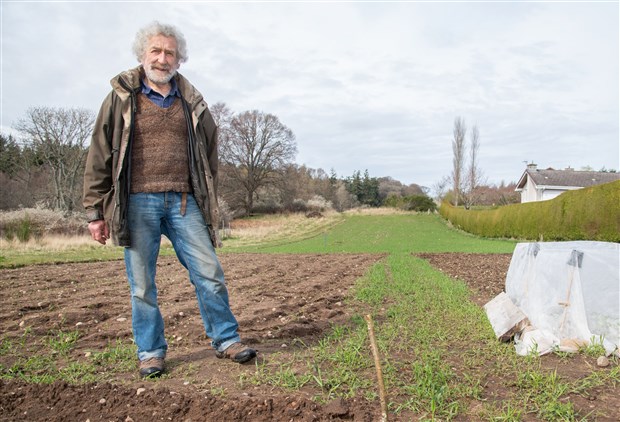
It was written by members of the the Forres Friends of Woods and Fields, environmental and community garden group based some 40 km east of the northern Scottish town of Inverness, and it paid tribute to the their founder and chairperson who had just passed on. It got me wandering through my backpages

We were born in the same year, 1949, and arrived at Moseley at roughly the same time, around 1960, remaining there until the summer of 1967 (though I stayed another year). The son of German/Austrian parents who had escaped from Nazi Germany, Nick was small of stature, with curly hair, a prominent nose, and friendly, laughing eyes – an expression that always seemed on the verge of amusement. He was very bright, academically gifted, and a natural actor.

School drama productions in those days had a peculiar and often unimaginative tendency to cast according to what teachers thought somehow “fitted”. Nick, being Jewish, often found himself cast in Jewish roles. Looking back now, one raises an eyebrow at the assumptions involved, but at the time it seemed merely how the world worked.

I remember him particularly in Samuel Beckett’s Waiting for Godot and Wolf Mankowitz’s dark comedy The Bespoke Overcoat, a poignant and comic reimagining of Nikolai Gogol’s The Overcoat, itself a story carrying echoes of Jewish life and exile. These were esoteric two-handers (not quite what one would expect in grammar school drama production*) with one of the other Jewish boys – Chris Field, another outstanding student and gifted actor. The pair of them together had an ease on stage that some people spend a lifetime trying to acquire.

I cannot recall how we became pals. Nor do I remember much about the details of our friendship. But I often visited his home – in Moseley, I think, not far from our school – probably during school holidays.

I do recall that he bought a canoe and took to paddling Brum’s many canals. “Canoe, canal,” he would often refrain. At the time I thought it quite eccentric.

He then bought a second-hand Lambretta scooter. Those scooters possessed a strange glamour, belonging to a brave new world of Mods and movement and urban freedom – and, indeed, rebellion. A couple of my schoolmates had one and sported those long-tailed parkas that later featured in Quadrophenia. I envied them for the speed and freedom and would have loved to do likewise, but that required means and parental permission, and I had neither.

And then our schooldays drew to an end and we put off schoolboy things and ventured out into the wide world – the great divide that so often arrives at the end of adolescence: university, cities, the widening world.

Nick went up to university in London. I am fairly sure it was the LSE, or somewhere very near it in central London. I hitched down to visit him and stayed in his bedsit –  an atmosphere peculiar to student life where one exists in a halfway house between adolescence and whatever comes next.

Was it once or several times? I cannot recall. But I have an image of scooting through wet, wintry streets on the back of a Lambretta.

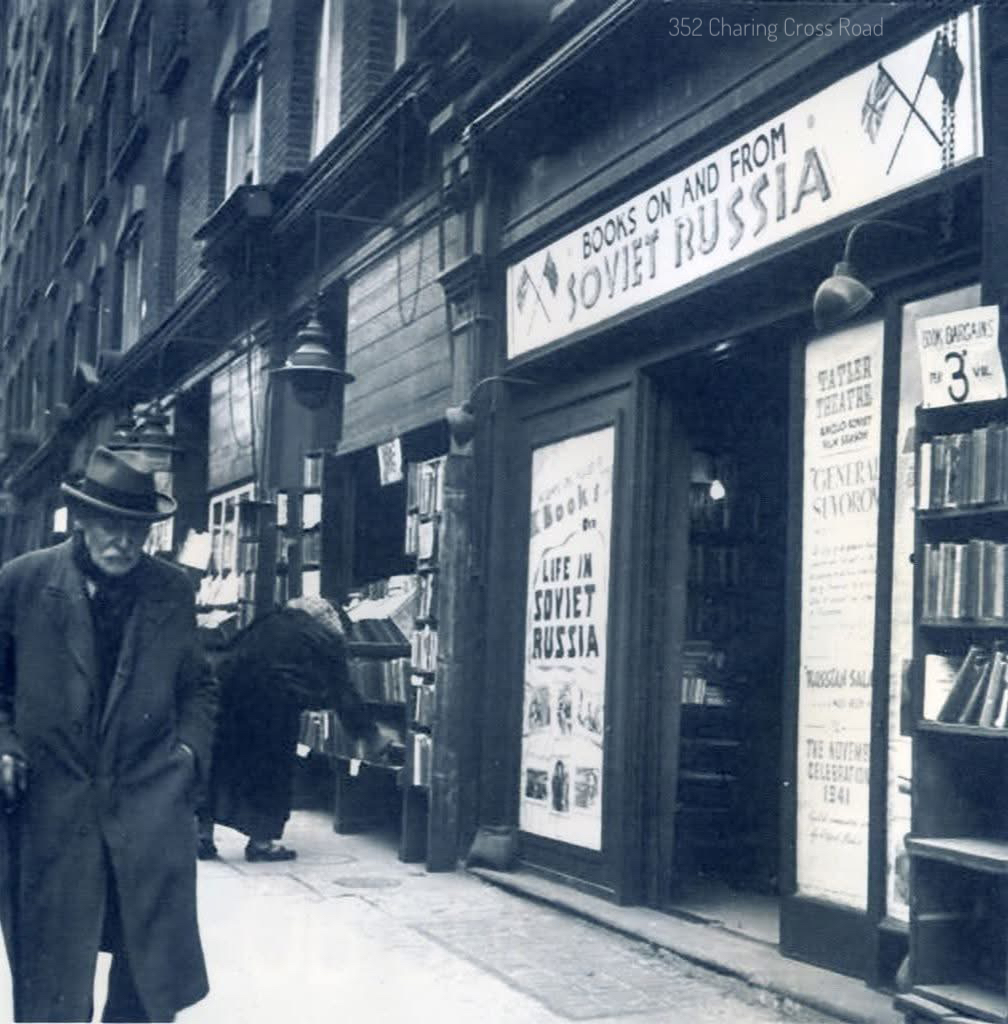
And he took me to what I recall as the Soviet Bookshop, though it may well have been Collet’s in Charing Cross Road. We had both developed a left-wing outlook on the world, and London at that time possessed a whole ecology of ideas. One could drift through central London moving from second-hand bookshops to political shops to cafés where everybody seemed convinced history itself had reached a point of imminent transformation.
Young people have always believed they stand on the threshold of a new age, but the late sixties had a particular confidence in this regard. Revolutions seemed possible. Societies looked malleable. One felt that history had become less a thing to study than a thing with which one might personally engage.

This was the life, I thought, mindful that I too would soon be taking that road.

Within a year I had left Birmingham for Reading in Oxfordshire and my own particular diversions, and, distractions. Unlike my upper sixth peers, I spent an extra year at Moseley, an unplanned and strange sabbatical during which I hitchhiked around Britain and nurtured my interest in history and politics. In what looks now in retrospect as one of life’s strange coincidences, in the Spring of 1967, I traveled the A98, the long road linking Aberdeen to Inverness – passing through Forres. I slept on the roadside somewhere near the Culloden battlefield and woke in the morning covered in snow.

Though London featured prominently, creatively and romantically in my university years, and I lived there from 1971 until 1978,  and though Nick and I may often have been in close proximity – I returned to that Russian book store several times , buying Lenin’s polemical pamphlets for my uni studies, Russian Revolution posters, and even, inspired by seeing Jethro Tull live, a balalaika (which I never learned to play) – I was never to see him again.

Until he walked through that door in our conversations here in the Tarkeeth forest – in the form of an obituary.

We lost touch – around 1968 –  as people sometimes do. Lives branch quietly. Then suddenly fifty or sixty years have passed and one discovers that entire lives have unfolded beyond one’s sight.

The strangest thing is that memory often preserves people at a fixed age. In my mind’s eye Nick remained perpetually young: climbing onto his Lambretta in his mod anorak, wandering through London, talking undergraduate politics, dropping me at the Tube station for my hitchhike back to Birmingham for school on Monday morning, and then heading off toward some unknowable future.

There is something poignant and bittersweet in discovering that the person you met a lifetime ago had not vanished after all, but had simply carried on further down the road, a.road that, for all its geographical, cultural, and social differences, might have been running parallel to my own.

Riffing on Nick’s biography – a life of service to community and environment as described below in the Forres Friends tribute –  I too became involved in student politics and protests in 1968 and 1969, including demonstrations against the Vietnam War in London, though I later parted company with politics in pursuit of more hedonistic things. I too travelled after graduation – my destiny lay in the Middle East and along the famous Hippie Trail to India and back.

My journey eventually carried me to Australia, where I now live out my latter years in a wildlife reserve and conservation area in the forests of northern New South Wales, caring for the bush while my wife tends our large vegetable garden. En route I have been an accountant, a folk singer, and an activist in Australia’s interminable forest wars.

People often imagine lives changing direction dramatically. We speak of transformations and reinventions. Yet perhaps character is more like a river than a sequence of disconnected events. It bends; it narrows; it widens; but somehow remains recognisably itself.

I had gone looking for a boy I once knew and found a life instead – a rich, generous, deeply lived life that had unfolded beyond my sight. We began with a door opening and a familiar face walking back into the room, but behind that remembered face lay an entire unseen life. There is a curious sadness in such rediscoveries. I found Nick again after all these years, only to discover that he had already rounded the bend and passed out of sight.

As Bob Dylan’s lines at the head of this memoire tell us, it is a reminder of how finite life is …

Paul Hemphill, May 2026

* But then again, maybe not. The young teacher who looked after school drama was of a bohemian bent, and in extracurricular drama classes, he introduced us sixth-formers to the plays of the “Angry Young Men” (a prominent group of working- and middle-class British writers and playwrights who emerged in 1950s postwar Britain), including Arnold Wesker and Joe Orton, and organised outings to the old Birmingham Repertory Theatre (back then, in its Stevenson Street location) to see contemporary plays.

In Tall Tales, small stories and eulogies, see more about my London in the nineteen sixties and seventies:  A Window on a Gone World … London days; Something about London; Song of the Road (1) – my hitchhiking days;; and Ciao Pollo di Soho – the cafe at the end of the M1

In That Howling Infinite has also written more generally about the nature of nostalgia. See: Blue remembered hills – a land of lost contentment (There is a précis of this below), and Blue remembered hills (2) – the history we hold within us

Forres Friends of Woods and Fields founder Nick Molnar passes away peacefully

Garry McCartney, The Northern Scott, 09 December 2025

A hard-working member of the community with a passion for the environment has passed away.

Forres Friends of Woods and Fields (FFWF) founder and chairman, Nick Molnar, 76, is survived by his wife and fellow volunteer Pippa, brother Michael, sister Nina and their families.

Nick (right) in the early days of the Chapelton polytunnel funded by the Berry Burn windfarm Community Fund.
The early days of the Chapelton polytunnel funded by the Berry Burn windfarm Community Fund.

FFWF chairman, Mick Drury, confirmed he also leaves the charity’s 26 diverse acres of land to be continued to be used for local community food production as well as a space to reconnect with nature.

The town has lost a core member of the community,” he said. “Nick was known for his warmth, helpfulness and involvement with a range of local projects. He had a lifetime’s commitment to the land and to building community.”

Nick was born in 1949 in Hertfordshire to German/Austrian refugees from the Nazi regime of the Second World war, spending most of his childhood in Birmingham.

He studied anthropology at university in London, taking part in student protests in 1967. After graduating, he travelled the world.

Nick then lived in Camphill communities in Norway, Ireland, England and Perthshire – supporting people with additional needs through work on the land. Camphill communities are residential communities and schools that provide support for the education, employment, and daily lives of adults and children with developmental disabilities, mental health problems, or other special needs.

Nick sowing in the Chapelton polytunnel.


Over the last five years, FFWF has been Nick’s life’s work, particularly after establishing its community garden at Chapelton.

Mick said: “His commitment and hard work have left a lasting legacy. A core group of volunteers meet there to work together weekly, harvesting for their own needs and making regular donations to Moray’s foodbank.”

The group’s summer open days are very popular now – Nick was always on-hand to welcome attendees and build new relationships.

“He’d always be out supporting the town’s apple and tattie days,” added Mick. “At home, he and Pen would be busy preserving soft fruits, making pickles and chutneys, sauerkraut and kimchi.”

Nick at the growing field and garden near Chapelton Farm.

Nick’s love of traditional skills and crafts of the countryside led to him trying his hand. Scything was a particular interest, and he was arrested for scything genetically modified crops on the Black Isle in 2001 when a test site was established there.

He was a keen reader and had a great interest in folk music, learning to play the violin in recent years.

Nick passed away at home just over a week after suffering a serious stroke. He was supported by his family, by Kate Clark from the Pushing up the Daisies bereaved charity, and with the “wonderful” assistance of the district nurses.

He was given a quiet send-off at Chapelton, with piper Rory O’Connell and a private green burial. There will be a life celebration for Nick in the new year. Messages of condolence are asked to be sent to forresfriends@gmail.com.

“We are blessed to have known Nick,” finished Mick, “and we will miss him greatly.”

Do you wish to respond to this article. If so, click here to submit your thoughts and they may be published in print

About Forres, Findhorn and Camphill

Forres is an historic market town in Moray in northeast Scotland, situated approximately 25 miles (40 km) east of Inverness and about 12 miles (19 km) west of Elgin, nestled between fertile farmland and the coast of the Moray Firth. Just 5 miles (8 km) north-east of Forres, a journey of little more than ten minutes by car, lies the small coastal village of Findhorn, set beside Findhorn Bay and opening onto the North Sea. Although distinct places, Forres and Findhorn have long existed in each other’s orbit: one a traditional Highland town with ancient roots, the other a village internationally known for its ecological and communal experiments.

Within this landscape sits Forres Friends of Woods and Fields (FFWF), a community woodland and garden project founded in 2020 by my old school chum Nic Molnar, who served as its founder and chair. The organisation brings together practical environmental work with a strong sense of community life, creating shared spaces where volunteers plant and grow food, manage woodland, support biodiversity, and learn sustainable land practices. Yet projects such as this are about more than gardens and trees. Their ethos is equally social: people gathering for a few hours of work, conversation, and companionship – “a blether and a cup of tea,” as the organisation itself cheerfully puts it. In that sense, FFWF reflects an older village ideal recast in modern form: a communal space where practical labour and human connection become intertwined.

The broader region also carries the influence of the Camphill Communities, an international movement founded in Scotland in 1940 by Karl König and fellow refugees from Nazi Europe. Based on principles of shared living and mutual care, Camphill sought to create communities in which people with learning disabilities and additional support needs lived and worked as equal participants rather than as institutional recipients of care. Farms, gardens, workshops, schools, and shared homes became central features of community life. The Moray region around Forres and Findhorn later developed into one of Camphill’s most significant centres, helping establish the area’s reputation for social innovation, community-based living, and environmental engagement. The underlying principles of König’s Camphill school were derived from concepts of education and social life outlined decades earlier by anthroposophistRudolf Steiner(1861–1925). Today there are over 100 communities worldwide, in more than 20 countries, mainly in Europe, but also in North America and Southern Africa

Findhorn itself added another layer to this local culture through the emergence of the Findhorn Foundation, whose experiments in ecological living and sustainability attracted international attention from the 1960s onward. Together, these overlapping influences –  the traditional town of Forres, the intentional and ecological communities of Findhorn, the Camphill movement, and local initiatives such as Forres Friends of Woods and Fields – have created a small corner of Scotland that is geographically modest yet unusually rich in ideas about community, stewardship, and shared ways of living.

Précis: Blue Remembered Hills — a land of lost contentment

Nostalgia is one of those curious human afflictions that sits somewhere between memory and myth. The Greeks called it nostos: the longing for home, the ache of return. Homer built The Odyssey around it. Houseman called childhood “the land of lost content”. We all know the feeling: that sudden gust of memory carrying with it a place that perhaps never quite existed in the form we remember it. A song, a smell, a taste, a street corner glimpsed through rain –  and suddenly one is standing again in those “blue remembered hills”.

The trouble is that nostalgia can be both consolation and deception. Memory does not preserve the past like amber trapping an insect; it edits, softens, rearranges and, occasionally, invents. It is less a historical archive than a film editor’s cutting room. We tend to remember not the world as it was, but the world as it felt. Childhood roads seem wider when revisited, old houses smaller, old certainties larger. Looking backward is a little like looking in a rear-view mirror: objects appear closer than they really are.

There is nothing inherently wrong with this. Quite the opposite. Nostalgia often provides continuity in a world moving at bewildering speed. Long-term memory can become a kind of inner refuge, perhaps even biology’s consolation prize for ageing. As we move through life, the past gradually acquires sovereignty over the present. The older we get, the more we discover that Hartley was probably right: the past really is another country. More disconcertingly, we begin to realise it has become home.

Yet nostalgia also has its darker uses. It can become what South Park hilariously called “memberberries”: seductive little fragments of selective memory that rot the brain with sentimental half-truths. “Remember when things were better?” they whisper. Remember when streets were cleaner, people knew their place, children behaved, and chips came wrapped in newspaper? The problem is that these memories often airbrush out the less attractive features of the era: poverty, prejudice, corporal punishment, rigid social hierarchies, casual cruelty and exclusion. There is a tendency to remember cohesion while forgetting whom that cohesion excluded.

And nowhere is this more visible than in those sprawling Facebook nostalgia communities now largely colonised by us boomers. They are fascinating anthropological sites – digital village greens where people gather not to discuss wars, elections or grand historical events but milkmen, street sweepers, bin men, old sweets, cassettes and television programmes long vanished into history.

At first glance it all appears harmless enough: a warm bath of collective memory. Yet beneath pictures of “proper bin men” and school playgrounds often lurk deeper currents of anxiety and resentment. The mundane becomes symbolic. The old milkman becomes shorthand for social trust; the local high street for community; black-and-white photographs of tidy streets for a world supposedly more ordered and comprehensible.

What many are mourning, however, may not be the world itself so much as their own place within it. We do not merely miss old streets or old songs; we miss younger versions of ourselves inhabiting them. We miss possibility. We miss novelty. We miss being twenty and imagining that life was still unfolding rather than slowly arranging itself into memory.

The political danger arrives when nostalgia stops being reflective and becomes restorative — when longing for the past becomes a demand to reconstruct it. The right has often understood this instinct well. It does not necessarily need to persuade people of a compelling future if it can offer an idealised yesterday. “Take back control”, “make things great again”, “return to traditional values”: all are variations on the same emotional melody.

But return tickets are unavailable. The past cannot be restored because it never truly existed in the form imagined. There were never really “good old days”; there were simply days – complicated, contradictory and viewed through younger eyes.

None of this means memory should be discarded. Far from it. There is immense pleasure in basking in les temps perdus. I happily indulge in musical rabbit holes and Facebook reminiscences myself. Songs especially are magical portals because music does not merely remind us of the past –  it briefly resurrects it. A song can collapse fifty years in three minutes.

But I would still choose today.

For all its noise and absurdity, for all the algorithms, grievances and existential clutter of modern life, today contains wonders unimaginable to my younger self. Medicine keeps people alive who once would not have survived. Knowledge sits literally in our hands. Distances have collapsed. Possibilities have expanded.

The trick perhaps is to hold memory gently: to enjoy nostalgia without becoming captive to it. To remember that we are, as Maria Popova put it, all our previous selves stacked inside us like Russian matryoshka dolls –  not discarded versions, but incorporated ones.

The little boy still exists somewhere in the old streets and schoolyards and songs. He is still playing in the enchanted forest with Pooh and Christopher Robin.

Blue remembered hills … memories of an old pal

That is the land of lost content,
I see it shining plain,
The happy highways where I went
And cannot come again
From The Shropshire Lad. AE Houseman

A few days ago, a Facebook message popped up out of the blue from England. It was from the niece of a friend – the daughter of his sister Jean. Heather wrote that they’d like to hear some stories of our time together. Predictably, as it so often is in these declining years, memories came flooding back.

Dave Shaw died suddenly of a brain hemorrhage in in the town of Pershore, Worcestershire, on Saturday 5th January 2013 at the age of 64. He was farewelled at his beloved Pershore Abbey, an historic church I knew well from many visits to his home, on Wednesday 23rd January. I hadn’t seen him since my visit to England in the summer of 2005, and I learnt of his passing by accident. My mother passed away in Nottingham at the end of January, and as Dave would often drop in and visit her when he passed through Birmingham, I rang him up to tell him of her death. I tried his home many times without answer, so I reckoned I’d contact Pershore Council to get in touch with him. My google inquiries ended up at The Evesham Journal, a local Worcestershire newspaper. And that’s when I learned that he had gone.

The following is an expanded version of a piece published in the Evesham Journal on1st February 2013

Our back pages

Dave was my oldest friend –  from when we entered Moseley Grammar School in Birmingham in September 1960.

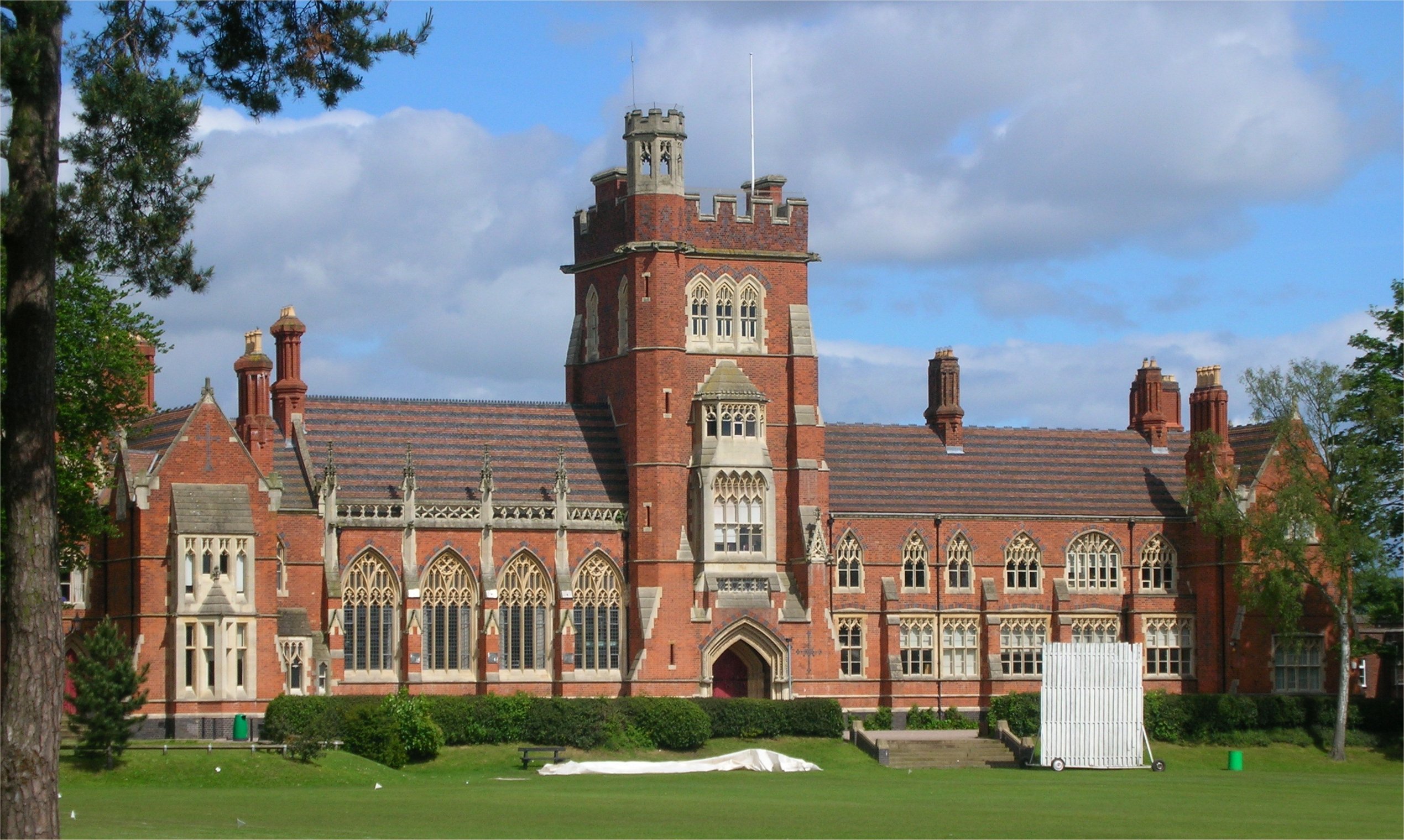
Moseley Grammar School, Birmingham

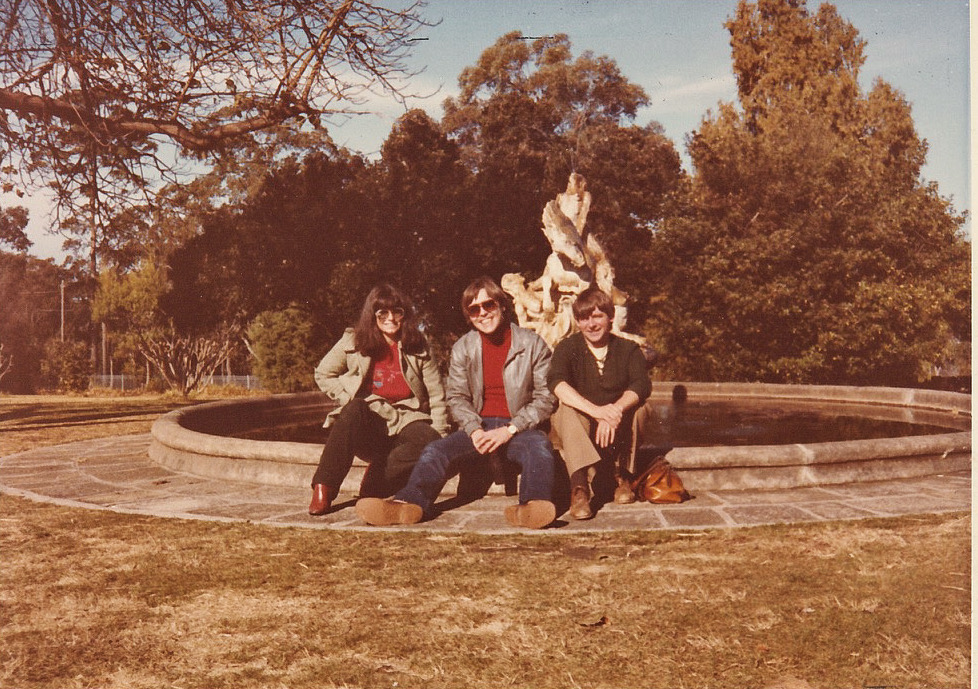
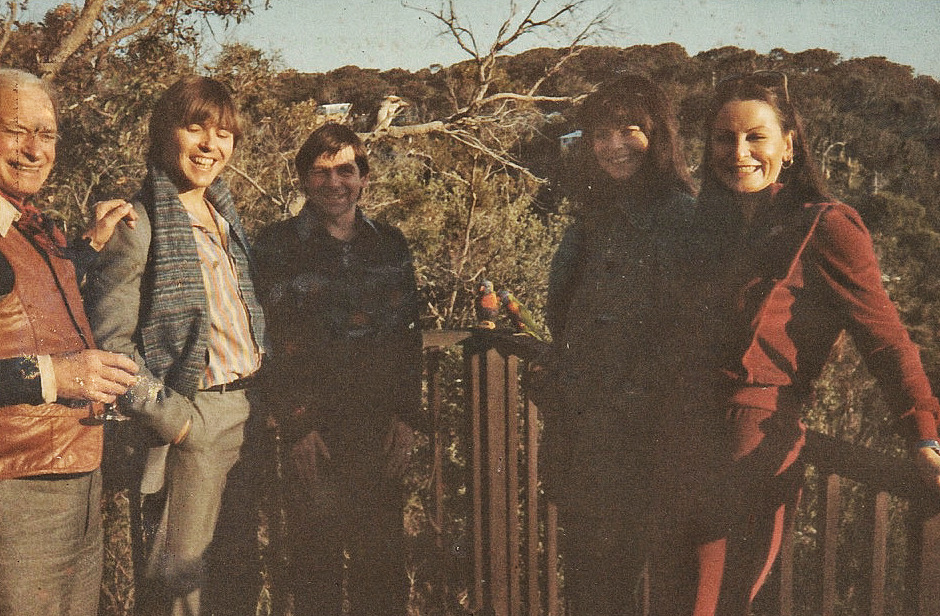
Through the Sixties, we came of age together, shared music, frequented folk clubs, did pub crawls through Birmingham, went to Birmingham City football matches (we were Blues fans and not supporters of Aston Villa, the other Brummie team) and hitchhiked to CND rallies and folk festivals. When we left Brum in 1967 and lived in other cities, we visited each other often and always remained in touch. Although I moved to Australia in 1978, I travelled to Pershore every time I returned to England and caught up with him and his family. One time, Dave came out to Australia. There’s a couple  of pictures here of that trip, featuring Dave, myself, my ex, Libby, and her sister Mary Jane, who was once a famous singer here in Australia but, sadly, took her own life in 1990. It must’ve been about 1982 as Libby and I separated the following year.

But let’s go back to the days when school chums became friends, the time when you began to address your mates by their christian names and not by surname, as was customary in grammar schools back then. Back to the Sixth Form when we began to “put off childish things” and as much as we could in our provincial and underage circumstances, “got with” the sixties zeitgeist and engaged with the wider world. We read the poetry of the American Beat Poets, our own Mersey Poets and John Lennon. We listened to the music, and particularly Bob Dylan. During school holidays, four of us, Dave, Peter Bussey, Malcom Easthope and myself, would go to the Jug o’ Punch in Digbeth run by the celebrated Ian Campbell Folk Group, to drink bitter, sing along to folk songs and listen to the likes of The Dubliners, Al Steward and Roy Harper, and, sigh, a young, gorgeous and melodious Joni Mitchell. We’d meet once a week at the Golden Eagle in Hill Street to talk politics and poetry, and read our own juvenile verse, before heading off to other pubs in the Birmingham CBD.

In those days, it was cool for teenagers to ride motor scooters – if they could get their parents permission. Several of my pals owned one, including Dave who’d bought a second hand lambretta. I recall this today because it reminded me of one of our better-heeled chums who had a brand new model. His dad was a publican, and one time, he threw a party at his father’s pub in Coventry and a mob of us got a lift there from another student who’d actually owned a car – a rare thing in those days. It came back to me today how that party ended for me and Dave. We both got very drunk, I tripped and sprained my ankle, and as we were driven back to Brum, I was sprawled in the back seat, and Dave, sitting beside me, chucked up. That wasn’t the last time I injured myself whilst inebriated. I can’t recall Dave getting as rat-arsed again. 

Later, we graduated to cannabis, and would toke at each other’s homes on weekends – one time, we hired a rowboat in Stratford on Avon and spent a stoned afternoon on the river. So Wind in the Willows. One lovely early summer’s day in 1969 when “we happy few, we band of brothers” camped out in my room at Reading uni, and dropped acid by the lake in nearby Whiteknights Park. It was a strange, trippy day, during which there was a police bust on my hall of residence, and we watched in amaze as people rushed down to the lake and threw many unidentified objects therein.

Fast forward to the eighties …

Though settled in Australia, I visited England often, and always took time out to catch up with Dave in either Birmingham or Pershore. When I was performing at folk clubs in 1987 and 1988, he acted as my local contact person. He also introduced me to his old friend Stan Banks, who’d served in World War II a bomb aimer and photographer on the night raids over Germany. On retirement from school teaching, Stan dedicated himself to the peace movement – which was how Dave came to meet him. Stan shared with us many enthralling and harrowing tales of his flying days.

Dave and I shared a common interest in the environment, cultural heritage and wildlife and we would exchange news on our endeavours. When we’d visit Pershore, he’d always take us out on a ramble or a drive to some out of the way place with an archaic name and take in a few nice country pubs on the way. On one visit, he gave me an instruction sheet for building boxes to shelter micro-bats. We have five of them around our home in northern New South Wales, and several of them are occupied all year around.

Green and progressive in word and deed, and dedicated to Pershore, Dave served as a Town Councillor for twenty-two years. Whenever we’d walk around town together or enter shops and pubs, folk would be always coming up to talk to him. At his funeral, the flag atop the abbey was flown at half-mast for the first time ever whilst fellow councillor Chris Parson praised him as “a giant of a man” – which I found apt but amusing considering Dave was short and slight of stature.

The feature photograph of him with his binoculars and bird book outside the glorious Pershore Abbey is a beautiful way to remember him.

Norman Linsday Gallery and Museum, Faulconbridge, NSW

Dave meets the Boyd Family, Palm Beach, NSW

When Heather read this story, she wrote:

“That is absolutely beautiful! Thank you so much, I hope you had as much pleasure from writing that as I did reading it. I laughed out loud and cried. Lovely. My mum will love this. ❤️ p.s I knew all along he was a stoner!! And with that asthma too? What was he like? I miss him a lot. X”

I replied:

“A lovely bloke. A gentle, laid back soul who was always in a calm, good mood. I recall a time when he visited me in London just as I was about to head off to the Middle East. I’d just had a typhoid shot and  was as sick as a dog – and he’d come all this way to see me off. He was so cool about it. What will be will be. Que sera sera! Did you know he was fluent in Spanish. It was one of his passions. He had Portuguese too, and I believe some Russian. I went through a “Russian phase” too in the early seventies, but ended up in the Middle East instead, by accident, and learned Arabic. Still learning. It’s effing difficult if you don’t have a gift for languages, but it keeps the old brain active.

Heather:

Sounds just like the Dave I knew. I am glad I found one person who he went to the Blues with him as I always wondered. Did you know we put some of his ashes at St. Andrews? Yes he was a language genius wasn’t he? Yes he was a language genius I think. Apparently he could get by in about 9 languages but he was very humble about it.

The ‘sixties … memories of London and Ireland

Dave is referenced many times in In That Howling Infinite, though, for privacy reasons, not by name. I also dedicated one of my poetry books to him: Tabula Rasa – Early Days. Below are a couple of extracts that are specifically talking about Dave.

“As I wrote in a recent trawl through my back pages, Song of the Road – my hitchhiking days: “… that motorway from Brum to London was a road well-traveled. In my final year at Moseley Grammar, I’d often hitch down to London for a weekend with pals who’d gone there before. We’d hang out at cheap and cheerful Pollo’s Italian restaurant in Old Compton Street in Soho and the Coach and Horses across the road and go to Cousin’s folk and blues joint in a cellar in nearby Greek Street, and the 101 Jazz Club off Oxford Street. Bunjies folk café and Ronnie Scott’s jazz club were just around the corner. After a meal or a pint, I’d often catch the last tube to the end of the line closest to the M1. I can’t recall how many times I headed off into the night; and there were always drivers on the road at the witching hour. I guess many folks “get the urge for going”, as Joni sang back then, “and they had to go …” And in those generous times, people were happy to offer a lift to a wayfaring stranger – gentle souls who would not leave strays stranded by the dark wayside; lonesome folks seeking company and conversation in the dark night of the soul; curious people wondering why a young man would hitch the highways in the middle of the English night. Yes, Café Pollo was indeed a significant landmark of my London days:. From Ciao Pollo di Soho – the cafe at the end of the M1

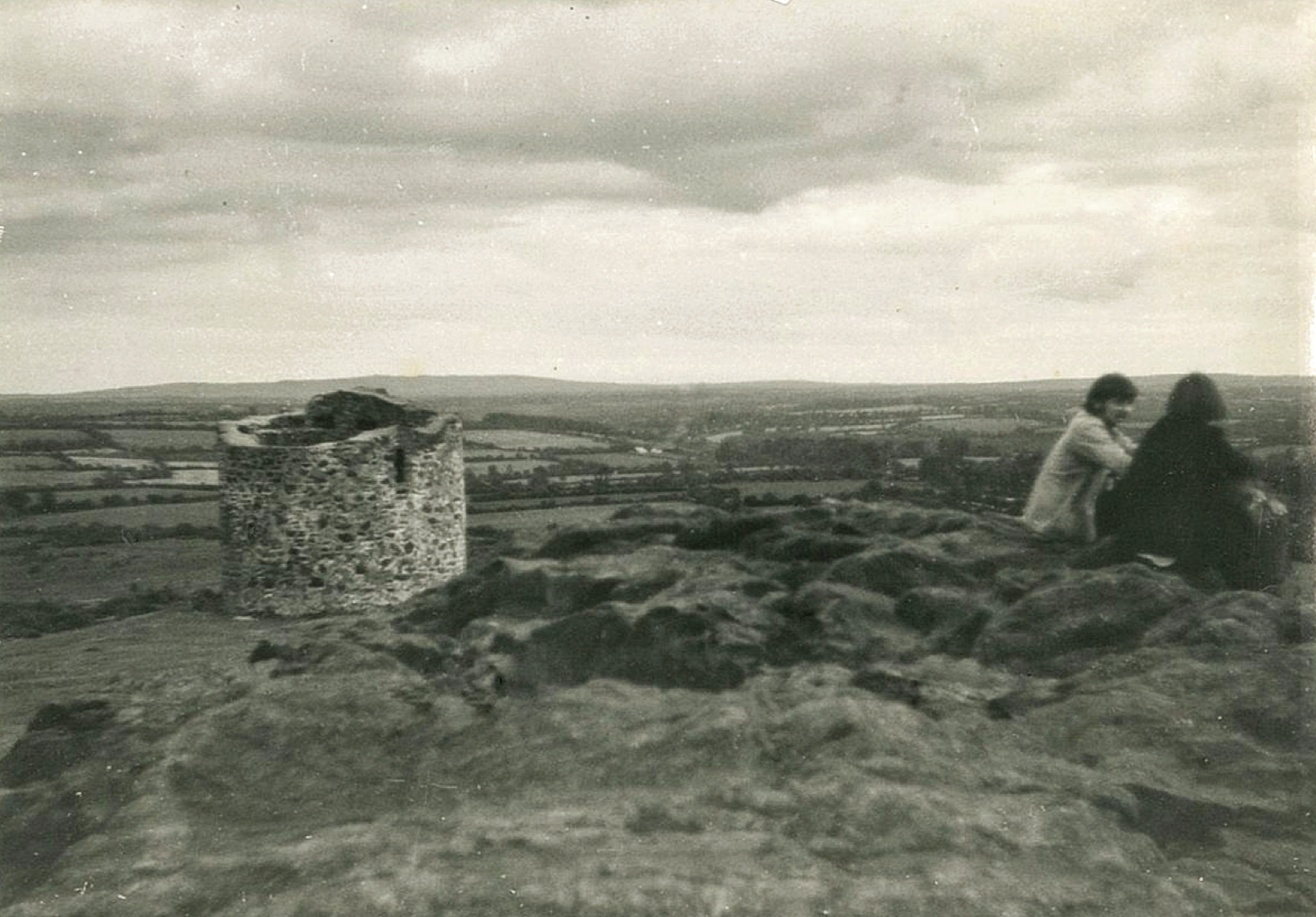
“In the summer of 1969, my brother and I and an old chum spent several weeks in an Enniscorthy that looked and felt like it had not changed since Aunty Mary’s day – so well portrayed in the academy award nominated film Brooklyn. Dressed as we were in hippie garb and sporting long locks, we cut incongruous figures in the pubs and at the local hop, and were so unsuccessful hitchhiking around the county that we walked many a long Irish mile. We hiked to Killane, Sean Kelly’s country, and inspired by the song, climbed upwards though heath and hedge to the top of Mount Leinster. We stayed at 13 Patrick Street and spent a lot of time sitting up on Vinegar Hill, beneath its round tower, looking down on the River Slaney and the town beyond. My brother was a keen photographer, and he took the following picture”. Thats Dave on the left, and me on the right. From The Boys of Wexford – memory and memoir 

“On Vinegar Hill o’er the pleasant Slaney”

And a final vignette, also featured in Song of the Road,from 1970, I think: 

One glorious English summer I arranged to meet up with my late pal Dave Shaw in Cambridge, where he was attending a summer school at the University, and go to the celebrated Cambridge Folk Festival. I clocked off from my work on the motorway, got home, just ten minutes away – I said we were close! – showered and packed, and headed to the Clock Garage roundabout and put out my thumb. I took the M1 to London’s North Circular, and cut across to the A10 (there was no M11 in those days) and, And, my stars were alignment on this night ride, arrived at Dave’s digs in time for breakfast.I don’t remember much of the festival bill, but American folk diva Odetta was singing, and also, our idol, Roy Harper, England’s high priest of angst.

I had to leave Cambridge around Sunday lunchtime, after Roy’s last set, to return to Brum for work on Monday. Rather than head back down to London, to save time – a quixotic idea when you are hitching – I decided to cut cross-country to connect with the M1 at Newport Pagnell – in those days before GPS and route planners, a cheap, creased road map from WH Smith was the best we had, plus a good sense of direction, fair weather and loads of luck. And such are the movements of the cosmos, that my one and only only ride took me to, yes, what was then the bucolic village of Newport Pagnell. It was one of those summer evenings in England, when the days are long, the air warm and languorous, and the light, luminous. Birds were singing and church bells were ringing for evensong, and in my mind’s ear, I’d like to imagine that cows were lowing and sheep were bleating. One could almost feel an ode coming on. So there I was, once more, at the services on-ramp, hitching a ride to Birmingham , and hopping aboard an old Land Rover for what was the slowest and noisiest ride ever – which took me almost to my door”.

Ciao Pollo di Soho – the café at the end of the M1

The Boys of Wexford – memory and memoir

Song of the Road (1) – my hitchhiking days

“When we were younger, time appeared to move more slowly than in our later years. It is in our nature to imagine and indeed, re-imagine our salad days as the best of times and the worst of times. But looking back through our back pages, these years was perhaps no better or worse, no more significant or seminal than any era fore or aft. Like objects seen through the rear-view mirror, memories always seem a lot closer and bigger. When I’ve revisited roads and streets where I grew up, playing or sauntering or rolling home with a skinful in the pale moonlight, they are no way as wide, long or spacious as they are to the mind’s eye. Vivid memories can distort time, making you feel that that weren’t that long ago”. From Blue remembered hills – a land of lost contentment 

Blue remembered hills – a land of lost contentment

Better Read Than Dead – the joy of public libraries

In 1839, in the midst of a half-century of post-Napoleonic political ferment and incipient revolution, English author Edward Bulwer-Lytton coined the adage “the pen is mightier than the sword”, implying that the written word is more effective than violence as a tool for communicating a point. It’s no wonder that the straighteners, the autocrats and the fundamentalists want to ban and even burn books. In his dystopian novel Fahrenheit 451, published in 1953 at the height of America’s McCarthy anti-communist witch-hunts, Ray Bradbury wrote: “The problem in our country isn’t with books being banned, but with people no longer reading. You don’t have to burn books to destroy a culture. Just get people to stop reading them”.

But, encouragingly, reports of the demise of the written word in the form of the humble published book are exaggerated and premature.

Which brings us to keepers of the flame – the torch of knowledge and not the bearers of the fire-brands,  the people who look after our public libraries. Oscar-winning documentary-maker Michael Moore once said admiringly that librarians were a more dangerous group than he had realized: “You think they’re just sitting there at the desk, all quiet and everything. They’re, like, plotting the revolution, man.”

To the American industrialist and philanthropist Andrew Carnegie, libraries were temples of learning and self-improvement. “A library outranks any other one thing a community can do to benefit its people,” said Carnegie, who put his money where his mouth was. By 1929, he had paid for the construction of more than 2500 libraries, most of them in the USA.

Back in the day … 

I reckon that I was visiting libraries even before I could read, but that could well be my mind playing tricks on my memory. But once I commenced grammar school, the local library, but a short walk away, was a world of wonders. Yardley Wood Library, in south Birmingham on the quiet northerly extension of busy Highfield Road, between a small housing estate of postwar prefabs on the east and a large expanse of recreation field at its rear, and but ten minutes from home, was the grail of my early education and my widening general knowledge of the outside world.

As an early teen, I’d stay weekends at my Aunt Mary’s house in the inner city on the border of Moseley and Balsall Heath, and the Victorian grandeur and shadowy interior of Balsall Heath Library became yet another “garden of earthly delights”. This library is the featured picture of this post. The tall chimney on the left belongs to the immediately adjacent Balsall Heath swimming baths, where my uncles and aunts who shared our home would take their weekly baths (even if they didn’t need them, as the old saw goes), where I’d go in my weekend sleep-overs, and where, when struggling with my Boy Scout swimming test, I’d push myself through the pool. And loathed every minute, Although I now live in a land blessed with beautiful beaches, I still hate being in water any deeper than my bath!

Yardley Wood Library, Birmingham

In these two “houses of wisdom”, I’d browse the stacks, thumbing through art books and atlases, encyclopaedias and illustratatives, and I’d always have three or four books on loan, with a particular interest in history, biographies and historical fiction. My reading was eclectic ab initio, from the early adolescent “he went with … “ great explorer adventures by Louse Andrews Kent and the many books of H Rider Haggard, both quite politically incorrect and vulnerable to ‘cancellation’ in today’s prescriptive cultural climate, to the relatively anodyne French ‘soft-porn’ of Anne Golon’s Angélique series, to Mikhail Sholokhov’s And Quiet Flows the Don and its sequel The Don Flows Home to the Sea, which introduced me to Russian history and politics and a youthful dalliance with The Communist Manifesto and the Communist Party. I remain very interested, and have written often on the subject. For example, Stalin’s Great Terror, The Russian Tradition – Russia, Ukraine and Tibor Szamuely, and Red and white terror – the Russian revolution and civil war

Eventually, as I studied for A Levels in the late ‘sixties, I entered Birmingham’s cavernous Central Library in the heart of the Second City. Opening in 1865 and rebuilt in 1882: it was a magnificent edifice within and without. I recall it when I rewatch the Game of Thrones episode in which would-be meister Sam Tarly enters the Citadel in Old Town for the first time. This Victorian relic was replaced by a brand new, brutalist building in 1974 – which I never saw as this too was closed in 2013 and replaced by the present Birmingham Library  – which I visited when I was in Birmingham two years later.

Birmingham Central Library

The interior of Birmingham Central Library

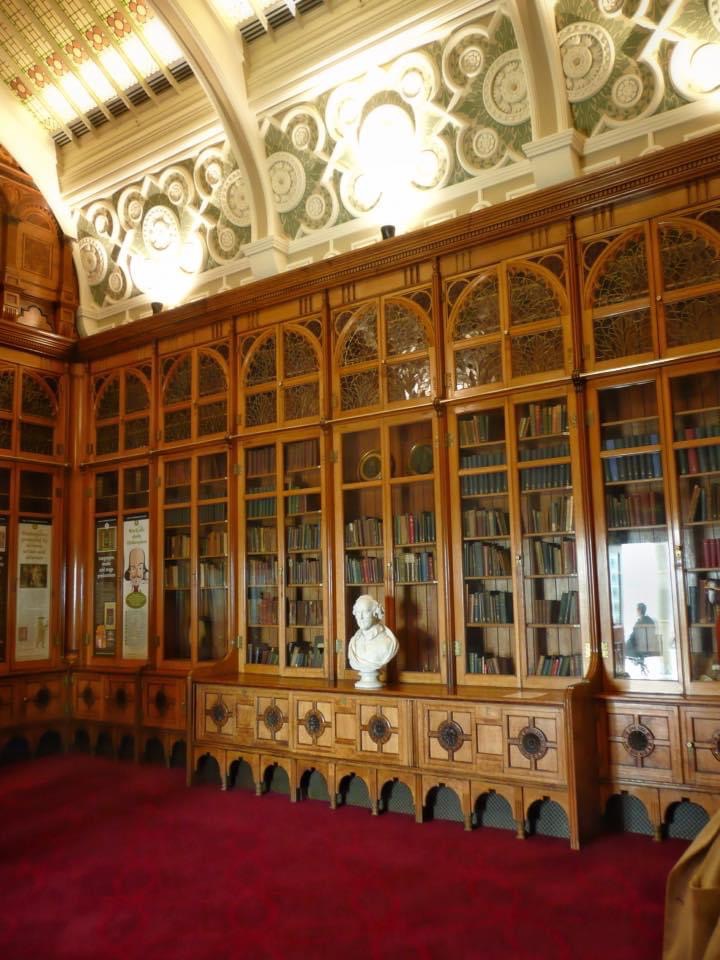
The William Shakespeare Room reconstructed atop the new BirminghamLibrary, 2015

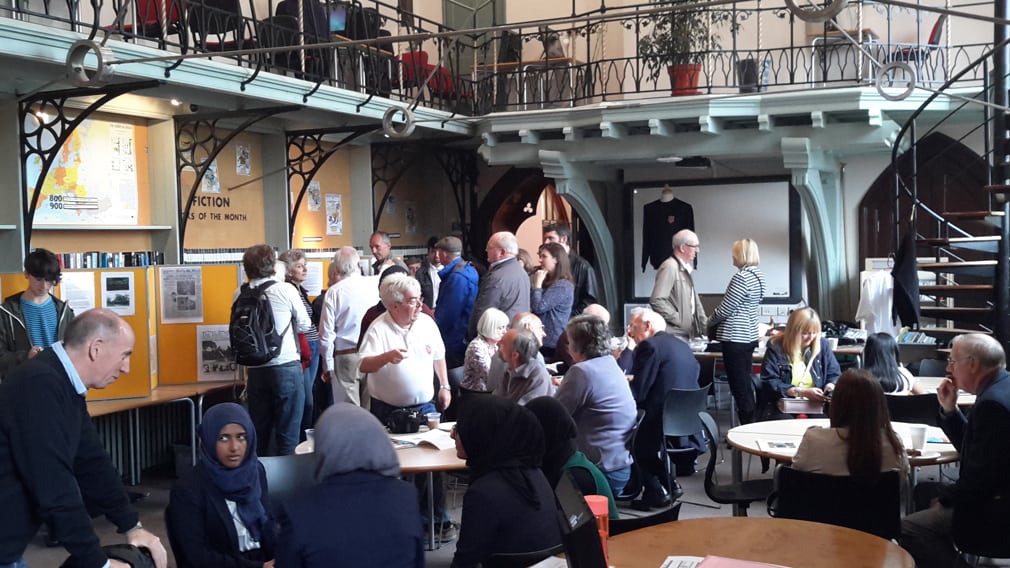
My alma materMoseley Grammar School boasted a small but diverse library that beckoned during lunch breaks, with its high, wooden-beamed ceiling, it’s wrought iron balcony and the spiral staircase that led up to the landmark school tower in subsequent years, the library was closed for safety reasons, but a recently completed renovation project has brought it back into use as the photo of former pupils gathered therein on the occasion of Heritage Day 2022 shows.

I’ve written fleetingly of this library before: “It was one of those beautiful late-spring evenings that you would get in the England of youthful memory. The evening sun poured through the gothic stained glass windows of the school library – it was one of those schools. A group of lower sixth lads, budding intellectuals all, as lower sixth tended to be, gathered for a ‘desert island disks” show-and tell of their favourite records. Mine was Wishin’ and Hopin’  (by (Dusty Springfield). Then it was on to the next. Clunk, hiss, electric guitar intro, and: “My love she speaks like silence, without ideas or violence, she doesn’t have to say she’s faithful, but she’s true like ice, like fire…” I was gone, far gone. So was Dusty”. From Whats Bob Got To Do With It?

It is one of those instances of serendipity we encounter on our journey through life that the first serious love of my life was studying to be … drum roll! …a librarian, and in time became the chief librarian of a major English university, whilst  one of my oldest London friends rose to a that position in the university I attended in the ‘seventies. How about that?

Moseley Grammar School, Birmingham

Former pupils of Moseley Grammar School gather in the refurbished library, 2022

Here in the now …

In Australia, if attendance figures are any indication, the public library is our most valued cultural institution. In the year to July 2018, about 7.6 million people visited Australian libraries – more than went to museums (6.7 million), art galleries (6.3 million), plays (3.9 million) or musicals and opera (3.5 million). But it was the return rate that really set libraries apart. Whereas at least half of those who visited museums or the theatre went only once in the year, three-quarters of library visitors went back at least three times, and one-third visited more than 10 times. Australians make about 114 million visits to public libraries annually.

Here where I now live in Australia, on the Mid North Coast of New South Wales, Coffs Harbour library is the mother ship with satellites at the outlying townships of Woolgoolga and Toormina – the latter is named for Taormina in Sicily, the site of one of the most famous theatres of Greek antiquity. Our own shire has libraries in Bellingen, Dorrigo and Urunga.

I get to the library nearly every time I’m in Coffs Harbour, just to browse the stacks (there is something there for everyone) and check out the history books – as ever – and the large collection of cds. I almost always come away with something I had not intended to read or listen too. It’s a calm and peaceful space, with friendly and helpful staff, and yet always quite busy – particularly at its free computer and wi-fi benches. Members can even borrow ukuleles! [Since this article was written, the library has relocated to brand new premises, and it is even better than before, with a more computers for public use, study rooms off-side for small groups, and meeting rooms available to the public. The ukulele shelf is still there]

As a volunteer with Settlement Services International, before Covid 19 closed our office and cut the flow of refugees to Australia, I often took newly-arrived refugee families there as part of their orientation. I’d help them enroll and give them a brief tour of the facilities, and particularly the computers, the foreign language section which houses a growing collection, including books in Arabic and Farsi, and the children’s section (which hosts regular and free storytelling and craft sessions for preschools kiddies), and encourage them to return – it’s such an excellent introduction to our language, society and culture.

The old Coffs Harbour Library

As the following essay shows, libraries are much much more than their books and their educational and technical resources and facilities. They are not just a reference service but also a place for the vulnerable and the lonely, a “shelter from the storm” for people of all ages and circumstances. In a world where social and community services are being ground down, and loneliness and isolation are endemic, libraries provide vital lifelines for all manner of folk. from elderly people who value the human interaction with library staff and with other visitors, to the isolated young mother who enjoys the support and friendship that grows from a baby rhyme time session, to people who want to play the ukulele (visitors can actually borrow ukuleles as one would borrow books), to people like me just seeking time out time in a peaceful and welcoming space.

© Paul Hemphill 2022.  All rights reserved

Postscript

I wrote recently about Moseley Grammar School in an article on JRR Tolkien:

“Learning more about the author, I was to discover that he’d grown up in Birmingham, my home town, first in leafy Edgbaston (the home of Cadbury and the Warwickshire County Cricket Club), where he’d attended the prestigious King Edward’s Grammar School – my own school, Moseley Grammar, was not in its league. He lived near Sarehole Mill, in present day Hall Green, around the turn of century, between the ages four and eight, and would have seen it from his house. The locale at that time was rural Worcestershire farmland and countryside and not in the Birmingham ‘burbs. He has said that he used the mill as a location in The Lord of the Rings for the Mill at Hobbiton: “It was a kind of lost paradise … There was an old mill that really did grind corn with two millers, a great big pond with swans on it, a sandpit, a wonderful dell with flowers, a few old-fashioned village houses and, further away, a stream with another mill … “  Sarehole Mill was just down the road from my school, and our sports field and cross country tracks were adjacent to it. On many a wintry, cold, wet and windy Wednesday afternoon, I’d stagger past it on a muddy track. How I hated wet Wednesdays; dry ones were for rugby, and I hated them too!”  From: One ring to rule us all – does Tolkein matter?

For more stories like this one in In That Howling Infinite, see Tall tales, small stories, eulogies and epiphanies, and on books and reading generally, see Better read than dead – books, poetry and reading.

One for the books: the unlikely renaissance of libraries in the digital age