Al Stewart’s Soho (needless to say …)

Soho feeds the needs and hides the deeds, the mind that bleeds
Disenchanted, downstream in the night
Soho hears the lies, the twisted cries, the lonely sighs
Till she seems lost in dreams
Al Stewart, Soho (needless to say) (1973)

Whenever I recall London’s Soho in the sixties, I always think about my bedsitter days in the city in the early seventies and also, British singer-songwriter Al Stewart’s over-orchestrated but quite excellent debut album of 1967, Bedsitter Images. 

My bedsitter images

My bedsitter images

You could say that I knew Al Stewart’s London ‘ere I first knew London. I bought the album when, as a sixth former, I first saw him perform at the famous Jug o’ Punch folk club in Digbeth, Birmingham, run by The Ian Campbell Folk Group.  I’d go there regularly with my schoolmates – we saw some great singers, including a young Joni Mitchell in the summer of 1968 – it was love at first sight, and I bought her first album there too: Songs from a Seagull). Al may have autographed his record – I can’t recall. It was stolen from my bedsit room in Reading in 1970 along with many of my favourite discs – including that one of Joni’s.

Maybe it’s about what here in Australia – borrowing from our indigenous compatriots – we might call “spirit of place”: the association with the streets within a hop, skip and an amble from Old Compton Street out into Shaftsbury Avenue and that bookshop in Charing Cross Road, the opening verse of the second track Swiss Cottage Manoeuvres, and that flat in Swiss Cottage, a suburb I used to frequent in the seventies when several of my friends lived there. You can listen to the whole of album below.

In a trawl through my back pages (OK! Enough with the Bob Dylan already!), wrote of my early encounters with Soho:

”As a sixth former, I’d often hitch to “swinging” London for the weekend, to explore the capital and visit folk and jazz clubs, kipping in shop door-ways and underground car parks under cardboard and napping wrapped in newspapers, and eating at Wimpy bars and Lyons teas houses”.

And naturally, I discovered Soho, a bright, colourful and disreputable warren of narrow streets behind the theatre-strip of Shaftesbury Avenue, with its mix of cafés, trattorias, delicatessen, book shops and strip clubs – and Carnaby Street, internationally famous by then as the fashion mecca and the “place to be” of “Swinging London”.

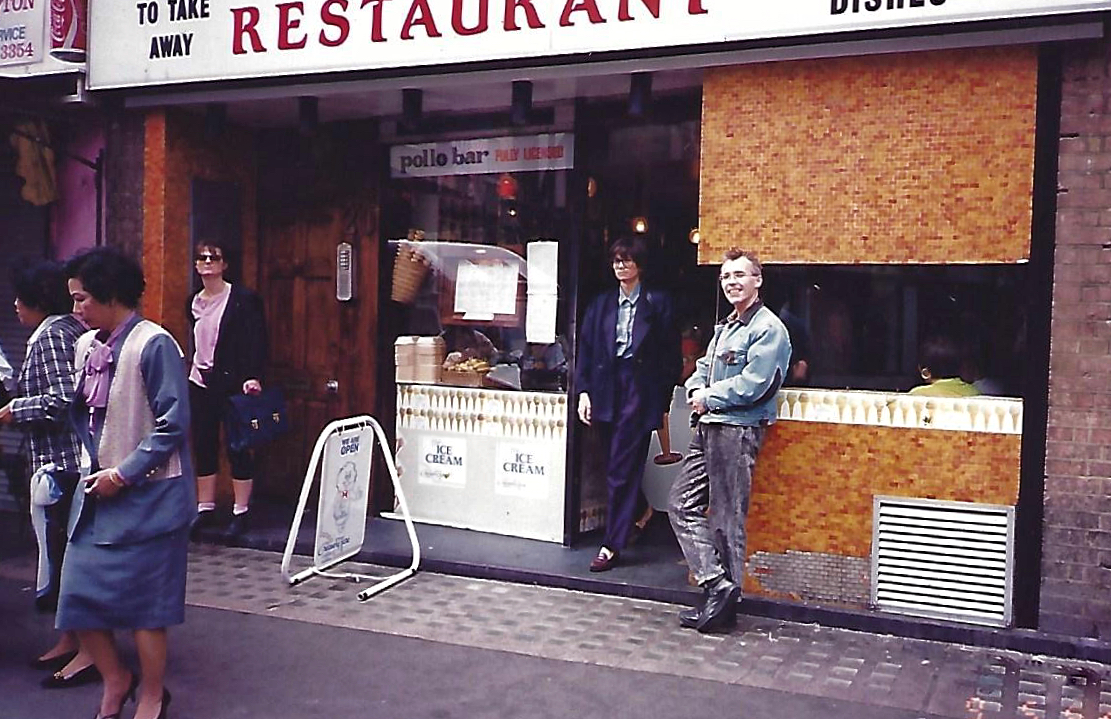
“… the motorway from Birmingham to London was a road well-traveled. In my final year at Moseley Grammar, I’d often hitch down to London for a weekend with pals who’d gone there before. We’d hang out at cheap and cheerful Pollo’s Italian restaurant in Old Compton Street in Soho and the Coach and Horses across the road, and go to Cousins folk and blues joint in a cellar in nearby Greek Street, and the 101 Jazz Club off Oxford Street. Bunjies folk cafè and Ronnie Scott’s jazz club were just around the corner. After a meal or a pint, I’d often catch the last tube to the end of the line closest to the M1. I can’t recall how many times I headed off into the night; and there were always drivers on the road at the witching hour. I guess many folks “get the urge for going”, as Joni sang back then, “and they had to go …” And in those generous times, people were happy to offer a lift to a wayfaring stranger – gentle souls who would not leave strays stranded by the dark wayside; lonesome folks seeking company and conversation in the dark night of the soul; curious people wondering why a young man would hitch the highways in the middle of the English night”. There’s more in  Ciao Pollo di Soho – the café at the end of the M1.

Pollo. The café at the end of the motorway

I saw a werewolf with a Chinese menu in his hand, walking the streets of Soho in the rain. Warren Zevon

There was something vicarious in ithe seedy, needy, greedy vibe of the priapic songs on Al’s follow up albums. An old friend and Al Stewart fanboy who has now passed on called them aural masturbation. Although there were many “love chronicles”, the title track of his second album, Al also wrote about melancholy middle aged suburban couples, historical events and more, with the odd foray into poetic mysticism, self-reflection, and also, nonsense. And some excellent instrumentals – he is an imaginative and flamboyant guitarist. My flat mates and I were all fans of Al back then, and went to most of his gigs when he played in London. Here’s one of our favourite ‘history’ songs:

In the early seventies, when a girlfriend started going out with Al, I actually got to know him for a brief while. Indeed, once, when he played in Birmingham Town Hall, me and a couple of pals drove up to my old hometown to see him, and after the show, invited him back to my folks’ place for a late night fry up. My mom reckoned he need fattening up. And afterwards, she and Al sat in the kitchen for a couple of hours talking about pop music. “I love Cat Stevens”, mom said. “Oh, I much prefer the Incredible String Band”, said Al. “Oh, they’re very weird, but Paul like them!” She said. Then they got talking about Mick Jagger. And my dad, in the sitting room, said to us others gathered there, and referring to Al’s stature, said “there’s not much to him is there!”. Strange but nice how you recall these little things. The folks have passed on a long time ago …


Afterthought – Clifton in the Rain

Whilst I always associate Al Stewart with London and Soho, my favourite song is set in a Bristol suburb. Released in 1970, it is gentle, lyrical, and paints a beautiful picture of English weather – and it features the gorgeous Jaqueline Bisset.

The rain came down like beads
Bouncing on the noses of the
People from the train
A flock of salty ears
Sparkled in the traffic lights
Feet squelched soggy leaves across the grain
I took my love to Clifton in the rain

And all along the way
Wanderers in overcoats with
Collars on parade
And steaming in the night
The listeners in the Troubadour
Guitar player weaves a willow strain
I took my love to Clifton in the rain

Jacqueline Bisset
I saw your movie
Wondered if you really felt that way
Do you ever fear
The images of Hollywood
Have you felt a shadow of its pain
I thought of you in Clifton in the rain

There’s a nice retrospective on the Troubadour Folk Club in Bristol here:

English actress Jaqueline Bisset

Something About London

Ciao Pollo di Soho – the café at the end of the M1

The first Intifada … Palestine 1936

In 1929, there is violence at the Western Wall in Jerusalem – then a narrow alley named for Buraq, the steed with a human face that bore the Prophet Mohammed on his midnight journey to Jerusalem, and not the Kotel Plaza of today. The event, which was actually called the Buraq rising was incited by rumours that Jews planned to overrun the Haram al Sharif, the third holiest site in Islam. A massacre of Jews in Hebron in the south followed. These were a bleak precursor of the wars to come.

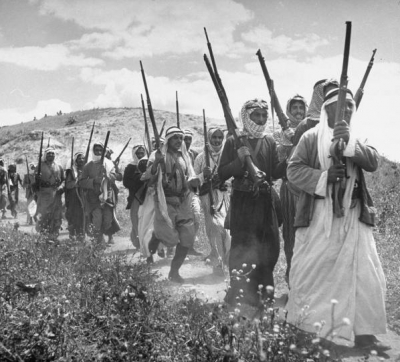
Fast forward to mid-April 1936. Following two incidents of killing carried out in by both Arabs and Jews, an Arab National Committee declared a strike in the city of Jaffa. National Committees were formed in other Palestinian cities and representatives of Arab parties formed the “Arab Higher Committee” led by Haj Amin al-Husseini. A general strike spread throughout Palestine, accompanied by the formation of Palestinian armed groups that started attacking British forces and Jewish settlements. Thus began the “Great Palestinian Revolt. It lasted for three years.

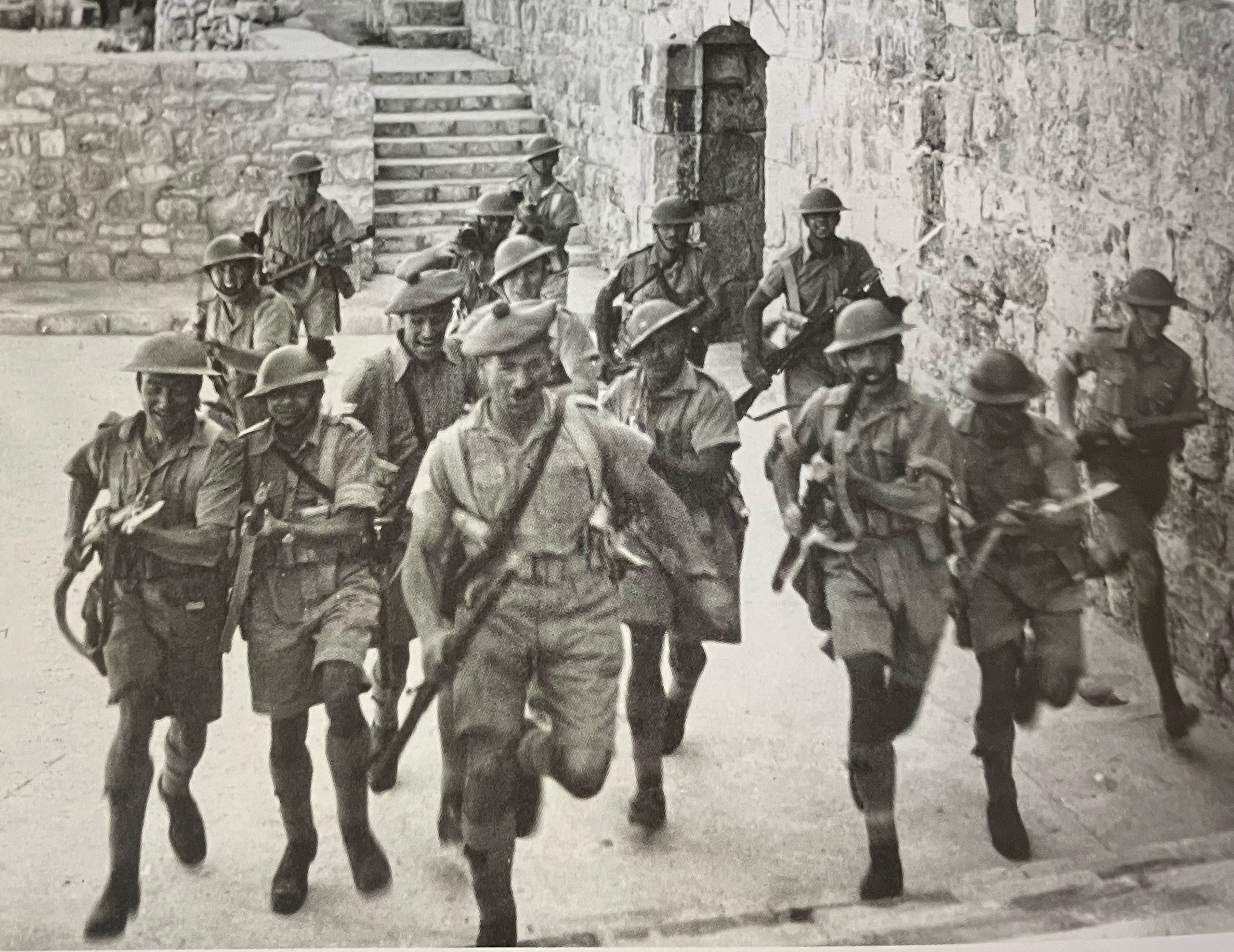
British troops run through Jerusalem’s’ Old City during the Great Revolt


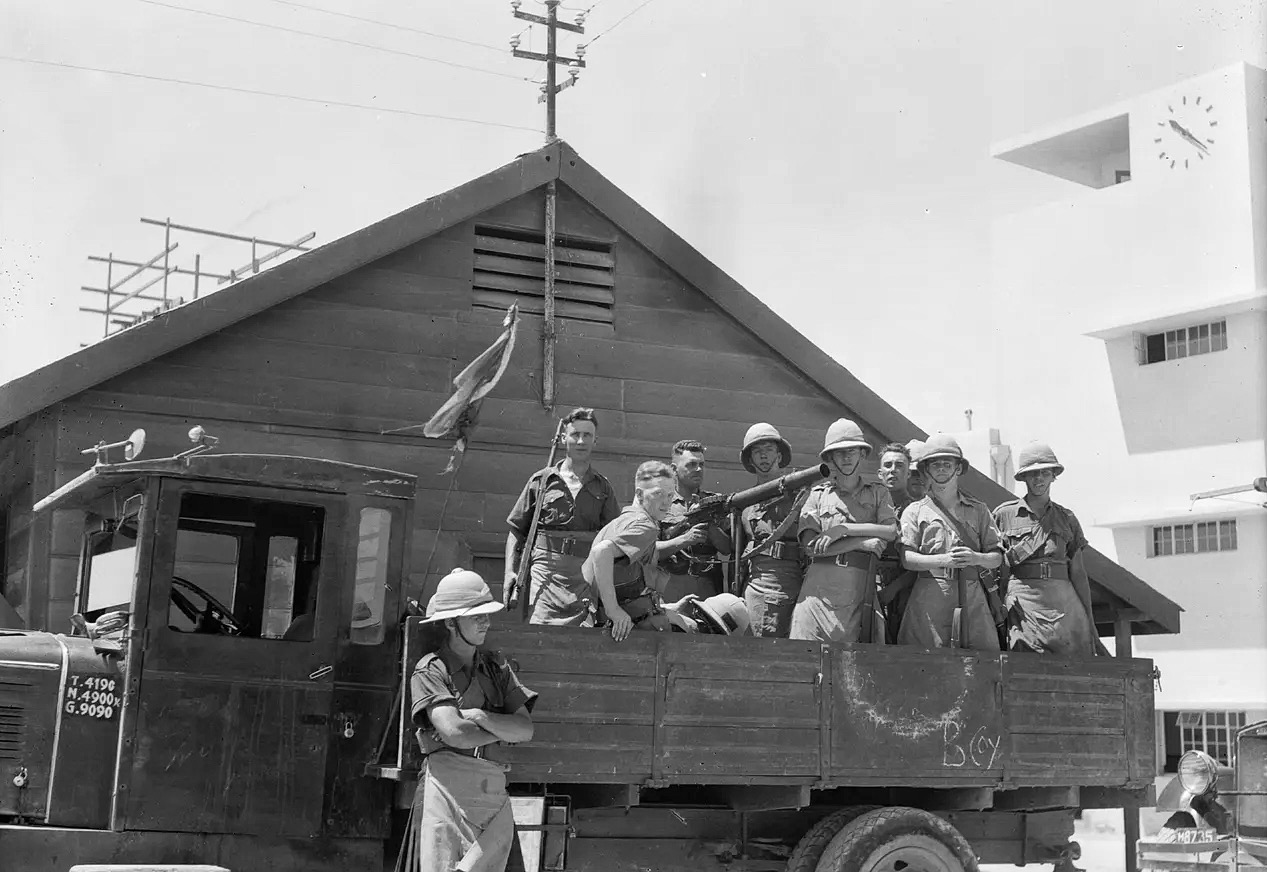
British soldiers on patrol 1936

Roots and fruits 

The ongoing struggle with regard to the existence Israel and Palestine is justifiably regarded the most intractable conflict of modern times. Whilst most agree that its origins lie in the political and historical claims of two people, the Jewish Israelis and the predominantly Muslim Palestinians for control over a tiny wedge of one-time Ottoman territory between Lebanon and Syria in the north, Jordan in the east, and Egypt to the south, hemmed in by the Mediterranean Sea. There is less consensus as to when the Middle East Conflict as it has become known because of its longevity and its impact on its neighbours and the world in general, actually began.

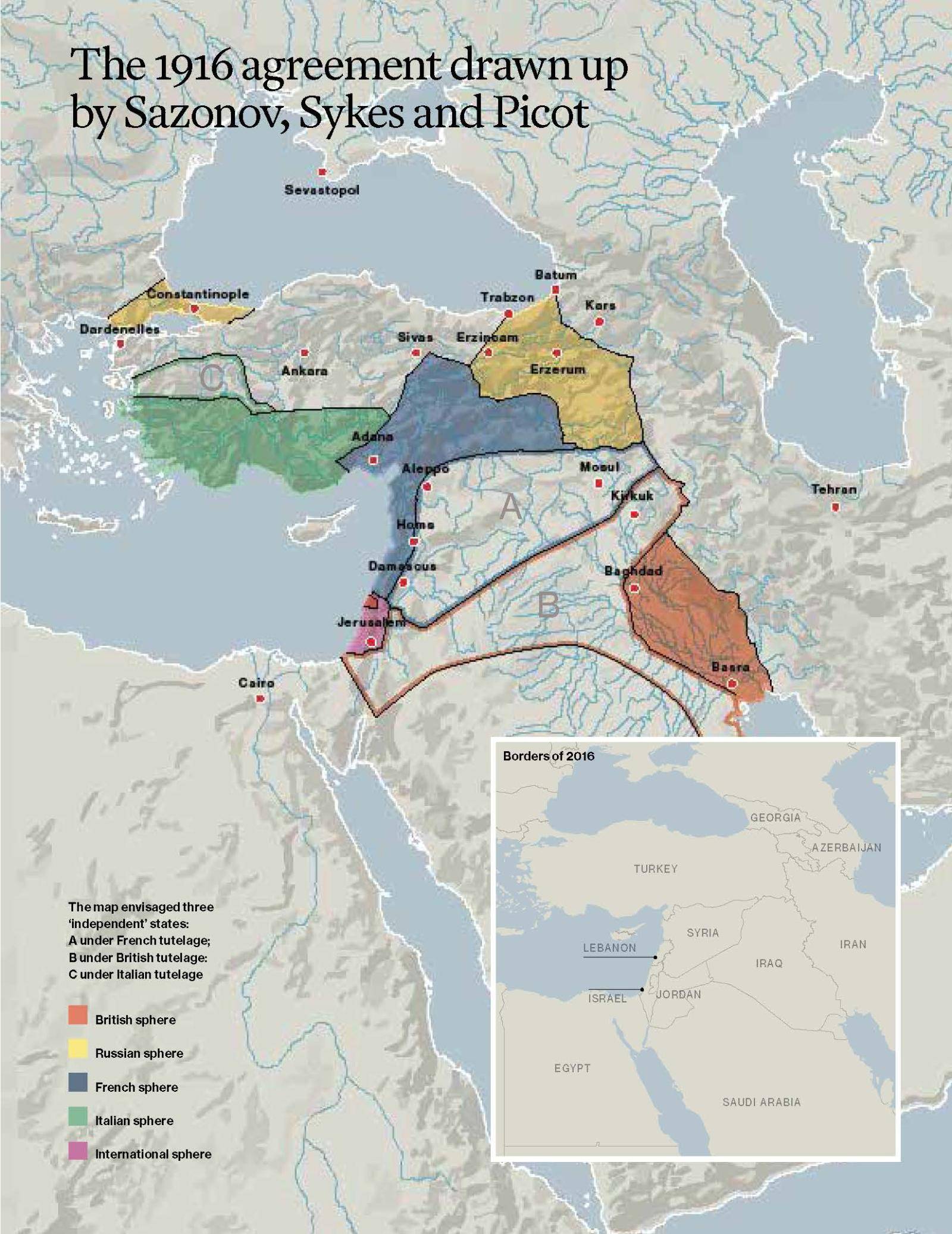
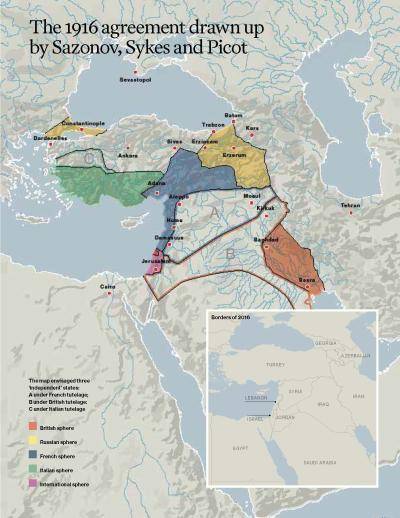
Was it the infamous Balfour Declaration of 1917 promising a national home for Jews in an Ottoman governate already populated by Arabs, or the secretive Sykes Picot Agreement that preceded it in 1916, staking imperial Britain’ and France’s claim to political and economic influence (and oil pipelines) in the Levant? Was it the establishment of the British Mandate of Palestine after the Treaty of Sèvres of 1922 which determined the dissolution of the defeated Ottoman Empire. Or was it the end of that British mandate and the unilateral declaration of Israeli independence in 1948 and the war that immediately followed?

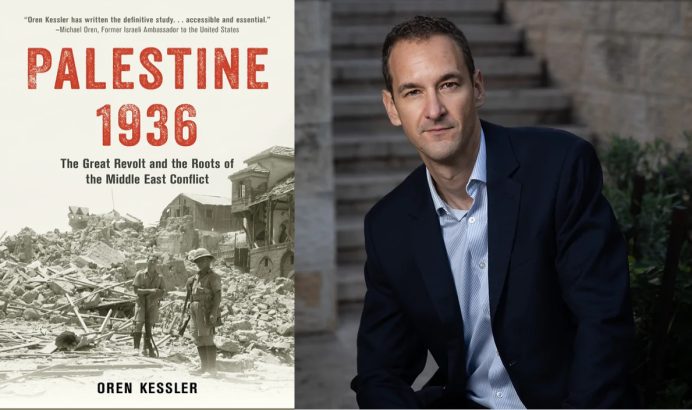
In his book Palestine 1936: The Great Revolt and the Roots of the Middle East Conflict (Rowman & Littlefield, 2023) Israeli journalist and author Oren Kessler argues powerfully that the events in Mandatory Palestine between 1936 and 1939 shaped the subsequent history of the conflict for Israelis and Palestinians. The book identifies what was known at the time as The Great Revolt  as the first Intifada, a popular uprising which actually sowed the seeds of the Arab military defeat of 1947-48 and the dispossession and displacement of over seven hundred thousand Palestinian Arabs, which has set the tone of the conflict for almost a century.

It is a tragic history shared with knowledge in hindsight of the decades of violence and bloodshed in the region that followed. It begins in the time before Palestine became political entity, when mainly Eastern European Jews began settling in progressively larger numbers to the consternation of the Arab populace.

The 1936 conflict stemmed from questions of how to divide the land and how to deal with the influx of Jewish people – questions that remain relevant today. In an extensive interview coinciding with the book’s publication (republished below) Kessler notes that, for the Arab residents, the problem was one of immigration and economics; for the Zionists, it was about finding a home. These two positions soon became irreconcilable issues, leading to sporadic violence and then to continual confrontation.

He believes that the Revolt is the point when both sides really came to see the conflict as zero sum. insofar that whichever community had the demographic majority in Palestine would be the one that would determine its fate. However, in the 1920s, the Jews were so far from that majority that both sides were able to postpone the final reckoning. In the 1930s, the Jews threatened to become a majority, and this was the immediate precursor to the rising. There was no way that the objective of bringing as many Jews to the land as possible could be achieved without bringing about some serious Arab pushback.

It is Kessler’s view that it was during revolt that a strong sense of Arab nationalism in Palestine extended beyond the urban elites to all corners of the country. All segments of Arab society – urban and rural, rich and poor, rival families, and even to a large extent Muslim and Christian – united in the same cause against Zionism and against its perceived enabler, the British Empire. The Arab public in Palestine was becoming increasingly politically aware and consciously perceiving itself as a distinct entity – distinct from its brethren in Syria, in large part because it has a different foe: not simply European imperialism but this very specific threat presented by Zionism.

The British government made early efforts at keeping the peace, but these proved fruitless. And when the revolt erupted in 1936, it sent a royal commission to Palestine, known to history as the Peel Commission, to examine the causes of the revolt. It proposed in effect the first ‘two state solution.’ The Emir Abdullah of Transjordan publicly accepted this plan. The main rival clan to the Husseinis, the Nashashibis, privately signaled that they were amenable – not thrilled, but amenable. And their allies held the mayorships of many important cities – Jaffa, Haifa, and even Nablus, Jenin and Tulkarem, which today are centres of militancy. And yet the Mufti makes very clear that he regards this plan as a degradation and a humiliation, and all of these erstwhile supporters of partition suddenly realise that they are against partition.

Kessler believes that this is the point at which a certain uncompromising line became the default position amongst the Arab leadership of Palestine, with dire consequences for the Palestinians themselves, and when Yishuv leader David Ben Gurion saw an opportunity to achieve his long-standing objective of creating a self-sufficient Jewish polity, one that could feed itself, house itself, defend itself, employ itself, without any help from anyone – neither British or Arabs. When the Arabs called a general strike and boycott, cut all contacts with the Jewish and British economies and closed the port of Jaffa in Spring 1936, he lobbied successfully with the British to allow the Jews to open their own port in Tel Aviv, ultimately causing a lot of economic pain to the Arabs and helping the Jews in their state-building enterprise.

This is a mosaic history, capturing the chaotic events on the ground through snippets of action. And also, the people involved. 

There are heroes and villains aplenty in this relatively untold story. The urbane and erudite nationalists Muhammed Amal and George Antonius who strive for middle ground against increasingly insurmountable odds, and who died alone and exiled having failed to head off the final showdown that is today known as Al Nakba. The farseeing, resolute, and humourless Ben Gurion and the affable, optimistic Chaim Weizmann, who became Israel’s first prime minister and president respectively. The New York born Golda Meyerson, more of a realist than either leader, who would also one day become prime minister. The irascible revisionist Vladimir Ze’ev Jabotinski, the forebear of today’s virulent rightwing nationalists

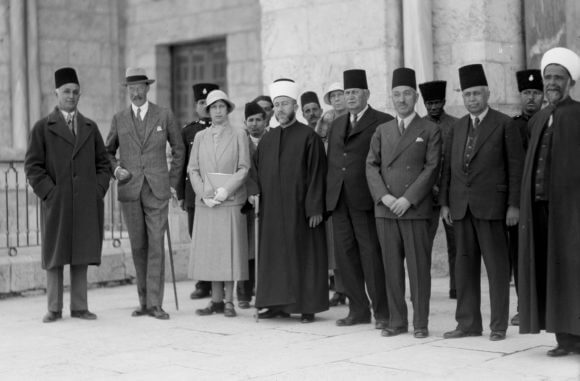
The hardliner Mufti Haj Amin al Husseini, whose uncompromising stance, malign political influence, and conspiratorial association with the Nazis set the stage for a long general strike, the Great Revolt, and ultimately, the débâcle of 1948. The flamboyant rebel leaders, Syrian Izz al Din al Qassam, who is memorialized in the name of the Hamas military wing and a Gaza-made rocket, and Fawzi al Qawuqji. Qassam was gunned down by British soldiers during the revolt whilst Qawuqji lived on to become one of the most effective militia leaders in the war of 1948, and to perish therein. Both are remembered today as Palestinian martyrs whilst the Mufti is an arguably embarrassing footnote of history. There’s an article about his relatively unremarked death at the end of this post. 

Amin al-Husseini in 1929

And in the British corner, the well-intentioned high commissioners who vainly endeavoured to reconcile the claims of two aspirant nations in one tiny land, and quixotic figures like the unorthodox soldier Ord Wingate who believed he was fulfilling prophecy by establishing the nucleus of what would become the IDF (like many charismatic British military heroes, and particularly General Gordon and Baden-Powell, both admirers and detractors regarded him a potential nut-case); and the Australian-born ex-soldier Lelland Andrews, assistant district commissioner for Galilee, who also conceived of his mission as divinely ordained. Lewis was murdered by Arab gunmen and Wingate went down in an aeroplane over Burma during WW2.

There are appearances from among many others, Lloyd George, Winton Churchill and Neville Chamberlain, Adolph Hitler and Benito Mussolini, Franklin D Eisenhower and Joseph Kennedy.

The book highlights the work of powerful British functionaries in handling early confrontations: they are memorialized for starting commissions to study the matter and to generate ideas, though many of their ideas weren’t followed or were followed to ill effect. None solved the problem, making this account of the earliest days of the conflict all the more heartbreaking.

All under the shadow of the impending Shoah, and the inevitable showdown that would culminate in al Nakba.

The road to Al Nakba

Kessler argues that the Arab social fabric and economy are completely torn and shattered by the end of this revolt that in many ways the final reckoning for Palestine between Jews and Arabs – the civil war that erupts in 1947 – is actually won by one side and lost by the other nearly a decade earlier.

The final paragraphs of Kessler’s enthralling book are worth quoting because they draw a clear line between the events of the Great Revolt and the catastrophe, al Nakba, of 1948:

“For the Jews, perhaps the greatest shift was psychological. they had withstood of powerful sustained assault and lived to tell about it. One book on Zionist leaders” thinking in this era is titled Abandonment of Illusions. The belief of material gains would bring Arab consent now naïve and, worse, dangerous. Instead, by the end of the revolt and the start of the world war, much of Palestine’s Jewish mainstream had accepted the fact that the country’s fate would ultimately be determined and maintained by force.
 
“By 1939, the Yishuv had achieved the demographic weight, control of strategic areas of land, and much of the weaponry and military organization that would be needed as a springboard for taking over the country within less than a decade”, writes the Palestinian American historian Rasheed Khalidi.
 
Khalid argues that the Palestinian catastrophe of 1947 -1949 was predicated on a series of previous failures: “a deeply divided leadership, exceedingly limited finances, no centrally organized military forces or centralized administrative organs, and no reliable allies. They faced a Jewish society in Palestine which although small relative to theirs, was political unified, had centralized para-state institutions, and was increasingly well-led and extremely highly motivated”.
 
For Palestinians, he maintains, the Nakba – the catastrophe of their military drubbing, dispossession and dispersal – was but a forgone conclusion. For them, the terrible events that bookended the year 1948 “were no more than a postlude, a tragic epilogue to the shattering defeat of 1936- 39”.
 
The Great Revolt, Kessler says, has cast its shadow over the Israeli-Palestinian conflict ever since – for the Arabs, for the Jews, and for attempts to resolve the conflict. It is still remembered by Palestinians and Israelis alike. Palestinian folk songs still celebrate the revolt, and in my he regards the. BDS movement as direct descendant of the general strike that preceded the revolt. The two-state solution that is still the international community’s favoured solution to the conflict is but a variation of that original partition plan of 1937.

In so many ways, for both Israelis and Palestinians, this revolt rages on.

© Paul Hemphill 2024.  

Kessler’s interview in Fathom e-zine follows, together with serval informative articles on the Great Revolt and its aftermath, including a Haaretz retrospective of how it reported the beginning of the revolt ninety years earlier. It was, most interestingly, a different newspaper then. 

For more on Israel and Palestine in In That Howling Infinite, see: A Middle East Miscellany

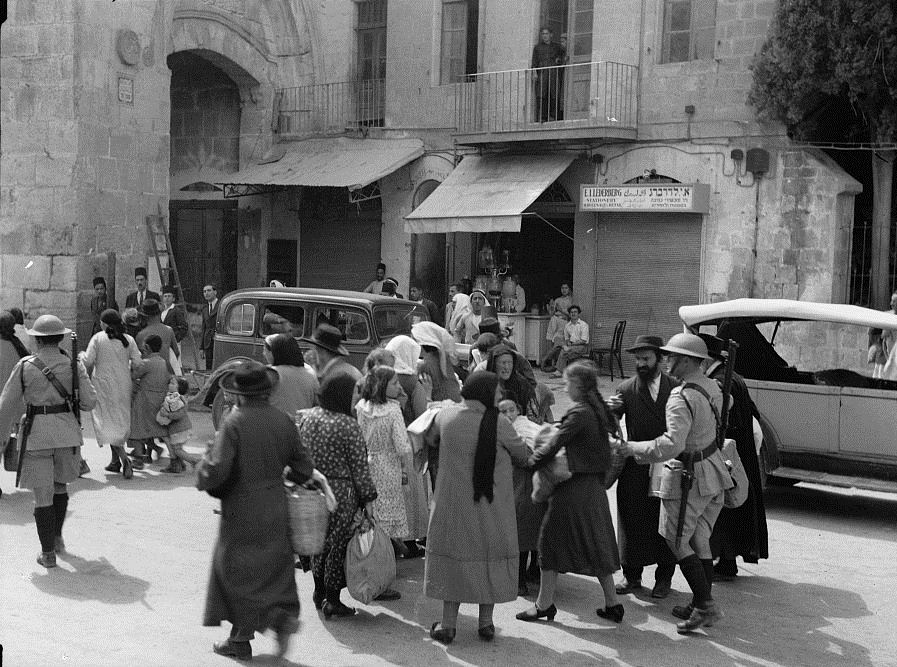
The picture at the head of this post shows British troops marching through Ibn Khatib Square in 1936 past King David’s Citadel and towards the Jaffa Gate

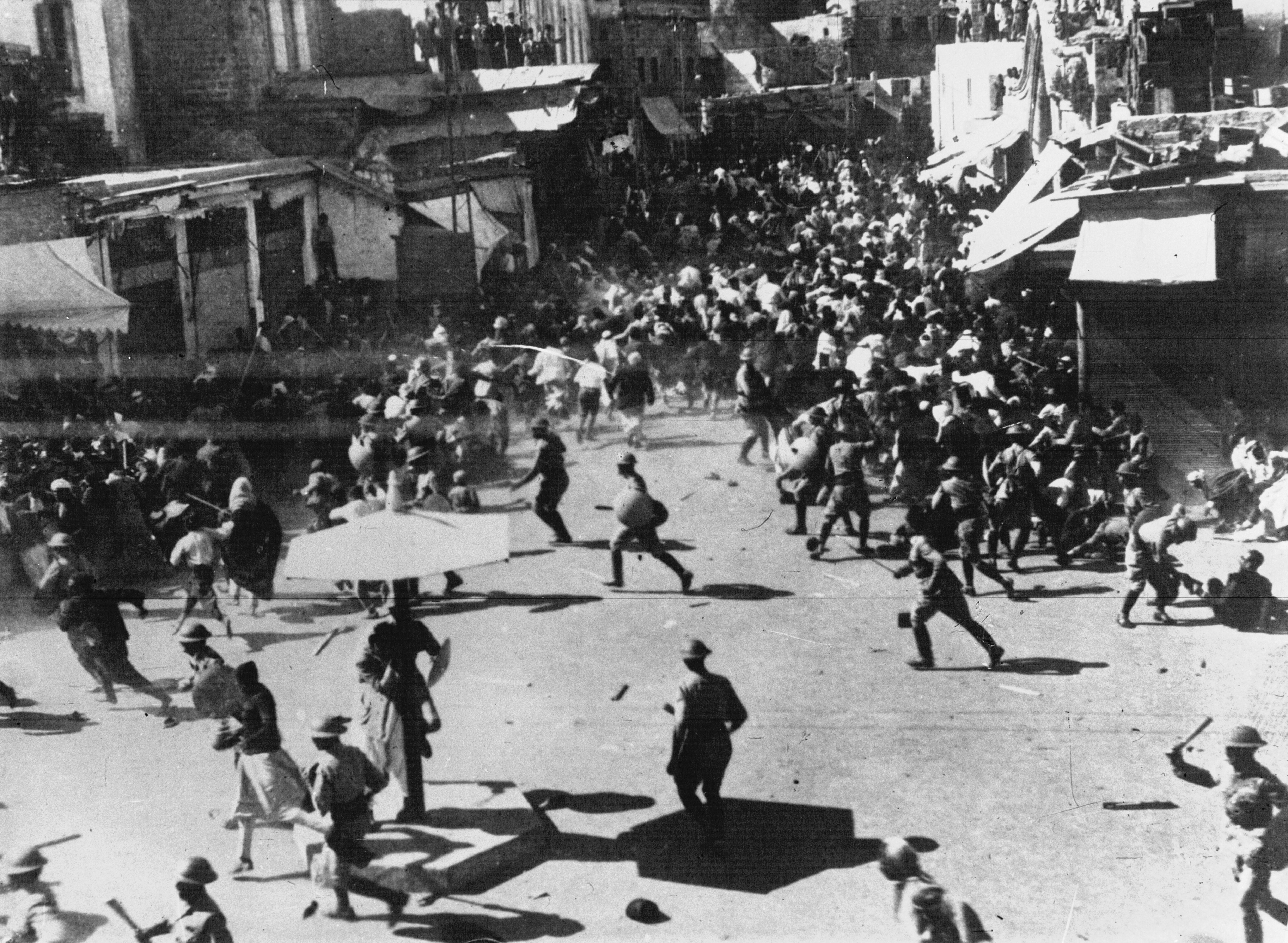
British policemen disperse an Arab mob during the Jaffa riots in April 1936 (The Illustrated London News)


Jews evacuate the Old City of Jerusalem after Arab riots in 1936.

Haaretz During the Arab Revolt: Blood Is the Glue That Binds a Nation and Its Land

At the start of the Arab Revolt, which began 90 years ago this week, the newspaper told its readers that ‘the God of Israel wanted our sacrifices,’ and promised that the Jewish community was here to stay

 
Haaretz April 17, 2026
 
“Once again, this land, sacred to all civilized humanity, has absorbed innocent blood,” read the Haaretz editorial on April 20, 1936. “Once again, passions raged and man turned into a desert wolf; decent people, ordinary citizens … did not return home, because murderers cut short their lives.”

The day before, nine Jews had been murdered by Arabs in Jaffa. “Tel Aviv accompanies its slain-saints,” a newspaper heading read. “From horror to horror,” screamed another headline. These were the first days of the Arab Revolt of 1936-1939 (in which Palestinian Arabs in British Mandatory Palestine rose up against the administration). Hundreds of Jews and Britons and thousands of Arabs were killed.

As a result of the revolt the Jewish community in Palestine focused on strengthening its military capabilities which later proved crucial in the War of Independence. But the revolt also had negative effects as the British closed the gates to Jewish immigration in 1939, sealing the fate of many.

The editorial argued that “all of the people of Israel” were the target of the “wild mob.” The murderers “sought to murder the last national hope of a nation wallowing in its blood and decaying … in its suffering … while trying to lift its soul from the abyss of its distress to new life.” Its language then became even more poetic.


A member of the Jewish community in Palestine is wounded in the first days of the Arab Revolt.
 
A member of the Jewish community in Palestine is wounded in the first days of the Arab Revolt. Credit: Haaretz

“From the earliest days of our new national movement, we knew that the renewed homeland would not fall into our laps as a gift from above. We knew that the Land of Israel would be acquired only through suffering and sacrifices. And if it is a tragic necessity that we shall again betroth our ancestral land not only with love and justice and righteousness, not only by the sweat of our brows … but also with the sacrifices of the souls and blood of our sons – the builders of this land– we will accept the decree.

“We have no choice, there is no other way” – the article continued, then adopting a religious tone; “The sacrifice is the justification and right of redemption. … And the blood … covenantal blood of building a people and a homeland, is the glue that binds a nation and its land. … The God of Israel wanted our sacrifices.

“No calamity will move us from our place,” the editorial asserts. “No bloody assassination, no schemes of deceit will turn back the wheel of history or break our new-old covenant with this land. The Hebrew Yishuv [Jewish community] in this land … is a reality that cannot be undone – a reality as natural as the air, the sun, the blue skies over the Judean Hills, and the Mediterranean Sea. The propaganda of so-called leaders will not stand against this natural truth and nor will acts of crime and bloodshed. … From time to time a storm of hatred, a lust for destruction, rises against us. But even these storms reveal and strengthen our power, temper our will, awaken and encourage our spirit.”

"Man turned into a desert wolf; decent people, ordinary citizens … did not return home, because murderers cut short their lives."
 
“Man turned into a desert wolf; decent people, ordinary citizens … did not return home, because murderers cut short their lives.” Credit: Haaretz, April 20th, 1936.
The funerals for those murdered in Jaffa take place in Tel Aviv.
 
The funerals for those murdered in Jaffa take place in Tel Aviv. Credit: Haaretz

Five days earlier, on April 15, 1936, two people driving near Tulkarm had been shot dead in what initially appeared to be a criminally-motivated attack. “Attack on cars near Tulkarm,” read the headline of the brief news report. It later turned out that two victims were Jews and the murder had nationalist motives. It was carried out by members of the Iz al-Din al-Qassam Brigade, whose leader had been killed by the British about six months earlier (the group later lent its name to Hamas’ military wing). The next day, Jews murdered two Arabs in the Petah Tikva area.

On April 17, 1936, Haaretz dedicated its editorial to the attack in Tulkarm. It did not hide its revulsion toward some of the country’s Arabs. “The act of robbery and murder near Tulkarm stunned and shocked the Hebrew Yishuv,” it wrote. In parentheses, the editors added: “We doubt if anyone else in this country, besides the Hebrew Yishuv, is capable of being shocked by these terrible acts.

“We have experience and are under no illusions about the cultural level …of part of the population. … The psychological and moral distance between the ‘civilized’ population of this country and the desert is no less than the geographical distance between them.”

The mourners' notice for one of he first victims of the Arab Revolt.
 
 
The mourners’ notice for one of he first victims of the Arab Revolt. Credit: Haaretz
Scottish soldiers stop Palestinians and their camel at the entrance to Rachel's Tomb near Bethlehem.
 
Scottish soldiers stop Palestinians and their camel at the entrance to Rachel’s Tomb near Bethlehem. Credit: G. Eric and Edith Matson Photograph Collection

Regarding the nationalist motivations of the attackers, the editors wrote: “The specific circumstances of the recent murders arouse particular anxiety. This time there is no room for the naïve assumption that the victims were only coincidentally Jewish.

“The German from Sarona, who drove by the scene was not touched after he told the attackers his nationality, while the Jewish driver was forced out of his car. An Arab car that arrived at the scene passed safely, after it became clear to the murderers that there were no Jews in it,” they wrote. “Now we have robbers who engage in politics, who carry out robbery and murder with nationalist motives. Robbers who seek only Jewish money and Jewish blood.”

The newspaper warned of what was to come. “The current climate is deeply charged; the public mood has been poisoned by unrestrained demagogic propaganda in which all methods are deemed legitimate. This tension could ignite at any time, manifesting in isolated crimes or even mass violence. Meanwhile, the authorities look on, unwilling to fully acknowledge what is unfolding.”

British soldiers in Tel Aviv.
 
British soldiers in Tel Aviv. Credit: Haaretz.

An interview with Oren Kessler

by Oren Kessler
 
 
3365748242
Great Arab Revolt, 1936-1939
A Popular Uprising Facing a Ruthless Repression
 
In 1936, widespread Palestinian dissatisfaction with Britain’s governance erupted into open rebellion. Several key dynamics and events can be seen as setting the stage for this uprising. In Palestine, as elsewhere, the 1930s had been a time of intense economic disruption. Rural Palestinians were hit hard by debt and dispossession, and such pressures were only exacerbated by British policies and Zionist imperatives of land purchases and “Hebrew labor.” Rural to urban migration swelled Haifa and Jaffa with poor Palestinians in search of work, and new attendant forms of political organizing emerged that emphasized youth, religion, class, and ideology over older elite-based structures. Meanwhile, rising anti-Semitism—especially its state-supported variant—in Europe led to an increase of Jewish immigration, legal and illegal, in Palestine.

Unsurprisingly, the combination of these various trends produced periodic upheavals, from the 1929 al-Buraq Uprising to multicity demonstrations in 1933 against the British Mandate. In October 1935, the discovery of a shipment of arms in the Jaffa port destined for the Haganah fueled Palestinian concerns that the Zionist movement was introducing the human and military resources necessary for its state-building project under the nose of the British. Meanwhile, the popular and populist Syrian Shaykh Izzeddin al-Qassam , who preached to the slum-dwelling rural transplants near Haifa’s rail yards and who had spent the early 1930s building a cell-based paramilitary network, was killed in a firefight with British forces in November 1935. Qassam’s funeral in Haifa elicited a mass outpouring of public outrage. These events are often seen as direct predecessors of the mass Palestinian uprising that took place in 1936.

The Great Palestinian Rebellion , or the Great Arab Revolt, as this uprising came to be known, lasted for three years and can be generally divided into three phases. The first phase lasted from the spring of 1936 to July 1937. With tensions throughout Palestine running high since the fall of 1935, the revolt was ignited in mid-April 1936 when followers of Qassam attacked a convoy of trucks between Nablus and Tulkarm , killing two Jewish drivers. The next day, the  Irgun killed two Palestinian workers near Petah Tikva , and in the following days, deadly disturbances ensued in Tel Aviv and Jaffa. In Nablus, an Arab National Committee was formed and a strike was called on 19 April. National Committees in other cities echoed the call to strike, and on 25 April the Arab Higher Committee (Lajna) (AHC) was formed, chaired by Haj Amin al-Husseini , to coordinate and support a nationwide general strike, which was launched on 8 May.

The strike was widely observed and brought commercial and economic activity in the Palestinian sector to a standstill. Meanwhile, Palestinians throughout the countryside came together in armed groups to attack—at first sporadically, but with increasing organization— British and Zionist targets. Some Arab volunteers joined the rebels from outside Palestine, though their numbers remained small in this period. The British employed various tactics in an attempt to break the strike and to quell the rural insurrection. The ranks of British and Jewish policemen swelled and Palestinians were subjected to house searches, night raids, beatings, imprisonment, torture, and deportation. Large areas of Jaffa’s Old City were demolished, and the British called in military reinforcements.

Concurrent with military operations and repressive measures, the British government dispatched a commission of inquiry headed by Lord Peel to investigate the root causes of the revolt. In October 1936, under the combined pressure of British policies, other Arab heads of state, and the effects of a six-month general strike on the Palestinian population, the AHC called off the strike and agreed to appear before the Peel Commission . A period of lower intensity conflict prevailed as the Peel Commission toured the country, but tensions continued to build in anticipation of the commission’s report. In July 1937, the Peel Commission published its report, recommending Palestine’s partition into Jewish and Arab states. Dismayed by this negation of their desires and demands, the Palestinian population relaunched their armed insurgency with renewed intensity, initiating the second phase of the revolt.

This second phase, lasting from July 1937 until the fall of 1938, witnessed significant gains by the Palestinian rebels. Large swaths of the hilly Palestinian interior, including for a time the Old City of Jerusalem , fell fully under rebel control. Rebels established institutions, most significantly courts and a postal service, to replace the British Mandate structures they sought to dismantle. The British, meanwhile, imposed even harsher measures to try to quash the revolt. The AHC and all Palestinian political parties were outlawed, political and community leaders were arrested, and a number of high-profile public figures exiled. The military aspects of counterinsurgency intensified, and British tanks, airplanes, and heavy artillery were deployed throughout Palestine. The British also meted out collective punishment: thousands of Palestinians were relegated to “detention camps”; residential quarters were destroyed; schools were closed; villages were collectively fined and forced to billet British troops and police. Zionist military institutions took advantage of the situation to build up their capacities with British support. By early 1939, members of the Jewish Settlement Police (about 14,000) were subsidized, uniformed, and armed by the British government as a thinly veiled front for the Haganah, and so-called Special Night Squads  comprising Jewish and British members launched “special operations” against Palestinian villages.

The third phase of the rebellion lasted roughly from the fall of 1938 to the summer of 1939. The British dispatched another commission of inquiry, this one headed by Sir John Woodhead , to examine the technical aspects of implementing partition. In November 1938, the Woodhead Commission report concluded that partition was not practicable, marking a certain British retreat from the Peel recommendation. At the same time, however, the British launched an all-out offensive: in 1939 more Palestinians were killed, more were executed (by hanging), and nearly twice as many were detained than in 1938. Such brutality placed immense pressure on the rebels, exacerbating rifts between the political leadership of the AHC exiled in Damascus and local leadership on the ground, between rebel bands and village populations that were expected to support and supply them, and ultimately between Palestinians who remained committed to the revolt and those willing to reach a compromise with the British. British-supported Palestinian “Peace Bands” were dispatched to battle their compatriots.

In May 1939, the British government published a new White Paperthat proposed the following: Britain’s obligations to the Jewish national home had been substantially fulfilled; indefinite mass Jewish immigration to and land acquisition in Palestine would contradict Britain’s obligations to the Palestinians; within the next five years, no more than 75,000 Jews would be allowed into the country, after which Jewish immigration would be subject to “Arab acquiescence”; land transfers would be permitted in certain areas, but restricted and prohibited in others, to protect Palestinians from landlessness; and an independent unitary state would be established after ten years, conditional on favorable Palestinian-Jewish relations.

The combined impact of Britain’s military and diplomatic efforts brought the rebellion to an end in the late summer of 1939. Over the revolt’s three years, some 5,000 Palestinians had been killed and nearly 15,000 wounded. The Palestinian leadership had been exiled, assassinated, imprisoned, and made to turn against one another. At the same time, the White Paper—despite its limitations—offered certain concessions to the rebels’ demands. Whatever gains Palestinians might have made through the revolt, however, were quickly overtaken by the larger geopolitical processes of World War II , and the combined British-Zionist assault on Palestinian political and social life during the revolt had a long-lasting impact.

 
Selected Bibliography:

Anderson, Charles W. “State of Formation from Below and the Great Revolt in Palestine.” Journal of Palestine Studies 47, no. 1 (Autumn 2017): 39-55.

Hughes, Matthew. “From Law and Order to Pacification: Britain’s Suppression of the 1936–1939 Arab Revolt in Palestine.” Journal of Palestine Studies 39, no.2 (Winter 2010): 6–22.

Kanafani, Ghassan. The 1936–39 Revolt in Palestine.

Shbeib, Samih. “Poetry of Rebellion: The Life, Verse and Death of Nuh Ibrahim during the 1936–39 Revolt.” Jerusalem Quarterly 25 (Winter 2006): 65–78.

Sufian, Sandy. “Anatomy of the 1936-39 Revolt: Images of the Body in Political Cartoons of Mandatory Palestine.” Journal of Palestine Studies 37, no.2 (Winter 2008):  23–42.

Swedenburg, Ted. Memories of Revolt: The 1936–1939 Rebellion and the Palestinian National Past. Fayetteville: University of Arkansas Press, 2003.

Britain says releasing a 1941 document about Palestine might ‘undermine security’

A two-part archive, labeled “Activities of the Grand Mufti of Jerusalem” and dated 1940-1941, sits in Britain’s National Archives in Kew. This writer successfully had the first part declassified in 2014. The second part remains sealed. My 2018 attempt to have these ten pages declassified was refused on the grounds that the archive might “undermine the security of the country [Britain] and its citizens.”[1] None of its secrets are to be available until January, 2042; and if the paired file is any precedent, even in 2042 it will be released only in redacted form.

The ‘Grand Mufti’ in the archive’s heading is Haj Amin al-Husseini, the Palestinian leader whom posterity best remembers for his alignment with the Italian and German fascists; and the years 1940-1941 place him not in Palestine, but in Iraq — and if the second archive extends to late 1941, in Europe. What could possibly be hidden in a World War II document about a long-dead Nazi sympathizer that would present such a risk to British national security eight decades later, that none of it can be revealed? At present, only the UK government censors know; but the answer may have less to do with the fascists and al-Husseini than with British misdeeds in Iraq, and less to do with Britain’s national security than with its historical embarrassment.

When in 1921 votes were cast for the new Mufti of Jerusalem, Amin al-Husseini came in last among the four candidates. But votes in Palestine mattered as little then as they do now, and the British, Palestine’s novice replacement occupiers for the Ottomans, handed the post to al-Husseini. At first, he proved to be an asset to the British. But as the years passed, his opposition to Zionism, support for Palestinian nationalism, and ultimately his involvement in the 1936 Palestinian uprising, led to calls for his arrest.

Photograph labelled 'Arab demonstrations on Oct. 13 and 27, 1933. In Jerusalem and Jaffa. Return of Grand Mufti from India. Met by hundreds of cars at Gethsemane, Nov. 17, 1933.'

“ARAB DEMONSTRATIONS ON OCT. 13 AND 27, 1933. IN JERUSALEM AND JAFFA. RETURN OF GRAND MUFTI FROM INDIA. MET BY HUNDREDS OF CARS AT GETHSEMANE, NOV. 17, 1933.” LIBRARY OF CONGRESS, LC-M33- 4218.

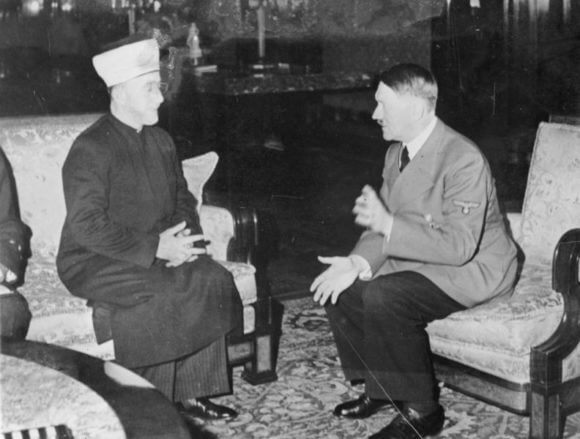
In mid-October of 1937, he fled from hiding in Palestine to Beirut. Two years later and six weeks after the outbreak of World War II, in mid-October of 1939, he slipped to Baghdad, where his sympathies for the Italian fascists further alarmed the British. Fast-forward another two years to late 1941, and al-Husseini is in Europe, meeting with Benito Mussolini on the 27th of October, and on the 28th of November meeting with the Führer himself at the Reich Chancellery in Berlin.

Al-Husseini’s motivation for embracing the Axis was likely a combination of selfish political opportunism and the belief that the alignment would help safeguard against the takeover of Palestine by the Zionists. The reasoning, however grotesque, was the same used by Lehi (the ‘Stern Gang’) in its own attempted collaboration with the fascists: Britain was the obstacle both to Palestinian liberation, and to unbridled Zionism, and for both the Mufti and Lehi, defeating that obstacle meant embracing its enemies. Even the ‘mainstream’ David Ben-Gurion had no moral qualms about taking advantage of Britain’s struggle against the Nazis — a struggle for which his Jewish Agency was already conspicuously unhelpful — by exploiting Britain’s post-war vulnerabilities.[2]

Posterity has treated Lehi’s and the Mufti’s flirtations with the fascists quite differently. Lehi, the most fanatical of the major Zionist terror organizations, was transformed into freedom fighters, and ex-Lehi leader Yitzhak Shamir was twice elected as Israeli Prime Minister. In contrast, Zionist leaders quickly seized on al-Husseini’s past to smear not just him, but the Palestinians as a people, as Nazis.

The use of al-Husseini’s unsavory history to ‘justify’ anti-Palestinian racism continues to the present day. Most bizarrely, in 2015 Israeli Prime Minister Benjamin Netanyahu claimed that Hitler had not intended to exterminate the Jews — that is, not until al-Husseini planted the words in his ear — which translates as “got the idea from the Palestinians”. A private citizen would likely have been arrested under German law for this attempt to rewrite the Holocaust.

The mufti of Jerusalem, Sayid Amin al Husseini, meets with Hitler, November 1941.

THE MUFTI OF JERUSALEM, SAYID AMIN AL HUSSEINI, MEETS WITH HITLER, NOVEMBER 1941.

Iraq won limited independence in 1932, just before the Nazis came to power. When the Mufti ensconced himself in Iraq seven years later, the country was under nominally ‘pro-British’ Prime Ministers, and Regent ‘Abd al-Ilah for the four-year-old king, Faisal II. This uneasy British-Iraqi equilibrium ended on first day of April 1941, when four Iraqi officers known as the Golden Square, wanting full independence (and similarly aligning themselves with the fascists in the foolish belief that doing so would help them get it), staged a coup d’état. It lasted two months. British troops ousted the coup on the first day of June — and as they did, anti-Jewish riots rocked Baghdad. An estimated 180 Jewish Iraqis were killed and 240 wounded in this pogrom known as the Farhud.

Why would the momentary power vacuum of the British takeover lead to anti-Jewish terror? While doing research for my 2016 book, State of Terror, I was intrigued by the claim of one Iraqi Jewish witness, Naeim Giladi, that these ‘Arab’ riots were orchestrated by the British to justify their return to power.[3] Indeed, the riots seemed unnatural in a society where Jews had lived for two and a half millennia, and the “pro-Axis” Golden Square takeover two months earlier had not precipitated any such pogrom. Yet it was also true that Zionism had created ethnic resentment, and Giladi did not question that junior officers of the Iraqi army were involved in the violence. The evidence provided by Giladi was compelling enough to seek out clues among British source documents that were not available to him.

And that, along with the hope of shedding new light on the Mufti’s pro-fascist activities, brought me to the archive at issue and my qualified (redacted) success in getting the first part declassified– officially titled, CO 733/420/19. Not surprisingly, much of the file focused on legitimate worry over the Mufti’s dealings with the Italian fascists. Some of the British voices recorded considered him to be a serious threat to the war effort, and a report entitled “Inside Information” spoke of the Mufti’s place in an alleged “German shadow government in Arabia”. Others dismissed this as “typical of the sort of stuff which literary refugees put into their memoirs in order to make them dramatic” and suggested that the Mufti’s influence was overstated.

Whatever the case, by October 1940, the Foreign Office was considering various methods for “putting an end to the Mufti’s intrigues with the Italians”, and by mid-November,

it was decided that the only really effective means of securing a control over him [the Mufti] would be a military occupation of Iraq.

British plans of a coup were no longer mere discussion, but a plan already in progress:

We may be able to clip the Mufti’s wings when we can get a new Government in Iraq. F.O. [Foreign Office] are working on this”.

So, the British were already working on re-occupying Iraq five months before the April 1941 ‘Golden Square’ coup.

A prominent thread of the archive was: How to effect a British coup without further alienating ‘the Arab world’ in the midst of the war, beyond what the empowering of Zionism had already done? Harold MacMichael, High Commissioner for Palestine, suggested the idea “that documents incriminating the Mufti have been found in Libya” that can be used to embarrass him among his followers; but others “felt some hesitation … knowing, as we should, there was no truth in the statement.”

But frustratingly, the trail stops in late 1940; to know anything conclusive we need the second part’s forbidden ten pages: CO 733/420/19/1.

The redacted first part partially supports, or at least does not challenge, Giladi’s claim. It proves that Britain was planning regime change and sought a pretext, but gives no hint as to whether ethnic violence was to be that pretext. Interestingly, Lehi had at the time reached the same conclusion as Giladi: its Communique claimed that “Churchill’s Government is responsible for the pogrom in Baghdad”.[4]

Does the public have the right to see still-secret archives such as CO 733/420/19/1? In this case, the gatekeepers claimed to be protecting us from the Forbidden Fruit of “curiosity”: They claimed to be distinguishing between “information that would benefit the public good”, and “information that would meet public curiosity”, and decided on our behalf that this archive fit the latter.[1] We are to believe that an eight-decade-old archive on an important issue remains sealed because it would merely satisfy our lust for salacious gossip.

Perhaps no assessment of past British manipulation in Iraq would have given pause to the Blair government before signing on to the US’s vastly more catastrophic Iraqi ‘regime change’ of 2003, promoted with none of 1940’s hesitation about using forged ‘African’ documents — this time around Niger, instead of Libya. But history has not even a chance of teaching us, if its lessons are kept hidden from the people themselves.

Note: According to Giladi, the riots of 1941 “gave the Zionists in Palestine a pretext to set up a Zionist underground in Iraq” that would culminate with the (proven) Israeli false-flag ‘terrorism’ that emptied most of Iraq’s Jewish population a decade later. Documents in Kew seen by the author support this. But to be sure, the Zionists were not connected with the alleged British maneuvers of 1941.

1. Correspondence from the UK government, explaining its refusal to allow me access to CO 733/420/19/1:

Section 23(1) (security bodies and security matters): We have considered whether the balance of the public interest favours releasing or withholding this information. After careful consideration, we have determined that the public interest in releasing the information you have requested is outweighed by the public interest in maintaining the exemption. It is in the public interest that our security agencies can operate effectively in the interests of the United Kingdom, without disclosing information that would assist those determined to undermine the security of the country and its citizens.

The judiciary differentiates between information that would benefit the public good and information that would meet public curiosity. It does not consider the latter to be a ‘public interest’ in favour of disclosure. In this case, disclosure would neither meaningfully improve transparency nor assist public debate, and disclosure would not therefore benefit the public good.

2. Ben-Gurion looked ahead to when the end of the war would leave Britain militarily weakened and geographically dispersed, and economically ruined. He cited the occupation of Vilna by the Poles after World War I as a precedent for the tactic. For him, the end of WWII only presented an opportunity for the takeover of Palestine with less physical resistance; it also left Britain at the mercy of the United States for economic relief, which the Jewish Agency exploited by pressuring US politicians to make that assistance contingent on supporting Zionist claims to Palestine. At a mid-December 1945 secret meeting of the Jewish Agency Executive, Ben-Gurion stressed that “our activities should be directed from Washington and not from London”, noting that “Jewish influence in America is powerful and able to cause damage to the interests of Great Britain”, as it “depends to a great extent on America economically” and would “not be able to ignore American pressure if we succeed in bringing this pressure to bear”. He lauded Rabbi Abba Silver in the US for his aggressiveness on the issue, while noting that he was nonetheless “a little fanatical and may go too far”. (TNA, FO 1093/508). The Irgun was more direct in 1946, stating that Britain’s commuting of two terrorists’ death sentences and other accommodations to the Zionists “has been done with the sole purpose to calm American opposition against the American loan to Britain”. (TNA, KV 5-36). Meanwhile, in the US that year Rabbi Silver’s bluntness on the tactic worried Moshe Shertok (a future prime minister). Although like Ben-Gurion, Shertok said that “we shall exploit to the maximum the American pressure on the British Government”, in particular the pre-election period (and in particular New York), but urged “care and wisdom in this” so as not to give ammunition to “anti-Zionists and the anti-semites in general”. Shertok criticized Silver for saying publicly that “he and his supporters opposed the loan to be granted to the British Government”. (TNA, CO 537/1715)

3. Suárez, Thomas, State of Terror: How Terrorism Created Modern Israel[Skyscraper, 2016, and Interlink, 2017]; In Arabic, هكذا أقيمت المستعمرة [Kuwait, 2018]; in French, Comment le terrorisme a créé Israël[Investig’Action, 2019]
Giladi, Naeim, Ben-Gurion’s Scandals: How the Haganah and the Mossad Eliminated Jews [Dandelion, 2006]

4. Lehi, Communique, No. 21/41, dated 1st of August 1941

Update: This post originally referred to the “four-year-old Prime Minister, ‘Abd al-Ilah,” not the four-year-old King Faisal under Regent ‘Abd al-Ilah. Commenter Jon S. corrected us, and the post has been changed.

The day the Mufti died 

Yes, Hajj Amin al-Husayni collaborated with the Nazis, but that’s not why he was dropped from the Palestinian narrative 

Martin Kramer, Times of Israel Blogs, July 5, 202

Please note that the posts on The Blogs are contributed by third parties. The opinions, facts and any media content in them are presented solely by the authors, and neither The Times of Israel nor its partners assume any responsibility for them. Please contact us in case of abuse. In case of abuse,

“To His Eminence the Grand Mufti as a memento. H. Himmler. July 4, 1943.” Israel State Archives.

Fifty years ago, on July 4, 1974, Hajj Amin al-Husayni, the “Grand Mufti” of Jerusalem, passed away in Beirut, Lebanon, at the American University Hospital. At age 79, he died of natural causes. The Mufti had faded from the headlines a decade earlier. In 1961, his name had resurfaced numerous times during the Jerusalem trial of Adolf Eichmann. But a couple of years later, the Palestinian cause gained a new face in Yasser Arafat. With that, the Mufti entered his final eclipse.

When he died, the Supreme Muslim Council in Jerusalem asked the Israeli authorities for permission to bury him in the city. Israel refused the request. Any Palestinian who wanted to attend the funeral in Lebanon would be allowed to do so, but the Mufti of Jerusalem would not be buried in Jerusalem. Instead, the Mufti was laid to rest in the Palestinian “Martyrs’ Cemetery” in Beirut.

The Mufti was appointed to his position by the British in 1921. Within the British Empire, authorities preferred to work through “native” institutions, even if they had to create them on the fly. So they established a supreme council for Palestine’s Muslims and placed the Mufti at its helm. Although he lacked religious qualifications, he came from a leading family and appeared capable of striking deals.

In fact, he used his position to oppose the Jewish “National Home” policy of the Mandate. The “Arab Revolt” of 1936 finally convinced the British that he had to go, and in 1937 he fled the country.

After a period in Lebanon, he ended up in Iraq, where he helped foment a coup against the pro-British regime. When British forces suppressed the coup, he fled again, making his way through Tehran and Rome to Berlin. There, the Nazi regime used him to stir up Arabs and Muslims against the Allies. He was photographed with Hitler and Himmler, recruited Muslims to fight for the Axis, and attempted to secure promises of independence for colonized Arabs and Muslims. None of his efforts met with much success. His role, if any, in the Holocaust is a contested matter. Hitler and his henchmen hardly needed any prompting to execute their genocidal plans. Clearly, though, the Mufti rooted for Jewish destruction from the fifty-yard line.

After the Nazi collapse, he fell into French hands and spent a year in comfortable house detention near Paris. Later, he fled to Egypt and subsequently moved in and out of Syria and Lebanon. Following the Arab debacle of 1948, Egypt established an “All Palestine Government” in the refugee-choked Gaza Strip, leaving the presidency open for the Mufti. It didn’t last long. He continued to maneuver through Arab politics, but he was yesterday’s man to a new generation of Palestinians born in exile. During the Eichmann trial, the prosecution sought to implicate the Mufti as an accomplice. Yet the Mossad never came after him, and he didn’t die a martyr’s death.

Man without a country

The Mufti was a formidable politician. In 1951, a State Department-CIA profile of him opened with this evocative enumeration of his many talents, which is worth quoting at length:

King of no country, having no army, exiled, forever poised for flight from one country to another in disguise, he has survived because of his remarkable ability to play the British against the French, the French against the British, and the Americans against both; and also because he has become a symbol among the Arabs for defending them against the Zionists. His suave penchant for intrigue, his delicate manipulation of one Arab faction against another, combined with the popularity of his slogan of a united Muslim world, has made him a symbol and a force in the Middle East that is difficult to cope with and well nigh impossible to destroy. The names of Machiavelli, Richelieu, and Metternich come to mind to describe him, yet none of these apply. Alone, without a state, he plays an international game on behalf of his fellow Muslims. That they are ungrateful, unprepared, and divided by complex and innumerable schisms, does not deter him from his dream. 

Profilers would later write similar things about Arafat, but the Mufti had none of Arafat’s cultivated dishevelment. He was manicured, even chic:

The Mufti is a man of striking appearance. Vigorous, erect, and proud, like a number of Palestinian Arabs he has pink-white skin and blue eyes. His hair and beard, formerly a foxy red, is now grey. He always wears an ankle length black robe and a tarbush wound with a spotless turban. Part of his charm lies in his deep Oriental courtesy; he sees a visitor not only to the door, but to the gate as well, and speeds him on his way with blessings. Another of his assets is his well-modulated voice and his cultured Arabic vocabulary. He can both preach and argue effectively, and is well versed in all the problems of Islam and Arab nationalism. His mystical devotion to his cause, which is indivisibly bound up with his personal and family aggrandizement, has been unflagging, and he has never deviated from his theme. For his numerous illiterate followers, such political consistency and simplicity has its advantages. The Mufti has always known well how to exploit Muslim hatred of ‘infidel’ rule. 

So why did the Mufti fade into obscurity? (By 1951, he was on his way out.) Many mistakenly believe his collaboration with Hitler and the Nazis discredited him. It didn’t. Not only did the Arabs not care, but Western governments eyed the Mufti with self-interest. The general view in foreign ministries held that he had picked the wrong side in the war, but not more than that.

The above-quoted American report expressed this view perfectly: “While the Zionists consider him slightly worse than Mephistopheles and have used him as a symbol of Nazism, this is false. He cared nothing about Nazism and did not work well with Germans. He regarded them merely as instruments to be used for his own aims.” If so, why not open a discreet line to him and let him roam the world unimpeded?

Nakba stigma

What finally discredited the Mufti in Arab opinion, where it mattered most, was his role in the 1948 war. It was a war he wanted and believed his side would win. In late 1947, the British sent someone to see if there might be some behind-the-scenes flexibility in his stance on partition, which he had completely rejected. There wasn’t. He explained:

As regards the withdrawal of British troops from Palestine, we would not mind. We do not fear the Jews, their Stern, Irgun, Haganah. We might lose at first. We would have many losses, but in the end we must win. Remember Mussolini, who talked of 8,000,000 bayonets, who bluffed the world that he had turned the macaronis back into Romans. For 21 years he made this bluff, and what happened when his Romans were put to the test? They crumbled into nothing. So with the Zionists. They will eventually crumble into nothing, and we do not fear the result, unless of course Britain or America or some other Great Power intervenes. Even then we shall fight and the Arab world will be perpetually hostile. Nor do we want you to substitute American or United Nations troops for the British. That would be even worse. We want no foreign troops. Leave us to fight it out ourselves. 

This underestimation of the Zionists proved disastrous, even more so than his overestimation of the Axis. He later wrote his memoirs, blaming “imperialist” intervention, Arab internal divisions, and world Zionist mind-control for the 1948 defeat. To no avail: his name became inseparable from the Nakba, the loss of Arab Palestine to the Jews. His reputation hit rock bottom, along with that of the other failed Arab rulers of 1948.

Upon his death in 1974, he received a grand sendoff in Beirut from the PLO. In 1970, Arafat had transferred the PLO headquarters from Jordan to Lebanon, and the funeral finalized his status as the sole leader of the Palestinian people. Four months later, Arafat addressed the world from the podium of the UN General Assembly, achieving an international legitimacy that the Mufti could never have imagined.

The PLO then dropped the Mufti from the Palestinian narrative; nothing bears his name. Even Hamas, which inherited his uncompromising rigidity and Jew-hatred, doesn’t include him in their pantheon. (Their man is Izz al-Din al-Qassam, a firebrand “martyr” killed by the British in 1935.)

If anyone still dwells on the Mufti, it’s the Israelis, including their current prime minister, who find him useful as a supposed link between the Palestinian cause and Nazism. One can understand Palestinians who push back on this; the Mufti was no Eichmann. But that doesn’t excuse Palestinian reluctance to wrestle candidly with the Mufti’s legacy. He personified the refusal to see Israel as it is and an unwillingness to imagine a compromise. Until Palestinians exorcise his ghost, it will continue to haunt them.


Alf Layla wa Laylah – the Arabian Nights and Orientalism

How do you see my country? Dusky maidens in desert tents offering dates on golden plates? 
Algerian secret agent Mohammed Ibn Khaldun to Tom Quinn, Spooks, 2,Ep 2

How often have we heard the exclamation “it’s like something out of the Arabian Nights”? We’ve said it ourselves as we walked down the Suq al Hamadiyya in Old Damascus and al Wad and Daoud Street in Old Jerusalem, in an ersatz Bedouin tent-restaurant just down the road from Palmyra and a similar night out near Petra. It’s as if the local tourist industry folk expect us westerners to enjoy, nay, expect this kind of entertainment. 

But whereas since the translation of The Arabian Nights, we have loved the tales, we have also taken from them a distorted impression of the Middle East, a pastiche of palm trees, minarets and camels like the illustrations of the old boxes of figs and of Fry’s Turkish Delight. 

So, how did we get here?

From a historical European perspective, the East or Orient has long been perceived as an unknown, alien, and, therefore, alluring world, that has existed for centuries, even millennia. It’s spell persists to this day, enchanting, seducing, and seducing soldiers, adventurers, travelers, troublemakers, writers, artists, and musicians.

This enduring fascination with the East gave rise to the descriptor Orientalism. In art history, literature, and cultural studies it described the imitation or depiction of aspects of the Eastern world largely by writers, designers, and artists from the Western world. Since the publication Palestinian America academic Edward Said’s seminal work Orientalism (1978) much of academic discourse has begun to use the term to refer to the generally nurturing though patronizing  Western attitude toward societies in the Middle East, Asia, and North Africa.

But more on Orientalism and Edward Said later. First, we’ll take look at one of the most popular manifestations of western culture’s relationship with the East. 

One Thousand and One Nights (أَلْفُ لَيْلَةٍ وَلَيْلَةٌ‎, Alf Laylah wa-Laylah) is a collection of folk tales compiled in Arabic during medieval times in what is recognized as the Islamic Golden Age, a period of scientific, economic and cultural flourishing in the history of Islam, traditionally dated from the 8th century to the 13th century.  It known in English as The Arabian Nights – from the first English-language edition in the early eighteenth century entitled The Arabian Nights’ Entertainment. Many European translations followed, but none more racy and picaresque that of English explorer, polymath and enfant terrible Richard Burton in 1885; it was an abridged version of this, purchased from a budget book store in King Street, Sydney, that I read the first time i got to meet Mademoiselle Scheherazade. The featured image is from that book’s dust cover. 

It has been acknowledged that Burton’s gaudy and bawdy English bears little relation to the Arabic of the Nights, which tends to be plain, conversational, and even a little threadbare – in other words, the idiom of folk literature. Some would dismiss it as Orientalist camp. Others would say it was just what would be expected from the infamous translator of The Kama Sutra. His translation included virtually every tale he could find a manuscript for – as well as some that he made up, such as my personal favourite How Abu Hasan Broke Wind.  

The stories were gathered over many centuries by various authors, translators, and scholars across the Middle East and South Asia, and North Africa. They originated in ancient and medieval Arabic, Egyptian, Indian, Persian, and even Mesopotamian folklore and literature. Many were originally folk stories from the Abbasid and Mamluk eras, while others, especially the central story of Scheherazade are most likely drawn from the Pahlavi Persian work Hezār Afsān (Persian: هزار افسان‎, A Thousand Tales), which in turn contained Indian elements.  

Charting the timeline, English scholar, author and Sufi adept Robert Irwin has written: “In the 1880s and 1890s a lot of work was done on the Nights by Zotenberg and others, in the course of which a consensus view of the history of the text emerged. Most scholars agreed that the Nights was a composite work and that the earliest tales in it came from India and Persia. At some time, probably in the early 8th century, these tales were translated into Arabic under the title Alf Layla, or ‘The Thousand Nights’. This collection then formed the basis of The Thousand and One Nights. The original core of stories was quite small. Then, in Iraq in the 9th or 10th century, this original core had Arab stories added to it—among them some tales about the Caliph Harun al-Rashid. Also, perhaps from the 10th century onwards, previously independent sagas and story cycles were added to the compilation … Then, from the 13th century onwards, a further layer of stories was added in Syria and Egypt, many of these showing a preoccupation with sex, magic or low life. In the early modern period, yet more stories were added to the Egyptian collections so as to swell the bulk of the text sufficiently to bring its length up to the full 1,001 nights of storytelling promised by the book’s title”.

Sheherazade (Fine Art Images/Heritage Images via Getty Images)

The Thousand And One Arabian Nights has been so appropriated by our culture that it is a de facto member of our so-called Western Canon. It is the source of so many of our fairy tales and boy’s own adventures with its magic lamps and genies, giant birds and winged horses, flying carpets and gorgeous girls in rich silks and ethereal damask. In our pubescent days, did we not “dream of Jeannie”? 

Harem pants and turbans, belly dancers and serpentine melodies, and a “nudge, nudge, wink, wink” of vicarious naughtiness (itself a word of Indian origin) – an exotic, “orientalist” retro-zeitgeist that drew artists, poets, writers and composers to this inexhaustible source of narrative, inspiration and titillation. Recall, back in those thankfully long gone more repressed days, the risqué, soft porn imaginings of European artists, including the Pre-Raphaelites and Orientalists who also elided into similar fever dreams of Babylonian and Roman erotica. 

Musicians too got in on the act. In 1782, Wolfgang Amadeus Mozart premiered Entführung aus dem Serail, The Abduction from the Seraglio, and Gioachino Rossini presented his L’italiana in Algeri or An Italian Girl in Algiers in 1813. These lightweight comic operas featured many of the tropes that entered the cinematic lexicon in the twentieth century, and whilst musically endearing and entertaining, their Orient was a mix of slapstick and exotic, and by today’s standards, condescending in their portrayal of lascivious sultans and their flunkies so easily outwitted by occidental heroes and heroines. Much grander and imposing is Russian composer Nikolai Rimsky-Korsakov’s splendid Scheherazade suite, otherwise known as “the Sultan is coming”. There’s an orchestral rendering of this masterpiece below.

The stories rattle through English pantomimes, Hollywood fantasias, Walt Disney, and even the avant-garde Pier Paulo Pasolini: Alāʼu d-Dīn and Sindibādu l-Bahriyy (these were indeed their original names), Ali Baba and those bandits in huge pots – the inspiration and the storylines for all those boy gets girl cosplay, rom-com, adventure and fantasy films like The Thief of Baghdad and Prince of Persia, and musicals like Kismet – and many more besides, most of them ordinary and many, bad (go Google!). Baubles, bangles and beads indeed (see, below, the Clio from the film). It was a pleasant, picturesque oriental world, the Middle East as Hollywood imagined it before it hit the headlines with its oil, its tyrants, and it internecine wars, a world sans Hamas, Hezbollah, the Taliban, Da’ish and the Al Quds Brigade. 

To illustrate the potential for satire, smut and downright silliness – a veritable “Carry on In The Casbah”. The nearest the famous British comedy series came to anything like this was the one film that didn’t have “Carry on” in its title: Follow That Camel in 1967. Though based on the French Foreign Legion adventures of Beau Geste, it doesn’t waste time getting to the suq and, predictably, the generic harem and the usual, well, carry on. Apropos this, there’s a clip below from the BBC production of British playwright Denis Potter’s excellent faux-musical Lipstick on Your Collar, set during the Suez Crisis of 1956, replete with orientalist imaginings and straight-out smut. 

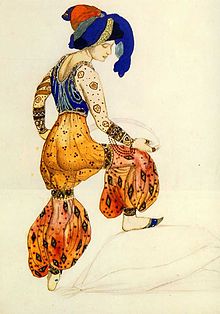
The Blue Sultana by Léon Bakst

The spell of the orient also lured adventurers and chancers to the canyons and the castles, the deserts and the oases of the Levant, Mesopotamia, Persia, Afghanistan and India. And, I have to declare, yours truly – not without incident but no match for derring-do of Brits who went before. Like Irwin himself, I was of a generation with no more deserts to conquer, no fabled cities to administer. See Song of the Road (2) – The Accidental Traveller. 

It’s a part of the world that has captivated much of my intellectual life for I too like many others before me was lured by the spell of the Orient.

I wrote before, in East, “I was drawn to the Middle East in another age, when it was the land of myth and magic, of dreamers and adventurers, of quixotic tilters at windmills, of pioneers who would make the deserts bloom, of dissemblers and deceivers bearing false promises. The ancient lands of the bible, the fabled realm of A Thousand and One Nights, and the restless quests of Richard Burton, Charles Doughty, and TE Lawrence. The pulp fiction fantasies of Frank Herbert, James Michener and Leon Uris, and the celluloid myths of Peter O’Toole, Omar Sharif, and Paul Newman”.

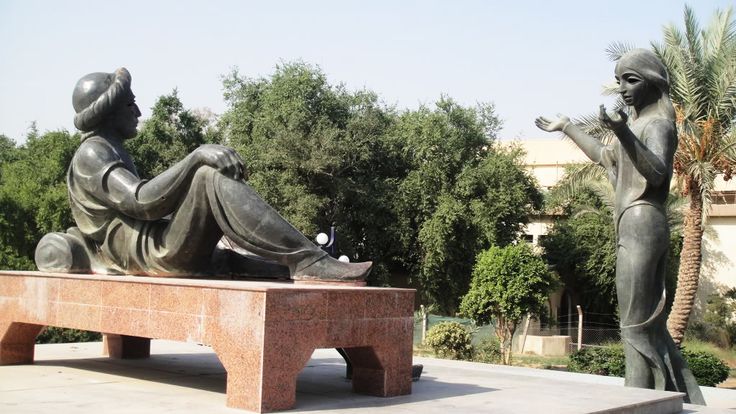
Middle East folk have taken to the stories too, and as in the West, it has inspired books, poems, plays and movies. Lebanese diva Fairuz played Scheherazade in a Beiruti musical back in the seventies, and Umm Kulthum, dead nearly five decades and still indisputably the Arab world’s most renowned and beloved singer, sang about the lass for forty minutes, which was not unusual for her, without saying too much about the story. There is a statue of Scheherazade  and the sultan on the banks of the Tigris in Baghdad. 


And yet, the whole glittering, fairytale artifice was built upon dubious foundations of misogyny and murder. 

Scrumptious Scheherazade’s “cunning plan” was nothing more or less than that of distracting Shahriya, a randy psychopath of a sultan, from dispatching her (and her sister) – as he had done with his many short-lived exes. The premise is that his former missus cheated on him with a cavalcade of lovers, including slaves and persons of colour. To use the words of an old song by latter day philosopher Hal David and his sidekick Burt Bacharach,, he resolved that he was “never gonna love again”. And no doubt, in true oriental fashion, he was fearful of rival claimants and suspicious of all, including his paramours conspiring against him. Yet, he nonetheless constantly needs to get his end in. So whomsoever he selects to join him in his boudoir – and no one says no to the sultan – gets the chop the morning after. When Schezza gets the royal nod, she is determined not to go the way of her predecessors, and to preserve the lives of future bedmates. Accordingly, she keeps his lascivious lordship so distracted with her storytelling that he will refrain from slayage because he wants to hear how her tale ends. And yes, indeed, he forswears his murderous ways and settles into connubial bliss. 

© Paul Hemphill 2024. All rights reserved

See also in In That Howling Infinite, A Middle East Miscellany

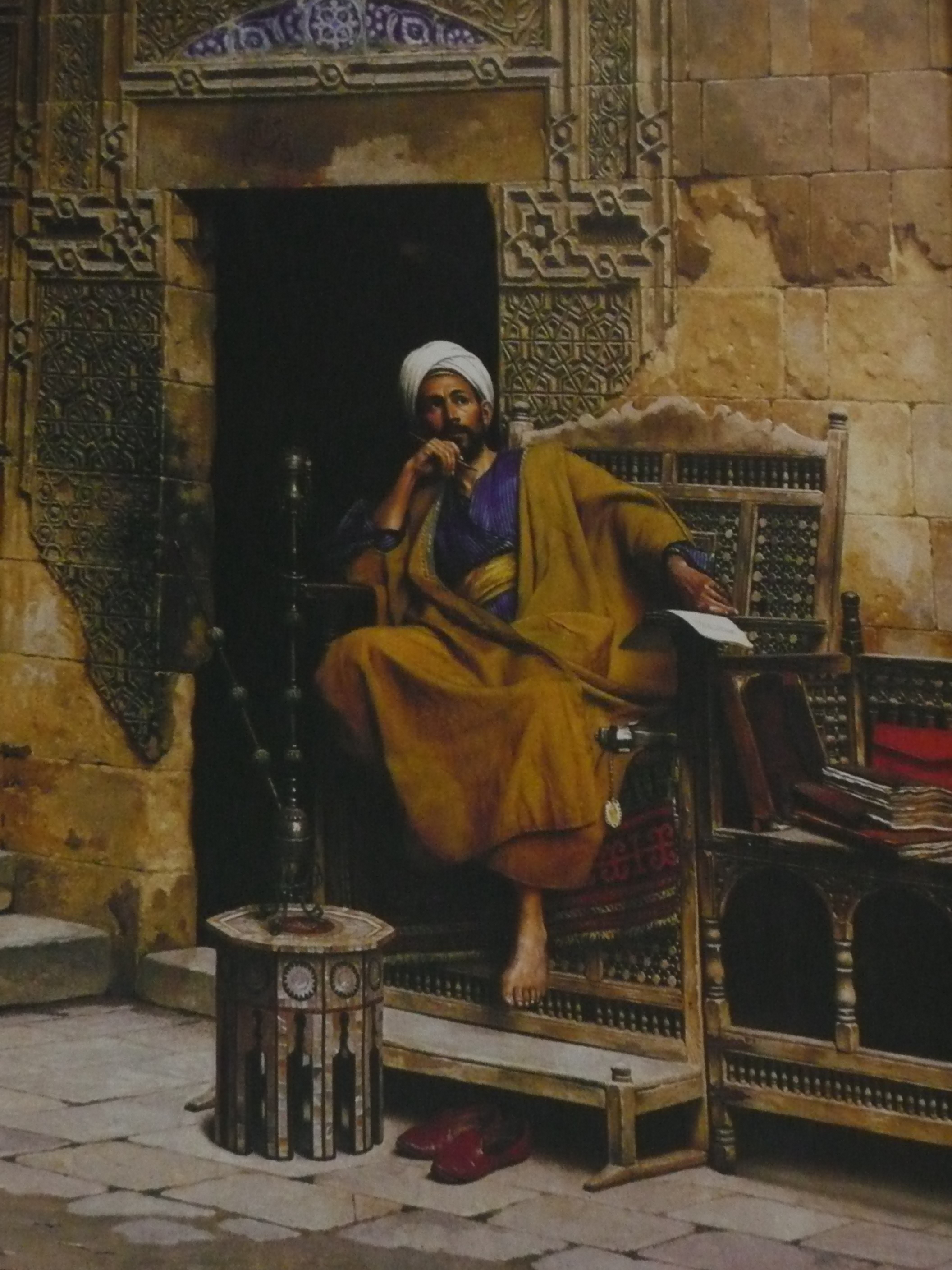
The Scribe. Ludwig Deutsche 1911

East is east and west is west

Oh, East is East, and West is West, and never the twain shall meet,
Till Earth and Sky stand presently at God’s great Judgment Seat
Rudyard Kipling, The Ballad of East and West

The term Orientalism gained its modern definition through the writing of the Palestinian academic and cultural critic Edward Said, especially his famous book Orientalism, published in 1978, which sparked controversy among scholars of Oriental studies, philosophy, and literature. It was a critique of cultural perceptions of how the Western world – primarily the white and Judeo-Christian world – perceives the East – or specifically lands and cultures that lie outside the borders of southern and southwestern Europe.

From a historical European perspective, the East has long been perceived as an unknown, alien, and, therefore, alluring world, that has existed for centuries, even millennia. The Greeks and Romans longed for the silk and spices of the East. To satisfy our human craving for the good things of life, busy trade routes stretched from China and Java to present-day Russia, Scandinavia, the Iberian Peninsula and the British Isles.

The term orient is derived from Latin, oriens meaning “east” (literally “sunrise”, from aurior, rising, and its geographical use of the word “rising” to refer to the east, where the sun rises). The term Levant is in turn derived from Old French, and Italian in origin, to refer to the lands of the rising sun – specifically the historical lands of Syria (in Roman times, specifically’ that included the modern states of Lebanon, Syria, Jordan, Israel, Palestine and most of Turkey. In its broad historical sense, it came to include Greece, the islands of the eastern Mediterranean, modern Egypt and North Africa. And with the emergence of European empires in the east, Persia, Afghanistan, India, China, and the East Indies.

Along with east, west, or west, derived, again, from Old French, via Latin, Occidentem, west, or “sky where the sun goes down”, as in occido, to go down or set, was originally synonymous with Christianity which in the Middle Ages were the states that followed the Roman Catholic faith and which for various centuries considered themselves superior to the Eastern Orthodox faith of the Byzantine Empire and the lands of Russia.

The Levant was widely used after the fifteenth century. During the two hundred years of the Crusades, during which the French knights and their retinue took control, the lands that became the crusader kingdoms were referred to as Outremer, meaning the lands beyond the sea. And through the Crusades, the love affair of Christian Europe with the East began. And it was to continue to this day, enchanting, seducing, and seducing soldiers, adventurers, travelers, troublemakers, writers, artists, and musicians.

Edward Said and Orientalism

Original cover art of Orientalism, Jean Leon Gerome’s Le charmeur de serpents, 1870

Edward Wadih Said Edward Wadih Said (November 1935 – September 24, 2003) was a Professor of Literature at Columbia University, a public intellectual, and a founder of the academic field of Postcolonial Studies. A Palestinian-American born in Mandatory Palestine, he was a citizen of the United States through his father, a US Army veteran.

Educated in British and American schools, Said applied his pedagogical and cultural perspective to highlight the gaps of cultural and political understanding between the Western world and the Eastern world, especially with regard to the Israeli-Palestinian conflict in the Middle East.

As a public intellectual Said  was a controversial member of the Palestinian National Council, due to his public criticism of Israel and Arab countries, especially the political and cultural policies of Islamic regimes that work against the national interests of their people. He called for the establishment of a Palestinian state to guarantee equal political and human rights for Palestinians in Israel, including the right to return to the homeland.

Orientalism in art history, literature, and cultural studies is the imitation or depiction of aspects of the Eastern world. These drawings are usually made by writers, designers, and artists from the Western world. In particular, Orientalist painting, more specifically depicting the ‘Middle East’, was one of the many disciplines of academic art in the nineteenth century, and the literature of Western countries showed a similar interest in Eastern themes.

Since the publication of Orientalism, much of academic discourse has begun to use the term “Orientalism” to refer to the generally nurturing Western attitude toward societies in the Middle East, Asia, and North Africa. In Said’s analysis, the West classifies these societies as static and undeveloped, thus creating a vision of Eastern culture that can be studied, photographed, and reproduced in the service of imperial power. Implicit in this is the idea that Western society is sophisticated, rational, flexible, and superior, Said writes.

His book redefines the term Orientalism to describe the Western tradition – academic and artistic – of biased interpretations of the Eastern world shaped by the cultural attitudes of European imperialism in the eighteenth and nineteenth centuries.

Said said that Orientalism as “the idea of ​​representation is a theoretical idea: the Orient is a stage in which the whole of the Orient is confined” to make the Eastern world “less intimidating to the West.” And that the developed world, and the West in the first place, is the cause of colonialism, and that Western countries and their empires arose by exploiting backward countries and extracting wealth and labor from one country to another. Academically, the book has become a foundational text for postcolonial cultural studies.

While Said’s analysis relates to Orientalism in European literature, especially French literature, the historical view identified and described can also be applied to representations of the Orient in other art forms, including visual art – most notably in Orientalist painting, which was popular among artists And with galleries during the nineteenth century, which modern scholars see as depicting myth and fantasy that has little connection with reality, and also in other art forms that come like music and film.

Such representations drew criticism as much as before and after World War II, they perpetuated the imagined trend, giving generations of Westerners a distorted impression of the Middle East adorned with palm trees, minarets, and camels like illustrations of old chests of figs and boxes of Turkish delight and serpentine melodies. Such images directly connected in Western minds with the trappings of orientalists.  

Fun, romantic and fascinating, this Middle East as imagined by artists and Hollywood – to quote from above, “harem pants and turbans, belly dancers and serpentine melodies, and a “nudge, nudge, wink, wink” of vicarious naughtiness (itself a word of Indian origin) an exotic, “orientalist” retro- zeitgeist that drew artists, poets, writers and composers to this inexhaustible source of narrative, inspiration and titillation”.

Inevitably, a backlash arose in the developing world, both in the Islamic world, and in Asian and African countries in general, and the term Western is now often used to refer to the negative views of the Western world found in Eastern societies, and is based on the nationalism that spread as a response to colonialism. Furthermore, Edward Said himself has been accused of Westernizing the West in his critique of Orientalism. He is guilty of falsely describing the West in the same way that Western scholars are accused of falsely describing the East. Said is said to have encouraged a homogenous picture of the West, which no longer consisted not only of Europe, but also of the United States, Canada and Australia which became more culturally influential over the years.

[This profile of Edward Said and Orientalistism is drawn largely from Wikipedia. For an interesting account of Robert Irwin’s take down of Said’s opus, see The man who defeated Orientalism The man who defended Orientalism]

Wystan and Christopher’s excellent adventure

As evening fell the day’s oppression lifted
Far peaks came into focus, it had rained.
Across wide lawns and cultured flowers drifted
The conversation of the highly trained.
Two gardeners watched them pass and priced their shoes
A chauffeur waited, reading in the drive
For them to finish their exchange of views.
It seemed a picture of the private life.
Far off, no matter what good they intended
The armies waited for a verbal error
With all the instruments for causing pain
And on the issue of their charm depended
A land laid waste, its towns in terror
And all its young men slain.
Embassy, WH Auden, from Journey to a War

In 1938, English writers WH Auden and  Christopher Isherwood were commissioned by their publishers to write a travel book about the East. Auden was already established as one of Britain’s foremost poets whilst his friend and onetime lover Isherwood was acclaimed as an author and dramatist. His Berlin Stories, two novels set in the last days of the Weimar Republic and today acclaimed as classics of modern fiction; the semi autobiographical Goodbye to Berlin (1939) inspired the remarkable musical Cabaret (1966).

By adventurous choice they went to China for six months, their journey coinciding with Imperial Japan’s brutal invasion. American poet and educator Mildred Boie, reviewing the book for Atlantic in November 1939, takes up the story:  

“With the good fortune of famous and attractive young men they were helped and shown about by everybody from coolies to ambassadors, journalists to generals. They behaved, as they observed and wrote (to judge from the diary), with the engaging frankness and immaturity of English schoolboys, with the ingenious confidence and casual incompleteness of amateurs. But these qualities are inadequate for reporting war, for evaluating life and death in so desperate and disastrously complicated a country as China. The authors were not only amateurs as foreign correspondents, they were also dilettantes: they played at getting to the front, at taking notes on slums, at dashing from formal garden parties to meetings with intellectuals and busy military and diplomatic leaders. They suffered almost as much, certainly as consciously, from blisters, constipation, boredom, sleeplessness, and hangovers as from the shape of poverty, the taste of fear, the sight and smell of death. They were always safe, always outside.” 

Collectively, perhaps, we most resemble a group of characters in one of Jules Verne’s stories about lunatic English explorers. 

War is bombing an already disused arsenal, missing it and killing a few old women. War is lying in a stable with a gangrenous leg. War is drinking hot water in a barn and worrying about one’s wife. War is a handful of lost and terrified men in the mountains, shooting at something moving in the undergrowth. War is waiting for days with nothing to do; shouting down a dead telephone; going without sleep, or sex, or a wash. War is untidy, inefficient, obscure, and largely a matter of chance. 

On their safe return, the pair put together Journey to a War, travel book in prose and verse that was published in 1939. The book is in three parts: a series of poems by Auden describing his and Isherwood’s journey to China in 1938; a “Travel-Diary” by Isherwood (including material first drafted by Auden) about their travels in China itself, and their observations of the Sino-Japanese War; and “In Time of War: A Sonnet Sequence with a Verse Commentary” by Auden, with reflections on the contemporary world and their experiences in China. The book also contains a selection of photographs by Auden.

I am never much good at defending the British Empire, even when drunk
Christopher Isherwood

I republish below an excellent article in the blog Books and Boots – Reflections on Books and Art. It provides a more detailed background to the genesis of the book, setting the geopolitical scene, describing  Auden’s  anticlimactic and, it would seem, personally disappointing visit to Spain during its civil war, and the poetry within.

See also in In That Howling Infinite, Better read than dead … books, poetry and reading


WH Auden and Christopher Isherwood

Journey To A War by W.H. Auden and Christopher Isherwood (1939)

When we awoke early next morning the train was crossing a wide valley of paddy fields. The rising sun struck its beams across the surfaces of innumerable miniature lakes; in the middle distance farmhouses seemed actually to be floating on water. Here and there a low mound rose a few feet above the level of the plain, with a weed-grown, ruinous pagoda, standing upon it, visible for miles around. Peasants with water-buffaloes were industriously ploughing their arable liquid into a thick, brown soup.
(Journey To A War, p.191)

Collectively, perhaps, we most resemble a group of characters in one of Jules Verne’s stories about lunatic English explorers. (p.104)

The Sino-Japanese War

In July 1937 – exactly a year after the start of the Spanish Civil War – Japan attacked China. It was hardly a surprise. In 1931 the so-called ‘Mukden Incident’ had helped spark the Japanese invasion of Manchuria (the large area to the north east of China, just above Beijing). The Chinese were defeated and Japan created a new puppet state, Manchukuo (setting up the last Qing emperor as its puppet ruler) through which to rule Manchuria.

Going further back, in 1894–1895 China, then still under the rule of the Qing dynasty, was defeated by Japan in what came to be called the First Sino-Japanese War. China had been forced to cede Taiwan to Japan and to recognise the independence of Korea which had, in classical times, been under Chinese domination.

In other words, for 40 years the rising power of militaristic, modernising Japan had been slowly nibbling away at rotten China, seizing Taiwan, Korea and Manchuria. Now the military junta in Tokyo decided the time was right to take another bite, engineered an ‘incident’ at the Marco Polo bridge on the trade route to Beijing, and used this as a pretext to attack Beijing in the north and Shanghai in the south.

Thus there was quite a lot of military and political history to get to grips with in order to understand the situation in China, but what made it even more confusing was the fact that China itself was a divided nation. First, the nominal government – the Chinese Nationalist Party or Kuomintang under its leader Chiang Kai-shek – had only with difficulty put down or paid off the powerful warlords who for decades had ruled local regions of China after the collapse of the Qing Dynasty in 1911.

But second, Chiang faced stiff competition from the Chinese Communist Party. The two parties had lived in uneasy alliance until Chiang staged a massacre of communists in Shanghai in 1927 which brought the tension between Chinese nationalists and communists into the open.

It was the three-way destabilisation of China during this period – warlords v. Nationalists v. Communists – which had helped Japan invade and take over Manchuria. Prompted by the 1937 Japanese attack the Nationalists and Communists formed an uneasy alliance.

Auden in Spain

Meanwhile, back in Europe, the great political issue of the age was the Spanish Civil War which began when General Franco led a military uprising against the democratically elected government in July 1936. Like many high-minded, middle class liberals, Auden and Isherwood both felt the time had come to put their money where their mouths were. Auden did actually travel to Spain in January 1937 and was there till March, apparently trying to volunteer to drive an ambulance in the medical service. Instead, red tape and the communists who were increasingly running the Republican forces apparently blocked him from getting a useful job. He tried to help out at the radio station but discovered its broadcasts were weak and there were no vacancies.

Frustrated and embarrassed, Auden was back in England by mid-March 1937. The long-term impact of the trip was his own surprise at how much it upset him to see the churches of Barcelona which had all been torched and gutted by a furious radical populace as symbols of oppression. Auden was shocked, and then shocked at his reaction. Wasn’t he meant to be a socialist, a communist even, like lots of other writers of his generation? The Spain trip was the start of the slow process of realisation which was to lead him back to overt Christian faith in the 1940s.

Also Auden saw at first hand the infighting on the Republican side between the communist party slavishly obeying Stalin’s orders, and the more radical Trotskyite and Anarchist parties who, later in 1937, it would crush. Later he paid credit to George Orwell’s book Homage To Catalonia for explaining the complex political manoeuvring far better than he could have. But watching the Republicans fight among themselves made him realise it was far from being a simple case of black and white, of Democracy against Fascism.

So by March 1938 Auden had returned to Britain, where he was uncharacteristically silent about his experiences, and got on with writing, editing new works for publication (not least an edition of his play The Ascent of F6 and Letters From Iceland).

Meanwhile, Christopher Isherwood was living in Paris managing his on-again, off-again relationship with his German boyfriend Heinz. And although he had accommodated Auden on an overnight stop in the French capital and waved him off on the train south to Spain, Isherwood hadn’t lifted a finger for the Great Cause.

Then, in June 1937, Auden’s American publisher, Bennet Cerf of Random House, had suggested that after the reasonable sales of his travel book about Iceland, maybe Auden would be interested in writing another travel book, this time travelling to the East. Isherwood was a good suggestion as collaborator because they had just worked closely on the stage play, The Ascent of F6 and had begun work on a successor, which was to end up becoming the pay On The Frontier. The pair were considering the travel idea when the Japanese attacked China, quickly took Beijing and besieged Shanghai.

At once they seized on this as the subject of the journey and the book. Neither had really engaged with the war in Spain; travelling east would be a way to make amends and to report on what many people considered to be the Eastern Front of what was developing into a worldwide war between Fascism (in this case Japan) and Democracy (in this case the Chinese Nationalists).

China also had the attraction that, unlike Spain, it wouldn’t be stuffed full of eminent literary figures falling over themselves to write poems and plays and novels and speeches. Spain had been a very competitive environment for a writer. Far fewer people knew or cared about China: it would be their own little war.

And so Auden and Isherwood left England in January 1938, boat from Dover then training it across France, then taking a boat from Marseilles to Hong Kong, via Egypt, Colombo and Singapore.

Journey to a War

Journey To A War is not as good as Letter From Iceland, it’s less high spirited and funny. There isn’t a big linking poem like Letter To Lord Byron to pull it together, and there isn’t the variety of all the different prose and verse forms Auden and MacNeice cooked up for the earlier book.

Instead it overwhelmingly consists of Isherwood’s very long prose diary of what happened to them and what they saw in their three months journey around unoccupied China.

The book opens with a series of sonnets and this was the form Auden chose to give the book poetic unity – sonnets, after all, lend themselves to sequences which develop themes and ideas, notably the Sonnets of Shakespeare, or his contemporaries Spencer and Sidney. There’s a collection of half a dozen of them right at the start, which give quick impressions of places they visited en route to China (Macau, Hong Kong). Then, 250 pages of Isherwood prose later, there’s the sonnet sequence titled In Time of War.

But instead of the bright and extrovert tone of Letters From Iceland, Auden’s sonnets are often obscure. They are clearly addressing some kind of important issues but it’s not always clear what. This is because they are very personal and inward-looking. Auden is clearly wrestling with his sense of liberal guilt. The results are rather gloomy. Spain had disillusioned him immensely. He went to Spain thinking the forces of Evil were objective and external. But his first-hand experience of the internecine bickering on the Republican side quickly showed him there is no Good Side, there are no Heroes. History is made by all of us and so – all of us are to blame for what happens. Travel as far as you want, you’re only running away from the truth. If we want to cure the world, it is we ourselves that we need to cure first.

Where does this journey look which the watcher upon the quay,
Standing under his evil star, so bitterly envies,
As the mountains swim away with slow calm strokes
And the gulls abandon their vow? Does it promise a juster life?

Alone with his heart at last, does the fortunate traveler find
In the vague touch of a breeze, the fickle flash of a wave,
Proofs that somewhere exists, really, the Good Place,
Convincing as those that children find in stones and holes?

No, he discovers nothing: he does not want to arrive.
His journey is false, his unreal excitement really an illness
On a false island where the heart cannot act and will not suffer:
He condones his fever; he is weaker than he thought; his weakness is real…

(from The Voyage by W.H. Auden)

‘An illness on a false island’ which is clearly England, a place ‘where the heart cannot act’. The traveller is trying to escape himself but cannot and glumly realises ‘he is weaker than he thought’. Or the thumping final couplet of the sonnet about Hong Kong:

We cannot postulate a General Will;
For what we are, we have ourselves to blame.

Isherwood’s diary

Luckily, the prose sections of the book are written by Isherwood and these are much more fun. He keeps up the giggling schoolboy persona of the novel he’d recently published, Mr Norris Changes Trains (1935), he notes the way the Chinese pronounce their names Au Dung and Y Hsaio Wu, he sounds wide-eyed and optimistic. He hadn’t seen what Auden had seen in Spain, wasn’t struggling with the same doubts.

On February 28 1938 they leave Hong Kong by steamer for Canton and Isherwood finds everyone and everything hilarious. Look a Japanese gunboat! Listen, the sound of bombs falling! He has same facility for the disarmingly blunt image which he deploys in the Berlin stories. The mayor of Canton (Mr Tsang Yan-fu) is always beaming, has a face like a melon with a slice cut out of it. After dinner the Chinese general entertains them by singing Chinese opera, showing how different characters are given different tones and registers (‘the romantic hero emits a sound like a midnight cat’).

He refers to the whole trip as a dream and as a landscape from Alice in Wonderland – they expected Chinese people to behave as in a Gilbert & Sullivan opera and had rehearsed elaborate compliments, and are disarmed when they’re much more down to earth. The train journey on through Hunan province is boring, the tea tastes of fish, they amuse themselves by reading out an Anthony Trollope novel or singing in mock operatic voices.

But this sense of unreality which dogs them is simply because both of them didn’t have a clue what was going on, what was at stake, the military situation,  had never seen fighting or battle and weren’t proper journalists. They were privileged dilettantes, ‘mere trippers’, as Isherwood shamefacedly explains when they meet real war correspondents at a press conference (p.53).

In Hankow the Consul gives them Chiang, a middle-aged man with the manners of a perfect butler to be their guide. They attend the official war briefings alongside American and Australian journalists, they meet Mr Donald, Chiang Kai-shek’s military adviser, the German adviser General von Falkenhausen, Agnes Smedley, Madame Chiang Kai-shek herself, and with delight are reunited with Robert Capa, the soon-to-be legendary American war photographer who’d they’d met on the boat out. They attend traditional Chinese opera, which Isherwood observes with the eye of a professional playwright.

They catch the train to Cheng-chow which has been repeatedly bombed by the Japanese, capably looked after by their ‘boy’, Chiang. They are heading north on the train when they learn that Kwei-teh has fallen, nonetheless they decide to press on to Kai-feng. With them is an exuberant and seasoned American doctor, McClure, who takes them to watch some operations. They walk round the stinking foetid town. They go to the public baths which stink of urine. Then they catch a train to Sü-chow. And then onto Li Kwo Yi where they argue with Chinese commanding officers (General Chang Tschen) to allow them to go right up to the front line, a town divided by the Great Canal.

If you’ve no idea where any of these places are, join the club. I was reading an old edition but, even so, it had no map at all of any part of the journey. Which is ludicrous. The only map anywhere appears to have been on the front cover of the hardback edition, replaced (uselessly) by an anti-war cartoon on the paperback editions, and even this doesn’t show their actual route.

First US edition (publ. Random House)

With no indication where any of these places are, unless you are prepared to read it with an atlas open at your side, Isherwood’s long prose text becomes a stream of clever observations largely divorced from their context. Even an atlas is not that useful given that Isherwood uses the old form of the placenames, all of which, along with most people’s names, have changed. Thus Sian, capital of Shen-si province, is now Xian, capital of Shaanxi Province, Sü-chow is now Suzhou, and so on.

We are intended to enjoy the surreal aspects of travelling in a deeply foreign land – the village restaurant which was papered entirely with pages of American tabloid magazines, and so covered with photos of gangsters and revelations about fashionable divorcees (p.126); or the expensive hotel in Sian whose menu included ‘Hat cake’ and ‘FF potatoes’ (p.141). Beheading is a common punishment because the Chinese believe a body needs to be complete to enter the afterlife. They meet lots of tough and brave American missionaries, mostly from the American south.

Finally, back in Hankow (Hankou) they become part of polite society again, are invited to a party of Chinese intellectuals, a party given by the British admiral and consul, where they meet the legendary travel writer Peter Fleming and his actress wife Celia Johnson, the British ambassador Archibald Kerr, the American communist-supporting journalist, Agnes Smedley (p.156). Fleming pops up a lot later at their hotel in Tunki, and is too suave, handsome and self-assured to possibly be real.

Militarily, Journey To A War confirms the opinions of the modern histories of the war I’ve read, namely that the Nationalist side was hampered by corruption, bad leadership and, above all, lack of arms & ammunition. When they retook cities which had been under communist influence the Chiang’s Nationalists realised they needed some kind of ideology which matched the communists’ emphasis on a pure life and so, in 1934, invented the New Life Movement i.e. stricter morals, which Madame Chiang politely explains.

Isherwood notices the large number of White Russian exiles, often running shops, come down in the world. This reminds me of the Russian nanny J.G. Ballard had during his boyhood in 1930s Shanghai, as described in his autobiography Miracles of Life.

From pages 100 to 150 or so our intrepid duo had hoped to approach the front line in the north and had crept up to it in a few places, but ultimately refused permission to go further, to visit the Eighth Route Army, and so have come by boat back down the Yangtze River to Hankou. Now they plan to travel south-east towards the other main front, where the Japanese have taken Shanghai and Nanjing.

On the Emperor of Japan’s birthday there is a particularly large air-raid on Hankow and they make themselves comfortable on the hotel lawn to watch it. The Arsenal across the river takes a pasting and they go to see the corpses. 500 were killed. Nice Emperor of Japan.

They take a river steamer to Kiukiang and stay at the extraordinary luxury hotel named Journey’s End and run by the wonderfully eccentric Mr Charleton. They catch the train from Kiukiang to Nanchang, stay there a few days, then the train on to Kin-hwa (modern Jinhua). Here they are horrified to discover their arrival has been anticipated and they are treated like minor royalty, including a trip to the best restaurant in town with 12 of the city’s top dignitaries.

Auden and I developed a private game: it was a point of honour to praise most warmly the dishes you liked least. ‘Delicious,’ Auden murmured, as he munched what was, apparently, a small sponge soaked in glue. I replied by devouring, with smiles of exquisite pleasure, an orange which taste of bitter aloes and contained, at its centre, a large weevil. (p.195)

They are taken by car to the town of Tunki. They try to get permission to push on to see the front near the Tai Lake, They have to cope with the officious newspaperman, A.W. Kao. This man gives a brisk confident explanation of what’s happening at the front. Neither Auden nor Isherwood believe it. Isherwood’s explanation describes scenes they’ve seen on their visit, but also hints at what Auden might have seen on his (mysterious) trip to civil war Spain. Auden is given a speech defining the nature of modern war:

War is bombing an already disused arsenal, missing it and killing a few old women. War is lying in a stable with a gangrenous leg. War is drinking hot water in a barn and worrying about one’s wife. War is a handful of lost and terrified men in the mountains, shooting at something moving in the undergrowth. War is waiting for days with nothing to do; shouting down a dead telephone; going without sleep, or sex, or a wash. War is untidy, inefficient, obscure, and largely a matter of chance. (p.202)

Peter Fleming turns up looking gorgeous, professional, highly motivated, speaking good Chinese. He attends briefings, manages the locals with perfect manners. They organise an outing towards the front, with sedan chairs, bearers, two or three local notables (T.Y. Liu, A.W. Kao, Mr Ching, Major Yang, Shien), Fleming is indefatigable. On they plod to Siaofeng, Ti-pu and Meiki. Here the atmosphere is very restless, the miltary authorities are visibly unhappy to see them, half their own Chinese want to get away. The spend a troubled night, with people coming and going at the military headquarters where they’ve bivouaced and, after breakfast, they give in to the Chinese badgering, turn about, and retrace their steps. Twelve hours later the town of Meiki fell to the Japanese. On they plod up a steep hillside, carried by coolies, and down the precipitous other side, down to Tien-mu-shan and then by car to Yu-tsien (p.229).

We stopped to get petrol near a restaurant where they were cooking bamboo in all its forms – including the strips used for making chairs. That, I thought, is so typical of this country. Nothing is specifically either eatable or uneatable. You could being munching a hat, or bite a mouthful out of a wall; equally, you could build a hut with the food provided at lunch. Everything is everything. (p.230)

Isherwood hates Chinese food and, eventually, Auden agrees. At Kin-hwa Fleming leaves them. It’s a shame they’ve ended up getting on famously. It’s interesting that both Auden and Isherwood initially were against him because he went to Eton. The narcissism of minor differences knows no limits.

They say goodbye to all the people they’ve met in Kin-hwa and set off by bus for Wenchow. They take a river steamer from Wenchow to Shanghai.

Arrival in Shanghai on 25 May signals the end of their adventures. They stay in the chaotic, colourful, corrupt city till 12 June. Fascinating to think that over in his house in the International Settlement, young James Graham Ballard was playing with his toy soldiers, dreaming about flying and laying the grounds for one of the most distinctive and bizarre voices in post-war fiction.

And Isherwood confirms the strange, deliriously surreal atmosphere of a Chinese city which had been invaded and conquered by the Japanese, who had destroyed a good deal of the Chinese city but left the International and the French Settlements intact. They attend receptions at the British Embassy, are the guest of a British businessman hosting high-level Japs.

There is no doubt Auden and Isherwood hate the Japanese, can’t see the flag hanging everywhere without thinking about all the times in the past four months when they’ve ducked into cover as Japanese bombers rumbled overhead and fighters swooped to strafe the roads.

This is the only section of this long book with real bite. Isherwood interviews a British factory inspector who describes the appalling conditions Chinese workers endure and notes that they’ll all be made much worse by the Japanese conquerors.

Schoolboys

It’s a truism to point out that the Auden Generation was deeply marked by its experience of English public schools, but it is still striking to see how often the first analogy they reach for is from their jolly public schools, endless comparisons with school speeches and prize days and headmasters.

  • Under the camera’s eye [Chiang kai-shek] stiffened visibly like a schoolboy who is warned to hold himself upright (p.68)
  • Mission-doctors [we were told] were obliged to smoke in secret, like schoolboys (p.88)
  • They scattered over the fields, shouting to each other, laughing, turning somersaults, like schoolboys arriving at the scene of a Sunday school picnic (p.142)
  • The admiral, with his great thrusting naked chin… and the Consul-General, looking like a white-haired schoolboy, receive their guests. (p.156)
  • [Mr A.O. Kao] has a smooth, adolescent face, whose natural charm is spoiled by a perpetual pout and by his fussy school-prefect’s air of authority (p.201)
  • Producing a pencil, postulating our interest as a matter of course, he drew highroads, shaded in towns, arrowed troop movements; lecturing us like the brilliant sixth-form boy who takes the juniors in history while the headmaster is away. (p.200)
  • The cling and huddle in the new disaster
    Like children sent to school (p.278)
  • With those whose brains are empty as a school in August (p.291)

The photos

At the end of the huge slab of 250 pages of solid text, the book then had 31 pages of badly reproduced black and white photos taken by Auden. In fact there are 2 per page, so that’s 62 snaps in all.

I don’t think there’s any getting round the fact that they’re average to poor. Some are portraits of people they met, notably Chiang kai-shek and Madame Chiang, Chou en-lai of the communists, and celebrities such as Peter Fleming the dashing travel writer and Robert Capa the handsome war photographer. A dozen or more named people, Chinese, missionaries and so on. And then lots of anonymous soldiers and scenes, the dead from an air raid, the derailed steam train, coolies in poverty, a Japanese prisoner of war, a Japanese soldier keeping guard in Shanghai, Auden with soldiers in a trench and so on.

Remarkably, few if any of these seem to be online. I can’t imagine they’re particularly valuable and their only purpose would be to publicise the book and promote Auden and Isherwood’s writings generally, so I can’t imagine why the copyright holders have banned them. If I owned them, I’d create a proper annotated online gallery for students and fans to refer to.

In Time of War

The book then contains a sequence of 27 sonnets by Auden titled In Time of War. In later collections he retitled them Sonnets from China. They are, on the whole, tiresomely oracular, allegorical and obscure. The earlier ones seem to be retelling elements of the Bible, Genesis etc as if recapitulating the early history of mankind. These then somehow morph into the ills of modern society with its bombers.

But one of them stands out from the rest because it reports real details and rises to real angry eloquence.

Here war is simple like a monument:
A telephone is speaking to a man;
Flags on a map assert that troops were sent;
A boy brings milk in bowls. There is a plan

For living men in terror of their lives,
Who thirst at nine who were to thirst at noon,
And can be lost and are, and miss their wives,
And, unlike an idea, can die too soon.

But ideas can be true although men die,
And we can watch a thousand faces
Made active by one lie:

And maps can really point to places
Where life is evil now:
Nanking; Dachau.

(Sonnet XVI from In Time of War)

Those last lines have stayed with me all my life. Nanking. Dachau. The darkness at the heart of the twentieth century.

Commentary

The last thing in the book is a long poem in triplets, from pages 289 to 301 and titled simply Commentary.

It’s a sort of rewrite of Spain, again giving a hawk’s eye view of history and society, the world and human evolution. It starts off describing what they’ve seen in Auden’s characteristic sweeping style, leaping from one brightly described detail to another, before wandering off to give snapshots of great thinkers from Plato to Hegel.

But at quite a few points voices emerge to deliver speeches. Then, on the last page, the Commentary becomes extremely didactic, ending with a speech by the Voice of Man, no less, the kind of speech he turned out by the score for his plays and choruses and earlier 1930s poems.

But in this context it seems inadequate to the vast and catastrophic war in China which they have just glimpsed, and which was to last for another seven years (till Japan’s defeat in 1945) and was itself followed by the bitter civil war (1945-48) which was only ended by the triumph of Mao Zedong’s communist party early in 1949.

The Japanese invasion of 1937 turned out to be just the start of a decade of terror and atrocity, and Auden’s response is to have the ‘Voice of Man’ preach:

O teach me to outgrow my madness.

It’s better to be sane than mad, or liked than dreaded;
It’s better to sit down to nice meals than nasty;
It’s better to sleep two than single; it’s better to be happy.

Ruffle the perfect manners of the frozen heart,
And once again compel it to be awkward and alive,
To all it suffered once a silent witness.

Clear from the head the masses of impressive rubble;
Rally the lost and trembling forces of the will,
Gather them up and let them loose upon the earth,

Till they construct at last a human justice,
The contribution of our star, within a shadow
Of which uplifting, loving, and constraining power
All other reasons may rejoice and operate.

It yet another of his prayers, deliberately personal in scale, addressed mostly to chums from public school, fellow poets, friendly dons and reviewers. It is calling on people who are already well-fed, well-educated and mostly decent chaps to be a bit more decent, if that’s alright. But ‘ruffling up your perfect manners’ wasn’t going to stop Franco or the Japs, Hitler or Stalin.

It is ironic of Auden to ask people to remove from their heads ‘impressive rubble’, which I take to mean the luggage of an expensive education in the arts – as that is precisely what he was going to use to make a living out of for the next 35 years and which was to underpin and inform all his later works.

And there are numerous small but characteristic examples of learnèd wit it here, such as when they light a fire which is so smokey that it forces them out of the room and Auden wittily remarks, ‘Better to die like Zola than Captain Scott’ (i.e. of smoke asphyxiation rather than from freezing).

In this respect the Commentary is another grand speech which, like the grand speeches in the plays he’d just written with Isherwood, was, in the end, addressed to himself. Once again, as with Spain, Auden has used a huge historical event to conduct a lengthy self-analysis.

Auden’s contemporary readers were impressed, as ever, by his style and fluency but, as ever, critical of his strange inability to engage with anything outside himself and, specifically, to rise to the occasion of such a massive historical event.

Half way through the text Isherwood tells a story about Auden’s complete conviction that the train they’re on won’t be shot at by the Japanese, whose lines they are going to travel very close to. Sure enough the train emerges on to a stretch of line where it is clearly visible from the forward Japanese lines, which they know to contain heavy artillery, and so they pass a few minutes of terror, petrified that the Japanese might start shelling any second. In the event, there is no shelling, and the train veers away to safety. ‘See. I told you so,’ says Auden, and Isherwood reflects that there’s no arguing with ‘the complacency of a mystic’.

It’s a joke at his old mate’s expense and yet I thought, yes – complacency – in Auden’s case complacency means undeviating confidence in his own mind and art to hold off, inspect and analyse. He creates a rhetoric of concern but it is nothing more than that, a poet’s rhetoric, fine to admire but which changes nothing.

And he knew this, had realised it during the trip to Spain, and had lost heart in the political verse of the 1930s. The pair returned from China via America, where all mod cons were laid on by his American publishers and Auden realised that here was a much bigger, richer, more relaxed, open, friendly and less politically pressurised environment in which to think and write.

He returned to England just long enough to wind up his affairs, pack his bags, then in January 1939 he and Isherwood sailed back to the States which would become his home for the next 30 years, and set about rewriting or suppressing many of his most striking poems from the troubled Thirties, trying to rewrite and then censor what he came to think of as his own dishonesty, pursuing a quest for his own personal version of The Truth.


Related links

1930s reviews

Journey To A War by W.H. Auden and Christopher Isherwood (1939)

Lukannon … Rudyard Kipling’s deep sea song

You’ve got to feel sorry for Rudyard Kipling (1865-1936)

This remarkable poet and storyteller is today rarely read and is often vilified and dismissed as a jingoistic and chauvinistic booster of empire and white civilization. When critics reach for their guns, they “bring out the white man’s burden“and “east and west is west, and ne’er the Twain shall meet”. He is definitely guilty as charged, but he was of his time, and voiced what was then the imperial zeitgeist that enraptured his British constituency. The past, as they say, is another country – they thought much differently then.

But, as those who are familiar with his many poems and stories would attest, the poet was so much more than this.

It was Kipling’s habit to preface and bookend his remarkable if, to contemporary readers, politically incorrect stories with short poems of singular quality.

Lukannon is one of these. The story of The White Seal first appeared in print in the August 1893 issue of the London-based magazine National Review and published again in 1894 as part of the anthology The Jungle Book. Yes, that one. Mowgli, Wolf Cubs, Akela, and all. But, exceptionally for a story in The Jungle Book, none of the action in The White Seal  takes place in India. And, presaging the environmental activism and protests against the controversial seal hunts of the late 20th Century, it is remarkably prescient and pertinent.

The story is set on an island in the Aleutians in the Bering Sea between Russia and Alaska. It tells of a unique seal who, by leading his fellow seals to a secret hidden beach, saves his kind from the seal hunters. He referred to his poem as “a kind of national anthem for seals”. The title of the poem is the name of a Russian seal-fur trader, Lukanin, who gave his name to these lonely Aleutian beaches in 1788. Kipling wrote: “This is the great deep-sea song that all the St. Paul seals sing when they are heading back to their beaches in the summer. It is a sort of very sad seal National Anthem”.

Back in the day, I set the poem to music. It is featured on the rare recording HuldreFolk Live in London 1988, featuring Paul Hemphill, Victor Mishalow and Adèle Hemphill. During HuldreFolk’s tour of English folk clubs in the northern summer of 1988, it was recorded on a cheap audio cassette by a dinky, clunky old analogue tape recorder – and it shows. But the natural acoustics of the cellar at Bracknell Arts Centre, and the audience’s participation in the choruses made up for a multitude of sins.

© Paul Hemphill 2024. All rights reserved

Lukannon is such a lyrical poem that it lends itself effortlessly to musical settings. Apart from my own, i have discovered three alone, and I am pretty certain that there are many more out there on the world wide web. There is a version by folk duo William Pint and Felicia Dale set to a tune by American musician Bob Zentz from their 1997 album Round the Corner. There is also a contemporary “prog-rock” version by British band Shadows of the Sun.

In 1947, the eccentric Australian expatriate composer Percy Grainger composed a song cycle of The Jungle Book and chose as his centrepiece the story of The White Seal – and particularly, Lukannon “as a protest against civilization.” For more on Grainger’s opus, see below.

Lukannon

I met my mates in the morning (and oh, but I am old!)
Where roaring on the ledges the summer ground-swell rolled;
I heard them lift the chorus that dropped the breakers’ song –
The beaches of Lukannon – two million voices strong!

The song of pleasant stations beside the salt lagoons,
The song of blowing squadrons that shuffled down the dunes,
The song of midnight dances that churned the sea to flame –
The beaches of Lukannon — before the sealers came!

I met my mates in the morning (I’ll never meet them more!);
They came and went in legions that darkened all the shore.
And through the foam-flecked offing as far as voice could reach
We hailed the landing-parties and we sang them up the beach.

The beaches of Lukannon – the winter-wheat so tall –
The dripping, crinkled lichens, and the sea-fog drenching all!
The platforms of our playground, all shining smooth and worn!
The beaches of Lukannon — the home where we were born!

I meet my mates in the morning, a broken, scattered band.
Men shoot us in the water and club us on the land;
Men drive us to the Salt House like silly sheep and tame,
And still we sing Lukannon – before the sealers came.

Wheel down, wheel down to southward; oh, Gooverooska go!
And tell the Deep-Sea Viceroys! the story of our woe;
Ere, empty as the shark’s egg the tempest flings ashore,
The beaches of Lukannon shall know their sons no more!

Percy Grainger’s Jungle Book Cycle

In 1947, the eccentric Australian expatriate composer dedicated a song cycle of The Jungle Book and chose as his centrepiece the story of The White Seal – and particularly, Lukannon. My Kipling ‘Jungle Book’ Cycle, begun in 1898 and finished in 1947, was composed as a protest against civilization.” (Grainger’s programme note, 1947)

Grainger (1882-1961) studied at the Hoch Conservatory in Frankfurt, Germany from 1895-1901 (aged 13-19). Grainger’s mother Rose wrote to her husband John of her fears that young Percy was becoming “more Germanized every day.” In response to Rose’s concern, and to “tickle up the British Lion in him,” John (who was estranged from Rose) sent Percy, among other things, several books by Rudyard Kipling . Kipling’s writings captivated Percy immediately, and he soon started writing choral settings of the poetry, especially those of Kipling’s Jungle Books.

Grainger’s settings of the poetry of Kipling are as extensive as his settings of British folk music; Kay Freyfus’s catalog of Grainger’s manuscript scores lists 36 settings, though Grainger in a 1926 letter to Kipling mentions “some 40 or 50” settings. Grainger felt a strong kinship for Kipling’s writing, and Kipling appreciated and approved of Grainger’s work at setting his poetry. Grainger played several of his choral settings for Kipling during a meeting at Kipling’s home in 1905. Of Grainger’s settings of his poetry, Kipling said, “Till now I’ve had to reply on black and white, but you do the thing for me in colour.”

The Beaches of Lukannon is the centerpiece of the cycle, and arguably the strongest piece musically and emotionally. It tells us the tale of the tragic slaughter of seals by wicked sealers from the seals’ perspective. The opening section, told from the point of view of a seal elder, recounts what the beaches of the Bering Sea Island of Lukannon originally were for the seals – their annual meeting (and mating) opportunity. The central section, reminiscent of the music of Charles Ives in its shifting chromatics, conveys the beauty of the surroundings “before the sealers came.” The final section musically revisits the opening material, but in a smore somber mode.

For more on Rudyard Kipling in In That Howling Infinite, see A Son Goes To War – the grief of Rudyard Kipling 

Killing for Country … dark deeds in a sunny land

… they were standin’ on the shore one day
Saw the white sails in the sun
Wasn’t long before they felt the sting
White man, white law, white gun
Solid Rock, Goanna 1982

As indigenous author and academic Victoria Grieves-Williams writes below in her essay regarding journalist David Marr’s recently published family history: “We live in a time of reckoning over the colonisation of the land mass that we now know as Australia. While British officials carefully avoided acknowledging that people existed on this continent prior to their arrival by adopting the infamous doctrine of terra nullius, many Australians are now re-examining the historical basis of their presence here. They know that they enjoy the material wealth and lifestyle of the lands they have come to call home and until recently there was no need to doubt, or be self-conscious, about Australia being “home”. Yet there clearly were people here, and it was only the idea of an empty country that made it possible for agents of Empire, such as the Uhr brothers, ancestors of the journalist David Marr, to go about attempting to empty it”.

I’ve written often about the indigenous history of our country. The following passage from my piece on Australia’s The Frontier Wars. This passage therefrom encapsulates my perspective:

”There is a darkness at the heart of democracy in the new world “settler colonial” countries like Australia and New Zealand, America and Canada that we struggle to come to terms with. For almost all of our history, we’ve confronted the gulf between the ideal of political equality and the reality of indigenous dispossession and exclusion. To a greater or lesser extent, with greater or lesser success, we’ve laboured to close the gap. It’s a slow train coming, and in Australia in these divisive days, it doesn’t take much to reignite our “history wars” as we negotiate competing narratives and debate the “black armband” and “white blindfold” versions of our national story”.

Below are pieces published in In That Howling Infinite in regard to Australian history and politics as these relate to Indigenous Australians:

Healing country key in David Marr’s awful family history of murder and mayhem

Victoria Grieves Williams, The Weekend Australian. 16th March 2024

Journalist and biographer David Marr with Indigenous leader Noel Pearson in 1997.
                      David Marr with Indigenous leader Noel Pearson in 1997

We live in a time of reckoning over the colonisation of the land mass that we now know as Australia. While British officials carefully avoided acknowledging that people existed on this continent prior to their arrival by adopting the infamous doctrine of terra nullius, many Australians are now re-examining the historical basis of their presence here. They know that they enjoy the material wealth and lifestyle of the lands they have come to call home and until recently there was no need to doubt, or be self-conscious, about Australia being “home”.

Yet there clearly were people here, and it was only the idea of an empty country that made it possible for agents of Empire, such as the Uhr brothers, ancestors of the journalist David Marr, to go about attempting to empty it.

Thus, settler colonials are having to come to terms with the fact that their ancestors were often murderous, criminal and racist, to what we may now understand as absurd and totally unnecessary lengths. And if they were not actually involved in these dirty deeds they were condoning them and even cheering them on. There were voices of dissent, but few are in the historical record. It is a ghastly story.

It is hardly surprising that Marr is now at the forefront, telling a family story about one of his great great grandparents and siblings that truly angers him. He has said that researching and writing this history is “partly an act of atonement and partly an act of rage”.

Marr is palpably angry. The book is written with an urgent passion, brave in what it reveals and unforgiving in the light it casts on bloody deeds.

I can only echo all that reviewers and commentators have said about this book. As Richard King said in his review (The Australian, October 13, 2023, republished below)this is “a magnificent achievement and a necessary intervention, on a subject that still divides Australia: the violent dispossession of its native peoples”.

It is what we have come to expect from a master journalist and storyteller who has a brilliant track record in publishing. The research is thorough and in this Marr was assisted by his partner Sebastian Tesoriero who connected with the joys of Trove, the online historical newspaper database. The search for the deeds of the Uhr brothers and the bloody swathe they and the Black Troopers cut through northern NSW and up through Queensland and into The Gulf country during the 19th century is satisfyingly forensic.

The aim of my essay is to place the book Killing for Country: A Family Story in the context of a process of truth telling. There is no doubt about the truth and veracity of this argument, that the frontier was a place of bloody mayhem and murder. Many Aboriginal people have always known this; the more naive of us have known at least since the early 1980s, with the publication of Geoffrey Blomfield’s groundbreaking Baal Belbora: The End of the Dancing and Henry Reynold’s important work, The Other Side of the Frontier.

What is left is to find a way to deal with this history in the best way possible, so as not to exacerbate social tensions and negatively impact race relations. My contention is that this is indeed a family story, to be resolved at that level.

On finishing reading the book I was left with the question: “What now?” What do we do with this awful history of murder and mayhem, the rage and need for atonement?

The first thing is to understand these events as history in a deeper sense, that is within a larger historical frame. Perhaps then we can understand what it is telling us of the true nature of human beings. This is the approach evident in Aboriginal cultural understandings of time and the ways in which conflicts are resolved.

Killing for Country, by David Marr


Victoria Grieves Williams is an Indigenous academic based in New York.
                                          Victoria Grieves Williams 

Historians are now recognising that the colonial wars unleashed from the 16th century onwards are the first of the Great Wars. The death toll was immense: the Spanish conquest of the Americas from the 16th-18th centuries has an estimated death toll of 28 million. The British Empire, which held 24 per cent of the Earth’s total land area by 1920, wrought an estimated death toll of 100 million people. It was by far the largest empire in history and a source of great pride for those who tied their fortunes to it.

One could say that it was the fashion. Colonial wars were fought by European powers over the Indigenous people of the global south, not only in Australia but in Africa, Asia, South America and Mexico, India and China. The aim was to dispossess, enslave, destroy and claim all of what these people had of value, for the Empire. They were enormously successful.

No small part of this success is due to the specific kind of white masculinity that enabled the bloody conquest, that seemed to relish the lawless frontier and the opportunity to prove oneself.

This specific masculine ideal of violence as normative was nurtured and fostered as a part of the imperial ambitions of Britain, and thus built into colonial culture and politics. The workings of what the anthropologist Rita Laura Segato refers to as the masculine mandate whereby the libido is conscripted into providing constant proof that one truly is a man was the order of the day. Subservience to the masculine mandate is for both men and women the only way to exercise any power “power is expressed … exhibited and consolidated, as virile potency in a brutal form”.

Thus arises the pedagogy of cruelty through which Segato names all of what is manifest on human bodies to reduce them to things – violence, terror and cruelty.

In interviews, Marr has been emphatic that the people of the killing times are the same as those of today. It is my view that they are separated by huge social, cultural and political gaps and contexts that shape them. This has been a long debate in sociology, is it nature or nurture that produces certain kinds of people? In the case of settler colonial masculinist ideology, the society back in Britain was often shocked by the excessive violence of the frontier. They sought ways to curb them. Perhaps some realised they were a necessary evil and continued to fund and support them.

An Invasion Day ceremony held in Kings Domain park in Melbourne. Invasion Day ceremony held in Kings Domain park in Melbourne

However, Marr has a point about the unchanged nature of people over time when you consider the murdered and missing Aboriginal women and children in Australia. For example, the crimes of the serial murderer Richard Dorrough against Aboriginal and Pacifica women. He, who perversely wanted his crimes to be known, can be seen as subservient to the masculinist mandate. There are many other perpetrators. The phenomenon of murdered and missing Aboriginal women and children is evidence of the continuation of the gendered conquest and pedagogy of cruelty in contemporary Australian society.

To enlarge on the macro view, the huge death toll in all of the worldwide wars since the 16th century has not seemed to make a dent on the continuing overpopulation of the Earth. We need to consider that huge hordes of Europeans moved out to the global south because they could not continue to live in home countries that were already overpopulated. The 18th century saw famines and food riots in Britain and France.

The colonial wars and subsequent mass migrations were a result of the very pressing need to find other lands on which to grow food and be able to live, as well as the search for the bounty that these lands could offer in timber, animal and mineral resources. While the idea of Manifest Destiny propelled settlers in North America, settlers in Australia were not untouched by this and also had the idea of an empty continent – therefore those who were there beforehand were not legitimate, had no rights, were not truly human.

And still yet – what now?

It’s important to understand that the way people see history, utilise it or deal with it varies according to cultural approaches. Aboriginal cultural understanding has it that our ancestors beyond the last two generations (that are usually in living memory) go back into eternal time where they are part of the paradigms for the proper human behaviour on Earth, also known as the Law. These paradigms are accessed through stories that are often attached to constellations and landforms. Eternal time is ever-present, it is here “running along beside us” enabling a connection through eruptions of eternal time into the present.

Eternal time then is connected to normal time in which we live, this is the “everywhen” that is often used to describe Aboriginal understandings of time. It is more than that, it is known as tjukurpa by Central Australian Anangu, and by other names elsewhere. Altogether it is the sacred, that is more easily accessed when in the state between dreaming and wakefulness. Hence the misnomer, the Dreaming.

David Marr.
David Marr.

If the Law is transgressed then people have to be held to account for their actions and the aim of a full and frank hearing is for people to be able to continue to live together in a good way. All involved are given an opportunity to speak their truth and an appropriate punishment is decided on and meted out. Once resolved, settled, these matters are never spoken of again. It is considered that the business is finished.

So, what now? The Yoorrook Commission in Victoria defines truth telling as the act of telling true history by listening to the experiences of First Peoples.

Marr has written this book as a contribution to the truth-telling process and this is, as he says, a family story. It holds the key to the important connections and relationships that can grow out of meeting with the “other” side. There are many descendants of the survivors of the killing times in north Queensland who have their own stories to tell. In some places the notorious Darcy Uhr is still in living memory.

What remains is for the Uhr family descendants to reach out and begin to make connections across the divide of a brutal history, for which no-one alive today is responsible or culpable, but for which we can feel deep regret and seek to heal the bonds that bind us as human beings. Our lives will all be so much better for it.

Victoria Grieves Williams is an historian and Warraimaay woman whose mother worked as a cook and housemaid at sheep stations at Brewarrina. She is based in New York

Killing for Country book review: examining the Native Police’s violent dispossession of Indigenous Australians

Richard King, The Australian. October 13th 2023

Young guns: journalist David Marr listens to lawyer Noel Pearson speak during 1997 National Law Week Forum meeting. Marr has this week released his latest book on his own family’s links to Indigenous massacres.

Running to almost half a thousand pages, prodigiously researched and immaculately written, David Marr’s Killing for Country: A Family Story is surely one of the books of the year. Modestly described as a “family story”, it is in fact as solid a work of history as one could hope to find on the shelves. Clearly, the book holds enormous significance – enormous personal significance – for its author. But Marr brings the same forensic approach to this narrative of the frontier wars as he did to his celebrated biography of Patrick White, to his monographs of Tony Abbott and George Pell, and to his indispensable account of the Tampa/Children Overboard affair and Pacific Solution, Dark Victory.

It is a magnificent achievement, and a necessary intervention, on a subject that still divides Australia: the violent dispossession of its native peoples.

It was the discovery that his great-great-grandfather had served with the Native Police that set Marr off on this bold endeavour. The son of Edmund Blucher Uhr, scion of a poorly connected family with pretensions to Irish nobility, Reginald Uhr and his brother D’arcy were both officers in this notorious outfit, which cleared land of its Aboriginal owners at the behest of the squattocracy, avenging attacks on farmers’ livestock and “dispersing” troublesome gatherings. “Dispersing” was a euphemism, of course, but so too was “police”: as even contemporaries understood, the NP was a quasi-military unit, not a tool of law enforcement. It’s estimated that over 60 years it murdered more than 10,000 people (Marr says a “cautious interpretation” of these figures has seen estimates rise from 10,000 to 20,000 and now to more than 40,000).

The NP began its campaign of killing in the Darling Downs in 1848, but its brutality reached its feverish peak as it moved north in the 1860s, in the wake of Queensland’s break from New South Wales. Its campaigns were characterised by a basic asymmetry, as the belligerents in the frontier wars operated according to different principles: the Indigenous peoples saw themselves as redressing grievances through evening up the score, while white retaliation was inordinate. A pattern quickly established itself. Colonial expansion led to Indigenous resistance, which led in turn to further dispersals. Notwithstanding that these acts of violence were often met with disapproval by the colonial authorities, the indulgence shown towards them was baked in, in a way that gives the lie to the idea that the NP was dispensing justice. The reality is that it was clearing the land of black bodies.

Killing for Country by David Marr is about the author’s great-great-grandfather, who served with the Native Police, which cleared land of its Aboriginal owners, often by murdering them.

This picture is complicated by the fact that the NP comprised units of eight to ten such bodies under the command of a single white one. But in Marr’s telling, this organisational structure was something of a genius-stroke, in that it drew on the multinational nature of the Indigenous population and on the profound connection to place – to country – that characterises Indigenous society in general. As he puts it:

“What made them strange and dangerous to each other was being away from their own country, the country that made them who they were. Here was a deadly conundrum. While officially denying their attachment to land, colonial authorities would rely on that profound attachment – and the divisions it provoked – to raise a black force that would strip them of their country.”

Such an arrangement also allowed the NP to characterise the murdering as what a US Republican might call “black on black” violence. The recruitment of Aboriginal men gave white officers a handy alibi when questioned by their superiors.

Why would the killers need an alibi? The question may sound ridiculous, but conservative history warriors who criticise histories such as these, will often suggest that their authors are guilty of projecting modern values backwards (this is the so-called “black armband” charge). But what emerges from these grisly pages, and from the accounts of the contemporary outrage directed against the clearances, is a picture of a system of “justice” founded on a gargantuan hypocrisy – hypocrisy being the compliment that vice implicitly pays to virtue. In other words, many of the men in this “story” knew full well that they were involved in an immoral undertaking, and commentary that attempts to downplay this reality is, itself, unhistorical. This is not to say that the picture is simple: history is a tragedy, not a morality play. It is simply to agree with the author that if it is possible to feel pride in one’s country, it should be possible to feel ashamed of it too.

Author and journalist David Marr adopts an even, controlled tone for his devastating new book. (Picture: Lorrie Graham)

Marr does not make a show of such feelings. In his television appearances, he will often adopt the sort of demeanour that (I imagine) sends conservatives round the bend: the more-in-sorrow-than-in-anger eyes; the casual, cruising exasperation at the politics he doesn’t share, and is, therefore, self-evidently preposterous. But here the tone is even and controlled. One notes the slightly ironic adjectives and the occasionally sardonic descriptions. (“He recruited blacks as guides. He also shot blacks who stood in his way. Somerville was a genial and unscrupulous gentleman of the warrior class.”) But in general he lets the material speak for itself. Goodness knows, there’s plenty of it. As Marr notes – again, a little sardonically – one good thing about the colonists is that they wrote plenty of fine letters home.

The attitudes evinced in those letters, or the language in which those attitudes are couched, will no doubt distress most contemporary readers, and it would be vacuously polemical to assert that nothing’s changed. It has. Nevertheless, it is the achievement of this book to invite us to reflect on the many connections between contemporary Australia and its bloody past. That past is not a foreign country. It just speaks in thicker accents than we are used to.

Richard King is an author and critic. His most recent book is Here Be Monsters: Is Technology Reducing Our Humanity? (Monash University Press)

Killing for Country: A Family Story
By David Marr
Black Inc, Nonfiction
$39.99; 468pp

Over the Hills and Far Away


I’m not the martial type and have no temperament, time nor tolerance for militarism as a political creed, but one of my favourite folk music records is a 1970, long out of print vinyl album called Songs and Music of the Redcoats. Never re-issued on CD, it is hard to find – but English folksinger Martyn Wyndham-Read kindly sent me a copy a decade or two ago. Its sequel, The Valiant Sailor: Songs & Ballads of Nelson’s Navy, followed in 1973.

The songs range from the English Civil War to the Boer War, in which the red coat was replaced by khaki, and all the wars between. The War of the Spanish Succession, the Seven Years War (in America, the French and Indian War), the American War of Independence, the French Revolutionary War, the Crimean and Afghan Wars, the Indian Mutiny, the Sudan wars, and the South African War. Standouts for me are The Girl I Left Behind Me,  which dates back to 1758,  The British Soldier, with its ominous line, “we marched into Kabul and we took the Balar Hizar”, Soldiers of the Queen, which enjoyed immense popularity during the South African War, and in latter days, in the film Breaker Morant, and Stand to Your Glasses Steady, a memento mori of the prevalence of death, most often from disease, in the service of the East India Company. The featured image is from Stanley Kubrick’s 1975 film Barry Lyndon, set during the Seven Years War.

But my favourite was Over the Hills and Far Away.

Then let us list and march, I say …

This traditional English marching song has been around for four centuries, probably originating during the War of the Spanish Succession. It was published in Thomas D’Urfey’s Wit and Mirth, or Pills to Purge Melancholy in 1706 and appeared in The Recruiting Officer in 1706, a comedy by George Farquhar, and in John Gay’s The Beggar’s Opera in 1728. The lyrics refer to the War of the Spanish Succession (1701-1714), the Duke of Marlborough, and Queen Anne of England (1665 -1714).

It recalls a time when poor men joined the army out of need and the rich for glory, and when many a young man “took the king’s shilling” or bought an officer’s commission to fight in foreign wars for king or queen and country and to perish far away from home in “far away places with strange sounding names”.

So far away from home: the last stand of the 44th Foot at Gandamak during the disastrous First Afghan War of 1842.

It was very popular in Colonial and Revolutionary America, with both sides singing their own versions. The song remained popular throughout the British Empire although nowadays, its melody serving as an orchestral leitmotif in many movies, including the 1940 Hollywood classic, Northwest Passage which starred Spencer Tracy as Major Robert Rogers, leading is Rangers through French lines during the Seven Years War (1756-1763) to attack an Indian village allied to the French. But it largely faded from public consciousness, until its use in the television adaptation of Bernard Cornwell’s Sharpe series of the 1990s about the green-jacketed Rifles soldiers. I’ve heard the tune is also used in Morris dancing.

British Soldier 1702, Robert Payton gallery: http://orloprat.deviantart.com

Winter Soldier 1702, Robert Payton

Batlle scene from Waterloo, 1970

The song may have actually originated in a nursery rhyme. Tom, Tom, the Piper’s Son” mentions a piper who knows only one tune, this one, although the children’s rhyme may have itself may have started actually started its life on the stagy, written for but not included) in Thomas D’Urfey’s 1698 play The Campaigners. This is the version we sang in primary school in late fifties Birmingham:

Tom, Tom, the piper’s son,
He learnt to play when he was young,
The only tune that he could play
Was ‘over the hills and far away’;
Over the hills and a great way off,
The wind shall blow my top-knot off.

The words have changed over the years, the only consistent element in early versions being the title line and the tune. D’Urfey’s and Gay’s versions both refer to lovers, while Farquhar’s version refers to fleeing overseas to join the army, whilst Gay’s lyrics reference transportation and indentured labour in the American colonies – which is an altogether different and largely untold story.

MacHeath:
Were I laid on Greenland’s coast,
And in my arms embrac’d my lass;
Warm amidst eternal frost,
Too soon the half year’s night would pass.
And I would love you all the day.
Ev’ry night would kiss and play,
If with me you’d fondly stray
Over the hills and far away.

Polly:
Were I sold on Indian soil,
Soon as the burning day was clos’d,
I could mock the sultry toil
When on my charmer’s breast repos’d.
I would love you all the day.
Ev’ry night would kiss and play,
If with me you’d fondly stray
Over the hills and far away.

My favourite version is by English folksinger Martin Wyndham-Read. Based on Farquar’s song, it is well sung with a melodic and measured martial fife or flute accompaniments. Wyndham-Read renders it wistful, poignant, nostalgic, romantic even. It is in itself a perfect recruitment advertisement, part patriotic, part propaganda – the two often operate in unison – promising not only financial reward to folk in straightened circumstances, but camaraderie in a noble purpose, and to riff the Bard of Avon, a “happy few”, a “band of brothers”.

Hark now the drums beat up again
For all true soldier gentlemen,
Then let us list and march, I say,
Over the Hills and far away.

(Chorus)
Over the hills and o’er the main
To Flanders, Portugal and Spain,
Queen Anne commands and we’ll obey,
Over the hills and far away.

All gentlemen that have a mind,
To serve the queen that’s good and kind,
Come list and enter into pay,
Then over the hills and far away.

No more from sound of drum retreat,
While Marlborough and Galway beat
The French and Spaniards every day,
When over the hills and far away.

The song is at 5.18 on the YouTube video below. It is a recording of the full album, so indulge yourselves and listen to it in its entirety. The Sharpe version, below, is also based on Farquhar’s, acquiring new lyrics for successive episodes. It was recorded by John Tams who played Dan Hagman in the series.

If I should fall to rise no more
As many comrades did before
Then ask the fifes and drums to play
Over the Hills and Far Away

Postscript- Irish soldiers

By happenstance, as I was completing this post, I was reading The Great Hunger, published in 1962, by English historian Cecil Woodham-Smith (well known back in the day for The Reason Why, her acclaimed story of the Charge of the Light Brigade). It is, she wrote, “a curious contradiction, not very often remembered by England, that for many generations, the private soldiers of the British Army were largely Irish. The Irish have natural endowments for war, courage, daring, love of excitement and conflict; McCauley described Ireland as “an exhaustible nursery of the finest soldiers”. Poverty and lack of opportunity at home made the soldier’s shilling a day, and the chance of foreign Service, attractive to the Irishman; and the armies of which England is proud, the troops who broke the power of Napoleon in the Peninsula and defeated him at Waterloo, which fought on the scorching plains of India, stormed the heights of the Alma in the Crimean campaign, and planted the British flag in every quarter of the globe in a hundred forgotten engagements, were largely, indeed in many cases, mainly Irish”.

It has been estimated that during the American War of Independence, 16% of the rank and file in the British Army, and 31% of the commissioned officers, were Irishmen. There were indeed Irishmen fighting on both sides (Scots too, as portrayed in the final few series of that entertaining Highland fling, Outlander). In following years, the Irish would swell the ranks to the extent that by 1813 the British Army’s total manpower was estimated to be half English, a sixth Scottish and a third Irish.

For other posts about folk song in In That Howling Infinite, see: The Boys of Wexford – memory and memoir; Mo Ghile Mear in Irish myth and melody; O’Donnell Abú – the Red Earl and history in a song; Over the sea to Skye, and Outlander – if I didna hae bad luck, I’d hae no luck at all …

In addition to Songs and Music of the Redcoats and The Valiant Sailor: Songs & Ballads of Nelson’s Navy, I would also highly recommend Strawhead’s 1987 album Law Lies Bleeding (see below). My own marching song, The Marching Song of the New Republic is also included below.

© Paul Hemphill 2024.  All rights reserved.

Farewell to Old England forever … reappraising The Fatal Shore

A previous article In That Howling Infinite, Martin Sparrow’s Blues, wrote about historian Peter Cochrane’s excellent historical novel The Making of Martin Sparrow. It is an enthralling tale of adventure and more often than not, misadventure, set on the middle reaches of the Hawkesbury River, north of Windsor, NSW. and the treacherous terrain of the picturesque Colo Gorge. Taking my cue from Cochrane’s  narrative, and the vibe of the late Robert Hughes’ iconic history of early white settlement in Australia,The Fatal Shore, I wrote:
“In the young colony, for free and unfree, men and women alike, life could be nasty, brutish and short, beset by hard labour, hard living and for many, hard liquor, cursed with casual violence, and kept in order by a draconian regime of civil and military justice. Particularly so for the felons, formerly of the convict transports, and only moderately less for free settlers and the expirees, former convicts endeavouring to make a living on hard-scrabble blocks on the outer fringes of the Sydney Basin, far from young and barely civilized Sydney Town”.

But, as author and journalist Luke Slattery has written in a brace of articles published six years apart in The Australian, whilst The Fatal Shore says many true things about early Australia, it leaves many true things unsaid.

“Three decades after its publication”, he writes, “The Fatal Shore remains the most influential work of popular Australian history written – certainly the most widely read. Yet it is, in a very fundamental sense, wrong about early Australia. The book’s flaws have their origins in the same common source: an imagination drawn to the infernal notes of the early Australian story and insufficiently attentive to the lighter tones, the grace notes. Hughes sets out to tell a harrowing tale of systematic oppression and abuse that has been aptly described as a “gallery of horrors”. The result is a ghoulish Goya-esque aquatint rather than a rounded picture of early Australian society”.

I republish both articles below. I do not do so to gild the white settlement lily. As we now acknowledge, Australia was not an empty land. It was a peopled landscape, a much revered, well-loved, and worked terrain, its inhabitants possessed of deep knowledge, wisdom and respect for “country”. I have written passionately and often about whatI have referred to as the darkness at the heart of our history, and what many historians refer to as “the great Australian silence”. The failure of our recent referendum on an Indigenous Voive to Parliament demonstrated that as a nation, we have still to come to terms with our past. Whilst acknowledging this clearly,, Slattery’s pieces, brief as they are, tell a fascinating story of how strangers in a strange land, transplanted from half a world away, struggled, survived and over time, prospered.

But first, some background …,

Farewell to Old England forever …

Now all my young Dookies and Dutchesses
Take warning from what I’ve to say
Mind all is your own as you toucheses
Or you’ll find us in Botany Bay
Traditional folk song

Between 1788 and 1868, about 162,000 convicts were transported by the British government to various penal colonies in Australia. It had begun transporting convicts to the American colonies in the early 17th century, but the American Revolution had put an end to this. An alternative was required to relieve the overcrowding of British prisons and on the decommissioned warships, the hulks, that were used to house the overflow. In 1770, navigator Captain James Cook had claimed possession of the east coast of Australia for Britain, and pre-empting French designs on Terra Australis, the Great Southern Land was selected as the site of a penal colony.

In 1787, the First Fleet of two Royal Navy vessels, three store ships and six convict transports. On 13 May 1787 the fleet under the command of Captain Arthur Phillip, with some 1400 people, mostly convicts with an additional number of marines, sailors, civil officers and free settlers – departed Portsmouth, England on a journey of over 24,000 kilometres (15,000 miles) and over 250 days to eventually arrive in what would become the first British settlement in Australia. On 20 January 1788 the fleet made landfall at Botany Bay, named by Cook for its abundant and unique flora and fauna. Phillip deemed it unsuited due to poor soil, the lack of secure anchorage and of reliable water source. Six days later, the fleet hove to in the natural harbour to its north landing not at wha became Sydney Cove in Port Jackson (or Sydney Harbour as it is known today). On 26th January, raising the British flag and formally claiming the land for King George III. The building for the settlement began on 27th January, and on Phillip officially declared the establishment of the colony of New South Wales on 7th February 1788, becoming its first Governor.

Other penal colonies were later established in Tasmania –
Van Diemen’s Land – in 1803 and Queensland In 1824, whilst Western Australia, founded in 1829 as a free colony, received convicts from 1850. Penal transportation to Australia peaked in the 1830s and reduced significantly in succeeding decades. The last convict ship, Hougoumont, left Britain in 1867 and arrived in Western Australia on 10 January 1868. In all, about 164,000 convicts were transported to the Australian colonies from Britain and Ireland between 1788 and 1868 onboard 806 ships.

Convicts were transported primarily for petty crimes – serious crimes, like rape and murder, were punishable by death. But many were political prisoners, exiled for their participation in the Irish Rebellion of 1798 and the nascent trade union movement. Their terms served, most ex-convicts remained in Australia, and joining the free settlers, many rose to prominent positions in Australian society and commerce. Yet they and their heirs bore a social stigma – convict origins were for a long time a source of shame: “the convict stain”. Nowadays, more confident of our identity and our national story, many Australians regard a convict lineage as a cause for pride. A fifth of today’s Australians are believed to be descended from transported convicts.

Almost straight away, the new colony faced starvation. The first crops failed because of the lack of skilled farmers, spoilt seed brought from England, poor local soils, an unfamiliar climate and bad tools. Phillip insisted that food be shared between convicts and free settlers. The British Officers didn’t like this, nor the fact that Phillip gave land to trustworthy convicts. But both actions meant that the colony survived

In a brief but succinct summary, Britannica describes what came next: “Increasingly, the convict element was overshadowed by men and women who came to the colony as free people. The British government encouraged migrants who, it was hoped, could employ, discipline, and perhaps reform the convicts. Few arrived until after 1815, by which time the activities of John Macarthur and other pastoralists had shown that New South Wales was well suited to the production of meat and especially wool. During the 1820s the pastoral industry attracted men of capital in large numbers. They were joined in the 1830s and ’40s by some 120,000 men, women, and children who sought to escape the harsh conditions of industrial England. Their passages were in many cases paid from a fund resulting from the decision of the British government in 1831 to sell crown land in colonies instead of giving it away. Often, they were carefully selected to remedy imbalances perceived in colonial society, such as the young women – “God’s police” – whom the philanthropist Caroline Chisholm worked to settle in pastoral districts. These migrants brought skills rather than capital and added greatly to the workforce”.

The rest, as we say, is our white history. The experience of indigenous Australians is an altogether different story: see, for example, in In That Howling Infinite, The Frontier Wars – Australia’s heart of darkness and Dark Deeds in a Sunny Land – a poet’s memorial to a forgotten crime   

© Paul Hemphill 2024.  All rights reserved.

Sydney Society 1800

Echoes

“History – and indeed, our lives – have a way of echoing across the world and down the years. In 1804, Irish convicts in the far-away penal colony of New South Wales, raised the flag of rebellion against the British soldiery and the colonial masters they served. It was the only convict rising in Australia. Many of those convicts would have been involved in the ‘98 and transported to Botany Bay for their part in it. Their quixotic Intifada was crushed at a place they called Vinegar Hill after the Wexford battle. In 1979, having migrated to Australia, I visited what is believed to be the site of the convicts’ revolt, the Castlebrook lawn cemetery on Windsor Road, Rouse Hill, where a monument commemorating the revolt was dedicated in 1988, Australia’s bicentennial year. Once open farmland, a place of market gardens and horse riding (back in the day, Adèle and I would canter across its  gently rolling paddocks), it is now a suburban sprawl of McMansions”.

Extract from The Boys of Wexford – memory and memoir 

It was one of life’s ironies that in London, I married an Aussie and in April 1979, immigrated Down Under. There I remained, becoming an Australian citizen and learning more and more about Australia’s history, politics and culture. See Down Under.

In Birmingham, back in the day, all I knew about Australia came from Irish folk songs like The Wild Colonial Boy and The Black Velvet Band, and The Rolf Harris Show, with the now disgraced songster painting scenes of the Australian bush on a big canvass with a broad paintbrush. It was all kangaroos, koalas and aborigines, didgeridoo and wobble board, Sun Arise and Tie Me Kangaroo Down, Sport – with winsome long-legged ladies dancing about.  Everyone know the chorus of Waltzing Matilda, of course, though few know about swagmen, billabong and coolabah trees (see Banjo’s Not So Jolly Swagman – Australia’s could’ve been anthem). Then there were The Dubliners, entering the Top Ten with their rousing version of The Black Velvet Band (they also recorded the famous Pub With No Beer, about a place that just happens to be quite near where we now live in rural New South Wales – although there are other claimants). At my favourite folk club, there was a Walsall chap called Barry Roberts who sang Australian folk songs – I won a copy of his EP in the raffle – whilst touring Aussie songster, the late Trevor Lucas, gave us Fair Brisbane Ladies. Trevor went on to join Fairport Convention, marry its lead singer Sandy Denny, and later, become a founding member of The Bushwhackers, Australia’s iconic bush band.

Writing this postscript, I resolved to find out more about Barry Roberts. I discovered that he was much much than a folkie. In his daytime job as a civil liberties campaigner, legal adviser and  administrator, he worked prodigiously to improve the rights of Travelers, worked on the case to exonerate the Birmingham Six convicted wrongfully of the 1974 IRA Birmingham bombings, and later, after a stint in South Australia, worked on the campaign to redress victims of Britain’s atomic tests at Maralinga. Read an excellent obituary here: https://www.theguardian.com/news/2007/aug/27/obituaries.mainsection

The Battle of Vinegar Hill, Rouse Hill, New South Wales 1804


Further reading 

For wider reading about Australian history, I highly recommend William Lines’ challenging Taming of the Great South Land’ – a history of the conquest of naturecin Australia, David Day’s Claiming a Continent, and Bruce Pascoe’s challenging Dark Emu.

In an earlier piece, The agony and extinction of Blinky Bill  I wrote about Lines’ book:

“It was, and remains, an eye-opener and a page-turner. All our past, present and future environmental hotspots are covered. Squatters and selectors,  rabbits and real estate, hydro and homosexuals, uranium and aluminium, environmental degradation and deforestation, and the trials of our indigenous fellow-citizens who up until a referendum in 1967 were excluded from the census – and therefore not counted [The referendum of October 14th 2023, rejecting the Indigenous Voice to Parliament and the inclusion of our First Nations in the Australian constitution, demonstrates that we have yet to come to terms with our past. [See Silencing The Voice – the Anatomy of a No voter]

Behind many of the names that are attached to our suburbs, our highways, our rivers and our mountains are the names of dead white men who were aware of, even witnessed, and were often complicit in “dark deeds in a sunny land”. Perhaps I shall write more on this at a later date, but meanwhile, the following is what Lines has to say about our iconic wildlife, and particularly, our endangered koalas”.

Captain Cook, his chopsticks and his lunch.
Whitby, Yorks


Lachlan Macquarie, Hyde Park, Sydney

Detail from the cover of The Fatal Shore

Hughes’s Fatal Shore unfairly shows early Australia as a Gulag

Augustus Earle’s <i>A Government Jail Gang </i>(1830).

Augustus Earle’s A Government Jail Gang (1830).

A year before his 50th birthday, at the height of his protean literary powers, expatriate art critic Robert Hughes published his masterpiece: a long-arc history of early colonial Australia titled The Fatal Shore. Hughes’s account, written in his engagingly virile prose, would quickly vault to bestseller status.

Three decades after its publication The Fatal Shore remains the most influential work of popular Australian history written — certainly the most widely read. Yet it is, in a very fundamental sense, wrong about early Australia.

The book’s flaws have their origins in the same common source: an imagination drawn to the infernal notes of the early Australian story and insufficiently attentive to the lighter tones, the grace notes. Hughes sets out to tell a harrowing tale of systematic oppression and abuse that has been aptly described as a “gallery of horrors”. The result is a ghoulish Goya-esque aquatint rather than a rounded picture of early Australian society.

Time magazine, to which ­Hughes contributed his splendid art criticism, got this right when it awarded The Fatal Shore 47th place at in its all-time top 100 nonfiction titles, describing the book as the “shocking story” of Australia’s penal colony origins: a story that submerged readers in “the dark heart of the subject matter”.

Its title, taken from a convict ballad about conditions in Tasmania soon after white settlement, has become shorthand for the early Australian reality. It has never seemed to matter that the “fatal shore” refers to the sites of secondary correction, not the mother colony at Port Jackson. The latter quickly saw itself as a way station between its origins as a penal colony and its future as a branch of civilisation.

The interesting thing about early Australia — interesting socially, politically, philosophically — was how and why it rose from a state of base felonry to democracy and prosperity. But this is not the focus of Hughes’s lengthy narrative. He’s interested in the inner circles of this antipodean hell, the lower realms of the convict system, the heart of darkness.

By the time Charles Darwin visited the colony on the Beagle in 1836, the student of natural evolution was moved to report: “On the whole, as a place of punishment the object is scarcely gained, but as a means of making men outwardly honest — of converting vagabonds, most useless in one hemisphere, into active citizens in another, and thus giving birth to a new and splendid country — a grand Centre of Civilisation — it has succeeded to a degree perhaps unparalleled in history.” Hughes records Darwin’s visit, yet he ignores this sunny manifesto of the colony’s moral significance.

Hughes framed his narrative around a powerful and lasting image of colonial Australia as a precursor to the Soviet Gulag, or concentration camp, and secondarily as a Grand Guignol, or horror story. “In Australia,” he writes, “England drew the sketch for our own century’s vaster and more terrible fresco of repression, the Gulag.” In the conclusion he again describes it as an “ancestor” of the Gulag.

Conditions at Port Jackson may have been harsh, particularly in the early years before the soils of Rose Hill (Parramatta) and the Hawkesbury began to yield maize, wheat and barley, and the colony’s sheep and cattle began to multiply. But the convicts enjoyed basic freedoms such as protection from harsh treatment under the rule of law. Their masters were not permitted to flog them. Only a court could sentence an offender to corporal punishment.

The image of the roguish convict iron gang is preserved in popular memory thanks to Augustus Earle’s watercolour of a string of malefactors at their morning muster at Hyde Park Barracks. They have threadbare hats, simian stoops, sly grins and glints in their eyes; and they regard the viewer on something like equal terms. This may have been a reality for serious offenders, re­offenders and absconders who were clapped into irons and forced to undergo hard labour. But it was manifestly not the reality for most. Most of the men, in the early years, worked unfettered in the government lumberyards, dockyards and quarries; most of the women were assigned as ­servants.

“Go and provide lodgings where they can be found for the remainder of the day and come to work in the morning,” the principal supervisor is reported to have told the convicts after their first muster. Before the completion of the Hyde Park Barracks most convicts were lodged in huts under the care of a convict woman. They were expected to pay for their board and washing out of money earned from overtime work.

A 20-year-old marine officer, Watkin Tench, perhaps the most appealing of the early chroniclers, describes how the fledgling colony readied itself in its first autumn for the approach of winter. Barracks were erected for the soldiers and lodgings built for married couples.

“Nor were the convicts forgotten,” he writes, “and as leisure was frequently afforded them for the purpose, little edifices quickly multiplied on the ground allotted them (on the harbour’s western edge) to build upon.” The liberality of this arrangement is astounding in the light of the Gulag metaphor.

The convict system in Tasmania was a much better fit with the Gulag image. But even then recent research of a near complete sample of Tasmanian convicts shows that they lived an average of 10 years longer than their free counterparts back in Britain.

Beyond the hours of work — dawn to 3pm in summer with Saturday afternoons and Sundays off — the convict was permitted to sell his labour, though payment was more often than not in goods or spirits. Profit-sharing schemes were not unknown. James Ruse, the first convict to be granted land by a colonial governor, induced convicts to clear his land in their own time and paid them with a share of the first crop. As skilled ­labour was scarce it could be sold at a high price. A man who could fix a watch could make a small fortune, even while he was serving out his term.

Before long convicts assigned to settlers on the expanding frontier were earning a set £10 a year for regular overtime, and within the first 30 years of settlement this mutated into a standard £10 annual wage. Convicts working at difficult tasks, such as construction, could earn even more in indul­gences such as cuts from the settler’s table, tobacco, tea, sugar and rum.

Before their sentences had expired, usually after four years for a seven-year term, though often earlier, many were given tickets of leave: forms, in effect, of early parole. Conditional and full pardons were also used as incentives to reformation of character and neces­sary measures to ensure specific projects, such as the road across the Blue Mountains, were completed on time. Following a pardon, the typical emancipist was granted 30 acres (12ha) and implored to go make his fortune.

Skilled convicts such as David Dickenson Mann quickly settled into a life of bondage without any great sense of confinement. Convicted of defrauding his master in 1798, the clerk was transported for life. Arriving in Sydney in 1799, he soon found work as a clerk in the colonial bureaucracy. Less than three years later he had received an absolute pardon.

A convict such as architect Francis Greenway more or less stepped off the transport and into government employment in his former profession.

In 1819 a French ship commanded by Louis de Freycinet entered Sydney Cove. On board was Freycinet’s wife Rose and an illustrator-writer named Jacques Arago. The latter’s account of his journey, published in 1822 as Narrative of a Voyage Round the World, describes Sydney Cove in tones that seem to anticipate Darwin.

“Spacious buildings assume the place of smoky huts; an active and intelligent population is now in motion, and eager in pursuit of pleasure, on the very spot where savages formerly engaged in bloody combats,” he writes. “Obscure paths become broad and level roads: a town arises — a colony is formed — Sydney becomes a flourishing city.”

Hughes ignores this paean to the convict revolution, just as he had ignored Darwin’s.

“Some Frenchmen — though not, as a rule, those who had actually been there — did admire the English penal settlement in Australia,” he writes

As a matter of fact most French witnesses — including both Freycinets, Francois Peron in 1802 and the splendidly named Hyacinthe de Bougainville (1825) — pondered the miracle of social and moral reformation: the convict revolution.

Early in his book Hughes avers that colonial Australia was “a more normal place than one might imagine”. In his conclusion, too, he acknowledges the powerful reforming impact of the assignment system. And at various points in the book he cites ­evidence about the convict labour system and convict society that undermines his own broad rhetoric.

Historian John Hirst, author of Convict Society and its Enemies (1983), understood Hughes’s narrative strategy with penetrating clarity. Hughes’s acknowledgment of normality, Hirst insisted, did nothing to disturb the “controlling image of the book: that one society determined on a sort of final solution for crime by shipping its ‘scum’ to the other side of the world”.

Thirty years after its first Australian publication, The Fatal Shore still astonishes with the seductive power of its writing — its rhetoric. And in his wonderful rococo sentences, Hughes gave his all: he shows flashes of lyricism and asperity; he varies the pace of his narrative, its syntax and rhythm.

The 600-page narrative is, above all else, a masterclass in the neglected craft of writing.

He may not make of the grace notes of his narrative what the full story of convict Australian demands, but he doesn’t ignore them.

He records, for example, that the first generations of the native-born currency lads and lasses “turned out to be the most law-abiding, morally conservative people in the country. Among them, the truly durable legacy of the convict system was not ‘criminality’ but the revulsion from it: the will to be as decent as possible, to sublimate and wipe out the convict stain, even at the cost — heavily paid for in later education — of historical amnesia.”

As Hughes winds towards his ambivalent conclusion, his deep target reveals itself: the sin of sublimation, the fog of forgetting. And the book’s great triumph is that it restores the horrors of the convict system to vivid — unforgettable — life.

The Fatal Shore says many true things about early Australia, but it leaves many true things unsaid.

Luke Slattery is a Sydney-based freelance writer

A unique story with a powerful contemporary resonance

The founding of modern Australia is much more than a tale of colonization.

Controversy can focus the mind, and the more we debate the history of the country’s colonisation, the better. Illustration by Eric Lobbecke.

Illustration, Eric Lobbecke.

There is much to celebrate in their story. It tells how a miserable convict underclass in exile went on to build a dynamic, prosperous, open and relatively egalitarian society. This had never happened before, and it hasn’t happened since.

It’s a historical story with a powerful contemporary resonance. How do contemporary societies, both developing and developed, find ways to improve and empower citizens trapped at the lower end of the social scale? It’s an intractable dynamic that, expressed as grievance, finds expression in Trumpism, nationalism, separatism – even terrorism. But colonial Australia found answers to the problem of social advancement when a criminal class was empowered to create a society defined by the idea of advancement and liberation. It was a social and economic revolution – a revolution without a proclamation. An accidental revolution. But a revolution nevertheless.

The chief obstacle to the dissemination of this story is the usual culprit: ignorance. To take one example: many Australians – and visitors to Australia – picture colonial Sydney and Hobart as vicious prison systems. They imagine convicts incarcerated, in leg irons, flogged for petty offences, subjected to cruel and arbitrary forms of torture.

The Founding of Australia By Captain Arthur Phillip R.N. Sydney Cove, January 26th 1788 by Algernon Talmage R.A First Fleet, 1787-1788. Picture: Supplied

The Founding of Australia by Captain Arthur Phillip R.N. Sydney Cove, January 26th 1788
Algernon Talmage R.A First Fleet, 1787-1788

At no stage were the run-of-the-mill convicts who went ashore at Port Jackson clapped in chains: that’s part folklore, part colonial Gothic cliche, part lazy assumption.

In 1822, the British government published the detailed report of a punctilious London lawyer named John Thomas Bigge – reputedly very small – who’d been sent to investigate the state of the convict system and suggest reforms. At their first muster the newly arrived convicts were, Bigge found, “told by the principal superintendent ‘to go and provide lodging where they could for the remainder of the day, and to come to their work in the morning’.” They weren’t chained. They weren’t imprisoned. They weren’t even confined – and they didn’t shuffle around town in leg irons.

After the hours of 3pm weekdays and on Saturdays, the convicts generally worked for themselves – fixing watches, building fences or furniture – and with their earnings they were expected to pay for their “weekly lodgings and their washing”, in Bigge’s words.

[Slattery’s account of Bigge’s inquiry does not mention that he and Governor Macquarie did not get on at all, and indeed were at loggerheads over political and bureaucratic seniority – see his entry in The Australian Dictionary of Biography]

The most remarkable thing about the convict colony at the end of the earth was its air of liberality, despite the harshness of the work and the climate. Convicts were formed into various work gangs. Only hardened criminals and repeat offenders were assigned to the chain gangs.

Commissioner Bigge observed that tradesmen were generally paid “a certain weekly sum, generally amounting to 10 shillings … In return for this payment, and so long as it is regularly made, the convict is allowed to be at large at Sydney, and elsewhere, and to be at his own disposal.”

A Tory and a snob with an unshakeable disdain for the convict classes, Bigge was determined to stamp out the payment of wages drawn from His Majesty’s coffers to felons who had subverted the British property system. As the Yale historian Peter Gay wrote in his groundbreaking study of the Enlightenment, British law in these years “grew more stringent, religiously safeguarding property – or, rather, safeguarding property as if it were a new religion”.

In 1810, more than 220 offences, most of them petty, incurred the death penalty.

Convicts in government service benefited from the shortage of skilled labour in the early years. Francis Greenway, the colony’s first architect – and a convicted ­forger – stepped straight from his transport into permanent employment. The most common gubernatorial indulgence was the ticket-of-leave – an early form of parole that gave the convict freedom, though not freedom to leave the colony. Between 1810 and 1816, some 50 per cent of male convicts who had been sentenced to seven-year terms were paroled in this fashion after they had served three years or less.

The trouble with Robert Hughes’ Fatal Shore myth of an antipodean gulag is that it’s not only an illusion, it’s an occlusion: it obscures the very real social, moral and political value in those features of the convict system that were in part a pragmatic response to economic need. We get a very different impression from the witness accounts of visitors to, and, in one rather special case, victims of the system.

The First Fleet in Sydney Cove. Picture: National Library of Australia

The First Fleet in Sydney Cove. Picture: National Library of Australia

In 1802, a young Frenchman named Francois Peron arrived at Sydney Harbour as part of the French “scientific” expedition commanded by Nicholas Baudin. In his journals of that voyage, Peron explicitly, though fleetingly, uses the term “revolution” to describe the mechanism of social advancement he’d witnessed first-hand at the penal colony at the end of the earth.

The mechanism of this “revolution” was, in Peron’s view, rational self-interest. The emancipated convicts were generally given land grants and starter provisions from the government stores. They were concerned with “the maintenance of order and justice, for the purposes of preserving the property they have acquired”, Peron observed.

At the same time, they “behold themselves in the situation of husbands and fathers; they have … powerful motives for becoming good members of the community in which they exist”.

Peron’s account has an English equivalent in the witness account of the 26-year-old Charles Darwin, who arrived at Sydney Cove in 1836 aboard HMS Beagle. “On the whole, as a place of punishment the object is scarcely gained, but as a means of making men outwardly honest – of converting vagabonds, most useless in one hemisphere, into active citizens in another, and thus giving birth to a new and splendid country – a grand Centre of Civilisation – it has succeeded to a degree perhaps unparalleled in history,” Darwin wrote.

It was the French who seemed the most acutely attuned to the political and moral force of the social experiment at Sydney Cove. The writer and illustrator Jacques Arago arrived in Sydney in 1819 aboard a ship commanded by Louis de Freycinet, who had smuggled his spirited wife Rose on board in the disguise of a deckhand.

Arago, too, was keen to lay bare the mechanisms of social elevation. “A convict arrives, condemned to seven years’ transportation. If he be of any trade, he may procure employment at it as soon as he arrives: and if he be industrious and frugal, he is soon enabled to work on his own account, and to earn money enough to begin a little business.”

A convict in this condition – unable to leave the colony yet free to earn wages – “is given as an assistant, or servant” in the form of a ­convict whose term has recently finished or “has been granted an exemption”. The servant’s labours are “recompensed; and, if he be frugal when his time has expired, he in his turn, obtains the same advantages as his master, and, like him, receives servants, who assist him in clearing fresh lands. In this manner the labour, the trouble, and the reward have been equally distributed; and while the country is improved, the man becomes better, and society is benefited.”

The Governor's rest house at Rooty Hill in 1918. Picture: State Library of NSW

The Governor’s rest house at Rooty Hill in 1918. Picture: State Library of NSW

We have another early colonial narrative of personal elevation, though one that lies outside this French tradition of looking on – somewhat admiringly as Voltaire had also done – to English society from without. It’s the narrative of Joseph Mason, a convict who arrived in the colony in 1831 and returned home after an early pardon. Far from being fettered or in any sense constrained, Mason was free to roam and explore the countryside. “I have traced the (Nepean) river its whole length through the mountain both alone and with company,” he boasted.

These witness accounts of early Sydney miss much detail, some supporting their vision of a benign social revolution, some challenging it. They fail, for example, to note the tensions in the colony between ex-convict emancipists, free settlers, convicts and the military; there is only a glancing mention of the fact that many convicts spend their earnings on grog, while others return to crime. And they fail by and large to see that the sunny social experiment was made possible by an act of colonial dispossession.

Contemporary Australians, and particularly the young, tend to view the early settlement solely through the prism of colonisation and dispossession. Many others have absorbed the gulag myth propagated by Hughes, who wilfully confused the harshness of the places of secondary punishment – such as Port Arthur, Norfolk Island and Moreton Bay – with conditions and practices in the main settlements.

The untold story of the Australian revolution carries its freight – moral, political, philosophical – into our century. It suggests that individuals, and entire societies, can be improved by improving their conditions; that work and purpose are, in fact, morally uplifting.

It illuminates some of the causes of social misery, as well as some of the cures. It’s an optimistic, and a badly needed, tale.

Peron, Arago and de Bougainville were convinced they’d witnessed something worthy of philosophical reflection. Their compatriot Jules (20,000 Leagues Beneath the Sea) Verne would later embellish Peron’s account in a non-fiction mash-up of famous maritime voyages. “A more worthy subject for the reflection of a philosopher or statesman never existed – no brighter example of the influence of social institutions can be imagined – than that afforded on the distant shores of which we are speaking,” wrote Verne.

But philosophers and statesmen were a little short on the ground at Sydney Cove.

Protesters at Frenchmans Bay, La Perouse for the First Fleet re-enactment carry banners "Australia Day = Invasion Day" in 1988. Picture: Michael Jones
Protesters at Frenchmans Bay, La Perouse for the First Fleet re-enactment carry banners “Australia Day = Invasion Day” , 1988. Picture: Michael Jones

This cheering vision of what has often been seen as an infernal colony, shouldn’t skew towards utopianism. In its broad outlines the convict experience was, as Darwin put it, about remaking, conversion and elevation. But it was, nevertheless, at heart, a form of extreme punishment for mostly petty offences. For many coveys the pursuit of freedom, despite the considerable risks, was preferable to the rigidities of indentured servitude. They escaped – even from the strictly supervised chain gangs – into the bush. Many perished there.

The reason, I think, that French observers were keen to stress the philosophical implications of the Australian revolution – the wonderfully named Hyacinthe de Bougainville also makes this point during his visit of 1825 – is that the French Revolution had been so heavily freighted with unrealised, or betrayed idealism. They were attuned to the sentiments of equality and fraternity. But they had lived through bloodshed, repression and, at the end of it all, the heady swell of Bonapartism and the restoration of a repressive monarchy. What they observed at Sydney Cove was the realisation of humane social ideas without any espousal of those ideals: a revolution without a Robes­pierre; a revolution without a guillotine.

It was not, of course, a revolution without bloodshed. Or violence, in the form of dispossession. Or murder, on both sides. But it would be facile to reduce the one story – the celebratory story with a powerful contemporary resonance – to the other. To reduce everything to black and white. Sophisticated cultures deal with complex origin stories of many strands.

Luke Slattery is the author of four works of non-fiction and one of fiction

What did Lenin do for us? The welfare state, that’s what,

Vladimir Ilyich Ulyanov (22 April 1870 – 21 January 1924), better known as Vladimir Lenin, was a Russian revolutionary, politician, and political theorist. He is widely considered one of the most significant and influential figures of the 20th century. Yet whilst his embalmed body still lies in Red Square, the real Lenin has been buried by decades of dictatorship and Cold War, and a century of sanctification and vilification.

Lenin speaking to a crowd in Moscow’s Sverdlov Square with Leon Trotsky and Lev Kamenev beside him, May 1920

In That Howling Infinite has written often about Russian history. So, we couldn’t resist commemorating the centennial of Lenin’s death.

I first became acquainted with him in the fall of 1968 whilst reading politics at Reading University under the tutorship of émigré academic and historian of Russian and Soviet politics Tibor Szamuely. For a while,

Back then, I was a political ingenue and a naïve communist sympathizer and fellow traveler, although my evolving perspectives were transforming and expanding. As my tutor, he advised me to study with an open mind and to put off juvenile thinking. He hadn’t been well when I knew him, and he died a year after I graduated. Under his tuition, I’d resolved to specialize in Soviet Studies – but events intervened, and I ended up in the Middle East (and that is another story. see: Tanks for the Memory – how Brezhnev changed my life). I nevertheless retained an active interest in the history and politics of Eastern Europe.

Szamuely would always impress upon me the historical and political continuity of what he called The Russian Tradition – the title of his one and only book, The Russian Tradition, published shortly before his death, and now, regrettably, out of print. I purchased a first edition when it was published and it is on my bookshelf still.

He believed that the bloodstained drama of the revolutions of 1917 – there were two, the social democratic one in the February, the Bolshevik one in November – and the years that followed, including civil war, the establishment of the USSR and Stalinism largely obscured the underlying consistency of Russian history. He did not live to see the decline and fall of the Soviet Union, and the advent of Putin and Russia Redux, but the basic pattern persists, circular and repetitive. The frequent turmoils that have overtaken this vast continent have in their various ways made changes that were essentially superficial, leading in the end to the intensification, under new forms, of the old authoritarian structure. See The Russian Tradition – Russia, Ukraine and Tibor Szamuely. 

Studying Soviet politics, I read quite a few of Lenin’s writings – the mercifully short paperbacks like What Is To Be Done? Burning Questions of our Movement (1901), Imperialism, the highest state of Capitalism (1917), and The State and Revolution (1917), and Leftwing Communism, an Infantile Disorder (1920), the best title of them all. They cost very little at a Communist Bookshop, in Soho, I think – a source also, of posters from the Revolution and the Russian Civil War. In my Russian phase, I’d even bought a balalaika – though admittedly my purchase was inspired more by its use by Ian Anderson of Jethro Tull in a great concert in our hall of residence. I never did much with it and saw it last on the sideboard of my late mother’s house in Birmingham.

I still have those books, in addition to the panegyric 1942 edition of The Truth about Soviet Russia, by famous British socialists (and Stalinist apologists) Sydney and Beatrice Webb, which was everything but the truth, posing the rhetorical question “Is Soviet Communism a New Civilization based on the ethical principle of ‘From each man according to his faculty to each man according to his need’. 

Better Read than Dead

Vladimir Lenin has a way of confounding Marxist and indeed other historians for he was that rare thing – an individual and singular instigator of historical change. A hundred years after his death, hagiographies and obloquies continue to pouring off printing presses as once did concrete to erect statues of Uncle Volodya. Even his most hostile critics would be churlish to dismiss his outsized role during the heady months leading to Red October.

The principal protagonist of the Bolshevik Revolution of November 1917 and the brutal and bloody civil war that followed, Lenin served as the first and founding head of government of Soviet Russia from 1917 to 1924 and of the Soviet Union from 1922 to 1924. Under his administration, Russia, and later the Soviet Union, became a one-party socialist state governed by the Communist Party. Ideologically a Marxist, his additions to the ideology earned their own title: Leninism.

There is near universal consensus that Lenin had no use for “liberalism” in any form, or democracy which he regarded as a bourgeois delusion. He closed down the elected Constituent Assembly, when elections to it rejected his party, at gunpoint. He then proceeded to ban all other parties. He instigated the Red Terror via setting up the Cheka, the prototype KGB and brought about the deaths of hundreds of thousands, establishing the apparatus and mechanisms of terror so definitively exploited by Stalin. His administration laid the framework for the system of government that ruled Russia and the USSR for seven decades and provided the model for later Communist-led states that came to cover a third of the inhabited world in the mid-20th century.

As a result, Lenin’s influence was global. A controversial figure, he remains both reviled and revered, a figure who has been both idolized and demonized. Even during his lifetime, Lenin “was loved and hated, admired and scorned” by the Russian people. This has extended into academic studies of Lenin and Leninism, which have often been polarized along political lines.

Back in the day, I admired him for the smooth operator that he was, though I was shocked by his cold-bloodedness. No matter what his sophisticated musings in exile or during 1917 told his readers, he conducted the civil way to à l’outrance. See: Red and white terror – the Russian revolution and civil war. Today, I come not to bury Vladimir nor to praise him – Wikipedia provides a good overview of his life and times, and his legacy. It’s a good source for further reading: HERE

Detail of Man, Controller of the Universe, a fresco by Diego Rivera in the Palacio de Bellas Artes in Mexico City

I republish below and interesting article from Unherd, my favourite e-zine, on the debatable influence of Lenin and the Bolshevik Revolution in British politics.

In the immediate wake of World War One, and the outbreak of civil war, Western Allies’ ideological perspective of the conflict was ambivalent. Many, politicians and military alike, were viscerally opposed to Bolshevism and what it stood for, and feared a Red contagion infecting their own countries, a fear that was not unfounded. After the Revolution, a concatenation of revolts detonated across the globe. Bolshevism spread westwards, from Vienna through Budapest and Sofia to Kiel. The Bavarian Soviet Republic was briefly established in April 1919, before the far-Right Freikorps did it in.

Britain wasn’t immune to the ferment. Between the February and October Revolutions, the Leeds Soviet did indeed appear to be the beginning of something, whilst strikes and demonstrations proliferated to be violently put down by the police and army. Winston Churchill alone of his cabinet colleagues wanted a full-on allied intervention and dreamed – some believed he was indeed dreaming but others claimed that he fantasized – of creating an effective White army and a borderlands alliance to defeat the Bolsheviks. But his aspirations were foiled by the imperialism of the White leadership and of White officers and the various national movements’ fear that that if the Whites prevailed, they would restore Russian rule. Britain’s rulers were reticent about shoring up and providing financial, material support and also, soldiers sailors and airmen to brutal to demonstrably homicidal Cossack brigades and revanchist and reactionary royalist autocrats.

The concern of His Majesty’s Government with the the Bolsheviks is the theme of series three of the superlative British crime saga Peaky Blinders. It is set in 1924, three years after the civil war, and not long after the fabricated Zionoviev Letter implicating the British communist party and by association, the Labour Party in a seditious plot, instigated a “Red Scare” that saw Britain’s first Labour Government defeated in a general election. Home Secretary Mr WS Churchill employs the services of Thomas Shelby and his Brummie brethren in a devious plot to fit-up and compromise the Soviet regime. The White Russian èmigrés, a cabal of revanchist aristocrats that Tommy has to do business with are an unsavory, unprincipled, bigoted and amoral crew.

The fear of this “Red contagion” after  Revolution, saw conservative British governments preempt insurrection by mollifying, co-opting even, and caring for the workers and the disadvantaged. The interwar years saw major strides in universal education, healthcare, and insurance Post-war, all that was left for Labour to do was to extend it to one and all. Already covering some 80% of the population, welfare was brought to the remaining one-fifth of Britain by Clement Attlee and William Beveridge.

I qualify this by noting that the article ignores the trends that emerged in the UK during the 19th century, such as the Poor Law Amendment Act, the Factory Acts and the 1870 Education Act which were built upon during the 20th century.

Historian Anil Pratinav’s writes how paradoxically, Soviet communism unwittingly fortified British capitalism. The unintended upshot of Anglo-Marxism was to make the Establishment more heedful of working-class interests. The same went for the welfare state. Peace was preserved between the classes. Redistribution took the edge off class conflict. What’s more, an educated and healthy workforce proved good for business. Moderately progressive taxation was a tiny insurance premium to keep the workers in working condition and the barbarians at bay.

Lenin might’ve said there are decades when nothing happens; and there are weeks when decades happens – but “these days, barring a few libertarian crackpots, Tory radicals, nostalgics, and campus Marxists, nearly everyone is united in confirming the wisdom of this arrangement. The simple fact is that most Brits like their politics dull.

© Paul Hemphill 2024.  All rights reserved.

Lenin’s funeral, as painted by Isaac Brodsky, 1925

Other articles on Russian and Soviet history is In That Howling Infinite has written often about Russian history: Ghosts of the Gulag; The Death of Stalin is no laughing matter; Stalin’s Great Terror; Borderlands – Ukraine and the curse of mystical nationalism:The Roots and Fruits of Putin’s Irridentism

How Bolshevism built modern Britain

Lenin still haunts our welfare state

Pratinav Anil Unherd, 15th January 2024

Yet there is another achievement that Lenin was inadvertently, indeed perversely, responsible for: the Western welfare state. That we rarely recognise this owes to a common misperception. Very many of us regrettably buy that Labour conceit, hawked by spin doctors and court historians, that celebrates Clement Attlee and William Beveridge as the co-fathers of our welfare jstate. But as the historian David Edgerton reminds us, it is in fact the Liberal-Tory coalition of David Lloyd George in the immediate aftermath of the First World War that we ought to be thanking. These were the years when the major strides in education, healthcare, and insurance were made. Post-war, all that was left for Labour to do was to extend it to one and all. Already covering some 80% of the population, welfare was brought to the remaining one-fifth of Britain by Beveridge.

More importantly, it was neither paternalism nor prodigality that prompted these early stirrings of dirigisme. Rather it was red contagion. In the wake of the Russian Revolution, a concatenation of revolts detonated across the globe. Bolshevism spread westwards, from Vienna through Budapest and Sofia to Kiel. The Bavarian Soviet Republic was briefly established in April 1919, before the far-Right Freikorps did it in. Britain wasn’t immune to the ferment. Between the February and October Revolutions, the Leeds Soviet did indeed appear to be the beginning of something. That nothing came of it was down to Lloyd George’s unsentimental pragmatism. Many of the workers’ demands were duly conceded, taking the sting out of union radicalism, even as many leaders were put behind bars.
Two years later, Lloyd George’s Bolshevik bugbear was to return with a vengeance, when shipbuilders stormed the Glasgow City Chambers. With hindsight, it is obvious that “Red Clydeside” was never, in any meaningful sense, a harbinger of “Red Britain”: the radicalism of Glaswegian trade unions on either side of the River Clyde was never going to spread to the rest of the country. Yet at the time, the red threat was all too real. “This country was nearer to Bolshevism that day than at any time since,” Lloyd George would later recall of the police and prison officers’ strike. London and Birmingham were spared, but Merseyside had rocked to the sound of rioting and looting. Violence was brought to a halt only when the army was brought in.
It is difficult for us to conceive what the “peace” after the armistice actually looked like. Yet Simon Webb’s 1919: Britain’s Year of Revolutions reconstructs a society teetering on the brink of collapse: soldiers roughing up workers; martial law in Luton; tanks cruising the streets of Liverpool. The Italians call the two years immediately following the war the biennio rosso, and it seems fair to speak of a red biennium in Britain as well. For one thing, it would be impossible to understand British domestic and foreign policy without reference to that singular neurosis of the interwar ruling class. While cavorting with the antisemitic Whites to crush the Reds in Russia, Westminster and Whitehall were at the same time crushing the unruly bolshies back at home. Churchill, then minister for war, put forward the government line with characteristic crassness: “kill the Bolshie, kiss the Hun.”

As it must in democracies, with the stick also came the carrot. Yes, the workers were brutally put down. But they hadn’t protested in vain. Gone were the Gladstonian days of cheese-paring Liberalism. Lloyd George’s Liberals were an altogether different beast: by turns technocratic, interventionist and ambitious. They were, no doubt, building on pre-war precedent, in particular the health and insurance schemes of 1911, and making good on wartime promises, but they were above all trying to make peace with the bad, mad and dangerous Brits on the streets.

To begin with, they gave a great many people a greater share in government, shepherding them from the barricades into polling stations. Universal male suffrage in 1918 enfranchised unpropertied men — that is, two in five men — as well as propertied women over 30. The same year, the Education Act, lobbied by Lancashire unionists, raised the school-leaving age from 12 to 14 to forestall cotton bosses from battening on benighted boys. And in 1919, the Housing and Town Planning Act put in motion the construction of what became that instantly recognisable feature of the British urban landscape: the council estate.

Bettered by Attlee and Harold Wilson, battered by Margaret Thatcher and David Cameron, the early interwar consensus around the welfare state survives to this day. Both under Labour and the Tories, truculent workers with ideas above their station have been shown their place: from Ramsay MacDonald’s disciplining of the “communistic” trade unions in 1924 through Thatcher’s thwarting of the miners in 1984 to Keir Starmer’s disavowal of organised labour in 2024. Likewise, since 1945, both parties have shown a general commitment to public spending around the 40% of GDP mark. Creaking, underfunded, “our NHS” continues nevertheless to be spoken of only in hallowed whispers.

Time and again, our rulers have let slip the real reason why welfare matters. Here’s Attlee in Margate in 1950: “our policy of democratic socialism is the only dynamic alternative to totalitarian communism.” Is it any surprise that two of the most robust welfare states across La Manche were created in societies that boasted a formidable communist presence? The Parti Communiste Français in 1946 counted some 800,000 members, and the Partito Comunista Italiano nearly two million. It is true that the Communist Party of Great Britain never had much to recommend it, but the strength of the post-war British Left — independent of Labour — is undeniable. It was the miners who brought down Edward Heath in 1974.

As with the British welfare state, so with British intellectual life. Our republic of letters would have been a dreary landscape of conformity were it not for the Russian Revolution, which fired three generations of Anglo-Marxists. The interwar years were a time when communists could rise to the very top of the cultural establishment. E.H. Carr, for example, became a leader writer and deputy editor of The Times, a perch from which he preached the gospel of collectivist planning and conciliation with Stalin. His monumental History of Soviet Russia — running to 7,000 pages and 14 volumes — remains the best account of the early years of the revolutionary regime.

Even such a sceptic of the state as George Bernard Shaw was swept away by Russomania. By 1931, with Britain reeling from the Depression, he was singing Stalin’s praises. Fabian gradualism, his old creed, wasn’t going to cut it in the 20th century. MacDonald’s Labour had evidently failed, he reflected in a new preface to Fabian Essays in Socialism. What was needed was “swift effectiveness” — Soviet-style. A trip to Moscow was written up in glowing terms in The Rationalisation of Russia.

In a manner of speaking, the remoter reaches of the ivory tower, too, succumbed to the Soviets. G.E.M. de Ste. Croix inaugurated what was by far the most arresting development in classical studies. A child of empire born in Macau, “Croicks” turned his back on his “thoroughly Right-wing upbringing” on the “lunatic fringe of Christianity” — as he later put it — in the Twenties. A romp across the Soviet Union in 1937 with Intourist, the Soviet travel agency, left him critical of Stalinism but committed to Marxism, on the strength of observing the peasants of the Caucasus. Thereafter, he became a “thoroughgoing Marxist”, tutoring a generation of students at New College, Oxford, who, in their own writings, were to remain alert to class in the classics. The Class Struggle in the Ancient Greek World appeared in 1981.

Such profiles can be indefinitely multiplied. Suffice it to say that most of the smartest minds of the interwar period were on the Left. This would soon change with the emigration of Eastern and Mitteleuropean conservatives to Britain — Friedrich Hayek, Karl Popper, Lewis Namier, Ernest Gellner — producing a more balanced intellectual division of labour. But before that, Left hegemony was unrivalled. John Strachey was undoubtedly among the most important political commentators of the Thirties. His father was the editor of The Spectator for nearly 40 years, and Strachey’s best man was Oswald Mosley, then still on the Left. When Mosley founded the British Union of Fascists, Strachey led some of the largest demonstrations against him.

As it was, the Marxist Strachey lost the battle of ideas to the Liberal John Maynard Keynes, who famously had no truck with communism: “How can I adopt a creed which, preferring the mud to the fish, exalts the boorish proletariat above the bourgeois and intelligentsia who, with all their faults, are the quality of life and surely carry the seeds of all human advancement?” Yet Keynes could do little to prevent one of his Cambridge protégés, Maurice Dobb, from taking up the cudgels for the boorish proletariat.

Communism gained a bridgehead in Cambridge thanks to Dobb, who edited The Plebs, a Marxist magazine, in the Twenties. He extolled Lenin as a “stern realist” blessed “with all the Jesuit’s sincerity and idealism”. By contrast, “non-Marxists” were “as silly as pre-Darwinian biologists”. He helped found the Communist Party Historians Group, and set up Kim Philby — of the Cambridge Five ring of spies — with the NKVD. Later students included Amartya Sen and Eric Hobsbawm, whose own Oxbridge appointments were blocked by Tory dons.

Paradoxically, then, Soviet communism unwittingly fortified British capitalism. The unintended upshot of Anglo-Marxism was to make the Establishment more heedful of working-class interests. The same went for the welfare state. Peace was preserved between the classes. Redistribution took the edge off class conflict. What’s more, an educated and healthy workforce proved good for business. Moderately progressive taxation was a tiny insurance premium to keep the workers in working condition and the barbarians at bay. These days, barring a few libertarian crackpots, Tory radicals, Bridesheady (Saltburny?) nostalgics, and campus Marxists, nearly everyone is united in confirming the wisdom of this arrangement. The simple fact is that most Brits like their politics dull.

Pratinav Anil is the author of two bleak assessments of 20th-century Indian history. He teaches at St Edmund Hall, Oxford.

Other articles by Anil: The Marxism of Horrible Histories, and Gandhi hasnt aged well. Both are good reads.

I wrote on Facebook regarding his article Horrible Histories, a Marxist plot?,:

I am a lifelong history tragic and I’ve degrees in history and politics. Now I’ve heard about horrible histories, I’ll have to look further. All history is, in a manner of speaking, storytelling, its validity and verification changing with the perspectives, perspicacity and prejudices of the storyteller. And on a potentially controversial tangent, all history is political – exhibit one is the proliferation of the culture wars and their corollary, the history wars.

If HHs can bring young folk to history and encourage them to learn more, so much the better. From what I read here, the histories are a more detailed and graphic version of that old, corny chestnut 1066 And All That. Which I still dip into now and then, for its perspective on what we’re owecievd back in the day as “good kings” and “good things”. Bad kings were more often than not the stuff of Shakespeare, whilst there were remarkably few bad things. I share the view of one commentator – that Deary is probably no Marxist, but was taught by a history teacher with Marxist leanings. History can and should be fun as well as serious, and not just the bailiwick of crusty academics and history snobs and culture warriors.

There’s a Canadian writer who tells similar stories about world history called Sweary History or The Day Shit Went Down – I’m sure you get the drift. By the way, I highly recommend Dominic Sandbrook and Tom Holland’s excellent podcast  The Rest is History – a gift that keeps on giving. Solid and well researched stories from history’s back pages with bad impersonations , lots of friendly banter, and loads of humorous irreverence regarding assorted shibboleths and sacred cows”.

Sleeping still, in Red Square

Blood and Brick … a world of walls

When our gallant Norman foes
Made our merry land their own,
And the Saxons from the Conqueror were flying,
At his bidding it arose in its panoply of stone,
A sentinel unliving and undying.
Insensible, I trow, as a sentinel should be,
Though a queen to save her head should come a-suing,
There’s a legend on its brow that is eloquent to me,
And it tells of duty done and duty doing.
The screw may twist and the rack may turn,
And men may bleed and men may burn,
O’er London town and its golden hoard
I keep my silent watch and ward!
WS Gilbert and Arthur Sullivan, The Yeomen of the Guard

I read British historian David Fry’s informative Walls: a history of civilisation in blood and brick a few years ago.

We’re not talking here of idioms, metaphors and analogies, like “facing the wall”, “up against the wall”, “another brick in the wall” and the anodyne “blank wall”. It’s all about imposing and impressive, massive and deliberately built structures designed to protect, contain or separate.

The breaching of Israel’s formidable high-tech wall which ostensibly sealed off the Palestinian enclave of Gaza on October 7th 2023 (more on that later) brought me back to my earlier notes. I’d gathered a few excellent reviews and random thoughts thereon, and I resolved to complete this article. The reviews republished below are informative and comprehensive, and well-worth reading.

I offer my own thought on the subject by way of an introduction. Neither they or I mention of a certain iconic song by Pink Floyd (I “almost mentioned the war” above) but I couldn’t resist opening with what many would call “the wall of walls”. It’s not Hadrian’s Wall, which has fascinated me since our first visit in 2015, when we stood atop the windswept knoll that is Housesteads Roman Fort on a freezing May morning. Nor is the Great Wall of China, iconic and impressive as it is – though I’m sure that if it had existed, you’d’ve been able to see this too from space. By the way, the opening quotation is a paean to the Tower of London, which, “if walls could talk” would have a great tale to tell.

The author at Housesteads Fort on Hadrian’s Wall

The view from Housesteads Fort, Hadrian’s Wal

The Wall has stood through it all …

I am the watcher on the wall. I am the shield that guards the realms of men. I pledge my life and honor to the Night’s Watch, for this night and all the nights to come.
The Oath of The Night’s Watch, Game of Thrones

George RR Martin, the author of the Game of Thrones epic has said that his Ice Wall separating the northern wintry waste with its nomads and its demons from the settled and temperate Westeros with its castles and cities, its palaces and slums, and destitute and the depraved, was inspired by a visit to Hadrian’s Wall – only he built it much longer and much, much higher. “We walked along the top of the wall just as the sun was going down. It was the fall. I stood there and looked out over the hills of Scotland and wondered what it would be like to be a Roman centurion … covered in furs and not knowing what would be coming out of the north at you” However, the author adds thats: Hadrian’s Wall is impressive, but it’s not really tall. A good ladder would be all you need to scramble right on over it. When you’re doing fantasy, it has to be bigger than in real life”.

We built a wall once …

A big one. Separating the backyard of our house from Camden Street, Newtown, Sydney. It was well over six foot high, rendered and scored to look “authentic” and entered thought a gate set into an ornate arch moulded to replicate the century-old portico of our front door. To build a wall that high, we had to take Council to the Land and Environment Court. We left that house over two decades ago. Our old house has changed hands several times since, but when the present owners wanted to redevelop the back end of that one-time corner shop that we once called home, Council mandated that the wall and the gateway had to be preserved because it was “heritage”. Such is the power and presence of walls.

Which brings us to the punchline. We built the wall for privacy and for security. But one night, while we were socialising upstairs, person or persons unknown scaled our wall, entered our house and swiped the handbags on the kitchen table. When the police came to investigate, a very agile constable shimmied up the wall and sat atop. So much for our wall. We ought to have laid broken glass or razor wire!

And that is the thing about walls:

Walls work … until they don’t 

We know that the Ice Wall protected by those Watchers of our opening quote fell to the zombie ice dragon Viserion and the dead. Drogon, the last of Queen Daenerys Targaryen’s “children” shattered the walls of Kings Landing, the decadent yet depressing capital of Westeros, and incinerated its unfortunate townsfolk.

The dead watch Visarion do his thing

Hadrian’s Wall fell into disrepair – it was always permeable, and in time, had served its purpose – which was perhaps as much about public relations as protection. Archeologist Terri Madenholme wrote in Haaretz: “Despite itself having a culture of violence, Rome aimed to project an image of a nation of the civilized, and what better way than having it monumentalized in stone? When Hadrian set to build the 73-miles-long wall drawing the border between Roman Britannia and the unconquered Caledonia, the message became even more clear: this is us, and that’s them. Hadrian’s Wall was much more than just a border control, keeping the Scots in check: it was a monument to Roman supremacy, an attempt to separate the civilized world from the savages”.

“He set out for Britain”, Hadrian’s historian tells us, “and there he put right many abuses and was the first to build a wall 80 miles long [Roman miles] to separate the barbarians and the Romans.

The Great Wall of China has in many places withstood the ravages of time, which says something about the skills of the workers who built it and the quality of its brickage. It had only been breached by Genghis Khan and the Manchus – until August 24 2023 when two Chinese construction workers in Shanxi province, were looking for a shortcut and drove heavy machinery through it, causing what authorities described as “irreversible damage” when they used an excavator to widen a gap in the wall.

The hole in the wall

The famous Theodosian Walls protected Constantinople since the foundation of the new capital of the Roman Empire by Emperor Constantine in 324 until they were breached by the Ottoman sultan Mehmet the Conqueror in 1453. He’d brought along a huge army and a bloody big gun. [The event is imaginatively recreated in Cloud Cuckoo Land  the 2021 novel by Pulitzer prize-winning author Anthony Doerr] Istanbul remained the capital of then Ottoman Empire for over half a millennium, and though dilapidated and discontinuous, they endure still. We have walked around them.

During the Cold War, Soviet controlled East Germany built its Berlin Wall virtually overnight to halt the haemorrhage of its population to the west and freedom, and it endured for thirty years with all its concrete, wire, guards, guns and deaths, until it fell, over thirty years ago, virtually overnight. And rejoicing Germans demolished it for souvenirs.

In Belfast, the capital of Northern Ireland, there are imposing walls that have actually stood longer than that in Berlin. Now called the the Peace Walls, they were first erected by the British army in 1969. They were temporary affairs of corrugated iron, as the inter-community conflict solidified and ossified, they were soon  extended and upgraded to bricks, steel and concrete. The walls separated predominantly Protestant loyalist and Catholic nationalist enclaves throughout The Troubles, the three decades of bombings, murders, riots and civil-rights protests.

Though not all linked, 38 kilometres of walls still slice through the city, outliving the conflict that engendered them. Only some short sections have been removed – partly they’ve become a tourist attraction, while the communities that live closest to them say they still provide a sense of security – though tensions may have eased, people are easily divided and it’s much harder to bring them together again. In the Shankill and Falls roads area of western Belfast, which were particularly notorious during The Troubles, the wall is splattered with political messaging, which makes it easy to know which side you’re on. One side has portraits of British soldiers and the queen and kerbs are painted red, white and blue. On the other the colours of the Irish flag predominate, framing portraits of Republican heroes and hunger-strike martyrs.

Belfast’s Peace Wall

Walls or fortified fences are all the fashion in the Middle East. Egypt has built one on its border with Libya – and also with Gaza. Saudi Arabia has put one between it a Yemen and also, one with Iraq. Kuwait has one too with its former invader. In the Maghreb, Morocco constructed the longest wall in the world dividing the former colony of Spanish Sahara from its independence fighters in their Algerian sanctuaries; and yet, the modern world’s longest enduring independence struggle continues.

The Israelis built the Separation Wall to halt the bombings of buses and bistros in Jerusalem and Tel Aviv during the Second Intifada and have maintained it as an instrument of security and control and of divisive national politics. And on the whole, it has worked, except that it has entrenched the isolation from each other of the Israeli and Palestinian communities, and increased in many, a lack of familiarity and empathy and a mutual fear and loathing that does not auger well for peaceful coexistence.

If you walk atop the Ottoman Walls that still circle the Old City of Jerusalem, you can see it and the Haram Al Sharif, the Dome of the Rock, from where the walls pass Mount Zion. It snakes away in the distance through the arid landscape and white sandstone suburbs like an incongruous grey scar. We’ve crossed through the wall and IDF and Border Police checkpoints many times in our travels through Israel and Palestine. On one journey, a cross-country drive across the Judean desert from the satellite city of Ma’ale Adumin to the ancient and amazing monastery of Mar Saba, we passed through fields where Bedouin women harvested wild wheat with sickles as their forebears did of old and actually walked across the footings of a section of the wall that has been abandoned when the high court determined that its construction would prevent the Bedouin from traversing their traditional grazing grounds.

In his final book, Night of Power, published posthumously in 2024, the late foreign correspondent Robert Fisk provides a dramatic description of this “immense fortress wall” which snakes “firstly around Jerusalem but then north and south of the city as far as 12 miles deep into Palestine territory, cutting and escarping its way over the landscape to embrace most of the Jewish colonies … It did deter suicide bombers, but it was also gobbled up more Arab land. In places it is 26 feet or twice the height of the Berlin wall. Ditches, barbed wire, patrol roads and reinforced concrete watchtowers completed this grim travesty of peace. But as the wall grew to 440 miles in length, journalists clung to the language of ‘normalcy’ a ‘barrier’ after all surely is just a pole across the road, at most a police checkpoint, while a ‘fence’ something we might find between gardens or neighbouring fields. So why would we be surprised when Italian Prime Minister Silvio Berlisconi, traveling through the massive obstruction outside Bethlehem in February 2010 said that he did not notice it. But visitors to Jerusalem are struck by the wall’s surpassing gray ugliness. Its immensity dwarfed the landscape of low hills and Palestinian villages and crudely humiliated beauty of the original Ottoman walls Churches mosques and synagogues .. Ultimately the wall was found to have put nearly 15% of West Bank land on the Israeli side and disrupted the lives of a third of the Palestine population. It would, the UN discovered, entrap 274,000 Palestinians in enclaves and cut off another 400,000 from their fields, jobs, schools and hospitals”.

Leftwing Israeli journalist Amira Haas, who lives in the West Bank, takes Fisk on a tour of the wall:

“Towering 26 feet above us, stern, monstrous in its determination, coiling and snaking between the apartment blocks and skulking in wadis and turning back on itself until you have two walls, one after the other. You shake your head a moment – when suddenly through some miscalculation surely – there is no wall at all but a shopping street or a bare hillside of scrub and rock. And then the splash of red, sloping rooves and pools and trees of the colonies and yes, more walks and barbed wire fences and yet bigger walls. And then, once more the beast itself, guardian of Israel’s colonies: the Wall.

The Separation Wall between Jerusalem and Ramallah. Paul Hemphill 2016

Israel also built a forty-mile so-called smart fence around the Hamas-controlled enclave of Gaza, decked out with cameras, radars, and sensors. It was meant to both stop large-scale Hamas attacks and provide warning if Hamas was gathering its forces. This failed disastrously on October 7th 2023.

Those defenses, of course, did work for many years. The Hamas, which used to send numerous suicide bombers into Israel, was largely unable to penetrate the border from Gaza, in large part due to the fence. In fact, Hamas had to plan for several years and conduct a massive operation to overcome the defenses – not an easy task and one that should have been detected and disrupted by Israeli intelligence.

The Hamas’ assault on the black Shabbat demonstrated chillingly that defenses by themselves are never sufficient. They must be backed up by intelligence and a rapid-response capability, making any breach less consequential for Israel and potentially disastrous for Hamas. Indeed, had Israel been able to scramble a small number of attack helicopters to Gaza quickly as the assault force was breaching the fence, Hamas would have suffered huge losses.

Yes, walls work, until, for one reason or another, they don’t …

Aida Refugee Camp outside  Bethlehem, Paul Hemphill 2016

An illusion of safety

I will ask more of you than any khal has ever asked of his khalassar! Will you ride the wooden horses across the black salt sea? Will you kill my enemies in their iron suits and tear down their stone houses? Will you give me the Seven Kingdoms, the gift Khal Drogo promised me before the Mother of Mountains? Are you with me? Now… and always!”  
Danearys Targaryen, Game of Thrones

And they were, and they did, with the help, of course, of dragons.

While walls are destined to fall one day, people like walls. They project a language of security – but their construction stems from a sense of insecurity, an intense fear of losing what you have.

In an early post, The Twilight of the Equine Gods, we talked of the horsemen of the plains and steppes who descended violently upon the sedentary lands of Europe the Middle East and China. The folk on the pointy end of their depredations built walls to keep them out.

But while people feel safe behind walls, their impregnability is often illusory.

Walls have gates and these permit ordinary, decent folk to enter and exit – to work, to trade, to parlay, to mingle, communicate and court. The forts along Hadrian’s Wall tell the story of such coexistence and cohabitation. But some people don’t bother with gates. Thieves can scale them and climb over them. Enemies too – they clamber over them, dig under them, mine them and bring them tumbling down, or by subterfuge, they can suborn, beguile or bribe a turncoat or waverer to open the gates or reveal a secret entrance. The ancient Greeks bearing their dubious gifts brought down “the topless towers of Illium” with a ruse that launched a thousand analogies and the famous aphorism “beware Greeks bearing gifts”. The Greeks have never lived that one down.

I’ve had the privilege and pleasure of walking the corridors and standing on battlements of some of those great crusader castles of Syria and Palestine – of Qala’t al Husn, known to the world as Krak de Chevaliers, of Qala’t Salahuddin in Syria’s Alawite heartland, and Belvoir in Israel. These fell not by storm but by subterfuge – plants, turncoats or bribes By geological happenstance, these three significant citadels were built above the great Rift Valley that runs from Africa to Turkey and from their still imposing ramparts, the traveller can look out over several countries and appreciate the strategic importance of these man-made megaliths.

Krak de Chevaliers, Husn, near Homs, Syria. Paul Hemphill 2006

Krak de Chevaliers,Paul Hemphill 2006

The Golden Gate, Jerusalem, from Gethsemene. Paul Hemphill 2016

A world of walls

And the great and winding wall between us
Seem to copy the lines of your face
Bruce Cockburn, Embers of Eden

In his Booker Award winning novel Apeirogon, Irish author Column McCann’s Palestinian protagonist Rami, speaking of the death of his daughter at the hands of the IDF, says: “all walls are destined to fall, no matter what”. But Rami “was not so naive, though, to believe that more would not be built. It was a world of walls. Still, it was his job to insert a crack in the one most visible to him”.

Walls are in vogue nowadays. We declare that we should be building bridges, and yet, we keep building walls. Indeed, walls and wire define and divide the brotherhood of man.

Walls keep unwanted people out and nervous people in. Or prisoners – the world is full of those. The USA, The Land of the Free, incarcerates more than any other nation – except China. More than Iran, or Turkey, each with tens of thousands of political prisoners. The majority of inmates in American and Australian jails are black.

And walls protect us from “the other”.

Australian commentator Waleed Aly wrote in the SMH 9 November 2019: “A wall doesn’t just exclude. It obscures. It renders those on the other side invisible. And once people are invisible, they become mythological beasts. Their lives, their attitudes, their aspirations all become figments of our imagination”. Read the full article below.

To my thinking, this can apply to several of today’s intractable conflicts. The division between North and South Korea, for example, with its heavily weaponized DMZ. Iran and its ostensible enemies. And as I alluded to above, the walls that divide Israelis and Palestinians in the West Bank and in Gaza.

Back in the day, I would walk from Ramallah, then but a small town, to Jerusalem. I’d traverse the old city, and head up the Jaffa Road to the bus station and thence, to Tel Aviv. Today, there is the Separation Barrier and checkpoints, and exclusive roads – easier for visitors like ourselves as we traversed the Occupied Territories, but excruciating and humiliating for the tens of thousands of Palestinians who, until October 7, crossed into Israel daily to work “on the other side” and visit family and friends in East Jerusalem and in Israel.

Amira Haas describes the road I once walked down: “It’s a destruction of peoples life – it’s the end of the world. See here? We go straight to Jerusalem. Not now. This was a busy road and you can see here how people invested in homes with a little bit of grace, the strength of the houses, the stone. Look at the Hebrew signs because these Palestinians used to have so many Israeli customers”. But, Fisk writes, “almost all the shops are closed, the houses shuttered, weeds and sticks along the broken curb. The graffiti is pitiful, the sun merciless, the sky so caked with the heat that the grey of the Wall sometimes merges into the grey stone of the sky. “It is pathetic this place” Amira Hass says. I’ve always been showing it to people always, you know hundred times and it never stop shocking me”.

The border fence between Saudi Arabia and Iraq

The border fence between Kuwait and Iraq

Girt by sea … 

That’s from our Australian national anthem, a paean to our pale Anglo-Celtic Christian heritage, continually updated as our values and our demography changes. It reminds us that walls are not necessarily built of bricks and mortar. An ocean can serve the same purpose.

The English, for example, have always rejoiced in their insular status. As early as the 13th century, an English chronicler described England as “set at the end of the world, the sea girding it around”. It was the sentiment which Shakespeare put into the mouth of the dying John of Gaunt in Richard II”: This precious stone set in the silver sea, which serves it in the office of a wall, or as a moat defensive to a house, against the envy of less happy lands.” It is part of the classic canon of English patriotism. Yet it was and remains a myth. As historian Jonathan Sumption, has pointed out, politically, England was not an island until defeat in the Hundred Years War made it one – had been part of a European polity.

Indeed, the aforementioned Hadrian’s Wall served as a more strategic historical reference point. In the preface to Pax, the latest volume of his magisterial history of the Roman Empire, English historian Tom Holland notes that the northern bank of the river Tyne was the furthest north that a Roman Emperor ever visited. What was so important about Hadrian’s visit to Tyneside in 122AD was his decision there to mark in stone, for the first time, the official limits of his Empire. North of this great wall, there was paucity and unspeakable barbarism, scarcely worth bothering about; below the wall was civility and abundance and the blessings of Romanitas. To this day, those 73 miles of the Vallum Hadriani across the jugular of Britain still shape the common conception of where England and Scotland begin and end, even though the wall has never delineated the Anglo-Scottish border. For this colossal structure left enduring psychological as well as physical remains. To the Saxons, it was “the work of giants” and was often thought of as a metaphysical frontier with the land of the dead – George  R got that part right too.

The “sceptred isle” tag prevails, but. It’s how many Brit’s saw themselves back then and right up to the sixties when we had to memorise it at grammar school: This earth of majesty, this seat of Mars, this other Eden, demi-paradise, this fortress built by Nature for herself against infection and the hand of war. This happy breed of men, this little world”. I couldn’t resist quoting it.

Our Island Story: A Child’s History of England, by British author Henrietta Elizabeth Marshall, first published in 1905, covered the history of England from the time of the Roman occupation until Queen Victoria’s death, using a mixture of traditional history and mythology to explain the story of British history in a way accessible to younger readers. It depicted the union of England and Scotland as a desirable and inevitable event, and praises rebels and the collective will of the common people in opposing tyrants, including kings like John and Charles I. It inspired a parody, 1066 and All That. Former Prime Minister David Cameron chose the book when asked to select his favourite childhood book in October 2010: “When I was younger, I particularly enjoyed Our Island Story … It is written in a way that really captured my imagination and which nurtured my interest in the history of our great nation”.

Maybe the Island Nation prevailed in its time – notwithstanding John Bull’s Other Island just over the water and the “troubles” it caused. But the French port of Calais that was such a headache to the Plantagenet kings back in the day is a persistent migraine today as folk from faraway places arrivethere hoping to board flimsy boats, casting their fortunes and their lives to the waves of one of the world’s busiest and tempestuous sea ways in the hope of a better life in the green and pleasant land of song and story.

We in Australia do have a unique wall – the ocean surrounding us.

Our former and now disgraced Australian prime minister Scott Morrison prime minister once declared that he himself was a wall, barring what we in official Australia call unauthorized arrivals by sea. The wall surrounding our continent – we are indeed the only nation that covers exclusively its own continent – is a wide watery one – huge, forbidding, and, depending on the operating budget and competence of the Australian Border Force, impenetrable. And it costs is a motza. In December 2020, The Guardian reported that Australia will spend nearly $1.2 billion on offshore detention – it’s called “processing” – that financial year, even though fewer than 300 people remained in ‘offshore detention” in Papua New Guinea and Nauru That’s roughly $4m for each person. Our government has spent more than $12 billion on offshore processing in the past eight financial years.

It might be less than the US$20 billion President Trump wanted to waste on a border wall, but it is far more as a proportion of government revenue and national income and more than five times the UN refugee agency’s entire budget for all of Southeast Asia.

That’s all from me. The reviews follow, but first some of the articles referred to in my narrative.

© Paul Hemphill 2024.  All rights reserved.

Al Tariq al Salabiyin – the Crusaders’ Trail

Roman Wall Blues – life and love in a cold climate

The Twilight of the Equine Gods

Thirty years after the fall of the Berlin Wall, we are building them again

Waleed Ali, Sydney Morning Herald, November 7, 2019

Sometimes that is literal as in the case of Donald Trump most famous, still unfulfilled promise. Sometimes this is figurative as in the case of Brexit (though it has dangerously literal implications in Northern Ireland). And sometimes this is a particularly pointed development, as in the case of countries that were once part of the Soviet bloc, which have turned in sharply illiberal, nationalist, anti-immigrant directions: places like Hungary and Poland.

Even as far afield as Australia we are being lightly stalked by this fortress mentality, too. Mostly this has focused on boats, but it is spreading now to a populist suspicion of globalisation more generally, especially where it involves us having obligations to other countries or the environment.

I don’t want to stretch the comparison too far. Today’s walls are about excluding the foreigner, while the Berlin Wall was built for the opposite reason: to keep East Germans in. But there is still an important continuity here, something powerful and important in the idea of a wall, that makes it so symbolic, whatever immediate function it serves. More profound than the physical barrier is the psychological one. That’s as true today as it was in Berlin.

Konrad Schumann leaps the barbed wire into West Berlin on 15 August 1961

Children at the Berlin Wall on Sebastianstrasse, around 1964 (Lehnartz/ullstein bild, Getty Images)

The fall of the Berlin Wall, November 1989

These narratives tell an uncomplicated story of the other that is really designed to tell an uncomplicated, heroic story about oneself. The East’s imagined multitudes of poor Westerners was a way of saying the Eastern system was superior and just. Hence, the West had to be wild and unequal. Meanwhile, the Western story of the East was a way of eliding its own shortcomings, establishing a triumphant narrative of freedom that swept away concerns about social injustice.

Walls make this so much easier. Aside from all else they do, walls prevent us from knowing each other. That has serious real-world consequences. We call the period after the Berlin Wall fell “reunification”, but it was really a Western annexation of the East. East became West, not some other accommodation. So thorough was the West’s self-regard, so comprehensive its belief in the East’s unmitigated bleakness, that it respected none of the institutions the East had built. It privatised and sold off its industries to the highest bidder – inevitably West Germans. It shut down its companies, more or less assuming they had nothing to offer.

The result saw East Germans with little choice but to head West for jobs, and the East hasn’t quite recovered. Today it is older, poorer, and endures higher unemployment. It’s only by knowing this that we can understand why a government study found 38 per cent of East Germans think reunification was a bad thing. A majority feel they are now second-class citizens. We’re seeing a rise of far-right radicalism, even neo-Nazism, in Germany. Its heartland is in the East.

Today’s walls are built on the same logic. They all offer some self-aggrandizing view of the world in which everyone else deep down wishes they were like us. Whether believing in the eternal supremacy of the British Empire in the case of Brexit, or that asylum seekers are really more interested in finding a back door to Australia than they are in fleeing persecution, the foreigner exists mostly as a counterpoint to our own magnificence. What matters is that they remain unknown and unknowable so we can mould them to our opposites, and they can be scapegoated for our problems.

We’re so committed to this kind of psychology that we will establish walls precisely where we’re told they can’t be built. Even something as borderless as the internet has become a landscape of barricades, populated by people talking only about their enemies and only to their friends. As a result, almost no one is knowable anymore.

So let me add one more idea to this week’s litany of Berlin Wall reflections: that it be a symbol of human arrogance. The arrogance to control and lie to one’s own people, sure. But the arrogance of choosing isolation, too. The arrogance of believing that the other has nothing to offer us. And the arrogance of believing that we can be fully formed in others’ absence; of treating other people as mere raw material from which we can manufacture ourselves.

Waleed Aly is a regular columnist and a lecturer in politics at Monash University.

A crash course in barrier building

Walls: a history of civilisation in blood and brick by David Fry Faber 2018.
Reviewed in the Australian by Pat Shell, March 16, 2019

“Build bridges, not walls. It’s a slogan”, writes Frye (Ancient and Middle Eastern History/Eastern Connecticut State Univ.), “designed to give military historians fits.”

Bridges, after all, have military purposes: to get across moats and earthworks and to ford rivers into enemy territory. Walls, on the other hand, make peace – history offers plenty of examples, he writes, to show that “the sense of security created by walls freed more and more males from the requirement of serving as warriors.”

Indeed, by Frye’s account, walls are hallmarks of civilization, if ones that are easily thwarted.

One of his examples is the Tres Long Mur, a defensive structure built more than 4,000 years ago, stretching across the Syrian desert and shielding some of the world’s oldest towns from marauders from the steppes beyond. There are mysteries associated with the ruins, just as there are with the Great Wall of China, another of Frye’s examples—and one that proves, readily, that where walls go up, people find ways to get around and over them.

The author’s pointed case study of Hadrian’s Wall shows that it may not have been a defensive success, but that does not mean it didn’t have a defensive purpose, as some scholars have recently argued. As he writes, wittily, “there is little to be gained from rationalizing an irrational past.”

Another defensive failure is the Maginot Line, which became more symbolic than practical in an age of modern tanks; on the reverse side are spectacular successes, such as the great walls of Constantinople, which shielded the city from siege by as many as 200,000 soldiers of the caliphate, “one of the greatest turning points in history.”

Walls have many purposes, he concludes, and it is rather ironic that the matter of walls is often as divisive as a wall itself.

A provocative, well-written, and – with walls rising everywhere on the planet – timely study.

Walls work, and walls save lives. So declared Donald Trump in the 2019 State of the Union address. Not long after that, he went a step further, just clearing Congress’ refusal to front with the funds for 4 billion bricks to be a national emergency.

There are times when that view could be right. How a well-built levee might postpone the inevitable when the rain keeps fallin’ and the river done rose. For a while it least.

But the US president wasn’t talking about breakwaters and climate change mitigation. The tsunami he is hoping to surf home to a tsecond term is a tidal bore of human flesh. He thinks that a Mexican wall is needed to keep out rapists, drug dealers, terrorists and Venezuelan communists.

But his wall, if ever built, will never achieve what wall builders through the ages have vainly striven for: to stop time itself, to freeze history at the pinnacle of their power. And in so doing, through the erection of military masonry on a monumental scale, confidently wallow in the triumphant delusions screamed by Ozymandias at weary gods who have heard it all before.

In short, the inevitable corollary of the invention of Real Estate: the creation of an exclusive neighbourhood to keep out riffraff.

Walls, David Frye’s fascinating and timely analysis of the rise and fall of empires, religions, cultures and languages, is so compellingly readable because it urges to look closely at human artifacts so everyday, so ordinary that we only rarely see them as instruments of power and authority. They can be impressive, sure, but not like an aircraft carrier steaming lies and all the flight of the two banners overhead.

We walk past walls every day. We live behind them. They hold up our roofs. Once fitted with a solid locked door and the steel-grated windows, they protect us, and not just from the wind and the rain.

Frye is an American historian. His main point is not just that walls, the stone and earthen shield of homesteads, palaces, towns, indeed entire nations, are as old as civilisation itself. He thinks that for all intents and purposes, walls are civilisation itself, or, at the very least have allowed civilisations to come into being.

He reminds us that like armies, walls don’t go anywhere. Like armies, they can be enormous, and symbolic of great power and proprietary rights, but they rise and fall in situ, and define the status of all who live around them.

Either you live inside the wall, or you don’t. And depending on how you define civilizations, they rarely flourish without a stable address of some sort. The Athenians wouldn’t have bothered building the Parthenon if they’d had to pull it down every winter to follow their goats to Macedonia in search of greener pastures. But they had to be able to go to bed at night confident that the marvels of the Acropolis would still be there in the morning.

And while the kind of people who write and read books such as Walls are by definition “inside the wall” characters, Frye notes the disdain with which “basket carrying” sybarites were regard by those on the outer.

The barbarians, the hordes. The marauding warriors. Luxury is for wimps, art an affectation citation for the feeble and effete. The Huns, Mongols, Cossacks, Names that are synonymous for people who would rather burn a city to the ground than simply move in and celebrate their luxurious residential arrangements by draining the wine cellars and frolicking in the fountains.

When the great unwashed arrived in sufficient numbers to break down the ramparts, they didn’t mess around. To them, plumbing, hanging gardens, marble theatres and elegant geometry will not try ounce of human aspiration, but conversions.

It is this primal fear of defenses overwhelmed that fuels Trump’s calculated hysteria today. While he may, without quite saying it in so many words, be grasping for historical legitimacy by asking his countrymen to “Remember The Alamo”, He does play on fears food in for thousands of years of siege warfare, and the grizzly fates that befell the losers.

And while the discounted insurance premiums that come with the electrified fences and gated communities of Bel Air and Rhode Island might ease the terror of wealthy Americans, a home invasion is small beer compared to the total collapse of “homeland security” in the real world.

Of the examples Frye gives of barriers breached and the resultant bloodbaths, and there are many, perhaps the most extraordinary is the Mongol demolition of Thirteenth Century China. “ The population of China fell from a 120 million in 1207 to 60 million in 1290. Mongols “boasted that they could ride over the sites of many former cities without encountering any remains high enough to make their horses stumble”.

Genghis Khan, born and bred on the merciless steppe, saw Chinese sophistication as an affront to nature, much as the Spartans mocked the music and theatre of the Athenians.

He shrugged off the carnage and destruction he had wrought as nature’s mockery of Chinese hubris and pretensions: “Heaven is weary of the beauty of the inordinate luxury of China”.

Trump doesn’t care for it much either, it seems. Perhaps a wise adviser might take a moment to point out to him the bridges are usually a far better long-term investment than barbed wire.

as The Eurasian Steppe by the archaeologist Warwick Ball makes clear, rather than a semi-wild anteroom to the continent, “the history, languages, ideas, art forms, peoples, nations and identities of the steppe have shaped almost every aspect of the life of Europe”. Europeans from further west have for centuries been prone to viewing the steppe as the haunt of wild tribes, and the source of occasional, fearsome destruction.
https://unherd.com/2022/07/the-fate-of-europe-lies-in-the-steppes/

Review of Walls: history of civilisation in blood and brick 

John M. Formy-Duval, retired teacher of ancient and medieval history and educator, on this books and  reading blogspot.

In Walls: a History of Civilization in Blood and Brick, David Frye has written an encompassing and enlightening review of walls through the centuries, ranging from 2000 B.C. to the present. A “Selected Timeline” covers the subject matter in four geographical areas: Near East and Central Asia; Europe; China; and the Americas. Frye writes that walls can take the form of “protectionist economic policies,” a “great internet firewall,” razor wire with motion sensors, or concrete barriers. Stringent, punitive immigration policies around the world seek to keep the perceived destroyers of “our culture out.” That is, we belong here; you do not.

“Few civilized people have even lived without them,” Frye emphasizes. From ditches to sapling fences to berms to walls, the level of sophistication rose as people perceived an increasing need for protection from, literally, the barbarians at the gate. Farmers settled and fortified their small villages. Even today one finds fences around Maasai villages in Tanzania. As villages transitioned into cities, their walls grew with them, often into great defensive bulwarks. Even Shakespeare’s Juliet recognized that “these walls are high and hard to climb.”

The epilogue “Love Your Neighbor, but Don’t Pull Down Your Hedge” covers the period from 1990 to the present. This section begins and ends with an account of how the Malibu coastline transitioned from the single ownership of May Rindge in 1892 until 1926, when she grudgingly agreed to lease some properties after numerous shootings, sheep poisonings, and a Supreme Court decision that went against her. Focusing on the present, Frye embarks on an account of the spate of walls built since the Berlin Wall was torn down. From the United States to the Middle East to Southern Europe and India, and nearly everywhere else, it seems, the pace, enormity, and sophistication of these walls is astounding.

People are familiar with the walls Israel has erected in which “infrared night sensors, radar, seismic sensors for detecting underground activity, balloon-born cameras, and unmanned, remote-controlled Ford F-350 trucks, equipped with video cameras and machine guns, augment the wall’s concrete slabs and concertina wire.” Lesser known is Saudi Arabia’s effort, begun in 2003, to create a barrier across its eleven-hundred-mile border with Yemen. The barrier rises across the desolate Empty Quarter, home of significant oil reserves. “Ten-foot high steel pipes, filled with concrete” provide the frame for razor wire while tunnels burrow deep underground. The Saudis have a second, more heavily fortified wall that ranges six hundred miles along their border with Iraq. Egypt, Jordan, India, Thailand and Malaysia, Morocco and Algeria, and Kenya are also in the wall-building business, often with funds or construction assistance either from the United States government or private businesses.

The U.S. was in the wall-building business along our border with Mexico long before the present administration, although the present focus changed the dialogue. We had barriers, little more than fences, before the Berlin Wall fell. Under President Clinton, for example, extensions were added to the existing barriers in 1993, 1994, and 1997. After Berlin, however, the word “wall” was largely abandoned in favor of softer language, and in 2006 the “Secure Fence Act” extended the extensions undertaken during Clinton’s time in office. Who knows what will happen at the present time?

Walls have deep effects on us. They box us in; they shut us out; they keep others out. They come in physical form, but they can be purely psychological, designed to prevent us from sinking into “the other side of the tracks.” Professional nomenclature excludes people and gives the holders of the language key a sense of superiority. Myriad iterations of “wall” provide endless means to isolate us and keep them out.

Frye provides the who, what, where, when, and how of walls ancient and modern. The Great Wall and Hadrian’s Wall are generally known, but he touches on the thousands of walls that continue to exist today and continue to be built “while we wait on everyone else to become just as civilized as we are.”

About Walls

Review in Always Trust in Books blog

For thousands of years, humans have built walls and assaulted them, admired walls and reviled them. Great Walls have appeared on nearly every continent, the handiwork of people from Persia, Rome, China, Central America, and beyond. They have accompanied the rise of cities, nations, and empires. And yet they rarely appear in our history books.

Spanning centuries and millennia, drawing on archaeological digs to evidence from Berlin and Hollywood, David Frye uncovers the story of walls and asks questions that are both intriguing and profound. Did walls make civilization possible? Can we live without them?

This is more than a tale of bricks and stone: Frye reveals the startling link between what we build and how we live, who we are and how we came to be. It is nothing less than the story of civilization.

‘The creators of the first civilisations descended from generations of wall builders. They used their newfound advantages in organization and numbers to build bigger walls. More than a few still survive. In the pages that follow, I will often describe these monuments with imposing measures – their height, their thickness, sometimes their volumes, almost always their lengths. These numbers may begin to lose their impact after a while. They can only tell us so much. We will always learn more by examining the people who built the walls or the fear that lead to their construction.’

David Frye’s Walls is a classic non-fiction read that left me not only well informed but with a deeper appreciation and understanding of world history. From 10,000 B.C right up to the present day, David Frye explains how fundamental the invention, construction and development of walls were (and still are) to the progression of humanity. If you are here purely for a history of walls then you may be disappointed as DF is more interested in the influence instead of the existence of walls. DF took me on a guided tour through key periods in the history of mankind and how the creation (and protection) of walls allowed us to flourish as a species but also the ramifications and innovations that they led to later on.

DF lead me through civilisations that either accepted or rejected the concept of being walled (or caged) in and how their decisions affected the population and also the other nations around them. Walls redefined our ability to exist in a barbaric world and allowed us to focus on scientific and cultural advancements. It also allowed some kingdoms to go soft, so to speak. DF also focuses on the absence of walls and how it changed the civilisations who refused to hide behind them; nations like the Spartans, Mongols and Native Americans who lived to fight for what was theirs or claim new lands for themselves.

The amount of coverage is exceptional, from the Roman Empire, Mesopotamia and China (with their many great walls) to Greece, Constantinople and Berlin. Walls are essential to the telling of history and David Frye did a fantastic and immersive job with his writing. Informative, concise, engrossing (narrative elements), well structured and paced out, David’s writing made this book totally worth my time. He could have easily knocked out this book with his extensive knowledge of war and culture but he went the extra mile. Making connections, observations and theories that made the content more comprehensive and digestible (with some hilarious comments too).

Recent history seems in part to be governed by a chain reaction that saw the building of more and more elaborate walls. Each emperor saw fit to out do their predecessors or competition. Each iteration of wall has its successes and failures, while destroying them advanced weaponry and military tactics along the way. I loved spending time with different time periods and walking amongst the mythos, history, socio-economic backgrounds, knowledge and statistics surrounding the world’s walls and those compelled to build them for their own needs or the needs of many. I especially enjoyed how David Frye’s message about walls was fluid and how it evolved over the course of the book. How humanity grew out of their need for walls and yet still see them in a symbolic nature. How destroying a wall can be as powerful as building one.

Frye knows perfectly where to stop and elaborate or move on to new points. He also doesn’t shy away from the darker shades of history so be aware of graphic detail. There is a lot to learn in this book but DF has written it in a way that it is never too much and I always wanted to know more. There are many highlights to Walls and I can’t recommend it enough to Non-Fiction lovers of many varieties. If you like detail, history, mythology (and ghost stories), the many aspects of building civilisation and humanity’s past then Walls is a great book to get stuck into. We owe walls our lives and without their protection our societies would have never been the same.

‘The walls alone have seen the truth, and they are mute’

David Frye

A native of East Tennessee, David Frye received his Ph.D. in late ancient history from Duke University in 1991 and is presently a professor of history at Eastern Connecticut State University, where he teaches ancient and medieval history. Frye’s academic articles have appeared in the UK, Germany, Sweden, and Denmark, as well as the United States, in journals such as Nottingham Medieval Studies, Classical World, Byzantion, Historia, Hermes: Zeitschrift fur klassische Philologie, The Journal of Ecclesiastical History, and Classica et Mediaevalia. In addition, he has published in various popular archaeological and historical magazines and on the online humor site McSweeney’s. As part of his research, he has participated in archaeological excavations in Britain and Romania. (Goodreads Biography)