That was the year that was – the road to nowhere

Well we know where we’re going
But we don’t know where we’ve been
And we know what we’re knowing
But we can’t say what we’ve seen
And we’re not little children
And we know what we want
And the future is certain
Give us time to work it out
The Talking Heads

To borrow from Boz, these were the worst of times, these were the strangest of times. So disillusioned were we with our politics and our politicians, so dispirited by the sad state of the plant, so fissured and fractured as a society, with our intractable culture wars, we retreated into own private Idahos, pulled up the drawbridge and settled in with our iPads and iPhones and our Foxtel with the vino collapso and watched all the fun of the fair.

The mellifluous but perennially entertaining Donald Trump had a bad year, and a resolute Theresa May likewise. Confounding critics, she endeavours to persevere as she steers her foundering shipm of State towards Brexit and China’s Uighur Muslims. Barbaric Da’ish had a bad year (which was rather a good thing) , as did the unfortunate Rohinga of Myanmar, and the long-suffering people of Gaza.. Resilient Bashar Assad had a good year, with a little help from his Russian, Iranian and Hezbollah friends, but the wars of the Ottoman succession grind on. Vladimir Putin and the fat conductor Kim Jong Un had an excellent year, courtesy of POTUS. Angela Merkel lost her sparkle but royal Markle sparkled, and the luminous Taylor Swift, all legs and lipstick, emerged from her apolitical closet to swing the vote against the Donald in the US midterms. Her trim gluteus maximus starredin a court case that typified a year that saw women stand up strongly against years of aberrant male behaviour.

The Australian parliament devolved into a circus of tantrums and turncoats as the Liberal and National coalition devoured its own in a year book-ended by smutty sexual scandals, whilst canny Labor kept its powder dry for what bodes to be an whopping electoral victory in 2019. We wished that our rulers and representatives would stop behaving like children and start running the country and governing it for all of us.and then the children walked out of school en mass and told us that when they grew up they’d do a better job. The circus clowns huffed and puffed and denigrated the young ones – which only served to embarrass them more for their paucity of vision and partisan division.

And so, to the year in review:

During what was to many observers a dispiriting year of division and destruction, In That Howling Infinite maintained its  watch  with an eclectic mix of commentary, commemoration, culture and comedy. It was a big year – some forty posts in all. So many indeed that decided to reposted my favourite top five – those that I most enjoyed writing – on In That Howling Infinite’s Facebook page. See these at the conclusion of this review.

In a December post, Free Speech, One Each, we expressed disappointment with the ignorance, naivety, and self-absorption of electorates, left and right: their lack of historical knowledge and of curiosity, an unhealthy and self-defeating habit of accepting facts, narratives and theories based upon their preconceptions and prejudices. Nowadays, it often seems as if the reasonable middle has been excised from political discourse, drained out by the shrill voices of the extremes with their identity politics, virtue signalling, and vested interests. Social media has exacerbated the situation as folk lock themselves into their own echo chambers, listening only to those with whom they agree, ignoring or even avoiding contrary opinions and perspectives. It is a self-defeating, delusional, zero-sum form of groupthink that erodes trust and goodwill and prevents the development of consensus and cooperation. Meanwhile, opportunistic politicians and commentators build their constituencies by appealing to the particularistic, even atavistic wants and fears of their followers. Too often this reduces things down to atavistic lowest common denominators. They literally seize the low moral ground. Peoples problems and fears are real enough, and do need to be solved or allayed, but too often they are gulled, manipulated and recruited by modern-day snake-oil salesmen and show-tent shysters.

It was with this in mind that we caste a weary and cynical eye over Australian politics and society, particularly the ongoing history and culture wars, beginning in January with the self-explanatory We’ve Got The Australia Day Blues , and continuing with Conservatism in CrisisMilo Downunder, an alt-right love story, and the ongoing angst about the Ramsay Centre and its proposed university course on western civilization. Never in recent memory have so many words been printed about so little – at least not until the right’s last holy war. And so, there is The long, dark teatime of The Australian’s soul and its sequel The Oz’s lonely crusade. By year’s end, both sides appear to have run out of puff and the course will most likely end up in small regional campuses rather than the prestigious halls of Sydney and Melbourne.

Southern Discomfort.

The year’s leitmotif was the ongoing fiftieth anniversary of 1968, a tumultuous year for the world, and a formative one for myself personally. Stories of the events of that year are interspersed my own recollections – what I was doing at at the time, and what was going through my youthful head.  In Encounters with Enoch, I revisit English politician Enoch Powell’s controversial ‘Rivers of Blood’ speech. Then it’s Springtime in Paris as I recall les Évènements de Mai. And thence to Prague and the Soviet invasion of Czechoslovakia with Tanks for the memory – how Brezhnev changed my life. Finally, there was the year in review with Things fall apart, the centre cannot hold – 1968 revisited.

2018 was also the centenary of the armistice that ended The Great War. November 1918 – the counterfeit peace discussed how for many countries and peoples in Europe and beyond, the conflict and the bloodshed continued. We also shared a poignant, fitting tribute by Gerry Condon  to all the “doomed youth” of all wars with Dulce et ducorem est – the death of war poet Wilfred Owen

There were other anniversaries. The Wild Wood and the Wide World revisited Kenneth Grahame’s riverbank pastorale The Wind in the Willows 110 years after it’s publication. Ghosts of the Gulag, which followed on from an earlier discussion of film The Death of Stalin released earlier in the year, looked at the contribution of Alexander Solzhenitsyn on the fiftieth anniversary of The Gulag Archipelago. The Russian theme continued with Whoar! And Peace – a light look at the BBC’s recent racey adaptation of Tolstoy’s celebrated house-brick.

The fiftieth anniversary of the death of John Steinbeck inspired The last rains came gently – Steinbeck’s dustbowl Blues. This featured the complete first chapter of The Grapes of Wrath, describing the unfolding of an environmental disaster. Two other posts also covered ecological bad news stories: The return of the forest wars in Australia, and Losing Earth – the decade we almost stopped climate change.

As always, the politics and people of the Middle East feature prominently in In That Howling Infinite. January kicked off with Ahed Tamimi – A Family Affair, a discussion about the young Palestinian activist and the first family of the resistance. Out of season, we visited the birthplace of the Christ child with O Little Town of Bethlehem, how still we see thee lie and tell the story of a border town that has existed since the beginning of recorded history. We considered whether an Israeli-Palestinian confederation was possible, and republished Israel author David Grossman’s A Fortess But Not Yet a Homeand a review of author Amos Oz’ Dear Zealots – letters from a divided land. Sadly, Oz passed on 28th December, his death and that of the indomitable Uri Avnery (see last September’s Seeing through the eyes of “the other’) in August saw the passing of two of the most forthright intellectual proponents of the receding ‘two state solution’. We also reviewed  the intimations, imperfections and implications of Donald Trump’s “ultimate deal”, an ostensible end to the intractable Arab-Israeli conflict but which is effectively Throwing Abbas under the bus. The wider Arab and Islamic world features in Islam’s house of many mansions, and, in the wake of the murder of journalist Jamal Khashoggi and the Yemen war, we consider the possibility of Sanctioning Saudi -1973 revisited.

Our history posts were as eclectic as ever. We continued our series of Small Stories with a profile of The Monarch of the Sea, Prince Roy of Sealand, the smallest country in the world, and The Odyssey of Assid Corban from a tiny village in Lebanon to a wine dynasty in Auckland, New Zealand. A video of University College Dublin’s celebrated Choral Scholars inspired a look at an old Jacobite song  Mo Ghile Mear, whilst the anniversary of the Irish rebellion of 1798 recalled another song and a host of personal memories: The Boys of Wexford – memory and memoir. We reviewed two historical novels. In Cuddling up to Caligula, we discovered a soft side to the controversial Roman Emperor; whilst melancholy Martin Sparrow’s Blues shone fresh light on the travails of Australia’s early white settlers. And a review of Ulrich Raulff’s Farewell to the Horse, a history of man’s long relationship with our four-legged friend, galloped away from me as we sang the song of the horse with The Twilight of the Equine Gods  – part history, part memoir, part prose-poem.

And that was the year that was.

And the top five?

Number five was that slap that resounded around the world – the story of young Ahed Tamimi and her family. Four, the tale of melancholy Martin SparrowThree, the Jacobite love song Mo Ghile Mear – Irish myth and melody. Two, the reverie of 1968. And, number one, my very, very favourite and indeed, a labour of love, The Twilight of the Equine Gods

Happy New Year. See you on the other side.

Our reviews of previous years: 20172016 2015

Islam’s house of many mansions

Islam, the faith of some two hundred million souls, has a long and well-documented history of pluralism and tolerance, and indeed, learning. But in recent decades, the faith has been hijacked by the punitive and literalist proclivities of the Salafis, condoned, coopted and championed by the conservative, corrupt, brutal, patriarchal and misogynistic autocracies of Saudi Arab and other Gulf States and ostensibly Islamic states like Iran. If ever there were exemplars for the “religion of peace”, and followers of a “merciful and compassionate” God, these are certainly not. To borrow another faith’s noun, theirs’ is in so many ways a gospel of bondage. [read Alastair Crooke’s excellent article on the history of Wahhabism]

[This, by the way, is a book review and not a theological critique. I neither profess nor profane, although my personal opinions might occasionally intrude. I admit to a sound but not specialist familiarity with and knowledge of Islam and Muslims, and a wide but not expert knowledge of the Middle East]

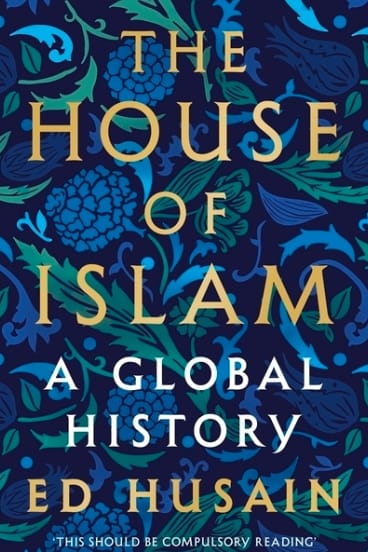
In The House of Islam – a global history  offers the potential for a softer, kinder, spiritual  Islam.  Author Ed Husain, British-born of Indian heritage, wears his Sufi heart on his sleeve.  “Preoccupied with spiritual awareness and depth, Sufi Islam transcends the performative trappings of superficial appearances such as beards and head-coverings, fixation with the simplistic binaries of haram and halal (what is forbidden and not forbidden in Islam) and the state’s imposition of sharia law.”

Little wonder that in many rooms in the House of Islam, Sufis are suspect, sanctioned and silenced – often brutally. As are many “heterogeneous” offshoots of this one true faith, including for many,  more than two hundred million Shiah.

It is the authoritarian, mediaeval Salafi-Wahhabi Arabian Peninsula theology and culture that has become commonly adopted as a marker of Muslim authenticity and has assumed the status of the ideal religious identity – notwithstanding the historical preeminence of Cairo, Damascus and Baghdad as centres of Muslim learning – and even though Arabs constitute a numerical minority in the Muslim world.

This “Arabization” and indeed, “Saudification” of Islam has colonized, distorted and, indeed, contorted and corrupted the spiritual message of Islam, and with the concurrent attractions and challenges of westernization, has, in Husain’s words, “disoriented the traditional Muslim equilibrium”, and brought forth jihadi abominations like al-Qaeda and Da’ish.

With the spread of ultra-conservative Salafi theology in many parts of the Arab and non-Arab Muslim world, Muslims are expected to dress in accordance with “modest” traditional Arabic attire and women are under pressure to wear the headscarf and other more extreme coverings – the latter never sanctioned by either Qur’an or Hadith writ. The writ runs deeper than outward appearance, as exemplified by the subordinate status of women in most Muslim societies. Moreover,  Arab and non-Arab Muslims are also expected to abandon their pre-Islamic history and culture – derided as remnants from pre-Islamic ignorance. In its most extreme manifestation, this saw the destruction of humanity’s priceless heritage at Palmyra and Nineveh. Some salafis call for the razing of Egypt’s pyramids.

Muslims in their glory days would refer to what went before as al Jahiliyya, the age of ignorance. But in so many ways, multitudes have returned there, helped in no small part by their more atavistic coreligionists who see salvation, wisdom and benefit to all in reverting to a medieval ethos and lifestyle of some golden age of faith which most scholars maintain never existed.

Islamists are intolerant of anything resembling a free exchange of ideas and information – the very concept of democracy is haram as the Prophet and his successors never thought of it – and possess a cultural antipathy, and iconoclastic rage for all things western, including, in some places,  western education (the derivation of the name ’Boko Haram’  for Nigeria’s ISIS franchise). The fundamentalist mindset in all its patriarchal intolerance, prejudice and misogyny is itself often embraced by the ignorant and the uneducated, the downcast and dispossessed, the bitter and the bigoted.

Husain points out that “not every Salafi is a jihadi, but every jihadi is a Salafi. Today’s jihadism, violating all the ethics of Islam, is nothing more than the continuation of the puritanism of the Salafi-Wahhabis“, which originated from the Saudi kingdom – guardian of Mecca and Medina, Islam’s most revered cities. There is no space for plurality and doubt in Salafi theology, rooted as it is in the discourse of yaqeen (certainty) and the propagation of an authoritarian one-dimensional piety.

This said, there are many more Muslim-majority states such as Turkey, Indonesia, Malaysia and Tunisia – countries that were conceived as secular states, and have largely remained secular or quasi-secular) , and indeed, have and made considerable democratic breakthroughs via the ballot box. Indonesia (the most populous Muslim-majority country) and Malaysia (one of the most industrialised Muslim-majority countries) are not located in the Arab Middle East. And yet, as events in Turkey and Indonesia have shown, the lure of radical Islam and its cultural and moral strictures is an attractive one to would-be authoritarians and to governments fearful of rising populist and nationalist tides.

And herein lies another portend. Just as the Muslim world has its share of religious and political extremists, so do an alarming number of Western democracies that are dominated by populists and ethno-nationalists who often do not hesitate to use religion as a blunt instrument of groupthink. I am thinking here of Russia and its Othodox Church, and of Polish Catholicism, but even ostensibly democratic USA and Israel are subject to the overweening influence of powerful evangelical and Haredim interest groups that endeavour to stamp their moral code on the more temporal majority. As radical British playwright Dennis Potter once remarked, “religion is the wound, not the bandage”.

Academic Lily Rahim notes in he review, published below, that this calls for a systematic analysis of the economic, socio-political, structural and institutional factors that have fueled the ascendancy of all forms of extremism, intolerance and exclusion, often rooted in authoritarian beliefs and systems. And that is a huge, multifaceted project, taking in the economic and social inequality that persists in countries rich and poor, the gap between the few ‘haves’ and the many ‘have-nots’, the power imbalances between the ‘North’ and the ‘South’, the pernicious rise of sectarianism and ethnocentrism, the mirage of ‘manifest destiny’, and the historical habit of the strong to bomb the weak and the poor to blazes.

Civil war and economic desperation have propelled millions of refugees across the Mediterranean and the Aegean Sea into Europe, threatening the unity and stability of the European Union. Islamic fundamentalism has filled the vacuum created by crumbling dictatorships and vanishing borders, unleashing atavistic, uncompromising and vicious Jihadis against their own people and co-religionists, and onto the streets of cities as far apart as Paris and Brussels, Istanbul and Baghdad, Jakarta and Mogadishu. In Syria particularly, but also in Iraq, Libya, Yemen, and Afghanistan, the longest war in the 21st Century, outsiders have intervened to further complicate the chaos, rendering an early end to what Rudyard Kipling called these “savage wars of peace” a forlorn hope.

“In many respects, the House of Islam is a microcosm of The House of Human History”.

Two other reviews of Ed Husain’s informative and illuminating boo follow.

For other posts regarding the Middle East in Into That Howling Infinite, see A Middle East Miscellany.  And, for a long view, read: A Brief History of the Rise and Fall of the West.

The House of Islam by Ed Husain.


The House of Islam by Ed Husain review – a powerful corrective

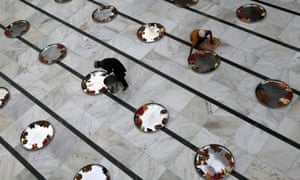
Boys prepare food for devout Muslims to break their day-long fast on the last Friday of the holy month of Ramadan in Mumbai, India.
         Boys prepare food for devout Muslims to break their day-long fast on the last Friday of  Ramadan in Mumbai, India ( Rajanish Kakade/AP)

Of the world’s 1.6 billion Muslims a very large number – perhaps a majority – observed the Ramadan fast last month. This doesn’t simply mean abstaining from food and water during the hours of daylight (as well as sex and cigarettes), but in many cases involves a deliberate reappraisal of one’s relation to God and the world, with more prayers and philanthropy and less shopping.

Of all the obligations that define Islam, Ramadan arouses perhaps the most irritation among some outsiders. A practice that places such a strain on the body is surely an affront to reason. Nor does it seem to make economic sense for workers to be tired and unproductive while declining to perform their allotted roles as consumers with credit ratings. And yet the west has absorbed Ramadan, if uneasily, with supermarket promotions for dates (the Prophet’s favoured breakfast), school assemblies on the subject and “What is Ramadan?” features even in the Sun.

Knowledge about Islam may have improved, but the speed with which relations are changing between Muslims and non-Muslims, and between Muslims, necessitates a constant reassessment of different worldviews and the way they interrelate. Isis’s defeat in Mesopotamia has not led to any meaningful dialogue between cultures. On the contrary, with Gaza aflame, the Iran nuclear accord uprooted and Sunni-Shia tensions at an all-time high, the prospects for detente have rarely been bleaker.

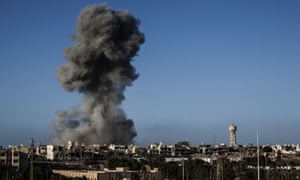
An airstrike on Islamic State militants in Sirte, Libya in 2016.
                      Airstrike on Islamic State militants in Sirte, Libya in 2016 )Manu Brabo/AP)

It’s an illustration of the insincerity of many world leaders that more than 250 French public figures, including former president Nicolas Sarkozy and three former prime ministers, recently demanded that Qur’anic verses endorsing the killing of non-Muslims be “struck down” – just as the Second Vatican Council expurgated elements of Catholic doctrine in the early 1960s. This meretricious proposal affects to assume that Islam is a centralised religion like Catholicism (it isn’t), that the Qur’an can be snipped and remain the Qur’an (it can’t), and that because they recognise the same holy book the Islam of the jihadi is the same as that of the Sufi or the Europeanised Muslim with his Qur’an on the top shelf and his bottle of burgundy on the bottom. When will someone put these contradictions of text, practice and culture into terms accessible to the layperson? Who will speak across the divides?

Enter Ed Husain. A Briton of Indian parentage, a Muslim whose bestselling book, The Islamist described his temporary embrace of the values of global jihad in the 90s, Husain retained his religious faith even after he became a government adviser on deradicalisation. Since then he has lived off the fat of the neoliberal establishment that ran the world before the age of Trump, working for Tony Blair’s Faith Foundation as well as several other well‑heeled thinktanks on both sides of the Atlantic. The anti-extremism organisation he co-founded in 2007, Quilliam, is considered by many to be hopelessly compromised by its support for government efforts to squeeze Muslims into the corset of “British” values.

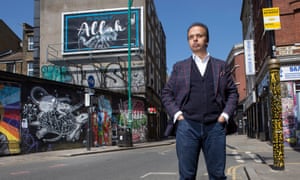
Ed Husain in Brick Lane, London, May 2018.
                            Husain in Brick Lane, London, May 2018 (Andy Hall, The Observer)

Husain’s politics and the company he keeps may be questioned, but they evidently haven’t stopped him from thinking productively about Islam as a force for good in the world. An account of the compassion, reason and wonderment that Islam has exhibited for much of its history, this book is a powerful corrective to the widespread perception, fostered by jihadis and Islamophobes alike, that it’s a belief system for misanthropes.

Ever since its inception Islam’s ethos had been contested, but a disastrous turn came with rejection of the printing press and the triumph of scholasticism over independent reasoning, exacerbated by a morale-sapping struggle against European expansionism in the 19th and 20th centuries.

Husain rightly says that the root of much Muslim confusion is a sense that a glorious past has soured into defeat and humiliation, but fallen prestige is hardly the monopoly of Muslims. The West has also lost ground, particularly its white males; dealing with changes in status is a part of being human. In general, Husain is too apt to view Muslims and their dignity as qualitatively different from those of other people. His modern politics can also be sketchy. With justification he criticises Saudi Arabia for its promotion of bigotry – less understandable is his soft spot for the  Turkey of Recep Tayyip Erdogan –  less a paragon of generous Islam than thuggish majoritarianism. His insistence that Muslim nations accommodate the tiny Jewish state in their midst is common sense but a suggestion of a Middle Eastern union including Israel reads somewhat grotesquely in the light of the recent carnage in Gaza.

For all that, Husain has written a valuable book, full of suggestions for Islam’s implementation from a position of magnanimity and love. Then the confidence will return.

 The House of Islam: A Global History is published by Bloomsbury. To order a copy for £21.25 (RRP £25) go to guardianbookshop.com or call 0330 333 6846. Free UK p&p over £10, online orders only. Phone orders min p&p of £1.99.

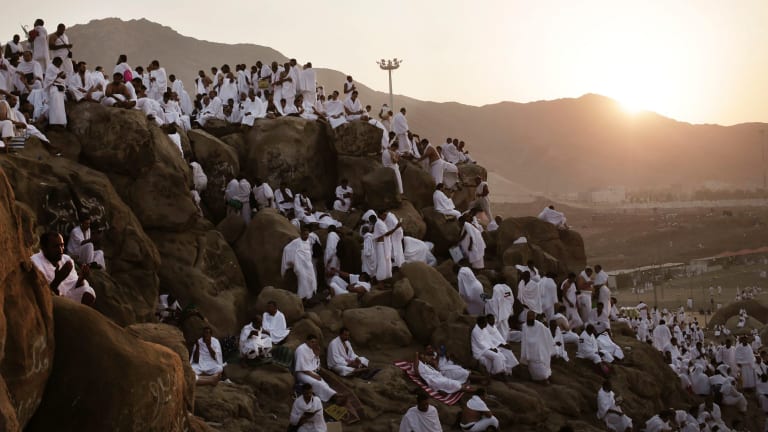
Muslim pilgrims pray on the Mountain of Mercy during The Haj. Mount Arafat, marked by a white pillar, is where Prophet Muhammad is believed to have delivered his last sermon to tens of thousands of followers some 1400 years ago, calling on Muslims to unite.
Muslim pilgrims pray on the Mountain of Mercy during The Haj. Mount Arafat, marked by a white pillar, is where Prophet Muhammad is believed to have delivered his last sermon to tens of thousands of followers some 1400 years ago, calling on Muslims to unite ( Nariman El-Mofty/AP)

In The House of Islam, Ed Husain affirms the centrality of the pluralist foundations and principles of Islam. Pluralism has also been rooted in Husain’s “lived reality”. His book opens powerfully, with Husain affirming his plural identity: “I am a Westerner and an observant Muslim. Caught between two worlds, I have learnt to dovetail the two facets of my identity. This book is a reflection of that inner bridge between Islam and the West”.

Yet, as the inflections of this superbly written book suggest, Husain’s “inner bridge” extends beyond “Islam and the West” and incorporates “the West” (Britain where he was born and raised), Islam (his faith) and India, his ancestral homeland.

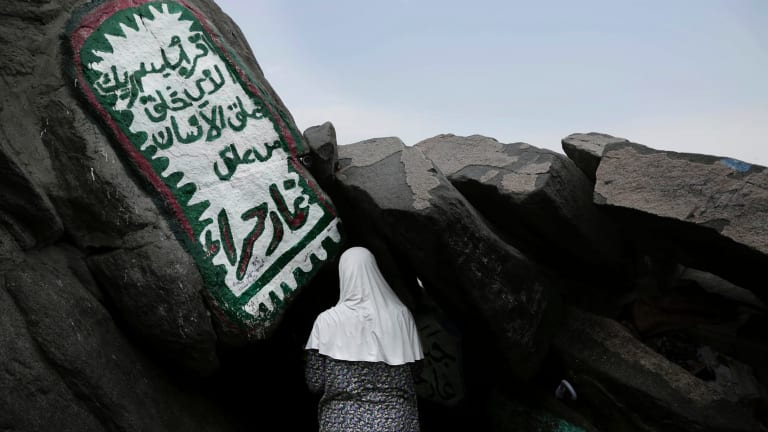
A Turkish Muslim woman prays inside Hiraa cave, where Prophet Muhammad received his first revelation from God to preach Islam, on Noor Mountain, on the outskirts of Mecca, Saudi Arabia.
A Turkish Muslim woman prays inside Hiraa cave, where Prophet Muhammad received his first revelation from God to preach Islam, on Noor Mountain, on the outskirts of Mecca, Saudi Arabia.Photo: AP

Husain’s Indian heritage comes across in his whimsical ruminations of Mughal Sufi history, in particular the riveting narrative of Jahanara Begum – the complex and colourful Sufi-inspired daughter of the Mughal emperor Shah Jahan (1592–1666), who built the Taj Mahal in memory of his beloved wife.

Hussain’s Sufi proclivities are apparent in the chapter “Who is a Sufi”, arguably one of the most engaging chapters. Husain describes the Sufi as one who “seeks only to please God, and does so in secret as often as possible”, grapples with “the heart and soul of Islam” and strives towards “maintaining equilibrium while swimming in deep oceans of spiritual awareness, and the ways in which the human ego could be crushed”.

Preoccupied with spiritual awareness and depth, Sufi Islam transcends the performative trappings of superficial appearances such as beards and head-coverings, fixation with the simplistic binaries of haram and halal (what is forbidden and not forbidden in Islam) and the state’s imposition of sharia law.

In contrast to the rigid, punitive and literalist tendencies of Salafi Islam, as promoted by the conservative monarchies in Saudi Arabia and other Gulf states and supposed Islamic states such as Iran, Sufi Islam’s leanings are inclusive, compassionate and speak to the complex yearnings of the human soul.

These leanings are evident in Rumi’s message of learning, hope and redemption, as the renowned Sufi poet ruminated: “Come. Come, whoever you are./ Wanderer, worshipper, lover of learning./ It doesn’t matter./ Ours is not a caravan of despair./ Come, even if you have broken your vows a thousand times./ Come, yet again, come, come.”

Husain’s considerable insights on the house of Islam, made up of more than 1.5 billion Muslims, have been shaped by his lived incarnations as an Islamist, Salafist and current abode in mystical Sufi Islam. His destiny within Sufi Islam culminated after many years of study under the guidance of Islamic scholars and living in the Middle East.

Enriched by these experiences, Husain notes that he has the “rare privilege of being an insider both in the West and in the Muslim World”. Yet, it could also be deduced that his acute insights have been cultivated by his status as an “outsider” in both the West and the Arab Middle East – stemming from his minority Indian ethnicity in both domains.

The House of Islam is understandably concerned with authoritarian and Salafi-Wahhabi Gulf Arab theology and culture that has become commonly adopted as a marker of Muslim authenticity. This peculiarity has assumed the status of the ideal religious identity – even though Arabs constitute a numerical minority in the Muslim world.

Husain insightfully asserts that Arabisation as well as Westernisation has “disoriented the traditional Muslim equilibrium”, as manifested by the rise of Salafi jihadi groups such as Isis and al-Qaeda.

With the spread of ultra-conservative Salafi theology in many parts of the Arab and non-Arab Muslim world, Muslims are expected to dress in accordance with “modest” traditional Arabic attire and women are under pressure to wear the headscarf and other coverings. Arab and non-Arab Muslims are also expected to jettison their pre-Islamic history and culture – derided as remnants from pre-Islamic ignorance or jahiliyya.

Husain reminds us of the paradox of the current Salafi dominance by noting that in the 1790s, Salafis were not even considered Muslims by the chief qadi (cleric) of Mecca; indeed, for several years Salafis were kept away from the holy cities and The Haj.

He highlights the theological ties between Salafi Islam and jihadi Islamists, such as Isis and al-Qaeda, by pointing out that “not every Salafi is a jihadi, but every jihadi is a Salafi…. Today’s jihadism, violating all the ethics of Islam, is nothing more than the continuation of the puritanism of the Salafi-Wahhabis”, which originated from the Saudi kingdom – guardian of Mecca and Medina, Islam’s most revered cities.

There is no space for plurality and doubt in Salafi theology, rooted as it is in the discourse of yaqeen (certainty) and the propagation of an authoritarian one-dimensional piety.

The House of Islam is a valuable read, particularly for those with some understanding of Islam and the Muslim world. Husain is a gifted writer and perceptive observer particularly of the Arab Middle East.

That said, the book makes minimal references to the more dynamic and democratising Muslim-majority states such as Indonesia, Malaysia and Tunisia – countries that were conceived as secular states (have largely remained secular or quasi-secular) and made considerable democratic breakthroughs via the ballot box. Instructively, Indonesia (the most populous Muslim-majority country) and Malaysia (one of the most industrialised Muslim-majority countries) are not located in the Arab Middle East.

Instead of pointing to Israel as a source of emulation for the Muslim world, Husain could well have highlighted these consolidating democracies. All three countries boast a vibrant civil society, coalition governments based on power-sharing and political systems based on secular constitutionalism.

Despite the penetrating insights in The House of Islam, Husain’s narrative of the myriad hurdles confronting the Palestinian struggle for self-determination, and Israel’s role in this struggle, is somewhat disappointing.

Just as the Muslim world has its share of religious and political extremists, so does Israel and an alarming number of Western democracies that are dominated by populists and ethno-nationalists. This calls for a systematic analysis of the economic, socio-political, structural and institutional factors that have fuelled the ascendency of all forms of extremism, intolerance and exclusion, often rooted in authoritarian beliefs and systems. In many respects, the House of Islam is a microcosm of The House of Human History.

https://www.smh.com.au/entertainment/books/the-house-of-islam-review-ed-husain-on-the-history-of-a-welcoming-religion-20180809-h13r0w.htm

Lily Rahim is an Associate Professor at the University of Sydney, where she teaches Political Islam and Southeast Asian Politics. Her more recent books include Muslim Secular Democracy and The Politics of Islamism. Ed Husain is a guest at the Melbourne Writers Festival (mwf.com.au).

Dear Zealots – letters from a divided land

Featured photograph: Banksey mural on the road into Bethlehem, Paul Hemphill May 2016

Winston Churchill defined the fanatic as one who can’t change his mind and won’t change the subject. Celebrated Israel author Amos Oz argues against religious fundamentalism, political cynicism and wishful thinking, reflecting on the rise of fundamentalism, and how, in an increasingly complex world, we take cover in xenophobia, religious fanatic­ism, and isolationism. He argues against fanaticism and for the acceptance of differences of opinion, celebrating the Jewish tradition of disputation, interpretation and persuasion and discovering an “anarchist gene” that thrives on disagreement as the perfect antidote to dogma.

Some people argue that Israeli commentators like Amos Oz, David Grossman, Gideon Levi, Uri Avnery, Ari Shavit, and Sarah Tuttle-Singer are cliche-bound idealists who love the Israel they wish to see, and not the one of a real, mutable and dangerous world. Fanatics and zealots themselves, indeed.  It is a valid if over-the-top criticism, but does not detract from what they are telling us. They, like their critics love their country with all their hearts. But they and ourselves all have our idealized homeland, a Dreamtime of our memories and imaginations, and it is, in a way, a kind of “magical thinking”. The irony is that the outside, “western” world often appears to share the same, romanticized, idealized and unrealistic concept of what Israel was, is and ought to be, and harshly holds it to that lofty standard regardless of the fact that no nation , however heroic and  glamourous its creation story, is pure and innocent.

Nevertheless, Australian publisher Louse Adler distills perfectly the message of this timely, perceptive book:


Dear Zealots: Letters from a Divided Land, by Amos Oz
Louse Adler, The Australian May 26, 2018

Writing about the Middle East may be considered timely, given the latest battles between the Israeli military and the citizens of Gaza. Yet this impasse has been in urgent need of resolution for 70 years.

Whether you celebrate the establishment of the state of Israel or mourn it as the Nakba, what remains a tragedy is the lack of a just solution that brings peace to the region and recognises the equally rights of competing claims.

Dear Zealots: Letters From a Divided Land, the 40th book from Israeli writer Amos Oz, ­offers the slimmest hope that peace may be possible, and a dire warning about the unholy coalition of anti-democratic forces that may thwart progress. Criticism of Zionism and contemporary Israeli politics is de rigueur in ­Israel, often cited as a testimony to this democratic island isolated in the midst of a fundamentalist Middle East. It is a truism that debate in Israel is robust and that critics of the state are afforded the right to dissent.

Despite treason accusations and the issuing of death threats, writers and journalists such as Oz, David Grossman, Etgar Keret and Gideon Levy continue to identify the moral malaise infecting Israeli society while the occupation of Palestine continues and settlements increase.

But these longstanding and courageous oppo­nents of the government’s attitudes to its neighbours have had little impact, ­despite their oratorical skills, international visib­ility and credibility. Great writers continue to write, speak out, sign petitions and ­demon­strate to no avail. Paradoxically, beyond Israel it is almost impossible to speak about governme­nt policies without inciting the wrath of its loyal defenders.

Into this seemingly intractable quagmire Oz has lobbed his latest literary missile. He argues against religious fundamentalism, political cynicism and wishful thinking. In three powerful essays he reflects on the rise of fundamentalism and why, in an increasingly complex world, we take cover in xenophobia, religious fanatic­ism, isolationism.

Winston Churchill defined the fanatic as one who can’t change his mind and won’t change the subject. Dear Zealots is an argument against fanaticism and for the acceptance of differences of opinion. Only Oz could include Israel’s “hilltop thugs”, Islamophobes, the Ku Klux Klan and Islamic State in one sentence; adding veganism, smoking and breastfeeding to this catalogue of zealotry. Against the rise of the zealot Oz celebrates the Jewish tradition of disputation, interpretation and persuasion. His discovery of an “anarchist gene” that thrives on disagreement is the perfect antidote to dogma.

Oz loves Israel. He tends to romanticise the place, pointing to the country’s eight million prime ministers, eight million prophets and eight million messiahs. However, a cacophony of voices­ and opinions doesn’t ensure­ a genuinely democratic state. A state that does not offer full rights to all citizens, a state in­extricably bound by religious authority, where there is no separation of church and state, imperils democracy.

The conflation of Israeli political practice and Jewish heritage makes it difficult to prise apart the state, the residual impact of its eastern European founders, religious influences and the challenging ethnic demographics of the polity.

Oz rages against Halachic Judaism, a form of religious piety demanding blind faith, investing God with supreme authority and believing the Torah protects Jews from assimilation. In Halachic Judaism, the history of the Jewish people is an unchanging story of sin, suffering and ­repent­ance. According to this logic, the innocent victims of the Holocaust, like those killed in Israeli military service, are martyrs sanctifying God’s name. Where else do we hear this today?

Who is a Jew remains a fundamental question. The answer delivers remarkable consensus. Everyone seems to agree that the most Jewish Jews are the “black hats”. Next are the settlers, then the trad­itional Jews who drive to synagogue but don’t eat prawns, then the Jews who are lost. The worst are the Jewish anti-Zionists, lefties who go on about human rights and peace.

Oz argues Jewish identity does not derive from holding fast to religious orthodoxy but is

amassed over generations, customs absorbed from outside which become part of the family, perhaps a certain type of humour, an inclination to be critical and sceptical, to be ironic, self-pitying and sometimes self-righteous, pragmatism tinged with fantasy, ecstasy diluted with scepticism, euphoria blended with pessimism, melancholy cheerfulness, a healthy suspicion of authority and a stubborn resistance to injustice.

The summation by Oz, often described as the secularists’ rabbi, of the commandments is the exhortation “to cause no pain”. That humanist ethos insists on the right of all to equal rights and a dignified life. That principle is disappearing from the fabric of Israel and the moral lacuna­ is being filled by pieties and pessimism.

Fundamentalism in Israel has brought ­together an unholy alliance between the ultra-Orthodox Haredim (anti-Zionist) and the (pro-Zionist) Messianic Jews of the settlements. Neither recognise the authority of the state of Israel. Fortress Israel is also the binding idea for Israel’s religious fundamentalists and political right; they perpetuate the myth of Is­rael being forever in conflict with the rest of the world.

The Israeli left’s attempts to resolve the conflict imply the terrifying prospect that Israel’s exceptionalism will evaporate, its identity will be lost, with assimilation an inevitability. Oz proposes instead that the focus should be on the future, forgetting the border fetishes of both the left and right along with the flags and holy sites.

In the final essay, Dreams Israel Should Let Go of Soon, Oz argues that Israel hasn’t won a war since 1967 and that, after 100 years of ­struggle, the Palestinian aspiration to self-determinat­ion has not been vanquished. There is justice and injustice on both sides in equal measure, and a two-state solution is the only way to ensure the continuation of a Jewish state and justice for the Palestinians. This will require compromise from both, and compromise is the antithesis­ of zealotry.

Dear Zealots is a passionate polemic against dogmatism and defeatism. Viscerally angered by the idea of irreversibility, Oz rejects as ­irrevocable the settlements and occupation. Religiou­s fanatics demand a theocratic state; the right continues to ignore international ­pressure; the left argues that the status quo is apartheid and the only solution is one state. Oz, a left-wing Zionist, opposes occupation but defends­ the historical right of Jews to statehood. He refuses to give up on democracy, on Israel or on justice for Palestinians.

Jews and Arabs are Semites, sharing more than they have chosen to remember, including a sensibility tinged with pessimism. Perhaps we should keep in mind the story of the Jewish optimist­ and the Jewish pessimist. The Jewish pessimist turns to the Jewish optimist and says: “Oy, things can’t get any worse for our people!” The Jewish optimist turns to the Jewish pessim­ist, smiles, and says: “Sure it can!”

It is the oblig­ation of all of us with a social conscience to wish Oz all power to his pen.

Louise Adler is chief executive of Melbourne University Publishing.

Dear Zealots: Letters from a Divided Land, By Amos Oz (Chatto & Windus, 224pp, $29.99)

See also, in In That Howling Infinite:  A Middle East Miscellany

Author’s Note: 
Whenever I pen commentaries such as this, people ask why I rarely forward my own opinion on the issues I am presenting or discussing. On the contrary, I would argue that my views are fairly transparent in in the subjects I chose to engage with, the words I use, and the vein in which I use them.
With respect to my numerous posts about Israel and Palestine, and the Middle East in general, I  come to my conclusions from a political science and sociology perspective – that’s where my academic experience came from – and a background in conflict resolution, supported by study and travel. If I do on occasions display any particular bias, it. originates in my longtime interest, understanding and affection for the history, politics and culture of the region, of its geography and archeology, and  of its people of all faiths and nationalities that I make my observations.
I am presently working on a piece that encapsulates my thoughts on this complex and controversial subject. But meanwhile, here is a brief exposition.
I do believe that the systematic dispossession of almost a million Palestinians and the destruction of half of their towns and villages in 1948 is Israel’s original sin. It is the primal stain that colours and corrupts all that followed. And yet, if not for the actions, often daring, often brave, often questionable, and often deplorable, of the politicians and soldiers of 1948 – and of the generations that folllowed –  Israel would not exist today. This paradox is addressed sympathetically by Avi Shalit in My Promised Land, referred to above, and scathingly by ‘new history’ scholar Ilan Pappe in TheEthnic Cleansing of Palestine.   
The Occupation, fifty years old this year, which grew out of the unexpectedly total victory of June 1967, has taken on strategic, ideological and indeed messianic dimensions by many in the  Israeli government and political elite. It compounded the original sin, deepened the primal stain, released the demons of messianic fervour, and wounded Israel’s soul. The settlements locked the nation into the the colonialist project. With the close-call of the Yom Kippur War, the violence and murder of the first and second Intifadat, and present Palestinian jaquerie, Israel’s heart has not just hardened, it has become sclerotic.
I admit that I have always been sympathetic towards Israel – from my first visit in 1972. But it is not a blinkered viewpoint. I am deeply critical of Israeli politics and policies, and have no respect for many of its leaders.
Ayelet Shaked, the nationalist’s La Pasionaria, and her boss Naftali Bennett do not not represent ALL Israelis! They hold extremist views just like we in UK, US, and Australia have parties and individuals with extremist views. But there are hundreds of thousands of Israelis who oppose the present government and long for justice and peace. And if – a very big “if” – Arab Israelis and the Israeli left could work together, they could obtain a majority in the Knesset and change Israel’s politics.
Yet meanwhile, Binyamin Netanyahu and his nationalist allies call all the shots, the Israelis continue to control and exploit the land, its people, and its resources, whilst varying degrees of annexation are on the cards. The settlements are an abomination, as are the policies and practices of the state and its occupying army, as described by Lyons and others. There’s no escaping these facts.
But I am likewise critical of Palestinian governance, politics and politicians. Hamas and the PA are on the nose in their respective fiefdoms, and if a moderate “third force” were to arise – and survive, because sure as hell, they would risk being murdered – Palestinians who just want a quiet, normal life, adequate services, and opportunities for their children, and Israelis who want likewise, might – just might – reject their extremist, dogmatic, entrenched leaders and reach some form of modus vivendi.
Palestinians themselves have to take control of their own lives, kick out their corrupt leaders, cease inculcating their children with hatred and jihadism, and use all that international good will and dollars to build a viable economy that can provide jobs, opportunities, and security, economic and physical to the people. Only this way will they be inoculated against cronyism, corruption and extremism. And yet, the dead hand of a moribund, patriarchal, conservative and ethnocentric culture holds them back –  but that is the subject of another, future discussion for In That Howling Infinite.
Today, the ‘powers that be’, defenders and beneficiaries of a status quo that looks more like a cul de sac, predominate over a dispiriting array of competing, clamouring factions, left, right, nationalist, secular, tribal, Haredi, and Islamist alike. New, young, brace, local voices in both Israel and Palestine, are not heard.
So what happens next?
I get that question too. And I am perennially reluctant to venture an answer beyond one that runs like “on the one hand…but then on the other”.  I inevitably fall back on Robert Fisk’s response to the same question with regard to the calamatous freezing over of the Arab Spring and the fall and rise again of the same old autocrats and tyrants: “my crystal ball is broken”. It’s a cop out, really, but just as cogent as that famous line in that UK spy drama Spooks: “What’s gong to happen to me?” “Bad things!”
One thing is for sure: as songwriter Warren Zevon sang, “the hurt gets worse, and the heart get harder”.
October 8th 2017
For more posts on Jerusalem, Israel and the Middle East, visit:
https://m.facebook.com/HowlingInfinite/
https://m.facebook.com/hf1983/

See also, my collection of posts about Jerusalem, and A Middle East Micellany

That was the year that was – going up against chaos

Reviewing 2017, I am reminded of Game of Thrones‘ Mance Rayder’s valedictory: “I wish you good fortune in the wars to come”.

On the international and the domestic front, it appeared as if we were condemned to an infernal and exasperating ‘Groundhog Day’.

Last November, we welcomed Donald Trump to the White House with bated breath and gritted teeth, and his first year as POTUS did not disappoint. From race-relations to healthcare to tax reform to The Middle East, South Asia and North Korea, we view his bizarro administration with a mix of amusement and trepidation. Rhetorical questions just keep coming. Will the Donald be impeached? Are we heading for World War 3? How will declining America make itself “great again” in a multipolar world set to be dominated by Russia Redux and resurgent China. Against the advice of his security gurus, and every apparently sane and sensible government on the globe (including China and Russia, but not King Bibi of Iz), his Trumpfulness recognized Jerusalem as the capital of Jerusalem. Sure, we all know that Jerusalem is the capital of Israel – but we are not supposed to shout it out loud in case it unleashed all manner of mayhem on the easily irritated Muslim street. Hopefully, as with many of Trump’s isolationist initiatives, like climate change, trade, and Iran, less immoderate nations will take no notice and carry on regardless. The year closes in, and so does the Mueller Commission’s investigation into Russia’s meddling in the last presidential election and the Trumpistas’ connivance and complicity – yes, “complicit”, online Dictionary.com’s Word of the Year, introduced to us in her husky breathlessness by the gorgeous Scarlett Johansson in a spoof perfume ad that parodies Ivanka Trump’s merchandizing.

Britain continues to lumber towards the Brexit cliff, its unfortunate and ill-starred prime minister marked down as “dead girl walking”. Negotiations for the divorce settlement stutter on, gridlocked by the humongous cost, the fate of Europeans in Britain and Brits abroad, and the matter of the Irish border, which portends a return to “the troubles” – that quintessentially Irish term for the communal bloodletting that dominated the latter half of the last century. The May Government’s hamfistedness is such that at Year End, many pundits are saying that the public have forgotten the incompetence of Labour leader Jeremy Corbyn, and predict that against all odds, his missus could soon be measuring up for curtains in Number Ten.

Beset by devilish twins of Trump and Brexit, a European Union written-off as a dysfunctional, divided bureaucratic juggernaut, appears to have found hidden reserves of unity and purpose, playing hardball with Britain, dismissing the claims of Catalonia and Kurdistan, rebuking an isolationist America, and seeing-off resurgent extreme right-wing parties that threaten to fracture it with their nationalist and anti-immigration agendas. Yet, whilst Marine Le Pen and Gert Wilders came up short in the French and Dutch elections, and centrists Emmanuel Macron and Angela Merkel hold the moderate middle, atavistic, autocratic and proto-fascist parties have risen to prominence and influence in formerly unfree Eastern Europe, driven by fear of a non-existent flood of refugees from the Middle East and Africa (these are headed for the more pleasant economic climes of Germany, Britain and Scandinavia), and perhaps, their historically authoritarian DNA. Already confronted with the Russian ascendency in the east, and the prospects of the Ukrainian – Donetsk conflict firing up in the near future, the EU’s next big challenge is likely to be reacquainting itself with its original raisin d’etre – the European Project that sought to put an end to a century of European wars – and addressing the potential expulsion of parvenu, opportunistic member states who fail to uphold the union’s democratic values. As a hillbilly villain in that great series Justifed declaimed, “he who is not with is not with us”.

The frail, overcrowded boats still bob dangerously on Mediterranean and Aegean waters, and the hopeful of Africa and Asia die hopelessly and helplessly. Young people, from east and west Africa flee poverty, unemployment, and civil war, to wind up in Calais or in pop-up slave markets in free but failed Libya. In the Middle East the carnage continues. Da’ish might be finished on the battlefields of Iraq and Syria, with the number of civilian casualties far exceeding that of dead jihadis. But its reach has extended to the streets of Western Europe – dominating headlines and filling social media with colourful profile pictures and “I am (insert latest outrage)” slogans. Meanwhile, tens, scores, hundreds die as bombs explode in Iraq, Syria, Yemen, Egypt, Afghanistan and Pakistan, with no such outpourings of empathy – as if it’s all too much, too many, too far away.

Bad as 2017 and years prior were for this sad segment of our planet, next year will probably not be much better. The autocrats are firmly back in the saddle from anarchic Libya and repressed Egypt to Gulf monarchs and Iranian theocrats. There will be the wars of the ISIS succession as regional rivals compete with each other for dominance. Although it’s ship of state is taking in water, Saudi Arabia will continue its quixotic and perverse adventures in the Gulf and the Levant. At play in the fields of his Lord, VP Pence declared to US troops in December that victory was nigh, the Taliban and IS continue to make advances in poor, benighted Afghanistan. Meanwhile, Africa will continue to bleed, with ongoing wars across the Sahel, from West and Central Africa through to South Sudan,  ethnic tensions in the fragile nations of the Rift Valley, and further unrest in newly ‘liberated’ Zimbabwe as its people realize that the military coup is yet another case what The Who called “meet the old boss, same as the new boss”.

This Syrian mother and her child were rescued by the Greek Coast Guard.

In our Land Down Under, we endured the longest, most boring election campaign in living memory, and got more of the same: a lacklustre Tory government, and a depressingly dysfunctional and adversarial political system. Politicians of all parties, blinkered by short-termism, and devoid of vision, insist on fiddling whilst the antipodean Rome burns. All this only accentuates Australians’ disenchantment with their representatives, warps their perception of the value and values of “democracy”, and drives the frustrated, disgruntled, fearful and alienated towards the political extremes – and particularly the Right where ambitious but frustrated once, present and future Tory politicians aspire to greatness as big fishes in little ponds of omniphobia.

Conservative Christian politicians imposed upon us an expensive, unnecessary and bitterly divisive plebiscite on same-sex marriage which took forever. And yet, the non-compulsory vote produced a turnout much greater than the U.K. and US elections and the Brexit referendum, and in the end, over sixty percent of registered voters said Yes. Whilst constituencies with a high proportion of Muslims, Hindus, Christians and Chinese cleaved to the concept that marriage was only for man and women, the country, urban and rural, cities and states voted otherwise. The conservatives’ much-touted “silent majority” was not their “moral majority” after all. Our parliamentarians then insisted on dragging the whole sorry business out for a fortnight whilst they passed the legislation through both Houses of Parliament in an agonizingly ponderous pantomime of emotion, self-righteousness and grandstanding. The people might have spoken, but the pollies just had to have the last word. Thanks be to God they are all now off on their summer hols! And same-sex couples can marry in the eyes of God and the state from January 9th 2018.

Meanwhile, in our own rustic backyard, we are still “going up against chaos”, to quote Canadian songster Bruce Cockburn. For much of the year, as the last, we have been engaged in combat with the Forestry Corporation of New South Wales as it continues to lay waste to the state forest that surrounds us. As the year draws to a close, our adversary has withdrawn for the long, hot summer, but will return in 2018, and the struggle will continue – as it will throughout the state and indeed the nation as timber, coal and gas corporations, empowered by legislation, trash the common treasury with the assent of our many governments.

And finally, on a light note, a brief summary of what we were watching during the year. There were the latest seasons of Game of Thrones and The Walking Dead. The former was brilliant, and the latter left us wondering why we are still watching this tedious and messy “Lost in Zombieland”. Westworld was a delight with its fabulous locations and cinematography, a script that kept us backtracking to listen again to what was said and to keep up with its many ethical arcs and literary revenues. and a cavalcade of well cast, well-written and original characters. Westworld scored a post of its own on this blog – see below. The Hand Maid’s Tale wove a dystopian tale all the more rendered all the more harrowing by the dual reality that there are a lot of men in the world who would like to see women in servitude, and that our society has the technology to do it. To celebrate a triumphant return, our festive present to ourselves were tee-shirts proclaiming: “‘ave a merry f@#kin’ Christmas by order of the Peaky Blinders”.  And on Boxing Day, Peter Capaldi bade farewell as the twelfth and second-best Doctor Who (David Tennant bears the crown), and we said hello to the first female Doctor, with a brief but chirpy Yorkshire “Aw, brilliant!” sign-on from Jodie Whittaker.

Whilst in Sydney, we made two visits to the cinema (tow more than average) to enjoy the big-screen experience of the prequel to Ridley Scott’s Alien and the long-awaited sequel to our all-time favourite film Blade Runner. Sadly, the former, Alien: Covenant, was a disappointment, incoherent and poorly written.  The latter, whilst not as original, eye-catching and exhilarating as its parent, was nevertheless a cinematic masterpiece. It bombed at the box office, just like the original, but Blade Runner 2049 will doubtless become like it a cult classic.

This then was the backdrop to In That Howling Infinite’s 2017 – an electic collection covering politics, history, music, poetry, books, and dispatches from the Shire.

An abiding interest in the Middle East was reflected in several posts about Israel and Palestine, including republishing Rocky Road to Heavens Gate, a tale of Jerusalem’s famous Damascus Gate, and Castles Made of Sand, looking at the property boom taking place in the West Bank. Seeing Through the Eyes of the Other publishes a column by indomitable ninety-four year old Israeli writer and activist Uri Avnery, a reminder that the world looks different from the other side of the wire. The Hand That Signed the Paper examines the divisive legacy of the Balfour Declaration of 1917. The View From a Balcony in Jerusalem reviews journalist John Lyons’ memoir of his posting in divided Jerusalem. There is a Oh, Jerusalem, song about the Jerusalem syndrome, a pathology that inflects many of the faithful who flock to the Holy City, and also a lighter note, New Israeli Matt Adler’s affectionate tribute to Yiddish – the language that won’t go away.

Sailing to Byzantium reviews Aussie Richard Fidler’s Ghost Empire, a father and son road trip through Istanbul’s Byzantine past. Pity the nation that is full of beliefs and empty of religion juxtaposes Khalil Gibran’s iconic poem against a politically dysfunctional, potentially dystopian present, whilst Red lines and red herrings and Syria’s enduring torment features a cogent article by commentator and counterinsurgency expert David Kilcullen.

On politics generally, we couldn’t get through the year without featuring Donald Trump. In The Ricochet of Trump’s Counterrevolution, Australian commentator Paul Kelly argues that to a certain degree, Donald Trump’s rise and rise was attributable to what he and other commentators and academics describe as a backlash in the wider electorate against identity and grievance politics. Then there is the reblog of New York author Joseph Suglia’s original comparison between Donald Trump’s White House and Shakespeare’s Julius Caesar. But our particular favourite is Deep in the Heart of Texas, a review of an article in The New Yorker by Lawrence Wright. His piece is a cracker – a must-read for political junkies and all who are fascinated and frightened by the absurdities of recent US politics.

Our history posts reprised our old favourite, A Brief History of the Rise and Fall of the West, whilst we examined the nature of civil wars in A House Divided. Ottoman Redux poses a hypothetical; what if The Ottoman Empire has sided with Britain, France and Russia in World War I? In the wake of Christopher Nolan’s blockbuster movie, Deconstructing Dunkirk looked at the myths surrounding the famous evacuation. On the seventieth anniversary of the birth of India and Pakistan, we looked at this momentous first retreat from Empire with three posts: Freedom at Midnight (1) – the birth of India and Pakistan, Freedom at Midnight (2) – the legacy of partition, and Weighing the White Man’s Burden. Rewatching the excellent sci-fi drama Westworld – one of the televisual gems of 2017 –  we were excited to discover how the plays of William Shakespeare were treasured in the Wild West. This inspired our last post for the year: The Bard in the Badlands – Hell is empty and the devils are here, the title referencing a line from The Tempest.

Happy Birthday, Indiaekkent

Our continuing forest fight saw us return to Tolkien’s Tarkeeth, focusing this time around on fires that recalled Robert Plant’s lyrics in Ramble On: In the darkest depths of Mordor. The trial in Coffs Harbour of the Tarkeeth Three and the acquittal of two of our activists were chronicled on a series of interviews recorded by Bellingen’s Radio 2bbb, whilst other interviews were presented in The Tarkeeth Tapes. On a lighter note, we revisited our tribute to the wildlife on our rural retreat in the bucolic The Country Life.

And finally to lighter fare. There was Laugh Out Loud – The Funniest Books Ever. Poetry offerings included the reblog of Liverpudlian Gerry Cordon’s selection of poetry on the theme of “undefeated despair”: In the dark times, will there also be singing?; a fiftieth anniversary tribute to Liverpool poets Roger McGough, Adrian Henri and Brian Patten, Recalling the Mersey Poets; and musical settings to two of our poems, the aforementioned Oh, Jerusalem, and E Lucevan Le Stelle.

And there was music. Why we’ve never stopped loving the Beatles; the mystery behind The Strange Death of Sam Cooke; Otis Redding – an unfinished life, and The Shock of the Old – the Glory Days of Prog RockLegends, Bibles, Plagues presented Bob Dylan’s laureate lecture. We reprised Tales of Yankee Power – how the songs of Jackson Brown and Bruce Cockburn portrayed the consequences of US intervention in Latin America during the ‘eighties. And we took an enjoyable journey into the “Celtic Twilight” with the rousing old Jacobite song Mo Ghille Mear – a piece that was an absolute pleasure to write (and, with its accompanying videos, to watch and listen to). As a Christmas treat, we reblogged English music chronicler Thom Hickey’s lovely look at the old English carol The Holly and the Ivy, And finally, for the last post of this eventful year, we selected five christmas Songs to keep the cold winter away.

Enjoy the Choral Scholars of Dublin’s University College below. and here are Those were the years that were : read our past reviews here:  2016   2015 

In That Howling Infinite is now on FaceBook, as it its associate page HuldreFolk. Check them out.

And if you have ever wondered how this blog got its title, here is Why :In That Howling Infinite”?

See you in 2018.


The Holly and the Ivy

Of all the trees that are in the wood, the holly bears the crown

A  Christmas gift from In That Howling Infinite.

Probably one of the loveliest traditional English carols, sung by melodious English song-bird Kate Rusby.

Written by Thom Hickey in his excellent blog The Immortal Jukebox – a treasure trove of well-written words and excellent music.The post is below the lyrics. Wander through it and enjoy.

The holly and the ivy,
When they are both full grown
Of all the trees that are in the wood
The holly bears the crown
O the rising of the sun
And the running of the deer
The playing of the merry organ
Sweet singing of the choir

The holly bears a blossom
As white as lily flower
And Mary bore sweet Jesus Christ
To be our sweet Saviour
O the rising of the sun
And the running of the deer
The playing of the merry organ
Sweet singing of the choir

The holly bears a berry
As red as any blood
And Mary bore sweet Jesus Christ
To do poor sinners good
O the rising of the sun
And the running of the deer
The playing of the merry organ
Sweet singing of the choir

The holly bears a prickle
As sharp as any thorn;
And Mary bore sweet Jesus Christ
On Christmas Day in the morn.
O the rising of the sun
And the running of the deer
The playing of the merry organ
Sweet singing of the choir

The holly bears a bark
As bitter as any gall;
And Mary bore sweet Jesus Christ
For to redeem us all.
O the rising of the sun
And the running of the deer
The playing of the merry organ
Sweet singing of the choir

The holly and the ivy
Now both are full well grown,
Of all the trees that are in the wood,
The holly bears the crown.
O the rising of the sun
And the running of the deer
The playing of the merry organ
Sweet singing of the choir

Thom Hickey's avatarThe Immortal Jukebox

There is a power beyond all analysis in the Christmas Carol – especially those which emerged from the folkloric tradition of England’s rural heartlands.

I could give you a learned analysis of, ‘The Holly and the Ivy’ noting it is numbered 514 in the Roud Folk Song Index and waxing lyrical on its symbolism and use of Christian iconography.

Somehow, as soon as Kate Rusty starts to sing all that appears superfluous.

For Kate is for my money the finest English Folk Singer since Sandy Denny and you would have to be made of stone not to be moved by the tender beauty of her voice.

Hearing her singing such a song I feel as if I had wandered from the snow into a Yorkshire Romanesque church.

Resting in a time worn pew, hunched against the draughts all around I am startled by the emerging sound of a rustic band…

View original post 164 more words

Yiddish – the language that won’t go away

The past and present of a language that refuses to disappear. An iluminating post from Matt Adler’s excellent blog planting Roots Bearing Fruits.

Matt Adler - מטע אדלר's avatarPlanting Roots Bearing Fruits

One might be surprised to hear this, but Yiddish lives in Israel- and not just among Hasidim.  Yiddish is the traditional language of Ashkenazi Jews like me.  Before someone says something stupid, let me clarify something- Yiddish is NOT a “mixture of German and Hebrew”.  It is also not only a Hasidic language- it has existed for at least a thousand years as a distinct language, whereas Hasidism has been around for about 400.  On the eve of the Holocaust, 13 million Jews- socialists, communists, Zionists, anti-Zionists, Hasidim, secularists- spoke the language.

Yiddish is an archaeology of the Jewish people and linguistic proof of our ties to the Land of Israel.  About 2000 years ago, Romans expelled Jews from Israel and destroyed the Temple in Jerusalem.  The Jews who weren’t executed were expelled or enslaved.  Many eventually made their way to other parts of the Roman Empire, where their Aramaic…

View original post 1,716 more words

Once in Royal David’s Citadel

During its long history, Jerusalem has been destroyed at least twice, besieged 23 times, attacked 52 times, and captured and recaptured 44 times.

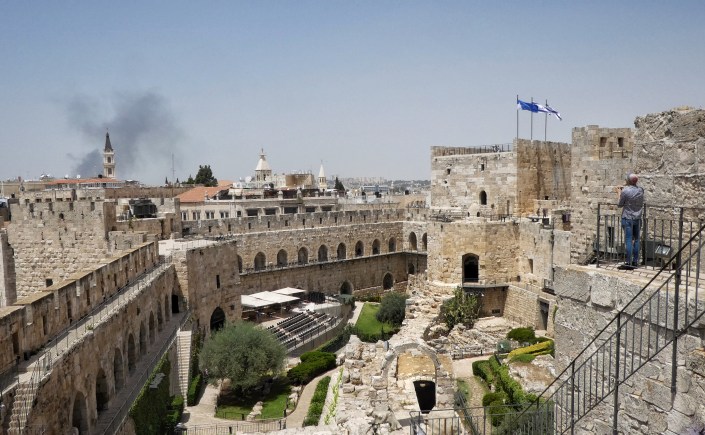
The Citadel or Tower Museum at the Jaffa Gate, the westernmost entrance to the city, is all the history you can eat in a four hour sitting. It’s a four thousand year old story: from the Canaanites and the Hebrews to the end of the Mandate and the establishment of the State of Israel, via Egyptians, Assyrians, Persians, Greeks, Hasmoneans, Romans, Byzantines, Umayyads, Abbasids, Fatamids, Crusaders, Ayyubids, Tartars, Mongols, Mamluks, Ottomans, British, and even Australians. Each left their mark on Jerusalem, and most planted their brickage upon and within the Citadel.

image

There is a long roll-call of famous names who may or may have not resided in the place.

King David didn’t, despite his name being given to the place and the apocryphal story that he once spied on the bathing Bathsheba from its ramparts – indeed, her bathroom is said to be underneath the New Imperial Hotel, just across the way. Nor did his son and heir, Solomon, builder of the First Temple. Conquerors Nebuchadnezzar and Cyrus did not. They just wrecked the joint. Judah Maccabee might have, and those other famous Jewish rebels, the Zealots didn’t, but during Great Revolt, they retreated there and trashed the place. Herod the Great, a psycho with an serious edifice complex, resided here. As did also Procurator Pontius Pilate when he was in town (he preferred the luxuries of Caesaea Maritimus (Latin for “on Sea). Historians now believe that the Citdel was where he actually cast judgement on Jesus, and not in the Antonine Fortress which overlooked the Temple (where the Haram al Sharif now stands) throwing into question the whole basis for the existence of the Via Dolorosa.

Roman general and future emperor Titus would have taken up residence therein after he destroyed the city in 70CE, leaving only the citadel standing. His troops needed somewhere to crash. Constantine didn’t, but his mom Helena most likely did when she “discovered” The True Cross, commissioned the construction of the Church of the Holy Sepulcher, and single-handedly invented the Holy Land pilgrim industry that endures to this day. The Muslim conquerors Omar Ibn Khattab, Salah ud-Din, and Baybars may have, but Ottoman Sultan Suleiman the magnificent, who built the city walls we see today, never set foot in Jerusalem, and nor did his successors.

image

Ottoman troops occupied it, and General Djemal Pasha would hang Arab Nationalists in the Square before it. General Allenby declared Jerusalem and Palestine liberated on the steps leading to the citadel in 1917, but most likely stayed across the square at our wonderful East New Imperial Hotel (the Kaiser stayed there too when he visited Jerusalem in 1898). British troops garrisoned it during the Mandate years – like the Roman legionaries before them, they’d’ve needed a place to lay their heads. The British-commanded Arab Legion of then Transjordan took control of it in during the the battle for Jerusalem in 1948 and defended it successfully against the new IDF. They did so again in 1967 only to lose it and the Old City.

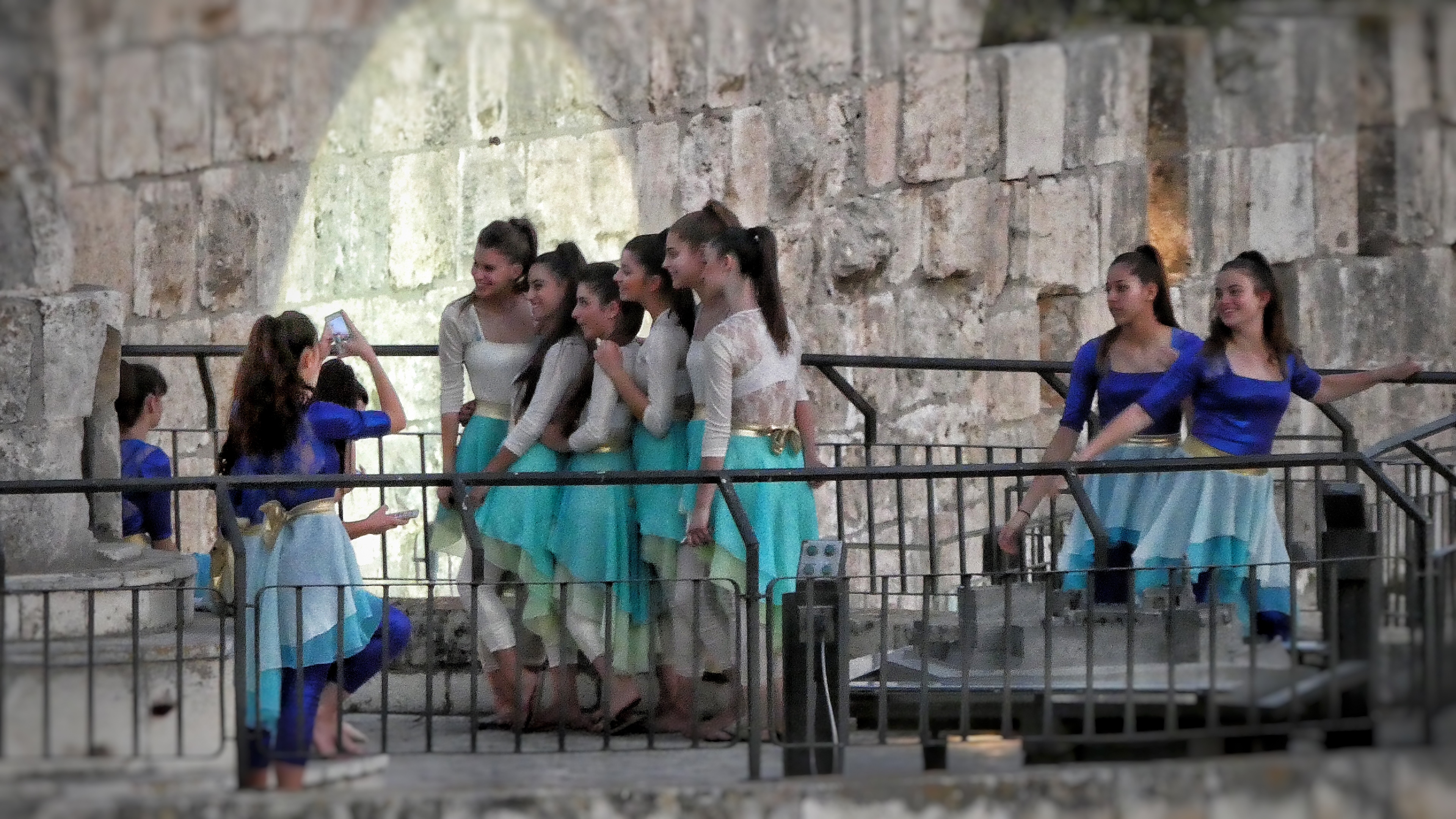
If the stones could talk, what a tale they would tell. And indeed, the museum now does just that, in content and in form. We sit on the roof garden of our hotel, directly across the street on Omar Ibn Al Khattab Square, and look across at its towers, ramparts and gardens, and sense it’s story in our souls. We watch present generations passing beneath its walls, and the young folk dancing on the ramparts, all part of the passing parade of humanity that has lingered by and upon these ancient walls.

For further reading, you can’t beat Simon Sebag-Montefiore’s Jerusalem : The Biography (Phoenix 2011).

See also in In That Howling Infinite, The Grand Old New Imperial Hotel, and Nova Via Dolorosa. For other posts about Jerusalem see: O Jerusalem

History Lessons

History Lessons

Carnivale

Dancers from the Son et Lumiere promenade

King Herod’s Edifice Complex

Herod the Great ruled from 37 to 4 BCE.

Like Lord Byron, he was mad, bad, and dangerous to know. He may or may not have been a psychopath – he killed his way to the top, murdering his relatives, and also, his wife Mariamne, whom loved truly, madly, deeply – but he suspected her of plotting to depose him, so she had to go too. He regretted it instantly and embalmed her in honey so he could spend quality time with her by her open catafalque.

Herod did a lot of questionable things, but he has gone down in Christian demonology for an atrocity he did NOT commit – he didn’t massacre the Innocents to ensure that baby Jesus would not live to supplant himself as King of the Jews! The slaughter of the babies was an invention of later Christian propagandists. Also, he was not the Herod who’s daughter Salome invented lap dancing and in payment, demanded the head of John the Baptist. Nor was he the Herod who told the imprisoned Jesus “I’m the King of the Jews!” That was Andrew Lloyd Webber’s camp caricature. Herod was a common name amongst the later (and last) Hasmoneans.

To his Jewish subjects, he was not a Kosher King, being only half Jewish, and then, only through this dad (even today, opinions about him are mixed for the same reason). Accordingly, he felt that he had to prove himself, like similarly half-Jewish, and much wiser King Solomon. So he built things. And man! Could he build! His stuff was not large – it was Monumental.

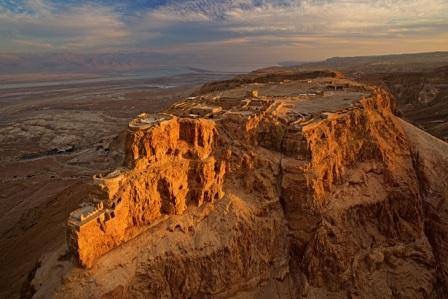
At Caesarea, on the Mediterranean coast, he build a port, a seaside palace and a city. In Jericho, another magnificent palace. At Herodium, he built a fortress-palace-mausoleum, but first, he built a hill high enough that he could see Jerusalem from the summit. Across the River Jordan, in present day Jordan, he rebuilt a fortress-palace at Machaerus which was said to be location of the imprisonment and execution of John the Baptist, and the venue for Salome’s notorious dance, The ancient town of Sebastia, on a hill with panoramic views across the West Bank, is another location of Herodian brickage; its Nabi Yahya Mosque is said to be the burial site of  the Baptist – although his head is believed to rest in an ornate catafalque in Damascus’s splendid Umayyad Mosque.  And he a fortress and summer palace on the Masada massif overlooking the Dead Sea, and the site of one of history’s most famous “last stands”.

He obviously liked palaces. When he died – and he died horribly as befits a bad boy – he was laid to rest in a bespoke tomb in his Herodium eyrie.

But his crowning glory was his breathtaking refurbishment of the Second Temple, rendering it a wonder of the contemporary world. Too bad that a “wabble of woudy webels”, to quote Bickus Dickus in “The Life of Brian”, had to rise up against Rome in 66CE, precipitating the destruction of Jerusalem, the death of thousands, and the razing of temple to the ground. All that impressive Herodian brickage was sent crashing to the ground, and all that remains is the Kotel, the hallowed Western or Wailing Wall.

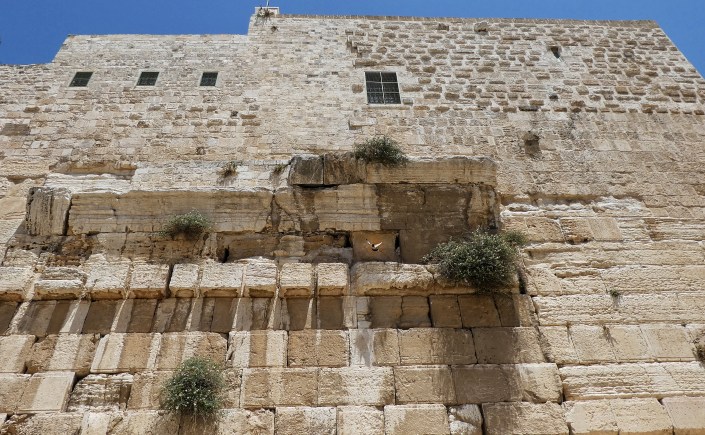
(The featured image shows signature Herodian ashlar blocks in the Kotel, the Western or “Wailing” Wall)

That’s my telling of the life and times of King Herod. Here’s what Wikipedia says : https://en.m.wikipedia.org/wiki/Herod_the_Great

Postscript

Apart from building things, was Herod really that “great”? I reckon he gave himself that soubriquet – or else the Romans did, probably in sardonic irony (which Herod, narcissistic and paranoid, probably didn’t get). His subjects didn’t think so and were happy when he died. Some accounts suggest that he’d ordered his bodyguard to slaughter the heads of prominent Hebrew families on the event of his death so that the people would not feel like rejoicing when he passed.


Herodian brickage thrown down bu the Romans

Herodian brickage thrown down by the Romans

Herodium

Herodium

Masada

Masada

The largest house brick in the world. The Western Stone of the Kotel 13.6m

The largest house brick in the world. The Western Stone of the Kotel 13.6m


Sic semper tyrannis

You come at the king, you best not miss.
Omar Little, The Wire (after RW Emerson)

The phrase “one man’s freedom fighter is another man’s terrorist” is at once apt, correct, and yet often oversimplified to the point of disingenuousness. The word “terrorist” itself describes its goal. To instill fear in the heart of the enemy. In the past, the target would have been the king, the dictator, the ruling class, and those who served them and upheld their rule. Politicians, officials, solders and policemen. Today, terrorists indiscriminately target whole societies. Irish bombers blasted communities of the rival faith, murdered shoppers, office workers, and pub patrons, as well as soldiers and policemen. Palestinian suicide bombers hit malls and pizza bars in city centres. ISIS, al Qa’ida and the Taliban detonate cars in busy city streets and publicly execute prisoners in callous and calculating “lectures in flesh” (the phrase is civil rights lawyer Geoffrey Robertson’s, from his chilling account of the trials and execution of King Charles I of England and those who sentenced him, The Tyrannicide Brief.).

But targeted and random terrorism has a long historical pedigree. For centuries, it has been the desperate and nihilistic weapon of last resort of resistance and rebellion against perceived oppression and injustice, and against invaders and occupiers.

In the second century BCE Palestine, the Maccabees used assassination in their resistance to the Seleucid Greeks, and a century later, the Jewish zealots, the Sicarii, named for the easily concealed small daggers, paid the Romans in like coin, and ultimately in an insurrection that culminated in the destruction of Jerusalem in 70CE and the scattering of the Jewish race (giving history the emotive and symbolic last exit that was Masada). In an etymological irony that Mark Twain would have been proud of, the present unrest in Jerusalem, a large number of young Palestinians have perished in attempting to stab jewish soldiers and civilians. Their jaquerie is called the “Intifada Sakni-in”, the ‘Knife Uprising – an echo of those long-dead Sicarii “dagger men”.

Nowadays, one would be excused for thinking that “terrorism” and “terrorist” are synonymous with Arabs and Muslims. And a historical precedent reinforces this erroneous assumption. The Hashishan or “Assassins” of Middle East fame (yes, that is where that noxious noun originated) were Muslim men and boys mesmerized and mentored by Rashid ad Din as Sina-n, the “Old Man of the Mountain” (and all this, before Osama in the caves of Tora Bora), and were Twelfth Century  hit-men contracted out to rival Muslim princes in the internecine conflicts that plagued the Levant in the wake of the Crusades and the demise of the great Arab Caliphates.

But the assassin’s knife (and in modern times, the gun and bomb, and latterly cars and trucks) predates these medieval hoods and links the Hebrew rebels of old to the Irgun and Stern Gang who encouraged Britain and the UN to abandon Palestine in 1948, bequeathing most of it to the new state of Israel, and triggering the Palestinian diaspora. European anarchists and Irish rebels and loyalists were adept at shootings and ambushes. In Algeria, during the ‘fifties, the nationalist FLN and the “colon” OAS shot and bombed each other and those unfortunates caught in the crossfire. The IRA perfected the improvised explosive device that today has crippled thousands of American, Canadian, and Australian soldiers in Iraq abd in Afghanistan. Hindu Tamil separatists of Sri Lanka introduced the suicide bomber, an economical and efficient weapon against soft (civilian, that is) targets, deployed today by Islamist killers in the streets of London and Lahore, Damascus and Dar es Salaam, Jerusalem and Jakarta. Whilst Arabs – and particularly Palestinians may have given the world the hijacking of aircraft – a tactic that fell into disuse due to diminishing political returns and rapid response forces – other Arabs showed us how to fly them into public buildings as the whole world watched in horror and disbelief. The shockwaves of this one are still reverberating through the deserts of the east and the capitals of the western world.

In going up up against their occupiers, the Palestinians have an old heritage. In my old country, Boudicca and Caractacus fought a losing battle against the Romans in Britain during the First CE. The Roman historian Tacitus ascribed to a vanquished chieftain the memorable words  “solitudinem faciunt, pacem appellant” – they make a desert and they call it peace. After the battle of Hastings in 1066, the defeated Saxons pushed back against the Normans and brought the genocidal wrath of William the Conqueror down on their heads with the devastating “Harrying of the North”. The Green Man and Robin Hood legends are said to be a retrospective and romanticised remembering of the Saxon resistance. Warrior fugitives from that failed guerilla war fled as far as Constantinple, where many joined the Emperor’s acclaimed Varangarian Guard, (see When Harald Went A Viking) 

In the streets and the countryside of Ireland, my parents’ birthplace, the United Irishmen, Fenians, Free Staters, IRA and Unionists fought against the redcoats, tommies, and black and tans of the British Army. Fought amongst themselves, fought against each other, and killed and were killed in their centuries long war of liberation. And in my adopted country, indigenous Australians fought a futile frontier war against settlers and soldiers just as native Americans did, albeit on a much smaller scale, and paid the price in hangings, massacres, poisoned wells, dispossession, marginalization, and “stolen children”. The legacy of those times lingers still – see The Frontier Wars – Australia’s heart of darkness.

In Central America, Juarez led the Mexicans against the French, and Sandino, Nicaraguans against US marines. Spaniards rose up against Napoleon’s forces, giving the world the word “guerilla”, or “little war”. Russian partisans ambushed the Grande Armé and the Wehrmacht. Throughout occupied Europe, the very term “resistance” became synonymous with the heroic unequal struggle against tyranny. In another of history’s ironies, muqa-wamat, Arabic word for resistance, unites sectarian rivals Hamas and Hizbollah against Israel.

And not just resistance to invasion and occupation, but also against oppression by one’s own rulers. Religious tracts tie themselves in knots reconciling the obligation to obey our rulers with the right to resist and overthrow those that rule badly. The unequal struggle against tyranny – or what is perceived by the perpetrators as tyranny – is the cause that inspires men and women to desperate acts.

The most celebrated in fact, film and fiction is the death of Julius Caesar at the hands of peers who feared that he intended to usurp the ostensibly democratic Republic (ostensible because democratic it was not) and institute one-man rule. That ended badly for the conspirators, and for Rome, as it precipitated years of civil war and ultimately, half a century of empire).

In 1880 the reforming Czar Alexander II of Russia, discovered the hard way that liberating the serfs did not inoculate himself against the bomb that took his legs and his life. His fearful and unimaginative successors hardened their hearts and closed their minds against further reform. setting in train the crackdown on dissent and democratic expression that led eventually to the storming of the Winter Palace on Petrograd in 1917. Narodnaya Volya, the killers called themselves – the People’s Will. And that is what terrorists do. They appeal and owe fealty to a higher court, a greater good, a savage God.

So it was when student and Serbian nationalist Gavril Princip assassinated Archduke Ferdinand of Austria-Hungary in June 1914 and ignited the spark that lit the conflagration of World War 1 which precipitated the demise of the old European empires.

So too when John Brown and his sons brought their broadswords to bear on slavers and their sympathizers and made a date with destiny at Harpers Ferry. Their famous raid may or may not have accelerated the downward slide to the secession and civil war that erupted the following year, but it provided a moral and symbolic prelude and also, the resonating battle hymn of the republic. John Wilkes Booth bookended this bloody era with his histrionic and public murder of Abraham Lincoln, shouting “sic semper tyrannis”, “thus always to tyrants,” attributed to Brutus at Caesar’s assassination – today, it’s the Virginia state motto. Brown and Booth were quite clear in their motives. As was were the segregationalist shooters who did for African Americans Medgar Evers and Martin Luther King. Less so were the killers of the Kennedy brothers in the sixties.

To conclude, sometimes that savage, rebel God is one of faith, sometimes, of blood and soil. In some instances, it is revenge for wrongs real and imagined – the reasons at times lost or forgotten through the passage of time and fading memories. And often, “the cause” is corrupted by the immoral economics of illicit commerce, including contraband, kidnapping, blackmail and extortion. Sometimes all merge in an incongruous hybrid of religious passion, ethic identity, libertarian or anarchistic fervour, and protection racket. As was the case in Northern Ireland, in Lebanon, in sub-Saharan Africa, and currently so in Syria and Iraq.

But most times, terror and turmoil is simply a political weapon planned, targeted and executed as a mechanism of regime change. Rebellion, revolt and revolution. Resisting, opposing, challenging, confronting and defeating the central authority. The seizing, holding, consolidation and keeping of political power.

And one thing is for sure. The outcome is unpredictable. History does not move in straight lines, but often follows a bitter and twisted path. Cliched as it is, the phrase “be careful what you wish for” is an apt one. And when, as Bob Dylan sang, “the line it is drawn, the curse it is cast”, there is no going back. To quote WB Yeats’ famous lines, “all is changed, changed utterly”.

Terrorism, then, can shift the course of history. If we were to stumble into the swamp of alternative histories, imagine what might of happened

If Caesar had walked home from the senate on the Ides of March
If Lincoln had been able to guide the Reconstruction
If the reforming Czar had introduced democratic government to Russia
If Gavril Princip’s shot had missed the archduke
If Kennedy had returned from Dallas
If John Lennon outlived George Harrison
If Yitzak Rabin had left the peace concert in Tel Aviv
If the Twin Towers stood still

To quote “Stairway to Heaven”, a curiously apposite title given the millenarian mindset of many terrorists, “Oh, it makes you wonder!”

Hejira

You know it never has been easy
Whether you do or you do not resign
Whether you travel the breadth of extremities
Or stick to some straighter line
Joni Mitchell, Hejira

People’ll tell you where they’ve gone
They’ll tell you where to go
But till you get there yourself you’ll never really know
Where some have found their paradise
Other’s just come to harm
Oh Amelia it was just a false alarm
Joni Mitchell, Amelia

How sweet it is to learn new things – to walk new streets, to look through new windows. Working lately as a volunteer with the Humanitarian Settlement Services progrmme,  I have had that opportunity. The HSS’ mission is to assist newly arrived refugees to settle in Australia, participate in our way of life,  access services available to us all, and to develop the skills and knowledge needed to begin a new life in our country. The  following  pieces recall two days in my volunteer life. They are a sequel of sorts, and indeed, a happy ending to my recent post No Going Home in which I endeavored to imagine the refugee journey.  

Hejira is an Arabic word that commemorates specifically  the flight of Muhammad from Mecca to Medina in 622.  But it also refers to any emigration or flight, and this is the context here.

Arrival

I wait at our tiny  airport for an Afghani family coming to Australia from a refugee camp on the Pakistani border. They have come here straight from Iran with but a short transit in Sydney. The plane is a little QANTAS Dash 8, and the passengers walk down the gangplank. The day is hot. Young girls in short shorts and skivvies disembark, and young men in shorts, tees and thongs (the sandals, that is). There a few suited businessmen, and retirees in nondescript array.

Our new arrivals are last off. Mum and two teenage sons. She wears a hijab and Iranian dress,, and the boys, jeans and tee shirts. They step onto the hot tarmac and walk, tired and nervous, to the arrivals lounge. We are with the welcoming party – a family of Afghanis who settled here a short while ago, two young girls, their mother and their auntie. They too are dressed in salwar kameez – they came here from a  camp in Pakistan. The ladies dwelt there for twelve years, and the girls were born there.

A young Hazara serves as our interpreter. She is dressed like a fashionable Iranian muhajibabe in simple and smart attire – for it is indeed Iran that she and he family sought shelter from the Afghan storm. She is eighteen, and arrived with her mother and siblings two years ago. Her English is excellent – she wants to be an interpreter, and is working towards that goal at TAFE. And this is the thing. These folk have all come here on 204 visas for women at risk, the sole carers of dependent families. Their husbands are either dead or decamped in Afghanistan or in the border camps.

And then there are we three Aussies. The tireless Humanitarian Settlement Service caseworker, a lady from community services who wanted to witness an arrival, and myself, working for the HSS as a volunteer, likewise bearing witness to what is quite a powerful scene.

The meeting and the greeting is done with salaams, embraces (the Afghanis) and handshakes (we locals). The first minutes in their new home in the sun. I help the lads load the suitcases on to the bus, and my work done, I bid them all “khoda hafez” and take my leave. They are driven off to their new digs, an Afghan meal, the first of much paperwork, and then sleep.

But not before they are taken to the headland, from where they will view the Pacific Ocean to the east, hills covered in banana plantations to the west, and beyond them, below the cloudless blue sky, the blue-green foothills of the Great Dividing Range. On the other side, far to the northwest, their landlocked, shattered  home is 11,353 kilometers away.

Moving

Our mission today is to move a Hazara family from their first, interim dwelling, to a permanent home on the other side of town. A mother with four children. Three of these are at school today, and the eldest, a sparky eleven year old, has stayed home to help mom move house and help us with translation. Although she has been in Australia for just six months, her English is astonishing. She later tells me she can speak five Afghan languages, Urdu, and a bit of Hindi. Nothing is going to hold this one back.

Their bags and boxes are ready, and these fill the bus. So off we all go to their new home. Two Afghani neighbours greet us on  arrival, with two young girls and a tiny boy. Three ethnic groups, three languages, and two religions, and they are getting along famously.

“Why do you think that is?” asks the caseworker. “Because there are no men around”. No men. No controllers. No patriarchy. No rules. No tribes. No prejudice.

 In Sydney, in Melbourne, with the larger Afghan and Muslim communities, with the mosques and madrassas, imams and ideologies, the self-appointed and self-perpetuating mullahs and muftis, male control would be asserted, with their restrictive rules and regimentation. All the old baggage that was left behind would be brought in and unpacked – the tribal loyalties and enmities, the specious theological diktats on dress and demeanor, form and function. And the patriarchy.

But not here, in this northern, sea-side town. Just women doing their best to get along and make the new life work for themselves and their children.

What will the future hold for these women taken out of their homes, their culture, their society, and asked to craft a new life and identity for themselves and their children in a new and strange land? How will they go with the language and with life in general? Will they make new friends, find rewarding work, and “fit in”,  or will they cling to their old lives, lonely and isolated, their children the sole interface between themselves and the world?

I wonder about the young girls – and particularly the bright and outward-going ones I have met. Will they build successful school and professional careers? Will they make long and lasting friendships with their Australian and other peers?  Will they let go the costumes, conventions, and constrictions of their parents’ culture?

I wonder about the young boys, and the young men whom I greeted at the airport. How will they fare in their matriarchal domestic world? How will they adjust to their new life here with all its challenges and temptations?

If they remain in this regional city, who will be their role models? Will they become more Australian than Afghani as they grow up and mature among their north coast peers? Will they complete their education, and find work in an area with a very high level of youth unemployment? Or will they be isolated and lonely, dislocated and discontented? Will they assume their old culture’s patriarchal role and demand their mothers and sisters subject themselves to the son’s authority as head of the family, and impose restrictions their movements and morality, demeanor and dress?

Will they be drawn to the capital cities with their diverse Muslim communities. And into which circle will they be drawn? To the moderate ones who just want to get on with their lives in an Aussie world, to the pious and unassuming who see jihad as an internal spiritual quest, to the criminal and bikie gangs that we hear so much about, or to the radical proselytizers who view our culture and values as anathema to the word and will of God?

All this is in the future, and as these folk might say, in Gods hands. But in reality, it is in their’s and their’s alone. But I am glad to have been able to play a small part in setting these new arrivals on their path.

see also: No Going Home