Enjoy the collage of photographs from In That Howling Infinite and check out the stories.
And visit us on FaceBook: In That Howling Infinite and HuldreFolk


Visit also:
https://m.facebook.com/HowlingInfinite/
https://m.facebook.com/hf1983/
Enjoy the collage of photographs from In That Howling Infinite and check out the stories.
And visit us on FaceBook: In That Howling Infinite and HuldreFolk
Visit also:
https://m.facebook.com/HowlingInfinite/
https://m.facebook.com/hf1983/
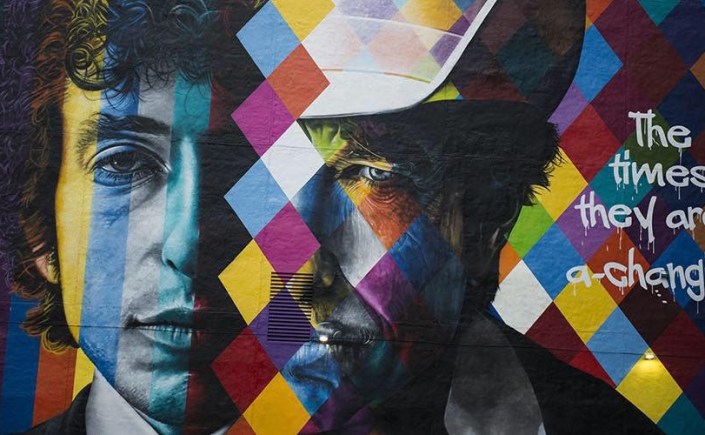
In Invisible Republic, his masterful telling of the story behind “The Basement Tapes”, Greil Marcus, quotes Bob Dylan: “Traditional music is based on hexagrams. It comes about from legends, Bibles, plagues, and it revolves around vegetables and death”.
And this is precisely the theme of Dylan’s belated Nobel Lecture, a presentation that is in its style, scope and subject matter, a a laid-back, folksey spoken edition of the long-awaited and probably never to be written “Chronicles – Volume 2”.
Constructed around his précis of three of the many books that have influenced his writing over more than half a century – Moby-Dick, All Quiet of the Western Front, and The Odyssey – he recalls how he had mined the literary canon for myth and meaning, often uncertain and uncaring about how one ended and the other began. As he concludes:
“If a song moves you, that’s all that’s important. I don’t have to know what a song means. I’ve written all kinds of things into my songs. And I’m not going to worry about it – what it all means”.
The full text of Bob’s lecture follows this recording:
When I first received this Nobel Prize for Literature, I got to wondering exactly how my songs related to literature. I wanted to reflect on it and see where the connection was. I’m going to try to articulate that to you. And most likely it will go in a roundabout way, but I hope what I say will be worthwhile and purposeful.
If I was to go back to the dawning of it all, I guess I’d have to start with Buddy Holly. Buddy died when I was about eighteen and he was twenty-two. From the moment I first heard him, I felt akin. I felt related, like he was an older brother. I even thought I resembled him. Buddy played the music that I loved – the music I grew up on: country western, rock ‘n’ roll, and rhythm and blues. Three separate strands of music that he intertwined and infused into one genre. One brand. And Buddy wrote songs – songs that had beautiful melodies and imaginative verses. And he sang great – sang in more than a few voices. He was the archetype. Everything I wasn’t and wanted to be. I saw him only but once, and that was a few days before he was gone. I had to travel a hundred miles to get to see him play, and I wasn’t disappointed.
He was powerful and electrifying and had a commanding presence. I was only six feet away. He was mesmerizing. I watched his face, his hands, the way he tapped his foot, his big black glasses, the eyes behind the glasses, the way he held his guitar, the way he stood, his neat suit. Everything about him. He looked older than twenty-two. Something about him seemed permanent, and he filled me with conviction. Then, out of the blue, the most uncanny thing happened. He looked me right straight dead in the eye, and he transmitted something. Something I didn’t know what. And it gave me the chills.
I think it was a day or two after that that his plane went down. And somebody – somebody I’d never seen before – handed me a Leadbelly record with the song “Cottonfields” on it. And that record changed my life right then and there. Transported me into a world I’d never known. It was like an explosion went off. Like I’d been walking in darkness and all of the sudden the darkness was illuminated. It was like somebody laid hands on me. I must have played that record a hundred times.
It was on a label I’d never heard of with a booklet inside with advertisements for other artists on the label: Sonny Terry and Brownie McGhee, the New Lost City Ramblers, Jean Ritchie, string bands. I’d never heard of any of them. But I reckoned if they were on this label with Leadbelly, they had to be good, so I needed to hear them. I wanted to know all about it and play that kind of music. I still had a feeling for the music I’d grown up with, but for right now, I forgot about it. Didn’t even think about it. For the time being, it was long gone.
I hadn’t left home yet, but I couldn’t wait to. I wanted to learn this music and meet the people who played it. Eventually, I did leave, and I did learn to play those songs. They were different than the radio songs that I’d been listening to all along. They were more vibrant and truthful to life. With radio songs, a performer might get a hit with a roll of the dice or a fall of the cards, but that didn’t matter in the folk world. Everything was a hit. All you had to do was be well versed and be able to play the melody. Some of these songs were easy, some not. I had a natural feeling for the ancient ballads and country blues, but everything else I had to learn from scratch. I was playing for small crowds, sometimes no more than four or five people in a room or on a street corner. You had to have a wide repertoire, and you had to know what to play and when. Some songs were intimate, some you had to shout to be heard.
By listening to all the early folk artists and singing the songs yourself, you pick up the vernacular. You internalize it. You sing it in the ragtime blues, work songs, Georgia sea shanties, Appalachian ballads and cowboy songs. You hear all the finer points, and you learn the details.
You know what it’s all about. Takin’ the pistol out and puttin’ it back in your pocket. Whippin’ your way through traffic, talkin’ in the dark. You know that Stagger Lee was a bad man and that Frankie was a good girl. You know that Washington is a bourgeois town and you’ve heard the deep-pitched voice of John the Revelator and you saw the Titanic sink in a boggy creek. And you’re pals with the wild Irish rover and the wild colonial boy. You heard the muffled drums and the fifes that played lowly. You’ve seen the lusty Lord Donald stick a knife in his wife, and a lot of your comrades have been wrapped in white linen.
I had all the vernacular all down. I knew the rhetoric. None of it went over my head – the devices, the techniques, the secrets, the mysteries – and I knew all the deserted roads that it traveled on, too. I could make it all connect and move with the current of the day. When I started writing my own songs, the folk lingo was the only vocabulary that I knew, and I used it.
But I had something else as well. I had principals and sensibilities and an informed view of the world. And I had had that for a while. Learned it all in grammar school. Don Quixote, Ivanhoe, Robinson Crusoe, Gulliver’s Travels, Tale of Two Cities, all the rest – typical grammar school reading that gave you a way of looking at life, an understanding of human nature, and a standard to measure things by. I took all that with me when I started composing lyrics. And the themes from those books worked their way into many of my songs, either knowingly or unintentionally. I wanted to write songs unlike anything anybody ever heard, and these themes were fundamental.
Specific books that have stuck with me ever since I read them way back in grammar school – I want to tell you about three of them: Moby-Dick, All Quiet on the Western Front and The Odyssey.

President Barack Obama presents rock legend Bob Dylan with a Medal of Freedom, Tuesday, May 29, 2012, during a ceremony at the White House in Washington. (AP Photo/Charles Dharapak)
Moby-Dick is a fascinating book, a book that’s filled with scenes of high drama and dramatic dialogue. The book makes demands on you. The plot is straightforward. The mysterious Captain Ahab – captain of a ship called the Pequod – an egomaniac with a peg leg pursuing his nemesis, the great white whale Moby Dick who took his leg. And he pursues him all the way from the Atlantic around the tip of Africa and into the Indian Ocean. He pursues the whale around both sides of the earth. It’s an abstract goal, nothing concrete or definite. He calls Moby the emperor, sees him as the embodiment of evil. Ahab’s got a wife and child back in Nantucket that he reminisces about now and again. You can anticipate what will happen.
The ship’s crew is made up of men of different races, and any one of them who sights the whale will be given the reward of a gold coin. A lot of Zodiac symbols, religious allegory, stereotypes. Ahab encounters other whaling vessels, presses the captains for details about Moby. Have they seen him? There’s a crazy prophet, Gabriel, on one of the vessels, and he predicts Ahab’s doom. Says Moby is the incarnate of a Shaker god, and that any dealings with him will lead to disaster. He says that to Captain Ahab. Another ship’s captain – Captain Boomer – he lost an arm to Moby. But he tolerates that, and he’s happy to have survived. He can’t accept Ahab’s lust for vengeance.
This book tells how different men react in different ways to the same experience. A lot of Old Testament, biblical allegory: Gabriel, Rachel, Jeroboam, Bildah, Elijah. Pagan names as well: Tashtego, Flask, Daggoo, Fleece, Starbuck, Stubb, Martha’s Vineyard. The Pagans are idol worshippers. Some worship little wax figures, some wooden figures. Some worship fire. The Pequod is the name of an Indian tribe.
Moby Dick is a seafaring tale. One of the men, the narrator, says, “Call me Ishmael.” Somebody asks him where he’s from, and he says, “It’s not down on any map. True places never are.” Stubb gives no significance to anything, says everything is predestined. Ishmael’s been on a sailing ship his entire life. Calls the sailing ships his Harvard and Yale. He keeps his distance from people.
A typhoon hits the Pequod. Captain Ahab thinks it’s a good omen. Starbuck thinks it’s a bad omen, considers killing Ahab. As soon as the storm ends, a crewmember falls from the ship’s mast and drowns, foreshadowing what’s to come. A Quaker pacifist priest, who is actually a bloodthirsty businessman, tells Flask, “Some men who receive injuries are led to God, others are led to bitterness.”
Everything is mixed in. All the myths: the Judeo Christian bible, Hindu myths, British legends, Saint George, Perseus, Hercules – they’re all whalers. Greek mythology, the gory business of cutting up a whale. Lots of facts in this book, geographical knowledge, whale oil – good for coronation of royalty – noble families in the whaling industry. Whale oil is used to anoint the kings. History of the whale, phrenology, classical philosophy, pseudo-scientific theories, justification for discrimination – everything thrown in and none of it hardly rational. Highbrow, lowbrow, chasing illusion, chasing death, the great white whale, white as polar bear, white as a white man, the emperor, the nemesis, the embodiment of evil. The demented captain who actually lost his leg years ago trying to attack Moby with a knife.
We see only the surface of things. We can interpret what lies below any way we see fit. Crewmen walk around on deck listening for mermaids, and sharks and vultures follow the ship. Reading skulls and faces like you read a book. Here’s a face. I’ll put it in front of you. Read it if you can.
Tashtego says that he died and was reborn. His extra days are a gift. He wasn’t saved by Christ, though, he says he was saved by a fellow man and a non-Christian at that. He parodies the resurrection.
When Starbuck tells Ahab that he should let bygones be bygones, the angry captain snaps back, “Speak not to me of blasphemy, man, I’d strike the sun if it insulted me.” Ahab, too, is a poet of eloquence. He says, “The path to my fixed purpose is laid with iron rails whereon my soul is grooved to run.” Or these lines, “All visible objects are but pasteboard masks.” Quotable poetic phrases that can’t be beat.
Finally, Ahab spots Moby, and the harpoons come out. Boats are lowered. Ahab’s harpoon has been baptized in blood. Moby attacks Ahab’s boat and destroys it. Next day, he sights Moby again. Boats are lowered again. Moby attacks Ahab’s boat again. On the third day, another boat goes in. More religious allegory. He has risen. Moby attacks one more time, ramming the Pequod and sinking it. Ahab gets tangled up in the harpoon lines and is thrown out of his boat into a watery grave.
Ishmael survives. He’s in the sea floating on a coffin. And that’s about it. That’s the whole story. That theme and all that it implies would work its way into more than a few of my songs.

Moby-Dick
All Quiet on the Western Front was another book that did. All Quiet on the Western Front is a horror story. This is a book where you lose your childhood, your faith in a meaningful world, and your concern for individuals. You’re stuck in a nightmare. Sucked up into a mysterious whirlpool of death and pain. You’re defending yourself from elimination. You’re being wiped off the face of the map. Once upon a time you were an innocent youth with big dreams about being a concert pianist. Once you loved life and the world, and now you’re shooting it to pieces.
Day after day, the hornets bite you and worms lap your blood. You’re a cornered animal. You don’t fit anywhere. The falling rain is monotonous. There’s endless assaults, poison gas, nerve gas, morphine, burning streams of gasoline, scavenging and scabbing for food, influenza, typhus, dysentery. Life is breaking down all around you, and the shells are whistling. This is the lower region of hell. Mud, barbed wire, rat-filled trenches, rats eating the intestines of dead men, trenches filled with filth and excrement. Someone shouts, “Hey, you there. Stand and fight.”
Who knows how long this mess will go on? Warfare has no limits. You’re being annihilated, and that leg of yours is bleeding too much. You killed a man yesterday, and you spoke to his corpse. You told him after this is over, you’ll spend the rest of your life looking after his family. Who’s profiting here? The leaders and the generals gain fame, and many others profit financially. But you’re doing the dirty work. One of your comrades says, “Wait a minute, where are you going?” And you say, “Leave me alone, I’ll be back in a minute.” Then you walk out into the woods of death hunting for a piece of sausage. You can’t see how anybody in civilian life has any kind of purpose at all. All their worries, all their desires – you can’t comprehend it.
More machine guns rattle, more parts of bodies hanging from wires, more pieces of arms and legs and skulls where butterflies perch on teeth, more hideous wounds, pus coming out of every pore, lung wounds, wounds too big for the body, gas-blowing cadavers, and dead bodies making retching noises. Death is everywhere. Nothing else is possible. Someone will kill you and use your dead body for target practice. Boots, too. They’re your prized possession. But soon they’ll be on somebody else’s feet.
There’s Froggies coming through the trees. Merciless bastards. Your shells are running out. “It’s not fair to come at us again so soon,” you say. One of your companions is laying in the dirt, and you want to take him to the field hospital. Someone else says, “You might save yourself a trip.” “What do you mean?” “Turn him over, you’ll see what I mean.”
You wait to hear the news. You don’t understand why the war isn’t over. The army is so strapped for replacement troops that they’re drafting young boys who are of little military use, but they’re draftin’ ‘em anyway because they’re running out of men. Sickness and humiliation have broken your heart. You were betrayed by your parents, your schoolmasters, your ministers, and even your own government.
The general with the slowly smoked cigar betrayed you too – turned you into a thug and a murderer. If you could, you’d put a bullet in his face. The commander as well. You fantasize that if you had the money, you’d put up a reward for any man who would take his life by any means necessary. And if he should lose his life by doing that, then let the money go to his heirs. The colonel, too, with his caviar and his coffee – he’s another one. Spends all his time in the officers’ brothel. You’d like to see him stoned dead too. More Tommies and Johnnies with their whack fo’ me daddy-o and their whiskey in the jars. You kill twenty of ‘em and twenty more will spring up in their place. It just stinks in your nostrils.
You’ve come to despise that older generation that sent you out into this madness, into this torture chamber. All around you, your comrades are dying. Dying from abdominal wounds, double amputations, shattered hipbones, and you think, “I’m only twenty years old, but I’m capable of killing anybody. Even my father if he came at me.”
Yesterday, you tried to save a wounded messenger dog, and somebody shouted, “Don’t be a fool.” One Froggy is laying gurgling at your feet. You stuck him with a dagger in his stomach, but the man still lives. You know you should finish the job, but you can’t. You’re on the real iron cross, and a Roman soldier’s putting a sponge of vinegar to your lips.
Months pass by. You go home on leave. You can’t communicate with your father. He said, “You’d be a coward if you don’t enlist.” Your mother, too, on your way back out the door, she says, “You be careful of those French girls now.” More madness. You fight for a week or a month, and you gain ten yards. And then the next month it gets taken back.
All that culture from a thousand years ago, that philosophy, that wisdom – Plato, Aristotle, Socrates – what happened to it? It should have prevented this. Your thoughts turn homeward. And once again you’re a schoolboy walking through the tall poplar trees. It’s a pleasant memory. More bombs dropping on you from blimps. You got to get it together now. You can’t even look at anybody for fear of some miscalculable thing that might happen. The common grave. There are no other possibilities.
Then you notice the cherry blossoms, and you see that nature is unaffected by all this. Poplar trees, the red butterflies, the fragile beauty of flowers, the sun – you see how nature is indifferent to it all. All the violence and suffering of all mankind. Nature doesn’t even notice it.
You’re so alone. Then a piece of shrapnel hits the side of your head and you’re dead. You’ve been ruled out, crossed out. You’ve been exterminated. I put this book down and closed it up. I never wanted to read another war novel again, and I never did.
Charlie Poole from North Carolina had a song that connected to all this. It’s called “You Ain’t Talkin’ to Me,” and the lyrics go like this:
I saw a sign in a window walking up town one day.
Join the army, see the world is what it had to say.
You’ll see exciting places with a jolly crew,
You’ll meet interesting people, and learn to kill them too.
Oh you ain’t talkin’ to me, you ain’t talking to me.
I may be crazy and all that, but I got good sense you see.
You ain’t talkin’ to me, you ain’t talkin’ to me.
Killin’ with a gun don’t sound like fun.
You ain’t talkin’ to me.

Bob Dylan and Robbie Robertson
The Odyssey is a great book whose themes have worked its way into the ballads of a lot of songwriters: “Homeward Bound, “Green, Green Grass of Home,” “Home on the Range,” and my songs as well.
The Odyssey is a strange, adventurous tale of a grown man trying to get home after fighting in a war. He’s on that long journey home, and it’s filled with traps and pitfalls. He’s cursed to wander. He’s always getting carried out to sea, always having close calls. Huge chunks of boulders rock his boat. He angers people he shouldn’t. There’s troublemakers in his crew. Treachery. His men are turned into pigs and then are turned back into younger, more handsome men. He’s always trying to rescue somebody. He’s a travelin’ man, but he’s making a lot of stops.
He’s stranded on a desert island. He finds deserted caves, and he hides in them. He meets giants that say, “I’ll eat you last.” And he escapes from giants. He’s trying to get back home, but he’s tossed and turned by the winds. Restless winds, chilly winds, unfriendly winds. He travels far, and then he gets blown back.
He’s always being warned of things to come. Touching things he’s told not to. There’s two roads to take, and they’re both bad. Both hazardous. On one you could drown and on the other you could starve. He goes into the narrow straits with foaming whirlpools that swallow him. Meets six-headed monsters with sharp fangs. Thunderbolts strike at him. Overhanging branches that he makes a leap to reach for to save himself from a raging river. Goddesses and gods protect him, but some others want to kill him. He changes identities. He’s exhausted. He falls asleep, and he’s woken up by the sound of laughter. He tells his story to strangers. He’s been gone twenty years. He was carried off somewhere and left there. Drugs have been dropped into his wine. It’s been a hard road to travel.
In a lot of ways, some of these same things have happened to you. You too have had drugs dropped into your wine. You too have shared a bed with the wrong woman. You too have been spellbound by magical voices, sweet voices with strange melodies. You too have come so far and have been so far blown back. And you’ve had close calls as well. You have angered people you should not have. And you too have rambled this country all around. And you’ve also felt that ill wind, the one that blows you no good. And that’s still not all of it.
When he gets back home, things aren’t any better. Scoundrels have moved in and are taking advantage of his wife’s hospitality. And there’s too many of ‘em. And though he’s greater than them all and the best at everything – best carpenter, best hunter, best expert on animals, best seaman – his courage won’t save him, but his trickery will.
All these stragglers will have to pay for desecrating his palace. He’ll disguise himself as a filthy beggar, and a lowly servant kicks him down the steps with arrogance and stupidity. The servant’s arrogance revolts him, but he controls his anger. He’s one against a hundred, but they’ll all fall, even the strongest. He was nobody. And when it’s all said and done, when he’s home at last, he sits with his wife, and he tells her the stories.
____________________
So what does it all mean? Myself and a lot of other songwriters have been influenced by these very same themes. And they can mean a lot of different things. If a song moves you, that’s all that’s important. I don’t have to know what a song means. I’ve written all kinds of things into my songs. And I’m not going to worry about it – what it all means. When Melville put all his old testament, biblical references, scientific theories, Protestant doctrines, and all that knowledge of the sea and sailing ships and whales into one story, I don’t think he would have worried about it either – what it all means.
John Donne as well, the poet-priest who lived in the time of Shakespeare, wrote these words, “The Sestos and Abydos of her breasts. Not of two lovers, but two loves, the nests.” I don’t know what it means, either. But it sounds good. And you want your songs to sound good.
When Odysseus in The Odyssey visits the famed warrior Achilles in the underworld – Achilles, who traded a long life full of peace and contentment for a short one full of honor and glory – tells Odysseus it was all a mistake. “I just died, that’s all.” There was no honor. No immortality. And that if he could, he would choose to go back and be a lowly slave to a tenant farmer on Earth rather than be what he is – a king in the land of the dead – that whatever his struggles of life were, they were preferable to being here in this dead place.
That’s what songs are too. Our songs are alive in the land of the living. But songs are unlike literature. They’re meant to be sung, not read. The words in Shakespeare’s plays were meant to be acted on the stage. Just as lyrics in songs are meant to be sung, not read on a page. And I hope some of you get the chance to listen to these lyrics the way they were intended to be heard: in concert or on record or however people are listening to songs these days. I return once again to Homer, who says, “Sing in me, oh Muse, and through me tell the story.”
http://www.svenskaakademien.se/en/nobel-lecture
© THE NOBEL FOUNDATION 2017. The Nobel Foundation has not obtained the right to assign any usage right to the Nobel Lecture to any third party, and any such rights may thus not be granted. All rights to the Nobel Lecture by Bob Dylan are reserved and the Nobel Lecture may not be published or otherwise used by third parties with one exception: the audio file containing the Nobel Lecture, as published at Nobelprize.org, the official website of the Nobel Prize, may be embedded on other websites
Read also: Blind Willie McTell – Bob Dylan’s Americana and Ahab’s Madness


Commentator and counterinsurgency expert David Kilcullen is always worth reading. Here is his assessment of the Khan Sheikhoun gas attack and the US’ “laughably symbolic” response. Contrary to the view of many that Assad did not use sarin gas, and to those who praised Trump’s newfound, muscular foreign policy, Kilcullen maintains that it was indeed Assad wot done it, that his reasons were strategically justified, that the US and its allies need much than this one viagra hit to bring the multifarious warring parties to the negotiating table, and that anyhow, the real target of Trump’s martial signalling were Chinese President Xi and The North Korean Fat Controller, Kim Jong Il. And, perhaps, as Beirut-based correspondent for The Independent, Robert Fisk suggests in his own interpretation of the events, Vladimir Putin:
Patrick Cockburn, Fisks’s colleague at at The Imdependent paints a scarier scenario. The folk who brought you the disasters in Iraq and Afghanistan are back, and are keen to attend to unfinished business:
David Kilcullen. The Australian, April 15, 2017
US President Donald Trump’s missile strike against Syria’s Shayrat air base last week, responding to the chemical attack on Khan Sheikhoun in northern Idlib province, garnered cautious praise across the political spectrum. It also highlighted the complex choices facing the US, allies such as Australia, regional players like Turkey and Iraq, and institutions such as the UN.
The key to understanding the strike, though, lies in a question that’s been somewhat overlooked: why did Bashar al-Assad’s regime need to use the nerve agent in the first place?
We should start by noting that praise for the strike can largely be explained by the extraordinarily low expectations Trump and his predecessor set for effective action on Syria. Trump’s alleged Russia ties, praise for strongmen, positive statements about Assad until days before the attack, and expressed disdain for world opinion set the bar so low that he got credit just for upholding an international norm against chemical weapons, and showing he was prepared to go up against Moscow.
His prompt response also contrasted with president Barack Obama’s failure to enforce his own “red line” after the vastly more lethal Ghouta attack of September 2013, which killed 1500 and poisoned thousands (the Khan Sheikhoun attack killed 74). When Obama called his own bluff on the red line, ceded the diplomatic initiative to Moscow and put the Kremlin in the driver’s seat for negotiations on Syria, he enabled a Russian-brokered agreement on Syria’s chemical stockpile that bolstered the regime’s legitimacy.
Far from eliminating Syria’s chemical weapons — as former national security adviser Susan Rice repeatedly claimed — that agreement left Assad’s regime with reduced but still lethal capability, including extensive supplies of chlorine gas and smaller stocks of nerve agent that it used in later attacks. As Syrians told me after Ghouta, they felt the White House was telling Assad he could go ahead and massacre his own people, provided he did it with barrel bombs and artillery rather than chemicals.
The failure to act after Ghouta so appalled some members of Obama’s cabinet that Democratic “Syria hawks” (including former secretary of state John Kerry) came out in support of last week’s Shayrat strike. Given the continued refusal by many on the left to recognise Trump as America’s duly elected President, this speaks volumes for the level of bipartisan support for decisive action on Syria.
It also highlights the comfort of many progressive interventionists (including Kerry, but also Hillary Clinton) with unilateral American use of force — provided it is sanctified by humanitarian principles such as “responsibility to protect”. All this put Trump’s punitive strike in the political mainstream, making him look positively, well, Clintonian.
The Western narrative on Assad — reinforced just this week by presidential spokesman Sean Spicer — has been that his regime is uniquely evil, uses chemical weapons simply because it can, hates its own people and just wants to burn the country to the ground.
But, in fact, Syrian use of chemical weapons in the war so far has been highly calculated and strategic. Assad’s regime, far from being blind to international condemnation, understands the severe political consequences of using chemical weapons, and only does so when its back is against the wall. Assad’s regime has shown no compunction in using nerve agents when its survival is at stake, but otherwise it mostly keeps chemical weapons as a hip-pocket emergency reserve that can be rapidly deployed when manpower is short.
Thus, the real missed opportunity of 2013 lay in a failure to understand the regime’s motive in using chemical weapons: as a last resort, when a victorious coalition of mostly secular rebel groups was threatening the eastern suburbs of Damascus, making significant gains in the regime’s heartland and jeopardising its survival. Decisive action, combining the measured use of force with a strong diplomatic push, could have forced Assad — given the dire pressure he was under — into genuine peace talks.
The Ghouta attack was not an act of unthinking evil but one of calculated desperation, and strikes against regime positions could have not only punished Assad for his use of gas, but enabled a rebel advance into Damascus that would have opened a path to negotiations. The diplomatic price for suspending air strikes would have been regime concessions in UN-led peace talks, while the international community would have retained the ability to restart strikes at any time, or impose no-fly zones to enable humanitarian corridors to protect the people.
This, in fact, was the argument that allied airpower experts made at the time, likening the situation to the NATO-led bombing in the Balkans that ended the Bosnian war, led to the Dayton Accords and halted massacres in Kosovo in 1999.
This isn’t as far-fetched as it seems. Remember, 2013 was before Islamic State emerged, before its blitzkrieg dramatically changed the game in Iraq, before the declaration of the caliphate prompted a spike in world terrorism, before Turkey’s military incursions into Iraq and Syria, and before the European immigration crisis.
In 2013, the dominant Syrian rebel factions still included secular groups, while jihadists were on the back foot. This was also before Russia’s intervention improved Syrian air defences and complicated targeting by putting Russians on to key regime sites, and before the presence of more than 1500 Western ground troops in Syria made it possible for the regime to easily retaliate. And it was before the Iranian nuclear deal of 2015 brought a flood of funds, advisers and troops from Tehran to further bolster the regime.
Against this background, last week’s strike seems almost laughably symbolic: 60-odd Tomahawk cruise missiles, launched from two US navy ships in the Mediterranean, with allied aircraft kept away from Syrian air defences, and the Russians (and thus, presumably, their Syrian proteges) given plenty of warning to get out of the way. The missiles destroyed some obsolete aircraft, killed a few regime troops, and left the airfield at Shayrat so lightly damaged that the regime was using it again within hours, even launching a further strike from Shayrat (with conventional munitions) against Khan Sheikhoun the very next day.
Kosovo 1999 it was not. But again, the key question is why Assad’s forces felt the need to use the nerve agent in the first place.
Khan Sheikhoun is a town of 50,000 on the southern edge of Idlib, a province in northwestern Syria that abuts Turkey to the north, Aleppo to the east, and Hama and Latakia provinces to the south and west. As of mid-April, apart from tiny regime enclaves at Fua and Kefraya, Idlib is almost totally controlled by a jihadist coalition led by al-Qa’ida’s Syrian affiliate Jabhat Fatah al-Sham, still widely known by its former name, the Nusra Front.
Nusra detests Islamic State (a feeling Abubakr al-Baghdadi’s organisation heartily reciprocates). But in many ways it poses a much more severe threat to the regime than Baghdadi’s group. The Nusra-led offensive in Idlib and Hama has been under-reported, but for Syrians it’s the most important event of 2017 so far.
Even as the regime recaptured Aleppo in December 2016 — with heavy support from Russian airstrikes, Russian special forces, Iranian advisers and Hezbollah militia — Nusra and other groups formed an alliance, Hayat Tahrir al-Sham, to recapture ground from Assad’s forces.
After weeks of preparation they launched a major offensive on March 21 with more than 5000 well-armed and well-organised fighters from seven rebel groups operating under Nusra leader Abu Mohammed al-Jolani. Tahrir al-Sham gathered the most capable rebel groups in Syria into a single coalition under al-Qa’ida’s leadership, pointed them directly at the regime’s weakest point and achieved immediate success.
Within days, rebel fighters pushed to within 5km of the Hama suburbs, threatening the regime’s control of a critical city that anchors its northern flank and provides access to Aleppo. They also made significant gains into the al-Ghab plain, Syria’s breadbasket, an area essential to the regime’s ability to feed Syria’s pro-government population.
Nusra’s rapid advance jeopardised Assad’s control of the economically and politically important Hama and Latakia provinces, and posed a risk to Russia’s naval and air bases to the south.
Khan Sheikhoun now sits at the base of a rebel salient that stretches from Idlib south into the outskirts of Hama city, and west into al-Ghab. As I write, this salient is being counter-attacked all along its perimeter by regime forces desperate to stem the Nusra advance, but lacking the manpower or ground-based firepower to roll back the rebels. Knocking out Khan Sheikhoun from the air would immediately collapse the rebel salient, letting the regime stabilise the front line. Unsurprisingly, doing exactly that has become a major priority for Assad.
The town’s importance was underlined by the fact that the pilot who allegedly carried out the sarin attack was Major General Mohammed Hazzouri, a Syrian air force officer commanding the 50th Air Brigade at Shayrat, and whose family name suggests he’s related to Mohammed Abdullah al-Hazzouri, governor of Hama, who was appointed by Assad in November 2016. Obviously, when you launch a gas attack using a fighter jet flown by a two-star general from the same prominent family as the provincial governor, you’re telegraphing that this is a pretty serious priority.
In fact, the town has been heavily attacked by regime forces (including earlier attacks with chemical weapons late last year and again last month) and subjected to multiple air strikes and artillery bombardments as the regime tries to contain the threat to its northern flank. Assad’s reliance on artillery and aircraft underlines his lack of ground assets: despite Russian, Iranian and Hezbollah support, his forces have their hands full consolidating control over Aleppo, trying to relieve the isolated city of Deir Ezzor in eastern Syria, and fighting on the southern front against other rebel groups.
All this indicates that the regime is again under serious pressure, that its position is far shakier than its propaganda narrative after the recapture of Aleppo might suggest, and that firm pressure now might bring renewed progress toward peace talks. But the situation today is vastly more complicated than in 2013. There are real risks to allied aircraft over Syria from Russian and Syrian air defences, and to special forces and conventional troops (there are now, according to media reporting, as many as 1500 rangers, marines and special forces on the ground in Syria) in the event of strikes against the regime.
The rebels opposing Assad today are not the largely secular forces of 2013 but rather are dominated by al-Qa’ida, while Russia has indicated it plans to further improve Syria’s air defences and has vetoed efforts in the UN for further talks on a Syrian peace deal.
To think that, under these circumstances, mere words — Secretary of State Rex Tillerson’s frosty visit to Moscow, Trump’s call for Vladimir Putin to stop covering for Assad, or ambassador Nikki Haley’s fiery confrontation with Russian diplomats at the UN — will force Putin to back away from a critical strategic relationship going back to the 1960s, or force Assad to stop throwing everything at an attack that threatens his survival, is fantasy. If the Shayrat strike is to be more than the latest useless symbolic gesture, it needs to be followed by a fundamental change in strategy.
Until a week ago, Trump’s Syria policy was to downplay any call for regime change, acquiesce in the permanence of Assad’s regime and collaborate with Putin against Islamic State. As recently as April 5, the day after the Khan Sheikhoun attack, Tillerson was asserting that Assad was here to stay.
This was bad policy: not just on moral or political grounds (Assad has killed 10 times as many Syrians as Islamic State, and most US partners both inside Syria and throughout the region see removing Assad and ending the war as the top priority bar none) but also in practical military terms.
Assad lacks the military capacity to stabilise Syria: he’s losing ground in key areas, controls less than 23 per cent of the country, has no prospect of reunifying Syria, presides over a patchwork of local militias and thuggish warlords with purely nominal allegiance to his government, and couldn’t survive six months without external support.
The use of sarin gas underlines how desperate his situation is. Even if it were morally and politically possible to work with his regime for the greater goal of destroying Islamic State, the man simply can’t do the job.
More fundamentally, the goal of destroying Islamic State may not actually be the higher strategic priority, at least not in Syria. Unlike Iraq, where recapturing Mosul and crushing the caliphate is a key first step toward stabilising the country, in Syria the greatest threat to stability is Assad himself.
For most Syrians I’ve spoken to, the idea that anyone engaged in the uprising since 2011 would sit down again under Assad is ludicrous, and many have told me the biggest winner so far isn’t Islamic State but al-Qa’ida, through its Nusra affiliate.
From a wider strategic standpoint, the other key audiences for the Shayrat strike were Chinese leader Xi Jinping (who was dining with Trump as the strike went in) and North Korean leader Kim Jong-un. Using the Syria strike to telegraph a zero-tolerance policy for weapons of mass destruction, administration spokesmen talked of a new joint effort with China to rein in North Korea’s nuclear adventurism. For a President who spoke blithely on the campaign trail about Japan and South Korea acquiring their own nuclear weapons to deal with Pyongyang, this represents a big step forward.
More importantly, the move of the USS Carl Vinson aircraft carrier battle group toward Korean waters to deter further missile launches, and the deployment of US air defence systems and special operators in South Korea, showed this was not just talk.
The choices facing President Trump on Syria today are vastly more complex than those president Obama failed to deal with in 2013. But his change of policy after the Khan Sheikhoun attack — perhaps prompted by the presence in his inner circle of experienced strategists such as Secretary of Defence James Mattis and National Security Adviser HR McMaster — shows he’s at least capable of learning and adapting.
Along with the change on Syria policy and the move to deter North Korea, last week’s strike was rapidly followed by shifts in Trump’s tone on China (evidently no longer a currency manipulator), NATO (apparently no longer obsolete) and Russia (it would have been nice to co-operate, but that’s not possible while Russia continues to back Assad). Don’t look now, but all this seems to be pushing the Trump presidency back toward something resembling relatively mainstream US policy in the tradition of presidents Bush, Clinton and Reagan.
Whether you think that’s good or bad probably depends on your view of America’s role in the world, and the longstanding propensity of US leaders to use unilateral military force. But symbolic as it was, the Shayrat missile strike may also open the door to new thinking on Syria — and after six years, half a million dead, dozens of cities destroyed and millions displaced, that can only be a good thing.
David Kilcullen is a former lieutenant-colonel in the Australian Army and was a senior adviser to US general David Petraeus in 2007-08, when he helped to design the Iraq war coalition troop surge. He also was a special adviser for counterinsurgency to former US secretary of state Condoleezza Rice. He is the author of Blood Year: Islamic State and the Failures of the War on Terror (Black Inc).
See also, a prior post featuring David Kilcullen: One, Two, Three, What Are We Fighting For?

As I contemplate my annual review of In That Howling Infinite, I am reminded, with clichéd predictability, of that well-worn Chinese curse: “may you live in interesting times”.
A torturous and seemingly endless US election campaign defied all the pundits by producing an colourful and unpredictable POTUS. In the UK, the unthinkable Brexit came to pass, dividing the polity and discombobulating the establishment. Next year is certainly going to be worth watching.
The slow and tragic death of Syria continued unabated with Russian and Turkey wading into the quagmire alongside Americans, British, French, Australians, Iran, Lebanon, Gulf tyrants, and Uncle Tom Cobley and all. Da’esh might be on the the ropes in Iraq, but the long term survival of the unitary state is doubtful. And the proxy wars of the Ottoman Succession have spread to Yemen, the poorest country in the Middle Eas as Gulf tyrants face off against Shia Iran’s alleged puppets, and, armed and abetted by British and American weaponry, South American mercenaries, and Australian officers, bomb the shit out of the place.
Whilst the grim reaper scythed through the world from Baghdad to Berlin, from Aleppo to Ankara, the Year saw the passing of a record number of icons of the seventies and eighties, two of whom who have provided a continuing soundtrack for my life, Leonard Cohen and David Bowie. We shall not see the like of them again.
In our little corner of the cosmos, we endured the longest and most boring election campaign in living memory, resulting in an outcome that only accentuates Australians’ disenchantment with a lacklustre Tory government, a depressingly dysfunctional political system, and politicians of all stripes who, blinkered by short-termism, and devoid of vision, insist on fiddling whilst the antipodean Roman burns.
Meanwhile, in our own rustic backyard, we find that we too are “going up against chaos”, to quote that wonderful Canadian songster Bruce Cockburn. For much of the year, we have been engaged in combat with the Forestry Corporation of New South Wales as it proceeds to lay waste to the state forest that surrounds us. As the year draws to a close, our adversary has withdrawn with only half of its proposed harvest completed. But it will return in 2017, and the struggle will continue – as it will throughout the state and indeed the nation as timber, coal and gas corporations, empowered by legislation, trash the common treasury with the assent of our many governments.
And yet, life on the farm remains pleasant and delightful, though dams are low and rain would be most welcome. The bird and reptilian life continues to amaze us, and an ironic corollary to the clear felling of the Tarkeeth Forest is that “refugees” are seeking shelter here. Wallabies rarely seen on our land are now quite common, whilst echidnas, and, we suspect, endangered spotted quolls have been sighted hereabouts
We took time out mid-year to revisit Israel and Palestine, and road-trip through the two countries was much an education as a holiday. We certainly got our history and archeology fix, and in travelling through the Golan and the Negev, we found respite in a stunning natural environment. But the answers to our many political questions merely threw up more questions. We have unfinished business in this divine but divided land, and will return.
In That Howling Infinite addressed all these concerns during 2016, and matters more eclectic and exotic.
And so, to the year in review:
The new year commenced with a reprise of our memorable journey to Hadrians Wall, and of the Victorian lawyer who helped preserve it for posterity, the saga of the viking Harald Hardraga and also, my subjective overview of world history. In a more lighthearted vein, I indulged in an unscholarly discussion of how film and fiction have portrayed or distorted history, and in a review of Mary Beard’s superlative history of Rome, I asked the immortal question “what have the Romans done for us?”

In April, in response to a discussion with a Facebook friend in Oklahoma, I wrote a trilogy of exotically-titled posts examining the nature of rebellion, revolution, and repression: Thermidorian Thinking, Solitudinem Faciunt Pacem Appellant, and Sic Semper Tyrannis. The origin of these Latin aphorisms is explained, by the way, in the aforementioned Roman review.

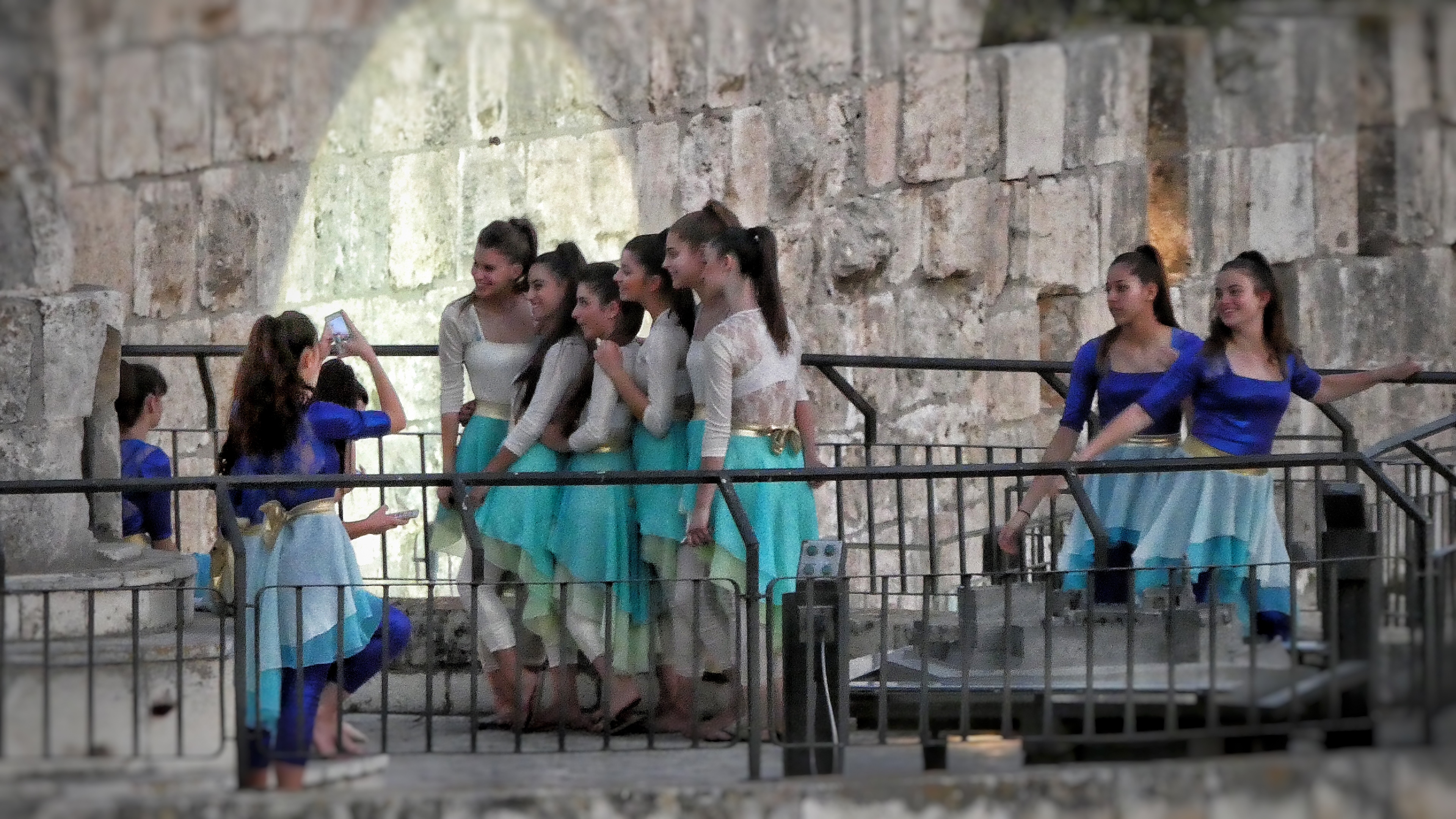
Our travels through Israel and Palestine inspired numerous real-time posts, and a several retrospectives as we contemplated what we had experienced during what was as much an educational tour as a holiday. Historical vignettes included a tribute to bad-boy and builder King Herod the Great, a brief history of the famous Damascus Gate, and its place in Palestinian national consciousness, and a contemplation on the story of King David’s Citadel which overlooked our home-away-from home, the New Imperial Hotel. Thorny contemporary issues were covered with an optimistic piece on the Jerusalem Light Rail, a brief if controversial post about Jewish settlers in the Old City, the story of Israel’s ‘Eastern’ Jews, the Mizrahim, and what appears to be a potentially problematic Palestinian property boom. Th e-magazine Muftah published an article I wrote about the conflicting claims to the city of Hebron. And finally, there is a poem recalling our visit to the Shrine of Remembrance at Yad Vashem and honouring the Righteous Gentiles who saved thousand of Jewish lives during the Shoah.
Wintertime passed with our minds on the Tarkeeth Forest. I had the pleasure discovering the history of our locality, and connecting via Facebook with the relatives of the Fells family of Twin Pines. But the latter half of the year was very much taken up with enduring and bearing witness to the clear- felling of the forest to our east. “If you go down to the woods today, you’re in for a big surprise. If you go down to the woods today, you’ll never believe your eyes”. And you’d ask “what would JRR Tolkien have thought?”
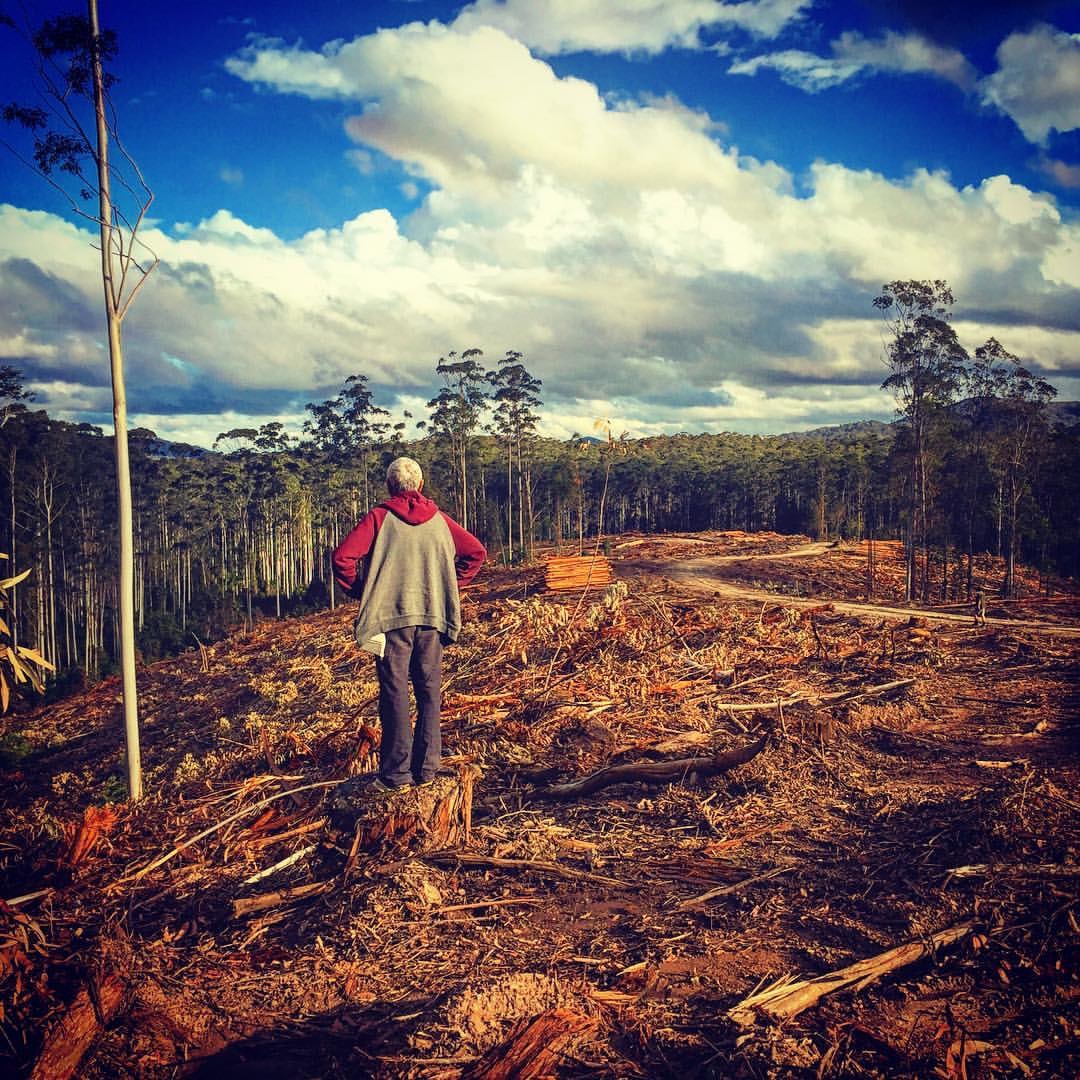
The UK And US paroxysms fascinated and exasperated the mainstream and social media in equal measure, whilst the outcome of the Brexit referendum and the presidential election has initiated an a veritable orgy of punditry. Never have so many column inches and kilobytes been spent on loud sounding nothings as the sifting through the entrails of such events as Brexit, the US election, and the Australian senate! With half a dozen elections coming up in Europe, Trump’s inauguration and the triggering of Article 50 to take Britain out the European Union, we’re gonna have to endure a lot more. I confined my posts to two insightful pieces by respected right-wing Australian commentators, Paul Kelly’s Living in Interesting Times, and Greg Sheridan’s The Loss of American Virtue, and my own reflection on the right-wing media’s strange fascination with “insiders” and “outsiders”.
Finally, in comparison to last year, this year was very light on music and poetry. But American satirist Tom Lehrer got a retrospective, and murdered Pakistani qawwali singer Madhaf Sabri, an obituary, whilst an abridged and vernacular version of John Milton’s Paradise Lost told the tale of Lilith, the first and greatest femme fatale. In the words of the gloriously-named jockey Rueben Bedford Walker III says in EC Morgan’s magnificent The Sport of Kings, the subject of my first post for 2017, “Malt does more than Milton can to justify God’s ways to man”.
On that wise note, I wish the world a Happy New Year – and may it be less interesting than this one.
In That Howling Infinite is now on FaceBook. Check it out. And just for the fun of it, here’s my review of 2015.


“These are the days of miracle and wonder, but don’t cry baby, don’t cry…” Paul Simon, The Boy in the Bubble
With an election looming in Australia, touted as the most important election since the last election, a critical referendum next week in the UK that could precipitate a frightening leap in the dark, and possibly the most divisive presidential contest in the USA in living memory, I scale the News Corp pay-wall to share Paul Kelly’s thoughts on the “interesting times” that we are living in.
Disruption of Brexit, Trump Loom in Anti-elitist Age
Paul Kelly, The Australian, 15th June, 2016
Our age is defined by hostility towards elites and establishment power — caused by financial abuses, frustration at pressures over incomes, immigration and living standards, polarisation at changing cultural norms and Islamist terror — with the US and Britain now in domestic political turmoil from this phenomenon.
The sense of elite failure is taking hold. It mirrors the belief that established policy is rotten or ineffective. Witness the incessant talk of weak leadership and the demise of political trust. People feel they are losing control — of their suburbs, country and security.
The culture of complaint, partly justified, lurches out of control, fed by public anger, acrimonious social media and a coarsening in public life. In this cauldron, ideas that have governed prosperity and success are now under assault from extremes of Left and Right. This roughly describes the forces at work in the US and Britain today. The once unthinkable — just nine months ago — is now a real prospect.
Donald Trump, Republican nominee for president with a reasonable chance in a two-horse race, constitutes a danger to the US and the world. Britain, according to polls, is 50-50 on whether to vote for Brexit and leave the EU in a delusional national revolt. And Australia, devoid of such epic events, is not devoid of their causes, with an anti-establishment, anti-major party hostility possibly defining the 2016 election.
There are two dominant characteristics of this revolt against the elites — it proves the failure of established political leaders and every sign is that such angry, disillusioned populism is just making matters worse and leaving people worse off.
The Western democracies are sinking into a political and intellectual crisis.
The Trump and Brexit movements are different in form but close in motivation — they are driven by multiple grievance. They feed off the notion of a polity gone wrong and a public scorned for too long. They represent a community alienated by and from the centres of power, from the Republican establishment to an arrogant EU.
In extreme form, people feel the system is rigged against them. They are retaliating: part calculated, part irrational. In an age of economic and technological disruption, large segments of the community have said “you want disruption? OK, we’ll give you disruption”.
Tory PM David Cameron now finds his survival in peril. Barack Obama, the most progressive US president, bequeaths a legacy of public rancour, polarisation and low self-esteem. Is it possible for any leader to succeed in societies that have lost their traditional virtue and much of the civic glue that held them together?
It is a time of false prophets. A generation of different and dangerous populists now moves to centre stage. Some like Trump, are undisguised in their racial, sexist and selfish pitches. Trump knows the key to being a successful fraud is to be a grand fraud. He pledges “to make America great again” with an agenda that will damage America and endanger the world.
Yet he wins wide applause. This is because he is an anti-politician, shaking the system, abusing the established politicians, trashing their ideas. He thrives on shock and extravagance in a culture drunk with mindless celebrity. He stands for economic nationalism, trade protectionism, xenophobic hostility towards Muslims and a US strategic withdrawal from the world and much of its alliance system.
Many of the sentiments Trump champions are embraced, one way or another, by the collection of minor parties and independents running at this election — and receiving little scrutiny — from Nick Xenophon’s extreme protectionism to Pauline Hanson’s extreme attitudes towards Muslims and immigration to the strategic withdrawal advocated by the Greens in their hostility towards the US alliance and delusion of a neutralist and more “independent” Australia.
Because he is an inflated ogre, Trump invites resistance. He lacks the judgment for the US presidency and should be fiercely opposed every step of the way. His policies cannot be excused simply because of establishment blunders.
The situation in Australia is different because our revolt against the elites is conducted in the name of the underdog, the little Aussie battler, the moral crusader or, as the Greens say, against the political equivalent of the Coles/Woolworths duopoly.
It is a climate where Jacqui Lambie, a purveyor of cliches with the common touch, can become a Tassie heroine and Xenophon can exploit rent-seeking provincialism to become SA’s finest son. Australians with their anti-authoritarian instincts are notoriously susceptible to appeals to cut down the tall poppies. It is a national pastime and good fun. The public can elect protest candidates in haste and regret over time. Witness Clive Palmer. Who pray, will Queensland give us this poll?
The educated class is adroit at the game. Clever men, Oxford educated, who write books about Winston Churchill can become slick populists as they seek to repudiate Churchill’s legacy of Britain’s commitment to Europe. Boris Johnson spearheads the Brexit campaign and, if successful, he will be well positioned to become PM.
Exploiting the multitude of EU flaws, Johnson makes a big call in Churchill’s style — time to quit Europe altogether — mobilising the sentiments that blame Europe for Britain’s problems, channelling Euroscepticism, overlooking the evidence that exit will hurt Britain economically, hurt the living standards of its people, diminish Britain’s influence and create a series of policy challenges that nobody remotely knows how to solve.
Johnson’s is a sophisticated populism. He cannot explain how Brexit will leave Britain more prosperous or safer. But he has invoked Hitler, Napoleon and the glories of the Empire along the road to what he calls a new freedom. He has panache and, exploiting the immigration card, he may win. Malcolm Turnbull, naturally, backs Cameron’s efforts to keep Britain in the EU.
False ideas are powerful in this new populism. People these days are disgusted with transactional politics — deals, trade-offs, compromises. Yet this is how nations are run in the age of fragmentation and diversity. It is what delivers stability, progress and social unity.
The anti-elites have a different view. They are obsessed by the notion of authenticity because they see most politicians as phony. They want politicians to take a purist stand in honouring their obsessions, single issues and self-interest — against the coal industry, for same-sex marriage, free Medicare forever, banning coal-seam gas, escaping the EU, building a wall to keep out Mexicans. It is a long list.
The anti-elites embody a rising intolerance — self-righteous refusal to accept the validity of the opposing argument is pivotal to this mood. These upheavals in the two great democracies, the US and Britain, are moments of great import. To list the sources of this malaise is to recognise its existence in Australia, albeit in different and less intense form. But for how long?
The mood in the Australian election is disengagement and disillusion with the main parties. The principal contest is Coalition versus Labor.
Yet there is another issue at stake: whether this poll sees an unprecedented number of minor party and independent candidates in evidence of a growing revolt against the Australian system.

You come at the king, you best not miss.
Omar Little, The Wire (after RW Emerson)
The phrase “one man’s freedom fighter is another man’s terrorist” is at once apt, correct, and yet often oversimplified to the point of disingenuousness. The word “terrorist” itself describes its goal. To instill fear in the heart of the enemy. In the past, the target would have been the king, the dictator, the ruling class, and those who served them and upheld their rule. Politicians, officials, solders and policemen. Today, terrorists indiscriminately target whole societies. Irish bombers blasted communities of the rival faith, murdered shoppers, office workers, and pub patrons, as well as soldiers and policemen. Palestinian suicide bombers hit malls and pizza bars in city centres. ISIS, al Qa’ida and the Taliban detonate cars in busy city streets and publicly execute prisoners in callous and calculating “lectures in flesh” (the phrase is civil rights lawyer Geoffrey Robertson’s, from his chilling account of the trials and execution of King Charles I of England and those who sentenced him, The Tyrannicide Brief.).
But targeted and random terrorism has a long historical pedigree. For centuries, it has been the desperate and nihilistic weapon of last resort of resistance and rebellion against perceived oppression and injustice, and against invaders and occupiers.
In the second century BCE Palestine, the Maccabees used assassination in their resistance to the Seleucid Greeks, and a century later, the Jewish zealots, the Sicarii, named for the easily concealed small daggers, paid the Romans in like coin, and ultimately in an insurrection that culminated in the destruction of Jerusalem in 70CE and the scattering of the Jewish race (giving history the emotive and symbolic last exit that was Masada). In an etymological irony that Mark Twain would have been proud of, the present unrest in Jerusalem, a large number of young Palestinians have perished in attempting to stab jewish soldiers and civilians. Their jaquerie is called the “Intifada Sakni-in”, the ‘Knife Uprising – an echo of those long-dead Sicarii “dagger men”.
Nowadays, one would be excused for thinking that “terrorism” and “terrorist” are synonymous with Arabs and Muslims. And a historical precedent reinforces this erroneous assumption. The Hashishan or “Assassins” of Middle East fame (yes, that is where that noxious noun originated) were Muslim men and boys mesmerized and mentored by Rashid ad Din as Sina-n, the “Old Man of the Mountain” (and all this, before Osama in the caves of Tora Bora), and were Twelfth Century hit-men contracted out to rival Muslim princes in the internecine conflicts that plagued the Levant in the wake of the Crusades and the demise of the great Arab Caliphates.
But the assassin’s knife (and in modern times, the gun and bomb, and latterly cars and trucks) predates these medieval hoods and links the Hebrew rebels of old to the Irgun and Stern Gang who encouraged Britain and the UN to abandon Palestine in 1948, bequeathing most of it to the new state of Israel, and triggering the Palestinian diaspora. European anarchists and Irish rebels and loyalists were adept at shootings and ambushes. In Algeria, during the ‘fifties, the nationalist FLN and the “colon” OAS shot and bombed each other and those unfortunates caught in the crossfire. The IRA perfected the improvised explosive device that today has crippled thousands of American, Canadian, and Australian soldiers in Iraq abd in Afghanistan. Hindu Tamil separatists of Sri Lanka introduced the suicide bomber, an economical and efficient weapon against soft (civilian, that is) targets, deployed today by Islamist killers in the streets of London and Lahore, Damascus and Dar es Salaam, Jerusalem and Jakarta. Whilst Arabs – and particularly Palestinians may have given the world the hijacking of aircraft – a tactic that fell into disuse due to diminishing political returns and rapid response forces – other Arabs showed us how to fly them into public buildings as the whole world watched in horror and disbelief. The shockwaves of this one are still reverberating through the deserts of the east and the capitals of the western world.
In going up up against their occupiers, the Palestinians have an old heritage. In my old country, Boudicca and Caractacus fought a losing battle against the Romans in Britain during the First CE. The Roman historian Tacitus ascribed to a vanquished chieftain the memorable words “solitudinem faciunt, pacem appellant” – they make a desert and they call it peace. After the battle of Hastings in 1066, the defeated Saxons pushed back against the Normans and brought the genocidal wrath of William the Conqueror down on their heads with the devastating “Harrying of the North”. The Green Man and Robin Hood legends are said to be a retrospective and romanticised remembering of the Saxon resistance. Warrior fugitives from that failed guerilla war fled as far as Constantinple, where many joined the Emperor’s acclaimed Varangarian Guard, (see When Harald Went A Viking)
In the streets and the countryside of Ireland, my parents’ birthplace, the United Irishmen, Fenians, Free Staters, IRA and Unionists fought against the redcoats, tommies, and black and tans of the British Army. Fought amongst themselves, fought against each other, and killed and were killed in their centuries long war of liberation. And in my adopted country, indigenous Australians fought a futile frontier war against settlers and soldiers just as native Americans did, albeit on a much smaller scale, and paid the price in hangings, massacres, poisoned wells, dispossession, marginalization, and “stolen children”. The legacy of those times lingers still – see The Frontier Wars – Australia’s heart of darkness.
In Central America, Juarez led the Mexicans against the French, and Sandino, Nicaraguans against US marines. Spaniards rose up against Napoleon’s forces, giving the world the word “guerilla”, or “little war”. Russian partisans ambushed the Grande Armé and the Wehrmacht. Throughout occupied Europe, the very term “resistance” became synonymous with the heroic unequal struggle against tyranny. In another of history’s ironies, muqa-wamat, Arabic word for resistance, unites sectarian rivals Hamas and Hizbollah against Israel.
And not just resistance to invasion and occupation, but also against oppression by one’s own rulers. Religious tracts tie themselves in knots reconciling the obligation to obey our rulers with the right to resist and overthrow those that rule badly. The unequal struggle against tyranny – or what is perceived by the perpetrators as tyranny – is the cause that inspires men and women to desperate acts.
The most celebrated in fact, film and fiction is the death of Julius Caesar at the hands of peers who feared that he intended to usurp the ostensibly democratic Republic (ostensible because democratic it was not) and institute one-man rule. That ended badly for the conspirators, and for Rome, as it precipitated years of civil war and ultimately, half a century of empire).
In 1880 the reforming Czar Alexander II of Russia, discovered the hard way that liberating the serfs did not inoculate himself against the bomb that took his legs and his life. His fearful and unimaginative successors hardened their hearts and closed their minds against further reform. setting in train the crackdown on dissent and democratic expression that led eventually to the storming of the Winter Palace on Petrograd in 1917. Narodnaya Volya, the killers called themselves – the People’s Will. And that is what terrorists do. They appeal and owe fealty to a higher court, a greater good, a savage God.
So it was when student and Serbian nationalist Gavril Princip assassinated Archduke Ferdinand of Austria-Hungary in June 1914 and ignited the spark that lit the conflagration of World War 1 which precipitated the demise of the old European empires.
So too when John Brown and his sons brought their broadswords to bear on slavers and their sympathizers and made a date with destiny at Harpers Ferry. Their famous raid may or may not have accelerated the downward slide to the secession and civil war that erupted the following year, but it provided a moral and symbolic prelude and also, the resonating battle hymn of the republic. John Wilkes Booth bookended this bloody era with his histrionic and public murder of Abraham Lincoln, shouting “sic semper tyrannis”, “thus always to tyrants,” attributed to Brutus at Caesar’s assassination – today, it’s the Virginia state motto. Brown and Booth were quite clear in their motives. As was were the segregationalist shooters who did for African Americans Medgar Evers and Martin Luther King. Less so were the killers of the Kennedy brothers in the sixties.
To conclude, sometimes that savage, rebel God is one of faith, sometimes, of blood and soil. In some instances, it is revenge for wrongs real and imagined – the reasons at times lost or forgotten through the passage of time and fading memories. And often, “the cause” is corrupted by the immoral economics of illicit commerce, including contraband, kidnapping, blackmail and extortion. Sometimes all merge in an incongruous hybrid of religious passion, ethic identity, libertarian or anarchistic fervour, and protection racket. As was the case in Northern Ireland, in Lebanon, in sub-Saharan Africa, and currently so in Syria and Iraq.
But most times, terror and turmoil is simply a political weapon planned, targeted and executed as a mechanism of regime change. Rebellion, revolt and revolution. Resisting, opposing, challenging, confronting and defeating the central authority. The seizing, holding, consolidation and keeping of political power.
And one thing is for sure. The outcome is unpredictable. History does not move in straight lines, but often follows a bitter and twisted path. Cliched as it is, the phrase “be careful what you wish for” is an apt one. And when, as Bob Dylan sang, “the line it is drawn, the curse it is cast”, there is no going back. To quote WB Yeats’ famous lines, “all is changed, changed utterly”.
Terrorism, then, can shift the course of history. If we were to stumble into the swamp of alternative histories, imagine what might of happened
If Caesar had walked home from the senate on the Ides of March
If Lincoln had been able to guide the Reconstruction
If the reforming Czar had introduced democratic government to Russia
If Gavril Princip’s shot had missed the archduke
If Kennedy had returned from Dallas
If John Lennon outlived George Harrison
If Yitzak Rabin had left the peace concert in Tel Aviv
If the Twin Towers stood still
To quote “Stairway to Heaven”, a curiously apposite title given the millenarian mindset of many terrorists, “Oh, it makes you wonder!”
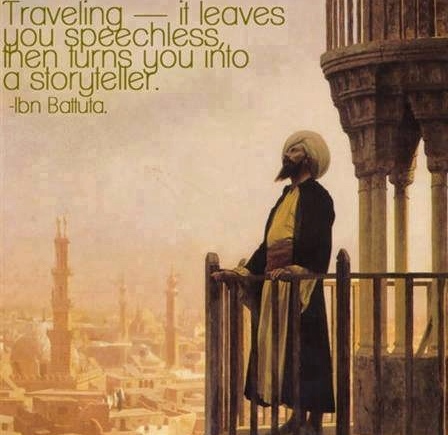
Its been a diverse year In That Howling Infinite. We have traveled, to quote Bob Dylan, “all the way from New Orleans to Jerusalem” – and to many other places in between. Vikings and Roman legionaries; Bob Dylan, Jackson Browne and Bruce Cockburn; Britain in the ‘forties and Paris in the ‘fifties; America, the Levant, and even Wonderland. By Year’s end a million souls will have journeyed to Europe from the war-ravaged lands of the Middle East, and my final posts for the year contemplate what it might mean for refugees who find to safe haven in Australia.
Here is a retrospective.
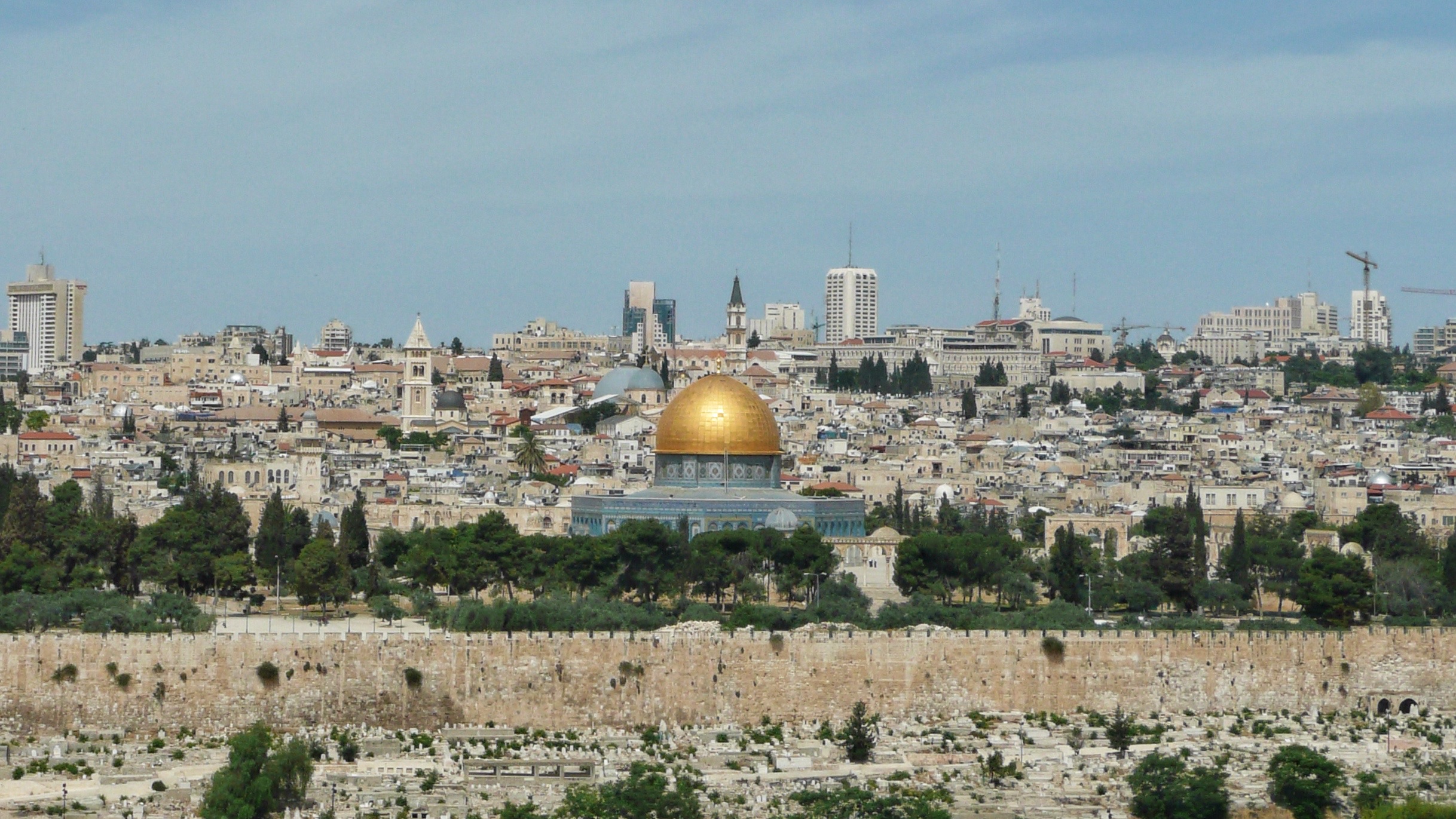
The year began with a short piece on recent archeological discoveries in Jerusalem that strongly suggested that the Via Dolorosa that Jesus trode on his final journey to Golgotha was the wrong route, and that instead, it began just inside of the Jaffa Gate. I took a light-hearted look at the Jerusalem Syndrome, a mental condition involving the presence of religiously-themed obsessive ideas, delusions and other psychoses triggered by a visit to The Holy City.
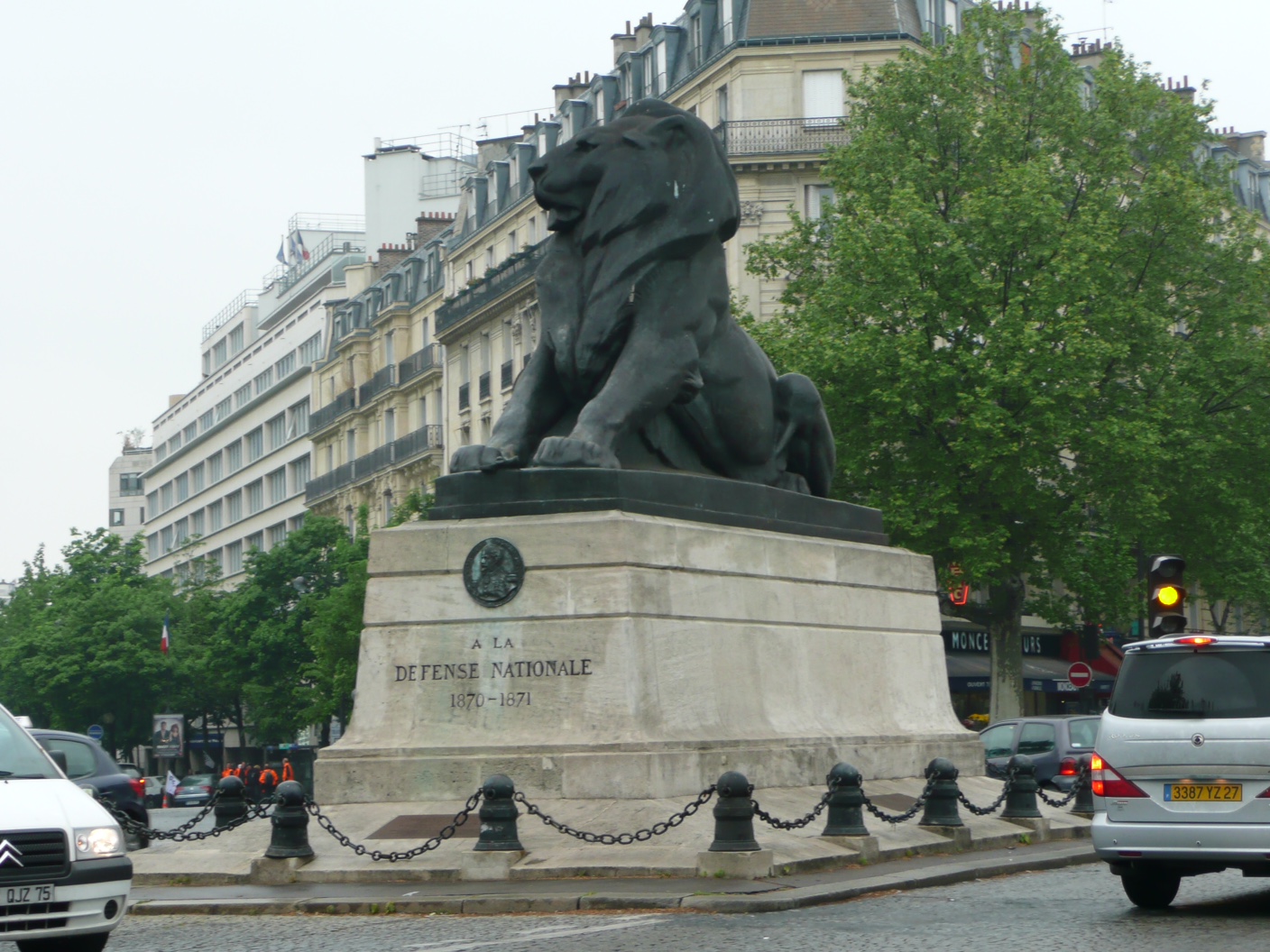
I read but one piece of fiction this year – a sad admission from a lifelong bibliophile – but this one book was probably one of the best I have read: The Incorrigible Optimists Club , winner of the prestigious Prix de Goncourt, by Jean Michel Guenassia. It is set in Paris’ Rive Gauche, as the ‘fifties gives way to the ‘sixties; as the crooners makes way for rock n’roll; as the Cold War divides a continent, sending dissidents and refugees fleeing to a safe haven in Paris; as the Algerian war divides and destroys families: and as the seeds of ‘les evenments de Mai 1968’ are sown in the hearts and souls of France’s young people. It is a coming of age book, of young hopes and fears, love and loss, a book about writers and reading, and the magic and power of the written word in prose and poetry.
March saw the passing of my old friend Dermott Ryder, chronicler and luminary of the Folk Music revival in Sydney in the early ‘seventies. Dermott’s Last Ride is my tribute to him. And April was a month of anniversaries and remembrance. Forty years since the outbreak of the Lebanese Civil War, and the centenary of the landings of the ANZACs at Gallipoli. Pity the Nation takes its title from Robert Fisk’s tombstone of a book on the long war; and he had taken it from a poem written in 1934 by Khalil Gibran, Lebanon’s most celebrated poet, a poem that was both a prophetic testament and a testimony of times to come: “Pity the nation divided into fragments, each fragment deeming itself a nation”. The Watchers of the Water is a song about Gallipoli sing by a Turkish solder.
May saw two diverse pieces of social history. The Spirit of 45 takes personal perspective of British filmmaker Ken Loach’s documentary of the excitement and optimism that followed the Labour Party’s election victory at the end of World War II. This laid the foundation stone for the British welfare state. Bob Dylan’s Americana discusses the meaning and significance of the lyrics and the imagery of Dylan’s early ‘eighties masterpiece Blind Willie McTell, a harrowing journey through America’s dark heart.
In June, we visited Yorkshire and in London, conjuring up memories and historical connections. Harald Went A Viking is a saga about the first of two kings to die on English soil in the late summer of 1066, and the adventures that took him from Norway to Constantinople and Jerusalem and finally, to Yorkshire. Roman Wall Blues takes its title from WH Auden’s poem about a homesick and grumpy legionnaire on Hadrian’s Wall, and contemplates the lives of the ethnically polyglot soldiery who defended the Empire’s borders. And June saw another famous anniversary, the Bicentennial of the momentous and bloody Battle of Waterloo. The Long Road to Waterloo prefaces a song for the men who, after twenty six long years of war, never came home.
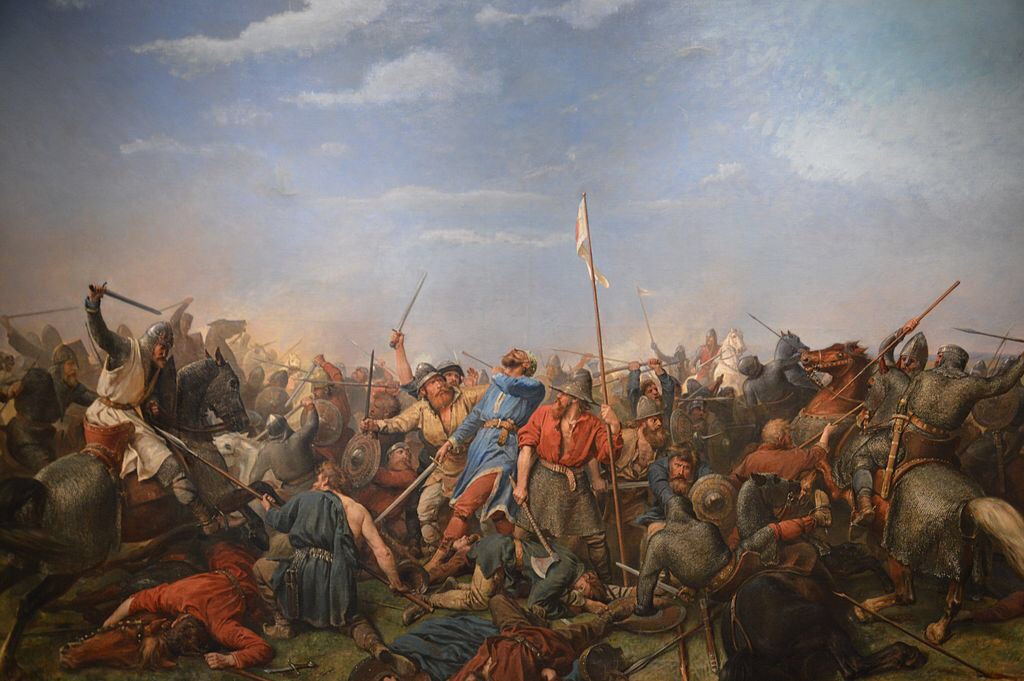
Battle of Stamford Bridge, depicting King Harald Hardrada hit in the neck by an arrow
In July, controversy erupted in the Land of the Free over the flying of the Confederate Flag in states that were once part of Old Dixie. The dead hand of the Civil War reached out and touched the hearts of Americans and their friends throughout the world in the wake of yet another mass shooting. This time, a young man gunned down worshippers at prayer. That the victims were folk of colour, and the shooter, a young white extremist, reopened wounds that have never really healed. Rebel Yell surmises that The South will always be with us, in our thoughts, in our historical memory, in our art and literature, our books and films, and our favourite music.
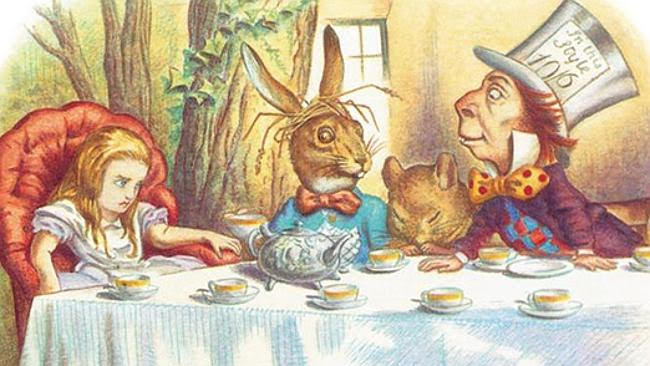
September marked the one hundred and fiftieth anniversary of the publication of Lewis Carroll’s timeless, fabulist masterpiece Alice In Wonderland. Go Ask Alice, I Think She’ll Know reproduces Australian critic Peter Craven’s masterful celebration of Alice 150. The title belongs to the mesmerizing Grace Slick of Jefferson Airplane who cut through to the rabbit chase channeling the long-gone Lewis in a psychedelic musical masterpiece.
On an infinitely sadder note, Ruins and Bones is a tribute to the memory of Syrian archeologist Khaled Muhammed al Asaad, murdered by ISIS in August 2015, and of Palmyra, the ‘Pearl of the Desert’.
Allende’s Desk and Osama’s Pyjamas is a brief commentary on the extension of American military power and the pathology of demons and demonization. Tales of Yankee Power looks at American foreign policy during the 1980s from the perspective of the songs of Jackson Browne and Bruce Cockburn.
November’s Children of the Revolution looks at the events that led up to the beginning of the Syrian Civil War, and the early days before it became too dangerous to gather on the streets, when men, women and children would parade in public places, waving the flag of the old Syria, the one that flew before the Assad clan seized power in 1966. Canny camera men could take media-friendly shots of photogenic little girls in face makeup looking sad, vulnerable and defiant. Those days of hope are long gone.
A highlight of this past year has been my work as a volunteer with the Humanitarian Settlement Services programme. The HSS’ mission is to assist newly arrived refugees to settle in Australia. In No Going Home, I endeavour to imagine the refugee journey. Hejira is a sequel of sorts and, indeed, a happy ending.
Happy New Year to these prospective New Australians, and to all my readers. May 2016 be fortunate and fulfilling.

Palmyra, viewed from Tadmor

To rephrase Euripides, those whom the state wishes to destroy, it first demonizes.
When the president of Chile was killed in the military coup d’état that brought Augusto Pinochet to power on 9th September 1973 (yes, that first, forgotten 9/11), ex post facto justification for the bloody coup and its equally bloody aftermath was provided by the content of the drawers in the dead presidents desk. Though never corroborated, there were alleged to contain proof of an imminent communist takeover, and evidence of drug taking and black magic.

Cut to Panama in December 1989, and the US invasion of Panama, ostensibly to take out strongman and erstwhile ally Emmanuel Noriega. There, in the ruins of the city, was Allende’s desk. The same communist literature, the drugs, the voodoo.
Cut to Mogadishu, Somalia, December 1992. US marines led a doomed UN intervention to take out the warlord. Mohamed Farah Aideed. Enjoy the folly in widescreen in Ridley Scott’s masterful Black Hawk Down. And although the villain decamped unscathed, guess what he left behind? Yes, Allende’s desk, contents intact. Actually, the desk had transformed into a bedside table, but the contents now included, shock horror, red silk pyjamas!
Communism. Drug taking. Black magic. And the sheer, un-American decadence of red silk pyjamas. The State Department pressed the hot buttons of white, Christian US morality to garner domestic support for its military adventures. The desk never came to light after the fall of Slobodan Milosevic in 2000. No doubt the Serbian authorities kept is existence hidden.
And it was never found at Waco because it was no doubt destroyed in the fire of state retribution. But David Koresh, self-proclaimed millenarian prophet, with his apparently indoctrinated and deluded followers, his harem, and his guns, was singled out for treatment very different to that meted out to scores of likeminded and heavily armed fringe dwellers scattered across the USA. To paraphrase Colin Powell, they were demonized, they were isolated, and they were destroyed. And on prime time television too. In that land of paradoxes, few eyebrows were raised when gun-toting members of the KKK offered to assist the DFDA and FBI in their assault on the besieged compound.
When Navy SEALS swooped on Abbottabad in Pakistan to take out long-sought-after Big Bad Osama bin Laden, they took careful notes of the contents of his bookshelves. An eclectic collection of reading matter – and pornography. No kindles, no iPads, so no eBooks or ePorn, which just went to show what a tired, old, out-of-date codger he was at the end of his days. The Pentagon has yet to reveal what they found on Osama’s bedside table. Maybe that voodoo and witchcraft stuff? And Osama’s pyjamas?
Though they both bequeathed sumptuous palaces to their conquerors, Saddam Hussein and Muammar Gaddafi were both spared the indignity of their cupboards being laid bare. But they were both caught hiding in drainpipes, which may show that the restless ghost of Allende’s Desk may have be laid at last.
Rumours of the inevitable demise of current bogeymen Bashar al Assad, Vlad Putin and Abu Bakr al Baghdadi are exaggerated. And the Fat Controller of Korea is still entertaining the world with his eccentricities and imaginative executions. So what will it be? Desks or drainage. And the long arm of the law has yet to reach inside another famous public enemy’s Knightsbridge hideaway. Yet, being the on-line, wired chap that Julian is, we may be disappointed.
And so it goes, as Vonnegut’s Kilgore Trout often declaimed when mad things happened. The American way of preparing the nation and its friends for a military adventure. First select your enemy. Give him horns and a tail. The latter day manifestation of the Judeo-Christian personification of the evil Other, the Dark Side of us all, and the public swallows and follows…Because it supports their own value system, their own perception of self, their own identity, and thereby, they’re own interpretation of what is and what is not appropriate behaviour. Then, hang on for a bumpy ride!
Over to Jackson Brown:


I didn’t surrender, but they took my horse and made him surrender. They have him pulling a wagon up in Kansas I bet.
Chief Dan George, as Lone Watie in The Outlaw Josie Wales
In the winter of ’65
We were hungry, just barely alive
By May the 10th, Richmond had fell
It’s a time I remember, oh so well,
The night they drove old Dixie down.
Robbie Robertson and The Band
The Band, from The Last Waltz
I do not profess to be an expert on the subject, and being an outsider, I do not presume to preach. Nor am I a civil war tragic like some of our politicians here in Australia – they can tell you precisely who said what at what o’clock on such and such a location on this battlefield or that.
Mind you, a civil war that claimed more than seven hundred thousand American lives, tore a young nation apart, and the echoes of which reverberate still one hundred and fifty years later, is bound to exert a degree of fascination on an inquiring mind.
Recently, the dead hand of the American Civil War reached out and touched the hearts of Americans and their friends throughout the world in the wake of yet another mass shooting. This time, a young man gunned down worshippers at prayer. That the victims were folk of colour, and the shooter, a young white extremist, reopened wounds that have never really healed.
What made this massacre different from all the other massacres was the prominence of the Confederate flag in the iconography of the fresh-faced killer. The battle flag of Dixie has never gone away. It flies inThe Dukes of Hazzard, True Blood, and even The Walking Dead, and is a favoured accessory above government buildings and at right wing rallies in The South, those former secessionists states that lay south of the Mason-Dixon line
But what also makes this slaughter different from all those other slaughters is that something is actually being done about it.
Not, however a tightening of gun laws. The Second Amendment is safe and still well kept. The President mourns with the grieving relatives and congregation and breaks into song. POTUS’ rendering of Amazing Grace goes viral on You Tube. But as ever, nothing can be done. No God or mortal can stymy the U.S’ long-time love affair with the gun, nor challenge the NRA choke-hold on the American polity – particularly with the next presidential race in the starting blocks.
No, not the right to bear arms. But the rather, the right to flaunt the Stars and Bars, an enduring symbol of the lost Confederate cause, and a rallying point for those who still believe the rebel cause to be just, those who take solace from an heroic defeat, and those who believed that “the South will rise again”, and indeed those who KNOW that the South has indeed risen again. For have not the white, right wing, God fearing, Clinton-baiting, and Obama-hating ‘Red’ states of the South conquered and colonized the American political system?
Flags can unite nations. And also divide them. And none more so, it seems, than this one. Professor Colin Tatz once said People will forget what you said. People will forget what you did. But people will never forget how you made them feel. This flag is potent symbol that spans both sides of the great divide. It is seen by many a a symbol of racism, and in the wake of the killings, there has been a loud call to remove it from public places and events. Others see it as part of their identity, of who they and their families are. They refuse to surrender it and to trade it in for Old Glory. The call has been met with with, well, dare I say it, defiance and rebellion. If you’ve got one, flaunt it – on houses, on cars, on roadsides, on Facebook posts, blogs and websites. Here are few of th m, all worth reading to place the battle flag in its social and political context:
http://www.vox.com/first-person/2016/9/30/13090100/confederacy-myths-lost-cause
http://www.historynet.com/embattled-banner-the-convoluted-history-of-the-confederate-flag.htm
I do not want to editorialize here. Rather, I would like to share the following piece in the Washington Post. It is symptomatic of the intellectual and cultural reaction to tragic events. If your cannot do something positive and practical about a problem. Advocate something symbolic, politically correct, a placebo even. Like banning the film Gone with the Wind.
The past is another country. They thought things differently there: The iconic film opened with “There was a land of Cavaliers and Cotton Fields called the Old South. Here in this pretty world, Gallantry took its last bow. Here was the last ever to be seen of Knights and their Ladies Fair, of Master and of Slave. Look for it only in books, for it is no more than a dream remembered, a Civilization gone with the wind…”
So, as students of history, do we call for the suppression of an artistic rendering of the past because we feel uncomfortable with the ideas, opinions and sentiments expressed therein? If this sprawling Southern soap opera, this pseudo Shakespearean tale of love lost and found and lost again, against a backdrop of great events, is to be consigned to the oublier of history, why cease there? Why not Lawrence of Arabia? The Outlaw Josie Wales? The Searchers? Showboat?
Let’s not go there. The South will always be with us, in our thoughts, in our historical memory, in our art and literature, our books and films. It is forever on the border of our consciousness. Even when listening to our favourite music.
Take the Flag, but leave the songs alone.
Here is what the Rebel Yell sounded like:
Alison Krauss and Union Station
Paul Robeson, from Show Boat
Chet Atkins
.
 In That Howling Infinite