Conservatism in Crisis

“In a fractured society”, writes The Australian’s Paul Kelly, “the Liberals are losing by choosing the wrong battles”. In his article, republlshed below, Kelly reveals the void in the heart and soul of a rudderless, directionless, dysfunctional government, and the loss of an ethos that once bound together the many mansions of the Liberal-National Coalition’s  broad but perennially fractious church.

He writes: “The upshot is that the conservative movement in this country has no organisational structure, no agreed agenda or strategic mission.It features rival leadership contenders, crisscrosses the Coalition, pulls in a few celebrities, falls for the false mantra from its media champions and seizes up any grassroots eruptions of support from the suburbs and regions. This is not a winning formula. Conservatives suffer from serious tactical ineptitude and misread public opinion”.

But behind all of this, challenging the Coalition, and haunting the long dark night of Mr Kelly’s  tortured conservative soul, is a social and cultural revolution that challenges all mainstream parties, and indeed, mainstream media (if the recent angst-ridden moralizing of the News Corp opinionistas is anything to go by) exemplified in the growth of social media and a new ethos of individual independence and “self-actualization”, accompanied by a decline in the status of and respect for the institutional political, commercial and cultural pillars of the past generations – government, church, family, and business.

Out there on ‘battler’, dinky-di, aspirational and struggle streets, the prevailing attitude is that of ‘a plague on all their self-interested, opportunistic and hypocritical houses!”

Kelly quotes the American conservative writer Yuval Levin:  “Our culture has been moved by an increasingly individualistic ideal and so by a drive for greater distinction, more customization and the elevation of personal choice and identity”. To conservatives, this has meant the erosion of a once-unifying moral and cultural consensus, and the loss of comfortable and reassuring certainties.

Many of these old certainties, and the values, perceptions and assumptions that sustained them were actually quite regressive, and indeed, entrenched prejudice, oppression and discrimination, and it was good to see the back of them.

Turnbull Liberals doomed while conservatism in crisis

Paul Kelly, The Australian 10th March 2018

Featured picture: Australian Prime Minster Malcolm Turnbull with ousted PM Tony Abbott after the Coalition’s campaign launch in Sydney in 2016.

Conservatives in the Anglo democracies are confused, divided and mainly in retreat. The meaning of conservatism is now riddled with disputation. Conservatives fight over whether Donald Trump is saviour or demon, whether Brexit is a calamity or a liberation and whether the Turnbull government deserves to be saved or denounced.

In Australia there is not a single leader among the six premiers and Prime Minister who is a self-declared conservative. The triumph conservatives enjoyed with Tony Abbott’s 2013 victory has surrendered to frustration under Malcolm Turnbull, who is not a conservative and shuns the label.
President Trump brings the conservative dilemma to a peak. Many applaud him for defeating Hillary Clinton and are seduced by his success — yet Trump champions ideas that violate traditional conservatism. Witness his blowing the US budget deficit by $US1.5 trillion in his tax cut package and this week’s protectionist lurch, with his tariff policy denounced across the world, including by Reserve Bank governor Philip Lowe as “highly regrettable and bad”.

What do conservatives believe in 2018? Are they for massive public deficits and debt, or governments that pay their way? Are they for unilateral protectionism or a global free trade order? Do they, like Trump, favour quitting the Paris climate change accords or sticking by this global pact of 175 nations? Do they want a US president capable of extolling the values of liberal democracy and freedom against the rival Chinese model of state capitalism and dictatorial repression? Do they want leadership that respects women and shuns racist wedges, or are they unfazed by insults to women and racist political ploys?

Elected as a Republican, Trump is a pro-business populist nationalist who is a killing agent for traditional conservative norms. His success heralds the rise of a destructive populism that in the guise of revitalisation threatens to poison mainstream conservatism. But it is not just Trump who poses such fundamental questions. They are being put at home across the centre-right of Australian politics.

Turnbull’s 2015 removal of Abbott was driven by electoral alarm and self-interest by MPs, but its progressive character was potent. Conservatives are thinner along the corridors of power, yet their frustration is driving a pent-up ideological purpose. The Liberal Party now suffers the sharpest rivalry for a generation between conservatives and progressives. This risks becoming a dagger at its heart: it damages the Turnbull government and the threat exists of a serious convulsion after any election defeat next year. This is not just about personalities. It goes to rising differences over core Liberal and centre-right belief.

Conservatism is consumed by confusion over its principles and purpose. It is fragmenting in party terms — witness the Coalition bleeding votes to Hanson’s One Nation and Cory Bernardi’s Australian Conservatives. With John Howard long gone, it is devoid of any authority figure in office able to hold the movement together and retain it within the party. Abbott remains its figurehead with the faithful but his internal standing has nosedived.

The upshot is that the conservative movement in this country has no organisational structure, no agreed agenda or strategic mission, it features rival leadership contenders, crisscrosses the Coalition, pulls in a few celebrities, falls for the false mantra from its media champions and seizes up any grassroots eruptions of support from the suburbs and regions. This is not a winning formula.

Conservatives suffer from serious tactical ineptitude and misread public opinion. The array of prescriptions they demand from the Turnbull government — such as quitting the Paris accords, pitting coal against renewables, ditching Gonski funding, revisiting the National Disability Insurance Scheme and achieving small government with a new round of spending cuts — might delight conservatives but constitutes a package for guaranteed electoral suicide. No government would entertain it.

Many of these issues are legacies from battle that conservatives have already lost with current public opinion. Conservatives in Australia, far more than in the US or Britain, have almost no cultural power, little institutional power and have suffered near-annihilation in schools and universities.

The cultural ascendancy of the progressives has been a long and turbulent 40-year story originating with Gough Whitlam. The personal success of Howard as PM for 11 years merely disguised the extent to which progressives were taking control of institutions.

The three institutions that long sustained conservative sentiment in Australia have been transformed — the church, the family and the business sector. The church, notably the Catholic Church, long the conservative sheet anchor, is discredited, with its influence in eclipse; the traditional family structure with its values has surrendered to the “modern” family on the new norm that one type of family is as valid as another; and the business community, more pluralistic but unpopular, has abandoned financial support for the Coalition and, desperate to purchase credibility, presents as an agent of social and environmental change while singularly inept at selling an economic reform message.

Amid this political and cultural turbulence, former Liberal Party federal director Brian Loughnane has warned that restoration of unity on the centre-right — the condition that underwrote Howard’s success — is essential for Turnbull’s re-election.

Such unity is unlikely as de facto political warfare between the progressive and conservative rank and file only intensifies. It would be equally wrong, however, to think progressive ideology is the solution for the Liberal Party or Turnbull government. The notion of “modernising” the Liberal Party with progressive ideas only guarantees the fracture of voters on the right, a process now far advanced. Hanson is the beneficiary at present but other breakaways on the right will emerge.

The test for the Liberals is: can such fragmentation be contained or does it inevitably arise from the social and cultural forces being unleashed that have their most powerful demonstration in the Trump presidency? Trump’s success has ignited conservative energy, breakaways and populist revolts around the world.

The Howard formula of a Liberal Party that unites both the conservative and liberal traditions seems lost these days, a victim of turbulence in the political system and social transformation. Put another way, the ultimate question is whether Howard’s successful party model can be reconstructed or whether it has been terminated by social change.

In the US and Australia today the idea of a common culture is eroding. Ultimately, this threatens both sides of both politics — Liberal and Labor — since their ability to hold together a majority coalition of voters across shared values becomes harder if not impos­sible. It is a bottom-up revolution that has a long way yet to run.

The American conservative writer Yuval Levin described this process in his 2016 book The Fractured Republic: “Our culture has been moved by an increasingly individualistic ideal and so by a drive for greater distinction, more customisation and the elevation of personal choice and identity. “The highest rated television program of the 1950s, I Love Lucy, earned a 67.3 Nielsen rating … in 1953. This meant that roughly 67 per cent of active television sets in the country were tuned to the program. By contrast, the highest rated program of the current decade, Sunday Night Football, maxed out at a 14.8 rating in 2014…The idea that the publication of a new novel by a leading author or the latest production by a noted playwright would be a huge cultural moment … now seems impossibly quaint. Such moments matter to the subcultures in which they emerge, but there is barely a mainstream culture at all to receive them.

“The internet has been developing in our time in ways perfectly suited to advance this process of fragmentation …As each of us is encouraged by our culture, economy and politics to be more like our individual selves, we are naturally inclined to recoil from any demands that we conform to the requirements of some external moral standard — a set of rules that keeps ‘me’ from being ‘the real me’.”

This stretches to breaking point Edmund Burke’s concept of conservatism as a contract to transit time-honoured values and traditions: “It is a partnership in all science; a partnership in all art; a partnership in every virtue … it becomes a partnership not only between those who are living but between those who are living, those who are dead and those who are to born.”

This cannot apply to a society where individuals practise “living my truth” with as much emotion as possible — emotion now widely accepted as proof of sincerity. As our shared moral culture recedes, it is replaced by individuals being true to themselves and having the “courage” to reveal their authentic self to all and sundry.

The issue for conservatism has been its paralysis before this gobsmacking rise in individual expressionism and its violation of Christian views of human nature. The first warning signs came from the pro-market economic-based individualism of the 1980s and then in the culturally based individualism of the past 20 years.

The crisis of conservatism is a moral crisis. This has been apparent since the 90s in Australia, and the inability of conservatives to recognise and respond has been remarkable. Warning about the unpopularity of necessary economic reform after the loss of the 1993 election dominated by the Liberal Party’s free-market Fightback! agenda, the leader of the “dries” John Hyde said: “What Liberals must do is explain these policies in moral terms: in terms of the liberty of workers, of a fair shake for unprotected industry, of justice for all and compassion for the needy.”

They failed. Reflect 20 years later on the inability of today’s Liberal Party to explain its policies in moral terms. From budget repair to inequality to climate change to same-sex marriage, the progressives win because they make a moral appeal — witness their campaigns around the need for compassion and fairness, egalitarian­ism, saving the planet and marriage equality. These became moral crusades.

This is to justify neither their policies nor their arguments but to make the essential point that progressives typically tie their stance to a moral position. It is part of their cultural DNA. The conservatives, by contrast, are exposed in moral terms. They lack the intellectual depth and the language to persuade others of the merits of their position.

The irony is that while conservatives obsessed over the decline of religion, progressives devised arguments based on secular morality. Just because the shared culture and religion of the nation is disintegrating doesn’t mean that morality is irrelevant. Morality always matters — the political contest over morality is pivotal and the conservatives mainly lose it.

Conservatives despise what they see as the phony morality of progressives. But that doesn’t count. What counts are the moral arguments conservatives have fail­ed to mount with sufficient persuasion. The list of battles they have lost is impressive or frightening, depending on your viewpoint.

In recent times conservatives have lost out over free speech and section 18C of the Racial Discrimination Act, spending cuts, opposition to creeping higher taxes, smaller government, less state regulation, trade union powers, industrial relations reform and jobs, same-sex marriage, union amalgamation, renewable energy, superannuation fund transparency and resistance to the Gonski model. They may lose the battle over the Adani coalmine and the defining contest over religious freedom.

This is not to deny substantial victories on border protection and national sovereignty, national security laws, the first phase of corporate tax cuts, better policing of the industrial relations system and a series of budget measures to restrain the deficit.

The failure of conservatism today is on vivid display when contrasted with Howard, a ruthless pragmatist. He surprised his opponents and the progressive class by turning his interpretation of conservatism into a weapon of political attack and electoral gain — yes, electoral gain.
The grounds on which he fought told the story — gun laws, national sovereignty by halting unauthorised arrivals, national security, social conservatism seen in family tax benefits, mutual obligation and individual responsibility, consumer choice and middle-class self-improvement, a social concept that popularised the “mainstream mob” against either elites or minorities, depending on the need, and a cultural agenda that spanned the patriotism of the Anzac legend, the bush ethos and monarchical stability.

There are three lessons from the Howard era that remain highly relevant. First, conservatism, like all movements, is lost without a leader whose task is to reinterpret the movement for the times and who delivers by exercising power. Second, it is a mistake to present conservatism as a rigid ideology, since that triggers the scepticism of the Australian public, but rather to frame initiatives as being practical, based in common sense, values and in the public interest.l

Third, conservatism’s success depends on tactical political judgment. Howard, for example, never restored knighthoods as PM nor would he have given a knighthood to the Duke of Edinburgh.

On the other hand, Howard as PM would have launched a high-profile national campaign against the Safe Schools program promoting gender and sexual diversity in schools, a campaign the current Liberal government declined to launch while insisting on reforms.

In short, don’t fight battles you are destined to lose. By picking battles you can win, your cause wins traction, prestige and more followers. Too many conservatives today break the Howard rules — they run on the wrong issues with implausible arguments, fail to persuade, delude themselves into thinking the silent majority is with them, and get shot down when the contest becomes serious.

The Liberal Party will not succeed while conservatism remains in crisis. Conservatism is too integral to the heart and soul of the party. If Turnbull believes his mission is to prove the Liberal Party can succeed essentially as a progressive entity, that project is doomed to fail as well.
An analysis, however, of Turnbull’s policies suggest that he seeks to govern from the centre; the problem with Turnbull is that he remains a transactional rather than conviction politician, weak in defining the terms of engagement against Labor and in projecting a clear message to middle Australia about living standards and values.

The 2019 election assumes a double meaning. It will determine not only whether the Turnbull government survives into a third term but also the future of the progressive-conservative power balance in the party, and whether the party stabilises or sinks into a full-blown crisis of identity.
The irony is that Labor, if it comes to power, will confront from opening day the demoralising social, economic and cultural forces that have played havoc with the Coalition.

There is no immunity for any government any more. Labor in office will reveal the equally lethal dilemma this time of a trade union/progressive party trying to hold together a fragile coalition of voters in an age of extreme individual self-expression.

Why Melania looks so sad, and other stories

Honestly, you couldn’t make this up!

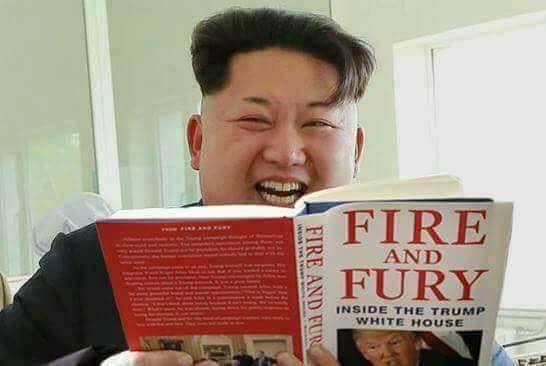
This long extract from the best-selling Fire and Fury: Inside the Trump White House by Michael Wolff, dismissed by the White House as “trashy, tabloid fiction”, reads like a novel by Joseph Heller, Thomas Pynchon or Kurt Vonnegut. “This was a real-life version of Mel Brooks’s The Producers, where the mistaken outcome trusted by everyone in Trump’s inner circle — that they would lose the election – wound up exposing them for who they really were”.

You don’t have to treat it as the truth, the post-truth, or anything except the truth. Just jump on this runaway train and enjoy the ride .

Reading might not necesssarily be believing, and Trumpistas certainly won’t believe, but, whatever! We should get our kicks anyway they come.

Here are just a few of Wolff’s revelations.

Stranger than fiction

The From the moment of victory, the Trump administration became a looking-glass presidency: Every inverse assumption about how to assemble and run a White House was enacted and compounded, many times over. The decisions that Trump and his top advisers made in those first few months – from the slapdash transition to the disarray in the West Wing – set the stage for the chaos and dysfunction that have persisted throughout his first year in office. This was a real-life version of Mel Brooks’s The Producers, where the mistaken outcome trusted by everyone in Trump’s inner circle – that they would lose the election – wound up exposing them for who they really were.

WYSIWYG

Few people who knew Trump had illusions about him. That was his appeal: He was what he was. Twinkle in his eye, larceny in his soul. Everybody in his rich-guy social circle knew about his wide-ranging ignorance.

Palestine

Pivoting from Trump himself, Bannon plunged on with the Trump agenda. “Day one we’re moving the US Embassy to Jerusalem. Netanyahu’s all-in. Sheldon” – Adelson, the casino billionaire and far-right Israel defender –  “is all-in. We know where we’re heading on this … Let Jordan take the West Bank, let Egypt take Gaza. Let them deal with it. Or sink trying.”

Bolton

Bannon said he’d tried to push John Bolton, the famously hawkish diplomat, for the job as national-security adviser. Bolton was an Ailes favorite, too. “He’s a bomb thrower,” said Ailes (former head of Fox News). “And a strange little fucker. But you need him. Who else is good on Israel? Flynn is a little nutty on Iran. Tillerson just knows oil”. “Bolton’s mustache is a problem,” snorted Bannon. “Trump doesn’t think he looks the part. You know Bolton is an acquired taste.” “Well, he got in trouble because he got in a fight in a hotel one night and chased some woman.” “If I told Trump that,” Bannon said slyly, “he might have the job.”

Rupert

“In fact,” said Bannon, “I could use your help here.” He then spent several minutes trying to recruit Ailes to help kneecap Murdoch. Since his ouster from Fox over allegations of sexual harassment, Ailes had become only more bitter toward Murdoch. Now Murdoch was frequently jawboning the president-elect and encouraging him toward Establishment moderation. Bannon wanted Ailes to suggest to Trump, a man whose many neuroses included a horror of senility, that Murdoch might be losing it. “I’ll call him,” said Ailes. “But Trump would jump through hoops for Rupert. Like for Putin. Sucks up and shits down. I just worry about who’s jerking whose chain.”

Jarvanka

The First Children were having to navigate Trump’s volatile nature just like everyone else in the White House. And they were willing to do it for the same reason as everyone else – in the hope that Trump’s unexpected victory would catapult them into a heretofore unimagined big time. Balancing risk against reward, both Jared and Ivanka decided to accept roles in the West Wing over the advice of almost everyone they knew. It was a joint decision by the couple, and, in some sense, a joint job. Between themselves, the two had made an earnest deal: If sometime in the future the opportunity arose, she’d be the one to run for president. The first woman president, Ivanka entertained, would not be Hillary Clinton; it would be Ivanka Trump. Bannon, who had coined the term “Jarvanka” that was now in ever greater use in the White House, was horrified when the couple’s deal was reported to him. “They didn’t say that?” he said. “Stop. Oh, come on. They didn’t actually say that? Please don’t tell me that. Oh my God.”

Hair

She treated her father with a degree of detachment, even irony, going so far as to make fun of his comb-over to others. She often described the mechanics behind it to friends: an absolutely clean pate – a contained island after scalp-reduction ­surgery – surrounded by a furry circle of hair around the sides and front, from which all ends are drawn up to meet in the center and then swept back and secured by a stiffening spray. The color, she would point out to comical effect, was from a product called Just for Men – the longer it was left on, the darker it got. Impatience resulted in Trump’s orange-blond hair colour.

Excerpted from Fire and Fury: Inside the Trump White House by Michael Wolff (Henry Holt and Co., January 9, 2018). This article appears in the January 8, 2018, issue of New York Magazine.

http://nymag.com/daily/intelligencer/2018/01/michael-wolff-fire-and-fury-book-donald-trump.html

See also other posts on In That Howling Infinite: The ricochet of Trump’s counter-revolutionDeep in the Heart of Texas, and The Loss of American Virtue,

The Bard in the Badlands – Hell is empty and the devils are here

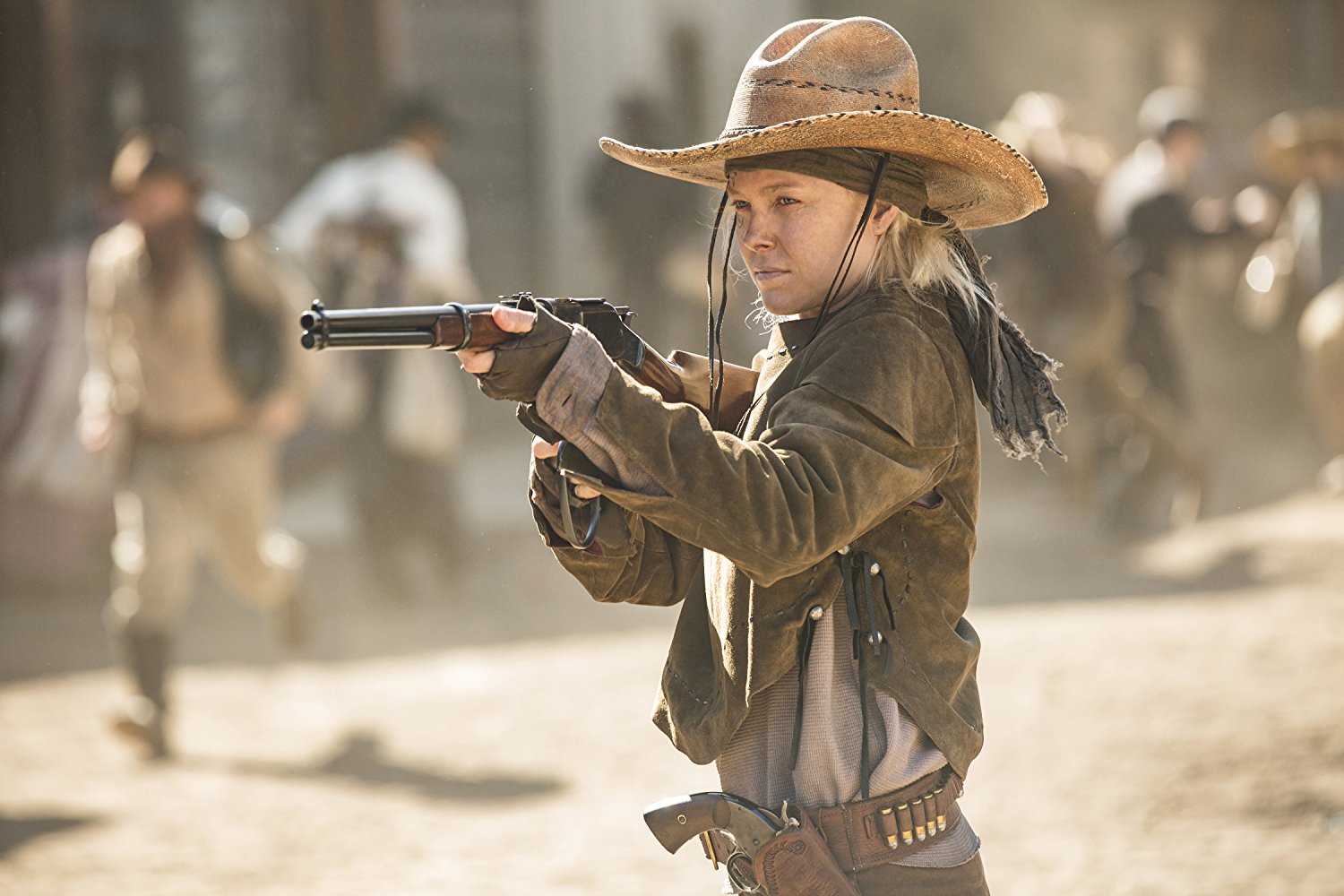
What happens when the robots, androids, replicants, call them what you will, feel emotion and sentiment, establish relationships, and recall memories, like humans do? When the boss starts disrupting the storylines, the ‘droids go off-script, think their own thoughts, and live their own “lives”. And lo! bad things happen! Before you know it, robots start quoting the Bard of Avon.

Westworld addresses some disturbing concepts. The mechanical and moral arcs of Artificial Intelligence. The ethical implications of an escapist theme park where well-heeled guests indulge in gamer-like fantasies, some of which that would see them jailed in their mainstream, material lives – play poker in a saloon (and cheat), go with a whore (of either sex), ride out with a posse, witness or even participate in a gunfight – and rape and pillage through a simulacrum Wild West, killing and fucking whomever they liked.

And then there are the hosts, the oh-so-realistic (“are you one of them” is a question often asked by a fascinated and impressed guest) robots, androids, cyborgs, replicants – call them what you will depending on your favourite sci-if film – who play out pre-written, sometimes derivative, mostly anodyne, but often perverse storylines, with added code for improvisations to move the guests’ adventures along, and for prohibitions on the use of knives, axes and firearms, because management mandates that whist guests might get injured, by accident or for the thrill of it, none must get themselves killed.

.

The hosts are men, women, and children – cowboys and indians, bar-tenders and whores, soldiers and civilians, bandits and desperados. There cyber horses, cattle, dogs, wolves and snakes, even. They are the entertainers, the surrogates, the fantasy-toys, the extras in the guests’ real-time fables (and yet, you never a tourist raise a camera or a cell-phone on this unforgettable dream holiday).  And they are also the victims. Assaulted, bludgeoned, raped, massacred, and brought off-set for repair, maintenance, and software enhancements and updates designed to give the guests improved service. Periodically, their memories are erased, and new roles assigned, and they re-enter the vast, geographically and scenically amazing park with new clothes, new skills, and new storylines.

 Until one day…

Most people of a certain age in the western world may recall the violent finale of the 1971 film Westworld starring Yul Brynner as the violent and relentless Man in Black. And yes, this is where Westworld Redux is taking us.

What happens when these robots, androids, replicants, call them what you will, feel emotion, and sentiment, establish relationships , and recall memories, like humans do? When they succumb to thatvold Pinochio syndrome. When the boss, played by that redoubtable chameleon Anthony Hopkins, starts disrupting the storylines, the ‘droids go off-script, think their own thoughts, and live their own “lives”. And lo! bad things happen. Before you know it, robots start quoting the Bard of Avon:

By most mechanical and dirty hand. Rouse up revenge from ebon den…  Henry IV Part 1

These violent delights have violent ends.  Romeo and Juliet

I shall have such revenges on you. The things I will do, what they are, yet I know not. But they will be the terrors of the earth”.  King Lear

When we are born, we cry that we are come. To this great stage of fools. King Lear

For in that sleep of death, what dreams may come. Hamlet

Hell is empty, and all the devils are here!  The Tempest

I am bound, upon a wheel of fire, that my own tears do scald like molten lead. King Lear

Daniel Pollack-Pelzner writes in Slate Magazine:

“Westworld suggests that once these replicants, who yearn like some feral Pinocchio to be real boys and girls start quoting Shakespeare, they can break free from their oppressors’ sadistic games. But Shakespeare’s lines aren’t the antidote to Wild West exploitation. They supplied the script for manifest destiny”.

He continues:

“What these portentous allusions don’t seem to register, however, is the actual role that Shakespeare played in the American West…(Settlers) performed Shakespeare from Missouri to San Francisco in the Wild Frontier. Gold-miners queued up to land a plum part in favorites like the bloodthirsty Macbeth or Richard III. “Traveling through America in the 1830s, Alexis de Tocqueville observed “There is hardly a pioneer’s hut that does not contain a few odd volumes of Shakespeare. I remember that I read the feudal drama of Henry V for the first time in a log cabin.” An army scout in Wyoming traded a yoke of oxen for an edition of Shakespeare; mines named Cordelia, Ophelia, and Desdemona dotted the Colorado mountains. More recent evocations of this period link the Bard to territorial conquest…When the United States prepared to defend the newly annexed state of Texas from Mexico in 1846, Ulysses S. Grant was cast as Desdemona in an army production of Othello in Corpus Christi”.

Daniel’s source for this is an enthralling, very well-researched article in The Smithsonian by American author Jennifer Lee Carrell, which I reproduce in full below. Resident in Tucson Arizona, and a teacher and historical author by trade, she is well placed geographically and well-credentialed academically to tell the tale of How the Bard Won the West.

Westworld references not just Shakespeare, by the way. There are literary, music and art motifs aplenty, and if this alternative universe seems at times to resemble a frontier Alice’s Adventures in Wonderland, that is because it is meant to. One character quotes Alice verbatim: “Dear dear, how queer everything is today and yesterday things went on just as usual. I wonder if I’ve been changed in the night.” And another, the Mad Hatter: “If I had a world of my own everything would be nonsense. Nothing would be what it is, because everything would be what it isn’t”. In Westworld’s vicarious and mechanical dreamland, things are constantly changing. Time Magazine has published a handy guide to Westworld’s many references.

Android Armistice

Westworld is not the first post-modern western to tread the boards, however.

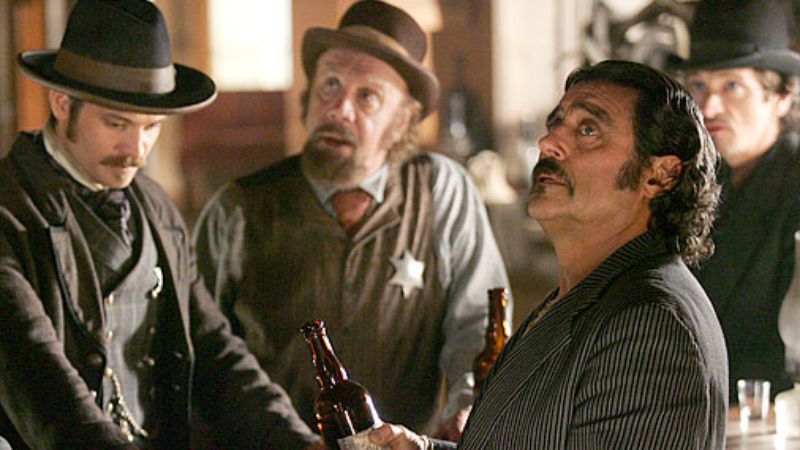
Over a decade ago, there was David Milch’s Deadwood – in my opinion is one of the most enthralling and memorable of historical dramas. Set in the lawless west of the eighteen seventies, it ticks all the parental guidance boxes: substances, sex, strong language, and that ambivalent catch-all “adult themes”. As a bonus, the acting is superb, the characterization likewise, and the script, inspired and inspiring,  traversing from the sacred to the (very) profane. It borrows heavily from the raw vernacular and from language that channels Shakespeare, Milton and Melville.

Deadwood offers its myriad gamblers, pimps, whores, miners, cowboys, carpet baggers, and fortune seekers only the lowest forms of entertainment (not counting the inevitable bar-room piano (in Westworld, there is an automatic player-piano (of course).  Enter stage east,  Brian Cox’s flamboyantly eloquent Jack Langrishe and his disparate troupe of travelling players, seeking both financial opportunity and a chance to bring art and culture to the barbarians. He converts an old schoolhouse recently refurbished as a boutique brothel into a theatre, and opens it with a surreal and surprising amateur night, a come-all-ye music hall that that brings out many of the lights that the townsfolk have been hiding under their bushels. Its an all-singing, all-dancing jamboree with jugglers, plate-spinners, axe-balancers, and a dance of the several veils. Keeping faith with Carrell’s thesis, Jack Langrishe is based on an actual Deadwood historical theatre owner and comic. Langrishe and his sad band of thespians are naturally on intimate terms with the bard.

I’ve recently rewatched Deadwood right through for the umpteenth time – and it’s as captivating as ever. Each viewing reveals new insights and gems of speeches but there are many I’ve missed due to the aural overload of its exquisite script. Like this one from Act 4 Scene 1 of King Lear. Gloucester, blinded by his enemies, encounters his son Edgar, disguised as a mad man, on a barren plain. Not recognizing his lad, he and asks that he guide him to a high place from whence he can leap and end it all. It doesn’t quite come to that in the play – there’s many twist and turn before he meets his maker. Langrishe and dying old friend and mentor Chesterton are at last taking their leave of each other, there is no other outcome.

Chesterton: Hmm. (Chesterton seems to be pretty much out of it. Jack is looking sad)
Jack: Dost thou know Dover? There is a cliff whose high unbending head looks fearfully on the confined deep. Bring me back to the brim of it, and from that place… I shall no leading need. Here’s the fly tower. If you mount up, take firm a rail in each hand. (He pauses and looks at his friend, who is motionless) I’ll boost your bum, darling.
Chesterton: Here’s the place. (he seems to be fading away)
Jack: How fearful and dizzy it is to cast one’s eyes so low.
Chesterton: Set me where you stand. Let go my hand. (Jack slips his hand out of his friend’s grasp.)
Jack: You’re now within a foot.
Chesterton: Line. L-line. (He seems to have died)
Jack: Our father, which art in heaven, hallowed be thy name. (We see motion in the shadows, the other members of the troupe appear) He’s gone. (Bellegarde puts his hand on the old man’s shoulder and slips off his glasses.)

G. Know’st thou the way to Dover?
E. Both stile and gate, horseway and footpath.
Poor Tom hath been scared out of his good wits.
Bless thee, good man’s son, from the foul fiend.
Five fiends have been in Poor Tom at once: of lust,
as Obidicut; Hobbididance, prince of dumbness;
Mahu, of stealing; Modo, of murder; ⌜Flibbertigibbet,⌝
of mopping and mowing, who since possesses
chambermaids and waiting women. So, bless
thee, master …
G. Dost thou know Dover?
E: Ay, master.
G.There is a cliff, whose high and bending head
Looks fearfully in the confinèd deep.
Bring me but to the very brim of it,
And I’ll repair the misery thou dost bear
With something rich about me. From that place
I shall no leading need.
E. Give me thy arm.
Poor Tom shall lead thee.

Milch claims in an interview for American Heritage, The  Man Who Made Deadwood, that profanity functioned as a kind of social equalizer, a way for people from all walks of life to communicate with one another. “Many of them might have been illiterate, but they knew the King James Bible and Shakespeare, and that’s what shaped the way they thought and the way they expressed themselves.” Regardless of whether they were familiar with the works of Shakespeare, it is telling that Milch brings up the influence since almost every review of Deadwood compares it to Shakespeare.

Read and enjoy Carrell’s intriguing piece. Watch and be captivated by Westworld and Deadwood. And see also:  Brogan Morris’ Deadwood’s Critique of the Rich and Powerful Matters Even More in 2016, and Ethan Tussey’s piece of the language of Deadwood in Critical Commons, and Deadwwod – An Introduction in Unaffiliated Critic.

See other posts on American history from In That Howling Infinite: Blind Willie McTell – Bob Dylan’s Americana and Rebel Yell.


How the Bard  Won the West

By Jennifer Lee Carrell, Smithsonian, August, 1998

Sometime late in 1863, a tall, thin man rode out of an Army camp in the Wyoming territory and headed across the prairie. He was just under 60 years old, one of the greatest scouts and Indian fighters, a man from whom Kit Carson took orders. It was the wild places that Jim Bridger liked best; following strange tales into the unknown, he was probably the first white man to see the Great Salt Lake. At that moment, however, he was headed toward people, not away from them. Not too far off, the Oregon Trail snaked westward across the landscape. Traffic had dwindled by 1863, but this trail still ranked as a highway by the standards of men such as Bridger; you could hardly follow its hard-packed earth so much as a day without running across somebody. That was exactly why Bridger was headed there.

He was looking to do some trading. What he had to offer was a yoke of cattle, then worth about $125, or almost a month of his wages as an Army scout. What Bridger wanted, and what he thought he could get from a wagon train, was a book. And not just any book, but the book that an Army officer had told him was the best ever written. He wanted Shakespeare.

Bridger’s quest might sound unlikely, but all over the American West trappers, cowboys, miners, outlaws, proper ladies, prostitutes and Army officers regarded Shakespeare with a familiar ease and delight that might astonish the average American in the late 20th century. The history of the West, in fact, is a history of playing Shakespeare, of playing with Shakespeare, in what now may seem peculiar places and surprising ways.

The Oregon Trail

Bridger, for instance, got what he wanted: someone, going west in wagons that could hold only the most necessary and precious possessions, had brought along a volume of Shakespeare. Out on the prairie, that someone judged the book not quite so precious as a yoke of cattle. For the additional sum of $40 per month, Bridger hired a German boy to read his new book to him. For though he could speak English, French, Spanish and a dozen Indian languages, and though he could draw, freehand, highly accurate maps of the West, Bridger could not read.

He could listen, however, and listen he did. Bridger was already well known as a storyteller. Because he sometimes embellished the already extraordinary natural marvels of the West, and because writers and others made up wild tales and attributed them to him, he also had a growing though undeserved reputation as a liar. That winter, however, he added to his repertoire: from then on he could quote Shakespeare at length. The prospect of an old mountain man spouting Shakespeare now seems more fantastic than the same man spinning tales about salt lakes, glass mountains and hot- and cold-running rivers. Nonetheless, Bridger came to know Shakespeare’s cadences of speech so well that his own speech could slide through the poet’s rhythms, especially the insults. One of Bridger’s tricks was to insert his own oaths into Shakespeare, so that his audience did not know where the playwright stopped and the mountain man began.

In search of the places that Bridger and others once took Shakespeare, I find myself heading off the main roads, and then off-road altogether. Up in Colorado’s Gunnison County, I wind north through a wide valley filled with quaking aspen and tall trumpet flowers. Passing beneath the mountain whose sky-hungry spires gave the town of Gothic its name, the road bounces up over a pass and creeps into a darker forest of pine and spruce. This is country that in summer is still best covered on horseback.

But I am horseless, so when I give up on the car, I set off on foot. For somewhere up here, say century-old documents that briefly sound more like The Hobbit than legal records, “at the foot of the Treasure Mountain” there lies a mine called Shakespeare.

Treasure Mountain, Colorado

It was not a spectacularly rich mine, but it was respectable. Two years after it was located in 1879, the last of its original owners, John Blewett, sold out for $30,000. Blewett may have revered the Bard, but he didn’t spend all his free time reading. Having sold his rights to the mine, he promptly made his way down to Gothic and won a shooting contest.

The name is scattered all over the West: “Shakespeare” names a town and a canyon in New Mexico, a mountaintop in Nevada, a reservoir in Texas and a glacier in Alaska. But it was the miners who most often staked Shakespeare to the earth. Nineteenth-century claims called Shakespeare dotted the landscape of Colorado and spilled over into Utah. The mines that still scar Western mountains now seem a curious honorific for a great poet. Yet, Shakespeare takes his place among heroes and sweethearts.

In their quest for distinctive names, the miners delved into the Bard’s stories. Colorado sports mines called Ophelia, Cordelia and Desdemona. There is even a “Timon of Athens,” revealing that some prospectors dug into remote corners of Shakespeare as well as remote corners of North America, because Timon is one of Shakespeare’s least-known plays. It is a fitting name for a mine, though, because the play’s hero — a mad, bankrupt misanthrope — accidentally discovers “yellow, glittering, precious gold” while digging in the forest for roots.

I did not, in the end, find the valley where modern survey maps and ancient mining records suggest the remains of Blewett’s mine lie. Far to the south, however, I did find an entire town called Shakespeare. By 1879, Ralston, New Mexico, was short on respectability, having been the site of a diamond-mine hoax that had produced a bank failure, a suicide and substantial losses for investors. In April of that year, therefore, Col. William G. Boyle renamed the town Shakespeare. He already owned the Stratford Hotel, and Main Street was familiarly known as Avon Avenue; soon after, Boyle organized the Shakespeare Gold and Silver Mining and Milling Company. The townsmen joined the trend, organizing the Shakespeare Guards to defend the place against Apache raids.

Shakespeare was more than a name to miners, however. During the gold rush, playgoing had a prominent place among the drinking, gambling and carrying on that was the miners’ usual relief from hard and dangerous work. From Colorado to California, theaters that played Shakespeare more than any other playwright perched just across the street, or sometimes right upstairs, from the saloons and gambling halls that were sometimes brothels as well. All over the West, towns built elaborate gilt-and-plush theaters grandiosely called opera houses. A few of these jewel-box theaters still survive in former boomtowns such as Nevada City, California; Tombstone, Arizona; and Aspen, Central City, and Leadville, Colorado. When theaters weren’t available people gathered in saloons, hotel hallways or even tents to watch actors play on stages made of packing boxes or boards laid across billiard tables and lit by kerosene lanterns; in Calaveras County, California, actors performed on the stump of a giant redwood.

The greatest actors from the Eastern Seaboard played to packed houses on these stages. Edwin Booth (elder brother of John Wilkes Booth) played his first Shakespearean leads on the magnificent and makeshift stages of California.

From left to right: John Wilkes, Edwin, and their father Junius Brutus Booth in Julius Caesar, 1864

That this caliber of actor regularly appeared in such venues might have been for adventure’s sake, but it was also partly because there was fame and wealth to be found among the miners. In the 1850s, top actors could earn up to $3,000 a week in San Francisco; the best theaters in the East were offering only a tenth as much. But it was up in the boisterous camps that the actors struck gold. In places with names like Rattlesnake, Rough and Ready, Git-up-and-Git and Hangtown, theater tickets were bought with gold dust, and cheering miners tossed nuggets and bags of gold dust onto the stage at curtain call.

The first people to carry Shakespeare into the West were trappers, who threaded their way into the Rockies along the rivers on their quest for beaver. Mountain men were legendary for gathering around campfires to tell bear stories both hair-raising and hilarious. According to the recollections of trappers Joe Meek and Bill Hamilton, however, though they might indeed be swapping bear stories, they might just as well be sharing a little Shakespeare. Or they might even be doing both: after all, the Bard’s most infamous stage direction, from The Winter’s Tale, is “Exit pursued by a bear.”

Alfred Jacob Miller, Moonlight — Camp Scene, 1858-60, Watercolor on paper
Walters Art Museum, Baltimore

On the frontier, Shakespeare was not “Art” to be adored in silent, solitary reading; Shakespeare was a set of stories to be told aloud, language to be tasted, toyed with, tossed about over a campfire. Bridger is a case in point: after he bought his precious book, it never seems to have occurred to him to learn to read. What he wanted from the book was specifically what was in it. Like Bridger, other Westerners might get their Shakespeare out of books, but in books they did not let him stay. The 19th century was an age of oral storytelling and public speaking; if Shakespeare was taught at all, it was taught as oratory and recitation — then parts of the most basic schooling. Since Shakespeare was seen and heard more than read, no one needed much, if any, formal education to have at least a passing acquaintance with the works. Montana rancher Philip Ashton Rollins said that many ranch owners brought Shakespeare west with them. It was not unusual to see “a bunch of cowboys sitting on their spurs listening with absolute silence and concentration while somebody read aloud.” Further, Shakespeare was popular because of the poetry, not in spite of it. After listening to the blood and thunder “dogs of war” speech in Julius Caesar, one top hand told Rollins, “Gosh! That fellow Shakespeare could sure spill the real stuff. He’s the only poet I ever seen what was fed on raw meat.”
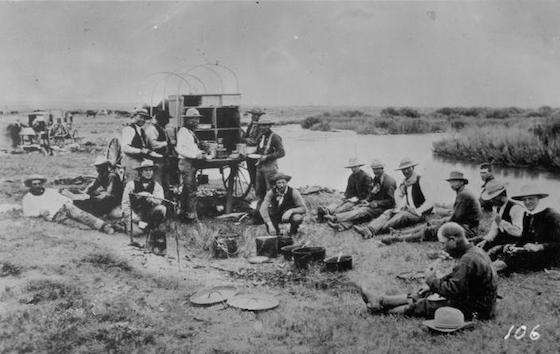
Roundup Camp, Wyoming, 1880s

Among Westerners, the most popular Shakespearean plays were the tragedies and epic histories, with Richard IIIHamletOthelloMacbeth and Romeo and Juliet heading the list. Westerners, however, were not silenced into tongue-tied awe by high tragedy. Like Bridger — who was once heard to say that Falstaff (or “Mr. Full-stuff”) liked beer a little too much for his own good and might have been better off with bourbon — cowboys, outlaws, miners and trappers embraced Shakespeare. They brought it to life, retelling it in a mix of remembered poetry and the teller’s own salty language.

Along with the enthusiasm came irreverence. It was common in 19th-century American theater to follow the main play, no matter how profound, with a comic song, a dance, and finally a farce in which the principal actors often reappeared. In Denver in 1859, a troupe followed Richard III with a polka and a farce called Luck in a Name; in San Francisco, King Lear was once followed by a dancing horse named Adonis. Sometimes the kind of mischief that led Bridger to alter Shakespeare’s oaths took over the stage completely. Audiences loved farces with titles like Hamlet and Egglet and Julius Sneezer, and burlesque Shakespeare was popular minstrel fare.

Westerners also delighted in creative casting. In Army camps, all-male performances were not uncommon. In Texas on the eve of the Mexican War, Lieut. Ulysses S. Grant was drafted into the role of Desdemona because he supposedly looked the part. Before opening night, however, his superiors had to send off to New Orleans for a real woman, because Grant failed to show “the proper sentiment.” Great actresses playing Shakespearean heroes in serious productions were ticket-selling curiosities. The women’s success led to the brief vogue of having little girls play the major tragic roles; thus did Anna Maria Quinn, age 6, play Hamlet to a mostly adult male audience at San Francisco’s Metropolitan Theatre in 1854. In Deer Lodge, Montana, on the other hand, miners and cowboys were treated to the spectacle of an actress playing Juliet with an imitation Romeo: a “blockhead in every respect” reported one witness delighted by the wooden dummy outfitted with wig and red cambric gown, and even more by the parodic performance that followed.

Because Shakespeare — as story or poetry or theater — was shared by so many people, it became a kind of imaginative meeting place. The readings organized by Bridger, for example, brought together an illiterate mountain man, a German boy and the well-educated Army officer who had first recommended the Bard. In the theater, there was no assumption that Shakespeare should be delivered in the plummy tones of the British upper class; audiences flocked to hear their favorite actors play Shakespeare in English heavily laden with German, Polish, French and Italian accents in addition to regional British, American and Australian inflections.

For all the intensity of their love affair with Shakespeare, Westerners had no monopoly on it. In 1849, what is still one of the bloodiest riots in American history broke out in New York City — over styles of acting Shakespeare. A vigorous style was said to be democratic and American while more cerebral acting was said to be aristocratic and English. Enraged by a supposedly elitist performance of Macbeth, a crowd of 10,000 surged outside the Astor Place Opera House (Smithsonian, October 1985). When the mob turned from hurling insults to hurling paving stones, the New York militia opened fire, shooting directly into the crowd at least 22 people died and 150 others were wounded.

The Astor Place Riot, New York City, 1849

As the frontier straggled westward, the differences that had chafed in crowded New York were stretched out across the continent; Westerners favored flamboyant acting while disdaining polished elegance as snobbish and Eastern. Less than a year after the Astor Place Riot, Shakespeare arrived along with the forty-niners in the California goldfields, and by 1856, the Californians, too, were brawling over Shakespeare. In the West, though, it was not politics but the combination of characters acting badly and actors acting badly that provoked riots.

At a Sacramento performance of Richard III, the audience began to get restive in the face of Richard’s mounting evil and the actor’s obvious incompetence. When at last Richard stabbed one of his victims in the back, the audience began tossing any and all handy garbage onto the stage: bags of flour and soot, old vegetables, a dead goose. At the request of the stage manager, the audience allowed Richard to reappear, but when he placed his sword in the hands of Lady Anne during the wooing scene, “one half the house, at least, asked that [the sword] might be plunged in his body,” the Sacramento Unionreported. The actor was finally driven from the stage by a “well directed pumpkin… with still truer aim, a potato relieved him of his cap, which was left upon the field of glory, among the cabbages.”

In their noisy displays of pleasure and displeasure, Western audiences preserved and even heightened an exuberant tradition of theatergoing dating back to the Elizabethan audiences that Shakespeare knew. They expected to enter into the spirit of play, and the same enthusiasm that could produce showers of either rotten vegetables or gold dust also provoked, at less frenzied moments, stamping, cheering, whistling and hooting, as well as quips and running commentary on the play, the players and the production.

This freewheeling audience participation had once been common all over America, but in the late 19th century Shakespearean theater was fast becoming an elite and stately affair in the East and in Europe. Western audiences preserved longer their right to play during the play. Appearing as Othello in 1886, Tommaso Salvini was so disturbed by the laughter and popping of champagne corks coming from “Silver King” Horace Tabor’s personal box in Denver’s Tabor Grand Opera House that he sent a note up during intermission threatening to stop the play if things in Box A did not quiet down. “My theater is a playhouse as much for the audience as for the actors,” Tabor reportedly bellowed back. “If that Eyetalian wants to pray,” Tabor fumed, “let him go to church.”

The Tabor Grand Opera House, Denver, Colorado. Photo by J. Collier

Nonetheless, changing attitudes eventually traveled westward; Lawrence Levine of George Mason University, in Fairfax, Virginia, has speculated that Shakespeare’s fall from popularity in America was caused by large-scale shifts in ideas about what is entertainment and what is art. When Shakespeare stopped being story and began to be art, it began to seem distant; when accuracy became more important than entertainment, it became boring; and when the language of Shakespeare ceased to be commonly heard aloud, it began to seem difficult. Beyond doubt, however, changing attitudes toward Shakespeare have resulted in what now looks like a paradox: Shakespeare’s popularity in the American West dwindled as the West was settled and ceased to be wild.

Shakespeare has not, however, disappeared from the West without a trace: it still shapes the myth of what we think the West was, or ought to have been. The novel that established the genre of the western, Owen Wister’s The Virginian (published in 1902), features an aloof hero who is a dead shot and a deeply honorable man. He is also prone to quoting Shakespeare; the poet’s lyricism captivates him. “The singing masons building roofs of gold,” he says at one point, quoting from King Henry V. “Ain’t that a fine description of bees a-workin’?…Puts ’em right before yu’, and is poetry without bein’ foolish.” Following the novelists, Hollywood, too, has borrowed from Shakespeare in shaping our idea of the West that was. The film Broken Lance (1954), for instance, tells King Lear in the guise of a western, while Jubal (1956) reshapes Othello.


Today up in Leadville, you can, as I did, climb onto the stage of the Tabor Opera House and stand in front of the painted scenery that once backed Romeo and Juliet. Facing the plush seats that curve toward you, you can let your voice roll out into the hushed and waiting darkness on the cadences of Shakespeare. In the ghost town of Shakespeare, you can, as I did, duck out of the New Mexico sun into the shade of the Stratford Hotel’s long narrow dining room, where the desert wind will send the fine silt of crumbling adobe drifting over your skin and through your hair; there you can listen to the stories that the town’s present owners, Janaloo Hill and Manny Hough, have spent a lifetime collecting from old-timers.

The Stratford Hotel in Shakespeare, New Mexico. Photo by Jennifer Lee Carrell

Yet Shakespeare is more than a ghost in the West. After the Bard ceased to be part of their everyday life, Westerners began to pioneer the Shakespeare festival. Every summer tourists descend upon the towns of Ashland, Oregon, and Cedar City, Utah, to gorge themselves on Shakespeare brilliantly brought to life in faux Elizabethan theaters set down among the forests of the Pacific Northwest and the red rock canyons of the Southwest. Scattered over the West as well are productions aimed more at local audiences, such as the Colorado Shakespeare Festival in Boulder and the Grand Canyon Shakespeare Festival in Flagstaff, Arizona. In Boulder, you can spend a summer’s evening picnicking on a wide lawn and then wander into a Greek-style amphitheater hewn out of local red stone. As the sky deepens to sapphire edged by the strange, stark shapes of the Flatiron Mountains that loom behind the set, you can be swept away to some far country on the tide of Shakespeare, sharing the laughter of a thousand Coloradans as Beatrice baits Benedick, or shivering with the hiss of indrawn breath as Romeo forever drinks poison a scant moment to early to see that Juliet still breathes.

Colorado Shakespeare Festival, Boulder

But here, as I listen to the crowds dispersing downhill through the trees, the laughter and the sorrow are tinged with surprise: that Shakespeare is here, that it is so good, that they have enjoyed it so much. In the frontier West, the fact that Shakespeare tells good stories, and that those stories should be told well in the West, was no surprise at all — at least not to Westerners. From Jim Bridger, to the forty-niners, to the cowboys, the old wanderers would hardly recognize anything in the modern cities that rise on the plains and mountains, strung out like glittering beads along the Interstate freeways. Yet they might recognize and be glad of one thing on such a summer night: Shakespeare still plays well under Western skies.

© 1998 by Jennifer Lee Carrell
All Rights Reserved

Originally published in the Smithsonian, vol. 29, number 5 (August, 1998): 98-107.

Back Story and Further Reading

Image of Shakespeare in a cowboy hat courtesy of Northwest University Drama, Seattle
Yiddish – the language that won’t go away

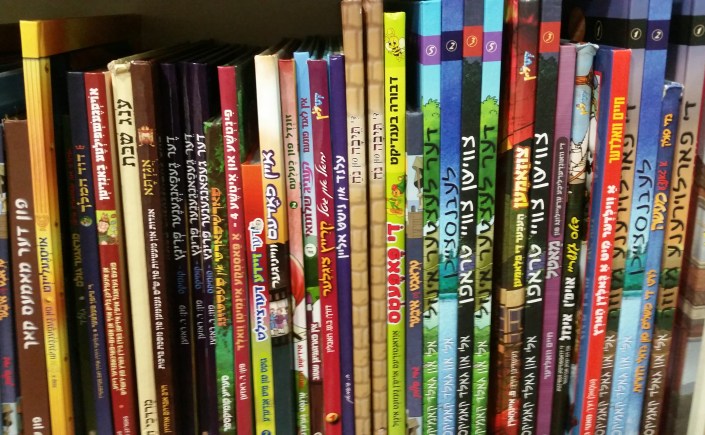
The past and present of a language that refuses to disappear. An iluminating post from Matt Adler’s excellent blog planting Roots Bearing Fruits.

Matt Adler - מטע אדלר's avatarPlanting Roots Bearing Fruits

One might be surprised to hear this, but Yiddish lives in Israel- and not just among Hasidim.  Yiddish is the traditional language of Ashkenazi Jews like me.  Before someone says something stupid, let me clarify something- Yiddish is NOT a “mixture of German and Hebrew”.  It is also not only a Hasidic language- it has existed for at least a thousand years as a distinct language, whereas Hasidism has been around for about 400.  On the eve of the Holocaust, 13 million Jews- socialists, communists, Zionists, anti-Zionists, Hasidim, secularists- spoke the language.

Yiddish is an archaeology of the Jewish people and linguistic proof of our ties to the Land of Israel.  About 2000 years ago, Romans expelled Jews from Israel and destroyed the Temple in Jerusalem.  The Jews who weren’t executed were expelled or enslaved.  Many eventually made their way to other parts of the Roman Empire, where their Aramaic…

View original post 1,716 more words

Why we’ve never stopped loving the Beatles

I have always wanted to write a tribute to the Beatles, but I can’t better Australian journalist and author David Leser’s piece in the Sydney Morning Herald on Nov 25-26 2017.

So here it is in full, pictures included: 

I was 6½ years old when I saw the Beatles perform Love Me Do on Britain’s Granada Television. Like anyone old enough to remember that moment in 1962, I was thunderstruck – by the harmonies, the haircuts and the wavering harmonica that John Lennon was playing.

Our generation had never heard anything like it – not until we heard Please Please Me, and then I Saw Her Standing There, and then From Me to You, and then She Loves YouI Want to Hold Your HandCan’t Buy Me LoveI Feel FineTicket to RideHelp …

They just kept coming didn’t they? One glorious foot-stomping pop classic after another. Songs that took us to places of head-shaking ecstasy in less than 2½ minutes, blending influences of rock ‘n’ roll, rhythm ‘n’ blues, rockabilly, skiffle and – later – reggae, folk, country and western, Indian, psychedelia and string quartets.

Songs that started with choruses. Songs that went from minor falls to major lifts. Songs with beautiful bridges and mysterious openings, like that indescribable shimmering announcement of A Hard Day’s Night, or the 16-minute medley that concluded Abbey Road, their final recorded album. (And, yes, Abbey Road was always my favourite, even though Rubber SoulRevolverSgt Pepper and The White Albumcould always ambush me with their brilliant innovations.)

Songs that were arrows aimed at the collective heart of nations. Songs that captured the tempo and temper of a generation. Songs that saw two geniuses – John Lennon and Paul McCartney – hunting as one pair to become the greatest songwriting duo in history – and this before George Harrison finally emerged from their oversized shadow.

 Songs that came to represent arguably the greatest outpouring of melody from one source since Mozart. Not scores of good songs. Hundreds of great songs that are still being analysed, deconstructed and, of course, played today.
I was eight when the Beatles came to Australia in 1964 and 300,000 people poured onto the streets of Adelaide to welcome them. I had photos of the Beatles all over my bedroom wall (actually I still have photos all over my wall, although not my bedroom) and I remember crying when my mother went to see them at the Sydney Stadium and told me I couldn’t go.

It was as if I’d lost a member of my own family, which in a way I had; only to be repeated 21 years later when George Harrison died from cancer.

The Beatles were the stuff that dreams and screams were made of and like millions of boys my age, I learnt to play guitar and sing because of them. I fell in love to the Beatles. And with the Beatles – George first, then Paul, then John, then George all over again.

And, truth is, this love has never deserted me – nor many in my generation – no matter how far we’ve travelled from their phenomenon, in time and space. Of course there were other loves too:  the Beatles’ great rivals – the Rolling Stones, the Who, Cream; the Beatles’ successors – Led Zeppelin, Talking Heads and Fleetwood Mac; the Jewish songwriters – Bob Dylan, Leonard Cohen and Paul Simon; the androgynous ground breakers Bowie, Michael Jackson and Prince; not to mention Nick Drake, Tim Buckley, Van Morrison, Cat Stephens and Bruce Springsteen. And all this well before we’d even entered the ’90s.

Such a long list of musical loves, but never like that first great love. And now that Paul McCartney is about to arrive on our shores after a near 25 year absence it feels appropriate to reflect on why this should be so, notwithstanding the millions of words already penned about the Greatest Band the World has Ever Known.

 I remember the moment as though it were yesterday – standing in a hospital corridor waiting to see my sick grandmother – as a woman in the room next door yelled to her deaf mother: ‘Did you hear mum? A madman just shot John Lennon.’

It was always about the music, but the multiple stories that attached themselves to the Beatles were no less compelling. Two motherless Liverpool teenagers, one caustic and witty (Lennon), the other conciliatory and hugely ambitious (McCartney), crossing their city one day to find the only person who could teach them the B7 chord.

And then, in the space of a few short years, forging a songwriting partnership that would see them, by early 1964, capturing 60 per cent of the American singles market, all top five positions on the Billboard’s singles and then, the following week, 14 of the top 100 US singles.

The Beatles give a press conference during their 1964 Australian tour.

They’d honed their stage craft during their Hamburg years (1960-62) when – among the bouncers, gangsters and sex workers of the notorious Reeperbahn​ – they’d performed 800 hours on stage, mostly on Preludin to stay awake, with show-stopping songs like Ray Charles’ What’d I Say.

They were the Rolling Stones before the Rolling Stones ever declared themselves a white Chicago blues band from London. For one thing, McCartney was a virtuoso musician who already knew his way around his left-handed guitar by the age of 15.

Son of a big band leader, he was steeped in famous music hall songs, while also imbued with the rock ‘n’ roll of Fats Domino, Little Richard, Elvis and Chuck Berry, not to mention the revival of British jazz, known as skiffle. Plus he could sing harmonies like an angel and he taught Lennon how to tune his guitar.

By the time he’d reached his prime, he was playing bass, electric guitar, acoustic guitar, piano, harmonica, trumpet, recorder, oboe, flugelhorn, cello, violin, harpsichord, even the drums.

“Mr Lennon, is Ringo Starr the best drummer in the world?” a breathless interviewer once asked John Lennon. “Ringo isn’t even the best drummer in the Beatles,” Lennon replied.

It was an apocryphal story and it belied Ringo’s mastery – his rock-steady backbeat, his tom tom grooves, his syncopated propulsion, his languid rolls. As McCartney noted after Ringo first sat in for original drummer Pete Best: “I remember the moment standing there and looking at John and then looking at George, and the look on our faces was like …what is this? And that was the moment, that was the beginning, really, of the Beatles.”

And then the so-called “Quiet Beatle” George Harrison, the lead guitarist, whose magnificent songwriting talent only began to fully reveal itself in 1968, four years after Beatlemania had swept the world, with songs like While My Guitar Gently WeepsHere Comes the Sun and Something, the latter Frank Sinatra describing as “the greatest love song ever written.”

All great stories naturally have their tension and for the Beatles it was, firstly, the global hysteria that saw them turn their backs on live performances in favour of the studio. There they would end up penning their most brilliant songs – Day TripperWe Can Work it OutNorwegian WoodNowhere ManIn My LifePaperback WriterEleanor Rigby. And all this before they got around to Sgt PepperThe White AlbumLet it Be and Abbey Road.

It was the tension also of the Lennon-McCartney rivalry that, at its best, would see them trading song for song – Lennon’s Strawberry Fields Forever for McCartney’s Penny Lane; or lyric for lyric, as in Day in the Life, arguably their greatest collaboration.

At its worst, though, was the feud that finally erupted in the wake of manager Brian Epstein’s death from a drug overdose in 1967. That’s when, according to Lennon, McCartney began bossing the others around, trying to assert his will over the band.

Lennon was withering about McCartney in his final Rolling Stoneinterview, claiming McCartney was an “egomaniac” who’d tried to destroy – subconsciously – his [Lennon’s] songs. He also damned Yesterday, the most covered song in history, with faint praise.

“Well, we all know about Yesterday,” he said. “I have had so much accolade for Yesterday. That is Paul’s song, of course, and Paul’s baby. Well done. Beautiful … and I never wished I had written it.”

That final interview came three days before Lennon was gunned down and whatever chance there might have been of a true reconciliation between these old Liverpool friends ended with those five shots from Mark Chapman’s .38 Special revolver.

In the 47 years since the Beatles disbanded the question has often been asked: “Who was the better songwriter, Lennon or McCartney?” In 2014, an American documentary crew attempted to provide an answer after spending 10 years asking 550 musicians, directors and actors for their verdict.

One respondent said it was like choosing between your mum and dad. Another said it was like deciding between “food, shelter and clothing”. Lennon got the highest number of votes, although when US President Barack Obama awarded Paul McCartney the annual Gershwin prize for popular song in 2010 he described the now 75 year-old McCartney as “the most successful songwriter in history.

“He has composed hundreds of songs over the years – with John Lennon, with others, or on his own. Nearly 200 of those songs made the charts. Think about that. And stayed on the charts for a cumulative total of 32 years. His gifts have touched billions of lives.”

My friends and I are among those billions, although I might be the most hopelessly devoted of all. Once a month a few of us gather for a night of Beatles songs and I’ll be damned if I’m still not trying to work out the complex chord progressions and the high notes to their two and three-part harmonies.

My daughters, too, are fans, even though they were born two decades after it all ended. When each girl turned five I gave them the complete works of the Beatles with the instruction: “If you want to learn about songwriting and melody then listen to this.”

My elder daughter is now a singer-songwriter, my younger daughter a photographer. No prizes for guessing where we’ll be the night McCartney rolls back the years.Liverpool

See also: Recalling the Mersey Poets 

Tales of Yankee Power

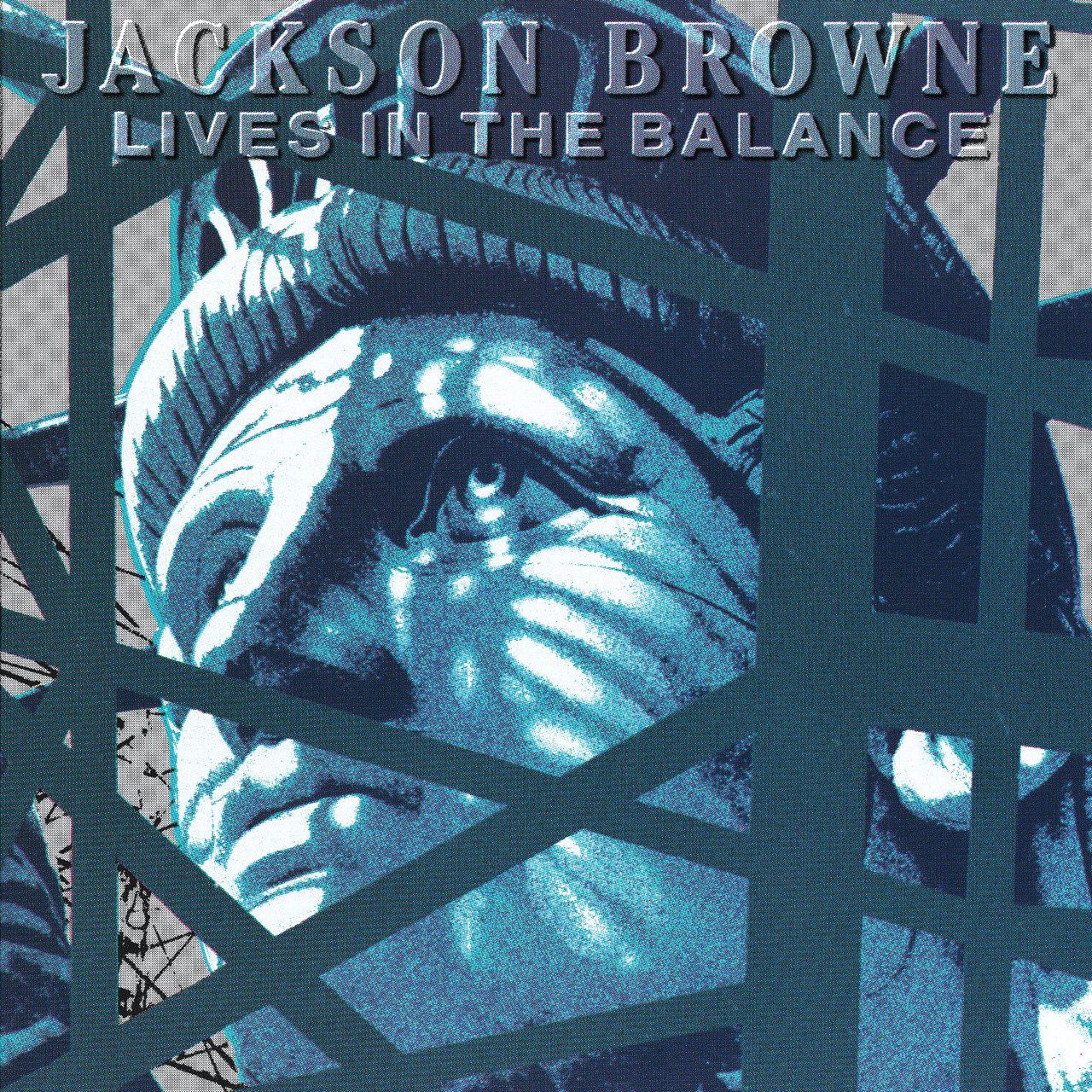
When Jackson Browne released Lives in the Balance in 1986, critics reckoned that its contemporary content, the USA’s bloody meddling in Central America, limited its appeal and long-term significance. And yet, here in the early twentieth first century, with the wars of the Arab Dissolution dragging the world into its vortex, the Great Power politics and proxy wars that taxed intellectual and actual imaginations in that seemingly distant decade jump back into the frame like some dystopian jack in the box. As Mark Twain noted, “history doesn’t repeat itself, but it does rhyme”.

Lives in the Balance was certainly a record for and of its times. Months before the Iran-contra scandal broke, Browne sang “I want to know who the men in the shadows are, I want to hear somebody asking them why. They can be counted on to tell us who our enemies are but they’re never the ones to fight or to die”. After the “arms for hostages” deals hit the news, increased public awareness of the US’ secret and dirty war in Nicaragua inspired him to produce a video for the title track well after the album had passed its sales peak.

Lives in the Balance

The album’s other songs sustained the assault. Soldier of Plenty condemns America’s paternalism towards its poor Latin neighbours. Lawless Avenues, with poignant Spanish lyrics by Browne and Warren Zevon’s old friend and collaborator, Jorge Calderón, takes us down the mean streets of Latino Los Angeles before sending its young anti-hero off to die in America’s wars. In the driving and ironic For America, Browne regrets his prior indifference and qualifies his conflicted patriotism: “I have prayed for America; I was made for America; it’s in my blood and in my bones. By the dawn’s early light! by all I know is right, we’re going to reap what we have sown”. in Til I Go Down, he sings “I’m not gonna shut my eyes, I’ve already seen the lies on the faces of the men of war leading people to the killing floor”. This song aptly plays out the end credits of the harrowing academy award winning The Panama Deception  which documents the US’ invasion of that unfortunate country.

Browne was not the first mainstream singer and songwriter to address America’s long and troublesome relationship with its Latin American neighbours. In his 1983 Stealing Fire and 1984 World of Wonders, Canadian Bruce Cockburn gave us the tragically beautiful Nicaragua and Santiago Dawn and the visceral If I Had a Rocket Launcher. On The Trouble With Normal (1983), there is Tropic Moon, with its cinematic imagery, and the lyrically deceptive Waiting For The Moon. The theme is the same as Browne’s – the North’s intervention in the politics of the South – particularly when comes to financing and arming rogue militias and warlords, and pliable, vicious and corrupt dictators: “Yanqui wake up, don’t you see what you’re doing, trying to be the Pharoah of the West bringing nothing but ruin…You’re my friend but I say Yanqui go home!”

World of Wonders

In this sad world, whenever Uncle Sam (or Uncle Ivan for that matter) plays his hand, something wicked this ways comes: “Little spots on the horizon into gunboats grow – waiting for the moon to show. Might be a party, might be a war when those faceless sailors come ashore. Whatever’s coming, there’s no place else to go, waiting for the moon to show”.

Cockburn’s poetic muse trumps Browne’s agit-prop. These lines from Tropic Moon are nonpareil: “Away from the river, away from the smoke of the burning, fearful survivors, subject of government directives. One sad guitar note echoes off the wall of the jungle. Seen from the air they’re just targets with nowhere to run to”. And: “the light through the wire mesh plays on the president’s pistol like the gleam of bead of sweat in the flow of a candle”.

Very little has changed since Browne and Cockburn sang their Tales of Yankee Power. “But who are the ones that we call our friends? These governments killing their own? Or the people who finally can’t take anymore, and they pick up a gun or a brick or a stone. And there are lives in the balance; there are people under fire; there are children at the cannons; and there is blood on the wire”. And if you were one of those people, why wouldn’t you say “If I had a rocket launcher, I would retaliate!“  As Cockburn sings in Santiago Dawn, “military thugs with their dogs and clubs spreading through the poblacion, hunting whoever has a voice, sure that everyone will run. They come in strong but its not that long before they know its not that easy to leave. To keep a million homeless down takes more than a strong arm up your sleeve”.

From Petrograd to Palestine, the story-line endures. The eighties were also the years of Russia’s Afghan quagmire, which led, ideologically if not geographically to the Chechen pogroms; and of a decade of bloodletting in Lebanon and in what in reality was the First Gulf War, that between Iran and Iraq. The Berlin Wall fell a few years before the events that drove these records, inspiring an outpouring of optimism as the countries of Eastern Europe broke free of the Soviet thrall. But this was not the Kumbaya moment that dreamers yearn for. Ensuing decades have seen a cartography of carnage: Bali and Beslan, Gaza and Grozny, Kabul and Kigali, Manhattan and Mogadishu, Sarajevo and Srebrenica.

We witness the anatomy of the new world economy in which millions of souls are on the move and everything can be traded for value. Bombs and babies, girls and guns, dollars, drugs and more besides. False prophets and bad dreams, broken promises and forlorn hopes, obscured visions and false horizons. “Many have perished, and more most surely will” – a line taken from WH Auden’s often overlooked masterpiece The Age of Anxiety, a meditation on a world in transition between the wreckage of The Second World War and foreboding for the impending armed peace that was itself to endure for another forty five years.

It is sadly ironic that our present world is passing through another time of uneasy transition, between the fixed certainties of great power rivalry and the intractable and bloody asymmetrical conflicts of today.

Paul Hemphill, November 2015 © All rights reserved

Postscript

The other day, I was listening to Dire Straits’ excellent 1985 album Brothers in Arms, and was reminded that several of the songs thereon refer, albeit obliquely, to the “bush wars” of Central America, and possibly also, to the US and Soviet Union’s proxy wars in Southern Africa and Afghanistan. There is Ride Across the River, with its Latino mood, and the beautiful and haunting title track. And there is The Man’s Too Strong, a powerful indictment of the cult of “the big man” that plagues countries all over the world. How often have these tyrants “re-written history with my armies and my crooks. Invented memories. I did burn all the books”. And how often too have they been tolerated, supported and bankrolled by Uncle Sam and Comrade Ivan.

Somewhere In Syria

Author’s Note:

This post is very much a companion piece to my recent post, Allende’s Desk and Osama’s Pyjamas, another tale of Yankee power, and its subject matter echoes that of A Brief History of the Rise and the Fall of the Westand my poem  E Lucevan le Stelle.

Its story does not relate to Bob Dylan’s cryptic and nihilistic Señor (Tales of Yankee Power), from Street Legal (1978), played here by bluegrass wiz Tim O’Brien. As for the meaning of the Bobster’s song, well, that’s pretty hard to fathom. A cowboy fever dream, perhaps; one of those strange illusions you channel in the early morning between sleeping and waking, more about mood than meaning. Perhaps it deserves a post of its own one find day.

Listen to Lives in the Balance in full be clicking on the blue text. Amid the its hard-hitting political commentary sits In the Shape of a Heart, considered to be one of Browne’s finest love songs. Yet this too might be regarded as controversial with regard to what it may or may not imply about the doomed relationship it describes. But like “the ruby she wore on the chain around her neck”, it is a finely cut gem.


Otis Redding – an unfinished life

Fifty years after his untimely death, a fabulous retrospective of the life, times, and musical greatness of Otis Redding:

Five magnificent years of an unfinished life. 

Singer-songwriter Otis Redding was born on September 9, 1941, in Dawson, Georgia. He became known the voice of soul music. Just as his career was taking off, he died in a plane crash on December 10, 1967. “(Sittin’ on) The Dock of the Bay” became posthumously his first and only Number One hit in January 1968.

Also, In That Howling Infinite, read:  The Strange Death of Sam Cooke


Deep In The Heart of Texas

America’s Future is Texas, by Lawrence Wright, The New Yorker, July 10 &17, 2017:

“Texas is as politically divided as the rest of the U.S., but a recurrent crop of crackpots and ideologues has fed its reputation for proud know-nothingism and retrograde thinking”.
This is a cracker. And a must-read for political junkies and all who are fascinated and frightened by the absurdities of recent US politics”.

This is a cracker. And a must-read for political junkies and all who are fascinated and frightened by the absurdities of recent US politics.

I haven’t enjoyed a lengthy American “fly on the wall” opinion piece since Variety despatched a writer to spend time with Lyndsay Lohan on the set of the The Canyons, her doomed porno-thriller (in case you are tempted, and it is indeed a hoot, there’s a link to it below).

Lawrence Wright’s piece reads like a tragicomical dystopian thriller, and indeed, Thomas Pynchon and Michael Chabon would find some great storylines here. His tale becomes increasingly surreal as the author charts the passions, policies and personalities that collude and collide in this chronicle of the recent legislative session of Texas’ State House.

It is full of stories short and tall, quips and quotes, and daring and dastardly deeds that would be hilarious and worthy of the best political satires if only they were not actually true! An Austin newspaper columnist recounts the story of an absconding representative: the police “tracked him to earth at his momma’s house, where he was found hiding in the stereo cabinet.” She added, “He always did want to be the Speaker.” A wannabe Republican candidate for the State Board of Education posts on Facebook that Barack Obama had worked as a male prostitute in his twenties: “That is how he paid for his drugs,” she reasons, (and) went on to assert that climate change is a “ridiculous hoax,” and that dinosaurs are extinct because the ones on Noah’s Ark were too young to reproduce”. Another representative tweets: “Top priority for Travis GOP: beautiful Big Titty women!!” A former governor once said of then presidential nominee, George H. W. Bush. “He can’t help it. He was born with a silver foot in his mouth.” She wore designer suits but picked her teeth, and she cleaned her fingernails with a Swiss Army knife. Successively opposing the placing of a Christmas manger scene in the state capitol, she said ““I’m afraid so…and it’s a shame, because it’s about the only time we ever had three wise men in the capitol.”

These are a selection of the more anodyne tales. Many others are downright scary, and one shakes one head in disbelief at what legislators and elected officials think and do. To bowdlerize the Bard, “what brave, bad world that has such people in it”.

“Texans…are hardly monolithic. The state is as politically divided as the rest of the nation. One can drive across it and be in two different states at the same time: FM Texas and AM Texas. FM Texas is the silky voice of city dwellers, the kingdom of NPR. It is progressive, blue, reasonable, secular, and smug—almost like California. AM Texas speaks to the suburbs and the rural areas: Trumpland. It’s endless bluster and endless ads. Paranoia and piety are the main items on the menu”.

Accordingly, Wright presses all the red (and blue) buttons that inspire, ignite and implode, delight, dismay and divide US politics and society, including in no particular order:

Abortion, gender and toilets. Obamacare, health insurance, and death panels (rememeber those?). Public schools, vouchers, and toilets. Gerrymandering, voter registration and electoral fraud. Lobbyists, political donations, and corruption. Immigration, Muslims, latinos, and sanctuary cities. Guns of all calibers, mass-shootings and pig hunting. Budgets, appropriations, and toilets. Donald Trump, the religious right, and the liberal menace – and, yes, toilets. You have to read the article if you want to understand how things always seem to come back to the rest room.

Maternal mortality rates (up), foster-care and child protection (down). The Poo Poo Choo Choo (really!), texting whilst driving, the right to say Happy Christmas instead of Happy Holiday, and a proposed law to fine masturbation outside of a woman’s parts or of a medical faculty – “an act against an unborn child, and failing to preserve the sanctity of life”. There’s the heroes : William Travis, Sam Houston, Davy Crockett, and, naturally, the Alamo (see below). Famous Texans Willie Nelson, Marty Robbins, and Kinky Friedman (and his band, the Texas Jewboys) get cameos, and Bruce Springsteen, a passing reference. But no Jimmy Webb or Galveston (Wichita is in Kansas in case you ask, and Phoenix is in Arizona), whilst Oklahoma is a refuge for dissenting Democrat legislators. And, whatever “they” do, “don’t California Texas!”

You will be amazed and horrified in equal measure as Lawrence Wright connects these dizzying dots. I never thought that politics could be so exciting. It makes the schoolyard bluster and the minor party shenanigans of our Australian Parliament seem like Children’s Play Time.

As we often say DownUnder: “Only in America Texas!”

And for some light relief (no pun intended) here’s Lindsay Lohan’s adventures in PornoLand.