The politics of Shakespeare’s Julius Caesar

In the wake of controversial production of Shakespeare’s play in New York’s Central Park,  here is an excellent exposition of the politics of this play by American screenwriter, novelist and producer Joseph Suglia. One forgets just how politically sophisticated and daring William Shakespeare was – potentially dangerous and, indeed, deadly during the unsettled and bloody times of the Tudor monarchs.

Dr. Joseph Suglia's avatarSelected Squibs, Scrips, and Essays by Joseph Suglia

Caesar Anti-Trump

by Joseph Suglia

“Nackt kann die Wahrheit vor dem Volke nicht erscheinen.”

—Arthur Schopenhauer, Die Welt als Wille und Vorstellung, Zweiter Band, Kapitel 17

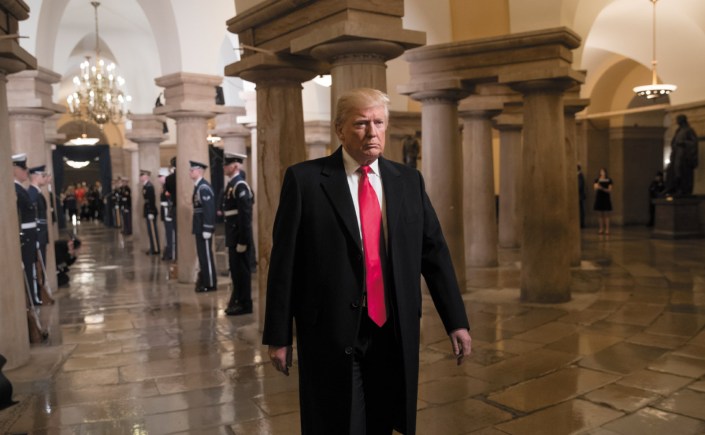
The election of Donald Trump to the presidency of the United States of America gives further evidence, if needed, that Americans wish to be led by cartoon characters.  It was not Trump the human being who acceded to the presidency.  It was his screen double, which is all the American electorate has ever known of him.  It was Trump the Rich Man of Home Alone 2: Lost in New York (1992).  It was Trump the Boss of The Apprentice (2004-2015).  It was Trump the Billionaire of Wrestlemania 23 (2007).  Donald Trump is every bit as unreal as Flo the Progressive Insurance Girl or Colonel Sanders—all three of these characters are strategic unrealities.  All are holograms, shadows of living beings rather than living…

View original post 5,091 more words

The Strange Death of Sam Cooke

Listening to my good friend Demitri and his King Street Blues combo inspired me to revisit the early soul standards of the late fifties and early sixties. Inevitably the journey took me to Sam Cooke.

Sam Cooke

Sam Cooke (January 22, 1931 – December 11, 1964), born Samuel Cook, was an African-American recording artist, singer-songwriter and entrepreneur. He is commonly known as the King of Soul for his distinctive vocal abilities and influence on the modern world of music. His pioneering contributions to soul music led to the rise of Aretha Franklin, Bobby Womack, Al Green, Curtis Mayfield, Stevie Wonder, Marvin Gaye, and Billy Preston and popularized the likes of Otis Redding and James Brown.

Cooke had 30 U.S. top 40 hits between 1957 and 1964, and a further three after his death. Major hits included “You Send Me”, “A Change Is Gonna Come”, “Cupid”, “Chain Gang”,  and “Twistin’ the Night Away”. And few remember that Herman’s Hermits “Wonderful World” was written and first recorded by Cooke.

He was also among the first modern black performers and composers to attend to the business side of his musical career. He founded both a record label and a publishing company as an extension of his careers as a singer and composer. He also took an active part in the African-American Civil Rights Movement.

On December 11, 1964, Cooke was fatally shot by the manager of the Hacienda Motel in Los Angeles, California, at the age of 33. At the time, the courts ruled that Cooke was drunk and distressed, and that the manager had killed Cooke in what was later ruled a justifiable homicide. Since that time, the circumstances of his death have been widely questioned.  Wiki tells the story: http://en.wikipedia.org/wiki/Sam_Cooke

Here are some of Sam Cooke’s timeless hits:

And check out King Street Blues at:  https://www.facebook.com/KingStreetBlues

Ottoman Redux – an alternative history

Counterfactual or alternative history had never gone out of fashion. As a history tragic with many kilometers on the clock, I enjoy such alternative history. “What if…?” and “if only…” are natural, if not instinctual responses to events around us – particularly the unpleasant ones. Hence the popularity of films like SS-GB and The Man in the High Castle (WW2 and the “Nazi victory” books they are based which on have always attracted us alternative history aficionados. There is currently excitement (and panic in some politically correct quarters) about the prospect of a project pitched by Game of Thrones’ show-runners visualizing a USA in which the Confederacy won the Civil War and slavery endures still. But such history is an indulgence that serious historians ought not take seriously – unless they are branching out into historical fiction, that is, which many indeed do. Popular English author Peter Ackroyd has said, the words “What if …” should never be on a historian’s lexicon. But writers of historical fiction have literary license to let their imaginations roam. Counterfactuals or alternative history is a fiction genre all of its own.

When we create alternative histories, we largely replicate a history we already know, often intimately. We replicate histories in which most of the same variables coexist, and the same historical trends prevail. Our motives are quite often as much to warn readers or audiences as to entertain them. Hence the tendency for such endeavours to drift into the depressing dystopian dramas that are so in vogue in these challenged times.

And yet, changing one or more of the players, removing or adding ingredients, hypothesizing different, even opposite scenarios, and imagining how events might have transpired differently, may not radically alter the result. In the case of the First World War, for example, if the conflict had not happened, the European empires may or may not gave endured. Often such multinational entities contain the seeds of their own demise – internal dynamics and contradictions, the impact of events in other countries. Whose to say what might have happened in say France, Germany, Russia, Türkiye or the US that might have upended the balance of power?

One surmises whether or not there is an iron law of inevitability that determines – predetermines, even – the same or similar outcome – a historical equivalent of Oedipus’ unsuccessful efforts to avoid his prophesied fate, affirming TS Elliot’s observation in Little Gidding: “And the end of all our exploring will be be to arrive where we started and know the place for the first time”.

In this entertaining podcast, British historians Dominic Sandbrook and Tom Holland discuss many examples of what might have been if …

In an interesting if light-weight and indeed disappointing exercise in alternative history, with an absolutely meaningless but catchy play on the title of a fabulous song, title, The Sultans of Spring, The Economist recently pondered how events would have unfolded if the Ottoman Empire had sat out WW1 or joined the Entente of Britain, France and Russia instead of throwing in its lot with the Central Powers of Germany and Austria-Hungary.  You may click on the above link, or page down to the full (and brief) transcript. Al-Sisi below, but preceding this is a brief précis of a a popular paperback historical novel published a short  while ago which presented an imaginative if overcooked and totally different Ottoman history.

But first, here is my own argument:

So, what if?

Removing the Ottoman Empire from the strategic equation, or else placing it in the military scales against the Central Powers, would certainly have a significant impact upon the conduct and progress of the European war on both the eastern and western fronts. Russia and Britain would not have had to divert forces and materiel to the Middle East arenas. The Ottomans could have reaped the political and economic benefit of either neutrality or victory, with commensurate benefits for their own survival. The hypotheticals with respect to what may have happened next are innumerable.

The Economist surmises: “How much of today’s mayhem in the Middle East, from civil wars to terror in the name of Islam (and of restoring the caliphate) to the emergence of sectarian dictators such as Bashar al-Assad, not to mention of such a grudge-bearing Ottoman revivalist as Recep Tayyip Erdogan, might have been avoided, if only Churchill had embraced Johnny Turk instead of sinking him?”

But would things have turned out radically different if this had happened – notwithstanding the fact that three to five million Turks, Arabs, Armenians, Africans, Indians, and Europeans who lived in or soldiered through the Middle East theatre would have lived to die a natural death after fulfilling their own particular destinies or to perish purposefully or pointlessly in some other conflict.

The previous century had seen the steady decline of the Sultan’s Empire. It had commenced with Napoleon, and the rise of Muhammad Ali in Egypt, an Albanian “slave soldier” who in practical terms, seceded from the empire. Greece followed next, assisted by European states, and then, bit by bit, the Balkans. The Czar dubbed the empire the “sick man of Europe”, or so British politician John Russell misquoted him, and everybody wanted a piece. The European powers were circling hoping to pick up pieces as the Empire’s borderlands detached – Russia in the east, France in the Levant, and Britain in Egypt and the Gulf. The Crimean War was but one manifestation of “the Eastern Question” that had excited European Chancellories for a hundred years. France and Britain challenged Russia for power and influence in the East and went to war on the Sultan’s side, ostensibly to protect Christian rights in the Holy Land, but weightier matters were in play – alliances have always been fluid in this part of the world, as today’s shifting allegiances demonstrate. Crimea ended in stalemate, but Russia kept encroaching, whilst France established its presence in the Levant. Britain, meanwhile, has its sights set on Egypt and the Red Sea, (the vital  route to its African and Asian empires), and when it was finally built, the Suez Canal, a strategic and commercial link that to this day concentrates the minds of foreign and state departments, military strategists and corporations worldwide.

The Balkan states continued to decouple from the empire, and prior to 1914, engaged in several bloody wars with each other, drawing their neighbours deeper and deeper into the tangle. The slow countdown to WW1 accelerated with the Austro-Hungarian archduke being killed by a Serbian student. Gavril Princip’s “shot that echoed around the world” in Sarajevo in 1914 was but one part of a chaotic picture, igniting tinder that had long awaited a match. Russia, supported the Serbs, Germany, the Austrians, Britain, and France, the Russians. And the Ottomans, forever hard pressed by the Russians, French and Brits, had already moved into the German orbit. When the Ottomans entered the war on the side of the central powers, the cards were dealt.

The Empire was already on a revolutionary path what with the Sultan’s desultory efforts with constitutional reform, the ascendency of Young Turks, a cabal of Turkish nationalist army officers, and the parlous state of the economy. Efforts to institute political and economic reform had faltered, and sooner or later, something was going to blow.

Arab nationalism had already taken root in the Levant, a secular creed spear-headed by Arab Christian intellectuals, to be brutally suppressed by the Young Turk triumvirate, Enver, Talat and Jamal. “Martyrs” were being strung up in Beirut, Damascus and Jerusalem. Perhaps the Ottoman Middle East would have unraveled like in the Balkans (and Balkanised too? Most probably). The “wars of the Ottoman Succession” that we are witnessing today amongst the states created in 1921 would eventually have erupted.

The Zionist project was already underway at the outbreak of war, with settlements of Jews from Eastern Europe and Russia well-established in Palestine, often encouraged by the Ottoman authorities. The pioneers included many of the founders of modern Israel, including its architect and first prime minister David Ben Gurion. The pressures that drove Jews from eastern Europe and Russia in the first place (the discrimination and the pogroms paramount) were unlikely to abate given the atavistic nationalism of Holy Russia and just as Holy Poland. Sooner or later, Zionism and Arab nationalism were going to collide. We will never know how the Ottoman state and its Arab provinces would have coped with the emergence of a Jewish state in Palestine. It certainly would have put the popular (but highly qualified) narrative of Ottoman tolerance of other faiths through a rigorous stress test. The Zionists had a pretty clear road map, and they weren’t sharing it with their new neighbours.

The British, French and Russians had been involving themselves in Middle Eastern affairs – that confounding “Eastern Question” – since the Napoleonic wars. , and Germany, seeking its coveted “place in the sun”, wanted in. German influence was already strong amongst progressive army officers – Prussian elan, ethos, menswear and weapons have exerted a powerful influence on wannabe juntas, the “men on horseback”, since the days Frederick the Great. The Kaiser’s government was very keen on expanding German influence in the east as a counter to British and French imperial power. Meanwhile, the industrial powers were already sniffing around the Gulf, Iranian, and Mesopotamian oilfields, the economic impetus behind imperialism having yet to run its course. The sea-lanes that preoccupied policy-makers in London, Paris and Moscow were soon to be joined by railways and pipelines, with the Germans making the running with its backing of the Berlin to Baghdad Bahnhof. Petroleum would soon join the fabled Great Game as a western imperial obsession. And this too, in time, would have to come up against rising Arab nationalism.

Would Ataturk and Ibn Saud’s ascendency in Turley and Arabia respectively have happened? Perhaps. The political instability in Anatolia and the Arabian Peninsula, and also, as we have described in the Levant, would have created conditions which could have brought these ambitious,  capable and charismatic men to power.

Mustafa Kemal was just one of many promising Young Turks. Whether he would have risen above his peers without his Gallipoli reputation is moot – he would still have had to shove aside the three amigos. His Turkish nationalism, like that of his Young Turk compadres, was not sympathetic to Arab aspirations. Nor was his agnosticism empathetic to what he considered to be a backward and suffocating Islam. Fezzes and face-coverings were amongst the first things to go once he established his secular republic. Whether he could have held the empire together is another question.

Ibn Saud was not the only kid on the Arabian block. The Hashimites (the descendants of Jordan’s King Abdullah) held the western edge of the peninsula, but also the most spiritually significant – the “haramayn” of Mecca and Medina, no less. The Hashimite princes has their eyes on an Arab Kingdom, but Ibn Saud had his eyes on them. The house of Saud, with its Salafi Wahhabi credentials of a cleaner Islam was way “out there” as far as Arab politics and religion went at the time. Apart from perennial outbreaks of intolerance towards and repression of religious and ethnic minorities and heterodox Muslim sects, Istanbul ruled its multinational and multicultural empire with a light if autocratic hand. But there was all that oil – and to British policy makers, that trumped loyalty to the Qurayshi wannabes in the west, for all their descent from the Prophet and their custodianship of the Holy Places.

How would British-controlled Egypt’s politics have developed? Resistance to Britain and its puppet monarchy (headed by the descendent of that famed Albanian schemer Muhammad Ali, who had caused the Europeans so much angst in the early days of the Eastern Question) was growing and would develop into a secular Egyptian nationalism on the one hand and the Islamist Muslim Brotherhood on the other.

So: no Gallipoli campaign (Churchill would have had to find another project, and young Australia another patriotic shibboleth); no Arab Revolt – the Hashemites would have remained just another influential desert clan and TE Lawrence would not have become a legend; no Balfour Declaration or Sykes Picot agreement to distort and dismember the Arab Levant with two conflicting and irreconcilable nationalisms, so, no Syria, Iraq and Lebanon; no British (and Australian) advance on Gaza, Jerusalem and Damascus (General Allenby might have ended up on the Western Front instead of the steps of King David’s Tower in Jerusalem) and arguably, therefore no Mandate, no Palestine, and no Israel; no Armenian genocide to darken Türkiye‘s reputation and prefigure the Shoah that was to come, or then again, perhaps never came; and no Türkiye as we know it today (although President Erdogan is certainly acting out his inner sultan).

As former and unlamented Secretary of State Condoleeza Rice prematurely proclaimed in 2006 too much ridicule from Arabs generally, “a new Middle East”.

© Paul Hemphill 2017 and 2023 All rights reserved

For further history stories in In That Howling Infinite, see Foggy Ruins of time – from history’s back pages

For stories about the Middle East in In That Howling Infinite, see A Middle East Miscellany
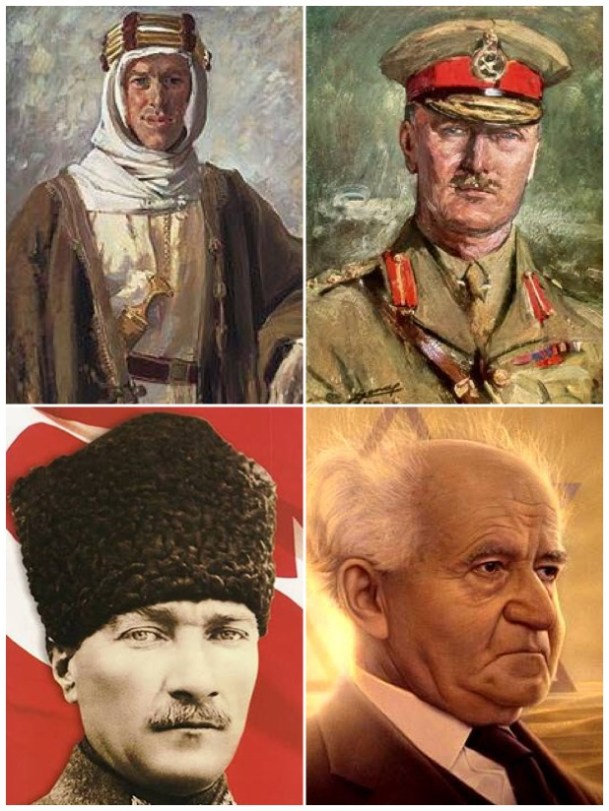
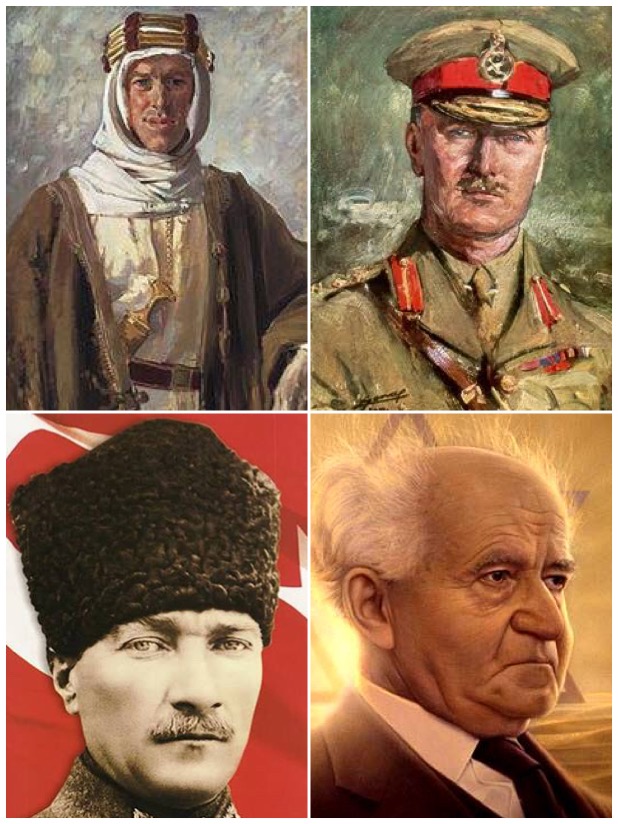
TE Lawrence, General Allenby, Ataturk, and Ben Gurion

The Ottoman Secret

By Raymond Khoury

The Ottoman siege of Vienna of 1683 sees the city fall and the Christian forces annihilated. Western Europe is conquered soon afterwards and in 2019, an increasingly repressive Sultan still rules the continent (though Britain and Russia withstood the onslaught and remain independent nations). A lot has happened in the world since 1683, and as Christendom was vanquished, many things just didn’t happen. Russia is still ruled by the Czars, and America by a post-Mayflower Christian theocracy. Concepts like democracy, freedom of thought and expression, and gender equality are ideas still struggling against heavy odds to be born.

We are in Muslim Paris in 2019. Kamal Arslan Agha is a patriotic, loyal subject of the the Sultan and a special investigator of the Tashkeelat-i Hafiye, the secret police, on the front line of the empire’s harsh response to increasing political and economic turmoil throughout Europe. The Caliphate’s efforts to maintain law and order spare no one, and soon, Kamal’s own family attracts the Hafiye’s attention.

His brother and sister-in-law discover a secret so dangerous, the Caliphate must suppress it, and with the foundations of the Empire under threat, Kamal’s family have no choice but to run. Whether or not they can escape the pursuing Hafiye will determine their own fate, and that of the Caliphate itself – its past, its present, and its future.

Khouri’s vision of a world dominated by conservative, repressive regimes combining religious conformity with modern technology is not a pleasant one. Western democracy might have its faults, but as Churchill said, it’s better than most of the alternatives.

This is, of course, fiction, written by a novelist and not a historian. Its political, cultural and technical milieu is predicated on “what if? What if the Ottomans had expanded and prospered for three centuries instead of gradually transforming into the “sick man of Europe” to be dissected and defeated by western powers? What if through serendipitous and underhand means, the empire has acquired the military, industrial, scientific and technical wherewithal to build over four centuries a world that in many ways in not unlike our own? What if their had been no enlightenment, no French or Russian revolutions, no Hitler, no Holocaust, no Hiroshima?

Incidentally, the siege of Vienna in 1683 gives its name to ‘Gates of Vienna’, a fanatically anti-Muslim far-right blog. Its essential thesis is that this was only one battle in a long war and that Europe and its civilisation are constantly threatened by a Muslim invasion.

As Kurt Vonnegut’s avatar Kilgore Trout would say, “so it goes …”

Sultans of Spring – if the Ottoman Empire hadn’t collapsed.

Imagine the mayhem that might have been avoided had the Ottoman Empire been saved rather than sunk. Blame, among others, Winston Churchill

When a Serb gunman shot an Austrian archduke in the summer of 1914, the nations of Europe tumbled into war with all the grace of bowling pins. Austria-Hungary declared war on Serbia, whose ally Russia declared war on Austria, whose ally Germany declared war on Russia, whose allies France and Britain declared war on Germany and Austria. By early August the continent was in flames.

Much as it wobbled like the rest, however, one of those bowling pins could not make up its mind. Which way would Turkey fall? Should the fading Ottoman Empire join the Triple Entente (Britain, France and Russia) or go with the Central Powers (Germany and Austria-Hungary)

Turkey’s 500-year-old empire was shrinking. It had lost its territories in Africa, nearly all its Mediterranean islands and most of its Balkan lands as well as chunks of eastern Anatolia. It was debt-ridden, industrially backward and politically shaky.

Still, the sultan’s lands straddled two continents, controlling access to the Black Sea. His Arabian territories stretched beyond the holy cities of Islam to the mountains of Yemen and the Persian Gulf, where there were rumoured to lie vast caverns of the sticky black liquid soon to replace coal as the world’s chief source of power.

Confident of Turkey’s weakness, Britain, France and Russia could have clobbered the Ottomans and divided the spoils. Thankfully, wiser heads prevailed. At a secret conclave aboard a British dreadnought off the coast of Norway in late July, a far-sighted politician by the name of Winston Churchill, then First Lord of the Admiralty, worked with French, Russian and Turkish diplomats to forge a treaty. The Turks drove a hard bargain for, as they coyly revealed, Germany too was proffering arms and gold in exchange for an alliance.

The deal that was reached proved immensely beneficial to all concerned. From France, Turkey received generous debt relief. Russia scrapped all claims to Ottoman territory, and made a limited goodwill withdrawal from parts of Anatolia. Churchill waived further payment on two warships that British shipyards were building for Turkey. And Turkey received assurances that its vulnerable extremities would not be attacked; for an empire that for a century had been preyed upon like a carcass this was a new lease of life.

The rewards to the Triple Entente were equally big. Granted exclusive access to the Black Sea, Russia’s allies could resupply the tsar’s armies when they faltered at the start of the war. With no need to defend its Turkish frontier, Russia moved thousands of crack troops from the Caucasus to shore up its front lines. Turkey signed separate agreements recognising British control of the Suez Canal, Aden and the Trucial sheikhdoms of the Persian Gulf, securing the sea lanes for Britain’s massive deployment of troops from the colonies to the Western Front. Turkey’s own army joined in a broad front against Austria-Hungary. Together, these Allied advantages are thought to have shortened the war by as much as a year; the Central Powers might not have sued for a truce as soon as America entered the war, but fought on instead.
Reprieved from collapse, the Ottoman Empire’s government pursued radical reforms. Challenged by growing nationalist tendencies from Arab, Armenian, Greek and Kurdish subjects, Sultan Mehmed V issued a historic firman or proclamation that recognised these as individual nations united under the Ottoman sovereign.

The sultan got to keep the title of caliph, commander of the Sunni Muslim faithful, which his ancestors had acquired four centuries earlier. This proved useful when the empire had to put down a rebellion of religious fanatics in central Arabia, led by a man called Ibn Saud who gained followers by claiming he would restore Islam to a purer state. But mostly the empire was seen as a tolerant place. When Nazi persecutions drove Jews from Europe in the 1930s, many took refuge there (as they had done when expelled from Spain in 1492), particularly in the province of Jerusalem.

If only…

Needless to say, none of the above happened. Quite the opposite. Turkey aligned with Germany in the first world war, and the allies did attempt to invade and divide its empire. Churchill, instead of handing over the warships that ordinary Turks had paid for by subscription, had them seized for the British navy. In 1915 he ordered a catastrophic attack on Turkey; the landing at Gallipoli cost the allies 300,000 casualties. British campaigns against Turkey in Iraq and the Levant cost another million lives.

Turkey’s casualties mounted, by war’s end, to 3m-5m people, nearly a quarter of the Ottoman population. This included some 1.5m Armenians, slaughtered because Turkish officials believed they might become a fifth column for a hostile Russia. And when Britain and France grabbed the Ottomans’ Arab lands, their suppression of uprisings cost thousands more lives.

How much of today’s mayhem in the Middle East, from civil wars to terror in the name of Islam (and of restoring the caliphate) to the emergence of sectarian dictators such as Bashar al-Assad, not to mention of such a grudge-bearing Ottoman revivalist as Recep Tayyip Erdogan, might have been avoided, if only Churchill had embraced Johnny Turk instead of sinking him?

Ataturk Monument, Istanbul

Here are other posts about Turkey past and present:

Sailing to Byzantium

The Watchers Of The Water

Cha … Cha … Changes

People Watching In Sultanahmet


Deep In The Heart of Texas

America’s Future is Texas, by Lawrence Wright, The New Yorker, July 10 &17, 2017:

“Texas is as politically divided as the rest of the U.S., but a recurrent crop of crackpots and ideologues has fed its reputation for proud know-nothingism and retrograde thinking”.
This is a cracker. And a must-read for political junkies and all who are fascinated and frightened by the absurdities of recent US politics”.

This is a cracker. And a must-read for political junkies and all who are fascinated and frightened by the absurdities of recent US politics.

I haven’t enjoyed a lengthy American “fly on the wall” opinion piece since Variety despatched a writer to spend time with Lyndsay Lohan on the set of the The Canyons, her doomed porno-thriller (in case you are tempted, and it is indeed a hoot, there’s a link to it below).

Lawrence Wright’s piece reads like a tragicomical dystopian thriller, and indeed, Thomas Pynchon and Michael Chabon would find some great storylines here. His tale becomes increasingly surreal as the author charts the passions, policies and personalities that collude and collide in this chronicle of the recent legislative session of Texas’ State House.

It is full of stories short and tall, quips and quotes, and daring and dastardly deeds that would be hilarious and worthy of the best political satires if only they were not actually true! An Austin newspaper columnist recounts the story of an absconding representative: the police “tracked him to earth at his momma’s house, where he was found hiding in the stereo cabinet.” She added, “He always did want to be the Speaker.” A wannabe Republican candidate for the State Board of Education posts on Facebook that Barack Obama had worked as a male prostitute in his twenties: “That is how he paid for his drugs,” she reasons, (and) went on to assert that climate change is a “ridiculous hoax,” and that dinosaurs are extinct because the ones on Noah’s Ark were too young to reproduce”. Another representative tweets: “Top priority for Travis GOP: beautiful Big Titty women!!” A former governor once said of then presidential nominee, George H. W. Bush. “He can’t help it. He was born with a silver foot in his mouth.” She wore designer suits but picked her teeth, and she cleaned her fingernails with a Swiss Army knife. Successively opposing the placing of a Christmas manger scene in the state capitol, she said ““I’m afraid so…and it’s a shame, because it’s about the only time we ever had three wise men in the capitol.”

These are a selection of the more anodyne tales. Many others are downright scary, and one shakes one head in disbelief at what legislators and elected officials think and do. To bowdlerize the Bard, “what brave, bad world that has such people in it”.

“Texans…are hardly monolithic. The state is as politically divided as the rest of the nation. One can drive across it and be in two different states at the same time: FM Texas and AM Texas. FM Texas is the silky voice of city dwellers, the kingdom of NPR. It is progressive, blue, reasonable, secular, and smug—almost like California. AM Texas speaks to the suburbs and the rural areas: Trumpland. It’s endless bluster and endless ads. Paranoia and piety are the main items on the menu”.

Accordingly, Wright presses all the red (and blue) buttons that inspire, ignite and implode, delight, dismay and divide US politics and society, including in no particular order:

Abortion, gender and toilets. Obamacare, health insurance, and death panels (rememeber those?). Public schools, vouchers, and toilets. Gerrymandering, voter registration and electoral fraud. Lobbyists, political donations, and corruption. Immigration, Muslims, latinos, and sanctuary cities. Guns of all calibers, mass-shootings and pig hunting. Budgets, appropriations, and toilets. Donald Trump, the religious right, and the liberal menace – and, yes, toilets. You have to read the article if you want to understand how things always seem to come back to the rest room.

Maternal mortality rates (up), foster-care and child protection (down). The Poo Poo Choo Choo (really!), texting whilst driving, the right to say Happy Christmas instead of Happy Holiday, and a proposed law to fine masturbation outside of a woman’s parts or of a medical faculty – “an act against an unborn child, and failing to preserve the sanctity of life”. There’s the heroes : William Travis, Sam Houston, Davy Crockett, and, naturally, the Alamo (see below). Famous Texans Willie Nelson, Marty Robbins, and Kinky Friedman (and his band, the Texas Jewboys) get cameos, and Bruce Springsteen, a passing reference. But no Jimmy Webb or Galveston (Wichita is in Kansas in case you ask, and Phoenix is in Arizona), whilst Oklahoma is a refuge for dissenting Democrat legislators. And, whatever “they” do, “don’t California Texas!”

You will be amazed and horrified in equal measure as Lawrence Wright connects these dizzying dots. I never thought that politics could be so exciting. It makes the schoolyard bluster and the minor party shenanigans of our Australian Parliament seem like Children’s Play Time.

As we often say DownUnder: “Only in America Texas!”

And for some light relief (no pun intended) here’s Lindsay Lohan’s adventures in PornoLand.

Rhiannon the Revelator – In the dark times will there also be singing?

 In the dark times will there also be singing?
Yes, there will also be singing. About the dark times.
Berthold Brecht

Rhiannon Giddens, a multifaceted singer, musician, folklorist and storyteller brings American history alive in her her drive to unearth the stories of forgotten people so that her audiences and listeners may remember them.
On Moon Meets The Sun,  a defiantly joyous song, Giddens and her comrades of Our Native Daughters sing in the round over a polyrhythmic lacework of banjo and guitar, vowing not to let radical suffering diminish humanity. “You put the shackles on our feet, but we’re dancing”, she sings, “You steal our very tongue, but we’re dancing” “Ah, you sell our work for your profit, but we’re dancing,” she scoffs. “Ah, you think our home we have forgotten, but we’re dancing.” Then she recedes into the jubilant tangle of voices: “You can’t stop us now (We’ll be dancing). You can’t keep us down (We’ll be dancing)”.
Rhiannon Giddens: “There is surely racism in this country — it’s baked into our oldest institutions – just as there is sexism, millennia old. At the intersection of the two stands the African American woman. Used, abused, ignored and scorned, she has in the face of these things been unbelievably brave, groundbreaking and insistent. Black women have historically had the most to lose, and have therefore been the fiercest fighters for justice — in large, public ways that are only beginning to be highlighted, and in countless domestic ways that will most likely never be acknowledged.”

https://www.youtube.com/watch?v=F0FfAagEkH8

https://www.youtube.com/watch?v=iZa1AMr7Kk0

Quasheba, Quasheba
You’re free now, you’re free now
How does your spirit fly?
Blood of your blood
Bone of your bone
By the grace of your strength we have life

From the Golden Coast of Ghana
To the bondage of Grenada
You kept the dream of hope alive
They burned your body
They cursed your blackness
But they could not take your lights

Raped and beaten, your babies taken
Starved and sold and sold again
Ain’t you a woman, of love deserving
Ain’t it somethin’ you survived?

Quasheba, Quasheba
You’re free now, you’re free now
How does your spirit fly?
Blood of your blood
Bone of your bone
By the grace of your strength we have life

You dreamt of home, you dreamt of freedom
You died a slave, you died alone
You came from warriors who once built empires
Ashanti’s kingdom carries on

You were forgotten, almost forsaken
Your children founded generations
Your strength sustained them
They won their freedom
Traced their roots to find you [waiting?]

Quasheba, Quasheba
You’re free now, you’re free now
How far your spirit’s flown
Blood of your blood
Bone of your bone
By the grace of your strength we are home

Blood of your blood
Bone of your bone
By the grace of your strength we are home
We are home
We are home
We are home

https://www.youtube.com/watch?v=zse7aJodkKg


Kingston, Jamaica 1983

I am reminded of  Pete Seeger’s adaptation of the old Baptist hymn:

” My life flows on in endless song
Above earth’s lamentation.
I hear the real, thought far off hymn
That hails the new creation
Above the tumult and the strife,
I hear the music ringing;
It sounds an echo in my soul
How can I keep from singing?”

Here is the wondrous Éabha McMahon of Celtic Woman:

https://www.youtube.com/watch?v=Z9hth14hokI


Gerry's avatarThat's How The Light Gets In

In the dark times
Will there also be singing?
Yes, there will also be singing
About the dark times.
– Bertolt Brecht, motto to Svendborg Poems, 1939

In an essay called ‘Undefeated Despair’, John Berger wrote of ‘Despair without fear, without resignation, without a sense of defeat.’ ‘However you look at it’, the Guardian editorialised a few days ago, ‘2017 offers a fearful prospect for America and the world.’ In the words of Paul Simon’s ‘American Tune’, I don’t have a friend who feels at ease when weighing the prospects for the year ahead. In the spirit that some solace may be found in poetry in these dark times, I offer a selection of poems or brief extracts – some have which have appeared in posts here before – which seem to offer meaning and hope; they may reflect Berger’s stance of undefeated despair, offering not ‘a promise, or a consolation, or an oath…

View original post 1,467 more words

The ricochet of Trump’s counter-revolution

From time to time, I republish articles by News Ltd commentators that I believe worth sharing with those who cannot scale the News paywall. This, by The Australian’s Editor at Large, Paul Kelly, is one of those.

In this piece, Kelly argues that to a certain degree, Donald Trump’s rise and rise was attributable to what he and other commentators and academics describe as a backlash in the wider electorate against identity and grievance politics.

“This election, beyond its madness, was about a clash of moral ­vision. Trump stood for three ­visions: economic protection against free trade, nationalism against internationalism, and cultural tradition against social liberalism”.

He quotes US academic Mark Lilla: “In recent years American liberalism has slipped into a kind of moral panic about racial, gender and sexual identity that has distorted liberalism’s message and prevented it from ­becoming a unifying force capable of governing. One of the many ­lessons of the recent presidential campaign and its repugnant outcome is that the age of identity ­liberalism must be brought to an end”.

American voters were “disaffected with the liberal message”. He said: “Democrats have simply lost the country. They have lost the capacity to speak to the vast middle of America, an America that is, in large part, white, very religious and not highly edu­cated… identity liberalism was about self-expression, not persuasion, and claimed that “it’s narcissistic, it’s isolating, it looks within”.

Identity politics segue into grievance politics and the cultivation of victimhood and the creation of laws, rules and processes that appear to allow victims to pursue and punish the people who have offended them. This vests victims with a superior moral standing, even social status. Once the victim culture prevails, notions of morality and decency are redefined. As its scope widens any established idea is vulnerable: in Australian this is manifested in the belief that male-female gender norms should be respected, that Australia Day should be kept as January 26, and that the British civilization heritage should be fundamental to the school curriculum.

Kelly quotes another US academic, Jonathon Haidt, who writes that identity and grievance politics are tied to the idea of “emotional reasoning” or, the elevation of emotion over reason. Its essence is: “I feel it, therefore it must be true.” Feelings are permitted to guide reality. “A claim that someone’s words are ‘offensive’ is not just an expression of one’s own subjective feeling of offendedness. It is, ­rather, a public charge that the speaker has done something ­objectively wrong. It is a demand that the speaker be punished by some authority for committing an offense”.

We are now seeing the backlash, Kelly concludes. First in The UK, with Br sit, then with the triumph of Trump, this year in Europe, perhaps, and sooner rather than later, here in Australia:

“It is futile to think the counter-revolution will not occur. The only issues are its leadership, its rationality and the extent of its conservative or reactionary populism. If Prime Minister Malcolm Turnbull, as Coalition leader, feels this is not his responsibility then the vacuum will be ­occupied by others. As the two-generations-long campaign in the West for individual human rights reaches its logical cultural conclusion in identity politics, the results are an increasingly fragmented society, the ­decline of a shared historical narrative and a distorted moral order that damages us all”.

are we witnessing just another swing of the values pendulum, the correcting of a temporary imbalance, or something more challenging, permanent, and in the long-term, dangerous?

Read on…

Donald Trump’s election a rejection of identity and grievance politics

Paul Kelly, The Weekend Australian, 28th January 2017

As Donald Trump’s new presidency surges across our politics, creating chaos and uncertainty, there is one element in his victory where most Australian politicians remain in ideological denial — the revolt against identity politics.
Trump, in effect, was given permission to win the election by the US progressive class despite his narcissism, his coarseness and his smashing of the orthodox bounds of political and policy behaviour.

In retrospect, the 2016 US election story is a grand joke — enough voters in Middle America decided to tolerate Trump’s juvenile viciousness because they felt the narcissism of prevailing closed-minded progressive ideology was no longer to be tolerated. In the end, the alternative was worse than Trump. Is this too difficult an idea to grasp?

During the Obama era the US underwent a cultural revolution. Fuelled by social activists on race, sex and gender issues and the ­decisive swing by younger people to social liberalism as a way of life, the Democratic Party embraced identity politics as a brand. It mirrored the values transformation that swept through many American institutions: the academy, media, arts, entertainment and much of the high income earning elite. But revolutions are only guaranteed to bring counter-­revolutions in their wake.

Barack Obama won two presidential elections enshrining iden­tity and minority politics at the heart of his campaign. But Obama is a unique historical figure. What works for him doesn’t work for other Democrats — witness Hillary Clinton. In 2016 minority politics failed to deliver. Its momentum has been checked, with American progressives sunk in an angry valley of rage.

Last year Clinton, after a long and often tortuous journey, embraced not a call to all, but a collection of separate identity groups, a pervasive agenda of political correctness and pledges to end discrimination for lesbian, gay, bisexual and transgender people. This testified to the US Supreme Court decision in favour of same-sex marriage, the injustices visited on African Americans, the voting power of minorities and their ­decisive capture of the soul of the Democratic Party. The problem for the Democrats is now obvious: managing the Obama legacy without the magic of Obama.

This election, beyond its madness, was about a clash of moral ­vision. Trump stood for three ­visions: economic protection against free trade, nationalism against internationalism, and cultural tradition against social liberalism. In Australia there has been immense coverage of Trump’s victory combined with denial of its full meaning. It is a historic failure of progressivism.

In his defining New York Times article of November 18, “The End of Identity Liberalism”, US professor of humanities Mark Lilla said the liberal orthodoxy that ­society should “celebrate” its differences was splendid as moral pedagogy “but disastrous as a foundation for democratic politics in an ideological age”.

Lilla said: “In recent years American liberalism has slipped into a kind of moral panic about racial, gender and sexual identity that has distorted liberalism’s message and prevented it from ­becoming a unifying force capable of governing. One of the many ­lessons of the recent presidential campaign and its repugnant outcome is that the age of identity ­liberalism must be brought to an end.”

Lilla, no fan of Trump, said Clinton’s “strategic mistake” was slipping into “the rhetoric of ­diversity, calling out explicitly to African-American, Latino, LGBT and women at every stop”. It ­became a bigger problem when, having decided to play group politics, she ignored the biggest group: white voters without college degrees. They punted for Trump and who can blame them?

After the result Lilla said American voters were “disaffected with the liberal message”. He said: “Democrats have simply lost the country. They have lost the capacity to speak to the vast middle of America, an America that is, in large part, white, very religious and not highly edu­cated.” He said identity liberalism was about self-expression, not persuasion, and claimed that “it’s narcissistic, it’s isolating, it looks within”.

The superficial lesson of the US election is that identity politics failed at the ballot box. That’s ­important. But what’s even more important — for the US and Australia — is that identity politics is bad in its essence, bad for nations, bad for societies and bad for peoples. Identity politics is a far bigger issue in the US than Australia but that does not gainsay this reality.

It goes to the flaw in progressive politics — its blindness to consequences of its policies. This is relevant in Australia given the Labor Party is fully pledged to identity politics as a tactic while for the Greens it is core ideology. The pent-up backlash, however, will come in this country probably sooner rather than later.

Trump, personally liberal in many ways, rode the tide of conservative moral revolt. It was wider and deeper than liberals ­expected because the rising progressive ethos touches virtually every aspect of US life. Progressives misjudged partly because they felt Trump condemned himself as a bigot, sexist and anti-­Muslim extremist.

The genius of Trump’s “make America great again” slogan was that it resonated at multiple levels — with people who saw their jobs and incomes were being eroded along with something even bigger: they felt the values of their America were being stolen, that they were losing their country.

Lilla joins that other brilliant American academic, Jonathan Haidt, professor of ethical leadership at New York University and author of The Righteous Mind, whose speeches over the past year are a tour de force in documenting and exposing the crisis in the US university system caused by iden­tity politics.

These speeches are reinforced by Haidt’s 2015 Atlantic magazine article, “The Coddling of the American Mind”, co-authored with constitutional lawyer Greg Lukianoff, that reveals the ­destructiveness of identity politics.

The key lies in its cultivation of victimhood and the creation of laws, rules and processes to allow victims to pursue and punish the people who have offended them. This vests victims with a superior moral standing, even social status, with the assumption such pro­cesses represent superior public policy and prove the compassion of institutions that embrace these norms.

The argument “I’m offended” is the ultimate card. Once these norms are accepted, it is unbeat­able. This thinking is spreading rapidly into Australian institutions and is embraced by authorities who don’t understand the consequences of what they are doing.

Any Australian politician will gain currency by standing for the victim, winning moral acclaim and usually votes. The great examples are rejecting the same-sex plebiscite because it would offend and hurt gays and lesbians, the insistence under section 18C that people have a right to be offended because of racial comments, and the right of LGBTI students to have the school norms redesigned on gender grounds for self-protection. The principle in each case is the same: the norms of the majority must surrender to the demands of the victimised minority.

Once the victim culture prevails, then notions of morality and decency are redefined. As its scope widens any established idea is vulnerable: that male-female gender norms should be respected, that Australia Day should be kept as January 26 or that the British civilisation heritage should be fundamental to the school curriculum.

While Haidt’s analysis is university-based, it is valuable ­because US universities are the most advanced outreach of iden­tity politics. He argues this transformation weakens the integrity of institutions and damages the precise people it is supposed to protect.

“What has been happening since the 1990s is there’s been a change — the most sacred thing at university is the victim,” Haidt says. “There are six groups of victims traditionally since the 1990s so mostly whenever there are big political blow-ups and controversies they tend to be around race ­issues, gender issues, or LGBT ­issues. Those are the big three. There are three other groups that tend to be sacred but there seems to be less controversy around Latinos, Native Americans and the disabled. The last two years have been extraordinary ­because there’s been a revolution in just two years with a seventh group, now Muslims, in the ­sacred category. You know you’re in the presence of sacredness when any little thing, any affront or insult, elicits a huge reaction.”

Haidt describes how the process works at American univer­sities: “The transition to a victimhood culture is one characterised by concern with status and sensitivity.” The self-declared victim looks to the new norms for satisfaction. “They bring it to the attention of the authorities,” Haidt says. “If something happens, you don’t deal with it yourself. You ­report it. You get the president of the university, the dean, some older person, some bureaucratic authority, to bring them in. To punish the person who did this. In such a culture you don’t emphasise your strengths, rather the ­aggrieved emphasise the repres­sion and their social marginalisation. The only way to gain status is not just to be a victim but to stand up for other victims.”

This is an accurate description of the ethos and operating rules of the Australian Human Rights Commission.

What are the consequences? Haidt says: “Professors are ­increasingly afraid of students. Everybody’s on the Left but they’re increasingly being hauled up for some charge of racism or sexism. Professors all over the country are pulling videos, pulling material. Undergrads are being exposed to far less provocative material in 2016 than they were even in 2014. Just in the last two years professors all over the country are changing their teaching.”

The origins of this cultural sickness are deep and pervasive. Lilla says: “The fixation on diversity in our schools and in the press has produced a generation of liberals and progressives narcissistically unaware of conditions outside their self-defined groups and indifferent to the task of reaching out to Americans in every walk of life.

“At a very young age our children are being encouraged to talk about their individual identities, even before they have them. By the time they reach college many assume that diversity discourse exhausts political discourse and have shockingly little to say about such perennial questions as class, war, the economy and the common good.

“In large part this is because of high-school curriculums, which anachronistically project the iden­tity politics of today back on to the past, creating a distorted picture of the major forces and individuals that shaped our country.”

Haidt says that children born after 1980 got a message: “Life is dangerous but adults will do everything in their power to protect you from harm.” He’s right. But he misses the sharper political point. For progressives, identity politics and victimhood are a wedge to delegitimise leaders and institutions that sustain any conservative status quo against the radical ­social changes they want. This has played out in the politics of both the US and Australia.

Identity politics should be seen in its historical context. It is one manifestation of the chaotic yet momentous embrace of populism on both the Left and Right, fanned by social media, the crisis of traditional values and the debasement of the notion of what is a virtuous person. Emotional self-expression, not piety, is the behaviour that is now rewarded.

Haidt says identity politics is tied to the idea of “emotional reasoning” — or, to be crude, the elevation of emotion over reason. Its essence is: “I feel it, therefore it must be true.” Feelings are permitted to guide reality. Lukianoff and Haidt say: “A claim that someone’s words are ‘offensive’ is not just an expression of one’s own subjective feeling of offendedness. It is, ­rather, a public charge that the speaker has done something ­objectively wrong. It is a demand that the speaker be punished by some authority for committing an offence.”

Emotional reasoning is now evidence; it is seen as illegitimate for an authority or a government to inflict mental or emotional damage on people who constitute a historically repressed minority; subjective evidence of the hurt is all that is required to make the case. Let’s be clear: emotions and claims of mental damage have ­become political weapons to be ruthlessly deployed. This is a core tactic of identity politics.

Bill Shorten, the Australian Leader of The Opposition, grasps this and has used it brilliantly. Shorten and most of his parliamentary frontbench were ­explicit in their rejection of the same-sex marriage plebiscite: it had to be rejected because of the emotional damage it would do. Shorten said the “No” campaign would be “an emotional torment for gay teenagers” and raised the possibility of suicide. Many mental health clinicians backed him.

These views must be challenged. How healthy was it for the LGBTI community to present ­itself to the Australian public as such entrenched victims that they were unable to sustain a national vote on the marriage issue? Are such individuals better off having embraced this position? Are they better prepared for future life when, in an imperfect world, they will face inevitable discrimination from time to time?

Moving to the central contradiction in identity politics — as rele­vant in Australia as it is in America — Lilla said: “It says, on the one hand, you can never understand me because you are not exactly the kind of person I’ve defined myself to be. And on the other hand, you must recognise me and feel for me.”

Rates of mental illness have been increasing rapidly in both the US and Australia among young people. This is a serious issue but it is being exploited in the cause of ideology. As Haidt says, if young people are taught, encouraged and rewarded “to nurture a kind of ­hypersensitivity” that does not ­assist their lives. On the contrary, this new moral culture advocated by the progressives results in “an atrophying of the ability to handle small interpersonal matters on one’s own” while at the same time “it creates a society of constant and intense moral conflict”.

Nobody doubts that hurt and offence are genuine and justified across every minority group. That is a fact. But it is not the issue. The issue is the institutional, political and legal response. Haidt argues that the cult of victimhood in law and process “causes a downward spiral of competitive victimhood” and the generation of a “vortex of grievance”. The further tragedy is that victimhood penetrates both sides of the political conflict: men branded as sexist by feminists claim to be victims of ­reverse ­sexism.

Progressives have been setting the cultural agenda in Australia just as they have done in the US: on same-sex marriage, LGBTI rights, gender fluidity programs, social and ideological agendas in schools, the campaign against ­religious freedom, winning more support for affirmative action, radicalising the proposed indigenous referendum, shifting multi­culturalism towards the “diversity” side of the spectrum and deploying anti-discrimination law as an ­instrument of radical social change.

It is futile to think the counter-revolution will not occur. The only issues are its leadership, its rationality and the extent of its conservative or reactionary populism. If Malcolm Turnbull, as Coalition leader, feels this is not his responsibility then the vacuum will be ­occupied by others.

As the two-generations-long campaign in the West for individual human rights reaches its logical cultural conclusion in identity politics, the results are an increasingly fragmented society, the ­decline of a shared historical narrative and a distorted moral order that damages us all.

Sic semper tyrannis

You come at the king, you best not miss.
Omar Little, The Wire (after RW Emerson)

The phrase “one man’s freedom fighter is another man’s terrorist” is at once apt, correct, and yet often oversimplified to the point of disingenuousness. The word “terrorist” itself describes its goal. To instill fear in the heart of the enemy. In the past, the target would have been the king, the dictator, the ruling class, and those who served them and upheld their rule. Politicians, officials, solders and policemen. Today, terrorists indiscriminately target whole societies. Irish bombers blasted communities of the rival faith, murdered shoppers, office workers, and pub patrons, as well as soldiers and policemen. Palestinian suicide bombers hit malls and pizza bars in city centres. ISIS, al Qa’ida and the Taliban detonate cars in busy city streets and publicly execute prisoners in callous and calculating “lectures in flesh” (the phrase is civil rights lawyer Geoffrey Robertson’s, from his chilling account of the trials and execution of King Charles I of England and those who sentenced him, The Tyrannicide Brief.).

But targeted and random terrorism has a long historical pedigree. For centuries, it has been the desperate and nihilistic weapon of last resort of resistance and rebellion against perceived oppression and injustice, and against invaders and occupiers.

In the second century BCE Palestine, the Maccabees used assassination in their resistance to the Seleucid Greeks, and a century later, the Jewish zealots, the Sicarii, named for the easily concealed small daggers, paid the Romans in like coin, and ultimately in an insurrection that culminated in the destruction of Jerusalem in 70CE and the scattering of the Jewish race (giving history the emotive and symbolic last exit that was Masada). In an etymological irony that Mark Twain would have been proud of, the present unrest in Jerusalem, a large number of young Palestinians have perished in attempting to stab jewish soldiers and civilians. Their jaquerie is called the “Intifada Sakni-in”, the ‘Knife Uprising – an echo of those long-dead Sicarii “dagger men”.

Nowadays, one would be excused for thinking that “terrorism” and “terrorist” are synonymous with Arabs and Muslims. And a historical precedent reinforces this erroneous assumption. The Hashishan or “Assassins” of Middle East fame (yes, that is where that noxious noun originated) were Muslim men and boys mesmerized and mentored by Rashid ad Din as Sina-n, the “Old Man of the Mountain” (and all this, before Osama in the caves of Tora Bora), and were Twelfth Century  hit-men contracted out to rival Muslim princes in the internecine conflicts that plagued the Levant in the wake of the Crusades and the demise of the great Arab Caliphates.

But the assassin’s knife (and in modern times, the gun and bomb, and latterly cars and trucks) predates these medieval hoods and links the Hebrew rebels of old to the Irgun and Stern Gang who encouraged Britain and the UN to abandon Palestine in 1948, bequeathing most of it to the new state of Israel, and triggering the Palestinian diaspora. European anarchists and Irish rebels and loyalists were adept at shootings and ambushes. In Algeria, during the ‘fifties, the nationalist FLN and the “colon” OAS shot and bombed each other and those unfortunates caught in the crossfire. The IRA perfected the improvised explosive device that today has crippled thousands of American, Canadian, and Australian soldiers in Iraq abd in Afghanistan. Hindu Tamil separatists of Sri Lanka introduced the suicide bomber, an economical and efficient weapon against soft (civilian, that is) targets, deployed today by Islamist killers in the streets of London and Lahore, Damascus and Dar es Salaam, Jerusalem and Jakarta. Whilst Arabs – and particularly Palestinians may have given the world the hijacking of aircraft – a tactic that fell into disuse due to diminishing political returns and rapid response forces – other Arabs showed us how to fly them into public buildings as the whole world watched in horror and disbelief. The shockwaves of this one are still reverberating through the deserts of the east and the capitals of the western world.

In going up up against their occupiers, the Palestinians have an old heritage. In my old country, Boudicca and Caractacus fought a losing battle against the Romans in Britain during the First CE. The Roman historian Tacitus ascribed to a vanquished chieftain the memorable words  “solitudinem faciunt, pacem appellant” – they make a desert and they call it peace. After the battle of Hastings in 1066, the defeated Saxons pushed back against the Normans and brought the genocidal wrath of William the Conqueror down on their heads with the devastating “Harrying of the North”. The Green Man and Robin Hood legends are said to be a retrospective and romanticised remembering of the Saxon resistance. Warrior fugitives from that failed guerilla war fled as far as Constantinple, where many joined the Emperor’s acclaimed Varangarian Guard, (see When Harald Went A Viking) 

In the streets and the countryside of Ireland, my parents’ birthplace, the United Irishmen, Fenians, Free Staters, IRA and Unionists fought against the redcoats, tommies, and black and tans of the British Army. Fought amongst themselves, fought against each other, and killed and were killed in their centuries long war of liberation. And in my adopted country, indigenous Australians fought a futile frontier war against settlers and soldiers just as native Americans did, albeit on a much smaller scale, and paid the price in hangings, massacres, poisoned wells, dispossession, marginalization, and “stolen children”. The legacy of those times lingers still – see The Frontier Wars – Australia’s heart of darkness.

In Central America, Juarez led the Mexicans against the French, and Sandino, Nicaraguans against US marines. Spaniards rose up against Napoleon’s forces, giving the world the word “guerilla”, or “little war”. Russian partisans ambushed the Grande Armé and the Wehrmacht. Throughout occupied Europe, the very term “resistance” became synonymous with the heroic unequal struggle against tyranny. In another of history’s ironies, muqa-wamat, Arabic word for resistance, unites sectarian rivals Hamas and Hizbollah against Israel.

And not just resistance to invasion and occupation, but also against oppression by one’s own rulers. Religious tracts tie themselves in knots reconciling the obligation to obey our rulers with the right to resist and overthrow those that rule badly. The unequal struggle against tyranny – or what is perceived by the perpetrators as tyranny – is the cause that inspires men and women to desperate acts.

The most celebrated in fact, film and fiction is the death of Julius Caesar at the hands of peers who feared that he intended to usurp the ostensibly democratic Republic (ostensible because democratic it was not) and institute one-man rule. That ended badly for the conspirators, and for Rome, as it precipitated years of civil war and ultimately, half a century of empire).

In 1880 the reforming Czar Alexander II of Russia, discovered the hard way that liberating the serfs did not inoculate himself against the bomb that took his legs and his life. His fearful and unimaginative successors hardened their hearts and closed their minds against further reform. setting in train the crackdown on dissent and democratic expression that led eventually to the storming of the Winter Palace on Petrograd in 1917. Narodnaya Volya, the killers called themselves – the People’s Will. And that is what terrorists do. They appeal and owe fealty to a higher court, a greater good, a savage God.

So it was when student and Serbian nationalist Gavril Princip assassinated Archduke Ferdinand of Austria-Hungary in June 1914 and ignited the spark that lit the conflagration of World War 1 which precipitated the demise of the old European empires.

So too when John Brown and his sons brought their broadswords to bear on slavers and their sympathizers and made a date with destiny at Harpers Ferry. Their famous raid may or may not have accelerated the downward slide to the secession and civil war that erupted the following year, but it provided a moral and symbolic prelude and also, the resonating battle hymn of the republic. John Wilkes Booth bookended this bloody era with his histrionic and public murder of Abraham Lincoln, shouting “sic semper tyrannis”, “thus always to tyrants,” attributed to Brutus at Caesar’s assassination – today, it’s the Virginia state motto. Brown and Booth were quite clear in their motives. As was were the segregationalist shooters who did for African Americans Medgar Evers and Martin Luther King. Less so were the killers of the Kennedy brothers in the sixties.

To conclude, sometimes that savage, rebel God is one of faith, sometimes, of blood and soil. In some instances, it is revenge for wrongs real and imagined – the reasons at times lost or forgotten through the passage of time and fading memories. And often, “the cause” is corrupted by the immoral economics of illicit commerce, including contraband, kidnapping, blackmail and extortion. Sometimes all merge in an incongruous hybrid of religious passion, ethic identity, libertarian or anarchistic fervour, and protection racket. As was the case in Northern Ireland, in Lebanon, in sub-Saharan Africa, and currently so in Syria and Iraq.

But most times, terror and turmoil is simply a political weapon planned, targeted and executed as a mechanism of regime change. Rebellion, revolt and revolution. Resisting, opposing, challenging, confronting and defeating the central authority. The seizing, holding, consolidation and keeping of political power.

And one thing is for sure. The outcome is unpredictable. History does not move in straight lines, but often follows a bitter and twisted path. Cliched as it is, the phrase “be careful what you wish for” is an apt one. And when, as Bob Dylan sang, “the line it is drawn, the curse it is cast”, there is no going back. To quote WB Yeats’ famous lines, “all is changed, changed utterly”.

Terrorism, then, can shift the course of history. If we were to stumble into the swamp of alternative histories, imagine what might of happened

If Caesar had walked home from the senate on the Ides of March
If Lincoln had been able to guide the Reconstruction
If the reforming Czar had introduced democratic government to Russia
If Gavril Princip’s shot had missed the archduke
If Kennedy had returned from Dallas
If John Lennon outlived George Harrison
If Yitzak Rabin had left the peace concert in Tel Aviv
If the Twin Towers stood still

To quote “Stairway to Heaven”, a curiously apposite title given the millenarian mindset of many terrorists, “Oh, it makes you wonder!”

Rebel Yell

I didn’t surrender, but they took my horse and made him surrender. They have him pulling a wagon up in Kansas I bet.
Chief Dan George, as Lone Watie in The Outlaw Josie Wales

In the winter of ’65
We were hungry, just barely alive
By May the 10th, Richmond had fell
It’s a time I remember, oh so well,
The night they drove old Dixie down.
Robbie Robertson and The Band

The Band, from The Last Waltz

I do not profess to be an expert on the subject, and being an outsider, I do not presume to preach. Nor am I a civil war tragic like some of our politicians here in Australia – they can tell you precisely who said what at what o’clock on such and such a location on this battlefield or that.

Mind you, a civil war that claimed more than seven hundred thousand American lives, tore a young nation apart, and the echoes of which reverberate still one hundred and fifty years later, is bound to exert a degree of fascination on an inquiring mind.

Recently, the dead hand of the American Civil War reached out and touched the hearts of Americans and their friends throughout the world in the wake of yet another mass shooting. This time, a young man gunned down worshippers at prayer. That the victims were folk of colour, and the shooter, a young white extremist, reopened wounds that have never really healed.

What made this massacre different from all the other massacres was the prominence of the Confederate flag in the iconography of the fresh-faced killer. The battle flag of Dixie has never gone away. It flies inThe Dukes of Hazzard, True Blood, and even The Walking Dead, and is a favoured accessory above government buildings and at right wing rallies in The South, those former secessionists states that lay south of the Mason-Dixon line

But what also makes this slaughter different from all those other slaughters is that something is actually being done about it.

Not, however a tightening of gun laws. The Second Amendment is safe and still well kept. The President mourns with the grieving relatives and congregation and breaks into song. POTUS’ rendering of Amazing Grace goes viral on You Tube. But as ever, nothing can be done. No God or mortal can stymy the U.S’ long-time love affair with the gun, nor challenge the NRA choke-hold on the American polity – particularly with the next presidential race in the starting blocks.

No, not the right to bear arms. But the rather, the right to flaunt the Stars and Bars, an enduring symbol of the lost Confederate cause, and a rallying point for those who still believe the rebel cause to be just, those who take solace from an heroic defeat, and those who believed that “the South will rise again”, and indeed those who KNOW that the South has indeed risen again. For have not the white, right wing, God fearing, Clinton-baiting, and Obama-hating ‘Red’ states of the South conquered and colonized the American political system?

Flags can unite nations. And also divide them. And none more so, it seems, than this one.  Professor Colin Tatz once said People will forget what you said. People will forget what you did. But people will never forget how you made them feel. This flag is potent symbol that spans both sides of the great divide. It is seen by many a a symbol of racism, and in the wake of the killings, there has been a loud call to remove it from public places and events. Others see it as part of their identity, of who they and their families are. They refuse to surrender it and to trade it in for Old Glory. The call has been met with with, well, dare I say it, defiance and rebellion. If you’ve got one, flaunt it – on houses, on cars, on roadsides, on Facebook posts, blogs and websites. Here are few of th m, all worth reading to place the battle flag in its social and political context:

http://www.thedailybeast.com/articles/2016/09/21/for-the-virginia-flaggers-it-s-hate-not-heritage.html

http://www.vox.com/first-person/2016/9/30/13090100/confederacy-myths-lost-cause

http://www.historynet.com/embattled-banner-the-convoluted-history-of-the-confederate-flag.htm

I do not want to editorialize here. Rather, I would like to share the following piece in the Washington Post. It is symptomatic of the intellectual and cultural reaction to tragic events. If your cannot do something positive and practical about a problem. Advocate something symbolic, politically correct, a placebo even. Like banning the film Gone with the Wind.

http://www.washingtonpost.com/news/act-four/wp/2015/07/01/why-we-should-keep-reading-gone-with-the-wind/

The past is another country. They thought things differently there: The iconic film opened with “There was a land of Cavaliers and Cotton Fields called the Old South. Here in this pretty world, Gallantry took its last bow. Here was the last ever to be seen of Knights and their Ladies Fair, of Master and of Slave. Look for it only in books, for it is no more than a dream remembered, a Civilization gone with the wind…”

So, as students of history, do we call for the suppression of an artistic rendering of the past because we feel uncomfortable with the ideas, opinions and sentiments expressed therein? If this sprawling Southern soap opera, this pseudo Shakespearean tale of love lost and found and lost again, against a backdrop of great events, is to be consigned to the oublier of history, why cease there? Why not Lawrence of Arabia? The Outlaw Josie Wales? The Searchers? Showboat?

Let’s not go there. The South will always be with us, in our thoughts, in our historical memory, in our art and literature, our books and films. It is forever on the border of our consciousness. Even when listening to our favourite music.

Take the Flag, but leave the songs alone.

Here is what the Rebel Yell sounded like:

Alison Krauss and Union Station

Paul Robeson, from Show Boat

Chet Atkins

http://www.deathandtaxesmag.com/254760/hero-rushes-through-traffic-to-rip-confederate-flag-off-truck/

.

Blind Willie McTell – Bob Dylan’s Americana

Bob Dylan’s song, named for blues singer Blind Willie McTell, was recorded in May 1983 for the Infidels album but was not released until 1991’s The Bootleg Series Volumes 1–3. The melody is loosely based on St. James Infirmary Blues. Bob plays piano and Dire Straits’ front man and songwriter Mark Knopfler, twelve-string guitar. Although inexplicably excluded from Infidels, the song is now recognized as one of Dylan’s best.

He said of his song: “I started playing it live because I heard the Band doing it. Most likely it was a demo, probably showing the musicians how it should go. It was never developed fully, I never got around to completing it. There wouldn’t have been any other reason for leaving it off the record. It’s like taking a painting by Monet or Picasso – goin’ to his house and lookin’ at a half-finished painting and grabbing it and selling it to people who are ‘Picasso fans”.

Howe continues: “McTell himself had been recorded by musicologist John Lomax who, apart from teaching himself ancient Greek and Latin, realised before anyone else the invaluable contribution to American music that had been made by black American cowboys. He and his sons John Jnr and Alan spent their lives recording the music that was already fading from American life and whose practitioners were dead, in jail or otherwise silenced. McTell’s thin volume of music – he died in 1959 – is a jaunty mix of blues and country and perhaps with hints of Scott Joplin. One of his songs to survive – with that distinctive clear, penetrating vocal – is Statesboro Blues which has been recorded by Taj Mahal, David Bromberg and was famously part of most Allman Brothers’ sets. ­English folkie Ralph May recorded it before changing his surname to McTell”.

Dylan’s song traces lines in American history from slavery, chain gangs, hostile Confederate “rebel yells” to the Civil War and the burning of rundown plantations after it when the cheap labour that sustained them dried up.

For Dylan, “God is in His heaven” but man proved himself untrustworthy in the Garden of Eden through “power and greed and corruptible seed”. Knopfler too was struck by this composition’s undecorated beauty. “I love that song,” he said. Indeed, they had been discussing influences with Dylan “who was big into Robert Johnson, and I said ‘do you listen to Blind Willie McTell?’. It could be that I put Blind Willie McTell into Bob’s head”.

Indeed it could. It’s not a song about McTell (pictured left), it is just a device to link the verses together, and unlike Johnson, McTell rhymes with lots of words. Dylan clearly thought he had never nailed the song he heard in his head. There are three versions of it about, the one with Knopfler that came out on the Official Bootleg Series, another with the Rolling Stones’ Mick Taylor on slide, and a third yet-to-surface version, of which Knopfler said: “I did (it) with electric guitar and piano. I don’t know what happened to that, which was really spaced out.”

On May 5, 1983, Dylan and Knopfler recorded it a final time, a hauntingly spare rendition. Still Dylan was unhappy. He never returned to that song. It sounds like another manufactured myth of Dylanology to point out that it would have been Blind Willie’s 80th birthday.

Whatever the untold story, Bob Dylan captures its essence in the following quote from Greil Marcus’ masterful telling of the story behind Dylan’s memorable collaboration with The Band in the sessions that became The Basement Tapes, The Invisible Republic: “I have to think of all this as traditional music. Traditional music is based on hexagrams. It comes about from legends, Bibles, plagues, and it revolves around vegetables and death”

http://en.m.wikipedia.org/wiki/Invisible_Republic

Blind Willie McTell is Dylan’s historical equivalent of his A Hard Rains Gonna Fall, a graphic compendium of images, not of an impending apocalypse this time, but of scenes from America’s harrowing history. More specifically, it is history of The South, a South that you don’t see in Gone With The Wind.

In 1936, Margaret Mitchell wrote: “There was a land of Cavaliers and Cotton Fields called the Old South. Here in this pretty world, Gallantry took its last bow. Here was the last ever to be seen of Knights and their Ladies Fair, of Master and of Slave. Look for it only in books, for it is no more than a dream remembered, a Civilization gone with the wind”.

There is no such romantic reverie in Dylan’s song. It is a journey to through America’s heart of darkness. As Leonard Cohen wrote in Democracy, America is “the cradle of the best and the worst”. And Dylan dwells on the latter.

As with all Dylan songs, commentators and aficionados have pondered the breadth and the depth of the lyrics. I reprint some of their thoughts below, if you have the time and the curiosity. But first, here the lyrics, followed by some of my own thoughts.

Seen the arrow on the doorpost
Saying, “This land is condemned
All the way from New Orleans
To Jerusalem”
I traveled through East Texas
Where many martyrs fell
And I know no one can sing the blues
Like Blind Willie McTell

Well, I heard that hoot owl singing
As they were taking down the tents
The stars above the barren trees
Were his only audience
Them charcoal gypsy maidens
Can strut their feathers well
But nobody can sing the blues
Like Blind Willie McTell

See them big plantations burning
Hear the cracking of the whips
Smell that sweet magnolia blooming
See the ghosts of slavery ships
I can hear them tribes a-moaning
Hear that undertaker’s bell
Nobody can sing the blues
Like Blind Willie McTell

There’s a woman by the river
With some fine young handsome man
He’s dressed up like a squire
Bootlegged whiskey in his hand
There’s a chain gang on the highway
I can hear them rebels yell
And I know no one can sing the blues
Like Blind Willie McTell

Well, God is in His heaven
And we all want what’s His
But power and greed and corruptible seed
Seem to be all that there is
I’m gazing out the window
Of the St. James Hotel
And I know no one can sing the blues
Like Blind Willie McTell

Copyright © 1983 by Special Rider Music

When I first listened to the song, I misheard the very first words. It was my fancy that the song opened with an arrow thumping into a door post – an archetypical image from many Westerns, movies that Dylan has often referenced – a signal that bad things are about to happen. I imagined a message attached to the arrow, another movie trope, a message of prophetic warning. Mankind has been weighed and found wanting. My good friend Malcolm Harrison corrected my initial perception. The arrow is ON the doorway, not IN it, he said, pointing eastwards. More likely, the arrow echoes the blood of lambs daubed on the Israelites’ doors protecting them as the Angel of Death passed over, forcing Pharoah to let the enslaved Chosen People go. As was Egypt condemned, so is America. The whole world, even, from New Orleans,  music Mecca at the end of the Mississippi, the River of Song flowing through the heartland of The Blues from Nashville and Memphis in Tennessee, to the Gulf of Mexico. To fabled Jerusalem, a city of the mind and heart as much as of this earth.

The narrator travels through East Texas, literally the borderland where the South ends and the West begins. It was also The Frontier, where the West was won. The fallen martyrs could be any the souls who perished here. Soldiers and settlers, Indians and slaves, the nameless dead of the wars with Mexico, the American Civil War, and the Indian Wars, the dead of the expansion westward and of the indigenous resistance to it, or casualties of Reconstruction, the Ku Klux Klan, the Dust Bowl, and the Great Depression.

He then takes us out beyond City Limits to the to the realm of Midnight Ramblers and Hoochy Coochie Men, fast guns and fast women, traveling circuses and honky-tonks, itinerant preachers and gospel tents. This was another ‘frontier’, a no-man’s-land where the laws of man and morality did not run.

And then, to the dark side of Dixie. Slavery was America’s Original Sin, a stain running through its technicolor grain. Carried to captivity from Africa; taken aboard ship to the New World, and placed in bondage. Four hundred years of slavery end ending in civil war and a wasteland. And yet there was still another hundred years of toiling towards true freedom. As Martin Luther King said, “Lord, we ain’t what we want to be; we ain’t what we ought to be; we ain’t what were gonna be, but thank God, we ain’t where we was”.

The Civil War and its aftermath. Crime and punishment. Sin and corruption. Trial and retribution. There are the winners with their fine clothes and bad habits, and the losers who end up working on the chain gang, another archetypical American image. And finally, that rebel yell echoing down the years. It used to be said that the South would rise again. It did, and indeed, some reckon, the South finally won the war.

The song ends where is started with the accusing prophecy. The road to heaven’s gate is a rocky one indeed. The back story is the decline and fall of civilizations, viewed through the fall of Man and the expulsion from The Garden. Race and slavery, sin and corruption, crime and punishment, trial and retribution, and the condemnation of all. Does the narrator sit in the famous hotel, watching the world pass by, or has he been imagining the passing parade he has described in the song? Is he a mere observer or is he a seer?

Paul Hemphill © 2015

The Band did a great cover of Blind Willie  McTell on their 1993 Jericho album.

 The Darker Meanings In A Bob Dylan Masterpiece

Sean Wilentz, The Beast, 09.05.2010

The Power Station studio is hushed; there is a barely audible footfall, then Dylan strikes a single piano key. It is a quiet but stark call to musical order. Mark Knopfler softly, exquisitely picks an acoustic guitar in the background, then joins in; Bob Dylan hits a quick pair of somber E- flat minor chords, sketches two measures of melody, and begins to sing, wearily: “Seen the arrow on the door po-ost, sayin’ this land is condemned.” Twenty years after A Hard Rains A-Gonna Fall, he has written another of his many songs that traverse appalling sights and sounds. Almost right away, it is obvious that the melody of Blind Willie McTell comes from St. James Infirmary– the same melody that dominates Blind Willie McTell’s own The Dyin Crapshooters Blues—with possibly just a touch of Frédéric Chopins Marche Funèbre.

Recording the song has been giving Dylan difficulty. Three complete takes from the first day of work on the album, with his entire ensemble, don’t work, and neither do two complete takes from the seventh Infidels session. Now, after a grueling three weeks of recording sessions, working six days a week, Dylan returns to Blind Willie McTell and attempts to rediscover it at the piano, much as he attempted in 1966 after he lost “She’s Your Lover Now.” With Knopfler playing beside him, his foot quietly tapping out the time, Dylan runs through the entire song, slowly, but fails to reconnect: whatever he had once heard in his head is gone. Infidels would appear later in the year without Blind Willie McTell and the recording of Dylan and Knopfler’s studio run-through would circulate as a demo tape for possible use by other performers, until it finally appeared in 1991 on an official three-CD retrospective of rare Dylan performances and outtakes. Only then did listeners learn that Dylan had recorded a masterpiece.

Dylan’s revision of the second line describes a yearning for life everlasting—but also humankind’s blasphemous disregard for the separation of heaven and earth.

The arrow on the doorpost that the singer sees when the song begins is a sign. It might protect the home inside, much as doorway signs of lamb’s blood protected the enslaved Israelites in the Passover story. It might mark the household as righteous and observant, like the Jewish mezuzah, affixed to the doorposts of the pious in accord with the holy injunctions in Deuteronomy. But it certainly signifies that the land as a whole is condemned. Which land? “All the way from New Or- leeans to Je- ru- sa- lem,” Dylan sings. The land where blacks were enslaved; the land where the Israelites ruled only to be cast out and oppressed, and where Herod, in trying to kill the Christ child, massacred the innocents: these lands and all the lands between them, the whole world over, are damned.

The singer suddenly tells of traveling through East Texas, home to Blind Lemon Jefferson, though not to McTel, “where many martyrs fell.” The martyrs could be, as the word normally connotes, holy victims, or they could be broken slaves and lynched freedmen, or even Confederate and Union soldiers, or soldiers from the war against Mexico, or the fallen fighters at the Alamo. Or they might include John F. Kennedy. Or they could be all of these. And what does the singer know from these sights and travels? That “no one can sing the blues like Blind Willie McTell.”

The next verse thrusts us into Willie McTell’s world. The singer recalls hearing a hoot owl singing late at night, after some sort of show had ended and the tents were being struck and folded. (They could be revival show tents or medicine show circus tents; McTell had connections to both.) Yet even though the singer heard the owl, a symbol of wisdom and victory in ancient Greece, although in other cultures a symbol of bad luck and evil – nobody else did; the owl’s only audience was the stars above the barren trees. By contrast, one can only imagine that an enthusiastic crowd cheered the charcoal gypsy maidens, strutting their feathers, whom the singer recalls next. It seems that the tent show was a lusty one, with swaggering black chorus girls who might have stepped out of “The Dyin’ Crapshooter’s Blues”—although Dylan himself had performed with his own soulful black maidens, who were also, at various times, his lovers. In the American South, the lines between one kind of show and the other – Holy Rollers and hoochie-coochie- had always been blurry; indeed, one sometimes followed the other on the same night. But no matter because, finally, Dylan sings, “ No-bu-dee can sing the blues like Blind Willie McTell.”

Now sunk in deepest Dixie, the song moves backward in time, not forward through space, and the singer doesn’t just relate what he finds, but calmly bids us to look for ourselves:  See them big plantations burnin’, Hear the cracking of the whips,Smell that sweet magnolia bloomin’, See the ghosts- uuuuuuuuuvv slavery ships.

From the Civil War and slavery’s Armageddon back to slavery times, cruelty cracked while lush beauty bloomed, and in back of it all stood the shades of the deathly Middle Passage. Suddenly, though, time has slipped again: these are ghosts, not the ships or slaves themselves, and the singer tells of how he can still “hear them tribes a- moanin’” and hear the undertaker’s bell ringing. The moaning tribes are the tribes of Africans being sold into slavery, but they could also be the moaning Africans of today, or the ancient enslaved tribes of Israel, or any suffering tribe you choose, at any time you choose. And though the undertaker’s bell tolled all over the slave South, that bell has tolled forever, and it tolls for everyone. And still – still – the singer repeats, “Nobody can sing the blues like Blind Willie McTell.”

Now the song flashes on other southern scenes, and Dylan’s voice rises in revulsion. A woman, who seems to know exactly what’s up, is down by the riverside with a fine young man, dressed to the nines, who is carrying a bottle of bootleg whiskey (the song does not say whether they are black or white, because they could be either). Up on the highway, a convict chain-gang toils and sweats. The singer can hear rebel yells. And now he knows no one can sing the blues like Blind Willie McTell. An instrumental break sets off the singer’s tale of his journey from his final reflections. Atop Knopfler’s strums and liquid licks, Dylan plays a jumpy piano, banging out the chorus with doubled-up, backbeat chords.

Then he sings: “Well, God is in His heaven, And we all want what’s His.” As performed on the session tape, the lines echo the famous conclusion of the poet Robert Browning’s Pippas Song – “God’s in His heaven – All’s right with the world!”, by which Browning really meant that despite all of the evil and vicious injustice in the world, it is still possible to have faith in God. But as rendered in Dylan’s official book of lyrics, Well God is in heaven”. The lines echo the Bible and convey a darker message. “God is in heaven, and thou upon earth,” reads Ecclesiastes 5:2. Dylan’s revision of the second line describes a yearning for life everlasting- but also humankind’s blasphemous disregard for the separation of heaven and earth. Continuing in a biblical vein, the song explains that in this world, all is vanity, and “power and greed and corruptible seed seem to be all that there is.” And there is still another possibility, just as close to Dylan’s preoccupations and the historical themes of “Blind Willie McTell”: “But God is in Heaven, and Grant in the Town, And Right through might is Law, God’s way adore,” Herman Melville wrote in one of his poems in Battle Pieces, describing the fall of Richmond, the Confederate capital, and the conclusion of the Civil War. The singer has seen, heard, and smelled unspeakable things, in the past and in the present. He reports no redress and no redemption, even in Jesus Christ; the only sign he sees of the Lord’s true and righteous judgment is an arrow marking condemnation of a heedless world riddled with greed, corruption, and the lust for power. And with that the singer concludes, gazing out a hotel window, his voice rising again, as if to give himself and his listeners something to hold on to, proclaiming one last time the one thing that he really knows, that “ no one can sing the blu- oo-ues like Blind Will-ah-ee McTe-uhl.” All he has left is the song and its singer.

Dylan and Knopfler play two more verses of instrumental, slowing and swelling at the end, and the performance concludes with a softly ringing harmonic and quick single note from Knopfler’s guitar. There the studio life of “Blind Willie McTell” ended for Dylan. It was May 5, 1983—which, as best anyone can tell, but unknown to everyone at the Power Station, would have been Blind Willie McTell’s 80th birthday.

http://www.thedailybeast.com/articles/2010/09/05/new-book-about-bob-dylan.html

(Sean Wilentz is a history professor at Princeton University whose books include The Rise of American Democracy: Jefferson to Lincoln and The Age of Reagan: A History, 1974-2008 and Bob Dylan in America, Doubleday 2010)

Others have a different view. Tony Attwood wrote on November 12, 2008 on  bob-Dylan.org.uk

I suspect that for most of us, Blind Willie McTell was the name of a blues singer whose music we had never heard of. I suspect also that for most of us it is unimaginable that such a wonderful piece of music should not appear on a mainstream album from Bob Dylan.

There have been other instances of such oddness on Dylan’s part – the delay in releasing Mississippi, for example, and the issues surrounding Dignity. In the case of the former, the original version was a love song that Dylan didn’t want to reveal – and he had to wait until he had re-written it as a political commentary. In the latter case, the piece is flawed. It is a masterpiece, but it isn’t right (as the multiple attempts to play it in different ways show. In effect it is hard to find the right way to cope with the piece – but more on that when I move on to that song)

But Blind Willie McTell falls into neither category. It is not only a perfect song, with not a word out of place, the classic recording that we have is itself wonderful. The slightly out of time piano works. The guitars work. Why not release it?

The first insight I can offer is that the song has nothing to do with the music of Blind Willie McTell. My source, Atlanta Strut, is a fine collection, and I am told it is representative of Willie McTell’s work. But it raises the question – what is the connection between the songs of McTell’s and Dylan’s song. In fact, on the surface there isn’t a connection. He’s not singing at all about McTell – it is just a throw away line in the song, that no one can sing the blues like Blind Willie McTell. Where is the connection between the famous line about “power and greed and corruptible seed” and a song like “I got religion and I’m so glad”.

Musically, Dylan’s song is a true masterpiece – although in effect a borrowed masterpiece. Back to strophic form, as it has to be for a song about the blues, it never tires through verse after verse, because of the unusual chord structure.

So we are edged towards the references to Willie McTell being a reference to the whole issue of slavery, and the music of the slaves and their descendants. “There’s a chain gang on the highway”… the humiliation of the people continues generation to generation. But even here it doesn’t quite work – because if humiliation is the theme, then Blind Willie McTell isn’t the man to cite.

In the end, we get a clue as to where we are going, appropriately, at the end…

And that is the clue. St James Hotel was nothing to do with Willie McTell – except McTell did record the song St James Infirmary Blues (on which Dylan’s tune is based) under the title Dying Crapshooters Blues. The melody is a derivative, and I suspect Dylan wasn’t too happy with that fact, which probably explains why he didn’t put it on an album.

See more at: http://bob-dylan.org.uk/archives/14#sthash.XCt0392j.dpuf

Zach Grudberg wrote in https://waxtrash.wordpress.com/2012/05/25/the-song-remains-the-same-1-dylans-blind-willie-mctell/

Whatever the costume Dylan wishes to don – folk troubadour, confessional songwriter, country crooner, tough bluesman, Beatnik rock and roller – his music always carries with it a vital understanding of roots music. The best folk songs sound modern but they also sound like they could’ve been written a hundred years ago. And that is the crux of Dylan’s music; that essence which places it not in a time period or genre but into the larger continuum of the American music tradition.

If any song by Bob Dylan fully exemplifies the above, it’s Blind Willie McTell. It was recorded for but curiously left off of 1983’s Infidels, an album warmly received for its return to secular themes after Dylan’s much-reviled gospel period. Religious overtones still find their way into the subject matter however. The version I’ll be discussing in this article is actually a demo; a take that Dylan recorded with a full band has yet to be officially released. Since I don’t own a would-be illegal copy of it, the full-band version will remain untouched in this article. Dylan aficionados being the notorious bootleggers that they are, (I’m not kidding; they were actually the first fan base to circulate bootlegs on a widespread level starting in the 60’s) the song found its way onto unofficial tapes and quickly became of Dylan’s most popular compositions among his fans and colleagues. The man himself never performed it live until he heard a cover by the Band, but since then it has become a concert staple for the “Never Ending Tour.”

So what makes Blind Willie McTell such a powerful song that deserves to be heard outside the circle of Dylanologists arguing over who exactly is “Einstein disguised as Robin Hood?” It’s the very subject matter of the song itself; a damning of America’s troubled past and the redeeming music that emerges from those who have suffered the most. Dylan imbues the song with a sense of timelessness in two important ways. First, he adopts the melody from “St. James Infirmary Blues,” an American folk song about a man who finds his lover lying dead in a hospital as a result of their morally questionable actions. This already connects the song to the rest of Americana by doing what people have been doing for hundreds of years; taking old songs and changing them. (St. James Infirmary Blues is itself adapted from an an English folk song known as The Unfortunate Rake). As I’ll discuss later, it also ties into the larger theme of the song itself. The second thing Dylan does to make the song mythic in scope is weaving the narrator’s perspective in and out of different periods of American history. This conveys to the listener that the cycle of pain and seeking relief from that pain through music is not unique to any time; it is something universal to the American experience.

Although not an outright gospel tune, religious imagery plays a key part in the lyrics. It becomes a framing device that Dylan uses to chastise America’s various ills in a manner similar to the way the narrator of “St. James” laments the sins that’ve brought their lover to death.

The last couplet ends each and every verse, tying together scenes of Civil War (There’s a chain gang on the highway, I can hear them rebels yell), debauchery (There’s a woman by the river With some fine young handsome man/. He’s dressed up like a squire, Bootlegged whiskey in his hand”), slavery (See them big plantations burning, Hear the cracking of the whips) and death (Hear the undertaker’s bell). Dylan’s vocals grow louder and louder by the end of each refrain. At the collapse of the last verse he’s practically howling the words, giving one of his best vocal performances.  It is here where the song gets its name, but why is Blind Willie McTell mentioned at all? Again, Dylan is tying the song and the subject matter to Americana at large. The blues was developed in the Mississippi Delta, an expression of pain molded by the experiences of living in Jim Crow America. Blind Willie McTell is revered as one of the best of the original Delta blues singers (Dylan obviously thinks so) and thus the metaphor now becomes clear. Amidst the evils of America, it is in the music created by those affected that Dylan finds redemption. Even though he is blind, Willie McTell expresses the pain of living in America in a more beautiful and better way than most of those with sight. Another telling aspect are the last days of the blues singer’s life; after becoming a preacher, he never sang the blues again. But America is not yet at peace.

Religion enters the lyrics again during the last verse, and it is here that we find another link to St.James Infirmary Blues. St.James was a real place that opened as a hotel in New Orleans in 1859 and was later converted into a military hospital by Union troops during the Civil War. The lyric serves not only as a nod to “St. James” but also as a tie-in to the Civil War and the larger themes of death and the decay of America. Dylan’s last rendition of the refrain ends on a hopeful note, despite the apocalyptic overtones of the rest of the song. Even as the narrator is in bed dying at the St. James Hotel, he still manages to find meaning in Blind Willie McTell’s music. Whether the rest of us can find similar redemption in anything is the real question the song poses. It’s one that people have asked themselves throughout our nation’s history and is a vital part of what makes the song so haunting. Astounding for a piece of music that might’ve been thrown away forever, Blind Willie McTell is surely deserving of the accolades usually reserved for Bob Dylan’s more popular tunes.

You can find Blind Willie McTell on the Bootleg Series Volume 13 (Rare and Unreleased) 1961-1991, an officially released compilation of various Dylan bootlegs collected over the years. St. James Infirmary Blues has been covered by countless artists over the years, but the version that made the song famous was Louis Armstrong’s 1928 recording. The White Stripes (also big fans of Blind Willie McTell, to which their first record is dedicated) have also released their own take on this classic folk song.  Blind Willie McTell himself recorded around 70 songs over his lifetime and they are all available on various compilations. If you want to to dive right into the deep end, you get all three volumes of his Complete Recorded Works from Document Records.

St. James Infirmary Blues, Louis Armstrong:

Statesboro Blues, Blind Willie McTell:

Glynne Walley wrote in his blog on 28 February 1996, http://expectingrain.com/dok/songs/bwmctell.html

First of all, what’s the arrow on the doorpost?  I seem to remember hearing somewhere that stations on the Underground Railroad would paint arrows on their doorposts as secret identification to runaway slaves, but I’ve tried to confirm this in the local library with no success, so I could be completely imagining it.  It would fit in real nice with slavery references later.  Putting signs on doorposts obviously ties in with the blood of lambs on the Israelites’ doors (they were slaves, too) in Egypt, a land that, like the slaveholding South, was condemned.

Also, what’s significant about East Texas?  I think he’s comparing the South to the Holy Land, dead slaves being equated to religious martyrs, all of which leads to Blind Willie McTell–in the song he’s not only a blues singer par excellance, but maybe something of a prophet as well. Blues singer as prophet – the only one able to fully express the horror and despair of what man is doing to man. But why East Texas in particular? McTell was from Atlanta, wasn’t he, so it’s not a reference to his stomping grounds.

Tents. Circus? Maybe a revival meeting, maybe a minstrel show? Maybe both (didn’t one usually follow the other, after the kids went to bed?). But in either case the owl is the one who really has something to say, and nobody’s listening–even the trees, his audience, are barren and desolate. Parallel between the owl and a prophet no one listens to, and with McTell. The choice of McTell is significant here, I think, in part because he’s not one of the most famous of bluesmen. I mean, he’s well-known in blues circles, and now among Dylan fans, but your average American, who may have heard of John Lee Hooker, Robert Johnson, Muddy Waters, etc., chances are doesn’t know McTell.  I think Bob’s suggesting that not only is the bluesman a prophet, but he’s an unheeded one, like the owl.

The gypsy maidens. If the tents are from a minstrel show/juke joint type of scene, then these would be the dancers. “Strut their feathers well” is a wonderfully evocative image of sassy, erotic dancing, I take it, and maybe he also means that they were using feather boas like you see in old movies. And their dancing, too, in this context, is likely meant to express a certain desperation, a certain longing (lust being a hallowed component of even the most philosophical of blues), but even so, McTell expresses it better.

(The next verse) seems to kaleidoscope the whole history of American slavery into one series of vivid images. The plantations burning is the apocalyptic end of the institution of slavery in the Civil War. The cracking of the whips, though, contrasted to the sweet magnolia blooming, is the long period when slavery was practiced, to support the genteel society of the South. The slavery ships need no explanation, but the fact that they’re ghosts is significant:  not only does this underscore the deadly nature of the ships, but it brings the listener back to the present, when those ships are long gone, but their effects still remain on American society. Tribes moaning takes us back to the very beginnings of slavery on the continent, when slavers broke up tribes and families, exploiting tribal enmities and loyalties. The undertaker’s bell casts a note of deathly finality over the whole verse’s reflections on slavery, and he concludes by once again insisting that the only one with power to fully deliver the burden of what has gone on (burden in the Old Testament sense of a message of prophecy) is Blind Willie McTell.

(Then)”There’s a woman by the river…” I think this woman and this man are what Bob elaborated on in Man in the Long Black Coat. The woman is by the river – a multifaceted image, as others have pointed out, in this case, I suspect it means mobility and escape. Could have just as easily been a road. The fine young handsome man is the Man in the Long Black Coat – alluring, groomed and handsome, but somehow sinister – the bootleg whiskey.  What’s she doing with him?  He’s alluring and sinister, ’nuff said. While they’re trying to escape the desperation of their lives, the world is still going to hell around them – the chain gang (slaves? prisoners? some kind of image of bondage) is at work on the highway, and the rebels (asserting their freedom, in direct contrast to the chain gang) are trying to split up the country. The rebel yell, too, is an echo of the blues song – a direct vocal expression of desperation, defiance, strong emotion. Inspiring, but scary if you’re a slave, in chains – where in the distance are the rebels, are they coming this way, and what have they got on their minds?

“Well God is in His heaven”…The conclusion of the whole matter, like it says in Ecclesiastes.  We all want Heaven – but all we can seem to find is power, greed, and a wicked mankind.  These relate to God – God has power, although it’s not the same as man’s political power to exploit; God has riches, although they’re spiritual and not the material ones that inspire greed; and God created man, that seed which, we find, is all too corruptible. ie. everybody talks about God, but their actions are just a parody of His nature. Case in point being all those ministers in the South who for hundreds of years maintained that God and the Bible justified the slave economy.

The St..James hotel? I’m sure the reference is also to James in the New Testament, but I confess I don’t get exactly what he means. This image brings us neatly back to the present, though, where the singer is contemplating all this evil and desperation, and realizes with a surety that no one at all can do it justice except Blind Willie McTell, prophet and bluesman. Oracles in Greece were supposed to be blind, weren’t they?

The intricate layers of irony in this song have been pointed out elsewhere, but it doesn’t hurt to repeat them in this context. Throughout, the singer is protesting that only McTell can really sing the blues.  But the singer is singing.  Dylan is singing.  In one of his best songs ever he’s protesting his inability to get it right (and then very coyly not releasing the song, protesting he never got it quite right).  And even in the lyrics, he strictly confines himself to description, instead of the kind of open statements the blues excel in, as if to say, I can tell you what I see, but I can’t interpret it completely for you. Of course, telling us exactly is poetically the greater accomplishment, because it enables us to make the judgement.