No Going Home

Never in modern times – since the Second World War – have there been so many refugees. There are over sixty nine million people around the world on the move today – people who have been forcibly displaced from their homes and are fleeing from persecution or conflict. Forty million people have been internally displaced within their own countries – including six million Syrians. Over 25 million are refugees in neighbouring countries and further afield -. 25% of them are in Turkey, Lebanon, Iran, Pakistan, and Uganda. five million are Syrians. These figures are of those registered by the UNHCR. The real numbers are much higher. [See below, The World Refugee Crisis in Brief, and The Refugee’s Journey] 

Just imagine …

Millions are on the move  – , and you are one of them.

Lebanese American BBC Journalist Kim Ghattas says well:

I often get asked why my family never left or more pointedly, why my parents kept us there, dodging sniper fire on the way to school and back. The answer is this: We stayed because leaving is hard. Becoming refugees meant leaving our lives, our identity, and our dignity behindNo ones first instinct is to leave. Their first choice is usually to hold on to the comforting familiarity of home; when that becomes impossible, you leave for another safer area within the country. Then you leave for a neighboring country, so you can return as soon as possible or even keep an eye on your property while youre away. Only when the walls are closing in and the horizon is total darkness do you give up and leave everything you have ever known behind, lock the door to your home, and walk away.                                                                                                         

Kim Ghittas, The Sad Fading Away of the Refugee Crisis, Foreign Policy 19th October 2015                

no one leaves home until home is a sweaty voice in your ear
saying-
leave,
run away from me now
i don’t know what i’ve become
but i know that anywhere
is safer than here
Somali poet Warsan Shire, Home

A million spaces in the earth to fill, here’s a generation waiting still – we’ve got year after year to kill, but there’s no going home. Steve Knightley, Exile

Oh, the wind, the wind is blowing, through the graves the wind is blowing, freedom soon will come;  then we’ll come from the shadows. Leonard Cohen, The Partisan 

I pity the poor immigrant whose strength is spent in vain, whose heaven is like ironsides, whose tears are like rain.  Bob Dylan, I Pity the Poor Immigrant

Just imagine …

What if you had to leave behind everything that you hold dear. Your identity, culture, language, faith. You job, your school. Your loved ones, your friends, and your play-mates.

What if you have to sleep with your shoes on so you are ready to run if your enemies are approaching your village? And then you have to flee your home and climb the mountain to escape, helping your youngsters and old folk up the rocky slopes in the summer heat, and there is nothing to eat or drink, and nothing you can do except wait for capture or rescue.

What would YOU do if you had but a short while to gather a few things together and run, leaving your whole life behind? What would you try and take with you?

Then you wash up, literally and figuratively, on foreign shores – in border refugee camps, dusty border towns or urban slums. And there you stay, with other tens, hundreds, thousands, maybe hundreds of thousands in like dire straits.

Until one day, you are selected for humanitarian settlement in a strange land at the other end of the earth.

That day may never come; so, impatient, frustrated, desperate, you use your family’s savings to pay smugglers and traffickers who prowl the desert and jungle camps like predators and the port cities of Turkey, Libya and South East Asia.

So you take to the seas in frail boats and brave the the deep and dangerous waters of the Mediterranean, the Adriatic and the Indian Ocean.

You might only have enough money for one passage, so you go on ahead and hope to send for your kin once you have reached safe haven.

You may be one of fortunate ones who make it – not one of those cast ashore, lifeless flotsam and jetsam like baby Aylan on his golden beach.

You are now one of tens of thousands in a river of desperate endeavour.

You walk the long miles of the unwelcoming highways of Eastern Europe to a German or Swedish sanctuary. You might end up in a detention camp in Italy or Spain, stranded in the Calais Jungle, or the harbours of Java and Sumatra.

Or else, you are parked in a hot and hostile makeshift camp somewhere near the Tropic of Capricorn.

Just imagine …

You have fled the terror of the warlords and the militias, the holy warriors and the ethnic cleansers.

You discover that the border camps of Jordan and Lebanon, Turkey and Afghanistan, Thailand and Malaysia, Kenya and Namibia have their own ecology of hardship and handouts, rape and robbery, beatings and bribes, illness and neglect, cursory and desultory treatment by overworked and under-resourced aid workers, and shake-downs by the criminals who thrive in these places and the cops who take a cut and turn a blind eye or else enforce punitive directives from politicians, parliaments and bureaucrats.

There, you and yours’ attempt to rebuild a semblance of a life-before amidst the tents and the shanties, the dust and the sewage, the summer’s heat and the winter’s cold. A mosque to pray in, a school for the children, games of football or backgammon for idle youth and menfolk.

You try to keep the children warm and fed and free of mortal illness; you try to keep the spirit alive in a time of anxiety, fear, threat, loss, and confusion, a time of hopeful emptiness and of empty hopelessness.

Zaatari-refugee-camp 3 July 2013

Zaatari refugee camp, Jordan July 2013

Just imagine …

You are one of the lucky few selected for settlement in the fabled, unknown ‘west’.

New lands, under foreign skies, different constellations, so far away it might as well be the moon.

You now dwell among strangers. You neither speak their language nor comprehend their ways or their foreign gods.

You have no friends or family to call on in time of need.

You must rebuild the basic buildings blocks of a normal life – where even the idea of a normal life has now changed utterly.

The houses, the streets, the shops, the money even – are all new.

The things you took for granted are no longer there, and in their place are new ways and means.

New systems and processes – social, welfare, health, education – with new rules and ways of getting things done. Going to the doctor, to the bank, to government offices.

Understanding  that policemen and soldiers are not people you have to pay off or flee from.

Learning English.

Finding a home.

Getting the kids into a school.

Finding a job when your qualifications are not recognized, and work-ways are different to what you know.

The laws are new, the language is new, the way people dress and behave, talk, walk and eat is new.

Many new things are fascinating, tempting.

Others, confronting and insulting to your morality and values.

Some are alien, even, beyond your comprehension.

Codes of behaviour, dress, decorum, politeness, are new. Less formality, respect and deference; open displays of sexuality, affection, and rudeness that would not have been tolerated, permitted even, at home.

You don’t understand what makes the locals tick – their mannerisms, their speech, their body language, their concept of time and space, even.

And you are shocked and frightened by their hostility. Not all – just a noisy and troublesome few who talk quietly amongst themselves, or hurl abuse, or march through city streets with signs that scream, “go back to where you came from!”, “go home!”

Home?

There is no home.

Home is far, far away.

So far away, it might as well be on the moon.

Just imagine…

This is the new. And you still bear the cross of the old. The world you left behind is still with you.

You miss your family, your friends, and the comfort and support you all gave each other.

You miss your old life. The streets, the sounds, the smells. The weather and seasons. Your job, your status, your school, your neighbourhood.

You yearn for street and shop signs you could read, voices you understood on the radio and television, on the street, and on the buses.

You hate having to try and make yourself understood to officials and doctors, desk clerks and shop assistants, and even the supportive and ever helpful case workers whose mission is to help you get through all this.

You are homesick, and lonesome; you feel isolated, helpless, dependent.

There is a terrible ache in your heart and a rift in your soul.

And then there are the scars that won’t and perhaps can never heal. The psychological and physical effects of the events and experiences that forced you to flee your homeland.

Conflict and violence, intimidation and discrimination, torture and brutality, even. You have flashbacks, bad dreams, anxiety attacks, and actual physical and mental pain and anguish.

They say that PTSD is endless. There is no cure …

Just imagine…

You are a stranger in a strange land, and there’s no going home

See also:  Hejira

They that go down to the sea in ships, that do business in great waters; these see the works of the LORD, and his wonders in the deep. For he commandeth, and raiseth the stormy wind, which lifteth up the waves thereof.   Psalm 107


Home

Warsan Shire

no one leaves home unless
home is the mouth of a shark.

you only run for the border
when you see the whole city
running as well.

your neighbours running faster
than you, the boy you went to school with
who kissed you dizzy behind
the old tin factory is
holding a gun bigger than his body,
you only leave home
when home won’t let you stay.

no one would leave home unless home
chased you, fire under feet,
hot blood in your belly.

it’s not something you ever thought about
doing, and so when you did –
you carried the anthem under your breath,
waiting until the airport toilet
to tear up the passport and swallow,
each mouthful of paper making it clear that
you would not be going back.

you have to understand,
no one puts their children in a boat
unless the water is safer than the land.

who would choose to spend days
and nights in the stomach of a truck
unless the miles travelled
meant something more than journey.

no one would choose to crawl under fences,
be beaten until your shadow leaves you,
raped, then drowned, forced to the bottom of
the boat because you are darker, be sold,
starved, shot at the border like a sick animal,
be pitied, lose your name, lose your family,
make a refugee camp a home for a year or two or ten,
stripped and searched, find prison everywhere
and if you survive
and you are greeted on the other side
with
go home blacks, refugees
dirty immigrants, asylum seekers
sucking our country dry of milk,
dark, with their hands out
smell strange, savage –
look what they’ve done to their own countries,
what will they do to ours?

the dirty looks in the street
softer than a limb torn off,
the indignity of everyday life
more tender than fourteen men who
look like your father, between
your legs, insults easier to swallow
than rubble, than your child’s body
in pieces – for now, forget about pride
your survival is more important.

i want to go home,
but home is the mouth of a shark
home is the barrel of the gun
and no one would leave home
unless home chased you to the shore
unless home tells you to
leave what you could not behind,
even if it was human.

no one leaves home until home
is a damp voice in your ear saying
leave, run now, i don’t know what
i’ve become.

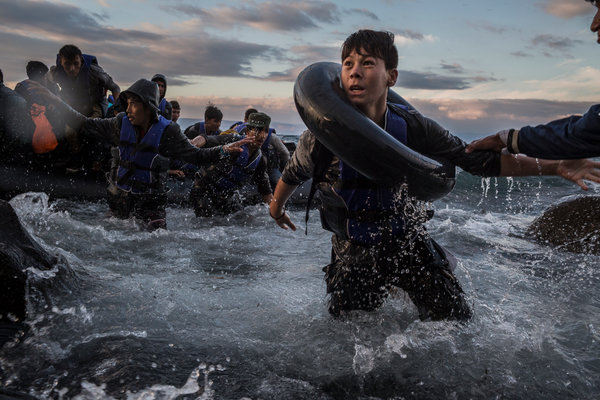
This Syrian mother and her child were rescued by the Greek Coast Guard.

The World Refugee Crisis in Brief

The Melancholy Mathematics

Like death and taxes, the poor and racism, refugees have always been with us.  But never in modern times – since the Second World War – have they been so many!

There are over sixty nine million people around the world on the move today – that have been forcibly displaced from their homes – fleeing from persecution or conflict.

This doesn’t count economic migrants who have hit the roads of sub Saharan Africa and Central America fleeing drought and crop failure, economic recession and unemployment, poverty, gangs and cartels, seeking a better life for themselves and the families in Europe or the USA.

Three quarters of a million ‘economic migrants’ are on the move in Central America, whilst the UN estimates that at least four million people have left Venezuela because of its political and economic crisis in what has been described as the biggest refuge crisis ever seen in the Americas. There are refugee camps on the Colombian border. Most are in Columbia but others have entered Brazil and Peru.  But these are not by legal definition refugees – see below, The Refugees’ Journey .

Of those sixty nine million people over 11 million or 16% are Syrians. The numbers keep growing Thirty one people at being displaced every minute of the day. In 2018 alone, 16.2 million people were newly displaced.

Forty million people have been internally displaced within their own countries – this includes six million Syrians and off our radars, some two million souls who once lived in the contested regions of eastern Ukraine.

Over 25 million are refugees in neighbouring countries and further afield. 25% of them are in Turkey, Lebanon, Iran, Pakistan, and Uganda. Some 57% of them come from three countries: Syria, 6.3 million, Afghanistan 2.6 million and South Sudan 2.4 million. The top hosting counties are Turkey 3.5 million, Lebanon, 1 million, Pakistan 1.4 million, Uganda 1.4 million and Iran 1 million.

Jordan shelters over three quarters of a million Syrians; during the Iraq wars, this relatively poor country sheltered a similar number of Iraqis, and still hosts tens of thousands of Iraqi Christians who’ve fled persecution at home.

These figures are of those registered by the UNHCR. The real numbers are much higher. The Lebanese government estimates that there are more than 1.5 million Syrian refugees in the country.

Much of the focus these days is on the Middle East – Syria and its neighbours, on Libya and the frail boats crossing the Mediterranean, on the war in Yemen which has killed over thirteen thousand and displaced over two million.

But situation in Africa is as dire.

More than 2 million Somalis are currently displaced by a conflict that has lasted over two decades. An estimated 1.5 million people are internally displaced in Somalia and nearly 900,000 are refugees in the near region, including some 308,700 in Kenya, 255,600 in Yemen and 246,700 in Ethiopia.

By August 2018, the Democratic Republic of the Congo hosted more than 536,000 refugees from Burundi, the Central African Republic and South Sudan. And yet, there are over 4.5 million Congolese people displaced inside their own country and over 826,000 in neighbouring countries, including Namibia, Angola and Kenya.

Should the present situation in Sudan deteriorate into civil war, another tide of humanity will hit the road.

And closer to home, there are millions of refugees in Asia.

As of March 2019, there are over 100, 000 refugees in 9 refugee camps in Thailand (as of March 2019), mainly ethnic Karen and Shan. Refugees in Thailand have been fleeing ethnic conflict and crossing Myanmar’s eastern border jungles for the safety of Thailand for nearly 30 years.

There were an estimated 1 million Rohingya living in Myanmar before the 2016–17 crisis, and since August 2017, an estimated 625,000 refugees from Rakhine, had crossed the border into Bangladesh.

The top-level numbers are stupendous. The detail is scary.

Some 52% of the world’s refugees and displaced are children. And many are unaccompanied. Every hour, around 20 children run for their lives without their parents to protect them.

Children are the most vulnerable to disease and malnutrition and also to exploitation and lose years of schooling. Millions are elderly and are also face health problems.

And the problems facing young people and adults are all enormous. International aid is limited and host countries often unsympathetic. Work opportunities are few, some countries even forbidding refugees to take work, whilst unscrupulous employers exploit the desperate. Migrants are often encouraged, sometimes forcibly, to return to their countries of origin regardless of whether or not it is safe for them to return. There are reports that many have returned to Syria into the unwelcoming hands of the security services.

Refugees have lived in camps and towns in Pakistan and Thailand, Namibia and Kenyan for decades. Most refugee children were not born in their parents’ homelands.

And the camps are by no means safe havens. There may be no shelter or only basic shelter in tents; no privacy; a lack of clean water; meagre food; limited medical care; and the threat of injury, disease and epidemics. They may be poor physical security and armed attacks, and abuse by the authorities and officials. There may be organized crime, shakedowns and extortion, corruption and bribery.

Families may have become separated, exposing women and children without the protection of male family members to more fear and violence. Women are subsequently vulnerable to harsh conditions, including potential sexual and physical and abuse, poor healthcare, and unequal access to food and water. They may be coping with the loss of the head of the family and with the changing roles and responsibilities that come from being the sole parent. They may not know if their male family members will return to them safely and they must deal with the stress and anxiety, the grief and loss arising from their recent experiences. They might be fearful of the future, which in a camp is unknown and unpredictable

 Australia and Refugees

Of all displaced peoples, 17% of them are being hosted in Europe. According to recent data published by the UNHCR, Germany is home to the most refugees by far in Europe – 1.4 million in total. By comparison, France and Sweden have 402,000 and 328,000 respectively, and the UK, 122,000.

Australia’s contribution to the world’s refugee problem is but a drop in the ocean. But we have a long established humanitarian refugee settlement programme for people officially recognized as refugees by the UNHCR and selected for third-country settlement in Australia.

Our humanitarian migration intake for 2016 -17 was the highest year on record. The intake of 24,162 was some 10% of our broader migration program which saw 225,941 permanent additions to the Australian population, and included the special intake of Syrian and Iraqi refugees (an estimate 12,000 places over several years).

The figures are 17,500 in 2017-18 and similar in 2018-19, whilst Scott Morrison has pledged to freeze the number of humanitarian arrivals for the next term. Under the policy there will be an overall target of 60 per cent of the offshore component for women, up from 50.8 per cent in 2017-18. The Government will also push to increase the number of refugees and humanitarian entrants being settled in regional Australia from a target of 30 per cent to 40 per cent in 2019-20, whilst insisting that new arrivals will only go to areas where there is strong community support.

 Coffs Harbour 

Coffs Harbour is one of several refugee intake towns in NSW, along with Armidale, Newcastle, Wollongong and Wagga Wagga. It’s medical and educational facilities have….

Coffs Harbour hosts several organizations dedicated to helping former refugees settle in Australia. They arrive in Australia on specific humanitarian visas and become permanent residents the moment they are admitted into the country. – and hence cease to be refugees.

SSI looks after them when they first arrive in Coffs Harbour. North Coast Settlement Services, a division of Saint Vincent de Paul Society, takes over once SSI’s work is done – after between six and eighteen months depending on a family’s needs, whilst the privately run Sanctuary organization assists settled migrants with such matters as family reunion and employment. An ancillary NSW government agency, the NSW Service for the Treatment and Rehabilitation of Torture and Trauma Survivors (STARTTS), assists new arrivals with psychological support, and particularly, the effects of PTSD. STARTTS services include counseling, group therapy, group activities and outings, camps for children and young people, English classes and physiotherapy

Settlement Services International

I spend two days a week as a volunteer with Settlement Services International, a Sydney-based community organisation that administers the Humanitarian Settlement Program (HSP) which supports refugees from the moment they arrive at the airport, provides essential support and information to assist refugees settle in Australia and empower them to gain independence and build strong connections in their new communities. SSI helps with the needs of new arrivals and the challenges of settling in a new country. Its aim is to enhance self-reliance with a focus on English language skills, education and job readiness.

SSI administers the Humanitarian Settlement Programme in several centres in regional NSW, including Coffs Harbour, Newcastle and Armidale. In all three areas, SSI has teams of staff on the ground who work with refugees, humanitarian entrants and their local communities to help new arrivals to through their initial settlement. The SSI team includes case managers and volunteers from the local community and from the refuge community itself

SSI’s work includes meeting and greeting, arranging temporary accommodation on arrival; orientation, including familiarization with Australian ways, our services and institutions, and getting around Coffs Harbour; basic official matters like Centrelink, banking, and health services; English classes at TAFE and enrolling children at schools; dealing with real estate agents, rental leases and looking after their rental properties.

 Where do our clients come from?

When first volunteering, I worked for Anglicare. New arrivals were largely from Myanmar and Congo – mostly Christians – and from Afghanistan. Many of the latter came to Australia under the “woman at risk” programme – mothers and children with no father. Whilst all are Muslim, many were Shia Hazaras, a Turkic people persecuted by the Sunni Taliban. Since SSI took over from Anglicare in September 2017, whilst Burmese and African families continue to arrive, the emphasis has been on Yazidis from Iraq and Syria, and particularly from the Yazidi heartland of Sinjar in northern Iraq, where they endured enormous suffering and hardship at the hands of the Islamic State. Considered infidels by Da’ish, they were targets of a campaign of genocide from 2014. More than five thousand were killed, and some five to seven thousand were abducted and enslaved – mainly women and children. Such was the danger that the UNHCR and the Australian and other governments took whole families straight out of the war zone rather than from camps outside Iraq.

The Yazidis

Yazidis are ethnically Kurdish, and their language, Kurmanji, is Kurdish. Their society is hierarchical and endogamous. Their religion, Yazidsm, is a monotheistic religion and has elements of ancient Mesopotamian faiths, including ancient Persian Mithraism, and some similarities to the Abrahamic religions, Judaism, Christianity and Islam. Because Yazidis believe in reincarnation and turn to the direction of the sun when praying, it has been thought – erroneously, that the religion has its origins in ancient Persian Zoroastrianism and Hinduism.  They believe in the one god, the creator of all things, who delegated the ongoing management to a heptad of seven holy beings or angels, the chief of whom is Malek Taus – the Peacock Angel.

Malek Taus has in the past been associated, by Muslims and Christians, with Iblis, Satan, and the fall of proud Lucifer. This misinterpretation has led, historically, to Yazidis being perceived as devil worshipers, and thus being subject to persecution and pogrom. The atrocities of Da’ish were only different from past assaults and massacres in their scale and longevity.

 Volunteering

Whilst case managers specifically look after the new arrivals, they depend upon a team of volunteers to assist them in a wide variety of tasks that we locals take for granted. for example: taking new arrivals them to medical or bank appointments, showing them how to use the bus network, setting up accommodation prior to arrival, minding children whilst parents attend appointments, and even helping folk to purchase use lawn mowers – there are few lawns in Iraq and Afghanistan.

As a volunteer, past and present tasks have included walkabouts to familiarize new arrivals with Coffs Harbour, accompanying clients to house inspections when seeking new rental accommodation, and assisting with rental application forms; sending important documents like birth, marriage and education certificates to Social Services’ translation service for official translations; helping clients to apply for bus concession cards, school bus cards, and children’s sport vouchers; and assisting with NBN plans and connections. I have fixed broken cupboards, replaced light bulbs, checked out washing machines and kitchen stoves. and taking families to school interviews.

As I can get by with spoken Arabic and can read and write the language, and as i am reasonably proficient with computers, I have helped with online applications and prepared resumes. I have shown clients how to budget their money, and have run a class on how to set up and use smart phone calendars to help them make and keep appointments. On occasions, I am asked to just drop in on clients to see how they are getting on, and sort any basic house problems.

My most rewarding experiences have been: assisting case managers at the airport when the clients first arrive. It’s a very emotional moment for all involved; Taking families who have never seen the sea before to the seaside; helping a clients get a job; and helping STARTTS run a youth group for children and young people by registering the young attendees

How I got into this

Since my twenties, I’ve had an interest and, indeed, a passion for the Middle East, its history and politics, its people and culture, its languages and religions. I’ve travelled often to the region, and have studied it formally and as a hobby. I learned standard Arabic in the seventies and worked in academic and government research. Though I took a very different road for two decades, I returned to Syria in the noughties and got back into Arabic  both standard and colloquial (two relatively distinct languages).

On retirement, I wanted to do volunteer work, and by happenstance, Coffs Harbour was a refugees intake town with several organizations dedicated to assisting new arrivals. At first, I used my knowledge of Arabic script to assist Farsi-speaking Afghans, and then the Iraqi and Syrian Yazidis arrived. Though their native tongue is Kurdish Kurmanji, and few could speak English, many spoke Arabic. SSI had several Arabic speaking support-workers, and some new arrivals had good English and now work as Arabic and Kurmanji speaking support staff, I am able to step in when they are already booked. Who’d ever have thought I’d be able to use and grow my Arabic in Coffs Harbour.


 The Refugees’ Journey

Who is a migrant?  Who is a refugee? Who is an asylum seeker?

Migrants

A migrant is a person who makes a conscious choice to leave their country to seek a better life elsewhere. Before they decide to leave their country, migrants can seek information about their new home, study the language and explore employment opportunities. They can plan their travel, take their belongings with them, and say goodbye to the important people in their lives. They can continue to phone friends and family, or write, email or Skype them without fear of adverse consequences. They are free to return home at any time if things don’t work out as they had hoped, if they get homesick or if they wish to visit family members and friends left behind.

People who choose to migrate for economic reasons are sometimes called “economic refugees”, especially if they are trying to escape from poverty. But they are not recognized as refugees under international law. The correct term for people who leave their country or place of residence because they want to seek a better life is “economic migrant”.

However, the displacement of people caused by such economic circumstances, or by natural disasters like flood, drought or extreme weather, can contribute towards political, social and ethnic tensions that can precipitate refugee crises. Effective and timely external assistance from neighbours and donor nations will often help to avert this. Aid is therefore provided in an effort to keep people in their homes or in their home countries.

Refugees

The 1951 United Nations Convention relating to the Status of Refugees states:

Any person who owing to a well founded fear of being persecuted for reasons of race, religion, nationality, membership of a particular social group or political opinion, is outside the country of his/her nationality and is unable, or owing to such fear, is unwilling to avail himself/herself of the protection of that country.”

Refugees are forced to leave their country because they are at risk of, or have experienced persecution. Their concerns are human rights and safety, and not economic advantage. They leave behind their homes, most or all of their belongings, family members and friends. Some are forced to flee with no warning, and may not be able to say goodbye to friends and family, and may never be able to contact or see them again.

Many refugees have experienced significant trauma or been tortured or otherwise ill-treated. Their journey to safety is fraught with hazards, many risking their lives in search of protection. They cannot return home unless the situation that forced them to leave improves.

Location is all important. During civil unrest and conflict, people may be forced to leave their homes, but do not leave their country. These internally displaced persons (IDPs) are often referred to as refugees. But, whilst refugees and IDPs may flee for similar reasons, their legal status is very different. Whilst remaining within the borders of their home countries, IDPs are legally under the protection of their own government, even in cases where the government’s actions are the cause of their flight. A person cannot be recognized as a refugee unless they are outside their home country.

Asylum Seekers

These seek protection as refugees, but their claim for refugee status has not yet been assessed. Many refugees have at some point been asylum seekers, that is, they have lodged an individual claim for protection and have had that claim assessed by a government or UNHCR.

Some refugees, however, do not formally seek protection as asylum seekers. During mass influx situations, people may be declared “prima facie” refugees without having undergone an individual assessment of their claims, as conducting individual interviews in these circumstances is generally impracticable (due the large numbers involved) and unnecessary (as the reasons for flight are usually self-evident). In other cases, refugees may be unable to access formal status determination processes or they may simply be unaware that they are entitled to claim protection as a refugee.

It is important to note that refugee status exists regardless of whether it has been formally recognized. People do not “become” refugees at the point when their claims for protection are upheld – they were already refugees, and the assessment process has simply recognized their pre-existing status. People become refugees (and are entitled to international protection and assistance) from the moment they flee their country due to a well-founded fear of persecution, as stipulated in the Refugee Convention.

What causes a person or a people to flee their home country?

 The most common causes are war and civil unrest, persecution for political or religious beliefs, or ethnic and racial identity, and human rights violations by government authorities or rogue militias. There could be extreme political instability and fighting; assassinations of people associated with certain political or social groups; arbitrary arrest and torture, mutilation and degradation that can happen without warning; routine sexual violence towards women and girls; forced conscription of child soldiers, forcing families to flee to protect their children; and conscription for slave labour. Governments are unable to protect their citizens, and may actively participate in violations, leaving people with no place or person to turn to for protection.

Often people will hang on, hoping things will improve. Flight is the last option because it means leaving everything behind – home, possessions, jobs, education, family and friends, language, culture and identity. People are often forced to flee with very little warning, no time to collect identity documents or precious things, or say farewell to family, friends and neighbours. They may have to travel long distances, often on foot or in small boats, and through dangerous territory or waters. They may go for long periods without food and water. They may become in danger of being intercepted, robbed or recruited, raped or killed, imprisoned or repatriated.

 Life in the Refugee Camps

The fortunate might reach a camp or other place of relative safety. In the camp there may be no shelter or only basic shelter in tents; no privacy; a lack of clean water; meagre food; limited medical care; and the threat of injury, disease and epidemics. They may be poor physical security and armed attacks, and abuse by the authorities and officials. There may be organized crime, shakedowns and extortion, corruption and bribery.

Families may have become separated, exposing women and children without the protection of male family members to more fear and violence. Women are subsequently vulnerable to harsh conditions, including potential sexual and physical and abuse, poor healthcare, and unequal access to food and water. They may be coping with the loss of the head of the family and with the changing roles and responsibilities that come from being the sole parent. They may not know if their male family members will return to them safely and they must deal with the stress and anxiety, the grief and loss arising from their recent experiences. They might be fearful of the future, which in a camp is unknown and unpredictable

The Role of the UNHCR

The office of the United Nations High Commissioner for Refugees (UNHCR) is mandated by the United Nations to protect refugees and help them find solutions to their plight. It has over 4,000 staff in 120 countries and an annual budget of about US$1 billion. In addition to legal protection, UNHCR now also provides material relief in major emergencies either directly or in partnership with other agencies.

Refugee protection is covered by International Human Rights Law, and this sits within a broader framework of international law. The agency responsible for the oversight of international human rights law is the Office of the United Nations High Commissioner for Human Rights (UNHCHR).

Refugees are accorded certain rights under international law, including

  • The right not to be sent back to a country where their life or freedom would be in danger
  • The right to receive public relief and welfare support at the same level as nationals
  • The right to access education and health care
  • The right to work
  • Entitlement to be issued with identity papers and travel documents

The role of the UNHCR is to

  • Safeguard the rights and wellbeing of refugees
  • Ensure that every person can exercise the right to seek asylum and find safe refuge in another country
  • Promote long-term solutions to the refugees’’ plight utilizing the options of voluntary return, local integration in the country of first asylum, or resettlement in a third country
  • Ensure that refugees are treated appropriately by countries that have signed the UN Convention
  • Ensure that refuges are given the same rights as nationals of the countries they are accepted into
  • Protect refuges from being forced to return to their home countries if it is likely they will be persecuted
  • Promote the reunification of families
  • Take into account the special needs of particular refuges classes, e.g. women and children

UNHCR’s “durable solutionsfor refugees:

  • Voluntary repatriation, the preferred long-term solution – going back to the country of origin when it is safe for them to return country. Voluntary repatriation is encouraged if it is safe and reintegration is viable. Indeed, most refuges prefer to go home as soon as circumstances permit and a degree of stability has been restored.
  • Local settlement and integration is the next preferred option – making a home in the country to which they first fled. Such local settlement may e spontaneous with new-comers establishing a new community. Integration is facilitated there are common ethnic groups or co-religionists. However, there may be a political affiliation between the government of their homeland and the country of first asylum which may lead to continued harassment and persecution.
  • Resettlement in a third country – often as a last resort, when refugees can neither return home nor remain in the country of first asylum, and are then selected by the UNHCR and sent to a third country to start a new life. Some eleven countries offer resettlement on a regular basis: Australia, Canada, Denmark, Finland, Ireland, Netherlands, New Zealand, Norway, Sweden, the UK, and the USA.

Refer: http://www.refugeecouncil.org.au/fact-sheets/international-issues/durable-solutions/

Whilst the UNHCR strives for “durable solutions”, the reality of the global refugee problem is that many countries hosting refugees embrace “non-durable” solutions such as:

  • “Warehousing” – refugees remain indefinitely in a camp where freedom of movement is restricted, basic supplies are scarce and there are few opportunities for any meaningful activity
  • Involuntary Repatriation – refugees are sent back to their country or origin while it is still unsafe. Sometimes refugees are forced back; sometimes they return because this is the “least bad option”
  • Secondary Movement – refugees themselves attempt to get to a western country in which they can lodge a claim for refugee status. This often involves clandestine travel using people smugglers and it can be very dangerous.

 Settlement and Arrival

Refugees are selected for settlement in Australia by the Department Immigration and Border Protection, in conjunction with the UNHCR. Before arriving in Australia, humanitarian entrants are required to go through security and health checks.

The Australian Cultural Orientation program (AUSCO) is provided to humanitarian visa holders who are preparing to settle in Australia. The program provides practical advice and the opportunity to ask questions about travel to and life in Australia. It is delivered overseas, before they begin their journey. The International Organization for Migration (IOM) is currently contracted to deliver AUSCO on behalf of the DIBP.

The average length of time spent in a camp or in a place of first refuge is 17 years, and migrants may have little experience beyond this. Children may not even have known their home country. Many will have experiences extreme instability and uncertainty. Being selected for resettlement can be an overwhelming experience, and can include feelings of intense elation on one hand and fear and anxiety on the other.

Under such circumstances, a person may not always be aware of the potential difficulties of resettlement. On arrival, feelings can quickly move from elation and joy to culture shock, resentment, dislocation and confusion. It can take months, years even, for new arrivals to understand aspects of their new country and adapt to it.

Much of above material is taken from:

Allende’s Desk and Osama’s Pyjamas

To rephrase Euripides, those whom the state wishes to destroy, it first demonizes.

When the president of Chile was killed in the military coup d’état that brought Augusto Pinochet to power on 9th September 1973 (yes, that first, forgotten 9/11), ex post facto justification for the bloody coup and its equally bloody aftermath was provided by the content of the drawers in the dead presidents desk. Though never corroborated, there were alleged to contain proof of an imminent communist takeover, and evidence of drug taking and black magic.

image

Cut to Panama in December 1989, and the US invasion of Panama, ostensibly to take out strongman and erstwhile ally Emmanuel Noriega. There, in the ruins of the city, was Allende’s desk. The same communist literature, the drugs, the voodoo.

Cut to Mogadishu, Somalia, December 1992. US marines led a doomed UN intervention to take out the warlord. Mohamed Farah Aideed. Enjoy the folly in widescreen in Ridley Scott’s masterful Black Hawk Down. And although the villain decamped unscathed, guess what he left behind? Yes, Allende’s desk, contents intact. Actually, the desk had transformed into a bedside table, but the contents now included, shock horror, red silk pyjamas!

Communism. Drug taking. Black magic. And the sheer, un-American decadence of red silk pyjamas. The State Department pressed the hot buttons of white, Christian US morality to garner domestic support for its military adventures. The desk never came to light after the fall of Slobodan Milosevic in 2000. No doubt the Serbian authorities kept is existence hidden.

And it was never found at Waco because it was no doubt destroyed in the fire of state retribution. But David Koresh, self-proclaimed millenarian prophet, with his apparently indoctrinated and deluded followers, his harem, and his guns, was singled out for treatment very different to that meted out to scores of likeminded and heavily armed fringe dwellers scattered across the USA. To paraphrase Colin Powell, they were demonized, they were isolated, and they were destroyed. And on prime time television too. In that land of paradoxes, few eyebrows were raised when gun-toting members of the KKK offered to assist the DFDA and FBI in their assault on the besieged compound.

When Navy SEALS swooped on Abbottabad in Pakistan to take out long-sought-after Big Bad Osama bin Laden, they took careful notes of the contents of his bookshelves. An eclectic collection of reading matter – and pornography. No kindles, no iPads, so no eBooks or ePorn, which just went to show what a tired, old, out-of-date codger he was at the end of his days. The Pentagon has yet to reveal what they found on Osama’s bedside table. Maybe that voodoo and witchcraft stuff? And Osama’s pyjamas?

Though they both bequeathed sumptuous palaces to their conquerors, Saddam Hussein and Muammar Gaddafi were both spared the indignity of their cupboards being laid bare. But they were both caught hiding in drainpipes, which may show that the restless ghost of Allende’s Desk may have be laid at last.

Rumours of the inevitable demise of current bogeymen Bashar al Assad, Vlad Putin and Abu Bakr al Baghdadi are exaggerated. And the Fat Controller of Korea is still entertaining the world with his eccentricities and imaginative executions. So what will it be? Desks or drainage. And the long arm of the law has yet to reach inside another famous public enemy’s Knightsbridge hideaway. Yet, being the on-line, wired chap that Julian is, we may be disappointed.

And so it goes, as Vonnegut’s Kilgore Trout often declaimed when mad things happened. The American way of preparing the nation and its friends for a military adventure. First select your enemy. Give him horns and a tail. The latter day manifestation of the Judeo-Christian personification of the evil Other, the Dark Side of us all, and the public swallows and follows…Because it supports their own value system, their own perception of self, their own identity, and thereby, they’re own interpretation of what is and what is not appropriate behaviour. Then, hang on for a bumpy ride!

Over to Jackson Brown:

demons

Down Under

Last Sunday, The Guardian published a delightful opinion piece by Guardian producer Madhvi Pankhania entitled ‘So long and thanks for all the flat whites: an English view of Australia’.

She began: “Recently my colleague Paul Owen shared his experiences about being an Englishman in New York, from the volatile customer service, to the way bragging is completely normal. This was after American Scott Waters FaceBook post about being won over by the England’s quaint villages where pubs are “community living rooms” went viral. I lived and worked in Sydney, Australia, for two years until this July, and I got to know its people and its outsider’s view of the rest of the world. Australians know something of the English – there are enough expats over there, and they also still have our Queen. Here’s my take on Australiana”.

I was amused and inspired enough to write a response from the land down under.

Dear Madhvi,

Seeing the title, for a moment, I thought you were writing about me. I enjoyed your article immensely, and was inspired to pen (type, really, but you know what I mean) a detailed response. Here it is, your points, one by one, and my perspective thereof in parenthesis.

1) Government policies on asylum seekers, prime ministerial cock-ups and sports achievements drive the international perception of Australia.

Sadly so, but our embarrassment of a prime minister was replaced and even though his replacement is still a Tory, it is as though a dark cloud has lifted. Politics dominates our front pages to the extent that old timers pine for the days when sport dominated the front pages. These days, it does so only when there is corruption, inappropriate behaviour or a doping scandal.

2) Don’t feel guilty about not tipping – unlike the US, businesses are responsible for paying staff decent wages and benefits, so anything extra you give doesn’t serve to prop up pay, but is a bonus. Cuts to take-home pay on weekends and public holidays, though, are a big current issue.

“Penalty rates” as we call them, on weekends and public holidays, including double-time on Sundays, are sacrosanct to unions and to those who have to work on weekends, but a shibboleth to conservatives and business who would like to see them smoothed out if not abolished.

3) Many Australians are the sons and daughters of migrants from all over the world, and have incredible stories of their journey to the country. And they’ll share these with you.

4) Australians have the gift of the gab; you can expect to hear some great stories.

5) There’s never a wrong time to strike up a conversation – the taxi driver, the barista, the dentist, the guy fixing your internet – they will ask how you are and tell you about their day. And why wouldn’t you want to hear their opinion on Tony Abbott’s latest blooper?

Yes indeed. But don’t let some people loose on issues like Muslims, asylum seekers, and immigration. We can be quite a conservative country at heart. And ironically, it is the naturalized immigrants who can be quite opposed to our “humanitarian intake” policy (Australians have a great penchant for euphemisms). And we do love a tall story. Like this one.

Number Six is missing? Was this censored or self-censored? Australians are great ones for conspiracy theories, especially those subtly alluded to above, though no here near as bad as the Americans.

7) But a word of warning, Australians can be sensitive – convict jokes will go down like a lead balloon.

8) In fact, making quips about Australia – unless you’re Australian – is a big no no.

Strange observation these. Apart from historians and politicians who like to engage in culture wars no one really thinks or cares about our convict heritage. And as for quips about Aussies, you might’ve been talking to the wrong Aussies. Generally, anyone and everything is fair game.

9) Europeans in Australia are ubiquitous. Try not to fall into the trap of only hanging out with other British people, as many others do – how else will you ask them about Peter Andre and Shane Warne?

Certainly true. There is a world of diversity here, and some great stories. See 3, 4, and 5.  As our National Anthem says, “For those who’ve come across the seas we’ve boundless plains to share”, (except if you arrive in small, leaky boats).

10) Whether it’s state, postcode, sports, media, or politics, competition between teams can fierce. Pick your side and be loyal. This is truest for contests like State of Origin – a rugby league match between states where the real prize of winning is the feeling of superiority.

We are quite a tribal bunch, and yes, irrationally loyal to our mob of choice. It’s often a bad case of “my mind is made up – don’t confuse me with the facts!”

11) In politics, even within parties, rivalries can go on for years. Prime ministers come and go, ousted by colleagues driven on by the spectre bad opinion polls. They are usually replaced by a former PM whose resentment has been bubbling for years. It’s the Dynasty of political entertainment.

12) Politics is the entertainment. Live, routine interviews with politicians’ scripted responses is considered prime time television. No one seems to get bored with impromptu press conferences, maybe because the rerun shows on other channels are about as interesting as watching paint dry. It’s either that or sports.

Indeed. Politics is our very own “blood sport”, and prime- time entertainment. And views can be quite polarized, predictable, and passionate. Virulent too – Games of Thronesy, even, but without he blood and bonking. Loyalties and hatreds linger for year – generations, evens.  Voting is compulsory DownUnder, and elections are full-on, emotional, high octane events. Election Day at the booths is one big party whilst the evening coverage of the counting, on all free to air channels, is all-night family entertainment, often filled with argument and alcohol.   

13) A politics/current affairs show is the most popular TV programme. Q&A is a politer version of a Question Time panel because why would they interrupt each other? British comedians and Greek singers are invited to make the panel more lively. And if you don’t watch it, you’ll be completely out of the loop with stories in the newspapers for the next few weeks.

Q&A is a strange beast, part current affairs, part reality TV show, loathed by the more extreme partisans of left and right, and often used as the whipping boy for conservative  politicians who would like to see the ABC abolished or owned by Rupert Murdoch. And yes, those British comedians and exotic singers often look and sound like lost extraterrestrials. But Nana Mouskouri and Joan Baez gave the oldies some sublime kumbaya moments at the end of all the partisan posturing.

14) Many politicians become big media presences. Like Clive Palmer, the Australian version of Donald Trump. He was a billionaire, says what he thinks and before he was an MP he was the owner of a dinosaur park and twerked for the public. It’s true! Some other politicians have done strange things, too, like threaten Johnny Depp’s dogs, or eat raw onions.

Queensland mining magnate Clive Palmer is a legend in his own longlunchtime, larger than life literally and figuratively. Not only was he actually elected to parliament – quite an achievement for an independent, but he formed his own party (which very rapidly disintegrated), and he donates his parliamentary salary to charity.  And yes, Tony Abbott’s onion eating was very peculiar, and the less said about Neanderthal Party deputy leader and wannabe dog killer Barnaby Joyce, the better.

15) Remember when Australia passed the law mandating plain packaging for cigarettes and another one imposing a price on carbon and people thought they were a new progressive force in the world? Now they can’t even pass gay marriage legislation, even with widespread public backing.

Relax, Madhvi. The world will be set aright. The carbon tax was abolished by the next, and now defunct prime minister, and Big Tobacco is taking us to court in Singapore to overturn the plain packaging legislation. Gay marriage will get through in the short to medium term now that the dead hand of Toney Abbott is taken off the wheel of state, but the Republic is still a long way away. Though we love Her Maj to death, and have no time for Chuck and Camilla, young and old alike are mad about Kate, Wills, George and Sophie.

16) is missing. See 13 above.

17) If you didn’t guess it yet, everyone’s really into politics.  And sport. Football is Australian Rules football (AFL), and football is soccer or A-league, rugby league is NRL. Or you could just follow the international cricket – but don’t mention this year’s Ashes.

19) Fancy learning to surf? It will only take years of practice and dedication to tame those waves – and most of the time you’ll feel like you’re drowning and being slammed against the bottom of the sea floor. And if you break surfing etiquette, you’ll feel the hard anger of professional surfers and wave police.

Sport certainly is a national religion, although we are quite ecumenical. Anything with a ball is divine, and horses, dogs and pokies are holy too.  Even politicians who hate sport are obliged to attend the various Finals and look enthusiastic about it. Serious interviews are interrupted with questions about which team they are barracking for on Saturday, or their tips on the Melbourne Cup. When one bookish state premier was filmed reading a volume from the western canon (probably Flaubert in the original French), he was ridiculed from Bendigo to Broome. Scandals, whether of substance abuse or sexual excess, are salaciously savoured with a mix of sadness and satisfaction.

20) The birds are beautiful, but why can’t they just stop squawking in the mornings and respect that you need a lie-in?

The birds are indeed amazing. They rise at five o’clock in the morning and sing, cackle or squawk all the live long day.  Bye the bye, item 21 is missing too. See 13 and 16. What was it you were not permitted to say in print? The fact that we have some of the most venomous snakes and spiders in the Universe, and some pretty mean denizens of the deep? Wouldn’t want to scare the tourists away.

22) Cockroaches will enter your home without fear, swivel their antennae and scuttle across your floor.

Yes, roaches can be very cheeky. As can fleas, ticks, sand flies, blowflies, horseflies and leeches which refuse to respect one’s personal space.

23) Queues are non-existent. Apart from when you wait to get a sandwich at lunchtime as they’re making it from fresh ingredients for every customer.

24) A sip of coffee is nectar to your lips, and even the cheap coffee is good. Some places even measure the water to the “perfect” temperature in chemistry beakers, and guys with big bushy beards hand you your flat white in the street.

Queues for good coffee are ubiquitous. Especially first thing in the morning when you crave a slug from the wonderful jug before you hit the hamster wheel. And yes, coffee here is the world’s best. Starbucks went broke in Sydney because it couldn’t compete (which is why it pays very little tax in Oz – but that, and the matter of Google, Apple, IKEA, and others paying their jus and fair share of income tax, is another story,  and another upcoming political battle).

25) A daily commute for some people is sailing past the Opera House and the Harbour Bridge, watching the occasional pod of dolphins.

And don’t forget the whales that play in Sydney Harbour, one of the most beautiful in the world.

25) People regularly sell all of their unwanted clothes and furnishings in front gardens, like an impromptu garage sale. You can go out for a walk and return with an old salad bowl.

In England, car park sales are held in, well, car parks. In Australia, garage sales are held, well, not in garages, but in front yards, and on the pavement. You can find everything that you never really wanted, from china to chainsaws, books to banana chairs, dildos to desks.

26) Cars are king of the roads and cities mainly have highways running straight through them. If you do walk in the centre of cities, the minutes spent waiting for the lights to change will feel like an eternity. Jaywalking is illegal though, so you’ll need to not let impatience get the better of you.

The car is indeed king (it was forever thus) and public transport neglected. Politicians promise public transit infrastructure, and pledge millions of dollars or our money, and all we get is roads, roads, and more roads. It could be to do with influence of the road transport and fossil fuel lobbies, but that is probably just another conspiracy theory – see 6. And yes, jaywalking is illegal and you can actually be fined in Sydney – although this is often to do with the fact that incredulous pedestrians start arguing with the enforcement officer.

27) Avocado is fresh, ripe and ubiquitous. Order it served on toast with some lemon and pepper and you will be told it’s the best brekkie in the world. It is.         28) Vegetables aren’t sold in packages of plastic. Then again, it’s just easier to eat out; Vietnamese pho is one of the great migrant dish imports.

Ah! The fruit and veggies. In abundance, but can be pricey in the wake of droughts, fires, and floods. The Thai, Arab and Turkish restaurants and cafes are great too.

29) If you get homesick, there’s a UK shelf in some supermarkets that stocks Marmite, PG Tips and Tunnocks caramel wafers

And there’s Barry’s Irish tea and Harrogate Yorkshire Tea, digestive biscuits, liquorice allsorts, and Dr Who tea pots. And of course, UK TV and BBC First channels on FOXTEL cable with a surfeit of English soaps, comedies and drama. Not to mention the History Channel’s stodgy diet of long-dead kings and queens.

30) There are English people everywhere. Most still believe they’ll move home one day.

31) There are none of the familiar comforts of high-street chain stores. No Marks & Spencer, Primark, or WH Smith. Small independent stores and restaurants do a better trade, and you tend to get better quality, individual products

And there ARE English people everywhere. And most will never go home. Why would you when this place is perfect one day, paradise the next (except for all the usual first world maladies like racism, refugees, child abuse, domestic violence, ice, corruption, inequality, and poverty). Lots of Irish people too, but the way. And Indians. Almost like home, really.

32) Anyone who’s everyone is on social media, and Instagramming every small achievement is standard … breakfast – delicious! New casual sportswear – so hot! Selfie on the beach – so amazing!

Social media is definitely full on, though no more so than in the UK, where wi fi availability is streets ahead of us. Here, it is patchy, depending on where you are, and vulnerable to political posturing and promises. We live in the bush and we are definitely the forgotten people.

33) Flying between states is the equivalent of taking a really luxurious bus.

We have forever suffered the tyranny of distance. It is a very long way between places, and whilst road trips are fun, and the scenery magical, the bush does tend to go on and on and on. Bus and train services are neglected (see 26), interminable and uncomfortable, so, unless you really like driving very long distances, flying is always the preferred option. Expensive but – it is cheaper to fly to Bali for a beano. See 44.

34) Australian slang – arvo, onya, sledge – is more fun, loose and creative than proper English, and the shortness is useful for Twitter. I remember hearing “ranga”, though, about someone with red hair and reeling at how mean it sounded. The words are good ammunition for Australian humour that laughs political correctness in the face. They laugh at everyone and everything, politicians, friends, family, but most of all you. Self-deprecation is a form of modesty, guys.

Language is fun in Oz. and yes, Madhvi, you are spot on. But I reckon the Poms are more politically-correct, particularly the liberal, middle class ones. You would never get Greek, Arab and Vietnamese comedians doing things like “Wogs out of Work” in the UK. Offensive. Off-colour (sorry about the pun). Tsk, tsk!

35) Finding a late-night drinking venue is an arduous journey that reaps few rewards. You think it’s because you’ve missed hidden spots, but no, they just don’t exist. Fun has a curfew of midnight; some Cinderellas have to go home. And no, one seedy hotel does not count as a late-night venue. What happens is that karaoke replaces real going out. Yep, it’s either that or a casino. Daytime weekend electronic music festivals also don’t count.

There is a good reason for this. Innocent people were literally getting killed on the streets at night. The “lock-out” laws have seen the level of booze-induced violence decrease dramatically. The owners of the swill palaces and 24 hour party people would dispute this, but.

36) Listening to Triple J’s Hottest 100 will keep your finger on the pulse of cool.

There is music for all tastes and passions on the dial, from hip hop to be bop, and all beats in between. Concerts by big name overseas artists require a small mortgage, however.

37) Everyone goes on about which is better – Sydney or Melbourne. What I’ll bring your attention to though, is that Brisvegas (Brisbane) has the better nickname.

Melbourne is cool, but Sydney is better. Brisvegas? Must be a Pom term. We don’t use it around here.

38) Wherever you are, you’ll have a great time commemorating Anzac Day. This national day, to mourn and respect soldiers who died at war, is when crowds come together to hoot, whoop, get steaming drunk and bet on the winner of … a coin toss.

This is the uncool picture of Anzac, our secular Christmas, Easter, Eid, and Hanukkah rolled into one. It is now a political and marketing extravaganza as people get up at dawn for the memorial services, watch the parades and the  piped bands, and endure hours of History Channel commemorations whilst Aussies young and old wonder the globe, suffering crowds and cold on the scattered battlefields of old. But folk still do get drunk and play Two Up on the “one day of the year” that it is legal.

39) The Australian way to drink beer is: on tap, all day long.

An old and increasingly inaccurate. stereotype. Wine sales overtook beer sales a long time ago. And Australian wine is world-class and reasonably priced in Sainbury’s, Tesco’s and M&S.

40) Indigenous Australians tend to be ignored on national holidays. They don’t really celebrate much – they’ve had their land stolen, their children taken, and have high suicide and incarceration rates. Many Australians do care about these issues, even though there isn’t a quick fix solution. A referendum in 2017 may give them recognition in the Australian constitution.

Yes, the indigenous Australians are still with us, contrary to the expectations of early twentieth century missionaries who endeavoured to give them comfort on their way out of this world. Our treatment of the aborigines and their present predicament is our original sin and national stain. Many care about these issues, and many don’t. Much has been done, and much still must be done. It’s a long winding road strewn with lost opportunities, good intentions, broken promises, and political expediency. But, as Martin Luther King once said, “Lord, we ain’t what we want to be; we ain’t what we ought to be; we ain’t what were gonna be, but thank God, we ain’t where we was!”

41) Most Australians aren’t racist. Not everyone is on board with the government’s hardline treatment of asylum seekers.

Most Aussies are not racists, sure, but there is a xenophobic streak that emerges in times of economic and political stress. Our divided response to asylum seekers and boat people, and Islamic terrorism shows us at our best and worst. But at most times, the better angels of our nature come to the fore.

42) Some of the vast outer suburbs of cities have thriving small communities, with kick-ass restaurants, though inner city dwellers stay away. This could be due to the hours of driving it takes just to get there. Or maybe its ruthless tribalism – a friend who grew up in Sydney said beach suburb kids weren’t too keen on “westies”, and north and south goad each other too.

43) Tasmania in winter is a dark and bleak land of no hope. The exquisite food and wine won’t be therapy enough for seeing barely any human beings. And definitely don’t visit Port Arthur in winter, unless you get a kick out of cold, austere tragedy.

We are a broad, wide land, and a diverse, multicultural society, twenty first century in many places, twentieth in others. That’s the joy of the place.

44) If you want sunset cocktails, Australians decamp to Bali over winter to spiritually revive. Or party.

Ah, to be young and free and living in Australia! But we do have a wee problem with alcohol abuse and binge drinking, and quite a bit of ancillary violence.

45) Australian women have swagger. They’re confident, powerful and words will not puncture them.

But, in Australia, there is still a toughened glass ceiling in politics and business, and two women are killed by domestic violence each week. Confident and powerful, maybe, in some places, but frustrated, exploited, vulnerable and frightened in others.

Ruins and Bones

In memory of Khaled Muhammed al Asaad, murdered by ISIS in August 2015, and of Palmyra, the ‘Pearl of the Desert’.

The past is manifest in stone, in Ruins and Bones  © Paul Hemphill 2014.

These are lands of testament and prophecy, of sacrifice and sacrament, of seers and sages, of vision and vicissitude, of warriors and holy men. The spiritual and the temporal have melded here for millennia. We see still the remnants of ancient empires and the echoes of their faiths. We chart their decline and fall in the fortunes of their monuments and their mausoleums, in the “tumbled towers and fallen stones, broken statues, empty tombs” where “ghosts of commoners and kings walk the walls and catacombs of the castles and the shrines”.

The cloud-capp’d tow’rs, the gorgeous palaces,
The solemn temples, the great globe itself,
Yea, all which it inherit, shall dissolve.
         Shakespeare, The Tempest, Act 4 Scene 1

Nothing beside remains. Round the decay
Of that colossal wreck, boundless and bare,
The lone and level sands stretch far away.
              Percy Bysshe Shelley, Ozymandias

Read also, The Rubble Of Palmyra by Leon Wieseltier, published in The Atlantic, 5th September, 2014

Palmyra (3)

Palmyra (6)

Malika Zenobia


Rebel Yell

I didn’t surrender, but they took my horse and made him surrender. They have him pulling a wagon up in Kansas I bet.
Chief Dan George, as Lone Watie in The Outlaw Josie Wales

In the winter of ’65
We were hungry, just barely alive
By May the 10th, Richmond had fell
It’s a time I remember, oh so well,
The night they drove old Dixie down.
Robbie Robertson and The Band

The Band, from The Last Waltz

I do not profess to be an expert on the subject, and being an outsider, I do not presume to preach. Nor am I a civil war tragic like some of our politicians here in Australia – they can tell you precisely who said what at what o’clock on such and such a location on this battlefield or that.

Mind you, a civil war that claimed more than seven hundred thousand American lives, tore a young nation apart, and the echoes of which reverberate still one hundred and fifty years later, is bound to exert a degree of fascination on an inquiring mind.

Recently, the dead hand of the American Civil War reached out and touched the hearts of Americans and their friends throughout the world in the wake of yet another mass shooting. This time, a young man gunned down worshippers at prayer. That the victims were folk of colour, and the shooter, a young white extremist, reopened wounds that have never really healed.

What made this massacre different from all the other massacres was the prominence of the Confederate flag in the iconography of the fresh-faced killer. The battle flag of Dixie has never gone away. It flies inThe Dukes of Hazzard, True Blood, and even The Walking Dead, and is a favoured accessory above government buildings and at right wing rallies in The South, those former secessionists states that lay south of the Mason-Dixon line

But what also makes this slaughter different from all those other slaughters is that something is actually being done about it.

Not, however a tightening of gun laws. The Second Amendment is safe and still well kept. The President mourns with the grieving relatives and congregation and breaks into song. POTUS’ rendering of Amazing Grace goes viral on You Tube. But as ever, nothing can be done. No God or mortal can stymy the U.S’ long-time love affair with the gun, nor challenge the NRA choke-hold on the American polity – particularly with the next presidential race in the starting blocks.

No, not the right to bear arms. But the rather, the right to flaunt the Stars and Bars, an enduring symbol of the lost Confederate cause, and a rallying point for those who still believe the rebel cause to be just, those who take solace from an heroic defeat, and those who believed that “the South will rise again”, and indeed those who KNOW that the South has indeed risen again. For have not the white, right wing, God fearing, Clinton-baiting, and Obama-hating ‘Red’ states of the South conquered and colonized the American political system?

Flags can unite nations. And also divide them. And none more so, it seems, than this one.  Professor Colin Tatz once said People will forget what you said. People will forget what you did. But people will never forget how you made them feel. This flag is potent symbol that spans both sides of the great divide. It is seen by many a a symbol of racism, and in the wake of the killings, there has been a loud call to remove it from public places and events. Others see it as part of their identity, of who they and their families are. They refuse to surrender it and to trade it in for Old Glory. The call has been met with with, well, dare I say it, defiance and rebellion. If you’ve got one, flaunt it – on houses, on cars, on roadsides, on Facebook posts, blogs and websites. Here are few of th m, all worth reading to place the battle flag in its social and political context:

http://www.thedailybeast.com/articles/2016/09/21/for-the-virginia-flaggers-it-s-hate-not-heritage.html

http://www.vox.com/first-person/2016/9/30/13090100/confederacy-myths-lost-cause

http://www.historynet.com/embattled-banner-the-convoluted-history-of-the-confederate-flag.htm

I do not want to editorialize here. Rather, I would like to share the following piece in the Washington Post. It is symptomatic of the intellectual and cultural reaction to tragic events. If your cannot do something positive and practical about a problem. Advocate something symbolic, politically correct, a placebo even. Like banning the film Gone with the Wind.

http://www.washingtonpost.com/news/act-four/wp/2015/07/01/why-we-should-keep-reading-gone-with-the-wind/

The past is another country. They thought things differently there: The iconic film opened with “There was a land of Cavaliers and Cotton Fields called the Old South. Here in this pretty world, Gallantry took its last bow. Here was the last ever to be seen of Knights and their Ladies Fair, of Master and of Slave. Look for it only in books, for it is no more than a dream remembered, a Civilization gone with the wind…”

So, as students of history, do we call for the suppression of an artistic rendering of the past because we feel uncomfortable with the ideas, opinions and sentiments expressed therein? If this sprawling Southern soap opera, this pseudo Shakespearean tale of love lost and found and lost again, against a backdrop of great events, is to be consigned to the oublier of history, why cease there? Why not Lawrence of Arabia? The Outlaw Josie Wales? The Searchers? Showboat?

Let’s not go there. The South will always be with us, in our thoughts, in our historical memory, in our art and literature, our books and films. It is forever on the border of our consciousness. Even when listening to our favourite music.

Take the Flag, but leave the songs alone.

Here is what the Rebel Yell sounded like:

Alison Krauss and Union Station

Paul Robeson, from Show Boat

Chet Atkins

http://www.deathandtaxesmag.com/254760/hero-rushes-through-traffic-to-rip-confederate-flag-off-truck/

.

The Spirit of ’45

I was a child of the Welfare State.

Born in the early years after the end of World War II, I was aware that the dominant mood was relief that it was over, sadness at those lost and most importantly a forward looking attitude to improve things and not simply to get back to what life had been like before. The traces of the conflict were all around me in once blitzed Birmingham – in the barren, levelled  ‘wastelands’ where streets had once stood, in the austerity, and the monotonous and monochrome drabness of couture and cuisine. To my boyish mind, “the war” was a shared community experience, a shadow which few, I now recall, talked about; but also, the stuff of puerile fantasies fostered by comic books, Airfix models, and patriotic movies that were literally and figuratively black and white.

Life was not all roses in those immediate post-war years, but better by far than what went before. Rationing was still in place when I was born in Birmingham in 1949, not ending until 1954. Young men still had to do their national service (the last call up was in 1960, the year I started Secondary school). We lived with our aunt in a cold-water, back-alley walk-up on the border of Balsall Heath (just inside Moseley, a ‘better’ suburb). Aunty Mary was my mother’s mother’s sister. When her sister died and daddy Paddy ran off with another women, Mary brought the six children over to Birmingham from Enniscorthy, County Wexford one by one. She had come to Birmingham from Ireland before the war, after her husband had run off (these things happened in Catholic Ireland). And she lived in that same old house right through the Blitz when German bombers regularly targeted The Second City’s engineering, motor and arms factories, and not a few public buildings including the Piccadilly and Waldorf cinemas on nearby Stratford Road.

I was born in her house. She had a friend who had once given birth, so that friend was the midwife. My brothers followed over the next two years. By then, National Health Service had kicked in, so they were born in hospital. Childbirth, forever dangerous, was now rendered less life threatening. There we all lived, three kids, our folks, three uncles, two aunts, a dog and a cat. Three bedrooms, girls in one, boys in another, and our family in the third. Outside loo and coal shed, no bathroom or hot water (we kids bathed in the kitchen sink and grown- ups went down to The Baths), Cold and damp, and close to the shops. And there we lived until, in 1956 when a council house in Yardley Wood became our first family home. Cold and colder running water that froze in winter, but it was at least inside the house;  bathroom with hot water boiled in a big gas boiler; and an outside flush lavatory that was nevertheless immediately adjacent to the backdoor and not down the garden. A big garden too, for winter and spring vegetables, and summer camp-outs.

There we grew, with free medical treatment for all our ailments, and free optical and dental care. I still have crooked teeth – no fancy orthodontics on the NHS – but I have all my teeth still. And my eyesight. We were educated, for free. This came in during the war with the Butler Act. So, thanks to the Welfare State, we were housed and healthy enough to get to primary school and beyond. Once there, we had free books, free pens and paper, and compulsory sport, and doctors and nurses would turn up on a regular basis to check our vitals. And thus, we were able to reach the glorious ‘sixties ready to rock ‘n roll.

Which brings me by a circuitous route to British director Ken Loach’s 2013 documentary, The Spirit of ’45,  a celebration of the radical changes that took place under the Labour government of Clement Attlee which came to power in 1945.

What a year that was! No sooner had the war ended, than the British electorate voted out its esteemed and beloved war leader, Winston Churchill, and bought Labour’s promise of a democratic socialism. Drawing on archive footage, and presented in black and white with contemporary interviews with dockers and miners, doctors and nurses, politicians and economists, Loach describes the nationalisation of the public services, and their subsequent privatisation three decades later. His interviewees provide poignant anecdotes about the poverty of the 1930s, dangerous and exploitative working conditions, poor housing, and abysmal health care, and the renewed sense of purpose and optimism after the end of the war and Labour’s landslide victory. He recounts the subsequent expansion of the welfare state, with its free to all medical service, and the nationalization of significant parts of the British economy, most notably, electricity, the railways, and the mines.

The Attlee government was elected due to a general belief that nothing would or could be as it had been before. Britain had pulled together to win the war; now, it would transform the peace. This was The ‘Spirit’ of ’45.

But whilst ‘spirit’ can imply  ‘esprit’ and elation, it can also mean ‘ghost’ insofar as Loach rages against the death of all that hope, optimism, and vision in the decades that followed.. It is a call to arms for a return to the public unity of those heady post-war years and against the policies of subsequent governments, and most particularly those of Margaret Thatcher, that have progressively demolished the Britain that Clement Attlee and Aneurin Bevan strove to build. And it is a reminder that the NHS is worth fighting for at a time when it is being progressively dismantled. With stills of modern soup kitchens and the Occupy movement camped outside St Paul’s, Loach clearly believes that Occupy inherits that spirit of ’45.

Viewing The Spirit of ’45 was exhilarating. It was full of Wow! moments. The footage of the poverty of the depression years, the slum dwellings, urchin children playing on the streets or on the slag heaps, the unemployment queues, the scavenging for coal, the Jarrow March. Diseases now preventable or eradicated, then mortal. Five in a bed, and two of them dead. Malnutrition and rickets. Bread and dripping sandwiches? You needed beef for dripping. Fat chance. It was bread and jam, thank you (and grateful for it, one was tempted to respond – there were indeed some Monty Python moments there, particularly the one-down-manship sketch “when I was a lad, we were so poor…”

Relying so heavily on memories and reminiscences, the film is nostalgic, sentimental, and simplistic even, with little in-depth analysis. A tick-a-box of the many innovations that greeted the arrival of the baby boomers. Presented in such a clear and uncluttered fashion, it was quite stirring. That is Ken Loach for you. What you see is what you get: a one-sided history lesson.

The film leaps from the Attlee government straight into the darkest days of the Thatcher government, with no discussion of the political, economic and social changes and challenges in between. The road from Clement to Maggie was an eventful and for many, a traumatic one. The Counter Revolution took decades to establish itself. The great experiment of 1945 contained the seeds of its own destruction.

Loach’s focus on the years of nationalization and privatization makes narrative and dramatic sense.

But the years in between were dramatic also. Read Dominic Sandbrook’s great quartet. The titles say it all: Never Had It So Good: A History of Britain from Suez to the Beatles; White Heat: A History of Britain in the Swinging Sixties; State of Emergency; The Way We Were: Britain 1970–1974; and Seasons in the Sun: The Battle for Britain, 1974-1979. These were best of times, these were the worst of times, as the Great Man might have said. And the worst was to come, when Britain apparently went down the gurgler, and Thatcher had to break it to fix it. And like Dr Frank’s monster, it did not quite come back together right.

The Spirit of ’45 received favourable reviews (one follows), most writers qualifying their praise with Loach’s unapologetic partisanship – he is Ken Loach, after all, and you either dig him or you don’t. My favourite film is his 1995 Spanish Civil War drama, Land and Freedom. And you most certainly don’t get a balanced view of that conflict from this. As with The Spirit of ’45, you just sit back and go for a revolutionary ride.

See also othet memories in In That Howling Infinite:

Dave Calhoun, Time Out, 11th Feb 2013

Ken Loach rarely makes documentaries, and when he does, they’re usually about an urgent topical issue, such as the 1980s miners’ strike (‘Which Side Are You On?’) or the 1990s Liverpool Dockers’ strike (‘The Flickering Flame’). On the surface, ‘The Spirit of ’45’ takes a longer view than those films. This rousing and saddening film reminds us of the air of progress and reconstruction that took hold in British politics immediately after World War II. It takes us right back to the founding of the welfare state and, with it, the nationalization of the health service, transport, energy, housing and other areas of public life, as initiated by Clement Attlee’s 1945-1951 Labour government. The faces we see at the beginning of the film of young Britons celebrating in the fountains at Trafalgar Square in May 1945 symbolize the hope of a nation: that things can only get better after six years of war.

But Loach, the director of ‘Kes’ and ‘Looking for Eric’, is equally concerned with the spirit of modern Britain. For him, the socialism of our past – of Attlee and his comrades Nye Bevan, Herbert Morrison and others – could teach the present a thing or two. And so the second part of ‘The Spirit of ’45’ ponders an altogether different mood than that in the 1940s: Thatcherism and the more recent failure of organised labour to live up to its founding principles. If ‘The Spirit of ’45’ might provoke David Cameron to raise his eyes skywards, it might also have Ed Miliband cowering behind an unwritten manifesto. Loach’s quiet, unforced position is that the left is equally guilty of abandoning the promise and passion of the post-war years.

Yet, as political essays go, this is a tender, soft and humane film. It’s a compelling mix of interviews, old and new, with archive footage, much of it from old newsreels and public information films. There’s no voice-over, just faces and voices – the voices of ageing nurses, doctors, miners, union officials and others, alongside a handful of economists and historians. Some of Loach’s arresting interviewees, like Sam Watts from Liverpool and the former Welsh miner Ray Davies, recall what poverty looked like in the 1930s, reminding us why the welfare state was necessary in the first place. Others, like a trio of nurses from Manchester and the Welsh GP Dr Julian Tudor Hart, remember the excitement and the work of the early NHS. In fact, the NHS emerges as one of the film’s chief concerns: it’s both the great survivor of the welfare state and the institution of that age currently facing the biggest threat from political decisions.

Ninety-odd minutes is not enough for this subject. There are inevitable omissions (no education, for example), and Loach makes a slightly jarring leap from a chronology of nationalization that speeds through the 1950s and ’60s to the 1979 election of Thatcher. But always apparent is his clear thesis and the infectious commitment and fervour of his interviewees. The film works all at once as a lament, a celebration and a wake-up call to modern politicians and voters.


Pity The Nation … Lebanon’s war of all against all

The Lebanese Civil War broke loose forty years ago this month. A cold war fuelled, by aggregating hostility between the Palestinian refugee community, a militarized state within a state, and their reluctant Lebanese hosts, became hot with deadly clashes between Palestinian and Maronite militias. Sects, clans, families, and the political parties and militias that gathered about them, went for their guns, the hounds of hell were loosed, and the massacres began.

In a Levantine echo of the Thirty Years War that raged through Western Europe from 1618, cities were destroyed and the countryside ravaged as armies, militias and gangsters fought over the fallen body of a divided and devastated land. Muslims fought Christians, Sunni fought Shi’a, Maronites fought Orthodox, Druze fought Muslims and Christians, Syrians fought Lebanese and Palestinians, communists fought nationalists, and Palestinians, at one time or other, fought everyone, including other Palestinians. And all changed partners and enemies in a bloody danse macabre that was at once mediaeval and mid-20th Century in its savagery.

This Hobbesian “war of all against all” drew in outsiders. Syrians, who during the course of their intervention, changed allies and adversaries as their political and strategic aims and interests mutated, and ruled the country until, implicated in the assassination of popular former prime Minister Rafik Hariri in 2005, beat an undignified retreat (whilst never quite relinquishing the levers of power). Israelis, threatened by guerrilla attacks in the Fatah land of southern Lebanon, ostensibly invaded Lebanon to destroy the Palestinian military machine, and as the midwife in the birth of the Shi’a Hezbollah, waded with eyes wide shut into a quagmire that many have viewed as their Vietnam. Americans and French, who intervened with the aim of separating the warring sides and pushing them towards a ceasefire, departed in the aftershock of Hezbollah bombs that killed hundreds of their servicemen. And United Nations Blue Berets who serve and die still in the hostile borderlands.

The war raged for the next fifteen years, staggering to an end in 1990 after claiming over 150,000 lives and destroying the lives of tens of thousands of others, including over 100,000 permanently handicapped. Nearly a million souls fled their homes, and some 76, 000 remain displaced to this day, now forgotten in the midst of the new and greater Syrian diaspora, whilst tens of thousands emigrated permanently. There are still some 17,000 “disappeared” who may be either still in Syrian or Lebanese jails, or more likely, in one of hundreds of unmarked graves scattered across this tiny country.

There are no memorials, no cenotaphs, no national commission to trace the missing, and no Madiba to gather and reconcile the sundered tribes. Just memories of what those who endured call “the events”, and for some, a selective amnesia. A harrowing half-life endures, sleeping embers constantly being fanned to life by the ill winds that blow across the porous frontier with Syria and the iron curtain that separates Hezbollah from Israel. It said that old wars beget future wars. And in no land can this be more of a self-fulfilling prophecy if the Gods Of War have their way.

As well they might as the legacy lives on in the rise and rise of Hezbollah, a non-state that is stronger than the state. In the use of car bombs, suicide bombers, foreign hostages, and human shields as canny weapons in what we now call asymmetrical urban warfare. In the destruction of the Palestinians’ once formidable military muscle, now quarantined in the Gaza ghetto and the impotent Palestinian Authority. In remembrance of the massacres of Sabra and Shatilla that still haunt Israeli and Palestinian dreams, when Yasser Arafat decamped for Libya with his army and left his people at the mercy of the Phalange militia. The Palestinians are still in Lebanon, still yearning for their terra irredenta in the south.

And in Lebanon redux, some say the old hatreds linger still and could rekindle the fires of war. Others hope that a younger generation do not take the road to perdition travelled by their elders. Armed young men in Sunni Tripoli and in Beirut’s Shi’a suburbs, and fighting in Syria may disagree. Calmer countries chart their fortunes with the rise and fall of their financial indices, whilst Lebanese can check the political weather by watching the market price of hand-guns and Kalashnikovs. They may have buried the hatchets, but many know where they are buried.

The roots and fruits of the Lebanese civil war are myriad and complex. The redoubtable journalist Robert Fisk unravels them best in his tombstone of book, Pity The Nation. Read it and weep. For it is a bloody saga of trial and treachery, of enmity and endurance, of courage and cravenness, but most of all, of infinite sadness. And none more so than when he writes of a Lebanese doctor, Amal Shamaa: “I had to take the babies and put them in buckets of water to put out the flames. When I took them out half an hour after, they were still burning. Even in the mortuary, they smouldered for hours”. “Next morning”, Fisk continues, “Amal Shamaa took the tiny corpses out of the mortuary for burial. To her horror, they again burst into flames”. Such is the effect of phosphorous shells on mortal flesh.

The title of Fisk’s book is that of a poem written in 1931 by Khalil Gibran, Lebanon’s most celebrated poet, a poem that was both a prophetic testament and a testimony of times to come: “Pity the nation divided into fragments, each fragment deeming itself a nation”.

Pity the nation that is full of beliefs and empty of religion.
Pity the nation that wears a cloth it does not weave
and eats a bread it does not harvest.

Pity the nation that acclaims the bully as hero,
and that deems the glittering conqueror bountiful.

Pity a nation that despises a passion in its dream,
yet submits in its awakening.

Pity the nation that raises not its voice
save when it walks in a funeral,
boasts not except among its ruins,
and will rebel not save when its neck is laid
between the sword and the block.

Pity the nation whose statesman is a fox,
whose philosopher is a juggler,
and whose art is the art of patching and mimicking

Pity the nation that welcomes its new ruler with trumpeting,
and farewells him with hooting,
only to welcome another with trumpeting again.

Pity the nation whose sages are dumb with years
and whose strongmen are yet in the cradle.

Pity the nation divided into fragments,
each fragment deeming itself a nation.

Kahlil Gibran, The Garden of The Prophet (1933)

ارحم على الامة
ارحم على الأمة المليئة بالمعتقدات والخالية من الدين.
ارحم على الأمة التي تلبس ثوبا لا يحاك.
وتأكل خبزا لا تحصد.
أشفق على الأمة التي تعتبر المتنمر بطلاً ،
ويعتبر منتصرها رائعا.
ارحم أمة تحتقر الشغف في أحلامها
لكنه يخضع لها عندما تستيقظ.
ارحم على الأمة التي لا ترفع صوتها
إلا عندما تمشي في جنازة ،
وتفتخر فقط بين أطلالها ،
ولن تنقذ نفسها عندما توضع رقبتها
بين السيف والكتلة.
ارحم على الأمة التي فيها رجل الدولة وهو ثعلب ،
والفيلسوف مشعوذ
فنه من الترقيع والتقليد
ارحم على الأمة التي تستقبل حاكمها الجديد بصوت عالٍ ،
ويقول وداعا له بسخرية ،
فقط للترحيب بآخر من خلال الاحتفال الصاخب مرة أخرى
ارحم على أمة حكماؤها أغبياء السنين ،
وأولئك الذين لا يزال رجالهم الأقوياء في المهد.
ارحموا الأمة منقسمة ،
وكل قطعة تعتبر نفسها أمة.

خليل جبران

Muslim gunmen clash with right-wing Phalange militiamen outside the Phoenicia Intercontinental hotel in Beirut, December, 1975.

© Paul Hemphill 2015. All rights reserved.

http://dailystar.com.lb/News/Lebanon-News/2014/Apr-12/253085-decades-on-lebanon-still-struggles-to-heal-war-wounds.ashx
http://en.m.wikipedia.org/wiki/Pity_the_Nation

Messianic Carpet Rides

When it comes to stories about The Middle East, I am reminded of the Bobster’s closing lines in the wonderful ‘Black Diamond Bay’: “Seems like every time you turn around, there’s another hard-luck story that you’re gonna hear”. Anyhow, getting away from all the doom and gloom, here is something completely different.

Our recent visit to Jerusalem inspired several posts on this blog, and several songs. One of the latter, published below, examines the Jerusalem Syndrome.

This is a group of mental phenomena involving the presence of either religiously themed obsessive ideas, delusions or other psychosis-like experiences that are triggered by a visit to the city of Jerusalem. It is not exclusive to one particular religion or denomination, having affected Jews, Christians and Muslims from many different countries and backgrounds.

Jerusalem is all about faith and passion, and there is no city on Earth that people get more passionate about. The light is luminous. In high summer it almost shimmers. The very air is full of prayer and politics, passion and pain, and the rocks and stones virtually sing a hallelujah chorus of history. I am not a religious person, but I cannot help getting excited by the place – although I do not transcend to transports of delight and delirium.

In The Simpsons episode The Greatest Story Ever D’ohed, the Simpsons travel to Israel where Homer is afflicted with the syndrome, the illness and its effect on Homer being one of the plot’s central themes. In The X-Files episode Revelations, agents Scully and Mulder try to subdue a man afflicted with a form of the syndrome.

Homer in the Mosque

The featured photograph at the head of this blog is a real-life version of the above Simpsons picture.  The man at centre stage is Carl James Joseph of Detroit, Michigan, ‘The Jesus Guy’ we encountered in the Church Of The Holy Sepulchre. He has been a common sight around the Old City for many years now.j

Of all the cities in the world, why Jerusalem?

“ The Arabs call the city ‘Al Quds’, “The Holy’. It was deemed sacred from pre-history. Those aforementioned iconoclast scholars suggest that Jerusalem was actually the holiest place in Islam, and that like Islam itself and the Prophet, Mecca and Medina were retrofitted to suit the conqueror’s narrative. A city of the mind as much as of this earth, it haunts the prayers and dreams of three faiths, and to this this day, it is coveted and contested. “The air above Jerusalem”, wrote Israeli poet Yehuda Amichai, “is filled with prayers and dreams, like the air above cities with heavy industry. Hard to breathe”. Arthur Koestler wrote: “The angry face of Yahweh is brooding over the hot rocks which have seen more holy murder, rape and plunder than any other place on earth”. Perhaps it is because Jerusalem is mankind’s number one hot spot! “There’s this thing that happens here, over the hell mouth”, says Buffy, “where the way a thing feels – it kind of starts being that way for real. I’ve seen all these things before – just not all at once”. More Jews have probably died violently in Jerusalem than in the Holocaust. And countless folk of other faiths have likewise perished”.  From A Brief History Of The Rise And Fall Of The West by Paul Hemphill

A lot of folk put a lot of energy into mattters millenarian, when they could divert it to more practical matters like health, water, human rights, blah, blah blah… Some diligent souls have constructed a 3D virtual second temple as a template for its reconstruction. And they don’t care if they start a world war to get it built. Others strive to create a Caliphate that will precipitate the long foretold great battle at The End of Days. And yet others are endeavoring to recreate Noah’s Ark in Kentucky, USA. Different tribe, same psychosis. Never underestimate the irrational mind. For such is the power of myth and magic even in this techno day and age. More blood has been shed in and for Jerusalem than any other city on earth, and we ain’t done yet!

The Jesus Guy

O Jerusalem!

Sound the trumpets of Zion to summon forth the saints.
From The Song of Solomon

O Jerusalem!
I never thought that faith could be so strong!
Ah, Jerusalem!
I never knew that faith could be such fun!

It’s something you don’t do at home.
It happens in Paris and Rome.
The fevered faithful’s illusion
That causes such holy confusion.
Scully and Mulder have fought it,
Homer Simpson has caught it
In Jerusalem.

Bear me up on angels wings
And other transcendental things.
Cradle me in Jesus’ arms,
Far from home but safe from harm.
Where the Golden Walls still glow,
Let my people go
To Jerusalem.
Never knew that faith could be so strong!
O Jerusalem,
Never knew that faith could be such fun!

Filipinas in a row harmonizing with “Swing Low
Sweet Chariot”.
Charismatic holy clown roams the alleys of the town,
Says he’s hunting down Iscariot.
Pentecostal Germans heard
Their pastor preach the Holy Word.
Drab babushkas clutch their crosses,
Eastern priest in black now blesses
Those who lie with arms out swept
On the rock where Jesus wept,
In Jerusalem.
Never knew that faith could be so strong!
O Jerusalem,
I want whatever they are on!

See that women dressed so plain, thinks she’s
Mary Magdelene
Waiting just beyond the Tomb for her Lord
To come again.
Is he not already here? Don’t you see him
Over there?
In his robe of woven wool, sandals, beard,
And flowing hair.
There’s lady known to me
Who would make a cup of tea
And take it to Mount Scopus every morning
To give to Christ when he returned in glory –
I tell you, I’m not making up this story!
Its Jerusalem!
I never knew that faith could be such fun!
O Jerusalem!
I want whatever they are on!

Sometimes in morning dreams, I see
The Holy City in front of me:
Forever and ever, and world without end,
We all need an invisible friend
In Jerusalem.

© Paul Hemphill 2014 All rights reserved

Mary Magdelene

Need to know more about the Jerusalem Syndrome?  Read: http://en.m.wikipedia.org/wiki/Jerusalem_syndrome

But the article reproduced below by Chris Nashawaty is much more entertaining.

See also the following article about ‘The Jesus Guy’:

http://www.dailymail.co.uk/news/article-2525844/The-Jesus-guy-Bearded-man-familiar-sight-Jerusalem-wearing-robe-carrying-cross-revealed-Detroit-preacher.html

And this recent piece in Ha’Aretz:

http://www.haaretz.com/israel-news/.premium-1.708900

Jerusalem Syndrome? Tourist Goes Treasure Hunting in Old City Cave

Nir Hasson Ha’Aretz Mar 15, 2016

image

Zedekiah’s Cave is a remnant of what was the largest quarry in Jerusalem that dates back to at least Second Temple times. Daniel Bar-On

An American tourist was arrested last week after spending the night in Zedekiah’s Cave, also known as Solomon’s Quarries, which lies under the Muslim Quarter of Jerusalem’s Old City.

Last Thursday afternoon, when the site was open to the public, the 19-year-old entered the cave carrying a backpack. When closing time came, he hid in one of the crevices of the cave and the security people did not notice him as they checked the site before closing. He was there overnight and started digging in various sections of the cave, apparently seeking to find some of the treasures that various legends say have been buried there over the centuries.

While the cave is usually closed on Fridays, last Friday it was opened to do some development work. The workers found the tourist in the cave covered with mud, his backpack full of stones and shards that he’d dug up from the floor of the cave. He was handed over to police and his findings were confiscated.

During questioning the young man could not explain his motives for what he did. Police said he apparently has emotional problems and may have contracted the so-called Jerusalem Syndrome, a phenomenon involving religious obsessions or other psychosis-like experiences seemingly triggered in some people by visiting Jerusalem. He was released and has since left the country.

Zedekiah’s Cave is a remnant of what was the largest quarry in Jerusalem that dates back to at least Second Temple times. It covers some nine dunams (two and a quarter acres), with an entrance between the Old City’s Damascus Gate and Herod’s Gate. Over the years a number of legends and traditions have sprung up involving the cave. The Jewish tradition is that King Zedekiah tried to flee through the cave during the destruction of the First Temple.

A later Muslim tradition identifies the cave as “the cave of Korah,” the place where the biblical Korah and his allies were swallowed up by the earth when they tried to revolt against Moses.

In 1968 a resident of the Old City claimed that his grandfather had hidden three crates of gold coins in the cave before the War of Independence. He asked permission to search for the crates using signs his grandfather had left him and promised in return to give three-quarters of the treasure to the authorities. He was given permission to search but found nothing.

The cave also serves as a ceremonial site for the Freemasons from the 1920s to this day. The Freemasons revere the place, believing it to have been the site from which the stones for the First Temple were quarried. Since the 1980s the cave is operated by the East Jerusalem Development Corporation as a tourist site, and events are held there from time to time.

The Jerusalem Syndrome: Why Some Religious Tourists Believe They Are the Messiah
Chris Nashawaty, Wired, 17th February 2012

Shortly after his 40th birthday, the life of a man we’ll call Ronald Hodge took a strange turn. He still looked pretty good for his age. He had a well-paying job and a devoted wife. Or so he thought. Then, one morning, Hodge’s wife told him she no longer loved him. She moved out the next day. A few weeks later, he was informed that his company was downsizing and that he would be let go. Not knowing where to turn, Hodge started going to church again.

Even though he’d been raised in an evangelical household, it had been years since Hodge had thought much about God. But now that everything seemed to be falling apart around him, he began attending services every week. Then every day. One night, while lying in bed, he opened the Bible and began reading. He’d been doing this every night since his wife left. And every time he did, he would see the same word staring back at him—the same four syllables that seemed to jump off the page as if they were printed in buzzing neon: Jerusalem. Hodge wasn’t a superstitious man, he didn’t believe in signs, but the frequency of it certainly felt like … something. A week later, he was 30,000 feet over the Atlantic on an El Al jet to Israel.

When Hodge arrived in Jerusalem, he told the taxi driver to drop him off at the entrance to the Old City. He walked through the ancient, labyrinthine streets until he found a cheap hostel near the Church of the Holy Sepulchre. He had a feeling that this was important. Supposedly built on top of the spot where Jesus Christ was crucified and three days later rose from the dead, the domed cathedral is the holiest site in Christendom. And Hodge knew that whatever called him to the Holy Land was emanating from there.

During his first few days in Jerusalem, Hodge rose early and headed straight to the church to pray. He got so lost in meditation that morning would slip into afternoon, afternoon into evening, until one of the bearded priests tapped him on the shoulder and told him it was time to go home. When he returned to his hostel, he would lie in bed unable to sleep. Thoughts raced through his head. Holy thoughts. That’s when Hodge first heard the Voice.

Actually, heard is the wrong word. He felt it, resonating in his chest. It was like his body had become a giant tuning fork or a dowsing rod. Taking a cue from the sign of the cross that Catholics make when they pray, Hodge decided that if the vibrations came from the right side of his chest, it was the Holy Ghost communicating with him. If he felt them farther down, near the base of his sternum, it was the voice of Jesus. And if he felt the voice humming inside his head, it was the Holy Father, God himself, calling.

Soon, the vibrations turned into words, commanding him to fast for 40 days and 40 nights. None of this scared him. If anything, he felt a warm, soothing peace wash over him because he was finally being guided.

Not eating or drinking came easily at first. But after a week or so, the other backpackers at his hostel began to grow concerned. With good reason: Hodge’s clothes were dirty and falling off of him. He had begun to emit a pungent, off-putting funk. He was acting erratically, hallucinating and singing the word Jesus over and over in a high-pitched chirp.

“Jesus … Jesus … Jesus …”

Hodge camped out in the hostel’s lobby and began introducing himself to one and all as the Messiah. Eventually, the manager of the hostel couldn’t take it anymore. He didn’t think the American calling himself Jesus was dangerous, but the guy was scaring away customers. Plus, he’d seen this kind of thing before. And he knew there was a man who could help.

Herzog Hospital sits on a steep, sun-baked hill on the outskirts of Jerusalem. Its sprawling grounds are dotted with tall cedars and aromatic olive trees. Five floors below the main level is the office of Pesach Lichtenberg, head of the men’s division of psychiatry at Herzog.

Lichtenberg is 52 years old and thin, with glasses and a neatly trimmed beard. Born into an Orthodox Jewish family in Crown Heights, Brooklyn, he moved to Israel in 1986 after graduating from Albert Einstein College of Medicine in the Bronx and has worked at Herzog more or less ever since. It’s here that he has become one of the world’s leading experts on the peculiar form of madness that struck Ronald Hodge—a psychiatric phenomenon known as Jerusalem syndrome.

On a bright, late summer morning, Lichtenberg greets me in the chaotic lobby of the hospital, smiling and extending his hand. “You missed it!” he says. “We had a new Chosen One brought into the ward this morning.” We go down to Lichtenberg’s office; on top of a bookcase is a giant shofar, a curved ram’s horn that religious Jews sound on the high holidays. A middle-aged British man under the doctor’s care had used it to trumpet the Messiah’s—that is to say, his own—coming. Lichtenberg explains that allowing me to meet his latest patient would violate hospital policy, and he can’t discuss ongoing cases. He’ll talk about past patients as long as I agree to de-identify them, as I did with Hodge. “But,” he adds, “that doesn’t mean we can’t try to find a messiah of our own. In a few days, we’ll take a walk around the Old City and maybe we’ll find one for you there.”

There’s a joke in psychiatry: If you talk to God, it’s called praying; if God talks to you, you’re nuts. In Jerusalem, God seems to be particularly chatty around Easter, Passover, and Christmas—the peak seasons for the syndrome. It affects an estimated 50 to 100 tourists each year, the overwhelming majority of whom are evangelical Christians. Some of these cases simply involve tourists becoming momentarily overwhelmed by the religious history of the Holy City, finding themselves discombobulated after an afternoon at the Wailing Wall or experiencing a tsunami of obsessive thoughts after walking the Stations of the Cross. But more severe cases can lead otherwise normal housewives from Dallas or healthy tool-and-die manufacturers from Toledo to hear the voices of angels or fashion the bedsheets of their hotel rooms into makeshift togas and disappear into the Old City babbling prophecy.

Lichtenberg estimates that, in two decades at Herzog, the number of false prophets and self-appointed redeemers he has treated is in the low three figures. In other words, if and when the true Messiah does return (or show up for the first time, depending on what you believe), Lichtenberg is in an ideal spot to be the guy who greets Him.

“Jerusalem is an insane place,” one anthropologist says. “It overwhelms people.”

While it’s tempting to blame the syndrome on Israel’s holiest city, that wouldn’t be fair. At least, not completely. “It’s just the trigger,” says Yoram Bilu, an Israeli psychological anthropologist at the University of Chicago Divinity School. “The majority of people who suffer from Jerusalem syndrome have some psychiatric history before they get here.” The syndrome doesn’t show up in the Diagnostic and Statistical Manual of Mental Disorders, but it and its kissing cousins are well-known to clinicians. For example, there’s Stendhal syndrome, in which visitors to Florence are overwhelmed by powerful works of art. First described in the early 19th century in Stendhal’s Naples and Florence: A Journey from Milan to Reggio, the disorder can lead to spontaneous fainting, confusion, and hallucinations. Paris syndrome, first described in 1986, is characterized by acute delusions in visitors to the City of Light and for some reason seems to preferentially affect Japanese tourists. Place, it seems, can have a profound effect on the mind.

What’s actually happening in the brain, though, isn’t completely clear. Faith isn’t easy to categorize or study. Andrew Newberg, a neuroscientist at Thomas Jefferson University in Philadelphia, has conducted several brain-imaging studies of people in moments of extreme devotion. The limbic system, the center for our emotions, begins to show much higher activity, while the frontal lobes, which might ordinarily calm people, start to shut down. “In extreme cases, that can lead to hallucinations, where someone might believe they’re seeing the face of God or hearing voices,” Newberg says. “Your frontal lobe isn’t there to say, ‘Hey, this doesn’t sound like a good idea.’ And the person winds up engaging in behaviors that are not their norm.”

SHE WOULD RUB HER TEMPLES, DESPERATE TO DIAL IN THE VOICE OF GOD LIKE SOMEONE TRYING TO TUNE IN A FAR-OFF RADIO STATION.
The psychosis typical of Jerusalem syndrome develops gradually. At first the victim may begin to feel symptoms of anxiety, nervousness, and insomnia. The next day, there may be a compulsive urge to break away from the rest of the tour group and visit holy places like the Church of the Holy Sepulchre or the Church of the Nativity in Bethlehem. Sufferers might follow this with a series of purification rituals such as shaving all of their body hair, clipping their nails, or washing themselves free of earthly impurities. The afflicted may then venture into the Old City to shout confused sermons claiming that redemption is at hand. In some cases, victims believe they are merely a cog in an ineffable process, helping to set the stage for the Messiah’s return with some small task they’ve been given. In more extreme cases, they can be swept up by psychotic delusions so intense, so ornate, that they become convinced they are Jesus Christ. “Jerusalem is an insane place in some ways. It overwhelms people, and it has for centuries,” Bilu says. “The city is seductive, and people who are highly suggestible can succumb to this seduction. I’m always envious of people who live in San Diego, where history barely exists.”

In other words, what you can blame Jerusalem for is looking like, well, Jerusalem. The Old City is a mosaic of sacred spaces, from the al-Aqsa Mosque to the Western Wall of the Temple Mount to the well-trodden stones on which Jesus supposedly walked. Like every city, it’s the combination of architecture and storytelling that makes Jerusalem more than just a crossroads. Great cities, the places that feel significant and important when you walk their streets, always rely on stagecraft—a deftly curving road, finely wrought facades, or a high concentration of light-up signage can all impart a sense of place, of significance. This architectural trickery can even instill a feeling of the sacred. The colonnades around St. Peter’s Square at the Vatican, the rock garden at Ryoanji temple in Kyoto, and the pillars at the Jamarat Bridge near Mecca all shoot laser beams of transcendence into the brain of a properly primed visitor. “Part of the experience of going to these places is the interweaving of past and present,” says Karla Britton, an architectural historian at the Yale School of Architecture. “There’s a collapse of time. And for some people who visit these sacred sights and spaces, this collapse can be psychologically disorienting. The whole act of pilgrimage is deliberately intended as a kind of disorientation.”

That in and of itself doesn’t make someone crazy. “There are a lot of people who come to Israel and feel God’s presence, and there’s nothing wrong with that,” Lichtenberg says. “That’s called, at the very least, a good vacation. God forbid a psychiatrist sticks his nose into something like that.” He smiles and rubs his beard. “But the question is, at what point is belief OK and at what point is it not OK? If someone says, ‘I believe in God,’ OK. And if they say, ‘I believe the Messiah will come,’ fine. And if they say, ‘I believe His coming is imminent,’ you think, well, that’s a man of real faith. But if they then say, ‘And I know who it is! I can name names!’ you go, wait a second—hold on!”

When people with Jerusalem syndrome show up at the hospital, doctors often just let them unspool their stories, however strange the narratives may seem. If the people aren’t dangerous, they are usually discharged. Violent patients might be medicated and kept under observation pending contact with their family or consulate. After all, the most effective treatment when it comes to Jerusalem syndrome is often pretty simple: Get the person the hell out of Jerusalem. “The syndrome is a brief but intense break with reality that is place-related,” Bilu says. “When the person leaves Jerusalem, the symptoms subside.”

Lichtenberg didn’t know any of this when he started at Herzog. Then, shortly after he began his residency in the late 1980s, he met a 35-year-old Christian woman from Germany. She was single and traveling alone in Israel. He remembers her as being gaunt, prematurely gray, and highly educated. The police had picked her up in the Old City for badgering tourists about the Lord’s return. “She arrived in a state of bliss because she believed the Messiah was coming,” Lichtenberg says. “I probably thought, she’s just meshuggeneh.”

Over the next few days, Lichtenberg underwent a transformation of his own. He became obsessed with the German woman’s case. He thought about how she would ricochet from periods of giddy rapture to moments of outright hostility and confusion. During her more manic moments, she wanted to share the Good News with the doctor. In her more depressive ones, she wandered the psychiatric ward desperately trying to hear the voices in her head that had gone momentarily silent. She would rub her temples as if she could dial in the voice of God, like someone trying to tune in a far-off radio station.

The woman stayed at the hospital for a month, until the doctor could arrange for her to be sent home. Lichtenberg has no idea what happened to her after she returned to Germany, but more than 20 years later he can still recall the smallest details of her case. “It was so interesting talking to her, but I was also a little embarrassed because there was no one at the hospital to encourage that sort of thing back then. At the time, the thinking here was more like, OK, what dosage is she getting? Should we increase it?”

This way of thinking is more sympathetic than many psychiatrists would call for. Actually, it wasn’t that long ago that one respected Israeli physician put two patients who both claimed to be the Messiah in a room together just to see what would happen. Each rabidly accused the other of being an impostor, barking fire-and-brimstone threats.

“People come to Israel and feel God’s presence,” Pesach Lichtenberg says. “There’s nothing wrong with that.”

Self-styled prophets have been journeying to Jerusalem on messianic vision quests for centuries. A certain Nazarene carpenter was merely the most charismatic and most written about. But it wasn’t until the 1930s that an Israeli psychiatrist named Heinz Herman clinically described Jerusalem syndrome for the first time. One of his early cases involved an Englishwoman who was so convinced the Second Coming was at hand that she climbed to the top of Jerusalem’s Mt. Scopus every morning with a cup of tea to welcome the Lord.

Most cases are harmless, but there have been disturbing exceptions. In 1969 an Australian tourist named Denis Michael Rohan was so overwhelmed by what he believed to be his God-given mission that he set fire to the al-Aqsa Mosque, one of Islam’s most sacred sites, which sits atop the Temple Mount directly above the Wailing Wall. The blaze led to rioting throughout the city. Rohan later said that he had to clear the site of “abominations” so it would be cleansed for the Second Coming. (The mosque was rebuilt by a Saudi construction company owned by Osama bin Laden’s father.)

More recently, an American man became so convinced he was Samson that he tried—and failed—to move a block of the Wailing Wall. An American woman came to believe she was the Virgin Mary and went to nearby Bethlehem to search for her baby, Jesus. And a few years ago, the Israeli press reported on a 38-year-old American tourist who, after spending 10 days in Israel, began roaming the surrounding hills muttering about Jesus. Shortly after being hospitalized, he jumped off a 13-foot-high walkway near the emergency room, breaking several ribs and puncturing his lung.

Lichtenberg says that during times of uncertainty and conflict (not infrequent in Israel), admissions to his ward spike. For example, in late 1999, when the rest of the world quaintly panicked about the Y2K bug and whether they’d be able to use their ATMs on January 1, Israel was on high alert, afraid that deranged religious crazies would flock to Jerusalem in anticipation of a millennial apocalypse. At the peak, five patients a week were brought into Lichtenberg’s ward. The country’s defense forces were concerned that someone would try to blow up the al-Aqsa Mosque, finishing the job Rohan started 30 years earlier.

One of the patients brought into Herzog at the time was an old man who sold novelty wooden back-scratchers near Lichtenberg’s home. The doctor knew him. He also knew that the man firmly believed he was King David. “Was he psychotic? Yeah, OK,” the doctor says with a shrug. “But I didn’t see any need to keep him. Unfortunately, he passed away recently. Otherwise, I would have loved for you to meet him. He would have been happy to talk to you.”

At 9 the next morning, the doctor and I are walking the narrow streets of the Old City. It seems like a good way to conduct an interview, outside the sterile confines of the hospital. Plus, we are still hoping to meet a messiah.

The scents of cumin and turmeric and cardamom are so overwhelming that my eyes begin to water. And even though the doctor has lived in Jerusalem for 25 years, his sense of direction in the winding alleys of the Muslim Quarter seems sketchy at best. After several embarrassing wrong turns and switchbacks, we find ourselves standing face-to-face with an Arab butcher skinning a goat that hangs on a giant rusty hook. We detour left down a dark passageway and nearly crash into a dozen elderly Italian women dressed in the black clothes of mourning, carrying a 6-foot wooden cross on their hunched backs. They’re huddled together like a rugby scrum, chanting in Latin as they take plodding steps along the Stations of the Cross, reenacting Jesus’ bloody march to his crucifixion.

We move aside to let them slowly pass. Neither one of us says a word. And as soon as they turn the corner and disappear from view, he turns to me. “I’ve got chills. Do you?”

I have to admit I do.

The doctor asks me to try to describe what I’m feeling as if I am one of his patients, and I stammer a response about going to Sunday School as a kid and the thick smell of incense I remember at Easter Mass at my father’s Syrian Orthodox church. But, really, as soon as I try to put the sentiment into words, the chills subside and trickle away.

This is essentially what happened to the patient I’ve called Ronald Hodge. After a month of taking antipsychotic drugs under Lichtenberg’s care at Herzog, he gradually came to accept the hazy reality of what he’d been through. He was still confused, but he was calmer, more cooperative, and he no longer felt voices thrumming through his body. The American consulate arranged for his discharge and put him on a flight back to the States. He went back to his old life.

Lichtenberg and I come to the Church of the Holy Sepulchre. Inside the entrance is the Stone of Unction, symbolizing the spot where Jesus’ body was anointed and wrapped in a shroud after he was taken down from the cross. Men are kneeling with lit candles. Women are kissing the stone and running their rosaries along the top of it. Many are crying. It’s profoundly moving.

We head east toward the Wailing Wall. There, rows of men dressed in black and wearing sidecurls are rocking back and forth as they pray. Lichtenberg grows quiet and slowly approaches the wall, rubbing his hand on one of the giant stones. He leans forward and softly kisses it. After a few minutes, he looks around and says, “No messiahs here today. Sorry.” He seems honestly apologetic.

Later, over a cold drink, Lichtenberg confesses that he sometimes views his patients with less-than-scientific eyes. “I guess when someone comes into the hospital claiming to be the Messiah, my interest is not just clinical,” he says. “Sometimes you can see right away that the patient isn’t the charismatic type. They’re just a sick patient. But, OK, yes, I’ll admit it. There have been a number of people over the years who managed to arouse a certain hope that, hey, wouldn’t it be great if this person really is the One? So far I’ve been disappointed. But you never know who will walk through that door tomorrow.” His cell phone buzzes on the table. He’s needed back at Herzog.

As Lichtenberg walks off toward the hospital, the drone of the muezzin’s call to prayer crackles and hisses over a loudspeaker. The hairs on the back of my neck stand up. Is this the strange power of Jerusalem? Or just the result of an overactive limbic system? It feels deeper than that—more holy. But then again, what is deeper than neurochemistry?

Chris Nashawaty (chris_nashawaty@ew.com) is a senior writer at Entertainment Weekly.
http://www.wired.com/2012/02/ff_jerusalemsyndrome/all/

John Cleverley’s Long March

In memoriam for our old friend, scholar, wise man, and neighbour of 20 Watkin Street.

John Cleverley was a stalwart of many battles with Council, and indeed, with any overbearing and presumptuous authority. At his funeral service, his brother told the story of how his dad sent him to participate in the school nativity play dressed not in shepherd garb, but in the white shirt and red scarf of Mao’s little pioneers.

Adele and I first met John during one of those numerous stoushes we had with the now defunct South Sydney Council, and were good friends ever since. For many years, I would entertain his many Chinese visitors with a formal presentation on accounting in a publishing company. Whenever I would encounter John in the street, we would have a good yack about Australian politics, the doings of the Tories, and the manipulations of the Murdoch empire.

John lived a full and colourful life and left a very large footprint. The obituary tells a great story.

John Cleverley

JOHN CLEVERLEY 1931-2014    

Education Academic Reached Out To China

John Cleverley, formerly pro dean of the Faculty of Education at the University of Sydney, first visited China in 1972. He was an organising member of the first study tour led by Australian UNESCO education chairman, Professor of education Bill Connell. This group, the first delegation of Australian educators to visit China, was there when the Whitlam government recognised the People’s Republic of China. China was an abiding interest for the rest of Cleverley’s life.

John Farquhar Cleverley was born on June 4, 1931, in an England at peace, but ravished by the Depression. His early years were at Lime Grove in London, from which he was evacuated in 1939 at the outbreak of war. His education started at Lime Grove Preschool, which was followed by Canon Lane Elementary School and later the John Lyon School in Harrow, an endowed grammar school.

Cleverley began work in a cottage industry and progressed to be an office boy in publishing. His decision to migrate to Australia in 1949 with a £10 berth (halved as he was under 18), was fired by his reaction to post-war Britain. He once posed the question: “Why should the accident of status and birth accord status and arrogance?” He believed people should be their own masters, was uninterested in army service to uphold the Empire and hoped for a reconstructed world after the horrors of the war.

In Australia he became a grocery assistant, Commonwealth public servant and a sales representative in publishing. Although unaligned politically he actively opposed the Communist Dissolution Act Referendum in 1951. He wanted a better, fairer more just society based on social inclusion and the free exchange of ideas.

UIn 1951 Cleverley set out on a program of “self-improvement” which continued throughout his life. He took classes at Sydney Technical College, took the NSW Leaving Certificate, matriculated for university entry in 1954, and supported himself by working in a printing foundry at night.

He entered primary teacher training at Balmain Teachers College in 1952 and became president of the Student Representative Council in 1953. He taught at Randwick, Balmain Demonstration and Woollahra Public Schools (in the latter teaching the opportunity class) while he pursued part-time studies at the University of Sydney. In 1958, he married Cecily Kearney.

Work in teacher education followed at Wagga Wagga Teachers College, where the family moved in 1960, before a stint in the Commonwealth Department of Education supporting Colombo Plan students.

At the University of Sydney he systematically pursued his undergraduate and post-graduate studies – a BA, MEd (Hons), and PhD. He moved to Monash University in 1965 then back to Sydney in 1972 to teach international and comparative studies in education and to help Connell to organise the now famous China education study tour of 1972.

Another tour followed in 1976, then many others, as well as many personal visits, often instigated by the Chinese. As a result, Cleverley developed a prodigious network of institutional and personal contacts from which a sustained program of outreach and exchange grew.

With the establishment of the pioneering Sydney University China Education Society (SUCES) in 1972 and under Cleverley’s careful guidance, educational and cultural exchange between China and Australia flourished.

SUCES morphed into the University of Sydney China Education Centre (Australia) in 1986. Cleverley imprinted his view that the society/centre was an apolitical grouping that saw cultural exchange as a public good. Much of what the group did was enlivened by Cleverley’s commitment to “people to people” contact and exchange. This gave the group strong capacity to reach out and host Chinese students and visitors in Australian homes and help them to engage with the Australian community.

Cleverley saw this as a different but successful “relational” approach for sustained success, antithetical to the current “transactional” norm focused on short-term dollar returns. The benefits and value of such exchange have been recognised by successive Chinese ambassadors to Australia.

SUCES received its first guest “worker, peasant, soldier” Chinese students who were studying in Canberra in 1973/4. Then a famous group came in 1979. It was known in China as “Aobang” (The Australian Gang) and in Australia as the “Gang of 9” and the members primarily studied literature or linguistics.

When the group returned to China, six of them established Australian Studies Centres in their home universities. In 2009 there was a 30-year celebration in China of this group and Cleverley was invited and honoured there. Over the years he was appointed an honorary professor at East China Normal University, Jiangxi Agricultural University, Shanpou University and South China Normal University, positions he held until his death.

The education centre, led by Cleverley (who was promoted to professor and married Margaret Teo in 1986) until his retirement, became well-known in educational circles in China and Australia, in Commonwealth and state education departments and by the Chinese Ministry of Education and the consulate in Sydney. It brought prestigious visiting scholars to speak at the University of Sydney, ran cultural exhibitions and displays, obtained grants for cultural exchange, published books and newsletters, held conferences, and was supported by a loyal following of Australian and Chinese associates.

As well as his work with China, Cleverley developed a national social studies curriculum in Papua New Guinea with Gerald Johnston and Roger Hunter. He also did some educational consultancy work in Thailand.

When a new building was proposed and planned for the Faculty of Education at the University of Sydney, Cleverley was called on to oversee the project. The outcome (opened in 1993) gave the faculty excellent facilities, but this was not without rancour. Access to some of the building space was fiercely coveted by some outside the faculty. The battle was won but not without challenge but the Faculty of Education’s position was ably carried by Cleverley.

Cleverley was also active in supporting opportunity for indigenous Australians at the University of Sydney, especially through the Aboriginal Teachers Aides (ATA) program offered through the Koori Centre. In 1983 he was invited to take management responsibility for this program which, though 10 years old, had been poorly funded and was barely viable, running heavily on goodwill and dedication.

His view was that the “disadvantages and disabilities facing Aboriginal people were historic and continuing, and this was indisputable”. For Cleverley the ATA program represented a major social equity initiative. He championed the Koori Centre before and after Commonwealth funding was forthcoming in 1990, and led it until his retirement in 1993.

Cleverley contributed significantly to teaching, scholarship and research in a number of education fields especially in comparative and international studies, particularly Chinese education. At the time of his death two additional works on China were approaching completion. These will be carried to publication by his close colleagues.

John Cleverley is survived by Margaret, children Anne, Helen, Jane, David and Elizabeth, seven grandchildren and his many students, colleagues and friends.

John Barclay

Sydney Morning Herald December 17th 2014

http://www.smh.com.au/comment/obituaries/obituary-education-academic-john-cleverley-reached-out-to-china-20141216-1261wn.html

The Devil Drives

In a piece in this weekend’s Australian, historian David Pryce-Jones wrote: “A nation in which a self-appointed group such as the Taliban sets out to murder the young, and in the process blow some of its own to unrecognisable body parts, is not really a nation at all”.

I am reminded of Chaim Nachman Bialik’s poem, Al haShehita (On the Slaughter), about the Kishinev Pogrom in the spring of 1903: And cursèd be he that saith: avenge this! Such vengeance for blood of babe and maiden Hath yet to be wrought by Satan.

And also, of WH Auden’s Epitaph On A Tyrant :  Perfection, of a kind, was what he was after…When he laughed, respectable senators burst with laughter. And when he cried the little children died in the streets.

Read my earlier post on the plight of Syria’s children:

https://howlinginfinite.wordpress.com/2014/02/06/bombs-and-babies/

Massacre in Peshawar reflects disarray across the world of Islam

David Pryce-Jones, The Australian, December 20th 2014

Picture: Women at an anti-terrorist vigil in Lahore, Pakistan, after this week’s massacre in Peshawar. Source: AFP

The murder by Taliban suicide bombers of 132 children in a military school in Pakistan is grim evidence of the crisis destroying settled order in the world of Islam.

Whole populations are no longer willing to submit to the injustice and hypocrisy of their rulers. The Taliban is only one example of those who reject the structure of their state and fall back on primary identities of tribe and sect, oblivious to the even worse injustice and hypocrisy they are putting in place.

Taliban leaders embody the central paradox of Islamism, that they have a religious obligation to indoctrinate their rank and file with murderous rage and contempt. In most of the Middle East, the political process has narrowed to a version of civil war. Power is lying in the street and whoever is able to mobilise people of their own ethnicity or sect may seize it. Pakistan is a case in point.

A nation in which a self-appointed group such as the Taliban sets out to murder the young, and in the process blow some of its own to unrecognisable body parts, is not really a nation at all. The law of the jungle has become the sole moral code in operation. In the absence of social and institutional ties that bind together people of different origins, what can only be called the culture of killing drives everyone apart, brutalises their existence and ends in the delusion that victims are in fact martyrs.

“Those to whom evil is done,” in WH Auden’s much-quoted stanza, “do evil in return.” Sure enough, Taliban spokesmen are claiming that their suicide bombers killed these children only to make the military “feel the pain” for having killed the Taliban’s “loved ones”. In reality, the Taliban and the military are both armed gangs set on having exclusive power. Sponsoring or opposing one another in the permanent search for advantage, they have created a submerged underworld of violence, secret deals and even more secret betrayals.

It’s more or less impossible to judge whether the culture of killing depends more on Islamic faith or ethnic identity. Take the example of the so-called Islamic State, setting up its putative caliphate in what used to be Iraq and Syria.

Its appeal is to the Sunni branch of Islam, and its brutal pursuit of power is very like the Taliban’s. Its main enemy appears to be the Syrian regime of Bashar al-Assad that belongs to the Shia branch of Islam, but what may look primarily like a sectarian divide is also another fight between rival armed gangs for supremacy over the same territory; and going between the two is the usual murky underworld of various supposedly jihadi groups also engaged in secret deals and even more secret betrayals.

Islamic State certainly illustrates with a frightening brutality all its own the Koranic injunction to the faithful to “strike terror into the hearts of the enemies of Allah”. These enemies include all who do not enrol under its black flag. One Sunni tribe in Iraq that was prepared to oppose Islamic State has been almost wiped out in revenge. Kurds are mostly Sunni Muslims but on ethnic grounds Islamic State has been fighting them to a standstill for weeks. Although Yazidis are Arabs, it has driven them into exile because their faith derives from Zoroastrianism.

Christianity and the caliphate are of course incompatible. Islamic State beheaded four Christian children in Iraq because they refused to convert to Islam. Canon Andrew White, the representative in Iraq of the Archbishop of Canterbury, says of the violence done to Christians: “They killed in huge numbers, they chopped their children in half, they chopped their heads off, and they moved north, and it was so terrible …”

Horrific videos show lines of Islamic State executioners shooting prisoners so that their corpses fall into mass graves. Exactly as in similar footage of the SS on the Eastern front in World War II, the murderers appear completely calm, self-possessed, as though gratified by a job well done.

Al-Qa’ida has been the first to declare that terror publicity of this kind is counter-productive and gives infidels knowledge that should be kept from them.

The news from the Middle East bears out the observation made long ago by Job in the Bible and Homer in The Iliad that evil is limit­less, mankind is capable of any atrocity that serves his purpose and even divinities can do nothing much to reform this sad building block of human nature.

The vilest crime becomes permissible and even praiseworthy if it is presented as sacrosanct. Civilisation involves creating circumstances in which evil is suppressed or controlled so that evildoers are perceived as outsiders, removed to the margin of society where their capacity for harm is neutralised.

Now and again in history, someone with the necessary force of character has been able to build an ideology strong and coherent enough to persuade others that it is true, and a salvation. Ayatollah Ali Khamenei leading millions of Iranians to chant “death to America, the great Satan”, is replicating Joseph Goebbels whipping up war frenzy at mass meetings in Berlin. A month ago, a preacher by the name of Sheik Omar Abu Sara solemnly promised Jews, in the course of preaching a typical sermon in Jerusalem’s al-Aqsa mosque: “We shall slaughter you without mercy.” The culture of killing has taken hold.

In 1979 the trial took place in Germany of Ernst Heinrichsohn, a Nazi official who supervised the deportation of Jewish children from Paris to their death in Auschwitz. All had been separated from their parents; some were too young to know their names. Witnesses remembered Heinrichsohn hitting the children on the way to their deaths. In the courtroom he was insignificant, a nonentity, stupid, deceived by ideology. World war alone put an end to his evil.

Until such time as the Taliban, Islamic State, al-Qa’ida and the various other jihadi groups are confronted and brought to account, whatever the costs, Muslim civilisation will have to remain a contradiction in terms.

Historian David Pryce-Jones is a senior editor at National Review.