Messing with the Mullahs – misreading the Islamic revolution

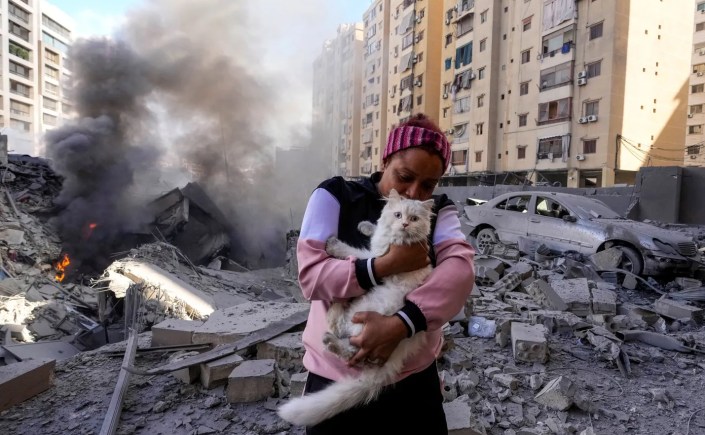
Most folk who are into history like to draw parallels and identify patterns in the past that reflect upon the present. As I do also, albeit in a more ambivalent way. Cleaving to Mark (Twain, that is). am fascinated more by the rhymes than the repetitions. Five years ago, i wrote Messing with the Mullahs – America’s phoney war? Events in the Middle East since October 7 2023, not least tit-for-tat aerial exchanges on we have seen in recent months between Israel and Iran, and the potential return of the unreformed and unchained prodigal son on January 6th 2025 render it relevant still. How long will it be before the war drums start beating on the Potomac and the Iran hawks circle over Washington DC seeking the restored king’s feckless and fickle ear? As they say, fools rush in where angels fear to tread.

Back then, I wrote:

“The story of the Iranian Revolution is a complex, multidimensional one, and it is difficult for its events and essence to be compressed into brief opinion pieces of any political flavour, no matter how even-handed they endeavour to be.

The revolution began slowly in late 1977 when demonstrations against Shah Reza Pahlevi, developed into a campaign of civil resistance by both secular and religious groups. These intensified through 1978, culminating In strikes and demonstrations that paralyzed the country. Millennia of monarchy in Iran ended in January 1979 when the Shah and his family fled into exile. By April, exiled cleric and longtime dissident Ayatollah Khomeini returned home to a rapturous welcome. Activist fighters and rebel soldiers overwhelmed troops loyal to the Shah, and Iran voted by national referendum to become an Islamic republic on April 1st, 1979. A new constitution saw Khomeini became Supreme Leader in December 1979.

The success and continuing durability of the Iranian Revolution derived from many sources, and many are not touched upon by commentators and pundits.

One can’t ignore the nature of the monarchy that preceded it – modernist on the one hand, and brutally repressive on the other; nor the unwavering and hypocritical support (including infrastructure, weapons, and intelligence) provided to it by western “democracies” since Britain and the US placed Reza Shah Pahlevi on the throne in 1953.

Nor should we ignore the nature of the unprecedented regime and state that was established forty years ago – a brutal, theocratic, patriarchal, quasi-totalitarian system that endeavours to control all aspects of its citizens’ lives, its rule enforced by loyal militias like the ruthless Basij and by the Revolutionary Guard, a military-industrial complex more powerful than the regular army.

The support and succour that the US gave to the deposed Shah and his family and entourage, and later, to the opponents of the revolution, served to unite the population around a dogmatic, cruel and vengeful regime, which, in the manner of revolutions past and present, “devoured its children”, harrying, jailing, exiling and slaughtering foes and onetime allies alike. One of the ironies of the early days of the revolution was its heterodox complexion – a loose and unstable alliance between factions of the left, right and divine. History is replete with examples of how a revolution besieged within and without by enemies actual and imagined mobilizes it people for its support, strength and survival.”

This brief outline summarises the events of 1979 and the decades which followed. It does not elaborate in any detail on the reasons for the downfall of the Shah and the durability of the regime that succeeded him. An impressive essay in the Jewish cultural e-zine Mosaic endeavours to do just that, providing as it does, insights into the history of modern Iranian history that few people today would be familiar with.

In it, the author suggests that “the most impressive of our experts persist in downplaying or ignoring the Islamic Republic of Iran’s driving forces can lead to misunderstandings of current affairs that are far from academic. Both nuclear negotiations and the sanctions, for instance, are premised on the assumption that Tehran is eager above all else to improve its country’s economy. While Ayatollah Khamenei and his minions doubtless care about trade and finances, they care much more about advancing their religious ideology across the Middle East, and like most religious believers, feel that spiritual concerns must ultimately trump material ones. It’s even possible that some might find the idea of suffering material hardships to achieve ideological goals appealing …

… If I’m right that Iranians didn’t rise up en masse because of the rising costs of onions or because they wanted to drive nicer cars, but because they were passionately opposed to secularization and American influence, then the U.S. cannot make peace with Iran even if the nuclear deal succeeds. The Islamic regime doesn’t oppose America because it supports Israel or Saudi Arabia, but because it represents Western secularism. Unless mass-conversion to Islam is in America’s future, that’s not something that’s likely to go away …

… One hopes that the loss of Afghanistan will finally hammer home the truth that the loss of Iran (in 1979) so signally failed to do: it’s religion, stupid.”

On matters messianic in In That Howling Infinite, see A Messiah is needed – so that he will not come and Al Aqsa Flood and the Hamas holy war. On the Middle East generally, see  A Middle East Miscellany:  

How Iran Thinks

Ze’ev Maghen, Mosaic, 7th March 2022

With a new nuclear deal on the way, attention is again turning to Iran. Four recent books, plus the deal itself, suggest that America and Europe are blind to the regime’s motivating spirit.

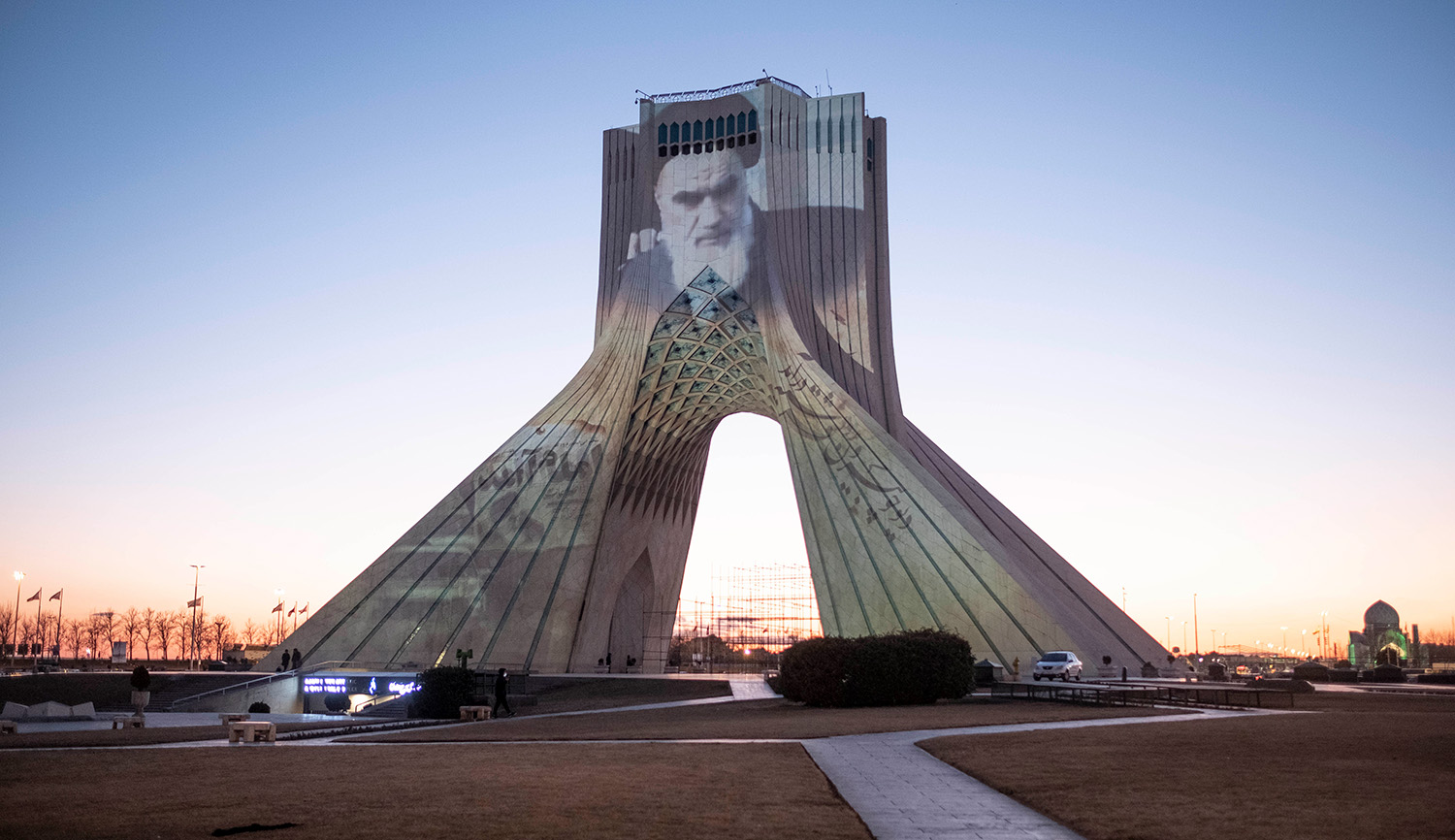
A portrait of the late Ayatollah Khomeini projected on the Azadi (Freedom) Monument in western Tehran on the 43rd anniversary of Iran’s 1979 Islamic Revolution in February 2022. Morteza Nikoubazl/NurPhoto via Getty Images.

A portrait of the late Ayatollah Khomeini projected on the Azadi (Freedom) Monument in western Tehran on the 43rd anniversary of Iran’s 1979 Islamic Revolution in February 2022. Morteza Nikoubazl/NurPhoto via Getty Images.

There is a well-known Persian children’s game in which a parent recites limerick-like poems while engaging in horseplay. One version, popular in the mid-20th century, had the father of the household seat himself on a carpet in the living room with one of his progeny standing to his right and the other to his left. The father would declaim:

There once was a cat (yek gorbeh bud)
Poor and miserable (bichareh bud)
A dog came and bit him in the belly (delash-o sag gaz gerefte bud)

(At this point the first child charges across the room and dives headlong into his father’s stomach.)

Next came a bear from behind and nearly killed the cat (khers az poshtesh taghriban koshtesh)

(The second son now bounds over and leaps onto his father’s back.)

But that cat, he rose, and he roared, and . . . turned himself into a lion! (gorbeh beh shir avaz shodeh bud)

(This being the signal for the father to get up and hurl his offspring this way and that onto the soft furniture.) 
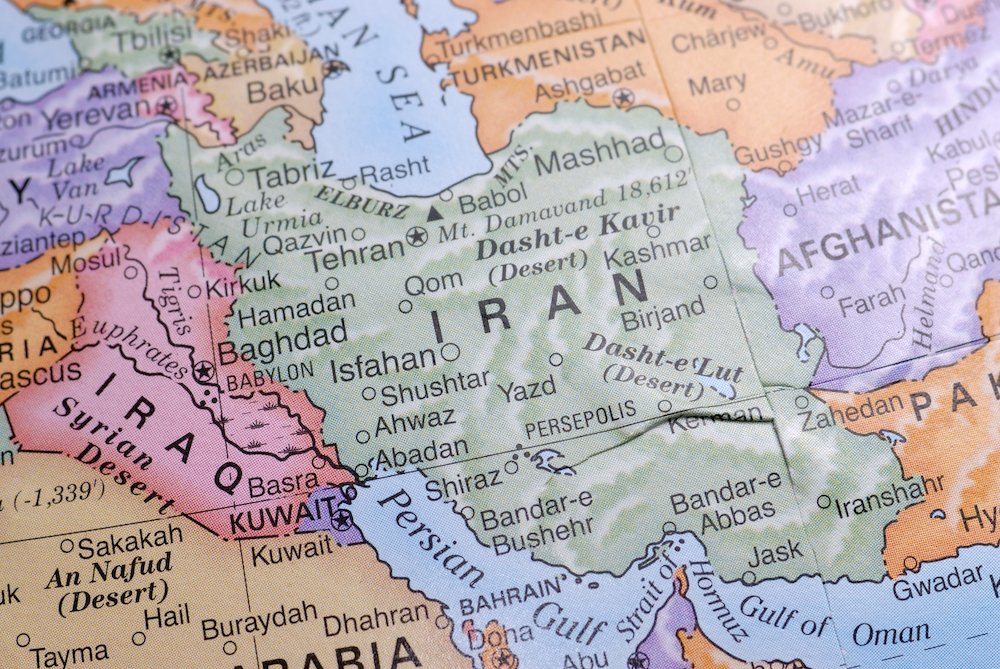
More than just child’s play, this post-dinner diversion harbored an obvious historical-ideological meaning—a meaning as relevant today as it was 130 years ago. Anyone looking at a map of modern Iran will perceive the lineaments of what the country’s inhabitants call “the sleeping cat.” This cat—the Iranian state—was indeed in miserable shape domestically and geopolitically by the reign of Naser al-Din Shah (1848-1897). What little authority this Qajar king still possessed over his realm was retained by a method that a 20th-century Iranian intellectual would dub “positive equilibrium”: the sovereign survived by parceling out large swaths of Persian territory and granting irresponsibly generous economic concessions to local potentates and foreign powers so that each would defend the capital and environs against the encroachments of his counterparts. Of the many forces that Naser al-Din Shah had to “buy off” in this manner, none was more menacing than Russia, the bear that jumped onto the cat’s back, or more influential than Britain, the (bull)dog that bit the cat’s belly.

Before ousting the last Qajar ruler in a bloodless coup, the founder of the Pahlavi dynasty (1925-1979), Reza Shah, had risen through the ranks to become commander of the only serious military force in the country, the Cossack Brigade, created with Russian assistance decades earlier by that same Naser al-Din Shah. While in this post, Reza is said to have engaged every morning in a ritual reading of the newspaper, his face waxing redder with each account of Iranian failure or humiliation until finally, in a fit of rage, he would stand up and rip the tabloid to shreds. Soon, this determined corporal would rewrite the headlines that had so dismayed him, and do much to turn the sleeping cat into a rising lion.

Assisted by a cadre of military comrades and nationalist intellectuals, the new monarch set about pacifying the countryside, developing infrastructure, implementing reforms in fields like education, sanitation, technology, agriculture, and women’s rights, and in general shoving Iran, kicking and screaming, into the 20th century. He even gave his subjects three days to come up with last names for purposes of taxation, conscription, and general modernization (hitherto everyone had been known as “so-and-so son or daughter of so-and-so” or by a nickname reflecting his profession, town of origin, or infirmity). For all that Reza Shah has been depicted in post-revolutionary Khomeinist retrospect as the epitome of an incorrigible Westernizer, it cannot be denied that he raised Iran from a trampled and torn-apart virtual protectorate and a conspicuous consumer of European goods to the status of an essentially independent and self-respecting polity boasting border integrity and assiduously cultivating import-substitution industry. That the method employed to achieve all this progress was despotic was a price that even many liberal Iranian thinkers of the time were willing to pay.

Ousted by the allies in 1941 on the pretext of harboring Nazi sympathies—sympathies partially tied to the “Aryan Thesis” that made Germans and Persians ethnolinguistic cousins and that was all the rage in both countries at the time—Reza Shah was replaced by his twenty-one-year-old son Mohammad Reza Shah. In awe of his father, and having spent his teenage years in Switzerland at an elite boarding school, the new king was prepped to take up where the dynasty’s founder had left off. His career, and his overthrow in 1979 by the Islamist movement that now rules Iran, is at the center of four books published in the past decade which I will consider here. These books offer much in the way of fresh insights and original research, correcting some of the misconceptions that plague commentary about the country. And yet, for all their merits, they fail to grasp fully why the shah fell, what motivated the revolutionaries, and by extension, what motivates the current regime. For if we want to be able to make sense of the revolutionary ideologues who now rule Iran, we have to understand the political and cultural order they rebelled against, and why they rose up against it.

By looking at what these four works get right and, more importantly, what they get wrong, we can also better understand why so many Western experts and policymakers so consistently misread the Islamic Republic, its sensitivities, its hierarchies of honor and shame, holy and profane, just and unjust—and why academics are so ill-equipped to figure out a society that doesn’t conform to their own ideas of secular rationalism. With the U.S. about to conclude a second nuclear deal with the Islamic Republic, if press reports are to be believed, it’s worth considering how this regime came to be, and what makes it tick.

I. The Last Shah

As the Council on Foreign Relations scholar Ray Takeyh has shown better than any previous author in The Last Shah, Mohammad Reza’s reign began with an impressive geostrategic victory: with a little help from astute advisors at home and a determined postwar American administration, the fledgling Iranian sovereign induced no less a megalomaniacal expansionist than Joseph Stalin, at the zenith of his power, to pull his troops out of the northwestern province of Azarbayjan (not to be confused with the neighboring Soviet Republic of the same name), where they had supported local socialist secessionist movements. The cold war had begun, and Tehran was poised to reap the benefits.

Mohammad Reza’s next major challenge came from within, in the person of the charismatic prime minister Mohammad-e Mosaddeq (in office 1951-3), perceived ever since in popular imagination—and in much scholarship—as Iran’s fatefully foregone hope for true democracy.

Takeyh sets the record straight, demonstrating more effectively than any writer to date that Mosaddeq was, to the contrary, a highly unstable personality with dangerous dictatorial tendencies. (He also quashes once and for all the myth that the CIA and MI6 were primarily responsible for the 1953 coup that removed him.) The shah, argues this author, though no friend of democracy himself, was ultimately better for Iran than the prime minister. Indeed, Mohammad Reza eventually realized the very dream that Mosaddeq had failed so badly to achieve: not just oil independence, but oil hegemony for Iran. (Remember when we switched the limousine-like sedans we used to drive for the cramped, sardine-cans-on-wheels that we squeeze into today? That was because of the shah.)

Surrounding himself instead with one-dimensional, sycophantic technocrats, the shah soon became the lonely autocrat, a one-man-show.

The second Pahlavi sovereign got so good at his job, Takeyh maintains, that he felt he could dispense with the independent aristocratic elite whose corruption, bickering, and jostling for advantage threw a spoke into his rapidly rotating wheel of progress—even though it was just these aristocrats who had been the agents of his success, and had saved his throne on more than one occasion. Surrounding himself instead with one-dimensional, sycophantic technocrats, he soon became the lonely autocrat, a one-man-show. When the Middle East-wide, and worldwide, revolutionary fever of the second half of the 20th century finally caught up with him in 1979—another significant connection Takeyh makes—Iran’s ruler faced it bereft of the crucial assistance he needed to weather the storm.

II. The Fall of Heaven

The inability to delegate and insistence upon ruling instead of merely reigning that Takeyh perceives as a shortcoming, Andrew Scott Cooper sees as a strength: Mohammad Reza’s hands-on approach to monarchy got things done for his country. To Cooper, the shah is something very different from the corrupt autocrat of most histories, whose disastrous mistakes supposedly smothered democracy and brought about the revolution. Indeed, in The Fall of Heaven, Cooper’s 2016 history of the decline and fall of the Pahlavi dynasty, there is little that has traditionally been held against this despot that isn’t deftly turned into a virtue, or at worst a well-intentioned miscalculation. The abolition of the multiparty system in 1975, itself largely nominal by that time, and the inauguration in its place of the single Rastakhiz (“Resurrection”) party to which all citizens were obligated to pledge allegiance, is presented as a (botched) stepping-stone toward democracy—a claim doubly audacious since, as Takeyh had shown, Rastakhiz’s own leaders admitted that it was a bad joke from day one. Cooper does not scruple to attribute the refusal of Iran’s Westernizing monarch to rule constitutionally to “his skeptical attitude to the 1906 constitution, which he regarded as a European invention imposed on Iran by former colonial powers.” The shah’s innumerable affairs with married women and regular visits to Paris prostitutes were evidence of his “boundless energy,” and usefully cleared his head to attend to matters of state. Even the king’s leisurely helicopter rides (and those of his siblings) over a capital city choked to a stand-still by some of the worst traffic jams in history are depicted by this creative and sometimes credulous author as his majesty’s noble attempt to help alleviate that same congestion.

These impressive feats of legerdemain aside, however, Cooper is no cheap apologist. The Fall of Heaven is a stunning achievement, and will go down in literary-scholarly history as the book that did more to rehabilitate the Pahlavi family’s reputation than any volume published before or since the revolution. Cooper accomplishes this formidable task—punching a corridor through decades of pervasive and unrelenting vilification—primarily by amassing, organizing, analyzing, and presenting in vivid color an unprecedented amount of detail surrounding the final years of the monarchy. On top of play-by-play accounts of the political ins-and-outs, the economic ups-and-downs, the burgeoning unrest and the frantic diplomatic maneuverings, Cooper can tell us for any given date of 1978 what pop song topped the charts, which jewels Queen Farah Diba was wearing, whose child was killed in a hit-and-run accident, what TV series garnered the highest ratings, whether the king had indigestion (and what he took for it), which night-club was the hottest in town, and what the weather and pollution levels were like. Who knew, for instance, that on November 5, 1978, as the Khomeinist tidal wave crested and began to break over the Land of the Lion and the Sun, Fiddler on the Roof was playing to a full house at the Goldis movie theater in Tehran?

Cooper’s broad and meticulous sweep allows him to put a human face to Iranian society on the eve of what may plausibly be called the first genuinely popular revolution in modern times.

Such an accumulation of detail may seem frivolous; it is anything but. Cooper’s broad and meticulous sweep allows him to put a human face to Iranian society on the eve of what may plausibly be called the first genuinely popular revolution in modern times. It also allows him to put a human face to the royal couple—Mohammad Reza and his wife Farah Diba—painting them convincingly as benevolent, idealistic, patriotic, hard-working, fragile but fortitudinous, beleaguered but long-suffering, intelligent and generally likeable. Finally, this author’s wide grasp facilitates the assembly of an incomparably variegated collage of factors that, so he maintains, together contributed to the uprising of 1979. Beyond the usual suspects—a regime that educated the hell out of its subjects but denied them political participation; rapidly rising but no less rapidly disappointed economic expectations; the alienation and radicalization accompanying mass urbanization—Cooper adduces: a milk shortage, an egg shortage, a power outage, a cholera outbreak, a heatwave, a UFO sighting, an earthquake, a tax increase, the kidnapping and murder of a young boy, drought (on the one hand), unseasonably heavy rains (on the other), “a slew of disaster movies” that “emphasized failure of leadership, loss of control, and public panic,” the fact that according to the Asian zodiac 1978 was the Year of the Horse when people are prone to ”let loose” and “ignore the consequences of their actions,” and, to top it off, a plague of locusts.

The present writer admits to entertaining doubts about the “coalescence of causes” approach to historical convulsions. I remain convinced that people make history, and on the rare occasions when the particular person typing these lines does anything at all important, I tend to feel like I do it for one reason. Extrapolating to the relevant macrocosm, I’m basically with Ruhollah Khomeini, who famously remarked that “the Iranian people did not make the Islamic revolution to lower the price of watermelons” but rather did so “for the sake of throwing off the foreign yoke and restoring their kidnapped culture and creed.” (That’s two reasons, but they are closely related). Nevertheless, it cannot be denied that the human will, independent and focused though it may be, is nourished, guided, and battered this way and that by the context surrounding it, and for this reason Cooper’s litany is highly enlightening. Ironically, the only one of our four authors who is not Iranian digs more deeply into daily Iranian reality than any of his colleagues.

III. Moods of Self-Assurance and Insecurity

Louis XIV’s famous quip, L’etat c’est moi (“the state—is me”), rarely rang as true as it did in Iran of the 1960s and 70s. Flush with eleven-figure oil revenues and spoiled rotten by U.S. support that had gone from conditional to unconditional, Mohammad Reza neutered the government apparatuses, military command structures, and traditional pillars of the Persian state—court, bazaar, and mosque—that he saw as so many obstacles to his imperious charge in the direction of the “Great Civilization.” The king became the only game in town, his picture on the wall of every home and business, his decisions the only ones that mattered. Thus, an intimate biography of the man on the throne is essential to an understanding of the state of the Iranian nation in the decades immediately prior to the Khomeinist debacle. In his 2012 The Shah, Abbas Milani—a Stanford political scientist and Hoover Institution fellow—provides us with the best example of such a biography.

Milani chronicles the initially reluctant sovereign’s rise to power with an apposite mixture of objectivity, sympathy, and drama. He masterfully interweaves the personal and political, offering probing analyses of Mohammad Reza’s ambitions and inhibitions, phantoms and phobias, worldviews and prejudices. He covers more widely and perceptively than any earlier scholar the experiences and influences of the prince’s formative years, and arrays before the reader the alternating moods of self-assurance and insecurity, tenaciousness and irresolution, optimism and depression that helped make his reign something akin to a non-stop roller-coaster ride. Milani aptly points out that “many of [the shah’s] weaknesses as a leader were his virtues as a human being,” referring, inter alia, to this embattled ruler’s unwillingness to spill gallons of his countrymen’s blood in order to stay in power.

The king made use of authoritarian methods to propel Iranian society forward—which set that society on a direct collision course with those same authoritarian methods.

No work details and dissects to the same degree the myriad challenges facing this well-meaning monarch on the foreign and domestic scenes (not the least of which was the rampant corruption of his own family), challenges which—by exploiting the cold war, dispersing petrodollars, repressing Communists and clergymen, and generally playing his cards right—he faced down successfully for almost four decades. His inability to face down the final challenge Milani ascribes to a paradox: the king had made use of authoritarian methods to propel Iranian society forward in the direction of literacy, industry, professionalism, research, technology, consumerism, capitalism, nationalism, intellectualism, secularism, and individualism—all of which set that society on a direct collision course with those same authoritarian methods. (Or as Takeyh puts it, the shah “built the modern middle class, but refused to grant it a voice in national affairs.”) Indeed, Milani asserts, monarchy itself as an institution, and the squelching of political participation it inevitably entails, was fast becoming an anachronism by the mid-20th century, especially in the countries that Mohammad Reza held up to his subjects as models, and to whose universities he sent thousands of college students.

IV. Reasons for Ruination

Whereas from Milani we learn about the general from the particular—about the situation in the country from the personality of its ruler—the Yale historian Abbas Amanat, in Iran: A Modern History(2012), takes the reader on an oceanic voyage in the opposite direction. One of the many advantages of this impressively ambitious magnum opus is the historical depth and topical breadth it brings to bear on the issues that have preoccupied us so far, and that preoccupy all who think about contemporary Iran: Mohammad Reza’s record as leader, and the reasons for his ruination.

Amanat, one of the premier Iranologists of our time, whose vast and diverse erudition is matched only by the humanity that permeates his texts, is uniquely qualified to construct the stage upon which the 20th-century showdown between Pahlavism and Khomeinism would be played out. By the time we reach the reign of Mohammad Reza Shah—some 500 pages into the book—we have been exposed repeatedly to an interlocking network of patterns and trends that have functioned as the matrix of Iranian history for centuries, sometimes millennia. Many of these are couched in terms of dichotomies: centripetal versus centrifugal forces, tribal versus sedentary existence, antinomian heterodoxy versus a state-supported clerical establishment, Persian versus Arab, Turk versus Persian, Russian versus British, religion versus nationalism, tyranny versus just rule.

Amanat tackles the tenure of the “King of Kings, Light of the Aryans” (Mohammad Reza’s self-chosen moniker) with all these tensions in mind, while simultaneously illuminating the political, economic, social, and especially cultural mise en scene of the period. We do not get the shah as a willful individual, as a volatile jumble of psychological traits, as with Milani, but the shah as one actor among hundreds of others, in what sometimes feels like a non-fiction Persian version of War and Peace. The dense tangle of processes that eventually led to the fall of the monarchy cannot be easily untangled here, but it should be said that unlike Tolstoy, Amanat does not present the tragic denouement of 1979 as the inevitable result of an amalgam of impersonal forces. The hundreds of authors, artists, ambassadors, academics, activists, and agitators, together with no few vendors, workers, thugs, and other ordinary Iranians who contributed to this momentous event are more often than not introduced by name, their dreams and activities fleshed out, and these many human threads woven together into a kaleidoscopic revolutionary tapestry.

Amanat’s presentation is painfully balanced: he rakes the post-revolutionary regime over the coals for its many human-rights violations, but criticizes the Western supporters of Iraq during its war with Iran in the same breath, and no less fiercely. He takes Mohammad Reza to task for curtailing liberty and stifling creativity, but overall—as with Takeyh, Cooper, and Milani—appreciates much of what the ill-fated Pahlavi sovereign did for Iran, depicting him as a driven reformer with high ideals who transformed his country so profoundly that even the Islamists could not turn back the clock.

Certainly, one must be careful not to overdo such revisionist rehabilitation. It is one thing to debunk Amnesty International’s ridiculous claim— popularized with most effect by Reza Barahani’s powerful but unreliable 1977 Crowned Cannibals—that over 100,000 political prisoners were tortured in the shah’s jails. It is quite another to claim—as does Ervand Abrahamian, the highly regarded scholar who literally wrote the book on the subject—that torture as a method of repression virtually disappeared from the Iranian scene under the Pahlavis, re-emerging with a vengeance only with the onset of the Islamic Republic. The shah was a more benevolent dictator than the image conjured up for the West by the various shrill (and ungrateful) Iranian Students Associations that regularly marred his visits to Europe and the United States; but no small number of atrocities were carried out in his name and with his knowledge. Even Cooper, the Pahlavis’ biggest fan, saddles the king with the ultimate responsibility for decades of state-sponsored prisoner abuse, including not a few extrajudicial murders.

Women in today’s Iran may have to cover their hair, but they vote like maniacs and there are more of them in the universities and in a whole slew of prestigious professions than their male counterparts.

Still, to read these four authors, Iran’s final monarch did far more good than harm. He took a particularly ignorant populace (tellingly, Jewish academicians concluded that even Persian Jews were less knowledgeable than their co-religionists anywhere on the planet) and increased their literacy level sevenfold in less than two decades. He used the endless supply of black gold that percolated up through the Khuzestan flats not just to purchase tanker-loads of state-of-the-art weaponry (useless, in the event, as they had been for his father), but also to build schools, roads, hospitals, clinics, orphanages, universities, vocational colleges, sports centers, airports, sea-ports, factories, research laboratories, parks, zoos, commercial centers, chemical plants, railroads, theaters, galleries, and museums by the thousands. He divvied up latifundia all over the country, compensating the owners fairly and doling out hundreds of thousands of acres to the peasantry. (The fact that these peasants often preferred migration to shantytowns on the edge of big cities to farming their newly acquired plots was a worldwide problem, and not Mohammad Reza’s fault). He protected minorities—Jews, Bahais, Sunni Muslims—and, though a dyed-in-the-wool chauvinist himself, energetically promoted women’s causes. The last achievement was one that Khomeinism could not roll back: women in today’s Iran may have to cover their hair, but they vote like maniacs and there are more of them in the universities and in a whole slew of prestigious professions than their male counterparts.

The king made Iran into a respected player on the international scene, encouraging and inspiring other third-world countries by example, to say nothing of financing their development projects. Though easily irritated by independent thinking among his subordinates, he tolerated more societal dissent than is generally acknowledged, and his “liberalization program” of the late 1970s, as Takeyh points out, actually saw that tolerance increase just before things got really hairy. When the revolutionary tsunami finally hit, thousands of oppositionist intellectuals and activists were of sound enough body and mind to surf on it all the way to victory.

V. Economy or Religion?

So why did the tsunami hit at all? Why, in the end, did the country choose Islamist rule instead? If so many impressive accomplishments can be laid at Mohammad Reza’s door—and they indubitably can—then why did his people, whom he had benefited so greatly, give him the heave-ho in such a peremptory and humiliating fashion? For many, the answer revolves around the bottom line. Despite the dazzling economic success story that was Pahlavi Iran—between 1957 and 1977 the standard of living among the Persian populace rose no less than 500 percent—many Middle East specialists persist in seeking the underlying causes of the Khomeinist revolution in economic woes of one sort or another. Scores of analysts have proffered such confident assertions as the following, from the pen of the astute student of Islamism Nazih Ayubi, drawing on the no-less-astute Iran expert Fred Halliday:

“The revolution was the outcome of a complex and painful process of rapid and uneven economic development. The main reason why it occurred was that “conflicts generated in capitalist development intersected with resilient institutions and popular attitudes which resisted the transformation process.” (Political Islam: Religion and Politics in the Arab World, p. 387)

Takeyh himself opens his study with a question, “Why did Iran have a revolution in 1979?,” and an answer: “The immediate causes can be easily summarized: the economic recession of the mid-1970s had halted the shah’s development projects and created expectations that the state could not meet.” (This is the well-known but discredited “J-curve” theory, which states that an economic boom followed by a sudden downturn tends to cause revolution and unrest.) To his credit, Takeyh contradicts his own assessment at the very end of the book: “The economic recession of the mid-1970s is sometimes casually blamed for the revolution, but the Iranian people were frustrated with the shah’s dictatorship even when the economy was performing well.”

The main problem with such claims is that the various processes they blame for engendering discontent and consequent unrest in Iran—including “inflationary pressures,” “rising expectations,” and the catch-all urbanization and its manifold consequences—were in no way unique to Iran, and were in many if not most cases more moderate versions of simultaneous developments in other third-world polities where no comparable revolutions ensued. One of Amanat’s arguments, for instance, is not only questionable in itself, but could be applied just as well to any other country in the developing world:

”Since the beginning of the Pahlavi era, the Iranian population had improved in every generation physically, hygienically, and medically, from the frail, malnourished, and diseased population at the turn of the 20th century . . . to a relatively healthy, sanitary, and better nourished people in the last quarter of the century. The need for greater quantities and greater varieties of food, home appliances, electronics, and cars thus was bound to become a burden for a government anxious to keep its population economically content. “(p. 655)

None of this holds water. The citizens of Iran did not bare their chests to the bullets of the largest and best-equipped army in the region, overthrow their sovereign, and put an end to a millennia-old monarchical tradition, all for the lack of a toaster oven. The Washington Post had it right way back in 1978: “Rarely would contemporary history appear to provide such an example of a people’s ingratitude towards a leader who has brought about an economic miracle of similar proportions.”

The citizens of Iran did not bare their chests to the bullets of the largest and best-equipped army in the region all for the lack of a toaster oven.

Though no amount of counterargument will eliminate the widespread post-facto imagining of Iranian economic distress (which somehow went unnoticed before the revolution), if we seek to isolate the sui-generis ingredients that went into making the Khomeinist upheaval of 1979, we must look elsewhere. Admittedly, this additionally rules out factors like irritation on the part of the educated classes at the lack of opportunities for political participation: such irritation, too, existed in spades in other countries, and although secular democracy-seekers had kept the embers of Iranian dissidence glowing for years, it was not they who ignited the conflagration. The central motivations for the mass revolutionary action of 1978-9 must be sought in factors more specific to Iran, or at least more unique to the situation in the country at the time.

Where shall we look? Here our masters all fall short. Ask the average Joe who was compos mentis 40 years ago why the Iranians rose up against their ruler. (Mind you, not your average Iranian Joe: Persian-speakers are conspiracy freaks of a caliber beyond anything one finds in the West, and they are convinced to a man that the U. S. was behind the whole thing. Even the shah thought so.) Anyone who paid attention at the time—and who was not an academic and could therefore think straight—was cognizant of the simple truth that the king got canned because he had spat on his people’s most hallowed traditions. He and his coterie of “Westoxified” sophisticates had mocked their rituals, stripped their women, insulted their clergymen, blasphemed their god, replaced their sacred paragons with pagan nymphomaniacs, gotten drunk on their solemn holidays, razed their mosques (sometimes building banks and stadiums in their place), and made common cause with heretics and infidels—all in the name of progress.

We should pause to admit that Milani, Cooper, and others don’t see it this way: they make much of what they claim was the second Pahlavi sovereign’s backpedaling of his father’s harsh secularizing policies, pointing to everything from the son’s oath of office, which included appeals to Allah and commitments to promote Shiism; the widely publicized visit paid by the new monarch to the hospitalized Grand Ayatollah Borujerdi, head of the seminary system in the holy city of Qom; mystical experiences in which Mohammad Reza claimed to have received blessings from this or that imam; his habit of carrying a mini-Quran into his breast pocket; and a significant increase in the number of new places of worship, and a partial easing of the restrictions on the veil, under his reign.

While there is truth to all of this, the broader picture tells a different story. Oaths of office and hospital visits are recognized by the genuinely pious for just what they are: lip service. While assertions of dream visitations by saintly figures can be a feather in the turban of a respected theologian, in the case of non-observant ignoramuses like Mohammad Reza Shah—who once boasted to a gathering of Muslim divines that “I say my prayers every night before bed,” a decidedly non-Muslim comment—such claims merely point to the claimant’s abject irreligiosity. And, one might add, the irreligiosity of those who record and build theories upon such empty gestures.

More importantly, while the father’s anti-clericalism and march toward modernization may have been gruffer, under the son these tendencies matured and expanded relentlessly, to a large extent due to Iran’s exponentially proliferating contacts with Europe and even more so the United States. There were, albeit, more mosques built during this period, but the mushrooming cinemas were the up-and-coming place to be. The veil, it is true, could now be worn, but it was scorned by refined society, and more and more women preferred bouffant hairdos and mini-skirts. As uncomfortable and un-moored as traditional members of Iranian society began to feel in the 1930s, they would feel so to a far greater extent in the 1960s, and if they did not, that was because they had grown accustomed to the direction the country had been taking for decades, not because that direction had changed or been reversed.

The few supposedly regressive features that characterized the reign of the second Pahlavi monarch in connection with religion were offset ten times over by the juggernaut of modernization that was the hallmark of the era. And while traditionalism would on occasion receive disingenuous royal support as a counterweight to radicalism, the shah and his governments were, if anything, more inclined toward socialism than Shiism. Above all, as all our authors readily admit, their lodestar was always the West. In the eyes of the vast conservative sector of Iranian society, Pahlavism was hedonism, plain and simple. In the eyes of the increasing number of students who subscribed to the lay theoretician Ali Shari’ati’s militant neo-Shiiism—young people for whom faith had become cool again, and for whom the imperative of the hour was “the return to ourselves”—Pahlavism was the contemptible, traitorous antithesis of religio-cultural authenticity.

Political Islam has been eulogized by untold analysts almost since its birth, the classic example being Olivier Roy’s 1992 L’échec de l’islam politique (“The Failure of Political Islam”), a book that, given all that has transpired since its publication, should long ago have been renamed “My Failure as a Middle East Expert.” Incurable rationalist-materialists that so many Western thinkers are, it is extremely difficult for them to credit the power of the spiritual or theological, and they accordingly search high and low for alternate motivations, especially economic ones, to explain the behavior of individuals and collectives. Such an approach both informs, and is informed by, schools of thought like Marxism and realpolitik, as well as no few social sciences. Immune to religious passions themselves, scholars and journalists simply can’t accept that these passions can motivate tens of thousands of people.

If there is one deficiency common to the four undeniably outstanding studies we have been reviewing, it is that whereas Ayatollah Khomeini and company were sure that they had risen in revolt because Westernization in Iran had gone too far, our authors are all convinced that the revolution occurred because Westernization had not gone far enough. A related argument has been advanced by the prominent postmodernist scholar Ali Mirsepassi in his 2019 Iran’s Quiet Revolution. Mirsepassi notes correctly that intellectuals close to the Pahlavi court, and the sovereign himself, sometimes coopted the anti-“Westoxification” discourse of leftists and Islamists in order to take the wind out of their sails and, at the same time, delegitimize democracy as a foreign implant. He then maintains, based on this paradox, that it was the Pahlavi rejection rather than the Pahlavi adoption of modernity that led to the dynasty’s destruction, a theory as creative and counterintuitive as it is utterly spurious.

Islam as the central propelling factor in the resistance movement to the shah receives extremely short shrift from Takeyh, Cooper, Milani, and even Amanat. The last scholar’s profound knowledge of Shiism is matched only by his dislike for it: for instance, he calls the premier intellectual pursuit of the ayatollahs in their seminaries “tedious” on no less than four separate occasions in his massive tome. The revolutionaries aver in no uncertain terms that they did it for Islam; but our four authors, and scores of their colleagues, claim to know better.

Certainly, there were other modernizing rulers in other Middle Eastern countries who antagonized their Muslim constituents, both before and after the Iranian revolution. Taking Islam seriously as a motivating and enabling factor means, however, familiarizing ourselves with this confession’s considerable inner diversity. Iranian Islam has been Shiite Islam for over 500 years, and Shiism is a revolutionary vehicle like no other. Thanks to the circumstances of its evolution, the slogan “Fight the Powers that Be” is virtually encoded on its DNA. Moreover, Shiite clerics are comparatively independent of temporal rulers, while enjoying the wall-to-wall obedience of their flocks. Not for nothing did Khomeinism succeed so spectacularly where other Islamist movements had succeeded only partially or failed: the creed on which it is based provided both the impetus and the instrument for its triumph.

VI. Missing the Point

That the most impressive of our experts persist in downplaying or ignoring the Islamic Republic of Iran’s driving forces can lead to misunderstandings of current affairs that are far from academic. Both nuclear negotiations and the sanctions, for instance, are premised on the assumption that Tehran is eager above all else to improve its country’s economy. While Ayatollah Khamenei and his minions doubtless care about trade and finances, they care much more about advancing their religious ideology across the Middle East, and like most religious believers, feel that spiritual concerns must ultimately trump material ones. It’s even possible that some might find the idea of suffering material hardships to achieve ideological goals appealing.

Likewise, President Obama’s negotiations with Iran sought to recognize the country’s “equities” in the Middle East, with the ultimate aim of creating a balance among Iranian, Saudi, and Israeli spheres of influence. Again, Tehran may not be immune to such realpolitik considerations. But ultimately the Islamic Republic is engaged militarily in Yemen, Iraq, and Lebanon to advance the Islamic Revolution. The idea that well-meaning Western diplomats can simply sit Iranian diplomats down with their Saudi, Emirati, and Yemeni counterparts and work out a compromise based on mutual interests completely ignores the theological aspect of Khomeinist foreign policy.

Both nuclear negotiations and the sanctions are premised on the assumption that Tehran is eager above all else to improve its country’s economy.

And all this is even more true when it comes to Israel. Economics and power politics simply fail to explain the conflict between the two countries, which share no borders and had cordial relations under the shah. While Shiism historically contains ample anti-Semitic currents, it is not indelibly anti-Semitic—but Khomeinism is. And it views Jewish sovereignty in the Middle East as an unacceptable offense, which must be eradicated at almost any cost.

But Israel is only the Little Satan. The Great Satan is America, the main driver of “Westoxification.” If I’m right that Iranians didn’t rise up en masse because of the rising costs of onions or because they wanted to drive nicer cars, but because they were passionately opposed to secularization and American influence, then the U.S. cannot make peace with Iran even if the nuclear deal succeeds. The Islamic regime doesn’t oppose America because it supports Israel or Saudi Arabia, but because it represents Western secularism. Unless mass-conversion to Islam is in America’s future, that’s not something that’s likely to go away.

Only several months have elapsed since the richest and most powerful country in the world, having spent $300 million per day for twenty consecutive years on the restoration of the various branches of the national economy and on the creation of a 300,000-strong national army, was sent ignominiously packing with its tail between its legs by a bunch of ill-equipped local amateurs wearing turbans, robes, and sandals. One hopes that the loss of Afghanistan will finally hammer home the truth that the loss of Iran so signally failed to do: it’s religion, stupid

Ze’ev Maghen is chair of the department of Arab and Islamic studies at Bar-Ilan University. His latest book is Reading the Ayatollahs: The Worldview of Iran’s Religio-Political Elite. He is also the author of John Lennon and the Jews: A Philosophical Rampage.

The first Intifada … Palestine 1936

In 1929, there is violence at the Western Wall in Jerusalem – then a narrow alley named for Buraq, the steed with a human face that bore the Prophet Mohammed on his midnight journey to Jerusalem, and not the Kotel Plaza of today. The event, which was actually called the Buraq rising was incited by rumours that Jews planned to overrun the Haram al Sharif, the third holiest site in Islam. A massacre of Jews in Hebron in the south followed. These were a bleak precursor of the wars to come.

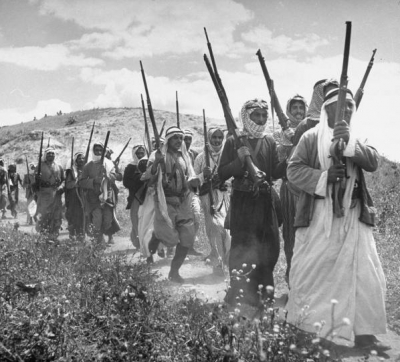
Fast forward to mid-April 1936. Following two incidents of killing carried out in by both Arabs and Jews, an Arab National Committee declared a strike in the city of Jaffa. National Committees were formed in other Palestinian cities and representatives of Arab parties formed the “Arab Higher Committee” led by Haj Amin al-Husseini. A general strike spread throughout Palestine, accompanied by the formation of Palestinian armed groups that started attacking British forces and Jewish settlements. Thus began the “Great Palestinian Revolt. It lasted for three years.

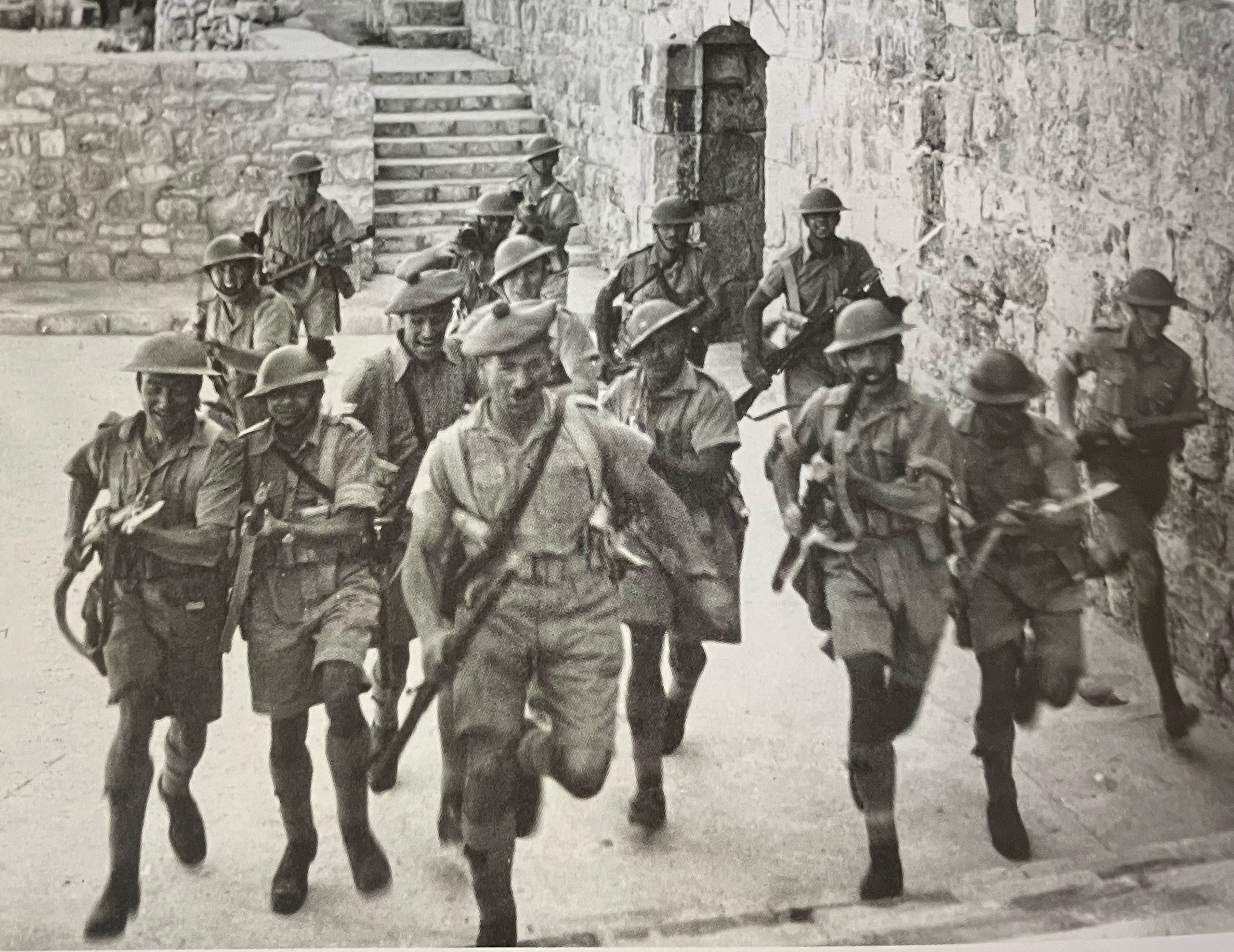
British troops run through Jerusalem’s’ Old City during the Great Revolt


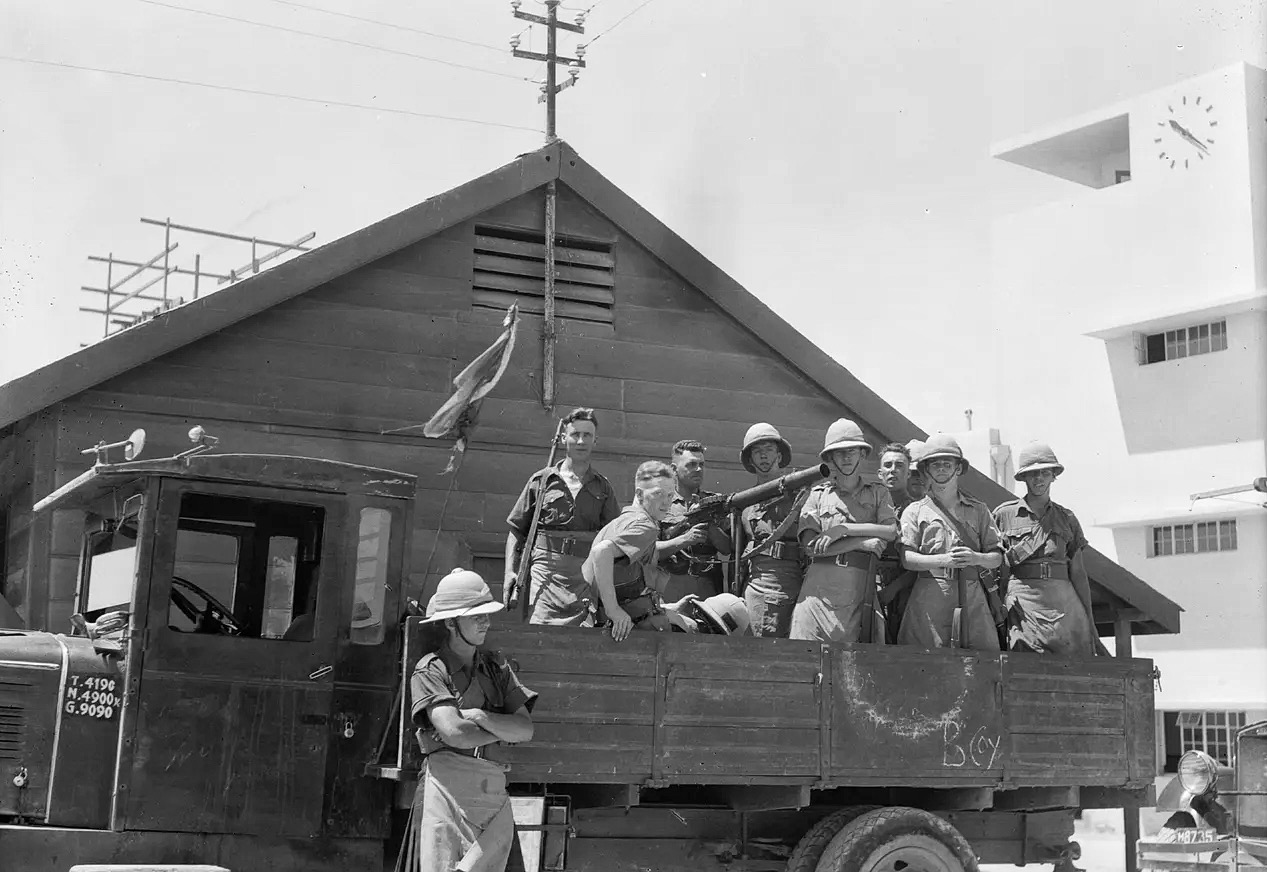
British soldiers on patrol 1936

Roots and fruits 

The ongoing struggle with regard to the existence Israel and Palestine is justifiably regarded the most intractable conflict of modern times. Whilst most agree that its origins lie in the political and historical claims of two people, the Jewish Israelis and the predominantly Muslim Palestinians for control over a tiny wedge of one-time Ottoman territory between Lebanon and Syria in the north, Jordan in the east, and Egypt to the south, hemmed in by the Mediterranean Sea. There is less consensus as to when the Middle East Conflict as it has become known because of its longevity and its impact on its neighbours and the world in general, actually began.

Was it the infamous Balfour Declaration of 1917 promising a national home for Jews in an Ottoman governate already populated by Arabs, or the secretive Sykes Picot Agreement that preceded it in 1916, staking imperial Britain’ and France’s claim to political and economic influence (and oil pipelines) in the Levant? Was it the establishment of the British Mandate of Palestine after the Treaty of Sèvres of 1922 which determined the dissolution of the defeated Ottoman Empire. Or was it the end of that British mandate and the unilateral declaration of Israeli independence in 1948 and the war that immediately followed?

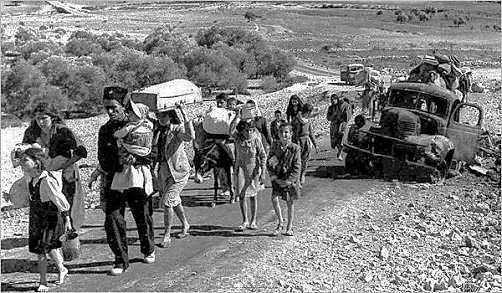
In his book Palestine 1936: The Great Revolt and the Roots of the Middle East Conflict (Rowman & Littlefield, 2023) Israeli journalist and author Oren Kessler argues powerfully that the events in Mandatory Palestine between 1936 and 1939 shaped the subsequent history of the conflict for Israelis and Palestinians. The book identifies what was known at the time as The Great Revolt  as the first Intifada, a popular uprising which actually sowed the seeds of the Arab military defeat of 1947-48 and the dispossession and displacement of over seven hundred thousand Palestinian Arabs, which has set the tone of the conflict for almost a century.

It is a tragic history shared with knowledge in hindsight of the decades of violence and bloodshed in the region that followed. It begins in the time before Palestine became political entity, when mainly Eastern European Jews began settling in progressively larger numbers to the consternation of the Arab populace.

The 1936 conflict stemmed from questions of how to divide the land and how to deal with the influx of Jewish people – questions that remain relevant today. In an extensive interview coinciding with the book’s publication (republished below) Kessler notes that, for the Arab residents, the problem was one of immigration and economics; for the Zionists, it was about finding a home. These two positions soon became irreconcilable issues, leading to sporadic violence and then to continual confrontation.

He believes that the Revolt is the point when both sides really came to see the conflict as zero sum. insofar that whichever community had the demographic majority in Palestine would be the one that would determine its fate. However, in the 1920s, the Jews were so far from that majority that both sides were able to postpone the final reckoning. In the 1930s, the Jews threatened to become a majority, and this was the immediate precursor to the rising. There was no way that the objective of bringing as many Jews to the land as possible could be achieved without bringing about some serious Arab pushback.

It is Kessler’s view that it was during revolt that a strong sense of Arab nationalism in Palestine extended beyond the urban elites to all corners of the country. All segments of Arab society – urban and rural, rich and poor, rival families, and even to a large extent Muslim and Christian – united in the same cause against Zionism and against its perceived enabler, the British Empire. The Arab public in Palestine was becoming increasingly politically aware and consciously perceiving itself as a distinct entity – distinct from its brethren in Syria, in large part because it has a different foe: not simply European imperialism but this very specific threat presented by Zionism.

The British government made early efforts at keeping the peace, but these proved fruitless. And when the revolt erupted in 1936, it sent a royal commission to Palestine, known to history as the Peel Commission, to examine the causes of the revolt. It proposed in effect the first ‘two state solution.’ The Emir Abdullah of Transjordan publicly accepted this plan. The main rival clan to the Husseinis, the Nashashibis, privately signaled that they were amenable – not thrilled, but amenable. And their allies held the mayorships of many important cities – Jaffa, Haifa, and even Nablus, Jenin and Tulkarem, which today are centres of militancy. And yet the Mufti makes very clear that he regards this plan as a degradation and a humiliation, and all of these erstwhile supporters of partition suddenly realise that they are against partition.

Kessler believes that this is the point at which a certain uncompromising line became the default position amongst the Arab leadership of Palestine, with dire consequences for the Palestinians themselves, and when Yishuv leader David Ben Gurion saw an opportunity to achieve his long-standing objective of creating a self-sufficient Jewish polity, one that could feed itself, house itself, defend itself, employ itself, without any help from anyone – neither British or Arabs. When the Arabs called a general strike and boycott, cut all contacts with the Jewish and British economies and closed the port of Jaffa in Spring 1936, he lobbied successfully with the British to allow the Jews to open their own port in Tel Aviv, ultimately causing a lot of economic pain to the Arabs and helping the Jews in their state-building enterprise.

This is a mosaic history, capturing the chaotic events on the ground through snippets of action. And also, the people involved. 

There are heroes and villains aplenty in this relatively untold story. The urbane and erudite nationalists Muhammed Amal and George Antonius who strive for middle ground against increasingly insurmountable odds, and who died alone and exiled having failed to head off the final showdown that is today known as Al Nakba. The farseeing, resolute, and humourless Ben Gurion and the affable, optimistic Chaim Weizmann, who became Israel’s first prime minister and president respectively. The New York born Golda Meyerson, more of a realist than either leader, who would also one day become prime minister. The irascible revisionist Vladimir Ze’ev Jabotinski, the forebear of today’s virulent rightwing nationalists

The hardliner Mufti Haj Amin al Husseini, whose uncompromising stance, malign political influence, and conspiratorial association with the Nazis set the stage for a long general strike, the Great Revolt, and ultimately, the débâcle of 1948. The flamboyant rebel leaders, Syrian Izz al Din al Qassam, who is memorialized in the name of the Hamas military wing and a Gaza-made rocket, and Fawzi al Qawuqji. Qassam was gunned down by British soldiers during the revolt whilst Qawuqji lived on to become one of the most effective militia leaders in the war of 1948, and to perish therein. Both are remembered today as Palestinian martyrs whilst the Mufti is an arguably embarrassing footnote of history. There’s an article about his relatively unremarked death at the end of this post. 

Amin al-Husseini in 1929

And in the British corner, the well-intentioned high commissioners who vainly endeavoured to reconcile the claims of two aspirant nations in one tiny land, and quixotic figures like the unorthodox soldier Ord Wingate who believed he was fulfilling prophecy by establishing the nucleus of what would become the IDF (like many charismatic British military heroes, and particularly General Gordon and Baden-Powell, both admirers and detractors regarded him a potential nut-case); and the Australian-born ex-soldier Lelland Andrews, assistant district commissioner for Galilee, who also conceived of his mission as divinely ordained. Lewis was murdered by Arab gunmen and Wingate went down in an aeroplane over Burma during WW2.

There are appearances from among many others, Lloyd George, Winton Churchill and Neville Chamberlain, Adolph Hitler and Benito Mussolini, Franklin D Eisenhower and Joseph Kennedy.

The book highlights the work of powerful British functionaries in handling early confrontations: they are memorialized for starting commissions to study the matter and to generate ideas, though many of their ideas weren’t followed or were followed to ill effect. None solved the problem, making this account of the earliest days of the conflict all the more heartbreaking.

All under the shadow of the impending Shoah, and the inevitable showdown that would culminate in al Nakba.

The road to Al Nakba

Kessler argues that the Arab social fabric and economy are completely torn and shattered by the end of this revolt that in many ways the final reckoning for Palestine between Jews and Arabs – the civil war that erupts in 1947 – is actually won by one side and lost by the other nearly a decade earlier.

The final paragraphs of Kessler’s enthralling book are worth quoting because they draw a clear line between the events of the Great Revolt and the catastrophe, al Nakba, of 1948:

“For the Jews, perhaps the greatest shift was psychological. they had withstood of powerful sustained assault and lived to tell about it. One book on Zionist leaders” thinking in this era is titled Abandonment of Illusions. The belief of material gains would bring Arab consent now naïve and, worse, dangerous. Instead, by the end of the revolt and the start of the world war, much of Palestine’s Jewish mainstream had accepted the fact that the country’s fate would ultimately be determined and maintained by force.
 
“By 1939, the Yishuv had achieved the demographic weight, control of strategic areas of land, and much of the weaponry and military organization that would be needed as a springboard for taking over the country within less than a decade”, writes the Palestinian American historian Rasheed Khalidi.
 
Khalid argues that the Palestinian catastrophe of 1947 -1949 was predicated on a series of previous failures: “a deeply divided leadership, exceedingly limited finances, no centrally organized military forces or centralized administrative organs, and no reliable allies. They faced a Jewish society in Palestine which although small relative to theirs, was political unified, had centralized para-state institutions, and was increasingly well-led and extremely highly motivated”.
 
For Palestinians, he maintains, the Nakba – the catastrophe of their military drubbing, dispossession and dispersal – was but a forgone conclusion. For them, the terrible events that bookended the year 1948 “were no more than a postlude, a tragic epilogue to the shattering defeat of 1936- 39”.
 
The Great Revolt, Kessler says, has cast its shadow over the Israeli-Palestinian conflict ever since – for the Arabs, for the Jews, and for attempts to resolve the conflict. It is still remembered by Palestinians and Israelis alike. Palestinian folk songs still celebrate the revolt, and in my he regards the. BDS movement as direct descendant of the general strike that preceded the revolt. The two-state solution that is still the international community’s favoured solution to the conflict is but a variation of that original partition plan of 1937.

In so many ways, for both Israelis and Palestinians, this revolt rages on.

© Paul Hemphill 2024.  

Kessler’s interview in Fathom e-zine follows, together with serval informative articles on the Great Revolt and its aftermath, including a Haaretz retrospective of how it reported the beginning of the revolt ninety years earlier. It was, most interestingly, a different newspaper then. 

For more on Israel and Palestine in In That Howling Infinite, see: A Middle East Miscellany

The picture at the head of this post shows British troops marching through Ibn Khatib Square in 1936 past King David’s Citadel and towards the Jaffa Gate

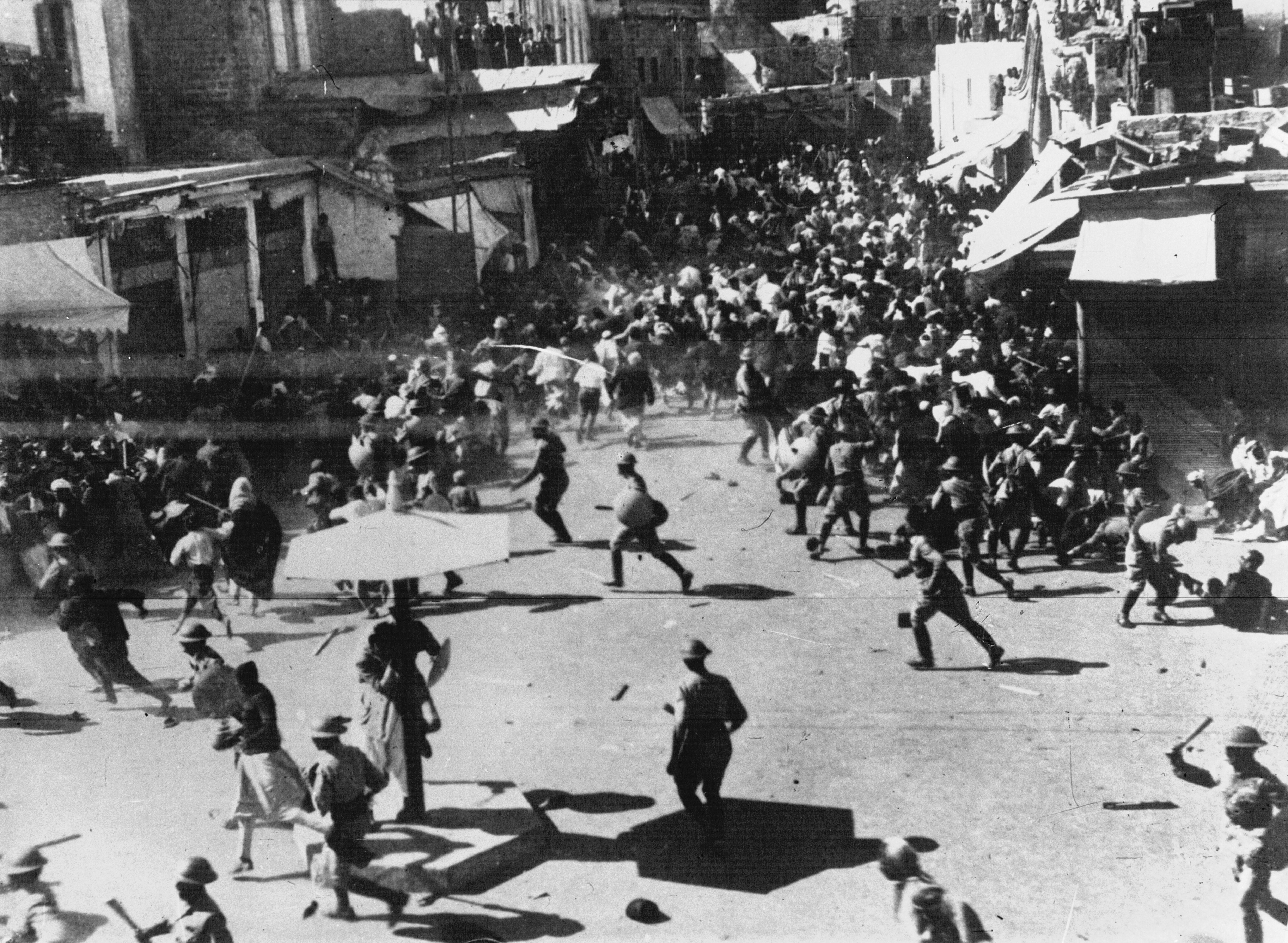
British policemen disperse an Arab mob during the Jaffa riots in April 1936 (The Illustrated London News)


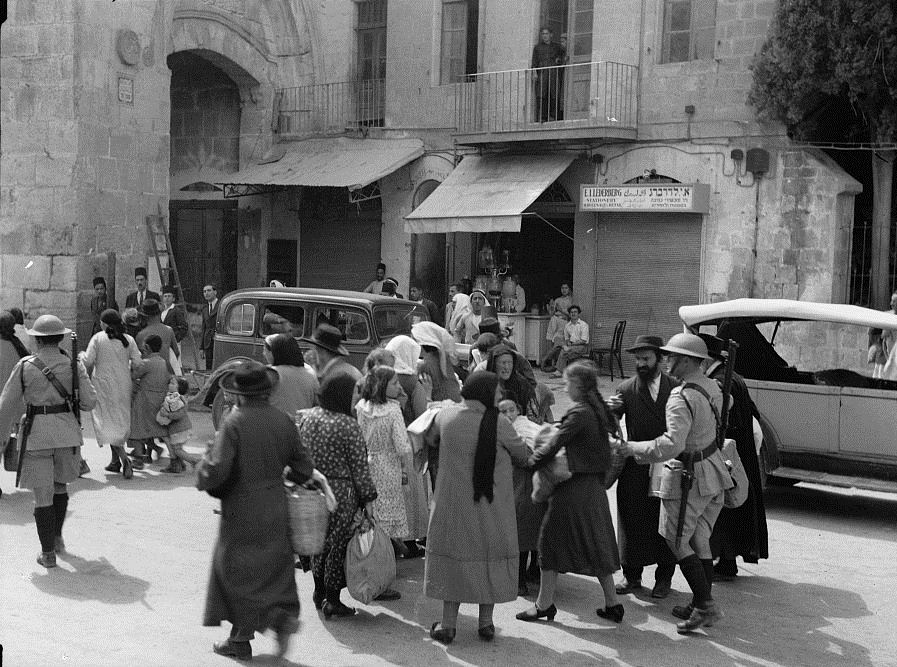
Jews evacuate the Old City of Jerusalem after Arab riots in 1936.

Haaretz During the Arab Revolt: Blood Is the Glue That Binds a Nation and Its Land

At the start of the Arab Revolt, which began 90 years ago this week, the newspaper told its readers that ‘the God of Israel wanted our sacrifices,’ and promised that the Jewish community was here to stay

 
Haaretz April 17, 2026
 
“Once again, this land, sacred to all civilized humanity, has absorbed innocent blood,” read the Haaretz editorial on April 20, 1936. “Once again, passions raged and man turned into a desert wolf; decent people, ordinary citizens … did not return home, because murderers cut short their lives.”

The day before, nine Jews had been murdered by Arabs in Jaffa. “Tel Aviv accompanies its slain-saints,” a newspaper heading read. “From horror to horror,” screamed another headline. These were the first days of the Arab Revolt of 1936-1939 (in which Palestinian Arabs in British Mandatory Palestine rose up against the administration). Hundreds of Jews and Britons and thousands of Arabs were killed.

As a result of the revolt the Jewish community in Palestine focused on strengthening its military capabilities which later proved crucial in the War of Independence. But the revolt also had negative effects as the British closed the gates to Jewish immigration in 1939, sealing the fate of many.

The editorial argued that “all of the people of Israel” were the target of the “wild mob.” The murderers “sought to murder the last national hope of a nation wallowing in its blood and decaying … in its suffering … while trying to lift its soul from the abyss of its distress to new life.” Its language then became even more poetic.


A member of the Jewish community in Palestine is wounded in the first days of the Arab Revolt.
 
A member of the Jewish community in Palestine is wounded in the first days of the Arab Revolt. Credit: Haaretz

“From the earliest days of our new national movement, we knew that the renewed homeland would not fall into our laps as a gift from above. We knew that the Land of Israel would be acquired only through suffering and sacrifices. And if it is a tragic necessity that we shall again betroth our ancestral land not only with love and justice and righteousness, not only by the sweat of our brows … but also with the sacrifices of the souls and blood of our sons – the builders of this land– we will accept the decree.

“We have no choice, there is no other way” – the article continued, then adopting a religious tone; “The sacrifice is the justification and right of redemption. … And the blood … covenantal blood of building a people and a homeland, is the glue that binds a nation and its land. … The God of Israel wanted our sacrifices.

“No calamity will move us from our place,” the editorial asserts. “No bloody assassination, no schemes of deceit will turn back the wheel of history or break our new-old covenant with this land. The Hebrew Yishuv [Jewish community] in this land … is a reality that cannot be undone – a reality as natural as the air, the sun, the blue skies over the Judean Hills, and the Mediterranean Sea. The propaganda of so-called leaders will not stand against this natural truth and nor will acts of crime and bloodshed. … From time to time a storm of hatred, a lust for destruction, rises against us. But even these storms reveal and strengthen our power, temper our will, awaken and encourage our spirit.”

"Man turned into a desert wolf; decent people, ordinary citizens … did not return home, because murderers cut short their lives."
 
“Man turned into a desert wolf; decent people, ordinary citizens … did not return home, because murderers cut short their lives.” Credit: Haaretz, April 20th, 1936.
The funerals for those murdered in Jaffa take place in Tel Aviv.
 
The funerals for those murdered in Jaffa take place in Tel Aviv. Credit: Haaretz

Five days earlier, on April 15, 1936, two people driving near Tulkarm had been shot dead in what initially appeared to be a criminally-motivated attack. “Attack on cars near Tulkarm,” read the headline of the brief news report. It later turned out that two victims were Jews and the murder had nationalist motives. It was carried out by members of the Iz al-Din al-Qassam Brigade, whose leader had been killed by the British about six months earlier (the group later lent its name to Hamas’ military wing). The next day, Jews murdered two Arabs in the Petah Tikva area.

On April 17, 1936, Haaretz dedicated its editorial to the attack in Tulkarm. It did not hide its revulsion toward some of the country’s Arabs. “The act of robbery and murder near Tulkarm stunned and shocked the Hebrew Yishuv,” it wrote. In parentheses, the editors added: “We doubt if anyone else in this country, besides the Hebrew Yishuv, is capable of being shocked by these terrible acts.

“We have experience and are under no illusions about the cultural level …of part of the population. … The psychological and moral distance between the ‘civilized’ population of this country and the desert is no less than the geographical distance between them.”

The mourners' notice for one of he first victims of the Arab Revolt.
 
 
The mourners’ notice for one of he first victims of the Arab Revolt. Credit: Haaretz
Scottish soldiers stop Palestinians and their camel at the entrance to Rachel's Tomb near Bethlehem.
 
Scottish soldiers stop Palestinians and their camel at the entrance to Rachel’s Tomb near Bethlehem. Credit: G. Eric and Edith Matson Photograph Collection

Regarding the nationalist motivations of the attackers, the editors wrote: “The specific circumstances of the recent murders arouse particular anxiety. This time there is no room for the naïve assumption that the victims were only coincidentally Jewish.

“The German from Sarona, who drove by the scene was not touched after he told the attackers his nationality, while the Jewish driver was forced out of his car. An Arab car that arrived at the scene passed safely, after it became clear to the murderers that there were no Jews in it,” they wrote. “Now we have robbers who engage in politics, who carry out robbery and murder with nationalist motives. Robbers who seek only Jewish money and Jewish blood.”

The newspaper warned of what was to come. “The current climate is deeply charged; the public mood has been poisoned by unrestrained demagogic propaganda in which all methods are deemed legitimate. This tension could ignite at any time, manifesting in isolated crimes or even mass violence. Meanwhile, the authorities look on, unwilling to fully acknowledge what is unfolding.”

British soldiers in Tel Aviv.
 
British soldiers in Tel Aviv. Credit: Haaretz.

An interview with Oren Kessler

by Oren Kessler
 
 
3365748242
Great Arab Revolt, 1936-1939
A Popular Uprising Facing a Ruthless Repression
 
In 1936, widespread Palestinian dissatisfaction with Britain’s governance erupted into open rebellion. Several key dynamics and events can be seen as setting the stage for this uprising. In Palestine, as elsewhere, the 1930s had been a time of intense economic disruption. Rural Palestinians were hit hard by debt and dispossession, and such pressures were only exacerbated by British policies and Zionist imperatives of land purchases and “Hebrew labor.” Rural to urban migration swelled Haifa and Jaffa with poor Palestinians in search of work, and new attendant forms of political organizing emerged that emphasized youth, religion, class, and ideology over older elite-based structures. Meanwhile, rising anti-Semitism—especially its state-supported variant—in Europe led to an increase of Jewish immigration, legal and illegal, in Palestine.

Unsurprisingly, the combination of these various trends produced periodic upheavals, from the 1929 al-Buraq Uprising to multicity demonstrations in 1933 against the British Mandate. In October 1935, the discovery of a shipment of arms in the Jaffa port destined for the Haganah fueled Palestinian concerns that the Zionist movement was introducing the human and military resources necessary for its state-building project under the nose of the British. Meanwhile, the popular and populist Syrian Shaykh Izzeddin al-Qassam , who preached to the slum-dwelling rural transplants near Haifa’s rail yards and who had spent the early 1930s building a cell-based paramilitary network, was killed in a firefight with British forces in November 1935. Qassam’s funeral in Haifa elicited a mass outpouring of public outrage. These events are often seen as direct predecessors of the mass Palestinian uprising that took place in 1936.

The Great Palestinian Rebellion , or the Great Arab Revolt, as this uprising came to be known, lasted for three years and can be generally divided into three phases. The first phase lasted from the spring of 1936 to July 1937. With tensions throughout Palestine running high since the fall of 1935, the revolt was ignited in mid-April 1936 when followers of Qassam attacked a convoy of trucks between Nablus and Tulkarm , killing two Jewish drivers. The next day, the  Irgun killed two Palestinian workers near Petah Tikva , and in the following days, deadly disturbances ensued in Tel Aviv and Jaffa. In Nablus, an Arab National Committee was formed and a strike was called on 19 April. National Committees in other cities echoed the call to strike, and on 25 April the Arab Higher Committee (Lajna) (AHC) was formed, chaired by Haj Amin al-Husseini , to coordinate and support a nationwide general strike, which was launched on 8 May.

The strike was widely observed and brought commercial and economic activity in the Palestinian sector to a standstill. Meanwhile, Palestinians throughout the countryside came together in armed groups to attack—at first sporadically, but with increasing organization— British and Zionist targets. Some Arab volunteers joined the rebels from outside Palestine, though their numbers remained small in this period. The British employed various tactics in an attempt to break the strike and to quell the rural insurrection. The ranks of British and Jewish policemen swelled and Palestinians were subjected to house searches, night raids, beatings, imprisonment, torture, and deportation. Large areas of Jaffa’s Old City were demolished, and the British called in military reinforcements.

Concurrent with military operations and repressive measures, the British government dispatched a commission of inquiry headed by Lord Peel to investigate the root causes of the revolt. In October 1936, under the combined pressure of British policies, other Arab heads of state, and the effects of a six-month general strike on the Palestinian population, the AHC called off the strike and agreed to appear before the Peel Commission . A period of lower intensity conflict prevailed as the Peel Commission toured the country, but tensions continued to build in anticipation of the commission’s report. In July 1937, the Peel Commission published its report, recommending Palestine’s partition into Jewish and Arab states. Dismayed by this negation of their desires and demands, the Palestinian population relaunched their armed insurgency with renewed intensity, initiating the second phase of the revolt.

This second phase, lasting from July 1937 until the fall of 1938, witnessed significant gains by the Palestinian rebels. Large swaths of the hilly Palestinian interior, including for a time the Old City of Jerusalem , fell fully under rebel control. Rebels established institutions, most significantly courts and a postal service, to replace the British Mandate structures they sought to dismantle. The British, meanwhile, imposed even harsher measures to try to quash the revolt. The AHC and all Palestinian political parties were outlawed, political and community leaders were arrested, and a number of high-profile public figures exiled. The military aspects of counterinsurgency intensified, and British tanks, airplanes, and heavy artillery were deployed throughout Palestine. The British also meted out collective punishment: thousands of Palestinians were relegated to “detention camps”; residential quarters were destroyed; schools were closed; villages were collectively fined and forced to billet British troops and police. Zionist military institutions took advantage of the situation to build up their capacities with British support. By early 1939, members of the Jewish Settlement Police (about 14,000) were subsidized, uniformed, and armed by the British government as a thinly veiled front for the Haganah, and so-called Special Night Squads  comprising Jewish and British members launched “special operations” against Palestinian villages.

The third phase of the rebellion lasted roughly from the fall of 1938 to the summer of 1939. The British dispatched another commission of inquiry, this one headed by Sir John Woodhead , to examine the technical aspects of implementing partition. In November 1938, the Woodhead Commission report concluded that partition was not practicable, marking a certain British retreat from the Peel recommendation. At the same time, however, the British launched an all-out offensive: in 1939 more Palestinians were killed, more were executed (by hanging), and nearly twice as many were detained than in 1938. Such brutality placed immense pressure on the rebels, exacerbating rifts between the political leadership of the AHC exiled in Damascus and local leadership on the ground, between rebel bands and village populations that were expected to support and supply them, and ultimately between Palestinians who remained committed to the revolt and those willing to reach a compromise with the British. British-supported Palestinian “Peace Bands” were dispatched to battle their compatriots.

In May 1939, the British government published a new White Paperthat proposed the following: Britain’s obligations to the Jewish national home had been substantially fulfilled; indefinite mass Jewish immigration to and land acquisition in Palestine would contradict Britain’s obligations to the Palestinians; within the next five years, no more than 75,000 Jews would be allowed into the country, after which Jewish immigration would be subject to “Arab acquiescence”; land transfers would be permitted in certain areas, but restricted and prohibited in others, to protect Palestinians from landlessness; and an independent unitary state would be established after ten years, conditional on favorable Palestinian-Jewish relations.

The combined impact of Britain’s military and diplomatic efforts brought the rebellion to an end in the late summer of 1939. Over the revolt’s three years, some 5,000 Palestinians had been killed and nearly 15,000 wounded. The Palestinian leadership had been exiled, assassinated, imprisoned, and made to turn against one another. At the same time, the White Paper—despite its limitations—offered certain concessions to the rebels’ demands. Whatever gains Palestinians might have made through the revolt, however, were quickly overtaken by the larger geopolitical processes of World War II , and the combined British-Zionist assault on Palestinian political and social life during the revolt had a long-lasting impact.

 
Selected Bibliography:

Anderson, Charles W. “State of Formation from Below and the Great Revolt in Palestine.” Journal of Palestine Studies 47, no. 1 (Autumn 2017): 39-55.

Hughes, Matthew. “From Law and Order to Pacification: Britain’s Suppression of the 1936–1939 Arab Revolt in Palestine.” Journal of Palestine Studies 39, no.2 (Winter 2010): 6–22.

Kanafani, Ghassan. The 1936–39 Revolt in Palestine.

Shbeib, Samih. “Poetry of Rebellion: The Life, Verse and Death of Nuh Ibrahim during the 1936–39 Revolt.” Jerusalem Quarterly 25 (Winter 2006): 65–78.

Sufian, Sandy. “Anatomy of the 1936-39 Revolt: Images of the Body in Political Cartoons of Mandatory Palestine.” Journal of Palestine Studies 37, no.2 (Winter 2008):  23–42.

Swedenburg, Ted. Memories of Revolt: The 1936–1939 Rebellion and the Palestinian National Past. Fayetteville: University of Arkansas Press, 2003.

Britain says releasing a 1941 document about Palestine might ‘undermine security’

A two-part archive, labeled “Activities of the Grand Mufti of Jerusalem” and dated 1940-1941, sits in Britain’s National Archives in Kew. This writer successfully had the first part declassified in 2014. The second part remains sealed. My 2018 attempt to have these ten pages declassified was refused on the grounds that the archive might “undermine the security of the country [Britain] and its citizens.”[1] None of its secrets are to be available until January, 2042; and if the paired file is any precedent, even in 2042 it will be released only in redacted form.

The ‘Grand Mufti’ in the archive’s heading is Haj Amin al-Husseini, the Palestinian leader whom posterity best remembers for his alignment with the Italian and German fascists; and the years 1940-1941 place him not in Palestine, but in Iraq — and if the second archive extends to late 1941, in Europe. What could possibly be hidden in a World War II document about a long-dead Nazi sympathizer that would present such a risk to British national security eight decades later, that none of it can be revealed? At present, only the UK government censors know; but the answer may have less to do with the fascists and al-Husseini than with British misdeeds in Iraq, and less to do with Britain’s national security than with its historical embarrassment.

When in 1921 votes were cast for the new Mufti of Jerusalem, Amin al-Husseini came in last among the four candidates. But votes in Palestine mattered as little then as they do now, and the British, Palestine’s novice replacement occupiers for the Ottomans, handed the post to al-Husseini. At first, he proved to be an asset to the British. But as the years passed, his opposition to Zionism, support for Palestinian nationalism, and ultimately his involvement in the 1936 Palestinian uprising, led to calls for his arrest.

Photograph labelled 'Arab demonstrations on Oct. 13 and 27, 1933. In Jerusalem and Jaffa. Return of Grand Mufti from India. Met by hundreds of cars at Gethsemane, Nov. 17, 1933.'

“ARAB DEMONSTRATIONS ON OCT. 13 AND 27, 1933. IN JERUSALEM AND JAFFA. RETURN OF GRAND MUFTI FROM INDIA. MET BY HUNDREDS OF CARS AT GETHSEMANE, NOV. 17, 1933.” LIBRARY OF CONGRESS, LC-M33- 4218.

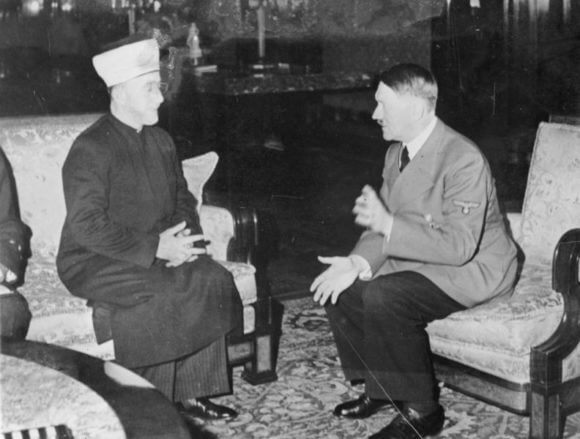
In mid-October of 1937, he fled from hiding in Palestine to Beirut. Two years later and six weeks after the outbreak of World War II, in mid-October of 1939, he slipped to Baghdad, where his sympathies for the Italian fascists further alarmed the British. Fast-forward another two years to late 1941, and al-Husseini is in Europe, meeting with Benito Mussolini on the 27th of October, and on the 28th of November meeting with the Führer himself at the Reich Chancellery in Berlin.

Al-Husseini’s motivation for embracing the Axis was likely a combination of selfish political opportunism and the belief that the alignment would help safeguard against the takeover of Palestine by the Zionists. The reasoning, however grotesque, was the same used by Lehi (the ‘Stern Gang’) in its own attempted collaboration with the fascists: Britain was the obstacle both to Palestinian liberation, and to unbridled Zionism, and for both the Mufti and Lehi, defeating that obstacle meant embracing its enemies. Even the ‘mainstream’ David Ben-Gurion had no moral qualms about taking advantage of Britain’s struggle against the Nazis — a struggle for which his Jewish Agency was already conspicuously unhelpful — by exploiting Britain’s post-war vulnerabilities.[2]

Posterity has treated Lehi’s and the Mufti’s flirtations with the fascists quite differently. Lehi, the most fanatical of the major Zionist terror organizations, was transformed into freedom fighters, and ex-Lehi leader Yitzhak Shamir was twice elected as Israeli Prime Minister. In contrast, Zionist leaders quickly seized on al-Husseini’s past to smear not just him, but the Palestinians as a people, as Nazis.

The use of al-Husseini’s unsavory history to ‘justify’ anti-Palestinian racism continues to the present day. Most bizarrely, in 2015 Israeli Prime Minister Benjamin Netanyahu claimed that Hitler had not intended to exterminate the Jews — that is, not until al-Husseini planted the words in his ear — which translates as “got the idea from the Palestinians”. A private citizen would likely have been arrested under German law for this attempt to rewrite the Holocaust.

The mufti of Jerusalem, Sayid Amin al Husseini, meets with Hitler, November 1941.

THE MUFTI OF JERUSALEM, SAYID AMIN AL HUSSEINI, MEETS WITH HITLER, NOVEMBER 1941.

Iraq won limited independence in 1932, just before the Nazis came to power. When the Mufti ensconced himself in Iraq seven years later, the country was under nominally ‘pro-British’ Prime Ministers, and Regent ‘Abd al-Ilah for the four-year-old king, Faisal II. This uneasy British-Iraqi equilibrium ended on first day of April 1941, when four Iraqi officers known as the Golden Square, wanting full independence (and similarly aligning themselves with the fascists in the foolish belief that doing so would help them get it), staged a coup d’état. It lasted two months. British troops ousted the coup on the first day of June — and as they did, anti-Jewish riots rocked Baghdad. An estimated 180 Jewish Iraqis were killed and 240 wounded in this pogrom known as the Farhud.

Why would the momentary power vacuum of the British takeover lead to anti-Jewish terror? While doing research for my 2016 book, State of Terror, I was intrigued by the claim of one Iraqi Jewish witness, Naeim Giladi, that these ‘Arab’ riots were orchestrated by the British to justify their return to power.[3] Indeed, the riots seemed unnatural in a society where Jews had lived for two and a half millennia, and the “pro-Axis” Golden Square takeover two months earlier had not precipitated any such pogrom. Yet it was also true that Zionism had created ethnic resentment, and Giladi did not question that junior officers of the Iraqi army were involved in the violence. The evidence provided by Giladi was compelling enough to seek out clues among British source documents that were not available to him.

And that, along with the hope of shedding new light on the Mufti’s pro-fascist activities, brought me to the archive at issue and my qualified (redacted) success in getting the first part declassified– officially titled, CO 733/420/19. Not surprisingly, much of the file focused on legitimate worry over the Mufti’s dealings with the Italian fascists. Some of the British voices recorded considered him to be a serious threat to the war effort, and a report entitled “Inside Information” spoke of the Mufti’s place in an alleged “German shadow government in Arabia”. Others dismissed this as “typical of the sort of stuff which literary refugees put into their memoirs in order to make them dramatic” and suggested that the Mufti’s influence was overstated.

Whatever the case, by October 1940, the Foreign Office was considering various methods for “putting an end to the Mufti’s intrigues with the Italians”, and by mid-November,

it was decided that the only really effective means of securing a control over him [the Mufti] would be a military occupation of Iraq.

British plans of a coup were no longer mere discussion, but a plan already in progress:

We may be able to clip the Mufti’s wings when we can get a new Government in Iraq. F.O. [Foreign Office] are working on this”.

So, the British were already working on re-occupying Iraq five months before the April 1941 ‘Golden Square’ coup.

A prominent thread of the archive was: How to effect a British coup without further alienating ‘the Arab world’ in the midst of the war, beyond what the empowering of Zionism had already done? Harold MacMichael, High Commissioner for Palestine, suggested the idea “that documents incriminating the Mufti have been found in Libya” that can be used to embarrass him among his followers; but others “felt some hesitation … knowing, as we should, there was no truth in the statement.”

But frustratingly, the trail stops in late 1940; to know anything conclusive we need the second part’s forbidden ten pages: CO 733/420/19/1.

The redacted first part partially supports, or at least does not challenge, Giladi’s claim. It proves that Britain was planning regime change and sought a pretext, but gives no hint as to whether ethnic violence was to be that pretext. Interestingly, Lehi had at the time reached the same conclusion as Giladi: its Communique claimed that “Churchill’s Government is responsible for the pogrom in Baghdad”.[4]

Does the public have the right to see still-secret archives such as CO 733/420/19/1? In this case, the gatekeepers claimed to be protecting us from the Forbidden Fruit of “curiosity”: They claimed to be distinguishing between “information that would benefit the public good”, and “information that would meet public curiosity”, and decided on our behalf that this archive fit the latter.[1] We are to believe that an eight-decade-old archive on an important issue remains sealed because it would merely satisfy our lust for salacious gossip.

Perhaps no assessment of past British manipulation in Iraq would have given pause to the Blair government before signing on to the US’s vastly more catastrophic Iraqi ‘regime change’ of 2003, promoted with none of 1940’s hesitation about using forged ‘African’ documents — this time around Niger, instead of Libya. But history has not even a chance of teaching us, if its lessons are kept hidden from the people themselves.

Note: According to Giladi, the riots of 1941 “gave the Zionists in Palestine a pretext to set up a Zionist underground in Iraq” that would culminate with the (proven) Israeli false-flag ‘terrorism’ that emptied most of Iraq’s Jewish population a decade later. Documents in Kew seen by the author support this. But to be sure, the Zionists were not connected with the alleged British maneuvers of 1941.

1. Correspondence from the UK government, explaining its refusal to allow me access to CO 733/420/19/1:

Section 23(1) (security bodies and security matters): We have considered whether the balance of the public interest favours releasing or withholding this information. After careful consideration, we have determined that the public interest in releasing the information you have requested is outweighed by the public interest in maintaining the exemption. It is in the public interest that our security agencies can operate effectively in the interests of the United Kingdom, without disclosing information that would assist those determined to undermine the security of the country and its citizens.

The judiciary differentiates between information that would benefit the public good and information that would meet public curiosity. It does not consider the latter to be a ‘public interest’ in favour of disclosure. In this case, disclosure would neither meaningfully improve transparency nor assist public debate, and disclosure would not therefore benefit the public good.

2. Ben-Gurion looked ahead to when the end of the war would leave Britain militarily weakened and geographically dispersed, and economically ruined. He cited the occupation of Vilna by the Poles after World War I as a precedent for the tactic. For him, the end of WWII only presented an opportunity for the takeover of Palestine with less physical resistance; it also left Britain at the mercy of the United States for economic relief, which the Jewish Agency exploited by pressuring US politicians to make that assistance contingent on supporting Zionist claims to Palestine. At a mid-December 1945 secret meeting of the Jewish Agency Executive, Ben-Gurion stressed that “our activities should be directed from Washington and not from London”, noting that “Jewish influence in America is powerful and able to cause damage to the interests of Great Britain”, as it “depends to a great extent on America economically” and would “not be able to ignore American pressure if we succeed in bringing this pressure to bear”. He lauded Rabbi Abba Silver in the US for his aggressiveness on the issue, while noting that he was nonetheless “a little fanatical and may go too far”. (TNA, FO 1093/508). The Irgun was more direct in 1946, stating that Britain’s commuting of two terrorists’ death sentences and other accommodations to the Zionists “has been done with the sole purpose to calm American opposition against the American loan to Britain”. (TNA, KV 5-36). Meanwhile, in the US that year Rabbi Silver’s bluntness on the tactic worried Moshe Shertok (a future prime minister). Although like Ben-Gurion, Shertok said that “we shall exploit to the maximum the American pressure on the British Government”, in particular the pre-election period (and in particular New York), but urged “care and wisdom in this” so as not to give ammunition to “anti-Zionists and the anti-semites in general”. Shertok criticized Silver for saying publicly that “he and his supporters opposed the loan to be granted to the British Government”. (TNA, CO 537/1715)

3. Suárez, Thomas, State of Terror: How Terrorism Created Modern Israel[Skyscraper, 2016, and Interlink, 2017]; In Arabic, هكذا أقيمت المستعمرة [Kuwait, 2018]; in French, Comment le terrorisme a créé Israël[Investig’Action, 2019]
Giladi, Naeim, Ben-Gurion’s Scandals: How the Haganah and the Mossad Eliminated Jews [Dandelion, 2006]

4. Lehi, Communique, No. 21/41, dated 1st of August 1941

Update: This post originally referred to the “four-year-old Prime Minister, ‘Abd al-Ilah,” not the four-year-old King Faisal under Regent ‘Abd al-Ilah. Commenter Jon S. corrected us, and the post has been changed.

The day the Mufti died 

Yes, Hajj Amin al-Husayni collaborated with the Nazis, but that’s not why he was dropped from the Palestinian narrative 

Martin Kramer, Times of Israel Blogs, July 5, 202

Please note that the posts on The Blogs are contributed by third parties. The opinions, facts and any media content in them are presented solely by the authors, and neither The Times of Israel nor its partners assume any responsibility for them. Please contact us in case of abuse. In case of abuse,

“To His Eminence the Grand Mufti as a memento. H. Himmler. July 4, 1943.” Israel State Archives.

Fifty years ago, on July 4, 1974, Hajj Amin al-Husayni, the “Grand Mufti” of Jerusalem, passed away in Beirut, Lebanon, at the American University Hospital. At age 79, he died of natural causes. The Mufti had faded from the headlines a decade earlier. In 1961, his name had resurfaced numerous times during the Jerusalem trial of Adolf Eichmann. But a couple of years later, the Palestinian cause gained a new face in Yasser Arafat. With that, the Mufti entered his final eclipse.

When he died, the Supreme Muslim Council in Jerusalem asked the Israeli authorities for permission to bury him in the city. Israel refused the request. Any Palestinian who wanted to attend the funeral in Lebanon would be allowed to do so, but the Mufti of Jerusalem would not be buried in Jerusalem. Instead, the Mufti was laid to rest in the Palestinian “Martyrs’ Cemetery” in Beirut.

The Mufti was appointed to his position by the British in 1921. Within the British Empire, authorities preferred to work through “native” institutions, even if they had to create them on the fly. So they established a supreme council for Palestine’s Muslims and placed the Mufti at its helm. Although he lacked religious qualifications, he came from a leading family and appeared capable of striking deals.

In fact, he used his position to oppose the Jewish “National Home” policy of the Mandate. The “Arab Revolt” of 1936 finally convinced the British that he had to go, and in 1937 he fled the country.

After a period in Lebanon, he ended up in Iraq, where he helped foment a coup against the pro-British regime. When British forces suppressed the coup, he fled again, making his way through Tehran and Rome to Berlin. There, the Nazi regime used him to stir up Arabs and Muslims against the Allies. He was photographed with Hitler and Himmler, recruited Muslims to fight for the Axis, and attempted to secure promises of independence for colonized Arabs and Muslims. None of his efforts met with much success. His role, if any, in the Holocaust is a contested matter. Hitler and his henchmen hardly needed any prompting to execute their genocidal plans. Clearly, though, the Mufti rooted for Jewish destruction from the fifty-yard line.

After the Nazi collapse, he fell into French hands and spent a year in comfortable house detention near Paris. Later, he fled to Egypt and subsequently moved in and out of Syria and Lebanon. Following the Arab debacle of 1948, Egypt established an “All Palestine Government” in the refugee-choked Gaza Strip, leaving the presidency open for the Mufti. It didn’t last long. He continued to maneuver through Arab politics, but he was yesterday’s man to a new generation of Palestinians born in exile. During the Eichmann trial, the prosecution sought to implicate the Mufti as an accomplice. Yet the Mossad never came after him, and he didn’t die a martyr’s death.

Man without a country

The Mufti was a formidable politician. In 1951, a State Department-CIA profile of him opened with this evocative enumeration of his many talents, which is worth quoting at length:

King of no country, having no army, exiled, forever poised for flight from one country to another in disguise, he has survived because of his remarkable ability to play the British against the French, the French against the British, and the Americans against both; and also because he has become a symbol among the Arabs for defending them against the Zionists. His suave penchant for intrigue, his delicate manipulation of one Arab faction against another, combined with the popularity of his slogan of a united Muslim world, has made him a symbol and a force in the Middle East that is difficult to cope with and well nigh impossible to destroy. The names of Machiavelli, Richelieu, and Metternich come to mind to describe him, yet none of these apply. Alone, without a state, he plays an international game on behalf of his fellow Muslims. That they are ungrateful, unprepared, and divided by complex and innumerable schisms, does not deter him from his dream. 

Profilers would later write similar things about Arafat, but the Mufti had none of Arafat’s cultivated dishevelment. He was manicured, even chic:

The Mufti is a man of striking appearance. Vigorous, erect, and proud, like a number of Palestinian Arabs he has pink-white skin and blue eyes. His hair and beard, formerly a foxy red, is now grey. He always wears an ankle length black robe and a tarbush wound with a spotless turban. Part of his charm lies in his deep Oriental courtesy; he sees a visitor not only to the door, but to the gate as well, and speeds him on his way with blessings. Another of his assets is his well-modulated voice and his cultured Arabic vocabulary. He can both preach and argue effectively, and is well versed in all the problems of Islam and Arab nationalism. His mystical devotion to his cause, which is indivisibly bound up with his personal and family aggrandizement, has been unflagging, and he has never deviated from his theme. For his numerous illiterate followers, such political consistency and simplicity has its advantages. The Mufti has always known well how to exploit Muslim hatred of ‘infidel’ rule. 

So why did the Mufti fade into obscurity? (By 1951, he was on his way out.) Many mistakenly believe his collaboration with Hitler and the Nazis discredited him. It didn’t. Not only did the Arabs not care, but Western governments eyed the Mufti with self-interest. The general view in foreign ministries held that he had picked the wrong side in the war, but not more than that.

The above-quoted American report expressed this view perfectly: “While the Zionists consider him slightly worse than Mephistopheles and have used him as a symbol of Nazism, this is false. He cared nothing about Nazism and did not work well with Germans. He regarded them merely as instruments to be used for his own aims.” If so, why not open a discreet line to him and let him roam the world unimpeded?

Nakba stigma

What finally discredited the Mufti in Arab opinion, where it mattered most, was his role in the 1948 war. It was a war he wanted and believed his side would win. In late 1947, the British sent someone to see if there might be some behind-the-scenes flexibility in his stance on partition, which he had completely rejected. There wasn’t. He explained:

As regards the withdrawal of British troops from Palestine, we would not mind. We do not fear the Jews, their Stern, Irgun, Haganah. We might lose at first. We would have many losses, but in the end we must win. Remember Mussolini, who talked of 8,000,000 bayonets, who bluffed the world that he had turned the macaronis back into Romans. For 21 years he made this bluff, and what happened when his Romans were put to the test? They crumbled into nothing. So with the Zionists. They will eventually crumble into nothing, and we do not fear the result, unless of course Britain or America or some other Great Power intervenes. Even then we shall fight and the Arab world will be perpetually hostile. Nor do we want you to substitute American or United Nations troops for the British. That would be even worse. We want no foreign troops. Leave us to fight it out ourselves. 

This underestimation of the Zionists proved disastrous, even more so than his overestimation of the Axis. He later wrote his memoirs, blaming “imperialist” intervention, Arab internal divisions, and world Zionist mind-control for the 1948 defeat. To no avail: his name became inseparable from the Nakba, the loss of Arab Palestine to the Jews. His reputation hit rock bottom, along with that of the other failed Arab rulers of 1948.

Upon his death in 1974, he received a grand sendoff in Beirut from the PLO. In 1970, Arafat had transferred the PLO headquarters from Jordan to Lebanon, and the funeral finalized his status as the sole leader of the Palestinian people. Four months later, Arafat addressed the world from the podium of the UN General Assembly, achieving an international legitimacy that the Mufti could never have imagined.

The PLO then dropped the Mufti from the Palestinian narrative; nothing bears his name. Even Hamas, which inherited his uncompromising rigidity and Jew-hatred, doesn’t include him in their pantheon. (Their man is Izz al-Din al-Qassam, a firebrand “martyr” killed by the British in 1935.)

If anyone still dwells on the Mufti, it’s the Israelis, including their current prime minister, who find him useful as a supposed link between the Palestinian cause and Nazism. One can understand Palestinians who push back on this; the Mufti was no Eichmann. But that doesn’t excuse Palestinian reluctance to wrestle candidly with the Mufti’s legacy. He personified the refusal to see Israel as it is and an unwillingness to imagine a compromise. Until Palestinians exorcise his ghost, it will continue to haunt them.


Can Lebanon free itself from Hezbollah’s grip?

Contrary to what many of the historically uniformed opponents of Israel and the US and its allies might think as they rush to judgement on the streets of western cities, the current Israeli Lebanese war (the third of that name) did not begin with the wired pagers and walkie talkies and the killing of much of Hezbollah’s leadership, including its chief, Hasan Nasrallah. It started the day after the Hamas’ murderous assault on Israel’s border communities on October 7th last year, when, ostensibly as a show of solidarity for Hamas and Gaza and with theocratic Iran’s tacit approval, the Lebanese Hezbollah began launching drones and missiles at northern Israel – some 9,000 to date – forcing the evacuation of probably up to 100, 000 citizens to safer areas to the south – where they remain to this day.

Yet, it is only now, a year later, that there are calls internationally for a ceasefire. I’ve seen glaciers move faster! Not that messianic jihadis are much into ceasefires, let alone surrender. It’s not in their doomsday DNA – they’d sooner burn down the house with themselves and their co-religionists inside, as they have done in Gaza.

There is no question that Hezbollah had it coming and that Israel’s strikes have been perfectly justifiable. Hezbollah committed a series of gross miscalculations and grievous strategic blunders. Nasrallah’s delusions of power were his undoing. Now it remains to be seen if Hezbollah can survive the devastation it has suffered in the last two weeks, and more critical for the rest of the world, if the conflict escalated into a regional war in which Israel and Its allies have to confront Iran’s “Ring of Fire”, its “Axis of Resistance” – a war that is actually now being waged on seven fronts: Gaza, the West Bank, Lebanon, Syria, Iraq, Iran – and world opinion.

Anyone who is willing to bet for or against an escalation between Israel and Iran should quit gambling. While the United States’ involvement endeavours to avert further escalation, this is like trying to put toothpaste back in the tube: theoretically possible, practically impossible. Remember the ludicrous American and Israeli concept of “escalate to de-escalate” from merely a week ago. Unpredictable developments and spiraling escalation obviously outpace analysis

Hezbollah members carry the coffins of two commanders during a funeral procession in Beirut’s southern suburbs on September 25. AP

Slouching towards Beirut

The Sydney Morning Herald provided an excellent summary of how the Shia Hezbollah came to create a parasitic state within a state and to dominate Lebanon’s politics, economy and society, outman and outgun the meagre Lebanese army, and to potentially threaten the country’s survival. Like Hamas, its Sunni counterpart in Gaza, it is an Iran-funded messianic, fundamentalist organization dedicated to the elimination of Israel, and the theocratic Islamic Republic of Iran’s most important proxy in the “Axis of Resistance” to the Jewish state and the United States and its allies, a keystone in its Ring of Fire strategy. And also like Hamas, its jihadi ideology, evident in its name, The Party of God, does not permit compromise let alone surrender.

On 27th September, Tom McTague, the political editor of the UK e-zine Unherd wrote in an article called Why Lebanon can’t be saved:

“Today, Lebanon is a dead state, eaten alive by Hezbollah’s parasitic power. The scale of the catastrophe in the country is hard to comprehend, much of it caused by the disruptive nature of Syria’s civil war. Since its neighbour’s descent into anarchic hell, some 1.5 million Syrians have sought refuge in Lebanon — a tiny country with a population of just 5 million. But, more fundamentally, with Hezbollah fighting to protect Bashar al Assad, the opposing countries — led by Saudi Arabia — began withdrawing funds from Lebanese banks. This sparked a financial crisis that left Lebanon with no money for fuel.

By spring 2020, the country had defaulted on its debts, sending it into a downward spiral which the World Bank in 2021 described as among “the top 10, possibly top three, most severe crises globally since the mid-nineteenth century”. Lebanon’s GDP plummeted by around a third, with poverty doubling from 42% to 82% in two years. At the same time, the country’s capital, Beirut, was hit by an extraordinary explosion at its port, leaving more than 300,000 homeless. By 2023 the IMF described the situation as “very dangerous” and the US was warning that the collapse of the Lebanese state was “a real possibility”.

With Iranian support, however, Hezbollah created a shadow economy almost entirely separate from this wider collapse. It could escape the energy shortages, while creating its own banks, supermarkets and electricity network. Hezbollah isn’t just a terrorist group. It is a state within a state, complete with a far more advanced army. “They may have plunged Lebanon into complete chaos, but they themselves are not chaotic at all,” as Carmit Valensi, from the Institute for National Security Studies at Tel Aviv University, told the Jerusalem Post.

Then came 7 October, after which Hezbollah tied its fate to that of the Palestinians, promising to bombard Israel with rockets until the war in Gaza was brought to a close. We have witnessed the frightening scale of its power over the past year, its bombardment forcing some 100,000 Israelis from their homes in Galilee to the safety of the Israeli heartlands around Tel Aviv. For the first time since modern Israel’s creation, the land where Jews are able to live in their own state has shrunk; the rockets are a daily reminder of the country’s extraordinary vulnerability, threatened on all sides by states who actively want it removed from the map – even from history itself. The pretense (in the walk of the Abraham Accords brokered by the US between Israel and a number of ‘friends’ Arab autocracies that the Palestinian and Lebanese questions could be contained, ignored or bypassed as part of a wider grand strategy to contain Iran has been shattered”.

The day after

Some commentators are more upbeat than McTague about Lebanon’s prospects in the event of the weakening if not outright removal of Hezbollah’s stranglehold on Lebanese life. I republish two such below.  Both acknowledge that this would not be easy.

Hezbollah’s command-and-control infrastructure is in tatters. But the Iranian control of Syria gives Hezbollah significant strategic depth, and, despite the recent losses, Hezbollah is a very large organization that is deeply woven into Lebanon’s Shia population, the largest sect in the country. But the events of the past two have seen the mystique around Hezbollah broken. Its prestige, built on “resistance” to Israel, has been irreparably damaged – not least by the revelation of how extensively Israeli spies have infiltrated its ranks. Hezbollah’s ability to dominate Lebanon is open to challenge in a way it has not been for decades. The end could well be nigh for the terrorist group.

As Israeli commentator Zvi Bar’el, wrote in Haaretz on 28 September:

“Even if Israel succeeds in destroying the entire stock of Hezbollah missiles that threaten it, the arms that remain in the organization’s hand will continue to serve as a whip threatening Lebanon’s domestic front so long as the country has no effective, equipped and trained army that can contend with Hezbollah. Iran fears that this lever is now liable to lose its power in the face of the heavy blows suffered by Hezbollah, which may lead to the Lebanese public to rear its head, considering the very heavy price it has had to pay for the war that is not its own, whose rationale has not been defense of the homeland, but assisting Hamas.

The Lebanese public and in particular the political rivals to Hezbollah, despite the sharp criticism that has intensified during the war, and in particular over the past two weeks, has still not taken to the streets to confront the organization. The political harmony between Hezbollah’s rivals has not yet ripened, their internecine revulsion and hate rivals what they feel toward Hezbollah, and there is no certainty that even in the face of the destruction of Lebanon will they be able to close ranks. Hezbollah is still demonstrating fighting ability despite the loss of its senior commanders, and the political road map that now appears optimal may disappear if a regional confrontation begins following the expected Israeli strike against Iran.

But the Lebanese have already demonstrated their power several times in the country’s recent history. In 2005, they drove the Syrian forces out of the country following the assassination of Prime Minister Rafik al-Hariri, and in 2008, they violently confronted Hezbollah in a clash that killed dozens. They have toppled governments and forced the replacement of ministers, and most of all, in contrast to Gaza, they have a country that offers a collective national structure that they believe has been undermined by Iran, by way of Hezbollah.

With more than a million Lebanese uprooted from their homes, and Hezbollah’s social and health services no longer capable of responding to the needs of the homeless and wounded, forcing the group to rely on the services of the government it aspired to replace – Iran’s strategic challenge is to prevent a situation in which the country and its people will reject, or at least erode, Hezbollah’s status as the party that determines the nation’s policy and character.’

But the way ahead is daunting. Lebanon was in dire straits even before October 7th.

An economic crisis that began in 2019 and a massive 2020 port explosion for which Hezbollah was partly responsible, have left Lebanon struggling to provide basic services such as electricity and medical care. Political divisions have left the country of 6 million without a president or functioning government for more than two years, deepening a national sense of abandonment. Reeling from years of economic dysfunction brought on by corruption and the presence of perhaps over a million refugees. A comprehensive international effort is needed to rebuild its political, economic, and military institutions. Yet critical aid and reconstruction money has been withheld precisely because of exasperation with Hezbollah’s corrupting presence in the country.

Lebanon must be freed of Hezbollah and Iran, and it should not be left up to Israel and its highly problematic Netanyahu government. The international community needs to take an active role in supporting Lebanon’s recovery and resisting Iranian interference. The UN Security Council can start the process by demanding the implementation of the United Nations Security Council resolution 1701 which was intended to resolve the 2006 Lebanon War. It was unanimously approved by the Security Council  and the Lebanese cabinet.

That resolution called for a full cessation of hostilities between Israel and Hezbollah; the withdrawal of Israeli forces from Lebanon to be replaced by Lebanese and United Nations Interim Force in Lebanon (UNIFIL) forces deploying to southern Lebanon; and the disarmament of armed groups including Hezbollah, with no armed forces other than UNIFIL and Lebanese military south of the Litani River which flows about 29 km north of the border. As of 2024, the resolution was not fully implemented. Hezbollah and other armed groups in southern Lebanon have not withdrawn at all; in particular, Hezbollah has since significantly increased their weapons capabilities

For more on Lebanon in In That Howling Infinite, see Lebanon’s WhatsAPP intifada, Pity the Nation and O Beirut – songs for a wounded city 

Hezbollah leader Hasan Nasrullah

The Day After Nasrallah: Lebanon’s Government Is Unsure How to Handle the ‘Historic Opportunity’ Ahead

With Nasrallah gone, Lebanon has a unique opportunity to envision a post-Hezbollah reality, yet the militant organization still maintains a tight grip on the country. They will not permit the government to secure a diplomatic solution acceptable to Israel.

Zvi Bar’el H

A little more than 20 years after the execution of Saddam Hussein and the end of his reign of terror, and about 13 years after the Arab Spring overthrew a number of dictators, a show of euphoria is resolutely predicting that Hezbollah Secretary General Hassan Nasrallah’s death will “change the map of the Middle East,” accompanied by proposals and work plans meant to take advantage of the opportunity to redraw that “dream map.”

The obvious starting point for this imagined renaissance is Lebanon, whose most significant political, economic and military center since the civil war ended in 1989 with the signing of the Taif Agreement, has now been damaged. The uniqueness and importance of the Taif Agreement was that it sought to shatter the confessional structure of the government that gave Christians a majority in the government and its institutions, as well as in the companies affiliated to it and in the army.

The agreement stipulated that Christians would no longer have an automatic majority in parliament, based on a population census conducted in 1932. Instead, its 128 seats would be divided equally between Christians (and other non-Muslim minorities) and Muslims, a definition that also included the Druze and the Alawite. In the important secondary division of the Muslim sects, 27 seats were allocated to Sunnis and 27 seats to Shi’ites.

At the base of this division was the aspiration that no single sect would ever be able to rule the country exclusively; for a government to be established, each sect would have to form a coalition with other sects that would share the political and economic spoils.

At the time, this structure was seen as an appropriate solution to ending the 15-year civil war. It did not build better politics in the country, but it did give Lebanon years of stability. This structure has not changed and it is not expected to change even after the removal of Nasrallah and Hezbollah’s military leaders; it is anchored in the Lebanese constitution, which no one currently intends to change.

The Taif agreement has led to the formation of trans-confessional coalitions, but they brought the country to economic collapse and to the brink of bankruptcy and political paralysis: In this situation, the rival parties cannot agree on a president, and since it is the president who appoints the prime minister it is then impossible to form a permanent government to make the critical decisions necessary to rescue the state from the crisis.

In an interview with Yossi Melman, former Mossad chief Tamir Pardo said, “The Israeli government should announce loudly and clearly that Lebanon is a single entity, and that the Lebanese government bears sole responsibility for every act of aggression that comes out of Lebanon. That the territory known to the world as Lebanon has one government, one flag and one army. That any negotiations to end the war and determine security arrangements will only take place with the Lebanese government. This war could be ended within hours from the moment Israel makes this clear and the international community acknowledges the fact that there is only one single legal entity in Lebanon.”

This is a statement that rests on admirable theoretical foundations, but they are detached from the reality of Lebanon and above all from the reality of the torn, crazy patchwork quilt known as the “Lebanese government.” It is true that any negotiations must be conducted with the Lebanese government, and that the country has “one government,” but it is a government with cabinet members who serve on behalf of Hezbollah who, together with their coalition partners from the Amal movement and, until recently, Gebran Bassil’s Christian party the Free Patriotic Movement, hold the government and the country by the throat, with or without Nasrallah. To bring about the “historic change,” Lebanon will have to hold a new general election, which at the present is about as likely as appointing a president or implementing economic reforms.
Lebanon has “one flag and one army,” but in practice it has two armies: the official one, headed by the Christian general Joseph Aoun, who has been mentioned as a candidate for the presidency; and the “Hezbollah army.” Even after all of the latter’s long- and medium-range missiles are destroyed and it no longer poses a threat to Israel, it will still have enough weapons to threaten Lebanon’s internal security and its own political rivals.
The Lebanese Army, on the other hand, is a ghost army. On paper, it has an estimated 80,000 or so soldiers, as well as a token navy and air force, lacking air defenses that could protect Lebanon’s skies from hostile attacks. Above all, it is a bankrupt army, that relies on Qatar and America for the wherewithal that allows the force to pay its soldiers their monthly wages of about $100. Many soldiers on the army’s payroll take on odd jobs in order to support their families.
Hezbollah’s fighters have no such problems. Their salaries are much higher, with a funding pipeline that relies on tremendous assistance from Iran and on the organization’s resources outside of Lebanon, without forgoing their share from the state budget.
During and before the war, Jean-Yves Le Drian, French President Emmanuel Macron’s special envoy to Lebanon, and U.S. President Joe Biden’s envoy Amos Hochstein have presented an operating plan to implement UN Security Council Resolution 1701, in particular the section that prescribes that the Lebanese Army and UNIFIL will deploy in southern Lebanon and prevent the establishment of Hezbollah forces up to the Litani River.

The plan includes recruiting, training, equipping, and arming 15,000 more men for the Lebanese Army and it even has the consent of Prime Minister Najib Mikati’s government, which announced an initial plan to recruit 5,000 “volunteers”. Paralleling the deployment of these forces, when their recruitment and training is completed, Lebanon and Israel will negotiate to mark their land border, which is supposed to neutralize Hezbollah’s grounds for pursuing the conflict with Israel.

Only one element was missing in the plan to complete its implementation: Hezbollah’s agreement. Although Nasrallah hinted that he would not oppose any decision that the Lebanese government would make on the issue of demarcating the border, he stressed that he was only prepared to discuss it after a cease-fire in Gaza. Even after his death, Hezbollah MPs and ministers will continue to be committed to this position.

It may be assumed that if the Lebanese government decides to initiate the plan with Hezbollah’s consent, the Lebanese Army or any international body that goes to Lebanon to help implement the settlement will encounter violent resistance by Hezbollah, for which they will not need long-range missiles. Assault rifles, machine guns, grenades, and IEDs will suffice.
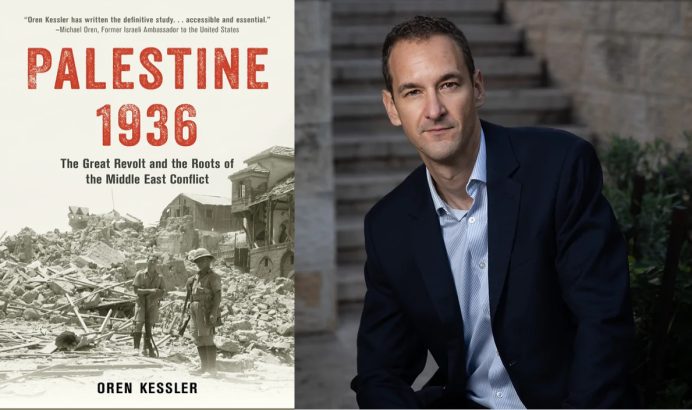
Nonetheless, there is a chance for a turnaround and implementation of the diplomatic action plan, and it lies in establishing a strong political coalition that will adopt the French-American action plan. The key figure for this measure is the Speaker of Parliament Nabih Berri, who, until now, served as Nasrallah’s representative in all negotiating issues on settlements, a cease-fire, and contact with the West.
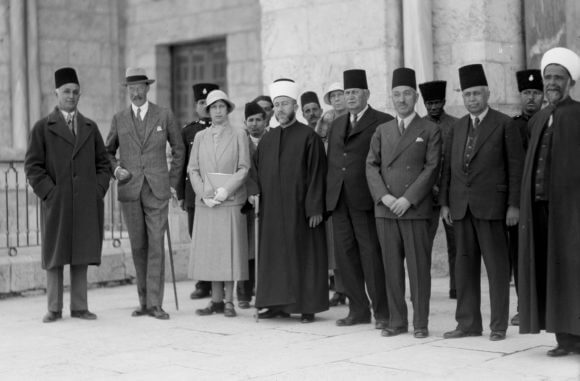
Berri, 86, is a veteran and sophisticated political battle fox, who has made a fortune estimated at tens of millions of dollars (other estimates mention a billion dollars), and enjoys broad support in the Shi’ite community. In the last elections, in 2022, his party won 15 seats, compared to Hezbollah’s 12.
Nasrallah’s removal may give Berri a major political edge, which if he can exploit to build a supporting coalition, he will be able to navigate Lebanon toward a diplomatic and military settlement or even finally bring about the appointment of the country’s president. And yet, even with his new position of political power, Berri cannot ignore or bypass Hezbollah’s position if he wants to implement a settlement that will satisfy Israel.
To help Berri and the Lebanese government make the “right” decision, it is possible to try and mobilize international pressure, offer financial rewards for Lebanon or threaten sanctions, but it should also be remembered that they have all been applied to Lebanon, before and during the war, without leaving their stamp on Lebanese politics.
It seems that the map of the new Middle East that will begin in post-Nasrallah Lebanon will have to find a different cartography department to draw it.

Without Hezbollah, Lebanon’s Economy Could Rise Out of the Ashes

It’s a long shot, but even amid financial crisis, dysfunctional government and brain drain, Lebanon has many of the raw materials to start over

David Rosenberg., Haaretz, Oct 1, 2024
As it turns out, things could get a lot worse. As Israelis hail a decisive victory over Hezbollah, Lebanon is being pummeled by Israeli bombs. Hundreds of thousands of residents in the south have fled for fear of Israeli airstrikes. The government – three years later, still a caretaker without a president – not only can’t defend the country, it has done nothing to help the refugees or care for the wounded. “They have no money and they have no control over what’s happening on the ground,” Mark Daou, a lawmaker, told The New York Times.
The old chestnut about Lebanon being the Switzerland of the Middle East is nothing more than a fun fact out of the distant past for the history books. The last time Beirut could boast of being a major banking center was before its civil war erupted in 1975. Today, it would be better described as the Somalia of the Middle East, with warlord No. 1 being Hezbollah.
Yet the Somalia comparison isn’t entirely fair. Amid all the dysfunction and chaos in Lebanon, there remains considerable latent potential to return to the glory days.
Rebuilding the economy will not be easy. The government is hopelessly corrupt and ineffectual, as evidenced by the fact that five years into the biggest peace-time economic collapse since the 19th century, it has not even proposed a recovery plan. It is heavily in debt and since it defaulted, can no longer tap the international financial market for funds. Infrastructure is in shambles. The state power company doesn’t come close to meeting electricity demand, leaving Lebanese to rely on private generators. The only way an ordinary Lebanese can get his or her money out of the bank is by robbing it.
In the short term, the economy may be even worse off without Hezbollah, which the hundreds of millions of dollars a year it received in Iranian funding was spent on local goods and services. Lebanon also stands to lose the export receipts from Hezbollah’s drug smuggling, arms and cigarette smuggling, and currency counterfeiting mainly in Latin America.
There is also a risk that Israel’s successful assault on Hezbollah over the past two weeks could set off a new round of sectarian fighting in Lebanon and destroy the last remnant of political stability and a functioning economy. “The demolition of Hezbollah’s capabilities will likely embolden its opponents and anti-Iranian forces within Lebanon,” Imad Salamey, an expert on Lebanon at the Lebanese American University, told Al-Jazeera television.
But the reverse could also happen: the elimination, or at least the significant weakening, of Hezbollah could remove its baleful influence and enable Lebanon to begin rebuilding its decimated economy.
Silver lining
Among other things, Lebanon would have to contend with far fewer Western sanctions, most of which are directed at Hezbollah and affiliated institutions. It is just possible that freed of Hezbollah interference, a government can finally be formed. Aid and investment from the Gulf and the West may be forthcoming for the first time in years.
Perhaps a more intense effort to find natural gas off Lebanon’s Mediterranean coast will get underway. Lebanon’s enormous diaspora – estimated at 15.4 million, almost three times the domestic population – could be a source of capital and for opening up foreign markets, just as the Jewish diaspora was for Israel in the past. There is even a silver lining to Lebanon’s feckless government, namely less government red tape and low taxes.
But in the end, Lebanon’s economic fate will depend on its people, or more precisely its human capital. Without significant natural resources or a domestic market to support industry, the future will depend on its becoming a knowledge economy, one based on technology and sophisticated services, as Tarek Ben Hassen, a Qatar University economist, proposed in a recent article.
Not surprisingly, even in 2019, before the roof caved in, Lebanon had long ceased to be a globally competitive economy. The World Economic Foundation’s Global Competitiveness Report that year ranked Lebanon 88th of 141 countries, one notch below Tunisia and one above Algeria – not the kind of neighbors a self-respecting country would want on this league table.
But on a few critical metrics, Lebanon came out looking much better. It placed 24th on graduates’ skill sets, 23rd on digital skills and 26th for imparting critical thinking in primary school teaching. And, these rankings probably understate Lebanon’s talent base: Like many countries, they are an average between a highly skilled elite and a less skilled majority. But a knowledge economy can get started with a small elite, if it is sufficiently capable.
Lebanon has another knowledge economy asset in its system of higher education. Despite all the economic and political vicissitudes of the last few years, six Lebanese universities are ranked among the world’s top 1,000 (top-ranking American University of Beirut comes in at 250), according to the QS World University Rankings for 2025.
And although it is not much in evidence these days amid economic collapse (the WEF ranked Lebanon 74th in 2019 for entrepreneurial culture), Lebanon has a long history of entrepreneurship stretching back to the days of the Phoenicians. Lebanese labor costs for engineers and the like are low. These kinds of numbers are a good foundation for a knowledge economy. The catch is that they reflect the situation as it was in 2019; since then, the collapse of the economy caused the country’s traditionally high rate of emigration to balloon 4.5-fold in 2020 and 2021. Many of those who fled were Lebanon’s best and brightest, and the young who contend with a youth unemployment rate of nearly 50 percent.
If Lebanon can get its act together, it may be able to lure many of these expatriates back. The knowledge that Hezbollah is no longer casting its shadow over the country will certainly be an incentive. The wreckage that Lebanon is today may be seen by the most ambitious and entrepreneurial as an opportunity.
With or without Hezbollah, establishing relations with Israel is unlikely. But if Lebanon were to do that and establish a warm peace involving trade, tourism and business deals, like the one between Israel and the other Abraham Accord countries, the road to a thriving economy would be that much shorter.

A Messiah is needed – so that he will not come

In our more secular, rational times, we condemn those who maim and murder in the name of their god. But do not for a moment dismiss the power of religious fervour … The promise of a full remission of all sins and a place in paradise was a powerful motivator (and among some faithful, it still is).
Al Tariq al Salabiyin – the Crusaders’ Trail, In That Howling Infinite

… it would be a mistake to assume that the pattern of apocalyptic thought exists only within the framework of religious belief. Its fingerprint can also be found in secular revolutionary movements and in modern ideological worldviews
Amit Vershinsky, Israeli historian and author

Messianism, the belief in the advent of a “promised one”, a Messiah or Mahdi, who emerges as the saviour of a people and who will bring about a better world, has never gone out of fashion, particularly in the Middle East, its theological birthplace. It originated as a Zoroastrian religious belief and flowed into the Abrahamic religions, Judaism, Christianity and Islam, but other faiths also harbour messianistic proclivities. And yet, messianism can be temporal as much as spiritual, as illustrated by the ideological movements which determined the course of twentieth century history.

The yearning for an ideal leader has long been ingrained in our collective psyche: a hero, mortal or divine, who would appear at the darkest hour and lead his people through the struggle to ultimate triumph. Even though we may not personally subscribe to a spiritual belief in the end of days, it is there in our historical memory and in the myths that are often shaped by it, as the following lines, referencing Alexander the Great, Genghis Khan and King Arthur, these “once and future” kings, illustrate:

We sing such songs as we might hear
In dreams before day breaking,
As ancient echoes hide between
The slumber and the waking.
We remember,
Yes, we remember

Iskander marched this way and back
Across these battlefields of old.
Persepolis he burned and in Babylon he died,
And now, embalmed in gold,
He lies waiting.

The killer khan in death reclines
Amidst his guards and concubines,
Who died so none would ever see
The final resting place where he
Lies waiting.

And in our own imagining
The fabled, once and future king
Upon an island in a lake,
He slumbers still but will awake
One day.

Ruins and Bones, Paul Hemphill

World-renowned Critical Theorist, activist, psychoanalyst, and public Marxist intellectual, Erich Fromm (1900-1980) distinguished two kinds of messianism. One he saw as radical and progressive, the other as regressive and potentially reactionary: “prophetic messianism” and “catastrophic or apocalyptic” messianism.

Prophetic messianism, Fromm argued, conceives the messianic event as occurring within history and time and not arriving through a rupture from history and time. Regressive catastrophic messianism on the other hand sees the messianic event entering history from outside, a force majeure, and not as an outcome of human activity. He saw “prophetic messianism” as a “horizontal” longing, a longing for human-made change, and “catastrophic messianism” as a vertical” longing, a longing for an external, transcendent “saviour” (perhaps a human leader or a deterministic law governing history) that will enter history from a realm outside of human affairs.

Because prophetic messianism views the messianic event as the outcome of human progress, it encourages productive and revolutionary action, and it makes planning or “anticipatory change” possible. By contrast, because catastrophic messianism views the messianic event as the outcome of the transcendent entering history to rescue a fallen humanity, catastrophic messianism encourages passive waiting or even destructive or unnecessarily violent action aimed at speeding the coming of the apocalypse. Like the types of false hope that Fromm warns against, catastrophic messianism risks becoming quietism on the one hand or actively destructive nihilism on the other.

[These two previous paragraphs are an edited extract of a review by Dutch publishing house Brill of Erich Fromm’s Revolutionary Hope by Joan Braune, 1st January 2014}

Today, catastrophic messianism is active and influential in our world’s most enduring conflicts – the clear and present danger facing the non-Muslim world by Islamic extremism, and the current war between the predominantly Jewish State of Israel and the Islamic fundamentalist Hamas and its allies

In islamic eschatology, the end of times will portend Malhama Al-Kubra, the “last battle between the forces of light and of darkness, an apocalyptic struggle so intense that according to some Hadith narrations, were a bird to pass their flanks, it would fall down dead before reaching the end of them. Many texts say that this will take place at Dabiq in northern Syria. As testament to its relevance in contemporary Islamist thinking, the brutally fundamentalist Islamic State adopted the name for its magazine.

In the eyes of Israel’s principal foes, the so-called “Axis of Resistance”, Iran and its Islamist proxies in Palestine, Lebanon, Syria, Iraq and Yemen, the current Arab Israeli conflict is in reality a holy war with inseparable and uncompromising religious, political and military dimensions that take on a messianic character.

The irony is that increasingly in the Jewish state, the existential crisis emanating from the catastrophe of October 7 and the encirclement of the tiny country by enemies determined to wipe it off the map, has arguably fostered a messianic fervour in Israel too.

In an informative article in Haaretz, writer and historian Amit Varshizky contemplates the connections between conflict and catastrophe on the one hand and an emerging messianism on the other among both religious and non-religious Jews.

This article reminded me of British historian Norman Cohn‘s influential book The Pursuit of the Millenium which I first read in ‘seventies. Indeed, Varshinsky refers to him. Cohn’s work as a historian focused on the problem of the roots of a persecutorial fanaticism which became resurgent in modern Europe at a time when industrial progress and the spread of democracy had convinced many that modern civilization had stepped out forever from the savageries of earlier historical societies. In The Pursuit, he traced back to the distant past the pattern of chiliastic upheaval that marred the revolutionary movements of the 20th century. He had described all his work as studies on the phenomena that sought “to purify the world through the annihilation.

Vershinsky writes:

“The origins of this craving for destruction and strife reside in the belief that the coming of the Messiah will be preceded by a period of “pangs of the Messiah,” characterized by suffering and ordeals; in short, there is no redemption that is not acquired without torments. This is a basic element of political messianism, which interprets historical events in a mythic light, as the embodiment of sanctity in concrete reality … the power of this redemptive mysticism derives from the fact that it does not talk about far-reaching cosmic transformations in the order of creation, as predicted by the Prophets. It refers, rather, to messianic fulfillment within the realm of historical, concrete time, and as such it is tightly linked to human deeds … History demonstrates how apocalyptic interpretations can be created from the experience of an existential crisis, which brings to a head the everlasting tension between deficiency and the striving for fulfillment – a tension that characterizes the human condition in general. Since the start of recorded history, periods that were marked by political crises, plagues, social anxieties and collective despair have been accompanied by the rise of apocalyptic interpretations that have vested history with a new and sanctified significance and have charged the events of the hour with redemptive meaning. As Norman Cohn showed, marking a low point as a formative moment of spiritual renascence that leads to redemption is part of a recurring pattern that appears in all apocalyptic interpretations of events throughout Western history. Cosmic disorder is a precursory and necessary stage for the coming of the Messiah and the establishment of the Kingdom of God … But it would be a mistake to assume that the pattern of apocalyptic thought exists only within the framework of religious belief. Its fingerprint can also be found in secular revolutionary movements and in modern ideological worldviews”.

See also in In That Howling Infinite, A Middle East Miscellany    A Short History of the Rise and Fall of the West and Lebensraum Redux – Hamas’ promise of the hereafter

Amit Varshizky, Haaretz, Aug 3, 2024

Disasters are a fertile ground for purveyors of apocalyptic prophecies

Oil-storage facility in Hםuthi-held Hodeida, Yemen after the port was hit by Israeli planes July 20. “War advances “the purification, refining and galvanizing of the Jewish people” Rav Kook.”: AFP

Social media is flooded with clips of rabbis calculating the end times and intoxicated with salvation as they declare that we are poised at the onset of the flowering of our redemption. Rabbi Naftali Nissim, a YouTube star in-the-making, waxed poetic: “There has never been a beautiful period like this… What happened on Simhat Torah [October 7] is a prelude to redemption.” Rabbi Yaakov Maor explained that “Rafah [in Gaza] refers to ‘288 sparks’ [the numerological value of the word ‘RFH,” and a concept in kabbalistic literature]. The redemption is near!” And Rabbi Eliezer Berland, head of the Shuvu Banim group in the Breslav Hasidic sect, promised: “This is the last war before the Messiah. After this war, Messiah Son of David will come.”

But such talk is not confined to the yeshivas and the kollels (yeshivas for married men), it’s even voiced on commercial television. Dana Varon, a presenter and commentator on the right-wing Channel 14, stated, “It’s written in the Mishna: The Galilee will be destroyed and the Golan shall be emptied, and the people of the border wander from city to city, that’s the Mishna coming to realization within us literally, I’m happy about this.”

Her colleague Yinon Magal went even farther in a radio broadcast. “The feeling is that we are approaching great days. We are in a redemptive process, and prophecies are happening.” And on another occasion: “Only the Messiah [can] supplant Bibi.” Magal is a demagogue and the embodiment of narcissism, but his remarks reflect a prevailing sentiment among broad circles of the settler and Hardali (nationalist ultra-Orthodox) right, and one that has also been adopted by broad segments of the ruling party.

The sentiment itself is not new. Since the advent of religious Zionism, it has greased the movement’s ideological wheels and been the driving force of the settlement project and the vision of Greater Israel. What is new is the popularity these ideas enjoy in the present-day political and public discourse, and how they have traveled from the margins of right-wing politics into the Likud center. Prime Minister Benjamin Netanyahu, who is captive by choice of power-hungry Kahanists and other extremists, is dragging Israel into the grip of an apocalyptic ecstasy that is deepening the existing crisis and creating new conditions for realizing the messianic fantasy of conquering all the territories of the Land of Israel, replacing Israeli democracy with the kingdom of the House of David and building the Third Temple.

This accounts for the enthusiastic spirit that has gripped the messianic camp since October 7, as well as the repeated provocations on the part of individuals and groups in an attempt to ignite a conflagration in the West Bank and pull the Arabs in Israel into the blaze.

War of Gog and Magog

The origins of this craving for destruction and strife reside in the belief that the coming of the Messiah will be preceded by a period of “pangs of the Messiah,” characterized by suffering and ordeals; in short, there is no redemption that is not acquired without torments. This is a basic element of political messianism, which interprets historical events in a mythic light, as the embodiment of sanctity in concrete reality. According to this approach, the birth of Israel and the Zionist enterprise, particularly since the victory in the 1967 Six-Day War, are manifestations of emerging redemptive reality. This reading of events is based in part on tractate Berakhot in the Talmud, according to which between this world and the time of the Messiah there is only “servitude to the [foreign] kingdoms.”

Indeed, the power of this redemptive mysticism derives from the fact that it does not talk about far-reaching cosmic transformations in the order of creation, as predicted by the Prophets. It refers, rather, to messianic fulfillment within the realm of historical, concrete time, and as such it is tightly linked to human deeds. Rabbi Shlomo Aviner, the dean of Ateret Yerushalayim Yeshiva and the former rabbi of the settlement of Beit El, put it succinctly: “We assert the absolute certainty of the appearance of our redemption now. There is no barrier here of secret and hidden.”

The same applies to the present war; it needs to be seen in its biblical dimension and perceived through a messianic prism. In this sense, the history of our generation is not much different from the chronicles of the Exodus from Egypt and the conquests of Joshua. At that time, too, the events occurred by natural means and the military victories opened the age of redemption.

The Gaza war, from this perspective, is bringing closer the Jewish people’s collective redemption. Light and dark are intertwined here, destruction and revival are interlocked like revealed and concealed, and as material and spiritual reality. Accordingly, the greater the dimensions of the destruction and the devastation, so too will the spiritual transformation brought by the campaign in its wake be augmented. The war is the purgatory that will steel the spirit of the Jewish people, which is already at the stage of incipient redemption. Anyone seeking a foundation for this idea will find it in the thought of Rabbi Zvi Yehuda Kook (the son of Abraham Isaac Kook): “What is the reason for the War of Gog and Magog? Following the establishment of Israel’s sovereignty, war can possess only one purpose: the purification, refining and galvanizing of Knesset Israel [the Jewish people].”

What is the conclusion? The more that suffering increases, the more good there will be; and “the more they were oppressed, the more they increased and spread out” (Exodus 2:12). They will multiply and burst forth, for like the measure of justice, so too is the measure of mercy. And as Dana Varon noted in replying to her critics, “It’s a good sign. Because if all the bad and the wicked materialize, that is a sign that the good is also guaranteed and is arriving.”

Sanctified victims

The designation of catastrophe as a condition for salvation is not new in human history. History demonstrates how apocalyptic interpretations can be created from the experience of an existential crisis, which brings to a head the everlasting tension between deficiency and the striving for fulfillment – a tension that characterizes the human condition in general. Since the start of recorded history, periods that were marked by political crises, plagues, social anxieties and collective despair have been accompanied by the rise of apocalyptic interpretations that have vested history with a new and sanctified significance and have charged the events of the hour with redemptive meaning.
As the British historian Norman Cohn showed, marking a low point as a formative moment of spiritual renascence that leads to redemption is part of a recurring pattern that appears in all apocalyptic interpretations of events throughout Western history. Cosmic disorder is a precursory and necessary stage for the coming of the Messiah and the establishment of the Kingdom of God.

But it would be a mistake to assume that the pattern of apocalyptic thought exists only within the framework of religious belief. Its fingerprint can also be found in secular revolutionary movements and in modern ideological worldviews. Marxism, for example, is based on the assumption that history is progressing toward a final end, after which there will be no more oppression, injustice or wars. The realization of the Marxist utopia sees extreme aggravation in the living conditions of the working class as a necessary condition for world revolution, and for the formation of a classless society that will bring about the end of history.

Fascism, and German fascism in particular, preserves a central place for apocalyptic patterns of thought. In Hitler’s Third Reich, whose followers adopted the Christian eschatological concept of the “Thousand Year Reich,” extensive use was made of the narrative of fall and redemption as a means to consolidate the Nazi movement’s ideological hold on the German public. The Nazi ideologues and propagandists were successful in evoking the deepest fears of their contemporaries, and in depicting Germany’s military defeat in World War I and the national nadir as a formative moment of illumination, resurrection and renewal.

As the Nazis conceived it, the catastrophe of the war marked the watershed – it was a rupture that exposed the subversive activity of the Jews, awakened the German people to recognize its inner strength and accelerated a process of national renewal. It was precisely the destruction and the mass killing of the Great War that made it possible to formulate a new worldview and philosophy of life that was based on recognition of the vital powers of the race and the organic essence of the people (the Volk). As such, the sacrifice of the war’s fallen was vested with sanctified validity.

The totalitarian movements thus secularized the apocalyptic pattern of thought and implanted it in their worldview. They offered their believers a utopian vision that was based not on divine redemption but on scientific progress, naturalism and the sovereignty of humanity. Their followers were driven by a sense of moral eclipse and existential dread, accompanied by a call to eradicate the old world and to build on its ruins a new, orderly world. The total war, in the Nazi case, or the total revolution, in the communist case, were perceived as a necessary stage to realize the secular utopia, and made it possible to normalize the most horrific crimes and sanctify every form of violence. The historical lesson is thus clear: Every attempt to establish the Kingdom of God on earth is destined to ignite the first of in the abode of man.

Here lies the danger in striving for a politics of “total solutions,” whether on the right or on the left. That form of politics entrenches a false picture of reality and paves the way for demagogues and populist false messiahs who are adept at exploiting social distress and anxiety by appealing to the urge for redemption and the human need for absoluteness.

Not only does political messianism cast on its leaders a sanctity of religious mission that is insusceptible to doubt; it also requires the marking of enemies (or political rivals) as foes that are delaying redemption, in the spirit of the Latin phrase, “Nullus diabolus, nullus redemptor” (No devil, no redeemer). In this sense, the more powerful the messianic idea is, the greater the violence and the destruction it sows when the demand for absoluteness shatters on the rocks of reality; the height of the sublimity toward which it thrusts is matched only by the depth of the abyss into which it is liable to slide. For the more that reality declines to acquiesce to the absolutist demands of the advocates of political messianism, the greater the strength they wield to shape it in the image of their utopian visions; and the more untenable this becomes, the more they attribute their failure to an internal enemy and to the power of abstract conspiracies.

David Ben Gurion: “The Messiah has not yet come, and I do not long for the Messiah to come. The moment the Messiah will come, he will cease to be the Messiah”. Fritz Cohen / GPO

Between the absurd and the meaningful

It’s only natural for people to seek to inform their lives with meaning that transcends their temporary, ephemeral existence. It’s also natural that in periods of mourning and distress they should wish to console themselves and imbue their sacrifice and loss with cosmic meaning. Crisis and catastrophe can indeed serve as an opportunity for renewal, and there is also nothing intrinsically wrong with the longing for redemption or for the absolute that is innate in the human psyche. The danger lies in the attempt to transform redemption into a political program, and the ambition to bring the heavenly kingdom into being in this world. The demand for absolute justice always ends in injustice. Moreover, a cause that relies on unjust means can never be a just cause.
In a meeting with intellectuals and writers in October 1949, David Ben-Gurion said, “The Messiah has not yet come, and I do not long for the Messiah to come. The moment the Messiah will come, he will cease to be the Messiah. When you find the Messiah’s address in the phone book, he is no longer the Messiah. The greatness of the Messiah is that his address is unknown and it is impossible to get to him and we don’t know what kind of car he drives and whether he drives a car at all, or rides a donkey or flies on eagles’ wings. But the Messiah is needed – so that he will not come. Because the days of the Messiah are more important than the Messiah, and the Jewish people is living in the days of the Messiah, expects the days of the Messiah, believes in the days of the Messiah, and that is one of the cardinal reasons for the existence of the Jewish people.”
Those remarks can be taken at face value, but it’s desirable to understand them as a message that encapsulates universal human requirements: People need belief, vision and a guiding ideal, but as is the way with ideals, it’s certain that this too will never materialize but will remain on the utopian horizon toward which one must strive but to which one will never arrive. Humanity, thus, is fated to exist in the constant tension between want and fullness, between the absurdity and futility of life and our need for meaning, purpose and significance. That tension can be a millstone around our necks and enhance the attraction of political messianism in its diverse forms.

Accordingly, it’s a mistake to assume that the allure of messianism can be fought only with rational tools. Myth cannot be suppressed by reason, and the yearning for the absolute cannot be moderated by means of learned, logical arguments. It was Friedrich Nietzsche, of all people, the philosopher who perhaps more than any other is associated with modern atheism and the “death of God,” who maintained that the death of God does not necessarily herald the death of faith, and that the rejection of religion and a consciousness of God’s absence do not mean that the craving for the absolute has ceased to exist.

On the contrary, it is precisely the death of God, precisely his nonexistence, that keeps alive more forcefully the longing for him, and spurs man to find substitutes. Hence Nietzsche’s famous cry: “Two thousand years have come and gone – and not a single new god!” The secular individual who has been orphaned of God is fated to give birth from within to new gods that will provide a response to one’s unfulfilled religious longing. God is dead, but his shadow continues to pursue humanity and to drive people to act in numberless forms and ways.

The denial of God’s shadow and of the unrequited longing of the human psyche for the absolute are the root of the blindness of secular culture in our time, and the source of its weakness in the light of the messianic sentiment. Under the guise of post-ideological pragmatism and economical rationalism, secular liberalism has completely forsaken the psycho-religious needs of the current generation in favor of material utilitarianism, narcissistic individualism and consumerist escapism, and has abandoned the possibility of bringing into being a life of a spiritual and cultural character capable of providing a response to the basic need for meaning and self-transcendence. Secular culture may perhaps allow freedom of choice (and that’s not a little), but in itself it does not offer another positive meta-narrative, guiding idea or existential meaning in an era of consumer and technological alienation. Into this vacuum political messianism has penetrated, as it offers an answer for spiritual longings and existential anxieties.

The formulators of state-oriented Zionism, head by Ben-Gurion, understood this well. They sought to harness the religious impulse to nation building and to the formation of a new Hebrew (Jewish) identity that draws on the messianic sources but does not attach itself to their religious content and instead secularizes it. In this way the messianic tension served Ben-Gurion to forge an ideal vision of a Jewish state that would be a moral paragon and a light unto the nations.

Is a return to the fold of Ben-Gurion-style Zionism the answer? Probably not. One thing, however, is certain: besides the urgent need to separate religion and state, and to anchor Israel’s secular-liberal character in a constitution, a deep transformation is also necessary in secular culture, in education, in artistic creation and in the intellectual-spiritual life. Because in order to do battle against the messianic myth, a counter-myth is needed, one that does not lie within the realms of religion and meta-earthly redemption, but in the imperfect world of humankind. It alone is capable of providing a substitute for the temptations of the diverse types of political messianism and of providing human beings with a horizon free of all supernatural, theistic, utopian or redemptive qualities.

A Messiah is needed – so that he will not come.

When Freedom comes, she crawls on broken glass

Flashing for the warriors whose strength is not to fight
Flashing for the refugees on the unarmed road of flight
An’ for each an’ ev’ry underdog soldier in the night
An’ we gazed upon the chimes of freedom flashing
Bob Dylan, Chimes of Freedom

Hear the cry in the tropic night, should be the cry of love but it’s a cry of fright
Some people never see the light till it shines through bullet holes
Bruce Cockburn, Tropic Moon

When Freedom Comes is a tribute to Robert Fisk (1946-2020), indomitable, veteran British journalist and longtime resident of Beirut, who could say without exaggeration “I walk among the conquered, I walk among the dead” in “the battlegrounds and graveyards” of “long forgotten armies and long forgotten wars”. It’s all there, in his grim tombstone of a book, The Great War for Civilization (a book I would highly recommend to anyone wanting to know more about the history of the Middle East in the twentieth century – but it takes stamina – at near in 1,300 pages – and a strong stomach – its stories are harrowing).

The theme, alas, is timeless, and the lyrics, applicable to any of what Rudyard called the “savage wars of peace” being waged all across our planet, yesterday, today and tomorrow – and indeed any life-or-death battle in the name of the illusive phantom of liberty and against those intent on either denying it to us or depriving us of it. “When freedom runs through dogs and guns, and broken glass” could describe Paris and Chicago in 1968 or Kristallnacht in 1938. If it is about any struggle in particular, it is about the Palestinians and their endless, a fruitless yearning for their lost land. Ironically, should this ever be realized, freedom is probably the last thing they will enjoy. They like others before them will be helpless in the face of vested interest, corruption, and brute force, at the mercy of the ‘powers that be’ and the dead hand of history.

The mercenaries and the robber bands, the warlords and the big men, az zu’ama’, are the ones who successfully “storm the palace, seize the crown”. To the victors go the spoils – the people are but pawns in their game.

In 2005, on the occasion of the publication of his book, Fisk addressed a packed auditorium in Sydney’s Macquarie University. Answering a question from the audience regarding the prospects for democracy in the Middle East, he replied:

“Freedom must crawl over broken glass”

Freedom Comes 

… all wars come to an end. And that’s where history restarts.  Robert Fisk

There goes the freedom fighter,
There blows the dragon’s breath.
There stands the sole survivor;
The time-worn shibboleth.
The zealots’ creed, the bold shahid,
Give me my daily bread
I walk amongst the conquered
I walk amongst the dead

Here comes the rocket launcher,
There runs the bullets path,
The revolution’s father,
The hero psychopath.
The wanting seed, the aching need
Fulfill the devil’s pact,
The incremental balancing
Between the thought and act.

The long-forgotten army
In the long-forgotten war.
Marching to a homeland.
We’ve never seen before.
We feel the wind that blows so cold amidst
The leaves of grass.
When freedom comes to beating drums
She crawls on broken glass

There rides the mercenary,
Here roams the robber band.
In flies the emissary
With claims upon our land.
The lesser breed with savage speed
Is slaughtered where he stands.
His elemental fantasy
Felled by a foreign hand.

The long-forgotten army
In the long-forgotten war.
Marching to a homeland.
We’ve never seen before.
We feel the wind that blows so cold amidst
The leaves of grass.
When freedom comes to beating drums
She crawls on broken glass.

Thy kingdom come, thy will be done
On heaven and on earth,
And each shall make his sacrifice,
And each shall know his worth.
In stockade and on barricade
The song will now be heard
The incandescent energy
Gives substance to the word.

Missionaries, soldiers,
Ambassadors ride through
The battlegrounds and graveyards
And the fields our fathers knew.
Through testament and sacrament,
The prophecy shall pass.
When freedom runs through clubs and guns,
She crawls on broken glass.

The long-forgotten army
In the long-forgotten war.
Marching to a homeland.
We’ve never seen before.
We feel the wind that blows so cold amidst
The leaves of grass.
When freedom comes to beating drums
She crawls on broken glass
When freedom comes to beating drums
She crawls on broken glass

© Paul Hemphill 2012

From: In That Howling Infinite – Poems of Paul Hemphill Volume 5

See also in In That Howling Infinite, A Middle East Miscellany, See also: East – An Arab Anthology and   A Short History of the Rise and Fall of the West

Alf Layla wa Laylah – the Arabian Nights and Orientalism

How do you see my country? Dusky maidens in desert tents offering dates on golden plates? 
Algerian secret agent Mohammed Ibn Khaldun to Tom Quinn, Spooks, 2,Ep 2

How often have we heard the exclamation “it’s like something out of the Arabian Nights”? We’ve said it ourselves as we walked down the Suq al Hamadiyya in Old Damascus and al Wad and Daoud Street in Old Jerusalem, in an ersatz Bedouin tent-restaurant just down the road from Palmyra and a similar night out near Petra. It’s as if the local tourist industry folk expect us westerners to enjoy, nay, expect this kind of entertainment. 

But whereas since the translation of The Arabian Nights, we have loved the tales, we have also taken from them a distorted impression of the Middle East, a pastiche of palm trees, minarets and camels like the illustrations of the old boxes of figs and of Fry’s Turkish Delight. 

So, how did we get here?

From a historical European perspective, the East or Orient has long been perceived as an unknown, alien, and, therefore, alluring world, that has existed for centuries, even millennia. It’s spell persists to this day, enchanting, seducing, and seducing soldiers, adventurers, travelers, troublemakers, writers, artists, and musicians.

This enduring fascination with the East gave rise to the descriptor Orientalism. In art history, literature, and cultural studies it described the imitation or depiction of aspects of the Eastern world largely by writers, designers, and artists from the Western world. Since the publication Palestinian America academic Edward Said’s seminal work Orientalism (1978) much of academic discourse has begun to use the term to refer to the generally nurturing though patronizing  Western attitude toward societies in the Middle East, Asia, and North Africa.

But more on Orientalism and Edward Said later. First, we’ll take look at one of the most popular manifestations of western culture’s relationship with the East. 

One Thousand and One Nights (أَلْفُ لَيْلَةٍ وَلَيْلَةٌ‎, Alf Laylah wa-Laylah) is a collection of folk tales compiled in Arabic during medieval times in what is recognized as the Islamic Golden Age, a period of scientific, economic and cultural flourishing in the history of Islam, traditionally dated from the 8th century to the 13th century.  It known in English as The Arabian Nights – from the first English-language edition in the early eighteenth century entitled The Arabian Nights’ Entertainment. Many European translations followed, but none more racy and picaresque that of English explorer, polymath and enfant terrible Richard Burton in 1885; it was an abridged version of this, purchased from a budget book store in King Street, Sydney, that I read the first time i got to meet Mademoiselle Scheherazade. The featured image is from that book’s dust cover. 

It has been acknowledged that Burton’s gaudy and bawdy English bears little relation to the Arabic of the Nights, which tends to be plain, conversational, and even a little threadbare – in other words, the idiom of folk literature. Some would dismiss it as Orientalist camp. Others would say it was just what would be expected from the infamous translator of The Kama Sutra. His translation included virtually every tale he could find a manuscript for – as well as some that he made up, such as my personal favourite How Abu Hasan Broke Wind.  

The stories were gathered over many centuries by various authors, translators, and scholars across the Middle East and South Asia, and North Africa. They originated in ancient and medieval Arabic, Egyptian, Indian, Persian, and even Mesopotamian folklore and literature. Many were originally folk stories from the Abbasid and Mamluk eras, while others, especially the central story of Scheherazade are most likely drawn from the Pahlavi Persian work Hezār Afsān (Persian: هزار افسان‎, A Thousand Tales), which in turn contained Indian elements.  

Charting the timeline, English scholar, author and Sufi adept Robert Irwin has written: “In the 1880s and 1890s a lot of work was done on the Nights by Zotenberg and others, in the course of which a consensus view of the history of the text emerged. Most scholars agreed that the Nights was a composite work and that the earliest tales in it came from India and Persia. At some time, probably in the early 8th century, these tales were translated into Arabic under the title Alf Layla, or ‘The Thousand Nights’. This collection then formed the basis of The Thousand and One Nights. The original core of stories was quite small. Then, in Iraq in the 9th or 10th century, this original core had Arab stories added to it—among them some tales about the Caliph Harun al-Rashid. Also, perhaps from the 10th century onwards, previously independent sagas and story cycles were added to the compilation … Then, from the 13th century onwards, a further layer of stories was added in Syria and Egypt, many of these showing a preoccupation with sex, magic or low life. In the early modern period, yet more stories were added to the Egyptian collections so as to swell the bulk of the text sufficiently to bring its length up to the full 1,001 nights of storytelling promised by the book’s title”.

Sheherazade (Fine Art Images/Heritage Images via Getty Images)

The Thousand And One Arabian Nights has been so appropriated by our culture that it is a de facto member of our so-called Western Canon. It is the source of so many of our fairy tales and boy’s own adventures with its magic lamps and genies, giant birds and winged horses, flying carpets and gorgeous girls in rich silks and ethereal damask. In our pubescent days, did we not “dream of Jeannie”? 

Harem pants and turbans, belly dancers and serpentine melodies, and a “nudge, nudge, wink, wink” of vicarious naughtiness (itself a word of Indian origin) – an exotic, “orientalist” retro-zeitgeist that drew artists, poets, writers and composers to this inexhaustible source of narrative, inspiration and titillation. Recall, back in those thankfully long gone more repressed days, the risqué, soft porn imaginings of European artists, including the Pre-Raphaelites and Orientalists who also elided into similar fever dreams of Babylonian and Roman erotica. 

Musicians too got in on the act. In 1782, Wolfgang Amadeus Mozart premiered Entführung aus dem Serail, The Abduction from the Seraglio, and Gioachino Rossini presented his L’italiana in Algeri or An Italian Girl in Algiers in 1813. These lightweight comic operas featured many of the tropes that entered the cinematic lexicon in the twentieth century, and whilst musically endearing and entertaining, their Orient was a mix of slapstick and exotic, and by today’s standards, condescending in their portrayal of lascivious sultans and their flunkies so easily outwitted by occidental heroes and heroines. Much grander and imposing is Russian composer Nikolai Rimsky-Korsakov’s splendid Scheherazade suite, otherwise known as “the Sultan is coming”. There’s an orchestral rendering of this masterpiece below.

The stories rattle through English pantomimes, Hollywood fantasias, Walt Disney, and even the avant-garde Pier Paulo Pasolini: Alāʼu d-Dīn and Sindibādu l-Bahriyy (these were indeed their original names), Ali Baba and those bandits in huge pots – the inspiration and the storylines for all those boy gets girl cosplay, rom-com, adventure and fantasy films like The Thief of Baghdad and Prince of Persia, and musicals like Kismet – and many more besides, most of them ordinary and many, bad (go Google!). Baubles, bangles and beads indeed (see, below, the Clio from the film). It was a pleasant, picturesque oriental world, the Middle East as Hollywood imagined it before it hit the headlines with its oil, its tyrants, and it internecine wars, a world sans Hamas, Hezbollah, the Taliban, Da’ish and the Al Quds Brigade. 

To illustrate the potential for satire, smut and downright silliness – a veritable “Carry on In The Casbah”. The nearest the famous British comedy series came to anything like this was the one film that didn’t have “Carry on” in its title: Follow That Camel in 1967. Though based on the French Foreign Legion adventures of Beau Geste, it doesn’t waste time getting to the suq and, predictably, the generic harem and the usual, well, carry on. Apropos this, there’s a clip below from the BBC production of British playwright Denis Potter’s excellent faux-musical Lipstick on Your Collar, set during the Suez Crisis of 1956, replete with orientalist imaginings and straight-out smut. 

The Blue Sultana by Léon Bakst

The spell of the orient also lured adventurers and chancers to the canyons and the castles, the deserts and the oases of the Levant, Mesopotamia, Persia, Afghanistan and India. And, I have to declare, yours truly – not without incident but no match for derring-do of Brits who went before. Like Irwin himself, I was of a generation with no more deserts to conquer, no fabled cities to administer. See Song of the Road (2) – The Accidental Traveller. 

It’s a part of the world that has captivated much of my intellectual life for I too like many others before me was lured by the spell of the Orient.

I wrote before, in East, “I was drawn to the Middle East in another age, when it was the land of myth and magic, of dreamers and adventurers, of quixotic tilters at windmills, of pioneers who would make the deserts bloom, of dissemblers and deceivers bearing false promises. The ancient lands of the bible, the fabled realm of A Thousand and One Nights, and the restless quests of Richard Burton, Charles Doughty, and TE Lawrence. The pulp fiction fantasies of Frank Herbert, James Michener and Leon Uris, and the celluloid myths of Peter O’Toole, Omar Sharif, and Paul Newman”.

Middle East folk have taken to the stories too, and as in the West, it has inspired books, poems, plays and movies. Lebanese diva Fairuz played Scheherazade in a Beiruti musical back in the seventies, and Umm Kulthum, dead nearly five decades and still indisputably the Arab world’s most renowned and beloved singer, sang about the lass for forty minutes, which was not unusual for her, without saying too much about the story. There is a statue of Scheherazade  and the sultan on the banks of the Tigris in Baghdad. 


And yet, the whole glittering, fairytale artifice was built upon dubious foundations of misogyny and murder. 

Scrumptious Scheherazade’s “cunning plan” was nothing more or less than that of distracting Shahriya, a randy psychopath of a sultan, from dispatching her (and her sister) – as he had done with his many short-lived exes. The premise is that his former missus cheated on him with a cavalcade of lovers, including slaves and persons of colour. To use the words of an old song by latter day philosopher Hal David and his sidekick Burt Bacharach,, he resolved that he was “never gonna love again”. And no doubt, in true oriental fashion, he was fearful of rival claimants and suspicious of all, including his paramours conspiring against him. Yet, he nonetheless constantly needs to get his end in. So whomsoever he selects to join him in his boudoir – and no one says no to the sultan – gets the chop the morning after. When Schezza gets the royal nod, she is determined not to go the way of her predecessors, and to preserve the lives of future bedmates. Accordingly, she keeps his lascivious lordship so distracted with her storytelling that he will refrain from slayage because he wants to hear how her tale ends. And yes, indeed, he forswears his murderous ways and settles into connubial bliss. 

© Paul Hemphill 2024. All rights reserved

See also in In That Howling Infinite, A Middle East Miscellany

The Scribe. Ludwig Deutsche 1911

East is east and west is west

Oh, East is East, and West is West, and never the twain shall meet,
Till Earth and Sky stand presently at God’s great Judgment Seat
Rudyard Kipling, The Ballad of East and West

The term Orientalism gained its modern definition through the writing of the Palestinian academic and cultural critic Edward Said, especially his famous book Orientalism, published in 1978, which sparked controversy among scholars of Oriental studies, philosophy, and literature. It was a critique of cultural perceptions of how the Western world – primarily the white and Judeo-Christian world – perceives the East – or specifically lands and cultures that lie outside the borders of southern and southwestern Europe.

From a historical European perspective, the East has long been perceived as an unknown, alien, and, therefore, alluring world, that has existed for centuries, even millennia. The Greeks and Romans longed for the silk and spices of the East. To satisfy our human craving for the good things of life, busy trade routes stretched from China and Java to present-day Russia, Scandinavia, the Iberian Peninsula and the British Isles.

The term orient is derived from Latin, oriens meaning “east” (literally “sunrise”, from aurior, rising, and its geographical use of the word “rising” to refer to the east, where the sun rises). The term Levant is in turn derived from Old French, and Italian in origin, to refer to the lands of the rising sun – specifically the historical lands of Syria (in Roman times, specifically’ that included the modern states of Lebanon, Syria, Jordan, Israel, Palestine and most of Turkey. In its broad historical sense, it came to include Greece, the islands of the eastern Mediterranean, modern Egypt and North Africa. And with the emergence of European empires in the east, Persia, Afghanistan, India, China, and the East Indies.

Along with east, west, or west, derived, again, from Old French, via Latin, Occidentem, west, or “sky where the sun goes down”, as in occido, to go down or set, was originally synonymous with Christianity which in the Middle Ages were the states that followed the Roman Catholic faith and which for various centuries considered themselves superior to the Eastern Orthodox faith of the Byzantine Empire and the lands of Russia.

The Levant was widely used after the fifteenth century. During the two hundred years of the Crusades, during which the French knights and their retinue took control, the lands that became the crusader kingdoms were referred to as Outremer, meaning the lands beyond the sea. And through the Crusades, the love affair of Christian Europe with the East began. And it was to continue to this day, enchanting, seducing, and seducing soldiers, adventurers, travelers, troublemakers, writers, artists, and musicians.

Edward Said and Orientalism

Original cover art of Orientalism, Jean Leon Gerome’s Le charmeur de serpents, 1870

Edward Wadih Said Edward Wadih Said (November 1935 – September 24, 2003) was a Professor of Literature at Columbia University, a public intellectual, and a founder of the academic field of Postcolonial Studies. A Palestinian-American born in Mandatory Palestine, he was a citizen of the United States through his father, a US Army veteran.

Educated in British and American schools, Said applied his pedagogical and cultural perspective to highlight the gaps of cultural and political understanding between the Western world and the Eastern world, especially with regard to the Israeli-Palestinian conflict in the Middle East.

As a public intellectual Said  was a controversial member of the Palestinian National Council, due to his public criticism of Israel and Arab countries, especially the political and cultural policies of Islamic regimes that work against the national interests of their people. He called for the establishment of a Palestinian state to guarantee equal political and human rights for Palestinians in Israel, including the right to return to the homeland.

Orientalism in art history, literature, and cultural studies is the imitation or depiction of aspects of the Eastern world. These drawings are usually made by writers, designers, and artists from the Western world. In particular, Orientalist painting, more specifically depicting the ‘Middle East’, was one of the many disciplines of academic art in the nineteenth century, and the literature of Western countries showed a similar interest in Eastern themes.

Since the publication of Orientalism, much of academic discourse has begun to use the term “Orientalism” to refer to the generally nurturing Western attitude toward societies in the Middle East, Asia, and North Africa. In Said’s analysis, the West classifies these societies as static and undeveloped, thus creating a vision of Eastern culture that can be studied, photographed, and reproduced in the service of imperial power. Implicit in this is the idea that Western society is sophisticated, rational, flexible, and superior, Said writes.

His book redefines the term Orientalism to describe the Western tradition – academic and artistic – of biased interpretations of the Eastern world shaped by the cultural attitudes of European imperialism in the eighteenth and nineteenth centuries.

Said said that Orientalism as “the idea of ​​representation is a theoretical idea: the Orient is a stage in which the whole of the Orient is confined” to make the Eastern world “less intimidating to the West.” And that the developed world, and the West in the first place, is the cause of colonialism, and that Western countries and their empires arose by exploiting backward countries and extracting wealth and labor from one country to another. Academically, the book has become a foundational text for postcolonial cultural studies.

While Said’s analysis relates to Orientalism in European literature, especially French literature, the historical view identified and described can also be applied to representations of the Orient in other art forms, including visual art – most notably in Orientalist painting, which was popular among artists And with galleries during the nineteenth century, which modern scholars see as depicting myth and fantasy that has little connection with reality, and also in other art forms that come like music and film.

Such representations drew criticism as much as before and after World War II, they perpetuated the imagined trend, giving generations of Westerners a distorted impression of the Middle East adorned with palm trees, minarets, and camels like illustrations of old chests of figs and boxes of Turkish delight and serpentine melodies. Such images directly connected in Western minds with the trappings of orientalists.  

Fun, romantic and fascinating, this Middle East as imagined by artists and Hollywood – to quote from above, “harem pants and turbans, belly dancers and serpentine melodies, and a “nudge, nudge, wink, wink” of vicarious naughtiness (itself a word of Indian origin) an exotic, “orientalist” retro- zeitgeist that drew artists, poets, writers and composers to this inexhaustible source of narrative, inspiration and titillation”.

Inevitably, a backlash arose in the developing world, both in the Islamic world, and in Asian and African countries in general, and the term Western is now often used to refer to the negative views of the Western world found in Eastern societies, and is based on the nationalism that spread as a response to colonialism. Furthermore, Edward Said himself has been accused of Westernizing the West in his critique of Orientalism. He is guilty of falsely describing the West in the same way that Western scholars are accused of falsely describing the East. Said is said to have encouraged a homogenous picture of the West, which no longer consisted not only of Europe, but also of the United States, Canada and Australia which became more culturally influential over the years.

[This profile of Edward Said and Orientalistism is drawn largely from Wikipedia. For an interesting account of Robert Irwin’s take down of Said’s opus, see The man who defeated Orientalism The man who defended Orientalism]

The sickness at the heart of the international order

Last week, in sheeplike conformity with diplomatic niceties, Australia, together with the US, the EU and NATO offered condolences for Iran’s vicious hanging judge President Ebrahim Raisi.

A year ago, the International Criminal Court issued a warrant for the arrest of Russian President Vladimir Putin for crimes against humanity. It would deepen Russia’s international isolation, pundits pronounced. The announcement did not receive the breathless coverage of the recent news that the court was considering similar warrants with respect to Israeli and Hamas leaders with repeat to the atrocities of October 7th and the bloody war that has followed.

A year on, and Vlad’s star still shines as Russia makes gains on the Ukrainian battlefield.

But the ICC is only one part of the malaise that has contaminated international institutions.

I have long believed that the United Nations has long passed its usefulness – if it ever had any purpose at all having been strangled at birth by the veto wielded in the Security Council by the US and Russia.

It has indeed gotten worse. As Greg Sheridan wrote in The Australian on 25th May

“The ethos of institutional liberal internationalism, especially when associated with the UN, has become an inverted parody of what it was once meant to be. The UN culture is a result of a combination of activism from dictatorships, especially China and Russia; plus the in-built voting power of the Arab, North African and Muslim blocs, none of which is sympathetic to democracy, and the ideological leftism of the activist and NGO class in Western societies themselves. Thus.  the UN frequently produces abominations with a kind of PG Wodehouse comic quality – committees on women’s rights headed by Saudi Arabia, human rights bodies chaired by China, non-proliferation committees headed by Pakistan and the like”.

On Ebrahim Raisi in particular, Sheridan wrote:

“Before becoming president Raisi was most famous for his role on the Tehran Death Committee in 1988. Across the Islamic Republic of Iran at that time many thousands of political prisoners were tortured and killed. No jurist was a more enthusiastic deliverer of death than Raisi. Later, when president, he looked back on those days with fondness and claimed the executions as a particular achievement for Iran.

Raisi ran unsuccessfully for president a couple of times. He was neither popular nor in the first rank of Iranian leaders, or of Islamic theologians, though he gave himself the title of Ayatollah. In 2021 Iran’s Supreme Leader, Ayatollah Ali Khameini, decided, with the Islamic Revolutionary Guard Corps, they would make Raisi president. He was a reliable hardliner and someone the IRGC in particular thought they could control”.

For more on Israel and Palestine in In That Howling Infinite, see Middle East Miscellany. See also, Lebensraum Redux – Hamas’ promise of the hereafter, Total war in an urban landscape – Israel’s military quandary, Flight into Egypt, and the promise of the hereafter , and The Calculus of Carnage – the mathematics of Muslim on Muslim mortality

The ICC is a sign of a deep sickness

That UN agencies mourn the Butcher of Tehran as they seek to arrest democratic Israel’s leaders presents the morally inverted, politically corrupted nature of what passes for liberal internationalism today.

Greg Sheridan, The Weekend Australian, 26th May 2024

Left to right: ICC chief Karim Khan, Israel PM Benjamin Netanyahu, Iran President, Ebrahim Raisi.

The contrasting treatment, especially at the UN, of Israel’s Prime Minister, Benjamin Netanyahu, and Iran’s president, Ebrahim Raisi, who died in a helicopter crash on May 19, starkly presents the morally inverted, politically corrupted and more than half insane nature of what passes for liberal internationalism today.

The chief prosecutor at the International Criminal Court in The Hague has formally requested arrest warrants for Netanyahu and Israel’s Defence Minister, Yoav Gallant, accusing them of war crimes in Gaza.

Netanyahu is the duly elected Prime Minister of the Middle East’s only democracy. On October 7 his country was attacked, while a ceasefire was in place, by the terrorist group Hamas, which is sponsored by Iran. In the attack the most savage, sadistic and sexually depraved terror was unleashed as 1200 people were exuberantly tortured and butchered, and some 250 taken hostage. Hamas then retreated into its tunnels below the civilians of Gaza.

The ICC has formally requested arrest warrants for Israel’s PM, Benjamin Netanyahu, and Defence Minister, Yoav Gallant, accusing them of war crimes in Gaza.
The ICC has formally requested arrest warrants for Benjamin Netanyahu, and Yoav Gallant

Netanyahu’s government retaliated, with a few clear objectives – to end Hamas rule in Gaza, to destroy Hamas and to ensure October 7 wouldn’t happen again. Hamas vowed it would repeat October 7 over and over. Meanwhile it killed some of the hostages, tortured others, even small children (there’s video) and subjected women and girls to sexual assault, sexual terror.

Raisi, unlike Netanyahu, didn’t have a background in politics, certainly not democratic politics, more the legal system, specifically as a prosecutor. In a totalitarian theocracy such as Iran, prosecutors are always busy. Before becoming president Raisi was most famous for his role on the Tehran Death Committee in 1988. Across the Islamic Republic of Iran at that time many thousands of political prisoners were tortured and killed. No jurist was a more enthusiastic deliverer of death than Raisi. Later, when president, he looked back on those days with fondness and claimed the executions as a particular achievement for Iran.

Raisi ran unsuccessfully for president a couple of times. He was neither popular nor in the first rank of Iranian leaders, or of Islamic theologians, though he gave himself the title of Ayatollah. In 2021 Iran’s Supreme Leader, Ayatollah Ali Khameini, decided, with the Islamic Revolutionary Guard Corps, they would make Raisi president. He was a reliable hardliner and someone the IRGC in particular thought they could control.

Ayatollah Ali Khameini.

Iranian elections used to have some limited meaning. Elected officials never really had power and Iranian voters several times elected notionally moderate presidents to no avail. The real powers, the IRGC and the office of the Supreme Leader, decided who could run. But much more than

Iranian elections used to have some limited meaning. Elected officials never really had power and Iranian voters several times elected notionally moderate presidents to no avail. The real powers, the IRGC and the office of the Supreme Leader, decided who could run. But much more than the president, they wielded state power.

Consequently, Iranians stopped bothering to vote. When Raisi won, the turnout was claimed to be 49 per cent, though even this is regarded as an exaggeration.

Since Raisi became president in 2021, Iran has been energetic. It redoubled the vice police. Iranian women and girls are routinely arrested, sexually assaulted and beaten to death for offences such as not wearing their hijabs properly. One such case, of a young woman named Mahsa Amini, who died in 2022, set off a round of riots and protests that were savagely repressed, with hundreds dead and more than 20,000 imprisoned.

Internationally, Raisi’s government became famous for murdering Iranian dissidents in Europe and the US. Western governments regard Iran as the chief state sponsor of terrorism. Apart from Hamas, Iran has built Hezbollah, in southern Lebanon, into a powerful non-state military force, with perhaps 150,000 missiles and tens of thousands of soldiers.

Mourners hold posters of Iranian President Ebrahim Raisi during a funeral ceremony in Tehran, on May 22. Picture: AFP
Mourners hold posters of Ebrahim Raisi during a funeral ceremony in Tehran. AFP

Tehran funds and provides weapons to Shi’ite militias in Iraq and Syria. All these groups deal out death fairly indiscriminately to their opponents and internal critics. Iran also backs the Houthi rebels, whom Australia has just declared a terrorist organisation under our law. They fire missiles at Israel but the Houthis’ great significance has been to massively disrupt shipping in the Red Sea. They exempt Chinese and Russian shipping, which is as sure a sign of Iranian control of their activities.

Many of the deaths Iran caused under Raisi occurred on the soil of nations over which the International Criminal Court claims jurisdiction. Yet the ICC never produced a warrant for Raisi’s arrest. Indeed, the UN lowered its flag to half-mast to honour Raisi after his death. The EU, not quite as otiose as the UN but surely its first cousin in the fatuousness of much that it says and does, used its most senior officials to send heartfelt and sincere condolences over Raisi’s death.

A former immigration minister of Belgium, Theo Francken, chided the EU for praising a “butcher and a mass murderer”. A Swedish member of the European parliament, David Lega, asked the EU leaders: “Can you ever look the brave women and freedom fighters of Iran in the eye again?”

You’ve never heard of Franck­en or Lega and you never will. Voices like theirs are marginal now.

The ethos of institutional liberal internationalism, especially when associated with the UN, has become an inverted parody of what it was once meant to be. The UN culture is a result of a combination of activism from dictatorships, especially China and Russia; plus the in-built voting power of the Arab, North African and Muslim blocs, none of which is sympathetic to democracy, and the ideological leftism of the activist and NGO class in Western societies themselves.

Thus the UN frequently produces abominations with a kind of PG Wodehouse comic quality – committees on women’s rights headed by Saudi Arabia, human rights bodies chaired by China, non-proliferation committees headed by Pakistan and the like.

Feeding into that are two other dynamics. One is that most nations are concerned, understandably but dismally, only to avoid getting themselves criticized in any UN committee. So they go along to get along. And they like to get their little share of UN goodies. So they don’t object to some moral grotesquerie to secure the position of deputy rotating chairperson of the Pots and Pans Committee of the Under Secretary’s eminent Consultative Group.

Far more toxic is the sick obsession in this fetid culture with Israel and Jews. This is a kind of reverse intersectionality. Modern demented left-wing activism absurdly defines Israel as a colonist state. Demented right-wing activism draws on centuries of Western anti-Semitism. Most Arab nations, though many have recently made good accommodations with Israel, would nonetheless rather not have any non-Muslim state in the Middle East, while the tradition of Arab anti-Semitism roars. China, Russia and all their friends will routinely seek to hurt Israel in order to hurt America.

All of this comes together in a witch’s brew of anti-Semitism cloaked in the faux high-minded verbiage of liberal internationalism. Very frequently, specialist UN human rights bodies pass more resolutions criticising Israel than they do concerning the rest of the world combined. Don’t worry about Uighurs or Tibetans or Christians in China; never mind about labour camps in North Korea; leave the Arab world’s treatment of women or indeed of gays to one side – all the human rights evil in the world is insanely attributed to Israel.

By the way, the only nation in the Middle East that has big gay pride days is Israel. I’ve seen the gay pride days in Jerusalem and Tel Aviv. But somehow you never see a protest march with a sign: Queers for Israel.

That the UN and its institutions have become so morally corrupted is partly the fault of the West, as it has lost power, cohesion, self-confidence and the ability to believe in and argue for the values it once regarded as universal.

The UN has been a politically corrupt body for a long time. Our response was not always this feeble. In 1975, only 30 years after the Holocaust, the UN General Assembly passed a resolution equating Zionism with racism. At the time, under Gerald Ford’s presidency, the US seemed all astray, after Watergate and the failures in Vietnam. Its ambassador to the UN was the professorial, slightly dishevelled-looking Daniel Patrick Moynihan, a cloud of stray hairs and half-dropped papers but a whirlwind of moral force. He went on, this most untelegenic of figures, to be a long-term Democrat senator for New York.

He strode, this ungainly figure, to the lectern and thundered forth a modern Gettysburg Address, in its way the finest speech ever delivered at the UN. Moynihan began: “The United States rises to declare before the General Assembly of the United Nations and the world that it does not acknowledge, it will not abide by and it will never acquiesce in this infamous act.” This was not bluster. The US stirred itself to get what was in fact a racist motion reversed, and it succeeded.

Back then Australia voted with the US, unlike now. Joe Biden denounced the ICC action as an outrage. His Secretary of State, Antony Blinken, said he’d work with Republican senators, notably Lindsey Graham, to consider imposing US sanctions on officials of the ICC who enacted such infamy. Biden, in my view a generally weak president, on this has been strong. Perhaps the issue called to an earlier version of Biden, when America itself was stronger.

Of course, Netanyahu deserves great criticism. He has become an increasingly counter-productive Prime Minister for Israel. This is despite past mighty achievements – liberalising and growing the Israeli economy, pioneering new relationships in Asia, welcoming millions of immigrants into the country, creating a good life for Jewish and Arab Israelis alike, and then, during Donald Trump’s presidency, achieving the Abraham Accords in which Israel exchanged diplomatic recognition with the United Arab Emirates, Bahrain, Sudan and Morocco.

But he became too arrogant, too self-obsessed, too complacent. The October 7 attacks are wholly the moral responsibility of Hamas, but they also reflect a shocking intelligence failure, and simple preparedness failure, on Israel’s part. Similarly, Netanyahu has not been able, or perhaps not willing to try, in recent years to control the lawlessness of some of the Israelis who live in the West Bank.

Netanyahu must bear responsibility for these matters. Now, he faces intense criticism from his cabinet colleagues for refusing to address governance in the Gaza Strip once Israel is finished its military operation. None of this remotely makes Netanyahu a war criminal. Israel has not starved Gaza. Hamas itself has made it difficult to get aid convoys safely into Gaza. Egypt has shut its border with Gaza because it doesn’t like Israel controlling the other side. But this means no aid from that quarter. Hamas and its allies have attacked aid shipments coming through the pier the US built to provide a sea route for aid to Gaza.

Similarly, Hamas’s casualty figures are greatly exaggerated. There has been terrible death and destruction in Gaza and this is entirely Hamas’s responsibility. Even today, Hamas could end all the suffering by releasing some Israeli hostages and accepting the ceasefire Israel has been offering for months. Hamas attacked Israel in the most sickening manner possible, then hid among and underneath Palestinian civilians. The ICC seems to be of the view that this means Israel is forbidden from waging a military campaign against Hamas. The UN itself recently halved its estimate of the number of women and children killed in Gaza, which suggests Israel’s efforts to keep civilian casualties as low as it can have been meaningful.

The ICC has no jurisdiction as Palestine is not a state and Israel is not a signatory to the Rome Statute that established the ICC. And finally, the ICC is meant to act only where national governments can’t or won’t act. Israel has a strong judicial system and will certainly have a plenitude of inquiries once the military action in Gaza is complete. The odious ICC action therefore has to be seen as a political expression of the cultural collapse and degradation of the old liberal international ideals.

It’s up to the nations that believe in those ideals, most importantly the US but, you would expect, also its allies and like-minded nations, to vigorously reform or, if this is impossible, simply walk away from those institutions.

Instead, Ireland, Spain and Norway extended formal diplomatic recognition to the state of Palestine. This is a common but bizarre conceit of our day. There is no state of Palestine. Hopefully one day there will be, but this can come about, as the US argues, only through negotiation between Israel and Palestinian representatives.

But, as everyone knows, any Palestinian leader who makes any kind of peace with Israel will surely be assassinated by extremists in his own camp. Some Palestinian groups, such as Hamas, are utterly transparent in their anti-Semitism and vow never to recognise any Jewish state. Others theoretically recognise Israel’s right to exist but have erected a whole lot of preconditions and red lines they know Israel can never possibly meet. Therefore, they won’t ever have to face the hard compromises and choices a Palestinian state would necessitate.

Instead, all the Western gestures of solidarity with the Palestinians have amply and warmly justified Hamas’s terror. The Albanese government rewarded Hamas when it declared, through a very confused and poor speech by Wong, it would recognise Palestine before an agreement was reached with Israel.

Israeli legal scholar and commentator Eugene Kontorovich surely calls out a gruesome truth when he writes: “Hamas’ grisly terror raid on October 7 has proved to be the single most stunningly successful act in gaining support for the Palestinian cause … The bloodier the terror attacks, the more stark the eliminationist rhetoric, the more support for a Palestinian state.”

Kontorovich identifies a crippling syndrome. The more savage the terror, the more entranced Western elite opinion becomes. If Israel responds that same elite instantly reverts to the rhetoric and operating principle of de-escalation.

When Biden was backing Israel most strongly early in the campaign, Hamas released hostages and agreed to a ceasefire. Washington’s efforts more recently have caused Israel delay, and this delay itself prolonged Palestinian suffering and helped Hamas. As Hamas has seen Biden come under political pressure, and therefore put Israel under pressure, it has been effectively rewarded for its barbarism and encouraged to make no compromise.

The ICC is not a court but a sign of the deep sickness at the heart of the international system. Don’t think that sickness cannot kill us here in Australia in time.

Greg Sheridan is The Australian’s foreign editor.

Lebensraum Redux – Hamas’ promise of the hereafter

We must differentiate between Jews who should and should not be killed.
The Promise of the Hereafter Post-Liberation Palestine conference September 2021

Mainstream and social media are naturally focused on the plight of Palestinian civilians caught in the crossfire between the IDF and the Hamas terrorists embedded amongst and below them with total disregard for their safety and welfare. Negligible attention is paid to what is not in plain sight.

Hence the widespread denial among pro-Palestinian activists and academics of the atrocities committed by Islamist fighters on October 7th notwithstanding the (belated) corroboration by the United Nations and reputable media outlets. Hence also, reports of the flight to Egypt of tens of thousands on Gazans with the means to cough up the exorbitant fees demanded by Egyptian middlemen.

That such stories are largely disseminated by Israeli media may lead outside observers unsympathetic to Israel to dismiss them as hasbara, derived from the Hebrew for explaining, but interpreted by many, particularly the lazy and the partisan as public diplomacy propaganda, public relations or spin. But to people with a deeper knowledge of Israeli and Palestinian history, politics, and society, and of the Middle East generally, they are potentially quite credible.

The same is true of a conference held in Gaza in September 2021: the Promise of the Hereafter Post-Liberation Palestine conference, sponsored by the Hamas’ leader in Gaza Yahyah al Sinwar and attended by senior officials from Hamas and other Palestinian factions. Whereas much western media commentary discuss what will happen to Gaza and its unfortunate populace “the day after” the war, this gathering discussed preparations for the future administration of the state of Palestine following its “liberation” from Israel after the latter “disappears”.

It is, in essence, a blueprint for expulsion and mass murder, a kind of Lebensraum Redux.

Though reported in October 2021 by the Israel-aligned Middle East Media Research Institute (MEMRI), the conference did not attract mainstream and social media interest at the time. Even after October 7, it has received little coverage, with the exception of Israeli media including Haaretz and Times of Israel – presumably because it might have seemed to some as elaborate hasbara.

The neglect is nonetheless surprising considering its clear exposition of the Islamist, genocidal intent of the Hamas and Islamic Jihad,  and accords with a view held by many knowledgeable and well-informed observers and commentators that the original intent of Operation Al Aqsa Flood was to race en masse across the Negev to the Occupied Territories and spark a general Palestinian rising which would precipitate an invasion of Israel by its Arab neighbours – a repeat of the war of 1948 without its al Nakba outcome.

We’ll probably never really know why this scenario was not followed through, and what may have been the outcome. Some may argue a 100km sprint across the open desert to the nearest Palestinian city, Hebron, was an impossible task. Others might surmise that the militants who descended on the borderland kibbutzim and the Nova Trance Festival to molest, maim and murder were distracted by the easy prey and the release of pent-up rage and brutal vengeance after years of siege in Gaza.

The conference’s concluding statement made clear the Resistance’s understanding of “from the river to the sea” and also its Islamist mission. Its very name originates in Quran 17:104: “And We said thereafter unto the Children of Israel, ‘Dwell in the land. And when the promise of the Hereafter comes to pass, we shall bring you as a mixed assembly”.

It claimed as its historical pedigree Muslim victories in the past – over Christians, not Jews, mind – and proposes what appears to be a “back to the future” plan for “the day after“. The following extract is taken from MEMRI’s report on the event:

“Immediately after the liberation, the liberation forces will issue a Palestinian independence document setting out the Palestinian principles, highlighting the Palestinian national identity and its Arab, Islamic, regional and international depth. The formulation of this document will be overseen by a team of experts in the spheres of politics, law and media, for this will be a historic document on the legal and humanitarian levels, a direct continuation of the Pact of ‘Umar Bin Al-Khattab and of the announcement issued by Salah Al-Din upon his liberation of the Al-Aqsa Mosque [in 1187].”

The conference published a concluding statement listing “ideas and methods of operation [to be implemented] during the liberation of Palestine” after Israel ceases to exist. This list included, inter alia, a call for drafting a document of independence that will be “a direct continuation of the Pact of ‘Umar Bin Al-Khattab” concerning Byzantine Jerusalem’s surrender to the Muslim conquerors which took place apparently in 638; a definition of the leadership of the state until elections are held; recommendations for engagement with the international community and the neighbouring states; a call for preparing in advance appropriate legislation for the transition to the new regime; a call for establishing apparatuses to ensure the continuation of economic activity once the Israeli shekel is no longer in use and to preserve the resources that previously belonged to Israel; and a call for compiling a guide for resettling the Palestinian refugees who wish to return to Palestine.

The conference also recommended that rules be drawn up for dealing with “Jews” in the country, including defining which of them will be killed or subjected to legal prosecution and which will be allowed to leave or to remain and be integrated into the new state. It also called for preventing a brain drain of Jewish professionals, and for the retention of “educated Jews and experts in the areas of medicine, engineering, technology, and civilian and military industry… [who] should not be allowed to leave.” Additionally, it recommended obtaining lists of “the agents of the occupation in Palestine, in the region, and [throughout] the world, and… the names of the recruiters, Jewish and non-Jewish, in the country and abroad” in order to “purge Palestine and the Arab and Islamic homeland of the hypocrite scum”.

Read the complete MEMRI report HERE. It is republished below in full.

A former high-ranking Fatah member from Gaza who was well acquainted with the Hamas leadership recently spoke to Haaretz about another aspect of Hamas’s scheme for the “day after,” namely the administrative division of “liberated Palestine” into cantons. He said he was contacted by a well-known Hamas figure who informed him that Hamas was “preparing a full list of committee heads for the cantons that will be created in Palestine.” In 2021, he was reportedly offered the chairmanship of the “Zarnuqa” committee, named after the Arab village where his family lived before 1948, that was slated to cover the cities of Ramle and Rehovot.

The Fatah official reportedly reacted to the Hamas offer in disbelief: “You’re out of your minds.”

We will do this again and again

Al Aqsa Flood, or Amaliyyat Tufān al Aqsa may have failed, with only the Black Shabbat and the destruction of Gaza to show for it, but without doubt, it ignited a wildfire that has reinvigorated the Palestinian cause in the eyes of the world and severely damaged Israel’s standing on the world stage. The Hamas maintains that the ongoing carnage is justified, with many senior officials, declare in the safety of their sanctuaries in Qatar and Beirut that they’d do it all over again … and again.

One such spokesperson, Ghazi Hamad of the Hamas political bureau, said in an October 24 2023 programme on Lebanon’s LBC TV that the Hamas is prepared to repeat the October 7 “Al Aqsa Flood” Operation time and again until Israel is annihilated. He added that Palestinians are willing to pay the price and that they are “proud to sacrifice martyrs.” Hamad said that Palestinians are the victims of the occupation, therefore no one should blame them for the events of October 7 or anything else, adding: “Everything we do is justified.”

Some extracts:

“We must teach Israel a lesson, and we will do this again and again. The Al-Aqsa Flood is just the first time, and there will be a second, a third, a fourth, because we have the determination, the resolve, and the capabilities to fight. Will we have to pay a price? Yes, and we are ready to pay it. We are called a nation of martyrs, and we are proud to sacrifice martyrs”.

“We did not want to harm civilians, but there were complications on the ground, and there was a party in the area, with [civilian] population… It was a large area, across 40 kilometers”.

“We Are the victims of the Occupation. Therefore, nobody should blame us for the things we do … Everything we do is Justified”

Hamad: “The occupation must come to an end … I am talking about all the Palestinian lands.”

News anchor: “Does that mean the annihilation of Israel?”

Hamad: “Yes, of course”.

“The existence of Israel is illogical. The existence of Israel is what causes all that pain, blood, and tears. It is Israel, not us. We are the victims of the occupation. Period. Therefore, nobody should blame us for the things we do. On October 7, October 10, October 1,000,000 – everything we do is justified”.

Watch the interview HERE.

About MEMRI

The Middle East Media Research Institute is an American non-profit press monitoring and analysis organization that was co-founded by Israeli ex-intelligence officer Yigal Carmon and Israeli-American political scientist Meyrav Wurmser in 1997. It publishes and distributes free copies of media reports that have been translated into English—primarily from Arabic and Persian, but also from Urdu, Turkish, Pashto, and Russian.

Critics describe MEMRI as a strongly pro-Israel advocacy group that, in spite of describing itself as being “independent” and “non-partisan” in nature, aims to portray the Arab world and the Muslim world in a negative light by producing and disseminating incomplete or inaccurate translations of the original versions of the media reports that it re-publishes.[9][10] It has also been accused of selectively focusing on the views of Islamic extremists while de-emphasizing or ignoring mainstream opinions.

For more on Israel and Palestine in In That Howling Infinite, see Middle East Miscellany. See also, Total war in an urban landscape – Israel’s military quandary, Flight into Egypt, and the promise of the hereafter , and The Calculus of Carnage – the mathematics of Muslim on Muslim mortality

‘Promise of the Hereafter’ Conference for the phase following the liberation of Palestine and Israel’s ‘disappearance’: We must differentiate between Jews who should and should not be killed, and prevent a Jewish ‘brain drain’ from Palestine

MEMRI October 4th, 2024

The September 30, 2021 “Promise of the Hereafter[1] – Post-Liberation Palestine” conference, sponsored by Hamas leader in Gaza Yahyah Al-Sinwar and attended by senior officials from Hamas and other Palestinian factions, discussed preparations for the future administration of the state of Palestine following its “liberation” from Israel after the latter “disappears.”

The conference published a concluding statement listing “ideas and methods of operation [to be implemented] during the liberation of Palestine” after Israel ceases to exist. This list included, inter alia, a call for drafting a document of independence that will be “a direct continuation of the Pact of ‘Umar Bin Al-Khattab” concerning Byzantine Jerusalem’s surrender to the Muslim conquerors which took place apparently in 638; a definition of the leadership of the state until elections are held; recommendations for engagement with the international community and the neighboring states; a call for preparing in advance appropriate legislation for the transition to the new regime; a call for establishing apparatuses to ensure the continuation of economic activity once the Israeli shekel is no longer in use and to preserve the resources that previously belonged to Israel; and a call for compiling a guide for resettling the Palestinian refugees who wish to return to Palestine.

The conference also recommended that rules be drawn up for dealing with “Jews” in the country, including defining which of them will be killed or subjected to legal prosecution and which will be allowed to leave or to remain and be integrated into the new state. It also called for preventing a brain drain of Jewish professionals, and for the retention of “educated Jews and experts in the areas of medicine, engineering, technology, and civilian and military industry… [who] should not be allowed to leave.” Additionally, it recommended obtaining lists of “the agents of the occupation in Palestine, in the region, and [throughout] the world, and… the names of the recruiters, Jewish and non-Jewish, in the country and abroad” in order to “purge Palestine and the Arab and Islamic homeland of this hypocrite scum.”

The conference was organized by the Promise of the Hereafter Institute, which was established in 2014; the institute called it “a conference that looks to the future.” Dr. Issam Adwan, chairman of the conference’s preparatory committee and former head of Hamas’s department of refugee affairs, said that the conference’s recommendations would be presented to the Hamas leadership, which also funded the event.[2] The recommendations were also included in the strategies that the Promise of the Hereafter Institute had been drawing up since its establishment to address the phase following the liberation of Palestine.[3]

In his statements for the conference, which were delivered by Hamas political bureau member Kamal Abu Aoun, Hamas leader Al-Sinwar stressed that “we are sponsoring this conference because it is in line with our assessment that victory is nigh” and that “the full liberation of Palestine from the sea to the river” is “the heart of Hamas’s strategic vision.”

This report will review the concluding statement of the September 30, 2021 Promise of the Hereafter conference and statements by several participating officials.

The Concluding Statement Of The “Promise Of The Hereafter” Conference

“Today, on Safar 30, 1443 AH, September 30, 2021, under the generous sponsorship of the leader Yahya Al-Sinwar Abu Ibrahim, head of the Hamas movement in the Gaza Strip, the Promise of the Hereafter Institute held the first strategic vision conference of its kind: the Promise of the Hereafter Conference, which formulated ideas and methods of operation [to be implemented] during the liberation of Palestine in various areas that were discussed at the conference. This complements the strategies that have been formulated by the Promise of the Hereafter Institute since its establishment in 2014, with the aim of providing a clearer vision for those in charge of liberating Palestine. The following are some of the recommendations [formulated at] the conference:

“1. The sovereign body that is to lead the liberation is the Council for the Liberation of Palestine, which is to include all the Palestinian and Arab forces who endorse the idea of liberating Palestine, with the backing of friendly countries.

“2. The liberation of Palestine is the collective duty of the entire [Islamic] nation, first and foremost of the Palestinian people. Its is [therefore] crucial to formulate a plan for utilizing the nation’s resources and dividing the labor among its different components, each according to its abilities. That is the responsibility of the Council for the Liberation of Palestine.

“3. The Council for the Liberation of Palestine will be headed by a general secretariat, led by a steering council, which, upon the liberation of Palestine, will become an executive council headed by an interim presidential council until the holding of presidential and parliamentary elections and the formation of a new government.

“4. Immediately after the liberation, the liberation forces will issue a Palestinian independence document setting out the Palestinian principles, highlighting the Palestinian national identity and its Arab, Islamic, regional and international depth. The formulation of this document will be overseen by a team of experts in the spheres of politics, law and media, for this will be a historic document on the legal and humanitarian levels, a direct continuation of the Pact of ‘Umar Bin Al-Khattab[4] and of the announcement issued by Salah Al-Din upon his liberation of the Al-Aqsa Mosque [in 1187].[5]

“5. Following the liberation, the Palestinian judicial system will be directly regulated by an interim basic law that will allow implementing  the laws from before the establishment of the independent state, each in its area of application, as long as they do not contradict the content of the Palestinian Declaration of Independence or the laws that will be legislated and ratified by the judiciary authorities in Palestine during the interim period or after it, until the unification of the judiciary authorities in Palestine – because the disappearance of states [i.e. Israel] does not mean the disappearance of legal effects, for the law is not abolished but rather amended by another law.

“6. The liberation forces will declare a series of interim laws, to be formulated in advance, including a land and real estate law granting [these forces] control over all state lands and assets, as well as laws [regulating the activity of] the civil service, the interim government, the Palestinian army, the judiciary and security [apparatuses], the return [of the refugees], the [state] comptroller and the municipal authorities.

“7. A [document] will be prepared declaring the application of Palestinian sovereignty over the 1948 territories, setting out a position on various agreements and contracts.

“8. An announcement will be addressed to the UN declaring that the state of Palestine has succeeded the occupation state and will enjoy the rights of the occupation state, based on the articles of the 1978 Vienna Convention on Succession of States.[6]

“9. Upon the liberation, the fate of the national agreements signed by the occupation or the Palestinian Authority will be at the discretion of the Palestinian state, given that the circumstances that prevailed during the occupation of Palestine are not similar to the circumstances that will prevail later. Therefore, it will be possible to consider these agreements from a different perspective, should the [Palestinian] state be inclined to renounce these commitments, born of international agreements that are the basis for the changing circumstances addressed by the 1969 Vienna Convention on the Law of Treaties.[7]

“10. The state of Palestine is likely to inherit from the defunct state of ‘Israel’ the agreements delineating the borders with Egypt and Jordan, as well as the economic zone delimitation agreements with Greece in the eastern Mediterranean, the passage and shipping rights in the Gulf of Aqaba, etc. Wise diplomacy will surely find a way to ensure that no side’s interests in the international agreements will suffer, neither the [interests of] the succeeding state (Palestine) or of the other states.

“11. A committee of legal experts will be established today, to study all the agreements, contracts and organizations that the state of ‘Israel’ has joined, and submit recommendations regarding each of them, determining which agreements the state of Palestine [should] choose to inherit and which it [should] not.

“12. The international community and the peoples of the world will be addressed, in order to clarify Palestine’s foreign policy, based on cooperation and mutual respect; a first diplomatic meeting of the ambassadors and representatives of the [various] states will be held in Palestine, in Jerusalem, the city of peace and freedom, so as to underscore the adherence of the free state of Palestine to the international commitments that promote security, stability and development in the region and the world; letters will be sent to the UN, the ambassadors of the various states and the representatives of the various religions in Palestine.

“13. It is inconceivable that one should lose ownership over one’s land… Therefore, land must be restored to its owners as long as no strategically [important] buildings or facilities have been built on it, in which case the owners will receive fair compensation, in money or land.

“14. A basis for a financial administration must be established, which will be ready to start operating immediately, [even] during the liberation efforts… To this end, the new Palestinian junayh[8] should be circulated at the crucial juncture, in order to prevent a deterioration of the situation, and it should be introduced domestically even now, so that people will become accustomed to it. In addition, we may agree with one of the neighboring Arab countries on the use of its currency on a temporary basis during the interim period. In any case the conference advises the Palestinian people not to keep [Israeli] shekels but to change their savings into gold, dollars or dinars.

“15. In dealing with the Jewish settlers on Palestinian land, there must be a distinction in attitude towards [the following]: a fighter who must be killed; a [Jew] who is fleeing and can be left alone or be prosecuted for his crimes in the judicial arena; and a peaceful individual who gives himself up and can be [either] integrated or given time to leave. This is an issue that requires deep deliberation and a display of the humanism that has always characterized Islam.

“16. Educated Jews and experts in the areas of medicine, engineering, technology, and civilian and military industry should be retained [in Palestine] for some time and should not be allowed to leave and take with them the knowledge and experience that they acquired while living in our land and enjoying its bounty, while we paid the price for all this in humiliation, poverty, sickness, deprivation, killing and arrests.

“17. The return of the refugees must be prepared for gradually, by coordinating in advance with the host countries and establishing temporary absorption centers near the borders with these countries. In this interim period, [the refugees] will register with the census bureau and be issued identity cards, and the Law of Return will be applied to them.

“18. The minute ‘Israel’ collapses, the interim government’s security apparatuses must put their hands on the data regarding the agents of the occupation in Palestine, in the region and [throughout] the world, and [discover] the names of the recruiters, Jewish and non-Jewish, in the country and abroad. This is invaluable information that must not be lost, [for] using this information we can purge Palestine and the Arab and Islamic homeland of the hypocrite scum that spread corruption in the land. This important information will enable us to pursue the fleeing criminals who massacred our people.

“19. A guide book must be compiled explaining the mechanism for repatriating all the refugees who wish to return, and the international community must be charged to do its duty of helping in their repatriation and in realizing the plans for absorbing them in their cities. Wealthy Palestinians must be encouraged to contribute [to the repatriation project] through housing, employment, and investment activity.

“20. When the campaign for the liberation of Palestine begins, the Palestinian fighters will be too busy to secure Palestine’s resources. This means that there will be others not engaged in warfare but possessing physical and mental abilities and the required training who will be recruited to popular committees which can be called ‘guard teams.’ These will comprise men over 40 years of age, as well as women, Palestinians from inside and outside Palestine, whose main job will be to secure the resources of the land and monitor them. They will be trained and then assigned to [different] work teams. Each team will familiarize itself with the institutions and resources it must secure, and record their [status] in an application that will upload [the information] into a central database, part of an administrative system coordinated with the military commander. Preparations for this will begin right now, first of all in the Gaza Strip.

“In sum, the time has come to act. Preparations for the liberation of Palestine began with the spirit of liberation that emanated from this conference, and from the preparations of the fighters whose souls yearn to liberate the land of Palestine and its holy places. We are headed for the victory that Allah promised his servants: ‘O you who have believed, if you support Allah , He will support you and plant firmly your feet [Quran 47:7]’; “They will say, ‘When is that?’ Say, ‘Perhaps it will be soon.’ [Quran 17:51].”

The Promise of the Hereafter conference, sponsored by Al-Sinwar (Source: Palsawa.com, September 30, 2021)

Al-Sinwar’s Statements At The “Promise Of The Hereafter” Conference: Palestine’s Liberation From The Sea To The River Is The Heart Of Hamas’s Strategic Vision

Statements by Yahyah Al-Sinwar, delivered at the Promise of the Hereafter conference by Hamas political bureau member Kamal Abu Aoun, underlined that “the battle for the liberation and the return to Palestine has become closer now than ever before.” Al-Sinwar emphasized the importance of preparing for what was to come, giving as an example the Sword of Jerusalem battle – i.e. the May 2021 Hamas-Israel conflict – which, he said, “did not suddenly break out… rather, the resistance had prepared for it with years of planning, training, and military and intelligence development.” Noting that “the conflict can end only with the implementation of the promise of victory and control that Allah gave us – that our people will live with dignity in its independent state with Jerusalem as its capital. To this end, we are working hard and making many efforts on the ground and in its depths, in the heart of the sea, and in the heights of the heavens… We [can already] see with our eyes the [imminent] liberation and therefore we are preparing for what will come after it…”

He added: “Liberation is the heart of Hamas’s strategic vision, that speaks of the full liberation of Palestine from the sea to the river, the Palestinian refugees’ return to their homeland, and the establishment of a Palestinian state with full sovereignty over its lands, with Jerusalem as its capital… We are sponsoring this conference because it is in line with our assessment that victory is nigh.”[9]

Hamas political bureau member Mahmoud Al-Zahhar referred to the battle of the End of Days, saying in an interview with the Gaza Filastin daily that the Palestinian people and the entire Islamic nation stood at the beginning of a final battle in which Lebanon, Syria, and Jordan must participate. He added that “their participation will finish off the occupation entity in a single day.” The battle of the End of Days will, he said, be a bigger and more intense version of the May 2021 Sword of Jerusalem battle and that “Hamas’s dispute with the plan of [Palestinian Authority President] Mahmoud ‘Abbas and Fatah is that they are settling for the western side of Palestine being for the Jews and the eastern side for the Palestinians – what is known as the two-state solution… We must not relinquish a single inch of our land.”[10]

Palestinian Islamic Jihad Official At The “Promise Of The Hereafter” Conference: The Zionist Entity’s End Is Mentioned In The Quran

In statements on behalf of the National and Islamic Forces, Palestinian Islamic Jihad official Khader Habib said at the conference: “The resistance is engaged in an existential conflict with the Israeli occupation, and it will emerge victorious, as promised by Allah.” He added: “The only conflict which the Quran discusses in detail is the conflict between us and the Zionist enterprise, which is the pinnacle of evil on the global level.” Calling on the Palestinians to be prepared for the ramifications of the divine victory, he noted that the end of the Zionist entity is mentioned in the Quran, and is certain and credible.[11]

Conference Chairman: Israel’s Disappearance Will Be An Historic Event; We Have A Registry Of Israeli Apartments, Institutions, And Resources

Also at the conference, conference chairman Kanaan Obeid explained: “The aim of establishing ‘The Promise of the Hereafter’ institute in 2014 was to act to implement in every way the vision of the phase that will follow liberation – with regard to the economy, politics, security, and society.” Stating that “liberating the Gaza Strip from the occupation in 2005 was an experience of liberation, and we learned a lesson from it – particularly when the resources of the [abandoned Israeli] settlements [in Gaza] were lost,” he added that following this, “we said [to ourselves] that there is no escape from establishing an institution that will be in charge of preparations and of drawing up the plans for the post-liberation stage.”

He added: “We have a registry of the numbers of Israeli apartments and institutions, educational institutions and schools, gas stations, power stations, and sewage systems, and we have no choice but to get ready to manage them… We believe that the liberation [will come] within a few years, [and] that the disappearance of Israel will be an unprecedented historic event on the regional and global levels will have global ramifications.”[12] He also called on the Palestinians “get rid of with the [Israeli] shekel, because it will have zero value – just as the occupation will have zero value.”[13]

[1] The name apparently originates in Quran 17:104: “And We said thereafter unto the Children of Israel, ‘Dwell in the land. And when the promise of the Hereafter comes to pass, We shall bring you as a mixed assembly.'”

[2] Al-Ayyam (Palestinian Authority), September 6, 2021.

[3] Safa.ps, September 30, 2021.

[4] According to Islamic tradition, the Pact of ‘Umar was signed between the Second Caliph ‘Umar Bin Al-Khattab and Sophronius, the Christian patriarch of Jerusalem, upon the Islamic conquest of the city in 638.

[5] Apparently a reference to Salah Al-Din’s decision upon his conquest of Jerusalem to allow Christians and Jews to reside in the city under Islamic rule.

[6] Article 2b of this convention states that “‘succession of states’ means the replacement of one state by another in the responsibility for the international relations of territory.”

[7] Legal.un.org/ilc/texts/instruments/english/conventions/1_1_1969.pdf.

[8] The Palestinian Junayh (also called the Eretz-Israeli funt or lira) was the currency of Mandatory Palestine.

[9] Palinfo.com, Shehabnews.com, September 30, 2021.

[10] Filastin (Gaza), September 30, 2021.

[11] Shehabnews.com, September 30, 2021.

[12] Shehabnews.com, September 30, 2021.

[13] Filastin (Gaza), September 30, 2021.

How the jihadi tail wags the leftist dog

… as of October 2023, the Anglosphere’s far-Left has neatly pivoted from the infantilization of black people to the Palestinian cause with the coordinated grace of a synchronized swimmer … Thus, an organization established for the defense of free speech of every sort – including the overtly Zionist kind – is necessarily obliged to openly advocate for Hamas, a murderous, cheerfully anti-Semitic cult whose interest in free speech on its home turf would fit in a thimble … For these authors, defense of free speech, promotion of tolerance, and opposition to violent political oppression – the very purpose of PEN – counted for nothing when weighed against any injury to the delicate feelings of fundamentalist Muslims

…Much has been written about the unholy and in some ways hilarious alliance developing between the progressive Left and Islam (Lesbians for Palestine, etc.). But for Western writers to embrace a restrictive, prescriptive, and stifling culture isn’t merely ironic or comical; it’s self-defeating. One needn’t consult a professor of Middle Eastern Studies to conclude that these fair-weather friends in Gaza may welcome useful idiocy, but the permissive ethos of the Anglo-Left is diametrically at odds with despotic Islamic theology. Moreover, for American writers to express increasingly shrill and little-disguised hostility to Jews is to disavow a substantial chunk of the country’s distinguished literary canon: Philip Roth, Saul Bellow, Isaac Bashevis Singer, Bernard Malamud, and Elie Weisel just for starters.

American author Lionel Shriver, Unherd  30th April 2024

Luxury beliefs and historical illiteracy 

From “You want it darker?” … Gaza and the devil that never went away

The term “luxury beliefs” was coined to describe how privileged progressives like to traffic in a kind of unhinged extremist rhetoric. Partly, it’s a byproduct of their insulation from ever having to experience the practical impact of what they advocate. When people in Australia chant “from the river to the sea”, and “gas the Jews”, relatively few are saying this because they have a material interest in obliterating the real Israel and rendering the land “Judenfrei” (remember that word!) More have no particular animus toward Jewish people – they just don’t care about them. But most are moved by a desire to weaken what Israel symbolizes: the US.

Many left-wing impressions are coloured by a an antipathy for the policies of the United States, an antipathy that for many was born of the Vietnam War and was perpetuated by America’s interference in the affairs of nations large and small since then – and of course, America’s strong ideological and military support for Israel. Uncle Sam certainly does have a case to answer. There’s no denying the hundreds of thousands, millions maybe, of bodies of men, women and children that could be laid at the foot of Abe Lincoln’s huge statue in Washington DC. But giving aid and comfort to a regime that is antithetical to your beliefs and also your lifestyle does not compute. It is an ideological stance uninformed by knowledge and awareness of the nature of the Israeli and Palestinian entities, their peoples, and their cultures in the 21st Century. None of these are what they were in the nineteen seventies and eighties.

Writing in The Australian on 29th October, commentator Gemma Tognini wrote: “As I watched mainly white, middle-class privileged (in the truest sense of that word, not the co-opted, cheapened version) people parade themselves around as soft apologists for a declared terror organization, I felt despair. How? How did we get here? … What’s been on display on university campuses since October 7 has been terrifying in its historical illiteracy, lack of humanity and ideological zealotry”.

It’s worthwhile quoting what else she had to say about such “luxury beliefs”:

“… This is the soft generation. Their grandparents fought type 2 diabetes, not Nazism. It was reported that (perhaps unsurprisingly) the University of Sydney Student Representative Council urged students to “stand against oppression … until Palestine is free”. Let me tell you one thing I’m willing to bet on. Not one of them would volunteer to go help the cause. Not one of them would give up their Uber eats, days at the pub and total freedom to go live in a place where being gay is an offence punishable by death, fewer than 20 per cent of women are allowed to work and more than 20 per cent of women are married under the age of 17. Good luck wearing a bikini or your active wear in downtown Gaza.

And then, there’s a punchline: “… this conflict in the Middle East, this visceral, existential attack on Israel, and on Jewish people the world over, seems to have ripped something open to reveal an ideological hatred that I don’t understand. It’s a good impetus to raise the voting age, to be honest. If your response to the fact that the Arab states are refusing to take refugees, that Egypt won’t open its northern border for the same reason, is “Israel’s committing genocide”, then sorry, you’re not intellectually agile enough to be in the conversation … If it were 1400 young people barbarically slaughtered anywhere else in the world, if it were any other ethnic cohort, these same junior cowards, and the universities they attend, would be condemning the act and the actors”

I couldn’t say it better, particularly her allusion to “historical illiteracy, lack of humanity and ideological zealotry”. Many people out there in the world of university politics, social media, and reflex virtue signalling, have, for a variety of reasons a limited, even cursory knowledge of the roots and fruits of intractable conflicts that originated decades, centuries, millennia ago. As the late Israeli Amos Oz explained in his excellent book, How to Cure a Fanatic, Arabs and Jews typically understand each other far better than westerners understand either of them. Cost-free wisdom from western liberals is so often pathetically ill-informed and bathing in self-righteousness.

For more on Israel and Palestine in In That Howling Infinite, see Middle East Miscellany. See also, Total war in an urban landscape – Israel’s military quandary, and The Calculus of Carnage – the mathematics of Muslim on Muslim mortality

America’s Leftist Literati Fetishizes Hamas Brutality

When Western leftists celebrate an open defense of Hamas’ ‘exhilarating’ murder of civilians but censor texts that humanize Israelis or deplatform Jews, they’re not acting in solidarity with Palestinians. It’s an armchair glorification of faraway violence that could rightly be called colonial

Relatives of victims of October 7  at an installation bearing the photos of loved ones killed or kidnapped during the Nova festival. AFP
By now, it shouldn’t be surprising to anyone that there are those on the Western left who openly support the attacks of October 7 on Israeli civilians. The past six months have produced a long list of examples.
The latest came when Verso Books, easily the most renowned left-wing publishing house in the English-speaking world, released an article on its website by political theorist Jodi Dean.
Dean’s position was made clear from her opening sentence in which she announces the image of October 7 paragliders, those who would go on to help brutally murder more than 300 young participants in a trance music festival, were “exhilarating” for her. She goes on to criticize the Western left for not doing enough to support Hamas and making clear that “[by] defending Hamas, we take the side of the Palestinian resistance.”
She writes: “Which side are you on? Liberation or Zionism and imperialism? There are two sides and no alternative, no negotiation of the relation between oppressor and oppressed.”
Palestinians transport a captured Israeli civilian, Noa Argamani, on a motorcycle from southern Israel, in the Gaza Strip during the Hamas attack on October 7.
Palestinians transport Noa Argamani, southern Israel to the Gaza Strip on October 7. AP
The article made even more news after Dean’s employer, Hobart and William Smith Colleges, started an investigation into her based on the article and temporarily relieved her of classroom duties.
Dean called the move “McCarthyism” and she has since become a cause in herself, with many among many well-known academics declaring their “solidarity” with her.
As an historian of political ideas, the fact that some human beings gleefully support brutalization and murder of others is, alas, not surprising to me. After all, the worst human atrocities, from the Cambodian genocide to Syria’s Bashar Assad‘s killing of hundreds of thousands of his own people, have long had their enthusiastic supporters, not least those on Western campuses
Images of Hamas militants parading the body of Shani Louk, a 22-year-old Israeli woman, on the back of a pickup truck, her body clad only in her underwear, while people take turn in spitting on her, were awful to many of us who could imagine in her, a sister, a cousin, a friend. To others, they could have been, well, “exhilarating,” justifiable as part of a broader political campaign. In the same way, some have rationalized any number of brutalities enacted upon Palestinian civilians.
So I am not writing these lines to profess my shock and disgust at Dean’s writing, but rather to place it in a political context and to show what it tells us about the state of the acceptable discourse on the Western left.
Just a month ago, about a dozen editors resigned from their unpaid positions at Guernica, a respected left-leaning American online magazine, over an essay published by Joanna Chen, an Israeli writer and peace activist.
Joanna Chen
Joanna Chen

The essay, which was soon retracted by Guernica, was denounced by one resignee as “hand-wringing apologia for Zionism and the ongoing genocide in Palestine.” In fact, Chen is pacifist enough to have refused mandatory service in the Israel Defense Forces.

When not translating Arabic and Hebrew poetry, she was volunteering to drive Palestinian children from the West Bank to Israeli hospitals. Her beautiful essay doesn’t give an ounce of support to Israel’s assault on Gaza and is instead brimming with humanity, full of empathy for all the people between river and the sea. As Guernica’s editor-in-chief, Jina Moore, who has since resigned herself amid the debacle, later put it, it addresses “caregiving as a political act as aligned with a long tradition of feminist writing.”
What was the controversy about then?
Simply put, Chen’s “crime” was that she is an Israeli who painted a humanized image of Israelis as real people; not nameless, faceless ‘settlers’ who are dehumanized enough so that a massacre of 1,200 of them, the kidnapping of over 230 be so boastfully celebrated.
Friday, Guernica’s founder Michael Archer, said Chen’s essay should have never been published, writing, “Rather than mine the personal to expose the political, individual angst was elevated above the collective suffering laid bare in the extensive body of work Guernica has published from the region.”
We saw another version of such controversy much earlier just after the October 7 attacks, when Canadian leftist writer Naomi Klein dared to write a piece in which she complained about “some of our supposed comrades on the left [who] continue to minimize massacres of Israeli civilians, and some even seem to celebrate them, as if doing so proves their bad-ass anti-Zionism.”
Even though Klein supports the boycott, divestment and sanctions movement and had gone out of her way to denounce Zionism in the very same piece, she met with such avalanche of opposition that she edited her piece within hours.
The new corrected version affirmed in a note at the bottom that “celebrations of the deaths were rare,” which begged the question: Why had she written it in the first place? She had now taken out the part about “bad-ass anti-Zionism” and added an acknowledgement about the “desire to celebrate the powerful symbolism of Palestinians escaping the open air prison that is Gaza – which occupied people have every right to do.”
The paragraph at the top is as it originally appeared in an op-ed in The Guardian by writer Naomi Klein published October 11, and the one on the below is as it appeared after it was edited following pushback.
The paragraph at the top is as it originally appeared in The Guardian by Naomi Klein on October 11, and below it is as it appeared after editing following pushback.
A bigger controversy is currently riling the literary world. Numerous writers, including many well-known names, resigned en masse from events and awards associated with PEN America, an association of writers dedicated to free speech.
This furor began in February when PEN America hosted an author’s event in Los Angeles for stand-up comedian Moshe Kasher’s memoir. He was joined on stage by his close friend, “The Big Bang Theory” actress Mayim Bialik whose pro-Israel commentary on the war has riled some. The event had nothing to do with the Middle East. The two were there to talk about the latter’s memoir which accounts his growing up in a deaf and Jewish household, journey through Alcoholics Anonymous and eventual landing in the world of comedy.
But PEN was accused of “platforming” Bialik, the implication being that she shouldn’t be allowed a platform to talk about anything, even if unrelated to the Middle East, not even her friend’s memoir.
Put together, these events show the framework of accepted discourse on Israel-Palestine on large sections of the American left and literary world. Publishing open defense of murdering Israeli civilians is hardly controversial and can even gain you “solidarity.” But publishing an essay that humanizes them is beyond the pale. This one-sided censoriousness is mirrored on the other side of the divide by those that ban any support to the Palestinian cause or sometimes a mere mention of Palestine, with the most extreme case being seen in Germany.
Turning to Dean’s essay itself, we find clues as to why some celebrations of violence against civilians are so welcome among parts of the Western left.
Dean calls herself a communist but what “communist” measure can she take that influences politics in the United States in any meaningful way? She is a member of the Party for Socialism and Liberation (PSL) which has runs in US elections for years. Its most spectacular success came in 2021 when a candidate it supported for city council in a small college town in Illinois got 40 percent of the vote (he still lost.) What better way to compensate for political irrelevance than by defending the most extreme position in support of Hamas?
Unsurprisingly, staunchly anti-Western PSL also supports Russia’s annexation of Ukrainian territory, Assad’s regime in Syria and North Korea’s nuclear weapons program. This all sure sound more “exhilarating” than running and losing in a city council race in Illinois.
In defense of her position, Dean cites the Western left’s adulation of Palestinian militants in the heady days of 1960s and 70s, specifically the left-wing Popular Front for Liberation of Palestine (PFLP) and its fabled plane hijackings including those by its most famous member, Leila Khaled. This works particularly well for her argument since PFLP continues to exist and celebrated the October 7 attacks.
This historical placing is also telling. Indeed, if the Western left then gave support to politically insane acts like PLFP plane hijackings, it was also to compensate for its lack of political relevance back home. Dean cites Khaled’s memoirs where she defended hijackings as “[acting] heroically in a cowardly world” and claimed that “the more spectacular the action the better the morale of our people.” With historical hindsight, we know that the “spectacular” actions of the militants produced a lot of “exhilaration,” but no progressive political change for Palestinians or anyone else. They arguably set back the Palestinian cause by decades.
The only difference is that, back then, those leftists actually took part in similar violent actions in home and abroad, putting their bodies on the line for their short-sighted political adventures. Now, a blog post is most they muster.
This isn’t about supporting the people of the Middle East, of which I am one, but using us as objects of amusement.
If Dean wanted to show solidarity to the Palestinian left, she could have done so by supporting Marxists such as those in the People’s Party of Palestine or the Palestinian-led Communist Party of Israel, both of whom have been on the forefront of countering the occupation and apartheid policies while also opposing the killing of civilians, whether in Gaza or in the kibbutzim.
But, in 2024 just like in 1970s, that would hardly provide much “exhilaration.” Dean’s act is not one of solidarity, but fetishization of violence in lands faraway. One might even call it colonial.
Arash Azizi is an Iranian historian and writer of “Shadow Commander: Soleimani, the US, and Iran’s Global Ambitions” (2020) and “Iran’s New Revolution: Women, Life, Freedom” (2023). Twitter: @arash_tehran

We did not weep when we were leaving – the poet of Nazareth

Thursday July 15, 1948, began as another ordinary day for the Ali family in the Palestinian village of Saffuriyya in the Lower Galilee. It was during Ramadan and Umm Taha was busy preparing mulukhiyah for the iftar meal to break the daily fast at sundown. The eldest son, Taha – who was also the family breadwinner – returned after a busy day at the shop. After finishing his meal, he washed his hands and went out to the field to graze two goats he had recently bought. Taha found them to be restless, but couldn’t understand their strange behavior. Suddenly, he heard a strange whirring sound. This sound intensified and then he saw two planes approaching his village. I heard a terrifying boom. I fell to the ground, my knees shaking. Then another boom, and another boom,” he would later recall. Then he heard wailing and saw smoke in the distance, and parents and children scattering in terror. He left the goats and ran toward home to find his family, but found no one there.
Sheren Falah Saab, Haaretz

Taha Muhammad Ali was born in 1931 in the village of  Saffuriyya in the Galilee, then in the British Mandate of Palestine, and now, northern Israel. He fled to Lebanon with his family after their village came under heavy bombardment during the 1948 Arab-Israeli War, part of Operation Dekel (the 10-day Israeli military campaign that captured the Lower Galilee),

They were among more than 700,000 Palestinian Arabs – about half of prewar Mandatory Palestine‘s Arab population – who from their homes or were expelled by Jewish militias and, later, the Israeli army.

We did not weep
when we were leaving –
for we had neither
time nor tears
and there was no farewell.
We did not know
at the moment of parting
that it was a parting
so where would our weeping 
have come from?”

Unlike most who fled, he returned the following year – to Nazareth, where he lived until his death in 2011. During the 1950s and 1960s, he sold religious souvenirs to pilgrims and tourists during the day to Christian pilgrims, and studied poetry at night. Self-taught, through his readings of classical Arabic literature, including Despite ending his formal studies, Ali continued to be interested in reading and writing. He was self-taught and learned the Quran and Arabic grammar and adored classical Arabic poetry. He read American fiction, and English poetry in translation. He began his poetry career in his forties. His shop in Nazareth, near the Church of the Annunciation, became a meeting place for local and visiting writers. his family settled in Nazareth and he opened a souvenir shop.

In fact, his door was always open to intellectuals and cultural figures of that era. “My shop turned into a literary salon,” he told his biographer. Prominent intellectuals and authors like Rashid Hussein, Emile Habiby and Hanna Abu Hanna visited him regularly. He mentioned that even Mahmoud Darwish, the most celebrated of Palestinian poets, and Samih Al-Qasim, who were high school students at the time, visited him and conversed with him about current events.

The Saffuriya of his youth  and the political and social upheavals he endured served as inspiration poetry and fiction that is grounded in everyday experience and driven by a storyteller’s vivid imagination.

A profile on the From the Poetry Foundation website reads:

“Taha Muhammad Ali writes in a forceful and direct style, with disarming humor and an unflinching, at times painfully honest approach; his poetry’s apparent simplicity and homespun truths conceal the subtle grafting of classical Arabic onto colloquial forms of expression. In Israel, in the West Bank and Gaza, and in Europe and in America, audiences have been powerfully moved his poems of political complexity and humanity. He has published several collections of poetry and is also a short story writer.

In a direct, sometimes humorous, and often devastating style, He combines the personal and political as he details both village life and the upheaval of conflict. Comparing Muhammad Ali to his contemporaries, John Palattella commented in a review in The Nation: “Whereas Darwish and al-Qasim, like most Palestinian poets, have favoured the elevated and ornate rhetoric of fus’ha, or classical Arabic, Muhammad Ali writes non-metrical, unrhymed poems that blend classical fus’ha with colloquial Arabic’.”

Amongst contemporary Palestinian poets, Taha was an atypical. His aversion to performing poems that referred to intifada and resistance raised numerous questions in the hothouse atmosphere Israeli and Palestinian politics and conflict. When asked his opinion on what he called “placard like-poetry”, he declared: “The poetry of the stones is fleeting, and the true poetry that lasts is that which depicts what’s behind the stones and what’s behind the intifada, which shows life brimming with feeling and sensation and pain.”

His collections in English include Never Mind: Twenty Poems and a Story (2000) and So What: New and Selected Poems, 1971–2005 (2006), both translated by Gabriel Levin, Yahya Hijazi, and Peter Cole. He traveled to read his work in Europe and the United States, including at the Geraldine R. Dodge Poetry Festival. In 2009, the writer Adina Hoffman published a biography, My Happiness Bears No Relation to Happiness: A Poet’s Life in the Palestinian Century, which won the 2010 Jewish Quarterly Wingate Prize.

Meeting at an airport

I made my first acquaintance with the poetry of Taha Muhammad Ali with a poem about a chance meeting at an airport. Aware of his background, and the tumultuous  times he lived through, it spoke to me on many levels.

In common with much contemporary Palestinian poetry, it portrays thepain of separation and of leaving home – and of exile. It recounts a chance meeting four decades after an event which we are to assume is al Nakba.

Two friends are taking their customary walk to a village spring. The language suggests that they are more than friends – he recalls how is his companion surprises with him questions that send his blood rushing. He answers and she laughs – her laughter startles the starlings into flight,

They part or are parted – we do not know which – and do not see each other again until forty years later when they just chance to bump into each other at a foreign airport in what we assume from the Arabic title of the poem, liqa’ fi matar mahayid , is a “neutral” or “friendly” airport. Are they just travelers or is his old friend an exile? Again we are not told – although Taha did not leave what became Israel, living in Nazareth all his life, so we assume it was the latter.

He is absolutely shocked to encounter his old friend. “Ya lalmuhal min al muhali!” he exclaims, using the a high Arabic idiom equivalent to “Oh my god!
“ or “wow!” He doesn’t think she recognizes him – but it is not so. She asks the very same questions she asked all those years ago. Again his blood rushes. He gives the very same answer. But this time, she does not laugh – instead, she weeps, and there no birds to sing, but invisible, heartbroken doves.

And so, two people meet at last and harbour the same feelings for each other as the first time they met long, long ago. But in life as in art, reconnecting with a loved one does not just bring joy – it can also bring sorrow and regret. It is a timeless theme – think Rick and Lisa reunited unexpectedly and ultimately temporarily in the “gin joint” in Casablanca.

I could go out on a limb and suggest that the lost love encountered at the airport could also be construed as a metaphor for the lost Palestine.

The Israeli newspaper Haaretz provides some further insight into the poem:

“He was in love with his cousin Amira, who would later become a central figure in his poems. He wanted to ask for her hand in marriage, but decided to wait until he was financially stable and had the dowry to offer her family.

On that fateful night when Saffuriyya was bombed as, his hopes of marrying Amira were shattered. He continued to carry her in his heart after his family fled to Lebanon, and he got to meet her again in the refugee camp. However, after a year, Ali’s father decided to try his luck and returned to Israel with his children. Thus, Ali’s love for Amira was buried on the day the family left the Ein el-Hilweh refugee camp.

We were not awake, and we did not fall asleep
on the night we left, that night was not a night for us
No fire was lit, no moon rose

He is not crying over the ruins. Rather, he writes about parting from his beloved Amira. There’s room for sorrow over lives that were cut short, but he always roots it in the personal, without assimilating it into the collective pain.”

Meeting at an Airport follows, in English and in Arabic, together with a selection of Taha Muhammed Ali’s poems – all translated by Peter Cole, Yahya Hijazi and Gabriel Levin

Arab poets and exile

 A million spaces in the earth to fill, here’s a generation waiting still – we’ve got year after year to kill, but there’s no going home. Steve Knightley, Exile

Historical and social memory, and indeed, remembrance and commemoration, and their opposites, forgetfulness and letting go, are intrinsic to our human story … For the exile, the refugee, the involuntary migrant, theirs’ is a yearning, a longing, an absence of belonging – an existential homelessness and rootlessness, that is almost like a phantom limb. It is a bereavement, a loss, a spiritual and cultural death that could qualifies for descriptors drawn from Elisabeth Kübler-Ross’ Five Stages of Grief: (Shock and disbelief), denial, anger, bargaining, depression, (testing) and acceptance.

One way the refugee can assuage his or her anguish is through writing. Chicago librarian and writer Leslie Williams notes: “The literature of exile encompasses bitter, impassioned indictments of unjust, inhumane regimes, but also includes wrenching melancholy for lost homes, lost families, and a lost sense of belonging. The pervasive feeling of rootlessness, of never being quite at home echoes across centuries of exile writing” (read here her The Literature of Exile).

See also, No Going Home – the refugee’s journey (1) and Hejira – the refugee’s journey (2)

Read about other Arab poets in In That Howling Infinite: O Beirut – Songs for a wounded city, Ghayath al Madhoun – the agony of an exiled poet  and Muzaffar al Nawab, poet of revolutions and sorrow 


Jerusalem Rooftops, Sliman Mansur

Jerusalem Heritage, Sliman Mansur

Hope, Sliman Mansur

Meeting at an Airport

Taha Muhammad Ali

You asked me once,
on our way back
from the midmorning
trip to the spring:
“What do you hate,
and who do you love?”

And I answered,
from behind the eyelashes
of my surprise,
my blood rushing
like the shadow
cast by a cloud of starlings:
“I hate departure . . .
I love the spring
and the path to the spring,
and I worship the middle
hours of morning.”
And you laughed . . .
and the almond tree blossomed
and the thicket grew loud with nightingales.

. . . A question
now four decades old:
I salute that question’s answer;
and an answer
as old as your departure;
I salute that answer’s question . . .

And today,
it’s preposterous,
here we are at a friendly airport
by the slimmest of chances,
and we meet.
Ah, Lord!
we meet.
And here you are
asking—again,
it’s absolutely preposterous—
I recognized you
but you didn’t recognize me.
“Is it you?!”
But you wouldn’t believe it.
And suddenly
you burst out and asked:
“If you’re really you,
What do you hate
and who do you love?!”

And I answered—
my blood
fleeing the hall,
rushing in me
like the shadow
cast by a cloud of starlings:
“I hate departure,
and I love the spring,
and the path to the spring,
and I worship the middle
hours of morning.”

And you wept,
and flowers bowed their heads,
and doves in the silk of their sorrow stumbled.

From So What New & Selected Poems, 1971-2005

لقاء في مطار محايد

طه محمد علي

سألتني
وكنا من ضُحى النبعِ
مرة
عائديْْنْ
‘ماذا تكره
ومن تُحِب؟

فأجبتُكِ
من خَلفِ أهدابِ الفُجاءة
ودمي
يُسرعُ ويُسرعْ
كظل سحابِة الزُرْزُورْ
‘اكرهُ الرحيلَ
أحبُّ النبعَ والدربَ
واعبُدُ الضُحى
فَضَحِكْتِ
فأزهرَ لوز
وشدَتْ في الايكِ أسرابُ العنادِلْ

سؤآلٌ
عُمرُه الآن عقودٌ أربعةْ
يا للْجواب من السؤالْ
وجوابٌ
عُمرُه عُمرُ رحيلك
يا لَلْسؤآلِ من الجوابْ

واليومَ
يا للْمُحالْ
ها نحن في مطارٍ مُحايِِدْ
على شفا صُدفةٍ
نَلتَقي
وّيحيْ…؟
نلتقي…؟
وها أنتِ
تُعيدين السؤالْ؟
يا لَلْمُحالِ من المُحالِْ
عَرَفْتُكِ
ولم تعرفيني
‘أهذا أنتَ؟
ولم تُصَدِّقي
وفجأة
انفجرتِ تسألين
‘إن كنتَ أنتَ أنتَ
فماذا تكره
ومن تُحبْ؟

فأجتبكِ
ودمي
يغادرُ الشُرفةْ
يُسْرعُ ويُسْرعُ
كظلِّ سحابةِ الزُرْوُرْ
‘أكره الرحيلَ
أُحبُّ النبعَ والدربَ
وأعبُدُ الضحى

فبكيتِ
فاطرقت ورُودً
وتعثرتْ بحرير حُرقتِها حَمائِمْ

Revenge

At times … I wish
I could meet in a duel
the man who killed my father
and razed our home,
expelling me
into
a narrow country.
And if he killed me,
I’d rest at last,
and if I were ready—
I would take my revenge!

But if it came to light,
when my rival appeared,
that he had a mother
waiting for him,
or a father who’d put
his right hand over
the heart’s place in his chest
whenever his son was late
even by just a quarter-hour
for a meeting they’d set—
then I would not kill him,
even if I could.

Likewise … I
would not murder him
if it were soon made clear
that he had a brother or sisters
who loved him and constantly longed to see him.
Or if he had a wife to greet him
and children who
couldn’t bear his absence
and whom his gifts would thrill.
Or if he had
friends or companions,
neighbors he knew
or allies from prison
or a hospital room,
or classmates from his school …
asking about him
and sending him regards.

But if he turned
out to be on his own—
cut off like a branch from a tree—
without a mother or father,
with neither a brother nor sister,
wifeless, without a child,
and without kin or neighbors or friends,
colleagues or companions,
then I’d add not a thing to his pain
within that aloneness—
not the torment of death,
and not the sorrow of passing away.
Instead I’d be content
to ignore him when I passed him by
on the street—as I
convinced myself
that paying him no attention
in itself was a kind of revenge.

Nazareth, April 15, 2006

ِنْتِقام

أَحْياناً
أَتَمَنّى أَن أُبارِزَ
الشَّخْصَ الذي
قَتَلَ والِدي
وَهَدَمَ بَيْتَنا
فَشَرَّدَني
في بِلادِ النّاسِ
الضَيِّقَةِ
فَإِذا قَتَلَني
أَكونُ قَدْ ارْتَحْتُ
وَإِنْ أَجْهَزْتُ عَلَيْهِ
أَكونُ قَدِ انْتَقَمْتُ!

لكِنْ…
إِذا تَبَيَّنَ لي
أَثْناءَ المُبارَزَةِ
أَنَّ لِغَريمي أُمّاً
تَنْتَظِرُهُ
أَوْ أَباً
يَضَعُ كَفَّ يَمينِهِ
عَلى مَكانِ القَلْبِ مِنْ صَدْرِهِ
كُلَّما تَأَخَّرَ ابْنُهُ
وَلَوْ رُبْعَ ساعَةٍ
عَنْ مَوْعِدِ عَوْدَتِهِ
فَأَنا عِنْدَها
لَنْ أَقْتُلَهُ إِذا
تَمَكَّنْتُ مِنْهُ

كَذلِكَ…
أَنا لَنْ أَفْتِكَ بِهِ
إِذا ظَهَرَ لي
أَنَّ لَهُ إِخْوَةٌ وَأَخَوات
يُحِبّونَهُ
وَيُديمونَ تَشَوُّقَهُمْ إِلَيْهِ.
أَوْ إِذا كانَ لَهُ
زَوْجَةٌ تُرَحِّبُ بِهِ
وَأَطْفالٌ
لا يُطيقونَ غِيابَهُ
وَيَفْرَحونَ بِهَداياه.
أَوْ إِذا كانَ لَهُ
أَصْدِقاءٌ أَوْ أَقارِبٌ
جيرانٌ مَعارِفٌ
زُمَلاءُ سِجْنٍ
رِفاقُ مُسْتَشْفى
أَوْ خُدَناءُ مَدْرَسَةٍ
يَسْأَلونَ عَنْهُ
وَيَحْرِصونَ عَلى تَحِيَّتِه

أَمَّا إِذا كانَ وَحيداً
مَقْطوعاً مِنْ شَجَرَةٍ
لا أَبٌ وَلا أُمٌّ
لا إِخْوَةٌ وَلا أَخَواتٌ
لا زَوْجَةٌ وَلا أَطْفالٌ
بِدونِ أَصْدِقاءٍ وَلا أَقْرِباءٍ وَلا جيران
مِنْ غَيْرِ مَعارِفٍ
بِلا زُمَلاءٍ أَوْ رُفَقاءٍ أَوْ أَخْدان
فَأَنا لَنْ أُضيفَ
إِلى شَقاءِ وَحْدَتِهِ
لا عَذابَ مَوْتٍ
وَلا أَسى فَناءٍ
بَلْ سَأَكْتَفي
بِأَنْ أُغْمِضَ الطَّرْفَ عَنْهُ
حينَ أَمُرُّ بِهِ في الطَّريقِ
مُقْنِعاً نَفْسي
بِأَنَّ الإِهْمالَ
بِحَدِّ ذاتِهِ هُوَ أَيْضاً

نَوْعٌ مِنْ أَنْواعِ الإِنْتِقامِ!

Below, poems from Norbert Bier’s Poetry Dispatch and othet notes from the Undergoud

Where

Poetry hides
somewhere
behind the night of words
behind the clouds of hearing,
across the dark of sight,
and beyond the dusk of music
that’s hidden and revealed.
But where is it concealed?
And how could I
possibly know
when I am
barely able,
by the light of day,
to find my pencil?

from SO WHAT New & Selected Poems, 1971-2005, Copper Canyon Press, 2006,

Empty Words

Ah, little notebook,
yellow as a spike of wheat
and still as a face,
I’ve protected you
from dampness and rodents
and entrusted you with
my sadness and fear,
and my dreams—
though in exchange I’ve gotten from you
only disobedience and betrayal…
For otherwise where are the words
that would have me saying:
If only I were a rock on a hill…
unable to see or hear,
be sad or suffer!
And where is the passage
whose tenor is this:
I wish I could be
a rock on a hill
which the young men
from Hebron explode
and offer as a gift to Jerusalem’s children,
ammunition for their palms and slings!

And where is the passage
in which I wanted
to be a rock on a hill
gazing. out from on high
hundreds of years from now
over hordes ,.
of masked liberators!

And where is what belongs
to my dream of being
a rock on a hill
along the Carmel—
where I call on the source of my sadness,
gazing out over the waves
and thinking of her
to whom I bade
farewell at the harbor pier
in Haifa forty years ago
and still…
I await her return
one evening
with the doves of the sea.

Is it fair, little notebook,
yellow as a spike of wheat
and still as a face,
that you conceal
what you cancel and erase,
simply because it consists of empty words—
which frighten no enemy
and offer no hope to a friend?

From Never Mind – Twenty Poems and a Story,

Twigs

Neither music,
fame, nor wealth,
not even poetry itself,
could provide consolation
for life’s brevity,
or the fact that King Lear
is a mere eighty pages long and comes to an end,
and for the thought that one might suffer greatly
on account of a rebellious child.

My love for you
is what’s magnificent,
but I, you, and the others,
most likely,
are ordinary people.

My poem
goes beyond poetry
because you
exist

Abd al Hadi Fights a Superpower 

In his life
he neither wrote nor read.
In his life he
didn’t cut down a single tree,
didn’t slit the throat
of a single calf.
In his life he did not speak
of the New York Times
behind its back,
didn’t raise
his voice to a soul
except in his saying:
“Come in, please,
by God, you can’t refuse.”

Nevertheless—
his case is hopeless,
his situation
desperate.
His God-given rights are a grain of salt
tossed into the sea.

Ladies and gentlemen of the jury:
about his enemies
my client knows not a thing.
And I can assure you,
were he to encounter
the entire crew
of the aircraft carrier Enterprise,
he’d serve them eggs
sunny-side up,
and labneh
fresh from the bag.

The Palestinian poet who never lamented the occupied land

Sheren Falah Saab, Haaretz, August 30 2023

The play ‘Taha’ offers a glimpse into the life of a poet who eschewed politics, preferring to write about personal pain and lost masculinity

The late poet Taha Muhammad Ali.
The late poet Taha Muhammad Ali. Nina Subin
Thursday July 15, 1948, began as another ordinary day for the Ali family in the Palestinian village of Saffuriyya in the Lower Galilee. It was during Ramadan and Umm Taha was busy preparing mulukhiyah for the iftar meal to break the daily fast at sundown.
The eldest son, Taha – who was also the family breadwinner – returned after a busy day at the shop. After finishing his meal, he washed his hands and went out to the field to graze two goats he had recently bought. Taha found them to be restless, but couldn’t understand their strange behavior. Suddenly, he heard a strange whirring sound. This sound intensified and then he saw two planes approaching his village.
“I heard a terrifying boom. I fell to the ground, my knees shaking. Then another boom, and another boom,” he would later recall. Then he heard wailing and saw smoke in the distance, and parents and children scattering in terror. He left the goats and ran toward home to find his family, but found no one there.
The story of Taha, from an eponymous play that was recently published in Hebrew (as part of the Maktoob project that translates Arabic literature into Hebrew), is based on the life of the Palestinian poet Taha Muhammad Ali, who died in 2011 at age 80.
הכפר ספוריה 1948

Amer Hlehel, the actor and playwright who wrote the play, takes the reader on a reflective journey through the poet’s personal life: from his escape from Saffuriyya as a teenager in 1948 following the occupation of the village, through his adaptation to life in a Lebanese refugee camp, to his return to Israel, which was fraught with dangers.

The play was first produced in 2014 and performed in Arabic at the Al-Midan Theater in Haifa. It was subsequently staged in Nazareth, Jerusalem and Ramallah, and was well-received by Palestinians on both sides of the Green Line. In the play, Hlehel incorporates quotes from things Ali said in interviews and in his meetings with him, as well as excerpts from his poetry.

Writing about leaving their Galilee village, Ali writes: “We did not weep / when we were leaving – for we had neither / time nor tears / and there was no farewell. / We did not know / at the moment of parting / that it was a parting / so where would our weeping / have come from?”

In the play, just as in real life, Ali does not manage to overcome the personal pain, but confronts it by writing poetry. He does not weep for the stones of the house that were destroyed, nor for the land that was occupied, but for the love that he lost and the life that ceased to exist.
Taha Muhammad Ali. 'He is not crying over the ruins. Rather, he writes about parting from his beloved Amira. There’s room for sorrow over lives that were cut short, but he always roots it in the personal, without assimilating it into the collective pain.'

Taha Muhammad Ali was born in Saffuriyya in 1931. At age 10, he stopped his formal education in order to help his father support the family. Later, he opened a grocery store in the village, as described by Hlehel in the play: “I opened the diwan [central room] in our house, which overlooked the main road. I filled the shelves with cigarettes and chocolate and halvah and chewing gum and pens, and the crown jewel was a block of ice inside a bowl with bottles of orange-, apple- and lemon-flavored soda.”

Despite ending his formal studies, Ali continued to be interested in reading and writing. He was self-taught and learned the Quran and Arabic grammar thanks to his neighbor, il-Hajj Taher. “He had a shelf of books and called it a library: the people of the village would read and return them,” he recounted in an interview with Adina Hoffman, who wrote the biography of Ali’s life, “My Happiness Bears No Relation to Happiness: A Poet’s Life in the Palestinian Century.”
It was through Taher’s books that Ali learned about the poets of the Umayyad and Abbasid dynasties (between the seventh and eighth centuries, and eighth and 13th centuries, respectively), and fell in love with classical Arabic poetry.
The sacrifices Ali made on behalf of his family reveal a generous and reserved personality. He was in love with his cousin Amira, who would later become a central figure in his poems. He wanted to ask for her hand in marriage, but decided to wait until he was financially stable and had the dowry to offer her family.
Dr. Daniel Behar. 'Taha Muhammad Ali had a talent to separate himself from the bitterness and political performance that surrounded Palestinian poetry.'

On that fateful night when Saffuriyya was bombed as part of Operation Dekel (the 10-day Israeli military operation that captured the Lower Galilee), his hopes of marrying Amira were shattered. He continued to carry her in his heart after his family fled to Lebanon, and he got to meet her again in the refugee camp. However, after a year, Ali’s father decided to try his luck and returned to Israel with his children. Thus, Ali’s love for Amira was buried on the day the family left the Ein el-Hilweh refugee camp.

In an interview with Hoffman, Ali described that moment as really tough. He immortalized this moment in a poem that is quoted in the play: “We were not awake, and we did not fall asleep / on the night we left, that night was not a night for us / No fire was lit, no moon rose.”
“Taha Muhammad Ali dedicates space to personal sadness in his poetry,” says Daniel Behar, a lecturer in modern Arabic literature at the Hebrew University who translated Ali’s poems for the play. He stresses that Ali’s poems distance themselves from performative-collective lamentation. “He is not crying over the ruins. Rather, he writes about parting from his beloved Amira. There’s room for sorrow over lives that were cut short, but he always roots it in the personal, without assimilating it into the collective pain.”
According to Behar, Ali decided to write in such a personal style as he was not writing with a specific audience in mind.
Ali confirmed these observations while speaking with Hoffman, when he said he would throw his writing “in the drawer and forget about it.” He said he had never thought of becoming a poet or publishing his poems, even though he was interested in culture and literature. After his return from Lebanon in the fall of 1949, his family settled in Nazareth and he opened a souvenir shop. In fact, his door was always open to intellectuals and cultural figures of that era.
'As I read his poems, I felt it was important for the Hebrew audience to get to know him,' says Guy Elhanan, a theater director, actor and translator of the play 'Taha.'

“My shop turned into a literary salon,” he told Hoffman. Prominent intellectuals and authors like Rashid Hussein, Emile Habiby and Hanna Abu Hanna visited him regularly. He mentioned that even Mahmoud Darwish and Samih Al-Qasim, who were high school students at the time, visited him and conversed with him about current events.

But, adds Behar, Ali’s poetry was different from the works of well-known Palestinian poets like Darwish, Tawfiq Zayyad and Al-Qasim, who often focused on Palestinian heroism. “Taha Muhammad Ali had a talent to separate himself from the bitterness and political performance that surrounded Palestinian poetry,” he notes. According to Behar, “his writing was intended to fill the silence of the archive for marginalized forms of life and nameless experiences, and whose voices were absent from written history.”
In 1983, Ali published his first collection of poems, “The Fourth Qasida [ode] and Ten More Poems.” This happened only after his friends urged him to publish his work. He later published a collection of stories, “Fooling the Killers” (1989), and three more collections of poetry: “Fire in the Convent Garden” (1992), “God, Caliph and the Boy with Colorful Butterflies” (2002) and “No More” (2005). A collection of his poems was published in Hebrew in 2006, translated by the author and poet Anton Shammas (published by Andalus).
The cover of Hebrew translation of the play 'Taha.'

“As I read his poems, I felt it was important for the Hebrew audience to get to know him,” says Guy Elhanan, a theater director, actor and translator of the play “Taha.”

One of the key motifs in Ali’s poetry was his native village. “Saffuriyya was dear to his heart and his love for it stood out in all his poems,” says Behar. Taha’s brother, Amin Muhammad Ali, said in an interview with the Al-Raed channel in 2016 that “the village never left him.” He added that his brother documented the small and large details in Saffuriyya throughout his life – in conversations with people, in his poetry, both day and night. The Palestinian poet Naji Daher from Nazareth added in an interview with the same Arab channel that “Ali carried Saffuriyya in his heart everywhere, and he also succeeded in conveying it to the world at large.”
The poem “Abd el-Hadi Fights a Superpower,” written by Ali in 1973 and published in Hebrew in 2006, embodies his approach as a poet. He does not write about Palestinian heroes seeking revenge against the Jews, nor does he try to conceal the sense of defeat and lost masculinity. In the poem, he portrays the character of the village fool Abd el-Hadi as an illiterate person who does not even know what The New York Times is. Between the lines, Ali reveals parts of himself, drawing the reader closer to him. “You can see aspects of Taha Muhammad Ali in the character of Abd el-Hadi – he has a joy and love of life that punctures the sadness and gives value to human love,” says Behar.
Ali concludes the poem with a description of Abd el-Hadi’s forgiving behavior: “Ladies and gentlemen of the jury / about his enemies my client knows not a thing / And I can assure you / were he to encounter the entire crew of the aircraft carrier Enterprise / he’d serve them eggs sunny-side up / and labneh fresh from the bag.”
According to Behar, in this poem (and others), Ali plays with words and sounds that were not customary in Palestinian poetry, offering sharp transitions between dialect and a high literary language.
In 2007, in an interview with the U.S. television program “PBS NewsHour,” Ali talked about his attempts to write poetry in the years after he left school. “This went together, reading and trying to write,” he said. “You have to take the pen and to take a paper, and to be ready to wait for it – otherwise it will come and you are not there. As a writer, you have to train yourself to write. Write anything, but everyday.”
Eight months after the outbreak of the second intifada at the start of the 2000s, Ali was published in London. He and Al-Qasim gave poetry readings to audiences in the British capital. Al-Qasim read his “Poem of the Intifada,” an indictment of those he called “Occupiers Who Do Not Read.” Ali, on the other hand, read distinctly different poems. “None of the poems he read contained a single direct reference to the uprising, to the ‘struggle,’ to children or to stones,” Hoffman wrote in her book.
His aversion to performing poems that referred to the intifada raised numerous questions. Hoffman noted in her book that he was indeed asked his opinion on what she called “placard like poetry.”
“The poetry of the stones is fleeting,” he declared, “and the true poetry that lasts is that which depicts what’s behind the stones and what’s behind the intifada, which shows life brimming with feeling and sensation and pain.”