We live in heart of the Tarkeeth Forest, some ten kilometers from the seaside town of Urunga on the mid north coast of New South Wales. The forest lies between the Bellinger and Kalang Rivers, and these are connected tidally to the ocean at Urunga – the only place in Australia where two rivers meet the ocean together. The forest rises from the rivers to to ride the Fernmount Range, the easternmost extension of the Great Dividing Range that spans the eastern edge of our island continent. Above and between the two rivers, it is a rain-harvesting, filtration and stabilization ecosystem vital to the rivers and to the wetlands around them, and is a habitat for bird, reptilian, mammalian and marsupial wildlife, including koalas, quolls. wallabies, echidnas, goannas, owls, fruit doves, and cockatoos. The east-west Fernmount Range Trail is an ancient highway highway from the plains to Urunga, known to the Gumbaynggirr nation as a “place of plenty”. The forest contains areas of significant indigenous culture, recalling song lines and stories of the Dreamtime, places of ceremony, of birth and burial, and of atrocity.
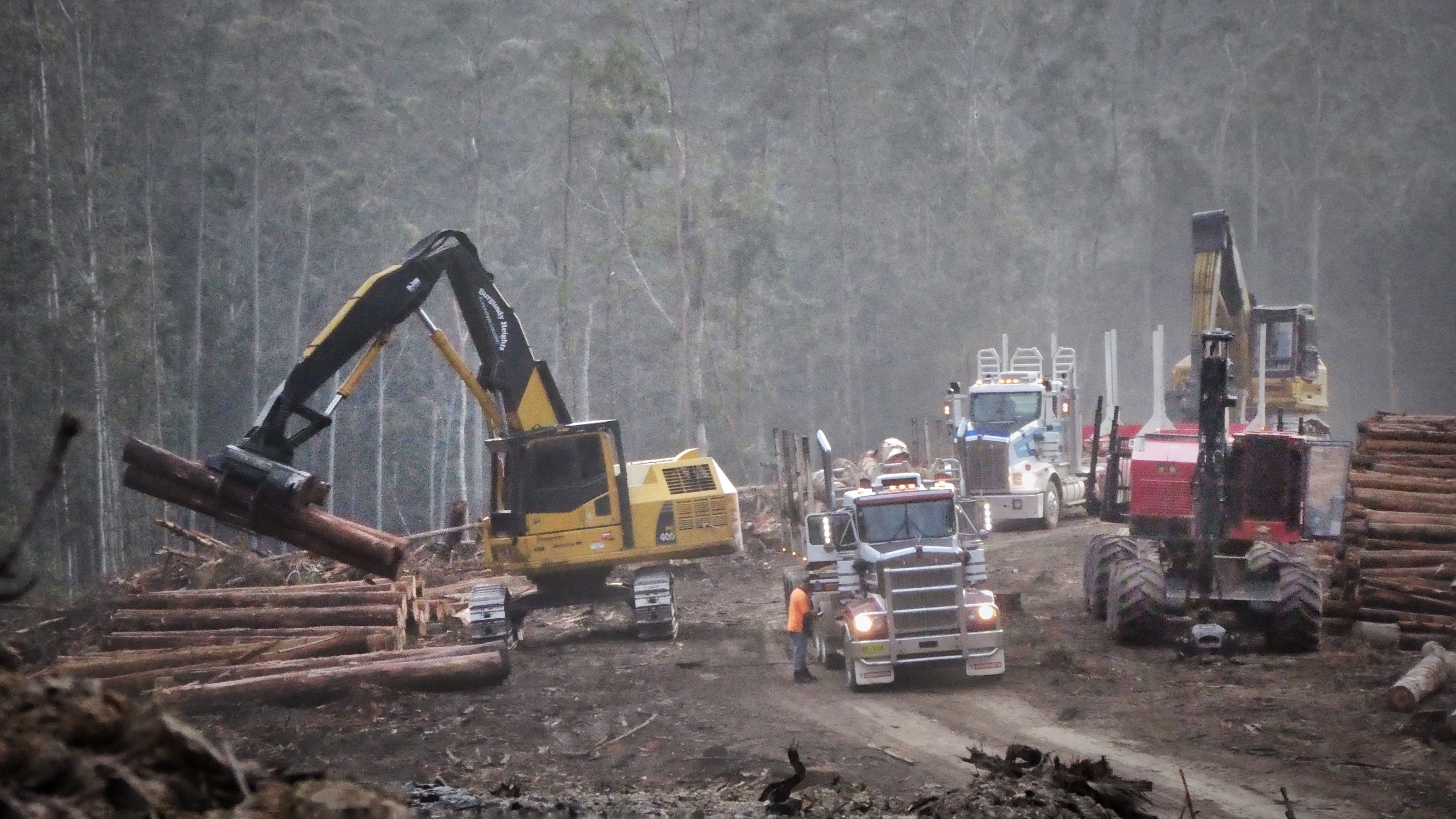
This land was rainforest once. In the late nineteenth century, much of it was cleared manually and laboriously for dairy farming, and in the late sixties, most of the landowners sold their farms to Australian Pulp Mills. APM cleared the farmland and established the flooded gum plantation that is now Tarkeeth State Forest to supply a paper mill that was to be built just south of Coffs Harbour. This never happened – the projects planners had inexplicably overlooked the lack of a massive water supply. Eventually, the plantations were sold to the government-owned State Forests News South Wales – now the Forestry Corporation. The plantation is now being harvested – clear felled, actually – a matter of considerable concern to us forest neighbours and to many in the Shire.
Now, we are all aware that the forest is legally designated a plantation, and that harvesting is considered to be both necessary and legitimate by the powers-that-be in state and local government, and among many in the community.
But it is the aggressive nature of the proposed harvesting that is the issue: the large area involved, and it’s ecologically sensitive location; the decision to clear-fell rather than selectively harvest it as in the past; the plan to burn what cannot be sold off in windrows; and to ground-spray the cleared land with a cocktail of toxic chemicals. All this in a forest highland situated between the large rivers, where with heavy rains and frequent flooding, everything – soil, ash, poison, will flow downhill. It happened last year on the Never Never, with predictably bad consequences for the Bellinger river system. Clear-felling the Tarkeeth will add to the cumulative impact of similarly aggressive harvesting operations in other forests the the Coffs Harbour and Bellingen region in recent years.
Wrong plantation, wrong place, wrong method.
Forestry Corp does not present its Tarkeeth operations as a profitable excercise, rather as the write-off of one asset – a neglected, failed plantation of uneconomical flooded gum – replacing it with another – a plantation of blackbutt which be better managed and more valuable, together with some tallowood to compensate the dispossessed koalas for the temporary loss of their habitat. In short, a financial loss with the promise of a profitable plantation outcome in two generations.
This is lush farmland on the flood plains of the two rivers, with dairy farms, cash crops, and organic farms. There are oyster farms in the twin estuaries, whilst the confluence of the rivers and the lower Kalang are a fisherman’s idea of heaven. This part of New South Wales is called the Holiday Coast, and tourism is is the backbone of a local economy that boasts attractions that range from the rainforest and waterfalls of the Gondwana World Heritage Area of the Dorrigo National Park, to the well-preserved historical township if Bellingen with its federation facades, cafes and craft shops, to the long, golden beaches of Hungry Head and Tuckers Rock.
Tarkeeth Forest contains areas of significant cultural significance to the Gumbaynggirr nation – the traditional landowners, who have identified scar trees, artefacts and sacred sites, and stand to lose this precious history if this forest is destroyed.
Then there are the protected and endangered species that some folk say do not live in the forest, but we know are here in the understory and old habitat trees because we live here, between the eastern and western compartments. These include koalas, quolls, sooty and powerful owls, great barred frogs, and fruit doves. Forty years of native forest ingrowth and plantation neglect have ensured the development of a biodiverse ecosystem. Nature hates a vacuum and has filled the Forestry Corp’s neglected vacant lot.
Broad-scale clear-felling by two mechanical harvesters is quicker and cheaper than the selective logging of marketable species. And large, open stretches of bare earth prepared by bulldozer and fire makes spraying and replanting much easier. The aim is loss-reduction, with some recoupment from the sale of trees felled, rather than money-making. But the non-financial loss is incalculable: The destruction of “in-growth” native forest that has survived previous thinning and flourished, and of preexisting habitat trees, flora and fauna, and the loss of topsoil. And the potential for environmental disaster on the rivers when the rain and the floods come.
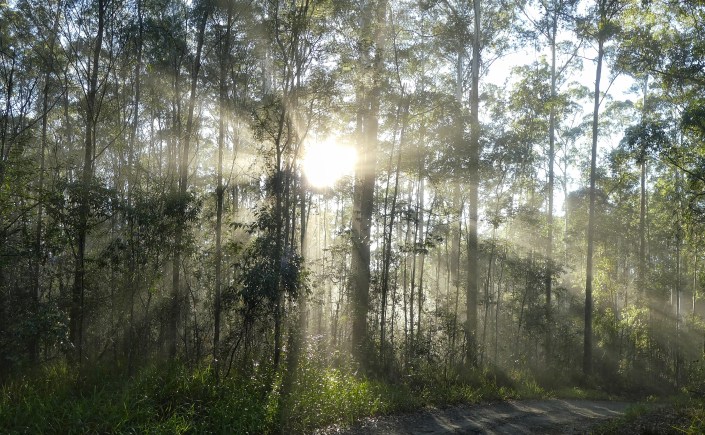
Tarkeeth Sunrise
Images of Isengard
Whenever governments put economic and environmental values on the scales, the mantra of “jobs, jobs, jobs” always trumps the preservation of our forests, plains and waterways. But what “Operation Tarkeeth” does not provide is work. Jobs, local jobs for loggers and mill workers. The days of the logger with his chainsa, selecting and felling the best trees, are gone in this mechanized workplace. We watch the logging jinkers heading east to the Pacific Highway loaded with blackbutt poles for the Grafton mill, some 100 kilometers away, whilst good pulp logs are trucked to Queensland. The trucks come from Grafton too. Local mills get what’s left. The jobs created by this destructive operation are in haulage, and in security – as protests and trespass into the harvest zone have halted work on several occasions.
And yes, there are protests, and there is also division. Nothing divides a small rural community more than logging the nearby forests. And particularly a community that still remembers the last forest war. It has been thirty years since the ferals and the grannies took on State Forests in the old growth wildernesses of Chaelundi and Wild Cattle Creek, since the lock-ons and the tripods in the deep dark woods, since the time of division and derision, since the passionate defense of the jobs of the loggers and the businesses that depended in the local mills for a livelihood, on the one hand, and the people who believed preserving the forest as a future heritage was more important. That war ended with a change of government and direction, and a truce as forestry agreements were made and national parks were extended.
A new generation has come of age since those days, But memories and loyalties, perceptions and prejudices are inherited, and are resurrected down the pub, around kitchen tables, and on social media. The old hatchets may have been buried a long time ago, but many folk still know where they buried them.
We played our own small part in that old war, as the Sydney base for the Wingham Forest “stump truck” that toured the state with two huge, old tallowwood stumps on its flat-bed. We thought that our days of rebellion, of rising up against the empire, were over. But the rebel heart is beating yet.
Featured Image: Nothing quite prepares you for the devastation of clear felling. Joby, a Gumbaynggirr elder, surveys the Tarkeeth.
During the Shoah, the biblical word for ‘the destruction”, and today, the standard Hebrew word for The Holocaust, the Nazi’s progress towards the Final Solution was aided and abetted by governments, armies, auxiliaries, officials, and individuals in the many countries that fell under the Axis thrall between 1939 and 1945. But there were also many, many people of goodwill and extraordinary courage from all walks of life who risked their lives and often, those of their families and friends, to protect Jews from persecution, and to save them from capture, deportation and extermination. untold numbers perished along with their charges. Many survived, as did thousands of Jews.
For Oscar Schindler, Raoul Wallenberg, and the ‘Righteous Gentiles’. In the words of the Talmud, “he who saves a life, saves the world entire”
We said “the worst is over”,
When the laws began to bite,
And our people crouched in silent fear
That fiery crystal night.
When they burned down the synagogues
And made Jews wear the star.
“this madness will not last”, we said,
“Nor reach us where we are”.
And we said “the worst is over”,
Bought the optimistic line.
We shared the hopes of millions,
Prayed for peace in our own time.
And we listened to our elders,
And we kept our fears controlled.
And we thought the worst was over.
Until the panzers rolled.
Then we thought the worst was over
When our army laid down arms.
And we went back to our daily lives,
Dismissed as false alarms
The rumours that these conquerors
Would wipe us from this earth.
It didn’t take us long to learn
What such false hope was worth.
Still, we thought the worst was over
When they made us wear the star,
And gathered all our people
From their townships near and far.
And they forced into ghettos
And set guards upon the gates.
We had seen worse persecution
In the history of our faith.
But we knew the worst still to come
As we watched the trucks appear.
And whispered talk of death camps
Gave dark substance to our fear.
When they sent in dogs and soldiers
To cull those trapped inside,
The ghetto was a station
On the road to genocide.
In the world beyond the wire
None could hear our people crying
As silence like a curtain fell
And cloaked a nation’s dying.
The ears of men were stricken deaf,
The eyes of men were blind
As the free world’s incredulity
Built the wall we died behind.
But we believed that at the hour of death,
When all our hopes had gone,
From the ranks of Gentiles
A just man would soon come.
He would part engulfing waters
With bold deeds and sleight of hand.
He would lead a tortured people
To a safe and promised land.
And, we believe
That when all doors are bared against us,
He will come.
When all hands are raised against us,
He will come.
When no man will defend us,
He will come
Into our darkest day.
He will walk up to our sepulcher
And roll the stone away.
Yes we believe
That in the hour of our worst torment,
He will come.
Like an angel in the darkness,
He will come.
When all our hope is dying,
He will come.
And in our blackest day,
He will walk up to our sepulcher
And roll the stone away.
Featured Image, from Yad Vashem, the World Holocaust Remembrance Centre
“These are the days of miracle and wonder, but don’t cry baby, don’t cry…” Paul Simon, The Boy in the Bubble
With an election looming in Australia, touted as the most important election since the last election, a critical referendum next week in the UK that could precipitate a frightening leap in the dark, and possibly the most divisive presidential contest in the USA in living memory, I scale the News Corp pay-wall to share Paul Kelly’s thoughts on the “interesting times” that we are living in.
Disruption of Brexit, Trump Loom in Anti-elitist Age
Paul Kelly, The Australian, 15th June, 2016
Our age is defined by hostility towards elites and establishment power — caused by financial abuses, frustration at pressures over incomes, immigration and living standards, polarisation at changing cultural norms and Islamist terror — with the US and Britain now in domestic political turmoil from this phenomenon.
The sense of elite failure is taking hold. It mirrors the belief that established policy is rotten or ineffective. Witness the incessant talk of weak leadership and the demise of political trust. People feel they are losing control — of their suburbs, country and security.
The culture of complaint, partly justified, lurches out of control, fed by public anger, acrimonious social media and a coarsening in public life. In this cauldron, ideas that have governed prosperity and success are now under assault from extremes of Left and Right. This roughly describes the forces at work in the US and Britain today. The once unthinkable — just nine months ago — is now a real prospect.
Donald Trump, Republican nominee for president with a reasonable chance in a two-horse race, constitutes a danger to the US and the world. Britain, according to polls, is 50-50 on whether to vote for Brexit and leave the EU in a delusional national revolt. And Australia, devoid of such epic events, is not devoid of their causes, with an anti-establishment, anti-major party hostility possibly defining the 2016 election.
There are two dominant characteristics of this revolt against the elites — it proves the failure of established political leaders and every sign is that such angry, disillusioned populism is just making matters worse and leaving people worse off.
The Western democracies are sinking into a political and intellectual crisis.
The Trump and Brexit movements are different in form but close in motivation — they are driven by multiple grievance. They feed off the notion of a polity gone wrong and a public scorned for too long. They represent a community alienated by and from the centres of power, from the Republican establishment to an arrogant EU.
In extreme form, people feel the system is rigged against them. They are retaliating: part calculated, part irrational. In an age of economic and technological disruption, large segments of the community have said “you want disruption? OK, we’ll give you disruption”.
Tory PM David Cameron now finds his survival in peril. Barack Obama, the most progressive US president, bequeaths a legacy of public rancour, polarisation and low self-esteem. Is it possible for any leader to succeed in societies that have lost their traditional virtue and much of the civic glue that held them together?
It is a time of false prophets. A generation of different and dangerous populists now moves to centre stage. Some like Trump, are undisguised in their racial, sexist and selfish pitches. Trump knows the key to being a successful fraud is to be a grand fraud. He pledges “to make America great again” with an agenda that will damage America and endanger the world.
Yet he wins wide applause. This is because he is an anti-politician, shaking the system, abusing the established politicians, trashing their ideas. He thrives on shock and extravagance in a culture drunk with mindless celebrity. He stands for economic nationalism, trade protectionism, xenophobic hostility towards Muslims and a US strategic withdrawal from the world and much of its alliance system.
Many of the sentiments Trump champions are embraced, one way or another, by the collection of minor parties and independents running at this election — and receiving little scrutiny — from Nick Xenophon’s extreme protectionism to Pauline Hanson’s extreme attitudes towards Muslims and immigration to the strategic withdrawal advocated by the Greens in their hostility towards the US alliance and delusion of a neutralist and more “independent” Australia.
Because he is an inflated ogre, Trump invites resistance. He lacks the judgment for the US presidency and should be fiercely opposed every step of the way. His policies cannot be excused simply because of establishment blunders.
The situation in Australia is different because our revolt against the elites is conducted in the name of the underdog, the little Aussie battler, the moral crusader or, as the Greens say, against the political equivalent of the Coles/Woolworths duopoly.
It is a climate where Jacqui Lambie, a purveyor of cliches with the common touch, can become a Tassie heroine and Xenophon can exploit rent-seeking provincialism to become SA’s finest son. Australians with their anti-authoritarian instincts are notoriously susceptible to appeals to cut down the tall poppies. It is a national pastime and good fun. The public can elect protest candidates in haste and regret over time. Witness Clive Palmer. Who pray, will Queensland give us this poll?
The educated class is adroit at the game. Clever men, Oxford educated, who write books about Winston Churchill can become slick populists as they seek to repudiate Churchill’s legacy of Britain’s commitment to Europe. Boris Johnson spearheads the Brexit campaign and, if successful, he will be well positioned to become PM.
Exploiting the multitude of EU flaws, Johnson makes a big call in Churchill’s style — time to quit Europe altogether — mobilising the sentiments that blame Europe for Britain’s problems, channelling Euroscepticism, overlooking the evidence that exit will hurt Britain economically, hurt the living standards of its people, diminish Britain’s influence and create a series of policy challenges that nobody remotely knows how to solve.
Johnson’s is a sophisticated populism. He cannot explain how Brexit will leave Britain more prosperous or safer. But he has invoked Hitler, Napoleon and the glories of the Empire along the road to what he calls a new freedom. He has panache and, exploiting the immigration card, he may win. Malcolm Turnbull, naturally, backs Cameron’s efforts to keep Britain in the EU.
False ideas are powerful in this new populism. People these days are disgusted with transactional politics — deals, trade-offs, compromises. Yet this is how nations are run in the age of fragmentation and diversity. It is what delivers stability, progress and social unity.
The anti-elites have a different view. They are obsessed by the notion of authenticity because they see most politicians as phony. They want politicians to take a purist stand in honouring their obsessions, single issues and self-interest — against the coal industry, for same-sex marriage, free Medicare forever, banning coal-seam gas, escaping the EU, building a wall to keep out Mexicans. It is a long list.
The anti-elites embody a rising intolerance — self-righteous refusal to accept the validity of the opposing argument is pivotal to this mood. These upheavals in the two great democracies, the US and Britain, are moments of great import. To list the sources of this malaise is to recognise its existence in Australia, albeit in different and less intense form. But for how long?
The mood in the Australian election is disengagement and disillusion with the main parties. The principal contest is Coalition versus Labor.
Yet there is another issue at stake: whether this poll sees an unprecedented number of minor party and independent candidates in evidence of a growing revolt against the Australian system.
I know we’ve come a long way, We’re changing day to day, But tell me, where do the children play?
Cat Stevens
A feature of the growth of Jewish “settlements” in the Old City of Jerusalem – houses occupied by Jewish families, bought or rented from Muslim and Christian owners through a mix of arms-length transactions, subterfuge, proxy purchasers, and intimidation – is the appearance of “kindie convoys ” in the crowded, colourful, bustling streets of the Muslim Quarter.
You will be walking down Suq al Khan az Zait towards the Danascus Gate, or al Wad, the Main Street, towards where it crosses the Via Dolorosa at the IV and V Stations of the Cross, amidst busy weekend shoppers and folk heading to the Haram for Friday prayer. Then, of a sudden, like a school of little fish, a gaggle of small children in kippas and backpacks flows onto the crowded street, enroute to kindie or home.
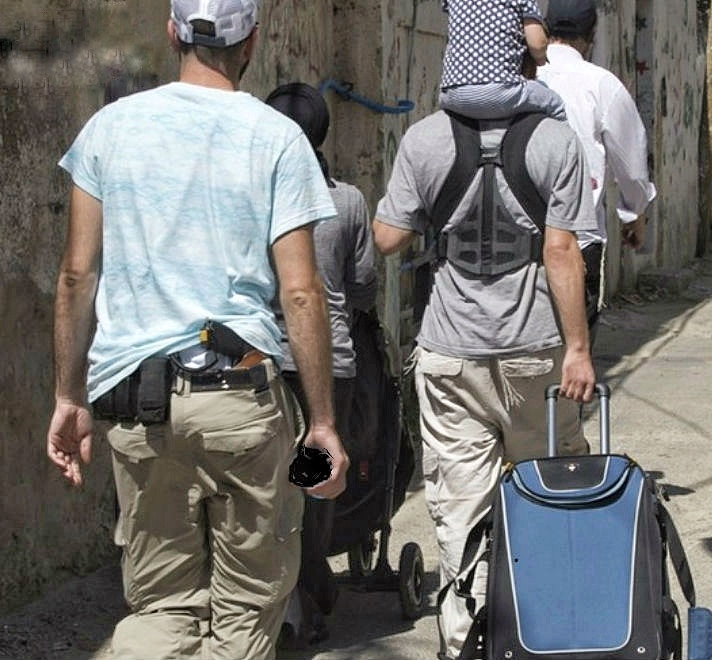
But these kids are like none other around them – those running, jumping, excitable, hyperactive Arab children who regard these ancient streets as their playground. For the Jewish littlies are being herded, and guarded, by slim, casually dressed young men with tee shirts over what appear at first glance to be bulging waistlines, but are in fact utility belts that would make Batman proud, and concealed handguns.
Two to the fore, two aft, and two more on each side of the infant convoy, keeping them in line and coaxing in the strays who meander out of the designated two-by-two line. And all the time, these young men turn and scan the streets, pedestrians, the roof tops, constantly alert, constantly scanning – and not being discrete about it either. They make no pretense at subtlety. For their very attitude is a warning, a demonstration of firepower, to any who would disturb or threaten their little convoy in any way: “you don’t want to mess with us!”
It reminded us of the scene in Series Three of “Deadwood” when, after Alma Garrett is fired upon by Hearst’s hired guns, antihero Al Swearengen orders his men to watch over her as she walks to her bank.
We follow them for quite a distance – immediately behind them, in fact -, and the rearguard look us up and down too. This is not the time for grabbing a Kodak moment.
Then, just as suddenly as they first appeared, the young men herd their charges into the passageway of a hidden house, or up a deserted alleyway, the wary rearguard facing the street until their cargo is safely delivered.
And then they are all gone.
Demographic Qualifier
The events described above took place in the Muslim Quarter of the Old City.
The population of the Old City is overwhelmingly Muslim – are an estimated thirty thousand Muslims here, and the population is growing due to high birth rates.
In the past, Christians, predominantly Armenian and Greek Orthodox, constituted a significant minority, concentrated in the centuries-old Christian and Armenian Quarters. The Arab Christian population has declined significantly since 1967, and stands at less than 6,000 according to the latest census figures. As with so many things in Jerusalem, appearances are deceptive. In the Christian Quarter, where pilgrims and clergy throng 24/7, almost all of the shops that cater for the tourists and the faithful are owned by Muslim Arabs as Christian owners have sold up and departed.
Christian numbers have declined drastically over recent decades, a development that has been mirrored throughout East Jerusalem and the Occupied Territories. From some 20% during the Mandate, to under 1% today. Bethlehem was once a predominantly Christian city, and this is no longer the case. Ramallah’s population used to be about 20% Christian, but no more.
The Jewish Quarter, which appears so vibrant and fresh since being rebuilt and repopulated 1967, and bustling with people visiting the Kotel and the many synagogues, is home to some three thousand souls only. In addition, there are some two thousand transient yeshiva students. Apart from the Jewish Quarter, Jewish residents are very few, living in dwellings scattered throughout the Muslim Quarter.
A Bigger Picture
This is Jerusalem. In London, Paris, and in other cities throughout Europe, synagogues and Jewish schools are for good reason under armed guard as antisemitism rises.
During its long history, Jerusalem has been destroyed at least twice, besieged 23 times, attacked 52 times, and captured and recaptured 44 times.
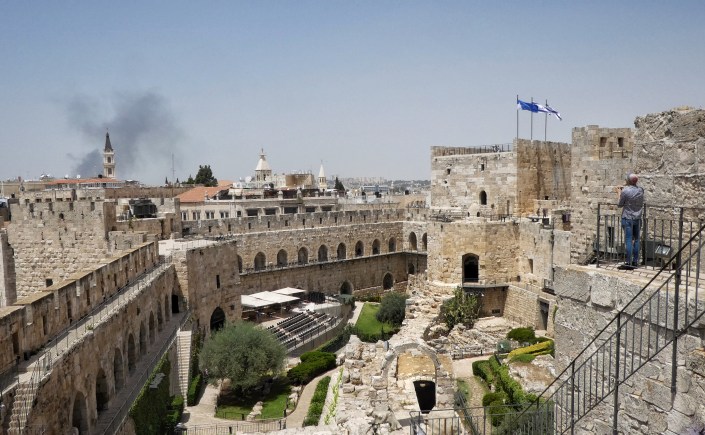
The Citadel or Tower Museum at the Jaffa Gate, the westernmost entrance to the city, is all the history you can eat in a four hour sitting. It’s a four thousand year old story: from the Canaanites and the Hebrews to the end of the Mandate and the establishment of the State of Israel, via Egyptians, Assyrians, Persians, Greeks, Hasmoneans, Romans, Byzantines, Umayyads, Abbasids, Fatamids, Crusaders, Ayyubids, Tartars, Mongols, Mamluks, Ottomans, British, and even Australians. Each left their mark on Jerusalem, and most planted their brickage upon and within the Citadel.
There is a long roll-call of famous names who may or may have not resided in the place.
King David didn’t, despite his name being given to the place and the apocryphal story that he once spied on the bathing Bathsheba from its ramparts – indeed, her bathroom is said to be underneath the New Imperial Hotel, just across the way. Nor did his son and heir, Solomon, builder of the First Temple. Conquerors Nebuchadnezzar and Cyrus did not. They just wrecked the joint. Judah Maccabee might have, and those other famous Jewish rebels, the Zealots didn’t, but during Great Revolt, they retreated there and trashed the place. Herod the Great, a psycho with an serious edifice complex, resided here. As did also Procurator Pontius Pilate when he was in town (he preferred the luxuries of Caesaea Maritimus (Latin for “on Sea). Historians now believe that the Citdel was where he actually cast judgement on Jesus, and not in the Antonine Fortress which overlooked the Temple (where the Haram al Sharif now stands) throwing into question the whole basis for the existence of the Via Dolorosa.
Roman general and future emperor Titus would have taken up residence therein after he destroyed the city in 70CE, leaving only the citadel standing. His troops needed somewhere to crash. Constantine didn’t, but his mom Helena most likely did when she “discovered” The True Cross, commissioned the construction of the Church of the Holy Sepulcher, and single-handedly invented the Holy Land pilgrim industry that endures to this day. The Muslim conquerors Omar Ibn Khattab, Salah ud-Din, and Baybars may have, but Ottoman Sultan Suleiman the magnificent, who built the city walls we see today, never set foot in Jerusalem, and nor did his successors.
Ottoman troops occupied it, and General Djemal Pasha would hang Arab Nationalists in the Square before it. General Allenby declared Jerusalem and Palestine liberated on the steps leading to the citadel in 1917, but most likely stayed across the square at our wonderful East New Imperial Hotel (the Kaiser stayed there too when he visited Jerusalem in 1898). British troops garrisoned it during the Mandate years – like the Roman legionaries before them, they’d’ve needed a place to lay their heads. The British-commanded Arab Legion of then Transjordan took control of it in during the the battle for Jerusalem in 1948 and defended it successfully against the new IDF. They did so again in 1967 only to lose it and the Old City.
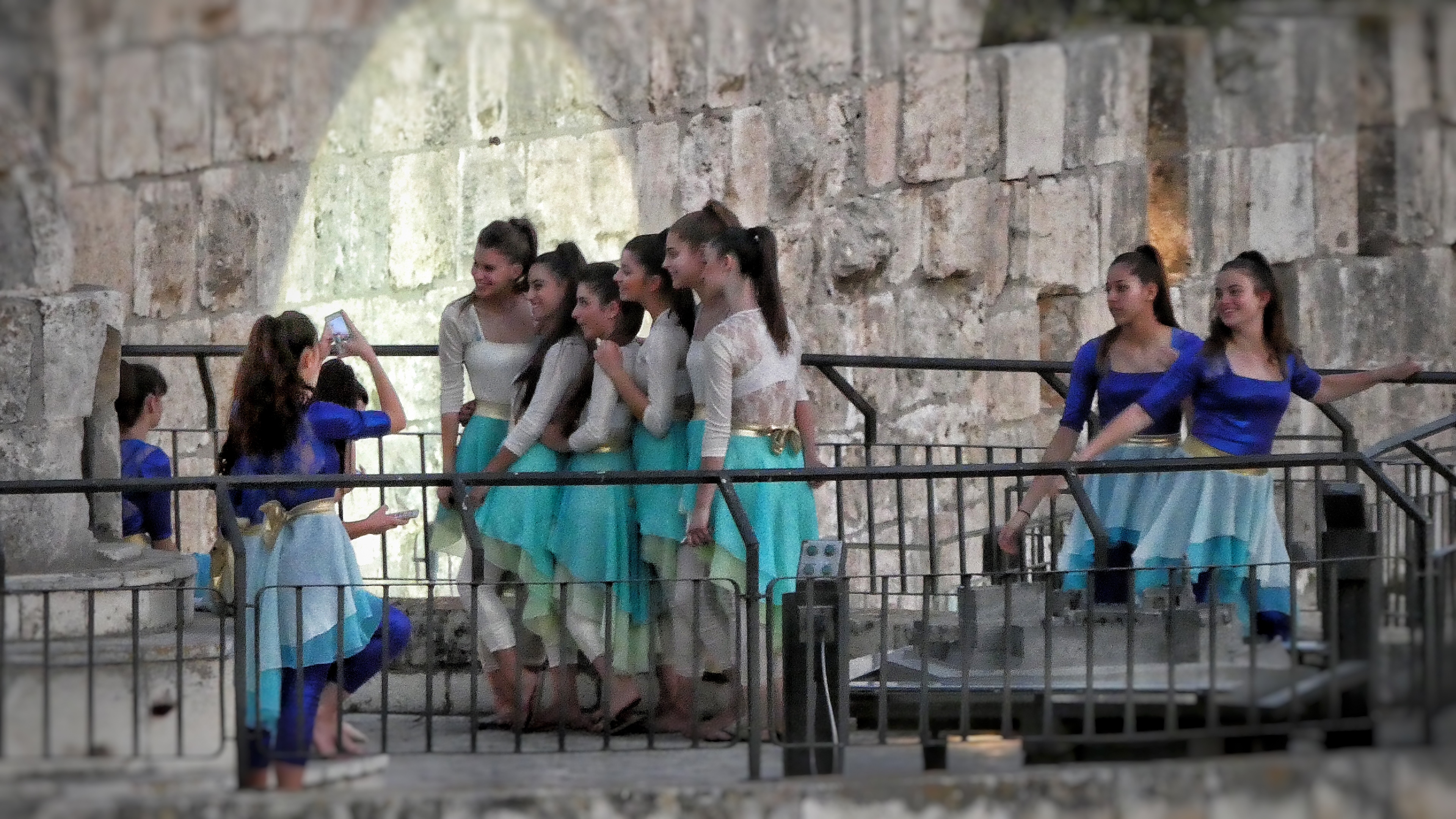
If the stones could talk, what a tale they would tell. And indeed, the museum now does just that, in content and in form. We sit on the roof garden of our hotel, directly across the street on Omar Ibn Al Khattab Square, and look across at its towers, ramparts and gardens, and sense it’s story in our souls. We watch present generations passing beneath its walls, and the young folk dancing on the ramparts, all part of the passing parade of humanity that has lingered by and upon these ancient walls.
For further reading, you can’t beat Simon Sebag-Montefiore’s Jerusalem : The Biography (Phoenix 2011).
“Cause out on the edge of darkness, there rides a peace train.
Oh peace train take this country, come take me home again.”
Cat Stevens, Peace Train
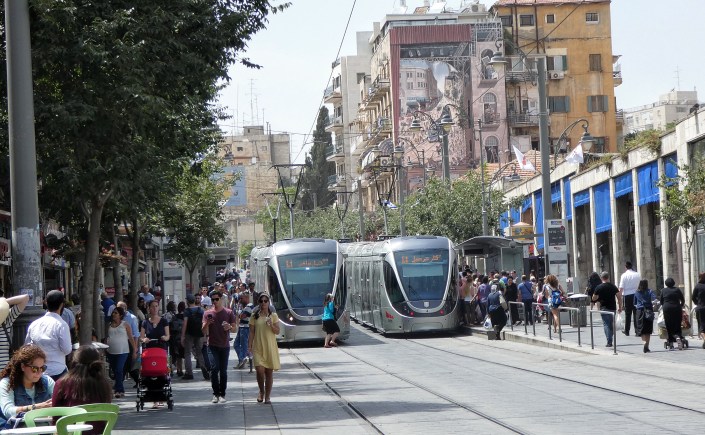
Completed in 2011, the Jerusalem Light Rail unites east and west Jerusalem. This how a light rail should be – small, light, and frequent, on a traffic free Jaffa Road. It links the Jewish suburbs of west and northeast Jerusalem with the Arab suburbs of the north and east of the Old City. The featured picture shows two trains passing at Jaffa Central, underneath a neat mural that shows one weaving down Jaffa Road through vignettes of Israeli urban life. Their destinations are shown sequentially in three languages. Synchronicity determined that in the picture, both were in Arabic.
It was controversial when first mooted, and extreme elements on both sides of the conflict opposed any such normalization of relations between the Jewish and the Arab communities. There were demonstrations in European countries against the “line that divided a city”, but these petered out when polls showed that Arabs in East Jerusalem found the line to be a blessing. It got dad to work on time; it got mom to the cornucopia that is the Mahane Yehuda fresh food markets, just four stops from the Damascus Gate; and it delivered the kids to school and back safely and punctually. It is said, with some justification, that earlier attacks on the line were perpetrated by thugs incited by Fatah, the political wing of the Palestinian Authority, which is alleged to control the taxi industry of East Jerusalem.
During the recent unrest, the line was often blocked and trains attacked during demonstrations and street fighting, but service was resumed quicksmart. Arab passengers were at times abused by Jews, and stations were the targets of random rammings by cars and heavy vehicles – the so-called “siyarah intifada” – with many Jewish casualties and “neutralized” perpetrators.
If you’ve ever ridden the light rail in Jerusalem, then you’ve seen the section with the chairs that go down when you sit on them – each has a wheelchair sign because people in wheelchairs get priority there since there’s space, but if you’re a mom and you’ve got a stroller, you can sit there, too, and that’s where these two women are sitting: I watched them both get in, one wore a hijab and the other wore a sheitel, and they both had their arms and leg covered, and no collarbone, no sir, and I watched the struggle through the crowd on the light rail with their strollers, big and blue and bulky, match match.
They each took a seat on opposite sides of the row where the wheelchairs go, and they put their strollers in the middle. Each woman stared straight ahead out the window as Jeursalem went by in one long smear, looking straight past each other.
Strangers on a light rail, with their matching strollers, but by accident, their strollers faced each other, and the kids met eye to eye — both bundled up in winter coats and hats and shoes, both brown eyed babes with pink cheeks, and curly hair, well fed and well loved, and they could have been brothers. And while their mothers stared straight ahead watching Jerusalem blur by, the two boys smiled at one another, and chatted back and forth as only little babies can, but as everybody should.
But calm appears to have descended, and folk of good will on all sides of the literal and figurative line pass in peace through Arab and Jewish Jerusalem.
“I believe that one fine day all the children of Abraham
Will lay down their swords forever in Jerusalem”
Steve Earl, Jerusalem
Light Rail Mural, Jaffa Road
Facebook Postscript from Sarah Tuttle-Singer, 20th February 2023
If you’ve ever ridden the light rail in Jerusalem, then you’ve seen the section with the chairs that go down when you sit on them – each has a wheelchair sign because people in wheelchairs get priority there since there’s space, but if you’re a mom and you’ve got a stroller, you can sit there, too, and that’s where these two women are sitting: I watched them both get in, one wore a hijab and the other wore a sheitel, and they both had their arms and leg covered, and no collarbone, no sir, and I watched the struggle through the crowd on the light rail with their strollers, big and blue and bulky, match match.
They each took a seat on opposite sides of the row where the wheelchairs go, and they put their strollers in the middle. Each woman stared straight ahead out the window as Jeursalem went by in one long smear, looking straight past each other.
Strangers on a light rail, with their matching strollers, but by accident, their strollers faced each other, and the kids met eye to eye — both bundled up in winter coats and hats and shoes, both brown eyed babes with pink cheeks, and curly hair, well fed and well loved, and they could have been brothers. And while their mothers stared straight ahead watching Jerusalem blur by, the two boys smiled at one another, and chatted back and forth as only little babies can, but as everybody should.
Like Lord Byron, he was mad, bad, and dangerous to know. He may or may not have been a psychopath – he killed his way to the top, murdering his relatives, and also, his wife Mariamne, whom loved truly, madly, deeply – but he suspected her of plotting to depose him, so she had to go too. He regretted it instantly and embalmed her in honey so he could spend quality time with her by her open catafalque.
Herod did a lot of questionable things, but he has gone down in Christian demonology for an atrocity he did NOT commit – he didn’t massacre the Innocents to ensure that baby Jesus would not live to supplant himself as King of the Jews! The slaughter of the babies was an invention of later Christian propagandists. Also, he was not the Herod who’s daughter Salome invented lap dancing and in payment, demanded the head of John the Baptist. Nor was he the Herod who told the imprisoned Jesus “I’m the King of the Jews!” That was Andrew Lloyd Webber’s camp caricature. Herod was a common name amongst the later (and last) Hasmoneans.
To his Jewish subjects, he was not a Kosher King, being only half Jewish, and then, only through this dad (even today, opinions about him are mixed for the same reason). Accordingly, he felt that he had to prove himself, like similarly half-Jewish, and much wiser King Solomon. So he built things. And man! Could he build! His stuff was not large – it was Monumental.
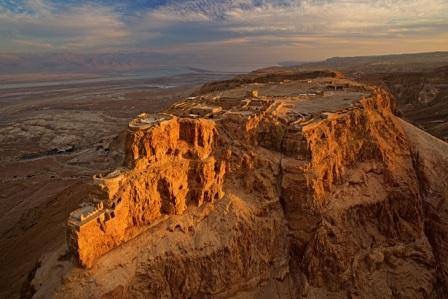
At Caesarea, on the Mediterranean coast, he build a port, a seaside palace and a city. In Jericho, another magnificent palace. At Herodium, he built a fortress-palace-mausoleum, but first, he built a hill high enough that he could see Jerusalem from the summit. Across the River Jordan, in present day Jordan, he rebuilt a fortress-palace at Machaerus which was said to be location of the imprisonment and execution of John the Baptist, and the venue for Salome’s notorious dance, The ancient town of Sebastia, on a hill with panoramic views across the West Bank, is another location of Herodian brickage; its Nabi Yahya Mosque is said to be the burial site of the Baptist – although his head is believed to rest in an ornate catafalque in Damascus’s splendid Umayyad Mosque. And he a fortress and summer palace on the Masada massif overlooking the Dead Sea, and the site of one of history’s most famous “last stands”.
He obviously liked palaces. When he died – and he died horribly as befits a bad boy – he was laid to rest in a bespoke tomb in his Herodium eyrie.
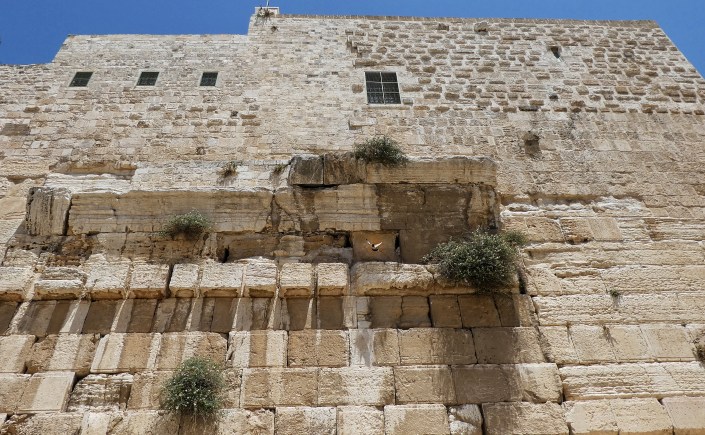
But his crowning glory was his breathtaking refurbishment of the Second Temple, rendering it a wonder of the contemporary world. Too bad that a “wabble of woudy webels”, to quote Bickus Dickus in “The Life of Brian”, had to rise up against Rome in 66CE, precipitating the destruction of Jerusalem, the death of thousands, and the razing of temple to the ground. All that impressive Herodian brickage was sent crashing to the ground, and all that remains is the Kotel, the hallowed Western or Wailing Wall.
(The featured image shows signature Herodian ashlar blocks in the Kotel, the Western or “Wailing” Wall)
Apart from building things, was Herod really that “great”? I reckon he gave himself that soubriquet – or else the Romans did, probably in sardonic irony (which Herod, narcissistic and paranoid, probably didn’t get). His subjects didn’t think so and were happy when he died. Some accounts suggest that he’d ordered his bodyguard to slaughter the heads of prominent Hebrew families on the event of his death so that the people would not feel like rejoicing when he passed.
Herodian brickage thrown down by the Romans
Herodium
Masada
The largest house brick in the world. The Western Stone of the Kotel 13.6m
One of the pleasures of moving to the Australian bush and living in Bellingen Shire is discovering its often overlooked history. This is the story of Twin Pines. Not as dippy as Twin Peaks, nor as sinister as Wayward Pines, it is a story of ordinary people doing extraordinary things.
When I first came to this land,
I was not a wealthy man,
So I built myself a shack,
And I did what I could.
I called my shack
Break My Back,
But the land was sweet and good,
And I did what I could.
When I first came to this land,
I was not a wealthy man.
So I built myself a farm.
I did what I could.
Prologue
We in Bellingen Shire , some ten kilometers west of the seaside town of Urunga on the mid north coast of New South Wales. The Tarkeeth Forest lies between the Bellinger and Kalang Rivers, and these are connected tidally to the ocean at Urunga – the only place in Australia where two rivers meet the ocean together. The forest rises from the rivers on either side of the Fernmount Range, the easternmost extension of the Great Dividing Range that spans the eastern edge of our island continent. Above and between the two rivers, it is a rain-harvesting, filtration and stabilization ecosystem vital to the waterways and wetlands around them, and is a habitat for bird, reptilian, mammalian and marsupial wildlife, including koalas, wallabies, echidnas, quolls, goannas, owls, fruit doves and cockatoos. The east-west Fernmount Range Trail is an ancient highway called the Yildaan Dreaming Track. It led from the plains beyond the Dorrigo massif to what is now the seaside town of Urunga, known then to the Gumbaynggirr people as a “place of plenty”. The first people would descend the spurs on the north and south flanks of the range to fishing and ceremonies on the riverside. The Tarkeeth Forest therefore contains areas of significant indigenous culture, recalling song lines and stories of the Dreamtime, places of ceremony, of birth and burial, and of atrocity.
The Fells of Twin Pines
Exploring the history of the forest, I chanced across Lloyd Fell’s story of the Fell Family Farm. This was located close to the present Twin Pines Trail, just east of Fells Road on South Arm Road, and west of the new bridge across the Kalang. It’s a great story of how the road got its name, and of how, in the late 19th century, Moses Lacey, the first selector, ran a store on the river bank. How back then, there was no road along the river, the South Arm (of the Bellinger), and access to farms along the river was by small jetties. South Arm Road was built to serve a quarry, now disused, just west of the present Fell’s Road.
Lloyd tells the story of how in 1926, New Zealand farmer, solo-yachtsman, and returned ANZAC Chris Fell first saw the land that became the family farm, purchasing it from Moses’s deceased estate for a thousand pounds. Chris was impressed by the two mature pines that stood on either side of the track leading to a rough timber house that already stood there – and these gave the farm its name. He cleared the bush, felling and hauling timber (helped by his neighbour Bennett’s bullock team) until he had sufficient land and capital to run cattle. In time, he built up a prosperous dairy business and cattle stud, and he and his wife Laura, a Sydneysider from a well-to-do Vaucluse family, raised their three children there. It was a hard life on the land back then – one of dedication, hard work, and perseverance. Power did not come to the South Arm until 1959. Many in the Shire still remember Chris and Laura and indeed, went to school with Lloyd, Bill and Margaret. When the kids were young, they went to the small Tarkeeth school house located just west of the present Fells Road junction. There are quite a few folk who remember attending the little school before its closure in 1972. Indeed, since I published the story on a local FaceBook page, and a former pupil published a picture of the Tarkeeth School’s “Class of ’68”, old aquaintances and school chums have reconnected with each other. Here is the History of Tarkeeth School. It can be obtained from Bellingen Museum,
Twin Pines is no more. When Chris could no longer work the farm, Bill took over the business. In 1966, with changes in the dairy industry rendering to business unprofitable, he sold it to the Errington family.They sold it shortly afterwards to Australian Paper Mills who in the early ’80s, sold it to State Forests – now the Forestry Corporation. APM cleared the land and established a flooded gum plantation thereon and on adjacent blocks – today’s Tarkeeth State Forest. That plantation is now being aggressively harvested – clear felled, actually – a matter of considerable concern to us locals and to many in the Shire. in the South, the forest comes right down to the Kalang River, and this too is a cause for concern as the harvesting and reforestation operations involve clearfelling, burning and spraying with herbicide. The consequences of an extreme weather event could be dire.
The farm house was not demolished. When the plantation was established, but was destroyed by fire years later. The school was sold to an Erik Johannsen who lived there for many years with a collection of animals. Tragically, he ended his own life after setting fire to the school. Fells Road puts the family name on the map, and whilst the Errintons did not linger here long, they are remembered in Erringtons Trail, a well-maintained forest track linking South Arm Road to the Fernmount Range Trail and thence the Bellinger Valley. Bennett the bullocky has a trail named for him too. Walking through the Forest Corp plantation, you can still just make out the place where the house stood. There is an old dam in the heart of the bush where tomatoes were once grown. In the the forest, amongst the plantation trees and native regrowth, you will come upon large, old angophera, grey gum, bloodwood and black butt habitat trees, their broad, spreading branches indicating that these once grew in open pasture.
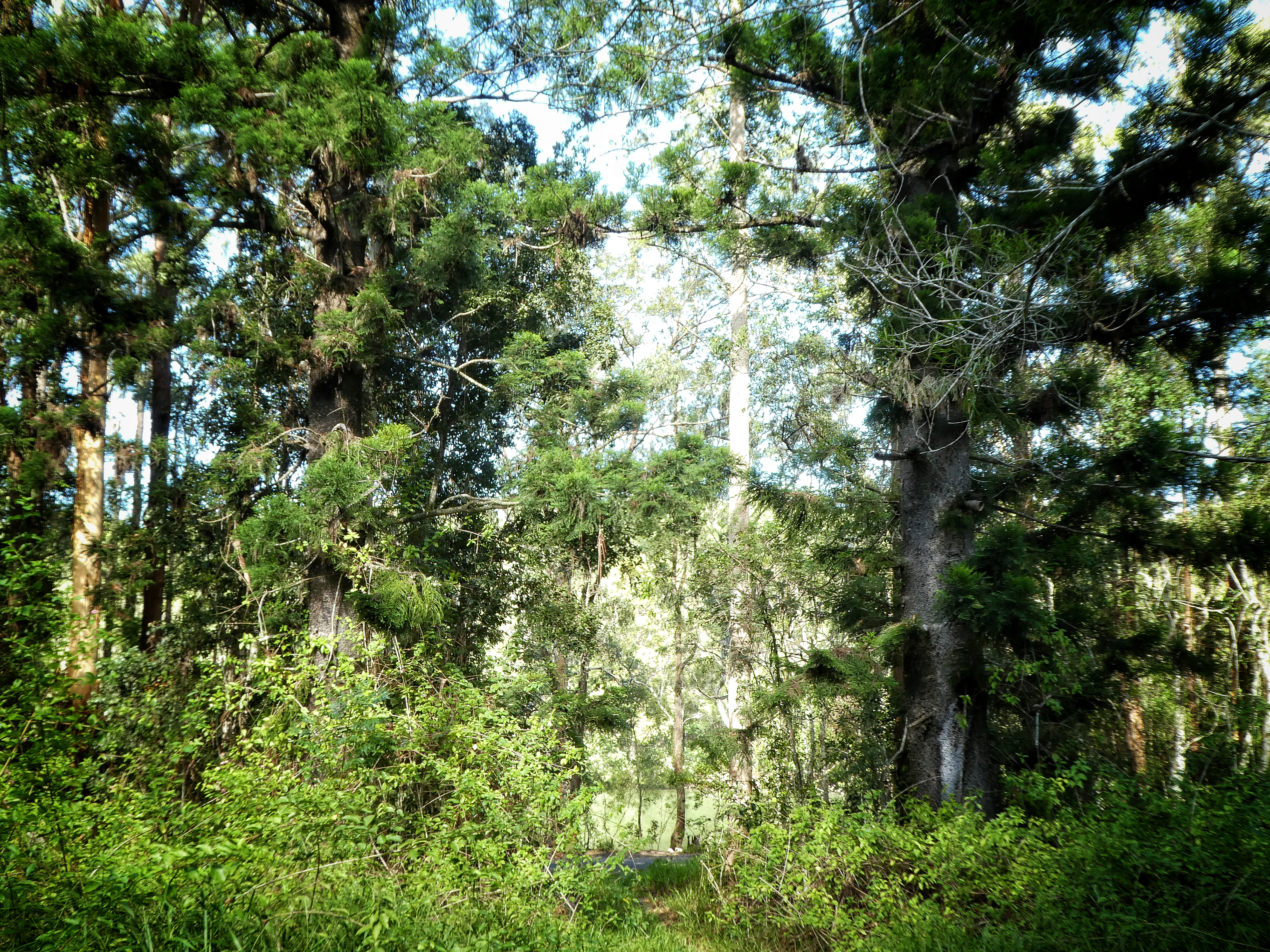
The pines are still there, some ten metres in from South Arm Road. They are not on what is now the Twin Pines Trail, but at the beginning of a trail just to the east of it. A pair of big and beautiful hoop pines. And next to one of them, an old gate post, a dumb signpost to a a vanished past. Furthermore, they have had loads of babies. There are small hoop pines close to their parents, and eastwards along the road towards the new bridge over the Kalang. Nature never sleeps.
Hoop pines at Twin Pines, Tarkeeth
Nothing remains of the Fells farm except some old fence posts, but standing there, it is easy to imagine what it would have been like in those days. But one thing has not changed. Walk into the bush halfway between the pines and Eastern Trail, you will see what Chris Fells discovered back in the ‘thirties:
“Down on the left as you looked out of the house, there was an especially thick, almost impenetrable circle of bush surrounding a small lagoon. Within this, was a haven for all kinds of wildlife such as bandicoots, native possums, snakes, frogs, and and a great assortment of birds: parrots, kingfishers, kookaburras, currawongs, black ducks, bowerbirds, honey-eaters, and by the water itself, the beautiful egrets, ibis and spoonbills. If you peep into the lagoon from the road, its great white paperbark trees, knee-deep in thick green water, gave it an air of mystery and magic”.
And indeed, as the photographs below show, the Tarkeeth Lagoon is still quite special. Folk who grew up on South Arm Road and explored the area as children, still remember the mystery of the place. Those animals and birds still live in the Tarkeeth, but the tall paperbarks have long since fallen and lie as moss and epiphyte-covered sculptures beside the water.
Read the full story of Twin Pines here in Lloyd Fell’s small but captivating book:
Local historian John Lean’s new book “Settlers of South Bellingen and the Lower South Arm”, his “Settlers of the Upper South Arm and Spicketts Creek”, and also, “The History Of Tarkeeth Public School” are available at the Bellingen and Urunga museums.
For other posts in our Small Stories series of ordinary folk doing extraordinary things, see: The schools of the Tarkeeth, another tale from our neck of the woods; TheOdyssey of Assid Corban, the story of a Lebanese migrant to New Zealand, and The Monarch of the Sea, the rollicking tale of an unlikely “pirate king”. There is also No Bull!a true though somewhat overwrought local saga of battling bovines – set in Bonville, not far north of us.
Chris Fell – The ANZAC Story
A century ago, on 31st October 1917, the Australian Light Horse charged the Turkish trenches during the Battle of Beersheba in one of history’s last great cavalry charges. The 31 light horsemen who fell are buried in the Beersheba War Cemetery along with 116 British and New Zealand soldiers who perished in the Beersheba battle. There are 1,241 graves in the military cemetery, soldiers being brought in from other Great War Middle East battlefields. It is a tranquil, poignant, and beautiful place in the Negev Desert, where the bodies of young men from Australia and New Zealand and from the shires of England, Ireland, Scotland and Wales were laid to rest. “Lest we forget”.
In his ebook The Twin Pines Story, Lloyd Fell tells how his father served as a mounted machine gunner with the New Zealand forces in the Gaza ampaign of late 1917. His war record reports that he was one of the machine gunners who fought through the day before the famous charge to knock out the Turkish machine guns on the strategic al Saba Hill east of Beersheba. Had these fortifications not been overrun, the Light Horse would have been prevented from advancing on the wells. Afterwards, the machine gunners and their Kiwi mates took part in a bayonet charge against the enemy.
As Jean Bou wrote in The Weekend Australian:
“The New Zealand brigade was sent against Tel el Saba, but this steep-sided hill with terraced entrenchments was formidable. The dismounted horsemen, with the limited fire support of their machine-gunners and the attached horse artillery batteries, had to slowly suppress the enemy defences and edge their way forward. Chauvel sent light horse to assist, but as the afternoon crawled on, success remained elusive. Eventually the weight of fire kept the defenders’ heads down enough that the New Zealanders were able to make a final assault. The hill was taken and the eastern approach to Beersheba opened, but nightfall was approaching.
See: http://specialreports.theaustralian.com.au/888793/a-remarkable-feat-of-arms/
Beersheba War Cemetery, Israel
This post opened with that great troubadour Pete Seeger singing Oscar Brand’s celebrated pioneer song. I conclude with his rendering of David Mallet’s tribute to the simple life.
Inch by inch, row by row,
Gonna make this garden grow.
Gonna mulch it deep and low,
Gonna make it fertile ground.
Pullin’ weeds and pickin’ stones,
We are made of dreams and bones
Need spot to call my own
Cause the time is close at hand
We have been visiting Bellingen Shire for the last thirty years, and moved a house onto our bush block over twenty years ago. Bellingen, the Bellinger Valley on the Mid North Coast of New South Wales, is well known as a picturesque, well-preserved (founded in 1870) country town. In former times, it was the centre of a thriving dairy and timber industry, and more recently, as a popular tourist spot between the university city of Armidale and the country music capital of Tamworth to the west, and the Pacific “holiday coast” of Coffs Harbour, Sawtell, Urunga, and Nambucca Heads, to the east, with their sand, surf and sun.
Between the two is the Great Dividing Range, the rolling, high country escarpment of the New England Plateau with its gorges and waterfalls, and the world-heritage Dorrigo National Park with it timeless, untouched rainforests – a “land that time forgot”. And linking them all, the old trunk road, aptly if touristically named Waterfall Way.
Bellingen is popular for its cafes and coffee shops, craft industries and shops, music festivals, and federation facades. It’s visual appeal, and it’s bucolic rural environs have seen the town used on many occasions as a film location. In the seventies, it was a Mecca for young people seeking an alternative lifestyle. The hills thereabout are still scattered with cooperatives and communes, or, in local council-speak, multiple occupancies. In the old days, no love was lost between the “hippies” and the farmers and loggers, and politics were dominated by the rural, conservative “born to rule” National and Country Party. Nowadays, it’s heir, the National Party still dominates the political scene, but its clear majorities decrease fractionally election by election, and by the turn of the century, there may no longer be a National Party member. But demographics do change, as does society. The hippies’ children and the farmers’ kids grew up together, attended the high school together, played, partied, and paired together, and now, there are grand children and great grandchildren.
As the timber and dairy industry has declined, Bellingen’s economy has changed. Once exclusively agrarian – including a time as one of the prime producers of cannabis sativa – tourism now plays a vital role. Bellingen advertises itself to visitors and to present and future residents as a clean, green and sustainable shire. Nature’s wonderland, from its golden beaches to its mountain rainforests and waterfalls. A Tourist Heaven with a cornucopia of recreational activities for young and old – from lazy bathing and picnicking to energetic rambling and trecking, camping and climbing, canoeing and fishing. A cultural mecca with many cafes, live music, craft and artisan shops, and music and writers’ festivals.
Two years ago, the online magazine Traveller published a breathless paean to “the bohemian town that is heaven on earth’. Happy traveller Sheriden Rhodes wrote: Some places are so beautiful; it feels like holy ground. For me, Bellingen has always had that consecrated feeling. It’s obvious, given the name the early pioneers gave the Promised Land, a scenic 10 minute-drive from Bellingen’s township itself. Here the land is so abundantly verdant and fruitful; it literally drips with milk and honey. It’s a place so special the fortunate locals that call it home, including its most famous residents George Negus and David Helfgott would much rather keep all to themselves”.
This is the marketing spin hyped up by the council, the chamber of commerce, and real estate and B&B interests. The reality is somewhat different. Bellingen and the “Holiday Coast” generally have seen a large influx of city folk seeking a different lifestyle for themselves and their children, and also of retirees seeking rural or seaside tranquility – in such numbers that Coffs Harbour and its seaside satellites have become in many ways the Costa Geriatrica.
Many newcomers are not fully aware that the Coffs Coast generally is one of the poorest areas of rural New South Wales. Statistics for youth unemployment and senior poverty are among the highest in the state with all the attendant economic, social and psychological impacts as evidenced by high rates of depression, domestic violence and substance abuse. Health and transport services outside the urban centres are pretty poor. Rising property values and high rents price low-income families and singles out of the market. Decreasing profit margins have forced many of those attractive cafes and coffee shops to close.
Nor is the clean, green, sustainable shire as picture perfect as the brochures portray It. There is environmental degradation with clear-felling and land-clearing, and flammable, monoculture, woodchip-bound eucalyptus plantations that encircle Bellingen – a potential fire bomb primed to explode during one of our scorching, hot dry summers. There is generational degradation of the Bellinger’s banks and the graveling up of its once deep depths. And there the encroachment and expansion of water-hungry, pesticide and herbicide reliant blueberry farms,
But on the right side of the ledger, we in the Shire are indeed blessed by Mother Nature. The coastline boasts magnicent headlands and promontories, and long, pristine and often deserted beaches. The World Heritage Gondwana rainforests are a national treasure, and surrounding national parks truly are a natural wonderland. We never tire of the drive from Urunga to Armidale via Waterfall Way, as it crosses the Great Dividing Range and the New England Plateau. The Kalang River as it flows beside South Arm Road and between the Tarkeeth and Newry State Forests is itself one of the Shire’s hidden and largely unvisited secrets, a haven for fishermen, canoeist and all who love mucking about in boats.
Compared to many places on this planet, we’ve really not much to complain about …
You come at the king, you best not miss.
Omar Little, The Wire (after RW Emerson)
The phrase “one man’s freedom fighter is another man’s terrorist” is at once apt, correct, and yet often oversimplified to the point of disingenuousness. The word “terrorist” itself describes its goal. To instill fear in the heart of the enemy. In the past, the target would have been the king, the dictator, the ruling class, and those who served them and upheld their rule. Politicians, officials, solders and policemen. Today, terrorists indiscriminately target whole societies. Irish bombers blasted communities of the rival faith, murdered shoppers, office workers, and pub patrons, as well as soldiers and policemen. Palestinian suicide bombers hit malls and pizza bars in city centres. ISIS, al Qa’ida and the Taliban detonate cars in busy city streets and publicly execute prisoners in callous and calculating “lectures in flesh” (the phrase is civil rights lawyer Geoffrey Robertson’s, from his chilling account of the trials and execution of King Charles I of England and those who sentenced him, The Tyrannicide Brief.).
But targeted and random terrorism has a long historical pedigree. For centuries, it has been the desperate and nihilistic weapon of last resort of resistance and rebellion against perceived oppression and injustice, and against invaders and occupiers.
In the second century BCE Palestine, the Maccabees used assassination in their resistance to the Seleucid Greeks, and a century later, the Jewish zealots, the Sicarii, named for the easily concealed small daggers, paid the Romans in like coin, and ultimately in an insurrection that culminated in the destruction of Jerusalem in 70CE and the scattering of the Jewish race (giving history the emotive and symbolic last exit that was Masada). In an etymological irony that Mark Twain would have been proud of, the present unrest in Jerusalem, a large number of young Palestinians have perished in attempting to stab jewish soldiers and civilians. Their jaquerie is called the “Intifada Sakni-in”, the ‘Knife Uprising – an echo of those long-dead Sicarii “dagger men”.
Nowadays, one would be excused for thinking that “terrorism” and “terrorist” are synonymous with Arabs and Muslims. And a historical precedent reinforces this erroneous assumption. The Hashishan or “Assassins” of Middle East fame (yes, that is where that noxious noun originated) were Muslim men and boys mesmerized and mentored by Rashid ad Din as Sina-n, the “Old Man of the Mountain” (and all this, before Osama in the caves of Tora Bora), and were Twelfth Century hit-men contracted out to rival Muslim princes in the internecine conflicts that plagued the Levant in the wake of the Crusades and the demise of the great Arab Caliphates.
But the assassin’s knife (and in modern times, the gun and bomb, and latterly cars and trucks) predates these medieval hoods and links the Hebrew rebels of old to the Irgun and Stern Gang who encouraged Britain and the UN to abandon Palestine in 1948, bequeathing most of it to the new state of Israel, and triggering the Palestinian diaspora. European anarchists and Irish rebels and loyalists were adept at shootings and ambushes. In Algeria, during the ‘fifties, the nationalist FLN and the “colon” OAS shot and bombed each other and those unfortunates caught in the crossfire. The IRA perfected the improvised explosive device that today has crippled thousands of American, Canadian, and Australian soldiers in Iraq abd in Afghanistan. Hindu Tamil separatists of Sri Lanka introduced the suicide bomber, an economical and efficient weapon against soft (civilian, that is) targets, deployed today by Islamist killers in the streets of London and Lahore, Damascus and Dar es Salaam, Jerusalem and Jakarta. Whilst Arabs – and particularly Palestinians may have given the world the hijacking of aircraft – a tactic that fell into disuse due to diminishing political returns and rapid response forces – other Arabs showed us how to fly them into public buildings as the whole world watched in horror and disbelief. The shockwaves of this one are still reverberating through the deserts of the east and the capitals of the western world.
In going up up against their occupiers, the Palestinians have an old heritage. In my old country, Boudicca and Caractacus fought a losing battle against the Romans in Britain during the First CE. The Roman historian Tacitus ascribed to a vanquished chieftain the memorable words “solitudinem faciunt, pacem appellant” – they make a desert and they call it peace. After the battle of Hastings in 1066, the defeated Saxons pushed back against the Normans and brought the genocidal wrath of William the Conqueror down on their heads with the devastating “Harrying of the North”. The Green Man and Robin Hood legends are said to be a retrospective and romanticised remembering of the Saxon resistance. Warrior fugitives from that failed guerilla war fled as far as Constantinple, where many joined the Emperor’s acclaimed Varangarian Guard, (see When Harald Went A Viking)
In the streets and the countryside of Ireland, my parents’ birthplace, the United Irishmen, Fenians, Free Staters, IRA and Unionists fought against the redcoats, tommies, and black and tans of the British Army. Fought amongst themselves, fought against each other, and killed and were killed in their centuries long war of liberation. And in my adopted country, indigenous Australians fought a futile frontier war against settlers and soldiers just as native Americans did, albeit on a much smaller scale, and paid the price in hangings, massacres, poisoned wells, dispossession, marginalization, and “stolen children”. The legacy of those times lingers still – see The Frontier Wars – Australia’s heart of darkness.
In Central America, Juarez led the Mexicans against the French, and Sandino, Nicaraguans against US marines. Spaniards rose up against Napoleon’s forces, giving the world the word “guerilla”, or “little war”. Russian partisans ambushed the Grande Armé and the Wehrmacht. Throughout occupied Europe, the very term “resistance” became synonymous with the heroic unequal struggle against tyranny. In another of history’s ironies, muqa-wamat, Arabic word for resistance, unites sectarian rivals Hamas and Hizbollah against Israel.
And not just resistance to invasion and occupation, but also against oppression by one’s own rulers. Religious tracts tie themselves in knots reconciling the obligation to obey our rulers with the right to resist and overthrow those that rule badly. The unequal struggle against tyranny – or what is perceived by the perpetrators as tyranny – is the cause that inspires men and women to desperate acts.
The most celebrated in fact, film and fiction is the death of Julius Caesar at the hands of peers who feared that he intended to usurp the ostensibly democratic Republic (ostensible because democratic it was not) and institute one-man rule. That ended badly for the conspirators, and for Rome, as it precipitated years of civil war and ultimately, half a century of empire).
In 1880 the reforming Czar Alexander II of Russia, discovered the hard way that liberating the serfs did not inoculate himself against the bomb that took his legs and his life. His fearful and unimaginative successors hardened their hearts and closed their minds against further reform. setting in train the crackdown on dissent and democratic expression that led eventually to the storming of the Winter Palace on Petrograd in 1917. Narodnaya Volya, the killers called themselves – the People’s Will. And that is what terrorists do. They appeal and owe fealty to a higher court, a greater good, a savage God.
So it was when student and Serbian nationalist Gavril Princip assassinated Archduke Ferdinand of Austria-Hungary in June 1914 and ignited the spark that lit the conflagration of World War 1 which precipitated the demise of the old European empires.
So too when John Brown and his sons brought their broadswords to bear on slavers and their sympathizers and made a date with destiny at Harpers Ferry. Their famous raid may or may not have accelerated the downward slide to the secession and civil war that erupted the following year, but it provided a moral and symbolic prelude and also, the resonating battle hymn of the republic. John Wilkes Booth bookended this bloody era with his histrionic and public murder of Abraham Lincoln, shouting “sic semper tyrannis”, “thus always to tyrants,” attributed to Brutus at Caesar’s assassination – today, it’s the Virginia state motto. Brown and Booth were quite clear in their motives. As was were the segregationalist shooters who did for African Americans Medgar Evers and Martin Luther King. Less so were the killers of the Kennedy brothers in the sixties.
To conclude, sometimes that savage, rebel God is one of faith, sometimes, of blood and soil. In some instances, it is revenge for wrongs real and imagined – the reasons at times lost or forgotten through the passage of time and fading memories. And often, “the cause” is corrupted by the immoral economics of illicit commerce, including contraband, kidnapping, blackmail and extortion. Sometimes all merge in an incongruous hybrid of religious passion, ethic identity, libertarian or anarchistic fervour, and protection racket. As was the case in Northern Ireland, in Lebanon, in sub-Saharan Africa, and currently so in Syria and Iraq.
But most times, terror and turmoil is simply a political weapon planned, targeted and executed as a mechanism of regime change. Rebellion, revolt and revolution. Resisting, opposing, challenging, confronting and defeating the central authority. The seizing, holding, consolidation and keeping of political power.
And one thing is for sure. The outcome is unpredictable. History does not move in straight lines, but often follows a bitter and twisted path. Cliched as it is, the phrase “be careful what you wish for” is an apt one. And when, as Bob Dylan sang, “the line it is drawn, the curse it is cast”, there is no going back. To quote WB Yeats’ famous lines, “all is changed, changed utterly”.
Terrorism, then, can shift the course of history. If we were to stumble into the swamp of alternative histories, imagine what might of happened
If Caesar had walked home from the senate on the Ides of March
If Lincoln had been able to guide the Reconstruction
If the reforming Czar had introduced democratic government to Russia
If Gavril Princip’s shot had missed the archduke
If Kennedy had returned from Dallas
If John Lennon outlived George Harrison
If Yitzak Rabin had left the peace concert in Tel Aviv
If the Twin Towers stood still
To quote “Stairway to Heaven”, a curiously apposite title given the millenarian mindset of many terrorists, “Oh, it makes you wonder!”
I fought in the old revolution on the side of the ghost and the King. Of course I was very young and I thought that we were winning; I can’t pretend I still feel very much like singing as they carry the bodies away. Leonard Cohen, The Old Revolution
‘Thermidorian’ refers to 9th Thermidor Year II (27 July 1794), the date according to the French Republican Calendar, when Robespierre, Danton and other radical revolutionaries came under concerted attack in the National Convention, resulting in their downfall and execution.
Grim travelers butt each other to establish dominance. One lot plays Danton to another’s Robespierre, with the moderate Manon Roland and her Girondins trampled underfoot in the melee. On the scaffold, Madame Roland is said to have exclaimed “O Liberté! O Liberté! que de crimes on commet en ton nom”. Maximillian Robespierre destroys his erstwhile friends and slaughters thousands, precipitating the Jacobin meltdown as the ascetic and purist Marat is murdered in his bath. Robespierre and Saint-Just are guillotined by those who believe “the Terror” had gone too far, soon to be followed by fellow Jacobins Georges Danton and Camille Desmoulins. [Hilary Mantel’s excellent door-stop of a debut novel, A Place of Greater Safety, tells the story of all these revolutionaries. The bones of most of them rest amongst those of tens of thousands of others in the famously macabre Catecombes de Paris, a “tourist” attraction I highly recommend]
I would argue that this “Thermidorian Reaction” – the ostensibly “better angels of our nature” (Abraham Lincoln said that) reasserting themselves – is a rare bird indeed. Inevitably, things get worse, much worse, before they get better. As WH Auden observes in his sombre eclogue The Age of Anxiety, “many have perished: more will”.
Revolutions are unpredictable. They never run in straight lines. They reverberate, the shockwaves expanding and impacting on their vicinity, and way beyond. The shots ricochet, like drive-bys and crossfires, and you never know who will be hit, where the bullets will come to rest, and who will be damaged or destroyed. Many people will be liberated, and many enslaved. Many peoples will prosper, and many, many will perish. As TS Elliot wrote, “between the idea and the reality falls the shadow”.”
Stalin seizing Lenin’s crown as the father of the revolution lay dying. Trotsky launching the Red Army against the sailors of Kronstadt whose guns had heralded the fall of the Romanovs, and who then fought to last man against their former comrades. Stalin and Trotsky wrestling for control of party and power as the old Bolsheviks disappeared into the gulags and the execution cells. Stalin’s long arm putting an ice pick through his rival’s skull in Mexico decades later. Trotsky knew a thing or two about “permanent revolution. See Red and white terror – the Russian revolution and civil warand Stalin’s Great Terror
Adolf Hitler making his move against the corrupt and sybaritic Rohm and his Brown Shirt bully boys, a threat to his control of party and state, in the “Night of the Long Knives”, and setting the course for a Germany’s slow spiral to damnation with the plausible deniability of the similarly dramatically named Kristalnacht. The German language has surely given the world ominous words of iron, including Nacht und Nebel; Storm und Drang; Weltanschauung, Blitzkrieg and Schadenfreude – none of them boding well for tyranny’s unwelcome attentions.
It is a zero-sum play book well-thumbed by latter-day revolutionists like the Baathists Saddam Hussein and Hafiz Assad in their relentless and merciless accession to power in Iraq and Syria respectively, like the cruel and vengeful but infinitely pragmatic regime that has ruled Iran’s Islamic Republic for these past forty years, and the kleptocratic dictators who lord over much of Sub-Saharan Africa. In the manner of revolutions past and present, each one has “devoured its children”, harrying, jailing, exiling and slaughtering foes and onetime allies alike.
The sad reality in so many countries is that when the going gets tough, the mild get going, and the hard men ride roughshod over their people.
Vengeful, vindictive. Merciless. Unforgiving and never forgetting. Do no deals. Take no prisoners. Give no quarter.













 In That Howling Infinite