Well we know where we’re going But we don’t know where we’ve been And we know what we’re knowing But we can’t say what we’ve seen And we’re not little children And we know what we want And the future is certain Give us time to work it out
The Talking Heads
To borrow from Boz, these were the worst of times, these were the strangest of times. So disillusioned were we with our politics and our politicians, so dispirited by the sad state of the plant, so fissured and fractured as a society, with our intractable culture wars, we retreated into own private Idahos, pulled up the drawbridge and settled in with our iPads and iPhones and our Foxtel with the vino collapso and watched all the fun of the fair.
The mellifluous but perennially entertaining Donald Trump had a bad year, and a resolute Theresa May likewise. Confounding critics, she endeavours to persevere as she steers her foundering shipm of State towards Brexit and China’s Uighur Muslims. Barbaric Da’ish had a bad year (which was rather a good thing) , as did the unfortunate Rohinga of Myanmar, and the long-suffering people of Gaza.. Resilient Bashar Assad had a good year, with a little help from his Russian, Iranian and Hezbollah friends, but the wars of the Ottoman succession grind on. Vladimir Putin and the fat conductor Kim Jong Un had an excellent year, courtesy of POTUS. Angela Merkel lost her sparkle but royal Markle sparkled, and the luminous Taylor Swift, all legs and lipstick, emerged from her apolitical closet to swing the vote against the Donald in the US midterms. Her trim gluteus maximus starredin a court case that typified a year that saw women stand up strongly against years of aberrant male behaviour.
The Australian parliament devolved into a circus of tantrums and turncoats as the Liberal and National coalition devoured its own in a year book-ended by smutty sexual scandals, whilst canny Labor kept its powder dry for what bodes to be an whopping electoral victory in 2019. We wished that our rulers and representatives would stop behaving like children and start running the country and governing it for all of us.and then the children walked out of school en mass and told us that when they grew up they’d do a better job. The circus clowns huffed and puffed and denigrated the young ones – which only served to embarrass them more for their paucity of vision and partisan division.
And so, to the year in review:
During what was to many observers a dispiriting year of division and destruction, In That Howling Infinite maintained its watch with an eclectic mix of commentary, commemoration, culture and comedy. It was a big year – some forty posts in all. So many indeed that decided to reposted my favourite top five – those that I most enjoyed writing – on In That Howling Infinite’s Facebook page. See these at the conclusion of this review.
In a December post, Free Speech, One Each, we expressed disappointment with the ignorance, naivety, and self-absorption of electorates, left and right: their lack of historical knowledge and of curiosity, an unhealthy and self-defeating habit of accepting facts, narratives and theories based upon their preconceptions and prejudices. Nowadays, it often seems as if the reasonable middle has been excised from political discourse, drained out by the shrill voices of the extremes with their identity politics, virtue signalling, and vested interests. Social media has exacerbated the situation as folk lock themselves into their own echo chambers, listening only to those with whom they agree, ignoring or even avoiding contrary opinions and perspectives. It is a self-defeating, delusional, zero-sum form of groupthink that erodes trust and goodwill and prevents the development of consensus and cooperation. Meanwhile, opportunistic politicians and commentators build their constituencies by appealing to the particularistic, even atavistic wants and fears of their followers. Too often this reduces things down to atavistic lowest common denominators. They literally seize the low moral ground. Peoples problems and fears are real enough, and do need to be solved or allayed, but too often they are gulled, manipulated and recruited by modern-day snake-oil salesmen and show-tent shysters.
It was with this in mind that we caste a weary and cynical eye over Australian politics and society, particularly the ongoing history and culture wars, beginning in January with the self-explanatory We’ve Got The Australia Day Blues , and continuing with Conservatism in Crisis, Milo Downunder, an alt-right love story, and the ongoing angst about the Ramsay Centre and its proposed university course on western civilization. Never in recent memory have so many words been printed about so little – at least not until the right’s last holy war. And so, there is The long, dark teatime of The Australian’s soul and its sequel The Oz’s lonely crusade. By year’s end, both sides appear to have run out of puff and the course will most likely end up in small regional campuses rather than the prestigious halls of Sydney and Melbourne.
Southern Discomfort.
The year’s leitmotif was the ongoing fiftieth anniversary of 1968, a tumultuous year for the world, and a formative one for myself personally. Stories of the events of that year are interspersed my own recollections – what I was doing at at the time, and what was going through my youthful head. In Encounters with Enoch, I revisit English politician Enoch Powell’s controversial ‘Rivers of Blood’ speech. Then it’s Springtime in Parisas I recall les Évènements de Mai. And thence to Prague and the Soviet invasion of Czechoslovakia with Tanks for the memory – how Brezhnev changed my life. Finally, there was the year in review with Things fall apart, the centre cannot hold – 1968 revisited.
2018 was also the centenary of the armistice that ended The Great War. November 1918 – the counterfeit peace discussed how for many countries and peoples in Europe and beyond, the conflict and the bloodshed continued. We also shared a poignant, fitting tribute by Gerry Condon to all the “doomed youth” of all wars withDulce et ducorem est – the death of war poet Wilfred Owen
There were other anniversaries. The Wild Wood and the Wide World revisited Kenneth Grahame’s riverbank pastorale The Wind in the Willows 110 years after it’s publication. Ghosts of the Gulag, which followed on from an earlier discussion of film The Death ofStalin released earlier in the year, looked at the contribution of Alexander Solzhenitsyn on the fiftieth anniversary of The Gulag Archipelago. The Russian theme continued with Whoar! And Peace – a light look at the BBC’s recent racey adaptation of Tolstoy’s celebrated house-brick.
As always, the politics and people of the Middle East feature prominently in In That Howling Infinite. January kicked off with Ahed Tamimi – A Family Affair, a discussion about the young Palestinian activist and the first family of the resistance. Out of season, we visited the birthplace of the Christ child with O Little Town of Bethlehem, how still we see thee lie and tell the story of a border town that has existed since the beginning of recorded history. We considered whether an Israeli-Palestinian confederation was possible, and republished Israel author David Grossman’s A Fortess But Not Yet a Home, and a review of author Amos Oz’ Dear Zealots – letters from a divided land. Sadly, Oz passed on 28th December, his death and that of the indomitable Uri Avnery (see last September’s Seeing through the eyes of “the other’) in August saw the passing of two of the most forthright intellectual proponents of the receding ‘two state solution’. We also reviewed the intimations, imperfections and implications of Donald Trump’s “ultimate deal”, an ostensible end to the intractable Arab-Israeli conflict but which is effectively Throwing Abbas under the bus. The wider Arab and Islamic world features in Islam’s house of many mansions, and, in the wake of the murder of journalist Jamal Khashoggi and the Yemen war, we consider the possibility of Sanctioning Saudi -1973 revisited.
Our history posts were as eclectic as ever. We continued our series of Small Stories with a profile of The Monarch of the Sea, Prince Roy of Sealand, the smallest country in the world, and The Odyssey of Assid Corban from a tiny village in Lebanon to a wine dynasty in Auckland, New Zealand. A video of University College Dublin’s celebrated Choral Scholars inspired a look at an old Jacobite song Mo Ghile Mear, whilst the anniversary of the Irish rebellion of 1798 recalled another song and a host of personal memories: The Boys of Wexford – memory and memoir. We reviewed two historical novels. In Cuddling up to Caligula, we discovered a soft side to the controversial Roman Emperor; whilst melancholy Martin Sparrow’s Bluesshone fresh light on the travails of Australia’s early white settlers. And a review of Ulrich Raulff’s Farewell to the Horse, a history of man’s long relationship with our four-legged friend, galloped away from me as we sang the song of the horse with The Twilight of the Equine Gods – part history, part memoir, part prose-poem.
At the root of all this is freedom of speech. If we wish to preserve and extend our liberties or maintain our democracies, we need to understand this. We must equip ourselves to practice it well, educate our young to understand how unusual such liberty has been in human history and how difficult it is to maintain. Paul Monk
Every once in a while, The Australian commissions an articulate and respected conservative commentator to pen a piece on a topic dear to its editorial heart. He (these worthy souls are invariably old, white blokes) duly oblige, for kudos or cash or both, and yet are careful not to become ensnared in the NewsCorp echo-chamber that houses the more virulent and predictable of its opinionistas. Historian Geoffrey Blainey recently managed such as arabesque when writing about the controversial Ramsay Centre (see The Oz’s Lonely Crusade). Canadian psychologist Jordan Peterson did likewise in a tribute to Russian author Alexander Solzhenitsyn (see Ghosts of the Gulag).
Australian author Paul Monk has done likewise when invited to ruminate on free speech in western universities. Instead of laying into left-wing uni students and the so-called Green Left, the bêtes noir of columnists like Chris Kenny, Gerard Henderson and Janet Albrechtsen, Monk refused to sing their song. Instead, he reminds us of our history and of our responsibility as democrats and reasonable folk to maintain dialogue with and endeavour to understand the reasoning (or its dearth) of our ideological opponents. History has shown us that once the shouting stops, the shooting often starts.
Often, I am disappointed, saddened even, by the ignorance, naivety, and self-absorption of electorates, left and right: their lack of historical knowledge and of curiosity, an unhealthy and self-defeating habit of accepting facts, narratives and theories based upon their preconceptions and prejudices.
Nowadays, it often seems as if the reasonable middle has been excised from political discourse, drained out by the shrill voices of the extremes with their identity politics, virtue signalling, and vested interests. Social media has exacerbated the situation as folk lock themselves into their own echo chambers, listening only to those with whom they agree, ignoring or even avoiding contrary opinions and perspectives. It is a self-defeating, delusional, zero-sum form of groupthink that erodes trust and goodwill and prevents the development of consensus and cooperation.
Meanwhile, opportunistic politicians and commentators build their constituencies by appealing to the particularistic, even atavistic wants and fears of their followers. Too often this reduces things down to atavistic lowest common denominators. They literally seize the low moral ground. Peoples problems and fears are real enough, and do need to be solved or allayed, but too often they are gulled, manipulated and recruited by modern-day snake-oil salesmen and show-tent shysters.
Monk’s piece is a timely reminder as he enjoins is to teach our children well.
Five Rules for Civil Engagement
Paul Monk, The Australian, 8th December 2018
There seems to be an extraordinary amount of confusion around these days regarding freedom of speech in our universities and more generally. But civil society and constitutional government require freedom of speech. And freedom of speech requires sound meta-rules regarding the way it is conducted.
Suppress freedom of speech and you move towards authoritarian government. Without sound meta-rules you move towards anarchy and violence.
Around the world right now we can see a disturbing drift in each of these directions.
What do I mean here by “meta-rules”? I mean the overarching political and civil rules that govern the conditions under which debates are conducted and dissent or protest permitted.
Ever since the Greek city-states pioneered democratic government and freedom of speech 2500 years ago, there has been a long struggle over the nature of the rules and how to uphold them.
Our present debates about freedom of speech, “hate speech”, censorship and “deplatforming” belong squarely within this tradition. It was, after all, the Athenian democracy that condemned Socrates to death for “impiety” and “corrupting the youth”; but we tend to admire him rather than those who condemned him.
The meta-rules we need now, in the interests of science as well as democratic governance and civil peace, are five in number. 1. That there is such a thing as truth and that the whole point of civilised and patient discourse is to elicit the truth. 2. That, since this may prove difficult and time-consuming, we agree to disagree while the inquiry and discourse are pursued, rather than simply insisting on our prior opinion being the truth. 3. That the search for truth itself be conducted according to workable principles of reason and evidence, not dogma or vehement assertion. 4. That we strive to see the distinction between opinion and truth and accept that truth, once grasped, will generally require that we alter our opinions. 5. That we agree to open contentious subjects up to discussion under the above four rules, not shut them down.
These are pretty basic ideas. One would have hoped that they would not be challenged in any 21st-century liberal democracy. Yet, as Michiko Kakutani has written in The Death of Truth, even the first rule — accepting that there is such a thing as truth — is now under challenge from a bewildering variety of sources.
Holding the scientific and philosophical line on this is made more difficult by the fact human beings generally are prone to confirmation bias and other cognitive weaknesses, which obstruct the search for truth even in the best and most important cases.
Anarchic social media exacerbates these problems, creating thought bubbles, viral “road rage” and avenues for the rapid dissemination of confused, mendacious or inflammatory claims.
There are also deliberate attempts to sabotage the factual and philosophical foundations of truth seeking. Michael Lewis’s latest book, The Fifth Risk, in his gentle and lucid manner, exposes the institutional vandalism of the Trump administration in this regard. Contempt for or shameless denial of fact and truth is endemic in undemocratic governments around the world in our time: Russia, China, Turkey, Iran, Saudi Arabia.
But our liberal democracies should be bastions of the meta-rules. This is especially so in our universities, which are supposed to be the schools of reason and the havens of open exploration of ideas. George Orwell famously wrote: “If liberty means anything at all it means the right to tell people what they do not want to hear.”
But that gets us only to the starting gate. All too often people insist on telling us things that we do not want to hear for the good reason that it is abusive, ignorant, banal, degraded or otherwise objectionable.
Are we obliged to listen, much less agree? And if we are not disposed to do so, what happens next?
That’s where the meta-rules have to come in. We must be prepared to uphold them and call our interlocutors on them when they are violated. That’s demanding work; but it is the indispensable work of democratic politics and a scientific culture.
It is for this reason and not because one has any sympathy for bigoted or harebrained ideas that many of us are dismayed by the rise of “grievance studies”, the insistence on “safe places”, “trigger warnings” and the suppression of lines of “hate speech” at all too many of our universities.
There seem to be a growing number of things one cannot be allowed to say publicly or teach, or say within teaching, at universities. Is this what the Free Speech Movement of the 1960s has come to at universities? Is this the proving ground for well-informed and articulate practitioners of free speech and democratic principles?
I attended university between 1977 and 1987. My purpose was to learn enough to be able to participate intelligently in public discourse about the forces shaping our world. I didn’t go to university to agitate but to inquire, though I was aware of the student radicalism of the 60s.
I encountered people, including teachers, of many different opinions and ideological or religious persuasions and read as widely and deeply as I could concerning where these different beliefs had come from and why anyone would adhere to them. No political correctness or ideological straitjacket was in evidence. That appears to have changed.
I did, however, encounter individuals with strong opinions. I recall a tutorial during the 1979 course Classical Social Theory (on Marx, Weber, Durkheim and other modern social theorists) in which a fellow student declared bluntly and humourlessly that “come the revolution” people who thought as individualists like me “will all be shot”.
He didn’t threaten to assault me on the spot, though, and it never occurred to me to insist that he be expelled from the class or the university for saying such a thing. The meta-rules were in place and I disagreed with his politics. I was bemused by what these days one might dub his “hate speech” but not intimidated. I knew perfectly well that my classmate’s attitude was not merely some strange fantasy on his part.
Pol Pot had been overthrown in Cambodia only very recently, after having huge numbers of his country’s educated elite tortured and shot. Deng Xiaoping had just crushed the Democracy Wall movement in Beijing and had Wei Jingsheng imprisoned for — as the trial judge put it — “using so-called freedom of speech to stir up trouble”. The ruthless practice of Marxist-Leninist tyrannies throughout the 20th century was well known to me.
But being at a university in a liberal democracy, I felt safe enough to absorb such violent language in the tutorial room.
This extended to public lectures. In 1980, I attended a forum in the famous Public Lecture Theatre at the University of Melbourne, at which several well-known speakers addressed an audience of hundreds on the subject of Malcolm Fraser’s economic policies and the problem of relatively high unemployment.
David Kemp (Liberal), Tom Uren (Labor Left), Don Chipp (Australian Democrats) and Albert Langer (Monash University Marxist radical) all spoke. None was shouted down. Langer, however, gave a decidedly inflammatory address. The first three had all advocated various competing approaches to macro-economics and unemployment relief. Langer declared openly: “Those are all bourgeois solutions. If you want to do something useful, go and learn how to use a rifle. What this country needs is a revolution.”
There’s freedom of speech for you: used to advocate violence rather than the deepening of inquiry and debate. Langer was not so much a far-right Proud Boy as a Proud Leninist.
Afterwards, I approached him and asked would he care for a coffee. He cheerfully agreed and, as we strolled over to the Student Union, I conducted an exercise in freedom of speech. “Albert,” I said to him, “let’s suppose, for the sake of argument, that you were able to organise the revolution you’ve just called for and seize power in this country. What exactly would you then do?”
“That’s a good question,” Albert responded.
“Sure, it’s a good question,” I replied, “so what’s your answer?” He remained silent. “OK,” I went on, “let’s assume you pursued a standard policy of nationalisation, state planning and indoctrination, but things got gummed up and the economy hit the skids. What would you do then?”
“Oh,” he said airily, “we’d have to have another revolution … And why not? After all, if things worked out, it’d get boring. Revolutions are fun.”
We proceeded to the Student Union and ordered our coffees. He described himself as a “Marxist-Leninist-Stalinist-Maoist”, which struck me as absurd and objectionable but not sufficiently so as to derail the conversation. I have never since, however, been able to take Langer seriously. He remained at liberty, carrying on with his ratbaggery for years. Fortunately, though, he wasn’t able to organise an armed revolution and I was able to pursue my studies without being purged or shot.
The year after that public forum, curious about student radicals such as Langer, I undertook an honours thesis on the student rebellion and general strike in France in May of 1968. The soixante-huitards (sixty-eighters), as they have been dubbed, had quite anarchic ideas about freedom of speech and social change. “All power to the imagination,” was one of their most fetching slogans.
From a conservative point of view, they were assorted imbeciles, suffering from various Castroite or Maoist fantasies and Marcusean delusions. Charles de Gaulle derided them as “bed wetters”.
I was interested in the wellsprings of their revolt and how it played out in advanced industrial society. My inquiry was unhindered and I drew my own conclusions, critically evaluating the full spectrum of ideological opinions about les evenements de Mai. It was a valuable learning experience.
The Free Speech Movement as such had arisen at the University of California, Berkeley, in 1964-65 among restive students who had come to believe that learning at university was not enough. Agitation for social change was incumbent upon them and should be accommodated by the academic authorities.
There was a struggle over this. The FSM was part of a groundswell of such activism in the early 60s, not least through the nationwide American movement called Students for a Democratic Society. As the problems of war in Vietnam and racism heated up, elements of the SDS threw the meta-rules of democratic social order overboard and opted to attempt violent revolution. They formed the Weather Underground Organisation, inspired by the insurrectionism of Che Guevara and Carlos Marighella in Latin America. I studied all of this in the 80s when it was still a matter of recent history; during doctoral studies on American counterinsurgency strategy throughout the Cold War.
I identified to some considerable extent with Tom Hayden and the founders of the SDS and empathised with armed rebels in countries such as El Salvador and The Philippines. I was wary of the Marxist-Leninist brand of violent revolution, given its appalling history in the 20th century, but appalled by the death squads that plagued Central and South America in those years. My investigation itself, after all, required the meta-rules of liberal democracy.
Robert Redford’s 2012 film The Company You Keep, starring Redford, Susan Sarandon, Julie Christie, Nick Nolte, Stanley Tucci, Sam Elliott, Chris Cooper and Shia LaBeouf, romanticises the Weather Underground and its radical politics. The film’s worth seeing, but it’s not a good introduction to what happened back then.
Brian Burrough did a vastly better job in Days of Rage: America’s Radical Underground, the FBI and the Forgotten Age of Revolutionary Violence(2015). Crucially, for our present purposes, he shows how the FSM and SDS struggled with the meta-rules regarding freedom of speech and civil society and how the impatient and “radical” wing threw away those rules and opted for violence of the kind Langer extolled.
Such would-be revolutionaries, like neo-Nazis or violent anarchists or religious fanatics, pose a direct threat to the meta-rules. It’s all very well, after all, to seek truth in congenial, intelligent, well-informed and professional company. But what do we do when we confront venom, ignorance, hostility, entrenched resistance — when we confront one kind or another of what Churchill called “the fanatic”: someone who cannot change his mind and will not change the subject?
Well, that’s exactly when defence of the meta-rules, including by police protection if necessary, is most important.
Nadine Strossen, the first female national president of the American Civil Liberties Union and professor of constitutional law at New York University, has just given us a fine reflection on this challenge: Hate: Why We Should Resist it With Free Speech, Not Censorship. She makes a powerful case that when we find ideas objectionable, we need to have the courage to stand up and challenge them, not merely shout them down or try to ban them.
An unimpeachable “liberal” on race, class and gender, she states forthrightly: “On many campuses … students complain that they have been ‘assaulted’ when they are exposed to ideas that offend them, or even if they learn that a provocative speaker has been invited to campus. This false equation between controversial ideas and physical violence fuels unwarranted calls for outlawing and punishing ideas, along with violence.”
For reasoned debate and fruitful inquiry to take place, it is necessary that violence be outlawed, but it is counter-productive for ideas to be outlawed. What’s required is to foster the opportunity for strenuous debate and what may often be painful and difficult learning. If we cannot agree on that, our political and intellectual culture is in trouble.
Unfashionable as it is to state this these days, the ideas of freedom (eleutheria), political equality (isonomia), equality of speech (isegoria), freedom of speech (parrhesia) and democracy (demokratia) derive from classical Greece. They were imperfectly realised in the ancient world and the Greek and Roman republics gave way to autocratic rule. But we derive our key modern ideas about freedom and responsible government from those beginnings.
Plato, Aristotle and the School of Athens
As Josiah Ober wrote in The Athenian Revolution: “Some 2500 years after the revolution that made it possible, democracy is widely regarded as the most attractive form of practical (as opposed to utopian) political organisation yet devised. Among democracy’s virtues is its revisability — the potential of the political regime to rethink and to reform itself, while remaining committed to its core values of justice, equality, dignity and freedom.”
At the root of all this is freedom of speech. If we wish to preserve and extend our liberties or maintain our democracies, we need to understand this. We must equip ourselves to practise it well, educate our young to understand how unusual such liberty has been in human history and how difficult it is to maintain. Doing these things itself demands that we adhere to the meta-rules that make it possible. And here’s the kicker: so will building any realisable “utopia” be worth striving after? Martin Luther King Jr knew that and spoke faithfully to it, calling for the American republic to live up to its founding meta-rules.
Paul Monk (paulmonk.com.au) is the author of 10 books. The most recent is Dictators and Dangerous Ideas: Uncensored Reflections in an Era of Turmoil (Echo Books, 2018).
Flashing for the warriors whose strength is not to fight Flashing for the refugees on the unarmed road of flight An’ for each an’ ev’ry underdog soldier in the night An’ we gazed upon the chimes of freedom flashing
Bob Dylan, Chimes of Freedom
Hear the cry in the tropic night, should be the cry of love but it’s a cry of fright Some people never see the light till it shines through bullet holes
Bruce Cockburn, Tropic Moon
When Freedom Comesis a tribute to Robert Fisk, indomitable, veteran British journalist and longtime resident of Beirut, who could say without exaggeration “I walk among the conquered, I walk among the dead” in “the battlegrounds and graveyards” of “long forgotten armies and long forgotten wars”. It’s all there, in his grim tombstone of a book, The Great War for Civilization (a book I would highly recommend to anyone wanting to know more about the history of the Middle East in the twentieth century – but it takes stamina – at near in 1,300 pages – and a strong stomach – its stories are harrowing).
The theme, alas, is timeless, and the lyrics, applicable to any of what Rudyard called the “savage wars of peace” being waged all across our planet, yesterday, today and tomorrow – and indeed any life-or-death battle in the name of the illusive phantom of liberty and against those intent on either denying it to us or depriving us of it. “When freedom runs through dogs and guns, and broken glass” could describe Paris and Chicago in 1968or Kristallnacht in 1938. If it is about any struggle in particular, it is about the Palestinians and their endless, a fruitless yearning for their lost land. Ironically, should this ever be realized, freedom is probably the last thing they will enjoy. They like others before them will be helpless in the face of vested interest, corruption, and brute force, at the mercy of the ‘powers that be’ and the dead hand of history.
The mercenaries and the robber bands, the warlords and the big men, az zu’ama’, are the ones who successfully “storm the palace, seize the crown”. To the victors go the spoils – the people are but pawns in their game.
There goes the freedom fighter,
There blows the dragon’s breath.
There stands the sole survivor;
The time-worn shibboleth.
The zealots’ creed, the bold shahid,
Give me my daily bread
I walk among the conquered
I walk among the dead
Here comes the rocket launcher,
There runs the bullets path,
The revolution’s father,
The hero psychopath.
The wanting seed, the aching need
Fulfill the devil’s pact,
The incremental balancing
Between the thought and act.
The long-forgotten army
In the long-forgotten war.
Marching to a homeland.
We’ve never seen before.
We feel the wind that blows so cold amidst
The leaves of grass.
When freedom comes to beating drums
She crawls on broken glass
There rides the mercenary,
Here roams the robber band.
In flies the emissary
With claims upon our land.
The lesser breed with savage speed
Is slaughtered where he stands.
His elemental fantasy
Felled by a foreign hand.
The long-forgotten army
In the long-forgotten war.
Marching to a homeland.
We’ve never seen before.
We feel the wind that blows so cold amidst
The leaves of grass.
When freedom comes to beating drums
She crawls on broken glass.
Thy kingdom come, thy will be done
On heaven and on earth,
And each shall make his sacrifice,
And each shall know his worth.
In stockade and on barricade
The song will now be heard
The incandescent energy
Gives substance to the word.
Missionaries, soldiers,
Ambassadors ride through
The battlegrounds and graveyards
And the fields our fathers knew.
Through testament and sacrament,
The prophecy shall pass.
When freedom runs through clubs and guns,
And broken glass.
The long-forgotten army
In the long-forgotten war.
Marching to a homeland.
We’ve never seen before.
We feel the wind that blows so cold amidst
The leaves of grass.
When freedom comes to beating drums
She crawls on broken glass
When freedom comes to beating drums
She crawls on broken glass
Fifty years ago this month, on August 20, 1968, troops from the Warsaw Pact, a military alliance formed in 1955 between the Soviet Union and seven Eastern European nations in its thrall invaded Czechoslovakia to crush liberal reforms enacted by communist leader Alexander Dubçek in the brief era known as the Prague Spring. In ex post factum justification, the following month, LeonidBrezhnev, General Secretary if the Communist Party of the Soviet Union, expounded what became known as The Brezhnev Doctrine: “When forces that are hostile to socialism try to turn the development of some socialist country towards capitalism, it becomes not only a problem of the country concerned, but a common problem and concern of all socialist countries”.
The Brezhnev Doctrine was meant to counter liberalization efforts and uprisings that had that challenged Soviet hegemony inside the Eastern Bloc, considered by Moscow as an essential defensive and strategic buffer in the event hostilities were to break out with NATO, the western alliance. In practice, it meant thatbloc members enjoyed but limited independence. Any challenge to the cohesiveness of the Eastern Bloc, whether, by either threatening the communist parties’ grip on power, or Lenin forbid, actually attempt to secede, the Soviet Union assumed the authority and the power to define “socialism” and “capitalism“, and to act militarily to defend the status quo.
With Dubçek detained and Prague occupied, the country was subsequently taken over by a hard-line Communist regime subservient to Moscow. In 1968 alone, 137 people were killed by Warsaw Pact soldiers, and a total of more than 400 died during an ccupation of that ended only after the 1989 Velvet Revolution, following the fall of the Berlin Wall and the collapse of the Soviet Union, when veteran dissident poet Vacláv Havel became the first and last democratically elected president of Czechoslovakia – he served from 1989 until the dissolution of Czechoslovakia in 1992 when he became the first President of the Czech Republic.
The events in Prague in August 1968 are described and appraised in an recent, informative ‘long read’ in The Independent, republished below.
With friends like these…
But first, as part of a continuing chronicle of the events of 1968 in Into That Howling Infinite (see below), here are some recollections of my own.
The Soviet invasion of Czechoslovakia was in many ways a seminal event in my own journeying. Until then, I was a political ingenue and a naive communist (yes, a member – the only party I have ever joined!) fellow-traveler, although my evolving perspectives were transforming and expanding as I studied the history and politics of Russia and the Soviet Union, under the tutelage of exiled Hungarian academic Tibor Szamuely.
The summer’s events in what is now-bisected Czechoslovakia occurred against a backdrop of anti-war demonstrations in the US, including the Kent State shootings (“four dead in Ohio”), the assassinations of Martin Luther King and Robert Kennedy, and the tumultuous evenementsde Mai ‘68 in Paris. These came as I was writing a dissertation on the Hungarian Rising of 1956 – a tragic precursor to Prague and to Brezhnev’s doctrine – and provided a pertinent background narrative and also, a coda for my story.
The shock-waves of the Prague pogrom rippled through my own world in 1970 when I was contemplating how to spend my summer vacation once I had earned enough money on the motorway construction site to pay for my travels.
I had a Czech friend – self-exiled Camille –who encouraged me to visit his country that summer and to drop in on his folks in Prague. Having completed my dissertation, I was pretty keen to visit such a historical and controversial city. So I booked a one-way ticket to Prague on British Caledonia – my first-ever aeroplane flight! It was my intention to visit the place where “Good King Wenceslas last looked out” and then head home to England via Austria and Germany.
But, as they say, man proposes, God disposes. Or life is what happens when you are busy making other plans. The date I’d chosen to travel just happened to fall two years to the day of the Soviet invasion. Our turboprop plane headed east into what was still the Soviet Bloc – that had twenty yeqrs to run – and flew OVER Prague! The first we happy travellers – students mostly – knew was that we were circling to land in the Hungarian capital of Budapest.
So there we were, in passport control, without visas and accommodation, our itineraries awry, amidst border officials who were wondering who the hell we were and what the f@$£ we were doing there in their portal to the Iron Curtain. Eventually, things were sorted, visas issued, money exchanged (exorbitantly, as was the way in those days), and a bus provided to take us to a Communist Party Youth hostel, bleak, spartan, and crowded with enthusiastic, gorgeous Young Communist lads and lasses.
So there I was, in my first communist country. And, you know what, “they who know only England, who only England know”. I walked through old Buda and Pest, strolled by the Danube and the Sejm, the famous parliament building, walked the boulevards of my dissertation, and saw the scars of battle still there in the brickwork twelve years after the doomed Intifada of 1956.
I’d heard and read about how the affluent and decadent west was an altogether different and better world than the drab, depressed and depressing cities of the workers’ paradises to our east. And yet, to my ingenue eyes, the look, life and life-style of Budapest appeared no better or worse than my Birmingham and Berkshire backwaters.
Maybe it was because of my youth, inexperience, and background – maybe I hadn’t traveled enough to interpret and to judge. Apart from brief Boy Scout and schoolboy excursions into Europe-lite, Brit-friendly Belgium and Luxembourg, this was my first foray into distinctly ‘foreign’ lands with histories, cultures, governance, and world views quite different to the fields that I had known.
I’d like to think that perhaps it is something intrinsically part of my software – an ability to adapt, accept, empathize, and, as far as it is indeed possible for a stranger, to become one with the scenery and slip into the machinery, and, to put it bluntly, take it all at face value. As a “stranger in a strange land”, I accepted what I saw, observed, heard and learned, moved on – to quote American beat poet Lawrence Ferlinghetti – like “a mirror walking down a strange street’. For this is how I traveled in thise roving years, leaving very little by way of words and pictures of my travelling. All I saw, heard, observed, felt and learned was mostly stashed away on my hard-drive to be accessed in latter years – waiting, perhaps, for the advent of social media, blogs and highly portable electronic devices.
Given the circumstances of our arrival, and the atmosphere prevailing in the Bloc on the anniversary of Prague invasion, the authorities had given me a visa for four days only. I had therefore to depart the country quick-smart. I had effectively two choices of non-Soviet countries –westwards to Austria, or south to what was then Yugoslavia. In a split second decision, I took the road less traveled – south to Szeged and the Serbian border. Wondering through the rural outskirts of Novi Sad, I was taken home by a pair of Serbian boys. I spent my first evening with their most hospitable family and slept that night on a bed of furs. “Novi Sad, Beograd” the lads had chanted, and so, instead of setting my direction home, I hitch-hiked south to the ancient Danube city of Belgrade.
In the Yugoslav capital, I resolved to keep going southwards. Over the next two weeks, I transited Yugoslavia to Thessaloniki, where decided to continue with my southern odyssey – to Athens and the Greek Islands. At journeys end, I hitchhiked back the way I’d come, only this time, reaching Austria via the Croatian capital of Zagreb.
That impulsive decision in Budapest led me into new pastures. Back in Britain, an Indian summer gave way to bleak autumn and dark and damp winter, and my compass re-calibrated. I had been focused on Eastern Europe and the Soviet Union, on deep history and the Russian ‘soul’ (whatever that might be), on ideologies, betrayals, and Cold War skulduggery. But the clear Hellenic sky and the cobalt blue of the Mediterranean, the parched hills and pine woods of the Peloponnese, the dazzling light and the warm sun on my body, and the ruins and bones of antiquity sang a siren’s song. As Jack Bruce warbled:
You thought the leaden winter would bring you down forever, but you rode upon a steamer to the violence of the sun. And the colours of the sea bind your eyes with trembling mermaids, and you touch the distant beaches with tales of brave Ulysses.
My thoughts and dreams no longer ranged eastwards. My next journey took me back to the Mediterranean, and thence, following in the footsteps of Alexander the Great – the golden hero of legend, not the “mad, bad and dangerous to know” destroyer – through the Middle East and on to the Hippy Trail to India. There and back again, to quote JRR Tolkien, so fresh in my undergraduate canon. I traveled through lands of which I knew little, picking up fragments of history and heritage, parables and politics as onwards I roamed.
Through the lands of antiquity and of empire: Greece and Cyprus; Egypt and Israel; the Levant (old French for the lands of the rising sun – Lebanon, Syria, and Jordan; Iraq before Saddam, and Iran under the Shah; Pakistan and India, who went to war with each other whilst I crossed their frontiers (a story for another time); and then back to Britain by way of Turkey and the fabled Pudding Shop.
I stood beside the great rivers of ancient stories – the Nile, the Jordan and the Orontes, the Tigris and Euphrates, the Indus and the Ganges. I traveled though deserts and mountains, the Himalayas and the Hindu Kush. I climbed through the Kyber Pass, immortalised by imperialendeavour and hubris, and the valley of Kashmir, a betrayed and battered paradise. I stood atop ancient stones in Memphis and Masada, Baalbek and Babylon, Jalalabadand Jerusalem.
On my return, I resolved to learn more about these lands, their peoples, and their histories, and this I did. The Middle East has long-since captivated and colonized much of my intellectual life, Imbuing it with a passion that has found expression in my persona. my politics, my prose, my poetry, and my songs.
In these troubled times, much of the world I once traveled is closed to the casual and the curious. I mourn for those dear, dead days when the map of the world was a signpost and not a warning. But today, I go wherever and whenever I can go, and I feel a wonderful sense of homecoming when I touch down in the bright sunlight. I get the thrill of fresh adventure when I arrive in new places with their sights, sounds and aromas. I reclaim and revel in the curiosity and wonder, knowledge and understanding, awareness and wisdom that was born back there in Budapest.
And that is how Leonid Brezhnev changed my life!
These are the lands of testament and prophecy, of sacrifice and sacrament, of seers and sages, of vision and vicissitude, of warriors and holy men. The spiritual and the temporal have melded here since time immemorial. We still see the remnants of ancient empires and the echoes of their faiths. We can chart their decline and fall in the fortunes of their monuments and their mausoleums, in the “tumbled towers and fallen stones, broken statues, empty tombs” where “ghosts of commoners and kings walk the walls and catacombs of the castles and the shrines”. Histories carved in stone,mysteries locked in stone, as “canyons and castles pass ageless and ageing and captive in time”.Forward to East – An Arab Anthology.
The Prague Spring: 50 years on what can we learn from Czechoslovakia’s failed attempt to reform communism?
Mick O’Hare, The Independent, 19 August 2018
Soviet tanks arrive to crush the ‘Prague Spring’ ( AFP/Getty )
Fifty years ago this week, on 21 August 1968, the citizens of Prague awoke to find tanks on their streets. For some it came as no surprise. Student activist Pavel Kamenicky was sleeping. “At first I thought it was the university bus trying to find the right gear,” he says. “But I realised it was way too loud. I jumped up thinking, ‘they’ve come’.”
Czechoslovakia had dominated news bulletins throughout the summer after its premier, First Secretary Alexander Dubcek, had begun reforming his communist government’s structures earlier that year. But now, what had become known as the Prague Spring, or Dubcek’s “socialism with a human face”, was lying crushed beneath the tank tracks in Wenceslas Square.
The Soviet Union feared its grip on the satellite states of eastern Europe was loosening and its patience had finally run out. Czechoslovakia and Dubcek had fallen foul of USSR leaderLeonid Brezhnev’s eponymous doctrine, espoused retroactively in justification the month after Warsaw Pact troops took to Prague’s streets: “When forces that are hostile to socialism try to turn the development of some socialist country towards capitalism, it becomes not only a problem of the country concerned, but a common problem and concern of all socialist countries,” Brezhnev said.
Soviet forces, alongside those of Poland, Hungary and Bulgaria, crossed the Czechoslovakian border at 11pm on the evening of 20 August. East Germany withdrew at the last minute when it was realised that, just over two decades after the end of the Second World War, the presence of German troops on Czech and Slovak soil could lead to unintended repercussions. The following morning, the foreign soldiers were in the capital, offering fraternal support to loyal comrades in Czechoslovakia.
Soviet tanks had intervened in post-war eastern Europe before. Towards the end of October in 1956, Hungarians revolted against their Marxist-Leninist governmentand declared a new administration, withdrawing from the Warsaw Pact and disbanding the communist-run state security apparatus. But barely two and half weeks later the western world watched aghast, but impotent, as Soviet forces entered Budapest to restore one-party rule.
Yet there had been real hope that Czechoslovakia could be different. 1968 was, of course, a year of revolution and political protest across the planet. But the Czechoslovak version was in many ways a rather gentler form of dissent. Dubcek had never set out to overthrow communism, merely to reform it.
The nation’s planned economy had been in decline throughout the 1960s. Dubcek had replaced previous first secretary, Antonín Novotný, in January 1968 and had attempted to liberalise communist party rule by tolerating political institutions and organisations not directly controlled by the party. Even multi-party government was mooted. More repressive laws were loosened, travel was made easier and freedom of expression, especially in media, accepted.
Leonid Brezhnev shares a joke with US president Richard Nixon in 1973 (AP)
Unwittingly though, Dubcek had created either a vicious or a virtuous circle, depending on one’s political viewpoint. Reform emboldened progressives and led to demand for further liberalisation. Dissidents, especially students, but also the wider population in numerous Soviet satellite nations, began to push for similar freedoms.
He was wrong: 2,000 tanks and a 250,000-strong Soviet-led force of men invaded on Brezhnev’s orders; 137 Czechoslovak civilians were killed resisting; and, pleading with his citizens not to fight back, Dubcek was flown to Moscow.
Some citizens used the power of argument to voice their opposition, engaging troops in discussion to make their point – until photographs were used in Soviet propaganda to suggest the locals were making friends with the invaders. Dubcek returned as little more than a puppet of the Soviet regime and was replaced early in 1969. Half a million of his supporters were expelled from the Communist Party.
Leaders of communist countries meeting in Poland in 1955 to sign the mutual defence treaty commonly known as the Warsaw Pact (AFP/Getty)
The members of Nato, especially the United States – already involved in conflict in Vietnam and aiming to broker a disarmament agreement with the Soviet Union – condemned the invasion but had no intention of intervening. In the aftermath, 300,000 Czechoslovaks, many highly qualified, emigrated to the west, although the authorities soon clamped down on their ability to leave.
The period between 1969 and 1971 is known in Czechoslovak history as the era of “normalisation”. The country returned to the Soviet fold; opposition both within and without the country faded; and the Communist Party returned to the hardline position it had held before the onset of the Prague Spring.
So, 50 years later, what does the anniversary offer today’s Europeans still struggling with political upheaval and, certainly in the east of the continent, getting to grips with increasingly nationalistic, repressive governments? Apart from the sense of betrayal felt by Czechs and Slovaks, both towards their own government and their supposed allies, and the reminder that totalitarianism brooks no dissent, are there lessons to be learned from the Prague Spring; and what became of Dubcek, its architect? Unsurprisingly the legacy is complex – as legacies are wont to be.
Perhaps the key to understanding Czechoslovakia in 1968 is that, unlike similar uprisings against the establishment, both in communist Europe but also elsewhere around the world – witness the Arab Spring of 2010 and 2011 – the Prague Spring was not a movement of only liberals, students (among other young people) and political intellectuals fighting a conservative establishment. It had wider cross-generational support drawing on the strong traditions of democracy that had developed in Czechoslovakia between the two world wars, after its formation in 1918.
Czech-born writer Milan Kundera, author of the Unbearable Lightness of Being, who lived in exile in France from 1975, argued that it was a movement falling back on the “best traditions” of Czechoslovakia’s brief history: a “higher quality of democracy not based on the ills associated with capitalism”. By contrast, the later revolutions that would finally overthrow communism in Europe at the end of the 1980s were driven as much by the “victory” of Reaganism, free-market economics and monetarism as they were by the right to vote freely and express opinions openly.
It has become fashionable, with hindsight, to blame the suppression of the Prague Spring on “communism”. But let it not be forgotten that it was fervent communists who were carrying out Czechoslovakia’s reforms. Whether the Prague Spring was a “purer” revolution than those that followed is probably an argument for political ideologues alone, but a glance across the border towards Viktor Orban’s Hungary shows that the spoils of the “freedom” won in 1989 might not always manifest themselves with good intent.
Two decades after Dubcek’s attempt to reform communism from within, the then premier of the Soviet Union, Mikhail Gorbachev, issued an apology on behalf of all Warsaw Pact nations, stating that the invasion of Czechoslovakia was a mistake, and that the USSR should never have interfered in the internal affairs of another sovereign state. (It should be noted that both Romania and Albania had refused to participate in the 1968 intervention; and Albania ultimately withdrew from the Warsaw Pact in the aftermath.)
It was the culmination of a number of apologies from Warsaw Pact nations throughout 1989 and it seems reasonable to argue that there was a direct link between these acknowledgements and the overthrow of communist governments in East Germany, Poland, Romania and, most poignantly, Czechoslovakia, that same year. Protesters realised that their actions would no longer lead to Red Army interference, and the Soviet bloc of eastern European nations had replaced their communist rulers within months of one another.
VaclavHavel,was elected first president of Czechoslovakia (Getty)
Perhaps 1968 showed us, if 1956 had not already, that the post-war façade of communist interdependence, internationalism and fraternal allegiance was broken, if indeed it had ever been more than a charade at all. The alliance was built on flimsy foundations and maintained by suppression. Czech historical novelist and writer Ivan Klíma has said that – for good or ill – the most important legacy of the Prague Spring was the delayed but ultimate destruction of the international communist movement.
But warnings must still be heeded. In a world where a nationalistically invigorated Russia under Vladimir Putin increasingly looks beyond its borders for a bulwark against Nato and the EU, the demise of communism and the Warsaw Pact does not mean a concurrent diminishing of militarism: the annexation of Crimea by Russia has shown us that very clearly. And – even putting aside the Brexit debate – illiberal governments in Slovakia, Poland and Hungary threaten to overturn the European Union’s free-market liberal consensus. The threat, while changed in ideology, still lurks.
And what of Dubcek? After he was ousted as first secretary he worked for the forestry service near Bratislava, in his native Slovakia. And after the final overthrow of communist rule in Czechoslovakia’s Velvet Revolution of 1989 he briefly returned to political prominence as chairman of the Czechoslovak Federal Assembly, and later as leader of the Slovak Social Democrats.
Pavel Kamenicky, now 70, says: “We were idealistic. But Dubcek should have realised what was going to happen. Did he really think Brezhnev would shrug and say ‘carry on’?” On the other hand, Dubcek’s son Pavol has defended his father’s position, once saying: “I don’t know if people really understand what it meant to have your fate in Brezhnev’s hands.”
For right or wrong, however, Dubcek had in truth become more or less a political irrelevance by the time of the Velvet Revolution. Václav Havel, the poet and statesman who played a prominent role in the events of 1989 and became Czechoslovakia’s first post-Soviet era president, said: “Dubcek is a symbol of our nice memories, but nobody thinks he can influence the situation now.” Dubcek himself rarely spoke of 1968.
Although a Slovak, Dubcek was opposed to the 1993 split between the Czech Republic and Slovakia and maintained his belief in the idea of a single, united nation. He was killed in a car crash in 1992, declared in an official investigation to be an accident. Conspiracy theories abound and even today 50 per cent of those Slovaks who know of him believe his death was almost certainly not an accident.
The crushing of the Prague Spring continues to echo down the ages, its eventual legacy yet to be determined.
We’ve got too much money we’re looking for toys. And guns will be guns and boys will be boys. But we’ll gladly pay for all we destroy. Cause we’re the Cops of the World, boys, We’re the Cops of the World
Phil Ochs
In our continuing series of the events of 1968, here is the enthralling story of folk singer Phil Ochs and the Democratic National Convention in Chicago fifty years ago this month. Hubert Humphrey was selected as candidate to run unsuccessfully against Richard Nixon that fall, and Chicago’s Mayor Daley set the city’s finest upon the thousands who had gathered to protest the Vietnam War, racial injustice, and other social and political ills in what contemporary reports described as a “police riot”.
The serpentine storylines of American author Nathan Hill’s astonishing debut novel The Nixconverge on the chaos and carnage of this convention. He sets the scene so lyrically, merits quoting in full:
“The day before the riots the weather turned. The grip of the Chicago summer loosened and the air was spring-like and agreeable…In the very early dawn there appeared on the ground a thin, slick dew. The world was alive and lubricated. It felt hopeful, optimistic, and therefore disallowable as the city prepared for battle, as National Guard troops arrived by the thousands on green flatbed trucks, as police cleaned their gas masks and guns, as demonstrators practiced evasion and self-defense techniques and assembled various projectiles to lob at the cops. There was a feeling among them all that so great a conflict deserved an nastier day. Their hatred should ignite the air, they thought. Who could feel revolutionary when the sun shined pleasantly on one’s face. The city instead was full of desire. The day before the greatest, most spectacular, most violent protest of 1968, the city was saturated with want”.
A reader’s comment in response to this essay declares: “1968! What a year! Everything was so groovy then. What happened in the following decades? Phil Ochs hung himself, Abbie Hoffman was arrested for drug dealing and later died of an overdose, Jerry Rubin turned into a corporate consultant and died in LA trying to cross Wilshire Boulevard while drunk and was hit by a car. Chicago is now a killing field and more segregated than ever thanks to the Yippies who morphed into the continuous white corporate America”.
But in reality, apart from the great music, 1968 was a sad year for the USA. Martin Luther King and Robert Kennedy were assassinated. Four students were shot dead by the National Guard in Ohio. The war in Vietnam continued to bleed out and divide the nation.
How the 1968 DNC protests in Chicago ‘killed’ protest folk singer Phil Ochs
Ryan Smith, Chicago Reader, 25th August 2018,
Phil Ochs during a 1967 Vietnam protest outside the UN building in New York.
It probably seemed like a gloomy joke when Phil Ochs put an image of his own tombstone on the cover of his 1969 album Rehearsal for Retirementwith an inscription that read: “Born El Paso, Texas; Died Chicago, IL, 1968.”
The grave, which also featured a black-and-white photo of Ochs—rifle slung over shoulder—standing in front of an American flag, was an obvious reference to the radical leftist folk singer’s role in the bloody protests outside the Democratic National Convention 50 years ago this week. Specifically, Ochs was in Chicago to help plan and participate in the Youth International Party’s (also known as Yippie) “Festival of Life” protest in Lincoln Park. He was among a core group of organizers arrested as they tried to publicize their own candidate for president, a pig.
Ochs witnessed all of the violence and chaos in Chicago while the Democratic establishment, guarded by a small army of Mayor Richard J. Daley’s troops, chose pro-Vietnam war candidate Hubert Humphrey. The singer saw it as the “final death of democracy in America.”
“It was the total, final takeover of the fascist military state—in one city, at least,” Ochs said inan interview in New York shortly after the DNC. “Chicago was just a total, absolute police state. A police state from top to bottom. I mean it was totally controlled and vicious.”
Certainly, Ochs didn’t perish. Nor was he one of the hundreds of anti-war protesters hurt in the ensuing melees with police and the National Guard that week. What he and many of his peers in the New Left instead suffered was a kind of spiritual death.
“I’ve always tried to hang onto the idea of saving the country, but at this point, I could be persuaded to destroy it,” Ochs said. “For the first time, I feel this way.”
The cover of Phil Ochs’s 1969 album Rehearsals for Retirement
If the music of Phil Ochs doesn’t ring a bell, you’re not alone. History has a way of sanitizing, obscuring, or just plain forgetting much of the protest music of the past. Woody Guthrie’s “This Land is Your Land,” for instance, was never intended to be a paean to our republic but a defiant Marxist response to Irving Berlin’s “God Bless America.” And the radical pro-labor and anti-war tunes contained in the Industrial Workers of the World’s Little Red Songbook (detailed in a recent Reader feature) are all but unknown today.
The same goes for Ochs. He wrote eight albums of fierce and fiery folk songs before he died by his own hand in 1976, but his legacy has been papered over when we think of the protest music of the tumultuous 60s. When Lady Gaga asked, “Anybody know who Phil Ochs is?” before covering his 1967 ballad “The War is Over” at a free concert during the 2016 Democratic National Convention, it got a lackluster response.
It’s no wonder: Ochs’s radical politics pulled no punches. When the Ohio State student newspaper refused to publish some of his pieces, he started his own underground magazine called the Word. During his early musical career—as part of a duo called the Singing Socialists and then as a solo artist—his songs often sounded like left-wing columns on current events set to music. Bob Dylan once famously once kicked him out of his car during an argument saying, “You’re not a folk singer, you’re a journalist.” Ochs didn’t totally deny it—his first album for Elektra in 1964 was even titled All the News That’s Fit to Sing, a play on the New York Times‘s tagline, and the songs were written about topics allegedly pulled from the pages of Newsweek magazine.
Many of his songs, as one might expect, take direct aim at reactionary conservatives and the architects of the Vietnam war: “We’ve got too much money we’re looking for toys. And guns will be guns and boys will be boys. But we’ll gladly pay for all we destroy. ‘Cause we’re the Cops of the World, boys,” he sang on “Cops of the World.”
Other tracks hold up a mirror to moderate liberals and implicate them in the excesses of American empire and systems of inequality and institutional racism. His scathing 1966 song “Love Me, I’m a Liberal” mocks hypocritical Democrats he described as “ten degrees to the left of center in good times, ten degrees to the right of center if it affects them personally.” Sung from the perspective of a liberal, Ochs croons the lyrics: “I love Puerto Ricans and Negros, as long as they don’t move next door. So love me, love me, love me, I’m a liberal.”
Mass-market success eluded Ochs his entire career. His most popular album, a 1966 live album, peaked at 150 on the Billboard charts. But he was an influential presence at folk festivals and at political rallies at college campuses all over the country. It was while visiting UC Berkeley to perform at a teach-in against Vietnam during the Free Speech Movement protests in 1965 that Ochs met and befriended Jerry Rubin, one of the founders of the Yippies.
It was Rubin who convinced Ochs to play music at the Festival of Life, the Yippies’ theatrical spoof of the DNC in Chicago. “[The Festival] was to show the public, the media, that the convention was not to be taken seriously because it wasn’t fair, and wasn’t going to be honest, and wasn’t going to be a democratic convention,” Ochs latertestified in court.
To show their contempt for the American political system, they vowed to nominate their own Democratic candidate—one of the swine kind. Abe Peck of the underground paper Chicago Seedtold the New York Timesthat after the nomination, they were “going to roast him and eat him. For years, the Democrats have been nominating a pig and then letting the pig devour them. We plan to reverse the process.”
Phil Ochs paid an Illinois farmer for Pigasis, the pig the Yippies tried to nominate as president.
Ochs and several other Yippies traveled to various farms in the Chicago area before the convention to pick out what Yippie Judy Gumbo, in her 2008 recollection of 1968, called “the largest, smelliest, most repulsive hog we could find.” The 145-pound black-and-white pig, dubbed Pigasus, was taken to the Chicago Civil Center for a press conference on August 23. Five Yippies were taken to jail at the press conference as they were taking Pigasis out of the truck—including Rubin and Ochs, while the presidential hog hopeful was taken to the Chicago Humane Society. All humans were released after posting a $25 bond.
The crowds at the five-day Festival of Life in Lincoln Park averaged between 8,000 and 10,000, nowhere near the 15,000 that organizers expected. Many were scared off by Daley’s saber rattling. A week before the convention, the city of Chicago turned downtown into a combat zone, with a special 300-strong CPD task force armed with riot gear. “No one is going to take over the streets,” said Daley. After the Yippies were denied a permit by the city, the Chicago Seed advised activists to avoid coming. “Don’t come to Chicago if you expect a five-day festival of life, music, and love. The word is out. Chicago may host a festival of blood,” the paper wrote.
“Daley’s preconvention terror tactics were a success in keeping out large numbers of people. For instance, his threats to set up large-scale concentration camps,” Ochs said. “Daley issued many statements like that, very threatening statements, and these and come succeeded in keeping a lot of people away. But the people who did show up were the toughest, really, and the most dedicated.”
Few countercultural artists and musicians came as well. Ochs invited Pete Seeger, Judy Collins, Paul Simon, and others to perform but he was the only folk singer to show. As he sang “I Ain’t Marchin’ Anymore”, hundreds of protesters burned their draft cards.
The only rock band to appear were the MC5, a radical leftist group managed by John Sinclair, a Yippie who’d formed the White Panthers—an organization of white allies to the Black Panthers. MC5 played at the Festival of Life.
Ochs believed his peers didn’t see the DNC protests as a “worthwhile project.”
“There really hasn’t been that much involvement of folk people and rock people in the movement since the Civil Rights period except that one period where the anti-war action became in vogue and safe, you know, large numbers of people and all that publicity, and then they showed up,” Ochs said, while also acknowledging their fear. “I’m sure everybody was afraid. I was afraid.”
As it turns out, there was plenty to fear. Especially on Wednesday, August 28, the day that most people think about when they think about that convention in Chicago. That early morning, protesters agitated along the east side of Michigan Avenue across from the Conrad Hilton Hotel where the Democratic delegates were staying. That included Ochs, who wore a flag pin on his suit jacket.
“Phil was born in El Paso, Texas, and really loves America,” Gumbo later said. “Even when he’s being gassed along with the rest of us.”
He also tried to engage with the young National Guardsmen pointing their bayoneted rifles toward the sky, Gumbo recalled:
As we walk, Phil introduces himself to the impressed guardsmen and asks if they’ve ever heard his songs. Like “I Ain’t Marching Anymore.” Many nod.
“I once spent $10 to go to one of your concerts” one complains. “I’ll never do that again.”
In 1968, $10 was a lot of money. Phil stops and talks directly to the guy, explaining why he is opposed to the war. The Guardsman starts to smile, and even lowers his rifle a little bit, very appreciative that a celebrity like Phil is speaking to him like a real person.
But the smiles soon disappeared as about 3,000 protesters tried to march and the police didn’t let them and some of them started throwing rocks, sticks, sometimes feces. What ensued was a 17-minute melee in front of the hotel between the marchers and a force that included some of the 12,000 Chicago police in addition to 6,000 army troops and 5,000 National Guardsmen that had been called to protect Chicago on the orders of Mayor Daley. Officers beat activists bloody in the streets of Chicago with nightsticks—live on national TV. It was called the Battle of Michigan Avenue, a nickname used to describe a one-sided affair that a government commission later declared to be a “police riot.” In all, 100 protesters and 119 cops were treated for injuries and about 600 protesters were arrested.
A public poll taken two months later found that more people thought the police had used too little force rather than too much, 25 to 19 percent. Many Chicagoans were also on Daley’s side, a fact that disturbed Ochs.
“The Chicagoans were unable to recognize that this was a national convention. They literally, psychologically couldn’t. They kept thinking, ‘This is our city, our convention.’ When it’s a national election they’re talking about,” he said. “I’m really beginning to question the basic sanity of the American public . . . I think more and more politicians are really becoming pathological liars, and I think many members of the public are. I think the Daily News, Tribune poisoning that comes out is literally creating—and television—all the media are creating a really mentally ill, unbalanced public.”
But Ochs also left Chicago feeling unbalanced and disillusioned with the idea that the system could be repaired or reformed.
“Maybe America is the final end of the Biblical prophecy: We’re all going to end up in fire this time. America represents the absolute rule of money, just absolute money controlling everything to the total detriment of humanity and morals. It’s not so much the rule of America as it is the rule of money. And the money happens to be in America. And that combination is eating away at everybody. It destroys the souls of everybody that it touches, beginning with the people in power,” he said.
This sense of despondency was reflected in his music. Many of his politically charged anthems had been critical of American society but were nonetheless anchored in a kind of can-do optimism. But in mid-1969, the man who once sang “Can’t add my name into the fight while I’m gone / So I guess I’ll have to do it while I’m here” released Rehearsal for Retirement,” an entire album of what he called “despair music.”
In the funereal track “William Butler Yeats Visits Lincoln Park,” Ochs sang about the bleak scene in Chicago at the Democratic National Convention: “They spread their sheets upon the ground just like a wandering tribe. And the wise men walked in their Robespierre robes. When the fog rolled in and the gas rolled out. In Lincoln Park the dark was burning.”
Ochs wouldn’t return to Chicago until almost a year after the Festival of Life to testify in the trial of the so-called Chicago Eight. They were the main organizers of the protests—including Rubin and Yippies cofounder Abbie Hoffman, and members of the Students for a Democratic Society, the National Mobilization Committee, and Bobby Seale of the Black Panthers—charged with conspiracy to cross state lines with intent to incite a riot.
The trial was a circuslike spectacle, and Ochs’s testimony was no different. The defense lawyer William Kunstler asked him discursive questions about Pigasus (“Mr. Ochs, can you describe the pig which was finally bought?”), had Ochs deny that he’d made plans for public sex acts in Lincoln Park, and tried to get him to play his song “I Ain’t Marchin’ Anymore” in front of the judge and jury until the defense objected. The trial dragged on for months, and Ochs returned to Chicago in December 1969 to play the so-called Conspiracy Stomp, a benefit for the Chicago Eight, at the Aragon.
R. Crumb drew the poster for the Conspiracy Stomp
The criminal and contempt charges against the Chicago Eight were eventually overturned or dropped, but the FBI escalated its attempt to build a case against them and Ochs. “I’m a folk singer for the FBI,” he told an audience during one show. Special agents monitored his travels in person and received updates from foreign authorities when, for example, he flew to Chile to meet with supporters of Salvador Allende, a socialist elected in 1970. (After his death in 1976, the FBI declassified the 420-plus-page file they kept on him, with information including the claim that a lyric about assassinating the president from Rehearsal for Retirement‘s “Pretty Smart on My Part” was a threat against President Nixon.)
Ironically, the FBI had increasingly less justification to do so. Ochs considered leaving the country at the end of 1968, but instead moved to Los Angeles and drastically changed his act. The tactics of the Yippies, he came to believe, were ineffective at enacting change. He turned, believe it or not, to Elvis Presley.
In Gunfight at Carnegie Hall, a concert album recorded at Carnegie Hall in New York on March 27, 1970, Ochs dressed in a Elvis-style flashy gold- lamé suits and sang medleys of covers of the King and Buddy Holly. He laid out his new philosophy bare in a monologue to the audience:
“As you know, I died in Chicago. I lost my life and I went to heaven because I was very good and sang very lyrical songs. And I got to talk to God and he said, ‘Well, what do you want to do? You can go back and be anyone you want.’ So I thought who do I want to be? And I thought, I wanted to be the guy who was the King of Pop, the king of show business, Elvis Presley.
Phil Ochs in his Elvis suit.
“If there’s any hope for America, it lies in a revolution. If there’s any hope for a revolution in America, it lies in getting Elvis Presley into becoming Che Guevera. If you don’t do that, you’re just beating your head against the wall, or the cop down the street will beat your head against the wall. We have to discover where he is, he’s the ultimate American artist.”
But Ochs’s Elvis-impersonator act bombed even as the singer begged the crowd to be more open-minded, pleading, “Don’t be narrow-minded like Spiro Agnew.”
Over the course of the 70s, the singer fell into mental illness, depression, and alcoholism. His death came at his own hands on April 9, 1976, at the age of 35. His real passing came almost exactly seven years after he announced his death on vinyl in early May 1969.
The tombstone wasn’t meant as a prophecy, it was a lament of the past
Bob Dylan is currently criss-crossing Australia on yet another circuit of his globe-trotting, decades-long Never Ending Tour. He played Sydney’s gorgeous art deco State Theatre the other night, at oure one-time local venu, the small but venerable Enmore Theatre in Newtown, to acclaim from fans young and old.
Veteran Australian folk music critic Bruce Elderwrote somewhat underwhelmingly: “… given the inevitable limitations (his voice is an ageing, husky, adenoidal instrument; he doesn’t talk to the audience; he always offers new interpretations of his old material; every song was delivered from behind his piano; he never tries to establish a rapport with his audience) this was a fascinating stroll through the “great American songbook” via an eclectic reinterpretation of twenty of his songs”. But friends of mine were much more enthusiastic. Stephane wrote me: “I thought of you last night. The show was great, it was fantastic to see him (he is still in good shape at 77!!). We even saw him smiling and dancing a bit at some stage on a fantastic version of “Gotta serve somebody”. Charles messaged: “It was really, really good. He was in top form. His voice sounded better than it has for quite a while. He played only piano but that with gusto and energy – and sometimes tenderness – throughout. The band cooked and arrangements were brilliantly re-imagined bringing new focus to the lyrics “. And this from Llew: “Started with It Aint Me Babe and Ballad of a Thin Man, so I was happy no matter what else happened. He did an encore of Blowin’ in the Wind and Don’t Think Twice. Not the old versions of course. He never said a word to the crowd”.
At a Bob Dylan concert – and I’ve been to many – we hear what we wish to hear, filtered through the memory of how we heard him all those years ago when we were young and idealistic and our world was new. To this day, I can never get enough of Bob – in all of his many guises. I listen to at least one or two of his songs every week and always discover something I hadn’t heard before. He has been a constant soundtrack to my ever-evolving, often revolving sense and sensibility. I wish that I’d been there in Newtown on Sunday night.
Bob in Newtown
Meanwhile, I have recently read classics professor Richard F Thomas’ scholarly frolic Why Dylan Matters. It is an entertaining and informative if ponderous and overwrought exegesis of the Bobster’s interaction with and intertextualizing (there’s a nice, fresh word for us all) of the old Greek and Roman poets and playwrights, and also poems, plays and folk songs of later vintage, including Rimbaud, of course, and Robbie Burns, and the hunter-collectors Cecil Sharp, Alan Lomax and the eccentric Harry Smith’s encyclopedic Anthology of American Folk Music so well analyzed in Greil Marcus’ insightfull Invisible Republic – Bob Dylan’s Basement Tapes.
And then, last night, by chance I watched the Todd Hayes’s 2007 film I’m Not There, an imaginative and at times surreal biopic inspired by Bob Dylan’s life and music, in which six actors depict different facets of Dylan’s public persona. I first saw the film when it was release and recall being a tad disappointed at the time and unsatisfied – although I did think that Cate Blanchett was fabulous as electric Bob.
Second time around, however, thought it a marvelous film full of allusions and illusions, facts and fictions, follies and fantasies. The selection of songs was superb, particularly Memphis Blues Again during the many railroad sequences, Ballad of a Thin Man in a smokey Blonde on Blonde cabaret, and The Man in the Dark Black Coat as the leitmotif for the Billy the Kid parable. The mix of extracts from interviews, chronicles, and other stuff was fascinating, and with the lyrics of the songs, demonstrate just what a gifted poet and songwriter Dylan was and is – which is the message Thomas gives in his professorial take on the man.
Cate was, as before, peerless. A great choice if a daring one on the producer’s part. She has the voice, the gestures, the body language down to a tee. She got a global globe award for that, and an Oscar nomination. Ben Whishaw as French poet Arthur Rimbaud is also very good, as is gorgeous Frenchie Charlotte Gainsbourg as Susie/Sara. And, much to my surprise, Richard Gere was good as the aging Billy the Kid (he got away after Pat Garrett done him in).
The weirdest thing is that just that morning, I was reading the lyrics to Tombstone Blues. And the second song up in I’m Not There was Tombstone Blues, sung by the late Richie Havens and a little Marcus Carl Franklin who goes by the name of Woody. They didn’t sing the best verses, but there is a cut, later on, to a Vietnam era President Johnson saying “the sun is not yellow, it’s chicken”. How about that?
With Bob Dylan once more on our fair shores, critic and author Peter Craven explains how Dylan’s “way with words helped change our times”.
It is reproduced below to surmount News Corp’s paywall.
Bob Dylan: rock poet’s way with words helped to change our times
Peter Craven, The Australian, 11th August 2018
For a lot of people who were young in the 1960s and starting to think of themselves as adults, Bob Dylan was a kind of god. And the funny thing is that this image of him as a sort of dynamised genius, a cross between Shakespeare and Marlon Brando, has never really gone away. We thought of him as a great songwriter who was also a great performer and, in a thrilling way, a great poet. And somehow this atmosphere of awe remains.
Dylan released what is probably his greatest album, Blonde on Blonde, in mid-1966 — 52 years ago — yet on his present Australian tour (his first was, you guessed it, in 1966) a lot of bright young kids, millennials aged 22 or so, who are a bit bored with Shakespeare and a bit vague about Brando, will be there along with contingents of their parents or grandparents.
Rock music is partly a domain of classic fashion and no one is going to shift Dylan’s status because, in its contemporary aspect, Dylan created it. As he said to Keith Richards, that old villain of the Rolling Stones, “I could’ve written Satisfaction but you couldn’t have written Desolation Row.” Is that why they gave him the Nobel Prize in Literature two years ago? The fact he could write a 12-minute rock song that could include lines such as:
And Ezra Pound and TS Eliot Fighting in the captain’s tower While calypso singers laugh at them And fishermen hold flowers Between the windows of the sea Where lovely mermaids flow And nobody has to think too much About Desolation Row
Is it that with Dylan, and especially the Dylan of those great records when the singer went electric (though Desolation Row is plucked out on an acoustic guitar with only the lamentation of the harmonica by way of accompaniment), rock music had thrown up a figure with the courage to trail the greatest artistic pretensions like a cloak?
Think of those mermaids in this long, deliberate monstrosity of a song, so lame with the limitations of musical talent and so grand and sepulchral in the way it overcomes them. Do the mermaids deliberately invoke TS Eliot’s Prufrock (“I have heard the mermaids singing, each to each. / I do not think that they will sing to me.”)?
Who knows? You could almost say who cares, as the logic of Desolation Row is annihilating because — whether by design or accident — it’s a pop-art replica of Eliot’s The Waste Land. It’s as if Dylan has revised and rewritten Eliot’s poem and turned it into his own.
All of which is weird beyond belief. Dylan is the singer-songwriter with the highest reputation in the history of rock music, if not the whole of popular music, yet this reputation depends pretty absolutely on a few hours of music that he wrote in the 60s — between his second LP, The Freewheelin’Bob Dylan, in 1963 and John Wesley Harding in 1967, where he is already tending towards lean meditations on the bare bones of country music.
The only other album for which the very highest claims continue to be made is Blood on the Tracks,which dates from 1975 and is venerated by many enthusiasts, but which to the diehards sounds a bit like Dylan imitating himself, whatever claims you make for songs such as Tangled Up in Blue and Idiot Wind, and however endearing it is to hear Dylan throw off lines like “Relationships have all been bad / Mine’ve been like Verlaine’s and Rimbaud”.
You can make a case that Dylan is very like Rimbaud — the French teenager who wrote some of the greatest poetry of the later 19th century — not in his relationships but in his relation to language. Like the French adolescent prodigy he took the poetic diction of our tradition — in its further reach, Western civilisation — and remade it in his own image.
So, in one way he’s like Rimbaud because he blazed so young, so briefly and so brilliantly, and lived to outlive his genius. Though it’s odd in a way to think that with Dylan, as with the casualties of rock 50 years ago (such as Jim Morrison, Janis Joplin and Jimi Hendrix), the reputation depends on the early work.
Then again, that’s some kind of norm, isn’t it? Think of how much the Rolling Stones trade on the vigour of what they wrote 50 or more years ago.
The 60s were when popular music upped its ante. Philosopher Raimond Gaita said to me once that before Dylan, anyone at a university was expected to educate themselves in classical music, according to their limits, but afterwards not. It helped of course that Dylan burst on the world in the early 60s with songs such as Blowin’ in the Wind, so that he’s still sometimes thought of as a folk singer and a protest singer.
Poet Robert Lowell, who thought Dylan wrote some great lines though not sustained poems, said he had “a Caruso voice”, and it’s true that he had a voice — and in some sense still does — of such overpowering individuality that it haunts or harrows the soul.
He created his early music by sounding the depths of what he could learn from Woody Guthrie and the blues, but he gave it a grave monumentality that was at the same time radically individual — it sounded like nothing on earth, it didn’t sound like anything that was ordinarily called singing — yet it seemed, too, to speak for the folk, so that when he says in With God on Our Side “The country I come from / Is called the Midwest”, you believe him.
In fact, as “the unwashed phenomenon, the original vagabond” — as Joan Baez, his one-time lover and very beautiful vocal interpreter once called him — Dylan crisscrosses the US. But in his work from the mid-60s — in particular in the great songs on Blonde on Blonde such as Visions of Johanna (“Ain’t it just like the night to play tricks when you’re tryin’ to be so quiet? / We sit here stranded, though we’re all doin’ our best to deny it”) — he sings in a New York accent.
It’s the voice of the greatest of urban metropolises that enunciates that great line from Just Like a Woman — “I was hungry and it was your world”.
How could he dare to write with that kind of plainness and that kind of grandeur? And how could he create such an opalescent, allusive and elusive thing as the side-long, 11-minute Sad-Eyed Lady of the Lowlands? Perhaps it’s an image of the eternally mourning woman, widowed by life: “And your magazine-husband who one day just had to go” — as much a transcendence of the popular culture it plays on as the very greatest of Warhol.
And that’s the trick with Dylan: he inhabits the form of an idiom he is re-creating. He sounds grounded in the deepest folk tradition yet the inimitable voice is the voice of something that a lifetime ago was a form of rock ’n’ roll. Think of the stately ravaged opening of Just Like Tom Thumb’s Blues:“When you’re lost in the rain in Juarez / And it’s Easter time, too / And your gravity fails / And negativity don’t pull you through …” It sounds pretentious to say this sounds like Baudelaire, but it does.
Dylan’s idiom — a language that was at once streetwise and capable of literary reference — also had extraordinary emotional range. Think of the blistering invective of Positively 4th Street and then place it against the lyricism of Love Minus Zero/No Limit (“My love she speaks like silence / Without ideals or violence / She doesn’t have to say she’s faithful / Yet she’s true, like ice, like fire …”) There’s a dazzling simplicity in that but the juxtaposition of “ideals” and “violence” is completely new in the world of popular music.
The times were a-changing and there’s a symbolic sense in which Dylan changed them. Quite early on he could write a song such as The Lonesome Death of Hattie Carroll that had as its refrain “But you who philosophise disgrace and criticise all fears” where “philosophise” is used in the sense of rationalise but the upshot has a Shakespearean effect; it’s as if Dylan bypasses ordinary literary language to create a kind of sung poetry shorn of artifice.
And it’s there in the most lushly romantic and dreamy of Dylan’s songs, Mr Tambourine Man, perhaps the clearest example of why he is such a great songwriter, why he was once such a dazzling singer and why he is a poet.
In Ballad of a Thin Man Dylan derides someone who has been through all of F. Scott Fitzgerald’s books and is described as having discussed lepers and crooks with great lawyers.
I once discussed Dylan with one of the world’s great literary critics, Christopher Ricks — the man who did the knockout edition of Laurence Sterne’s Tristram Shandy and who wrote the knockdown defence of Milton against his modernist critics. Ricks is one of Dylan’s most formidable admirers. He believes that when you put Dylan’s words together with music, he is an extraordinary maker of worlds out of words.
Dylan created for the rock music of the baby boomer generation a poetic language equal to its hubris in thinking it could discover a new heaven and a new earth, that it could encompass a radical new politics and some kind of derangement of the senses that might open up a new spirituality.
It may be that all these things were delusions or potential traps, but the language he used to shape and shade them has outlasted its occasion. That’s why it speaks to the millennials. That’s why they’ll be there in droves to see the grand old man of rock who is also so much more.
Dylan changed the language in which we think and feel.
Decades ago I gave up rock music and tried my way with classical music. But Dylan’s words and music have never left my mind.
When we shore up the ruins of what we have made Western civilisation, how could he not have a high and mighty place? Who do we think could compare with him?
I’ve read a lot about Dylan, and Peter Craven’s article is excellent, but the thing is, no words seem aver to come anywhere near accurately describing what seems to be a very personal and unique relationship / interpretation each fan of Dylan has with his work.
Here are some of the comments posted in respnse to Craven’s piece:
You make sweeping statements of Dylan’s relevance and output in the context of “decades ago I gave up rock music”. Making your critique of the greatest singer/songwriter’s career output rather shallow. “Tried my way with classical music” – good for you! In my experience, and in my own case, Dylan goes deep and has produced extraordinary work over decades, because of his singing and phrasing. The emotion, uniqueness and genius of his singing. Unfortunately his live voice has been off badly, imo, for about a decade now. The man is genius but it isn’t because of the songwriting. He should never have received a Nobel for Lit, that’s says more about the self important (why do we give it so much attention?) Nobel Academy than anything else. Dylan is rock n rolls greatest and most influential singer songwriter by a million miles. He is steep in rock, country, blues, folk and Americana. How predictable we get another tired article in a broadsheet newspaper misunderstandings & representing Dylan and from someone who “gave up Rock decades ago”. Why give up rock? And gave it up for classical, how worthy!!
He also wrote two of the most vicious put- down songs ever: “Like a Rolling Stone” and “Positively Fourth Street”.
Have seen him three times – each time was different. Would see him again. Love the fact that he constantly reinvents his classics and always has a sensational group of musicians with him. This concert is no exception – his piano playing is standout.
Dylan, in centuries to come, will not be so much seen as a singer song writer, but a written history of humans of the western world of the 20th century. Sent from the future to document and capture a deep understanding of the soul of humanity.
You get the impression of Dylan as an almost unsurpassed songwriter but reluctant performer, due to the brilliant cover versions of his songs. Think of Hendrix with All Along the Watchtower, Peter Paul and Mary with Too Much of Nothing (and Blowin’ in the Wind), Manfred Mann with Just Like a Woman and You Angel You, Bryan Ferry with A Hard Rain’s Gonna Fall, and UB40 with I’ll Be Your Baby Tonight.
l And you might add Simon and Garfunkel’s repertoire…The Sounds of Silence, Bridge Over Troubled Waters, and more thought-generating songs.
@Peter “reluctant performer”!!. No one in the history of rock n roll anywhere near is level of fame and influence has performed as many times. He is engaged in the “Never Ending Tour” that has been going essentially non-stop for two decades! Performance is the absolute essence of who and what Dylan is.
At 76 years of age I loved the good music of the 60s, 70s, and 80s. Occasionally I would hear the radio commentator, mention the name Bob Dylan but that was it. Never knew his songs or was ever interested in them.
He’s my favourite songwriter of all time and undoubtedly a genius, but I gave up on his concerts years ago. There seemed little point when he’d be half way into a song before I could actually (sort of) recognise it. I’ll stick to my record collection – and there are quite a few stinkers in there too – and memories of the great concerts.
I don’t agree with much that Peter Fitzsimmons says, but he called Dylan an impressionist and I think that is the best description of him.
No mention of “Lay lady Lay”. my favourite love song. ” whatever colours you have in your mind, I’ll show them to you, you’ll see them shine” Of course ” lay across my big brass bed” is not too shabby either.
His concerts have been unattendable for 30 years. Still a genius.
He may well be a good poet and songwriter. I agree with Bob Rogers, he should leave performing to others.
f only van Gogh painted like da Vinci, imagine how much better his paintings would be!
Is it only six months since the cream of Australia’s intelligentsia, including those famous insider outsiders Mark Latham and Ross Cameron, News Corp flunkies Andrew Bolt and Janet Albrechtson, Alan Jones (of course), the entire Whine Nation cabal, including the irritating dwarf Malcolm Roberts (now consigned to that limbo where lame ex-pollies languish), and that gruesome twosome Cory Bernadi and George Christiansen rocked up to salute confused libertarian and Alt-Right poster-boy Milo Yiannopoulos?
[Author’s note: this piece was penned (don’t we miss that anachronism!) in a fit of frolic and nostalgia. I found Milo’s adventures in Australia quite entertaining and informative. May he come back soon! Many of the places and personages mentioned herein may be unknown to readers who are unacquainted with the politics of our great southern land. I beg your indulgence.]
That giant can of ‘Milo’ ? ‘Milo’ is a chocolate powder, often served in hot milk, and commonly given to kiddies as a dinkum night-cap (thus guaranteed to keep them up all night long). It is one of many Aussie icons – alongside meat pies, lamington cakes, kangaroos, the late Steve Irwin, and the ABC (our national broadcaster, which many on the right would like to see abolished). And we have many such BIG Things in Australia. Like the Big Merino in Goulburn, the Big Prawn in Ballina, and the Big Banana in my own regional centre, Coffs Harbour]
Did Milo REALLY make such a big impression DownUnder when he was out here last December? At the time, I thought that it was just shock jocks, insider “outsiders” (or is it outsider “insiders”?), a One Nation coven, and a mob of journos who view politics as entertainment, who fawned at the feet of this strange muppet.
I guess we will never really know because the media, forever breathlessly covering our antipodean political blood-sport, generally loses all sense of objectivity and proportion. And in vicariously entertaining and picturesque way, the carnival was quite newsworthy.
There was wide media coverage as demonstrators of all stripes flocked to Milo’s clandestine but well-publicized-Melbourne gig in their tens and proceeded to get stuck into each other, and the police turned out in force to break up the very telegenic brawl. Milo’s myrmidons were sighted sporting Trump flags and red “Make America Great Again” caps (which goes to show what an unoriginal lot we Aussies are). Guy Rundle of e-zine Crikey sent an entertaining dispatch from the Flemington front-line on 4th December 2018 (it is republished below). Damian Costas, the organizer of the event, who also happens to be the publisher of Australian Penthouse, Was billed A$50,000 for the services of the boys in blues, but he has yet to pay up. A case of “free speech, one each”?
it was a gift that kept on giving. Soon afterwards, celebrity sex therapist, Milo-fangirl and occasional News Corp mouthpiece Bettina Arndt spent quality time with Milo (our featured image), and joined the opinionistas of the House of Rupert by writing to a News Corp and Institute of Public Affairs template in an opinion piece in The Australian which echoed a Janet Albrechtsonesque angst about left-wing university group-think into a contrived diatribe against the preponderance of young women in said left-wing ranks. Universities, she says, are brainwashing our damsels and transforming them into latter-day Mesdames Defarge.
And yet, Betty, maybe girls were already left-wing before they enrolled in Uni. And one really can understand why they veer to the left given the example set by the conservative right-wing males who dominate our politics, business, churches and media. Sisters are doing it for themselves, and “the powers that be” do not like it.
They do not like very much, it seems. It is becoming quite predictable that “culture war” opinionistas coopt any contrarian who comes along as a crusader for their conservative cause. Late militant atheist Brit Christopher Hitchens; dissenting Danish environmentalist Bjorn Lomberg; Canadian psychologist Jordan Petersen. Even eccentric and useless climate-change denialist Viscount Christopher Walter Monckton. So it was not unusual that Milo got a guernsey from the News Corp chattercrats. As did Milo’s mate, photogenic Canadian Alt Right poster girl Lauren Southern who dropped in on us last month. Laurie canceled her New Zealand speaking tour, however, after the Mayor of Auckland banned her from speaking in his burgh. Yet another example of how the Kiwis are doing things better than its neighbour across the Tasman these days.
Southern Discomfort
The whole Milo mythos is founded upon a world of make-belief, a political world overly determined by rhetoric, fear and loathing, fireworks and fictions. It is driven by false narratives that envelop false hopes and expectations. But, like that big can of chocolate powder, we like big things in Australia, and if they are not as huge as we like them, in the immortal word of Captain Jean-Luc Picard, we make it so …
And so, whenever the likes of Milo and his ilk land on our fatuous shore, they are feted by the right and vilified by the left whilst the affronted at every hand huff and puff in self-righteous indignation, posture and pontificate, vigorously virtue-signaling energetically to their minuscule covens. The chucks cluck, the dogs bark, and the circus leaves town.
As Led Zeppelin once crooned, “Oh, it makes you wonder!”. But, as John Lennon sang: “Strange days indeed! Most peculiar, Mama!”
[I’ve just remembered what Milo’s martial get-up reminds me of – Michael Jackson. As the Donald would say, “Sad”]
Peter Fitzsimmons wrote a highly amusing piece in the SMH recently. Read ithere, or in full at the end of this post, he also reveals that Brexit bon-viveur Nigel Farge will grace our shores shortly. be still my beating heart!
Guy Rundle reminisces in Crikey ,4th December 2018:
Night had fallen on Flemington when your correspondent rocked up to the Milo extravaganza. The houso flats across the road, sheer cliffs of lights, the Citylink overpass glowing green on the other side.
Racecourse Road was blocked off either side of the Milo venue, Melbourne Pavilion, an old art deco hall with a concrete box attached to one end of it. “Weddings Events Functions” reads the sign on the side. All that, and, inevitably, boxing too.
Big cop trucks at each end of the area, flashing red and blue, cop helicopter thrumming overhead.
Cops and cops and cops around. Cops in yellow hi-viz; cops in blue; black-clad ninja-turtle riot squad. Rings and rings of them. Cops in number absurd.
“No place for fascists no place for fascists” or something, shout coming from the grounds beneath the flats. “We live here, fuck off.” The remnant left protesters, hardy anarchists mostly, had been joined by locals, young mainly, African mainly, from the flats.
The Milo late-show crowd were arriving on the other side of the street. They gleamed white in the fluoro and arc lights. A few Mediterranean types, of martial arts/UFC styling, top-crop hair and T-shirted, hard-body man tits. But mostly Anglo, boiled-potato pale.
“They don’t even know what they’re protesting,” they laughed, at the protesters.
“It was easy to get a park, because protestors don’t own cars.” That got a big laugh.
And:
“How can Milo be a racist? He’s married to a black man!”
“I know! I know!”
Heard that exchange six times if once. A sort of alt-right ring tone.
I’d missed the early session argy-bargy, because I’d been to — what else? — a book launch in Fitzroy. The first show crowd were just coming out, the cops directing them down a corridor between temporary barriers, running down a side street.
“Go go go go this way this way this way” — the cops treated it like they were getting the Kurds out of Iraq. The protesters were half a kilometre away.
“Lot of cops to protect one paedophilia advocate,” I said loudly, and one cop on the end of the line winced, visibly. I made a mental note.
The place was in lockdown, yet I was drifting easily back and forth between the lines, threading through the riot cops, my press card in a lanyard. Admirable respect for free activity of the press I thought.
Then I looked at the stage door, where bouncers and tour officials were gathered. Fat men in dark suits and lanyards, they — ah.
The cops thought I was with the tour.
There were 600 in the early show, took a while to get them out. They clutched copies of Dangerous, Milo’s self-published book, and copies of Australian Penthouse, sponsors of the tour, and my sometime publishers (hello, fellows! You still owe me author’s copies of the September and October issues by the way. Send them to the Crikey office, please).
“The show was great,” Trisha told me, without much prompting. Trump-style red baseball cap, bottle-blonde, fake-leather jacket, two copies of Dangerous, two copies of Penthouse. “I just love him, he’s so funny.”
“What do you like in what he’s saying?”
She thought for a long time.
“Ohhhhhhhhhhhhhh … well, I mean immigration. Not that we don’t like Muslims! Just not the wrong ones!”
“There anyone in Australia who inspires you like he does?”
“No one! No one!”
“Andrew Bolt?”
“He’s pretty boring.”
‘What about the pro-paedophilia stuff? ‘Thirteen year old boys can consent meaningfully’ …”
Trisha squirmed.
Ponytail man came up. There were a lot of ponytails in this crowd. Long, short, ’80s adman, postmodern architect, vegan grindcore maleorexic, Milo’s little ponies.
“I’ve seen Milo four times.” Ponytail man was soft-faced, soft-bodied. Milo men are either hard-body keto warriors, living off bullet coffee enemas and T-gel patches, or they appear to be carved from a giant bar of soap. Ponytail man wore a red tie, and a white cotton suit, over hips that wobbled like an offal tray.
“How was he tonight?”
“Top form, top form.” As if speaking of an employee.
“What’s the most important issue facing Australia today?”
“Oh corporate control. Banks, globalisation …”
“Who do you like politically here-“
“Oh the Citizens Electoral Council make … sense.” (A LaRouchite! I’d found a LaRouchite!)
“We need a state-owned bank, public ownership,” he said.
“But that’s exactly what most of the protesters would say!”
“Well, yes, we’ve got to build bridges …”
“And Milo, well, as far as he has any position at all, he’s sort of a gay Thatcherite.”
Ponytail’s eyes peeped out his puffy face, imploringly: don’t spoil this for me.
“What do you do?”
“I’m a music producer.”
“You make a living from that?”
“Well no,” he laughed, like George Martin between Beatles LPs. “I’m living off savings. And,” voice lowered, “getting some payments from the government.” (“Ah, Mr Ponytail,” the voice said on the phone at midnight, “you are too dangerous not to have on our side. Your fee will be dispatched fortnightly disguised as a Centrelink payment.”)
The helicopter thrummed, the protesters got louder. People were coming out of the flats now, it was getting big. Couple of smoke bombs went off near the tram stop, and the riot squad formed up in a phalanx. This was all piss-weak, yet they looked skittish. The more suited up cops are, the more scared they get.
Late-show arrivals, early-show departures commingled. Ross Cameron, the show MC, was walking around, looking at his notes, like anyone gave a damn what he said.
“You’re going to miss the late show Ross,” I said.
He looked up.
“Oh you’re right, yes, thanks very much,” and scurried in through the stage door. He thought I was security, too. Jesus, six Trots in Target suits and lanyards could have taken this place. It was Stupidolooza.
“Do you want to know what I think?” A large blonde swayed towards me, in big blue comedy shades, Jimmy Buffett fan sans margarita, and said, and I will sign an affidavit to this conversation, “they don’t like us cos we support Trump! Yahhhhhh,” she yelled towards the protestors “we’re lefties”.
“Lefties?”
“Oh hang on, no, I get those two mixed up.”
Her equally imposing friend turned up. “Stop talking to him.”
“This is my friend Tziporah,” Lefty said. “She knows a lot of stuff.”
Tziporah! Tziporah Malkah! Kate Fischer as was! Last time I’d seen her, I was writing lines for her for an awards night performance. A torturous joke that included the name “Wittgenstein”. It took a long time.
Tziporah had been casting herself as a Milo fan, or Milo-curious, hours earlier, posting a pic of herself kissing his pic on her “access all areas” pass. Now they wouldn’t let her in. Malkah and Lefty tottered back and forth between the entrances, but they’d been barred.
“You want to talk, call my agent,” Malkah said.
“But I don’t want to talk.”
“Call my agent.”
They tottered off.
The crowd was herded in, the old one herded off, the protesters got louder, plastic bottles started flying across the road.
Suddenly there was loud shouting, and a megaphone “back back, leave them alone …” and the riot squad, having demobbed, formed up again, and started coming across Racecourse Road to the flats.
I walked across with a few others. Malkah and Leftie, passes still dangling, had walked across to talk to the protesters, locals now, nearly all African, and appeared to have asked a question about Muslim extremism, and the organisers were having a bit of trouble restraining some of the more rambunctious.
“Back, back … OK OK look,” the organiser glanced around. No TV still around. “Leave the women alone! Leave the women alone!” Yeah. That would not have looked good on the news.
“Why are they holding this here –” one of the kids asked me, “to insult us?”
“It’s a boxing venue. They-“
The last anarchist charged over, white as the moon. “Don’t talk to the media! Don’t talk to the media.”
Big mistake. The kids, seeing his pale face and black hoodie thought he was a Milo-ister and laid into him. The organisers had to wade in and rescue him. It was all sorted out.
At which point, of course, the riot squad began to move, the Behan principle taking over (“no situation so bad, a policeman cannot make it worse,” Brendan Behan said).
Banging on their shields, they came into the flats gardens in a flank that even I could see was far too long. The kids got behind them. There was pelting with empty mineral-water bottles, the equivalent of a stern letter to The Flemington Leader. The squad narrowed their line and charged deep into the gardens. The kids legged it easily.
Piqued, the squad set up camp, holding a corden inside the gardens for 45 minutes, an empty Fanta can from the windows bouncing off a helmet now and again.
I tried the line again.
“Four hundred cops on night shift to defend a paedophile sympathiser. You must feel really proud of your work.” Tried it about half a dozen times. Pretty sure it got a few wobbles. Tease the cops about being agents of the banks, etc, no response. But, overtime aside, I don’t think anyone signed on to defend a Hitler Youth tribute act.
The gardens quietened.
‘Bout 11.30pm a cop car pulled up. A senior cop got out, took a look at the pointless vigil, and said something sharpish to the field commander. The riot squad moved backward slowly, and in 10 minutes they were gone.
Across the road, somewhere inside, a gay man likely to faint at the sight of a visible panty line was adjudicating on which women were and weren’t fuckable. Today, he’s addressing the right at Parliament House. Australian conservatism in our time.
Peter Fitzsimmons, Sydney Morning Herald, 7th August 2018
It remains one of my favourite bits of rugby writing.
In the late 1980s, after a Wallaby of modest repute changed national rugby camps to turn out for the Irish team instead, a writer for the Irish Timescommented: “Why is Ireland importing bad rugby five-eighths? Don’t we have enough bad rugby five-eighths of our own?”
Might I ask a different version of the same question for Australia in 2018?
Why on earth are we importing so many “alt-right” political nutters to Australia on speaking tours? Seriously, don’t we have enough alt-right – whatever that is – nutters of our own?
The most recent visitor to our shores was a 23-year-old Canadian, Lauren Southern, whose schtick seems to be warning about the dangers of Islam, multiculturalism, immigration, political correctness and the left side of politics in general, while also trying to right the many wrongs done to white people just because they are white. I repeat: she is just 23-years-old. From the fine, peaceful, happy country of Canada.
I ask you: how likely is it that this young woman, as fine as she might be, will have some wisdom, some insight into Australian affairs, something she can tell us, warn us about, that our own people of her ilk haven’t been saying around the clock, on the radio, in reams of columns, in parliament, on the street, for years?
Police assemble at Broadmeadows train station to manage people protesting against Lauren Southern who is in Australia on a speaking tour.Photo: Darrian Traynor
Hasn’t Pauline Hanson been doing all of the above for a quarter of a century? Wasn’t our very own Malcolm Roberts a seer on these very issues? And isn’t he planning a comeback? (Where are you, Mr Roberts, by the way? A nation turns its lonely, bemused eyes to you.)
As for paying up to $750 to see Ms Southern, close-up, and speak? Please.
Save your money, my friends. Turn on Sky News After Dark any day of the week. You can watch hours of that kind of stuff, from the comfort of your own home. You can call Bronwyn Bishop “Butter,” ’cos she’s always on a roll, on those very subjects. And don’t forget Ross Cameron. And that other fellow, someone-or-other Hargraves. On Sunday night, and I am not making this up, they even provided a platform for Blair Cottrell – previously notable for his criminality, and for advocating that every Australian classroom should have a portrait of Hitler on the walls – to give his views on immigration. I am not making that up, I said! And tell us, Blair, given your boast about using “violence and terror”, to get what you want from women, your views on feminism?
Yes, Sky News costs a bit, but if you divide the cost of subscribing by the number of cans of Pissed-Off they serve up, it is, seriously, as cheap as chips.
The Brit, Nigel Farage, will also be here shortly, I gather. He, you’ll recall, rose to fame by running the campaign which saw Britain commit to the economic suicide of Brexit and then turned his back on the whole mess, waltzing away on something of a world speaking tour. What, pray tell, can he see, that our own nutters haven’t spotted? In the first place, we don’t have a Brexit situation and in the second place, he’s never lived here, never shared our experience, never had much to do with us at all. So what would he know that, say, Alan Jones doesn’t?
Alan’s great on that kind of thing generally. When he speaks on the radio, there is never a pause, never a nuance to be examined, never a grey area which he is not sure about – he delivers outraged certainty, for a good 15 hours a week. Everything is either right or wrong, it is mostly wrong, and he is the only man who can right the wrongs. All your prejudices will be fed, all the bleak angels in your nature can gorge themselves and you can hit the day roundly pissed off at about 15 things at once. Yes, Alan is, as Paul Keating once described him, a “middle-of-the-road fascist” but he’s our middle-of-the-road fascist and that has to count for something, dammit.
For the Fascist 1500 metre race, our Alan would lap Farage. Not only that, he has endurance. I first heard Alan ranting like that in the Manly rugby dressing sheds, in 1983, and he is still going strong.
Milo Yiannopoulos? I frankly can’t remember what he was all about when he visited earlier in the year – I think it was most of the above, bar ganging up on gays – and only recall that our own Mark Latham delighted in displaying a photo of himself kissing him on the cheek. That would be a fair indication that Latham believes in his views, so if that is the stuff you want, my fellow Australians, if the Yiannopoulos brand of outrage is your thing, buy home-grown, buy Latham. He is producing so much of that highly refined bile – the really good Aussie stuff, not that imported rot – he is giving it away.
I am serious about this.
A consistent theme of the whole alt-Right thing, is to defend Australia, stop the bastards at our borders, say no to foreigners of all descriptions, make Australia great again by putting Australia first, etc.
Can’t the people who espouse all this then, and who want to consume that kind of stuff, start with our own nutters and set a good example?
Support Alan. Support Mark. Support Bronwyn and Pauline. And bring back Malcolm Roberts, the real star of the whole show.
But Blair Cottrell? Actually, no. Even we, have to draw the line somewhere.
An earlier version of this comment was briefly published online last month .
The serpentine storylines of Nathan Hill’s astonishing debut novel The Nixconverge on the chaos and carnage of the Democratic National Convention in Chicago in August 1968, when Hubert Humphrey was selected as candidate to run against Richard Nixon that fall, and Mayor Daley set the city’s finest upon the thousands who had gathered to protest the Vietnam War, racial injustice, and other social and political ills in what contemporary reports described as a “police riot”.
Hill sets the scene beautifully…
“The day before the riots the weather turned. The grip of the Chicago summer loosened and the air was spring-like and agreeable…In the very early dawn there appeared on the ground a thin, slick dew. The world was alive and lubricated. It felt hopeful, optimistic, and therefore disallowable as the city prepared for battle, as National Guard troops arrived by the thousands on green flatbed trucks, as police cleaned their gas masks and guns, as demonstrators practiced evasion and self-defense techniques and assembled various projectiles to lob at the cops. There was a feeling among them all that so great a conflict deserved an nastier day. Their hatred should ignite the air, they thought. Who could feel revolutionary when the sun shined pleasantly on one’s face. The city instead was full of desire. The day before the greatest, most spectacular, most violent protest of 1968, the city was saturated with want”.
Indeed, for most of that year, the western world was full of unfulfilled desires and unsatisfied wants.
In this, the third in a series of posts recalling the tumultuous events of 1968, we review a year that breathless commentators have dubbed “the year that changed America”, and, drawing an even longer bow, “the year that changed the world”. It was indeed a year of seismic social and political change, from the anti-Vietnam War and civil rights movements in America, to protests and revolutions in Europe, and famine in Africa. And as the year ended, Apollo 8 gave us our first view of our sad, blue planet from space.
It was indeed a great year to be alive, young and engaged – although a very great many endured grief, misery and pain, and met violent deaths. Yet, it is in our nature to imagine and indeed, re-imagine our salad days as the best of times and the worst of times. But looking back through our back pages, the year was perhaps no better or worse, no more significant or seminal than any year fore or aft. Like cars seen through the rear-vision mirror, memories always seem a lot closer and bigger. Recall the last verse of Bobby Goldsboro’s tear-jerker Honey, released that February: “…see the tree how big it’s grown. But friend it hasn’t been too long. It wasn’t big”. But we do, however, enhance our depth of perception, and accordingly, our understanding.
1968 conjures up a kaleidoscope of searing images apart from those of police clubbing demonstrators on the streets of Chicago.
A South Vietnamese general blowing out the brains of a Vietcong prisoner on a Saigon street during the Tet Offensive. The Reverend Andrew Young Jr. and his colleagues, on the balcony of the Lorraine Motel in Memphis standing next to the body of Martin Luther King Jr. and point to where the assassin’s bullet was fired. Students at Columbia University taking over campus buildings, only to be hauled away, battered and bloody by police. Parisian protesters hurling tear gas canisters back at the police. Robert Kennedy felled by Sirhan Sirhan in the basement at the Ambassador Hotel in Los Angeles. Soviet tanks rolling into Prague. Women dumping bras and girdles into a trash can on the boardwalk outside Atlantic City’s Miss America pageant. Protesters facing off against coppers and horses in a violent mêlée in front of the US embassy in London’s Grosvenor Square. Tommy Smith and John Carlos on the Olympic medalists’ platform in Mexico City, raising their black-gloved fists in the Black Panther Salute as second-placed Aussie Peter Norman stands tall and silent in solidarity (a stance which would earn him opprobrium in his still prejudiced and conservative homeland).
As young people in the UK, we viewed these scenes to an exciting and eclectic soundtrack of blues, rock and psychedelia as the pop music cavalcade of the ‘sixties rock ‘n rolled on.
The Beatles sang Hey Jude, and The Rolling Stones, Street Fighting Man, and Jimi Hendrix delivered simply the best-ever cover of a Bob Dylan song with his blistering, sinister All Along the Watchtower. Imagining we were Born To Be Wild, we were invited to get our motors running and head out on the highway, or else to “take the load off, take the load for free”. We could pointlessly ponder the mysterious meaningless of MacArthur Park, or just lay back in a hazy daze with the Hurdy Gurdy Man (a strange ditty that has enjoyed a brief comeback with the recent hippy, trippy Romans-versus-druids soap Britannia). Koo-koo-ka-choo, Mrs. Robinson!
Images and music aside, what was it really like to experience 1968?
Christopher Allen, in a piece in The Australian reviews an exhibition commemorating the events of 1968 at the National Library of Australia in Canberra. His is an original overview, advising caution when seeking signs and patterns in contemporary events. The past, as they say, is a foreign country – they see things differently there. “The signs 50 years ago were alarming, hopeful or dispiriting, depending on your point of view, but above all conflicting, as are the signs today. We will one day know where events on the Korean peninsula or the latest phase of tensions in the Middle East are leading. The shadowy, seemingly fluid future, with its dramatically different possible alternatives, will have become the ossified, unchangeable past.
In an entertaining and upbeat piece in The Guardian, Hendrick Herzberg rebuts that cliched putdown of how people who remember the sixties weren’t really there, recounts his own adventures, and claims that “In a modest way, 1968 was the kind of year that pushes history in some unforeseen, astonishing direction – a gentler little brother to 1492, 1776, 1848, 1914, 1945, and 2001”. I would add 1789, 1939, and 1989 and 2011. Check them out.
I too remember the ‘sixties, and I too was there, albeit not on the political, social or cultural front lines. But I was at Grosvenor Square, occupied the vice-chancellor’s offices, did drugs (soft, mind), dug Cream, read Oz and IT, and totally got into Hair, which opened in London that year. And today, I share Hetzberg’s reverie: “In 1968, the ‘sixties were almost over, but The Sixties have never fully gone away. For me, and no doubt for many others of my vintage, it’s hard to believe that half a century now separates us from that momentous, tumultuous year, and that 1968 is now as distant in time as 1918 – the year of the end of World War I, the consolidation of Bolshevik power in Russia, and the flu pandemic that killed 50 million people – was in 1968. Fifty years from now, it’ll be 2068. The ‘sixties again! I Can’t wait!”
In contrast, Tod Gitlin gazes through a glass darkly in a sober retrospective for The New York Review of Books: “When we fight over the meaning of the past, we are fighting over what, today, we choose to care about. In this way, the 1968 anniversaries stalk 2018, depicting scene after scene of revolt, horror and cruelty, of fervor aroused and things falling apart, and overall, the sense of a gathering storm of apocalypse, even revolution. Inevitably, the “iconic” images of the time feature scenes of brutality, rebellion, and tragedy”.
And indeed, the enduring historical memory of 1968 is one of a succession of seemingly disconnected conflicts and collisions, turmoil and turbulence, not only in the USA but around the world. Yet beneath the apparent chaos, Gitlin seems to suggest, there were patterns that can only be discerned with the benefit of hindsight or as visions from a great height – much like, perhaps, that iconic image of our blue planet.
“Public life seemed to become a sequence of ruptures, shocks, and detonations. Activists felt dazed, then exuberant, then dazed again; authorities felt rattled, panicky, even desperate. The world was in shards. What were for some intimations of a revolution at hand were, for exponents of law and order, eruptions of the intolerable. Whatever was valued appeared breakable, breaking, or broken”.
The pendulum was swinging away from the previous year’s Summer of Love into a darker place. The lyrics of Steppenwolf’s Magic Carpet Ride, released that September, seem, in retrospect, to describe the turning tide: “Last night I held Aladdin’s lamp, so I wished that I could stay, but before the thing could answer me, well, someone took the lamp away. I looked around, and a lousy candle’s all I found”. In November 1968, Jimi Hendrix sang: “Outside in the cold distance, a wildcat did growl. Two riders were approaching, and the wind began to howl”.
There lurked a new narrative, and this was one of backlash and counterrevolution. “What haunted America”, writes Gitlin, “was not the misty spectre of revolution but the solidifying spectre of reaction. As the right consolidated around an alliance of Christian evangelicals, racial backlashers, and plutocrats, the left was unable, or unwilling, to fuse its disparate sectors. The left was maladroit at achieving political power; it wasn’t even sure that was its goal”.
”This country is going so far to the right you won’t recognize it,” Nixon’s attorney general, John Mitchell, said in 1969. He spoke prematurely. And presciently. Fifty years on from this momentous year, all that is old is new again.
Read on and enjoy these articles and the accompanying pictures.
But first, a poignant memento of 1968 from the 1979 film version of the “tribal love-rock musical” (yep, that how it was marketed back in the day) Hair, which i saw in London in the fall of 1968.
Associates of Dr. Martin Luther King Jr., the slain civil rights leader lying on the motel balcony, pointing in the direction of the assassin, Memphis, Tennessee, April 4, 1968
Commemorations are the greeting cards that a sensation-soaked culture sends out to acknowledge that we, the living, were not born yesterday. So it is with this year’s media reassembly of 1968. What is hard to convey is the texture of shock and panic that seized the world a half-century ago. What is even harder to grasp is that the chief political victor of 1968 was the counter-revolution.
When we fight over the meaning of the past, we are fighting over what, today, we choose to care about. In this way, the 1968 anniversaries stalk 2018, depicting scene after scene of revolt, horror and cruelty, of fervor aroused and things falling apart, and overall, the sense of a gathering storm of apocalypse, even revolution. Inevitably, the “iconic” images of the time feature scenes of brutality, rebellion, and tragedy: a South Vietnamese general’s blowing out the brains of a prisoner on a Saigon street during the Tet Offensive; the Reverend Andrew Young Jr. and his colleagues, on the balcony of the Lorraine Motel in Memphis, next to the body of Martin Luther King Jr., pointing at where the assassin’s bullet had come from; demonstrators at Columbia taking over campus buildings, then hauled away, battered bloody by cops; Parisian protesters hurling tear gas canisters back at the police; Robert Kennedy felled by Sirhan Sirhan’s shots at the Ambassador Hotel;Soviet tanks rolling into Prague; police clubbing demonstrators at the Democratic National Convention in Chicago; women’s liberation activists dumping girdles, hair curlers, and bras (unburnt) in a trash can on the boardwalk outside Atlantic City’s Miss America pageant; Tommy Smith and John Carlos on the Olympic medalists’ platform in Mexico City, raising their black-gloved fists in defiance.
Helmeted police blocking antiwar protesters in Grant Park, Democratic National Convention, Chicago, Aug 1
A more thorough survey would take note of social collisions that, however violently repressive, failed to register in America with the same supersaturated significance. For example: the killing of three students in Orangeburg, South Carolina, by highway patrol officers after the students protested segregation at a bowling alley (February 8); the near-deadly shooting of the German radical student leader Rudi Dutschke in Berlin (April 11); Chicago police battering a wholly nonviolent antiwar protest (April 27).
As for less bloody demonstrations, there were so many, so routinely, that TheNew York Times regularly grouped civil rights and antiwar stories on designated pages. Neither does this rundown of calamities take into account images that did not see the light of day until much later, like the color shots of the My Lai massacre (March 16), not published until late 1969—by which time they were almost expected. Or the images that never materialized at all, like the slaughter of hundreds of demonstrating students by troops in Mexico City (October 2).
A feminist protester at the Miss America beauty pageant, Atlantic City, New Jersey, September 7
Images aside, what was it really like to experience 1968? Public life seemed to become a sequence of ruptures, shocks, and detonations. Activists felt dazed, then exuberant, then dazed again; authorities felt rattled, panicky, even desperate. The world was in shards. What were for some intimations of a revolution at hand were, for exponents of law and order, eruptions of the intolerable. Whatever was valued then appeared breakable, breaking, or broken.
The textureof these unceasing shocks was itself integral to what people felt as “the 1968 experience.” The sheer number, pace, volume, and intensity of the shocks, delivered worldwide to living room screens, made the world look and feel as though it was falling apart. It’s fair to say that if you weren’t destabilized, you weren’t paying attention. A sense of unending emergency overcame expectations of order, decorum, procedure. As the radical left dreamed of smashing the state, the radical right attacked the establishment for coddling young radicals and enabling their disorder. One person’s nightmare was another’s epiphany.
The familiar collages of 1968’s collisions do evoke the churning surfaces of events, reproducing the uncanny, off-balance feeling of 1968. But they fail to illuminate the meaning of events. If the texture of 1968 was chaos, underneath was a structure that today can be—and needs to be—seen more clearly.
Two Viet Cong captured during the Tet Offensive, one already dead, the other about to be executed by pistol shot, Vietnam, May 1968
The left was wildly guilty of misrecognition. Although most on the radical left thrilled to the prospect of some kind of revolution, “a new heaven and a new earth” (in the words of the Book of Revelation), the main story line was far closer to the opposite—a thrust toward retrogression that continues, though not on a straight line, into the present emergency. The New Deal era of reform fueled by a confidence that government could work for the common good was running out of gas. The glory years of the civil rights movement were over. The abominable Vietnam War, having put a torch to American ideals, would run for seven more years of indefensible killing.
The main new storyline was backlash. Even as President Nixon assumed a surprising role as environmental reformer, white supremacy regrouped. Frightened by campus uprisings, plutocrats upped their investments in “free market” think tanks, university programs, right-wing magazines, and other forms of propaganda. Oil shocks, inflation, and European and Japanese industrial revival would soon rattle American dominance. What haunted America was not the misty specter of revolution but the solidifying specter of reaction.
Even as established cultural authorities were defrocked, political authorities revived and entrenched themselves. In so many ways, the counterculture, however domesticated or “co-opted” in Herbert Marcuse’s term, became the culture. Within a few years, in public speech and imagery, in popular music and movies, on TV (All in the Family, M*A*S*H, TheMary Tyler Moore Show) and in the theater (Hair, Oh! Calcutta!), profanity and obscenity taboos dissolved. Gays and feminists stepped forward, always resisted but rarely held back for long. It would subsequently be, as the gauchistes of May ’68 in Paris liked to say, forbidden to forbid.
In the realm of political power, though, for all the many subsequent social reforms, 1968 was more an end than a beginning. After les évènements in France in May came June’s parliamentary elections, sweeping General De Gaulle’s rightist party to power in a landslide victory. After the Prague Spring and the promise of “socialism with a human face,” the tanks of the Soviet-run Warsaw Pact overran Czechoslovakia. In Latin America, the Guevarist guerrilla trend was everywhere repulsed, to the benefit of the right. In the US, the “silent majority” roared. As the divided Democratic Party lay in ruins, Richard Nixon’s Southern strategy turned the Party of Lincoln into the heir to the Confederacy. As the right consolidated around an alliance of Christian evangelicals, racial backlashers, and plutocrats, the left was unable, or unwilling, to fuse its disparate sectors. The left was maladroit at achieving political power; it wasn’t even sure that was its goal.
Counter-revolutions, like their revolutionary bêtes noires, suffer reversals and take time to cohere. The post-1968 counter-revolution held the fort against a trinity of bogeymen: unruly dark-skinned people, uppity women, and an arrogant knowledge class. In 1968, it was not yet apparent how impressively the recoil could be parlayed into national power. “This country is going so far to the right you won’t recognize it,” Nixon’s attorney general, John Mitchell, said in 1969. He spoke prematurely.
1968: the year that changed America
Hendrick Herzberg, The Guardian, April 15, 2018
Where were you in the 1960s? And what were you? A toddler, a grade schooler, a teenager? A young adult? Were you already old enough to form your own memories? Or were you old enough but in the “if you can remember The Sixties you really weren’t there” category?
Of course, if you’re like most people, you were nowhere. You hadn’t been born yet. You didn’t exist. But wherever and whatever you were or weren’t, it’s a safe bet that you’ve heard about The Sixties – quite enough, maybe. Ad nauseam, maybe.
There is a continuing theological controversy among sixtiesologists concerning when The Sixties can properly be said to have begun and ended. Tuesday 8 November1960 – the day Senator John F Kennedy was elected president – has a pretty good claim to the beginning. Kennedy’s campaign slogan, which appeared on every campaign poster, had been LEADERSHIP FOR THE 60’s. Out with the dull, conformist, priggish, crewcut, Eisenhowerish Fifties! In with the dashing, exciting, daring, sexy, slightly longer-haired, Kennedyesque Sixties!
A darker view – the view I take – sets the clock of The Sixties ticking three years later. The assassination of President Kennedy was a crack in time. Like Sunday 7 December 1941; and like Tuesday 11 September 2001; Friday 22 November 1963 was “a date that will live in infamy”. And, like them, it was a day that is remembered in vivid detail by those who experienced it.
I was taking a noontime shower in my Harvard dorm room, having been as usual up till dawn getting out the college daily, the Crimson. I heard a faint, muffled radio news bulletin coming through the wall from the neighboring room. As I dried off, I turned on my own radio. I can still see the edge of the shower stall and the little bathroom window next to it. On the grass below, a girl was standing under a tree, weeping. The Crimson put out an extra that afternoon, but without my help. It felt too much like a schoolboy stunt. Rightly or wrongly, I didn’t want to play newspaperman. I didn’t want to be distracted from the communal grief all around me.
So The Sixties, in this conceit, began either in 1960 or, like Philip Larkin’s sexual intercourse, in 1963. And the ending? That too has long been a subject of debate. There are plenty of nominees, two of which may be considered the frontrunners. Like the beginnings, one is light and one is dark. The light one: Friday 9 August 1974, the day Richard Nixon resigned the presidency, freeing the nation from a quarter-century of having had him to kick around. The dark one: Altamont. Sunday 6 December 1969. Google it. Or see the movie.
It is possible to build a narrative around two currents of the year’s events, currents that melded and crisscrossed and fed off each other, to startling effect: the music, mostly a kaleidoscopic, wildly imaginative explosion of rock’n’roll; and the politics, mostly a politics of protest – protest against the Vietnam war, against racial injustice, and, more broadly, against what was experienced as the joyless, stultifying blandness of mainstream American life.
Those two currents, the music and the protests, washed over me as they did over millions of others. In 1966, a year out of college and a newly minted cub reporter for Newsweek, I was lucky enough to land in San Francisco. Something was happening there, and I found myself in a position to absorb it.
Jefferson Airplane San Francisco, 3 August 1968. Photograph: AP
The scene, cultural and political, was quite something. A new kind of music – rooted in blues, rock, and electronica, and supercharged by psychedelia – was drawing motley-dressed weekend crowds to a couple of repurposed old dance halls, the Fillmore Auditorium and the Avalon Ballroom. For $2.50 you could spend hours listening and dancing to bands that were still unknown back east or down south in LA – bands still without record contracts but with wonderful names: Jefferson Airplane, the Grateful Dead, Big Brother and the Holding Company, Quicksilver Messenger Service – often paired with iconic bluesmen like Muddy Waters and James Cotton. The walls were mesmerizingly alive with rhythmically pulsating, ever-changing liquid projections. It was, in the patois of the moment, mind-blowing. For the gentle dreamers that Herb Caen, the San Francisco Chronicle’s gossip columnist, had dubbed hippies, the Fillmore and the Avalon were Carnegie Hall and the Philharmonic.
Like every young man of my generation, I had to reckon with the draft. I was against the war, of course, but I didn’t think I had the stomach to go to jail over it. I had zero desire to go to any more schools, graduate or otherwise. I was unmarried and childless. Canada was not my country, my country was the United States of America. I wasn’t physically or mentally ill and was too proud to fake it. And I wasn’t a conscientious objector. On the other hand, I didn’t want to get killed either. My solution was the US navy.
I got a haircut and reported to the naval base at Newport, Rhode Island, for three months of officer training. From there I asked to be sent to Vietnam, but it wasn’t like it sounds. Unless you were a flier (like John McCain, the future senator), a Seal (like Bob Kerrey, also a future senator) or a member of the Riverine Force (like John Kerry, a future senator, presidential nominee, and secretary of state), being a naval officer in Vietnam, especially a “public affairs” officer like me, posed very little physical risk. Instead, however, the navy, in its wisdom, assigned me to a desk job in lower Manhattan.
As the year rushed on, the pace of events grew ever more frenziedI stole away from the office whenever I could, and devoted the time to salving my conscience. I pitched in at the ramshackle headquarters of the War Resisters League. In March, after Robert Kennedy entered the presidential race, I took to hanging around his Manhattan headquarters, doing layouts and writing headlines for the Kennedy Current, the campaign’s weekly tabloid.
As the year rushed on, the pace of events grew ever more frenzied: the bloody shock of the Tet Offensive; the electoral abdication of President Lyndon Johnson; the assassination of Martin Luther King Jr and the riots that followed; the murder of Robert Kennedy; the chaotic, riotous Democratic convention in Chicago; Nixon’s hairsbreadth victory over Hubert Humphrey in November. And me? Well, at Christmastime I got the orders to Vietnam (as a “recreation officer” at the US base in Da Nang) I’d hoped for two years earlier. Only this time I didn’t want to go. My antiwar sentiments had hardened to the point that I decided I preferred jail to further military service, and I announced my intention to refuse the orders.
Riots in Chicago follow the assassination of Martin Luther King.
Photograph: Lee Balterman/TimePix/Rex Features
But before I could achieve fame as a martyr for peace an unexpected medical difficulty developed: I had a wisdom tooth pulled, the wound bled for days, and when I was diagnosed with a (relatively mild) form of hemophilia, the navy quickly mustered me out. I had managed to have it both ways: veteran (kind of) and resister (in a way).
Why didn’t I think of that?
In 1968 the sixties were almost over, but The Sixties have never fully gone away. For me, and no doubt for many others of my vintage, it’s hard to believe that half a century now separates us from that momentous, tumultuous year, and that 1968 is now as distant in time as 1918 – the year of the end of World War I, the consolidation of Bolshevik power in Russia, and the flu pandemic that killed 50 million people – was in 1968. Fifty years from now, it’ll be 2068.
Many Cheers on the Founding of the Revolution Committee of Hubei Province, papercut poster (1968). All images from 1968: Changing Times exhibition, National Library of Australia
In one of the most famous stories from antiquity, Croesus, the proverbially rich king of sixth-century BC Lydia, in what is now Turkey, was disturbed by the rise of the Medes and the Persians on his eastern borders. Thinking it might be wise to crush these potential rivals before they became a serious threat, he consulted the oracle of Apollo at Delphi, plying it with gifts to ensure a favourable answer. The oracle replied that if he made war on the Persians, a great empire would be destroyed. Croesus accordingly gathered his armies and attacked, but he was defeated and taken prisoner by Cyrus the Great, founder of the Persian Empire.
The oracle had a reputation for accurate yet riddling answers. A half-century after these events, Heraclitus, one of the most brilliant Pre-Socratic thinkers and famous for enigmatic aphorisms, declared: “The lord whose oracle is at Delphi neither reveals nor conceals but signifies.” It is up to us to read the sign he gives, and Croesus had fatally misconstrued that sign in his eagerness to hear what he wanted to hear.
The signs 50 years ago, in 1968, were alarming, hopeful or dispiriting, depending on your point of view, but above all conflicting, as are the signs today. We will one day know where events on the Korean peninsula or the latest phase of tensions in the Middle East are leading. The shadowy, seemingly fluid future, with its dramatically different possible alternatives, will have become the ossified, unchangeable past.
The political protests of May 1968 in Paris were among the most significant events of that year. Although partly emulating earlier student agitation in the US, the French protests were much broader in their implications. The term that the French use for this movement, la contestation, suggests its universal spirit of revolt and its nebulous sense of direction, if not nihilistic disorientation. It was a catastrophic time for many young people caught up in the hysteria and afterwards left to pick up the pieces of interrupted studies and broken careers, in an ambience of cynicism and disenchantment. Ever since the revolution of 1789, the French have been prone to political overexcitement, and throughout much of the 20th century communists continued to believe in their own kind of revolution in the same way Christians believe in the second coming.
The zealots thought 1968 heralded the end of days and the imminence of the dictatorship of the proletariat; but the grassroots movement, spreading from students to workers, was not supported by the Communist Party, which was still committed to a totalitarian and Stalinist model of central control. A few months later, a similar pattern evolved within the communist world: the opening up of Czechoslovakia to greater freedom, democracy and independence — the Prague Spring — was crushed in August when Soviet tanks invaded the country and occupied its capital.
The events of Paris and of Prague dealt a fatal blow to the credibility of communism in the West; the old left began slowly bleeding to death until its collapse with the fall of the Berlin Wall 21 years later. Thus May 1968, as in the story of Croesus, did indeed herald the fall of an empire, but not the one the student rioters thought they were going to bring down.
Much else happened in 1968, including the opening of the new National Library in Canberra, whose anniversary is the occasion for this exhibition. As we enter the exhibition, we are confronted by a wall of 21 tabloid bills, in the centre of which is one announcing the opening of the library. The remaining headlines sum up many other momentous events of the year, starting with the mysterious loss of prime minister Harold Holt, who disappeared, presumed drowned, while spearfishing off Portsea in December 1967.
America was shocked by two political assassinations: that of Martin Luther King in April and Robert Kennedy in June. Both events are covered in the exhibition by photographs, posters and copies of contemporary news magazines. Particularly interesting, especially today, is an article about the revulsion against gun culture that followed the death of Kennedy, whose brother, president John Kennedy, had been assassinated less than five years earlier. There are pictures of individuals willingly giving up guns at police stations: so many were handed in that the police, as we see in another photograph, ended up disposing of them by dumping them in the sea.
John Gorton Visiting Australian Troops in Vietnam, Australian News and Information Bureau (1968)
Meanwhile, the Vietnam War was growing more intense — it was the year of the Tet offensive — and provoking greater opposition at home, mainly because of the draft, of which fatal randomness we are reminded by a set of the wooden balls that were used in the birthday ballots. It was clearly a political mistake to send conscripted soldiers to Vietnam; professional soldiers expect to fight wherever their nation sees fit to send them, but conscripted troops should be reserved for national self-defence.
At the time, however, the spread of communism in Asia looked like a serious menace, which it would be smug to discount with the benefit of hindsight. Communism had only recently been suppressed by the British in the course of the Malayan Emergency (1948-60) and, more recently still, by Suharto in Indonesia, in a far bloodier struggle from 1965 onwards. So the threat of violent totalitarian revolution was real. At the same time, there was a prima facie moral justification in helping South Vietnam defend itself against the north. The way that North Vietnamese aggression was turned into a fight for freedom in the eyes of many in the West was one of the first examples of the self-destructive neurosis that has afflicted the Western intelligentsia for the past couple of generations. A map of Vietnam published in the US in 1968 includes an insert labelled “Freedom’s struggle in Asia”, with a pall of black covering Siberia, Mongolia, China and North Vietnam. It is easy to understand the fear of the domino theory in Southeast Asia, and clear that this had serious consequences for Australia.
And to argue that time was running out for the communist dream, and that even China would, within a generation, be starting to build its own unique model, combining capitalist profiteering with communist authoritarianism, would have seemed mere wishful thinking.
For the time being Mao Zedong, after killing 45 million people by starvation during the Great Leap Forward of 1957-62, had launched the almost equally disastrous Cultural Revolution, which lasted from 1966 until his death in 1976, and posters showed beaming peasants and workers celebrating the foundation of new socialist regional committees.
This is the great difficulty in anticipating the future: we can imagine plausible scenarios but the really important things are often ones that seem entirely implausible until they happen. It would have seemed far-fetched to suggest that Southeast Asian countries racked with poverty and communist insurrection in 1968 would be booming capitalist economies by the early 20th century, but even more unbelievable that one of the most significant threats to security, freedom and human rights would one day be the rise of fanatical Islamic belief among the populations of several regional countries. Religion in general was assumed to be a long-spent political factor, of marginal relevance in the thinking of left and right.
Even in the Middle East, religion was not yet an important factor. Israel had spectacularly crushed its Arab neighbours in the Six-Day War of 1967 and extended its control over buffer territories in the north and east; its neighbours were angry and humiliated, but were all ruled by secular dictators. Iran was a prosperous, secular and modernising nation under the rule of the shah, even though there was growing opposition to his authoritarian rule. But a map of The Daily Telegraph motor marathon from London to Sydney reminds us how essentially peaceful the region still was: it is many years since such a rally could follow an itinerary from London through Europe to Turkey, then on to Tehran, Kabul and Bombay (as Mumbai was then called), before the cars were ferried to Fremantle for the final legs from Perth to Sydney.
Culturally, the period represented a new level of mass consumption of pop music and other media. At the time, pop groups often seemed to give voice to various forms of social and political dissent, but in retrospect their objective role was to channel and neutralise the malaise, turning it into harmless entertainment. Television had more or less completed its takeover of family life by 1968; people who used to play the piano or talk or read a book after dinner now sat glued to serials and talk shows. TV was a new form of addiction, whose damaging effects we now can begin to understand in the age of far more serious addiction to smartphones and other devices.
National Library of Australia at Night from beneath Commonwealth Avenue Bridge near Regatta Point, Canberra, (1968, detail), by Max Dupain
The final part of the exhibition is devoted to the conception, planning and building of the new library. Canberra, only 55 years old in 1968, was still in the process of growing into its ambitious urban design. An area from Capital Hill down to the lake had been designated as a special ceremonial triangle, destined to house not only the new Parliament House but also some of the most significant cultural edifices of the new city. These included the National Library on one side and the National Gallery, which was established in 1967 and opened in 1982. The new library was a favourite project of Robert Menzies as prime minister, and the exhibition includes correspondence and his speech in introducing the National Library bill in 1960. Although he retired in January 1966, his successor Holt invited him to lay the foundation stone in March that year.
In his speech on that occasion, Menzies expressed the hope he would live long enough to see the white marble structure reflected in the waters of the lake: this is exactly how Max Dupain photographed the finished structure in 1968. Seeking grandeur in the depth of distance, he takes a view of the new building from across the lake at night, so the library appears as a small but radiant temple-like form, its reflection shimmering silently on the dark waters.
1968: Changing Times. National Library of Australia, Canberra, Until August 12, 2018
Featured photograph: Banksey mural on the road into Bethlehem, Paul Hemphill May 2016
Winston Churchill defined the fanatic as one who can’t change his mind and won’t change the subject. Celebrated Israel author Amos Oz argues against religious fundamentalism, political cynicism and wishful thinking, reflecting on the rise of fundamentalism, and how, in an increasingly complex world, we take cover in xenophobia, religious fanaticism, and isolationism. He argues against fanaticism and for the acceptance of differences of opinion, celebrating the Jewish tradition of disputation, interpretation and persuasion and discovering an “anarchist gene” that thrives on disagreement as the perfect antidote to dogma.
Some people argue that Israeli commentators like Amos Oz, David Grossman, Gideon Levi, Uri Avnery, Ari Shavit, and Sarah Tuttle-Singer are cliche-bound idealists who love the Israel they wish to see, and not the one of a real, mutable and dangerous world. Fanatics and zealots themselves, indeed. It is a valid if over-the-top criticism, but does not detract from what they are telling us. They, like their critics love their country with all their hearts. But they and ourselves all have our idealized homeland, a Dreamtime of our memories and imaginations, and it is, in a way, a kind of “magical thinking”. The irony is that the outside, “western” world often appears to share the same, romanticized, idealized and unrealistic concept of what Israel was, is and ought to be, and harshly holds it to that lofty standard regardless of the fact that no nation , however heroic and glamourous its creation story, is pure and innocent.
Nevertheless, Australian publisher Louse Adler distills perfectly the message of this timely, perceptive book:
Dear Zealots: Letters from a Divided Land, by Amos Oz
Louse Adler, The Australian May 26, 2018
Writing about the Middle East may be considered timely, given the latest battles between the Israeli military and the citizens of Gaza. Yet this impasse has been in urgent need of resolution for 70 years.
Whether you celebrate the establishment of the state of Israel or mourn it as the Nakba, what remains a tragedy is the lack of a just solution that brings peace to the region and recognises the equally rights of competing claims.
Dear Zealots: Letters From a Divided Land, the 40th book from Israeli writer Amos Oz, offers the slimmest hope that peace may be possible, and a dire warning about the unholy coalition of anti-democratic forces that may thwart progress. Criticism of Zionism and contemporary Israeli politics is de rigueur in Israel, often cited as a testimony to this democratic island isolated in the midst of a fundamentalist Middle East. It is a truism that debate in Israel is robust and that critics of the state are afforded the right to dissent.
Despite treason accusations and the issuing of death threats, writers and journalists such as Oz, David Grossman, Etgar Keret and Gideon Levy continue to identify the moral malaise infecting Israeli society while the occupation of Palestine continues and settlements increase.
But these longstanding and courageous opponents of the government’s attitudes to its neighbours have had little impact, despite their oratorical skills, international visibility and credibility. Great writers continue to write, speak out, sign petitions and demonstrate to no avail. Paradoxically, beyond Israel it is almost impossible to speak about government policies without inciting the wrath of its loyal defenders.
Into this seemingly intractable quagmire Oz has lobbed his latest literary missile. He argues against religious fundamentalism, political cynicism and wishful thinking. In three powerful essays he reflects on the rise of fundamentalism and why, in an increasingly complex world, we take cover in xenophobia, religious fanaticism, isolationism.
Winston Churchill defined the fanatic as one who can’t change his mind and won’t change the subject. Dear Zealots is an argument against fanaticism and for the acceptance of differences of opinion. Only Oz could include Israel’s “hilltop thugs”, Islamophobes, the Ku Klux Klan and Islamic State in one sentence; adding veganism, smoking and breastfeeding to this catalogue of zealotry. Against the rise of the zealot Oz celebrates the Jewish tradition of disputation, interpretation and persuasion. His discovery of an “anarchist gene” that thrives on disagreement is the perfect antidote to dogma.
Oz loves Israel. He tends to romanticise the place, pointing to the country’s eight million prime ministers, eight million prophets and eight million messiahs. However, a cacophony of voices and opinions doesn’t ensure a genuinely democratic state. A state that does not offer full rights to all citizens, a state inextricably bound by religious authority, where there is no separation of church and state, imperils democracy.
The conflation of Israeli political practice and Jewish heritage makes it difficult to prise apart the state, the residual impact of its eastern European founders, religious influences and the challenging ethnic demographics of the polity.
Oz rages against Halachic Judaism, a form of religious piety demanding blind faith, investing God with supreme authority and believing the Torah protects Jews from assimilation. In Halachic Judaism, the history of the Jewish people is an unchanging story of sin, suffering and repentance. According to this logic, the innocent victims of the Holocaust, like those killed in Israeli military service, are martyrs sanctifying God’s name. Where else do we hear this today?
Who is a Jew remains a fundamental question. The answer delivers remarkable consensus. Everyone seems to agree that the most Jewish Jews are the “black hats”. Next are the settlers, then the traditional Jews who drive to synagogue but don’t eat prawns, then the Jews who are lost. The worst are the Jewish anti-Zionists, lefties who go on about human rights and peace.
Oz argues Jewish identity does not derive from holding fast to religious orthodoxy but is
amassed over generations, customs absorbed from outside which become part of the family, perhaps a certain type of humour, an inclination to be critical and sceptical, to be ironic, self-pitying and sometimes self-righteous, pragmatism tinged with fantasy, ecstasy diluted with scepticism, euphoria blended with pessimism, melancholy cheerfulness, a healthy suspicion of authority and a stubborn resistance to injustice.
The summation by Oz, often described as the secularists’ rabbi, of the commandments is the exhortation “to cause no pain”. That humanist ethos insists on the right of all to equal rights and a dignified life. That principle is disappearing from the fabric of Israel and the moral lacuna is being filled by pieties and pessimism.
Fundamentalism in Israel has brought together an unholy alliance between the ultra-Orthodox Haredim (anti-Zionist) and the (pro-Zionist) Messianic Jews of the settlements. Neither recognise the authority of the state of Israel. Fortress Israel is also the binding idea for Israel’s religious fundamentalists and political right; they perpetuate the myth of Israel being forever in conflict with the rest of the world.
The Israeli left’s attempts to resolve the conflict imply the terrifying prospect that Israel’s exceptionalism will evaporate, its identity will be lost, with assimilation an inevitability. Oz proposes instead that the focus should be on the future, forgetting the border fetishes of both the left and right along with the flags and holy sites.
In the final essay, Dreams Israel Should Let Go of Soon, Oz argues that Israel hasn’t won a war since 1967 and that, after 100 years of struggle, the Palestinian aspiration to self-determination has not been vanquished. There is justice and injustice on both sides in equal measure, and a two-state solution is the only way to ensure the continuation of a Jewish state and justice for the Palestinians. This will require compromise from both, and compromise is the antithesis of zealotry.
Dear Zealots is a passionate polemic against dogmatism and defeatism. Viscerally angered by the idea of irreversibility, Oz rejects as irrevocable the settlements and occupation. Religious fanatics demand a theocratic state; the right continues to ignore international pressure; the left argues that the status quo is apartheid and the only solution is one state. Oz, a left-wing Zionist, opposes occupation but defends the historical right of Jews to statehood. He refuses to give up on democracy, on Israel or on justice for Palestinians.
Jews and Arabs are Semites, sharing more than they have chosen to remember, including a sensibility tinged with pessimism. Perhaps we should keep in mind the story of the Jewish optimist and the Jewish pessimist. The Jewish pessimist turns to the Jewish optimist and says: “Oy, things can’t get any worse for our people!” The Jewish optimist turns to the Jewish pessimist, smiles, and says: “Sure it can!”
It is the obligation of all of us with a social conscience to wish Oz all power to his pen.
Louise Adler is chief executive of Melbourne University Publishing.
Dear Zealots: Letters from a Divided Land, By Amos Oz (Chatto & Windus, 224pp, $29.99)
Whenever I pen commentaries such as this, people ask why I rarely forward my own opinion on the issues I am presenting or discussing. On the contrary, I would argue that my views are fairly transparent in in the subjects I chose to engage with, the words I use, and the vein in which I use them.
With respect to my numerous posts about Israel and Palestine, and the Middle East in general, I come to my conclusions from a political science and sociology perspective – that’s where my academic experience came from – and a background in conflict resolution, supported by study and travel. If I do on occasions display any particular bias, it. originates in my longtime interest, understanding and affection for the history, politics and culture of the region, of its geography and archeology, and of its people of all faiths and nationalities that I make my observations.
I am presently working on a piece that encapsulates my thoughts on this complex and controversial subject. But meanwhile, here is a brief exposition.
I do believe that the systematic dispossession of almost a million Palestinians and the destruction of half of their towns and villages in 1948 is Israel’s original sin. It is the primal stain that colours and corrupts all that followed. And yet, if not for the actions, often daring, often brave, often questionable, and often deplorable, of the politicians and soldiers of 1948 – and of the generations that folllowed – Israel would not exist today. This paradox is addressed sympathetically by Avi Shalit in My Promised Land, referred to above, and scathingly by ‘new history’ scholar Ilan Pappe in TheEthnic Cleansing of Palestine.
The Occupation, fifty years old this year, which grew out of the unexpectedly total victory of June 1967, has taken on strategic, ideological and indeed messianic dimensions by many in the Israeli government and political elite. It compounded the original sin, deepened the primal stain, released the demons of messianic fervour, and wounded Israel’s soul. The settlements locked the nation into the the colonialist project. With the close-call of the Yom Kippur War, the violence and murder of the first and second Intifadat, and present Palestinian jaquerie, Israel’s heart has not just hardened, it has become sclerotic.
I admit that I have always been sympathetic towards Israel – from my first visit in 1972. But it is not a blinkered viewpoint. I am deeply critical of Israeli politics and policies, and have no respect for many of its leaders.
Ayelet Shaked, the nationalist’s La Pasionaria, and her boss Naftali Bennett do not not represent ALL Israelis! They hold extremist views just like we in UK, US, and Australia have parties and individuals with extremist views. But there are hundreds of thousands of Israelis who oppose the present government and long for justice and peace. And if – a very big “if” – Arab Israelis and the Israeli left could work together, they could obtain a majority in the Knesset and change Israel’s politics.
Yet meanwhile, Binyamin Netanyahu and his nationalist allies call all the shots, the Israelis continue to control and exploit the land, its people, and its resources, whilst varying degrees of annexation are on the cards. The settlements are an abomination, as are the policies and practices of the state and its occupying army, as described by Lyons and others. There’s no escaping these facts.
But I am likewise critical of Palestinian governance, politics and politicians. Hamas and the PA are on the nose in their respective fiefdoms, and if a moderate “third force” were to arise – and survive, because sure as hell, they would risk being murdered – Palestinians who just want a quiet, normal life, adequate services, and opportunities for their children, and Israelis who want likewise, might – just might – reject their extremist, dogmatic, entrenched leaders and reach some form of modus vivendi.
Palestinians themselves have to take control of their own lives, kick out their corrupt leaders, cease inculcating their children with hatred and jihadism, and use all that international good will and dollars to build a viable economy that can provide jobs, opportunities, and security, economic and physical to the people. Only this way will they be inoculated against cronyism, corruption and extremism. And yet, the dead hand of a moribund, patriarchal, conservative and ethnocentric culture holds them back – but that is the subject of another, future discussion for In That Howling Infinite.
Today, the ‘powers that be’, defenders and beneficiaries of a status quo that looks more like a cul de sac, predominate over a dispiriting array of competing, clamouring factions, left, right, nationalist, secular, tribal, Haredi, and Islamist alike. New, young, brace, local voices in both Israel and Palestine, are not heard.
So what happens next?
I get that question too. And I am perennially reluctant to venture an answer beyond one that runs like “on the one hand…but then on the other”. I inevitably fall back on Robert Fisk’s response to the same question with regard to the calamatous freezing over of the Arab Spring and the fall and rise again of the same old autocrats and tyrants: “my crystal ball is broken”. It’s a cop out, really, but just as cogent as that famous line in that UK spy drama Spooks: “What’s gong to happen to me?” “Bad things!”
One thing is for sure: as songwriter Warren Zevon sang, “the hurt gets worse, and the heart get harder”.
“Bliss it was in that dawn to be alive, but to be young was very heaven”.
The famous line from that old romantic William Wordsworth evokes a degree of nostalgie for les temps perdue. And so it is with the many published recollections and reveries surrounding the fifties anniversary of “les évènements de Mai” 1968. Perhaps we would be better served with Charles Dickens’ take on an earlier French Revolution:
“It was the best of times, it was the worst of times, it was the age of wisdom, it was the age of foolishness, it was the epoch of belief, it was the epoch of incredulity, it was the season of Light, it was the season of Darkness, it was the spring of hope, it was the winter of despair, we had everything before us, we had nothing before us, we were all going direct to Heaven, we were all going direct the other way – in short, the period was so far like the present period, that some of its noisiest authorities insisted on its being received, for good or for evil, in the superlative degree of comparison only”.
As German social historian Ulrich Raullf has written: “Our historical memory is a motherland of wishful thinking, sacrificed to our faith and blind to known facts…This is why historical myths are so tenacious. It’s as though the truth even when it’s there for everyone to see, is powerless – it can’t lay a finger on the all powerful myth”. During the closing scenes of the western The Man Who Shot Liberty Valance, a journalist says: “This is the West, sir. When the legend becomes fact, print the legend”. And so it is with that Paris Spring.
To those of us who were young and politically progressive in those dear dead days, the protests, strikes and other forms of civil unrest of that springtime in Paris offered a mix of hope and vicarious adventure.
It was not simply a fight against something, like the Vietnam War that was raging at the time. Rather, It was a fight for something – for social change, for new forms of political, economic, social and class relations. We believed change was in the air, and there was a palpable frisson (such a great French word) of excitement.
We’d all read our Communist Manifesto, that mercifully brief and breathless primer for wannabe rebels, and now, to misquote oldKarl Marx (ironically, two hundred years old this month), a spectre was indeed haunting Europe. Anything could happen. The future was unwritten. Regimes could tumble, and old ways crumble. Everything was mutable, impermanent – an idea that was simultaneously uplifting and terrifying.
We watched these events from across the La Manche with admiration and not a little envy. Our perspective may have been obscured, coloured and tittilated by distance and the biases of mainstream media, and by the pictures and the posters that found their way onto bedsit and bedroom walls. But there was not the 24/7 syndicated saturation that we get nowadays nor the live tweets and FB posts from the Sorbonne.
As Mitchell Abidor wrote recently in The New York Times: “The images … which changed my life when I was a teenager watching them on TV, are still burned in my memory: the enormous marches through the streets of France’s major cities; the overflowing crowds of people speechifying and debating in the amphitheater of the Sorbonne; workers occupying factories and flying red flags over the gates; students occupying universities and being beaten by the police. Workers and students, it appeared, were united against a sclerotic Gaullist state…These were images of the previously unimaginable: a revolution in the modern West. Revolution was no longer something that happened only in the past, or elsewhere, or in theory”.
Mick Jagger later explained how he and Keith Richards came to a compose one of the Rolling Stones’ seminal songs, released that August on Beggars Banquet: “Yeah, it was a direct inspiration, because by contrast, London was very quiet…It was a very strange time in France. But not only in France but also in America, because of the Vietnam War and these endless disruptions … I thought it was a very good thing at the time. There was all this violence going on. I mean, they almost toppled the government in France; de Gaulle went into this complete funk, as he had in the past, and he went and sort of locked himself in his house in the country. And so the government was almost inactive. And the French riot police were amazing”. And so the Stones sang:
Everywhere I hear the sound of marching, charging feet, boy ‘Cause summer’s here and the time is right for fighting in the street, boy Well what can a poor boy do Except to sing for a rock ‘n’ roll band ‘Cause in sleepy London town There’s just no place for a street fighting man
We all have differing memories and perspectives of those days, as do today’s commentators who may or may not have been born back then, or lived of the far side of the world, and who in these polarised times, cleave to tediously turgid talking points.
News Corp opinionistas and others on the right have put it all down to the nihilistic nonsense of pampered youth, using it as yet another stick which to beat the virtue-signalling, politically correct, young culture warriors of today. And on cue, The Australian’s resident Ayn Randista Janet Albrechtson is particularly possessed of the perception that a “wabble of woudy webels” holding our universities hostage to what she sees as a virulent post-modern anarchism identical to the apparent hedonist nihilism of the students of Paris. But many on the left are also captive of binary thinking, looking back on the events as a grand and glorious upsurge of worker and student solidarity and revolutionary zeal – a latter-day replay of the Paris Commune (another doomed Intifada that ended with firing squads during le semaine sanglant”. And then there are others who view it today as the political equivalent of coitus interruptus, remembered all over the world this year as a great missed opportunity, and the end of a revolutionary illusion. But, as the selection of articles featured below demonstrate, in retrospect, it probably a mix of all three, and maybe, even, none at all …
To many contemporary commentators, the violent unrest that shook Paris through May 1968 was driven by a cathartic reaction to a national feeling of ennui. After decades of economic growth, high employment rates, rising living standards, and a burgeoning educational system, France was bored – with the ageing but immovable and indomitable President Charles de Gaulle, and with a stultifying, bureaucratic, “father knows best” vein that ran through the public, political and social establishment, through administration, education, industrial and sexual relations.
The times they were a’changin’, but the ferment, the fashion, the fun that roiled and rock ‘n rolled the US and even staid and stitched-up Great Britain, had somehow bypassed La France – 1968 did not begin in Paris, but in Berkeley, California around 1965, where the Vietnam protests originated, spreading by early 1968 to Britain and to Germany. Viewing photographs of the sit-ins, demonstrations and street-battles, commentators remark on the straight appearance of the students with their sports jackets, ties and long skirts, and “short back and sides” haircuts, such a long way away from London’s Carnaby Street and California’s Summer of Love. To borrow again from Karl, the French has nothing to loose but their chains.
No doubt there was indeed a fair dose of teen rebellion during that Parisian prima vera. But there was much more to it than just wild oats, teen spirit, a cursory reading of Marx, Mao and Marcuse, and a battle cry of Egalité! Liberté! Sexualité! It takes more than the desire for a yahoo to take to the streets for a month of barricades and cobblestones (so French and red chic!) in the face of paramilitary batons, water-cannons and teargas. Though it must be said that the French do Revolution extremely well. It doesn’t mean that they succeed. Indeed. Most have failed, and have ended badly with blood on the streets, betrayal and retribution.
But there were in, effect, three Mays, each of them quite distinct and different.
There was the May of the students, which we all recall so well in our own subjective hindsight, a protest against the rigidity and hierarchy of the French university system, defying the historical deference of young people to their elders, and yes, demanding more sex!
Then was the May of the workers with their call for higher wages, less hours, and consultation with management. Some ten million people came out on strike and brought the factories of France to a virtual standstill. They were, despite the slogans of worker-student unity, no true friends of ostensibly spoiled middle class student firebrands and their foreign pals. They joined the revolution for their own sectional and economic reasons, and the end, the state represented by Jacques Chirac, secretary of state for employment, and the unions, led by the Communist Georges Séguy, agreed that the revolt had to end, and negotiated tremendous pay increases, a shorter working week, the strengthening of workers’ councils, and much more.
And there was a third May – an “anti-May even – that ultimately carried the day, one that the students failed to take into account and which their left wing heirs have often ignored. On May 30, half a million people paraded on the Champs-Élysées in support of President de Gaulle – perhaps the largest demonstration of the month. The France that the students were rebelling against, one they thought was all but dead, turned out to be very much alive – and eager to put rebellious youth back in its place. Charles de Gaulle emerged triumphant from the elections in June. And the political right remained in power in France until the victory in 1981 of François Mitterrand and his very un-1968 brand of socialism.
In the wings was the maker and breaker of kings and communes: the French Army, the traditional bulwark of successive French Republics, and the strong arm up canny conjurer Charles de Gaulle’s sleeve. Then there were those half a million French men and women who took to the streets at the fag end of the month to defend the staid and safe republic. De Gaulle had at first been nonplussed by the students, describing them at one point as chienlit – literally, “shit-a-bed” – youngsters and and shocked by the scale of the strikes, and even briefly fled France for Germany whilst he recalibrated. And finally, when Le President had made his feints, and done his deals, and went to the people, he was re-elected in a landslide in an anxious conservative backlash.
The revolution, such as it was, kind of faded away, much like Marx has reckoned the state would fade away. The students went back to their crowded classrooms, and the workers, to higher wages and a shorter working week. And those who John le Carré might’ve called “the many too many” returned to the safe, serene, suburban lives. God was in his heaven and de Gaulle back in the Élysée Palace.
Since then, the French left has been reduced to a shadow of its former self, while the right and neoliberalism have grown ever stronger. As for “les soixante-huitards”, some have become grumpy old men, and conservatives even. Others, like Daniel Cohn Bendit, Sorbonniere firebrand Danny Le Rouge, and now a Green, German member of the European Parliament, are open to new ideas and changing times.
Chou En Lai, China’s premier at the time, was asked of the French Revolution – the big one, that is, if 1789 – whether he thought it was a good thing. “Its too early to tell” he replied. As many conservatives are eager to point out, he seems to have been talking about May 1968.
But, after May 1968, “all changed, changed utterly”, to quote WB Yeats. As the Bobster had written just a few years prior, the line had been drawn and the curse had been cast, and the order was rapidly fadin’. The old dispensation of patriarchal authority and catholic morality had been mortally wounded. the Karl’s chains had indeed been broken and France had entered the swinging ‘sixties.
The Paris riots of May 1968: How the frustrations of youth brought France to the brink of revolution
Fifty years ago today the streets of Paris staged a battle between 6,000 student demonstrators and 1,500 gendarmes – within days it had snowballed into civil dispute that saw 10 million French workers go on general strike and brought the economy to a virtual halt. Andreas Whittam Smith recalls the events of ‘Mai 68’
To the barricades: on 30 May, the unions led 400,000 to 500,000 protesters through Paris chanting ‘Adieu, De Gaulle’ Getty
The French always celebrate 1 May with a few riots. They did so this year with added piquancy because it was the 50th anniversary of the famous “Mai 68” when, in the Latin Quarter of Paris, the Left Bank, the whole month was devoted to riotous assembly led by students. In contemplating these events, I recall Wordsworth’s often quoted phrase: “Bliss it was in that dawn to be alive” – unless, of course, you were struck by a cobblestone hurled by a student demonstrator or soaked and knocked off balance by a police water cannon.
Presumably those who were demonstrating in Paris last Tuesday have now resumed their normal lives. The point about May 1968, however, is that they didn’t go back to college or to work the next day, they carried on, some of them for the whole month. Why was that? After all, economic growth had been unusually strong, the country was calm, both politically and socially, inflation was weak, living standards had been rising and there was little unemployment.
Was it in a way a very 1960s thing? That question is prompted by a French historian of the period, Éric Alary, who observes that “May 68 is seen as a period when audacious moves seemed possible and during which society profoundly changed”. For that is an accurate description of the nature of the 1960s, whether in Western Europe or in North America.
At the same time, there was a big rise in the sheer number of young people as a result of an increase in the birth rate in the closing stages of the Second World War and for some years afterwards. Thus, in France, the under-20 cohort rose from 30.7 per cent of the population in 1954 to 33.8 per cent in 1968. At the same time in France (1967), the school leaving age was raised from 14 to 16.
Two men take evasive action during a Paris street riot on 30 May (Getty)
This required a massive expansion of teaching staff and building. As a result, students often found themselves being taught by hastily trained teachers in hastily built class rooms. In France, as in Britain, this was followed by a big expansion of the university sector. There was inevitably something ramshackle about it all, and students noticed. Yet the command structures of educational establishments remained unchanged.
Nonetheless, universities are never just academic establishments full stop. For their campuses and their indoor and outdoor spaces lend themselves to meetings and debates and even to organising mini demonstrations. The intellectual gods of these 1960s students were Marx, Freud and Sartre, the French existentialist philosopher. In a famous passage, Sartre wrote that “God does not exist, and as a result man is forlorn, because neither within himself nor without does he find anything to cling to”. This struck home. For as Bob Dylan sang in 1965 – “How does it feel/How does it feel/To be on your own/With no direction home/Like a complete unknown/Like a rolling stone?”
One had either to start things on one’s own without adult backing, or not at all. This was an unprecedented and intoxicating freedom. As the French student leader Dany Cohn-Bendit told the Paris demonstrators in May 1968: “There are no marshals and leaders today. Nobody is responsible for you. You are responsible for yourselves.”
In fact, as is the way of things, Mai 68 began not in central Paris, but in Nanterre, a suburb seven miles to the northwest, and not in May but on 22 March. The construction of the university of Nanterre campus in a bleak shanty town had begun in 1962. In the spring of 1968 it was still not finished. The building were exceedingly functional and contained some 12,000 students. They were particularly shocked to find themselves living and doing their studies in what was in effect a building site. They demanded, too, the right to circulate freely between the residences of males and female students, still forbidden in what one might call pre-1960s style. There was a lot of justified discontent.
Daniel Cohn-Bendit was known as ‘Dany le Rouge’ because of his politics as well as the colour of his hair (Getty)
Some 150 students, including far-left groups together with a small number of poets and musicians, occupied a building. The police surrounded it. After publication of the students’ wishes, they left the building without any trouble. But then they took their protest movement to the Sorbonne in the very middle of the Latin Quarter. That was how Mai 68 started.
In a drastic action, the authorities shut down the University of Nanterre on 2 May. The students who had decamped to the Sorbonne were bound to think that this was a hostile act, an outbreak of war between the university authorities and the student body. It had been natural to head to the Sorbonne, France’s premier university, which had the prestige of its ancient foundation 700 years earlier. This meant nothing to the police, of course, who invaded the Sorbonne the next day.
In response, on 6 May the national students’ union and the union of university teachers organised a protest march. It was one of the key events of the month. The head of the Paris police was obsessed by the need to protect the Sorbonne and its surroundings from a massive invasion by the students. He placed 1,500 officers in defence. But then came 6,000 protesters in waves. Overnight the confrontation was particularly violent. Thousands of cobblestones were ripped up and used as projectiles by the demonstrators. The police responded with teargas grenades. Dozens of gendarmes were taken to hospitals. Students were wrenched from the arms of the police by their colleagues.
The next day, students, teachers and increasing numbers of young workers gathered at the Arc de Triomphe to demand that all criminal charges against arrested students be dropped, that the police leave the university and that the authorities reopen Nanterre and the Sorbonne. But negotiations broke down. When the students returned to their campuses to find that the police were still in occupation, a near revolutionary fervour began to grip them.
The lyrics of Bob Dylan captured the sense of isolation and alienation felt by many young people
The next big date was 10 May. The atmosphere became more and more tense. Left-wing students were seeking a confrontation and the force of law and order did nothing to avoid it. Senior politicians now began to fear that an insurrection was being planned that would soon set ablaze the whole country. When the Compagnies Républicaines de Sécurité, a special police unit specialising in riotous situations, blocked the demonstrators from crossing the river, the crowd again threw up barricades, which the police then attacked at 2.15 the next morning after negotiations once again floundered. The confrontation, which produced hundreds of arrests and injuries, lasted until dawn.
The events were broadcast on radio as they occurred, and the aftermath was shown on television the following day. This demonstration of heavy handed police brutality brought on a wave of sympathy for the strikers. Moreover, in a highly significant move, the major union federations called a one-day strike and demonstration for Monday, 13 May. The workers were going to march with the students.
They had their own grievances. There had been sporadic industrial trouble since the beginning of the year. More than half of them put in a 48-hour week. They feared that their standard of living had ceased to improve. Unemployment, albeit from a low base, was beginning to rise. As a result this was no longer a Paris event, for workers took to the streets throughout France. Their slogan was “Ten years! That’s enough!” referred to Charles de Gaulle’s long period as president.
French politicians Michel Debre and Andre Malraux at the tomb of the unknown soldier, demonstrating their support for De Gaulle (Getty)
The events the next day, 14 May, were as important. For workers began occupying factories, starting with a sit-down strike at the Sud Aviation plants near the city of Nantes. If students could occupy their universities, then workers could seize control of their factories. By 16 May, workers had occupied roughly 50 factories throughout France and 200,000 were on strike by 17 May. That figure snowballed to two million workers on strike the following day (18 May) and then ten million, or roughly two thirds of the French workforce on strike the following week (23 May).
The unions assumed that the workers simply wanted more pay. So, when they were able to negotiate substantial pay increases with employers’ associations, they thought their job was done. But workers had also demanded the ousting of the De Gaulle government and in some cases demanded to run their own factories.
The demonstrations and the strikes went on. Meanwhile on the morning of 29 May, De Gaulle suddenly boarded a helicopter and left the country. He went to the headquarters of the French military in Germany and called a meeting of Council of Ministers for 30 May back in Paris. On that same day, the unions led 400,000 to 500,000 protesters through Paris chanting “Adieu, De Gaulle”. The head of the Paris police carefully avoided the use of force.
Sensibly De Gaulle responded by dissolving the National Assembly and calling a new election for 23 June. He ordered the workers to return to work immediately, threatening to institute a state of emergency if they did not. The Communist Party agreed to the holding of the election. Immediately revolutionary feelings began to fade away. The police retook the Sorbonne on 16 June. And the Gaullists won the greatest victory in French parliamentary history.
The May days of 1968, it turned out, had been a convulsive moment, nothing more enduring than that. Nonetheless in Wordsworth’s words, “to be young was very heaven”.
Egalité! Liberté! Sexualité!: Paris, May 1968
It began with a demand by students for the right to sleep with each other. And it ended in one of the greatest upheavals in French society since the revolution. John Lichfield goes in search of the spirit of 68 . Saturday 23 February 2008
BRUNO BARBEY/MAGNUMPHOTOS
“Bliss was it in that dawn to be alive, But to be young was very heaven!”
It took a dead British poet to understand May 1968. The conventional French politicians of the time did not have a clue what was going on, even the left-wing politicians. The student and worker revolt in France 40 years ago this spring was a cultural revolution, even a sexual revolution, before it was a political one.
The young William Wordsworth wrote the above lines about a much bloodier French revolution. They express perfectly, all the same, the mood of May 1968: the idealism, the whimsy, the zeal, the humour, the self-righteousness, the excitement.
The photographs tell the story. On the first night of rioting in the Paris Left Bank, on 3 May 1968, the riot police wore old-fashioned uniforms and old-fashioned helmets. They looked rather like French soldiers from the 1914-18 war.
The male students wore jackets and ties or neat jumpers and short hair and well-pressed trousers. The women had long hair and sensible skirts and hair-bands. There were few jeans or sandals or beards.
This, remember, was more than a year after Sgt Pepper’s Lonely Hearts Club Band. It was the year after the Flower Power revolution had begun in San Francisco. No self-respecting, revolting student in America or Britain or Germany would have worn a jacket and tie on a barricade in the first days of May 1968. Before the end of the student revolt in early June, the French students looked more convincingly revolutionary: they were scruffier, more hirsute and more psychedelic. They had lost politically but they had won culturally and maybe even spiritually.
May 1968 was, in its origins, a revolt against the stifling papa-knows-best conservatism, and dullness, of General Charles de Gaulle’s economically booming 1960s France. It was, at one level, a catch-up, fast-forward revolution for the right to wear long hair and purple trousers. It began in March, at the new Nanterre University west of Paris, as a demand for the rights of boy and girl students in their late teens and twenties to sleep together.
There were other student revolts in Europe and America, before and after May 1968. In no other country did a student rebellion almost bring down a government. In no other country did a student rebellion lead to a workers’ revolt, one that rose up from the blue-collar grass roots and overwhelmed the paternalistic trade-union leadership as much as the paternalistic, conservative government.
The two revolts remained largely separate: despite the efforts of a fringe of Maoist students, despite the eloquence of Jean-Paul Sartre, who stood on a box outside the Renault factory at Boulogne-Billancourt telling the workers about the student-worker-intellectual paradise to come. (“Be brief,” someone advised him, but he wasn’t.)
The workers’ demands were tangible and precise. The students’ aims were diffuse and contradictory: more philosophical than political and often shot-through with sexual innuendo (and frustration). “Marxist, Groucho tendency.” “Be realistic, ask for the impossible.” “Take your desires for realities.” “Unbutton your brain as much as your trousers.”
Of the two rebellions, it was the wildcat general strike by workers which worried the government most at the time. A young minister called Jacques Chirac was sent secretly to prepare the way for the pay rises, and reduced working hours, which helped to bring the strike to an end. He put a revolver in his inside jacket pocket before going to his clandestine meetings. This was not self-dramatisation; it was just the giddy mood of the times.
And yet, 40 years on, it is the student revolt which is most remembered and the workers’ revolt which has been almost forgotten. This is partly because the leaders of the young people who built barricades and overturned cars in the Paris Latin Quarter in 1968 went on, in many cases, to become senior journalists, writers, philosophers and politicians (including the present foreign minister, Bernard Kouchner).
It is also because the French cultural and sexual revolution of the 1960s was compressed so memorably into four or five weeks. Elsewhere the changes were stealthier. Philip Larkin (another dead British poet) said: “Sex was invented in 1963, between the Chatterley trial and the Beatles’ first LP.” In truth, the end of the old social and sexual certainties and taboos in Britain was a gradual process from 1963 to 1970, driven by the Profumo scandal, the Beatles, the reforms of the first Harold Wilson government and a virus of revolt carried on the wind of television from Vietnam and the United States.
In France, typically enough, the same transition was acted out in a great, concentrated psycho-drama on the streets. As the French journalist and writer Jacques Julliard said, revolutions in France are “rites of passage”. Quiet, peaceful, social transitions, even noisy, peaceful transitions, are not the French Way.
“To go from Louis XVI to Louis XVIII, from moderate absolutism to a parliamentary monarchy, clumsy foreigners would have gone by way of a Louis XVII,” M. Julliard wrote. “We went via Robespierre and Napoleon.”
By the same logic, France needed six weeks of mayhem to go from grey trousers to purple trousers; from the social and sexual repression of the 1950s to the social and sexual freedom, and confusion, of the 1970s (and afterwards).
The French students who manned the Left Bank barricades thought – among other things – that they were revolting against French-ness itself. In fact, they were behaving in a classically French way.
Perhaps because it was such a French occasion, French commentary to this day tends to treat May 1968 as a purely French phenomenon. Reading some of the French analyses of 1968 – both for and against – one could have the impression that the May student revolt alone created the post-1970s world of tolerance and individualism, free-thinking and consumerism.
Other Western countries were going the same way before France. Most of them had brief or scattered outbreaks of anti-establishment violence in the late 1960s and early 1970s, even of terrorism in the case of Germany and Italy. None of them had a brief, intense, mythologised youth rebellion as France did.
The fast-forwarding of events made the myth of May 1968. And the myth, as myths do, has achieved a life of its own.
During his presidential campaign last year, Nicolas Sarkozy launched into a series of vituperative speeches in which he promised to “liquidate” the legacy of 1968, which he blamed for everything from poor school results to high crime figures and the decline of old-fashioned patriotism.
And yet M. Sarkozy, a twice-divorced, consumerist, value-muddling, politican par excellence, is himself a child of 1968. At least, he is a child of the social changes which 1968 symbolised rather than generated.
Similarly, on the French Left, May 1968, precisely because it was so memorable, has become a sacred totem. Unfortunately, it is the most hidebound, unthinking lefties who cling onto the memory of France’s revolution manqué. The open-minded, joyful, jokey, surreal side of May 1968 – the “Groucho tendency” – tends to be forgotten. There are, none the less, specific reasons why “May 1968” – which began in March and ended in June – happened in France in the way that it did.
From 1945 to 1975, still known as “les trentes glorieuses”, France enjoyed 30 years of unbroken growth and relative prosperity. After the revolving-door governments and the lost colonial wars of the 1950s, France under President Charles de Gaulle settled into a period of unusual stability in the 1960s (give or take a few incidents of pro-colonial terrorism).
In that period, an old France, mostly agricultural, mostly Catholic, was being quietly buried. In 1945, there were still 7,000,000 farmers and peasants in France. By 1968, there were 3,000,000. (There are now, by the way, only about 500,000.)
The rural population poured into towns and suburbs and worked in offices and factories. Their children thrived in urban schools. Long before 1968, anyone who passed the baccalaureate (equivalent to A levels) had an absolute right to go to university, virtually for free.
In 1938, France had 60,000 university students. In 1961, it had 240,000. By 1968, it had 605,000, as many as Britain, West Germany and Belgium combined. Few new university campuses were built or extended to take the massed ranks of students. Nanterre University was one exception.
Despite the overall rise in prosperity, and levels of education, De Gaulle’s France was a quietly oppressive place. Memories of French failure in the war were everywhere but rarely discussed. The general wanted a modern, dynamic France rooted in an old, conservative and non-dynamic social system.
Students felt that they were treated like children and herded like cattle into vast “amphis” or amphiteatres to scribble down notes. Factory workers were treated like inferior beings, by bosses and union bosses alike. They also resented the fact that the 1960s prosperity had failed to trickle down to the shop floor.
In a celebrated, prophetic, but also obtuse, article in Le Monde on 15 March 1968, Pierre Viansson-Ponté said that France was suffering from a dangerous political malady: “boredom”. Elsewhere, he said, from Spain to the US, students were protesting about wars or fundamental liberties. “French students are mostly concerned that the girls … should be able to visit the bedrooms of the boys, which is a rather limited conception of human rights.” Not so limited if you are French, aged 20 and the sexual revolution is already well under way in the United States and even in supposedly frigid Britain.
The right of young adults to have sex with one another in their rooms was, indeed, one of the first of the demands of students at Nanterre University, which led directly to the events of May 1968. Sociology students at Nanterre, led by a 22-year-old, red-haired, French-born German called Daniel Cohn-Bendit, successfully used sexual oppression as a symbol for political and spiritual oppression. ………
By 22 March 1968, the issues were much wider, including the Vietnam War. Cohn-Bendit led 300 students in an occupation of the admin block at Nanterre. Several students, including Cohn-Bendit, were accused of “agitation” and threatened with expulsion.
A demonstration in support was planned in the courtyard of the venerable Sorbonne, in the centre of Paris’s Left Bank, on 3 May. A far-right-wing group, Occident, enflamed tempers – and pumped the left-wing students with self-righteous adrenaline – by threatening to attack the “manif” (demo).
The police scattered the “righties” and then began to remove the “lefties” from the Sorbonne. The demonstrators had been promised that they could leave freely. About 400 of them were brutally arrested.
Larger demonstrations gathered. The first “pavés”, or cobble stones, were thrown at the police. The Paris police, supported by a few busloads of the notorious CRS riot police, responded with indiscriminate baton charges and volleys of tear gas, assaulting students, journalists, passers-by, tourists, cinema-goers and elderly couples who were sitting at café terrasses watching the fun. Many of the younger victims, and some older ones, joined in the riots. By that night, there were barricades all over the fifth arrondissement.
A week later a large crowd of students tried to “liberate” the Sorbonne, which had been ringed by the CRS. Trees were ripped up, cars overturned and cobble stones hurled – exposing yards of sand, and leading to one of the best-known anarcho-libertarian sayings of 1968: “Sous les pavés, la plage” (Under the cobble-stones, the beach).
On 13 May, the trades unions – against the better judgement of their own leaders – called a one-day strike and demonstration. The government ordered the CRS to withdraw, and an immense student and worker demonstration choked the Left Bank. But the strike did not end after one day as the union leaders planned. Eight million workers went on indefinite, wildcat strike, the largest labour stoppage in French history.
The demonstrations spread to provincial cities. A half-hearted attempt was made on 24 May to burn down the Bourse (the Paris stock exchange). The Prime Minister, Georges Pompidou, began secret – and then public – negotiations with the unions. Cohn-Bendit was expelled from France, returned and was expelled again.
Parts of the Left Bank of Paris came to resemble giant debating chambers, in which anyone who wished could discuss, endlessly, the future of humanity. At the 18th-century Odéon theatre, beside the Luxembourg gardens, there was an all day and all night, open-ended conference between, among others, Renault car workers, students, cleaning ladies, tourists, celebrated writers and artists and businessmen with nothing to do because
their factories were on strike. In the wings of the theatre, young men and women performed loveless sexual acts never previously seen on the French stage.
On 29 May, De Gaulle left France for Baden-Baden in West Germany. Crazy rumours spread that he had resigned or that there had been a military coup. In fact, De Gaulle was talking to the French military high command, making sure that they would support him.
The next day a carefully managed, but huge, counter-demonstration by De Gaulle supporters blocked the Avenue des Champs Elysées. The President called early elections (which he won easily the next month).
To the fury of the students and the more revolutionary workers, the trades unions accepted a generous, capitalism-preserving deal from the government: a 10 per cent increase in all wages and a 35 per cent increase in the minimum wage, a shorter working week and mandatory employer consultations with workers. Right wing economists argue that France’s post-war prosperity ended that day, though in fact it continued until the mid-1970s and the first oil crisis.
By early June, the strikes and the student demos had melted away. France was saved. Utopia was cancelled, or at least postponed.
What remains of May 1968? Some left-wing thinkers of the time have – like William Wordsworth before them – become grumpy and conservative in their old age. The philosopher Régis Debray, a minor figure in the events of 1968, argues that, far from a left-wing revolution, “les évènements de Mai” let loose the individualism and the ultra-capitalism of the 1980s and 1990s. Under the paving stones, the beach; under May 1968, Margaret Thatcher and Ronald Reagan.
But this is once again – in the French way – to mistake May 1968 for the whole of the Western zeitgeist of the late 1960s. If anything survives of May 1968, the month and the myth, it is the tendency to romantic absolutism of the French Left. What other developed Western country could produce four (or was it five) Trotskyist candidates in a presidential election? French social democracy is still paying the price for such dogmatism, which is quite alien to the best of the free-wheeling, mind-opening spirit of ’68.
This, at any rate, is the argument made by a 62-year-old Green German Euro MP who played a part in the “events of May” in Paris. “I say forget May 1968,” he said. “It is finished. Society today bears no relationship with that of the 1960s. When we called ourself anti-authoritarian, we were fighting against a very different society.”
The Green German Euro MP is now a pro-market, pro-European, libertarian liberal and ecologist. Like the best of the “soixante-huitards” (sixty-eighters), his mind is still open to new ideas and changing times. His name is Daniel Cohn-Bendit.
May 1968: A Month of Revolution Pushed France Into the Modern World
A student hurling rocks at the police in Paris during the May 1968 student uprising. The protests transformed France.CreditGamma-Keystone, via Getty Images
Just six weeks after France’s leading newspaper, Le Monde, pronounced that the country was “bored,” too bored to join the youth protests underway in Germany and in the United States, students in Paris occupied the Sorbonne, one of the most illustrious universities in Europe.
The day was May 3, 1968, and the events that ensued over the following month — mass protests, street battles and nationwide strikes — transformed France. It was not a political revolution in the way that earlier French revolutions had been, but a cultural and social one that in a stunningly short time changed French society.
“In the history of France it was a remarkable movement because it was truly a mass movement that concerned Paris but also the provinces, that concerned intellectuals but also manual workers,” said Bruno Queysanne, who, at the time was an assistant instructor at the École des Beaux-Arts in Paris, one of the country’s most prestigious art and architecture schools.
“Each person that engaged, engaged himself all the way,” he said. “That was how France could stop running, without there being a feeling of injustice or sabotage. The whole world was in agreement that they should pause and reflect on the conditions of existence.”
Jacques Sauvageot, center right, one of the protest leaders, and other students marching in Paris. Universities across the country shut down during the protests.CreditBruno Barbey/Magnum Photos
Photo
Police forces in the Latin Quarter in Paris during the “night of barricades” on May 10 to 11.CreditAgence France-Presse — Getty Images
Photo
Riot police in front of the Le Rex cinema on the Grands Boulevards in Paris. The 1968 Cannes Film Festival was cancelled about halfway through its run because of the protests and strikes.CreditBruno Barbey/Magnum Photos
Today it is hard to imagine a Western country completely engulfed by a social upheaval, but that is what happened in May 1968 in France. It is hard to find any Frenchman or woman born before 1960 who does not have a vivid and personal recollection of that month.
“Everything was enlarged by 1968; it determined all my life,” said Maguy Alvarez, a teacher of English to elementary school students, as she walked through an exhibition of posters and artworks from the period.
“In religion, in sexual things, what it meant to be a woman — that it did not mean only to serve a man or to submit to men. These are questions you think about your whole life,” she said.
Both the women’s liberation movement and the gay rights movement in France grew out of the 1968 upheaval and the intellectual ferment of the time.
Students at Nanterre University in the suburbs of Paris in 1968.CreditGilles Caron/Fondation Gilles Caron
Students gathered for a general assembly in the amphitheater at Sorbonne University on May 15.CreditAgence France-Presse — Getty Images
Posters at a French university celebrating communist leaders.CreditBruno Barbey/Magnum
While some people saw the mass strikes and protests as a shattering and painful event that upended social norms — the authority of the father of the family and of the leader of the country — for most, it pushed France into the modern world.
“The 19th century was a very long century,” said Philippe Artières, a historian and researcher at the National Center for Scientific Research and one of the curators of the show on the posters of 1968.
“We’re hardly out of it, and you have to keep in mind that in ’68 we were just 50 years after the revolution of ’17 and a century after the Paris commune,” he said, referring to the Russian Revolution and the 1871 uprising by mostly poor and working class residents of Paris (although the leadership was middle class) that was brutally put down, leaving as many as 10,000 dead.
President Emmanuel Macron, who was born in 1977, is the first post-1968 French leader not to have personal memories of the upheaval — the exhilaration, the sense of possibility, and the potential power of the street.
Students passing cobble stones to build barricades in Paris on May 10.CreditBruno Barbey/Magnum Photos
Universities across the country shut down as students, often joined by their professors, occupied the classrooms and courtyards. In Paris and other major French cities, workers, students, intellectuals and anyone else who was interested thronged into the street for mass rallies.
Blunting the sense of exhilaration were the daily confrontations with the police. As early as May 3, police charged into the Sorbonne and ousted the students; in the ensuing melee, some 600 were arrested, according to Agence France-Presse.
The students returned and quickly set up barricades to stop the police from entering the areas where they were massing. The two factions faced off night and day: The police wearing helmets and armed with riot shields, tear gas, truncheons and water cannons; and the university students, sometimes still wearing the ties and jackets mandated at the time by the university administration. The students dug up paving stones from the Paris streets to heave at the police.
The night of May 6 was particularly violent, with 600 people wounded and 422 detained, but it was overnight between May 10 and May 11, known as the “night of barricades” that people still talk about.
The protesters ripped up the paving stones from two streets in the Latin Quarter, where the Sorbonne is, set fire to cars and confronted the police. By the time the bloody fighting ended, hundreds of students had been arrested and hundreds more hospitalized, as were a number of police officers.
A student chased by a police officer on May 6 in Paris.CreditGilles Caron/Fondation Gilles Caron
Students in the Latin Quarter being led to a police station on May 11. Hundreds of students were arrested during the protests that night, and hundreds more hospitalized, as were a number of police officers.CreditAssociated Press
The evacuation of an injured student under the eyes of the riot police during the night of May 10-11.CreditBruno Barbey/Magnum
“During the night there were very violent protests, cars burned, things broken, but during the day, there was an air of vacation, of summer, a relaxed feeling,” said Mr. Queysanne, who later became a professor of the philosophy of architecture at the University of Grenoble and then at the Southern California Institute of Architecture in Los Angeles.
“But then the next day, people came and discussed what they had seen; some were for, some were against. This was incredible, there was freedom of speech, words were set free.”
The aftermath of a night of riots in Paris.CreditBruno Barbey/Magnum Photos
Amazingly, somehow the violence did not taint the euphoria of the protesters.
“The feeling we had in those days, which has shaped my entire life really, was: We’re making history. An exalted feeling — suddenly we had become agents in world history,” said Daniel Cohn-Bendit, the most prominent of the student leaders at the time, in an essay in the May 10 issue of The New York Review of Books.
The French philosopher Jean-Paul Sartre, right, addressing students at the Sorbonne on May 20, 1968.CreditAssociated Press
French student leaders Daniel Cohn-Bendit, left, and Pierre Delteil, with glasses, speaking to the media in the Jardin du Luxembourg in Paris after a night of violent clashes on May 7.CreditAgence France-Presse — Getty Images
Hundreds of thousands of people demonstrated their support for President Charles De Gaulle on May 31, 1968. Many sang “La Marseillaise” on the tomb of the Unknown Soldier.CreditGamma-Keystone, via Getty Images
Simultaneously with the student protests, France’s factory workers walked off the job and in many places camped out on the factory floor, refusing to work and demanding a new order.
The shipyards in Nantes stopped loading and unloading freighters, and work in much of the car manufacturing and aeronautics industries also ceased. The unions did not call the strikes but when workers and students embraced them, they acquiesced.
By the third week in May, between 10 and 11 million people were on strike. There was no gas for cars because the refineries came to a halt; the trains did not run, nor did the Paris Metro.
A May Day demonstration in Paris against the bombings in North Vietnam by United States forces.CreditGilles Caron/Fondation Gilles Caron
Strikers at the Renault factory in Boulogne-Billancourt on May 27.CreditBruno Barbey/Magnum
A student on a barricade in front of the School of Medicine; it was the last barricade to be breached by the police, on May 12.CreditBruno Barbey/Magnum
In France, the enemy of change was the government, then headed by President Charles de Gaulle, who tried to repress the strikes and the sit-ins, but on May 29, he appeared to be overwhelmed.
In an unprecedented move, he left the country without saying either that he was leaving or where he was going. It was a startling turn of events and for a day or two the students and workers thought they had won.
But Mr. de Gaulle returned, dissolved the National Assembly and called an election for the end of June. Already, on May 27, the government and the unions had made a deal to get the striking workers back on the job, offering them generous pay increases and benefits.
But the established hierarchy and formality that permeated relationships between teachers and students, parents and children, bosses and workers, and ultimately even politicians and citizens, had been upended.
“At the level of daily life, and the relationships of people with institutions, there were big changes,” said Mr. Queysanne, the professor of the philosophy of architecture.
When students returned to classes, they could now ask questions in class and dispute ideas — a revolution in the French educational system. Bosses had to treat their workers better.
But that heady atmosphere of social foment, excitement and a sense of deep camaraderie that cut across class and education, that touched factory workers, students, intellectuals and farmers alike had passed.
There would be other moments of social protests, but none that were quite the same as those that occurred in the Paris spring of 1968.
A Paris street in June, with the aftermath of the protests still clearly visible.CreditGilles Caron/Fondation Gilles Caron
During the major strikes and student uprisings in France that year, the École des Beaux-Arts turned itself into a workshop for revolutionary messages.
Image
“Clash of Images,” an exhibition in Paris of posters, paintings, films and other works from the uprising of May 1968 and beyond.CreditFrancois Mori/Associated Press
PARIS — Fifty years ago, almost to the day, students here began to strike over the rigidity and hierarchy of the French university system, defying the historical deference of young people to their elders; the same day, workers at a major factory near Nantes walked out.
Within days, the strikes spread to other universities and factories, and garbage collectors and office workers joined in. By mid-May, more than 10 million people across France were on strike, and the country had all but come to a standstill.
The protests of 1968 ushered in more than five years of social upheaval, intensifying an antiwar movement in Europe and contributing to the women’s liberation and gay rights movements. And it all started with a call to upend the old order.
“There was an idea that France was a class society and it had to be torn down,” said Éric de Chassey, a professor of contemporary art who curated, with Philippe Artières, “Clash of Images,” an exhibition at the Beaux-Arts de Paris. It showcases posters from those early days of social upheaval, as well as art and documents from subsequent protests for women’s rights and gay rights.
The show’s title refers to the way the 1968 protests evolved from uniting the left and people from different backgrounds — middle class and working class — to dividing them when the strikes ended and leftist factions re-emerged. But in those first months of protest, university students, factory workers and government employees joined intellectualsand teachers to try to fulfill the dream of making France a more egalitarian place.
Image
The protests ushered in more than five years of social upheaval, intensifying an antiwar movement in Europe and contributing to the women’s liberation and gay rights movements. CreditAssociated Press
The École des Beaux-Arts was at the center of the revolt. Many of the prestigious art school’s students and teachers occupied the 300-year-old stone structure on the Left Bank of the Seine: Rather than holding meetings only in the building’s vast rooms and courtyards, they turned the school into an atelier, or artists’ workshop, where they created protest art.The often arresting posters straddled the line between art and propaganda.
In keeping with the utopian ideals of collective work and anonymous authorship, the artists labored together to conceptualize, design and write slogans for the posters that framed their revolutionary sentiments.
“Someone would say ‘We need a poster that talks about immigration,’ ” Mr. de Chassey explained. “Then someone would propose a design, someone else would propose a slogan and then it would be discussed by a committee.”
The students printed hundreds or sometimes several thousand copies of the posters and taped them to lampposts and walls around Paris. In an era before the internet, the posters became a trusted way to communicate plans for action as well as the protesters’ political messages. There was little faith in electronic media at the time because it was state owned.
The strikes that began in May 1968 became the template for social protest in contemporary France, and although the fervent anti-establishment sentiments have faded, the mentality of struggle still resonates. The Beaux-Arts posters, on display through May 20, give a sense of the ferment of idealism, rebellion and rejection of the status quo that permeated French society and marked the second half of the 20th century.
Some of the posters are easily comprehensible, but others need a little explanation. Here’s a look at 11 of the most emblematic.
CreditÉcole des Beaux-Arts
One of the most iconic posters on display depicts a member of the French riot police (the Compagnies Républicaines de Sécurité, or C.R.S.) as a baton-wielding member of the SS, the Nazi special police.
CreditÉcole des Beaux-Arts
Under the title “Grève Illimitée” (“Unlimited Strikes”), three figures walk arm in arm, representing the students, union members and factory workers who joined together in protest.
CreditÉcole des Beaux-Arts
The words on a bottle of poison read, “Press Do Not Swallow,” a warning not to trust the state-owned news media. At the time, France’s television and radio stations were state-owned corporations.
CreditÉcole des Beaux-Arts
The raised fist is a straightforward call to march and to fight for the causes of students and workers. It remains a well-known symbol of solidarity on the left.
CreditÉcole des Beaux-Arts
Police officers raided the École des Beaux-Arts and forcibly expelled the students who had occupied it, turning the complex into a workshop. In this poster, a helmeted officer, complete with wolf-sharp teeth, grips a paintbrush in his mouth, a symbol of the police takeover of the school.The slogan plays on the French verb “afficher,” which means “to display” but in its reflexive form, “s’afficher,” means “to show up.” The poster says: “The police show up at the Beaux-Arts, the Beaux-Arts displays in the street.”
CreditÉcole des Beaux-Arts
The poster above is a straightforward reference to the ties that bond factory workers and university students and that calls on them to unite.
CreditÉcole des Beaux-Arts
This poster shows the silhouette of Charles de Gaulle, a World War II general and the French president at the time, covering the mouth of a young man. “Be young and shut up,” he says. The expression was also an adaptation of a well-known phrase, sometimes used to denounce sexism, from a popular French film of 1958 titled “Be Beautiful but Shut Up.”
CreditÉcole des Beaux-Arts
A sketch of Daniel Cohn-Bendit, a French-German student leader during the uprising, above the French words for “We are all undesirables.” It refers to Mr. Cohn-Bendit’s expulsion from France during the protests, when he was deemed “an undesirable.”
CreditÉcole des Beaux-Arts
In this poster, the factory chimney completes the last letter of “Oui,” or “Yes,” above the words “Occupied factories,” to encourage workers to take over more of them. At the time, factories all over France were closed or occupied by striking workers. Among the many companies affected were the auto manufacturers Renault and Citroën, and the aeronautics firms Sud Aviation and Dassault.
CreditÉcole des Beaux-Arts
In response to the protests, Mr. de Gaulle was reported to have said: “Reform, yes. Havoc, no.” The poster above reads “Once again, the havoc is him.” Until 1968, Mr. de Gaulle was primarily associated with the resistance in World War II, but in ’68 he tried to repress the strikes with armed police officers. His lack of sympathy for the strikers and his seeming inability to understand them made him the target of much of the protesters’ anger.
CreditÉcole des Beaux-Arts
This classic poster of May ’68 depicts unity between French and immigrant workers. France had recruited many workers from Algeria, Morocco and Tunisia to help build railroads and other infrastructure or industrial installations. A short man, who appears to symbolize the factory owners or owners of capital, tries to push them apart. The slogan reads, “Workers united.”
Daphné Anglès contributed reporting from Paris.
Alissa Johannsen Rubin is the Paris bureau chief for The New York Times. @Alissanyt





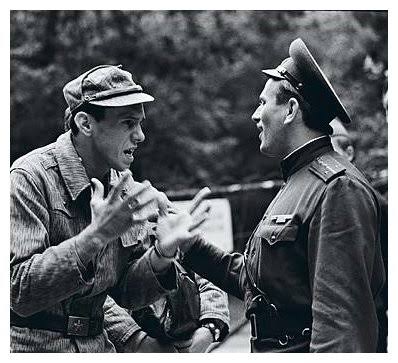

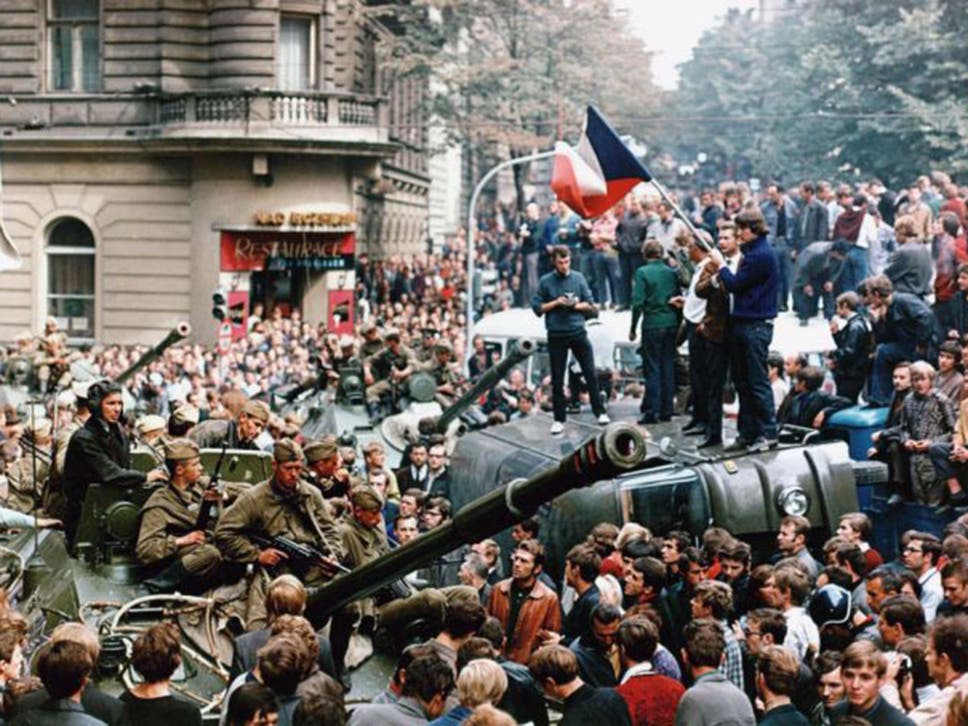
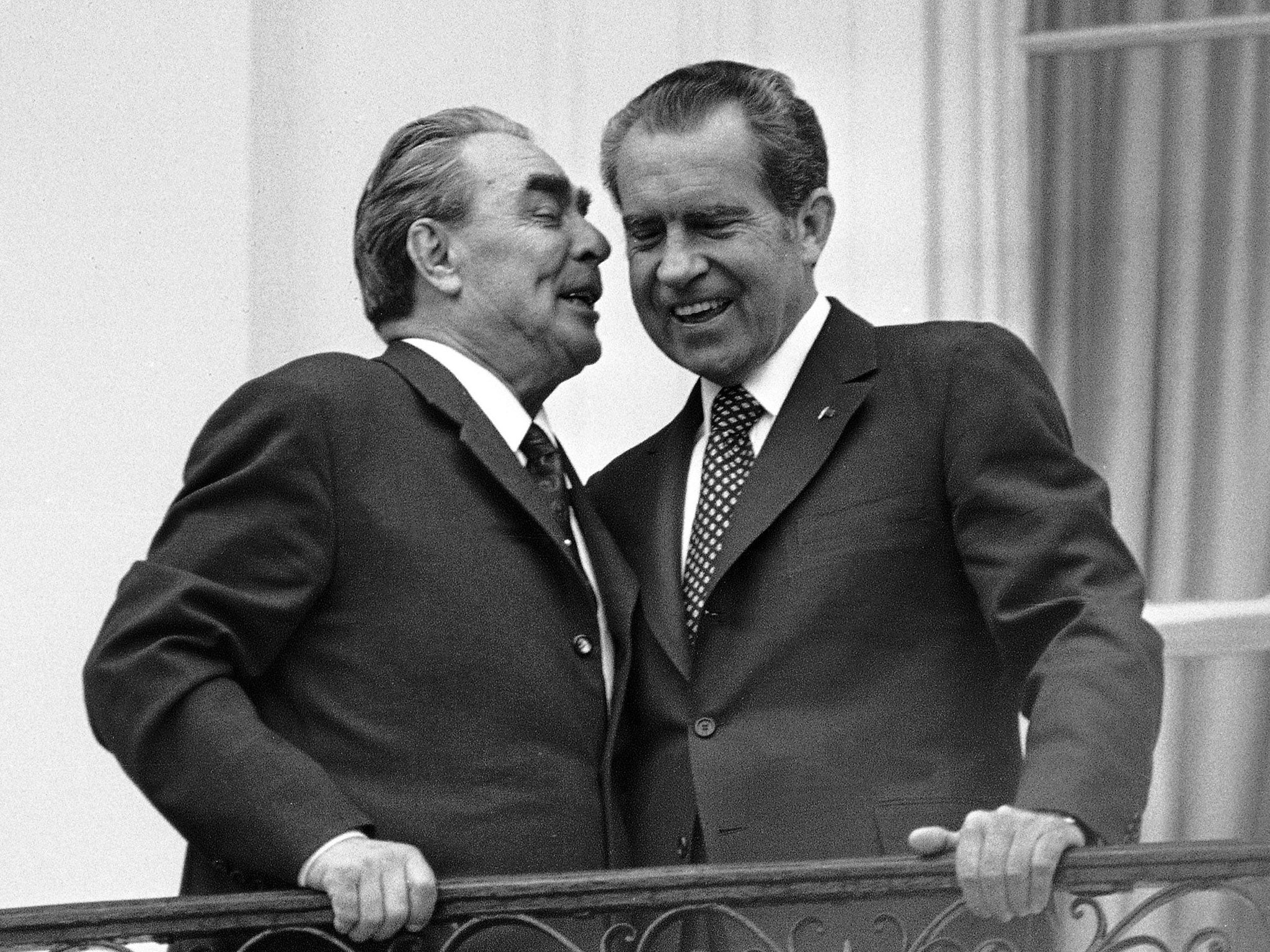
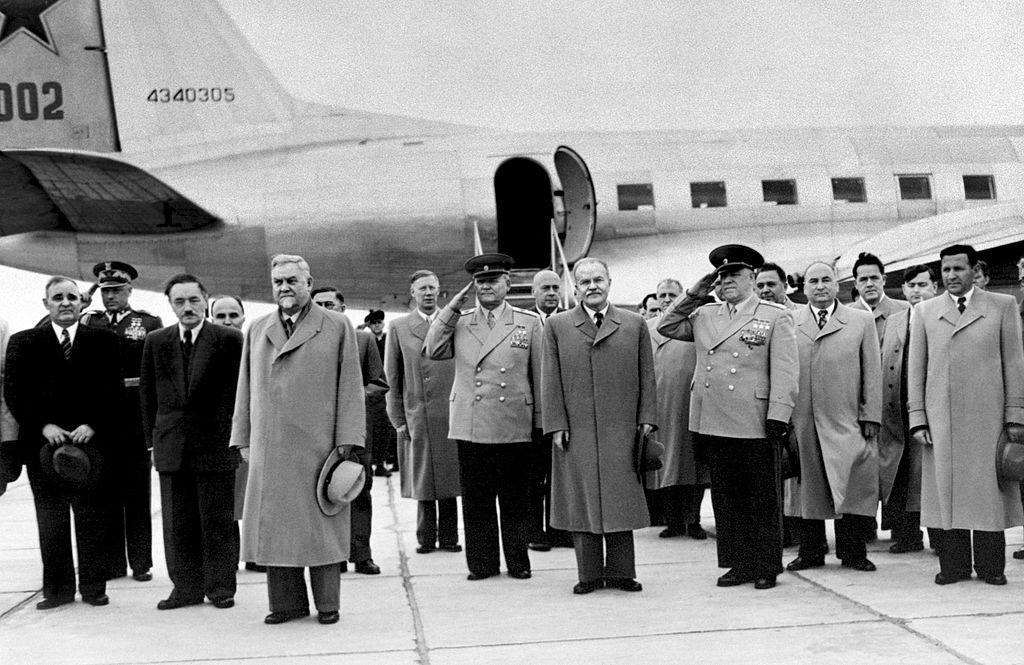
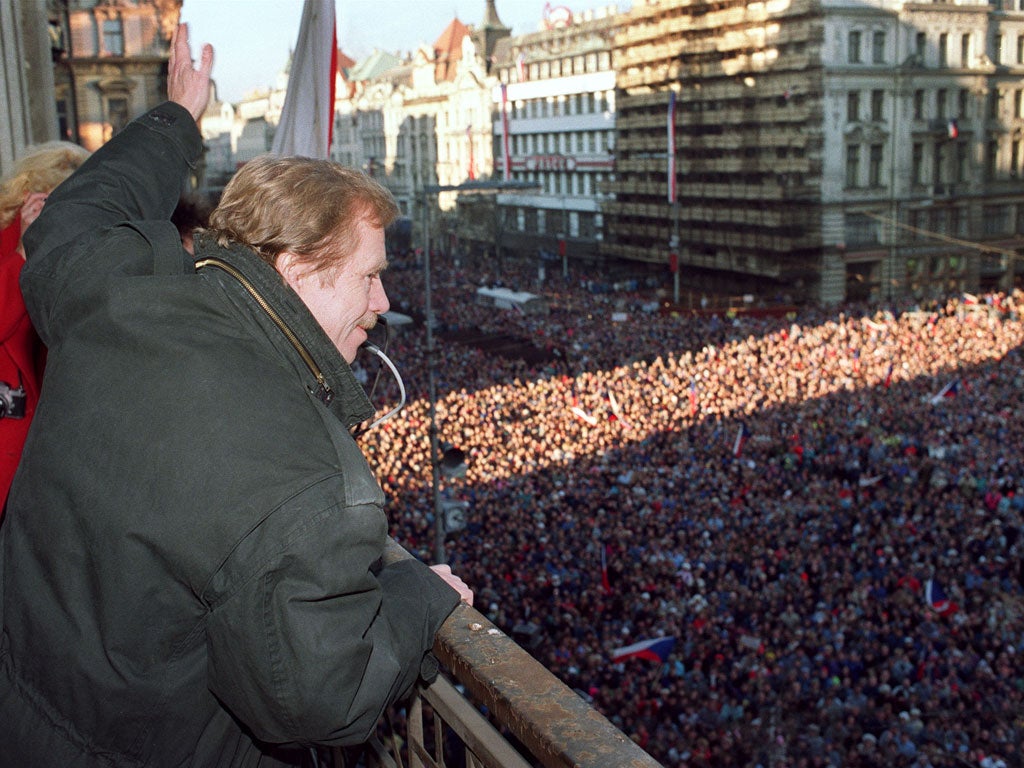


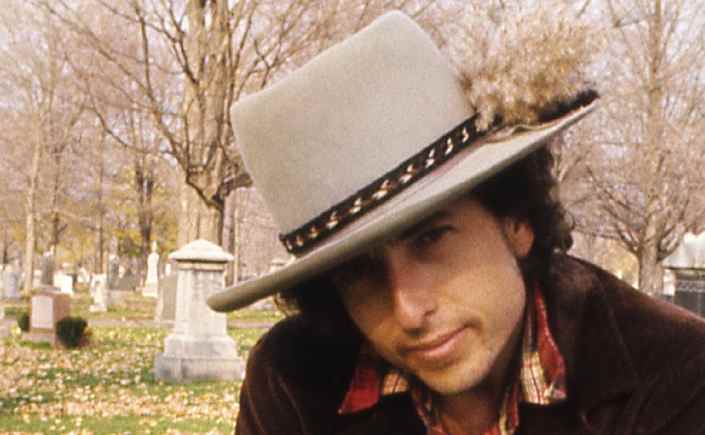

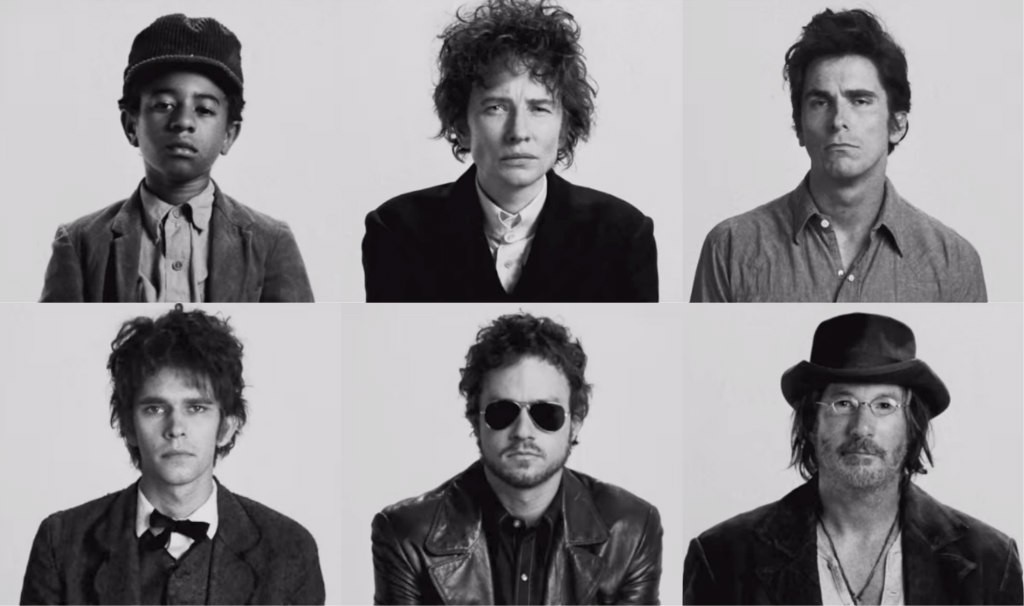


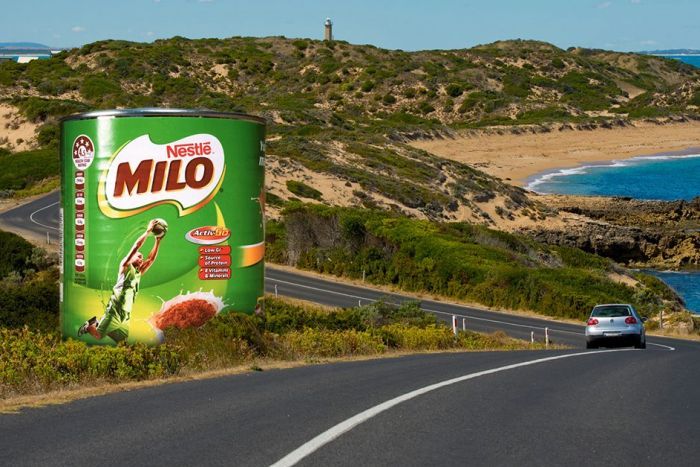
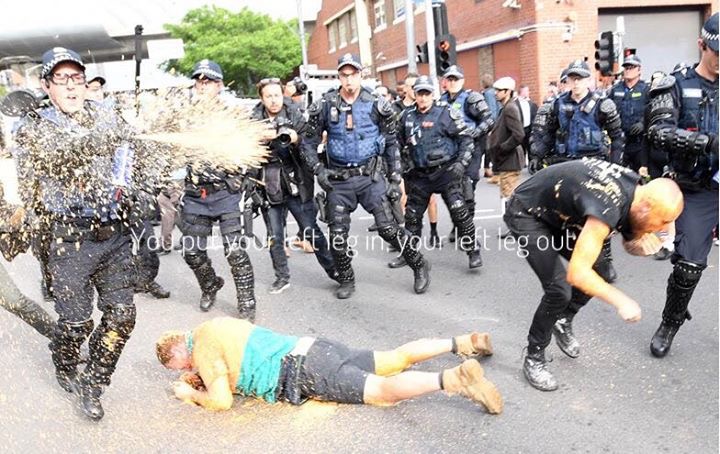


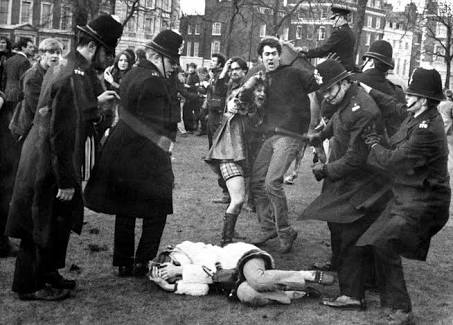
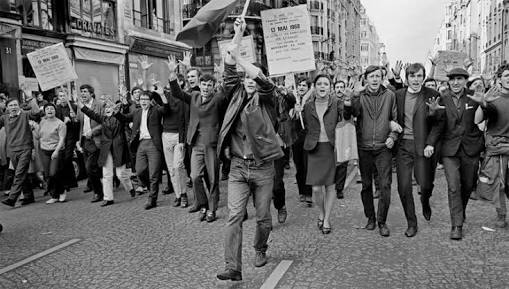


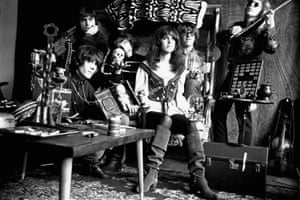

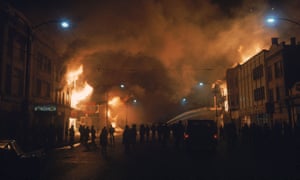


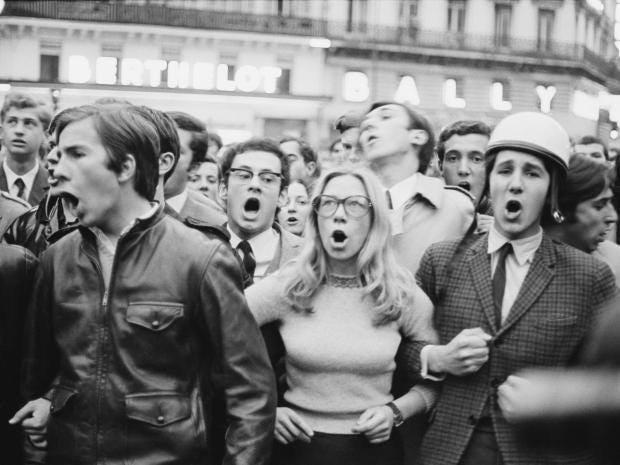
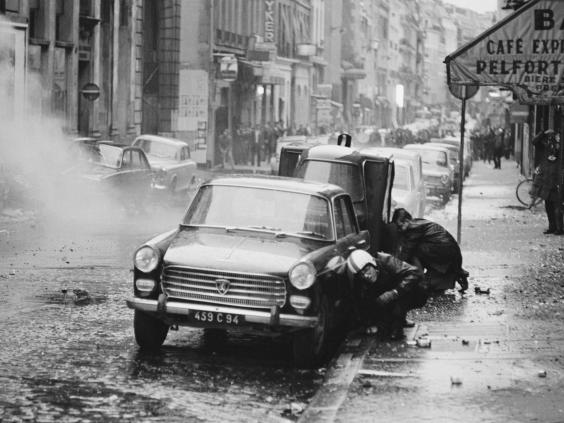
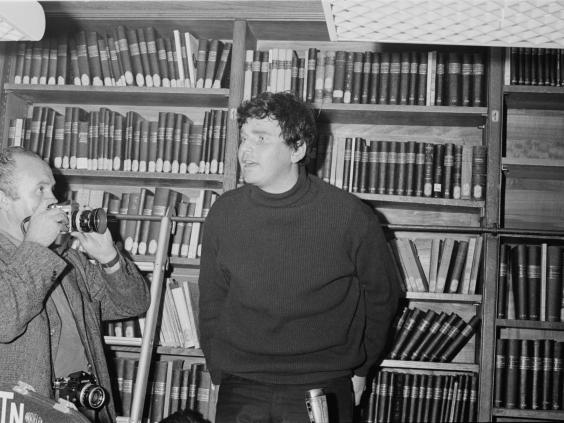
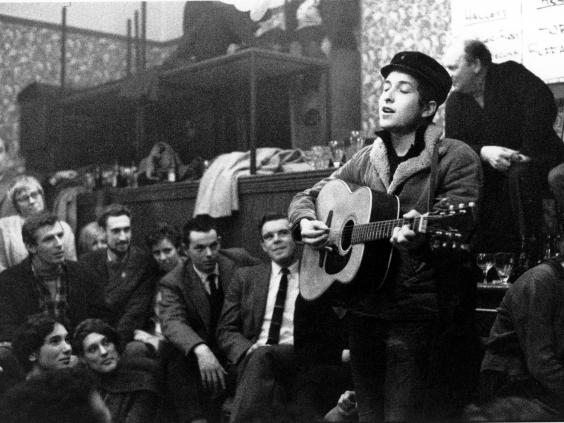
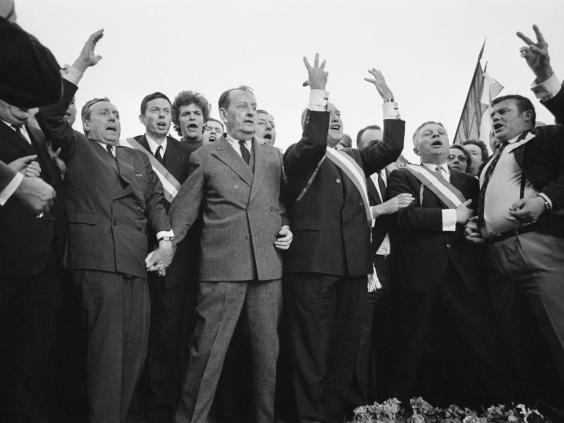
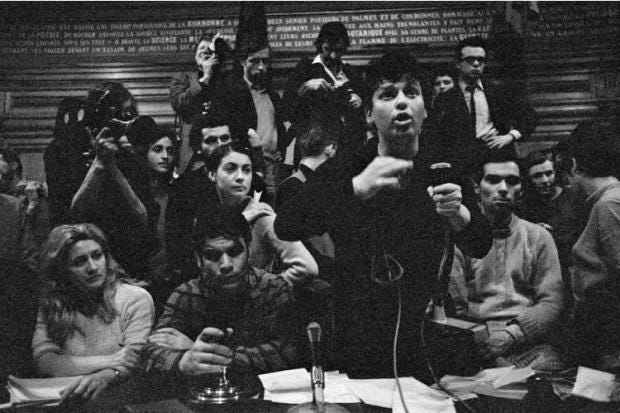


 In That Howling Infinite