Revolution, civil war and the horseman of the Steppe
The Russian Civil War was one of the great catastrophes of the twentieth century, although it is often overshadowed by the world wars that framed it. Between 1917 and 1922, across the vast territories of the collapsing Russian Empire, perhaps ten million people died from combat, famine, disease, terror, and reprisal. Reds fought Whites, Whites fought Greens, and Greens fought everyone. Autocrats fought anarchists, nationalists fought internationalists, peasants fought cities, and villages fought armies.
The conflict stretched from Poland to Vladivostok, from the Arctic Ocean to the Caucasus, and drew into its vortex Russians, Ukrainians, Jews, Cossacks, Tatars, Armenians, Greeks, Mennonites, Germans, Czechs, Poles, and dozens of other peoples caught between competing visions of the future. and foreign powers inserted themselves into the chaos including Britain, Australia, the United States, and Japan.
As I wrote in an earlier essay, Red and white terror – the Russian revolution and civil war, this was not one war so much as many wars occurring simultaneously. It was less a civil war than a kind of World War 1.2: a continental struggle in which the old order died, and several incompatible new worlds attempted to be born.
The civil war was infamous for its cruelty, Fratricidal wars are bound to be cruel because of the lack of definable front lines, because of their instant extension into civilian life, and because of the terrible hatreds and suspicions which they engender. The fighting ranged right across the Eurasian landmass was violent beyond belief, especially the unspeakable cruelty of the Cossack atamans in Siberia.
All too often, whites represented the worst examples of inhumanity, yet on that score, the Bolsheviks were unbeatable. Reds and Whites are both revealed as more than comfortable burning villages, shooting traitors, suspected or real, and torturing and massacring prisoners, and men women and children caught in the crossfire.
There were many instances of racist violence mainly on the White side – particularly towards Jews. The Whites’ antipathy towards Jews was to some degree due to their perception that most senior Bolshevik were Jewish, but mostly it was that old devil that never went away, antisemitism. Retreat from the major cities brought out the worse in the Whites, with terrible massacres of Jews – although they were not the only perpetrators. It is estimated that there were some 1300 anti-Semitic pogroms in the Ukraine during the civil war, with some 50000 to 60000 killed by both sides. There were pogroms in Belarus also, but these were not nearly as murderous as in Ukraine. A Soviet report of 1920 mentions 150,000 dead and as many again badly injured.
Among the prophets, executioners, bandits, ideologues, adventurers, warlords, saints, opportunists and dreamers thrown up by that upheaval, few were more remarkable than Nestor Ivanovych Makhno: charismatic Ukrainian anarchist insurgent, peasant revolutionary, cavalry commander, military opportunist, libertarian idealist, and larger-than-life folk hero.
Unlike so many of his contemporaries, he survived. He survived the firing squads, the battlefields, the prisons, the epidemics, and the purges. Survived the tuberculous contracted in jail before the revolution and the many wounds inflicted throughout the war. The man who fought Germans, Austro-Hungarians, Ukrainian nationalists, Cossacks, White armies, Red armies and assorted local warlords eventually died not with a rifle in his hand but in a Paris hospital bed, impoverished and tubercular, an exile far from the black-earth steppe that had made him famous.
Or perhaps infamous – because Makhno belongs to that category of historical characters who stubbornly resist classification. The Whites hated him because he was a revolutionary peasant insurgent. The Bolsheviks hated him because he was a revolutionary peasant insurgent who refused to obey them. Ukrainian nationalists distrusted him because he placed anarchism before nationalism. Landowners feared him. Foreign occupiers hunted him. Even fellow anarchists sometimes regarded him with suspicion. Yet somehow this peasant from Huliaipole (now in the Zaporizhzhia Oblast of Ukraine) acquired an almost mythological stature.
A century later, artists still paint him, films are made about him, rock bands commemorate him. political activists still claim him, and historians still argue about him. Wikipedia’s entry about Nestor Makhno, is long, thorough, and extensively detailed, but makes for exciting reading with its comprehensive account of his colourful career during, before and after the civil war, and even, beyond the grave.
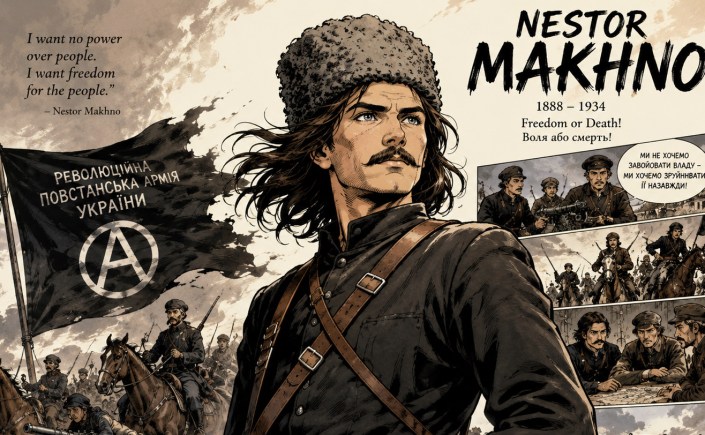
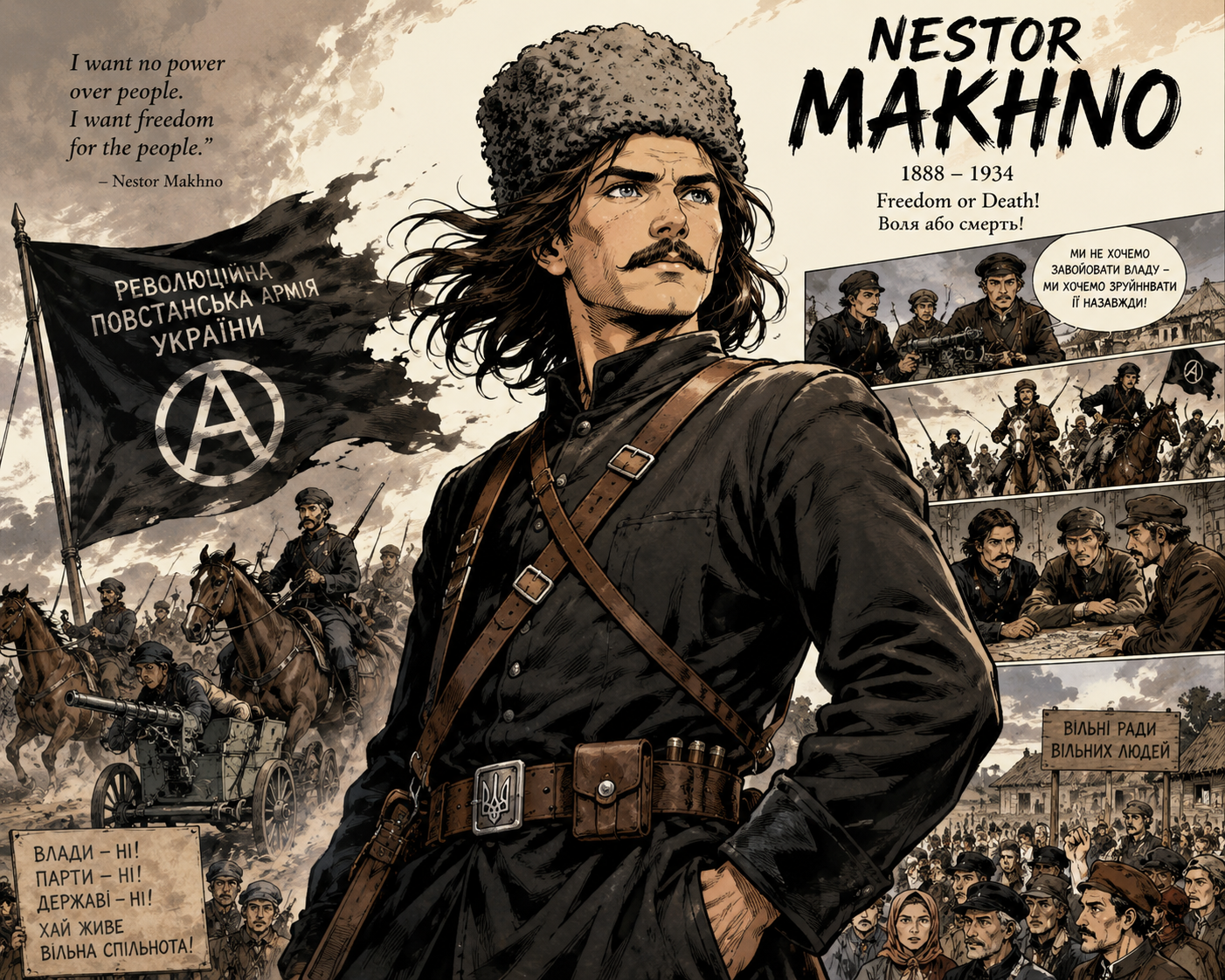
The two manga-style illustrations that prompted these reflections are themselves evidence of that enduring fascination.
Nestor Makhno, the Legend
The first thing one notices is that the artists are not attempting strict historical realism. The Makhno of these images is tall, windswept, and handsome, somewhere between a Cossack ataman, a samurai, and a western gunslinger. The black banner streams dramatically behind him. His gaze is fixed on some distant horizon. One expects a swelling Russian chorale to surge in the background panning across limitless grasslands.
The real Makhno was another man. Contemporary photographs show a relatively short, compact man, often clean-shaven, intense rather than imposing. His contemporaries remembered not his stature but his energy. He seemed perpetually in motion. Charismatic, restless, impulsive, brave, reckless, idealistic and pragmatic in equal measure. The sort of man who appears during periods of social collapse and seems almost generated by the turbulence itself.
Yet the artists understand something important: historical memory rarely preserves people as they actually were. It preserves them as they are remembered. The artwork therefore depicts not so much the historical Makhno as “Makhno the Legend”, the anarchist rebel rider of the Ukrainian steppe. And legends tell us as much about those who create them as they do about their subjects.
The flag in the first picture identifies his force as the Revolutionary Insurgent Army of Ukraine. One speech bubble proclaims: “My ne khochemo zavoyovaty vladu – my khochemo zruynuvaty yiyi nazavzhdy!” – “We do not want to seize power- we want to destroy it forever!” A poster declares: “No to authority! No to the Party! No to the State! Long live the free community!” Another slogan advocates “Free councils of free people.”
One can almost hear every bureaucrat in history grinding their teeth. For Makhno was that rarest of political creatures: an anarchist who genuinely seemed to mean it. Here was one who would have signed to Denearys Targaryen’s vow not to join the wheel but to break it.
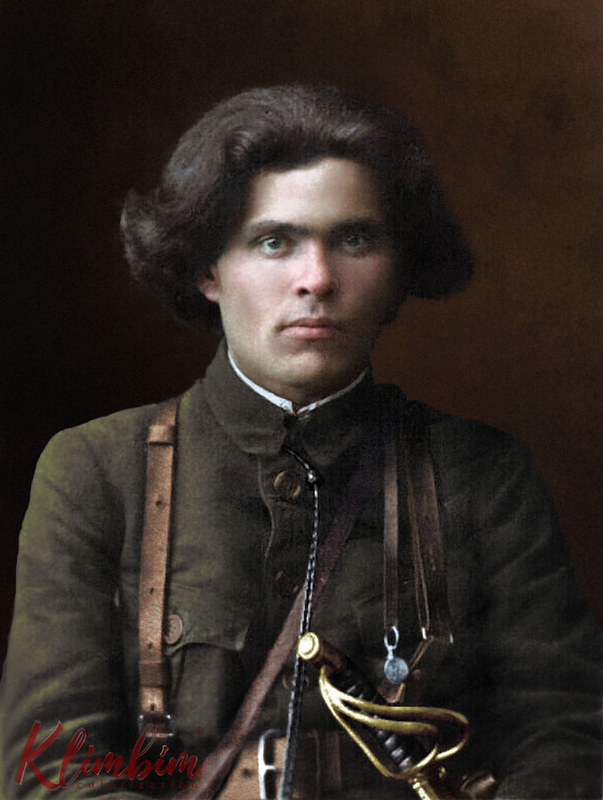
A Kaleidoscope of Lost Futures
The popular memory of the Russian Civil War tends to reduce it to a struggle between Reds and Whites. Bolsheviks versus monarchists. Revolution versus reaction. Reality was considerably messier. The conflict resembled a kaleidoscope more than a chessboard.
The collapse of the Romanov Empire unleashed a bewildering array of competing visions. Monarchists wanted restoration. Liberals hoped for constitutional government. Socialist Revolutionaries dreamed of a peasant democracy. Bolsheviks sought proletarian dictatorship – with themselves as it unchallenged ruler. National movements emerged across the empire’s periphery. Foreign powers intervened. Countless local strongmen pursued their own ambitions. Entire regions changed hands repeatedly.
The lands between the Dnieper and the Don were particularly complex. They were never inhabited solely by Russians and Ukrainians in the neat modern national sense. These were borderlands in the deepest historical meaning of the word. Cossacks rode the steppe. Mennonite farmers cultivated colonies founded generations earlier. Jews lived in market towns and cities. Greeks inhabited settlements along the coast. Tartars maintained ancient communities. Armenians traded. Germans farmed. Merchants, smugglers, soldiers, pilgrims, revolutionaries and dreamers moved constantly through the landscape.
Every modern nation prefers neat origin stories. But history seldom cooperates.
Makhno emerged from this world of overlapping identities and competing loyalties. His Free Territory in southeastern Ukraine represented perhaps the most improbable political experiment of the entire Civil War: an attempt to create a libertarian society amidst one of the bloodiest upheavals in modern history.
Whether it could ever have survived is doubtful. The twentieth century belonged to states, bureaucracies, standing armies, intelligence services, and industrial administration. It rewarded those who could organise railways, requisition grain, count factory output and maintain prisons. Anarchism, though long part of Tsarist Russia’s political kaleidoscope, was a forlorn hope.
Makhno the Anarchist war lord had a precarious relationship with the ultimately ascendant Bolsheviks. Vladimir Lenin at one time looked upon him favourably. Leon Trotsky, commanding the Red Army, regarded him as a dangerous adventurer, an undisciplined partisan commander whose independence threatened revolutionary unity. Makhno regarded Trotsky as a would-be dictator masquerading as a liberator. Both men were, in their own ways, correct.
Their uneasy alliance against General Wrangel’s White Army in Crimea remains one of those moments when history briefly forces bitter enemies onto the same side before restoring them to mutual hostility. The Makhnovists helped defeat the Whites, but once that task was accomplished, the Bolsheviks turned on their troublesome allies.
The logic was almost inevitable. The Bolsheviks sought power. Makhno sought freedom from power. Those two projects could coexist only temporarily.
My old tutor Tibor Szamuely would undoubtedly have seen the episode as another illustration of what he called the Russian Tradition. Revolutions changed slogans and symbols, but the underlying gravitational pull of centralised authority remained remarkably constant. The old autocracy vanished. New forms emerged. Yet power continued to accumulate at the centre. The names changed. The structure endured. [See, in In That Howling Infinite, The Russian Tradition – Russia, Ukraine and Tibor Szamuely]
Yet for a brief moment Makhno’s movement offered a glimpse of a different possibility. That possibility was ultimately crushed, first by necessity, then by power, and finally by history itself.
Makhno and Anarchism
Makhno did not emerge from a vacuum. Like so much in Russian and Ukrainian history, he was both a product of his time and the inheritor of a much older tradition. The black banners that fluttered above the villages of southern Ukraine during the Civil War carried ideas whose roots stretched back decades, even centuries, nourished by peasant rebellion, intellectual dissent, and a deep suspicion of distant authority.
Russian anarchism emerged in the nineteenth century as a radical critique of both Tsarist autocracy and the centralising tendencies of socialism. Its two great theorists were Mikhail Bakunin and Peter Kropotkin, figures who remain among the most influential anarchist thinkers in history. Bakunin, the aristocratic revolutionary who spent years in prison and exile, rejected all forms of state power, arguing that liberation could never be achieved through a dictatorship, even one claiming to act on behalf of the workers. Kropotkin, the geographer and scientist, developed a more constructive vision, emphasising voluntary cooperation, mutual aid, and federations of free communities. Against the harsh Social Darwinism fashionable in his day, Kropotkin argued that cooperation was as important to survival as competition. Human beings, he believed, were capable of organising society without kings, bureaucrats, or party commissars.
These ideas found fertile ground in the Russian Empire. The vastness of the state, its bureaucratic inefficiency, and its often brutal methods of rule encouraged a culture of resistance. Anarchism attracted intellectuals, workers, and, perhaps most significantly, peasants. Long before Marxism became dominant, populist movements such as the Narodniks had romanticised the peasant commune as a foundation for a more egalitarian society. Although not anarchists in the strict sense, they helped create a political culture in which local self-government and suspicion of central authority were deeply valued.
The revolutionary years between 1905 and 1921 provided anarchism with its greatest opportunity. Across the empire, workers established councils, peasants seized land, and local militias sprang up with little regard for official authority. In the great cities anarchist groups were active among factory workers and sailors. The Kronstadt sailors, who would later revolt against Bolshevik rule in 1921 under the slogan “Soviets without Bolsheviks,” reflected many anarchist principles even if they were not uniformly anarchist in ideology.
It was in this turbulent environment that Nestor Makhno emerged. Born in 1888 into a poor peasant family in Huliaipole, a town in the steppe lands of southeastern Ukraine, Makhno encountered anarchism as a young man. Arrested for revolutionary activities after the 1905 Revolution, he spent years in Tsarist prisons where he came under the influence of anarchist intellectuals and immersed himself in the writings of Bakunin and Kropotkin. Prison served as his university.
When the Russian Empire collapsed in 1917, Makhno returned home and transformed theory into practice. His achievement was remarkable. Amid the chaos of civil war he helped create what became known as the. Makhnovshchina (loosely translated as “Makhno movement”), a vast anarchist experiment encompassing large areas of southern Ukraine. Villages elected their own councils. Land was redistributed. Local communities enjoyed a degree of autonomy rare in wartime. Makhno’s Revolutionary Insurgent Army of Ukraine ,often called the Black Army, defended these territories against a bewildering array of enemies: German occupiers, Ukrainian nationalists, White armies, and eventually the Bolsheviks themselves.
Military historians continue to marvel at Makhno’s campaigns. His forces perfected the use of the tachanka – a machine gun mounted on a horse-drawn cart – which allowed extraordinary mobility across the open steppe. His army repeatedly outmanoeuvred larger and better-equipped opponents. In 1919 and 1920, Makhno’s forces played a crucial role in defeating General Anton Denikin and later Baron Wrangel, two of the most formidable White commanders. Ironically, these victories helped secure the survival of the Bolshevik regime that would ultimately destroy the anarchist movement.
Makhno was not alone. Other anarchists left significant marks upon the revolutionary era. Volin (Vsevolod Eikhenbaum), an intellectual and organiser, sought to develop anarchist theory and worked closely with the Makhnovists. Lev Chernyi advocated individualist anarchism and was later executed by the Bolsheviks. Grigori Maximoff became a leading anarcho-syndicalist thinker in exile. Internationally, figures such as Emma Goldman and Alexander Berkman, both born in the Russian Empire, carried anarchist ideas to global audiences and later became disillusioned critics of Bolshevik authoritarianism.
Yet none combined military leadership, mass peasant support, and revolutionary vision quite as successfully as Makhno. His closest parallels are perhaps not found in Russia but elsewhere: Emiliano Zapata in Mexico, Buenaventura Durruti in Spain, or even the medieval peasant rebels who periodically erupted across Europe. Like them, Makhno embodied a recurring historical phenomenon: the attempt to create freedom from below rather than impose it from above.
The tragedy of Russian anarchism was that it found itself squeezed between two powerful forces. The Whites regarded it as revolutionary chaos; the Bolsheviks regarded it as a rival source of legitimacy. Both sought centralised authority, disciplined armies, and hierarchical control. Anarchism offered something messier and more elusive: local autonomy, voluntary association, and a belief that ordinary people could govern themselves. In the brutal arithmetic of the Civil War, such ideas proved difficult to defend.
Yet the legacy endured. Makhno became a folk hero to some, a bandit to others, and a symbol of resistance to authority for generations of radicals. His black flag bearing the slogan “We wish for freedom” represented more than a military movement. It expressed a persistent current in Russian and Ukrainian history – a stubborn refusal to accept that power must always flow from the centre, from the capital, from the party, or from the state. In a land famous for tsars, commissars, and strongmen, that may have been the most revolutionary idea of all.
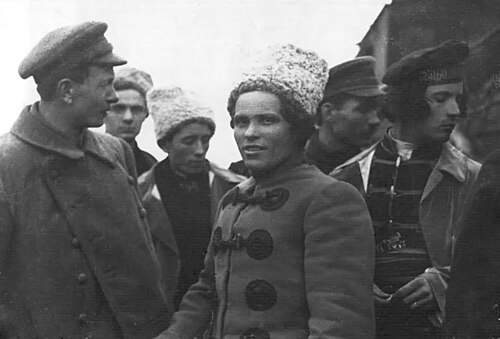
Makhno (centre) with other Insurgent command staff in Huliaipole (1919)
The Black Banner and the Long Shadow of Empire
Makhno’s story emerged from one of the great turning points of modern history: the collapse of empires. The Russian Civil War was not simply a struggle between Reds and Whites. It was also a struggle over what would replace the Romanov Empire. Across the former imperial territories, peoples sought to determine their own futures. Finns, Poles, Estonians, Latvians, Lithuanians, Georgians, Armenians, Azerbaijanis, Ukrainians and many others attempted to carve nation-states from the wreckage of imperial collapse. Some succeeded. Others failed. All became caught up in the wider maelstrom.
The tragedy of the twentieth century is that many of those hard-won freedoms proved fleeting. The new states born from the ruins of the Romanov, Habsburg, Hohenzollern and Ottoman empires found themselves trapped between larger and more powerful forces. First came the Nazi storm. Then came the Soviet one. Much of Central and Eastern Europe spent decades living under one form of domination or another. The promise of national self-determination so evident in the years immediately following the First World War often ended in occupation, dictatorship or subordination.
Yet history did not stop there.
The Soviet Union eventually followed the Romanov Empire into the graveyard of failed political systems. One by one, nations that had disappeared behind the Iron Curtain re-emerged as sovereign states. Flags long hidden returned to public squares. Languages once marginalised regained official status. Historical memories suppressed for decades resurfaced. The old imperial map dissolved once again.
Seen from this perspective, the present war in Ukraine is not simply a dispute over territory. It is part of a much longer historical argument about empire, sovereignty and identity.
A century after Reds, Whites and Greens fought across the same black-earth steppe, war once more rages in the lands where Makhno made his name. Huliaipole itself has found itself close to the front line. Mariupol, Melitopol, Berdyansk, Donetsk, Zaporizhzhia and Kherson appear both in histories of the Civil War and in contemporary battlefield reports. The same landscape that once carried cavalry columns, tachanki those iconic horse drawn machine gun wagons )and, as this is Russia, sleighs), and armoured trains now carries tanks, drones, missile batteries and mechanised brigades.
The present conflict is not a replay of the Russian Civil War. Historical analogies are useful servants but dangerous masters. Yet the recurrence is striking. Once again Ukraine finds itself at the centre of a struggle shaped by the afterlife of empire.
At its heart lies a question that has echoed through East European history for more than a century: who has the right to determine Ukraine’s future?
An increasingly irredentist Russia, drawing heavily upon imperial memory and historical grievance, has launched an assault upon a former imperial possession that insists upon its own sovereignty and right to choose its own path. The arguments are framed in terms of security, history, ethnicity and geopolitics. Beneath them lies a much older issue. The Russian Empire fell. The Soviet Empire followed it. Must Ukraine forever remain part of another state’s historical imagination, or may it exist fully as itself?
It is impossible today to read about the Russian Civil War without occasionally experiencing moments of historical déjà vu. The geography is hauntingly familiar. Kharkiv. Kherson. Mariupol. Melitopol. Odesa. Kyiv. A century ago, armies advanced and retreated across these landscapes. Reds, Whites, Greens, nationalists, foreign interventionists and local militias fought for possession of the same territory. Entire populations found themselves trapped between competing visions of political destiny.
The circumstances are very different today and historical analogies always have limits. Yet the persistence of geography and geopolitics is striking. The lands between the Dnieper and the Don remain what they have long been: a frontier between competing narratives of the past and competing visions of the future.The same rivers flow. The same cities endure. The same questions of identity, sovereignty, memory and belonging continue to reverberate across the region.
History does not repeat itself exactly. But it often revisits old addresses.
One suspects Makhno would have found the question both familiar and irritating.He was never a nationalist in the conventional sense. Unlike Bandera and later Ukrainian nationalists, Makhno did not fight for a Ukrainian nation-state. He fought for something simultaneously larger and smaller: local autonomy, peasant self-government and anarchist freedom. He distrusted all states, whether Russian, Ukrainian, Bolshevik, White, German or otherwise.
This has made his legacy awkward for modern Ukraine. States generally prefer heroes who wanted states. Makhno wanted free councils of free people.
As a consequence, he occupies an unusual place in Ukrainian memory. Unlike Bandera or Shukhevych, he has never become a central pillar of official state mythology. Unlike the controversial legacy of the OUN-UPA or the Waffen-SS Galicia Division, debates surrounding Makhno are not primarily about nationalism. Instead, he exists in several overlapping forms at once: the historical insurgent commander, the libertarian icon celebrated by anarchists across the world, the regional folk hero of southern Ukraine, and increasingly, the son of Ukraine who resisted domination from distant centres of power.
None of these versions fully captures the man.
The historical Makhno remains elusive. His movement opposed antisemitic pogroms more consistently than many contemporary forces and included Jews within its ranks, yet it operated amidst the appalling violence and carnage of the Civil War and was never entirely untouched by it. His Free Territory represented one of the most ambitious anarchist experiments in modern history, yet it was also shaped by the brutal necessities of war. Admirers romanticise him. Critics emphasise the contradictions. Both have evidence on their side.
Perhaps that ambiguity explains his enduring fascination.
The unknown artist who created the image at the head of this essay gave his Makhno a modern Tryzub or trident belt buckle, a symbol of today’s Ukrainian resistance and resilience. It is a striking touch and a thoroughly anachronistic one. The symbol derives from the seals of Volodymyr the Great and modern Ukrainian statehood. Makhno himself never wore it.
The artist is making a statement. This is not merely Makhno the anarchist. This is Makhno the Ukrainian hero. The image therefore fuses three different figures into one. There is the historical insurgent Makhno of the 1918-21 Civil War. There is the anarchist her of libertarian mythology. And there is the modern Ukrainian patriot Makhno recruited into the story of national identity – retrospectively enlisted into a national story that he himself might have regarded with considerable scepticism. He spent much of his life rejecting national labels in favour of anarchist ones.
The anachronisms are historically dubious but symbolically powerful. But history rarely asks permission before appropriating its characters in an ongoing contest over memory.
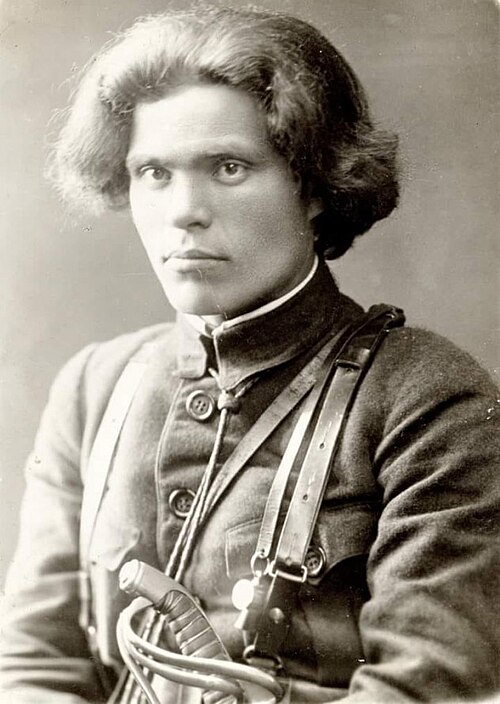
Makhno in Red Army uniform, 1919
Twilight in Paris
And then there is the final act.
What happens after the war is over? Most stories conclude when the hero rides away. Real life begins afterwards. Makhno’s cavalry charges, victories, defeats and escapes belong to legend. The more intriguing question is what became of the dream once the banners were lowered.
Defeated but not destroyed, Nestor Makhno escaped the fate that overtook so many of his contemporaries. Unlike countless White and Red commanders, he did not perish on a battlefield, before a firing squad, or later in Stalin’s Great Terror. Unlike John Brown, Custer, and Davy Crockett or the Australians Ned Kelly and another horseman Harry “the Breaker” Morant, he did not die with his boots on. Miraculously, given the odds against him, he survived.
And improbably, the horseman of the steppe ended his days in Paris.
One imagines him there during the 1920s and early 1930s, sitting in smoky cafés among White émigrés, ex-Bolsheviks, anarchists, monarchists, refugees and stateless wanderers arguing about futures that had already vanished. The thunder of cavalry had faded into memory. The revolutionary epic had dissolved into reminiscence.
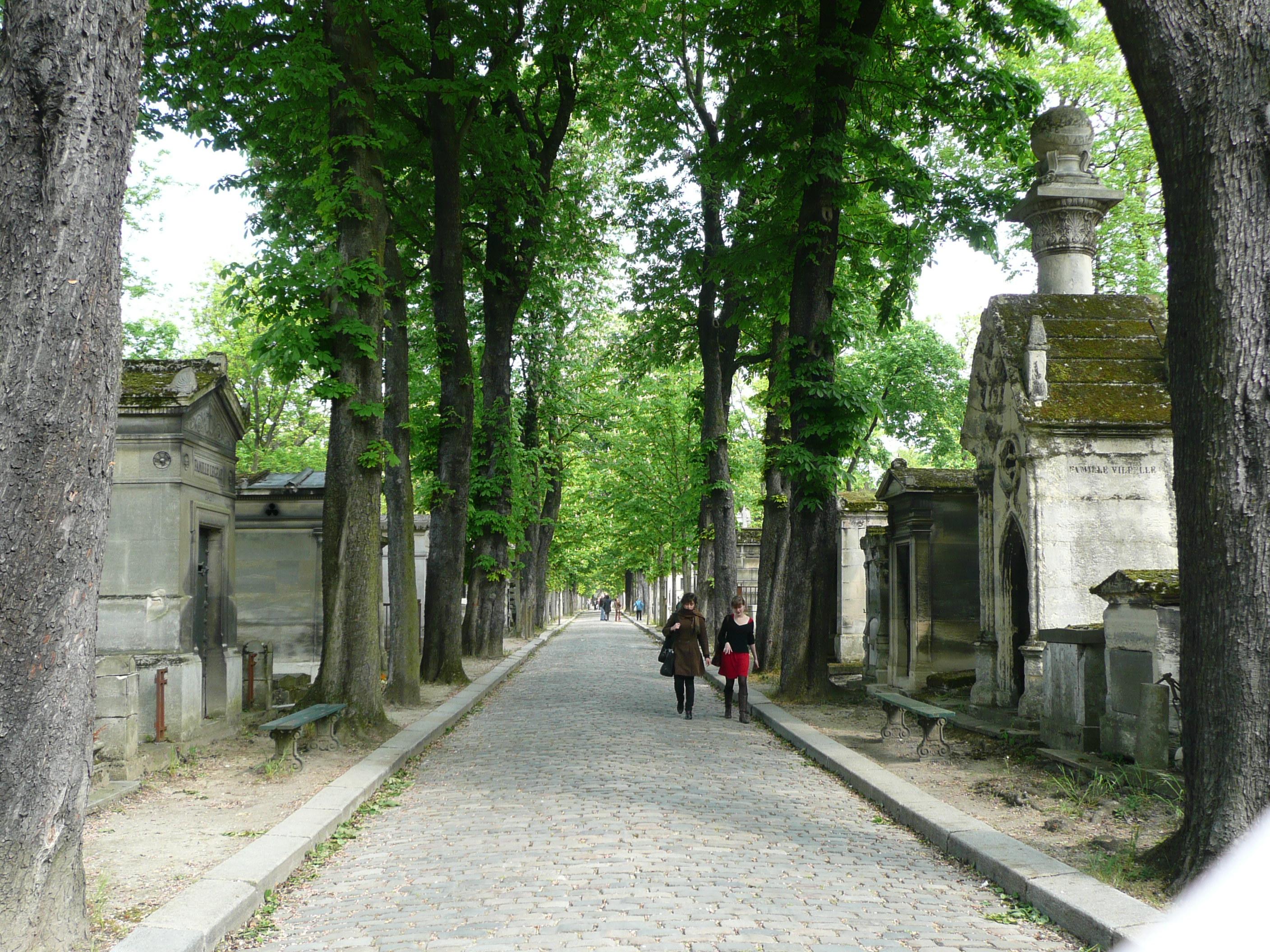
Nestor Makhno died on 25 July 1934 at the age of forty-five, worn down by tuberculosis, old wounds and years of hardship and, latterly, poverty. He was cremated and his ashes placed in the columbarium of Père Lachaise Cemetery. Not beneath a black banner. Not in the black earth of the Ukrainian steppe. Not in the town where his rebellion began. His ashes were placed not in the Ukrainian black earth but in niche 6686, a small compartment among thousands of others.
There is something wonderfully ironic, literary even, about that. The anti-clerical anarchist who spent his life fighting states, hierarchies and institutions, who once commanded tens of thousands of insurgents and rode across southern Ukraine pursued by enemies on every side, ends his journey among the famous dead of France, surrounded by poets, musicians, revolutionaries and dreamers.
History possesses a sense of humour.
Yet perhaps the final irony belongs to memory itself. For the world has turned another circle since his death.
The Black Army vanished and the Free Territory of the Makhnovshchina disappeared. They survive only in memory. Stalin’s Soviet Union rose and fell. The nations that struggled for freedom amidst the ruins of empire endured decades beneath first Nazi and then Soviet domination before re-emerging as sovereign states. The world that produced Makhno passed into history, and now, in the lands where Makhno once rode beneath a black banner, another war is being fought over questions of empire, identity, memory and self-determination.
What would Nestor Makhno make of it all? We cannot know. But one suspects he would recognise the landscape immediately. And perhaps that is why he refuses to stay buried. The ashes remain in Père Lachaise. The legend still rides the steppe.
There is a Russian word, toska, which Nabokov famously described as a spiritual anguish without precise object. A longing for something absent. A yearning that cannot quite be named. One suspects Makhno understood it. So did Chekhov. So did many of the exiles who haunted Paris in those years. For what is exile if not a prolonged conversation with vanished possibilities?
The revolutionary epic dissolved into memoirs, arguments and recollections. The thunder of cavalry became stories told over coffee and cigarettes. The dream survived. The dreamers grew old.
Yet Makhno remains. Not exactly as he was. Not exactly as he would have wished to be remembered. But alive nevertheless in paintings, songs, novels, political arguments, historical debates, and manga-inspired artwork.
The artist who gave him a Tryzub belt buckle and the physique of a cinematic hero understands something essential. Historical memory is not an archive. It is a conversation between past and present. Each generation creates the figures it needs. And so the anarchist who rejected states has become part of a national story. The peasant insurgent has become a folk hero. The historical man has become a legend.
The ashes rest quietly in Père Lachaise. The legend still rides the steppe. And somewhere beyond the horizon, beneath a black banner snapping in the wind, Nestor Makhno continues his endless charge toward a freedom that history never quite allowed him to reach.
Paul Hemphill, June 2026
For more on Russia, Ukraine and the Soviet Union in In That Howling Infinite, see Russky Mir – Russian history’s long shadow
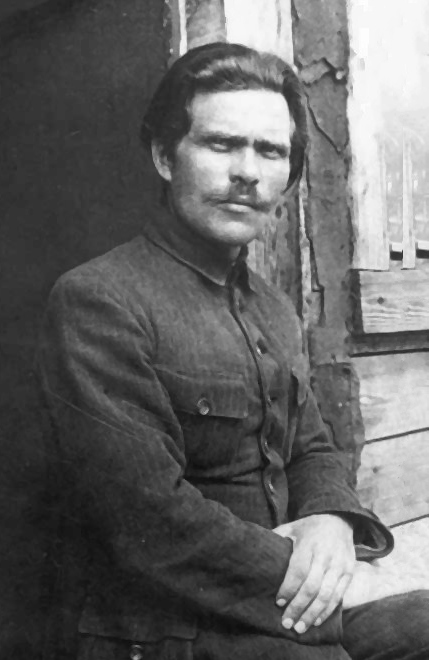
Makhno, 1921. Wikipedia
Author’s note
For the dear departed, Père Lachaise is the best address in Paris. Some 300,000 people reste ici. A cavalcade of French cultural and political history, with a few foreign entombments, including the playwright Oscar Wild and Doors front-man and zeitgeist icon Jim Morrison.
I have always loved the place. I have wandered its avenues among the celebrated and the forgotten, the visited and the unvisited. It occurs to me that perhaps there is a verse yet to be written about those whose names draw no pilgrims and whose flowers have long since withered. Next time I find myself there, I think I shall seek out niche 6686 and offer a quiet dobryi den to the old anarchist.
The singers, and the dancers, and the actors, and the chancers,
The rebels and the statesmen, and the fallen communards,
Napoleonic Generals and politicians’ wives.
The poets and the dreamers, all those other famous lives.
Paul Hemphill, Chanson – living next to Jim
Coda: The Wall

Makhno in Red Army uniform, 1919
Makhno, 1921. Wikipedia