The wild ride of Nestor Makhno

Revolution, civil war and the horseman of the Steppe

The Russian Civil War was one of the great catastrophes of the twentieth century, although it is often overshadowed by the world wars that framed it. Between 1917 and 1922, across the vast territories of the collapsing Russian Empire, perhaps ten million people died from combat, famine, disease, terror, and reprisal. Reds fought Whites, Whites fought Greens, and Greens fought everyone. Autocrats fought anarchists, nationalists fought internationalists, peasants fought cities, and villages fought armies.

The conflict stretched from Poland to Vladivostok, from the Arctic Ocean to the Caucasus, and drew into its vortex Russians, Ukrainians, Jews, Cossacks, Tatars, Armenians, Greeks, Mennonites, Germans, Czechs, Poles, and dozens of other peoples caught between competing visions of the future. and foreign powers inserted themselves into the chaos including Britain, Australia, the United States, and Japan.

As I wrote in an earlier essay, Red and white terror – the Russian revolution and civil war, this was not one war so much as many wars occurring simultaneously. It was less a civil war than a kind of World War 1.2: a continental struggle in which the old order died, and several incompatible new worlds attempted to be born.

The civil war was infamous for its cruelty, Fratricidal wars are bound to be cruel because of the lack of definable front lines, because of their instant extension into civilian life, and because of the terrible hatreds and suspicions which they engender. The fighting ranged right across the Eurasian landmass was violent beyond belief, especially the unspeakable cruelty of the Cossack atamans in Siberia.

All too often, whites represented the worst examples of inhumanity, yet on that score, the Bolsheviks were unbeatable. Reds and Whites are both revealed as more than comfortable burning villages, shooting traitors, suspected or real, and torturing and massacring prisoners, and men women and children caught in the crossfire.

There were many instances of racist violence mainly on the White side – particularly towards Jews. The Whites’ antipathy towards Jews was to some degree due to their perception that most senior Bolshevik were Jewish, but mostly it was that old devil that never went away, antisemitism. Retreat from the major cities brought out the worse in the Whites, with terrible massacres of Jews – although they were not the only perpetrators. It is estimated that there were some 1300 anti-Semitic pogroms in the Ukraine during the civil war, with some 50000 to 60000 killed by both sides. There were pogroms in Belarus also, but these were not nearly as murderous as in Ukraine. A Soviet report of 1920 mentions 150,000 dead and as many again badly injured.

Among the prophets, executioners, bandits, ideologues, adventurers, warlords, saints, opportunists and dreamers thrown up by that upheaval, few were more remarkable than Nestor Ivanovych Makhno: charismatic Ukrainian anarchist insurgent, peasant revolutionary, cavalry commander, military opportunist, libertarian idealist, and larger-than-life folk hero.

Unlike so many of his contemporaries, he survived. He survived the firing squads, the battlefields, the prisons, the epidemics, and the purges. Survived the tuberculous contracted in jail before the revolution and the many wounds inflicted throughout the war. The man who fought Germans, Austro-Hungarians, Ukrainian nationalists, Cossacks, White armies, Red armies and assorted local warlords eventually died not with a rifle in his hand but in a Paris hospital bed, impoverished and tubercular, an exile far from the black-earth steppe that had made him famous.

Or perhaps infamous – because Makhno belongs to that category of historical characters who stubbornly resist classification. The Whites hated him because he was a revolutionary peasant insurgent. The Bolsheviks hated him because he was a revolutionary peasant insurgent who refused to obey them. Ukrainian nationalists distrusted him because he placed anarchism before nationalism. Landowners feared him. Foreign occupiers hunted him. Even fellow anarchists sometimes regarded him with suspicion. Yet somehow this peasant from Huliaipole (now in the Zaporizhzhia Oblast of Ukraine) acquired an almost mythological stature.

A century later, artists still paint him, films are made about him, rock bands commemorate him. political activists still claim him, and historians still argue about him. Wikipedia’s entry about Nestor Makhno, is long, thorough, and extensively detailed, but makes for exciting reading with its comprehensive account of his colourful career during, before and after the civil war, and even, beyond the grave.

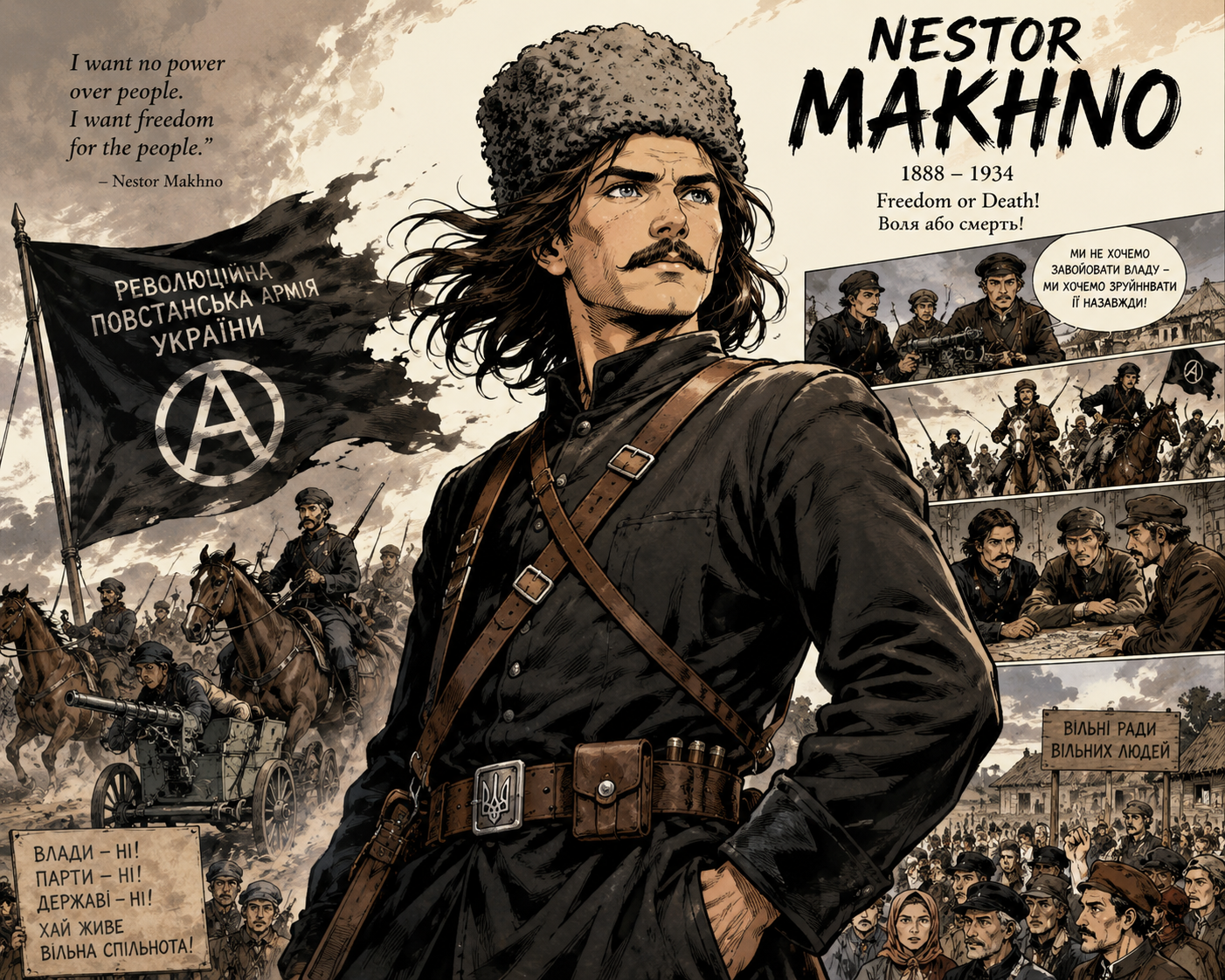
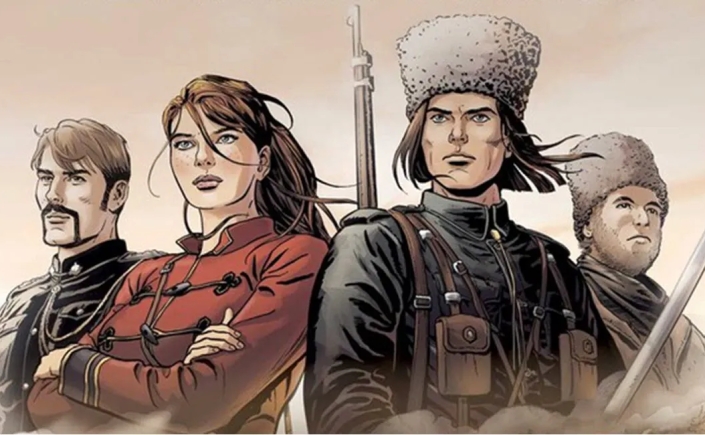
The two manga-style illustrations that prompted these reflections are themselves evidence of that enduring fascination.
Nestor Makhno, the Legend

The first thing one notices is that the artists are not attempting strict historical realism. The Makhno of these images is tall, windswept, and handsome, somewhere between a Cossack ataman, a samurai, and a western gunslinger. The black banner streams dramatically behind him. His gaze is fixed on some distant horizon. One expects a swelling Russian chorale to surge in the background panning across limitless grasslands.

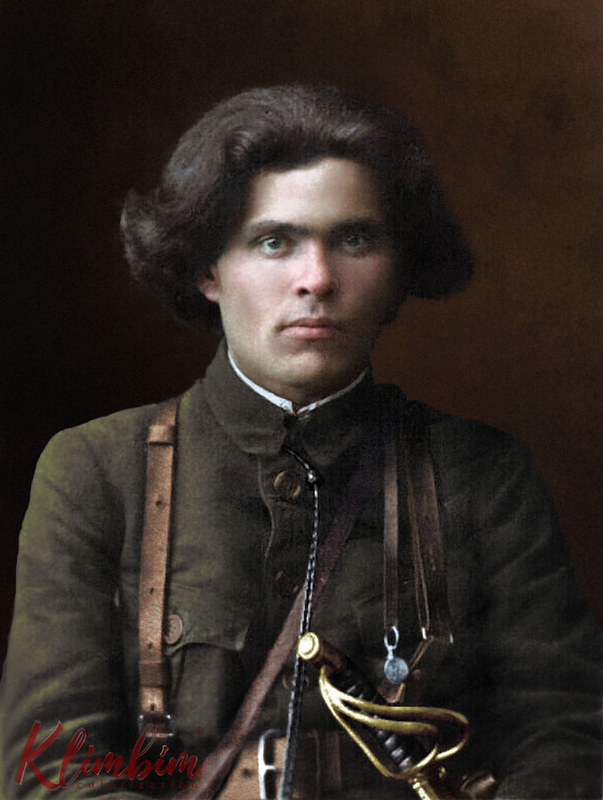
The real Makhno was another man. Contemporary photographs show a relatively short, compact man, often clean-shaven, intense rather than imposing. His contemporaries remembered not his stature but his energy. He seemed perpetually in motion. Charismatic, restless, impulsive, brave, reckless, idealistic and pragmatic in equal measure. The sort of man who appears during periods of social collapse and seems almost generated by the turbulence itself.

Yet the artists understand something important: historical memory rarely preserves people as they actually were. It preserves them as they are remembered. The artwork therefore depicts not so much the historical Makhno as “Makhno the Legend”, the anarchist rebel rider of the Ukrainian steppe. And legends tell us as much about those who create them as they do about their subjects.

The flag in the first picture identifies his force as the Revolutionary Insurgent Army of Ukraine. One speech bubble proclaims: “My ne khochemo zavoyovaty vladu – my khochemo zruynuvaty yiyi nazavzhdy!”  – “We do not want to seize power- we want to destroy it forever!” A poster declares: “No to authority! No to the Party! No to the State! Long live the free community!” Another slogan advocates “Free councils of free people.”

One can almost hear every bureaucrat in history grinding their teeth. For Makhno was that rarest of political creatures: an anarchist who genuinely seemed to mean it. Here was one who would have signed to Denearys Targaryen’s vow not to join the wheel but to break it.
A Kaleidoscope of Lost Futures

The popular memory of the Russian Civil War tends to reduce it to a struggle between Reds and Whites. Bolsheviks versus monarchists. Revolution versus reaction. Reality was considerably messier. The conflict resembled a kaleidoscope more than a chessboard.

The collapse of the Romanov Empire unleashed a bewildering array of competing visions. Monarchists wanted restoration. Liberals hoped for constitutional government. Socialist Revolutionaries dreamed of a peasant democracy. Bolsheviks sought proletarian dictatorship – with themselves as it unchallenged ruler. National movements emerged across the empire’s periphery. Foreign powers intervened. Countless local strongmen pursued their own ambitions. Entire regions changed hands repeatedly.

The lands between the Dnieper and the Don were particularly complex. They were never inhabited solely by Russians and Ukrainians in the neat modern national sense. These were borderlands in the deepest historical meaning of the word. Cossacks rode the steppe. Mennonite farmers cultivated colonies founded generations earlier. Jews lived in market towns and cities. Greeks inhabited settlements along the coast. Tartars maintained ancient communities. Armenians traded. Germans farmed. Merchants, smugglers, soldiers, pilgrims, revolutionaries and dreamers moved constantly through the landscape.

Every modern nation prefers neat origin stories. But history seldom cooperates.

Makhno emerged from this world of overlapping identities and competing loyalties. His Free Territory in southeastern Ukraine represented perhaps the most improbable political experiment of the entire Civil War: an attempt to create a libertarian society amidst one of the bloodiest upheavals in modern history.

Whether it could ever have survived is doubtful. The twentieth century belonged to states, bureaucracies, standing armies, intelligence services, and industrial administration. It rewarded those who could organise railways, requisition grain, count factory output and maintain prisons. Anarchism, though long part of Tsarist Russia’s political kaleidoscope, was a forlorn hope.

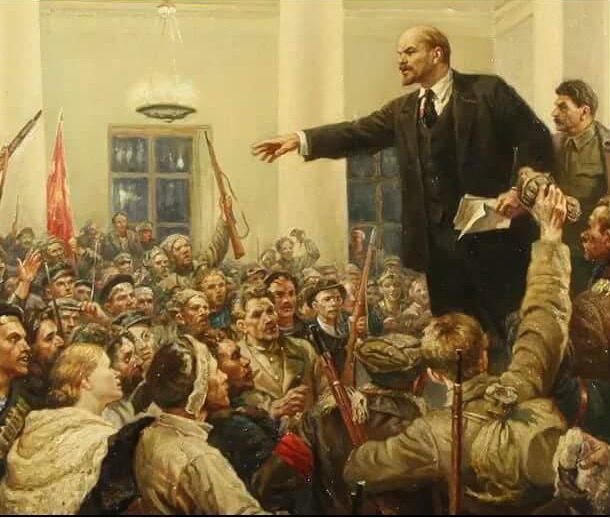
Makhno the Anarchist war lord had a precarious relationship with the ultimately ascendant Bolsheviks. Vladimir Lenin at one time looked upon him favourably. Leon Trotsky, commanding the Red Army, regarded him as a dangerous adventurer, an undisciplined partisan commander whose independence threatened revolutionary unity. Makhno regarded Trotsky as a would-be dictator masquerading as a liberator. Both men were, in their own ways, correct.

Their uneasy alliance against General Wrangel’s White Army in Crimea remains one of those moments when history briefly forces bitter enemies onto the same side before restoring them to mutual hostility. The Makhnovists helped defeat the Whites, but once that task was accomplished, the Bolsheviks turned on their troublesome allies.

The logic was almost inevitable. The Bolsheviks sought power. Makhno sought freedom from power. Those two projects could coexist only temporarily.

My old tutor Tibor Szamuely would undoubtedly have seen the episode as another illustration of what he called the Russian Tradition. Revolutions changed slogans and symbols, but the underlying gravitational pull of centralised authority remained remarkably constant. The old autocracy vanished. New forms emerged. Yet power continued to accumulate at the centre. The names changed. The structure endured. [See, in In That Howling Infinite, The Russian Tradition – Russia, Ukraine and Tibor Szamuely]

Yet for a brief moment Makhno’s movement offered a glimpse of a different possibility. That possibility was ultimately crushed, first by necessity, then by power, and finally by history itself.

Makhno and Anarchism

Makhno did not emerge from a vacuum. Like so much in Russian and Ukrainian history, he was both a product of his time and the inheritor of a much older tradition. The black banners that fluttered above the villages of southern Ukraine during the Civil War carried ideas whose roots stretched back decades, even centuries, nourished by peasant rebellion, intellectual dissent, and a deep suspicion of distant authority.

Russian anarchism emerged in the nineteenth century as a radical critique of both Tsarist autocracy and the centralising tendencies of socialism. Its two great theorists were Mikhail Bakunin and Peter Kropotkin, figures who remain among the most influential anarchist thinkers in history. Bakunin, the aristocratic revolutionary who spent years in prison and exile, rejected all forms of state power, arguing that liberation could never be achieved through a dictatorship, even one claiming to act on behalf of the workers. Kropotkin, the geographer and scientist, developed a more constructive vision, emphasising voluntary cooperation, mutual aid, and federations of free communities. Against the harsh Social Darwinism fashionable in his day, Kropotkin argued that cooperation was as important to survival as competition. Human beings, he believed, were capable of organising society without kings, bureaucrats, or party commissars.

These ideas found fertile ground in the Russian Empire. The vastness of the state, its bureaucratic inefficiency, and its often brutal methods of rule encouraged a culture of resistance. Anarchism attracted intellectuals, workers, and, perhaps most significantly, peasants. Long before Marxism became dominant, populist movements such as the Narodniks had romanticised the peasant commune as a foundation for a more egalitarian society. Although not anarchists in the strict sense, they helped create a political culture in which local self-government and suspicion of central authority were deeply valued.

The revolutionary years between 1905 and 1921 provided anarchism with its greatest opportunity. Across the empire, workers established councils, peasants seized land, and local militias sprang up with little regard for official authority. In the great cities anarchist groups were active among factory workers and sailors. The Kronstadt sailors, who would later revolt against Bolshevik rule in 1921 under the slogan “Soviets without Bolsheviks,” reflected many anarchist principles even if they were not uniformly anarchist in ideology.

It was in this turbulent environment that Nestor Makhno emerged. Born in 1888 into a poor peasant family in Huliaipole, a town in the steppe lands of southeastern Ukraine, Makhno encountered anarchism as a young man. Arrested for revolutionary activities after the 1905 Revolution, he spent years in Tsarist prisons where he came under the influence of anarchist intellectuals and immersed himself in the writings of Bakunin and Kropotkin. Prison served as his university.

When the Russian Empire collapsed in 1917, Makhno returned home and transformed theory into practice. His achievement was remarkable. Amid the chaos of civil war he helped create what became known as the. Makhnovshchina (loosely translated as “Makhno movement”), a vast anarchist experiment encompassing large areas of southern Ukraine. Villages elected their own councils. Land was redistributed. Local communities enjoyed a degree of autonomy rare in wartime. Makhno’s Revolutionary Insurgent Army of Ukraine ,often called the Black Army, defended these territories against a bewildering array of enemies: German occupiers, Ukrainian nationalists, White armies, and eventually the Bolsheviks themselves.

Military historians continue to marvel at Makhno’s campaigns. His forces perfected the use of the tachanka – a machine gun mounted on a horse-drawn cart – which allowed extraordinary mobility across the open steppe. His army repeatedly outmanoeuvred larger and better-equipped opponents. In 1919 and 1920, Makhno’s forces played a crucial role in defeating General Anton Denikin and later Baron Wrangel, two of the most formidable White commanders. Ironically, these victories helped secure the survival of the Bolshevik regime that would ultimately destroy the anarchist movement.

Makhno was not alone. Other anarchists left significant marks upon the revolutionary era. Volin (Vsevolod Eikhenbaum), an intellectual and organiser, sought to develop anarchist theory and worked closely with the Makhnovists. Lev Chernyi advocated individualist anarchism and was later executed by the Bolsheviks. Grigori Maximoff became a leading anarcho-syndicalist thinker in exile. Internationally, figures such as Emma Goldman and Alexander Berkman, both born in the Russian Empire, carried anarchist ideas to global audiences and later became disillusioned critics of Bolshevik authoritarianism.

Yet none combined military leadership, mass peasant support, and revolutionary vision quite as successfully as Makhno. His closest parallels are perhaps not found in Russia but elsewhere: Emiliano Zapata in Mexico, Buenaventura Durruti in Spain, or even the medieval peasant rebels who periodically erupted across Europe. Like them, Makhno embodied a recurring historical phenomenon: the attempt to create freedom from below rather than impose it from above.

The tragedy of Russian anarchism was that it found itself squeezed between two powerful forces. The Whites regarded it as revolutionary chaos; the Bolsheviks regarded it as a rival source of legitimacy. Both sought centralised authority, disciplined armies, and hierarchical control. Anarchism offered something messier and more elusive: local autonomy, voluntary association, and a belief that ordinary people could govern themselves. In the brutal arithmetic of the Civil War, such ideas proved difficult to defend.

Yet the legacy endured. Makhno became a folk hero to some, a bandit to others, and a symbol of resistance to authority for generations of radicals. His black flag bearing the slogan “We wish for freedom” represented more than a military movement. It expressed a persistent current in Russian and Ukrainian history – a stubborn refusal to accept that power must always flow from the centre, from the capital, from the party, or from the state. In a land famous for tsars, commissars, and strongmen, that may have been the most revolutionary idea of all.
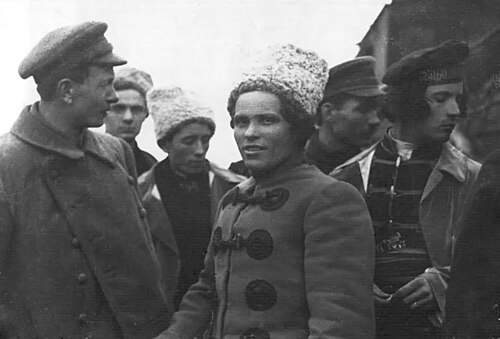

Makhno (centre) with other Insurgent command staff in Huliaipole (1919)

The Black Banner and the Long Shadow of Empire

Makhno’s story emerged from one of the great turning points of modern history: the collapse of empires. The Russian Civil War was not simply a struggle between Reds and Whites. It was also a struggle over what would replace the Romanov Empire. Across the former imperial territories, peoples sought to determine their own futures. Finns, Poles, Estonians, Latvians, Lithuanians, Georgians, Armenians, Azerbaijanis, Ukrainians and many others attempted to carve nation-states from the wreckage of imperial collapse. Some succeeded. Others failed. All became caught up in the wider maelstrom.

The tragedy of the twentieth century is that many of those hard-won freedoms proved fleeting. The new states born from the ruins of the Romanov, Habsburg, Hohenzollern and Ottoman empires found themselves trapped between larger and more powerful forces. First came the Nazi storm. Then came the Soviet one. Much of Central and Eastern Europe spent decades living under one form of domination or another. The promise of national self-determination so evident in the years immediately following the First World War often ended in occupation, dictatorship or subordination.

Yet history did not stop there.

The Soviet Union eventually followed the Romanov Empire into the graveyard of failed political systems. One by one, nations that had disappeared behind the Iron Curtain re-emerged as sovereign states. Flags long hidden returned to public squares. Languages once marginalised regained official status. Historical memories suppressed for decades resurfaced. The old imperial map dissolved once again.

Seen from this perspective, the present war in Ukraine is not simply a dispute over territory. It is part of a much longer historical argument about empire, sovereignty and identity.

A century after Reds, Whites and Greens fought across the same black-earth steppe, war once more rages in the lands where Makhno made his name. Huliaipole itself has found itself close to the front line. Mariupol, Melitopol, Berdyansk, Donetsk, Zaporizhzhia and Kherson appear both in histories of the Civil War and in contemporary battlefield reports. The same landscape that once carried cavalry columns, tachanki those iconic horse drawn machine gun wagons )and, as this is Russia, sleighs), and armoured trains now carries tanks, drones, missile batteries and mechanised brigades.

The present conflict is not a replay of the Russian Civil War. Historical analogies are useful servants but dangerous masters. Yet the recurrence is striking. Once again Ukraine finds itself at the centre of a struggle shaped by the afterlife of empire.

At its heart lies a question that has echoed through East European history for more than a century: who has the right to determine Ukraine’s future?

An increasingly irredentist Russia, drawing heavily upon imperial memory and historical grievance, has launched an assault upon a former imperial possession that insists upon its own sovereignty and right to choose its own path. The arguments are framed in terms of security, history, ethnicity and geopolitics. Beneath them lies a much older issue. The Russian Empire fell. The Soviet Empire followed it. Must Ukraine forever remain part of another state’s historical imagination, or may it exist fully as itself?

It is impossible today to read about the Russian Civil War without occasionally experiencing moments of historical déjà vu. The geography is hauntingly familiar. Kharkiv. Kherson. Mariupol. Melitopol. Odesa. Kyiv. A century ago, armies advanced and retreated across these landscapes. Reds, Whites, Greens, nationalists, foreign interventionists and local militias fought for possession of the same territory. Entire populations found themselves trapped between competing visions of political destiny.

The circumstances are very different today and historical analogies always have limits. Yet the persistence of geography and geopolitics is striking. The lands between the Dnieper and the Don remain what they have long been: a frontier between competing narratives of the past and competing visions of the future.The same rivers flow. The same cities endure. The same questions of identity, sovereignty, memory and belonging continue to reverberate across the region.

History does not repeat itself exactly. But it often revisits old addresses.

One suspects Makhno would have found the question both familiar and irritating.He was never a nationalist in the conventional sense. Unlike Bandera and later Ukrainian nationalists, Makhno did not fight for a Ukrainian nation-state. He fought for something simultaneously larger and smaller: local autonomy, peasant self-government and anarchist freedom. He distrusted all states, whether Russian, Ukrainian, Bolshevik, White, German or otherwise.

This has made his legacy awkward for modern Ukraine. States generally prefer heroes who wanted states. Makhno wanted free councils of free people.

As a consequence, he occupies an unusual place in Ukrainian memory. Unlike Bandera or Shukhevych, he has never become a central pillar of official state mythology. Unlike the controversial legacy of the OUN-UPA or the Waffen-SS Galicia Division, debates surrounding Makhno are not primarily about nationalism. Instead, he exists in several overlapping forms at once: the historical insurgent commander, the libertarian icon celebrated by anarchists across the world, the regional folk hero of southern Ukraine, and increasingly, the son of Ukraine who resisted domination from distant centres of power.

None of these versions fully captures the man.

The historical Makhno remains elusive. His movement opposed antisemitic pogroms more consistently than many contemporary forces and included Jews within its ranks, yet it operated amidst the appalling violence and carnage of the Civil War and was never entirely untouched by it. His Free Territory represented one of the most ambitious anarchist experiments in modern history, yet it was also shaped by the brutal necessities of war. Admirers romanticise him. Critics emphasise the contradictions. Both have evidence on their side.

Perhaps that ambiguity explains his enduring fascination.

The unknown artist who created the image at the head of this essay gave his Makhno a modern Tryzub or trident belt buckle, a symbol of today’s Ukrainian resistance and resilience. It is a striking touch and a thoroughly anachronistic one. The symbol derives from the seals of Volodymyr the Great and modern Ukrainian statehood. Makhno himself never wore it.

The artist is making a statement. This is not merely Makhno the anarchist. This is Makhno the Ukrainian hero. The image therefore fuses three different figures into one. There is the historical insurgent Makhno of the 1918-21 Civil War. There is the anarchist her of libertarian mythology. And there is the modern Ukrainian patriot Makhno recruited into the story of national identity – retrospectively enlisted into a national story that he himself might have regarded with considerable scepticism. He spent much of his life rejecting national labels in favour of anarchist ones.

The anachronisms are historically dubious but symbolically powerful. But history rarely asks permission before appropriating its characters in an ongoing contest over memory.
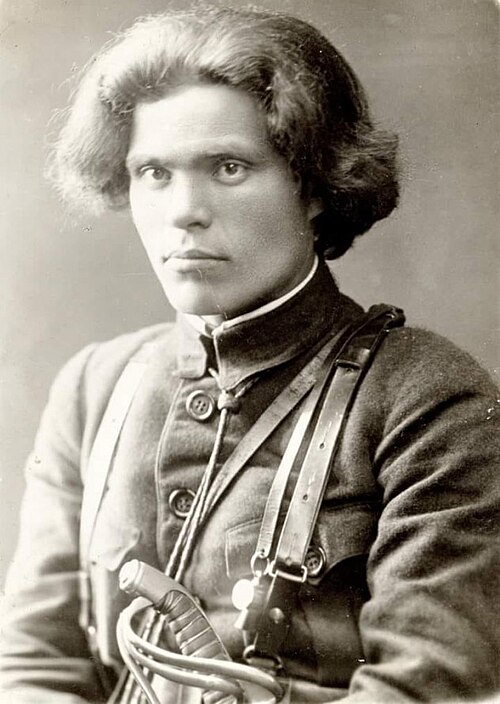
Makhno in Red Army uniform, 1919

Twilight in Paris

And then there is the final act.

What happens after the war is over? Most stories conclude when the hero rides away. Real life begins afterwards. Makhno’s cavalry charges, victories, defeats and escapes belong to legend. The more intriguing question is what became of the dream once the banners were lowered.

Defeated but not destroyed, Nestor Makhno escaped the fate that overtook so many of his contemporaries. Unlike countless White and Red commanders, he did not perish on a battlefield, before a firing squad, or later in Stalin’s Great Terror. Unlike John Brown, Custer, and Davy Crockett or the Australians Ned Kelly and another horseman Harry “the Breaker” Morant, he did not die with his boots on. Miraculously, given the odds against him, he survived.

And improbably, the horseman of the steppe ended his days in Paris.

One imagines him there during the 1920s and early 1930s, sitting in smoky cafés among White émigrés, ex-Bolsheviks, anarchists, monarchists, refugees and stateless wanderers arguing about futures that had already vanished. The thunder of cavalry had faded into memory. The revolutionary epic had dissolved into reminiscence.

Nestor Makhno died on 25 July 1934 at the age of forty-five, worn down by tuberculosis, old wounds and years of hardship and, latterly, poverty. He was cremated and his ashes placed in the columbarium of Père Lachaise Cemetery. Not beneath a black banner. Not in the black earth of the Ukrainian steppe. Not in the town where his rebellion began. His ashes were placed not in the Ukrainian black earth but in niche 6686, a small compartment among thousands of others.

There is something wonderfully ironic, literary even, about that. The anti-clerical anarchist who spent his life fighting states, hierarchies and institutions, who once commanded tens of thousands of insurgents and rode across southern Ukraine pursued by enemies on every side, ends his journey among the famous dead of France, surrounded by poets, musicians, revolutionaries and dreamers.

History possesses a sense of humour.

Yet perhaps the final irony belongs to memory itself. For the world has turned another circle since his death.

The Black Army vanished and the Free Territory of the Makhnovshchina disappeared. They survive only in memory. Stalin’s Soviet Union rose and fell. The nations that struggled for freedom amidst the ruins of empire endured decades beneath first Nazi and then Soviet domination before re-emerging as sovereign states. The world that produced Makhno  passed into history, and now, in the lands where Makhno once rode beneath a black banner, another war is being fought over questions of empire, identity, memory and self-determination.

What would Nestor Makhno make of it all?  We cannot know. But one suspects he would recognise the landscape immediately. And perhaps that is why he refuses to stay buried. The ashes remain in Père Lachaise. The legend still rides the steppe.

There is a Russian word, toska, which Nabokov famously described as a spiritual anguish without precise object. A longing for something absent. A yearning that cannot quite be named. One suspects Makhno understood it. So did Chekhov. So did many of the exiles who haunted Paris in those years. For what is exile if not a prolonged conversation with vanished possibilities?

The revolutionary epic dissolved into memoirs, arguments and recollections. The thunder of cavalry became stories told over coffee and cigarettes. The dream survived. The dreamers grew old.

Yet Makhno remains. Not exactly as he was. Not exactly as he would have wished to be remembered. But alive nevertheless in paintings, songs, novels, political arguments, historical debates, and manga-inspired artwork.

The artist who gave him a Tryzub belt buckle and the physique of a cinematic hero understands something essential. Historical memory is not an archive. It is a conversation between past and present. Each generation creates the figures it needs. And so the anarchist who rejected states has become part of a national story. The peasant insurgent has become a folk hero. The historical man has become a legend.

The ashes rest quietly in Père Lachaise. The legend still rides the steppe. And somewhere beyond the horizon, beneath a black banner snapping in the wind, Nestor Makhno continues his endless charge toward a freedom that history never quite allowed him to reach.

Paul Hemphill, June 2026

For more on Russia, Ukraine and the Soviet Union in In That Howling Infinite, see Russky Mir – Russian history’s long shadow
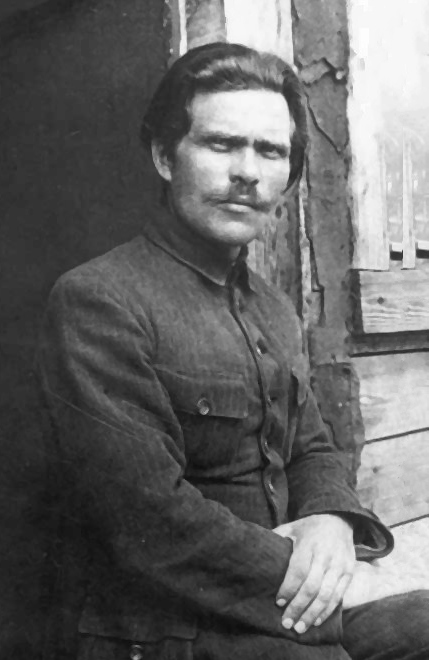
Makhno, 1921. Wikipedia

Author’s note

For the dear departed, Père Lachaise is the best address in Paris. Some 300,000 people reste ici. A cavalcade of French cultural and political history, with a few foreign entombments, including the playwright Oscar Wild and Doors front-man and zeitgeist icon Jim Morrison.

I have always loved the place. I have wandered its avenues among the celebrated and the forgotten, the visited and the unvisited. It occurs to me that perhaps there is a verse yet to be written about those whose names draw no pilgrims and whose flowers have long since withered. Next time I find myself there, I think I shall seek out niche 6686 and offer a quiet dobryi den to the old anarchist.

The singers, and the dancers, and the actors, and the chancers,
The rebels and the statesmen, and the fallen communards,
Napoleonic Generals and politicians’ wives.
The poets and the dreamers, all those other famous lives.

Paul Hemphill, Chanson – living next to Jim

Coda: The Wall

History occasionally produces coincidences so perfect that a novelist would be accused of over-writing them.

Nestor Makhno spent his final years in Paris and today rests in the columbarium of Père Lachaise Cemetery. Visitors come to see Oscar Wilde, Jim Morrison, Édith Piaf, Chopin, Proust and a host of other luminaries. Few seek out the old anarchist from Huliaipole. Yet not far from where his ashes lie stands one of the most potent revolutionary monuments in Europe: Le Mur des Fédérés, the Wall of the Federals.

It was here, on 28 May 1871, that the last defenders of the Paris Commune made their final stand. After a week of savage street fighting- the Semaine Sanglante, the Bloody Week – surviving Communards retreated through the eastern districts of Paris, fighting among the tombs and avenues of Père Lachaise itself. Cornered among the graves and monuments, they were overwhelmed. One hundred and forty-seven prisoners were lined up against the wall and shot. Thousands more would be executed in the days that followed.

The image possesses an almost unbearable symbolism. Revolutionaries making their last stand in a cemetery, fighting among the dead before joining them.

For later generations of socialists, communists and anarchists, the Paris Commune became something far greater than its brief seventy-two-day existence. Marx regarded it as the first example of proletarian government. Lenin studied it obsessively. Trotsky drew military lessons from its failure. Bolshevik revolutionaries saw in the Commune both an inspiration and a warning. It represented what revolution could achieve, but also what happened when revolution hesitated.

When the Bolsheviks seized power in 1917 they consciously invoked the Commune’s memory. Lenin famously noted with satisfaction when the Soviet regime survived longer than the Commune’s seventy-two days. Soviet propaganda elevated the Communards into secular saints of the revolutionary tradition. Streets, factories and institutions were named in their honour. Their red banner became one of the sacred relics of international socialism.

The symbolism endured even into the Space Age. The Soviet Union, which liked to present itself as the culmination of all previous revolutionary struggles, repeatedly invoked the Commune as a precursor to October 1917. A banner associated with the Paris Commune was ceremonially carried aboard an early Soviet space mission – a remarkable journey for a symbol born in the barricades of nineteenth-century Paris. One could scarcely imagine a more dramatic arc: from the cobblestones of Belleville to orbit around the Earth.

And here, perhaps, lies the final irony.

The Commune inspired the Bolsheviks. The Bolsheviks built the Soviet Union. Makhno spent much of his life fighting the Bolsheviks. Yet in death he came to rest within walking distance of the Wall of the Federals, among the ghosts of the very revolutionaries whose memory helped shape the revolutionary tradition that ultimately hunted him into exile.

The layers fold into one another like a Russian matryoshka doll. Open Makhno and one finds the Civil War. Open the Civil War and one finds the Revolution. Open the Revolution and one finds the Commune. Open the Commune and one finds the old dreams of liberty, equality and fraternity that first burst forth in revolutionary France. Each generation inherits the visions of those who came before, and each generation remakes them, sometimes beyond recognition.

One wonders what Makhno would have made of the Wall. He might have admired the courage of the Communards while distrusting those who later appropriated their memory. He might have reflected that revolutions, like nations, are often most attractive in defeat. Victors build institutions. Martyrs become legends.

And perhaps there is another lesson in Père Lachaise itself.

The cemetery gathers together monarchists and republicans, communists and anarchists, believers and atheists, poets and soldiers, dreamers and executioners. The quarrels that once seemed world-shattering now coexist in uneasy silence beneath the trees. The dead no longer argue.

Yet their stories continue to speak.

So when I eventually return to Père Lachaise and seek out niche 6686, I shall also walk to the Wall of the Federals and salute the ghosts of the old revolution. Between them lies much of the history of the modern age: revolution and reaction, hope and disappointment, dreams of freedom and the realities of power. The Communards fell there. Makhno rests nearby. The Soviet Union that claimed their inheritance has itself vanished into history.

And still the questions remain. The wall stands. The ashes remain. The legend rides on.

Le Mur des Fédérés, Pere Lachaise

Epilogue. Midnight in Paris (with apologies to Woody)

There is one final irony to Nestor Makhno’s story that deserves mention, because it reminds us how strange history can be.

When one thinks of Paris in the 1920s, one tends to think of Woody Allen’s Midnight in Paris, that charming fantasy in which a modern writer wanders the streets of Montparnasse at night and stumbles into the city’s golden age. There are Hemingway and Fitzgerald, Picasso and Gertrude Stein, Cole Porter at the piano, Salvador Dalí being magnificently Salvador Dalí, and a parade of artists, poets and dreamers whose names would come to define the twentieth century.

The film is whimsical, nostalgic and perhaps a little romanticised. But the extraordinary thing is that it is not entirely wrong. Paris really was like that.

The city into which Nestor Makhno arrived in exile was arguably the most intellectually crowded place on earth. Somewhere in Montparnasse, Ernest Hemingway was learning how to write short sentences and long silences. F. Scott Fitzgerald was turning glamour and self-destruction into literature. James Joyce was wrestling with language itself. Gertrude Stein was hosting salons where painters, writers and poets mingled late into the evening. Picasso and Matisse were redefining art. Stravinsky and Ravel were reshaping music. Josephine Baker was electrifying audiences. André Breton and the Surrealists were busy dismantling reality and rebuilding it according to dream logic.

And scattered among them were thousands of exiles.

The collapse of empires had turned Paris into a gathering place for the displaced. White Russian aristocrats who had fled the Revolution. Former tsarist officers reduced to driving taxis. Poets, philosophers and theologians trying to reconstruct vanished worlds. Jews escaping pogroms. Political refugees from every corner of Europe. Revolutionaries who had won and revolutionaries who had lost. Monarchists, liberals, socialists, anarchists, nationalists and stateless wanderers all sharing the same cafés, boulevards and boarding houses.

One can almost imagine the scene.

At one table sits Ivan Bunin, the future Nobel laureate, lamenting the Russia that had vanished. At another, the philosopher Nikolai Berdyaev debates faith and freedom. Across the room a young writer named Vladimir Nabokov quietly works on stories that few people yet read. Somewhere nearby Emma Goldman and Alexander Berkman are arguing about anarchism. Victor Serge is reflecting on the revolution’s betrayal. Trotsky occasionally passes through the émigré world like Banquo’s ghost, carrying with him the memory of power and the certainty of future assassination.

And then there is Makhno.

Not the manga hero with the flowing coat and trident buckle. Not the legendary ataman galloping across the steppe beneath a black banner. Just a tired, impoverished former insurgent commander, his lungs damaged by tuberculosis, surviving on odd jobs, writing memoirs, arguing politics, and trying to make sense of a world that had moved on without him.

It is difficult not to feel a touch of svetlaya grust’ – that luminous melancholy the Russians understand so well – in contemplating the image. Somewhere in the city Hemingway is inventing modern prose while Makhno is remembering cavalry raids across the Donbas. Picasso is dismantling perspective while former White officers reminisce about the Crimea. Joyce is transforming literature while exiled revolutionaries debate futures that have already vanished.

The worlds scarcely intersect, yet they coexist in the same city.

And perhaps they were not as far apart as they appear.

For all their differences, many of these figures were grappling with the same underlying question. The old world had collapsed. What would replace it? The question haunted the artists as surely as it haunted the revolutionaries. Some sought answers through politics, some through nationalism, some through religion, some through art. All were living among the ruins of certainties.

History often encourages us to imagine neat compartments: politics here, literature there, art somewhere else. The reality is usually messier and more interesting. The horseman of Huliaipole, the author of Ulysses, the creator of Cubism, the composer of The Rite of Spring, the future Nobel laureates, the forgotten exiles, the dreamers, the drunks, the philosophers and the refugees all inhabited the same city at the same moment.

Paris was large enough to contain them all.

Which means that somewhere, perhaps on a damp evening in Montparnasse, while jazz drifted from a nearby club and rain glistened on the pavement, Nestor Makhno may have walked past Hemingway on his way to a café argument, or crossed paths with Picasso without either man recognising the other.

Woody Allen would have appreciated the coincidence.

History, after all, often writes better stories than novelists.

Author’s note: Paris has a myriad of attractions for history tragics. For me, there are three ‘must sees’ that are at the top of the ‘out there’ list. Les Catacombes de Pariss are one. The folk cabaret Au Lapin is another. and the third is La Cimetière du Père-Lachaise, the most famous cemetery in the world.

Makhno in Red Army uniform, 1919

Makhno, 1921. Wikipedia
Red and white terror – the Russian revolution and civil war

… as a policeman, I would say, get hold of a man’s brother and you’re halfway home. Nor was it admiration for a better man than me. I did admire him, but I didn’t think he was a better man. Besides, I’ve executed better men than me with a small pistol. 

She’d come to Moscow to look for her child. I helped her as best I could, but I knew it was hopeless. I think I was a little in love with her. One day she went away and didn’t come back. She died or vanished somewhere, in one of the labor camps. A nameless number on a list that was afterwards mislaid. That was quite common in those days.

Yevgraf Zhivargo, in David Lean’s Doctor Zhivago (1965)

“The terror,” declared British Historian Simon Schama in his iconic Citizens: A Chronicle of the French Revolution “was merely 1789 with a higher body count; violence … was not just an unfortunate side effect … it was the Revolution’s source of collective energy. It was what made the Revolution revolutionary’. In short, “From the very beginning […] violence was the motor revolution”.

At the end of the chapter on the coming of thw Revolutionary Wars, he writes: ‘ … poets of romantic weather forecasting like William Wordsworth continued to describe the revolution is a cyclonic disturbance, but increasingly it was no longer the storm that invigorates in cleanses rather a dark and potent elemental rage moving forward in indiscriminate destruction its breath was no longer sweet but foul. It was the wind of war and if the wind of war comes, can the storm clouds of war be far behind’.

I thought a lot about the events of the French Revolution and the Napoleonic wars which followed it as I read English author and historian Anthony Beevor’s latest foray into Russian and Soviet history, Russia – Revolution and Civil War 1917-1921

Some books can be unrelentingly bleak and brutal, so grim and graphic in fact that you have to push yourself to finish them. Cormac McCarthy’s odyssey tale The Road is one such. But one doesn’t often say that about history books. Usually it is time, ennui or both that cry “enough, already!” You set it aside, promising to return to your bookmark – but you never do. I persevered with a veritable catalogue of the horrors that men can inflict upon their fellow humans (and yes, the perpetrators are apparently exclusively male, and the victims are males and females of many ethnicities). Beevor’s previous, highly acclaimed books Stalingrad and Berlin 1945 are chilling, but his latest takes top prize. And finish it I did …

The following is not a review of Beavor’s grim opus as such, but rather a thematic compendium of thoughts and observations derived from or inspired by the book.

Most academic accounts and university courses focus on the ideological and geopolitical dimensions of the origins, rise and consolidation of the Soviet Union, and its ultimate disintegration seventy years later. General public knowledge of the Russian Revolution and the civil war which followed it is relatively limited and cursory, often derived and books like Mikail Sholokhov’s saga of the Don Cossacks, Quiet Flows the Don and The Don Flows Home To The Sea, and Boris Pasternak’s Doctor Zhivago. Indeed, it was these novels and David Lean’s powerful adaptation of Doctor Zhivago that first attracted my interest in Russia as a school student in Birmingham. I majored in Politics at the University of Reading in the United Kingdom, and Soviet history and politics were an important part of my studies. Between those days and today, I’ve read widely about Russia’s history, past and present, and I am familiar with the events, ideas and personalities, their role in the broader and longer tableau of history, and the reverberations that are still felt today.

I have written often in In That Howling Infinite on Russian and Ukrainian history. Although I am no expert, and profess an amateur interest only, I do possess a short and humble pedigree. My tutor in Soviet Studies at Reading was exiled Hungarian academic and historian Tibor SzamuelyLike many refugees from Communism, he was descended from both perpetrators and victims. An uncle of the same name served in the Hungarian Soviet Republic that took power for six months under Béla Kun in 1919 and died violently that year when the revolution failed. He was among that government’s most bloodthirsty ministers and was called “Butcher Szamuely”. Szamuely’s family wound up in Moscow, where Tibor was born, and where his father was executed in Stalin’s purges. Young Tibor served in the Red Army, and he too was arrested and sent to a labour camp. Rehabilitated, he served as Chancellor of Budapest University. In 1964, then nearing 40, he was teaching in the “ideological institute” of Ghana’s Marxist president Kwame Nkrumah when he defected to England.

Back then, I was a political ingenue and a naïve communist sympathizer and fellow traveler, although my evolving perspectives were transforming and expanding. As my tutor, he advised me to study with an open mind and to put off juvenile thinking. He hadn’t been well when I knew him, and he died a year after I graduated. Under his tuition, I’d resolved to specialize in Soviet Studies – but events intervened, and I ended up in the Middle East (and that is another story. see: Tanks for the Memory – how Brezhnev changed my life). I nevertheless retained an active interest in the history and politics of Eastern Europe.

He would always impress upon me the historical and political continuity of what he called The Russian Tradition – the title of his one and only book, The Russian Tradition, published shortly before his death, and now, regrettably, out of print. I purchased a first edition when it was published and it is on my bookshelf still.

Szamuely believed that the bloodstained drama of the revolutions of 1917 – there were two, the social democratic one in the February, the Bolshevik one in November – and the years that followed, including civil war, the establishment of the USSR and Stalinism largely obscured the underlying consistency of Russian history. He did not live to see the decline and fall of the Soviet Union, and the advent of Putin and Russia Redux, but the basic pattern persists, circular and repetitive. The frequent turmoils that have overtaken this vast continent have in their various ways made changes that were essentially superficial, leading in the end to the intensification, under new forms, of the old authoritarian structure.

You – Bolshevik recruiting poster 1918


Contemplating civil wars

A civil war can emerge from the ashes of a wider, ongoing conflagration when factions or parties dispute the nature and terms of the post-bellum status quo and fracture along political and ideological lines. Many civil wars have arisen from the ashes of a prior war when there are what are perceived as existential issues unresolved and the availability of weapons and materièl and experienced and discontented men to use them.

There is a view that civil war can retrospectively be seen as a crucible of nation, a fiery furnace through which the righteous must walk – an ex post facto rationalization of the Nietzschean paradox of “that which does not kill us makes us strong”. Abraham Lincoln verbalized this in his Gettysburg Address in 1863 on a battlefield where the fallen had been only recently interred. Franco made a similar play as he laid claim to the wreckage that was Spain in the wake of three years of carnage, but then petrified his riven, country in autocratic stone until his death many decades later. The Russian Civil War was not accorded such a nation-building ethos as it was viewed by the Bolshevik victors as the crushing of a counter-revolution against a new world already being born.

Given Russia’s vast expanse, long history of restive regions, and large non-Russian ethnicities – all a result of centuries of imperial conquests – there is always the potential for the disintegration of centralized control and fragmentation. There is a rich history of state collapse following wars, revolutions, system breakdowns, economic crises, and other epochal events. Napoleon’s empire collapsed after his disastrous march on Moscow and subsequent defeat at the Battle of Leipzig. In 1918, the Ottoman, Austro-Hungarian, German, and Russian empires all collapsed in military defeat. Of course, people, decisions, and policies played a role, but ultimately it was war and the attendant economic and social crises that pushed these states over the edge into political chaos and often violence.

Once thing for sure, civil war, the Hobbesian “war if all against all” (Hobbes was thinking England’s) is undoubtedly the saddest, bloodiest and most visceral of all conflicts. I leave the last words to WB Yeats:

Things fall apart; the centre cannot hold;
Mere anarchy is loosed upon the world,
The blood-dimmed tide is loosed, and everywhere
The ceremony of innocence is drowned;
The best lack all conviction, while the worst
Are full of passionate intensity.

See: In that Howling Infinite, A House Divided – the Nature of Civil War

All fall down 

Revolutions are unpredictable. They never run in straight lines. They reverberate, the shockwaves expanding and impacting on their vicinity, and way beyond. The shots ricochet, like drive-by shootings and crossfires, and you never know who will be hit, where the bullets will come to rest, and who will be damaged or destroyed. Many people will be liberated, and many enslaved. Many peoples will prosper, and many, many will perish. As TS Elliot wrote, “between the idea and the reality falls the shadow”.”

When the Tsarist Russian empire collapsed halfway through the First World War, it was the first of four great empires to disintegrate. By war’s end, the conflict had destroyed the German, Hapsburg and Ottoman empires. But unlike these three, though the imperial house perished, the empire it ruled did not disintegrate. A handful of national movements, Finnish, Polish, Estonian, Latvian, and Lithuanian succeeded in breaking free, but most of murdered Tsar’s realm emerged from the convulsions of world war, revolution and civil war within a new Soviet empire, one that still ruled millions of square miles and a multitude of peoples.

The Russian Revolutions – the two in 1917, and a failed rising in 1905 in the wake of the disastrous (for Russia) of Russo-Japanese War – and the civil war that followed can be said to have defined the contours of modern European geopolitics, setting the stage for the Cold War and also, the current Ukraine war. The 20th Century was not kind to the countries of Central and Eastern Europe. Historian Timothy Snyder called them “the blood lands”.

The USSR was officially declared in the Bolshoi Theatre on 30th December 1922. Most people find this slightly surprising, because we assume that the Soviet Union must have been proclaimed immediately after The Bolshevik Revolution in November 1917. In fact, it only came into existence after a horrendous civil war that killed an estimated 10 million people, in which the deep national and ethnic tensions inside the old Russian Empire had been laid bare for all to see.

Historian Orlando Figes says in his seminal book about the Bolshevik revolution, A People’s Tragedy, that the failure of democracy in 1917 was deeply rooted in Russian culture and social history and what had started as a people’s revolution contained the seeds of its degeneration into violence and dictatorship.

In Russia, the revolution of February 1917 did not provoke a counterrevolution. The initial absence of any attempt to fight back was illustrative not so much apathy, as a feeling that there was very little of the ancien regime left that was worth defending. The overthrow of the czarist regime prompted a variety of reactions amongst the former ruling class: a resignation to events, bitterness at the incompetence and obstinacy of the Imperial Court, yet also an initial optimism among its more liberal and idealistic members. Most of the nobility and bourgeoisie supported the Provisional Government in the hope that it would at least restrain the worst excesses and keep the country together.

Soon after the November 1917 revolution, Lenin made it clear to the Bolsheviks that civil war was necessary to cleanse Russia of reactionary forces and old ways and to rebuild as a communist state and society. Moreover, he was confident that the Bolsheviks’ example would ignite revolution in the countries of Western Europe. German and Hungarian communists obliged, establishing people’s republics, which in turn invited counter revolution, the ousting of the revolutionaries, and reactionary military and police exacting bloody revenge on any leftists that could find.

The determination to resist only crystallized when the Bolshevik programme in the wake of the Bolshevik Revolution of October 1917 polarized opinion. The question is important when it comes to the origins of the Civil War itself, which led to the deaths of up to 12,000,000 people, the impoverishment of the whole country, and suffering on an unimaginable scale.

In June 1918 the Bolshevik regime was enjoying a brief respite from the rigors of revolution and civil war. Although surrounded on all sides by hostile forces, the Bolsheviks were in no immediate military danger. This welcome hiatus, lasting from the Treaty of Brest-Litovsk (March 1918) to the collapse of the Central Powers at the end of the year, allowed the Bolsheviks to consolidate their political and military strength.

In an uneasy alliance with the Bolsheviks were leftwing Socialist Revolutionaries who still dreamed of a constituent assembly and the anarchists who regarded Brest-Litovsk represented the watershed of the Revolution. In coming to terms with the Central Powers, the Bolsheviks had paid a staggering price in territory and resources. But, more importantly, they had preferred to make a pact with the imperialists rather than attempt to propagate the Revolution through popular initiatives, in particular, by partisan warfare.

Shortly after Brest-Litovsk the Bolsheviks turned against their erstwhile allies. The Cheka (the successor to the Czar’s Okrana secret police and the precursor to the NKVD, the KGB and the FSB) ostensibly created to suppress counterrevolutionaries, was unleashed on the Bolsheviks’ critics on the left. There were fierce battles between Chekists and anarchists in Petrograd and many other Russian cities.

It was game on.

It is difficult to comprehend to scale of the civil war that broke out in Russia in terms of its territorial extent, the numbers of nations and would-be states engaged in the conflict, and the destruction and carnage it wrought to soldier and civilian alike. Nor the ongoing relentlessness. Western European invaders had been defeated in the past (and indeed, the future) by what Mikhail Kutuzov, the Russian general who defeated Napoleon, called General Winter, but within the empire and its Soviet successor, weather did not stop play. Certainly, it complicated military operations, played havoc with logistics and supply-chains, and inflicted indescribable suffering upon soldiers and civilians. And the war went on …

The last of the Romanovs – Tsar Nicholas and his family, murdered by the Bolsheviks in July 1918

Revolution and reaction

If Lenin was politically flexible with foreign powers, he was ruthless with his own people, including rival parties on the left. He grabbed power when the hapless provisional government lost its way in setting up a constituent assembly that was intended to be a democratic representation of all Russians. Lenin initially paid lip service to the assembly, while calling for power to go the “soviets” – people’s councils. In reality he had no intention of allowing any diminishment or oversight of his control of the Bolshevik party and, through its Council of People’s Commissars, the battered Russian state.

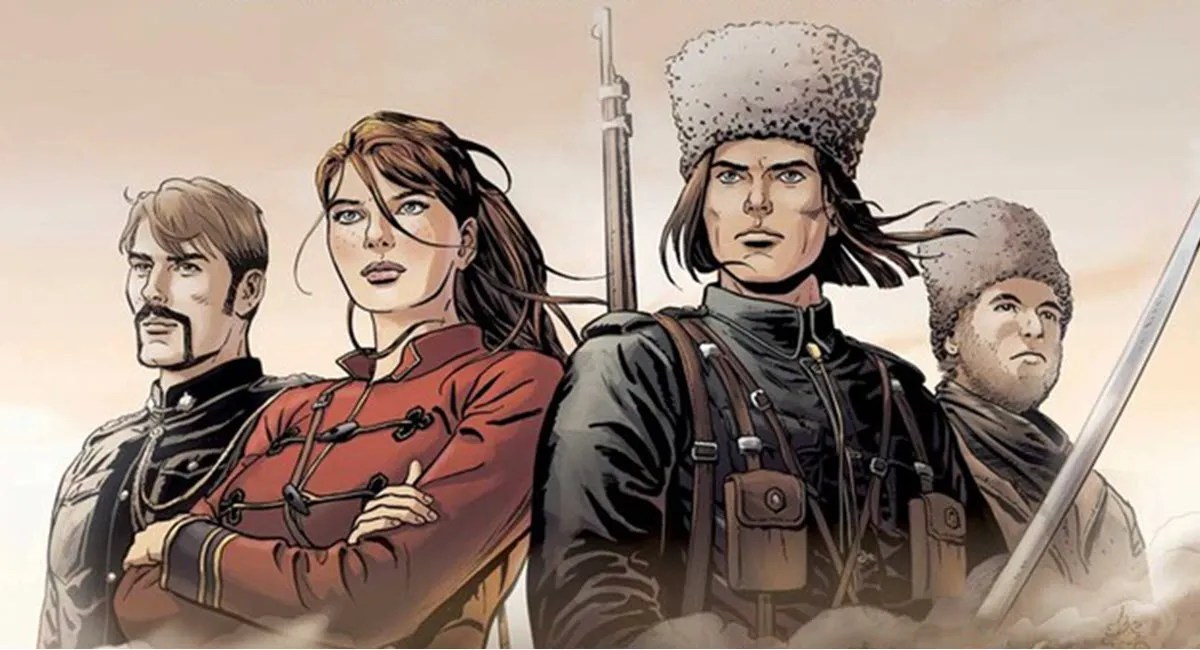
But no sooner had the Bolsheviks cemented their rule than they were fighting a civil war on multiple fronts against a mind-boggling array of enemies, stretching from revolutionary socialists  and anarchists to unreconstructed “White Russian” tsarists, nostalgic for a corrupt and flagrantly unjust regime and in between the Reds and Whites were the Greens or Partisans, mainly deserters from all sides who hated both Reds and Whites and attacked both, increasingly so as the war continued. And a range of foreign powers dealt themselves into the game to further their own strategic and ideological interests. [the featured picture of this piece is an idealized manga depiction of charismatic Ukrainian anarchist and Green Nestor Makhno, a larger-than-life figure who miraculous survived the civil way and died in his bed in exile]

The Whites were a confused, fractured and often dysfunctional coalition with rapid changes of command occasioned by personal ambitions and fluctuating military fortunes. White generals were committed to restoring the integrity of the Russian Empire, a self-defeating handicap that alienated potential allies on the fringes, like Finland, the Baltic states and Poland. Churchill underestimated this imperial obsession which prevented the alliances he wanted to defeat the Bolsheviks. The Greater Russia obsession also hampered efforts in the Caucasus where Georgians stirred regions like Ingushetia, Chechnya and Dagestan, giving Britain nightmares of Bolshevism spreading through Central Asia towards India, an obsession that continued through the twenties as described in Peter Hopkirk’s Setting the East Ablaze – Lenin’s Dream of an Empire in Asia.

Out on the edge of the old empire, White warlords endeavoured to carve out kingdoms for themselves. Many commanders spent more time terrorizing locals than fighting the Red partisans who were operating behind enemy lines across the war zone, creating a legacy and tradition the persist to this day.

The diffusion of opponents played into the Bolsheviks’ hands, as their differences were so extreme that a unified opposition fighting force was never a viable option. But if the battle lines were often blurred, the hatred felt by the combatants for each other was nightmarishly vivid.

The White’s defeat in the civil war wasn’t for lack of outside moral and materiel support. It was due largely to their inflexibility, including their refusal to contemplate land reform until it was far too late, and their refusal to grant any autonomy to nationalities of the Czarist Empire. Their administration was so useless that it’s barely existed. Paradoxically, they lost for reasons very similar to the way the Republicans lost the Spanish Civil War two decades later. In Spain, the antifascist alliance of the Republic could not prevail against Generalissimo Franciso Franco‘s disciplined and militarized regime. In Russia, the utterly incompatible alliance of socialist revolutionaries and reactionary monarchists didn’t stand a chance against the single-minded Communist dictatorship.

A leftist libertarian with St. George’s Cross, and a Sister of Mercy nurse, 1916.

World War 1.2

It in many ways it became World War 1.2. The idea of a purely Russian Civil War is misleading simplification, prompting one historian recently to describe it instead as ‘a world war condensed’.

It was waged across European and Asian Russia, including present day Belarus and Ukraine and the successor states of the Soviet Union in the Baltic, the Caucasus, and Central Asia – from Warsaw and Eastern Europe to the Urals and eastwards through the vastness of Siberia’s forests, deserts and tundra to Vladivostok in the Far East, from the arctic north to Crimea and the Black Sea, the Caspian Sea and the borders of what in 1918 ceased to be the Ottoman Empire. Fronts stretched for thousands of miles and advances and retreats likewise. The Trans-Siberian Railway, stretching the length of the former empire from Moscow to Vladivostok, was almost six thousand miles long, and it’s tributary lines served as strategic and logistical thoroughfares for all protagonists who weren’t mounted like the innumerable Cossacks tribes and the nascent Red Cavalry, bringing to prominence the armoured trains that became a symbol of the revolution.

It drew in most of Russia’s contemporary neighbours and more far-flung nations, including The USA, Britain, France, Germany Italy and Japan – the latter providing the largest contingent, estimated by British Intelligence as some 85,000 soldiers, more than many of the various White armies. Combatants included soldiers from these countries, the British dominions of Canada, Australia, South Africa, and India, and Chinese and Mongolian troops. And a multitude of ethnicities fought for their own warlords, their national place in the sun or else their very survival. Caught up in the transcontinental maelstrom were Slavs, Cossacks, Tartars, Turkmen, Arabs, Azeris, Persians, Turks, Armenians, Chechens, Kazakhs, Buryat Mongols, Kalmyks (Europe’s only Buddhist nation) and Jews. White divisions were augmented in Siberia by Mongolian, Chinese, Uighur and Kirghiz mercenaries.

Various nationalist movements arose, successfully and unsuccessfully in all parts of the former Russian Empire. The aftermath of the First World War and the collapse of the Russian Empire saw Polish, German, Italian, Hungarian, Romanian, Czech, and myriad other nationalities fighting for disparate sides, and Beevor skillfully frames the bizarre impact of this on the ethnic nationalist dimensions of the conflict.

The scale of military manoeuvres was unprecedented, as were the physical and supply difficulties over vast distances, and the extremities in climate, particularly the bitter Russian winter. The conflict became very much a cavalry war and indeed, a “railway war” notable for its armoured trains and the logistical lifeline of the Trans-Siberian Railway, protected for much if the conflict by the Czechoslovak Legion, a force of Czech and Slovak nationalists who having fought in the Czarist army, joined the Whites who controlled many towns in Siberia.

In addition to the Czechs, there was also a Polish Legion operating in the Far East. The commanders of both forces became increasingly disenchanted with the White officers who refused to countenance the independence of the border states and who shocked many with their brutality towards prisoners and civilians, and though thousands of miles from Europe, demanded repatriation – ostensibly by sea from Vladivostok.

Western Allies’ ideological perspective of the civil war was ambivalent. Though many, politicians and military alike, were viscerally opposed to Bolshevism and what it stood for, and feared a Red contagion infecting their own countries, a fear that was not unfounded. In the wake of the Revolution, a concatenation of revolts detonated across the globe. Bolshevism spread westwards, from Vienna through Budapest and Sofia to Kiel. The Bavarian Soviet Republic was briefly established in April 1919, before the far-Right Freikorps did it in. Britain wasn’t immune to the ferment. Between the February and October Revolutions, the Leeds Soviet did indeed appear to be the beginning of something, whilst strikes and demonstrations proliferated to be violently put down by the police and army. Winston Churchill alone of his cabinet colleagues wanted a full-on allied intervention and dreamed – some believed he was indeed dreaming but others claimed that he fantasized – of creating an effective White army and a borderlands alliance to defeat the Bolsheviks. But his aspirations were foiled by the imperialism of the White leadership and of White officers and the various national movements’ fear that that if the Whites prevailed, they would restore Russian rule. Britain’s rulers were reticent about shoring up and providing financial, material support and also, soldiers sailors and airmen to brutal to demonstrably homicidal Cossack brigades and revanchist and reactionary royalist autocrats.

British regiments were nevertheless deployed in Siberia and in the Far East as well as the Arctic and Caspian Sea. Royal Navy flotillas blockaded Petrograd in the Baltic, floated up the Volga in the south and down the Dvina in the arctic north, and controlled the Caspian Sea and the waters around the Crimean Peninsula. The Royal Air Force deployed Sopwith Camels and sea planes in surveillance and surveillance missions against the Red forces, who British officers called the “Bolos”. And artillery units and armoured car squadrons were attached to the various White armies.

Wider imperial concerns were in play too. Churchill rang alarm bells as the Reds pushed the Whites back in Siberia and Central Asia, alarming even his reticent cabinet colleagues with prospect of Reds on the borders of the Raj. The Great Game still had over a quarter of century to run before the final whistle blew. In the Far East, Britain and the US, and Reds and Whites alike, were nervous about the designs imperial Japanese was revealing with regard to the resources and the empty lands of eastern Siberia, the island of Sakhalin, the pacific littoral and Manchuria. Intelligence reports revealed that Japanese forces in the region exceeded all others involved, including the warring Russians.

Pogrom

Fratricidal wars are bound to be cruel because of the lack of definable front lines, because of their instant extension into civilian life, and because of the terrible hatreds and suspicions which they engender. The fighting ranged right across the Eurasian landmass was violent beyond belief, especially the unspeakable cruelty of the Cossack atamans in Siberia. Even that archconservative politician VV Shukgin believed that one of the major reasons for the failure of the whites what is a “moral collapse” – that they behaved as badly as their enemy.

There was nevertheless one subtle yet important difference. All too often, whites represented the worst examples of inhumanity, yet on that score, the Bolsheviks were unbeatable. It has been said that their ruthlessness has few parallels in recorded European history up until that time – believing that history was on their side, and that a new world was being created. The almost religious zeal with which they brutalized and killed combatants and innocents alike could be likened to the Albigensian Crusade in the early thirteenth century. [The Crusaders were accompanied by an official representative of the Pope, a French Cistercian monk named Arnaud Amalric. According to accounts written decades later, as the attack began, a soldier asked Amalric how they would be able to tell which Beziers townspeople were Catholics and which were Cathars. Some sources give the alleged quote as “Kill them all, for the Lord knows his own” or as “Kill them all. The Lord knows his own.”]

The focus on ordinary people also means their suffering is brought to the fore. And Beevor is unsparing in showing the chaotic violence of the conflict, and unrelenting in showing the sheer violence of both sides. Reds and Whites are both revealed as more than comfortable burning villages, shooting traitors, suspected or real, and torturing and massacring prisoners, and men women and children caught in the crossfire.

There were many instances of racist violence mainly on the White side – particularly towards Jews. The Whites’ antipathy towards Jews was to some degree due to their perception that most senior Bolshevik were Jewish, but mostly it was that old devil that never went away, antisemitism. The fall of the Romanovs and the ancien regime and the anti-Semitic pogroms they perpetuated continued. Retreat from the major cities brought out the worse in the Whites, with terrible massacres of Jews – although they were not the only perpetrators. Playwright And author Isaac Babel, attached as a correspondent and propagandist to the Red Cavalry on the Polish Soviet front in late 2020 posed the question: “what sort of person is our (Red) Cossack? Many layered: looting, reckless daring, professionalism, revolutionary spirit, bestial cruelty. The population await their saviors. The Jews look for liberation – and in ride the Kuban Cossacks”.

It is estimated that there were some 1300 anti-Semitic pogroms in the Ukraine during the civil war, with some 50000 to 60000 killed by both sides. There were pogroms in Belarus also, but these were not nearly as murderous as in Ukraine. A Soviet report of 1920 mentions 150,000 dead and as many again badly injured.

Churchill was well aware of the effect of the pogroms on public opinion in the West and sought in vain to exert pressure on white leaders to restrain their forces.,

Terror begat terror, leading to greater acts of conspicuous cruelty. After a particularly hard-fought battle in early 1919, a young White horse artillery officer recalled “for the first time since the start of the civil war, prisoners were not shot. There were too many of them”. This did not happen often – and such was the brutality meted out to captives on both sides, shooting was actually a blessing. An Odesa women witness after the fall of the city to the Whites, “Urrrraaa! Four and a half months under these five-pointed star oppressors”. Two days later, Beevor notes, she noted that all the Jews were in hiding. When a city held by the Reds fell to the Cossacks, a a female surgeon observed that fearing a program, two Jewish doctors in her hospital wisely ran to hide in the attic.

Bolshevik leaders and commanders on the field eventually realized that brutality did not endear their cause to the general populace and moderated their behaviour. Some Whites too came to that conclusion, and sought to prevent it at least limit atrocities, but reactionary officers and uncontrollable Cossacks persisted in burning, looting, torturing and murdering, inflicting irreparable damage to the anti-Bolshevik cause. Beevor reports instances when allied forces actually fired on Cossack perpetrators.

The End

As the whites retreated, support for the red army amongst the populace grew, as did its numbers as deserters returned to its ranks encouraged by the announcement of an amnesty and as defections from the White forces grew. Peasants grew less reluctant to serve in the Red Army Fear that with white advances and victory, old landlords would reclaim their land. Success bred success. The Whites’ ranks thinned with desertions defections and the need to transfer troops to defend its rear from attacks by partisans and freelance militias units. The Cossacks, disappointed and tired of war, turned about and headed home to their stanitsas laden with loot. The size of the frontline Red Army was eventually twice that of the Whites, as it eliminated the White armies in the north and east and closed in on the last remaining area under White control, Crimea, where rearguards held out long enough to ensure the evacuation of 150,000 soldiers and civilians by sea protected by the British and French navies.

In the aftermath of total Soviet victory, starvation struck the towns and cities across the land. Food requisitioning detachments scoured the countryside for supplies, their rapaciousness and brutality igniting peasant rebellions from Belarus to Siberia; tens of thousands of peasants rose in revolt, dealing brutally with any Bolshevik that came into their hands. The Red Army and Cheka reciprocated in spades with burning and looting, rape and torture, execution and exile to the emergent Gulag. Workers went on strike in the starving cities, and with the Whites vanquished and the civil war won, the call for democratization of Soviet rule grew louder.

And then, the sailors of the Baltic Fleet at the Kronstadt naval base, who’s guns had heralded the fall of the Romanovs, and whom Trotsky had called “the pride and glory of the Russian Revolution”, rebelled. The regime responded with lies – that the sailors had been suborned and were now Whites – and that White forces in Finland would be crossing the ice to help them. When this didn’t work, I resolved to crush them without mercy, dispatching trustworthy forces against them.

At the end, of 16000 sailors and their families, most were able to cross that ice to final and. But some 3000 fought a last stand and died by assault or firing squad. One of the last cries of protest by the Kronstadt sailors was “All of Soviet Russia has been turned into a Russian penal colony”.

Thus ended the Russian Civil War in November 1920.

… all wars come to an end. And that’s where history restarts.
British war and foreign correspondent Robert Fisk

Evacuees board ship in a Crimean portEpilogue

Epilogue … history repeats

Whilst there were many active fronts during the civil war, often simultaneously, extending for thousands of kilometers, around Archangelsk and Murmansk in the arctic, along the great rivers the Volga, the Don and the Dniester in the south, in the Baltic provinces, and in Belarus, and along the length of the Trans-Siberian Railway. And as during WW2 and the present-day Ukraine war, opposing armies advanced and retreated across Ukraine. Kiev was occupied, often several occasions, by Reds, Whites and Greens, and finally, the Polish Army which invaded Russia and Ukraine in 1920 to reclaim and defend the independence of the onetime Polish state, long divided between the now destroyed Russian, German and Austro-Hungarian empires. The names of the war-torn cities are today tragically familiar. Mariupol and Melitopol, Karchiv and Kherson. Kiev, Odessa and Lvov are now Kyiv, Odesa and Lviv.

© Paul Hemphill 2023 All rights reserved

Posts in In That Howling Infinite, about Eastern Europe: