… the protagonists of 1914 were sleepwalkers, watchful but unseeing, haunted by dreams, yet blind to the reality of the horror they were about to bring into the world
Christopher Clark, The Sleepwalkers: How Europe Went to War in 1914
The mystique of the mesmerising muzhik
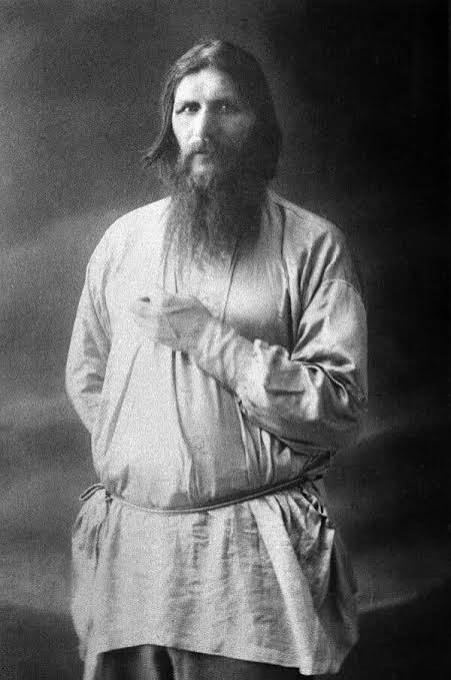
For readers unfamiliar with him, Grigori Rasputin was a Siberian peasant, self-styled holy man and wandering mystic who somehow found his way into the innermost circle of the last Russian imperial family. Born in 1869 in the remote village of Pokrovskoye, he possessed no formal religious training yet acquired a reputation as a healer and spiritual adviser. His influence grew largely because Tsarita Alexandra became convinced that he could alleviate the suffering of her hemophiliac son, Tsarevich Alexei, whose illness threatened both the family and the succession itself. From that point onward, Rasputin became a lightning rod for public anger, rumour and scandal. To his admirers he was a man of God; to his enemies a charlatan, sexual predator, political manipulator and symbol of everything rotten within the late Romanov regime.
History has rarely been kind to him. The very name “Rasputin” conjures images of dark-eyed depravity, hypnotic influence and imperial decadence, making him one of those figures who seem destined to play the villain in the historical imagination.
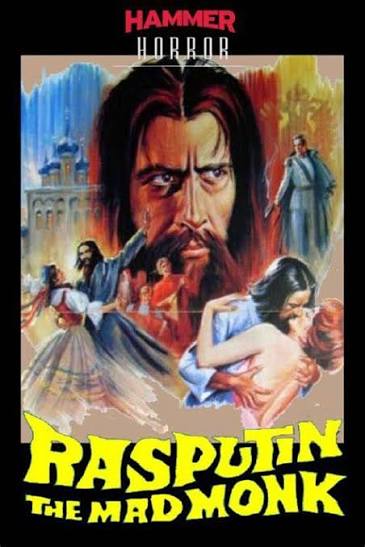
My own first encounter with him came not through history but through Hammer Horror’s gloriously lurid Rasputin: The Mad Monk (1966), in which Christopher Lee – already such a vampire icon that he’d earned the epithet “Draculee”. He played Rasputin with such operatic menace that it was not difficult to assume he must have personally engineered the fall of the Romanov dynasty between bouts of hypnotism, partying and priapic indulgence. The reality, as is so often the case, was both less theatrical and considerably more complicated. Like Boney M’s disco hit a decade later (more on that at the end if this essay), it was great entertainment, if not necessarily great history. [In later life, Christopher Lee played a suitably malevolent Saruman in Peter Jackson’s The Lord of the Rings, resembling very much what Rasputin might have looked like had he reached old age. Lee really wanted to play Gandalf, but he was doomed to be typecast]
The mystical muzhik
Which brings us to acclaimed British historian Anthony Beevor’s latest book Rasputin and the Downfall of the Romanovs.
As happens often In That Howling Infinite, what begins as a review ultimately becomes something larger than that. The book is the point of departure, but the essay then widens into a meditation on Russia itself and on historical continuity; and in this case, on the recurring problem of elites mistaking symptoms for causes, and on the peculiar human inability to recognise catastrophe even when its scent is already in the air.
I have read most of Anthony Beevor’s books and, on the whole, found them riveting, informative and refreshingly free of sensationalism. Stalingrad, Berlin, The Ardennes, Arnhem, Russia: Revolution and Civil War. Beevor is one of those rare historians who combines scholarship with narrative flair, making vast and complicated events accessible without sacrificing seriousness. Which is why I came to Rasputin with high expectations, and why I finished it feeling vaguely disappointed.
Not because it is a bad book. It is not. It is readable, entertaining, meticulously researched and full of fascinating material. But compared with Beevor’s finest work, it feels curiously slight: overextended and underdeveloped at the same time. There is enough material here for a long magazine essay, a television documentary; but not quite enough analytical depth to sustain a truly great work of history.
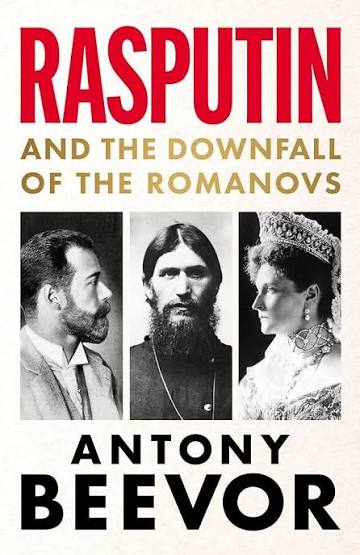
The title itself is slightly misleading. This is not really a biography of Rasputin. The so-called Mad Monk looms over the narrative like a spectral presence, but remains oddly elusive. Readers expecting a deep exploration of his Siberian origins, religious beliefs, charisma, psychology, sexuality, or the mythology that has accumulated around him often come away unsatisfied. Rasputin functions less as a subject than as a lens through which Beevor examines the final years of the Romanov court. What the book actually delivers is the story of imperial collapse between 1914 and 1917.
And what a royal court it was. Beevor presents a world populated by sycophants, grifters, mystics, opportunists, flatterers, courtiers and assorted aristocratic parasites orbiting an increasingly dysfunctional monarchy. Ministers come and go with bewildering speed. Rumours swirl through Petrograd salons. Schemes flourish and collapse. Rasputin dispenses advice, Tsarita Alexandra dispenses influence, Tsar Nicholas retreats ever further into passivity, and meanwhile the empire bleeds. All of this makes for compelling reading. Yet one gradually begins to suspect that the court is being asked to carry more explanatory weight than it can reasonably bear.
Certainly Nicholas II was an inadequate ruler and often dominated by his spouse. Certainly Alexandra was politically naïve – though that didn’t deter her from meddling: “Lovey”, she wrote to him in August 1915 while he away with his army, “I am your wall in the rear. I am here, don’t laugh at old wifey, but she has ‘trousers’ on unseen.” And both were catastrophically dependent upon Rasputin.
Certainly, the dynasty had become detached from the realities of modern Russia. But the Russian Revolution was not simply the consequence of a dysfunctional royal family making poor decisions in a palace. Russia’s problems ran far deeper than the imperial nursery. By 1917 the empire faced enormous peasant land hunger, rapid but uneven industrialisation, militant labour unrest, revolutionary traditions stretching back decades, ethnic tensions across a vast multi-national state, a fragile constitutional settlement after the failed revolution of 1905, catastrophic military losses on what we call the Eastern Front to distinguish it from the brutal stalemate on the Western one, economic breakdown, logistical paralysis and food shortages. Above all, it faced the immense pressures of total war. Even a far more capable monarch would have struggled. The Romanovs were undoubtedly part of the problem. They were not the whole problem.
Indeed, one of the ironies of Beevor’s narrative is that the closer he gets to Nicholas and Alexandra, the less convincing they become as the sole explanation for the catastrophe unfolding around them. The real story increasingly lies beyond the palace walls.
And then there is the nursery talk. The surviving correspondence between Nicholas and Alexandra is authentic, and Beevor quotes it extensively – perhaps too much. Endless references to “Sunny,” “Hubby,” “Wifey,” “baby” (the sickly heir apparent), pet names, sentimental endearments and emotional dependency reveal a couple inhabiting a private emotional universe increasingly disconnected from the realities of the empire they ruled. The first few examples are illuminating. The next fifty plus merely reinforce the point. One understands quickly enough what Beevor wishes to demonstrate: that the Tsar and Tsarina had retreated into a cocoon of domestic intimacy and religious certainty while the state around them was disintegrating. Yet repetition eventually diminishes rather than strengthens the effect.
I found myself feeling less contempt than pity, particularly for Alexandra. Beevor’s portrait is harsh, and not without justification. She was deeply unpopular even before the arrival of Rasputin. Her German origins became politically disastrous during wartime. Her interventions in ministerial appointments were often disastrous. Her faith in Rasputin was politically suicidal. Yet behind the political incompetence stood a tragic figure: a woman consumed by anxiety over a hemophiliac son whose death seemed perpetually imminent, a husband she believed had been divinely appointed, and a political system she scarcely understood. Her mistakes were enormous. Her burdens were equally profound.
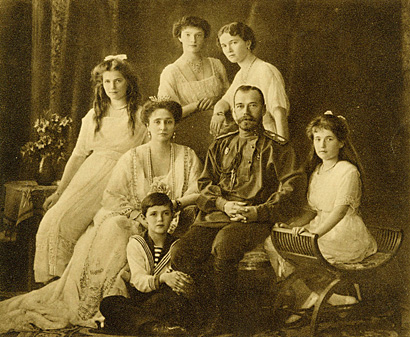
The children, meanwhile, are perhaps the saddest figures in the entire story. OTMA, the Grand Duchesses Olga, Tatiana, Maria and Anastasia. The family acronym itself has become strangely poignant, a small domestic joke preserved in history. Throughout the narrative I wondered how much they understood. Did they recognise that the dynasty was already doomed? Did they understand that the empire around them was beginning to crack apart? Olga especially emerges as a fascinating figure. Many contemporaries remarked upon her intelligence and seriousness. She often appears more politically aware than either parent. Had Russia permitted female succession, might she have made a better sovereign than Nicholas? It is impossible to know, but it is difficult to avoid the conclusion that several members of the younger generation among a myriad of dukes and duchesses possessed more common sense than the adults steering the ship of state.
As for Alexei, history has wrapped him in the melancholy glow reserved for doomed children. Understandably so. Yet had he survived to inherit the throne, one suspects he would have faced the same impossible contradictions that destroyed his father: autocracy confronting modernity, privilege confronting reform, dynasty confronting history itself.

The last of the Romanovs – Tsar Nicholas and his family, murdered by the Bolsheviks in July 1918
The road to Ekaterinburg
Let papa (Nicholas II) not plan war. It will be the end of Russia and
all of us. We shall be destroyed to the last man
Grigori Rasputin July 30, 1914
But if there is a deeper weakness in Beevor’s account, it lies not with the Romanovs, but with what overshadows them. The giant elephant in the room is the First World War. Without the war, Rasputin remains an eccentric holy man from Siberia. Alexandra remains unpopular. Nicholas remains mediocre. The Romanov dynasty perhaps limps on for another decade or two. With the war, every weakness becomes fatal.
Russia entered the conflict militarily, economically, politically and socially ill-equipped for the demands of modern industrial warfare. It possessed manpower but lacked organisation. It could mobilise millions of peasants but struggled to arm, supply and transport them. Railways buckled. Food shortages worsened. Casualties mounted on a staggering scale. Most importantly, the largely peasant army itself became fertile ground for revolution. The officer corps remained socially distant from the rank-and-file. Military disasters shattered confidence. Discipline deteriorated. Radical ideas spread. By 1917 the army was not merely losing battles. It was losing faith in the system it served. When revolution finally arrived that February, not with a bang but a slow-mo disintegration, it was little wonder that, encouraged by agitators in its ranks, the Russian Army did what we like to imagine most soldiers would like to do: lay down their arms and head for home – often first shooting their officers.
This, surely, was the real story. The gossip in Petrograd salons and restaurants drawing mattered. But millions of armed peasants questioning the legitimacy of the state mattered rather more. One occasionally wishes Beevor had spent less time recounting the latest court scandal and more time examining the immense structural forces pulling the empire apart.
Because by 1916 some observers could already smell danger. The writer Mikhail Lemke, serving at Stavka, the army headquarters, captured the mood perfectly: “Oh, the holy stupidity of the Romanovs. We are moving at full speed towards some terrible abyss, a dreadful end that is not clear to anyone but is inevitable… It is clear that the finale is going to be terrifying and in its haphazard nature.” It is a remarkable observation insofar as it captures something larger than the Romanovs themselves.
History is full of such moments. Barbara Tuchman encountered them repeatedly. Christopher Clark found them among the sleepwalkers of 1914. One finds them before the collapse of Austria-Hungary, before the fall of the Ottoman Empire, before Yugoslavia’s descent into war. People sense that disaster is approaching. The clouds gather, the pressure changes, the atmosphere becomes electric, even if the precise lightning strike remains unseen.
Beevor quotes Russian poet Alexander Blok expressing something similar when he wrote of the “peculiar merry horror that sits in the Russian soul.” It is one of those observations that sounds simultaneously profound, unfair, insightful and impossible to verify. Yet it evokes a Russia that appears repeatedly in its literature and history: exuberant and despairing, mystical and brutal, comic and tragic, capable of extraordinary creativity and extraordinary destruction, often simultaneously.
Reading these passages, I found myself thinking not only of Beevor but of my university tutor Tibor Szamuely who has featured often in In That Howling Infinite. Szamuely believed that Russia punished simplification. Its history moved in circles rather than straight lines. Revolutions proclaimed liberation only to rediscover autocracy in new forms. The Romanovs fell; the Bolsheviks inherited the imperial reflexes. The Soviet Union collapsed; empire returned draped in Orthodoxy, nationalism and Eurasian destiny. Beneath the turbulence remained what he called The Russian Tradition – the title of his one and only book, now out of print: centralised power, messianic consciousness, siege mentality and the recurring sanctification of suffering.
Szamuely believed that the bloodstained drama of 1917 and beyond – the February Revolution, the Bolshevik seizure of power in November, the Civil War, the creation of the USSR and Stalinism – often obscured the deeper continuities of Russian history. He did not live to see the collapse of the Soviet Union, the rise of Vladimir Putin or the war in Ukraine, but his argument remains strikingly relevant. The frequent upheavals that have overtaken this vast continent have often produced changes that were, at bottom, superficial, leading ultimately to the intensification of old authoritarian structures under new names.
One of the more revealing moments in Beevor’s narrative comes when Alexandra writes to Nicholas on December 14, 1916: “Be firm. Russia loves to feel the whip – it’s their nature – tender love and then the iron hand to punish and guide”. The observation is deeply revealing. It suggests a view of governance fundamentally at odds with constitutional politics. Whether one accepts Szamuely’s thesis or not, one cannot help noticing the irony. The Romanovs fell. Liberal democracy survived only briefly. The whip did not disappear. It merely changed hands. Lenin’s whip proved heavier. Stalin’s heavier still. Perhaps Alexandra was disastrously wrong about her own era and yet, in some darker sense, glimpsed something enduring about Russia’s future.
And that reminded me, oddly enough, of Deadwood. One of the reasons David Milch’s masterpiece remains such extraordinary television is that it understands something many historians understand and many politicians do not: catastrophe is usually visible before it arrives. Not in its precise form, certainly. Nobody sees the exact bullet, the exact revolution, the exact market crash. But the atmosphere changes. The clouds gather. The animals become restless. And somebody, somewhere, notices. Viewers who are paying attention notice too because the background music becomes jangly and minor key.
In the episode ominously titled Suffer the Little Children, world-weary Madame Joanie Stubbs asks the young opportunist Flora a simple question: “Can you smell danger?” Joanie, from experience, can. The fey and feckless Flora cannot. She sees only opportunity and the immediate game she is playing and fails to recognise the larger forces closing around her. The result is one of the most violent conclusions in a series notorious for its displays of wanton brutality.
The same pattern appears repeatedly in history. People like Lemke could smell danger. Alexander Blok could smell danger. Many officers, politicians, intellectuals and ordinary Russians could smell danger. But did Nicholas and Alexandra? The evidence suggests not. Or perhaps they did but convinced themselves otherwise. In that sense they resemble the tragic Flora. Not wicked. Not entirely foolish. Simply trapped within assumptions that prevented them from recognising reality. Every warning became another irritation. Every crisis was temporary. Every setback could somehow be managed through faith, loyalty and persistence. Meanwhile the empire was bleeding to death.
The Romanovs spent years mistaking symptoms for causes. Rasputin was a symptom. Ministerial instability was a symptom. Court gossip and innuendo was a symptom. The disease lay much deeper: a political system incapable of reforming itself, a society under immense strain, and a war exposing every weakness simultaneously. By 1916 the smell of danger was everywhere. The tragedy is that those best placed to act either could not smell it or convinced themselves that the storm would somehow pass.

Tsar Nicholas in captivity
Which brings us to where Beevor’s book ends. Rasputin is assassinated by nobles determined to save the dynasty itself – treating a symptom, not the disease (see below); the Tsar abdicates in March 1917; and the last of the Romanovs and his family disappear down the melancholy railway line to Ekaterinburg and death. The curtain falls. The reader must supply the rest. And the rest matters enormously. For all their failings, Nicholas and Alexandra were not succeeded by enlightened constitutional reformers. They were succeeded by the Bolsheviks. The road that began with Rasputin’s influence at court led through revolution, civil war, famine, terror, collectivisation, purges and the Gulag.
One leaves the book with an uncomfortable thought. The Romanovs were unquestionably part of the problem. But history’s eventual solution proved vastly more destructive.
Perhaps that is the most haunting aspect of the entire story. The downfall of the Romanovs solved one set of problems and unleashed others on an unimaginable scale. The train that Lemke saw hurtling toward the abyss did indeed reach its destination. But beyond the bend in the track lay not merely revolution, but decades of violence, repression and suffering.
In the end, Rasputin and the Downfall of the Romanovs is worth reading. The story itself remains compelling. Yet it is a lesser Beevor work: repetitive where his best books are incisive, narrowly focused where his best books are panoramic, occasionally so absorbed by court intrigue that it loses sight of the immense forces gathering beyond the palace gates. Like the dynasty it describes, it becomes most interesting when viewed as part of a larger story.
And perhaps that is the final irony. Rasputin, Nicholas, Alexandra, the four princesses, poor Alexei, the plotting dukes, ambitious ministers and aristocratic parasites all occupy centre stage for a time. Yet beyond them looms the true protagonist of the drama: Russia itself – vast, restless, wounded, contradictory, moving, as it has so often moved, between reform and reaction, idealism and coercion, hope and catastrophe.
The revolution was coming regardless. The tragedy of the Romanovs was not merely that they failed to stop it. It was that, like Flora ignoring Joanie Stubbs’ warning, they scarcely seemed to understand it was happening at all. The smell of danger was everywhere. The locomotive was already gathering speed. And somewhere ahead, beyond the next bend in the track, lay Ekaterinburg, the Civil War, Stalin, the Gulag, the Soviet century and perhaps even the long shadows that still stretch across Russia today.
The passengers continued gossiping, plotting, arguing and reassuring one another. A few looked nervously out the windows. A few could smell the storm. But by then it was already too late.

Bolshevik recruiting poster 1917
Explaining Rasputin’s power – Russia’s peasant complex
Rasputin arrived in St Petersburg trailing not merely Siberian mud on his boots but centuries of Russian argument about the peasantry.
For much of the nineteenth century, Russia’s educated classes had romanticised “the people” from a respectful distance. The peasant was imagined as the keeper of Holy Russia’s soul: patient, devout, long-suffering, close to the land and somehow morally superior to the fashionable, French-speaking aristocracy that governed him. Tolstoy found wisdom amongst peasants. Dostoevsky found redemption there. Intellectuals went “to the people” in search of authenticity, only to discover that actual peasants could be suspicious, conservative, superstitious and decidedly unimpressed by visiting idealists from St Petersburg.
Out of this tension emerged the Narodniks, the great “to the people” movement of the later nineteenth century. Young idealists abandoned universities and cities and went into the countryside to live amongst the peasants, educate them, organise them and, in some cases, save them. The peasants frequently responded by assuming they were spies and reporting them to the police.
Russia has always possessed an unusual talent for disappointing its romantics
Rasputin landed squarely in this contradiction. To admirers, he was the authentic Russia that the salons had spent generations searching for: a wandering pilgrim, a holy fool, a man of the soil with the smell of birch forests and woodsmoke still clinging to him. To his enemies, he represented everything that modern Russia was supposed to leave behind: ignorance, mysticism, obscurantism and the triumph of superstition over reason.
The aristocracy had always liked peasants rather in the way that modern urbanites like farmers’ markets — as long as the mud remained somebody else’s problem. Then one of them walked into the Winter Palace and sat down with the Tsarita.
Even popular culture recognised the type. At one point, Christopher Lee’s wonderfully excessive and inebriated Rasputin, breaks into an exuberant Russian dance to Stenka Razin, the great folk lament about the rebel Cossack who throws his Persian princess into the Volga to prove his loyalty to his comrades. Watching it as a teenager, I remember thinking not of Cossacks and river pirates but: “Hang on! That’s The Carnival Is Over.”
Tom Springfield had indeed borrowed one of Russia’s most famous melodies and transformed it into a global hit for The Seekers. Russia has always had a habit of turning up unexpectedly in other people’s stories. [See, in In That Howling Infinite,“High above the dawn is waiting” … the unlikely Russian origin of an English pop song]
Rather like Rasputin himself.
The resurrection of the Romanovs
One of the enduring ironies of Russian history – and indeed of history generally- is how often “all that is old is new again.” Revolutions announce themselves as clean breaks with the past, yet the past has a habit of returning through side doors and forgotten corridors. The symbols change, the slogans change, the uniforms change, but old habits, assumptions and institutions frequently re-emerge in unexpected forms.
Russia provides perhaps the most spectacular examples.
Much attention is paid to the persistence of the autocratic state: the succession from Tsarist secret police to Cheka, NKVD, KGB and FSB; the recurring preference for centralised authority over pluralism; the enduring suspicion of foreign influence; the tendency to frame political life as an existential struggle between order and chaos. These continuities are real enough.
Yet the return of older Russia extends well beyond the machinery of coercion. One of the most remarkable developments of the post-Soviet era has been the resurrection of the Russian Orthodox Church. The institution that survived persecution, marginalisation and attempted eradication under Soviet rule has re-emerged as one of the central pillars of contemporary Russian identity. Cathedrals demolished by the Bolsheviks have been rebuilt. Religious symbolism once dismissed as superstition now appears alongside state ceremonies and military rituals. Patriarchs once monitored by the Party have become influential public figures. Patriarch Kyril , the current head of the Russian Orthodox Church is a close political and ideological ally of Putin. Orthodoxy, once pushed to the margins, has returned to the centre of Russian public life.
And with Orthodoxy has come a reconsideration of the Romanovs, murdered along with their servants (and pet dogs) by bullet and bayonet by local Bolsheviks, on Lenin’s orders it is claimed, on the night of 16th and 17th July 1918 – ostensibly to prevent their rescue by Kolchak’s White forces who were closing in on Ekaterinburg. Many of their family and friends were executed in the days and months afterwards.
For much of the Soviet period, Nicholas II occupied a relatively simple role in the official story: a weak ruler whose incompetence justified the Revolution that swept him away. Post-Soviet Russia complicated that narrative. The Romanovs gradually ceased to be merely the defeated rulers of a vanished age and became, for many Russians, symbols of national martyrdom. Nicholas and Alexandra, together with their children, were canonised as Passion Bearers. Pilgrimages developed around sites associated with their imprisonment and murder. Their deaths came to be viewed not simply as a political execution but as a spiritual tragedy and a national wound.
The process was aided by the gradual revelation of what actually happened in the cellar of the Ipatiev House in Ekaterinburg. Soviet accounts had long been evasive. The fuller story proved profoundly unsettling. The murder of Nicholas and Alexandra is one thing. The murder of Olga, Tatiana, Maria, Anastasia and the sickly Alexei is quite another. Whatever one’s judgement of the Romanov regime, if the witness statements gathered after the slaughter are reliable, it is difficult not to recoil from the sheer brutality of what occurred that night. The image of frightened young women surviving the first fusillade because jewels sewn into their clothing deflected bullets, only to be finished off with bayonets and revolvers in a chaotic mess of panic and gun-smoke possesses a dreadful power.
That sympathy has done much to reshape public memory. The Romanovs who emerge in popular imagination are often not the rulers of a vast empire but a doomed family. The focus shifts from Nicholas the inadequate monarch to Nicholas the husband and father; from Alexandra the politically disastrous empress to Alexandra the anxious mother. Martyrdom eclipses governance.
There was to be, however, no martyr’s crown for Grigori Rasputin, whom we had lost sight of when we widened the scope of our review of Beevor’s historical pot-boiler.
The death of Rasputin
To borrow from the Bard of Avon (Macbeth, that is), “nothing in his life became him like the leaving it”. Rasputin’s demise has passed into legend largely because it seems to belong less to history than to black comedy.
In December 1916 a group of aristocratic conspirators, led by Prince Felix Yusupov and Grand Duke Dmitri Pavlovich, decided that the self-styled holy man had become a mortal threat to the monarchy and must be removed. What followed has often been retold as a Gothic horror story in which Rasputin was poisoned, shot, beaten, drowned and somehow kept coming back for more.
Beevor, however, strips away much of the mythology and reveals something closer to a tragic farce. The conspirators were astonishingly amateurish, repeatedly losing control of events, contradicting one another, panicking and improvising as their carefully laid plan unravelled. Reading Beevor’s account, one is reminded less of a sinister political assassination than of a darkly comic Ealing caper performed by nervous aristocrats hopelessly out of their depth. Yet the absurdity only heightens the symbolism. Here was the Russian elite, convinced it was saving the Empire, bungling even a murder. Rasputin’s chaotic end became a grotesque metaphor for the regime itself: confused, incompetent, riddled with fantasy, and staggering towards disaster while imagining it was still in control.
No wonder it provided such irresistible material for a shonky Hammer Horror melodrama. Rasputin’s life already contained all the necessary ingredients: a mysterious peasant mystic, aristocratic decadence, rumours of hypnotic powers, political intrigue, sexual scandal and a violent death wrapped in myth and exaggeration. His assassination only added to the legend. Poison that apparently failed to work, bullets that seemed unable to stop him, panicked noblemen stumbling through a murder plot and a corpse eventually dumped into the icy Neva – it all reads less like sober history than a fever dream concocted by a screenwriter after too many vodkas.
Hammer simply leaned into the absurdity. With Christopher Lee glowering, glaring and generally chewing the scenery as only Christopher Lee could, Rasputin became less a historical figure than a gothic supervillain, somewhere between Dracula and a mad prophet. The remarkable thing is that the real story, stripped of its embellishments, remains almost as bizarre as the cinematic version. Indeed, one suspects that if a screenwriter had invented the entire affair from scratch, critics would have dismissed it as implausibly over-the-top.
History, as usual, had other ideas. And therein lies the enduring fascination of Rasputin: not merely the man himself, but the way his life and death seem perpetually suspended between fact and folklore, political history and popular mythology.
The book of the film?
Whilst reading Beevor’s account, I wondered if he had recently watched the 1971 British film Nicholas and Alexandra. It is an appealing fancy, and not an entirely implausible one.
Anthony Beevor is a serious historian, of course, and his account of the Romanovs, Rasputin, and the revolutionary years rests on decades of scholarship rather than any cinematic influence. Yet historians are also human beings, and good historians often have a keen sense of narrative, character, and scene. Reading some passages in Russia: Revolution and Civil War, one occasionally gets the feeling that Beevor can see the events unfolding before him in almost cinematic fashion.
The 1971 film Nicholas and Alexandra remains one of the most ambitious attempts ever made to dramatise the collapse of Imperial Russia. Although it was something of a commercial disappointment, it assembled a remarkable cast of British acting royalty. Michael Jayston’s Nicholas II and Janet Suzman’s Alexandra are perhaps best remembered, but the supporting cast reads like a roll-call of twentieth-century British theatre and film: Laurence Olivier as Count Witte, Michael Redgrave as Sazonov, Jack Hawkins, Harry Andrews, Timothy West, Ian Holm, and a young Brian Cox in one of his earliest screen appearances as Leon Trotsky.
Then there is Tom Baker as Rasputin: wild-eyed, bearded, charismatic, unsettling, simultaneously ridiculous and strangely compelling. It remains one of the screen’s most memorable Rasputins, capturing something of the paradox that has fascinated generations- the peasant mystic who became confidant to an empress, faith healer, political liability, and eventually a figure of near-mythic notoriety. [Tom Baker reincarnated in 1974 as the Fourth Doctor, to become the longest serving time lord in that venerable television series, and, to hark back to our opening paragraphs, like Christopher Lee, he also pitched unsuccessfully to play Gandalf in The Lord of The Rings]
As for Ian Holm, His role is actually an interesting footnote. In Nicholas and Alexandra, he played Vasily Yakovlev, the Bolshevik commander who supervised the execution of the imperial family in Ekaterinburg in July 1918. Yakovlev survived the civil war and perished during Stalin’s Great Terror in 1938 while Holm morphed into the devious cyborg Ash in Ridley Scott’s Alien (1979).
Whether Beevor recently watched the film is impossible to know. But if one were writing about the twilight of the Romanovs, it would be hard not to have the film somewhere in the back of one’s mind. For all its historical simplifications, it remains one of those grand old epics that lodged themselves in the cultural imagination.
And perhaps that is one reason the movie endures despite its reputation as a flop. It was not merely recounting history. It was staging the last act of an entire civilisation – the chandeliers still glittering, the uniforms still immaculate, the orchestra still playing, even as the floorboards beneath the Russian Empire were already beginning to crack.
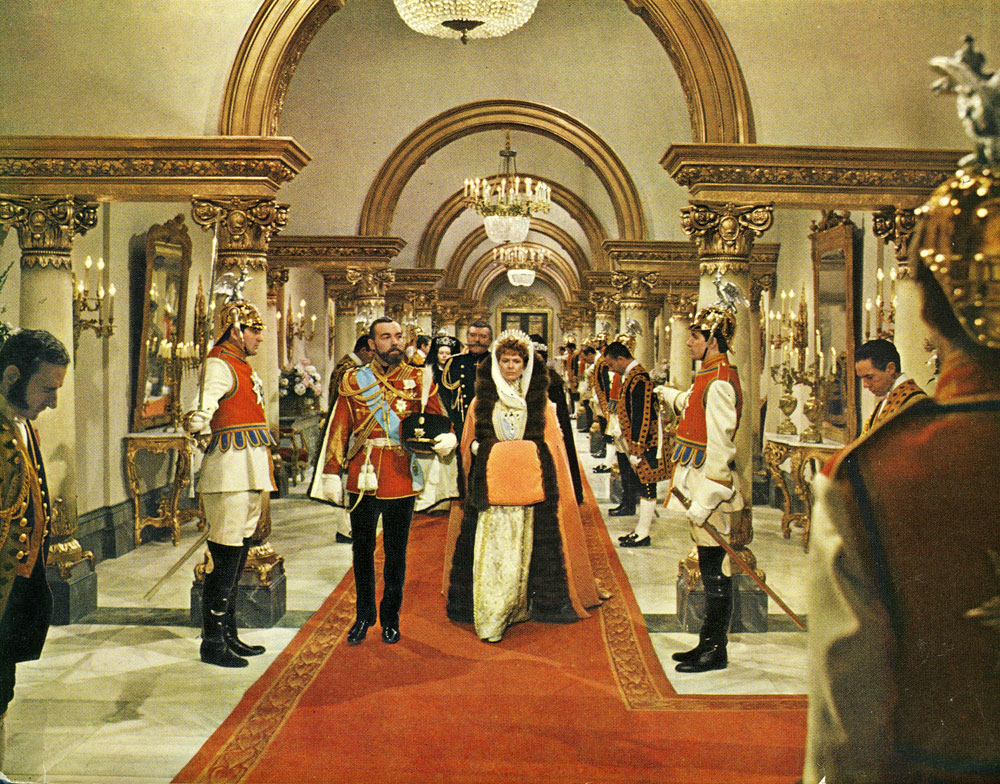
When Josef met Vladimir
There is a scene in Nicholas and Alexandra that takes us down one of history’s intriguing rabbit holes where fact, folklore and political mythology sit together at the same table – perhaps even, over a pint.
It depicts the First Conference of the Russian Social Democratic Labour Party in Tampere (then part of the Grand Duchy of Finland) in December 1905. That conference is generally accepted by historians as the first documented meeting between Lenin and Stalin. Stalin himself later recalled it as their first encounter, describing how the younger Georgian revolutionary was somewhat disappointed to discover that the legendary Lenin was not the towering, commanding figure he had imagined, but rather a relatively ordinary-looking man who blended easily into the crowd.
And yet, according to a London tradition, the two had met earlier at the Crown Tavern on Clerkenwell Green, a pub situated opposite what became the headquarters of the Twentieth Century Press, where Lenin worked while editing Iskra during his London exile. The tale has enormous appeal. One can easily picture the scene: two future dictators of the twentieth century sharing a beer in a smoky London pub while discussing the fate of the Russian Empire, utterly unknown to the drinkers around them.
The problem, though, is evidence. Lenin certainly spent considerable time in Clerkenwell. Stalin certainly visited London in 1907 for the Fifth Congress of the RSDLP. Both men undoubtedly walked the same streets. The Crown Tavern proudly embraces the connection. Yet hard documentary proof that they actually sat down together there before the 1905 Finnish conference is elusive. Soviet historians, who were often eager to document Lenin’s revolutionary activities in minute detail, generally treated the Tampere meeting as the first confirmed encounter. Modern historians tend to do the same.
That does not necessarily make the pub story false. Revolutionary underground movements were not renowned for maintaining meticulous attendance records. Absence of evidence is not evidence of absence. But it does leave the tale in that charming grey zone occupied by so much historical folklore.
There is also a delicious irony in the setting. Clerkenwell Green was one of the great centres of radical politics in Victorian and Edwardian London – a place where exiles, anarchists, socialists, trade unionists and political dreamers gathered. The British Empire, then at the height of its power, provided refuge to revolutionaries who were plotting the overthrow of other empires. London was simultaneously the capital of global capitalism and a sanctuary for those dedicated to its destruction.
If Lenin and Stalin really did share a pint at the Crown Tavern, neither man could have known that within two decades one would have created the Soviet state and the other would inherit it. Nor could the Londoners around them have guessed that two obscure Russian exiles would become among the most consequential figures of the twentieth century.
That, perhaps, is why the story survives. Whether true or not, it captures the peculiar magic of history: the possibility that world-changing events sometimes begin not in palaces, parliaments or battlefields, but in an ordinary corner pub on an ordinary London afternoon.
And, finally, from the surreal to the ridiculous …When it comes to exuberant absurdity, one cannot match that of German reggae, funk and disco group Boney M.
Ra- ra-ra Rasputin
For an entire generation, Boney M’s 1978 disco hit Rasputin probably did more to shape popular perceptions of the man than any serious work of history.
It is, of course, ridiculously inaccurate. Rasputin was not literally the “lover of the Russian Queen”; there is no credible evidence that he and Alexandra were lovers, despite endless rumours at the time. Nor did he “rule the Russian land and never mind the Tsar.” Even at the height of his influence he remained more symbolic than omnipotent, a trusted adviser whose access to the imperial family far exceeded his actual political competence.
Yet the song captures something important about how Rasputin entered popular mythology. He became less a historical figure than a larger-than-life archetype: part holy man, part conman, part libertine, part political puppet-master, wrapped in an aura of sex, mystery and impending catastrophe.
It compresses a complicated story into a memorable caricature. The real Rasputin was almost certainly less powerful, less sinister and less glamorous than legend suggests. But legends endure because they tell us something about the fears and fantasies of their age. To Russians watching their empire stagger towards collapse, Rasputin became a convenient embodiment of everything that seemed wrong with the Romanov regime. To the wider world, he became the bearded mystic with hypnotic eyes, impossible appetites and nine lives.
Boney M simply took that mythology, added a disco beat with a Russian flavour, Euro-pop chorus and a dash of Cold War exoticism, and produced one of the strangest historical stories ever to hit the dance floor.
Indeed, there is a curious progression in the way many of us first encountered Rasputin. First came Christopher Lee’s wild-eyed Hammer Horror incarnation in the 1960s; then Boney M’s improbable disco supervillain in 1978; and only much later the actual historical figure lurking behind both performances. By that stage, poor old Grigori scarcely stood a chance. History had already handed him over to popular culture, where villains, mystics and monsters invariably enjoy a much longer shelf life than ordinary men.
Paul Hemphill, June 2025
For more on Russia, Ukraine and the Soviet Union in In That Howling Infinite, see Russky Mir – Russian history’s long shadow
Rasputin, Bony M (1978)
There lived a certain man in Russia long ago
He was big and strong, in his eyes a flaming glow
Most people look at him with terror and with fear
But to Moscow chicks, he was such a lovely dear
He could preach the Bible like a preacher
Full of ecstasy and fire
But he also was the kind of teacher
Women would desire
Ra-Ra-Rasputin, lover of the Russian Queen
There was a cat that really was gone
Ra-Ra-Rasputin, Russia′s greatest love machine
It was a shame how he carried on
He ruled the Russian land and never mind the Tsar
But the kazachok, he danced really wunderbar
In all affairs of state, he was the man to please
But he was real great when he had a girl to squeeze
For the Queen, he was no wheeler-dealer
Though she’d heard the things he′d done
She believed he was a holy healer
Who would heal her son
Ra-Ra-Rasputin, lover of the Russian Queen
There was a cat that really was gone
Ra-Ra-Rasputin, Russia’s greatest love machine
It was a shame how he carried on
But when his drinking, and lusting and his hunger for power
Became known to more and more people
The demands to do something about this outrageous man became louder and louder
“This man’s just gotta go,” declared his enemies
But the ladies begged, “Don′t you try to do it, please”
No doubt this Rasputin had lots of hidden charms
Though he was a brute, they just fell into his arms
Then one night some men of higher standing
Set a trap, they′re not to blame
“Come to visit us,” they kept demanding
And he really came
Ra-Ra-Rasputin, lover of the Russian Queen
They put some poison into his wine
Ra-Ra-Rasputin, Russia’s greatest love machine
He drank it all, and he said, “I feel fine”
Ra-Ra-Rasputin, lover of the Russian Queen
They didn′t quit, they wanted his head
Ra-Ra-Rasputin, Russia’s greatest love machine
And so they shot him ′til he was dead
Oh, those Russians
Writer(s): Frank Farian, Fred Jay, George Reyam
Afterword
Being a longtime student of the Middle East, and having visited Jerusalem many times, whilst assembling this essay, I was surprised to discover a direct connection between the murdered Romanovs and the Holy City. Tsarita Alexandra’s sister, the Grand Duchess Elisabeth, who was executed along with other nobility on the sane night as The Tsar and his family, and later, interred in the incongruous and ostentatiously Muscovite Church of Saint Mary Magdalene in the Garden of Gethsemane on Mount Olive – which she and her husband had helped build – and in 1982, canonised as “new martyr” of the Russian Orthodox Church Outside Russia.
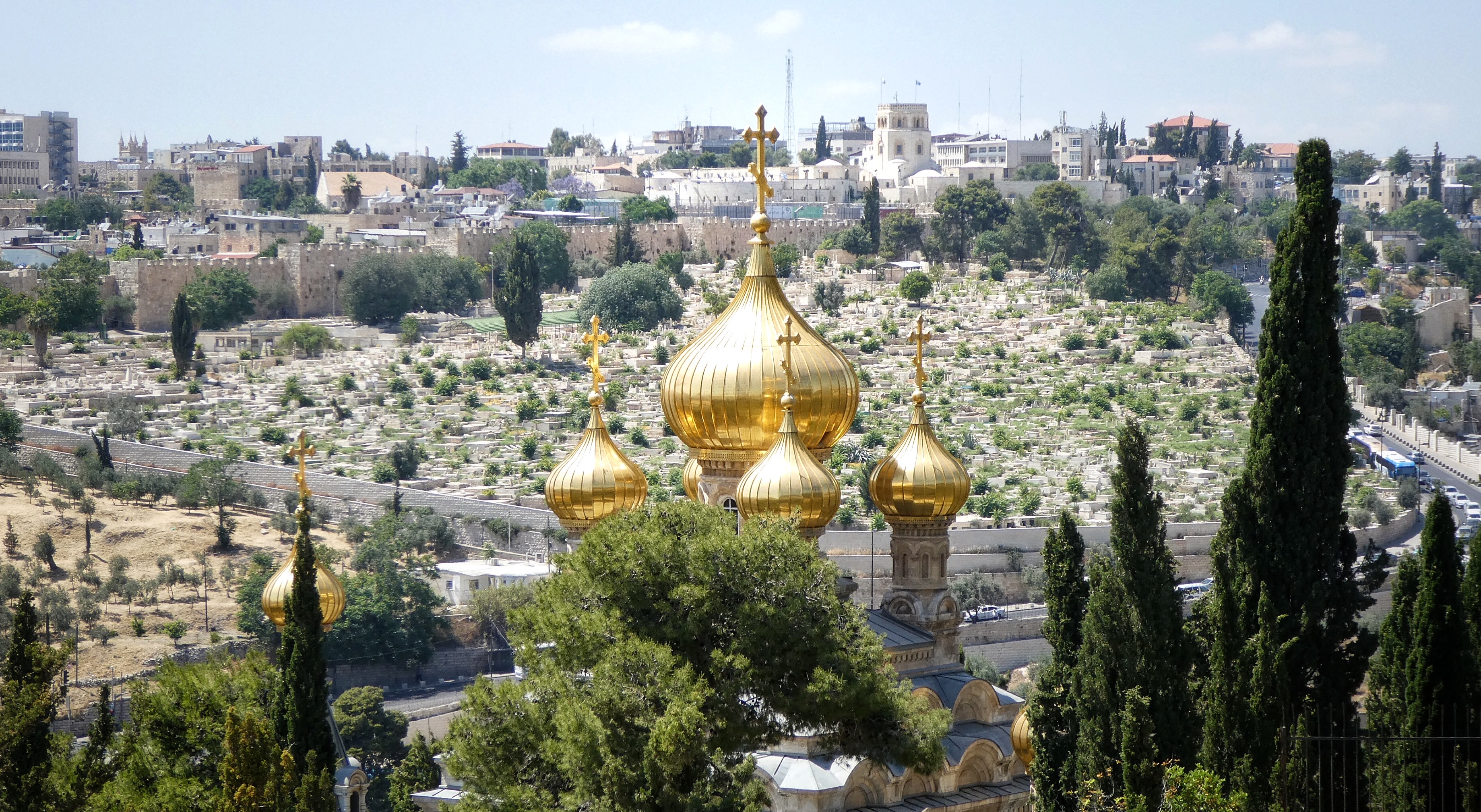
The Church of St. Mary Magdalene, viewed from the walls of Jerusalem. P.Hemphill, May 2014



 In That Howling Infinite